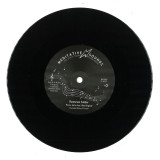
The 1979 album "Blå Vardag" by ATLAS is in every way indispensable when looking at the progressive music history of Sweden. Their sole debut album is combining the almost Zamla -esque playfulness on tracks such as "På Gata" with intricate, mellow melodies on e.g. "Blå Vardag" and "Den Vita Tranans Väg" while infusing heavy organs, carefully refined guitar riffs and fantastic synthesized sound scapes.
Bruno Berle, the young songwriter and poet originally hailing from Maceió, the capital of Brazil’s Alagoas state, crafts songs that are simple, direct, and full of tender nuance. With his first album No Reino Dos Afetos (which translates to "In the Realm of Affections” and was released in 2022), Berle firmly established himself as a unique and important voice in the burgeoning scene of new Brazilian artists making a global impact, including peers like Ana Frango Elétrico, Tim Bernardes, Bala Desejo, Sessa and more. Now back with his second album, No Reino Dos Afetos 2, he stretches that further.
Bruno Berle’s music lives between two worlds – a traditional Brazilian folk talent steeped in history, and a contemporary, dreamy electronic pop; the result is songwriting that’s genre-bending, intentional, iconoclastic and consuming, spacious and sinewy and singular, a striking reflection of its composer while leaving space for the listener to settle in. The album follows Bruno’s relocation to São Paulo, and the songs are a reflection of his past and present. A rebuke of former categorizations of his work in Brazilian music scenes, and an idea of where his music can move, unfettered.
Berle’s music is purposeful in being a true portrait of himself, and a reflection of the music, art, and fashion scenes he personally moves through. Berle aims to provide an entrypoint for Black queer joy in his music, in his storytelling, in his presence and vision as a creative. For him, it feels subversive to be playing MPB laced with dubstep and lo-fi, a sort of intentional sacrilege, capturing a dialogue of modernity in traditional music.
Berle wrote most of the arrangements and co-produced his new album, Reino Dos Afetos 2 with longtime friend and musical partner Batata Boy, who is also from Maceió; the album was recorded in Rio de Janeiro, Maceió, and São Paulo, his new home, and picks up the conversation begun in 2022 on Berle’s debut album No Reino dos Afetos. Both records are the result of a nonlinear but coherent seven-year music creation process culminating in these albums, holding hands across space and time.
“Tirolirole,” the first single from the record, was released at the end of 2023; sun-soaked rhythms and soft voice coat the song, the lilting refrain of “Tirolirole” throughout – hushed, gentle, but somehow almost tactile, a golden-hour moment unlocked in the mind. “Tirolirole” is a triumphant future classic about the temporality of a blossoming love, with Bruno’s stunning vocal soaring over melodies which ebb and flow like the waters on the Atlantic shore. Of the track, Berle explains: “Despite ‘Tirolirole’ being an expression that evokes my childhood, just like the light words about nature, the harmony, and the poetry are epic, carrying a great hope for love.”
In fact, the guiding theme of No Reino dos Afetos 2 is a relationship, unfolding in the arc of a weekend. It traverses the innocence of an early young love, how that can be formative, can stretch on to take new shapes, or shape you. The album happens at the genesis of meeting someone and falling for them, before the relationship is thrown into overdrive – set in a big city, against a backdrop of major life changes, rising energy, the sound of São Paulo.
Something transcendental emerges in “Dizer Adeus,” with an arrangement that echoes a gospel atmosphere (evangelical and Catholic environments were pivotal to Berle’s upbringing). On “É Só Você Chegar,” piano and flute gracefully intertwine, a dance, while “Quando Penso” skews sparser, the voice-and-guitar minimalism somehow cultivating an entirely different shape – somehow both cozy and melancholy, with the background sound of a rainy day. Coupled with the lo-fi aspects that shape much of the album’s personality in the vocals and the production, No Reino Dos Afetos 2 is meticulously elaborated by Berle’s sonic alchemy, like on the mid-album instrumental “Sonho,” which feels like floating. “It’s the apex. It’s when lovers are sleeping together,” Berle explains of the feeling he wanted to encapsulate in the song.
On “Love Comes Back” Berle interprets Arthur Russell, the late Iowa musician who only reached greater visibility after he died in 1992. “His way of making music is similar to mine,” Berle explains. “He sings in a more fragile way, has more of an experimental way of recording, letting ‘chance’ appear in the final work.”
Even so, Berle doesn’t want his music to be buried in sentimentality – and the purposefulness of his craft serves as a sort of north star. The production, the arrangements, his restraint and intentionality in crafting his songs feel just as vital as their emotional cores. His songwriting is amorphous, fluid, an encompassing genre-bending movement in-and-of-itself, quietly daring. The songs are often in conversation with other works – drinking in fountains as diverse as the filmmaking of Ingmar Bergman, the poetry of Walt Whitman, the rhythm of Djavan, and the painting of Maxwell Alexandre. Musically he weaves together a rich tapestry of Brazilian folk, UK 2-step garage/dub, trip hop and sun soaked west coast songwriters; something akin to the worlds of Milton Nascimento, Arthur Russell, James Blake, Feist, and Sade colliding into one. But even then No Reino Dos Afetos 2 floats separately, a romanticism driven by a simplicity and intimacy, an open-ended possibility, Berle’s singularity as an artist at the helm of the ship.
out of Stock
Last delivered 2 years ago available to reorder, subject to availability
Seafood Sam is a futuristic artifact. If that description might sound confusing at first, it matches the eclectic dualities found in true originals. With his effortless cool and timeless style, the North Long Beach native defies convention and exact comparison. He's a virtuosic rapper, a stop-you-in-your tracks singer, and a symphonic producer. Welcome to the lavish life of a laid-back transcontinental man of mystery, rolling in old school Cadillacs, eating caviar with a blade in his pocket, and making plays in vintage Pelle Pelle gear. A blaxploitation icon for the Instagram age, blessed with the bars of a `90s legend and 23rd century swagger. Seafood Sam is a true hero of modernity. On his full-length album debut for up-and-coming label drink sum wtr (Kari Faux, Deem Spencer, Aja Monet) debut, Standing on Giant Shoulders, Sam splits the difference between Snoop Dogg and D' Angelo, Curren$y and David Ruffin. The songs reveal a forward-thinking sensibility rooted in ancestral soul. He creates spiritual hymns for the streets that tap into universal ideals and irrepressible groove. In an era plagued by short-term thinking, his ambitions reveal a crate-digging depth of music history and a meticulous ear for detail. The giant shoulders in the album's title refer to James Brown, Bobby Brown, and Miles Davis - the holy trinity who inspired Sam's process. From the Godfather of Soul, Sam took a perfectionist's rigor and focus. The example of Bobby Brown lent an unshakeable confidence and self-belief. While the constant artistic left turns of the trumpeter that birthed Ccool offered an aspirational archetype. The story starts in the glory days of Long Beach hip-hop. As a young child, the G-Funk era soundtracked rides in Sam's father's car. Some of his earliest memories are trying to memorize Snoop's verse on "Nuthin' But a "G" Thang." Beyond gangsta rap, the LBC has historically doubled as a capital of lowrider soul and carwash oldies. At any intersection, you could hear Dogg Food or Brenton Wood, Warren G or Barbara Lynn. This too was absorbed via osmosis. It also just so happened that the art of performance was always in Sam's blood. So at family functions, he and his sister supplied entertainment by singing karaoke renditions of The Isley Brothers. While his Harlem Shake remains a thing of local lore. Long Beach is a culturally diverse mecca of skate parks and gang life, street fashion and tricky dance moves. This is the place that raised Sam on a diet of Wu-Tang and Nelly Furtado, Lil Bow Wow and Allen Iverson. He was the middle ground between his two older brothers: one who gangbanged, the other who graduated with a master's degree from UC-Santa Barbara. But it wasn't until the end of high school that Sam started to take rap seriously. Alongside long-time collaborators like Huey Briss and Reaper Mook, Sam's name began to make waves on the northside of the city, but he was partially distracted by a modeling career that paid the bills and took him all to way to walk in Paris' fashion week. The first turning point arrived with 2018's "Ramsey," a self-produced, slick-talk anthem with over 10,000,000 streams across all platforms. With each subsequent release, Sam showcased his peerless consistency, building buzz both online and in the city streets. Spin hailed his "smooth and unhurried cadences and understated lyricism_ that sounds like nothing else in Long Beach." Clash raved about Sam's "evolution as an artist, cruising through nostalgic production with slick, witty rhymes." The culmination arrives with Standing on Giant Shoulders. It's the evidence of a master, a young sensei in the model of Quincy Jones. All rhymes, singing, production, and arrangements were handled by Sam - with an assist from his close Long Beach kinsman Tom Kendall from the group Soular System. It's hard-edged and lyrical enough for disciples of Larry June and Roc Marciano, but orchestral and melodic enough for fans of Anderson .Paak and H.E.R.
Delphine Dora is a prolific composer, improviser and musician who has released on a plethora of labels including Recital, Morc, Sloow Tapes, Feeding Tube, Okraïna and more, and ‘Le Grand Passage’ is her Modern Love debut, a stunning set of songs for piano and voice, recorded in one take without overdubs or edits.
In an act of pure expression, Delphine Dora recorded the 8 songs of ‘The Great Passage’ in a single take, succumbing to a whirlwind of inspiration that transported her beyond the material world. Baroque paradigms bleed into fragile, introspective mantras, expressed through a made up language of existential yearning and channeled through piano and voice. It’s music that caresses the sublime, made without any premeditation.
Delphine was nearing the end of a three-day prepared piano residency when an technician stepped in to tune her grand piano for her final performance. He removed the objects from the strings and fixed the pitch, leaving Dora with a freshly tuned instrument. Mesmerised by its new sound, she proceeded to switch on her recorder and pour out her soul, channeling, in her own words, "something greater than myself".
The result is some of the most unusual but elevated material the prolific composer, improviser and multi-instrumentalist has ever recorded, rooted in a deep understanding of European musical history but willing to push at its boundaries, questioning the earthly logic of life and death, asceticism and impiety. Glistening imperfections lash 'The Great Passage' to the physical world, but Dora - seemingly possessed as she quivers in a fictional dialect - lets her fantasies intensify her spirit, lifting the music towards the heavens. It's not sacred music, per se, but it is unashamedly mystical.
On the luxurious, languid opening, Dora dissolves eerily familiar romantic piano motifs into an attentive ceremony, singing with charged emotion. Her words aren't really decipherable, but their resonance vibrates beyond language; it's striking to hear how confident she is in vulnerability. She lets the piano wrap into her voice, connecting us directly to a unique mode of emotional expression by urging us - the listener - to project our own meaning onto her abstracted words.
Dora refers to the act of improvisation itself as a way to indicate "the fragility of being”, and as her words blur in and out of focus, dipping from a hoarse croak to a choking wail, she places herself at the very edge of musical formality, questioning strictures put in place to suffocate self-expression. Her music has often been labeled "outsider", but here she sounds intimate and interconnected, more self-consciously candid than anything traditional might have allowed. She conjures affecting, plainspoken poetry, like a bedside diary written in a hypnagogic, delirious state: a stream-of-unconsciousness, channelling the beyond.
The album title connects to a book dedicated to French philosopher and activist Simone Weil, who famously pored over global religions to ascertain spiritual truths. To Weil, meditation was a passage to access mystical experience, or a bridge between humanity and divinity. In Dora's hands, this idea is a corridor between herself and the listener, a liminal place where she's able to address feelings without making anything explicit. The title, of course, also refers to life, its impermanence, finitude, and fragility, presenting the complex, multi-dimensionality of being through one of the most undiluted, unbridled set of songs imaginable.
This tune has a long history. We recorded some tracks with Prince Jamo back in 2010, of which this was one of them. A couple of years back Andreas picked up this track again with the idea of making a new riddim for it with live musicians and a more organic feel. Linking it up with Earth Works studio & musicians at the studio aka Signal One Band.
The riddim was then sent to Aba Ariginal for horns overdubs.
Andreas did make this all happen, so this is a retrospect release, in the loving memory of our brother, a true rootsman soldier, Andreas Weslien.
out of Stock
Last delivered 2 years ago available to reorder, subject to availability
How do you follow up a work described in the Independent on Sunday as “the best debut album since Marquee Moon”? That’s the question facing singer-songwriter John Canning Yates, twenty years on from the critically acclaimed ‘The First Album’ by his band Ella Guru.
‘The Quiet Portraits’ will appeal to anyone who loves the beautiful melodic soundscapes woven by Brian Wilson, Burt Bacharach, and Tom Waits, while Yates’s unique vocals evoke the emotional fragility and compelling narrative of Neil Young, Paul Buchanan, Mark Linkous and Elliott Smith.
Mastered by Jason Mitchell (PJ Harvey, Robert Forster), and featuring guest contributions from pedal steel maestro BJ Cole and friend and multi-instrumentalist Andy Frizell (Kevin Ayers, Wizards of Twiddly), those dedicated followers of Ella Guru who stayed the path will find their patience very well rewarded. ‘The Quiet Portraits’ is a remarkable achievement from an unassuming, yet hugely talented artist.
It’s a welcome relief amid the rapidly changing musical landscape to find that all that has changed in John’s world is the number of musicians around him. The beautiful storytelling, the art of finding those magical musical moments that will remain with you for years to come: all of that has survived the passing of time intact.
Happiest with headphones on, working alone in the small hours from his Liverpool home, Yates has created another masterpiece.
He explains: “In the wee small hours, with loved ones safely asleep and the busy day done, there comes a hush. Within it, you can breathe and listen. Listen for the infinite possibilities. From those possibilities emerged these portraits. I have sought to find those precious moments: of love and peace in turbulent times, of truth and hope for calmer days ahead. I hope you find them too.”
Entitled ‘The Quiet Portraits,’ the new solo album from John Canning Yates tells tales of people and places, of time, family, history, belonging, forgetting and remembering.
Often the best music gets made when people get out of their comfort zone and venture into new territory. That is what I felt listening to these tracks from Ukrainian veteran Alexander Pavlenko. He has a long history in drum 'n bass as Sunchase, and as Na Nich, you might have heard him on Rhythm Buro or Semantica, but this release reveals another side of him that we haven't heard before.
The Karpati EP kicks off with "Manipulation". A rolling sub and punchy drums propel the track's momentum forward and make it dancefloor-ready. The sounds on top take inspiration from multiple genres for a track that finds a perfect balance between the deeper sides of both house and techno.
Next up is "Still There", a stripped deep house tune where filtered percussion, pads and vocals alternate each other, flowing in and out of focus.
Title track "Karpati", a hypnotic techno track, takes inspiration from the mountain region in western Ukraine, the melody reflecting a similar beauty as the Carpathian nature. Add Na Nich's expert sound design on top, and the result is a deep and captivating trip.
"Morning Habit" rounds up the EP by slowing things down for a dubbed out house cut. Chords playfully bounce over the beat for a tune suitable for either the early or very late mornings.
out of Stock
Last delivered 40 days ago available to reorder, subject to availability
Released in July 1994 by Atlantic Records, Cracked Rear View is Hootie & the Blowfish's most successful album, reaching No. 1 on the Billboard 200 five times during the course of 1995. It was also the best-selling album of 1995 in the United States, selling 7 million copies, and since then has gone on to sell more than 10.2 million copies, making it one of the best-selling albums of all time.
AllMusic's Stephen Thomas Erlewine says Hootie & the Blowfish, on Cracked Rear View, "...deliver the goods, turning out an album of solid, rootsy folk-rock songs that have simple, powerful hooks."
The album played a pivotal role in shaping the career of its lead vocalist, Darius Rucker, who transitioned to country music in the mid-2000s as a solo artist. Cracked Rear View was an instant sensation, with chart-topping hits such as "Hold My Hand," "Let Her Cry," and "Only Wanna Be with You." The album has a distinctive sound, blending rock, pop, and a hint of folk, using Rucker's soulful, raspy baritone as its emotional core, and his heartfelt delivery to win over audiences.
This Analogue Productions (Atlantic Series) reissue of Cracked Rear View has the essential elements that make it a standout for your collection. We turned to Ryan K. Smith at Sterling Sound in Nashville for an exemplary cut direct from the master tape. Pressing on 180-gram vinyl is by Quality Record Pressings, and the album is housed in tip-on old style gatefold double pocket jackets with film lamination by Stoughton Printing.
Cracked Rear View's emotional depth and Rucker's distinctive voice left an indelible mark on the music industry, making Hootie & the Blowfish's debut album a timeless piece of musical history.
It's the year 2003. the world is bad and it would only be your fault if it stays that way. but the ärzte are doing what they've never done before: a double album. Everything has to be included! Punk, jazz, rumba, hard rock ... so many ideas, so many songs ... Even "Als ich den Punk erfand..." (When I invented punk ...) clarifies some aspects of human cultural history that have been clearly neglected up to now. The light-heartedly silly "Jag Älskar Sverige!" is a crowd favorite, "Geisterhaus" plays in the league of the great goth rock anthems, "Deine Schuld" provides the soundtrack to the clenched-fists-in-the-air resistance that is as permanently valid as it is double-edged, while "Die klügsten Männer der Welt" is more of a subtle dialectical critique. "Nothing in the World" is the official heartache cracker. There's also the bundle of pitch-black, cynical "Der Tag" with the blazingly amorous "Die Nacht" and two of the most good-humored zombie homage rock smashers of all time. And the absolutely compelling "Unrockbar" is instantly one of the signature hits of the best band in the world.
Nia Archives is the star at the forefront of the latest era of jungle. Since her emergence in 2020, her collagist soundscapes have helped bring the sound to a new generation of clubgoers (though fair warning: don’t call her a “revivalist” – she’s the first to point out that the scene never went away). So when it comes to talk of the 24-year-old producer, DJ, singer and songwriter’s much-anticipated debut album, the odds are you’re thinking of a full-length record of weightless jungle tracks with basslines so intense they’ll leave your ears ringing.
But the reality of the Bradford-born, Leeds-raised artist’s first ever album – while very much replete with that exquisite jungle sound she does so well – is also doing something a little different. On the thrilling and freeing Silence Is Loud, Nia Archives is looking to make music for beyond the rave. As she explains: “I think music can be experienced in different ways, and there’s different kinds of music for different scenarios. Say you’re at a festival listening to music with thousands of other people, that can feel really uniting. But then you might listen to an album on your own in the bus, or in a taxi; and this project is definitely more a record to sit and listen to than a collection of club tracks.” Nia is intent that Silence Is Loud is taken in as a full body of work of something “more song-focussed, putting interesting sounds on jungle.” It means that this is a record which finds gloomy Britpop, warm Motown, soaring indie, a love for Kings of Leon’s Aha Shake Heartbreak, skittering IDM, Madchester, classic rock, old skool hardcore and more, woven and fused into her ragga and junglist tapestry, all layered with feeling, imbued with her songwriterly lyricism about loneliness, relationships, family, navigating her 20s, and the intense potential power of silence.
The vast sonic palette on Silence Is Loud comes down to Nia’s broad array of influences through her life. With her Jamaican heritage, Nia remembers hearing jungle as a child via her nana, as well as at Bradford Carnival, where she was drawn to the soundsystem culture, dancing carefree on the floats in the parade. The first album she ever bought was Rihanna’s debut, Music of the Sun, and she also went to Pentecostal church back then, and was obsessed with gospel. Aged 16, she moved to Manchester, where she didn’t really know anybody: and so, her solution to meeting people was going out. “Partying was a huge part of my life,” she says, “They used to do little freestyle cyphers at the house parties and I would join in – that’s kind of how I got into singing.” She had found music boring at school, but in meeting all these new people she became interested in making her own music as a hobby. “I was making boom-bap kind of stuff which I didn’t really like in the end,” she laughs, “My lyrics are quite deep, so on a hip-hop beat it all sounds really depressing. I wanted people to dance to my music.” And so she began experimenting with faster tempos alongside that melancholy songwriting, teaching herself how to make beats on Logic: “It’s all been a lot of trial and error, really.”
Nia went to study music in London, and was also interested in visual art, making collages and VHS: “Before the music, I was trying to make a visual archive of my life and the people around me,” she explains, “And then my music was like my diary, and a sonic archive, as well.” Hence, she paired the word “archives” with her middle name, Nia. To this day, in her spare time she’s working on pulling together a documentary on the global nature of the jungle scene.
Back on those first two EPs, Headz Gone West (2021) and Forbidden Feelingz (2022), she honed that junglist sound, painting it with new flecks of colour and vibrance. It was only after she started releasing work that she realised pursuing music could be a viable life path for her. The decision has been paying off ever since. Nia Archives placed third in the prestigious BBC Sound Poll for 2023, alongside garnering a nomination for the Brit Awards’ Rising Star prize, plus wins at the DJ Mag, NME, the MOBOs and Artist and Manager Awards. She has also toured the world – be it North America, Europe or Asia – and even opened a show in London as part of a little something called Beyoncé’s Renaissance World Tour. She’s renowned as a party-starter in her own right, too, with takeovers at Glastonbury, Warehouse Project and her own Bad Gyalz day event. She’s done official remixes for the likes of Jorja Smith, had a huge summer hit with her Yeah Yeah Yeahs rework ‘Off Wiv Ya Headz’, and worked with brands like Corteiz, Nike, Flannels, Burberry, FIFA and Apple. In just three years, it’s fair to say that Nia Archives has become a need-to-know name in dance music.
But Nia is not interested in being one fixed thing. Building on the terrain from her third EP, Sunrise Bang Ur Head Against Tha Wall, the universe of Silence Is Loud is not totally unfamiliar territory; but it’s still emblematic of a bolder scope than we’ve heard from the artist before. Working with Ethan P. Flynn (the songwriter and producer known for his work with FKA twigs and David Byrne), the resulting record is an impressive feat of deftly-sculpted textures; sometimes big and euphoric, like the wobbly, lusty bass of ‘Forbidden Feelingz’, or elsewhere notably gentle and quiet – see: the gorgeous, surprisingly drumless ‘Silence Is Loud (Reprise)’, a heartfelt number that sits somewhere in the school of Adele. “I really sharpened my songwriting skill on this project,” Nia says, “I was really intentional about what I was writing about, and I really loved co-producing with Ethan. His process is so different to anyone I’ve worked with before, and he’s got a kind of DIY set-up like me.” Flynn’s flat overlooks the Barbican, adding that unquantifiable futurist urban quality that the area holds to the music. The pair enjoyed the collaborative process so much that the album was done within three and a half months.
Perhaps this is why Silence Is Loud maintains an exuberant immediacy while still being sleek and spacious, interspersed with flourishes of metallic beats, lush melody and topped with her sugary but powerful vocal, floating over it all. There is an intimacy to the record, perhaps in part due to Nia writing most of her lyrics while sitting in bed in her flat in Bow (once a bedroom producer, always a bedroom producer). You can hear it on the refrain for lead single ‘Crowded Roomz’, which finds rippling guitar lines cutting taut through the beats as Nia refrains: “I feel so lonely crowded rooms.” The song is an examination of life on tour, constantly surrounded by people, but not necessarily those she can be herself around; more than that, the track is exemplary in the category of sad bangers.
Silence Is Loud often finds itself in that push and pull between melancholy and euphoria. There’s a celebration of her unconditional love for her younger brother (the title track), a rumination of an evening with an Irish boy she met by Temple Bar (‘Cards On The Table), or a letter to herself on the light and airy ‘Unfinished Business’, even coming to terms with a lover having a past they haven’t quite processed yet (“nobody comes with a clean slate”). The latter was recorded the week after a music festival, and accordingly captures Nia’s vocal in its not quite healed, husky state.
Nia’s work is always a snapshot of where she’s at when she’s making it. This might not be the debut album you were expecting, but that’s what makes Silence Is Loud so special. Nia Archives has learned the rules of her sound, and is unafraid to break them, pushing jungle and herself into new, unchartered territories that, in turn, go some way to map the history of the greats of British dance music. More than that, it plants her firmly in that lineage.
out of Stock
Last delivered 16 months ago available to reorder, subject to availability
Gimme, Gimme, Gimme Desire, an everlasting grip of that youthful energy, that fire and fury you felt playing a style of music that gives you a lifelong addiction and appreciation. If you’ve once been part of that certain something, that became part of your identity, it never lets you go. Drummer Sascha, bassist Jan, guitarists Philipp and Tobias know how it is getting older but still feeling the fire. The four friends shook up the scenes out of Frankfurt in the 90s and 00s. They played in different bands, they toured Europe and the US of A, they were mods, punks, hardcore kids. And they never lost their connection and love for their music. That’s why they got together some years back, rehearsing and writing songs just for the heck of it. Out of pure desperation the four of them were thinking about staying a goddamn instrumental band, maybe working with projections and shit to fog the fact that there was something initial missing: a singer. The road was calling their names, and they wanted to play shows and let you and you and you know what they got... So, they gave it one last try to find somebody to fill the void behind the mic. What helped was a platform – basically Tinder for musicians – to find that certain somebody. They kept it simple and only dropped one thing: #blackflag. On the other side of the screen there is Sam, a mystical, ghostly punkrock fairy. Sam shares that same hashtag, and she wants to sing. So, why not give it a try? Sam takes the offer, shows up in the rehearsal space, and the rest is history. Sam owns it. Sam is prepared. Sam can sing, scream, kick ass and has the lyrics to back it all up! On different occasions they now set stages on fire. They played a sweaty show in a packed Molotow cellar at Reeperbahn Festival, they joined the “Female Fronted Is Not A Genre” festival at legendary SO36 in Berlin and took the place by storm. They are ready. They were born ready. And they have that record to prove it. As any classic hardcore/punk LP it’s almost over before it started. Ten songs in twenty minutes. That’s the way. I Am A God sets the tone: “You think that I’m a girl?”, Sam asks, “Let me tell you I am a god/ And you know that I’m heaven sent.” What else would Sam be? The legendary hashtagged Californian hardcore icons drip out of every note here. This is old-school knowledge, played today. Fast, furious, and packed with energy. But it’s way more than just a bland tribute. It’s a middle-finger that finds its own direction. Salary Man allows itself a certain amount of melody – also carried by Sam who obviously can do more than bellow. Or Somewhere that shows that The Pill is a more dimensional band that can even Hüsker Dü things up if they are willing to. The Bitter Pill presents itself surprisingly angular and kind of melancholic. And What’s New almost makes its way into post-hardcore territory. Inbetween Switch and Off give you all the Greg Ginn vs. Dez Cadena your damaged souls were desperately striving for. The debut album Hollywood Smile will be released on April 5th, 2024 by Hamburg’s Sounds Of Subterrania.
Shelly y Nueva Generación was a cult Spanish soul and garage band that left an indelible mark on the late 1960s music scene. Their rare 45s, now classic DJ spins in the mod/psych 60s scene, boast a funky Le Beat Bespoke style freakbeat sound. Three singles were released on Philips between 1968-69, including their stunning take on Nonato Buzar's 'Vesti Azul' and the outstanding original 'I'm Just a Fool', as featured on Ivan Zulueta's cult film "Un, Dos, Tres, Al Escondite Inglés". This long-awaited release unveils their complete discography plus many unreleased recordings unearthed from lost tapes now seeing the light of day for the first time! It comes with a 8-page booklet with extensive notes and rare photos of the artists. This compilation stands as both a celebration of the band's legacy and a rediscovery of the timeless allure that made Shelly y Nueva Generación an enduring force in the annals of Spanish music history.
Known for classic collaborative albums with artists like J Dilla, MF DOOM, and Freddie Gibbs, widely celebrated producer Madlib is a sampling savant who has crafted beats for the likes of Erykah Badu, Anderson .Paak, Tyler The Creator, Logic, De La Soul, and many more. The California artist’s latest project is Liberation 2, his second collaboration with hip-hop icon Talib Kweli. A global call for unity through space and time, the acclaimed album features appearances by Q-Tip, Westside Gunn, Roc Marciano, Roy Ayers, Goapele, Wildchild, Pink Siifu, and more. Now, the remarkable jazz-inflected Madlib instrumentals from Liberation 2 are receiving a proper vinyl release. Following in the footsteps of past Madlib instrumental classics, this limited-edition collection features 14 compelling tracks from one of the most gifted musical minds in hip-hop history.
Along the west coast of Co Kerry in Ireland you will find the amazing Valentia Island.
Attached by a bridge to the mainland, it is a place of beauty touched by years of history and the songs of the sea.
I managed to obtain a house there for a few weeks, I took my computer and mic with me not knowing what to expect when I got there. In one of the rooms sat a piano, and as my fingers touched the keys I knew there was a story there waiting to be told.
The sound of the piano in that place was something very magical as 100mph winds battered the house and interrupted my recordings.
Other material has since emerged from those days spent on the island, but the main body of work that I recorded there makes up this album that I now present to you.
Album support from: Gilles Peterson, Skream, Laurent Garnier, Patrick Forge, Jean-Claude (IF), Soulclap, Joszif, Makoto, Breach, Flight, dBridge, Doc Scott, Trevino, Craig Richards, John B, Klaus
Fiehe. Mr Scruff....
out of Stock
Last delivered 20 months ago available to reorder, subject to availability
Second Compilation Of New Music By Ex-Sarah Records Bands! Under The Bridge 2 is the sequel to the celebrated 2022 compilation album that reunited groups and songwriters who had once recorded for cult label Sarah Records. The new album showcases the continuing creativity of a special group of musicians who have never rested on their laurels. Bigger and more expansive than the first album, Under the Bridge 2 is a double LP, containing twenty brand new tracks. There is a huge range of material here, from intense, dark chamber pop to dense shoegaze to out-and-out indiepop. Exciting new groups are unveiled: The Gentle Spring (a new project by Michael Hiscock of The Field Mice); Vetchinsky Settings (a collaboration between Mark Tranmer and James Hackett of The Orchids); and Mystic Village (which features new songs by Robert Cooksey of The Sea Urchins). You will also see familiar starry names like Even As We Speak, The Orchids and Secret Shine - bands whose line-ups have remained mostly unchanged since the 1990s. And there are established bands who didn't appear on the first album but are now represented - bands like Action Painting! and The Hit Parade. Most of the tracks are exclusive and unreleased: there's the first new song from The Catenary Wires since 2021, a brand new fizzbomb from Jetstream Pony, a haunting instrumental from GNAC. The emphasis of Under The Bridge is on the new. The bands' shared history means they have a shared aesthetic, even a shared ethos - they all believe that the future is more important than the past. They are as independent and as uncompromising as ever, but they are still uncynical - and still excited about what Pop Music can be. Under The Bridge 2 is available as ltd vinyl double LP, CD and digital download. It will not be on streaming sites. CDs and LPs include a 12 respectively 24-page illustrated colour booklet.
What a difference a year makes, right? HOUSE Of ALL's follow-up to their self-titled debut came about at some risk to band and label . . . so absolutely sure of their debut, Martin Bramah asked for an advance on recording costs for the follow-up before their self-titled album had even been released. Needless to say, things went pretty well with the debut, which led to a few sold-out tours, wildly enthusiastic press and great sales. Follow-ups do come with perils, but perhaps Bramah's presumption was the very thing which has allowed CONTINUUM to escape the dread second album syndrome, because . . . it's fantastic! Whatever initial re-establishment of synaptic connection was needed to get things grooving on their debut, after many years since they'd last played together (excepting Peter Greenway, whose genuine bravery in joining four former members of The Fall whom he alone had never played with before) is history now. The grooves are bigger, the lyrics brilliant, Tomos Williams' production is top-notch and the necessity sitting on this album while the first one kept on rolling offered the advantage of allowing Dave Trumfio (of The Mekons and Pulsars) time to fine-tune the mixing and mastering . . . and it sounds HOT.
Remastered re-issue of this now classic work of Ambient / Dungeon Synth. Conceived in late 2002 as a soundtrack for one of the most sinister, dark, brutal and morbid periods of European history, the Dark Ages. Diving deep into Medieval works on witchcraft, demonology and theology, as well as the works of modern authors exploring all the aspects of that epoch, Roman Saenko (of Drudkh and Hate Forest) wanted to explore all shades of the Middle Ages. Bringing forth images, details and landscapes of that era into the modern world using a minimalistic yet very poignant pallet of sounds. Artwork by Heresie Studio.
out of Stock
Last delivered 2 years ago available to reorder, subject to availability
HoneyLuv impresses on her Crosstown Rebels debut with ‘Right Spot’, accompanied by remixes from house heavyweights Dennis Ferrer and Byron The Aquarius Unveiling her first solo production of 2024, the DJ Mag North America ‘Best Breakthrough Producer’ 2023 winner showcases a deeper side to her growing sound, backed by a pair of unorthodox remixes from two of house music’s favourite names.
One of the most hotly-tipped artists within the current house landscape, it’s safe to say Cleveland-born, London-based DJ/producer HoneyLuv arrived in 2023 and hasn’t looked back since. Riding high following a whirlwind twelve months, featuring as one of Radio 1’s Future Stars, Tomorrowland’s ‘20 of 2023’, and as a DJ Mag North America cover star, plus being selected as one of Beatport’s ‘Beatport Next: Class of 2023’ and most recently as one of Spotify’s ‘Mint Artists To Watch’, her 2024 account opens with a big label debut as she heads to Damian Lazarus’ iconic Crosstown Rebel for the first time. Paying homage to the rich house history of Chicago, she unveils her latest single, ‘Right Spot’ - joined by a double-dose all-star remix cast in the form of house icons Dennis Ferrer and Byron The Aquarius, two individuals who need little introduction.
Groove-laden and rich, harnessed by the alluring vocal at the heart of the production, ‘Right Spot’ is an excellently crafted trip through varying shades of house music as slick percussion and vibrant leads accent hazy textures to offer up a future-focused cut with nods to the past.
Dennis Ferrer’s interpretation sees the NYC icon switch things up as he veers towards the after-hours with a bubbly, stripped-back take that leans on colourful stabs, sweeping melodies and off-kilter drum shots. To close, Alabama’s finest, Byron The Aquarius’ remix ups the tempo and launches right into the action as tunnelling grooves and skippy hats take hold for an energy-charged ride.
out of Stock
Last delivered 16 months ago available to reorder, subject to availability
"Back in the 1990s original Verve pressings of this record were hot items pushed into prominence in great part by write-ups in The Absolute Sound, particularly by my friend Frank Doris. I found a few, and even a few in pretty good condition, but none of them begin to compare to this double 45 RPM set that offers more of everything, particularly transparency and instrumental separation. ...Ella's on a microphone with a slightly rising high end but if it sounds icy, don't blame the recording or the mastering. It's your system. If it's well-balanced and your cartridge is a good tracker, the vocal transparency and clarity are spooky and the sibilant articulation is precise. These double LPs cut at Sterling Sound use the original tapes, not copies of the original tapes and the clarity and transparency coupled with QRP's drop-dead silent pressings are remarkable. The original pre-MGM buyout LP has a pleasingly nostalgic quality and the added warmth produces a bit more room sound, but in my opinion it can't compare to this reissue unless you like hearing things through rose-tinted loudspeakers. Elegantly produced, arranged and recorded and easy to recommend ..." Music = 9/11; Sound = 9/11 - Michael Fremer, February 15, 2013.
Fourteen numbers from the heyday of swing, composed sometime between 1930 and 1945 - played and sung time and time again in ballrooms, or on the radio to advertise biscuits or war bonds, were recorded by Ella in completely new and personal interpretations in 1961. No one should be put off by the rather unfortunate cover. Clap Hands... is absolutely top notch as regards musicality, perfect recording quality, superb accompaniment by a small ensemble, with room for improvisations; it offers a wonderful opportunity to discover something new in these evergreens, despite the occasionally banal lyrics. The songs of this recording conjure up bygone days, with listeners in the 21st century being offered a highly personal homage to one of the most successful periods in the 100-year history of jazz.
Out of print as a stand-alone release for decades since its original 1974 issue. Produced by George Harrison, Shankar Family & Friends is an almost-forgotten masterwork – an emotional and sonic pact between two like-minded souls to both advance their spiritually minded bond and unite musical styles, cultures, and sounds in wondrous fashion Contributions from Ringo Starr, David Bromberg, Billy Preston, Nicky Hopkins, Jim Keltner, Klaus Voorman, and a host of virtuosic Indian musicians add to a diverse album that melds Eastern and Western traditions; encompasses jazz, funk, bhajan, Indian, and pop; and represents the spirit and breadth of Harrison's Dark Horse Records imprint.
Memorable contributions from an A-list of American and English musicians — Ringo Starr (drums), David Bromberg (electric guitar), Billy Preston (organ), Nicky Hopkins (piano), Jim Keltner (drums), Klaus Voorman (bass), Robert Margouleff (Moog), Malcolm Cecil (Moog), Tom Scott (saxophone) included — add to the richness of a set that melds Eastern and Western traditions. These “names” mesh with a host of Indian virtuosos — Alla Rakha, Ashish Khan, Kamala Chakravarty, Hariprasad Chaurasia included — who turn Shankar Family & Friends into a journey laced with percussive, string, and vocal components that aren’t soon forgotten.
Throughout, Shankar Family & Friends remains true to its title — a mesmerizing record named to reflect the group participation approach of its creators. The idea started when Shankar told Harrison about a ballet he wrote. The Beatle, who first met Shankar in June 1966 — roughly a year after Harrison became interested in Indian music after overhearing it in a restaurant while filming Help! — immediately was convinced they needed to record it. Harrison’s staunch admiration of Shankar and serious approach to Eastern styles are reflected throughout the album.
Indeed, for Harrison, Shankar Family & Friends marks the culmination of a years-long effort to master the sitar, study Hinduism, and incorporate elements such as drones, unusual chords, and expressive picking into his own songs. The seeds of this unique collaboration can be heard in Beatles works such as “Norwegian Wood,” “Love to You,” and “Within You Without You.” Both musicians were also fresh from performing at the 1971 Concert for Bangladesh shows. Yet Shankar Family & Friends remains entirely unique in each visionary artist’s history — and ultimately, led to a collaborative tour Harrison and Shankar staged across North America.
Encompassing jazz, funk, bhajan, Indian, and pop, Shankar Family & Friends is thematically split into halves. Side One reveals Shankar’s uncanny ear for melody — even when applied to Western forms. The lead-off “I Am Missing You,” the first single ever released by Dark Horse Records and reportedly the first pop composition Shankar completed, underscores his skills as a composer and global ambassador. Beautifully sung across three octaves by his sister-in-law, Lakshmi Shankar, the devotional song features multiple drummers and production that mirrors Phil Spector’s Wall of Sound approach. Harrison plays autoharp and guitar; Starr sits in on drums; Scott handles flute and soprano saxophone. It’s the inviting start of a musical adventure teeming with color, majesty, and mysticism.
A second version of the track — designated with a “(Reprise)” tag — appears minutes later. Unfolding in different ways, it follows a folk ballad structure stitched together with Indian instrumentation. Here, according to Shankar, the musicians “attempted to convey the sounds and atmosphere of Vrindavan, the ancient holy place where Krishna grew up.” Both renditions speak to the cross-continental fusion that came so naturally to Harrison and Shankar, whose oversight on the side’s other vocal tracks ensures listeners familiar with Western methods gain easy access to the hypnotic allure of his native country’s music.
Nowhere is this more evident than on Dream, Nightmare & Dawn (Music for a Ballet), the side-long piece that served as the genesis for Shankar Family & Friends. Launched with an airy overture and unfolding across three movements, the mostly wordless suite features everything from call-and-response interplay and classical lyricism to uptempo dance figures, stacked rhythms, and intoxicating grooves. Blurring the lines between contemporary and traditional, and Western and Eastern, the inspirational work is the exclamation point on a record that defined “world music” well before the term became co-opted as a catch-all genre.
DRIFT. Is British-Italian producer Nathalia Bruno, releasing music under the guise since 2015. Her 'techno-pop' EPs 'Black Devotion' and 'Genderland' released with Avant! records were the first explorations in finding the sound of DRIFT. but as the name suggests, is in constant flux. In 2020 'Symbiosis' the debut record was released on Hamburg's Tapete Records, an assemblage of lo-fi futurism reflecting on the breakdown of communication and interaction Nathalia felt was increasing around her. Channelling classic industrial electronica, haunting melodies, using samples, field recordings and curated sound as a 'canvas to rewire the vision of the future as colourful and old, ceremonial and rust beaten. A shrine like ornament and clinical machine language plaited together.'. In 2022 DRIFT. Self released 'The nature of things', a 30 minute piece entitled 'CTRL/ Algorhythm of love' written and produced for designer Mona Cordes' 'Cellusion' show for London fashion week. "_a journey into the dark heart of the dancefloor. The glimmering bass-heavy trance of its opening section could be classic Underworld, while its ambient center is genuinely Eno-esque. And then it all kicks off again as a Berlin school style banger. It's terrific" says Electronic Sound Magazine. This year, 2023 will give birth to DRIFT.'s second album released with God Unknown records '11 points In Time' written for and based on disappeared artist Rosi Crucci, compiled of sounds/field recordings recorded onto cassettes found in the attic of the home she last lived at, interpreted into song using some of her poetry and journal entries of what was happening in the world around her, attempting to finally give Rosi a voice. PRESS Louder Than War album review 'Symbiosis' (2020) "...blends passion with precision to create a tapestry of machine-made sounds that are bursting with ideas and filled with emotion. "We live in times where nothing means nothing," she sings on Visualise The Invisible. "And nothing is true." Never more so than now...Over the course of its ten tracks, Symbiosis draws from pretty much every strand of electronic music throughout its 50-year history" Shindig Magazine review 'Symbiosis' 2020 "A brilliant, fascinating album" Post Punk Magazine review 'Symbiosis' 2020 "is an exercise in disjointed meditation, a trip through the doors of the spirit lodge and inner workings of the human psyche." Pop Matters Review 'Symbiosis' 2020 "...One track in particular, "In Orbit", speaks to this new disturbing unknown we are creating. A distorted, three-note death knell drives it as repeated knocking seems to come from a dank tunnel. If it sounds bleak, it's likely also to be therapeutic and finds common ground with the entrancing industrial thud of Throbbing Gristle or Third Eye Foundation..."
Returning to the action and spectacle that have captured moviegoers around the world, Transformers: Rise of the Beasts take audiences on a ‘90s globetrotting adventure with the Autobots and introduce a whole new faction of Transformers – the Maximals – to join them as allies in the existing battle for earth. It's the seventh instalment in the Transformers live-action film series. Directed by Steven Caple Jr. and starring Anthony Ramos and Dominique Fishback, the film was released in June 2023. The soundtrack was in hands of Jongnic Bontemps, who gave the film a new sound. The score also features a reimagining of familiar musical compositions from the earlier movies by Steve Jablonsky. Bontemps felt his goal was influencing the score from the first five films directed by Michael Bay, but as the movie takes place after the events of Bumblebee (2018), which deviated from the timeline of the original films, he also needed to provide new fresh music. During the soundtrack's production, different musical styles were experimented with. However, Bontemps said they quickly realized that ""an organic, orchestral, emotional score, that sound we are all familiar with, and has such a deep history, goes a long way for we as the audience to connect with these robots."" Transformers: Rise of the Beasts (Expanded Edition) is available as a limited edition of 500 individually numbered copies on Autobots Red (LP1) vs Decepticons Purple (LP2) coloured vinyl. The vinyl edition features 5 bonus tracks and it includes a 4-page booklet with liner notes by the director, composer, and music executive of Paramount."
Transformers: Rise of the Beasts by Jongnic Bontemps, released 29 March 2024, includes the following tracks: "Autobots Enter", "More Than Meets the Eye", "Museum Heist", "Fallen Hero" and more.
This version of Transformers: Rise of the Beasts comes as a 2xLP. This release comes with (a) Booklet.
The vinyl is pressed as a red disc. Another vinyl is pressed as a purple disc.
Feels as if we're stepping outside the known universe of Nigga Fox but simultaneously being invited in. It's not about being hermetic, shutting out followers of his trademark dance beats or making an experimental statement per se. All this music comes effortlessly during sessions such as any other, so don't throw away valuable time searching for a concept.
"Chá Preto" sounds revolutionary but not so much in his discography, accustomed as we are to game-changing compositional solutions in the afro musical continuum but - never forget - also in Dance Music taken as a broad genre. But is it Dance? Certainly a fair amount of suffering and introspection comes clear throughout the album, namely in the sequence made up of "Má Rotina" and "Mutadoree Leonor". "Mutadoree" is a free, alternative spelling of "much pain" and each listener can process the info as s(h)e pleases. The music is also strikingly beautiful, so there's really no final word on this.
Beats come sparse, a very personal phraseology, the dancefloor a memory. Or just something to keep in mind for a future night out. Presently there's no lack of adventure or excitement in these grooves, a uniquely themed one-person show of musical skills and bare emotion. It ends in a snap, not a trace of embellishment. Pragmatic and out of the loop. Rewind and feel it all over again. Any comparison in mind? Flip through History books and you won't find this chapter.
SOYUZ (СОЮЗ) stole our hearts back in 2022 when we released their album Force Of The Wind to critical acclaim. Here we proudly present the predecessor to that LP, the band’s sophomore long player from 2019 that was previously only available digitally. It captures a pivotal evolving period in the band's career, the recordings giving a snapshot of what would become their sound on Force Of The Wind, yet with echoes of avant-psychedelic-pop footprints from yester years.
Produced at a time when band leader Alex Chumak had moved from Minsk to Kyiv, torn between the need to try something new and the homesickness it brought about. Travelling back to Minsk almost weekly, Alex joined fellow band members Mikita Arlou and Stanislav Murashko to lay down II at Studio 42. The album captures these transient feelings, contextualised through the broad scope of influences the band were nourished by. From MPB to Ethio-Jazz and the Italian library soundtracks of Piero Piccioni and Piero Umiliani, the album shines with touches of joy from across the globe.
The opening track 'Verocai' is a tribute to the Brazilian maestro and 'Mirouze', whilst being named after a French favourite of the band, Jean-Pierre Mirouze, pays clear homage to Milton Nascimento and Lô Borges. A ghostly sample and invisible connection to music made miles away in a different era that has influenced and become part of the band’s lives. This is further reinforced in the album's enchanting closer, the aptly titled 'Nascimento', another nod to the great Brazilian musician and singer.
The beginnings of the cinematic, soul-laden jazz SOYUZ are now known for, are on display across the likes of ‘Lyric’ and 'Motive I'. The latter an orchestrated jazz instrumental with sensuous string sections, all of which were recorded on the warmth of a Studer reel-to-reel and waltzing Rhodes keys.
SOYUZ’s wide-ranging palate is further demonstrated in tracks like ‘Business Partners’ with its Krauty, kosmische, new wave production featuring Inturist, and the oh-too-short Anatolian-influenced interlude 'Corrida'. Elsewhere, 'Tezeta' and ‘ES-2 Jazz’ hint at the psychedelic haze of soul-funk, with the former featuring verses from Serbian rapper Petar Martic.
For this new physical and digital release, the whole album was mixed from scratch by Ryan Power before Joker worked his magic on the remaster. More excellence is to come from SOYUZ, but in the meantime, we are thrilled to present this essential recording from the band’s foundational years, mixed to a level that does it the justice it deserves.
out of Stock
Last delivered 22 months ago available to reorder, subject to availability
Africamore: The Afro-Funk Side of Italy (1973-1978)
Continuing Four Flies' dedication to delving into lesser-explored periods of Italian music, Africamore takes us on a captivating journey into the intersection of Afro-funk and the Italian soundscape during the six years between 1973 and 1978 - a time when disco was looming on the horizon and the nightclub market was rapidly expanding.
Before reaching Italian shores, the infectious sound originating from African and Afro-Caribbean roots traversed both the Mediterranean and the Atlantic, landing on New York dancefloors, where DJ Dave Mancuso discovered "Soul Makossa" by Manu Dibango. In 1973, from Mancuso's Loft parties, the song's hypnotic groove spread to the rest of the globe, including in Italy, where it sparked a wave of imitations and variations.
Tribal influences thus found their way into Italian soul-funk and early-disco productions released between 1973 and 1978 – from psychedelic-tinged tunes like Jean Paul & Angelique's "Africa Sound" to the Afrobeat-inspired club banger "Kumbayero" by composer/producer Albert Verrecchia (aka Weyman Corporation); and from groundbreaking Afro-cosmic songs like Chrisma's "Amore", co-written by Vangelis and featuring the rhythms of Ghanaian-British Afro-rock band Osibisa, to mind-blowing floor-fillers like Beryl Cunningham's "Why O", a re-write of Nat King Cole's "Calypso Blues" arranged by Paolo Ormi, with percussion breaks that sound pretty much like what would later become known as techno.
Combining feel-good vibes with driving rhythms, world-style percussion, and even synths, all these productions pushed the boundaries of dance music at a time when disco had not yet taken over. In doing so, they sowed many of the seeds of the later Italian cosmic scene and its unique mixture of African elements, disco-funk and electronic music.
This was a brief but nuanced period in Italian music history, one that deserves to be rediscovered, with love.
Africamore is due out on March 22nd and will be available as a gatefold 2LP and digipak CD. Both formats come with stunning artwork by Kathrin Remest and liner notes by Pierpaolo De Sanctis and Elena Miraglia.
out of Stock
Last delivered 2 years ago available to reorder, subject to availability
Mon Goose is multi-instrumentalists Yegang Yoo and Robert Lombardo (both ex-Alex Delivery Jagjaguwar). Flowing seamlessly between dance grooves to experimental soundscapes, their songs twist and turn melodically through dense layers, animated by inventive live percussion and a creative melding of electronic and acoustic sounds. A Seoul-native trained in classical piano and composition at an early age, Yegang transplanted to New York City in 2000, where she and Robert began playing music together. Robert's history spans from playing guitar and drums in garages and basements, to the rabbit-holes of experimental and dance musics, to the present where he pulls from all of those influences in the music of Mon Goose and as a sound designer and composer for films.
Very Still Right Now lives in the intersection of music to listen to and music to dance to. Showing influences from space disco (stand-out track “I Feel Goose” is gloriously remixed by Lindstrøm) to Krautrock to techno ... to soundtrack records ... to classical ... it shifts and turns, sweeping you unaware from the disco dance floor to the melancholic high seas with a unique ability to contain, expand, and gradually distort moods without sacrificing a sense of lightheartedness. The album is the culmination of several years’ work from the duo, tangled in the wires of an arsenal of analog gear in their basement studio in Greenpoint, Brooklyn, and is the first offering of much to come.
out of Stock
Last delivered 2 years ago available to reorder, subject to availability
Beside Trawbreaga Bay, in Co Donegal, on the north coast of Ireland, in an old schoolhouse, with a suitcase full of hired recording gear, Oisin Leech strums gently on an acoustic guitar and watches the tide pull the water away from the ancient inlet - The thickness of Oisin's voice soothes the room as the sound waves bounce around in the land where his ancestors still live and still wander - With a musical history that led Leech from the street punk bands of yesteryear through an ongoing stint with folk duo The Lost Brothers, he found himself for the first time working on songs to sing alone. In his mind, the songs became imagined vignette films playing behind closed, guitar eyes. After writing nearly 40 new songs in this fashion, Leech wrote "October Sun" which would become the foundation for his debut solo record, Cold Sea.
Cold Sea was produced by guitarist/songwriter Steve Gunn. Leech dreamt of making the record in Donegal Ireland, a county significant to him because it is the home of his ancestors. Pitching this idea to Gunn sparked the first of several serendipities circling the Cold Sea sessions - Gunn had always wanted to visit Donegal to connect with his own familial roots in the region.
Cold Sea is perhaps most notable for its tremendous warmth. Each song was recorded in a few takes and adorned gently with synthesizers and guitar from Gunn. Several songs feature contributions on the upright bass by Bob Dylan band stalwart Tony Garnier. M. Ward plays guitar on October Sun and there are strings by Roisin McGrory and bouzouki by the legendary Donal Lunny throughout. It is a friendship record but even at its most collaborative, Cold Sea remains centered around the humble acoustic guitar and wool blanket vocals of Leech.
One of the most successful and enjoyable debuts in history, The Cars' self-titled album doubles as a greatest-hits collection. That's because not one song here is unrecognized or unknown. A huge reason why the Boston quintet became America's most popular new-wave band, The Cars launched eight tracks still regularly heard on radio stations everywhere. Consider the hit list: "You're All I've Got Tonight." "Good Times Roll." "Just What I Needed." "Moving in Stereo." "My Best Friend's Girl." "Don't Cha Stop." If you're a fan of pop music, this album is mandatory. Just call it the best new-wave rock album ever made.
And now, The Cars sounds better than it has in any previous incarnation. Mastered from the original analogue tapes, Mobile Fidelity's numbered-edition LP allows the music's oscillating rhythms, futuristic keyboard passages, panned stereo images, and rippling textures to be experienced like never before. The songs take on a surreal quality, the Cars manipulating the vibrant music at will to mesmerize the listeners' senses and hold them at bay. Mobile Fidelity's pressing epitomizes the sensation of "moving in stereo."
Led by Ric Ocasek and Benjamin Orr, the Cars managed to unite then-disparate styles: bubblegum pop melodies, angular art rock, progressive arrangements, and terse minimalism. Orr's low, understated singing and Ocasek's cool, detached vocals lend shades of doubt and double meaning to the lyrics, which are further counterbalanced by orchestral keyboard flourishes and electronic beats. The brilliant arrangements also benefit from a laidback cool and understated irony that remain uncommon in the over-the-top world of mainstream music. Obsessed with incorporating the latest technologies and sounds into its palette, the band spiced its tunes with delightfully quirky accents — country-tinged guitar fills, echoing Syndrums, reggae splashes, hard-rock tones, robotic pulses.
The results are the sounds of a creative landmark. At once accessible and eccentric, edgy and catchy, The Cars explodes with emotion, energy, and hooks. It's impossible not to get caught up humming and singing along to every song, an appeal that comes courtesy of Roy Thomas Baker's stellar production. The legendary producer, best known for his work with Queen, ensured that the record seamlessly packed a smooth midrange, spacious imaging, and call-and-answer choruses in one tight package. Baker's trademark touches with harmony vocals abound.
"The MoFi disc is much better than the original in every way. It's more dynamic, much more natural on top, and all three dimensions have a lot bigger space. This disc is great from start to finish, but "Moving in Stereo" will blow you away on a great system in a big room."
—Jeff Dorgay, TONEAudio
As a composer Martijn Comes has a special interest in timbral music and various musical traditions, with an emphasis on the electro-acoustic history. His works for the carillon were performed live at festivals like Le Guess Who and Rewire. He also released several solo-albums and collaborated with a wide range of contemporary artists like Frans de Waard, Lukas Simonis, Nicoleta Chatzopoulou and Hessel Veldman, with whom he co-produced the album EPoX, published by Bedouin Records in 2020.
Veldman is a veteran of the Dutch musical avant-garde and published several legendary cassettes on his label EXART in the early 80’s. His experimental soundscapes are laced with industrial elements, creating a hypnotic, dark undercurrent of sounds. Besides operating under his moniker Y Create, he was a member of the improvisation group Gorgonzola Legs and kept working intensively with Fluxus artist and Dutch underground cult-figure Willem de Ridder. The home-taping era shaped his free approach to music. His diverse musical practices have been traversing several decades by now and he continues to play music according to his own insights and intuitions.
Because of the emotional and poetic weight of the pieces, reverend Tom de Haan was consulted for this collaborative album. It was the start of a musical exploration and a search for peace, balance and above all freedom. Reaching out to a distant world, a place to come to terms with ourselves. A journey full of obstacles and setbacks. Sometimes persistently moving forward, sometimes doubtful. 'Are there Gods among us or inside us?' The music as a manifest, the expression of an inner struggle.
Throughout the chapters of this album layers of sound and distant voices arise and seem to float on the surface before they disappear again. Swaying on the gentle waves, running ashore, we find ourselves in unknown places. Manifest Exodus is an album for deep listening in the vein of Lustmord, Lawrence English or Rafael Anton Irisarri. It contains 4 rich, immersive pieces with austere drones, ambience, intense sonic textures and an incredible sense of detail to create a multi-layered escape to a better world.
Miles Davis created just one studio album with his original sextet: Milestones. And he made every moment count. Pairing with Cannonball Adderley, John Coltrane, Red Garland, Paul Chambers, and Philly Joe Jones, Davis not only laid the groundwork for the modalism that immediately followed but tailored a genuine modern-jazz masterwork laden with performances among the most explosive of his distinguished career. Sandwiched between the more famous 'Round About Midnight and the epochal Kind of Blue, Milestones remains a seminal work of art.
Sourced from the original master tapes and pressed on dead-quiet SuperVinyl, Mobile Fidelity's numbered-edition 180g LP grants each musician their own space amid broad soundstages. Afforded the benefits of a nearly non-existent noise floor and supreme groove definition, this vinyl reissue doubles as a time machine back to the February-March 1958 recording sessions.
Colors, shapes, and dimensions appear in the manner that resembles what you'd glean from behind a studio control room's window. Davis' burnished trumpet is rendered in three-dimensional perspective and seemingly coaxes the band to play with unburdened zest. Coltrane's trademark saxophone teems with lifelike tonality and images with specificity; his solos work in tandem with and against the driving rhythms. Garland's swaggering piano lines? Visualize the keys as he hits full stride, the chords and fills slithering around skeletal frameworks.
Inducted into the Grammy Hall of Fame and selected as a "Core Collection" record by the Penguin Guide to Jazz, Milestones is as famous for its title track – widely considered ground zero for modalism and bolstered by Jones' hallmark "Philly Lick" rim shot – as the players that produced it. The launching pad for many of Davis' improvisational flights, the album teases the explorations Coltrane would soon chase. Davis' own solo work broaches territories that far exceed what he had done in his bop-rooted past. Every song is a highlight.
Take the bravado "Dr. Jackle," featuring a hot-foot pace and bebop strains, or "Sid's Ahead," which continues the album's blues theme while juggling edgy harmonics and inside-out structures. On "Billy Boy," distinguished with an arco bass solo from Chambers, Garland gets a turn in the spotlight and channels the openness practised by one of his heroes, Ahmad Jamal. Even more instructive is the band's reading of Dizzy Gillespie's "Two Bass Hit." Three years removed from the version Davis and company recorded for the trumpeter's Columbia debut, this interpretation demonstrates the extent to which the group had jelled in a relatively short amount of time.
Then there's "Straight, No Chaser," the definitive rendition of Thelonious Monk's signature piece. Coltrane's marbled playing pulls at the tune's borders, Adderley takes liberty with solos, and Davis dances around his mates, at one point quoting "When the Saints Go Marching In" while demonstrating his knowledge of tradition and casting an eye towards the future.
About that future. Garland already had one foot out the door during the Milestones sessions to the extent Davis spells him on "Sid's Ahead." Jones would stick around for a bit longer but soon plot his exit. History proves Davis navigated the changes with visionary aplomb. Yet the chemistry, excitement, and beauty the sextet achieves on Milestones cannot be overstated. This reissue helps put the album in proper perspective – and presents the music the fidelity it deserves.
Le jazz homme is the 2nd album of Black To Comm related entity Mouchoir Ètanche. This time heavily influenced by French Jazz (?) as well as the usual suspects: Nurse With Wound, Luc Ferrari, JG Ballard, Surrealism. The human entity has finally been replaced.
"Program music, instrumental music that carries some extramusical meaning, some “program” of literary idea, legend, scenic description, or personal drama. It is contrasted with so-called absolute, or abstract, music, in which artistic interest is supposedly confined to abstract constructions in sound. It has been stated that the concept of program music does not represent a genre in itself but rather is present in varying degrees in different works of music." (Encyclopædia Britannica)
Prompt 1: Pascal Comelade's toy piano falling down the stairs , Hector Zazou pushing from behind, laughing
Prompt 2: Cool jazz played on antique mellotron, low in fidelity, and sad, Glenn Miller‘s grandma crying silently
Prompt 3: A hippie commune version of jazz as played by a cheap computer fed by Chat GPT with medieval buisine fanfare information and samples, trained on the entire Amon Düül II history, heavily looped yet unsynchronized
Prompt: 4: Same, but flutes and synths and trance and chants
Prompt 5: French female artist philosophizes about Shirley Temple, mysterious atmosphere, insensitive homme laughing nervously, heavily looped, hynotic 18th century orgue de salon underneath
Prompt 6: Cool jazz, Echoplex, strange rhythm, Blue Note daydreaming
Prompt 7: Hammond jazz with fake Cyro Baptista loop, Madagascar indri indri lemurs chanting fake sax solos in Malagasy language, electronic bells
Prompt 8: German jazz and artificial prayers, and Shirley Temple returning, with defect Publison recorded at GRM, destroying the voice recording
Prompt 9: Andrei Tarkovsky's moustache meets Johann Sebastian Bach's wig, a well gently lapping in the background, fifths, car crashing into a poor violent onsen geisha
Marc Richter records as Black To Comm for Thrill Jockey and under the Mouchoir Ètanche and Jemh Circs monikers (and solo) for his own Cellule 75 imprint. He collaborated with visual artists such as Ho Tzu Nyen, Jan van Hasselt and Mike Kelley. He also produces soundtracks and acousmatic multichannel installations for institutions such as INA GRM Paris, ZKM Karlsruhe and Kunstverein Hamburg.
in this music, that makes me bow my head out of respect for primal, natural forces. It is said that this third album in the discography is the most important one, I have no doubt whatsoever that "Magna Mater" is a polished, ambitious and the best work in the several-year history of Kalt Vindur, and if this is how black metal of the 21st century is to sound, it should be glorified without a doubt.
Recommendation!!! Amen."- Metal Crush 'Zine (Jarek) Cover artwork made by Maciej Kamuda (Blut Aus Nord, Spaceslug, Sunnata,
Trauma)
Heavee is a Queer Chicagoan DJ & producer with a long history in footwork. His 2022 'Audio Assault' EP on Hyperdub showcased synth-driven, melodic footwork, but ‘Unleash’ goes much further into audio world-building, with a fresh, spongy and citrus-y sound palette and rich, bright chord sequences.
It's minimal, airy, balancing light and dark, sometimes breezy and sometimes clinical. Heavee works simultaneously outside and inside the box, rebuilding footwork's framework and vibe to his own unique specification. Rhythmically, it's dance floor ready, using footwork's 160 template as a springboard for building new drum sounds to express these rhythms, and draws from R&B, rap, jazz and grime, with a sprinkling of bitter-sweet vintage Detroit techno.
‘Unleash’ takes footwork’s “eats all” approach to music and leads it in a fresh direction with a freedom of spirit. It's a strong addition to the footwork cannon and shows that experiments in dance music can be fun.
out of Stock
Last delivered 2 years ago available to reorder, subject to availability
HJirok is a mythical figure, conceived as a fictional character by Iranian-born Kurdish singer and artist Hani Mojahedy. Together with versatile music producer And Toma of Mouse On Mars, she combined a variety of sounds collected during their joint travels to Iraqi Kurdistan and elsewhere with heavily processed recordings of Sufi drum rhythms and setar melodies. The result is a driving, dubbed-out, and deeply intricate soundscape that perfectly sets the stage for Mojahedy's extended, unconventional vocal techniques and polyglot lyrics. Both informed by tradition and rigorously forward-looking, »Hjirok« (with a lowercase J) is at once a profoundly personal album and a universal utopian promise. As a ghost from the past, HJirok draws on Mojtahedy's memories to mould a new future out of them.
The foundation for »Hjirok« was laid in the city of Erbil in the Kurdish part of Iraq. During one of their stays in the region, Mojahedy and Toma recorded the three percussionists Hadi Alizadeh, Jawad Salkhordeh and Serdar Saydan as well as setar player Ali Choolaei from Motahedy's backing band while they were playingthe rhythms and notes that she had grown up with in the house of her grandfather in the Iranian city of Sanandaj. Her memories of that place revolve around hypnotic Sufi music, dervishes in deep trance, and ecstatic singing. Much like this music seemed to open a portal to other dimensions, the inhabitants of the house lived in a sort of alternative reality: It provided them with a hideaway from political circumstances. Following the Iranian revolution in 1979, a Kurdish rebellion ensued but was met with the utmost brutality by the new regime, which resulted in the death of thousands.
It is no coincidence that the music on »Hirok« would draw on rhythmic patterns that were passed on from one generation to the next for hundreds of years. »The project is rooted in the figures of the Sufi dervishes and thus a culture that precedes today's political, social, cultural, and religious systems,« explains Mohtahedy. »The Sufi sound travelled around the entire world. I like to think of it as a dialogue between peoples-one based on the rhythms of the drums and the sound of their voices.« Toma adds that by electronically transforming the recordings and enriching them with field recordings from both rural and urban spaces, they were able to use the stories told by the drums and the setar to create an entirely new narrative.
The story told by these eight pieces is hence a deeply personal, but also inherently political one. Moitahedy herself left Iran in 2004 and relocated to Berlin in 2010. Having continued to use her art as a platform to tirelessly advocate for the rights of the Kurdish people and women under oppressive regimes, she has not been allowed to return to her country of origin ever since. »Hani is singing for equality and there are people who are afraid of that-her femininity, her strength.« Toma says. Much like earlier Hirok sound installations addressed human-made climate change and other systemic ills, also »Hjirok« can hardly be disconnected from far-reaching struggles for liberation and equality.
This is also true on a thematic and even linguistic level. »The lyrics are about a promise,« Mojahedy says, citing Kurdish writer Ebdulla Pesêw as an inspiration. »At their core, these are about that day on which violence and fear become a thing of the past; what they tell you is ot not give up, to keep hoping,« she adds. The promise embedded in them is an emancipatory one. These contents are mirrored on a linguistic level: The lyrics were written in both Kurdish and Farsi, blurring the lines between the two languages and thus, Kurdish and Persian cultures.
Mojahedy, or rather HJirok, conveys these philosophical themes with elegance. Herversatile vocal performance is only loosely basedo n established styles. »Of course everything started with traditional rhythms, but we kept pushing things further and further, so Idid the same with my voice,« Mojahedy explains. »There were no boundaries.« The same can be said of the field recordings that she and Toma used. Whether it's conversations between members of the Pesmerge, the Kurdish armed forces, having a chat in meadow full of bunnies or the humming and buzzing of metropolises like Tehran: »Hirok« paints a sonic picture that is quite literally autopian one; that of a non-place in which different soundscapes, cultures and ways of life coexist peacefully.
What the album conjures up from Mojahedy's memory is not only a very specific place during a unique time in history as experienced by a single person. It is also ametaphorical home open to anyone who wishes to enter - promise of a better, more egalitarian future for everyone. Hence, HJirok will bring it on tour, presenting the material as an audio-visual live show that makes use of the photo and video material that Mojahedy and Toma have collected during their travels through Kurdistan.ja
out of Stock
Last delivered 2 years ago available to reorder, subject to availability
Idriss D officially launches the brand new label Nedjma with his own 2-vinyl, 8-track album as first release. The imprint will serve as a platform for up and coming talents from the Arabic world who are not represented in the current musical landscape. A very bold statement from Idriss himself, this record sees the Franco-Algerian dj and producer infuse his personal history into what he loves the most and share it with the rest of the world.
First track Tsakhbira works as the perfect opener for the album with a melodic ambient-like mood and Arabic chants, with second track Beld el fen following in the same vein with raditional instruments interspersed with synth stabs and eerie atmos.
Chazil’s upbeat rhythm spices up the vibe, a mix of ethereal
singalongs and bouncy percussions. Mohamed is the first foray into Electronic territory, a downtempo piece featuring French vocals and plenty of analog industrial clanks that lead into subsequent Hey Galbi, an exquisite melodic house number with acid synth melodies and piano keys.
Electro (Leila Moon Remix) delves into more experimental landscapes, with darker tones, blurred vocals and pulsating beats, while Elf Leila is quintessential Electroclash Arabic music, blending these two genres together, with a syncopated super catchy bassline. Closing track Harramt is a whirlwind of snare rolls, 303 arpeggios and nods to North African heritage sounds.
out of Stock
Last delivered 2 years ago available to reorder, subject to availability
Jacob Lusk, Ryan Hope & Ari Balouzian; an acclaimed gospel singer and choir director, an established film director and a classically trained musician and soundtrack artist. This is the trio that fate brought together and now make up Gabriels.
Their debut EP ‘Love & Hate In A Different Time’ comprises five songs that sound instantly of another era without faltering into throwback territory. True masters of story-telling, their timeless take on vintage soul, new R&B and just a hint of ultra-contemporary altpop have seen them become firm favourites of Gilles Peterson, Off White’s Virgil Abloh, Benji B, Annie Mac, Elton John... the list goes on.
The lead track and new single, ‘Love & Hate In A Different Time’, showcases their sound perfectly. A soul-stirring song with elements of funk and that joyous gospel influence too. Jacob has one of those terrifically cavernous deliveries and understands the power of when to adopt restraint and when to let rip. It’s raw, show-stopping and combines to form a magical few minutes of cinematic sound, unlike anything else out there today.
In the song’s long-form video, directed by band member and British born musician Ryan Hope (himself a celebrated music video director), we’re taken through a history of the dancefloor in archive footage, culminating in Jacob singing Billie Holliday’s Strange Fruit to a rapt audience during a Black Lives Matter protest in LA last year. It’s an engrossing, moving watch and an evocative listen.
out of Stock
Last delivered 14 months ago available to reorder, subject to availability
It all started with a crashed computer and it certainly didn’t end there. »Cinnte le Dia« is the third collaborative album by Hanno Leichtmann and Valerio Tricoli, their first entry into Ni Vu Ni Connu’s duo series that focuses on Berlin’s Echtzeitmusik scene and beyond. Having already released two joint records on the now-defunct Entr'acte label, the two musicians wanted to document a 2018 concert in Berlin, but technology failed them. Undeterred, the sound artist and percussionist and the electroacoustic composer went to the former’s Static Music Studio to record six of the eight tracks on this record straight to tape, with two additional ones being recorded during a performance at Eupen’s Meakusma festival in 2019.
After 2016’s »The Future of Discipline« saw the duo enter the studio for a one-take session with added synth-bass overdubs and 2018’s »La Casa delle Chimere« documented a live gig in Kyiv, »Cinnte le Dia« presents a synthesis of the two approaches. Mixing the album together and adding overdubs—Leichtmann with his synth-bass again, Tricoli with his trusted Revox B77—the duo combined the special energy of their performance in front of a live audience with the intimate atmosphere of a studio session between two exceptional improvisers and composers. The pieces are accordingly marked by their sonic density, but also a rhythmic intricacy that makes the album as a whole negotiate its place in music history between bass-heavy, dubbed-out club music and electroacoustic as well as musique concrète techniques.
Leichtmann worked with a mix of acoustic percussion routed through a modified looper and a granular live sampler as well as electronic drums consisting of three modular sampleplayers, a Syncussion drum synth and a bass drum module. Depending on the current set-up, the two fed this input through Tricoli’s B77 either individually or collectively to further manipulate single elements or the entire sound. What might look complicated on a tech rider sounds intuitive on record: these are two versatile musicians engaging in a play of difference and repetition, acting and reacting to each other in real-time, but also creating additional layers by inserting new elements after the fact. In a very literal way, »Cinnte le Dia« is the duo’s most refined album, yet at the same time a testament to the uncanny energy they unleash during their improvisations. It’s solemn and moody, spontaneous and driving at once. Of course a computer couldn’t handle that.
Numa Crew and the ’London City Warlord’ Riko Dan join forces on this dancefloor banger called ‘Babylon’.
When it comes to the influence of Ragga in the MCing styles of Grime, one of the undisputed pioneers is Riko Dan - most famously associated with Roll Deep, one of the most important collectives in the history of Grime.
The original track is an explosive mix of Grime and Dubstep sounds spiced with a Dancehall flavor that gives Riko the perfect platform to spin raw and punching lyrics.
The flip side is a remake of the original ‘Babylon’ in a pure Dub stepper style, heavyweight bassline, hypnotic skanks and mystical atmospheres that fuse the two worlds of Grime and Dub in a unique sound. Certified sound system material.
out of Stock
Last delivered 6 years ago available to reorder, subject to availability
REKORDER is "a kind of retrospective of myself", says M.RUX about his second, long-awaited solo album. For over 10 years, Marten Rux aka M.RUX appears as a DJ, producer, editor, remixer and multi-instrumentalist all over the world and has developed an idiosyncratic sound that opens up subtle fields of tension: M.RUX mixes a sound between experimental sound design and hooklines that stay in your ears forever. Between wild percussion and contemplative harmonies, between ecstasy and meditative calm. In his DJ and live sets, M.RUX usually steps up to the controls with a smile, discreetly bobbing his head, while the audience goes wild. He circumnavigates clichés with trustworthy certainty and develops his very own guiding threads in his selection beyond BPM or genre straitjackets. One constant is his warm, often stoically slow kick drum, which holds all that playfulness together. REKORDER is a manifestation of this typical M.RUX sound. Similar to his concept album "Vermonische Melodien" from 2020 (on the Pingipung label), the artist's curiosity is directed towards the musical visions of the past. When new music technology projected great visions of the future and when new sounds had not yet solidi ed into clichés. REKORDER refers to the recording device, spelled in a German way, because most of the recordings were made in Germany (and in England as well). Phonography is a miracle that has only been around for 150 years: Technology gifts upon us prosthetics for remembering sound. Every recording is a process, and every playback a new performative act. Recordari (Latin) is a beautiful word. It literally means to take something to heart (cor) once again (re-). This doesn't just refer to remembering, but also to a ponderous, loving, sometimes doubtful contemplation. It is a perfect headline for M.RUX’ approach to processing sound. REKORDER draws deeply from its own archive, which has ourished quite splendidly during the pandemic. Multi-instrumentalist M.RUX mixes his own recordings of banjo, guitar, auto-harp, synths, percussion and jews harp with fragments from sessions with friends that have accumulated since 2020. They unfold in the process of re-listening in the mix and transform into a solid musical tapestry. A typical gesture for this album? M.RUX bows deeply to the history of pop music - especially the blues and its melancholy, coolness and shuf ing groove. The harmonic framework of the album is based on blues scales throughout. Instead of conveying blue emotions via lyrics or the tone of the voice, as the original genre does, the synthesizer takes on this role on REKORDER. With his sound design, M.RUX achieves an ecstatic sorrow in his melodies, this gurgling portamento that is reminiscent of R&B (or even the ingenious title melody of the series "Bojack Horseman”). If voices are heard on REKORDER, then as hypnotic fragments that guide us through the groove as conjunctions: "Because...", says the voice in the track of the same name. That's enough. There are no lyrics, no literal weariness, no love-songs or storytelling, REKORDER processes all of this into timbres and groove as vessels for the album’s individual, contemplative melancholy. Never forgetting, with a gentle smile, to swing a leg.
out of Stock
Last delivered 21 months ago available to reorder, subject to availability
LIMITED RED COLOURED VINYL!
REKORDER is "a kind of retrospective of myself", says M.RUX about his second, long-awaited solo album. For over 10 years, Marten Rux aka M.RUX appears as a DJ, producer, editor, remixer and multi-instrumentalist all over the world and has developed an idiosyncratic sound that opens up subtle fields of tension: M.RUX mixes a sound between experimental sound design and hooklines that stay in your ears forever. Between wild percussion and contemplative harmonies, between ecstasy and meditative calm. In his DJ and live sets, M.RUX usually steps up to the controls with a smile, discreetly bobbing his head, while the audience goes wild. He circumnavigates clichés with trustworthy certainty and develops his very own guiding threads in his selection beyond BPM or genre straitjackets. One constant is his warm, often stoically slow kick drum, which holds all that playfulness together. REKORDER is a manifestation of this typical M.RUX sound. Similar to his concept album "Vermonische Melodien" from 2020 (on the Pingipung label), the artist's curiosity is directed towards the musical visions of the past. When new music technology projected great visions of the future and when new sounds had not yet solidi ed into clichés. REKORDER refers to the recording device, spelled in a German way, because most of the recordings were made in Germany (and in England as well). Phonography is a miracle that has only been around for 150 years: Technology gifts upon us prosthetics for remembering sound. Every recording is a process, and every playback a new performative act. Recordari (Latin) is a beautiful word. It literally means to take something to heart (cor) once again (re-). This doesn't just refer to remembering, but also to a ponderous, loving, sometimes doubtful contemplation. It is a perfect headline for M.RUX’ approach to processing sound. REKORDER draws deeply from its own archive, which has ourished quite splendidly during the pandemic. Multi-instrumentalist M.RUX mixes his own recordings of banjo, guitar, auto-harp, synths, percussion and jews harp with fragments from sessions with friends that have accumulated since 2020. They unfold in the process of re-listening in the mix and transform into a solid musical tapestry. A typical gesture for this album? M.RUX bows deeply to the history of pop music - especially the blues and its melancholy, coolness and shuf ing groove. The harmonic framework of the album is based on blues scales throughout. Instead of conveying blue emotions via lyrics or the tone of the voice, as the original genre does, the synthesizer takes on this role on REKORDER. With his sound design, M.RUX achieves an ecstatic sorrow in his melodies, this gurgling portamento that is reminiscent of R&B (or even the ingenious title melody of the series "Bojack Horseman”). If voices are heard on REKORDER, then as hypnotic fragments that guide us through the groove as conjunctions: "Because...", says the voice in the track of the same name. That's enough. There are no lyrics, no literal weariness, no love-songs or storytelling, REKORDER processes all of this into timbres and groove as vessels for the album’s individual, contemplative melancholy. Never forgetting, with a gentle smile, to swing a leg.
out of Stock
Last delivered 2 years ago available to reorder, subject to availability