Pleasure is a Sydney based music project that utilizes distorted synths, irregular drum beats and fluid song structures to create energetic and hypnotic pieces that straddle the line of bright and abrasive.The trio is comprised of Adam Connelly (synthesizers + vocals) Jonathan Boulet (bass guitar + fx pedals) and Hugh Deacon (drums). When playing live and on record, their music is improvised and unrehearsed with no laptops or backing tracks. “One of us will introduce an idea and the rest will follow.”
Their debut LP Saint Albans, was conceived and recorded in a small farm house in the town of Saint Albans, New South Wales, over 3 days from the 12th to the 14th of October 2019. The building has since burned down in the 2019 Australian Bushfires. “We came away from this session with close to 20 hours of material that we edited down into consumable pieces.” This is the case for all tracks except BRAIN WASTE 191013 which was left intact and unedited.
They launched the Australian release of the album by playing a 6 hour endurance set in a warehouse in Sydney’s Inner West. “Our sonic influences seem very obvious but we haven't been called out yet. Mainly Boards of Canada, Black Moth Super Rainbow, Aphex Twin, Fuck Buttons, Blanck Mass and Lightning Bolt.”
Поиск:hypno
Все
- A1: Kebrou - Banjey ‘Boogie’
- A2: Ateg Ould Syed - L’ensijab
- A3: Jeich Ould Chighaly - Wezin
- A4: Kebrou - Banjey
- A5: Deye Ould Amartichitt - Paris
- A6: Mohammed Guitar - Banjey & Medh
- B1: Baba Ould Hembara & Mama Mint Hembara - Moulana, Laa Moulana
- B2: Luleide Ould Dendenni - Wezin
- B3: Mohammed Guitar & Sbeyniat - Gelbi Vatimetou
- B4: Mohammed Cheikh Ould Syed - El Horr & Az-Zrag
- B5: Kweli Ould Seyyid & Klayhid Ould Meylid - Wezin
Legendary psychedelic guitar music from the Islamic Republic of Mauritania finally available on vinyl!
Originally released as a double CD in 2010, Wallahi Le Zein! has persisted as a cult classic, a collection of a rarely heard and utterly unique underground music scene, raw and unfiltered.
For fans of the more raw side of Sublime Frequencies, Sahelsounds, the ripping tape-hiss psychedelia of Les Rallizes Denudes, and anyone remotely interested in GUITARS.
12” 160 gram black vinyl LP, with 2 spot color reverse-board jacket, and 8-page full sized booklet with extensive notes and photos, and a history of Mauritanian guitar playing.
‘’this is the first curated collection of unfiltered Mauritanian guitar music ever, and I'm glad it's been introduced with such thoroughness and care.’’ 8.0 Pitchfork
The LP version we now present is intended as an immersive entry into this music: gnarled and virtuosic electric guitars weave hypnotically throughout melismatic sung poetry and exclamations, pulsing hand drums, party chatter, buzzing rigged desert sound systems, and all manner of the ambient sounds of Nouakchott wedded to oversaturated cassette in all its swirling, breathing, psychedelic glory. Operating entirely outside of any local recording industry, these songs were collected from bootleg tape stalls, wedding souveniers, and networks of musicians, expertly curated, researched and produced by Matthew Lavoie.
Drawing from the deep well of Mauritanian classical music, the gamut of musical modes and the tidinitt lute repertoire are transposed to the electric guitar - often with frets removed or additional frets installed, “heavy metal” distortion pedals and phasers built into guitar bodies, blurring the lines between Haratine and Beydane musical cultures, the ancient and the futuristic. At times transcendent and transfixing, and conversely a furious and cascading intensity that commands jaw-dropping attention.
Acid Dad is an American alternative-rock band composed of singer-guitarists, Vaughn Hunt and Sean Fahey, and drummer, Trevor Mustoe. Vaughn first started recording the band in his Bushwick, NY basement releasing singles “Brain Body” and their first EP “Let’s Plan a Robbery.” Appearing live in the New York City rock scene in 2016, Acid Dad quickly moved to a world stage with their self-titled debut album, released by Greenway Records in 2018. During 2020, the band spent their time building a new studio space in Queens, NY, while continuing to independently produce all their own music, art and even building their own guitars. With a new space and vision, the band produced their second LP, “Take It From The Dead,” set to be co-released in June 2021 by Brooklyn’s Greenway Records and psych powerhouse LEVITATION’s label, The Reverberation Appreciation Society. “Take It From The Dead” features an array of different influences ranging from 90’s neo-psych, modern post-punk and 70’s rock-n-roll. Acid Dad has crafted a record that sounds new, yet feels nostalgic. In contrast to their earlier work, they make use of slower tempos and expand their sound to include songs that are both more intricate and more hypnotic. To accompany the new record, the band spent the last year collaborating with video artist Webb Hunt, producing psych and glitch art videos that form a visual counterpart to the dreamy distortions of their sound. Take It From The Dead is out June 11th via Greenway Records / The Reverberation Appreciation Society on Deluxe LP & CD.
- 1: Road To Avalon
- 2: Click Click Domino (Feat. Marcus King)
- 3: Line On The Page
- 4: Raining For You
- 5: Little Liars
- 6: Deep River (Feat. Marcus King)
- 7: Heartworn Traders
- 8: Calico Coming Down
- 9: Learn To Love You Better
- 10: Long Gone & Heartworn (Feat. Jake Kiszka)
- 11: Mountain Lion Blues
- 12: Sing A Hallelujah
- 13: Has My Midnight Begun
For nearly two straight years following the release of their critically acclaimed debut, Chasing Lights, Ida Mae lived on the road, crisscrossing the US from coast to coast as they performed hundreds of dates with everyone from Willie Nelson and Alison Krauss to Marcus King and Greta Van Fleet. And while those shows were certainly formative for the electrifying British duo, it was what happened in between — the countless hours spent driving through small towns and big cities, past sprawling suburbs and forgotten ghost towns, across rolling plains and snow-capped mountains — that truly laid the groundwork for the band’s transportive new album, Click Click Domino. Written primarily in the backseat of a moving car, the record embodies all the momentum and possibility of the great American unknown, offering up a series of cinematic vignettes full of hope and disappointment, promise and regret, connection and loneliness. The songs on Click Click Domino are raw and direct, fueled by an innovative mix of vintage instruments and modern electronics, and the performances are loose and exhilarating to match, drawing on early rock and roll, classic country, British folk, and 50’s soul to forge a sound that’s equal parts Alan Lomax field recording and 21st century garage band. Turpin and Jean produced the album themselves, recording primarily on their own in their adopted hometown of Nashville during the COVID-19 pandemic, and while the collection is certainly bolstered by appearances from high profile guests like Marcus King, Greta Van Fleet’s Jake Kiszka, and Ethan Johns, the heart and soul of the record remains Ida Mae’s intoxicating chemistry, which has never felt more vibrant, ambitious, or self-assured. Now married, Turpin and Jean first met a little over a decade ago while attending university in Bath. The pair bonded immediately over their love for the sounds of bygone eras, and they quickly earned rave reviews everywhere from the BBC to the NME with their raucous first group, Kill It Kid. Starting over fresh as a duo named for Sonny Terry and Brownie McGhee’s “Ida Mae,” the first song they ever harmonized on, Turpin and Jean relocated to Nashville in 2019 and released Chasing Lights to similarly widespread critical acclaim. Rolling Stone hailed the album’s “stomping swirl of blues and guitar-heavy Americana,” while The Independent lauded its “retro lustre” and “impressive experimentation,” and NPR’s Heavy Rotation called it “tightly drawn, harmonic and hypnotic.” The music helped the earn the duo a slew of support dates with the likes of Greta Van Fleet, The Marcus King Band, Blackberry Smoke, Josh Ritter, Rodrigo y Gabriela, and The Lone Bellow, as well as performances at Bonnaroo, the Telluride Blues & Brews Festival, the Philadelphia Folk Festival, Germany’s Reeperbahn Festival, and Switzerland’s Zermatt Unplugged.
In the fall of 2016, having overcome serious health issues, Marco Repetto – Bigeneric – begins to weave new delicate soundscapes from a place of stillness, unaware of his emerging role in the fabled magic web of the fairy queen Helva. Inspired by an encounter with the storyteller Andreas Sommer and the legend of Helva, the fairy queen who lives on the Gantrisch mountain, and another gentle message from the universe, Marco Repetto merges his electronic strands of magical sounds into a tender and mystical composition he names Helva. Helva is a cinematic work of sound with long, hypnotically mesmeric tonal progressions and subtle ambient colors, combining influences from the electronic avant-garde and the futuristic spectrum of contemporary electronic music. This is the spiritual soundtrack of the Heart Rebels Gang who ceaselessly radiate into the world a powerful and profound force of beauty
Etruria Beat founder Luca Agnelli unveils his long-awaited debut album, ‘Source Drops’ – presenting a ten-track journey through techno and beyond.
A name at the centre of Italy’s rich house and techno scene for over a decade, Etruria Beat head-honcho Luca Agnelli continues to showcase his talent as a leading DJ, producer and label boss on the international stage. With releases via a host of globally renowned labels, plus standout remixes including Moby’s iconic ‘Porcelain’, the Tuscany native’s reputation has seen him become of the genre’s leading artists when combining energetic, entrancing productions throughout his powerful DJ sets. Yet, the core of his work has always found a perfect home on his own Etruria Beat imprint, with July now welcoming the arrival of his highly-anticipated debut album ‘Source Drops’ – an in-depth musical story presenting growth, development, self-reflection and raw emotions via a collection of ten tracks ranging from powerful peak-time anthems through to EBM influenced cuts and slower, hypnotic productions.
“This is the journey that traces my musical evolution of the last 20 years, discovering more conceptual, deeper musical territories; taking inspiration from what influenced me in my career as a DJ and from my continuous research without musical barriers. A journey always in equilibrium, at times dark and sharp, solar and fluid, that develops a different creative vision in each track trying to convey my most intimate and strongest emotions". – Luca Agnelli
Opening via the slow-blooming builds and atmospheric and waves of ‘Black Mirror’, before diving into the heady and menacing tones of ‘Mutant Circle’, the ten-track project quickly showcases a wide-reaching range of influences and nuances central to Agnelli’s development as an artist over his career. Productions such as ‘Balance’ and ‘Oxigen’ contrast with one another whilst bringing space to proceedings, guided by breaks-influenced percussion, minimal arrangements and warping leads, whilst the driving ‘Resistance’ harnesses classic techno tendencies to provide an energetic and lively, snaking journey through rich soundscapes.
Title cut ‘Source Drops’ brings that trademark Luca Agnelli energy to the heart of the project, merging scintillating melodies, acid-tinged stabs and icy hats to unveil a high-octane ride into the peak-time, whilst ‘Raw Surface’ keeps the tempo high with sweeping leads, oscillating basslines and resonant lasers. Next, ‘Omega’ spirals into an off- kilter ride through glitchy echoed vocals, crunchy percussion and rumbling low-ends, with the epic ‘Losing Control’ welcoming an infectious lead melody at its core guided by punchy kicks and slick drum licks. To close, the package veers to an eerie yet ethereal close as hazy, celestial vocal chants meet panning sirens and swooping electronics – punctuating an expansive and diverse offering from the Italian favourite and shaping up an impressive debut LP in the process.
His sixth EP on the Figure label catalogue, Brain Mechanix, finds the Stockholm producer UBX127 once again in top form.
Enhancing the proven formula, UBX127 combines outer-space atmospherics with heavy slabs of techno that will shake up any soundsystem. Revolving around a dusky vocal, opener Freek sets a hazy mood with chugging rhythms and some massive bass. Bastun then builds its eerie character on steady drums and squelching tones, before a hypnotic synth finally takes over.
A perfect example of finely trimmed minimalism, soothing B1 Likstroem carries itself by the presence of its rising and falling dub chords alone. Marking the culmination of the vinyl release, Teleport Into Space combines all of UBX127’ core qualities into a lengthy, albeit deeply rewarding ride throughout the stratosphere.
Repress
Calibre's mighty wind has blown through the drum 'n' bass scene ever since his first tentative forays into production in 1998. As a trained musician and student of the genre, he quickly developed a unique sound that was warm, orchestral and hypnotic. Attracting the attention of tastemakers like Fabio, the Belfast-born producer and DJ was encouraged to work harder and faster on this liquid funk, resulting in what would become his signature sound. By the time his sophomore album, "Second Sun", came into orbit, Calibre was recognised as a shining star of the scene.
One of the few who had realised the potential of the album format, he crafted dubbed out house grooves, jazzier downtempo numbers, and introspective vocal-led tracks amongst the more trad tempos the largely dancefloor single-based genre was known for.
The album is awash with high points, from the anthemic "Drop It Down", to the more reflective MC tracks like "Timeout" and "Blink Of An Eye". Most producers would labour over such delicately balanced arrangements for weeks, but the fact that Calibre can knock such masterworks out in a matter of hours tells you how effortlessly and naturally his music comes to him.
"Working quickly gives me a unique and personal sound," says Calibre. "It also helps that I like to sample my own playing. Any type of instrument I could get my hands on, I'd record it live. Maybe quite badly, but I still did it. It helped create my own sound. If you can play an instrument, and you can play it with a little bit of passion and a little bit of love, it'll give you something back."
In the fourteen years that have passed (Second Sun dropped in October, 2005) Calibre has written more material than quite possibly anyone else in the scene, and this year shows no sign of him slowing up. Besides the usual wealth of remixes in the pipeline, and a forthcoming techno album on Craig Richards' label, a sixth Shelflife compilation of unreleased Calibre material will be dropping on his own Signature Records label. But for now, let's rewind the story, as the man himself takes us, track by track, through Second Sun.
The Italian producer Daniele Serraino aka D/n, label boss of Spazio Magnetico, publishes his EP entitled Phase Transitions, a title connected to the concept of the album which is magnetism, paying homage to the label's name.
There are three tracks produced by D/n, "Anomaly" and "Dipolar" characterized by hypnotic sequencers, tunnels, with dance flore rhythms. With "Polarity" D/n explores abstract, floating settings with broken rhythms.
Thanks to the dotdat remix of track Anomaly, powerful dance floor track.
Traditional village music transformed into fiery and frenetic underground Hip Hop. Emerging from the digital cultural renaissance of the early 2000s, where DIY studios sprung up throughout West Africa, "Patriote" is a shining example of localized global music. Hypnotic and driving rhythms built from sampled percussion and chopped-up instruments combine with syncopated staccato "ragga" inspired flow into infectious hammering tracks that sound like nothing before. Mamaki Boys was formed in 2002 by Aziz Tony, Bachou Issouf, and Salif André, when a local Hip Hop movement was exploding in the capital of Niger. "Patriote" was recorded to address a trend in the scene they perceived as too derivative. Produced at Studio BAT, one of the first studios in Niamey, Mamaki Boys sought to merge modern Hip Hop with traditional music. They invited elder musicians into the studio to play Nigerien instruments like duma and kalango, which were sampled and looped over their compositions. "We wanted to put tradition in the rap, ancestral dances, the things that our grandparents did in the village," Aziz explains. "Our mission was to re-value the culture, put it into Hip Hop, and to show all the colors of our country." Self-describing their music as "tradi-moderne", a Nigerien movement of folk revitalization, their cultural manifesto presents through every aspect of their work. Each track relies heavily on traditional instruments, and each rhythm is based on a dance from Niger. Their mission extends to the urgency of their lyrics: Takai challenges the population to preserve their culture, Kagani Kagani is a demand to take back mineral, oil, and uranium rights from their colonizers, while Komando uses war cries to inspire artists to keep speaking out. A strong entry in 21st-century global music, Mamaki Boys "Patriote" takes back the tools of globalization, repurposing them in the fight for cultural identity. Originally self-released in 2009 on limited edition CDR in Niger.
HET returns with a Various Artists EP.
Featuring tracks from talented Berlin-based artists, this release offers a wide range of sounds, that fit different dancefloor situations perfectly.
With ‘’Sleeping Paralysis’’ Tigerhead is delivering a driving and dynamic sound. Her uncompromising track reaches the future post-pandemic floor at peak time.
Justine Perry’s ‘’All of a Sudden’’ is her very first solo track release.Through a deep bassline and intense rhythmicexplores a more hypnotic side of the Techno genre.
Jay Quentin returns after his highly anticipated track ‘’Information Superhighway’’ for the :// about blank004 EP. Here, his track ‘’Fatal Accident in Suicide Forest’’ takes ravers and listeners on a deep musical journey.
2021 Repress
Rone is a stalwart of the French electronic scene and returns with his fourth album, 'Mirapolis', a synesthetic journey with features from Bryce Dessner (The National), Baxter Dury, John Stanier (Battles) and Saul Williams. The artwork was created by the critically acclaimed director Michel Gondry.
Stepping into Rone's music is like sleepwalking through a vividly colourful dream, eventually stumbling across a strange, scintillating Megapolis of saturated light and colours: 'Mirapolis'. Its twelve tracks / districts, each with their own specific planning, pulsate as though animated by their musical mastermind.
The project was an opportunity to get reacquainted with long- time stage and studio partners John Stanier, Gaspar Claus and the Vacarme band and Bryce Dessner (guitarist for The National,) while bringing in new collaborators (and thus, new interpretation of Rone's dreams). We find American slam-poet Saul Williams, who happened to be in Paris for a moment and contributes a searing anti-Trump screed, Baxter Dury, who brings an irresistible East London touch to 'Switches', a kind of fan fic that reimagines the Beatles' Sergeant Pepper lounging pensive in a club chair, Israeli electronic music muse Noga Erez, who inspired 'Waves' which, despite being recorded remotely, betrays a euphoric partnership, and finally, Kazu Makino, Blonde Redhead's bewitching singer and multi- instrumentalist, who contributes to the album's closer, the gauzy 'Down For The Cause'.
Rone remains a producer of grand instrumental pieces, which cannot be easily categorized in the architectural canon of our electronic music galaxy. Hypnotic, cinematic opening track 'I Philip' is an offshoot from the score for the first French virtual reality fiction, built around Philip K Dick - the perfect gate into a city that then opens up myriad temporal perspectives.
Alan Dixon launches his brand new label 'Love Attack' with a release from fellow North Eastern Man Power. The 'Multi Periodic Oscillations EP' is three tracks from Man Power at his curious techno best. Deep, dark and dubby, suitable for all of your 3am needs. Opener 'Cepheid Variable Part 1' is 11 minutes of twists and turns, revolving around a hypnotic groove. It's baby brother Part 2 keeps the vibes in tact with 'Applegate Mechanism' closing the EP in a straight up dancefloor fashion. Keep your eyes on 'Love Attack' with many more releases lined up for the next year.
- A1: Africa Is My Root - Osayomore Joseph And The Creative Seven
- A2: Ta Gha Hunsimwen - Akaba Man The Nigie Rokets
- A3: Popular Side - Akaba Man And The African Pride
- B1: Iranm Iran - Victor Uwaifo And His Titibitis
- B2: Sakpaide No 2 - Victor Uwaifo And His Titibitis
- B3: Ta Ghi Rare - Akaba Man The Nigie Rokets
- C1: My Name Is Money - Osayomore Joseph
- C2: Ogbov Omwan - Akaba Man The Nigie Rokets
- C3: Aibalegbe - Victor Uwaifo And His Titibitis
- D1: Who Know Man - Osayomore Joseph And The Ulele Power Sound
- D2: Obviemama - Victor Uwaifo And His Titibitis
- D3: Ororo No De Fade - Osayomore Joseph And The Ulele Power Sound
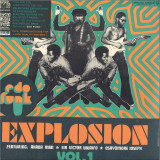
Analog Africa Presents Edo Funk Explosion Vol. 1, available on
2xLP/Gatefold LP with 20-page booklet / CD with 36-page booklet. It was
in Benin City, in the heart of Nigeria, that a new hybrid of intoxicating
highlife music known as Edo Funk was born.
It first emerged in the late 1970s when a group of musicians began to experiment with different ways of integrating elements from their native Edo culture
and fusing them with new sound effects coming from West Africa s night-clubs.
Unlike the rather polished 1980 s Nigerian disco productions coming out of the
international metropolis of Lagos Edo Funk was raw and reduced to its bare
minimum.
Someone was needed to channel this energy into a distinctive sound and Sir
Victor Uwaifo appeared like a mad professor with his Joromi studio. Uwaifo
took the skeletal structure of Edo music and relentless began fusing them with
synthesizers, electric guitars and 80 s effect racks which resulted in some of the
most outstanding Edo recordings ever made. An explosive spiced up brew with
an odd psychedelic note known as Edo Funk.
That’s the sound you’ll be discovering in the first volume of the Edo Funk Explosion series which focusses on the genre’s greatest originators; Osayomore
Joseph, Akaba Man, and Sir Victor Uwaifo: Osayomore Joseph was one of the
first musicians to bring the sound of the flute into the horn-dominated world
of highlife, and his skills as a performer made him a fixture on the Lagos scene.
When he returned to settle in Benin City in the mid 1970s - at the invitation of
the royal family - he devoted himself to the modernisation and electrification
of Edo music, using funk and Afro-beat as the building blocks for songs that
weren’t afraid to call out government corruption or confront the dark legacy of
Nigeria’s colonial past.
Akaba Man was the philosopher king of Edo funk. Less overtly political than Osayomore Joseph and less psychedelic than Victor Uwaifo, he found the perfect
medium for his message in the trance-like grooves of Edo funk. With pulsating
rhythms awash in cosmic synth-fields and lyrics that express a deep personal
vision, he found great success at the dawn of the 1980s as one of Benin City’s
most persuasive ambassadors of funky highlife.
Victor Uwaifo was already a star in Nigeria when he built the legendary Joromi
studios in his hometown of Benin City in 1978. Using his unique guitar style as
the mediating force between West-African highlife and the traditional rhythms
and melodies of Edo music, he had scored several hits in the early seventies,
but once he had his own sixteen-track facility he was able to pursue his obsession with the synesthetic possibilities of pure sound, adding squelchy synths,
swirling organs and studio effects to hypnotic basslines and raw grooves. Between his own records and his production for other musicians, he quickly established himself as the godfather of Edo funk.
What unites these diverse musicians is their ability to strip funk down to its
primal essence and use it as the foundation for their own excursions inward to
the heart of Edo culture and outward to the furthest limits of sonic alchemy.
The twelve tracks on Edo Funk Explosion Volume 1 pulse with raw inspiration,
mixing highlife horns, driving rhythms, day-glo keyboards and tripped-out guitars into a funk experience unlike any other.
DJ Sotofett and LNS have teamed up with Tresor Records for Sputters. The double-vinyl album with 15 cuts spans a hybrid of warped electro and psychedelic hypnosis, all the while remaining fixed in an unmistakable dance release. Recorded between 2017 – 2020, and bookmarked throughout by intros and interludes dug out from archival material, it's a deconstructed yet classic compound of techno-sonics.
LNS from Calgary, Canada, is rooted in braindance, electro and acid. Releasing 12inches on both her self-titled imprint LNS and Sotofett’s Wania - LNS, whilst in the studio, has often pointed out “the lacking blend of dub and electro in dance music”.
DJ Sotofett, hailing from Moss, Norway, is among a myriad of things commonly known for the extended work of his Sex Tags Mania and Wania labels, without forgetting his afro, dub and jazz releases on Honest Jon's London.
Together both artists give space to a guest appearance by E-GZR, a fellow Wania artist, to open the Sputters journey. The sinus bending drum stutter of K.O. by E-GZR collisions flanging basses and chronic-inducing synth pads to blueprint the technoid atmosphere to come. LNS & DJ Sotofett take control with El Dubbing, evoking an effect-heavy demeanour, typical of the Sex Tags Mania soundworld that DJ Sotofett is responsible for, this time rubbing up against solid electrified rhythms. The hypnotic moods carry over to Dúnn Dubbing's deep delays, freely running over a surprisingly minimal skeleton retaining a solid direction. Crafting a warmly emotive end of Side-A with sparse rhythms to perfection.
A meaner turn introduces Side-B. Hints of electro are scattered everywhere, fat basslines, ricocheting drums and synths that mourn and drift in and out of harmony. Vitri-Oil exposes a tumbling sound design, fog-lit chords of material fragility and nosedives - with an alive mix that wallows and grows in equal measures. The side closes with Shim, a classic drift between house and techno releasing sensual euphoria with the albums first big surprise – grand strings.
“LNS wanted to sell her TR-606, while my reply was for us to make a track with the 606 sounding so fresh that she'd never even think about selling it again” Sotofett states. Side-C proves the artists to be some of the most singular producers around with album centrepiece The 606. Clocking in over 10 minutes, it kicks off as a driving techno banger, chugging bass and big chords. Midway through everything falls away, and out of the void enter scattered drums and improv piano lines emerge, while twisted dubs lead us back in an enduringly warm groove.
Side-D sets the clock back to the original electroid foundation of the album, casting fires with alien vibrations. Synchronic Bass Blort is a hard-hitting electro track, steaming sonics and thrills, its melodic hook diving in subterranean motions. On Sputtering the duo raspily beams into outer space, with fizzy motives that disfigure and dazzle while the harmonies of the closing track is for yourself to experience.
DJ Sotofett and LNS deliver an album inhabiting a world full of sci-fi sonics and fierce groove. Their sound is free and live, simultaneously wondrous and sharp.
- A1: Conjunto Típico Corazón De La Selva - Alegría En La Selva (02:47)
- A2: Los Pihuichos De La Selva - La Carachama Coqueta (02:46)
- A3: Los Pihuichos De La Selva - Chupizinatay Yacui (02:37)
- A4: Los Pihuichos De La Selva - Shamuy Pacarina (02:32)
- A5: Los Pihuichos De La Selva - El Montañés (02:41)
- A6: Los Pihuichos De La Selva - El Huancahui (02:38)
- A7: Los Pihuichos De La Selva - Flautero De La Montaña (02:31)
- A8: Los Pihuichos De La Selva - El Jornalero (02:30)
- B1: Los Pihuichos De La Selva - La Danza Del Trapichero (02:32)
- B2: Conjunto Típico Corazón De La Selva - Picaflor Loretano (02:31)
- B3: Conjunto Típico Corazón De La Selva - Ushpagallo (02:56)
- B4: Conjunto Típico Corazón De La Selva - Punchacacho Tutacacho (02:50)
- B5: Los Pihuichos De La Selva - De Dónde Vienes Loretano (02:31)
- B6: Conjunto Típico Corazón De La Selva - Bailando En La Selva (02:52)
- B7: Los Pihuichos De La Selva - La Huayranguita (02:34)
Andrés Vargas Pinedo is a prominent composer of Amazonian popular music from Peru. He is blind and has excelled as a player of the quena and the violin. He was born in the city of Yurimaguas but he developed as an artist in Lima, for thirty years he has worked as a traveling musician on a street in the San Isidro district of Lima. Throughout his career, he has formed and joined various popular music groups. This compilation presents fifteen songs of his authorship, belonging to his first two groups: Conjunto típico Corazón de la Selva and Los Pihuichos de la selva, active between 1965 and 1974, and which helped define the sound of Amazonian popular music.
These years saw the emergence of an Amazonian popular music movement led by Vargas Pinedo as well as groups such as Los Solteritos, Flor del Oriente or Selva Alegre. These artists based their music on the rhythms of the Amazonian folklore (pandilla, sitaracuy, movido, cajada, chimayche) and were nourished by influences from the coast and the highlands of Peru, as well as by the tropical rhythms of Brazil, Colombia and Ecuador, achieving a musical synthesis that is an invitation to collective celebration and endless dance. A sound that is defined by a constant and hypnotic rhythmic base of kick and snare drums, upon which the quena and violin develop imaginative melodic lines. Sometimes there is a singing voice, sometimes the voices playfully appear as sounds that identify Amazonian popular speech or that emulate jungle animals.
The fifteen tracks gathered in 'El fabuloso sonido de Andrés Vargas Pinedo: Una colección de música popular amazónica' (1966-1974) / 'The fabulous sound of Andrés Vargas Pinedo: A collection of Amazonian popular music' (1966-1974) are a good introduction to the work of an essential creator of Peruvian music, whose sound expresses the spirit of the Amazonian people and summarizes the transition from tradition to the popular in the context of the emergence of a record industry of Amazonian music. Andrés Vargas constitutes a fundamental basis for the music of the Amazon, as his work synthesizes diverse influences, having that original root as its main motive.
This compilation is presented in vinyl format and includes a brochure with extensive information and photos. The audio has been remastered directly from the original tapes. Edition of 300 copies. Art by Jordy García (Blumoo Posters).
Ex-Voto is the first page in a new story, where French techno artist Nao Nhil looks inwards to find pools of sonic hypnosis. Taking inspiration from both techno and ambient music, Nao Nhil explores the outer reaches of contemporary, dancefloor expression, striking a delicate balance between body and mind. Contrasts between percussive roughness and slick execution, or between brooding darkness and beams of radiance, colour the sound and hold your gaze. The pristine techno construction of "Ex-Voto" tunnels deep into Nao Nhil's core, unearthing the roots from which the laser-cut drone of "Primal Atom" and the stepping kaleidoscope of "Psylle" were born.
crystal blue vinyl
South London based producer Lxury is a subtle experimentalist, pairing house rhythms with eclectic genre blending and risk-taking. Returning to Shall Not Fade's Lost Palms series for a second record, Smart Digital Life EP shows the maturity and complexity of his production while keeping the energy light and summery.
"1722" opens things up with dreamlike pitched vocals that provide a vaporwave feel, hypnotizing over stuttering synths and a wonky beat. "Spin" has an experimental sound palette, a euphoric pulse and a sweet melody, dance music doused in honey.
This sweetness spills over onto the B side; "Pad Ma" sounds like a pumping club track meets a trip to the fairground - unstoppably buoyant and headsy. The vocals in "When I Wake Up" spin around your head before a muscular beat kicks in, the most stripped back and raw sounding of the record. This one is certain to get heads down and feet moving. "Up High" is an expansive closing track, built around fuzzy drums as the clever use of vocal samples creates a melody with a loved-up feeling; it's a tour-de-force of Lxury's delicate production skills.