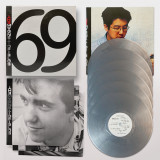
180GM BLACK VINYL : 500 PRESSED WORLDWIDE.
Furthermore, Billy Mahonie now have their own label, Whistling Sam Projects, an almost sold-out London launch show at The Lexington on May 4th, and they are confirmed to play Portals Festival Saturday May 25th in East London. After nearly quarter of a century, Billy Mahonie are very much back.
Formed in the first wave of British post-rock alongside the likes of Mogwai in the late 90s, John Peel favourites Billy Mahonie are set to return with the first new music from their original line-up in some twenty-four years. Whilst their debut album ‘The Big Dig’, released in 1999 on Too Pure Records, is considered a classic of the post rock genre, Billy Mahonie always crafted their intricate music with memorable hooks and melodies and performed it with energy and gusto. Theirs was not an aimless, meandering sound, instead the songs and attitude were rooted in punk rock, and still are. Billy Mahonie put the rock into post-rock.
Set for release this coming May 24th via Whistling Sam Projects, ‘Field Of Heads’ sees the band returning with their classic original line-up of Gavin Baker (guitar), Howard Monk (drums), Hywell Dinsdale (bass and guitar) and Kevin Penney (bass and guitar). Whilst this line-up has been semi active for a few years, no new material came to fruition. After their last gig in 2017, however, the band decided it was time to get back into the studio, but with two members living abroad new challenges were faced, but ideas were shared, old ones were resurrected and finally in October of 2019, Billy Mahonie were back in the studio.
Recorded over two long weekends on either side of the Covid 19 lockdowns, the band tracked at The Church studios, owned by their former collaborator and front of house engineer Paul Epworth, with senior engineer Luke Pickering at the controls, allowing ‘Field Of Heads’ to quickly take shape.
New single ‘Kaiju’ gives the music world the first taste of ‘Field Of Heads’ and right from the off, it’s classic Billy Mahonie. Immediately bursting into life with the energy and melody that is so unique to their sound, Howard’s driving drums thrust the music ahead as the guitars and synths weave their way around them. Intricate and shifting, but never at the expense of a tune that sticks in your head.
“This one came from a chord progression myself and Gav first tried out jamming in 2010,” explains drummer Howard. “Needless to say, when Hywell and Kev got their hands on it, it became something no-one ever envisaged. Kev's great title is, of course, the Japanese name for the subgenre of monster-based science fiction. A frenetic riff opens the song and for a counter guitar part only two options remain, play in the minimal gaps or find an overarching theme. We chose both. Kaiju films influence the additional Synths, echoes of those early Japanese movie themes. Some people we have played this to in advance have suggested this track is one we should lead with, as it is kind of where we left off. We agree. It rocks pretty hard. And is a bit funky too. What’s not to like?!”
Furthermore, Billy Mahonie now have their own label, Whistling Sam Projects, set up for global distribution through SRD, an almost sold-out London launch show at The Lexington on May 4th, and they are confirmed to play Portals Festival Saturday May 25th in East London. After nearly quarter of a century, Billy Mahonie are very much back.
Search:i like the way
- A1: Bob Sinclar Feat Hendogg, Master Gee & Wonder Mike Fro
- A2: Bob Sinclar Feat Dj Roland Clark - Give Me Some More
- A3: Bob Sinclar Feat Shabba Ranks - Love You No More
- B1: Bob Sinclar Feat Vybrate, Queen Ifrica & Makedah - Ne
- B2: Bob Sinclar Feat Tony Rebel - Jamaïca Avenue
- B3: Bob Sinclar Feat Steve Edwards - Peace Song
- C1: Bob Sinclar Feat Ron Carroll - What A Wonderful World
- C2: Bob Sinclar - Mr Tambourine Man
- C3: Bob Sinclar Feat Steve Edwards - People Of Tomorrow
- D1: Bob Sinclar Feat Adam Joseph - The Way I Feel
- D2: Bob Sinclar - We Are Everything
- D3: Bob Sinclar Feat Kevin Lyttle - Belly Dancer
- D4: Bob Sinclar - Looks Like Love
To celebrate the 15th anniversary of "Born in 69"", the album is reissued for the first time as a double vinyl! It features collaborations with The Sugarhill Gang, Shabba Ranks, Kevin Lyttle ant the renowned Awell. (Re)Discover the worldwide hits "La La Song", "Love you no more", "New new new" and "What a wonderful world"
"Return Of The Super Ape" was the final revelation from Lee Perry’s Black Ark Studio, a psychedelicized dub journey into uncharted sonic territories. The longplayer is now state-of-the-art remastered by Pete Norman (Finyl Tweek) and restored with original press artwork complete with inner disco sleeve!
The album from 1978 is the final chapter in the trilogy of albums in the period from 1976 - 1978 following "Scratch The Super Ape" (aka "Super Ape") and "Roast Fish & Cornbread". Produced, mixed and arranged by Lee Perry at the Black Ark Studio featuring on all tracks the skills of The Upsetters and additional vocals by The Full Experience on "Dyon-Anasaw" and "Tell Me Something Good". The frontsleeve artwork image was created by Lloyd Robinson (also known as the singer of the Studio One classic "Cuss Cuss").
Reggae expert Jeremy Collingwood says: "The Return Of The Super Ape that surfaced later in the year 1978 saw Perry way off the mainstream with a set that owed much to jazz with its loose structure and horn breaks. The title track took an early production from Perry, U-Roy's " OK Corral", and reshaped it into another futuristic outing - just like the original that had been a decade earlier. At the time few knew what to make of it and over the years its lack of proper re issue had meant it's remained a hidden Perry gem. It also marked the end of a hugely creative period at the Black Ark."
Tracklisting / side-split
Side One
A1 Dyon-Anasaw
A2 Return Of The Super Ape
A3 Tell Me Something Good
A4 Bird In Hand
A5 Crab Yars
Side Two
B1 Jah Jah Ah Natty Dread
B2 Psyche & Trim
B3 The Lion
B4 Huzza A Hana
B5 High Rankin Sammy
• Follow-up to the highly acclaimed dub album Super Ape, the album like its predecessor, was produced by Lee ‘Scratch’ Perry. This was the last album recorded by The Upsetters before Perry closed down his Black Ark Studio.
• The remastered album showcases the production skills of undisputed dub master with insanely layered textures and technical wizardry. With musical backing The Upsetters – Boris Gardiner, Mikey Richards, Sly Dunbar, Benbow Creary, Earl ‘Chinna’ Smith, Winston Wright, and Keith Sterling.
• Remastered by Pete Norman at Finyl Tweek
• Coloured Inner Bag
Special Guests on the record include: Mark Cisneros, Joe Lally, Derrick Decker, Bob Berberich, Clint Walsh, Dave Grohl, Onam Emmett, John Goetchius, Jerry Busher, Amy Pickering, Ian MacKaye, Amanda MacKaye, Brian Baker, Randy Austin, Martha Hull, Michael Reidy, Nate Bergman, Bobby Madden.
Scream formed in 1979. Drummer Kent Stacks, bassist Skeeter Enoch Thompson and the brothers Pete and Franz Stahl attended school together in Bailey’s Crossroads, Virginia, when they began to discover the punk and new wave scene in DC and the provocative power of making music.
Like most of the punk bands in DC, they were influenced by the Bad Brains, but their rock and roll sensibilities set them apart. In 1982, they went into Inner Ear Studio with Ian MacKaye and Eddie Janney to record Dischord's first full length album, Still Screaming.
Scream followed this with a second full length album, This Side Up, in 1984. The band toured throughout the US and were one of the first US hardcore bands to tour Europe and the UK. In 1987, they released Banging the Drum, which was recorded at both Southern Studios in London and Inner Ear. In 1988, No More Censorship was released on reggae label RAS records. Scream returned to Dischord to release Fumble in 1993.
They made a few line-up changes along the way, including the addition of their friend Harley Davidson on second guitar, and, when Kent Stacks (RIP) left the band to start a family, they asked a young local drummer, Dave Grohl, to take over. After a number of years with "the Scream team," Dave went on to join Nirvana and form The Foo Fighters.
In 1996, at a Christmas reunion show, Kent Stacks returned as Scream’s drummer; the show was recorded and released as the CD “Live at the Black Cat.” Over the next few years, everyone branched out in different directions – Franz joined the Foos for a short period and Pete played with Goatsnake and earthlings? The band returned as a unit, with Clint Walsh on second guitar, in 2011 to record the Complete Control Sessions, which was released as an EP on Side One Dummy and was, until now, the band’s most recent release.
Scream’s newest album, DC Special, will be released in the fall of 2023 on Dischord Records. For this record, Scream invited their extensive music community to help create a unique project that weaves the history of music in Washington DC into the story of the band. Recorded by Don Zientara just weeks before his studio was evicted from its longtime location, the record is rich with both the sounds of Inner Ear and those of friends and musicians who influenced Scream and who shaped DC music over the past six decades. DC Special embodies the same sense of community and politics that inspired Scream from the start and is a truly special collection of new music that speaks to the present and also tells the story of DC music, Scream, and the influences that shaped them.
Bonus Download Tracks
Faces
Politics is Entertainment
Black and White
Lifeline Redux
Smile and Bleed
I Saw Ya (Wanna Be Like Captain)
Audionaut sound adventurer Neil Stringfellow (aka Audio Obscura) makes a welcome return to Subexotic with his many-splendoured mixed media project Acid Field Recordings In Dub. Following years of avid field recording, Neil explains how it came about through a series of epiphanies: "It sort of started after I did a field recording introduction weekend workshop with the legend that is Chris Watson (the BBC wildlife team and ex-Cabaret Voltaire), just in terms of it being very inspirational and meeting like minded people. I've been sound recording for about 12 years now and have a good archive of sounds, and simply enjoy just listening and capturing the world. Since then over the years I've learned to really listen to the everyday soundscapes and as such I no longer walk down the street listening to a personal stereo anymore, the world can often be more exciting than music. A few memories of listening stick out which really helped form this album. I was walking up a hill in Norwich and a street cleaner was coming down pushing his cart, the broom attached to the cart but one end was bouncing up and down in the exact way a snare drum in a Dub reggae record might sound with the dub echo effect.. for a few seconds it was amazing and I stopped and stood still and just savoured the moment but of course did not have a microphone with me. Another time recording the dawn chorus in Lowestoft the chirping birds sounded intense coming from different trees and walking between the trees seemed to make the classic 303 acid squelch sound. part of this is in the middle section of the Babyloniacid track. Another time I was recording in a forest after a storm sitting under thick trees trying to keep the mics dry and the wind blowing the tops of the trees was like a swooshing synth line. I always liked the moments when the soundscapes felt like music and over time had a desire to marry music and field sounds together. Things really came together though when in summer 2022 I had a minor operation and was resting in bed after the operation, high on painkillers feeling quite spaced out. It was in the middle of a heat wave and the nurses had opened the ward windows, it was evening and I could see pink clouds but the sunset was out of view. I'd been listening to the Eno / Harmonia album and after that ended, I put on some Burial. I just lay there watching the clouds and the title Acid Field Recordings In Dub just came into my head... I could hear how the concept should be: made with field recordings, manipulating them and creating ambient soundscapes... dubby beats fractured in places and snatches of the acid 303. This is more or less what I wrote down that day and a few weeks later I started to create it... the process came easy and at first, I thought I'd need to spend some time making new extra field recordings but, to be honest, I has such an archive I pulled most of the sounds from that." Music, electronics & field recording by Neil Stringfellow. Design & mastering by Dan Seville. Test siren on 'Through Nuclear Skies' recorded by Marc Weidenbaum. Melodica on 'Hollowlands' played by Simon McCorry
milky clear w/ black speckles VINYL[38,45 €]
black & beer vinyl[38,45 €]
black & white vinyl[38,45 €]
clear & brown vinyl[38,45 €]
foggy orange vinyl[38,45 €]
yellow w/red splatter vinyl[38,45 €]
white and red vinyl[38,45 €]
Black Vinyl[38,45 €]
Red Creek's debut release, The Raging River, is a seamless continuation of the writing process and the creative mindset that has guided Cult of Luna for the last couple of years. "The Raging River" feels more like a bridge. A midpoint that needs to be crossed so we can finish what we started with "A Dawn To Fear". It's a seamless continuation of the writing process and the creative mindset that has guided us for the last couple of years. It's been an interesting as well as an introspective way of working, having our instinct leading the way and then having to figure out where it takes us. But not only has it been a linear journey, some aspects of it is clearly circular. We have been a fan of Mark Lanegan for many years. So in 2005 when we wrote the song "And With Her Came The Birds" we had his voice in mind and the working title was "The Lanegan Song". But we were not many years over 20 and our lack of self-confidence prevented us from even daring to ask. It took fifteen years for us to get the guts to ask him. Hearing his voice on "Inside Of A Dream" is nothing more than feeling that we're inside of a dream. Johannes Persson
NAKID presents the first album in years from Max Loderbauer (Sun Electric) and Tobias Freund’s cult Non Standard Institute. Delving deep into the aether with a double LP - almost an hour and a half in length - featuring ruined, vaporous and engrossing ambient variations on a theme.
Planing axes between iridescent new age ambient, sublime folk and avant-classical, to miasmic drone and plangent shoegaze; ‘A Day or Two’ charts the Non Standard Institute’s first actions in 6 years and serves as a compelling reminder of their intuitive work in abundance. Expanding and contracting their sound across 18 parts, they arc from heaving, oddly-tuned drones to smoggy, surreal soundscapes, bringing a wealth of fine-tuned instincts to the table. With Max Loderbauer’s 35+ years as Berlin ambient pioneer with Sun Electric, jams with Villalobos, and roles in Vladislav Delay Quintet and the Moritz von Oswald Trio, he’s matched by Freund’s 40 years of deep engineering expertise embedded in the experimental industrial and techno trenches.
The melancholy, Satie-laced piano meditations that grounded 2018's '5863' are gone, and the human touch that's been present since their very first collaborations is placed under the microscope, enhanced by their use of the Haken Continuum Fingerboard, a gestural synth that was developed to open up new modes of playing. Loderbauer's experience with the piano helps him make the most of the instrument's touch-sensitive 3D surface, while Freund uses two multi-channel loopers, piping the sounds through his arsenal of pedals.
The 18 tracks are billed as "unplanned atmospheres" that arc from sombre, drone-heavy material to humid, tape-saturated imaginary-island jams such as 'Listening To Cells' and 'Are You One Of Them'. On the latter, the duo work patiently, letting dusted string plucks tumble across each other while warbling pads hum below, bending like flutes. On 'Unlikely Events', anxious didgeridoo-like wails are ruptured by environmental rattles, before ominous voices lead us into a pocket of industrialised resonance. In time, the skies open up and the sounds morph into pastoral song, the drone blurring into hopeful pads almost as lucid and eloquent as AFX's 'SAW Vol. II', with sonorous synths that float over formless strings. Reflective, cinematic arrangements for flute and silvery ambient give way to diffusions of denser, resonant polychromatics and pucker up in outernational, alien ambient impulses recalling Connor Camburn jamming with dirashe folk pipes.
"Miranda Winters, as the voice of Chicago’s much-loved noisemakers Melkbelly, has spent the past few years happily in her own shadow. While she has quietly written and occasionally released her own music for 15 years, Winters finally steps out into the bright light with the release of Lawn Girl, the debut album under her Mandy moniker.
The album, a combination of older songs and newer creations, feels positively and endearingly alive–like a freeing of pent-up energy, an intimate rebuilding of the self. While Winters recorded and produced a number of the songs herself, she worked with Taylor Hales at Electrical Audio to feed those songs back into the studio, where they were re-recorded with room mics and worked back into the original versions. “I see it like photocopying,” she says of the process. “I’ve always loved working with photocopying and related printing techniques in my visual art because of the way everything decays and falls apart. It was nice to honor that on the record.”
Performed by an all-women band–Linda Sherman (guitar), Lizz Smith (bass) and Wendy Zeldin (drums)–the songs on Lawn Girl suitably find Winters ruminating on the idea of femininity; about her mom (who graces the album cover) and being a mother herself; her female friends; and what it means and what is required to make art and music in a female space intentionally."
"Philadelphia’s So Totally are a portrait of utmost devotion, and how longevity in any kind of relationship can’t occur without it. Since 2015, the band originally called So Totally In Love has humbly studied their surroundings and themselves, perfecting a sound that from inception was present. So Totally’s shimmering guitars and melodies typically sit underneath lush vocals that concurrently embed themselves in a listener’s subconscious, haunting them with heavy mood and nostalgia for 90’s rock groups like Swirlies, Pixies, and The Breeders. Previous releases, and their dedication to spending years playing regionally, brought So Totally to the point of singular focus on drafting a third album, entitled Double Your Relaxation, while in quarantine in 2020.
Upon formation, So Totally collectively bonded over an admiration of Land of Talk. While the influence is certainly present in vocalist/guitarist Roya Weidman’s sugary vocals, the band's love of comfortably resolving melodies, and auxiliary percussion, So Totally sonically have more in common with bands like Sonic Youth, My Bloody Valentine, and Spirit of the Beehive…creating massive walls of sound on each record that plainly implies the quartets towering live experience. Such huge tones aren’t only because of Weidman and guitarist/vocalist Matt Arbiz playing, but the collective effort of the band, which is rounded out by bassist Ryan Wildsmith and drummer Joe McLaughlin.
Lyrically and thematically, Double Your Relaxation explores where influence and “hypnosis” exist in life, specifically in environment, media, relationships, and self (via mental illness), bouncing between perspectives of witnessing, interacting with, and contributing to illusion and how that ultimately affects our idea of identity. The moody and, at times, surreal nature of the songs lends itself very appropriately to the shoegaze and heavy indie style So Totally plays, making them a perfect addition to the canon of the genre."
December 2012 I showed up totally exhausted in Vancouver BC after touring stupidly and relentlessly for however many straight months and got a job at a call centre raising money for the Red Cross. It was a scent free office but one time this woman cooked a piece of fish in the microwave for 10 minutes on low and hot boxed the whole office - we got sent home early no pay. There was the other woman I named the Call Centre Coltrane because her pitch and routine usually involved improvised flights of fancy that went off in both directions at once somehow landing back down with a credit card number and a donation. I used to sleep under the desk. I was there a few months and at the time I reconnected with John Brennan who I had played with briefly in Montreal at the Mutek Festival. In Montreal John was running an experimental music night at a burrito shop downtown called Garbage Night. While in Vancouver I began connecting with the music scene there and would go hang out with the Shearing Pinx lads who I think lived with Sydney the bass player at the time. I knew Nic and Jer from an AIDS Wolf Tour and was so stoked to get to know them both better. I really fell in love with that era of Vancouver's music scene.
Fast Forward to today. 2024
Actually it was the dying days of 2023 but you get it and John asks if I'll sit in with Earth Ball and I keep thinking about Earth Balance, the vegan butter everyone eats here. I brought my aching bones and my ipads on the beautiful ferry named the Queen of Oak Bay and out to Nanaimo BC, home of the nanaimo bar (a dessert treat - special to this region - that seems to be more popularly found under the weird glass sneeze guards in office building deli's out east in Ontario.... anyhoops ). No one in Nanaimo wants to talk to me about the famous treat. I asked a couple of people. Silence. Nanaimo is like London, Ontario but more fried and by the sea. The town is filled with blown out old sea dawgs with tin coffee pots and loose leaf tobacco, then there's the usual streetfolk you find in this part of the Canadian Pacific Northwest and a bunch of bohemians who I guess have left Vancouver behind - that fine city having become uninhabitable for those not making over 100k a year. And then up the way are all the retirees.
Yup Nanaimo is a strange one. They mined the shit out of this region and Nanaimo is surely haunted by those buried in mining shafts or maimed by the heavy machinery or blown up by accident in the explosives store house. And when Earth Ball fire up the amps in Izzy and Jer's basement you can hear the voices of the ghosts hum through electrical lines and out the speakers, Kellen's hued feedback, Izy's sturdy basslines, Jer's paperbag guitar tone and rumble pack zaps, Liam's (aka the Kid) sheets of sound and Brennen's multidirectional drums.
You wouldn't guess Earth Ball was auto-composing and from what my rat brain can tell - the lyrics are improvised too...Improvising lyrics and singing them is the hardest thing to do in all of music.. Izzy and Jer are pros. And their attitudes are pro too.
The live show is scorched and without naming names they've been known to make headliners nervous. Lucky ones will get to see them live as they tour this beast of a record entitled ‘It’s Yours’ (out May 17th on Upset The Rhythm) and I hope I'm one of them.
But now you, fan of fun but totally fucked up music, have the opportunity to Ball with them thanks to Upset The Rhythm. Enjoy
-Alex Moskos, Montreal QC, Feb 2024
With his new instrumental album Ventas Rumba, the French composer (and singer) returns to his signature instrument, the piano, blending it with warm synth tones. This album represents a "return to his roots ", allowing Ezéchiel Pailhès to reinvent himself in a seamless way while still exploring ballads and ritornellos, halfway between light-heartedness and melancholy. Ezéchiel Pailhès has been meaning to write a solo piano album for as long as he can remember. Hardly surprising, of course, for this academically-trained pianist, brought up on classical music and then studied jazz. Yet, since his 2001 debut with the electro-pop duo Nôze, and his subsequent four albums, the artist had constantly postponed this project that was so close to his heart. Then in 2022, just as he was getting ready to start producing an album of new songs, this long-standing aim finally materialized.
The melodies he wrote seemed to stand on their own naturally, spurring him on to compose this series of fourteen tracks, recorded in sessions split between France and Latvia.
A new piano: the Una Corda
Ezéchiel wanted this project dedicated to the piano to begin a new narrative, to explore new instrumental terrain and new tones, something far removed from the familiar piano he has been playing all his life. He opted for the Una Corda piano, designed by David Klavins, a groundbreaking instrument builder renowned for his distinctive pianos with vertical shapes and frames.
The Una Corda, created in 2014, is an upright piano with a single string per note (unlike three strings on traditional pianos). Enticed by the "crystalline and unique" tones of this instrument, which is hard to find in France, Ezéchiel travelled to Kuldiga, Latvia (where David Klavins set up his workshops and studios), to record the first part of the album. Although the title of the album may initially conjure up images of a distant, sensual dance, the reality is quite different. Ventas Rumba indeed refers to the waterfall and rapids (in Latvian: rumba) of the river Ventas, which runs near this small village in the western part of the country. Ezéchiel chose to blur the lines, as the sound and musicality of the title likely evoke both his short stay in the Baltic country, and also a form of distant exotic imagery perfectly in tune with his own mischievous wit. Tracks as short stories
Back in France, Ezéchiel enhanced the first tracks recorded in Kuldiga with subtle synth tone layers, and added other tracks composed and recorded at his Montreuil studio. The album reflects a deliberate and sensitive orchestration of piano, synth keyboards and digital effects, as he puts it: "playing to erase the differences between the tones of the various instruments", as if each instrument's texture echoed the others. According to Ezéchiel, you can listen to Ventas Rumba as you would leaf through "a collection of short stories", through compositions that rarely exceed three minutes and evoke figures of movement, lightness, curves or modulation, such as "La ligne", "La valse des singes" or "Fly Finger". Others more seriously relate to a kind of spirituality, which quietly infuses such different tracks as "Ferveur", "Éclair" and "Louanges". Ezéchiel adds: “I’m by no means religious, but I like what God has managed to get musicians to achieve (laughs)". "Louanges", for instance, despite its electronic edge, "refers to Olivier Messiaen, a very devout composer who I greatly admire". Other tracks are directly inspired by the classical music he listens to on a daily basis. For example, Chopin's “8th Nocturne” formed the backdrop of “Pianovado”. Likewise, the harmonic structure of Beethoven's “Waldstein Sonata No. 21” inspired “Opus 53”. Aside from these multiple references and inspirations, which quickly recede behind a style that is uniquely his, Ezéchiel Pailhès keeps exploring ideas already found on his first solo albums, this time in an instrumental format, undoubtedly purer, fostering an imaginary world that evokes the shapes and themes of ballads, ritornellos, light-heartedness, passing time, reverie or a universal subdued melancholy.
By now one of our most cherished and respected portuguese songwriters, Maria Reis has been steadily creating a legacy that will undoubtedly endure in the portuguese songwriting canon for years to come. Co-founder of the Lisbon based Cafetra label- collective, Reis spent her teenage years honing her craft, particularly with her co- leading role on Pega Monstro with her sister Júlia Reis, with albums like 'Alfarroba' and 'Casa de Cima' on Upset !the Rhythm and whose indefinite hiatus since 2018 opened the gateway for a prolific solo venture. After a raw debut EP released in 2017 – Maria -, 2019 saw the release of the celebrated 'Chove na Sala, Água nos Olhos', a definitive statement of Reis' almost casual gift of painting vivid and impressionistic portraits of everyday life, conveying all the anger, resignation and melancholic joy of moving on. Two years later, following a string of widely praised live appearances, Reis records the 'Flor da Urtiga' EP with musical production of Noah Lennox aka Panda Bear, a sweeter affair, crossed by a witty irony that tackles such subjects as family, love and toxic masculinity, through layered acoustic guitars, lightweight percussion and joyful harmonies. 'Benefício da Dúvida' from 2022, strips back most of the production to rely on simple but affirmative arrangements assembled with the help of her sister Júlia and longtime collaborator Leonardo Bindilatti.
And now, almost two years on the clock after 'Benefício da Dúvida', Maria Reis returns with a newfound maturity with 'Suspiro...' - Portuguese for sigh. Created in close collaboration with Tomé Silva - a young and versatile musician and producer who's been recently leaving a mark on the portuguese scene - and recorded in the intimacy of the latter's bedroom, 'Suspiro...' doesn't cut ties with that recent past but reflects the learning process embedded in previous ventures in its lyrics and arrangements, towards song's eternity. A projection of different emotional states and physical spaces throughout these years, 'Suspiro...' carries in the apparent simplicity of its title the plurality of meanings found in such a natural act, from anger to being in love, from resignation to resilience. Life in a sigh? We've been further from that.
An attentive and sensitive observer of both intimate and surrounding spaces, Maria Reis continues to explore wordplay in her very personal manner, a poetic act as brutally honest as filled with imagery allusions, enchanting the mundane with lyricism. Touched by a resigned and dreamy melancholy, 'Suspiro...' settles, for the most part, on electric and acoustic guitar lines, simple but expressive rhythms, floating vocal harmonies and a voice almost tangible in the way it conveys memorable hooks without fear of appearing both fragile and tenacious. 'Amor Serpente's low key tragedy turned mantra for life, the blissed pop of 'Estagnação' or 'T-shirt', 'Holofote's flailing rawness, the mesmerizing sparkle of 'Pico', 'Meta Data's electrified energy or the playful keyboards and sound effects of 'Coisas do Passado' composing a lively portrait of reality and expectations where we can all see ourselves reflected in. For Maria, almost a second nature, that through all her honesty, know how and imagination, reaches a new life with 'Suspiro...'.
GER Jim Jarmusch und Carter Logan (Gründungsmitglieder von SQÜRL) kehren mit einer klanglichen Erkundung des filmischen Werks des dadaistischen Pioniers Man Ray zurück, einem fesselnden Projekt, das Musik und Film miteinander verschmilzt. In den vergangenen acht Jahren haben SQÜRL das Publikum mit ihrer Live-Vertonung von Man Rays Kurzfilmen in ausverkauften Konzerten an renommierten Orten wie dem Centre Pompidou in Paris, der Queen Elizabeth Hall in London und dem Art Institute of Chicago verzaubert. Der Höhepunkt ihrer Bemühungen fand im Frühjahr 2023 statt, zum 100. Jahrestag von Man Rays erstem Ausflug ins Filmemachen, als der neu restaurierte Film "Die Rückkehr zur Vernunft" bei den Filmfestspielen von Cannes seine Premiere feierte. Der von Womanray (Marieke Tricoire) und Cinenovo (Julie Viez) produzierte Film ist eine Anthologie mit vier Stummfilm-Kurzfilmen von Man Ray - Étoile de mer (1928), Emak bakia (1926), Le Retour á la Raison (1923) und Les Mysteres du Château de Dé. (1929) - jeweils gepaart mit einer Originalpartitur von SQÜRL. Jarmusch und Logan, zwei multidisziplinäre Künstler, die für ihre Experimentierfreudigkeit bekannt sind, wollten mit diesen Partituren einen ekstatischen Zustand schaffen, einen Raum zwischen Bewusstsein und Unterbewusstsein, Realität und Surrealem. Das daraus resultierende Album "Music for Man Ray", das aus einer Live-Aufnahme im Centre Pompidou in Paris im Februar 2023 hervorging, enthält verzerrte Gitarren, hypnotische Rückkopplungen, Loops und affektierte Synthesizer Logan: "Es ist eine Reise, auf die wir das Publikum mitnehmen wollen, indem wir Themen in diesen Filmen beleuchten. Sie sind eigenständig, aber es gibt auch wiederkehrende Anklänge im gesamten Programm." Jim Jarmusch fügt hinzu: "Wir sind sehr stolz darauf, die Begleitband von Man Ray zu sein." Nun erblicken sowohl der Film als auch die daraus resultierende Musik in Form von "Music for Man Ray" das Licht der Welt - beide stehen als Zeugnis für die kreative Synergie zwischen Man Rays bahnbrechendem Kino und der innovativen musikalischen Interpretation durch SQÜRL.
[ENG] Clear Vinyl. Jim Jarmusch and Carter Logan (founding members of SQÜRL) return with a sonic exploration of the cinematic works of Dadaist pioneer Man Ray, a captivating project that melds music and film. Over the past eight years, SQÜRL have been enchanting audiences with their live scores to Man Ray's short films across sold-out shows in prestigious venues like the Centre Pompidou in Paris, Queen Elizabeth Hall in London, and the Art Institute of Chicago. The culmination of their endeavor took place in the spring of 2023, on the 100th anniversary of Man Ray's inaugural foray into filmmaking, when the newly restored Return to Reason premiered at the Cannes Film Festival. Produced by Womanray (Marieke Tricoire) and Cinenovo (Julie Viez), Return to Reason unfolds as an anthology featuring four silent short films by Man Ray _ Étoile de mer (1928), Emak bakia (1926), Le Retour á la Raison (1923), and Les Mysteres du Château de Dé. (1929) _ each paired with an original score by SQÜRL. Jarmusch and Logan, two multi-disciplinary artists known for their experimental prowess, approached these scores as a way to create an ecstatic state, a space between consciousness and unconsciousness, reality, and the surreal. The resulting album, Music for Man Ray, born out of a live recording at the Centre Pompidou in Paris in February of 2023, features distorted guitars, hypnotic feedback, loops and affected synthesizers. In the words of Logan, "It's a journey we want to take the audience on, illuminating themes throughout these films. They are discrete, but there are also recurring echoes throughout the whole program." Jim Jarmusch adds, "We feel very proud to be Man Ray's backup band." Now both the film Return to Reason and the resulting music in the form of Music for Man Ray are seeing the light of day _ both stand as a testament to the creative synergy between Man Ray's groundbreaking cinema and the innovative musical interpretation by SQÜRL.
Inspired by the Buddhist sutras, Blitzen Trapper’s radiant new album, 100's of 1000's, Millions of Billions, offers a captivating take on rebirth and transcendence, navigating its way through the space beyond dreams and reality, beyond gods and mortals, beyond life and death. The songs here are as sincere as they are surreal, rooted in rich character studies and deep reflection, and the production is intoxicating to match, blending lo-fi intimacy and trippy psychedelia into a mesmerizing swirl of analog and electronic sounds. Add it all together and you’ve got a gorgeous collection of stripped-down bedroom folk wrapped in lush layers of synthesizers and washed out electric guitars, a poignant, expansive exploration of perception and purpose that manages to look both forwards and backwards all at once. This LP is pressed on clear blue vinyl and limited to 1,000 copies worldwide. Launched roughly two decades ago in Portland, OR, Blitzen Trapper broke out internationally with 2008’s Furr, which cemented their status at the forefront of the modern indie folk revival. Rolling Stone hailed the band’s “hazy, psychedelic Americana,” while NPR praised their “explosive live performances and infectious roots-rock swagger.” Dates with Fleet Foxes, Wilco, and Dawes followed, as did festival appearances at Bonnaroo, Lollapalooza, Newport Folk, and Coachella, among others. The band would go on to release six more similarly lauded studio albums, culminating with 2020’s Holy Smokes Future Jokes, which Mojo proclaimed “sounds like the Beatles at Big Pink.”
100's of 1000's, Millions of Billions by Blitzen Trapper, released 17 May 2024, includes the following tracks: "Cosmic Backseat Education", "Cheap Fantastical Takedown", "Planetarium", "Long Game" and more.
Inspired by the Buddhist sutras, Blitzen Trapper’s radiant new album, 100's of 1000's, Millions of Billions, offers a captivating take on rebirth and transcendence, navigating its way through the space beyond dreams and reality, beyond gods and mortals, beyond life and death. The songs here are as sincere as they are surreal, rooted in rich character studies and deep reflection, and the production is intoxicating to match, blending lo-fi intimacy and trippy psychedelia into a mesmerizing swirl of analog and electronic sounds. Add it all together and you’ve got a gorgeous collection of stripped-down bedroom folk wrapped in lush layers of synthesizers and washed out electric guitars, a poignant, expansive exploration of perception and purpose that manages to look both forwards and backwards all at once. This LP is pressed on clear blue vinyl and limited to 1,000 copies worldwide. Launched roughly two decades ago in Portland, OR, Blitzen Trapper broke out internationally with 2008’s Furr, which cemented their status at the forefront of the modern indie folk revival. Rolling Stone hailed the band’s “hazy, psychedelic Americana,” while NPR praised their “explosive live performances and infectious roots-rock swagger.” Dates with Fleet Foxes, Wilco, and Dawes followed, as did festival appearances at Bonnaroo, Lollapalooza, Newport Folk, and Coachella, among others. The band would go on to release six more similarly lauded studio albums, culminating with 2020’s Holy Smokes Future Jokes, which Mojo proclaimed “sounds like the Beatles at Big Pink.”
100's of 1000's, Millions of Billions by Blitzen Trapper, released 17 May 2024, includes the following tracks: "Cosmic Backseat Education", "Cheap Fantastical Takedown", "Planetarium", "Long Game" and more.
““Do One” is the last song I wrote for the new album, and the first song on that album, as well as the first single. So it’s a summation of what I’m trying to say with this record, a record about survival and defiance, but also one with a sense of fun and self-deprecation.
19 years into my solo career, I’m still standing up and putting out some of my best work. It feels good.”
“Undefeated” is my tenth solo studio album, and in many ways I’m pleasantly surprised by that statement. I feel very fortunate that I’m still making records and touring - fortunate
and proud. The record is fired by that feeling, and a new sense of energy and liberation. It feels like a new chapter for me - after the pandemic, back in the independent world, the
new lineup of the Sleeping Souls, and a slightly bewildered sense of gratitude that I’m still standing, still have something to say.” - Frank Turner.
Archival reissue of the Afro-prog-psych Zamrock masterpiece Presented For The First Time Ever In A Yellow Vinyl Pressing
"Electrified by a diet of James Brown, the Stones and Deep Purple, WITCH were the stadium-filling kings of 70s Zamrock. - ****" - MOJO
WITCH’s musical arc is contained to a five year span and, in retrospect, is a logical one. The band’s fifth and final rock album - released before the band splintered and an offshoot band traveled to Zimbabwe to record and release disco albums - makes use of traditional Zambian rhythms and folk melodies alongside progressive rock movements. Like Lukombo Vibes before it, it is in the Osibas “afro-rock” style.
From a Decade Hiatus To A Musical Uppercut Like They Never Left Round 1, The Newest Ant Farm Installation Flexes Moments Of InTricate Metal All The Way To haunting acoustic ballads that might make Ray Lamontagne shiver and back again.
If you're an Alien Ant Farm fan true and true, you won't be disappointed, and if you're just a visitor from another planet, we hope you enjoyed your extra terrestrial visit
Bruno Berle, the young songwriter and poet originally hailing from Maceió, the capital of Brazil’s Alagoas state, crafts songs that are simple, direct, and full of tender nuance. With his first album No Reino Dos Afetos (which translates to "In the Realm of Affections” and was released in 2022), Berle firmly established himself as a unique and important voice in the burgeoning scene of new Brazilian artists making a global impact, including peers like Ana Frango Elétrico, Tim Bernardes, Bala Desejo, Sessa and more. Now back with his second album, No Reino Dos Afetos 2, he stretches that further.
Bruno Berle’s music lives between two worlds – a traditional Brazilian folk talent steeped in history, and a contemporary, dreamy electronic pop; the result is songwriting that’s genre-bending, intentional, iconoclastic and consuming, spacious and sinewy and singular, a striking reflection of its composer while leaving space for the listener to settle in. The album follows Bruno’s relocation to São Paulo, and the songs are a reflection of his past and present. A rebuke of former categorizations of his work in Brazilian music scenes, and an idea of where his music can move, unfettered.
Berle’s music is purposeful in being a true portrait of himself, and a reflection of the music, art, and fashion scenes he personally moves through. Berle aims to provide an entrypoint for Black queer joy in his music, in his storytelling, in his presence and vision as a creative. For him, it feels subversive to be playing MPB laced with dubstep and lo-fi, a sort of intentional sacrilege, capturing a dialogue of modernity in traditional music.
Berle wrote most of the arrangements and co-produced his new album, Reino Dos Afetos 2 with longtime friend and musical partner Batata Boy, who is also from Maceió; the album was recorded in Rio de Janeiro, Maceió, and São Paulo, his new home, and picks up the conversation begun in 2022 on Berle’s debut album No Reino dos Afetos. Both records are the result of a nonlinear but coherent seven-year music creation process culminating in these albums, holding hands across space and time.
“Tirolirole,” the first single from the record, was released at the end of 2023; sun-soaked rhythms and soft voice coat the song, the lilting refrain of “Tirolirole” throughout – hushed, gentle, but somehow almost tactile, a golden-hour moment unlocked in the mind. “Tirolirole” is a triumphant future classic about the temporality of a blossoming love, with Bruno’s stunning vocal soaring over melodies which ebb and flow like the waters on the Atlantic shore. Of the track, Berle explains: “Despite ‘Tirolirole’ being an expression that evokes my childhood, just like the light words about nature, the harmony, and the poetry are epic, carrying a great hope for love.”
In fact, the guiding theme of No Reino dos Afetos 2 is a relationship, unfolding in the arc of a weekend. It traverses the innocence of an early young love, how that can be formative, can stretch on to take new shapes, or shape you. The album happens at the genesis of meeting someone and falling for them, before the relationship is thrown into overdrive – set in a big city, against a backdrop of major life changes, rising energy, the sound of São Paulo.
Something transcendental emerges in “Dizer Adeus,” with an arrangement that echoes a gospel atmosphere (evangelical and Catholic environments were pivotal to Berle’s upbringing). On “É Só Você Chegar,” piano and flute gracefully intertwine, a dance, while “Quando Penso” skews sparser, the voice-and-guitar minimalism somehow cultivating an entirely different shape – somehow both cozy and melancholy, with the background sound of a rainy day. Coupled with the lo-fi aspects that shape much of the album’s personality in the vocals and the production, No Reino Dos Afetos 2 is meticulously elaborated by Berle’s sonic alchemy, like on the mid-album instrumental “Sonho,” which feels like floating. “It’s the apex. It’s when lovers are sleeping together,” Berle explains of the feeling he wanted to encapsulate in the song.
On “Love Comes Back” Berle interprets Arthur Russell, the late Iowa musician who only reached greater visibility after he died in 1992. “His way of making music is similar to mine,” Berle explains. “He sings in a more fragile way, has more of an experimental way of recording, letting ‘chance’ appear in the final work.”
Even so, Berle doesn’t want his music to be buried in sentimentality – and the purposefulness of his craft serves as a sort of north star. The production, the arrangements, his restraint and intentionality in crafting his songs feel just as vital as their emotional cores. His songwriting is amorphous, fluid, an encompassing genre-bending movement in-and-of-itself, quietly daring. The songs are often in conversation with other works – drinking in fountains as diverse as the filmmaking of Ingmar Bergman, the poetry of Walt Whitman, the rhythm of Djavan, and the painting of Maxwell Alexandre. Musically he weaves together a rich tapestry of Brazilian folk, UK 2-step garage/dub, trip hop and sun soaked west coast songwriters; something akin to the worlds of Milton Nascimento, Arthur Russell, James Blake, Feist, and Sade colliding into one. But even then No Reino Dos Afetos 2 floats separately, a romanticism driven by a simplicity and intimacy, an open-ended possibility, Berle’s singularity as an artist at the helm of the ship.
And once again with a reissue of a rare record that's highly sought after by collectors around the world. After the great undertaking we conducted with lost metal bands like CHILD SAINT and more recently with KNIGHTMARE II, it is with great pleasure that we bring you the first official reissue of TRAITOR and their mini-album "Shot Down"! All those who are familiar with "Show Down" know that it is impossible to remain indifferent to songs like "The Way It Used To Feel", "Have You Ever" or "Feel The Steel".
Formed in 1984 in Bellflower, California, TRAITOR began their short-lived career with the release of the one- sided flexi- single "Feel The Steel" that same year. In the following year, they would release the mini- album "Shot Down" containing a total of five original songs, which takes us unquestionably to the best US Metal made independently in the 80s. We are delighted to bring the first ever official reissue of "Shot Down" on vinyl.
A limited edition with the quality that Lost Realm Records has accustomed you to. With a total of 12 tracks, this reissue will feature the 5 songs from the original "Shot Down" version released in 1985, as well as an alternative mix version, never released before! All tracks fully remastered for the best sound experience.
This collaboration is full of synchronicities that go all the way back to 2020, when The Galaxy Electric (Jacqueline Caruso & Augustus Green) started conjuring the melodies and arrangements for this project - without knowing what it would be for. Their obsession with Retro Sci-Fi films & TV shows was thoroughly indulged during the COVID lockdown: "It was our “escape” out of reality. Shows like The X-Files, Dr. Who, and movies like Forbidden Planet and Clockwork Orange were our strange bedfellows guiding us to create music like we’d never made before." The result was a mix of electronica, psych pop and retro-futurism blending together to form music fit for the Korova Milkbar. As they emerged from this cocoon of sci-fi isolation, Jacqueline & Augustus began reaching out, connecting online with other obsessives: "Through our shared love of BBC Radiophonic Workshop Sound FX Records, we connected instantly and deeply with Drew Mulholland. Across time zones and land masses, our connection sparked creative collaboration like we’ve never known, and this new project was re-born. We knew in an instant that those forgotten ideas were meant for this moment. And thus began the files flying back and forth - until the synchronicities became fully manifest into what is now Muzak for the Korova Milkbar..Drew may tell it differently, but the sense of nostalgia, deja vu & mystical connection remains the same. A project we could have never set out to produce on our own, and that was always meant to be created with Drew. A dream fulfilled."
- 1: Sorry
- 2: Miss You
- 3: Won't Be There
- 4: Good Enough
- 5: Never
- 6: Change
- 7: A Place In Your Heart
- 8: Rainbow
- 9: Taken Over
- 10: Lifeline
- 11: Feel
- 12: Conqu
From the early ‘90s to the turn of the millennium, Gabrielle was one of the UK’s most successful and beloved artists. With two unforgettable #1 smashes (‘Dreams’ and ‘Rise’), a back catalogue full of Top 10 hits, two albums which reached 4 x Platinum status, two BRIT Awards, two MOBOs and an Ivor Novello, everything she touched seemed to turn to gold. In recent times, Gabrielle has enjoyed a remarkable resurgence, one that proves that timeless, empowering songwriting and a distinctive voice that is the very definition of soul will never go out of fashion.
The first single from the album, "A Place in Your Heart" will be released on the 18th January (9:30am timed release), and will be premiered on BBC Radio 2 - Zoe Ball that morning. The new single retains Gabrielle's signature sound, opening with her instantly recognisable vocal and provides an anthemic hook fans will no doubt sing along to.
A big part of that resurgence comes from the love shown to her by the current wave of iconic artists. Adele recalls being inspired by the lyric “Dreams can come true” as a child and has been a life-long fan of Gabrielle since, saying, “I remember being mesmerised by her, so pure and so delicate and gentle with her voice and in the way she moved.” And when Adele’s own dreams came true, she returned to her first inspiration and invited Gabrielle to join the bill for her two rapidly sold-out Hyde Park shows in the summer of 2022. The result was a sea of faces - some older fans, but many more who would’ve been too young to remember her the first time around - singing Gabrielle’s songs back to her.
Another high-profile supporter emerged that same year. Stormzy invited Gabrielle to cameo in his ambitious video for ‘Mel Made Me Do It’, where she joined a host of artists including Dave, Little Simz, Headie One and Jazzie B. She was also referenced in its midpoint monologue, when ‘Black Panther: Wakanda Forever’ star Michaela Coel narrated Wretch 32’s words: “Gabrielle once told us dreams can come true, and that sentence emancipated the minds of our pioneers.”
2018’s ‘Under My Skin’ in 2018 was heralded as “a heartfelt comeback” by The Guardian on its way to the Top
10. It wasn’t long before she was discovered by a brand new audience too, winning fans with a memorable stint as Harlequin in ‘The Masked Singer’ in 2021.and followed by ‘Do It Again’, an album of which mixed original songs, new takes on all-time classics, and her interpretations of more modern pop favourites from the likes of Billie Eilish, Harry Styles and Rihanna. It shot to #4 on the Official Album Chart - Gabrielle’s highest chart position in twenty years.
With Gabrielle’s star again in ascendance and her high profile live presence, 2024 seems the perfect time to release a new album. She’s consolidated her original audience and found a whole new one.
Autumn / Winter 2023 saw Gabrielle embark upon the ‘30 Years of Dreaming’ headline tour which was extended to a phenomenal 33 dates following overwhelming public demand. Many shows sold-out more than six months in advance, including London’s prestigious Royal Albert Hall.
Jonah Matranga has been making music for over 30 years. A prolific artist, he has become an enduring institution in the scene with a devoted fan base, rich lineage, and varied music career. Jonah has often straddled the line between the underground and mainstream. He’s worked with indie labels like Jade Tree and majors such as Atlantic, having fronted the bands FAR, NEW END ORIGINAL, and GRATITUDE. His music has influenced bands from Deftones to Blink-182, and he was there for emo and post-hardcore giants in their earliest beginnings–taking bands such as Thursday and Dashboard Confessional on tour. Simply put, the scene cannot be separated from Jonah’s art. Jonah has always written from the heart and performed in an intimate way that few others have accomplished. From basements to massive festivals, he brings the same energy to them all: raw honesty and an ability to make every show unique and personal. This is most apparent in Jonah’s solo and collaborative project ONELINEDRAWING. Jonah’s solo performance has always been about connecting with fans in an intimate setting, where they often perform with only a guitar and R2D2 sidekick. Sketchbook is the latest release from ONELINEDRAWING, featuring a collection of songs from Jonah’s early solo years, 1999 - 2001, completely remastered for vinyl. The album features originals and renditions of the likes of 7 Seconds and Jawbox, as well as the Sensefield split honoring the late Jon Bunch (Sense Field / Further Seems Forever). The LP also includes liner notes and zine by Norman Brannon (Texas is the Reason / New End Original). Sketchbook exists as both a time capsule and thank you letter to fans and music itself–a combination of the period in which Jonah first embarked on his solo journey and a celebration of the vitality that music and community not only affords him but all of us. Available in the EU/UK from Thirty Something Records and in the US from Iodine Recordings. Genre: Alternative / Emo
Though their album was cut in two days over the course of 2 eight hour sessions their arrangements shine through what was a scattered recording session. "We really worked hard in the studio even though we didn't have enough time to do all the things we wanted to do with music," bassist Robb Murphy remembers. "We were pretty excited. We just had no experience with that sort of thing. We had heard things but never had any experience.
We were really babes in the woods. It was a terrific experience looking back on it. It was really a hell of a lot of fun, we loved the idea of being able to overdub even though we didn't get to do too much of that, it was still fun. That was pretty high tech in those days, being able to lay down a couple of tracks with your voice." guitarist Mike Barnes recalls.
Similar to the Bosstown sound (Orpheus, Ultimate Spinach), Tiffany Shade lean towards harmony-driven vocals that combine their clever pop sensibilities with a versatile showcase of keys, organ, and scintillescent guitars. After their album's release in '68, they had the opportunity to open for Big Brother & Holding Co., but because of poor sales (and like many Mainstream artists) the band didn't last and went their separate ways in '69.
Coloured Vinyl[27,94 €]
As an organism, Blood circa Loving You Backwards, was a six piece. Tim O'Brien is the lyric writer, but the song writing and arrangement is a painstakingly collaborative process in which the band aims for democracy over swiftness.
The record also features the band's first major work with the producer Daniel Enrique Howard, whom the band recorded with at his studio in Brooklyn. Howard helped guide Blood into this new sonic territory. It is not a bedroom project, but instead fully realized, somehow sounding both intimate like Liz Harris' Grouper feels intimate and totally vast in the way that a Talk Talk record feels vast. It's in the same universe as Ought in its earlier iterations.
UK jazz ensemble The Jazz Defenders release their third album "Memory In Motion" in April on Haggis Records (home of The Haggis Horns and Malcolm Strachan). The Bristol jazz boppers deliver another quality release of original material that takes in their usual diverse mix of influences and genres, from timeless acoustic jazz referencing the classic sounds of Blue Note Records, to a more contemporary fusion where jazz meets soul, funk and hip-hop.
Although they love to mix things up, their roots are in the classic acoustic jazz quintet sound of the late 1950s/early 1960s, back when hard bop and modal jazz ruled. They have already explored this musical path well on their previous albums but they still deliver a couple of classic inspired jazz cuts here. "Chasing Fantasies" and "Fuffle Kerfuffle" both give the band some space to cut loose on solos over swing jazz beats that will keep their original jazz audience happy. The latter bubbles away with a jazz shuffle beat that would make drum legend Art Blakey smile.
"Meanderthal" and "Snakebite Playfight" bring soul to this jazz party. Exactly like jazz legends Lee Morgan/Herbie Hancock/Freddie Hubbard etc did back in the early-mid 1960s. The first is a feel-good, toe-tapping gem that's heavy on the backbeat and short and snappy on the solos, the exact reasons that made it the perfect opening single from the album. "Snakebite Playfight" comes with a jaunty New Orleans shuffle before transforming into a heavy psychedelic soul jazz burner, flipping back with ease to the NOLA shuffle for the Mardi Gras meets bebop piano solo by band leader George Cooper.
"Rolling On A High" is a hip-hop/jazz banger that sees the band continue their collaborations with UK rapper Doc Brown, a perfect combination that began on their second album "King Phoenix''. This time, the Doc spits some old-school block party-style bars over a bouncy uptempo funky beat with the band cooking up some soul stew behind him. Definitely dancefloor material.
Another uptempo jam is the heavy jazz fusion jam "Net Zero". It kicks off with some live broken beat kit playing and piano/bass staccato vamping before taking off into Headhunters territory on the solos, sounding both contemporary and classic at the same time. This is The Jazz Defenders at their fiercest and toughest and delivering a track that will have jazz dancers worldwide in an utter frenzy.
It's not all uptempo numbers or dancefloor-oriented compositions on this album. Two tracks take the musical dynamics right down to give a temporary break from the high-energy numbers. "Take A Minute" has a rolling double bass line locked into the groove while the horns play a lazy and laid-back theme with vibes embellishment, sounding like some trippy independent film soundtrack. Another recurring musical reference point for this band over the years.
The album finishes on a poignant and introspective note with a beautiful piano and double bass feature for George Cooper and bassist Will Harris. It's called "Enigma", it was recorded live in Paris and it closes the album on a peaceful note evoking the music and playing of Bill Evans. The perfect way to close this brilliant third album from The Jazz Defenders.
With Memory In Motion, pianist George Cooper and his band undoubtedly pay great homage to a golden era of jazz music that they love, but also elaborate on this influence with a wealth of modern musical experience, to create their own raw and vibrant compositions. The result is an enthrallingly unique sound that is as danceable as it is listenable.
- A1: The Urinals - I'm A Bug (1.11)
- A2: The Normals - Almost Ready (2.20)
- A3: The Angry Samoans - Right Side Of My Mind (2.08)
- A4: Nervous Eaters - Just Head (1.59)
- A5: The Nubs - Job (1.48)
- A6: The Controllers - Neutron Bomb (2.05)
- A7: Electric Eels - Agitated (2.10)
- B1: The Randoms - Let's Get Rid Of New York (2.43)
- B2: The Bizarros - Ice Age (5.03)
- B3: Iggy Pop And The Stooges - Gimme Some Skin (2.44)
- B4: Tuxedomoon - Joeboy The Electronic Ghost (2.58)
- C1: X_X - You're Full Of Shit (2.02)
- C2: Flamin' Groovies - Dog Meat (4.04)
- C3: The Deadbeats - Kill The Hippies (2.04)
- C4: Theoretical Girls - U.s. Millie (3.03)
- C5: The Skunks - Earthquake Shake (2.48)
- D1: Crash Course In Science - Cakes In The Home (1.31)
- D2: The Pagans - Not Now No Way (2.44)
- D3: Pastiche - Flash Of The Moment (3.54)
- D4: The Lewd - Kill Yourself (2.07)
- D5: The Heartbreakers - Chinese Rocks (2.55)
Soul Jazz Records’ new 10th anniversary one-off limited-edition heavyweight special-edition orange coloured vinyl pressing (+ download code) exclusively for Record Store Day 2024 of their long out of print Punk 45: Kill the Hippies! Kill Yourself! Soul Jazz Records’ debut Punk 45 album charts the rise of underground punk across the United States of America in the years 1973-1980. This album is fully remastered, relicensed with new tracks exclusively for RSD 24 and includes new tracks from Iggy & The Stooges, Nervous Eaters, The Angry Samoans and more!
The Punk 45 album features a collection of seminal, classic, obscure and rare punk and proto-punk 45 singles from the likes of Electric Eels, The Pagans, The Deadbeats, The Randoms, The Lewd and many more - a lightning-rod journey across the states of America - Cleveland, Detroit, Los Angeles, Akron, New Orleans, Philadelphia – tracing the rise of punk music in these various towns and cities. The album comes complete with extensive text, biographies on each of the bands, exclusive photos and original record artwork.
Warehouse Find!
Last month saw the re-release of the this stone-cold classic from 1988. Now we give you the re-edits from The Black Madonna, Adjowa and Jimpster. The Black Madonna should need little by way of introduction seeing as she is almost singlehandedly regenerating Chicago's House music legacy through brilliant
her brilliant productions as well as her position as booker and resident at the legendary Smart Bar. It seemed only right and proper to have the youngest generation of Chicago native revisit such an infuentional classic from the first wave of House. With only the stereo track to work with she stretches things out
and teases with a filter-frenzied arrangement and plenty of twists and turns to bring a fresh new spin to In The Heat Of The Night.
Adjowa grabbed our attention after his amazing Science And Soul 10' last year and seemed the perfect choice to bring some seriously raw warehouse vibes to the release. He certainly goes for the jugular with a more in depth remix adding extra bass and beats with plenty of grit and dirt. Finally, Jimpster gives us his Stretchdit, keeping the vibe of the original intact but offering up an extended DJ friendly version with extra hats, FX and a
sprinkle of pixie dust adding sizzle and drama. We hope you agree that with club music like this sounding every bit as mind-
blowing today as it did in 1988 it seems only right to help introduce such innovative, influential and timeless music to a wider audience.
New Zealand's Marlon Williams has quite simply got one of the most extraordinary, effortlessly distinctive voices of his generation-a fact well known to fans of his first, self-titled solo album, and his captivating live shows. An otherworldly instrument with an affecting vibrato, it's a voice that's earned repeated comparisons to the great Roy Orbison, and even briefly had Williams, in his youth, consider a career in classical singing, before realizing his temperament was more Stratocaster than Stradivarius. But it's the art of songwriting that has bedeviled the artist, and into which he has grown exponentially on his second album, Make Way For Love, out in February of 2018. It's Marlon Williams like you've never heard him before-exploring new musical terrain and revealing himself in an unprecedented way, in the wake of a fractured relationship. In early December, Williams and his longtime girlfriend, musician Aldous (Hannah) Harding, broke up. While personally wrenching, the split seemed to open the floodgates for Williams as a writer. "_I wrote about fifteen songs in a month," he recalls. Sure enough, while Make Way For Love draws on Williams' own story, in remarkably universal terms it captures the vagaries of relationships that we've all been through: he bliss (opener "Come To Me"); ache ("Love Is a Terrible Thing"); nagging questions ("Can I Call You"); and bitterness ("The Fire Of Love", whose lyrics Williams says he "agonized over" more than any). And there's "Nobody Gets What They Want Anymore", a duet with Harding, recorded after the two broke up, with Williams directing Harding's recording via a late-night long distance phone call. "We finally got to talk it out," he adds. "We still love each other very much."If "breakup record" is a trope-and certainly it is-then Marlon Williams has done it proud. Like the best of the lot, Make Way For Love doesn't shy away from heartbreak, but rather stares it in the face, and mines beauty from it.
- A1: Honkaya - Boat Rowing Song
- A2: Etukuma Kara - Dance Practice On Ice
- A3: Uekap - Greeting Song
- A4: Cikap - Dance For The Crane
- A5: Sonkayno - Game Song
- A6: Haw Sa - King Of Round Singing
- A7: Hetono He Karakara - Sake Ritual
- A8: Yaykatekara - Wedding Song
- A9: Tacuro - Birds
- B1: Sikata Kuykuy - Snow Falling From A Tree
- B2: Horippa - Dance Song
- B3: Hunpe Yan Na - A Whale Ashore
- B4: Hunpe Pa Wa - From The Whale Head
- B5: Pon Repun Kamuy - Little Orca Sea God
- B6: Orouru Roahun - Lullaby
- B7: Kanerenren - Bear Ceremony Song
Marewrew (pronounced: Ma-leoo-leoo / mɑleːul̯ eːu)̯ is a female vocal group that sings traditional Ainu songs. The music of the long-suppressed people from northern Japan has been a particular focus of Pingipung's output in recent years, together with Oki Kano who recorded and produced many Ainu artists. Following various re-releases by Umeko Ando, the late grande dame of traditional Ainu music, the spotlight is now on the a cappella music of Marewrew, which by the way means ‘butterfly’ in Ainu. Attentive listeners will recognise the voices, as some of the band have already performed as backing singers on recordings by Umeko Ando. Their a cappella versions of traditional Ainu music shed a whole new light on the fascinating songs that have been passed down through generations exclusively through song. 'Ukouk' means 'round singing', which refers to the form in which Marewrew perform and record. Many of the songs are set as tightly interwoven canons: one starts, the others join in, but slightly out of phase: Almost like dub echoes, except that they are sung and not created in post-production. The short songs sometimes unfold into a wondrous trance ('Sikata Kuykuy', 'Honkaya') that seems to spin round and round - if singing can actually dance, then this is how. Nature sounds and woodpeckers can be heard ('Hawsa’), and there is a funny miniature in which the ladies imitate birdsong ('Takuro'). Things get hypnotic with an evocative song about stranded whales ('Hunpe Yan Na’) or an ode to the Orca as ‘Little Sea God’ (‘Pon Repun Kamuy’). The album culminates in unexpected pop ('Yaykatekara') or cumbia moments ('Kanerenren') with a band line-up including percussions and Oki Kano on the famous Tonkori harp. Marewrew are Rekpo, Hisae and Mayunkiki. Rim-Rim was a member of the group until 2022. Mayunkiki reflects on the ambivalence of performing traditional music as a contemporary band: "When we first started performing, we all thought we had to perform in an Ainu way. But over time we have become more and more open to new ways of singing. I think if our way of singing is seen as the only, correct way of our tradition, then it won't spread, it's not alive. We like it when it's traditional, but it changes, just like our voices have changed over time.” * 'Ukouk' is a selection of Marewrew's work from the last 13 years, compiled from CD releases by Pingipung's Andi Otto. Oki Kano has contributed unreleased material and added new versions of the songs which had only been released in Japan. The album has been remastered by Kassian Troyer and is now available on LP for the first time.
“Dissociative Being” is the 2nd single from the Ohio based metalcore band Like Moths To Flames - taken from their new album The Cycles Of Trying To Cope – out May 10th. This release follows their 2020 album ‘No Eternity In Gold’ which received praise from Wall Of Sound “LMTF deliver their signature sound, but still manage to dial it up a few notches. I genuinely think that metalcore fans will be debating their number one metalcore album of the year” and The Music “Like Moths To Flames have positioned themselves back on the path of success and memorability, crafting a release that laughs in the faces of their many lacking core peers. There might be “no eternity in gold,” but there just might be an eternity in this kind of tightly-wound, well-rounded modern metalcore.” When speaking about the meaning of track “Dissociative Being” singer Chris Roetter states, “Blood leaves a stain that's often hard to remove. Much like the scars that people leave when they're destructive with their life. This song is about someone who's destroyed everything they had left. Being so parasitic with their life that it bleeds into the lives of others - - - - - - - - - - - - - - - - - - - - - - “Kintsugi” is the latest single from the Ohio based metalcore band Like Moths To Flames and will be used to launch their new album The Cycles Of Trying To Cope – out May 10th. This release follows their 2020 album ‘No Eternity In Gold’ which received praise from Wall Of Sound “LMTF deliver their signature sound, but still manage to dial it up a few notches. I genuinely think that metalcore fans will be debating their number one metalcore album of the year” and The Music “Like Moths To Flames have positioned themselves back on the path of success and memorability, crafting a release that laughs in the faces of their many lacking core peers. There might be “no eternity in gold,” but there just might be an eternity in this kind of tightly-wound, well-rounded modern metalcore.” When speaking about the meaning of track “Kintsugi” singer Chris Roetter states, “When things go wrong, I think we are left to pick up the pieces and forced to choose which piece to leave with. If it's not possible to leave with everything the way it was before it broke, how do you know what piece to hold onto? “.
Fast approaching the label's two year anniversary, what better way to celebrate than with a double header of LP's from the stalwarts of the modern atmospheric scene. Fresh from his incredible album on Over/Shadow, ASC continues to find a new lease of life rekindling the atmospheric drum & bass scene of the 90's, slowing down the pace to reveal a depth that's just not achievable with higher tempos. Reflections is the culmination of ASC's work in the genre, picking up where others jumped off, and breathing new life into music with old school breaks and sensibilities at its core.
A1 - Still Motion
Opening the album with the airy sounds of a lively coastline, Still Motion is a glorious, unique throwback gem which takes inspiration from elysian points in time in the history of atmospheric drum & bass. Snappy beats and eager kick drums contrast perfectly to the serenity of the keys and a warm, soothing bassline which rumbles along below, unleashing a deep three note melody which will be in your head all day from the first listen.
A2 - Glaciers
Delicate beat work and timid bells introduce Glaciers, before jungly breaks take over and the depth of the piece takes shape with long, mournful strings punctuated by an emotive melody, boring its way into your soul. The track displays a dense, contemplative vibe that must be heard to comprehend, heavy with impact as you are compelled to release your own inner thoughts to slowly dance with ASC's intense production.
B1 - Mirage
Another slice of intense atmospherics awaits with Mirage, beginning with crisp breaks and the sounds of water droplets plunging into the abyss. A cacophony of effects are splashed around the mix while melancholic pad work surrounds the ever-changing breaks, patient melodies waiting their turn to seize the moment. The distinctive ''feel my soul'' vocal sample delivers a simple message - this is a track from within.
B2 - Constellations
Switching up the vibe is Constellations, opening with ASC serving up a barrage of detailed breakbeats that frolic merrily before soothing pads rise in the backdrop, joined by a serene female vocal sample and calming echoed effects. Mild intrigues its atop as our breaks are gradually and subtly layered with intricate detail towards a laid-back conclusion, offering a perfect mid-point breather to the LP.
C1 - Diffusion
An eerie, continuous melody - slightly reminiscent of Tubular Bells - opens and punctuates Diffusion, leading into a typically punchy and energetic masterclass of edited breaks. Tense pad work provides a haunting backdrop to the track, while understated sub bass hides beneath a quadruple hit of low, tuneful tones. The distinctively pitched vocal sample complements the composition to create a truly unique slice of atmospheric drum & bass.
C2 - Dreams
Utilising a detailed, zestful break previously heard in certain classics from the old Progression Sessions days, ASC showcases his superb editing skills to chop the break into something quite scintillating and new. Dreams is one of those tracks which has something fresh to offer the ear each time you listen, riddled with complexity yet also dancefloor friendly with some sumptuous pad work and whispered samples in the backdrop.
D1 - Frozen in Time
A deeply atmospheric piece, Frozen in Time delivers a weighty break pattern which thumps its way into the foreground while a tense, endless melody reflexively grips your attention - and holds it. Building a dramatic, thoughtful vibe with long, washing synths and rising notes, ASC's aural storytelling prowess works in parallel to the nervous energy of the melody, creating a memorable slice of ethereal drum & bass.
D2 - Prototype
Closing out the LP we have something suitably special with Prototype, taking inspiration from far & wide with an experimental feel, showcasing ASC's versatility and command of the apache break. Beats are edited and scattered like dense confetti in the mix, as a varied array of effects mingle around clouds of synths and deep basslines. A signature female vocal yearns ''take me away'' - Prototype, like the rest of the album before it, fulfills that desire in style.
Words by Chris Hayes (Spatial / Red Mist)
Recorded in both Memphis and Texas and prominently featuring the amazing Bill Willis on Hammond B-3 (who doubles on bass pedals -- leaving this as one of the few blues albums without an official bassist), Jimmie's more subtle approach leaves lots of spaces to nail a groove that gets deeper as the album progresses.
Guests like James Cotton on harp and longtime associate singer Lou Ann Barton (who just about steals the show on the songs where she duets with Vaughan) inject extra spice, but the singer/ guitarist has crafted a compelling slice of contemporary blues that blends traditional elements in a distinctive way....Rootsy yet polished tracks like the R&B swamp of "Without You" and the Texas soul of Johnny "Guitar" Watson's "In the Middle of the Night" (featuring Stevie Ray's Double Trouble rhythm section) crackle with taut energy and low-down soul. By forging an individual musical style, Jimmie Vaughan not only avoids all Stevie Ray comparisons, but has produced a remarkable album that truly sounds like no one else."
Heavenly, crystalline psychedelic sounds, in our favored stereo mix! Jazzy, acoustic guitars and stacked Association-like harmonies showcase Tiffany Shade's gorgeous originals and a rendition of Love's "Softly To Me." Pressed on lavender vinyl! After a chance meeting in a record store, this Cleveland band got their start on Upbeat!, a local teen dance show similar to American Bandstand. Though their album was cut in two days over the course of 2 eight hour sessions, their arrangements shine through what was a scattered recording session. "We really worked hard in the studio even though we didn't have enough time to do all the things we wanted to do with music," bassist Robb Murphy remembers. "We were pretty excited. We just had no experience with that sort of thing. We had heard things but never had any experience. We were really babes in the woods. It was a terrific experience looking back on it. It was really a hell of a lot of fun, we loved the idea of being able to overdub even though we didn't get to do too much of that, it was still fun. That was pretty high tech in those days, being able to lay down a couple of tracks with your voice." guitarist Mike Barnes recalls. Similar to the Bosstown sound (Orpheus, Ultimate Spinach), Tiffany Shade lean towards harmony-driven vocals that combine their clever pop sensibilities with a versatile showcase of keys, organ, and scintillescent guitars. After their album's release in '68, they had the opportunity to open for Big Brother & Holding Co., but because of poor sales (and like many Mainstream artists) the band didn't last and went their separate ways in '69.
Aural Imbalance has enjoyed a colourful and celebrated journey through music over the years, taking in ambient soundscapes, deep house and of course, a pioneering role in atmospheric drum & bass. With Spatial, he has unearthed a pure, varied musical prowess seldom seen, with the ability to control both the lighter aspects of the mix as well as expert breakbeat craft. Infinity Spectrum showcases the breadth of talent Aural Imbalance possesses in one incredible package, not to be missed.
A1 - Aurealis
Opening the album with a wonderfully serene track, Aural Imbalance delicately rolls out his trademark smooth ambience with building cymbals and an energetic break merging perfectly in the mix - along with a great, pounding undertone of bass. Riddled with old-school sensibilities, Aurealis layers the building blocks until the track opens up further through a superbly lush breakdown, blooming like a flower in the summer sun before the breaks return.
A2 - Glistening Stars
Washing strings and the chitter-chatter of playful effects introduce Glistening Stars, before familiar, crisp old school breaks steal the limelight. A happy earworm melody soon reveals itself, and the breaks are gradually filtered back in following an other amazing breakdown before the melody takes on new life. Packed with detail and soul, this track will repeat on you long after you've moved on.
B1 - Alpha
Curious, apprehensive tones punctuate a fascinating intro, with a deep old school bassline creeping out first to greet us, before the hi-hat laden break loses its inhibitions and roams free.
Crafting a deliciously textured atmosphere, Aural Imbalance continues to showcase the breadth of his production techniques in his Spatial form, flecking the track with sumptuous melodies to create yet another gem.
B2 - Stargazers
This piece opens with a special blend of quiet, epic serenity, evoking hope and wonder as amen cymbal work and a stabbing snare-heavy break pattern rise and fall in the surrounding symphony. The quietly musical bassline plays a key role in the aural world-building here, complementing the breaks it harmonises with superbly. Aural Imbalance allows the composition to breathe and flourish for a superbly executed final act. Delightful.
C1 - Slow Motion
Introduced with quietly filtered breaks, Slow Motion dials back the pace with a break pattern which relaxes the snare while still maintaining a playful energy as the kicks and bass bumble along below. A uniquely atmospheric yet eccentric melody takes shape with dreamy pads filling the backdrop, and calming scatterings of echoing effects colliding and combining to generate a blissful collage of sound.
C2 - Apparition
Switching up the vibe we have Apparition, which boldly utilises long, tranquil yet purposeful pad work before an immense break pattern riddled with stark snares and a jumpy bassline which rides the smothered kickdrums so well, they appear to be fused as one. The breaks on this are truly special and will move the discerning dancefloor for sure, Aural Imbalance continuing to reveal a never-ending depth to his sound.
D1 - Artificial Satellite
Introduced with smooth synths and DJ-friendly hi hats, Artificial Satellite sees Aural Imbalance laying down a fresh showcase of old-school breakbeats, laced with that inimitable Spatial flavour. A swirling low-key sci-fi vibe punctuates the breakdown before the beats re-emerge. A deep, brooding bassline pulses beneath throughout, while the perfectly executed breaks enjoy their final flourish.
D2 - Unknown Forces
Finally, up steps Unknown Forces for a blistering finale to the LP. Aural Imbalance is at his amen-editing best here with a truly superb showcase of analogue break patterns to nourish the ears and set pulses racing on the dancefloor. Deep bass elevates the gentle intro before thumping kicks begin an epic workout, chopped to perfection with synths and strings flying gracefully above. We couldn't have a Spatial LP without an amen banger could we? What a way to end
Words by Chris Hayes (Spatial/Red Mist)
A psychedelic storm rages over The Netherlands, and its name is Heath. Their upcoming debut album “Isaak’s Marble” marks the beginning of a long story and opens the door to the world of Heath, where anything is possible.
Odd time signatures, blazing harmonica, and driving guitars accompanied by narrative vocals create an enchanting journey. Heath is known for their energetic live shows, which together with carefully drawn out eclectic songs seamlessly blend into an atmosphere that is both hypnotic and liberating.
Heath is also playing Roadburn 2024 Roadburn Festival Artistic Director Walter Hoeijmakers: “It’s rare that we book a band for Roadburn before they even release their debut album, but we believe Heath are a rare band. You may not know them yet (or maybe you do, and that’s cool too), but we were lucky enough to get an early listen to ‘Isaak’s Marble,’ which will be released by Suburban Records on 10 May, and we knew immediately they needed to be on our stage this year. In Heath, we hear instrumental breadth and organic vocal melodies combine in ways that draw from classic influences like The Allman Brothers, Grateful Dead, or even the Red Devils, but they are not a throwback at all. They are a proper and vital new band, and their energy bleeds into every dynamic second of ‘Isaak’s Marble.’ We cannot wait to introduce them to the Roadburn audience, and we know they’ll be talked about afterward as a highlight for those who were there.”
Mayday is the third LP by Montreal-based artist, Myriam Gendron. It follows her earlier, critically acclaimed albums, Not So Deep As A Well (2014) and Ma délire - Songs of love, lost & found (2021). Myriam began exploring the complex folk traditions of Quebec (and beyond), with Ma délire, which combines traditional and original songs with arrangements that make space for avant-garde musical interludes by such folks as guitarist Bill Nace (Body/Head) and renowned jazz percussionist Chris Corsano. Mayday presents an even more syncretic fusion of the elements Myriam uses to create her sound. Most of the songs are original, sung in both English and French, and they blend traditional and avant elements with abandon. She is often accompanied on this album by the guitarist Marisa Anderson and drummer Jim White (Dirty Three, Xylouris White), whose work provides a quietly aggressive sort of free-rock base. Additional players include Montreal bassist Cédric Dind-Lavoie, Bill Nace and saxophonist Zoh Amba. Mayday is a thoroughly thrilling effort that manages to create new vistas of sound while maintaining a feel that is both intimate and familiar. The music here certainly possesses a richly serious tone, but Myriam Gendron (like Leonard Cohen) is able to infuse her darkness with a subtle, powerful light that reminds us that even the most pitch-black night is but a transitional state. Beautiful work.
- Retopia (Feat. Chase Guerin)
- Delayed Green
- Silhouette
- Pyramid
- We Are More (Feat. J. Hoard)
- Peace Of Mind (Feat. Kokayi & Debo Ray)
- Ginger Ale
- Day By Day (Feat. Cisco Swank & Zacchae'a Paul)
- Pen And Paper
- Infinity (Feat. Georgia Anne Muldrow)
- Something In The Air (Feat. Zacchae'us Paul & Melanie Charles)
- Home And Heroine
"“A jazz artist to watch” (NPR) and “a virtuoso in the truest sense of the word” (JazzTimes), Morgan Guerin spent nearly a year crafting his multi-dimensional Tales Of The Facade, layering instruments and sounds track upon track. And while an impressive amount of the album is performed solely by Guerin, he also enlisted stellar collaborators, including Georgia Anne Muldrow, Melanie Charles, Cisco Swank, Zacchae’us Paul, J Hoard, and Kokayi. Despite Guerin’s widespread acclaim as a jazz artist, it would be reductive to call this a ""jazz album." "It touches a lot of different periods and styles of music," Guerin explains. "Wayne Shorter and John and Alice Coltrane are big influences, but so are people like Stevie Wonder, Marvin Gaye, Minnie Riperton, and Kendrick Lamar. I wanted all of those sounds to be represented. ” What’s left in the grooves obliterates concepts of genre even as it celebrates genres themselves. Now signed to Candid, Guerin’s music will finally reach an audience as vast and diverse as his musical vision."
Melbourne pop eccentric Gregor releases his fourth album Satanic Lullabies, his deepest and darkest record yet. In the years since his first album, 2016's Thoughts & Faults, Gregor's music has got progressively odder, more challenging and more rewarding. The spacious, acerbic pop of Silver Drop (2018), featuring touching single A Song About Holding Hands, was followed by the lovesick Destiny (2020), which put Gregor's inquisitive pop through a warped filter. Now Satanic Lullabies has polar extremes of wide-eyed innocence and deep despair. There are moments of great musical beauty that segue into harsh, bleak soundscapes. "I'm seeking to draw attention to the similarities between heaven and hell," says Gregor, "and to comfort anyone who recognises these." Satanic Lullabies is a modern epic, a bedroom odyssey, like if pre-MAGA Kanye made a Disney soundtrack. Gregor's live show ranges from solo mode up to a ten piece band, and he has played festivals such as Golden Plains, Dark Mofo, Inner Varnika, Boogie and The Others Way (NZ). He was nominated for Best Album and Best Solo Artist in the 2019 Music Victoria Awards, and Best Pop Act in 2021.
- A1: Goldne Abendsonne, Wie Bist Du So Schön
- A2: Aprilnacht
- A3: Urin Deiner Blüten 1
- A4: Mutter Maria Zwischen Den Himmeln
- A5: Requiem Für Eine Ringelnatter
- A6: Urin Deiner Blüten 2
- B1: Apfelbaum, Kuh Und Backofen
- B2: Nie Kann Ohne Wonne, Deinen Glanz Ich Sehn
- B3: Requiem Für Ein Schwalbennest
- B4: Morgensonne
- B5: Afra Altar Maidbronx
Originally released on tape by SicSic in 2014, Aprilnacht commemorates a decade of music from Brannten Schnüre and marked the spring in a tetralogy of albums about the four seasons when it came out. Back then the Würzburg-based project consisted solely of Christian Schoppik, who later welcomed Katie Rich to take over the vocals. He used to perform as Agnes Beil, but dropped the name when, while making this album realized his music was becoming "much gentler and more fragile". Aprilnacht already captured the particular musical ideas that Schoppik would thoroughly keep exploring, delving deeper and deeper into the use and manipulation of samplers from sources so diverging as to wander between the five continents to post-war German family television and cult cinema. Heir of the ritualistic intensity of Coil, of the intricate sampler assemblies of Ghédalia Tazartès', and of the dusty, dismal old ballads from around the world, Brannten Schnüre manages to make these paths cross in a territory that is as inherent as it is uncanny; sieged by the past and intimate as a hearth. An organic approach to folk, ambient, and sound collage, where ethereal yet thoroughly textured pieces coalesce in enthralling, delicate, and innermost musical rituals.
The album cover paintings reveal the temper: dreary old towns where shadows come to dim the slow passage of crepuscular colors, a soft area of reanimation where wind and light come close and foresee the night of spring. Aprilnacht was inspired by the stories of German philosopher and writer Friedrich Alfred Schmid Noerr, whose work exhaustively examines the conflict between paganism and Christianity, safeguarding myth in a way that Schoppik describes as boldly modern, humorous and unpredictable in its variations of the Germanic folklore motifs. "I wanted to do the same with the music," he states, and the music here could as well be suitable for a night when household deities welcome wandering will-o'-the-wisps, water nymphs, and gyrovagues to discuss Perchta's leadership of The Wild Hunt, but this album is not a folk tale, it's not an elegy to worlds already gone, hidden in years; it's an intersection of routes that open mysteriously before our ears like a congregation of vapors. Aprilnacht is a gathering of voices; "There are too many children, and none of them keeps quiet," reads the last verse of «Requiem für eine Ringelnatter.»
Sensuality drips over the music to celebrate both the voluptuousness and tragic quality of nature; "It's raining on me, urine from your flowers," Schoppik sings in «Urin deiner Blüten» and later on, faced with a snake's erotic features, as if he wanted to be embraced by it: "Your quick, sharp tongue and your warm venom; that's what the pond is missing." Orality is where this profusion of contents thrives. When the voices get closer and condense, the words reveal the saliva employed to pronounce them; we feel the mouth and the tongue, but when breath envelops them in sorrow and softens their edges, they sound distant, diffused in the atmosphere, letting go of the body that held them. These two vocal facets oscillate permanently and interact naturally with the fertile assembly of samplers and instruments that develop throughout the album, which condense and disperse impersonating each other, interweaving to search for a specific syntax. Tangled whisperings of enigmatic phrases, timid voices that stick out to check the scene but hide away quickly, shivering trance chants and monastic ambiances, distant screams and clamors in between chaos and warfare swirl until bursting into subtle songs where even Mother Mary comes forth softly. Soothed by foggy atmospheres and crackling punctuations, these voices shape a vulnerable crowd, an occasion of fragility. Along this swarm of songs thrown into thin air, accordions sound like heavy-breathing lungs; clarinets sigh like curtains shaking; violin solos wander around like bees; Gjallarhorns cries distend like fleeing cattle; glockenspiels evoke remote music boxes and inherited toys; backward emanations emerge like slender waves retreating. On the banks of stretching loops and ember textures is where the songs slowly nest, collecting the words to find their tone.
A poem by Jorge Teillier says, "To talk with the dead you have to choose words that they recognize as easily as their hands recognized the fur of their dogs in the dark. To talk with the dead you have to know how to wait: they are fearful like the first steps of a child. But if we are patient one day they will answer us with a flame that suddenly revives in the fireplace." This may be Brannten Schnüre's main purpose: To find the voice to speak to those of whom we were a vision. Not in mourning, but acknowledging the obscure and volatile nature of spring's regenerative force, searching for the treasure of balance, as evidenced in the lyrics of «Requiem für ein Schwalbennest,» "Its nest was destroyed so many times before it was finished, and despite that, the shallow builds as if it is infatuated." The same idea is here in the words of Schmid Noerr, who made poetry an act of resistance to the horror of Nazism; "Since having seen the ability of a brilliant spirit to die, with a calm mouth that everyone saw, health is true again and we affirm it, even if rivers of blood flow." And as we call for the dusk's kindness, waiting to return home and eat with our kin by the stove, our ears become used to the games of the night. We feel like we're rowing on wetlands, while the "moon musick" keeps us vigilant against the slightest movement of water or sweet moan because eeriness here is imperative for survival. Do not succumb to the insipid howl of death, for nothing may last but mutability. You see, the rock has moved a little during the night; the rest is just wind fleeing from the void.
- A1: Pikiran Dan Kepentingan (Thoughts And Concerns)
- A2: Fenomena Demi Fenomena (From Phenomena To Phe-Nomena)
- A3: Lubuk Yang Terdalam (The Depths Of The Depths)
- A4: Manusia Oh Manusia (Human, Oh Human)
- B1: Selalu Ada Jalan Keluar (There Is Always A Way Out)
- B2: Meyakini Sebuah Jawaban (Believe In An Answer)
- B3: Kepada Cahaya Yang Menerangi Jiwa (To The Light Which Illuminates The Soul)
Born in 1977, in Malang, East Java, Wukir Suryadi began playing music for theatre at the age of 12 with the Idiot The-ater Studio, and later with the Rendra Theater Workshop. In his solo work, and as a member of Senyawa, Error Scream, Bendera Hitam Setengah, Potro Joyo and other groups, Wukir breaks the boundaries of traditional music, death metal and avant-garde performance. On this new release, “Cycle and Prayer,” recorded in 2023, he expands the edges of his unique artistic world further, by digging in to meditative improvisation, art, and community building in his home workshop in the mountains of central Java. These recordings vibrate inwards, toward the microcosmic ecologies of forests and rivers; they distort outwards, resonating with global waves of apocalyptic change that are forcing all living beings to the edges of existence on earth. The result is a meditative poem that moves, as its titles an-nounce, from phenomena to phenomena, praying that humans find a way out from the depths of the depths to the light that illuminates the soul.
An essential mode of creative work for Wukir is the creation of unique instruments, using these sound sources as “bullets of expression.” In addition to the spear-like tube zither Bambu Wukir, he has created the Solet, Enthong, Garu, Luku, Arrows, and Industrial Mutant instruments, which in addition to being used in live performance, have been exhibited in the Instrument Builders Project and the 2017 Jakarta Biennale. In the past few years, Wukir has begun to collaborate with local guitar makers, carpenters, and suppliers of native endemic wood in the mountain region of Salatiga. Using earthen bricks along with local woods (suren, coconut, mindi, and waru lengis) as building materials, he constructed a new studio and workshop space in Tingkir, where this album was made. The trees, water and air of the local environment have exerted a powerful influence in Wukir’s documentations of instrumental sound. On this recording, he uses the simple Cetta guitar, an instrument designed in Bali and made for Indonesian children and local communities of folk and popular musicians, in order to explore the different sonic characteristics of a more “normal” instrument built from local wood.
The themes of the album -- cycle and prayer -- arise from a foreboding series of meta-events that shook Indonesia and the world over the past years, following one after the other: the COVID-19 pandemic, the Ukrainian-Russian war, the Kanjuruhan Stadium tragedy in which football supporters were gassed and killed by police, revelations of govern-ment failures and corruption, the rise of personal vehicles, the increasing disturbance of natural patterns of the rainy season and other ecological cycles. “In these waves of technology and narratives of truth made for certain interests, playing a sound at a certain frequency and repeating can try to bring images and feelings to a certain point of con-sciousness,” Wukir told me. “Sound is a prayer that creates a change, whether gradual or rapid, in the behaviour of living things, to face the demands of the time, as humans struggle to live according to what they believe.” The draw-ings and sketches used for the cover spontaneously emerged alongside the recordings, as an instinctive depiction of “time and sound, nature that is outside of oneself, and nature that is within.”
London-based four-piece Adult Jazz announce their first full-length album in a decade, So Sorry So Slow, out 26 April 2024 via Spare Thought. Alongside the announcement comes lovesick new single ‘Suffer One’ featuring Owen Pallett, a cautious excavation of self and sexuality, clambering across a gorgeously shapeshifting, filmic five-minutes.
Containing some of the band’s most abrasive but gentle, beautiful and melismatic work to date, So Sorry So Slow has many defining characteristics: romance, panic, devotion and remorse, threaded together by an intentionally laser-focused love. It’s deeply personal, bruised and candid in its expressions of tenderness, and deeply pained in its concurrent reflections of ecological regret. Across its hour-long runtime, a delicate, frenetic energy and glacial heaviness coexist, the band pitting those paces against one another. In their richly experimental timbre, dancing strings and fluttering falsettos prang against a bed of brass drones like a wounded bird.
“We started writing in 2017 and began recording in 2018,” says vocalist Harry Burgess. “We genuinely thought it might be finished in 2018! But things kept developing and, having resolutely not struck while the iron was hot, there was no real external push to rush things after that, so we just kept letting things shift and unfold until it felt right. Listening back to my voice notes it’s nice to notice that there are fragments of ideas from the whole period 2017-2023 which have shaped the record.”
Recorded in bursts at studios across London and in the band members’ flats, at Konk, on the Isle of Wight and in Sussex, So Sorry is unambiguous in its evolution. Sonically, there are sparks of the arrhythmic brightness that afforded the band’s critically acclaimed debut album Gist Is its cult adoration, for fans of Arthur Russell and Meredith Monk, but with a blossoming, melancholic darkness often overhead. Piano sprees and luscious string sections appear like low-hanging stars on a night-time drive, whilst plunging vocal distortions and humming brass loops resurrect heavy limbs in a bad dream.
“I usually have objects as kind of totems for ideas,” explains Burgess. “The album initially started out to do with performance… the totem was a head mic, one of the subtle skin-tone ones, discreet on the forehead of a West End star. A number of the first songs in their original forms were almost musical theatre piano ballads. I think that was really a device to write about my life as the ‘main character’ (pre internet-speak reframing): regrets about romance, relationships - unsustainable relationships with the self and others.”
“However, once we started writing, the ideas about unsustainable personal relationships, loving unevenly and heartbreak conflated with a more expressly ecological regret. Like contending with big feelings of loss, endings, beauty, desolation, and with how much joy the earth contains in it. Feeling so much gratitude bound up in waves of sadness. Maybe witnessing a slow-motion goodbye to all that, or its last gasps. I love the earth and the life it supports so much. I love how ecosystems fit together - even the brutal stuff. It may be basic to say, but now is the time to be laser focused on that love. I was thinking about human centrality on earth, us as the ‘main character’, the way that is served by faith and romanticism, and the subsequent disingenuous understandings of our position in the ecosystem, as only stewards somehow, rather than subjects. The totems at this point: a herald’s horn, lorry inner tubes, archaeological tools. I guess from doom, industry, history respectively.”
“Now I would say the record is about gripping. Totems being: crampons, rope, drips, desalination equipment, accruing various survival tech. I think gripping sums up both of the threads. There’s the emotionally correct clinging to the earth that is the substrate of everything we value, or the delusional clinging to our imagined dominant position. But also the practical, technological aspects of creating a sustainable relationship, of remaining here. Then I think of romance again.”
So Sorry So Slow comes out 26th April 2024 on Spare Thought, mixed by Fabian Prynn at 4AD Studios and mastered by Alex Wharton at Abbey Road.
Adult Jazz is Harry Burgess, Tim Slater, Steven Wells and Tom Howe.
2024 Repress
Imagine a held-up-in-traffic Wayne Shorter arriving late to a Weather Report studio session and Joe Zawinul, Victor Bailey, and Omar Hakim filling in the time by jamming on a grooving house cut. Had that happened, it might have sounded a little bit like “It Never Stops,” one of two ultra-fresh tracks on Kaidi Tatham's Yore debut. Jazz and house are obviously distinct genres, yet as this irresistible cut makes clear swing is common to both. The other track, the cerebrally titled “One for the Brain,” locates itself closer to house music proper but is no less appealing for doing so.
Given the jazzy vibe of “It Never Stops,” it's fitting that Benji B once deemed Tatham the "Herbie Hancock of the United Kingdom.” Regarded as one of the originators of the Broken Beat sound, the UK-based multi-instrumentalist has worked with many an artist, from Bugz In The Attic and The Herbaliser to DJ Jazzy Jeff, and his session work credits list Slum Village, Amy Winehouse, Soul II Soul, and others. His own discography includes EPs and releases for labels such as 2000 Black, First World Records, Theo Parrish's Sound Signature, Eglo Records, and now, of course, Yore.
“It Never Stops” rolls in on a wave of silky synthesizer textures and percolating precision with a tight, funky groove that instantly pulls you into its velvety world. Triangles, electric bass, and clavinet add collective radiance to the material as the tune struts its way into your psyche. As if to make the jazz connection even more explicit, Tatham works an acoustic piano solo into the cut's second half before shifting focus back to the groove for the coda. “One for the Brain,” by comparison, digs into its chugging house pulse with fervour whilst also sweetening the arrangement with painterly synth flourishes. This one charges with breathless determination and like “It Never Stops” nods in jazz's direction with the inclusion of a freewheeling piano solo. Every minute and second on this strictly limited 12“ release seem's meaningful. No Represses / Limited 200 Copies.
- A1: Joan Bibiloni – Nits De La Sultana
- A2: The Zenmenn – The Legend Of Haziz
- A3: Ströer – When You Stopped Sleeping
- A4: Androo – W I.o. Micmac Mix
- B1: Joel Graham – Cool Blue Pool
- B2: Jonny Nash – Dream It Right
- B3: Terekke – Just Ducking Around
- B4: Mei Honeycomb – Squeaky Eye Syndrome
- C1: Tombolo – Continental Drift
- C2: Kuniyuki Takahashi – Forest Dust
- C3: Yu Su, J Wilson – Mitti Attar
- D1: Gigi Masin – Panama Girl
- D2: Ocean Moon – The Ecstatic Alarm
- D3: Michael Turtle – Borrowed Times
- D4: Ramzi – Baci
- D5: Suso Sáiz – Kailas
- D6: Dea – Undecenial
2023 marks the tenth year of Music From Memory; a decade of groundbreaking archival releases, cross-generational collaborations and long-standing creative partnerships with our ever-expanding community of artists.
To celebrate this milestone, earlier this year we asked our roster of artists to submit a piece of music for an anniversary compilation. As submissions gradually came in, we were blown away by what we received and slowly began to piece them together into what was to become “10”.
Featuring work from artists who were present during the formation of the label, such as Gigi Masin, Joan Bibiloni and Michal Turtle, as well as artists like The Zenmenn, RAMZi and Dea, who have helped the label expand over subsequent years, “10” serves as a natural bookmark of where we are musically, whilst simultaneously reflecting on the label's rich musical past.
In keeping with the Music From Memory ethos, the music of “10” spans both time and space, with submissions ranging from Vito Ricci's 'Da Hamptons' (1985) to Yu Su & J. Wilson's 'Mitti Atar' (2023). It crosses the globe, with a total of 10 countries represented across 17 tracks. The final result is an immersive musical compilation that flows perfectly from start to finish.
Tragically, during the last few weeks of finalising MFM066, label co-owner Jamie Tiller passed away in a sudden accident. “10” was always intended to be a way to reflect on the journey of Music From Memory. The fact that it is now also one of the last releases that the team all worked on together adds a whole other level of reflection and makes it all the more special.
Kee Avil's music is both adventurous and intimate, intellectually challenging and emotionally resonant. The Montréal guitarist and producer's 2022 debut LP Crease garnered plaudits from outlets like The Wire, The Quietus, Mojo and Foxy Digitalis, picking up a Canadian Juno Award nomination and Bandcamp Album Of The Day and Albums Of The Year along the way. Its intricate construction, unnerving atmospheres, and knife-edge take on avant-pop prompted comparisons to early PJ Harvey, This Heat, and Gazelle Twin. A remix EP with work by claire rousay, Ami Dang, Cecile Believe, and Pelada brought collaborative perspectives to four Crease tracks, offering new pathways within those songs. With Spine, Kee Avil strips back her heavily textured compositions, opening up a much rawer sound. She calls it folk—and while traditionalists might scoff, this is urgent music that reflects the precarity of modern life, as well as the jarring mixture of electronic and real-world interactions that have become the fabric of our day-to-day experiences. There's a hypnotic post-punk somnambulance to it all, using the repetition and fracturing of melodic phrases interwoven with delicate electronics to create curious and persistent hooks. While not a concept album, themes of time's passage, remembrance, and decay crop up across multiple tracks. Each track intentionally only has four elements—guitar, electronics, and two other instruments, with Kee's voice and guitar pushed to the front. Within this minimalist framework, the juxtaposition of beauty and discomfort that is key to the Kee Avil sound stands out in skin-prickling relief. "We're shaped by many versions of ourselves," says Avil. "I was looking back at these versions of myself and what could have been, what didn't end up being and what did end up being, and going back like that through time. Seeing the future, the past." Spine was written in Kee Avil's home studio after a lapse in writing while touring Crease and working on other projects. She is a well-known and respected member of the Montréal experimental scene, and formerly ran Concrete Sound Studio with Zach Scholes, who continues to work with her as a producer on Spine. Compared to the three years that went into making her debut, Spine emerged in a matter of months—a process that may also be a factor in its intensity and sharpness: "This record was much harder, like it was really discovering everything from scratch." In her desire to not simply replicate or extend the sound of Crease, she felt she had to rip up the rule book, write in a different way, and pare back songs against her usual instincts. Sometimes, when we work against our ingrained habits, we get to the core of who we really are. Spine is an exercise in that process. Without over-intellectualizing or being didactic, it hits immediately and emotionally, especially if you are a person who has spent much time in the process of self-examination. Kee's voice hisses, whispers, and chants; her guitar bends and rings; electronics skitter and crackle; violin creaks like a door in the wind. There is something so evocative about the atmospheres she creates that it's easy to overlay one's own feelings onto her work, but to do that wholly would be to overlook one of the most important things about Spine: Kee Avil's clear and thoughtful vision. This isn't just the next step forward in her artistic trajectory; it's a stunner of a record that stands on its own, a bracing and thrilling listen that has much to reveal about the contradictions inherent in being human. — jj skolnik.
- Not In An Anthropological Mood
- First Notebook Of Songs
- Forgive Me My
- Seal
- El Kebda, Let It Go
- We Made It To The Underpass
- Our Mother Is Our Daughter Is Our Mother
- (Sister Said) Home Is A Direction
- We're Still At The Underpass
- Call It Luck If You Want To
- Call Her By Her Name, Enheduanna
- Growing Sense Of Wonder
- I Walk Again, Eyes Towards The Sky
South-Asian vocalist, multi-instrumentalist and composer Ganavya releases her new studio album “Like the sky I've been too quiet” on Shabaka Hutchings’ Native Rebel Recordings. The album features contributions from artists including Kofi Flexxx, Floating Points, Carlos Niño, Leafcutter John and Mercury-nominated bassist Tom Herbert.
Since graduating from Berklee College of Music, UCLA and Harvard, Ganavya has quickly become a much-in-demand artist on the US scene who consistently confounds expectations. Hailed as “among modern music's most compelling vocalists” (Wall Street Journal), “most enchanting” (NPR) and "extraordinary" (DownBeat), Ganavya has worked with an array of luminaries including the likes of Quincy Jones, Wayne Shorter and Esperanza Spalding and on new album "Like the sky I've been too quiet" she presents thirteen compelling tracks which showcase her ethereal voice and numinous energy.
blue LP[29,83 €]
In August 2022, as her hook-filled triumph of a debut album ‘Garageband Superstar’ was soaring into the UK Top 40, she was grieving for her father, who’d died in the weeks ahead of the release. “A lot of stuff happened to me around that time – I lost my dad, I went through my first big break-up, I was living on my own for the first time,” she reflects now. It would have made sense if this intense period of grief, change and adaptation had left the 26-year-old needing to hit pause and focus on something other than music for a moment. Writing, though, became a way for her to deal with and continue processing the things she was going through. As she re-entered sessions in the studio, her second album ‘Girlfriend Material’ “just fell out” of her. “It felt like it needed to happen. I felt so much freer and a bit more capable of writing about certain topics than I did before,” she reasons. “It’s like, for the first album, someone sent me to Spain without me knowing any Spanish, and I’ve been like, ‘I’ll figure it out’. This time, I’ve had a year of learning Spanish, and I can ask for the time.”
clear LP[29,83 €]
In August 2022, as her hook-filled triumph of a debut album ‘Garageband Superstar’ was soaring into the UK Top 40, she was grieving for her father, who’d died in the weeks ahead of the release. “A lot of stuff happened to me around that time – I lost my dad, I went through my first big break-up, I was living on my own for the first time,” she reflects now. It would have made sense if this intense period of grief, change and adaptation had left the 26-year-old needing to hit pause and focus on something other than music for a moment. Writing, though, became a way for her to deal with and continue processing the things she was going through. As she re-entered sessions in the studio, her second album ‘Girlfriend Material’ “just fell out” of her. “It felt like it needed to happen. I felt so much freer and a bit more capable of writing about certain topics than I did before,” she reasons. “It’s like, for the first album, someone sent me to Spain without me knowing any Spanish, and I’ve been like, ‘I’ll figure it out’. This time, I’ve had a year of learning Spanish, and I can ask for the time.”
The Baby Seals debut album, "Chaos," is a sonic exploration that blends heavy guitars, a pop edge, and a punk rock garage spirit with a heavy attack. The band, comprised of Amy "Amos" Devine on drums and backing vocals, Kate Shore on bass and backing vocals, and Kerry Devine on guitar and lead vocals, delivers a raw and energetic collection that captures the essence of their live performances. Recorded in March 2023 in Thaxted, just outside of Essex, "Chaos" embodies the DIY ethos that has defined The Baby Seals' approach to music. Working with engineer Joe in a secluded outhouse surrounded by fields, the band laid down the tracks live over a day, capturing the unfiltered essence of their sound. Joe's extensive collection of homemade pedals added a unique touch to the recording, while Benny T's mixing expertise brought the album to its final form. The decision to minimise post-production sets "Chaos" apart from previous recordings, reflecting the band's commitment to authenticity and a desire to showcase their growth and maturity. On Chaos Kerry says: “Chaos is the next phase in life for us lasses in the band - babies and mid-life responsibilities. The album definitely is about how we feel and experience the world around us in our 30s and 40s. Someone who heard the album recently said it's like the The Baby Seals have grown up and I liked that because that's what I feel likes happened to me in the last two years… The album definitely has Themes: inclusivity, gender inequality, the mental load, the motherload, power, body positivity, challenging taboos, liberation. The importance of what to take seriously and what not to take seriously. Title track, Chaos is one of the songs on the album which I'd written after a series of events including watching an interview with the late writer Benjamin Zephaniah who said the only way to liberation for all was to tear big governments down and to believe in your community. The cover photo by Jeff Pitcher sums us up and hopefully gives you a feeling of what the album sounds like. Album design was created by Igor Prato Luna, he just seemed to understand what we are about. He referenced loads of wonderful album cover, poster and flyer artwork from the 60s - 90s, and even some fabulous sci-fi artwork from the 1920s and those incredible 1950s sci-fi pulp book covers. Nothing was referenced too heavily, though, and Igor definitely made it his own
Warehouse Find!
Red D is back for a follow up to his brilliant Chez EP which dropped last year and this time he's going for the jugular! The man responsible for
some of the finest house music of the last decade as FCL (with San Soda) and FCL vs VFB (with Motor City Drum Ensemble) knows a thing or two about
what makes the dancefloor lose its s**t, with tracks such as Let's Go Seven, It's You and Can We Try all testament to this.
When he's not DJing at the likes of Panorama Bar or hosting his own stage at Tomorrowland, Red D can be found running his own mighty fine We Play House label from his Ghent HQ.
Moan The Mania opens this release in suitably back to the raw fashion! A minimal drum machine groove and clipped bassline lay the foundations of this tribute to all things jacking with a sprinkling of porno groans to help you on your way. This is sleazy machine funk at it's very best. Next up we have a remix from Eli Escobar, the native New Yorker who has recently been making major waves following the release of his LP Happiness on Classic.
As someone who has remixed the likes of Lana Del Rey, Kim Ann Foxman, Honey Dijon and Holy Ghost we knew he'd be the man to take Red D's baton and run with it.
Keeping the overall vibe of the original intact
Eli cranks the energy further with additional in your face percussion parts and a couple of perfectly placed build ups. Flipping over we have Chase The Cat which takes a similarly stripped-back and minimal approach as Moan The Mania but goes heavier on the 707 beats. Finally we have Dusk Or Dawn closing the release with a deeper mood.
Simple FM synth stabs and glassy chimes provide a tender and naive-sounding counterpoint to the basic beats.
Red D proving once again that limiting your tools and not over-complicating things can often have so much more impact when it comes to house music.
Warehouse Find! Test Pressing!
Simbad makes a welcome return to Freerange following last year’s brilliant Take My Hand EP featuring South African vocalist Brian Temba. Now based predominantly in Cape Town, the French Londoner producer and DJ is one of the most prolific artists in the scene having notched up countless EP’s, remixes and production work for labels like Apron, G.A.M.M. Faces, Hyperdub, Atjazz, BBE & Brownswood. His association with Gilles Peterson and Worldwide runs deep, hosting regular shows on WWFM as well as traversing the globe delivering his unique and eclectic sets from Africa
to Asia and beyond.
Peaceful Revolution is one of those special house tracks which transcends boundaries, encapsulating an outernational sound in a way that Simbad excels in. Featuring South African upcoming producer Zito Mowa & vocalist Lwandile Zulu who brings a raw and impassioned energy to the deep and soulful mood, this tune was recorded in support of the troubled events from the past few months (Black Lives Matter movement).
Next up we have a track entitled Let Go which could quite easily be the lead track of the EP if they weren’t all as good as each other! This is late night emotive house music at its most sublime. Drop this at the right time and watch the floor come together in collective bliss.
Flip over for SMBD’s Shaolin Dub remix of Peaceful Revolution which pushes the original to the outer limits of the audio spectrum. Sub-sonic low end rumbles sitting in contrast to the ghost like whispers, glitches and industrial noises that pierce the ethereal pads.
Closing out this special release we find the unassumingly titled Soulful Jam, a low-slung groove which sees Simbad going heavy on fizzing analogue synths with a serene synth solo takin centre stage amongst the lush chords.
Repress of the 2017 album on green & cloudy clear vinyl. Within the songs of Laetitia Tamko there are infinite worlds: emotional spaces that grow wider with time, songs within songs that reveal themselves on each listen. Tamko is a multi-instrumentalist and a producer, recording since 2014 as Vagabon. Her forthcoming debut, Infinite Worlds, builds upon Tamko’s stripped-down demos that have been circulating online and throughout the independent music community for the past two years. Tamko’s songs are embedded with her own story and personal history: growing up in Cameroon, her family’s move to New York and adjusting to culture shock. She grew up around music and loved it, but finishing engineering school was a priority before music could start to feel like a real possibility. To date, Tamko mostly listens to East and West African music nostalgic of her childhood, styles of music that influence her own in subtle ways.
- Love Somebody
- Didn't Anybody Tell You
- Ain't No Easy Way
- Memories
- You Don't Live Here Anymore
- (Keep Chasing) Blue Skies
- Take It Back
- No One Does It Like You
- Life Is Like A Mountain
- Thought I Knew You
Limited to 1000 copies for RSD 2024. The Flirtations are poised to release 'Still Sounds Like the Flirtations' - their first album of new material in 55 years. They are best known for their 1969 signature song, "Nothing But A Heartache", off their debut album 'Sounds Like the Flirtations'. That song spent 14 weeks on Billboard's Hot 100, and its success saw the group tour with Stevie Wonder, Tom Jones, The Four Tops and The Temptations. "Nothing But a Heartache" remains an undeniable Northern Soul classic; it has been streamed over 13 million times, and in 2022 was remixed by Tobtok and Oliver Nelson. On their forthcoming album, which was produced, engineered, mixed, and co-written by Ben Rice (Joan Osborne, Valerie June), Earnestine Pearce, Shirley Pearce, and Viola Billups aka Pearly Gates tell the stories of their lives. Drawing inspiration from the churn of personal, social, and political situations that they have lived through over the past five decades, they capture a timeless and well-earned perspective on love and life. The record, which features the Dap King horns, contains standout tracks, including the reflective call to action "Memories", co-written by Stevie Wonder; the hopeful love song "Ain't No Easy Way" and the instant dance floor hit "Didn't Anybody Tell You", both co-written by Grammy-nominated songwriter Gian Stone (John Legend, Meghan Trainor); the uplifting groover "Love Somebody"; and the roaring "Take It Back", co-written by Dave Sherman (Nick Cave & the Bad Seeds, Elle King). The recording process was a transatlantic adventure, with sessions at Abbey Road and Resident Studios in London, Degraw Sound in Brooklyn, and Creative Workshop in Nashville. Retaining the classic soul sound and melodic harmonies The Flirtations are known for, the album will not disappoint long-time fans, while also promising to bring their authentic, inimitable sound to a new generation of music.
I Know I'm Funny haha is Webster's most realized manifestation yet of this emotional and musical alchemy. Continuing to bloom from her 2019 breakthrough and Secretly Canadian debut Atlanta Millionaires Club, Webster's sound draws as much from the lap-steel singer-songwriter pop of the 1970s and teardrop country tunes as it does from the audacious personalities of her city's rap and R&B community. The album began for Webster with the stirring ballad "In a Good Way," as in "You make me want to cry in a good way"_an instantclassic Faye Webster one-liner. It's beguilingly simple, the kind of melody and arrangement that seem to have existed forever. A sense of relief charges the neo-psychedelic pop of "Cheers," where Webster experiments with an overdriven guitar tone. She also collaborated, on "Overslept," with the Japanese artist Mei Ehara, who she calls the biggest influence on her new music. Webster's music is full of personality. Many of her songs contain bits of girl-group-esque talk-singing, which color her atypical storysongs. Webster says she's in a growth mindset, pushing herself to learn more, to be more vulnerable. "Growth is really important to me," she says. "I hope people will relate to my songs, and not just be like `this is a good record' but `this makes me feel something. This is making me think differently, this is making me question things.' I told myself a few years ago that I was going to be more honest in my songwriting, that honesty is the best route to take with music. If I have a voice and people are listening to me, I'm not going to waste it."
- 01: Absolutely Cuckoo
- 02: I Don't Believe In The Sun
- 03: All My Little Words
- 04: A Chicken With Its Head Cut Off
- 05: Reno Dakota
- 06: I Don't Want To Get Over You
- 07: Come Back From San Francisco
- 08: The Luckiest Guy On The Lower East Side
- 09: Let's Pretend We're Bunny Rabbits
- 10: The Cactus Where Your Heart Should Be
- 11: I Think I Need A New Heart
- 12: The Book Of Love
- 01: Fido, Your Leash Is Too Long
- 02: How Fucking Romantic
- 03: The One You Really Love
- 04: Punk Love
- 05: Parades Go By
- 06: Boa Constrictor
- 07: A Pretty Girl Is Like
- 08: My Sentimental Melody
- 09: Nothing Matters When We're Dancing
- 10: Sweet-Lovin' Man
- 11: The Things We Did And Didn't Do
- 01: Roses
- 02: Love Is Like Jazz
- 03: When My Boy Walks Down The Street
- 04: Time Enough For Rocking When We're Old
- 05: Very Funny
- 06: Grand Canyon
- 07: No One Will Ever Love You
- 08: If You Don't Cry
- 09: You're My Only Home
- 10: (Crazy For You But) Not That Crazy
- 11: My Only Friend
- 12: Promises Of Eternity
- 01: World Love
- 02: Washington, D.c
- 03: Long-Forgotten Fairytale
- 04: Kiss Me Like You Mean It
- 05: Papa Was A Rodeo
- 06: Epitaph For My Heart
- 07: Asleep And Dreaming
- 08: The Sun Goes Down And The World Goes Dancing
- 09: The Way You Say Good-Night
- 10: Abigal, Belle Of Kilronan
- 11: I Shatter
- 01: Underwear
- 02: It's A Crime
- 03: Busby Berkeley Dreams
- 04: I'm Sorry I Love You
- 05: Acoustic Guitar
- 06: The Death Of Ferdinand De Saussure
- 07: Love In The Shadows
- 08: Bitter Tears
- 09: Wi' Nae Wee Bairn Ye'll Me Beget
- 10: Yeah! Oh, Yeah!
- 11: Experimental Music Love
- 01: Meaningless
- 02: Love Is Like A Bottle Of Gin
- 03: Queen Of The Savages
- 04: Blue You
- 05: I Can't Touch You Anymore
- 06: Two Kinds Of People
- 07: How To Say Goodbye
- 08: The Night You Can't Remember
- 09: For We Are The King Of The Boudoir
- 10: Strange Eyes
- 11: Xylophone Track
- 12: Zebra
Limited edition silver vinyl anniversary reissue of the Magnetic Fields' classic 1999 rumination on, of course, love. Funny, smart, dark, memorable, and a lifetime's worth of listening. Stephin Merritt solidifies his songwriting genius on his "most ambitious and fully realized work". (AMG) This vinyl reissue is remastered for vinyl and beautifully packaged in a 10" slipcase box with three double gatefold sleeves and a 24 page booklet!
On a cold December's night, we packed the Paradiso in Amsterdam, ending our tour in glorious fashion. This night felt like a homecoming show, marking my seventh time headlining the "pop temple". The "creme de la crème" line up included one of my oldest friends Marnix. Slider returned on keys for this tour, having been a crucial member of our musical family for years. We brought out the big guns for these shows, having a crazy variety of classic keys on stage. These included an electric grand, clavinet, multiple synths and multiple electric pianos. Needless to say, the stage was pretty full! Willem being the powerhouse he is, raised the bar as usual. An amazing drummer and an amazing singer! Last but not least, returning to Paradiso with Xander felt incredible. Him and I have been doing this even before I descended down to earth and became Jett Rebel. All of us are friends and being on stage with these people is a privilege and a blessing. You'll be able to hear the crowd's excitement in the way we play. My primary goal was to make it feel like you were actually there. I live for this...
The opening line of Emily Dickinson’s short poem ‘‘Hope’ is the thing with feathers’ inspired the central image of Emily Barker’s new single ‘Feathered Thing’, written while she navigated cumulative grief.
When Barker was first introduced to producer Luke Potashnick (Gabrielle Aplin, Jack Savoretti, Katie Melua) in May 2022, she brought with her a full album’s worth of songs. But after visiting Potashnick’s storied studio, The Wool Hall and hearing his ambitious production ideas, she was inspired to write one more song.
“I also needed to process some heavy news” she comments. Barker and her husband Lukas Drinkwater had been trying to start a family. Following a couple of failed IVF cycles (and other “starts that we’d lost”), they investigated adoption and had decided to relocate to Australia to be closer to Barker’s family.
“It felt like we couldn’t work out what we wanted, but we finally reached a point where we both felt at peace with not having kids,” Barker recalls. “It had been an incredibly intense time, coinciding with a house move and the pandemic.”
And then Barker found she was pregnant. “We’d done all these things to try to make it happen, and then it happened naturally (and against all biological odds). Having previously navigated losses throughout our pregnancy journey, we now had to get our heads around what having this new person in our lives might look like - emotionally and practically.”
Soon after work began on the album, Barker had a miscarriage.
“Songwriting has always been a way of processing throughout my life.” Barker reveals how the new song came quickly as she sat at her piano at home. She shared an early version with Potashnick and remembers him politely asking, “Do you mind telling me what this is about?”
“I think I’d left it too abstract, initially,” she reflects. “It was difficult to open up about the miscarriage, but Luke was very supportive and encouraged me to dig a little deeper without necessarily being specific. I revisited the lyrics, and the result is much stronger.”
“I went to the burnt-out woods/ A tourist with some damaged goods/ Remembered how the trees withstood fires before…”
“The opening line is a metaphor for knowing that I’ll get through this,” Barker clarifies. “It’s about recovery and hope, allowing yourself both the space to grieve and permission to move on”. But Barker’s optimism is never misplaced – she knows the imprint of imagined futures and lost children are carried in hearts and minds forever:
“It’s so hard to let go, wanted to know wanted to know you …”
“I think that it's important to share and normalise these stories, which are all too common, yet not openly spoken about. People hide their pain and don’t want to burden friends and family. I think behind all this anguish, there’s a deep, often untold story.”
Now that Barker is settled back in Western Australia, she’s embracing being an auntie. “I’ve got three younger siblings over here who I’m close to, and they all have kids,” she enthuses. “I look after my brother's kids, aged two and five, one morning a week.”
Recorded - along with the entirety of the new album - at The Wool Hall, ‘Feathered Thing’ begins gently, with oscillating piano and distant drums, until the arrangement gradually transforms into an instrumental dervish of vibrant strings, bass drones and cymbal crashes. Throughout, Barker’s vocals float tantalisingly like a slipstreaming feather.
Watch the video, filmed at The Wool Hall here. The Wool Hall is a studio in Beckington, Somerset, set up by Tears for Fears in the 1980s and used by artists including The Smiths, Pretenders, Joni Mitchell and many more.
Emily Barker is an award-winning singer-songwriter, best known as the writer and performer of the theme to the hugely successful BBC crime drama ‘Wallander’ starring Kenneth Branagh.
Her last album, 2020's ‘A Dark Murmuration of Words’, was produced by Greg Freeman and recorded at StudiOwz, a converted chapel in the Welsh countryside. Lyrically probing, by turns both dark and optimistic, Barker searches for meaning through the deafening clamour of fake news and algorithmically filtered conversation, delivering a timely exploration of the grand themes of our age. It garnered widespread acclaim, with Uncut calling it “…a kind of Australian equivalent of PJ Harvey’s Let England Shake”.
Barker has released music and toured as a solo artist as well as with various bands and collaborations, most notably her long association with Frank Turner, and has written for TV and film, including composing the soundtrack for Jake Gavin’s lauded debut feature ‘Hector’ starring Peter Mullan and Keith Allen.
‘Fragile as Humans’ is scheduled for release on May 3rd 2024 through Everyone Sang/Kartel Music Group. The album will also feature earlier singles: the vast, cinematic ‘Wild to be Sharing This Moment’ and the meditative, crestfallen ‘Loneliness’.
- 01: Aykathani Malakon (Live At Cafe Oto)
- 02: Mouathibatti (Live At Café Oto)
- 03: Bell (Live At Café Oto)
- 04: Ya Nass (Live At Café Oto)
- 05: Rings (Live At Café Oto)
- 06: Shajar Al-Touti (Live At Café Oto)
- 07: 94 (Live At Café Oto)
- 08: Oulo La Emmo (Live At Café Oto)
- 09: Ayouha Al-Taiin Fi Al-Mawt (Live At Café Oto)
Live recording of the final show of SANAM's debut European 2023 tour at London's home for experiemntal music, Cafe Oto.
Beirut's SANAM burst on the scene in 2023 with their debut album Aykathani Malakon, chosen by The Guardian as one of their 5-star albums from 2023: "Aykathani Malakon thoroughly embodies their originating influences, whipping up kosmische, post-punk, psych rock, free jazz and Levantine folklore into an alchemical tour de force delivered with a defiant, DIY disposition".
Under difficult conditions, the band took to the road for a European tour in November 2023 with the final show at Café Oto. From their incendiary European debut earlier that month at LeGuessWho then rapturous, sold out shows in Switzerland, Belgium, Germany and the UK, spirits for the Cafe Oto gig were high and it was destined to be a tour highlight. 'Live at Café Oto' captures the intensity of the shows, a ritual where improvised rock, free jazz and noise underscored an exorcism of traditional Egyptian song and Arabic poetry.
Drummer Pascal Semerdjian adds: "On this tour, I felt the album evolve from being a set of improvised tracks captured spontaneously, into ripe solid songs. Playing these shows back-to-back, our chemistry kept growing, we got closer, and our live sets, at least to me, were an embodiment of this evolution. In a way, this was the real birth of the band"
Vocalist Sandy Chamoun: "We started the tour with a great push at LeGuessWho, and we kept this energy throughout the whole tour. Every gig felt like I was playing the songs for the first time, providing a new and fresh experience for me. We finished the tour with an emotionally intense gig at Cafe Oto, a dream venue. The audience was incredible, as if we had known each other for a long time and the energy was intense and intimate at the same time; it felt like we were in a small circle of fire together, both us and the audience."
"There was definitely magic in the air for our show at cafe oto - an iconic, humble and warm venue and the last show of the tour – it felt like everything was in the right place. It was my favourite show by far, specially that we were also comfortably able to talk about Palestine, the atrocity we have to live with and can't ignore." Pascal Semerdjian
Today, the Toronto-born-and-raised singer, songwriter, producer, and multi-instrumentalist Charlotte Day Wilson announces her highly-anticipated sophomore album Cyan Blue out May 3rd via Stone Woman Music / XL Recordings Along with the announcement of her new album comes the release of first single, "I Don"t Love You", a stark and devastatingly beautiful confessional, highlighting Wilson"s immaculate production skills and chill inducing vocals laid atop smooth groove piano chords and soft drums. The track also arrives with a visual directed by Dani Aphrodite featuring layered low fi footage of the artist and producer performing at home, living every day life and having moments of solitude in her car, a theme that comes up throughout the album. Cyan Blue finds Wilson crafting a smoothly woven cyan tapestry of her eternal influences; thumping gospel piano, warm soul basslines, atmospheric electronics, and penetrating R&B melodies. Yet, it possesses a sense of vastness that rings in a new era for Wilson, one in which she"s embracing collaboration and newfound creative openness tinged with wistfulness and yearning and a reflection on youthful innocence. "I want to look through the unjaded eyes of my younger self again," Wilson explains of making Cyan Blue. "Before there wasn"t as much baggage, before so much life was lived. But I also wish that my younger self could see where I am now. It would be nice to be able to impart some of the wisdom and clarity that I have now onto her." Working with producers like Leon Thomas (SZA, Ariana Grande, Post Malone), and Jack Rochon (HE.R, Daniel Caesar), Cyan Blue demonstrates Wilson"s sonic expertise while also showcasing the next evolution of her time-bending songwriting. Through 13 hypnotizing tracks, she continues to use music as a vessel for unpacking relationships, which in turn allows her to meet and understand herself in life-spanning, panoramic focus. But, on Cyan Blue, she challenged herself to kick her perfectionist tendencies. "Before, I was extremely intentional about creating music with a strong foundation, a bed of artistic integrity," Wilson reflects. "But that was a bit stifling, like, "Let me just make a great piece of art that will stand the test of time, no pressure." Now, I think I"m getting out of this frozen state of needing everything to be perfect. I"m more interested in capturing feelings in the moment as they happen and leaving them in that moment." While this is only her second album, Wilson"s influence in music has made a major mainstream impact. Wilson broke out in 2016 with her critically acclaimed EP, CDW, followed by 2018"s Stone Woman and made her debut studio album an official coming out moment in 2021 with the critically acclaimed, self-released Alpha. Over the past decade, she"s been sampled by Drake, John Mayer, and James Blake, while Patti Smith has recently praised and covered Wilson"s 2016 breakout single "Work." Additionally, she"s collaborated with artists like Kaytranada, BADBADNOTGOOD, and SG Lewis, demonstrating that there"s no sound Wilson can"t adapt to and sprinkle her cyan-colored magic over.
- A1: Oriana Ikomo - Never Forget
- A2: Moodprint - Eartha
- A3: Kin Gajo - Exit, Gajo!
- A4: Adja - Told You So
- A5: Bodies - Brioche
- B1: Orson Claeys - Conversations
- B2: Bodem - Kleine Mars
- B3: Honey - Bossa Dolce
- C1: Azmari - Sheep Party
- C2: Le Ministère - De L'amour
- C3: Ciao Kennedy - Parcifal Pt. I
- D1: Echofarmer - Beginning Would Have Been Outside
- D2: Kassius - Escapism
- D3: Bruno X Soet X Moene - Ott
Vol. 1[22,27 €]
Vol.2 Black Vinyl[24,79 €]
Vol.2 Limted Red Vinyl[26,01 €]
Vol. 3 Black Vinyl[24,16 €]
Limted version on 2LP transparent violet vinyl in gatefold sleeve, 300 copies! ‘Lefto presents Jazz Cats' is back with volume 3 and still doing what it does best: putting you in the front row of what the thriving Belgian jazz scene currently has to offer and revealing a melting pot of the musical talent.
'Lefto presents Jazz Cats' is back with volume 3 and still doing what it does best: putting you in the front row of what the thriving Belgian jazz scene currently has to offer and revealing a melting pot of the musical talent coming out one of the smallest countries in Europe. Never change a winning team they say, so we're happy to have Belgian DJ and eclectic connoisseur Lefto on board again.
Although you expect thecompilation to be talking jazz, volume 3 explores a broader array of styles, genres, and sounds than ever before, arriving at a point where the 'young cats' of today don't bother no more. It may focus on the Belgian scene, but let's face it, seeing the influences, this one could be compiled from all over the world. From the empowering and bittersweet voices of Oriana Ikomo and Adja, over the more acoustic-electronic productions of Moodprint, Ciao Kennedy, Kassius and echofarmer. It's even expanding the Jazz Cats universe to dub and bass-heavy tracks with Kin Gajo and Le Ministère, Ethio-jazz from Azmari, while sending you back to earth with bodies' swirling sax and drums. That saxophone still rings in your ears when you end up in the orbit of the march-like drums of Bodem, Orson Claeys' piano testing your ability to follow him, slamming the breaks to go smooth cruisin' with HONEY (Morricone meets Khruangbin, anyone?), to crashing in a raging tempo on that last track of Bruno x Soet x Moene. And there you are, back with us.
2018's 'Lefto presents Jazz Cats' included tracks from some of Belgium's biggest hitters, including Black Flower, STUFF. De Beren Gieren and Glass Museum who have all gone on to receive global acclaim. The album was given the accolade of 'Album of the Week' on Worldwide FM and also received further radio support from Jazz FM in addition to numerous glowing reviews. The 2022 follow-up 'Jazz Cats volume 2' paved the way for a new generation inspired by its peers, entering another era of very talented individuals and collectives. Maybe even more so than 4 years before. It uncovered a beautiful balance of more established but also obscure musicians and artists. Opening up to electronics and dance, enter bands like ECHT!, Stellar Legions and TUKAN. Thrilling innovative soundscape grooves and jazz fusion with Bandler Ching and L?p?GangGang, not to forget about the weaving musical odyssey that is M.CHUZI. In addition, there's the balanced unease of One Frame Movement, the laidback 'acoustic electronica' of Boombox Experiments, the classic funky jazz stylings of Cargo Mas and cinematic The Brums, all of these have set volume 2 on the map as an essential release for any jazzhead with a passion for new sounds.
Tastemaker, selector, curator, DJ and producer, these words often get mentioned when Lefto's name pops up in discussions. And rightly so. If you've ever had the pleasure to listen to one of his incredible Boiler Room sets or one of his many radio shows, you'll know why. Famed for his gloriously eclectic taste on the decks, he switches effortlessly between hip hop, funk, breaks, neck-snapping beats, future bass, South-American influences, bruk riddims, some wild African rhythms and of course, jazz.
Growing up as a child, his father would have the sounds of jazz flowing through the speakers. Which led him to bars around town to hear the latest jazz ensembles. Falling in love with the genre, he would later refine his knack for record digging and fine ear for music working at Belgium's legendary Music Mania record store in his hometown Brussels. Which makes that Lefto is consistently a couple steps ahead. He doesn't wait for the next thing to land in his lap, but actively seeking it out.
Lefto on Jazz Cats volume 3:
"Another release in less than two years! I am very impressed by the amount of creative "jazz" talent we've managed to compile over the last couple of years. Thanks to the internet, young musicians find inspiration from around the globe and incorporate diverse influences into their work. Given the history and heritage of jazz in this country, it has managed to create a healthy jazz scene supported by festivals, venues, press, and labels. Therefore, I am very proud to present to you the thirdinstallment of Jazz Cats. This compilation is dedicated to the young and hardworking musicians who are the present and the future of Belgium's jazz scene."
- 1: Freda Payne - Band Of Gold (Single Mix)
- 2: Chairmen Of The Board - Give Me Just A Little More Time
- 3: Flaming Ember - Westbound #9
- 4: Silent Majority - Frightened Girl
- 5: Chairmen Of The Board - You've Got Me Dangling On A String
- 6: Honey Cone - Girls It Ain't Easy
- 7: Chairmen Of The Board - Pay To The Piper
- 1: Chairmen Of The Board - Everything's Tuesday
- 2: Freda Payne - Unhooked Generation
- 3: Glass House - Crumbs Off The Table
- 4: Chairmen Of The Board - All We Need Is Understanding
- 5: Freda Payne - Deeper And Deeper
- 6: 100 Proof Aged In Soul - Somebody's Been Sleeping
- 7: Honey Cone - Want Ads
- 1: Freda Payne - Bring The Boys Home
- 2: Barrino Brothers - I Shall Not Be Moved
- 3: 8Th Day - You've Got To Crawl (Before You Walk)
- 4: Lucifer - Don't You (Think The Times A-Comin')
- 5: Honey Cone - Sunday Morning People
- 6: Glass House – I Surrendered
- 1: Freda Payne - You Brought The Joy
- 2: General Johnson - I'm In Love Darling
- 3: Chairmen Of The Board - Working On A Building Of Love
- 4: Honey Cone - Stick Up
- 7: 8Th Day – Eeny-Meeny-Miny Mo
- 1: Holland-Dozier Featuring Lamont Dozier - Why Can't We Be Lovers
- 2: Chairmen Of The Board - Elmo James
- 3: Silent Majority - Something New About You
- 4: Barrino Brothers - Try It, You'll Like It
- 5: Danny Woods - Let Me Ride
- 6: Glass House - Thanks I Needed That
- 7: Laura Lee - Crumbs Off The Table
- 1: Warlock - You've Been My Rock
- 2: Laura Lee - Woman's Love Rights
- 3: Holland-Dozier Ft Brain Holland - Don't Leave Me Starvin’ For Your Love
- 4: The Politicians - Free Your Mind
- 5: Harrison Kennedy - Sunday Morning People
- 6: Satisfaction Unlimited - Let's Change The Subject
- 7: 100 Proof Aged In Soul - Nothing Sweeter Than Love
- 1: Eloise Laws - Love Factory
- 2: Freda Payne - We've Got To Find A Way Back To Love
- 3: Brian Holland - I'm So Glad Pt.1
- 4: Honey Cone - If I Can’t Fly
- 5: Tyrone Edwards - Can't Get Enough Of You
- 6: Chairmen Of The Board - Skin I'm In
- 7: New York Port Authority - I Got It Pt. 1
- 1: Chairmen Of The Board - Finders Keepers
- 2: Hi-Lites - That’s Love
- 3: Freda Payne - Two Wrongs Don't Make A Right
- 4: Holland-Dozier Featuring Lamont Dozier - New Breed Kinda Woman
- 5: 8Th Day - She's Not Just Another Woman (Single Mix)
- 5: Eloise Laws - Put A Little Love Into It (When You Do It)
- 6: Melvin Davis - You Made Me Over
- 7: Honey Cone Featuring Sharon Cash – Somebody Is Always Messing Up A Good Thing
- 6: Flaming Ember - Gotta Get Away
Holland, Dozier and Holland are arguably the greatest songwriters ever. More prolific than Lennon and McCartney, they shaped “the Sound of Young America” and propelled the Motown sound in the mid-1960s into a creative stratosphere unmatched by any other independent music label. Their trademark catchy teenage love songs were delivered energetically by previously unknown Detroit groups like The Supremes, the Four Tops, Martha & the Vandellas & Marvin Gaye. Although synonymous with Berry Gordy’s Motown, it was their departure from Motown after a stand-off strike in 1967 and a brutal legal battle that led them to run their own group of labels, Invictus, Hot Wax and Music Merchant. This compilation is a definitive look at this period in history, exploring how H-D-H, under a new guise ‘The Creative Corporation’, drove the next generation of soul music in a myriad of different ways, towards funk, underground disco and jazz. Featuring 55 tracks, this collection documents HDH’s creativity and growth over this seminal 8 year period. During this time the trio developed new artists to rival Motown’s success such as Chairman Of The Board, Freda Payne, Honey Cone, Glass House, Flaming Ember, 8th Day, Laura Lee & Eloise Laws. The collection is complete with a detailed depiction of this period in history by award winning author Stuart Cosgrove who wrote the Soul Trilogy, a series of books on soul music and social change - Detroit 67: the Year That Changed Soul, Memphis 68: The Tragedy of Southern Soul which won the Penderyn Prize, as Music Book of the Year in 2018, and Harlem 69: the Future of Soul. Stuart’s notes detail the relationship with Motown in the final days, the immediate fall out after the trio left Motown and the creation of the new labels Hot Wax, Invictus & Music Merchant
It's been a decade since John Carpenter recorded the material that would become Lost Themes, his debut album of non-film music and the opening salvo in one of Hollywood's great second acts. Those vibrant, synth-driven songs, made in collaboration with his son Cody Carpenter and godson Daniel Davies, kickstarted a musical renaissance for the pioneering composer and director. In the years since, Carpenter, Carpenter, and Davies have released close to a dozen musical projects, including a growing library of studio albums and the scores for David Gordon Green's trilogy of Halloween reboots. With Lost Themes IV: Noir, they've struck gold again, this time mining the rich history of the film noir genre for inspiration. Since the first Lost Themes, John has referred to these compositions as "soundtracks for the movies in your mind." On the fourth installment in the series, those movies are noirs. Like the film genre they were influenced by, what makes these songs "noirish" is sometimes slippery and hard to define, and not merely reducible to a collection of tropes. The scores for the great American noir pictures were largely orchestral, while the Carpenters and Davies work off a sturdy synth-and-guitar backbone. The noir quality, then, is something you understand instinctively when you hear it, as in connected in an emotional way. The trio's free-flowing chemistry means Lost Themes IV: Noir runs like a well-oiled machine_the 1951 Jaguar XK120 Roadster from Kiss Me Deadly, perhaps, or the 1958 Plymouth Fury from John's own Christine. It's a chemistry that's helped power one of the most productive stretches of John's creative life, and Noir proves that it's nowhere near done yielding brilliant results.
Black Vinyl[24,79 €]
Deluxe edition Tan and Black Marble Vinyl[28,36 €]
Cassette[14,50 €]
It's been a decade since John Carpenter recorded the material that would become Lost Themes, his debut album of non-film music and the opening salvo in one of Hollywood's great second acts. Those vibrant, synth-driven songs, made in collaboration with his son Cody Carpenter and godson Daniel Davies, kickstarted a musical renaissance for the pioneering composer and director. In the years since, Carpenter, Carpenter, and Davies have released close to a dozen musical projects, including a growing library of studio albums and the scores for David Gordon Green's trilogy of Halloween reboots. With Lost Themes IV: Noir, they've struck gold again, this time mining the rich history of the film noir genre for inspiration. Since the first Lost Themes, John has referred to these compositions as "soundtracks for the movies in your mind." On the fourth installment in the series, those movies are noirs. Like the film genre they were influenced by, what makes these songs "noirish" is sometimes slippery and hard to define, and not merely reducible to a collection of tropes. The scores for the great American noir pictures were largely orchestral, while the Carpenters and Davies work off a sturdy synth-and-guitar backbone. The noir quality, then, is something you understand instinctively when you hear it, as in connected in an emotional way. The trio's free-flowing chemistry means Lost Themes IV: Noir runs like a well-oiled machine_the 1951 Jaguar XK120 Roadster from Kiss Me Deadly, perhaps, or the 1958 Plymouth Fury from John's own Christine. It's a chemistry that's helped power one of the most productive stretches of John's creative life, and Noir proves that it's nowhere near done yielding brilliant results.
Who is Leon Dinero? From whence did he come? The soulful singer dropped his first single this past June, tearing up a ska version of Lee Fields & Sugarman 3's classic "Lover Like Me". Backed by The Frightnrs, and with Victor Axelrod in the producer's chair Leon returns with "If You Ask Me", a gorgeous piece of wax that draws inspiration from the deep vaults of Jamaican Rocksteady.
Originally penned for The Frightnrs' debut long player but never tracked as such, this version showcases Dinero's timeless vocal delivery - his voice etched with honey-dipped imperfections that call to mind the classic vocals of Alton Ellis and Hopeton Lewis. Gracing the flip-side is"Bandits", a lyrical takedown of the continuing gentrification of New York City that rides the A-Side's instrumental in pure Jamaican DJ style. Vocal duties for this stellar side are brought to you by Screechy Dan, who's often described as the glue that holds the NYC reggae community together.
Beyond his classic tunes like"Pose Off" and "Big Bills", Screechy has nurtured generations of young artists, sound systems and selectors, forging deep ties that bind Jamaica to New York and veteran artists to the new school. Victor Axelrod expertly handles the production by employing the rhythmic powerhouse that is The Frightnrs to help mine the sweetness of rock steady for the A-side whilst tempering it with the drum and bass toughness of classic rub-a-dub for the flip. We're looking forward to much more to come from this extraordinary group of musicians!
Before "Svengali" came to describe any vaguely megalomaniacal personality in the entertainment industry-from the genuinely evil Phil Spector and Colonel Tom Parker all the way to their Diet Rite equivalent Jack Antonoff-he was a literary character who was probably the prototypical megalomaniacal personality in the entertainment industry. The antagonist in the famously mid and otherwise unmemorable 19th century novel Trilby, Svengali is depicted as a machiavellian manipulator who transforms the guileless titular character into a famous singer. Mo Troper's Svengali is a deeply psychological record with the throbbing heart of a fragile giant. It is a meditation on evil-ness. At certain points across Svengali's 13 tracks, Troper relishes his own innate evil-ness; just as often he's repulsed by it. Like any Mxo Troper album, Svengali is a collection of razor-sharp pop songs that sound like they were written yesterday, or in 1990 by Paddy McAloon, or in 1966 by Brian Wilson, or in 1936 by some unheralded Tin Pan Alley great. Troper has always belonged in the Pop Hook Hall of Fame but his latest and sixth LP of original material is, lyrically, a "look, there are levels to this" moment.
Chris Whitley was an artist with his feet planted in two very different worlds. On one side was a guitarist/ songwriter who grew up with the Delta and Chicago blues of Robert Johnson, Muddy Waters and Howlin’ Wolf, with some Bob Dylan thrown in. But at the same time, he was hanging out with NYC Lower East Side avant-gardeists like Arto Lindsey and Michael Beinhorn during his early ‘80s formative years. And it is precisely that tension between tradition and experimentation that makes his music so interesting and unique among “roots rock” artists. That tension is palpable on 1995’s Din of Ecstasy, his second record; Whitley abandons the acoustic blues-rock of his Living with the Law debut in favor of an album, that at first listen, owes a lot to the early-‘90s grunge movement. But Din of Ecstasy is hardly a johnny-come-lately to that sound; those are some truly weird tunings and chords being played by Whitley. It’s almost like he’s reinventing grunge in his own fashion, soaking it in blues and seasoning it with dissonance and feedback. Add some dark, druggy lyrics to the mix and Din of Ecstasy takes its place as one of the decade’s most adventurous albums, a cult classic way overdue for a vinyl release. Limited edition “clear smoke” vinyl, nestled inside a printed inner sleeve. Don’t sleep on this one
A tribute to one of the greatest songwriters & artists of our time! Features newly recorded covers from Keith Richards, Joan Jett and the Blackhearts, Rufus Wainwright, Lucinda Williams, Maxim Ludwig & Angel Olsen, Rickie Lee Jones, Mary Gauthier, Bobby Rush, Automatic, The Afghan Whigs, and Rosanne Cash. Special Record Store Day Edition pressed on Silver Nugget vinyl and housed in a silver laminated jacket Booklet features liner notes by compilation producer & former Lou Reed publicist Bill Bentley, featuring photos by Mick Rock and Timothy Greenfield-Sanders. "To me, Lou stood out. The real deal! Something important to American music and to ALL MUSIC! I miss him and his dog." - Keith Richards "Lou seemed fearless to me, like he'd rather die than be a people-pleaser. I took inspiration from that." - Rosanne Cash "Lou Reed is my earliest influence, my introduction to punk rock, and the soundtrack to the beginning of my romance with Maxim." - Angel Olsen "Lou Reed has been gone now for many years. He's one of the few people whom I miss as much now as when he left. There are so many instances where I wonder what he would say or what he would think. His general aura would always lend something really unique to the room. Thank God he left his great music and recordings. His personality is sorely missed. Love you, Lou." - Rufus Wainwright // It goes without saying that the legendary Lou Reed was a true rock 'n' roll pioneer. From The Velvet Underground's debut in 1967 all the way through the end of his days, Reed sang truth from his heart. He lived life to the limit-and then some. The Power of the Heart is a tribute to Reed's freedom of expression with covers spanning his ground-breaking years with the Velvets into his majestic solo career. Each track is a glorious extension of the Rock 'n' Roll Animal's soul, ever adventurous and avant-garde. The Power of the Heart: A Tribute to Lou Reed kicks off with a legend in his own right, Keith Richards, reimagining the Velvets' classic, "I'm Waiting for the Man." Richards' rendition instantly invites you on board this unforgettable ride. In stark contrast, "Perfect Day" is somehow even more melancholy than the original given the Rufus Wainwright treatment, featuring sparse fingerpicking and gentle harmonies. Joan Jett and the Blackhearts deliver a version of "I'm So Free" that would have even Lou rockin' in his grave. It's thrilling to hear these songs reinterpreted and sung by such heavyweights; you can even hear as Lucinda Williams channels the spirit of Lou with her take on "Legendary Hearts." Other notable tracks include a punk-drunk, loved-up duet by real-life lovers Angel Olsen & Maxim Ludwig with "I Can't Stand It," and Rickie Lee Jones' reimagining of "Walk on the Wild Side," both whimsical and enticing with her whispery vocals, stripped-down percussion, and a piano fit for a late-night lounge. This tribute album truly defies genre, but its throughline, in the end, is its heart: a deeply thoughtful collection of songs that shaped a generation, each paying homage to a man whose body of work still sings.
Third Child album Soul Murder released for the first time on vinyl and digipak. Combine the heavy emotion of the blues, the tone and raw power of hard rock, the finesse of soul and a twist of 60's psychedelia. It will give you a visceral musical experience that plays directly to your being. That is CHILD. Living for their art, the pubs, the booze, the endless highways and the blues is what makes this band who they are. Child are a must see for those who are worshippers at "the electric church". The freedom and power of a live performance is important to CHILD in their approach to music, endeavouring to never perform the same way twice. They look forward to once again bringing this to the world on their continued search for sonic paradise. Since the release of their runaway self-titled debut in 2014, Child have continued to develop their unique brand of heavy blues through constant writing and extensive national/international touring. The band released the follow-up 'Blueside' in December 2016, which builds on this foundation to deliver a disc of pure sonic expression whilst following in the long tradition of the blues. 2018 saw the release of Child's first EP, simply titled 'I'. Recorded live to tape, 'I' is a glimpse into the boundless directions that could be taken on upcoming releases.
Blood red vinyl, limited to 350 copies. Third Child album Soul Murder released for the first time on vinyl and digipak. Combine the heavy emotion of the blues, the tone and raw power of hard rock, the finesse of soul and a twist of 60's psychedelia. It will give you a visceral musical experience that plays directly to your being. That is CHILD. Living for their art, the pubs, the booze, the endless highways and the blues is what makes this band who they are. Child are a must see for those who are worshippers at "the electric church". The freedom and power of a live performance is important to CHILD in their approach to music, endeavouring to never perform the same way twice. They look forward to once again bringing this to the world on their continued search for sonic paradise. Since the release of their runaway self-titled debut in 2014, Child have continued to develop their unique brand of heavy blues through constant writing and extensive national/international touring. The band released the follow-up 'Blueside' in December 2016, which builds on this foundation to deliver a disc of pure sonic expression whilst following in the long tradition of the blues. 2018 saw the release of Child's first EP, simply titled 'I'. Recorded live to tape, 'I' is a glimpse into the boundless directions that could be taken on upcoming releases.
- A1: 1000 Light Years Ft. High Times Players, Lloyd Obeah Denton
- A2: In The Shadow Ft. Vin Gordon, Glen Dacosta, Sheldon "Atiiba" Bernard
- A3: Whitewater Ft. Ibo Cooper, Lew Chang
- A4: Memories Of Old Ft. Ernest Ranglin, Tyrone Downie
- A5: Rose Hall’s Birds Ft. Vin Gordon, Glen Dacosta
- B1: Squirrel Inna Barrel Ft. Ernest Ranglin, Vin Gordon, Karl Bryan
- B2: Under The Cotton Tree Ft. Glen Dacosta, Ibo Cooper, Cat Coore
- B3: 45 Charles Street Ft. Roots Radics, Dwight Pickney, Dean Fraser
- B4: Everlasting Love Ft. Sly & Robbie, Dean Fraser, Peace Diouf
Bringing together over 50 of Jamaica's greatest session musicians, whose work spans from the birth of reggae in the late 1960s until today, Roots Architects is the largest gathering of Jamaican musical talent on one all-instrumental album. Never before have so many veterans, who helped create the immortal rhythms that made reggae internationally successful, been assembled to play on new material without vocals. This album aims to celebrate and pay tribute to the unsung heroes of reggae music: the rhythm builders or Roots Architects.
The project is the brainchild of Swiss keyboardist and producer Mathias Liengme. In 2013, he travelled to Kingston, Jamaica, to produce The Inspirators project, an all-star album gathering Leroy ”Horse-mouth” Wallace, Lloyd Parks, Earl ”Chinna” Smith and Sangie Davis, the four of them acting both as musicians and vocalists. This first experience in Kingston studio life paved the way to what would become the Roots Architects project. In February and March 2017 Mathias Liengme travelled for the fifth time to Kingston to record as many of reggae’s greatest living veteran musicians as he could. With the help of a few of these Architects like Robbie Lyn, Fil Callender or Dalton Browne, he managed to gather over 50 session musicians aged 60 to 85 on nine instrumental songs.
Roots Architects are legends back together in Kingston studios doing what they do best: creating in-strumental music all together!
- 1: Risk Of Rain (2023 Remaster)
- 1: 2Dew Point (2023 Remaster)
- 1: 3Tropic Of Capricorn (2023 Remaster)
- 1: 4Monsoon (2023 Remaster)
- 1: 5Cyclogenesis (2023 Remaster)
- 1: 625.3°N 9.7°E (2023 Remaster)
- 1: 7Hailstorm (2023 Remaster)
- 1: 8Moisture Deficit (2023 Remaster)
- 1: 9Intermission (2023 Remaster)
- 2: 1Tropic Of Cancer (03 Remaster)
- 2: Aurora Borealis (03 Remaster)
- 2: 3Surface Tension (03 Remaster)
- 2: 4Arctic Oscillation (03 Remaster)
- 2: 5Precipitation (03 Remaster)
- 2: 6Double Fucking Rainbow (03 Remaster)
- 2: 7Coalescence (03 Remaster)
- 2: 8Chanson D'automne.. (03 Remaster)
- 3: 1Intermission Returns
- 3: 2Risk Of Rain Returns
- 3: Surface Tension Returns
- 4: 1Double Fucking Rainbow Returns
- 4: 2Coalescence Returns
Double 180g coloured marbled vinyl (Disc 1: translucent sun yellow with red; Disc 2: purple with violet & white) housed in a gatefold cover. Double EP 7" on randomly coloured eco vinyl with four new tracks written for "Risk Of Rain Returns". Carefully designed, beautifully remastered and loaded with new ways to play - "Risk of Rain" is back and better than ever! Dive into the iconic roguelike full of unique loot combinations, enhanced with new Survivors, overhauled multiplayer, fan favourite content from Risk of Rain 2 and more! Ten years to the day, after "Risk of Rain" was released into the world to become a true classic, the game is revived on November 8, 2023 as "Risk of Rain Returns" to reconnect with its fans and be discovered by those who didn't realise what they were missing. Time to give the iconic game soundtrack an update as well, isn't it? Creator Chris Christodoulou gives an insight on his work as well as the extensive and luxurious new vinyl release that come with some remarkable extras: "Can you believe it's been ten years already? It seems like yesterday that I was sitting in my small bedroom/studio in front of an aching computer writing the music for 'Risk of Rain'. And here we are, ten years later, returning to it to, adding to its musical compendium. What an unexcepted, magnificent journey! With this very special release we're celebrating both, the 10-year anniversary of 'Risk of Rain' and the release of 'Risk of Rain Returns'! This modular album contains the entire Risk of Rain soundtrack remastered and the four new tracks written for 'Risk of Rain Returns' (with contributions from special guest musicians Damjan Mravunac & Maria Papageorgiou).
Firnis DC lands on Perko’s FELT imprint with Firnis der Civilisation, an eponymous collection of 9 tracks that transmit the enigmatic meditations of its author; discordant trudges of twilight romanticism from pastures far beyond.
The uncommon threads that bind FELT intersect neatly at Firnis DC. Their previous outings as тпсб, for Blackest Ever Black, Climate of Fear and AD93, and a pair of The News Cycle releases, were cult hits of uncanny ambient techno and jungle volleys interpreted through lenses of outsider electronics. A snug fit, in other words, for Perko’s unpredictable stable.
On Firnis der Civilisation, we find things paired back further than before. Its 9 tracks play out like beatless symphonies of wayward folk music who’s basement transmissions have been intercepted from the ether; a stirring limbo of grotty emotions that inspire and conflict in equal measure. Tracks offer brief portals into zones of sampladelic oddities, haunted vocals and scatty euphoria that is collectively driven by an (un)willingness to straddle familiar pastures. By the time you reach its finale gut-punch of Dreifach Fiktierung’s twitching breakcore and Innozenz Jahr funk rollage, you are offered a light at the end of a rather odd tunnel that you never quite understood how you got there in the first place.
- Dirty Deeds Done Dirt Cheap (Live)
- Fat Bottom Girls
- Whole Lotta Rosie
- You Shook Me All Night Long (Live)
- I Believe In A Thing Called Love
- Ace Of Spades
- Detroit Rock City
- Corn Liquor
- Feel Like Making Love
- Walk This Way
- Touch Too Much
- Centerfold
- I'm Keeping Your Poop
- Highway To Hell (Live)
- Will The Circle Be Unbroken (Live)
1000 LPs pressed for RSD. 20th Anniversary Release, and first time ever on vinyl LP, of Hayseed Dixie's "Let There Be Rockgrass" album. This is the original manifesto that started the entire Rockgrass genre. Containing many of the band's best know songs, "Let There Be Rockgrass" sold more than 100,000 CD copies in Europe alone in its year of original release. Never previously available in the USA. This vinyl LP edition is cut at 45rpm and spread across 2 12" LPs for the highest possible sound quality.
Cate Brooks is back with her seventh release for Clay Pipe Music. Never one to stand still, ‘Easel Studies’ finds her pushing the boundaries of sound synthesis and experimentation on the Buchla Music Easel while still sounding beautifully beguiling and hypnotically melodic.
"On this day in 2015, at exactly Midday, I took delivery of a wildly exotic musical instrument. To call it a synthesizer would be a misrepresentation; it’s really more of a tactile, living, breathing entity than anything else. It had originally supposed to have been delivered on the day before, but had somehow been mislaid in the labyrinths of the Royal Mail sorting office at Elephant and Castle.
I sat patiently and quietly all morning, waiting for its imminent arrival. I had already read through the ‘manual’, which is more of a concept / design for living, written by synthesis legend Allen Strange.
With Noon approaching, I became a little anxious- my local postie, Barrie, was usually here by about 10:30am and there was no sign of him.
At 11:58, Barrie walked past, completely ignoring my house. Obviously concerned, I stood at the door and waited for him to walk back toward his van. As he came back, he smiled and I called out, quizzically “Barrie?”. His reply was “Yes I have!” and walked back to his van, collecting a large box and bringing it to my door. I remember the weather was muggy and my neighbour was attending to her rose bushes, as the cheery and helpful postie deftly navigated around her busy secateurs.
I took the box inside, opened the top and just looked at the inner box for a while. I took a photo of it, which I still have. It felt like quite a momentous occasion, because I felt that this instrument would take me to different sonic spaces than I was used to. It wasn’t my first experience with Don Buchla’s instruments by any means, as I’d learned to use his 200e system. But this was quite a different beast.
My cat Brillo came to inspect the box and I set the Music Easel up on the floor and plugged it in. The result of that very first experiment became “Pendula”.
In the following days and weeks of that summer, I created many more experiments on the Easel, quite often with Brillo either sat on me as I played, or trying to climb up on the instrument itself, attempting to move the faders and switches himself.
By the end of August, I had amassed some thirty-something pieces, which I put aside for future reference. I had learned a lot about this instrument, its idiosyncrasies, subtleties and ways of working.
Sadly, Brillo died in September of 2015. I like to think that his last summer with me was a comforting experience, curling up and listening to the sonic experiments taking place, as he regularly did for the sixteen years he was with me. The first track on the album, “Con Brillo” is my little tribute to him.
Fast forward to 2021 and I rediscovered all of these experiments. Some were almost unlistenable, but some had a beguiling charm about them- perhaps the sound of someone not really knowing what they’re getting into. They needed mixing and balancing, so I set to work. I also wrote a new piece, with exactly the same recording chain, in the same way, in the same room. This became the suitably titled final track “Hindsight”.
The Music Easel has remained a constant source of sonic worlds for me to explore. It because the main instrument on the album Agri Montana, for example and has cropped up on many other records I’ve made since.
I would especially like to thank David at Postmodular for selling the Music Easel to me, after phoning him and disturbing his Sunday afternoon outing to Hyde Park (sorry about that David). I always promised I would send him a copy of something I had produced on it, so hopefully he will enjoy Easel Studies."
As I finish writing this, I notice that it is, once more, exactly Midday.
I hope you enjoy Easel Studies too.
Cate Brooks (21st of May, 2023).
The Path is the latest album from Belbury Poly (aka Ghost Box records founder Jim Jupp). This time round Jupp has recruited a full band roster to expand his own unique electronica. He is joined by occasional Belbury Poly collaborator Christopher Budd on Bass and Guitar, Jesse Chandler (of Midlake, Mercury Rev & Pneumatic Tubes) on flute, clarinet and keyboards, Max Saidi on drums plus narration from author and poet, Justin Hopper.
Musically it takes as its starting point a particular moment of early 1970s British film soundtracks by the likes of Roy Budd and Roger Webb; a soundworld of easy-going jazz and funky rhythms gently coloured with pastoral strings and flutes. The Path, however, is unmoored from time or place thanks to Hopper’s narrative style, Chandler’s rustic flutes and keys, Budd’s soulful psychedelic guitars and Jupp’s production and electronics. The co-writers were all chosen for their unique abilities and an
intuitive understanding of the ongoing Belbury Poly project. The spoken word elements form a loose, open-ended narrative; very much an album with spoken word rather than a spoken word album.
The Band and Album Recording:
Christopher Budd: Electric Bass, Double Bass, Guitars, Electric Sitar
Jesse Chandler: Piano, Synths, Mellotron, Flute, Clarinet
Justin Hopper: Narration
Jim Jupp: Electric Piano, Synths, Mellotron, Percussion, Sound Effects
Max Saidi: Drums, Percussion
The project came together over two years, beginning with a conversation between Hopper and Jupp during a walk on the Sussex South Downs. Originally, it was to tell the tale of an American academic unravelling while adrift in an alienating English landscape. From the beginning, the pair wanted on a narration integrated lyrically into the piece, rather than dropped on top. The words gradually became more film-noir and open to interpretation; occasionally a little tongue-in-cheek. The final
texts explore a folklore of alienation; the way we impact the landscape and it impacts us.
Belbury Poly:
Jim Jupp has released EPs, singles and seven albums on Ghost Box as Belbury Poly. It’s generally a solo project, but he calls on a floating roster of like-minded musicians to extend the sound beyond studio based electronica. He is also one half of The Belbury Circle along with Cate Brooks (of The Advisory Circle) - occasional collaborators with John Foxx. He has recorded library tracks for KPM, BMG and Lo-Editions. He’s remixed tracks for several artists including Beautify Junkyards,
John Foxx and Bill Ryder-Jones (The Coral) and co-written a song with Paul Weller for his 2020 album On Sunset.
In the dimly lit corners of a nondescript basement party, amidst the cacophony of laughter and clinking glasses, a pulsating beat cuts through the haze of alcohol-induced euphoria. It's a track that none have heard before, yet it feels instantly familiar, echoing the electrifying energy of Underworld's iconic 'Born Slippy'. The song, discovered by accident during a drunken deep-dive into the depths of an online music platform, becomes the unexpected anthem of the night. Titled "Macht over het Stuur", this track is an odyssey of sound, blending relentless techno rhythms with haunting, ethereal vocals that seem to drift in from another world. The opening notes are a siren call, drawing listeners into a whirlpool of synths and beats that mimic the heartbeat of the city at night. It's music that doesn't just want to be heard; it demands to be felt, pulsating through the veins and igniting a fire in the soul. As "Macht over het Stuur" unfolds, it weaves a narrative without words, telling tales of fleeting connections, electric glances, and the raw, unfiltered essence of human emotion. It captures the spirit of those who chase the dawn, those who find beauty in the blur of lights as they speed past on their way to nowhere. The track is a paradox, both a celebration of the present moment and a longing for something just out of reach, a sound that encapsulates the feeling of being utterly lost yet exactly where you're supposed to be. The discovery of "Macht over het Stuur" on that drunken night feels like unearthing a treasure, a secret shared among friends that would soon ripple out to captivate a wider audience. As word of the track spreads, it becomes more than just a song; it's a movement, a collective memory etched into the minds of those who experienced it firsthand. It stands as a testament to the power of music to unite, to transform an ordinary night into something magical, a reminder that sometimes, the most unforgettable moments are those we never see coming.
'One Deep River' is Mark's sixth consecutive studio album to be recorded at his British Grove Studios and his first since 2018's 'Down The Road Wherever.' When Covid restrictions eased, Mark reconvened at BG with longtime band members and collaborators such as Guy Fletcher, Danny Cummings, Richard Bennett, Glenn Worf, Jim Cox and others, with the addition of first-time contributor Greg Leisz on pedal and lap steel and acoustic guitar.
Says Mark of the new album, which he co-produced with longtime confidant Fletcher: "It was back to the old-fashioned idea of a band making a record together in the room, which maybe in the more youth-oriented side of the industry has become quite rare, because everyone uses loads of technology. We do too, but what we do is we combine the old and the new. If it works, I use it.
"With these songs, you can see them coming together very quickly, with a band like this. You're in a game where you're making the thing and it's happening whether you like it or not. You could push the pace, but I try and give myself a little bit more breathing room. The fatal thing a lot of the time would be to want to rush everything. Something creative always happens by not panicking."
Of the track 'Ahead Of The Game,' Mark adds: "That all goes back to bands playing live. In some way, I was thinking about Nashville, because when I first went out there, it must have been in the early '80s and all the bands in the bars downtown were playing the hits. And that's fine. What I was trying to say is that's an achievement to actually get to a place where you've got employment, and you've got yourself a gig. I mean, statistically, what are the odds of making it? If you stopped to think about that, you'd hardly take a step further, would you?"
'One Deep River' is Mark's sixth consecutive studio album to be recorded at his British Grove Studios and his first since 2018's 'Down The Road Wherever.' When Covid restrictions eased, Mark reconvened at BG with longtime band members and collaborators such as Guy Fletcher, Danny Cummings, Richard Bennett, Glenn Worf, Jim Cox and others, with the addition of first-time contributor Greg Leisz on pedal and lap steel and acoustic guitar.
Says Mark of the new album, which he co-produced with longtime confidant Fletcher: "It was back to the old-fashioned idea of a band making a record together in the room, which maybe in the more youth-oriented side of the industry has become quite rare, because everyone uses loads of technology. We do too, but what we do is we combine the old and the new. If it works, I use it.
"With these songs, you can see them coming together very quickly, with a band like this. You're in a game where you're making the thing and it's happening whether you like it or not. You could push the pace, but I try and give myself a little bit more breathing room. The fatal thing a lot of the time would be to want to rush everything. Something creative always happens by not panicking."
Of the track 'Ahead Of The Game,' Mark adds: "That all goes back to bands playing live. In some way, I was thinking about Nashville, because when I first went out there, it must have been in the early '80s and all the bands in the bars downtown were playing the hits. And that's fine. What I was trying to say is that's an achievement to actually get to a place where you've got employment, and you've got yourself a gig. I mean, statistically, what are the odds of making it? If you stopped to think about that, you'd hardly take a step further, would you?"
METAL HAMMER - 8/10 review. FOR FANS OF : Lustmord, Om, Sunn O))) . “An exercise in freeform ambience, ritualistic repetition and the rapturous, womb-like power of bass…strange and affecting. We remain lucky to share in the great man’s vision.”
It’s a dream diary narrating a passage through Summer Isle where Flying Saucer Attack are wafting out of a window, a distant Fairport Convention are being remixed by dub master Adrian Sherwood, celestial scanners Tangerine Dream are trying to drown out Bert Jansch and Hawkwind are playing Steeleye Span covers, all prised out of time yet bound to its singularity.
Released periodically on three of 2024’s full moons – April 23rd’s Pink Moon, July 21st’s Buck Moon and October 17th’s Hunter Moon – the three-album cycle, “Triptych”, is (Steve Von Till from Neurosis) Harvestman’s most ambitious undertaking yet.
Guest musicians including Al Cisneros of Sleep / OM who plays bass on one track for each LP, of which he will also mix a dub version on the B-Side of each LP. Dave French of Yob, Sanford Parker and Wayne from Petbrick all make appearances.
Released periodically on three of 2024’s full moons – April 23rd’s Pink Moon, July 21st’s Buck Moon and October 17th’s Hunter Moon – the three-album cycle, “Triptych”, is (Steve Von Till from Neurosis) Harvestman’s most ambitious undertaking yet.
Guest musicians including Al Cisneros of Sleep / OM who plays bass on one track for each LP, of which he will also mix a dub version on the B-Side of each LP. Dave French of Yob, Sanford Parker and Wayne from Petbrick all make appearances.
It’s a dream diary narrating a passage through Summer Isle where Flying Saucer Attack are wafting out of a window, a distant Fairport Convention are being remixed by dub master Adrian Sherwood, celestial scanners Tangerine Dream are trying to drown out Bert Jansch and Hawkwind are playing Steeleye Span covers, all prised out of time yet bound to its singularity.
Bone White opaque + Black Galaxy effect vinyl in dub style jacket (jacket sleeve with centre hole cut out so label shows throug
Drawn to the megaliths, ruins and ancient sites mapped out along the British and European mainland’s geographical and psychic landscapes, the folklore and apocrypha forever resurfacing as portals from a rational world, “Triptych” is a meditation forged from traces and residues, and an hallucinatory recollection of artists who have tapped into that enduring otherworldliness embedded within us all.
Woven together from home studio recordings that span two decades, this fifth outing as Harvestman finds parallels with nature’s cycles not just in its release dates but in the repeated structure that binds each album, like an imprint refracted though three separate strata. “Part One”, as with the forthcoming Parts Two and Three, starts on a collaboration with Om bassist and long-term friend of Steve’s, Al Cisneros, with a dub take opening the B-Side. Here, the opening track “Psilosynth" orbits a grandfather-clock mechanism passing through a nebula haze, all waved on by an acid-fried deity. From there on, “Part One” journeys through the elegiac “Give Your Heart To The Hawk”, with the sampled poetry like a documentary retrieved from a long-lost world, Philip Glass wistfully attending a rescue beacon from the far corner of the universe on Coma, as well as percussion recordings performed by Steve and friend Dave French (drummer of Yob) on a rusted torn open stock tank outside Steve’s barn, treated bagpipes and old reel-to-reel recordings, all reiterated across the next volumes in ever more out-there contexts.
If “Triptych” is a multi- and extra-sensory experience, it extends to the remarkable glyph-style artwork of Henry Hablak, a map of correspondences from a long-forgotten ancient and advanced civilization. As with “Triptych” itself, it’s an echo from another time, an act of binding, a guide to be endlessly reinterpreted, and a signpost to the sacred that might not indicate where to look, but how.
Recorded across three sessions over the last three years, ‘Behold’ is a testament to Parsnip at their most creative, catchy and collaborative. This album showcases the multi-talents of all four members, with spirited performances adding dazzle to the thirteen tracks.
Paris Richens lets the bass playfully roam. Carolyn Hawkins tumbles feeling into the drum rumble. Stella Rennex’s guitar soars alongside her saxophone work, whilst a sprightly keyboard is tenderly attended by Rebecca Liston. Everyone sings amidst this lush canopy.
Patience, environmental cues and internal signals are integral for a garden to flourish. The same can be said of the conditions necessary for ‘Behold’ to emerge. It is an album gleeful in reassessment, changed priorities and anticipation. The roots are deeply anchored to mystery, drinking up a hidden wonderment that lies within. ‘Monument’ is a twist of melody and mania, “For what am I? But a channel of light” they attest amongst the whoops and hollers. ‘The Babble’ sounds like Ray Davies playing Wordle for enlightenment. In fact most of these songs are pointing the way towards growth and understanding. ‘Turn to Love’ is mesmeric and timeless, thoroughly serene and perfectly judged. Parsnip write songs as a form of communion with the intangible in our increasingly delusory world, but there is always a gentle reminder; don’t take anything too seriously! “My head is gonna split in two, fix it with flour and glue” they demand on ultimate bop ‘Papier-Mâché’, this juxtaposition of mature resolve with childlike astonishment packs a more powerful punch.
On ‘Behold’, Parsnip explore both the inner and outer realms of consciousness with quick wits and some seriously quality jangle and jolt. ‘The Light’ is a whip smart workout, sprouting naturally from the propulsive nature of their debut album ‘When the Tree Bears Fruit’ (2019). ‘Placeholder’ is also devastatingly honest and channels The Field Mice as it buries itself like an arrow into your heart.
Anti Fade Records and Upset The Rhythm proudly present Parsnip’s first album in five years, ‘Behold’. Available in all good record stores April 26th.
Afro-Cuban star Daymé Arocena has announced her new album 'Al-Kemi' which will be released on February 23 via Brownswood Recordings. It is her first album since 'Sonocardiogram' in 2019.
Dayme's new single "American Boy" accompanies her album announcement. No other song on the album embodies Arocena’s artistic liberation like “American Boy” - an exhilarating, futuristic slice of progressive pop. “I wrote it ten years ago, but thought it was too much of a pop song,” Dayme reflects. “In an indirect way, the music industry had shown me that I wasn’t welcome in that world. There isn’t a Black woman like me who enjoys the kind of success usually reserved for Rosalía or KAROL G. The image of music genres like salsa or bachata has been painfully distorted throughout the years. You are supposed to clone and fuse yourself in order to conceal your Black or indigenous side. They told me I didn’t fit in that world, but I’m going to prove them wrong.”
When Daymé decided to switch gears and record her fourth studio album in Puerto Rico with the iconic producer Eduardo Cabra (Calle 13), she never imagined that she would end up moving there.
“From the moment I stepped foot on the island, I realized that I never wanted to leave,” says the 31 year-old Cuban singer/songwriter with a hearty laugh. “At the time, I had spent three years away from Cuba, living in Canada with my husband. I called and asked him to come over to Puerto Rico, and to please bring all my stuff. It wasn’t a conscious decision on my part. It was simply love at first sight.”
Relying on instinct and intuition is how Daymé has managed her career since she burst on the international scene with 'Nueva Era,' her prodigious debut album, in 2015. Now, she has fully reinvented her sound with 'Al-Kemi,' a revolutionary – and transformative – fusion of neo soul singing, Afro-Caribbean beats and slick new millennium pop.
The album is titled 'Al-Kemi' with the Yoruba word for alchemy. "It means the cosmovision of transformation," she explains. "It is mixing all the elements to achieve an unbeatable result, full of shine and light, like gold springing from the skin."
From the cosmopolitan smoothness of lead single “Suave y Pegao” – an effortless fusion of jazz, bossa nova and urbano stylings with reggaeton star Rafa Pabön on guest vocals – to the smoldering neo-soul of “A Fuego Lento,” with Dominican singer Vicente García, Daymé’s latest album relies on sacred formats of the past but rearranges them in a conscious quest to redraw the very definition of what Latin pop is supposed to sound like.
“It was definitely a team effort,” she reflects from her new home in San Juan. “Flexibility may well be my biggest virtue. I’m always open to every possible suggestion when it comes to making things better. My piano player, Jorge Luis "Yoyi" Lagarza, and I worked on the demos with the rest of my band. Then with Eduardo Cabra’s direction, we enlisted musicians from all over the Caribbean – Cuba, Puerto Rico, the Dominican Republic. Everybody added their energy and coloring.”
It was Daymé’s piano player who originally suggested she contact Eduardo Cabra known for combining commercial aptitude with a refined sense of craftsmanship. Not only did Cabra accept the singer’s offer, but he also invited her to stay at his home during the four months when they recorded 'Al-Kemi' in his Puerto Rico studio.
“I had no idea that he was familiar with my music,” she enthuses. “Eduardo has been in the industry for a long time, and he comes from a world that is more global and commercial than mine. He was the ideal candidate for this project, but I initially didn’t know if he would understand the social, psychological and personal complexities of the message that I wanted to express.”
“Daymé is one of the most talented musicians that I’ve ever worked with,” says Cabra. “Working together was a joy, because she knew exactly the kind of fusion that she was going for: a cross between her Afro-Cuban roots – which clearly are strong on this album – with the more contemporary vein of analogue synths, samples and a bit of electronica. We wanted both worlds to communicate, to be both respectful and disrespectful to the ancestral colors. I feel comfortable with both, and even Calle 13 walked the two paths. This is also the album where Daymé opened up to the Caribbean at large. Her understanding of harmony and her performance skills are out of this world.”
Born in Havana in 1992, Daymé grew up immersed in Afro-Cuban folk, but also listening to cassette tapes of Sade Adu, her father’s favorite singer. She was identified as a prodigious
talent at only 8 years old and soon started studying music. After studying at the prestigious Amadeo Roldán conservatory, she became co-founder and band member of the Cuban-Canadian jazz collective Maqueque in 2017. With the collective, she launched several international tours and earned a GRAMMY nomination.
“In Cuba, the emphasis on technique is exacerbated,” Daymé explains. "At the same time, opportunities are scarce on the island. A career in music provides a potential for escape, which is why the competitiveness is off the charts.”
In 2012 we at Soul Junction were able to release two previously unissued songs on the Internationally renowned recording artist, Oliver Cheatham. The songs recorded in Detroit circa 1974/75 were cut under the supervision of Olivers cousin William R. Miller. “Don’t Pop The Question (If You Can’t Take The Answer)” went on to become Soul Junction’s biggest seller, selling in excess of over a thousand copies, but such is the enduring quality of the song that there hasn’t been a week gone by where we haven’t received a sales enquiry for a copy. So, after much deliberation we have decide to re-release the 45 again with a nifty 300 limited press run to hopefully satisfy this continuing demand. During the ensuing years the soulful sweet soul ballad b-side “Good Guys Don’t Make Good Lovers” has also grown in stature with collectors of this genre with many of the sales enquiries received coming from the direction of the West Coast’s lowrider scene.
Oliver Cheatham will forever be remembered for his timeless 1983 R & B hit “Get Down Saturday Night” on MCA records, which he co-wrote with fellow Detroit musician and ‘One Way’ group member Kevin McCord. Oliver’s own career began way back in the mid 1960’s when his future brother-in- law Allen Cocker invited Oliver to join his group the ‘Young Sirs’ to recorded the mellifluous “There’s Something The Matter (With Your Heart)” for Ernest and Barbara Burt’s Magic City label with Oliver now being the groups lead singer.
Into the 70’s the Young Sirs, briefly became ‘Butch & The Newports’ who under the auspices of George McGregor recorded “I’m Only A Man/Out Of My Mind” on the Black Rock label, with Butch being Oliver’s nickname. “I’m Only A man” was released for a second time on Marvin Higgin’s Grand Junction label, this time credited to ‘The Gaslight’ along with a further two releases. A subsequent Gaslight release “Just Because Of You/It’s Just Like Magic” reputedly came out on the local T.E.A.I label before being picked up for national distribution by Polydor Records. Under the guidance of influential Detroit radio DJ and record producer Al Perkins, Oliver firstly became the lead singer of the group Sins Of Satin later re-named Roundtrip and then following a further re-naming just becoming known as Oliver.
Following on from “Get Down Saturday Night” Oliver continued to score chart success with “SOS”, “Celebrate Our Love” followed by two duets with Jocelyn Brown “Turn Out The Lights” and “Mind Buster”. Further chart success came in 2003 when Oliver featured as a guest vocalist on Room 5’s UK No1 hit “Make Luv” which incidentally sampled Oliver’s “Get Down Saturday Night”. Oliver at this juncture was residing in England and had previously recorded a garage version of the old standard “Our Day Will Come” with the London based band, Native Soul. Sadly, Oliver passed away in November 2013.
- A1: Magic Momentum
- A2: Rockets To Mars
- A3: The News These Days
- A4: Life (Skit)
- A5: Love Vibration
- B1: Original Flow
- B2: Hold On
- B3: Surviver (Skit)
- B4: Tatamaka Pt.1
- B5: Tatamaka Pt.2
- C1: Time (Skit)
- C2: Time
- C3: Jinja (Skit)
- C4: Kochirakoso
- C5: Our Tactus
- C6: Nah Personal
- D1: No Chains
- D2: Push Comes To Shove
- D3: We No Let Y'all In
- D4: Mexico (Skit)
- D5: Future For Our Children
We Release JAZZ is very happy to announce an exciting new body of work by Joseph Deenmamode aka Mo Kolours. The singular musical spirit’s new 21-track album Original Flow is available as a double LP housed in a heavy 350gsm sleeve with original artwork by Mo Kolours himself and the classic WRJ obi strip, as well as in digipack CD and digital formats.
A catalog of critically acclaimed records, including his self-titled debut (2014), ‘Texture Like Like Sun’ (2015), 2018 album ‘Inner Symbols’ and three companion EPs, established Deenmamode as a prodigious musician and vocalist. Pitchfork extolled his “hypnotic, tribal-infused dance grooves”, DJ Mag appreciated the “colourful celebration of soundsystem culture”, and Resident Advisor advocated that “no one sounds quite like Mo Kolours”. Musical analogies were drawn by The Guardian as “The best album Curtis Mayfield never made with A Tribe Called Quest and Lee Perry” and Mojo as “like Marvin Gaye produced by J Dilla”.
Five years ago, Deenmamode moved to the Japanese countryside. Far away from familiarity, he contemplated his place and further questioned his identity. “I had none of my ‘own’ people around. I had time to really find what makes me tick musically. Japan has helped me go back to those subconscious leanings, really go deep, and reflect the aspects that make up my story”.
The tracks on ‘Original Flow’ have been constructed from sessions, improvisations and soundbites captured around the world during this time; collecting contributions from musicians including Deenamode’s brothers Reginald Omas Mamode and Jeen Bassa plus Andrew Ashong, Charles Bullen, Dwaye Kilvington, Eddie Hick, Stefan Asanovic, Myele Manzanza, Ross Hughes, and Tom Dreissler. Deenamode says “I’m proud of this album’s creative process. Coming from a tradition of scouring through hours of records, I wanted to create my own samples, to find that perfect loop that no other producer could put their hands on. I decided to invite a group of friends and acquaintances, who also happen to be incredible musicians, to a studio in Crystal Palace to improvise based on some loose ideas I had. We spent all day, and recorded everything”.
‘Original Flow’ is an album of UK street-soul nouveau, future indigenous jazz fusion, Rasta Segga, Nyahbinghi jazz, Malagasy Hebrew hip hop. While retaining a spirit of exploration and improvisation, it sees Deenmamode grow and flex beyond beat tape brevity, expanding composition and stretching his musical muscle to play live with other musicians. Themes of empowerment, overcoming adversity, and mental liberation coexist with notes from ancient history, futurism, and science, as well as musings on family and togetherness.
‘Magik Momentum’ springs from a discussion that features at the start of the song, an inspiring mentor answering a question from Deenmamode about improvisation and what role it plays in life when planning and manifesting the future. ‘Rockets to Mars’ questions the lack of care for the billions of people with nothing, while governments plan to explore space. “This sparked a comparison in my mind to a Sonny Okuson song that I would reference when performing. Okuson’s song talked of the lack of resources in many communities in the world, while governments go to the moon”.
He says the music behind ‘The News These Days’ is “possibly my favourite on the album”. Looped like he would a late sixty jazz-fusion sample, there was nothing added and the track was complete within a matter of minutes. “It was the first and best moment from the entire Crystal Palace session”, he adds. The album’s contrasting title track with minimal instrumentation played solo by Deenamode. While frustratingly searching for gems in past recordings, he thought in a burst of ego, “I don’t need no-one else to make a dope beat!” picked up his ravanne, (the traditional frame drum of his fathers home-land of Mauritius), pressed record, and started to play. He says, “In my thoughts were the rhythms of the Nubians in Upper-Egypt and Sudan, the swing of the huge drums played by Mauritanian women, of-course the Sega beat of Mauritius, and the ever inspiring beat of James Yancey”.
Driven by UK broken beat, Cuban congas, Nigerian and Mauritian inflections, ‘Love Vibration’ follows the concept that all emotions carry a vibratory frequency and pays homage to the frequency of creation and the power of love. The two part ‘Tatamaka’ tells of the history of Deenmamode’s ancestors, the maroons of Mauritius. “We are people who managed to run from our oppressors and find refuge in a corner of the island called ‘Le Morne’ where they could not reach us. One bloody day they came in numbers to re-capture, to revenge. Many of us chose to jump to our deaths, rather than be taken back into subjugation. The poem by Creole Richard Sedley Assonne says; “there were hundreds of them, but my people, the maroons chose the kiss of death over the chains of slavery”. Tatamaka was the name of a famed maroon leader who was murdered for claiming his, and our people’s freedom. The song is the imagined journey of escape and freedom by an ancestor of the maroons of Le Morne”.
Born in the west midlands and raised on the traditional sega music of his father’s Indian Ocean homeland of Mauritius alongside records by the likes of Jimi Hendrix, Santana and Michael Jackson; his influences expanded with late 90s jungle and drum and bass nights in Bristol, experiments at art college in Camberwell, and the rich culture of Peckham, “at the time we called it the Afro Quarters of London” says Deenmamode, adding hip hop, dub, soul and soundsystem styles to his individual sound.
He explains, “I love drum music, from hand-drums to 808s. I love music from the ancient past, heritage music, indigenous music, traditional music passed down from the beginning of time. Music from the body, hand claps, grunts and foot stomps. Music with audible depth, busy, bustling, highly charged. Music from the soul, the music from beyond. I love music from the islands and the mountains. The music of the streets, hustle music, alleyway beats. Club music”.
He describes the creative process as thinking in images. “The visual world and the world of sound seem to intermingle in my thought process. When I play the drum with my eyes closed, a world of imagery dances and moves with beat. Improvised drumming feels like I am listening to what I want to hear, rather than trying to play what I want to hear. Following the rhythm and finding new pathways to walk within the patterns is what I experience. In this way I often feel I am just a listener, instead of the player”.
Original Flow is pressed on biovinyl, a sustainable alternative to traditional vinyl. Biovinyl replaces petroleum in S-PVC by recycling used cooking oil or industrial waste gases, resulting in 100% CO2 savings in bio-based S-PVC production. Furthermore, it is 100% recyclable and reusable, embracing the circular economy ideology.
Green Vinyl[22,06 €]
In many ways, the music of Writhing Squares could have only originated in Philadelphia; the city itself a microcosm of creatives, go-getters, freaks & weirdos that have coalesced into a supportive & boundary-pushing crew. Former Purling Hiss bassist Daniel Provenzano & Ecstatic Vision sax-player & vocalist Kevin Nickles' first musical missive was shot forth in 2013 (the self-released CDR "Live In Space") & various singles, split releases, albums (and a double-album) later we arrive at the duo's fourth full-length "Mythology", their third for Chicago-based Trouble In Mind Records. "Mythology" picks up the pieces left shattered by their previous double-album "Chart For The Solution" and reconnects the broken shards together like Kintsugi, the ancient Japanese technique for mending broken ceramics, infusing the breaks with powdered gold. The Squares themselves are like mad-scientists, taking the ruined detritus populating junk shops & surplus outlets & constructing their own sonic laboratories in their New Jersey basements to record, mix & tweak "Mythology"s eight tracks. Their new location allowed the band to regroup, reassess & reconstruct their sound from the ground up, shearing away the cosmic excess of 2021's "Chart For The Solution" to a sharper point. Tracks like `Barbarians' & `LEM' are classic Squares; brutal, aggressive, unwavering assault of Motorhead/Stooges-inflected sci-fi punk scree, while others like `Chromatophage's mutant funk & `Cerberus's techno-slink owe a serious debt to electric-era Miles Davis or Herbie Hancock & show that the group has more to offer than bludgeoning you with sonic force. Provenzano's bass & electronics are like a tank rolling across the terrain - a gnarly construct of Hawkwind-ian headiness & `Vincebus Eruptum's snarl - uncaring of what gets in the way. Nickles' brass vacillates between Stooges-influenced sleaze, jazzy no-wave stabs, & cacophonous sonic storms, strafing the listener into oblivion. The duo are joined on "Mythology" by drummer John Schoemaker - who contributed drums to "Chart For The Solution"s epic closing track `Epilogue' - whose percussive pulse adds an organic swing to The Square's sonics, particularly on album closer "The Damned Thing"s cosmic strut. "Mythology" tackles a multitude of themes, from fantastical tales of hellhound `Cerberus' or the comic-inspired "Eternity " to `Chromatophage's colorful/evil yarn about animals that eat colors (or a Magic: The Gathering card) to the true-life influenced `Acid Rain' that deals with the uncertainty of consuming drinking water after a chemical spill in the Delaware River. Elsewhere, `Ferrell' is an homage to the late, great Ferrell "Pharaoh" Sanders & `The Damned Thing' by a short horror story penned by Ambrose Bierce about an animal whose coloring is invisible to the naked eye. Writhing Squares are in a transitional phase, mapping out a new sonic mythology for themselves after crossing the event horizon into unknown space. "Mythology" is streaming on most DSPs & released on black vinyl & limited fluorescent green vinyl (while supplies last) on April 26th, 2024.
Black Vinyl[21,22 €]
In many ways, the music of Writhing Squares could have only originated in Philadelphia; the city itself a microcosm of creatives, go-getters, freaks & weirdos that have coalesced into a supportive & boundary-pushing crew. Former Purling Hiss bassist Daniel Provenzano & Ecstatic Vision sax-player & vocalist Kevin Nickles' first musical missive was shot forth in 2013 (the self-released CDR "Live In Space") & various singles, split releases, albums (and a double-album) later we arrive at the duo's fourth full-length "Mythology", their third for Chicago-based Trouble In Mind Records. "Mythology" picks up the pieces left shattered by their previous double-album "Chart For The Solution" and reconnects the broken shards together like Kintsugi, the ancient Japanese technique for mending broken ceramics, infusing the breaks with powdered gold. The Squares themselves are like mad-scientists, taking the ruined detritus populating junk shops & surplus outlets & constructing their own sonic laboratories in their New Jersey basements to record, mix & tweak "Mythology"s eight tracks. Their new location allowed the band to regroup, reassess & reconstruct their sound from the ground up, shearing away the cosmic excess of 2021's "Chart For The Solution" to a sharper point. Tracks like `Barbarians' & `LEM' are classic Squares; brutal, aggressive, unwavering assault of Motorhead/Stooges-inflected sci-fi punk scree, while others like `Chromatophage's mutant funk & `Cerberus's techno-slink owe a serious debt to electric-era Miles Davis or Herbie Hancock & show that the group has more to offer than bludgeoning you with sonic force. Provenzano's bass & electronics are like a tank rolling across the terrain - a gnarly construct of Hawkwind-ian headiness & `Vincebus Eruptum's snarl - uncaring of what gets in the way. Nickles' brass vacillates between Stooges-influenced sleaze, jazzy no-wave stabs, & cacophonous sonic storms, strafing the listener into oblivion. The duo are joined on "Mythology" by drummer John Schoemaker - who contributed drums to "Chart For The Solution"s epic closing track `Epilogue' - whose percussive pulse adds an organic swing to The Square's sonics, particularly on album closer "The Damned Thing"s cosmic strut. "Mythology" tackles a multitude of themes, from fantastical tales of hellhound `Cerberus' or the comic-inspired "Eternity " to `Chromatophage's colorful/evil yarn about animals that eat colors (or a Magic: The Gathering card) to the true-life influenced `Acid Rain' that deals with the uncertainty of consuming drinking water after a chemical spill in the Delaware River. Elsewhere, `Ferrell' is an homage to the late, great Ferrell "Pharaoh" Sanders & `The Damned Thing' by a short horror story penned by Ambrose Bierce about an animal whose coloring is invisible to the naked eye. Writhing Squares are in a transitional phase, mapping out a new sonic mythology for themselves after crossing the event horizon into unknown space. "Mythology" is streaming on most DSPs & released on black vinyl & limited fluorescent green vinyl (while supplies last) on April 26th, 2024.
Career trajectories are rarely linear or make logical sense. Life is always unpredictable so all you can do is put in good work and keep at it. Joh Chase is a testament to this. Over the past two decades, the Seattle-raised, Los Angeles-based artist has persistently honed their songwriting and toured, opening for acts like Noah Gunderson and David Bazan. This dedication comes out entirely in their songs, which are so timeless, confident, and inviting they can only come from someone who’s devoted their whole life to their craft. Chase’s new album SOLO feels like a turning point for them: it’s the culmination of a lifetime of writing, losing, loving, and doing it all yourself. The LP adventurously toes the line between genres and sensibilities but it’s all filtered through Chase’s charming and fully-formed vision. SOLO is a testament to Chase’s do-it-yourself ethos throughout their entire career—they chipped away, self-funded tours, and crowdfunded this LP. But by finding their voice, they now no longer feel alone. “This is the most support I've ever had in my life,” says Chase. “I do not feel alone at all. There’s so much energy and generosity here around these songs.” Though it’s not their debut, SOLO feels like a reinvention for an artist: a daring reintroduction for a timeless talent. “I spent my life making music and trying to do it about 10 different ways,” says Chase. “Now this one feels like it. This album feels like a leveling-up of my music in general. When I look at it now, I realize this is the first record that's really me.” “Mesmerizing, infectious, joyful, and heartbreaking; this is the best new album I've heard in a decade. Joh Chase has arrived
You get older, you have a family, and you start to slow down-that's how things are supposed to go, right? Not for Montreal band Corridor, who have returned on their fourth album, Mimi, with a sound and style that's more widescreen and expansive than anything that's preceded it. The follow-up to 2019's Junior is a huge step forward for the band, as the members themselves have undergone the type of personal changes that accompany the passage of time; even as these eight songs reflect a newfound and contemplative maturity, however, Corridor are branching out more than ever with richly detailed music, resulting in a record that feels like a fresh break for a band that's already established themselves as forward-thinkers. Mimi immediately recalls the best of the best when it comes to indie rock-Deerhunter's silvery atmospherics immediately come to mind, as well as the spiky effervescence of classic post-punk-but despite these easy comparisons, Corridor remain impossible to pin down from song to song, which makes Mimi all the more thrilling as a listen. "The goal was to work differently, which is the goal we have every time we work on a new album-to build something in a new way," Robert explains. "This time, we took our time." And so in the summer of 2020, Corridor's members-Robert, vocalist/bassist Dominic Berthiaume, drummer Julien Bakvis, and multi-instrumentalist Samuel Gougoux-holed away in a cottage to engage in the sort of creative experimentation that would lead to Mimi's ultimate creation. Corridor tinkered with the songs' raw parts digitally and remotely over the next few years, with co-producer Joojoo Ashworth (Dummy, Automatic) lending their own specific talents in the theoretical booth. The process was a byproduct of not having access to their rehearsal space due to the COVID-19 pandemic, but also a result of the four-piece leaning harder into incorporating electronic textures than on previous records. "For a long time, we identified as a guitar-oriented band, and the goal of making this whole record was trying to get away from that," Berthiaume states. Berthiaume also describes Mimi as a record about "getting older" and "figuring out new parts of life"-but despite any claims of transitional growing pains from the band, Mimi is a record bursting with new energy and life, a vibrance that's owed in no small part to Gougoux joining the band full-time after pitching in on live performances in the past. "I come more from a background of electronic music, so it was nice to involve that with the band more," he explains, and Mimi contains a distinct rhythmic pulse reminiscent of classic era-post-punk's own melding of dance and rock textures. Over bright, chiming guitars and ascending synths, Robert addresses his looming mortality on "Mourir Demain": "I wrote it when my girlfriend and I were shopping for life insurance," he laughs. With our little daughter growing up, we also considered making our will. I said to myself, 'Oh shit, from now on I'm slowly starting to plan my death." Don't mistake this as music about dead ends, though, as Mimi embraces and champions unfettered creativity while paving a way for Corridor's own bright future. "We just focused on making a record that sounded the way we wanted," Gougoux exclaims while discussing the band's aims. "There were no limitations when it came to what was possible."
There are one million ways to approach love, one million ways to experience love, one million ways in which love shapes both the course of our lives and how we choose to navigate that course. On her second album, Bnny’s Jessica Viscius looks love square in its many eyes and describes, with self-awareness and humor, not only what she sees, but what it makes her feel. Deep romantic love, breathy lust, generous self-love—and their opposites, self-loathing, resentment, disappointment—all make appearances. Like a sheet being draped over a clothesline, channeling Mazzy Star and mimicking the soft, gauzy, fresh feeling of realizing you’re able to begin it all again with a new person. Recorded in Asheville at Drop of Sun and produced by Viscius alongside Alex Farrar (Wednesday, Indigo De Souza, Snail Mail), One Million Love Songs is Bnny’s revelatory second album. Out April 2024 on Fire Talk
About 20 years ago, Carlos Giffoni quickly made a name for himself both as a noise guitarist and a laptop noisician upon arriving in New York (via Florida and Venezuela). His expertly curated annual No Fun Festival, as well as his No Fun label, further solidified him as a key figure in the international noise scene. The festival's success proved the formula for experimental and improvised music fests could work with the noise underground as well, but it also capitalized on the faster rate of connections being made between geographically disparate artists as a result of the (still relatively nascent) internet. Back then Carlos would play his laptop like a pinball machine, in contrast to the static stage presence of most laptop performers, and his solo music, like many others' at that time, expressed a less dark and dour vision of the implications of harsh noise. By the close of the 2000s, he had stopped doing the festival, switched gears musically to playing the lighter No Fun Acid sets, and moved to LA. Now he has re-emerged in a big way with Dream Walker, his first full-length since 2018's Vain (and only his second since 2010). Inspired by the masterful performances and diffusions he heard at the February 2023 GRM electronic music festival in Paris, particularly sets by old friends Lasse Marhaug, Jim O'Rourke, and Eiko Ishibashi, he began conceptualizing new music of his own in response, turning to synthesizers and other hardware to produce a work more firmly in the tradition of European electronic music than anything else he's done. Intended as a late night listen that evokes the edge of consciousness, with Carlos getting as close as possible to a trance state during the actual recording and mixing, each of the eleven tracks transition into one another rather than being standalone discrete pieces, forming two side-long suites that proceed like stages of a dream. Unabashedly tonal and repetitive, the glistening opener "Now Dream," the droning "Sleep Walker," and the closing triptych of "Lost in Descanso," "Sunrise," and "The Hidden Path" occupy a power electronics-ambient nexus that feels spiritually close to the Mego label. Elsewhere, "Ticking Clock" is reminiscent of Stereolab's non-easy listening vintage electronic side, while the two-part arpeggiated "Euphoria" recalls early Oneohtrix Point Never (which Carlos released on No Fun). The contrast between "One Breath"'s crackling opening and its remarkably fluid and soaring sustained synthesized chords is a distillation of the album's lingering tension between electronics' ability to project mechanical rupture as well as the organic and the infinite _or "walking between dreams," as Carlos himself puts it. Produced by Lasse Marhaug (who also mastered Carlos' first solo album, Welcome Home, back in 2005), released by Stephen O'Malley (who I remember DJing at the No Fun fest), with cover art and photos by personal friends, Carlos considers the album a family affair. But Dream Walker most of all heralds a maturation of the artist, and stands as a record that exists out of pure desire, rather than obligation or force of habit; a statement of reconnecting with music not by merely revisiting it, but by building on what's come before, both in his own work and in the music he loves. -Alan Licht, New York, December 2023
Sleap-e is reclaiming herself. The Italian singer-songwriter’s second album, 8106, captures the spirit of play; the child-like instinct to pursue what you love without compromise - and here it is, that particular magic that rarely survives adulthood, remarkably intact. Each of its eleven songs are vibrant shards which build a mosaic of Asia Martina Morabito’s world: the growing pains of your early twenties, remaining faithful to your dreams despite the hostility of adulthood, places of escape both real and imagined - and the pulse of Bologna, her home and north star. As a student of old-school iconoclasts like The Fall and inspired by the outsider streak of Jimmy Whispers and Daniel Johnston, it was not any particular musical quality of theirs which Asia wanted to channel in Sleap-e, but their confidence to “explode in a raw, free and authentic way.” Though her sound has shifted from the tender bedroom pop of her 2020 EP Mellow and her 2022 debut album Pouty Lips which was bedecked with jubilant brass and Mediterranean rhythms, it’s her self-belief which endures. 8106 is Sleap-e’s most raucous, unpolished and playful offering to date, steeped in the influence of “egg-punk”, an internet-grown genre which seeks to satirise the tropes of punk with its danceable irreverence. There is joy to be found, Asia feels, in refusing to conform, and it has brought her closer to herself than ever before. But to gain her sense of self, first, she had to lose sight of it. Summer of 2023, when the outlines of the record were made, was a difficult time for her. 8106 was the number of the hotel room she felt confined to, alone and adrift from comfort when she was working away from home. Writing this album was her getaway car. “It represents an important choice I made,” she explains. “I chose happiness. I chose myself.” The title represents a kind of mental post-it note reminding herself to stay focused on what she loves; it’s a talisman to protect her from hard times. She returned home, and there she began recording the album in residency at the Bronson Club, a hive of like-minded creatives and mentors who helped it take its final form. At home, her own music was played freely and instinctively. The artwork for 8106 is by Noemi Vola, a prolific Bolognian illustrator and author who specialises in designs for children, which reflects the “funky, fairytale mood” of the record itself.
If blue is the color of sadness, or the best color to reach authenticity, R.Y.F. – the project of the Italian singer-songwriter and musician Francesca Morello, based in Ravenna – goes even further with the new album Deep Dark Blue. Deep Dark Blue is an underwater album, maybe it is even a deep-sea album. The sound is dark and muffled, as if we were in a sort of cradle, a blue bubble, a sea cocoon in which to wrap ourself ves to regenerate and achieve peace, but whose casing also conveys energy. Born following a dazzling baptism in the mesmerizing sea of Stromboli, in Sicily, Deep Dark Blue is an album of suffering and healing which confirms R.Y.F.‘s destabilizing power. According to her: ”Sometimes I experience moments of great suffering, in the last two years caused by my wife’s health problems. I was “broken inside” and I didn’t know if I would be able to go back to the way I was before. Deep Dark Blue tells how I felt and how I would like to rebuild myself. I still talk about the freedom to love, but I also felt the need to talk about suffering, and I tried to do all this with irony, in the most joyful way possible. And it worked. That’s why this is also a healing album”. In Deep Dark Blue there are also some important guests, underlining R.Y.F.’s rise in her international career. They are Moor Mother, Skin (Skunk Anansie) and Alos (aka Stefania Pedretti, formerly OvO and Allun), united by feminism, queerness and political activism, to get precious artistic affinities stronger in these hard times of new repression that we are experiencing. Deep Dark Blue arose from software and analog instruments and was then developed with Maurizio “Icio” Baggio (The Soft Moon, Boy Harsher), who also took care of recording, production, mixing and mastering at the music studio La Distilleria in Bassano del Grappa. Matteo Vallicelli (The Soft Moon, Death Index) participated in the production of some tracks. Although it flows with compact fluidity, the album highlights R.Y.F.‘s mastery in expressing herself through different stylistic genres. There is a dark electro-punk common thread, but there are also blackness (Run Run Run), alt-metal guitars on dance house structures (Can I Can U feat. Skin), industrial doom (Deep Dark feat. Alos) and other experiments (the instrumental interludes Droplets and Sirene). The variety of sounds corresponds to a spontaneous variety of topics. The theme of suffering opens and closes the tracklist with Blue and Deep Dark feat. Alos, almost as if to represent a first contact with the water and the culmination reaching the bottom of the abyss, and is approached both with a smile on the lips in the sexy Lies and from a more authorial perspective in the heartfelt Violent Hopes and December 25th, the first songs on the album to have been written. Deep Dark Blue by R.Y.F. is an immersion from which you emerge different from your old self, some kind of magical creature in a new form, but it is first of all an electric shock from which one is violently happy to be struck.
"All our dreamers lose to the light" - from "Angels Go Home" When the pandemic began, and the world shut down, so did the process of creating for Iron & Wine's Sam Beam. In its place was a domesticity that the singer hadn't felt in a long time, and although it was filled with many rewards, making music was not one of them. Reflecting on that time, Beam notes: "I feel blessed and grateful that I and most of my friends and family made it through the pandemic relatively unscathed compared to so many others, but it completely paralyzed the songwriter in me. The last thing I wanted to write about was COVID, and yet every moment I sat with my pen, it lingered around the edges and wouldn't leave. This lasted for over two years." The journey back began with a recording session in Memphis to record a handful of Lori McKenna tracks for the EP Lori with friend and producer Matt Ross-Spang. The cathartic experience reconnected Beam with his love for making music, and soon enough the paralysis had passed, and he was finishing lyrics and booking studio time for what would become Light Verse. Light Verse was recorded with engineer and mixer Dave Way at his studio Waystation high up in Laurel Canyon (with an additional session at Silent Zoo Studio with a 24-piece orchestra), with a host of talented musicians joining Beam: Tyler Chester, Sebastian Steinberg, David Garza, Griffin Goldsmith, Beth Goodfellow, Kyle Crane, and Paul Cartwright. And, Fiona Apple joined Beam on vocals for the duet "All In Good Time." Beam lyrically once again takes focus on a series of both fictional and personal insights, filled with desperate characters and wide-eyed optimists, offering promise and a dose of heartache, tears and laughter, life and love. Taking stock in the album's title, he jokes, "Light verse is a form of poetry about playful themes that often uses nonsense and wordplay, and it's my first official Iron & Wine comedy album!_. Just kidding_." While true this may be Iron & Wine's most playful record, Beam says the title mostly reflects the way the songs were born with joy after the heaviness and anxiety of the pandemic. Where recent records like Beast Epic or Weed Garden gave air to the disquiet of middle-aged frailty and brokenness, these songs trade that for the focus acceptance can bring. Moment by moment, they delight in being pointed or silly (or both) and attempt beauty over prettiness. Light Verse arrives April 26th, and it's Iron & Wine's seventh full-length overall and fifth for Sub Pop Records. Fashioned as an album that should be taken as a whole, it sounds lovingly handmade and self-assured as a secret handshake. Track by track, its equal parts elegy, kaleidoscope, truth, and dare.
"Corrosion of Conformity's In The Arms Of God was released in 2005 and was the last album to feature Pepper Keenan on vocals and guitar until his return in 201The set shows a return to the form of albums like Deliverance and Wiseblood, where it features a new form of progression and maturity not seen in older Corrosion of Conformity releases and resembles a true underground metal album as opposed to the much more catchy and commercial albums of their classic era in the 90's. The opener of the album, ""Stone Breakers"", closely resembles a Tony Iommi-led Sabbath jam, while such other ragers as ""Paranoid Opioid"" and ""Never Turns to More"" feature a classic COC sound. In The Arms Of God is widely seen as one of their best albums to date and is available as a limited edition of 1000 individually numbered copies on silver coloured vinyl. "
In The Arms Of God by Corrosion Of Conformity, released 26 April 2024, includes the following tracks: "It Is That Way ", "Rise River Rise " and more.
This version of In The Arms Of God comes as a 2xLP in a(n) Gatefold Sleeve packaging.
The vinyl is pressed as a silver disc. Another vinyl is pressed as a silver disc.
With $10 Cowboy, Charley Crockett didn’t set out to make a themed record. He had released a concept album in 2022, the critically acclaimed Man From Waco, propelling Crockett to new heights and establishing him as one of the leaders of a sparkling revival of traditional country and folk music. For the follow up album, Crockett wrote freely, over a two-month period, as he wound his way across the United States on the back of a tour bus. The resulting songs—raw, personal, vivid portraits of a country in transition—ended up being connected after all. “This material is written at truck stops, it’s written at casinos, it’s written in the alleys behind the venues, it’s written in my truck parked up on South Congress in Austin,” explains Crockett. “A ramblin’ man like me, a genuine transient, is in a pretty damn good position to have something to say about America.” As the album unfolds, you begin to understand that a $10 Cowboy is anyone who has hustled to get by, who didn’t fit in, who has slept on other people’s couches, or the street, who has fallen down, gotten up, and ventured from home chasing a paying gig, or a new start. “Being out on the road gives you a first-hand experience of how different kinds of Americans see themselves as going through some kind of great struggle,” Crockett says. “The roughneck working the oil and natural gas fields in West Texas. The single mother raising kids by herself. The young man working a street corner because he thinks it's his only option. I would be dishonest if I said I couldn’t see the thread. Each of ‘em feel invisible. I am struck by the battles they are fighting internally, and the ways they have been entrapped by what America says they are.” The album was recorded at Arlyn Studios in Austin, produced by Crockett and his long-time collaborator Billy Horton. It was recorded live to tape, with anywhere from 6-12 musicians and backup singers on each track, giving the songs the feel of a live performance. It’s a sound Crockett has been after for years. “Reason I cut it on tape is because when you got the right people in the room, and the great players rise to the occasion when that red light is on and the tape is rolling, you get the magic of a great performance.” It's exactly what he achieved with $10 Cowboy. Regular bandmates Fox, Nathan Fleming, and Mayo Valdez are joined by some of the genre’s most talented players—Rich Brotherton, Kevin Smith, Dave LeRoy Biller, T. Jarrod Bonta and others, including a string quartet. Lauren Cervantes and Angela Miller sing on the album. While the musicianship and accompaniment are exquisite, they are also subtle, placed joyously, yet judiciously across the album. No, Crockett didn’t set out to write a themed record. Or, through his studied eye, to find America. But with $10 Cowboy, he might have done both.
After 20 years of living on the road in different places, Six Organs of Admittance had returned home to Humboldt County - a far country, to some, but still part of the world through which creatures of all kinds are moving through and contributing to. And some of them are human. Alone together - forming connection and exchange out of thought and expression - no different from the people on the other side of the Redwood Curtain. It was there, where Six Organs had long ago emerged, in the name of everything cycling, of circles that spiral concentrically and remain unbroken, the new music was conceived. In moments, it was as if the future had somehow wrapped around 360 degrees; elsewhere, the systems and patterns inside the writing and recording only became evident later - like a recognition that cumulus and nimbus clouds which passed through the sky the day before contained familiar shapes. Informing the songs accordingly as he went, Ben picked up on modes both musical and lyrical, threading backward through the time of Six Organs of Admittance. Almost marinating in it as a way of life. Working on the music and the vocals, then spending some time with them while stepping away from them. Walking the dog and coming back to them Time is Glass is made of that kind of time. Alone time. Recorded in the visceral environs of home, Time is Glass is sharply focused, even as misty impressionist mountains float through the background. Sweet and spiny, "The Mission" sings its purpose, before turning abruptly to the orchestral rumble of "Hephaestus": rural industrial psychedelia, ecosystem goth, synths arcing to lift a helplessly earthbound community into the firmament above. Winding almost imperceptibly back into song with "Slip Away", the time of the record becomes clear, moves fluidly, relaxed but aware, from event to event. People and things coming around again. The intuit, passing through wormholes and time, sounding deep then dissolving into the universal. The acoustic sounds ringing, layered suddenly, then clear again. Explosions of a new kind of distortion. Ecstatic melodies. Communing. The space of a day. The space of a season. Time is Glass, and Six Organs of Admittance is here and will be here, again.
Ever since their auspicious beginnings, more than a decade ago, Laughing Bastards have giddily delighted in impurity. Initially a reeds-guitar-bass trio modeled after the classic Jimmy Giuffre 3, the band has remained truthful to its original spirit. Saxophone player Michel Mast and guitarist Jan-Sebastiaan Degeyter have remained its core, but the band went through several permutations, first welcoming Eline Duerinck (cello) and Marcos Della Rocha (for Unanimal in 2019) and solidifying its present-day line-up with bassist Cyrille Obermüller.
Bastards. It's kind of a rude word to throw around carelessly, but there has always been that element of being irregular, being too stubborn to comply with what is expected, that has set them apart. This is nowhere more evident than in the material contributed by Degeyter, who wrote more than half of the album's compositions. A talented illustrator and designer (he created a few of their striking album covers) as well as a versatile guitarist, Degeyter always manages to add a strong visual component to his material. In combination with his knack for pulling exotic influences into the band's overall sound, it leads to a playful, cinematic eccentricity.
"Tigraman" and "Black Spoon" are examples of this. Both are infused with an Ethiopian-tinged sound, but while the first one develops the catchy throbbing of a trance-like soul/rock tune, the second exudes the lush cadence of Golden Age Ethio jazz, the kind that gets under your skin with those sensual, irrepressible rhythms. They are a nice match with the increasing drama of the Slavic-tinged "Red Lemon", the slow, dreamy flow of the Jamaican dance hall-inspired "Sand", a strong feature for Duerinck, and "Dosi", that shows Obermüller's knack for propulsive melody.
The synesthete in Degeyter gets free reign in "Calliope", chamber jazz in which sweeping sax and cello are kept grounded by guitar, bass and drums. Mast's odd meter-song "Fetish" is another showcase for the band's effortless dancing and some gorgeous tenor schmooze. Della Rocha's "Turquoise" starts off in brooding, contemplative way and keeps simmering on a low, glowing fire. To top it off, there are a few covers that remind you of the band's origins. A new take on Giuffre's rootsy "The Train and the River" stresses their loose flexibility with an Americana style somewhat reminiscent of Charlie Haden, while Carla Bley's evergreen "Vashkar" gets a carefully constructed makeover to close out the album with grace.
On their latest album, Laughing Bastards prove they are a quintessential Belgian band - soaking up sounds and influences from all over the place while maintaining a tight unity - with an international appeal. Combining jazz and chamber music with ideas from pop music and multi-colored strains does not only give their music an iridescent edge, but also keeps the interplay fresh and inspired, something to return to while waiting to see them live on stage.
Born of Austin's underground musical melting pot; Glassing's 2017 debut album `Light and Death' erupted out of the famously genre-resistant scene. 35 minutes of harrowing blast beats, searing angular feedback and frontman/bassist Dustin Coffman's sandpaper screams that set out to redefine the idea of heavy music to better reflect increasingly heavy times. Two subsequent full-length releases, 2019's `Spotted Horse' and 2021's `Twin Dream', plus especially the band's last release, the eponymous two-track EP, `Dire and Sulk' paved way for the new longplayer. More discordant, more distorted and somehow even angrier than before `From the Other Side of the Mirror', Glassing prove that uncertain times call for decisive measures. Recorded across two years of intense fits and starts, affectionately nicknamed `Hell Weeks' by the band, `From the Other Side of the Mirror' is a metaphysical foray into the fractured, warped impressions of ourselves that exist only in the minds of others. Working again with producer Andrew Hernandez, who the band liken to a fourth member at this point, Glassing pushed themselves harder, faster and more punishing than ever before. As their first full-length release with Osment and their first release on Pelagic Records, `From the Other Side of the Mirror' became an opportunity for a new beginning, free of any pre-existing limitations or thresholds. As Coffman tells us, "This allowed us to forgo a lot of the convention and structure we've relied on in the past, the substitution was for raw expression. Kindred to the emotions that birthed it, this record is spirited, painful and unmethodical." There's an indescribable, beautiful rawness to this album that comes from Glassing throwing everything on the table in plain sight, rather than polishing ideas for the benefit of others until they're unrecognisable, perfect and fake. FFO Portrayal of Guilt, Neurosis, Converge, Botch, Pelican, Unsane, This Will Destroy You, Chat Pile, Old Man Gloom, Départe
A new Toy Tonics EP. It’s the second by Venezuelan house DJ and producer Gee Lane. Including amazing remixes by NYC mainstay musclecars!
Gee Lane’s debut EP Metamorphosis (with remixes by Demi Riquísimo and Divorce From New York Remix & PIEK ) came out last October.
But as Virginie (her real name) is a steady name of tue Toy Tonics crew now and plays almost every weekend at one of the worldwide Toy Tonics Jams it makes sense to put out a follow up fast.
Gee Lane originally from Caracas now in Barcelona is a passionate DJ and vinyl digger with an extraordinary positive energy and attitude. A DJ diva in a positive way. A unique personality with a very strong style (in music but also as a person) and very elaborated ability to read and play with the dancers. Like the first EP also this one was recorded in Barcelona and Berlin with a little help by Robin Braum from Athlete Whippet. The music reflects well her roots and passion for everything what came out from New York’s dance culture. You can hear influences from the 80‘ promo disco scenes as well as the 1990 Body & Soul/ Francois Kervorkian / Joe Claussell universe. In fact Gee Lane after being raised in Caracas and musically educated by her father from a very early age, (a composer and musician) she moved to New York at a very young age in the late 90's where she fell in love with the HOUSE scene. And especially everything that happened at the famous and influential ’Body & Soul’ club.
This culture increased her curiosity to become a DJ (and vinyl digger herself) who is not just interested in house music but wants to explore other genres such as funk, Hip-Hop, jazz and Latin sounds and include these vibes into her DJ sets. A vinyl collector (and long time record shop employee) since then, she is known for her musical eclecticism that leads her to mix everything what she wants ...
Gee Lane now is a steady member of the Toy Tonics Krew and is already playing the Toy Tonics Jams all around Europe.
Dettinger’s Intershop and Oasis have long been held, by many fans of ambient and electronic music, to be some of the finest albums in their field. Produced by the mysterious Olaf Dettinger, about whom not much is publicly known, they were some of the earliest full-lengths released by the then-nascent Kompakt, and in many ways, they both articulated and defined the sound that would come to be known as Pop Ambient, while also existing, somehow, to the leftfield of any clearly recognisable genre.
Beautiful, sui generis works, it is a rare pleasure to see them being reissued on vinyl for a new generation of listeners to embrace. Originally released on CD only in 1999, Intershop was Kompakt’s first artist full-length. The music here simmers and broods, with opulent banks of tone marking out territory for rhythms that seem to be built from the clacking detritus of technology – hisses, thunks, knocks. Bass is deployed carefully, each drop a dubbed-out depth charge; drones spin and spiral, warping and weaving between the beats.
Oasis, released in 2000, refined the palette that Dettinger had explored on its predecessor. A blurred crusade of ambient texturology, its unassuming patterns, and subtle, incremental dynamics, admit to real beauty, and a kind of abstract sensuality that you don’t often experience with music that is, perhaps, similarly tooled, but not as poetic. Through seemingly simple gestures – whether lushly expansive repetitions, hyper-acute tremolo tones, or ear-tickling rhythms – it builds complex emotional resonance. It’s no surprise to discover Oasis is held in high esteem by artists like Panda Bear of Animal Collective, who once said of Dettinger, “For us, he was the dude.”
There is, of course, other music to know Dettinger by, too – his three excellent EPs for Kompakt, Blond (1998), Puma and Totentanz (1999), the latter of which, Michael Mayer once argued, “invented dubstep.” There is also a small, yet graceful run of compilation contributions, many of which can be found on Kompakt’s Total and Pop Ambient series. All this music has plenty to recommend it, sharing a clarity of purpose, and a rare, human warmth and depth. But Intershop and Oasis are the releases that distil Dettinger’s singular vision, and allow him, should he wish, to claim his place as a modern master of ambient and electronic music.
Dettingers Intershop und Oasis werden von vielen Fans von Ambient und elektronischer Musik seit langem als einige der besten Alben in diesem Bereich angesehen. Produziert von dem mysteriösen Olaf Dettinger, über den nicht viel bekannt ist, gehörten sie zu den ersten Alben, die von der damals aufstrebenden Plattenfirma Kompakt veröffentlicht wurden. In vielerlei Hinsicht formulierten und definierten sie den Sound, der später als Pop-Ambient bekannt werden sollte, während sie gleichzeitig irgendwie links von jedem klar erkennbaren Genre existierten.
Es ist eine seltene Freude zu sehen, dass diese wunderschönen Werke auf Vinyl wiederveröffentlicht werden, um sie einer neuen Generation von Hörern zugänglich zu machen. Ursprünglich wurde Intershop 1999 nur auf CD veröffentlicht und war Kompakts erstes komplettes Künstleralbum. Die Musik hier brodelt und brütet, mit opulenten Klangbänken, die das Territorium für Rhythmen abstecken, die aus dem klappernden Gerümpel der Technik gebaut zu sein scheinen – Zischen, Klopfen, Schaben. Der Bass wird sorgfältig eingesetzt, jeder Drop ist eine synchronisierte Tiefenladung; Drones drehen und winden sich spiralförmig und verflechten sich zwischen den Beats.
Oasis, das im Jahr 2000 erschien, verfeinerte die Palette, die Dettinger auf seinem Vorgänger erkundet hatte. Ein verschwommener Kreuzzug der Ambient-Texturologie, dessen unaufdringliche Muster und subtile, schrittweise Dynamik echte Schönheit und eine Art abstrakter Sinnlichkeit zulassen, die man nicht oft bei Musik erlebt, die vielleicht ähnlich ausgestattet, aber nicht so poetisch ist. Durch scheinbar einfache Gesten – seien es üppig ausladende Wiederholungen, hyperakute Tremolotöne oder ohrenbetäubende Rhythmen – baut sie eine komplexe emotionale Resonanz auf. Es ist keine Überraschung, dass Oasis von Künstlern wie Panda Bear von Animal Collective hoch geschätzt wird, der einmal über Dettinger sagte: “Für uns war er DER Typ”.
Es gibt natürlich auch noch andere Musik, die Dettinger bekannt macht – seine drei ausgezeichneten EPs für Kompakt, Blond (1998), Puma und Totentanz (1999), von denen letztere, wie Michael Mayer einmal kühn behauptete, “den Dubstep erfand”. Es gibt auch eine kleine, aber feine Reihe von Compilation-Beiträgen, von denen viele auf Kompakts Total- und Pop-Ambient-Serien zu finden sind. All diese Musik ist sehr empfehlenswert und zeichnet sich durch eine klare Zielsetzung und eine seltene, menschliche Wärme und Tiefe aus. Aber Intershop und Oasis sind die Veröffentlichungen, die Dettingers einzigartige Vision destillieren und es ihm ermöglichen, seinen Platz als moderner Meister der Ambient- und elektronischen Musik zu behaupten, sollte er dies wünschen.
Dettinger’s Intershop and Oasis have long been held, by many fans of ambient and electronic music, to be some of the finest albums in their field. Produced by the mysterious Olaf Dettinger, about whom not much is publicly known, they were some of the earliest full-lengths released by the then-nascent Kompakt, and in many ways, they both articulated and defined the sound that would come to be known as Pop Ambient, while also existing, somehow, to the leftfield of any clearly recognisable genre.
Beautiful, sui generis works, it is a rare pleasure to see them being reissued on vinyl for a new generation of listeners to embrace. Originally released on CD only in 1999, Intershop was Kompakt’s first artist full-length. The music here simmers and broods, with opulent banks of tone marking out territory for rhythms that seem to be built from the clacking detritus of technology – hisses, thunks, knocks. Bass is deployed carefully, each drop a dubbed-out depth charge; drones spin and spiral, warping and weaving between the beats.
Oasis, released in 2000, refined the palette that Dettinger had explored on its predecessor. A blurred crusade of ambient texturology, its unassuming patterns, and subtle, incremental dynamics, admit to real beauty, and a kind of abstract sensuality that you don’t often experience with music that is, perhaps, similarly tooled, but not as poetic. Through seemingly simple gestures – whether lushly expansive repetitions, hyper-acute tremolo tones, or ear-tickling rhythms – it builds complex emotional resonance. It’s no surprise to discover Oasis is held in high esteem by artists like Panda Bear of Animal Collective, who once said of Dettinger, “For us, he was the dude.”
There is, of course, other music to know Dettinger by, too – his three excellent EPs for Kompakt, Blond (1998), Puma and Totentanz (1999), the latter of which, Michael Mayer once argued, “invented dubstep.” There is also a small, yet graceful run of compilation contributions, many of which can be found on Kompakt’s Total and Pop Ambient series. All this music has plenty to recommend it, sharing a clarity of purpose, and a rare, human warmth and depth. But Intershop and Oasis are the releases that distil Dettinger’s singular vision, and allow him, should he wish, to claim his place as a modern master of ambient and electronic music.
Dettingers Intershop und Oasis werden von vielen Fans von Ambient und elektronischer Musik seit langem als einige der besten Alben in diesem Bereich angesehen. Produziert von dem mysteriösen Olaf Dettinger, über den nicht viel bekannt ist, gehörten sie zu den ersten Alben, die von der damals aufstrebenden Plattenfirma Kompakt veröffentlicht wurden. In vielerlei Hinsicht formulierten und definierten sie den Sound, der später als Pop-Ambient bekannt werden sollte, während sie gleichzeitig irgendwie links von jedem klar erkennbaren Genre existierten.
Es ist eine seltene Freude zu sehen, dass diese wunderschönen Werke auf Vinyl wiederveröffentlicht werden, um sie einer neuen Generation von Hörern zugänglich zu machen. Ursprünglich wurde Intershop 1999 nur auf CD veröffentlicht und war Kompakts erstes komplettes Künstleralbum. Die Musik hier brodelt und brütet, mit opulenten Klangbänken, die das Territorium für Rhythmen abstecken, die aus dem klappernden Gerümpel der Technik gebaut zu sein scheinen – Zischen, Klopfen, Schaben. Der Bass wird sorgfältig eingesetzt, jeder Drop ist eine synchronisierte Tiefenladung; Drones drehen und winden sich spiralförmig und verflechten sich zwischen den Beats.
Oasis, das im Jahr 2000 erschien, verfeinerte die Palette, die Dettinger auf seinem Vorgänger erkundet hatte. Ein verschwommener Kreuzzug der Ambient-Texturologie, dessen unaufdringliche Muster und subtile, schrittweise Dynamik echte Schönheit und eine Art abstrakter Sinnlichkeit zulassen, die man nicht oft bei Musik erlebt, die vielleicht ähnlich ausgestattet, aber nicht so poetisch ist. Durch scheinbar einfache Gesten – seien es üppig ausladende Wiederholungen, hyperakute Tremolotöne oder ohrenbetäubende Rhythmen – baut sie eine komplexe emotionale Resonanz auf. Es ist keine Überraschung, dass Oasis von Künstlern wie Panda Bear von Animal Collective hoch geschätzt wird, der einmal über Dettinger sagte: “Für uns war er DER Typ”.
Es gibt natürlich auch noch andere Musik, die Dettinger bekannt macht – seine drei ausgezeichneten EPs für Kompakt, Blond (1998), Puma und Totentanz (1999), von denen letztere, wie Michael Mayer einmal kühn behauptete, “den Dubstep erfand”. Es gibt auch eine kleine, aber feine Reihe von Compilation-Beiträgen, von denen viele auf Kompakts Total- und Pop-Ambient-Serien zu finden sind. All diese Musik ist sehr empfehlenswert und zeichnet sich durch eine klare Zielsetzung und eine seltene, menschliche Wärme und Tiefe aus. Aber Intershop und Oasis sind die Veröffentlichungen, die Dettingers einzigartige Vision destillieren und es ihm ermöglichen, seinen Platz als moderner Meister der Ambient- und elektronischen Musik zu behaupten, sollte er dies wünschen.
Disco Segreta breathes new life into two of the most elusive and coveted italo disco tracks of all time!
Originating from the paradisiac island of Sardinia, Italy, Susy Pintus embarked on her musical journey alongside her brother at Radio Cagliari Centrale, one of Sardinia’s very first “free radios,” which opened its doors in 1977. Her singing career took flight in 1978, and by 1979, she attained national acclaim with her single “C’Est Magnifique,” a disco reinterpretation of the renowned Cole Porter track.
However, Susy’s most sought-after single undoubtedly remains her 1986 italo-disco 45 featuring the tracks “Fragile” and “Live for Your Love”. These compositions, expertly arranged by Italian jazz piano virtuoso Danilo Rea and superstar musician Aldo Tamborrelli, weave a captivating tapestry of sound using instruments like Yamaha DX7 and CP80, Roland Juno 60 and JX 8P, as well as the omnipresent Linn 9000. The result is a distinctive blend of italo-disco, synth-pop, and a touch of the “balearic” vibe.
Originally released in a limited run of 1500 copies on a 45, these tracks have become exceedingly rare over time, finding their way into the wishlists and collections of discerning italo-disco enthusiasts.
Now, Disco Segreta proudly reissues these two exceptional italo disco gems, granting them the expanded 12” treatment they rightfully deserve.
This deluxe edition includes the original tracks, meticulously remastered to meet contemporary standards without destroying the feel of the originals, along with two remixes of “Fragile” and “Live For Your Love” by Italian wonder Cosimo Mandorino aka Cosmo Dance.
Like all the best stories in rock 'n' roll, the epic journey of When Rivers Meet has never been plain sailing. Right now, the acclaimed Essex-based blues-rock duo Aaron and Grace Bond stand on the brink of their latest career peak, releasing fearless third album, Aces Are High, shaking stages on their Breaker Of Chains headline tour, toasting a third consecutive victory as UK Blues Federation Band Of The Year and pulling an army of fans along in the current. Combining powerful and heartfelt vocals with thundering guitar riffs, Essex-based Rock band When Rivers Meet offers originality with both talent and authentic personalities. Grace Bond leads with her larger-than-life vocals, as well as bringing raunched-up mandolin and violin instrumentals, while Aaron paints with seismic grooves, hypnotic cigar box licks and harmonies that stop all the clocks. With the Aces Are High material now rattling speakers and shaking stages everywhere from the UK festival circuit to Joe Bonamassa's Keeping The Blues Alive Mediterranean III Cruise in August, everything is flowing the right way for When Rivers Meet. "Looking back to 2019, when we really started as a duo, it's so surreal to think that now we're on our third album," reflects Aaron. "And when you see people singing the words back to you - my God, that's so emotional
Spanning more than two decades, Mike Kinsella's widely influential songwriting has steadily sharpened and evolved with each new chapter. In his solo vehicle as Owen (in addition to his roles along the way with American Football, Cap'n Jazz, the more recent LIES, and other collaborative ventures), Kinsella’s ability to seamlessly stitch jagged emotional currents into crushingly beautiful songs has remained at the forefront of his art. The Falls of Sioux, Mike Kinsella’s newest Owen full-length, represent a type of reinvention; feeling like the natural next step in Kinsella’s growth, both artistic and personal. The album perforates an established sound to explore unlikely musical ideas, while the songs document a time of moving through life-altering turmoil into brighter days. Heavy themes are turned over with a gentle hand, and Kinsella inhabits the deeper perspectives that come with hard-earned life experience. This contrast has become more distinct as Owen expanded from unassuming acoustic beginnings into more ornate production, reaching new levels of complexity and clarity by the release of 2020’s The Avalanche.
Yellow Vinyl[32,56 €]
Prolific singer-songwriter Kathryn Williams and recently reinvigorated troubadour Dan Willson (aka Withered Hand) have announced a collaboration album, ‘Willson Williams’, out April 26th.
‘Willson Williams’ witnesses the meeting of two likeminded musicians who’ve built their successful, independent careers on inventive folk instrumentation, reflective and sincere lyricism, and not a small amount of self-deprecation. Their modest confessionals, written poetically and over nostalgic and atmospheric melodies, are as relatable as ever, and together they find new ways to unpack their feelings.
One overarching theme on the album is that of grief, when the writing process saw them both, tragically, in mourning for separate loved ones; Dan for his brother Karl and his friend Scott Hutchinson of Frightened Rabbit, and Kathryn for her friend, comedian and BBC Radio 4 presenter Jeremy Hardy. They explain that “the initial premise and starting point for us was discussions and open conversations on bereavement. We’d both recently lost friends who were also in the public eye, and we talked about the strange place between personal loss and the communal grieving of a public figure”. Contrastingly, the music on ‘Willson Williams’ is warm, heartfelt and even cheerful, an opposing nature that is completely in keeping with both their humour and candidness.
Black Vinyl[28,53 €]
Prolific singer-songwriter Kathryn Williams and recently reinvigorated troubadour Dan Willson (aka Withered Hand) have announced a collaboration album, ‘Willson Williams’, out April 26th.
‘Willson Williams’ witnesses the meeting of two likeminded musicians who’ve built their successful, independent careers on inventive folk instrumentation, reflective and sincere lyricism, and not a small amount of self-deprecation. Their modest confessionals, written poetically and over nostalgic and atmospheric melodies, are as relatable as ever, and together they find new ways to unpack their feelings.
One overarching theme on the album is that of grief, when the writing process saw them both, tragically, in mourning for separate loved ones; Dan for his brother Karl and his friend Scott Hutchinson of Frightened Rabbit, and Kathryn for her friend, comedian and BBC Radio 4 presenter Jeremy Hardy. They explain that “the initial premise and starting point for us was discussions and open conversations on bereavement. We’d both recently lost friends who were also in the public eye, and we talked about the strange place between personal loss and the communal grieving of a public figure”. Contrastingly, the music on ‘Willson Williams’ is warm, heartfelt and even cheerful, an opposing nature that is completely in keeping with both their humour and candidness.
"Nothing and no one can extinguish this flame within you," sings Emilie Simon from the opening title of Polaris, her first true album in ten years. An apparent long eclipse that the French singer, musician, and producer has nevertheless used to explore new territories, open uncharted paths, and reinvent her musical vocabulary and narrative threads. Like Ariane in a dreamlike world, she stretches these threads along her journey, inviting us to blindly follow.
After composing music for the film "The Jesus Roll" with John Turturro, and a musical journey between Earth and Mars through a series of singles, in 2023, Emilie Simon chose to revisit her debut album, both in the studio and on stage, to definitively close a chapter begun twenty years earlier. She also published "Phoenix," a gothic tale with a "vampiric" theme, sung and spoken in alexandrines. The central character, Lily Mercier, is the same one found at the heart of the Polaris adventure. Clearly, Lily is a projection of Emilie, on a quest for the North Star that symbolizes the never-extinguished desire to find her way. The dazzlement too, when one is a musician always eager to ignite again for the infinite mysteries of sound and to translate its shivers into songs.
This album, sung in both French and English, succeeds in combining the clarity of melodies with the demands of production. It immediately captivates (the irresistible burn of the Sun) and enchants over repeated listens, like a lasting iridescence of a thousand sonic fragments. Recorded in New York (where Emilie lived for a long time), Los Angeles, Montreal, Rome, and Paris (where she returned to settle), Polaris has its own cartography. Its universe is the standard scale, its pulsation inspired by cosmic rhythms, and its unique poetry both disturbs and captivates. A sign that nothing and no one can extinguish this flame within her.
Somehow Klasse Wrecks has made it to 50 official releases, not bad for a label that wears its ignorance for others and 'the norm' proudly on its dirty sleeve. Over the years the label has released a multitude of various sounds, spanning bleep, rave, deep house, down tempo and the 50th release does well to encapsulate that free spirit and openess. Without much planning and totally by way of coincidence the responsibility lies with label co-owner Luca Lozano and its sonically a typical mixed bag as to be expected. Kicking off with restless acid stomping, the title track barges through the door...knocks over a few drinks before blossoming into a breakdown that propels the 303 deep into space and back again. On the A2, Lozano shows off his love for creaky breakbeats and DX donks on a track called 'Re-Mix'...which as far as we know isnt a remix of anything at all. The flip contains more raving beauties, 'Save Me From The Rave' might be a desperate plea but by the sounds of it he's still enjoying the madness, the producer makes an epic breakdown that might well signify the end of all Trance homages. Then the final track of the EP sounds like it could be played in a field in Glastonbury in 1993, its haunting vocal harmonies signify the sun is coming up soon and likely that we're about to start Chapter 2 of the Wrecks Wrebellion. The special edition sleeve artwork features examples of previous artwork from the last 50 records, overlaid in a typically chaotic manner by the label's designer
Keplar presents the first-ever vinyl edition of the 2003 album »From Tokyo to Naiagara« by Tujiko Noriko. This reissue with new artwork by Joji Koyama is an abridged version of the album as Tomlab label owner Tom Steinle and producer Aki Onda had originally intended to publish it alongside the original CD version. Written by the France-based Tujiko while she still lived in Japan, »From Tokyo to Naiagara« followed up on her two seminal Mego albums and marked a turning point in both the artist’s career and personal life: While she was preparing to leave Japan behind, she succinctly connected the dots between her experiments in pop music and her interest for more abstract sounds. Tujiko worked primarily with a Yamaha synthesizer and an MPC sampler while also incorporating contributions by other musicians such as Onda, Riow Arai and Sakana Hosomi into the pieces. Sometimes approaching an IDM and clicks’n’cuts-style production or working with trip-hop and hip-hop beats while using conventional song structures in the most unconventional of ways, the album showcases her multifaceted influences and skills as a singer and musician to full effect.
Tujiko fondly remembers the time when she made the album. »I had a lot of time for myself back then and I didn’t even feel like I was very busy,« she says today. She describes producing it in close collaboration with Onda, who would relocate to New York City shortly after, as »quite Tokyo and very local.« They explored parts of the city that they hadn’t yet been to for a photography project (finding, among other things, a coin laundry called Naiagara—a transliteration of Niagara). This left its mark on a record that mixes melancholia with joy. The driving opener »Narita Made,« named after one of Tokyo’s airports, already makes this clear: Tujiko’s wistful vocals and lyrics like »I miss you terribly« emphasises the sense of bittersweetness that forms the common thread for a sonically diverse and stylistically open-ended album—this music is looking back while moving forward. It is probably no surprise that its reissue too evokes tender memories of Onda and Steinle in Tujiko, while also reminding her of what lies ahead. »I have so much more to do and not enough time for that,« she muses, before quickly adding: »But I also feel less alone having that album again.«
Influenced in equal parts by the experience of strolling through previously unknown Tokyoite back alleys and thinking about the paths not (yet) taken, »From Tokyo to Naiagara« is precisely that: the perfect travel companion for a journey that leads its listeners from past to future.
Bite Down, the Merge Records debut of Rosali, finds acclaimed songwriter and guitarist Rosali Middleman in the midst of transition. Written after moving to North Carolina from her longtime home of Philadelphia, Bite Down is a searching, hungry record by an artist who is resolved to bite down on life, in all its horror and joy. She is joined here by Mowed Sound_David Nance (bass, guitar), James Schroeder (guitar, synth), Kevin Donahue (drums, percussion)_and in studio by Destroyer collaborator Ted Bois (keys). Bite Down is Rosali's second album working with Mowed Sound, and there is urgency and ambition in their collaboration_a band pushing each other not just to expand on what they've already done together, but to break through into altogether new territory. Among those joining Rosali and her band there is Dan Bejar of Destroyer, who waxes poetically on where she's been, where she's going, and how thrilling Bite Down is to experience: It's hard to talk about Rosali's music. Songs that reach outward like this, but then constantly disarm with their intimacy. What do you call such inner searching that is hellbent on rollicking? Songs that long for a sense of peace and songs that want romance, all on equal footing in the same plot of earth? Performed wild, but always centered around the incredible lyrical calm that is Rosali's voice. Bite Down makes me think about singers and bands that throw themselves hard into the storm, the way the Rosali quartet does. (Jim captures the tone of this perfectly, again!) The calm of her voice over top of the band's raging_it is the emblem of songs that live to put themselves in harm's way. But it's not harm. It's just that you have to play hard to get at these goods. The calm of Rosali's voice, the straight talk of her inner search vs. the wildness of the band, the sonic storm she rides in on. That's their sound. The Mowed Sound. It's hard to talk about these last couple Rosali albums without talking about them. They play free and wild and relentlessly melodious. They rip and create space and fill it up with what seems like reckless abandon, but listen carefully or listen for a while and you'll find them paying real close attention to each other and exactly what the song demands. Maybe Fairport did this, maybe VU. It's a strange telepathic brew. Breezier songs like "On Tonight" and "Rewind" sound like they've fought their way to get to that sense of ease. Maybe that's the Mowed Sound "sound"_hard-won ease. Then add to that Ted Bois' patented Rhodes sleaze (see sinuous title track "Bite Down") steering the record into late-night corners; the incredible "Hills on Fire" (maybe the centerpiece of the album), the guitar-ripping and the singing taking turns in reaching new levels of intimacy. It feels listened-in on, exposed and invented on the spot. It is also simply a staggeringly beautiful song. There are a few of those on the album. In contrast, "My Kind" is a raucous, hand-delivered classic; the band throws tables over. For the most part, this is a moodier record than No Medium. It has the same sound of "I've traveled through fire to deliver you these songs," but it is also quieter, more nocturnal. The quiet dread of staring down an open road, and the excitement of that. By the final track, "May It Be on Offer," it is the prayer uttered as you hand yourself over to the world.
Available on ltd edition Eco mix vinyl, with only 250 copies pressed. Includes download.
We’re delighted to bring you the latest full length from London psych heads The Confederate Dead.
‘As an artist, one of the most extraordinary gifts is the ability to convert life's experiences and emotions into music, transmuting pain into beauty, tragedy into art. With our latest album, 'Flamingo', we embarked on this creative journey. The inception of this project dates back to 2022, a year marked by a period of separation that was both challenging and transformative. 'Flamingo' is not just an album; it is a voyage through the labyrinth of heartache and healing. Each track resonates with the overarching theme of the album, yet each presents a unique interpretation of it. Every song echoes the same meaning, the same core narrative, but from a different emotional lens.’ Butchy Davy (The Confederate Dead)
‘“Flamingo by London’s psychedelic indie band The Confederate Dead flows by like a strange dream. Each song flows differently, shifting the dreamy images into another direction. Thoughts of The Black Angels, the Fuzz Club catalogue and genres from shoegaze to garage pop and back to good old psych rock fight a confusing fight for my attention. In the end it appears that this struggle will never truly be decided. The Confederate Dead is their own beast, and a great one at that.
Theirs is a sound that oozes confidence and grandeur, presented like a big name would. and there is no reason why The Confederate Dead would not dream big, they have the chops, the songs, the looks, the only thing standing in the way of moving up might be their dark brooding undertones and their refusal to do a cool thing twice.
Because the most powerful thing about Flamingo is its versatility. The album is like a box of assorted chocolates, the one you can’t get enough of because each song is delicious and sweet in its own way. So, indulge yourself, have a chocolate, or ten…before you know it the album is over, and you’ll press play again.’
@weirdoshrineblog 2023.
The second in our Mr Bongo series opening the vault on classic recordings from the fabled Groove Merchant Records catalogue. This time the spotlight turns to the Hammond B3 organ maestro Lonnie Smith, as we proudly present a reissue of his cosmic jazz-funk journey, ‘Afro-Desia’.
Originally released in 1975, this much-loved album was produced by Groove Merchant label owner Sonny Lester and features the mysterious 'Compliments Of A Friend' on guitar. Considering Smith was part of George Benson’s quartet in the ‘60s, that not so discreet veil appears to have been lifted on who this ‘friend’ might be. However, presumably due to contractual reasons, Benson had to remain covert for this recording. The lineup doesn’t stop there though, with the likes of legendary bassist Ron Carter and Grammy award winning saxophonist Joe Lavano joining the outfit.
An album of two parts, the first side sees Lonnie Smith in a spaced-out, cosmic jazz funk setting. The opener 'Afrodesia' is a funk flexing, steamy groover. Greg Hopkins and Lavano trading off on trumpet and sax respectively, as that bassline walks its way over fluttering jazz percussion and off-kilter electronics. 'Spirits Free' is an epic 15-minute free-wheeling jazz-funk workout. A mind melting trip that rises and falls, in parts spacey and serene, with Smith’s organ playing complimented by stretched out horns. Before long it opens out into unconstrained fluid sections that do its title proud. Pure ‘70s jazz-funk at its most stellar.
Side B takes a more classic soul-jazz flavour, with touches of Latin spice. 'Straight To The Point' kicks off with a carnival zing, full-frontal horn and organ lines providing a fiery party punch. It’s a swinging jazz cut that used to receive spins by DJs at Russ Dewbury's Jazz Room's sessions in Brighton in the ‘90s.
Finally, 'Favors' and 'The Awakening' close out the release. Two sure shot, quintessential Lonnie Smith firing Hammond grooves. Each conjuring up images of packed out, smokey jazz bar jams, every player letting loose with masterful improv sections to whip the crowd up into a frenzy.
A truly wonderful album, and an archetypal release showcasing the height of jazz musician excellence from this era.
The Morning Papers Have Given Us the Vapours was made with the black watch bandmates and producers/engineers Rob Campanella (Brian Jonestown Massacre, The Tyde, The Warlocks) and Andy Creighton (The World Record, Parson Red Heads). Ben Eshbach, formerly of The Sugarplastic, arranged the strings. Kesha Rose guests on lead vocals on the second single, Oh Do Shut Up. And the great Lindsay Murray once again lends her beautiful backing vox to a number of tracks.
the black watch songwriter/frontman John Andrew Fredrick wrote the ten songs on this, his Los Angeles-based band's latest album, entirely unselfconsciously, with no set goal in mind other than to revel in the joy of songwriting, and, eventually, the luxury of recording his music with his more-than-accomplished band. The Morning Papers Have Given Us the Vapours, produced separately and together by Rob Campanella and Andy Creighton evinces the black watch's often stunning ability to, as Andy Gill once observed in The Independent, "find chaos in the calm, melody in the miasma."
Fredrick, who has also published four comedic novels and a book on the early films of Wes Anderson, jovially describes himself as "a recovering Anglophile--one who'll never, one hopes, fully recover." From his home studio in the Angeleno Heights district of L.A., he waxes eloquent about how being branded, as it were, as a too-ardent lover of British music, film, and literature has left him as bemused as has the tag "prolific" that is often affixed to reviews of his work.
"I just don't think it's all that interesting to note that we've made so many records. Looked at one way, it's a sort of deflection from talking about the timbre if not the quality of the individual songs. Though I know it can be intimidating for fans who've just discovered us--a sort of 'My goodness, where do I start with this band that has put out LPs since 1988?' I get it. I do. I picture someone standing at our slot at a bin at a record store becoming overwhelmed at the prospect of picking the 'wrong' title. And then walking away and not picking up anything from us!" Fredrick laughs. "What can you do indeed?"
He started his career as a songwriter as a result of an American Football injury that left him bedridden in the home he grew up in in Santa Barbara, California. The year The Beatles immortal double-album came out at Christmastime he broke his leg so badly that he had to be home-schooled for an entire year. His parents, ex-teachers themselves, refused to let him watch telly for more than an hour a day. He propped a Silvertone acoustic on top of the massive cast that screamed all the way up to his thigh from his toes, and began to write little melodies and lyrics that, doubtless, did not in the least mask his love for the Fabs, The White Album in especial.
And he read and read and read--histories of the American Revolution and Civil War, mostly, and as many Dickens novels as his mum and dad could bring him. "That year," Fredrick observes, "surely made me who I am today. Proof that intensely unfortunate-seeming events can prove most fortunate. As a sport-mad kid, it made me absolutely mental that I was exiled from the activities I loved most and the school teams I played on. What a blessing undisguised that injury was! Not that I'd like to experience anything like it ever again, mind you."
Fredrick can even recall a few of the melodies he wrote as boy ("Utterly trite, of course, completely jejune"); and in a way, The Morning Papers Have Given Us the Vapours showcases a kind of get-back-to-where-you-once-belonged sensibility. "I didn't intend, this time, to make an album per se. I write both songs and fiction in order to find out what happens, to find out what I might want to say," he notes. "Rob often asks me what a particular song is about; and I often reply that I either don't know, or would prefer that others say. Same thing goes for when people ask me where they should start with our discography. I never know what to say. Our LP from 2011, Led Zeppelin Five (remastered in 2021 for its tenth anniversary), has been our best seller, I think--but that may be because some stoned Zepheads thought their gods had perhaps put out a record they'd missed!"
Despite being deadly serious about music-making, TBW's been known to either whimsically or perversely title their albums. Examples: Jiggery-Pokery (an allusion to John Lennon assessing George Martin's productions), After the Gold Room (a pun on the Neil Young classic plus a local eastside L.A. watering hole), Sugarplum Fairy, Sugarplum Fairy (echoing Lennon's famous count-off to A Day in the Life), Fromthing Somethat (a garbled spoonerism/lyric while doing a vocal), Brilliant Failures (the 2020 release that, along with Fromthing Somethat, was named Album of the Year by venerable indie rock magazine The Big Takeover), and the aforementioned LZ5.
For the new LP, the band recruited longtime friends and allies Ben Eshbach (the Emmy-Award-winning frontman of The Sugarplastic) and Lindsay Murray (Gretchens Wheel) to compose and arrange strings and sing heaps of lovely backing vocals, respectively.
And the result? A collection of songs that Fredrick, in his quite-but-not-quite self-deprecatory way, might call another set of brilliant failures. "Every song, every LP we do, is a failure of sorts--no matter how powerful or beautiful or pleasing-to-us it turns out," John concludes. "I have often said that my aim is to write songs as good as anything on The Beatles... and I will never achieve my goal. And thus I'll have to keep at it, keep trying. And chin-chin to that!"
And now your attention's been brought to a band (or you've heard of them or heard a track or two down the years) that has been pegged by The L.A. Weekly as "a national treasure" as well as "the most criminally-neglected indie pop group imaginable."
So here's to the prospect of that ostensible neglect becoming as much of a thing of the past as John Andrew Fredrick's year-long stint in bed.
2024 RSD Release
The ascending soul sensation Fat Generous embarks on a heavenly collaboration Wai Wan. This record is an invitation to their soulful world of jazz influenced funk and R&B, Fat Generous have been making waves in their hometown playing alongside the likes of Fatboy Slim and Sister Sledge, and their raw onstage energy has gained the stamp of approval from the godfather funk himself, George Clinton. Recorded at the height of a record breaking heatwave, Fat Generous have captured the blissful respite of a 'NightTime Cool Breeze' in a silky laid back groover that formed their debut single back in September. Amassing over 30,000 streams in the first month, alongside radio play and feedback from the likes of Craig Charles & Giles Peterson. Channeling carefree vibes reminiscent of Roy Ayers’ 'Everybody Loves The Sunshine'. On the second side a Record Store Day exclusive track 'Shake Your Body Down' 'Shake Your Body Down' is an unparalleled journey through the funk filled cosmos, a collector's dream that pays homage to the pioneers of funk while paving the way for a new era of groove. This release is the precursor to a bigger release schedule for the band a good vibes only DIY recording project that has been produced by legendary nujazz producer, Wai Wan, whose fingerprints can be found all over releases on Chrysalis Records and Virgin Records. This record is a scene setter that introduces you to the groovy rhythms that Fat Generous deliver in excess at each of their live shows unique performances that lean on the group’s tight knit ability to improvise and reimagine their own music. Limited edition heavyweight 7 inch vinyl in a picture sleeve. Get the debut release and you're ahead of the curve.
Warehouse Find!
Time to welcome Soul 223 to the label with his debut Delusions EP entitled Fear Of Stopping. Something of a complete legend in our eyes and ears, Steve Pickton has been releasing top drawer tuneage for over two decades both as Stasis on influential labels such as B12 and Peacefrog and more recently as Soul 223 on equally well regarded imprints like Delsin, Soul Jazz and Neroli. Always one to shy away from any limelight or self promotion it's true to say that this underrated British producer remains something of an anomaly, staying true to his underground roots where faceless, shadowy and obscure reigns supreme over the latest over-exposed cover star. This ethos naturally carries through into his music where you will always find both expansive beauty and unrefined rawness in equal measures ensuring his tracks always sound fresh rather than over produced or contrived.
Fear Of Stopping opens the EP with a low-slung disco groove providing the backbone for intermittent pad washes and reversing stabs. The focus here is firmly on the drums and simple conga riff with thankfully very little else to deter you from this sublime slice of abstract dance music.
Next up we have a remix from another ridiculously talented producer who chooses quality over quantity, having only ever had one release under his own name, albeit for one of the most respected labels in the world; Rush Hour. Maxi Mill came to our attention having released one of the tracks of 2011 namely To The Next. On this, his first ever solo remix he brings a brilliant bump to the EP with a raw, warehousey and bass-heavy workout. Just the right amount of strings and pads keep the deep vibe intact but the filtering bass and jacking drums definitely take this one to the floor.
Flipping over we have Walberswick in it's Hoist Covert Mix incarnation. Almost thirteen minutes of spaced out, deep Detroit house music awaits you, ready to lure you in and cocoon you with it's warm and hypnotizing machine funk. Lovely to hear the old Stasis influence working it's way into this one sounding both decidedly old-school and completely futuristic and otherworldly as only the best tracks ever do.
Closing the EP we have Birdbrook Rain dropping the BPM's for a beautifully sparse track that brings with it an almost desolate and disconnected feeling, echoing synths providing a naive melody while a dusty pad shifts simply beneath. A little slice of magic concluding a fresh and interesting EP, we hope you agree.
Coloured[29,83 €]
EIGHTEEN AND I LIKE IT… (MISC. COLOURED VINYL))if you survived trips 1-17 with one tiny speck of psychedelic sunshine intact, Brown Acid The 18th Trip will be your coming of age nightmare. Vintage underground '70s hard rock, coming at you from bizarre angles, local scene wasteland America when everybody was out for themselves and the drugs went bleak. The guitars kill, the attitude is twisted, even the sex is headed down the wrong road. Real people, no compromise, pure and potent. Get stoked, take the 18th Trip and know that the artists will get paid for pulverizing your soul! "People… are you ready?, 'cause the music now is getting so heavy"… Back Jack out of St. Louis, Missouri in 1974 launch our trip with "Bridge Waters Dynamite". It's an invocation to rock flashing on Mark Farner whooping up a Grand Funk crowd, then getting to the point quickly with berserk guitar assaults. Heavy riff with power chord stalks beneath as you take their advice… get loose and blow up the past. Smokin' Buku Band dropped my jaw with the audacious track "Hot Love" coming on like some fractured fever dream burlesque of Led Zep moves out of Hollywood in 1980. Swooping elongated vocals above, a total Zep chord move at the end of each verse. Writer/producer Steve Shauger aka Shag Stevens gets a brilliantly messed up sound quality here, the ideal polar opposite of slick. The extended guitar break is an epitome of serendipitously crude virtuosity, simply outrageous! Coming at you from way outta left field is "Moby Shark" by Atlantis, a hilarious and strange Baltimore pre-punk vibed dose of D.I.Y. meets hard rock. Lon Talbot is the mastermind, the flip side of this impossibly rare Mekon Records label single was featured in an obscure 1978 B-movie titled "The Alien Factor". Follow the lyrics closely, when the ominous jaws jaws jaws start coming after you you you… the song's big hook is so preposterously catchy the shark attack feels like good news. Inquiring minds should know that the band formerly known as Atlantis can now be found by searching for the Lon Talbot Group! Tommy Stuart and the Rubberband's "Peeking Through Your Window" from 1970 opens with a spooky organ riff, slips into a gushy fuzz/organ groove akin to "Mustache In Your Face” by Pretty. The singer creates downright creepy vibes, a stalker peeking through the girl's mind like a peeping Tom at the window up to no good. The lyrics evoke a disturbing scenario. Tommy Stuart also made a strange LP titled Hound Dog Man in 1977 and some terrific rare garage singles under the names Magnificent Seven and The Omen & Their Love in the mid '60s. Nothing better than an angry two chord guitar attack with cowbell to set the stage for this rant about getting "Ripped Off" by love. Taken from their rare 1977 LP on Dynamite Records, Chicago Triangle was Marvey Esparza, Dave Guereca, Jose 'Tarr' Perez and Robert Aguilera. They unleash such strong brain-scrubbing wah wah frenzy in the guitar break here that it seems to perversely mock it's own intensity! Like I said, Brown Acid the 18th Trip comes at you from all kinds of uncanny angles. Damnation of Adam Blessing out of Cleveland, Ohio unleashed a stone killer psychedelic hard rock classic "Cookbook" in the late '60s, this track "Nightmare" from 1973 has them cooking again at full power. A different singer, name change to Damnation and then Glory, unleashing a deadly dose of dark progressive heavy rock drama peaking when spooky 'oooo-wa-oooo' background vocals emerge during a bizarre spoken bit. It unfolds like a mini-epic and includes some remarkably brutal guitar and turbulent organ, too. "Swing your sword, all aboard… bid farewell to the dreamer" Dalquist exclaims. Cynical view of human nature, idealism is over, war is coming, it always does. Opens with a cold menacing riff and atmosphere reminiscent of "Synthezoid Heartbreak" by Maya. Mournful despondent vocals ride an insistent churning groove, gnarly guitar break moves into free noise territory. This rare track is from a local various artists benefit album titled Kangaroo Jam issued for the Waco Family Abuse Center in Texas circa 1980. The Pawnbrokers "Realize" is prime proto heavy rock emerging out of psychedelic garage roots in 1968 Fargo, North Dakota. Unusual arrangement, terrific sustain guitar tones like on the first Blue Cheer LP, even a rip on Hendrix "Manic Depression" with unison voice and guitar ascent near the end. They made three 45s and were active from '65 to '69. Hats off to Blake English, Kent Richey, Paul Rogne and Steve Harrison, you nailed it in just a hair over two minutes! As pure and creative as the original psychedelic garage hard rock gets. Parchment Farm from Union, Missouri gigged with the likes of ZZ Top and Foghat back in the day and unleashed the amazing "Songs Of The Dead" in 1971. Primitive riff/chord pattern dosed with some funky prog moves, sky turning black, 'is this heaven or hell' type disoriented confusion… may as well grab your guitar and sing songs to the dead. Robert 'Ace' Williams on bass, Paul Cockrum on guitar, Gary Reed on keys and Micky Waterman on drums, replacing Mike Dulany (R.I.P.) Cool that they use the Blue Cheer misspelling from Vincebus Eruptum for the band name! Ominous organ, thick minimalist fuzz riff, funky psychedelic wah wah flashes and freaky sex combine in one twisted dance titled "Rockin' Chair" by Brothers Of The Ghetto. Out of Chicago in 1975 with some Santana atmospherics and a delicious fuzz wah screamin' guitar break, the groove is highlighted by an off the wall vocal which sounds eerily detached in a subtly sleazy way. Rene Maxwell is the writer of this hard-rock boogie-down hybrid straight out of the twilight zone. It was issued on Ghetto, a subsidiary of the peculiar Kiderian label that released the Creme Soda LP. Now that your head is totally skewered, go Back Jack and play side one again! (Words by Paul Major)
Black[28,15 €]
EIGHTEEN AND I LIKE IT… (MISC. COLOURED VINYL))if you survived trips 1-17 with one tiny speck of psychedelic sunshine intact, Brown Acid The 18th Trip will be your coming of age nightmare. Vintage underground '70s hard rock, coming at you from bizarre angles, local scene wasteland America when everybody was out for themselves and the drugs went bleak. The guitars kill, the attitude is twisted, even the sex is headed down the wrong road. Real people, no compromise, pure and potent. Get stoked, take the 18th Trip and know that the artists will get paid for pulverizing your soul! "People… are you ready?, 'cause the music now is getting so heavy"… Back Jack out of St. Louis, Missouri in 1974 launch our trip with "Bridge Waters Dynamite". It's an invocation to rock flashing on Mark Farner whooping up a Grand Funk crowd, then getting to the point quickly with berserk guitar assaults. Heavy riff with power chord stalks beneath as you take their advice… get loose and blow up the past. Smokin' Buku Band dropped my jaw with the audacious track "Hot Love" coming on like some fractured fever dream burlesque of Led Zep moves out of Hollywood in 1980. Swooping elongated vocals above, a total Zep chord move at the end of each verse. Writer/producer Steve Shauger aka Shag Stevens gets a brilliantly messed up sound quality here, the ideal polar opposite of slick. The extended guitar break is an epitome of serendipitously crude virtuosity, simply outrageous! Coming at you from way outta left field is "Moby Shark" by Atlantis, a hilarious and strange Baltimore pre-punk vibed dose of D.I.Y. meets hard rock. Lon Talbot is the mastermind, the flip side of this impossibly rare Mekon Records label single was featured in an obscure 1978 B-movie titled "The Alien Factor". Follow the lyrics closely, when the ominous jaws jaws jaws start coming after you you you… the song's big hook is so preposterously catchy the shark attack feels like good news. Inquiring minds should know that the band formerly known as Atlantis can now be found by searching for the Lon Talbot Group! Tommy Stuart and the Rubberband's "Peeking Through Your Window" from 1970 opens with a spooky organ riff, slips into a gushy fuzz/organ groove akin to "Mustache In Your Face” by Pretty. The singer creates downright creepy vibes, a stalker peeking through the girl's mind like a peeping Tom at the window up to no good. The lyrics evoke a disturbing scenario. Tommy Stuart also made a strange LP titled Hound Dog Man in 1977 and some terrific rare garage singles under the names Magnificent Seven and The Omen & Their Love in the mid '60s. Nothing better than an angry two chord guitar attack with cowbell to set the stage for this rant about getting "Ripped Off" by love. Taken from their rare 1977 LP on Dynamite Records, Chicago Triangle was Marvey Esparza, Dave Guereca, Jose 'Tarr' Perez and Robert Aguilera. They unleash such strong brain-scrubbing wah wah frenzy in the guitar break here that it seems to perversely mock it's own intensity! Like I said, Brown Acid the 18th Trip comes at you from all kinds of uncanny angles. Damnation of Adam Blessing out of Cleveland, Ohio unleashed a stone killer psychedelic hard rock classic "Cookbook" in the late '60s, this track "Nightmare" from 1973 has them cooking again at full power. A different singer, name change to Damnation and then Glory, unleashing a deadly dose of dark progressive heavy rock drama peaking when spooky 'oooo-wa-oooo' background vocals emerge during a bizarre spoken bit. It unfolds like a mini-epic and includes some remarkably brutal guitar and turbulent organ, too. "Swing your sword, all aboard… bid farewell to the dreamer" Dalquist exclaims. Cynical view of human nature, idealism is over, war is coming, it always does. Opens with a cold menacing riff and atmosphere reminiscent of "Synthezoid Heartbreak" by Maya. Mournful despondent vocals ride an insistent churning groove, gnarly guitar break moves into free noise territory. This rare track is from a local various artists benefit album titled Kangaroo Jam issued for the Waco Family Abuse Center in Texas circa 1980. The Pawnbrokers "Realize" is prime proto heavy rock emerging out of psychedelic garage roots in 1968 Fargo, North Dakota. Unusual arrangement, terrific sustain guitar tones like on the first Blue Cheer LP, even a rip on Hendrix "Manic Depression" with unison voice and guitar ascent near the end. They made three 45s and were active from '65 to '69. Hats off to Blake English, Kent Richey, Paul Rogne and Steve Harrison, you nailed it in just a hair over two minutes! As pure and creative as the original psychedelic garage hard rock gets. Parchment Farm from Union, Missouri gigged with the likes of ZZ Top and Foghat back in the day and unleashed the amazing "Songs Of The Dead" in 1971. Primitive riff/chord pattern dosed with some funky prog moves, sky turning black, 'is this heaven or hell' type disoriented confusion… may as well grab your guitar and sing songs to the dead. Robert 'Ace' Williams on bass, Paul Cockrum on guitar, Gary Reed on keys and Micky Waterman on drums, replacing Mike Dulany (R.I.P.) Cool that they use the Blue Cheer misspelling from Vincebus Eruptum for the band name! Ominous organ, thick minimalist fuzz riff, funky psychedelic wah wah flashes and freaky sex combine in one twisted dance titled "Rockin' Chair" by Brothers Of The Ghetto. Out of Chicago in 1975 with some Santana atmospherics and a delicious fuzz wah screamin' guitar break, the groove is highlighted by an off the wall vocal which sounds eerily detached in a subtly sleazy way. Rene Maxwell is the writer of this hard-rock boogie-down hybrid straight out of the twilight zone. It was issued on Ghetto, a subsidiary of the peculiar Kiderian label that released the Creme Soda LP. Now that your head is totally skewered, go Back Jack and play side one again! (Words by Paul Major)
Bruno Berle, the young songwriter and poet originally hailing from Maceió, the capital of Brazil’s Alagoas state, crafts songs that are simple, direct, and full of tender nuance. With his first album No Reino Dos Afetos (which translates to "In the Realm of Affections” and was released in 2022), Berle firmly established himself as a unique and important voice in the burgeoning scene of new Brazilian artists making a global impact, including peers like Ana Frango Elétrico, Tim Bernardes, Bala Desejo, Sessa and more. Now back with his second album, No Reino Dos Afetos 2, he stretches that further.
Bruno Berle’s music lives between two worlds – a traditional Brazilian folk talent steeped in history, and a contemporary, dreamy electronic pop; the result is songwriting that’s genre-bending, intentional, iconoclastic and consuming, spacious and sinewy and singular, a striking reflection of its composer while leaving space for the listener to settle in. The album follows Bruno’s relocation to São Paulo, and the songs are a reflection of his past and present. A rebuke of former categorizations of his work in Brazilian music scenes, and an idea of where his music can move, unfettered.
Berle’s music is purposeful in being a true portrait of himself, and a reflection of the music, art, and fashion scenes he personally moves through. Berle aims to provide an entrypoint for Black queer joy in his music, in his storytelling, in his presence and vision as a creative. For him, it feels subversive to be playing MPB laced with dubstep and lo-fi, a sort of intentional sacrilege, capturing a dialogue of modernity in traditional music.
Berle wrote most of the arrangements and co-produced his new album, Reino Dos Afetos 2 with longtime friend and musical partner Batata Boy, who is also from Maceió; the album was recorded in Rio de Janeiro, Maceió, and São Paulo, his new home, and picks up the conversation begun in 2022 on Berle’s debut album No Reino dos Afetos. Both records are the result of a nonlinear but coherent seven-year music creation process culminating in these albums, holding hands across space and time.
“Tirolirole,” the first single from the record, was released at the end of 2023; sun-soaked rhythms and soft voice coat the song, the lilting refrain of “Tirolirole” throughout – hushed, gentle, but somehow almost tactile, a golden-hour moment unlocked in the mind. “Tirolirole” is a triumphant future classic about the temporality of a blossoming love, with Bruno’s stunning vocal soaring over melodies which ebb and flow like the waters on the Atlantic shore. Of the track, Berle explains: “Despite ‘Tirolirole’ being an expression that evokes my childhood, just like the light words about nature, the harmony, and the poetry are epic, carrying a great hope for love.”
In fact, the guiding theme of No Reino dos Afetos 2 is a relationship, unfolding in the arc of a weekend. It traverses the innocence of an early young love, how that can be formative, can stretch on to take new shapes, or shape you. The album happens at the genesis of meeting someone and falling for them, before the relationship is thrown into overdrive – set in a big city, against a backdrop of major life changes, rising energy, the sound of São Paulo.
Something transcendental emerges in “Dizer Adeus,” with an arrangement that echoes a gospel atmosphere (evangelical and Catholic environments were pivotal to Berle’s upbringing). On “É Só Você Chegar,” piano and flute gracefully intertwine, a dance, while “Quando Penso” skews sparser, the voice-and-guitar minimalism somehow cultivating an entirely different shape – somehow both cozy and melancholy, with the background sound of a rainy day. Coupled with the lo-fi aspects that shape much of the album’s personality in the vocals and the production, No Reino Dos Afetos 2 is meticulously elaborated by Berle’s sonic alchemy, like on the mid-album instrumental “Sonho,” which feels like floating. “It’s the apex. It’s when lovers are sleeping together,” Berle explains of the feeling he wanted to encapsulate in the song.
On “Love Comes Back” Berle interprets Arthur Russell, the late Iowa musician who only reached greater visibility after he died in 1992. “His way of making music is similar to mine,” Berle explains. “He sings in a more fragile way, has more of an experimental way of recording, letting ‘chance’ appear in the final work.”
Even so, Berle doesn’t want his music to be buried in sentimentality – and the purposefulness of his craft serves as a sort of north star. The production, the arrangements, his restraint and intentionality in crafting his songs feel just as vital as their emotional cores. His songwriting is amorphous, fluid, an encompassing genre-bending movement in-and-of-itself, quietly daring. The songs are often in conversation with other works – drinking in fountains as diverse as the filmmaking of Ingmar Bergman, the poetry of Walt Whitman, the rhythm of Djavan, and the painting of Maxwell Alexandre. Musically he weaves together a rich tapestry of Brazilian folk, UK 2-step garage/dub, trip hop and sun soaked west coast songwriters; something akin to the worlds of Milton Nascimento, Arthur Russell, James Blake, Feist, and Sade colliding into one. But even then No Reino Dos Afetos 2 floats separately, a romanticism driven by a simplicity and intimacy, an open-ended possibility, Berle’s singularity as an artist at the helm of the ship.
FUJI||||||||||TA returns to Hallow Ground with his second full-length for the label after we had released his international breakthrough album »iki« in early 2020. Active since 2006, the Japanese composer and sound artist has become prolific since the release of »iki,« releasing a slew of records while also touring the world. His new album »MMM« is Yosuke Fujita’s most complex so far. Changing the set-up of his pipe organ by switching to an electric air pump allowed him to activate new sonic and compositional potentials of the instrument, while he also expanded upon his experiments with his own voice. »MMM« is a masterpiece of conceptual and formal rigour—a testament to how multi-layered and versatile the music of FUJI||||||||||TA can be.
Previous releases had already showcased Fujita's interest in working with the rhythmic potentials of the organ he built himself in 2009. Replacing its hand-operated air pump with an electric one allowed him to work with it more freely and simultaneously record its sounds. This marked the starting point for the opener »M-1,« for which he recorded the pipes by waving a gun microphone close to it, thus creating shifting rhythmic patterns. The piece engages in a perpetual play of repetition and difference, balancing sonic intensity with compositional dramaturgy. For »M-2,« the artist uses his voice and works with a singing technique he has developed over more than a decade: constantly exhaling and inhaling, he puts a strain on his internal organs in order to create what he calls a »third voice.« The resulting piece is built on a throbbing rhythmic foundation topped by wordless melodies.
»M-3« closes the album as a synthesis of these two pieces, but is far more than the mere sum of its parts. The subtle tonal shifts of the organ take on a more subdued role this time, and Fujita’s scat growling and singing reappears in processed form. »M-3« combines the rhythms and melodies of the previous pieces to let something entirely new emerge out of them, much like the album is based on perpetual changes and recombinatory strategies. In fact, Fujita explains, the acronymic title can be read in many ways: this album is minimalistic, but freely mixes and mingles different materials in magical and even metaphorical ways while also paying its dues to his wife and daughter—M. and M. Just like its title can mean a lot of different things, »MMM« itself is ever-evolving, traversing different moods and opening itself up to a plethora of interpretations at each of its many turns.
In the ever-evolving landscape of the underground music scene, few bands have made an impact quite like Selofan, an immensely talented duo of Joanna Pavlidou and Dimitris Pavlidis, has carved a niche for themselves within the international pantheon of darkwave, post-punk, and '80s synthpop, blending these influences to create a sound uniquely their own. Their journey, marked by a commitment to artistic integrity and evolution, has taken them from the cozy confines of local venues to the grand stages of international festivals, earning them a dedicated following and critical acclaim along the way. Their sixth album, Partners in Hell, released in October 2020, navigated the band through unprecedented times, testing their adaptability and resilience. Despite the hurdles to performing live and the global pandemic's challenges, Selofan emerged stronger, embarking on international tours with a newfound appreciation and connection with their global audience, during this period of introspection and isolation, Joanna Pavlidou embarked on a new venture, GIOVANNA, released under Selofan’s house label, Fabrika Records. GIOVANNA, which places Pavlidou at the helm of vocal and lyrical composition, represents a full on foray into synth-pop. showcasing a different facet of her artistic identity, with lyrics entirely in Greek. In 2023, Selofan hit the circuit hard, lighting up revered festivals with their presence. They stood shoulder to shoulder with heavy hitters like Molchat Doma and Lebanon Hanover at Grey Scale and performed with with the likes of The Sisters of Mercy, VNV Nation, and She Past Away at the Death Disco fest in their hometown of Athens. With each album they have released Selofan made significant strides in their evolution, deepening their engagement with their art. And their forthcoming seventh full length studio release, Animal Mentality, is poised to be their most compelling work yet. Animal Mentality unfolds as a labyrinthine journey through the elemental aspects of human emotion and experience, set against the backdrop of Selofan's signature darkwave sound. Each track on the album delves into different facets of the human condition, from the depths of desire to the pangs of isolation, encapsulating the duo's profound understanding of the intricate spectrum of human emotion and subjective experiences. The album kicks off with "Sticky Fingers," a track that melds cinematic scope with a haunting storyline, reminiscent of Jean-Michel Jarre's icy synths and a lyrical nod to Joy Division. This opening salvo revisits the tragic allure of classic car accident songs, weaving a tale of joy turned to sorrow amidst the snowy Alps. "Love's Secret Game" delves into the depths of forbidden desire, with vocals that echo the melancholy timbre of Xmal Deutschland, Lebanon Hanover, and Nico. It's a tale of passion and ephemeral connection, promising an enduring presence despite the inevitable fracture of time and distance. In "Lucille," sung by Dimitris Pavlidis, the plot is ensnared in the machinations of a tempestuous affair, with gothic undertones evoking the dramatic soundscapes of Ultravox and Clan of Xymox. The lyrics are steeped in danger and desire - a dance with the shadows. "Sacrifice Me" plunges into the abyss of despair, driven by a Bauhaus-esque bassline. It's a plea for release from the chains of alienation, a yearning for a final gesture of solace in the face of overwhelming darkness. "Bluebirds" offers a poignant reflection on solitude, with the fleeting imagery of bluebirds symbolizing the elusive quest for happiness. The song serves as a meditation on the internal struggle to maintain hope in a world shaded by sorrow. The narrative shifts with "Glassplitter," where German lyrics paint a portrait of deceptive allure and toxic entanglement. We are confronted with irresistible danger, masked by a veneer of beauty. "Ignoranz" continues the exploration in German, pondering the universality of misunderstanding. It's a reflection on the subjective nature of truth and the shared human experience of ignorance. "Behind My Eyelids" closes the odyssey, a contemplation on melancholy and metamorphosis. The phoenix rises from the ashes of betrayal to the brighter realm of renewal - a beautiful homage to the resilience of the human spirit amidst the often harrowing cycles of life. More than just an album, Animal Mentality is a milestone in Selofan's career, marking a decade of musical innovation and growth. It's a testament to their enduring spirit and a bold step into new realms of artistic expression. As Selofan continues to evolve, they remain at the forefront of their genre, pushing boundaries and exploring the depths of the human psyche through their haunting melodies and poignant lyrics.
Total Reality is the sound of a group in constant forward motion, finding new sounds and new ways to express their joy and catharsis in making music together. On album opener 'Slug' the band sing ‘I’m feeling like a slug so I gotta visit the doctor’, and though reliably tongue-in-cheek you get the feeling they mean it - the members using Dr Sure’s Unusual Practice as a vessel to lift each other up while unpacking the collective fatigue of life in late-capitalist society. “A mood like that, you're apt to stay in it, not dial your way out. Despair like that, about total reality, is self-perpetuating." - Philip K Dick On their third LP Total Reality - a title ripped from the classic sci-fi novel ‘Do Androids Dream of Electric Sheep?’ - Dr Sure's Unusual Practice tackle lofty issues through a hopeful lense, avoiding the often cynical pastiche of modern punk music. Total Reality touches on varied influences - proto-punk to post-punk, new wave to no wave, krautrock to trip-hop - to concieve something fresh and inspired. Beginning in 2018 as a solo project, here Dougal Shaw is joined by an ever-expanding collective. In addition to a core band (Jake Suriano, Miranda Holt, Tali Harding-Hone, Mathias Dowle) the new record features contributions from Jack McCullagh (Cracodile), Stu Patterson (The Empty Threats/Placement), Alannah Sawyer (Babyccino/Mouseatouille), as well as Shaw’s partner Alivia Lester, and baby Blue - who also adorns the album cover. An almost polar approach to the band’s acclaimed second LP ‘Remember The Future? Vol. 2 & 1’, which was tracked live in a recording studio, Shaw refers to Total Reality as a ‘collage album’. There are pieces of pandemic-era demo’s; drum machines coexisting with a live-tracked rhythm section; fresh collaborations; layers of guitars, synths, horns and percussion; collected field recordings and samples - all cut and glued in Shaw’s home studio to realise an expansive and colourful record.
- Saylo
- Can't Take The Hood To Heaven
- Attack Of The Dreadlocks (Feat. Rae Khalil)
- Lynn's Lullaby (Interlude)
- Brownskin Cinnamon
- Grey Seas (Feat. Reaper Mook)
- Cowboy Leather (Feat.pink Siifu)
- Overseas Sam
- Bullets From A Butterfly
- Pearly Gates Playlist
- Things Grandma Told Me
- Bygones
- Lagonda (Feat. Goya Gumbani)
- The Card Players (Feat. Jayellz)
- When I Met Rose
Forest Green Vinyl[27,31 €]
Seafood Sam is a futuristic artifact. If that description might sound confusing at first, it matches the eclectic dualities found in true originals. With his effortless cool and timeless style, the North Long Beach native defies convention and exact comparison. He's a virtuosic rapper, a stop-you-in-your tracks singer, and a symphonic producer. Welcome to the lavish life of a laid-back transcontinental man of mystery, rolling in old school Cadillacs, eating caviar with a blade in his pocket, and making plays in vintage Pelle Pelle gear. A blaxploitation icon for the Instagram age, blessed with the bars of a `90s legend and 23rd century swagger. Seafood Sam is a true hero of modernity. On his full-length album debut for up-and-coming label drink sum wtr (Kari Faux, Deem Spencer, Aja Monet) debut, Standing on Giant Shoulders, Sam splits the difference between Snoop Dogg and D' Angelo, Curren$y and David Ruffin. The songs reveal a forward-thinking sensibility rooted in ancestral soul. He creates spiritual hymns for the streets that tap into universal ideals and irrepressible groove. In an era plagued by short-term thinking, his ambitions reveal a crate-digging depth of music history and a meticulous ear for detail. The giant shoulders in the album's title refer to James Brown, Bobby Brown, and Miles Davis - the holy trinity who inspired Sam's process. From the Godfather of Soul, Sam took a perfectionist's rigor and focus. The example of Bobby Brown lent an unshakeable confidence and self-belief. While the constant artistic left turns of the trumpeter that birthed Ccool offered an aspirational archetype. The story starts in the glory days of Long Beach hip-hop. As a young child, the G-Funk era soundtracked rides in Sam's father's car. Some of his earliest memories are trying to memorize Snoop's verse on "Nuthin' But a "G" Thang." Beyond gangsta rap, the LBC has historically doubled as a capital of lowrider soul and carwash oldies. At any intersection, you could hear Dogg Food or Brenton Wood, Warren G or Barbara Lynn. This too was absorbed via osmosis. It also just so happened that the art of performance was always in Sam's blood. So at family functions, he and his sister supplied entertainment by singing karaoke renditions of The Isley Brothers. While his Harlem Shake remains a thing of local lore. Long Beach is a culturally diverse mecca of skate parks and gang life, street fashion and tricky dance moves. This is the place that raised Sam on a diet of Wu-Tang and Nelly Furtado, Lil Bow Wow and Allen Iverson. He was the middle ground between his two older brothers: one who gangbanged, the other who graduated with a master's degree from UC-Santa Barbara. But it wasn't until the end of high school that Sam started to take rap seriously. Alongside long-time collaborators like Huey Briss and Reaper Mook, Sam's name began to make waves on the northside of the city, but he was partially distracted by a modeling career that paid the bills and took him all to way to walk in Paris' fashion week. The first turning point arrived with 2018's "Ramsey," a self-produced, slick-talk anthem with over 10,000,000 streams across all platforms. With each subsequent release, Sam showcased his peerless consistency, building buzz both online and in the city streets. Spin hailed his "smooth and unhurried cadences and understated lyricism_ that sounds like nothing else in Long Beach." Clash raved about Sam's "evolution as an artist, cruising through nostalgic production with slick, witty rhymes." The culmination arrives with Standing on Giant Shoulders. It's the evidence of a master, a young sensei in the model of Quincy Jones. All rhymes, singing, production, and arrangements were handled by Sam - with an assist from his close Long Beach kinsman Tom Kendall from the group Soular System. It's hard-edged and lyrical enough for disciples of Larry June and Roc Marciano, but orchestral and melodic enough for fans of Anderson .Paak and H.E.R.
The incendiary proto hard rock and ambitious epic journeys this album delivers are all the more uncanny and devastating when you realize Gary Del Vecchio was a mere 16 years old when the title track Buzzin was unleashed! Even more astonishing is how far he travelled over the next five years, documented in this brilliant selection of nine tracks from the classic daze of early 1970s underground rock. Ohio was a hotbed for hard rock at the time with bands like the James Gang, Glass Harp, Poobah, Left End, Damnation Of Adam Blessing… what you get here matches the style any of those bands laid down. Gary's music grabs you immediately and grows over time. Grabber and Grower… best of both worlds style! It makes sense that Gary later owned a recording studio, right out of the gate he was laser focussed on all the aspects involved in making music that stands the test of time. The guitar action is incredible, shards of sound flying free yet hitting the bullseye continuously, vocals confident with none of the macho posturing that ages poorly in much early hard rock. These tracks are all vividly recorded and meticulously mixed in a way that balances fiery performance and intelligent structure to maximum effect. The bass and drumming here are phenomenally inventive and propulsive, the several players involved across the album nail it in their support of Gary's vision. This is rock music born in the 'anything is possible' life affirming energy of the late '60s right on time with where the most enduring artists of the early '70s took it. Had he scored the major label deal he pursued with labels like Mercury or London at the time I am confident we'd be hearing his music on classic rock radio today! The music on this album is both uncompromising and accessible. In particular, the two long tracks Wasted King and Starman have all the moves needed to grab fans of Pink Floyd, Led Zeppelin and the likes by the throat and brain in the extended progressive epic department! RidingEasy Records sets a high bar when it comes to unleashing the best vintage hard rock you never heard… take my tip people, the ride this one takes you on is definitely an 11 on a scale of 1 to 10… Gary Del Vecchio really knows how to do it!
Big Crown Records is proud to present Brainstory’s sophomore full-length album Sounds Good.
Based in L.A. but hailing from the Inland Empire's own Rialto, California, two-thirds of Brainstory, Kevin and Tony Martin are brothers by blood, while Eric Hagstrom is a brother through their music and long term friendship. Since they started the band they have constantly faced situations that forced them to rise to the occasion. They got signed to Big Crown Records, they stepped up their game. COVID happened, they learned to record themselves. They started touring a ton sharing the stage with the likes of Lady Wray and they got their live show super tight. All of this time spent grinding and growing has certainly paid off. The path to take their art to the next level is clearer than ever, and once again, they are here for it. If there is one thing that is abundantly clear on Sounds Good, it’s that Brainstory has leveled up.
Part of this evolution is undoubtedly attributed to having access to and working constantly in their own studio in Long Beach. Another major factor is that their brotherhood has expanded. "I've been playing music with my brother all my life and now with Eric for a long time," Tony tells us. "Leon, though, is like another brother I've just met."
Leon Michels, Big Crown's co-owner, produced this record and applied his unmistakable golden touch in crucial ways. The other member of the extended Brainstory brotherhood whose contributions were essential to the album, is studio engineer legend Jens Jungkurth who controls the tones and textures of the music. "That's what you're hearing, our connection, the fun moments, the little details," Kevin describes. "This record isn't half what it is without them—and it made us want to match that effort," and match that effort they did. Album opener "Nobody But You" is an uplifting, dance oor burner, that shows off a new side of Brainstory's range. Drummer Eric Hagstrom’s crushing back beat lays the foundation for an inspirational feel good banger that manages to take the uncomfortable truth that “nobody will save you but you” and turn it into pure blissful motivation. "Peach Optimo" is a laid back half time tune that blends the bounce of Down South Hip-Hop with California G funk and Jazz. They once again show off their B said ballad talents with "Gift Of Life" but this time taking the genre to a new place with lyrics about existentialism and a track that is drop dead gorgeous, haunting, and profound all at once. "NyNy" is an homage to Kev and Tony's recently deceased grandfather while "Too Yung" is a show stopping, deeply personal, stripped down number about being introduced to
alcohol at a young age. They put another hit on the boards with "Hanging On," a Latin / Psychedelic Soul inspired banger featuring Claire Cottrill on background vocals while "XFaded” addresses the all too common vicious cycle of smoking and drinking too much over a trippy shufe.
"It's been four years since our last full length record, and with everything that's happened since, it's like we've been catching up to ourselves." That's one way to describe change: catching up to oneself. Each member of Brainstory has gone through shifts, both personally and musically, and all of that threads through Sounds Good. It's easy to say that the music industry can be short on lasting, genuine relationships. However, for Brainstory, from day one it's been about standing by each other, for each other. Their friendship started the group. Track listing:
New Jackson marks his long awaited follow-up to 2017’s From Night To Night with its successor OOPS!... POP for long-time collaborators Permanent Vacation. A concise triumph in techno pop, its 9 tracks elevate his signature electronic sounds into anthemic new heights.
David Kitt is a prolific sonic polymath who’s enjoyed a colourful career making whatever he likes.
While releasing music under a vast array of aliases and collaborations for close to two and a half decades, New Jackson has remained his irregular home since 2011 for when ‘at one with the machines’. It offers a kaleidoscopic window into his love of dance music, and on his debut album under the alias From Night To Night (released in 2017 on Dublin’s All City label) he unfurled his singular vision; a dilated suite of nocturnal soul coaxed from his beloved electronic equipment with songwriter’s nous, sonically etched as blunted whispers coalesced from the dusky billows of Dublin bay. Further EPs and singles followed, alongside a beloved live show he toured globally, plus detours with his critically-lauded Garies duo (with Lumigraph) and a David Kitt solo album.
In the time since his New Jackson debut, he’s slowly distilled his studio methodology to help mine the true core of his musical self. Within this experimentation, he has stumbled upon the bounty that is OOPS!... POP, his most direct and euphoric body of work to date. Recorded across the span of five years and three different countries, Kitt has managed to transform his beloved alias into a leaner beast, tightening the screws around arrangements and songwriting to inspire an album sonically effortless in demeanour and spontaneously playful in structure and form. Aided by a stacked cast of collaborators including Rita Lynn, Donnacha Costello, Riche “Jape” Egan, Yenkee, Kean Kavanagh, Margie Jean Lewis, Meg Cronin and Fehdah, it bears the hallmarks of the studio albums of yesteryear in its dynamism and gratification while drawing on his rich bouquet of influences across a century of recorded music.
Opener SI SI SI lulls you in with its smothered vocoder’d croons and patient groove, BURNT DEEP next yields a surprising deep house turn, lit gently with casual hedonism. LIKE rewires the playbook entirely, shuffling along its minimal 80’s boogie groove with a cheeky grin, before lead single OUT OF REACH further mines the golden pastures with its glorious stuttering techno power-pop fit with that anthemic chorus. DAY IN SHOCK digi-dubs around the wonderful vocal turn of Fehdah in purest heads-down manner, then THE OK HOLE and STROBE both descend the psychedelic wormhole of anaesthetised breaks and electro with its entranced dancefloor gaze. I WANNA BE ADORED, the Madchester anthem from The Stone Roses, is then surprisingly reimagined as a lost kraut-pop robo sung classic while WITH THE NIGHT AT OUR FEET is our climactic conclusion, a mechanised symphony of dual proportions; a humane core of angelic harmonies chugging along in electro rhythm before soaring strings take us on our way.
New Jackson’s oeuvre, indeed David Kitt’s musical world, is vast; OOPS!... POP then might just be his opus across it all, a towering achievement of soaring catharsis in melody and song that soundtracks the most direct transmissions from his heart to yours
Delphine Dora is a prolific composer, improviser and musician who has released on a plethora of labels including Recital, Morc, Sloow Tapes, Feeding Tube, Okraïna and more, and ‘Le Grand Passage’ is her Modern Love debut, a stunning set of songs for piano and voice, recorded in one take without overdubs or edits.
In an act of pure expression, Delphine Dora recorded the 8 songs of ‘The Great Passage’ in a single take, succumbing to a whirlwind of inspiration that transported her beyond the material world. Baroque paradigms bleed into fragile, introspective mantras, expressed through a made up language of existential yearning and channeled through piano and voice. It’s music that caresses the sublime, made without any premeditation.
Delphine was nearing the end of a three-day prepared piano residency when an technician stepped in to tune her grand piano for her final performance. He removed the objects from the strings and fixed the pitch, leaving Dora with a freshly tuned instrument. Mesmerised by its new sound, she proceeded to switch on her recorder and pour out her soul, channeling, in her own words, "something greater than myself".
The result is some of the most unusual but elevated material the prolific composer, improviser and multi-instrumentalist has ever recorded, rooted in a deep understanding of European musical history but willing to push at its boundaries, questioning the earthly logic of life and death, asceticism and impiety. Glistening imperfections lash 'The Great Passage' to the physical world, but Dora - seemingly possessed as she quivers in a fictional dialect - lets her fantasies intensify her spirit, lifting the music towards the heavens. It's not sacred music, per se, but it is unashamedly mystical.
On the luxurious, languid opening, Dora dissolves eerily familiar romantic piano motifs into an attentive ceremony, singing with charged emotion. Her words aren't really decipherable, but their resonance vibrates beyond language; it's striking to hear how confident she is in vulnerability. She lets the piano wrap into her voice, connecting us directly to a unique mode of emotional expression by urging us - the listener - to project our own meaning onto her abstracted words.
Dora refers to the act of improvisation itself as a way to indicate "the fragility of being”, and as her words blur in and out of focus, dipping from a hoarse croak to a choking wail, she places herself at the very edge of musical formality, questioning strictures put in place to suffocate self-expression. Her music has often been labeled "outsider", but here she sounds intimate and interconnected, more self-consciously candid than anything traditional might have allowed. She conjures affecting, plainspoken poetry, like a bedside diary written in a hypnagogic, delirious state: a stream-of-unconsciousness, channelling the beyond.
The album title connects to a book dedicated to French philosopher and activist Simone Weil, who famously pored over global religions to ascertain spiritual truths. To Weil, meditation was a passage to access mystical experience, or a bridge between humanity and divinity. In Dora's hands, this idea is a corridor between herself and the listener, a liminal place where she's able to address feelings without making anything explicit. The title, of course, also refers to life, its impermanence, finitude, and fragility, presenting the complex, multi-dimensionality of being through one of the most undiluted, unbridled set of songs imaginable.
FIRST 100 ORDERS COME WITH A DOUGLAS DARE OMNI CONDOM, ON A FIRST COME FIRST SERVED BASIS**First Pressing on Limited Translucent Red Vinyl**British artist Douglas Dare announces the release of his fourth album Omni. Seen by Douglas himself as a bold rebirth and embrace of the electronic, Omni is all at once a throbbing, avant-garde, queer, dark and cinematic record imbued with a love of rave culture and sense of fearless storytelling that’s deeply evocative. Omni will be released on May 10 via Erased Tapes. To mark the announcement, Douglas today shares the first taster of the record with ‘Mouth To Mouth’, a pulsing, synth-laden track that begs to be played loud. ‘Mouth To Mouth’ sees a collaboration with label mate Daniel Brandt who appears on production duties, with beats supplied by Rival Consoles. Speaking on the track, Douglas says, “life, death, fate and orgies; this is the heartfelt club track I always wanted to write.” Since 2013, Douglas has blurred classical, chamber-pop, folk and avant-garde to dazzling effect, with a startling voice that can stop you in your tracks. It’s why he’s played with luminaries like Nils Frahm, Perfume Genius and Ólafur Arnalds, and was selected by David Lynch and The Cure’s Robert Smith for their respective cultural festivals in Manchester (MIF) and London (Meltdown). But Douglas’s fourth album, Omni, is a fresh awakening. Encouraged by Erased Tapes founder Robert Raths, he decided to step away from acoustic instruments, especially the piano he grew up playing, and swapped them for synths and drum machines. His new music has much in common with Arca and the late SOPHIE, two artists for whom self-expression meant liberation. “I got to hang out in the studio with her,” says Douglas of the latter musician, “the way she made music made a big impression on me.” And yet Omni is steeped in the kind of deft storytelling, sweeping strings, elegant contrasts and fairytale atmosphere that marks Douglas out as a crucial and singular voice. It’s not often you hear a strutting electro banger that could have been straight out of 90s Soho, with vocal loops inspired by US experimentalist Meredith Monk. For Douglas, Omni is about reconciling all those different sides of himself – the songwriter, the raver, the lover, the observer. It’s a hugely queer record: seductive, sexy, lusty, untethered from the genre binary. “It’s even got sailors on it!” laughs Douglas. “You don’t get more queer than that.
- A1: Oceans Of Emotions - The Circle Session, 2023
- A2: Take My Heart - The Circle Session, 2023
- A3: I’m Leaving - The Circle Session, 2023
- B1: What Will Be - The Circle Session, 2023
- B2: Drown In My Own Tears - The Circle Session, 2023
The Teskey Brothers share The Circle Session – a live 5-track EP, which features the band’s stunning rendition of the Ray Charles classic, ‘Drown In My Own Tears’, alongside live recordings of four other songs from their #1 ARIA-charting album, The Winding Way – winner of Best Blues and Roots album at the 2023 ARIA Awards. The limited-edition vinyl marks the band’s third live recording pressed on 12inch following their first #1 ARIA-charting album, 2020’s Live At The Forum and their equally stunning Live At Hamer with Orchestra Victoria (2021). Recorded while the band were in Germany in 2023, The Circle Session series has also featured performances over the years from the likes of Hozier, Lewis Capaldi, Freya Ridings and more.
- Gods On Safari
- The World Shadow
- Rocket Number Nine
- The Voice Of Pan
- Dawn Over Israel
- Space Mates
- Conversation With Saturn
Black Vinyl[25,42 €]
2024 REPRESS
To understand the significance of the word 'featuring' on Featuring Pharoah Sanders And Black Harold, consider how infrequently Sun Ra used it and the exact way it had been used. The October Revolution in Jazz, organized by Bill Dixon in the West Village in 1964, presented a vivid cross section of approaches to the new music, including a sextet led by Ra. For the October Revolution's continuation, titled Four Days in December, held at nearby Judson Hall on the last days of 1964, the Arkestra performance presented Pharoah Sanders as well as a flautist (who was and remained obscure thereafter) named Harold Murray, nicknamed Black Harold. It wasn't until long after Sanders had achieved worldwide acclaim with John Coltrane that Ra and manager Alton Abraham decided to issue the music they'd recorded at Judson Hall. After its first release in plain or handdecorated covers in 1976, Featuring Pharoah Sanders And Black Harold remained an exceptionally rare item in the El Saturn discography, known to a few lucky collectors. We're lucky to have this glimpse of what Sanders sounded like in such a different context, galvanizing the large group and in turn being inspired to make his first significant contribution on record.' —John Corbett (excerpt from the liner notes)
There is no in-between, neither is it only black or white - it is always, also, a question about contrast.
This is the third edit release on the newly reborn Tech-nology label.
The first was played by Luca Bacchetti at Burning Man 2023 and by Michael Meyer in his Soundcloud, radioshow - a big thanks.
The second is yet to be discovered, but mostly jazz and afro with a Minimal and Chicago touch.
The edit series is a mix between techno, which was initially the start of the label, so!
The edit series is not disco in the sense that is most popular or most accepted, this is a new way!
Making a techno approach to attack the original disco track.
Tech-nology!
This output is the third and not a secret track.
Here it is black, like the techno sound behind.
There is the basic well-known one-to-one production with extra techno breaks for your dancing
pleasure.
But the flipside, with 2 versions, is the big room killer.
There is always white noice
There is no in-between, neither is it only black or white - it is always, also, a question about contrast.
This is the third edit release on the newly reborn Tech-nology label.
The first was played by Luca Bacchetti at Burning Man 2023 and by Michael Meyer in his Soundcloud, radioshow - a big thanks.
The second is yet to be discovered, but mostly jazz and afro with a Minimal and Chicago touch.
The edit series is a mix between techno, which was initially the start of the label, so!
The edit series is not disco in the sense that is most popular or most accepted, this is a new way!
Making a techno approach to attack the original disco track.
Tech-nology!
This output is the third and not a secret track.
Here it is black, like the techno sound behind.
There is the basic well-known one-to-one production with extra techno breaks for your dancing
pleasure.
But the flipside, with 2 versions, is the big room killer.
There is always white noice
A Chaos Of Flowers is an album that builds on their ferocious 2023 album nature morte. BIG|BRAVE"s music has been described as massive minimalism. Their fusillades of textural distortion and feedback emphasize their music"s frayed edges as much as its all-encompassing weight. The potency of the trio"s work is their singular artistry combining elements of traditional folk techniques and a modern deconstruction of guitar music. Gain, feedback, and amplitude are essential. For A Chaos Of Flowers guitarist/vocalist Robin Wattie drew heavily on the poems of artists whom Wattie found kinship in, their words resonant with experiences of those often sidelined by cultural norms. "I discovered that most poems from folk traditions or in the public domain seem to be by men - to which I could not quite relate. In my search, I rediscovered some of my favorite works and poets," says Wattie. Guitarist Mathieu Ball and drummer Tasy Hudson help Wattie shape poetry into pieces as dense and impenetrable as they are vulnerable. BIG|BRAVE achieve their colossal sound through minimalist approaches, a deft understanding of dynamics and an inventive employment of percussion and distortion. The trio reconceptualize what it is to be heavy or minimal, challenging perceptions with their illumination of painfully overlooked perspectives. Guest guitarist Marisa Anderson lends earthen, blues-inflected atmospheres to the album, where guitarist Tashi Dorji and saxophonist Patrick Shiroishi amplify the squall. Working closely with frequent collaborator and producer/engineer Seth Manchester, the internal tumult of Wattie"s voice rings out in warbles, haunting echoes, and unearthly harmonies across bold immense walls of distortion. BIG|BRAVE have collaborated with metal monsters The Body on a previous Thrill Jockey release, Leaving None But Small Birds, and have toured internationally with bands like SUMAC, Godspeed You! Black Emperor, SUNN O))), and Lingua Ignota. As they continue to ascend in their journey as pioneers in the contemporary metal scene, it"s safe to say that BIG|BRAVE are here to stay.
Daga Voladora's last album came out in 2016. To alleviate such a long wait, only a couple of celebrated singles. Now, finally, Cristina Plaza (identity gracefully hidden under the Daga Voladora name that was before Gran Aparato Eléctrico and also a quarter of Los Eterno and half of Clovis) releases an album and does it, for the first time, in vinyl format. "Los manantiales" is the title of the happy and long-awaited return of an artist that never completely left.
"Los manantiales" ("The Springs") refers to all those sources from which I drink to make my songs: Stereolab, Broadcast, Galaxie 500, Cate Le Bon... And also some of the flamenco language. Flamenco in my own way, of course," explains Plaza. "Los manantiales" will also bring echoes of acts that the artist has not practiced as much such as Esclarecidos, Vainica Doble, Ana D or Kikí d'Akí. Deep voices for songs with substance.
But there is also that other idea of the spring that gushes forth when it can no longer be contained. "It has taken me so many years to make this album because I had a prejudice related to the previous one "Primer segundo" in which there was a coherence. Not finding that concept or thinking that this or that wasn't Daga Voladora, I couldn't get into it. Until I decided that maybe I didn't have to impose such a rigid direction on myself..."
Sketched in a town bordering Ávila where Plaza decided to get lost in the summer of 2022 and then finished off in a basement in Madrid for several months, the nine songs of "Los manantiales" make up a short album, premeditatedly short ("I don't like the songs to be longer than 2:50") but, above all, varied. Because, as can be sensed in the song Quise ser ( "I wanted to be a fictional hero, an expressionist painter, a promising actress"), here are all the imagined Cristinas and their different lives ("The song Lejos de la multitud is that longing of mine to be a vagabond"), an unmistakable sign that, as the artist confesses, "I am my own spring". And all this joyful dispersion comes from the premise with which Plaza approached the album: "I said to myself: 'Let's play'. I set out to have a good time. Suddenly, I wanted to do a dub track and I came up with Fosforito or a rock song like Lou Reed in the 80s and there was 'Me vi penando'. I wanted a rock record, an experimental record, something like Broadcast, and a musical! I wanted to do a thousand things!"
The result is a playful album, very enjoyable; but above all elegant and extremely precise. In both form and substance. Thus, the melodies are so rounded at first listen; the music would work perfectly on its own, stripped of lyrics that respond to the maxim, so often ignored, that there is really only one way to say things. "I have tried to refine the texts a lot. There are some phrases taken from Steinbeck, other things that emerge in a somewhat magical way. There's also Gary Snyder, Kerouac and his Dharma Bums, echoes of California..."
It's an album made, as usual with her, in the most absolute solitude (except for the collaboration of Andrés Arregui on sax and the final mix by Fino Oyonarte). Bareback. "I recorded everything with my computer, with my instruments, my analog keyboards, my rhythm boxes, little noises I make around... I don't make demos. I just do it. In a rough way. What I do do is repeat. The good thing about this method is that many things happen spontaneously and that's where they stay".
An album that, for all of the above, responds to the best notion of caprice. A whimsical whim, signed and finished off by the splendid cover designed by Beatriz Lobo, which feartures a painting ('La chica del King Creole') by the legendary artist Javier de Juan.
In "Los manantiales" there are many possible worlds, as many dreamed ones. Of course, those of Daga Voladora (not in vain, the album opens with a song titled Cristinópolis), but also those of any curious and sensitive listener who, by the way, will find more than one musical wink along the way. You just have to be attentive.
- A1: Jah Turn The Dub
- A2: My Lady's Dub
- A3: Yallas Dub
- A4: Slave Master Dub
- A5: Where Wicked Gonna Dub
- B1: Facts Of Dub
- B2: I Don't Mind Dub
- B3: Don't Give Up Your Culture Dub
- B4: Rockers Dub
- B5: School Days Dub
Totally killer previously unreleased dub companion LP to Flick Wilson's "School Days" LP. Jah Life was no slacker when it came to mixing dubs, and sat in with Scientist at King Tubby's for the mixing of many of the classic Junjo/Radics/Scientist albums. But more importantly, they also mixed a ton load of dubs for Jah Life himself, many of which, like this album, remain unreleased...until now! Nine out of ten tracks from the Flick Wilson album are dubbed here, and one track from the Wayne Jarrett "What's Wrong..." album. Classic Scientist 1980 style mixing, nothing else like it, hard stuff. Cover features a fantastic previously unseen photo from Beth Lesser.
With time, we come to understand the way the joy of connection is mirrored by the void of loss, how the constancy of love is matched only by the impermanence of life, the simple idea that we could not create light if we did not risk the dark - we'd never need to. So it is with METZ, a band once known for blowing out eardrums with songs of joyous rage who have, over their past few records, begun exploring ways to turn abrasiveness into atmospherics, the evolution of their sound not only a reflection of the maturing of the band themselves but also of a changed world that demands nuance and compassion to comprehend and to survive. It was a journey already underway on 2020's Atlas Vending, but one that reaches new heights on Up On Gravity Hill, where the Canadian trio creates a kaleidoscopic sonic world as tender as it is dark, aided once again by engineer Seth Manchester (Mdou Moctar, Lingua Ignota, Battles, The Body). Deep, detailed, and unyieldingly personal, it is not only METZ's most powerful record to date but also their most beautiful. Still three punks from Ontario at heart, guitarist and vocalist Alex Edkins, drummer Hayden Menzies, and bassist Chris Slorach waste no time as opener "No Reservation/Love Comes Crashing" sweeps in like a wave, sonically and thematically setting the scene for the record to come. A dynamic song about feeling suspended in stasis, layers of dissonance melt into a restlessly heady outro marked by escalating crescendos of shimmering noise that reach for the stars - and is that a violin quivering brightly beneath those elegant swells of guitar, those charging drum fills, those intricate bass lines? It is indeed, courtesy of composer Owen Pallett; his presence an immediate indicator that METZ are thinking more cinematically than ever before. The change is partially inspired by Edkins' work as a scorer for film and television and his pop-leaning solo project, Weird Nightmare, where, he says, he learned to write more intuitively, letting his emotions lead the way. But make no mistake: Up On Gravity Hill is a total band effort, the work of three musicians who have been playing together for over a decade, with all the trust that entails. For those who believe in the power of the rock band to exemplify the highest resonance of human connection, there is much on Up On Gravity Hill to lift the spirit, a puzzle worth repeated listening to unlock or just to get lost in again and again. Rather than the music being flattened into a single plane, the band explores "the space above the cymbals," resulting in some of the most spacious, sympathetic, and accessible songs - could we call them pop? - of their career. If this seems contradictory, well, METZ has always been something of a contradiction. "We've never been heavy enough for metal or hardcore purists, but we're way too heavy for indie rock. We just don't have a lane - and that's okay. We exist outside the lines of delineation. I think this record is even more like that," says Edkins.
Nia Archives is the star at the forefront of the latest era of jungle. Since her emergence in 2020, her collagist soundscapes have helped bring the sound to a new generation of clubgoers (though fair warning: don’t call her a “revivalist” – she’s the first to point out that the scene never went away). So when it comes to talk of the 24-year-old producer, DJ, singer and songwriter’s much-anticipated debut album, the odds are you’re thinking of a full-length record of weightless jungle tracks with basslines so intense they’ll leave your ears ringing.
But the reality of the Bradford-born, Leeds-raised artist’s first ever album – while very much replete with that exquisite jungle sound she does so well – is also doing something a little different. On the thrilling and freeing Silence Is Loud, Nia Archives is looking to make music for beyond the rave. As she explains: “I think music can be experienced in different ways, and there’s different kinds of music for different scenarios. Say you’re at a festival listening to music with thousands of other people, that can feel really uniting. But then you might listen to an album on your own in the bus, or in a taxi; and this project is definitely more a record to sit and listen to than a collection of club tracks.” Nia is intent that Silence Is Loud is taken in as a full body of work of something “more song-focussed, putting interesting sounds on jungle.” It means that this is a record which finds gloomy Britpop, warm Motown, soaring indie, a love for Kings of Leon’s Aha Shake Heartbreak, skittering IDM, Madchester, classic rock, old skool hardcore and more, woven and fused into her ragga and junglist tapestry, all layered with feeling, imbued with her songwriterly lyricism about loneliness, relationships, family, navigating her 20s, and the intense potential power of silence.
The vast sonic palette on Silence Is Loud comes down to Nia’s broad array of influences through her life. With her Jamaican heritage, Nia remembers hearing jungle as a child via her nana, as well as at Bradford Carnival, where she was drawn to the soundsystem culture, dancing carefree on the floats in the parade. The first album she ever bought was Rihanna’s debut, Music of the Sun, and she also went to Pentecostal church back then, and was obsessed with gospel. Aged 16, she moved to Manchester, where she didn’t really know anybody: and so, her solution to meeting people was going out. “Partying was a huge part of my life,” she says, “They used to do little freestyle cyphers at the house parties and I would join in – that’s kind of how I got into singing.” She had found music boring at school, but in meeting all these new people she became interested in making her own music as a hobby. “I was making boom-bap kind of stuff which I didn’t really like in the end,” she laughs, “My lyrics are quite deep, so on a hip-hop beat it all sounds really depressing. I wanted people to dance to my music.” And so she began experimenting with faster tempos alongside that melancholy songwriting, teaching herself how to make beats on Logic: “It’s all been a lot of trial and error, really.”
Nia went to study music in London, and was also interested in visual art, making collages and VHS: “Before the music, I was trying to make a visual archive of my life and the people around me,” she explains, “And then my music was like my diary, and a sonic archive, as well.” Hence, she paired the word “archives” with her middle name, Nia. To this day, in her spare time she’s working on pulling together a documentary on the global nature of the jungle scene.
Back on those first two EPs, Headz Gone West (2021) and Forbidden Feelingz (2022), she honed that junglist sound, painting it with new flecks of colour and vibrance. It was only after she started releasing work that she realised pursuing music could be a viable life path for her. The decision has been paying off ever since. Nia Archives placed third in the prestigious BBC Sound Poll for 2023, alongside garnering a nomination for the Brit Awards’ Rising Star prize, plus wins at the DJ Mag, NME, the MOBOs and Artist and Manager Awards. She has also toured the world – be it North America, Europe or Asia – and even opened a show in London as part of a little something called Beyoncé’s Renaissance World Tour. She’s renowned as a party-starter in her own right, too, with takeovers at Glastonbury, Warehouse Project and her own Bad Gyalz day event. She’s done official remixes for the likes of Jorja Smith, had a huge summer hit with her Yeah Yeah Yeahs rework ‘Off Wiv Ya Headz’, and worked with brands like Corteiz, Nike, Flannels, Burberry, FIFA and Apple. In just three years, it’s fair to say that Nia Archives has become a need-to-know name in dance music.
But Nia is not interested in being one fixed thing. Building on the terrain from her third EP, Sunrise Bang Ur Head Against Tha Wall, the universe of Silence Is Loud is not totally unfamiliar territory; but it’s still emblematic of a bolder scope than we’ve heard from the artist before. Working with Ethan P. Flynn (the songwriter and producer known for his work with FKA twigs and David Byrne), the resulting record is an impressive feat of deftly-sculpted textures; sometimes big and euphoric, like the wobbly, lusty bass of ‘Forbidden Feelingz’, or elsewhere notably gentle and quiet – see: the gorgeous, surprisingly drumless ‘Silence Is Loud (Reprise)’, a heartfelt number that sits somewhere in the school of Adele. “I really sharpened my songwriting skill on this project,” Nia says, “I was really intentional about what I was writing about, and I really loved co-producing with Ethan. His process is so different to anyone I’ve worked with before, and he’s got a kind of DIY set-up like me.” Flynn’s flat overlooks the Barbican, adding that unquantifiable futurist urban quality that the area holds to the music. The pair enjoyed the collaborative process so much that the album was done within three and a half months.
Perhaps this is why Silence Is Loud maintains an exuberant immediacy while still being sleek and spacious, interspersed with flourishes of metallic beats, lush melody and topped with her sugary but powerful vocal, floating over it all. There is an intimacy to the record, perhaps in part due to Nia writing most of her lyrics while sitting in bed in her flat in Bow (once a bedroom producer, always a bedroom producer). You can hear it on the refrain for lead single ‘Crowded Roomz’, which finds rippling guitar lines cutting taut through the beats as Nia refrains: “I feel so lonely crowded rooms.” The song is an examination of life on tour, constantly surrounded by people, but not necessarily those she can be herself around; more than that, the track is exemplary in the category of sad bangers.
Silence Is Loud often finds itself in that push and pull between melancholy and euphoria. There’s a celebration of her unconditional love for her younger brother (the title track), a rumination of an evening with an Irish boy she met by Temple Bar (‘Cards On The Table), or a letter to herself on the light and airy ‘Unfinished Business’, even coming to terms with a lover having a past they haven’t quite processed yet (“nobody comes with a clean slate”). The latter was recorded the week after a music festival, and accordingly captures Nia’s vocal in its not quite healed, husky state.
Nia’s work is always a snapshot of where she’s at when she’s making it. This might not be the debut album you were expecting, but that’s what makes Silence Is Loud so special. Nia Archives has learned the rules of her sound, and is unafraid to break them, pushing jungle and herself into new, unchartered territories that, in turn, go some way to map the history of the greats of British dance music. More than that, it plants her firmly in that lineage.
“Great Doubt” is the third full length LP by Danish composer Astrid Sonne. Throughout her acclaimed discography, Astrid Sonne has been carefully crafting different moods through electronic and acoustic instrumental endeavours. On “Great Doubt” this skill is refined, now with the distinct addition of the composer's own vocal in front. The tone of each track is unmistakably Sonne’s, structured around contrasts through an impeccable sense of timing. Lyrics on the album are sparse, merely highlighting different scenes or emotional states of being, leaving the music to fill in the blanks. Yet they also form a pattern of ambiguity, consolidated through the album title, searching for answers through looking at how and what you are asking, questions for the world, questions of love. The viola, a trusted companion since Astrid Sonne’s youth, appears effortlessly throughout the album, fully integrated into the sonic universe; through a pizzicato driven arrangement in the poignant track “Almost” or along with booms and claps in mutated cinematic stabs during “Give my all”, paraphrasing Mariah Carey's 1997 ballad. Yet the string section also gives way to explorations of woodwinds, counterbalancing the bowed movements with digital brass and airy flutes. Finally, beats and detuned piano are fresh additions to the soundscape, cementing how Sonne’s practice is always evolving into new territories. In fall 2022, Astrid Sonne relocated from Copenhagen with its peers of artists such as ML Buch, Erika de Casier and Smerz, to live in London, where musicians of the South-East London scene like Coby Sey, Lolina, Still House Plants and Mica Levi provide a new inspirational framework. “Great Doubt” bears witness to both of those geographical locations, yet finds itself in its own unique space, in many ways due to the presence of Sonne's voice throughout. A voice that has always been present in her work, but never fully explored as a solo instrument before now. Astrid Sonne elaborates on the wish to work more in depth with the voice: “I come from a tradition of choir singing where I’ve used my voice as a way of creating unity with other voices. I’ve disciplined my voice in a certain way and this album is an exploration of me trying to find my own voice as an instrument, as a communicator, as a new way of being honest.” Questions take up a central role throughout the album. The doubt is both a blessing and a curse, always lying in-between, acting as both what holds back and drives forward. A metamorphosis not going anywhere. The great doubt takes place in a space of courage, chances, love, loss, gifts and surprises. Genre: Electronic / Experimental
- 01: Otis Redding - These Arms Of Mine
- 02: James Brown - Think
- 03: Mary Wells - The One Who Really Loves You
- 04: Marvin Gaye - Stubborn Kind Of Fellow
- 05: Ray Charles - Hit The Road Jack
- 06: The Marvelettes - Please Mr. Postman
- 07: Jimmy Ruffin - Don’t Feel Sorry For Me
- 08: Ike & Tina Turner - A Fool In Love
- 09: Wilson Pickett - If You Need Me
- 10: Aretha Franklin - It’s So Heartbreakin’
- 11: The Impressions Feat. Curtis Mayfield - Little Young Lover
- 12: Sam Cooke - Twistin’ The Night Away
- 13: Stevie Wonder - Contract On Love
- 14: The Crystals - He’s A Rebel
- 15: The Drifters - I Count The Tears
- 16: Chuck Jackson - The Breaking Point
- 17: The Isley Brothers - Shout
- 18: The Temptations - Check Yourself
- 19: Maurice Williams & The Zodiacs - Stay
- 20: Booker T. & The Mg’s - Green Onions
- 21: Maxine Brown - Wanting You
- 22: Barrett Strong - Money (That’s What I Want)
- 23: Solomon Burke - Cry To Me
- 24: The Coasters - Yakety Yak
- 25: Ben E. King - Stand By Me
- 11: C.t.a
From the bouncy, catchy acts at Motown (like The Temptations, The Marvelettes, and Stevie Wonder), to the horn-driven, gritty soul of Stax/Volt (such as Otis Redding and Booker T. & The MG’s), there was much diversity within classic soul. This essential LP edition contains 25 of the most legendary original songs of the idiom. If you’re looking for a way to start a soul music collection on vinyl, this would be a fantastic set to begin with. Here you can find the most influential artists, from the genre’s inception in the 1950s until 1962. The track listing covers the period when R&B was giving way to soul music. It includes smashes and classic soul anthems by such celebrated figures as Sam Cooke, Ray Charles, Otis Redding, Aretha Franklin, James Brown, Ike & Tina Turner, Ben E. King, and Marvin Gaye, to name a few. The underlying virtues of the R&B/soul music exposed here are represented by a direct emotional delivery, a pride and artistic integrity, and a feeling within the music which transmits itself to the listener. You can call it soul or R&B, it can be more or less intense, lively or educational, but it has to have those ingredients to truly succeed. From the explosion and growth of American soul, and its lasting impact upon the U.S. charts since then, this defining era is still regarded as one of history’s greatest musical movements. All of this remastered material represents a formidable slice of American popular culture, allowing listeners to experience some of the finest and most emblematic tunes of the soul genre.
Although it felt like the world had stopped spinning, at times, it was during these days, months, and years of uncertainty that many of Venice’s “Stained Glass” songs were conceived. Each member of Venice was quietly and privately cataloguing their artistic interpretation of this new reality and uncertainty by recording or writing down little snippets of ideas, like guitar riffs, melodies, or lyrics…all of these came about while looking at life through a new lens.
They set up the writing circle using an electronic drum kit, small tube amps, direct acoustic guitars and bass and the sm58 stage microphones for vocals. This small and simple setup allowed the band to work on ideas at low-volume levels by using headphones or low-level playback through studio monitors without bothering the neighbors with live drums. “Lunches made by Michael’s wife, Danielle, and visits from their dog Sachi, kept us grounded and let us stay in the creative bubble without leaving that space”, says bassist, Mark Harris. Michael and drummer, Andre Kemp, who co-produced Stained Glass, would later re-record the drum tracks with real drums in a friend’s studio.
“The beauty of this approach on Stained Glass was that one person’s idea would be presented to the other 5 musicians and each guy added a different color to that idea”, says Michael. “Whether it was an unexpected drum beat, or a moving guitar line, those simple ideas turned into pieces of art, colored by the different musical and lyrical contributions. That only happens when you are working that idea out, together, and playing as one unit”.
That was the main inspiration for the album title; like a kaleidoscope, each guy's experience and taste in music was bringing a different color to the songs, but together their contributions made one piece of art, one song. Michael concludes, “if you zoom out, each song becomes its own color and all those songs or colors come together to form one big piece of art, one big piece of ‘Stained Glass’”.
The nineties are often described as a hedonistic decade, a party decade when all arrows pointed upwards. In music culture, first things that comes to mind is the peak of club music, big-mouthed and drunken British rock bands, extreme Black Metal, and the high-energy "Scandi-rock" - a scene that the Euroboys members themselves were part of, in bands like Gluecifer, Team Spirit, Fair Fuck and Turbonegro. "Soft Focus" broke out from the noise after the nineties, and started introducing new vibes in the rock genre. With inspiration from the music scene that grew out of Laurel Canyon and California in the early seventies, Euroboys came up with a rock album that was soft on the edges, warm sounding with bittersweet melodies. Today, names like Fleetwood Mac, Eagles and David Crosby are of course gods on the retro sky, but it wasn't like that in 2004. This first time on vinyl reissue of "Soft Focus" has been remastered from the original tapes, and also features two bonus tracks that resurfaced in the process, mixed and released for the first time.
Recorded in 1971 by a 27-year-old pastor and an after school program choir, Like A Ship is a stirring and powerful meditation on the wayward aftermath of the Civil Rights Movement. Tracked with the help of Chess/Cadet maestros Gene Barge, Phil Upchurch, and Richard Evans, the album is a mix of euphoric gospel and Mayfieldesque political soul, with sleigh bells, hand claps, and jazzy piano stabs. Sampled by T.I., Kanye, and Khaled, Barrett created a rapturous, crossover gospel classic that's still wildly r elevant.
Color Vinyl[31,30 €]
Following two revered albums, ‘Dissolve’ in 2017 and ‘Avalanche’ in 2019, London-based electronic songwriter and producer Tusks, aka Emily Underhill, has returned with her third: ‘Gold’.
‘Gold’ took form slowly over several months spent rewriting and reworking; half created at home in the middle of London and half during two solitary trips to Devon, where many of the songs found their inspiration. In need of some space, away from a shared house that had just been through a pandemic together as well as from a relationship that was coming to an end, she travelled to the south-west. It was here that she would get the bulk of her writing done, recognising there were some things she would have to work through alone, and in no small part it came to her in the form of a torrential storm. Bringing the album back to London, Tusks partnered with producer Tom Andrews to bring the tracks to life from studios like Ten87 in Tottenham and SS2 Recording in Southend.
Cauthen first earned his reputation as a fire-breathing truth teller with the acclaimed roots rock band Sons of Fathers, but it wasn’t until the 2016 release of his solo debut, ‘My Gospel,’ that he truly tapped into the full depth of his prodigious talents. Rolling Stone called the album “a triple-barreled blast of Texas country, soul and holy-roller rockabilly delivered by a big-voiced crooner,” while Vice Noisey dubbed it “a somber reminder of how lucky we are to be alive,” and Texas Monthly raved that Cauthen “sounds like the Highwaymen all rolled into one: he’s got Willie’s phrasing, Johnny’s haggard quiver, Kristofferson’s knack for storytelling, and Waylon’s baritone.” The album landed on a slew of Best Of lists at the year’s end and earned Cauthen dates with Elle King, Margo Price, Billy Joe Shaver, and Cody Jinks, along with festival appearances from Austin City Limits and Pickathon to Stagecoach.
"Room 41" by Paul Cauthen iincludes the following tracks: "Cocaine Country Dancing", "Big Velvet", "Freak", "Give 'em Peace" and more.
This version of Room 41 is pressedon swirl, orange vinyl.
Keyboardist and composer Carl Moore originally wrote, recorded and pressed only 100 (!) copies of these tracks, grabbing a quick moment of studio time during a tour of Japan in the early 1980s. Moore’s purple patch saw him becoming peers with artists such as Phyllis Hyman, Jean Carn, Janet Jackson and ‘The King of Gospel’, James Cleveland.
Carter Lake is an energetic 2 minutes 30 second blast of pure dance floor joy, that looks back at carefree days, teenage love and love lost. Moore’s voice soars, and showcases his love for the powerful stylings of jazz and gospel. On the flip, Must Be The Beat sees him explore very different textures and could easily be a long lost Prince recording found in the vaults in Paisley Park. Sounding like something jammed late at night, this one is perfect for the afterhours when there are 30 sweaty dancers left on the floor at 5am that just don’t want to go home!
This is the first release on Sweet Free Association, a new label founded by Sam Don, the DJ and curator responsible for the recent lovers rock and UK soul comps For The Love of You and Just A Touch. Born out of the wish to find another way of sharing ‘the fruits’ from his Free Association radio show and parties, these impossibly rare disco tracks are now available to a wider audience for the first time, as the vast majority of the original copies have been long lost.
Mastered at The Carvery, the lo-fi recordings have been skilfully lifted by Frank Merritt to sound big in the club, while retaining the original charm in the sound that made the tracks stand out to Sam in the first instance.
With his debut EP Mo Wrights delivers a jazz-focused and narrative-driven record navigating the inner dialogue of a creative struggle of inferiority, abstraction and commitment. The story finds him enlisting some friends along the way to advance from one act to the other.
With the title track - ‘things2proof’ - Mo tries to combine his myriad of influences in a 6-minute record that weaves together elements of jazz, broken beat, acid jazz, fusion, hip-hop and hints of rock. The coherence comes from his poignant narrative, which resembles a four-act structure, telling the story of alienation and his internal experience of inferiority, creative frustration, and his eventual recognition of a solution, concluding by finally permitting himself to simply ‘be’. And for that we thank him!
The b-side ‘proof of concept’ follows the title track, Mo embraces a more laid-back approach, sitting sonically closer to his beloved broken beat sound. Amsterdam-based pianist Misto Kay delivers a long soul-felt piano solo that carries the track into untold dimensions of groove. With this offering the soul feels both heard and yearned for. It’s as if desire and satisfaction are in conversation with one another. You can’t help but be gripped, pay attention, and listen.
As a co-founder of the Amsterdam-based music platform Steppin’ Into Tomorrow, whose ethos is anchored in the principle of collaboration and unification of the Dutch scene is a deeply felt sentiment throughout Mo’s EP. He enlists a slew of emergent local legends, such as QUANZA, drummer Jamie Peet, flutist Han Litz, bass player kotokid and pianist Misto Kay to embellish and remix his creation. The remixes also illuminate other bright creatives the local scene has to offer, with remixes by the likes of - Kofi the Unknown, LYMA, Misto Kay and Jazz n Dance.
Emotional Rescue dives back into one of its specialties, the formative years of Post Punk and Dub influenced music, presenting the, to date, unheralded Skinbat Scramble. The rarity of the unknown, the discovery of rich, lost music, it is a delight to release a compilation of the band's previously unreleased recordings. A snapshot of time, a journey that covers several decades of friendship but is concentrated here on the fertile 80's scene.
Forged around the friendship of Mark Eason and Fergus Crockford, but with ever changing line-ups, flowing in and out during misspent youths, self-taught playing, falling in and out of bands, travelling that well-worn journey from Home Counties boredom to the excitement of a rough edged London, taking in as music as possible, from Motown on to the The Velvet Underground, The Rolling Stones, Bowie, Pink Floyd, Gong and Fripp & Eno, before Dr Feelgood, Eddie & The Hotrods and a dose of John Peel led to discovering Dub and Punk and witnessing that short-lived burst of creativity at the Roxy Club, Marquee or Vortex and exploring back to early Rock'n'Roll, Rockabilly and old Surf'n'Soul, alongside the likes of Wire and Suicide.
As the Post-Punk sounds mixed simultaneously with Two-Tone, local Art College gave way to university and the early struggles of finding a way in the late 70s / early 80s of Thatcher's Britain. Music was central, Skinbat Scramble finally appearing, morphing from numerous teen bands, early studio excursions of tape loops and effects leading to the first recording sessions in 1981.
The slower tempos, introspection, open structures, and shimmering experimentation of Post Punk were pivotal. John Foxx's early Ultravox, Siouxsies' "Lord's Prayer" period and The Electric Chairs seminal "So Many Ways", influenced to a freer future. PIL, ACR, Section 25 and Pink Military let imaginations briefly roam.
'Far out and weird', those first recordings made at Leeds Uni's Fine Arts Dept utilized Revoxes, Tandberg, MiniMoog and even a borrowed drummer. This was followed up with completed sessions at Elephant Studios in London, forming the basis of this compilation.
The tight scattergun rhythms on opener Submit, in both Vocal and short Dub mix, bely an unreleased band. Taught and crisp, it's like a song you've heard propelling open-minded, leftfield dancefloors for years.
The writing, musicianship and studio mastery displayed on North By Northwest and Skiddadle should not be music unreleased for almost 40 years. In North Dub and closer, Pixie Boot Dub their understanding of the opportunities of dub Reggae are clearly apparent, ethereal music wormholes for late night smokers.
However, it is in Basement Voltaire that the band step out time. Recorded in 1986 this is a 9-minute proto-techno wonder that mixes all their psychedelic meets punk youth in a crescendo of crashing claps and rolling toms that is of a time and so far ahead of its time.
And that was that, after 6 gigs, including a couple at the infamous St Martins, to an audience total you can fit on one hand, the band's first incantation closed and the master tapes were stored for several decades, waiting for "The Psychedelic Pirates" to finally surface.
- A1: Tension (Y Rioland/M. Goldfeder)
- A2: Like The Wind You Are (J P. Decerf/M.c. Cartier)
- A3: Queens Club (Y Rioland/J.m. Hauser)
- A4: Benson's Way (J P. Savelli/F. Rimbert)
- A5: Cap York (B Cohen/M. Houari)
- A6: Sensitive (J P. Savelli/F. Rimbert)
- B1: Young Flesh For You (G Granier/M.c. Cartier)
- B2: Malika's Moon (G Granier/R. Cerri)
- B3: Disco Ma Non Troppo (L Melki)
- B4: Digital (Y Rioland/M. Goldfeder)
- B5: Kenny's Castaways (Y Rioland/J.m. Hauser)
- B6: Love Within You (G Granier/M.c. Cartier)
2024 Repress
Farfalla Records presents its new compilation Amplitude - The Hidden Sounds of French Library. 12 tracks exclusively recorded for professional use between 1978 and 1984 in France.
Dive into the universe of the early 1980s with colorful sounds and catchy rhythms from talented musicians from the French scene, composing and arranging both for library music and variety, and accompanying big names in French music.
The Nomads remastered reissue of their album Solna, recorded by the Swedes in 2012, limited edition of ww 500 copies. The tracklist here is following the 2013 US release of the album, comprised of nine original album album tracks, but cutting three tunes to have those replaced with three songs culled from the Loaded Deluxe EP. After many years of career, The Nomads produced their strongest album to date. The group perfected their sound, live and in the studio. Solna is the distilled essence of what Nomads are known for. The Nomads deliver hair-raising authenticity of rock and roll with unsurpassed purity. Nobody coughs on them or will cough on them. They are still as good as ever. The formula is simple: a strong frontman, Nick Vahlberg, a guitar hero, Hans Ostlund, a powerful drummer, Joakim Werning, and a multi-talented bassist and composer, Bjorne Froberg. The Nomads are an institution in Europe after more than 40 years of career. Their last album, "Solna" was named after the Stockholm neighborhood from which they emerged in 1981, paving the way for the garage rock scene of the time. "Aside from the Pebbles compilations, not much was known about the garage bands of the 60s and many people first heard those great songs in The Nomads version," according to Chips K (famous Swedish producer - Hellacopters, la Secta_- and member of Sator). "But one thing that distinguishes the band from many other revival bands is that they never just copied the sound of the originals. They added extra influences such as punk, power pop and hard rock. That special recipe is what still makes their sound unique." Bands like The Hellacopters, Maharajas and Sator are direct descendants of what The Nomads created. They were closer to Australian punk rock and took varied influences to create something completely their own.
Outsider rock is no longer an invite-only endeavor with DIY touring art pop band Summer Like The Season. Their sophomore record “Aggregator" is a DM to come hang out on discord servers and twitch streams. Opening with the track “Meet Me On The Internet” this anthem is a welcoming call to summon a court of weirdos and misfits. Genre bending across the spectrum of indie rock to hyper pop, the musical musings of Summer Krinsky are an exploration of this cyborg era. As a LGBTQIA female producer, percussionist and singer, Summer fronts the band from a unique perspective in more ways than just physically behind the drum kit. Summer is an audio engineer and co-owns Atonuv, a recording studio in Detroit with bandmate Scott Murphy. She composes all of the music, playing piano, bass, guitar, drums, erhu, synths, found sounds, singing bowl, banjo, auxiliary percussion, melodica, kazoo and more on this album. Locking themselves in the studio for many months in a marathon of micro-details, Summer and Scott mixed the record to their exacting standards. The presentation of the band’s first album “Hum” was a polished product from out of thin air, finding fans in person as they toured from town to town. For this new record Summer’s goal was to allow audiences to witness, engage, and participate in a far more intimate manner. Summer live-streamed slices of the composition process, refining tracks such as “Android Hymn” and “Crosstalk” realtime on twitch. “Aggregator” is an album about nowness, living in the time of technological revolution, at the intersection of optimism and anxiety. These songs are a balance, a flip of a coin, the outcome of which is yet to be determined.
For Thee Sacred Souls, the first time is often the charm. The band’s first club dates led to a record deal with the revered Daptone label; their first singles racked up more than ten million streams in a year and garnered attention from Billboard, Rolling Stone, and KCRW; and their first fans included the likes of Gary Clark Jr., The Black Pumas, Princess Nokia, and Timbaland. Now, the breakout San Diego trio is ready to deliver yet another landmark first with the release of their self-titled debut on Daptone Records.
“Every step of the way has just been so organic,” says drummer Alex Garcia. “Things just seem to happen naturally when the three of us get together.”
Indeed, there’s something inevitable about the sound of Thee Sacred Souls, as if Garcia and his bandmates—bassist Sal Samano and singer Josh Lane—have been playing together for a lifetime already. Produced by Bosco Mann (aka Daptone co-founder Gabriel Roth), Thee Sacred Souls is a warm and textured record, mixing the easygoing grace of sweet ’60s soul with the grit and groove of early ’70s R&B, and the performances are utterly intoxicating, with Lane’s weightless vocals anchored by the rhythm section’s deep pocket and infectious chemistry.
Hints of Chicano, Philly, Chicago, Memphis, and even Panama soul turn up here, and while it’s tempting to toss around labels like “retro” with a deliberately analog collection like this, there’s also something distinctly modern about the band that defies easy categorization, a rawness and a sincerity that transcends time and place.
"Joe Pernice has been writing for a long time—most of his life, in fact—and has crafted a remarkable catalog that boldly reinterprets and recasts classic American pop. Who Will You Believe may be his most moving and nuanced album yet; it’s certainly his timeliest. “These songs were all written during the same time period,” he says, “and they all seemed to tap into a mood I was in at the time. I go through spells where I’m a certain way for three or four months. I might be more reticent than usual, or more outgoing. With all of my records—and especially with this one—the songs all feel like they belong together, probably because they all arrived during the same stretch of time.”
In a single six-month stretch he was left reeling from the deaths of three close friends, including David Berman, poet and songwriter for Silver Jews and Purple Mountains, and Gary Stewart, the Rhino Records co-founder and tireless Pernice Brothers supporter since their first album in 1998. “That was such a bad patch when David and Gary both took their own lives. And my cousin Joe Harvard, who started Fort Apache Studios in Boston and was like a brother to me—he died, too. It was such a tough year. I was thinking about them a lot and watching how divided America had become. I was doing my best to try and take nothing for granted.
”
Pernice has been releasing albums for over 25 years. And with age comes a greater patience and an immense appreciation for the act of creation. Who Will You Believe showcases a beautiful balance between such sadness and moments of solemnity with warm humor and camaraderie."
, Old fat furry cat-puss , Wake up and look at this thing that I bring, Wake up, be bright , Be golden and light , Bagpuss, Oh hear what I sing. 12th of February, 1974, and for an audience of small children at 1:45pm, a life irrevocably coloured by the wayward wonderings of one saggy cloth cat. Some 44 years later and Earth Recordings opens the door to Bagpuss & Co. once again, revealing for the first time the original music in all its newly-mastered splendour. The 32 tracks that make up the main body of the compositions are – like all good folk music – a patchwork of traditional pieces, half-remembered tunes and pure improvisation. It's testament to Sandra Kerr and John Faulkner's musicianship that the recordings work so well, not only within the context of the television episodes, but as an album in its own right. Of the recording, Oliver Postgate (in his exquisite autobiography 'Seeing Things') says: "Between them Sandra and John could play every sort of instrument from a mountain dulcimer to an Irish fiddle. They knew and could sing every tune in the world and didn't bother with written music, except as a last resort. They were exactly suited to Gabriel the Toad and Madeleine the Rag Doll and in those roles were happy to play whatever music and sing whatever songs would be needed." Those songs manifested themselves as reworkings of familiar tunes ('I Saw A Ship'; 'Row Your Boat'; 'Bucket's Burning'), takes on traditional ballads ('Brian O'Lynn'; 'The Frog Princess'; 'Weaving Song'; 'The Old Woman Tossed Up in a Basket') and delicious flights of fancy ('The Bony King of Nowhere'; 'Turtle Calypso'; 'Uncle Feedle'). The counterpart to Madeleine and Gabriel's more polished ditties are the interludes from the mice; a raggle-taggle chorus that accompanies the creatures' efforts of help (with the mice once famously going on strike when they were not permitted sang as they worked). Again, Postgate muses: "Once I had worked out a few episodes I would make a very rough list of the bits where I though music would be appropriate. I would send it to Sandra and John to think about. Then we would borrow a fairly silent room in a remote house and, taking the various articles that we intended to celebrate with us, would spend a happy day with a tape recorder, thinking up and recording whatever songs and tunes came to mind." The outtakes provide an intimate – and often very humourous – insight into the trio's work ethic, if it can be called such a thing. (By all accounts they sound as though they're having a very jolly time indeed.) Highlights include alternative opening words and end music, as well as Postgate sound-checking in character as Bagpuss. This never-before heard audio provides a real treat for fans (and indeed those new to the Smallfilms stable) – affirmation again to the enduring quality of these special recordings, and the beloved programme that inspired them. "An accidental classic of the folk-roots underground that we never dared hope we’d hear with such clarity."Stewart Lee
From her first single "Muscles" in 2012 to her new album Nini, through numerous collaborations (Sabrina Bellaouel, Chassol, Varnish La Piscine, Hubert Lenoir, etc.), singer-songwriter Bonnie Banane crosses the French musical landscape with a pace that's all her own. With alchemical brilliance, she sets out to reconcile the most opposing realities: cold death, burning passion, and all those timid in-betweens to whom few songs are dedicated. Inspired by what surrounds her, her own story and those of others, between the surreal poetry of Brigitte Fontaine and the gospel of D'Angelo, she cultivates the art of being enigmatic, sexy and eccentric. Nourished by life, her music returns to it: on stage, it's between the exuberance of the clown and the dignity of the mourners that she teaches us to dance with doubt, laugh with gloom, forming the unexpected soundtrack of our lives. With her second album, Nini, Bonnie dedicates herself in a new way to the delicate art of doing what she likes. She chooses to extend the spectrum, finding her own signature in the most uninhibited of eclecticisms.
MAGNOLIA PARK, the Florida based genre-bending alternative rock band who play more than 200 shows a year, are releasing their third album, entitled HALLOWEEN MIXTAPE II. The band"s following has grown substantially in the past year (with over 710k TikTok followers/63M views, 187k Instagram followers), as they move from opening slots on tours with everyone from Sum 41 to Simple Plan, to sold out headline tours and top slots at festivals including When We Were Young (LV /Oct 23), Reading / Leeds Festival 2023 (UK). It"s no secret that Epitaph Records has been the breeding ground for some of the most legendary bands in existence and MAGNOLIA PARK carry on in that tradition. Since forming in Orlando, Florida, in 2019, the five-piece act-vocalist Joshua Roberts, guitarists Tristan Torres and Freddie Criales, drummer Joe Horsham and keyboardist Vincent Ernst-have released two albums, three EPs, and a handful of singles, bringing their upbeat brand of alt-rock to the masses. While MAGNOLIA PARK"s music is at times lighthearted, the ethnically diverse band are also serious about spreading a message of inclusivity and inspiring other kids like them to start bands as a form of creative expression. "Our goal when we"re together is to make sure the next generation doesn"t have to face as much racial backlash for being a rock band," Torres explains. "In the industry, people look at us a certain way and try to impose things on us-and we want to make sure the next generation of rock bands don"t have to go through what we"ve been through."