Paranoid London with Water Machine - Decimated Driver Tested over the summer on the stages of our favourite festivals & hot on the heels of the Nu Groove release & the Medlar remix.
Side A is a proper throbber with a vocal chant from Glasgow band Water Machine.
Side B is dubbier, clubbier & bloodier. More speaker testers from people that should know better by now.
Cerca:i speak machine
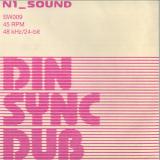
DIN SYNC DUB is an exploration of communication through sound. Six tightly packed experimental dub tracks use bass-heavy vibrations to rattle both body and mind, pushing the limits of self-expression in the hope of fostering deeper human connection.
The drive for more efficient and precise communication tools—whether between man and machine or machine and machine—has been a foundational force in the evolution of technology. This duality, the way we interface with computers and the way we speak to one another, is at the heart of DIN SYNC DUB. For this album, N1_SOUND looks back to 1980, drawing inspiration from Roland’s Din Sync—a 40-year-old synchronization technology once used to link musical machines in perfect harmony. While connecting machines to produce precisely sequenced music is nothing new, it’s the tension between perfection and imperfection—the mistakes of both man and machine—that gives DIN SYNC DUB its voice, its emotional rawness.
The journey begins with “Horizontal Hang”, which crashes through the door with a relentless bassline and crystalline synths. “Such Love” introduces a throbbing, guitar-driven groove, while “Intuition Dub” channels the spirit of Jah Shaka, offering a rhythmic pulse that echoes dub’s deep roots. “Us All” provides a moment of introspection with its sparse, three-dimensional melodies, before “Joy” reintroduces chaos, creating a post-dubstep soundscape that dismantles everything in its path. The album closes with “Mauzy” , a hopeful yet fragmented conclusion, reflecting the ever-evolving nature of technology and connection.
By the mid-to-late 1980s, Din Sync was superseded by the more widely adopted MIDI, yet obsolescence is built into the nature of all technology. Just as our relationship with machines shifts and fades, so too does our understanding of how those changes shape us. Before we can grasp the impact, the world has already moved on.
DIN SYNC DUB, the first full-length LP from Spiritual World, pulses with energy, on the edge of malfunction—a manifestation of the tension between the digital and the organic, the past and the present.
LIMITED POSTER EDITION (inclusive stickers)
From the dark circuitry of the American underground, Signal 72 transmits a raw message through Zodiak Commune Records. Loosing The Station is not about losing control, it's about releasing it. Letting the system breathe, unhooking from order, and giving the machines room to speak in distortion and pulse.
The sound is intense and immersive: heavy electro rhythms, dense sub pressure, and acidic 303 lines that twist through the mix like voltage on the edge of overload. It's the friction between chaos and precision, mechanical yet human, destructive yet alive.
Each element feels driven by instinct and recorded in the moment. The result is a tense, physical energy that connects directly to the roots of underground electronics, the sound of resistance, transmission, and release.
Broken symmetry. Acid eternal.
Panthera is back at the Bordello with his most energy-packed release to date. Synthsizer Hits III is forged in the heat of Hi-NRG, the romance of italo and the daring synthesizer hooks of 1980s Europe. A thick rasping beat pounds above a juddering arpeggiator line before hedonistic surges ignite “Fumare”, an achingly addictive opener. Vocals are toyed with, used to increase the potency of the chosen machines and sounds. A circling chant infects “Lucifera” as a joyous melody takes hold of this modern Summer anthem, euphoric notes ushering in the dawn while speakers and strobe throb. There is a palpable power that permeates the 12”. “The Magic Touch” sends strings sailing skyward as rich percussive textures take root below. From this fertile ground, a sensational ode to the synthesizer flowers. Vocoder lyrics, pulsating rhythms and keys that are truly fantastical. “Toccata” finishes this analogue celebration. Slow burning with disco inflections, this finale soon shows its true colours. Daring counter melodies frolic, from the elegant and refined to the brash and broad, in this mirrorball inspired last dance.
2025 Repress
In 2013 Voyage Direct released Tom Trago’s ‘Hidden Heart of Gold’, an expansive trip into intergalactic deep house territory that ranks as one of his most emotionally charged moments to date.
Hidden Heart Of Gold is undeniably special. A typically spacey and quietly soulful dancefloor epic that stretches out majestically over 13 spellbinding minutes. It was a highlight in many of Trago’s club sets for the best part of 12 months prior to release..
Virtual waves of ambient chords shimmer between the speakers, rising and falling as if drifting through time and space. Meanwhile, eyes-closed melodies reminiscent of classic stargazing techno and disembodied vocal samples ride a tough but unfussy machine drum rhythm and addictive bassline. There are well-timed breakdowns and a gradual, enveloping build towards a heart-breaking climax. Many listeners may feel contrasting emotions; a sense of undiluted joy while dancing, perhaps, but also the odd pang of melancholy when listening on headphones. It's that kind of record.
The tracks intergalactic, emotion-rich inspirations are explored further on the flipside Ambient Mix, a winding, beatless excursion brimming with hazy, late night beauty. Gentle and immersive, it offers a grandiose, never-ending world in which to shed your inhibitions. Shorn of the originals dancefloor paraphernalia, Tom's emotive, wide-eyed vision comes to the fore ¿ all sensual chords, far-sighted pads and gentle, outer-space melodies. Like the A-side club version, it may just take your breath away.
Milian Mori shares his deep interest in combining mathematics, geometry, and data with emotion, dance, and fulfillment: technology meets nature, binary meets fluids, algorithm meets spirituality, dualism meets triality, machine meets human, randomness meets self-similarity.
His second album, »Triality«, consists of 16 tracks and is being released via raster as a double LP vinyl, CD, and digitally. Composed to be experienced seamlessly, the 53-minute-long album can be listened to from beginning to end like an audiobook, with no pauses between tracks, creating a continuous sonic experience.
Triality explores the ›unspeakable third in the second‹—a quality that is present everywhere but remains immeasurable. This concept strongly influenced Milian Mori during the composition of the album. In his live performances, he attempts to visualize this unique relationship through the strobe light, which exaggerates the interplay between light and darkness, creating a non-binary space between 0 and 1. The album can be experienced like a film without images—a film that speaks of a vision yet to unfold.
Unearthed from the Crammed Discs vaults after nearly four decades (Originally recorded in 1987), a hidden gem finally sees the light. Maurice Poto Doudongo’s The Lost Album arrives on vinyl for the first time—limited to 500 copies, with printed inner sleeve featuring release notes and photographs.
Back in the hazy margins of late-’80s Brussels, where boundary-blurring sounds were seeping through the cracks of pop music, a young autodidact named Maurice Poto Doudongo was crafting music that didn’t quite belong to any scene. Born in Kinshasa and growing up in Belgium, Maurice was a sonic nomad—raised on Franco, Miriam Makeba, and Tabu Ley Rochereau, transfixed by James Brown and Prince, and shaped by the fertile collision between African music and experimental electronics occurring all around him.
Leaving school at 16 to concentrate on music full-time, he began recording on borrowed 4-tracks, using cardboard boxes for percussion, and absorbing whatever sounds the airwaves served him: “Music has no frontier,” he says. “You take what you like. Prince, Fela, Papa Wemba—there is no contradiction. It’s all part of the sound.”
The result? A record that’s equal parts analog drum machine funk, homegrown Afro-pop futurism, and new wave R&B-informed synth poetry. Marc Hollander, founder of Crammed Discs, met Maurice through his friend and associate, musician/producer Vincent Kenis and quickly recognized the spark. The two began working in earnest, preparing tracks intended for a full-length release that, for reasons lost to time and memory, never materialized—until now.
Marc remembers: “The album was never completely finished. “Bolingo” was the only track that came out on a Crammed compilation at that time… and the rest sat on the shelf for decades until we started opening the Crammed vaults.”
Maurice recalls the session as being, “like an unstoppable current”. Listening now, the Lost Album feels both of its time and well beyond it. While tracks like “Momo” sound not a million miles away from the slinky and sophisticated Balearic pop ambience of Wally Badarou’s Echoes album, "Passport Train" shakes itself loose of any genre boundaries, veering into free-form Afro-electronica and tough electronic rhythm. Others pulse with a sweet and soulful groove that suggests dance floors dreamed of but never reached.
In decades hence, Maurice never left music, and the music never left him. Now working mainly as an arranger, he describes his job as being like that of a musical psychologist: “Someone comes to me with their sound, and before anything I have to understand their mind and heart,” he explains. That same intuitive fluency can be heard across this entire album—music that listens before it speaks, that absorbs before it asserts.
This reissue is more than a remastering. It’s a second breath. Sourced from cassette roughs and 24-track demos, carefully restored with Maurice’s blessing, and released as a complete album on vinyl for the very first time, The Lost Album isn’t lost anymore.
It just took nearly 40 years to find its way to you. - Editions de Lux
Oscar Mulero and Another Machines join forces together for the next installment of their Joven Prisionero Project. No less than seven cuts on the zeroes and ones version and a six cut vinyl gonna be released on our 78th release. You may wonder what's inside this new outcome, and the answer is easy and direct: Pure techno with no roundabouts. But techno is an open language and this duo speaks all dialects: From the merciless and bleepy Conocete to the functional and fast paced minimalism on De tunica roja passing thru the drilling Surrealista Entorno stopping via Birmingham on Persiguiendo ecos, breaking the grooves and going martian for Mundo Efimero, back to Birmingham again with El nuevo jardin to finalize the duties with Identidad Variable in a pure scifi mood. If you want to spend your money on a totally useful collection of tools here you have the perfect package. El Joven Prisionero delivers to you exactly what your bodies and minds need under the strobe light. Soon available in your trusted physical and digital dealers.
Do you remember Cush?
A nod to the enigmatic Danakil warrior from Corto Maltese — wise, fierce, and fiercely free. That spirit is back, and this time, it speaks through sound.
Welcome to Cush — a bold sonic territory where the elegance of myth meets the urgency of noise.
Across 14 tracks, this power trio delivers a raw, immersive journey that bends genre boundaries and stirs the imagination. A soundscape emerges, somewhere between dystopia and liberation: windswept grooves, fractured brass, buzzing machines, explosive drums. Think improvisation at its most daring, textures at their most tactile, and themes that haunt like echoes from the future.
Cush is a cry. A rebellion. A pulse.
It’s where musique concrète collides with free jazz and industrial atmospheres — and something new is born.
For listeners drawn to Pierre Henry’s audacity, Alain Damasio’s visions, industrial ASMR, or sonic voyages à la Corto: this is your next deep dive.
Unbuckle your seatbelts. You’re in Cush territory.
An album that demands to be heard — and experienced — live.
Step into the emotional landscapes of Saudade’s new EP Expensive Noise, a multi-textured journey where analog machines speak louder than words. Each track captures a different state of mind, blending depth and groove with raw, honest sound design. The EP opens with “Expensive Noise” — direct, grounded, and hypnotic. No detours, no hesitation — just raw analog power locking into a loop with magnetic tension. The groove builds steadily, shifting your state of mind as the rhythm takes hold. “Anyway” brings a dreamy, bittersweet touch. Exclusive to vinyl, this extended version unfolds like a teenage memory you never shared — warm, nostalgic, somewhere between electro and pop, glowing softly from within. “Colored Life” dives into detailed minimal deep house territory. Rounded and generous, its sound design sculpts soft clouds of melodies against crisp, syncopated snares — floating between dream and presence, like a cushion made of rhythm and light. “Porte de la Villette 45” echoes the EP’s birthplace — a raw area near the Parisian périphérique, where engines roar, people hustle, and concrete weighs heavy. Yet within this urban friction stands Studio Villette 45 — a funky, soulful shelter where the machines find their groove. The record closes on “Cœur” (heart in French) — a stripped-down, heartfelt outro. Just a Prophet 5 pad, no tricks. A moment of vulnerability, stillness, and truth — as if the music had finally dropped its armor. Between analog heat and emotional honesty, Expensive Noise is Saudade at his most sincere — building bridges between power and softness, body and soul, sound and silence.
Balearic sounds and Mediterranean warmth are the inspirations for Bruno Belissimo’s Bordello A Parigi debut. Drawing on disco, house and funk, Ottimo! is a four tracker of electronic exuberance with Belissimo’s musical ability and range immediately spilling from the speakers. Guitar strings curve around synthlines in the title piece, percussive textures giving way to the mantra-like refrain of “Ottimo!” Thick bass echoes into beaming keys for “Meduse.” Bright notes cascade, grooves melting with vocoder lyrics as classic disco tones are reimagined in this modern mirrorball medley. Organic rhythms introduce the flip. “Mirage” opens to ripples of bongos and toms as a loose structure takes hold. Hedonistic chants rise to a shimmering chord, kicks and snares funnelling the building energy as bold blasts and samples shriek with delight. “Las Piramides De Ibiza” brings the quartet to a close. Clean drum patterns support joyous notes, a machine dipped voice calling time.
- 1: Holiday Party At The Cryptozoological Museum (Entrance) 0:22 Video
- 2: Abominable Snowman 0:38
- 3: Unholy Night - Mini Exhibit On Ritualistic Holiday Burnings 01:21
- 4: Coventry Carol For The Dead (Exhibit Hall A - Human Sacrifice As Holiday Tradition) 02:8
- 5: Hoofsteps Approaching (Mini Exhibit: Malfunctioning Yuletide Countdown Clocks) 01:06
- 6: Krampus Is Coming To Town - Exhibit Hall B 02:58
- 7: A Last Noel (Mini Exhibit: Collection Of Animatronic Christmas Decorations) 01:26
- 8: Sugar Plum Faeries: Friends Or Foes (Exhibit Hall C) 03:0
- 9: The Bells Toll (Mini Exhibit: Collection Of Vintage Holiday Carnival Games And Pinball Machines) 01:14
- 10: Christmas Luau (Snack Bar) 02:37
- 11: The Aritifical Aviary 01:04
- 12: God Rest Their Souls (Closed For Renovations) 02:42
- 13: Off-Limits Stairwell 01:14
- 14: Deadly Night (Members Only Ritual Chamber) 02:48
- 15: Cursed Artifiact Storage Room 01:21
- 16: Carol Of Hells Bells 02:53
- 17: Escape 01:21
Following the release of Haunted House Party, Bradley Thomas Turner was contacted by the Cryptozoological Society of New York City to create music for their museum’s holiday exhibitions. As enigmatic as they are controversial, the secretive society gave the composer free rein to create music that celebrated their profane (and, according to their critics, pseudoscientific) explorations of the darker side of yuletide folklore. The endeavour was denounced by religious groups, the scientific community and even parts of the cryptozoological community as “blasphemous,” “irresponsible”, and “a dangerous topic to make light of” respectively. Not much is known about the pandemonium that broke out on the night of the opening reception, but one journalist (who has been granted anonymity by request) infiltrated the event and captured the recordings that follow. Death cult ritual? Mishandling of cursed artifacts? Elaborate practical joke? Publicity stunt? No one can (or will) say for sure as no person in attendance has been willing to speak on record. Therefore, we present these recordings so the general public can decide for themselves.
To speak to Luca Daniel Schwarz aka LDS about his music is to be enthusiastically guided into a complex world of his own creation: clean and powerful techno which pulses with life from the textured patterns and drum sequences that have fills and accents that would make anyone who’s picked up a set of drumsticks envious. Yet this ecosystem of noise is deceptive; Schwarz’s process for making music is very different to how a live drummer would create the same subtlety of performance. Forever researching new technology, Luca got deeply interested in different programming languages, and created a series of probability-based music tools for manoeuvring sounds and sequencing.
Manipulating those probabilities takes a skilful alchemy, needing understanding of both musical structure and how the tools he devised work. To return to the drummer analogy, if the drummer is focussed and intentional in the moment of playing, then the method used in LDS tracks is almost diametrically opposed, with all of the intention coming in the assembly of the instruments, potential paths, and gateways; once play is pressed the music flows, following all the rules that were set in advance, not unlike a domino run or Rube Goldberg machine. And like a domino run, the results are fascinating and, ultimately, fun: staccato vocals pop in and out in ‘zipp prompt’; laser-like synths pulse; background noises sweep across the aural plane of the dub techno of ‘diff, blockmix’ and ‘pow’ adding texture that brings vitality all-too-easily missed out when complex mathematical
processes become entwined with music creation. The high sensitivity to texture and rhythmic detail in Stadion Progg is multiplied further on Jean Redondo's remix - whose track, Hypersonic, was the backbone of 2023’s ‘yet’ compilation on Tresor.
The balance between technology and a sense of fun might also come from the maker; it’s not easy to overstate Schwarz’s passion for what is now his favourite way to make music, “it never gets boring. There’s always a moment of anticipation to see what actually emerges.” And the true “power of 2” comes into play when the resulting music can be fed back through the system again and again, potentiating the music in exponential ways.
Schrödinger’s Box welcome Catalonia’s Adrian Marth into the fold. The Iberian artist has been drawing crowds and turning heads with his analogue inspired productions and dancefloor inhibitions.
This five tracker sees the Italo Moderni founder explore the glittering angles and brooding shadows of his machines. The punishing percussion and beaming laser lights of “Labyrinth Mind” give way to the tumbling drums and racing synthlines of the addictive “Sex Tonight.” The flip opens with the sleazy grandeur of “Beverly Hills”, looming melodies and retro flourishes combine in this operatic ode to the 1980s. Speaking of the 80s, the inspiration for the penultimate comes from a figure who symbolised the bombastic bravado of the era. “Divine on the Late Show 88” is a tribute to the Pink Flamingos legend, beats sparkle as her sequenced dresses and larger-than-life attitude screams into the present. Danny Wolfers takes the helm to close. Donning his familiar Legowelt moniker, the behemoth of all thing electronics delivers a saturated and spiralling rework of “Divine on the Late Show 88” to the close.
The combination of their musicianship and the cutting-edge technology at the studio resulted in a masterpiece of pure, state-of-the-art funk and boogie. The album features all the hallmarks of great 80s music: fresh synths, drum machines, and powerful lead vocals from John Davis. Upbeat tracks like "The Cat (Puma)" and the title track sit comfortably alongside more soulful songs like "Tears" and "Hearts of Gold," while "Dancing Shoes" remains one of the era's catchiest dance tracks.
Still, Shake It - Make It Loose holds a few mysteries. Why was it released under the unusual name J.D. (Puma) Lewis? And what's the story behind tracks like "The Cat"? While J.D. Lewis stood for John Davis Lewis's full legal name, Hudson sheds light on the "Puma" connection: "At the time, I was working as a promotions manager for Puma sportswear. Jörg Dassler, son of Puma founder Rudolf Dassler, was a friend of mine and financed our studio sessions." As said, these sessions took place at Hartmann Digital, a state-of-the-art studio in Untertrubach, Bavaria, where iconic artists like Nena, Yello, Visage, DAF, and Soft Cell recorded.
The use of such an expensive studio would have been out of reach for the two musicians without Puma's backing, which also explains why there is a title like "Dancing Shoes." When we had licensed the track for the Boogie On The Mainline compilation in 2018, we had the chance to speak with John Davis (who sadly passed away in May 2021 due to COVID-19). Davis revealed that there were plans to make a video for the song in collaboration with Puma, but those plans fell through. In the end, the album was signed to the Deggendorf-based Metrovynil label.
Interestingly, the original contract reveals that the first version of the album only contained six tracks. Metrovynil added two more: "Sexy Highschool Lady," a track Davis recorded solo, and "Party Rap" by The Dynamite Two, which had no connection to Davis or Hudson at all. The album's credits also list a "Fred Fiore" as the person "who made all of this possible." Hudson, who sees himself as the producer, has no idea who Fiore was - likely another fabrication from the label. "That's just the kind of thing Metrovynil did," Hudson comments with some regret.
Despite the behind-the-scenes confusion, the music spoke for itself. The original pressing looked and sounded fantastic, featuring a stylish cover shot of John Davis in a sharp suit. Now, with this first-ever vinyl reissue, we're thrilled to include additional photos and more background information in a deluxe gatefold sleeve.
This reissue includes all six tracks from the original Hartmann Digital sessions, plus two bonus tracks. From the original reel tapes, we unearthed additional material that Hudson and Davis produced together in the early to mid-80s. We're excited to share the previously unreleased tracks "Life's A Party," and "Walk Out On Me." The digital version of the reissue will also feature two more songs: "Red Drops" and "Pick It Up Off The Ground."
Shake It - Make It Loose is a classic boogie-funk album that belongs in every serious funk and disco collection. It showcases the undeniable talent of two true musicians and stands as a testament to the friendship between Reg Hudson and John Davis.
Follow-up album to cult-classic debut, Mantra Moderne.
‘Melodi’ is the second album from captivating duo Kit Sebastian (aka Kit Martin and Merve Erdem). Those familiar with the band's cult classic 2019 debut record 'Mantra Moderne' will instantly recognise their unique sound that blurs boundaries of world music, jazz and psychedelia. Not to be content replicating the same album, sonically the feel of ‘Melodi’ is a maturation. It is more diverse and provides glimpses into many different worlds from the Italian Riviera to the mountains of the Caucasus, the beaches of Bahia to the city streets of Istanbul and Paris. This joyous merging of soundscapes evokes a borderless planet with music as an international language, belonging everywhere and nowhere.
‘Melodi’ is imbued with Kit Sebastian's love of vintage records and world cinema, but it is not a retro homage. It celebrates its influences but is very much a modern record, being simultaneously brand new and retro. This is a credit to the duo's craft as musicians and songwriters, presenting their influences as a circular interaction between the present and the past rather than a linear one.
The music was written during the first UK lockdown and recorded that summer, a time of opening up that only briefly existed. In a world with a slower pace than before the Covid crisis, the band were able to spend more time experimenting in the studio. The album’s range of instrumentation has expanded from the previous record to include zithers, harpsichords, congas, bongos, bulbul tarang, and a mock-up choir on top of the synthesizers, balalaikas, organs, and saxophones. Session musicians and friends were also booked to introduce trumpet and string sections giving the album an added depth and orchestral texture. Despite the added complexity, the album was recorded using the same techniques employed for the previous album with various tape machines, bouncing back between cassette and ¼” tape for practicality and sonic abstraction. To pierce through this abstraction, the vocals are intentionally more expressive. Merve took cues from the Turkish singers of her youth, adding a slightly more melancholic, darker and more reflective style than 'Mantra Moderne’. Rooted in observations from everyday life, they speak often about the worlds and thoughts that arise from the end of the night.
Like with many of the best albums, the record seems over all too soon and has you instantly wanting to play it again. On each listen you decide on a track that you think is your favourite from the album only for it to be replaced with a different one on the next listen. The songs and production have hidden depths that seem to evolve and morph the more you devour them. Moments of pure pop, moments to fall in love, moments to contemplate. This journey is rich in musical vitamins and nourishment, but like all the best things still leaves you wanting more.
The most experimental work of Mauro Rizla for his “Unpronounceable” project using circuit bend machines, sounds recorded with a microphone and playing with a “speak & spell” toy in the track “Extra Dollars”.
‘Kevin’, a new collaboration between Ben Bondy and Mister Water Wet, presents what feels like a time-machine hidden in the back of your closet. ‘Laundry’ pleasantly haunts listeners with phantom purrs, harmonies, hums and horns. This project is a hand reaching through the void and out of your speakers responding to moments of isolation and pining with resounding gratitude. It makes space for warmth in slow-healing wounds; the gift of reset that is born from the call and response between friends.
Shipwrec have delved into the underbelly of electronics for their latest discovery. Fake Youth Cult is the brand new project of Richard van Kruysdijk, an artist who has been integral to the Dutch music scene. Following releases on Delsin, as well as founding his own Music for Speakers label, this latest undertaking explores the darker hues of Kruysdijk's audio creations. Across six tracks, a realm of shadows and steel is constructed. From the murky tones of "Visitor" to the industrial and blackened "Scorched", a towering sound of punishing percussion looms over the listener. Techno is central message. Despite this, the piercing coldness of electro rises in the incising and stark "Messing." The influence of punk comes to the fore in racing rhythms and lean strings that make up "Smear." BPMs drop in the slow burning EBM stained "Management." The machines take control for the finale. A relentless kick is the motor that drives this seven minute juggernaut to the close. Broad and brutish brilliance from a prodigious talent.
The final volume of this mammoth collection of music from Bristolian electronic music pioneer Krust is finally upon us, and like the previous parts of this collection it boasts an assemblage of music of different energies, vibes and feelings. The music contained within spans decades yet somehow refuses to be locked to one 'era' or 'style'. This is what makes this release unmissable for the hardcore fan, newcomer or completist.
'Irrational Numbers' is a meticulously curated collection of five parts, available on both vinyl and digital formats. The compilation is a treasure trove of hand-picked records and archival gems from Krust's extensive discography, thoughtfully remastered and presented anew for both devoted fans and newcomers.
'Irrational Numbers' features a dizzying array of self-released 12" cuts, exclusive unreleased VIPs and dub-plates, alongside epic major label widescreen classics. It's an unmissable journey through the sonic output of one of the UK's most distinctive and forward-looking producers.
Featured on part 5 are some groundbreaking entries into Krust's massive back catalogue. The live bass driven jazz inflected 'Second Movement' from his acclaimed 'Coded Language' LP jostles alongside the speaker smashing machine funk of 'Break Ya Neck' as well as a couple of more recent productions including the sleek and sinister 'The Portal', which is undeniably the man at his best, in full electronic stealth mode.
For longtime Krust enthusiasts, this project serves as a fond reminder of the boundless creativity and originality that flourished during the early 1990s and beyond. For those new to his work, it presents an enthralling introduction to innovative electronic music that has comfortably set the tone for generations to come. Get ready to experience the evolution of sound and immerse yourself in the visionary artistry of Krust.