LP+Buch
Limited Edition Deluxe Version comes with 50 page children's book inspired by the album. Written by Francine Prose and illustrated by Omar "El Oms" Juarez. The colored vinyl is red. Fresh off of their 2020 offering Adult Themes, El Michels Affair is back with a new full-length release. Titled Yeti Season, this newest album has everything we've come to expect from EMA's patented cinematic style of instrumental soul music. Where Adult Themes inspired a soundtrack to an imaginary film, Yeti Season brings us to a different place in time_with new inspirations. Taken with Turkish-styled funk and an almost Mumbai-esque take on soul, El Michels Affair offers us a different kind of drama and imagination with Yeti Season. If you've been following along, this shouldn't be viewed as too far a departure for El Michels Affair. The first single off of Yeti Season showed their hand back in 2018. A double-sided banger, that release brought the musical textures to the fore that dominate this record. The first song, titled "Unathi," is fully realized with the beautifully haunting-yet-hopeful vocals of Piya Malik, formally of 79.5_another Big Crown artist. Singing in Hindi, Piya's ethereal voice is telling us to work and strive together toward progress. Even if you don't understand her language, you can still hear the urgency of purpose, creating a lasting vibe that sits on top of it all. Leon Michels explains that Piya had a vital influence on this record: "When Piya started singing in Hindi, she had a different voice, a different tone. I knew we had to do something together." And so Piya appears on three other songs on Yeti Season: "Zaharila," "Murkit Gem," and "Dhuaan." Each providing particular signatures to the album. "Zaharila" is a building and changing love song punctuated by blaring trumpets, driving drums, and Piya's pleading lyrics. While the more upbeat "Murkit Gem" opens with a fuzzed out, Wu-Tang-esque baseline that buoys Piya's stylings. The psychedelic guitar and Piya's changing tones and textures singing about an all-consuming love are what pushed "Dhuaan" on to the second single from Yeti Season. There is also a vocal appearance from Shannon Wise of The Shacks, yet another Big Crown artist. Her song called "Sha Na Na," lies more in the familiar EMA vein: melodic, hypnotic, soulfully visual. But between Shannon's airy singing, the jumpy baseline, moody vibes, the active drum lines, it sounds like a pensive walk home after a strangely dramatic night. So what is Yeti Season? It could be more of a feeling than an actual place or time of year. It's a heavy album_as evidenced by the signature musicianship and dramatic vocal expressions. But it's also a hopeful record, with phrasings, textures, and chord changes that hint at something better_or fuller_coming our way. You hear it in songs like "Ala Vida," with its stabby, pulsing chords laying a bedrock for EMA's bright, atmospheric horn lines. Or even in "Fazed Out," which leaves you with a feeling of determination, a striving for resolution even though the driving, march-like song structure should accompany some conquering army. This persistence has to come from the fact that Leon Michels and company finished this record during the lockdown. It was a tough and troublesome time. But look at what has come of it: Yeti Season_a record of high and heavy drama, but also one of hope and promise. It may take a year like 2020 behind us to find hope in a winter big footed creature like a Yeti, but that's where we are.
Buscar:i tones
The original Soundtrack to Greek-German director Nikias Chrssos’ new feature, ‘A Pure Place’, scored by John Gürtler (Eigenlicht, COUNTER019), with his studio partner Jan Miserre, and featuring a track by chameleonic British artist Shackleton.
The script for A Pure Place had a dizzying effect on John Gürtler & Jan Miserre; their minds reeling with the possibilities.
From Persian sheep bells, Chinese sheng, prepared trombone, quarter-tone piano, a beaten-up cembalo, hand percussion, and a room full of synthesizers, embryonic compositions and experiments came to life early on in the project.
An electro-acoustic extravaganza, the soundtrack for A Pure Place takes a deep bow towards the many magnificent composers and scores from the late 60s and 70s where orchestral arrangements met with tape loops, psychedelia, and instruments from across the globe. Listening to that era of film music, anything seems possible.
The minimalist tones of ‘Ritual Bells’ set the dial to weird in the opening sequence of the movie, whilst ‘The Island’ makes use of ambient vocals recorded through an oil drum, gently introducing one of the score’s main themes with a distant quarter-tone cembalo.
Acclaimed British artist Shackleton’s eerie original version of ‘Fust’s Song’ (also included) was a tonal keystone for the entire soundtrack. Gürtler and Miserre translated his psychedelic electronic blueprint, layering acoustic instruments and bottom-heavy percussion in their ‘Paradox Paradise’ production style. The vocals, written by Chryssos, and sung by the cast on set, capture the sonics of the actual crypt-like space where cult leader Fust addresses with his following.
‘A Glimpse of the Other Side’ speaks of love and death in a 70s-indebted composition reflecting John and Jan’s shared love for melancholic and suspenseful chord progressions. Meanwhile, the sparkling synths of ‘Athens’ - the children discovering neon-lit civilisation after years confined on the island - transplant us to an entirely different era.
Greek artist Maroulita del Kol features heavily throughout - her choir of vocals on ‘Erotica’ were recorded late at night in the studio foyer, capturing its unique tiled reflections and concrete reverb.
On ‘Purification’ Maroulita’s voice guides us alongside a Moog bass drone, building to an ecstatic climax, whilst she also features in the film’s disco-centric ending credits on ‘Gatoula Mou Mikri’.
strumentalist Teddy Lasry's story is noteworthy not just in regards to the music he released, but in the ways approached the craft of composing and experimenting with sounds and sonics.
Always intrigued with the capabilities of instruments, their groove and their feel, it was very much his family’s influence that helped to fuel these life long affections. As a performer in a parisien cabaret, Teddy’s father Jacques would mingle with giants like Serge
Gainsbourg and Charlie Chaplin (impressed by his ability to improvise, Chaplin wanted him to become his accompanist, but the pianist politely refused). Jacques and his wife (Teddy’s mother Yvonne), would later become members of the innovative experimental group Les Structures Sonores, and surround their children’s lives with sounds. Electronic music was still in its infancy and Les Structures Sonores, with their resonators that produced long, mysterious tones, were deemed ‘cosmic’. It was the era of the launching of the first Russian Sputnik and every time a radio or television station wanted music for their science fiction programs, they turned to one of their compositions. Showing a natural ability with multi instrumentalism, Teddy was rewarded with a spot in the band, allowing him to really explore unconventional methods of composition.
Following a brief stint with Ariane Mnouchkine's avant-garde Théâtre du Soleil after graduating school, Teddy joined the pioneering prog band Magma, with whom he would record three groundbreaking records during the early 1970s (According to former member
Laurent Thibault, their album Mëkanïk Dëstruktïẁ Kömmandöh and its sound were strong influences on David Bowie during the recording
of Low and Iggy Pop’s The Idiot at Hérouville). Despite the successes with these projects, Teddy was constantly searching for new ways
of expressing himself through music, leading him into the beginnings of a solo career that would last the better part of three decades.
Teddy’s transition into his solo career came with contrasting fortunes, in that he was now becoming a music to image composer but with the unfortunate realisation that his eyesight was gradually worsening (due to being diagnosed with retinitis pigmentosa at an early age). Nonetheless, his solo career would begin in 1975, and for the rest of the decade his sound would become increasingly mired in electrified Funk-Fusion and its endless sonic possibilities. The resulting music would serve to highlight Teddy’s love affair with the possibilities found within tireless instrumentation, with the flute and particularly synthesisers becoming a mini-obession of his (he once spent a 7,000 Francs loan, which was meant to be spent on fixing his roof, on synths).
To this day Teddy continues to record and experiment with music, a passion which in many ways has never left his sid, even at the age of 75. His career was one that was fuelled by innate curiosity and an intrinsic desire to discover new methods of expressionism, be it through the realms of Jazz-Funk, ambient electronics, Swing music or indeed through the medium of instrumentation itself. On this compilation, we look to encapsulate the essence of his innovative sound, and from start to finish a sense of his ingenious approach to composing structure and mood is made abundantly clear. The funk-jazz fusion style that embodied the majority of his 70s work is on full display here, with the vibrant flute driven "Los Angeles", the Miles Davis inspired "Blue Theme", the progressive and driving
"Chamonix", and the deeply intricate "Krazy Kat", along with one of his finest 80s slow jams, "Funky Ghost". Two cuts off the ‘Back To
Amazonia’ album are also featured (Teddy’s last album including his Prophet T8, Yamaha DX7 and Oberheim drum machines). "Raising
Sun in Bali" and the title piece both emphasise an ever present passion for synthesisers. "Birds of Space", a standout track off the e=mc2 album, closes the comp, and is a fitting way to end this journey.
Pulled together in close collaboration with Teddy and his family, this collection of songs looks to introduce new listeners to his work and we are proud to present this limited and carefully remastered compilation on vinyl, including extensive liner notes.
Newly arranged and composed by Joe Hisaishi for children and adults who are exposed to an orchestra for the first time.
It consists of two parts: an introductory version with an easy-to-understand explanation of the names and tones of the instruments, narrated by Shigesato Itoi as the father, and a suite without narration. Performed by the New Japan Philharmonic.
Gábor Lázár's colourful discography extends from sound art to his more recent dancefloor detonations. From his first release on Lorenzo Senni's Presto! label to his collaborations with Russell Haswell and his popular 'seizure inducing' team-up with Mark Fell entitled 'The Neurobiology of Moral Decision Making' to his last album 'Unfold' on The Death of Rave, where he balanced relentless, snappy rhythms and wonky melodic tones against more measured chords to create a deliciously fruity futurism.Gábor has now signed to Planet Mu for his new album 'Source' which moves forward with the dance music direction he started to formulate with 'Unfold'. Gábor first fell in love with electronic music simultaneously through dance music and it's IDM offspring, and also with harsher, noisier computer music on labels such as Editions Mego. This collection, which develops slowly over 8 tracks, works its way through his own take on these influences, moving across themes and loops as if each track is a different stage in a process. All these tracks sound incredible on a club sound system. The listener can hear nods to hoover bass and 2-step in 'Phase', or trance techno in ‘Excite', the dive-bombing bass of dubstep in 'Effort ' or the frantic techno influence of 'Route', emulated in the minimal forms Gábor has created with a sound artist's precision and a strict adherence to his vacuum-like grids. Gábor bends his sounds, abstracts them and re-contextualises them; basslines fire out of the grid at strange angles and squirm as if they've come alive, shards of melody shoot off at wild angles, attacking with drama and a thrilling sense of energy
GENRE: Modern Classical, Experimental, Ambient Metal. RIYL: György Ligeti, Sarah Davachi, Stars Of The Lid. 180g LP pressed at Optimal, 350gsm jacket, inner & DL card. Jessica Moss Also Known For Her Tenure In Thee Silver Mt. Zion (2002-2015), Black Ox Orkestar (2002-2007), Recordings By Vic Chesnutt, Carla Bozulich, Arcade Fire, Basia Bulat, Roy Montgomery, Sarah Davachi, Big Brave & More. A phosphene is “the phenomenon of seeing light without light entering the eye.” The title of the heart-rending and resolute new album by composer/violinist Jessica Moss could not be better chosen. Moss is by now a seasoned practitioner of immersive isolation music; across three previously acclaimed solo records of minimal and maximal post-classicism, her acoustic, amplified, and electronically-shifted violin is the raw material for deeply expressive, palpably haunted, wholly committed compositions. But Phosphenes inscribes fleeting halos of refracted ghostly light out of a prevailing darkness with especially plangent determination and intensity. This is the most overtly searching, mournful and inexorable music Moss has made to date. The pieces on Phosphenes exquisitely navigate consonance and dissonance, building patiently from single notes to multiple voicings, harmonic stacks and clusters. These compositions channel themselves like slow-moving water in a dark cave, finding small eddies and catching glints of luminescence from within. Signal processing is kept to a minimum in the three-movement “Contemplation” suite on Side One, where Moss deploys amplification chiefly in the service of activating overtones and pitch-shifts, thickening and widening the sonics, carving out her unique timbral space. Based on a four-note sequence that sets whole tones against one another, “Contemplation” is a bona fide requiem that finds Moss at her most instrumentally naturalistic, measured, and modern. Side Two unfolds in a more foreboding vein: “Let Down” is marked by cavernous octave-dropped arco and pizzicato, providing a gothically-inflected substratum upon which hauntingly wordless vocal invocations and cumulative gyres of violin melody unfurl. “Distortion Harbour” grinds with noisier grit and a more harrowing complexion, highlighting Moss’s ambient-metal sensibility and her distinctive palette of industrial-inflected power electronics a reminder of why she’s also been a go-to player on albums by the likes of Big Brave, Oiseaux-Tempête and Zu in recent years. These two songs also feature upright bass from old friend and former bandmate Thierry Amar (Godspeed You! Black Emperor, Thee Silver Mt. Zion, Black Ox Orkestar). Album closer “Memorizing & Forgetting” is inarguably the most tender and beautiful song in Jessica’s oeuvre: a keening lullabye of sorts, on which she plays piano, violin and guitar, joined by her partner Julius Levy in a lustrous ambient vocal duet. Everyone has been trying to find a way through and out of pandemic, lockdown, social isolation and often darkened hope and for many musicians, the absence of touring, of live performance, live sound, live audiences, and a living. For Moss, it’s also been “like when you press your fists hard against your eyes and eventually there is fireworks.” The light gets in where it can, even or maybe especially as imaginative sensory simulacra (if/when we shut down our screens and are left to our own devices). Phosphenes is a stoic, acutely sensitive, superlative musical statement from Moss
- A1: Isabelle Mayereau - Jeux De Regards
- A2: Nemo - Jungle Jim
- A3: Erik Tagg - Got To Be Lovin' You
- B1: Achim Kück & Friends - Wind
- B2: The Mike Nock Underground - Wax Planet
- B3: Horace Silver & The L.a. Modern String Orchestra - Scott Joplin
- C1: Carmen Lundy - Have A Little Faith
- C2: Embryo - Knast-Funk
- C3: Siegfried Kessler & Serge Bringolf - Sigi Dance
- D1: Gustav Brom Orchestra - Calling Up The Rain
- D2: Frederic Rabold Crew - Ride On
- D3: Stan Kenton & His Orchestra - Samba Dehaps
- D4: Larry Rose Band - The Sand
DJ Cam & sommelier Frédéric Beneix present Wine4Melomanes, an eclectic and unique
compilation album concept, matching fine wines with rare pieces of music produced in the
same year.
Connecting the complexity, sensuality, liveliness of a drink with the harmony, arrangements,
voice, orchestration, rhythm and melody of a song, Wine4Melomanes tours France,
Germany, Holland, the USA and even Slovakia in search of only the finest musical flavours.
Ranging from jazz, to pop-rock, to blue-eyed soul from the early 70s right through to 2016,
Wine4Melomanes is defined by its sense of musical opulence, with warm rich tones and
understated quality evident throughout. DJ Cam is known for his pioneering abstract hip-hop musical
compositions, his virtuoso use of technology and his fascination for acoustic jazz gaining him
international acclaim.
‘Eighteen Movements’ is a collection of recordings captured at live performances between 2017 – 2019. The record’s rich textures combine ambient, tribal rhythms, field recordings, ritualistic vibes, and a meditative feeling that runs through the entire LP. Đ.K. is in full flight mode, illustrating the project’s aptitude for deep transcendence.
Đ.K. is a DJ, composer & producer based in Paris, France. A versatile and prolific artist, D.K. has cultivated an eclectic body of work in recent years, with acclaimed output on renowned labels including Antinote, Melody As Truth, 12th Isle, Good Morning Tapes, Music From Memory’s Second Circle imprint, and L.I.E.S. (as 45 ACP).
Luminous and mesmeric, D.K.’s work combines finetuned traces of house, synth pop, ambient, balearic, minimalism, and fourth world music, creating energies and soundscapes which aim to invoke elevated forms of consciousness.
Prismatic tones exchange space with devotional drums on ‘Clarity’ and ‘Echo Chamber’, as Đ.K. hits a hypnotic stride somewhere between Jon Hassell, HTRK & a Folkways percussion ensemble. With ‘Full Consciousness’ meditation bells ring out across a progression of gleaming new age emanations, conjuring an entrancing spell. Movements of pulse and ether.
On ‘Mirror’, sonorous, elaborate percussive phrases are interwoven with drifting ambient vapours, while ‘The Other Side’ veers into broad, rolling blasts of dub and Antipodean drone, a cavernous trance evoking the early roots of Ras Michael and Yabby You, pared back to resolute drum sequences and infused with esoteric chimes and sultry synthesis.
The finale of ‘Eighteen Movements’ represents one of Đ.K..’s most ambitious recordings. ‘Awakening’ is an epic tone poem of aqueous, outer planetary resonance that completes this mercurial cycle with a poignant, euphoric fadeout. Chronicled in the moment, alternating between rhythm and repose, momentum and aviation, 'Eighteen Movements' sees Đ.K. voyaging further, into vast, uncharted outskirts of sound. A collection of movements for heightened states and new diversions.
Mastered by Jose Guerrero at Plataforma Continental. Graphic Design by Javi Tortosa.
Long-standing FUSE mainstay Rich NxT makes a long-awaited return to Hot Creations this October with the Vibewise EP. The three-tracker marks his debut solo release on the label, having featured as remixer on the imprint previously.
The A-side sets off with Roll On and the title signifies the exact nature of the track. A chuggy, groove-paced creeper, borrowing a unique vocal hook from UK hip hop protagonist Einstein. Rich’s hallmark style leaves few prisoners in its wake, as swinging bass tones open into the techy sounds of Papermill. Gritty basslines meld into whirring synth pulses before the title track brings things to a close, with stripped-back percussion residing next to loopy kick-hat combos throughout.
As one of FUSE’s original residents, Rich NxT played a major part in the brand’s evolution, helping take it from a free afterparty to one of the most respected event brands and labels on the planet. Elsewhere, the DJ / producer draws on his strongly identifiable sound to run two vinyl imprints, NxT Records and What NxT.
Sistrum ventures ever deeper into the cold, dark nights of winter, conjuring the hidden warmth that lies within each waveform. Genesis Tracks showcases a collection of deep techno talents who aren't afraid to stand their ground for purity of sound.
Track 1 - Modular One - Quasar
Chris Mitchell teams up with label boss, Patrice Scott for a lush, hypnotic groove of classic proportions. Warm square wave tones pulsate and crisp chord stabs shimmer as they punctuate the atmosphere. Sistrum sound, through and through.
Track 2 - Johannes Volk - Steam
Johannes Volk ups the tempo a bit to create a dirty, driving dancefloor number with Steam. Maintaining the Sistrum tradition of raw, no-nonsense techno music with depth, texture and soul, Johannes Volk makes his case eloquently through the use of rolling bass and slowly modulated chords.
Track 3 - Marco Zenker - Second Sight
Deeper yet we go, as Marco Zenker proceeds into the darkness with the booming, reverbed kicks of Second Sight. Slowly evolving synth textures rise and undulate, meshing with the rugged rhythm section to form a powerful groove that can only be defined as 'techno soul.'
Track 4 - Sharif Anderson - Future Acid Test
Closing the EP, Sharif Anderson offers his forward thinking take on the traditional acid motif. As the title implies, the sound is futuristic, but still retains the simple subtleties of yore. Give this track a proper sound system and watch it come alive before your ears.
The second selection from Toko's 2021 collection again sees label mainstay Si Brad man the controls on the sublime and soulful 'Avenue 6 (Is This Real Life?)'.
Incorporating the crisp rhythms, heavyweight subs & swelling pads which are such a Toko trademark, Brad brings the bliss to this sensual house heater, enlisting Azeem's emotive vocal tones for an extra helping of soul.
The label enlist hometown hero Crooked Man for the B side business here, and the Techno hero obliges with a pair of ferocious speaker tweaking reshapes.
Dark and cavernous, the 'Real Crooked' mix combines wall shaking bass, jacking drums and bloodless riffs into a smoke and strobe stomper, repurposing Azeem's vocal as a haunting refrain.
The dance floor paranoia continues on the 'Crooked Girl, Crooked Boy' mix, a sparse and dissociative take on the original equipped with demented dub FX and some serious bass weight.
An anthem in its original form, and a main room monster on the remix tip. Toko are back.
A trio of tunes from Diahgonal’s brilliant debut LP “Spiral” gets remixed by label mates for this Special 12”. We’ve packed a sonic spectrum into this release: a tech-house shaker from Adriano Mirabile,
autonomic goodness from Driftsystem, ambient soundscape from Louis Haiman, abstract IDM chillage from Maps Of Hyperspace, and tribal techno tones from Robert Roos.
On our 39th chapter we welcome Madrid's _asstnt & Roll Dann on their first collaborative EP on MindTrip. Throughout four tracks, the Spanish duo joins efforts and shows off their talent in producing high octane yet beautifully melancholic music designed to tear down structures. Sharp percussive elements, hypnotic grooves and evolving, emotive tones inside. This is 'Emergency Break'.
This is MindTrip!
Weighty Ways strongly believe that every now and then the Universe aligns a series of elements that leads to the uprising of a unique talent. Enter the Room 'Alfredo Romero', alias of Alfie Aukett, Music Extraordinaire hailing from West London. Alfredo Romero is the byproduct of where a philosophical understanding of the sonic landscape meets all its capabilities. With little regard for the restraints of traditional music theory and drawing influences from improvisational genres such as Jazz (which Alfie studied to a molecular level at Leeds University) makes for a superior musical tapestry woven by a man far beyond his years.
Alfie's quest for musical enlightenment started at a very young age as a Chorister and experimented with a plethora of musical instruments. This profound musical understanding is evident in "Retrain Station", a four track EP born from the ashes of a desolate 2020. A collection of seamlessly flowing production with tones drawn from the musical nuances of Jazz, Blues and Classical through to the ever evolving face of the electronic music scene from both sides of the pond.
Strong on all flavours from Jungle to Jazz. A magnificent EP from a truly special individual.
anthéne, one of ambient drone’s most recognised names, presents ‘maritime’. A shift from his usual expansive, time-stretching soundscapes, maritime is something altogether more grounded, more present. It signals the call of the open ocean, of its vast possibilities and terrors, as a similitude for the night.
In both, one faces the peace, the limitlessness, the reverence, and the promise, while at the same time the uncertain, the uncontrollable, the danger and the fear of the unknown. In such a way, maritime is presented in two parts: Side A demonstrates the beauty and inspiration of ocean views and night time explorations, while Side B addresses the vulnerable nature of vast, boundless experience.
An artist with an astounding workrate, Brad Deschamps has worked with such artists as Ian Hawgood, James McDermid, Andrew Tasselmyer and Fossil Hunting Collective (as Still Harbours), and releases the likes of Hakobune, Moss Covered Technology and Forest Management on his own Polar Seas Recordings.
His patient style is clear throughout the album, shimmering guitar tones overlaying with warmth and stability, yet the addition of more troubled melodies and subtle vocal parts make for something far more poignant. The duality of awe and terror, of the two primary elements of the sublime, channel through as one in one of anthéne’s most thoughtful offerings to date.
Elsa Hewitt is a London-based music producer and writer hailing from Sussex, via Yorkshire. Beginning as a young singer-songwriter producing demos on a four-track, she progressed through fronting post-punk bands and solo electronic songwriting, all the while developing a passion for album-making which would ultimately lead her to electronic production, establishing her name producing avant-garde, experimental & ambient, leftfield dance, and lo-fi, psychedelia. Since her 2017 official debut ‘Cameras From Mars’, stepping onto the scene as a Future Bubbler and Lynsey de Paul Prize winner, Hewitt has amassed a series of distinct yet interlinked philosophical worlds; each one holding its own tones of joyful beauty and abstract darkness. With a boundless approach to merging elements of dance & ambient, Hewitt’s adventurous approach remains pinned by her earthy voice, idiosyncratic songwriting style and sharply poetic lyricism.
German electro producer Martin Matiske has recently breathed new life into his Blackploid alias. The project's revival continues to bear fruit with the Strange Stars EP, Matiske's third Blackploid release of 2021 and second for Central Processing Unit after issuing March's Cosmic Traveler EP through the Sheffield label.
Blackploid's two CPU drops have more in common than just stargazing titles. Those who enjoyed Cosmic Traveler will find plenty to like again in these four tracks, with Matiske serving up another quartet of snappy machine-funk joints this time around. However, while there is certainly a throughline between Cosmic Traveler and Strange Stars, this EP also finds Blackploid pushing the envelope at points by taking risks with his synth tones which thrill and enliven the record.
In keeping with the cosmic theme of Blackploid's recent output, Strange Stars kicks off with 'Star Patrol'. While this opening cut is full of the same needle-gun basslines and dinky synths that characterised Cosmic Traveler, the drum programming eschews the broken beats favoured by many in the scene for a straight house/techno snap. It makes for a very groovy jam, one with Drexciya, Computer World-era Kraftwerk and a pinch of Space Dimension Controller in its mix.
Indeed, the only track on Strange Stars which skips along on a broken beat is second entry 'The Signal'. 'The Signal' also features some of Blackploid's most impressive electronics programming to date, announcing itself with a brilliantly unusual synth that sounds like an old video game unit which has just gained sentience. When this alien tone is combined with another precision-engineered bassline the track invokes the grizzly bangers of the L.I.E.S. label, though the keyboard stabs which enter periodically also hint to the funkier electro of, say, Egyptian Lover.
'The Unseen', the first B-side of Strange Stars, finds Blackploid bringing together many of the things which made the two previous tunes such standouts. A steady four-on-the-floor and a slightly haunted feel to the synth choices casts back to 'Star Patrol', but much like 'The Signal' this joint also features some rather weird tones which are a hair's breadth away from machine malfunction. It's a feeling which runs through to closing cut 'Light Corridor', a number where melodies and anti-melodies zip around an array of gurgling electronic cells.
Martin Matiske's fine run of Blackploid EPs continues with the intergalactic electro stylings of Strange Stars.
RIYL: Drexciya, Cardopusher, Legowelt, Beau Wanzer, Jensen Interceptor
- A1: Noriko Miyamoto - Arrows & Eyes
- A2: Mishio Ogawa - Hikari No Ito Kin No Ito
- A3: Yoshio Ojima - Days Man
- B1: Mkwaju Ensemble - Tira-Rin
- B2: Rna Organism - Weimar 22
- B3: Naoki Asai - Yakan Hikou
- B4: Takami Hasegawa - Koneko To Watashi
- C1: Mammy - Mizu No Naka No Himitsu
- C2: Dip In The Pool - Hasu No Enishi
- C3: Wha Ha Ha - Akatere
- D1: D Day - Sweet Sultan
- D2: Perfect Mother - Dark Disco-Da Da Da Da Run
- D3: Neo Museum - Area
- D4: Sonoko - Wedding With God (A Nijinski) (A Nijinski)
LTD. COLORED VINYL
Somewhere Between: Mutant Pop, Electronic Minimalism & Shadow Sounds of Japan 1980–1988 hovers vibe–wise between two distinct poles within Light In The Attic’s acclaimed Japan Archival Series—Kankyō Ongaku: Japanese Ambient, Environmental & New Age Music 1980–1990 and Pacific Breeze: Japanese City Pop, AOR & Boogie 1976–1986. All three albums showcase recordings produced during Japan’s soaring bubble economy of the 1980s, an era in which aesthetic visions and consumerism merged. Music echoed the nation’s prosperity and with financial abundance came the luxury to dream.
Sonically, Somewhere Between mines the midpoint between Kankyō Ongaku’s sparkling atmospherics and Pacific Breeze’s metropolitan boogie. The compilation encompasses ambient pop, underground electronics, liminal minimalism and shadow sounds—all descriptors emphasizing the hazy nature of the nebula. Out–of–focus rhythms wear ethereal accoutrements, ballads are shrouded in static, and angular drums snake skyward on transcendent tones. From the Avant–minimalism of Mkwaju Ensemble and Yoshio Ojima, to the leftfield techno-pop of Mishio Ogawa and Noriko Miyamoto (featuring members of YMO), and highlights from the groundbreaking Osaka underground label Vanity Records, these are blurry constellations defying collective categorization.
These tracks also exist in a space of transition when the major label grip on the Japanese recording market began to give way to the escalation of independents. Thanks to the idyllic economic climate and innovations in domestically–manufactured music gear, creators on the edges were empowered to focus on satisfying their artistic visions in the open headspace of home studios. While labels like Warner Music and Nippon Columbia explored new sounds through traditional channels, it was possible for Vanity, Balcony and other indie labels, not to mention self–released artists like Ojima and Naoki Asai, to publish their work via affordable media such as cassettes, 7" vinyl, and flexi–discs.
Expertly curated by Yosuke Kitazawa and Mark “Frosty” McNeill (dublab), Somewhere Between is a collection of music, much of it released for the first time outside Japan, that is bound more by energetic vibration than shared history, genre or scene. They are the sounds of transition and searching—a celebration of the freedom found in floating.
Note: The track “Days Man” by Yoshio Ojima is only available on the LP and Cassette versions.
Ignition, Something Records lifts off 'Lost in Musik' by STL aka Stephan Laubner. An album to blow your minds, shake your bodies and touch your souls. On 17 tracks and an extended playing-time, this double vinyl comes in complete album feel, multifarious variations, and in STL's full tonal trademark fit. It will rumble dance-floors the same as moody home listening places. Here we go. STL attends the brains & ears in his magic discrete way with an unstoppable bucket-raining flow of fresh sounds, catching rhythms and aspirating music, like no one else usually does. Soon after joining these vinyl reliefs, you will be under the spellbound and enhexed beauty of these otherworldly beats and tones, which makes you feel all of the sudden, being relocated in other dimensions shrouded in new-born principles of fascinating un-shattered realities. Feel from beyond. Something Vinyl Series 31 works great with special and exceptional. From the sound creations up to the artwork. Everything follows the distinct d-i-y philosophy to what a something-records release is well known for. The Vinyls are coming in limited quantity. So you better be fast catching a copy. Now let the music do the further talking. Enjoy this seldom gem. Take the action and get lost in musik!
Expertly utilised in hit series 'Breaking Bad' to soundtrack Walt and Jesse's meth manufacturing, The Peddlers 'On A Clear Day You Can See Forever' is a sumptuous smooth soul journey - full of exquisite organ solos and deep vocal tones.
2019 marks 50 years since it's release and with original copies pushing £40 it's a chance to bag this iconic record at a fraction of the price.
Remastered and reissued on 7 inch with large / dinked centre hole in Epic generic paper sleeve.
Slowdive’s 5 EP was released in 1993 and contains 4 songs, 3 of which are instrumental. Neil Halstead had a blast experimenting with electronic beats. The instrumental tracks on this EP are all accompanied by a solid beat.
Slowdive once again succeed beautifully in producing tones that leave you numb as to how you should feel. There is an unmistakably euphoric edge to it, something heavenly, something convincing, something that takes you to places where everything is more beautiful, more colorful.
5 EP captures a brief moment of Slowdive’s journey - not quite like anything they did before it and not quite like anything after it, though it does have elements of both Souvlaki and Pygmalion in there.
“In Mind”, “Good Day Sunshine”, “Missing You” & “Country Rain” are trippy, dreamy, spaced, melancholic and cinematic... Overall an essential part of the history of one of the most influential acts of the late 20th century.
This rare and sought-after EP is now finally available as a limited edition of 4000 individually numbered copies on pink & purple marbled vinyl. The jacket has a special deluxe “alubrush” finish. The package includes an insert with the Slowdive catalogue.
Hanagasumi - hazy curtain of flowers, cherry blossoms appearing from afar like a white mist - this phenomenon can be seen during the sakura blossom in Japan.
The third release on the label from the musician Shine Grooves. This vinyl is a mini LP of five tracks with different moods. The release is opening with a melodic track with exciting keyboard chords, performed in the best traditions of electro rhythm. On the second track, the mood changes towards a glitch house with a 4x4 beat and a naive melody that penetrates deeply into the mind. The first side of the vinyl is closing with a techno track - a loop recorded on a Roland TR-606 drum machine with an atmospheric melody that flutters in the air throughout the entire composition.
The second side of the vinyl starts with a 10-minute ambient ode, with cosmic synthesizer sequences and fragments of phrases from telephone conversations - a slow entrance to another reality. The last track on the record has an experimental IDM flavor with melodic guitar tones.
This LP is made on 12" vinyl, hand stamped, limited to 300 copies. High quality analogue mastering by Sergey Luginin at Luginin Studio.
Queen B and US vocalist Lee Wilson collaborate together for this smooth soulful sounding house track entitled ‘Nobody Else’. With it’s infectious groove, topped off with Lee's sublime vocal tones this really is a gem of a record.
Let There Be House label head Glen Horsborough delivers a huge remix which is only available and exclusive to this vinyl release.
Black Truffle is thrilled to announce ViewFinder / Hide & Seek, a new release from acclaimed American experimental composer David Behrman, presenting recordings made in collaboration with Jon Gibson and Werner Durand between 1989 and 2020. Last heard from on Black Truffle as part of the collaborative art song/live electronics madness of She’s More Wild, these recordings find Behrman continuing the pioneering work in interactive electronics that have established him as one of the major living experimental composers.
Side A presents excerpts from two live realisations of Unforeseen Events (1989), the fourth in a series of pieces focussing on the interactions between instrumental performers and responsive software. Like the classic earlier works in the series, On the Other Ocean (1977), Interspecies Smalltalk (1984) and Leapday Night (1986), Unforeseen Events is an “unfinished composition” in which a computer system listens for and responds to specific pitch cues from an instrumentalist. Performed by the composer on electronics and Werner Durand on soprano saxophone in Berlin in 1989, the first realisation immediately ushers the listener into an environment of long soprano notes, lush, sustained synth harmonies, randomised percussive interjections and distantly burbling arpeggiated patterns.
The 1999 realisation recorded in New York with Jon Gibson on soprano shows how much room for the instrumentalist to affect the course of the music exists in Behrman’s interactive pieces, in which, as he notes, ‘performers have options rather than instructions’. Beginning in a roughly similar area to the version with Durand, this later recording eventually becomes substantially more active, as polyrhythmically layered arpeggios and percussive patterns respond to fast chromatic lines and dynamic phrases from the saxophone, moving Gibson in turn to respond with cycling figures and moments of extended technique that touch on the soprano languages pioneered by players like Steve Lacy and Evan Parker. Yet even at its most active, the lack of conventional forward movement in the music allows it to retain what Behrman’s friend Jacques Bekaert called its ‘fragile tranquillity’, as episodes of activity appear only as momentary disruptions of an underlying calm.
On the B side, we are treated to a new collaborative work from Behrman and Werner Durand, building on the 2002 installation work ViewFinder, in which a camera detecting physical motion triggered changes to electronic sound. The piece presented here is a long-distance studio construction, recorded by Behrman in the Hudson Valley and Durand in Berlin, offering up an expansive duet between Behrman’s lush, gliding synth tones and the alien, untempered tones of Durand’s invented and adapted wind instruments. Presented in a stunning gatefold sleeve with art from Terri Hanlon, archival photographs and new liner notes from Behrman and Durand,ViewFinder / Hide & Seek is an essential release showcasing the continuing vitality of a legendary figure in experimental music.
The Mecánica Clásica project combines modified elements of early electronics, krautrock, ambient, minimalism & fourth world music, generating an interplanetary space where enterprising guitar tones, lush synth sequencing & off-kilter percussion coalesce.
‘Mar Interior’ the new album by Mecánica Clásica is a fusion of kosmische & fourth world music inspired by ancient Mediterranean culture. Loosely translated as ‘Inland Sea’, ‘Mar Interior’ is thematically centred on the history & legacy of the ancient civilizations that proliferated around the Mediterranean Sea.
Augmented by environmental recordings, Mecánica Clásica renew the extensive topographies opened up by early pioneers like Craig Leon, Jon Hassell, Brian Eno & Cluster, in an immense vision of Spanish space ambient. On ‘Mar Interior’ their work expands upon these influences, moving into a shimmering, hypnotic sound world which finds common ground with the likes of O Yuki Conjugate, K. Leimer, Roberto Musci & X.Y.R.
Mastered by Colin Potter (Nurse With Wound)
Diving into the archives of Alter Ego - the Italian experimental ensemble of Manuel Zurria, Paolo Ravaglia, Aldo Campagnari, Francesco Dillon, Oscar Pizzo, and Eugenio Vatta - Die Schachtel is thrilled to present Microwaves, a never before released body of recordings of works composed by Atli Ingólfsson, Giovanni Verrando, Yan Maresz, and Riccardo Nova, made with Pan Sonic (Mika Vainio and Ilpo Vaisanen) in 2005. Resting at the outer reaches of avant-garde chamber and electronic music, the LP’s blistering structures, tones, and textures - plowing forward with frenetic energy - remain radical and ahead of their time, more than 15 years after they were first laid to tape.
A modular chamber ensemble with a pointedly anti-academic approach to music, over the course of its activities - running roughly between 1990 and 2010 - Alter Ego developed a devoted following among some of the most forward thinking voices in experimental music, all the while collaborating widely with artists spanning a vast range of practices and disciplines, including Robin Rimbaud, Philip Jeck, Matmos, Gavin Bryars, Andrew Hooker, William Basinski, David Moss, Alvin Curran, Terry Riley, and near countless number of others.
Alter Ego’s diverse activities can be understood as interventions with the disposition toward formality within contemporary chamber music, often pairing themselves with artists working well beyond their own context as a means to develop highly original interpretations of a specific composer’s work. In 2004, this process led them to instigate a collaboration Pan Sonic, the Finnish duo of Mika Vainio and Ilpo Vaisanen, pioneers of a remarkably distinct form of rhythmic, experimental electronic music, and regarded by many as one of the most visionary and irreverent projects working in the field during the '90s and 2000s.
Initially conceived with Fausto Romitelli in 2004 before being sidelined by the composer’s untimely passing the following year, Microwaves acts, in part, a remembrance in sound, featuring four works by some of his closest friends, the composers Atli Ingólfsson, Giovanni Verrando, Yan Maresz, and Riccardo Nova. Each composition, Ingólfsson’s Snap, Verrando’s Harmonic Domains #3, Maresz’s Link, and Nova’s Thirteen13x8@Terror Generating Deity, have roots in a pallet of samples and fragments drawn by each composer from existing works by Pan Sonic. Upon completion, these compositions then entered into a collaborative process between Mika Vainio and Ilpo Vaisanen (Pan Sonic) and Alter Ego (Manuel Zurria, Paolo Ravaglia, Aldo Campagnari, Francesco Dillon, Oscar Pizzo, and Eugenio Vatta), and were performed collectively by both groups during an extensive tour that year.
Distinct and free-standing, while operating as a seamless whole, the four works encountered across the album’s two sides - built from the sounds of flute, clarinet, violin, cello, piano, electronics, and further treatments - present an engrossing intersection between electronic and acoustic sound that diverges from most standing conceptions of electroacoustic music. Each composer’s carefully rendered structures rise and fall within the startling, conversant interplay between the two groups, finding perfect balance - between the frenetic and restrained - in what can only be regarded as one of the most striking and singularly unique expressions of contemporary chamber music realized during the 2000s.
Vast in scope, visionary in concept and artistry, and sonically engrossing, Die Schachtel is thrilled to present these never before heard recordings from the archives of Alter Ego. Microwaves is available on black vinyl, in a limited edition of 350 copies.
Diving into the archives of Alter Ego - the experimental ensemble of Manuel Zurria, Paolo Ravaglia, Aldo Campagnari, Francesco Dillon, Oscar Pizzo, Fulvia Ricevuto, and Eugenio Vatta - Die Schachtel is thrilled to present Pranam - A(Round) Giacinto Scelsi, a never before released body of recordings interpreting the works of the legendary Italian composer Giacinto Scelsi, made with Matmos (Martin Schmidt and Drew Daniel) in 2005. Resting at the outer reaches of avant-garde chamber and electronic music - moving at a glacial pace of tightly wound energy - Pranam’s two sides radically rethink the terms electroacoustic music in ways that still feel radically ahead of their time, more than 15 years after they were first laid to tape.
A modular chamber ensemble with a pointedly anti-academic approach to music, over the course of its activities - running roughly between 1990 and 2010 - Alter Ego developed a devoted following among some of the most forward thinking voices in experimental music, all the while collaborating widely with artists spanning a vast range of practices and disciplines, including Robin Rimbaud, Philip Jeck, Pan Sonic, Matmos, Gavin Bryars, Andrew Hooker, William Basinski, David Moss, Alvin Curran, Terry Riley, and near countless number of others.
Alter Ego’s diverse activities can be understood as interventions with the disposition toward formality within contemporary chamber music, often pairing themselves with artists working well beyond their own context as a means to develop highly original interpretations of a specific composer’s work. In 2005, this process led them to invite Matmos, the American duo of Drew Daniel, Martin Schmidt - acclaimed for a body of visionary albums at the vanguard of electronic process and sampling - to collaborate on a series of interpretations of works by the legendary Italian composer Giacinto Scelsi.
Realized in collaboration with The Fondazione Isabella Scelsi, which holds Giacinto Scelsi’s archives, and performed at the Festival Roma Europa and the Festival Aeterforum during May of 2005, the album’s four works - Estratti dal Quartetto per archi n.3 (1963), Ko-Lho (1966), Riti: I Funerali di Carlo Magno A.D. 814 (1976), Aitsi (1974) - shift the boundaries of 20th Century chamber music toward markedly new and contemporary terms, incorporating everything from the sounds of the Revox tape machine that Scelsi used to record his own improvisations and processed electronics, to the plastic trumpets used by fans during football matches.
From intertwining, shifting lone-tones that render startling resonances and dissonances, to passages guided by a vast pallet of electronics and flurries of acoustic sounds, joined as a single ensemble, across the two sides of Pranam, Alter Ego and Matmos infuse these four works by Scelsi with humor and playfulness, while retaining all the urgency and rigour with which they were initially composed.
Delicate and meditative, while tightly wound and brooding, Pranam brings the works of Giacinto Scelsi to life in ways that almost no group ever has. Riveting and immersive from start to finish, Die Schachtel is thrilled to present these never before heard recordings from the archives of Alter Ego. Pranam is available on black vinyl, in a limited edition of 350 copies.
Domino are immensely proud to announce the signing of my bloody
valentine, with new physical editions of the band’s seminal catalogue
being made available. ‘Isn’t Anything’ and ‘loveless’ have been
mastered fully analogue for deluxe LPs and also mastered from new
hi-res uncompressed digital sources for standard LPs, with each
being made available widely for the first time ever. Fully analogue
cuts of ‘m b v’ will also be available on deluxe and standard LPs
globally for the first time.
my bloody valentine, the quartet of Bilinda Butcher, Kevin Shields,
Deb Googe and Colm Ó Cíosóig, are widely revered as one of the
most ground-breaking and influential groups of the past forty years.
During an era in which guitar bands denoted, at best, a retroclassicism, not only did my bloody valentine sound unlike any of their
contemporaries, the band achieved the rare feat of sounding like the
future.
The second my bloody valentine album, ‘loveless’, was released in
1991. Musically, it took an unexpected leap forwards, standing ahead
of anything released at the time. Shields and the band moved further
towards a music of pure sensation, creating textures and tones that
could be felt as much as heard; with ‘loveless’ the band created an
album that overwhelmed the senses. ‘loveless’ is widely considered a
flawless whole and rightly regarded as a masterpiece; a 1990s
equivalent to ‘Pet Sounds’, ‘In A Silent Way’ or ‘Innervisions’, a record
constructed by exploring the edges of what a recording studio is
capable of. It is a record best experienced as a whole, in one sitting -
a listening experience like no other and unmatchable in its sonic
brevity.
Happenstance can be a fortuitous element. A union funded single discovered in a dusty store, a long disbanded band found, leads to unreleased post punk dubs in a box of unreleased demos.
Formed during the mid-80s in the downbeat town of Walsall, their music a blend of disparate influences from 50s crooners, blues and reggae to Killing Joke and The Bunnymen; Ron's Neighbours were out of step with the perfect pop of the C86 indie generation.
Their only single - "To The Fight" - a split 7" was supported by the Trade Union Resource Centre, while many gigs were benefits for striking miners, leading to a loyal local following.
Engineered by Ozzy Osbourne's brother Tony, tracks were recorded at an 8 track bedroom / home studio, while a terraced house served as rehearsal space. Here Ron Next Door was born. When a tape recorder was left running it captured the long-suffering neighbour for posterity. His outburst gave the band and song, its name.
Experimenting with drum machines, the resultant jam track, here in its "Alternative Mix", languished unheard until now. Ron's 'Black Country' tones lead to driving bass / percussion against crashing Stratocasters and repeating, refrained vox - a post punk dub turned symphony.
The B side, Sitting On Top of the World, is an indie anthem, becoming their theme, a blend of grandiose and banal that characterised their songs.
In the afterglow of her acclaimed 2020 album Silver Ladders, Los Angeles-based harpist Mary Lattimore returns with a culminating counterpart release, Collected Pieces: 2015- 2020. The limited-edition LP features new and previously unreleased material, Bandcamp-only singles, and other obscurities alongside standouts from her 2017 tape Collected Pieces. Beyond the vinyl compendium, an expanded tracklist on the cassette/digital version brings more of Lattimore's archives together for the first time. Lattimore has described the process of arranging these releases as akin to "opening a box filled with memories," and here that box continues to populate, accessible for both the artist and fans. Evocative material separated by years, framed as a portrait of an instrumental storyteller who rarely pauses, recording and often sharing music as soon as it strikes her. Seemingly in constant forward motion for the last five years since her Ghostly debut, Lattimore glances back for a breath, inviting new chances to live in these fleeting moments and emotions; all the beauty, sorrow, sunshine, and darkness housed within. Opening the cassette version is "Mary, You Were Wrong," which mirrors an author's bout with a broken heart. "It's about how you have to keep on going even if you make some mistakes," she says. The bittersweet refrain cycles throughout, a little brighter every time, slowly, like the way time tends to heal. Unreleased track "Sleeping Deer" came together during Lattimore's artist residency on a cattle ranch in Wyoming. She remembers, "a small deer whose mother I think had been run over by a car would hang out in the yard. I called him Lollipop and would leave vegetable scraps out." Lollipop returned daily to eat, rest, and wait for more. The music this vision inspired is patient and droning, with light plucks giving way to deeper, vibrating tones, permeating with a sense of anticipation. Next is a newer single, "We Wave From Our Boats," which she improvised after walking her neighborhood during the early days of lockdown in 2020, and shared on her Bandcamp. "I would just wave at neighbors I didn't know in a gesture of solidarity and it reminded me of how you're compelled to wave at people on the other boat when you're on a boat yourself, or on a bridge or something. The pull to wave feels very innate and natural." The heart of the track is a somber loop, over top which Lattimore's synth notes ruminate, each a gentle shimmer of optimism in the most anxious and absurd of days. Also recorded in 2020, "What The Living Do" is inspired by Marie Howe's poem of the same name, which reflects on loss through an appreciation for the mundane messiness of being human. The echoed, slow-marching track has a distant feel to it, as if the listener is outside of it, watching life play out as a film. "Princess Nicotine (1909)" scores actual footage, a dream sequence Lattimore imagined for J. Stuart Blackton's surreal silent film Princess Nicotine; or, the Smoke Fairy. She adopted the same approach for "Polly of the Circus," explaining it was the name of one of the old silent films discovered in permafrost in the Yukon featured in the documentary Dawson City: Frozen Time, "the only copy that survived and it kind of warped in the aging process." A trove of pieces are collected here, most recorded in the moment, just Lattimore and her Lyon and Healy Concert Grand Harp, contact mics, and pedals. Like her most affecting work, these songs showcase Lattimore's gifts as an observer, able to shape her craft around emotional frequencies and scenes. Her power as a musician is rooted in how she sees the world: in vivid detail, profoundly empathic, with deep gratitude for nature and nuance.
After a trilogy of spectacular explorations of relentlessly driving rhythms – Sagittarian Domain (2012), Quixotism (2014) and Hubris (2016) – Simian Angel finds Oren Ambarchi renewing his focus on his singular approach to the electric guitar, returning in part to the spacious canvases of classic releases like Grapes from the Estate while also following his muse down previously unexplored byways. Reflecting Ambarchi's profound love of Brazilian music – an aspect of his omnivorous musical appetite not immediately apparent in his own work until now – Simian Angel features the remarkable percussive talents of the legendary Cyro Baptista, a key part of the Downtown scene who has collaborated with everyone from John Zorn and Derek Bailey to Robert Palmer and Herbie Hancock. Like the music of Nana Vasconcelos and Airto Moreira, Simian Angel places Baptista's dexterous and rhythmically nuanced handling of traditional Brazilian percussion instruments into an unexpected musical context. On the first side, 'Palm Sugar Candy', Baptista's spare and halting rhythms wind their way through a landscape of gliding electronic tones, gently rising up and momentarily subsiding until the piece's final minutes leave Ambarchi's guitar unaccompanied. While the rich, swirling harmonics of Ambarchi's guitar performance are familiar to listeners from his previous recordings, the subtly wavering, synthetic guitar tone we hear is quite new, coming across at times like an abstracted, splayed-out take on the 80s guitar-synth work of Pat Metheny or Bill Frisell. Equally new is the harmonic complexity of Ambarchi's playing, which leaves behind the minimalist simplicity of much of his previous work for a constantly-shifting play between lush consonance and uneasy dissonance. Beginning with a beautiful passage of unaccompanied percussion dominated by the berimbau, the side-long title piece carries on the first side's exploration of subtle, non-linear dynamic arcs, taking the form of a gently episodic suite, in which distinctive moments, like a lyrical passage of guitar-triggered piano, unexpectedly arise from intervals of drifting tones like dream images suddenly cohering. In the piece's second half, the piano tones becomes increasingly more clipped and synthetic, scattering themselves into aleatoric melodies that call to mind an imaginary collaboration between Albert Marcoeur and David Behrman, grounded all the while by the pulse of Baptista's percussion. Subtle yet complex, fleeting yet emotionally affecting, Simian Angel is an essential chapter in Ambarchi's restlessly exploratory oeuvre. --- Oren Ambarchi - guitars & whatnot Cyro Baptista - percussion & voice Recorded by Randall Dunn, Joerg Hiller, Iuri Oriente and Oren Ambarchi. Edited by Joerg Hiller and Oren Ambarchi at Choose Studios, Berlin. Mixed by Joe Talia and Oren Ambarchi at Good Mixture, Tokyo. Cut by Rashad Becker at D&M, Berlin. Executive Producers: Konrad Sprenger & Dick Wolf. Photography by Traianos Pakioufakis. Design by Lasse Marhaug.
- A1: The Fate Of The World On Our Shoulders
- A2: Existential Terror
- A3: Necromantic Fantasies
- A4: Crawling King Chaos
- B1: Here Comes A Candle.. (Infernal Lullaby)
- B2: Black Smoke Curling From The Lips Of War
- B3: Discourse Between A Man And His Soul
- B4: The Dying Of The Embers
- C1: Ashen Mortality
- C2: How Many Tears To Nurture A Rose?
- C3: Suffer Our Dominion
- C4: Us,Dark.invincible
- D1: Sisters Of The Mist
- D2: Unleash The Hellion
Black vinyl[30,71 €]
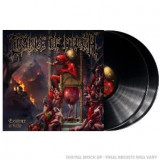
Belched from Hell’s depths into the rustic charms of the Witch County, Suffolk thirty long and disturbing years ago, CRADLE OF FILTH are undisputed giants of the heavy metal realm. Imperious purveyors of a perennially unique strain of dark, dastardly and wilfully extreme metal, with deep roots in the worlds of gothic horror and occult curiosity, the band led by Dani Filth has weathered three decades of tumult and trial, earning a formidable reputation as both a singular creative force and one of the most riotously entertaining live bands the metal world has ever produced.
From primitive early works like 1992 debut »The Principle Of Evil Made Flesh« to more expansive and theatrical classics like ‘Cruelty And The Beast’ and ‘Midian’, CRADLE OF FILTH defied trends and constructed their own idiosyncratic world of foul grandeur, becoming one of the UK’s most notable metal bands in the process. Since then, they have traversed the world countless times, hoovering up plaudits and praise from an ever-expanding international fan base. Resolutely prolific, the band’s catalogue has grown in depth and stature all the while, irrespective of line-up changes or the whims of the faithful.
In more recent times, CRADLE OF FILTH have hit an unmistakable hot streak of creativity and urgency. As a new line-up coalesced around the creation of 2015’s »Hammer Of The Witches«, fresh impetus propelled the band to new heights, as the revitalised crew became more in demand around the world than ever before. 2017’s ‘Cryptoriana - The Seductiveness Of Decay’ repeated the trick with even more explosive flamboyance. Until a global pandemic brought the music industry to a jarring halt, CRADLE OF FILTH were almost permanently on the road and absolutely fucking flying. As a result, it should surprise no one that the band’s brand new album, ‘Existence Is Futile’, is yet another monumental and electrifying journey through the dark.
Buoyed by these recent triumphs, CRADLE OF FILTH recorded »Existence Is Futile« during 2020, piecing the record together in isolation, at Grindstone Studios in Suffolk with studio guru Scott Atkins (Devilment/Benediction/Vader). Although instantly recognisable as the work of these veteran blackhearts, the thirteenth CRADLE OF FILTH album is a wholly different beast from its immediate predecessors. Pitch-black, perverse and at times absurdly brutal and extreme, it hangs together with mesmerising fluidity. It is also absolutely rammed with giant, rousing melodies and moments of jaw-dropping invention. No one could mistake the venomously catchy likes of ‘How Many Tears To Nurture A Rose?’ or monstrous ballad ‘Discourse Between A Man And His Soul’ for anything other than CRADLE OF FILTH, of course, but ‘Existence Is Futile’ confirms that the band’s exploratory instincts remain as sharp as ever.
Underpinned by its huge and disarmingly organic production, »Existence Is Futile« is plainly the darkest and most unsettling album CRADLE OF FILTH have made in a while. Eschewing the band’s trademark twisted storytelling in favour of horrified glimpses into the mortal void and ruminations on the inevitable destruction of life on Earth, its poignancy and relevance to the cluster of nightmares facing humanity in 2021 is impossible to ignore, even if Dani Filth insists, not unreasonably, that he didn’t anticipate a global pandemic when the news songs were being written.
With the best possible timing, CRADLE OF FILTH were already due to make a new album during those long, lonely months of lockdown in 2020. Having grabbed the opportunity with both hands, Dani avows that unavoidable isolation from the rest of the world was the best possible incentive to get the job done, while also adding plenty of eerie atmosphere to the whole experience.
Sonically speaking, ‘Existence Is Futile’ is easily the most powerful and dramatic record CRADLE OF FILTH have ever made: it’s the sound of band’s enviable onstage chemistry spilling over into the studio, propelling each member of the band to new levels of intensity. Combined with the expected labyrinthine arrangements and moments of spellbinding bombast, ‘Existence Is Futile’ may be the most vivid representation of the CRADLE OF FILTH experience yet.
Also, diehard fans will be thrilled to learn that horror icon Doug 'Pinhead' Bradley makes a welcome return to the CRADLE fold, lending his dulcet tones to the epic ‘Suffer Our Dominion’, and to one of the forthcoming new record’s bonus tracks, as Dani explains.
“There are also two bonus tracks in addition to the album, one of which is the culmination to the ‘Her Ghost In The Fog’ trilogy, which began on »Midian«.
For this we had little hesitation in enlisting our friend and actor Doug Bradley to reprise his narrative role. Doug lives in Pittsburgh, which he refers to ‘The Pit’, thus we directed his narrative over Skype from his local studio. He adopts this almost David Attenborough-ish role on ‘Suffer Our Dominion’, which is possibly the most politically astute song we’ve written of late. As a band we usually shy from branching into politics, but it’s something that needed spouting. The fact we’re fucking our ecology up and desperately need to address the situation pronto…”
So, if we’re all going to perish in the fire of our own stupidity, we might as well have a suitably deranged and destructive soundtrack to do it by.
A bewitching, fearless nosedive into the abyss, the band's thirteenth studio album confirms the ferocious efficacy of CRADLE OF FILTH in 2021. Bold, brave, wildly imaginative and heavy as hell, the band’s latest runaway train-ride through the flames is the perfect album for these most imperfect of times. As Dani concludes, “Be like the virus! Mutate and survive!”
- A1: The Fate Of The World On Our Shoulders
- A2: Existential Terror
- A3: Necromantic Fantasies
- A4: Crawling King Chaos
- B1: Here Comes A Candle.. (Infernal Lullaby)
- B2: Black Smoke Curling From The Lips Of War
- B3: Discourse Between A Man And His Soul
- B4: The Dying Of The Embers
- C1: Ashen Mortality
- C2: How Many Tears To Nurture A Rose?
- C3: Suffer Our Dominion
- C4: Us,Dark.invincible
- D1: Sisters Of The Mist
- D2: Unleash The Hellion
Purple/Black Marbled Vinyl[39,62 €]
Belched from Hell’s depths into the rustic charms of the Witch County, Suffolk thirty long and disturbing years ago, CRADLE OF FILTH are undisputed giants of the heavy metal realm. Imperious purveyors of a perennially unique strain of dark, dastardly and wilfully extreme metal, with deep roots in the worlds of gothic horror and occult curiosity, the band led by Dani Filth has weathered three decades of tumult and trial, earning a formidable reputation as both a singular creative force and one of the most riotously entertaining live bands the metal world has ever produced.
From primitive early works like 1992 debut »The Principle Of Evil Made Flesh« to more expansive and theatrical classics like ‘Cruelty And The Beast’ and ‘Midian’, CRADLE OF FILTH defied trends and constructed their own idiosyncratic world of foul grandeur, becoming one of the UK’s most notable metal bands in the process. Since then, they have traversed the world countless times, hoovering up plaudits and praise from an ever-expanding international fan base. Resolutely prolific, the band’s catalogue has grown in depth and stature all the while, irrespective of line-up changes or the whims of the faithful.
In more recent times, CRADLE OF FILTH have hit an unmistakable hot streak of creativity and urgency. As a new line-up coalesced around the creation of 2015’s »Hammer Of The Witches«, fresh impetus propelled the band to new heights, as the revitalised crew became more in demand around the world than ever before. 2017’s ‘Cryptoriana - The Seductiveness Of Decay’ repeated the trick with even more explosive flamboyance. Until a global pandemic brought the music industry to a jarring halt, CRADLE OF FILTH were almost permanently on the road and absolutely fucking flying. As a result, it should surprise no one that the band’s brand new album, ‘Existence Is Futile’, is yet another monumental and electrifying journey through the dark.
Buoyed by these recent triumphs, CRADLE OF FILTH recorded »Existence Is Futile« during 2020, piecing the record together in isolation, at Grindstone Studios in Suffolk with studio guru Scott Atkins (Devilment/Benediction/Vader). Although instantly recognisable as the work of these veteran blackhearts, the thirteenth CRADLE OF FILTH album is a wholly different beast from its immediate predecessors. Pitch-black, perverse and at times absurdly brutal and extreme, it hangs together with mesmerising fluidity. It is also absolutely rammed with giant, rousing melodies and moments of jaw-dropping invention. No one could mistake the venomously catchy likes of ‘How Many Tears To Nurture A Rose?’ or monstrous ballad ‘Discourse Between A Man And His Soul’ for anything other than CRADLE OF FILTH, of course, but ‘Existence Is Futile’ confirms that the band’s exploratory instincts remain as sharp as ever.
Underpinned by its huge and disarmingly organic production, »Existence Is Futile« is plainly the darkest and most unsettling album CRADLE OF FILTH have made in a while. Eschewing the band’s trademark twisted storytelling in favour of horrified glimpses into the mortal void and ruminations on the inevitable destruction of life on Earth, its poignancy and relevance to the cluster of nightmares facing humanity in 2021 is impossible to ignore, even if Dani Filth insists, not unreasonably, that he didn’t anticipate a global pandemic when the news songs were being written.
With the best possible timing, CRADLE OF FILTH were already due to make a new album during those long, lonely months of lockdown in 2020. Having grabbed the opportunity with both hands, Dani avows that unavoidable isolation from the rest of the world was the best possible incentive to get the job done, while also adding plenty of eerie atmosphere to the whole experience.
Sonically speaking, ‘Existence Is Futile’ is easily the most powerful and dramatic record CRADLE OF FILTH have ever made: it’s the sound of band’s enviable onstage chemistry spilling over into the studio, propelling each member of the band to new levels of intensity. Combined with the expected labyrinthine arrangements and moments of spellbinding bombast, ‘Existence Is Futile’ may be the most vivid representation of the CRADLE OF FILTH experience yet.
Also, diehard fans will be thrilled to learn that horror icon Doug 'Pinhead' Bradley makes a welcome return to the CRADLE fold, lending his dulcet tones to the epic ‘Suffer Our Dominion’, and to one of the forthcoming new record’s bonus tracks, as Dani explains.
“There are also two bonus tracks in addition to the album, one of which is the culmination to the ‘Her Ghost In The Fog’ trilogy, which began on »Midian«.
For this we had little hesitation in enlisting our friend and actor Doug Bradley to reprise his narrative role. Doug lives in Pittsburgh, which he refers to ‘The Pit’, thus we directed his narrative over Skype from his local studio. He adopts this almost David Attenborough-ish role on ‘Suffer Our Dominion’, which is possibly the most politically astute song we’ve written of late. As a band we usually shy from branching into politics, but it’s something that needed spouting. The fact we’re fucking our ecology up and desperately need to address the situation pronto…”
So, if we’re all going to perish in the fire of our own stupidity, we might as well have a suitably deranged and destructive soundtrack to do it by.
A bewitching, fearless nosedive into the abyss, the band's thirteenth studio album confirms the ferocious efficacy of CRADLE OF FILTH in 2021. Bold, brave, wildly imaginative and heavy as hell, the band’s latest runaway train-ride through the flames is the perfect album for these most imperfect of times. As Dani concludes, “Be like the virus! Mutate and survive!”
In what seems like some sort of cosmic alignment bound to happen, the ever prolific and somewhat elusive Niagara make their way into the Discrepant catalogue with '1807'. Compiling tracks recorded between 2014 and 2018 that appeared scattered among very limited and long out of print self released CDRs, the record feels as much out of time as deeply resonant with these times with no dancefloors. Stripping away most of the beat based approach of early Príncipe releases and Ascender EPs, these 17 vignettes presented in the classic dance maxi 12" format dabble with escapism in a manner that projects them as potential DJ tools for lockdown.
Deeply idiosyncratic, the trio from Loures shows an internal coherence that while not easy to grasp given their mutating creative impulses, weaves each different path into a sonic fiction all their own. Cobbled together from countless hours of jamming on warm spectral synths, field recordings, otherworldly textures or devious drum machines '1807' paints a vivid and dreamlike escape route that goes from the hypnotic arpeggios and rarefied synths of 'Esc8' through the glowing tones and fragmented melodies of 'Egyptiu' and into the malfunctioning swirl of the stark 'Esc 10' or the polluted 4/4 thump and funky guitar line of 'Mapas'. Equally disruptive and inviting.
All tracks composed by Niagara between 2014 – 2018
Nanocluster Vol 1. is an album with some serious pedigree. It sees Immersion (aka Malka Spigel and Colin Newman of influential groups Minimal Compact and Wire respectively) collaborating with some of the finest left field artists of our era: Tarwater, Laetitia Sadier, Ulrich Schnauss and Scanner. The project was born out of a Brighton based club night, also called Nanocluster, run by Spigel and Newman alongside writer, broadcaster and DJ Graham Duff, and promoter Andy Rossiter. The club features a range of influential and cutting edge music acts. But the unique aspect of the evenings is that each show climaxes with a one off collaboration between Immersion and the headliners. The songs having been written and recorded in the studio in just three days prior to the performance - or one day in the case of Schnauss. "It could have just been a series of performances." Says Newman.? "But the fact that we had built the tracks in the studio for the performances means we had these recordings." Says Spigel. The recordings have since been developed with Immersion heading up pro- duction duties. The result is a beautiful and unique album.? "I think the really interesting thing is how different everybody is," says Spigel. "Both as people and creatively." - Immersion and Tarwater: The German duo of Ronald Lippok and Bernd Jestram have created an impressive body of work. Yet their involvement with Immersion has opened out their sound, creating a more panoramic soundscape. The opening instrumental 'Ripples' is a gentle breathe of optimism, all purring tones and sun dazzled synths. Meanwhile, 'Mrs. Wood' is a dubby psychedelic shuffle, Lippok's vocal cool and assured over a fat bass line and skybound eastern melodics. It feels like a more spacious take on the Tarwater of albums such as 'Suns, Animals and Atoms'. The four musicians' 3rd collaboration is Nanocluster's most pop moment: with a heartfelt yet unsentimental lyric unfurling over feline rhythms, 'All You Cat Lovers' is a feel-good anthem for cat lovers everywhere. - Immersion and Laetitia Sadier: An original and distinctive presence in contemporary music, Sadier made her name with the inimitable Stereolab, but she's also created several impressive solo works. The instrumental 'Unclustered' sees Sadier's spidery guitar weaving through Immersion's lush web of synths drones. The following 'Uncensored' has a subtle melodic tug with a classic Spigel guitar line underpinning Sadier's sweet yet worldly wise vocal. 'Riding the Wave' is another feel good song, swapping between Newman's plaintive vocal, and Spigel's vocal and Sadier's backing vocals. With its uplifting chorus: 'Things have a way of working out' 'Riding The Wave' feels like it might be the sound of the summer we've all been waiting for. - Immersion & Ulrich Schnauss: A highly respected solo artist, as well as being a member of Tangerine Dream, Schnauss' skill with electronics is legendary. The opening 'Remember Those Days On The Road' skips along on a rimshot rhythm with Spigel's honeyed vocal telling a tale of life on tour. Yet it is far removed from such usual fare. This feels vulnerable and flecked with melancholy. 'Skylarks' opens with a lattice of arpeggios before a gently nag- ging guitar enters and everything takes a turn for the sublime. 'So Much Green' is everything you'd hope a collaboration between Newman, Spigel and Schnauss could be. A constantly spiralling urban-kosmisch, with Spigel's plangent bass anchoring the celestial sounds. The addition of her wordless backing vocals and recordings of real birdsong only serve to elevate the mood further. - Immersion & Scanner: Scanner - aka Robin Rimbaud - is one of the most prolific and diverse artists currently working in contemporary music. Spigel and Newman have of course collaborated extensively with Rimbaud before: alongside Max Franken in the art-pop group Githead. But this is something very different. Their opening piece together: 'Cataliz' is the album's moodiest moment. With its serpentine synth drones it sounds like the soundtrack to a mysterious thriller. The rich pulsing 'Metrosphere' recalls Immersion's early work whilst adding another layer of grainy uncertainty. The closing 'The Mundane and the Profound' opens with a "Rimbaud scanned" recording of an irritated flight attendant but this is eventually subsumed by a simple yet emotive piano figure: a gentle and touching end to a unique collection of songs. Nanocluster Vol.1 is a testament to a remarkable synergy between a diverse assembly of strongly individual talents. The fact that it not only succeeds, but excels should be cause for celebration.
- A1: Deep In The Forest, A Sacred Pool
- A2: As I Fear The Ground Opening
- A3: Unturned
- B1: One Hundred Ideas
- B2: My Own Moon
- B3: The New Face Of England
- C1: Nothing Is Enough
- C2: The Myth Of Visibility
- C3: Void Hopping
- D1: Prisoner Of The Sun
- D2: Summer Of '18 Ft. Guy Liner (Album Version)
- D3: Let These Waves Wash Upon You
Following the release of Twisted Heads comes Slacker’s most complete work to date. The artist's debut LP - What Would I Do With Saturn - arrives on Lobster Theremin on Friday 2nd July and demonstrates Slacker’s killer ear for capturing the cross-sections that exist within UK sound; floating between the artist's drum & bass upbringing and introspective, world-building electronica.
“The main idea was to think 'what would an outside observer to our planet think when looking down at this moment in time, what does the moon think when looking down on us?'” he says. “It was a way of me both building another world whilst also expressing the strife of the world that we were living in. I was lucky enough to be quite secluded in the first lockdown around a lot of nature, but then feeling the isolation ten-fold as I was so far away from civilisation. I think that the album has this schism represented in it with the more classically "nice" tracks standing next to the more aggressive and expressive tracks; it is both an escape and capturing of the world we live in.”
Designed to have inward-gazing and aggressive tracks side by side - to represent the day to day mood swings that only extensive isolation can bring - the record is a tripped-out voyage through rich, flora-drenched ecosystems and Halo ring worlds. A cathartic release to heavy isolation, the album opens with ‘deep in the forest, a sacred pool’ - angelic tones and tranquil chords symbolising a melting in the ocean, the contemplative silence that comes when one puts their head beneath water, shutting out the outside world.
‘As I Fear The Ground Opening’ represents the anxious rush when the bubbles start to rush and your time of total freedom reaches its inevitable end; it’s frantic drum patterns scoring an intense scene, trancey atmospherics enticing you to keep turning the corner. ‘Unturned’ continues down the cinematic route, before the B-side introduces Slacker’s breaks heritage: ‘One Hundred Ideas’ sounding reminiscent of the fire wave of experimental, stripped-back percussion currently championed by the likes of Al Wooton and his TRULE label; green fields, optimism and wicked breaks.
‘My Own Moon’ channels open-the-clubs energy with a percussive melter, before completing the B-side with a call to arms on ‘The New Face of England’; it’s trap-techno energy encapsulating the anger and frustration felt in the face of rising English nationalism.
Staying true to the testament of his most complete work to date, Slacker relentlessly switches up his sonic palette in pursuit of differing - yet uniquely connected - experiences, entering future-electro territory on the C-side; ‘Nothing Is Enough’ giving off Tron Legacy largeness - temporarily paused by the emo-ambience of ‘the myth of visibility’ - before ‘Void Hopping’ crashes back down to earth with that rough-edged, raw aesthetic that has become so synonymous with the Slacker name.
The climatic D-side provides the most mixed bag yet; ‘Prisoner Of War’ opening an unmarked door as we venture further into the UK’s underground; the smells and sights of a packed-out jungle rave being expressed through ripples, blares and vaporous breaks, while the nostalgia inspired ‘Summer Of ‘18’ - featuring Guy Liner - offers a synthy, nu-disco vibe that manages to incorporate the emotional aesthetic that has been built throughout the album.
‘let these waves wash upon’ you draw the curtains as we take a deep breath to venture back into a scary world that lies beyond the door. A world of dreams, fears, love and sadness. Optimism, hopelessness, anxiety and inspiration. The world is opening up, and Slacker’s rise is imminent.
Reinvigorated and revitalized, REAPING ASMODEIA are back and set to leave their mark on 2021 with their third full length, Darkened Infinity - due for release via Prosthetic Records on October 15. The Minneapolis, Minnesota three-piece present twelve tracks of rhythmically acerbic modern technical death metal and thematically dauntless songwriting, weaving together a conceptual story of transcendence, consciousness and humanity’s ongoing struggle with the psychological self. Darkened Infinity sees REAPING ASMODEIA capitalize on a growing reverence within extreme metal circles for their off-kilter time signature changes and complex songwriting, thanks in no small part to Alexander Kelly (guitars) and Daniel Koppy (drums)’s blistering sonic camaraderie that make the foundations of the band’s assault. Replete with an inhumanly savage vocal performance across Darkened Infinity’s runtime from Steven Lane, the trio shine on apocalyptic album highlights False Awakening, Oneironautic Oblivion and Simulacra. Produced and engineered by the band themselves in Minneapolis before being mixed and mastered by Zack Ohren (Machine Head, All Shall Perish, Carnifex) at Castle Ultimate and Sharkbite Studios, Darkened Infinity’s intricate lead melodies unfurl with a menacing clarity when set against the album’s more abrasive tones.
Repress
Finnish sound scientist Aleksi Perälä presents 'Paradox', a double EP landing 15 th of December on . Using a microtonal tuning method known as Colundi - with which his work is now synonymous - he guides us through a ritualistic journey of ten formidable tracks.
Glistening scales cascade over peculiar tones. Aleksi Perälä explores the powers of an alternative tuning system in dance-floor structures, tapping into the veiled potential of his sound palette with stunning physical consequences.
Saccharine and mysterious, 'Paradox' channels elements of Electro, Techno and Italo, ultimately achieving a transcendental form of its own.
It was the mid 80s. A musical revolution was already steamrolling throughout the French West Indies when the band Kassav' produced what was to become the sound of the decade. With a now wider use of synthetic and digital tones, the "zouk" wave literally swept away to sea the biguine and cadence from the West Indian musical landscape. While this took place, some musicians chose to make an alternative use of the new techniques brought on by the advent of synthesizers. Musicians like Serge Fabriano.
It was back in 1980 that Serge, a talented young musician from Guadeloupe, while studying for a degree in 'Arts & Informatique' (Computers & Arts Cycle) at the Université De Vincennes near Paris, discovered early computer-generated digital music (MAO in French) thanks to his roommates, who both taught computer-generated graphic arts. In 1982 Fabriano and his Fabriano Unité Zion project recorded, with the help of Alain-Jean Marie, Mario Canonge and Pierre Labor, Cosmik Syndika*, which to this day remains a masterpiece of made-in-Guadeloupe Caribbean jazz.
The following years saw him tour the US and Canada as well as several other countries. By 1986 he was back in Guadeloupe, teaching music in the secondary schools of Point-à -Pître and Sainte-Rose. While doing this, his ongoing passion for the budding MAO led him to kit himself out: the Yamaha CX5M (MSX Music Computer), the Macintosh Plus, the legendary synthesizers DX7 and DX11 and several other early rhythm machines became his new toys.
Him and his partner at the time, Marie-Reine Lamoureux, who was also both a teacher and a musician, as well as a member of the Fabriano Fuzion project, decided to involve their pupils in his electronic musical experimentations. They recorded an album, composed of five tracks deliberately titled Demain, under the name 'Digital Caresse' (the idea behind this was that instead of hitting the percussions to make music, one stroked the computer keyboard to coax a sound). The combination of the children's choir, enchanting wonky flutes, saturated electronic beat and cosmic atmosphere perfectly outline the purity of this rough diamond.
Sound Wonders: A Series of Epics is the second compilation from Touchtheplants, the imprint and multidisciplinary creative environment founded by Kaitlyn Aurelia Smith and Sean Hellfritsch (aka Cool Maritime). Following 2020's Breathing Instruments, the new collection features sonic responses to a new prompt. Like its predecessor (which explored music as an extension of the human body and the natural world), the medium of focus here dates back to ancient civilizations. Smith invited artists to compose music based on the idea of epics: the long poems and narrative verse works that have detailed deeds and adventures since the dawn of storytelling. The musicians — some of today's most exciting practitioners of experimental sound design, instrumentation, and synthesis — took this directive loosely, realizing a series of vibrant and transportive songs evoking wondrous visions, subjects, and locales.
From Elori Saxl’s chamber piece to Olive Ardizoni’s ode to the strange and beautiful phenomenon of starling murmurations with synth and xylophone tones the album splays out like chapters in a panoramic account of all that surrounds us.
The Cool Feedback Quartet’s music is quite similar to a philharmonic orchestra manipulating new material:
feedback, or in other words, the unexpected beauty of sound when it is let loose. Becoming its master so as to make the
best use of it, like a new instrument, the guitar pick up plays again on request. Harmonizing sounds like a string section
gone wild would, like light piercing through ether, tearing up the background and taking us for good to unknown territory.
The bandleader, Grégoire Garrigues, who first got the idea of the concept and got the ball to roll, is a well-known and
respected French guitarist.
A repress for four prime slices of classic Baby Ford minimal tech gear, from the rhythm-centric drum machine fest 'Very', the resonant bleepy tones of 'Test', the sparse and spacious 'Down' and the subtle acid undertones of 'Percy'. Baby Ford is finally getting his props as one the UK acid and techno scene's true innovators and pioneers, and these four very mixable tracks are four more reasons why this is only right.
Dans le Sable is the first new album in over 40 years by composer, pianist, and digital audio pioneer Loren Rush (b. 1935). Active in the Bay Area new music scene since the late 1950s alongside composers such as Robert Erickson and Pauline Oliveros, he also co-founded the Stanford University’s Center for Computer Research in Music and Acoustics in 1975. His music has been performed by the Boston Symphony, the New York Philharmonic, and the San Francisco Symphony Orchestra amongst others.
The title piece "Dans le Sable" (1967-68, 70) covers the first side of the record, of which Charles Shere in the Oakland Tribune (1972) writes: “A surreal opera scene. A narrator dwells on the significance of passing time. A soprano sings Barbarina's cabaletta from Figaro, which describes her distraught search in the sand for a lost pin. The chamber orchestra—mostly solo instruments—plays soft, half-forgotten tunes reminiscent of the Parisian music hall. If Marcel Duchamp wanted to put painting once more at the service of the mind, so did Rush seem to want to make a composition that speaks directly to that thing behind the mind—the point where it connects with the soul. And he succeeded. But only because the work is so brilliantly constructed, so careful in its structure and the timing of its phrases, so well balanced in the disposition of its parts that it quite overcomes the audience.”
The second piece on the album “Song and Dance” begins with the watery held tones of “Song.” Melancholy phrases are deconstructed and stretched in different retellings, invoking a harmonic fog. We are then thrust into “Dance,” one of the first orchestral pieces to employ computer-generated digital synthesis. A hypnotic and percussive march is propelled into a storm of early computer-processed cannonades.
Recital is proud to now illuminate the deeply overlooked composer Loren Rush, whose meticulous attention to detail has perhaps kept his toiled-upon works in the shadows these past decades. Dans le Sable is among the most gorgeous records I have heard.
Basking in the golden glow of an Indian Summer, Basso brings us a much needed reissue of one of his most treasured musical discoveries, Guy Maxwell's 'Outside My Window'. A long time favourite in the Growing Bin, this mellow masterpiece originally crept out in 1980 with no backing from its label, the soon to burst Bubble. Now resequenced and redressed to the exacting standards of Mssr. Maxwell, 'Outside My Window' is ready to warm the hearts and cheer the ears of a whole new audience.
Born in Bordeaux under a wandering star, Guy spent the 70s on the road, freewheelin' from Paris to Rome, guitar in tow, before settling in Switzerland at the end of the decade. There he reconnected with school friend Serge Maillard, whose Santiago bandmates swung by to help bring Guy's arrangements to life. Joined by Jan Dix (Om Buschmann and Foodband) on percussion and Ruth Failure (later in Mag and the Suspects) on guitar, and the Santiago powerhouse of Tato Gómez, Sergio Castillo and Paco Saval, who also leant his deft touch behind the desk, Guy put together a nine track trip through groovy AOR, gentle jazz fusion, cosmic folk and yacht rock.
For this reissue, Guy's stripped back the tracklist, tossing aside a trio which didn't quite stand the test of time in favour of a concise six song LP which brings brilliance in every bar. 'Watch Out Sally' introduces the LP with playful keys and a Latin lilt, a sophisticated seventies pop song that's more Aja than A-Ha, sax and strings sending the whole track soaring as Guy muses on wanderlust in his honeyed tones. 'You Never Sang This Song' is undoubtedly a lost classic, embodying all the bittersweet beauty of yearning while riding a rollercoaster arrangement of folk-jazz fusion enhanced by Serge Maillard's quicksilver solo. 'Funny Weather' looks both ways as it closes out the A-side, marrying the smooth sounds of the 70s with the rain-soaked jangle of the decade to come. The B-side opens with the LPs second lost classic, the frankly sublime 'Beautiful Day'. Stripped back to acoustic guitar and subtle hand percussion, this jazzy ballad brings a tear to your ear before drawing your attention skywards with the acid folk energy of the chorus. There's mellow magic in the air on 'Summer Song', an optimistic ode to sunshine and romance lifted way beyond the AOR standard by a lyrical sax solo before Maxwell closes the set with the 7/4 escapism of 'There's A Train Leaving', a fond farewell which sees the ensemble say goodbye in perfect harmony.
Burning Injustice’, the second album by Torn Relics, forthcoming on the Berlin based label Instruments of Discipline, weaves mythical and futuristic elements of an unknown world. Haunting, visceral and diverse in production styles, the duo continues to pave their own musical territory. This album was written between 2017 – 2021, in which the music produced reflects the decay of the political and social landscape in the UK, from the Brexit divide to covid isolation. This music serves as antidote in these turbulent times. Torn Relics are an experimental electronic duo based in London, composed of Romek Boyer (AKA Rommek) & Aimée Mullen. The body of their work is a mixture of cyber-punk electronics with tribalistic violin, rhythms and tones. Their debut EP, The Poisoned Chalice, was released on Sacred Court in 2019 and included a remix from SNTS. Abolish The Dogma, the duos debut 8-track album was released in 2020 on Leyla records, which showcases the diversity of their production styles.
Following on from the acclaimed Tiger Balm / Amazonia Dreaming / Immersion LP (BT028), Black Truffle is thrilled to present two major new instrumental works from legendary sound artist and experimental composer Annea Lockwood. Demonstrating the ever evolving and radically open nature of Lockwood’s practice, these two recent works were developed in close collaboration with their performers. ‘Becoming Air’ (2018), developed with and performed by trumpeter Nate Wooley, uses extended technique and electronics to interfere with Wooley’s virtuosic control over his instrument, pushing him into areas of fluctuating pitch and timbral instability. Motivated by a desire for ‘the letting go of sound to be itself’, ‘Becoming Air’ unfolds as a series of texturally distinct moments separated by pauses, each fixing on a particular approach to the instrument (long tones, upper-register whistles, breathy wooshes) and maintaining it in an essentially static fashion, focussing our attention on subtle changes and variations. Dipping into near-inaudibility in the fragile high tones of its opening section, the piece dramatically increases in volume and intensity in its final third, climaxing with a passage of roaring distortion, where the interaction between feedback and trumpet pitches calls up the shuddering interference effects of Robert Ashley’s Wolfman.
‘Into the Vanishing Point’ (2019) is a collaborative work developed with New York piano and percussion quartet Yarn/Wire, who have performed work by major contemporary composers such as Olivia Block, Catherine Lamb and Klaus Lang. Carrying on the ecological and environmental concerns of some of Lockwood’s previous works, ‘Into the Vanishing Point’ was inspired by a devastating news article on the global collapse of insect populations. Discovering that the four members of Yarn/Wire had also read this text, Lockwood mapped out a loose structure for the piece that would allow the composer and four performers to explore their ‘feelings about what is happening ecologically’. Working with a huge variety of instruments, objects and techniques of sound production, the resulting work is an alluringly lush, organically unfolding tissue of unorthodox textures and haunting tones. Though not intended to sonically represent ecological issues in any direct way, its unique sound world of rubbed piano strings, gently handled objects and chiming pitches often calls up natural images: of insects and frogs, wind rushing through trees, a bird’s wings in flight. Presented in a stunning gatefold cover with liner notes by Lockwood, Wooley and Yarn/Wire, Becoming Air/Into the Vanishing Point is a testament to the generosity and experimentation that continue to characterise the work of this extraordinary artist, active for over fifty years.
Laura Nyro's masterpiece, New York Tendaberry, remastered by Ray Staff on 180g Vinyl! The tapestry of great beauty and painful images found here is not for the pop-oriented crowd who only are familiar with the aurally digestible versions of "Save The Country" and "Time And Love" sung by other people. Laura herself had a voice both comforting and full of despair, and both of those tones are wonderfully represented on this complex journey.
Sydney-based producer and co-founder of Velodrome Recordings, PZ Specialist comes through with an energetic and forward-thinking debut 12” Rattlehats.
Comprised of 4 versatile club cuts, these tracks range from trance-inspired electro to jazzed-out Balearic house. It’s a versatile EP that sees the Sydney producer blend vibrant, dreamlike synth tones with dense and playful percussion - a colourful record that remains grounded in club-focused practicality.
In My Sleep is the debut vinyl release from French producer Margee. Having gained a loyal following last summer with a remix for Tommy Guerrero, released on Music For Dreams, this EP showcases his natural ability at creating low-slung, densely layered productions, perfectly aimed at the dancefloor.
The release also features two heavyweight remixes. The first of these comes courtesy of underground House legend DJ Nature, who takes the title track and gives it a completely new twist with his inimitable ‘ruff disco’ stylings. Hailing from Bristol (via New York), recent years have seen Nature release on Futureboogie, Golf Channel and Jazzy Sport.
The second remix on the release comes from Hardway Bros (AKA Sean Johnson). Having been an early champion of Margee’s work on his regular ALFOS streaming marathons, Sean took the second track on the release, Wrong Dream, and went into heavy-dub mode. The resulting remix clocks in at just over 11 minutes and is everything you’d expect from him, and more…
Margee said of the release ‘In My Sleep started while taking a shower. The bassline popped up in my mind and I ran out as quickly as possible to record it. From there, I got pulled into a deep emotional trip with groovy tones and dirty sounds. Wrong Dream is actually a lost project that I had to start over again. It turned out to be more fierce than the first one, experimenting with arps and fuzzy synths, while keeping a certain groove that was easier to reproduce.’
In My Sleep is the second release from London based label Other Goodness, following on from Bawrut’s ‘Divergent Emotions’ EP last year, which quickly became a mainstay of the live-streams and a DJs favourite.
Working his mellow magic on the Growing Bin, Sorcerer entertains your inner child with eight tracks of instrumental west coast pop suitable for dancing, dreaming and surfing a wave or two.
While Basso sat in a Teutonic treehouse, feeding his head with the sounds of the woodland, Dan Judd danced on the sands of San Francisco's Baker Beach. Stretching between them, like the world's longest tin can radio, was the Dream Chimney. This legendary forum, run by Ryan Bishop, better known as The Beat Broker, helped to launch a thousand labels, and the Growing Bin is one of them - all hail the Chim!
Here, Dan, naturally mystic in his Sorcerer guise, satisfies all our sensory needs with a Kinder Surprise of sweet melodies, coastal cool and playful rhythms inspired by his children's earliest responses to music. Following his feelings and avoiding overthinking, he creates open, enticing and accessible cuts; each living and breathing that mellow magic you only get on the West Coast.
'Kids World' kicks into gear with the spheric bass of '2000 Studio', a bouncy embodiment of that spacious San Francisco sound. There's a nod to nu disco but the dreamy dubiness takes the track much deeper, especially as those surf guitars start to detune in the summer heat. The breezy fretwork continues on 'Disco Drums', topping a wriggling groove tailor made for the terrace. Shades of rave refract through a healing crystal at the midpoint, encouraging al fresco dancing from sunrise to sunset. The A3 sees Sorcerer get into the groove of 'Bahia Brothers', rolling that rubberised B-line out of his own Paradise Garage before putting the top down for the carefree Balearic pop of 'Spray Paint.'
The B-side glides into being via the night dubbing grooves of 'Fire Feel', a reverb laden journey though glassy tones, off beat perx and gorgeous chord progressions. Next up, the new wave inspired 'Crunchy' translates Sheffield's daring synth pop into a wide eyed blast of psychedelic house, boosting our mana ahead of the loose limbed and light footed 'First Wave'. Ringing guitars reference Ghanaian highlife, shimmering in the heat haze as Dan funks up the drum kit ready for the broken beat and blissed out energy of sundowning set closer 'Escape Route'.
Let’s get back to the program. Picking up from where things were left off in July 2020…
Whilst most electronic producers of the dance-floor persuasion dabbled with conducting micro-symphonies for their micro-herbs, locked inside their micro-mansions, Dreems has dusted off his dance-floor accreditations and got back to work creating some serious indoor waves for Le Temps Perdu.
The Blue Water EP has all the stuff that encapsulates the label - raw, fun, powerful and free, yet deep, loving, warm and friendly. The music carries on from the previous Shark Water and Blue Hole EPs, calling all sea monsters with Die Orangen Remix of Shark Water, later emerging in calm waters for mermaid pleasing Iñigo Vontier Remix of The Dolphin Communion, and finally swimming into the salty, acidic tones of the Blue Hole (Break Mix).
Dear water-lily enthusiast, you need fear not, there is a hearty nod to the plant-life in Something Else for Spring that grows and sprouts new life with each turning phrase and finally blossoms with a sprinkle of joy. Label head-gardener V gives it the extra push put on the dance floor with his tougher take.
You grab a copy of the vinyl at some bricks and mortar stores if you are fond of wearing your scuba suit whilst browsing the shelves, otherwise head to the regular online outlets to get this small slice of history. It contains, we feel, the best of the past 2 EPs.
- A1: Ash (2021 Remaster) 07 06
- A2: Chessa (2021 Remaster) 06 58
- A3: Blast (2021 Remaster) 03 04
- B1: Duh (2021 Remaster) 03 40
- B2: Marche (2021 Remaster) 05 21
- B3: Nerf (2021 Remaster) 03 40
- B4: West Nile (2021 Remaster) 02 16
- B5: Melt (2021 Remaster) 05 30
- C1: Logical (2021 Remaster) 03 01
- C2: Dead Leaves (2021 Remaster) 05 22
- C3: Scrapbook (2021 Remaster) 07 53
- D1: Habitat (2021 Remaster) 07 04
- D2: Bloom (2021 Remaster) 03 31
- D3: Angelic (2021 Remaster) 03 39
Keplar re-issues the fourth album 'Chessa' by Dan Abrams' project Shuttle358 on vinyl for the first time. The double LP edition includes 3 previously unreleased tracks from the same recording sessions back in 2004, as well as an extended artwork with unseen photographs by Dan Abrams.
While undoubtedly associated with the microsound and 'clicks & cuts' movement around the turn of the millennium, on 'Chessa' Shuttle358 left behind the classical rhythmic patterns of the genre and shifted further towards warmer territories, meandering between modern digital minimalism and the soft tones of ambient music. Counter to his microsound synthesis approach on Frame (2000), Abrams created Chessa by writing software that manipulated samples from his unreleased songs, guitar pieces, and vintage japanese films sampled from video tape. In particular, a special granulating technique was written and performed at intentionally low sample rates that gave the uniquely fragile, yet dense sound to the album. Over fourteen tracks Abrams arranges slowly evolving sonic entities of unfading elegance. Strayed and hazy melodies pulse and cascade, elongated but brittle harmonies shimmer and disappear, echoing far-off in the rounded corners of the mind. The patient and detailed way Abrams combines the broken with the beautiful in creating organic collages of sound that retain the euphonic essence of a song, makes this piece of work so powerful and timeless, sounding just as relevant today, as it did 17 years ago.
Under modern scrutiny in Abrams latest studio, he refocused the original recordings to emphasize the elements most important to the original vision. The final mastering and vinyl preparation was done in collaboration with Stephan Mathieu, vinyl was cut by LUPO.
From the original press release in 2004 by Taylor Deupree:
Without a doubt Shuttle358 has become one of the most admired artists to emerge from modern electronic music’s sea of musicians. From the humble beginnings of a demo CD in 12k’s mailbox to 4 critically acclaimed CDs, Dan Abrams is, to some, the one credited for bringing a warmth and human touch back into what has often been considered a very cold, sterile genre. It began with 1999’s Optimal.lp (12k1005), a groundbreaking debut release that immediately defined the Shuttle358 sound; a hybridization of the then-emerging “microsound” genre with Eno’s true ambient explorations. In 2000 Abrams outdid himself with Frame (12k1011) by honing his sound design and exploring production techniques at rates that made his “now” quite brief and creating what was to become one of the most sought-after CDs in the 12k catalog.
Chessa is the third release from Abrams’ Shuttle358 moniker on 12k and he continues to do what he does best: attempt to move microsound away from the world of theory and towards absolute real life. Like his photographs, Chessa is music about, and to be listened to in, unexpected places. It is a narrative, a simple slice of life that plays out through the incidental photography of the cover artwork. To achieve this Abrams fuses irregular granular sound particles, like the movements of everyday life, with a deliberate melodic base that captures emotion and simplicity.
According to the artist himself, zake's first solo album of 2020 was recorded and produced during "a four-day excursion in several secluded areas" in South Carolina. As a result, listeners can expect to hear babbling brooks, birdsong and the gentle rustling of leaves beneath Zake's alluring mixture of enveloping ambient chords, unearthly drone tones, opaque electronics and slowly-shifting, heavily processed neo-classical movements. The results are hugely immersive and undeniably enjoyable, with each of the four tracks delivering a head-in-the-clouds journey that ripples with becalmed, atmospheric intent. In other words, it's the kind of ambient music you can get lost in. More please!
Black Truffle is pleased to announce Parampara Festival 13.3.1992, a stunning performance by Amelia Cuni captured live in Berlin almost thirty years ago. Milanese by birth and resident in Berlin for many years, Cuni lived in India for over a decade, studying the classical vocal style of dhrupad under masters of the form. Though perhaps known to many listeners primarily through her performances of the vocal music of John Cage and collaborations with Werner Durand and Terry Riley, she is recognised internationally as one of the great contemporary proponents of traditional dhrupad singing. These recordings document her performance at the 1992 Parampara Festival at the Haus der Kulturen der Welt, a landmark event celebrating the global spread of Indian classical music, bringing together Indian teachers with their international students.
Accompanied by Gianni Ricchizzi on vichitra vina (a plucked zither played with a glass ball slide) and her own tanpura, Cuni stretches out for a languorous side-long performance of the late night Raag Bageshri, the limpid tones of her vocal improvisations illuminating the droning strings like flashes of the moon revealed by rushing clouds. Initially working patiently through a series of subtle dialogues between Cuni’s melodic extemporisations and phrases in response from Richizzi’s vichitra vina, the performance builds to a series of strikingly beautiful, virtuosic held notes from Cuni at the beginning of its second half, before picking up some brisker rhythmic articulation on the way to its conclusion.
On Devino Amor, Cuni presents her own composition, a setting of mystical texts by the 13th century Franciscan friar Jacopone da Todi, elaborated through various traditional raags. Like the words used for most dhrupad compositions, the text Cuni has selected from da Todi praises divine love, thus linking her otherwise unorthodox use of Italian text to the dhrupad tradition. The result is a performance of a yearning intensity that communicates across any language barrier. On the final performance, Cuni and Ricchizzi are joined by Helmut Waibl on the two-headed pakhawaj drum for a piece using a 14 beat rhythmic pattern that sets in motion a cycle of tension and release, metrical dissolution and resolution, possessing a subtle grandeur.
Illustrated with archival images of the performance and accompanied by new liner notes from Peter Pannke and Lars-Christian Koch, Parampara Festival 13.3.1992 invites listeners to lose themselves in Amelia Cuni’s unique approach to ancient tradition.
Repressed !
Luca Cazal & Josh Baker kickstart Richy Ahmed’s new vinyl focused imprint, Back 2 Black, with a brace of intergalactic tracks. The new label’s first release also features a remix from British electronic stalwart, Radioactive Man.
Cazal remains a central figure within the house & techno community; his DJ residency at Circoloco is longstanding and releases for labels like Crosstown Rebels, Classic Music Company, his own See Double label, and Richy Ahmed’s Four Thirty Two imprint have marked out his production prowess and ear for a good groove. Josh Baker has been rising up the ranks over the last few years, with releases for Ben Rau’s META label, Locus and his own You&Me label.
On ‘Organ Nuke’, Cazal & Baker dip into the kind of spacey techno house that was forged by Detroit pioneers Underground Resistance, as funky percussion and organ stabs are coupled with dreamy pads and cosmic tones. ‘Rocket Ship’ continues these themes, with heavy 909 drums anchoring a cheeky acid bassline and flashes of cosmogonic sound.
British DJ & producer, Radioactive Man, has long since been at the coalface of electronic music’s leftfield. As one half of Two Lone Swordsman (with the late, great Andrew Weatherall), and multiple aliases for his industrious flow of releases, the revered producer injects a heavy dose of classy electro and Drexciyan vibes into ‘Rocket Ship’. Rolling breaks unfurl in the electro beats as head scrambling keys and rasping bass stimulate the senses for a funkin’ body poppin’ workout.
Four years after the release of their highly anticipated album The Immortal Wars (2017), Juno Award-nominated EX DEO returns with more massive, brutal soundscapes than ever! The Roman Empire inspired death metal band’s newest release, The Thirteen Years Of Nero, transports the listener back to Ancient Rome with 10 cinematic masterpieces that tell the emotional, conceptual story of the reign of Emperor Nero. Accented by sounds of ancient instruments like lyra and harp and detailing the harrowing stories of Nero’s surroundings, close allies and enemies, listeners will connect with intense psychological tones of political turmoil and paranoia.
A new project by Dicky Trisco and JKriv, Sentimental Animals is a celebration of dancing, late night antics, and musical togetherness.
This offering of all-original disco features lead singer of Brooklyn disco outfit Escort belting her heart out, and Robin Lee of Faze Action showing his muso side on guitar, bass and keys duties. Art of Tones gets down and dirty on the flip side with a rolling and raucous funk remix.
The '2Kings EP' is the debut release from Ash and Jay Shah, two brothers based in London. The record has come out on their newly formed '506' label via Kudos Records. Having produced for various MC's and vocalists in the past, this is the first time the brothers have teamed up to release something under their own '2Kings' alias.
Drawing on influences from the styles of producers such as Madlib, J Dilla and The Alchemist, the record blends obscure soul and jazz infused samples with incisive vocals to take the listener on an introspective journey across 6 tracks.
”Papered Up” and "Dark Corners" shows the pair team up with Detroit legend Guilty Simpson and LA wordsmith Blu over two soul-smoked instrumentals, with both MCs lacing up to provide hard-hitting verses. Guilty's gritty personal narrative of the daily struggles of living in the D is wonderfully counterbalanced by the spaced out, string-lead production; whilst Blu takes a more positive approach, his intricate west-coast flow interrupted only by the pitched-up vocal hook of the sample.
"Last Time", perhaps the standout song on the EP, is a rich, experimental piece of neo-soul embellished by gorgeous guitar riffs from Oscar Jerome (who has released on both Universal Records and Giles Peterson's Brownswood Records) and the velvet smooth tones of rising vocalist Douniah (signed to german based hip hop label Melting Pot Music).
Since the digital release, the EP has received widespread acclaim, with support from Tom Ravenscroft, Huey Morgan, Giles Peterson and Alexander Nut, to name a few. The brothers have been repeatedly championed by Jamie Groovement / Agent J (head music editor of Bonafide Magazine) having recently appeared on his Groovement Show on Reform Radio, and "Last Time" was also featured on Spotify's 'Fresh Finds' and 'Fresh Finds: The Wave' playlists.
The '2Kings EP' is definitely one to watch out for.
When Walter Smith III released his fourth solo album ‘Still Casual’ in 2014,
people listened, and the album was heralded as one of the top
releases of the year.
Now, fans of the saxophonist and composer can experience the tenorist’s wideranging release on vinyl for the first time on this special 2xLP, 180 gram limited
edition pressing with gatefold artwork.
Smith’s discography is pleasingly joined-up. As ‘In Common 2’ follows ‘In Common’, ‘Still Casual’ references his 2006 solo debut ‘Casually Introducing’. The
title might be another one of Smith’s trademark riffs, but the album is as committed to exploration as any other. Over the course of ten original tracks, Smith
covers a swathe of musical and emotional ground.
The players assembled for ‘Still Casual’ speak volumes for the quality of Smith’s
company. Trumpeter Ambrose Akinmusire joins Smith for explosive soloing on
‘Fing Fast’ and ‘Something New’. In Common co-convenor Matthew Stevens
provides reflective harmonic support and muted solo colours alongside the
understated backings of Taylor Eigsti. Together, Harish Raghavan and Kendrick
Scott provide moments of tension and intrigue from the backline, adding suitable punch to the opener ‘Foretold You’.
Chronologically, the album precedes the In Common projects, and comes right
as Smith hits his stride as a composer and arranger. From the elaborate (‘About
360’, ‘Processional’) to the personal (‘Greene’ is dedicated to saxophonist Jimmy Greene, whose daughter was killed in the Sandy Hook school shootings in
2012), Smith shines across fast-flowing vernacular and reflective, tender tones.
Still Casual showcases a group stretching themselves in a way that never seems
hurried, delving into a powerful collective energy to test their limits instead.
B2 Recordings founder Bengoa returns to the label this July with his ‘Sun Dub’ EP, comprised of three originals from the Greek producer and DJ.
The past year has been Bengoa unveil an array of material on his B2 Recordings imprint, ranging through a variety of style under the umbrella of House, from deep and intricate sounds by Peter Grummich, twitchy acid from fellow Greek artist Zak, Disco tinged material from Lex and of course dubbed out sounds from Bengoa himself.
Here, the head honcho returns again with a fresh three-tracker, opening with title-track ‘Sun Dub’, a high octane house workout fuelled by swinging drums, choppy bass stabs, airy dub chords and a classic Hammond organ hook line. ‘Negligence’ then opens the b-side, stripping things back to cavernous low-end pulsations and swirling stabs atop a robust drum machine jam. ‘Physique’ then wraps up the release on a deeper tip, bringing shimmering bell tones, a stab-led bass sequences and murky vocal chants into the forefront, while skippy drum hits and modulating hats carry the subtly nuanced, hypnotic groove.
’Angelo lost his shit over it. Aaliyah’s 3rd favourite track of all time is on it. David Bowie rocked up with it to a TV interview, declaring it “the most exciting sound of contemporary soul music”.
In 1996, Lewis Taylor released his self-titled masterpiece. A true modern classic, it’s an album that was years ahead of its time. Forget 25 years ago, it could easily have been made in 2021. An effortless blend of neo-soul, sophisticated pop, smart grooves and laid-back white funk, it enjoyed rapturous reviews from critics and music legends alike. But the album never managed to make an impact and given what was likely a token vinyl release at the time, the original records have long since been near-impossible to find. Lewis Taylor’s Lewis Taylor remains a holy relic for some and criminally unknown to most.
Lewis Taylor’s impeccable influences created a dazzling sonic palette: the LP as a whole suggests the visionary brilliance of Prince; the vocal stylings evoke the yearning power of Marvin Gaye; the effortless guitar playing shares the virtuosity of Jimi Hendrix; the haunting tones conjure Tricky; the innovative production and engineering invite comparisons to studio mavericks like Todd Rundgren and Brian Eno; the multi-layered, complex harmonies flash on Pet Sounds-era Brian Wilson; the dark, drama is reminiscent of both Scott Walker and Stevie Wonder; the complex arrangements create textures and moods with the feel of Shuggie Otis on Inspiration Information; the bold experimentation is akin to progressive artists like Faust and Tangerine Dream; the atmosphere is in conversation with Jeff Buckley’s Grace… and we could go on. That might all sound like marketing hyperbole, but not as far as Be With is concerned. It is a genuine wonder how an album this good could’ve passed so many people by.
But despite all the reference points, the similarities are really only skin-deep because the album sounds truly original. It occupies its own distinct, strange universe that feels dark and brooding one moment, bright and joyous the next. Ultimately, Taylor sounds like Taylor.
Although you wouldn’t know it from the credits, the album wasn’t the work of Lewis alone. Sabina Smyth gets an executive producer credit on the original sleeve, but in fact she worked with Lewis on the production and arrangements, did a lot of the backing vocals and she co-wrote Track, Song, Lucky and Damn with Lewis.
Lewis clarified all this in a Soul Jones interview with Dan Dodds in 2016. He explains how not giving Sabina the credit she was due at the time was an unfortunate consequence of where his head was at and he’s now trying to set the record straight.
Together they created an exquisite and sensually-charged record, with a freshness to the writing that makes the songs catchy, melodic-yet-deep and sometimes even funky. The music is predominantly guitar-led and a mixture of organs and synths, live drum loops and electronic percussion make for a sort of modern soul backing orchestra.
On the surface the album is gorgeously laidback, but beneath the lush, sometimes slick, production there’s a murkiness in the seriously gritty funk/hip-hop instrumentation. Lewis Taylor can be a claustrophobic listen. Even its one-word, often seemingly throw-away track titles add to the sense of unease. In its most positive moments, there’s still a sense that things aren’t quite right. The magic comes from this compelling tension.
The languid, strutting “Lucky” is a sensational opening statement. Sinuous electric guitar winds around the shaking percussion with a killer bass line rattling your bones, and Lewis’s voice is sublime. Its six-and-a-half unhurried minutes manage to distill the work of Marvin, Al Green and Bobby Womack because yes, it’s *that* good. Up next is the tough, dusty drum and jazzy, unsettling psych-guitar workout of “Bittersweet”. Aaliyah described it the “perfect song”, which says it all. By turns loping and soaring, tightly coiled and blasting free, 25 years on its discordant, swaggering majesty still sounds like future R&B.
The swinging, blue-eyed funk of “Whoever” oozes sophisticated sunshine soul for hazy days before “Track” sweeps in. The music tries to lift us up, beyond the reach of the vocals trying to drag us back down as Taylor sings “my mood is black as the darkest cloud”. The spare, dubby electro-soul of “Song” closes out the first half of the album with barely contained dread as it creeps towards the lush, synth-heavy coda.
The smouldering “Betterlove” eases us into the second half, coming on like a languorous response to the call of “Brown Sugar”, before sliding into the shuffling, softly-rocking “How”. Somehow the remarkable “Right” manages to both warm things up and smooth things out even more. Taut yet luxurious, it’s definitely not wrong.
“Damn” was to have been the album’s title track and you might also be able to hear its influence on D’Angelo’s Voodoo, maybe most obviously in the chaotic closing moments of “Untitled (How Does It Feel)”. Building to a screeching wall of noise that suddenly cuts dead, “Damn” sounds like the natural end to the album, with the celestial a cappella “Spirit” serving as a heavenly reprise.
When it came to the sleeve, art director Cally Callomon heard Taylor’s music as “sideways off-camera glances at a plethora of influences he had” and wanted to interpret that visually: “I went off into night-time London to see if I could find his song titles in off-beam low-fidelity photographs. I even found a shop called Lewis Taylor”. With a slide for each of the album’s ten tracks, nine of them are on the inner sleeve and the slide for “Damn” makes the front cover. It should’ve been the album’s title, but concerns over distribution in the US scuppered this.
One of UK soul’s most fascinating artists, Andrew Lewis Taylor is an enigmatic figure and a hugely under-appreciated talent. A prodigious multi-instrumentalist who got his start touring with heavy blues/psych outfit the Edgar Broughton Band, he released two albums of psychedelic-rock as Sheriff Jack before Island signed him on the strength of a demo alone. But Taylor was destined to be one of those artists unable (or unwilling) to be pigeonholed and despite the best efforts of Island’s publicity department the music never sold in the quantities it needed to or deserved to. Island eventually let him go in the early 2000s and in June 2006, Lewis Taylor retired from music.
Typical for the mid-90s, this CD-length album was squeezed onto a single LP for its original vinyl release. Simon Francis’s fresh vinyl mastering now spreads out the ten tracks over a double LP so nothing is compromised. And as usual, the records have been cut by Pete Norman and pressed at Record Industry. The original artwork has been restored at Be With HQ and subtly re-worked to work as a double.
This sprawling psychedelic soul opus really is a forgotten should-be-classic. We know that there are those of you who know, and as for the rest of you, we’re a bit jealous that you’re getting to hear Lewis Taylor for the first time.
‘Part I’ is the debut LP from Indigo, the moniker and ongoing project of Melbourne-based composer and arranger, Nick Roder.
The first release in what will be an ongoing three-part series, Part I features nine tracks for bass guitar and tenor saxophone. Part II, an exploration of a slightly larger, more sonically diverse musical world will feature string quartet and voice. Finally, Part III will collaborate with choreographer Siobhan McKenna, who alongside Nick will develop a percussive movement work that seamlessly intertwines with the musical work.
“My aim is to create music that is sonically and musically atypical whilst still belonging to an accessible contemporary scene. Each project, album or ‘part’ will set out to explore a single ensemble or group of instruments. In the case of Part I, that ensemble is hollow body bass guitar and tenor saxophone. “ - Indigo (Nick Roder)
The Indigo project itself was inspired by Saxophone & Bass Guitar by Sam Gendel and Sam Wilkes, which prompted Nick to write an album of music for the same type of ensemble. Having only just purchased a bass guitar for a different project, the instrument was still very new to him.
“I was curious to see what I would write with my self-imposed rule of not being able to overdub material, and further, how my limitations as a relatively green bass guitarist would influence the writing of the material. A strong focus on harmonic movement and melodic material was where I eventually found my happy place.”
The result is a phenomenal debut. Burrowing into the space between it’s sparse instrumentation and dulcet tones, Part I is the realisation of a minimalist and concise vision of what a symbiotic relationship between two instruments can yield.
About Indigo
Indigo is the moniker and ongoing project of Melbourne-based composer and arranger, Nick Roder. The Indigo project was conceptualised in 2020 and focuses on deep sonic exploration of little-heard ensembles in a contemporary space.
Since 2018, Nick has been composing soundtracks for video games including The Invisible Hand, Roadwarden, N1NE: Splintered Mind, This Dead Winter and Miska. Nick has also played in art-rock ensemble, Tulalah, exploring sonic textures, combining contemporary jazz/rock with chamber sounds. The modular ensemble released The Flood (Equinox Recordings, 2015) and The Question (Independent, 2017).
Fake Laugh & Tarquin first became acquainted a very long time ago, before they were either Fake Laugh or Tarquin. Two humans in their late teens with a keen interest in sound, they would indulge each other in whatever conversation they could muster while loitering in the corridors of their sixth-form college. Their place of learning existed in a sleepy Sussex town where once a year, the skies are filled with explosions, while burning effigies are carried through the cobbled streets by inebriated locals. The two did not suspect that much would become of their light friendship - but in good time that would all change…
In the years that followed, the two young artists moved to London and embarked upon their own totally distinct musical journeys - Fake Laugh was playing in venues with ‘rock bands’, while Tarquin was carving out a niche for himself in the bubbling, lava-like instrumental grime scene, which brought a new kind of heat to the clubs of the city. His vibrant, unapologetically obtuse (and at times absurd) brand of club-music delighted the ears of listeners, the feet of dance-floor dwellers and the brains of music theorists - all in one fell swoop. Having released with Mr. Mitch’s crucial Gobstopper imprint as well as big-guns Rinse, Tarquin has become a household name in the homes of those that know. All the while, Fake Laugh was in his bedroom writing scores of songs and occasionally releasing collections of the strongest cuts on a variety of indie labels who believed in his talent for timeless melody, focussed through his own rose-misted, yet modern lens.
It wasn’t until the fabled summer of 2019 that Fake Laugh & Tarquin would make music together in the same room. The first session resulted in album opener Slow, a song which for the previous two years, lay dormant in an acoustic form on a dusty Fake Laugh hard-drive. Fake Laugh had the idea that perhaps the song could be transformed into something far bigger and better in the hands of Tarquin - a theory which was proven correct.
Throughout Fake Laugh & Tarquin the pair continuously confound the listener, fusing sharp and glacial synthetic elements with warm organic tones and heartfelt vocal performances. Money was written at the start of the global pandemic, a time in which people had more financial concerns than usual. Rejecting total doom and gloom, Fake Laugh & Tarquin turn this dystopian angst on its head and create a one-of-a-kind club mover that pulls inspiration from the super-slick grooves of early noughties stalwarts Moloko and Groove Armada. The album twists, turns, morphs and mutates until it’s peaceful conclusion in the form of existential piano-ballad Meaningless Thin
2023 Repress
Black Truffle is pleased to announce the first-ever vinyl reissue of Alvin Curran’s classic Fiori Chiari, Fiori Oscuri, originally issued in 1978 on Ananda, the cooperative label run by Curran, Roberto Laneri, and Giacinto Scelsi. Fiori Chiari, Fiori Oscuri (Light Flowers Dark Flowers) – its title inspired by an intersection in Milan – is the second in the series of four solo recordings Alvin Curran issued in the 1970s and early 1980s, preceded by Songs and Views from the Magnetic Garden (1975), followed by The Works (1980) and Canti Illuminati (1982).
Each of these solo works combines field recordings with performances on synthesiser, various acoustic instruments, and voice, arranged in languorously paced, dreamy sequences. Far from the bracing pointillism of much musique concrete, the elements encountered on the meandering course followed by Fiori Chiari, Fiori Oscuri – whether a frenetic piano improvisation, dense layers of Serge synthesiser and ocarina, or a monologue from Frederic Rzewski’s five-year old son, Alexis – often occupy the foreground of our attention for minutes at a time. As Curran explains, his approach is like that of a filmmaker in the editing process, working with “whole blocks of recorded time”. The purring of a cat, toy piano, a child counting, plaintive synthesiser tones, the cacophony of exotic birds at the London Zoo – each disappears into the next, until, on the LP’s second side, a solo piano performance takes centre stage, moving unexpectedly from percussive minimalist permutations to a halting rendition of Georgia on My Mind. A subtle yet stunning work that more than forty years on still seems charged with possibility, Fiori Chiari, Fiori Oscuri arrives in a loving reproduction of the original sleeve, featuring Edith Schloss’ beautiful cover painting, remastered audio and with new liner notes by Alvin Curran and Francis Plagne.
- A1: Dick Dale And His Del Tones - Miserlou
- A2: The Chantays - Pipeline
- A3: Duane Eddy - Peter Gunn
- A4: The Mar-Kets - Surfin
- A5: The Scarlets - Stampede
- A6: Don And The Galaxies - Avalanche
- A7: The Frantics - The Whip
- A8: The Frogmen - Underwater
- A9: The Packabeats - Gypsy Beat
- B1: The Tornadoes - Bustin' Surfboards
- B2: The Sentinals - Latin'la
- B3: The Bel-Airs - Volcanic Action
- B4: Johnny & The Hurricanes - Sandstorm
- B5: The Gamblers - Moon Dawg!
- B6: The Fabulous Playboys - Cheater Stomp
- B7: The Rhythm Rockers - Get It On
- B8: Kenny & The Ho-Daddies - Surf Dance
- B9: The Hunters - Teen Scene
THE BEST OF SURF MUSIC IN AN EXCLUSIVE 3 VINYL COLLECTION ! BETWEEN CLASSICS AND RARITIES, BE CARRIED AWAY BY THE WAVE OF SURF ROCK !
Pop royalty the Pet Shop Boys have done an epic 12 minute HI-NRG remix of Paul Weller’s recent album track “Cosmic Fringes”.
The Pet Shop Boy Triad Remix is a thumping fuzzing disco banger featuring the dulcet tones of Neil Tennant as well as Paul’s original vocals.
And if that’s not enough, there’s another remix by Primal Scream’s guitarist-in-chief Andrew Innes. Giving Paul’s vocals a distorted sound, this sensory assault is layered with thumping chimes and a searing 4/4 doof for the dancefloor.
The first release in what will be an ongoing three-part series, Part I features nine tracks for bass guitar and tenor saxophone. Part II, an exploration of a slightly larger, more sonically diverse musical world will feature string quartet and voice. Finally, Part III will collaborate with choreographer Siobhan McKenna, who alongside Nick will develop a percussive movement work that seamlessly intertwines with the musical work.
“My aim is to create music that is sonically and musically atypical whilst still belonging to an accessible contemporary scene. Each project, album or ‘part’ will set out to explore a single ensemble or group of instruments. In the case of Part I, that ensemble is hollow body bass guitar and tenor saxophone. “ - Indigo (Nick Roder)
The Indigo project itself was inspired by Saxophone & Bass Guitar by Sam Gendel and Sam Wilkes, which prompted Nick to write an album of music for the same type of ensemble. Having only just purchased a bass guitar for a different project, the instrument was still very new to him.
“I was curious to see what I would write with my self-imposed rule of not being able to overdub material, and further, how my limitations as a relatively green bass guitarist would influence the writing of the material. A strong focus on harmonic movement and melodic material was where I eventually found my happy place.”
The result is a phenomenal debut. Burrowing into the space between it’s sparse instrumentation and dulcet tones, Part I is the realisation of a minimalist and concise vision of what a symbiotic relationship between two instruments can yield.
About Indigo
Indigo is the moniker and ongoing project of Melbourne-based composer and arranger, Nick Roder. The Indigo project was conceptualised in 2020 and focuses on deep sonic exploration of little-heard ensembles in a contemporary space.
Since 2018, Nick has been composing soundtracks for video games including The Invisible Hand, Roadwarden, N1NE: Splintered Mind, This Dead Winter and Miska. Nick has also played in art-rock ensemble, Tulalah, exploring sonic textures, combining contemporary jazz/rock with chamber sounds. The modular ensemble released The Flood (Equinox Recordings, 2015) and The Question (Independent, 2017).
Fine Art Book, Ltd. to 400 copies:
Hardcover book printed on Munken Print White 115g/m2 // 108 pages, 24cm x 22cm, 65 photos // Logo, slot and circle embossed // Matt laminate + selective varnish // Hand-numbered, hand-stamped
"Même Soleil" is the result of a dialog between the French photographer Gaël Bonnefon and the French musician Frédéric D. Oberland initiated by IIKKI, between December 2019 and June 2021.
Self-taught multi-instrumentalist & photographer, Frédéric D. Oberland finds himself at the crossroads of image and sound, favoring a synesthetic approach. He articulates different modes of narration, combining the raw character of the documentary form with the transfigured reality of myth and poetry, allowing him to question notions such as the sacred, the monstrous, the fraternity, while at the same time returning to the political news of the present. Attentive to the pulse of the body, his work is willingly itinerant, modulating between the ripples of dreams, watching the points of incandescence and the bursts of electricity that act as revelations of our presence in the world, here and now. He’s the co-founder of leading bands such as Oiseaux-Tempête, FOUDRE!, Le Réveil des Tropiques, FareWell Poetry and is co-curating the label NAHAL Recordings.
"Fueled by travels and their emanations, Frédéric D. Oberland’s music had to build new horizons this year, outlined by the curves of semi-modular synthesizers, the avalanches of effect pedals and the zigzagging paths of electric circuits. Même Soleil, his third solo album, manages to merge mystical visions of the unconscious and the absurdity of an apocalyptic present in a sensory whirlwind, operating an astonishing mutation with tones still unexplored in his previous releases. A visual as well as a musical journey that takes shape in a book and a record of the same title, Même Soleil is the result of a collaboration with the photographer Gaël Bonnefon. Seeking the tension between the blinding light of day and the glittering visions of saturated night skies, the two pieces in dialogue transcend reality to deliver their own truth, as bright as the first light of the sought-after morning." (Alice Butterlin)
Gaël Bonnefon graduated with highest honours from the Fine Arts School of Toulouse (Isdat) in 2008. He has exhibited at Villa Pérochon, at the Eté photographique in Lectoure, at the 104 in Paris during Jeune Création 2012, at Rencontres Internationales de la Photographie d’Arles and at PhotoEspaña, at the Abattoirs Museum in Toulouse in 2014, at the Château d’Eau Gallery in 2012 and 2019 and in the Vitrine of Frac Île-de-France in 2020. His work is part of the collections of Frac Midi-Pyrénées, Château d'Eau gallery, Kulturamt in Dusseldorf and Kiyosato Museum in Japan ; he participated in Temps Zero projects Berlin, Braga, Rome, Bucarest, Groningen and Thessaloniki. He has also been granted artist’s residencies in Germany, France and Israel. His first book Elegy for the Mundane was published by La Main Donne in 2019. He continues his intimate and dense journey and presents his second publishing, Même Soleil with photographic works from 2009 to 2021.
"At first brutal and declining, the substance of Gaël Bonnefon's photography is just like a gaze that fears being one day extinguished and that is always looking to be born again. In photography as in love, recoil and desire, tension and easement, repetition, wandering and rest, flight and pursuit. Here photography allows itself to be traversed by flashes of life, renewed forces, echoes of far-off kindnesses and lost joys. It sings silently, lover of a thousand faces from which the thread of a single and same image is born, followed without relent, from the snowy peaks of childhood to the lost worlds of the present." (Michaël Soyez)
From appropriation to recreation, Tato revisits Cuban sound and Mediterranean jazz by integrating it into his rumba, a rumba without borders, open to the world. His music transgresses styles to blend in with Nemir's hip hop. She inspires the most prominent Djs, such as Ashley Beedle, Art of Tones, Jeff The Fish or Raph Dumas for remixes of the title “la rumba me va” taken from his latest album “El mundo”. With this new EP, French producer Djs Rocco Rodamaal and Dandyguel, Portuguese Fradinho and Welsh Born74 revisit new Tato compositions alternating old school groove, electro, new jazz and broken beat to ignite all the dance floors. This vinyl is delivered with a download code and 3 dub versions
Etruria Beat founder Luca Agnelli unveils his long-awaited debut album, ‘Source Drops’ – presenting a ten-track journey through techno and beyond.
A name at the centre of Italy’s rich house and techno scene for over a decade, Etruria Beat head-honcho Luca Agnelli continues to showcase his talent as a leading DJ, producer and label boss on the international stage. With releases via a host of globally renowned labels, plus standout remixes including Moby’s iconic ‘Porcelain’, the Tuscany native’s reputation has seen him become of the genre’s leading artists when combining energetic, entrancing productions throughout his powerful DJ sets. Yet, the core of his work has always found a perfect home on his own Etruria Beat imprint, with July now welcoming the arrival of his highly-anticipated debut album ‘Source Drops’ – an in-depth musical story presenting growth, development, self-reflection and raw emotions via a collection of ten tracks ranging from powerful peak-time anthems through to EBM influenced cuts and slower, hypnotic productions.
“This is the journey that traces my musical evolution of the last 20 years, discovering more conceptual, deeper musical territories; taking inspiration from what influenced me in my career as a DJ and from my continuous research without musical barriers. A journey always in equilibrium, at times dark and sharp, solar and fluid, that develops a different creative vision in each track trying to convey my most intimate and strongest emotions". – Luca Agnelli
Opening via the slow-blooming builds and atmospheric and waves of ‘Black Mirror’, before diving into the heady and menacing tones of ‘Mutant Circle’, the ten-track project quickly showcases a wide-reaching range of influences and nuances central to Agnelli’s development as an artist over his career. Productions such as ‘Balance’ and ‘Oxigen’ contrast with one another whilst bringing space to proceedings, guided by breaks-influenced percussion, minimal arrangements and warping leads, whilst the driving ‘Resistance’ harnesses classic techno tendencies to provide an energetic and lively, snaking journey through rich soundscapes.
Title cut ‘Source Drops’ brings that trademark Luca Agnelli energy to the heart of the project, merging scintillating melodies, acid-tinged stabs and icy hats to unveil a high-octane ride into the peak-time, whilst ‘Raw Surface’ keeps the tempo high with sweeping leads, oscillating basslines and resonant lasers. Next, ‘Omega’ spirals into an off- kilter ride through glitchy echoed vocals, crunchy percussion and rumbling low-ends, with the epic ‘Losing Control’ welcoming an infectious lead melody at its core guided by punchy kicks and slick drum licks. To close, the package veers to an eerie yet ethereal close as hazy, celestial vocal chants meet panning sirens and swooping electronics – punctuating an expansive and diverse offering from the Italian favourite and shaping up an impressive debut LP in the process.
His sixth EP on the Figure label catalogue, Brain Mechanix, finds the Stockholm producer UBX127 once again in top form.
Enhancing the proven formula, UBX127 combines outer-space atmospherics with heavy slabs of techno that will shake up any soundsystem. Revolving around a dusky vocal, opener Freek sets a hazy mood with chugging rhythms and some massive bass. Bastun then builds its eerie character on steady drums and squelching tones, before a hypnotic synth finally takes over.
A perfect example of finely trimmed minimalism, soothing B1 Likstroem carries itself by the presence of its rising and falling dub chords alone. Marking the culmination of the vinyl release, Teleport Into Space combines all of UBX127’ core qualities into a lengthy, albeit deeply rewarding ride throughout the stratosphere.
Melodic Motion sees Martin Matiske use his machines in a new way. Across four tracks, the German musician inspires. “Digital Emotion” is built on crisp drum patterns, patterns from which Matiske arcs rich analogue notes. Vocals, employed almost like samples, give a human quality to this future-world vision. Technology is a central theme of the EP. Human qualities melt in robotic currents in “Computer Dance,” colder electro tones merging with warm and cheer-filled videogame echoes. “Information Product” maintains some of the electro character of its predecessor. Yet this is far from a dark piece, its uplifting piano keys surging with optimism. The icier tones of “Transmission” closes. Warm arpeggios rise against a front of crystalline chords in this final foray into this ever-so-close world of tomorrow.
Blissful ambient scapes alternated with dark tones and spacious IDM trips: Nous'klaer proudly present the third album by the Rotterdam via Sydney producer Nadia Struiwigh. After her Oooso EP earlier this year, Nadia returns with nine healing tracks to dream to. Artwork courtesy of Yan Cook.
Binding a deep social and political conscious with rigorous musical experimentation, the Brussels based, Italian pianist, performer, composer, Giovanni Di Domenico, delivers Downtown Ethnic Music, the 4th instalment of Die Schachtel’s Decay Music series, focused on inspired contemporary experimental efforts in the ambient, ethereal, and emotively abstract music.
Over the last decade or so, Giovanni Di Domenico has carved a deep path through a diverse number of discrete fields within experimental music, working in various ensembles - Abschattungen, AufHeben, Bonjintan, Cement Shoes, Delivery Health, Going, etc. - as well as producing a discography of critically heralded solo efforts, and intimate collaborations with Jim O'Rourke, Tatsuhisa Yamamoto, Akira Sakata, Arve Henriksen, Tatsuhisa Yamamoto, Alexandra Grimal, Nate Wooley, Chris Corsano, and others.
Downtown Ethnic Music encounters Di Domenico reimagining the future of urban music, pluming the mysterious and emotive depths of self, to arrive at vision of sonorous utopia, radically divergent from those of the past. Hybridizing numerous forms of musical practice, while making a conceptual nod to Jon Hassell’s notion of the "fourth world”, as well as the cross-temporal transnationalism of Roberto Musci, Aktuala, Futuro Antico, and the Third Ear Band, Di Domenico’s vision of democracy - rendered through the creative metaphors of sound - is a true to life, bristling conflict, as open-ended as it is ordered, and as dramatic and tense as it is beautiful, playful, and refined.
A colorful tapestry of ideas, experiences, histories, and reference points, woven from a pallet of electronics, synthesis, and various acoustic sources - the intervening rhythms of drummer João Lobo, vocals by Pak Yan Lau and Patshiva CIE women choir, the horns of Ananta Roosens and Jordi Grognard etc. - across the length of Downtown Ethnic Music, the boundaries between idiom, expressive concept, collective, and individual blur, giving way to a visionary, forward-thinking rendering of electroacoustic music, that subtly reminds us of the social and political potential of art.
Seamlessly incorporating bubbling electronic abstraction, sprawling ambience and long tones, throbbing kosmische, acoustic free improvisation, and the human voice, Giovanni Di Domenico’s Downtown Ethnic Music represents a high-water mark in an already astounding career. Issued by Die Schachtel in a one-time edition of 250 copies, pressed to 180g marble vinyl and housed in a pro-printed inner sleeve and jacket, contained in a silk-screen PVC sleeve.
A bridging of minds and energies, a confluence of souls and spirits. Midnight Shift releases an exclusive collaboration between Prequel Tapes and dBridge - Ionize. Cast all genres aside, as two electronic worlds collide to produce a third sonic space.
Start your engines with 'Divisible Cause' speeding and hurtling into the great atmospheric unknown. Outlier for the freaks, 'Stray Thrills' amalgamates between the classicist EBM and futurist UK bass. Stumble through 'Pleasure Systems' with light sabres, wrangled beats and gun shots ricochetting off the walls in one heady disorientation. Then wander aimlessly into the warehouse at 170bpm with 'Mindless', led by twilight tones and menacing machines at every turn.
Clear Vinyl
DDS catch enduringly absorbing sonic alchemist Jim O’Rourke at his knottiest and most ingenious in a wormholing suite of amorphous rhythm and psychedelic electronics - a massive RIYL Autechre, Roland Kayn, Bernard Parmegiani, NYZ, Keith Fullerton Whitman.
Playing up to and into DDS’ freeform aesthetics, O’Rourke renders 40 minutes shearing hyaline synth tones and ruptured rhythm generated at his Steamroom facilities in Tokyo, a modular outzone trawling that harks back to his iconic Mego releases and some of the more recent Steamroom experiments. It’s an ideal addition to the ever expanding DDS cosmos, following Demdike’s recent ‘Drum Machine’ expo with a slice of purist and screwed modular magick that transcends early
electronics and modern styles in pursuit of musical sensations that defy stylistic brackets.
‘Too Compliment’ was assembled using a bespoke Hordijk modular system, a rare West Coast-style setup hand made by Dutch engineer Rob Hordijk. O’Rourke focuses on the frequency shifter here, using it to coax out fluxing tone thickets, haphazard frequencies and elongated drone corridors.
It’s transportive stuff, harking back to the early days of private press academic synth music but also sitting on edge alongside Autechre’s recent long-form work, as well as O’Rourke’s classic “I’m Happy, And I’m Singing, And A 1, 2, 3, 4” In O’Rourke’s hands, the mass of electronics takes on throbbing, organic dimensions, congealing
grey matter and purplish veins of fluid in viscous transitions that glisten and spark with invention as they form new tissue. What comes out is as unearthly as the earliest electronic music, but also
blessed with a psychedelc spirit in a way that’s long kept O’Rourke right out on his own, teetering between paradigms yet never settling into any single style. If you’ve always been keen on finding a way into that sprawling soundworld, ‘Too Compliment’ is a perfect entry point into a highly rewarding creative macrocosm.
Blue Vinyl
Lynch protégé and Twin Peaks sound designer Dean Hurley coaxes an incredible puzzlebox of atmospheres and mood pieces on this killer contribution to our Documenting Sound series, now remastered and pressed on vinyl for what is, perhaps unsurprisingly, the most cinematic and neon-lit instalment in the series. Like a
smudged and overdubbed copy of the BoC Maxima tape, with added iridescence.
Across almost 40 minutes we transition from aerosolised synths to romantic chromatics, thru to Nurse WIth Wound-style severed rhythms and fading glimmers of hope, ‘Concrete Feather’ epitomises Dean Hurley’s prized knack for nuanced instrumental story-telling in the finest and most engrossing style we could imagine. Against the backdrop of the Hollywood film industry that has primed us for as long as we can all remember, the music spans a panorama of lush, mirage-like choral pads and starry flickers thru to gloaming
nightmare sequences and screwed drums, while touching on some of the dankest synth tones this side of his ‘Anthology Resource’ volumes or indeed his soundtrack work for Twin Peaks: The Return. It’s full of dread and a slowly unfolding sense of tragedy.
“Having a regular practice of recording is probably the single most important element to my craft. It’s a way of dropping indiscriminate mile markers while constantly moving forward in time without ability to pause.
Over the years, working for David Lynch taught me a great deal about this and the concept and importance of experimentation. I’ve found myself clinging to those lessons during this time and using them as tools for both productivity and balance. His notion of experimentation is a simple one, yet incredibly profound. It was one of the very first words I heard him say during our initial meeting, and I never stopped hearing the term daily over the subsequent 13 years working together. An ‘experiment’ can provide a legitimate mental back-entrance into the act of creation. It can position an approach toward discovery as opposed to effort, and eliminate the thought that one needs to ‘will’ something into existence. It also aids in calming the judgmental
side of a brain from stepping on/interfering with expression…after all, experiments are not about success or failure, they’re simply about learning. In the Lynch school of thought, multiple experiments then become firewood…and with firewood, one can not only build but actually sustain a fire…even turn it into a multipleacre blaze or more.
Dean Hurley
- A1: Built To Last (Feat Xzavier Stone)
- A2: Let's Go
- A3: Simple Stuff
- A4: Black Ting (Feat Le3 Black)
- A5: Insecure Behaviour & Fuckery (Feat Nova)
- A6: Self Doubt (Leaving The Club Early) (Leaving The Club Early)
- B1: On The Lake Outside (Feat Baths)
- B2: Reflection
- B3: Change
- B4: Running Like That (Feat Eden Samara)
- B5: We're Building Something New (Feat Iceboy Violet)
Made during summer 2020, Loraine James’ second Hyperdub album, ‘Reflection’, is a turbulent expression of inner-space, laid out in unflinching honesty, offering gentle empathy and bitter-sweet hope. ‘Reflection’ further develops a unique pop sensibility realised on last year’s ‘Nothing EP’, while tones of Drill and R&B seep through into this collection too. In contrast to the brash splashes of 2019’s ‘For You And I’ LP and the grimey anger of ‘Nothing’, ‘Reflection’ is pared-down and confident, taking the listener through how last year felt as a young black queer woman in a world that has suddenly stopped moving, the arc of the album peppered with Loraine's diaristic confessions. Starting positively with the gentle pop-trap of ‘Built To Last’ ft Xzavier Stone, into the bumpy instrumental of ‘Let's Go’, the album switches tone with ‘Simple Stuff’, followed by regular collaborator Le3 bLACK amplifying Loraine's vulnerability on the downcast drill of ‘Black Ting’, then ‘Insecure Behaviour And Fuckery’ is a techno glide which pairs Nova's confrontational plea for respect, delivered in monotone autotune, against deep Drexciyan chords. With Baths on vocals, the weightlessness of ‘On The Lake Outside’ soothes numb feelings, and Eden Samara explores the shadow world of anxious dreams on the airy R&B of ‘Running Like That’. Closing track ‘We're Building Something New’ with Manchester rapper Iceboy Violet brings the album together, confidently suggesting a new world is in reach. ‘Reflection’ is a brave step forward for a unique and creative 21st century musician.
- A1: Love-In (December) 2:18
- A2: Freaky (January) 2:23
- A3: Flashes (February) 2:23
- A4: Kaleidoscope (March) 2:20
- A5: Hallucinations (April) 2:23
- A6: Flower Society (May) 2:27
- B1: Trippin' Out (June) 2:36
- B2: Tune In-Turn On (July) 2:14
- B3: Vibrations (August) 2:15
- B4: Soulful (September) 2:21
- B5: Inner-Space (October) 2:18
- B6: Wiggy (November) 2:12
Psychedelic Percussion definitely sticks to his title. With the help from Paul Beaver of Beaver & Krause (famous keyboard wizard and sound engineer for the likes of Stevie Wonder), vibe master Emil Richards (check is two fantastic album on Impulse! with The Microtonal Blues Band featuring Joe Porcaro, father of the famed Toto brothers) and Gary Coleman (percussionist in the famous Wrecking Crew), Blaine goes wild in the studio with drums, gong, xylophone, organ, bongos, congas and timpani. Unusual textures and tones lead the way to 12 instrumental exotic numbers similar in a way to Raymond Scott most visionary experiments. This is pure madness, a record full of breaks and still unsurpassed in many ways. Blaine was an American drummer and session musician, estimated to be among the most recorded studio drummers in the history of the music industry, claiming over 35,000 sessions and 6,000 singles. His drumming is featured on 150 US top 10 hits, 40 of which went to number one, as well as many film and television soundtracks. He became one of the regular players in Phil Spector's de facto house band, which Blaine nicknamed "the Wrecking Crew". Some of the records Blaine played on include the Ronettes' single "Be My Baby" (1963), which contained a drum beat that became widely imitated, as well as works by popular artists such as Frank Sinatra, Elvis Presley, the Beach Boys, Simon & Garfunkel, the Carpenters, Neil Diamond and the Byrds.
Shifted offers the latest distillation of his trademark sound.
Following on from the recent release of “The Dirt On Our Hands” – Guy Brewer’s fourth studio album and the first to arrive on his own Avian imprint, “Constant Blue Light” – another full length, explores new avenues in caustic minimalism.
Eschewing the booming effervescence of his own more plosive dance floor material – Shifted takes a no less nuanced, but decidedly more introspective angle on this new LP. At the centre of Brewer’s practice as an artist, there has always been a sense of dedication to the refinement of a singular idea. In some ways “Constant Blue Light” represents a move closer to the apex of this approach.
Opener “Slowly Counting Backwards” creates the framework for the record – reduced and meditative, owing somewhat to previous work, but still crisper and more precise. “Natural Elevation” riffs on airy patches that hiss and bend while “The Weight of It” transmits an unsettling hysteria with flanging leads and untethered rhythmic components. On the B side, the ominous dirge of “Soft Palate” brings a kind of uncanny energy to proceedings before “Into Your Ocean” utilises exquisite FM tones to create a captivating sonic montage. “Several Instances” hinges on dense low end and scattering white noise, before giving way to the machinations of “Clotting Time”. Closing piece “This I Know” offers a stunning, crystalline finish to the LP – upping the ante in its final minutes before giving way to a hiss of delay trails.
A continued exploration from a focused and diligent artist that provides yet another fully formed and beautifully articulated component to his own discography and that of the Avian label.
Over the past decade, Egyptian-born, Barcelona-based DJ and techno producer Raxon, known to friends and family as Ahmed Raxon, has popped out a steady stream of twelve-inch singles, precision-tooled, for labels like Cocoon, Drumcode, Diynamic, Truesoul, and Ellum Audio. An alumni of Kompakt’s Speicher series – check the insistent, vibrating pulses of “The Ancient” and “Dark Light” on 2019’s Speicher 107 – with Sound Of Mind, Raxon has produced a long-awaited debut album that’s ready and aching both for the dancefloor and the boudoir, traversing the heat of the club and the warmth of the home.
“The idea of an album has always floated around in my head for the past few years,” Raxon confirms, “but it was never the right moment in my mind.” Instead, he’s been insistently pursuing his vision of deep, elegant techno, taking him from early DJ gigs in Dubai, including the legendary audio tonic night, then relocating to Europe on the recommendation of Herman Cattaneo, all the while allowing his experiences to inform and transmute his producer’s thumbprint. He’s an architect by training (though he gave architecture up for electronic music), which might explain why Raxon productions are so sturdy and well-designed; but remember also that architecture is a field filled with brave experimentation, something Raxon definitely draws on throughout Sound Of Mind.
Like many albums from the past twelve months, Raxon’s debut developed partly thanks to the unique social situation the planet has found itself caught within. “In the beginning of 2020 I started working on a few tracks with the album in mind,” he recalls, “with no idea of what’s to come in the next few months. As catastrophic as the situation was/is, I found myself in the studio; in a way the lockdown gave me that creative freedom in the studio, to try to tell my story through sound.” And indeed, there is something in the way of ‘life writing’ about Sound Of Mind, particularly in the way Raxon’s productions pay subtle homage, perhaps, to his formative listening experiences in the late nineties.
It’s no retro trip, but there’s plenty of variety here, and a few moments that’ll tickle the collective memory – see the prowling pulsations of the opening “Majestic”, the alien breakbeat action of “Vice” and “Journey Mode”, where the interstellar tones feel like Foul Play or Steve Gurley, the leaking gas and woozy keys that make “Droid Solo” so subtly destabilising, or the strobelight drones that sputter and flare throughout “El Multiverse”, where dappled organ tones fight it out with interdimensional transmissions, all sucked into the vortex of a late-night techno mantra. Beautifully sculpted, Sound Of Mind feels consummate, an elegant set that pulls Raxon’s vision into its sharpest focus. Alive with possibilities, it’s a fever dream of creativity.
In den letzten zehn Jahren hat der in Ägypten geborene und in Barcelona lebende DJ und Techno-Produzent Raxon, der Freunden und Familie auch als Ahmed Raxon bekannt ist, eine ganze Reihe von 12inch-Singles auf Labels wie Cocoon, Drumcode, Diynamic, Truesoul und Ellum Audio veröffentlicht. Wir kennen Raxon außerdem durch seinen Beitrag zur Kompakt Extra/Speicher-Reihe – man höre sich nur mal "The Ancient" und "Dark Light" auf dem 2019 erschienenen Speicher 107 an. Nun hat Raxon mit “Sound Of Mind“ sein lang erwartetes Debütalbum produziert, das sowohl für den Dancefloor als auch für die eigenen vier Wände geeignet ist und dabei sowohl die Hitze des Clubs als auch die Wärme des eigenen Zuhauses durchmisst.
"Die Idee eines Albums schwebte in den letzten Jahren immer in meinem Kopf herum", bestätigt Raxon, "aber es gab nie den richtige Moment." Stattdessen verfolgte er leidenschaftlich seine Vision von tiefem, elegantem Techno, die ihn von frühen DJ-Gigs in Dubai, einschließlich der legendären Audio-Tonic-Nacht, dann auf Empfehlung von Hernan Cattaneo nach Europa führte. Im Laufe dieser Zeit sammelte er unzählige Erfahrungen, die es ihm erlaubten, seinen Stil als Produzent mehr und mehr zu transformieren. Raxon ist gelernter Architekt (obwohl er die Architektur für die elektronische Musik aufgegeben hat), was vielleicht erklärt, warum seine Produktionen so robust und gut durchdacht sind; aber man sollte auch nicht vergessen, dass Architektur bestenfalls immer ein Feld mutiger Experimente ist, etwas, worauf Raxon in “Sound Of Mind“ definitiv zurückgreift.
Wie viele andere Alben der letzten zwölf Monate auch wurde Raxon’s Debüt von der einzigartigen gesellschaftlichen Situation, in der sich der Planet momentan befindet, beeinflusst. "Anfang 2020 habe ich angefangen, an ein paar Tracks für das Album zu arbeiten", erinnert er sich, "ohne zu wissen, was in den nächsten Monaten auf uns zukommen würde. So katastrophal die Situation auch war/ist, ich fand mich im Studio wieder; in gewisser Weise gab mir der Lockdown auch eine kreative Freiheit im Studio, um zu versuchen, eine Geschichte durch meinen Sound zu erzählen." Und in der Tat gibt es auf “Sound Of Mind“ so etwas wie eine "Lebensgeschichte", besonders in der Art und Weise, wie Raxon’s Produktionen eine subtile Hommage an seine prägenden musikalischen Erfahrungen in den späten Neunzigern darstellen.
Es ist fürwahr kein Retro-Trip, aber es gibt hier viel Abwechslung und ein paar Momente, die das kollektive Gedächtnis kitzeln werden - zum Beispiel der sich langsam heran pirschende Pulsschlag im Eröffnungstrack "Majestic", oder die außerirdischen Breakbeats von "Vice" und "Journey Mode", in denen sich die interstellaren Sounds ein wenig wie Foul Play oder Steve Gurley anfühlen. Dann das ausströmende Gas und die wummernden Tasten, die "Droid Solo" subtil destabilisieren, oder die Strobo-Drones, die in "El Multiverse" herum sprudeln und flackern, wo einzelne Töne einer Orgel mit interdimensionalen Transmittern um die Wette strahlen und schließlich in den Strudel eines nächtlichen Techno-Mantras gesogen werden. “Sound Of Mind“ fühlt sich formvollendet an, wie ein elegantes Set, das Raxon’s Vision verstärkt in den Fokus rückt. Ein Fiebertraum voller Kreativität und Möglichkeiten.
Good things come to those who wait! A commonplace that is also true in the case of Perel’s Running Back debut. Ever since „Die Dimension“ appeared on DFA, our own CEO couldn’t wait for a call from the lady herself. Star is the consequence of said call and not only that.
Picturing Perel’s development as a recording artist on the one hand and the hardships everyone had to experience since the world has been changed by a pandemic on the other, making it - in her word words - „an EP about crossing the „physical distance between the people I miss and love“. Opening with the riveting vocals of Star („This song is literally a love song for my people“), the three pieces also show Perel's growing versatility as a producer. The tried and tested neon disco lights interchange with darker tones, uplifting and affirmative moments (Tour De Perel) rotate with contemplative and pondering intervals (Internal Monologue). Yet, by no means Perel is whistling a sad tune. Her melodies are as always deep, distinguishable and delightful to dance to. Wherever that may be.
BUILDINGS was born out of a creative merger between Detroit’s 313 Acid Queen (Rebecca Goldberg) and Italian maestro Sickboy (Stefano Piseddu), their 4th and 2nd releases on Detroit Underground respectively. The duo have thoughtfully arranged a half dozen tracks inspired figuratively and literally by the landscape of Detroit. Working 7,000km and multiple time zones apart, having never met in person, their individual expressions intertwine in soundscapes reminiscent of techno’s origin and exist in a way only capable in our present time. Devoted as ever to the roots of Detroit techno, Goldberg and Piseddu have built a magnificent album around the Detroit Map Series theme conceptualized by DU label founder Kero and designed by Neubau Berlin.
Opener GUARDIAN pays homage to Detroit’s Art Deco landmark skyscraper exploring rigid textures and a mosaic of tones reflective of the building’s diverse composition.
STRUCTURE escalates through synth leads and drum breaks ascending into a powerful high-rise track.
MCS carves through an array of percussion and crooning acid as you might imagine the sounds of Detroit’s former train depot, at one time used by thousands of passengers per day traveling to and from Detroit.
FOUNDATION’s original mix and rework get down to the literal with vocal samples calling out the project’s muse. Sickboy’s dynamic hits and 313 Acid Queen’s bubbling acid lines are truly reflective of both producers’ individuality within the collaboration.
RENAISSANCE represents a continued era of rebirth and is more literally named for the group of connected skyscrapers whose central tower stands as Detroit’s tallest building.
Germany’s Tilman inaugurates his new imprint Pleasant
Systems this June with the ‘Adventures’ EP, featuring
collaborations with Will Buck and Rhode & Brown. Mainz,
Germany based producer and DJ Tilman has been dropping
his twist on contemporary house over the past decade on
labels such as Shall Not Fade, Life Is For Living and Quality
Vibes as well as his own Fine imprint, run in collaboration
with Johannes Albert. Here though, Tilman marks a new
beginning with the launch of Pleasant Systems, a new
imprint designed to shine a light on vintage inspired house
sounds from both himself and friends. Up ¦rst is ‘What’s
Mine Is Mine’, a collaboration with Brooklyn’s Will Buck which
lays down an amalgamation of airy synth pads, choppy bass
stabs, bright piano lines and enchanting §ute like melodies
atop a swinging drum groove. ‘Strawberry Fields’ follows,
stripping things back to shu©ed percussion, billowing
ethereal textures and wandering sub bass tones while
§uttering brass tones and resonant leads ebb and §ow
within. ‘Velvet Park’ opens the §ip side, this time joining
forces with Rhode & Brown, embracing a classic sound with
raw crunchy drums, delayed piano chords, bumpy bass
stabs, cinematic strings and brass hooks throughout. ‘Lovin'’
then rounds out the release, dropping the tempo, featuring
the voice of Tilman himself and laying focus on off-kilter
organic percussion, twinkling resonant tones, eighties tinged
African, funky, sarcastic, bewitching, green, ecstatic: these words collide to describe Vaudou Game and all of them are true.
Noussin is the fourth album of the french Afro Funk band. Forced into lockdown, like much of the planet, Peter Solo and his Vaudou Game had no choice but to retreat into the studio. A reunion to once again invoke the spiritual forces of the Voodoo Deities. A reunion that was Initially imagined for an EP…yet these spiritual forces behind that imagination yearned for something more, and as we all know, these forces are impossible to push away once they have decided to stay.
Under the strain enforced by the current socioeconomic climate, as much as by the environmental peril that faces us all today - they diverted the course of the groove towards daring new vibrations. Without extinguishing or diminishing its highly communicative power, they released Vaudou Game from its origins of pure Afro-Funk to gradually engage into compositions which crystallized themselves into tones resembling more rock than funk.
On this fourth album, with an entirely revisited line-up, Peter Solo separates for the first time in his career from his brassy guard, leaving saxophone, trumpet and trombone outside to invite an arsenal of keyboards to define, with him, this new voodoo sound. A sound, as usual, built on vintage and precise analogical material - grime even on the white side of the tape, a blunt instrument used to blanket anything that strived to shine too much in the mix.
Graced with tapered guitars stringing out rhythmic bumps or withdrawing a few beats to indulge in infectious solos, this album is boisterously alive with vintage 70's Funk, infused with a few digressions into other ethers of the funk timeline, nicking different sounds and frequencies to render the black and white keys of an inspired keyboard to reach new euphoric levels of melodic acidity.
Tearing off the enigmatic mask to reveal his true face: on a few titles, Peter Solo ventures outside of his sacred voodoo range to reconnect with his London years, these titles feature small nods to the time he spent in “The Smoke” where the incantations of British music culture were written within him.
Noussin which means “Stay strong” in Mina, a dialect spoken in the south-west of Togo. Noussin, a message of hope as much as a call to come together to weather the turmoil and to come out better on the other side. Don’t let them grind you down…Noussin!
Brooklyn-based duo Julian Duron and Michael Sherburn are Earth Boys, connoisseurs of heady house music that warms you with soft summer heat. Returning to Shall Not Fade after the success of their sellout LP Earth Tones last year, Automatic EP continues the Bristol label's new Classic Cuts series. It beautifully blends jazz instrumentation with deep house energy, creating sophisticated and unique dance music.
The title track is absolutely not to be missed - it's something a little different from the duo, centralising completely infectious vocals that are guaranteed to circulate your head for hours, a clean cut hit. Jazz sax meanders over the laidback house beat and into the next track "Okokok," which nods to Middle Eastern disco, this time the sax solos pair with a throbbing acid bassline. This acidic edge is brought to the forefront in the hard hitting business of "Revolution 420", a rave ready number infused with laser cut synths and dreamy pads.
Floating flute samples bring in the B side, the hazey natural breaks but disco influenced bassline making "Hush" both muted and danceable. Earth Boys bring master house producer JT Donaldson on board for the closing track, a sound soaked with funk n soul influence in its chunky slap bass and crooning female vocals. "Love Got You" winds the EP to a close with style - both cool and romantic, understated and glittering with character.
Order SNFCC004 now
unsubscribe from this list update subscription preferences distribution.triplevision.nl
Triple Vision Record Distribution BV · Achterhaven 160 · Rotterdam, Zuid-Holland 3024 RC · Netherlands
- Yonder ( Live )
- Rocket Smoke ( Live )
- Breach ( Live)
- Sealed ( Live )
- Give Up The Rest ( Live )
- Grim Dance ( Live )
- The Drifter ( Live )
- Immaculate Desire ( Live )
- Immersion ( Live )
- The Dreamer’s Hideaway ( Live )
- Nebulous ( Live )
- The Last Experience ( Live )
- Silver Gate ( Live )
- Army Of Me ( Bjork Cover ) ( Live )
‘Sleek, impassioned and thoroughly modern’ - Prog Magazine
French atmospheric rockers Klone have built their name on making music that
is as deeply introspective as it is sonically powerful. Known for their trademark
dark guitar tones and epic brooding soundscapes, the band signed with Kscope
in 2019 before releasing their first album with the label, ‘Le Grand Voyage’, that
same year to critical praise.
Now, for the first time in the band’s career, Klone are releasing a live album.
Recorded between two different shows at Sjiwa in Baarlo, The Netherlands in
October 2016 and at Moloco in Audincourt, France in November 2019 respectively, Alive captures the true essence of Klone and includes stunning performances of the singles ‘Yonder’ and ‘Breach’.
Engineered by the band’s live sound engineer Chris Edrich and Mastered by
Pierrick Noel, the band describe the moment as “a way to pay tribute to our
audience and the people who support us.”
As we await live music to return on a large scale, this is a timely reminder of
what a superb live band Klone are. Featuring recordings which represent the
band’s most popular material whilst giving testimony to the shows recorded
during the period between 2015’s ‘Here Comes The Sun’ and 2020’s ‘Le Grand
Voyage’.
This LP edition of ‘Alive’ features a bonus track “The Last Experience” and is
available as a gatefold double black vinyl on 11th June 2021.
Brand new Barcelona imprint Balearic Ensemble hit the ground running with their premier plastic disc drop, BE001. We’re over (and under, and around) the moon to present the Painting Of The Day EP, the first i n a series of extended plays l ined up from the baddest crew of balearic samurais for your aural i ndulgence. Leading the charge i s the one and only Max Essa, a man some may know as botanist-in-chief at the sublime Jardin Jansen l abel, others as the shadow behind a string of l ush productions sounded out by the l ikes of the Guv’nor Andrew Weatherall or a one David Mancuso. Painting Of The Day i s the l atest i n Max’s deeply inventive output, with Joe Morris, Lukkas and Ibicenco duo Reisdentes Balearicos serving up three wondrously lush revamps for the heads . First up i s ‘ Matinee’, which takes that l aid-back 80s sound and washes i t through reverb racks and cascading arpeggiatic tones. Soft, subtle and brilliant, the result i s an emotional Essa performance, akin to a soft caress of the waves, or a brush stroke on a canvas i n the afternoon sun. ‘Tempo Babadoh’ i s another massive balearic number, promenading and pirouetting i ts way across a vista of club congas, wah guitar and deluxe synth sounds. Sliding nylon strings evoke memories of a l ate-night Mandy Smith anthem as agogo bells i nterweave among the flora and fauna of Max Essa’s balearic vision. A l ofty, virtuosic affair that’s sure to be a staple when the good times come. On the flip we have Joe Morris’s ‘ Paraiso’ version of Tempo Badaboh. It’s a(n) NY hymn, a dusty psalm, a stellar reimagining of the original which brings an 80s Chicago feel with all the savoir faire and finesse that the Clandestino man has come to be revered for. Sizzling b l ines, crickets at dusk and time-tested balearic motifs presented i n a new, slightly angular l ight. Over on B2 (?) we get Lukkas’ Club Mix of Matinee, a dangerous dance weapon with a dose of l ow frequencies bubbling through the sp
Sinéad O’Connor marks a long-awaited return with a stunning version
of ‘Trouble Of The World’, a traditional song made famous by exalted gospel singer Mahalia Jackson, available as a 7” single backed with an a cappella version on Heavenly Recordings.
It follows somewhat belatedly the-ever-more pertinent ‘Trouble Soon Be Over’, her contribution to 2015’s ‘Tribute To Blind Willie Johnson’ compilation and once more exudes the heart and soul of this extraordinary performer.
Sympathetic to its origins, the heartfelt, evocative tones propel this impassioned rendition to the present its poignancy highlighted by a remarkable artist who leaves her own indelible mark on this topical realisation whilst realigning with a positive viewpoint.
In her own words, she explains; “for me the song isn’t about death or dying. More akin, a message of certainty that the human race is on a journey toward making this world paradise and that we will get there.”
The inspirational lyrical narrative that underpins ‘Trouble Of The World’ bears more relevance than ever today in the context of the death of George Floyd and the highlighting of the persistent racist undercurrents that trouble mixed societies across the globe.
The song sees Sinead joining forces with renowned producer David Holmes and, recorded in Belfast, Northern Ireland at the easing of the lockdown, it shares an uncanny albeit eerie symmetry with our new trouble of the world backdrop and once again Sinéad awakes our souls to the ironies and similarities of our collective past and present. The pair have created a sonic tonic and shout out to the powers that be as a voice of the people still questioning all-toofrequent events such as witnessed over the past few months that ensue decades since the nascent birth of the civil rights movement in the United States.
Embodying a voice with beauty and innocence, a spirit part punk, part mystic with a combined fearlessness and gentle authenticity - unique, uncompromising, a pioneer, a visionary, just some of the descriptions that perhaps merely touch the surface of Sinéad O’Connor.
Moving into 2021 Pure Space is excited to deliver another year of Australian electronic music. Lately we’ve found therapy through regular body movement to help us see that better days are ahead. We hope you feel this too with this new release…
For our first release of the year, Melbourne’s Third Space captures his most club-focussed exploration to date. It offers a broad path which melts genres, instead showing us an alternate domain.
Having started his own label ‘Nice Setting’ in 2020 and self-releasing an album and an EP, Third Space has established his sound of complex undulating rhythms. For his release on Pure Space, ‘Pattern of Spring’ continues this exploration of dramatic structures with continually shifting timbres - morphing them as they progress through energies, rumbles, and struck surfaces.
The two A-side tracks are powerful displays of organic instrumentation with fluttering pads and subtle resonations. An upbeat tempo and abright atmosphere underpins the opening side, anchored by dnb leaning programming and off-kilter polymetric rhythms.
‘170 Shitshow’ showcases complex percussion underwritten by a formidable resonating karplus-strong section throughout the track. Whilst ‘Pulsing Delay Mod’ builds upon this notion of polymetric rhythms continually at play with one another, it offers a crisp and menacing drum pattern pulsating amongst metallic timbres.
Flipping to the B-sides; ‘Cyclical Pan Workout’ reflects an unruly and evolving atmosphere, anchored by a wonderfully cerebral drum pattern and delicate pad toward the close.
The final track ‘Nonlinear (For Pillows)’ offers re-contextualised melodies and percussion, providing a sense of closure and sonic bookending by linking tones and timbres referenced throughout the EP into a pillow like state.
Kscope Re-Issue Of The Classic ‘Radiation’ Featuring 2013 Mixes, 2 x LP 140Gram Vinyl in a Gatefold sleeve. The CD edition will include both the original 1998 version and the 2013 mixes, whilst the LP edition will host the 2013 mixes with an etched D-side
Marillion formed in 1979 and have since sold over 15 million albums worldwide. Rightly regarded as legends of progressive rock, the band have continued to evolve and have been keen to embrace the possibilities of the internet, using innovative ways to interact with listeners resulting in an incredibly loyal legion of fans around the world.
‘Radiation’ was the band’s tenth studio album and debuted in the top 40 in the UK when it was originally released in 1998. The album saw the band abandon the acoustic approach of ‘This Strange Engine’ and instead revisit a heavier sound previously found on ‘Afraid Of Sunlight’. This change in sound as well as the experimentation with different instrument tones and vocal effects and samples led to a more pop sound than that previously heard from the group.
The album was subsequently remixed and remastered by Michael Hunter in 2013. Kscope are now pleased to present a reissue of this highly regarded album on LP.
Having already made a big splash on labels like Rush Hour, Ghostly, Spectral Sound and Werkdiscs, the London based producer Moirétees up his third full length player for Hypercolour. ‘Good Times’ goes someway to pulling back a positive energy to recent global events and finds Moirécollaborating with fellow artist Demigosh on a good chunk of the album cuts. Hazy agit house and drowsy beats anchor an album filled with smooth ambience and soulful sampling.
Low frequencies and foggy tones make tracks like ‘Magdan’ and ‘Vertigo’ strike a chord between lo-fi electronica and abstract ambient noise, whilst the collaborations with Demigosh add an ethereal soulful touch that’s both stirring and emotive in equal measures. Exotic beat science is deployed on cuts like ‘R1’ and ‘Telefunk’, whilst the jazzy licks and lumpy rhythms of ‘Lost In Pacific’ seal off an extraordinary album that exemplifies the advancing maturity of Moiré’s sound and vision.
“Behind The Mask” was originally to be the second Incognito album. Still floating on the high of the success of their debut album “Jazz Funk”, Jean-Paul ‘Bluey’ Maunick started work on new material recruiting friends and strangers from London’s buzzing music scene. Where “Jazz Funk” in 1981 had by name and nature been achieved from the influence of Jazz Funk and Soul music that we had been listening to in the 70’s, “Behind The Mask” from has a strong leaning towards the harder Fusion trend of that time. Innocence and earthy tones were replaced by a bright and bold flurry of cascading arpeggios and screaming solos. Brass arrangements that had been created by singing a man a line were now leaping out of reams of paper scored by the wizard that is Richard Niles. However, still present and leading the charge was the unmistakable, funky, pulsating and irresistible bass lines of the late Paul “Tubbs” Williams.
Raised in Corsica, Stephanie made a name for herself as a dj in Paris but more recently focused on producing her own sound. The roots of her musical style are deeply entrenched in Pop, House and Ambient music, all genres that to her reflect our human desire to express our feelings. Her heartfelt debut, AUTEL, released on new label Lake Of Confidence, is an invitation to be fully present in the moment and listen to ourselves with awareness. The track "Disarm" is an uplifting tonic for the soul and could not have come at a more fitting time, encouraging the letting go of fear. Stephanie's grounded voice and the tender tones of the music take us on a liberating journey and reminds us of what is important in life - to move beyond ourselves and embrace joy. The captivating "Unchain" and the Superpitcher remix of the track, are both powerful guides for deep contemplation. Each beat is a metaphor of the breath of life, space and the impressive vastness of this extraordinary mystery we live in.
Domino are immensely proud to announce the signing of my bloody
valentine, with new physical editions of the band’s seminal catalogue
being made available. ‘Isn’t Anything’ and ‘loveless’ have been
mastered fully analogue for deluxe LPs and also mastered from new
hi-res uncompressed digital sources for standard LPs, with each
being made available widely for the first time ever. Fully analogue
cuts of ‘m b v’ will also be available on deluxe and standard LPs
globally for the first time.
my bloody valentine, the quartet of Bilinda Butcher, Kevin Shields,
Deb Googe and Colm Ó Cíosóig, are widely revered as one of the
most ground-breaking and influential groups of the past forty years.
During an era in which guitar bands denoted, at best, a retroclassicism, not only did my bloody valentine sound unlike any of their
contemporaries, the band achieved the rare feat of sounding like the
future.
The second my bloody valentine album, ‘loveless’, was released in
1991. Musically, it took an unexpected leap forwards, standing ahead
of anything released at the time. Shields and the band moved further
towards a music of pure sensation, creating textures and tones that
could be felt as much as heard; with ‘loveless’ the band created an
album that overwhelmed the senses. ‘loveless’ is widely considered a
flawless whole and rightly regarded as a masterpiece; a 1990s
equivalent to ‘Pet Sounds’, ‘In A Silent Way’ or ‘Innervisions’, a record
constructed by exploring the edges of what a recording studio is
capable of. It is a record best experienced as a whole, in one sitting -
a listening experience like no other and unmatchable in its sonic
brevity.
Every Dunbarrow album has a hauntingly classic sound of, in the band’s own
words, “an eerie rawness.” But their third album feels like you’ve discovered a
mysterious half-century old recording tucked away in a decrepit abandoned
mansion. Perhaps there’s a note attached, begging its courier to beware. Alas,
whoever possessed the tape apparently never survived. ...that is to say, it feels like there’s a solemn
story to this album, not just in the
lyrics, but in the sound itself. Much like
the eponymous debut of Black Sabbath,
the band uses subtle sound effects to
dramatically set the scene for its mostly
clean tones and masterful use of open
space for which the band has become
known. But unlike their first two albums,
this one does see the band branching
out just a bit into heavier, more distorted
guitars. The result is a much more
in-your-face sound, while retaining the
Haugesund, Norway quintet’s masterful
proto-metal sound.
The album opens with the sound of falling
rain as Lønning and Eirik Øvregård’s
guitars seep into the speakers like
funereal bells and haunted drones on
“Death That Never Dies.” Drummer Pål
Gunnar Dale slams down three snare
beats as bassist Sondre Berge Engedal
slinks in harmony over it all. Andersen’s
crisp vocals paint a bleak picture of
dark perdition until the band slips into
a swaggering piano-led coda reminiscent
of “Sabbra Cadabra.” The 7-minute
psychedelic folk masterpiece “Turn In
Your Grave” is the album centerpiece,
replete with mournfully shimmering
Mellotron and bleak folkloric lyrics. Its
hypnotically spinning guitar notes and
old European parlando-rubato singing
hearken to dark early Steeleye Span with
a sinister edge. “In My Heart” perfectly
showcases the band’s penchant for folk
based, yet head-banging riffs that break
with tradition that has stilted modern
heavy music.
“I think with this record, we have managed
to create our own unique sound
with its own Dunbarrow tag,” says the
band. With that sound comes the perfect
artwork: A cover illustration from the
early 1900’s by artist Harry Clarke from
his work for Edgar Allen Poe’s Tales of
Mystery and Imagination.
Guy Gerber’s Rumors recruits Öona Dahl and Amber Cox aka Slumber for a dose of psychedelic house on the ‘Twin Moon EP’ this May.
Slumber’s previous outings for the likes of Nervous, Viva Recordings and Desert Hearts have seen them push an otherworldly, dreamlike sound and this debut for Gerber’s imprint sees the pair turn in the most accomplished expression of their heady aesthetic to date.
Across the release, the duo displays their talent for crafting hypnotic and engaging tracks. From the wistful, muted vocals on ‘Envoke’ through to twinkling closer ‘Twin Moon’, understated atmospherics, soft tones and well-considered production take the forefront, leading the listener through their delicate sound.
Öona Dahl’s solo work has seen her grace the likes of Watergate, All Day I Dream and DJ Three’s Hallucienda and San Francisco-based Amber Cox’s has appeared on Motek Music and Occultists. Since 2009, the pair have been involved with Slumber, a project initially started in Florida from a shared passion for vivid electronic music.
After he became one of the most respected name in the global Balearic scene skipping rocks across water and moving through an amazing and different philosophy. A Vision of Panorama's latest release is an extremely well-designed album which is morphing his synth-o-logy on even more subtly and glistering shapes. With previous 12'' releases on Mellophonia, Cala Tarida Musica and Omena gave us the first sings ''Tiger'' was a matter of time. Boogie-crafted sound with squelching percussions and a touch of 'jazz in the house' which representing the charismatic sound of Larry Heard is managing not only to satisfy his already fans but to be discovered by tones of new ones who their musical references are not only the European 'state of Balearic music' but the breezy US sound too
Pure Donzin is the debut solo offering by Amsterdam - based Donald “Donny” Madjid - also known for his involvement in The Mauskovic Dance Band. On a pandemic - induced break from his usually busy tour ing schedule, Donny, armed with a 60’s drum machine and a few synths, made the most of his time off by experimenting with, and home - recording new sounds - resulting in a fully - fledged 9 - track album under the artist monicker Don Melody Club.
Whilst many of his local peers tend to turn to sounds further from home for inspiration, Madjid felt drawn to honour the literary and musical tradition of The Netherlands, following in the footsteps of classic and lesser known Dutch troubadours such as Ramses Shaffy (a cover of ‘Laat Me’ features on the album) and Ronald Langestraat. Don drew inspiration from bard - like storytelling and for the first time started writing in his native tongue, craftily forging lyrics that his rich tenor voice delivers with a sincerity that translates regardless of whether or not you understand Dutch. This intimacy is balanced evenly with synth and drum machine grooves, recalling Dutch New Wave legends Doe Maar - merging ear worm pop hooks and infectious danceable beats to these otherwise pe nsive ballads.
An ode to being immersed in the magic of the night in good company, an experience so lacking during the year in which the album was recorded, is the danceable Psychonauten. The track is a fine example of the glittering synthesis of infectio us musical atmosphere and lyrically rich straightforwardness Donny has mastered on the album.
The influence of The Mauskovic Dance Band, especially the bass driven, hypnotic groove - a signature sound Don guides in new directions - can be detected on Ver anderd. Somewhat of an anthem, it is laced with tones of 70’s West - African sounds, like fast percussive key arrangements and energetic backing vocals. An example of a more laid back tune on the record is Isabel, a cool nostalgic love song, a soother for a sentimental occasion.
Opening number Geen Nood (No Panic), lyrically nothing short of a ‘sign of the times’ track, paints a mindful setting of cycling past the Amsterdam canals, seeing the leaves in the water, and feeling your blood flow peacefully throu gh your veins - letting go of the need to be anywhere other than where you are. Be it through meditative observances, or hypnotic dance grooves, Pure Donzin is a record that tempts the listener to become just that: immersed in the moment.
Ambivalence has the tendency to dance to its very own beat because of its implied ambiguity. It’s the antithesis to any kind of middle of the road business. And it’s something that rings particularly true for Joram Feitsma’s sophomore album “Flux“.
Giving home to fifteen songs that were composed between 2017 and very late 2020, “Flux“ is the result of multiple years of experimenting with different styles, different tones, different feelings, exposing an emotional spectrum you thought you’ve lost in the fire for good. It’s sensual. it’s sensitive. It’s even a bit otherworldly. It’s a testament to the idea that we’re all capable of immense love regardless of its possible disillusionment and consequential losses.
Hand numbered/limited to 200 copies.
At first glance, Sarah Louise might seem an unlikely candidate
to credit technology as inspiration for her new album, Earth Bow.
After all, she has lived in rural Appalachia for the last decade,
foraging numerous species of wild mushroom, concocting
medicine from plants she gathers, and performing what she
terms “Earth Practices” to deepen her relationship with the
natural world. But it is precisely her ability to find connections
between false binaries that makes this album so novel and richly
immersive.
Louise conceived Earth Bow as an interconnected ecosystem,
meant to evolve, interact and grow. Known for her inventive
guitar playing, vocal harmonies and electronic experiments,
it was her use of the SP-404SX sampler that became a primary
inspiration for the album’s woven nature. “Improvising with the
404 during live shows allows me to collaborate with the music
as a living system, almost the way generative music works,” she
says. “I kept finding more and more samples that worked together
and realized I wanted to connect the entire record—and
that there were many ways it could be connected.”
Through this process, what began as eight core songs
blossomed into two sweeping suites. Samples—denizens of
her electronic forest—move around the record with changing
context like words in a sestina or phrases in the I Ching,
revealing new connections with each listen. Mesmeric sounds
abound on Earth Bow, from analog synth tones, to digitally
manipulated sonics that she stretches and layers with a painterly
touch. These electronic sounds inhabit the same environment as
field recordings, ceremonial percussion, guitars and empathic
vocals, weaving together her vast and borderless influences into
an enveloping world. “I want this record to take people on a
journey through the wonders of our incredible planet, to help
people feel held by the mysteries of nature,” she enthuses. “I
believe music can heal.” After a string of celebrated releases on
Thrill Jockey, Sarah Louise is self-releasing Earth Bow on her
new imprint of the same name.
BBE Music present the latest in the acclaimed J Jazz Masterclass Series: Kohsuke Mine ‘First’, the debut album by one of the leading artists in the new wave of modern jazz that swept Japan in the late 60s and early 70s. ‘First’ epitomises the shifting sound of the Japanese modern jazz scene of the time, characterised by rich textures and tones, kinetic rhythms, punctuated by urgent, angular melody lines. Reissued for the first time since original 1970 release, Mine is joined by master keyboard player Masabumi Kikuchi on electric piano, and two American players - bassist Larry Ridley and drummer Lenny McBrowne - to deliver one of the strongest debuts in the J Jazz canon. ‘First’ announced the arrival of a serious talent, one who was to be a hugely influential figure in the Japanese jazz scene across the decade that followed and beyond. ‘First’ established an artist who built a reputation for standout albums spanning spiritual jazz, post-bop, modal and funk-fusion. All of that started here, on this exemplary album. ‘First’ is issued on CD, digital and vinyl. The vinyl edition is presented as a double album, cut at 45rpm by the Grammy-nominated Carvery, with full original reproduction artwork, including obi strip. Both CD and vinyl comes with a 4500 word sleeve note and interview with Kohsuke Mine by Tony Higgins, plus artist portraits by Shigeru Uchiyama. J Jazz Masterclass Series is curated by Tony Higgins and Mike Peden for BBE Music.
Conceived at the heel of Italy's boot-shaped peninsula in Apulia, Patrick Belaga's Blutt makes music for the unruly imagination. The title is an old German word for 'naked', 'bare', but it can also mean 'blood' when spelt blut. Take away another letter and it makes 'butt'. None of these definitions and adaptations were what prompted the classically-trained composer and cellist to name his second album with a word simulating the sound of a punctured artery. That came later. Blutt's nine woozy compositions are inspired by a contemplative road trip with a friend, and the mysterious muffled music heard from an unidentified source. It was a combination of jazz and classical music that haunted Belaga's wanderings through the Byzantine town Gallipoli, and soon infected his dreams of long-gone civilizations. This record is its outcome, where organic instrumentals and electronic production merge into a sound that's both contemporary and ancient. Samples of mewing incantations and tape hiss sway atop the waltzing thud of piano chords on "Sigh". Composite layers of Belaga's cello play in downcast harmony on "Rust". There's a wistful sense for the romantic, in the eerie rhythm of a piece like "Momentum". The quarter tones of an Eastern European and Middle Eastern folk scale probe a profound melancholy via Kai Knight's violin. Its notes are haunted by a field recording of running water on "Unsoft", echoes of panpipes and a Jew's harp on opener "Lilt". As a consummate composer and performer known for his work with artists Wu Tsang, boychild, Josh Johnson and Asma Maroof, Belaga's Blutt is itself marked by flawless collaborations. Vocalist and instrumentalist Jazmin Romero sings and composes the surreal melodies of "Grey Eye". Multidisciplinary dance artist and producer Riley Watts contributes to the muted, motorik movement of "The Tunnel is a Tower". Together, the record plays as a stunning soundtrack to the strangeness of sleeping, and the heartbreaking transience of time. Like an intense dream half-remembered, the emotions persist after waking but for the sharp machinations just outside of the mind's reach. The album is mastered by Rashad Becker, featuring artwork by Giovanni Furlino & design by N MRE 08.
Jonathan Fitoussi is a French composer that explores an electronic music versed in futuristic tones that evokes the vision of the future as it was perceived in the 60s or 70s, mixed with the perception of a unique, utopic world, yet to be reached, yet to be build.
After his last album Plein Soleil on the label, he offers here a limited run of 300 copies for his new release, contained in a transparent sleeve with postcard.
"Rayons" illustrates Les Rayons (Sarus), 2016, a sculpture by Xavier Veilhan. "Silences" illustrates Music for Mutant Stage 8 (2017) a film by Xavier Veilhan with Marie-Agnès Gillot & Dimitri Chamblas. On B side, you'll find an laser engraved original drawing by Xavier Veilhan called "Volume".
Lothian Buses’ is an EP of genre collisions with Proc Fiskal amalgamating his twinkling, caffeinated grime sound with the rhythms and sounds of other genres, without ever overthinking it. To kick off, ‘Thurs Jung Yout’ is a kind of shoegaze drill with strings and gentle tones swelling and dissipating against busy drill beats. ‘Baguettes’ is a more classic Proc sound, a galloping rhythm against a sparse melody that was a quick fix up for a show that turned out well. ‘Choco Frito (Calamari)’ was influenced by the good life, DJing in Portugal in the sunshine and hearing Kuduro played out. The latticing drum patterns nod to the style, dropping into a sunny accordion chorus with a plucked guitar line. ‘Scarab Aloph’ is Proc's style compressed, full of micro-glitches, tight drum fills and incidental drop-outs across a pretty melody, while ‘HopeTak2’ is his percussive, breezy take on funky house with smiley melodic stabs. Finally, ‘Mullit Madollock’ takes the sonics of airy Bukem-style atmospheric jungle, an instantly recognisable inspiration that's not been as foregrounded in Proc’s work before, refitted and updated with grime-inspired melodic bass kicks.
1994 by French artist Continental and backed by a remix from Cosmin TRG.
Amrboise Boret is a French engineer, mixer and producer located in Paris who released material under various guises from the nineties through to the early 2000’s. Here we see his Continental moniker brough back into the limelight, highlighting a selection of material from the Pushin' It Up EP on Alliance Records. Up first is ‘Flying Dub’, as the name would suggest a dub-infused excursion through gliding chord sequences, snaking bass licks and bright string sequences while swinging analogue drums dynamically evolve throughout. ‘Way U Jack’ follows, introducing a more Chicago leaning attitude rhythmically alongside low-pitched vocal murmurs, fluttering dub chords and a bumpy bass line. Title-track ‘Whispers’ follows on the b-side next, employing ethereal atmospherics, flute like synth melodies, organ bass tones and crunchy, shuffled percussion. Rounding out the EP Cosmin TRG reworks ‘Whispers’, offering a contemporary twist on the original with intricately programmed drums, subtly nuanced introductions of the originals atmospherics, winding low-end pulsations and an overall ornate, dynamic feel.
For Böser Herbst, Thomas Fehlmann returns to the sediment of ages, drawing from a similar lexicon of sounds to that used on 2018’s ‘1929 – Das Jahr Babylon’. Like that album, Böser Herbst was produced as the soundtrack to a documentary made by Volker Heise, ‘Herbst 1929, Schatten Über Babylon’, which offers historical insight to the third season of the television series Babylon Berlin. It adds yet another string to the bow of this most forward-thinking and creative artist, whose history takes in NDW (Palais Schaumburg), techno (3MB) and psychedelic ambience (The Orb), plus a clutch of gorgeous solo albums that explore wide terrain, from the dancefloor through supine home listening to compelling soundtrack work. Fehlmann’s approach here was to ‘capture’ samples of contemporaneous music, “picking up the dirt and dust of original 1920s archive sound and music excerpts and shaping the essence into this selection of tunes,” he recalls. After delivering the material to the editing room, Fehlmann “threw all the pieces up in the air, deliberately lost the overview in consequence, researched the atmospheric thread and assembled it for this album.” That explains the singular nature of the material here, and its ability to sit together so neatly and discretely, as its own entity. For Böser Herbst is a music box of possibilities, shadowed by its historical provenance, but never crudely beholden to it, rather “keeping the references only as a distant nod, a scent.”
It’s certainly an evocative listen, a cornucopia of textural pleasure and sensual, tactile assemblage. The spiralling, psychedelic cycle of “Karnickel” winds its way between the ears like thread to the needle; “Mit Ausblick” immerses the listener in deep, gaseous tones, only to be lifted into the air by the glassy drones of “Umarmt”. “Wunschwechsler” crackles with the unpredictability of weather systems while a guitar-like loop unspools across the horizon. Throughout, you can catch tiny tastes of the source material, but they’re pressed into greater service, Fehlmann using these sources for their evocative capacity and then saturating them with grain and rumble, abstracting outwards. It’s a music of temporal disjuncture and clairvoyant resonance, “speaking with the past – alert, distant and quixotic.”
Für “Böser Herbst“ schürft Thomas Fehlmann tief in den Sedimenten der Zeit und schöpft dabei aus ganz ähnlichen Klangquellen wie auf dem 2018 erschienenen Album “1929 - Das Jahr Babylon“. Auch “Böser Herbst“ wurde als Soundtrack zu der von Volker Heise gedrehten Dokumentation “Herbst 1929, Schatten über Babylon“ produziert, die den historischen Background der dritte Staffel der deutschen Fernsehserie “Babylon Berlin“ beleuchtet und dabei Archivmaterial mit Stimmen unterschiedlichster Zeitzeugen verknüpft. Das neue Album fügt eine weitere Saite zum Bogen dieses überaus voraus denkenden und kreativen Künstlers hinzu, dessen Geschichte NDW (Palais Schaumburg), Techno (3MB) und psychedelischen Ambient (The Orb) umfasst, plus eine Reihe von großartigen Soloalben, die ein weites Terrain erkunden, von der Tanzfläche über entspanntes Hören bis hin zu Soundtracks.
Fehlmanns Herangehensweise auf diesem Album war es, Samples aus jener Zeit "einzufangen", "den Schmutz und Staub der originalen 1920er Archiv-, Sound- und Musikaufnahmen zu sammeln und als Essenz in die einzelnen Tracks einfließen zu lassen", erinnert er sich. Nachdem Fehlmann das Material im Schnittraum abgegeben hatte, "warf er alle Teile in die Luft, verlor dabei absichtlich den Überblick, suchte sich dann einen atmosphärischen roten Faden und setzte alles wieder zusammen." Das erklärt die Einzigartigkeit des vorliegenden Materials und dessen Eigenschaft, sich fein säuberlich und gänzlich unangestrengt zu einer Einheit zusammenzufügen. “Böser Herbst“ ist eine Spieldose voll unbegrenzter musikalischer Möglichkeiten, umspielt von düsteren historischen Quellen ohne darin zu ertrinken – Fehlmann ging es stattdessen darum, "die Referenzen nur wie eine flüchtige Geste, wie eine Ahnung von etwas zu behandeln."
“Böser Herbst“ löst eine Vielzahl an unterschiedlichen Vorstellungen beim Hörer aus, es ist ein wahres Füllhorn an lustvollen Texturen und sinnlicher, taktiler Assemblage. Der spiralförmige, psychedelische Kreisel von "Karnickel" dreht sich in die Ohren wie ein Faden ins Nadelöhr; "Mit Ausblick" lässt den Hörer in tiefe, gasförmige Töne eintauchen, um anschließend von den transparenten Drones von "Umarmt" in die Luft gehoben zu werden. "Wunschwechsler" knistert mit der Unberechenbarkeit eines aufziehenden Unwetters, während sich ein gitarrenartiger Loop am Horizont abzeichnet. Überall kann man winzige Spurenelemente des Ausgangsmaterials erhaschen, aber sie werden in einen größeren Kontext gesetzt; Fehlmann benutzt seine Quellen nur als Mittel zum Zweck, um eine bestimmte Wirkung hervorzurufen, die einzelnen Teilchen werden angereichert mit Struktur und Körper und schließlich abstrahiert wieder ins Außen gesendet. Es ist Musik, an der die Zeit sich bricht und in die Zukunft schaut wie in einen Resonanzraum: Musik, "die mit der Vergangenheit spricht - hellwach, mit aller gebotenen Distanz und voller Rätsel".
Ed Cosens is stepping out of the shadows to take centre stage. The bewitching ‘If', his debut single, marks both the start of an overdue solo career and the latest chapter in the life of a longtime lynchpin of the Sheffield music scene. Best known as the guitarist/bassist and co-songwriter in Reverend & The Makers, Ed has spent 15 years conquering the charts and touring the world, yet leaving the limelight to others. With ‘If', the first song written for his forthcoming solo album, Fortunes Favour (due early 2021), he’s finally ready to reveal his true self. “It’s only taken 10 years or so for me to find the confidence!” says the self-depreciating singer, who shared stages with Arctic Monkeys members Matt Helders and Alex Turner before the Makers took off. “I subscribe to the fine wine way of thinking - allow things to mature fully before enjoying. Nobody wants to be Lambrusco!” ‘If' distils a lifetime of longing and loss, of dreams Vs. desires, into three mesmerising minutes of tremolo-rich, strings-soaked melody. Plangent chord progressions and mournful tones pair with poetic reflections on life’s twists and turns. Shades of The Beatles, Echo & The Bunnymen and Richard Hawley snake in and out. Emotions take over as Ed opens up fully for the first time. Drawing on Ed’s personal experience, he says of ‘If' "Its a love-lorn tale of the struggle between true love’s path and the path which you think you're destined to follow. It’s about the conflict between what you think you want, where you unwittingly lead yourself and ultimately where you should really be." “After several attempts, it became the song that sent me in the right direction. With a lot of albums, it takes one song to kick things off and this was that moment for me. It set out the stall for who I wanted to be as an artist with its strong sense of emotion and the journey that runs through it.” ‘If' was produced by Dave Sanderson, recorded at Giant Wafer studios in Wales at the tail end of 2018 and finally the man from Sheffield’s musical shadows can relish the start his solo career. “People ask why I waited so long, but there was no masterplan,” says Ed. “The time had to feel right. I found my voice along with an inner confidence and suddenly the itch was too much not to scratch. Once I'd started, I scratched like there was no tomorrow.”
Following their debut compilation last year, Accidental Meetings are back with their first album by Vancouver-based artist, wzrdryAV aka Kelly Nairn.
The tape is a tale of two sides, one beats, one beatless. Using field recordings, audio collage, sound object manipulation, synths & samples, Nairn explores his extensive repertoire.
"`To take two of my worlds and put them in one place as an experiment in contrast"
Side A explores the groovier, rhythmic side of Nairn. While deliberate melodies are uncommon, repeating fragments of chords and foggy loops combine in a pulsating way. Touching on Detroit techno & Jamaican dub throughout, Nairn creates trance-inducing mini jams from start to finish. Side B leans more on Nairn's granular synthesis side. With fragments of field recordings scattered over drones & layered tones that manifest themselves in the most unexpected ways.
“I'm putting together and playing back sounds for the audience that I find evocative for my own escapism”
First-ever official re-issue of the Ecuadorian composer's stunning electroacoustic composition "Oeldorf 8" on vinyl and CD. Remastered by KASSIAN TROYER at D&M, Berlin.
MESÍAS MAIGUASHCA (b. December 24th, 1938 in Quito / Ecuador) is a composer of Neue Musik, especially electroacoustic music, who studied at the Conservatorio Nacional de Quito, at the Eastman School of Music in Rochester, NY (1958–65), with ALBERTO GINASTERA at the Instituto di Tella in Buenos Aires, at the Hochschule für Musik in Cologne and, after a short return to Ecuador, attended the Internationale Ferienkurse für Neue Musik in Darmstadt and the Fourth Cologne Courses for New Music in 1966–67 where he studied with KARLHEINZ STOCKHAUSEN. From 1968 to 1972, MAIGUASHCA worked closely with STOCKHAUSEN in the Electronic Music Studio of the Westdeutscher Rundfunk in Cologne and joined STOCKHAUSEN's ensemble for performances at the German Pavilion at the Expo '70 in Osaka. In 1971 he became a founding member of the OELDORF GROUP of composers and performers, and began work at the Centre Européen pour la Recherche Musicale in Metz, at IRCAM in Paris, and at the ZKM in Karlsruhe. From 1990 – 2004 MAIGUASHCA was Professor of Electronic Music at the Musikhochschule of Freiburg im Breisgau where he still lives today.
The OELDORF GROUP, named after the small village 40 km away from Cologne where they lived and worked in a rented farmhouse where they set up their own studio for electronic music and studio productions, was a musicians' collective active during the 1970s. In the adjacent barn, the group held concerts for audiences up to 300 people with an emphasis on live-electronic music and other kinds of new and avant-garde music. Thanks to a long-standing contact with the Westdeutscher Rundfund, the core members of the OELDORF GROUP (PETER EÖTVÖS - electronics and keyboards, the violinist/violist and composer JOACHIM KRIST, electronics specialist and composer MESÍAS MAIGUASHCA, who also played keyboards, and his wife GABY SCHUMACHER – cello) received commissions for compositions, invitations to perform in the Musik der Zeit concert series, as well as having many of their summer concerts recorded for the late-night broadcasts of WDR3.
One of these commissioned compositions is "Oeldorf 8": a retrospective portrait of the OELDORF GROUP consisting of a series of ten short pieces for four instrumentalists (clarinet, violin, cello, electric organ/synthesizer) and tape which may be played either simultaneously or continuously without a break. It premiered in 1974 at the Darmstädter Ferienkurse and was released on LP two years later and turned into a sought-after, but not very well-known rarity achieving collector's prices., and was later unofficially reissued on KEITH FULLERTON-WHITMAN's Creep Pone CDr label.
Conceived as a sonic diary with an edge to encompass radical electronic synthesis, the 48 minute composition proves " … a thing of wonder; from the outset, MAIGUASHCA's spoken introduction of the players & concept gets slowly eroded by errant, pointillist electronic sound … which then lets loose for a good 10 minutes before a swarm of slowly rising held tones c/o the players acoustic arsenal slowly comes to the fore. On the second side, the acoustic sounds - patiently, elegantly state their cases across a good half of the segment until a rising pulse-wave drone essentially annihilates the more nuanced phrasing & slowly builds to an almost ROLAND KAYN-esque climax of raw oscillator gristle" (Soundohm).
44 years after its original release, MAIGUASHCA's stunning album finally sees its deserved and overdue re-release on CD and LP, carefully remastered by KASSIAN TROYER at D&M, Berlin.
"Maiguashca … is part of the first generation of South American maverick sound explorers that in the 1960s paved the way for a tradition of innovation that persists in the present noise and psychedelic scenes of the continent. Along with Edgar Valcárcel, César Bolaños, Beatriz Ferreyra, Mauricio Kagel or José Vicente Asuar, he contributed to expand the possibilities of musical language beyond the dominant Western canon …"
David Jarrin / Kraak Festival
Real Real World is the first collaborative effort from Nantes-based Australian drummer/percussionist Will Guthrie and Australian keyboardist/composer James Rushford. Primarily recorded in a fluid, spontaneous studio session in Nantes, with overdubs added later in Melbourne and Nantes, Real Real World presents five spacious, unhurried pieces that inhabit a unique sound world characterised by wheezing, half-voiced organ chords, chiming metal percussion, and eruptions of small sounds. Beginning with the eerily beautiful, shakuhachi-esque sound of Rushford performing on detuned portative organ, the opening title track is abruptly transformed by the entry of Guthrie’s sizzling cymbals, deep gong strikes, and rustling hand percussion. On the epic ‘Lumbering’, which occupies the majority of the record’s first side, organ chords define a space in which a kaleidoscopic succession of amplified thuds, chiming bells, rustled and dragged objects, and abruptly silenced clusters advance and recede in an oneiric blur, eventually making way for a passage of Guthrie’s virtuosic polyrhythms, itself unexpectedly overtaken by waves of melting fairground organ. The record reaches an energetic climax mid-way through the second side with the stunning ‘Slakes’, where lugubrious chords in the organ’s lowest register are joined by Guthrie’s skittering rhythms, which somehow manage to call to mind both the most chaotic moments of Balinese Gamelan and the stochastic breakbeats of late-90s Autechre. On this piece, Guthrie and Rushford are joined by Melbourne saxophone maverick Scott McConnachie, who contributes an alto sax solo of burning precision, working with a single-minded palette of piercing long tones and wild intervallic leaps. Though it makes extensive use of overdubbing, Real Real World retains a strong sense of having been performed, rather than constructed: while at times the fleeting succession of events can recall electroacoustic music, its primarily acoustic nature and unhurried pace is also reminiscent of the music of AACM affiliates or Marion Brown’s classic Afternoon of a Georgia Faun. Immediately engaging while also hiding countless details in the folds of its polychrome fabric, Real Real World is a relaxed and joyous document of collaborative musical invention.
Artwork by Patrizia Bach. Layout by Lasse Marhaug. Mixed and mastered by Joe Talia at Good Mixture, Berlin.
Fresh off of their 2020 offering Adult Themes, El Michels Affair is back with a new full-length release. Titled Yeti Season, this newest album has everything we've come to expect from EMA's patented cinematic style of instrumental soul music. Where Adult Themes inspired a soundtrack to an imaginary film, Yeti Season brings us to a different place in time_with new inspirations. Taken with Turkish-styled funk and an almost Mumbai-esque take on soul, El Michels Affair offers us a different kind of drama and imagination with Yeti Season. If you've been following along, this shouldn't be viewed as too far a departure for El Michels Affair. The first single off of Yeti Season showed their hand back in 2018. A double-sided banger, that release brought the musical textures to the fore that dominate this record. The first song, titled "Unathi," is fully realized with the beautifully haunting-yet-hopeful vocals of Piya Malik, formally of 79.5_another Big Crown artist. Singing in Hindi, Piya's ethereal voice is telling us to work and strive together toward progress. Even if you don't understand her language, you can still hear the urgency of purpose, creating a lasting vibe that sits on top of it all. Leon Michels explains that Piya had a vital influence on this record: "When Piya started singing in Hindi, she had a different voice, a different tone. I knew we had to do something together." And so Piya appears on three other songs on Yeti Season: "Zaharila," "Murkit Gem," and "Dhuaan." Each providing particular signatures to the album. "Zaharila" is a building and changing love song punctuated by blaring trumpets, driving drums, and Piya's pleading lyrics. While the more upbeat "Murkit Gem" opens with a fuzzed out, Wu-Tang-esque baseline that buoys Piya's stylings. The psychedelic guitar and Piya's changing tones and textures singing about an all-consuming love are what pushed "Dhuaan" on to the second single from Yeti Season. There is also a vocal appearance from Shannon Wise of The Shacks, yet another Big Crown artist. Her song called "Sha Na Na," lies more in the familiar EMA vein: melodic, hypnotic, soulfully visual. But between Shannon's airy singing, the jumpy baseline, moody vibes, the active drum lines, it sounds like a pensive walk home after a strangely dramatic night. So what is Yeti Season? It could be more of a feeling than an actual place or time of year. It's a heavy album_as evidenced by the signature musicianship and dramatic vocal expressions. But it's also a hopeful record, with phrasings, textures, and chord changes that hint at something better_or fuller_coming our way. You hear it in songs like "Ala Vida," with its stabby, pulsing chords laying a bedrock for EMA's bright, atmospheric horn lines. Or even in "Fazed Out," which leaves you with a feeling of determination, a striving for resolution even though the driving, march-like song structure should accompany some conquering army. This persistence has to come from the fact that Leon Michels and company finished this record during the lockdown. It was a tough and troublesome time. But look at what has come of it: Yeti Season_a record of high and heavy drama, but also one of hope and promise. It may take a year like 2020 behind us to find hope in a winter big footed creature like a Yeti, but that's where we are.
Red Vinyl
Ornament – an information carrier and a coding element for a unique and complex algorithm that modulates the state, space, intention, and path.
Embroidery technique – a conscious coding ritual, where the intention is modeled by both the external forms and the internal structures of the ornament symbols.
An embroidered structure – geometrical and sonic – is a set of energies, generating and conducting a harmonious path and destiny, where both holding the same harmony principles of the sacred process of the cryptography of the heart.
The sound ornament dances in time and space. The patterns with the rhythmic repetition of geometric tones embroider your symbolism, enhancing the expressiveness of the feeling and catching up after the spirit.
Feel the high frequencies, while perceiving the low pulsations. It is the contrast between slow and fast energies, where balance is the key. It is the basic impeccability of the curves in the harmonious flow, it is the conscious ritual of awareness with pure thoughts to create the unique.
Trace inner power into other dimensions. Encrypt intent with the ornament and weave your bright oscillation into the fabric of Existence. Explode as the calm light and jump into the Immeasurable.
The “Hôtel Costes Presents” series returns this March with "Hardcore Lounge", the new album by Greek duo Glacial, comprise of eight original tracks and a special collaboration with the well-know star singer Giorgos Mazonakis.
Glacial is the joint project of renowned Greek techno/house producer Lemos and saxophonist/experimental artist Ilan Manouach. The duo released their debut album back in 2012 via the former “Costes Presente” series, picking up support along the way from Ricardo Villalobos who called it “the album of his dreams”. With this new album, the band is back together for a release on the new “Hotel Costes Presents” series, once again delivering their inimitable twist on jazz infused electronic music.
The focal point from the album comes in the shape of "Den Ime Ego", which sees Glacial collaborating with one of Greece’s most infamous pop singers, Giorgos Mazonakis, to create a cinematic composition driven by emotive strings, jazzy drums and airy sax tones alongside Mazonakis haunting vocals.
LTD. CLEAR BLUE VINYL
Fresh off of their 2020 offering Adult Themes, El Michels Affair is back with a new full-length release. Titled Yeti Season, this newest album has everything we've come to expect from EMA's patented cinematic style of instrumental soul music. Where Adult Themes inspired a soundtrack to an imaginary film, Yeti Season brings us to a different place in time_with new inspirations. Taken with Turkish-styled funk and an almost Mumbai-esque take on soul, El Michels Affair offers us a different kind of drama and imagination with Yeti Season. If you've been following along, this shouldn't be viewed as too far a departure for El Michels Affair. The first single off of Yeti Season showed their hand back in 2018. A double-sided banger, that release brought the musical textures to the fore that dominate this record. The first song, titled "Unathi," is fully realized with the beautifully haunting-yet-hopeful vocals of Piya Malik, formally of 79.5_another Big Crown artist. Singing in Hindi, Piya's ethereal voice is telling us to work and strive together toward progress. Even if you don't understand her language, you can still hear the urgency of purpose, creating a lasting vibe that sits on top of it all. Leon Michels explains that Piya had a vital influence on this record: "When Piya started singing in Hindi, she had a different voice, a different tone. I knew we had to do something together." And so Piya appears on three other songs on Yeti Season: "Zaharila," "Murkit Gem," and "Dhuaan." Each providing particular signatures to the album. "Zaharila" is a building and changing love song punctuated by blaring trumpets, driving drums, and Piya's pleading lyrics. While the more upbeat "Murkit Gem" opens with a fuzzed out, Wu-Tang-esque baseline that buoys Piya's stylings. The psychedelic guitar and Piya's changing tones and textures singing about an all-consuming love are what pushed "Dhuaan" on to the second single from Yeti Season. There is also a vocal appearance from Shannon Wise of The Shacks, yet another Big Crown artist. Her song called "Sha Na Na," lies more in the familiar EMA vein: melodic, hypnotic, soulfully visual. But between Shannon's airy singing, the jumpy baseline, moody vibes, the active drum lines, it sounds like a pensive walk home after a strangely dramatic night. So what is Yeti Season? It could be more of a feeling than an actual place or time of year. It's a heavy album_as evidenced by the signature musicianship and dramatic vocal expressions. But it's also a hopeful record, with phrasings, textures, and chord changes that hint at something better_or fuller_coming our way. You hear it in songs like "Ala Vida," with its stabby, pulsing chords laying a bedrock for EMA's bright, atmospheric horn lines. Or even in "Fazed Out," which leaves you with a feeling of determination, a striving for resolution even though the driving, march-like song structure should accompany some conquering army. This persistence has to come from the fact that Leon Michels and company finished this record during the lockdown. It was a tough and troublesome time. But look at what has come of it: Yeti Season_a record of high and heavy drama, but also one of hope and promise. It may take a year like 2020 behind us to find hope in a winter big footed creature like a Yeti, but that's where we are.
Back in 2019, Ravioli Me Away debuted their hyper-surreal operatic work 'The View From Behind The Futuristic Rose Tellis' across the UK, including two sold-out shows in London. Difficult to contain, and wound-up with a truant's sense of narrative, it presented a wondrous cacophony of erupting media and performances patched together with wit and existential alarm. A suite of songs circling themes of aspiration and the everyday run through the opera, and these were released in parallel by Wysing Polyphonic, one of the commissioning institutions. A selection of these songs were then reinterpreted and reshaped into forms that befit a club setting, debuting at Supernormal festival in the same year. Entitled 'Naughty Cool,' Alter now presents these collective club reworkings by HMS RMA for the first time on vinyl and digital formats. Uplifting and delightfully crooked throughout, the tracks are shuffled together and stitched as a 'DJ mix.' In six segments of vocal-led missives and soft drops, the sunniest hooks of early Chicago house are recalled, all cross-pollinated with the collective rhythms and tones of the UK's rave subconscious. A freeform, DIY rowdiness lurks around every corner, equally evoking punk's flings with disco. The familiar sound and presence of Ravioli Me Away's Alice Theobald, Rosie Ridgway, and Sian Dorrer aren't lost in the edits and adaptations, and they come backed-up with Tom Hirst (Design A Wave), opera singer and artist Siobhan Mooney, and Dean Rodney Jnr (The Fish Police), all of whom took part in the original opera itself. "Naughty Cool" was engineered by John Hannon at No Recording Studios and mixed and mastered by Amir Shoat in London. This record is dedicated to the memory of Donna Lynas.
Legendary Chicagoan General Juke aka Gant-Man returns with Distorted Sensory, his brand new acid house adventure. A longtime veteran who's been behind the decks since before he was even a teen, he's been an essential part of Chicago dance music history since the Dance Mania days in the mid 90s, and a major pioneer in jumpstarting the juke movement that followed. This new single, and his debut solo releaseon the Teklife imprint explores the time honored tradition of jacking, channeling the very essence of house music though a modern lens. Employing an enigmatic 303 bassline that mutates and breathes as if it were alive, Gant plays malicious melodies that run up and down octaves in a freaky, hallucinatory manner. Squelchy synth movements are met by eerie FM tones, reminiscent of Cajmere's classic Chicago staple the Percolator. A rugged 909 drum kit bangs the track along in true jacking fashion, making it the perfect tool for shaking the floors of dark, sweaty warehouses. In addition to the original, two of the UK's finest contribute remixes as well. Hyperdub boss Kode9 puts things into overdrive with his 160 BPM warped vision of Gant's acid, sliced up to appeal more to the footworkers and fans of psycho tempos. Dubstep pioneer Loefah strips back the original percussion and lets the 303s float over a cloud of deep sub bass, adorned with lovely splashes of rolling snares and micro percussion. With an array of stone cold classics under his belt, from ghetto house anthem Juke Dat Girl to his brilliant collabs with the late DJ Rashad Heaven Sent and Juke Dat Juke Dat, Gant-Man is a true renaissance man. For over 20 years, he's consistently shown the world the complexity that makes up his city's dance culture, never sticking to one area or tempo. Distorted Sensory is a beautiful celebration of Chicago house music, a return to its true raw design, and a reminder of just how timeless an art form it really is.
British artist Robin Rimbaud (Scanner) traverses the experimental terrain between sound and space connecting a bewilderingly diverse array of genres. Since 1991 he has been intensely active in sonic art, producing concerts, installations and recordings, the albums Mass Observation (1994), Delivery (1997), and The Garden is Full of Metal (1998) hailed by critics innovative and inspirational works of contemporary electronic music. Committed to working with cutting edge practitioners he has collaborated with Bryan Ferry, Wayne McGregor, Mike Kelley, Carsten Nicolai, Michael Nyman, Steve McQueen, Laurie Anderson and Hussein Chalayan, amongst many others.
Rimbaud first met Belgian artist Hans Op de Beeck at Le Fresnoy Studio national des Arts Contemporains when they were both Visiting Professors in 2012. Op de Beeck lives and works in Brussels, Belgium and creates sculpture, installations, video, photography, animated films, drawing, painting, and writing. His various works show the viewer non-existent, but identifiable places, moments and characters that appear to have been taken from everyday life.
The artists found an immediate creative connection, and a year after meeting Staging Silence (2) was completed. In 2019, they returned to the theme and created Staging Silence (3).
Each of the films is realised through the same principles, as two pairs of anonymous hands construct and deconstruct fictional interiors and landscapes on a mini film set of just three-square metres in size. The films take the viewer on a visual journey through depopulated, enigmatic and often melancholic, but nonetheless playful, small-scaled places, which are built up and taken down before the eye of the camera.
Ranging from hyper-realistic fictional land and cityscapes to absurd, almost surreal, dreamscapes, the various locations are connected by the sense of mystery and melancholy that pervades them. And at every moment Rimbaud's score is amplifying and illustrating these moments, from tragedy to nostalgia, witty to optimistic.
Introspective and lyrical, Staging Silence offers us a world of mystery and intrigue, held together by nature and time. This is a very humane works experienced at a time when many of us feel disconnected from the world around us. The peculiar silence that permeates this hauntingly beautiful work is very much an illustration of our times, anticipating a future in the past. Staging Silence is an exquisite study in dreamlike abstract ambience, a kaleidoscope of sounds and tones that engage the head and the heart.
Originally recorded and released in 1980, "Six of One" beautifully captures the detail in Evan Parker's high frequency split tones for which he is now perhaps better known. Five years on from "Saxophone Solos" and with circular breathing and polyphonics well worn into his live performances, Parker's experimentations here produce sustained passages of brilliant flight. Set into the echoes and resonances of St Judes On The Hill church, the results are stunning. "The recital commences with a split tone line of twining sine waves that expand and contract in telepathic collusion. Pitch dynamics narrow and redefine themselves more emphatically on the second piece where sliding legato rivulets born of Parker's compartmentalized tonguing create the sonic semblance of up to three separate voices emanating from the single reed speech center. It's a feat he's accomplished innumerable times since, but every fresh hearing never fails to open an aperture into a style of improvisatory expression that is at once wholly alien and intensely mesmerizing. There's also something strangely subterranean about the flood of sounds, like the rush percolating water through an underground aquifer system enroute to unknown tributaries. The third piece trades tightly braided tones for leaner and more linear phrases, but a vaporous trail of phantom notes still clings to the central line. And so it goes, with the illusion of repetition guiding the momentum, though Parker never explicitly repeats himself." - Derek Taylor, All About Jazz Transferred from the original master tapes at Abbey Road Studios and released in an edition of 500.
Following the release of the single of the same name, Dutch duo Tunnelvisions return to Disco Halal with new EP ‘Gold Teeth’, out on Friday 27th November.
A three-track release, ‘Gold Teeth’ opens with an extended version of the title track, an infectiously feelgood house number, characterised by driving synths, busy percussion and catchy vocals. Next up, ‘Hyperfocus’ is a slow-burning progressive house cut that unfurls steadily across its six minutes. Closing things out, ‘Heat Wave’ harnesses an old school house vibe, characterised by deep bass and fluttering percussive elements.
Speaking about the EP, Tunnelvisions says: “We’re proud to present you our next EP called ‘Gold Teeth’. Three tracks combining our percussional and synthpop influences into something we’re very excited about.”
With an unmistakable ear for imaginative, melodic themes and entrancing rhythms, Tunnelvisions hit the sweet spot by seamlessly fusing worldly influences with analog synthesisers.
A diverse collection of tracks, ‘Gold Teeth’ sees Tunnelvisions skilfully explore various shades and tones on the house music spectrum.
Hot Creations continues its 2021 release schedule this February with a four-track EP from Josh Hvaal. Getting Better sees the UK talent return to the label, fresh from releasing his maiden EP, The Sound, on the imprint in March last year.
Basic leads the charge and takes no prisoners as it goes, pairing rapid kick-hat combos against layered vocal tones to create Josh’s signature late-night sound. Getting Better comes next, blending a retro acid vibe with an up-tempo lead bassline before the near six-
minute Oi takes the form of a heavyweight techno number. Tiptoe brings things to an emotive close, showcasing Josh’s eclectic style with drawn-out chords and percussion- laden breaks.
Josh Hvaal has become a household name in the contemporary house sphere in recent times. It was in March that the young UK-native achieved a remarkable feat: releasing his debut EP on Hot Creations. Such an achievement didn’t go unnoticed, with industry heavyweights soon playing his music in the form of Joseph Capriati, Andrea Oliva and many more. Releases have since followed on Yousef’s Circus Recordings, Malgado’s Distortion and Hot Creations’ offshoot Hottrax, standing him in good stead for another successful year in 2021.
The term 'tourbillon' has two meanings - it is the French word for "whirlwind" and also a device used in watchmaking to improve the accuracy of a timepiece. Both definitions feel apt when listening to Tourbillon, the latest release on Central Processing Unit from Australian producer Tim Koch. Following on from Koch's CPU debut Spinifex back in 2018 - an album that initially emerged via minidisc - Tourbillon is a four-track EP which dazzles with its perpetual-motion post-IDM productions.
These tracks draw you into their webs by forming dense interlocking sonic patterns over the course of several minutes. While the rhythmic programming and lattice of alien percussion tones can appear discombobulating at first, Koch also bewitches the listener with the slyly melodic synth work that he laces throughout Tourbillon.
Opening track 'Estranger' is a fine example of this combination. The first section here is a blend of blown-out drum sounds which comes off like an industrial electro tune run through a meat grinder. However, the track soon blossoms with the introduction of some amazingly atmospheric synth pads, and the two contrasting elements come together for a strange and rather beautiful whole.
'Estranger' finds a mirror-image in Tourbillon's final cut 'Hankert', a track in which more of those gurgling percussive tones play off the rich chord progressions that chirrup away in the background. Between 'Estranger' and 'Hankert' we get two propulsive grooves in the form of 'Disfugue' and 'Dreitark'.
How, then, to contextualize such unique material? Calum Gunn's recent outing for CPU is a good point of comparison, and the electronics here bang and whirr in a manner which nods to the post-IDM innovations of artists like μ-Ziq. One can also see Tourbillon as descended from acts like Cabaret Voltaire, the industrial electronics innovators from CPU's home city of Sheffield. However, Tourbillon is ultimately an EP which exists in its own lane, an open-minded and open-hearted set which runs with the futurist spirit of CPU and Koch's previous home of Merck Records.
Australian producer Tim Koch returns to Sheffield's Central Processing Unit with Tourbillon, an EP of otherworldly post-IDM productions.
RIYL: μ-Ziq, Calum Gunn, Proswell, Modeselektor
When a synth master like Steve Moore joins forces with the legendary KPM, magic must materialise. And so it does with Analog Sensitivity: cinematic, enigmatic synthscapes to both haunt and heal.
New York-based multi-instrumentalist/producer/film composer Steve Moore is probably best known for his synthesizer and bass guitar work as Zombi, together with Anthony Paterra. But he is also part of Miracle and Titan as well as being a prolific solo artist releasing music as Gianni Rossi, Lovelock and under his own name. Steve’s music has found a home across labels like Future Times, Mexican Summer, LIES, Static Caravan, Relapse, Kompakt, Spectrum Spools, Death Waltz and Ghost Box, and much of his recent work has been scoring films like The Guest and Cub. Prolific indeed.
The story of Analog Sensitivity starts with those soundtracks, or more specifically the time in between them. Rather than being commissioned by KPM, this LP comes from music Steve was recording sporadically and tinkering with for over three years during the downtime between his film projects. There were no ideas about what it was nor a plan for how it would be released, or even if it was going to be released at all.
However, after Jon Tye invited him to play on the Ocean Moon project for KPM Steve realised that the hallowed library label might be the perfect home for what he had been working on. The people at KPM agreed. Finishing production in late 2019 in Albany, NY, he came up with the track sequencing and suddenly, he had an album: Analog Sensitivity.
The LP opens with the dystopian electronic minimalism of “Eldborg”, its dark synth bass unfolding to ominous synth pads, shadowy sustains and glistening arpeggios. “At The Edge Of Perception” brings an unsettling retro-future of edgy analogue leads and desolate FX. The sound of a robotic core tears through the sparse textures of the enigmatic “Rose Of Charon”. A chilling breeze blows through a persistent, hypnotic synth sequence on “Time Freeze”. Title track “Analog Sensitivity” is a sparkling transcendental synthscape of melody, drones and celestial synth. The brooding “Behind The Waterfall” winds down the first side, building subtle strings and a desolate sound beneath its haunting organ.
“Mirror Mountain” ushers in side two, its woozy bass and arpeggio unfolding to envelop the muffled, muted echos of its organic leads. "Syzygy" emerges you in bubbling sequences, airiness and ambient electric guitar tones. It’s followed by the cinematic minimalism of “Pentagram Of Venus” and its trickling FX. The wind swirls through the otherworldly “Of Dust Thou Art” kicking up clouds of unsettling, plodding synth sequences leading to the uneasy atmosphere of “Message From The Beast” which builds to the echo of the last refrain of some choral incantation. Closing track “Urge Surfing” is as cool a climax as you’d hope from something so brilliantly titled, riding along hushed waves of brooding electronics.
With the clue right there in the title, Analog Sensitivity is built up from the quieter aspects of the sound Steve has been exploring and evolving for over 20 years. It’s a layering of ambivalently dense and airy, muffled and echoing sounds from his collection of synthesizers and other electronic music hardware. And whilst some of Steve’s other work uses this vintage equipment to conjure the past, that wasn’t his intention here. Steve explains “I wanted Analog Sensitivity to feel atemporal, as though it could have been released any time over the past 30 or 40 years. While not specifically in the spirit of any particular album, I’m really into old KPM artists like Alan Hawkshaw and Brian Bennett”.
In collaboration with Brooklyn-based artist RDO/ATK, Sophia Saze makes her long-awaited return to her Dusk & Haze imprint with four slamming cuts on a release entitled ‘Stalker’.
Born in Tbilisi and now residing in Philadelphia after years living a nomadic lifestyle, Sophia Saze began her creative journey in her formative years with classical music and dance training. With a solid and natural musical foundation, Sophia became engulfed by electronic music leading to the launch of her Dusk & Haze imprint in 2017, before dropping a remix of Heathered Pearls on Ghostly International and the release of her much lauded debut album on Kingdoms. ‘Stalker’ sees her team up with old friend RDO/ATK who has been soaking up the dancefloor since the early 90s. With much of his influence stemming from the early east coast rave and club scene, his sound maintains a homage to the past without getting stuck in it. A sucker for a dirty 303, a breakneck amen, or a crushed 909, RDO/ATK’s style spans across genres from jungle to acid to broken beat and everything in-between.
The EP kicks off with a dynamic, jungle roller entitled ‘Stalker’ featuring old-school, amen breaks, stirring yet intriguing synths and hefty bass shatters balancing styles of glitch and funk together with pure class whilst ‘Fucking Crazy B’ lays focus on cold, syncopated grooves, chopped up shrieks and screams from a video of a traumatic personal incident and shimmering pads moving into ominous territories.
On the flip, ‘Talk To You In Your Brain’ delivers relentless kicks and spiralling acid squelches peppered with chilling vocal samples and frazzled fx that pulsates strikingly throughout until ‘Acid B’ rounds off proceedings with an effervescent, warehouse techno cut as the electrifying modulations bounce gracefully off the menacing percussion and slashing, 303 tones.
Katy Kirby is a Texas-based songwriter and indie rock practitioner with an affinity for unspoken rules, misunderstanding and boredom. She was born, raised and homeschooled by two ex-cheerleaders in small-town Texas and started singing in church, amidst the pasteurised-pop choruses of evangelical worship. Like many bible belt late-millennials, Katy grew up on a strict diet of this dependably uncool genre and accordingly, Cool Dry Place finds her dismantling it. "I can hear myself fighting that deeply internalized impulse to make things that are super pleasant or approachable," she says. Though Katy hasn't fully overcome the itch to please, it's to a listener's benefit. Instead of eradicating the pop sensibilities of her past, she warps them, lacing sugary hooks with sneaky rage, twisting affectionate tones into matter-of-fact reproach, and planting seemingly serene melodies with sonic jabs. The fun is in the clash. The nine tracks that make up Cool Dry Place are miscellaneous in subject (motherhood, late capitalism, disintegrating relationships) but unified by the angle from which they're told: from a person re-learning to process life with intense attention. Each song is a catalogue of fragments, the number of segments in an orange or the cut of an obsessively-worn shirt, distilled into meditations on the bizarre and microscopic exchanges that make up modern life - a relationship splintering, an uncomfortable pause, an understanding finally found. These emotional dioramas are moderated by the angular storytelling that unites Gillian Welch and Phoebe Bridgers, a favour for the conventions of short fiction over confession.
The debut album from Kiri Ra! is an intuitive journey through landscapes of spectral otherness with colors of post classical minimalism, ambient folk and spiritual jazz. Starting as cross Baltic improvisation group in 2014, Kiri Ra! found form in the winter of 2016 when Finnish experimental artist Lau Nau, Finnish jazz saxophonist Linda Fredriksson, and Swedish pianist Matti Bye were commissioned by The Swedish Film Institute to create music for experimental amateur documentary films from its archive. Their debut album is made up entirely of improvised live studio recordings that stemmed from this film-scoring effort. With meticulous attention to detail and a sense of wonder, the players are collective witnesses to what can unfold between three musicians in a room. As illustrated on the tracks "Happlo'os" and "))Glänta//", softly played piano ostinatos, field recordings and bowed percussion set a visceral foundation for the saxophone to carve melodic tones of tingling melancholia. This warmth and sense of intimacy prevails throughout the album, as illustrated on the serene track "Linnesöndagen Gynnas Icke", whilst "Kites Över Gärdet" is an almost supernatural unfolding of timelessness.
Sons of Traders 002 is a Compilation 8 Tracks Ep of loosely knit artists that surround the duo Sons of Traders (Mike Tansella Jr. and TANS). Leading the EP, the title track “Rotten to the Core” is a slow stomper with a forceful vocal sample and some various squelches. LA’s Kosmik picks up the tempo with “Murmurs” which features a hypnotic synth loop over a 4/4 beat. On “Chomping at the Bit” C.L.A.W.S. and Tyrell trade off between claps, hi hats and short delays underneath a sinister synth tone. To close the A side of the record is Future Blondes out of Texas with “2020 ultra visions”, a cut that can only be described as a sinister barrage of slamming drums and tones. The B side launches with “The Other Side of Town” by The White Lines, a dark electro workout with vocal samples, dark synths and growling bassline. Frigio label boss Juan Pablo brings us an intricate drum pattern with layers of synths on “Night Drive in Beijing”. “Self Feral” by Chris Mitchell is something with a hip hop swing, heavy drums, various feedback and vocals. Closing the EP is Dragee, a new artist from Tel Aviv. “Them” features a hard snare that holds together the demented vocals, claps and bassline that develop throughout the track.
Coma World is a new collaboration between Maxwell Hallett, a.k.a. Betamax (The Comet Is Coming/Soccer96) and Pete Bennie (Speaker's Corner Quartet) bringing together their potent chemistry in an intoxifying debut LP. Betamax drives the duo with his signature 'rhythmadelic' drum rapture as Pete elegantly pummels bass tones into an assortment of wonky pockets. Both layer on a blanket of electronic dark matter to create a sonic womb-like world laid out for the brave listener to explore. This is dub and jazz reduced to the raw fundamentals of experimentation, trance and spontaneity. Inspired by a friend's recollections of being in a coma, the duo delve through the mysteries of consciousness and return with a striking array of colourful sound artefacts. From Cosmic flushes that wouldn't sound amiss on a record by Byrd Out collaborator the late, great Andrew Weatherall, through to drowsy groove meditations and explosive eruptions, the album plays by its own rules but demands attention. The two artists sling their dirty funk through cold clouds of darkness leaving psychedelic trails of bleeping fractal spillage. The sonic experimentation is distilled through analogue studio relics followed by a rugged 'all hands on deck' live mix down performance from 1/4" tape. The result is a spontaneous collection of sonic debris that will be administered to willing participants through 12" vinyl format.
Angel Tears in Sunlight is Pauline Anna Strom's first album in over thirty years; an assemblage of music that refracts the expansiveness, and minutiae, of imagined realms while embracing the kaleidoscopic echoes of our distant epochs. The capacity to collapse time might elucidate the enigma of Pauline Anna Strom. A mystic force in music, emerging during the dawn of new age as the Trans-Millenia Consort, the pioneering synthesist channelled primordial energies into future-facing sound through a series of full-length releases between 1982 and 1988. Little was known about her, except by a constellation of devoted followers who saw a unique legacy forming amidst the (mostly male) synthesist canon of the time. Following the 2017 release of Trans-Millenia Music, an anthology revitalizing the most evocative parts of Strom's catalog, the Bay Area visionary sensed the universe telling her to return to music. As with her work in the 80s, Angel Tears in Sunlight was composed and recorded in the same San Francisco apartment where Strom has lived for almost four decades in synthesis with her machines and "dinosaurs." Populated by a compact array of modern instruments that streamline the sound of her analog past and her beloved iguanas, Little Soulstice and Ms Huff, the terrarium of her home forms an intimate yet limitless ecosystem that defies the constraints of the outside world. Within this sanctuary, Strom becomes lost in time, drawing on the ancient energies of her inner visions. Her hardware forms the crux of translating these ideas into sound. "It's the only way this stuff can be pulled out of myself, the universe, Little Soulstice, an ammonite_," Strom notes. "It couldn't be done without this machinery, because there's no other way to draw and capture these frequencies into sonic interpretation." Strom's process of recording transient live-takes enriches the mystery of her work. She renders the machinery a composer itself, a cohabitation with a living other. "Many musicians wouldn't go that far because of ego," Strom muses. "The equipment has to become part of you and your creativity. That's how I think it all comes together." Music-making becomes a harmonic language of intuition with an instrument, where Strom cultivates sound for a harvest that defies season. Shaped by circadian contours, Angel Tears in Sunlight is a celestial observatory of earthborn phonic mosaics. Strom uncovers a symbiosis between hardware frequencies and apparitions of nature in the record's arena of organic tones, emulating the melodic pulses of primeval terrain. The album transcends both shadow and light, falling to hushed stretches of sound as if not to awaken antediluvian animals, before soaring through the treetops where ancient skies peer over reptilian traffic and unsparing rains.
Katy Kirby is a Texas-based songwriter and indie rock practitioner with an affinity for unspoken rules, misunderstanding and boredom. She was born, raised and homeschooled by two ex-cheerleaders in small-town Texas and started singing in church, amidst the pasteurised-pop choruses of evangelical worship. Like many bible belt late-millennials, Katy grew up on a strict diet of this dependably uncool genre and accordingly, Cool Dry Place finds her dismantling it. "I can hear myself fighting that deeply internalized impulse to make things that are super pleasant or approachable," she says. Though Katy hasn't fully overcome the itch to please, it's to a listener's benefit. Instead of eradicating the pop sensibilities of her past, she warps them, lacing sugary hooks with sneaky rage, twisting affectionate tones into matter-of-fact reproach, and planting seemingly serene melodies with sonic jabs. The fun is in the clash. The nine tracks that make up Cool Dry Place are miscellaneous in subject (motherhood, late capitalism, disintegrating relationships) but unified by the angle from which they're told: from a person re-learning to process life with intense attention. Each song is a catalogue of fragments, the number of segments in an orange or the cut of an obsessively-worn shirt, distilled into meditations on the bizarre and microscopic exchanges that make up modern life - a relationship splintering, an uncomfortable pause, an understanding finally found. These emotional dioramas are moderated by the angular storytelling that unites Gillian Welch and Phoebe Bridgers, a favour for the conventions of short fiction over confession.
DJ GIRL’s latest EP on Planet Euphorique “Slsk Trax” shows us how it’s done with four head-turning techno-transanthems, bass bins bursting at the seams with fast & furious innovative aural onslaught. The Chicago based producer offering no zoom, main room, (more than) four to the floor visceral punishment of the highest pleasures.
Immediate assault in the form of A1; “And the Crowd Howls” unstoppable rapid, rhythmic voltage racing through your veins, pulsating like the most dramatic, dark dancefloors should. Sliced with electro injections interrupting the hypnotizing drumwork, snapping you in and out of altered states, invoking vivid imagery of flickering smoke and sweat. Following the intoxicating opener, “The Runaround'' beams up to otherworldly tech-territory, a deliciously syncopated bass line rumbling below disciplined running snares, DJ GIRL eradicating expectations, her addictive percussive spontaneity and mutation of conventional structure nothing short of exhilarating.
A 7 minute “Tunnel Vision” initiation on the B side starts with swirled panned percussion, a gritty foundation paving the way for scorched screeches and additional demented drums demanding your undivided attention. Rising and dropping, a fluidity and expertise in tension with subtlety amongst the filth. Closing up shop and slamming the door is the B2 “Untitled”, a fierce electro encore. Minimalistic instrumentation turns into an encompassing sphere of sonic evolution through processing and modulation. Metallic delays flair and decay over squelched tones and boot stomping kicks and claps.
PE014 comes dripping in saturation, DJ GIRL’s Detroit roots are infused into the indisputable groove seeping through the record, elevated by her subliminal, sapphic style, a personal touch that unleashes the freakiest of dancers.
- A1: Play Dead
- A2: Snap Ya Neck Featuring – Joe Burn
- A3: Bod Gets Slapped Up (Krash Slaughta Remix) Featuring – Ced Gee, Ramson Badbonez* Remix – Krash Slaughta
- A4: Zasa Featuring – Aj*, Specifik
- A5: Hills Are Alive
- A6: Keep Drinking
- B1: Lemonade Featuring – Juga-Naut
- B2: Where The Monster Is Featuring – Noah Churton
- B3: New Planet Goons Featuring – Klashnekoff, Micall Parknsun
- B4: Write Featuring – Greg Blackman
- B5: Fuck You
This is the latest album by UK hip hop artist, Uncle Mic Nitro. Following releases as a member of Dark Craftsmen, Ill Psychosis, The Bomb Factory & The Pick Pockets, he released his first solo album, Mind State Krakatoa, for B-Line Recordings in 2016.
B-Line are a highly respectable UK hip hop label run by DJ Specifik and have released a number of 7” singles, 12” singles, EP’s and albums from the likes of Whirlwind D, Sir Beans OBR, Chrome & Illinspired, Def Defiance, Heavy Links, Carpetface, etc.
Hip Hop Be Bop Records started with a release by US hip hop veteran and member of Fantasy 3, Silver Fox. This was followed with singles by Sugar Bear, best known for his 89 hit “Don’t Scandalize Mine”, Unique (“Axe Maniac”), newcomers 05:21 and Bla.Ze plus a previously unreleased album by UK hip hop veterans, Outlaw Posse (“My Afro’s On Fire Vol. 2”).
B-Line and Hip Hop Be Bop have now teamed up to release “Vincent On Horseback” by Uncle Mic Nitro. The album is pressed on neon yellow vinyl and comes with a cut-out face mask. Production is by Ollie Knight, Ryan Mac, Featurecast, Djar One, Speaks, Djar One, etc and featured artists include DJ Krash Slaughta, DJ Jabbathakut, DJ Tones, Micall Parknsun, Joe Burn, Specifik, Juga-naut, Klashnekoff, Greg Blackman and Ced Gee from Ultramagnetic MC’s.
Highlights include ‘Lemonade’ (Video link below), ‘Where The Monster Is’ and ‘Write’ which samples Stevie Wonder’s ‘Do I Do’ (Shhhh!) and features the vocal talents of Greg Blackman. This is definitely one for the summer.
Nick Beringer debuts on INFUSE to open the label’s 2021 schedule, offering up his stellar ‘Blue Blood’ EP.
A rising DJ and producer at the heart of Berlin’s minimal house scene, Rubisco boss Nick Beringer has formed a growing reputation as a ‘go-to’ artist for quality productions across the genre in recent years, with his diverse
discography welcoming material via the likes of Raum…Musik, Taverna Tracks, Mulen Records and Berg Audio to name just a few. With a sound fusing classic Detroit house and techno with more modern shades, ranging from electro-tinged elements through to more dubby textures, the German talent kickstarts 2021 with an impressive debut outing on FUSE sister imprint INFUSE as he delivers his four-track ‘Blue Blood’ EP.
Lead cut ‘Concave’ is a perfect example of Beringer’s ability to fuse genres and nuances with ease and fluidity as skipping percussion licks guide skittering sci-fi electronics and sweeping atmospherics throughout an up-front EP opener, whilst vinyl only cut ‘Aint Got Nobody’ delves into deeper realms as squelching basslines merge with icy hats and infectious vocal iterations. The lively title cut ‘Blue Blood’ opens the B-Side in style as warping synths weave amongst aquatic melodies and deep sub-bass, before closing out proceedings via the dynamic, off-kilter tones of final production ‘Second Hand Emotion’.
‘Pacific Kiss’ is the fourth album from Australian musician David West’s underground pop band, Rat Columns. It was engineered by Griffin Harrison and DW in New York City and Perth, and mixed by Mikey Young in Victoria. ‘Pacific Kiss’ sees Rat Columns plunging headfirst into an azure sea of power pop, rock’n’roll and indie. The tones are bright and optimistic, though fans of confusion and gloom will still find solace in the album’s darker moments, of which there are a few. Rat Columns emerged from San Francisco via Perth, Western Australia in the late 2000’s with the mope ’n’ jangle of their first self-titled cassette release, from which several tracks were drawn for their first vinyl release, a four-song 7” on the San Francisco based indie label, Smartguy Records. From that moment, DW and a constantly evolving troupe of friends and co-conspirators have forged a persistent trail of albums and EP’s on a number of interesting small labels such as RIP Society, Upset The Rhythm, Blackest Ever Black, Syncro-System, Adagio 830 and now the London-based Tough Love Records, who have also released many of David’s eponymous pop records. DW has also found time to play in a number of other interesting outfits, such as Rank/Xerox, Lace Curtain, Liberation, Scythe, Total Control and Burning Sensation over the years. ‘Pacific Kiss’ was primarily recorded in a dingy but comfortable practice space in East Williamsburg, Brooklyn. The core of the record is DW, bassist Max Schneider-Schumacher, drummer Dylan Stjepovic and keyboard wiz Joey Fishman. Additional fairy dust was sprinkled by Amber Gempton and Raven Mahon (vocals), Jef Brown (saxophone) and Mikey Young, who found time to contribute some off the wall guitar solos during the mixing process. ‘Pacific Kiss’ is a record for those astral voyages into the spheres conducted from bedrooms, kitchens, grassy fields and open car windows.
During an unprecedented yet poignant global situation, Bobhowla’s debut album EVERYTHING’S WRONG, BUT
IT’S ALRIGHT serves to soundtrack our daily challenges we all face since the start of the pandemic.
Recorded and produced by Rod Jones at Post Electric Studio, this 11-track strong collection of songs bring
together a wider scope of influences than usually found in any particular group’s output. Years of solo acoustic
performances around the north west have honed an acoustic base into more gritted tones, alongside folk,
electronica and dream-pop influences.
The single Million $ Man is as direct as a song can be, with crunchy guitars harking back to simpler times of loud
choruses and powerful anthems. Their debut album is the culmination of recording sessions with Rod Jones
(Idlewild) at Post Electric Studio. Working together to form 11 tracks, an accumulation of songwriting ideas
spanning years. Million § Man is the album’s example of taking a staple live favourite and letting the studio process
completely re-map the track’s direction. The once folky-skiffle ditty is now a hard-hitting, anthemic call to arms,
complete with a crafty hook and chorus to match.
Behind the music, hides deeper meaning. In what singer Howard Doupé believes to be first - a track dealing with
the emotional complexities of a life, delicately touched with health-laden ‘survivor’s guilt.’ Like so many songs
before, Million $ Man is an upbeat indie-pop tune that masks a sobering and very rarely explored subject matter.
It’s an honest and frank perception that attempts to deal with issues that will resonate with a particular section of
our community. In a daringly brave move, Doupé expresses a personal narrative with the track, firmly cementing
the album’s themes in real life matters.
Leeds-based art-rock trio Mush release their feverish second
album, ‘Lines Redacted’, via Memphis Industries. The new
release, which finds the group recruiting Lee Smith (The Cribs,
Pulled Apart By Horses) on mixing duties, arrives just under a
year after their debut, ‘3D Routine’, capping off what has been
an obviously tumultuous but remarkably prolific year for the
band. With any prospect of live shows decimated, the group,
led by songwriter Dan Hyndman, have found the time to
release two EPs (‘Great Artisanal Formats’ and ‘Yellow Sticker
Hour’) and now a duo of full-length albums.
Tipped previously by the likes of 6 Music, Loud & Quiet, Uncut,
Q, Stereogum, DIY, The Line of Best Fit, Dork and more, Mush,
comprised of Hyndman (guitar/vox), Nick Grant (bass/vox) and
Phil Porter (drums), present their own sonic idiosyncrasy. It’s a
sound that blurs the lines of abstract surrealism, existentialism
and social commentary; utilising guitars as tools in 2020 to
stave off malaise whilst simultaneously commenting on the
nation’s ability to fall into such dire straits. It’s a sensory
overload of wiry tones that zig-zag between punk, prog and
sardonic-funk with a relentless ability to reflect society’s faults
and apathy in a unique and acerbic manner.
Whereas the band’s debut was very much a product of its time,
something part-inspired by the political atmosphere of mid-
2019 and a genuine moment of optimism when the prospect of
a socialist government in the UK was on the cards, this new
record uses tongue-in-cheek cynicism as a coping mechanism
for the environment that we now find ourselves in. From one
song to the next, ‘Lines Redacted’ introduces a string of
different narrators with each providing a different reflection on
the Armageddon scenario that we are slowly entering, whether
that’s bemoaning it or gleefully willing it along. ‘3D Routine’
presented a bed of scathing political jibes latching onto themes
and decisions of the time. ‘Lines Redacted’ mutates these ideas
into something slightly more sinister whilst maintaining all of
Hyndman’s razor-sharp wit that permeates the album.
Whtie Vinyl
Freund der Familie invite Christopher Rau, Pole, Roger Gerressen and Van Bonn to remixes cuts from their 2018 ‘Panorama’ EP this February.
Leipzig, Germany’s Freund der Familie, the producer and label name, has long been respected in the world of raw, underground house and techno. The past decade has seen the founders Klaus Rakete & Mirko Hunger unveil a number of releases under the alias,
exploring a wide range of styles influenced by dub, leftfield electronica and much more.
Here the label revisits the ‘Panorama’ EP from a few years back, welcoming remixes from some esteemed artists in the industry.
Christopher Rau returns on remix duties following his take on Symbian for FDF005 and also FDFALFA01, this time round Rau delivers a hazy take on ‘PRS’ driven by raw analogue drums, woozy synths and winding subs. Dub master and Scape mastering head
honcho Pole steps up next with his take on ‘CRM’, delivering a typically intricate twist employing expansive swells, snappy percussion and swirling low end tones.
Irenic boss Roger Gerressen delivers his take on ‘PRS’ next, taking a more groove-driven feel with stripped-back drums, ethereal pad textures and crisp bass stabs before Van Bonn wraps up the package, reworking ‘CRM’ with a heavily swung drum groove,
menacing synth flutters and a dynamic, ever-evolving feel.
- A1: Noriko Miyamoto - Arrows & Eyes
- A2: Mishio Ogawa - Hikari No Ito Kin No Ito
- A3: Yoshio Ojima - Days Man
- B1: Mkwaju Ensemble - Tira-Rin
- B2: Rna-Organism - Weimar 22
- B3: Naoki Asai - Yakan Hikou
- B4: Takami Hasegawa - Koneko To Watashi
- C1: Mammy - Mizu No Naka No Himitsu
- C2: Dip In The Pool - Hasu No Enishi
- C3: Wha Ha Ha - Akatere
- D1: D-Day - Sweet Sultan
- D2: Perfect Mother - Dark Disco-Da Da Da Da Run
- D3: Neo Museum - Area
- D4: Sonoko - Wedding With God (A Nijinski) (A Nijinski)
Somewhere Between: Mutant Pop, Electronic Minimalism & Shadow Sounds of Japan 1980–1988 hovers vibe–wise between two distinct poles within Light In The Attic’s acclaimed Japan Archival Series—Kankyō Ongaku: Japanese Ambient, Environmental & New Age Music 1980–1990 and Pacific Breeze: Japanese City Pop, AOR & Boogie 1976–1986. All three albums showcase recordings produced during Japan’s soaring bubble economy of the 1980s, an era in which aesthetic visions and consumerism merged. Music echoed the nation’s prosperity and with financial abundance came the luxury to dream.
Sonically, Somewhere Between mines the midpoint between Kankyō Ongaku’s sparkling atmospherics and Pacific Breeze’s metropolitan boogie. The compilation encompasses ambient pop, underground electronics, liminal minimalism and shadow sounds—all descriptors emphasizing the hazy nature of the nebula. Out–of–focus rhythms wear ethereal accoutrements, ballads are shrouded in static, and angular drums snake skyward on transcendent tones. From the Avant–minimalism of Mkwaju Ensemble and Yoshio Ojima, to the leftfield techno-pop of Mishio Ogawa and Noriko Miyamoto (featuring members of YMO), and highlights from the groundbreaking Osaka underground label Vanity Records, these are blurry constellations defying collective categorization.
These tracks also exist in a space of transition when the major label grip on the Japanese recording market began to give way to the escalation of independents. Thanks to the idyllic economic climate and innovations in domestically–manufactured music gear, creators on the edges were empowered to focus on satisfying their artistic visions in the open headspace of home studios. While labels like Warner Music and Nippon Columbia explored new sounds through traditional channels, it was possible for Vanity, Balcony and other indie labels, not to mention self–released artists like Ojima and Naoki Asai, to publish their work via affordable media such as cassettes, 7" vinyl, and flexi–discs.
Expertly curated by Yosuke Kitazawa and Mark “Frosty” McNeill (dublab), Somewhere Between is a collection of music, much of it released for the first time outside Japan, that is bound more by energetic vibration than shared history, genre or scene. They are the sounds of transition and searching—a celebration of the freedom found in floating.
Note: The track “Days Man” by Yoshio Ojima is only available on the LP and Cassette versions.
EMS Hallucinations was crafted as two magnetic side-long compositions
that gurgle, hiss, bounce, and invite - the first consists of Buchla 200
recordings, and the second the Buchla in conjunction
with the Serge Modular.
Following Naucke’s tracking, he painstakingly arranged stems in his home studio across seven months. Within the side-long tracks are shorter songs that
transform into each other. For album teasers, Naucke edited two sections from
side one into singles - kinetic electronic nuggets that suggest trance, house, and
other forms of floor-ready music, while showcasing cascading synth lines and
rich analog tones.
'Leone' is the first meeting of electric guitarists Loren Connors and Oren Ambarchi. It's somewhat surprising it's taken this long as these two are connected by ongoing collaborators, like Jim O'Rourke and Keiji Haino. Connors, for more than 40 years, developed an iconic sound tethered to radical permutations of the blues. Ambarchi's own multi-decade transfiguration of the guitar inhabits a rarefied realm of abstracted tones and dissonance pitched between improvisation and composition. This album, like its title, is a sum of parts: solo performances by Connors and Ambarchi bookend a duo. On 'Lorn,' Connors unravels an aggressive ternary form, with an opening section wrapped in distortion and extreme phasing that contrasts against ghostly, distant single notes. Ambarchi's 'Nor,' supplants a guitar performance with melodic, shifting organ-like tones that are swallowed into a fluttering, glitchy squall. On 'Ronnel,' the duo, each audio landscape created by the two slowly rotates and overlaps the other, as if each is drawing the others' portrait on opposite sides of a translucent sheet. Recorded November 2017 by Bob Bellerue at the Issue Project Room. Mixed and mastered by Joe Talia and cut by Carl Saff. Cover illustration by Marissa Huber. Edition of 500; includes download.
What hides in the fog that keeps people apart, and what does it take to cut through it? These questions hang heavily over
Sarah Beth Tomberlin's music, whose hushed and intimate tones orbit answers as much as they savor the unanswerable.
To be in relation to another human being is to engage with a deep mystery: We are all fundamentally alone, siloed into
confusing bodies, and yet occasionally we ¬nd someone who lets us feel as if we weren't. Tomberlin, the Louisville native
who recently relocated to Los Angeles, delights in articulating and amplifying that mystery, picking out its details and
marveling at its scale. In singing her aloneness she soothes it, and extends a hand to others reckoning with their own
solitude--a paradox that warms her spectral songs.
Tomberlin's new Projections EP continues the arc of her critically acclaimed 2018 debut At Weddings, weaving new collaborators and new techniques into her signature dusky milieu. Since the LP's release, Tomberlin has toured with Pedro the
Lion, Andy Shauf, American Football, and Alex G, played a Tiny Desk concert for NPR, and given a riveting performance on
Jimmy Kimmel Live! The ¬ve-song EP, capped with a cover of Casiotone for the Painfully Alone's stunning "Natural Light,"
re ects this period of intensive growth and self-discovery. "I wrote these songs while getting to know myself outside of
people's perceived notions of who I was," says Tomberlin. "I just started being like, What am I interested in? What do I want
out of relationships and friendships? What am I looking for that I don't have in myself already?"
- A1: Closer
- A2: Electronic Memory No.1
- A3: Eternal Return
- A4: The Innocence Of Sleep
- A5: Miserere
- A6: No Tomorrow
- A7: New Winds
- A8: Perpetual Notions
- A9: Empryrean
- A10: Rites Of Luna
- A11: Luminous
- A12: Theory Of Knowing
- A13: Rites Of Luna (Reprise)
- A14: Evolving Robots
- A15: The Space Between
- A16: Electronic Memory No.2
- A17: A Ballad For Broken Wings
- A18: Grace The Sky
- A19: Detachment
Past Inside The Present is pleased to announce Repetition Hymns, a double album from the enigmatic Black Swan. Comprised of 19 vignettes, the relatively short tracks impart a strong forward momentum despite the 80-minute runtime. Repetition Hymns is thus particularly well-suited to the temporal distortion of quarantine, in which each day feels like an endless repeating loop. Our bleeding hearts are in need of drone like never before. In the decade since the release of In 8 Movements, Black Swan's 2010 debut, the anonymous producer has built a reputation for his unique brand of tape-based symphonic drones. While the author behind the moniker remains hidden, Black Swan is still able to surprise and captivate. The dark symphonic deconstructions of those early works have slowly evolved, making space for lighter textures and tranquil meditations on sound, expanding the palette of tones while staying true to an identity in flux.
“The Vale” is in immersive electronic album of dark soundtrack work. It’s the first of several Everyday Dust releases scheduled for Castles in Space in 2021.
Everyday Dust is RJ McConnell. Based in Scotland, RJ ditched piano lessons when he realised I had no interest in being an instrumentalist. Instead he wanted to create his own musical works from the ground up. He goes on, “I was much happier working my way through music theory books on my own and applying my learning to my own music. We had a little home studio when I was a child. My Dad was also a musician and was involved in local amateur theatre where he prepared and operated all the sound cues on reel to reel tape. So from an early age I was messing around with tape machines, making tape loops and recording music. For years I tried to make the most interesting tones I could from a Yamaha home keyboard by passing it through my Dad’s guitar pedals, or recording to tape and playing it back at different speeds etc. My first proper synth was the Roland SH101.” He went on to study music and sound for theatre and worked for many years as a theatre composer before branching into larger events and eventually film and documentary work.
The Vale story starts in 2018. RJ again, “I was brought in as composer for an independent horror short that was being filmed in Istanbul. The film was a vampire movie, very atmospheric and beautifully shot. I was aware of being a Scottish composer on a Turkish film and therefore didn’t want to attempt in any way to make anything that sounded traditionally Turkish. I wanted to represent the idea of these ancient beings who had existed in one of the oldest cities in the world for centuries. I wondered how I could imply this “ancient” world with the instruments I had to hand. I recorded various old metal whistles, which were slowed right down to become eerie arcane horn blasts that sounded like they had come from another time. I also recorded lots of melodica, which was again slowed down to sound like wheezing old harmonium drones. I spent another day recording inside an old piano, plucking individual strings and also hammering them percussively with wooden beaters. Using synthesizers and effects as the “glue” to bring these sounds together I started to work on the cues for the film. I had scored most of the film by the time I heard it was being cancelled. The concept and story had been taken over by a streaming site who wanted to make it into a series - with a drastically different tone and style.
“Later that same year I had worked on a project that incorporated the folklore of a celtic water sprite who kept the waterfalls and streams running smoothly so they could turn the mills of the local village. In return the villagers would bring the water sprite bannocks (Scottish flatbreads) each day. I started to daydream about a darker, Lovecraftian twist on this story. Some Ancient One dwelling in the forests and controlling the water - the very life essence of the village - in return for offerings of the soul. The concept was filed away in the back of my mind for some months.
“The following year I was on a flight to visit my friend in Bodrum. He had been the producer and editor on the original disbanded Vampire film, and I found myself thinking about the project again. I wondered if the sound cue files were still on my laptop, which they were. It had been a year since I’d even heard them. Hearing the eldritch folk-tinged sounds of the whistles and plucked strings my mind instantly returned to the idea of the Lovecraftian folk horror story. I started jotting down notes and musical ideas and by the time I landed in Bodrum I already had the album title - The Vale. Having the album concept and prototype ideas to work with was a huge head start in making the album. Although all of the original cues were so dramatically developed and transformed that they really just served as the initial clay on the wheel.
“I used a Doepfer A100 modular synth to create the animalistic yelps, conches and horns that were improvised over the original cues as a response to the arcane “folk” world of the acoustic instruments. This half-acoustic half-modular landscape was the sonic scene-setter I needed to move onto the composition and musical journey of the album. I composed and developed most of the musical parts on an Oberheim Matrix 6 synthesizer. However all the percussion, rhythmic sequences and ornamental synth sounds were created from improvised modular sessions multitrack recorded. A lot of editing later, the soundtrack to the movie in my mind was finally there.
Without bottle opener
The eighth chapter of the Apparel Wax saga brings with it, as always, a multitude of sounds and suggestions. The masked producer always manages to renew himself, bringing something new and special to each record but always remaining faithful to his musical line. APLWAX008 will be released in January and consists of four tracks: the first is a track with a very marked dynamics and is characterized by a solid rhythm section, a bass line that recalls the UK garage, vocal samples and a beautiful harmonic evolution produced by evolving chords. The second track, A2, winks at Jazz and Soul with a production rich in rhythmic virtuosity, keyboard solos and an almost hypnotic vocal loop while the second side starts with B1, which takes us back to an imaginary dancefloor with a powerful beat and airy disco chords. The EP closes with B2 that softens the tones giving a more intimate, classy and deep end, with references to Funk and R&B. In short, an EP that touches many genres while remaining compact as a whole. Another small masterpiece of production and music selection by Apparel Wax.
Terry Gross is an engrossing trio composed of guitarist Phil Manley (Trans Am), bassist Donny Newenhouse, and drummer Phil Becker. The trio are also connected as owners and engineers at Bay Area recording spot El Studio, where they began improvising together as a way to test the boundaries and gear of the studio. Their loose, organic chemistry burgeoned into a deep camaraderie and a sound both expansive and exacting. The three experienced musicians crafted their first fulllength album through the pure joy of playing together with no expectations. With the tapes rolling on their rehearsals, the band captures the exuberance of live performance and elevates those recordings through a deft use of the studio as their collective instrument. On their debut LP Soft Opening, Terry Gross channels their cosmic powers and considerable chops into a gleefully mesmerizing odyssey fit for an arena. Soft Opening took shape over the course of 2016-2019, with Terry Gross writing and refining their songs. "Space Voyage Mission" and "Worm Gear" parallel one another as sinuous jams that pulse with adamantine fervor. Each mountainous epic churns spellbinding repetition and simplicity into dizzying gallops that take hairpin turns into sinewy riffing and elysian vocal melodies. Phil Manley's guitar takes on a constellation of tones across "Space Voyage Mission" with drifting delays soaring over the Newenhouse and Becker's driving rhythm section which all succumb to frothing overdrives that spin the song into entirely new pastures. The hypnotic throb of "Worm Gear" grows all the more enchanting as Newenhouse and Becker add subtle shifts to the single-chord barrage. "Specificity (Or What Have You)" contrasts these two in its more traditionally pop-oriented structure while retaining its predecessors wide-eyed energy and delves further into the album's lightheartedyet-earnest take on sci-fi tropes from space and time travel to the singularity. As Terry Gross, Phil Manley, Donny Newenhouse, and Phil Becker are sonic scientists traversing the borderlands of rock. Soft Opening captures the simple joy of a no-holds-barred trio in stunning detail, transporting the listener into the splendor and freedom of rock.
Stephan Bazbaz heads to LOCUS to deliver his Voyage EP, backed by a remix Casey Spillman.
An artist at the heart of Tel Aviv’s blossoming house and techno scene, Stephan Bazbaz continues to showcase his skills as one of the city’s leading lights within electronic music. With releases and remixes via the likes of Djebali, hedZup and INFUSE in 2020 alone, he now closes out a fruitful twelve months with an impressive label debut via FUSE imprint LOCUS to deliver three fresh cuts in the form of his ‘Voyage EP’ – whilst INFUSE regular and LOCUS alumni Casey Spillman makes a swift return to step up on remix duties.
A low-slung and moody effort from the off, opening cut ‘300’ combines swinging percussion and icy hats whilst escalating synths and rumbling sub-bass take hold and transport the production firmly into the peak hours – unsurprisingly featuring as a stand-out track within Enzo’s sets over the past 12 months. Next up, ‘Key To Success’ offers up a groove-heavy roller, with tracky drums guiding off-kilter samples and rich piano flourishes throughout, whilst Casey Spillman’s interpretation ups the energy levels as he works punchy kicks, warping synths and menacing low-end tones to turn in a bustling remix. To close, ‘The Life’ showcases yet another side of Bazbaz’s vast production skills, opting for hazy synths and dreamy chords to round out proceedings in impressive fashion.
light blue vinyl + purple vinyl
French ROD imprint returns with the second chapter of his "Rave Encounter" trilogy, featuring four original and exclusive bangers packed in another collectible 2x10''!
Frankfurt legend Marc Acardipane (The Mover - Planet Phuture) engages hostilities on a side with an hardcore ode to the label. Powerful breakbeat rhythms melt with hitting lines turn this "Rave Or Die" cut into a true underground and future classic anthem. Insane!
On the flip, German J. Lindenthal & R. Russino from Mental Fear Productions go dark with implacable "Constant Sorrow", a hypnotic yet doom-like song that fits pretty well to this odd period we are all living at the moment.
On the C-side, Scottish Dave Tarrida (boss of Sativae) signs his second contribution to ROD. Punishing "Rave Death Cult" skilfully combines bleepy tones to raging spirit for the greatest happiness of your neighbours!
Last but not the least, ROD mastermind Umwelt concludes the compilation in apotheosis with the rollin' "Chaos & Mayhem", a tense, brutal and oldschool masterpiece full of early 90's sounds.
If you enjoyed the first opus of "Rave Encounter", you'll 100% dig this brain-melting new release that goes further into murky industrial rave waters.
Candombe fusion, art rock and psychedelia with punk attitude.
With a unique mix of music roots and cosmopolitan sounds Jaime Roos would become one of the most successful and significant artists of Uruguayan music.
Siempre son las cuatro, his fourth album, recorded in 1982 in Montevideo after a long stay in Europe, was the work that started to build Roos’ artistic personality and the first step towards mass appeal in his country.
A psychedelic album with dark and somber tones but also full of groove and punk defiance, that is quintessentially Uruguayan.
500 copies. 140 gramms vinyl, Poster included
Fabrizio Maurizi makes his debut on Infuse this October as he delivers his latest EP ‘Jumping’, backed by a remix from Pierre Codarin.
A staple within the Italian house and techno scene for over a decade, Bologna’s Fabrizio Maurizi is a producer and DJ now known across the globe for his seamless blend of the two styles across his productions and DJ sets. One half of the duo Bassa Clan, with material via their self-titled imprint, and a member of the Bolo Represent collective, Maurizi’s recent releases include EPs via labels such Bodyparts, Memoria, Want?, Re.face, whilst playing sets worldwide for renowned institutions such as fabric, Robert Johnson, Womb and Cocoricò. Next up, October signals the arrival of a new name to his catalogue as he heads to FUSE sister imprint Infuse to deliver three fresh productions in the form of his ‘Jumping’ EP – accompanied by bubbling UK talent Pierre Codarin on remix duties.
The slick and paired back title track ‘Jumping’ opens proceedings as Maurizi fuses minimal soundscapes with more jazz-influenced notes and tones, whilst Pierre Codarin’s remix ups the energy levels as he introduces metallic drum licks, spiralling electronics and a snaking bassline to the mix. On the flip, ‘Night and Day’ harnesses a classy blend of dubby chords, slinking hats and echoed vocals, before closing the package via the off-kilter rhythms and loose, glitch-driven drums of hypnotic after-hours cut ‘Caravel’.
On his first EP, Forgiveness, the artist Max von Sternberg delivers four new tracks on the Munich label Musica Autonomica. With its strong basslines and expressive hi-hats, the eponymous piece, Forgiveness, is clearly made for the dance floor. It comes in two versions – one with lyrics and one as a dub version. Falling Star, the first track of the vinyl's B-side feels likely energetic. New Day, on the contrary, gets the more quiet tones, occasionally leaves a melancholic impression and is by that also made for contexts beyond the club.
Stars are created by gravitational collapse of large molecular clumps. Once formed, they stay in the universe for millions of years – and outlive all human life. The artistic creation of Max von Sternberg also is about outliving. With his driving and melodic sound he creates unheard soundscapes. Complemented by well placed lyric pieces, he underlines the the continuous change of our world and shows that nothing is forever. With his first EP, Forgiveness, on Musica Autonomica, he delivers four deep house pieces that cover the entire bandwidth – from bassy dance floor bangers to more quiet, melancholic sounds.
GILA is an electronic music producer from Denver, Colorado. His debut album, Energy Demonstration, blends bass-heavy, leftfield techno with detailed ambient textures, and showcases GILA’s impeccable production style.
Energy Demonstration - out 20th November on Lex Records - follows earlier, club-focused releases on XL Recordings, LuckyMe & Benji B’s Deviation. GILA, (pronounced “hee-la”) takes his name from the gila monster, the only venomous lizard native to the United States -- slow yet powerful with a potentially deadly bite, this colourful reptile possesses many of the same qualities as GILA’s music.
GILA started to make his mark as one half of rap duo, Gorgeous Children, before striking out on his own. As GILA, his signature, hard-edged sounds have been championed by Thom Yorke, Flying Lotus, Benji B, Jamz Supernova, and led to collaborations with Boys Noize and Rustie. Since signing with Lex, GILA’s released a pair of EPs; 2019’s Trench Tones and 2020’s Three Riders.
As a DJ GILA has shared stages with Metro Boomin, Telefon Tel Aviv and fellow Lucky Me alumni Rustie & Hudson Mohawke.
Patrice Scott returns to the controls, offering up a fresh platter of high grade goodness for your listening pleasure. Featuring 3 cuts of his trademark, modern Detroit sounds, this EP sees Patrice continuing to keep the Sistrum standard high and utterly unadulterated. Depth, emotion and groove lead the way through chords, tones and rhythms that call to all who seek sonic salvation. As always, turn it up and enjoy - on the dancefloor, the home hi-fi or anywhere in between
Much like its predecessor, In Decay, the 2014 compilation of unreleased, early Com Truise recordings, In Decay, Too unlocks a new set of rarities and unheard fragments from the past for the producer's legion of fans. To accomplish such a feat, the Com camp tapped the Internet's foremost Com Truise archivist, Polychora (formerly Comrade), whose YouTube channel has diligently documented Seth Haley's musical output since his earliest Komputer Cast (Haley's podcast mix series) days. Polychora's vault and input helped Haley and the team locate and curate the ultimate sequence of career-spanning off-album material, showcasing an artist in perpetual orbit of hazy machinist nostalgia. Haley's singular style of melodic beat music is the work of countless iterations; with In Decay, Too, his idiosyncratic exercises, experiments, and pivots pause for a rightful wave of appreciation. Following the smeared introductory tones of "Zeta," the album locks into its first robotic groove on "Compress_ Fuse," a trademark Truise treatment with cascading synth lines and deep, sinister low-end bass stabs. Further down is the suspiciously bright "False Ascendancy," which lures listeners through a labyrinth of drum patterns and siren-like keys, all colliding into "Constant Fracture." The track pushes to the point of stress, reaching the album's apex with a punishing series of blows before fading to relief, where the beatless and contemplative "Trajectory" awaits. In 2019, Com Truise left his previous sci-fi narratives behind for the visceral Persuasion System, a markedly more human record, which now makes In Decay, Too something like a bookend to an era. One last transmission from coordinates unknown; a culminating exhale ahead of what's still yet to come.
Caught somewhere between environmental sound studies and surrealist sonic architecture, SUGAI KEN helps mark the 30th release of Field Records with an ambitious new album. Commissioned by the Dutch Embassy in Tokyo, Tone River is the product of a year’s intensive work between artist and label, created in part to examine the relationship between Japan and the Netherlands with regard to water management.
While its doors to the Western world were closed during the 17th and 18th centuries, Japan kept abreast of Western science via a Dutch trade post in the bay of Nagasaki. When the country changed from a feudal society to a modern democracy through the turn of the 19th century, Dutch engineers lent their expertise to large-scale water management projects. One of the most prestigious projects of the time was the Tone River, which stretches 322 kilometers across Honshu, Japan’s largest island.
For this project, SUGAI KEN travelled to three points across the Tone River and used regular, binaural and underwater microphones to record environmental sounds, seeking to express the change in landscape of the river in its flow into the Pacific Ocean. On Tone River, these varied recordings are interspersed and juxtaposed with Ken’s distinctive take on synthesis, where raw and precisely sculpted textures and tones interact in stark, neutral space.
On this conceptually rigorous, yet beguiling and free-flowing record, SUGAI KEN glides between the elemental and hyper-synthetic in a flexible exploration of sound and story
Ibiza Records has collaborated with Yardrock Productions to bring you this 4 track EP called 'Straight From The Yard Vol 1. We've gone into their back catalogue n picked choons that are reppin the 'Original London Jungle Sound' back in 2013-14.
Yep those kinda choons that give that 'back a yard' feeling with reggae/rnb samples with strong jungle breaks n some sic heavy reggae basslines resonating the essence of jungle musik to make you wanna skip n hop, skank n jump...
A. This track made in 2014 has both a reggae and David Rodigan samples on it with some dutty drum patterns n heavier leading basslines that reflect the jungle sound representing that upbeat jamaican vibez.
AA. Rough n Rugged: This track produced in 2014 showcases a more rave feel with the whistles n sirens. The reggae sample giving that steppers vibez alongside jungle breaks n basslines
AAA. Soundboy Killer: This track produced in 2014 has a classic Bitty Mclean reggae sample with that soundclash feel of yard. Heavy basslines, horns n drum patterns to kill any soundbwoy. With a slight soulful vibe with cymbals n flutes combining with jungle breaks
AAAA. Wha Grawn Blud: This track produced in 2013 has a sic intro with the jungle breaks n vocals giving an upbeat n grimy tones n strong drum patterns that inter mingle up holding that authentic jungle london sound of modern day jungle
- A1: Prologue
- A2: Main Titles
- A3: Basement Discovery
- A4: First Incantation
- A5: First Ghoulie & Clown Room
- A6: Jonathan Prepares
- A7: Bring Forth The Ghoulies
- A8: In Bed With…Ghoulies
- A9: Becky Is Leaving
- B1: The Master Returns
- B2: Bracelet Kill
- B3: Mr. Dick’s Tongue Lashing
- B4: Short Dudes
- B5: The Ghoulie Attacks
- B6: Ghoulies Attack Becky
- B7: Father & Son Battle & Finale
- B8: End Titles
- A1: Fela Johnson - Dancing With A Monster Bonus 7
- A2: Fela Johnson - Surrender Bonus 7
(Full Uncut Original Soundtrack) 180g pink colored vinyl LP vinyl + 7"
WRWTFWW Records is ghoulishly happy to announce the first everl release of Richard Band’s full uncut soundtrack for cult horror comedy classic Ghoulies (1985).The limited edition pink-colored 180g vinyl LP is housed in a heavy gatefold sleeve with full movie gallery, obi strip, and video store stickers.The album is also available on CD house in a classic jewel case with cavalier and video store sticker. Both versions contain liner notes by Richard Band himself.
One of the most sought-after soundtracks from horror/sci-fi/fantasy film scoring master Richard Band, Ghoulies is finally getting the full official release it deserves. Packed with 16 tracks, plus two bonuses by Fela Johnson (including the fan-favorite "Dancing with a Monster", a true disco…monster!), it beautifully flows, covering all aspects of 80s b-movie horror music, from eerie vibes to palpable tension, full on satanic darkness, epic momentums, and just the right amount of wackiness. Band has a true talent for subtle tones and precise moods, fully capable of taking you on an uninterrupted magical ride/listening experience - one that feels like a trip to a 1985 video store and a whole world of mysterious treasures to discover!
This is released in conjunction with the soundtracks of Empire Pictures’ TerrorVision and Troll, also out on WRWTFWW Records November 20th. Established by producer and director Charles Band in 1986, Empire Pictures quickly became notorious for the horror-comedy classics made during its brief but legendary lifespan. With wild special effects, outrageous humor and over-the-top horror action, Ghoulies, Troll and TerrorVision are three of Empire’s finest works, and each movie feature an unforgettable score by Charles’ award-winning composer brother Richard Band.