pas en stock
Commandez maintenant et nous commanderons l'article pour vous chez notre fournisseur.
22,65 €
Derniere entrée: 49 jours
Commandez maintenant et nous commanderons l'article pour vous chez notre fournisseur.

Shards is a collection of pieces originally written for various film and TV soundtracks
Tim Hecker has scored over the last half decade.
These compositions were originally written for scoring projects including Infinity Pool, The North Water, Luzifer, and La Tour.
Press quotes for No Highs (2023):
"Tim Hecker has become one of the most pre-eminent and nuanced electronic producers of his
generation." New York Times
"Hecker pairs expansive and bright songs with more repetitive compositions, capturing the beauty in uneasiness and vice versa…” Resident Advisor
“It's somewhere between a replenishing bath and an out-of-body experience.” All Music
"The shapes it makes in the air are often wounding, but also graceful. And like all of his work, it is
devastating in the best way possible.” The Quietus
"The love of creation seems to be what drives him and that’s a special thing to be cherished.” New Noise Magazine
“To his credit, Hecker isn't just good at this stuff - he helped write the playbook.” Boomkat
Commandez maintenant et nous commanderons l'article pour vous chez notre fournisseur.

Linea Aspera is the London duo of Ryan Ambridge (Synths/Programming) and Alison Lewis (Vocals/Synths). They began the project in November 2011, technically drawing inspiration from electronic music from the early 1980s. Within the duo, Alison writes and performs all vocal elements, while Ryan is responsible for the writing and performing of the electronics, as well as recording and mixing of the final recordings. For their debut album they utilized small, simple analog synthesizer set up: Roland SH-09, Roland Juno 6, Vermona DRM MKiii, Korg Poly 800 and Analogue Solutions Semblance. Linea Aspera's sound includes clear influences from early electronic body music, classic synth-pop and, in some instances, industrial and noise. Lyrically the band incorporates the sciences of osteology, neuroscience, and anthropology weaving a new medical language around themes of desire, despair and renewal. Linea Aspera serve up an icebox of dark doom riding on Alison's powerful vocals with a soft but sharp touch.
Commandez maintenant et nous commanderons l'article pour vous chez notre fournisseur.

Tief aus den Schatten der südlichen Mystik taucht Cammie Beverly, die gefühlvolle Stimme von Oceans Of Slumber, mit ihrem Solo-Debütalbum auf: "House Of Grief" ist eine Odyssee des Pop Noir, bestickt mit südgotischen Texturen, Alt-Pop-Rhythmen und Wellen von Dark Wave, die die Zuhörer in ihr beschwörendes Reich einladen. Eine faszinierende Reise, bei der die eindringliche Atmosphäre des Gothic Country auf die nervöse Energie südlicher Melodien trifft. Von unter moosigen Eichen geflüsterten Geschichten aus der Zeit vor dem Amerikanischen Bürgerkrieg bis zu Liebesgeschichten, die vor der Kulisse eindringlicher Bayous erzählt werden, ist jeder Track ein Schritt in eine Landschaft voller Nostalgie und Sehnsucht.
- "Cammie Gilbert hat eine Stimme, die zu den hochfliegenden Ambitionen der Gruppe passt, und sie kann sowohl Intensität als auch Intimität in einer Zeile zum Ausdruck bringen." // Pitchfork USA
- "Cammie Beverly, eine der emotionalsten Sängerinnen im Vorprogramm des Metal." // KERRANG
- "Cammies gefühlvoller Gesang ist die stärkste Waffe in ihrem Arsenal." // Metal Hammer
- "Cammie Beverly hat eine der besten Stimmen im Geschäft." // New Noise Magazine USA
il devrait être publié sur 21.02.2025

UK producer Smev lands on X2SEE with a scintillating five track EP - a cosmic journey characterised by
contrasting feelings and emotions, bridging the void into an alternative reality…
Commandez maintenant et nous commanderons l'article pour vous chez notre fournisseur.

The record you have in your hands is the sound of dreams fulfilled, dashed, then fulfilled again.
Candy McKenzie, a young singer from North West London, had endured a hard life before she flew to Jamaica in pursuit of a dream that she didn’t fully understand.
Candy McKenzie was a young talent in need of an experienced producer. Who better than Lee Perry, who had created international hits for another raw female talent, Susan Cadogan, not to
mention his brilliant work with Max Romeo, Junior Murvin and the Heptones? All the magic of Perry’s classics are here. Candy sadly passed away in 2003,
and it might appear she was an unfulfilled talent, but she and Lee Perry left us this beautiful hidden gem of an album.
The album is available as a limited numbered edition of 750 copies on orange coloured vinyl and includes an insert.
il devrait être publié sur 21.02.2025

When Apollo Brown and Crimeapple connect, it’s like old film grain under a projector— gritty, timeless. This album isn’t just boom-bap nostalgia; it’s a rebirth of smoke-stained bars, where Crimeapple plays both poet and philosopher, flipping bilingual manteca rhymes with a chef’s precision, stirring up the street grime and serving it with a side of sharp wit. Apollo Brown, as always, builds his beats like ancient architecture—dusty, soulful, and heavy with forgotten stories. These tracks sound like the cracks in the sidewalk talking back, the perfect companion for long nights and even longer thoughts. It’s a sonic novel, a street sermon, and Crimeapple’s wordplay dances through it like grease sizzling in a pan, a reminder that even in decay, there’s beauty. This, Is Not That.
il devrait être publié sur 21.02.2025

Fresh from beasting the end-of-year charts with her 'I Miss Your Love' remix project, Ghost Assembly, aka Manchester DJ and writer Abigail Ward, is back with a double A-side: RESIST! / I Keep on Making the Same Mistake.
RESIST! (Extended 12" Mix)
Laid down quickly and angrily after attending a demo in Manchester city centre, RESIST! aims to capture the galvanising spirit of protest and put it on wax.
A 111bpm acid chugger that will leave dancefloors of an ALFOS or Optimo persuasion begging for more, this is uncompromising machine funk at its crudest.
Duelling 303s twist around each other whilst a taut, snaking 707 groove underpins unexpected blasts of Arabic rhythm, almost as if DJ Pierre had remixed 'Get UR Freak On', relocating it to the Middle East.
As a stuttering Harper Hay vocal sample urges us to RESIST!, the track climaxes with an ice-cold acid house string coda banged out on a disobedient synth. Please note: the sub on this record may trouble your duodenum.
RESIST! (Utter Kunt Mix)
The Utter Kunt mix is a sparse and daring Sleng Teng-inspired avant-dub affair strictly for discerning dancefloors only. Improbably combining hints of the Mission Impossible theme, Les Negresses Vertes' 'Zobi La Mouche' and the rough-hewn sampling of 'Duck Rock', this is a radiant obstacle in the path of the obvious. Warning: collectors of On-U, EBM and New Beat could experience a spate of nocturnal emissions upon purchasing this record.
The A-side closes with a BONUS BEATS version of the Utter Kunt Mix: a must-have DJ tool.
I KEEP ON MAKING THE SAME MISTAKE
Picking up the pace to 120, 'I Keep on Making the Same Mistake' sees Ghost Assembly returning to her string-drenched sad banger comfort zone, pairing a chilly breakbeat with a bass riff reminiscent of Joey Beltram having a gut-wrenching cry wank. Keening vocals supplied by Hazel Grove are chopped up, tormented and eventually hurled down a K-hole as the strings build and the drama escalates.
When the credits roll on this cinematic masterpiece we hear a wistful French lesbian talking about 'borrowed bliss'.
A future comedown classic; also sounds good slowed down to 33rpm.
The E.P. signs off with a stunning string-a-pella that will linger long after the needle hits the run-out groove.
Commandez maintenant et nous commanderons l'article pour vous chez notre fournisseur.

It’s a tough call which is the bigger cult classic, the Tank Girl movie or its accompanying soundtrack, but on balance, we’d have to go for the soundtrack. Yeah, the film had a cast composed of some of the most colorful characters (Iggy Pop, Ann Magnuson) and character actors (Malcolm McDowell, Ice-T, and of course the almighty Lori Petty!) in show biz.
And, its dystopic, resource-starved desert setting, intense action sequences, and lead female character mark it as a feminist (albeit funnier) precursor to Mad Max: Fury Road. But check out the soundtrack’s bona-fides: assembled by Courtney Love herself, it features a Who’s Who of ‘90s female rock including Hole, Björk, L7, Veruca Salt, and Belly among others. Plus, it even has tracks that were exclusive to its release, like a unique version of Devo’s “Girl U Want,” “Mockingbird Girl” by The Magnificent Bastards (a side project of the late Scott Weiland of Stone Temple Pilots), and a duet of “Let’s Do It, Let’s Fall in Love” between Joan Jett and The Replacements’ Paul Westerberg. In short, if there ever was a score that needs to be on wax, this would be it. We’ve done it right, too, with a gatefold jacket featuring the trademark comic book art and stills from the film, and neon coral vinyl pressing for its 30th anniversary!
il devrait être publié sur 15.02.2025

Possessing lyrics heavily focused on political and social justice, inspired heavily by West Coast gang culture and Islam, Da Lench Mob made waves throughout the hip-hop scene when they first appeared on the track "Rolling With Da Lench Mob", off Ice Cube's famed 1990 solo record AmeriKKKa's Most Wanted. Initially, the titular "Lench Mob" of the track namesake referred to Ice Cube as well as the other participating rappers, but J-Dee, Shorty, and T-Bone would adopt the name for their own in time. Their standout appearance on the Ice Cube track would earn the trio critical interest, (as well as shout-outs on Ice Cube's 1991 follow-up Death Certificate) and generate palpable anticipation for a studio album of their own. Guerillas In Tha Mist, their 1992 debut record, was recorded in the wake of the Rodney King riots, taking its name from infamous comments made during the riots. The record was uncompromising and confrontational in its depictions of urban decay and an unjust system wreaking havoc on an economically disadvantaged Black population. It was starkly realistic (bordering on abrasive) in the content of tracks like the armed revolution-advocating "Freedom Got An A.K.", the kill-your-idols style of "You And Your Heroes", and the anti-pusher anthem "All On My Nut Sac." These harsh manifestos were made all the more smooth via Ice Cube's jazzy G-funk and Bomb Squad-influenced production, which sampled heavily from classic songs by Parliament, Kool & The Gang, The Incredible Bongo Band, and even Vangelis. Cube himself would make guest appearances throughout the record, as well as an appearance by B-Real of Cypress Hill on the track "Ain't Got No Class." Guerillas In Tha Mist was a Billboard success upon its release, reaching #24 on the Billboard 200, and rendering rap radio hits out of its title track and "Freedom Got An A.K.", but Da Lench Mob would fall into obscurity over the years, eventually going their separate ways after creative differences, financial rifts, and the life conviction of rapper J-Dee for suspected murder in 1993. Despite their loss of commercial fortunes, Guerillas In Tha Mist would develop a strong reputation as an unheralded gem among hip-hop heads, and would be considered one of the great lesser-known releases of the era among critics (in 2018 Complex would declare the title track as one of the 100 Best L.A. Rap Songs). Decades after its initial release, and in tribute to the memory of Da Lench Mob member Shorty, who passed in 2019, Get On Down now presents an exclusive LP reissue of Guerillas In Tha Mist, which previously was only released officially on wax in Europe. The LP is pressed on a deluxe Green and Orange Splatter-colored vinyl, and features remastered audio and a painstakingly recreated full color jacket.
il devrait être publié sur 14.02.2025

Born as a culture and art movement that began in the Bronx in New York city in 1973, Hip Hop emerged from neigh- borhood block parties thrown by the Black Spades, an African-American group that at the time was describes a being a gang, a club, and a music group. Since then, and for the last fifty years, Hip hop culture has spread to both urban and suburban communities throughout the United States and subsequently the world, Furthermore, it has become a phenomenon that influenced music, fashion and pop culture as a whole. An album that features many of the most influential artists of the genre, including Run DMC, LL Cool J, Grandmaster Melle Mel, Ice-T, Slick Rick, Eric B, & Rakim, Naughty By Nature and Big Daddy Kane among many others. It also includes a curated selection extrac- ted from the Rap Mania: The Roots Of Rap event, which was a bi-coastal simulcast concert that brought together some of the most popular Hip Hop artists of that era for a one-time-only show. East Coast Hip Hop meets West Coast Hip Hop before the gangsta craze and east vs west rivalry really got started. The show was a celebration of the 15th Anniversary of Hip Hop and took place simultaneously at the Apollo Theater in New York City and The Palace Theater in Hollywood. With fantastic artwork and remastered sound, this is essential collection, that any hip hop fan will treasure and that will help as an introduction to those interested in knowing more about a movement that changed the course of pop culture. Also, remember that this is not available on streaming platforms.
il devrait être publié sur 14.02.2025

Icelandic dub techno legend Yagya returns to his own Small Plastic Animals label with Vor, an album of dreamy dub techno indebted to seasonal differences. After exploring vocal-led composition on Faded Photographs, this new album finds Aalsteinn Gumundsson returning to the purely electronic sound he first forged in the early 2000s. It's an album split between the distinct moods of Spring ('Vor') and Autumn ('Haust'), four tracks apiece. Steeped in the pristine dub techno pulses and broad synthstrokes which made his early albums like Rigning and Sleepygirls instant classics, Gumundsson delivers a widescreen masterpiece true to his long-standing legacy in Iceland's lauded dub techno scene.
Commandez maintenant et nous commanderons l'article pour vous chez notre fournisseur.

Laufey is Los Angeles-based singer, composer, producer and multi-instrumentalist whose jazz songs are about young love and self-discovery. Raised between Reykjavik and Washington, D.C. with annual visits to Beijing, the Icelandic-Chinese artist grew up playing cello as well as piano and became hooked on the jazz standards of Ella Fitzgerald after digging through her father's record collection. Typical of Me is Laufey’s debut EP including her breakout single “Street by Street” - the 2023 pressing includes an updated cover & expanded insert.
Commandez maintenant et nous commanderons l'article pour vous chez notre fournisseur.

Vol 2[28,99 €]
Volume 1 of this expertly curated project of 90s Italian House - put together by Don Carlos.
If Paradise was half as nice… by Fabio De Luca.
Googling “paradise house”, the first results to pop up are an endless list of European b&b’s with whitewashed lime façades, all of them promising “…an unmatched travel experience a few steps from the sea”. Next, a little further down, are the institutional websites of a few select semi-luxury retirement homes (no photos shown, but lots of stock images of smiling nurses with reassuring looks). To find the “paradise house” we’re after, we have to scroll even further down. Much further down.
It feels like yesterday, and at the same time it seems like a million years ago. The Eighties had just ended, and it was still unclear what to expect from the Nineties. Mobile phones that were not the size of a briefcase and did not cost as much as a car? A frightening economic crisis? The guitar-rock revival?! Certainly, the best place to observe that moment of transition was the dancefloor. Truly epochal transformations were happening there. From America, within a short distance one from the other, two revolutionary new musical styles had arrived: the first one sounded a bit like an “on a budget” version of the best Seventies disco-music – Philly sound made with a set of piano-bar keyboards! – the other was even more sparse, futuristic and extraterrestrial. It was a music with a quite distinct “physical” component, which at the same time, to be fully grasped, seemed to call for the knotty theories of certain French post-modern philosophers: Gilles Deleuze, Félix Guattari, Paul Virilio... Both those genres – we would learn shortly after – were born in the black communities of Chicago and Detroit, although listening to those vinyl 12” (often wrapped in generic white covers, and with little indication in the label) you could not easily guess whether behind them there was a black boy from somewhere in the Usa, or a girl from Berlin, or a pale kid from a Cornish coastal town.
Quickly, similar sounds began to show up from all corners of Europe. A thousand variations of the same intuition: leaner, less lean, happier, slightly less intoxicated, more broken, slower, faster, much faster... Boom! From the dancefloors – the London ones at least, whose chronicles we eagerly read every month in the pages of The Face and i-D – came tales of a new generation of clubbers who had completely stopped “dressing up” to go dancing; of hot tempered hooligans bursting into tears and hugging everyone under the strobe lights as the notes of Strings of Life rose up through the fumes of dry ice (certain “smiling” pills were also involved, sure). At this point, however, we must move on to Switzerland.
In Switzerland, in the quiet and diligent town of Lugano, between the 1980s and 1990s there was a club called “Morandi”. Its hot night was on Wednesdays, when the audience also came from Milan, Como, Varese and Zurich. Legend goes that, one night, none less than Prince and Sheila E were spotted hiding among the sofas, on a day-off of the Italian dates of the Nude Tour… The Wednesday resident and superstar was an Italian dj with an exotic name: Don Carlos. The soundtrack he devised was a mixture of Chicago, Detroit, the most progressive R&B and certain forgotten classics of old disco music: practically, what the Paradise Garage in New York might have sounded like had it not closed in 1987. In between, Don Carlos also managed to squeeze in some tracks he had worked on in his studio on Lago Maggiore. One in particular: a track that was rather slow compared to the BPM in fashion at the time, but which was a perfect bridge between house and R&B. The title was Alone: Don Carlos would explain years later that it had to be intended both in the English meaning of “by itself” and like the Italian word meaning “halo”. That wasn’t the only double entendre about the song, anyway. Its own very deep nature was, indeed, double. On the one hand, Alone was built around an angelic keyboard pattern and a romantic piano riff that took you straight to heaven; on the other, it showcased enough electronic squelches (plus a sax part that sounded like it had been dissolved by acid rain) to pigeonhole the tune into the “junk modernity” section, aka the hallmark of all the most innovative sounds of the time: music that sounded like it was hand-crafted from the scraps of glittering overground pop.
No one knows who was the first to call it “paradise house”, nor when it happened. Alternative definitions on the same topic one happened to hear included “ambient house”, “dream house”, “Mediterranean progressive”… but of course none were as good (and alluring) as “paradise house”. What is certain is that such inclination for sounds that were in equal measure angelic and neurotic, romantic and unaffective, quickly became the trademark of the second generation of Italian house. Music that seemed shyly equidistant from all the rhythmic and electronic revolutions that had happened up to that moment (“Music perfectly adept at going nowhere slowly” as noted by English journalist Craig McLean in a legendary field report for Blah Blah Blah magazine). Music that to a inattentive ear might have sounded as anonymous as a snapshot of a random group of passers-by at 10AM in the centre of any major city, but perfectly described the (slow) awakening in the real world after the universal love binge of the so-called Second Summer of Love.
For a brief but unforgettable season, in Italy “paradise house” was the official soundtrack of interminable weekends spent inside the car, darting from one club to another, cutting the peninsula from North to centre, from East to West coast in pursuit of the latest after-hours disco, trading kilometres per hour with beats per minute: practically, a new New Year’s Eve every Friday and Saturday night. This too was no small transformation, as well as a shock for an adult Italy that was encountering for the first time – thanks to its sons and daughters – the wild side of industrial modernity. The clubbers of the so-called “fuoriorario” scene were the balls gone mad in the pinball machine most feared by newspapers, magazines and TV pundits. What they did each and every weekend, apart from going crazy to the sound of the current white labels, was linking distant geographical points and non-places (thank you Marc Augé!) – old dance halls, farmhouses and business centres – transformed for one night into house music heaven. As Marco D’Eramo wrote in his 1995 essay on Chicago, Il maiale e il grattacielo: “Four-wheeled capitalism distorts our age-old image of the city, it allows the suburbs to be connected to each other, whereas before they were connected only by the centre (…) It makes possible a metropolitan area without a metropolis, without a city centre, without downtown. The periphery is no longer a periphery of any centre, but is self-centred”.
“Paradise house” perfectly understood all of this and turned it into a sort of cyber-blues that didn’t even need words, and unexpectedly brought back a drop of melancholic (post?)-humanity within a world that by then – as we would wholly realise in the decades to come – was fully inhuman and heartless. A world where we were all alone, and surrounded by a sinister yellowish halo, like a neon at the end of its life cycle. But, for one night at least, happy.
Commandez maintenant et nous commanderons l'article pour vous chez notre fournisseur.
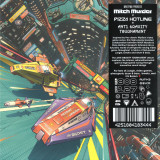
WRWTFWW Records is honored to present a one of a kind collaboration release between buzzing UK producer and DJ Pizza Hotline and Swedish electronic and synth icon Mitch Murder, delivering 3 gigantic tracks each for the Anti Gravity Tournament album, now available as a limited-edition LP housed in a heavyweight 350gsm sleeve illustrated by the legendary junkboy. It is also available in digital formats.
Inspired by the classic WipEout video game series, this high-energy boosted split-album transports listeners into the futuristic world of anti-gravity racing, a colorful turbo adventure soundtracked by 6 mega tracks of fast-paced atmospheric jungle, thunderous breaks, and liquid drum & bass. The adrenaline-fueled collection delivers maximum energy and dreamy vibes, a true paradise for fans of 90s/Y2K video games, LTJ Bukem, Peshay, Soichi Terada, and previous efforts by Mitch & Pizza.
Anti Gravity Tournament follows 2 critically-acclaimed albums by Pizza Hotline – Level Select and Polygon Island, both still available on WRWTFWW Records, as well as the limited Low Poly Breaks cassette series which sold out in a few minutes.
Mitch Murder is known as one of the originators of synthwave and has released timeless albums on Rosso Corsa Records, Mad Decent, and My Pet Flamingo (TimeSlave Recordings). He is also the man behind the Kung Fury soundtrack and has collaborated with…David Hasselhoff himself!
The astonishing exclusive artwork comes from the one and only junkboy, creative director at Mojang Studios (Minecraft) and all-around design grandmaster.
Fasten your seatbelt and join the fun.
Commandez maintenant et nous commanderons l'article pour vous chez notre fournisseur.

il devrait être publié sur 07.02.2025

"Four years in the making, Nikolaienko’s retrogarde take on mid-20th century tape music is a loping, whirling fuzzy felt oscillator odyssey. If Louis and Bebe Barron had been asked to create electronic tonalities for a Czech animation based on EM Forster’s The Machine Stops, the results may have turned out like this. Only, for all its nods to Parmegiani and the BBC Radiophonic Workshop, one can’t quite see this album coming out in 1956 – or even 1976. Something about the slightly off kilter rhythms, the loose feel and wheezing sound effects make this very much a post-Dilla take on Raymond Scott and his successors." - The Wire
"...The album, pitched as “a tribute to early-electronics’ golden era,” takes on a fragmented aesthetic of bleeps, thunks and jolts that secrete the concentrated focus of a fantastical laboratory...” Tiny Mix Tapes
"...The Sounds Of Pseudoscience is a perfect cocktail of space ambient with ice, delicate percussions, under-water rhythms and echoes of Soviet 60s..." Krossfingers
Commandez maintenant et nous commanderons l'article pour vous chez notre fournisseur.

Limited to 50 copies cassettes in Riso printed J-cards
"Four years in the making, Nikolaienko’s retrogarde take on mid-20th century tape music is a loping, whirling fuzzy felt oscillator odyssey. If Louis and Bebe Barron had been asked to create electronic tonalities for a Czech animation based on EM Forster’s The Machine Stops, the results may have turned out like this. Only, for all its nods to Parmegiani and the BBC Radiophonic Workshop, one can’t quite see this album coming out in 1956 – or even 1976. Something about the slightly off kilter rhythms, the loose feel and wheezing sound effects make this very much a post-Dilla take on Raymond Scott and his successors." - The Wire
"...The album, pitched as “a tribute to early-electronics’ golden era,” takes on a fragmented aesthetic of bleeps, thunks and jolts that secrete the concentrated focus of a fantastical laboratory...” Tiny Mix Tapes
"...The Sounds Of Pseudoscience is a perfect cocktail of space ambient with ice, delicate percussions, under-water rhythms and echoes of Soviet 60s..." Krossfingers
Commandez maintenant et nous commanderons l'article pour vous chez notre fournisseur.

Founded in 1979 in Sesto San Giovanni by Roberto Fusar Poli, Il Disco o began as a small, family-run record store, quickly evolving into a hub for imported music and a pioneer in the "disco dance" genre.
By 1981, it had expanded into music distribu/on and produc/on, aligning with the rise of Italo Disco—a genre blending synth-pop and electronic disco inspired by ar/sts like Giorgio Moroder and Bobby Orlando. Its first release, "I'm A Vocoder" by Gay Cat Park, marked the start of a prolific catalog that included hits like "You Are A Danger" by Gary Low and "Comanchero" by Raggio Di Luna, cemen/ng Il Disco o’s reputa/on in Italy and abroad.
At its peak, the label produced up to one record a day and distributed interna/onal hits like "Don’t You (Forget About Me)" by Simple Minds.
Commandez maintenant et nous commanderons l'article pour vous chez notre fournisseur.

il devrait être publié sur 31.01.2025
