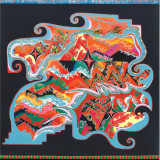
OUTLANDERS ist ein Projekt der finnischen Sopranlegende Tarja Turunen und dem EDM Pionier Torsten Stenzel. Über 10 Jahre haben die beiden an dem Album gearbeitet und hatten dabei Unterstützung von einigen der einflussreichsten Gitarristen unserer Zeit. Bei jedem Song wirkt ein besonderer Gitarrist als Gast mit: u.a. Al Di Meola, Trevor Rabin, Joe Satriani, Jennifer Batten, Steve Rothery, Mike
Oldfield, Walter Giardino, Ron “Bumblefoot” Thal, Vernon Reid und Marty Friedman. 7 Tracks wurden bereits digital vorab veröffentlicht und nun erscheint das langersehnte gleichnamige Album am 23. Juni auf CD-Digipak und Ltd. Blue Curacao 2LP.
Поиск:in da place
Все
Robin Saville - one half of the influential duo ISAN - returns to Morr Music with »Lore«, his fourth solo album to date. After 2020’s »Build A Diorama«, the British musician takes his love for field recordings, whirring pads, hovering bells and subtle electronics further, adding extra depth to both his sonic palette and his storytelling, focussing on biological diversity and its implications for human life.
For many years now, ›look and listen‹ has been Robin Saville's motto on his regular environmental explorations. The avid ambler does not just enjoy being out and about in nature; it is an important inspiration for his creative work as well. Sounds, smells, colours and even soil properties add to the experience. Equipped with a microphone and a recording device, Saville documents his strolls, using these recordings as a base for his compositions. »The field recordings on the album were made very locally this time, for obvious reasons,« he says. Welcome to the sonic landscape of the UK's East Anglia.
»Judith Avenue«, the opening track, is a great example of how Saville evolved his perspective on the sounds of nature: »It is a residential street, fading into a scrubby, wild landscape. There, I made a recording of nightingales at dusk. Such romantic birds! The males fly here from Africa a couple of weeks ahead of the females. They find a good territory, and at dusk, when all the other birds are going quiet, they start to sing to tempt the females down from their migratory flight paths. This has happened for thousands of years. However, the patch of ground where I made the recordings is earmarked for development and I don't suppose it'll happen there again. The recordings therefore become part of the history of that place, the lore.«
Recording the sounds of nature and enriching them with electronic sorcery, Saville is not only a documenting preservationist; he also translates these recordings into meaningful musical miniatures. Building on the soundscapes that marked his previous LP »Build A Diorama«, »Lore« is dominated by both open-hearted melancholy and more upbeat rhythms. But even when the music sounds quirky and loose, there is always deeper meaning. The album is characterised by an ever present melancholy about the threatening loss of living spaces, and a celebration of their beauty. This simultaneity turns the tracks into existential meditations about our human habitat. Saville enriches our lives musically by addressing the very issues we often ignore. At the same time, he becomes an agent of hope and change. Moving between light and dark, »Lore« is a musical allegory of where we stand today.
»The album is a document of places and times and while it is certainly a celebration of those things, it is also a record of things we are losing. That's how interaction with nature feels to me nowadays: something precious and amazing, but with an underlying sadness about the destructive relationship that humanity seems inevitably to have with the world around it.«
Let's not lose any more things.
- 1: Big Hair (Live)
- 1: 2 Through The Night (Live)
- 1: 3 Nothing (Live)
- 1: 4 Give You What You Came For (Live)
- 1: 5 Attack (Live)
- 1: 6 Fire (Live)
- 1: 7 Heart Strings (Live)
- 2: 1 Trapped Inside (Live)
- 2: Right About You (Live)
- 2: 3 Driver (Live)
- 2: 4 Shake It (Live)
- 2: 5 Anyway I Find You (Live)
- 2: 6 River Flows (Live)
- 2: 7 Sacred Ground (Live)
180g double LPs, 45 RPM. Hot off the back of this year's critically-acclaimed new album 'New York City', Brooklyn punk institution The Men are back already with a Fuzz Club Session album due out digitally and on limited double LP vinyl June 23rd. Recorded live to tape at Brooklyn's Serious Business Studio by Travis Harrison, the live session sees the Men storm through three tracks from 'New York City', one from 'Devil Music', a cover of English punk band Blitz and nine-brand new tracks that have never seen the light of the day until now, ranging from blistering noise-rock and cathartic rock'n'roll to lo-fi country-rock and hypnotising drones. This is the 20th release in the Fuzz Club Session series from London-based label Fuzz Club, which has previously hosted the likes of A Place To Bury Strangers, Night Beats, Holy Wave, The Entrance Band and more.
Repress!
Leeds soul and funk label ATA Records are proud to announce the new single from The Sorcerers. Available on 7" vinyl and Digital Download from Friday 30th March, this single is a driving Ethiojazz track aimed squarely at the dancefloor, backed by the Yorkshire Film & Television's original recording of "The Anderson Spectrum" (Later re-recorded and re-named by The Sorcerers as "The Viking Of 5th Avenue")
Taking influences from Ethiopiques Ethiojazz as well as the soundtracks to the European horror films of the 60s and 70s, The Sorcerers seamlessly blend these disparate elements into one cohesive package. Based in ATA Records' home of Leeds, The Sorcerers are made up of the cream of the city's jazz and world scene. Forming the backbone of the ATA Records house band they incorporate bass clarinets, flutes, and vibraphone alongside bass, guitar organ and drums, providing Ellingtonian textures on top of a solid rhythmic foundation.
Initially inspired by the work of Ethiopian composer Mulatu Astatke, The Sorcerers have developed their sound from the foundations laid out on their debut LP "The Sorcerers"."In pursuit of Shai Hulud" eschews the atmospheric textures of their previous material, replacing them with driving percussion and propulsive bass. Organ and flute tear into the melody as temple blocks beat out an insistent rhythm throughout.
The B-Side ("The Anderson Spectrum") is the original track from The Yorkshire Film & Television Orchestra that The Sorcerers re-recorded and re-named "The Viking Of 5th Avenue" when they recorded it for their debut. Tremolo-fuzz guitar and heavy brass place the track firmly in the sonic realm of 1960s British Library Music, bringing to mind the work of John Barry and Portishead rather than Mulatu Astatke.
Lost soul phenomenon Lewis Taylor's Numb finally arrives on double vinyl! One of UK soul’s most fascinating artists, most enigmatic figures and most under-appreciated talents, Andrew Lewis Taylor is a prodigious multi-instrumentalist and eclectic polymath. He enjoys a fiercely loyal following which, over the years, has included celebrity champions like Bowie, Elton and D'Angelo. Numb is Taylor's sixth album, initially released on his own label Slow Reality (an anagram of his name) and licensed to Be With for this long-awaited physical edition. It captures Taylor's wholly unique, intoxicating take on lush, late-night psychedelic soul music.
Lewis wrote and recorded these 10 brand new tracks after a 17 year break from making music, although the album came together over a two-year period. The years away have done nothing to dull Taylor's unique musical vision. He still astounds. The lyrical themes, however, have shifted. Understandably, more than a decade and a half of soul searching and unflinching self-examination cannot fail to influence this most honest of songwriters, and boy does it show. Numb marks a return to the darker, more mysterious side of his output: "Brian Wilson-channels-Smokey Robinson atmospheres", as Mojo put it recently.
After playing a rapturously received gig at the Bowery Ballroom in NYC in 2006, Lewis unceremoniously walked away from music and disappeared completely. An interview in 2016 shed light on some of the reasons for Taylor’s withdrawal from the business, but there was no hint of a return anytime soon. Then in June 2021, news emerged out of the blue that he was readying new music alongside Sabina Smyth with whom he had worked first time around.
On Numb, Lewis deftly balances stark, soul-bearing lyrics with moody mid-tempo pop-soul sheen. He deals candidly with depression, mental turmoil, even thoughts of suicide - clearly more personal than Taylor's earlier songs. The music is rich, warm and layered, with infectious melodies and hooks that stick with you. A true grower of an LP, it really does reward repeated listens. As Jim Irvin in Mojo reflected, "despite the depths these plumb, it's a curiously uplifting experience, unfurling like a concept album about life's challenges with an optimistic beauty at its heart."
Triumphant dubwise horns ring out yet, almost instantly, “Final Hour” takes on a dark, downbeat vibe. With lyrics that confront (and, seemingly, confound) death head-on, Lewis ensures the groove is still there, the beats still swing and your head still nods, strings glissade. Woven around delicate yet insistent piano and subtle strings over a killer bassline, the title track “Numb” is a good example of the lyrical themes throughout the album. As Taylor reflects, "So removed I feel no pain / And for all I know I could be having the time of my life" with a coda that feels very much in conversation with Brian Wilson's finest harmonies. "Feels So Good" is sophisticated 90s-sounding soul of the highest order. The music and vocals feel simultaneously optimistic and despondent. Downlifting. A neat trick, and one Lewis has been so adept at over the years. "Apathy" is a mini-epic, a symphonic-soul gem which builds and glides and, eventually, soars. “Worried Mind" is another slow-builder, creeping out the gate in a sketchy, discordant fashion before climbing to half-crescendo but never quite breaking free of its disorientating restraint.
The brighter "Please" presents a more hopeful mood, with the refrain "I still believe" ringing out as Lewis harmonises with himself. "Brave Heart" quietly struts from step one, as Lewis's falsetto swaggers over a downtempo backdrop with ace echoey drums, beautiful strings and serene electric guitar. Closing out Side C, "Is It Cool" answers its own (non-) question with a spellbinding five and a half minutes of swoonsome deep soul that oscillates between a restrained, barely-there backdrop and a lushly full musical accompaniment of acoustic and electric guitar and organ over bass and slick drums. The penultimate track "Nearer" is a magical, soul-stirring ballad in which Lewis sings of reaching a sweet salvation and achieving a peace of mind. If the hairs on the back of your neck aren't standing up by the midway point, you might need to check your pulse. Album closer and true tear-jerker "Being Broken" places Lewis's gorgeous voice high in the mix and the wordless falsetto and melodies invite you to ponder what Pet Sounds might sound like if it were refashioned as a dubby 21st Century electronic soul album. Astonishing.
Simon Francis’s vinyl mastering spreads out the ten tracks over a double LP so, as ever, nothing is compromised. And as usual, the records have been cut by Cicely Balston at Air Studios and pressed at Record Industry. Turn it up and let the Lewis Taylor sound envelop you.
More recently best regarded as soundtrack composer, Ben Frost here follows work with interdisciplinary sound artist Francesco Fabris on the »Dark« OST with a plunge into purest rock music, as in the actual sound of molten material rising to the surface and solidifying. With an impressionistic-artistic license also found in work by Chris Watson, Jana Winderen or Giuseppe Ielasi, the duo uncompromisingly revel in the sounds of nature’s biting point, using various production methods to make audible the sound of the earth beneath our feet in the process of creation, on location at Fagradalsfjall, Reykjanes Peninsula Iceland.
»As stable as we might choose to think it is, this planet is anything but that. A paper thin crust, the zone in which we find ourselves, and mostly concern ourselves with, exists as a modest veil cloaking a dynamic seismic turbulence that is as powerful as it is unknowable. There are moments though where ruptures occur. The pressure from within carves its way to, and through, the surface of the planet simultaneously delivering destruction and virgin landscapes, as primordial as any we might care to imagine. It is here, in these places, where we can literally see the living planet, that geologic time is condensed and world building is made visible, and audible to us, in an unrestrained and provocative detail.
These volcanic ruptures, such as those captured on Vakning by Francesco Fabris and Ben Frost, speak to the very living geology of Earth. These recordings, captured at close range, exist at a nexus where liquid rock becomes solid. They capture moments of transformation, of obliteration and of creation, often all at once. These are recordings of a living, material planet, dynamic and unrestrained«. (Lawrence English)
red vinyl edition[29,37 €]
green vinyl edition[33,99 €]
silver vinyl edition[29,37 €]
blue vinyl edition[29,37 €]
In Times New Roman... is raw, at times brutal and not recommended for the faint of heart. And yet, it’s perhaps the most beautiful and definitely the most rewarding album in their epic discography. Founder Joshua Homme's most acerbic lyrics to date are buoyed by the instantly identifiable QOTSA sonic signature, expanded and embellished with new and unprecedented twists in virtually every song. With In Times New Roman… we see that sometimes one needs to look beneath scars and scabs to see beauty, and sometimes the scabs and scars are the beauty.
black vinyl edition[31,72 €]
green vinyl edition[33,99 €]
silver vinyl edition[29,37 €]
blue vinyl edition[29,37 €]
In Times New Roman... is raw, at times brutal and not recommended for the faint of heart. And yet, it’s perhaps the most beautiful and definitely the most rewarding album in their epic discography. Founder Joshua Homme's most acerbic lyrics to date are buoyed by the instantly identifiable QOTSA sonic signature, expanded and embellished with new and unprecedented twists in virtually every song. With In Times New Roman… we see that sometimes one needs to look beneath scars and scabs to see beauty, and sometimes the scabs and scars are the beauty.
black vinyl edition[31,72 €]
red vinyl edition[29,37 €]
silver vinyl edition[29,37 €]
blue vinyl edition[29,37 €]
In Times New Roman... is raw, at times brutal and not recommended for the faint of heart. And yet, it’s perhaps the most beautiful and definitely the most rewarding album in their epic discography. Founder Joshua Homme's most acerbic lyrics to date are buoyed by the instantly identifiable QOTSA sonic signature, expanded and embellished with new and unprecedented twists in virtually every song. With In Times New Roman… we see that sometimes one needs to look beneath scars and scabs to see beauty, and sometimes the scabs and scars are the beauty.
black vinyl edition[31,72 €]
red vinyl edition[29,37 €]
green vinyl edition[33,99 €]
blue vinyl edition[29,37 €]
In Times New Roman... is raw, at times brutal and not recommended for the faint of heart. And yet, it’s perhaps the most beautiful and definitely the most rewarding album in their epic discography. Founder Joshua Homme's most acerbic lyrics to date are buoyed by the instantly identifiable QOTSA sonic signature, expanded and embellished with new and unprecedented twists in virtually every song. With In Times New Roman… we see that sometimes one needs to look beneath scars and scabs to see beauty, and sometimes the scabs and scars are the beauty.
black vinyl edition[31,72 €]
red vinyl edition[29,37 €]
green vinyl edition[33,99 €]
silver vinyl edition[29,37 €]
In Times New Roman... is raw, at times brutal and not recommended for the faint of heart. And yet, it’s perhaps the most beautiful and definitely the most rewarding album in their epic discography. Founder Joshua Homme's most acerbic lyrics to date are buoyed by the instantly identifiable QOTSA sonic signature, expanded and embellished with new and unprecedented twists in virtually every song. With In Times New Roman… we see that sometimes one needs to look beneath scars and scabs to see beauty, and sometimes the scabs and scars are the beauty.
- A1: G & B
- A2: Of Dreams To Come
- B1: F. T. B
- B2: Y’outta Praise Him (Intro)
- B3: Y’outta Praise Him
- C1: Beatrice
- C2: Maiden Voyage/Everything In Its Right Place
- C3: J Dillalude
- D1: Silly Rabbit
- D2: One For ’Grew
- D3: Tribute
Robert Glasper’s 2005 Blue Note debut Canvas signaled the arrival of a singular new voice in jazz and his 2007 follow-up In My Element solidified his status as a rising star who was taking the music someplace new. Featuring bassist Vicente Archer & drummer Damion Reid, the album expanded the possibilities of where a modern jazz piano trio might go by delving further into his hip-hop & gospel roots.
This 2-LP Blue Note Classic Vinyl Edition was mastered by Kevin Gray and pressed on 180g vinyl at Optimal.
• CLASSIC LATE 80S DIGI-ROOTS SET FROM THE LEGENDARY WAILING SOULS PRODUCED BY KING JAMMY
• “STORMY NIGHT” TAKES IT’S PLACE IN A LONG LINE OF CLASSIC WAILING SOULS ALBUMS FOR GREENSLEEVES STRETCHING FROM ‘81’S “FIRE HOUSE ROCK” TO THE RECENT ALBOROSIE PRODUCED “BACK A YARD”.
• INCLUDES THE HIT SINGLE “DOG BITE”
• RE-MASTERED AND RE-SEQUENCED WITH NEW COVER ART
The next chapter of the Natural Information Society is here. Since Time Is Gravity, credited to Natural Information Society Community Ensemble with Ari Brown, presents a newly expanded manifestation of acclaimed composer & multi-instrumentalist Joshua Abrams nearly 15 year, 7 albums &-counting flagship ensemble. Joining the core NIS of Abrams (guimbri & bass), Lisa Alvarado (harmonium) Mikel Patrick Avery (drums) & Jason Stein (bass clarinet) are Hamid Drake (percussion), Josh Berman & Ben Lamar Gay (cornets), Nick Mazzarella & Mai Sugimoto (alto saxophones & flute), Kara Bershad (harp) & Chicago living legend of the tenor saxophone Ari Brown. Recorded live to tape at Electrical Audio & The Graham Foundation, cover painting Vibratory Cartography: Nepantla, by Lisa Alvarado. 2xLP on Eremite USA, 2xLP & CD on Aguirre/Eremite Europe. Out 14-04.
Since first developing Natural Information Society in 2010, Joshua Abrams has been gradually expanding the group’s conceptual underpinnings, its musical references & the sheer number of the group’s members. Its music is, in a sense, an expansive form of minimalism, based in repeated & overlaid rhythmic patterns, ostinatos & modality. Its roots, its scale & its meaning become clearer in time. If time is gravity, it also allows us to carry more. Having begun as fundamentally a rhythm section with Abrams’ guimbri at its core, the version here can stretch to a tentet, including six horns.
Abrams has been expanding his minimalism gradually, but he has long understood a key to minimalism’s potential: the breadth of its roots in the late 1950s & early 1960s, ranging from the dissatisfaction of young European-stream composers with the limitations of serialism to the simultaneous dissatisfaction of jazz musicians with the dense harmonic vocabulary of bop & hard bop. The former began exploring rhythmic complexity & narrow tonal palates in place of harmonic abstraction (Steve Reich’s Drumming, Philip Glass’ Music with Changing Parts; perhaps above all Terry Riley’s In C & his late ‘60s all-night organ & loop concerts); the later reduced dense chord changes to scales (signally with Miles Davis' Kind of Blue, but rapidly expanding with John Coltrane’s vast project). In the 1950s the LP record opened the world with documentation of Asian & African musics, key influences on both minimalists & jazz musicians. If John Coltrane’s soprano saxophone suggested the keening shehnai of Bismillah Khan, the instrument was rapidly taken up by two key minimalists, LaMonte Young & Riley, similarly appreciative of its flexible intonation, the same thing that kept it out of big bands.
If the guimbri, the North African hide-covered lute that Abrams plays with NIS, involves a rich tradition of hypnotic healing music associated with the Gnawa people, Abrams’ music also touches on other musics as well — other depths, memories & healings, different drones, rhythms & modes. As the group expands on Since Time Is Gravity, he has made certain jazz traditions in the same stream more explicit as well. If there is a mystical & elastic quality involved in the experience of time, both in direction & duration, you will catch it here. The parts for the choir of winds expand on the roles of Abrams’ guimbri, Mikel Patrick Avery & Hamid Drake’s percussion & Lisa Alvarado’s harmonium: at times, the winds are almost looping in the tentet version, each hitting a repeating note in turn, at once drone & distinct inflection on temporal sequence. The brilliance of the work resides in Abrams’ compositions, the NIS’ intuitive execution & in Ari Brown’s singular embodiment of the great tenor saxophone tradition, including the oracular genius of Eddie “Lockjaw” Davis, & Yusef Lateef. The three pieces by the expanded NIS featuring Brown —the opening “Moontide Chorus” & “Is” & the ultimate “Gravity”— have an immediate impact, & togther might be considered a kind of concerto for tenor saxophone. Here Brown presses almost indistinguishably from composed melody to improvised speech, getting so close to language that he might have a text. Everything here is a sign. Note the tap of the Rhythm Ace that links “Moontide Chorus” to “Is”, the attentive heart always present, even when signed by a machine. There’s a link here to the methodologies & meanings of dub music & the linear & vertical collage of beats, textures & tongues: treated with reverence, a sample of a beat-box can be as soulful, as hypnotic, as a mbira or a tamboura. If those pieces with Brown are heard as a suspended concerto, the three embrace & enfold the other works, like the sepals of a flower. That placement will also touch on the mysteries of our perception of time.
Particularly in “Is”, but elsewhere as well, a phenomenon of transcendence arises in which time appears to be tripartite, at once moving backwards & forwards & standing still. This is an act of technical brilliance certainly, but also an illumination of music’s ability to represent temporal consciousness through polymetrics. This particular listener has only heard it before in a few places, including the horn shouts & bowed basses of Coltrane’s Africa, in moments of Charles Mingus’ The Black Saint & the Sinner Lady, in certain pieces where tapes were literally running backwards, & earlier still in Dizzy Gillespie’s Cubana Be, Cubana Bop, in which the composer George Russell & conguero Chano Pozo found a music that spoke at once in the voices of Stravinsky’s Rite of Spring & the vestigial rites, rhythms & songs of the Yoruba language & Santeria religion of inland Cuba.
In Joshua Abrams’ compositions & the realization of them by the NIS, in the time of one’s close listening & memory thereof, distinctions between the “natural” & the “social”, the “quotidian” & the “transcendent” are erased, suspended or perhaps irrelevant. Consider two of the ensemble pieces, one named for nature, the other social science. In “Murmuration” the repeated wind figures of flute & alto saxophone combine with the interlocking patterns of harp, guimbri & frame drum (tar) to create a perfect moving stillness, not an imitation but a witness to the miracle of the starlings’ astonishing collective art, a surfeit of beauty that might be the ultimate defense tactic.
“Stigmergy” takes its name & concept from the Occupy movement’s Heather Marsh, who proposes a social system based on a cooperative rather than competitive models, one in which ideas are freely contributed & developed as ideas rather than an individual’s property. In its form, Abrams’ “Stigmergy” is the closes thing to traditional jazz, a series of accompanied solos by each of the wind players. However, the composed accompaniment is a radically collectivist notion: a repeated rhythmic figure, call it ostinato or riff, in which the different winds each play only a note or two of the figure, a concept both more collectivist & individualistic in its conception than any typical unison figure. It suggests another of the underlying recognitions that propel the Natural Information Society, the group as social organism, the teleology of hypnotic anarchy, all parts in place, functioning systematically, evolving & expressing itself, its nature & society, as a transformative organism.
George Lewis has described music as “a space for reflection on the human condition”. This suggests that, rather than a “distraction”, at least some music might serve as a distraction from distraction. It’s a focus, a clarity, a awareness, an external invitation to interiority, as if music itself is a model for form & contemplation, an organism contemplating for us or as us. If that is a possibility, & I am sure I have heard such musics, than this music is among them. How many of our rhythms, melodies & harmonies (cultural, historical, biological, psychic) might such music carry, translate & transform in the particulate ecstasy of our own murmuration? (Stuart Broomer, April 2022)
After the acclaimed ΠΟΛΙΣ, Subheim returns with RAEON; a collection of eight new tracks for lonely evenings and long night drives. With RAEON, Subheim continues to expand into the sonic territory he has steadily been exploring since 2015’s Foray, the album that marked the project’s shift towards moodier, highly textured, lofi compositions through the use of sampling and heavy audio manipulation. While this EP feels like a natural continuation of the producer’s most recent work, it is intentionally stripped of any percussive elements, with the focus being entirely placed on space and melody.
Each composition feels like a distant, fading memory that unfolds faster than you expect it to and dissolves into an echoing nothingness before you’re able to hold on to it for more than a few seconds. Much like a long-distance train passing by or perhaps like a song you might hear in your sleep.
Every piece serves as a different chapter of the same open-ended narrative; one where stillness, grief and hope simultaneously coexist in perfect harmony. Intentionally imperfect, naturally gritty, spacious as ever, this new record balances between fragility and conviction, and once more illustrates the deeply human side of its creator.
In contrast to some of the producer’s darker work, RAEON is filled with an undertone of bittersweet hopefulness and a strong desire for new life. With the juxtaposition of nostalgic, synthesized, analog sounds and neoclassical elements, Subheim strikes the perfect balance between past and future, between melancholy and hope. And while the closing track is almost ironically called “Forget”, its ending will leave you longing for more and wondering what else is there.
Stimela were a popular and successful South African Afro-fusion outfit led by guitarist, vocalist, songwriter, producer and arranger Ray Phiri. The band was formed under the name ‘The Cannibals’ during the 1970s when Phiri got together with drummer Isaac Mtshali, keyboard player Thabo Lloyd Lelosa and bass player Jabu Sibumbe. They initially started out as instrumentalists, but later evolved to Afro-fusion when they joined forces with vocalist Jacob “Mparanyana” Radebe in 1975. The story of ‘The Cannibals’ ends when Radebe died in 1978 but the ‘Stimela’ story was only just beginning.
In 1979, after a life-changing experience in Mozambique (where they were stranded for three months) the band members had to sell all their belongings to take a train home. This trip was a watershed moment as it was here where they conceived the new name for the band: The Zulu word for “locomotive-train” STIMELA.
Stimela would soon become little short of an institution in their home country of South Africa. With soulful tunes and gripping lyrics, the band has recorded platinum-winning albums such as Fire, Passion and Ecstasy, Shadows, Fear and Pain & Look Listen and Decide. In addition to recording their own material, the group supplied instrumental accompaniment on albums by a lengthy list of legendary artists. Stimela would go on to gain global fame after being featured on Paul Simon’s iconic 1986 ‘Graceland’ album and the mega tour that followed.
Ray Phiri would enter into many successful collaborations with major acts and artists such as Harari, Joan Baez, Willie Nelson and Manu Dibango. In 2017 he was diagnosed with lung cancer and died at the age of 70. Phiri has received many awards in recognition for his contribution in the music industry, one of these is the Order of Ikhamanga awarded to him by the South African president. This was to honor his sterling contribution to the South African music industry and the successful use of arts as an instrument of social transformation.
Stimela is the tale of a South African band who have battled their way through dark days to take their rightful place in the forefront of the South African apartheid-era music invasion. One of their most memorable tracks “Whispers in the Deep” was even restricted from being broadcasted by the old South African Broadcasting Corporation.
On the album we are presenting you today (Fire, Passion and Ecstasy from 1984) the unique sounds of Ray Phiri’s Stimela are fully showcased. Expect infectious hypnotic build-up grooves, cinematic lowdown jazz-funk, Afro-soul, delightful reggae, gospel influences and funky synth-boogie sounds…all with a touch of early eighties new wave and hints of Island disco mixed with sensual bubblegum pop. It comes as no surprise that the album has now become a sought-after item due to its addictive and original-sounding nature, a must-have for any self-respecting record digger!
These recordings completely encapsulate Stimela’s fusion style. They managed to craft a modern South African sound that continues to influence SA musicians to this day. Never in a rush, yet always with a sense of purpose and direction – like the steam train after which they took their name.
Tidal Waves Music now proudly presents the first reissue of this fantastic Afro-fusion classic since 1990 (originally released in 1984 on Gallo Records) & this is also the first time the album is getting a release outside of the African continent. This rare record (original copies tend to go for large amounts on the secondary market) is now finally back available as a limited 180g vinyl edition (limited to 500 copies) complete with the original artwork. Also included is a double-sided insert containing rare pictures of the band.
Since we've known him, Robert Lloyd has made quite clear his enormous affection for the songs and sounds of Freakwater, the duo of Janet Beveridge-Bean and Catherine Irwin who've been wrongly denied their place as rightful and willful progenitors of alt-country's 'movement', which (frankly) is to their credit. Their genius in offering absolute authentic to the sound old-time Appalachian folk music with a modern façade that in no way negates tradition (one of their albums is titled Feels Like The Third Time) is unparalleled within the genre, and Freakwater remain under-appreciated. After the start of Covid, Robert dared approach Janet with the idea of recording together. Over the course of the long pandemic, songs were bandied about for months, and when recording was finally practical, a band was assembled with dates set up for a recording session in Valencia, Spain. Robert and Janet were joined by Robert's long-time ally, Pete Byrchmore, the musical foil for Robert's solo album on Virgin and a former Nightingale, Mark Bedford, the bassist for Madness and Terry Edwards' Near Jazz Experience, and Pablo Roda, Spanish mystery drummer, couldn't have worked out more perfectly. Tracks were selected without regard for collective presentation, just the goal of walking out of the studio with an album of perfect gems. Forget Lee & Nancy or George & Tammy, Rob and Janet have an immediate chemistry that only sounds long-lived - and too uniquely them to merit any comparison. The title track, Black Cat, Dark Horse is the sole Lloyd / Bean / Byrchmore composition and one of the record 's highlights. Jim Elkington, collaborator with Jeff Tweedy and Richard Thompson, contributes Heavy Reckonings and a song written with Janet, The True Lovers' Knot And The Lie, while Robert adds reworkings from past releases - Sweet Georgia Black and Black Country (with Pete) - not to mention the unreleased Eggs And Bacon. Janet brought One Shot and the unheard Freakwater song Arc Of A Smile. Covers of tunes from Dion and The Monkees and a magnificent Jon Langford song, "Tears Like Stars" round out the album. We daresay the album is among the finest you'll hear in 2023. That it doesn't fit perfectly into any preconceived genre is a testament to its quality. "Songcraft" is a word used infrequently today, yet Black Cat, Dark Horse will show that good songs endure. We're proud that Robert and Janet will find some new admirers through this album's release. The Michael Cumming / Stewart Lee film King Rocker made a case for Robert Lloyd-as-losthero; this album furthers that idea and shows a compelling side of Janet's talent and abilities which will be a surprise to her fans and serve as an entry point to exploring her many other compelling projects.
Josh Milan has been recording music professionally for over 30 years.He's played every role from artist to engineer in the studio.This project, Honeysweet, focuses on his production and musicianship.Utilizing only one musician on sax, Josh plays every instrument and sings every note on this project. His songs are packed with soulful dance floor grooves inspired by iconic, soulful groups like Brian Auger, Cymande, Pleasure, Africano, Santana and others.
"I wanted to do music that made me and my family feel good when I was growing up. It's the kind of music that families dance to at gatherings with a record player and no DJ”, says Josh. “Intros, Accents, Breakdowns, Bridges, and endings were all part of the music.” This music will transport Josh's audience to a place of musical freedom. This is music with, seemingly, no rules.
Josh Milan describes each track on the Honeysweet EP “Exodus” in his own words :
"Last Night Changed It All featuring Lawrence Clark on sax is the kind of groove that keeps its dance floor value while holding up the banner of true musicianship. This song was written after hearing a DJ set,where the DJ didn’t seem to be concern about staying within a musical box. He played all sorts of music in one set. I knew then that I’d branch out musically when recording.Rhodes, picked bass guitar, rhythm guitar and drum kit is all that's needed on this one.”
"Exodus the manipulation of major and minor chords in this groove make it complex and interesting. The listener is lead by the organ solo featured here. The song is a mental escape. A mental exodus complete with bongo section.”"Being Free is a message that captures the point of this entire project. Musical freedom and expression is where this project gets its
fuel. Horns, are included on this production. A true expression of soulful music. Being free should be all the time I'm your mind all the time.”
“Cranberries and Cream is my tribute to funk grooves as they were featured on records in 70’s. I’m a fan of that sound and I like to play by own funk grooves when I’m alone. This is one of the tracks on the ep I prefer to rock.”
“And So She Waits has eerie sounding pads in the background. They linger throughout the track. Popping in and out, as though they’re waiting for something. You will hear the change in mood once she is no longer waiting. The groove returns to it’s original state. Only she is no longer waiting, he is.”
“Crazy is me bringing the funk to dirty house music. Complete with house piano in the mix. The chords are unsettling. They are, in fact,Crazy. I though adding a horn arrangement to a house track like this would sound interesting and different.”Honeysweet “Exodus” out at all digital outlets and double pack vinyl set.
Death Is Not The End's 333 sub-label drops a much needed reissue of Rupie Dan's My Black Race 12" from 1982. A huge Shaka selection featuring one of the heaviest dubs available from this era of UK roots production. Originally written and produced by Rupie for his Flag Records label, with engineering from Tony Addis (later of Addis Posse and the Warriors Dance label).
"The lyrical idea for My Black Race came about during the 1980/81 social/racial revolution that took place in several cities all over England, including London, Liverpool, Birmingham, Leeds etc. I was living in Bradford, West Yorkshire at the time and was a DJ/Sound System operator on Jah Scorcher International Sound. I also co-hosted a Reggae show on an independent radio station Called Pennine Radio 235. In my regular job I was a youth and community leader with the Bradford education council. I was fully connected and in touch the community.
Seeing how the media used the events of the social uprising as a weapon to further discriminate against the African & Caribbean community committed me to say and do something to elevate the minds of especially young people who were already demoralised by the rhetoric that brought about the so called "riots" of the time. It was during this time that the lyrical foundation of "My Black Race" was laid. The rhythm came later after hearing Barry Brown's "No Wicked Shall Enter the Kingdom of Zion". In the summer of 1982 I entered into the Addis Ababa recording studio on Harrow Road, Paddington and recorded the song having moved to London the previous year. Musicians featured included Victor Cross on bass and Mark Wright on drums (both from the Ariwa band), Rizzo on guitar, Tan Tan and Bami on Horns (all 3 from Aswad band), Bubblers on Piano/Organ (Undivided Roots/Ruff Cutt Band). Lead vocals were provided by myself, with backing vocals Jenifah Gad and Niomi who was working with David Bowie at the time. The engineers were Bubblers and Tony Addis (later of Addis Posse & the Warriors Dance label).
Jah Shaka was in the studio during the entire recording session. I was aquatinted with him as I was previously involved in a 3 way soundclash with Shaka, Quaker City and my sound at the time Jah Scorcher. Some years later I was in Terry's Dub studio in North Acton cutting some dubs when King Jammys and Bunny Lee walked in and heard the song. Bunny was responsible for the production of Barry Brown's "No Wicked Shall Enter the Kingdom of Zion". Thankfully they were both impressed by the track which delighted me as a young up-and-coming artist/producer. The rest is history as we know it. Jah Shaka was mystically constant hence his attachment and love for the song. Jah bless and guide him."
A double 12" album with brand new music produced in collaboration between DJ Fett Burger and Dama. All produced between April to October 2021.
An explosive creative collaboration between the two artists.
Unfinished sketches by Dama have been reproduced, reworked and remixed in various ways, and new tracks have been created. There have already been released three digital singles on DJFB's Digitalised Planet B, now the double album on vinyl, Emotional Tripper.
A tripped out left field house and techno record, with experimental and ambient elements. Early Italian dance music meets UK and Norwegian percussive house. Techno, electro and minimal elements all in their place. A pure mix of influences mixed and reworked together in a creative, fun and surprising way. Staying true to their original influences and moving towards something new and original.