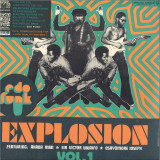
Freshly unleashed from the vaults of Desco Records and remastered for the first time since its 1998 release, it is an honor to announce the re-release of one of the finest and most satisfying needle drops of the last 40 years. An album that needs no introduction, yet one is required...we're talking raw soul and heavy, heavy funk sung with aplomb by one of the best in the biz...Ladies and Gentlemen... Presenting...
The Lee Fields' classic, "Let's Get a Groove On". And groove you shall, for this is supernova of soulful superiority. There is no equal.
Поиск:in fields
Все
Lingering at the remains of a campfire before dawn, with the politics of the personal burnt into ash, running his stick through what’s left, Wand singer/guitarist Cory Hanson is reflecting on a series of moments in which he steps farther into himself, finding the ultimate big sky country on the inside of his skull. It’s a combination of songs and sounds that journey
through bleak and broken territory and places of sweet, lush remove and it adds up to the best record he’s been involved in yet: his second solo album, ‘Pale Horse Rider’.
Cory’s first solo, ‘The Unborn Capitalist From Limbo’, was an intense affair, a grand experiment that produced inspiring,
nconventional music - but this time around, he wanted to breathe a bit easier, to feel that breath in the music as well. So he and his band drove out to the desert to record in a lowstress environment: Brian Harris’ Cactopia, a house surrounded by 6ft tall sculptural psychotropic cacti. They built a studio inside and then they made music and lived off pots of coffee and chili and cases of Miller High Life as they played guitars, bass, keyboards and drums in what seemed increasingly like a living biomech, their tech made out of fungal networks and cacti needles.
It was loose and flowed onto tape well. Recorded by Robbie Cody and Zac Hernandez (who assisted on Wand’s ‘Laughing Matter’), the sounds were great from the get-go. First takes were mostly best takes. Fuelled with DNA lifted from country-rock cut with native psych and prog strands, Cory guided his craft toward the cosmic side of the highway, a benevolent alien in ambient fields hazy with heat and synths, early morning fog and space echo spreading the harmonies wide.
‘Pale Horse Rider’’s got a lot to get out of its mind, looking around and seeing that, on the surface, things don’t always look like much. A lifelong Californian, Cory’s naturally found himself standing to the left of most of the
country. The west may be only what you make it; these days, the roadside view looks exceptionally sunbleached and left behind. ‘Pale Horse Rider’ eyes the city, the country and the fragile environment that holds them both in its hands - a record as much about Los Angeles as it can be with its back to the town and the sun in its eyes; as much about
ostalgia as new music can be with the apocalypse over the next rise.
On ‘Pale Horse Rider’, Cory Hanson moves ceaselessly forward. The old myths weave and waft, the shadows of tombstones flickering in the mirages and the light that lies dead ahead.
Lingering at the remains of a campfire before dawn, with the politics of the personal burnt into ash, running his stick through what’s left, Wand singer/guitarist Cory Hanson is reflecting on a series of moments in which he steps farther into himself, finding the ultimate big sky country on the inside of his skull. It’s a combination of songs and sounds that journey
through bleak and broken territory and places of sweet, lush remove and it adds up to the best record he’s been involved in yet: his second solo album, ‘Pale Horse Rider’.
Cory’s first solo, ‘The Unborn Capitalist From Limbo’, was an intense affair, a grand experiment that produced inspiring,
nconventional music - but this time around, he wanted to breathe a bit easier, to feel that breath in the music as well. So he and his band drove out to the desert to record in a lowstress environment: Brian Harris’ Cactopia, a house surrounded by 6ft tall sculptural psychotropic cacti. They built a studio inside and then they made music and lived off pots of coffee and chili and cases of Miller High Life as they played guitars, bass, keyboards and drums in what seemed increasingly like a living biomech, their tech made out of fungal networks and cacti needles.
It was loose and flowed onto tape well. Recorded by Robbie Cody and Zac Hernandez (who assisted on Wand’s ‘Laughing Matter’), the sounds were great from the get-go. First takes were mostly best takes. Fuelled with DNA lifted from country-rock cut with native psych and prog strands, Cory guided his craft toward the cosmic side of the highway, a benevolent alien in ambient fields hazy with heat and synths, early morning fog and space echo spreading the harmonies wide.
‘Pale Horse Rider’’s got a lot to get out of its mind, looking around and seeing that, on the surface, things don’t always look like much. A lifelong Californian, Cory’s naturally found himself standing to the left of most of the
country. The west may be only what you make it; these days, the roadside view looks exceptionally sunbleached and left behind. ‘Pale Horse Rider’ eyes the city, the country and the fragile environment that holds them both in its hands - a record as much about Los Angeles as it can be with its back to the town and the sun in its eyes; as much about
ostalgia as new music can be with the apocalypse over the next rise.
On ‘Pale Horse Rider’, Cory Hanson moves ceaselessly forward. The old myths weave and waft, the shadows of tombstones flickering in the mirages and the light that lies dead ahead.
Johnny Cash had a birth certificate marked J. R. Cash because his parents couldn’t decide what to call him. Their environment was the recurrent poverty that reigned in Thirties America, a background of depression where J. R. went to work in flooded fields, learned music and sang along with other cotton pickers, picking up jobs here and there, and finally signing up for three years in the Army.
In 1954 he went back to civilian life, married Vivian Liberto, and went through the studio doors at Sun Records, where Sam Phillips recorded his first hits. In ’57 he joined Columbia Records and a decade later married June Carter (of The Carter Family) in 1968. The following years were complicated by drugs, alcohol and constant tours, yet the pair remained together until June passed away in 2003. Johnny Cash only survived another four months.
His original country music showed empathy for those who had been rejected, and his vision of the misery around him. But he also had an especially warm baritone, and it gave Johnny Cash an immense and faithful audience. He sold 90 million albums, confirming him as one of the greatest artists in music, all genres included.
* The Menahan Street Band includes members of The Roots, Budos Band, Lee Fields and The Expressions and The Dap-Kings...an all star Brooklyn line up!
* First album in 9 years.
*LPs are In gatefold sleeve and contain download code.
* MSB tracks have been the foundation for some of modern hip-hop's most successful beats; their music has been sampled by the likes of Eminem, Jay-Z, Kendrick Lamar, Travis Scott, 50 Cent, Curren$y, to name a few.
Menahan Street Band, a veritable supergroup of some of today's most prolific songwriters, arrangers, and producers return with this beat-forward, cinematic masterpiece.
Their unique brand of instrumental soul has not only been the foundation for some of modern hip-hop's most successful beats, it has also become the perennial soundtrack and veritable vibe-generator for countless parties, art shows, and restaurants throughout NYC and abroad.
While this album carries the aesthetic torch that MSB has skillfully woven into the tapestry of their DNA, it also delves deeper into the experimental, exotic sounds that fill many of the coveted Sound Library and Soundtrack LPs of the late sixties and early seventies - an amalgamation of moog synths, electric pianos, drum machines, and a bevy of analog instrumentation, that ebb and flow in lush swells of Morriconian grandeur.
Three years in the making only to be held up nearly another whole year due to COVID, this dark brooding monster of an EP by Brussels based Strapontin, aka multi-disciplinary artist Patrick Belmont, is finally seeing the light of day.
Clocking in at over 35-minutes the record is almost album length and spans a multitude of depths and moods with elements of techno, new wave, rock 'n' roll, house and tribal…...all glued together with a sleazy atmosphere reminiscent of the electronic body music pioneered by Strapontin’s Belgian forefathers Front 242 and their German peers DAF.
Add to this a heads-down-no-nonsense darkroom beast of a remix by techno maestro Sascha Funke and the package is complete.
Strapontin provides us with some insight:
“It started with a desire to move away a bit from my 'dancefloor' side and go into more undefined fields, I wanted to work with blurry sensations that I can't understand. I like mixed feelings. Dramatex 300 is made of that ambivalent mood. The voice is saying 'I'm feeling empty' and 'I'm feeling healthy' at the same time. I like that paradox. Eunuque is a song but is also a character I will develop in a short movie (which will act as the 'music video' of the song). The Eunuque is a character full of anger yet he doesn't want to fight nor has he a target to aim at. A restrained aggressivity is boiling inside him/it that has no opportunity to escape from the body and gain release. The song is the fever he feels from these inner battles. I think Le Bain d'Huile and Anti-sceptical have the same slow and angry feeling. I'm proud of these tracks because they are a bit mysterious to me and it feels like they controlled me more than I controlled them.”
Getting plays from Monika Seta & Alexis Le-Tan
‘Pacific Kiss’ is the fourth album from Australian musician David West’s underground pop band, Rat Columns. It was engineered by Griffin Harrison and DW in New York City and Perth, and mixed by Mikey Young in Victoria. ‘Pacific Kiss’ sees Rat Columns plunging headfirst into an azure sea of power pop, rock’n’roll and indie. The tones are bright and optimistic, though fans of confusion and gloom will still find solace in the album’s darker moments, of which there are a few. Rat Columns emerged from San Francisco via Perth, Western Australia in the late 2000’s with the mope ’n’ jangle of their first self-titled cassette release, from which several tracks were drawn for their first vinyl release, a four-song 7” on the San Francisco based indie label, Smartguy Records. From that moment, DW and a constantly evolving troupe of friends and co-conspirators have forged a persistent trail of albums and EP’s on a number of interesting small labels such as RIP Society, Upset The Rhythm, Blackest Ever Black, Syncro-System, Adagio 830 and now the London-based Tough Love Records, who have also released many of David’s eponymous pop records. DW has also found time to play in a number of other interesting outfits, such as Rank/Xerox, Lace Curtain, Liberation, Scythe, Total Control and Burning Sensation over the years. ‘Pacific Kiss’ was primarily recorded in a dingy but comfortable practice space in East Williamsburg, Brooklyn. The core of the record is DW, bassist Max Schneider-Schumacher, drummer Dylan Stjepovic and keyboard wiz Joey Fishman. Additional fairy dust was sprinkled by Amber Gempton and Raven Mahon (vocals), Jef Brown (saxophone) and Mikey Young, who found time to contribute some off the wall guitar solos during the mixing process. ‘Pacific Kiss’ is a record for those astral voyages into the spheres conducted from bedrooms, kitchens, grassy fields and open car windows.
There is a blink-and-you’ll-miss-it anecdote tucked into one of
the many fine documentaries about seminal 20th Century artist
Jean-Michel Basquiat regarding the habits of his studio practice.
As we watch inspiring footage of Basquiat darting from one
piece to the next with rapid-fire brush strokes, a friend or
gallerist in a voice over says that it was not unusual for
Basquiat to be working on several paintings in the same
moment as several radio stations and televisions played in the
background. Not much more time is spent on the anecdote but
it feels like a skeleton key into Basquiat’s endlessly alluring,
neoexpressionist work.
And while Bryan Devendorf’s solo curio ‘Royal Green’ doesn’t
possess the only-in-New York vibe of Basquiat’s work, there is
something shared in its many-channels-open style of creation.
Satellite signals, strange voices from lost television
documentaries and radio operas are all woven into its fabric -
like it’s using these endless tides of media and information to
unlock the subconscious. Even its covers - Bob Dylan,
Fleetwood Mac, The National (with a nice big wink), The
Beatles - are like stunning, albeit satanic takes on hymns, or
like American standards almost dragged into the underworld.
Like the best of Spacemen 3, Sparklehorse or massively
underrated San Fran band Skygreen Leopards - the music
makes you queasy in one movement and lulls you into
blissmode in the next. It’s the very edge of outsider pop
songwriting.
For all the amphitheaters and festival fields Devendorf has
played to over his career, ‘Royal Green’ almost feels like an unlearning and a newfound love of homemade/found/fractured
sounds - and how, if collaged just so, detritus can become
stunningly gorgeous and surreal. And not without hooks. Look
no further than ‘Frosty’, which could be Little Billy Corgan’s
decayed demo tape from just before the Smashing Pumpkins
appeared on the scene. And the unspooling, slightly unglued
dream-pop of ‘Breaking the River’ is as rapturous as it is
sinister. And that’s probably where Devendorf wants it.
There is a blink-and-you'll-miss-it anecdote tucked into one of the many fine documentaries about seminal 20th Century artist Jean-Michel Basquiat regarding the habits of his studio practice. As we watch inspiring footage of Basquiat darting from one piece to the next with rapid-fire brush strokes, a friend or gallerist in a voice over says that it was not unusual for Basquiat to be working on several paintings in the same moment as several radio stations and televisions played in the background. Not much more time is spent on the anecdote, but it feels like a skeleton key into Basquiat's endlessly alluring, neoexpressionist work. And while Bryan Devendorf's solo curio `Royal Green' doesn't possess the only-in-New York vibe of Basquiat's work, there is something shared in its many-channels-open style of creation. Satellite signals, strange voices from lost television documentaries and radio operas are all woven into its fabric _ like it's using these endless tides of media and information to unlock the subconscious. Even its covers _ Bob Dylan, Fleetwood Mac, The National (with a nice big wink), The Beatles _ are like stunning, albeit satanic takes on hymns, or like American standards almost dragged into the underworld. Like the best of Spacemen 3, Sparklehorse or massively underrated San Fran band Skygreen Leopards _ the music makes you queasy in one movement and lulls you into blissmode in the next. It's the very edge of outsider pop songwriting. For all the amphitheaters and festival fields Devendorf has played to over his career, `Royal Green' almost feels like an un-learning and a newfound love of homemade/found/fractured sounds _ and how, if collaged just so, detritus can become stunningly gorgeous and surreal. And not without hooks. Look no further than "Frosty" which could be Little Billy Corgan's decayed demo tape from just before the Smashing Pumpkins appeared on the scene. And the unspooling, slightly unglued dream-pop of "Breaking the River" is as rapturous as it is sinister. And that's probably where Devendorf wants it.
Fleet Foxes' Robin Pecknold shares, "SHORE feels like a relief, like you'd feel when your feet finally hit sand after getting caught in a riptide. It's a celebration of life in the face of death, honoring our lost musical heroes, from David Berman to John Prine to Judee Sill to Bill Withers, embracing the joy and solace they brought to our lives and honoring their memory. SHORE is an object levitating between the magnetic fields of the past and the future." SHORE was released digitally in its entirety on the fall equinox (22/9) alongside an album length Super-16mm landscape film captured and edited in Washington State by the filmmaker Kersti Jan Werdal. The album was recorded in upstate New York at Aaron Dessner's Long Pond Studio, in Paris at Studios St. Germain, in Los Angeles at the legendary Vox, in Long Island City at Diamond Mine, and New York City's Electric Lady. Fleet Foxes' self-titled debut made a profound impact on the international musical landscape, earning them Uncut's first ever Music Award Prize and a spot in Rolling Stone's 100 Best Albums of the 2000's. The follow-up album Helplessness Blues was met with the same critical praise as its predecessor (MOJO âÿ_ âÿ_ âÿ_ âÿ_ âÿ_, Pitchfork's Best New Music) and earned them a GRAMMY nomination. Both Fleet Foxes and Helplessness Blues are certified Gold in the US. The band's third studio album Crack-Up, released in 2017, had the highest European chart entry at #5. Fleet Foxes has sold over 1 million records in Europe
Harry Bertoia's Glowing Sounds LP contains three versions of the same composition, each transferred at different tape speeds in accordance with the artist's instructions. This is the third LP to be released from Bertoia's extensive tape archive and it's the first, of many, to be released using instructions left behind by the artist himself.
Bertoia wrote the concept for this Glowing Sounds LP on a note in 1975 and slipped it into the master tape case where it sat unread for 45 years. The idea was simple, transfer the original recording at its original speed and two slower speeds. Bertoia noticed that the results, however, were profound.
Recorded on January 20, 1975 using two large gongs, Glowing Sounds is one of the most powerfully minimal recordings yet discovered in Bertoia's collection. The artist's note left with the tape indicated that it was recorded at a speed of 15 IPS (inches per second) but slowing it down to speeds of 7.5 IPS and 3.25 IPS were quite effective for enhanced playback. Side A features the original 15 IPS recording and the 50% slower 7.5 IPS recording. Side B features a 20 minute, ultra-slow version at 3.25 IPS.
Long, deep drones and powerful overtones define the sound of this recording. Comparison of the three speeds provides a revealing magnification of Bertoia's gongs, overtones and the artist's inventive approach to performance, composition and recording.
Bio:
Harry Bertoia first gained some artistic visibility in the early 1940s, then came into prominence with his sculptural, ergonomic chairs, produced by Knoll Furniture beginning in 1952, which quickly became classics of modernist furniture. Inspired by the resonant sounds emanating from metals as he worked them and encouraged by his brother Oreste, whose passion was music, Harry restored a fieldstone "Pennsylvania Dutch" barn as the home for this experiment in sounding sculptures which he had begun in the late 1950s. Bertoia was an obsessive composer and relentless experimenter, often working late into the night and accumulating hundreds of tapes of his best performances; Oreste, too, would explore and record the sculptures' sounds during his annual visits to his brother's home in rural Pennsylvania.
Harry Bertoia's recently dismantled Sonambient barn collection was an attentive listener's paradise full of warm, expressive instruments that were gorgeous visually and audibly. Nothing could prepare you, even on return visits, for the overwhelming experience of entering the spacious wood and plaster interior where gongs, some of them giant, hung among the ranks of standing sculptures of various metals. Over nearly twenty years of adding, culling and rearranging, Bertoia carefully selected nearly 100 harmonious pieces ranging in height from under a foot to more than fifteen feet. He considered this barn a full experience, sights and sounds comprising not a collection of works, but one piece unto itself. It was here, deep in the woods, that his Sonambient recording work took place.
Learning by experimentation was common for Bertoia and he mastered the art of tape recording, turning the Sonambient barn into a sound studio with four overhead microphones hanging from the rafters in a square formation. He would experiment with overdubbing by performing along to previous recordings, sometimes backwards, constantly improving his methods while also honing his performance skills. Bertoia was a careful editor of his own work and only chosen recordings remained, each with a date and carefully considered observations written on a note included with each tape. Through these pieces of paper a the artist's logic can be uncovered, a careful approach to composition, ideas, feelings and forms. The story of Sonambient barn collection will slowly be told through the release of recordings from the archive as well as installations and performances built from Bertoia's own recordings, lectures and a book.
Linus Hillborg’s solo debut Magelungsverket lures listeners through despaired soundscapes of justly tuned electroacoustic orchestral arrangements seeped in rich harmonic synthesis.
Magelungsverket is a rendering of materials from Hillborg’s own computer game hacking project, Orphan Works, where an obsolete game engine was modified to create an interactive installation in which participants drive through the purple midnight streets of a decrepit and abandoned Stockholm. The game's generative soundtrack interacts with the player’s haphazard navigation of a ceaseless digital void of factories, housing projects, run down bars, ditches and lakes. Displaced, uncanny narratives and depictions of both real and semi-fictional locations in Stockholm that could have existed - but do not - procures distinct sequences of sound constructed with the Buchla 200 system, programmed synthesis, bowed cymbals, metal clarinet and tape machines.
The rendered pieces on Magelungsverket have been adapted from Orphan Works’ interactive and generative material into separate, fixed compositions, bound by duration, each one named after a location in this fictional, virtual Stockholm. For instance, Vårbergsobservatoriet (The Vårberg Observatory), draws its name from an artificial mountain that exists in the outskirts of Stockholm, amidst the sprawl of residential areas far beyond the sparkling city center. It was built from garbage scraps left behind after the underground metro system was constructed in the 1970s. In this fictional version, a public observatory was wishfully imagined to have been built on top of it. However fictitious Hillborg has imagined these locations, it is a bittersweet reflection and fragmented mental image of a Stockholm that never existed. Magelungsverket will be released on the 4th of December in a limited run of 200 black vinyls and across digital platforms.
Linus Hillborg (b. 1989, Stockholm) is a composer, musician and sound artist based in Stockholm, operating in numerous fields, ranging from experimental musics and audio-visual installations to post-punk and noise formations.
-LTD. COL. EDITION-
We are always sitting on a handful of unreleased songs that didn't make their way to albums. Listening back to these gems we decided to launch a new series entitled Big Crown Vaults and the first volume features the music of Lee Fields & the Expressions. These tunes were cut during the Special Night & It Rains Love sessions. Listening to these tracks you can imagine how difficult some of these decisions were in the first place to leave them off the albums. An absolute standout is "Regenerate," a song that finds Lee in the country soul realm, a style that Mr Fields, a North Carolina native, flourishes in. A drum break starts the song and then drops into a chorus where El Michels, Paul & Big Bill Schalda belt out the earworm chorus. Lee sings an encouraging tune about finding your way out of a low point in a relationship while The Expressions lay down an airtight groove. "Thinking About You" takes it back to the dance floors with what will surely be a hit at Soul parties around the globe. An uptempo drum break opens the song and Lee launches into a tale about the unbreakable bond with his significant other and how they keep each strong through moments of hardship and pain. People who have seen Lee perform live in the last decade might have been lucky enough to hear his rendition of Little Carl Carlton's "Two Timer". For those of you who haven't heard it, Big Crown Vaults has got you covered. A faithful version of the song showcases Lee's gorgeous voice and the Expres- sion's unwavering groove. Another treat on here is the fuzzed out funk banger "Do You Know" where Fields uses his platform to address some of our societal woes in a "Make The World" style. A deeper from the vaults number is "Out To Get You", an instrumental that Lee never laid down vocals to. Even as just a rhythm track it stands as a testament to The Expressions musical prowess, the band that created 5 studio albums with Lee Fields which will go down in history as stone classics.
Patrick Conway is made of snips and snails and puppy tails. This is his second offering for the ESP Institute. On side A, Hypersocial removes our minds from the daily online cesspool and pulls up emotions we haven’t felt for almost a year. We lost a Summer of dancing together en masse in clubs, fields, warehouses and pubs, but with this beautiful reminder of what true social synergy and collective ecstasy can physically feel like, the Bristolian by way of Berlin hits the nail right on the head (with a little help from his friends Quantum Thomas & Hoyahelper). Lush strings? Tick. Balmy chord progression? Tick. Ethereal vocal chops? Walloping bassline? Infectious rhythm? Goosebumps? Tears of joy? Tick, tick, tick, tick, tick! On the flip-side, Safety Test is surely the tougher counterpart, the warm fuzzies are traded for a ten ton bag of grit. Here, Patrick foreshadows a sonic approach we’ll hear lot more of with his debut album early next year; a combination of abrasive rhythms, processed scraps, a grab bag of stabbing bleeps and bloops, distant car alarms, ballistic fax machines, and an arsenal of low frequencies so brutal your woofers will require jumper cables. So, a heroic slab for both a block party in your brain and sunset in your soul, these two songs will bring back the Summer you just lost.
The debut album from writer and artist Holly Childs and artist Gediminas Žygus formerly known as J.G. Biberkopf.
Initiated in 2017, Hydrangea grew out of a series of performances emphasising conspiracies and the designer realities that they generate. Navigating a tangle of digitally induced subjectivities and relationships, Hydrangea sees Childs & Žygus amidst a continuously evaporating world in which narratives dissolve, leak, fold in on themselves and loop.
Childs & Žygus ask: As individuals are siloed online, can rifts in reality ever be reconciled? Is history a form of science fiction? And are narrators ever reliable? The process of creating Hydrangea was defined by the search for a form to bind fiction, poetry, and musical experience. Its narrative is influenced by technical instructions, lectures and whispered conversations, in which slippage and floating focus can create new meanings in the listener that weren’t intended by the speaker.
Aspects of physical and informational security including passwords, codes, locks and obstacles speak to the ways in which meaning or material can be locked, unlocked or instrumentalised for a range of potential outcomes. Hydrangea reflects on the Machiavellian strategies of political ideologists such as Steve Bannon, Aleksandr Dugin and Vladislav Surkov who have made use of contemporary and postmodern artistic strategies to design narrative uncertainty—covertly braiding together questionable truths, slippery narratives and bespoke reinterpretations of history for undisclosed political ends.
"Hydrangea’s Just the Password Though, Right?"
Childs & Žygus employ a musical language that layers their cumulative practices and experiences. The compositions are cinematic and spatial, working with the illustrative qualities of Disneyesque string melodies and taking cues from Maurice Ravel’s impressionistic piano works.
The work is also influenced by both artists’ lifelong experiences of rave culture, beginning for Žygus during childhood in newly independent Lithuania, spending time juggling Disney and happy hardcore cassettes on the family stereo, and for Childs as a preteen in Australia, tagging along with her sisters to doofs and warehouse parties. Initiated while the artists were both working between Amsterdam and Rotterdam in 2017, the work also draws on Dutch gabber music.
Hydrangea’s development has been influenced by collaboration with artists and filmmakers Metahaven, who created the album art.
Holly Childs is a writer and artist. Her research involves filtering stories of computation through frames of ecology, earth, memory, poetry, and light. She is the author of two books: No Limit (Hologram) and Danklands (Arcadia Missa); and has presented her work at ICA (London), Stedelijk Museum (Amsterdam), Trust (Berlin), Elam School of Art (Auckland) and more.
Gediminas Žygus is an artist working within the fields of sound, documentary and performance. Their practice assembles a spectrum of influences deriving from architecture, ecology, ethnography, science studies, and media theory. As J.G. Biberkopf, their releases have found homes on Knives and Danse Noire. Žygus has performed at Barbican Centre (London), Berghain (Berlin), Sonic Acts (Amsterdam), and Centre Pompidou (Paris), among others. credits
Denovali presents the first cooperation album of the Italian composer, arranger, producer and guitarist ERALDO BERNOCCHI with the Berlin-based Japanese violinist, composer, electronic producer and TANGERINE DREAM member HOSHIKO YAMANE.
Born in Osaka, Hoshiko Yamane attended the University of Arts in Aichi. Her training destined her to be a violinist in classical music - later on she extended her practice to modern and pop music. In 2011 she joined the legendary band Tangerine Dream. In 2014 she started to release her first solo works.
During his long lasting career in several musical fields and genres London-based Eraldo Bernocchi worked with artists like Nils Petter Molvaer, Harold Budd, Thomas Fehlmann, Bill Laswell, Colin Edwin, Mark Stockhausen, Mick Harris or Robin Guthrie.
The first collaboration of both artists called "Mujo" combines traditional classical music with innovative electronic production techniques. The result is a coherent album that combines eight pieces to a timeless soundscape. The artwork of "Mujo" was arranged by the renowned media artist Petulia Mattioli.
- A1: Road To Earth (With Peter Thomas)
- A2: It's The Music (With Afrika Bambaataa, Charlie Funk, Hektek & Deejay Snoop)
- A3: In The Dark (With Nichola Richards)
- A4: The Spell Of Ra-Orkon
- A5: Political Power (With Afrika Bambaataa, Charlie Funk & Donald D)
- A6: Drifting Stars
- B1: Not Get Caught (With Derobert)
- B2: Locked & Loaded
- B3: Catfight
- B4: Hot Stuff (With Afrika Bambaataa, Charlie Funk & Deejay Snoop)
- B5: The Showdown
COLOUR VINYL[16,77 €]
The Mighty Mocambos' new album "Showdown" sets another cornerstone in their prolific career as a globally active instrumental funk outfit. While maintaining their organic approach of recording real musicians live on tape, the group has refined their trademark sound with a dramatic edge, a hard hitting production and ventures into less obvious musical territories. While highly enjoying themselves as the tight unit they are, The Mighty Mocambos invited an exciting list of guests to contribute to their musical "Showdown": German film composer icon Peter Thomas, hiphop godfather Afrika Bambaataa, rap legends Charlie Funk aka Afrika Islan (member of the original Rocksteady Crew) and Donald D (of Ice-T's Rhyme Syndicate), plus Nichola Richards, Shawn Lee, DeRobert from peer label GED Soul in Nashville, Zulu Nation MCs Deejay Snoop & DJ Hektek and organ genius Guillaume Metenier all joined the group for their new musical adventure. "Showdown" is released on vinyl LP by Mocambo Records and on CD and digital incarnations by Légère Recordings.
About the Mighty Mocambos:
The Mighty Mocambos and their many incarnations have released dozens of 45s and several albums on their own imprint Mocambo Records and other labels such as Kay Dee, Truth & Soul, Tramp, Légère and Favorite Recordings, to name a few. They have collaborated with musical legends such as Afrika Bambaataa, Lee Fields or Kenny Dope, put new talent like Gizelle Smith and Caroline Lacaze on the map, brought Caribbean steel drums to funk clubs with their alter ego Bacao Rhythm & Steel Band, and have toured through all civilized parts of the continent and beyond for the better part of the last years. Their unique style and trademark sound are loved by peers, fans and critics alike and distinguishes them from mere retro-copycat-acts as well as overproduced plastic soul. The Mighty Mocambos continue to deliver their brand of funk with blazing horns, soulful guitars, driving drums and basslines combined with an extra bit of quirkiness. When not producing records for one of their many incarnations and collaborations, the band is touring steadily. Whoever witnessed a concert will tell you about the musicality, passion, energy, humour and joy that the band loves to bring to the people. Background What started out years ago as a take on "deep funk" and its associated vinyl culture has completely grown into its own oeuvre d'art. With the launch of their production studio and record label in 2006, things started to gain momentum. Apart from self-releasing the group's own recordings, Mocambo Records became a household name by putting out highly collectable vinyl 45s by today's best funk outfits as well as unearthing lost library funk treasures. The Mighty Mocambos however did not restrict themselves solely to their own label. Their interpretation of the Furious Five classic "The Message", released under a pseudonym on an obscure phantasy label without proper distribution, got picked up and remixed by Grammy- nominated producer legend Kenny Dope (Masters at Work, Bucketheads). Their first single with UK funk singer Gizelle Smith, "Working Woman", became an overnight smash and a prime-time club favourite of funk & soul DJs worldwide. Initially released on the Finnish private press imprint Old Capital, it got the remix treatment by Kenny Dope and a re-release on Kay Dee Records as well. After earning their credits through vinyl 45s, the band stepped up their game with the full- length "This Is Gizelle Smith & the Mighty Mocambos" in 2009. The album received rave reviews, got lots of airplay - and sold a bunch of physical copies too. Its success led to an extensive tour throughout Europe with club dates from Marseille to Oslo, performances at massive festivals such as the Printemps de Bourges in France and live radio appearances at respected FMs such as the BBC and Radio Nova. With the following album "The Future Is Here" (2011), the band stepped further into the spotlight and explored new sounds with features by hiphop legends Afrika Bambaataa and Charlie Funk, French singer Caroline Lacaze and German rare groove queen Su Kramer, while manifesting their unique raw funk sound and refining their unmistakable instrumental style that had long gained international reputation. The album was toured extensively, including a legendary performance with Afrika Bambaataa at Hamburg's Reeperbahn Festival (covered by ARTE TV), support gigs for Lee Fields and headline shows at renowned venues such as Amsterdam's Paradiso, Islington Assembly Hall in London, Paris' Bellevilloise, Tempo Club in Madrid, or at home at Hamburg's Mojo Club. After producing the critically acclaimed debut album "En Route" (2013) of French soul singer Caroline Lacaze, where their adapted their sound to deliver a stunning mix of French Beat, Soul & Psychedelic Rock, the band went on to record a full length under their moniker Bacao Rhythm & Steel Band. Their interpretation of 50 Cent's P.IM.P. had long become a cult classic and was often mistaken for the original sample. The group's approach in stretching the boundaries of funk by adding Caribbean steel pans caught the interest of Brooklyn's finest label Truth & Soul who signed the band for the album "55", an explosive mix of funk and hip hop cover versions as well as original compositions that showcase the band's singularity in today's funk circuit. The Mighty Mocambos' recent album "Showdown" (2015) sets yet another cornerstone in their prolific career as a globally active instrumental funk outfit. While maintaining their organic approach of recording real musicians live on tape, the group has refined their trademark sound with a dramatic edge, a hard hitting production and ventures into less obvious musical territories, with a diverse list of special guests ranging from German film composer icon Peter Thomas to hiphop pioneer Afrika Bambaataa.
Traditionally the liner notes of an album take on a kind of third-party address, where a writer is delivering their thoughts about how an album makes them feel without breaching that space where they are representing themselves or the moment in time directly to the reader. The goal is typically a kind of timelessness, but as we live in unprecedented times, unconventional methods take on new life, and hopefully importance. In the spirit of that idea... man, is this the kind of album we all need right now. So many of us feel like we're constantly walking a tightrope, are feeling like we can't unwind, are in genuine need of a few moments of respite. Every so often an album emerges from an artist that most likely did not realize when they were composing how timely the results would be, and Lofi Dimensions is exactly that kind of record. It doesn't really matter why it's coming when it is, what's important is that it's here, offering peace to the perturbed and inspiration for the downcast. The American Dollar have long been one of those artists operating in a kind of middle ground, a band with a long history of creating moving instrumental rock that has somehow avoided ever becoming synonymous with modern American post-rock acts. They retain a sort of autonomy in a valued position just outside the boundaries of classification. Blending electronic textures with moving guitar and keyboard melodies, their music has always traveled somewhere in the spaces between trip-hop, electronic, post-rock and ambient, and this inability to be defined is ultimately what sets them apart from the trappings of genre, allowing them to be whatever they want The American Dollar to be in a given moment, always on their terms.
Turned on by a new dawn of chemical love, Sydney dance-funk combo Bellydance laid down their sampledelica blueprint in 1991, thinking in parallel with Weatherall's revelatory work with Primal Scream. A candy flip of streetsoul, festival jam band and Chip Monck's cautionary brown acid address, 3 Days Man! was primed for open fields and discotheques, in an age when the deejay was royalty.
With an elastic lineup that boasted up to 9 members, Bellydance synchronised more with the club scene than the city's straight-ahead pub rock racket, naturally recruiting hometown heroes Peewee and John Ferris to remix their multi-track concoction. A certified party closing anthem, the brother's sun-smacked breakbeats elevate a collective consciousness beyond the clouds.
Originally issued on Regular Records sub-label Boomshanka Music as a precursor to their album One Blood, the now sought-after 12" sports characteristic artwork from Mambo visionary and Mental As Anything co-founder Reg Mombassa. Instigated by Sydney selector Ben Fester, this Efficient Space reboot arrives fashionably late to Woodstock's 50th anniversary but just in time to help soothe universal division.
The Magic Movement welcomes Anatta to the family with her Fields Of Play EP.
Following her debut Album on Random Collective, her new EP comes as a four-track package:
In the original mix, Anatta invites us to discover a sonic world between pitched down UK House and future-primitive downbeat.
Rough Drumbeats, quirky synths, and catchy vocal chops guide us through a sophisticated arrangement with unforeseen twists and turns.
Salon des Amateurs resident Tolouse Low Trax delivers the 'Knights & Wheels Remix' in his signature style: While a hypnotic vocal loop hooks you up from the very beginning, minimalistic and dreamy synths slowly submerge the listener into a jam of stripped-down Lo-Fi funk.
The 'Beat Mix' by Rio de Janeiro's sound wizard Carrot Green and long time family member of the label, speeds up the tempo, and puts together a groove of classic electro boogie vibes with a P-Funky bassline that sounds like a futuristic liaison between Afrika Bambaataa and George Clinton.
Increasing the UK house vibe with strong drums and a wobbly bassline, Noema's 'Acid Ghetto Style Remix' works the mysterious vocals of Anatta into a delicious hook and creates a highly animating and fun dancefloor monster.
And now, let's get weird!!!
in a trio of records by Andrew Wasylyk which unearth and reshape the landscape of Eastern Scotland as shimmering and inventive instrumental music.
Where Themes for Buildings and Spaces (2017) toured the architecture and industry of Dundee, evoking a place caught between decay and regrowth, the Scottish Album of the Year Award shortlisted The Paralian (2019) explored the littoral exchanges between sea and shore on the North Sea coastline.! !
Fugitive Light And Themes Of Consolation carries a trace of this arc on a return upriver, drifting back inland along the River Tay's inner estuary: a record of the low light on winter fields, empty suburban streets at dawn, the deep clear waters of the quarry excavated to build the city.
Ten songs circling landscapes for meaning, channelling half-heard melodies and misremembered memories; caught somewhere between settling down and setting out towards the shining levels of the estuary and beyond.! ! The record is threaded with the influences of people, place and musical lineages – David Axelrod, John Barry, Virginia Astley, Mark Hollis, Alice Coltrane – yet as with all of Andrew's solo work it has a deft, clear voice all of its own. Recorded between Summer 2019 and January 2020, Fugitive Light…
displays his talent as a multi-instrumentalist and composer: all hushed drum grooves, rolling waves of plucked acoustic guitar, cascading upright piano, Bob James-inspired Fender Rhodes, rippling clàrsach harp, and ECM-worthy electric guitar motifs. As on The Paralian, string arrangements are by fellow Tayside musician Pete Harvey, known for his work with King Creosote, Modern Studies and The National Theatre of Scotland.! !
The Current Inside”, Marja Ahti's sophomore album for Hallow Ground, plays with the theme of currents - connecting and animating movements in the form of air, water and electricity. It approaches sound as a poetic medium, focusing both on the experience of sound as form and energy and on a loosely narrative arc, suggesting a riddle on the relations between the sounds. It implements alternative as well as intuitive tunings, analog and digital synthesis, recordings of sonorous spaces and vessels, electromagnetic fields transduced into audio, acoustic close-ups of elements in motion and other field recordings. Fluently connecting quite diverse sound sources, Ahti's music lingers in a zone between abstract sonorities and vaguely familiar acoustic environments.
The first half of the album consists of ”The Altitudes”, a piece commissioned by Ina GRM for Présences Électronique and Sonic Acts. It was inspired by descriptions of the layers of Earth's atmosphere. Imagining a movement through layers of air, the piece unfolds with a slow intensity, interweaving concrete sounds and closely tuned electronic sonorities. Traversing the altitudes, a landscape of entangled elements, masses and currents emerges. The air around us has weight and it presses against everything it touches. As gravity pulls it to Earth, it is sensed as pressure. The rotation of the planet, the angle of the sun at any new moment sets the elements in motion in a chain reaction.
The other side consists of four shorter pieces. ”The Currents” opens with a dance of trembling charged movements. ”Lost Lake” extracts resonant tones from a trail of close-up recordings of winter environments, while ”Fluctuating Streams” channels streaming air in different forms. The closing track, ”Sundial”, could be construed as the steady turning of the planetary angle towards the sun, unfolding through fragments of everyday activity against the backdrop of piercing, slowly twisting, suspended tone.
Marja Ahti (b. 1981) is a musician and composer based in Turku, Finland. Originally from Sweden, Ahti has been a part of the Finnish experimental music scene for more than ten years in different constellations. She is currently active in the duo Ahti & Ahti with her partner and as a member of the Himera artist/organizer collective. Her critically acclaimed 2019 solo debut, Vegetal Negatives, explored a new formal language and sonic palette inspired by a short text by René Daumal.
Sven Libaek's Inner Space is, simply put, one of the most legendary soundtrack recordings in the history of Australian music. Released in 1973, soundtracking a documentary series on underwater life by Ron & Valerie Taylor, it now stands proud as a key album of 'underwater music', one of the most rightly and righteously revered fields within soundtrack and library music circles.
Endlessly inventive, gorgeously melodic, at times oceanic, at times amphibian, at other times in some mysterious pelagic zone, Inner Space sits proudly alongside such classic underwater OST's and libraries as Egisto Macchi's Fauna Marina, the Sonoton Underwater Music series, the Ittologia and Biologia Marina twin-set, and Danielle Patucchi's Men Of The Sea, Alla Scoperti Del Mare and Uomini E Squali. Considered to be one of the unsung masters of Australian Film music, Sven Libaek composed for many Australian Films and TV series in 1960's and 70's. Inner Space is considered amongst his finest.
Featuring the best Australian jazz musicians including Don Burrows and John Sangster, they masterfully range from the incidental to the improvisational as they create a whirlpool of sublime aquatic jazz exotica. Notably, in 2004 the soundtrack had a second lease on life when several tracks were used in the Wes Anderson film.
'The life aquatic with Steve Zizzou'.
"Who Sent You?" by Irreversible Entanglements is an entire holistic jam of "infinite possibilities coming back around," a sprawling meditation for afro-cosmonauts, a reminder of the forms and traumas of the past, and the shape and vision of Afrotopian sounds to come. Stay on it! This is the future! This is the spectral dreaming, the reshaped soundwaves of post-Katrina, post-Osage Avenue, post-Obamacare that we borrow from to do this work, so stay on it. Who Sent You? they said from their liquid cryo-chamber, from a low-light induction field cobbled together with lithium rods, with melted down Romare Bearden and Howardena Pindell paintings, stitched with chaos fibers and placed in the center of the carrion husk of a burnt out shanty town. They took time to scrape ashen samples of what was, their souls the residue thick and caked on, that still climbs those new high-rise condominiums like moss - the only evidence that they were once there, that they were baked into the fabric of this planet - they were there fixing elevators and tossing wrenches into quantum fields until they were stopped! frisked! and turned into weird, 100-foot martyr murals on the backside, the north side, of supermarket walls-Who Sent You? is how the matrix modulation works. Dig it: Who Sent You? is the punk-rocking of jazz and the mystification of the avant-garde, a sci-fi sound from that out-soul-fire jazz quintet Irreversible Entanglements.
- A1: Felix Kubin - Nachtflug Durch Die Weltenfalte
- A2: Lena Willikens & Sarah Szczesny / Phantom Con Ballett - Fragment 1
- A3: Esmark - Menge Ponge
- A4: Tintin Patrone - Con Papa` Nel Laboratorio
- A5: Asmus Tietchens - Der Heizer
- A6: Lena Willikens & Sarah Szczesny / Phantom Con Ballett - Fragment 2
- B1: Wolfgang Seidel & Ken Montgomery & Crystal Penalosa - Confluence
- B2: Phuong-Dan - About Rhythmus
- B3: Jessica Broscheit & Mark Boombastik - Anomaly
- B4: Carl & Sohn (Toben) - Yes
- B5: Rvds - Conrad Tanzt Im Regen
ERUPTION is an outburst of creaking energies, unconventional ideas, arhythmic thoughts, cacophonous images and musical phantasms. ERUPTION is also the name of the second album by Kluster, a band project of the musician and video artist Conrad Schnitzler, who died in 2011, together with his colleagues Dieter Moebius and Hans-Joachim Roedelius. ERUPTION was also the name of a two-day festival that took place in July 2018 at the Golden Pudel Club in Hamburg. For two days, artists and musicians from different generations and working in various fields met here, who were in one way or the other inspired by the comprehensive oeuvre Conrad Schnitzlers’, as well as by his free-spirited thoughts and actions. The result was a multi-faceted programme of concerts, performances, sound and video installations, which resulted in the release of these two special records on Pudel Produkte, the house-own label of the Golden Pudel Club. The single features a previously unreleased piece by Conrad Schnitzler & Ken Montgomery as well as a story told by Asmus Tietchens about his father and Schnitzler, who unwittingly crossed the Atlantic together on the steamboat Bornhofen in the late 1950s, one as an engineer, the other as a heater. The LP brings together the festival's invited artists, Schnitzler‘s contemporaries
such as Ken Montgomery, Wolfgang Seidel and Asmus Tietchens, as well as young artists who developed works especially for ERUPTION. Among them are Lena Willikens & Sarah Szczesny with fragments from their performance Phantom Con Ballet, the DJ Phuong-Dan who composed a musical collage from the poem About Rhythmus and rhythm studies by Schnitzler, a piece from the performance of Felix Kubin, who uses a light scanner and his modular synthesizer to convert graphic notation into sound, a theatrical sound piece by Carl & Sohn (also known as Les Trucs), the producer and DJ RVDS, who interacted with the piece Tanz im Regen by Conrad Schnitzler and many more. Initiated and curated by Nika Son, a musician and artist based in Hamburg
Deliberately breaking all the rules Mr. Hornby once famously outlined regarding the creation of homemade (tape) compilations, Saroos’ members indeed had the term “mixtape” on their minds while working on their latest full-length – albeit in the hip-hop sense: a sonic snack box, interconnected shots from the hip, something that just came together and immediately felt right.
Whereas hip-hop folks nowadays often use the vacuous term “project” in order to steer clear of the ontological debate caused by the almost synonymous use of album/mixtape, Florian Zimmer, Christoph Brandner, and Max Punktezahl, otherwise busy with The Notwist, Driftmachine & Lali Puna, stick to the classics: their new 16-track project “OLU” (Off Label Use) is, officially, still an album. But it’s wild and vibrant like a mixtape, interwoven like its cover: a seamless burst of ideas, impulsively combined to form a split-screen snapshot of recent moments and momentums.
Re-appropriating the term “Off Label Use” – which actually means: using prescription drugs in ways that aren’t mentioned on the instruction leaflet – in their own “off-label” way, Saroos never sounded more loose-limbed and elastic. Whereas the trio’s earlier releases were rather conceptual and homogenous, “OLU” indeed has a more loose, spur-of-the-moment feel, a spontaneous force at its core. Checking the weighty sci-fi inspirations at the door, they use that Bomb Shelter-type of freedom to reinvent themselves at every turn, chasing sounds that happened to emerge in the group’s triangular energy field.
Kicking it off “with a killer, to grab attention” (Hornby/Cusack, after all), the massive reverb-stumblin’ adjustment between beats and bass of opening track “Quarantaine” cross-fades smoothly into “Humdrum Rolloff,” an early hint at the group’s off-label practices: the underwater creepers floating around here were really voices (mostly). From majestically built oriental sound-pieces (“Looney Suite Serenade”), synth-based “End House Mario” and a triptych of speaker-boxxxing gas lamp experimentations entitled “Cord Burn 1-3,” Saroos have rarely sounded this playful and unrestricted: there’s a new energy at work that welds all the different sonic playing fields together to create one continuous 40 minute mix.
For the B-side descent, “Tatsu Jam,” at less than 4 minutes still the longest cut, billows over the kind of sizzling hi-hats you’d expect to hear on real trap tapes from Hotlanta. A prelude to a bunch of quicker-paced instrumentals (“Scratch Pets”, “24h Love Gumbo”) and ambient sun showers, until the next “Plateau” (Mo’Wax vibes!) brings the beats to the fore once again (“Tomorrow’s Kudos”), and the ultimate “Whirligig” sounds like a mix of Oktoberfest 2020 and Johnston’s “Casper The Friendly Ghost” coming apart at the seams.
Whatever you wanna call it – album, LP, mixtape, project, who cares? –, it’s definitely a double A-side tour-de-force.
- A1: China Crisis - Jean Walks In Fresh Fields
- A2: Turquoise Days - Grey Skies
- A3: Simple Minds - Real To Real
- A4: Illustration - Tidal Flow
- A5: Care - An Evening In The Ray
- A6: Soft Cell - Youth
- A7: John Foxx - Europe After The Rain
- A8: Patrik Fitzgerald - Personal Loss (Mono)
- A9: Eyeless In Gaza - Lights Of April
- A10: Orchestral Manoeuvres In The Dark - Sealand
- A11: Thomas Leer - Private Plane
- A12: The Electronic Circus - Direct Lines
- A13: The Pale Fountains - Unless
- A14: Chris & Cosey - October (Love Song) (Love Song)
- A15: New Musik - A Map Of You
- A16: The Human League - Wxjl Tonight
- A17: Paul Haig - Christiana
- A18: The Teardrop Explodes - Tiny Children
- A19: Oppenheimer Analysis - Behind The Shades
- A20: Trevor Bastow - Feather Bed
At the turn of the 80's, a new generation of musicians appeared who saw synthesisers not as dehumanizing machines but as musical instruments that could be coaxed into creating modern, beautiful and decidedly emotional music. It was almost as if the musicians were intentionally creating this music to prove the doubters wrong.
Compiled by Saint Etienne’s Bob Stanley and Pete Wiggs, “The Tears Of Technology” celebrates this brief period when scruffy synth duos from the provinces broke through and took over British pop. Like mellotrons before them, synths could project a strange and deep emotion; listen to OMD’s ‘Sealand’, or the Human League’s ‘WXJL Tonight’, and it was clear that something in the wiring had an inherent melancholy.
In the 60's and 70's, the synthesiser had mostly been regarded as either a novelty or a threat. Tomorrow’s World warned us that the cold, heartless synth would soon make orchestras redundant. But by 1980, Korgs, Moogs and Rolands were becoming affordable for all, and post-punk had created a safe place for new groups to experiment with these new toys.
The influence of Kraftwerk – who had made a landmark appearance on Tomorrow’s World in 1975 – is all over this collection. Big names rub shoulders with obscurities by Turquoise Days, Electronic Circus and Illustration, all highly prized recordings among ‘cold wave’ and ‘minimal synth’ afficionados. There are pioneers like John Foxx and Thomas Leer, alongside unexpected synth sadness from Simple Minds and the Teardrop Explodes.
“The Tears Of Technology” celebrates an era of electronic melancholia, synthesized intimacies and insights – even Tomorrow’s World didn’t see that coming.
States of Fugue SF02 is the adventurous & uncompromising new record from Zoë Mc Pherson. It follows the success of her critically acclaimed 2018 album String Figures SF01, an audiovisual project that earned her invitations to perform around the world.
States of Fugue SF02 also inaugurates her new hybrid label SFX, a collaborative project with fellow multimedia artist Alessandra Leone. The label presents an opportunity for the pair to fully embody their creative vision whilst building bridges between, and for practitioners working at the intersection of different creative fields.
Zoë Mc Pherson's recent recorded work includes collaborations with Rupert Clervaux and Christina Vantzou, and a remix for Contagious, which was released on Rabih Beaini's Morphine imprint. SoF features collaborations with Elvin Brandi and dutch free improv scene singer Greetje Bijma, a cast which reveals Zoë's punkish & deviant taste and who's vocal work provides moments of both ballistic & mystic power.
Brandi features on Learn Ur Language with a rabid diatribe, somehow flowing through Zoë's staccato barricades. On album closer Bug, Greetje's alien annunciations are neatly vaporised into the year 3000.
The album relentlessly toys with typical dance music meter, creating complex organic structures that activate forgotten muscles in those exposed at sufficient volume, puppeteering the obedient dancer into new patterns of movement. Tenace is the prime example, where wormhole rhythms pull you in with the gravity of an unknown planet.
The album within it's singular feeling for electro-naturalism is rich in humanity and personality, aided throughout by the diverse terrain of Zoë's voice - a tool she uses for full spectrum expression, from whispers to screams. With the launch of SFX and a clutch of multimedia collaborations alongside, we are witnessing her evolve in all directions.
SFX is a new hybrid label from Zoë Mc Pherson and Alessandra Leone. After collaborating for three years on their multimedia String Figures project, the label will build on this foundation, continuing to develop and release objects and experiences across various mediums.
The labels first release will be Zoë Mc Pherson's sophomore LP
States of Fugue, released February 20th 2020.
- A1: Johanna Knutsson - Synthsakral 03 14
- A2: Efdemin - Sequence 100 05 44
- A3: Sophia Saze - Same Sane 05 28
- B1: Dj Skull - Good Pain 07 38
- B2: Patrik Skoog - Echophenomena 06 00
- A1: Inland - Overthebrainbow 07 49
- A2: Joel Mull - Cerritulus 05 36
- B1: Arbitrage - Hon 07 11
- B2: Peter Van Hoesen - Twin Motive 05 08
- A1: P Lopez - Power G 05 22
- A2: Perm - Busak 07 22
- B1: Aiken - Second Law 06 02
- B2: Jamaica Suk - Drumtaktics 06 13
- A1: Rhyw - Chisel 05 50
- A2: Tripeo - Humble Bragging 05 37
- B1: Fred Mann - Nacre 04 18
- B2: Mark Broom & Discrete Circuit - Mbdc 4 04 52
- B3: Distant Echoes - Todo Muere (Edit) 04 45
British DJ and producer Inland (Ed Davenport) has compiled and mixed 'Stream State', his biggest project to date, bringing together over 20 artists in a DJ-ready compilation of colourful, diverse modern techno on his label Counterchange.
Complete with a 90 minute continuous mix by Inland himself, the project celebrates over 15 years behind the decks and cements Davenport's reputation not only as a tireless force in the studio, but as a trusted selector and curator of contemporary club music. Spanning deep idm-rooted studies, lush chord-driven euphoria, powerful modernist workouts and tough house-groove jackers, Davenport weaves an addictive mix full of character and his precision mixing style.
From veterans and heroes like DJ Skull, Efdemin, Joel Mull, Boddika, Peter Van Hoesen, and Mark Broom (alongside Discrete Circuit), to a new echelon of up-and-coming talent like Rhyw, Sophia Saze, Jamaica Suk, Johanna Knutsson, Aiken, DJ Sodeyama, Perm and Felix Fleer, there's an underlying thread of shimmering production values and close attention to detail in every track. Inland also selected debuts from Berlin based artists Fred Mann and Arbitrage, and welcomes back BNJMN, P. Lopez and Distant Echoes to the label, now in its 7th year of operation.
'Stream State' is Inland's celebration of the DJ mix / compilation format. Enamoured with UK dance music culture in the mid 90s, the burning, illicit energy of early rave mixtapes left a huge impression. Mystical bootlegs recorded at mass gatherings in fields or late night Radio One transmissions captured on cassette - their eternal spirit was absorbed and cherished. Now more than 2 decades later, Davenport has channeled that fascination into this weighty collector's item and a captivating continuous mix.
All 22 tracks included are new and original productions made by some of Inland's favourite artists and colleagues. A network and a community - complied and presented by an artist who continues to demonstrate his longevity and unique voice in the scene.
- A1: Starfish – This Town
- A2: Vampire Lezbos – Stop Killing The Seals
- A3: Nubbin – Windyyy
- A4: Saucer – Jail Ain't Stopping Us
- A5: Machine – Blind Man's Holiday
- A6: Medelicious – Beverly
- A7: Hitting Birth – Same 18
- A8: Nubbin – Wonderama
- B1: Crunchbird – Woodstock Unvisited
- B2: The Ones – Talk To Me
- B3: Pod – 123
- B4: Thrillhammer – Alice's Palace
- B5: Yellow Snow – Take Me For A Ride
- B6: Helltrout – Precious Hyde
- B7: Bundle Of Hiss – Wench
- C1: Starfish – Run Around
- C2: Thrillhammer – Bleed
- C3: Chemistry Set – Fields
- C4: My Name – Voice Of A Generation Gap
- C5: Small Stars – It's Getting Late
- C6: Shug – Am Fm
- C7: Treehouse – Debbie Had A Dream
- D1: My Name – Why I Fight
- D2: Soylent Green – It Smiles
- D5: Saucer – Chicky Chicky Frown
- D6: Attica – The System
- D3: Kill Sybil – Best
- D4: Calamity Jane – Magdalena
Soul Jazz Records new release takes us on a serious road trip into the North-West region of the USA, 1986-97, to explore the amazing lost and forgotten sounds of the Grunge era.
This Deluxe massive 28-track Double CD with 44-page outsize booklet features extensive text, band features and interviews, exclusive photos. Also Worldwide digital release + Ltd.Edition Two seperate double-vinyl albums with full notes and free download code.
The underground music scene of the North-west of America arose from the early 1980's, strung out in isolated towns across the vast state of Washington. In its early days bands who showed an allegiance to their roots of punk. Yet, by 1991,Nirvana, the biggest band in the world, had been born from this community of outsiders.
This compilation features some of the many divergent bands who emerged out of the North-west during this era. Intensely researched and documented this album features many bands who have now disappeared from history after releasing maybe just a couple of singles, or an album, or even never making it onto vinyl – alongside some bands that continue to this day.
Perhaps most fascinating is the wide-ranging styles that these grunge bands incorporated - from punk to metal, experimental and more.
All Roads lead to Nirvana: 17 of the bands featured here played alongside Nirvana in the period 1987 to 93. All 23 bands featured feature members who shared a stage with Nirvana. Jack Endino (The Ones) produced 37 Nirvana songs. Dave Foster (Helltrout) was Nirvana's 3rd drummer. Bundle of Hiss became TAD who played more gigs with Nirvana than any other band.
With fantastically in-depth sleevenotes, interviews with most of the bands, exclusive photography and all sonically remastered tracks this is a comprehensive double CD (and 2 volumes of 2x12" vinyl releases) bringing together the hidden, lost and forgotten sounds of the North-west grunge era.
Reviews & Articles: Seattle Times feature here. Irish Times here. Read article by compiler Nick Soulsby in Nirvana Legacy here Read second article by the compiler here. Read article about the artwork here.
AIDAN BAKER (NADJA, B/B/S) and bass clarinetist GARETH DAVIS continue their fruitful collaboration with "Invisible Cities II" - five new tracks of finest ambient/chamber jazz/subtle drones of a highly meditative quality. Two years ago, the Canadian guitar player AIDAN BAKER and clarinetist GARETH DAVIS from Belgium released their duo debut "Invisible Cities" that surprised many by it's quiet, even meditative quality.
DAVIS had made himself a name in a wide range of fields, from the postrock of A-SUN AMISSA or OISEAUX-TEMPÊTE, new music (PETER ABLINGER, BERNHARD LANG), or experimentation with the likes of ELLIOTT SHARP, MERZBOW or SCANNER, while BAKER is mostly known for his drone/postmetal duo NADJA, but that's just one out of several steady projects (e.g.B/B/S with ANDREA BELFI and ERIK SKODVIN aka SVARTE GREINER) and a multitude of solo albums.
On "Invisible Cities" the duo explored the calmer side of things – from chamber jazz to ambient/drone and back, giving much space and air to breathe to their respective instrument. Subtle guitar drones, sonore clarinet sounds, a sonic scenery of peacefullness and meditative introspection – all this you'll also find on the new album "Invisible Cities II" which is an accomplished continuation and refinement of the duo's first collaborative effort from 2018.
Recorded between 2018 and 2019 in Berlin and Amsterdam, mastered and cut at D&M Berlin by KASSIAN TROYER.
Synkro handpicks three great producers to remix tracks from his ‘Images’ album. Claro Intelecto has been releasing consistently on point deep techno and electro since 2003. His remix is perfectly equipped for dancefloors in 2020. Sad City represents R&S offshoot Meda Fury with a trademark hypnotic beatdown workout and Apollo label mate and collaborator Sieren ramps up the emotions for his remix of the title track.
Legacy Chicago craftsman Mark Nelson’s latest offering as Pan. American is less a distillation or divergence than it is a return to his musical and spiritual beginnings. Spare, subdued, and largely acoustic, A Son unfurls like late summer dusk on the edge of town, expansive but intimate.
Motivated by notions of “moving backward” and tracing roots – as well as a couple years of hammered dulcimer lessons – the album’s nine songs were written and recorded in his home in Evanston, Illinois, and honed during a recent solo tour in Europe. The emphasis on uncluttered arrangements and the centrality of the guitar and vocals reveal these songs as the most direct and emotional statement of his career.
Nelson cites everything from June Tabor, The Carter Family, Suicide and Jimmy Reed as oblique inspirations, though his truest muse was creative self-inquiry: “What does music do, Where does music start? How simple can it be? How honest can it be?”
After decades of mining post-rock pathways and latticework electronics in Labradford and early Pan. American, A Son strips away ornament and distraction in favor of a direct gaze into the heart of what is.
- A1: Pinta Manta - António Sanches
- A2: Dia Ja Manche - Dionisio Maio
- A3: Morti Sta Bidjàcu - José Casimiro
- A4: Pontin & Pontin - Bana
- B1: That Day - Fany Havest
- B2: Odio Sem Valor - Pedrinho
- B3: Mino Di Mama - Quirino Do Canto
- B4: Mundo D'margura - Tchiss Lopes
- C1: Po D'terra - Joao Cirilo
- C2: Corre Riba, Corre Baxo - Abel Lima
- C3: Ilyne - Os Apolos
- C4: Sintado Na Pracinha - Americo Brito
- D1: Capchona - Elisio Vieira
- D2: Djal Bai Si Camin - Antonio Dos Santos
- D3: Stebo Cu Anabela - Abel Lima
repress
2LP 140G VINYL + 12 PAGE BOOKLET.
"Space Echo - The mystery behind the "Cosmic Sound" of Cabo Verde finally revealed!" is the 20th release by the fabulous Analog Africa Label.
In the spring of 1968 a cargo ship was preparing to leave the port of Baltimore with an important shipment of musical instruments. Its final destination was Rio De Janeiro, where the EMSE Exhibition (Exposição Mundial Do Son Eletrônico) was going to be held.
It was the first expo of its kind to take place in the Southern Hemisphere and many of the leading companies in were all eager to present their newest synthesisers and other gadgets to a growing and promising South American market, spearheaded by Brazil and Colombia.
The ship with the goods set sail on the 20th of March on a calm morning and mysteriously disappeared from the radar on the very same day.
One can only imagine the surprise of the villagers of Cachaço, on the Sao Nicolau island of Cabo Verde, when a few months later they woke up and found a ship stranded in their fields, in the middle of nowhere, 8 km from any coastline.
After consulting with the village elders, the locals had decided to open the containers to see what was inside - however gossip as scintillating as this travels fast and colonial police had already arrived and secured the area.
Portuguese scientists and physicians were ordered to the scene and after weeks of thorough studies and research, it was concluded that the ship had fallen from the sky. One of the less plausible theories was that it might have fallen from a Russian military air carrier. The locals joked that again the government had wasted their tax money on a useless exercise, as a simple look at the crater generated by the impact could explain the phenomena. "No need for Portuguese rocket scientists to explain this!" they laughed.
What the villagers didn't know, was that traces of cosmic particles were discovered on the boat. The bow of the ship showed traces of extreme heat, very similar to traces found on meteors, suggesting that the ship had penetrated the hemisphere at high speed. That theory also didn't make sense as such an impact would have reduced the ship to dust. Mystery permeated the event.
Finally, a team of welders arrived to open the containers and the whole village waited impatiently.
The atmosphere, which had been filled with joy and excitement, quickly gave way to astonishment. Hundreds of boxes conjured, all containing keyboards and other instruments which they had never seen before: and all useless in an area devoid of electricity. Disappointment was palpable. The goods were temporarily stored in the local church and the women of the village had insisted a solution be found before Sunday mass.
It is said that charismatic anti-colonial leader Amílcar Cabral had ordered for the instruments to be distributed equally in places that had access to electricity, which placed them mainly in schools.
This distribution was best thing that could have happened - keyboards found fertile grounds in the hands of curious children, born with an innate sense of rhythm who picked up the ready-to-use instruments. This in turn facilitated the modernisation of local rhythms such as Mornas, Coladeras and the highly danceable music style called Funaná, which had been banned by the Portuguese colonial rulers until 1975 due to its sensuality!
The observation was made that the children who came into contact with the instruments found on the ship inherited prodigious capabilities to understand music and learn instruments. One of them was the musical genius Paulino Vieira, who by the end of the 70s would become the country´s most important music arranger. 8 out of the 15 songs presented in this compilation had been recorded with the backing of the band Voz de Cabo Verde, lead by Paulino Vieira, the mastermind behind the creation and promulgation of what is known today as "The Cosmic Sound of Cabo Verde".
The field of electronic music were involved. Rhodes, Moog, Farfisa, Hammond and Korg, just to name a few.
“Cryptic, twilight emissions from Villalobos and Loderbauer; their synthetic compound of electronics and ouroboros jazz has walked from ECM and Perlon over to Mana.
Developing a sound that tends to drift along as otherworldly atmospheres and strange fusion, Vilod evade easy categorisation, even compared to Villalobos’ already experimental and genre-twisting solo minimal offerings. He and Loderbauer pull away the backbone inherent to the structure of that dance music, and The Clouds Know refines a deft and subtle musical noir built on ambient cues, sparks and claps of electricity, brushed drums, black voids and subterranean bass swoops. There's a twinkle in the eye and moments of deadpan levity, but the overall mood here is sober and introspective. Emotions run deep.
Through studio mastery and an enigmatic language the album forms a fascinating sonic and sensory work with few compromises. With erratic rhythms notably submerged—techno remains as an irregular pulse in the belly of the beast—fields of crisp, uncanny detail expand greatly. Humid environments appear, dense with the chatter of synthesised insects and the gentle rain of drums and whispering cymbals, enchanting the listener in focus or sublimating into layers of ambience depending on your disposition - and the quality of your stereo field.”
Whether offering up dreamy, hypnotic deep house tracks or soft downbeats, Jenifa Mayanja's work has always tended towards the melancholic fields and cinematic soundscapes. Jenifa sets the bar always high, also in terms of quality and depth. She again delivers 5 extraordinary tracks, a mixture of elongated chords, playful smooth melodies and synth games, gentle new age jazz keys, all what your open minded heart can welcome. The mini album also contains a space ambient with pensive synth lines remix by Allstarr Motomusic.
- A1: Leftfield - Not Forgotten (Dub Mix)
- A2: One Tribe - Is This All (Instinctstrumental)
- B1: Lennie De Ice - We Are Ie (Original Mix)
- B2: Zero B - Lock Up (2012 Re Master)
- C1: Wots My Code - Dubplate
- C2: Foul Play - Being With You
- D1: Noise Factory - The Future
- D2: Fallout - The Morning After (Sunrise Mix)
Fabio & Grooverider have been at the forefront of UK dance music for over 3 decades. This is the roots of their story told through music.
The 2 London DJ's are part of the DNA of the global Jungle / D&B movement and they have remained relevant, cutting edge, authoritative and essential to this truly underground art-form since it's inception. RAGE could arguably be the ground zero of Jungle. The party was started at London's cavernous Heaven club by Fabio & Grooverider in 1988, at the height of Acid House fever that was making it's way up and down the motorways, slip-roads, fields and warehouses of the M25 and further beyond every weekend, troubling the nation, the police, your parents and the press as it went. RAGE was a different beast, it certainly channelled some of that Acid energy but pitted it against the new and exciting sounds emanating from Belgium, Amsterdam, Detroit, Sheffield, Essex and Hackney and in turn created a new style, a new sonic attitude and energy in the process. Rumbling bass-lines, narcotic synth rushes and roughly chopped and sped-up breakbeats all merged into a style that we now know as Jungle. Nothing like this had been heard before, this was a brand new style and it was coming out of London's West End and Fabio & Grooverider were the people firmly behind it.
RAGE is approaching it's 30th anniversary. It's sonic and cultural legacy is still being felt today, Fabio & Groove are still shutting down raves and festivals every weekend all over the world with their superior DJ sets and musical knowledge guided by their pioneering spirit. This musical selection you hold in your hands, the first of 4 parts, sees them delve into their prodigious memories and record boxes to select a true musical representation of the very beginning of one of the UK's most unique and influential musical movements of the last 50 years. Across 4 x 2 x 12"s compilations we are taken on the journey through the sounds of RAGE, accompanied with track by track notes from Fabio & Groove themselves. This is the sound of the underground, from the inside out.
This is a masterclass in the old-school. The roots. There is no filler here, it's simply ALL killer. Lovingly selected and programmed by the masters - 'The Living Shock' & 'The Ladies Choice'. Produced in conjunction with Above Board distribution and Fabio & Grooverider. All tracks mastered from original sources and fully licensed. Mastering by Optimum, Bristol. Artwork and design by Atelier Superplus. 2019
Rounding-off a landmark year for Clark which saw an accelerated drive for variety and freshness - including skewed renditions of Bach performed at the Royal Albert Hall and a hugely acclaimed score for TV series ‘Kiri’ - the leftfield legend takes it back to the source with two bangers for the massive.
The riff-powered heavy electrics of ‘Branding Problem’ romp from Detroit to Belgium via Chicago and the M25. It’s platinum-grade dancefloor techno, but it’s more too. The production flair and inventive sound sculpting ensure a level of quality and originality not found in your average grist-for-the-mill DJ fodder.
‘Legacy Pet’ is hardcore and tech step dipped in loopy juice; it’s the sound of a raver wandering out from a cavernous warehouse, across fields and into an enchanted dingily dell dance, throwing gun fingers with the goblins and faeries.
“I’ve been quite amused at how easy it is to stream background music these days. How accessible it all is and how entitled we all feel to it, like it’s some sort of air freshener you spray in your Uber.
For some reason I’m imagining a future where Elon Musk does a streaming deal, so he can prance around controlling nano implant VR chips for 1 million amortal coastal elites, while the rest of us don’t have electricity and only manage one rave a year - to a sound system powered by rationed candles. This is music for that fantasy scenario, ha.
Anyway, I don’t want these 2 tracks to be part of background air freshener world. They are limited edition club gear. I wanna play them out so badly in my live show.
Influences: Hardcore UK rave, Detroit techno, Jungle, Oizo, Ed Rush and Optical, No U-Turn. The origins, the source and it’s constant subsequent mutations. BEHOLD THE CONTINUUM, HARDCORE WILL NEVER DIE.” Clark
- A1: Felix Kubin - Nachtflug Durch Die Weltenfalte
- A2: Lena Willikens & Sarah Szczesny / Phantom Con Ballett - Fragment 1
- A3: Esmark - Menge Ponge
- A4: Tintin Patrone - Con Papa` Nel Laboratorio
- A5: Asmus Tietchens - Der Heizer
- A6: Lena Willikens & Sarah Szczesny / Phantom Con Ballett - Fragment 2
- B1: Wolfgang Seidel & Ken Montgomery & Crystal Penalosa - Confluence
- B2: Phuong-Dan - About Rhythmus
- B3: Jessica Broscheit & Mark Boombastik - Anomaly
- B4: Carl & Sohn (Toben) - Yes
- B5: Rvds - Conrad Tanzt Im Regen
- A1: Tracklist 7“ Conrad Schnitzler & Ken Montgomery - 27 8.87
- B1: Tracklist 7“ Asmus Tietchens - Wilhelm Bornhofen
12"LP plus 7", ltd copies
ERUPTION is an outburst of creaking energies, unconventional ideas, arhythmic thoughts, cacophonous images and musical phantasms. ERUPTION is also the name of the second album by Kluster, a band project of the musician and video artist Conrad Schnitzler, who died in 2011, together with his colleagues Dieter Moebius and Hans-Joachim Roedelius. ERUPTION was also the name of a two-day festival that took place in July 2018 at the Golden Pudel Club in Hamburg. For two days, artists and musicians from different generations and working in various fields met here, who were in one way or the other inspired by the comprehensive oeuvre Conrad Schnitzlers’, as well as by his free-spirited thoughts and actions. The result was a multi-faceted programme of concerts, performances, sound and video installations, which resulted in the release of these two special records on Pudel Produkte, the house-own label of the Golden Pudel Club. The single features a previously unreleased piece by Conrad Schnitzler & Ken Montgomery as well as a story told by Asmus Tietchens about his father and Schnitzler, who unwittingly crossed the Atlantic together on the steamboat Bornhofen in the late 1950s, one as an engineer, the other as a heater. The LP brings together the festival's invited artists, Schnitzler‘s contemporaries
such as Ken Montgomery, Wolfgang Seidel and Asmus Tietchens, as well as young artists who developed works especially for ERUPTION. Among them are Lena Willikens & Sarah Szczesny with fragments from their performance Phantom Con Ballet, the DJ Phuong-Dan who composed a musical collage from the poem About Rhythmus and rhythm studies by Schnitzler, a piece from the performance of Felix Kubin, who uses a light scanner and his modular synthesizer to convert graphic notation into sound, a theatrical sound piece by Carl & Sohn (also known as Les Trucs), the producer and DJ RVDS, who interacted with the piece Tanz im Regen by Conrad Schnitzler and many more. Initiated and curated by Nika Son, a musician and artist based in Hamburg