The 11-track album titled “Needledrop” provides a suite of both uplifting and easy-listening moments, refined and understated individually yet cohesively crafted with the honest musicianship and inarguable credentials that we know of production duo Session Victim.
The German pair of Hauke Freer and Matthias Reiling are no strangers to releasing quality long-format albums and while rising through a discerning community of DJ’s have previously released three consecutive albums on tastemaker label Delusions of Grandeur culminating in 2017’s “Listen To Your Heart”.
Their latest and fourth studio album via the label Night Time Stories (the London based sister label to the coveted LateNightTales) marks a notable move towards the home listening dynamics of their career counterparts such as Nightmares on Wax and Portishead that have played such a strong influence in Session Victims variety of output over the last decade.
As accomplished producers, Session Victim have been intent on delivering a characteristic body of work for uninterrupted easy listening and with Needledrop have landed with significant inspiration from the engaging jazz and soul compositions that found their way into early 2000’s trip hop.
Fusing downtempo beats, smooth tones and hedonistic grooves via their intuitive sampling sessions, Session Victim’s fourth album succeeds in actively engaging the listeners mood and intellect in equal measure.
The albums clear stand out is "Made Me Fly” which presents a soothing yet expressive live vocal performance by singer songwriter Beth Hirsch, best known for her collaboration with French duo Air on their 1998 album Moon Safari.
As self-confessed semi-reclusive studio geeks, Session Victim have turned their 2020 album focus towards a large arsenal of dusty influences which has inspired them to rediscover the intuitive and playful side of their production personalities while also demonstrating their cherished music knowledge.
Cerca:individual
For its second release, NUBIPHONE is proud to present you SUNSHINE, a privately pressed Afro-Jazz-Folk UFO album recorded in 1980 by the Cameroonian Singer, Musician, Actress, Seamstress & Poetess LIZA NGWA. Individually-numbered Official Deluxe Edition, limited to 500 copies! Comes with a beautiful exclusive poster, a handwritten insert from Liza Ngwa herself with the lyrics of the album and a download card.
Emergency Ward! (1972) is Nina Simone’s statement on the Vietnam War, and by dealing with matters more spiritual than political, this album aptly reflect the events of the day. The entire first side consists of a 18-minute medley of George Harrison’s “My Sweet Lord” and a poem by David Nelson called “Today Is a Killer,” set to music by Simone. This is a very strong, gospel-like performance, sometimes resembling the Capitols’ “Cool Jerk” with a call-and-response vocal arrangement - one of Simone’s finest moments. It was performed together with the Bethany Baptist Church Junior Choir of South Jamaica, New York. Side two consists of the Lennie Bleecherâ’s Jeremy Wind song “Poppies” and George Harrison’s “Isn’t It A Pity”. Tracks 1 and 3 were recorded november 18, 1971 at Fort Dix, and track 2 is recorded at the RCA Studio in New York City.
• 180 GRAM AUDIOPHILE VINYL
• INSERT
• 1972 ALBUM FEATURING “MY SWEET LORD / TODAY IS A KILLER” MEDLEY
• LIMITED EDITION OF 1000 INDIVIDUALLY NUMBERED COPIES ON TRANSPARENT RED VINYL
First released on digital formats back in 2016, and here now given a richly deserved full vinyl release, 'Holy Science', the debut outing from Amirtha Kidambi and her New York based quartet The Elder Ones, is a work of dazzling singularity. Delicately yet unashamedly divulging its complex network of influences at every turn, 'Holy Science' simultaneously disperses of boundary and limitation, emerging as an album steeped in tradition yet located firmly in the futuristic present.
Amirtha Kidambi, the Elder Ones' leader, composer and vocalist, was a child of South Indian heritage, and she grew up immersed in the tradition of devotional singing, joining in with free-form, improvised Bhajans on regular Sundays. She began simultaneously accompanying her voice with the harmonium from the age of three.
These formative experiences continued to instruct and merge with her ongoing musical explorations as she went on to study Classical music, all the while ingesting the Punk, R&B and Rap that surrounded her. A particularly significant discovery was that of free and avant jazz, and in particular the music of Alice and John Coltrane, in whom Kidambi found clear echoes and parallels with those Bhajans and Ragas of her earliest musical awakenings.
All these influences collide on 'Holy Science', at times as explosive blasts of sky-opening thunder, at others as moments of soothing, meditative bliss. These holy bursts are enacted by Kidambi's assembled musicians and are given permission to explore the science of spiritual alchemy, plundering their individual and collective soul for the sake of musical expression, and all of the unpredictable and profound revelations such an approach might yield.
'Holy Science' is a work underpinned by traditions, be they the Bhajan spirituals, or the Jazz and Classical avant gardes, that are in their own manner, archetypal. But perhaps most importantly, all of these forms contain an inbuilt capacity for discovery and progression.
Amirtha Kidambi's musical pathway has been defined by a studied determination to occupy this specific space, the unbounded realm of improvisation and exploration, summoning the acquired instruments of experience, knowledge, culture and tradition to unlock secrets of the past, present and future. The most cherished music is often remarked upon as having a timeless quality – ancient, modern and futuristic, all at once. And so it is with 'Holy Science'.
Jungletrain resident Trainspotter debuts on Vivid’s first black label
series release. Spaced out ambient pads, noisescapes, and sparse
percussion take you far out and bring you to a place entirely new and
yet somehow familiar. This series is dedicated to individual, abstract
conceptualizations of the jungle / drum n bass landscape, exploring
freedom from formulaic beats while taking you to the fringe of
160-170+ bpm music. Fading Train EP is a truly unique take on this and excellent for bringing a sense of space to busy mixes.
For the new Arma release Ena explores different, distinct facets of his sound across three productions. “Pale” distills his vision of techno as a minimalist, repetitive construct. Working around non-standard time signatures, he creates a densely woven lattice of percussive pulses, which cut a polyrhythmic path through nightmarish sheets of noise. “Secondary Color” uses a broader palette that opens the Ena sound up to the light,,, “Wired” heads further away from the grid in pursuit of sound design exploration, as a rack of pipes and chambers strike, boom and chime against artful distortion and cavernous reverb. While Ena has historically been hesitant about remixes of his material, he warmed to the idea of long-time Arma friend JASSS reworking “Wired”. Taking the track into her own fiercely individual sound world, she uses the harmonic tonality of the original as a jump-off point for an epic, emotionally forthright chiller loaded with coldwave bombast, trap hats and Silvia’ own voice. Coming from entirely different angles of approach, Ena and JASSS are bound together by their fearless individuality. You can sense the slithers of pre-existing music somewhere in their constructions, but such familiarities are no more than faint echoes of places they passed through on their way to somewhere new.
Berlin based Dame Bonnet makes music influenced by post punk and cold wave and with a primitive and reverb-drenched production he creates a tragic dream for the listener to sink in to.
The music has a sentimental feel to it but the pretentions are avoided thanks to the direct sound and the unremitting drums which contributes to give the tracks a forward momentum instead of a stuck in place-feeling.
Dame Bonnet makes sad club music with traces from the early eighties In England, a society ravaged by the cold individualism as a result to neo conservative politics - a time that resembles ours, where people gets categorized out of prejudice and the social welfare systems are uninstalled bit by bit in front of a sparser crowd of woke people.
In Europe, now in the 2010s, a supposed dead ultraconservative monster is coming alive again and Dame Bonnets music makes the soundtrack to that process.
From the cosmic creative musical mind of Swiss/Catalan studio whizz, Zeleste Nightclub engineer, video nasty film composer, occasional Jaume Sisa (Muìsica Dispersa) collaborator and future electronic music therapy pioneer J. M. Pagaìn comes the synth-ridden, vocoder-loaded 1984 sci-funk soundtrack to Barcelona’s daytime TV response to the universal E.T. phenomena. Get ready to meet your new alieniìgena amic and the unidentified flying object of thousands of Catalonian kids’ affections through the 1980's as Finders Keepers present Pagaìn’s lost lunar modular synth score to ‘Kiu I Els Seus Amics’ (Kiu And Friends aka Kiu Is Your Friend).
From the same intergalactic phenomenon that brought such delights as Turkey’s exploito cash-in ‘Badi’ or South Africa’s lo-rent homage ‘Nukie’ to our unregulated small screens and the same craze which filled international airwaves with the likes of Extra T’S electro smash single ‘E.T. Boogie’ or the million selling Columbian ‘Cumbia De E.T. El Extraterrestre’ smash hit... not to mention a wide range of unofficial theme-tune cover versions from Holland, Austria, France and Germany (lest we forget an inspired late period Lee Scratch Perry Album).
In 1982 the diaspora from Steven Spielberg’s small fictional mid-American neighbourhood that played host to everyone’s favourite torch fingered, three toed, Skittle-scoffing space goblin touched virtually every family home in every major city resulting in one of the biggest cinematic merchandise phenomenas of the 21 st Century, resulting in an unexpected high-demand / short-supply play-off in which bootleggers, copyists and counterfeiters rose to the challenge like never before.
When Spielberg regrettably told interviewers that he had no intention of making a sequel to ‘E.T. The Extra Terrestria’ it instantly became open-season for the imitators... but way before somebody squeezed-out ‘Mac & Me’, ‘ALF’ and ‘The Purple People Eater’, a team of kid’s TV executives in Catalunya were ready to fill the widening gap in the market without haste. Created in 1983 by Luna Films and Televisioì de Catalunya (TV3) and screened exclusively in Catalunya, ‘Kiu I Els Seus Amics’ was one of the first E.T. ‘tributes’ to make it out of the gate and with a crew of five individual directors and writers to ensure that the five episode, one-off series hit the wave of phone-home-fever, Kiu has since remained a short but sweet micro- memory in the hearts of an entire generation of Catalonian cosmonauts.
This special Finders Keepers edition comes complete with all of Pagaìn’s cosmic synthesiser soundscapes fully intact (barring striking comparisons with the likes of Tangerine Dream, John Carpenter, Vangelis and the soundtrack music of Suzanne Ciani), as well as some rare, unreleased, incidental TV edits. The bulk of this LP is made up of tracks taken from the rare full-length album, which was released after the TV programme had already been aired and coincided with sales of jigsaws and rubberised play figures in an attempt to catch-up with the unexpected mega-success of the show, needless to say, with a short promotional window, the LP (and cassette edition) did not benefit a re-press and with most copies sold to children, few vinyl pressings have escaped repeat needle scratches and decorated sleeves.
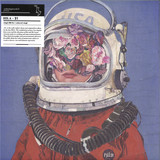
"21" is the well-crafted, sharp and original first album by the duo HILA, composed by American cellist Artyom Manukyan (who already worked with Kamasi Washington, Daedalus, Flying Lotus, Run DMC, Gretchen Parlato, Raphael Saadiq, Clive Lowe Mark...) and french producer Dawatile.
The combination of jazz, Los Angeles beat-scene and the vibrations of 80s and 90s Soviet Armenia make it a striking and unprecedented fusion. These kind of nostalgic and unconventional references forcefully shake the codes of mainstream culture to create a sincere, raw and intimate expression.
"HILA" was born from a spontaneous and intense creative impulse between Artyom Manukyan, a Los Angeles-based Armenian celloist and his partner in crime, David Kiledjian aka Dawatile, a French multi-instrumentist of Armenian descent. This project is proving to be a true master stroke given that it only took 21 days for the duo to make it a reality.
"HILA" was made in less a moon cycle but captivates and electrifies audiences upon its first outings. "H.I.L.A" colors the warmth of the Californian "High" with Armenian vibes. The artists chose this name for their creation since both have a close and valuable connection to these locales. This journey began in 2007, on the day Dawatile went to Yerevan, the capital of this small country in the Caucasus mountain to realize a first fusion project centered around local folkloric music genres.
There he was introduced to local musicians including the Armenian Navy Band, one of the country's foremost groups in which Artyom played the bass and cello. In this context, he also met many musicians such as Tigran Hamasyan and Norayr Kartashyan. This will be the beginning of connections between Lyon, Yerevan and Los Angeles. The following year, the two artists will be be seen performing next to Taylor Mc Ferrin at the Jazz à Vienne festival. More recently, they partnered up again when the cellist, who had freshly relocated in California, invited Dawatile to produce his album. As soon as the studio’s threshold was crossed, they decided to postpone this record and create a joint project: Hay (as the Armenians call themselves) / High In Los Angeles. HILA was born at the end of these 21 days of intense creation. The association of Artyom Manukyan and Dawatile is the combination of two visions, two versions of Armenia, two personalities, the reunion of the Eastern and Western blocs.
One grew up nurtured by the sounds of hip-hop and jazz in Europe and the other by art music and Russian-influenced 1980s Armenian folkloric music before moving to L. A., Ca. The cornerstone of it all, the glue that unites everything : Armenia and music. They generate a new identity synthesizing two perceptions, their complicity transcending these cultural discrepencies. To achieve this, they will scour through images of Artyom’s childhood, within the popular culture of Soviet Armenia. Together, they revisit this decidedly retro vibe, based on the work of Caucasian groups inspired by African American music. This background is rehashed and fused with ancestral Armenian sounds. The DNA of the album "21" is molded by these dear influences.
We can also hear the ancestral sounds of Armenia, a country at the edges of both Europe and Asia. The presence on two tracks of Armenian music Master Norayr Kartashyan, infuses the languor of past melodies and traditions. These purposeful anachronistic sounds offer a fantastic depth to this powerful opus. Listening to the album, one can appreciate the successful fusion of styles and influences. Those combinations, however, manage to preserve individual identities only to enhance the art through an adamant musical dialogue.
Being driven by the urge to transpose Armenian musical traditions into a unique universe, the daring artists, offer an innovative combination by blending, for the first time, these ancestral sounds with the world of Los Angeles beat-scene and jazz. An invention largely fueled by the magic strings of Artyom and maestro Miguel Atwood-Ferguson, a pillar of the genre in Los Angeles combined. These associations resonate with a triumphant equilibrium. HILA is musical uncharted territory in which Artyom's cello strings intertwine to ignite the harmonies of keyboards, the machines, the vocals and electronic layers Dawatile pieced together. HILA plays the soundtrack of an adventure set between Armenia around the end of the Soviet era and a mysterious near future.
Artyom Manukyan grew up in Armenia in the 90s. At the time, he studied Russian classical music while learning jazz with assistance by his father, a music journalist. Being an unconditional music lover, he went on to sharpen his skills at the prestigious Berkelee College of Music. Subsequently, he’s been lucky enough to travel the world touring with numerous acts and mainly with the Armenian Navy Band. The group has fostered alacritous success honored by a BBC Award as a crowning achievement. He moved on 10 years ago and made his way to L.A. with his cello on his back. In the City of Angels, he quickly became a popular figure of the jazz and hip-hop scenes thanks to his first album "Citizen". He’s accompanied prestigious musicians such as Kamasi Washington, Melody Gardot, Daedalus, Flying Lotus, Run DMC, Gretchen Parlato, Raphael Saadiq, Clive Lowe Mark, or Vulfpeck. He released his solo album on the cello, "Alone" in October 2019.
Dawatile is a bold producer and multi-instrumentist as well as a passionate and resolute musician molded by jazz. As a versatile artist, he handles and juggles the saxophone, the keys, the bass and composition. Simultaneously, Dawatile produces cross-over projects and soundtracks for the movie industry. He, as well, has had the opportunity to be a part of many tours, including with his electro hip-hop band, Fowatile and more recently with the "Future Kreyol" trio, Dowdelin. Being the ever workaholic, he has under his belt a string of prestigious collaborations with the likes of Talib Kweli, Foreign Beggars, Roy Ayers, Tigran Hamasyan, Mathieu Boogaerts, Voodoo Game and Piers Faccini. His taste for developing new musical recipes and his know-how in production make him a much sought-after album producer. In concert, the HILA duo offers a sober, precise and rhythmic performance. "21" is an aerial and lively album taking the audience on an at times joyous and sometimes melancholic dreamlike journey. The magic of "HILA" operates at the speed of light and positions it already as an avoidable group.
'Active Imagination' is a result of the bringing together of musicians for a day in the studio, with minimal rehearsal, to collectively experiment and improvise in the moment - in contrast to the more composed and structured recordings of the Paradox Ensemble album 'Awakening' from January 2019. All musicians contributed their distinctive individual voices, creating a united force of spiritual, freeform jazz. Each composition is based on a different mode, all with their own distinctive flavour: "So Long Chef" nod's to Coltrane with its chords jumping by major thirds, before a more static middle section,offering a chance for Walters and Jeff Guntren (tenor sax) to explore the Lydian mode."Ahimsa" is a meditative reflection and group improvisation, based around a simple theme in the mixolydian mode, resulting in a spiritual journey steered by Rebecca Nash's hypnotic piano solo. "Gordian Knot" was conceived as a vehicle for Ed Cawthorne (aka Tenderlonious) to cut loose on soprano sax in the phrygian mode, which he achieves with devastating effect, backed up by Nim Sadot's infectious bass hook and complimented by an equally striking trumpet solo from the band leader. Finally, "Dansoman Last Stop" uses the dorian mode to channel the spirit of a bustling travel interchange in southern Accra, Ghana, conceived further by another exquisite trumpet solo from Walters.
The new album by Robert Piotrowicz does not fit any category. What this multicoloured electronic instrumentation aims to channel is the acoustic experience and energy of the performing musician. As a result of a wide range of creative means used, the narrative language of the compositions bursts withtension and mystery.
The album includes slow hypnotic passages of stone electronics (“To Fleh”), vigorous tempos and circular repetitions (“Euzo Found Gitar”), sprawling artificial soundscapes, back-to-origins ethnicity (ethnical subsoil and elements) liberated from any geographical identity (“Ocarina Wars”), as well as dreamlike minimalism with unpretentious cinematographic traits (“Flares Et Wasser Hole”). Some of these unusual melodic patterns may resemble the corporality of the animal throat rather than any human-created instrument (“Electros Spong”).
Although Euzebio was recorded with synths, the final shape of individual tracks and the album’s overall acoustic image go far beyond any electronic genre. The instruments have not become a goal in itself. They were merely a building block, a tool that helped achieve the album’s extended structure - a diverse whole with rich spatial features.
All sounds performed and recorded by Robert Piotrowicz on Buchla and Serge synthesizers at EMS Elektronmusikstudion in
Stockholm 2013/2014. composed, mixed and premastered by Robert Piotrowicz artwork and photos: Robert Piotrowicz design
and layout: Lasse Marhaug special thanks: Ocarina Jones and Tomasz Gil mastered and cut by Rashad Becker at D&M Berlin
Produced by Musica Genera
"I'm always looking for ways to be surprised," says composer and multi instrumentalist Jeff Parker as he explains the process, and the thinking, behind his new album Suite for Max Brown, released via a new partnership between International Anthem and Nonesuch Records.
"If I sit down at the piano or with my guitar, with staff paper and a pencil, I'm eventually going to fall into writing patterns, into things I already know. So, when I make music, that's what I'm trying to get away from-the things that I know." Despite its musical departures, in presentation Suite for Max Brown is an informal companion piece to The New Breed, Parker's debut release on International Anthem, which was honored as one of the "Best Albums of 2016" by New York Times, Observer, and Los Angeles Times.
"I made The New Breed based off these old sample-based compositions and mixed them with improvising," Parker says. "That's in a nutshell how I make a lot of my music; it's a combination of sampling, editing, retriggering audio, and recording it, moving it around and trying to make it into something cohesive... With Max Brown, it's evolved." Though Parker collaborates with a coterie of musicians under the group name The New Breed, theirs is by no means a conventional "band" relationship.
Parker is very much a solo artist on Suite for Max Brown. His accompanists are often working alone with Parker, reacting to what Parker has provided them, and then Parker uses those individual parts to layer and assemble into his final tracks. The process may be relatively solitary and cerebral, but the results feel like in-the-moment jams-warm-hearted, human, alive. Suite for Max Brown brims with personality, boasting the rhythmic flow of hip hop and the soulful swing of jazz.
Choof Teʞnian & Pneumatix Collab'. Images are taken out from a Photo collection from Livia Saavedra. Groningen Teknival 1998. Party where i was too... and witch was my first party under eoliennes...
And nowadays; those who knows... knows, that eoliennes aeras are just perfect for many reasons.
Thanks to Vstee Thebassacademy for the Visual too.
Limited Edition of 200 Individually, numbered Copies.
Black Truffle is pleased to present Realejo, the first vinyl release from Brazilian sound artist and composer Manuel Pessoa de Lima. Having composed works for diverse contexts including cinema, contemporary dance, theatre and television, Lima’s live appearances often take the form of self-reflexive lecture performances that combine electro-acoustic sound, red light, video and spoken text, moving unpredictably from the hilarious to the distressing.
Realejo consists of two side-long pieces of highly idiosyncratic electro-acoustic collage, beginning with recordings Lima made of himself playing the organ in the Schloss Solitude Chapel in Stuttgart. Exploring the peculiarities of the instrument’s mechanics, Lima made hours of recordings with the organ stops half-way open, moving from haunting gliding tones to oddly tuned fair-ground melodies reminiscent of the record’s namesake realejo, a hand-cranked organ traditionally found in Brazil as the musical accompaniment to the work of fortune-telling parrots.
To these organ sounds, Lima added recordings of a security guard made in São Paulo: ‘Just before coming to Stuttgart, I started making field recordings of a security guard in São Paulo. It's something pretty common in residential areas: they sit in a chair with a whistle, and use that to signal when people arrive, leave or pass by in the street. This particular security guard, Miguel Viana, works on the same street my parents live, and where I had my childhood, and he has worked there since I was a small child. He has watched the street at night, from 8PM to 6AM, every single day, except Sundays, for over 30 years’.
The poignant sounds of the security guard’s whistles punctuate Lima’s electro-acoustic environment, which also includes raw digital synthesis, recordings of his friends’ infant child, audio lifted from Youtube, and, on the LP’s second side, elements taken from an earlier work, ‘36 English to Portuguese Lessons’. Finely chiselled from dozens of hours of source material into a detail-rich, mercurial structure, Realejo is alternately jarring and seductive, introducing listeners to a young composer with a powerfully individual voice.
This debut album, by prodigious keys player, composer and producer Joe Armon-Jones, is buoyant, celebratory and welcoming. With a background in jazz, he draws from influences in dub, hip-hop and soul. Different traditions are infused and commingled together. Soulful brass arrangements are coloured with carefully-tuned atmospherics, individual flashes of brilliance are bound into the album's bigger picture.
He's part of London's young, jazz-influenced music scene. Drawn from that same close-knit circle, the album features the likes of Moses Boyd, Nubya Garcia and Oscar Jerome. It's playing with those - along with Ezra Collective, which he co-founded, and touring with the likes of Ata Kak and Pharoahe Monch - which has honed his playing and grown his ideas.
It's made for a record with an unmistakable depth. He draws on deep musical understanding, making music which is warm and has a feeling of joy. A document of his vision for bringing together his different influences, it's also a testament to hard-earned, head-turning musical virtuosity.
- non-gatefold sleeve without 7"
Rush Hour announces their second artist compilation Patchwork, curated by one of the label’s most loved family members, Sassy J. The Swiss DJ is the very embodiment of passion and long-standing dedication to the craft of the DJing, but also to the community surrounding the music that she lives and breathes. For the past fourteen years Sassy J has run the Patchwork night in her native Bern and in London, with guests ranging from Theo Parrish and Little Dragon to Floating Points and MF Doom invited to share their respective musical visions. Her collaborative approach stands out in a DJ world that is too often weighted in favour of promoting the individual. This compilation grows out that unique sensitivity, foregrounding a theory of curation that centres on long-term bonds, articulated through Sassy J’s personal relationships with the contributing artists.
Patchwork speaks to the grass roots values that Sassy J espouses, showcasing music by many of the artists that have joined her throughout the years in clubs, on the radio, and at home. It is an expression of Sassy J’s individual musical path that casts its gaze firmly in the future: Patchwork is made up almost entirely of new and unreleased songs that are exclusive to this collection. Patchwork captures a sound that has continued to evolve in its restless search for new musical directions. Across thirteen tracks we find forward thinking electronic music rubbing elbows with cosmic jazz and deep percussion workouts from Brazil and beyond.
There are irresistible calls to the dancefloor: 2000 Black’s UK boogie and the syncopated rhythms of WaH-chU-kU nod to the West London sound, whilst the early rave of Nu Era and Aardvarck’s sub-rattling techno channel the grittier edges of the club experience. We find machine music imbued with humanity in Larry Heard’s deep house classic “Survivor” and in Ron Trent’s WARM project, whose gentle breeze points to a different side of the legendary producer. Patchwork also opens a more immersive listening space in which the radical indie soul of Georgia Anne Muldrow, the ambient spiritual jazz of bandleader Carlos Niño & Friends, and the lament for the Amazon rainforest by Azymuth’s drummer Ivan Conti can channel the overall spirit of group interplay and solidarity. Patchwork also includes Sassy J’s collaboration with veteran producer Alex Attias, marking her own place in a universe that is held together by her singular thread.
"This is the compilation of the year!" - DJ Spinna
For it’s second-release, Planisphere returns once more to the Berlin studio of Swiss-Turkish producer Mehmet Aslan, who has fast become one of the most fiercely individual and increasingly prolific emerging artists in some time.
This three-track EP is arguably Aslan’s most-refined work to date, aiming squarely at heads-down dancefloors, riding on sophisticated and hypnotic grooves. On ‘Comme II Faut’, a minimal beat unravels Aslan’s textural, traditional samples, delivering a woozy and intoxicating atmosphere.
Meanwhile, ‘Lobster Is Coincidence’ christens the EP with its title and a stop-start slice of unpredictable, cut-up psychedelia, utilizing obscure samples to generate esoteric funk. On the contrary, Aslan executes a tapestry of tightly-wound and no less entrancing rhythms on ‘Kakusui’, which evolves intriguingly with a subtle half-step and further echoes of Aslan’s unique musical heritage.
Hardcore punk pioneers 'Bad Brains' released their sixth full-length 'God Of Love' in 1995. The original line-up was back together and the album was promoted with a big tour and concerts on the Beastie Boys’ Ill Communication tour.
The album consists of a mix of reggae, hardcore, punk, and hard rock tracks. The band continued to evolve and created such a versatile album that people from different backgrounds felt attracted to it.
'God Of Love' is available as a limited edition of 1000 individually numbered copies on coloured (transparent green & yellow mixed) vinyl and the package includes an insert.
Paul Young’s debut album No Parlez launched him as one of the most talented musicians of the early ’80s. The record reached number one on the UK Albums Chart and remained in the Top 100 for 119 weeks. After he released the third single from the album, a cover of the Marvin Gaye classic “Wherever I Lay My Hat (That’s My Home)”, the song reached the first position in the UK Singles chart.
Afterwards the second single “Love of the Common People” and the follow-up single “Come Back and Stay” charted all over Europe.
The last one proved that he was capable to chart with his own material as well. His great vocal individuality made him one of the most beloved singers of the early ‘80s.
... Unfortunately he couldn’t hold on to this success, but 'No Parlez' will always remind us of the great musician he once was.
Detailed Information about this LP:
'No Parlez' is available as a limited edition of 2000 individually numbered copies on purple marbled (purple & solid red mixed) vinyl.