First released on digital formats back in 2016, and here now given a richly deserved full vinyl release, 'Holy Science', the debut outing from Amirtha Kidambi and her New York based quartet The Elder Ones, is a work of dazzling singularity. Delicately yet unashamedly divulging its complex network of influences at every turn, 'Holy Science' simultaneously disperses of boundary and limitation, emerging as an album steeped in tradition yet located firmly in the futuristic present.
Amirtha Kidambi, the Elder Ones' leader, composer and vocalist, was a child of South Indian heritage, and she grew up immersed in the tradition of devotional singing, joining in with free-form, improvised Bhajans on regular Sundays. She began simultaneously accompanying her voice with the harmonium from the age of three.
These formative experiences continued to instruct and merge with her ongoing musical explorations as she went on to study Classical music, all the while ingesting the Punk, R&B and Rap that surrounded her. A particularly significant discovery was that of free and avant jazz, and in particular the music of Alice and John Coltrane, in whom Kidambi found clear echoes and parallels with those Bhajans and Ragas of her earliest musical awakenings.
All these influences collide on 'Holy Science', at times as explosive blasts of sky-opening thunder, at others as moments of soothing, meditative bliss. These holy bursts are enacted by Kidambi's assembled musicians and are given permission to explore the science of spiritual alchemy, plundering their individual and collective soul for the sake of musical expression, and all of the unpredictable and profound revelations such an approach might yield.
'Holy Science' is a work underpinned by traditions, be they the Bhajan spirituals, or the Jazz and Classical avant gardes, that are in their own manner, archetypal. But perhaps most importantly, all of these forms contain an inbuilt capacity for discovery and progression.
Amirtha Kidambi's musical pathway has been defined by a studied determination to occupy this specific space, the unbounded realm of improvisation and exploration, summoning the acquired instruments of experience, knowledge, culture and tradition to unlock secrets of the past, present and future. The most cherished music is often remarked upon as having a timeless quality – ancient, modern and futuristic, all at once. And so it is with 'Holy Science'.
quête:instruments of science
17 Steps present ‘New Atlantis’, a 5 track EP from versatile DJ, producer and dance music historian Chrissy.
The EP takes its name from an unexpected source – a 17th century utopian novel of the same name by Sir Francis Bacon, depicting a future society in which science has become the ruling principle. It’s an inspiring idea for Chrissy – an antidote to the assault on truth and intellectualism led by climate change deniers, anti-vaxxers, flat earthers, creationists, unfit-for-office demagogues and the slow suffocation of fact-based journalism.
‘New Atlantis’ explores the utopian worldview implicit in early rave music, drawing on classic Chicago house, UK hardcore and Drexciyan electro. The result is a collection of jacking breaks and bass infused dance music washed with a bittersweet euphoria – celebrating and lamenting an era’s forgotten optimism.
The music of Chel White is celebrated in Automaton, a collection of mostly unreleased recordings from 1985 to 1991, by this innovative animator, film maker and visual artist.
Having studied music theory in grade school, White taught himself drumming and played in a new wave band until, in 1981, together with Dan Gediman, they formed the minimal wave duo Process Blue (Alternative Funk, 1985 / Dark Entries, 2018). Here their experimentation went way beyond playing drums.
His interest in industrial music, fostered in the late '70s and early '80s while working in factories as a way to put himself through college, informed his use of electronic instruments, tape manipulation, noise and unconventional percussion.
By 1985, as a now solo artist buoyed by newly affordable audio sampling technology, White tapped into his earlier teenage fascination with the art and films of both the Surrealist and Dada movements - in particular their disparate and fragmented imagery and sound - as a means to create striking new sonic palettes.
Science & Industry - a track largely influenced by Balinese monkey chanting and the consumer excess of American in the 1980's - is a clear example of "music collage". Photocopy Cha Cha, made for the short animation film Choreography for Copy Machine (Berlin International Film Festival, 1992 / Sundance Film Festival, 2001) moved his music into the realm of early multi-media.
Experimenting further, tracks like Liquid Shadows and Pensive provide minimalist moments, before the drone-like Dream #630 and Forest Song point to a future that included music video works (David Lynch/Thom Yorke).
For the second release on the Galaxiid imprint, a label of electronic music archeology and quality, we are transported to the strange sonic world of an elusive 90s pioneer. Solar X's 1997 album X-Rated will be released for the first time on vinyl, as well as reissued digitally, with new artwork by the Japanese artist Keiichi Tanaami. Two worlds connecting sonically, visually and culturally.
Solar X enjoyed a burgeoning career in post-Perestroika Moscow making playful, low-tech electronica from Soviet analogue instruments, which he masterfully configured to forge animated compositions and dancefloor rarities. Fascinated by chaos and complexity, his music explores the ways in which our minds can be manipulated by structure - an endeavour quite plausibly linked to his other career as a lecturer and researcher of AI, information theory and cognitive science, his interest in which was in turn triggered by his young experiments in computer music.
Solar X gained international attention at a time when Russia was (quite unfairly) seen as a vacuum for electronic music, but was exploding in the period of piracy, poverty and freedom following the collapse of the USSR. Young Russians had benefited from the soviet education system and there was a strong DIY computer programming and music scene, fuelled by hackers, gear freaks and party animals. Viewed from today, the album is reborn at a time of further political and social strife, which many see as fuelling the huge creativity and radical thinking of modern Russia's young creatives.
X-Rated treats tempo and form as fluid concepts, administering sudden changes to its sonic landscape with disorienting effect, underlain with a subtle dose of humour and experimentation. Downtempo trip-hop sits alongside frenetic IDM and blistering electro, all bound together by peculiar melodic inflections and lively distortions. Warm, trippy harmonies and robotic synths are offset with angular drums, shifting erratically through moods and genres with cunning intent. Much like his contemporaries from the era, it's his ability to breathe life into a humble production setup that makes his music so compelling some twenty one years later.
The track titles are from a book of call girl cards in London phone booths, that reached the artist in Moscow in 1995. "I liked the titles from these cards, which were self-promoting and offering pleasure (e.g. "Mistress awaits you"). So, I thought since my tracks also offered some kind of pleasure, they might as well advertise this through their titles.'
Label head Nina Kraviz was introduced to the work of the 83 year old sensei Keiichi Tanaami by Ukawa Naoshiro, founder of Dommune in Tokyo, one of the brightest figureheads for the arts in Japan, responsible for the graphic design of the cover. In September 2017 Nina played for the opening of Tanaami-san's first exhibition in Moscow at Gary Tatintsian Gallery. Nina performed a live sound palette, to accompany the looping 7 minute animation, of experimental music from the Soviet Union, Russian pioneers of electronic music like Species Of Fishes and SolarX, Soviet-time pioneer Lev Termen, Kuryochin, avant-guard rock mixed with some Stockhausen and just pure abstract sounds, as well as treasured artists like Biogen.
Tanaami's illustrative work has strong sexual elements, so out of the five art pieces Nina selected and commissioned for Galaxiid, the first fits perfectly for 'X-rated'. The vertical line of text on the left is the traditional form for Japanese covers of foreign releases. The cover, together with the accompanying poster and sticker, are printed in Japan to ensure the highest print quality and purity of the colours.
Kanto Records goes into sci-fi waves! Turkey based producer Mustafa Yüksel aka Stars Like Dust releasing his debut album with us! We are super excited to present 'Voyager 01 which combines the guitar of 80's new wave and electric instruments of synthwave with influences from science fiction and horror movie soundtracks. The album has some unmissable references to space and sci-fi with influences pouring in from Akira and movies such as Blade Runner, as the name Stars Like Dust is a clear nod to legendary Isaac Asimov's famous novel.
PAUL LABRECQUE (SUNBURNED HAND OF THE MAN) and GHAZI BARAKAT (PHAROAH CHROMIUM) present two epic cosmic, dystopian tracks where guitars, synths and traditional instruments blend into an anarchic sound system.
After excessive years in rock bands like THE GOLDEN SHOWERS or his solo project BOY FROM BRAZIL, time had come for the German-Palestinian artist GHAZI BARAKAT to develop a new aesthetic - the birth of his alias PHAROAH CHROMIUM where BARAKAT creates "meta-music for meta-people in a meta-world", or in other words:a mutoid blend of post-krautrock, psychedelism, free jazz, ancient rituals, science fiction and electronics. So far the Berlin based sonic performer released a couple of solo albums on labels like GRAUTAG or TAPEWORM and a triple LP with krautrock legend GÜNTER SCHICKERT. For his latest output he decided to simply use his civilian name BARAKAT, as does PAUL LaBRECQUE (SUNBURNED HAND OF THE MAN) who contributesguitar and synthesizer to the two side-long tracks. "Jajouka Pipe Dream" is a clear reference to the MASTER MUSICIANS OF JAJOUKA, with lots of flutes and percussion, a very rhythmical, ritualistic track, while "Planet R-101" turns out a spacey trip with elements of krautrock and Kosmische Musik / Berliner Schule.
What may sound contradictionary on paper functions perfectly on LP - freeform / free-floating music, absorbing and integrating a wide range of influences and inspirations, sounds and styles - and highly psychedelic!
Credits:
Ghazi Barakat: guembri, moog synthesizer, beats, Rauschpfeife
Paul LaBrecque: guitar, synthesizer
Mastered and cut by Rashad Becker at D&M, Berlin
Artwork + photography: Nicolas Moulin
James Baldwin was an unparalleled master of the written and spoken word. He was best known for his brilliant essays, plays and novels that shone light on his insights into race, sexuality, spirituality and humanity. Baldwin was an incredible orator who commanded the power of words. Whether on the pages of his books or in speeches and debates, he was passionate, compelling and powerful. This EP is the second half of a project that is a tribute to Baldwin. It features extracts from the audio portion of a documentary film shot of a discussion led by James Baldwin and Dick Gregory at the West Indian Student Centre in London in 1968.
Peabody & Sherman is a partnership between Phillip C Hertz and Curtis Ruptash - drummer and bass player respectively. They share common interests in dub, afrobeat, funk, jazz, ambient and improvisational music. They have long histories of the employing 'studio as instrument' approach to recording. The foundations for this EP was P&S rhythm tracks recorded at the Wayback Machine Studio in 2011. Supplemental instruments were layered on to create the final product. The same original sessions were also the source for their James Baldwin EP released in 2012. That EP featured remixes by Area and Afrikan Sciences.
The same concept is applied here, with remixes being contributed by Waajeed and BusCrates. Waajeed is a Detroit producer known for inventive and genre-defying music. He is background includes his work with Slum Village through to the Platinum Pied Pipers and to his work with his own Dirt Tech label today. BusCrates is a Pittsburg based producer known for his inventive use of electric and vintage synths to create deep layers of analog goodness.
Optimo Music is delighted to release the new album from Lia Mice, Australian-born but UK-residing DJ, producer and instrument designer.
Here's a few words from Lia - "When I moved to London in 2015, many things changed at once - I started going to more techno and electro nights, I changed my live-set setup, and I had access to a fully-equipped recording studio through my music masters programme. At the same time I was reading a lot of books on time travel, not just science fiction but also psychology and neuroscience - like how the human brain perceives time from moment to moment, how we can experience overlapping time, and how we interact with our past and future through memory and imagination. 'The Sampler As A Time Machine' is the result of all these new influences coming together. The tracks were developed out of ongoing studio experiments interpreting these different ideas of time travel by using samplers and tape to re-sample and manipulate original music performed by me on various instruments including my voice."
Following a self-titled EP last year, Dario Rojo Guerra aka Natureboy Flako is set to release his second album 'Theme For A Dream' on Five Easy Pieces on 20th July 2018. Exploring the boundaries of music, science and spirituality through a prism of colourfully synthesised-sound, heart-pounding rhythm and cinematic soundtracks; the core essense of 'Theme For A Dream' is the exploration of the human inne space, the balance of musical energies and music's healing capabilities. 'Theme For A Dream' is a more electronic sounding record than his debut. Guerra makes extensive use of old and new analogue equipment such as the Juno 106, Korg's MS-20, ARP Odyssey or Roland's SH-2000 synthesisers, alongside recordings of vocals, guitars and other instruments. This serves to create a dynamic and eclectic sound spectrum, all unique to his musical handwriting. 'Theme For A Dream' will be accompanied by an experimental and interactive website that allows users to preview music while being an immersive, unique multi-sensual 4D xperience of its own. Snippets of the music from 'Theme For A Dream' become audio visual poetry and an immersive exploration of state of the art technology and oneself. 'I don't think technology necessarily means not being natural. Technology can be very much in balance with nature, since it is mostly just trying to imitate or trying to understand something from within nature. Around recording 'Theme For A Dream', Guerra also co-produced/co-wrote and engineered Kutmah's recent debut and Jitwam's forthcoming album, as well as produced almost half of Fatima's follow up album to 'Yellow Memories'. He is currently working on a film project with a London based production company and is already working on a new album, which is expected to bring back his vocal talent, previously released under the moniker Dirg Gerner.
- A1: Heron Dance
- A2: Twilight Song
- A3: Yes—Singing
- A4: Dragonfly Song
- A5: A Homesick Song
- A6: The Willows
- A7: Lullaby—Lahel
- B1: Long Singing
- B2: The Quail Song
- B3: A Teaching Poem
- B4: A River Song
- B5: Sun Dance Poem
- B6: A Music Of The Eighth House
Music and Poetry of the Kesh is the documentation of an invented Pacific Coast peoples from a far distant time, and the soundtrack of famed science fiction author, Ursula K. Le Guin's Always Coming Home In the novel, the story of Stone Telling, a young woman of the Kesh, is woven within a larger anthropological folklore and fantasy. The ways of the Kesh were originally presented in 1985 as a five hundred plus page book accompanied with illustrations of instruments and tools, maps, a glossary of terms, recipes, poems, an alphabet (Le Guin's conlang, so she could write non-English lyrics), and with early editions, a cassette of field recordings' and indigenous song. Le Guin wanted to hear the people she'd imagined, she embarked on an elaborate process with her friend Todd Barton to invoke their spirit and tradition.
For Music and Poetry of the Kesh, the words and lyrics are attributed to Le Guin as composed by Barton, an Oregon-based musician, composer and Buchla synthesist (the two worked together previously on public radio projects). But the cassette notes credit the sounds and voices to the world of the Kesh, making origins ambiguous. For instance, The River Song' description reads, The prominent rhythm instrument is the doubure binga, a set of nine brass bowls struck with cloth-covered wooden mallets, here played by Ready.' According to writer and long-time friend of LeGuin, Moe Bowstern (who pens the liners for the Freedom To Spend edition of Kesh), Barton built and then taught himself to play several instruments of Le Guin's design, among them the seven-foot horn known to the Kesh as the Houmbúta and the Wéosai Medoud Teyahi bone flute.' Barton's crafting of original instruments lends an other-worldly texture to the recordings of the Kesh, not unlike fellow builders Bobby Brown and Lonnie Holley. Bowstern notes, Other musician / makers have crafted their own Kesh instruments after encountering the earlier cassette recordings that accompanied some editions of the book.' Both Barton and Le Guin are sensitive to the sovereignty of indigenous Californians and were careful not to trample the traditions of the Tolowa people who lived in the valley long before the Kesh. You research deeply, and then you bring your own voice to the table,' said Barton. Within the Kesh culture, the numbers four and five shape the lives, society and rituals. Barton composed loosely around these numbers, patiently listening to the land of Napa Valley for signs and audio signals from the natural elements. Todd incorporated ambient sounds of the creek by Le Guin's house and a campfire they built together. The songs of Kesh are joyful, soothing and meditative, while the instrumental works drift far past the imaginary lands. Heron Dance' is an uplifting first track, featuring a Wéosai Medoud Teyahi (made from a deer or lamb thigh bone with a cattail reed) and the great Houmbúta (used for theatre and ceremony). A Music of the Eighth House' sends gossamer waves of the faintest sounds to float on the wind.' Like the languages invented in the vocal work of Anna Homler, Meredith Monk, and Elizabeth Fraser, the Kesh songs and poems play with the shape of voice.
The Music and Poetry of the Kesh cassette was meant to accompany and enhance the experience of reading Always Coming Home. Presented in this edition as a long-playing album, where only traces of the book linger (the jacket offers some of Le Guin's illustration, and a letterpressed bookmark featuring the the narrative modes of western civilization and the Kesh valley is included), the music alone breaking the silence of what might be. It can transport—offering a landscape for imagining a future homecoming. One in which we are balanced, peaceful, and tend to the earth and its creatures. A line from the Sun Dance poem reminds us, We are nothing much without one another.' Freedom To Spend gives new life to the recordings of the Kesh people in the first ever vinyl edition of Music and Poetry of the Kesh, out on LP, and digital formats on March 23, 2018. The LP will include a deluxe spot printed jacket with illustrations from Always Coming Home, a facsimile of the original lyric sheet, liner notes by Moe Bowstern, multi-format digital download code and a limited edition bookmark letter pressed by Stumptown Printers in Portland, OR.
This past Monday, January 22, Ursula passed from this realm to another leaving a life spent building and exploring other worlds while challenging social concepts of the real word she inhabited.
Freedom To Spend had been working under Ursula's enthusiastic endorsement and with Todd Barton, her musical collaborator on Kesh, to give the music that accompanied her 1985 epoch a new life. With the Le Guin family's encouragement to move forward with our planned release, we are humbled to play this small role in sharing Ursula's work.
As Pete Swanson, one third of Freedom To Spend, stated, Ursula's legacy is her work which transformed the world, and this is another piece of the universe that her imagination birthed becoming real.' Listen to A Teaching Poem / Heron Dance' below.
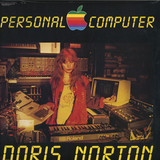
Mannequin Records presents a trilogy of reissues from the avantgarde Italian-born producer Doris Norton, "Nortoncomputerforpeace" (1983), "Personal Computer" (1984, originally released by Durium Records), "Artificial Intellingence" (1985).Apple's first music "endorsement" and Roland affiliate, Doris Norton is one of the most important women pioneer in the use of synths and in the early electro / computer music. Norton is the wife of Antonio Bartoccetti, progressive rock guitarist, and mother of the musician and techno producer Rexanthony. As a teenager, she was drawn to medieval, Renaissance and Baroque music, not to mention quantum physics, differential equations, organic chemistry, the experimentalism of John Cage and animated movie soundtracks. Her love for modules and circuits found expression through the waves of an old harmonium, the frequencies of a Minimoog, a Roland System 100M, a Roland System 700 and the ARP 2500/2600.
In 1980, Norton began her solo career by recording at Fontana Studio 7, the Milan studio of the composer and musician Tito Fontana, resulting in the electronic opera "Under Ground". Norton became more prolific, continuing her adventures in experimental electronics and computer music with Parapsycho (1981), Raptus (1981), Nortoncomputerforpeace (1983), PC (1984) - whose album cover prominently features Apple's colored logo - and Artificial Intelligence (1985).
While the beat-oriented style of Norton's music aligns her with such global fellow-travelers as Yellow Magic Orchestra and Kraftwerk, her championing of the personal computer as a tool for self-sufficient musical creativity also connects her to more artsy musicians such as Pietro Grossi, Laurie Spiegel, and the League of Automatic Music Composers. Norton's predilection for the bright, glossy timbres of early digital instruments also recalls Hubert Bognermayr and Harald Zuschrader's bizarre 1982 one-off Erdenklang.
Later, her talent and expertise attracted the attention of IBM, who in 1986 named her as an official consultant. Already the reigning queen of the Italian electronic scene, she recorded two CDs for IBM: Automatic Feeling and The Double Side Of The Science. Influenced by her son, the musician and producer Rexanthony, Norton brought her fascination with the early days of techno into the 1990s, when she released three volumes of Techno Shock on Italian trance/hardcore label Sound Of The Bomb.
While her music remains largely out of print and inaccessible, Norton's early records have recently begun to receive the inevitable rediscovery treatment.
"In the late sixties I had already conceived computers as personal.' I have always trusted in the benefits of solitude, (being) alone means freedom... What's better than a personal' computer for materializing ideas, by oneself" (Doris Norton)
There are some records that manage to sound both of a time and utterly timeless and Bon Voyage Organisation's Jungle Quelle Jungle (a nod to Supertramp's Crisis What Crisis) is one of those albums. Its silken-smooth production, irresistible grooves, funk-tinged guitars, lush soundscapes and general glowing presence could easily lead one to believe that have dug up a lost disco gem from the 1970s. However, behind the disco-pop gleam lies eerie dystopian sci-fi ruminations of a futuristic bent and tones that can often feel as French as they do Asian or African.
This sort of cross-continental exploration is an expansion on BVO's previous two EPs, the man behind the Organisation, Adrien Durand, says. 'I tried to continue the musical expedition between dystopian Science-Fiction Haunted Africa - plus Haitian Vaudou on 'Soleil Dieu' - and futuristic Asia. Addressing, in a double entendre manner, some of the political issues that I am sensitive to.' In fact the jungle in question in the album's title is a metaphorical one and one that creates a vast series of environments for Durand to explore such subjects as world trade, utopian ideals and themes of idols, as well as of time and communication. However, one will need to speak French to decipher such explorations, as well as shake off the natural impulse to move with every glorious beat on its 13 tracks, of which are moved along by Maud Nadal and Agathe Bonitzer's golden vocals.
Durand is a full-time producer based in Paris, working with the likes of Amadou & Mariam, so it makes sense that this record would absolutely sparkle in this department. Durand feeds off the variety of musicians coming and going during recording sessions as well as the rotating members and numbers of people involved with the band but fundamentally he writes all songs on piano first before bringing them to record live. 'We recorded a rhythm section of five - drums, percussion, guitar and myself on bass/synth bass and keyboards - at La Frette which is a studio located in a mansion outside of Paris and fitted with a beautiful 1973 NEVE desk. We only used analogue gear, by taste really, and found it a pretty reliable way of doing things. This simply consists of putting good players together in a room and waiting for the right take to happen.' Two four-day sessions and a 'cooling off' period (to let the recordings settle) soon followed before Durand picked the material back up to give it a final polish.
The resulting album is one loaded with intricacies and idiosyncrasies, something that Durand puts down to his own unique approach. 'I don't consider myself much of a songwriter but I love arranging rhythm sections and I'm pretty proud of the ones on this record.' This applies when it comes to working with such musicians as Inor Sotolongo Zapata, who with Durand used traditional Cuban percussive instruments and explored Haitian rhythms. When Durand expands on some of the ideas and influences that were funnelled into the record, you begin to get a sense of the vastness of the sounds that fill his world, from Trevor Horn's production work on ABC's Lexicon of Love, to the literary work of JG Ballard to the visual flair of the original Blade Runner and even the Tuareg sounds of Tinariwen, due to the fact that his studio neighbours their manager's and he would hear their rhythms bleeding through the walls. You therefore end up with an album that offers tracks such as 'GOMA' that fuses Chinese and African rhythms as well as 'SI D'Adventure' a piece of pop music that is dazzlingly hook-laden.
As a result of this cooking pot of sounds, influences, thoughts and creations, Durand has more of a gumbo approach to making this music than a set-out scientific formula. 'There is no definite recipe for me to like the production of a record,' he says. 'Of course it really sticks out that my work is really influenced by the 1978-1983 period, the golden age and last stand of analogue studios and session musicians.' Whilst Durand adores the traditional and conventional music, he really views this as something bigger and wider. 'I have a taste for the otherworldly vibe from records coming from less sought-after musical scenes, particularly Poland, Haiti, Ethiopia, Somalia, Congo and early Cantonese pop. Languages and the rapport of the people involved in the making of those records really inspires me. I particularly hate the use of the word 'World Music' as a potpourri for everything that doesn't sound quite western enough.'
We started with the principle - the cosmic idea that we were taught by our father from a very young age - that the stars and planets make a sound, that deep in outer space there is audible harmony.'With its cathedral-like, richly resonant acoustics, the new HBE album is a brilliant expression of this interplanetary principle. The album is by turns urgent and contemplative, funky and reflective, varied in its textures, but entirely of one piece. Underpinned by concepts of our earth's place in the cosmos, held in place by meditation, swirling with notions of history, science, theology, ancestry, there is a rich conceptual brew here. But always, what talks loudest is the music. The album rings with what back in the 1950s the jazz critic Whitney Balliet called the sound of surprise'. At a time when the phrase Spiritual Jazz threatens in some quarters to become a tired cliche, this is a record that makes you believe again in the genre's validity.
Talking to Cid, one of the Ensemble's two trombonists, one phrase recurs: back to the beginning'. We wanted to go back to the beginning, when we were kids, real young, and our father would wake us up at 5 AM to practice for two hours before breakfast.' One outcome - initially unplanned but subsequently embraced - is that unlike their two previous albums on Honest Jon's, this is an album without a drummer. When we started, as Wolf Pack, just brothers on the street with our horns, there wasn't a kit in sight.' Book Of Sound retains plenty of rhythmic heft, but the absence of a drummer opens up space for a notably varied instrumental palette. Acoustic guitar, piccolo, synthesiser, alto sax - none of them typical HBE Instruments - all have their place on the album. Most striking perhaps are the vocal lines that thread through the album and give it a palpable warmth. In Wolf Pack, we rapped and played, this time we took it a step further.'
Sessions were recorded in Brooklyn and Chicago, and brilliantly mixed at Abel Garibaldi's studio in the Loop ( Abel was like a musician on this record'), and it's the Hypnotic's hometown that permeates. For Cid this is a deeply Chicago record: it's got the vibe of the lake, the vibe of the prairies opening up to the west'. It also has the vibe of those Sun Ra Arkestra albums recorded in Chicago in the 1950s, and - of course - the Phil Cohran albums from the 1960s.
It's Phil Cohran (the father of all seven members of the Ensemble and their first teacher, and not just in music) who is the album's guiding spirit. For Cid it's a major regret that, in the months before their father's death early in 2017, Phil was not well enough to play on the album. He loved the whole idea, and we had the perfect place for his zither'. But Book Of Sound is a magnificent testament to their Cohran legacy. You know, it's tough trying to satisfy everybody with our music. It's hard enough satisfying ourselves, let alone the jazz scene, the hip hop guys, what have you. With this album we just dropped all that as a consideration, and tuned into deeper principles.'
lvin Toffler was overwhelmed. When in the morning of October 4th, 1988-it was his 60th birthday-he was starring with a still somewhat absent look into a bowl of cornflakes, he thought that in the surface structure of the yellowish shimmering milk which was making an emulsion with the maple syrup and slowly but irreversibly corroding the crunchy crystals on the flakes, he could see through a window into a timeless dimension. Toffler, who at that time had reached the peak of his fames as a future scientist, was sustainably disturbed from his peek into this extra temporary peephole. In none of his books-'Future Shock' had just been released with yet another edition featuring a proud printed note on the book cover stating 'more than 5 million copies in print'-did he ever mention this occurrence. Even after his death in June 2016, no note on this incident could ever be found in his estate. The 'flake dimension' as Toffler called it in notes which were later shredded remains a secret of opaque, hard-to-grasp radiant power.
Maybe it's too simple to describe 'Pneumatics' as a creation coming from this cornflake world Without doubt. Are there any more precise terms or instruments to determine the multifacetedness and beyond-timeliness of the 'Pneumatics' soundscape There are still unknown. 'Pneumatics' is, after releases at Innervisions, Die Orakel und his own label Sound Mirror, the debut album of Orson Wells (as long as you don't count in 'Jupiter' - Wells's first LP which was released in 2014 with 48 copies on cassette-have fun digging for rarities and bargains!).
Perhaps Wells, known in Frankfurt under his real name Lennard Poschmann and as an employee at the record store Tactile, is only a messenger. Or a psychic. The sound manifesto that he apparently transmits from Toffler's secret dimension tells of a city of upside down pyramids ('Tianon'), of passes into the land of the five elements ('Multipass') and dead straight four-to-the-floor lines which appear bended within the spherical dimension (''Geodesic'). These beats are right on the heels of the ones of Intersteller Fugitives; the strings sound like that at any moment a vocal sample edited by Moodyman could warp over through the Cornflake wormhole. Pneumatics is the science of all technological applications powered by condensed and often by quite heated air. It is a matter of mechanics, compression, jackhammer, ramblings, high pressure levels, valves for blowing of steam. On 'Pneumatics' it's all about this. And more. Orson Wells's album gets to the point of the post-retro futuristic state of the dancefloors of the house and techno clubs of this planet. It is like a peek into another dimension, right on the golden cut of spacetime geometry.
Dark Entries is proud to release the sophomore EP from BEZIER entitled Telomeres. Bézier is the moniker of local SF musician ROBERT YANG, who also is part of the illustrious HONEY SOUNDSYSTEM crew. Telomeres is the follow up to Bézier's debut EP Ensconced, released in 2013. The title relates to themes of time, science, analytics and procedures. Bézier integrates the refrains of Spanish new wave and Italo disco with the attitude and aggression of underground styles like synth-punk and industrial. These six tracks were written, produced and mixed by Bézier at his home studio in San Francisco between 2014 and 2015, and feature the debut of his own vocals. All songs have been mixed by Mark Pistel (of Meat Beat Manifesto fame) at Room 5, San Francisco and EQed for vinyl by George Horn at Fantasy Studios. The vinyl comes housed in a jacket featuring an illustration by in-house designer Eloise Leigh riffing on early 80s computer graphics. The matted sleeve is meant to resemble the side panels of early computing instruments like Macintoshes or the Commodore 64. Each LP includes a postcard with a photograph of actual telomeres captured by a microscope camera by the Blackburn Lab at UCSF. Telomeres' are life's building blocks, changing the lengths of chromosomes to determine lifespan. This music is an investigation of a future in which time elongates as well as contracts.