On his second release for ECM New York-based saxophonist Oded Tzur
introduces a heightened sense of urgency and a conceptually augmented
approach to his distinctive voice, weaving one underlying musical idea
through a series of elaborate and impassioned designs
The quartet's lineup is unchanged from 2020's Here Be Dragons and the group's
interplay has grown even more expressive in the meantime. Throughout Isabela
the saxophonist and his collaborators - pianist Nitai Hershkovits, Petros
Klampanis on bass and rhythm conjurer Johnathan Blake - apply their subtle
dialect in a more intense space, exploring the nuances and colors of Oded's selffashioned raga in a suite- like sequence of quiet meditations and powerful
exclamations.
The remarkable session was captured in Lugano's Auditorio Stelio Molo in
September 2021 and produced by Manfred Eicher.
Oded Tzur: tenor saxophone
Nitai Hershkovits: piano
Petros Klampanis: double bass
Johnathan Blake: drums
Поиск:intense
Все
2015 DEBUT ALBUM FROM O R K AVAILABLE FOR THE FIRST TIME ON
VINYL
"An electric storm that takes no prisoners but could seduce an army"
Prog"Impressive debut" Drummer
"Expertly done" Rock a Rolla
A band comprising some of contemporary music's most revered creators, O.R.K.
released their debut album 'Inflamed Rides' in 2015. The band are: accomplished
singer & composer LEF (lead vocals), Pat Mastelotto (drums, King Crimson), Colin
Edwin (bass, ex-Porcupine Tree) & Carmelo Pipitone (guitars, Marta Sui Tubi).
'Inflamed Rides' is an intriguing collaborative debut release which defies easy
categorisation. A primordial & energetic fusion of playful acoustic psychedelia,
precise math rock & intense ambient electronica, the album delivers a
soundscape rich with controlled chaos, much praised on release.
This new Kscope edition has been remastered in 2022 by Francesco Guadalupi.
Available for the first time ever on vinyl, pressed on a stunning blue edition.
In 1998 The Wave Pictures started carving out their own path in search of the lost essence of British Indie, since their acclaimed “Instant Coffee Baby” -nominated for The Guardian New Album Award and present in many lists of the best albums of the last 15 years– , until the most recent “When The Purple Emperor Spreads His Wings”, always giving their best in countless electrifying performances. Now The Wave Pictures are once again allied with Acuarela to release an exclusive double 7” with five songs (one, “French Cricket” included on their new album and the other four totally exclusive) and show that they are still an indie rock band without indie rock influences, a trio with its own style that doesn't want to be a blues group, but with blues –and soul, and country, and folk-, as the invisible core of everything they do. The Wave Pictures began their career in 1998. Since then the British trio hasn't stopped: at the frenetic pace of their concert schedule, they add a stakhanovist record production, which advances at the rate of almost one album per year. Example: “Great Big Flamingo Burning Moon”, which came out in February 2015, was already their thirteenth official LP (without forgetting that they have also released a large number of singles, EPs, rarities and unofficial material). But it is that in February 2016 the fourteenth album, “A Season In Hull” was released -which they recorded with a single microphone and only released on vinyl-, and in November of that same year its successor, “Bamboo Diner In The Rain” came out. In June 2018 they returned to the fray with another LP, “Brushes With Happiness”, and that November also dropped “Look Inside Your Heart”. The pandemic has made them slow down a little bit until May 2022 when they finally returned with "When The Purple Emperor Spreads His Wings". “When The Purple Emperor Spreads His Wings” is a double album dedicated to the cycle of life and in which each of its four sides (in the old fashioned way) is focused on one of the seasons of the year. The title refers to spring and its splendor. The result is pop in the style of The Wave Pictures, with all the essence of the band: those intense guitar solos by Dave, his acoustic plucking, the solid writing… in addition to the mandolin, the bluesy harmonica...you name it! All the band members, David Tattersall (vocals, guitar), Franic Rozycki (bass) and Jonny “Huddersfield” Helm (drums), are avid fans of rock'n'roll, classic country, 70s rock, soul and folk, and this album celebrates with joy all those musical loves of them, some rediscovered in recent times. Moreover, they have pointed out that Guided By Voices have also been a great source of inspiration on this recording, as well as re-listening to Sun Records’ rockabilly, African guitar records, the more country side of Neil Young, the crazy fun of The Who and some moments from The Yardbirds. The Wave Pictures are still playing what Modern Lovers did back in the day -and then Herman Dune or Hefner-, only they play it as if Rory Gallagher was their lead guitar. With the lo-fi pop-rock label as an amicable stigma, they never deny the maxim that places attitude before technique and they are always vaccinated against fashion. Years go by and they are still the same sly alley-cats, only sounding more and more classic. Tracklist: 1. French Cricket/ 2. From A Buick 6/ 3. Porcupines/ 4. Rufus Thomas/ 5. Cincinatti Flow Rag
Three-time Grammy nominees, the San Antonio, Texas-based quartet NOTHING MORE return with their highly awaited seventh album, 'SPIRITS'. It features thirteen focused, adventurous and intense songs, uniting introspective philosophical lyrics with unapologetically massive anthems, including the in-your-face 'TURN IT UP LIKE (Stand In The Fire)', their most recent Top 10 Billboard Active Rock radio single 'TIRED OF WINNING'. Since emerging in 2003, NOTHING MORE has made rock radio chart history with no. 1 singles for both 'This is the Time (Ballast)' and 'Go To War', while they also have seven Active Rock Radio Top 10 singles in their repertoire. 'SPIRITS' further proves their expertise in the rock genre and beyond. It documents the tumultuous time the world experienced over the past two years capturing the desperation and isolation of lockdown, the spiral of substance abuse, the pain of broken relationships and survival in self-reliance while summarizing the overall story and mission of NOTHING MORE: Reflect, Provoke, Inspire.
Repress incoming...
Number 94 in the Brazil45 series is one for the Brazilian boogie lovers out there.
The vocal and instrumental group Os Carbonos from São Paulo had a long career that straddled the 60s, 70s and 80s. 'Pássaro Selvagem' is taken from the latter years of their career. Its a bass driven, boogie-funk groove (with a bassline not too dissimilar to Queen 'Another One Bites The Dust') that is Brazilian boogie at its finest. Taken from the B-side to a 7" campacto released in 1981 on Copacabana records, its proven to be a favourite of Luke Una and we foresee it becoming a staple in your DJ box for years to come too.
The B-side comes from one of our all-time favourite artists, the mighty Sandra Sa. Sandra is a wonderful vocalist, her intense and recognisable style is one of THE voices of the Brazilian boogie golden era. Check out her classic album 'Vale Tudo' (MRBLP230) on Mr Bongo for further proof of her credentials here. 'Palco Azul' is also taken off a 7" single from 1981 and is a feel-good dancefloor groover with punchy brass stabs, warm keys and uplifting chord changes. It contains all the right elements that we have come to associate with that knockout late 70s / early 80s Brazilian sound.
Multi-dimensional future-jazz outfit JK GROUP release a new EP, Rising on La Sape Records. The brainchild of award-winning saxophonist, Joshua Kelly (30/70 collective, PBS Young Elder of Jazz 2019), the band returns to the label with a follow up EP to the mind-bending 2021 release, What's Real?
Where What's Real? served as a platform for wild experimentation, Rising returns to a more considered and familiar format for the band, offering up 4 cohesive tracks that are deep in conception and expression, at once original and fresh. Conceived after recording an as yet unreleased body of work written whilst undergoing chemotherapy, Rising celebrates bandleader Josh's survival and eventual recovery from the intense treatment he received for lymphoma in 2020.
The band stays true to their honed format of jazz traditions melding with influences from electronica and beyond. Like the first release, The Young Ones, Rising sits comfortably in the crossover of raw, live jazz and electronic dance music, whilst also throwing an unexpected curveball to the listener expanding the palate of the bands sound to a pigment never before heard in their music. The EP takes you on an emotional journey throughout the four tracks, best listened to start-to-finish.
Limited Clear Vinyl edition, 300 copies! Roland Kirk was one of the most creative, extravagant figures in jazz history. A master multi instrumentalist
with no boundaries in terms of language, style and technique. Here we find him co-leading a strong studio session with organ specialist Brother
Jack Mcduff. Backed up by Joe Benjamin on bass and Art Taylor on drums, Kirk and McDuff give voice to a soulful post-bop set full of groovy riffs
and highly inventive instrumental ping pong. Recorded by Rudy Van Gelder and released in 1961 by Prestige Records, this is a fine early step in
Kirk’s varied and intense career.
New pressing of the old RSD LP , now on black vinyl. An essential vinyl release of the Throwing Muses’ mainstay’s 2016’s CD and essay book that featured stories from “her life's most perception-altering junctures” (NPR). “As memoirs, her albums are so intensely personal... as art, they’re arguments for the value of unapologetic individuality” Pitchfork. “This music reminds you how alone you are; it consoles you through its insolubility, comforts you by jabbing you in the chest and letting you know how complex the struggle is, how inaccessible we are to each other but just how universal our pain can be.” The Wire. This sonically rich and fragmented record references to Hersh’s past material and sees her perform on guitar, bass, drums, piano, horns and cello. There’s a mysticism and sense of life wonderment throughout ‘Wyatt At The Coyote Palace’ that also has death as a central theme rather than the contemplation of death itself it’s reaching the end of something and beginning a new life. Tracklist: Side A. 1 Bright 2 Bubble Net 3 In Stitches 4 Secret Codes 5 Green Screen 6 Hemmingway's Tell. Side B. 7 Detox 8 Wonderland 9 Day 3 10 Diving Bell 11 Killing Two Birds 12 Guadalupe. Side C. 13 American Copper 14 August 15 Some Dumb Runaway 16 From the Plane 17 Sun Blown 18 Elysian Fields. Side D. 19 Soma Gone Slapstick 20 Cooties 21 Christmas Underground 22 Between Piety and Desire 23 Shaky Blue Can 24 Shotgun
Vinyl LP[39,45 €]
A "cheval de frise" is a military defensive structure and the name Thomas
Bonvalet and Vincent Beysselance chose for their post rock duo, creating
anxious, agitated music with perpetually changing, almost baroque,
patterns
Urgent, emotional and paradoxically structured and thought out in the finest
detail, it drew much of its influences from the many forms of 90s American posthardcore, while being undeniably singular. The formation was instrumental and
the bass was abandoned for an amplified classical guitar. The band released their
first eponymous album in 2000 on Sonore, a label based in Bordeaux. It was well
received, allowing Cheval de Frise to tour all over Europe. Their second album,
'Fresques sur les parois secrètes du crâne', was recorded in 2002. The band split
in 2004 leaving their mini album 'La Lame du Mat' to be released posthumously.
Remastered by Carl Saff, 'Cheval de Frise' is reissued on New York label
Computer Students and is available for the first time ever in cassette and double
LP. The vinyl version is presented in a beautiful gatefold sleeve with an impressive
poster. The whole thing is packaged in a sealed foil pouch, a trademark of the
label.
"Intense, energetic, and audacious, this music is thrilling, unforgettable." - Pop
Matters
"An impressive debut that lingers in between pleasantry and pandemonium, o?
ering forty minutes of odd, deserving attraction." - Tiny Mix Tapes
"Highly in?uenced by many early jazz artists, this is an album that - in many ways -
de?es description." - Babysue
"This band is incredibly unique, and their music knows very few boundaries. What
these two people do with their instruments is rather amazing." - Ink 19
'While We Wait for a Brand New Day' is the third part of the Oddgeir Berg
Trio's trilogy around the dark hours of the day
The album was recorded under immense pressure. With only three days left
before Norway went into a lockdown, the trio headed to the studio and finished
the album in an intense session. Remarkably, the tone of these nine new originals
is hopeful and upbeat. If previous Oddgeir Berg Trio albums made you think of
ECM, the new one carves out a more personal sound.
Berg remembers the process as one of careful touches: "To me, it feels like an
evolving landscape. I have quite a few synths and effect pedals in my locker, but I
try not to overdo things." In conceptual terms, this is where the circle closes - now,
you can put on 'Before Dawn' and simply continue listening.
Three-time Grammy nominees, the San Antonio, Texas-based quartet NOTHING MORE return with their highly awaited seventh album, 'SPIRITS'. It features thirteen focused, adventurous and intense songs, uniting introspective philosophical lyrics with unapologetically massive anthems, including the in-your-face 'TURN IT UP LIKE (Stand In The Fire)', their most recent Top 10 Billboard Active Rock radio single 'TIRED OF WINNING'. Since emerging in 2003, NOTHING MORE has made rock radio chart history with no. 1 singles for both 'This is the Time (Ballast)' and 'Go To War', while they also have seven Active Rock Radio Top 10 singles in their repertoire. 'SPIRITS' further proves their expertise in the rock genre and beyond. It documents the tumultuous time the world experienced over the past two years capturing the desperation and isolation of lockdown, the spiral of substance abuse, the pain of broken relationships and survival in self-reliance while summarizing the overall story and mission of NOTHING MORE: Reflect, Provoke, Inspire.
Luuk van Dijk has unveiled his hotly-anticipated debut album First Contact, out 11th November on his own Dark Side Of The Sun label. The Dutch DJ and producer’s maiden LP is the end result of a long and intense voyage of discovery.
Years in the making, it’s a project that Luuk can fully stand behind and be proud of. Next to a search for his own identity and his own place in music, it has also become a passage
through time.
By far his largest body of work to date, the 13-track release kicks off with the suitably-titled ‘Cosmiq’, a deep, grooving sonic exploration that immediately sets the tone. “Because of this
track I wanted to make an album to showcase my other kind of music that people won’t maybe expect of me,” Luuk explains.
Next up is the shimmering, ethereal sounds of ‘Love You’, a track that features the irresistible vocals of US singer-songwriter Dawn Richard and will be released as a single in October. “She really brought this track to a whole new level,” says Luuk. “I couldn’t be more happy with the result.”
Further collaborations come in the form of ‘Wolf’, a majestic, strings-led house cut featuring Steve Burton of oneofmanysteves; ‘Master Plug’, a deep, jackin’ number with Chicago artist
Kid Enigma; and the Detroit-indebted ‘Together We Rise’, punctuated by the spiritual vocals of MC Roga. “I tried making a track the way they used to make music,” Luuk says of the latter.
“With as few machines as possible, just a mixer, sampler and some synths.” Additional highlights include the enchanting ‘Let The Bass Kick’, orchestral ‘Lightning
Striking’ and hypnotic ‘Hot Stuff’, before ‘Knowing How To Love’ closes things out on a peculiarly wistful note. “The last track of the album, also a track that started as an interlude and
ended up being a full song,” says Luuk.
“This song basically sums up how I’ve been feeling the years 2020 and 2021, very emotional, sad, but also hopeful. Everything will be alright.”
One of the hottest new names coming out of Amsterdam’s bustling club scene, Luuk van Dijk is currently making waves in international waters with his infectious take on spirited house
music.
He has already released on labels like Hot Creations, Cuttin’ Headz, Solid Grooves Records and Eastenderz have established his name as a house music prodigy.
He launched Dark Side Of The Sun in 2020 with the aim of exploring a broader approach to his signature style.
First Contact represents a vivid sonic snapshot of one of electronic music’s brightest young talents.
Early DJ Support :
Jamie Jones
Marco Faraone
Carl Craig
Yuksek
Sasch BBC
CamelPhat
Paco Osuna
Stacey Pullen
Tocadisco
With I was born by the sea, Richie Culver brings to a close a period of intense introspection and emotional reckoning with a debut album that serves as both an optimistic statement of intent and a final glance back at the painful places it explores. Following recent work with Blackhaine and Pavel Milyakov, I was born by the sea picks up where Culver’s EP for Italian label Superpang, Post Traumatic Fantasy, leaves off, painting an unabashed portrait of contemporary malaise, detailing a life lived behind closed doors, pinned under the crushing weight of austerity, sapped of the strength to do anything other than gaze out to sea and all the grey possibilities it represents. Where Post Traumatic Fantasy saw Culver returning to his hometown of Hull after a period spent entangled in London’s relentless sprawl, his first full length project reaches further back to his formative years working in a caravan factory and going to raves in and among Hull’s outskirts. Unspooling like a fever dream, I was born by the sea is the anxious clutter of a racing mind spoken clearly, a stark reflection on how it feels to have too many ideas and too much time to act on them.
Though unquestionably a snapshot of a time of significant difficulty, Culver reflects on this period with tender empathy and pitch-black humour, stitching together unflinching observations from England’s neglected corners, ‘there’s more mobility scooter repair shops and bookies than there are bookshops,’ and devastating vignettes of everyday struggle, ‘tears on the tin foil’, with surreal depictions of industrial grit, ‘skimming stones in a small pond by the slaughterhouse’. His DIY approach to production stretches the rough sinew that connects these fragments of memory, a process he describes as using a paired back collection of synths and drum machines to the best of his ability, ‘but to the least of their capabilities,’ wringing out visceral sound with self-taught urgency. During the album’s most impressionistic passages it’s as though Culver has transposed past internal turmoil into powerfully resonant noise, the Sisyphean sonics of ‘Create A Lifestyle Around Your Problems’, which evokes in its concrète clatter and MRI machine barrage the sound of making the same mistake again and again, or the stuttered jumble of ‘Its Hard To Get To Know You,’ its garbled vocal modulation and frayed edges of distortion channeling the paranoia of somebody listening to muffled voices through thin plaster, climbing the walls of their bedroom with the curtains closed, a nervous breakdown in stereo.
In counterpoint to this glides the ever-present spirit of the dance floor, which haunts the record from the moment it is invoked in its first few seconds. Opening onto a sea wall of bright synthesis, the stuttering vocals and bass tone chops of ‘Nervous Energy’ dump us directly into post rave ecstasy, the echoing cry of a voice amplified by loudspeaker carrying the loose energy and surge of crowds moving in darkness. The incessant, dead phone line beep of ‘Pigeon Flesh’ builds to a pulse that suddenly swells into an anxious technoid surge, shapeshifting at lysergic speed into head shrinking audio hallucinations, a descent into the void of the present via machine music hypnosis. Even ‘Its Hard To Get To Know You’ summons the ego death drive of hardcore techno within its scorched textures, flickering indiscernibly between attritional noise and frazzled hardware stomp. Paying homage to both the parties of his youth and a countless succession of Sundays spent offering himself up within Berghain’s hallowed architecture, Culver’s experiments in addressing his formative relationship with rave provide an energetic glimpse at where he might take his sound next.
Between spikes of propulsive energy and grim mood pieces Culver returns to suspended passages of aching, glacial drift, the cold swell of the North Sea, accompanied by some of his heaviest testimonials. The gauzy ebb of ‘Daytime TV,’ its tumbling loops reminiscent of boats bobbing off a distant shore, sees the artist at his most checked out, slumped in front of his television, seven days a week. ‘I used to dream of doing something,’ he admits, ‘anything to get out of this town.’ ‘Love Like An Abscess’ pairs swirling currents of ambient shimmer with violent images of baseball bats lying next to beds and blood-stained mattresses, next to which Culver pleads in a desperate mumble, ‘let our love grow, like a broken abscess.’ Yet it’s with the album’s final word and title track that Culver reveals a glimmer of cautious optimism, a parting gesture of exposition and closure. ‘I knew I had to get away,’ he asserts, ‘so I did and I never looked back.’ What follows builds from a low throb, the flutter of a tiny heartbeat, to a resonant glow, embellished with unfurling synthetic burbles, oil rigs sparkling in the distance, golden light spilling across the sea. In reckoning with the place he had to escape, Richie Culver is now free to look towards the promise of something new, something hopeful.
- 1: A Recipe To Cure Historical Amnesia
- 2: To Remember (Feat. Kushal Gaya)
- 3: Utopia Is A Colonial Project
- 4: Back In The Day, Things Were Not Always Simpler (Feat
- 5: The Past Is Not Only Behind Us, But Ahead Of Us
- 6: Kal Means Yesterday And Tomorrow
- 7: Remember Begum Rokheya
- 8: That Clocks Don't Tell But Make Time (Feat. Kodo)
- 9: Remember Circles Are Better Than Lines
- 10: Remember To Look Out For The Signs
- 11: Kalak - A Means To An Unend
Black Vinyl[20,04 €]
Sarathy Korwar returns with new album KALAK. The follow up to the politically charged, award-winning More Arriving is an Indo-futurist manifesto - in rhythmic step with the past and the present, it sets out to describe a route forward. It celebrates a rich South Asian culture of music and literature, which resonates with spirituality and community, while envisaging a better future from those building blocks. Recorded at Real World studios with meticulous production by New York electronic musician, DJ and producer Photay, who translates these communal rhythms and practices into a timeless and groundbreaking electronic record. There"s a spirituality and warmth at play in the polyrhythms, group vocals and melodic flourishes. The KALAK rhythm is the fulcrum upon which the 11-track project balances. After an intense lockdown induced period of reflection and meticulous note-making, Korwar boiled this down to the circular KALAK symbol which he then presented to his band before recording began. With the symbol projected on the walls in order to de-code and improvise around, Korwar had utter faith in the musicians he"d assembled and conviction in the concept.
Blue Vinyl
Throughout his productive career, Carl Oesterhelt has proven to be an artist who finds it easy to move between musical genres and concepts. Much of his work has been within classical and chamber music, but he has also scored museum exhibitions and he is sometimes part of The Notwist crew as an angular figure on the Munich scene.
In Umor Rex we have been lucky enough to publish an array of Oesterhelt's universes. In Eleven Pieces for Synthesizer (Umor Rex 2019) we heard his kosmische side, where the connections with Harmonia or Klaus Schulze were amalgamated with ecclesiastical organ pieces and intense semi-automatic rhythms. A deeply melodic, fresh album. Pure syntax of the modern synthesizer. Further, in The Aporias of Futurism (Umor Rex 2021), in collaboration with Andreas Gerth (Driftmachine, Tied & Tickled Trio), Oesterhelt showed what is perhaps his darkest side —a work full of nuances within concrete music and midnight atmospheres. As deep and cerebral an album as it is surprising and catatonic.
Yet it seems that Carl Oesterhelt has another ace up his sleeve. Now he surprises us with The Dualistic Principle, a fantastic album full of weird but charming electronic melodies, rhythms that push the body to movement, sometimes syncopated and abstract, others permanent and fluid. In this work, Oesterhelt invited Johan Simons to give voice to the lyrics. The Dualistic Principle is a sort of rendition of a philosophical review or a nostalgic memory of the glamorous years. There is also underlying humor in the Post / Space-pop / Munich-disc assortment. The Dualistic Principle is the score to an imaginary film of contemporary hedonism.
All music & lyrics by Carl Oesterhelt. Voice by Johan Simons. Additional strings played by the Ensemble für synkretische Musik. Recorded in Munich & Bochum, Germany. Mastered by John Tejada in Sherman Oaks, USA. Artwork by Daniel Castrejón in Mexico City.
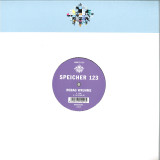
There's no 123 without 4 in our beloved Speicher series. Robag Wruhme is back with two intense, low-slung monster tunes in his unique masterful fashion. "Fire" is destined to set your peak time dancefloor on fire with its killer bassline and trippy sequences. "Un-spok-en" is equally relentless and unfathomable, garnished with a haunting vocal snippet.
Es gibt kein 123 ohne 4 in unserer geliebten Speicher-Serie. Robag Wruhme kehrt mit zwei unglaublich intensiven, tiefergelegten Monstern zurück und schon ab dem ersten Beat ist klar, dass hier der Meister aus Weimar wieder mal in Hochform ist. "Fire" ist pure Primetime-Beglückung mit einer der fiesesten Basslines ever und schön trippigen Sequenzen on top. "Un-spo-ken" ist ähnlich unerbittlich und unberechenbar. Daran kann auch das zart dahin gehauchte Vocalschnipsel nichts ändern.
After his latest ‘Youth EP’ that experimented with spacious vocal chops and whimsical soundscapes, Nocow returns with a relentless flurry of blows on the heavily computerized ‘Magnit EP’ released on npm. Featuring gloriously broken melodies and hard-hitting rhythm, Nocow explores the darker, more formulaic side to his sound. Brooding acid-infused synths shimmer across the four tracks, morphing between moods as the EP progresses. ‘Magnit S’ kicks off the EP with scattered bass hits, driving dark techno arpeggios, and a hint of footwork-esque percussion. The intense atmosphere is a relatively new direction for Nocow, straying from his more meticulous, introverted beats prior. ‘Kali’ incorporates warbled synth with a more subdued rhythm, playing with a modular sound and distant echoes of robotic vocals. This fragmented track is more akin to his 2018 sound of the Voda/Vozduh/Zemlya trilogy as the kinetics of sound play a strongly defined role in the overall sonics. ‘Sputnik’ commences with a blistering arpeggio of bit-crushed synth and chimes. The rocket-propelled pacing creates a frantic, yet ultimately controlled piece, worthy of a place in a club 300 years from now. Yet, after the frenzy comes the calm. The closing track ‘Extasy’ grinds the EP to a kaleidoscopic halt. Vocoder passages drift across the dense soundscape as Nocow transports you to an other-world, filled with spacey percussion. This closer is a well-deserved return to solid ground, following the perpetual trio of dark, yet utterly compelling techno pieces. Once again, Nocow exhibits his multi-faceted approach to electronic music that truly sets him apart.
Jozef Van Wissem- Lute, Electronics, Beats, Electric Guitar, Found Bird Sounds. In 2013 van Wissem won the Cannes Soundtrack Award at the Cannes Film Festival for Jim Jarmusch’s “Only Lovers Left Alive “. In December 2017 Jozef van Wissem was invited to perform the madrigal depicted in Caravaggio’s painting The Lute Player (1596) at the Hermitage museum of Saint Petersburg. In 2022 three of his works were used for in the soundtrack and trailer of Irma Vep (HBO). His completely unique musical world can be easily verified by his collaborations, especially that these relationships are also strengthening his own musical character. He worked together with Zola Jesus, Tilda Swinton, Jarboe as well as with his long-time collaborative partner, also his friend, Jim Jarmusch. “La Cinémathèque Française in Paris commissioned me to write and perform the score at the presentation of the restored version of Nosferatu. I was a bit overwhelmed by its success. It was sold out. I wasn’t going to repeat it. But people kept asking. In the beginning the soundtrack was more improvised and reactive to the images but after a few times the audience kind of showed me the way. To start with a few notes and building the score slowly to a dense slow metal ending. I found an old 7-inch single with recordings of extinct birds on a market, I electronically processed and added them to the score . “ Manipulating the sounds of electric guitar in alternate tuning he manages to create the feeling of fear, equal to the experience of the victims of Count Orlok. “To me Nosferatu personifies this Death Bird of the Plague. The Black Death depicted in the film offers a timeless parallel with contemporary society. The vampire Count Orlok infests the city with rats and people are infected with the plague. They must quarantaine. This provokes hysteria. Much like nowadays”. With a melodic almost medieval magic and mystery Jozef van Wissem has reignited the light through the filters of dark energy post punk and even black metal into a wondrous new melodramatic cinematic space…- John Robb (Louder Than War) Beginning with a solo played on the lute, his performance will incorporate electric guitar and distorted recordings of extinct birds, graduating from subtlety to gothic horror. – New York Times Delightfully macabre, intense and electrifying – MXDWN
In 2016 lutenist Sofie Vanden Eynde put her instrument aside for nine
months in order to recover from a severe burnout
Five years later, she felt the need to look back. Would it be possible, she
wondered, to use the intense, shared concentration between musician and
listener to convey sensations of over- stimulation, contrast, excess, stagnation,
emptiness, beauty and movement? Would it be possible to articulate the inner
reality of a burnout musically: to make a burnout audible, tangible,
understandable and, who knows, avoidable? The result is Vanishing Point /
Verdwijntijd, an autobiographical recital, a musical narrative, a journey:
somewhere between fragile comfort and cautious happiness. Writer Annemarie
Peeters drew on her interviews with Sofie to write a text that reflects the three
phases of a burnout. The run- up, the phase of total stagnation during, and the
cautious way out. Three colours, three seasons, three ways of being. Lurking
beneath Sofie's personal story are experiences that many will recognize: the
craving for efficiency, the sudden faltering, the unfamiliar and at the same time
disconcerting sense of emptiness, and the tentative search for a new balance.
But also the questions Sofie asked herself – about the connection between her
own little story and the big world that surrounds her – evoke wide recognition. Is
burnout a personal failure or a social symptom?
Sofie went in search of pieces from the solo lute repertoire that she intuitively
associated with the various phases of the text. This resulted in a recital with a
surprising palette of colours, styles and atmospheres. At times she chose the
rich, powerful sound of the theorbo. At others she chose the fragile, hushed
sound of the Renaissance lute. The Prelude by the French baroque composer
Robert de Visee combines phrases full of grandeur with breathing pauses filled
with intimate doubt. The music of John Dowland draws on the typically English
penchant for melancholy. In the fantasias and ricercars of Francesco da Milano, it
is not only the bright colours of the Italian Renaissance that resound, but also the
constant search for a new beginning. Luis de Narvaez's Cancion del emperador is
an arrangement for lute of the famous chanson Mille Regretz by Josquin Desprez,
a song that emanates serene regret for everything that is not. And in Robert de
Visee's Chaconne the same chord sequence revolves around its own axis. Hope,
tenderness, revolt and acceptance each step to the fore in turn.
At Sofie's request, Vladimir Gorlinsky created a new composition, one which
reflects the state of mind in the middle of a burnout. Vanishing Point balances on
the edge of total emptiness, a stagnation that at times is hard to bear. Vanishing
Point starts out from this stagnation to explore the different facets of burnout:
resistance and acceptance, fear and hope, stagnation and movement, absolute
solitude and the desire to interact again with the surrounding world. Vanishing
Point / Verdwijntijd can be listened to in different ways: not only as a lute recital,
but also as a radio play with voice, lute and soundscapes. Annemarie Peeters'
text was recorded by actress Katelijne Damen (NL) and voice artist Caroline
Daish (EN). Vladimir Gorlinsky created soundscapes based on the sounds of the
lute, which were magnified as if under a microscope. The soundscapes weave
themselves between the text and the lute music. Jo Thielemans created the
sound design and provided the live electronics.