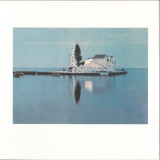
"Espontaneamente se Tenta: Aventuras Sonoras de Djalma Corrêa is an album of deeply exploratory pieces by legendary percussionist and composer Djalma Corrêa. This double-LP set features previously unreleased recordings that cover a wide range of sonic experiments, revealing an unknown side of the prolific and groundbreaking Brazilian artist. Most of the tracks on this album were digitized for the first time – directly from the original tapes – and were compiled in collaboration with Corrêa just before he passed.
The result is a wild and unsettling collage that shows us just how original and intense Corrêa could be: from the unorthodox electroacoustic piece Evolução (Para Fita e Filme), which channels ancestral African inspirations to create a sonic cosmogonical narrative, to the proto-mixtape Exemplo de Sintetizadores, in which he transitions from transcendental drones to astral cha-cha-chas.
While the compilation might seem disjointed at first listen, it is in fact the most accurate translation or representation of his central concept: spontaneous music. Djalma's relationship with sound was always guided by his fearless approach to listening, and by his audacious and dynamic interaction with both musicians and equipment, which enabled him to work across a wide array of genres: from jazz to completely abstract music, always through a personal DIY ethic.
Corrêa developed a strong bond with experimentalist and inventor Walter Smetak, with whom he shared a studio during his formative years at Universidade Federal da Bahia. Suite Contagotas, featured in this collection, is no less than a sonic materialization of that bond: an experiment revolving around dripping water and its randomness – a tentative exploration of the ideas and possibilities envisioned by Smetak for his audacious, albeit unrealized, Estúdio OVO.
Djalma, however, is best known for his studio work in historical albums, including many by Caetano Veloso, Gilberto Gil and Jorge Ben, and for his own polyrhythmic opus Baiafro. The last track is an early recording called Bossa 2000 dC, first performed by Djalma at the 1964 Nós, Por Exemplo concert, an event which is often cited as marking the beginning of the Tropicalia movement. At the time, he was the only artist in the lineup using electronic devices to create sounds, e.g. medical oscillators and contact mics to augment his percussive palette.
The artwork is an amalgamation of material found in the Djalma Corrêa Archive (currently managed by his son Caetano Corrêa) and other material created during the period in which the record was being put together. The intention is to guide the listeners through this possibly tempestuous soundscape, giving them additional resources so that they may draw their own meanings and make their own sense of this extremely immersive and original experience – which is like nothing we've ever heard before."
Cerca:intention
Darning Woman is an intentional, beautiful, sometimes confrontational album that shreds expectations of DIY, bedroom music, and feminine themes. There's a lushness and maternal instinct at play, as Coope connects the dots between physicality, ephemera, and the ultrafeminine. "I don't really like to deal that much with themes of personal hardships, or heartache and love," says Anastasia Coope. "Ultimately, I work most honestly with the language of what is happening in a moment and the passage of time around it. That, coupled with my reaction to entering the artistic landscape, and my thoughts about what does and doesn't get representation, comprises most of this album." Darning Woman explores, among other things, the meditative aspect of sewing, patching and embellishment, care and repair, collection not as modern, craven consumption but as a counterpoint to materialism. This sort of collection - the good kind, the gathering of things to make a home - can be, in Coope's words, "A very baby way to critique capitalism. Birds make nests, right? It can be a new life for a thing that was made. What you surround yourself with matters." To that end, Anastasia Coope is also the founder and leader of the Bonzo collective and show series, an exciting new home for the type of expansive, profoundly creative scene that New York has been missing for some time. And while Bonzo may well be the ascent of a new community, Darning Woman is the story of Anastasia Coope, herself. It is the sound of Coope entering the world as an artist, acknowledging the tangle of what changes - the gaze of the world, Coope's art in reaction and community to art in general - and what does not: her ideas and her own self.
- A1: Big Swimmer (Vocal Harmonies By Sharon Van Etten)
- A2: New York, Let's Do Nothing
- A3: The Mattress
- A4: Milk Boy (I Love You)
- A5: Suddenly, Your Hand
- B6: Somewhere Near El Paso
- B7: Lily Pad
- B8: Davey Says
- B9: Scully
- B10: This Wasn't Intentional (Vocal Harmonies By Sharon Van Etten)
- B11: John Prine On The Radio
Black Vinyl[23,95 €]
Neues Album erscheint am 31. Mai 2024 bei City Slang inklusive der Single 'Big Swimmer' featuring Gesangsharmonien von Sharon Van Etten!
King Hannah entwirft einen musikalischen Wandteppich, der nahtlos zwischen den ruhigen Tiefen des meditativen Pops und den weitläufigen, klangvollen Landschaften voller Dunkelheit, Witz und schrägem Humor pendelt. Merricks Gesang, ein rauchiges Vergnügen, verleiht ihren Worten tiefes Gewicht und Kraft, ergänzt durch die bluesigen Leinwände, die Whittle meisterhaft unter ihnen malt. Ihr Sound wechselt mühelos von Momenten post-rockiger Weite zu dem Gefühl, dass Springsteen auf eine düstere Seitenstraße abseits seines Highways zur Freiheit gerät. In jüngster Zeit hat das Duo die Bühnen neben geschätzten Künstlern wie Kurt Vile, Thurston Moore, Kevin Morby und DIIV geziert und das Publikum auf Festivals in ganz Europa und Nordamerika, darunter End of the Road, Green Man, Primavera Sound und Fusion, in seinen Bann gezogen. King Hannah wurde unter anderem von Stereogum als "Band to Watch", von The Guardian als "Ones to Watch" und von Paste als "Best of What's Next" gefeiert und in der Rubrik "NEU" des DIY Magazins sowie als "Rising Artists" von SPIN vorgestellt.
Mr Bongo proudly presents the debut album from Tasmania-born, Melbourne-based, Finn Rees. Gliding across a swirling palette of saturated hues, Dawn Is A Melody feels vintage yet vibrant, new but familiar at the same time. A spiritual, deep and textured jazz record, tipping its hat to greats from the past, capturing memories and reformulating them into new ideas with the help of some of Melbourne’s finest talent.
Expert keys player for the likes of 30/70 and Elle Shimada, alongside one-half of Close Counters, this debut LP was Finn’s conscious departure from the realm of groove-based jazz. Instead, Dawn Is A Melody places the piano and arrangements centre stage, giving Finn and his fellow Melbourne crew freedom to explore the spaces in between, new emotions and alternate soundscapes.
In Finn’s own words: “My intention with Dawn Is A Melody was to create a world; a microcosm of colour. Something rich and beautiful that allowed the melodies and compositions to reach their full potential. It was driven by hope, curiosity and the search for beauty and reassurance in this ever-changing world. The emotion behind the music is really about the journey of life, growing up and changing, as well as my relationship with Tasmania’s natural landscapes where I grew up, a part of the world that is incredibly unique and beautiful.”
The album arcs between opening, middle and end. Beginning with the optimism of ‘Looking Up’ and ‘Lagoon’, the former a celestial, string and harp marbled slice of positivity, the latter a spiritual journey of exuberance and hope, Finn’s fingers dancing across the ‘70s Yamaha grand piano. From there the songs blossom outwards with the cinematic soulful journey of ‘It’s Behind Me Now’ and Brazilian-inspired ‘Expansion’, as the divine ‘Crossing’ signals a transition to a new realm. The energy is transformed from the rich cosmic textures to a more intimate and personal feeling with ‘Ablaze’, ‘Between Spaces’ and ‘As It Passes’ which blissfully fades down to simply piano and strings to close out the record.
Recorded at Rolling Stock in Collingwood, Melbourne, Henry Jenkins was drafted in as recording and mix engineer, his minimal vintage mic setups giving a live aesthetic and warmth to the arrangements. Lucky Pereira and Blakely McLean Davies form the rock-solid rhythm section, with a hand-picked line-up of other Melbourne talent on display, including Cheryl Durongpitikul on tenor sax, Siwei Wong on harp, Audrey Powne on trumpet and Allysha Joy on vocals to name only a few.
Plotting a course from Alice Coltrane, through Herbie Hancock, to Arthur Verocai, this is a debut nourished by the past but firmly made in the present. A record unable to be age-stamped, casting ambiguity as to when, what era and by whom it has been crafted. Like a vintage lens capturing a current scene, Dawn Is A Melody is warm and familiar yet focused on the here now.
In The Red Records is proud to announce a previously unreleased new album by Brooklyn-born master of minimalism Alan Vega, Insurrection. The eleven songs here showcase the unparalleled vision and uncompromising force from one of the most influential artists of all time. Alan Vega was born in Brooklyn in 1938. He co-founded the legendary New York City punk band Suicide with Martin Rev in 1970. Suicide’s groundbreaking 1977 debut is considered one of the most influential albums of all time. Vega considered his solo records the audio counterpoint to his visual art that reflected the world around him while simultaneously exploring universal themes. It makes his work as relevant today as it was when he created them. It was during his highly experimental period beginning in the late ’80s that he began working with Liz Lamere, who became the most crucial collaborator of his solo career until his death in 2016. Lamere, along with Jared Artaud, resurrected these newly unearthed collection of lost recordings, which they co-produced and mixed. Lamere and Artaud spearhead the Vega Vault project, which aims to bring rare, unreleased and back catalog work spanning Alan Vega and Suicide’s career to the public for the first time. On Insurrection, Lamere says: “Insurrection was created in the time period around 1997/98, after Mutator and prior to Vega’s 1999 release of 2007 and captures the intense energy of NYC in the ’90s rife with crime, killing, hate, fascism, racism, and moral bankruptcy. You can hear the tortured souls floating through this album. Post-Gulf War angst still enveloped Alan. He was having premonitions about a major terror attack in the US, well before 9/11. The upcoming birth of his son raised further awareness of the state of our world. All these emotions are mirrored in the sounds he magnetized. And true to Vega form, there remains hope and empowerment coursing through the tracks. In the almost three decades of going into the studio with Vega, we recorded significantly more material than the seven albums released. Vega’s intention was to experiment with sound which would become the canvas for the poetry that reflected his vision of the universe. Because the goal wasn’t to make albums, he had no timeline or constraints and would freely follow new paths uncovered along the way.”
To address the weight of the world without speaking of weariness. To march the song to breathlessness but loosen your grip when the band wanders. To tell all your secrets but shield your loved ones from vulnerability. To dress up in the charm and temptation of the pop song but maintain a core of peculiarity, of a single voice trying to navigate this world. This is the project of the Spatulas. Think of the few songwriters who know they're the only ones in the world who could write their songs. The ones who sing in the confidence that the song couldn't exist without them: Peter Jefferies, Jenny Mae, Ron House, Heather Lewis. Jonathan Richman? Put Miranda Soileau-Pratt and the Spatulas on this list. All eleven songs on `Beehive Mind' share a percussive, unshadowed presence, a steady, clear-voiced clop. Every note on the record is a little bit sad on its own but then they're organized in a way that you don't actually notice. Credit this to the band's skill_Jon Grothman, Lila Jarzombek, Kyle Raquipiso and Miranda Soileau-Pratt all play with no limits and they all play with profound ease. The songs breathe in warmth and patience, they are immediate and sweet. And then they start to meander. The guitar skitters with the deliberate unpredictability of a wild animal. Parts repeat and reset with the obsessiveness of an anxious mind. The lyrics open doors to unexpected scenes of lovers, family, and violence. This is all intentional: "I need to play music and listen to music as a form of therapy," explains Soileau. This means safety, this means encouragement, this means trauma, this means hard questions. Only a band so comfortable at the margins, only a band so capable, only a band so trusting can achieve all this. Miranda Solileau-Pratt wrote the first Spatulas song in 2020, while living in Oregon. Since that time, the band has released two cassettes and toured the United States. Members of the Spatulas have also played in The Blimp, Honey Bucket, Hot Gum, and Meerkaz. The band has shared stages with Helen, Lavender Flu, Debt Rag, Pink Reason, Blues Ambush, and Kath Bloom. `Beehive Mind' is their debut LP.
The Slovak band Shallov releases their new track "Refrain" on the experimental label Weltschmerzen just one year after the release of "Coexist". Two tracks that both span more than 10 minutes in length, work together as one coherent audiovisual art piece and are out as an EP on 10" vinyl. Music videos do not only visually supplement both tracks but they are equally autonomous art pieces.
The visual feature of the music pieces is highlighted by the vinyl's cover painted by Slovak artist Michal Fízik. The previous back cover carries a photograph which served as an inspiration for the painting while the current back has been created via AI reinterpretation.
The musical component of Refrain is based on a repetition building into a hypnotic trance, gradually disintegrating so it eventually ends in a monumental climax. It contrasts the band's previous work as well as the track Coexist which uses rather neverending rhythmic variations, and a changeable vibe and atmosphere.
The concept of the visuals in Coexist is a result of a collective fusion between the theatre director Adam Dragun, Viktor Ori and dozens of other participating non-actors. The video depicts individualistic egoist actions shaping a contradicting and incomprehensible totality of the world which ultimately seems to be alienated to everybody.
Refrain is an introspective journey leading to the dissolution of the individualistic experience of human existence. The video's concept, direction and production was conducted by the visual artist and performer Jak Užovič who also tends to inter-media art and object installations.
As Shallov and Jak Užovič explain the track's conceptual background: "The idea of owning one's own body and mind is an unnatural way of looking at ourselves imposed by the dominant paradigm. It's a blind ideology - the view of a body as a machine or a commodity is incomplete and represents a materialistic utopia which is being systematically internalized. We're not a community that acts right or wrong, our intentions are determined by an ideology which pretends not to exist - our relations are relations of masters and slaves, of domination and exploitation. We are a society bound by these features and even though we refuse to admit it, the world presented to us is only a legend we're striving to keep alive at all costs, while believing that there is no alternative. Our quality doesn't stem magically from the inside, on the contrary, it's determined by the conditions within which we interpret it through collectively shared fictions. We don't get to know our consciousness through ourselves, but we recognize it through others as they create and form us."
Deluxe 180g vinyl. Art Edition LP includes set of six 12”x12” art cards.
The follow-up to Kee Avil's acclaimed 2022 debut Crease: "A stunning debut" (The Quietus); "A whiplash style of uninhibited exploration" (The Wire); "Kee Avil's debut is a force" (Foxy Digitalis); "A work of Frankensteinian wonder" (Electronic Sound); "A tightly coiled, finely wrought vision of avant-pop" (Exclaim); "A debut of fiendish creativity" (Bandcamp Album Of The Day / Albums Of The Year) Kee Avil's music is both adventurous and intimate, intellectually challenging and emotionally resonant. The Montréal guitarist and producer's 2022 debut LP Crease garnered plaudits from outlets like The Wire, The Quietus, Mojo and Foxy Digitalis, picking up a Canadian Juno Award nomination and Bandcamp Album Of The Day and Albums Of The Year along the way. Its intricate construction, unnerving atmospheres, and knife-edge take on avant-pop prompted comparisons to early PJ Harvey, This Heat, and Gazelle Twin. A remix EP with work by claire rousay, Ami Dang, Cecile Believe, and Pelada brought collaborative perspectives to four Crease tracks, offering new pathways within those songs. With Spine, Kee Avil strips back her heavily textured compositions, opening up a much rawer sound. She calls it folk… and while traditionalists might scoff, this is urgent music that reflects the precarity of modern life, as well as the jarring mixture of electronic and real-world interactions that have become the fabric of our day-to-day experiences. There's a hypnotic post-punk somnambulance to it all, using the repetition and fracturing of melodic phrases interwoven with delicate electronics to create curious and persistent hooks. While not a concept album, themes of time's passage, remembrance, and decay crop up across multiple tracks. Each track intentionally only has four elements - guitar, electronics, and two other instruments, with Kee's voice and guitar pushed to the front. Within this minimalist framework, the juxtaposition of beauty and discomfort that is key to the Kee Avil sound stands out in skin-prickling relief. "We're shaped by many versions of ourselves," says Avil. "I was looking back at these versions of myself and what could have been, what didn't end up being and what did end up being, and going back like that through time. Seeing the future, the past." Spine was written in Kee Avil's home studio after a lapse in writing while touring Crease and working on other projects. She is a well-known and respected member of the Montréal experimental scene, and formerly ran Concrete Sound Studio with Zach Scholes, who continues to work with her as a producer on Spine. Compared to the three years that went into making her debut, Spine emerged in a matter of months - a process that may also be a factor in its intensity and sharpness: "This record was much harder, like it was really discovering everything from scratch." In her desire to not simply replicate or extend the sound of Crease, she felt she had to rip up the rule book, write in a different way, and pare back songs against her usual instincts. Sometimes, when we work against our ingrained habits, we get to the core of who we really are. Spine is an exercise in that process. Without over-intellectualizing or being didactic, it hits immediately and emotionally, especially if you are a person who has spent much time in the process of self-examination. Kee's voice hisses, whispers, and chants; her guitar bends and rings; electronics skitter and crackle; violin creaks like a door in the wind. There is something so evocative about the atmospheres she creates that it's easy to overlay one's own feelings onto her work, but to do that wholly would be to overlook one of the most important things about Spine: Kee Avil's clear and thoughtful vision. This isn't just the next step forward in her artistic trajectory; it's a stunner of a record that stands on its own, a bracing and thrilling listen that has much to reveal about the contradictions inherent in being human. - jj skolnik
The relatively short life of San Francisco's Aluminum has so far yielded a single (Spinning Backwards, 2020) and an EP (Windowpane, 2022), but their debut LP, Fully Beat, overflows with tenured confidence and a singular style that deftly comprises shoegaze, big beat, and jangle pop. With influences ranging from Orbital, to Wipers, to The Avalanches and Sly and the Family Stone, theirs is a multifaceted take on established forms, fed through fuzz and led by honeyed, male-female vocal harmonies from Bay Area post-punk veterans Marc Leyda (of Wild Moth) and Ryann Gonsalves (of Torrey). "Smile" begins with deceptive sparseness, adding neon swirls of stacked tremolo over a mesmerizing lyrical refrain, and hinting at the dynamism to come with understated grace and grit. "Always Here, Never There" is Fully Beat's first pure hit of melodic pop: its liquid bass groove winds beneath a melancholy-sweet synth hook and Leyda's plaintive vocals, while drummer Chris Natividad's deep, pillowy snare and propulsive style maintain a driving pace. Lead single, "Behind My Mouth", shifts gears into a big beat shuffle and howl of overdriven guitars, which relent to Gonsalves' rolling bassline and playful, snarky vocal. Composed across several weeks of experimentation, it is a prime iteration of Aluminum's meticulous world of sound, which nevertheless carries an air of wry nonchalance. Asking, "Do you ever see behind my mouth?", Gonsalves notes that the song "comes from a place of wanting to be understood authentically, and to communicate intentionally." This approach speaks to the album's broader theme of exhaustion amid the demands of the modern grind: working unfulfilling jobs to pay exorbitant rent, feeling society break at the seams, and trying to maintain a meaningful personal life with the remaining scraps of morale. The response, then, must be to find joy. These songs were crafted over a half-dozen months in basements and practice spaces, creating an abundance of authentic passion and catharsis that's as nostalgic and comforting as a cherished, tattered band t-shirt. The closer, "Upside Down", is a full-throttle blare of joyous release - "a straight-up love song," according to Leyda. The deliberate choice to end it with a gradual fade, rather than a dramatic climax, smartly suggests the ambivalence of acceptance - perhaps fitting, when considering the immensity of the album's subject matter. It also hints that there is much more to be said, and as such a rich and compelling debut, Fully Beat shows that Aluminum are only getting started.
London outfit Kassian continue their broadly- evolving yet highly detailed journey through and beyond sound towards something ever more expansive. Their second release for !K7 Records comes in the wake of creating a dedicated hardware-forward studio in a Northeast London container complex, where they have the freedom to interlink their machines. This renewed focus brought them to Supercontinent EP, named for the ancient geological era when Africa and South America were joined as Pangea.
A reformulation of rhythmic ideas inspired by South= African Amapiano and South American Baile Funk governs the two hemispheres of the record. The pair examine and deconstruct dancefloor material, eschewing 4/4 for interlocking shaker patterns, searing acid lines, cracking breakbeats, and vocal samples in Zulu and Brazil Portuguese.
The immediacy of the restless rhythm and bass-led funk of “Yena” (the word Yena translates to ‘he/him /man’)forms a sweet spot where double-time and half-time can coexist. “Yami” (‘mine’ in Zulu) is a slinkier proposition which sheds prominent percussion in favour of a weighty, fluid, acid-informed bassline undulating from below.
An ascending percussive riff marks the arrival of “Pulgueiro”, followed closely by break beats and the nostalgia of distinctly British acid electro; it is an intentionally future-forward retelling of a vintage sound, replete with a mind-melt breakdown of rave pads.
A dubbed-out groove dominates the bottom-heavy “Sistema” – a groovy, steady roller that chugs and propels and chugs with head-nod hypnotism through an intricately minimalistic approach.
Matching his signature melodic futurism with enduring club music structures, Pev brings the Pulse series to a natural conclusion with the Pulse Phase EP. On this third release he underlines the broader approach to tempos and styles he’s taken across this latest period of his output, soon to be coalesced into a new live set.
If there’s been a nostalgic streak detectable amongst the crisp modernism of the Pulse series, it comes through clearer than ever in the looped-up house jack and starry-eyed techno synth hooks of ‘Pulse IX’. ‘Pulse TEN’ pares back for a lean soundsystem workout driven by a strafing arp and fractured drums while ‘Pulse XI’ revisits 90s bleep techno with a deep, dubby intention. ‘Pulse XII’ completes the picture capturing the skeletal pressure of 2-step at its most slender and deadly.
There’s never a sense of over-familiarity — the exacting angles of the drums and alien hue of the synths maintain Pev’s distinctive sound first and foremost. But this series has also been an opportunity to hear some of his musical DNA more explicitly than before, cast in universal rave motifs propelled by the unrelenting pursuit of new forms for the dance.
Livity Sound is a label set up by Peverelist in 2011 as a vehicle for a raw and exploratory strain of UK techno, rooted in the heritage of UK dance music and sound system culture. It has since become one of the UK's foremost protagonists for cutting edge underground electronic music.
"Miranda Winters, as the voice of Chicago’s much-loved noisemakers Melkbelly, has spent the past few years happily in her own shadow. While she has quietly written and occasionally released her own music for 15 years, Winters finally steps out into the bright light with the release of Lawn Girl, the debut album under her Mandy moniker.
The album, a combination of older songs and newer creations, feels positively and endearingly alive–like a freeing of pent-up energy, an intimate rebuilding of the self. While Winters recorded and produced a number of the songs herself, she worked with Taylor Hales at Electrical Audio to feed those songs back into the studio, where they were re-recorded with room mics and worked back into the original versions. “I see it like photocopying,” she says of the process. “I’ve always loved working with photocopying and related printing techniques in my visual art because of the way everything decays and falls apart. It was nice to honor that on the record.”
Performed by an all-women band–Linda Sherman (guitar), Lizz Smith (bass) and Wendy Zeldin (drums)–the songs on Lawn Girl suitably find Winters ruminating on the idea of femininity; about her mom (who graces the album cover) and being a mother herself; her female friends; and what it means and what is required to make art and music in a female space intentionally."
Fabulous Soundtracks, the fourth studio album by reclusive Los Angeles musician Jack Name, is an homage to the IRL world and its twisted and varied romance with the worlds of our minds, in a wild collection of "soundtracks'', each a sonic re-construction dedicated to a distinct scene. Both musically and lyrically, this is Name's most adventurous and genre-defying album. Elements of acid, dance, folk, micro-tonal weirdness, horror, sensuality, impressionism, and bursts of rock fuse with Name's most direct yet ethereal lyric writing to date.
Each song with artful intention confuses dream-like experiences and common everyday situations, and vice-versa, sometimes inflicting a frightening energy into the banal, or this in reverse. Offering a "fabulous soundtrack" as the title implies, to dreamlike cinematic scenography including but not limited to; walking alone through a park at night, a woman tiptoeing through a garden, a person wrestling with time and change, lust, grieving a pet, driving alone in the rain, laying in bed with a lover, a bare tree standing in a field, looking through pieces of glass, and inviting the devil into the home (as one does).
Jules Archive is a project founded by Marco Marzuoli and Marco Mazzei in 2016.
By employing various technologies, instruments, and approaches, the duo strives to craft a mysterious and fantastical persona named Jules. Through this persona, they aim to immerse listeners in a dreamlike atmosphere, transcending reality and dwelling in imaginary spatiotemporal dimensions.
Platonic Tales is the second chapter of Jules' journeys, more anthropocentric than the first album Adventures & Explorations (Volume 1), but equally exotic and dreamlike. The musical intention of this record was to rework a set of five (plus one) melodic tape loops, already structured in "song form”, through detailed arrangements. The treatment followed an experimental-pop-oriented production approach.
Recorded entirely at home by the artists, the music on the album features analog cassettes containing loops dating back to around 2016. The remaining arrangements were composed during the 2020 pandemic lockdown.
Several international guests collaborated on the album:
Lino Capra Vaccina, the legendary Italian percussionist/minimalist composer, and Jefre Cantu Ledesma engaged in a musical dialogue on An Ontological Novel.
Andrew Weathers contributed his voice to the tracks A Superior Truth and Exodus.
Christina Vantouz participated in Exodus and concluded the album with a string composition arranged and conducted by Minna Choi, performed by Magik*Magik Orchestra.
Recorded between Città Sant' Angelo (Pescara - Italy, 2016-2020), Francavilla (Chieti - Italy, 2020), and Firenze (2019-2020).
Produced by is an EP featuring original songs created by Adrian Younge featuring talented artists Black Thought, Estelle, Gallant, Georgia Anne Muldrow and Terrace Martin. From Younge's perspective, each of these songs collectively celebrate the spectrum of black music and were intentionally created for Black History Month. Recorded and mixed by Adrian Younge at Linear Labs, the preeminent analog studio of Los Angeles, CA.
Bruno Berle, the young songwriter and poet originally hailing from Maceió, the capital of Brazil’s Alagoas state, crafts songs that are simple, direct, and full of tender nuance. With his first album No Reino Dos Afetos (which translates to "In the Realm of Affections” and was released in 2022), Berle firmly established himself as a unique and important voice in the burgeoning scene of new Brazilian artists making a global impact, including peers like Ana Frango Elétrico, Tim Bernardes, Bala Desejo, Sessa and more. Now back with his second album, No Reino Dos Afetos 2, he stretches that further.
Bruno Berle’s music lives between two worlds – a traditional Brazilian folk talent steeped in history, and a contemporary, dreamy electronic pop; the result is songwriting that’s genre-bending, intentional, iconoclastic and consuming, spacious and sinewy and singular, a striking reflection of its composer while leaving space for the listener to settle in. The album follows Bruno’s relocation to São Paulo, and the songs are a reflection of his past and present. A rebuke of former categorizations of his work in Brazilian music scenes, and an idea of where his music can move, unfettered.
Berle’s music is purposeful in being a true portrait of himself, and a reflection of the music, art, and fashion scenes he personally moves through. Berle aims to provide an entrypoint for Black queer joy in his music, in his storytelling, in his presence and vision as a creative. For him, it feels subversive to be playing MPB laced with dubstep and lo-fi, a sort of intentional sacrilege, capturing a dialogue of modernity in traditional music.
Berle wrote most of the arrangements and co-produced his new album, Reino Dos Afetos 2 with longtime friend and musical partner Batata Boy, who is also from Maceió; the album was recorded in Rio de Janeiro, Maceió, and São Paulo, his new home, and picks up the conversation begun in 2022 on Berle’s debut album No Reino dos Afetos. Both records are the result of a nonlinear but coherent seven-year music creation process culminating in these albums, holding hands across space and time.
“Tirolirole,” the first single from the record, was released at the end of 2023; sun-soaked rhythms and soft voice coat the song, the lilting refrain of “Tirolirole” throughout – hushed, gentle, but somehow almost tactile, a golden-hour moment unlocked in the mind. “Tirolirole” is a triumphant future classic about the temporality of a blossoming love, with Bruno’s stunning vocal soaring over melodies which ebb and flow like the waters on the Atlantic shore. Of the track, Berle explains: “Despite ‘Tirolirole’ being an expression that evokes my childhood, just like the light words about nature, the harmony, and the poetry are epic, carrying a great hope for love.”
In fact, the guiding theme of No Reino dos Afetos 2 is a relationship, unfolding in the arc of a weekend. It traverses the innocence of an early young love, how that can be formative, can stretch on to take new shapes, or shape you. The album happens at the genesis of meeting someone and falling for them, before the relationship is thrown into overdrive – set in a big city, against a backdrop of major life changes, rising energy, the sound of São Paulo.
Something transcendental emerges in “Dizer Adeus,” with an arrangement that echoes a gospel atmosphere (evangelical and Catholic environments were pivotal to Berle’s upbringing). On “É Só Você Chegar,” piano and flute gracefully intertwine, a dance, while “Quando Penso” skews sparser, the voice-and-guitar minimalism somehow cultivating an entirely different shape – somehow both cozy and melancholy, with the background sound of a rainy day. Coupled with the lo-fi aspects that shape much of the album’s personality in the vocals and the production, No Reino Dos Afetos 2 is meticulously elaborated by Berle’s sonic alchemy, like on the mid-album instrumental “Sonho,” which feels like floating. “It’s the apex. It’s when lovers are sleeping together,” Berle explains of the feeling he wanted to encapsulate in the song.
On “Love Comes Back” Berle interprets Arthur Russell, the late Iowa musician who only reached greater visibility after he died in 1992. “His way of making music is similar to mine,” Berle explains. “He sings in a more fragile way, has more of an experimental way of recording, letting ‘chance’ appear in the final work.”
Even so, Berle doesn’t want his music to be buried in sentimentality – and the purposefulness of his craft serves as a sort of north star. The production, the arrangements, his restraint and intentionality in crafting his songs feel just as vital as their emotional cores. His songwriting is amorphous, fluid, an encompassing genre-bending movement in-and-of-itself, quietly daring. The songs are often in conversation with other works – drinking in fountains as diverse as the filmmaking of Ingmar Bergman, the poetry of Walt Whitman, the rhythm of Djavan, and the painting of Maxwell Alexandre. Musically he weaves together a rich tapestry of Brazilian folk, UK 2-step garage/dub, trip hop and sun soaked west coast songwriters; something akin to the worlds of Milton Nascimento, Arthur Russell, James Blake, Feist, and Sade colliding into one. But even then No Reino Dos Afetos 2 floats separately, a romanticism driven by a simplicity and intimacy, an open-ended possibility, Berle’s singularity as an artist at the helm of the ship.
Repress!
Landing next from toolroom is a 4-track vinyl sampler of some of our biggest recent releases including a label debut from Liverpool based DJ & producer Essel with her single ‘love vibration’, Dutch DJ & production powerhouse Guz who teams up with Italian production duo havoc & lawn for ‘come back’, fellow Italian DJ & producer Qubiko who delivers brand new single, ‘confused’ and UK duo wh0 and Brighton based Kideko for their new collab ‘soul searcher’. Four killer cuts that you will not want to miss!
Countless radio plays on radio 1 from Danny Howard, Sarah Storie,
Pete tong Other notable radio plays – kiss FM, toolroom radio, Sirius XM, data transmission radio, radio 1 dance anthems, radio 1 party anthems, Rinse FM, select radio, Tomorrowland radio
Dj Support From Danny Howard, Annie Mac, Mistajam, Pete Tong, Charlie Hedges, Kraak & Smaak, Maxinne, Todd Terry, Alex Preston, Full Intention, Gw Harrison, Dj Rae, Rudimental, Alaia & Gallo, Illyus & Barrientos, Johan S, David Penn, Sam Divine, Riva Starr, Claptone, Nice7, Dario D’attis, Mousse T, S-Man, Huxley, Kc Lights, Friend Within, Dombresky, Gorgon City, Chris Lake, Format:B, Pirupa, Tcts, Alan Fitzpatrick, Low Steppa, Mat.Joe, Raumakustik, Eskuche
2026 Repress
DJ Support from Danny Howard, Annie Mac, Mistajam, Pete Tong, Charlie Hedges, Kraak & Smaak, Maxinne, Todd Terry, Alex Preston, Full Intention, GW Harrison, DJ Rae, Rudimental, Alaia & Gallo, Illyus & Barrientos, Johan S, David Penn, Sam Divine, Riva Starr, Claptone, Nice7, Dario D’Attis, Mousse T, S-Man, Huxley, KC Lights, Friend Within, Dombresky, Gorgon City, Chris Lake, Format:B, Pirupa, TCTS, Alan Fitzpatrick, Low Steppa, Mat.Joe, Raumakustik, Eskuche
Next up and with a label debut is one of the leading Female artists on the circuit, Tini Gessler! Tini dropped some straight-up club fire on our sister label Toolroom Trax earlier in the year alongside Juliet Sikora and digs deep into her clubby roots once again with 'Do What You Want'. After releases on the mighty Drumcode, Sola and Kittball in recent years, her 10 year career is going from strength to strength which is seeing her DJ all over the Globe on a weekly basis and her music production is making huge waves within the industry, and rightly so. Next up Italian born DJ and producer, CASSIMM is back on Toolroom with a straight up club weapon! After laying down the delicious disco number last year called 'Get On The Funk' with Kid Enigma, this follows suit perfectly and fuses chunky beats, disco licks and has Bruno Blanc sharing some sentimental lyrics about how important house music is to all of us. Last but not least, French artist Tony Romera is back on Toolroom with another slice of Tech House fire. Tony Romera first stepped onto the scene 10 years ago as a fresh-faced 20 year old looking to make waves and disrupt the electronic music world with his unique style and French-house inspired beats. Since then he's been busy releasing music and experimenting with different sounds and styles, putting out music on a range of powerhouse labels and gaining support from the likes of Diplo, Fisher, Chris Lake, Fatboy Slim, Deadmau5, Vintage Culture, Adam Beyer and more. House Y'all's distinct character is built upon a warped, creeping bassline and tough, relentless beats providing an irresistible pulsing backdrop as the familiar chanted vocal emerges. A sonic trip that transports you deep into the heart of the underground.
Countless radio plays on Radio 1 from Danny Howard, Sarah Storie, Pete Tong Other notable radio plays – Kiss FM, Toolroom Radio, Sirius XM, Data Transmission Radio, Radio 1 Dance Anthems, Radio 1 Party Anthems, Rinse FM, Select Radio, Tomorrowland Radio
- A1: Pieces Of My Pain
- A2: Onyx Amg
- A3: Money Machine
- A4: Cliffhanger
- B1: 101 Razors (Feat. Method Man)
- B2: Movie Scenes
- B3: Opened Gates
- B4: Lsd (Feat. Vado)
- C1: Voices
- C2: Red Alert (Feat. 38 Spesh & Tony Yayo)
- C3: Keys To Success
- C4: Automatic Pilot (Feat. Dave East & Vado)
- D1: Invisible
- D2: Daddy's Little Girl
- D3: Showers
- D4: Deceitful Intentions (Feat. Cormega)
"The Course of the Inevitable 3: Pieces of My Pain" marks a triumphant return for rapper Lloyd Banks, as he delves deep into the intricacies of his life and experiences, unveiling raw emotions and profound wisdom. In this highly anticipated album, Banks collaborates with legendary artists such as Method Man, Cormega, 38 Spesh, Vado, Dave East, and Tony Yayo, creating a powerful narrative that resonates with listeners.
In this musical journey, Banks weaves together a compelling storyline, sharing pieces of his own pain and struggles, inviting listeners to connect with his authenticity. With Method Man's signature lyrical prowess, Cormega's poetic finesse, and the raw energy of 38 Spesh, the album boasts a stellar lineup of features that enhance its impact.
Banks' sharp lyricism and introspective storytelling shine throughout the album, exploring themes of resilience, triumph over adversity, and the complexities of life. Each track serves as a piece of his soul, revealing layers of vulnerability and strength. With the collaborative efforts of his fellow artists, "The Course of the Inevitable 3: Pieces of My Pain" delivers an immersive and powerful listening experience, solidifying Lloyd Banks' position as a master in the rap game and the one and only Punch Line King.
- A1: Gwaing Reverie
- A2: Lucelle Sista Of The Soil
- A3: Mantis Praise
- A4: Amaseh Amen
- A5: For Peter & Ruth
- A6: Terug Blik
- A7: Threnody For The Khoisan
- A8: Ambient Khoi
- B1: Mcinci Song I
- B2: Morenga
- B3: Evidence Of Things Unseen
- B4: Lockdown Duet Milano-Cape Town
- B5: Roesdorp Requiem
- B6: The Ascension Of Milford Graves
Garth Erasmus is an artist and musician based in Cape Town, South Africa. 'Threnody for the KhoiSan' is his first album under his own name. Since 1985 his artistic interests have broadened to include music-making, designing and making his own instruments based on indigenous KhoiSan knowledge. From 1999 to 2012 he was a member of the South African First Nation activist group Khoi Khonnexion. In the past couple of years Garth Erasmus has also been a pivotal part of various international performance pieces and exhibition projects which brought him regularly to Europe. Most of these activities were developed and performed in collaboration with the Hamburg based band Kante and his band Khoi Khonnexion. In April 2024 Garth Erasmus will be part of the group exhibtion 'Oscillations' at Akademie der Künste, Berlin.
His works in music are predominantly characterized by a restless quest for alternative forms of expression and materials including self build instruments, field recordings or various electronic music devices.
In this context the music on 'Threnody for the KhoiSan' takes on a primal and metaphorical meaning. Rather than a formal, physical initiation, this process is more spiritually inclined, yet it is a spirituality which is consistently put into action.. “Ever since I was an art student I have experimented with alternative materials to release me from the Western education values I received. When I started to make these instruments in the 1980s, my intention was to create art objects but when I discovered the sound they made, it unlocked a door that transported me deeper in my quest in the realization that I was on the right path.
In fact all instruments which appear on 'Threnody for the KhoiSan' are products of a process of discovery starting from square one. All this is based and founded on the beauty of simplicity and minimalism as symbolized by the single string Khoisan musical bow and arrow as trance musical instrument. In this sense it soon became manisfest for Garth Erasmus to combine the bow instruments with various electronic instruments. Besides developing his own unique language in music he also shared an expressed interested in experimental sound aesthecis, Avantgarde composition and Free Jazz. However, his non - academic approach towards sound and music was always fueled by the desire for a reconnection to the land and to the idegenious knowledge of the KhoiSan, whose struggle for First Nation status continues.
Song for Morenga
This song is dedicated to a guerilla leader, named Jacob Morenga, who was the leader of the nama/herero anti-german uprisings that occured between 1904 and 1907.
Amaseh Amen
This is a classic mouthbow piece that conjures the spiritual nature of Khoisan cultural praxis.
Gwaing Reverie
It was composed as a personal gift to the other members of newly formed electro-acoustic trio „Gwaing". „Gwaing" is an ancient Khoisan place name, meaning the mouth of the river.
Mcinci Song
A typical meditation on the traditional Mcinci flute. This flute was originally played by shepherds and was made of reed.
The Ascension of Milford Graves
This piece attends to capture the risen spirit of the legendary African American drummer Milford Graves. It was composed soon after his death in 2021.
Song for The Sisters of the Soil
A live improvisation dedicated to Lucelle and Melissa (The Sisters of the Soil) on the occasion of visiting them at their residence, known as „Oppieyaart" on the Cape Flats. On 10 September 2022 there is an online event with them at Kunsthaus Hamburg.
London-based four-piece Adult Jazz announce their first full-length album in a decade, So Sorry So Slow, out 26 April 2024 via Spare Thought. Alongside the announcement comes lovesick new single ‘Suffer One’ featuring Owen Pallett, a cautious excavation of self and sexuality, clambering across a gorgeously shapeshifting, filmic five-minutes.
Containing some of the band’s most abrasive but gentle, beautiful and melismatic work to date, So Sorry So Slow has many defining characteristics: romance, panic, devotion and remorse, threaded together by an intentionally laser-focused love. It’s deeply personal, bruised and candid in its expressions of tenderness, and deeply pained in its concurrent reflections of ecological regret. Across its hour-long runtime, a delicate, frenetic energy and glacial heaviness coexist, the band pitting those paces against one another. In their richly experimental timbre, dancing strings and fluttering falsettos prang against a bed of brass drones like a wounded bird.
“We started writing in 2017 and began recording in 2018,” says vocalist Harry Burgess. “We genuinely thought it might be finished in 2018! But things kept developing and, having resolutely not struck while the iron was hot, there was no real external push to rush things after that, so we just kept letting things shift and unfold until it felt right. Listening back to my voice notes it’s nice to notice that there are fragments of ideas from the whole period 2017-2023 which have shaped the record.”
Recorded in bursts at studios across London and in the band members’ flats, at Konk, on the Isle of Wight and in Sussex, So Sorry is unambiguous in its evolution. Sonically, there are sparks of the arrhythmic brightness that afforded the band’s critically acclaimed debut album Gist Is its cult adoration, for fans of Arthur Russell and Meredith Monk, but with a blossoming, melancholic darkness often overhead. Piano sprees and luscious string sections appear like low-hanging stars on a night-time drive, whilst plunging vocal distortions and humming brass loops resurrect heavy limbs in a bad dream.
“I usually have objects as kind of totems for ideas,” explains Burgess. “The album initially started out to do with performance… the totem was a head mic, one of the subtle skin-tone ones, discreet on the forehead of a West End star. A number of the first songs in their original forms were almost musical theatre piano ballads. I think that was really a device to write about my life as the ‘main character’ (pre internet-speak reframing): regrets about romance, relationships - unsustainable relationships with the self and others.”
“However, once we started writing, the ideas about unsustainable personal relationships, loving unevenly and heartbreak conflated with a more expressly ecological regret. Like contending with big feelings of loss, endings, beauty, desolation, and with how much joy the earth contains in it. Feeling so much gratitude bound up in waves of sadness. Maybe witnessing a slow-motion goodbye to all that, or its last gasps. I love the earth and the life it supports so much. I love how ecosystems fit together - even the brutal stuff. It may be basic to say, but now is the time to be laser focused on that love. I was thinking about human centrality on earth, us as the ‘main character’, the way that is served by faith and romanticism, and the subsequent disingenuous understandings of our position in the ecosystem, as only stewards somehow, rather than subjects. The totems at this point: a herald’s horn, lorry inner tubes, archaeological tools. I guess from doom, industry, history respectively.”
“Now I would say the record is about gripping. Totems being: crampons, rope, drips, desalination equipment, accruing various survival tech. I think gripping sums up both of the threads. There’s the emotionally correct clinging to the earth that is the substrate of everything we value, or the delusional clinging to our imagined dominant position. But also the practical, technological aspects of creating a sustainable relationship, of remaining here. Then I think of romance again.”
So Sorry So Slow comes out 26th April 2024 on Spare Thought, mixed by Fabian Prynn at 4AD Studios and mastered by Alex Wharton at Abbey Road.
Adult Jazz is Harry Burgess, Tim Slater, Steven Wells and Tom Howe.
Kee Avil's music is both adventurous and intimate, intellectually challenging and emotionally resonant. The Montréal guitarist and producer's 2022 debut LP Crease garnered plaudits from outlets like The Wire, The Quietus, Mojo and Foxy Digitalis, picking up a Canadian Juno Award nomination and Bandcamp Album Of The Day and Albums Of The Year along the way. Its intricate construction, unnerving atmospheres, and knife-edge take on avant-pop prompted comparisons to early PJ Harvey, This Heat, and Gazelle Twin. A remix EP with work by claire rousay, Ami Dang, Cecile Believe, and Pelada brought collaborative perspectives to four Crease tracks, offering new pathways within those songs. With Spine, Kee Avil strips back her heavily textured compositions, opening up a much rawer sound. She calls it folk—and while traditionalists might scoff, this is urgent music that reflects the precarity of modern life, as well as the jarring mixture of electronic and real-world interactions that have become the fabric of our day-to-day experiences. There's a hypnotic post-punk somnambulance to it all, using the repetition and fracturing of melodic phrases interwoven with delicate electronics to create curious and persistent hooks. While not a concept album, themes of time's passage, remembrance, and decay crop up across multiple tracks. Each track intentionally only has four elements—guitar, electronics, and two other instruments, with Kee's voice and guitar pushed to the front. Within this minimalist framework, the juxtaposition of beauty and discomfort that is key to the Kee Avil sound stands out in skin-prickling relief. "We're shaped by many versions of ourselves," says Avil. "I was looking back at these versions of myself and what could have been, what didn't end up being and what did end up being, and going back like that through time. Seeing the future, the past." Spine was written in Kee Avil's home studio after a lapse in writing while touring Crease and working on other projects. She is a well-known and respected member of the Montréal experimental scene, and formerly ran Concrete Sound Studio with Zach Scholes, who continues to work with her as a producer on Spine. Compared to the three years that went into making her debut, Spine emerged in a matter of months—a process that may also be a factor in its intensity and sharpness: "This record was much harder, like it was really discovering everything from scratch." In her desire to not simply replicate or extend the sound of Crease, she felt she had to rip up the rule book, write in a different way, and pare back songs against her usual instincts. Sometimes, when we work against our ingrained habits, we get to the core of who we really are. Spine is an exercise in that process. Without over-intellectualizing or being didactic, it hits immediately and emotionally, especially if you are a person who has spent much time in the process of self-examination. Kee's voice hisses, whispers, and chants; her guitar bends and rings; electronics skitter and crackle; violin creaks like a door in the wind. There is something so evocative about the atmospheres she creates that it's easy to overlay one's own feelings onto her work, but to do that wholly would be to overlook one of the most important things about Spine: Kee Avil's clear and thoughtful vision. This isn't just the next step forward in her artistic trajectory; it's a stunner of a record that stands on its own, a bracing and thrilling listen that has much to reveal about the contradictions inherent in being human. — jj skolnik.
2024 Repress
Mannequin Records is proud to present a full length by the Philly minimal-synth princess Void Vision.
Void Vision is a Philadelphia-based electronic project helmed by Shari Vari. It began around 2009 at a time when a wave of synth-revivalists were materializing, but the quality of the songwriting and intense vocals set the band apart from the pack. In a rare instance, Void Vision has managed to combine vintage dance elements with melodic structures, haunting melancholy, and lyrics that have a palpable soul. The songs themselves are dynamic, referencing a cross-section of the last 30 years of electronic music, while simultaneously retaining a uniqueness all their own.
The infamous Wierd Records weekly club night in New York, which showcased a variety of talented electronic and coldwave artists, served as an incubator for Void Vision in it's early stages. After a standout debut performance at the club, they immediately caught the attention of Blind Prophet Records, who consequently released their first 7" single, 'In 20 Years', which received excellent reviews.
Vari has continued performing and recording steadily over the last few years, releasing songs on compilations for various labels, including Rough Trade, and in 2012 the song 'Everything is Fine' was selected for Artforum magazine's 'Best of 2012' issue. In 2013, Void Vision toured the West Coast and later that year released a split 12" with Portland-based band, Vice Device. The first official full-length album, entitled 'Sub Rosa' is set to debut on Berlin-based Mannequin Records, followed by a European tour in 2015.
Shari Vari formed Void Vision in 2009 originally as a duo, during the explosion of the new minimal synth and cold wave scene in United States. Sharing the same scene of the Wierd Records associates like Led Er Est, Martial Canterel, Xeno & Oaklander, Automelodi, in 2010 VV released 'In Twenty Years' on Blind Prophet (Sean Ragon's Cult Of Youth record label), receiving also the attention of the Rough Trade dudes, who asked to put out a track for one of their synth wave compilations.
After other split vinyls, tapes and compilations, Mannequin approached Shari with the intention to continue what Wierd Records started, giving a proper shape to her beautiful and youthful dark electronic sound. The result is 10 hypnotic cold analog tracks dominated by the warm and fragile Shari's voice, some more 'pop orientated' some others belonging to the original 'cold wave' atmosphere.
"Sub Rosa" is an edition of 400 copies on 160 gram black vinyl and 100 copies on 160 gram white vinyl.
Today, the Toronto-born-and-raised singer, songwriter, producer, and multi-instrumentalist Charlotte Day Wilson announces her highly-anticipated sophomore album Cyan Blue out May 3rd via Stone Woman Music / XL Recordings Along with the announcement of her new album comes the release of first single, "I Don"t Love You", a stark and devastatingly beautiful confessional, highlighting Wilson"s immaculate production skills and chill inducing vocals laid atop smooth groove piano chords and soft drums. The track also arrives with a visual directed by Dani Aphrodite featuring layered low fi footage of the artist and producer performing at home, living every day life and having moments of solitude in her car, a theme that comes up throughout the album. Cyan Blue finds Wilson crafting a smoothly woven cyan tapestry of her eternal influences; thumping gospel piano, warm soul basslines, atmospheric electronics, and penetrating R&B melodies. Yet, it possesses a sense of vastness that rings in a new era for Wilson, one in which she"s embracing collaboration and newfound creative openness tinged with wistfulness and yearning and a reflection on youthful innocence. "I want to look through the unjaded eyes of my younger self again," Wilson explains of making Cyan Blue. "Before there wasn"t as much baggage, before so much life was lived. But I also wish that my younger self could see where I am now. It would be nice to be able to impart some of the wisdom and clarity that I have now onto her." Working with producers like Leon Thomas (SZA, Ariana Grande, Post Malone), and Jack Rochon (HE.R, Daniel Caesar), Cyan Blue demonstrates Wilson"s sonic expertise while also showcasing the next evolution of her time-bending songwriting. Through 13 hypnotizing tracks, she continues to use music as a vessel for unpacking relationships, which in turn allows her to meet and understand herself in life-spanning, panoramic focus. But, on Cyan Blue, she challenged herself to kick her perfectionist tendencies. "Before, I was extremely intentional about creating music with a strong foundation, a bed of artistic integrity," Wilson reflects. "But that was a bit stifling, like, "Let me just make a great piece of art that will stand the test of time, no pressure." Now, I think I"m getting out of this frozen state of needing everything to be perfect. I"m more interested in capturing feelings in the moment as they happen and leaving them in that moment." While this is only her second album, Wilson"s influence in music has made a major mainstream impact. Wilson broke out in 2016 with her critically acclaimed EP, CDW, followed by 2018"s Stone Woman and made her debut studio album an official coming out moment in 2021 with the critically acclaimed, self-released Alpha. Over the past decade, she"s been sampled by Drake, John Mayer, and James Blake, while Patti Smith has recently praised and covered Wilson"s 2016 breakout single "Work." Additionally, she"s collaborated with artists like Kaytranada, BADBADNOTGOOD, and SG Lewis, demonstrating that there"s no sound Wilson can"t adapt to and sprinkle her cyan-colored magic over.
Malegra, Reyna Tropical's long-anticipated debut full-length album, is at once a vibrant arrival and an electrifying bridge. The album is a contemporary celebration and continuation of wide-reaching cultural traditions - from Congolese, Peruvian, and cumbia rhythms to revolutionary artists like lesbian Mexican guitarist-singer Chavela Vargas - these influences meld and are remixed through the distinctive lens of trailblazing guitarist and songwriter Fabi Reyna. Traversing themes including queer love, feminine sensuality, and the transformative power of intentional relations to the earth, Malegría spotlights narratives often pushed to the margins and offers them a sonic homeland. The portmanteau, born from a 1998 Manu Chao song by the same name, is akin to bittersweet and blends the Spanish "mal" which means "bad" and "alegria" which means "happiness." Malegria marks Reyna Tropical's return to centering creative joy and movement through music. Whether enjoyed during listening parties or infectious live sets, the music will move listeners and irresistibly command a jump - into action in protection of the land, into the arms of a crush, into your own power and fearlessness, into steady body rolls along to the beat. Malegria offers us all a chance to witness history in the making.
The fourth full-length record from Atlanta’s Microwave is a trip. It all begins with the misty synth strikes and cosmic transmission warbles of “Portals,” before hazy, dripping-wet guitar chords settle in. The song, an adaptation of the traditional Christian hymn “Softly and Tenderly,” is true to its new name, as liminal and fleeting as it is gripping and emotional. It’s an enormous, gentle, enveloping introduction to what will be explored: life and death, happiness and freedom, the real and unreal. This is Let’s Start Degeneracy, the long-awaited new album from Microwave, releasing on April 26 via Pure Noise. It's an emo record, but perhaps only categorically speaking. It contains multitudes: ambient, pop, R&B, punk, and experimental sounds float in and out of one another as the record moves through scenes, experiences, and feelings, all of them rippling with a purity of intention and translation that mark the best artistic works of “psychedelia.” Vocalist/guitarist/producer Nathan Hardy, bassist Tyler Hill, and drummer Timothy Pittard have created something that resembles a concept record, but it’s the sort of concept that’s impossible to contain in just one phrase or word or sound. The record’s title, taken from a conservative politician’s take on drugs in 1970, captures this liberated spirit. There are no rules, and there is nothing to be ashamed of. “It’s about letting go of attachments and behaviors that aren’t serving you, and trying to shake off your programming and not be motivated by fear and guilt and shame,” says Hardy.
Hunting for rhythm, as if our lives depended on it, as if, without rhythm, we’d starve to death. Can body and soul live without rhythm? Seizing its different forms, dissecting it, ingesting it, digesting it, could very well be akin to the Rhythm Hunters’ creative process. What are the rhythmic principles that lead us to develop its polyphonic, groovy and trance-like aspects (Africa), or mathematically complex ones (India), or irregular pulsations that transcend asperities (Balkans), among others? To go on a rhythm hunt, why not explore all these places, appreciate the infinite diversity of rhythms and, back home, try to understand and experiment with enriching your own rhythmic vocabulary with the basic principles underlying each musical tradition. What can these principles contribute if you transcend borders and begin to adapt your musical knowledge and experience to the new ramifications of the rhythm you’ve just discovered? The music of The Rhythm Hunters is one of the answers.
A few years ago, the musicians in this band and I began a specific practice on unusual mixes of rhythmic ideas, inspired by traditions from various parts of the world, with the intention of integrating them until they became a personal vocabulary and means of expression. The result is on this album.
Stéphane Galland & The Rhythm Hunters by Stephane Galland & The Rhythm Hunters, released 26 April 2024, includes the following tracks: "Positivv ", "Artemis" and more.
This version of Stéphane Galland & The Rhythm Hunters comes as a 1xCD in a(n) O-Card packaging.
Bruno Berle, the young songwriter and poet originally hailing from Maceió, the capital of Brazil’s Alagoas state, crafts songs that are simple, direct, and full of tender nuance. With his first album No Reino Dos Afetos (which translates to "In the Realm of Affections” and was released in 2022), Berle firmly established himself as a unique and important voice in the burgeoning scene of new Brazilian artists making a global impact, including peers like Ana Frango Elétrico, Tim Bernardes, Bala Desejo, Sessa and more. Now back with his second album, No Reino Dos Afetos 2, he stretches that further.
Bruno Berle’s music lives between two worlds – a traditional Brazilian folk talent steeped in history, and a contemporary, dreamy electronic pop; the result is songwriting that’s genre-bending, intentional, iconoclastic and consuming, spacious and sinewy and singular, a striking reflection of its composer while leaving space for the listener to settle in. The album follows Bruno’s relocation to São Paulo, and the songs are a reflection of his past and present. A rebuke of former categorizations of his work in Brazilian music scenes, and an idea of where his music can move, unfettered.
Berle’s music is purposeful in being a true portrait of himself, and a reflection of the music, art, and fashion scenes he personally moves through. Berle aims to provide an entrypoint for Black queer joy in his music, in his storytelling, in his presence and vision as a creative. For him, it feels subversive to be playing MPB laced with dubstep and lo-fi, a sort of intentional sacrilege, capturing a dialogue of modernity in traditional music.
Berle wrote most of the arrangements and co-produced his new album, Reino Dos Afetos 2 with longtime friend and musical partner Batata Boy, who is also from Maceió; the album was recorded in Rio de Janeiro, Maceió, and São Paulo, his new home, and picks up the conversation begun in 2022 on Berle’s debut album No Reino dos Afetos. Both records are the result of a nonlinear but coherent seven-year music creation process culminating in these albums, holding hands across space and time.
“Tirolirole,” the first single from the record, was released at the end of 2023; sun-soaked rhythms and soft voice coat the song, the lilting refrain of “Tirolirole” throughout – hushed, gentle, but somehow almost tactile, a golden-hour moment unlocked in the mind. “Tirolirole” is a triumphant future classic about the temporality of a blossoming love, with Bruno’s stunning vocal soaring over melodies which ebb and flow like the waters on the Atlantic shore. Of the track, Berle explains: “Despite ‘Tirolirole’ being an expression that evokes my childhood, just like the light words about nature, the harmony, and the poetry are epic, carrying a great hope for love.”
In fact, the guiding theme of No Reino dos Afetos 2 is a relationship, unfolding in the arc of a weekend. It traverses the innocence of an early young love, how that can be formative, can stretch on to take new shapes, or shape you. The album happens at the genesis of meeting someone and falling for them, before the relationship is thrown into overdrive – set in a big city, against a backdrop of major life changes, rising energy, the sound of São Paulo.
Something transcendental emerges in “Dizer Adeus,” with an arrangement that echoes a gospel atmosphere (evangelical and Catholic environments were pivotal to Berle’s upbringing). On “É Só Você Chegar,” piano and flute gracefully intertwine, a dance, while “Quando Penso” skews sparser, the voice-and-guitar minimalism somehow cultivating an entirely different shape – somehow both cozy and melancholy, with the background sound of a rainy day. Coupled with the lo-fi aspects that shape much of the album’s personality in the vocals and the production, No Reino Dos Afetos 2 is meticulously elaborated by Berle’s sonic alchemy, like on the mid-album instrumental “Sonho,” which feels like floating. “It’s the apex. It’s when lovers are sleeping together,” Berle explains of the feeling he wanted to encapsulate in the song.
On “Love Comes Back” Berle interprets Arthur Russell, the late Iowa musician who only reached greater visibility after he died in 1992. “His way of making music is similar to mine,” Berle explains. “He sings in a more fragile way, has more of an experimental way of recording, letting ‘chance’ appear in the final work.”
Even so, Berle doesn’t want his music to be buried in sentimentality – and the purposefulness of his craft serves as a sort of north star. The production, the arrangements, his restraint and intentionality in crafting his songs feel just as vital as their emotional cores. His songwriting is amorphous, fluid, an encompassing genre-bending movement in-and-of-itself, quietly daring. The songs are often in conversation with other works – drinking in fountains as diverse as the filmmaking of Ingmar Bergman, the poetry of Walt Whitman, the rhythm of Djavan, and the painting of Maxwell Alexandre. Musically he weaves together a rich tapestry of Brazilian folk, UK 2-step garage/dub, trip hop and sun soaked west coast songwriters; something akin to the worlds of Milton Nascimento, Arthur Russell, James Blake, Feist, and Sade colliding into one. But even then No Reino Dos Afetos 2 floats separately, a romanticism driven by a simplicity and intimacy, an open-ended possibility, Berle’s singularity as an artist at the helm of the ship.
Reissue of early Japanese house outing by Junichi Soma, Shuji Wada and Katsuya Sayo. Comes with insert with liner notes.
All musical movements require a spark to set them alight; in the case of Japanese house music, that spark was provided by the forward-thinking resident DJs of The Bank in Roppongi, Tokyo. In 1989, to celebrate the ground-breaking club’s first birthday, the venue released a 12” EP featuring first-time productions from three of its DJs, Junichi Soma, Shuji Wada and Strong Katsuya AKS Katsuya Sayo.
Widely considered to be one of the first ever EP of house music produced in Japan, 1st Unit was never officially released. Instead, 500 of the 1000 copies pressed were given away at The Bank’s first birthday party, with the rest initially being sold not in local record stores, but rather the venue’s own in-house shop. Three decades on, the 12” is finally set to get its first worldwide release via Rush Hour’s Store JPN Series.
The record has its roots in The Bank’s willingness to give its ever-changing roster of DJs a free hand to play what they liked – at the time a rarity in Tokyo nightclubs, whose musical offerings usually revolved around strictly defined playlists. At The Bank in 1989, it was not only common to hear European body music and the kind of post-disco New York productions associated with Larry Levan’s sets at the Paradise Garage, but also acid house – something not offered at the time by other clubs in the city.
This cutting-edge blend of sounds, combined with the venue’s unique decor (it was modeled on the inside of a London bank, complete with a cashier’s window to take entrance fees), made The Bank a go-to spot for young party-goers, celebrities and forward-thinking Japanese musicians (Ryuichi Sakamoto was reportedly a weekly visitor).
When it came to celebrating the club’s birthday by cutting a unique record, it made sense for The Bank’s owners to turn to three of their most exciting resident DJs, who were assisted by Heigo Tani and Jun Ebi. The collective name, 1st Unit, was chosen to reflect the fact that all three resident DJs were debutants with no previous studio experience.
As this reissue proves, the music remains timeless, magical, and authentic to the sound of American house productions of the period – albeit with occasional twists,. Katsuya Sano’s EP opener, ‘I Need Love’, sounds like a twist on Larry Heard productions of the period – all jacking TR-909 drums, undulating analogue bass, dreamy JUNO synthesizer chords and evocative vocal samples.
The influence of Chicago acid house is also evident on Junichi Souma’s ‘Ubnormal Life’, whose unusual title contains what he says was an intentional misspelling. Driven forwards by restless drum machine handclaps, sweet chords and rising and falling melodic motifs, the track is an energetic and uplifting treat.
Perhaps the most influential of the three tracks at the time – within Japan at least – was Shuji Wada’s similarly misspelled ‘Endless Load’. Deeper and more melodic with a more expansive arrangement, the track’s combination of marimba-style lead lines, tribal drum patterns, dreamy chords and jazz-funk influenced bass offered a loose blueprint for the more successful and better-known Japanese deep house tracks that followed.
Recorded in the past 25 years in different parts of the world, Encyclopedia Sónica Vol. 1 compiles the music and sounds of Leo Heiblum. Comes with insert.
Since Leo Heiblum was a little boy, he always found music everywhere. Listening to the engine of his mother's car and hearing incredible rhythms. He always thought every sound we hear can be made into music, every sound that we hear can be heard as music and it can be felt and understood as music. Every sound has an attack, a decay; some have a pitch. What is more beautiful, the sound of a flute, a bird, a trumpet, a car horn, a violin or a mosquito buzzing? They can all be used to make music.
Leo Heiblum believes that If we learn to hear all sounds as “musical” or at least to have the potential to be used to make music, we might look at the world and listen to the world more lovingly. That car passing by had a beautiful crescendo. That dog barking in the distance created a fantastic melody with an impossible-to- transcribe rhythm. Is there no creative intention behind those sounds? Can the listener give them an intention, can the listener transform them into art? Leo Heiblum is trying to organise them and use them in a way that will be musical for us. He hopes that the next time we hear an ocean wave breaking a bond, fire crackling, or a fly flying, we can enjoy the notes and the rhythms they are making. They are being created by something; who knows what the intention is, but some of the most unique beats he's heard come from rocks falling in cenotes or ice breaking down in a glacier. And the melodies he's heard from bats, dogs fighting, or a newborn dog are both haunting and beautiful. The timber from sounds such as the thorn of a cactus, the voice of a homeless person in the street or a mosquito buzzing can be used to create instruments as beautiful as any instrument. And they have a new sound or a familiar old sound used differently. A way that invites us to hear the music created by this planet.
Nia Archives is the star at the forefront of the latest era of jungle. Since her emergence in 2020, her collagist soundscapes have helped bring the sound to a new generation of clubgoers (though fair warning: don’t call her a “revivalist” – she’s the first to point out that the scene never went away). So when it comes to talk of the 24-year-old producer, DJ, singer and songwriter’s much-anticipated debut album, the odds are you’re thinking of a full-length record of weightless jungle tracks with basslines so intense they’ll leave your ears ringing.
But the reality of the Bradford-born, Leeds-raised artist’s first ever album – while very much replete with that exquisite jungle sound she does so well – is also doing something a little different. On the thrilling and freeing Silence Is Loud, Nia Archives is looking to make music for beyond the rave. As she explains: “I think music can be experienced in different ways, and there’s different kinds of music for different scenarios. Say you’re at a festival listening to music with thousands of other people, that can feel really uniting. But then you might listen to an album on your own in the bus, or in a taxi; and this project is definitely more a record to sit and listen to than a collection of club tracks.” Nia is intent that Silence Is Loud is taken in as a full body of work of something “more song-focussed, putting interesting sounds on jungle.” It means that this is a record which finds gloomy Britpop, warm Motown, soaring indie, a love for Kings of Leon’s Aha Shake Heartbreak, skittering IDM, Madchester, classic rock, old skool hardcore and more, woven and fused into her ragga and junglist tapestry, all layered with feeling, imbued with her songwriterly lyricism about loneliness, relationships, family, navigating her 20s, and the intense potential power of silence.
The vast sonic palette on Silence Is Loud comes down to Nia’s broad array of influences through her life. With her Jamaican heritage, Nia remembers hearing jungle as a child via her nana, as well as at Bradford Carnival, where she was drawn to the soundsystem culture, dancing carefree on the floats in the parade. The first album she ever bought was Rihanna’s debut, Music of the Sun, and she also went to Pentecostal church back then, and was obsessed with gospel. Aged 16, she moved to Manchester, where she didn’t really know anybody: and so, her solution to meeting people was going out. “Partying was a huge part of my life,” she says, “They used to do little freestyle cyphers at the house parties and I would join in – that’s kind of how I got into singing.” She had found music boring at school, but in meeting all these new people she became interested in making her own music as a hobby. “I was making boom-bap kind of stuff which I didn’t really like in the end,” she laughs, “My lyrics are quite deep, so on a hip-hop beat it all sounds really depressing. I wanted people to dance to my music.” And so she began experimenting with faster tempos alongside that melancholy songwriting, teaching herself how to make beats on Logic: “It’s all been a lot of trial and error, really.”
Nia went to study music in London, and was also interested in visual art, making collages and VHS: “Before the music, I was trying to make a visual archive of my life and the people around me,” she explains, “And then my music was like my diary, and a sonic archive, as well.” Hence, she paired the word “archives” with her middle name, Nia. To this day, in her spare time she’s working on pulling together a documentary on the global nature of the jungle scene.
Back on those first two EPs, Headz Gone West (2021) and Forbidden Feelingz (2022), she honed that junglist sound, painting it with new flecks of colour and vibrance. It was only after she started releasing work that she realised pursuing music could be a viable life path for her. The decision has been paying off ever since. Nia Archives placed third in the prestigious BBC Sound Poll for 2023, alongside garnering a nomination for the Brit Awards’ Rising Star prize, plus wins at the DJ Mag, NME, the MOBOs and Artist and Manager Awards. She has also toured the world – be it North America, Europe or Asia – and even opened a show in London as part of a little something called Beyoncé’s Renaissance World Tour. She’s renowned as a party-starter in her own right, too, with takeovers at Glastonbury, Warehouse Project and her own Bad Gyalz day event. She’s done official remixes for the likes of Jorja Smith, had a huge summer hit with her Yeah Yeah Yeahs rework ‘Off Wiv Ya Headz’, and worked with brands like Corteiz, Nike, Flannels, Burberry, FIFA and Apple. In just three years, it’s fair to say that Nia Archives has become a need-to-know name in dance music.
But Nia is not interested in being one fixed thing. Building on the terrain from her third EP, Sunrise Bang Ur Head Against Tha Wall, the universe of Silence Is Loud is not totally unfamiliar territory; but it’s still emblematic of a bolder scope than we’ve heard from the artist before. Working with Ethan P. Flynn (the songwriter and producer known for his work with FKA twigs and David Byrne), the resulting record is an impressive feat of deftly-sculpted textures; sometimes big and euphoric, like the wobbly, lusty bass of ‘Forbidden Feelingz’, or elsewhere notably gentle and quiet – see: the gorgeous, surprisingly drumless ‘Silence Is Loud (Reprise)’, a heartfelt number that sits somewhere in the school of Adele. “I really sharpened my songwriting skill on this project,” Nia says, “I was really intentional about what I was writing about, and I really loved co-producing with Ethan. His process is so different to anyone I’ve worked with before, and he’s got a kind of DIY set-up like me.” Flynn’s flat overlooks the Barbican, adding that unquantifiable futurist urban quality that the area holds to the music. The pair enjoyed the collaborative process so much that the album was done within three and a half months.
Perhaps this is why Silence Is Loud maintains an exuberant immediacy while still being sleek and spacious, interspersed with flourishes of metallic beats, lush melody and topped with her sugary but powerful vocal, floating over it all. There is an intimacy to the record, perhaps in part due to Nia writing most of her lyrics while sitting in bed in her flat in Bow (once a bedroom producer, always a bedroom producer). You can hear it on the refrain for lead single ‘Crowded Roomz’, which finds rippling guitar lines cutting taut through the beats as Nia refrains: “I feel so lonely crowded rooms.” The song is an examination of life on tour, constantly surrounded by people, but not necessarily those she can be herself around; more than that, the track is exemplary in the category of sad bangers.
Silence Is Loud often finds itself in that push and pull between melancholy and euphoria. There’s a celebration of her unconditional love for her younger brother (the title track), a rumination of an evening with an Irish boy she met by Temple Bar (‘Cards On The Table), or a letter to herself on the light and airy ‘Unfinished Business’, even coming to terms with a lover having a past they haven’t quite processed yet (“nobody comes with a clean slate”). The latter was recorded the week after a music festival, and accordingly captures Nia’s vocal in its not quite healed, husky state.
Nia’s work is always a snapshot of where she’s at when she’s making it. This might not be the debut album you were expecting, but that’s what makes Silence Is Loud so special. Nia Archives has learned the rules of her sound, and is unafraid to break them, pushing jungle and herself into new, unchartered territories that, in turn, go some way to map the history of the greats of British dance music. More than that, it plants her firmly in that lineage.
US progressive metal band EXIST make their return this Spring with their fourth album, Hijacking the Zeitgeist, set for release via Prosthetic Records on April 12. EXIST’s latest full-length sees the group expand upon their established dichotomy of extreme metal technicality and sanguine atmospherics with an intentionally more concise approach to songwriting, resulting in the most direct and emphatic album of their 14 year career. Similarly to 2020’s Egoiista, EXIST took on a keen co-production role as recording sessions commenced in early 2022, with the band emphasising a collaborative approach to the songs arrangements. Drum co-production was handled by John Douglass (Mr. Bungle, Entheos and The Contortionist) before vocals were handled by Mike Semesky in the winter. Hijacking the Zeitgeist’s sonic heft isn’t without its diaphanous counterpoints too, as Phelps and new addition Charles Eron (guitar and synths) craft deceptively complex interplay on album high points in Thief of Joy (featuring Sanjay Kumar of Inferi and Wormhole), Blue Light Infinite and soaring closer Window to the All. EXIST’s sonorous sonic landscape is bolstered by immersive rhythmic lock-ins between Alex Weber (bass and vocals) and Brody Smith (drums), that shine in Anup Sastry’s mix and Kris Crummett’s mastering work. At the core of Hijacking the Zeitgeist lies a multifaceted exploration of algorithmic rabbit holes, conspiratorial paranoia, and the universal traits that lie within humanity - these cautionary tales are tied together in striking detail with album art by Sebastian Jerke. EXIST treats both the allure and perils of both digital mazes and the real world, with equal parts wide eyed awe and horror.
2025 Repress
Chicago legend, Green Velvet, returns to Toolroom as he locks horns with label founder Mark Knight and studio partner, James Hurr, for 'The Greatest Thing Alive'. A low slung, chunky affair that screams Miami Space terrace at 8am! Quirky, full of character and Green Velvets unmistakable vocal re-work of the classic 'Mannish Boy' from Muddy Waters pushes this record into a really special place. Green Velvet debuted on the label back in 2015 alongside Technasia with 'Suga', a record that went onto to be an overall Beatport #1 and remained as their highest selling track for many years that followed, the track also sits on an impressive 9m streams. On the flipside, head honcho Mark Knight, returns with studio cohort and DJs favourite James Hurr, as they take on one of House music's all-time classic records; 'Lady (Hear Me Tonight)'. No messing around, Mark and James offer up an alternative take to this stone cold classic, bringing the infectious vocal and iconic guitar riff to the forefront, mixing into a signature Mark Knight club heavy beat. Having previously collaborated on 'Make You Happy' with Todd Terry and last year's 'You Are A God' with vocalist Cari Golden, Mark Knight and James Hurr are fast becoming a killer duo in the studio, and throughout the scene. Offering up a killer reinterpretation of legendary House classic 'Lady (Hear Me Tonight)' by French House duo Modjo, a record which transcended the boundaries of dance music back in the early 2000's and has since become a record synonymous with the era. True to form, Mark Knight and James Hurr mix their musical prowess together and deliver yet another stomping hit for the clubs!
Countless radio plays on Radio 1 from Danny Howard, Sarah Story, Pete Tong Other notable radio plays – Kiss FM, Toolroom Radio, Sirius XM, Data Transmission Radio, Radio 1 Dance Anthems, Radio 1 Party Anthems, Rinse FM, Select Radio, Tomorrowland Radio
DJ Support from Danny Howard, Annie Mac, Mistajam, Pete Tong, Charlie Hedges, Kraak & Smaak, Maxinne, Todd Terry, Alex Preston, Full Intention, GW Harrison, DJ Rae, Rudimental, Alaia & Gallo, Illyus & Barrientos, Johan S, David Penn, Sam Divine, Riva Starr, Claptone, Nice7, Dario D’Attis, Mousse T, S-Man, Huxley, KC Lights, Friend Within, Dombresky, Gorgon City, Chris Lake, Format:B, Pirupa, TCTS, Alan Fitzpatrick, Low Steppa, Mat.Joe, Raumakustik, Eskuche
Anders als bei ihrem selbstproduzierten Debüt 'Refuge Cove' und dem Nachfolger 'Storm Queen' arbeitete Grace Cummings für ihr neues Album 'Ramona' mit Produzent Jonathan Wilson (Angel Olsen, Father John Misty) zusammen und schuf einen aufwändig orchestrierten Sound, der die Tiefe und den Umfang ihres stimmlichen Könnens voll zur Geltung bringt.
'Ramona', das am 5. April über ATO Records erscheinen wird, behandelt Trauer, Selbstzerstörung und emotionale Gewalt und verleiht Cummings Musik dabei eine neue Größe. “In the past I’ve been caught up in worrying about whether I’m being too emotional or over-the-top, but this time around I decided not to filter any of that out”, so Cummings. “My only intention was to be myself, which meant being extremely vulnerable in my writing and my vocal performance, without going back and editing myself later on.”
Das Album entstand in Zusammenarbeit mit einer Reihe von Gästen, darunter die Harfenistin Mary Lattimore und der Streicherarrangeur und Multiinstrumentalist Drew Erickson (Weyes Blood, Mitski, Lana Del Rey), mit Cummings an der Gitarre und am Klavier und Wilson an der Gitarre, dem Schlagzeug, dem Banjo und der Orgel. “I wanted everything and the kitchen sink on this record, to make it as big and dramatic as possible and show a whole range of colors.”
Utilising a mammoth bank of saxophone samples, Shmuel Hatchwellpresents his new alias hoyah with an engrossing album captured in tape and digital form on Bruk.
The process leading to Set + Setting started out with a need for limitations to provide some focus for long-serving sound engineer and producer Hatchwell. He set out the following guidelines to accompany the overarching idea of 'set + setting':
No 'beats'
Saxophones are the voice
Stay away from the computer for as long as possible
Hatchwell took a deep dive in search of every saxophone sample he could find, threw them all into his MPC and then proceeded to weave together a variety of pieces. The focus on a particular instrument brings cohesion to the album, but equally the limited sound inspired freedom to experiment with other techniques and tools. At times one or two sax voices sound naked and undisturbed, while elsewhere you might only hear jagged shards or distant ghosts as they pass through aggravated processing.
Beyond the sound itself, the name hoyah was born with the flippancy of the 21st Century and ratified by ancient tradition. After the music had been made, After the music had been made, Hatchwell plucked the name out of thin air as a play on the TikTok meme 'can I get a hoya,' and subsequently discovered on a dive into his Jewish heritage that in old Hebrew hoyah means, 'to be, become, come to pass, exist, happen, fall out.' This distinction between Jewish concepts and modern political conflations is important to Hatchwell, who finds himself consistently having to separate Judaism from the situation in the Middle East and its ongoing genocide.
Subtly calling to mind the understated cosiness of real-life sax players like Sam Gendel as well as the fragmented sample manipulation of Matmos and Tim Hecker's approach to processed noise, hoyah's debut album absolutely manifests an idea and musical practice as something new and intentional
Returning from a period of intense and concentrated seclusion in its purest form, WRISTMEETRAZOR make their return in 2024 with their upcoming third album, Degeneration. The US metalcore outfit’s latest full length will be released via Prosthetic Records on March 29. Following the release of their 2021 sophomore effort, Replica of a Strange Love, the WRISTMEETRAZOR’s line-up went through of metamorphosis with Justin Fornhof abdicating his role on bass in favour of lead vocals - bringing Elaine Dalton (bass) and Nate Billmyer (guitar) to the fold in the process. Extensive North American touring soon followed with stints on the road among the likes of Seeyouspacecowboy, Traitors, Eighteen Visions and festival appearances at Furnace Fest and Code Orange’s Code World, respectively. Having solidified and fine-tuned the strengths of their latest incarnation onstage, the newly upgraded quintet found themselves with a renewed focus leading into Degeneration’s gestation period. During this moment of rare quiet for the group, WRISTMEETRAZOR sought the production skills of Randy Lebeouf (The Acacia Strain, Dying Wish, Kublai Khan). Ushering themselves into near total isolation in the woods of New Jersey, the writing and recording process for Degeneration was one of acute solitude, only leaving the studio’s cabin three times during the 30 day lock-in between almost non-stop 12 hour recording sessions. Degeneration’s backdrop of self-imposed seclusion bore fruit as the album’s lyrical focus began to develop. Whilst there are still traces of WRISTMEETRAZOR’s established world of Nietzchian philosophy and twisted romanticism, Fornhof found himself gravitating towards themes of misanthropy, apoplexy, and moral, political and religious hypocrisy within society. With WRISTMEETRAZOR’s ire pointed outwards rather than inwards, societal degeneration is explored through allegorical tales of mechanical decline and system failure that pull together to reveal a larger picture of the band’s disdain for humankind’s more repulsive traits. Songs such as Turn On, Tune In, Drop Dead, DogdayGod and The Greatest Love Offering in the History of the World reference intentional exits from society and sordid real life stories of assassination, against deftly woven industrial and EBM influences with groove based nu-metal flourishes at the fore. Degeneration’s post-apocalyptic production values lend a cold and methodically calculated quality to WRISTMEETRAZOR’s new skin, without losing the visceral core of their identity. Seeking to ensure a fully realised aesthetic to represent the absurdity of seeking justice in an unjust world, the cover was put together by Philadelphia, PA visual artist Alex Eckman-Lawn (END, Dim Mak, Woe).
Organ of Corti, the trio of Joachim Nordwall (IDEAL Records, The Gagmen), Mattias Gustafsson (Altar of Flies) and Dan Johansson (Sewer Election, Enhet för Fri Musik) returns with another exercise in the slow-motion decay of analog sound. Usher, a minimal hypnotic track on side A reveals its subtle details after multiple listens while the claustrophobic Trauma on the flipside will grab your immediate attention. Machines that hum, sputter, and crackle while slowly moving forward. Vaguely familiar tape loops, spacious synths and crumbling electronics. A journey into the unknown.
The Swedish underground scene continues to deliver some of the best experimental acts and Organ of Corti firmly establish themselves as part of the foundation with a recent self-released cassette, another cd on New Forces and this new single. While their sound has clearly evolved, these alchemists are staying true to their original intention of forging fragments of surreal nightmares.
Los Angeles-based Fabiano Do Nascimento is a multi-string guitarist and songwriter who melds the traditional idioms of his native Brazil (i.e., samba, choro) with the more contemporary and experimental strains of jazz, pop, and electronic music. Das Nuvens (“The Clouds”), out July 2023 on Leaving Records, is a crisp, frequently blissful, and deceptively groove-oriented showcase from a consummate musician — a rich and varied collection of songs, all of which seem to prioritize, and thrive in, the soft and intentional spaces between notes.
Das Nuvens constitutes the free-form, exploratory work of a musician who, having mastered a distinct musical language, seeks to apply his skill towards broader, more experimental modes of expression. Fittingly, track one — built around a contemplative, pointillistic refrain— is titled “Babel,” a reference to the legend of man’s attempt to build a tower to heaven, and how God thwarted this alleged act of hubris by shattering man’s shared language, sowing chaos and confusion. Though a stern parable on its face, it is a myth that enshrines our world’s dizzying array of languages (of modes of being), and the subsequent beauty of cultural exchange through art. In this regard, it is a fitting opening statement for an album that collapses and collages not only contemporary and classical Brazilian and pop idioms, but also the diverse range of indigenous music that Nascimento has encountered and studied in his travels as a touring musician.