The new label opens its first chapter with a collaboration between Elisa Batti (label founder) and Isabel Soto, two artists who have been working together for some time. Their debut release balances precision, atmosphere, and texture, bridging club-ready energy with immersive listening experiences.
Founded in March 2026 in Amsterdam, the label reflects Elisa's musical vision, moving from deep, driving techno to experimental and ambient territories. Each release is carefully curated, emphasizing coherence, attention to detail, and long-term artistic impact.
This first record sets the tone for the label's direction, intentional, focused, and defined by a strong musical identity. It's both a statement and a starting point, marking the beginning of a journey that will explore bold sonic landscapes while maintaining clarity and depth.
Release date: March 20, 2026
Written & produced by: Elisa Batti & Isabel Soto
Mastering by:Conor Dalton at GLowcast Mastering
Поиск:its a musical
Все
Gatefold Sleeve
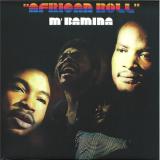
M’Bamina – African Roll (1975)
The story of an album born between Africa, Italy, and the nightclub culture of the 1970s
In the heart of 1970s Italy — a country undergoing profound social change and a music scene just beginning to open itself to distant sounds and cultures — an extraordinary, almost improbable story took shape. It is the story of a group of young African musicians who found their way to Europe, of a Turin nightclub that became a crossroads for communities and experimenters, and of an album which, released in small numbers and largely unnoticed at the time, is now considered a rare jewel of Afro-fusion.
The band called themselves M’Bamina — an ensemble of musicians from Congo, Cameroon, and Benin, who arrived in Italy in the early Seventies. Settling between northern Italy and the Pavia area, they began performing in small clubs and community events, bringing with them a vibrant rhythmic heritage: African polyrhythms, call-and-response vocals, funk-infused bass lines, and Caribbean or Afro-Latin colours absorbed along their musical journeys. Their raw, contagious energy on stage quickly drew attention.
Meanwhile, in Turin, another story was unfolding. There was a venue becoming almost legendary: Voom Voom, one of the city’s liveliest nightclubs, run by Ivo Lunardi. The club attracted an eclectic crowd — students, artists, foreigners, night owls — and Lunardi quickly understood that the dancefloor wasn’t just a place for music, but a melting pot for a new kind of cultural energy. Out of this vibrant atmosphere came his idea: to turn the club’s name into a small independent record label, Voom Voom Music, capable of capturing the spirit of those years and giving voice to unconventional projects.
When Lunardi heard M’Bamina, he immediately sensed that this was the sound he had been searching for: fresh, different from anything circulating in Italy at the time, and capable of blending African tradition with funk and European sensibility. He brought them into the studio.
Production was handled by Lunardi along with Christian Carbaza Michel, while the engineering was entrusted to Danilo Pennone, a young sound technician with a sharp, intuitive ear.
The recording sessions — held in Turin in 1975 — produced a remarkably warm and direct sound. The music feels almost live: grooves rooted in African tradition, but open to funk-rock structures and modern arrangements. It is a natural fusion, never forced. Tracks move between tribal rhythms, funk basslines, light electric guitars, congas and Afro-Latin percussion, with call-and-response vocals and melodies that echo both Congolese tradition and the lineage of Latin jazz. Not by chance, one of the album’s most striking tracks, Watchiwara, reinterprets a Latin standard through M’Bamina’s own rhythmic language.
The album was titled African Roll — a name that was already a statement of intention. It is African music that “rolls,” that moves, adapts, transforms within a new geographic and cultural setting. It is not strictly Afrobeat, nor Congolese rumba, nor Western funk: it is a spontaneous, hybrid blend, shaped more by lived experience than by any calculated aesthetic program.
When African Roll was released, the world around it barely noticed. Distribution was limited, and 1970s Italy had yet to develop a cultural framework for receiving such music. The national music press rarely paid attention to African or “world” productions. The album slipped into silence — though the band’s own story did not.
M’Bamina continued performing across Europe and Africa, even sharing a stage in Cameroon with none other than Manu Dibango. By the late Seventies, they moved to Paris, signed with Fiesta/Decca, and recorded a second LP, Experimental (1978). Meanwhile, the peculiar record they had made in Turin began to resurface quietly among vinyl collectors, Afro-funk enthusiasts, and DJs hunting for forgotten grooves.
That is when the album’s fate began to shift.
Over the decades, African Roll emerged as an almost unique document: a snapshot of an intercultural Italy before the word “intercultural” even existed, a fragment of migrant history, a spontaneous experiment in musical fusion born far from major industry circuits but rich in authenticity. Original copies began commanding high prices on the collector’s market, and the album became recognized as one of the hidden classics of European Afro-fusion from the 1970s.
Today, more than fifty years later, this reissue finally restores visibility and dignity to a project that deserves to be heard, studied, and celebrated. It is not simply an album: it is the testimony of a rare cultural encounter, born in an Italy unaware of how fertile such exchanges would one day become.
It is the story of a visionary producer, an extraordinary band, and a fleeting moment in which music, migration, and nightlife came together to create something genuinely new.
African Roll is — now more than ever — the sound of a bridge: between continents, between eras, between cultures. A record that, after rolling far and wide, has finally come home.
This is another big moment for us, and if you have read the story on how the Psychology EP came to be, you will know that we spent a long time trying to track Dimension with the Fozbee & Cooz brothers.
This is my era of music, these are the tunes that I was raving to once I first got my driving license in 90/91. Its a style of music that has influenced pretty much my whole musical career. I find it fascinating that this music was basically by hip hop heads who only a year or two before would of discovered rave. A truly unique musical style and culture that could of only come out of the UK.
Check the soundfiles below and take yourself back to an illegal rave in a secret woodland in Wiltshire in 1991 where ravers, b-boys, hippies and new age travellers all partied together.
New album by SABA ALIZADEH, a groundbreaking voice in contemporary Iranian music who blends classical Persian traditions with avantgarde experimentation.
Born in Tehran in 1983 as son of the world renowned tar and setar virtuoso HOSSEIN ALIZADEH, SABA ALIZADEH established himself not only as a true master on the Iranian spike fiddle kamancheh but one of the groundbreaking voices in contemporary Iranian music, blending classical Persian traditions with avantgarde experimentation. His music, praised by THE WIRE as "a bridge between the ancient and the contemporary", turns sound and image into powerful narratives of memory and resistance. Over the past years, ALIZADEH (who relocated to the Netherlands a few years ago) has appeared at key festivals and venues such as Reeperbahn Festival, CTM, Flow Festival, Philharmonie Berlin, Kölner Philharmonie, solidifying his reputation as a singular live performer.
After the critically acclaimed releases "Scattered Memories" (his international debut, released on Karlrecords in 2019), "I May Never See You Again" (2021) and last year's "Temple of Hope", his new album fascinates again with a unique artistic voice, weaving together centuries-old sonic heritage and the urgency of the present through deeply immersive, meditative landscapes in two epic pieces. "Rituals Of The Last Dawn" may feel like a sad or resigned title (compared to the positively fierce "Temple Of Hope"), but at the same time the highly meditative music provides a good lot of contemplative strength. Appealing to an open-minded "world music" audience as well as fans of current streams of ambient or drone in its most subtle forms, ALIZADEH's latest work is a strongly needed soul food in bitter times. Created on the spot with his musical partners PIETRO CARAMELLI (guitar and electronics on "First Ritual") and LIEW NIYOMKARN (lap steel and electronics on "Last Ritual"), "Rituals Of The Last Dawn" is a pure, unfiltered emotional expression from one of contemporary Iranian music's leading artists.
No Drama, the label founded by Roy Rosenfeld, continues its vinyl and digital series with a new release from Eli Nissan, an artist whose work consistently rewards close listening.
The musical material unfolds over 15 minutes and 4 seconds, offering a concise yet layered statement.
While Hedonism opens with driving percussion and a flexible groove, layering textures and effects into a high-energy, immersive cut built for peak-time moments, Shout closes the release with a deeper, more introspective direction, blending vocal samples with a laid-back, psychedelic flow balancing repetition and variation to create a sense of elevation and continuity.
Concise, versatile, and DJ-ready, the fifth edition of the No Drama catalog continues the path with clarity and purpose.
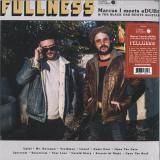
There’s a special kind of feeling when everything falls into place - when the drums bounce easy, the bassline rolls steady, and a bright guitar line cuts through the warmth of tape. That feeling became the heart of the FULLNESS, from Marcus I meets aDUBta. The sound of FULLNESS is built on simple, living elements: real drums, deep bass, a warm sound, and melodies that leave space to breathe. It moves between Early Reggae, Rocksteady, and Roots - sometimes straight and solid, sometimes stretching out into Dub and Echo. With its voice, from singer and lyricist Marcus I, FULLNESS carries the message about gratitude, love, freedom, and the small moments of everyday life. While Marcus’s singing style nods to the great singers, he stays grounded in his own experience, which perfectly complements aDUBta’s production, giving him space to shine. This LP is a complete, warm, balanced, and uplifting experience from start to finish.
FULLNESS grew from a steady musical exchange between Marcus I and aDUBta - two people on different sides of the Alps (Marcus I in France and aDUBta in Germany), finding a shared rhythm. What began in early 2022 with a few Riddims sent back and forth soon turned into a regular flow of songs. Every week brought new ideas, new words, and new melodies. When they finally met in person at aDUBta’s Attic Roots Studio in Bavaria, Germany, it all fell naturally into place. Most of the instruments were played by aDUBta, and the whole LP was mixed live on his Tascam 388, keeping that raw, handmade feel. With several friends helping bring even more color into the music, aDUBta brought in Viti Sanchez to lend his expressive saxophone and horn lines, Michael Salvermoser with his warm trombone tones, and members of the Black Oak Roots Allstars - King HuHa and Jannis Klenke on bass and guitars, along with Morry 'Da Baron' (Dub Inc.) on bass. FULLNESS means the fullness of music, of life, of friendship, of gratitude. It’s what happens when music becomes more than a project - when it turns into a shared space where things just flow.
Fresh for 2026, Something System Records returns with its second four-track EP, showcasing a carefully curated selection of forward-thinking underground sounds from across the DnB and jungle spectrum.
A1 – Creativity
Oxford-based producer SR makes his label debut with Creativity. Having already built a strong reputation through multiple vinyl releases and production collaborations with JEMONE on Metalheadz, SR delivers a powerful opener defined by tense atmospheres, razor-sharp drum programming, and weighty sub-bass. Designed to move both dancefloors and minds, this is a standout introduction.
A2 – 3 Times Around The Sun
Duburban & Peeb return to Something System Records for their second appearance following a prolific period of releases on some of the scene’s most respected labels. This track channels lush, uplifting pads reminiscent of the golden era of Good Looking Records, underpinned by warm sub frequencies and expertly edited drumfunk breaks that evolve beautifully throughout. A deeply musical and rewarding listen.
B1 – Fresh Outlook
Bristol-based producer Loma returns to the imprint with Fresh Outlook, a finely crafted 140 BPM jungle roller. Featuring intricately layered breaks, precisely placed subs, and an immersive atmospheric backdrop, the track takes the listener on a dynamic journey. With previous releases on John B’s BETA Recordings, Loma continues to demonstrate a bright and promising trajectory.
B2 – Tell Em Purdie
Closing the EP, Something System Records proudly welcomes Pixl to the label for the first time, collaborating alongside Duburban & Peeb. A seasoned producer with releases on numerous highly respected DnB labels and founder of Loop Progression Records, Pixl brings depth and experience to this jazz-infused finale. Smoky club atmospheres, textured breaks, deep subs, saxophone lines, and a spoken-word sample referencing a legendary drummer combine to deliver a rich, soulful conclusion to the EP.
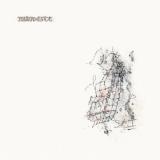
Australian composer-performers Judith Hamann and James Rushford have worked together in countless projects for two decades, perhaps most notably in Golden Fur, their trio with Sam Dunscombe. Black Truffle is pleased to announce Midmeste, their first work as a duo. Its title is Middle English for ‘the middlemost point’, alluding to how the piece builds on the points of overlap between the highly personalised musical languages Hamann and Rushford have developed in recent years. Performed on cello and a variety of pipe organs, Midmeste is a spacious, sometimes unsettling exploration of their shared interest in alternative tunings, psychoacoustic phenomena, the physical properties of their instruments, and the usually peripheral sounds generated by the performing body.
Beginning with a sequence of austerely vibrato-less harmonics from Hamann's cello, trailed by Rushford's whistling portative organ tones, the music soon expands into a slow-moving melodic wander, pausing at times to linger over an uncomfortable harmony or particularly resonant cello tone. Hamann and Rushford have long histories of engagement with pre-Classical European musical traditions, having in past projects performed and radically extended the work of Solage, Louis Couperin, Johann Conrad Beissell and other composers. Here they use a 15th century song by John Dunstaple, ‘O rosa bella’, which returns throughout the piece, distorted, aerated and splayed into new forms.
Developed while the two shared residencies at Akademie Schloss Solitude, Stuttgart in 2020 and La Becque on Lake Geneva in 2023, Midmeste integrates recordings made (at at the invitation of the Biennale Son) on the organ of the Basilica St Valere in Sion, Switzerland—the world’s oldest playable organ, built in the early 15th century. Played by both Rushford and Hamann, the instrument’s idiosyncratic features, including bellows pumped manually using massive wooden beams, are integrated into the music through amplification. Creaks and thumps locate the music physically both in the performers’ bodies and the specific site of its making. Moving through a series of distinct episodes across its forty-minute span, Midmeste makes space for near-silent duets of high harmonics and hissing air, moments where twittering high tones and rumbling sub-bass could be electronic, and static fields that unexpectedly blossom into almost Romantic harmonies.
Listeners familiar with Hamann and Rushford’s work will find many familiar features here: the stunningly rich cello tones, their patient sustain allowing heightened awareness of the inner life of sound and its interactions with the environment; the care with which acoustic space is activated, becoming at times a third instrumental voice; the attention to fragile, unstable sonorities that sometimes have a comic edge. A major work from two key figures in contemporary experimental music, Midmeste synthesises rigorous exploration of fundamental questions of sound and performance with an unapologetic embrace of beauty.
- A1: Herbaliser – A Mother
- A2: Small World – Livin’ Free (Soundtrack Mix)
- B1: Tango – Spellbound
- B2: The Lab Rats – Give My Soul
- B3: Statik Sound System – Revolutionary Pilot
- C1: Jmj & Flytronix – In Too Deep
- C2: Aquasky – Kauna
- C3: James Bong – Mr. Kiss Kiss Bong Bong (Big Brothers Dubbing You Full On - Dub Tractor Remix)
- D1: Hardfloor Presents Dadamnphreaknoizephunk – Dupdope (Dubdope)
- D2: Thievery Corporation – Shaolin Satellite
- D3: Kruder & Dorfmeister – High Noon
- E1: Beanfield – Keep On Believing
- E2: Sapien – Que Dolor
- E3: Shantel – Bass And Several Cars
- F1: Karma – Look Up Dere
- F2: Showroom Recordings – Radio Burning Chrome
- F3: Kruder & Dorfmeister – Black Baby (Dj-Kicks)
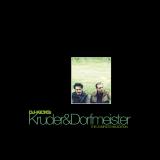
For its 30th anniversary, Kruder & Dorfmeister’s DJ-Kicks is available for the first time in mixed form on 3LP, remastered by Bernie Grundman and packaged in a special box set including original imagery. Kruder & Dorfmeister's rendition of the series created an era defining moment, which tied together a glowing array of musical registers. The Viennese downtempo royalty blended a fusion of slowed down moments across many genres with rolling Drum and Bass from the likes of Aquasky, the melting acid lines of deep Hardfloor and the 90s boom bap sampling, smoked out atmospherics of Thievery Corporation amongst many more.
These masters of mood channeled the sound of a moment with their DJ-Kicks, which still retains a certified cinematic sheen, the patina of the real – curation and mixing at its most playful and refined. It remains to this day one of the most recognizable DJ-Kicks and mixes of all time. Containing two certified cuts from K&D themselves; the wooze is strong on “High Noon” with Dorfmeister's intoxicating jazz flute licks and a trembling harmonica atop a mirage of breaks. Their DJ-Kicks original and legendary tune “Black Baby” closes the mix providing a piece of grandeur, riding off into the distance deep to the vanishing point.
When the mix dropped in 1996, the slo-beat pioneers were among the hottest producers in the dance universe. Even though they only produced two unreleased maxis, names like Count Basie, Bomb The Bass, Alex Reece or United Future Organization had some of their tracks remixed by these exceptional producers. Rumour has it during the work for DJ-Kicks and their debut album they refused doing remixes for U2, Grace Jones, Elvis Costello and the Fantastic Four! ‘DJ-Kicks: Kruder & Dorfmeister’ took its place in the pantheon a long while back, effortless in its ability to traverse sounds, styles and tempos while retaining a selection which remains timelessly recognisable as: Kruder & Dorfmeister.
Time To Get On Board A New Black Universal Express.
With each new recording Anthony Joseph presents an imaginative, personal vision of contemporary black culture, and The Ark is yet another compelling album by the award-winning Trinidadian poet and musician. This second part of a sequence of two albums launched with last year’s Rowing Up River To Get Our Names Back, finds Joseph giving full vent to his desire to explore many thought-provoking themes. However, there is a specific thread running through the glorious offering of sounds.
”I was especially interested in the idea of using Afrofuturism as a means of using the future in order to correct the wrongs of the past,” explains Joseph. “And so a lot of lyrics reimage or imagine an alternate black history. At the same time there are elements of autobiography.” The aforesaid cultural phenomenon, a view of the black experience through the prism of science fiction and ancient Egypt and Africa, as mapped out by visionaries from music and literature such as Sun Ra, Parliament-Funkadelic and Octavia E. Butler, has previously inspired Joseph. His 2006 novel The African Origins Of UFOs was a multi-hued work, and the new music shows how Joseph
has, much like all significant artists, gone on to broaden his conceptual palette, creating beguiling new stories and images set to startling rhythms and tones. Tracks such as ‘James’, with its taut, crisp bass and dubbed-up brass, and ‘Transposition Of Space (Glissant)’, a potent evocation of the influential Martiniquan theorist set in a haze of jazz guitar and ambient synthesizers, are marvels of text-sound painting.
As for ‘Baron Samedi’, shaped by a languid, almost wounded guitar line and slow rise of horns that frame Joseph’s journey to the ‘mountain of fire, almost touching the sky’ it is an epic blend of commanding vocal delivery and dramatic sonic tapestry.
Joseph led the Spasm band in the early 2000s and recorded well-received albums such as Bird Head Son and Time, in which songs were largely based on spirituals or chants enhanced by improvisation. But his musical curiosity has naturally led to collaborations, and the new work is produced by Dave Okumu, the prodigiously talented guitarist-vocalist-composer known as the leader of Mercury Music Prize-nominated The Invisible, and who was also a member of the seminal band Jade Fox.
Having first performed together at a show curated by influential saxophonist-flautist Shabaka Hutchings at the storied Total Refreshment Centre In London during lockdown, Joseph and Okumu struck up a rapport that further developed when the former guested on he latter’s album. With the connection made Joseph knew Okumu was the ideal producer for this latest project, which has a freewheeling, almost black psychedelic thing. After sifting through demos and loops the guitarist made on pro-tools the poet started to live with the music. Many months later words began to take shape. Joseph then went into the studio with Okumu’s band and set about creating a magnum opus. Boasting a stellar cast such as vocalist Eska Mtungwazi, trumpeter Byron Wallen and keyboardist Nick Ramm, The Ark is a highly intricate musical mosaic framed by simmering funk grooves, wily jazz improvisation and haunting dub effects. Through the use of many genres the music has simply become its own genre.
The Ark can be perceived as a vessel or means of transport to new worlds, along the lines of Sun Ra’s Ark or Funkadelic’s Mothership, and the material it contains is a unique blend of who Anthony Joseph is and how he sees the world and society in these stimulating, challenging times. “It balances the personal with the universal in a much more vulnerable, accessible way than on previous albums,” Joseph explains.
“It has become less about a personal experience and more about a collective, communal experience in which the artist is conduit, messenger, urban griot.”
- 1: Wild Geese Arrive
- 2: Awaken The Insects
- 3: Mantis Vs Horse
- 4: Grain Rain
- 5: Tiger Sex
- 6: Feed The Fireflies
- 7: Offerings To The Beast
- 8: Limit Of Heat
- 9: Thunder Begins To Soften
'The Endless Dance' is the first collaborative album from Northern Irish producer and composer Hannah Peel and Chinese percussionist Beibei Wang. The record is grounded in the strength of ancient concepts, but comes alive with the joy and freedom of play as together, Peel and Wang travel through the 24 solar terms of the Chinese calendar with a cornucopia of sound in tow – synths and prepared piano alongside traditional and unconventional percussion.
The album is collaged together from recordings made over five days at legendary rural studio Real World, a setting which aligned with the duo’s inspiration from the natural world creating a permanent record of their shared musical landscape, informed by the flora and fauna that emerge and retreat through the seasons.
Both genre-defying, storied artists in their own right, Peel and Wang met while working on Manchester Collective’s 2023 album NEON and 'The Endless Dance' certainly represents a step-change from the duo’s shared classical backgrounds – but their knowledge and training is also the foundation of its freewheeling audacity, giving them the confidence to trust their instincts.
The album is produced by Mike Lindsay LUMP, Tunng, Guy Garvey, Jon Hopkins who, with free rein, brings added energy and creativity to the album, whilst Peel & Wang are also joined by Hyelim Kim on Daegeum, a Korean flute with “colourful overtones on every note”.
Track to track, 'The Endless Dance' is unpredictable and unexpected, which is in part due to the genuine curiosity and outside perspectives that each player brought to the sessions. “I am so familiar with Chinese heritage, but I don't see how it can present in electronics, for instance,” says Wang. “Hannah comes in with that direction, to imagine what the sounds could be together.” The characterful richness of the album stems from the commonalities they found in the sessions. “We both come from cultures where story is really important,” explains Peel. “The attention to detail comes from telling a story, and one note can set that off in a different direction.”
'The Endless Dance' is a major work from two accomplished, singular artists - but it’s also the sound of mutual curiosity and shared fun, or as Wang puts it: “Two women talking in totally different language that had a wonderful chat.”
- A1: Sensation 04:33
- A2: Tropics 9500 05:31
- B1: Lumbago 05:33
- B2: Idiocracy 04:18
- B3: You Suck Me Dry 03:23
Step into a candy box of sound: sweet Italo-infused house and tangy, bass-heavy breaks. Some tracks hit like hard candy, daring you to bite, while others are sticky and irresistible, gluing you to the dancefloor. B.Visible tasted all the sweet treats without losing a tooth, but the synths took a proper beating. On this DJ tool, you'll find a track for every part of your set, with a package that nods to '90s electronic music without losing its timeless charm.
B.Visible is a Vienna-based DJ and producer. His sets blend danceable beats with a strong musical vision - ranging from disco and house to breaks and experimental electronics, complemented by rare vinyl discoveries. Each selection is surprising, versatile, and curated with great attention to detail. His productions are just as multifaceted as his DJ sets: warm drums and organic textures meet carefully crafted electronic elements designed with the dancefloor in mind. The result is a distinctive signature style - accessible, diverse, and independent. His music is regularly featured on Austrian radio stations such as FM4 and receives international
support from BBC DJs including Gilles Peterson, Tom Ravenscroft, and Don Letts. B.Visible's music thrives on surprise and depth - whether in the studio or on stage, it always unfolds with a unique dynamic, drawing audiences in from the very first moment.
- A1: In Comedy (And I Music)
- A2: Rude Crude Lude
- A3: True Story
- A4: Laughter (Is The Best Medicine)
- B1: In Comedy (And I Music) Ii Feat. Ala.ni
- B2: Punchlines
- B3: Punchlines Ii
- B4: How Do You Write A Joke?
- B5: What Is Stand-Up? Feat. Ala.ni
- C1: A First Lady
- C2: Marina
- C3: Stand-Up Like Richard. Feat. Vic Mensa
- D1: A Raunchy Comedian
- D2: Dulce
- D3: Killed By Police
- D4: L.o.l
Funny How? is Christophe Chassol’s fifth album.
While it builds directly on his work with the “Ultrascores,” it also marks a turning point: a more contemporary sound, broader songwriting, and more explicitly political and social themes make Funny How? his most accomplished album to date. It’s also his most accessible: inspired by American stand-up comedy, Funny How? sounds like a joyful mix of all the music that inspires the artist: soul, jazz, rap, musicals… Thus, throughout the album, major stand-up figures like Dave Chappelle, Marina Franklin, Dulcé Sloan, and Tiny Thickemz appear alongside emerging comedians filmed in more intimate comedy clubs, composing a moving portrait of the new American scene.
Drawing on archival footage and sequences shot for the project in New York and Chicago, and true to his principle of harmonizing reality, he reveals its hidden notes, replaying and developing them throughout a fascinating process. The result is a major work, a choral, political, and deeply musical narrative. In concert, the work unfolds majestically through a hybrid performance where music and images respond to and converse with one another.
The premiere of Funny How? on April 17 and 18, 2026, at the Cité de la Musique in Paris is already sold out. The album is scheduled for release on May 22, 2026.
Details marks SCHiLLiNG's return after years of research, above all on himself. It brings together the practices that have become essential to him: composition, sampling, sonic patchworks, and a palette that mirrors the full spectrum of his musical identity, from Rock'n'Roll to Trip-Hop and Ambient. Details is rich in small edits, hidden layers, fragile textures, and fragments that reveal themselves slowly. Yet the word carries a deeper meaning: what truly matters is often the smallest element, what doesn't appear clearly at first glance or on first listen, yet quietly holds the core of everything. The detail as the very pulse of one's inner world. Across 14 tracks, the album unfolds as a diverse journey, carefully shaped yet open enough to allow unexpected elements and subtle imperfections to remain part of its flow. The structure is not binding, you can begin from any track and embark on your own path through it. Each piece contributes to a wider arc without overpowering the others. The album includes collaborations with several artists who lent their talent to the project; their names appear in the credits of the physical release. In many ways, they embody the very idea behind the title: individual presences, each bringing their own nuance, forming a whole together. After all, fragments, in their union, shape the larger totality. Details doesn't ask to be consumed in a specific way, fast or slow, close or distant. It simply is what it is
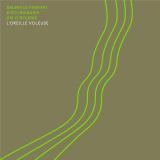
Persistence of Sound releases a new work by Brunhild Ferrari called »L’oreille Voleuse« (The Thieving Ear). The LP features an extraordinary live reinterpretation by Eiko Ishibashi and Jim O’Rourke, recorded in October 2025 in Paris.
»No, without listening at doors, the ear captures noises here and there and unexpected sounds without choice, but remains attentive to the messages of each one picked up over the years. It gathers surprises and impressions, bringing them together in a simple mix. In waking up these ear memories again, which were mostly recorded on magnetic tapes, I am very happy about the collaboration of Eiko Ishibashi and Jim O'Rourke in playing on this mix tape.« Brunhild Ferrari
Eiko Ishibashi is a Japanese composer, singer, and multi-instrumentalist who has developed a unique body of work blending experimental pop, improvisation, and film music. Her work, praised for its expressive intensity and sensitivity to sonic textures, has led her to collaborate with numerous musicians on the international scene, including Jim O'Rourke, with whom she forms a long-standing duo. She is also the composer of several film scores, notably for the films of Ryusuke Hamaguchi (Drive My Car, Evil Does Not Exist), which have helped to bring her work to a wider audience beyond experimental music circles.
Jim O'Rourke is an American composer, producer, and multi-instrumentalist, and has been a major figure in experimental and independent music since the 1990s. His work spans rock, improvised music, electronic music, and contemporary music. A former member of Sonic Youth and a collaborator with Wilco, Gastr del Sol, and Merce Cunningham, he has released numerous solo albums and film scores. Based in Japan since the early 2000s, he continues to pursue a rich and multifaceted musical practice, where formal rigor and freedom of invention coexist.
Persistence of Sound was founded in 2019 by Iain Chambers (Langham Research Centre, Rubbish Music). The label explores the world of electroacoustic music, contemporary global field recordings, and the unclassifiable music spanning these genres.
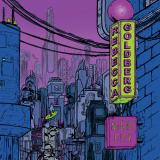
Rebecca Goldberg presents the release of her debut full-length album, Night City, a deeply personal and expansive body of work that reflects a decade of artistic growth, exploration, and connection. Produced and arranged by Goldberg, this album captures the evolution of her sound through years of practice, travel, collaboration and mentorship.
Including 12 tracks across a 2x LP, Night City draws from the rich lineage of Detroit electronic music. Goldberg cites influences from dystopian cityscapes and futurism to space exploration and the possibilities of technology. The result is a forward-thinking genre-spanning collection.
The album features two notable collaborations: “444,” created with Jnn Aprl and recorded in her studio in Seoul, South Korea, and “Tunnel,” featuring Detroit techno artist Tiptonaires. Each collaboration adds a distinct voice and texture to the record’s immersive sonic world.
Night City was mixed and mastered by Andy Toth, with album artwork illustrated by Mark Sarmel. A limited run of vinyl is available for preorder now, pressed at Archer Record Pressing Co. in Detroit. The album will be released on Detroit Underground.
At its core, Night City is an offering shaped by experience and guided by curiosity, marking a significant milestone in Rebecca Goldberg’s musical journey.
With »News from Planet Zombie«, The Notwist return to view after years of exploration and experiment with an album rich in both melancholy and positivity, sketched across a suite of thrilling, fiercely committed pop songs. It’s an album reflecting a chaotic world, but responding with warmth and generosity, to achieve creative and spiritual consolidation. Recorded in their home base of Munich, it reconnects with the security of the local to explore the troubles of the global: a guiding impulse writ large across this album’s eleven songs. It’s also the first studio album since 1995’s »12« that the entire band recorded together in the studio in its expanded live formation.
A new album by The Notwist is always a curious endeavour; their musical language is as consistent and resilient as the contexts for creativity are unpredictable and ever shifting. For »News from Planet Zombie«, the core trio of Markus and Micha Acher and Cico Beck embraced the plural possibilities of writing together, bringing songs to the collective and then arranging, rehearsing and recording that material live, in the studio.
The result is an album that’s energised, fully in ›the now‹, with spectacular moments where you can hear the magic bubbling up in the dynamic between the Achers, Beck, and fellow members Theresa Loibl, Max Punktezahl, Karl Ivar Refseth, and Andi Haberl. If »Teeth« begins »News from Planet Zombie« quietly and reflectively, by »X-Ray« everyone’s supercharged, blasting out future anthems with the collective energy cranked up high. The chiming keys of »Propeller« skim the instrumental’s surface like stones across burbling water; »The Turning« clangs its way into one of the album’s most heartwarming melodies.
»News from Planet Zombie« was recorded over one week at Import Export, a non-profit space for arts and music. You can tell, too; there are some pleasingly rough edges here, as though The Notwist’s striving for hazy perfection means they’re also confident enough to let the songs breathe and mutate between our ears. That openness to chance also takes in guest turns from friends both local and international, reflective of a cosmopolitan Munich: Enid Valu joins in on vocals, while Haruka Yoshizawa guests on taishōgoto and harmonium, Tianping Christoph Xiao on clarinet, and Mathias Götz on trombone.
The Notwist aren’t best known for cover versions, but »News from Planet Zombie« features two: a gorgeous version of Neil Young’s »Red Sun« (from 2000’s »Silver & Gold«), which the group originally developed for a theatre play directed by Jette Steckel, and a take on Athens, Georgia folk-pop gang Lovers’ »How the Story Ends«. They slot into the album’s narrative perfectly, nestling in like old friends, revealing The Notwist as poetic interpreters. Played well, the cover version is both acknowledgement of fellow travellers and act of generosity, and The Notwist nail both aspects here.
And that narrative, the way the album plays out? »News from Planet Zombie« acknowledges the distress of our current geopolitical impasse, while reminding us there are collective ways forward. Fed through the figure of the zombie, Markus Acher explores our anxieties: »In the title and some lyrics I reference B- and horror-movies, which is a reference to the crazy world at the moment, which seems to be like a really bad and unrealistic B-movie.« But there’s a reminder here not to lose the thread entirely, that these things, too, will pass.
»The river here in Munich I often go to has been there forever and will be there long after us,« Acher reflects, pinpointing an important source of succour for him, »always the same but always changing. Very calming, but also always reminding me that like this river time only flows into one direction and you can’t go back. Every moment is very precious.«
Artwork by Marie Vermont
The Notwist:
Markus Acher: vocals, guitar
Micha Acher: bass, sousaphone, euphonium, trumpet
Cico Beck: electronics, keyboards, guitar, recorder, percussion
Theresa Loibl: bassclarinet, clarinet, piano, harmonium, organ
Max Punktezahl: guitar
Karl Ivar Refseth: marimbaphone, vibraphone, glockenspiel, congas, percussion
Andi Haberl: drums, dulcimer
+
Enid Valu: vocals on 1, 2, 3, 4, 5, 7, 9, 10, 11
Haruka Yoshizawa: taishōgoto on 6, harmonium on 9, 10, 11
Tianping Christoph Xiao: clarinet on 4, 10, 11
Mathias Götz: trombone on 4, 10, 11
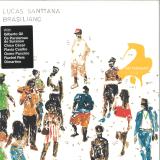
Lucas Santtana’s tenth album celebrates the vitality and musicality of the Romance languages.
The heir to Brazilian tropicalism, Santtana marks 25 years of his career with Brasiliano, a true collective celebration that brings together prestigious collaborators: Gilberto Gil, Oxmo Puccino, Flavia Coelho, Piers Faccini, Chico César, Paralamas do Sucesso, Cocanha, Dimartino, Karyna Gomes, Tainara Takua, Rachel Reis and Maria Lado.
Sung in eight different languages, Brasiliano is both an ode to linguistic diversity and a testament to its symbolic power. Carried by luminous and layered arrangements where voices intertwine like a polyphonic conversation, the album treats language as a musical instrument in its own right, but also as a political tool. Santtana questions cultural heritage, identity, colonial memory, and the possibility of a shared language. With his singular approach—blending popular rhythms, contemporary soundscapes and vibrant melodies—he celebrates the love and exchange embodied in Romance languages, where music becomes fertile ground for encounters and reinvention.
Oinimod Records proudly presents its first-ever vinyl release, Gravity EP, a statement of intent rooted in deep grooves, timeless house aesthetics, and club-driven energy.
Written and produced by Duccio Lopresto, Gravity EP delivers two original cuts that explore different shades of House music, complemented by a powerful remix from Gearmaster, one of Estonia's most respected House talents.
“Gravity” opens the EP with a deep and groovy House journey inspired by the classic Detroit House legacy. A strong rhythmic foundation drives hypnotic acid lines and rich, expressive synths, creating a track that is both raw and elegant, built for the dancefloor yet deeply musical.
“Mirage” reveals a more dreamy and introspective atmosphere. This Deep House track flows with a timeless rhythm, warm grooves, and relaxing yet melodic elements, offering a soulful and immersive listening experience that transcends trends.
Closing the EP, Gearmaster delivers a pure Club House banger remix of Gravity, reinterpreting the original material with precision and power. Tight rhythms, infectious groove, and a modern club sensibility turn the remix into a peak-time weapon, showcasing Gearmaster’s unmistakable touch and deep understanding of the dancefloor.
Gravity EP marks the beginning of Oinimod Records’ vinyl journey — a release that bridges classic influences and contemporary House music, crafted for DJs, collectors, and true House music lovers.
Stay True Sounds presents a vinyl-focused celebration of a modern dance music classic.
Jazzanova need no introduction. For over two decades, the Berlin collective has shaped the sound of soulful electronic music — timeless, refined, and rooted in pure musicality. Their collaboration with the ever-smooth Vikter Duplaix produced That Night, a track that has since lived many lives on dancefloors across the world.
Central to its legacy is the Wahoo Remix by Dixon and Georg Levin — a cult favourite that continues to resonate from Berlin to Johannesburg. This vinyl release brings together key reinterpretations of that remix, spotlighting South African artists who have added new dimensions to an already iconic recording.