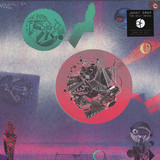
Moff & Tarkin's second Lagaffe installment marks the label's 8th vinyl release. The release sports three original tracks from the Austrian-based Icelander and a remix from label boss Jonbjorn.
The record starts of with the track 'Buzz Lightyear', who flies us off out of the atmosphere filled beginning into the depths of the spacey synths, delays and feedback.
Followed is the track 'Friends Be like', which feels like a refreshing strut down the boulevard where everyone you meet knows you and you know them but instead of saying hello you are wearing headphones and just strut down the street nodding, winking and walking in beat with true swagger. A track with confidence written all over it.
The flip side features the track 'Takk!' which roughly translates as Thank You! in Icelandic. Maybe not roughly, but rather exactly. The track is dramatic and starts off rather stress inducing but takes a whole new direction when Moff n Tarkin adds in soothing piano chords and makes the track's whole mood switch.
Maybe its a fitting goodbye for the listener as you make your way through label boss Jonbjorn's remix which has a very warm and feel good atmosphere, lush drums and elements that add on layers to the already great original. A very personal remix and a good ending to a great record that we hope you can enjoy.
V & B
Поиск:its not over
Все
- A1: Not Drowning, Waving - Frogs
- A2: Mark Pollard - Quinque Ii
- A3: Blair Greenberg - Beach
- A4: John Heussenstamm - Sawan
- A5: Beyond The Fringe - Guitar Fantasia
- B1: Meera , Atkinson - White
- B2: Free Radicals - My Lips Are Moving
- B3: John Elder - Again
- B4: Helen Ripley-Marshall - Under The Sun
- B5: Blair Greenberg - Rainforest
- B6: Sam Mallet - Westgate Bridge At Dawn
- C1: Gary Havrillay - Temple
- C2: Ros Bandt - Starzones
- C3: John Elder - Wayayisma Petra
- D1: Sam Mallet - Stream Daimons' Speak
- D2: Blair Greenberg - Gleaming
- D3: Robert Bleeker - Glowing Trombones
- D4: Tom Kazas - Blankets Of Ice
- D5: Errol H. Tout - As Darkness Falls
Midday Moon is a survey of ambient and experimental music that emerged from Australia and New Zealand between 1980 and 1995. These recordings are sourced from a rich variety of micro-labels, private pressings, theatre soundtracks and artists' personal archives. Curated by Melbourne based DJ and archivalist, Sanpo Disco (a.k.a Rowan Mason), the collection delves deep into the world of outsider music that emerged in Australia and New Zealand in the latter half of the twentieth century, as synthesisers and early workstations began to enter the consumer marketplace. The record is an odyssey in itself, a journey that takes listeners into the unsung world of Australian new age composers. There are stories abound within this volume, from the mysterious disappearance of Helen-Ripley Marshall after the release of her 1988 album 'Green Chaos', to the journey of American-born, Perth based blues/rock guitarist John Heussenstamm, who unexpectedly turned his finger to 'ambient' music in the late 80's; and again from Melbourne based Ros Bandt, who made a series of recordings exploring the resonance of a hollow concrete cylinder 5 stories beneath busy Collins Street in Melbourne's CBD. Compiled by Sanpo Disco / Mastered by Mikey Young . '(Ambient music is) a surrounding influence that induces calm and a space to think... it can accommodate many levels of listening attention without enforcing one in particular.' - Brian Eno / 'A richer and more diverse ambient genre began to form. Music that crafts a unique cultural geography of landscapes and atmospheres: real and imagined, natural and man-made. Some artists turned their attention to the singular acoustic ecologies of overlooked spaces around the country. Others fostered interests in non-Western music cultures and instruments. The common thread is their use of new technologies to conjure interior and exterior regions, through acoustic and synthesised sounds.' - Sanpo Disco
White Shadows In The South Seas is the title of a book written in 1919 by Frederick O'Brien as part of a trilogy he wrote based on his experiences living in the Pacific islands in the early part of the 20th century. His book was taken as the starting point for a film to be directed, initially, by Robert Flaherty (famous at the time for his groundbreaking documentary / fiction film Nanook Of The North) with W.S.Van Dyke as his support. The film, ultimately, apart from the title, had little to do with O'Brien's book and Flaherty left the film after a few months leaving Van Dyke to finish it.
I purchased O'Brien's book, along with many others, from Basement Books, a secondhand bookstore in Melbourne/Australia. Part of my 'Islomania' and on going fascination with all things Pacific. When I discovered there was a 1929 silent film based on the book I sought it out and started to present it as part of my 'Live Music/Silent films' repertoire. Tabu by Frederick Murnau, which coincidently also had Flaherty as co-director originally, was the first film I ever wrote / improvised a score for and presented as a live film/music performance. My repertoire extends to over 23 films now.
My eclectic and diverse musical and artistic interests extend into 'Hawaiian', 'Exotica', 'Ambient' and 'Electronic' Music. I have produced several volumes of so called 'Electronic, Ambient, Exotica' on CD and Vinyl, including Kiribati, Globe Notes, Rayon Hula ( on Vinyl, CD and digital format ) and most recently, New Globe Note on Vinyl and White Shadows In The South Seas on CD.
White Shadows In The South Seas features some of the music presented in my live screenings of the 1929 silent film.
The film is the story of Dr. Matthew Lloyd, an alcoholic doctor who is disgusted by the exploitation by white people of the natives on a Polynesian island. The natives dive for pearls, however, numerous accidents occur and one diver dies. In anger, Dr. Lloyd punches Sebastian, the employer. As revenge and to prevent further interruption of his activities, he tricks Dr. Lloyd onto a ship with a diseased crew (thinking they are ill) and his men rough him up and send the ship off into a storm. Dr. Lloyd survives and is washed ashore on an island where none of the natives have ever seen a white man before. Lloyd is rescued and ultimately falls in love with the chief's daughter, who is Taboo, hence Lloyd is prevented from pursuing his love for her. An incident occurs and a young boy is thought to have drowned but Lloyd is able to revive him, earning him points and permission with the chief's daughter. Lloyd begins to realise that the local islanders have no sense of the value of the black pearls which grow in abundance around their island and he starts to dive for them and collect them. One morning the white man Sebastian unexpectedly turns up on a scooner and starts to offer the islanders trade for their pearls. Llloyd tries to interrupt the encounter and is shot and dies. His wife and the islanders morn for his dead body and, symbolically, the passing of a way of life.
Mike Cooper plays - Electric and acoustic lap steel guitars / electronics / Zoom Sampletrack / Kaos Pad / Casio SK1 / Korg Drum Machine / Self Made Instruments.
It also features field recordings made on Pulau Ubin by Mike Cooper during a month as Artist In Residence for The Artist Village / Singapore.
I would like to acknowledge and thank Lawrence English (Room40 Records) for his assistance and encouragement with the original recordings and the CD version of White Shadows In The South Seas.
All music written and played by Mike Cooper PRS/MCPS - except Po Mahina (trad. Arr. Cooper) and Hilo Hanakahi (trad. Arr. Cooper)
Recorded and Mixed at the Steelworks in Rome 2012/2013.
A White Shadow In The South Seas
In February 2014 'A White Shadow In The South Seas' was the title of an audio-visual installation I made at the Teatro In Scatola in Rome, Italy, presented as part of a series of sound installations titled 'Visitazioni' produced by Proposte Sonore.
The essay below, as well as our collection of Hawaiian shirts, Exotica and Hawaiian vinyl records, was an inspiration for this installation.
'..the transformation and reconstitution of the souvenir commodity as an indigenous ethnic art form and a scarce relic of Hawai'i's romanticized past...' from - Clothing and Textile Reasearch Journal - From Kitsch to Chic by Marcia A. Morgado.
And....
Michael Thompson's Rubbish Theory (1979)
' ...a critical aspect of Western culture is the pre-disposition to see objects in terms of two overt categories: the transient and the durable. Objects identified as transient have finite life spans and lose value over time, whereas those identified as durable have infinite lives and over time increae in value....category assignments are arbitrary, but once assigned a category membership determines relative value. Fashion apparel-by defenition-is assigned to the transient category; paintings commonly are designated durables....how is it that transient objects.. ( e.g. Hawaiian shirts and vinyl records ) ..sometimes become durables.
Objects assigned to the rubbish category are largely invisible, have no value and, ideally, no life span. Fashion for example, no longer worn and relegated to the back of the wardrobe has fallen into the covert rubbish category. But rubbish can be rescued and transformed. Thompson says ' What I believe happens is a transient object gradually declining in value and in expected life span may slide across into rubbish. Here it exists in a timeless and valueless limbo where it has a chance to be re-discovered and be successfully transformed to a durable. Such transferes are radical: objects gradually slide from transcience to rubbish, but the transformation from rubbish to durable involves an all-or-nothing leap across two boundaries, that separating the worthless from the valuable and that between the covert and the overt. Things drift into obscurity but they leap into prominence.
The delightful consequence of this hypothesis is that in order to study the social control of value we must study rubbish.
The rubbish-to-durable transformation is accompanied by the development of highly specialized knowledge derived from the discovery of subtle variations and complex details that went unnoticed in the objects transient stage. The discoveries initiate renewed interest in the object and its market value begins to climb. As prices soar beyond the reach of ordinary people, the object becomes available only in high priced collectors' markets. Furthermore, as market values rise, the aesthetic value of the object undergoes a reassessment as well, and it becomes increasingly apparent that the objects intrinsic beauty has been overlooked. Ultimately the object is re -assigned as a durable and becomes recognized as a timeless classic.
Exotica, Ambience and Pacificism - A dialogue with Mike Cooper & Professor Philip Hayward Deputy Pro Vice Chancellor of Research Southern Cross University, Lismore, Australia.
Our Favourite Bothy Botherers Mac-talla Nan Creag (comprised Of Hoch Ma Toch, Other Lands And Lord Of The Isles) Return To Firecracker Recordings, Channeling Ancient Rites, The Mysteries Of The Scottish Landscape And Its Elements Through Technologies Both Old And New For Your Listening Pleasure.
This Time Round The Archaeological Work Of Forestry Commission Scotland At Dun Deardail In Glen Nevis, And The Links Between That Site And The Ancient Celtic Myth 'the Sorrow Of Derdriu' Provided Fertile Ground For New Exploration And Response. Accompanying The Music Once Again Will Be A Lush Booklet Containing Some Of The Stunning Imagery That Results From The Work Fcs Have Done There, All Packaged And Silk-screened With The Usual Finesse We've Come To Expect From Firecracker Recordings And Their Chief Visionary House Of Traps, In Conjunction With 12th Isle's Al White.
Captured In Part In A High Vaulted Medieval Church, Then In Home Studios, Bouncing Ideas Back And Forth Over The Internet, Mtnc Have Once Again Drawn On Field Recordings, Traditional Instrumentation, Analogue Electronics And The Simple Power Of The Human Voice To Create A Shimmering And Expansive Song Cycle.
Whereas The First Album Was Borne Out Of An Intense Period Of Field Trips And Whisky Fuelled Jam Sessions In Brochs And Had A Loose Approach Overall, The Second Is Perhaps More Focussed In Its Themes Relating To The Ancient Tale - Love, War, Beauty And Tragedy All Intertwined - And They Arguably Go Deeper This Time, Conjuring Up Something Of The Fourth World Feel, By Way Of The Firth Of Forth.
With Additional Contributions From Professor John Kenny - Whose Primal Zummoesque Playing On A Range Of Horns Including A Giant Conch Shell And A Replica Of The Ancient Deskford Carynx Underpins Several Tracks On The Album - And Eva Sutherland (daughter Of Other Lands) Who Provides A Reading From The Myth At The Very Beginning, This Is An Album That Not Only Carries The Heaviness Of History But Also Looks To The Light Of The Future.'
Ken Oath slip on their moon shoes for a joint venture with Freda & Jackson, pressing up four cuts that will have you slipping the surly bonds of earth and dancing in the skies. Loaded with basslines heavier than a neutron star and well-chopped breaks, produced with a dubwise ear for space, this is some of the duo's finest material yet 'Kendama' is the heaviest cut here, a deep psychedelic outing that's swathed in an foggy haze. Abstracted digi-flutes and koto plucks are paired with a skull-boring bassline and exacting breakbeat dissection, adding some levity to the leaden heaviness of the track's bass-weight. 'Cubone' slows but retains the hallucinatory haze that coils around all these trackers. Thudding bass anchors the floating drones and glitches, while percussion snakes through the track, building, like smoke slowly filling a room. The steady build is transportive, to the point where you hear the final echo tail trailing out into silence, and wonder how that all time dissipated Flipping over the record, 'Platform 22' is where you'll find the two of them at their loosest. Submerged vibraphone melodies and swirling voices play over a bassline that sounds like its descending the stairs, boisterous and half-drunk, to culminate in an orgiastic percussion frenzy at the end. Spacious and dubwise, 'Noggin' is a tellingly heady closer. Samples are set adrift across the track as they are dubbed-out and dissolved into smears of sound. There's a buoyancy to the whole piece, a pleasant weightlessness that keeps you floating after the final notes fade out. One time for ya mind.
Malfunctioning speakers, & digital dreamscapes, SQUIRRELS ON FILM's 4th release explores the outer reaches of techno with impolite, reckless abandon.
Psychedelic sound explorer Its Own infinite Flower, who was
responsible, along with head squirrels Solar & C.l.a.w.s., for San
Francisco underground punk rave/happening Hostile Ambient
Takeover, unleashes his first official release, The Plumes of Love (ARE BLACK!). After contributing a track to 2017's Spacetime Continuum/ Juju & Jordash curated Air Texture V compilation, this four track EP of abstract tech-noise brings the sounds Its Own Infinite Flower refined in the basements & warehouses of the Bay Area's underground music scene to the wider world, whether it's ready or not.
'Drone, Drugs 'n' Dissonance' creeps into life as a thunderstorm of
white noise, out of which a cold-rave pulse somehow metastasizes into something resembling techno, although this is a deformed, uncivilized, unwanted mutation, separated at birth & raised in a toxic wilderness. It builds slowly before turning up in a rage of digital distortion, a black metal dub party held at the edge of a melting glacier. 'Oh, Empire of Roses' is a Dada Phycho Jazz Electro number. Dissonant synth chords snake around each other in a playful ouroboros of manic future funk, never knowing if it's starting or stopping, coming or going. Relentless bass throbs through the track, which almost threatens to bubble into classic acid electro before fizzling out. On side two there is 'Devotion to a Peacock Angel,' an angular breakdance groove for the characters in the bar scene in Star Wars. Electro dub rhythms keep stay grounded as everything else rips apart in all directions over the course of the track. On 'Misfortunes of El Dorado' a soundsystem bangs in the next room, only the deepest bass escaping, shaking reality until it's torn apart in waves of distortion, a classic techno synth string wandering over the top of everything in a full blown Techno Jazz Odyssey.
SQUIRRELS ON FILM continues its adventure at the edges of techno
with the mind bending stylings of Its Own Infinite Flower's debut EP,
fitted with another beautiful hand-drawn, full color sleeve by New York artist Bert Bergen. The Plumes of Love (ARE BLACK!).
Norwegian artist Tarjei Nyga°rd first touched on the ESP Institute spectrum in 2016 with a limited red flexidisc of Bleusa that accompanied issue 21 of New York City's acclaimed Love Injection fanzine, and since then, his poetic music has been a staple in our arsenal (especially during Summer), for its ability to effectively direct moods is second to none. Across the four tracks on this debut EP, Tarjei paints quite viscerally using the most fundamental of tools—melodic and rhythmic hooks—and as obvious as this may sound on paper, its his deliberate approach to songwriting that brings these productions to life. Bleusa is literally dripping with a sense fantasy and adventure—island pads, golden bent notes, even a cameo bird-call from the infamous Acid House loon—yet Tarjei exhibits a mature level of restraint, a highly sophisticated sleaze recognizable to refined pleasure-seekers. Forus Echo furthers this notion but expands into full-blown rapids of ecstasy, rolling over soft-thumping percussion that mimics the human heart while smothering the listener in euphoric waves of pads and delays. Side B shifts us from the melodic dynamic heard thus far over to a strong rhythmic palette, not acknowledging any specific reference point but loosely hearkening back to early-era turntablism, the demented title track Lost In Lindos is a aquatic beat thats both deep and buoyant, the type of liquid tool that works at any BPM. Øylie closes the EP with a signature ESP vibe that has us lying on our backs, drawing finger pictures in the opium smoke above, feeling the warm embrace of collective consciousness while telepathically harmonizing our plans for a bright utopian future.
A while back Pratt & Moody hit the global soul scene with their Stylart debut 7" "Lost Lost Lost", leaving many exclaiming the words "FIRME ROLA" on its tracks. Some even mistook it for a forgotten oldie. Now this vocal/guitar duo gets together with Cold Diamond & Mink for another dose of grade A soul music.
Not breaking the spell of tautology started with the first 45, "Words Words Words" picks up the tempo from ballad territory into the beat heavy group soul category. The pulsing drum track is laced with majestic horn riffs, tremolo guitar, penny arcade organ, and over everything hover the beautiful lyrics by Pratt and his mysterious harmony singers.
If the first single by Pratt and Moody left you yearning for more soul, this one should blow away the rest of your corporal existence.
Domestic Exile are proud to present the devastatingly deplorable and malevolent recordings (that are sure to corrode yet electrify your ears) by Glasgow's very own KLEFT.
KLEFT aka Vickie McDonald is rooted in and has actively propagated the underground DIY radical queer punk and feminist movement here in Glasgow. Their projects have included the skull crushing sludge doom of Cartilage, the unflinching and infamous multi- membered hard core stars that were DIVORCE and the sacrificial, druid drone glitch of MOURN. Alongside these projects they have uncompromisingly disrupted, motivated and facilitated collective endeavors to take down the capital power structure of the dominant system of patriarchal club venues and abhorrent fuckers in this town.
For this record 'H+ Sexualis', KLEFT explores the neo-modern space where flesh is left behind. Negotiating, analyzing and tearing to shreds the relationship and balance between flesh and technology. KLEFT's expansive and palpable sonic offerings delve into themes of transhumanism and body hacking and seep into our collective skin begging the question; can flesh ever be created digitally. Does a lack of physicality alienate human experience in a post transhumanism society Are we all destined to be skinless yet digitally connected Will the body become superfluous Toward "the utopian dream of the hope for a monstrous world without gender," as stated on Donna Haraway's essay ''A Cyborg Manifesto.'
From the opening track 'Ossein' the listener grasps a foreboding lethargic build up, lurking out of the spatial ritualistic shadows into a sea of suffocating nothingness. A void where there is no gravity. Skeletal and brittle shattering rhythms which echo DMZ / Skull Disco dubstep alongside the more frozen, glacial ominous explorations of grime are often felt proving KLEFT is an artist whose inspirations run deep and wide and generally exist in the darkest recesses of our subconscious. These fearful, disjointed rhythms are set against weightless atmospheric oscillated synths, as if roaming through bleakly opaque, claustrophobic narrow corridors on a first person survival horror video game such as Resident Evil.
Moving through to 'CMBR', KLEFT's dissonant, degrading soundscape ferociously ascends. The resilient kick drum is propulsive and pulverizing akin to 'ardcore tekno - or intense gabba if you have the guts to adjust the tempo up to +8 - aesthetics that overwhelm and agitate finally revealing it's grotesque biological / amorphous bio structure. Elevating the repetitive 4/4 kick to a destructive, distorted banger of a track as layers of converging atonal noise and sound design simultaneously further enhances the sense of imminent radioactive contamination.
Next is 'Writhe, Squirm, Broken' continuing the convulsive, nauseating permutations of the prior track but reconfigured like a mangled, gruesome Cronenberg-esque parasite that has infiltrated an open wound, excruciatingly feeding off of the inner anatomy of it's hosts body from within. Repulsively reformulating the shape and dimension. The intro is akin to a panic stricken bouncy ball contracting and expanding, the spring reverb building momentum and traveling further away in distance and speed.
'Hackfleisch Deluxe' is a muuurrderous stomper and is one of the more grime / bass orientated tracks that deconstructs and disrupts the tempo familiar to sub-low producers on Black Ops / Jon E Cash / DJ Dread D. The crawling, plummeting frequency of the synth is a nauseating rush of coagulating blood to the heed; a deep throbbing sensory depravation in sharp, paradoxical contrast with the driving harmony layered on top which proves to be infectiously addictive. Furthermore are splintering programmed vocal samples that gives a sense of artificial disorientation, mind over matter, a possible hint at our evolving sentient cognition within a nightmarish simulated, augmented reality
Second to last we have 'Keratin' which is filled with the near fatal dissolving thud of Djax-Up acid that gives the impression that you're a biologist peering through a microscope into a petrie dish and witnessing the rapid and furious genetic cellular replication of bacterial and viral organisms.
Culminating in 'Bruised and Bleeding Hands' where the squashed density of a deflated and depressurized helium filled balloon and elastic umbilical cords, barbed wire and copper wires grind n' coil around the lens of a zooming camera. Taking no prisoners, this is a punishing grime weapon. A phat, surgical kick drum bulldozes its way thru causing carnage, syncopated punching snares after every rave stab and dizzying third beat. It won't be long until ye hear this on Silver Drizzle's youtube channel in the near future.
This record transports us to the hyperkinetic mutation scene on the cult cyberpunk film Tetsuo The Iron Man where the organic flesh / mechanical rust of the Iron Man metamorphoses with the Metal Fetishist during the rebirth sequence and we say 'LONG LIVE THE NEW FLESH!''.
Techno Thriller joins the Unknown Precept fam with a brand new mini-album. The first following the release of their eponymous full-length album a couple of months ago. Based in Brussels, although now relocating themselves in Marseille, France, the four-handed formation has steadily been crafting cybernated Gothic music over the past years. Recorded a few months back while drawing its inspiration from dark dungeons and occult folklore, not without evocative titles, Enfant de Sodome feels as muscular and thrilling as their live performances usually imply. Compelling murky synthpunk and industrial machinery colliding in fervor and howls. Free falling tumultuous bass lines lacerated by ominous muffled groans. Bone-bending primitive techno music catapulted over the walls in the most urgent fashion. At the end, it very much feels like trying to dance on some sort of cryptic electronic body music in a heavy chain-mail.
Turbo Kid Is A Contemporary Classic From The Depths Of Cult Cinema With Quebec-duo Le Matos' Score To This Acclaimed Science Fiction Picture.
Turbo Kid. A Stirring Tale Of A Boy, A Girl, And A Bmw Amidst A Post-apocalyptic Landscape, The Film Is A Delightful Throwback To The Teen Wish-fulfilment Fantasy Films
Of The 1980's Through The Prism Of Modern Splatter, Complete With A Deliciously Villainous Performance By Legendary Genre Character Actor Michael Ironside (scanners, Total Recall).
Propelling This Insanity Is An Incredible Score That Cherry Picks Its Influences From The Best Of Electronic Film Music From The Past Thirty Five Years,
Running The Gamut From The Inevitable John Carpenter Bleed Through - With Some Beautifully Malevolent Atmospheric Pieces -
To Riffing Off Of The Classics Of Van Halen All The Way Through To Modern French Electronic Music From The Like Of Daft Punk & Ed Banger Records.
Turbo Kid Is Diverse But Not Disparate; It Plays Fast And Loose But Not At The Expense Of Cohesion, So There Are Moments Where You Can Just Lie Back And Relax
To The Mesmerizing Ambience And Dream Of Authentic Alien Landscapes, Or Freak Out To The Best Of The 80's Hedonistic Synth-pop,
Or Let Yourself Be Inhabited By An Eerie Chill From The Evocative Electro-goth Vocals.
Turbo Kid - A Place Beyond Your Dreams, A Record Beyond Your Imagination.
- A1: Brotherhood Feat. Krsa
- A2: Revolution Feat. Ashley Slater
- A3: Keep Going On Feat. Bryant Goodmann
- A4: All My Life Is In This Bag Feat. Denise M'baye
- A5: Come Away With Me Feat. Fedora
- B1: It Works Feat. M3Nsa
- B2: People Kill People Feat. Ashley Slater
- B3: Pass It On Feat. Krsa & Bogár
- B4: Wings Feat. Denise M'baye & M3Nsa
- B5: All Is Blues
After the release of their playful debut album "Worldstyle" the Budapest duo are now returning with their 2nd album "Brotherhood" and this time their message is more serious. The music if often summons blues elements but also influenced by dub, funk and a little hip-hop while the lyrics are mainly about the social and personal problems of our time interpreted by talented guest vocalists from all over the world. The guest performance of KRSA puts the point on the letter 'i' in 'Brotherhood' and in the other reggae-inspired song 'Pass It On'. Being one of the dominant figures of the Hungarian ska movement he is an
important guest on the album. As the main driving force behind the 90's very popular and recently revived British band Freak Power Ashely Slater needs no introduction. He has worked with Dub Pistols, Dublex Inc., or Fort Knox Five, and his
talents and professional performances are turbocharges three
completely different songs. 'Revolution!' has previously released in 2016 as a 7' single and features dazzling electro blues and Ashley's food for thought lyrics. In 'Life Is Love' he proves that his talent has no barriers whether he sings lonely doo-woptempo or the dub-ska of 'People Kill People' which is a unique cover of Éric Serra's seminal 80's cult classic 'Guns & People'.
Denise M'Baye known as the MC/singer of Mo'Horizons is featured in two downtempo tracks. 'Wings' is a laidback song about love while and 'All My Life Is In This Bag' smuggles back a little bit of the mood of 'Worldstyle'.Fedora is the best-known female MC/singer of the Hungarian bass music life. She made her own solo album in 2017. With 'Come Away With Me'
she proves that she's not only an bass music MC, but a great singer with deep emotions. Another guest from Hungary is the lead singer of the downtempo-funk band Mystical Plants. Bryant Goodman contributes to the album in two different tracks with his gravelly voice. 'Bad Man's Ballad is bittersweet song about the average politician of our age while 'Keep Going On' on
the other hand is full of playfulness and delivers a short but positive message.
At last but not least we have the Ghanaian M3NSA on the board from Fokn Bois and RedRed. His lyrics in 'It Works' is very motivating for everyone and spreads the message of not giving up even if the world is seemingly against you.
Savages Y Suefo's new album 'Brotherhood' is a lot different from their previous one in many ways but it remained just as eclectic as its predecessor 'Worldstyle' and still proves Savages Y Suefo's wide interest and openness in music that is needed today... and not just in music.
Nicetraxuk hand over the production reins totally to Li'l Mark (Classic, MFF, Apollo) on this 12" and digital release. The ep starts off with 'Inevitable' which builds slowly with plenty of synth work over a tight driving beat. At its crescendoAthe deep bass synths take over and away we go! Driving synths and padsAweave through this track from start to end with syncopated class.'Be afraid' follows, starting out with a spacey vibe over a bouncing beat which drops outAto introduce a snippet of vocal and a huge, vibrating stretched bassline this track has it all-spacey, deep and driving with diverse and crafted sounds swirling around keeping the dance floor constantly engaged. Flip the 12"A over to find 'F IT',A another bass driven tech track with a great vocal stab. Mark really turns it up a notch here to create an enormous sounding track, using all his years of knowledge and production to pull all the elements together to work together perfectly. This track has been causing serious damage on the dance floor when tested out! TheA12" isAconcluded in old school fashion with an acappella (or as he calls it Itapella) for the true DJs out there! The perfect way to round off this brilliant EP
Following a first compilation in 2016 and a series of parties, Rinse France & Piu Piu join forces for the first release of her own label : Grooveboxx Records.
Together, they present 'Memorias', the first EP of her new imprint.
Quite explicit through its title, Grooveboxx catalogue stands for an exploration of the grooves across its modern shapes, it embodies the quest of trance throughout music and question the body and the individuals on the dancefloor.
The first release is composed of 5 percussive tracks from producers and DJs Aleqs Notal, Myako and Geena.
All tracks are exploring samples coming from the Musee du Quai Branly's ethnos collection along with some some field recordings captured in a garden in Paris where south American tribes were exhibited during the ""Universal Exposition"" in Paris.
With Salvia Cosmica Myako takes us to a progressive voyage surrounded by all kinds of spirits whispering melodies to our soul while the tribe's marching band marks our footsteps with its strong percussions. Enter the forest.
Influenced by Chicago & Detroit, house producer Aleqs Notal graces us with a percussive jam baptized Finger Prints.
6:45 of pure rhythmics honoring the roots of the music its been sampled from. The rite begins.
La Dansa Del Risa is a conversation between birds and humans overlooking at the tension one night in the forest can impose on our western fears of nature. Stay close to the flames.
Antinote senior, Geena blesses us with Selva Spirit, a slowjam reverie filled with eerie pads and peculiar drum sequences.
We're almost there.
Last but not least, Jungla Encantada seals the EP with a deep wisdom and mastership of the jungle's best kept secrets. It's slow pace and flute melodies appease our senses while mysterious dialects becomes our native language.
The journey is complete.
Nirosta Steel is a sometime alias of Steven Hall. Musician and survivor of the `80s NYC`s art melting pot. Everybody Sing dances like Steven`s long-term collaborator and lost-way-too-early friend, Arthur Russell. As he forced irresistible, idiosyncratic, Disco-Not-Disco, out of the Ingram Brothers. Riding low rumbling bass. Phased guitar, country picking, flickering in and out of the mix. Strings, choir boy falsetto, and blue yodel, cutting through its delay-drenched, dance floor delirium.
L.A.`s Cole Medina delivers two reworks. His Heavy Disco take is intro`d by cowbell and synth swirls. Cymbals crashing like sampled surf. With Stratocaster microtones, and echoes of the original, washing over an electronically, re-imagined B-line and trip-py sequences.
Cole`s Knuckles Tribute sets poignant piano and gated orchestral euphoria against a classic Def Mix groove. Revealing the song in epiphany. Clarifying the lyric`s call for unity. Where singing your troubles away is a analogy for strength in adversity. Everybody hurts sometimes. In that, we are united. Eventually heading towards its own disorientating climax. Comin` at ya from all sides.
Mind Fair`s version goes in for some tribal thumping. Stripping the track down, before building it back up. Its big kick blowing bins like a hyped heart pumping within a giant's chest. Chicken scratches dropping in between its colossal 'lub dub', and Coati Mundi-meets-Jah Wobble-like Punk Funk..
Known for a broad swath of genre-obliterating club tracks on crucial labels including Critical, Exit, and 50Weapons, Sam Binga approached us earlier this year with a radically different kind of project, a collaboration with Welfare, true junglist and label boss at D&B bastion Rua Sound. The result of their team-up is Conamara Fieldworks. Its unique inspiration and patient process are best described by the duo themselves:
"In early November 2016, we set off through the bleakness of an Irish November into the wilderness that is Conamara, County Galway, Ireland, with about half an idea of what we wanted to do. Our friend Laney had been kind enough to allow us the use of a 300 year old cottage overlooking the sea, itself belonging to her family through generations which she was bit by bit restoring to its former glory. The isolation was perfect - very little in the way of creature comforts, no network coverage, but plenty of turf for the stove and Guinness for the belly.
Our routine for the next few days consisted of trudging the length of the rugged coastline in search of interesting sounds we could potentially process into usable elements for some kind of dub/dub techno-inspired composition...This took us inside tidal caves and abandoned ruins, across sheep fields, up and down mountains and winding country lanes, in and out of the odd pub, under upturned boats and (carefully) across huge washes of seaweed-covered shoreline. Using our handheld recorder (shouts Danny Scrilla for the lend) we assembled a palette of varied noises, constantly battling with the peaking and distortion created by the incessant Atlantic gusts.
Each evening, following some intense huddling around the stove and vital Irish home cuisine and stout, we'd examine and dissect what we had collected that day, sometimes discovering the most interesting material firmly planted in the background of the soundscapes. A certain amount of (but not too much) processing later we had the bones of a few short loops of each sound which made some kind of musical sense when played alongside each other.
Binga suggested staying true to the craft and keeping the rawness to the foreground by attempting to develop the loops into full compositions via live desk mixing, arrangement and effects. We said our goodbyes to Conamara and a month or two later said our hellos to the Dubkasm shedio. Following a crash course from the dynamic duo, we set to work for the day, learning as we went along and enjoying to the full the unpredictability, intuition and sheer vibes a dubbing session can bring, particularly in a studio kitted out with some fine analogue gear which undoubtedly helped us to keep that damp, saturated feeling that Conamara had sown."
The resulting collection of music speaks for itself, and does so in its own language. It is meditative, deeply textural, and richly saturated, with awesome sound design, generous bass weight, and dubwise finesse. Referencing ambient, concrete, and dub techno while never letting any genre dictate its path, Conamara Fieldworks is a deeply rewarding and intensely involving listen. A restrained yet transporting remix from the one Ossia completes the set.
It has been a good year for Idle Hands. The label reached its 50th release with a release from Livity Sound's Pev and November saw the release of Parris' latest 12' featuring a KMOS remix.
For the labels final vinyl release of 2018 it is the turn of Stockholm's Pistol Pete. Idle Hands boss Chris Farrell has long been a fan of this artists work. He may not have put much out over the years but each release has found a welcome home at the Bristol record shop from which the label operates.
On this release we find three club focused House tracks, each exuding a warmth one would hope for in these cold winter monts. 'Orphan' opens the set with crunchy, swinging drums and the deft use of a sample. 'Lundagatan' continues things apace with some concentrated drum programming and a chopped up soul sample. 'Esqpads' rounds things off with a warm Deep House feel and grooving bassline.
On her deeply moving debut album At Weddings, Sarah Beth Tomberlin writes with the clarity and wisdom of an artist well beyond her years. Immeasurable space circulates within the album's ten songs, which set Tomberlin's searching voice against lush backdrops of piano and guitar. Like Julien Baker and Sufjan Stevens, she has a knack for transforming the personal into parable. Like Grouper, she has a feel for the transcendent within the ordinary.
Born in Jacksonville, Florida, and now based in Louisville, Kentucky, Tomberlin wrote most of At Weddings while living with her family in southern Illinois during her late teens and early twenties. At 16, she finished her homeschooling curriculum and went to college at a private Christian school she describes, only half-jokingly, as a "cult." By 17, she had dropped out of school, returned home, and begun to face a period of difficult transition in her life. The daughter of a Baptist pastor, Tomberlin found herself questioning not only her faith, but her identity, her purpose, and her place in the world.
"I was working, going to school, and experiencing heavy isolation," Tomberlin says of the time when she first began writing the songs on At Weddings. "It felt monotonous, like endless nothingness. It was a means to get through to the next step of life." In songwriting, Tomberlin found relief and lucidity she had trouble articulating otherwise. When she was 19, she wrote "Tornado" on her parents' piano, and began to develop confidence in her music. A year later, she had written enough songs to fill an album.
Throughout At Weddings, Tomberlin's lyrics yearn for stability and belonging, a near-universal desire among young people learning to define themselves on their own terms for the first time. "I am a tornado with big green eyes and a heartbeat," she sings on "Tornado," her voice stretching to the top of her range. Rich, idiosyncratic imagery — a fly killed with a self-help book, brown paper bags slashed violently open, clouds that weep over a lost love — sidle up to profound realizations about learning to be alive in this world. "To be a woman is to be in pain," Tomberlin notes on "I'm Not Scared." On "A Video Game," she muses, "I wish I was a hero with something beautiful to say."
Tomberlin cites the hymns she grew up singing in church as her greatest musical influence, and while At Weddings in many ways documents the unlearning of her childhood faith, it's easy to hear the reverential quality of sacred music in her songs. "A lot of hymns talk about really crazy stuff — being saved from the depths and the mire, judgment. When you actually realize what you're singing, it becomes really overwhelming," Tomberlin says. "I grew up singing in church. I was still helping to lead worship when I started coming to terms with the realization that I didn't know if I believed. I felt nauseous and shaky reading these words I was singing and feeling their intensity. If I did believe this, how could I sing these words without being scared out of my mind That's what's influenced how I write."
At Weddings is laden with reverence for music itself, for the power it has to heal others and help people navigate their lives. It is a record about learning to love oneself and others without reservation, from a place of deep sincerity — a lifelong challenge whose tribulations Tomberlin articulates beautifully. "My number one goal with my music is for honesty and transparency that helps other people find ways to exist," she says. With At Weddings, this remarkable young songwriter offers up comfort and wonder in equal measure.
a1 | Any Other Way
a2 | Untitled 1
a3 | Tornado
a4 | You Are Here
a5 | A Video Game
b1 | I'm Not Scared
b2 | Seventeen
b3 | Self Help
b4 | Untitled 2
b5 | February
- A1: Dave Porter - Breaking Bad Main Title Theme (Extended)
- A2: Rodrigo Y Gabriela - Tamacun
- A3: Working For A Nuclear Free City - Dead Fingers Talking
- A4: Glen Phillips - The Hole
- A5: Darondo - Didn't I
- B1: Mick Harvey - Out Of Time Man
- B2: The In Crowd - Mango Walk
- B3: Ticklah - Nine Years
- B4: Fujiya & Miyagi - Uh
- B5: The Silver Seas - Catch Yer Own Train
- C1: The Walkmen - Red Moon
- C2: The Be Good Tanyas - Waiting Around To Die
- C3: Los Cuates De Sinaloa - Negro Y Azul: The Ballad Of Heisenberg
- C4: Calexico - Banderilla
- D1: Far East Movement - Holla Hey
- D2: The Black Seeds - One By One
- D3: Blue Mink - Good Morning Freedom
- D4: Yellowman - Zungguzungguguzungguzeng
- E1: Chuy Flores - Pollos Hermanos Veneno
- E2: Los Zafiros - He Venido
- E3: Vince Guaraldi & Bola Sete - Ginza Samba
- E4: Teddybears Feat. Eve - Rocket Scientist
- F1: Prince Fatty - Shimmy Shimmy Ya
- F2: Son Of Dave - Shake A Bone
- F3: The Association - Windy
- F4: Quartetto Cetra - Crapa Pelada
- F5: America - A Horse With No Name
- G1: Alexander - Truth
- G2: Ana Tijoux - 1977
- G3: Bang Data - Bang Data
- G4: Fever Ray - If I Had A Heart
- H1: Apparat - Goodbye
- H2: Thee Oh Sees - Tidal Wave
- H3: Taalbi Brothers - Freestyle
- I1: Whitey - Stay On The Outside
- I2: The Peddlers - On A Clear Day You Can See Forever
- I3: Knife Party - Bonfire
- J1: Tommy James & The Shondells - Crystal Blue Persuasion
- J2: The Limeliters - Take My True Love By The Hand
- J3: Marty Robbins - El Paso
- J4: Badfinger - Baby Blue
First time on vinyl
10th Anniversary of the Breaking Bad TV Series
5 x 10' vinyl in 5 different jackets, 1 relating to each season
Each 10' is the same colour, Strictly Limited Edition Albuquerque Crystal Coloured (transparent with a hint of turquoise) Vinyl!
Lift off box-set with Breaking Bad logo on front with special drip-off varnish
Exclusive Breaking Bad Poster & Pollos Hermanos plastic ID badge
Booklet with exclusive pictures and extensive liner notes by Thomas, the musical supervisor of Breaking Bad
One run only of this very exclusive BOX-SET
Individually numbered the manufacturing qty for Worldwide is est 4000 with 800 for the UK - we could get some more
PLEASE ORDER BY 12.00 TUESDAY 25 SEPT TO BE GUARANTEED YOUR QTY
Available worldwide
Weight ESTIMATED 950g
All the essential Breaking Bad songs by Badfinger, Calexico, Far East Movement, America, Fever Ray, Apparat, Whitey, Knife Party, The Peddlers and others
Various dialogies by Walter, Jesse, Skyler, Mike, Gus, Saul and many more
This release will be heavily promoted on social media, including the social media accounts of Breaking Bad (facebook, over 11 million followers!!!).
MOV proudly presents the OST - BREAKING BAD (MUSIC FROM THE ORIGINAL SERIES) 5 x 10' BOX-SET!
A TOP PRIORITY RELEASE with WORLDWIDE RIGHTS!
So far only the score music has been released on vinyl and now finally, for the very very first time, the original soundtrack music is released on vinyl!
Breaking Bad is widely regarded as one of the greatest television series of all time and celebrates its 10th anniversary in 2018.
The legion of fans have been waiting for this to be released for a long time. There will be a huge demand for this exclusive BOX-SET!
This release was never released in any other format (CD, vinyl, digital) before and will only be available on vinyl!
OST - BREAKING BAD (MUSIC FROM THE ORIGINAL SERIES) is presented in a beautiful Lift off box-set with Breaking Bad logo on front with special drip-off varnish. The box-set includes a selection of defining songs, devided in five 10' records on coloured vinyl, each representing a season with accessory artwork. The numbered box-set also includes a booklet, poster and Pollos Hermanos plastic ID Badge. Next to all essential Breaking Bad songs by Badfinger, Calexico, Far East Movement, America, Fever Ray, Apparat, Whitey, Knife Party, The Peddlers and others, the 10' records also include various dialogies by Walter, Jesse, Skyler, Mike, Gus, Saul and many more. The box-set is a ONE-RUN-ONLY and is STRICTLY LIMITED!
Breaking Bad is an American neo-western crime drama television series created and produced by Vince Gilligan. The show originally aired on the AMC network for five seasons, from January 20, 2008 to September 29, 2013. The series tells the story of Walter White (Bryan Cranston), a struggling and depressed high school chemistry teacher diagnosed with lung cancer. Together with his former student Jesse Pinkman (Aaron Paul), White turns to a life of crime by producing and selling crystallized methamphetamine to secure his family's financial future before he dies, while navigating the dangers of the criminal world. The title comes from the Southern colloquialism "breaking bad", meaning to "raise hell" or turn toward crime. Breaking Bad is set and filmed in Albuquerque, New Mexico.
Walter's family consists of his wife Skyler (Anna Gunn) and children, Walter, Jr. (RJ Mitte) and Holly (Elanor Anne Wenrich). The show also features Skyler's sister Marie Schrader (Betsy Brandt), and her husband Hank (Dean Norris), a Drug Enforcement Administration (DEA) agent. Walter hires lawyer Saul Goodman (Bob Odenkirk), who connects him with private investigator and fixer Mike Ehrmantraut (Jonathan Banks) and in turn Mike's employer, drug kingpin Gus Fring (Giancarlo Esposito). The final season introduces the characters Todd Alquist (Jesse Plemons) and Lydia Rodarte-Quayle (Laura Fraser).
Breaking Bad is widely regarded as one of the greatest television series of all time. By the time the series finale aired, it was among the most-watched cable shows on American television. The show received numerous awards, including 16 Primetime Emmy Awards, eight Satellite Awards, two Golden Globe Awards, two Peabody Awards, two Critics' Choice Awards and four Television Critics Association Awards. For his leading performance, Cranston won the Primetime Emmy Award for Outstanding Lead Actor in a Drama Series four times, while Aaron Paul won the Primetime Emmy Award for Outstanding Supporting Actor in a Drama Series three times; Anna Gunn won the Primetime Emmy Award for Outstanding Supporting Actress in a Drama Series twice. In 2013, Breaking Bad entered the Guinness World Records as the most critically acclaimed show of all time.
In The Dust Of Idols is an album exploring mortality, existentialism & the dread one can feel in the face of an apparently meaningless world. The journey you embark on when trying to create meaning where there is perhaps none. These initial senses of dread can be brought about by the insignificance you feel in the face of greatness, where others have seemingly found meaning and purpose in the face of your own wavering path. Other then these can be expressed in grandness and can become historically significant human feats, the fact that they have stood the test of time can become in itself overwhelming when reflecting on your own journey. Whilst these moments in time may hold no specific meaning to you - despite their impressive nature - you are driven into senseless awe. In the Dust of Idols ties in this sense of wonderment coupled with the overarching dread you feel as you contemplate your own existence, where you fit into the significance of society and as Ruth Tallman quotes ' the search for answers in an answerless world'. 'I wanted to create something dense & heavy. When you listen through, it makes you feel like it has the weight of time stitched into it' explains Ives. As well as expanding the range of instrumentation used on this,his second album, Ives also enlisted the talents of Cellist Charlote de Burgh-Holder and experimentalist Joe Summers on the tracks 'The Unread Library' and 'Twisted Necks' which further adds to the dynamic depth and range on this record Clarity was not my main objective, like an old piece of furniture covered in dust, you can tell what it is but the details are obscured,
Harlem's legendary Disco label Queen Constance has long been a cult favourite among fans of underground dance music for decades.
One of many labels operating under the equally legendary P&P family of imprints Queen Constance was operated by one Peter Brown, a truly colossal figure in NYC's music scene, its catalogue still fascinates music lovers to this day. Covering a wide range of styles including Gospel, early Rap and Disco the label's output continually finds it way into the playlists of respected DJ's and selectors across the globe. This latest repress from the vaults is a real biggie - a true NYC underground disco CLASSIC!
High Voltage is one of the more familiar names in the P&P / Queen Constance galaxy. Led by Peter Brown and Patrick Adams right hand man and producer Michael Campbell who presided over some of the biggest and best sides the labels put out. This one is a must, essential, do not sleep business. 11.00 minutes of Disco fury! One is forgiven in thinking that this would've been huge had it have come out on one of the 'bigger' Disco labels, but that hasn't stopped 'Rock, spank, freak' becoming a true blue club anthem. Appearing in the playlists of DJ's and selectors as diverse as Larry Levan, Danny Krivit and Daniele Baldelli. Rough n'ready, unpolished but musically explosive the sounds contained on this here 12" are indeed High Voltage! As with a lot of these jams, this one's been badly bootlegged, so ignore those wack counterfeits that are out there and bag you a fully licensed reissue of this absolute bomb. Dope.
This is a 100% legit reissue, made in conjunction with Above Board distribution and the Demon Music group, lovingly remastered with love by Optimum Mastering, Bristol UK.
Same track on both sides
- A1: Thore Pfeiffer - Alles Wird Gut
- A2: Coupler - A Plain Of Reeds
- A3: The Black Frame - The Uncertainty Principle
- B1: Kenneth James Gibson - Gone Too Soon
- B2: Morgen Wurde Feat. Maria Estrella - Schien Immer
- C1: Gregor Schwellenbach - Rot 2
- C2: Last Train To Brooklyn - Bluebird
- C3: Max Würden Feat. Luis Reichard - Zweitens
- C4: Thomas Fehlmann - Karenina
- D1: Leandro Fresco - Araña De Vidrio
- D2: Yui Onodera - Cromo 3
- D3: Triola - Adren
- D4: Max Würden - Core
Boum Boum Boum! 25 years of KOMPAKT. When a record label still thrives after a quarter of a century thanks to a focus of what was expected to be a short lived music phenomenon called TECHNO, then it stands to prove two things; that it techno has taken its place amongst serious, multilayered musical genres like rock'n'roll, pop and folk music. And that KOMPAKT has never been only for techno, but KOMPAKT stands as a broad-minded, genre-defying entity that has set out to cross-pollinate all kinds of musical inventions within the realm of electronic music. Through its course, KOMPAKT has sent 'Around The World', all kinds of sub-genres, concept series and crossover adventures based on the non- negotiable 4/4 beat. And back again.
Without a doubt, the 100% kickdrum-free POP AMBIENT series is the most endearing and enduring concept that I have had the pleasure to curate. From the start, I felt there was a strong need to add a certain pop- elegance - ensouled by discourse as much as hedonism - to a sound that was recognized as 'Chill Out' music that could be heard in seedy techno club back rooms and forgotten festival areas. Over the years, I like to imagine that POP AMBIENT has crystallized into a highly recognizable trademark sound and a multi-facetted musical universe of its own.
So once again, I had the pleasure to put together this year's edition by plowing through an ocean of sonic jewelry that had been submitted from all over the world by new and old friends. The task was clear: for this special edition, I must create a homogenous listening experience that would both appeal to our trusting followers, to continue our tradition while integrating new micro facets , variations and influences from neighboring musical universes as possible. Obligatory while being innovative. Conspirative while being cosmopolitan. Albeit the headline 'Ambient' might sound a little too humble for a compilation that encompasses aspects of neo classic, atonal music and the most beautiful aural kitsch imaginable, it still helps as a necessary means of orientation in the best possible sense. Same goes for another dear tradition: Veronika Unland's abstract-floral cover design that keeps on pleasing our sore eyes year after year.
Although each and every POP AMBIENT edition doesn't shy away from diving into the relevant question of 'What is contemporary discourse music' - in the end it all boils down to that elevated moment where all theory dissolves into ambient air, into a higher state of cosmic bliss. POP AMBIENT is sacral music for non-believers.
Wolfgang Voigt Cologne, October 2018
Bum Bum Bum. 25 Jahre KOMPAKT. Wenn ein Musiklabel, das seine inhaltliche Ausrichtung im Wesentlichen auf den anfangs als schnelllebig und vor allem kurzlebig apostrophierten - hype' Techno setzt, nach 25 Jahren in jeder Beziehung immer noch voll im Saft steht, dann zeigt das zwei Dinge: Das erstens mittlerweile jeder bemerkt haben du¨rfte, dass Techno eben kein kurzftristiger hype ist, sondern vielmehr ein vielschichtiges, ernstzunehmendes Genre, das sich ebenso wie Rock'n'Roll oder Schlager fest in der Musikgeschichte etabliert hat.
Und zweitens, dass KOMPAKT nie nur ein reines Technolabel war und ist, sondern ein nach vielen Seiten aufgeschlossenes Experimentierfeld, das sich von Anfang an der Grenzu¨berschreitung und dem musikalischen Erfindungsreichtum verschrieben hat. U¨ber die Jahre wurden unter dem KOMPAKT-Signet etliche Subgenres, Konzeptreihen und Crossoverwagnisse auf Basis der unverhandelbaren geraden Bassdrum - around the world' und wieder zuru¨ck geschickt.
Eine der wohl scho¨nsten und nachhaltigsten Konzeptreihen du¨rfte wohl die bassdrumfreie POP AMBIENT-Serie sein, die ich als KOMPAKT-- Altvorderer' nach wie vor die ja¨hrliche Freude habe, zu kompilieren. Dabei hat sich u¨ber die Jahre aus dem anfa¨nglichen Bedu¨rfnis der seit den fru¨hen 90er Jahren in den sogenannten - Chilloutrooms ' grossra¨umiger Technoclubs, - Lounges' und - Muzakkneipen' entstandenen - Entspannungsmusik' etwas entgegenzusetzen, eine eher von Pop-Eleganz, Diskurs und Hedonismus beseelte, eigene Spielart ambienter Musik, eine vielschichtige programmatische Musik mit hohem Widererkennungswert entwickelt.
So hatte ich auch im Jubila¨umsjahr einmal mehr die Qual der Wahl, aus den aus aller Welt kommenden, grossartigen Klangpreziosen guter alter sowie neuer Freunde die subjektiv besten zu einem homogenen Ho¨rerlebnis zusammenzufu¨hren. Dabei ist mir immer sehr wichtig, einerseits den Erwartungen der treuen Ho¨rerschaft im Bezug auf Traditionsverpflichtung gerecht zu werden und andererseits auch immer mo¨glichst viele Mikrofacetten, Varianten und Einflu¨sse angrenzender Stile und Universen aufzugreifen. Innovativ und verbindlich. Konspirativ und weltoffen. Auch wenn der U¨berbegriff Ambient, fu¨r eine Kompilation die sowohl Aspekte von Neuer Klassik, Atonalita¨t und Kunstmusik mit den allerscho¨nsten Seelenkitschklangwelten zu vereinen sucht, zu eng gefasst ist, so hilft er doch bei der notwendigen Orientierung im besten Sinne. Ebenso wie die Tradition gewordenen, wunderscho¨n abstrakt-floralen Kunstblumenwelten der von Veronika Unland gestalteten Cover, die ein ums andere Jahr auch die Augen in Verzu¨ckung versetzten.
Auch wenn jede Kompilation sich aufs Neue an den relevanten Fragen zeitgema¨sser Diskursmusik abarbeitet, so ist der erhabene Moment am Ende doch der, in dem sich alles zu Gunsten eines - ho¨heren, kosmischen' Ho¨rerlebnisses, im wahrsten Sinne des Wortes in ambiente Luft auflo¨st.
POP AMBIENT ist die sakrale Musik der Ungla¨ubigen.
Wolfgang Voigt / September 2018
- A1: A Winter In Los Angeles Feat. Private Agenda
- A2: Trust The Direction Of The Wind Feat. Peaking Lights
- A3: Feel Live
- B1: Villaggio Paradiso (On Acid)
- B2: I Promise
- B3: Geometric Crystal Spaces
- C1: Endless Change
- C2: Raving At The Acropolis
- C3: Fare Spazio
- D1: Properties Of Distance
- D2: Floating Room Feat. Fort Romeau
- D3: Two Weeks Later Feat. Kim Anh
The body never lies. Every dance is a graph of the heart. Nothing is more revealing than movement.
These are the words of Martha Graham, one of the greatest American dancers and choreographers of the 20th century. Massimiliano Pagliara might as well have them tattooed on his chest, close to his heart, being an accomplished dancer, too. He has studied contemporary dance in Milan and Berlin, and went on to dedicate his life to transforming experience into movement, be it musical, physical, or spiritual. Massimilano's message is clear: Don't stand still. Don't keep looking back. Know where you are coming from, but don't remain petrified by the past. Take a chance at Endless Change, instead. Move on! Just like Massimilano did.
Stemming from Lecce province, an area at the south-eastern-most tip of Italy, Massimilano has been based in Berlin for several years where he's been one of the main forces behind recombining the city's hardboiled techno scene with an often overlooked sensibility for the soft and the tender. Call it underground disco passion. Massimilano's last and sophomore album, With One Another, released in 2014, was about celebrating the joy of human encounters and in parts seemed like a big get-together with like-minded artists and friends (among them nd_baumecker, Lee Douglas, and Credit 00). The record quickly hit the number one spot in Groove magazine's album chart - and its creator hit the road.
Besides his busy DJ schedule and far from the usual club circuit routines, Massimilano dedicated himself to intense travelling and exploring the world anew. 'I felt like I have lived more than ever,' he states. 'Getting to discover all these beautiful places around the world and meeting so many lovely interesting people, has inspired me in many different ways. I feel enriched.'
The result of these experiences is Feel Live, Massimiliano's third full-length endeavour. It was recorded in several intimate, sometimes improvised studio settings between Los Angeles, Portland, and Massimiliano's homebase in Berlin as well as at airports and on intercontinental flights high up in the sky. Featuring vocals by Private Agenda, Peaking Lights, Kim Anh and instrumental contributions by Fort Romeau, Tim K, and Jules Etienne, Feel Live is Massimilano's most playful and imaginative work to date. It's as emotional as sensual, as vibrant as the first ray of light after a thunderstorm has cleared the air.
Is it awkward or odd to call this record jazzy Presumptuous to pinpoint its spacial, almost orchestral qualities Unfair on the ruling Cosmic powers to highlight its aspirations of founding a new land of Balearic Harmonia and getting down at a huge fertility rite with electro enthusiasts and house lovers Not one bit. Feel Live is pure grandeur and elegance. It feels like an eternal movement.
Martha Graham has dedicated her whole life to dancing. 'It's permitting life to use you in a very intense way,' she said. 'Sometimes it is not pleasant. Sometimes it is fearful. But nevertheless it is inevitable.' Massimilano couldn't agree more. His advice when facing the inevitable: 'Live what you are feeling, feel what you are experiencing, good or bad, it is an experience.'
Major Keys is a brand-new audiophile label focusing on fully licensed reissues of jazz classics, pressed on 12' for a fuller, louder version compared to the original album cut. What better way to kick of the series than housing Herbie Hancock's imitable 'Chameleon' and 'Watermelon Man', loud and proud on either side of a 12' - remastered and cut by the engineer of the original Head Hunters LP from 1973.
They don't get much more iconic than 'Chameleon'. Nestled on the incredible 1973 'Head Hunters' album it's a 16-minute exploration of legendary jazz funk - having all the sensibilities and solos of a jazz record, yet grounding its rhythms in funk, soul and R&B. Even, as its title suggests, morphing from a low slung slow jam into a full-on, fast paced spiritual gem. Lock in for one of the most iconic basslines around courtesy of Paul Jackson, alongside some of the sweetest synth and Rhodes playing you're likely to hear from Herbie, all tied together with Harvey Mason's mythical drumming. Sampled the world over by the biggest and the best this is a truly timeless and hugely influential piece of music.
On the B side, the equally intriguing 'Watermelon Man'. This version, again taken from the Head Hunters LP, differs from the Blue Note bop '62 original, with Hancock developing it into a jazz fusion expedition. Bill Summers top and tails the track with a style of beer bottle blowing imitating a type of whistle playing found in Central African Pygmy music, giving a unique flavour to Hancock's jazz funk stylings that focus on the rhythmic interplay between each instrument. From Dilla to Digable Planets, Madonna to Massive Attack it's a classic that's sampled time and time again for good reason.
LP,180, 2018 REISSUE - REMASTERED FROM ORIGINAL TAPES, CAREFULLY REPRODUCED ORIGINAL ART
Piano Viberations' 'small group jazz featuring piano and vibes with rhythm' makes for a gorgeous Francis Coppieters showcase, surely one of Belgium's best-kept musical secrets. Released in 1975, and arguably the most low-key of the KPM and Themes records we're re-issuing, this is easily our current favourite.
'The Open Highway' is the appropriately-named opener, and immediately demonstrates Coppieters' dexterous interplay between piano and vibes in assured, joyous fashion. The shufing bossa of 'Sales Notes' is a jaw-dropper, well-mined by samplers with impeccable taste. The mellow head-nod drum-break
that is 'Funky Chimes' brilliantly demonstrates Coppieters' quiet majestic side with its slow-motion funk rhythm with beautifully refective notes throughout.
The upbeat and joyful 'Cross Talk' closes out side A. Vibes and piano are defnitely at the heart of the arrangement here. The quick cut movement of 'Piano In Transit' is another gem, driven principally by piano but those vibes along for more than just the ride. On a more gentle, elegiac note, 'To Shearing With Love' is a warm, slow, romantic piece in the style of George Shearing. It's
plaintive and sublime.
Piano Viberations is one of those rare library records the original description of which makes as much sense now as it did when it was frst released. Piano and vibes with rhythm indeed.
As with all ten re-issues, the audio for Piano Viberations comes from the original analogue tapes and has been remastered for vinyl by Be With regular Simon Francis. We've taken the same care with the sleeves, handing the reproduction duties over to Richard Robinson, the current custodian of KPM's brand identity.
- A1: Keith Mansfield - Tycoon
- A2: Keith Mansfield - Hot Property
- A3: Keith Mansfield - Whistle Stop Tour
- A4: Keith Mansfield - Power Complex
- A5: Keith Mansfield - Research Establishment
- A6: Keith Mansfield - Clean Air
- A7: Keith Mansfield - Fatal Error
- A8: Keith Mansfield - Sleeping Giant 1
- A9: Keith Mansfield - Sleeping Giant 2
- B1: Keith Mansfield - World In Action
- B2: Keith Mansfield - World In Action (Composite)
- B3: Keith Mansfield - Balance Of Power
- B4: Keith Mansfield - Motorail Express
- B5: Alan Hawkshaw - Road And Rail
- B6: David Snell (2) - International Flight
- B7: Keith Mansfield - Quality Fair
- B8: Keith Mansfield - Summer Location
LP,180, 2018 REISSUE - REMASTERED FROM ORIGINAL TAPES, CAREFULLY REPRODUCED ORIGINAL ART
The two sides of 1973's Big Business / Wind of Change are mainly the work of thegreat Keith Mansfeld but there's a killer cameo each from Alan Hawkshaw and David Snell to help deliver a thematic suite, diverse in mood, applicable to dramatic and environmental situations'. A Be With favourite and truly one for the heads.
The Big Business of side A is all the work of Keith Mansfeld. It's heavy on the suspense and features the vital Hot Property', an insistent groove so good that Madlib sampled it to lace the ace Long Awaited' by Lootpack with Dilated Peoples.
Sleeping Giant 1' is a more feshed out version of the equally-dazzling Fatal Error', evoking the orchestral magic of David Axelrod. Indeed, it conjures images of Diamond D falling over himself in the early-to-mid 90s to loop its intoxicatingly
eerie soundscape. Complete with guitar flls that recall Paris, Texas-era Ry Cooder, you need this record for this piece alone.
The horn-and-fute-led "Tycoon" is a head-nodder and "Power Complex" has some fantastic percussion. Other highlights include the breezy glide of Whistle Stop Tour' and its sister groove Clean Air.'
Over on Side B is the more expansive Wind Of Change, which includes the David Snell and the Alan Hawkshaw contributions. But these ain't no fller. Snell's shufing International Flight' sounds like a smooth Dorothy Ashby track tossed from the heavens. Hawkshaw's Road And Rail' is about as luxurious and strung-
out as the great man gets and it might just be the highlight of this whole set.
Not to be outdone, if Mansfeld's Balance Of Power' doesn't make you feel like king of the world then you must be playing it wrong. Oh, and did we mention World In Action'!
As with all ten re-issues, the audio for Big Business / Wind of Change comes from the original analogue tapes and has been remastered for vinyl by Be With regularSimon Francis. We've taken the same care with the sleeves, handing the reproduction duties over to Richard Robinson, the current custodian of KPM's
brand identity.
LP,180g, 2018 REISSUE - REMASTERED FROM ORIGINAL TAPES, CAREFULLY REPRODUCED ORIGINAL ART
Veteran library musician Alan Parker recorded with session vocalist Madeline Bell for his Themes International Music label and the result was 1976's The Voice of Soul.
The sensational uptempo dancer 'That's What Friends Are For' is probably the most well known track on the record, and is a big hit on the rare groove scene, but it is by no means an anomaly. The Voice of Soul is essentially a perfect, sophisticated soul album with heaps of swagger and sass from beginning to end.
Its once generic-sounding title is now deservedly defnitive.
And the whole LP oozes sex. It oozes sex so much that it could have soundtracked a period porn flm. Indeed, parts of it did. 'Love Is All' and 'You've Got What It Takes' both featured on the infamously banned Pretty Peaches from the same year.
As is usual with library records, The Voice of Soul was hard to get even when it was frst released. It's next to impossible now. So here's your opportunity to own what is in our opinion one of the fnest rare soul LPs of the late 70s, and a superb example of Madeline Bell's superlative vocal talents.
But that's not the whole story. As well as pitching the record as 'a varied selection of modern female vocal features which are equally suitable for background or radio programme usage', the original release notes go on to explain that 'the corresponding backing tracks are issued on TIM 1022 The Sound of Soul. Therefore it is possible to edit from vocal to instrumental version and vica versa where commentary or scene changes occur.'
So yes, all of the backing tracks from The Voice of Soul were released as The Sound of Soul, and we couldn't re-issue one without re-issuing the other.
As with all ten re-issues, the audio for The Voice of Soul comes from the original analogue tapes and has been remastered for vinyl by Be With regular Simon Francis. We've taken the same care with the sleeves, handing the reproduction duties over to Richard Robinson, the current custodian of KPM's brand identity.
Recorded already in 1983/84, these soulful songs still show a relation to 1970s soul pop with lush
arrangements that work with real instruments and have a vibrant atmosphere. An all in all memorable songwriting
and the incredible vocals of Mavis Staples from The Staple Singers make the album stand the test of time, even 35
years after the initial recording sessions and 25 years past its first CD/MC release. Licensed by legendary BRIAN
HOLLAND and for the first time on vinyl now by EVERLAND!
Mavis Staples has come to fame and fortune as member of the family vocal group THE STAPLES
SINGERS from the late 50s onward to the mid 80s and she has released a fair amount of solo albums as well,
many of them in recent years. - Love gone bad' is a solo effort from 1993, originally titled - Mavis Staples' and only
released on CD and cassette back in the days. So EVERLAND have now done the right thing and put out the first
ever vinyl of this gem. And a real gem can be found here. Soul music in a down tempo with a slick production and
lush arrangements that still have this vivid expression making it real music by real musicians. The songs contained
on this album all date back to the early 80s, from a session not released until 1993. The melodies and the way the
compositions flow go back to a mid to late 70s soul pop style that incorporates elements of funk and dance music
but in a moderate pace. You can easily float upon the dancefloor and drift away in silky dreams. Some tunes have
a synthesized beat with a typical 80s sound, but these are compositions that stand the test of time and 25 years
after their initial release and 35 years after these recording sessions they shine on as diamonds of black soul pop
and R'n'B music (not to be confused with Rhythm & Blues). Mavis sings like a grand lady of soul with a timeless
quality that makes her stand out from the crowd of similar crooners. Even in the most gentle moments here the
tunes have an irresistible groove that moves the listener. But you can also sit and listen and explore piece by piece
digging deeper into the arrangements to unearth great bass and guitar lines. You will sing these vocal melodies
over and over again in the days to come until you throw this onto your turntable once again. I wonder why this did
not see a regular release back in the 80s as it would have led Mavis Staples to the top positions of the charts, Pop,
Black Music and Billboard. She was meant to make an impact and although she was already in her mid 40s when
she recorded this collection of soul nuggets, she brought a lightfooted youthful spirit in, which gives so much life to
her songs. A must have for all aficionados of female fronted soul pop.
This is a long overdue reissue of a fantastic album! Here we find a pure disco classic from the US scene of the late 70s. The original copies retail at plus $300, that's only if you can find one at all! So those who love to spin good music, but are unwilling or unable to lay down too much money can now lend an ear to this fine vinyl! The opening track is 6.5 minutes long and consists of ongoing grooves with a hint of rock thanks to the melodic lead guitar. The driving rhythms are irresistible with soulful and strong female lead vocals that capture you right away. This reminds me strongly of the lengthy Donna summer dance classic, released during the same period 'Better than walking out' which became a dance floor sweeper. There is nothing complicated here, just sheer groove interwoven with catchy melodies. 'Lovin' you is so easy' follows and is a mid-paced soul anthem that comes as clean, slick and close to pop music a tune can come, but the melody of the chorus will stick to your mind. The arrangements are tight revealing several layers of instrumentation on second take. The lead singer's expressive voice matches with the best of its genre. A grand dame of soul familiar to a wide audience. While we ruminate about the different stylistic ingredients of this album we reach ''Woman', an entire instrumental with a straight groovy beat paired by cool funky rhythm guitar that lies beneath a soundscape made by the electric piano. Both seem to interact tightly and communicate with another. This tune just moves you physically with ease. Lushly orchestrated ''Our love is special' turns out to be a wonderful soul pop anthem of the kind that stays with you when you have only enjoyed it once. I'm almost certain that most fans of the late 70's soulful dance and pop will spin this record over and over again. This is what the DISCO LADIES are made for. Their music has this certain disco feeling but the classic 60s Motown Soul roots are so obvious and keep the whole collection of songs so grounded, that the music will go straight to the heart, nestling there for a long time. ''I second that emotion' is again a mid-paced groover that has this fluttering beat with great instrumental figures build upon this footing. One might hear elements of reggae, gospel and funk melting into an utterly joyful soul pop tune that eventually would become an evergreen in the clubs. Last but not least we are treated to ''Woman', again the arrangements of lead and backing vocals are amazing! These are footed by equally amazing strings and horns. These melodies, soulful, expressive, intense and full of joy! The last tune is a vocal version of 'Woman'. Definitely being the highlight of the entire album and a worthy finale for a record that sticks out of the masses of disco music productions of it's era! All this makes a wonderful and delightful reissue ! worthy of joining every black music aficionado of the 1970s.
With MEL013, Melodies International are extremely proud to bring you at last, a disco anthem from Detroit that was originally recorded in 1980 and dedicated to the 'King Of The Champion Fighters': Le Stim - A Tribute to Muhammad Ali (We Crown The King).
Le Stim was a band formed by lead vocalist Donald Jennings in the late 70s. Now an ordained deacon back in Detroit, Jennings was brought up in a gospel environment and was said to be born to sing. Growing up picking up songs from the likes of Nat King Cole, Ella Fitzgerald or Sam Cooke, Jennings frequently performed for family and friends and went on to sing for audiences in New York, St. Louis and all around Detroit.
We Crown The King is a song written in the mid 70s by the late Herbert Andrei Duncan, also from Detroit. Duncan approached Jennings with the song who was initially reluctant to sing it because it took him out of his usual vocal range. However, Duncan finally (thankfully!) managed to persuade Jennings after five years to record a tune that would prove to become a party anthem decades later.
Remembering Duncan, Jennings says: 'Andrei was positive..inquisitive.... and determined. I was only 18 or 19 years old at the time and remember Andrei coming over to my house.... He had a cellphone in his car!.. I remember going to Andrei's house, and he said he wanted to do the track. Andrei did not take no for an answer! The answer had to be yes! However Andrei didn't have any money to record the song with. So we made a deal. In exchange for the use of his P.A., Loc (the drummer) provided the seventeen musicians for Le Stim to record 'We Crown The King'. The session itself was recorded at a studio in Southfield, Michigan.
According to Jennings, Muhammad Ali did hear the track back then and liked it! Le Stim were in touch with Ali's management and were about to meet him on a number of occasions which unfortunately didn't work out.
Licensing this record has proven to be Melodies' biggest research effort as of yet and has involved visiting it's author, Duncan's former house in Detroit only to discover it had burned down and that his family had moved years ago. It wouldn't have been possible without the invaluable help of Jeremy from Rain&Shine records (NZ) who then managed to track down the family back in Texas!
Officially licensed, remastered and cut to half-speed lacquers at 45rpm (instead of it's original 33rpm format) to bring the shine out of the top end - MEL013 comes forth in it's original 12' vinyl format with exclusive Melodies stickers and digitally too.
A trio of guitar, bass and drums, Elektro Guzzi overcome the boundary between analogue versus digital, performing techno live with the drive of a machine and the sonic detail of an instrument - without any computers or loopers. For their upcoming album Polybrass, Elektro Guzzi have drastically expanded their sonic repertoire: both in the studio and on stage, they are joined by an ensemble of three trombonists, opening up a whole new realm of possibilities. With Hilary Jeffrey, Daniel Riegler and Martin Ptak, the band are joined by three brass heavyweights, each of them well renowned for both their solo ventures as well as projects such as The Kilimanjaro Darkjazz Ensemble, Sand and Zeitkratzer. By treating the three trombones not simply as a set of extra instruments but rather as one coherent body of sound on its own, Elektro Guzzi dissociate the brass instruments from their conventional use and repurpose them into something completely different: a modular synthesizer, with each trombone representing one oscillator. In doing so, Elektro Guzzi add new layers of depth to their music, emphasizing a more cinematic side of their music: like the soundtrack for a movie, Polybrass is bigger, darker, more dramatic, more intimate. Warm and fuzzy textures float weightlessly above fragile soundscapes and complex sonic fragments. At the same time, the band's signature sound runs distinctly through the entire album: solid percussive grooves, stripped down to the absolute minimum it takes to make your body move. Hypnotic repetition, building tension and suspense up to a point where the energy of the music gets so intense you feel like you can physically touch it with your hands, interlaced with organic patterns of sound, constantly changing and evolving, pulsating and oscillating. Vinyl: heavy sleeves + heavy printed inner sleeves, 180g vinyl with download code.
For the third chapter of Refined Productions Aleksandra Grünholz aka We Will Fail delivers her third full length album entitled Dancing on her recently launched label with Jakub Mikolajczyk, head of MonotypeRec label and MonotypePressings. Here she tells the story:
'Taking a break from rationality, my first thoughts about the theme of this album were about the night, when our sight is limited and thoughts are corrupted by fatigue. I don't dance anymore, I don't party, I don't let myself go. Some time ago that part of life slipped away from me. This album is like silently entering into a place you shouldn't be in. A lot of rave inspired sounds were used on the album, dreamy pads, arpeggios, simple melodic structures; but this album is not easy and simple.
As head of a graphic design studio in Warsaw, last year was very hard for me, the amount of work started to overwhelm me; I started to feel stupid and possessed by the work, this is how the tracks 'Very Urgent' and 'Economic Maladies' were born. While the track 'Reason' is about losing rationality and how easy it is to do.
'Put Your Hands Up in the Air' encompasses the rave. It's also a kind of question, can music itself tell a story Very often in EDM or trance music there is a story and I like to call it catharsis. A moment, when the beat slows down and melody/pads become solo. I tried to extract this moment, without adding drops and aggressive rhythms.
'So Who's the Man' is about regaining the power, slowly but consequently. This album is a about feeling bold, monstrous and strong. Like looking insolently into someones eyes. You have to be patient with this one, because it builds up slowly. If you listen only for a fragment you miss the whole idea.
'Beasts from the East' was inspired by the thought of being a small peace loving person in a chaotic world that is dominated by stupidity.
The track '2018' epitomises the rave, but more complicated. Each of the layers are a but simplistic and could construct a dance track, but as there are so many sounds simultaneously, it can become disturbing in the perfect way.
'Diving in Plastic' was fit for the last track, I didn't want the album to have a perfect conclusion, I wanted to leave the listener hanging and ready for more.'
To sign off 2018, Malka Tuti are releasing a mega 4- tracker ep by Khida, in collaboration with their old time friend from back home Mihai Balabas. The 4 different tracks were written over the past few years, slowly plotted produced and perfected, each in its own 'twisted' direction. There are no dancefloor killers here, but instead 4 very unique voyages, experimental sonic excursions in time and space. It was the track Chloe that caught our attention, back in 2015. It's not a typical Khidja track, but the musicality and the composition in it reminded us of lost balearic moments. It made us reminisce on summery Sunday mornings back when life was still a bit more innocent, and naive. Out of our infatuation with that track came the idea of 'sitting on it' until the right tracks will be ready, and here we are, more than 3 years later.
FANTASTIC TWINS, the solo artist formerly known as The Twins, has always carried an air of transmutability - not only in a name creating its own hall of mirrors, but also in a constantly fluctuating sound, from the first spoken word interludes recorded as The Truly Fantastic Dessagne Twins From Saint-Etienne (for the Pachanga Boys' infamous 'We Are Really Sorry' album) to myth-building solo releases on Hippie Dance and Optimo Music, as well as style-bending remixes for La Mverte Vs Capablanca, Moscoman and - most recently - fellow Hippie Dancer Rebolledo.
Following the echo-drenched 'Holiday' on 'A Very Nice Combinado Volume Dos', the project from Julienne Dessagne has embarked on yet another transforming journey, leading to the latest outing with the well-suited title THE NEW YOU. Its four tracks prove Dessagne's ongoing commitment to an open sound aesthetic that works the techno blueprint from the inside out, mutating from foreboding, post-industrial landscape to dazed interzone opera in a heartbeat.
Uncanny rave polaroids from last night's ill-memorized peak floor flash up on opener SHAKE IT's mental screen, while follow-up HEY tries to herd its nervously rushing percussion to no - albeit banging - avail. The title track slowly implodes in reverse, pitting Dessagne's obsessing, molting vocals against a stubbornly no-wave-ish synth bassline and octave-hopping freeform keyboards blown to gaseous smithereens. Post-punk closer TIME SCIENCE kicks into motion with a confused diary entry turned subconscious commentary - while the psych guitar gently weeps all over the neatly arranged furniture. Welcome back, newcomers!
Basement Freaks serves up a classic funk instrumentation version of his own jam 'White Hot' which features the sizzling vocals of Ms. Kylie Auldist (The Bamboos, Cookin' On 3 Burners) over a jumping groove. He's taken it back to the old school and managed to achieve the seemingly impossible of improving on his already impeccable music.
Over on the flip he's taken the Smoove & Turrell frontman's sweet and soulful vocals of the track 'Won't Get Fooled Again' and revised it into a barnstorming electro funk joint. It's not the first time these two have come together musically and whenever they do its always-on-point.
No one had been through those doors in years. Unchanged, seemingly untouched, just a Guard watching over it, one wondered whether the place would ever see the light of day again. Built in the 70s by Scotch, there were only twenty such places in the entire world. Twenty studios, all identical. Most had undergone a digital makeover in the 80s, but not this one; situated in Lomé, this studio had stayed true to its original form. Silent and uninhabited but waiting for one thing, and one thing only: for the sacred fire to be lit once again. That of the Togolese Recording Office, is studio OTODI for those in the know. Through thick layers of dust, the console was vibrating still, impatient to be turned on and spurt out the sound so unique to analog. That sound is what Peter Solo and his band Vaudou Game came to seek out.
The original vibrations of Lomé's sound, resonating within the studio space, an undercurrent pulsing within the walls, the floor, and the entire atmosphere. A presence at once electrical and mystical sourced through the amps that had never really gone cold, despite the deep sleep that they had been forced into. In taking over the studio's 3000 square feet, enough to house a full orchestra, Vaudou Game had the space necessary to conjure the spirits of voodoo, those very spirits who watch over men and nature, and with whom Peter converses every day.
For the most authentic of frequencies to fully imbibe this third album, Peter Solo entrusted the rhythmic section to a Togolese bass and drum duo, putting the groove in the expert hands of those versed in feeling and a type of musicianship that you can't learn in any school. This was also a way to put OTODI on the path of a more heavily hued funk sound, the backbone of which maintains flexibility and agility when moving over to highlife, straightens out when enhanced with frequent guest Roger Damawuzan's James Brown type screams, and softens when making the way for strings. Snaking and undulating when a chorus of Togolese women takes over, guiding it towards a slow, hypnotic trance. Up until now, Vaudou Game had maintained their connection to Togo from their base in France. This time, recording the entire album in Lomé at OTODI with local musicians, Peter Solo drew the voodoo fluid directly from the source, once again using only Togolese scales to make his guitar sing, his strings acting as channels between listeners and deities...
Format: 180g vinyl, mastered at half speed, heavy cardboard old Stoughton tip-on sleeve, obi, sticker, liner notes - First ever reissue of important Swiss jazz album Stuff Combe 5 + Percussion by Stuff Combe available on 180g vinyl mastered at half speed, with liner notes by Alain Morisod. - For fans of jazz, soul jazz, funk, sci-fi, bossa nova, spaced out sounds, jazz ensembles, collective wizardry, deep solos, Swiss magic, Francy Boland, Benny Bailey, Geneva Tracklisting A1 Space Trip A2 Boss Turquoise B1 Eastern Blue B2 St-Thomas Info We Release Jazz is very happy to present its fourth release (following Ryo Fukui's Scenery and Mellow Dream and Le Cercle Rouge's soundtrack by Eric Demarsan), the official reissue of 1974's Stuff Combe 5 + Percussion, a hard to find soul jazz jewel from a cast of illustrious jazzmen led by glorious Swiss drummer Stuff Combe. The limited edition 180g vinyl LP is mastered at half speed, cut at Emil Berliner Studios, housed in a black and silver Stoughton tip-on sleeve, and comes with liner notes. Recorded in Geneva, Stuff Combe 5 + Percussion finds Stuff Combe conducting an all-star ensemble consisting of Bob Jacquillard on bass, Francy Boland (The Chet Baker Quintet, arranger for Count Basie, Benny Goodman and the list goes on) on piano and electric piano, bebop and hard-bop legend Benny Bailey on trumpet, and Tony D'Adario on saxophone. The sessions ooze with funk, spaced out sounds, breathtaking solos, and moments of absolute collective wizardry. It's soul jazz at its best with sci-fi and bossa excursions! Born in Bern in 1924, Etienne Stephen Jean Gustave 'Stuff' Combe had a wonderfully prolific career, playing all over Europe and the US and working with Buck Clayton, Bill Coleman, Stan Getz, Kenny Clarke, Oscar Pettiford , Art Taylor, Dizzy Reece, and Lucky Thompson just to name a few.
It's not the fall that hurts, it's when you hit the ground - that's what - Failing Upwards' is all about. On Lehult's fourteenth release Lucky Charms breaks away from 4-to-the-floor territory to deliver a fun trip through skippy drum workouts and jazzy warmth. Spread out across the full A-Side is 'Einbahnstraßen-Sound". Heard first on the Lehult Worldwide FM Special last year, this highly requested tune finally sees the light of day in all its trippy, warm, analogue glory. 'Oase' takes things a notch deeper by layering lush synths, swarming melodies and ski field recordings over a laid back electro-groove. 'Rex Dubius' translates the vibe of the first two tracks into a more straightforward, dubby groove - not without the skipping beats and the warm counterparts, though.
180g vinyl, limited pressing
Fantastic 80s pop music with a soul and funk touch and an outstanding singer. A must have for fans
of Billy Ocean, Barry White and similar artists. Perfect playing, perfect production, perfect songwriting.
On the edge of the lightfooted disco movement there was sophisticated funk music and one of the often
overlooked protagonists oft he scene was Mr. Sterling Harrison, born in 1941, passed in 2005. His legacy contains
two solo albums from the early 80s and this, dear friends of funk music, is his second from 1981. Copies in good
shape fetch prices up to 800 Dollars so we should give this current reissue on EVERLAND warm welcomes. Is it all
worth the enthusiasm Oh, you can bet it is. Sterling Harrison had left behind the 70s and was ready for the 80s.
The sound is up to date, clear, clean and powerful. The music still shows the fire of the earlier funk records but the
synthesizer passages, the whole production proves that we are now entering a new age. 80s Synthie Pop is part of
the mix, despite the main ingredients are soul, funk and a bit of disco here and there. The vocals are overwhelming,
sung with great emotions and a feeling for the freaky edge of soul. The tunes here come as diverse as they can be,
each one with his very own face, but they all have the same spirit courtesy of Sterling Harrison. Each one should
have had a spot on the top ten pop charts in 1981 but in this case this album would probably be legendary in
another way. This music will drive every 80s black pop enthusiast wild. When after all these powerfully driving pop
and dance tunes, with a more relaxed reggae groover in between, your feet ask for a break, just go for a sweet soul
ballad in the best Barry White style. Smooth and slick, yet still performed with depth and spirit, such a song might
calm you down until the next dancefloor sweeper will hit your ears. The overall atmosphere of this record is truly
happy and enlightened. Good vibrations pour from every note, played here by a team of highest order musicians. A
perfect record for 80s black pop aficionados who admire Billy Ocean's 80s albums for example. This record is a
typical example of the contemporary pop music of its era, but this is what makes it even more charming. And the
songs will definitely stick to your mind after just a few spins without losing their fascination. A true gem for true
music lovers.
A girl stands at an arcade machine, her eyes fixed on the glowing screen with her back turned on the world. She seems to be alone, somehow lost and yet at one with herself. The cover art (by Carmen Alt-Chaplin) for Peter Zirbs' debut album as a solo artist conveys escapism - being totally immersed in another reality, in the virtual world. His equally futuristic and retro-futuristic aesthetic is permeated with melancholy. What if we really don't exist
Peter Zirbs himself also knows how to escape: how to hunker down in the studio, hide from the outside and lose himself in the music. He emphasizes that such an escape is healing, leading to the world of the romantic. The Viennese musician and producer has always felt most comfortable straddling genres, whether techno and rock in previous band projects, or now as a solo artist combining post-minimalist dramatic synth/piano ("Firmament") with modern wave pop ("Are You Reality") and poignant ballad-kitsch ("Dreamescape"). Here there are subtle changes in emphasis gracing otherwise repetitive harmonies; there a true appreciation of pop. Ten songs - five with lyrics, five without - some threatening, some heartbreaking, all stirring. They project a world - sometimes concrete, sometimes abstract - in which can be found beauty and disquiet, love and fear, failure and perseverance. A world one is happy to get lost in while the cinema in one's head tells its own stories. (by Manuel Fronhofer)
As part of the Viennese rave and techno scene of the 1990s, multi-instrumentalist and electronic producer Peter Zirbs has released music under several pseudonyms, produced and remixed various artists, and scored a range of experimental films. He has broken down genre boundaries over the years with the variety of his output. The circle closes now. In 2018 Peter Zirbs finally steps into the spotlight as a solo artist.
"What If We Do not Exist" by Peter Zirbs is released on 19th October 2018 by Fabrique Records. Guest vocalists include Monika Heidemann (Heidemann, The Phenomenal Handclap Band, The Juan MacLean / DFA Records), Tom Walkden (Wolventrix) and Gerard McNeice.
Spectral Empire are George Thompson (aka Black Merlin / Karamika) and Kyle Martin (Vactrol Park / Land of Light). With the release of Iron Muscle they are celebrating 10 years since their debut ep Innerfearence saw the light of day in 2008 on the now defunct THISISNOTANEXIT record label. Legend tells all track were made around the same time (2008-2009), at what was back then Kyle's studio in Archway, London, however opinions remain divided over the validity of this info. What is remembered for a fact is that they'v used practically every home appliance and improvised noise they could find, record and harness, in order to create the feeling of what they describe as a ' Robot walking' for the title track Iron Muscle. Anything from kitchen drawers to DVD's and cutlery was sampled and then drenched in effects and manipulated in order to create what came out as a cinematic futuristic piece to dive into again and again, a soundtrack for an unwritten sci-fi movie, or just a dramatic soundtrack for your everyday lives.. With See the invisible, rules do not apply. An arpeggiated groove sitting on a steady half time 60bpm beat, its like the perfect soundtrack to the perfect car chase. Mediterranean riverbed guitars- not-guitars, sirens, and a heavy (dreamy) atmosphere fill the voids and keeps the track pushing forward throughout... The 4th track on the record is a never before seen the light of day epic remix by Die Wilde Jagd, that back then still included Ralf Beck (Unit 4) as an active member of the band (back when they were still known as Der Rau¨ber und Der Prinz). The release will be a vinyl only release, and is already getting massive support from the likes of Vladimir Ivkovic, Michael Mayer, John Talabot, Red Axes, Manfredas, Trevor Jackson, Lena Wilikkens, Man Power and many more...
Kalita Records and CC:EDITIONS (a new venture by
Australia's CC:DISCO) jointly announce a 12' EP
comprised of four of Nana Tuffour's greatest electronic
burger highlife tracks, accompanied by interview-based liner
notes. Here, in partnership with Nana, we select two highly
sought-after songs from his 1993 release 'Genesis', namely
'Sikyi Medley' and 'M'Anu Me Ho', and pair them his with two
lesser known yet equally deserving tracks 'Asamando' and
'Jesus' from his 1997 CD-only release 'Highlife Tropicana'.
Hailing from Kumasi, the capital of the Ashanti region in Ghana,
Nana Tuffour is by far one of the most important exponents of
modern highlife music. He studied piano at college and cut his
teeth in the '70s as an organist and vocalist for the incomparable
Kyeremanteng Atwede and Dr. K Gyasi's Noble Kings Band.
Fast forward to 1981 and Ghana was at the apex of its golden age
of music. This era was brought to an abrupt end by political
upheaval when the military took over the government and as a
result a restrictive dusk to dawn curfew was imposed between
1982 and 1984. This resulted in a total obliteration of the country's
night life, and Nana just like many other prominent musicians
including Pat Thomas and George Darko left Ghana for greener
pastures, the most popular destinations being Nigeria and
Germany. The Rheinklang Studio in Düsseldorf run by a young
inimitable German sound engineer Bodo Staiger and another
'exiled' Ghanaian musician Charles Amoah played a crucial role
for those musicians who had chosen Germany. This studio
became the focal point for Ghanaian musicians and the birthplace
of a new sound, now known as 'Burger highlife' - traditional
Ghanaian highlife infused with the more up to date electronic and
disco sounds of the West. It is arguable that Nana has played a
crucial role in Burger highlife and developing the sound of
traditional Ghanaian highlife more widely to what it is today, with
his innovative use of electronic accompaniment pushing its
boundaries to its creative extremes.
It is Burger highlife's transcendence of traditional musical
boundaries that helps make it so accessible to listeners,
appealing not only to Ghanaians back home but now highly
regarded and sought-after by those in the West interested in
more occidental disco and electronic sounds. We hope that you
enjoy the four songs offered here, each chosen to demonstrate
Nana's singular influence on the development of Burger highlife.
Marti Caine's infamous Point Of View is a groovy blend of slow-mo funk, dark disco and precise pop. Originally released on BBC Records in 1981, it has attracted a considerable cult following this century. The odd charity shop score aside, it has been impossible to find a copy for less than eye-watering sums (often selling for over £200) and, as such, it's an honour to present the first officially licensed vinyl reissue of this sublime record. Featuring expert liner notes written by Bill Brewster - perhaps the record's most notable champion - this lovingly curated release is limited to just 500 copies.
Marti Caine was a popular UK TV entertainer in the late 1970s onwards and Point Of View presented her with an opportunity to proceed in a hip direction by working with British R&B heavyweight Barry Blue. His legendary reputation was secured with a string of great records, among them the first three Heatwave albums, the Balearic hit "Afro Dizzi Act" by Cry Cisco and the cult smash "Breakin' In" by Javaroo. However, despite the array of talent working on the album, Point Of View sank without trace at the time. It's something that Blue attributes to the bizarre way BBC Records worked, and he entertainingly expands upon this within the liner notes.
Musically, the highlights are many and memorable. Its most notorious track is the sublime soul stepper "Love The Way You Love Me", the reason most people covet this album so profoundly. However, from the dark dubby disco of "Snowbird City" to the moody ballad "Love Is Running Through Me", the lesser heralded tracks are nothing short of exquisite. Indeed, the chugging elegance of sleazy disco opener "Can I Speak To The World Please" showcases a string-drenched strutting-funk that would've been enviable the world over. It's that good.
The outlandish artwork - presenting a striking, green-eyed Marti treating a tiger to a headlock - has been faithfully restored and is arguably worth the price of admission alone. With access to the original tape transfers, Simon Francis' sensitive mastering elevates the sound throughout and, as ever, it has been pressed at a reassuringly weighty 180g. Sadly, Marti died of lymphatic cancer at the tragically early age of 50 in 1995, so is not here to experience what we hope will be a long overdue reappraisal of the hitherto underheard genius of Marti Caine, the singer
Fast-moving Times, In Which Popularity And Quality Are Often Equated Or Commonly Confused With One Another, Aids And Abets This Imitation Game Some Call Conformity, Others Professionalism. In The End, Both Paths Will End Up In Predictability. Here's Where Stathis Kalatzis, Aka Mr. Statik, Comes To Play. The Resident At Athens' Multi-purpose Cultural Space Six D.o.g.s Has Not Only Been One Of The Scene's Pivotal Figures, But Since He Started To Release His First Solo Releases In The Mid-00s, The Now Berlin-based Greek Dj Has Earned A Reputation For Being A Trend-ignoring, Unconventional Producer.
Whether His Output For Bpitch Control, Rotary Cocktail, Or Even Last Year's Debut Ep "rogue
Cherub" For Away - Mr. Statik Enjoys Thinking Outside The Box By Crossing His Diverse Pop-cultural Interests And Pulling In Expertise And Perspective From Beyond The Usual Functional Formulas. After A Decade Of Not Staying In One Comfort Zone Or Sticking To One Musical Direction, He Finds Himself More Comfortable In His Producer Shoes Presenting His Debut Album "metamorphose". Housing A Few Film References In This For Mr. Statik Typical Nebulous Fashion, The Ten Tracks Not Only Carrying The Narrative Potential Of An Imaginary Score, But Primarily Exploring A Versatile Array Of Influences, Themes, And Contradictions (which Mr. Statik As An Illustrator Also United On The Albums' Artwork). Ranging From The Sci-fi Infused Album Opener "insomnia", The First Non-dancefloor Piece He Ever Produced Around 7 Years Ago, Over "atastrophe", An Homage To Ancient Greek Theater, To Collaborate With Others Such As Beatrice Ballabile, Jan Niklas Jansen (locas In Love), And Rbma Alumnus Claude Speeed, Who Contributed Synth Work On "soulfur".
"metamorphose" Succeeds In Constantly Changing Its Tones, While Maintaining An Emotional
Frame, In Which Mr. Statik's Melancholic, Introvert, At Times Hopeful And Euphoric, Bottom End
Inclined Electronic Music Can Elaborate.
Mr. Statik On His Album Debut:
"i Have Always Tried To Approach Producing As Storytelling Exercises. This Allowed Me To
Experiment Finding Myself In Uncharted Territories, More Specifically In Music That Doesn't
Necessarily Fit To A Dance Floor - Unless It's A Very Adventurous One. 'metamorphose'' Is Loyal To That Mindset. I Usually Draw Inspiration From Cinema And Comic Books And Have Always Been Fascinated With Sci-fi, South Asian Culture, Surrealism And The Dreamworld. Initially The Album Was Supposed To Be A Collage Of The Various Influences That Had Shaped My Life, But Ended Up Being Something Very Different. During The Conceptualization And Recording Process A Lot Of Things Around Us Have Changed, Primarily For The Worse. I Became More And More Sensitive And Susceptible To Pessimism And Trendy Visions Of 'dystopian Futurism', So That The Lp Emerged Being An Exercise In Positivity: 'metamorphose' Is A Verb Describing The Act Of
Conversion, But In Greeklish It Is Describes The Urge Towards Others To Start Transforming Their
Environment, In This Case For The Better."
Produced by Jenn Wasner of Wye Oak. LP is on coloured coke bottle green vinyl + inclues download code and 12x12' lyric sheet/ liner note insert.
Madeline will be on tour throughout the UK and Europe this Autumn.
'Building from understated beauty to dense guitar theatrics. It reminds me of Chicago circa '93 as remembered in a dream — a little bit of Liz Phair 'Exile In Guyville' - rendered in soft-focus with the graceful confidence of a young master. ' STEREOGUM
In January of 2018, five months after the release of her debut album Night Night at the First Landing, Madeline Kenney traveled from Oakland, California to the woods outside of Durham, North Carolina to record her sophomore album with a new collaborator, Wye Oak's Jenn Wasner.
The choice was a conscious decision to explore new methodology in writing, recording, production and even genre. Perfect Shapes sees Kenney leaping headfirst into fresh and adventurous territory, largely eschewing conventional rock structures in favor of theme and melody. Its ten songs are full of surprises big and small - from vibrant synth lines to taut bass figures and subtly modulated vocals - that instead of feeling fussed over, reveal Kenney's penchant for elegant and abstract composition.
Kenney's 2017 debut, Night Night at the First Landing, was a guitar-centric rock album, produced by friend and collaborator Chaz Bear of Toro Y Moi, Perfect Shapes leans on the foundational pieces of Night Night - fuzzed-out guitar tones, coy wordplay and Kenney's notably strong voice - but with an unconventional approach that allows them to bloom, reincarnated. Perfect Shapes marks Wasner's first foray into producing another artist's work and is permeated by the pair's collaborative spirit. Both Wasner and Kenney play multiple instruments on the record, and engineered the session alongside Kenney's touring percussionist, Camille Lewis.
An eagerness to explore and experiment is apparent from start to finish, as Kenney and Wasner weave endless sonic curve balls into the arrangements. From the delightfully warped percussion on opening track 'Overhead' to the burbling synths on the R&B-tinted 'The Flavor of the Fruit Tree' and the left-field trumpet solo in 'Your Art,' these rich and inventive ideas echo Yo La Tengo's everything-but-the-kitchen-sink mentality, as well as the surging soundscapes of Tame Impala and Wye Oak at their most impressionistic. Lead single "Cut Me Off" is a surprise of its own - the most pop-forward song Kenney has written yet. 'Bad Idea,' finds her balancing fragility as foil; later, 'I Went Home' manages to evoke both frustration and affection in a single breath.
The complex and open-ended questions that lay at the core of Perfect Shapes mark Kenney's arrival into a hard-hitting reflective space: How do you love another when it hurts to do so What is the physical limit to which one can carry the emotions of others How does a modern female artist reckon with the expectations demanded of her femininity Yet for all the notes of doubt and fear that Kenney raises, she delivers each song with confidence and poise, grounded by the pointedly laid and surging soundscape.
Kenney has always had a penchant for curiosity and experimentation. Raised in the Pacific Northwest, she began studying classical piano and dance in kindergarten, and grew to believe her future lay in modern dance choreography. Not one to be tied to a singular pursuit, however, Kenney took a hard left in college, studying Interpersonal Neurobiology and supporting herself with a career in baking. Music remained a constant however, and after moving to the Bay Area in 2013, Kenney quickly found footing in the supportive arts community in Oakland. There, she met and began collaborating with Chaz Bear (Toro Y Moi), which led to the production of her Signals EP and later her debut album, Night Night at the First Landing. Both releases were received with great critical acclaim, and saw Kenney exploring the sounds within her self-proclaimed twang-haze genre, defined by cathartic fuzz breakdowns and lyrical sensitivity.
- A1: First Overture (Spiritual Atom) (4:59)
- A2: Annotation (4:04)
- A3: Carbonb 12 (5:05)
- B1: Unorthodox Elements (3:35)
- B2: Anamenesis (Part 1) (3:30)
- B3: The Abyss Of Doubt (3:35)
- B4: Mutation (5:03)
- C1: Fist Interlude (Absence Of Measure) (4:40)
- C2: Permutation (4:39)
- C3: Kundalini (4:48)
- D1: Anamnesis (Part 2) (4:05)
- D2: Blue I (4:01)
- D3: Second Interlude (The Choosing) (6:26)
By now, the story of how Jlin went from working in a steel factory in Gary, Indiana to being one of the most widely appreciated electronic musicians is well known. 'Black Origami' was one of the most reviewed and lauded albums last year. Seriously prolific and seriously hard-working, she has toured constantly since its May 2017 release and despite being involved in a wide range of projects, still manages to find a balance and 'do some personal healing and growing.'
Here we are over a year later with 'Autobiography,' the score for her collaboration with renowned British choreographer Wayne McGregor arranged by Unsound. This isn't technically her third album (that's due to arrive in 2019 or 2020), but the soundtrack stands up on its own with all the emotional peaks and troughs of a well-sequenced longplayer.
For Jlin, making music for dance is the fulfillment of one of her lifelong dreams - and remarkably, Company Wayne McGregor's performance was the first show she'd ever seen. She describes the process of working with Wayne: 'We first met face to face in October 2016 in a downtown Chicago hotel, talking for about a solid two hours. Immediately, I saw Wayne was very friendly and energetic. He's brilliant, witty, and knows exactly what he wants; an absolute gem to work with. Before I even started composing for Autobiography, Wayne told me so gently that he trusts me completely with my direction of creating the score. That was the best feeling in the world. I would wake up at two in the morning and work until six in the evening until I completed all the pieces. We were both very happy with the outcome. Creating the score for an impeccable piece of work such as Autobiography changed my life as an artist.'
'Autobiography' is a highlight in an evolving and growing career. During the last year, Jlin has also become an in-demand remixer, securing her place among a roster of music heavyweights. Unsurprisingly, given her positive and outgoing nature, she also developed friendships with the artists she has remixed such as Björk, Max Richter and Ben Frost.
Jlin will be touring with Company Wayne McGregor performing 'Autobiography' this year in addition to completing a commission for the Kronos Quartet titled 'Little Black Book.' She still approaches every performance 'with the same attitude of doing my best to execute a good show, no more, no less. Doing my best is what's most important to me.' She also still lives in Gary, Indiana, which keeps her grounded. She notes with her typical humility, 'The local community is a little more knowledgeable of me now. But I don't mind my community taking its time.'
Composer Tashi Wada has performed for years with his father Yoshi Wada—artist, composer, and early member of the Fluxus movement. However, they have rarely appeared together in studio settings. Nue, the fourteenth entry in RVNG Intl.'s intergenerational FRKWYS series, finally brings Tashi and Yoshi, along with an eclectic group of close friends and extended family, together on tape.
Nue draws on aspects of Tashi's background for his widest vision to date—among them the minimalist bagpipe music of Yoshi, who co-composed three of the tracks, the psychoacoustic and perceptual explorations of his mentor, composer James Tenney, and reimagined forms of ancient and devotional music. The album, however, is not a tribute to the past or a recapitulation of familiar sounds. Instead, Nue is an intertwining of people and ideas as a means of growing, of looking inward to move outward, and of looking back to move forward.
To achieve this growth, Tashi assembled a core group of fellow travelers, including Yoshi, composer Julia Holter, producer Cole MGN, and percussionist Corey Fogel, to give life to this multifaceted suite. As an experience, Nue subtly navigates the interactions, intimacy and spaciousness of this group.
The album's title itself is a nod to Tashi's abiding interest in duality and the unknown: nue is a mythological Japanese chimera with the face of a monkey, the legs of a tiger, and a snake for a tail, a composite form, at once disturbing and otherworldly. But, as the composer points out, nue is also French for naked—stripped of complexity, bare and exposed, but also raw and essential.
From the doubling of tones—and the world of harmonic nuances such an action produces—to the rich interplay between individual musicians, all baring their own personalities and experiences through shared performance, Tashi's compositions allow space for these elements to join and grow. The multipartite creature that is an ensemble melds in the simplicity and purity of the music itself.
As explained by Tashi, each part was written with an individual in mind, not simply an instrument. And each individual performer makes their mark, from Holter's vocal performances on the cresting, oceanic 'Mutable Signs' and 'Ondine' with guest vocalists Simone Forti, Jessika Kenney and Laura Steenberge, to Fogel's resonant, precise percussion on 'Bottom of the Sky.' Producer Cole MGN, who has worked extensively with artists like Beck and Ariel Pink, helped to create a world of sound with minimal yet multi-dimensional materials. Like many of its influences, Nue uses deceivingly simple means to create complex, coherent worlds and narratives.
Tashi notes the influence of legendary Brazilian writer Clarice Lispector, whose work looked inward, investigating memory and emotion and dream, to understand the often overwhelming world outside the self. Like Lispector's classic novel Near to the Wild Heart, Nue cleaves these archetypal dualities—world/self, old/new, complex/simple—to create a work that allows them to coalesce into something singular.
As Tashi states in his liner notes: 'My desire was to create something both old and new sounding—ancient and futuristic—and ultimately something of its own world and other. Nue is a vision, an endless night of dreams, and a personal history of sorts, full of joys and demons.'
Italian sound artist GIULIO ALDINUCCI drops his 2nd album on Karl: "Disappearing In A Mirror" is again a truly masterfully composed and sound-designed ambient masterpiece and a more than worthy follow-up to the critically acclaimed "Borders And Ruins" which made it onto several year's best lists for 2017.
Over the course of four solo albums on labels like DRONARIVM plus EPs and collaborative albums (a.o. with IAN HAWGOOD), GIULIO ALDINUCCI successively has been refining his skills as composer and sound designer. His elegant style which blends ambient and field recordings came to full impact on his 2017 album "Borders And Ruins" which gained the Italian sound artist a lot of critical praise and made it onto several year's best lists, a.o. ALDINUCCI's latest effort is again not only a musical masterpiece ofsublime beauty and sacral majesty, it also deals with philosophical concerns. Where "Borders ..." was areflection on the instability of borders - borders as an extreme attempt to discriminate and rationalize that turnsinto a source of chaos and cultural ruins on both sides - and their impact on the relationship between people and territory, "Disappearing In A Mirror" raises the very personal question of identity. In the words of ALDINUCCI himself:
" 'Disappearing In A Mirror' focuses on the fluidity of the identity concept, highlighting the harmonious coexistence of contradictory elements and the transitional features that characterize every transformation. It is a reflection on the current situation of change and disruption and at the same time it is a gaze into the human timeless soul and its inner soundscapes."
Those of you who have followed Lucky Brown's tireless efforts since joining the Tramp family in 2007 can hear without a doubt the progress he and his various ensembles have made in almost every musical aspect. His songwriting skills amazed us right from the start of our relationship. What deserves much more respect is that during the past years he has proved to be probably one of the most authentic and steady but at the same time most innovative creative minds on the contemporary funk scene. Sure, many of today's funk bands are able to deliver a two-and-a-half minute funk killer, what distinguishes Lucky Brown, however, is his ability to create compositions which also employ the idiom as a means to deliver an artistic message, a hard-to describe feeling, or a conscious concept, just like James Brown and Fela Kuti mastered in the 1970s. Furthermore, Lucky has developed his own trademark production and sound whose depth and honesty form a basis from which his work will ever remain timeless.
But that's nothing new as you can hear on both of his first two albums for Tamp ("Lucky Brown's Space Dream, 2011 and "Mystery Road", 2015) On "Mesquite Suite" he is forging new paths by soaking up musical styles from all over the world to infuse with his own totally unique way of producing. Perfect examples are the Mulatu Astatke-ish tracks "Pauraque" and "Mother Corn Stalk" with its distinctive New Orleans Swamp-Jazz flavor. Fans of the Menahan Street Band or El Michels Affair may see in "Taterbug" and "Estrellas De La Tierra" their favourite tracks. But it's the entirety which makes this album standout.
It has been Lucky Brown's aim to paint for the world a picture of the vernacular jazz that America's neighborhoods once crafted as their own homegrown cultural heritage. Lucky Brown's music is a rejection of the elitism, classism, and status of the music industrial complex and is an antitoxin to it's resultant homogeneity. He wants with his heart and his art to transmit an everyday people's sound, made by everyday people, dedicated to the upliftment of all people.
Tobias Kirmayer, August 2018
key-selling points:
- limited to 500 hand-numbered copies
- incl. full album download code
- double vinyl LP with deluxe gatefold cover
If you check the credits of The Rolling Stones' Goats Head Soup LP from 1973 you'll find a certain "Pascal" listed on the percussion section. That is none other than Los Angeles based artist Nicolas Pascal Raicevik (1933-1994), aka 107-34-8933, aka Head, aka Nik Pascal, aka Nik Raicevic. Besides his hitting the bongoes on the Stones album, Nik was a great artist on his own, both as a painter and as a musician. As a musician, he was a pioneer in the use of synthesizers, preceeding the Berlin school by some years when his Head LP was released on on Buddah in 1970. Buddah probably saw in Head the opportunity to cash in some money from the remains of the psychedelic scene - the three tracks on the LP are named after drugs used in the late sixties. The sounds, however, are accomplished works that show Raicevic as one of the most interesting pioneers in the use of synths. The album probably didn't do too well, since Buddah didn't renew the contract with Raicevic, who instead took his own way releasing his works on his very own Narco Records and Tapes label. Between 1968 and 1975 Narco would issue 4 LPs credited either to Nik Raicevic (Beyond The End... Eternity) or Nik Pascal (The Sixth Ear, Magnetic Web and Zero Gravity) plus one credited to 107-34-8933 (Numbers, which is in fact the same LP as Buddah's Head, albeit with different cover art). Copies of these LPs came with an ironic sticker over the shrinkwrap that read "Do not listen to this LP if you are stoned".
Magnetic Web was released in 1973. It appeared under the Nik Pascal monicker and showed a clear evolution in sound, favoured by the addition of an Arp 2600 and some rhythm boxes. It also included percussions and cymbals. The Two Headed Dog site thinks "this is his masterpiece in all of its acid-laced glory."
Besides his musical explorations, Nik was also an interesting painter. His paintings are auctioned from time to time, and are consciousness expanding works influenced by abstract cubism and surrealism, some kind of Salvador Dalí on drugs exploring the outter and inner space. All the artwork on the sleeves of his LPs is done by himself. Spacey landscapes and psychedelic colours that fit perfectly to the music they contain.
"Nik Raicevic's music is at the intersection of radical psycho-electronic weirdness and kraut kosmische music (in particular the scifi-hypno-minimal modules of Conrad Schnitzler in Grun, Rot and Blau). It presents mega epic & tripped out electronic improvisations.
"This is an absolute must for collectors and fans of visceral, neurotic soundscapes."
"As far as late-60s / early-70s American Bedroom' Electronic Music goes, these LPS have to be among the first transmissions from this sector, made all the more attractive when coupled with Raicevic's alien topographIes - the covers are high-color portrayals of Venusian lanes, knotted growths, & future-past architecture in a style you might equate with Vintage' sci-fi pulp-novel covers - & copious Downer' sentiment. This music is imbued with a sort of lonely, anti-social sensibility that's about as far as you can get from the Academic' Early Electronic vector. I will say that if the Steve Birchall, Cellutron & the Invisible, and/or Pythagoron™ seed your garden, this will likely do the same."
Never reissued before on vinyl format, the Wah Wah reissue features original sleeve artwork made of paintings and drawings by Nik himself, and reproduction of the famous ironic "Do not listen if you are stoned" sticker. Limited edition, 500 copies only.
After more than a decade of deep, expansive productions on labels such as Detroit Underground and CPU, Annie Hall arrives on MUSAR for a record typically rich in texture and understated grooves.
Opening track 'Linium' immediately seduces listeners with a complex drum pattern that somehow feels spacious, subtly twisting and turning its way around Hall's analogue world. Dutch artist Mattheis maintains this understated feel but adds a soft, compelling kick in response on his suspenseful remix of 'Lavandula'. The original, moodier version of this cut the follows to open the B side, gradually erupting around a killer distorted bassline. The EP continues to hit a more urgent note with the tense machinations of 'Silene', where dense layers of stuttering, frenetic drums interweave with Hall's trademark, melancholy keys. The record concludes on a weightless, transcendent note with 'Santolina', taking each visceral element featured thus far and slowing each down, with affecting results.
Indebted to vintage electro and IDM, Hall's music is no throwback, always looking forward and moving dancefloors in the most unexpected ways.
DJ FEEDBACK
Early support from
Michael Mayer (Kompakt) : Nice vibes from Mattheis... will play for sure!
James Zabiela (Born Electric) : Linium is a nice one, thanks.
Arnaud Le Texier (Cocoon / Chronicle) : Nice music. Thx!
Marcel Dettmann (Ostgut Ton/MDR) : Thx!
Carl Craig (Planet E) : Thx!
Gonno (Beats In Space Records / Endless Flight) : I like Mattheis' :)
Thomas Hessler (Index Marcel Fengler) : Nice one! Thank you!
Slam (Soma) : Thanx
Âme (Innervisions) : Thanks
Blasha & Allatt (Meat Free / Manchester) : Amazing!
EREZ / John Byrun : A superb EP
Tom Lye (Melodic Distraction - Liverpool) : Big fan of the whole EP. Strong, building electro with different moods. Essential!
Afrodeutsche (NTS / LuckyMe / Skam) : Glitchy melodica... Right up my Strasse...
DJ Shiva / Noncompliant (Valence / Detroit Underground) : Stellar music here. Moving beyond "DJ music", this is just really fantastic to listen to in headphones. Gorgeous stuff.
Lonya (Asymmetric Recordings) : Great stuff here!
Nori (Posivision) : Cool work.
Cinnaman (Rush Hour / Naked Naked) : Lavandula and Santolina are my favorites! thanks
Dj Windows XP (E-Beamz) : Dope E.P. Will play Lavandula.
Ambivalent/LA-4A (Delft/Cocoon/Ovum) I'm a huge fan of Annie Hall and Mattheis!!! This is a FANTASTIC release!! One of my favorites of recent months just on first listen!!
Benoit C (Tsugi) : Linium for me
Ian Blevins (ESP Institute / Sulk Magic) : Linium and another bit of top work from Mattheis. Santolina is pushing my buttons too. Aphexy vibes.
Joe Europe (Ransom Note) : Very nice!
Azterisco: Very interesting record. Nice remix!
Oded Peled : What a fantastic release! Was hard to choose a favourite between Linium and the Mattheis Remix of Lavandula. Both will come in handy in my sets. ....Thanx a lot and keep em coming.
Naduve (Cocktail d'Amore / Disco Halal) : Both A1 and A2 are great!..Thanks.
Anastasia Kristensen (Nous) : I dig this a lot, it's a crazy well produced record.
Demia E.Clash (Darknet) : Such a good ep-.i love them all,quality production yess.
Pedro Martins (Karakter Records) : Nice EP overall. Linium, Silene, and Santolina are my favorites. Thank you so much!
Xinobi (Discotexas) : Great record. I'm specially enchanted by the original version o Lavandula. Congratulations.
Scan Mode (DJ Mag Spain) : Lavandula in both mixes for me
John Osborn (TANSTAAFL) : Can't pick a fav. it is all Devine. thank you.
Madloch (Sound Avenue) : Nice EP, Linium & Lavandula original are my favs, thanks.
DVS NME (Transient Force) : The standout track is Lavandula.
Matthew Dear's Black City Can't Be Found On Any Map. It's A Composite, An Imaginary Metropolis Peopled By Desperate Cases, Lovelorn Souls, And Amoral Motives. Like Most Literary Gothams, Black City Is A Place To Love And Hate, As Seedy As A Nightclub's Back Room And As Seductive As The Promise Of Power. Matthew Dear, The Musician, May Live In New York City, But The Matthew Dear Of Black City Inhabits A Sound-world Unlike Any Other: A Monument To The Shadowy Side Of Urban Life That Bumps And Creaks, Shudders And Wakes Up Screaming In The Middle Of The Night. Black City Is Matthew Dear's Third Album On Ghostly International, And It's His Darkest And Most Engrossing Work To Date.
From The rst Notes Of Album Opener "honey", It's Clear That The Love-obsessed Matthew Dear Of 2007's Asa Breed Has Given Way To A More Existentially Paranoid Entity, As Creeping Tempos Dominate, Cavernous Atmospherics Envelop The Listener, And Strange Distortions Crackle On The Horizon. In Black City, Nothing Is At It Seems: Leadoff Single "little People (black City)" Is A Nine-and-a-half Minute Disco odyssey, subverting its gleaming electronic lead with eerily giddy backing vocals and cryptic, ominous lyrics ("a frozen wasted heart / has died", "love me like a clown"); "You Put a Smell on Me" is a sordid sex romp set to hysterically chattering percussion and a serrated synth line that will set your teeth on edge; "More Surgery" at rst recalls the barely-there Krautrock of Harmonia in its burbling minimalism, until Dear's chanted chorus of "Alter genetics / to make my body glow / I need more surgery / there's so much more to know" sends the track hurtling into a dystopian future.
And yet, for all the foreboding moods on Black City, it's the album's sweeter moments that illustrate Matthew Dear's growing maturity as a songwriter. "Slowdance" is a futuristic lullaby in which Dear articulates a lover's helplessness ("I can't be the one to tell you everything's wrong") over breathy, Arthur Russell-esque cello swishes; the album-closing "Gem" is an achingly simple, reverb-drenched piano ballad that ends with a long, slow fade. Even in Matthew Dear's Black City, there is hope.
Inner is the 5th full-length from Bordeaux composer Franck Zaragoza's Ocoeur. Inner evolves from 2016's Reversed by arching away from the piano-centric works and focusing a bit more on ambient synth motifs. The piano (Mother, Unseen), strings (Inner, Shelter), and sound design (Passage, Echo) are still ever present, but Zaragoza elongates his sounds out by allowing the synths to swoon, drift, and decay. Each note having its proper and due time to ascend. While there is a transition in the overall feel of Inner from Zaragoza's previous output, it feels like the natural progression in the Ocoeur catalog.
- 1: Folly
- 2: Better In My Day
- 3: Little Lambs
- 4: Old Thorn
- 5: Dieu Et Mon Droit
- 6: Throne
- 7: Mongrel
- 8: Glory
- 9: Tea Rooms
- 10: Jerusalem
- 11: Dance Of The Peddlers
- 12: Hobby Horse
- 13: Sunny Stories
- 14: Over The Hills
Coloured[16,77 €]
'Bound to shake your walls and rattle your windows' Max Reinhardt, BBC RADIO 3 "The first bit of evidence that Elizabeth Bernholz's next album Pastoral - due out in September - could be her best to date". THE QUIETUS "Will likely be one of the year's very best records.' CLASH 'What species is this What century' Forged in a rural idyll in Middle-England, the new album Pastoral, by Gazelle Twin, exhumes England's rotten past, and shines a torch over its ever-darkening present. Told through a troupe of multi-gender voices, in vernaculars old and new; from the shrill echo of folksong to tabloid-tinged jaunts, the artist aka Elizabeth Bernholz, presents the notion that 'there is horror in every idyll, and danger lurking beyond the 'quaint' '. The village square - once host to centuries of public torture - becomes a floral framed postcard, dolled-up for the Summer Fête. A sunny, afternoon walk over the hills unsettles a cloud of angry flies feeding from unidentifiable remains. Bigoted vitriol gently murmurs amidst tearoom chatter, as the neatly framed pastoral picture dissolves into a solemn ennui. Four years in the making, amidst life-changing events, including a move far out of the city, Pastoral will be the first major release by the artist since her widely acclaimed LP UNFLESH (2014, Anti-Ghost Moon Ray) and is seamlessly on-theme, together with Bernholz's J.G. Ballard-inspired A/V show 'Kingdom Come' (soundtrack released November 2017, Anti-Ghost Moon Ray) - a fascism-infused hellscape, this time set in deepest Old England. As its sole creator, Gazelle Twin 'The Composer, Musician and Producer' has crafted an album overflowing with a frenzy of traditional and contemporary musical tropes; from early music instrumentation - the harpsichord and the humble recorder, fed through myriad electronics - to the compelling, ritualistic application of found sample-looping. Beyond Bernholz's signature choral-infusions, here reverberating like a warped Sunday Service, there are even shades of '90s house and the once-thriving rural rave scene, albeit recalled as a watery, second-hand memory. In its consummation it is an album that feels pan-century, even pan-species. Set against a verdant backdrop of hedgerows and steeples, Gazelle Twin 'The Artist and Performer', constructs an eccentric and commanding visual embodiment of all-of-the-above - a costume fit for a court Jester of the 21st Century. The colours of Neo-Nationalism. Coke cans, and DANGER. 'It' (not 'she') hints at folkloric traditions with a footy mascot twist. The 'Ye Olde' and 'The Everyman' of the English cliché. Brandishing a sneer and a hobby horse. A riddle and a recorder. A jeer and a square dance in red, Adidas Gazelle's, and a mad, fixed GRIN - first glimpsed in the single, 'Hobby Horse' (22 June, Anti-Ghost Moon Ray). A deranged, absurd reflection of deranged and absurd times.
Here at Death & Leisure we are on a continuing mission to surprise and experiment, and so with our new release we present something very special, Blackmoon1348 and The Tibetan Monks of The Tashi Lhunpo Monastary. This project sounds like nothing else, it fuses heavy drone guitar sounds with traditional tibetan throat singing and live instrumentation.
BlackMoon1348 in collaboration with the Tibetan Monks of the Tashi Lhunpo Monastery (Tibet/ India). 2017 BlackMoon1348 embarked on a cultural experimentation of cultural diversity in the arts, forming a collaboration of ancient Tibetan ceremonial practises and instrumentation with sub-harmonic drones and industrial soundscapes. The music amalgamates sacred mantras that date back to the early teachings of Tibetan Buddhism practised in the Tashi Lhunpo Monastery, with heavy detuned western instruments, synths, and electronic music for the first time in recorded history. The Tashi Lhunpo monastery was once home to the Panchen Lama who subsequently 'disappeared' under the oppressive Chinese rule of Tibet. A handful of the Tashi Lhunpo monks were fortunate to escape into exile and have since re-built the monastery in Mysore, South India - now flourishing with over 400 monks practising within the monastery. Tibetan Buddhism is an outlawed ancient tradition within Tibet - monks, nuns, and Tibetans cannot openly practise their heritage and traditions, forcing Tibetans to inhabitable plateaus, with such areas are now under 'Chinese Re-development', the land being stripped of natural resources for China's ever growing economy and totalitarian rule. Tibetans face persecution for as little as owning a Tibetan flag, or picture of the Dali Lama, with such actions landing you in jail, tortured, poised, and/or being released just before the point of death. It is important for us to remember and celebrate the traditions of the Himalayas and its sacred, peaceful practises.
The music was recorded live in one take at Flesh and Bone studio in Hackney for NTS Radio's Black Impulse show. Engineered, mixed, and mastered by Oliver and Owen at Flesh and Bone, capturing the raw, ethereal essence of the collaboration and ceremonial sounds buried deep within the Himalayas. This was the first time in history for such collaboration of tradition, ideology from Adeline Rozario and orchestrated by David Kerry of BlackMoon1348 who created this music to diversify and bring together ceremonial instruments, diversifying the metaphysics of transcendence through ceremonial Tibetan practises.
It is important to understand that BlackMoon1348 are not attempting to change the fundamental meaning or belief of the Tashi Lhunpo Monks, or assume to have a deep-rooted understanding of the ancient traditions of Tibetan Buddhism, This is our understanding of Tibetan culture and practices as truly and honestly as we see and feel it, and our attempt to spread this beautiful, sacred, culture, and keep it alive within today's society.
Liberation through hearing.
You May Not Have Heard The Name Jackson Almond Before, But You Will Have Likely Heard Some Of His Music. Having Released On Wotnot Back In 2013 Under The Name Real, With A Flurry Of Eps, Remixes And Bootlegs Under This Name And As Part Of Duo Boean (on Bbe, Warner, Xvi & Slowfoot Among Others), Jackson Has Been Delighting Ears For A While Now, With A Particular Knack For Balancing Hooks And Earworms With Original Ideas And Creative Production.
This Ep Began Life As A Series Of Headphone Jams Written When Jackson Was Living Outside Of The City In Self-imposed Exile, Tuning Into The Goings On In Dance Music From An External Position. It Was Then Polished Into Dancefloor Gems At The Wotnot Studio At The Total Refreshment Centre. The Music Reflects This, With The Sonic Palette Reflecting Lo-fi And Outsider House, But With A Warmth, Depth And Musicality Specific To His Own Personal Situation.
The Music Embodies The Hook Of The Title Track - Open Your Head - A Mix Of Influences And Sounds From World, Soul, Jazz, House And Techno Sources. In Oyh, A Child's Voice Floats Over Percussive Drum And Mbira Layers With African Flavours, While Soulful Guitar Stabs Widen The Palette. Ee Ye Follows A Similar Idea With Overseas Sounds Opening To Infectious House Organ Stabs. People, Places, Things In Spaces Is An Immersive Roller With Warming Wurlitzer Chords Providing An Almost Gospel-like Inflection.
The Attention To Detail Throughout The Ep Is Astonishing, The Best Example Being The Arrangement Of Our Personal Favourite Common, With The Irresistible Chord Progression Working Its Way Around Instruments, Patiently Building To Hit Its Peak Halfway Through The Track For The Ultimate Screwface Moment.
Ultimately This Rebirth Of Jackson Almond Sits Nicely With A Label Finding Their Stride Again, With Widely-praised Releases From Danvers And K15 Already This Year, Wotnot Are Staking Their Claim On People's Ears Once Again.
Early Dj Support:
Atjazz, Jimpster, Dave Harvey Futureboogie, &me, Robert Luis (tru Thoughts), Severino Panzetta (horsemeat Disco)
The full-length debut by Julie Carpenter's Joshua Tree, California ambient orchestral project Less Bells emerged from the drama and desolation of its high desert origins.
She cites certain compositions as being 'specifically inspired by August monsoons rolling in over the mountains, others by clear, starry nights.' Utilizing an array of electronic and acoustic instruments, including cello, Optigan, violin, voice, and modular synth, Solifuge conflates not only the solitude and refuge of its title but also intimacy and grandeur, fragility and force, 'building from austerity to wild overgrowth.'
She speaks of a creative process involving cut-ups and rearranging, mapping a melody for strings only to transpose it to synth, or refashioning a rigid classical piece as stream of consciousness soundscape. Carpenter's versatility and embrace of flux fills these songs with a living, breathing quality, restrained but responsive, adapting to shifting conditions and emotions beneath the surface.
- A1: Salute (Feat Mc Gq)
- A2: Better Life (Feat Maduk & I-Kay)
- A3: Holy Star
- A4: Hold Up The Crown (Feat Ky Lenz)
- B1: Just A Step Away (Feat Ownglow)
- B2: Starting It Over (Feat Hannah Symons)
- B3: Devil's Drop
- B4: Money Calling Me (Feat Times X Two)
- C1: Many Signs (Feat Pete Josef)
- C2: Roll The Drums
- C3: Lizard Steppa
- D1: Idragon
- D2: Supreme
- D3: Atomic Funk
- D4: Tranquility (Feat Scarboy)
Drum & bass pioneer and Hospital Record's crown jewel Danny Byrd is back! He's set 2018 ablaze with monolith anthems 'Devil's Drop', 'Salute' ft MC GQ and 'Hold Up The Crown' ft Ky Lenz, now he proudly presents his first album in five years.
A 15-track funk-fuelled compendium of rolling dancefloor-fillers that tributes to the jungle foundation moulding his early discography. Collaborations with the likes of I-Kay, Maduk, Ownglow, Times x Two and MC GQ, fuse with powerful
doses of Danny's hip-hop and R&B infused 174BPM productions. 'Atomic Funk' is undoubtedly Mr Byrd's finest work to date and includes one of the biggest future D+B anthems 'Holy Star' that's brought to life with vocal delights from MC Foxy.
'Just A Step Away' (ft. Ownglow) has become a silver bullet for the Byrd, taking a spotlight in his DJ sets as his finishing move. With its gorgeous vocals, volatile rave synths and humming sub-bass, it's not hard to see why. However, that's
far from the only weapon in this legend's locker. 'Roll The Drums' is a certified sub shaker bringing a fierce bassline and thundering percussion, plus there's raw jungle madness with 'In The Meantime' (ft. Hannah Symons). With fifteen incredible tracks from Hospital Records' longest standing signing, 'Atomic Funk'
is Danny Byrd at his best. Crafted for the dancefloor and Feel-good from start to finish, a must-have for a true Hospital fan.
On Respective Edges Of America — Oregon And Maine — Keith Kenniff Records Quiet Music At Night. 'when Things Are Calmer,' He Says. 'my Mind Is Less Distracted When I Know That Everything Is Dark Outside.' For Over A Decade, Such Has Been The Mode — Nocturnal, Unrushed, Using The Same Mini-cassette Recorder, "a Lovely Little Imperfect Way To Treat Sounds" — For One Of The Country's Most Understated Composers. Kenniff Has Housed Dozens Of Ambient Releases Under The Name Helios Since 2004, Alongside Post-classical Output As Goldmund, Shoegaze Pop With His Wife Hollie As Mint Julep, And Commissions For lm And Television. It Is A Reliably Transportive Body Of Work That's Earned Kenniff A Cult Following, And A Genuine Modesty That's Kept Him On The Fringes, Right Where He Prefers, In The Dark.
Kenniff Mostly Lets His Music Breathe Free Of Explanation, Open To Interpretation. As Listeners, We Follow Subtle Suggestions — The ery Sky On The Cover Of 2012's Moiety, The Countryside Daydream Of 2015's Yume — Extracting Meanings From Imagery And Inscriptions. Veriditas, The Sixth Helios Full-length, Shares Its Name With Twelfth-century Philosopher Hildegard Von Bingen's Notion Of "the Greening Power Of The Divine," The Term Derived From The Union Of Two Latin Words: Green And Truth. Bingen Saw The Abundance Of The Earth As Vitality To Be Cultivated, Interconnected With The Body And Spirit. Take The Concept In Concert With Veriditas' Vistas Of Sound, Gazing Beyond The Tree-lined Wonder On Its Artwork, And We Undoubtedly Recognize The Album's Rooting. Kenniff Elaborates, "while I'm Not A Very Spiritual Person As It Relates To A Religious Belief, I Do Feel An Overwhelming Connection Between The Aesthetics I nd Pleasing In My Experience Of Nature And My Experience Of Writing Music."
The young virtuoso producer Prins Emanuel follows up his acclaimed debut album on Music For Dreams with something quite different than what we're used to hearing from him. While Arbete & Fritid was an epic odyssey into the furthest corners of disco with an array of studio wizardry and complex rhythms, Diagonal Musik is a sparse and delicate exploration of the acoustic guitar. Steering away from his comfort zone, the Prins follows his intuition for experimentation and lands somewhere in a field of genre-defiant folk-jazz meditations; a development that fits like hand in glove for the eccentric nature of Music For Dreams. The album reads like a soundtrack to the country house Emanuel shares with his family and friends, a place on the map called Oran. From atop a hillside overlooking a lake, Oran is lodged deep in the heart of the Skåne landscape, the southern part of Sweden that once belonged to Denmark. This place encompasses the whole of the album, as the track titles all pinpoint crucial locations on the courtyard and its surroundings. 'Orön' which opens the album is named after the small half-island that sits in the centre of the lake. There's the hand-built sauna ("Bastun") at the edge of the yard, and behind that in a slope the old root cellar ("Jordkällaren"). While the nature here is anything but balearic, the overwhelming calm of the country life seems to inspire the same laid-back attitude and passion for all things organic (and not just musically, as this is where Emanuel also makes cider from local apples according to the vin naturel school). Upon listening to Diagonal Musik one might be keen to draw references to works in similar style, such as the output of late 80's new age label Windham Hill or the dreamy lullabies of long-time friend and Music For Dreams affiliate 55 Cancri e. This is all circumstantial however, surprising as it may seem.
- Les Soleils De L'île De Pâques A1
- La Brûlure De Mille Soleils A2
- La Brûlure De Mille Soleils A3
- La Brûlure De Mille Soleils A4
- La Brûlure De Mille Soleils A5
- La Brûlure De Mille Soleils A6
- La Brûlure De Mille Soleils A7
- La Brûlure De Mille Soleils A8
- La Brûlure De Mille Soleils A9
- La Brûlure De Mille Soleils A10
- La Brûlure De Mille Soleils A11
- La Brûlure De Mille Soleils A12
- La Brûlure De Mille Soleils A13
- Les Soleils De L'île De Pâques B1
- Les Soleils De L'île De Pâques B2
- Les Soleils De L'île De Pâques B3
- Les Soleils De L'île De Pâques B4
- Les Soleils De L'île De Pâques B5
- Les Soleils De L'île De Pâques B6
- Les Soleils De L'île De Pâques B7
- Les Soleils De L'île De Pâques B8
- Les Soleils De L'île De Pâques B9
- Les Soleils De L'île De Pâques B10
- Les Soleils De L'île De Pâques B11
- Les Soleils De L'île De Pâques B12
- Les Soleils De L'île De Pâques B13
- Les Soleils De L'île De Pâques B14
- Les Soleils De L'île De Pâques B15
- Les Soleils De L'île De Pâques B16
- Les Soleils De L'île De Pâques B17
- Les Soleils De L'île De Pâques B18
- Les Soleils De L'île De Pâques B19
- Les Soleils De L'île De Pâques B20
- Les Soleils De L'île De Pâques B21
- La Brûlure De Mille Soleils A1
WRWTFWW Records is overjoyed to announce the release of two never-released-before soundtracks by French award-winning composer, audio experimenter, electroacoustic and musique concrète magician, and all-around sound visionary Bernard Parmegiani, sourced from the original reels, and neatly packed together in a gatefold sleeve double LP with English and French liner notes. The 2 albums are also available in an all-in-one digipack CD. Les Soleils de l'Île de Pâques (1972), by French director Pierre Kast, is a sci-fi feature which secured itself a well-deserved place in the pantheon of mysterious cult films thanks to hallucinatory (and superb) cinematography, exploration of supernatural phenomenons and occult symbolism, and one hell of a trippy atmosphere. La Brûlure de Mille Soleils (1965) also comes from Pierre Kast, but this time with the help of none other than writer, photographer, multimedia artist, homme à tout faire Chris Mar
Planet Mu Are Very Happy To Be Releasing 'vicious Circles', The Debut Ep By Sinjin Hawke And Zora Jones, Who Aside From Producing Music Also Run The Audio-visual Production Unit 'fractal Fantasy'. Zora Released Several Collaborations On Last Year's 'visceral Minds 2' Including 'dark Matter' With Planet Mu's Jlin, While Sinjin Has Collaborated With Dj Rashad, Just Blaze And Mikeq, And Also Produced Music For Monoliths Like Kanye West And Frank Ocean. Remarkably, Given The Breadth Of Their Work, 'vicious Circles' Is Their First Collaborative Ep, And The First Time Either Have Released A Vinyl Record Too. The Ep Is A Great Showcase For The Duo's Emotional, Maximalist Chimeras Of Abstract Pounding Beats. From The Punchy, Circular, Grandiose Build-ups Of Opener 'vicious Circles', To The Unyielding Melancholy Of 'god' With Its Sinister Bulgarian Choir Sample Against A Peak Timbaland-era Rhythm, The Record's Potent Synths And Manipulated Vocals Are Both Simultaneously Fierce And Friendly. 'source Of Conflict' Is A Poised Dance Between Pulsing Ambient Textures And Drilling Beats, While 'lurk 101' Pits A Volley Of Abstracted Juke Toms Up Against A Hammering Drumline. 'babyboysosa' Feels Like Drum-less Drill, Manipulating Vocals Into Strange Alien Shapes Over A Bassline Before Spiraling Toms And Hi-hats Start To Form A Forceful March. The Ep Concludes On The Love Anthem 'and You Were One' With A Chipmunked Vocal Running Through Its Wonky Chorus Of Bent Notes And Chords.
Set for release on June 23 via Asylum Records, x (multiply) is the hugely anticipated new album by Ed Sheeran.
It follows his critically acclaimed and hugely successful 2011 debut +; an album that was certified 6 times platinum in the UK alone and has achieved worldwide sales of over 4 million copies to date. It also saw Ed asthe recipient of various awards for the record, including 2 Brits, an Ivor Novello and multiple Grammy nominations.
Never an artist to stand still, Ed recorded x at various locations around the globe (all the while drawing on experiences and influences encountered on his over three years of unrelenting touring) with such luminary producers as Rick Rubin (Eminem, Jay-Z, Red Hot Chilli Peppers), Pharrell Williams (Daft Punk, Robin Thicke, N.E.R.D), Benny Blanco (Rhianna, Wiz Khalifa) and Jeff Bhasker (Alicia Keys, Jay-Z) adding new flavours to the classy work of key collaborators Johnny McDaid (Snow Patrol) and Jake Gosling (who produced +). xhas the musical ingredients to make it one of the most important global releases of this year.
The new set showcases the exponential growth (both vocally and musically) of an incredible artist, who at 23 exhibits the poise of a seasoned veteran. The songs for x came together whilst touring + and, in the same way as the latter was a snapshot of his life and relationship to-date, x charts his loves and life since. Only 'One', the perfect album opener and first song written for the record (in 2011 whilst on tour in Australia) looks back to that time and is the link between the two records. With 'One' under his belt, almost before he noticed he was writing, Ed had ten new songs and counting.
The breath-taking album-closer 'Afire Love' was written about his grandfather who passed away last Christmas. 'Always the hero of the family - such a cool guy - he'd been suffering with Alzheimer's for some time and I actually started writing that song two weeks before he passed away," Ed says. "I was thinking 'What if' and then he did...' Then there is the timeless ballad 'Photograph' written in May 2012 in a hotel room in Kansas whilst on tour with Snow Patrol. McDaid had a piano loop playing on his laptop while Ed was making a Lego X-wing Fighter to give to a charity auction. He just started singing as he put the pieces together and the song grew from there. 'Don't' started life as a riff on his phone and grew into another of x's massive moments. The deluxe version of the album also includes the original song, 'I See Fire', which Ed wrote, produced and recorded for the second Hobbit movie. This was after Academy award-winning filmmaker Peter Jackson personally commissioned him. With no promotion besides 3 tweets from his personal twitter account, it reached #2 on the UK iTunes chart.
However it's the Pharrell-produced lead single 'Sing', due out in the UK on June 1, that's pushing the envelope for Ed. #Sing was the number one trend on twitter globally ahead of launch with the track immediately tearing up airwaves nationwide including a 7-week add to Radio 1 and an unprecedented addition straight to the Super Hit list at Capital FM and Kiss Network. The audio upload on YouTube was Ed's biggest ever video launch, clocking 650k views in its first 24 hours. Already i-tunes Top 5 in 15 different countries (number 3 in the US), Top 20 in 36 countries and with all chart positions climbing, 'Sing' is well on the way to being a global smash.
On the back of 'Sing's' launch, x reached No.7 in the UK iTunes chart on pre-order alone with that success mirrored internationally with No.1 positions in the US and Canada, Top 5 in New Zealand, Sweden, Australia and Top 10 in 20 countries.
'I'm really proud of my new album and can't wait for people to hear it.' Ed says. 'It's definitely my best work.'
Another very special EP on Al Zanders A to Z label
Teaming up this time with vocalist Sheyi, for a one-off foray into Broken Beat territory.
The story of its inspiration begins with a trip to Notting Hill Record & Tape Exchange...
After asking for some broken beat, the assistant ventured a withering opinion that "won't be monotonous enough, try the house music section instead"
Turns out it was Phil Asher of Co-op fame - who, after establishing a genuine desire for said genre - sold Al a bunch of West London music which became the influence for this EP.
Allowing Sheyi to shine over a bare bones, syncopated rhythm track on the title cut and an equally stripped down 'Satisfy' Al amps up the groove, with the G.I.T dub, which was made for IG Culture's radio show.
Limited run on these - don't snooze !
Lucrecia Dalt's Anticlines is a volume of bodily and geological substrates within poetic theory and sound. It is a place where skins and minerals dissolve and commingle, where gaseous subterranean leaks inflate lungs, where brain cavities echo interplanetary waves bent from passing through atmospheres.
A former geotechnical engineer from Colombia currently residing in Berlin, Dalt's concern with boundaries and edges shape the lyrics and music of Anticlines, her sixth album. Paying careful attention to pace, breath, and texture, Dalt microtonally shifts the distance between speech and song while using traditional South American rhythms to support her contemporary electronic composition.
Lucrecia arrived at the atmosphere of Anticlines after several months of studying and creating new patches for the Clavia Nord Modular, forming a rhythmic feedback flow with it, a Moogerfooger MuRF, and her voice. The overall effect of cavernous space backdroping Dalt's intimate vocal phrasing rewards contemplation, supported in the physical formats of Anticlines by a lyric booklet documenting Lucrecia's collaboration with Australian artist Henry Andersen.
The album opens with Edge,' bordering on a pathological circlusion of self upon other. The lyrics depart from the Colombian myth of El Boraro, an Amazonian monster who turns its victims insides to pulp before sucking them dry and inflating their bodies like balloons to lifelessly float away. Tar' ponders human dependence on earth at the boundary of the heliopause, where to inhale might be like breathing tar. Dalt's distant and obscured vocals end with, we touched only as atmospheres touch.'
The sonic rise and fall of Analogue Mountains' is inspired by martian traces found in Antarctica embedded by meteorite ALH84001, suggesting that we might well be living in mountains transferred from Mars.' The steadily winding music on Concentric Nothings' descends with the lyrical exercise of dissolution let my touch be indistinct and instinctive.'
Interspersed with the lyrical pieces of Anticlines are instrumental interstitials that demonstrate preceding concepts — as if to say, this is what antiforms sound like, and this is what the universe's indifference sounds like.' Dalt's ongoing experiments with visual artist Regina de Miguel support these ideas, their practice allowing the objects of their attention to slip in and out of being.
Mystic of matter, Lucrecia Dalt has previously performed and worked with Julia Holter and Gudrun Gut, her slippery spoken word and performative nature recalling the work of Laurie Anderson, Robert Ashley, Asmus Tietchens, or Lena Platonos. While touching stones, The Thing by Dylan Trigg, Cascade Experiment by Alice Fulton, and Wretched of the Screen by Hito Steyerl are but a few formative scripts that support Dalt's exploration of the betwixt and between.
In preparing a live set for Anticlines, Dalt plans to stage an uninterrupted configuration, like a kind of alienated lecture, aiming for gestures that create tensions with non-existent objects.' Dalt intends to provide meaning and a place for the listener to meditate or relate to the concerns and ideas' she presents.
- Lucrecia Dalt is a Colombian recording artist, songwriter, and producer.
- After studying civil engineering in Colombia, Dalt worked at a geo-technical company for two years and has since lived in Barcelona and Berlin, where she currently resides.
- She has released five solo albums and has collaborated with musicians Julia Holter, Laurel Halo and Rashad Becker, to name a few.
- Dalt has composed for sound design installations and performance pieces for institutions such as the Santa Monica Art Centre, Reina Sofia Museum and the Maisterravalbuena gallery of Madrid, in collaboration with visual artist Regina de Miguel.
- Anticlines is Dalt's sixth solo record, and her first on RVNG Intl., following the release of 2015's Ou.
- Anticlines explores the boundaries and limitations of human consciousness. The album's poetic lyrics were written collaboratively between Dalt and Henry Andersen during a weekend in Brussels, Belgium.
2022 repress
currently the rediscovery of long forgotten japanese electronic, jazz and new age music is at a peak like never before. but although many re-issues already flood the record stores around the world: the large, diverse musical culture of japan still got some gems in store that are really missing.
for example, it is still quiet around the the work of japanese bass player, new-age and ambient musi-cian motohiko hamase. when the today 66-years old artist started to be a professional musician in the 1970's, he quickly gained success as a versed studio instrumentalist and started to be part of the great modern jazz isao suzuki sextett, where he played with legends like pianist tsuyoshi yamamoto or fu-sion guitar one-off-a-kind kazumi watanabe.
he also was around in the studio when legendary japanese jazz records like 'straight ahead' of takao uematsu, 'moritato for osada' of jazz singer minami yasuda or 'moon stone' of synthesizer, piano and organ wizard mikio masuda been recorded.
in the 1980's hamase began to slowly drift away from jazz and drowned himself and his musical vision into new-age, ambient and experimental electronic spheres, in which he incorporated his funky medi-tative way of playing the bass above airy sounds and arrangements.
his first solo album 'intaglio' was not only a milestone of japanese new-age ambient, it was also fresh sonic journey in jazz that does not sound like jazz at all. now studio mule is happy to announce the re-recording of his gem from 1986, that opens new doors of perception while being not quite at all.
first issued by the japanese label shi zen, the record had a decent success in japan and by some overseas fans of music from the far east. with seven haunting, stylistically hard to pigeonhole compo-sitions hamase drifts around new-age worlds with howling wind sounds, gently bass picking and dis-creet drums, that sometimes remind the listener on the power of japanese taiko percussions. also, propulsive fourth-world-grooves call the tune and all composition avoid a foreseeable structure. at large his albums seem to be improvised and yet all is deeply composed.
music that works like shuffling through an imaginary sound library full of spiritual deepness, that even spreads in its shaky moments some profound relaxing moods. a true discovery of old music that oper-ates deeply contemporary due to his exploratory spirit and gently played tones. the release marks another highlight in studio mule's fresh mission to excavate neglected japanese music, that somehow has more to offer in present age, than at the time of his original birth.
Apart from being known for founding the infamous vinyl imprint Subaltern Records and for his residency on SUB.FM, Gabriele Romeo aka. Mentha has made quite a name for himself with his Jazz-influenced bass music productions. This LP is a selection of tracks from his vault, showcasing his musical abilities and tasteful compositions in this self-release.
1 - All Or Nothing
Greeting the listener with melancholic yet optimistic vibes is the first track of the LP, 'All Or Nothing'. Setting the loungey and open space feeling for the release, captivating chords and soothing melodies join a potent sub-bass in this introspective overture.
2 - Same Spot ft. Vale
'Same Spot' picks it right up where the first track left it, emerging further into a vast ethereal space. Charming guitars pave the way to uplifting trumpet lines, masterfully executed by Vale. A meditative bass-line seamlessly merges all elements together into a seductive modal composition.
3 - Sunflower
Showing off his instrumental skills yet again, Mentha delivers a sunny and laid-back masterpiece with an apt title, rounded off by a perfectly executed contrast between bumping subs, crispy drums and radiant spaces. Bossa-inspired rhythms bond with Rhodes, jazzy horns and crystal guitars shifting through the realms of major and minor.
4 - Natural Rain
Natural Rain maintains the meditative vibe while entering mysterious spheres of consciousness. Like sunrise in an enchanted forest, this track is magically captivating and keeps the listener under its spell throughout. Oneiric melodies encounter pads and polyrhythms, leading to a climax which completes this mystical journey.
5 - Water March
Like a light breeze on a hot day, Water March takes it easy. Marked by Mentha's very own signature guitar and trumpet, this peaceful march unfolds playfully. While surprising with energetic bass frequencies and instrumental intricacies, this piece shows an insight of the artist's musical roots.
6 - In My Head ft. Aphty Khéa
A psychedelic masterpiece, 'In My Head' sets a strong statement at the end of the release. The unsettling atmosphere of the track is tastefully matched by Aphty Khéa's pristine voice. Creating an eerie yet soothing vibe, this track lets the mind roam freely through time signature changes, dynamic transformations and instrumental layers which remind of Steve Reich.
The music on this EP was conceived in China, between 1989 and 1993. The original tracks were mixed to DAT in real time, in a small neighbour-proof studio inside my apartment in Macau, a 19th floor with a view to the hurricanes. There's a small, unexpected or improbable story behind each track, some little magic fused with the local atmosphere, certainly guaranteeing their lasting authenticity 25 years later.
TAIPEI DISCO
Late 80s Guangzhou was an exotic city where the traditional past coexisted in harmony with the present and even already with the future.
I'd rather spend my weekends in Guangzhou than diving into Hong Kong consumerism - as most ex-pats in Macau did. I took a cab at the border and travelled 150 Km through chaotic roads with family and friends until reaching the hot, humid, mega South China metropolis.
We ate on street joints in the evenings, went on to a karaoke bar and ended up at Taipei Disco, the only proper club in town. All the others were inside hotels and played generic music or they were seedy, sleazy, smoky cabarets.
Taipei Disco used to be a cinema and played cantonese pop music and anglo-saxon pop/rock (that was new). The spacious dance floor was generously lighted, the atmosphere was airy and modern. Boys and girls were in the habit of dancing in pairs, one in front of the other, observing a respectful yet sensual distance. When the girl took a few steps back, the boy went along and vice versa. With legs and feet (more than the upper bodies) synchronized with the music, they never exceeded in extroversion. Cool.
I always carried a MicroComposer and a portable DAT recorder in my travels through China and weekends in Canton. Any spontaneous musical idea was imediately recorded and memorized. The MicroComposer allowed multitrack recording, which was very handy on the road. Based on the emphatic choreography of Taipei Disco's dancers, i started to compose a rhythm track while sitting at a table, with headphones, listening to Cantopop in the background. As if by magic - not a rare occasion in music - everything began fitting together. Odd as it may seem, the track ended up sounding more germanic (Kraftwerkian) than Cantonese pop.
The story ends in a circle: the cantonese DJ at Taipei Disco, whom i used to ask to play certain records, wanted to play my music at the disco when it was basically only just a rhythm track and little else. From a cupboard under his set up he took out a battered keyboard (unrecognizable brand) and invited me to play over the track with the available sounds on the keyboard. The circle was complete, with Cantonese clubbers happily dancing forwards and backwards, as if it were another Cantopop hit.
I didn't get payed but the house offered us free ice cream cups in which little Portuguese flags were sticked.
The track would be finished later, in studio, with vocoder strings ensemble and synth solos.
TAIPEI DISCO (LIVE)
The live version of 'Taipei Disco' was recorded during a live set at the China Pop venue, in Macau, 1993. China Pop was a rock club built in the ample space of an old fishing warehouse, located in the labyrinthic Inner Harbour area. It was decorated with large Mao Zedong and Cultural Revolution posters and memorabilia and had a unique atmosphere, fusing Pop Art with film noir. We began our performance at 1AM, pretty early for Macau's nightlife standards. We were lucky. An audience showed up. And in Macau there were always several friends among the audience, which tranformed a musical performance into a relaxed party.
The atmosphere was particularly surreal on that night. The front row was dominated by French Crazy Horse dancers, a sort of Oriental Moulin Rouge. The girls had finished their last performance of the evening at the Crazy Horse and were still energized from their show. During our performance, right in front of us and perfectly synched, we could hear the famous irreverent screams of can-can dancers. You always had to expect the unexpected in Macau.
RED MAMBO (IMPROMPTU)
I was familiar with the Portuguese-speaking African countries well before having lived in China. I found myself returning several times to one in particular, always attracted by its magic and very distinct, identitary culture and music: Cape Verde.
During the early years of DWART a lot of the inspiration for drum machine rhythms (Roland's TR series) came from African music, especially from new musical trends that gained full autonomy with Cape Verde's independence from Portugal, as was the case with funaná.
I had the privilege of having known and befriended some of the greatest Capeverdian composers, musicians and singers during the 70s and 80s, such as Bana, Luís Morais, Cesária Évora, Paulino Vieira, Chico Serra, Tito Paris, and historical bands such as Bulimundo (ambassadors of funaná) and Os Tubarões (great innovators of morna, coladera and funaná, with the sonic impact of an afro-beat big band).
When Luís Filipe de Barros began playing Os Tubarões for the first time on Portuguese radio, that was the turning point for African music in Portugal. The 'Tabanca' album was so widely heard and talked about that it quickly got a Portuguese release through one of the big labels of the time.
The mystic of this band from the Santiago Island would reach the East. Os Tubarões played to a packed room in Macau in 1992, and after the bombastic gig we arranged a dinner and party at my place.
We ate and drank generously and the moment came for a jam session at the small studio on the 19th floor. Because Os Tubarões didn't all fit in the studio, we recorded an impromptu with only three of the musicians: Tótó Silva (electric guitar), Mário Russo Bettencourt (bass) and Zeca Couto (piano). And there we were improvising without barriers, suddenly detached from cultural roots, labels and constraints, a truly unique moment. The track is now being released exactly as it was recorded, imbued with the real communion between the musicians. And it could only be titled 'Red Mambo'. I wish to dedicate it to the memory of Ildo Lobo and Jaime do Rosário, founders of Os Tubarões, sadly and too soon departed from the land of music.
Jonny Drop's debut, Sub Plot, was the very first album release on the fledgling Albert's Favourites label at the beginning of 2016. The initial offering, a 7" of album favourites Mind Field and This Is The One had quickly been picked up on by the good people at BBC Radio 6 Music as well as some of Drop's personal heroes including Kenny Dope, Mr. Thing and Nightmares On Wax.
But when the infectious rhythms and warm production of the beat tape landed, its impact was greater than anyone at the label could have hoped.
Although Jonny never stopped producing beats in the following years, he was also kept busy as a drummer, playing live for Andrew Ashong, The Bongolian and Connie Constance, whose Boring Connie EP he also laid down beats for.
Then in early 2018 his band The Expansions delivered their celebrated Murmuration LP. All the while, with the support of his label family, Drop had been evolving his solo sound too.
'The Only Sound sees a huge progression in my writing direction, as I collaborated with multiple vocalists and musicians, instead of the usual 'one-man band' approach.
The development of these processes make this LP a steady departure from the beat-tape influence of my past releases, and hopefully, showcase the more original sound I've been working to achieve over the past few years.'
The new album is more atmospheric, emotional and expressive. It is filled with beautiful vocal performances, musical contributions from label partners and close friends Deoke and James O'Keefe, and inspirational London jazz composer, flautist and master saxophonist Tamar Osborn (Collocutor/On The Corner).
Voices here include Shea Soul, Grace Walker, former Myron and E soul man Eric Boss with his Lucid Paradise and Pendletons partner Ishtar, plus First Word Records producer/Golden Rules collaborator Sarah Williams White.
While there are thoughtful, down-tempo moments of electronica in abundance here, Drop brings his favourite elements of disco and soul into the picture too.
And there's no shortage of low end throughout. The Only Sound is a welcome next step from Jonny Drop, the sound of a beat maker not just finding his feet as a composer, but thriving in new territory.
Huey Morgan (BBC Radio 6 Music),
Music Is My Sanctuary premiere for All This Trouble, Bonafide Magazine premiere for Looking Glass
'A really talented musician, absolutely loving that" Lauren Laverne on This Is The One, BBC Radio 6 Music
The wonderfully monikered Golden Flamingo was one of many labels operating alongside the now legendary P&P Records imprint in late 70's to early 80's NYC. Fans of deep Disco, raw gritty Soul and rare as hen's teeth Electro and early Rap know of the cult status of it's brief but influential output and in recent years the P&P label and it's associated entities have enjoyed further popularity through the exposure of it's music by some of the world's most respected DJ's and selectors, and rightfully so. An amazingly lo-fi, endearing and overtly underground aesthetic runs through all of the labels, from the label artwork down to the music itself. This style is evident on Margo Williams' epic 'God Save And Protect All The Children', a colossally rare 12" from back in 1980.
A huge, drifting soulful Gospel number, 'God Save...' has been an oft overlooked gem in the wider P&P related catalogue. Not much info is known about Williams other than she contributed backing vocals to some classic Disco records including Inner Life's 'Inner Life II' and The Salsoul Orchestra's christmas LP as well as appearing on other P&P projects. The production on this record was handled by the absolute powerhouse duo of Peter Brown and Patrick Adams so it oozes that amazing quality that these 2 legendary studio figures brought to all of their projects - the trademark P&P sound. It's all here in this beautiful stirring plea to the lord to look after all of us set to some incredible arrangement and production. It's obvious these self-made music industry legends were at the top of their game back then and one only has to explore the rich and diverse catalogue of amazing music they've given us over the decades. Absolutely essential repress action here.
This is a 100% legit reissue, made in conjunction with Above Board distribution and the Demon Music group, lovingly remastered with love by Optimum Mastering, Bristol UK. Housed in original 1980 release full sleeve artwork.
Meet Me On The Corner is taken from the band's sophomore album, Orange Whip, which itself was BBC 6Music's Album of The Day on its release. It follows previous singles Whatever You Do and Sinner, which garnered support from Craig Charles, Tom Ravenscroft and Huey Morgan. The song showcases Honeyfeet at their funkiest and chunkiest. A pounding beat beefed up by bass, guitar and brass propels forward while Rioghnach Connolly sings lyrics that could be straight out of the playground, but suggest something deeper, possibly mystical even, in its demands for a dalliance on the street.
Remixes on this more foot friendly single come courtesy of homegrown legends of funky house music, Crazy P who come through with both a vocal and dub version. Honeyfeet's latest opus is turned into a straight up soulful disco monster by the boys from Nottingham, with Rioghnach's rasping vocals playfully meandering over Hot Toddy and Ron Basejam's crisp beats and trademark live bass. Elsewhere, much hyped Russian production don, I Gemin, delivers his take - still aimed at the dance floor of course, but a slightly deeper house affair based around jazzy keys and chopped up vocals that take the song into more sonorous territories.
As a bonus, the 12" package also features the acclaimed remix of previous single, Sinner, courtesy of erstwhile Polish Innocent Sorceror, Envee - his shuffling, moody take only previously being available on vinyl via a super limited (and now impossible to find) 7-inch release late last year. For the last couple of years Honeyfeet (whose name comes from a line in the Blues Brothers film) have been a conduit for the ideas and expressions of an exotic mixture of Manchester based musicians. This genre-defying band incorporate styles including jazz, folk and hip hop into their music.
The band are fronted by Rioghnach Connolly - also known for her work with Real World artists Afro Celt Sound System and The Breath - "A remarkable singer and flutist who...can ease from Irish traditional influences to soul" (The Guardian). The line-up is completed by Rik Warren (vocals/harmonica), Gus Fairbairn (tenor sax), Biff Roxby (trombone/vocals), Ellis Davies (guitar), Lorien Edwards (bass guitar), John Ellis (keyboards) and David Schlechtriemen (drums).
Since their self-released debut album, 2013's It's a Good Job I Love You, keyboardist John Ellis jumped on board as full-time member, bringing his unique musical presence. This enabled the development of a more texturally adventurous style, as witnessed with the dual atonal solo between himself and guitarist Ellis Davies on Sinner. Similarly, for their current LP, Orange Whip, engineer, bassist and spiritual guide Lorien Edwards makes his Honeyfeet recording debut, so completing the 'kitchen' of this very special band.
- The album, Orange Whip, is out now.
The first chapter of Armand Jakobsson's musical career has been
nothing short of remarkable. After establishing himself with rough
but emotive house as Rimbaudian and jungle as Birds of Sweden,
he unveiled his DJ Seinfeld alias to the world, first with underground hit single 'U', then with his Time Spent Away From U album on Lobster Fury in November 2017. It was a post break-up love letter to the dance floor with heart-on-sleeve emotions colouring the dusty and analogue house grooves. Acclaim came in from far and wide, with everyone from Rolling Stone to Pitchfork fawning over its heart swelling nostalgia and melancholic immediacy. Jakobsson approached his DJ-Kicks with the intention of representing all the things that made him fall in love with dance music more than a decade ago, as well as showing some of the progression that has occurred in that time and 'reflecting the simultaneous fear of leaving something safe behind as well as the excitement of venturing into unknown territories, musically and emotionally.' In order to make it as personal as possible, he called upon the many talented people around him making music. They returned with an enthusiasm that reminded Jakobsson of his own early passion, and in turn invigorated him and the whole process of assembling the mix. It was finally recorded at Inkonst club in Malmo because, recently back from years in Barcelona, he has not yet set up a studio in his hometown. DJ Seinfeld's DJ-Kicks is not only a testament of his characterful DJ skills, but also a complete artistic statement that showcases his unique vision of dance music
Moscow Is Mythologized For Its Grandeur And Gravity But Its Parable Pleasures Offer Splendor And Even Absurdity. Over The Ten, Symmetrical Pieces Of For, Kate Nv Scores Her Native Urban Environment With Just Enough Whimsy To Gurgle Through The City Cracks And Grow Psychotropic Foliage. Each Sound Assumes Its Own Personality, Moving Through The Album Metropolis Like Miniature, Mutating Molecules Viewed From Nv's Apartment Window.
Alternately A Guitar-wielding, Post-punker And One Within The Multitude Of Moscow Scratch Orchestra's Avant-garde, Nv Is A Versatile Artist That Maneuvers Instinctively In Whatever Musical Environs She Finds Herself. Nv's Second Solo Album Is An Even More Abstract Endeavor Than The Hybrid Pop Of 2016's Binasu. Inspired By Casual Moments Of Ephemeral Sound From Within And Beyond Her Apartment Walls, The Record Has A Clarity Arrived Altogether And From Right Under Her Nose. Recorded At Home, Nv Says It Was As If The Music Was Not Written By Herself, But Her Chair.
For Inhabits A Stage That Piero Milesi & Daniel Bacalov, Ann Southam, Or Hiroshi Yoshimura May Have Written Music For And Dresses It With Viktor Pivovarov's Psychedelic Depictions Of Moscow - Contorting Bodies, Flying Pencils, And Multi-dimensional Faces Dance With Subtle Arpeggiations, Conversational Voice Synthesis, And Anthropomorphic Midi. Animating Objects Is Essential To The Album. Like A Surreal Still Life, Each Piece Is An Alien Arrangement Of Common Elements That Extend The Everyday Ritual Into An Eternal Landscape Of Unconscious Activity. Somewhere Along That Landscape, Kate Awaits And Greets With Apples For Hands And Fish For Feet.
Like The Album Title, Each Composition Contained Within Is Represented As A Three Letter Word, In Russian And English. The First Half Of For Was Written In The Spring. Starting With yxo Ear,' Previously Released On The Peaceful Protest Compilation Cassette In 2017, Melodies Meander And Lollygag. a Two' Incorporates Human Breath Played Like Notes On A Pump Organ. Oak' Offers A Warm Tune To Tango. How' Loops Curious Notes That Bump Into Each Other With A Chirpy Acknowledgement. You,' The Only Track On For With Lyrics, Sets A Wassily Kadinsky Poem To Song.
The Second Half Of The Album Was Written In The Autumn. The Feathery Edges Of One' Extend Like Watercolors Bleeding Off A Rubber Scroll. See' Is A Subdued, Shadowy Variation Of How', As If The Same Song Were Played In Different Weather, Dimmer Light, Or By Kate's Devious Doppelganger. The Electronics Unravel And Unwind On Dog' Until The Final Track, Who,' Ends With Vague Solemnity And Rattled Metals.
A Short Online Film Series By Shura Kulak Will Accompany The Release Of For. The Films Follow A Solitary Figure Performing Ordinary Tasks Through A Slow, Warped Lens — Each Song Enacting A Daily Habit: Waking, Dressing, Reading, And So On. In Her Live Performances Around The Album, Kate Nv Will Play Each Song From Memory, Allowing For Variation From The Recorded Tracks, And Scenes From The Films Will Be Re-created And Improvised In The Moment.
The Four Tracks Composing All My Time Reveal A Unique Bird's-eye Perspective Over The Contemporary Pop Landscape, With Its Ambiguities And Fictional Public. By Developing A Personal Approach In The Bosom Of A Universal Notation, Mechatok Informs Naturally His Compositions With A Deep, Emotional Insight. Ornate But Undisposable, All My Time Glides Through The Skies Of Today's Music With A Rejuvenating Melody. Limited Edition Vinyl. Includes Dl Card.Timur Tokdemir Aka Mechatok Hails From Munich But Now Calls Berlin His Home. With His 2016 Debut 'see Thru' Ep On Staycore The Young Producer Exhibited A Rare Gift Of Honing A Distinct And Unique Style At Quite A Young Age. The Title Song Was Accompanied By A Captivating Videoclip Shot By Benjy Keating On The Stairs Of Athens' Panathenaic Stadium, Able To Reflect Both The Wide Scope And The Intimacy That Defined The Compositions. Mechatok Also Attracted Attention Thanks To The Single 'still Life' (co-produced By Toxe) Which Scored The Kenzo Fw 2016 Prints Presentation. The Allure Of Mechatok's Compositions Can Be Partly Traced Back To The Fact That He's A Classically Trained Guitarist, But A Distinct Expertise Can Also Be Recognized In His Dj Sets, Where He Instinctively Juggles Melodic Pieces With Club And Pop Music, Conveying Feels From Vulnerability To Bliss. In His Mixes For Dazed And Mixmag, Mechatok Tells Stories Of Melancholy, Always Radiating With A Moving Energy. Mechatok Has Also Shown His Face As A Top-notch Pop Producer, By Providing The Instrumental For Uli K And Yung Lean's "schemin" Or By Remixing Sinead Harnett's "rather Be With You" Or Mr Mitch And Palmistry's "vpn", Which Got Recently Published On Planet Mu.
Beautiful 1 LP Edition with 350g cardboard old Stoughton tip-on sleeve, Sticker - MKWAJU ensembleâs highly sought-after album reissued on vinyl for the first time since 1981. Also available on CD. - 33 rpm LP mastercut by Emil Berliner from original tapes! WRWTFWW Records is over the moon to announce the official reissue of legendary album KI-Motion by Japanese percussionist Midori Takadaâs MKWAJU ensemble, sourced from the original masters and available in two versions: a vinyl LP cut at Emil Berliner Studios and housed in 350g old Stoughton tip-on sleeve, and a digipak CD. A highly creative and transcendental fusion of marimba, vibraphone, bamboo percussion and synthesizers, KI-Motion was recorded in 1981 and captures the birth of Midori Takadaâs exploration of minimalism, African rhythmic tradition, and ambient music. The album takes its conceptual inspiration from the tamarind ( âmkwajuâ in Swahili), a drought resistant tree notably used to craft some of the first mallets and marimbas but also known for its culinary and medical uses, an essential symbol of life and identity for the Central African grasslands. Drawing from the regionâs culture and music as well as the crucial notion that rhythms represent the very fabric of life, Midori Takada leads her ensemble into environmental heaven to create one of the highlights of her recording career and an absolute must-have from the golden age of Japanese ambientâ¦the ideal companion to her majestic Through The Looking Glass opus!
Sharif Laffrey can charm the snake out of any basket. This is his first offering for the ESP Institute. Side A's Tangier is a long drawn-out exercise, an endurance test of the highest order. Over the span of some thirteen minutes, elements bob and weave intermittently and layers overlap haphazardly—the type of exciting dynamic that's born out of restriction—as if putting down a live jam without enough hands to work the console, yet Sharif perseveres. As touch and go as this arrangement may be, there is something that undoubtedly glues it all in place; the combination of his massive rolling 16th-note bassline and his tough-as-nails drumkit is so good that, upon first listen, we spat out our tea and insisted on its release. On side B, Everything Is Nice carries on with loose arrangement, dirty production and layers of inexplicable spoken- word samples (a Sharif calling card by now) but this time we're lead to a melancholy place, the blue comedown to Side A's antagonistic trial. With his ESP Institute debut, Sharif leaves you mentally unhinged, as if you've smoked something interesting and arrived bewildered in some Saharan labyrinth. These two songs will guide you through the medina to score the black meat.
In the studio Prototype 909 was a group that rarely agreed on a clear idea of exactly what they were trying to accomplish. The entire project was an experiment, and every time they hit record there was nothing better for them to do than to just try stuff.
Whenever it came time to put together an album they would go through what they had recently done and nd the tracks that seemed to fit together well, or that at least sounded like they were made by the same group. That left on the cutting room foor some really amazing worst that somehow just didn't 'fit" their goals at the time. At Schmer, we remember. P-909 leftovers have Schmer written all over them...
These four tracks were all recorded live in the studio in between their three studio albums 93-97. Brenecki ( half of Ontal ) provided his remix inspired by one of them.
"Hyperdrive" and "Datafash" were recorded shortly after Acid Technology was released in 93. They come from the "lets make Acid Technology Vol 2 approach'. That would have made a really cool record had they done it but they decided on making Transistor Rhythm instead. "ANOISE-NYC" aka "The Tracs that Dietrich Hates" is what you get when you let Jason go nuts on a Doepfer MAQ-16
( they never made that mistake again ). "Bobo" is possibly the most prototypical P-909 tracks ever: it took three guys making their own tracks simultaneously almost ignoring what the others
were doing but somehow mixing them into a flow to make this one, but it all comes together nicely in the end. Its amazing that they never released it before.
You've enjoyed the wait, now enjoy your "new" Prototype 909 while it still is new!
- A1: The Hell Raisers - Syd Dale
- A2: The Eyelash - Johnny Hawksworth
- A3: Walk In A Nightmare - Syd Dale
- A4: Beat Street - Johnny Hawksworth
- A5: Walk And Talk - Syd Dale
- A6: Big Bass Guitar - Bill Martin / Phil Coulter
- A7: Mr. Chestertons Dog - Bill Martin / Phil Coulter
- A8: Mods & Rockers - Bill Martin / Phil Coulter
- A9: L.s.d. - Bill Martin / Phil Coulter
- B1: Stand By - David Lindup
- B2: Take A Goosie Gander - Syd Dale
- B3: Juggernaut - David Lindup
- B4: Grand Prix - Johnny Pearson
- B5: Veiled Threat - David Lindup
- B6: Sixth Sense - David Lindup
- B7: Funky Flight - Keith Mansfield
- B8: Raver - Alan Hawkshaw
- B9: The Washington Affair - Syd Dale
Way back in 1967, an animated superhero cartoon was released into the world. It was created by Grantray-Lawrence Animation and was based on a web-spinning, crime fighting blue and red dressed character that had originated in1962, in Marvel Comics by Stan Lee and Steve Ditko. This amazing series (that we're not allowed to mention the name of for legal reasons) ran on ABC TV in the USA, then Canada, then a few years later started to spread its web further, running here in the UK throughout summer holidays, after school and possibly early mornings at weekends in the late 1970s. The series then got released on VHS video (and probably Betamax too) in the mid 1980s and still continues to spin its animated magic around the world through further broadcasts, YouTube and DVDs.
The series was notoriously low budget, with animated errors everywhere and numerous scenes, sequences and backgrounds being re-used all the time, often across the same episode. Even a certain spider logo on a costume would appear with six legs, then eight legs later on, then back to six again in the same show.
Series One opened with a newly written spider theme, a classic, hooky song all about doing whatever spiders can, and had, as Big George (RIP) once pointed out to me, a set of session singers falling slightly out of time with the backing track after the first verse. Series One also featured background music by jobbing composers Bob Harris and Ray Ellis but these cues and master tapes are now believed to be lost.
After Series One the company Grantray-Lawrence went bankrupt, so the amazing spider series (that we're not allowed to mention for legal reasons) was taken on by producer Steve Krantz. He brought in new talent, including animation director Ralph Bakshi who later went on to turn a Robert Crumb strip cartoon into the feature Fritz The Cat. Krantz also slashed the already cripplingly small spider budget, and brought in the idea of using economic library music. Here, thanks possibly to an independent sync agent (it has been suggested that a company called Music Sound Track Services may have been the one) production turned to the KPM catalogue. This was one of the few really established library catalogues around at the time with a modern edge, it was full of fabulous, modern dramatic music tracks - often all on the same LP. But more importantly all the tracks were far longer than the one minute musical cuts that many of the fledgling USA library companies were issuing at the time. Not only would this KPM music be efficient, affordable and very easy to use, it would also mean syndication worldwide would not be held up by any future musical issues. Krantz produced two amazing spider series (that we're not allowed to mention for legal reasons), and both were smothered with KPM music. In fact barely a spider second goes by without music playing in either the background or foreground.
For many years I - and many nostalgic others - have been thinking about putting this vinyl album together. For many enthusiasts this really is formative music - a junior foray into hip swinging crime jazz and esoteric musical grooviness. I've also read on line accounts by DJs from WFMU on the trail of original spider master tapes, and there's even a whole forum dedicated to Spidey-Jazz'. Then recently I was looking at an old spider tracklist and realized that several of my favourite KPM cues were there including Syd Dale's Hell Raisers' and Walk And Talk', both from one of the most elusive and desirable KPM albums of all time (yes, you just try and find yourself a copy of KPM 1002 right now), so I decided to push on and get the album made.
So, what features on this Spider-Jazz Lp Well it's music from the amazing TV series we are not allowed to mention for legal reasons, BUT, not music from Series One. No, but it is all from Series Two and Series Three. From looking at archival cue sheets, over 50 tracks from various early KPM 1000 series albums were used across episodes. I've distilled this down into one exciting and enthralling LP, and if this works a further Spider Jazz album may well swing in to production. If you're interested (and I'm sure you may well be) cues here came from KPM1001, KPM1002, KPM1015, KPM1017, KPM1018 and KPM1043 and were composed by master library composers of the era - Dale, Hawkshaw, Hawksworth, Mansfield etc.
And if you are listening over there in the USA, you may well recognize many of the cues here not just from the amazing TV series (that we're not allowed to mention for legal reasons) but also from classic 1960s and 1970s NFL highlight shows that we are allowed to mention.
It's been over 10 years since the release of Gui Boratto's breakthrough full length debut 'Chromophobia'. As to what its title suggests, he shook up the techno game with a contrast of lushly coloured minimal grooves and melody, whilst many will recall that the album included the highlight single Beautiful Life' which became a dance floor anthem for that era. Four albums in and countless EPs and remixes under his belt, the Brazilian producer's unique savoir-faire in carving out a functional album out of diversely routed singles and features is back at it on his fifth studio LP, 'Pentagram'. Here Gui Boratto lays down a nuanced 12-track narrative that reinvigorates his signature sound into a refreshingly different perspective that feels all too familiar - including the return of Beautiful Life' vocalist (and Gui Boratto's wife) Luciana Villanova on the single "Overload".
Through his signature kaleidoscopic approach, Boratto delivers an album built as a far-reaching hub-and-spoke system, broadly inclusive as can be. From the opening cut, 'The Walker' - hot on the trail of Tears For Fears 'Elemental' (one of Boratto's "favourite 80's bands") - to the hi-NRG euphoria of 'Forgotten' and its pounding tech alter ego 'Forgive Me'. "I was going into 2 different directions", Boratto says, "the typical indie- electronic-rock' Boratto kind of production like It's Majik' or Like You' and a much more techno approach." He goes on, "I decided to split them into two twin sister songs. When I play live I always put these two songs together."
The Brazilian Producer further embraces the pop-friendly essence of his past work on tracks like 'The Phoenix', featuring vocalist Nathan Berger, and 'Overload', both melding acidulous synthlines with laser-precise breaks, vox hooks and drops calibrated for extended radio and club use, although sieved through his distinctive rainbow-hued musical prism. For the symbolists out there, the album's pared-down closer '618' duration accidentally happens to equate the proportions of the said pentagram. "Coincidence" Boratto questions, and capsulises, "not so ufanista and supporter of Brazilian neo-concretism, but I guess the brazilian sculptor Lygia Clark also inspired me a lot. Not the meaning of her sculptures, but the shape of the hinge of most of her work. I've wanted to transmit the scientific pentagram's point of view. It's not a religious kind of thing."
Whereas 'Spur' (a field-tested 808 and 909-heavy "purist track", "very, very old school" Boratto insists) and 'Alcazar' are sheer smooth-edged four-to- the-floor epics, the album also shares its lot of startling moments, such as with the John Barry'esque 'Scene 2' (with a hint of Amon Tobin, 'Easy Muffin' style, throw in) and its refined string-laden buildup, 100% fitted for a 007 opening credit sequence, or with 'Hallucination' (feat B.T.) and the further James Holden-ish title-track 'Pentagram' (think 'The Idiots Are Winning'), "one of those exercises I did when I got my Buchla modular synth" Boratto analyses, "I think I've used more then 30 different snares, with different delays and reverbs. The whole song is alive". And so is 'Pentagram' in its entirety: alive and definitely just as manifold and hopeful as its architectonics are the stuff of science and dreams all at once.
Es ist zehn Jahre her seit der Veröffentlichung von Gui Borattos bahnbrechendem Debütalbum - Chromophobia . So wie der Titel vermuten ließ, war das Album mit seinen kontrastreichen Minimalgrooves und den üppig gefärbten Melodien ein Schocker im besten Sinne. Ihr erinnert euch sicher noch an die Hit-Single - Beautiful Life , eine Dancefloor-Hymne aus dieser Zeit. Nach vier Alben und unzähligen EPs und Remixen ist das einmalige Savoir-faire des brasilianischen Produzenten, aus vielfältigen Singles und Features stimmige Alben zu schaffen, auch auf seinem fünften Studioalbum - Pentagram zu hören. Hier legt Gui Boratto ein Zwölf-Track-Narrativ vor, das seine Handschrift auf erquickende Weise wiederbelebt. Wiederbelebt wird auch die Stimme von - Beautiful Life (die der Frau Gui Borattos gehört) auf dem Stück - Overload .
Durch seinen charakteristisch kaleidoskopischen Ansatz liefert Boratto ein Album, das gebaut ist wie die Speichen deines Fahrrads, von dem Opener - The Walker - direkt auf der Spur von Tears For Fears - Elemental (einer von Borattos - favourite 80's bands ) - zur Hi-NRG-Euphorie von - Forgotten und seinem stampfenden Counterpart - Forgive Me . - Ich bin in zwei unterschiedlichen Richtungen gegangen , sagt Boratto: - den typischen ,Indie-Electronic-Rock'-Weg wie in - It's Majik oder - Like You und den Techno-Weg. Er fügt hinzu: - Ich hab mich entschieden jedem Track seinen Zwillings-Track an die Seite zu stellen. Immer wenn ich live spiele lege ich die zwei Stücke zusammen.
Der brasilianische Produzent erschließt weiter die Pop-Essenz seiner vergangenen Arbeit auf Tracks wie - The Phoenix (feat. Nathan Berger) und - Overload . Beide kombinieren zwitschernde Synthi-Melodien mit lasergenauen Breaks, Hooklines, Drops und sind wie gemacht für die Rotation und den Club. Und für die Symbolisten da draußen: die Länge des reduzierten Closers - 618 beträgt zufälliger Weise genau die Proportionen des besagten Pentagramms. - Fügung , fragt Boratto und fasst zusammen: - Ich bin kein Anhänger des brasilianische Neo-Konkretismus , aber ich glaube die brasilianische Künstlerin Lygia Clark hat mich sehr inspiriert. Nicht die Bedeutung ihre Skulpturen aber die Form der meisten ihrer Arbeiten. Ich wollte den wissenschaftlichen Blickwinkel auf das Pentagramm übersetzen. Nicht im religiösen Sinne oder so."
Während - Spur (ein erprobter - purist track auf der Basis von 808 und 909, - sehr, sehr old school , wie Boratto betont) und - Alcazar glatte Vierviertel-Epen sind, hält das Album auch Überraschungsmomente bereit. Z.B. das John Barryschen - Scene 2 (auch eine Spur von Amon Tobins - Easy Muffin ist darin zu hören) und seinem Streicher-Aufbau, der hundertprozentig geeignet wär für eine Eröffnungssequenz in einem Bond-Film. Auch - Hallucination (feat. B.T.) oder der James-Holden-hafte Titeltrack - Pentagram (wir denken da an - The Idiots Are Winning ) wäre da zu nennen. - Einer dieser Übungen, die ich gemacht habe, als ich meinen Buchla-Modular-Synthesizer bekommen habe, war , erinnert sich Boratto, - mehr als 30 verschiedene Snares, Delays und Reverbs zu verwenden. Der ganze Song sollte am Leben sein. Und so ist - Pentagram im Ganzen: lebendig und sicher genau so vielfältig wie sein Bauplan, der auch der Wissenschaft und den Träumen zugrundeliegt.
Max Loderbauer, who has so far made consistently engaging contributions to the Arjunamusic family, is back to lend his unique interpretive skills to the master recordings for the Brightbird album by João Paulo Esteves da Silva, Mário Franco and Samuel Rohrer. Loderbauer has set himself up for a chal- lenge, since the original album's completely improvised flow of small-ensemble, conversational jazz feels complete enough without outside intervention. However, Loderbauer's role as electronics operator in the similarly attuned Ambiq trio has already shown that, through his mastery of tone color, he has a talent for teasing out the additional hidden details within an apparently 'complete' sonic environment. It's a task he mana- ges to accomplish without ever overriding or contradicting the cohesive message provided by his collaborators.
Adding to the challenge here, Loderbauer chooses to re- mix using only sounds from the original recordings. By doing so, it might seem he is willfully denying himself the chance to use his own signature tools and turn Brightbird's source materi- al into stunningly new electro-acoustic hybrid blooms. Yet Loderbauer succeeds here by becoming something more like a translator than an augmenter - he finds a way to make mea- ningful syntactical changes to the trio's rich and versatile vo- cabulary, and once again unveils a verdant world of hidden details in the process.
The A-side 'Trusting Heart/Cosmos' has an anxious tone introduced by a set of Doppler-effected piano notes that seem to melt in the sun, and is soon complemented by a va- riegated, chattering rhythm line. Here Loderbauer builds up a tactile tension between rhythmic certainty and sharp-angled, de-tuned, and occasionally scrambled instrumentation, framing a disorienting (yet engaging) virtual space where ob- jects' bright hues rapidly change as they contract and expand along multiple dimensions. For the b-side 'Noontide', Lo- derbauer switches to a more focused and streamlined idiom with an uncanny ease, riding along steady waves of sequencer patterning and silvery, resonant shiverings. Reverberating, ho- lographic piano again provides the tonal center here, and the notes ring with a forward-thinking optimism not far removed from classics of the 'Krautrock' era.
Current supporters of all the artists involved will find this to be an invigorating synopsis of their work to date, while newcomers will be treated to a soundworld where skillful fu- sion (the act itself, rather than the music genre with the same name) is constantly on display.
- A1: Lesbian Mouseclicks - Bye Bye
- A2: Bakeliet - Don't Let Them Know
- A3: Distel- Dögn
- A4: Neurobit - Inner Hideaway
- B1: Pornologic - Pterodactyl Extraordinaire
- B2: Staatseinde - Ruimtevaart Vooruit
- B3: Hunter Complex - Desert
- B4: Autonon - Not For Immortals
- C1: Sololust - Space Drama
- C2: Milligram Retreat - Allégement
- C3: Puin+Hoop - Slaapstaking
- C4: Hadewych - Apse
- D1: Logosamphia - La Hars
- D2: Peter Quistgard - Nono
- D3: Murw - Een Soort Van Geel
- D4: Treasure Of Grundo - Itli
Enfant Terrible was one of the first labels to give recognition and attention to the pioneers of minimal electronics / proto-elektro / avant-garde pop / experimental pop music from the late 1970's and early 1980's. Next to that it is one of the few labels in this field of music that truly invests in the development of new talents in this music tradition. In short: Enfant Terrible has been mapping the field of this counter culture and contributing to its development since the very start of its activities.
But in this world of followers and copycats we have an agenda of our own. We go furthur and dare to move into new territories. Both when it comes to content and ways of organizing the business part we are at the forefront of independent music culture. We keep it real, stay ourselves and a hundred percent independent.
While Enfant Terrible for an important part has built the current niche of minimal electronics we also have always looked beyond rigid style definitions and established artists. All our compilation releases have been highly acclaimed for this.
The time is now... we go for the logical next step... supporting and contributing to the local music scene.
'Kamp Holland' is an overview of the current independent electronic music scene from Holland. Some of the artists on this compilation have been inspired by the music tradition we have been building. Others are inspiring Enfant Terrible in its current development. Always furthur we go...
This is the Royal Dutch Underground!
* Following on from last year's debut release on Cold Recordings, Cocktail Party Effect makes a welcome return to the imprint with 4 new genre-melting rhythmical workouts, charged and ready for the dancefloor.
* 'Lemons', the eponymous EP title track, kicks things off, opening with dubbed-out chords and a fidgety, rattling percussive loop which eventually disappears into the background as the breakdown primes itself for the drop. Suddenly, in comes a hyperactive rhythmical workout, rolling at 128bpm but turbo charged with double time percussive flicks. Soon the dub elements return to fill out the sonic, keeping the pace lively and engaging. Quality, effective dancefloor music.
* Following straight on is 'Bangers' which almost sounds like an imagined collaboration between JA rhythms stars of the moment, Equiknoxx and Walton or Batu. Squelchy drums and a t'umping bassline roll things out in fine style.
* Flip the plate then for 'Quite' which brings things back into slightly more familiar territories, utilising a swooping bassline as pitched, deranged vocal stabs swirl about and tight drum programming keeps the pace moving. Last up is 'Flat Football' which returns to a similar form as the title track, 'Lemons'. Manic drum programming is used to create the impression of being in fast forward without moving the tempo over 130bpm! Not for the faint hearted.
Prairie is the project of multi-instrumentalist and producer Marc Jacobs, hailing from Brussels with roots in The Netherlands. He previously released an EP (I'm so in love I almost forgot I survived a Disaster - 2013) and an LP (Like a Pack of Hounds - 2015) on the Berlin imprint Shitkatapult. On stage, Prairie plays with two or three musicians and together they re-create a free association of musical ideas and atmospheres. Prairie has played in selected venues and festivals across Europe and toured with Apparat in 2016.If the apocalypse was painted in several layers of pastel gouache, its soundtrack might be PRAIRIE's Flash Flood. Listening to the album, we drift through a series of frozen landscapes that gesture at a post-apocalyptic ambience. This is a kind of blackened music that has been left to sediment, excavated from traces in ice core samples. Flash Flood showcases a deep sensitivity to narrative and rich cinematic textures as Marc Jacobs returns with palimpsestic sonic layers. It has been three years since PRAIRIE's last release—the 2015 Cormac McCarthy-inspired Like a Pack of Hounds—and it is clear that it has been several years of pensive reflection. Now, PRAIRIE takes the sentiment of his 2012 debut, I'm So In Love I Almost Forgot I Survived A Disaster, several steps further: it is after the apocalypse, and no one has survived. And yet with Flash Flood, we can hear the hum of this impossible future.
'After the Flash Flood' introduces the sonic ruins of distorted guitars, field recordings, drum programming and synths that create the textures of the entire album. The melancholic and subdued black metal churn of 'Raindeath' becomes the cold backdrop for unnerving, paranoiac speech. The third track, 'Sisters', foregrounds this coldness while slowly moving away toward alternate vistas where the acoustic timbres of the saz-driven 'A Permanent War Economy' take over. 'Underwater Body Hunting' and 'Rabid Ibrahim' are hard hitting beat-oriented tracks that insist on burning slow. There is a patience with PRAIRIE's FLASH FLOOD that is difficult to deny. The lamentation of 'Elephants Will Rise Again' perhaps signals that it is not only the human that is lost after catastrophe. The album closes with 'Hard Water: Cracked Ice' and 'Hayashi Clock'. The former is a beautiful coalescence of clean harmonious tones and softly overdriven drums, while the latter brings us back to a meditative state, drifting through the final pastel tapestry.
"... his cosmos is located somewhere between Bohren & der Club of Gore and Sunn O))), ambient is as familiar to him as brachial sounds, and he is as much acquainted with guitars as with synths and modern technology" (GROOVE)
"... Like Ben Frost, (Prairie) exudes a certain harshness while tempering his work with moments of sublime beauty. This isn't club material, it's music for the hammer in one's hand, the confrontation of the demon, the soul-shattering revelation." (A Closer Listen)
Raga Abhogi
1) Alap
2) Jod
3) Jhala
Raga Vardhani
4) Alap
5) Jod
6) Jhala
Zia Mohiuddin Dagar : rudra veena
Annie Penta : tanpura
Concert recorded at the home of Shantha and Niranjan B. Benegal, Seattle, Washington 9 March 1986.
Recorded by Niranjan Benegal. Files obtained from Jeff Lewis.
Mastered & Cut by Rashad Becker at Dubplates & Mastering 1117 & 0318.
Liner notes by Renaud Brizard, edited by Stephen O'Malley & Ian Christe.
Front and back cover photos by unknown.
Interior photography by Niranjan B. Benegal, Dan Neuman & unknown, Seattle 1978-1980. .
Around ten years ago, deep into a cozy and hazy night following a concert with my sound brothers Daniel O'Sullivan and Kristoffer Rygg in London (as Æthenor), they graciously introduced me to a recording of rudra veena (a kind of noble deeper bass relative to the sitar, in a way) as performed by dhrupad master Zia Mohiuddin Dagar.
Dhrupad, for those who do not know, is a branch of Hindustani classical music said to "show the raga in its clearest and purest form". It's pacing concentrates heavily on the slow, contemplative alap section and works with specific microtonal gestures and deep characteristics of resonance ... in short I was hooked on this new (to me) and ancient form of music from the first listen, and feel that a more or less continual listening & reviewing of Zia Mohiuddin Dagar's recordings in the years that followed have influenced my own approach to music quite heavily (if, albeit, indirectly).
In early 2015 I was able to make contact with Zia Mohiuddin Dagar's son Bahauddin and some of his American students/disciples, primarily Jeff Lewis. Over time we developed a friendly and educational exchange, access a massive archive of recordings and developed these two paired titles for my label. It's been a long path to arrive at actually releasing them but also probably in many ways one of the most significant releases I've worked on. And I'm proud to be able to reveal these to date unreleased archival recordings of one of the masters of dhrupad, Z. M. Dagar, to the public for the first time.
Zia Mohiuddin Dagar was the nineteenth generation in a family tradition known as Dagar gharana, a rich lineage which continued and performed the musical form of dhrupad (Bahauddin Dagar continues the lineage as a master rudra veena dhrupad player of note today). Initially, dhrupad was a rigorous, austere, devotional genre that was sung in Hindu temples. But between the 16th and the 18th centuries, it became the preeminent genre in royal courts in North and Central India, and the Dagar gharana developed and continued publicly following the eventual loss of court patronage for dhrupad in the 19th century. The French ethnomusicologist Renaud Brizard covers the story of Zia Mohiuddin Dagar's life and teaching (a long story also in Seattle, my hometown!), the Dagar family and gharana, the rudra veena and more topics in an extensive set of liner notes in this release.
Ragas Abhogi & Vardhani were recorded in a private house concert in Seattle at the home of the Benegals in March 1986 (the week before the accompanying release SOMA029 Raga Yaman was recorded). The Benegals were friends (& Shantha Benegal was also a student) of Dagarsahib who sometimes hosted Hindustani music concerts in their home. It's a rare glimpse of a more intimate, personal and perhaps different kind of performance considering the form of dhrupad.
-Stephen O'Malley, March 2018, Paris, France
Stephen O'Malley would like to especially thank Bahauddin Dagar, Jeff Lewis & Jody Stecher for their enthusiasm, cooperation, patience, insight & advice toward developing these editions. Thank you also to Laurel Sercombe & John Vallier from the University of Washington Ethnomusicology Archives, Shantha Benegal, Philippe Bruguière, Dan Neuman, Ira Landgarten, Renaud Brizard, Ian Christe, Peter Rehberg, Rashad Becker, Daniel O'Sullivan & Kristoffer Rygg, all for their direct or indirect cooperation, assistance & patience.
Raga Yaman
1) Alap
2) Jod
3) Jhala
4) Gat (Composition in Chautal)
Zia Mohiuddin Dagar : rudra veena
Manik Munde : pakhawaj
Gayathri Rajapur & Annie Penta : tanpuras
Recorded by unknown at the University of Washington, HUB Auditorium, Seattle, Washington 15 March 1986 , concert co-sponsored by the UW Ethnomusicology Division and Ragamala.
Original digitally processed audio recording made with Panasonic PV-9000 VCR, Sony PCM-F1, PZM mics. Mastered & Cut by Rashad Becker at Dubplates & Mastering 1117 & 0318.
Liner notes by Renaud Brizard, Stephen O'Malley & Ian Christe.
Front and back cover photos by Niranjan B. Benegal, Seattle Center Folklife Festival 1979. Elizabeth Reeke & Annie Penta on tanpuras.
Inner gatefold photography by Niranjan B. Benegal & Ira Landgarten.
Around ten years ago, deep into a cozy and hazy night following a concert with my sound brothers Daniel O'Sullivan and Kristoffer Rygg in London (as Æthenor), they graciously introduced me to a recording of rudra veena (a kind of noble deeper bass relative to the sitar, in a way) as performed by dhrupad master Zia Mohiuddin Dagar.
Dhrupad, for those who do not know, is a branch of Hindustani classical music said to "show the raga in its clearest and purest form". It's pacing concentrates heavily on the slow, contemplative alap section and works with specific microtonal gestures and deep characteristics of resonance ... in short I was hooked on this new (to me) and ancient form of music from the first listen, and feel that a more or less continual listening & reviewing of Zia Mohiuddin Dagar's recordings in the years that followed have influenced my own approach to music quite heavily (if, albeit, indirectly).
In early 2015 I was able to make contact with Zia Mohiuddin Dagar's son Bahauddin and some of his American students/disciples, primarily Jeff Lewis. Over time we developed a friendly and educational exchange, access a massive archive of recordings and developed these two paired titles for my label. It's been a long path to arrive at actually releasing them but also probably in many ways one of the most significant releases I've worked on. And I'm proud to be able to reveal these to date unreleased archival recordings of one of the masters of dhrupad, Z. M. Dagar, to the public for the first time.
Zia Mohiuddin Dagar was the nineteenth generation in a family tradition known as Dagar gharana, a rich lineage which continued and performed the musical form of dhrupad (Bahauddin Dagar continues the lineage as a master rudra veena dhrupad player of note today). Initially, dhrupad was a rigorous, austere, devotional genre that was sung in Hindu temples. But between the 16th and the 18th centuries, it became the preeminent genre in royal courts in North and Central India, and the Dagar gharana developed and continued publicly following the eventual loss of court patronage for dhrupad in the 19th century. The French ethnomusicologist Renaud Brizard covers the story of Zia Mohiuddin Dagar's life and teaching (a long story also in Seattle, my hometown!), the Dagar family and gharana, the rudra veena and more topics in an extensive set of liner notes in this release.
Raga Yaman was recorded at a public concert in Seattle at the HUB Ballroom at the University of Washington in March 1986 (the week after the accompanying release SOMA028 Ragas Abhogi & Vardhani was recorded) at the end of his last tour of the United States. Yaman was a special raga for Zia Mohiuddin Dagar, one of his signature raags. For centuries, Yaman has been considered as one of the most fundamental ragas in Hindustani music and is one of the first ragas which is taught to students. A deep knowledge of Yaman gives a key for understanding many other ragas. It's filled with tranquility, contemplation, pathos and spiritual yearning. .
-Stephen O'Malley, March 2018, Paris, France
Described by Crack Magazine as a 'hypnotic slow-burner' and noted by Ransom Note as one of the most interesting albums to emerge in 2017, not only did Dollkraut's second album 'Holy Ghost People' herald the launch of Jennifer Cardini and Noura Labbani's adventurous new label with fitting mystic gusto... It also gave us a beguiling LP that keeps on giving, exciting and inspiring over a year later. Proof can be found in these three superlative remixes. Subversive Berlin duo OTTO take the lead with a warm, Arabic twist on the album opener 'Bonnie Says' by lifting the groove with a little organ-squeezing spring while maintain its faraway haze and mystique. Accurately hyped Romanian-also-in-Berlin Borusiade follows with an overwhelming floor-ready update on 'Have I Told You'. Already a familiar face with the label, she weaves a chasm-like new-wave narrative that sucks you deep into the mix and galvanises the pundit attention she's getting right now. Finally Mannequin Records founder Alessandro Adriani joins the party with a tunnelling twist on the somnambulant aesthetic of 'Valium'. Flipping the dreams for a much darker 3am reality, it will leave your dancefloor pining for more. Don't worry, there's plenty more to come. Dischi Autunno are only just warming up...
- A1: The Devonns - Come Back
- A10: Diplomats Of Solid Sound - Hurt Me So (Feat The Diplomettes)
- A11: The Crabs Corporation - The Sort
- A12: Dojo Cuts - You Don't Know Me (Feat Roxie Ray)
- A13: The Hook & Slingers - Top Dog
- A14: The Faithful Brothers - One More Time
- A15: Hannah Williams & The Affirmations - Late Nights & Heartbreak
- A2: The Tibbs - This Strange Effect
- A3: Marta Ren & The Groovelvets - I'm Not Your Regular Woman
- A4: Third Coast Kings - Love You Back
- A5: Baby Charles - This Time
- A6: Calibro 35 - Psycheground
- A7: Martha High - Don't Throw Your Love In The Garbage Can
- A8: Tanika Charles - Money
- A9: The New Mastersounds - Idle Time (Lack Of Afro Remix)
Record Kicks Celebrates 15 Years In The Business With A Collection Full Of Exclusive New Singles. Available In Ltd Edition Double Clear Vinyl Lp, Cd And Digital Download. Side By Side With Similar Outfits Like Daptone, Truth And Soul, Freestyle Or Timmion, Under Its Motto "the Explosive Sound From Today's Scene" Milan-based Independent Label Record Kicks Has Been Pitching The Contemporary Funk & Soul Scene Since Day One.
With Over 200 Releases Under The Belt, Rk Has Released Bands From All Over The Globe And Earnedthe Support Of Vip Fans Such As Kenny Dope, Jamie Cullum, Craig Charles And Not Least Jay-z, Thanks To Which The Label Has Recently Received A Grammy Nomination For Hov's Use Of Hannah Williams' "late Nights And Heartbreak" As Backdrop For His "4:44". The New Instalment "record Kicks 15th" Coming Out Next May 18th On Double Clear Lp, Cd And Digital Download, Celebrates 15 Years In The Business With A Collection Full Of Exclusive New Tracks And The Very Best Of It's Roster.
The Album Kicks Off With Rk's Latest And Youngest Signing:
From Chicago, Heavily Inspired By The Impressions And Leroy Hutson, We Are Proud To Present You "the Devonns" With Their Super Soulful Debut Single "come Back", An Appetizer Of Their Debut Full Length Expected To Land On Rk Next Autumn. Another New Signing To The Label Is Men Of North Country's (acid Jazz Records) Side Project "the Faithful Brothers", Here With Their New Single "one More Time".
Other Exclusive Tracks Of The Comp Are "this Strange Effect", A Coverup Of The Hooverphonic's Single From 1998 Brought To You By Dutch Northern Soul Disciples The Tibbs, "love You Back" From Detroit Deep Funk Outfit Third Coast Kings, "the Sort" By The Buenos Aires Mod Reggae Kings The Crabs Corporation, "top Dog" By British Funk Combo The Hook & Slingers And Straight From Down Under "you Don't Know Me" By The Always Great Dojo Cuts.
Along With These New Exclusive Cuts, Dig On Some Label's News Singles And Heavyweight Classics Such As Dj Shadow's "this Time" Taken From Baby Charles Debut Lp, "don't Throw Your Love In The Garbage Can" By James Brown's Original Funk Diva Martha High Feat Japanese Funk Ambassadors Osaka Monaurail, "psycheground" The Brand New Afro-funk Single By Calibro 35 And Then Portuguese Tnt Dynamite Marta Ren & The Groovelvets, Toronto Soul Queen Tanika Charles, Uk Funk Ambassadors The New Mastersounds, The Diplomats Of Solid Sound And The Already Mentioned "late Nights & Heartbreak" By Hannah Williams & The Affirmations.
The anonymous underground figure of Phoboz is associated with one colour - black. Not only is his online presence a mystery, with alternative stage names such as Doghead, Phaseliner, and Parseq. He is also connected to the well-respected Motorlab label, whose releases from the outset have been devoid of portraiture, biographic information, or textual support. Black covers, a few silver symbols of factory hardware, and nothing more.
Nonetheless, one Russian venue online has referred to Phoboz's earlier work as 'digital music for sentient people.' There's a vague connection between darkness, industry, and Russian feelings of late. Actuality is black.
These same emphases define the newest release by Phoboz on Resonance Records, entitled 'Flow' and overseen by Moscow's techno kingpin Nikita Zabelin. Forty minutes of resonant, insistent beats, straight from the gut of some abandoned factory. A heavy, even thunderous tradition fades to black, leaving the echo of prior decades to repeat itself, over and over. Even the titles of this release speak of something lost in the dark: 'Forgotten Planet' or 'Shifted Bias.' One tradition has evanesced; a future equivalent remains vague.
Phoboz gives voice to that shift from erstwhile desire to present-day drive, from industrial progress to post-industrial flow. The sounds of a forgotten culture.
2x12" Reflecting on a career spanning three decades, Luke Slater is a true dance music legend. The British producer has not only been pivotal in the rise of techno but his work continues to play a vital role in driving the genre forward, particularly under his Planetary Assault Systems name. Following its launch in 2006, Slater's L.B.Dub Corp moniker has been responsible for refreshing house music on labels like Mote-Evolver and Ostgut Ton, with the latter hosting the pseudonym's debut album in 2013. 'Side Effects' is the project's first body of work since then. "I wrote the tracks over the last year between being on the road as P.A.S. and playing a few L.B.Dub Corp house sets, which naturally evolved into 'Side Effects' almost accidentally" - Luke Slater Crashing stabs and a rolling hook inaugurate the album in 'Reel One' before the meandering 'Night Time Hawk' demonstrates effervescent effects and bursts of white noise. Commanding kicks and a moody bassline make up the robust 'Edge 7' whilst 'IELBEE' exhibits a bouncy aesthetic complete with intricate melodies. 'Float When You Can' is dark and ominous from the off but an echoing note sequence adds a glimmer of light, making way for the reverberating mechanics of 'Bass Machine' before leading into the twisted sounds and ghostly air of 'Forever In A Day'. Nearing the end, 'LBEES Jam' is the most lighthearted track on the album with its twinkling lead melody until Slater rounds off the release with a soulful and vocal driven affair 'All Got To Live'.
Grammy-nominated Ostinato Records presents "Abu Obaida Hassan & His Tambour: The Shaigiya Sound of Sudan" in a gatefold LP packaging with vintage photos and authentic Sudanese designs.
A complex blend of Arab melodies, Nubian rhythms, and signature Sudanese call and response by a legend of Shaigiya music from nothern Sudan.
Abu Obaida Hassan and the wonders of his five-string tambour remained largely a mystery. In the early 2000's, a prominent Sudanese newspaper declared him dead. Internet forums confirmed his passing. Many in Khartoum, Sudan's capital, said he had indeed died.
But rumors that he was still alive persisted.
What was always certain is Abu Obaida Hassan's mercurial talent.
His command of a modified tambour, backed by a chorus and two drummers, unleashed swirling melodies alongside complex Nubian rhythms and hypnotic Sudanese call and response. His bands roster constantly changed, but he remained at the helm, playing for sold out shows in cities across the country and capturing the dancefloors and youth of 1970's and 80's Sudan. This is a rich, raw example of the human experience with sound from northern Sudan, an ancient part of the world, and the birthplace of civilization. Music like this isn't mastered overnight.
The Ostinato team first came across Abu Obaida's recordings in 2011, finding scratchy bits and pieces along the years. We traveled to Sudan in 2016 to find the clues to piece together the Abu Obaida Hassan puzzle. Through some extensive detective work with our man in Khartoum, Ahmed Asysouti, and a generous dose of good fortune, we tracked Abu Obaida to the rural outskirts of Omdurman, the old capital just across the White Nile from Khartoum. Age has taken its toll, but he remains full of life and music, ready to jointly curate a selection of his eight best cuts. He has written over 100 songs, only 30 were recorded.
Abu Obaida comes from the Shaigiya people, whose culture is spread around the ancient city of Merowe, home of traditional Nubian culture, where pyramids older than those in Egypt still stand. They trace their entire lineage to one man, Shaig, who migrated from the Arabian peninsula in the 15th century. An endlessly rhythmic syncretism between Arab and Nubian styles, Abu Obaida's Shaigiya music was an in demand party affair in an era when a vibrant nightlife and roving sound systems were a staple of life in Sudan.
It was music for a modern era, and Abu Obaida, at just 19, rebelliously abandoned traditional Shaigiya music traditions, pioneering a new sound by adding an extra string to his tambour and electrifying an instrument adored across East Africa. The result was complexity in simplicity and a hyper-talented artist who mirrors the story of Sudan's highs and lows, from the leading tambour maestro of the hour to such obscurity on the fringes that he was believed dead. "They killed me!", he likes to joke.
Abu Obaida Hassan, his music and the musical traditions of the Shaigiya remain alive and kicking. A culmination of a 7-year journey — from first hearing Abu Obaida's distinct sound, found only in Sudan, to finding the man — has produced the first global release of Shaigiya music and is just the beginning of Ostinato's immersion into Sudan, with a full compilation of the lavish musical history of one the most diverse countries in Africa due later this year. All brought to you by the Grammy-nominated team behind last year's "Sweet As Broken Dates."
The first single from Blundetto's forthcoming album sees the French producer collaborate with a true great of Jamaican music, the legendary reggae vocalist Ken Boothe. Enjoy the killer A side on this dinked 7' then flip it over for dub and repeat... Ken 'Everything I Own' Boothe played a significant part in covering Sir Coxsone's Studio One walls with gold - and goodness knows that label fostered its share of legends. Collaborating with the master, Blundetto could have laid it on thick with heavy production; instead alongside his discreet partner Blackjoy, he created a gorgeous production using the purest of Jamaican music, proving yet again that time has nothing on the suave tones of Mr. Rocksteady.
Since the release of their critically acclaimed debut album in 2013 on Names You Can Trust, La Mecánica Popular has quietly been contemplating the evolution of the group's sound, philosophy, and overall approach to making music. Band leader Efraín Rozas' experimental nature has continually pushed the boundaries of his own definition of not only Latin American music, but its broader relationship with music's global culture and history. The sound of "psychedelic salsa" that LMP helped capture in their debut was destined for further outside-the-box interpretations, and with the formation of a new quintet lineup over the last few years, LMP began to incorporate a more free, improvised and instrumental-focused performance of Rozas' increasingly radical compositions. The band subsequently took this liberated approach directly into the studio, recording Roza Cruz live, in its entirety. It was a cathartic experience, a necessary methodology for the new album's concept that embraced the intimate performance of its players and did away with standard techniques of isolation and overdubs.
The evolution of the band's sound on Roza Cruz brings forth a blend of styles rarely heard together, a touch reminiscent of electric-era Miles Davis or Eddie Palmieri at his most experimental, as the driving force of timbales and congas provide a bed for a wave of lush, analog amplification that mirrors the dueling leads of fuzz guitar and electric piano. But as far out as those instruments take the listener, the raw rhythm — the clave — always keeps it tethered to the earth and the dance, a cerebral yet visceral gift for the mind and feet.
Welsh producer Odeko first appeared on Mr. Mitch's forward-looking Gobstopper imprint with the A.I. influenced EP "A History With Samus" in 2016 immediately snagging a "producer to watch" tag from Fact magazine and a premiere at SPIN. In early 2017, his second EP "Digital Botanics / Construct Conduct" arrived confirming his sound and setting the stage for him to start working on this - his debut album "Rose Tinted Vision Implant" that is set in a post-Ballard, post-Gibson, post-Miéville, alternate reality. "Rose Tinted Vision Implant" sees the Bath-based producer creating a cutting edge sonic world inspired by "speculative fiction, time/reality shifting stories and dystopian shit." The entire record is structured around, and expands upon his passion for the "future," underpinning the music via a underlining narrative. "Rose Tinted Vision Implant" starts with "The User" (aka the listener/ protagonist depending on your perspective) of the 'Optic.Rose' going through the process of getting an implant is made by a mega corporation, (think "whatever Elon Musk's legacy will be 200 years from now" says Odeko "not necessarily evil or good, just a world owning superpower."). And then we follow "The User" who has unfortunately received a bad egg through stages of that devices degradation. Sonically we're there to observe. We open ("Anomaly Detection") with a precursory scan and move onto installation ("OpticRose_0_1_Installation")
through to a battery change and a recalibration. From this point, the 'presence' begins to take over the implant and the tracks verge into a more cerebral range. Odeko notes "its a bit of a satire on corporate brands pushing these great products that everyone is obsessed but that are detrimental to both the world, and how we perceive reality. Our relationship with social media and tech could go down a dangerous path if we loose sight of things. I'm going quite far here for the sake of the concept, but things like VR, AR, the want for body tech, mixed with our desire to be connected, emotionally, digitally, physically, wirelessly could lead us to a world where everyone has implants, or some kind of tech built into them." Sonically its a record that explores a post-IDM, post-Grime, post-Ambient, post-Glitch, post-Retro-House, post-Instrumental Grime, take on electronic music, like Gobstopper's Mr. Mitch himself and his label mates Orlando, Lloyd SB, Tarquin, Clu, rAHHH and Loom, Odeko is making a kind of post-genre music. Yes it's a cerebral concept under the music but as popular shows like Black Mirror have shown - critiquing our new future can be fun, unusual and highly rewarding. Welcome to the world of Odeko.
Black To Comm's Marc Richter returns under his Jemh Circs guise for a 2nd album of sonic abstractions. In contrast to Black To Comm's analogue tape and vinyl based sound, in Jemh Circs he works with digital sources by primarily sampling modern Pop Music (and various other oddities) on YouTube (et al.) and sending chunks of it through a variety of arcane transformations and mutations.Using similar esoteric methods as on his 2016 debut album but with very different results the record deconstructs the hypermodern sound of Pop Music with a Post Punk attitude, energy and primitivism. Richter's combining disparate elements that shouldn't really work together but somehow all the chaos is making strange sense creating a collection of oddly diverging sonic vignettes with a surreal and anarchic spirit. This is music deeply rooted in the present but still difficult to pinpoint to a certain year or style."(untitled) Kingdom" converts a seemingly one-dimensional concept into a complex puzzle of ideas, sounds and narratives, completely assimilating the original sources and transforming them into novel entities with an unexpected melodic and rhythmic quality.Some press clips for previous releases:The overall effect is quite remarkable. Each track is like a hologram of pop music itself, a tiny part that reflects the whole. You almost feel that you could open them out and re-create entire popular music cultures. We'll be grateful for that when the next solar storm fries all of our hard drives. (Ian Sherred / The Sound Projector) In that way Jemh Circs is a record about process - not just how Richter loops and distorts and mutates his samples, but how the sounds of pop music create a particular sonic signature, one that gets more interesting the farther they're pulled from their original context. (Marc Masters / The Out Door) Recycling random audio off YouTube, Jemh Circs' process couldn't be less sentimental, but the results turn out to be sneakily emotive. (Philip Sherburne / Pitchfork)
- A1: Band One - Stories / Cairo Wonk / Ballache Mansions
- A2: Band Two - Jazz Pact / Feelin Dank / Industrial Giant Colour
- A3: Band Three - Theme From The Tincleton Now / Man Next Door
- A4: Band Four - Now There's Pain / Art Slab
- B1: Band One - Teahead Of Time / Western Monk
- B2: Band Two - Carnaby St Caper / Gongs2Go / Turnintuit
- B3: Band Three - Bontempi Ventures / Speltre Flecks
- B4: Band Four - Kitten Kindred / Zvuk Poisk / Cimbolism
- B5: Band Five - Baked Tapes
Glyn Bigga Bush has been producing electronic and sample-based music since the early 90s when he formed Rockers Hi Fi, going on to release numerous albums. Since the turn of the century he has produced and DJ'd as BiggaBush as well as various side projects such as Lightning Head (Sonar Kollektiv), the Dandelion Set (Buried Treasure) and the Magic Drum Orchestral (Tru Thoughts).
Bigga's latest project 'Sunken Foal Stories' represents a departure from much of his other work in that it is not primarily based on beats. Instead, his working method was to go with fascinating samples, accidental juxtapositions and irregular loops - inspired by pioneers of sound such as Faust and the audio experiments of Julian House as well as early stereo test records, soundtracks and library music.
The 21 concise tracks of Sunken Foal Stories link into two 15 minute segments on the LP. Bush explores the random elements created by overlaying disparate samples, where chimes of baroque psychedelia clash with ascending classical strings, or a haunting Eastern European folk song is looped into an eternal cadence of longing. Various voices float over the speakers, lost poets, disturbing therapists, dreaming vampires, chuckling cabaret singers. Sourced almost entirely from charity shops and carboot sales, the source material speaks of a forgotten yet relatively recent period, when stereo was something new and exciting, when home entertainment first came into its own and suburban homes thrilled to the exotic sounds of home organs, primitive beatboxes, LPs bought in unusual holiday destinations and 'glamorous' soundtracks.
"Emotional Rescue begins the first in a series of reissues looking at the music of guitarist Carl Weingarten and his Multiphase Records label, starting at his highly sought after collaborate album with Walter Whitney, Dreaming In Colors. With an early interest in photography and Super 8 film leading to a degree in cinema production, Weingarten's other, self-taught, love was the slide guitar. Taking its blues roots and merging them with his visual arts background created a unique "painting in sound" style of playing. While looking to break into the film industry he began writing and recording his own film scores and other music for modern dance companies. From this, he founded Multiphase Records in St Louis in 1980. By the time of Dreaming In Colors, the label had released a series of cassettes and vinyl albums offering abstract, experimental, jazz-fusion, new wave and increasingly, new age compositions. Throughout this period the work of engineer, keyboardist and programmer, Walter Whitney was often present and by the 1985 release of Dreaming In Colors the duo had collaborated for a number of years and released several projects together, most notably as members of the Delay Tactics band. Recorded during off days from the Delay Tactics sessions, the album came together at Whitney's Subterranean Sound studio with a focus away from the bands guitar driven instrumentals to explore a multilayered approach to synthesis, blending textures with Whitney's original samples and sound design, while Weingarten's guitar moved from shining solo moments to complimenting the overall oeuvre, all with heavy washes of delay. This ecumenical approach led to the creation of this compelling album. A masterful conceptual whole that is linked by rich melodies and a concise playing style, heavy on substance while never forgoing the uplifting vibrations. "
The optimum effect of Music of the Five Elements will be achieved if each side of this recording is played through, from beginning to end without interruption. Music of the Five Elements, when used as a meditational or body work tool, rather than entertainment, will increase in effect over time. Overplaying or improper use, however, may eventually diminish its designed effect'
.
Music is the healing force of the universe. It's an ancient idea bandied about by Pythagoras and Plato. In the last century, music as medication has been explored by musicians as diverse as Albert Ayler, Spacemen 3 and Pauline Oliveros. Nowhere did this concept gain more traction than in the so-called realm of New Age Music, an entire movement of synth droners and echoey flautists recording home-baked healing mantras on 4-track. In recent years, thanks to cassette collecting devotees and open-minded music journalists, New Age has shed its flowing robes and is being mined for the truly incredible music that swells under its pastel surface. Musician/acupressurist Sam McClellan's 1982 Music of the Five Elements is one of those revelatory discoveries, an unrivalled work of intense research and focus, simultaneously a near perfect work of art and a scientifically sound elixir for body and mind.
After studying electronic composition at Hampshire College with Randall McClellan (no relation), Sam McClellan became intrigued with the possibilities of healing through music. He explored this idea by applying the ancient Chinese philosophy of medicine to the principles of musical composition. Using the pentatonic scale (the traditional scale of Chinese music), McClellan related each of the notes to one of the five elements (Wood, Fire, Earth, Metal Water), and created five variations for each. He experimented with tempo, beat, pitch, duration, and sound quality, studying the effect on people's energy levels. Using the results of his tests he developed a comprehensive theory of sonic healing and spent the next year composing an album designed to help people achieve inner balance, reducing anxiety and energy depletion.
Music of the Five Elements is not only the acoustic massage' that McClellan set out to make, but is a fully realized and peerless piece of music. Taking cues from Minimalism, American Primitive guitar (Fahey & Basho) and even psychedelia, the album is a continuous sound voyage for voice, synthesizer, guitar, bowed bass, piano, effects and ciao (Chinese flute) all played by McClellan himself. Although divided into sections, the journey is best undertaken as a whole, without distraction.
"The kind of melancholia I'm talking about, by contrast, consists not in giving up on desire, but in refusing to yield. It consists, that is to say, in a refusal to adjust to what current conditions call 'reality' - even if the cost of that refusal is that you feel like an outcast in your own time." (Mark Fisher, Ghosts Of My Life, Zero Books 2014, p. 24) In Ghosts of My Life: Writings on Depression, Hauntology and Lost Futures', the author Mark Fisher outlines - to put it in a big way - a resistant melancholy. This stands in contrast to leftist melancholy resignation', as well as something which Fisher does not talk about: its common masculine counterpart, habitual post-left cynicism - as in seen it all before'. Fisher calls this hauntological melancholy. Haunting, spooks, ghosts and apparitions are an almost constant presence on I Started Wearing Black', the second album by the Cologne-based artist Sonae (pronounced so-nah'). The term hauntology shares a fate with retro-futurism when it comes to inflationary overuse and abuse. It's a conceptual container that looks good and can hold a lot, indeed, too much. Furthermore, hauntology has its peak season behind it, a term on the threshold of its expiration date. Nevertheless, I would like to rehabilitate hauntology and use it properly to characterize I Started Wearing Black', because the term is rarely as compelling to describe music as is the case here. The most recent other example could be Asiatisch' by Fatma Al Qadiri, but with a completely different frame of reference. What are the ghosts of this music It rustles, crackles, ruffles, crunches, rattles, scrapes, sometimes a beat emerges from the constant noise, sometimes an obscure voice mumbles incomprehensibly, sometimes a melancholy piano figure is prevented by this noise from coming too much to the foreground. It definitely is eerie - to bring into play another term used by Fisher in the title of his latest book, The Weird and the Eerie'. In British pop-jargon, eerie first occurred to me more often when referring to particularly leftfield, spooky and... well... ghostly dub, a bass-heavy, echoing noise, from Augustus Pablo to Creation Rebel to Burial. Unlike the Wald & Wagner records by Wolfgang Voigt, Sonae is not a kind of neo-romantic veiling with a tendency for escapist nebula. It is more a noise of latency. The noise signals a latent - not necessarily acute - threat, a latent uneasiness about... yes... about what About a System Immanent Value Defect' That's the name of a track on I Started Wearing Black' where something that sounds like a French Horn (or a foghorn) battles for attention through or against the background noise. An email from Sonae: The piece 'System Immanent Value Defect' should actually be called 'I See Turkey'. I wrote it for my fellow student Elif - she is a pianist and Gezi Park activist from Istanbul. Through her I witnessed the inner conflict and agitation that political circumstances can create: her feelings of guilt when there was an attack, with her safe in Germany as a student, watching the events from afar. It was horrible. When her mother begged her not to come home because she feared for her safety, I felt a cold shiver run down my spine. I started with the piece from this mood, beginning with the piano, then the noise (modulated sinusoidal curves), which reminded me of waves and the then heatedly discussed Mediterranean sea: atmospheric, melancholy motifs. In contrast is the anger, the pressure, represented in corresponding sounds - hopefully audible! - During this time I started to think about world views as they can be found around the globe, in how far they held by societies and their political representation. I realized that I know of no political system that is actually about the people and what would do them good. It's always about positions, power, money. I thought that was a lot more frightening on a global scale than merely viewing Turkey in isolation. That's why the piece is called "System Immanent Value Defect", because our world suffers from precisely that. Everywhere, it's all about the wrong things.' Between the wrong things there are happy moments. In the title track, after 184 seconds of rattling and hissing, a beat is unleashed, like an arrow released from a spanned bow, a beatific relief, if there is such a thing. White Trash Rouge Noir' first meanders along spookily, then after 144 seconds it transforms itself into a distant cousin of Einstu¨rzende Neubauten's Yu¨ Gung', but there is no Big Male Ego to be fed here, and the black in the album title is a completely different type of black from that of the Neubauten. Furthermore, I Started Wearing Black' was finished long before the black dresses were worn at the Golden Globes as a sign of protest against sexual violence. Sonae writes that she herself started wearing black some time ago. Her reasons are so-called personal ones: ... resulting from an individual situation (lovesickness), I started to wear black (gaining weight and feeling ugly).' The political dimension of gaining weight, feeling ugly and therefore dressing in black in I Started Wearing Black' lurks within the noise and never becomes explicit and only rarely manifest - or a manifesto. Sonae writes about the track We Are Here': A piece for minorities... in this case, considering the current pop-feminist discourse, explicitly for women. Female artists have long been saying loud and clear that 'we are here' and 'electronic music is not a boys club!' But this pop-feminist moment should only be seen as one part of the dedication of the piece. It is for minorities, for the oppressed, who didn't belong enough.'
Klaus Walter
- A1: Gee Gee Shinn & Boogie Kings - Fever
- A2: Connie Kaye Trio - I'm A Woman
- A3: Bus Brown - Mr. L.b.j
- A4: Earl Demus Band - Her Spare
- A5: Chuck Finney Combo - I Want A Man Like You
- B1: Chick Willis - Sometimes Soon
- B2: Australia - Wide Awake
- B3: J.r. - Any Time Now
- B4: Joe Akens - Nice
- C1: Hummingbird 4 - Cho Cho San
- C2: Evangeline Made - Burnt Flesh
- C3: Dario & The Inferno - Brother, Where Are You
- C4: Swoop - Upside Down
- D1: You - You Got It
- D2: Hot Cakes - Harlem Shuffle Theme
- D3: Reunion - When The Well Runs Dry
- D4: The Counts - Get Up, Get Dancin
2x LP + 7"[22,65 €]
IT'S TIME TO PAAAARTY! Why The Universe knows that Tramp is celebrating their 40th trip around the sun in 2018. And what about planet Earth Well... it is as blind as it is in so many other situations. Therefore, it is time to shine the light on Tramp for all of its unremitting efforts. As musical diversity is vanishing, especially in the field of African American music from the 1960s/70s, it is our duty to stop the extinction of threatened species of music in the same way an animal welfare activist would do anything to save a gorilla's life. Tramp Records keeps this beautiful heritage alive, every single day, again and again and again. So we are here wondering why Earth people and especially to those from our beloved home country, why why are you just sitting there, going about your life unaware of this historic event What a pity!
The announcement is especially striking when it comes to the prestigious "Movements" series. Like all its predecessors, this ninth volume contains Rare Groove nuggets recorded between the early 1960s and the late 1970s. The fact that only one of the songs appear anywhere else is a jaw-dropping phenomenon! The chronological track listing starts with two amazing cover versions: "Fever" by Gee Gee Shinn & the Boogie Kings and "I'm A Woman" by Connie Kaye Trio. Bus Brown, Earl Demus and Chuck Finney remain in the same direction although their contributions are slightly jazzier. Chick Willis' gut-wrenching "Sometime Soon" easily rivals James Brown's "It's A Man's World" and the recordings by Australia, J.R. and Joe Akens are beautiful examples of privately produced soul from the 1970s. The latin-soul of "Cho Cho San" by Hummingbird 4 heads the sound in another direction for the next three tunes, highlighted by one more stunning cover version, Oscar Brown Jr.'s "Brother, Where Are You". The album closes with some pre-disco tracks from The Counts, Reunion and Hot Cakes' dance floor bomb cover of "Harlem Shuffle".
Over a hundred great unknown songs have been re-released on the first eight volumes in the "Movements" series, the majority of which can not be found elsewhere, and Vol. 9 is no exception. The work of Germany's tiniest but grooviest record label is still incomprehensibly underestimated. We know you diggers, collectors, mavens, aficionados, fanatics, completists, enthusiasts, and just plain record geeks know what's up and we heartily salute you! Without your support there would be no Tramp Records. But now it's time for a broader cultural shift for good music and a sweeping move to uphold the legacy of the unsung heroes of funk and soul. Therefore, we humbly petition you: in 2018, Don't keep all this glory to yourself! Turn your friends and neighbors on! Thank you!
- the double vinyl LP comes with a full album download code
- deluxe double-gatefold LP with detailed liner notes, label scans & unseen photographs
- all but one song appear on vinyl-LP for the very first-time
The 12' you're about to read a few lines about is a laconic introduction to the music of an elusive new musician on Antinote. Biographical details about him would probably not help comprehend his music and might even seem slightly contradictory with the music itself, as Reigi / Haipa has been produced in Reims - at least, it would have been much more accommodating if the capital of Champagne was located somewhere in-between Sheffield and London...
.
Indeed, at first listen, Slowglide's music seems deeply rooted in a very British history of dance music. Reigi, on the A-side, unfolds a cavernous syncopated kick on which relies a compressed, flangered, smart but somehow handcrafted sound with an extra Kraftwerkian treatment (the obsessive robotic arigato gozaimasu' and the pocket calculator' bleeping melodic line), enlightened by discreet synth waves appearing in the middle of the track.
Haipa, the atmospheric B-side, is an even stronger throwback to a time when Intelligent Dance Music was ruling over electronic music, the likes of Aphex Twin and his fellow Warp-affiliates were about to be crowned kings and Ghost In The Shell was establishing itself as one of the most culturally significant pictures of the late past century.
Slowglide's music is not backward-looking, though. There's something that relevantly resonates with today's diffracted musical landscape, as the French producer gathers and updates bits and pieces from a thirty-andsomething yearlong history of electronic dance music. The result is probably Bass Music', something that one might have been tempted to describe as the future of Dance Music' a few decades ago - to quote these prophetic words written many times. It's probably not, but these two songs are certainly fresh and futuristic.
Limited Edition Clear Vinyl
Includes 12' Vinyl and Deluxe CD album, 30 page hard back book
Now that I've been to Nashville,' Kylie Minogue says with audible affection, I understand. It's like some sort of musical ley-line...'
Golden, Kylie's fourteenth studio album, is the result of an intensive working trip to the home of Country music, a city whose influence lingered on long after the pop legend and her team returned to London to finish the record: We definitely brought a bit of Nashville back with us,' she states. The album is a vibrant hybrid, blending Kylie's familiar pop-dance sound with an unmistakeable Tennessee twang. It was Jamie Nelson, Kylie's long-serving A&R man, who first came up with the concept of incorporating a Country element' into Kylie's tried-and-trusted style. That idea sat there for a little while, with Minogue and her team initially unsure about how to bring it to life. Then, when Grammy-winning songwriter Amy Wadge's publisher suggested Kylie should come over to collaborate in Nashville, a city Kylie had previously never visited, something clicked. You know when you're so excited about something,' she recalls, that you repeat it an octave higher and double the decibels I was like that. 'Nashville! Yes! Of course I would!'. I hoped it would help the album to reveal itself. I thought 'If I don't get it in Nashville, I'm not going to get it anywhere.''
Kylie's Nashville trip involved working alongside two key writers, both with homes in the city. One was British-born songwriter Steve McEwan (whose credits include huge Country hits for Keith Urban, Kenny Chesney and Carrie Underwood), and the other was the aforementioned Amy Wadge, another Brit (best known for her mega-selling work with Ed Sheeran). It was then a truly international project: Golden was mainly created with African-German producer Sky Adams and a list of contributors including Jesse Frasure, Eg White, Jon Green, Biff Stannard, Samuel Dixon, Danny Shah and Lindsay Rimes, and there's a duet with English singer Jack Savoretti.
However, the album's agenda-setting lead single Dancing was, significantly, first demoed with Nathan Chapman, the man who guided Taylor Swift's transition from Country starlet to Pop megastar. If anyone knows how to mix those two genres, Chapman does. Nathan was the only actual Nashvillean I worked with. He's got a huge studio in his house, which is probably due to his success with Taylor... there's plenty of platinum discs of her, and others on his walls.' There's something of the spirit of Peggy Lee's Is That All There Is, of Dylan Thomas' Do Not Go Gentle Into That Good Night, even of Liza Minnelli's Cabaret about Dancing, a song which not only opens the album but sets out its stall, providing a microcosm of what is to come. You've got the lyrical edge, that Country feel, mixed with some sampling of the voice and electronic elements, so it does what it says on the label. And I love that it's called 'Dancing', it's immediately accessible and seemingly so obvious, but there's depth within the song.'
The experience of simply being in Nashville was an overwhelming one, before Kylie had even arrived. Once I knew I was going to Nashville, people talked about the place with such enthusiasm. They said without doubt I would love it and, I would come back with songs. They were sending lists of restaurants, coffee shops and bars. It really was a beautiful and genuine response and it felt like I was about to have a life changing experience and in a way, I did.' The reality came as something of a surprise, when she found a far more modern metropolis than the vintage one she'd envisaged. I thought it would be like New Orleans: little houses and bars, with music spilling out onto the street. It reminded me more of Melbourne: apartment blocks going up everywhere! The main strip, Broadway, where the honky tonk bars are, that's where the street was filled with music and it was just amazing.' Mainly, Minogue remembers the heat and humidity. It was 100 degrees. It was like it was raining with no rain.' She also relished the chance to wander around unrecognised, visit a few venerable music bars and soak in the atmosphere. I didn't get to the Grand Ole Opry or the music museums but I managed to go to a couple of the institutions there like The Bluebird Cafe and The Listening Room, and just by being there, through some kind of osmosis, you get this rejuvenated respect for The Song, and the writing of The Song. There's no hoo-hah around it. There's a singer-songwriter there, talking about the song and singing the song, to an audience who are there to listen. Although, I have to confess I was guilty of starting to clap too soon during a long pause at the end of one of the songs. The guy made a bit of a joke out of it and got a laugh from it, but I thought 'Of all people in the audience, no...''
It's probably no coincidence, therefore, that every track on Golden is a Kylie co-write, making it arguably her most personal album to date. The end of 2016 was not a good time for me,' she says, referring to well-documented personal upheavals, so when I started working on the album in 2017, it was, in many ways, a great escape. Making this album was a kind of saviour. I'd been through some turmoil and was quite fragile when I started work on it, but being able to express myself in the studio made quick work of regaining my sense of self. Writing about various aspects of my life, the highs and lows, with a real sense of knowing and of truth. And irony. And joy!'
The songwriting process allowed Kylie to get a few things out of her system. Initially, she admits, it was cathartic, but it also wasn't very good. I think I was writing too literally. But I reached a point where I was writing about the bigger-picture, and that was a breakthrough. It made way for songs like Stop Me From Falling and One Last Kiss. It also meant I had enough distance to write an autobiographical song, like A Lifetime To Repair, with a certain amount of humour. The countdown in that song: 'Six-five-four-three, too many times...'. I don't know if that will be a single, but I can just imagine a girl with framed pictures of past boyfriends, and kind of going 'Oh god, when am I going to get this right'' When she listens back to Golden, Kylie can vividly hear the Nashville in it. It is, she'll agree, probably the first time that a Kylie album has sounded like the place it was made. You wouldn't normally relate my songs to the cities. Can't Get You Out Of My Head sounds more like Outer Space than London. But Shelby '68, for example, was written in London but it was done with Nashville in mind. It's about my Dad's car, and my brother recorded Dad driving it! I don't think I'd have written a number of the songs, including Shelby '68 and Radio On without having had that Nashville experience.'
The latter, she says, is about music being the one to save you.' Throwing herself into the making of the record, she says, crystallised that idea. If there's one love that will always be there for you, it's music. Well, it is for me, anyway.' That song, in particular, carries nostalgic echoes of the golden age of Country, as heard through Medium Wave transistors and tinny home stereos in the distant past. Like any child of the Seventies, Kylie had a basic grounding in Country music, mainly absorbed from older family members. My Step-Grandfather was born in Kentucky and though he lived most of his adult life in Australia, he never stopped listening to his beloved Country artists.' If there's any classic Country singer whose imprint can be heard on Golden, it's Dolly Parton.
Kylie saw Dolly live for the first time at the end of 2016, at the Hollywood Bowl. It was like seeing the light,' she beams. It was incredible. Everyone, whether they know it or not, is a Dolly Parton fan. When I was in Nashville, I did pick up a T-shirt that said 'What Would Dolly Do' Maybe that should be my mantra.' And, whether consciously or otherwise, there's a timbre and trill to Kylie's vocals on Radio On that is distinctly Parton-esque. My delivery is quite different on this album,' she says. A lot of things are 'sung' less. The first time I did that was with Where The Wild Roses Grow. On the day I met Nick Cave, when I recorded my vocals, he said 'Just sing it less. Talk it through, tell the story.' This album wasn't quite to that extreme, but a lot of the songs were done in fewer takes, to just capture the moment and keep imperfections that add to the song. I remember on my last album, a lot of producers were trying to take out literally every vibrato they heard. And that's not natural to my voice. I mean, I can make myself sound like a robot, but it's nice to sound like a human!' Working within the Country genre also gave Kylie permission to write in the Nashville vernacular. Because we were going there, I wasn't afraid to have lines like 'When he's fallen off the wagon we'd still dance to our favourite slow song', 'Ten sheets to the wind, I was all confused', 'I'll take the ride if it's your rodeo'. The challenge of bringing a Country element to the album made the process feel very fresh to me, kind of like starting over. I started to look at writing a different way, singing a different way.'
If ever Kylie lost confidence in the Country-Pop concept, and found herself pondering This is great, but back in the real world - my real world - how will this work', Jamie Nelson was there to badger her into sticking to the path. We found a way to make it a hybrid with what we'll call my 'usual' sound. It had to stay 'pop' enough to stay authentic to me, but country enough to be a new sound for this album. The closer we zoomed in, and the more we honed it, I knew Jamie was right. We sacrificed good songs that weren't right for this album, because we wanted it to be as cohesive as possible. The songs that were hitting the mark were these ones, so we decided to be strong, and that's how we wrapped up the album. What he said, that stuck with me, was that 'I'd hate to get to the end of this and really wish we'd gone for it.'' Having worked with Kylie for so long, Nelson was able to put this latest shift of direction into perspective. He said 'You've traditionally done it throughout your career. You had your PWL time, then you did a complete turn when you went to deConstruction, then another complete turn with Spinning Around, and R&B dance-pop, and then another turn with Can't Get You Out Of My Head, icy synth-pop, and this is another one.' He was right. It felt like the right time to have a change sonically. New label, new stories to tell, and a new decade almost upon me.'
Kylie Minogue will, it's scarcely believable, turn 50 this year. This looming milestone is partly behind the album's title, and title track. I had this line that I wanted to use: 'We're not young, we're not old, we're golden' because I'm asked so often about being my age in this industry. This year, I'll be 50. And I get it, I get the interest, but I don't know how to answer it. And that line, for my personal satisfaction, says it as succinctly as possible. We can't be anyone else, we can't be younger or older than we are, we can only be ourselves. We're golden. And the album title, Golden, reflects all of this. I liked the idea of everyone being golden, shining in their own way. The sun shines in daylight, the moon shines in darkness. Wherever we are in life, we are still golden.' One of the album's shiniest moments is Raining Glitter, an exuberant banger which ventures closest to Kylie's traditional dance-pop comfort zone. Eg White, who is one of the producers and writers and a great character, was talking about disco one day. I said 'I love disco, but you know the brief.' We needed to be going down the Country lane, so to speak. But we managed to bring them both together. When I wrote it, I was thinking about the Jacksons video for Can You Feel It where they're sprinkling glitter over everyone. And I think there's a Donna Summer record that's got that feel to it. I think that's my job: I basically leave a trail of glitter after every show I do anyway.'
Kylie is looking forward to the challenge of incorporating the Golden material into her live shows. Mixing these songs in with my existing catalogue is going to be fun. And it could be fun to do some of those songs with just a guitar. It'll make my acoustic set interesting...'Her incredibly loyal fans - to whom one Golden song, Sincerely Yours, is intended as a love letter' - will, she believes, have no problem with her latest stylistic shift. My audience have been with me on the journey, so I shouldn't be afraid that they won't come with me on this part. I've had fun with it, and I'm sure they will too.'
The time spent making Golden has, Kylie says, been a time of creative and personal renewal. I've met some amazing people, truly inspiring writers and musicians. My passion for music has never gone away, but it's got bigger and stronger.' And if there's an overriding theme to the record, it is one of acceptance. We're all human and it's OK to make mistakes, get it wrong, to want to run, to want to belong, to love, to dream. To be ourselves.'
I was able to both lose and find myself whilst making this album.'
Black Truffle is pleased to make Oren Ambarchi's Grapes from The Estate available once more on vinyl. Originally released on CD on Touch in 2004 and reissued on Southern Lord as a limited double LP in 2006 during Ambarchi's tenure as a member of Sunn O))), Grapes from the Estate was a landmark release for Ambarchi, seeing him expand his sonic palette beyond the clipped, bass-heavy electric guitar tones he was known for at that point. Incorporating subtle layers of strings, keyboards, percussion over a bedrock of his signature guitar tones, in retrospect this album can be seen as the beginning of a broadening and evolution in Ambarchi's work that would lead to his acclaimed, densely layered epics for Editions Mego, Quixotism (2014) and Hubris (2016). Beginning with the shuddering pure tones of opener 'Corkscrew', which looks back to previous guitar-only releases such as Suspension (2001), the album's next two pieces show a progressive broadening of the instrumental palette and a corresponding move away from textural abstraction and sustained tones towards more traditional notions of musicality. This reached its high point on the album's third piece, the fifteen-minute long 'Remedios The Beauty', where guitars, both acoustic and electric, strings, piano, and bells build from a murmur to an interlockinging web of repeating melodic patterns over gently swinging brushed snare and cymbals. The epic closer, 'Stars Aligned, Webs Spun', returns us to a space populated only by the electric guitar, but unlike everything Ambarchi had produced up until this point in his career, the piece has a liquid, psychedelic edge that looks forward to the shimmering harmonics of his more recent work. As Brendan Walls wrote at the time of the original release, this is 'another outpouring of personal, intimate and enduring music from Oren Ambarchi'. Presented in a stunning gatefold sleeve featuring the original artwork and design by Jon Wozencroft. Redesigned by Stephen O'Malley Remastered and cut by Rashad Becker at D&M, Berlin.
It was chance that brought about the release of One/Three, Dabrye's debut album. Early demos were tucked on the B side of a cassette Tadd Mullinix passed to Sam Valenti in 2000 while working at the Dubplate Pressure record shop in Ann Arbor. Mullinix had spent the late '90s producing jungle, techno, house, hip-hop and more using the All Sound Tracker software as a primary instrument. Each style pulled from a similar sound palette as Mullinix used limitations to define the contours of di-erent musical personalities. Dabrye was his hip-hop wildstyle, a captivating collage of sparse instrumentals inspired by the laid back vibes of midwestern hip-hop and east coast boom bap, the futuristic funk of Umma-era Jay Dee, and the calculated subtlety of Detroit dance music. Released in 2001 as the first in an intended trilogy, One/Three announced Dabrye's arrival with an unavoidable contribution to Detroit hip-hop. Ghostly International is reissuing the album in 2017 for the first time, including a long overdue vinyl edition.
On its release One/Three was the rare album that appealed to both fans of Slum Village's smooth yet rugged hip-hop and enthusiasts of the distinct American IDM released by labels like Schematic. Over the following decade, the inadvertent demo submission turned into a body of work that placed Dabrye alongside innovators such as Prefuse 73 amid the cannon of a new generation of producers. Today, One/Three remains a concise and intriguing study in instrumental hip-hop that helps join the dots between J Dilla and Flying Lotus.
One/Three is a record that says much with little. There are no obvious hip-hop tropes. Instead Mullinix captures the ingenious minimalism of '90s hip-hop instrumentals to build tracks both supple and hard, joyous and melancholy, full of sharply angled rhythms and warm rubbery basslines: 'The Lish' throws a sickly sweet saxophone against digitally fragmented melodies, 'How Many Times (with this)' draws you in with an irresistible, clipped guitar groove, the rhythmic stutter of 'Smoking The Edge' makes your head spin with pleasure. Playing with his inspirations, Mullinix injects omitted downbeats for imagined rhymes and repurposes the intricacy of ragga jungle for breakdowns.
But what really defines One/Three is the rhythmic sensibility and metric modulation of Detroit's school of hip-hop production, which Mullinix was a fervent student of. The beats feel like they're constantly escaping a rigid tempo grid even though they are, in fact, pretty tight. A lot of it is nuance,' Mullinix explains. I've been known to say that I'm not impressed by spectacle. I think that nuance is what really captivates people.'
If you like your beats with a dash of class, do not miss this. An essential purchase of the highest order.' -BBC
- First time all tracks from the original 2001 release appear on vinyl.
- Remastered by Daddy Kev
- Standard weight black vinyl is inserted in to 3.5mm matte finish vinyl jacket.
- Download card includes free download of the Payback EP
Tim (aka Jean Marie Tiam)and the sadly departed Maurice Foty who died in 2011. The musical cousins hails from Bafoussam in Cameroon. Their signature vocal harmony sound may be the first thing you hear, however they also have produced a host of funkiest African funk around. They sing in their native language Ngomâlah, as well as Duala and English.
We start the album off slowly with the scene-setting and largely instrumental "Douala By Night". Tight guitar and choppy clavi drive this song along. The groove is so deep even Missy Elliot couldn't resist a cheeky sample. "Funky Bafoussam" carries on the theme and expands it to include a kick-ass horn section. "More And More" is next and here the vocals burst forth over this up tempo punchy pop-funk track. With "Love Is Light" the pair show their versatility with a smooth English-sung soul ballad.
The hopelessly upbeat "Aie" is next with its earworm keyboard riff, slice guitar and catchy falsetto vocal. "Not So Bad" brings on the boogie. "I Love Yaounde" is a smooth swinging boogie-ballad with a killer chorus hook. "Eda" is a hit from early in their career. We close of the comp with the disco funk of "Funky Boogie Love" and synth grooves of "Eya Mba".
The songs on the comp represent only a 2 year period but some of the finest from the duo. These days Tim keeps the Tim and Foty flame alive. He currently lives between France and Cameroon. A musical flame that most definitely is burning bright.
Gqom Oh! records presents "The Originators", a five track EP respresenting the past, the present and the future of Gqom - the thunderous club sound from Durban, South Africa. The Gqom Oh! label was set up by Rome-based DJ and musician Nan Kolè to highlight the music and artists of Durban, the often overlooked cradle of the new South African sound. The label's 2016 compilation - 'Gqom Oh! The Sound of Durban Vol.1' - broke the sound out of South Africa, Pitchfork calling it The largest and most thoughtful survey of the genre available to western audiences to date'. Recently joining Kolè is Sboniso Brandon Luthuli aka Citizen Boy on the ground as local A&R. The EP's A-Side is dedicated to two of the genre's most prominent producers. DJ Lag is a frontrunner in pushing Gqom worldwide. Making music from a young age and building up a solid reputation in South Africa, he's known as the "King of Gqom". Griffit Vigo, a real innovator in the Gqom genre, grew up in the same area as DJ Lag and has attained a legendary status amongst his peers. "When I was in Durban the first time I noticed that Griffit Vigo was a kind of legendary figure, he'd been inspiring all the Gqom Durban artists for a long time. Nobody knew where he was but everybody was playing him and sometimes using his beats to make new songs. The main track 'Ree's Vibe' was the peak moment of DJ Lag's sets all over the world. If Lag is the Gqom King then Griffit Vigo is the Gqom Legend."- Nan Kolè. Sbucardo is one of the most respected DJs around the streets and the townships of Durban. Featuring Abnormal on 'Iphoyisa', whose lyrics in Zulu translate to We at the club, Mr police man don't disturb us", the track represents the South African scene and Gqom culture in Durban very well. Naked Boyz (officially the first in Durban to explore new territories in broken beat in 2011) 'Story Teller' is characteristic of the Sgubhu style, a blend of Gqom with more conventional house sounds, the new genre taking over Durban and finding its way onto mainstream radio. Scene kingpins Rude Boyz round off the release's line up of Gqom originators with 'Umshunto'.
Alien Ensemble's trombone man Mathias Goetz caused quite a splash when he released his eponymous debut LP under his Le Millipede moniker back in 2015: The multi-instrumentalist's initial offering was clearly something else, impossible to grasp, a musical vessel beyond genre, beyond style or era, seemingly beyond space and time even, a vessel that carried an almost cosmic kind of song-craft - music with no fixed stamp of origin, though it did somehow feel like an Alien Transistor release. Followed by remix album Mirror Mirror, which comprised reworks by 1115, Protein, LeRoy, Olaf Opal, and Saroos, to name a few, it's now time for album #2: The Sun Has No Money.Let's face it: There's nothing as majestic as the sun. At least not in our world. If it runs out of juice one day, it's game over: The End. Light's out. For everyone. At that point, it wouldn't even matter if you're rich or poor. We're all equal under the sun. Same level. And yeah, this might not be major news, but then again... we're talking about the sun. The sun! Guess it's about time to acknowledge its power and superiority, right In fact, you can feel it on your bicycle: pedaling at night, when it's on duty in other hemispheres, and you're working hard at the dynamo, sweating, you can actually feel how powerful it is. In the end you get off the bike all recharged, a tune on your lips - and somehow feeling like a miniature version of the sun yourself. And whenever you feel like that, that's exactly the right moment to grab a melodica and get to work.Following an initial warm-up round sans electricity, this new album soon begins to glow: Mathias Goetz aka Le Millipede doesn't need pedals, he boosts circulation by single-handedly* playing tons and tons of different instruments - it actually feels like thousands, easily. And thus begins a show that has countless levels to it: There are various sonic illusions... and yet Le Millipede doesn't hide anything: He's also willing to show the inner workings, the actual recording process and everything else. In short: he goes meta. Makes songs about making songs. That's right: why not use all these beautiful means to address the issue of money It's not the sun that casts shadows, all it does is recharge, fuel: growth & thriving, that's the sun's area of responsibility. And yet there came a man whose plan was simple: steal the fruit from your garden, only to sell it right back to you, for money. We can hear the sea gulls crying in the distance, as somebody is throwing breadcrumbs up into the wind that carries their voices...It's not the sun that casts shadows - all it does is radiate light. And yet there came a time when someone blocked those rays of light. Now if you're some kind of Diogenes, you'll simply say, Move at least a little out of the sun.' But if you're a teacher, you'll maybe light up your pipe and use that to lighten up. What matters is that the percussion parts, in this case, resemble some serious musique concréte. The sun doesn't know shadows - all it knows, is itself. And yet somebody entered the picture and built an entire city. A city full of streets, so that houses can cast shadows into these avenues. Plus, there's music in the streets, music originally written inside the walls of said houses.One of those streets is known as the Tin Pan Alley: a place that got its name from a music writer who compared the sound of so many pianos to the banging of tin pans. That sound: that's one side of the road that is this album. Some of these melodies appear to be shadows of earlier tunes, dating back to, say, 1898 or even before that, melodies that were first registered in the Tin Pan Alley publishers' offices back in 1912 or 1917. We actually get to see this Alley at that point in time. We see the ropes, the workings. How things come together, the actual act of creation. Suddenly, we can hear the shadows!
Okay, so one side of this street is America. The US of A. The opposite side: Russia. And smack dab in the middle: Europe. A pothole in the center. All the back-and-forth that occurs between these two poles ultimately depends on the movement of the sun. Night and day, taking turns, commuting in and out of sight. We get to meet Prokofiew's and Scriabin's ghost, among other spirits, reframed and published by Le Millipede's own imaginary label imprint on the historic Tin Pan Alley. Indeed there are moments on this album when Le Millipede seems to be playing Scriabin's clavier a` lumie`res (tastiera per luce), when his performance seems to be based on synesthesia, a wild cross-pollination of colors and sounds. In case you didn't know this: In the States, Prokofiew goes by the name Brian Wilson, and Scriabin's also known as Sun Ra - yet another guy who's usually broke, but gets to spend a lot of time out in the sun. Together, these assorted protagonists ask the people of the Antilles for Mutabor dance-tokens and send postcards to Moondog in Germany, right back into the darkness. On the postcards you can see people dancing the Biguine...Firing foreign fossil fuels from all pipes (Brennelementsteuer!), Le Millipede controls the very center of this hustle and bustle: going as far as to employ some southern Chopped & Screwed styles, he's 100% current and zeitgeisty! Houston, we've got a problem: there's some kind of myriapod, centi- or millipede on the loose! Well, give me another sip of lean, sizzurp, dirty Sprite, and on goes the journey in the Pullman coach. Let's follow the sun! Keep on moving, keep things motorik! Here comes the Trans-Eureka-Express. Cherish the backpacking days! A piercing rhapsody of sound (bohrende Rhapsodie), we'll remember them fondly! And thus things move on, the sun, the days, the earth: rise, set, action, round and round... onwards eternally. The sun: the biggest loop known to mankind. As if it was some kind of sonic Rube Goldberg contraption, time seems to be stretching out while listening to that hmmm. After all: time is a lot (a lot!) more than just money. And yeah, the sun is the real big shot on (or rather: above) Planet Earth. Le Millipede's live line-up also includes Markus & Micha Acher (The Notwist etc.), Nico Sierig (Joasihno), and Manuela Rzytki (G. Rag & die Landlergschwister, Kamerakino etc.).
*sole exception: Evi Keglmaier (Zwirbeldirn, Hochzeitskapelle) plays the viola. Words/sun worship: Pico Be
- A1: Saint Stephen
- A2: Bertha
- A3: Wharf Rat
- B1: Jack Straw
- B2: Truckin
- C1: Sugar Magnolia
- C2: Morning Dew
- D1: Brown-Eyed Woman
- D2: The Music Never Stopped
- D3: Estimated Prophet
The Grateful Dead forged its legend on the road, traveling countless miles between 1965 and 1995 to perform a world record 2,318 shows for millions of devoted fans. The band's refusal to ever play a song the same way twice has endeared generations of fans, many of whom prefer certain live versions of songs over their studio counterparts, and garnered the popular phrase among Dead Heads: There is nothing like a Grateful Dead concert.'
The live albums the band released during its 30-year career are the primary source for the collection, including tracks like Bertha' from Grateful Dead (Skull & Roses) (1971), Fire On The Mountain' from Dead Set (1981), and The Music Never Stopped' from One From the Vault (1991). A testament to its ongoing popularity, the revered double-album Europe '72 (1972), is represented by no less than five tracks, including Sugar Magnolia,' Jack Straw' and a searing rendition of Morning Dew.'
Other performances on the set were selected from the growing number of live releases that have emerged since the death of founding member Jerry Garcia in 1995. Some of those recordings include Touch Of Grey' from Truckin' Up To Buffalo (2005), a 1990 version of Eyes Of The World' with saxophonist Branford Marsalis featured on Wake Up To Find Out (2014), and Estimated Prophet,' which debuted earlier this year as part of Cornell 5/8/77, a recording of the Grateful Dead's mythic show at Cornell University in 1977, thought by many to be the band's greatest live performance.
Made for die-hard Dead Heads and new fans alike, The Best Of The Grateful Dead Live Vol. 1 1969-1977 will be available as a on 180-gram vinyl as a 2-LP set, covering the first half of the album, on March 23rd. The music will be available through digital and streaming services as well.
more talking all that jazz, more high aiming music by fumio itabashi: mule musiq is ready to release another record by the legendary japanese jazz pianist, born in ashikaga, tochigi in the year 1949.
this time his first solo record ever: the heavy jazzing 'nature', which has never been reissued on vinyl since its birth in 1979. it has been recorded at nippon columbia 1st studio, tokyo from march 13 to 15 in the year of its release.
it features itabashi making feverish love with the piano and sharing the studio with the great bass players hideaki mochizuki and koichi yamazaki, drummers kenichi kameyama and ryojiro furusawa, soprano saxophonist yoshio otomo and vibraphone wizard hiroshi hatsuyama.
they all joined him to perform his very own songs, composed by itabashi himself and produced by ryonosuke honmura, who also produced japanese jazz heroes like saxophonist keizo inoue during his career.
but enough background information. what counts is sound. it is fresh, propulsive, twitchy and melodi-ous from the first to the last tone. sometimes the instrumentalists play a classic solo in an overall deep modal jazz atmosphere that seems to be made for cats that love the good old stars and inventors - from john coltrane to mile davis, from thelonious monk to art blakey.
'nature' also shows how deep itabashi studied the history of the genre, while keeping his very own vision of jazz alive. the man that made his professional debut as a member of the sadao watanabe quintet in 1971 and that also was a member of the elvin jones jazz machine world tour from 1985 to 1987, plays the piano in all tempos: nervous high-flying quick, deeply blue blues style slow.
besides the traditional jazz flavours, you get a feeling of mind-expanding spiritual jazz, that grand mas-ters like pharaoh sanders or gary bartz turned into a sacred music genre. a master-class record in ravishing big city jazz music, adventurous, sometimes meditative, sometimes faster than the speed of light, always grooving with a bright, pure-toned sensibility and deeply soulful melodic imaginations.
it extends the jazz history with a fine balance between tradition and innovation. and it stays infectious all the time while sounding surprisingly fresh due to a lot of thrilling musical spontaneity that touches profoundly even though all notes have been written down by fumio itabashi before he and his combat-ants entered the studio.
and maybe that's the mystery of these timeless five at times epic recordings: all notes been written on paper but each musician had the freedom to dance with them in his very own unique way. so, turn the volume loud and get ready to be steamrolled by fumio itabashi's 'nature', an inebriant album that is talking all that jazz deeply!
New York City has had a long history of dance music fused with confrontational performance. Whether it came from within the late 70's No Wave canon projected through venues like the Mudd Club or the downtown avant-garde galleries such as The Kitchen, the feeling that influences and infects Brooklyn-based duo Wetware's overall being as a cohesive and confrontational unit is as much enigmatic as it is familiar. Formed in 2015, Wetware eased into its performative role with their live shows around their home base of Brooklyn, NY.
Vocalist Roxy Farman, who's familiar voice was last seen on Drew McDowall's 'Unnatural Channel' album, stole audience's attention from the moment they started, using her body in tandem with her voice as a weaponised vehicle for the band's anxiety filled performance. Matthew Morandi cut his teeth in the electronic music world through his solo tech-industrial project Jahiliyya Fields and partner to Inhalants, the techno collaboration of Morandi and Max Ravitz (Patricia). The synergy that developed between Farman and Morandi has been explosive. Wetware's live antics and behaviour has caused alarm and envy amongst their local audiences, causing Wetware the group to 'not be missed' on any particular bill that they are allowed to take part in.
Wetware stepped out from their live persona and self-recorded a selection of songs that viewers had grown accustomed to and were debuted on the flawlessly curated Primitive Languages imprint. Shortly following their recorded premier was an EP collection of demo recordings on the much praised Bank NYC label. Once the band reconciled with documenting their work, they set out, with the help of engineer Kris Lapke (Alberich / Hospital Productions) to formalise their most recent output in the context of their first full length album entitled 'Automatic Drawing'.
Given Wetware's penchant for endurance, as displayed by their 3 hour long production at Koenig & Clinton Gallery in the Summer of 2017, one would expect the usual restlessness on Wetware's debut full length. All of the apprehension and unease in Wetware seems to have been channeled into a string of cohesive electronic statements found on songs 'Frequent Dreamlands' and 'Ode to Joe'. Industrial dance rhythms bounce around Farman's poetic stance on 'Where Ever You Were', causing flashbacks of an early 80's dystopia that jumps around a confusing, uncomfortable backdrop. Inter-spliced with modular electronic instrumentals like the album's opener 'Pantomime', Wetware's devastating portrait is that of a society in peril.
* From the pumping heart of The Magnetic System comes the 'dirtiest' Da-Da-dancefloor anti-jams with this lost 1979 blueprint of Italian conceptual cosmic disco played by the cream of the Goblin studio band. Ultra-rare and unscrubbed,Finders Keepers finally snip the trip from the cash machine to the trash machine.
* Carving its own grubby niche as an early prototype of cosmic disco cum Italo space funk whilst simultaneously harbouring Dada hat stand satire with a junkshop glam aesthetic, this ecological illogical poplitical crab cabaret clearly broke the mould before way before the jelly had set.
* Fans of 'other' obtuse outernational agit-camp might find a fantasy fusion between France's JP Massiera and Sweden's enviroMENTAL marvel Kaptain Zoom while trying to unravel the Madfilth tangle - but rest assured there were method men behind this madness and a portal to Italian funk royalty still festers
at the bottom of the psych rap scrapheap.
* Originally drip-fed out of Cesare Andrea Bixio's Cinevox stable as one of a tight grip of non-soundtrack LPs, made to test the label's commercial potential, Madfilth would follow the band Goblin (and their non-cinematic Roller) as well as the hens' teeth eponymous long player by the group The Motowns in what was perhaps the last-ditch attempt at custom built popsploitation - combining the skills of overqualified composers with undercooked conceptual mind belches. Naturally, after almost 40 years in the barrel, this micro-brewed oddity finally quenches the acquired taste of a new breed of shambolic psychotropic guzzlers proving that 1979 was obviously good year for fool's gold. The Madfilth medicine has finally come to cure your psychic ills so open wide and don't bite the spoon.
* It is beneath the flamboyant rhythm rants and vari-speed osric slop of alt-comedic sarcy-satirist Alberto Macaro (a genetic beneficiary of a vaudevillian comic bloodline) that we find The Magnetic System maestros Franco Bixio and Vince Tempera as the sonic driving force behind this unmarked treasure trove of
B-musical diamanté discoids. It will also come as little surprise that
Cinevox/Dario Argento favourites Goblin were not too distant from the whiff of this curate's egg with the men who many consider to be the group's greatest assets - bass player Fabio Pignatelli alongside sports rock drummer Agostino Marangolo. It was this unison that remained consistent throughout Goblin's career, weathering the temporary departure of Claudio Simonetti and
maintaining the stylistic heartbeat of the group. Madfilth's inclusion of Goblin synth Maverick Maurizio Guarini and the band's mid-period guitarist Carlo Penessi (founder of the band Etna) pinpoints the jobbing Goblin session group during the time they recorded the soundtracks for the films 'Buio Amiga' and 'Squadra Antigagsters'. This lesser-celebrated late 70s era also witnessed the mutating Goblin rhythm section providing discoid backbeats for records such as Giorgio Farina's 'Discocross' album, Simonetti's own Capricorn alter-ego and the homoerotic nightclub spin-off Easy Going - all of which, alongside Madfilth,
provide a strong mutual stylistic support system for their claim to cosmic disco's deep red bloodline.
Intimate November tour also announced After their 2012 Mercury Prize nominated debut and 2015's Top 20 follow-up 'Born Under Saturn', musical adventurers Django Django are back for 2017, exploring new sounds with their brand new album 'Marble Skies' which will be released on January 26th on Because Music. Today the album launches with first single 'Tic Tac Toe', a rousing, trippy upbeat rock track with an enormous echoing hookline which will excite fans of the band's rockabilly-influenced elements. The accompanying video for 'Tic Tac Toe' was directed by John Maclean, brother of Django Django drummer/producer David Maclean and director of the critically acclaimed modernist western 'Slow West'. It depicts vocalist/guitarist Vincent Neff enjoying a rapid-fire day-trip to Hastings which takes a turn into the surreal and sinister when a ghost train puts him on a collision course with a grim reaper inspired by Ingmar Bergman's The Seventh Seal. As John Maclean explains: The film could be about the fading era of the beach arcades, time moving too fast, love and games, horror and happiness but it is actually about a man who needs to go buy a pint of milk to make a cup of tea.' After the brilliant, rave-shaped grooves and expansive arrangements of its predecessor, 'Marble Skies' is a more concise and focused offering which recalls the dynamic, genre-blurring music of their debut. It's a return to form, an album which finds them returning to the handmade, cut-and-paste approach of the past. Upon finishing the 'Born To Saturn' tour, Dave ventured to LA to work on a production project, whilst the other band members went to India with the British Council. When they returned, the new album process began with a back-to-basics approach which recalled the DIY ethos of the band's early days, Django Django - minus an absent Maclean - assembled at Urchin Studios in Tottenham, London with Metronomy drummer Anna Prior to experiment with the idea of coming up with new tracks through loose jamming sessions. After ten days of recording, there was plenty of raw material to send up to Dave (then back in his hometown of Dundee) for him to edit, refine and evolve. As ever, all four band members (completed by Tommy Grace on synths and bassist Jimmy Dixon) contributed to the band's music, melodies and lyrics as the final album took shape. Parts of 'Marble Skies' find Django Django sailing into uncharted territories, not least the driving title track (propelled by Prior's drumming), with its echoes of Krautrock and Suicide. Meanwhile, the hazy Zombies-like summer pop of 'Champagne', which explores the joys and ills of alcohol, was inspired by the band's over-indulgence during a boat trip on the Seine that was hosted by their label. Those drawn to the more dance-orientated side of Django Django will find much to love in the twisted '80s electro pop of 'In Your Beat' and the dancehall-influenced 'Surface To Air', a dreamy-headed pop song fronted by Rebecca Taylor of Slow Club. The collaboration came as a result of the two bands meeting up at SXSW some years ago, where Rebecca and Dave in particular bonded over shared interests in R&B, hip-hop and dancehall. Another more surprising collaborator is Jan Hammer, the Czech-born, American-based jazz-fusion and electronic artist who shares writing credits with the band on the gorgeously floaty 'Sundials'. If there's a mood running through 'Marble Skies', it's one of reflection on things past and present, and finding some kind of peace with your place in the grand scheme of things.
Vol.9[22,14 €]
Vol.1[23,49 €]
Vol.13 PT2[23,40 €]
Vol.13 PT1[23,49 €]
Vol.15[26,47 €]
Vol.16[26,01 €]
Our latest examination of Esoteric, Modal & Progressive Jazz of the 20th Century has taken us to Japan. The liberating force of jazz has been created and felt all around the world, but few nations on earth embraced the jazz message with the passion and intensity of Japan. From the dawn of the jazz age to the present day, Japanese audiences have been renowned tastemakers, enthusiasts and champions of the music - in the 1980s, Japan was the biggest per capita market in the world for jazz records, and it has even been said that Japanese jazz fans kept the jazz record industry alive through the lean years of the 1970s, when the music fell from commercial favour in the land of its birth.
But while the jazz aficionados of Japan are celebrated as sophisticated fans and consumers of the music, comparatively little is known outside Japan of the remarkable and abundant music produced by generations of Japanese jazz musicians. Numerous Japanese jazzers have found enormous success on the international stage - Toshiko Akiyoshi, Sadao Watanabe, Teramasu Hino, and many others are household names among jazz listeners all over the world, and with good reason. But if such global figures are put aside, the stunning heritage of Japanese jazz remains poorly understood outside Japan. As a result, the work of many celebrated Japanese jazumen has remained largely unknown to international audiences, and the extraordinary scope and depth of Japanese jazz has not been widely recognised.
Compiled for the Spiritual Jazz series in collaboration with the celebrated collector and DJ Yusuke Ogawa (Deep Jazz Reality, Tokyo), this 2CD/twin set of double LPs aims to correct that omission by uncovering the uniquely deep sound of esoteric, modal and progressive jazz from Japan - music of the heart, soul and Japanese spirit!
Each 2LP set comes complete with OBI strip and thick, textured sleeve. Our extensive liner notes extend onto printed inners, and are in both Japanese and English.
Les Adventures de President Bongo is a unique work that will reveal itself over the next seven years, give or take, in the form of 24 LP's.
What is a groove It is something that goes on and on, not changing much seemingly, like the growth rings exposed when you cut and fell a tree. It is no coincidence that tree rings resemble the spiral track of a record: they're both grooves of a sort.
A groove is a routine, a life lived. It may not always seem like much - a cup of bitter coffee, another day spent under the flickering fluorescent lights of an office, an overly long queue at the check-out of a suffocating supermarket. But it is also the scent of slightly burnt meat and birch by a gently flowing stream under a pink sunset, a silver fog clearing without notice to expose a starry sky and its familiar twinkling constellations, an impenetrable smile on a crowded morning train. It is the pattern exposed on the tree stump. A proper groove has ups and downs, it has drama. A good groove is a good story, a transmission into the future.
Gitanes is Olde Gods' new EP and longest output to date. Following a series of singles on the Minor Planets label, the Barcelona duo are up to a 12 four-tracker on Amsterdams' Atomnation. Gitanes brings echoes from Spains' not-long gone golden club era. Its cover depicts an abandoned club from the 90's in a coastal town in the Mediterranean, could be anywhere from Valencia to Barcelona. All four tracks are trippy yet solid-grounded, spacey voices and strings leads all flying up and magically suspended over gross rhythmical foundations. Dear CZ, a fetiche track, built around a moody Casio CZ synth stab topped up with acid videogame-like crazyness. Gitanes brings entrancing vocals intertwined with more CZ pad action. All Around is a foggy and paranoid late-night drive, and None of these Bitches, a homesick folks' walk around Tokyo's Daikanyama area. Olde Gods are JMII and Guillamino.
Following the success of the Retro-Zouk mixtapes series (4 volumes / 15k plays on Soundcloud), Secousse Radio proudly presents its first official vinyl reissue of a long lost Zouk banger.
Originally released in 1993-1994, those two tracks have been road-tested in various clubs and parties for months and the feedback is clear: it's dancefloor devastation business.
Their author is Jules Henri Malaki, an established and self-produced artist from Guadeloupe, a French overseas island in the Southern Caribbean Sea.
As the popularity of Zouk music keeps growing every day in Europe, America and Asia, just whisper the name Makiyaj' to any of the best DJs from the current tropical diggers scene and watch their eyes scintillate... This secret weapon shall not remain secret very long.
Seeking the overwhelming vibration of the genuine sound wave and its profound echo on the soul, Kenneth James Gibson has spent his career experimenting under a variety of aliases like as many brushstrokes to an ever polymorphic palette - successively releasing as (a)pendics.shuffle, Bell Gardens, Reverse Commuter, dubLoner, Kenneth James G., KJ Gibbs, Bal Cath, Eight Frozen Modules, and Premature Wig... the list is long. Near to two years after his first incursion on Kompakt with his third studio LP 'The Evening Falls', Gibson returns with 'In The Fields Of Nothing', his second full-length delivery for the Cologne-based imprint.
A piece of intricate scales and moods, by turn streaming with the quiet flow of a small meandering rill, then suddenly veering off into an oceanic kind of tumult, 'In The Fields Of Nothing' was conceived as a proper film soundtrack with its rhythmic ebb-and-flow and deep sense of immersion, pulling the strings to an imaginary scenario where the uncanny rubs shoulders with a minute care for the immersion and deep emotional involvement of its whole.
Like entangling multiple levels of consciousness through a millefeuille of textures, piano and strings as well as a flurry of subtly FX-soaked instrumentals, Gibson reflects on his new album - created and recorded right after 'The Evening Falls' came out - as hugely inspired by the lushly forested mountain landscapes of his home region, the bewitching Idyllwild, California. With each track being an essential petal in the narrative corolla figured by Gibson, it's a breathing forest of sounds that deploys, bearing the memories of Kenneth's early morning and late night wanderings in the wild, alone and not, with the ancient trees' vital force for main companion.
An attempt at capturing a slice of these ephemeral sensations felt when striding along across the steep ridges and stony paths of the San Jacinto mountains, staring at the star-studded dome or gazing into the quiet horizon at dawn, 'In The Fields Of Nothing' eludes the single genre encapsulation, opting for the all-embracing openness of scope as it hops from droney melodic interplays ("Her Flood") and roomy string-laden folk drifts ("Further From Home") through Ligetian webs of sound ("Thirsty Lullaby", "Fields Of Everything") and poignant threnodies ("Unblinded"), onto sorrowful pop ballads ("Far From Home") and lulling ambient scapes ("To Love A Rotting Piano", "Plastic Consequence")
Cut by CGB at Dubplates & Mastering, Berlin, June 2017
Digital Transfer: Jonathan Fitoussi
Translations: Valérie Vivancos
Layout: Stephen O'Malley
Coordination GRM: Daniel Teruggi & François Bonnet
Executive Production: Peter Rehberg
Tremblement de terre très doux (1978), 28'14
climate 1 / transit 1 / landscape 1 / climat 2 / landscape 2 / transit 2 / landscape 3 (walking - jumping - sliding - flying) / climate 3 / landscape 4 / climate 4 - transit 3 / landscape 4, end.
The familiar generates the strange.
These rolls, these hums, these sudden rushes, this song, these peaceful circlings, these sudden outbursts, these returns to quiescence - what do they remind us of
This piece's trajectory could also be a representation of the dramatic unfolding of a day - of a life - from sunrise (climate 1) to night-time (landscape 4) via restless encounters, transitions (1 to 3) that announce the drama climaxing in landscape 3, before reaching its denouement in climate 4... A whole concrete 'story'.
The subterranean properties inherent to listening gently shift our ideas...
François Bayle
First performance: 19 March 1979 - Grand Auditorium of Radio-France,
Ina-GRM's Cycle Acousmatique. .
Toupie dans le ciel (1979), 21'
A wave is swaying on two minors thirds. This constantly uniform yet constantly varied swaying revolves in a swarm of sharp designs that blink on and off in a layer of growing density and mobility.
Distance, speed, pressure, density, temperature, colour, intensity, are the "themes" of the 27 short interconnected cells flowing together though this seemingly unified movement.
Occasionally, a breach in the texture reveals skyes dotted with little comets. In the centre, a slow gliding picks up the distant harmonics of a basic chord. Toward the end, this gliding returns with a fiery burst.
Fine lines and whirs are generated from the song of a spinning antique top.
To end on a lighter note the title Toupie dans le ciel - Spinning Top in the Sky reminds us of Lucy in the Sky with Diamonds by The Beatles as well as Lucy, the oldest Australopithecine (3 million years), our African grandmother in the Erosphere...
The overall title Erosphere alludes to the desire inherent to the listening experience, and to the very primitive cues that sustain the auditory attention and are the basis of all musical pleasure.
François Bayle
First performance: 21 January 1980 - Grand Auditorium of Radio-France,
Ina-GRM's Cycle Acousmatique.
There is no doubt that Bobby Moore is an absolute F***ing legend, and a true icon R.I.P. A hero who lifted the World Cup for England at Wembley. He is widely regarded as one of the greatest defenders of all time, and was cited by Pele as the greatest defender that he had ever played against. A leader of the highest quality and a true inspiration to us all. We would love to say that Neil Diablo shares these traits and acomplishments but his Bewuda EP is tribute enough to one of Footballs gretaest ever captians. The EP itself is a remix record , the track is called Bewuda, and what a track it is . A 6 min trancy club banger. 808 drums all over the place give it a 90's vibe but with Mr Diablos signiture Italo feel. And what we can we say about his team mates . Coyote , Tiago & Dawn Again on the same record !! yes please !!!. The Coyote boys dont mess around at all .Straight into a ravey , sweeping banger. Teasing balaerica but keepng it a fully loaded dance floor bomb. Tiago does what Tiago does . His signiture sunshine vibe oozing out of the track from start to finish . The drums are something to behold and the piano riff drop packs a real punch. And last but not least our mate from Melbourne 'Dawn Again' tears up the track and brings us a classic weird re-triangluation in true banging Dawn Again fashion. Big record from team Rothmans for their 15th release!
Excise is thrilled to host San Francisco underground xture Max Gardner on the label's 3rd vinyl release. Max runs the legendary Californian party crew Direct to Earth and he's equally a hypnotic DJ selector and highly skilled synthesist. As you'll see on this release Max's tracks are not only excellent DJ tools but also deeply interesting for close-listening: truly unique electronic music dif culty to pigeonhole into a genre. 'Mona Loops' is an immersive experience on club speakers as an eerie high-pitched synth line twists in unexpected ways over powerful waves of bass.
Next Max remixes label co-owner Muon's track 'KMC' redefining its raw elements into a blitzing four and half minute romp held together by a jagged low-mid frequency lead line. 'Broken Pinkies' is hard to de ne. All we can say is it embodies the feeling of the San Francisco all night underground world more than any single song in recent memory. It begs for repeat listening. Yan Cook joins the Excise family for a banging remix of 'Broken Pinkies'almost shocking in its spin off the original. We're huge fans of Yan over here and this track embodies what we love most about his productions - groovy but with serious bite
ossession Records proudly present the new album by Soft Riot, entitled 'The Outsider In The Mirrors'.Soft Riot is the stylised musical alter-ego of JJD, Canadian by birth and an ex-resident of London and Sheffield, now based in Glasgow (so not unfamiliar with sites of post-industrial decay!). With over twenty years of playing in various post-punk and synth-punk bands, he has been crafting the sound of Soft Riot since the early turn of the decade, releasing a slew of albums across a multitude of labels and touring obsessively around Europe and beyond.With 'The Outsider In The Mirrors', his sixth full-length, he has found a new home for his sound on Possession Records, a fledgling Glasgow imprint founded by JJD, Claudia Nova (aka Hausfrau) and Andy Brown (Ubre Blanca). Their aim is to bring together their pool of musical talents and provide a more permanent home for their future creative endeavours, whether it be music, video or otherwise and to experiment with what it is to be a 'label' in the ever evolving 21st century. Future projects and releases will see them getting a select group of their peers and friends involved in Possession's focused vision, locally or from further afield.'The Outsider...' is a consolidation of all the stylistic elements Soft Riot has pursued in the past; the manic propulsive energy of 'Waiting For Something Terrible To Happen', the infectious, off-kilter dynamics of opener 'The Eyes On The Walls' and the pulsing, elegiac synth washes of 'The Saddest Music In The World'. Throughout the album Soft Riot fuses his maximalist sonic palette with a sharp-edged sense of post-punk anxiety, unique synth interplay and brooding, claustrophobic new-wave dread. Comparisons to musical kindred spirits like John Foxx, DAF, early Depeche Mode, Fad Gadget and Virgin-era Cabaret Voltaire would be analogous, but JJD is defiantly fusing these basic references into something highly idiosyncratic and personal.
The music on 'The Outsider...' is evocative of an kind of nostalgic futurism, of a refusal to give up on a desire for the future (dystopic or otherwise) and the unpredictable nature of the urban situation. The music is tense, synthetic and precise, embodying and exploring issues of isolation, urban alienation and social paranoia. Yet despite these dark thematic preoccupations the Soft Riot sound is not without its warmth and humour. Wry and self aware without irony, the songs are hook laden, infuriatingly catchy and designed for dancing as much for static listening. It is a peculiarly Soft Riot take on the electro pop sound that will engross and captivate any adventurous listener.
The Make Mistakes ethos is one of diversity and evolution, and that is showcased in full on our newest vinyl release Need Your Luvin'. House, Acid, Techno, Roy England, Jarvi, Fredy Grogan. One track, three styles, all dance floor bounders.
Roy England's original mix is a jackin' house jam with a timeless vibe. A classic house sound propelled forward by the titular vocal sample, England manages to deliver a track that would work equally in the lounge, as well as late night in the big room.
On the B side Jarvi's Acid Workout strips the original down even further, and fills it back up, with a wandering, hypnotic acid line to stitch it all together. An old school party sound, both familiar and fresh. Fredy Grogan deconstructs the original into its component parts, building it back up into his dark, and driving dub techno remix. Drawing it out over nearly 8 minutes, this'll have the heads bouncing off the walls.
House, Acid, Techno, pillars of dance music, mixed together, given the ol' razzle dazzle, and served up hot and ready for mind, body, and soul. Grab Need Your Luvin', stick it in the crate, and never worry, because you'll always have the Luvin' you need.
'Beware the irrational, however seductive. Shun the 'transcendent' and all who invite you to subordinate or annihilate yourself. Distrust compassion; prefer dignity for yourself and others. Don't be afraid to be thought arrogant or selfish. Picture all experts as if they were mammals. Never be a spectator of unfairness or stupidity. Seek out argument and disputation for their own sake; the grave will supply plenty of time for silence. Suspect your own motives, and all excuses. Do not live for others any more than you would expect others to live for you.'
---Christopher Hitchens, Letters to a Young Contrarian
- A1: Gee Gee Shinn & Boogie Kings - Fever
- A2: Connie Kaye Trio - I'm A Woman
- A3: Bus Brown - Mr. L.b.j
- A4: Earl Demus Band - Her Spare
- A5: Chuck Finney Combo - I Want A Man Like You
- B1: Chick Willis - Sometimes Soon
- B2: Australia - Wide Awake
- B3: J.r. - Any Time Now
- B4: Joe Akens - Nice
- C1: Hummingbird 4 - Cho Cho San
- C2: Evangeline Made - Burnt Flesh
- C3: Dario & The Inferno - Brother, Where Are You
- C4: Swoop - Upside Down
- D1: You - You Got It
- D2: Hot Cakes - Harlem Shuffle Theme
- D3: Reunion - When The Well Runs Dry
- D4: The Counts - Get Up, Get Dancin
2x LP[17,61 €]
**INITIAL 400 LPs CONTAIN A BONUS 7" BY MEL-O-MADNEZZ**
IT'S TIME TO PAAAARTY! Why The Universe knows that Tramp is celebrating their 40th trip around the sun in 2018. And what about planet Earth Well... it is as blind as it is in so many other situations. Therefore, it is time to shine the light on Tramp for all of its unremitting efforts. As musical diversity is vanishing, especially in the field of African American music from the 1960s/70s, it is our duty to stop the extinction of threatened species of music in the same way an animal welfare activist would do anything to save a gorilla's life. Tramp Records keeps this beautiful heritage alive, every single day, again and again and again. So we are here wondering why Earth people and especially to those from our beloved home country, why why are you just sitting there, going about your life unaware of this historic event What a pity!
The announcement is especially striking when it comes to the prestigious "Movements" series. Like all its predecessors, this ninth volume contains Rare Groove nuggets recorded between the early 1960s and the late 1970s. The fact that only one of the songs appear anywhere else is a jaw-dropping phenomenon! The chronological track listing starts with two amazing cover versions: "Fever" by Gee Gee Shinn & the Boogie Kings and "I'm A Woman" by Connie Kaye Trio. Bus Brown, Earl Demus and Chuck Finney remain in the same direction although their contributions are slightly jazzier. Chick Willis' gut-wrenching "Sometime Soon" easily rivals James Brown's "It's A Man's World" and the recordings by Australia, J.R. and Joe Akens are beautiful examples of privately produced soul from the 1970s. The latin-soul of "Cho Cho San" by Hummingbird 4 heads the sound in another direction for the next three tunes, highlighted by one more stunning cover version, Oscar Brown Jr.'s "Brother, Where Are You". The album closes with some pre-disco tracks from the mid-to-late 1970s. Funk 7" collectors will freak out to finally get a chance to listen to Mel-O-Madnezz' superheavy "What You Getting High On" but will certainly also enjoy The Counts, Reunion and Hot Cakes' dance floor bomb cover of "Harlem Shuffle".
Over a hundred great unknown songs have been re-released on the first eight volumes in the "Movements" series, the majority of which can not be found elsewhere, and Vol. 9 is no exception. The work of Germany's tiniest but grooviest record label is still incomprehensibly underestimated. We know you diggers, collectors, mavens, aficionados, fanatics, completists, enthusiasts, and just plain record geeks know what's up and we heartily salute you! Without your support there would be no Tramp Records. But now it's time for a broader cultural shift for good music and a sweeping move to uphold the legacy of the unsung heroes of funk and soul. Therefore, we humbly petition you: in 2018, Don't keep all this glory to yourself! Turn your friends and neighbors on! Thank you!
- initial 400 LPs contain a bonus 7" by Mel-O-Madnezz ("What You Getting High On")
- the double vinyl LP comes with a full album download code
- deluxe double-gatefold LP with detailed liner notes, label scans & unseen photographs
- all but one song appear on vinyl-LP for the very first-time
Air Lows is the debut solo album by Silvia Kastel. The Italian artist has been a fixture of the underground since her precocious teens, clocking up many miles in Control Unit with Ninni Morgia ('It's like Catherine Deneuve dumped two cases of post-Repulsion psychiatric notes over Pere Ubu's Dub Housing, lit the fuse and, ahem, stood well back" - Julian Cope), including collaborations with the likes of Smegma, Factrix, Gary Smith, Aki Onda and Gate (Michael Morley of The Dead C). Both solo and in her work with others, Kastel has explored the outer limits and inner workings of no wave, industrial, dub, extreme electronics, free rock and improvisation. Air Lows is both her fullest and most refined offering to date, a work of vivid, isolationist electronics which draws deeply on her past experience but assuredly breaks new ground. Prompted by a late-flowering interest in techno and club music, Kastel sought to create something which combines a steady rhythmic pulse with the otherworldly sonorities of musique concrete, and avant-garde synth sounds inspired by Japanese minimalism and techno-pop (Haruomi Hosono's Philharmony being a particular favourite). The formal artifice of muzak / elevator music, the intros and outros of generic popular songs, the extreme light-heavy contrasts of jungle, the creative sampling of hardcore, and the very 'human' synths in the jazz of Herbie Hancock's Sextant and Sun Ra: all were touchstones for Air Lows' conception and composition, and all strains of music addressing - or complicating - the relationship between the human and the technological. By extension, visual inspirations also proved important: anime, and the avant-garde fashion of Rei Kawakubo. What does that shirt or dress sound like Though used sparingly, Kastel's voice remains her key instrument, whether subject to dissociative digital manipulations as on 'Bruell', delivering matter-of-fact spoken monologues, or providing splashes of pure tonal colour. Recorded between her expansive Italy studio and a more compact, ersatz set-up in Berlin, Air Lows gradually takes on some of the character of the German capital: you can hear the wide streets and uninhabited spaces, the seepage of never-ending nightlife, the loneliness. Air Lows is The Wizard of Oz in reverse: the glorious technicolour J-pop deconstructions of its first half leading inexorably to the icy noir of 'Spiderwebs' and 'Concrete Void'. These later tracks are reminiscent of 2015's magnificent 39 12', Kastel in the role of numbed, nihilistic chanteuse stalking dank, murky tunnels of reverb and sub-bass. But in fact there is contradiction and emotional ambiguity to Air Lows from the outset, and throughout - a sense of both infinite space and acute claustrophobia; energy and inertia; fluency and restraint.
Nick Klein's new record, 'Lowered Flaming Coffin,' was recorded in Brooklyn, NY, on an economic set-up. With a spartan modular synth and Korg MS-20, Klein describes the process of recording as "focused around the relentless role of filtering out and managing the anxiety of existing in a metropolitan area in the current political climate."Though 'Lowered Flaming Coffin' starts on an almost uplifting note with the glistening melodic cycles of 'Burning Mattresses,' the asphyxia soon takes over, and the vertigo of the metropolis comes into lurching clarity for the remainder of the record. The height of the following track, 'Peña Adobe,' has the panicked terror of an archaic ringtone hitting the volume of an air raid siren, 'Smelling The Sheets' skulks rather than bangs, its momentum stifled and edgy, as if not enough was on Klein's side when making his way to the studio that day. The anguish doesn't taper, but rather culminates in the despairingly titled 'The God In Vodka.' At nearly 14 minutes, its disfigured rave stabs and blunted military tattoo-snare furiously pace into a clammy, toxic rush.Despite the wry funerary image of its title, 'Lowered Flaming Coffin' is far from a lament for better times, nor a report on descending into contemporary hell. Like a frenzied metronome, the record syncs itself with the dynamics of unrest in order to grasp the brazen tactics that perpetuate the seemingly boundless inequalities in the world today. Klein forges this link with his own minutiae in stride, tethering the conceptual motivations to a fidgeting, personalized atmosphere of rhythmic dysphoria.Pitching agitation in this way, the record unapologetically presents itself as a soundtrack for participatory intervention, forcefully side-stepping the queues and suspended beliefs of much party-centric electronic music. Overwhelmingly focused, and overbearingly raw, 'Lowered Flaming Coffin' is a bleeding mess of grazed attempts and small triumphs in clawing back hope.
In 1980 Ilitch mastermind Thierry Müller released his second LP, 10 Suicides, on the French imprint S.C.O.P.A. Unlike his debut Periodikmindtrouble (also available from Superior Viaduct), which featured intricately layered instrumentals, 10 Suicides explores a more art-damaged pop sensibility. While distorted guitars and atmospheric synth workouts remain a part of Müller's signature sound, several songs credit the mysterious Ruth Ellyeri, who was not an actual person, but rather Müller's female alter-ego. Opening track "Elle Voulait Que Je Sois Drôle" shows Ilitch's new direction with overloaded vocoders, driving Moog basslines and soft, Eno-like melodic flourishes. The androgynous vocals on "Waiting For Mabelle (Je Ne Viendrais Pas)" resemble an upbeat Gregorian chant bent through a 20th century lens. 10 Suicides is a staggeringly personal album that still sounds years ahead of its time.This first-time vinyl reissue comes with 16-page booklet and is recommended for fans of Ghédalia Tazartès, Chris & Cosey and Monoton.
Mastered and cut by Rashad Becker at Dubplates & Mastering in Berlin.
Hana's first and self-titled LP was recorded in Autumn 2010 at Facta non Verba and consists out of 5 tracks which are techno oriented with disposal of experimental and abstract elements.
Reviews
OMG Vinyl
Hana s S/T LP is easily the best promo records we ve gotten in months. This Greek duo has somehow, almost entirely below the radar, released one of the most exciting electronic records of 2011. Their wobbly brand of techno sometimes chugs ahead at full-speed, other times easing back into a wider waver, almost resembling some weird, warped IDM. I will be shocked if this record doesn t get wider appreciation very soon. Whether that happens or not, we fully recommend it, track one down.
Cyclic Defrost by Oliver Laing
Granny Records duo Hana come correct with their first album, offering a refreshing take on techno and IDM variants in the vein of Jan Jelinek, Raime, Actress and hints of the mighty Chain Reaction label. Mastered at Berlin s Dubplates and Mastering by none other than Rashad Becker, a name that often appears in the run-out groove of artists who inhabit a curiously funky techno-not-techno netherworld Hana s debut self-titled release grows in stature and listening enjoyment with every spin. With a sense of fun and adventure inhabiting the grooves, Hana (who are also part of label-mates, Good Luck Mr Gorsky), explore experimental timbres and ghostly vocalisations with a lightness of touch that belies their recording credentials.
Starting off with an abstract, Clicks and Cuts style intro, Liv slowly finds the sweet spot between mutant Detroit electro funk, a hint of the indie/dance territory of Matthew Dear and the abstract, yet rhythmic 12 releases on the Beatservice label, by Norwegian duo Information from the mid 90s. Obermaier implies the groove to begin with, until a wrong-footed man-with-two-left-feet rhythm leads into minimal acidic flourishes. Album opener SM heads in a Ricardo Villalobos vs. Nonplace Urban Field direction, as the lopsided rhythm and sepulchral vocals add a haunted edge to proceedings. CR80 uses beautifully syncopated live drums and urgent female vocals, and adds a driving, belligerent synth riff falling somewhere in between DMZ and Gary Numan. Echoic, boingy sounds threaten to derail the beat, but somehow it manages to maintain, reminding me of Shed and A Made Up Sound; more in overall feel than in the specific sounds. For those that enjoy abstract electronics that work just as well on headphones as on the dance floor, Greece s Hana are a duo to watch.
Textura
Hana's self-titled debut album arrives saddled with a (literally) cheeky front cover one would more associate with a 70s band like Wild Cherry than a Greece-based techno outfit formed in Thessaloniki last summer. Recorded in fall 2010 at Facta non Verba, the five-cut release finds Good Luck Mr Gorsky members Thanasis Papadopoulos and Thanos Bantis hunkered down in their chemical lab concocting formulae to go along with their material's stripped-down techno beats. Using analogue synths, samplers, and sequencers, the duo brings a decidely experimental edge to their productions, sprinkling as they do liberal doses of burble and flutter over bass-heavy techno rhythms.
The opening track, Sm, sets the scene with a heavy low-end pulse thudding alongside a steady kick drum and joined by acidy synths and percussive effects that suggest a lighter being repeatedly flicked open. On a slightly more aggressive tip, the B-side's Cr80 adds truncated vocal yelps to its bleepy, elephantine throb. A dubby dimension emerges in the track, too, when echoing waves drift repeatedly across the huge bass that slithers across the track's underbelly. The album's most elaborate track comes last. Liv opens beatlessly with flickering shudders and what could pass for the amplified workings of an ant community but then progressively fills in the dots with an insistent beat pattern, voice fragments, and even the demented meander of accordion playing. Though Hana hardly rewrites the techno guidebook on the release, it's nevertheless a pleasurable listen, in part due to the multi-dimensional experience provided by the vinyl format and the always superb mastering work done by Rashad Becker at Berlin's Dubplates & Mastering.
It's impossible to talk about this album without acknowledging the spectre of death that hangs over it - not only is it the third entry in Strata-East Records' Dolphy Series, a collection of archival recordings from some of the label's close associates honoring the recently deceased multi-instrumentalist, but it is actually dedicated to two members of the band, Wynton Kelly and Kenny Dorham, who died in between the recording sessions and its release. The point is driven home even further by the fact that the album begins with a tribute from Payne to the fallen Martin Luther King, Jr., a piece that acts as a de facto solo for Dorham - his playing all rosy elegance and regal warmth - before shifting into the lighter (though equally coolly-paced) "I Know Love," a showcase for Payne's sax. While not the most somber jazz track ever recorded, this opening suite is a low-key and mournful way to open the affair, but thankfully the album really picks off and shows these musicians more in their element the rest of the way.
"Girl, You Got a Home" is a funky piece, beginning very soulfully with some tight interplay among the rhythm section of Kelly, bassist Wilbur Ware and drummer Albert Heath. Ware is in especially fine form on this track, tying together the disparate passages of the piece by grounding the more ponderous moments in a deep funk, while Kelly's playing is especially ear catching in the way he stabs at his piano like it's an organ. After the first two tracks take up nearly twenty minutes, the four-minute "Slide Hampton" feels almost impossibly brief, a feeling that's enhanced by its quick, jittery, and infectious rhythm, driven by some really dexterous work from Kelly. The final track, "Flying Fish," may be the album's highlight, a Caribbean-inspired composition that casts the rhythm section as flighty ground for both Payne and Dorham to vamp on. The track is oddly danceable for something released on Strata-East, maybe the most fun moment ever for the label, and relentlessly uptempo. Though this release may be in part defined by the deaths that preceded it, it's clear that the recording process was actually a lot of fun for everybody, as their enthusiasm and energy jumps right out of the speakers. This is one of the first Strata East records I really got into and is still one of my favorites, a must-hear for any fans of the flightier moments of Dorham or Kelly's career, and a fitting tribute for both master musicians.
"I'm going to try not to gush too much about the fact that 'Me Me Me' has Raj Pannu's first ever record, but you have to understand that he's DJ royalty to someone from where I come from.
From his residencies in Newcastle in the Early 90s, touring all over Europe, playing with the likes of Gilles Peterson, Jazzanova and James Lavelle to his move into turntablism in the late 90s playing one on one with DJ Craze, A-Trak and Q-Bert.
All the way up to the last decade and his time spent touring the world for 5 years as part of Coldcut, working with institutions like the BBC and Ninja Tune, and just generally being an absolutely mind bending DJ playing with people from all over the spectrum, such as Richie Hawtin, DJ Kentaro, Jamie Lidell, Kode9 and more....
and now he's decided to release his first record... With Us!
As you can imagine for someone with such a varied musical background, FSOP is hard to pin down. I played it to a friend and they said it sounded like Photek covering Pink Floyd, which is the closest approximation I've heard of it, I guess.
It's techno, but steppy, and super musical, and dark, but uplifting. Above all, it's just really special.I couldn't not give the record a full side to itself, and for the remix we've found the perfect pairing with an interpretation from Cosmin TRG (who I met at a festival, and who I instantly hit it off with after finding our shared love of Guiness and Sarcasm).
Cosmin chokes out all of the light with a cut of raw, skittering Paranoid Techno. Providing the ideal balance for both sides of the record.
Raj has also provided us with a Dub Mix which we're releasing as a digital exclusive.
The dub narrows the dancefloor focus, without losing the drama of the OG.
Reading this, you can probably tell how excited I am about this record."
- A1: Canto De Amor Jayeechi
- A2: Quitiplás
- A3: Punto Oriental
- A4: Rumba Callejera
- A5: Percusión Con Platos
- A6: Tamboritas De Fulía
- A7: Jujuta
- A8: Tambor De Palma
- B1: Saludo A San Juan Bautista
- B2: Campana De Los Diablos De Chuao
- B3: Canto De Pilón
- B4: Joropo Estribillo
- B5: Marimba Indígena
- B6: Carrizos Con Baile
- B7: Tambor De Los Diablos De Yare
- B8: Canto Yekuana
"After a concert of Kenyan singer Ogoya Nengo in Berlin in 2015 in a pleasant conversation Guillermo Lares told me about his father, Oswaldo Lares, a studied architect who, parallel with his professional activity, began to make field recordings of the traditional and indigenous Venezuelan music from the early 1960s onwards up until today.
His search and fascination for finding the musical roots of his country led Oswaldo Lares to visit the rural villages outside Caracas, investigating the many and varied musical cultures of the region and the complex relationship between Venezuelan folk music and its various origins, including the African (mu´sica afrodescendiente).
The vast amount of music documents in the form of sound recordings, photographs and videos accompanied by notes and studies reflect the scope of this entirely self- taught sound engineer's work and represent a passionate documentary, making his work today one of the most comprehensive and systematic that has ever been assembled by a single person in Venezuela. Oswaldo Lares as an ethnomusicologist remained an amateur in the most direct meaning of the word: amare. Whereas most studied ethnomusicologists travel around the world to explore far away continents and foreign cultures, Oswaldo began to devote much of his spare time to the generally overlooked folk traditions that existed right in his very neighbourhood.
Currently Guillermo Lares has started to promote his father's work through the Achivolares Foundation, turning it into a living archive that preserves an essential part of Venezuelan musical memory. It is a pleasure and honor of our label TAL to support the invaluable work of Oswaldo and Guillermo Lares with this album."
A kind of intimate scrapbook of the startling collaboration between the techno maestro and this long-standing musical collective based in Bishkek, devoted to the roots music of Kyrgyzstan. Loose-leaved but balanced, lucid and intimate, it sets out from stunning a cappella and virtuosic komuz and kylak, mouth harp and traditional percussion: not field, but expert studio recordings, using marvellous vintage microphones, made over several days in Berlin. Further, a few of these are deftly treated by Moritz, using Reichian de-synced double-tracking, and discreet effects. Also two ten-minute dubs: a deadly, signature Berlin steppers, plus its version; and an echoing, mystical drum session, recorded live on stage in Bishkek. And a side-long, dream-like summation: the locomotive, oceanic, clangorous, dread Facets. Ravishing, rooted, searching music; beautifully presented.
Most of the musicians who gathered to record this fantastic spiritual jazz record for the Strata-East label on May 24th, 1974 had crossed each other's paths in various musical pairings over the preceding few years. Husband and wife team Dee Dee Bridgewater (vocals) and Cecil Bridgewater (trumpet) had been working together on albums like Frank Foster's "Loud Minority", and Roy Ayers' "Coffy" and "Virgo Red". Ten weeks before the "Freedom Of Speech" session, the couple had been joined in Tokyo by Cecil's brother Ronald Bridgewater (tenor saxaphone) to record Dee Dee's debut album, the beautiful "Afro Blue". Also in the studio on May 24th, 1974 was Donald Smith, (piano, vocals), fresh from recording on his older brother Lonnie Liston Smith's "Cosmic Funk" - on which Ronald Bridgewater had also played percussion. Cecil McBee (bass) was also there - just two weeks before, he'd completed his own Strata East date "Mutima", and in February he'd played on Mtume's "Rebirth Cycle" - with both albums also featuring Dee Dee Bridgewater on vocals. He'd also played on Lonnie Liston Smith's "Astral Travelling".
So 1974 was a huge year for all five of these people. Donald Smith and Cecil McBee were six months away from recording on Lonnie Liston Smith's massive "Expansions", with McBee fitting in a few Pharoah Sanders albums in between.
AND THEN, THE MYSTERY ... So with all this fervent activity, the question has to be asked ...Who was Billy Earl Parker Jr (drums), the leader of this session
Billy Parker remains unlisted as a musician on all major jazz sites. His only other recording appears to be as a percussionist on Charles Tolliver's "Impact" in 1975. Then there's nothing.
Finally, by backtracking one of those Zoom info pages, I found a summary of a "SUNY Rockland Community College" 2002 press release that no longer exists :
"Billy Parker's Fourth World Legacy Concert ...The concert, Billy Parker's Fourth World Legacy, is the eighth annual tribute honouring the late percussionist and RCC educator, Billy Parker. A long-time Rockland County resident, Parker began his affiliation with RCC in 1987, building its jazz program and maintaining his life-long tradition of teaching and inspiring others. A lifelong student himself, Parker was near completion of his doctorate in music education at New York University when he died in 1996.
But then people began to read this blog post, and in the comments, Aaron Fuller said :
"Billy Parker was my uncle. He was an incredibly talented, smart, and kind man. I'm very happy to see that folks are still enjoying his masterpiece. Just to give you a bit more information about him... He was born and raised in Buffalo, NY and then attended college at Michigan State University. He met my aunt in Lansing. They lived in NY and toured in Europe for quite a while. Sometime later they relocated to Nyack, NY and he ended up on the faculty of the community college while he pursued advanced degrees from NYU. He was an Ellington scholar. Although his name isn't well-known even among the most avid jazz fans, I think that if you were to talk to some of the great NY musicians that were around in the late 60s and 70s you would find that most knew him. He also had a huge impact as a music educator and I have no doubt that his former students are all over the place, continuing to put his love of the art into practice."
Re-issued again, with new liner notes. A wonderful, rare record wrapped in a mysterious yet playful ambiance. Or maybe it's just the impression that the Japanese language often gives me. ''Suiren'' is an odd jazz-fusion-wave tune that sounds like its boiling, waiting to burst but somehow manages to stay in control. Like the nervous tick of a leg fidgeting under the table of a restaurant on a first date. Yasuaki Shimizu is a Japanese composer, producer and saxophone player born in 1954. He worked with Ryuchi Sakimoto on certain arrangements, with the South Korean artist Nam June Paik on art+sound installation pieces and even DJ Towa Tei (of Deee-Lite fame). ''Suiren'' was released in 1981 and is the opening title on the sought-after ''Kakashi'' album and is my personal favorite on this overall brilliant record. It weaves behind new wave, jazz, fusion, ambient and experimental music.Repetitive and hypnotizing, punctuated by exclamation marks on most first mesures, the muted triangle percussion hits me straight in the heart. About 90 seconds into the song, the saxophone makes its appearance and the song goes from ''this is cute'' to ''oh, this is some serious shit!''. Shimizu's saxophone frees the song from the rest of the elements which are more calculated and repetitive.A joyful, mysterious slow-moving train ride led by the artist's mellow voice that rocks us with this calming but funky lullaby. Every phrase is punctuated by the xylophone there to energize the piece, albeit very subtely.
Keysound Recordings presents a weightless album from label boss Blackdown. 'Those Moments' is his first solo LP, features fellow 'Margins Music' contributors Trim, Dusk & Farrah and, like the imprint's Rollage sub series, is centered at 130 bpm. Each of the tracks is a distillation of a fleeting moment. The tracks and LP itself are short and constrained, relying on only voices, synths and sub bass. The album came about in a quick intense burst and many of the tracks represent snapshots of brief instances - a bitter-sweet moment of inflection, a moment of positivity, digital over stimulation, awe, loss, intensity, anger, nostalgia, regret, honesty, relief and joy. 'I'd had a tough 6 months...' explains Blackdown. 'I'd had to hold it together and not lose my nerve. Early on in the months I'd so nearly had a massive, positive life change but... it slipped out of my grasp. I was so focused on holding it together, I couldn't allow myself to really write music. Then, when things resolved themselves, and I'd figured out this new weightless way of working, 'Those Moments' just came flooding out. I'd heard other musicians talk about this - but that had never happened to me.' Recent releases from Rinse FM's Blackdown include a contribution to the #SaveFabric CD, three 4 track 12's of the new Rollage sub series ('WDYM!', 'Keysound Sessions Anthem' and the 'C-Troit' EP) and a remix of Jamakabi & Terror Danjah's 'Juicy Patty.'
It is a distinct honour and privilege to welcome the legendary musicianWally BadaroutoDiskotopiawithThe Unnamed Trilogy Vol.1, a collection of recent solo work presented for the first time as a limited-edition 12" and select digital EP,marking the first vinyl release of his solo music since 1989.The release has already gained a great deal of excitement following its announcement on FACT magazine, The Vinyl Factory, Resident Advisor and other media in early August.
Wally Badarou is a visionary musician who over the years has forged a history that is immensely storied, diverse and creatively rich. He has not only released timeless solo material such as the incredible Echoes LP in 1984 (part of which reached a new generation of music fans when the track Mambo was sampled for Massive Attack's Daydreaming), but has also recorded on classic albums with luminaries such as Grace Jones, Sly & Robbie, Mick Jagger, Fela Kuti, Robert Palmer, Jimmy Cliff, Black Uhuru and Talking Heads to name just a few. Both co-founders of Diskotopia have been huge fans of Mr. Badarou's work since before the label's inception and are elated to present The Unnamed Trilogy Vol.1 to the world at large.
With its sixth release NEW YORK TRAX continues the mission of highlighting the jewels of the New York underground. Liquid Asset is a Philadelphia-born Brooklyn-based hardware virtuoso who has made a name for herself by virtue of appearances on labels such as E-Saggila's Summer Isle Brooklyn's own Primitive Languages
Jacktone and Acid Etch where she has recently delivered a furious 7' split with Isabella. Liquid Asset built her own 808 and 303 clones by hand. The modified 303 is particularly audible in the opening track of the record Ephemeral Nights' where she did not waste time on an intro and went straight to creating a sonic pandemonium by blending an airhorn sound with frenzy acid basslines and a hardcore-leaning 909 kick. Contact' is a merciless creature of the night with its relentless dark groove building up throughout this composition cannot easily be classified as a representation of any particular genre. Controlperception' opens the B side. Here Liquid Asset plays with a cheerful acid line over a dreamy landscape often punctured with bleeping sounds. Finally in Forgetmenot' two opposite sounding basslines intertwine creating a minimal yet very capturing composition to close this one of a kind record.
The Doors had one of the most extraordinary debut years in music history in 1967, releasing a string of hit singles and two platinum albums, beginning in January with the band's self-titled debut, followed by Strange Days in September. The latter peaked at #3 on the Billboard album chart and featured classics like Love Me Two Times,' When The Music's Over,' and the title track Strange Days.'
STRANGE DAYS (50TH ANNIVERSARY DELUXE EDITION) was produced by the album's original engineer Bruce Botnick. It includes the original stereo mix of the album on CD for the first time in a decade, with sound that's been remastered for the first time in 30 years. The second disc features the album's original mono mix, which has been remastered for this set and is making its CD debut. Accompanying the set are liner notes by music journalist David Fricke, as well as a selection of rare and previously unseen photographs.
Having a larger budget for Strange Days allowed the band to spend more time experimenting in the studio. They used an eight-track recorder for the first time, which resulted in some memorable overdubs like Krieger's double-tracked guitar on When The Music's Over.' Surprisingly, the trippy keyboard sound heard on the album's title track is actually one of the earliest appearances of a Moog synthesizer in a rock song.
Strange Days mixed new songs written on the road with some written before the band's 1967 debut. In fact, the band performed Strange Days' during its 1966 residency at the London Fog in L.A., while My Eyes Have Seen You' dates back to 1965. Another early track is Moonlight Drive,' which was one of the very first songs that the band practiced together, and where the band heard Krieger's haunting bottleneck guitar playing for the first time. It's also the song Morrison sang to Manzarek at Venice Beach in 1965 when the two former UCLA film students reconnected and decided to start the Doors.
In 2017, the musical term electronic' is nearly obsolete given the ubiquity of computerized processes in producing music. Even so, the prevailing assumption is that musicians working under this broad umbrella must be inspired by concepts equally as electrified as their equipment. Kaitlyn Aurelia Smith has demonstrated in her still-blooming discography that this notion couldn't be further from the truth, and that more often than not, rich worlds of synthesized
sound are born from deep reverence of the natural world. Smith (who by no coincidence, cites naturalist David Attenborough as a contemporary muse) has embodied such an appreciation on
The Kid in as direct and sincere a way as possible by sonically charting the phases of life itself.
The album, which punctually follows up her 2016 breakthrough EARS, chronicles four defining cognitive and emotional stages of the human lifespan across four sides of a double LP.
The first side takes us through the confused astonishment of a newborn, unaware of itself, existing in an unwitting nirvana. Smith's music has always woven a youthful thread befitting of the
aforementioned subject. Here she articulates it in signature fashion on the track An Intention,' which serves not only as a soaring spire on The Kid, but on her entire output. There is playfulness here, but it's elevated by an undertone of gravity into something compelling and majestic that is fast becoming Smith's watermark. The emotional focus of side two is the vital but underreported moment in early youth when we cross the threshold into self awareness. The subject is profound enough to fill an entire album, but rarely makes its way into a single track, indicating Smith's ambition to broach subtler and deeper subjects than the average composer. This side offers up another highlight in the form of In The World But Not Of The World' which serves its subject well with epiphanic, climbing strings and decidedly noisy textures over a near-Bollywood low end pulse.
Side three emphasizes a feeling of being confirmed enough in one's own identity to begin giving back to the formative forces of one's upbringing, which is arguably the duty that all great artists
aim to fulfill. This side ends with the exploratory album cut Who I Am & Why I Am Where I Am' recorded in a single take without overdubs on the rare EMS Synthi 100 synthesizer. This humble
piece of sound design serves as a contrast to side four's verdant orchestral moments, all written and arranged for the EU-based Stargaze quartet by Smith herself. This final side represents a
return to pure being, the kind of wisdom and peace that eludes most of us until the autumn of life. On To Feel Your Best' this concept is voiced in the bittersweet refrain one day I'll wake up
and you won't be there' which Smith intended to be a grateful acknowledgement of life rather than a melancholy resentment of loss. The song has both effects depending on the mood of the
listener, and both interpretations are equally moving.
Kaitlyn Aurelia Smith belongs to an ilk of modern musicians who are defined by their commitment to creating experiential albums despite the singles-oriented habits of modern listeners,
and here she represents her kind proudly. The subjects on The Kid are not simple to convey, and yet through both emotional tone and lyrical content, Smith does just that. There is a similar
gravity to both birth and death, and rarely is that correlation as accurately and enthusiastically mapped as it is here.
Alan Watts, another logical inspiration of Smith's, once expounded that people record themselves to confirm their own existence, and as such, echoes and resonance are reminders that we are alive. You're not there unless you're recorded,' Watts muses, if you shout, and it doesn't come back and echo, it didn't happen.' The Kid speaks to this idea directly. As Kaitlyn Aurelia
Smith explores her existence through music, she guides us in gleefully contemplating our own.
Following a run of local transmissions from A Sagittariun, Crump, Rob Smith and Atki2, Idle Hands turns its attention to Berlin and the straight-up, no-nonsense techno thrust of Johanna Knutsson and Hans Berg. Both respected artists and DJs in their own right, the pair have been turning out 12"s together for The Free Spirit Society, Klasse and Crime City Disco over the past few years, but most importantly they've been steering the excellent UFO Station Recordings as a vessel for their punchy, primal techno tracks.
The sound on this EP taps into the pure form of stern, dark dancefloor tackle favoured at Idle Hands - no extraneous filler, plenty of space in the mix, but equally built with warmth and personality rather than monochrome functionality. If you need further proof, just look to the fact the EP is named after a Swedish soap opera from the 90s.
The bleeps and bass tones that pulse through "Taggen" are so finely crafted they need not skip and dance around the arrangement. The melodic interplay on "Klimax" is subtle but ultimately uplifting and optimistic where so much techno concerns itself with oppressive gloom. "Bimbo" finds the pair embracing a more psychedelic approach, but even here the modulating effects processes are kept within certain boundaries so as to not dilute the impact on the floor. After all, this is music to dance to, to be felt over a large system (where possible).
Moving from leftfield bass excursions to minimalist 2-step, UK techno and now onto this much more continental sound, theMälarviken EP continues to widen the range of Idle Hands' musical tastes without losing sight of the complete picture.
- A1: Demi Paradise
- A2: The Sounds Of Earth
- A3: Cloud Cuckoo Land
- A4: Stardust
- A5: Orbit Unknown
- A6: Ready For The Moon Trip
- A7: The Girl From The Green Planet
- A8: Jerusalem
- A9: A La Luna
- A10: Magic In The Dark
- B1: Early Machines
- B2: Since You Went Away
- B3: Sixties Twist
- B4: Innocenti
- B5: Love It Baby
- B6: Loving In The Fine Light
- B7: If I Close My Eyes
- B8: This Light, This Light
- B9: Voice In The Night
- B10: Sad Hearts
- B11: Nazca Lines
- B12: Worry Beads
For the label's 50th release, Emotional Rescue returns to the music of Woo to close a trilogy of reissue collaboration albums, in A La Luna. Following Whichever Way You Are Going (1982) and Into The Heart Of Love (1990), their opus A La Luna (1991) was the last of the bands song based albums and represents a wonderful way to close this association.
Reworked, re-ordered and remastered especially for this first time vinyl release, brothers Mark and Clive Ives again present their unique, ground-breaking and at the time, heart-wrenchingly overlooked music, that seems to fit the folk-new age-electronics of today as well, if not better, than when first released.
Across 20 plus songs Mark's guitar, clarinet and vocals are as ever drenched in Clive's mixing desk mastery. Echo and reverb shimmer as the short pieces rise and fall like the wind blowing across nighttime trees. With no song going much beyond three minutes, A La Luna flows as one piece. The unmistaken sound of Woo wraps itself around you in an essence, warmth and glow that is addictive, meditative and uplifting.
Featuring the original vocal performance of Mark's love ode, Magic In The Dark stands as a centerpiece where, as with all their albums, vocals appear at a minimum, as part of the musical journey.
The underlying somber nature of the album comes as the band ended more than a decade of recording with little critical or commercial success. The fact they did not release a full album again and moved towards a more meditation outlook was a loss, however, their recent rediscovery and the excellent releases by Drag City and Palto Flats included, has finally given the Ive's brothers not just a place in appreciation, but has shown that there really is no one like Woo. Enjoy the magic.
Silencio celebrates the first year of the label with a double-pack vinyl aptly titled Uno.
Comprising of new and established artists, the tracks on Uno collectively summarize the the feel of this label's year, while giving us a hint of what to expect in the year to come.
Click Box & Stefan Dichev kick off the release with 'Memories'. Presenting a collaborative production that will prove over and over again why sound is one of the strongest senses tied to memory. Engineered with emotionally responsive rhythms that roll into a rocksteady baseline, this track evokes feelings with finesse. "Memories" also features funky squiggle sounds and trailing even-tempered tones to punctuate its procession. This is one you'll want to relive every time the opportunity arises.
New comer Wave Particle Singularity has done it again. 'Virtue' is a tremendous track that will quickly establish itself as one of your new favorite things. The drum sequence, accented by beguiling background sounds and curious vocals, gallops throughout this selection with all its feet off the ground together in each smooth stride. Plus, it also comes fully equipped with a pleasingly unpredictable pace in the form of some moody, well-orchestrated changes that result in a perfectly adjusted attitude. Never a dull moment on the dance floor.
Guaranteed.
Kepler.'s latest offering 'Tool A' possess all the qualities one would normally associate with a fine wine because the taste left on the palate after its consumption is both complex and satisfying. During its ascent, effects that compress a thousand echoes into a single sample ride alongside an active baseline that ripples accordingly. Subtle, flavorful snippets bleep and bloop in complete balance, giving this cut a coordinated, contemplative vibe that brings everything into focus.
With his first track on Silencio, Yuuki Hori's 'Scene 5' is truly a unique item. This electromechanicaly exotic sounding export from Japan makes an impression with layers that are neatly stacked and minimal to the max. Its main feature, a sample that seemingly mimics the mating call of a male bullfrog, rhythmically ribbits in harmony with the beat, bellowing over the entirety of this track. All the various elements of this composition come together in a natural way that feels symbiotic and sounds superb.
Another Silencio first, Jorge Ciccioli's 'TD8' has a deliberate intention to create momentum, with a deep, penetrating baseline that rises to the occasion by descending the darkest depths of its own digital horizon. In the midst of the mix the listener is greeted with a clever chorus that effectively sounds like air vibrating, or in layman's terms "blowing", within an empty glass bottle. As it goes through the motions, observe how every note is noticeably nuanced in an effort to reflect the subtle changes that take place.
Closing out the release and year for Silencio, is Laughing Man with 'Reach Out'. Hard, heavyand heavenly are all terms that could be used to express the sentiment of this selection.
Notice how right from the get go this production profoundly pounds out its agenda with a solid, speedy beat that relentlessly rocks throughout the recording. Accompanied by aseries of wavy, spirited vocal layers, ringing bells and an inspired intersection of cymbals,this track is one hell of a ride that will enable you to make contact with the other side.
Four tracks, four artists and one common goal. The proposal is based on feasible, or better said, future encounters with extraterrestial beings or civilizations from outer space. The idea behind the whole work is to construct a conceptually and musically self-sufficient bundle of tracks developed by several creatives.
On this case, DJ Surgeles, Jeroen Search, 30drop itself and another label's member, ORYX 9, are the manufacturers of this first chapter.
DJ Surgeles has a solid career as DJ and producer with, for instance, his releases on Something In The Sky, the captivating and exquisite label of Jeff Mills. Jeroen Search is another well known talented producer with a large discography behind him that opens the EP with a steadfast cosmic shot, "Aeon". "Umbra", a spacey on a firm body track by DJ Surgeles, takes over from. On the B side, 30drop drops us to a "Lunar Mission" launched directly from the dance floor and, finally, ORYX 9 invites us to a psychedelic floating experience on a distant galaxy "Black Market".
First Contact EP is a massive set of Sci-Fi Techno cuts that you should not miss it!
Marco Bailey's 5th full-length album, one that he personally claims to be the best overall representation of his sound. With seventeen tracks comprising almost an hour and a half of music, he has ample room to stretch out and to give listeners an excellent portable version of his potent live show.
By maintaining a consistently high-quality output that does not merely ride the wave of current trends, multi-faceted producer Marco Bailey has managed to survive through decades of mercilessly shifting adjustments to popular taste in dance music. From his beginnings in the late '80s spinning eclectic sets comprised of everything from punk to old school hip-hop, to his present interest in pure unadulterated techno, the Belgium-based DJ and producer has won over audiences with his keen knowledge of how to squeeze the greatest physical and emotional impact out of a few well-placed elements, along with his instinct for seeking out the most innovative and resilient kindred spirits (his impressive number of professional friendships includes artists as diverse as Markus Suckut, Jonas Kopp, Alex Bau, Edit Select, Speedy J, Steve Rachmad and many more). These combined talents have led to his formation of several different labels: MB Electronics in 2001, the 'limited edition' label MBR in 2013, and lastly the new Materia Music label begun last year. His similiarly named event series, Materia, has also been a truly worldwide 'state of the art' summit for advanced techno artists.
The full-length personal releases by Marco Bailey, which stretch back to his mid-'90s period as a trance producer, have been gracefully arcing and anthemic affairs composed of individual tracks that follow that same blueprint. He is now about to drop his 5th full-length album overall, one that he personally claims to be the best overall representation of his sound. With seventeen tracks comprising almost an hour and a half of music, he has ample room to stretch out and to give listeners an excellent portable version of his potent live show. Of course, an epic running time alone is not the marker of a great audio experience, but an epic running time in which one loses track of time completely is - Bailey accomplishes this feat by never rushing the payoff; by organically building up each track until listeners are fully immersed in his alternate universe.
This skill can be heard on banging, sweat-saturated tracks like 'Ash', 'Genetix' and 'Hasai,' but also on comparitively gentle pieces like 'Klauth' (which straddles the line between disciplined electro and something more dreamlike and weightless), or the blissed out 'Suoh,' which feels like a fresh snowfall in audio form. Low-key cuts like 'Rex,' driven by echo FX and other windswept sounds, form natural counterparts to busier tracks like 'Ruth,' with its spring-loaded sequencer attacks, or 'Reboot That Device,' which is ingeniously driven by a psychedelic organ whose sound evolves with various filter settings. Minimalist vocals are occasionally injected into the mix - i.e. on the 'The Darkness' - to impart a subtle message of constant, ongoing expansion into unexplored galaxies without and within. It's as good a definition of the artist's musical mission as any.
With The Object Isn't There UK guitar player and producer Jack Allett has made a deeply personal masterpiece based around cyclical guitar parts and electronic percussion. Playing like a half remembered fever dream with an aesthetic that is ragged, hypnotic and spacey, its two side-long pieces touch on minimalism, kraut-infused dub and euphoric dance floor optimism. As comfortable being played after Manuel Göttschings E2-E4 as right before a Terekke lo-fi house anthem, it is laced with the melancholy of an early morning post-rave comedown. Yet for all the references and name-checking, it's a record that is hard to compare to anything else, past or present.
BIOGRAPHY
Jack Allett works as a producer in London and has been active for many years as an experimental guitar player, releasing a solo record on Blackest Rainbow and collaborating with UK avant-guitar player Cam Deas. The Object Isn't There was written, recorded, and mixed in Camberwell and Camden, London, UK. 2012-2016.
INFO
This record is about - insofar as instrumental music need be about anything - hallucinations. The title The Object Isn't There serves as a concise definition, derived from the quote 'An hallucination is a strictly sensational form of consciousness, as good and true a sensation as if there were a real object there. The object happens to be not there, that is all.' (William James, The Principles Of Psychology, 1890)
Having experienced constant tinnitus - a form of auditory hallucination - for the last 13 years, Jack has long questioned the distinction of something experienced as being either there or not-there. Even if, strictly speaking, an hallucination is something that's not there, if the reality of how it affects day-to-day existence is undeniable then to any extent that matters, it is there. But The Object Isn't There is no tale of woe, nor simply a response to this one condition, and tinnitus need not be considered only as distressing or distracting. Allett sees it merely as one example of many things in life that cross this uncertain terrain:
There are obvious parallels here with the notion of active listening. There is room for emotion too, particularly the kind of overwhelming, -all-consuming emotion that, once it fades, is hard to believe was actually how you felt. Essentially the music here is concerned with being overwhelmed by a sensation, never really being sure to what extent you are conjuring it up yourself, to what extent it exists independently of you, but ultimately deciding that it doesn't much matter; the sensation itself was undeniable.
— Jack Allett
A swirling haze with a plenitude of sounds bobbing to it's surface it's a heartfelt
On this new EP, DJJ's trademark jagged take on filtered French house is still present, but with Chicago bump, techno and more random elements thrown in for good measure.I Keep Trying To Convince Myself is the tougher, more rugged and even funkier cousin to DJJ's hotly-hyped 2016 summer anthem just a lil. Chi house meets soca in this carnivalesque new classic, which hits the perfect spot between sweetness and dirt.Yn Y Ty is fast, jerky funk and almost a new genre in itself. Both melancholy and pumping, think DJ Rush meets the Tetris theme in an oddball, groovy-as-hell work of genius.The cut-up, loopy loops and tough, tribal beats on Apilli are deranged in a good way and - as with the rest of the EP - demonstrate a quirkiness and subtle humour akin to Basement Jaxx's early golden period.A big sample drives the jacking, sweaty, glitz of Upsqwar's warped take on handbag, which channels the spirit of Modjo and features a ponderous, almost chiptune melody drifting subtly over the top.The EP closes with the Greek flavoured stomper Glas, which wouldn't sound out of place on Richie Hawtin's 1999 mix album Decks, EFX & 909. This new EP is first release since jus a lil for Crazylegs, which gained high praise from NPR, Resident Advisor, Indie Shuffle, Mixmag, Dummy, Hyponik and FACT - who commissioned a video and coined the tongue-in-cheek genre name 'outsider Ibiza'. Comparisons have been made to Thomas Bangalter, Alan Braxe, Todd Edwards and David Morales - albeit a skewed reinterpretation. Like the punks' assimilation of rock and roll, DJJ's fresh and irreverent take on highlights from dance music history make for some of the most exciting sounds since Daft Punk's first forays.Although distorted and with lowered bit-rates, to call theses tracks 'low fi' is to do them a disservice, as DJJ's manipulation of frequencies, distortion and samples is deceptively simple yet not easily matched. There's a mastery of sonics and leftfield sensibility at play, akin to fellow EQ tweakers Heiroglyphic Being, Aphex Twin and Adrian Sherwood.DJJ is a member of the Bristol-based label/collective Crazylegs, alongside artists including Gage, Sudanim, Finn (all of whom remixed just a lil). He's also one half of ISLAND, whose grime-flavoured Nokia EP was release in 2015 - also on Crazylegs.
2022 Repress
HQ Gatefold, 3x12 140g Vinyl, black innersleeve, download code
EXTRAWELT are back! Although in fairness, they were never gone. On the contrary, since their first release on James Holden's Border Community Label dropped in 2005, Arne Schaffhausen and Wayan Raabe have been responsible for a plethora of classics including "Schöne Neue Extrawelt" and "In Aufruhr", their two seminal albums on Cocoon Recordings. The duo are one of the most booked live acts worldwide, commanding a huge fan base. Their performances are the stuff of legend, making them the absolute highlight at every club and festival they play. So it's with great pride and respect, that we can announce the release of Extrawelt's third album for Cocoon Recordings. "Fear Of An Extra Planet" completes the Cocoon trilogy and the excitement growing among their fans represents a new high in the history of EXTRAWELT!
Musically, of course, there's enormous pressure on EXTRAWELT to deliver, but this is dismissed with a playful disregard and they are clearly focused on the job in hand. The album title "Fear Of An Extra Planet" sounds cinematic, like some art-house science fiction film, without giving too much away.
However, from the first seconds of the opening track "Superposition", the album title makes 100% sense and sets the scene for the rest of the trip. We are immersed in wide open spaces and invited to explore dark and dusky worlds that transport us back to their Border Community years. Timeless and elegant, "Superposition" perfectly captures the epic, dream like quality that made James Holden's label so influential.
New Release Information Second up, "Gott ist Schrott" takes a much more minimalist approach with its retro 80s drum programming, monster bass lurking in the breaks and playful Rhodes/synth riffs that span the divide between early German techno and deep Detroit electro with a distinctive film soundtrack aesthetic. "Oddification" continues this theme, adding extra spice reminiscent of the techno-synth vibe of Detroit with a punchy, almost Prodigy-style breakbeat complete with shredded vocal samples that gives us a taste of what's in store. "Gentle Venom" then takes the breakbeat motif to the next stage. The main focus here is the classy sprinter of a bassline, peppered with a flurry of intricate and subtle effects and modulations, that immediately trigger an intense, movie-like 'in pursuit' feeling.
With - Das Grosse Flimmern" we cautiously approach the album's high point. It's still in keeping with the soundtrack aesthetics, but faster and with more urgency. Almost hypnotically, Extrawelt invade us with an energy and impetus that always radiates from their music. Next in line is "Silly Idol" and here Arne Schaffhausen and Wayan Raabe opt again for a more minimal tack, focusing even more intensely on the dance floor to reveal a pulsing, twisted heart to the album.
"Punch The Dragon" is the hidden gem of the collection, utilising and melting together the most bombastic and playful elements. This one is totally off the hook, a sensory overload in an acoustic widescreen format! Then we have the title track "Fear Of An Extra Planet" which perfectly sums up the album concept. It opens up like a film score, with minimal passages following dark sequences that morph into dreamy melodies, all grounded by cool, constantly alternating analogue drum patterns. If you're not listening closely, you might get the impression that three or four different titles are mixed together; such is the effortless flow of the album.
As we near our destination, "The Friendly Coroner" really does honour its name. The morbid charm of the title is captured by a fluid bassline and melodic arrangements that border on the absurd, until the funky drum beat finally drops. In our mind's eye we see a cheerful medical doctor removing his bloody gloves, hanging his smock in the closet and vibing out in his neon drenched workspace. And there we sit, glued to our cinema seat, submerged in the different textures EXTRAWELT have conjured up on "Fear Of An Extra Planet". Over the course of the last title, the strings usher in the final acknowledgments as the credits roll. The dramatic end of "2084" leaves us transfixed in front of a black screen in a large, dark room safe in the knowledge that we've just witnessed a science fiction epic.
Mnestic Pressure' is Lee Gamble's first album since 2014 and his first with Hyperdub, a reset that sees a noticeable change in his sound and the concepts that feed into his music. Lee says 'From Diversions 1994-1996' (2012) through to Koch' (2014) - my music felt like I was dealing with signals from elsewhere - signals from the unconscious, sub-aqua, hallucinated, dreamt. Mnestic Pressure' feels like their decoded offspring, a terra interpretation.' The title Mnestic Pressure' comes from Lee's thinking about how our contemporary memory is pressured, individually, but also collectively. 'We live in these strobing, visual times, like a constant subliminal advertisement but, also over the last few years the world seems to have become more and more dreamlike, alien, and parodic itself and there was this part of me that wanted to drag my music back from this Shangri-La, but fully drenched and infected by its ghosts.' Mnestic Pressure' as a whole is a simulation of this experience, a flow of targeted information, through contrasting and quickly changing terrain, from one track to another you're dragged into a new space. The pressure to move is intrinsic to the flow of the album, one thing morphologically transforms into another, zooming in and out from wide angle to detail, reshaping into new forms at a speed Lee's music hasn't before. The music on Mnestic Pressure' has a hardness, with a structure and melody that was sublimated in Lee's previous LPs. It builds on his more recent experiments with more functional dancefloor forms. Here his hypermodern production and crunchy, dissembled beats feel like they could be malfunctioning holograms projected onto the hallucinated memories of his early work.
Sparse and reflective, the Chicago native's work occupies a curious space on the periphery of the Techno genre. By stripping back the music to all but its most vital elements - most notably the Sequence, but at the same time maintaining a sense of urgency in its articulation, Litüus crafts exquisite, ghostly shadows of busier, more fleshed out material. Neither intro nor outro, but rather suspended in some middling point of formation - what remains is a remarkably pure examination of minimalist, experimental synthesis.
The enigmatic producer first appeared on the label with19805.-19905 - a collection of reduced hardware sequences released on cassette and 12" in 2015 and 2236 s Wentworth ave continues in much the same vein, though perhaps exploring a marginally more traditionally 'musical' sentiment. Nods to 1970's sound designer Irv Teibel's Environments series sit alongside more overtly contemporary structures, and the mood shifts gently across the recordings - from a low slung, pulsing anxiety to a gentler serenity via heavily ring modulated bells and spring reverbs, softly warping percussion and careful bandpass filtering.
Litüus creates music that is geared neither towards home listening nor the dance floor, but that exists somewhere in between - quite where exactly remains part of the the artist's undeniable allure.
Osaka, not being Japan's capital city, has a history of producing some unique underground movements and artists. Without the attention or the funds Tokyo artists may have access to, Osakan artists over the years have had to make their own way with raw innovation.Iku Sakan, an electronic musician and DJ from Osaka, has spent most of the last decade living in Berlin. Prior to that, he was active in the underground club scene of Kyoto & Osaka. A previous unit was Sakan & Senju (with Muneomi Senju of The Boredoms). Together, they produced a 15 copy handmade edition of their music on CDr. Iku personally handed a copy to Karlheinz Stockhausen, when he was visiting Tokyo for his last festival appearance in Japan.Sakan began playing steel drum at the Görlizer park in Berlin, Tori Kudo of Maher Shalal Hash Baz then invited him to accompany the band. Immersing himself in the international DIY / noise / improv scene back in Berlin, he became active as an improviser, DJ and promoter, and has since worked with Sun Araw, Anders Lauge Meldgaard, Pekka Airaksinen, Günter Schickert, and Damo Suzuki.Playing and improvising, touring and DJing, has led to his sound, a kind of metaphysical music, with circular rhythms and an emotive, melodic feel. He combines analogue and digital devices (Omnichord, Roland MC303, and a DIY electronic doll synth. made by his friend Stephane Shibatsuji-Perrin in Tokyo), and pre-recorded materials, mixing and merging all four signals into one mixer (no MIDI sync.), through an effect pedal. When recording, he usually lets these devices run until something clicks. Then he records and starts to improvise, like he's playing an imaginary instrument, entering a timeless region where track length loses its meaning.2017 has seen some of Sakan's Berlin recordings released, initially on two tapes: 'Human Wave Music', for Natural Sciences, and 'Cepheidian' for Planet Almanac. The two track long player 'Prism in Us All' on Japan Blues' imprint is his first LP. His on/off-world sound, part kalimba, part gamelan, part E2-E4 - and at the same time, none of them. A hypnotic, musical mantra, centring the spirit, and resonating with the harmonics of the spheres.Prism In Us All' is the second release on Japan Blues' eponymous imprint, after featuring the album on his NTS show in January.300 copies only, in silk-screened sleeve.
We have been waiting for Pele to crop up on a release from the footy mad Rothmans and what a time to play that hand card. Teaming up once more with his Aussie team mate Dawn Again and a first apperance from Leeds legends Clandestino. The first track from the EP 'Cobblejam' is nothing short of first class, a worthy italo, chuggy ,powerhouse that leaves absolutely nothing to the imagination. The b-side finds us with the slightly strangely named 'Woman For A Day' theres nothing strange about the track itself though . A deep and dark track that slowly drives forward into the abyss. Finishing off the record is an excellent remix from the lads over at Clandestino. Their Dessert Trance vibe brings the record together as sweetly as Pele brought together that 1970 World Cup Winning team.
- 1: ) Experimental Music
- 2: ) The Logic Of Night
- 3: ) If I Was An Animal
- 4: ) Rome
- 5: ) Don't Make Me Dream
- 6: ) Come Over
- 7: ) Three Made A Fool Out Of Me
- 8: ) Temporary Insanity
- 9: ) Don't Scare The Ghost
- 10: ) I Hate Winners
hain & the Gang : Ian Svenonius
Chain & the Gang ... the world's only 'DOWN WITH LIBERTY' group ... the best and most radical rock n roll group ever ... have a BRAND NEW long playing record out on RADICAL ELITE records and its a 'head scratcher' for sure ...
Chain & the Gang - known as the dynamic and irresistible live combo that pens provocative, unforgettable odes to obedi- ence and total destruction (e.g. 'Devitalize', 'Certain Kinds of Trash', 'Detroit Music' ) got sick of the simple fare so prevalent at the rock festivals these days. After nodding off to the washed-out zzzounds of the latest five-star folly critic's catastrophe, 'Chain & the Gang' decided to respond with their patented perversity ; they reached to the farther corner of the lab and came up with an immortal classic in the hard-to-hear genre of 'EXPERIMENTAL MUSIC' (!!!!!!!!)
In fact, this record is so confounding, so new and uncharted, they decided to call it 'EXPERIMENTAL MUSIC.' Not only is it a pounding super-classic, but it's the final word in the experimental music genre, answering the questions initially proposed by John Cage, Yoko Ono, LaMonte Young etc., shutting down the need for further experiments forever. The Lab is Closed!
Besides CHAIN & the GANG's 'Chain' — aka Ian Svenonius -- the 'EXPERIMENTAL MUSIC' LP features an all-star cast of avant-garde geniuses such as DANNY KROHA (the Gories, Demolition Dollrods, Danny and the Darleans), FRED THOMAS (Saturday Looks Good to Me, Lovesick, Tyvek, His Name is Alive), SHELLEY SALANT (Shells, Tyvek, SLGTM, Swimsuit), AMBER FELLOWS (Swimsuit), MADELINE MCCORMICK (Chain & the Gang) and BEN COLLINS (Mini- Horse) and was recorded live to four-tracks at WORLD CLASS TAPES in ANN ARBOR, Michigan.
The title track sets forth the premise and the rest of the tunes expound upon it. Its a foot-tapping, head scratching, torso tornado that will crinkle the connossieur's temple in a tantrum of cerebral delight.
Writers in one hundred years will still be piecing together the puzzle of perversity that's named EXPERIMENTAL MUSIC by CHAIN & the GANG on RADICAL ELITE Records.
All the beats, tracks, and harmonies that Vega Records release have a story behind them, 'UNION DANCE (LOUIE VEGA REMIX) - DJ CLOCK FEATURING MADAME-X's begins where most great things do as far as we are concerned.... under a mirror ball in a dark club! One night, (well really EARLY morning to be honest) while Louie Vega was vibbing in the booth, listening to Timmy Regisford work it out for a packed NYC dance floor a wild beat caught his ear. As Louie looked over and saw the crowd confirm exactly what he felt he turned to Timmy with a smile and said "that beat is hot, let me get that", and from that moment UNION DANCE's story began with Louie Vega.
No surprise to Louie, DJ CLOCK of Durban South Africa was the mastermind producer behind this fiery beat. DJ CLOCK is practically a house hold name in S.Africa since he first got into producing and djing in 2007. He's collaborated with some serious heavy hitters including Fistaz Mixwell, Euphonik, Oskido, Chynaman et al and has become the go-to producer for compilation albums across his continent and now with Louie Vega he's making his way to all of us. This gritty beat captured every emotion that makes you go in even harder at 3am... It had heat pumping out the system but it was missing something as far as Louie was concerned.
The missing element was the incomparable force that is MADAME-X, known to many as a sexy sultry vocalist by all accounts but there is a force living within HER expressed only as MADAME-X. She interprets the words of Maya Angelou with the utmost confidence and conviction. A powerful woman, with her raw, unapologetic edge MADAME_X pro claims "I WANNA DO THIS MY WAY" transforming a hot beat Louie heard one night into a FIERCE TRACK to ignite crowds around the world today!
UNION DANCE (LOUIE VEGA REMIX) - DJ CLOCK FEATURING MADAME-X reminds us that not only is it ok but its necessary to OWN THE DANCE FLOOR! This right here is for the djs, the dancers and all those who truly understand that HOUSE MUSIC IS A FEELING!
AVAILABLE AT YOUR NEAREST VINYL OUTLET. DISTRIBUTED BY ABOVE BOARD DISTRIBUTION, UK & MANUFACTURED BY OPTIMAL, GERMANY
Orbis X is a sublabel of Orbis Records and will be mainly focusing on softer yet often usable as DJ material for the broader mass interested in Electronic music. This sublabel is an extension of Orbis Records softer, more melodical and experimental side.
Music will be ranging from house, dub, chicago over melodic acid and even breaks. Not any track makes it to this sublabel if it can't stand on its own and stand the test of time! We warmly welcome the Dutch duo Dennis Pors & Stephan de Bruijn to OrbisX. New fresh talent, ready to conquer the world. We feel obliged to support these
fine gentlemen to get their music spread across the globe. Dennis & Stephan know each other through their musical perspectives.
They share a similar taste for music, Detroit techno. Before they worked together, Dennis experimented with deep house through digital synths and learned the ins and outs of programming music in Logic.
Stephan was well known with the detroit techno scene. His passion goes out to well balanced electronic music with hypnotizing emotional feeling to it. Add a layer of atmospheric grooves on top of that and you have the perfect blend to potential timeless music.
Soon enough they made the switch to analog gear to be able to create a cleaner and better sound. After three years of hard work, they have reached the sound they were looking for. And this is it!
Their debut on vinyl. D&S servers a full EP called Thoughts EP. A great cocktail of dreamy and diverse electronic tunes. This EP fits well in the back of any DJ bag to warm up the place or fix the atmosphere on roof-top bar in NYC. Smooth cruising, roof down car music or background music on a spring night with a summery breeze This EP is amazing and works best on a big sounds systems and major festivals! Childs play , what s in a name. Nothing like that melody. Creating a generously opening atmosphere, but actually brilliantly mixed creating the perception of simplicity. Groovy, acid touches and funky. Can t keep still when being played. A-track for sure! Thoughts might have a dark feel to it but evolves in a very uplifting track in just a few moments, making
it very bright and fun to play. Shed light to the place, should have been a great title as well, but thoughts is the best name for this track. The story in this track is definitely there to be told and listened to. Edge Of Insanity kicks of the B-side. Goosebumps, as from the start. Building up slowly to a very melodic and yet simply track, it s the perfect translation for a sunrise at the beach. Potential
Ibiza hit if you ask us. Submission is a track straight out of a movie. Clever, nice build up, dreamy, spacey and above all so amazingly subtle. This is what falling in love should sound like. We re humble. We re amazed. We re honoured to host D&S. We hope this duo gets the attention
After showcasing his knack for emotive productions via various EPs throughout his career, including chart-topping singles on Hot Since 82's Knee Deep in Sound and Dave Seaman's Selador, the Swiss artist Several Definitions now reveals his first full-length album. It should come as no surprise that the artist found familiarity in what he calls the Berlin style' of electronic music and notably, that of Oliver Koletzki's Stil vor Talent. Reborn After The Road is an intense and emotional affair, consisting of 14 tracks crafted using field and live recordings, switching between analogue and digital to mould a sonic atmosphere that emblazons the artist's core ethos. Although the personal experience that sparked the inspiration for the LP is far from pleasant, Several Definitions' style is audibly resolute. Reborn After The Road, the album's eponymous track, creates a fitting intro for the healing process that is to follow. Its airy pads and majestic strings sonically stand at the epicenter of the expressive album. Several Definitions continues to explore these sounds on vaporous slices like Pontceard 32 or the more acidical Last Breath. The mellifluous, feminine vocals of LaMeduza on Learn To Feel and Her, as well as Spanish singer Goldsun's crooner talents on the introspective Trust, on the other hand, showcase Several Definitions' ability to work the human voice into his musical explorations. Taking introspection one step further towards darker realms, Senelity then feels like a rite of passage into the deeper and more intense segment at the album's core. Over You briefly signals a turning point, with its alarm-like synths and grave leads, which is then followed by the glitchy resistance on Modular Spaces. The Escape
The second EP of Samuel Rohrer's Range of Regularity album presents two more striking reinterprations. These new remixes provide an intriguing parallax view of the original tracks, using the percussive eclecticism of the parent LP as a starting point from which to journey into sonically vibrant, feature-rich territories. The production specialists on hand for this project include Burnt Friedman and Ricardo Villalobos. Villalobos, has already formed a strong working relationship with Rohrer's AMBIQ trio, lends his talents to both of the EPs. (RoR REMIXES I - AMEL-EP716). Nonplace label boss Friedman, as well, has carved out a unique space for himself within the electronic world, logging several decades' worth of releases that with dub-wise production sensibility, skewed humor, and riots of tone color. Though each individual remix has its own character, they are all united in their ability to provide a quick cure for fatigue with the common 'loop': though not improvised, they are strung together from fleeting phrases that evolve as if they are taking on a life independent of their creators.
Burnt Friedman's own dramatic interpretation of 'Microcosmoism' pairs up his consciousness of deep bass and analog inventiveness with Rohrer's continually transforming sound objects, making for a flowing and wordless narrative that simply dares listeners to stop paying attention. Feeling more like a collaboration in 'real time' than a remix proper, Friedman brings his characteristic 'mad scientist' wit to the proceedings and delivers an energetic piece that simply glows in the dark.
This is complemented nicely by Villalobos' remix of 'Microcosmoism'. It carries the energy level of the 1st EP over to a new disk, while heavily experimenting with feelings of emotional ambiguity. At some points aggressive and at other points merely curious, this mischievous collage of attitudes feels as inspired by the questing jazz of Sun Ra as it is by continental techno. Contemplative keyboard runs, enthusiastic spring-like percussion and malfunctioning machine chatter all coalesce to make this a most fascinating piece of multi-purpose electronic music.
Too many people sleep on Tougher Than Leather, Run-DMC's fourth album. But hear us out as we plead the case for this amazing LP. By 1988 there was a lot more competition in the rap game - Public Enemy, Boogie Down Productions, Eric B. & Rakim, Ice-T and many more had given Hollis, Queens' prodigal sons lots of competition. But Joe, Darryl and Jay were still at the top of their game, and hip-hop fans should never let this classic - chiefly produced by their Queens neighbor, DJ and multi-instrumentalist Davy D(MX) - get lost in their crates. For starters, the album's first single, Run's House' b/w Beats To The Rhyme' is arguably the most powerful one-two punch of the trio's career, showing contenders to the rap throne that they could still destroy a beat, tag-teaming with power at any speed. Not to be lost in the shuffle, fans were also reminded on both sides that Jam-Master Jay remained one of the world's best DJs, flexing the pinnacle of what would be called turntablism' a decade later. Both songs show a musical telepathy between all three that has rarely been equaled. The second single, Mary, Mary,' driven by an infectious Monkees sample, took a different approach, shrewdly ensuring that pop fans who jumped on the Raising Hell bandwagon had something to chew on. But, like Walk This Way,' the song wasn't just bubblegum - there was an edge to it, and the lyrical gymnastics were very real. It wasn't selling out, it was allowing fans to buy in. Papa Crazy,' driven in concept and by a sample from the Temptations' Papa Was A Rolling Stone,' followed a similar pop-leaning path. Overall, the lyrical content on the album was a step up from the group's first three LPs. It's easy to infer, looking back, that they were feeling the heat from their younger competitors in the rap game. The genre was changing fast, and they were up to the challenge. On cuts like Radio Station' they bring substance to the grooves, by attacking Black Radio for its continual denigration of rap. Tougher Than Leather' reminds the world that they were still the Kings of Rock, with hard guitars to drive the point home. And They Call Us Run-DMC' and Soul To Rock And Roll' both bring things back to their early days, with sure-fire park jam rhymes and killer cuts. Tougher Than Leather, which went platinum up against a lot of competition, perfectly bookends the '80s output of one of the decade's most important groups. It encompasses the full range of the trio's capabilities, and reminds us that Run-DMC should never be forgotten as both pioneers and party-rockers. And so, we say, long live Joe, Darryl and Jay!
Produced by veteran dance music producer Bert Decoteaux, "Anung Anunga" is the perfect fusion of red-hot Cuban musicians with a contemporary dance production.
The result is simply stunning and continues the tradition of artists like Candido and Joe Bataan crossing over into the Dance Music world.
As though that's not enough, on the flip we've provided the equally stunning "Baila Mi Ritmo" - the other outstanding dance track from their only Columbia studio album which now makes its debut on 12" for the first time ever.
All in all, this is an exceptional double-sided slab of 12" vinyl which could almost be a fresh new find for many since the original 12" disappeared without trace
Juxta Position returns once more to his own imprint with two slices of epic techno. Kinaesthesia is a subtle tool track with added depth, as waves of synth chords wash over deep percussion in increasing intensity. Barrier Block however hits straight between the eyes, with its fusion of varying styles. A half breakbeat rhythm section builds in intensity before an early 90's Frankfurt influenced melodic synth construction reveals itself, culminating in a spectacular crescendo. Two more essential cuts for your box, do not miss!
It's been 3 years since the last Basic Soul Unit EP on Lab.our and the label co-head is back to top form! Loose, melodic and funky, the Toronto producer stretches his legs across 4 tracks in this kaleidoscopic gem of an EP.
On A1 is 'Behavoural Issue', a frenetic, crunchy and off-kilter number that will have you contorted in distortion with all arms and legs on the dancefloor.
'Rising Over The East' marches in next, a deep jacking head trip to the Orient opium den with its endless arpeggiators. On the B-side, the heavy broken club banger 'Propulses' harkens back to the glory rave days without mimicry. A Basic Soul Unit interpretation with his undeniable footprint in the mix.
'My Heart Skips' turns the dial down several notches into deeper house terrain. The soulful ride begins as an easy cruise before deftly lurching into an odd rhythmic fractal workout that the producer has become known for.
Sealing an untouchable reputation in the world of broken soulful lo-fi techno, Basic Soul Unit casts an even wider net to captivate audiences with this must-have EP.
Having made her mark on Brazil's rich musical legacy with three best-selling albums to date, Rio's original nu-bossa queen returns with a tour de force of golden-era Brazilian soul music. From the spiritual swing of the early pioneers of modern Samba, to the dizzying hedonism of Brazil's eighties disco/boogie craze, Clareia is a life-affirming journey through the rich and varied sounds Sabrina Malheiros has been immersed in since she can remember. For her most up-lifting and danceable album to date, Sabrina has (as always) enlisted her father Alex Malheiros - bassist of samba jazz-funk legends Azymuth - and visionary London based producer Daniel Maunick (aka Dokta Venom), son of Incognito's Bluey.
Sabrina Malheiros' career has often been characterised by her place in the succession of those special Brazilian women who, with unmistakable talent and effortless grace, have encapsulated the magical energy of Brazil with their voices. Elis Regina, Astrud Gilberto, and Joyce all had it, and Sabrina Malheiros has it in spades.'(MOJO) With her debut album Equilibria in 2005, Sabrina arrived on a wave of instant acclaim, carving out her place as the pioneering voice of a new brand of Brazilian soul music, rooted in the traditions of samba and bossa, but with an edge of contemporary electronic sophistication. Sabrina's innovative nu-bossa sound would continue with the 2006 remix album 'Vibrasons' followed by sophomore 'New Morning' - declared the best album of summer 2008'(Evening Standard), before 2011's best-seller Dreaming.
Six years on, Sabrina returns with Clareia. Itmeans to clear, light, brighten or illuminate, which, after seeing Brazil and the rest of the world go through some very difficult times, is exactly what the writing of this album brought to my life.' All tracks are written by either Sabrina, or in collaboration with her father Alex Malheiros and producer Daniel Maunick. Written and recorded in Niteroi, Brazil, overlooking Gunabara Bay and Rio's beaches, mountains and forests, the music basks in its surroundings and sings of ecological beauty, peace and sanctuary. Echoing Sabrina's emphasis on clarity, Alex notes that the album's title represents an appeal to the minds of our civilization today, to clear our thoughts for good and for peace.'
This pursuit of clarity continued into the studio: It took a little longer than usual' notes Sabrina, which was good in way, as all my previous albums were recorded in rush and we usually had a week for pre-production and another week in the studio, which always gave me the feeling that I could do better. With this album it was different... we took our time.'
Sabrina's unmistakable voice has never sounded better. Packed out with high-octane swinging samba-soul, like the title-track and 'Salve O Mar', the album also features some bottom-heavy Brazilian boogie cuts, like rejoicing album opener 'Celebrar' which harks back to some of Marcos Valle's cult '80s disco output, and 'Sol Ceu E Mar' is a Tania Maria-esque future classic of scorching latin-funk. Mellower moments are found in 'Em Paz', on which Sabrina's beguiling harmonies find an anchor in the rhythmic acoustic guitar of Ze Carlos', who Sabrina heralds as being the best guitarist I have ever worked with'. Azymuth's keyboardist Kiko Continentino's deft Rhodes, piano, organ and synth playing, add ever more textures of distinctly Brazilian brilliance throughout, while tropical brass and flute arrangements on cool bossa-jazz movers 'Vai Maria' and 'Sandore', come from Brazilian saxophone legend Leo Gandleman, a man who has worked with everyone from Gal Costa to Gilberto Gil. The rhythm section combines Daniel Maunick's seamless drum programming and the organic polyrhythms of Brazilian percussion legend Jakare, all punctuated by Alex Malheiros' inimitable (occasionally slapped) jazz-funk bass, giving the album its irresistibly danceable pulse.
Set for release at the height of summer this year, Clareia is an intergenerational masterclass of Brazil's soulful spectrum, led by a pioneering voice of today's scene on the very top of her game. The up-lifting compositions, which take inspiration from the stunning natural beauty amongst which the album was made, and the call for the clarity of mind needed to preserve it, are enriched by this special team of some of Brazil's most established musicians. Like the sun breaking through tropical storm-clouds, Clareia is a vessel of joy, as Sabrina puts it simply, I hope Clareia brightens the soul of whoever listens to it. That's the spirit of this album.'