In the age of streaming platforms and social media, stimulation is easy to come by. Real pleasure, however_the kind that feeds our soul rather than draining it_is in shockingly short supply. The second LP by THUS LOVE is full of that kind of nourishing euphoria. It swoons, shakes, and swaggers with a combination of grit and sensuality that's been hard to locate in music lately. It's called, fittingly, All Pleasure. The album came out of a period of dizzying growth and transformation for the group. When they began work on it, vocalist/guitarist Echo Mars and drummer Lu Racine were still reeling from the runaway success of their 2022 debut Memorial_a set of lush, elegant post-punk that brought praise from The FADER, the NME, and the Guardian_along with processing the departure of the founding bassist. With All Pleasure, the band re-formed with new bassist Ally Juleen and guitarist/keyboardist Shane Blank. The group convened in a barn in the woods that Mars had transformed into a recording studio, and kept one rule at the forefront: "If it's not joyful, don't do it." What emerged from that mission is a stunningly gorgeous album, full of big, arcing melodies and a range of kinky stylistic twists that will surprise listeners who know the group just for Memorial's chorus-drenched 80s-style psychedelia. "Birthday Song" gives grungy glam rock with a transcendent hook that underlines Echo's lyrical tribute to communal joy. "Get Stable" transmutes existential panic into sharp-angled punk pop. The anthemic title track is something like the album's mission statement, paying tribute to the power of joyful creation. Mixed by Matthew Hall and Rich Costey and mastered by Bob Weston, All Pleasure was recorded as live as possible, capturing the sheer infectious ecstasy that comes from sharing space together and making a divine racket. Put on All Pleasure, tap into the energy that THUS LOVE is putting out, and you just might find an escape.
quête:j period
based songwriter Henrik Appel returns with third album Shadows. Ranging from freewheeling garage rock to intimate moments, and adding touches of jazz, Shadows is inspired by the likes of Bob Dylan’s Blond on Blonde and The Fall’s Hex Enduction Hour and another step of his continued evolution as a songwriter and artist.
For as long as he’s been a solo artist, Henrik Appel has been in a constant state of evolution. His first album, 2018’s Burning Bodies, was a meticulous construction project, one that came togeth-er over a five-year period and that saw him chronicle, with searing honesty, the slow death of a relationship, with its nine songs written according to a stringent set of self-imposed rules, intend-ed to keep the songwriting minimalist and bare-bones in nature.
His 2021 follow-up, Humanity, represented a remarkable progression of its own. It was born out of a break-up of a different kind, this time with his former bandmates in Stockholm outfit Lion’s Den; piecing together aspects of the vision he’d had in mind for the band’s never-realised second al-bum, he built from them his own sophomore LP, one that took the classic feel of Burning Bodies and imbued it with adventurous new influences, as he began to carve out a genuinely singular sound.
Now, three years on from Humanity, Appel has made another ambitious left turn. Neither of his first two albums were made in complete isolation; on both, he enlisted the production services of Stockholm underground legend Martin ‘Konie’ Ehrencrona, and also collaborated on his lyrics with his partner, Emma Lind. Now, on this thrilling reinvention of a third record, Appel has turned away from perfectionism, placing chief importance instead on making a raw, human record.
Arbes’ long-awaited debut album, "Counterways", exists on the cusp between the ethereal and the more attention-seeking concerns of pop. The record invites listeners into an unusual sonic world of atmospheric depth. Comparisons can be drawn to New York post-punk of a more colourful bent, running Blondie all the way through to Gang Gang Dance. The album's dream-pop dimension brings to mind Cocteau Twins, while its grittier, art-rock moments, coloured with ambience feels akin to Deerhunter. Glimmering flashes of psychedelia channels the likes of Melody's Echo Chamber.
The ten track album explores romantic dreaming and the struggle to (not) understand and to be understood. It memorialises glimmers of connection, discontentment and longing. Front woman Jess Zanoni’s soulful, oracular voice is anchored by the earthbound brambles of prickly guitar and brushstroke percussion, where all is tethered to a surface of unearthly detail and resonance. Written and recorded over a five year period (2017-2022), Arbes eke out every possible ounce of emotionality from their songs. Not to sedate, but to guide listeners somewhere unexpected, at the song or album's conclusion.
The 24 songs on this double album are in some ways a completion. Together with Young Man Songs here are nearly all the songs Kerry Lee Crabbe and Daryl Runswick wrote (and Daryl sang) which are good enough to be issued. The subject matter here is wider ranging than on Young Man Songs:love songs, but also family, heroes and antiheroes, zen, celebration, nostalgia, philosophy, life and death.
Daryl Runswick writes: "I first set Kerry Lee Crabbe's words to music in 1967; for the last time in 2010. Our most prolific period was 1970-1980 during which time we had considerable success as a songwriting team, though we didn't have big hits. The pinnacle for us was when Cleo Laine recorded a whole album of our songs (One More Day: well worth looking out for on vinyl or CD). There are a number of reasons for our lack of hits: songwriting was for neither of us our main job - not 'the principal source of his revenue' as Paul Simon put it (One Trick Pony) - we did it in our spare time. Also, neither of us had any interest in being an entrepreneur, nor did we employ a manager to push the songs; also, perhaps we were snobs who disdained moneygrubbing; but perhaps the main reason was that these are art songs: art songs in the style of pop music, yes, but not aimed (other than tangentially) at the commercial market.
We'd have loved to have hits but that's not why we did it and we didn't bother overmuch flogging our wares around. Kerry and I were introduced to one another as undergraduates at Cambridge University. Kerry had written the book and lyrics for a musical (Someone is Squeaking) and I was instructed by Clive James, then President of the Footlights Club where I was Musical Director, to compose the songs. It was put on at the Edinburgh Festival Fringe in 1967 with Julie Covington in the lead role. Kerry directed and I was musical director, playing piano in the accompanying trio. After that summer I went down to London to be a jazz bass player while Kerry had a further year at Trinity College, Cambridge. After he came down, we got together again and continued making songs."
- A1: Dub Takeover
- A2: Nobodies Dub
- A3: A Dub Tribulation
- A4: Liquidator Dub
- A5: African Dub Child ( Part 1)
- A6: None Shall Escape The House Of Dub
- B1: Legalise The Dub
- B2: Satta Massa Dub
- B3: A Bad Way To Dub
- B4: Dub To The Roots
- B5: Zion Gates Of Dub
Sly Dunbar and Robbie Shakespeare or Sly and Robbie as they are affectionately known are the drum and bass backbone of Reggae Music, they have played on, produced, invented, reinvented more records then many of their contemporaries put together.
Sly Dunbar born Lowell Charles Dunbar on 10 May 1952, Kingston, Jamaica, drummed his first session for Mr Lee Perry which included a Jamaican hit ,a track called 'Night Doctor', before moving on to the group Skin, Flesh & Bones who had a residency at Kingston's famous 'Tit for Tat' club. This band would evolve into the Channel One house band The Revolutionaries where Sly named after his fondness of the band Sly and the Family Stone would begin to play alongside a bass player who would become his long standing partner in music, namely one Robbie Shakespeare.
Robbie Shakespeare born 27 September 1953, Kingston, Jamaica, had worked his way through session bands including the legendary Aggrovators before uniting with Sly Dunbar in The Revolutionaries. Both musicians had worked with other respective bass / drum players including such figures as Lloyd Parks bass, Carlton 'Santa' Davis drums, but everything seemed to fall into place when they worked together.
They also both had a quest to push the boundaries of reggae music, which they would do throughout their careers, over many sessions to numerous to mention. But highlights would include the groundbreaking Mighty Diamonds 1976 set 'Right Time' with its fresh rockers rhythms which lead the way in the 1970's. Also their work with the bands Culture and Black Uhuru the later of which they toured extensively with, spreading the reggae vibes across Europe and America. Not to forget to mention their Taxi label / productions which are always inventitive whether its in the reggae field or outside where their playing / production skills are much in demand.
The third piece of this jigsaw is the mighty Mr Bunny 'Striker' Lee who brought these legends together. Born Edward O'Sullivan Lee 23 August 1941, he must be one of reggae's most underrated producers. Leading the way in the 1970's especially in the dub field and being one of the early exponents of a King Tubby remix ,which would see nearly all his 7'' releases carrying a Tubby reworking on its flip side. Bunny started his musical career in 1962 working for Duke Reid's Treasure Isle label and soon moved into the world of production gaining his first hit in 1967 with 'Musical Field' by Roy Shirley for the WIRL label. The 1970's was a very productive time for Bunny Lee and saw the launch of his LEE'S label which was producing hits in Jamaica. Not having a studio of his own and renting studio time from the existing establishments like Randy's Studio 17 and Channel One he had to have a crack team of session players to carry out this task, fast and efficiently. This happened firstly under the guise of THE AGGROVATORS see The Aggrovators dubbing it studio 1 style JRCD005 and then with the group of musicians THE REVOLUTIONARIES[ see The Revolutionaries at Channel 1 dub plate specials JRCDOO3]. It’s here in the latter of these groups that Bunny matched Sly and Robbie together for the first time and it’s this match made in heaven that these tracks on this release are culled from. Sessions that Bunny Lee produced with Sly and Robbie during this magical 70's period. These rare dubs are taken from the original master tapes, you may have heard the tune before but not these versions. So sit back and enjoy Reggae Musical History in the making....
- A1: Club Sf (1999) - 00 04:48 Min
- A2: Invasion Der Venus (2000) - 00 05:05
- A3: Das Verlangen (Ladada) (2004) - 00 02:39
- A4: Originale Ansage Talisman (1986) - 00 00:37
- A5: Talisman (1986) - 00 04:01
- B1: Lola (1999) - 00 02:02
- B2: Geranienblumenkästen (2002) - 00 06:07
- B3: Die Falsche Wahl (2002) - 00 05:19
- B4: Originale Ansage Schreittanz (1986) - 00 00:40
- B5: Schreittanz (1986) - 00 05:36
This obscure record showcases a selection of 10 tracks created between 1986 and 2002.
Remastered and reworked, this material provides a unique insight into SF aka Schielfried Frankenstein's journey as a performance artist and musician during that period. While Manuel Göttsching produced SF's first record (Ordal/1985), this release, proudly presented by Lustpoderosa, introduces a fresh perspective. Partly reworked and mixed by Ismael Zouaoui and mastered by @Sneaker at Tailout Studios, it is complemented by remixes from contemporary artists, bridging the gap between the past and present.
6 years after their last album, fav favourite Kites, Submotion Orchestra make their long-awaited return with the remarkable Five Points EP. Recorded over a period of two months at band member Taz Modi's new studio in the Sussex countryside, it sees the band plough a path through electronica, jazz, soul and ambient in their own singular way. After a period of time spent looking back at their oeuvre, with the release of two Unplugged collections as well as classic debut album Finest Hour on vinyl for the first time, the refreshed, slightly older and wiser band set their sights firmly ahead, and the result is music that sounds like nothing they've done before.
Whilst featuring the uniquely fragile voice of Ruby Wood and the live instrumentation that has been their calling card in the electronic world for so long, the EP also delves into rhythms, soundscapes and effects that push their recognisable sound as far as it can go, and acts as the perfect taster for the forthcoming album that the band are currently recording.
Created as a seamless listening experience, the EP opens with the evocative and atmospheric 'Start Point', as dreamlike synths and brass mix with wordless harmonies straight from the heavens. 'Hope' continues the mood, warm analogue synth patterns combining with fragmented vocals on a persistent build-up to an emotional climax. Lead single 'Side One' cheekily nods to Submotion classic 'All Yours', before moving into newer territory, where Ruby Wood's vocals slowly become distorted and twisted, the perfect backdrop for this story about the loss of hope. Flowing joinlessly into its mirror image 'Side Two', we see the instrumental prowess of Submotion Orchestra which has so long been their defining characteristic in full flow. Finally, 'End Point' brings the EP to a moving and wistful climax, telling a tale of the wisdom that can only come after bitter experience.
2024 Reissue
Touching Bass continue to prise open a distinct, exciting lane for themselves as a label home for forward-thinking, soulful music with the incredible debut project from London's Demae (aka Bubblerap and ? of Hawk House) entitled "Life Works Out...Usually" - "Life Works Out...Usually" is a soothing antidote to these turbulent times; a soulful coming-of-age story celebrating black joy, self-empowerment and life learnings centred around an integral two year period of growth and featuring appearances from Fatima (Eglo Records), Joe Armon-Jones, Ego Ella May and Nala Sinephro - all part of our close-knit, London-based musical community. Sonically, it draws a unique line between the grit of inner-city London soul, interstellar Flying Lotus electronic rushes and new-age Dilla-isms mixed with flecks of London's exciting jazz-influenced sounds. Production comes from rising producers like Eun (Ego Ella May, Denzel Himself), Jake Milliner (Slum Village, Yazmin Lacey, Lord Apex), 104.ROG (Liv.e, THEESatisfaction) and Wu-Lu (Ego Ella May). For those not yet accustomed, Demae's work stretches beyond her solo project. She has been a fundamental part of Fatima's touring band as a backing vocalist since the release of her much loved second album And Yet It's All Love. Prior to that, she was one-third of hip-hop adventurists, Hawk House, whose introspective, eclectic style was reshuffling the rule book for UK-based rap, quickly making them one of the UK's most exciting emerging sounds and earning fans from Mac Miller and Ghostpoet to Wretch 32 and Jill Scott.
The LP was released during a fertile period in her early career, when she was also playing with the group The Marine Girls and just about to embark on a life-long musical and personal partnership with Ben Watt in Everything But The Girl.
Its stark minimalism made it stand out from the crowd, and the album remained on the Independent chart for many months. To this day, ‘A Distant Shore’ remains one of our proudest achievements here at Cherry Red Records. Fully supported by the artist, 'A Distant Shore' is now being represented with the addition of five hitherto unheard demo recordings, hand-picked by Tracey from her archive of cassettes. ‘Lucky Day’ was recorded during the same session as the album but somehow never made the grade; the other four tracks here were recorded during a later session but then set aside, to be re-recorded a while later with EBTG for their first album, Eden.
Freshly mastered at Abbey Road Studios with new sleeve-notes written by Tracey, this 2024 edition is available on both vinyl and CD, a beautifully presented reminder of the album’s elemental beauty.
Steve Leach's Balearic beach-funk beast Ocean Potion, recorded with the Crystal Grass Orchestra is an absolutely ace, Ned Doheny-adjacent funky AOR / blue-eyed soul BBQ classic from 1976.
Who is Steve Leach, you ask? None other than Seasick Steve in a previous life! A French-only release on Philips, it's a hugely immediate, pop-funk firecracker. It features a wonderfully lush, full orchestral sound throughout, underpinning Steve's gorgeous voice and an army of brilliant backing vocalists.
The supporting cast is phenomenal and is arguably the salient reason this is such a fantastic record. We're talking legendary players from the French scene (think Arpadys, Voyage, Kongas, CCPP, Giant, Swing Family) such as Don Ray with his arranger-conductor hat on as well as synths, Marc Chantereau on percussion, Slim Pezin on guitar, André Ceccarelli on drums, Christian Padovan on bass and Pierre Halation on flute.
With these snakes behind the scenes, it remains a mystery how Ocean Potion is so relatively unknown. Hopefully, this long overdue reissue rectifies this and puts a stop to people dropping $200 on it.
Triumphant, horn-forward opener "The Light Of The Mind" has that uniquely Ned Doheny fidgety funk feel with a fantastically irresistible chorus and great harmonies. Just magic. The insouciant, swaggering "Hey! Hey! What You Doin To Me" is straight up white-hot feel-good funk with by turns sweeping and stabbing strings and a neck-snapping break. Crucial. Coming off like something off The Beach Boy's Surf's Up or Holland (including a sneaky "reason to live" reference that surely nods to "The Trader") is the brilliantly ominous, driving wall of sound of "Take Strength". Cavernous drums, urgent strings and a staggeringly good vocal performance make this a real highlight amongst an album of highlights. The blissful folk-funk of "The Lady Of The Sea" is a real naked heartbreaker, melancholic vibes and a beautiful flute line complementing each other perfectly. Side A closes out with "All My Life", a groovy island-funk white-reggae-tinged lilter which just about lands the right side of acceptable.
Side B opens with the gorgeous "You're The Only One Girl" before the propulsive Philly soul of "At Least We Got Love" elegantly glides into focus. Pulsing beats and piano working with that irresistible orchestra of grass. Glacial ballad "All Love's Children" has a deep New Orleans soul feel that truly soars whilst the breezy "Get Out In The Sun" owes a debt to "Crocodile Rock". It's pure pop for now people and wouldn't have been out of place on a late 70s Nick Lowe effort. Deep late-period Beach Boys gem "Golden Hues" is another heavy melancholic down lifter that really beguiles before the real reason you're all here. Pastoral closer "I Meditate Each Day" is just beautiful, and likely the reason this reissue is giving you that special feeling. Another gorgeous flute-led, folk-funk groover, it featured in a memorable mix from the Creme2laCreme crew (Raphael Top-Secret, Jerome Qpchan and Antoine Kogut) live on Red Light Radio over a decade ago and has been top of many heads' wants list never since. Just mellow out.
As ever, the audio for Ocean Potion has been carefully remastered by Be With regular Simon Francis, ensuring it sounds better than ever. Cicely Balston's expert skills have made sure nothing is lost in the cut whilst the records have been pressed to the highest possible standard at Record Industry in Holland. The original, iconic sleeve featuring a topless Steve reclining next to his piano on a flatbed truck on the beach (of course?!) has been restored here at Be With HQ as the finishing touch to this long overdue re-issue.
In 2007 an Italian film festival invites Mouse on Mars to score a film of their choice. The organizers claim to be able to clear the rights for any movie the band chooses. Werner Herzog’s fictional documentary Fata Morgana, which merges footage of several desert explorations by Herzog and his team into one continuous association, has long been a band’s favorite. The film comes with a soundtrack by Mozart, Leonard Cohen, Third Ear Band and field recordings. Andi Toma and Jan St. Werner are sent a DVD to Düsseldorf and start working. The idea is to score the film in real time so instrumentation has to be readily at hand: guitar, percussion, electronics, mouth harp, pedals, software, tapes, samplers. Once the arrangement for the three-part film is sorted Mouse on Mars bring their score to stage. Herzog Sessions is performed twice: first when the band still thought the rights had been cleared, and a second time at London’s Southbank Center knowing that Herzog would have never approved a new score.
--
Mouse On Mars – London Queen Elizabeth Hall soundtracking Werner Herzog.
By Mike Diver, 24.04.2009
Filmed in 1971, Fata Morgana is perhaps not one of Herzog’s best-known works (think Grizzly Man, Rescue Dawn, et cetera…), but then Mouse on Mars have never been ones to embrace the mainstream, quietly letting their modern, experimental take on krautrock do the talking over the years, thus producing some quietly brilliant electronica that far outweighs their modest profile.
The film itself is not altogether dissimilar to the wonderful, Phillip Glass-scored Koyaanisqatsi, with sweeping landscape shots and no obvious plot or narrative, though Fata is concentrated purely in one place – in and around the Sahara Desert, switching from images of barren wasteland to desert tribes and dead, skeletal cattle.
The obvious thing to do when soundtracking such powerful imagery is to vie for dreamy electronic soundscapes which can be sustained for a long period, and whilst this ambient shoegaze approach was present and correct (also carefully constructed and highly effective), Mouse on Mars added a human element to the performance, incorporating a live dimension by using and looping guitars, harmonicas, processed vocals and even a live horn player (quite possibly a flugelhorn. Look it up if you don’t believe me) for the final section of the film.
Some of the most interesting points arose when the duo suddenly switched from solemn, ambient tones to glitchy, bouncing electro (reminiscent of their more upbeat work) whilst on the same film shot – causing the audience mood to flick from tripped-out bliss to attentive semi-wired, utterly subverting any idea of a narrative the film may have possessed. Clever stuff.
Ranging from sinister to surreal to humorous, all the moods portrayed in Fata Morgana were successfully matched by Mouse on Mars’ live rescore – no mean feat. The duo also went above and beyond the call of duty with their own soundtrack, adding a fascinating personal signature to an already unique film.
Halsey’s fifth studio album The Great Impersonator is due out on Columbia Records on October 25th.
Halsey describes this album as a confessional concept album, where she explores herself and her musical identity through the lens of different time periods.
After a nine year hiatus SUN AND SAIL CLUB are back and they've come back swinging! This album is more aggressive than the previous album, as if that was even possible. Same line-up as before featuring Scott Reeder (FU MANCHU/SMILE) on drums, Scott Reeder (KYUSS/THE OBSESSED/FIREBALL MINISTRY) on bass, Bob Balch (FU MANCHU/SLOWER/BIG SCENIC NOWHERE/YAWNING BALCH) on guitar and Tony Adolescent (THE ADOLESCENTS) on vocals. The album starts with a mellow jazz guitar piece and then proceeds to rip your face off until the end of the album, which closes with another solo jazz guitar piece. "Shipwrecked" is their strongest album yet. Fully realized and to the point. Fast and dissonant. "This album is a compilation of riffs collected over a nine year period. Most of the songs were written last year but some of them have been floating around for a while. There is a general sense of unease throughout. I wanted to make an album that went one step further than "The Great White Dope." The songs are faster and more intense at times. It's basically the soundtrack of me beating the shit out of my guitar. Then you factor in Scott Reeder on drums, Scott Reeder on bass and Tony Adolescent on vocals and you've got something more than I could have imagined by myself. This album is raw and pummeling. If you're a glutton for punishment this might be your desert Island record." - Bob Balch Recorded at Jim Monroe's The Racket Room, Casa De Balch, and Scott Reeder's The Sanctuary
Red vinyl, limited to 300 copies. After a nine year hiatus SUN AND SAIL CLUB are back and they've come back swinging! This album is more aggressive than the previous album, as if that was even possible. Same line-up as before featuring Scott Reeder (FU MANCHU/SMILE) on drums, Scott Reeder (KYUSS/THE OBSESSED/FIREBALL MINISTRY) on bass, Bob Balch (FU MANCHU/SLOWER/BIG SCENIC NOWHERE/YAWNING BALCH) on guitar and Tony Adolescent (THE ADOLESCENTS) on vocals. The album starts with a mellow jazz guitar piece and then proceeds to rip your face off until the end of the album, which closes with another solo jazz guitar piece. "Shipwrecked" is their strongest album yet. Fully realized and to the point. Fast and dissonant. "This album is a compilation of riffs collected over a nine year period. Most of the songs were written last year but some of them have been floating around for a while. There is a general sense of unease throughout. I wanted to make an album that went one step further than "The Great White Dope." The songs are faster and more intense at times. It's basically the soundtrack of me beating the shit out of my guitar. Then you factor in Scott Reeder on drums, Scott Reeder on bass and Tony Adolescent on vocals and you've got something more than I could have imagined by myself. This album is raw and pummeling. If you're a glutton for punishment this might be your desert Island record." - Bob Balch Recorded at Jim Monroe's The Racket Room, Casa De Balch, and Scott Reeder's The Sanctuary
"“There are times in life when you’re so present, so fully immersed in the moment that you can catch a glimpse of another universe, of a realm beyond our own,” says Louisa Stancioff. “It might last for a second or an hour, it might come in the midst of bliss or sadness, you might be alone or with a lover, but when it happens, there’s nothing quite like it.”
When We Were Looking, Stancioff’s stunning Yep Roc debut, is full of those moments. Written and recorded through a period of deep heartbreak and uncertainty, the collection is the raw and unflinching work of a nomadic soul who spent stints living in Alaska, California, New York, and North Carolina before returning home to her native Maine, one that holds nothing back in its bittersweet reckonings with pain, healing, acceptance, and growth. Stancioff writes with a cinematic eye here, conjuring up richly detailed stagings for her emotionally-charged character studies, and the guitar-and-synth-focused arrangements are immersive and nuanced to match, thanks in part to the evocative sonic landscaping of producer/keyboardist Sam Kassirer (Josh Ritter, Craig Finn), who proves to be an ideal creative foil on the record. Add it all up and you’ve got a dreamy, nostalgic Polaroid of an album that blurs the lines between indie stoicism and folk sincerity, a lush, cathartic work that hints at everything from Phoebe Bridgers and Arlo Parks to Big Thief and Waxahatchee as it learns to find the beauty in grief and rebirth."
Most bands after nearly 20 years of classic albums, touring , line-up changes and a definitive legacy might be forgiven for putting their feet up and kicking back for a while, but then most bands aren’t the juggernaut that is Motörhead. We Take No Prisoners takes in a collection of singles and promos from the period of 1996-2005, during which the band, now a taut powerful trio, continued on their relentless journey with even more of the same quality, ear-shredding riotous rock ‘n’ roll than ever before. This Box Set containing nine 7” records, brings together some of the classic singles from the era alongside rare and live material including a lost interview with Lemmy and Mikkey Dee. There is also a CD version that features all this alongside tracks exclusive to that format. Descriptions: - 7" Singles Box Set containing nine 7” singles (on black – eight 7” contain two tracks on each and one 7” interview with Lemmy/Mikkey Dee). - Standard digisleeve with 2CD with 20pp Booklet. Features several tracks exclusive to the CD edition only.
"Critically acclaimed and the most-watched Netflix series during the week of 12th February 2024, One Day – adapted from the David Nicholls book – follows the lives and relationship of Emma and Dexter over the course of 20 years, presented through the lens of their annual encounters on the 15th of July.
The series has been a hit globally (number one in 80 countries) with a standout soundtrack, including The Cranberries ‘Dreams’, Joan Armatrading ‘Love And Affection’, Crowded House ‘Weather With You’, Soul II Soul ‘Back To Life (However Do You Want Me)’, Cameo ‘Candy’, Nick Drake ‘Northern Sky’.
This 2LP release curates twenty songs from across the twenty year period of the series’ soundtrack, as well as including two tracks from the score to close each disc in the set."
First time vinyl reissue of Univers Zero's legendary Crawling Wind, originally released in 1981 on the Japanese 'Chaos International Series' label, with the original cover artwork has been beautifully redesigned by Thierry Moreau.
Toujours Plus à l'Est, as the title suggests, is heavily influenced by the traditional music of Eastern Europe, particularly Bulgaria., and paying tribute to the iconic catchphrase of Professor Calculus (Tournesol), the character from the Belgian comic series Tintin. Before The Heat, played live a few times, is an ambient composition by Andy Kirk, who is part of the EP's lineup alongside Daniel Denis, Guy Segers, Alan Ward, and Dirk Descheemaeker. Central Belgium in the Dark is a live improvisation from a period when Univers Zéro dedicated part of their concerts to complete improvisation. What makes this recording unique is that one of Andy Kirk's effects pedals picked up and emitted the sound of a mysterious radio signal, seemingly coming from "nowhere," especially noticeable at the end of the piece. The title of this improv is a nod to contemporary composer Charles Ives' work Central Park in the Dark. Central Belgium refers to the concert venue where the piece was recorded (Haine-St-Pierre).
Univers Zero represents one of the longest-living bands in Belgium. It was established in 1974. Drummer Daniel Denis had the brilliant idea to gather together a team of professionals sharing the same taste for music. The band has adopted an instrumental progressive style. Over the last couple of decades, the band has also implemented a series of influences from chamber music - most commonly, chamber music from the 20th century. Even if the line-up changes a lot over the years, the overall sound of UZ remained fairly consistent.
- 01: Comida Congelada
- 02: El Verano De Elia Y Elizabeth
- 03: Todo Volverá A Ser Como Antes
- 04: Morir En Otra Habitación
- 05: Circuito
- 06: Comida Congelada (Instrumental)
- 07: El Verano De Elia Y Elizabeth (Instrumental)
- 08: Todo Volverá A Ser Como Antes (Instrumental)
- 09: Morir En Otra Habitación (Instrumental)
- 10: Circuito (Instrumental)
With "Morir en otra habitación", Wild Honey delivers a wonderful record full of emotion and warmth. Beautiful pop music that travels through an intimate moment with an unusual and touching naturalness.
It has been just over three years since Guillermo Farré, the singer and multi-instrumentalist behind Wild Honey, released "Ruinas futuras" (2021). Hailed as one of the best albums of that year, that record reflected his recent fatherhood and the exceptional circumstances of the first stage of the pandemic. Now, his new songs are the echo of a difficult and convulsive time after the death of his father.
The result is a mini-album of five songs that swing between fragility, the unexpected and the everyday. It is a snapshot that captures, as Guillermo describes in one of his lyrics, "slow motion avalanches". These are pieces charged with great emotional intensity but also full of light, driven by the expansion and openness of their exquisite arrangements.
"When I try to remember when something happened, I always think of historical events or personal milestones like moving houses, the birth of my children or the records I've made over the years. Recording an album is sort of like taking a photograph of a particular life moment and I've got used to records helping me sort out the time in my head."
"Morir en otra habitación" is the deliberate effort to document the strange and surprising feelings of that period, knowing that over the years these songs will be the easiest way to remember those months. A feverish exercise of describing in songs that journey of extremes where making breakfast for my children, explaining to them what a person's ashes are or playing the game of making a wish upon seeing a shooting star all come together."
In its vinyl edition, the album will include instrumental versions that, without the presence of Guillermo's voice, are close to the soundtracks he has recorded in recent years for film and TV.
Although Wild Honey is a project with a marked personal character, "Morir en otra habitación" has the support of collaborators close to Guillermo. Co-produced with Remate, the album includes contributions from Clara Viñals (Renaldo & Clara), Anna María Biffi, Javier Lorente and José María Rubio. In addition, Sean O'Hagan (The High Llamas) is responsible for the exquisite string arrangements, which recall Scott Walker, Belle & Sebastian or the most delicate Colin Blunstone, and Ali Chant (Aldous Harding, M. Ward, Katy J Pearson) has been in charge of the mixing.
Somehow, 15 years has passed since I worked on A Colour For Autumn.
This recording was, in many ways, a critical one for me. In some respects, it rounded out a period of work that was focused on a particular marriage of thematics and harmony. Like For Varying Degrees Of Winter, it dwelled on old world impressions of the seasons, something that, in the southern hemisphere, isn’t intrinsically part of our way of approaching place. I think it was this incongruity with my own lived experience that kick started the interest in making these recordings.
The intention had originally been to take Vivaldi head-on , as the holder of the Four Seasons terrain (I jest of course), but shortly after completing this album, it became resoundingly clear that even in the old world, seasonality was a thing that was known ‘then’, and unknowable ‘now’.
Climate change, as a lived experience and not merely as a ‘possibility’, suddenly came into focus with reports flooding in about the climatic dynamics since the turn of the century and events like the Black Saturday fires here in Australia. It felt like, and continues to feel like, seasonality as some predictable measure of our world is relegated to the ‘before’ times. This record is not about these climatic shifts however, more a recognition of how we have used patterns and predictability to guide us over the centuries and perhaps a realisation that the way forward is not the path we have known historically.
Listening back to the record with fresh ears, a process made completely delightful by Stephan Mathieu who has carefully remastered it, I am struck by how minimal some of the structures were. There are moments that strike me as uncharacteristically patient and even generous, allowing one element to hold without interference. I’m grateful to still feel a deep connection to this edition and to the people and places that helped shape it.
I hope you find some sense of your place here. It’s offered with that intention and invitation.
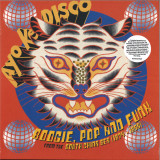
- A1: Fatimah Razak - Dahaga
- A2: Black Brothers - Mangge Mangge
- A3: Marini & The Steps - Kuingin Dekatmu
- A4: Tian Niu - Deng Ni Zai Yu Zhong
- A5: The Rollies - Disco
- B1: Regalado - Pinoy Funk
- B2: John Philips & The Steps - Ayo Ke Disco
- B3: Aria Yunior - Salah Tingkah
- B4: Ahmadi Hassan - Habibi (Mari Bersatu)
- B5: Pongsri Woranuch - Aew…Phu Chai
‘Ayo Ke Disco’ (meaning ‘Let’s go to the disco’ in Malay
and Indonesian) celebrates the musical identities
emerging from the newly independent countries in
South-East Asia during the 1970s and 80s.
Soundway general manager Alice Whittington, aka
Norsicaa (DJ), selects 10 deep cuts from local labels,
officially reissued on vinyl for the first time – forming a
snapshot of the vibrant discotheques and live scenes
across Indonesia, Singapore, Thailand, Malaysia, Hong
Kong and the Philippines.
The artists featured here were known for exploring
traditional sounds alongside funk, disco, city-pop and
even political psych-rock, genres that were indicative
of the exciting but often turbulent period. But despite
the post-war backdrop of instability there came
unprecedented levels of economic prosperity. With a
hopeful buzz filling the air, the music scene was helping
lead the way in reshaping the new identities of the
region.
OVERVIEW:
FOR FANS OF:
Sound of Siam compilations, Priscilla Chan, Lovin’ Mighty
Fire compilation, Tanamur City compilation
Rag’n’Bone Man is ready to accept joy into his life. Born Rory Charles Graham, the Sussex-born singer known for his gravelly blues vocals, took the world by storm with his debut album ‘Human’ in 2016. Now multi award-winning, the British vocalist is embracing newfound balance, returning to his creative foundations while building anew.
It’s the most vital chapter to date in one of British music’s defining stories. A truth-telling voice that has framed an era, Rag’n’Bone Man’s success speaks for itself: his debut album ‘Human’ went platinum four times over in the UK and multi-platinum in a further twenty-seven countries - becoming the fastest selling male debut album that decade. While his latest release ‘Life By Misadventure’ debuted at #1 and spent seven weeks in the Top 10, making it the fastest-selling album by a solo artist in 2021. With over nine-billion worldwide streams (and counting) over his entire catalogue, Rag’n’Bone Man is a voice that can be heard across the globe. Now he’s ready to eclipse this: assured, and built with love, his uplifting new album “What Do You Believe In?” finds the multi award-winning British artist (with three BRITs, two MTV Europe awards, and an Ivor Novello to his name) facing the future with passionate excitement.
‘What Do You Believe In?’ is anchored in the blossoming of confidence and the enduring support network he finds in family life. It’s taken time, but Rag’n’Bone Man is in a secure, loving place - and he wants to share that feeling. The period surrounding second album, 2021’s ‘Life By Misadventure’, was marked by self-doubt, with troubles weighing down on the singer’s shoulders – but then things changed - As a result, new album ‘What Do You Believe In?’ has a bold, yet radiant touch.
With the pairing of the poignant and ubiquitous themes and the sonic brightness of both 00s hip-hop and the youthful memories they prompt, the release of the albums title track ‘What Do You Believe In?’ sets the tone for the for the thrilling musical journey Rag’s is preparing to take fans on.
Rag’n’Bone Man is ready to accept joy into his life. Born Rory Charles Graham, the Sussex-born singer known for his gravelly blues vocals, took the world by storm with his debut album ‘Human’ in 2016. Now multi award-winning, the British vocalist is embracing newfound balance, returning to his creative foundations while building anew.
It’s the most vital chapter to date in one of British music’s defining stories. A truth-telling voice that has framed an era, Rag’n’Bone Man’s success speaks for itself: his debut album ‘Human’ went platinum four times over in the UK and multi-platinum in a further twenty-seven countries - becoming the fastest selling male debut album that decade. While his latest release ‘Life By Misadventure’ debuted at #1 and spent seven weeks in the Top 10, making it the fastest-selling album by a solo artist in 2021. With over nine-billion worldwide streams (and counting) over his entire catalogue, Rag’n’Bone Man is a voice that can be heard across the globe. Now he’s ready to eclipse this: assured, and built with love, his uplifting new album “What Do You Believe In?” finds the multi award-winning British artist (with three BRITs, two MTV Europe awards, and an Ivor Novello to his name) facing the future with passionate excitement.
‘What Do You Believe In?’ is anchored in the blossoming of confidence and the enduring support network he finds in family life. It’s taken time, but Rag’n’Bone Man is in a secure, loving place - and he wants to share that feeling. The period surrounding second album, 2021’s ‘Life By Misadventure’, was marked by self-doubt, with troubles weighing down on the singer’s shoulders – but then things changed - As a result, new album ‘What Do You Believe In?’ has a bold, yet radiant touch.
With the pairing of the poignant and ubiquitous themes and the sonic brightness of both 00s hip-hop and the youthful memories they prompt, the release of the albums title track ‘What Do You Believe In?’ sets the tone for the for the thrilling musical journey Rag’s is preparing to take fans on.
Rag’n’Bone Man is ready to accept joy into his life. Born Rory Charles Graham, the Sussex-born singer known for his gravelly blues vocals, took the world by storm with his debut album ‘Human’ in 2016. Now multi award-winning, the British vocalist is embracing newfound balance, returning to his creative foundations while building anew.
It’s the most vital chapter to date in one of British music’s defining stories. A truth-telling voice that has framed an era, Rag’n’Bone Man’s success speaks for itself: his debut album ‘Human’ went platinum four times over in the UK and multi-platinum in a further twenty-seven countries - becoming the fastest selling male debut album that decade. While his latest release ‘Life By Misadventure’ debuted at #1 and spent seven weeks in the Top 10, making it the fastest-selling album by a solo artist in 2021. With over nine-billion worldwide streams (and counting) over his entire catalogue, Rag’n’Bone Man is a voice that can be heard across the globe. Now he’s ready to eclipse this: assured, and built with love, his uplifting new album “What Do You Believe In?” finds the multi award-winning British artist (with three BRITs, two MTV Europe awards, and an Ivor Novello to his name) facing the future with passionate excitement.
‘What Do You Believe In?’ is anchored in the blossoming of confidence and the enduring support network he finds in family life. It’s taken time, but Rag’n’Bone Man is in a secure, loving place - and he wants to share that feeling. The period surrounding second album, 2021’s ‘Life By Misadventure’, was marked by self-doubt, with troubles weighing down on the singer’s shoulders – but then things changed - As a result, new album ‘What Do You Believe In?’ has a bold, yet radiant touch.
With the pairing of the poignant and ubiquitous themes and the sonic brightness of both 00s hip-hop and the youthful memories they prompt, the release of the albums title track ‘What Do You Believe In?’ sets the tone for the for the thrilling musical journey Rag’s is preparing to take fans on.
Rag’n’Bone Man is ready to accept joy into his life. Born Rory Charles Graham, the Sussex-born singer known for his gravelly blues vocals, took the world by storm with his debut album ‘Human’ in 2016. Now multi award-winning, the British vocalist is embracing newfound balance, returning to his creative foundations while building anew.
It’s the most vital chapter to date in one of British music’s defining stories. A truth-telling voice that has framed an era, Rag’n’Bone Man’s success speaks for itself: his debut album ‘Human’ went platinum four times over in the UK and multi-platinum in a further twenty-seven countries - becoming the fastest selling male debut album that decade. While his latest release ‘Life By Misadventure’ debuted at #1 and spent seven weeks in the Top 10, making it the fastest-selling album by a solo artist in 2021. With over nine-billion worldwide streams (and counting) over his entire catalogue, Rag’n’Bone Man is a voice that can be heard across the globe. Now he’s ready to eclipse this: assured, and built with love, his uplifting new album “What Do You Believe In?” finds the multi award-winning British artist (with three BRITs, two MTV Europe awards, and an Ivor Novello to his name) facing the future with passionate excitement.
‘What Do You Believe In?’ is anchored in the blossoming of confidence and the enduring support network he finds in family life. It’s taken time, but Rag’n’Bone Man is in a secure, loving place - and he wants to share that feeling. The period surrounding second album, 2021’s ‘Life By Misadventure’, was marked by self-doubt, with troubles weighing down on the singer’s shoulders – but then things changed - As a result, new album ‘What Do You Believe In?’ has a bold, yet radiant touch.
With the pairing of the poignant and ubiquitous themes and the sonic brightness of both 00s hip-hop and the youthful memories they prompt, the release of the albums title track ‘What Do You Believe In?’ sets the tone for the for the thrilling musical journey Rag’s is preparing to take fans on.
“A huge thing for this record was to make it feel as close to our live show as possible,” says Tom Sharkett of W.H. Lung’s latest album. “We didn’t want it to sound live but we wanted to capture the excitement of the live performances.”
This is something that has become paramount to the group in recent years as they have undeniably blossomed into one of the most joyous and arresting live bands in the country. “The reason I’m in a band is to play live music,” says singer Joe Evans. “For me, music is live music. That’s what it’s for, to be played with people.”
The five-piece band, also featuring Chris Mulligan, Hannah Peace, and Alex Mercer-Main, decided to try something new on their third album after two incredibly successful collaborations with previous producer Matt Peel. In order to capture the energy, spirit and dynamism of their live shows, they relocated to Sheffield to work with Ross Orton (MIA, Arctic Monkeys, Working Men’s Club) who was able to harness this side of the band to remarkable effect. “Ross is the Sheffield Steve Albini,” says Evans. “He’s the king of not overthinking it and trusting the process of the art of recording songs. He was always there to stop us fucking around with cerebral stuff and get it down.” Sharkett echoes this too: “He was the exact producer we needed without us even realising. His productions and mixes are bombastic, lively and in your face and that’s exactly what we wanted.”
However, while this album is rooted in a sense of capturing a moment and a sparky liveness, that’s not to say it’s a raw or ragged record. It is still a meticulously composed, delicately layered and pristinely produced piece of work that, in true W.H. Lung style, runs the gauntlet from dance to pop to indie while still capturing that distinctly unique quality that is unquestionably their own. “It was a really big thing for me to realise what made us sound like us on this record,” says Sharkett. “I think the album sounds a lot more confident and self assured because of it. Some songs sound just so much like Lung and I’m really proud of that. I’m not sure we’ve done that as consistently across the other records.”
While the band have drilled deeper into finding their own singular identity, it’s not a record resting on its laurels. It’s a significant leap forward, expanding on their solid foundations while also breaking new ground. “The big difference with this record is its directness in every sense,” says Sharkett. “The songwriting is more upfront. Previously we’d focused a lot on vibe and production as opposed to just writing songs. The overall mission here was to revert to a classic songwriting structure and for the production to come afterwards.” And so what you have on this record are deeply considered and well-crafted songs, then recorded with blistering intensity in the moment, and then given a touch of experimentation afterwards. Then throw in Orton’s contributions to the band and it’s proven to be a real winning formula. “He brought a real dose of magic to the songs we’d written,” says Sharkett. “And brought an extra bit of wonk and quirkiness each time.”
The band’s ability to write more traditional and conventional songs is clearly a skill they’ve taken to with ease, at times there’s an almost Springsteen-like quality – but if he'd ever had an ecstasy period – to tracks such as ‘Thinner Wine’ and ‘Bloom and Fade’. While ‘How to Walk’ was constructed with one thing only in mind: that it would absolutely slay on stage. “I can’t wait to play this live,” says Evans. “We wanted a song to represent our live set, a new big one, and this is it.” Once again it leans towards the anthemic, with its driving, propulsive charge complete with incandescent synths and vocal melodies so irresistible you can already hear them being sung in unison by a crowd.
It’s an incredibly difficult feat to pull off a record that is more rooted in traditional songcraft while also capturing the power of a live performance, as well as pushing sonics into experimental new directions while working with a brand new collaborator. But here the band has managed to do just that. And the album’s closing song ‘I Will Set Fire To The House’ is a perfect example of such a thing. It’s a song that feels immaculately constructed but also very much alive and of the moment as its radiating synths engulf from the off, and Evans’ vocal is silky but powerful and in perfect symbiosis with Peace’s. It’s a song that captures the endless joys of music playing long into the night. “It may be a bit of a bloody bombastic way to end an album saying ‘and we’ll dance into the sunrise’,” says Evans. “But fuck it.”
MORE PRESS ON ‘VANITIES’ (MELO131)
"Vanities artily refines an exhilarating brand of up-front electro-dance" MOJO ⅘
'Idiosyncratic yet euphoric electronic pop on triumphant second LP' 9/10 Uncut
''One of the most effective alternative pop albums of the year'' 4/5 Record Collector
'Dance music for the modern age' - The Times (4*)
- Otis Gayle - What You Won’t Do For Love (2.28)
- Earl Sixteen - Love Is A Feeling (2.40)
- Alton Ellis - Back To Africa (5.13)
- Prince Jazzbo - Apollo 16 (3.32)
- Johnny Osbourne - Eternal Peace (2.52)
- Errol Dunkley - Don’t Do It (2.11)
- Omega - Bounty Hunter (2.42)
- Noel Bailey And Sound Dimension - Wiggles Diggles (3.12)
- Freddie Mcgregor - I Am Ready (2.42)
- Prince Jazzbo - Imperial I (3.17)
- Jackie Mittoo - Lovers Rock (7.33)
- Devon Russell - Swing And Dine (3.25)
- Sugar Minott - Guidance (6.21)
- Dolly Man - Trigger Happy (3.15)
- Nana Mclean - A Little Love (2.51)
- Tyrone Taylor - Rightful Rebel (4.42)
- Wailing Souls - All Alone (2.28)
- Sugar Minott - Revelation (2.51)
Brand new collection of Studio One killer tunes, focussing on the late 70s, 80s and beyond.
Since the early 1960s Clement ‘Sir Coxsone’ Dodd had established Studio One as the unparalleled leader in reggae music in the world. In the years that followed he established the careers of countless reggae legends – Bob Marley & The Wailers, Marcia Griffiths, The Skatalites, Horace Andy, Dennis Brown, Burning Spear and many more.
From its inception Studio One had been at the forefront of every major development in reggae music – ska, rocksteady, roots, DJ, dub and, starting in the second half of the 1970s, dancehall.
Having attained such great success, by the late 1970s Clement Dodd was free to enjoy Studio One’s now firmly established supremacy in reggae music. He released a series of stunning new albums at the end of the decade by Sugar Minott, Johnny Osbourne, Freddie McGregor and others that rode the wave of dancehall and set the path of Studio One’s output for the following 25 years.
During this period, long-established artists such as Alton Ellis, Jackie Mittoo and others returned to the label, recording some of their most creatively satisfying albums with new music that both celebrated the classic sound of Studio One while continuing to experiment, push boundaries and look forward to the future.
This release celebrates this sometimes overlooked golden era at Studio One in the 1970s,1980s and beyond.
Distance as a measure of time and place informs Kelly Finnigan's, A Lover Was Born with a grit and grace that turns passion into virtue. The latest solo release from The Monophonics frontman roots itself in the best traditions of midwest soul labels like King, Curtom, Dakar, and the Bodie Recording Company. A Lover Was Born is a testimony that these deep cut grooves are not resigned to nostalgia, instead, they are at the burning heart of longing and hope. The journey Finnigan takes listeners on over Lover's eleven tracks echo the state of motion and growth since his solo debut, The Tales People Tell (2019). These two records bookend a prolific period of output, including a pair of Monophonics albums, a Christmas album, a mixtape, and a full slate of producing other artists (The Ironsides, Alanna Royale, the Sextones). "There's nothing like making records," says Finnigan. "It feels like that's my purpose _ the reason I was put on this earth." Written in California, Ohio, and Staten Island, Kelly Finnigan collaborated with old friends in and outside the studio. "I enjoy working alone but it's not how you want to make a record_almost everybody I brought in for this album I've worked with, toured with or spent a great deal of time with." Max and Joe Ramey (The Ironsides), Jimmy James (Parlor Greens), Sergio Rios (Orgone), Joey Crispiano (Dap Kings) and Jay Mumford (aka J-Zone) all contribute to the overall sound of A Lover Was Born. Dramatic influences like Isaac Hayes (check out the piano on "Be Your Own Shelter") and Jerry Ragovoy are chopped and folded into Northern Soul uptempo numbers to create stompers like "Get a Hold of Yourself" or "Chosen Few". Finnigan's take on Deep Soul is captured brilliantly on "Walk Away from Me" and "Love (Your Pain Goes Deep)", while Boom Bap pervades on hard hitters "His Love Ain't Real" & "Cold World". Slower songs such as "Let Me Count the Reasons", the emotional "All That's Left", and the soul-stirring album closer "Count Me Out" show the honest and tender side that has become Finnigan's calling card. All the while, the voice is raw and earthy _ in the best tradition of R&B shouters like Otis Redding, Lee Moses, and David Ruffin. The songs on A Lover Was Born reconfigure the spliced and sampled DNA of hip hop (extracted by crate diggers like Dilla and RZA) to create something new, underscoring both the spectrum and depth of soul while making a case to the timelessness of Finnigan's sound.
Ardor or Entropy is Nzʉmbe's first album in nine years, following 2015's Titubeo. During this period, philosopher and artist Miguel Prado's sonic output has included synthesizing a sonic Gernika with his band HARRGA alongside Dali de Saint Paul, and crafting a hallucinatory sci-fi mythology for Lucrecia Dalt's latest album, ¡Ay!."
Rewiring the conventions of chamber electronics and postmodern songwriting. Here it is presented A Spanish' song cycle on love and cosmological redshift. The distant echo of Tristan‐and‐Iseult's smoking gun where lovemaking becomes an enactment of entropy, a transformation between the dynamic and the static, the human and the fetish, illustrating the inevitable decline into chaos and stillness.
A beached singing voice (beautifully processed by Rashad Becker) against electro-acoustic backdrops ranging from the caustic, viscous to the bonecrushingly dense worldbuilding shared by HR Giger, Ballard and Pynchon. Transcendental and psychotic vistas that boldly examine human fragility and the surrounding abyss of godlessness.
---------------------------------
Artist: Nzʉmbe Title: Ardor or Entropy Label: Drowned By Locals Catalog Number: DBL31LP Year: 2024
Side A:
Mirror Of TauromachyZone Of AlienationGreat Vitreous TactKarman Vortex Street
Side B:
Serpentine LinesThermocline Anake and EntropyErgosferaAsymptopia
Composed, arranged and recorded by Miguel Prado Casanova
Vocal processing by Rashad Becker Piano on "Anake and Entropy" by Michael PisaroPipes on "Mirror Of Tauromachy" and "Ergosfera" by Wojciech RusinAccordion on "Asymptopia" by Alfredo Costa MonteiroTrumpet on "Asymptopia" by Ruth Barberán Electric bass on "Asymptopia" by Dominic LashElectric guitar on "Asymptopia" by Daniel BennettPercussion on "Asymptopia" by Alex Lázaro
Premixed by Miguel Prado Casanova Mixed, Mastered and Vinyl cut by Rashad Becker
Artwork photos by Lúa Ribeira © all rights reserved, 2024Design by Giovanni Murolo
This album is dedicated to Patricia
Special thanks to Patricia Fraga, Dali de Saint Paul, Mattin, Lucrecia Dalt, Laith Demashqieh, Lúa Ribeira, Rashad Becker
- A1: Five Days (Mixed)
- A2: Love Don't Pay The Bills (Mixed)
- A3: Make It Alright (Mixed)
- B1: Please Don’t Break My Heart - Dj Andy Smith Reach Up Disco Wonderland Re-Edit (Mixed)
- B2: I Like Funky Music - Skratch Bastid Turntable Mix (Mixed)
- B3: Black Water Gold Part 2 - Dj Andy Smith Reach Up Disco Wonderland Extended Mix (Mixed)
- C1: Disco Hi-Life (Mixed)
- C2: Lovin' You - Smoove Disco Dub (Mixed)
- D1: Change (Mixed)
- D2: Free Yourself - Full Intention Extended Remix (Mixed)
- D3: Bad Times - Yam Who Extended Vocal Remix (Mixed)
- E1: Body Work (Mixed)
- E2: The Big Throwdown (Mixed)
- E3: Losers & Fools - Dj Andy Smith Reach Up Disco Wonderland Re-Edit (Mixed)
- F1: Beyond The Clouds (Mixed)
- F2: You're So Far Away - Dj Andy Smith Reach Up Disco Wonderland Re-Edit
Releasing in the autumn of 2024 Andy Smith's curation of the 3rd volume in his Reach Up – Disco Wonderland series brings us more carefully selected music from the Discosphere. With tracks from artists as far ranging as Buscrates, Trailer Limon and Rena Scott included in this 16 track killer compilation Andy has also included excellent edits and remixes from such stellar names as Full Intention, Yam Who and Skratch Bastid. Indeed, the CD and digital versions of the release also include a fully continuous Skratch Bastid mix of all 16 tracks. Reach Up-Disco Wonderland vol. 3 was curated during the lockdown periods of the pandemic after a series of virtual 'nights out' viewing DJs such as Skratch Bastid, The Nextmen, Chris Wheatley and others performing sets on the Twitch platform. Andy is now playing out in the real world with some of the DJs he 'met' online so now the time is right to drop this compilation on BBE Music. Andy Smith's pedigree in sourcing and mixing tracks from across eras and genres goes back to his debut compilation release The Document in 1998, he was the explorer and provider of samples and breaks for the first two Portishead albums and played as the band's international tour DJ. His compilation track record of some fifteen plus releases since 1998 has covered New Orleans Funk, Northern Soul, Reggae, the mixed genre follow ups to the The Document and, of course, the now three volumes of the Reach Up-Disco Wonderland series on BBE Music. Pressed as a triple vinyl LP, along with the aforementioned double CD and digital versions, not only is Reach Up-Disco Wonderland vol. 3 a delight for the DJ consul and the dance floor, but also an audiophile's dream on vinyl with all tracks mastered at the renowned and Grammy nominated Carvery Studios.
"Raise a glass to the latest entry in Bloodshot’s Barrel Select Series!
Barrel Select exists to highlight the best of Bloodshot’s cask-strength catalog. Robbie Fulks has made some of the finest records we can claim as our own, but if there’s only room for one on that sacred shelf at the top, it’s Gone Away Backward.
“At a time when modern country feels like bloated spandex-and-Aquanetted pop-metal, Fulks defiantly embraces an unflinching traditionalism.” Paste’s words, not ours, but we’re not gonna argue the point they made when Gone Away Backward hit their doorstep 11 years back. They also called this “a tour du force of bluegrass-derived spare country,” which we’ll also let stand. Magnet said it was “the best album Fulks has ever made, period,” and out of respect for the wonderful work Robbie has done in the past decade, we’ll simply point out that this too is an 11-year-old review.
With Steve Albini at the board, Robbie was able to break his songs down to their core and fire his characters, his chops, his band, and his amazing voice directly at listener’s souls. “We recorded it pretty fast, in a couple of days. People are always bragging that they did it without overdubs, but that’s the way we did it.” The results are everything we ever wanted from Robbie and a high-water mark of folk or bluegrass or alt-country or whatever genre bucket you want to pour his gifts into.
Recorded by Steve Albini
10th Anniversary Barrel Select edition on Bloodshot Red vinyl
“Stunning” —Saving Country Music
“a work of great, accomplished craft . . . vivid and moving” —Ken Tucker, NPR
“The level of artistry is so complete that it suggests a world in which Fulks isn’t a household name is somehow upside down.” —Wall Street Journal"
Fables of the future fuel the present. Lisel (Eliza Bagg) draws from this tradition on The Vanishing Point, a daring musical odyssey of altered singing, experimental pop, broken melodies, and striking electronics. A culmination of her continual dissemblance of genre, Lisel’s new album is an epic composed of allegorical tales, forming a dystopian storybook of life in the shadow of impending catastrophe. It’s a high-concept work of contemporary pop sounds, hyperpop motifs and tropes. Every song reflects the shared psycho-emotional experience of moving towards unsettling futures and looking beyond these outcomes, to the point where the horizons vanish. Evolving the sonic toolkit she employed on Patterns For Autotuned Voices And Delay (2023), Lisel transforms pop into a canvas for operatic storytelling. Along with making her own work, Bagg is a classical singer working in baroque and contemporary experimental opera, and with her project Lisel, she seeks to develop new, expressive qualities out of ancient vocal techniques from the Baroque and Renaissance periods. Her opera experience has infused her with a desire for a big, cinematic sound and holistic world-building, creating a “total artwork,” and she fits that medium into the form of a solo project. From haunting whispers to soaring melodies, she reaches back towards ancient musical traditions while incorporating futuristic sounds in order to imagine how a possible future might look back at contemporary existence. Dystopic stories melt into pop songs, hammered to ruin. Both through sonics and lyrics, the album recounts urgent narratives as ancient mythological fables, chronicling in operatic density the deepening awareness of the world’s looming, inevitable vanishing point. Photographer Carla Rossi further builds Lisel’s world through a series of photographs that similarly draw on Renaissance and Medieval painting, while placing them aesthetically in a digital realm. In these dramatic, hyper-stylized photos, Lisel takes up classical poses and yields iconographic symbols, further exploring the dissonance in her work as these manufactured “paintings” recall storytelling of the past while depicting images from an imagined future.
Following releases on Sähkö Recordings and The Trilogy Tapes, "Fever of the World" is the Soda Gong debut by Memotone, the nom de plume of UK-based multi-instrumentalist Will Yates. As a collection, it is both intimate and expansive, like the feeling of gathering one's thoughts before setting off on a long journey or committing to an irrevocable course of action. Throughout, Yates' talents as both player and sound designer are on full display, as are the sonic signatures that have come to characterize the Memotone catalog: low-lit, ECM-inflected noir; evasive and evolving loop-based accretions; and mellifluous mosaics of keys, guitar, reeds, and percussion. It is patient and focused music, built around production techniques and compositional ideas that have been perfected both in studio and in live performance over a period of several years. "Catherine, On Fire" sets the scene, one of two languid, longform selections, and develops slowly from a spare, harmonic-laden guitar loop into a bed of rippling textural ambience and woozy clarinet filigree. Later, "The Bus" and "When the Bakery Has What You Want and It's Cheap" conjure images of rain-streaked windows, fanciful baked confections, and grey skies broken finally by sunlight. Warm, generous, and comfortable in its own skin, this is music that reminds us that when it feels easy to resign ourselves to world weariness, we should pause for a moment and listen to the rustle of the leaves. The wind knows not to linger.
4LP: Two multicolour gatefold 2LPs in very special sleeve. In collaboration with composer Ed Harrison (Deus Ex: Breach, Tsioque) and art designer Julianne Griepp, Stumpy Frog is proud to release the full OST (GSDF & NSF albums) to the Half Life 2 modification NEOTOKYO° on 4LP limited vinyl. During the period of 2004-2009, Half Life 2 modders TEAM RADI-8 created a multiplayer total conversion focused on two clashing factions in a dystopian cyberpunk future inspired by the works of Masamune Shirow (Ghost in the Shell) & Katsuhiro Otomo (Akira). To bring this world to life, they enlisted the help of a then-23 year old composer from the forums: Ed Harrison aka 0edit. What he created was nothing short of spectacular. Equal parts frantic and solemn, hopeful and angry, this soundtrack is exactly the kind of art Stumpy Frog Records was made to bring to wax. I’ve been listening to this OST for years and I hope this release will become a mainstay on your record player. A diamond, fully formed, that Ed Harrison, Stumpy Frog, and art designer Julianne Griepp poured themselves into to create a release worth your time and hard earned money.
By 1973, Herbie Hancock already had both feet planted firmly in the future — some 50 years based on the vast, electronic funk he crafted during this period. How could he have known that this music would soundtrack block parties in the ‘80s and give ground to a burgeoning hip-hop culture? How could a man so steeped in the history of jazz be so untethered to form and genre that he created a sound all his own? Did he envision a world much like we’re living in now, where smartphones dictate our lives and musical compositions co-mingle without adherence to artificial marketing terms? Herbie likely wasn’t that prescient, but I wouldn’t doubt his genius. Based on the interplanetary trance funk of Sextant, his 11th studio album, such foresight wouldn’t be surprising. Then and always, Herbie was the master of the road less traveled. He was the light guiding his peers where they needed to go.
- A1: Bergendy - Randevúm Lesz Délután
- A2: Neoton - Majd Ha Nem Leszek…
- A3: Kék Csillag - Ki Volt Ez Az Ember?
- A4: Meteor - Kívánj Te Is Nekem Szép Jóéjszakát
- A5: Apostol - Az Esti Utcán
- B1: Kex - Elszállt Egy Hajó A Szélben
- B2: Non-Stop - Szelíd Tüzek
- B3: Echo - Boldogságból Építettem
- B4: Juventus - Egy Pont A Térben
- B5: Scampolo - Levegőben
(Physical release only, Limited edition of 300 hand numbered copies + insert) Psyched Out Grooves from Hungary compiles ten of the most outstanding singles recorded by the underdogs of this period.
The psychedelic scene that never was – the perfect subtitle to this compilation. There were barely any drugs in Hungary to begin with. In this era, alcohol, music, and imagination have served as the primary means of mind alteration among the youth. The Communist party had a firm grip on culture through monopole control over venues, the media, and the recording industry, western records were not available, clubs enforced a strict dress code of suits, shirts, and longer skirts, and the police harassed young men for not more than having long hair or wearing blue jeans.
There was, however, an undercurrent of smaller semi-professional bands striving to succeed in the shadow of the very few stars privileged by the sole state owned record company. Given their chances to release music were at best limited to a few 7“ singles at the mercy of said record company powers. Psyched Out Grooves from Hungary compiles ten of the most outstanding singles recorded by the underdogs of this period. Some of the bands featured on here have eventually reached wider success by switching to more commercial styles, like Bergendy, Neoton, and Apostol. Most, like Echo, Meteor, Kék Csillag, Non-Stop, were temporal formations that dissolved after a few years due to personal conflicts, lack of success, or both. Others, like Scampolo or Juventus, lasted a longer time without an actual break through. Most of these bands never had a consistent, lasting ’psychedelic’ repertoire or identity at any point. These tracks were the exception, not the norm. That coherence - the illusion of a scene - comes from the curation and sequencing of Budabeats head honchos Von Yodi and Gandharva. It is the arrangement of these puzzle pieces that makes them fit together.
Limited edition of 300 hand numbered copies. Edited excerpt from the liner notes written by Gábor Vályi (Dj Shuriken)
It is summer dawn . . . and you are alone. Here is music for your strange mood. The piano starts the first track, slow tempo beat, a strict beat, a swinging beat. Lillemor—here minor harmonies give the tune a rural, romantic feeling of some place in Spain or France. The tempo changes to medium fast—the flute solos. Light phrasing contrasts beautifully to the earthy, swinging beat of the rhythm section and the repeating piano figures. The trombone adds a new color, a counterpoint of sound and phrasing, backed by the pulsating beat of this wonderful rhythm and the driving piano. Summer dawn . . . This music has more to offer, because it shows the personality of Sahib Shihab at its best. Sahib is a universal musician who reflects musical experiences in jazz since the end of the thirties. He lived through the important periods of modern jazz with his heart and mind wide open toward everything that was good music, regardless of being termed "Mainstream", "Bop", "Cool", "Westcoast", "Eastcoast", "Hard Bop'', et cetera. When you listen closely to his music, you will find traces of all these, but they are immersed in his deep musicianship and his true jazz personality. Sahib Shihab's background reads like the record of a master of advanced studies. Furthermore he played and collaborated with the coolest jazz musician of that period. Above all let's name Budd Johnson, Theolonius Monk, Tadd Dameron, Milt Jackson, Dizzy Gillespie, Illinois Jaquet, Elmer Snowden, Luther Henderson, Larry Noble, Fletcher Henderson, Roy Eldridge. In his early professional years, Sahib was heard mostly on alto sax; later, more often on baritone sax and flute. Today, his name is inseparably connected with these two instruments. The unity of his jazz performances is not alone bound up with the com¬positions and the arrangements of Sahib Shihab, though in their understated simplicity they have a melodic beauty that is seldom found in jazz of today. The rhythmical subtleties add to the overall qualities of being relaxed vehicles for free-blowing, but there is an immediacy that you hear and feel every moment when listening which defies analysis. The playing of the rhythm section helps greatly to promote the sense of flux and contrasting constant renewal that makes listening to this record so invigorating an experience. Well, this is no surprise, with Kenny Clarke as the nucleus of the rhythm group. Kenny 'Klook' Clarke is a major figure and contributor in jazz, one of the founders of modern jazz, and is ranked as one of the all-time great drummers. He influenced a whole generation of musicians with his playing, though living in Paris since the middle of the fifties somewhat dimmed his name to the general American public. Nevertheless, his name alone will assure a connoisseur to expect top class musical experiences. Talking of the rhythm section we have to name Jimmy Woode's bass, which together with Kenny's drumming, is the driving force for the group and the reliable harmonic anchor for the improvisors. By the way, Jimmy has been with the Duke quite a while, and this alone is an award for extraordinary craftsmanship and artistry. The good sounding rhythm with its full-bodied color is also a result of the added bongos of Joe Harris, who manages to stay out of the way of the players—a quality not often found with drummers—but his playing is felt through the set. There are two members of the group not yet mentioned. Two Europeans, pianist-composer-arranger Francy Boland from Belgium, and trombonist Ake Persson from Sweden. Francy Boland this time is a sideman, though normally he is a leader of recording sessions, both as composer-arranger and as musical director of the band. In the fifties he was in the States writing arrangements for different name-bands, such as Basie and Goodman. In Europe, he is famous for his swinging modern big band arrangements; and his inventiveness as a writer is reflected in his piano playing. He has the talent of using the right dynamic approach every moment, thus making his playing helpful to soloists and interesting for listeners as well. Ake Persson has been Scandinavia's out-standing trombone player for about ten years. There are only a few trombonists in Europe who might match his talents at times, but they lack the consistency of his playing. He is impressive, whether playing in a big band, or whether main soloist in his own small groups. American musicians love the sound of his slide trombone and his easily flowing romantic improvisations, so he often joins American name-bands as they travel in Europe. The music speaks alone . . . , we said it before. You have your soul to feel the beauty, to follow lines and structure, and to enjoy the spiritual excitement. Whether you enjoy the flowing, easy sounding theme of "Please Don't Leave Me", or the climaxing piano solo in the same piece—the bass solo in "Waltz For Seth" or the swinging baritone sax—listen to the first bars of this solo and pay attention to Kenny. Whether you listen to "Campi's Idea", (named after Gigi Campi, the well known Cologne jazz enthusiast who organized this recording) with the romantic flute solo of Sahib, the interesting tempo changes, the piano comping, the moving trombone solo; or to the up-tempo "Herr Fixit", with the cooking Kenny and humorous, driving flute solo, you know that these six musicians where in the right mood, in the right stimulating surroundings to feel what we all feel when it's: SUMMER DAWN.
Tamil Rogeon, the Melbourne based multifaceted jazz, classical and electronic violin & viola player firmly cemented his reputation with the critical success of his 2021 album Son Of Nyx which was released on Soul Bank Music, Impressive Collective head honcho Greg Boraman's previous label. Lauded as a modal and spiritual jazz fusion opus, Son Of Nyx found favour with Gilles Peterson, Laurent Garnier, Rebecca Vasmant, BBC6 Music's' Cerys Matthews and Deb Grant, was a Jazz FM’ Album of the Week. Building upon that highly original sound concept, Wave Theory draws from the jazz fusion movements of the 70s and 80s and conjures up textured soundscapes rich with cosmic synths, soaring vocals and deep jazz funk, and sees Tamil once again joining forces with Son of Nyx contributors Rita Satch and Daniel Mougerman, plus new collaborators and special guests including Lance Ferguson and celebrated trumpeter, friend Audrey Powne. Listeners can expect the same modal experiments, driving percussion and cosmic synths of Son of Nyx as well as new and exhilarating experiments in electric string instrumentation. Across all 6 tracks the highlights are numerous, but of particular note are the album opener "Ascend it!"; a fusion masterpiece that seamlessly blends psychedelic elements, funk grooves, intricate melodies, and improvisation. When "Doom Date" takes flight we are transported to Mahavishnu Orchestra-like territory, before finishing with an angular melody that is pure jazz-fusion inventiveness. The irresistibly funky 'Gift Of The Gab” is built upon a hypnotic bass line over drum and percussion. Laden with synth and retro keyboards reminiscent of the deep funk of Herbie Hancock’s late 70s period. "Mountain Bug' alternates between minor and major keys, a hallucinatory violin solo is followed by a dazzling trumpet improvisation. A restatement of the melody accompanied by the gunfire of the drum set and percussion. Tamil says of Wave Theory “Sometimes themes reveal themselves through creative encounters and through life experience. I wrote and recorded the album in six months. A lot happened to me and my friends during that time so, for me, ‘Wave Theory’ is like a musical snapshot of life’s relentless ebbs and flows. It’s about the sadness and thrills of endless transformation and the power of creative connection".
The release will be available on super ltd edition black and clear vinyl, including download code.
Up In Her Room are delighted to bring you the latest offering from Uruguay’s Las Cobras!
Emerging from the Uruguayan city of Canelones in 2017, Las Cobras introduced themselves with their debut album, 'Temporal', a 9-track release that quickly became a reference point in global psychedelia after signing with London’s Fuzz Club Records. A couple of years later, the duo—Leandro Rebellato and Sofia Aguerre—expanded to include Dario Macarín and Diego Mercadal, releasing their second album, 'Selva'.
In their debut, Las Cobras blended proto-punk and shoegaze with hints of afrobeat and Tropicalia. With 'Selva', the band amplified these elements, showcasing their evolving sound. Notably, their track "Al más Allá" is featured in the Amazon Prime series "La Cabeza de Joaquín Murrieta."
For their third album, 'Cárcavas', the band explores the concept of the cárcava—a scar on the earth symbolizing a period of desolation. Teaming up with London label 'Up in her Room', they present a darker, more chaotic record that reflects the tumultuous years they've endured. Most tracks were mixed by James Aparicio (Depeche Mode, Spiritualized, Throw Down Bones Grinderman), lending the album a sharper, more defined sound. Las Cobras continue to delve into their sonic palette, incorporating electronic drums, Latin percussion, penetrating synthesizers, and fuzzed-out guitars, all from a more stripped-down perspective.
Black butterfly for example is an espectrum of a lost friend. Like a ghost...Always in orbit. Diving into darker places... Traveling through the universe...
- Live At Harvard Square Theater
- Cambridge, Ma, November 20, 1975
- Recording Supervised By Don Devito; Mixed By Sean Brennan
- 1: Introduction – Bob Neuwirth
- 2: Edith And The Kingpin
- 3: Don’t Interrupt The Sorrow
- Live At Music Hall
- Boston, Ma, November 21, 1975
- Recording Supervised By Don Devito; Mixed By Patrick Milligan
- 4: Introduction – Bob Neuwirth
- 5: Harry’s House
- Live In Bangor
- Bangor, Me, November 27, 1975
- Recorded By L.a. Johnson & Petur Hliddal
- 6: A Case Of You
- Live At Montreal Forum
- Montreal, Qc, Canada, December 4, 1975
- Recording Supervised By Don Devito; Mixed By Sean Brennan
- 1: Intro To Coyote
- 2: Coyote
- 1976: Tour Of The United States
- Recorded By Stanley Johnston From Pa Mixes By Brian Jonathan
- (Courtesy Of The Estate Of Stanley Tajima Johnston)
- Live At Music Hall
- Boston, Ma, February 19, 1976
- 3: Free Man In Paris
- 4: Shades Of Scarlett Conquering
- Live At Nassau Coliseum
- Uniondale, Ny, February 20, 1976
- 5: For Free
- Side Three
- Live At Music Hall
- Boston, Ma, February 19, 1976
- 1: Shadows And Light
- 2: In France They Kiss On Main Street
- 3: Intro To Furry Sings The Blues
- 4: Furry Sings The Blues
- Hejira Demos
- A&M Studios, Hollywood, Ca, March 1976
- Recorded By Henry Lewy; Mixed By Patrick Milligan
- 5: Traveling (Hejira)
- 1: Black Crow
- 2: Amelia
- Rolling Thunder Revue
- Tarrant County Convention Center, Fort Worth, Tx, May 16, 1976
- Recording Supervised By Don Devito; Engineered By
- Don Meehan; Mixed By Patrick Milligan
- 3: Intro To Song For Sharon
- 4: Song For Sharon
- Hejira Sessions
- A&M Studios, Hollywood, Ca, Summer 1976
- Recorded & Mixed By Henry Lewy
- 1: Refuge Of The Roads (Early Mix With Horns)
- 2: Don Juan’s Reckless Daughter (Early Rough Mix)
- Don Juan’s Reckless Daughter Sessions
- A&M Studios, Hollywood, Ca
- Recorded & Mixed By Henry Lewy
- 3: Otis And Marlena (Early Rough Mix)
- Mingus Sessions
- Electric Lady Studios, New York, Ny
- Recorded & Mixed By Henry Lewy & Jerry Solomon
- 4: Sweet Sucker Dance (Vocals & Drums Version – Take 5)
- Live At Bread & Roses Festival
- Greek Theatre, Berkeley, Ca, September 2 & 3, 1978
- Recorded & Mixed By Henry Lewy
- 1: Introduction
- 2: The Dry Cleaner From Des Moines
- 3: Intro To Goodbye Pork Pie Hat
- 4: Goodbye Pork Pie Hat
- 5: Intro To The Wolf That Lives In Lindsey
- 6: The Wolf That Lives In Lindsey
- Mingus Early Alternate Version
- Electric Lady Studios, New York, Ny And A&M Studios
- Hollywood, Ca, 1978 & 1979
- Recorded & Mixed By Henry Lewy & Jerry Solomon
- 15: God Must Be A Boogie Man
- 1: Sue And The Holy River
- 1979: Tour Rehearsals
- Sir Rehearsal Studios, Los Angeles, Ca
- Recorded By Joel Bernstein
- 2: Jericho
- 3: Help Me
- 1979: Tour Of The United States
- Live At Forest Hills Tennis Stadium
- Queens, Ny, August 25, 1979
- Recorded By Joel Bernstein From Pa Mix By Ed Wynne
- 4: Big Yellow Taxi
- 5: Just Like This Train
- 6: Raised On Robbery
- 1: The Last Time I Saw Richard
- Live At Greek Theatre
- Los Angeles, Ca, September 13, 1979
- Recorded By Andy Johns & Henry Lewy; Mixed By Patrick Milligan
- 2: Intro To A Chair In The Sky
- 3: A Chair In The Sky
Features Unreleased Studio Sessions, Alternate Versions, Live Recordings, Rarities, And 36-Page Book With New Photos & An Extensive Conversation Between Joni & Cameron Crowe
Sourced From Original Stereo Reels, Nagra Film Recordings, Multi-track Tapes, Radio Airchecks & Cassette Tapes
Throughout the latter half of the seventies, Joni continued to creatively break ground with her fearless and fluid exploration of jazz. Rather than tread the same path, she challenged and reinvented her style with a folk fusion like no other. Ascending to an unrivaled sonic peak, this innovative sound took shape across the gold-certified HEJIRA 1976, the gold-certified double-LP DON JUAN’S RECKLESS DAUGHTER [1977], her collaboration with Charles Mingus entitled MINGUS [1979], and live album SHADOWS AND LIGHT [1980]. Channeling the thrill and excitement of these records, she delves even further into this season on JONI MITCHELL ARCHIVES, VOL. 4: THE ASYLUM YEARS (1976-1980), due October 4th.
Available as a 6CD, 4LP (featuring Joni's personal favorites from the 6CD set), and digitally, this comprehensive and essential set spans one of the most prolific periods of her storied career. It boasts powerful live tracks from her time in Bob Dylan’s Rolling Thunder Revue during 1975 and 1976 Tour of the United States. It pulls back the curtain on the music by showcasing early recordings and alternate takes from the respective sessions for HEJIRA, DON JUAN’S RECKLESS DAUGHTER, and MINGUS. It covers the Bread & Roses Festival as well as the Anti-Nuclear Rally. Finally, VOL. 4 chronicles her 1979 tour, even showcasing two tracks from that year’s Tour Rehearsals. Not to mention, it showcases her versatility and adaptability, housing collaborations with everyone from Herbie Hancock and Jaco Pastorious to Wayne Shorter and Pat Metheny.
Vol. 4 culls the previously-unissued material from original stereo reels, cassette tapes, CD-Rs, and even a radio broadcast. Newly mixed tracks came from multi-track tapes, while a handful of hi-res digital tracks have been sourced from the Bob Dylan Archives.
Each version includes a book with never-before-seen photos and liner notes comprising a deep dive discussion between Mitchell and longtime friend Cameron Crowe. As part of their candid conversation, she shares intimate anecdotes, memories, and stories from that five-year creative run.
This release documents the coming together of two fallible musical instrument systems and their creator-operators. In June 2023, Graham Dunning's Mechanical Techno and Sam Underwood's Acoustic Modular System took a train journey to Galerie Paradise in Nantes, France. Following a period of exploration, points of cohesion, jeopardy and happenstance were exploited to create these nine unruly pieces that appeared initially on the ultra-limited vinyl release on the gallery’s record label. Now they celebrate a new pressing of Beaux Timbres on Accidental.
Using innovative methods, they create abstract, rhythmical and textural experimental soundscapes. Graham uses an extended turntable: a regular DJ turntable with numerous sensors, modified vinyl records and synthesizers creating irregular rhythmic patterns. Sam presents his Acoustic Modular System: a device for creating acoustic sounds with bellows, feedback and chaotic sequencers.
The growth of the Jamaican recording industry…
Records have played an integral part in the history of Jamaican music and the importance of making records, as opposed to making music, can never be overstated. These are the stories, told through first-hand accounts wherever possible, of the men and women… manufacturers, musicians, singers, deejays, arrangers and record producers… who made the records and who made the sound of reggae available worldwide.
“This volume of what promises to become a crucial series covers in comprehensive fashion Jamaican music’s pivotal phase, when the music absorbed its US influences from soul and moved on from rock steady and progressed to the uniquely Jamaican sound of reggae and rockers.
It was a period in which old and new rhythms became the cornerstone of the music and thus the true
foundation of reggae. This second volume in the trilogy, amply illustrated, contains a wealth of interview testimony from the creators of the music and is both utterly authentic and essential reading.”
Steve Barrow
Co-author of ‘Reggae The Rough Guide’
“Noel Hawks takes another deep dive into the history of Jamaica’s recording studios, the businessmen who owned them and the record producers who worked in them. While the previous volume, ‘The Birth Of Ska’, dealt with Jamaica’s nascent music business and the journey, from its mento and folk roots to rhythm & blues and then ska, ‘Rock Steady To Rockers’ picks up the story as ska is about to transform into the smoother rock steady style and carries us through to reggae and the sonically sophisticated dub of the Seventies.
The book contains a stunning collection of hard facts about the business of making records, as well as personal recollections from many of the leading lights of Jamaica’s music scene, and is a fascinating read for record collectors, reggae fans and anyone who loves music.
Chris Lane
Fashion Records
“The second part of this important trilogy is no less informative and engrossing than the first volume. The author’s blending of his own authoritative narrative and entertaining quotes from people who watched everything that’s chronicled here unfold… artists, producers and early collectors… makes for a seamlessly entertaining read from start to finish.
If you couldn’t be there, or even thereabouts, at the time consider this book your very own literary TARDIS to help you to relive the evolution of Jamaican music at (almost) first hand. I’m very proud to have had even the smallest involvement with this essential read. Roll on Volume Three…”
Tony Rounce
Author & Music Historian
After dipping into the archive to deliver a series of essential reissues, Bureau B continue to encourage the chaotic brilliance of Faust with an LP of brand new music curated by originator Zappi Diermaier and a band of musical friends, including fellow founder Gunther Wüsthoff. Over the years Faust has become many things, each as separate as the fingers, but as together as the hand which makes up their eponymous fist. From 1971 to 1974 the Hamburg band blazed a bold sonic trail, helping to create the distinct and delirious strand of German music we"ve come to know as Krautrock. Uncompromising, innovative and experimental, their releases in that period, and the stories accompanying their creation, are nothing short of legendary, and the fact that after a hiatus, the band returned and remained active in a variety of separate and simultaneous incarnations is entirely fitting for these musical revolutionaries. On Blickwinkel, Diermaier"s incarnation embrace synchronicity and chance in order to capture the moment in a six track snapshot of industrial churn, unsettling ambience and psychedelic motorik.
This collection is an overview of the B-sides of Elvis Presley’s hit singles in the period 1955 to 1962.
Take, for example, “I Was The One”, the B-side of “Heartbreak Hotel”,
The King’s first worldwide hit. To name a few more “Treat Me Nice”,
from the single “Jailhouse Rock”, “Loving You” from “(Let Me Be Your) Teddy Bear”,
“Treat Me Nice” from “Jailhouse Rock”. Enjoy this delicious collection of Elvis Presley singles
- A1: Quiero Emborracharme 03 59
- A2: Caminando De La Mano 03 44
- A3: Hoy Te Toca Sufrir 03 39
- A4: Mi Barrio 02 52
- A5: Reina De Mi Corazón 03 22
- A6: Lindas Mujeres 03 19
- B1: Recuerdos 03 19
- B2: Solo Me Has Dejado 02 55
- B3: Un Recuerdo Para Ti 02 54
- B4: Amor No Me Dejes 03 19
- B5: Chanchullo 03 16
- B6: Romeo Y Julieta 02 55
In the story of Los Sanders, many sources can be found to understand the emergence of “chicha”, a style associated with the life of migrants in the city that saw its heyday in the 1980s, but also to understand the connections between youth music, “new ola”, and rock with tropical rhythms.
Los Sanders serve as a bridge between periods and styles, and their ability to adapt to musical genres and reinvent them has given them a unique style. Los Sanders de Ñaña reflect a Lima that was transforming, giving way to a new face and a new urban soundtrack.
In the universe of Peruvian tropical music, one can distinguish a wide variety of styles. One of the most unique is known as the “carretero” style, also referred to as the “Carretera Central” sound, which alludes to the sound developed by a series of musical groups that became known during the 1970s in the areas surrounding this major highway. At that time, this area received a large influx of migrants from the provinces who came to the capital in search of a better future. The initiators of this carretero style were Los Sanders de Ñaña, and following them, other groups emerged, not only creating a unique style but also establishing a circuit.
On March 24, 2023 Rob Mazurek assembled his endlessly psychedelic and explorative large ensemble Exploding Star Orchestra under the dome of Chicago’s Adler Planetarium to perform material from their recently released album Lightning Dreamers along with a number of new pieces.
A digital projection flashed an ever-changing stream of vividly colored, abstract shapes derived from Mazurek’s paintings and animations over the audience’s heads, while the Orchestra, which on this night numbered eight musicians besides its leader, transformed the stylistically disparate pieces from Lightning Dreamers into an enveloping maelstrom. Electric pianists Angelica Sanchez and Craig Taborn pushed layers of plush texture back and forth over the intricate, tripartite grooves of bassist Ingebrigt Håker Flaten and two drummers, Chad Taylor and Gerald Cleaver. Mazurek’s trumpets and wordless cries, Tomeka Reid’s cello and Nicole Mitchell’s flute and voice periodically surfaced out of the flow, issuing sharp, energetic statements, while Damon Locks’ proclamations flickered in and out of the mix like an erratic signal from some interstellar radio announcer. Together, they reimagined the brooding sound of Miles Davis’ Bitches Brew as a force for transcendent uplift.
At one point, Mitchell put down her flute, spoke into Mazurek’s ear and pointed up to toward the dome. As he looked up, his own horn came down, and for a moment, the two of them gazed with undisguised awe at the spectacle that the Orchestra had unleashed. In a time when so many forces conspire to bring people down, this concert was an invitation to look up and out past the horizon.
This album marks Thelonious Monk's sole recording as a member of Art Blakey's celebrated Jazz Messengers. The pianist and drummer were very close friends who understood each other well on both a personal and musical level. In fact, Blakey was present on both Monk's first and last studio sessions, spanning a period of 24 years from the 1947 quintet and trio recordings to the last sets taped in London in 1971, when Blakey and Monk were touring with the group called the "Giants of Jazz" (which also included Sonny Stitt, Dizzy Gillespie, Kai Winding and Al McKibbon). With the exception of Johnny Griffin's "Purple Shades", all of the compositions on this album are classic Thelonious Monk tunes.
[d] In Walked Bud [First Version]
[h] Evidence [Solo Piano Version]
The Ruins' eponymous EP (also known as the “gray record”) was originally released in the late spring of 1984 and in fact represents a significant moment in the Italian independent music scene of the early 1980s. The then contemporary burgeoning wave of entertainment music contaminated by experimental accents and conveyed essentially by electronic instruments saw the Ruins at the forefront. The band, essentially a duo, formed in Mestre (Venice) in 1978, had already carved out a window of national attention within the Italian new wave in 1981 with their first single “Short wave” and their participation in one of the very first (if not the very first) Italian new wave compilations entitled “Samples Only.”
Following this, between 1982 and 1983, there had been an important interlude in the evolution of the RUINS sound with the foundation of the quintet project (of which SPITTLE/DepenDance recently published an essential anthology titled “BRAIN FLAKES”). At the end of 1983, having concluded the group experience with the consequent and inevitable return to the original duo dimension the musical style further evolved putting even more emphasis on the unique blend of electronic sounds and almost black /soul influences of the new compositions that would later be collected in 1984 in the original version of E.P.
The duo's sound at that particular time was characterized by the innovative use of synthesizers and drum machines for unconventional song structures, which at the same time also encapsulated Ciranna and Pizzin's experimental ethos, thus allowing them to follow a parallel trajectory capable of maintaining a certain distance - while remaining somewhat related to - from the contemporary mainstream pop and the so-called ITALO disco strand.
Ultimately, this 1984 EP by the Ruins - of which Spittle DepenDance now offers a valuable reissue enriched with additional material from the period that has remained completely unreleased until now - is a testament to the band's innovative spirit and its role in shaping the Italian new wave scene, landing moreover to international acclaim and acclaim even over the following decades. With its mix of electronic experimentation and dark pop sensibility, it remains essential listening for fans of avant-garde pop music.
As the 21st century was born, so Kreator underwent what was nothing less than a seismic creative rebirth. By this time, the iconic German band had released nine studio albums in the 1980s and '90s, which had established them as one of the most important metal names of these decades.In the first period, they had helped to shape and pioneer the thrash scene through such releases as 'Pleasure To Kill' (1986), 'Terrible Certainty' ('87) and 'Extreme Aggression' ('89). During the following decade, the band had opened up exciting horizons of experimentation on albums like 'Coma Of Souls' (1990), 'Renewal' ('92) and 'Endorama' ('99).
Now, though, it was time to move into a fresh era, as vocalist/guitarist Mille Petrozza explains.
“During the 1990s, we were definitely experimenting with what the band were doing. But (drummer) Ventor and I decided that for this album – our first of the new millennium – we wanted to go back to the sort of sound that we had at the start of Kreator. In other words, to get back to the reason why we began the band in the first place.”
There was also new guitarist introduced, as Sami Yli-Sirniö (who had made his reputation with Finnish band Waltari) took over from Tommy Vetterli. The latter (also known as Tommy T. Baron) had joined in 1996 and played on the 'Oucast' (1997) and 'Endorama' albums.
The producer for this album was Andy Sneap, who was now making a name for himself as one of the pre-eminent masters of this art in the modern metal world.“I had known and liked Andy since the days he had been the guitarist in Sabbat, as they were signed to Noise Records as Kreator were on that label. He was our first choice to work on this new project. I liked what he'd done for Testament on their album 'The Gathering' (released in 1999). He had given them a sound they'd never had before, and that really was what we were after. It was natural and organic, and also very modern. I remember phoning him at his Backstage Studios in England (Ripley in Derbyshire). And Warrel Dane, the vocalist in Nevermore, answered. Andy was producing their new album at the time ('Dead Heart In A Dead World', 2000). And when I heard this, again I was very impressed. So, I was delighted when he agreed to produce the new Kreator album.”
The album title came from something Petrozza had read. “In a book I came across a comment that John F. Kennedy said (in 1962). This was: "Those who make peaceful revolution impossible will make violent revolution inevitable”. I thought 'Violent Revolution' would make a good title for an album. So, I kept it in my mind for this record. I think 'Violent Revolution' is a title that makes a real impact.”
One interesting aspect of the track listing was that the 52 second instrumental 'The Patriarch' actually came after the opening song 'Reconquering The Throne'. Fans might have been expected that it would have opened the album. But for Petrozza, there was a logical reason for this not to happen. “We really wanted to lead off with a thrashing track, to show everyone what we were now doing musically. After 'Endorama', it was important that everyone should recognise this was a new era for Kreator.”
'Violent Revolution' is without question an excellent album. While in some ways it does hark back to the glories of the band's earlier days, nonetheless it does not sound at all nostalgic. The performances and production values are very much part of the contemporary era, and the strength of the compositions themselves are of the highest values. Rising to the challenge offered by a new generation of ambitious metal bands, Kreator proved they were far from being a spent force. Unlike so many of their peers, here was a band who still had so much creativity to offer, and were also clearly excited themselves by what they were doing. And when you hear the band themselves enjoying the entire process, then you know this is a bona fide revitalisation.
With their third album on Heavy Psych Sounds Records, Alunah have wasted no time in a post-pandemic haze since their last release, balancing being on the European festival circuit alongside touring the UK. However, in a Birmingham rehearsal room away from the outside world, everyday life and online noise, their latest full length "Fever Dream" has been quietly brewing waiting to see the light of day. Forged from a period of extensive jamming and soul searching "Fever Dream" digs into the core of what makes Alunah tick, being in a room together making the music they want to hear. Recorded during the winter of 2024, the atmosphere of the historic Foel Studio allows groove to flow alongside riff, heft and melody in equal measure. The brooding progressive majesty of the title track, the eastern soundscape of "Sacred Grooves" and the doom and roll of "Far From Reality" each highlight the album's ability to surprise and deliver in equal measure throughout the emotive journey of its nine tracks. Let yourself fall deep into the "Fever Dream".
Holly Macve's third album, Wonderland, is a stunning testament to her evolving artistry and a bold declaration of independence. Released under her own Loving Memory Records, this album is her most luxurious and cinematic work to date. Co-produced with Dan Rothman of London Grammar, it features string arrangements by David Saunders and a notable collaboration with Lana Del Rey, who has lauded Macve's voice as one of the world's most beautiful. Reflecting a period of profound personal transformation, Wonderland captures Macve's journey through moments of intense highs and lows. The album's first single, 'San Fran Honey,' explores the theme of unattainable love, blending nostalgia with self-awareness. Macve's evocative, dreamy style resonates with the cinematic quality of Lana Del Rey's work, drawing comparisons between their approaches to music. Wonderland is an exciting exploration of Macve's growth and a showcase of her unique, atmospheric sound.
For a final time, accompanied by her musicians, Cesária’s voice sweeps us away on yet another voyage of nostalgia. Entitled Mãe Carinhosa, meaning “Mother Tenderness”, this was the very last album by the Queen of Morna that was released posthumously. It includes 13 unused tracks, covering a period that goes from the recording sessions of the album Cabo Verde in 1997 to those of Rogamar in 2006.
From 1995 on, each time Cesária Évora went into the studio, her producer José da Silva got her to record more tracks than were needed for a new album. The aim was to choose a set of songs that fitted together naturally and formed a harmonious record that would delight listeners from start to finish - one of the reasons for Cesária’s commercial success. Some of the surplus tracks were left incomplete for technical reasons or because Cesária so decided. A year after her passing, this extra material was used to produce an album of 13 previously unreleased tracks, beginning with a first, unpublished version of the morna “Sentimento”, recorded in 2003.
• 180 GRAM AUDIOPHILE VINYL
• DELUXE SLEEVE WITH GLOSS LAMINATE FINISH
• INCLUDES INSERT WITH LYRICS
• CESÁRIA ÉVORA’S POSTHUMOUS ALBUM
• AVAILABLE ON VINYL FOR THE FIRST TIME
• 10TH ANNIVERSARY EDITION OF 1000
INDIVIDUALLY NUMBERED COPIES ON BLUE
& RED MARBLED VINYL
SIDE A
1. Sentimento
2. Tchon de França
3. Mãe Carinhosa
4. Dor Di Sodade
5. Talvez
6. Dos Palavras
To celebrate its 10th anniversary, Mãe Carinhosa is available on vinyl for the very first time as a limited edition of 1000 individually numbered copies on blue & red marbled vinyl.
Born in Aldershot on 11 September 1947, Catley's family moved to the Tile Cross area of Birmingham when he was young. He went on to attend the nearby Central Grammar School for Boys (Birmingham) and left to start an apprenticeship at the GPO before deciding on a musical career shortly after meeting similarly minded individuals at college. Whilst at college he joined several bands, such as The Smokestacks (Jeff Clark-guitar, Ron Savage-guitar, Derek Danks-bass & Brian Worrell-drums, Life and Clearwater). His first professional band was when he joined local outfit The Capitol Systems. The initial line-up was Bob Catley (vocals) Paul Sargent (guitar) Paul Whitehouse (bass), Dave Bailey (keyboards) and Bob Moore (drums). Shortly afterward they changed their name to Paradox, inspired by a science-fiction novel. A one-off deal was arranged with Mercury after Paradox had come to the attention of Francis Rossi and Rick Parfitt. The tracks were "Ever Since I Can Remember", backed with "Goodbye Mary". In addition, they recorded "Mary Colinto" and "Somebody Save Me". All of these songs were written by Dave Morgan. Paradox played festivals in the Netherlands and Italy before splitting up upon their return to the UK in 1970. Formed in 1972, Magnum throughout the next 16 years consisted mainly of Bob Catley on vocals and Tony Clarkin on guitar. Magnum began as the house band at Birmingham's famous Rum Runner night club (later the home of Duran Duran). They began to develop their own style by playing Clarkin's songs at a residency at The Railway Inn, in Birmingham's Curzon Street, in 1976. Joining Clarkin and Catley were drummer Kex Gorin and bassist Dave Morgan (later a member of ELO). Their most notable success during these early years was the Jeff Glixman produced Chase The Dragon (1982) which reached No. 17 in the UK, and included several songs that would be mainstays of the band's live set, notably ‘Soldier of the Line’, ‘Sacred Hour’ and ‘The Spirit’. Their breakthrough album came in 1985 with On a Storyteller's Night which featured the single ‘Just Like an Arrow’. This success continued in the following years with the Roger Taylor (Queen) produced Vigilante in 1986, the top 5 album Wings of Heaven in 1988, and the Keith Olsen produced Goodnight L.A. reaching No. 9 in the UK album charts in 1990. Subsequently, Clarkin decided to maintain a tighter control, and after their initial mainstream success, the band lost their major label backing and returned to a more personal level of production. This finally found the band splitting and the formation of Hard Rain in 1995, which saw Clarkin pursue a more Pop orientated direction with a band that included Sue McCloskey on lead vocals. This new direction didn’t sit well with Catley, and after a headline performance at The Gods in the late 90s, a conversation with Bruce Mee of Now & Then Records saw Catley agree with a decision which eventually led to his debut solo album, ‘The Tower’. This release was completely written by Gary Hughes of Ten, with the writing completely decided to be in the vein of classic Magnum. The album itself was recorded by various members of Ten, including the amazing Vinny Burns (Dare) on guitar. On release, the many positive reviews concluded that the release of ‘The Tower’ had succeeded beyond its wildest imagination…..and Bob Catley’s solo career had been launched with amazing success!! With a lyrical intricacy and majestic pomp, songs like ‘Far Away, ‘Fear of the Dark, ‘Madrigal’ and ‘Deep Winter’ take you back to that glorious period of Magnum between ‘Chase The Dragon’ and ‘Wings Of Heaven’ whilst hard melodic rockers such as ‘Scream’, ‘Dreams’ and title track ‘The Tower’ show just what Magnum would have sounded like if they’d gone a little bit harder. Another absolutely brilliant album that totally deserves to be filed alongside those mid-period Magnum classics.
After over a year spent in a slight creative slump in a crumbling terraced house in Tottenham, Jam Baxter rang his label boss while heavily intoxicated to request they fly him to Bangkok forthwith, to rejoin forces with '...so we ate them whole' producer and engineer, Chemo. After an initial period of understandable hesitancy, the flights were booked and Baxter found himself suddenly regurgitated from the belly of a Jet Airliner into the magical and surreal surroundings of Mansion 38.
Mansion 38 is the name of the apartment block in Bangkok in which Baxter wrote the entire album, all the while going slowly insane on a heady mix of local liquor and multicoloured pharmaceuticals. The album is very much a product of the month he spent there in a dream-like state, becoming a delusional half-man half- goat figure to be admired and feared in equal measure.
Despite not being the wholesome and creative Zen retreat he anticipated and most probably needed, the backdrop of seedy late nights and impulsive tropical hedonism has resulted in some of his most intriguing and honest work to date. Chemo once again provides the haunting and evocative canvas that is all too perfect for Baxter's colourful imagery and dark psychedelic storytelling, blending a huge array of influences into an album that flows seamlessly from start to finish.
With comrades Lee Scott and Trellion flying to Bangkok on a whim to record their contributions and with videos shot in Bangkok, Hanoi and London this is truly an international project born of grand ambition and abject madness.
Mansion 38 is clear proof that after several years and multiple solo and group projects, Jam Baxter is still angrily shoving the boundaries of hip hop and lyricism further outward.
- 1: No-Intro
- 2: Interlude
- 3: I'm Gonna Find Out
- 4: Something I Had Said, I Shouldn't Have Said
- 5: Last Chance To See
- 6: You Wouldn't Ask A Fire To Stop
- 7: Always Freaking Out
- 8: Stabbed In The Small Of The Back
- 9: That's What
- 10: Best Friend On The Cross
- 11: Stay Next To Me Tonight
- 12: How Many Will I Make
- 13: Still I Struggle
In 2013, a New Zealand teenager named Daniel Johann Lines quietly uploaded his debut album, melanchole, to Bandcamp under the moniker salvia palth. The LP was a homespun collection full of vulnerable, self-recorded songs about the overwhelming messiness that comes from growing up and figuring out who you are. Despite modest intentions, the record resonated profoundly with millions on platforms like Tumblr and Youtube, maintaining momentum through the TikTok and streaming era. menchole remains a wildly influential lo-fi release, a moving portrait of youth in turmoil. Over a decade later, Lines returns to the project with a new full-length titled “last chance to see”. Out February 16 via Danger Collective Records, the now 27-year-old musician offers his most fully formed and ambitious effort yet. last chance to see is not only a complete artistic reinvention but one that gracefully closes the chapter on a formative period of the songwriter’s life. His decision to revisit the salvia palth moniker is intentional and integral to the album.
The principles of pleasure radiate a knowing, carnal heat throughout the genre-fluid sound of LSDXOXO. His decade of dedication to the sensibility of underground club culture has brought forth club classics interwoven with pop music hooks and subversive, tongue-in-cheek lyrics.
After four years of what LSDXOXO, real name RJ Glasgow, calls a period of “healing and self-discovery,” he is consolidating his multiplicitous sound with one compelling masterstroke: the debut album DOGMA, to be released on his own imprint F.A.G. DOGMA marks a complete paradigmatic shift: it is a poetic and fantastical performance, a route for deep escapism through an expanded musical palette including piano and guitar, and a deeply personal confessional through a fresh approach to songcrafting.
Within DOGMA, RJ meditates on the interlinked qualities of fame, infamy, lust and submission, as he rediscovers a pure, unadulterated approach to music-making, all the while adopting a futurist approach to pop music appreciation. RJ’s unmistakable signatures—the smutty dancefloor caller, the maker of irresistible bangers, the latter-day electroclash and DnB nostalgist—take on even more shades and intricacies. Despite his widespread acclaim as a collaborator with and songwriter for other artists, RJ strips DOGMA down almost exclusively to himself, carving out intentional space as a chameleonic vocalist and performer. He breathes life into the album with private thoughts, external fears and a red thread through personal themes that crystallise the album’s narrative from front to back.
The album’s promo single “Bloodlust” offers angsty, intimate indie-tronica, and musings on the intoxicating nature of love and infatuation. The lead single “Ghost” reaches beyond RJ’s Philadelphia origins to find itself in the deep south, in a sultry fever dream of coquettish R&B featuring backing vocals from close collaborator Kelela. Elsewhere on the album futuristic love, pensive pop earworms, evocative vintage dance styles and sleazy club tracks intermingle. While the DOGMA era will eventually explore remixes and reworks, the album is RJ’s purest embrace of himself and his artistry.
RJ first garnered attention as LSDXOXO in New York City with his on-the-pulse Soundcloud edits and then as part of the cult GHE20GOTH1K collective. His DJ sets and productions quickly earned him acclaim across globally-linked underground scenes. His decision to shift from sampled vocals to picking up the pen and microphone pushed his reach out to the stratosphere; his association with XL Recordings via the Dedicated 2 Disrespect EP in 2021 was a turning point for the burgeoning superstar.
This multiplicity of the LSDXOXO sound has led to enviable co-signs. These include being selected as the opening DJ for Beyoncé’s German Renaissance tour dates, remixing Lady Gaga, Pink Pantheress and Shygirl and producing five tracks for Kelela's highly acclaimed 2023 album for Warp Records, Raven. His fully-realised live show has also taken to the stage, serving fierce charisma to huge audiences at festivals including Primavera, Nuits Sonores and Rewire.
- A1: Sam Ruffillo & Fimiani - Mediterranea (Party Mix Extended)
- A2: Tommiboy Feat Dm Disco Band - La Sfinge
- B1: M¥Ss Keta & Kapote - Italomania Intermezzo
- B2: Severino & Giacomo Moras Ft M¥Ss Keta - Maledetto
- B3: Stump Valley Feat Femmina - Non Dire Di No (Extended Version)
- C1: Munk & Kapote - La Musica (Hot Dj Version)
- C2: Fimiani & Angeleri - Sessospaghetti (Extended Version)
- C3: Kapote - Sono Tropical (Extended Version)
- D1: Giovanni Damico - Tropica (Feat Martina)
- D2: Lele Sacchi Feat Elasi - Malamore (Extended Version)
- D3: Daniel Monaco Band - Milly
Toy Tonics ITALOMANIA Vol. 2 is a compilation dedicated to NEW ITALIAN DISCO. (Not Italo Disco.)
13 young contemporary Italian producers made new organic disco, indie dance, avant pop and house tracks with Italian vocals.
Everything on this compilation has been produced in 2023. Fresh dance music by Italian indie electronic star Myss Keta together with DJ Severino (of Horse Meat Disco) and newcomers Sam Ruffillo, Fimiani, Magou, Tommiboy, Daniel Monaco, Giovanni Damico. And new music by artists Stump Valley (from Dekmantel), Munk (Gomma records), Rodion (Slow Motion Records) and DJ legend Lele Sacchi,
The ITALOMANIA compilation was initiated by Toy Tonics boss Kapote. The idea is to show the status of Italian Disco of today. It’s like a „manifesto“!
Kapote invited the most relevant Italian producers to make new tracks with Italian vocals and show different styles of modern Italian disco, dance and house music.
with Italian vocals. All tracks compiled by Kapote aka Mathias Modica aka Munk. Italo-German producer, DJ, keyboarder and head of Toy Tonics and Gomma records.
Italian Disco is not Italo Disco.
While the last years the slightly trashy pop music of the 1980’s called Italo Disco (with English lyrics) had a big revival. But now also the attention for more quality and organic dance music with Italian language is rising. This compilation is about this Italian Disco,
It’s a fact that not just in Italy but also in France and Germany there are now artists singing in Italian or using Italian words and names - even if they are not Italian.
Let’s not forget: The world’s culture of party, dancing, showbizness and pop music would be unimaginable without the heritage and creativity that Italians contributed.
Italy is not just the country of good food, beautiful beaches and high fashion, but it’s also the original country of dance music. Since almost 3000 years, since the ancient roman times the Italians have been making (dance) music culture, creating popular culture and being the maestros in organizing parties.
Also the disco wave of the 1970ies and the Pop music of the 1980ies has been co-created by Italians (and Italo-americans in New York).
The ITALOMANIA artists & tracklist:
M¥SS KETA
The most famous artist on the compilation is singer M¥SS KETA. The Italian press calls her "the Italian Lady Gaga“. M¥SS KETA is an edgy performer that reached the top of the charts with indie pop songs, but is also well rooted in the Milan art, fashion and LGTB scene.
To create a song for Italomania she teamed up with DJ Severino. The Italian part of London’s Horse Meat Disco DJ collective. Probably the world leading queer DJ team. (M¥SS KETA recently was invited to perform Berghain in Berlin).
Sam Ruffillo
Sam Ruffilo has contributed a new (party) version of his song Mediterranea. A organic disco track with lyrics in Neapolitan dialect. Sam Ruffillo is an upcoming Italian DJ and producer and one of the lead artists of Toy Tonics (along with Coeo, Kapote and Cody Currie). He had a few underground hits combining leftfield disco and Lofi House with Italian vocals creating a new genre that is finding lot of fans right now. One of his songs (Chiamami Subito) made it into the rotation of big Italian radio station M20. On Instrgam you can see his DJ sets where hundreds of Italians sing his songs at Toy Tonics parties.
Munk
Toy Tonics head honcho Kapote reworked the Munk song ‚La Musica‘ for this compilation. Munk is the former producer name of Mathias Modica aka Kapote. The creative mind behind Toy Tonics and Gomma records. ‚La Musica‘ is an Italo house song that he originally released 2010 when he was doing his former label Gomma records. Now there is this new version of this catchy dance song with the Italian hookline that became almost iconic when first released.
It made sense to include a new version of this track on ITALOMANIA because its a blueprint of italian disco and sounds so fresh again now.
Giovanni Damico
The south Italian DJ, producer made „Tropica“. The song is a tribute to the music of the Italian discos of south Italy of the 1980ies. A Balearic session that can be great at a beach in the afternoon, but also for dancing in the early morning. Damico is part of the new Italian disco scene releasing his dance tracks on international labels like Lumberjacks in hell and White Rabbit records since 2013.
Kapote
His new song „Sono tropical“ is an ironic Latin pop song based on a classic salsa piano riff and a strong Latin soul bassline. It reminds the big tunes from the 1970ies New York Salsa Scene (Tito Puente, Willie Colon, Fania All Stars). The vocals performed by Kapote are a mix of Italian and Spanish. The girl’s voice is also performed by Kapote. But transferred into a female voice by an AI. All instruments played by Kapote who before starting to get into the DJ and label business used to to study jazz piano. Before starting Toy Tonics Kapote he released 3 albums under his former name Munk and produced records with big names from the electronic music scene like James Murphy of LCD Soundsystem, Peaches, The Rammellzee and three albums of Danish band WhoMadeWho. Mathias/ Kapote also worked with artists like Franz Ferdinand, The Rapture and Asia Argento.
Lele Sacchi
Lele Sacchi is an Italian DJ legend and host of Italy's most important DJ radio show on RAI national radio. He has been djing all around the world playing from Circoloco Ibiza to Avalon LA. He has Besides being on Italian national radio he has been doing shows on NTS Radio or guest on BBC Six. He produced for labels like Soul Clap, !K7, Internasjonal, Nervous, Snatch, Crosstown Rebels, Poker Flat and his own Stolen Goods imprint.
Sacchi teamed up with young vocalist Elasi, a new talent from Milano that is making waves in Italy for a few songs she released in a indie disco style. Their song is an interpretation of late 70’s cult slow disco pop classic ‘Malamore’ by the underdog Enzo Carella. A mix of slow house and playful pop with a slight touch of acid!
Tommiboy
Tommiboy made a nasty, disco rock song called Sfinge. Only 26 years old he is one of the most hyped up Italian disco diggers and collectors. Originally from Rimini, the capital of discos, he is the son of a father who was a regular dancer in Rimini’s clubs of the 1980is and fed his son with all things disco.
Tommiboy started to do parties and compilations under the name Disco Stupenda three years ago. By now he and his parties are a big thing in Italy and has fans all around the country. He also is DJ for fashion brands like Gucci and he is the guy who re-introduced 1980s stars like Pino D’Angio.
Fimiani aka BPlan
The DJ und producer from Napoli is part of the new, vibrant disco scene from Napoli. (NuGenea, Mystik Jungle, Manny Whodamanny )
His collabo with italian 1980ies crooner Angeleri called SessoSpaghetti is a remake of a song originally released in 1983, but never became famous when it came out. The drums on the song are played by Napoli legend Tullio De Piscopo and the guitar by Lucio Battisti guitar player Massimo Luca.
The new version is a ironic summer disco with sexy vocals and Italian fun rapping about beach life, beautiful girls and sex on the beach. Fimiani also does edits of rare italo disco under the name of BPlan
Daniel Monaco
Daniel Monaco is a multi-talented artist, producer, and bass player DJ, bandleader and producer from Napoli - but has been living for many years in Amsterdam where he hosted show on Red Light Radio released on Labels of the likes of Rush Hour and Bordello a Parigi. Is one of the key figures of the scene due to unique fusion of Italo Disco, Proto House, Obscure Disco, and a captivating tropical touch. His latest EPs came out on Slow Rush Hour records and Periodica Records contributed the song ‚Milly‘ for Italomania. Played with a 5 person band.
Stump Valley
The two DJs, producers and vinyl collector are experts in all things Italo Disco and Balearic music. Before joining Toy Tonics they released an album on Dekmantel records. One of the guys (Brain de Palma) is the favorite DJ of Peggy Gou. He is regularly opening the shows of Peggy as a warm up DJ and releases his solo records on Peggy's label Gudu records. For this compilation they made Non dire di no. An old school piano house track with catchy vocals in the finest tradition of the piano house style that Italians invented in the early 1990ies.
Limited Edition of 1000 Opaque Pink 180 Gram Vinyl LP. Kiss Each Other Clean, Iron & Wine's fourth full length record was originally released in 2011 and came three years after his biggest selling record up to that point, The Shepherd's Dog. The bands two earlier albums had been sparse, intimate solo affairs that offered no hint of the direction he would take with records three and four. Like The Shepherd's Dog, Kiss Each Other Clean is layered with textures, poly-rhythmic sounds and a more is more approach. His lyrics sprung to life in ways initially unimaginable to early fans and critics helping each song tell its story and build to climaxes thru various sounds and editing techniques. However what remained at the core of KEOC, and what fans of the band had come to love, was the song writing and singing of principle songwriter Sam Beam. Beam's ability to invite you in with his hushed singing tone and knack for a melody remained front and center even in his drive to replicate something in the vein of Waits' Swordfishtormbones Principle recording for KEOC was at home in Dripping Springs, Texas where Beam resided at the time. After laying down the bulk of the record Beam moved recording to Chicago to work with Brian Deck. A cast of musicians helped Beam find his sound and see his vision for KEOC including Joe Adamik (Califone), Jim Becker (Califone), Thomas Bartlett (Doveman), Stuart Bogie (Antibalas), Rob Burger (Tin Hat Trio), Benny Massarella (Red Red Meat/Califone), Chad Taylor (Chicago Underground Duo) and Matt Lux (Isotope 217). With KEOC Beam and company brought in soft rock smoothness, dub reggae textures, and instruments that hadn't been featured on previous records. The vintage synths on 'Monkeys Uptown', the Stevie Wonder funk on 'Big Burned Hand,', the strum and drang of 'Walking Far From Home' all give the otherwise very organic-sounding arrangements a welcome cheesy kick. The record also produced the biggest radio single of the bands career with the vintage AM friendly vibes of 'Tree by the River.' It was an adventurous period in the career in Iron & Wine and one in which Beam was defying categorization.
"Here is what 2014 felt like: The cold, rushed walk from the Montrose Avenue L to the downstairs entrance of 20 Meadow Street, an address you could never quite remember. The careful steep climb to the top of the nondescript building, where Titus Andronicus’s Patrick Stickles was waiting to take your balled-up cash and stamp the inside of your wrist. Standing beneath that jagged cardboard punk bunting, draped with tangled twinkle lights, while Joe Galarraga, frontman of Big Ups, slowly, menacingly, wound a microphone cable around his fist. Then a barbed F-sharp sprang forward from Amar Lal’s guitar, shaking the entirety of Shea Stadium to life.
For much of that time period, ten years now behind us, it would be easy to say, man, you just had to be there. You had to be there when Death By Audio closed. You had to be there when the Apple store opened on Bedford Ave. If you weren’t there when a small, specific subculture of New York City took over its abandoned lofts and grimy basements and squatted itself into community, that’s okay — it might be too clunky and myopic to explain now. Released in January 2014 to Dead Labour in the US and Tough Love Records in the UK, Eighteen Hours of Static stands even now as a triumphant representation of what Big Ups did so well over the course of their nine-year run as a band. Now, with the re-release of Big Ups’ killer debut full-length, those who didn’t get to experience all this the first time around will get a shot at living as if it’s the glory days again."
White[36,93 €]
"They are the Finnish / Dutch / British troupe NIGHTWISH – one of the most fascinating rock bands of the last decades, whose enigmatic paths have proceeded from acoustic passages to symphonic heavy metal and from catchy folk to progressive majesty. If there is one trait the band has year after year, it might be this: expect something familiar but also expect the unexpected. NIGHTWISH has indeed broken all kinds of boundaries – never deliberately, but perfectly naturally.
Now guess what? NIGHTWISH's new studio album ""Yesterwynde"" – the band's tenth overall – is no exception to the rule. But it is more...
“""Yesterwynde"" took more time to make than any previous NIGHTWISH album”, nods keyboardist Tuomas Holopainen, who once again envisioned most of the material. ""The new album was intensively worked on for 3,5 years. My ambition and piety really skyrocketed, and I just couldn't let go of the creative process – and didn't want to. Along the way, ""Yesterwynde"" became both an exhilarating obsession and a comforting haven for me. All aspects of the making – compositions, lyrics, arrangements, cover art, videos, mixing and so on – were given more attention than ever before.""
The result? There's a fascinating, but inexplicable feeling that NIGHTWISH has once again been able to find unprecedented nuances, spices and perspectives in their new works – exactly: after a career of nine classic albums. """"Yesterwynde"" is an experience that takes time to digest. The gravid ingredients of the songs are easily recognizable, but beneath the surface lies a large number of intriguing details and features"", Holopainen describes.
""It's interesting – but not surprising – that ""Yesterwynde"" has attracted quite a variety of opinions. Some have stated that it is the most 'band' record to date. For some it appears to be the heaviest and most ominous NIGHTWISH release. It has also been called our most progressive album. And the list goes on.""
And what does Tuomas think of it himself?
""To me, ""Yesterwynde"" sounds, tastes and feels strongly like the true essence of NIGHTWISH – enriched with new moods and flavors.""
The lyrics of ""Yesterwynde"" deal with large-sized universal themes: memories, mortality, humanism, time and much more. ""The new album is the conclusion of the trilogy – textually it follows in the footsteps of its predecessors ""Endless Forms Most Beautiful"" and ""Human. :II: Nature."""", Holopainen says. ""At the same time, ""Yesterwynde"" is the band's most lyrically driven album: our music has never been so 'married' to the lyrics. So here's a tip: if something in the composition puzzles you, the words might clear it up.""
""For me, one of the key lines is 'we are because of a million loves' – taken from the song ""Perfume of the Timeless"". Each of us is part of an unbroken chain that stretches back billions of years. If even one of your ancestors had died too young – mauled by a cave bear, for example – during this incredibly long period of time, you would never have been born. In other words: our existence is such an unfathomable privilege!”
What does the term 'yesterwynde' mean?
""It describes a feeling that cannot be found in any human language. That's why we had to invent a whole new word. The album is supposed to open that feeling to the listener.""
Without taking anything away from the solid delivery of guitarist Emppu Vuorinen, drummer Kai Hahto, bassist Jukka Koskinen and multi-instrumentalist/singer Troy Donockley, it might be worth highlighting one fact: the performance of the eloquent storyteller Floor Jansen is once again unparalleled. It is simply breathtaking how the singer is able to make songs fly with her performance. ""Floor's second child was born just over a month ago, and we hadn't rehearsed together at all... So it was a little nerve-wracking to go to Floor's home studio for vocal recordings. Well, what happened? We had booked twelve working days and after six days everything was completed in style. Floor's preparedness for the sessions was something extreme!""
After the recordings and mixing process, there was one more working phase. Mastering. Could you possibly guess that no shortcuts were taken at this point either?
""The album was mastered seven times until we reached the finish line – one hundred percent satisfied!"", states Tuomas. ""When the record was eventually finished, a three-year, extremely inspiring adventure had come to an end. I felt very, very happy.""
NIGHTWISH's next steps are clear. And they are not the most common ones.
""NIGHTWISH will not go on a world tour this time. This was a decision made for personal reasons. But don't worry... Our contract with Nuclear Blast Records includes several albums, and there's plenty of motivation to create new music!""
May the dream continue...
"
Black[27,86 €]
"They are the Finnish / Dutch / British troupe NIGHTWISH – one of the most fascinating rock bands of the last decades, whose enigmatic paths have proceeded from acoustic passages to symphonic heavy metal and from catchy folk to progressive majesty. If there is one trait the band has year after year, it might be this: expect something familiar but also expect the unexpected. NIGHTWISH has indeed broken all kinds of boundaries – never deliberately, but perfectly naturally.
Now guess what? NIGHTWISH's new studio album ""Yesterwynde"" – the band's tenth overall – is no exception to the rule. But it is more...
“""Yesterwynde"" took more time to make than any previous NIGHTWISH album”, nods keyboardist Tuomas Holopainen, who once again envisioned most of the material. ""The new album was intensively worked on for 3,5 years. My ambition and piety really skyrocketed, and I just couldn't let go of the creative process – and didn't want to. Along the way, ""Yesterwynde"" became both an exhilarating obsession and a comforting haven for me. All aspects of the making – compositions, lyrics, arrangements, cover art, videos, mixing and so on – were given more attention than ever before.""
The result? There's a fascinating, but inexplicable feeling that NIGHTWISH has once again been able to find unprecedented nuances, spices and perspectives in their new works – exactly: after a career of nine classic albums. """"Yesterwynde"" is an experience that takes time to digest. The gravid ingredients of the songs are easily recognizable, but beneath the surface lies a large number of intriguing details and features"", Holopainen describes.
""It's interesting – but not surprising – that ""Yesterwynde"" has attracted quite a variety of opinions. Some have stated that it is the most 'band' record to date. For some it appears to be the heaviest and most ominous NIGHTWISH release. It has also been called our most progressive album. And the list goes on.""
And what does Tuomas think of it himself?
""To me, ""Yesterwynde"" sounds, tastes and feels strongly like the true essence of NIGHTWISH – enriched with new moods and flavors.""
The lyrics of ""Yesterwynde"" deal with large-sized universal themes: memories, mortality, humanism, time and much more. ""The new album is the conclusion of the trilogy – textually it follows in the footsteps of its predecessors ""Endless Forms Most Beautiful"" and ""Human. :II: Nature."""", Holopainen says. ""At the same time, ""Yesterwynde"" is the band's most lyrically driven album: our music has never been so 'married' to the lyrics. So here's a tip: if something in the composition puzzles you, the words might clear it up.""
""For me, one of the key lines is 'we are because of a million loves' – taken from the song ""Perfume of the Timeless"". Each of us is part of an unbroken chain that stretches back billions of years. If even one of your ancestors had died too young – mauled by a cave bear, for example – during this incredibly long period of time, you would never have been born. In other words: our existence is such an unfathomable privilege!”
What does the term 'yesterwynde' mean?
""It describes a feeling that cannot be found in any human language. That's why we had to invent a whole new word. The album is supposed to open that feeling to the listener.""
Without taking anything away from the solid delivery of guitarist Emppu Vuorinen, drummer Kai Hahto, bassist Jukka Koskinen and multi-instrumentalist/singer Troy Donockley, it might be worth highlighting one fact: the performance of the eloquent storyteller Floor Jansen is once again unparalleled. It is simply breathtaking how the singer is able to make songs fly with her performance. ""Floor's second child was born just over a month ago, and we hadn't rehearsed together at all... So it was a little nerve-wracking to go to Floor's home studio for vocal recordings. Well, what happened? We had booked twelve working days and after six days everything was completed in style. Floor's preparedness for the sessions was something extreme!""
After the recordings and mixing process, there was one more working phase. Mastering. Could you possibly guess that no shortcuts were taken at this point either?
""The album was mastered seven times until we reached the finish line – one hundred percent satisfied!"", states Tuomas. ""When the record was eventually finished, a three-year, extremely inspiring adventure had come to an end. I felt very, very happy.""
NIGHTWISH's next steps are clear. And they are not the most common ones.
""NIGHTWISH will not go on a world tour this time. This was a decision made for personal reasons. But don't worry... Our contract with Nuclear Blast Records includes several albums, and there's plenty of motivation to create new music!""
May the dream continue...
"
A thrilling double-sider, a delight for DJs because of the funky dancefloor cuts that have never been available on a 45 before.
Two outstanding funky gems from Piper Pimienta and Columna de Fuego, among the most innovative Colombian artists of the ‘70s.
DESCRIPTION
Early Fruko collaborator and member of Discos Fuentes’ supergroup The Latin Brothers, Piper Pimienta was a renowned salsa singer and composer (and talented dancer!). Following his Fuentes period, he released several records on Venezuela’s Discomoda label. ‘Pensamiento’ is a killer Latin funk cut that was included on the 1979 album “La Fuente” by Piper Pimienta y su Orquesta and has never been available on a 45 before.
The flipside features one of the most innovative groups on the Colombian musical circuit in 1973: Columna de Fuego. They forged its sound by creatively and organically mixing elements of heavy rock with rhythms rooted in the music of the Pacific and Caribbean coasts and also funk and soul, keeping a fast pace from start to finish. ‘Iñot’ is an outstanding funky gem for the dancefloor taken from their only LP.
Alice Taylor was a popular session singer who sang background vocals for several local Philly groups including The Delfonics during the height of the Philly Soul boom of the early to mid-1970’s.
In 1974 Alice under the auspice of producer Emanuel ‘Manny’ Campbell Jr and fellow Philadelphian musician/composer Charles R. Bowen entered the famed Sound Room Studios in Upper Dardy PA, to record a session of her own. This session yielded two songs. The more commercial pop soul orientated “(I’m In Love With A) Rock ‘n’ Roll Singin’ Superstar”. A song which took influences from other popular songs of the time that mentioned one’s love for Rock ‘n’ Roll singers and taking road trips to L.A (Los Angeles) in an attempt to cash in. Although the elongated song title may at first be a tad off-putting the recording showcases Alice’s vocal talents to the full and in itself is a very good record. The second song “Sounds Ridiculous” is based around the theme of a girl falling in love with a guy who spends most of his time daydreaming rather than getting a regular 9-5 job. An excellent record that should find favour with 70’s/crossover soul fans alike.
Manny Campbell Jr used some of Philadelphia’s finest musicians on Alice’s session, notably session drummer Earl Young, reputedly the first exponent of the hi-hat cymbal a style of drumming used extensively throughout the disco period. Young had honed his skills during the 1960’s with his band The Volcanos, recording sessions for the Arctic and Harthon Record Labels. The Volcanos later became The Moods before morphing into The Trammps who Young recorded on his Golden Fleece Label with the group recording several further disco hits for Buddah Records prior to their worldwide hit “Disco Inferno” for Atlantic Records. Young’s strumming can be found on many other Philadelphia International, Sal Soul and MFSB recordings. The string and horn arrangements on the session were provided by another MFSB (Mother Father Sister Brother) pool of musician’s member, Don Renaldo.
“I’m In Love With A) Rock ’n’ Roll Superstar/Sounds Ridiculous” came out in November of 1975 as an initial pressing run of 500 copies for promotional use which sadly were not of the best quality with some background noise being present in the introduction on both sides of the single, a possible detrimental factor in the release gaining any significant airplay. It’s was the second and final release on Emandolynn Music’s short lived, Stage-Art label. The first release being another of Manny Campbell’s acts The Nu-Rons & Co “Disco Hustle/Can’t Do Enough Girl” (Stage-Art 1001). Sadly, Alice Taylor passed away sometime during the 1980’s. Soul Junction through its ongoing relationship with Emandolynn Music have taken the opportunity to license these now very sort after Alice Taylor songs, which have been remastered to remove the aforementioned sound problems present on the original release. Which are now presented to you as a 3 track EP which also includes a previously unissued alternative mix of “(I’m In Love With A) Rock ’n’ Roll Singin’ Superstar, a recent master tape discovery.
Black Vinyl[23,49 €]
After dipping into the archive to deliver a series of essential reissues, Bureau B continue to encourage the chaotic brilliance of Faust with an LP of brand new music curated by originator Zappi Diermaier and a band of musical friends, including fellow founder Gunther Wüsthoff. Over the years Faust has become many things, each as separate as the fingers, but as together as the hand which makes up their eponymous fist. From 1971 to 1974 the Hamburg band blazed a bold sonic trail, helping to create the distinct and delirious strand of German music we"ve come to know as Krautrock. Uncompromising, innovative and experimental, their releases in that period, and the stories accompanying their creation, are nothing short of legendary, and the fact that after a hiatus, the band returned and remained active in a variety of separate and simultaneous incarnations is entirely fitting for these musical revolutionaries. On Blickwinkel, Diermaier"s incarnation embrace synchronicity and chance in order to capture the moment in a six track snapshot of industrial churn, unsettling ambience and psychedelic motorik.
Larry Mullins, langjähriger Mitarbeiter von Nick Cave and the Bad Seeds, Iggy Pop and The Stooges, Swans & The Residents, hat mit "Camissonia" ein einzigartiges und persönliches Soloalbum aus minimalen elektronischen Sci-Fi-Vignetten geschaffen, das lose auf den Schriften und dem Leben des deutschen Schriftstellers und Botanikers Adelbert von Chamisso basiert. Das Album ist nach der von Chamisso benannten Pflanzenart benannt, die von seinem Kollegen, dem Botaniker Johann Friedrich Eschscholtz, erstmals beschrieben wurde. Es ist größtenteils ein instrumentaler Soundtrack, der mehrere bemerkenswerte Ereignisse aus Chamissos Buch "Peter Schlemihls wundersame Geschichte (Der Mann, der seinen Schatten verkaufte, 1814)" sowie seine tatsächliche Überseereise an Bord von Otto von Kotzebues Schiff, der "Rurik", während der Jahre 1815-1818, als Botaniker, musikalisch illustriert. Das Artwork zum Album besteht überwiegend aus drei Holzschnitten, die zwischen 1915 und 1919 von Ernst Ludwig Kirchner geschaffen wurden. Kirchner hegte Anfang des 20. Jahrhunderts, also ca. 100 Jahre nach der Veröffentlichung von Chamissos Buch, eine ähnliche Faszination für das Werk wie Larry Mullins weitere 100 Jahre nach Erstellung von Kirchners expressionistischem Meisterwerkes - dem "Peter Schlemihl-Zyklus". Diesmal erweitert "Camissonia" das Chamisso-Erbe als Interpretation in Musik. Camissonia wurde 2020 während der Lockdown-Periode in Wien, Österreich, aufgenommen, die das belebte Zentrum Wiens in einen Zustand einer evakuierten Sci-Fi-Dystopie versetzte. Während Mullins als Musiker im Burgtheater arbeitete, fand er seine Sammlung von Instrumenten plötzlich für die kommenden Monate im Orchestergraben eingeschlossen. Er hatte jedoch eine kleine Auswahl an Elektronik in seiner Wohnung und hatte auch die Möglichkeit, sie aufzunehmen. Außerdem hatte er einen Stapel Bücher zum Lesen, und ganz oben lag - "Der Mann, der seinen Schatten verkaufte". "Die Bilder dieser Geschichte verließen meinen Geist weder bei Tag noch bei Nacht. Ich begann, Chamissos echtes Leben zu erforschen und fand ein wildes Abenteuer rund um die Welt auf einem Schiff! Eine parallele nächtliche Obsession mit den Sci-Fi-Filmen von Rainer Werner Fassbinder verschmolz schließlich zu einem bizarren Moment der Klarheit. Ich richtete mein karges Equipment ein, um zu sehen, welche Klänge ich erzeugen konnte, um die Bilder in meinem Kopf zu interpretieren. Ich entdeckte, dass die mir auferlegten Einschränkungen eine eigene Atmosphäre schufen, und so entstand jeden Tag ein neues Musikstück. Nach meiner Rückkehr nach Berlin wollte ich das Projekt so schnell wie möglich abschließen und keine weiteren Instrumente hinzufügen, um die seltsame Qualität zu bewahren. Ich lud zwei Sängerinnen ein, die ich in Berlin kannte, um bei zwei Stücken einen Chor zu singen, und ich fügte bei einem weiteren Stück selber einen Chor hinzu. Dann schloss ich die Tür und warf den Schlüssel weg."
Will Butler, known for his work with Arcade Fire, has composed the original score for the Broadway play Stereophonic. The play, set in the 1970s, explores the dynamics of a rock band on the brink of success or collapse. Butler’s score authentically captures the era, using period-specific instruments and recording techniques to evoke the raw energy of 1970s rock. His compositions range from high-energy anthems to introspective pieces, enhancing the emotional depth of the narrative. Critics have praised Butler’s work for its authenticity and emotional impact, noting how it drives the story and deepens audience connection. He recorded the parts with the original cast from Stereophonic, including Will Brill, Andrew R. Butler, Juliana Canfield, Eli Gelb, Tom Pecinka, Sarah Pidgeon, and Chris Stack. The production received acclaim from critics and no less than 13 nominations at the 77th Tony Awards, taking home five, including Best New Play. Stereophonic now holds the record for the most Tony nominations by a play. Stereophonic is available as a limited edition of 750 copies on crystal clear vinyl and includes an insert.
Three Quarter Skies – the new band formed by Simon Scott from Slowdive – release their
debut album Fade In on September 6. It was recorded by Simon and mixed with the help
of elusive Flying Saucer Attack mainman Dave Pearce.
The eight-track album includes the singles ‘Crows’ and ‘Leave A Light On’, a Nick Drake
cover and brand-new versions of ‘Holy Water’ and ‘Pieces Of Roslin’, which was originally
released on last year’s introductory EP, Universal Flames. While that grew out of a semiimprovised live recording, the new album is as focused as it is ferocious; a cohesive body
of work that came together after a fertile creative period following the death of Simon’s
mother earlier this year.
Suburban Base legend Mark XTC is back! Starting out at The Hacienda, and working in the mighty Eastern Bloc record store at the height of the rave scene, DJ XTC was on every major Rave flyer nationwide throughout the period. Going on to form Da Intalex with partner Marcus Intalex, releasing incredibly influential Drum & Bass during the earliest stages of its evolution. Mark XTC is currently a resident on Kool FM continuing to bring cutting edge music to a worldwide audience.
Collectors that have his Subbase releases Intalex Productions presents The X, and Ill Figure can now grab the next instalment! A four track EP of banging tunes celebrating the golden eras of Rave and Drum & Bass!
Genuine uncovered unreleased DATs from the period, Mark breaks down some info on these hidden gems!
'Unite' - Mark made this in the mid/ late 90s after working with vocalist Charmaine. Big distorted bass, 'Amen' drums and his trusty EMU sampler.
'To The Beginning' - Another late 90s creation, adding some P-Funk to the Amen drums with a Sub Bass filling the tune with heavy vibes.
'Oldskool Massive' - A more recently made dedication to the classic Belgium techno of early rave, with heavy 4/4, acid riffs and of course those distorted stabs and hoovers.
'Taking It Back' - Mark made this in 1998, and even then was taking you back to that classic 94 Jungle sound and loops.
Released in 1981& the last in a decade-long run of Top 50 R&B albums, ‘The Electric Spanking Of War Babies’ was the band’s twelfth studio LP & featured several players new to the Funkadelic line-up, notably Sly Stone. With its allusions to the Vietnam War & US imperialism, George Clinton’s project was destined to court controversy from the start, not least for its uncompromising sleeve art which original label Warner Bros. censored. Described by Robert Christgau as “the solidest, weirdest chunk of P-Funk since one nation gathered under a groove” & originally conceived as a double LP, many tracks saw release on Clinton’s later P-Funk projects. Arguably, it is better for having been précised down to a single album while still spawning two hit singles, the title track (US R&B No. 60) & ‘Shockwaves’ (US R&B No.53). FUNKADELIC Masterminded by the larger-than-life figure of George Clinton, Funkadelic was a key component of his influential P-Funk empire. Funkadelic’s unique combination of Rock, Psychedelia, R&B & Soul led to the band crossing over to the pop mainstream & gaining a vast international following, becoming one of the most important & influential groups in music. On 6 May 1997, Parliament / Funkadelic were inducted into the Rock & Roll Hall Of Fame by Prince. To commemorate six decades of thrilling & delighting fans, George Clinton returned to the stage in 2022 for a series of concerts. To celebrate, Charly have reissued Funkadelic’s classic four albums ‘Hardcore Jollies’; ‘One Nation Under A Groove’; ‘Uncle Jam Wants You’; & ‘The Electric Spanking Of War Babies’ (originally released by Warner Bros during a golden period for the band between 1976-1981). Each album will be available as deluxe gatefold Digi-Sleeve CDs in PVC wallets + obi-strip & facsimile-edition gatefold LPs on 180-gram black vinyl & limited edition 180-gram colored vinyl + 1970s-style obi-strip in a protective PVC sleeve. “They played a HUGE role in creating the future of music.” PRINCE
Limited Gray Marble Vinyl. This vinyl edition includes two EPs, one on each side: 'By the Ash Tree' and 'Upstream Dream', originally recorded and released in 2020 and 2021 respectively. To connect these compositions, Matt Kidd (Slow Meadow) composed new segues/crossfades from song to song, allowing the pieces to be experienced in one cohesive and harmonious flow. From Marc Weidenbaum's 'Disquiet' review: "Slow Meadow's new album, 'By the Ash Tree', opens with cascades of delays and proceeds through three tracks of reflective piano". The title track of 'By the Ash Tree' is one of Slow Meadow's most popular and enduring compositions. 'Upstream Dream' was composed around the time of 2019's Happy Occident. Soft electronics, bearing otherworldly tones and, at times, a sense of playful mischief, subtly shift expectations and bring discovery and wonder at every turn. It bookends a period of creative output that introduced Kidd's vision of calming and meditative ambient music. With a foundation of piano, string orchestration, and an ever-evolving electronic palette, Slow Meadow traverses the borders of neoclassical and minimalist electronics and delivers a deeply personal and transportive experience that speaks directly to the ebbs and flows and mundanity and marvels of life.
Rain and experimental music have had an interesting connection for decades. Under the umbrella of American film music promotion, Hanns Eisler was already looking for "Vierzehn Arten, den Regen zu beschreiben” (fourteen ways to describe the rain) in 1941. A good 20 years later, The Cascades interpreted the periodicity of rain as a rhythm of mourning. For the Beatles ("If the rain falls, they run and hide their heads"), the precipitation inspired the band to use backward running tapes. However, it seems that there has always been a lot of rainfall in popular music. In the early seventies, David Toop and Paul Burwell even had a band project with the great name Rain In The Face...
That was a long time ago and today, rain, which in the age of climate catastrophe mainly occurs as heavy rain or an enervating endless loop, has lost a great deal of its inspiring quality. Perhaps as a reminder of the musical quality of rain, but knowing full well that it can only be enjoyed in theory, Razen call their new album "Rain Without Rain". In the music of the Brussels collective led by the two multi-instrumentalists Brecht Ameel and Kim Delcour, it certainly pours down on the roofs. In fact, the album opens with the sound of pouring rain before we hear the sequence of an oscillator played through a guitar amp on the first track „Lazy, Lazy Eye“.
The album is the captivating result of an one-night mobile studio field recording in an abandoned pedestrian tunnel in the centre of Düsseldorf, and it is finding beauty with brutal(ist) means: recorder, oscillator, guitar amp and reverberation, two musicians and four microphones, early electronics versus Early Music. “Suicide meet Hildegard von Bingen”, as Stefan Schneider, who recorded the session, admits. “Ghostly occurrences”, he adds.
Brecht Ameel states: “We do put a lot of weight and care on acoustics. On some of our recordings, the room acts as another band member, or as the main ‘mixing board’. Most of the albums we have recorded so far are not mixed in the traditional sense: they are simply „captured”, and we let the room decide what is left on the tapes. The studio recordings, then, give us the possibility of bringing other elements to the fore; precision of interplay, or tiny variations in breathing.”
The group Razen exists since 2010 and has since released numerous records on labels such as KRAAK, Marionette and Hands In The Dark. "Rain Without Rain" is their debut on the Düsseldorf label TAL. If there has been an increased international interest in experimental music from Belgium in recent years, this is not least due to musician collectives such as Razen. In terms of its electro-folkloristic intensity and instrumentation, Razen's music is quite unique worldwide. What does Razen actually mean? “We took the word from a poem by Paul Van Ostaijen, not specifically because of its meaning but because of the way it looked on paper”, Ameel explains. “But the meaning goes in the direction of ‘thundering / raging / speeding’ … although we prefer playing with a strong notion of restraint, building our world from (and with) silence.”
Olaf Karnik, Köln 2024
The mighty U Roy is the originator, the man who put the DJ phenomenon on the map and made it an artform. From Kingston Jamaica to the corners of all the Dancefloors, Clubs and Sound Systems across the world. U Roy (B. Ewart Beckford, 1942, Kingston, Jamaica) began his musical career spinning records for Doctor Dickies Sound System way back in 1961. The mid sixties saw him working for Sir George The Atomic before moving in 1967 to the man who best shaped his sound King Tubby on his Home Town HI - FI. Tubbys work in the dub field, dropping out vocals on his versions for the Sound Systems allowed U Roy to voice over these spaces adding to the excitment of the Dance!!!
U Roy moved into the recording arena firstly cutting two disc's for Producer Lee Perry 'Earths Rightful Ruler' and 'OK Corral' and then following this with 'Dynamic Fashion Way' and 'Riot' for Producer Keith Hudson. Producer Duke Reid seeing the protential in this new found form brought U Roy to his Treasure Isle Studios to voice over his back catalogue of Rocksteady Hits. His first three releases for Duke Reid 'Wake The Town', 'Rule The Nation' and 'Wear You To The Ball' held the Top 3 positions for 12 weeks in early 1970's.
We have compiled some of U Roy's best loved cuts from his mid 70's period when all were still looking at him for guidence. The opening cut Call On Me sees him working over Delroy Wilson's 'Got To Be There'. You Never Get Away gets U Roy answering Delroy Wison's 'Keep On Rocking'. Johnny Clarke's 'Time Gonna Tell' with rootsy bassline turns into Every Knee Shall Bow. Cornell Campbell the Gorgon himself gets his 'Check Mr Morgon' turned into Gorgon Wise. Johnny Clarke's Hold On gets reworked. Jeff Barnes 'Blowing In The Wind' tuned into Number 1 and alongside King of The Road which sees Lennox Brown blow his saxophone over the instrumental 'In The Swing of Things', was one of U Roys first releases. Linval Thompson's 'Let Jah Arise' is versioned to Joyful Locks. I Originate which lends us to the title of this compilation, says it as it is, a classic built over Dave Barker's 'Shocks of Mighty'. Linval Thompson again provides the backbone with his Cool Down Your Temper cut for U Roys version. The mighty Burning Spear's Creation Rebel although providing our next track, it is Johnny Clarke's version that gets worked over. Leo Graham's 'Birds of A Feather' turns into Stick Together. Soul Syndicates instrumental 'Goliath' grows into Riot. A big hit for Max Romeo Wet Dream sounds great under U Roy's new rendition.
Two extra tracks for the CD release of this album sees the great voice of Slim Smith on his 'Let's Stick Together' becomes ‘Ain’t To Proud To Beg’ and Cornell Campbell's 'Stand Firm' works with
U Roy to sign us off with ‘I Shall Not Remove’. A fine collection i hope you agree to the Daddy of all DJ's who in his own words ''I Originate, so you must appreciate, while the others got to imitate'' says it all really……
Lukas de Clerck brings us the ancient greek instrument, the aulos, of which his new interpretation of long form expression is coaxed forth on this tremendous recording. Lukas de Clerck explores a niche of archaeological research in music; the aulos is a historical Greek instrument that Lukas analyzed and reinterpreted by a luthier in modern times_navigating this impression as an artwork or living sculptural object, as there is an absence of historical partitions or written information about how to recreate technique on the instrument. Lukas de Clerck has interpreted information from the rare archaeological resources and visual art of the classical Greek period to recreate both playing technique and possible sound timbres with the instrument. With his contemporary approach to drone, post-minimalist music, and contemporary folk, we find a deeply satisfying and compelling, even playful set of songs, timbral exercises and compositions. An important document of new music meets contemporary archaemusicological research via Stephen O'Malley of SUNN O)))'s label Ideologic Organ. _ The telescopic aulos is speculative: might it have existed? It takes on features from the historical aulos, a double-reed instrument of which we know how it looked but little about what music was played on it or how it would have really sounded. It's an instrument without the limitations of canon or manual, providing creative freedom and awakening curiosity. The new instrument featured on this album is ancient and futuristic at once. The aulos has no tone holes; instead, each of the two tubes consists of three parts that can slide into each other. In this sense, the metal pipes bear a certain resemblance to the principle of a trombone. However, since both hands are already in use to hold both tubes, the sliding has to be done by way of gravity and the help of a «phorbeia», a leather mask which helps keep the reeds in place. The aulos's material is metal (instead of wood), which gives it a certain electronic allure and intensity, as well as a variety of sonic possibilities and textures. It produces overtones efficiently and allows them to play with their microtonality. The aulos Lukas plays on this recording was developed at Brasserie Atlas, a temporary occupation of a former brewery in the heart of Brussels where Lukas lives. It is quite a poetic coincidence that the birthplace of the instrument is named after the Greek titan condemned to carry the sky, while this instrument needs to be turned skywards to lower its pitch with the help of gravity. At Brasserie Atlas, Lukas has found collaborators who have shared in the process of building this new instrument: the collective Noir Métal has constructed the tubes, in this way becoming instrument builders; the phorbeia has been manufactured by Jot Fau; a former water reservoir in the vast cellar of the building carried the instruments' resonance for its first sounds. The place has left an imprint on this new instrument. With all of the telescopic aulos' layers, its sonic, musical and extra-musical components are still unfolding their potential as a medium for discovery and research, next to being an instrument of great musical potential. The music on The Telescopic Aulos of Atlas reflects this spirit. In several miniature pieces, it presents an encyclopaedia of musical possibilities that the instrument offers while keeping an intense and corporeal sonic specificity. The short pieces are studies that reflect on the sonic possibilities of this instrument that are yet to be explored. It meanders, searches and interacts with itself and the space. It needs to answer common expectations of old instruments being harmonious or pleasing. It transports a kind of experimental archaeology that, by formulating hypotheses in the present, allows us to reflect on what might have been in the past and simultaneously questions concepts of beauty, harmony or virtuosity. However, in the end, this instrument might have never existed before. -Julia Eckhardt
Recorded in 2014, Mid-City Island is the first ever project to be released from Moses Sumney. Moses recorded the entire EP from his apartment in Mid-City, Los Angeles straight to cassette on a four-track recorder that TV on the Radio's Dave Sitek lent him. To mark the 10 year anniversary of Mid-City Island, Moses kept good on a promise he made to himself all those years ago, broke and starting out - that he would press it to vinyl in a decade. Reflecting back on that period, Moses says "Mid-City, Los Angeles was more of a concept than a place. Seemingly nobody had ever heard of it, and yet it was the geographic center of the city. Living there felt analogous to my disposition as a 'rising' Angeleno - highly visible and invisible at the same time. I sat on my bedroom floor and wrote 'Plastic.' Throughout his 10-year career, Moses Sumney has consistently evaded definition as an act of duty: technicolor self-directed videos and monochrome clothes; Art Rock and Black Classical; blowing into Fashion Weeks from a small town in North Carolina; seemingly infinite collaborators, but one staggering voice. Consistent across the worlds of music, fashion, and film is his assertion that the undefinable still exists and dwelling in it is an act of resistance.
Repress of Still House Plants’ second LP FAST EDIT on frosted clear vinyl with microtene inners. Cultivated over the course of 2019, the album switches the combativeness of previous releases for bare intimacy. FAST EDIT is a palette of qualities and curdled headspaces. Now living far apart and coming together only for intense periods of shows and touring, the band have come to rely on an archive of mp3s (quick recall overtakes stable long-term memory). Written on mobile phones, dictaphones, and laptops, FAST EDIT cuts rehearsals and schemas with tight, raucous tracks. This is most tenderly at play on ‘Shy Song’ – a cut'n’chase piece, in which all sounds are ghosts of another. ‘PredikateD’ is a phone on the ground: the voice is air, the guitar and drums meld with the plywood and sand-bag structure, the seams exposed.
Hejira is the eighth studio album by Canadian singer-songwriter Joni Mitchell, released in 1976 on Asylum Records. Its material was written during a period of frequent travel in late 1975 and early 1976, and reflects Mitchell's experiences on the road during that time. It is characterized by lyrically dense, sprawling songs and musical backing by several jazz-oriented instrumentalists, most prominently fretless bass player Jaco Pastorius, guitarist Larry Carlton, and drummer John Guerin.
Pour Un Homme Seul, the debut EP from Pete Beardsworth, is a cathartic exploration of the spiritual world of jazz and the healing force within. Originally just simple melodies jotted down in the back of a small leatherbound notebook, the songs were written during a long period of solitude in the year following a traumatic accident that left Pete without the bottom parts of his legs. Charting a journey of hope and rediscovery, the tracks are aural fragments of a voyage through a harsh, personal wilderness, and back again to civilization and consciousness. This voyage is painted with woodwind, electronics, vocals, found sounds, and synthesizers provided by Pete.
Accompaniments by renowned Erhu player Ling Peng, Yazmin Lacey's drummer Tom Towle, guitarist Roshan Gunga, bassist George Butt, and vocalist Daisy Godfrey. It follows long-standing collaborations with Yazmin Lacey, for whom Pete produced EPs Black Moon and When The Sun Dips 90 Degrees, the genre-crossing Invisible Orchestra, Brooklyn's own Chris Rock, and work as part of free-jazz inspired electronic outfit Three Body Trio.
Air, Nico, St Etienne, Kid Loco, Young Marble Giants, Sandy Denny, Vashti Bunyan, Andrew Weatherall, Robert Wyatt and Serge Gainsbourg. Limited edition first pressing of 500 copies on "Mock Turtle" Blue. International collaboration between artists in Glasgow, London, Paris & New York. Mastered by Shimmy-Disc founder Kramer. Accompanying visual art work by Film and art director Tim Saccenti. Inspired by the intensity of lockdown, the self-titled debut album by electro-pop project Gates of Light, is the result of a collaboration between five artists across four cities, three time zones and two continents. Hailing from Glasgow, singer-songwriter Louise Quinn and producer Bal Cooke teamed up with London-based DJ and producer Scott Fraser; Parisian musician, DJ and producer Kid Loco; and film director and photographer, New York’s Tim Saccenti - who has previously worked with Run The Jewels and Pharell- to create a sublime, electro-pop reflection on the grief, insularity and peculiar highs of lockdown. Immediately after hearing the album, revered post-punk musician and producer Kramer offered to release the vinyl edition on his iconic cult label Shimmy-Disc, which boasts an impressive back catalogue of artists including Daniel Johnson, Low and Galaxie 500. A project grounded on collaboration - born from a period of disconnect - Gates Of Light perfectly amplifies the longing, confusion, lucid dreams and appreciation of the outdoors that the pandemic ignited in so many over the last couple of years. Originally written and recorded by Louise and Bal from their bedroom studio in Glasgow whilst their one-year-old twins slept, the tracks were then sent to Scott and Kid Loco who remixed the tracks from home studios in London and Paris before Tim created the artwork and a video for the track ‘When The Leaf Falls’. Gates Of Light is the latest project from Louise and Bal who have released music in the past as A Band Called Quinn and DAWNINGS. Louise and Scott Fraser have also previously collaborated following a chance encounter at a nightclub in Glasgow. Their single ‘Together More’ was released on Andrew Weatherall’s renowned Birdscarer vinyl imprint in 2019 and featured a remix by the Guv’nor himself who described the track as “sublime magik”.
Hidden Notes Records (Spindle Ensemble, Fran & Flora, Josh Semans) and Tardigrade Records (Cosmo Sheldrake, Howl) are excited to announce a unique collaboration to release ‘Selected Worlds’, the monumental and ambitious debut triple album by composer and pianist Daniel Inzani. Over the past 2 decades you might have seen Inzani performing with dozens of bands from Bristol’s underground alternative and avant-garde scene, blending classical, jazz, contemporary, improvisation, unusual harmony and rhythms as a band leader and collaborator. He’s released an avant-garde collaborative album with Alabaster dePlume, is the musical director and arranger for Cosmo Sheldrake’s 19 piece live band, leads his own critically acclaimed modern chamber quartet Spindle Ensemble and (the now disbanded) 8 piece Ethiopian Jazz meets Frank Zappa group Tezeta, He has toured worldwide as a keys player, collaborated with Canadian ensembles Evergreen Club Contemporary Gamelan and London Symphonia and co-founded Bristol’s experimental collective Bloom, leading to tours and releases with UK rocksteady favourites Count Bobo, the psychedelic space doo-wop of Dubi Dolzcek and many more. After years of recording, touring and eclectic composing he has gathered a trusted set of musicians who are both skilled improvisers and virtuoso players to record an instrumental triple album for release under his own name. The 3 vinyl discs act as albums in their own right, each with different sets of musicians, instrumentations, genres and intentions. The 3 discs were recorded live over 3 day periods in quick succession, with Daniel’s regular collaborator Cosmo Sheldrake engineering the recording sessions. It’s quite possibly the only album you’ll ever hear that starts with a neo-impressionist string quartet, goes on to merge avant-garde symphonic arrangements with group improvisation and ends with an 8 piece cosmic jazz band wigging out, yet Inzani’s voice is clear throughout making for a cohesive 2 hour odyssey from the mind of a composer whose idiosyncratic style thrives through variety Listeners will hear influences from the aforementioned composers including Mingus, Tsegué-Maryam Guèbrou, Ravel and Moondog in Inzani’s music but might also find the soundtracks of Morricone and Jonny Greenwood nestled alongside the loose freeform leanings of Alabaster dePlume, the contemporary jazz of Kamasi Washington and the unique collaboration by Floating Points and Pharoah Sanders (minus the electronics perhaps.) Daniel will be performing a special preview of the album with an 11 piece band at WOMAD Festival (27.07) and a launch concert at this year’s Hidden Notes Festival in Stroud (21.09), with further tour dates to be announced
- Lover
- It’s Only A Paper Moon
- My Blue Heaven
- It All Depends On You
- You Do Something To Me
- Should I
- The Continental
- When You’re Smiling
- You Do Something To Me (Orchestral Backing Track/False Starts/Alternate Vocal Take)
- It’s Only A Paper Moon (Alternate Take)
- Farewell, Farewell To Love (“Barbecue Riffs”)
- Deep Night
- American Beauty Rose (Orchestral Backing Track)
- American Beauty Rose (Vocal Take)
- Meet Me At The Copa
- It All Depends On You (Includes Previously Unreleased Session Material)
1STEP Process 180g 45rpm 2-LP, Pressed on VR900-Supreme Vinyl!
The ultimate edition of Frank Sinatra’s famed 1950 concept album
Cut Using Original Analogue Mix-down Masters by Chris Bellman and Andreas Meyer! Strictly Limited To 5,000 Numbered Pressings!
Two 45-rpm 1STEP LPs pressed by RTI on VR900 Supreme Vinyl
New lacquers cut after each run of 500 pressings
Distinctive Impex 1STEP packaging featuring a gorgeous tip-in 36-page booklet with exclusive photography and period graphics, an expanded historical essay by Charles L. Granata
A heavy-stock two-sleeve Monster Pack jacket by Stoughton Printing and a luxe colour-matched slip case
We are beyond thrilled to announce the release of a very special limited edition of Frank Sinatra’s historic Sing and Dance with Frank Sinatra on Impex 1STEP! Our all-analogue 2-LP set adds further narrative substance and sonic greatness to The Voice’s first big-band jazz long-play vinyl “concept” album! Our 33.3 release was a landmark reissue, but this is a whole other level!
Like all Impex 1STEPs, this audiophile recording is pressed at 45-RPM on high-definition, VR-900 Supreme vinyl for incredible clarity, immediacy and a tonal depth that virtually mirrors the original monophonic master tape. Additionally, the tapes and discs we mastered from have rarely been used by other labels, delivering the original recording sessions closer than releases whose tapes have gone through mastering chains over and over. Silent, flat surfaces provide for near-perfect audio playback without distracting non-fill issues.
Exclusive to the Impex 1STEP edition are two previously unreleased bonus recordings and an extended version of the “It All Depends On You” Session + Take, where Sinatra capably arranges the musicians in real time!
The luxurious 1STEP packaging includes a gorgeous 36-page full-colour booklet with expanded historical liner notes, unique photos and graphics, and a deluxe slipcase. It provides an excellent listening experience and a “coffee table book” for your living room or den!
- A1: Sekiro, The One-Armed Wolf
- A2: Rebellion
- A3: Emma The Physician
- A4: Ashina Reservoir
- A5: Divine Heir Of The Dragon's Heritag
- A6: Knife's Edge
- B1: Ashina's Crisis
- B2: Sculptor Of The Dilapidated Temple
- B3: Ashina Outskirts
- B4: A Shinobi's War
- B5: Strength And Discipline
- B6: Serpent Valley
- C1: Great Serpent
- C2: Gyoubu Oniwa
- C3: Hirata Estate, Dragonspring River
- C4: Approaching Forces
- C5: Up In Flames
- C6: The Phantom Lady Butterfly
- C7: Ashina Castle
- D1: The Ashina Clan
- D2: Genichiro Ashina
- D3: Sunken Valley
- D4: Snake Eyes
- D5: Guardian Ape
- E1: Altered Form
- E2: Folding Screen Monkeys
- E3: Children Of Rejuvenation
- E4: Mibu Village
- E5: Thirsting Horde
- E6: Apparitions
- E7: Corrupted Monk
- F1: Incursion
- F2: Lone Shadow
- F3: Gentle Blade
- F4: Isshin Ashina
- F5: Great Shinobi
- F6: Fountainhead Palace
- F7: Okami Lineage
- G1: Great Colored Carp
- G2: Old Dragons Of The Tree
- G3: Divine Dragon
- G4: Overrun
- G5: The Red Guard
- G6: Demon Of Hatred
- H1: Conspiracy
- H2: The Owl
- H3: Sword Saint
- H4: Hend Of A Vicious Struggle
- D6: Senpou Temple, Mt. Kongo
- D7: Seekers
The clans of Activision, FromSoftware, and Laced Records have come together to release the majestic music of Sekiro: Shadows Die Twice on deluxe quadruple vinyl.
Set in a fictionalised 16th Century Japan, players take on the role of the shinobi Wolf in trying to protect the young Divine Heir Kuro from the remnants of the Ashina clan. Progression requires a mastery of stealth combat and extreme precision while battling some of From’s most iconic boss encounters to date. No one forgets the first time they bested Genichiro atop Ashina Castle...
The vinyl sets feature 50 tracks by lead composer Yuka Kitamura (Bloodborne, Dark Souls III) and co-composer Noriyuki "α" Asakura (Tenchu series.) The dramatic score features traditional Japanese instruments, orchestral and choral elements, and outlandish, mysterious sounds that transport listeners to a war-ravaged Japan during an alternative history Sengoku period.
- Despertemos En America
- Querida Miusi
- Sabor De Amigo
- Como Aprendi A Soportar Tus Inseguridades
- Tema De Los Titulos
- Transeuntes
- El Revolver Es Un Hombre Legal
- Lo Mas Bello Esta En Cualquier Lugar
- Tu Vas A Ser (Youre Gonna Be)
- El Secreto De La Vida (O Segredo Da Vida)
- Brians Coral (Dedicado A Brian Wilson)
- Buscando En El Bolsillo Del Alma
- En La Tierra, El Sol
- Cuecas Song
- El Casamiento De Los Musicos
- La Palabra Desnuda (The Naked World)
- La Mascara Se Encendio
- Cancion Para Domingo Cura
- Para Mi Suerte
- Titulos Para Un Documental No Realizado
- Tierra, Viento & Fuego
Amazing compilation of Litto Nebbia's recordings from 1971-1988, a magical and prolific time in the career of the Argentine artist and in the history of his record label, Discos Melopea, including different sounds, from jazz to Brazilian rhythms or experimental textures. Hip-hop artists and producers such as The Alchemist, Jay Electronica and DJs such as Gilles Peterson have openly declared their admiration for Nebbia, generating great interest in his records among collectors around the world. This double-LP compilation, first one ever released in Europe, comprises twenty one recordings taken from some of his best-known albums and also rarities, tracks previously unavailable on vinyl and songs taken from his most obscure albums, the vast majority never reissued on vinyl before. This compilation, the first to be released in Europe, is a subjective look into his fascinating work. It has no historical biographical pretensions or completist aspirations. The selection includes forays into different sounds, from jazz to Brazilian rhythms or experimental textures, which show the rich variety present in Litto Nebbia's vast discography. This collection of songs extends throughout the period 1971-1988, a magical and prolific time in the career of Litto Nebbia and in the history of his record label, Discos Melopea. It comprises twenty one recordings taken from some of his best-known albums, "Bazar de los milagros", "Canciones para cada uno", "Toda canción será plegaria" and also rarities, tracks previously unavailable on vinyl and songs taken from his most obscure albums, the vast majority never reissued on vinyl before.
"Even God Has A Sense Of Humor" is the long-awaited follow up album to Maxo's critically acclaimed 2019 release Lil Big Man. Across the 14-tracks, Even God Has A Sense Of Humor pays tribute to the mercurial nature of life and includes features from Liv.e, keiyaA, LastNameDavid, and Melanie Charles along with the previously released singles "Free!," produced by Dev Morrison and "48," produced by Madlib and featuring Pink Siifu. The FADER recently sat down with Maxo to discuss the album, which they described as having "a defiant glow, like a bronze statue still standing after an intense tornado."
Born Maxamillian Allen, Even God Has A Sense Of Humor finds Maxo earnest, full-hearted, and lyrically agile. His delivery punches as he poetically unpacks the trials and blessings that have marked the last three years since Lil Big Man, his stirring and meditative debut album. “Life is always gonna be life-ing,” Maxo says, speaking to the spiritual lessons that inspired this new project and an album process that has revealed to him the many ways in which he’s divinely protected.
The album’s striking cover features three casted sculptures of Maxo by legendary NYC-based artist artist John Ahearn, photographed by the rapper’s friend Steven Traylor. The image both preceded the music and set the tone for the record’s overall aura. Experiencing the casting process—which required long periods of stillness for form, and breathwork to avoid claustrophobia—became a metaphor about ego death for Maxo. “I had to go to a space where I was just not there,” he says. As the molding was poured over his body and the voices of those in the room became distant, Maxo’s inner world came into focus. “By the time it hardened, it seemed like the sculpture had risen to be 20 feet above where it was first— almost like it grew tall,” he explains. EGHASOH, in its aural ebbs and flows, honest questioning, profound revelations, and elegant verse, is Maxo standing spiritually tall following a period of challenges with family and friends.
Maxo’s writing process has always been rooted in imagery, observation, and capturing moments. Growing up in Southern California, Maxo spent a lot of time combing through old family photo albums, some of whose contents have become the artwork for prior releases. But his fascination with visual memento is less about nostalgia or remembering, and more about exploring concepts of growth, healing, and cycles. His artistry is intentional and deeply sensitive: “If I’m not feeling it, I’m not gonna record.” While his past records openly grappled with emotional turbulence, anger and depression, EGHASOH is Maxo’s acceptance stage: “I can't really judge nothing. I can't sit up and be mad at shit because everything is, everything is kind of coexisting,” he says.
Musically, EGHASOH is an impressive evolution from Maxo’s earlier, unornamented lo-fi projects. With an emphasis on jazzy instrumentalism and soothing, intricate vocals from both the artist and featured chanteueses Liv.e, Melanie Charles, and keiyaA, EGHASOH is a welcome and beautifully complex sonic effort. Its contributors include a range of musicians: Pink Siifu, LastNameDavid, Madlib, GrayMatter, Karriem Riggins, Beat Butcha, Lance Skiiiwalker, and more. The album was executive produced by Mount Kimbie’s Dom Maker.
“Nobody talks about the fact that we’re changing as we get older... Everybody just acts like you supposed to know,” Maxo says on album standout, “Face of Stone”. It's moody bassline meets a cinematic accordion melody that paradoxically both broods and uplifts—a fitting production choice that mirrors the song’s story. “I’m seeing how this world is chipping you and withering your bones,” Maxo says. “I’m talking about myself, talking about my bro. But it’s never nothing you gonna do that’s a one stop shop in this life. You gotta keep staying diligent and consistent.” For Maxo, Even God Has a Sense of Humor is nothing more than another moment on the timeline of his offerings of self-expression as an artist—one whose sole intention is to, in his words, develop as a human being and heal.
Neil Feather has spent decades creating a musical world of his own through dozens of one-of-a-kind instruments he invented and built himself. His work as an instrument inventor, improviser, musical iconoclast, and stalwart of the idiosyncratic Baltimore experimental scene culminated in the late 2010s when filmmaker Skizz Cyzyk shot hours of footage of Feather taking stock of his workshop and his collaborations with musicians from Baltimore and beyond as he prepared to relocate permanently to New Zealand. That period produced Sound Mechanic, Skizz’s 2022 feature-length documentary about Feather’s work and music. It also produced an album-length collection of recordings of Feather’s music from the film that captures the spectrum of his unique sonic vision. Uninterested in the traditional rules and roles of music from his early years, Feather began constructing noisemakers out of what was around him—pieces of metal, spare parts from bikes and other gadgets, discarded traditional instruments, various electronics, ball bearings, and so on. By the time he moved to Baltimore in 1985, his work had become more codified into a practice of instruments and families of instruments, such as the Nondo, the Vibrawheel, and the Former Guitars. At the same time, he became a mainstay of the burgeoning experimental / improvised music scene that erupted from the Red Room and the internationally renowned High Zero Festival.
- Introduction
- Directions
- The Mask
- It’s About That Time
- Bitches Brew
- The Theme
- Paraphernalia
- Footprints
- Directions
- The Mask
- It’s About That Time
- Bitches Brew
- The Theme
- Spanish Key (Encore)
- The Theme
- Directions
- The Mask
- It’s About That Time
- I Fall In Love Too Easily
- Sanctuary
- Bitches Brew
- The Theme
- Fillmore West, April 11, 1970
- Miles Runs The Voodoo Down
- Directions
- The Mask
- It’s About That Time
- I Fall In Love Too Easily
- Sanctuary
- Bitches Brew
- Willie Nelson
- The Theme
These are four historic performances from the Fillmore East and West in 1970, at a time when Miles Davis was single-handedly bringing Jazz into the commercial Rock era. In their unedited form, all selections are previously unissued. The searing white heat of these concerts, originally issued in severely edited form, are now made whole. This set includes several bonus tracks like Wayne Shorter's “Paraphernalia” and “Footprints”, an early version of “Miles Runs The Voodoo Down” plus a rare encore performance of Bitches Brew’s “Spanish Key”.
The visionary Bill Graham had booked Miles on a bill with The Grateful Dead at the Fillmore West and with fellow Columbia artist Laura Nyro in June 1970. The latter recordings are the earliest documented live performances of Miles’s band when he hired two keyboardists--Chick Corea and Keith Jarrett, along with saxophonist Steve Grossman who had replaced Wayne Shorter. The rest of the rhythm section--keyboardist Corea, bassist Dave Holland, drummer Jack DeJohnette and percussionist Airto Moreira--were in the backbone of this band throughout this explosive period.
Curated by Carlos Santana, this set features fascinating firsthand accounts and profound insight into a seismic shift in American society, music, and culture. In a rare, in-depth interview, Miles--while listening to the concert playback--was “so excited about the music that he wanted every set, every note made available to the public...”
There are ghosts all across AVANTI, the debut album from Malice K. At points it's howling and unhinged, a grungy layer atop a lush foundation of melodic capital-s Songwriting, but in other moments it dissolves into a gentle, wistful haunting. Malice K's songs are blunt, uncomplicated and unflinching as he probes the interiority of memories, of mistakes - saturated with an innate intensity that sucks you into his gnarled and visceral world, so barbed it could draw blood. Malice K is helmed by visual artist and songwriter Alex Konschuh, New York-based but born and raised in Olympia, Washington. Following a stint living in Los Angeles, where he became a member of the artist collective Death Proof Inc., a trip to New York resulted in him simply never leaving the city. A period of chaos ensued, Malice K exhausted and unmoored and ultimately, unwell. The record is unpredictable across its 11 songs. The album opens with a jarring scream on "Halloween," Malice K's breathless vocals buried beneath a grungy, roving Nineties riff. The track emanates a manic energy, enveloping. It's a fitting entrypoint for the record, and for the vividness of Malice K. The snarling and obsessive "You're My Girl" has a swaggering paranoia: "I got so high I thought my hand touching my hand was your hand." But AVANTI exists in quieter moments too; "Radio," with its fluttering morose cello, moves at an almost glacial pace comparatively. The aching wistfulness of "The Old House" is an album stand-out, anchored in an acoustic guitar, an uneasy lullaby that never quite settles into itself: "I think to myself I got the things that I wanted, but I can't help think there's something else that I forgot to do." A recent press interview called Malice K a shapeshifter, but he's not amorphous in that way. He's decisive and intense, more concerned with carving his own path, and building his own world. Every part of Malice K is distinctly himself: from his sweaty high-octane shows to the high-flash high-contrast photos; from his gnarled and unsettling illustrations to the studio recordings that vacillate between grief and tenderness, there's an exceptional ferocity across everything Malice K touches. AVANTI feels lived in, like peering into an abandoned house through a window smeared with grimy fingerprints, relics of a life well-lived scattered inside - despite being a debut, there's the sense that Malice K arrived fully-realized, imperfections and all.
‘The Oakland band’s wide-ranging debut is a whirlwind of biting critique, nervy post-punk guitars, and absurdist humor. Rarely does a first record speak with such a trenchant voice.’ 7.5 PITCHFORK
‘Post-punk lovers have a new act to follow" - PASTE
Fake Fruit’s visceral indie rock operates so firmly in the present that it’s transportive and unmooring. The Oakland trio’s songs careen with volatile energy and lead singer Ham D’Amato’s lyrics are enveloped with acerbic humor and resonant perceptiveness. Though their new LP Mucho Mistrust is a sly reference to a beloved Blondie lyric, the title encapsulates both the anxieties of daily life, a bloodless music industry, and global capitalism as well as the clear-eyed skepticism needed to rebel against it. Across 12 propulsively unpredictable tracks, the album is both their most collaborative and most immediate yet.
Following the 2021 release of Fake Fruit’s self-titled debut LP, the band’s personal lives hit a turbulent and transformational period. “There were big life changes and I was so close to boiling over,” says D’Amato. “I left a bad relationship, entered a more stable and loving one, got diagnosed with alopecia, and I'm turning 30 soon too.” This personal upheaval was channeled into the explosive lead single “Mucho Mistrust.” The track is simultaneously disorienting and direct, with clanging guitars from Alex Post, off-kilter drums from Miles MacDiarmid, and D’Amato snarling, “How you gonna blame me / when you could’ve done something about it / it’s not right / How you gonna marinate me / in shitty things overnight.” She explains, “This song was a snapshot of how I got through a difficult year.”
Recorded live at the Bay Area’s Atomic Garden studio with producer Jack Shirley (Deafheaven, Home Is Where), the band’s palpable ferocity shines throughout the record. Single “Más o Menos” is searing punk, with buzzsaw guitars and surging bass. It’s a clenched-fist song, one where D’Amato sings, “I decided to assert myself / After I lost all my sense of self.” Later in the track, D’Amato, who is Chicana, sings in Spanish, “¡No me hables! / ¡No escuchare!” While some of these songs deal in heartbreak, they are charged with way bigger themes. “There's also wanting to break up with capitalism and feeling upset about things politically,” says D’Amato.
For the band, these themes are personal. “I'm managing us while I'm in between changing diapers in my day job as a nanny,” says D’Amato. “Everyone in the band still believes in it and is motivated to keep wading through the bullshit.” On this album, they had no choice but to bet on themselves and each other. No track broadcasts their evolution better than the single “Cause of Death,” which morphs from a gorgeous sax-laden banger to something cathartic and anthemic.
As adventurous and righteous as Mucho Mistrust gets, there’s still an inviting core that never takes itself too seriously. From the ripping “Cause of Death,” which self-deprecatingly takes aim at anxiety and indecision, to the searing title track, Fake Fruit imbue their songs with humor and heart. “Our band is fun,” says D’Amato. “My number one coping mechanism for all of life is to joke about it. Even when the album talks about serious things, I am proud of how funny it can be.”
The year 2020 sure wasn't the most ideal time to form a band, especially for a group of musicians who never played together before. But for New York rock quintet GIFT, this strangest of periods was the auspicious backdrop for a bold new sound - a dizzying blend of early shoegaze, classic `90s alternative rock and even modern pop. Indeed, that GIFT emerged somewhat fully formed on their 2022 debut album Momentary Presence was a testament to the creative possibilities laying deep within. Now, Illuminator, their Aug. 23 debut album for revered New York independent label Captured Tracks, is the long-awaited payoff of GIFT's ever-growing musical and human chemistry. And while nods are apparent to label forerunners such as Beach Fossils, DIIV and Wild Nothing, GIFT are shepherding those elements into wondrous new vessels for the present moment - sleek, often danceable and frequently mesmerizing. GIFT - vocalist/guitarist TJ Freda, multi-instrumentalists Jessica Gurewitz and Justin Hrabovsky, drummer Gabe Camarano and bassist Kallan Campbell - are firmly enmeshed in the New York scene as talent buyers, photographers, DJs, audio engineers, art directors and, in the case of Campbell, an owner of the beloved Brooklyn DIY venue Alphaville. GIFT introduced Illuminator with "Wish Me Away," their first new song in the 18 months since the debut. With its earworm guitar lines, propulsive rhythms, riveting vocals and mind-expanding aural flourishes, "Wish Me Away" is the perfect sonic springboard from Momentary Presence to where GIFT are going next. It's also a potent reminder that you can still preserve that twinkle in your eye even when you feel like everything's slipping away. On songs such as "Light Runner", "Going In Circles" and "Destination Illumination," Freda demonstrates a newfound confidence and versatility, embracing pop music as a vehicle. The relentless, often painful dance of love has never sounded as exhilarating as on "Going in Circles," while the strident tone poem "Water in My Lungs" conjures the unreal feeling of watching a romantic partner both figuratively and literally fade from view. "This album has a lot of themes of going fast, time passing and things changing," Freda says. Throughout, Freda and company thankfully do much of the hard work for us: falling in love, heartbreak. Watching events and moments go by like cars on the highway. People you once knew coming in and out. Grieving the loss of different phases. Watching everything happen simultaneously. For these and many other reasons, Illuminator, friends, will be the soundtrack to the throughline of your life.
A late period hard-rock, proto-punk entry in Zambian guitarist and bandleader Paul Ngozi’s extensive catalog. Featuring drummer Chrissy Zebby Tembo. LP includes oversized 8 page booklet detailing Ngozi’s arc, rare photographs, discography and annotations. Released under license from the Estate of Paul Nyirongo. “Zambia's Zamrock movement that exploded in the 1970s ... provided young musicians access to European and American music, and created a unique sound. At its root, Zamrock melded fuzz-toned psychedelia, chugging garage rock and roiling funk with a broad mix of African cadences and beats.... enlivening a scene that included bands like Musi O Tunya, Amanaz and the Ngozi Family.” - The New York Times Zamrock was a bona-fide rock scene, with albums released through independent labels based in Zambia. This music scene was complete, encompassing the genres of rock, acid folk, fusion, Afro-beat, South African jazz and traditional Zambian melodies. It quickly became a uniquely Zambian movement, befitting of its name. WITCH, Paul Ngozi and Amanaz sound nothing like other rock music from the African continent or elsewhere.
- Fillmore East, June 17, 1970
- A1: Introduction
- A2: Directions
- A3: The Mask
- Fillmore East, June 17, 1970
- B1: It’s About That Time
- B2: Bitches Brew
- B3: The Theme
- Fillmore West, April 11, 1970
- C1: Paraphernalia (Bonus Track)
- C2: Footprints (Bonus Track)
- Fillmore East, June 18, 1970
- D1: Directions (Bonus Track)
- D2: The Mask (Bonus Track)
- Fillmore East, June 18, 1970
- E1: It’s About That Time
- E2: Bitches Brew
- Fillmore East, June 18, 1970
- F1: The Theme
- F2: Spanish Key (Encore)
- F3: The Theme
- Fillmore East, June 19, 1970
- G1: Directions
- G2: The Mask
- H2: I Fall In Love Too Easily
- H3: Sanctuary
- Fillmore East, June 19, 1970
- I1: Bitches Brew
- I2: The Theme
- Fillmore West, April 11, 1970
- I3: Miles Runs The Voodoo Down (Bonus Track)
- Fillmore East, June 20, 1970
- J1: Directions
- J2: The Mask
- Fillmore East, June 20, 1970
- K1: It’s About That Time
- K2: I Fall In Love Too Easily
- K3: Sanctuary
- Fillmore East, June 20, 1970
- L1: Bitches Brew
- L2: Willie Nelson
- L3: The Theme
- Fillmore East, June 19, 1970
- H1: It’s About That Time
Miles At The Fillmore - The Bootleg Series Vol. 3 features four historic perfor- mances from the Fillmore East and West in 1970, at a time when Miles Davis was single-handedly bringing jazz into the commercial rock era.
The visionary Bill Graham had booked Miles on a bill with The Grateful Dead at the Fillmore West and with fellow Columbia artist Laura Nyro in June 1970. The latter recordings are the earliest documented live performances of Miles’s band when he hired the keyboardists Chick Corea and Keith Jarrett, along with saxophonist Steve Grossman who had replaced Wayne Shorter. The rest of the rhythm section - bassist Dave Holland, drummer Jack De- Johnette and percussionist Airto Moreira - were the backbone of his band throughout this explosive period.
Curated by Carlos Santana, this set features fascinating firsthand accounts and profound insight into a seismic shift in American society, music, and culture. In a rare, in-depth interview, Miles was “so excited about the music that he wanted every set, every note made available to the public...” The searing heat of these concerts, originally issued in severely edited form, are now made whole. This set includes several bonus tracks like Wayne Shorter’s “Paraphernalia” and “Footprints”, an early version of “Miles Runs The Voodoo Down” plus a rare encore performance of “Spanish Key” from the Bitches Brew album.
The Bootleg Series Vol. 3: Miles At The Fillmore is available as a deluxe 6-LP boxset, housed in a lift-off box. This 6LP-set includes printed inner sleeves and a 12-page booklet with extensive liner notes and rare photos.
Plush, the 1982 studio album by the Eighties synth-boogie band Plush, is a standout in the genre. The band, consisting of Siedah Garrett, Tony Phillips, and Ambrose Price, was known for their smooth blend of R&B, funk, and synth-driven melodies. Garrett, who later gained fame as a solo artist and songwriter, brought a distinctive vocal presence to the band. Not long after the band broke up, she was discovered by Michael Jackson, for who she later provided backing vocals and co-wrote ""Man In The Mirror"" with. The album was produced by Bobby Watson, René Moore and Angela Winbush. It features catchy tracks like ""Free and Easy"" and ""We’ve Got the Love,"" showcasing their polished production and soulful harmonies. Despite not achieving major commercial success, Plush has garnered a cult following for its authentic early Eighties sound. It's a significant work within the disco boogie genre, reflecting the transitional period of early Eighties music and is one of the rare and sought-after albums from that era. Plush is available on coloured vinyl for the first time as a limited edition of 500 copies on red coloured vinyl and includes an insert.
Morgan Wade was feeling the urge to simplify after a period of relentless touring and intense media scrutiny during the last couple of years. Every time she sat down with her guitar, new songs just started pouring out. 'They were just coming to me left and right', Wade says. The Virginia-born singer-songwriter made a choice to return to the basics for her new album 'Obsessed', a solo-written, stripped-down 14-track collection produced by her touring guitarist Clint Wells that showcases Wade at her rawest and most vulnerable. 'I really wanted to get back to doing what I used to do', she says. 'Just make this whatever I wanted it to be'. Wade's third album and follow-up to 2023's 'Psychopath', 'Obsessed' puts the focus on Wade's storytelling abilities and singular voice. She writes with incredible force about the ache for home and the emotion of being reunited with loved ones, of feeling dangerously preoccupied with someone, and of being in situations that society might consider outside the norm. On 'Obsessed', Wade also does a thorough examination and inventory of her journey as a person, not sparing any ugly details when she's been the one at fault. It's a fearless look into the life of one of country music's most exciting talents, arriving right as she's hitting her stride. This is a x14 trk double black LP Vinyl & standard CD. Marketing activity across all media outlets.
Mr. B is the album recorded in 1983 by Chet Baker and is considered one of the best from that period. Baker plays compositions from “Dolphin Dance” (Herbie Hancock), “Strollin” (Horace Silver) and “In Your Own Sweet Way” (Dave Brubeck). The sadness of the songs is felt throughout, in a lazy sometimes slow and sluggish tempo. The album includes two bonus tracks “White Blues” and “Father X-mas” and band members include Michel Graillier (piano) and Ricardo Del Fra (bass).
Mr. B is available as a limited edition of 1000 individually numbered copies on translucent red coloured vinyl. The album sleeve contains liner notes by Wim van Eyle.
• 180 GRAM AUDIOPHILE VINYL
• SLEEVE PRINTED ON HEAVY CARDBOARD WITH LINEN LAMINATE FINISH, CONTAINING LINER NOTES BY WIM VAN EYLE
• CHET BAKER PLAYS COMPOSITIONS FROM HERBIE HANCOCK “DOLPHIN DANCE”, HORACE SILVER
“STROLLIN”, DAVE BRUBECK “IN YOUR OWN SWEET WAY” PLUS 2 BONUS TRACKS “WHITE BLUES” AND “FATHER X-MAS”
• LIMITED EDITION OF 1000 INDIVIDUALLY NUMBERED COPIES ON TRANSLUCENT RED COLOURED VINYL
Elemental version[34,41 €]
Released in 1971 on Impulse and recorded with two different ensembles, Thembi marked a departure from the slowly developing, side-long, mantra-like grooves Sanders had been pursuing for much of his solo career. Instead, it offers an intriguingly wide range of relatively concise ideas resulting in something of an anomaly in Sanders' prime period. This Verve By Request title is pressed on 180-gram vinyl at Third Man in Detroit.
Black Truffle is thrilled to announce a reissue of Chico Mello and Helinho Brandão’s self-titled release from 1984, the first return to vinyl of this classic of Brazilian experimental music with its original cover art and complete track listing. An under-recognised figure whose work inhabits a singular terrain where radical new music techniques and music theatre meet musica popular brasileira, Mello has lived and worked in Berlin since the late 1980s. A student of Dieter Schnebel, Mello played in the 90s iteration of Arnold Dreyblatt’s Orchestra of Excited Strings alongside compatriot Silvia Ocougne, with whom he produced a radical and hilarious deconstruction of MPB classics on Musica Brasileira De(s)composta (an early and rather atypical release on Edition Wandelweiser).
On this release, his only recording predating his move to Europe, Mello works with the alto saxophonist Helinho Brandão, who appears to be otherwise unknown outside Brazil. The record’s six tracks range from solo saxophone improvisation to densely layered ensemble works bridging minimalism, acoustic sound art and a plaintive melodic sensibility that calls up Edu Lobo or Milton Nascimento. Beginning with a dramatic, dissonant wind and string surge from which emerge ominously pounding piano chords, opener ‘Água’ slowly builds in intensity, a halo of clustered vocal harmonies gradually closing in on Brandão’s squealing sax until the piece opens up to reveal a gorgeous passage of melodic singing. The piano accompaniment reduces to tolling bass notes as the voice begins a repeated incantation, suggesting a ritualistic atmosphere reminiscent of parts of Xenakis’ setting of Oresteia. Dissonant, sawing tremolos on the strings climb to a crescendo before disappearing into the sounds of water being poured and splashed into metal vessels, presented not as a field recording but as a percussive element performed by the ensemble. A child’s voice then appears, singing to piano accompaniment the same melody heard earlier in the piece. After a brief solo alto improvisation from Brandão, working with the guttural pops and fleeting melodic gestures of Braxton or Roscoe Mitchell, the remainder of the first side is dedicated to the leisurely unfolding of ‘Baiando’ over the course of twelve minutes. A trio for Brandão on soprano saxophone, Mello on a very period-appropriate phased nylon string guitar and Edu Dequech on bongos, the performance eases its way hypnotically through subtle variations on a set of rhythmic and melodic patterns, almost derailed at points by Brandão’s wild forays into extended technique but held together by Mello’s droning guitar notes.
The second side opens with another multi-part epic for a larger ensemble, ‘Matraca’, which makes use of strings, electric guitars and a wide range of South American percussion instruments. Rasping violin harmonics hover as drum hits, repeated guitar notes and triangle accompany a slowly descending bass glissando. A sudden change in direction introduces a thrumming, incessantly repeated bowed bass tone, beginning a series of episodes of minimalist phasing and pattern variation, the combinations of electric guitars and orchestral instruments giving the ensemble an ad hoc charm like the early Penguin Café Orchestra but with more percussive drive. Eventually the piece is overrun by a cacophony of the titular matracas (a kind of ratchet/cog rattle). Following a lyrical trio improvisation by Mello, Brandão and Gerson Kornin on bass, the final ‘Danca’ focuses entirely on Mello’s layered acoustic guitars and vocals, using this restricted palette to build up a haunting piece of almost orchestral density, reminiscent of the 70s work of Egberto Gismonti in how it thickens a folkish ambience with harmonic sophistication.
Arriving in a starkly beautiful gatefold sleeve and sounding better than ever in its new remaster, one might call the stunning music contained on Chico Mello/Helinho Brandão ahead of its time. But what (other than some of Mello’s own work) produced in the years since its initial release has really touched the organic fusion of minimalism, free improvisation, radical instrumental technique and popular song achieved here? Forty years after its first release, Chico Mello/Helinho Brandão remains music of the future.
- Drive In
- Black Network News
- Splish Splash
- Inergy
- Johnny Better Get
- Dingy Bars Suck
- Seen That Movie Before
- High Places
- Blood's Good
- Human Body
- Mom's Wallet
- Positive Change
- Amerika
- New Generation
- Livin' In The '80S
- Stoned To Death
- Stick To Your Guns
- I'm Bored
- Piece Of Me
- Livin' In The 80S Live At Crazy Al's, September 6Th, 1980
- Stick To Your Guns Live At Crazy Al's, September 6Th, 1980
- Commies Live At Crazy Al's, September 6Th, 1980
- I'm Absent Live At Crazy Al's, September 6Th, 1980
LP+7" (Clear Vinyl). When the Ramones lost it, the Zero Boys found it; Adding a slam brigade fist to the Blitzkrieg Beat. The Zero Boys managed to come with one of the best early 80's punk records, or one of the best records ever, period. From 1979 to 1983, the Indianapolis-based Zero Boys were the finest hardcore blitz in the Midwest if not all the lower 48 states. Compiled and released as a post-mortem following the band's breakup, History Of_ is the proof, if more was needed, that their take of American hardcore wasn't all white bread numbers. Yeah, they played shows with Minor Threat, Dead Kennedys, Subhumans, and others but in Terry "Hollywood" Howe's guitar there was harmonious terror and unstoppable cadence. Terry's licks and chops _ a leap beyond two or three chord punk _ offered a zone and measured count for drummer Mark Cutsinger and bassist David "Tufty" Clough, a rhythm unit in par with the Minutemen if not The Meters, to run lines like quicksilver. Meanwhile, frontman, Paul "Z" Mahern provides a constant wash from beginning to end. Originally released in 1984 with a limited-edition reissue in 2009, this 40th anniversary edition includes the original LP of `History Of...' and a 7" featuring four live recordings never previously pressed to vinyl and recorded at iconic hardcore/punk venue Crazy Al's in 1980: "Livin' In The 80's", "Stick To Your Guns", "Commies", and "I'm Absent".
Mr. B recorded by Chet Baker with his trio, is considered one of the best from that period. Baker plays compositions from “Dolphin Dance” (Herbie Hancock), “Strollin” (Horace Silver) and “In Your Own Sweet Way” (Dave Brubeck). The sadness of the songs is felt throughout, in a lazy sometimes slow and sluggish tempo. The album includes two bonus tracks “White Blues” and “Father X-mas” and band members include Michel Graillier (piano) and Ricardo Del Fra (bass). Mr. B celebrates its 40th anniversary and is available as a limited edition on translucent blue coloured vinyl. The album sleeve contains liner notes by Wim van Eyle.
Reggae Charmers is the 1970 album by Lloyd Charmers, born Lloyd Tyrell. His career spans some of the most fertile periods of Jamaica's musical history. From the late-'50s era of Jamaican shuffle R&B and the subsequent ska boom, to the rocksteady and roots reggae of the late '60s and early '70s, Charmers made valuable contributions not only as a vocalist, but as a session musician and producer, as well. Charmers took up the piano in 1966. A few years later, he was an accomplished enough player to form a band of his own with a few friends. The band eventually backed Ken Parker, Max Romeo, Pat Kelly, John Holt, and Slim Smith & the Uniques (Charmers would also spend some time singing for the Uniques). Buoyed by their reputation for laying down some of the rawest and driving rhythms of the time. Charmers is joined by Byron Lee and the Dragonaires on this record, that is a must for all true fans of vintage Jamaican sounds. Reggae Charmers is available as a limited edition of 750 individually numbered copies on orange colored vinyl.
- A1: Sound Innovation
- A2: Nuclear Bomb
- A3: Long Periods Of Time
- A4: 1979
- B1: Future Worlds
- B2: Whats Your Name?
- B3: She's Unreal
- B4: Phone Calls From The Dead
- C1: Asbestos Lead Asbestos
- C2: Mass Producing Hate
- C3: Radio Mellotron
- C4: Assasinator
- D1: Cancer
- D2: Lucid Dream
- D3: Addiction
- D4: No Purpose No Design
- D5: Transmission
- D6: We Done
'Subliminal Sandwich' von 1996 war das fünfte Album der britischen Trip-Hop-Band Meat Beat Manifesto, gegründet von Jack Dangers und Jonny Stephens. Zur Feier des 40-jährigen Jubiläums des belgischen Labels PIAS erscheint das Album nun erstmals wieder auf Vinyl.
'A Handful Of Memories' is the result of an appreciation upon reflection of Adam's
past experiences, trips with his family, his touring families and friends in some
places that hold special memories for him.
To reflect the personal, minimalist nature of the tracks, no effort was made to
remove any of the pedal noises or enhance the tracks in any way, as Adam
wanted them as exposed and natural as they can be.
The pandemic had a hand in Adam's return to modern classical piano after 25
years. As a highly sought- after touring pianist, Adam played extensively with
Black Sabbath, Ozzy Osbourne, Travis and many others. When the pandemic
started, and the music world paused, he was halfway through a South American
tour with Martin Barre on his 50th Anniversary Tour of Jethro Tull. Forced to leave
his gear in Peru and hurry home before the airports closed, a period of reflection
had started and this album is a result of that.
Grande Coisa! (Big Deal!). You could hear it. It is the eternal irony of life. For a composer who has been making music since he was a teenager and only at the age of 38 does he make his work public, it can indeed be a big deal. Grande Coisa, is Dorea's first authorial album, and tells his stories, the ones he lived, others he heard about, but mainly the ones he created. With all the songs composed during the most isolated period in the pandemic, the work can be dense in many moments, difficult to digest, but there are sighs. And there are stories that intersect, like those of the boys who are one and also millions, and show the artist's vision of Brazil. The disappeared, forgotten, the sad and aimless still appear. And there is the warmth of the song for a loved one or even a family partnership, between mother and son. Grande Coisa has ten songs, all written by the artist himself, one of them with lyrics adapted from an excerpt from a book written by his mother. Its musical roots are rooted in rock, but with a blatantly Brazilian gaze and interpretation. It has musical production and minimalist paths chosen by Sebastian Notini, collaborative arrangements forged in the encounter of Dorea's guitar with Seba's percussive and melodic vein and Carla Suzart's bass, and a wood weave that ends the album with the timbres of Joana Queiroz (bass clarinet and clarinet) and Leandro Tigrão (flute) under the baton of maestro Per Ekdahl.
40 Years ago, Hunting Lodge was nearing the peak of its fertile 'tribal' period. In celebration of this anniversary we are releasing a book-style 3LP set including Nomad Souls, 'Tribal Warning Shot' (expanded) and The Harvest (live/expanded). All of the included tracks have been lovingly remastered from the original reels and cassettes, restored by Grant Richardson and mastered for vinyl by Sion Orgon. The Nomad Souls LP was originally released in the autumn of 1984 on S/M Operations in the USA, and in the following spring on Side Effekts Records, UK. The 'Tribal Warning Shot' 12” 4-track EP was released early 1985 on S/M Operations (USA). The title track was remixed with drums added for a 12” 45 release on Normal Records (Germany) soon thereafter. This version, along with the other three EP tracks appear on the second record in the set. A new remix of the 1983 7” 'Night From Night' b/w 'Untitled' is also included, along with 2 tracks that appeared on compilation albums and one previously unreleased track. To round off this LP we launch into a track from original The Harvest live cassette, to ease you into the album to come. The Harvest cassette was a collection of live Hunting Lodge tracks circa 1984 which has never appeared on LP until now. To make for a more cohesive theme we have separated the two LP sides by shows: Side A from Chicago, where the original 'Tribal Warning Shot (live)' was recorded, while the other side features a Detroit show which bears the distinction of being the only time Roselle Williams (The Wolf Hour) sang live with the band. Each side features one song that was NOT included on the original The Harvest release This set features a replica of the original S/M Operations' Nomad Souls cover, and of the original Normal Records 12” art on the second LP. The third sleeve features a newly designed back cover by Rolaid Alpo Cola, and an inner panel including the original promo poster artwork along with an essay from Graeme Revell.
2024 Repress
180 Gram, Tip On Sleeve RSD version of this classic. One of the rarer records of the mythical Strata East albums is finally reissued for the first time on Heavenly Sweetness!
The recording of Earth Blossom, the John Betsch Societys one and only album, seems something of an enigma nowadays. For even though Nashville is clearly one of the towns in the US with the highest number of recording studios, who would have thought that the capital of country music would give birth to one of the forgotten masterpieces of 1970s spiritual jazz. The path leading to the album starts in 1963 when John Betsch, originally from Jacksonville in Florida, arrives in Nashville to study at Frisk University. He is a young drummer and joins Bob Holmes trio. Holmes is one of the towns major jazz organists and pianists; he becomes Betschs mentor and, over the space of two years, John will play alternately with him and with the trumpeter Louis Smiths group. However, in 1965, John leaves town to go to the prestigious Berkeley University in Boston and do a two-year course along with his fellow debutants with names like John Abercrombie, Ernie Watts and Alan Broadbent. Two years later, he is invited by a pianist friend, Billy Chilf, to join the legendary singer/songwriter Tim Hardins group. Just after Woodstock, John Betsch and Tim record a psychedelic album Columbia will never release together with the members of the future group Oregon: Colin Walcott, Glen Moore, Paul McCandles and his friend Billy Chilf. But he soon leaves this group to return to Nashville where he hooks up again with his friend Bob Holmes. Two years later, he is accepted on Archie Shepp and Max Roachs famous course at the University of Massachusetts Amherst (UMASS) and for the next four years he participates in this collective of intellectuals and musicians under the aegis of the two masters.
During this period he returns to Nashville to form his Society whose music is obviously influenced by the Afrocentric ideas of the UMASS student and political movement. However, the album, recorded in one day and in one take, also bears the hallmark of their generations psychedelic experiences, and in the themes and playing of the musicians we can hear a less violent form of music than the radical free jazz of New York or Chicago. Nature and environmental themes are the inspiration behind tracks touched by the spirit of Coltrane but also of Flower Power.
After Amherst, John Betsch joins Marion Browns group in 1976, leaves Tennessee for good and makes his home in New York over the next ten years or so. He plays and records with Dollar Brand, Kalaparusha Maurice McIntyre and many others, before heading off to France. He has lived in Paris for the last twenty years and played in Steve Lacy, Mal Waldron and Archie Shepp bands, as well as forming groups of his own. He now lives in Paris and plays with many musicians/bands.
Over 10 years ago, Leon Michels released his first full length record, Sounding Out The City. It was Michels' first full length record under the moniker El Michels Affair. At the time, the budding retro soul scene consisted of mostly organ quartets a la The Meters and of course, Sharon Jones & The Dap Kings were in the early days of their ascent to world domination. Leon Michels, who was 18 when recording Sounding Out The City began, had just released Thunder Chicken, the first record by his high school band The Mighty Imperials. At the time of SOTC, Michels was just discovering early rocksteady, afrobeat, and 60's garage rock, which inevitably crept its way into the songwriting. He purchased a Tascam 388, an 80's 1/4" reel to reel 8 track intended for home recordings, and began recording music in a 10x10 box with no windows that also doubled as his childhood bedroom. Along with fellow Mighty Imperials Nick Movshon, Homer Steinweiss, and Sean Solomon, and Michael Leonhart, Thomas Brenneck, and some of the musicians from The Dap Kings, Michels recorded the LP over a two year period. Upon it's release, it received some rave reviews and the small deep funk community ate it up, but due to the lack luster promotion and distribution the rest of the world was slow to catch on to the instrumental gems featured on SOTC, which Michels appropriately labelled as "cinematic soul". However, in 2005 it found it's way into the hands of the people who were organizing a series of concerts for Scion that paired bands with MC's. El Michels Affair was contacted about playing one show with Raekwon The Chef of Wu Tang Clan fame. The show was such a success it led to a tour, and then to another set of concerts that featured multiple members of the Wu-Tang Clan. This eventually led to the release of El Michels Affair's second record, "Enter the 37th Chamber" which introduced them to a much larger audience and has been their most successful release to date. Michels has since gone on to produce and co-produce numerous records for powerhouse soul artists like Lee Fields. He shares songwriting credits with Adele, Jay-Z, Ghostface Killah, Aloe Blacc, and has played on records by Ray LaMontagne, Lana Del Rey, The Black Keys and Dr. John.
- A1: What A Cute Man - Max Romeo
- A2: Do Your Thing - Roland Alphonso & Don Lee
- A3: Boss Cocky - The Hotrod All Stars
- A4: The Whip - Winston Williams
- A5: Earthquake - Winston Scotland
- A6: Joe Lewis - Bunny Lee All Stars
- A7: Walk Through This World - Doreen Schaffer
- B1: Call On Me - U Roy
- B2: Welcome To Reggae City - Val Bennet
- B3: Devil’s Playground - Bunny Lee All Stars
- B4: Run For Cover - Lee Perry
- B5: In The Mood For Horns - Roland Alphonso
- B6: Chain Gang - Winston Francis
- B7: The Vow - Slim Smith & Doreen Schaffer
The early Reggae sound that came out of Jamaica between the years 1968 and 1971 became the soundtrack to the skinhead movement in the UK. Not only was the music embraced but also the dress style of the Jamaican Rude Boys.
The skinhead style started around 1968 and by the following year 1969, had become the style and fashion of the British teenagers. The uniform of the skinheads consisted of boots, braces, button down shirts and jeans and the upbeat reggae sounds seemed to match the style perfectly. The tempo of the music in Jamaica had previously slowed down from the more up tempo beat of Ska to the calmer pace of beat called Rock Steady. Some say this was to match the extreme heat wave that was hitting the island between 1966 and 1968. But that period had now passed and the evolution of the Reggae beat had again found a new pulse to hang its songs by. A more up tempo beat that all Jamaicans, British youths and various pockets of people around the world could groove to.
We have selected a cross section of tunes from those heady times, so sit back and enjoy some of the tunes the youths were listening to when the Skinhead Shuffle was all the rage. Hope you enjoy the set….
- A1: Psycho Killer
- A2: Heaven
- A3: Thank You For Sending Me An Angel
- A4: Found A Job
- A5: Slippery People
- A6: Cities
- B1: Burning Down The House
- B2: Life During Wartime
- B3: Making Flippy Floppy
- B4: Swamp
- C1: What A Day That Was
- C2: This Must Be The Place (Naive Melody) (Naive Melody)
- C3: Once In A Lifetime
- C4: Big Business/I Zimbra
- D1: Genius Of Love
- D2: Girlfriend Is Better
- D3: Take Me To The River
- D4: Crosseyed & Painless
LOS ANGELES—To celebrate the 40th anniversary of the celebrated Talking Heads and Jonathan Demme’s concert film Stop Making Sense, the set will be re-released as a 2LP and 2CD/Blu-ray set this summer.
Released last year, the sold-out Deluxe Edition of the soundtrack will return as a 2-LP black vinyl on Rhino and 2-LP crystal clear vinyl at retail. Both variants feature a 12-page booklet with liner notes from all four band members –Tina Weymouth, David Byrne, Chris Frantz, and Jerry Harrison—and band photos. The 2CD/Blu-ray version includes the entire 28-page booklet from last year’s Deluxe Edition and a Dolby Atmos mix of the complete concert, mixed by Jerry Harrison and E.T. Thorngren, who also mixed the original release. Both will be available on July 26. Pre-order now.
The band appeared together for a sold-out screening and Q&A last night at the Pantages Theater, the same theater at which Stop Making Sense was recorded. They were joined by Blondshell, who performed “Thank You For Sending Me an Angel.” Another special screening with the band will occur in Brooklyn at the King’s Theater on June 13, with the Q&A hosted by Questlove and The Linda Linda’s performing “Found a Job.” The two events cap off a banner year of celebrations for what many consider to be the best concert film of all time.
The inspiration for Stop Making Sense came when director Jonathan Demme saw Talking Heads perform during the band’s 1983 tour for Speaking in Tongues. Afterward, he approached them with the idea of making the show into a concert film. They agreed and worked together over the next few months to finalize the details. Ultimately, Demme filmed three shows at Hollywood’s Pantages Theater in December 1983 to create Stop Making Sense.
The concert film presents a retrospective of the band up to that point, with a performance that weaves together songs from all six of its studio albums. The show progresses methodically, opening with Byrne onstage performing “Psycho Killer” alone with a drum machine. After each song, he’s joined by a new band member until Weymouth, Frantz, and Harrison are all on stage with him. The group continues to grow throughout the concert as members of the stellar touring band are added: keyboardist Bernie Worrell, percussionist Steve Scales, guitarist Alex Weir, and backup singers Lynn Mabry and Ednah Holt.
The band performs 18 songs in Stop Making Sense, including its recent single at the time, “Burning Down The House.” That summer, the song was in heavy rotation on radio and MTV, helping the song become the band’s first top 10 hit in America. It was, however, a different song from Speaking in Tongues that was destined to deliver one of the film’s signature moments. Talking Heads would perform “Girlfriend Is Better” wearing the now iconic, oversized suit inspired by costumes worn in traditional Japanese theater. For good measure, a picture of David Byrne in the suit also graces the album cover.
Stop Making Sense focuses mainly on music by Talking Heads but does include a few songs recorded outside the band: “Genius Of Love” by Tom Tom Club, “What A Day That Was” and “Big Business” from Byrne’s 1981 album, The Catherine Wheel. Limited edition vinyl versions of both of these albums, along with Harrison’s The Red And The Black, were released for this year’s Record Store Day.
When it arrived in September 1984, Stop Making Sense was an artistic and commercial triumph. The film had people dancing in theatre aisles, and the soundtrack sold over two million copies. Just last year, the Library of Congress added Stop Making Sense to the National Film Registry in recognition of its cultural, historical, and aesthetic significance.
Weymouth praises Demme as a collaborator: “…Jonathan was a very enthusiastic, highly adaptive, and imaginative guy who was just as good a listener as he was a talker and collaborator. From the get-go you just got the impression he was as flexible as he was disciplined. Being team players, that boded well for a great relationship and a great film!”
Harrison says the film still holds up today: “To me, Stop Making Sense has remained relevant because the staging and lighting techniques could have been created in a much earlier time period. For example, Vari-Lights, lights with motors to re-aim them, had just come into vogue. Had we used them, there would have been a timestamp on the film, and it eventually would have felt dated...The absence of interviews, combined with the elegant and timeless lighting, created a film that can be watched over and over.”
Byrne says it’s interesting that this album was – for many people – an introduction to Talking Heads. “We had done a live album before this, but coupled with the film, and with the improved mixes and sound quality, this record reached a whole new audience. As often happens, the songs got an added energy when we performed them live and were inspired by having an audience. In many ways, these versions are more exciting than the studio recordings, so maybe that’s why a lot of folks discovered us via this record.”
Frantz recalls the sheer joy surrounding the entire Stop Making Sense experience. “I’m talking about real, conscious, transcendent joy… I’m talking about what the Southern gospel people call ‘getting happy,’ which means ‘to be filled with the Spirit.’ That is what happened to us onstage every night, and from my seat behind the drums, I recognized that this was happening to the audience too. Joy was visible in front of me and all around me every night.”
The Cutter & The Clan was the breakthrough album from Scottish Celtic rock band Runrig. Their fifth full length and the first with what is considered the classic line-up of the band. This record marked their debut for Chrysalis and took them to another level internationally, going Silver in the process. This was the beginning of a run of hit albums and features the song, 'An Ubhal as Airde', which was heard in the popular Carlsberg advert. The Cutter & The Clan has been mastered by Peter Beckmann at Technology Works, from the original pre-production 1/2" master and overseen by band member Malcolm Jones. Once In A Lifetime, originally released in 1988 and reaching Gold status, is considered to be one of the best live albums of the era. It's inclusion here gives listeners an insight into the excitement surrounding their live performances during this period.
Released in 1969, The Golden Gate’s “Year One” album is a gem of late 60s psychedelic pop and alternative rock. This album is renowned for its innovative compositions, combining complex harmonies and rich sonic textures. With its poetic lyrics and experimental production, “Year One” captures the spirit of its era while offering a unique perspective. It is considered a cult classic for fans of this revolutionary period in music.
Pressed on a triple 180-gram CLEAR MARBLE vinyl! This album features the Mahavishnu Orchestra, a jazz fusion band led by English guitarist John McLaughlin. Formed in New York City in 1971, the group underwent lineup changes during its active periods from 1971 to 1976 and 1984 to 1987. Known for their complex blend of Indian classical music, jazz, and psychedelic rock, the band received acclaim for dynamic live performances. Many former members have pursued successful careers in jazz and jazz fusion.
Pressed on a triple 180-gram CLEAR vinyl! This album features the Mahavishnu Orchestra, a jazz fusion band led by English guitarist John McLaughlin. Formed in New York City in 1971, the group underwent lineup changes during its active periods from 1971 to 1976 and 1984 to 1987. Known for their complex blend of Indian classical music, jazz, and psychedelic rock, the band received acclaim for dynamic live performances. Many former members have pursued successful careers in jazz and jazz fusion.
English musician Bryn Jones is one of the most original and productive artists on the post-industrial scene. He has released an incredible amount of music in just 16 years. According to current estimates, he has released at least 200 albums for a total of over 1,900 songs in circulation.
The Extreme Years 1990-1994 is a compilation of all Muslimgauze's music, released on the Australian label Extreme Music between 1990 and 1994.
According to many critics and fans, this was a unique and very special period in Bryn's work, during which he went from amateur musician to experimental sound sculptor. Sadly, Bryn passed away in early 1999 at the age of 38.
The original tracks have been perfectly remastered for this first vinyl release and the new masters have been praised by Extreme Music owner Roger Richards.
- A1: Psycho Killer
- A2: Heaven
- A3: Thank You For Sending Me An Angel
- A4: Found A Job
- A5: Slippery People
- A6: Cities
- B1: Burning Down The House
- B2: Life During Wartime
- B3: Making Flippy Floppy
- B4: Swamp
- C1: What A Day That Was
- C2: This Must Be The Place (Naive Melody) (Naive Melody)
- C3: Once In A Lifetime
- C4: Big Business/I Zimbra
- D1: Genius Of Love
- D2: Girlfriend Is Better
- D3: Take Me To The River
- D4: Crosseyed & Painless
LOS ANGELES—To celebrate the 40th anniversary of the celebrated Talking Heads and Jonathan Demme’s concert film Stop Making Sense, the set will be re-released as a 2LP and 2CD/Blu-ray set this summer.
Released last year, the sold-out Deluxe Edition of the soundtrack will return as a 2-LP black vinyl on Rhino and 2-LP crystal clear vinyl at retail. Both variants feature a 12-page booklet with liner notes from all four band members –Tina Weymouth, David Byrne, Chris Frantz, and Jerry Harrison—and band photos. The 2CD/Blu-ray version includes the entire 28-page booklet from last year’s Deluxe Edition and a Dolby Atmos mix of the complete concert, mixed by Jerry Harrison and E.T. Thorngren, who also mixed the original release. Both will be available on July 26. Pre-order now.
The band appeared together for a sold-out screening and Q&A last night at the Pantages Theater, the same theater at which Stop Making Sense was recorded. They were joined by Blondshell, who performed “Thank You For Sending Me an Angel.” Another special screening with the band will occur in Brooklyn at the King’s Theater on June 13, with the Q&A hosted by Questlove and The Linda Linda’s performing “Found a Job.” The two events cap off a banner year of celebrations for what many consider to be the best concert film of all time.
The inspiration for Stop Making Sense came when director Jonathan Demme saw Talking Heads perform during the band’s 1983 tour for Speaking in Tongues. Afterward, he approached them with the idea of making the show into a concert film. They agreed and worked together over the next few months to finalize the details. Ultimately, Demme filmed three shows at Hollywood’s Pantages Theater in December 1983 to create Stop Making Sense.
The concert film presents a retrospective of the band up to that point, with a performance that weaves together songs from all six of its studio albums. The show progresses methodically, opening with Byrne onstage performing “Psycho Killer” alone with a drum machine. After each song, he’s joined by a new band member until Weymouth, Frantz, and Harrison are all on stage with him. The group continues to grow throughout the concert as members of the stellar touring band are added: keyboardist Bernie Worrell, percussionist Steve Scales, guitarist Alex Weir, and backup singers Lynn Mabry and Ednah Holt.
The band performs 18 songs in Stop Making Sense, including its recent single at the time, “Burning Down The House.” That summer, the song was in heavy rotation on radio and MTV, helping the song become the band’s first top 10 hit in America. It was, however, a different song from Speaking in Tongues that was destined to deliver one of the film’s signature moments. Talking Heads would perform “Girlfriend Is Better” wearing the now iconic, oversized suit inspired by costumes worn in traditional Japanese theater. For good measure, a picture of David Byrne in the suit also graces the album cover.
Stop Making Sense focuses mainly on music by Talking Heads but does include a few songs recorded outside the band: “Genius Of Love” by Tom Tom Club, “What A Day That Was” and “Big Business” from Byrne’s 1981 album, The Catherine Wheel. Limited edition vinyl versions of both of these albums, along with Harrison’s The Red And The Black, were released for this year’s Record Store Day.
When it arrived in September 1984, Stop Making Sense was an artistic and commercial triumph. The film had people dancing in theatre aisles, and the soundtrack sold over two million copies. Just last year, the Library of Congress added Stop Making Sense to the National Film Registry in recognition of its cultural, historical, and aesthetic significance.
Weymouth praises Demme as a collaborator: “…Jonathan was a very enthusiastic, highly adaptive, and imaginative guy who was just as good a listener as he was a talker and collaborator. From the get-go you just got the impression he was as flexible as he was disciplined. Being team players, that boded well for a great relationship and a great film!”
Harrison says the film still holds up today: “To me, Stop Making Sense has remained relevant because the staging and lighting techniques could have been created in a much earlier time period. For example, Vari-Lights, lights with motors to re-aim them, had just come into vogue. Had we used them, there would have been a timestamp on the film, and it eventually would have felt dated...The absence of interviews, combined with the elegant and timeless lighting, created a film that can be watched over and over.”
Byrne says it’s interesting that this album was – for many people – an introduction to Talking Heads. “We had done a live album before this, but coupled with the film, and with the improved mixes and sound quality, this record reached a whole new audience. As often happens, the songs got an added energy when we performed them live and were inspired by having an audience. In many ways, these versions are more exciting than the studio recordings, so maybe that’s why a lot of folks discovered us via this record.”
Frantz recalls the sheer joy surrounding the entire Stop Making Sense experience. “I’m talking about real, conscious, transcendent joy… I’m talking about what the Southern gospel people call ‘getting happy,’ which means ‘to be filled with the Spirit.’ That is what happened to us onstage every night, and from my seat behind the drums, I recognized that this was happening to the audience too. Joy was visible in front of me and all around me every night.”
- A1: Don't Be Scared (Feat Takura)
- A2: Go
- A3: Censor (Feat Popcaan & Irah)
- A4: Mixed Emotions
- A5: Over & Done (Feat Pip Millett)
- A6: Run Up (Feat Unknown T)
- A7: 5Am
- B1: Headtop (Feat Irah)
- B2: When It Rains (Feat Backroad Gee)
- B3: Hold Your Ground (Feat Ethan Holt)
- B4: Blazer (Feat Irah)
- B5: Consciousness
- B6: Forgive Dark
Last month, Chase and Status returned to the limelight unveiling their hard-hitting and trailblazing singles “When It Rains” ft. BackRoad Gee, complete with a Jack McMullen starring, Hector Dockrill-directed cinematic visual and the addictive smash “Don’t Be Scared” ft. Takura. Today, the duo are making a true statement of intent for the year ahead, with the announcement of their sixth studio album, What Came Before. Created by Crown & Owls, the accompanying artwork captures a truly special and magnetic live moment. Speaking on the concept, Crown & Owls state:
“We wanted to create an image that captured the very human compulsion to gather in a dark room and dance and sweat. Such scenes have a different weight to them after they were off the table for a good while, and we were very interested in capturing a moment of collective catharsis in the shadow of a period of history that pushed isolation on so many. We were really interested in the stories of the individuals in the image - what drives them to want to be in that room? The whole campaign kind of works backwards from that moment in the photo really - the intersecting stories of the dance floor, and the sense of freedom and release it brings to the individual. The record sleeve, the single covers, visualisers and elements of the music videos were all captured at this special night - it’s been a joy to work on.”
Landing alongside the album announcement is new single “Mixed Emotions” - a euphoric and recognisably brilliant dose of true Chase and Status energy that landed alongside an incredible video, filmed in two halves and directed by UKMVA-winning Femi Ladi (Pa Salieu - “My Family”). Femi Ladi states:
“On nights out like this, sometimes you just want to get fucked up. Trying to get to that moment, when you’re out of your head and completely in the moment. Sometimes music gets us there, sometimes drugs and alcohol, sometimes it’s a combination of all 3.
I want to connect our camera to the chasing of that high. A visual metaphor for trying to reach that euphoria. Each time she takes a bump, a line or a pill, the camera closes in on her. The closer she gets to that euphoric moment, the closer the camera gets to her.
By the end I want the audience to have an uncomfortable and claustrophobic feeling as our hero goes slightly overboard, a feeling that most of us know but won't dare to admit.”
Consisting of 13 tracks, What Came Before distills 15 years of unparalleled experiences into a bold, invigorating sixth album; informed by global tours, sold out headline shows, five albums, multiple awards, chart success, underground kudos, top tier collaborations and remixes, and, above all else, that unwavering dance floor energy that remains as tangible and transformative now as it has since the very beginning. This pure, unadulterated exhilaration is the glue that binds all of these experiences together, cultivating a legacy of positive vibes, unforgettable moments and the continued progression of British club culture.
For trailblazers Chase and Status, the story is cyclical - a constant process of regeneration and refinement that comes full circle. Everything that came before, from their inception point to now, has brought them back to their essence.
Landing in the wake of their critically acclaimed specialist album RTRN II JUNGLE, and the more recent news of their headlining ParkLife festival this Summer, Chase and Status’s musical return is highly anticipated. After a series of teasers were published on their social media, the duo directed their fans to whatcamebefore , unveiling a plethora of forthcoming Summer festival dates.
The forthcoming album marks the inception point for the duo’s next phase; while on forced hiatus they also went back to square one with their live show. With What Came Before Chase & Status prepare to embark on the next chapter of their illustrious career as a seasoned act ignited by the same excitement
After a hiatus of a few years to concentrate on various studio projects, Steevio’s Mindtours label is back with a vinyl release over 2 volumes, pressed on bio-vinyl at the carbon neutral pressing plant Deepgrooves.
Dod yn ôl at fy nghoed (which is Welsh for ‘to return to my trees’ meaning to return to balanced state of mind) sees Steevio experimenting with deep, broken-beat bass techno awash with polymetric rhythms and jazz infused chord structures. Steevio’s musical approach has in recent years become more free-form, with loose mathematical frameworks, evading clear generic boundaries, and this release continues and expands on that theme.
All tracks were recorded live and improvised from a blank canvas in real-time on an analogue modular synthesizer.
Vol. 1 was all recorded during Covid lockdown and represents some the best material from jams from that period. All tracks were recorded live and improvised from a blank canvas in real-time on an analogue modular synthesizer.
Vol. 2 to be released 1 month after.
Roy Porter was approaching 50 years of age at the time when he released his first album, breaking a long period of silence and aiming for a comeback. The album is a hot one, with a superb sense of rhythm and vigorous drumming that clearly conveys his ambitious attitude. It is also his most expensive album, with the original selling for over $1000. The album includes 'Jessica', one of his best-known songs, which he wrote for his girlfriend, a long jazz-funk song with a melody of indescribable melancholy and colour, 'Funky Twitch', with its percussive beat and lush horns & guitar, and 'Wave', which quotes a phrase from Jobim's classic song 'Wave'. The LP comes on clear yellow vinyl, plus a 7" featuring a Kenny Dope re-edit of 'Jessica'!
Released in July 1963, "Impressions" is a compilation of recordings from various sessions between 1961 and 1963 of John Coltrane. The album showcases the range of Coltrane's musical interests, from modal jazz and hard bop to ballads, reflecting his evolving style during the early 1960s and received positive reviews for its adventurous spirit and technical brilliance. Critics and fans alike praise the album for capturing a pivotal moment in Coltrane's career as he moved towards more experimental and spiritual jazz. The early 1960s were a period of significant evolution for Coltrane. Having recently left Miles Davis's sextet, Coltrane was delving deeper into modal jazz, a style that focuses on scales (or modes) rather than traditional chord progressions. This period saw Coltrane pushing the boundaries of jazz with extended solos, complex improvisations, and a deeper spiritual search, which would later culminate in his iconic album "A Love Supreme."
- A1: Freeze (Scrappy Mix)
- A2: Freeze (Mad Dog Dub)
- B1: Freeze (Limelight Mix)
- B2: Don't You Wanna Dance (Unreleased 1990 Mix)
- B3: Freeze (Credit Power Dub)
- C1: Welcome To My House (Jerome Derradji Edit)
- C2: Freeze '92 (Remix)
- D1: Don't Give Up On Love (Long Version)
- D2: Love Motion Diversey St Trip (Acid Love)
2024 Repress
In the midst of House music's burgeoning scene in 1986 Chicago, a young local DJ named Jonathan Gilbert, known as Scrappy, seized a golden opportunity to showcase his skills at the renowned Medusa's Club's video room. It was in 1987, one fateful night, when the main DJ failed to show up, that Gilbert stepped in, securing a residency at one of the city's hottest spots. As the year progressed, Gilbert ventured into music production, teaming up with The Boxx Boys--Jim Marcus and Van Christie, notable for their later formation of the iconic group Die Warzau. Their collaboration birthed the legendary acid house anthem from Chicago, "Freeze," which Gilbert released under his Zap Records label in 1988, solidifying his place in Chicago's music history. The track became a timeless favorite, and is often featured in Jerome Derradji's sets. With Scrappy's gracious consent, we have the privilege of reissuing this seminal track, along with delving into his archives to uncover previously unreleased gems and alternate versions from his Atlantic Records era around 1990. For a brief period, Scrappy rode the waves of Chicago's house scene with his distinctive flair before bidding farewell to pursue new horizons in California. Presented for the first time on Still Music, "Acid House + Medusa's - Chicago, 1987-1992" invites listeners on a journey through the vibrant tapestry of late-eighties Chicago House. DJing, indulgence, romance, and the pulsating beats of acid house defined Scrappy's era, and fortunately, he left behind a legacy of unforgettable house tunes, emblematic of the city's unparalleled musical spirit. This limited edition DLP release, accompanied by an insert detailing the captivating tale of one of Chicago's unsung talents, ensures that Scrappy's story and his contribution to the era remain etched in musical history.
Da Best Riddim Eternal Action Krew ! Here is the mission that DA BREAK has given itself for this 3rd album : To drop a new
opus of great quality, which will remain eternally engraved in the memories of Soul Music... BOOM! As simple as that! ;)
Jennifer "Hawa" Zonou & Rémy Kaprielan, founding members of the group, have decided to tighten the ranks and clarify
the content of their music: an aesthetic still anchored in their dear 90's Soul Hip Hop culture, but also with a sharpened ear,
attentive to today's world and sounds, always searching for federating grooves and warm vibes.
DA BREAK has entrusted the production of the LP to Pierre Vadon (also the band's Live keyboard player) who has already
proved the quality of his compositions and arrangements on the second album LET IT SHINE. The mission remains
unchanged: to gather, in the line of the social values defended in the 90s urban music, crib of their inspiration. Grounded,
conscious, questioning, celebrating, comforting, staying open to the world and to each other. Each song is a painting, a
story, a reflection...
Composed during an intense period on the emotional level, this album is a subtile mixture of musical influences: from the
most old school Hip Hop beat to the most contemporary flow, going from West Coast vibes to Caribbean colors. DA BREAK
IS BACK and its key word remains the same: GROOVE.
Over the last 20 years, Portland, Oregon's Federale has carved out a unique niche within the indie music landscape, blending their signature spaghetti-Western instrumental sound with increasing doses of moody vocal arrangements in the spirit of Lee Hazlewood or later-period Leonard Cohen. Still, through it all songwriter (and lead singer, when there is one) Collin Hegna has maintained a strictly retro vibe, and Federale's records have always sounded period-correct for an alternate-universe 1971 where rock and roll never caught on.
Reverb & Seduction, Federale’s sixth studio album, marks the band’s 20th anniversary, and finds them beginning to color outside those Ennio Morricone lines. Perhaps Hegna—who also spent the last 20 years as a dues-paying member of The Brian Jonestown Massacre—has finally decided to give his psych-rock alter ego a seat at the Federale table.
“Before, I'd have an idea and think, ‘Well, that can't be a Federale song’, because it had distorted guitars or whatever,” says Hegna. “But then I thought, 'Well, why not?’” This openness to a broader palette of influences allows Reverb and Seduction to veer into psychedelic and even gothic territory—think Love and Rockets or Sisters of Mercy—that the 2010s Federale might have considered off limits.
The album's first single “Heaven Forgive Me,” for example, draws on Goblin (the Italian prog-rockers who scored Suspiria) and perhaps even a little Depeche Mode, while “Advice from a Stranger” borrows the fuzz and feedback of DIG!-era BJM and The Electric Prunes.
Repress!
Vocal powerhouse Izo FitzRoy exploded on to the scene in 2017 with her debut LP 'Skyline', the album incorporating a stunning fusion of styles spanning gospel, funk and soul as Izo's raw bluesy tone and direct lyricism took centre stage.
Her new album 'How The Mighty Fall' builds further on the soul foundations of her debut. Recorded between Paris, London and Sheffield, it sees her collaborating with three stellar producers and a host of talented musicians.
Disco royalty – Dimitri From Paris (Glitterbox, BBE) directs fellow Parisians Cotonete on her smash single 'I Want Magic'. Studio wizard Shawn Lee (BBE, Ubiquity) brings the funky AOR vibes on 'Slim Pickings' and the Mercury Prize nominated - Colin Elliott (Richard Hawley, Jarvis Cocker, Paul Weller) who produced the bulk of the album, completes the trio. Guesting on the record are the UK's most in demand brass section – The Haggis Horns and Izo's long-time collaborators - Soul Sanctuary Gospel Choir.
Conceived during the aftermath of the breakdown of her long-term relationship, Izo looked to this personal experience for inspiration for the album as well as casting further afield at the wider themes of mental, societal and communication breakdowns.
Despite the strong material, at one point it seemed the record might never materialise. Just as the world was getting on board with her debut LP and international touring was taking off, Izo lost the use of her voice and required surgery on her vocal chords in the second part of 2018. A long schedule of vocal rehabilitation was necessary to get back to a position where she could first talk, then sing regularly enough to get back to work.
Thankfully after this difficult personal period for her, the silver lining from the experience was that post-recovery she gained a whole new octave at the top of her vocal range! This in turn has influenced her song writing on the album & allowed her to enhance her compositions with more vocal light and shade from this unexpected gift.
Hometown to Come' is the second full-length album by Minhwi Lee from Seoul, South Korea. The eight tracks were written over a period of seven years after Lee's first album and loosely form a single story, contemplating how people who have lost their hometown can return.
“What I had imagined from the title, Hometown to Come, was something forever delayed yet constantly approaching; however, upon repeated listens, it takes on a different meaning—a promise of hospitality being realized every day. Even if our places to meet disappear, ‘the song we sing today’ will remain. We will continue to grow, cross paths again, venture far away, and encounter more faces. And when time has passed and you, having forgotten me, ask about my smile or sadness, I will hum ‘the same song,’ cherishing it as a keepsake.” (morceau j. woo, sound designer)
I have no neat and tidy way to summarize Joan of Arc. The group's obdurate dedication to shape-shifting reinvention charmed and frustrated in equal measure, and often simultaneously. Any conversation of who or what Joan of Arc is must also consider what the band is not—beyond a unit that avoided convention. Only one person, bandleader Tim Kinsella, remained in Joan of Arc from its 1996 debut to its final days in 2020. For nearly a quarter century, Joan of Arc maintained a fluid lineup that drew from a multitude of subversive Chicago music communities. Every musician and behind-the-scenes collaborator that played a role in Joan of Arc (a number that exceeds 100) influenced the band's direction and character. All the while, Tim helped maintain Joan of Arc's singular identity throughout all the shifts. No two Joan of Arc albums sound identical, but if you listen close enough, you trace ideas that took root on one LP and blossomed in the next. This book expands and deepens the story of Joan of Arc's first five albums (its Jade Tree period) with archival photos and pages ripped from Tim's journals, presented alongside Tim's recollections and a compact early history. This book comes with a live recording of the one and only show by Red Blue Yellow the band Tim started just before Joan of Arc presented here on a 7", along with download code for a couple hundred bonus tracks from the group's archives.
- A1: Jun Sato - Lorang
- A2: Fumihiro Murakami - Miko
- A3: Tadahiko Yokogawa - Stop Me
- A4: Love Peace Trance - Yeelen
- B1: Ichiko Hashimoto - Lete
- B2: Yosui Inoue - Pi Po Pa
- B3: Eiki Nonaka - Phlanged Vortex Clip
- C1: X Cara - Night In Aracaju
- C2: Poison Girl Friend - Nobody
- C3: Dream Dolphin - Take No Michi
- D1: Keisuke Sakurai - Harai Cd Version
- D2: Hiroki Ishiguro - Unity
- D3: Dido Shizuru Ohtaka Michiaki Kato - Mermaid
- D4: Keisuke Kikuchi - Retro Electric
2024 repress
Music From Memory is excited to announce a special compilation that they’ve been working on for some time now; MFM053 – VA – Heisei No Oto – Japanese Left-field Pop From The CD Age (1989-1996). Compiled by long-time friends of the label, Eiji Taniguchi and Norio Sato, Heisei No Oto delves into a world of music released almost exclusively on CD and brings together a fascinating selection of discoveries from a little known and overlooked part of Japan’s musical history.
The last ten or so years have seen a global wave of interest in Japanese music encompassing ambient, jazz, new wave and pop records from the 1980s, some of which is increasingly considered the most innovative and visionary music of that time. Although some music from this period, in the form of ‘City Pop’ or ‘rare groove’ records, had been coveted by collectors and DJs for a number of years, most Japanese music from the time was little known outside and often even within Japan.
Sometime around the mid 2000s, two Osaka record store owners, Eiji Taniguchi of Revelation Time and Norio Sato of Rare Groove, along with a handful of deep Japanese diggers such as Chee Shimizu of Organic Music records in Tokyo, began to explore beyond the typical ‘grooves’ or ‘breaks’. Much like their counterparts in Europe and the US, they began delving into home-grown ambient, jazz, new wave and pop records, discovering visionary music, often driven by synthesizers or drum computers, that broke beyond the typical confines of their genres.
Spending tireless hours in local record stores and embarking on digging trips across the country, Eiji Taniguchi and Norio Sato, much like Chee Shimizu, have been at the forefront of unearthing and introducing many of the very Japanese records now loved and sought after around the world. Yet as YouTube algorithms and vinyl reissues would transport such music into the global consciousness and demand and therefore scarcity intensified for such records, so Eiji and Norio have recently begun to turn their attention to CDs.
The title of the compilation Heisei No Oto refers to the sound of the Heisei era, which began in 1989 and corresponds to the reign of Emperor Akihito until his abdication in 2019. Marking the culmination of one of the most rapid economic growths in Japanese history, 1989 also coincided with the music industry’s final shift away from vinyl in favour of CDs. And, although compact discs were first introduced seven years earlier it wasn’t until late into the ‘80s that, beyond dance music labels, CDs became the exclusive format for major and independent labels in Japan and throughout the world.
This however didn’t signal the end of the innovation in Japan. Many of those same musicians who have become known for their work in the ‘80s would continue to produce outstanding music well into the mid ‘90s, as greater innovation and advances in musical equipment allowed Japanese musicians and producers to refine and explore new sounds. While musicians such as the seminal Haruomi Hosono, whose productions feature on a number of tracks, would continue to push the boundaries of these new technologies, these technological advances also meant less established musicians were able to make use of increasingly affordable but state-of-the-art equipment.
Including music by Haruomi Hosono as well as Yasuaki Shimizu, Toshifumi Hinata and Ichiko Hashimoto who have become known and loved around the world in recent years, Hesei No Oto also features Japanese pop star Yosui Inoue, producers Jun Sato and Keisuke Kikuchi in aaddition to less established artists from the contemporary, jazz, new wave, pop and dance music scenes. Bringing together a selection of tracks that seem to define these specific genres and in fact move fluidly between a number of them, the music on the compilation is again underscored by experimentations with synthesizers and drum computers though with something of a gentle Pop sensibility. Reimagined here then under the encompassing term ‘Left-field Pop’, this is an exciting chapter in Japanese musical history that has only just begun to be fully explored.
VA - Heisei No Oto - Japanese Left-field Pop From The CD Age (1989-1996) is a 2xLP/2xCD that includes liner notes by Chee Shimizu and artwork by Hagihara Takuya and is released on February 28th.
We can"t really say that Japanese jazzmen benefit (not justify in fact) from a great international fame. However, trumpet player Terumasa Hino is an exception, undoubtedly because since the 70s he has collaborated with numerous Americanmusicians : Gary Burton, Roy Haynes, Herbie Hancock ... On Into the Heaven, which was released in 1970, Terumasa Hino is surrounded by the same musicians as on Hi- Nology, released a year earlier : his brother Motohiko Hino on drums, Hiromasa Suzuki on electric piano, Kunimitsu Inaba on electric bass and Takeru Muraoka on tenor sax. The eponymous piece, which lasts more than 20 minutes, is a jazz fusion giving room to choruses and which is reminiscent of the music that Miles Davis then offered, in what we will call his "electric period". B side opens with "Love More Train", a brilliant and long hard bop song, while the album closes melancholy with the peaceful"Feeling Blues As YouAre Feeling".
Terumasa Hino is undoubtedly one of the most famous Japanese jazzmen. Learning the trumpet at the age of 9, he began his career as a professional musician by playing in the orchestra of an US Army base, before joining Hideo Shiraki's Quintet and then forming his own band in 1964. On Hi-Nology we find his brother Motohiko Hino on drums, Hiroma Suzuki on electric piano, Kumitsu Inaba on electric bass and Takeru Muraoka on tenor sax. The inspiration from the "electric period" of Miles Davis (notably Miles In The Sky released in 1968) is felt and is even accepted, since the opening piece is entitled "Like Miles". Coincidentally, Hi-Nology was recorded on July 31, 1969, the day after the release of In a Silent Way and has nothing to envy of this great record by Miles Davis.
Over the past decade, Kasra V has blossomed as a prominent figure in the music industry, particularly through his renowned residency on NTS Radio which has expanded his profound knowledge and expertise in music. Since landing his radio residency in January 2014 he has successfully broadcast over 200 radio shows, making use of the format to explore a wide array of sonic attitudes, styles and systems. To celebrate his achievement Kasra V launches his own imprint V-Sion which he will not only use for his own release output but also to propel his vision of contemporary dance music. To kick things off he presents a stunning 9-track compilation '10:10 Kasra V presents 10 years on NTS Radio' featuring unreleased tracks from some of his most revered guests who have graced his show throughout the years. Each contribution is wholly in line with Kasra V's genre-spanning approach. Over the years some periods have seen him playing straightforward club music, others featuring an extended notion of listening music. One hears a whole breadth of influences in his releases on acclaimed labels such as Radiant Records and Shaytoon Records: collected strands of rave, acid house, San Francisco breakbeat, new beat, ambient, oddball pop from 90s and 80s, UK bleep and so on. The regularity of a broadcasting residency pushed him to carry out a constant study of the history of dance music, and he envisions V-Sion as an output to curate musical output, contributing to the ongoing dialogue between past, future and the ever-changing fulcrum of the sonic present. The tracks presented on 10:10 are also emblematic of this historically-informed approach to dance music. They are all tuned for the floor, but present a range of possible floors to conjure: Fantastic Man's progressive opener, "Neural Filter", is airy and laced with delicate breakbeats, while "Archangel Waltz" by Sepehr presents a shadowy drama of string samples and throbbing bass swells."Qadak" by 500SEC lays an anthemic Arabic melody over bubbling electro; 2 tracks prior, Angel D'Lite circulates a whisper and moan through the mix of a euphoric, rave-stabbed anthem. The latter encouraged Kasra to put out this very compilation, which is just a testament to the value of the company we keep.
Joe Pernice has been writing for a long time—most of his life, in fact—and has crafted a remarkable catalog that boldly reinterprets and recasts classic American pop. Who Will You Believe may be his most moving and nuanced album yet; it’s certainly his timeliest. “These songs were all written during the same time period,” he says, “and they all seemed to tap into a mood I was in at the time. I go through spells where I’m a certain way for three or four months. I might be more reticent than usual, or more outgoing. With all of my records—and especially with this one—the songs all feel like they belong together, probably because they all arrived during the same stretch of time.”
In a single six-month stretch he was left reeling from the deaths of three close friends, including David Berman, poet and songwriter for Silver Jews and Purple Mountains, and Gary Stewart, the Rhino Records co-founder and tireless Pernice Brothers supporter since their first album in 1998. “That was such a bad patch when David and Gary both took their own lives. And my cousin Joe Harvard, who started Fort Apache Studios in Boston and was like a brother to me—he died, too. It was such a tough year. I was thinking about them a lot and watching how divided America had become. I was doing my best to try and take nothing for granted.”
Pernice has been releasing albums for over 25 years. And with age comes a greater patience and an immense appreciation for the act of creation. Who Will You Believe showcases a beautiful balance between such sadness and moments of solemnity with warm humor and camaraderie.
Wayne Shorter’s mesmerizing 1970 album Odyssey of Iska was the last release of the saxophonist’s early Blue Note period. The album was a tribute to his daughter Iska which found Shorter continuing his own unique explorations into fusion having just left Miles Davis to form his band Weather Report. This stereo Tone Poet Vinyl Edition was produced by Joe Harley, mastered by Kevin Gray from the original analog master tapes, pressed on 180g vinyl at RTI, and packaged in a deluxe tip-on jacket.
We are proud to announce the 20th anniversary of "The True Meaning", the 2nd studio album by legendary Queensbridge MC Cormega. This critically acclaimed album was the first Independent Hip Hop album to win the prestigious "Independent Album of the Year" at the Source Awards in 2003. This is a true classic featuring Mega's sharp and heartfelt rhymes over tight well-crafted beats produced by The Alchemist, Large Professor, Buckwild, Hi-Tek, DR Period, J. Waxx Garfield, J-Love and others. Standout tracks include "The True Meaning", "The Come Up" Produced and featuring Large Professor, The Alchemist produced "The Legacy", "Built For This" produced by J. Waxx Garfield and the J-Love produced "Love in Love Out".
B[13,87 €]
Gravity Loss will be the first EP released as part of Dsum's eagerly anticipated album, 'Water In The Moon.' Since his last album in 2022, he is pleased to announce a 12-track project focused purely on electro sounds, aiming between experimental ambient and Detroit techno, and which might be his most musical album to date.
To be released on his label Back Door, Dsum's fourth album has been years in the making and sees him go back to the sound of his electronic music roots. The album's inception traces back to the lockdown period of 2020, serving as a tribute to his introspective musical exploration and honoring the genesis of electronic music.
Featuring an analog sound loaded with lush pads, spatial synths, and solid raw 808 electro rhythms, tracks are brought together with a succession of short variations and instrumental snippets, contributing to a vision of what sound in outer space should be.
'Gravity Loss' alongside 'Double Distance' will be the two EPs bringing "Water In The Moon" to life, both to be released on vinyl as well as digital. This project's wax version sees ten tracks spread across 2x12" records releases in June and July, followed by the full album release in a digital format with extra exclusive tracks featuring all twelve songs in their original intended order.
Northampton, Massachusetts. The Five Colleges. Hampshire College. Forward-thinking education. Electronic Music studies. A vast student population created and sustained a vibrant cultural scene. This is but a snapshot of a fraction, but a fertile and significant one that impacted the lives of many who came in contact with it. The book follows a tight group of people who got together, made music, promoted and released it, created the conditions for others to record and release music, booked bands and then scattered throughout the Midwest and East Coast.
First person memories and memorabilia from Christopher Vine, Craig O'Donnell, Elliott Sharp, James Whittemore, Nicholas Brown, Sean Elias and others, patch up a story of joyous action, firm and enthusiastic DIY endeavours to make things happen as they would like them to happen. It is about a local scene and some key protagonists and it communicates values and methods that are still current — and probably will always be in some form or another among young people with a serious drive to act upon their artistic inclinations. This is also a depiction of what was in fact a model of a music scene. A complete ecosystem was in place during this period. Northampton, sure, but extended across the whole of Pioneer Valley in Western Massachusetts. Bars, music and record stores, live music, College radio, electronic music studios, written press and a lot of energy going into creative work. The immediate "punk effect" motivated the appearance of numerous bands, many short lived, others evolving into New Wave / Power Pop territory, eventually crossing into Post-Punk experimentation.
Turning The Crank is also a companion to an EP of the same title, including music played, produced and recorded in Northampton between decades (1970s going into the 1980s) by different combinations of individuals resulting in The Higher Primates, The Scientific Americans and Human Error. Music in turns mechanical and austere, gorgeously loose, in love with Dub.
First ever reissue of this excellent self-titled South African jazz album by Spirits Rejoice.
Check out tracks like 'Woza Uzo Kudanisa Nathi' or 'Papa's Funk' !
The 1970s is regarded as a period of experimentation, boundary-breaking and hybridization in modern music and this spirit certainly informed the mushrooming of ideas that occurred in South African jazz during this time. In the shadow of more commercial township jive and soul, South African jazz evolved on the fringe, nurtured by passionate and enterprising independent producers who courted the interest of the mainstream with enchanting concoctions of jazz with folk, rock, soul and funk.
With a lineup hailing from far flung regions of South Africa, the mercurial sound of Spirits Rejoice and its willingness to weave a patchwork of different influences into its recordings is not hard to account for. More difficult to reconcile is that the band didn’t manage to level up to the status enjoyed by its peers in larger music markets abroad. Nevertheless, Spirits Rejoice has maintained its revered status in the collective memory of South African jazz for over four decades and their recorded artifacts return in the 2020s with the group’s vitality and energy undiminished.
** TRILOGY ***
post-punk experiments
VOLUME 1 of a series of 3 re-releases of the 80s underground solo cassette tapes by Menko Konings (aka EM / Menko / eM.)
This first re-release/remaster is the cassette tape “dedicated to Charles Bronson” (1986) by Menko, with almost one hour music
TAPE RESTAURATION / REMASTER (2024) by the grand master RUDE 66
Vocals on Debra by Tonny Timmermans (aka Antonia)
Limited edition of 50 (hand numbered) golden cassette tapes with original J-card
“When I went solo in 1983 I only had a guitar, a bass and a four track cassette tape recorder. Sometimes I borrowed a rithmebox or a synth for a couple of days. These solo cassette tapes were created in that period.” (MK)
Music journalist Oscar Smit described these tapes in the 80s - in his column Dolby of the legendary Dutch magazine Vinyl - s.a.: “Big city music, metropolis beat, drum composers, funking basses, nervous rhythm guitars, radio and TV sounds in the background and intonationless vocals.”
Another Interplanetary STAR CREATURE team up for a Chicago Tokyo expedition across a soundscape ranging from bossa nova lounge to pre-vaporwave exotica; new age city pop to minimal library boogie. JUNE CHIKUMA is best known now for her ground breaking Video Game soundtracks throughout the late 1980s and early 90s, most notably the now cult-classic status Bomberman Hero OST for Nintendo. During this same period she produced many recordings for a wide variety of clients including Japanese Public Transit Commercials, Video Game Arcades and VHS Nature Documentaries. STAR CREATURES combed her archives and selected a nice mix of tracks as entry point into her work. These tracks have been rescued from obscurity, remastered and waxed up for contemporary universal enjoyment. 500 Copies. Pressed in Detroit.
With Pere Ubu on hiatus since 1982’s excellent ‘Song Of The Bailing Man’, David Thomas had recorded a` much-praised solo album and the band had now signed to a major label. In a period of rampant world commercialism, what would happen next? Another crucial era for the band unravelled, Pere Ubu’s journey charted new undulating territory and so began a three-album escapade that retooled our understanding of what pop music is. Things were further obscured with ‘Cloudland’ when they released “their industrial strength equivalent of a class Beach Boys album from musicians more familiar with factories than surf.” (Greg Kot, Chicago Sun Times).
1982, Brussels: The former au pair for Rick Wakeman of Yes and two of her teenage friends are at the doorstep of Les Disques Du Crepuscule, ready to cut an album with Gilles Martin. Living on busking wages and next door to Tuxedomoon, their work results in a contemporary bossanova record that would provide a missing link between Antonio Carlos Jobim and Kraftwerk. Camino Del Sol was issued and promptly forgotten, with Isabelle Antena moving toward jazz in Asia and the others returning to France. Twenty years later, it was findable only as a VG+ LP with a sticker price of $4.99. Intrigued by the striking cover's sunlit patio furniture emptiness basking in the south of France, we scooped up Camino Del Sol and grouped the extant Antena recordings from that exceptional period by session. Numero Group's definitive 2LP reissue of the original five-song mini-LP adds the group's first 12" (a cover of Jobim's "Girl From Ipanema," naturally), the Seaside Weekend 12", compilation tracks, and two previously unissued cuts, recasting this short-lived combo's forward-thinking milemarker as a modern-day masterstroke. 2x150g LP in a 2-pocket gatefold tip-on jacket with 2 printed inner sleeves.
- Last Epoch Theme
- Burning Forest
- In Preparation
- Keepers Camp
- Escape From The Fortress Vaults
- What She Left To Remember
- Fires Before Dawn
- Bastion Of The Sun
- War Machines Of Solarum
- Eterra
- Highlands
- Ascending The Summit
- Inferno And Fury
- The End Of Time
- Crystal Mines: Crystal Lotus
- Shattered Remains
- The Temple Of Eterra
- Twisted Fire
- The Precipice
- Above The Black
- The Council Chambers
- The Sheltered Wood
- The Forsaken Trail
- The Ritual Site
- Guardian Of Ruins
- The End Of Ruin
- Ruins Of Welryn
- Shadows Whisper
This epic loot sees the epoch-making score for time-hopping action RPG Last Epoch blessing heavyweight wax.
28 tracks chosen by composer Erik Desiderio have been specially mastered for vinyl and will be pressed onto heavyweight discs. These slip into a deluxe double gatefold sleeve with artwork by the team at Eleventh Hour Games.
Desiderio had to cast his mind through time to soundtrack each of the game’s four different epochs of Eterra, with the music of this release focusing mainly on the brighter Divine Era and the darker, apocalyptic Ruined Era. Most eras of the game have a natural, acoustic sound to them with more traditional instrumentation, while the Ruined Era focuses on warped synthetic and acoustic sounds. Over the course of the game’s Early Access period, the composer was able to gather fan feedback, which in turn helped shape the final score.
Some less well-known instruments and techniques colour the music. The sound of the lute helped capture the beauty of the world, while the scratchy, intense tagelharpa embodied the conflict of a war-torn land. In the Ruined Era, fretless bass guitar and expressive Ebow serve to create a sense of unease, with melodic material returning from earlier eras.
Choral lyrics were sung in Old Norse, in particular on the “Last Epoch Theme” with its stirring refrain “Fyoern Oowled” (trans. “Ancient Era”). Vocalists include Ffion Elisa, Colm McGuiness, Mason Lieberman and Matt Lambert.
- A1: Dance Dance Dance (Enthalten In Neil Young – Archives Vol. I.)
- A2: Come On Baby, Lass Uns In Die Innenstadt Gehen (Unveröffentlichte Version)
- A3: Winterlong (Unveröffentlichte Version)
- A4: Everybody's Alone (Anderer Mix In Archives Vol. I Enthalten)
- A5: Wonderin' (Unveröffentlichte Version)
- B1: Cinnamon Girl (Original 7-Zoll-Mono-Mix. Veröffentlicht Am 20. April 1970. Enthält Gitarren-Outro, Nicht Auf Der Lp-Version.)
- B2: Look At All The Things (Unveröffentlichte Version)
- B3: Helpless (Unveröffentlichte Version)
- B4: Birds (Unveröffentlichter Stereomix). Der Mono-Mix Wurde Als B-Seite Von „Only Love Can Break Your Heart“ Veröffentlicht
- B5: Down By The River (Unveröffentlichte Version Mit Alternativem Gesang)
clear LP[30,88 €]
The earliest recordings of Neil Young with Crazy Horse are surrounded by a very special aura. The material is so historic - 55 years! - that the most loyal fans, whose shelves are filled with just about every release by the musician and his formative band, can hardly contain their excitement when new releases from this period are announced. Now the time has come again: EARLY DAZE will be released on June 28 and the excitement among fans is already palpable.
The album will be released on June 28th on black vinyl, CD and digital. A limited edition clear vinyl with exclusive poster will be available at indie retailers. EARLY DAZE is a collection of 10 songs, each one a unique original that became an instant classic and remains so to this day. The recordings on this album have never been heard before and sound as new as when they were made. The EARLY DAZE are back.
- A1: Dance Dance Dance (Enthalten In Neil Young – Archives Vol. I.)
- A2: Come On Baby, Lass Uns In Die Innenstadt Gehen (Unveröffentlichte Version)
- A3: Winterlong (Unveröffentlichte Version)
- A4: Everybody's Alone (Anderer Mix In Archives Vol. I Enthalten)
- A5: Wonderin' (Unveröffentlichte Version)
- B1: Cinnamon Girl (Original 7-Zoll-Mono-Mix. Veröffentlicht Am 20. April 1970. Enthält Gitarren-Outro, Nicht Auf Der Lp-Version.)
- B2: Look At All The Things (Unveröffentlichte Version)
- B3: Helpless (Unveröffentlichte Version)
- B4: Birds (Unveröffentlichter Stereomix). Der Mono-Mix Wurde Als B-Seite Von „Only Love Can Break Your Heart“ Veröffentlicht
- B5: Down By The River (Unveröffentlichte Version Mit Alternativem Gesang)
black LP[29,83 €]
The earliest recordings of Neil Young with Crazy Horse are surrounded by a very special aura. The material is so historic - 55 years! - that the most loyal fans, whose shelves are filled with just about every release by the musician and his formative band, can hardly contain their excitement when new releases from this period are announced. Now the time has come again: EARLY DAZE will be released on June 28 and the excitement among fans is already palpable.
The album will be released on June 28th on black vinyl, CD and digital. A limited edition clear vinyl with exclusive poster will be available at indie retailers. EARLY DAZE is a collection of 10 songs, each one a unique original that became an instant classic and remains so to this day. The recordings on this album have never been heard before and sound as new as when they were made. The EARLY DAZE are back.
Following a 21-year hiatus since their last album release, UK-industrial-metal pioneers KILL II THIS return with a new album, Variant. KILL II THIS guitarist Mark Mynett spoke about the album title and artwork: "We originally had a much more complicated title for the album but the Variant title came about during the Covid lockdown period. It also echoes previous KILL II THIS album titles, especially 'Deviate,' and the roman numeral V signifies that this is the fifth album. The artwork was created by Andy Pilkington at Very Metal Art and we are delighted with what he has come up with. There are some really clever touches and the detail is incredible. We've recorded a very strong album with Variant and it needed powerful artwork to match."
Nothing Makes Sense Without It, the seminal sophomore LP by Kind of Like Spitting, is finalyl getting the deluxe reissue that it deserves.. The group's second album, originally released in 2000, is a heartbreakingly tender effort, with songwriter Ben Barnett's signature, sullen voice aching across twelve slow-burners. Now, 24 years after its original vinyl pressing, the album has been reissued as a deluxe 2xLP featuring an entire extra LP of demos and unreleased tracks. Whether you're replacing your worn out original pressing or just discovering Nothing Makes Sense Without It, this reissue is a must have for both longtime die-hards or any fan of the music of Kind of Like Spitting's northwest indie contemporaries like Death Cab For Cutie, Pedro The Lion and Elliott Smith.
Lenticular Sleeve / White Vinyl. When Jack Tatum began work on Life of Pause, his third full-length to date, he had lofty ambitions: Don't just write another album; create another world. One with enough detail and texture and dimension that a listener could step inside, explore, and inhabit it as they see fit. "I desperately wanted for this to be the kind of record that would displace me," he says. "I'm terrified by the idea of being any one thing, or being of any one genre. And whether or not I accomplish that, I know that my only hope of getting there is to constantly reinvent. That reinvention doesn't need to be drastic, but every new record has to have its own identity, and it has to have a separate set of goals from what came before." What came before: a rightfully acclaimed, much beloved display of singular pop craftsmanship. Tatum's dreamy, unexpected 2010 debut, Gemini, was written while he was still a student at Virginia Tech University. Its equally disarming follow-up, 2012's Nocturne, marked the first time he'd been able to bring his bedroom recordings into a studio, to be performed and fully realized with the help of other musicians. There has been a set of wonderfully expansive EPs in between_each hinting at new directions and punctuating previous ideas_but with Life of Pause, Tatum delivers what he describes as his most "honest" and "mature" work yet, an exquisitely arranged and beautifully recorded collection of songs that marry the immediate with the indefinable. "I allowed myself to go down every route I could imagine even if it ended up not working for me," he says. "I owe it to myself to take as many risks as possible. Songs are songs and you have to allow yourself to be open to everything." After a prolonged period of writing and experimentation, recording took place over several weeks in both Los Angeles and Stockholm, with producer Thom Monahan (Devendra Banhart, Beachwood Sparks) helping Tatum in his search for a more natural and organically textured sound. In Sweden, in a studio once owned by ABBA, they enlisted Peter, Bjorn and John drummer John Ericsson and fellow Swedish Radio Symphony Orchestra veteran Pelle Jacobsson, to contribute drums and marimba. In California, at Monahan's home, Tatum collaborated with Medicine guitarist Brad Laner and a crew of saxophonists. From the hypnotic polyrhythms of "Reichpop" to the sugary howl of "Japanese Alice" to the hallucinogenic R&B of "A Woman's Wisdom," the result is a complete, fully immersive listening environment. "I just kept things really simple, writing as ideas came to me," he says. "There's definitely a different kind of `self' in the picture this time around. There's no real love lost, it's much more a record of coming to terms and defining what it is that you have_your place, your relationships. I view every record as an opportunity to write better songs. At the end of the day it still sounds like me, just new."
We can't really say that Japanese jazzmen benefit (not justify in fact) from a great international fame. However, trumpet player Terumasa Hino is an exception, undoubtedly because since the 70s he has collaborated with numerous American musicians : Gary Burton, Roy Haynes, Herbie Hancock … On Into the Heaven, which was released in 1970, Terumasa Hino is surrounded by the same musicians as on Hi- Nology, released a year earlier : his brother Motohiko Hino on drums, Hiromasa Suzuki on electric piano, Kunimitsu Inaba on electric bass and Takeru Muraoka on tenor sax. The eponymous piece, which lasts more than 20 minutes, is a jazz fusion giving room to choruses and which is reminiscent of the music that Miles Davis then offered, in what we will call his "electric period". B side opens with "Love More Train", a brilliant and long hard bop song, while the album closes melancholy with the peaceful "Feeling Blues As You Are Feeling".
2024 repress.
Five years ago, back in September 2016, Stefano Gentile published a photographic book entitled IL SILENZIO DEI TUOI PASSI (The Silence of Your Steps), which collected a series of 56 pictures, both in b/w and colour, dedicated to the nights in Venice. The book was a journey through the most remote "calli" and "campi" (streets, alleys and squares, as they're called in Venice) in search of the true 'breath' of the city, far away from the hordes of tourists who 'attack' it every day during daylight hours.
On such occasion, renowned musician Gigi Masin composed a 30 minutes epic ambient track entitled VENEZIA 2016 which was the perfectsoundtrack to the images included in the book. The track was published on CD and released bounded with the book itself in a limited edition of 480 copies only, and has been unavailable for years now.In 2021 Gigi Masin returned to that great piece of music and to its timeless sounds. Finally, Silentes can now offer PLAYS VENEZIA, Masin's latest work contanining a re-edited version of that 'pearl', accompanied by two unreleased tracks composed and recorded in the same period.
Once again inspired by the city, Masin created an enduring and wonderful ambient masterpiece, a sort of return to the origins, to his home. Adding to the intrinsic quality of the originals, the tracks were beautifully mastered by Brandenburg Mastering in Amsterdam. PLAYS VENEZIA is simply an unmissable release and one of Masin's greatest accomplishment in a long carrier that never ceases to amaze us.
* CASSETTE VERSION **
Five years ago, back in September 2016, Stefano Gentile published a photographic book entitled IL SILENZIO DEI TUOI PASSI (The Silence of Your Steps), which collected a series of 56 pictures, both in b/w and colour, dedicated to the nights in Venice. The book was a journey through the most remote "calli" and "campi" (streets, alleys and squares, as they're called in Venice) in search of the true 'breath' of the city, far away from the hordes of tourists who 'attack' it every day during daylight hours.
On such occasion, renowned musician Gigi Masin composed a 30 minutes epic ambient track entitled VENEZIA 2016 which was the perfect soundtrack to the images included in the book. The track was published on CD and released bounded with the book itself in a limited edition of 480 copies only, and has been unavailable for years now.In 2021 Gigi Masin returned to that great piece of music and to its timeless sounds. Finally, Silentes can now offer PLAYS VENEZIA, Masin's latest work contanining a re-edited version of that 'pearl', accompanied by two unreleased tracks composed and recorded in the same period.
Once again inspired by the city, Masin created an enduring and wonderful ambient masterpiece, a sort of return to the origins, to his home. Adding to the intrinsic quality of the originals, the tracks were beautifully mastered by Brandenburg Mastering in Amsterdam. PLAYS VENEZIA is simply an unmissable release and one of Masin's greatest accomplishment in a long carrier that never ceases to amaze us.
- A1: Mr Righteous (Intro)0 35
- A2: You Need Knowledge 3 45
- A3: 88 Soul 3 12
- A4: Black Shakespeare 3 02
- B1: For My People ..It's Spiritual 2 55
- B2: Lonely At The Top 3 56
- B3: Just Listen 4 05
- B4: California Dreamin' 4 33
- C1: Purity 3 59
- C2: Kunta Kente 4 20
- C3: 1993 Shit 3 49
- D1: We Got Plots 3 38
- D2: Do Win-Dis 4 11
- D3: Hope She Remembers Me 3 15
A Gilles Peterson-approved deep jazz-rap classic.
2024 first time vinyl release, 140g double vinyl, remastered audio with restored artwork.
Limited and Non-Returnable.
Holy grail hip-hop alert! Superstar Quamallah's Invisible Man was never released on wax so, to celebrate the 15th anniversary of this astounding record, we present the first ever vinyl edition. A stunning record which gained accolades upon its initial release, such as a prominent feature on Gilles Peterson's renowned Best Of 2009 show, it's one of the most essential jazz rap albums of all time.
Deep jazz rap on that mellow-melodic tip, Invisible Man is an unforgettable album with nothing but dope beats and dope bars. There's a strong chance this album has passed you by but we truly believe it to be a lost hip-hop masterpiece. It supremely captures the essence of a golden age classic without being slavish to the past. No, this ain't some facile throwback rap. It's a fresh and deeply soulful, original album shot through straight from the heart. Perfect to chill to, Invisible Man is profoundly jazz-oriented and captures with simplicity and sincerity the essence of hip-hop circa 1983-1994. It sounds like vibing with your nearest, dearest and oldest friends on a long hot summer night as the tantalising thought that anything is possible fills the air. You know what, we can just call this "magic hour rap" and we think you'll know what we mean. It's just beautiful. Just Listen.
Brooklyn-born, California-based emcee, DJ, and producer Superstar Quamallah was active in the West Coast underground scene throughout the 90s and recorded extensively with such revered names as Defari and Tajai. His parents were some serious artistic heavyweights, too; his father was soul organist Big John Patton, a giant in the jazz world known for his releases on Blue Note whilst his mother was an active designer. However, he remains relatively unknown. Invisible Man, named ostensibly after the classic Ralph Ellison novel, could also refer to how he is viewed by the public at large. With close affiliations to the Hieroglyphics, Dilated Peoples and Likwit crew, his debut EP "Don't Call Me John" arrived in 1999 on ABB Records, after which he took a sabbatical from recording which included graduate school, travelling, teaching at Inglewood High and eventually a professorship of African Studies at Berkeley.
With a laidback flow and deep, relaxing presence on the mic, Superstar Quamallah is equal parts Big Daddy Kane, Rakim and Guru. Invisible Man is refined, soulful, feel-good hip-hop of the old school. Its wise, spiritual and literate sound, combined with the summertime vibes projected by the smooth beats and the nostalgia-inducing samples and vocal scratches, created jazzy boom-bap rap reminiscent of prime De La Soul, A Tribe Called Quest and Gang Starr.
Irresistibly bouncing opener "You Need Knowledge" loops sparkling pianos, horns and a nagging whistle refrain with scratched vocal refrains from Slick Rick, Mobb Deep and Guru. The super-smooth head-nod classic "88 Soul" also utilises a beautifully swelling piano line and dusty breaks whilst Quamé reminisces about his childhood in NYC. Deeply moving, the silky, sultry "Black Shakespeare" is built around an elegant piano loop and goes hard on the superman lover tip whilst "For My People...It's Spiritual" is transcendental rap in conversation with Rakim and older gods. The "Moment Of Truth"-sampling "Lonely At The Top" is striking for its undiluted boom-bap stylings and the staccato flute-hop of "Just Listen" is riddled with soulful refinement. The deeply-affecting, wistful-yet-triumphant bells and horn-drenched single "California Dreamin'" is top-tier rap of unimpeachable quality. What a flow!
Another highlight is the rich melodic piano-rap of "Purity", a beautiful ode to the foundations of rap and those keeping the culture authentically alive. Beautifully played instruments and spiritual jazz samples elevate the deep thinking present on "Kunta Kente" whilst the darker jazz-tinged battle-rap of "93 Shit" goes super hard both in a lyrical sense and with its no-holds drum punches. The breezy Rhodes and string loops that serve as the sonic backdrop to the slinky jazz rap of "We Got Plots" are just gorgeous as our hero evokes Common's "I Used To Love H.E.R." with a head-spinning tale of crime, deception and double crossing. And some twist! "Do Win-Dis" has a tense crime-funk backing and rolling beats which complement Quamé's flow perfectly before the record is rounded out by the tough yet jazzy brilliance of rap confessional "Hope She Remembers Me". Just sensational.
Upon its original release, Quamallah himself declared: "My favorite time period for Hip Hop music was definitely between 1983 and 1994 with 1988 and 1993 being two years that standout as extremely impressive years musically and culturally. The fashion, slang, movies, TV shows and vibe during those years was incredible. While totally submerged in the feelings and music of that entire time period, I went to work on Invisible Man and I am excited for people to hear the result! It is an album that I would want to hear from some of my favorite artists of the past and present today. This is not a RETRO trip for me; this is me at my best lyrically and spiritually using the accessories of the 80s and 90s to fuel me. I am a 88 soul as the song states!"
This album goes deep. It goes all in. When Invisible Man first came out it had a real hold on us here at Be With HQ. We couldn't stop listening to it. We'd venture to say it's one of the top 25 rap records of the 2000s. In the years since its release, it has remained a criminally underrated record, an increasingly hidden gem. We sincerely hope this first time double LP release will go some way to correct this.
It's been mastered for vinyl by Simon Francis, cut by Cicely Balston and pressed at Record Industry. Finally available on the format it should always have been on, it must never be rendered invisible again.
Black Truffle is thrilled to present the first vinyl reissue of David Rosenboom’s unique Future Travel, originally released on the short-lived Detroit label Street Records in 1981 and here presented in an expanded edition with an additional LP of wild, previously unheard live and studio material from the same period.
Future Travel emerged from the confluence of two important streams in Rosenboom’s work at this time. First, his exploration of ‘propositional music’, defined as ‘complete cognitive models of music’ that start from the radical question, ‘What is music?’ In this case, the music belongs to the universe of Rosenboom’s In the Beginning (1978-1981), in which proportional relationships determine the material available to the composer in all musical parameters (harmonic relationships, melodic shapes, rhythmic subdivisions, dynamics, and so on). Second, the work documents a key moment in Rosenboom’s long collaboration with synthesizer pioneer Don Buchla. Having played a role in developing concepts for some of the modules of the Buchla 300 Series Electric Music Box (an innovative analogue modular system controlled by micro-processors), Rosenboom went on to write the software for Buchla’s hybrid analogue-digital keyboard synthesiser, the Touché, the instrument heard most prominently here.
In a way that no purely analogue synthesizer could, the 300 Series and Touché allowed Rosenboom to work with the In the Beginning algorithms in real time, the synthesizers becoming ‘intelligent instruments’ that actively collaborate with the performer. Developing the open structures of the electronic pieces from In the Beginning, Future Travel explored the possibilities of simply ‘playing the system’, recording live at Francis Ford Coppola’s Zoetrope studio in San Francisco. Working from loose sketches, Rosenboom added acoustic instruments to the electronic sounds and, on some pieces, the processed voice of Jacqueline Humbert. Like Rosenboom’s collaboration with Humbert on the abstracted synth-chanson of Daytime Viewing, this music set out deliberately to challenge the ‘stratified and illusorily coagulated identities in the musical culture of the time,’ refusing distinctions between ‘serious’ and popular music. But where Daytime Viewing achieves this in part through genre references, Future Travel is bracingly sui generis, existing in a unique universe where radical formalisation à la Xenakis spontaneously gives rise to expressive jazz harmonies and old-timey folk melodies.
The crystalline quality of many of the Touché sounds gives Future Travel a sparkling, immediately enticing surface, its layers of shifting ostinato patterns pulsating outside conventional meter, rippling like waves on the surface of water. On opener ‘Station Oaxaca’, ping-ponging synth arpeggios and hand percussion accompany a sentimental violin melody, abruptly overtaken by layered keyboard runs, before the entry of tinkling marimba-like sounds reframe the scene as sci-fi Martin Denny exotica. ‘Time Arroyo’ begins as an austere study in staccato synth sounds in multiple overlapping tempi, reminiscent of Ligeti’s famous ‘clock’ rhythmic effects. Before long, it opens up into a melodic passage with the gentle heroism of classic Roedelius, which proves to be only a brief interlude before the layers of rhythmically distinct synthesiser patterns begin to build and accelerate into an increasingly dense cacophony. The wildest twists and turns are saved for the epic closer ‘Nova Wind’, where the arrangement focuses on Rosenboom’s virtuoso piano playing, perfectly embodying the project’s radical disregard of stylistic orthodoxies as he moves from hyperactive pointillistic flurries to a kind of space-age gospel.
At several points throughout the record, the distinctive voice of Jacqueline Humbert is heard reading passages from the text component of In the Beginning, a dialogue between The Double (an embodiment of humanity’s timeless desire to replicate itself in spiritual and technological copies) and two Spirit Characters. Fittingly, as all are conceived as embodiments of a future form of techno-human collective consciousness, distinctions between the three characters are not immediately evident in Humbert’s delivery, just as the music blurs the boundaries between intelligent computing and human spontaneity. Adorned with a striking retro-futurist cover (and here accompanied by extensive new liner notes and archival images), Future Travel is a time capsule of radical imaginings at the birth of our digital age, reminding us of utopian possibilities of which our own present seems so often to fall short.
LP Ltd Edition CREAM Vinyl, DL card. Originally released in 2002 ‘Edge Of A Dream’ will be reissued on limited edition Cream vinyl as part of ‘Bert Jansch 80’, celebrating the enduring legacy of Bert Jansch’s peerless guitar playing and songwriting. Following ‘Crimson Moon’, ‘Edge Of A Dream’ is one of Jansch’s last studio records featuring original and traditional songs that are modal with his trademark bluesy and folk sound. It features some traditional reworkings including the lesser-known instrumental ‘Gypsy Dave’ with fiddler Dave Swarbrick and the stunning ghostly track ‘All That Remains’ with Mazzy Star’s Hope Sandoval. Known for his collaborations, ‘Edge Of A Dream’ sees Jansch accompanied by Bernard Butler, Ralph McTell, Johnny ‘Guitar’ Hodge’, Makoto Sakamoto, Paul Wassif, Colm Ó Cíosóig and Loren Jansch. “One of the most revered artists of his generation” Shindig. “Edge Of A Dream remains that period's most overlooked beauty, featuring some beautiful playing and some great collaborations” The Quietus. “Despite 40 years at folk’s vanguard, Jansch was still bright and inventive, as new generation of musicians embraced his music” Mojo
Big Wave, the sixth full-length release from the Catalan singer-songwriter, strides boldly in a new direction, its songs charged with a fresh power -- precipitated by changes in her personal life. On her previous albums, particularly Hardcore From The Heart and Dripping Springs, Joana's music engages in a tug-of-war between fragility and intensity, a dynamic that has caught the attention of major publications such as Mojo, Uncut, and The Guardian, as well as Lauren Laverne, Guy Garvey and Gideon Coe on their BBC 6 Music show. Her songs have been described as "torrents of familiar heartache made startling and luminous". Big Wave retains her characteristic use of reverb and pop melody, but is tighter, fiercer, shrouded in distortion. An emotional and sonic ferocity because "I wanted to be more aggressive," Joana explains. "Because I was going through a period where I was feeling very uncomfortable."
- A1: Fé De Sábio - Crepúsculo
- A2: Nuno Rebelo - Vê-Se Das Nuvens
- A3: Vítor Rúa - T
- A4: Tó Neto - Daly
- B1: Luis Cilia - Saxofonía
- B2: Spqr - Flow
- B3: Telectu - Untitled
- B4: Pilar - Voz Do Mar
- C1: Carlos María Trindade - Em Campo Aberto
- C2: Balladium - Andrómeda
- C3: Ban - Irreal Social
- D1: Pop Dell'arte - Querelle
- D2: Santa Maria Gasolina Em Teu Ventre - Optical Sunday Without William Burroughs
- D3: Croix Sainte - We Build Cities
- D4: Linha Geral - Hino À Nossa Luta
Unveiling an unheard scene: Glossy Mistakes presents "Atlantic Mavericks: a Decade of Experimental Music in Portugal 1982-1993"
Glossy Mistakes is proud to announce the upcoming release of "Atlantic Mavericks: a Decade of Experimental Music in Portugal 1982-1993," a groundbreaking double LP compilation that offers a unique glimpse into the vibrant landscape of Portuguese experimental music. Set to launch on June 10th, this monumental release showcases the evolution and innovation of the Portuguese music scene during a transformative decade marked by political upheaval and artistic experimentation.
Compiled by Glossy Mario and featuring liner notes by Rui Miguel Abreu, "Atlantic Mavericks" captures the essence of a generation of artists who dared to challenge conventions and push the boundaries of what was possible in music.
The compilation stands as a testament to the eclecticism of the Portuguese music scene during this period, featuring a diverse range of genres and styles. From ambient and new age to electro, rock, and synth-pop, "Atlantic Mavericks" offers something for every listener, inviting them to explore the rich tapestry of sounds that defined the era.
The 1980s in Portugal were a time of profound transformation, marked by the aftermath of a peaceful revolution and a burgeoning desire for artistic expression. As the country emerged from political turbulence, a new generation of musicians began to explore uncharted territories, paving the way for a wave of experimentation and innovation.
From the emergence of artists like Rui Veloso and bands like UHF, who ushered in a new era of Portuguese rock, to the founding of independent record labels like Fundação Atlântica and Ama Romanta, the 1980s saw a surge in creativity and a desire for independence within the music industry.
"Atlantic Mavericks: a Decade of Experimental Music in Portugal 1982-1993" offers a comprehensive overview of this dynamic period, featuring tracks that span the spectrum of experimental music. Each song tells a story of artistic evolution and creative risk-taking, reflecting the diverse influences and eclectic tastes of the Portuguese music scene during this transformative decade.
Spanning from 1982 to 1993, the compilation includes contributions from a wide range of artists, including SPQR, Croix Sainte, Linha Geral, Balladium, Ban, Santa Maria, Gasolina Em Teu Ventre!, Fé de Sábio, and Telectu, among others. With each track carefully curated to showcase the breadth and depth of Portuguese experimental music, "Atlantic Mavericks" promises to be a must-have for music enthusiasts and adventurous listeners alike.
"Atlantic Mavericks: a Decade of Experimental Music in Portugal 1982-1993" will be available on June 10th as a double LP release, offering listeners a chance to immerse themselves in the sonic landscapes of 1980s Portugal. Whether experienced on vinyl or through digital channels, this monumental compilation is sure to leave a lasting impression on all who encounter it.
LEE MOSES is a cult figure amongst rare funk and deep soul collectors with his lone album, Time And Place, the holy grail of his brief but majestic recording legacy. Despite working with the likes of Eddie Billups, King Hannibal, Freddie Terrell, Barbara Hall and Gladys Knight & The Pips, he remains obscure and yet revered. He recorded just eight singles over a period of eight years and scratched a living playing the bars and R&B clubs in Atlanta. “Bad Girl” is a funk/soul masterpiece that is heavily in demand around the world as the three million views on YouTube lays testament. It was recorded in New York in 1967 and is produced by the legendary Johnny Brantley who captures the very soul of Moses in every tortured second of this 5-minute opus that stretches over both sides of the 45.
The next release in the Mr Bongo Cuban Classics series, is one of Juan Pablo Torres' most-known and loved albums, the iconic Super Son from 1977. A wonderful record of tripped-out rumbas, psych-Afro-Latin funk and quirky orchestrated tracks with a big band horn section courtesy of Torres’ band, Algo Nuevo.
As well as being the director of Algo Nuevo and Cuban all-star ensemble Estrellas De Areito, the trombonist, bandleader, arranger and producer also released a wealth of albums under his own name predominately on the state-owned imprint Areito/EGREM.
Post-revolution, there was a contrast in Cuba’s musical world. State censorship was at play, but professional musicians were on the government payroll which gave them an artistic freedom. Experimentation emanated in the ‘70s and ‘80s and Super Son is a prime example of that. ‘Y Que Bien' kicks off the album taking you down a tripped-out, cosmic rabbithole, psych guitars and skat vocals opening up into a joyful funk groove laced with jazzy Afro-Cuban horns stabs. Tracks such as 'Pastel En Descarga' seem to come out of nowhere and are completely unique. Fuzzed-up guitar lines and percussion lay the groundwork, with those jubilant horns adding to the energy of this forever building track.
Elsewhere, there’s the ‘70s TV theme-tune feeling of 'Con Aji Guaguao', a playful funk number that boils and bubbles with blistering trombone playing by Torres. Or ‘Son A Propulsión' and ‘Son Riendo’, two more brilliant examples of psychedelic funk, wrapped up in a blanket of Afro-Cuban rhythms. The former sweeping you up in rushes of wind as trumpets, trombones and distorted guitars trade off, the latter, an intergalactic fiesta of tradition and exploration.
Super Son is up there as one of the funkiest Cuban records around, a playful fusion of ideas from a producer, player and group on fine form and, for us, one of our favourite gems to come out of Cuba in this period. A sheer masterpiece.
Live Volume is the first live album by American heavy metal band Corrosion of Conformity, which was originally released in 2001. The album was recorded on April 20, 2001, at the Harpos Concert Theatre in Detroit, Michigan. Although the group began with strong punk leanings, they were one of the first groups to merge punk and metal. Live Volume features live recordings from their entire ‘metal period’ from Blind until America’s Volume Dealer, including “Albatross”, “Clean My Wounds”, “Vote With A Bullet”, and “Congratulations Song”. Live Volume is available as a limited edition of 1000 individually numbered copies on silver coloured vinyl, housed in a gatefold sleeve.
- Automate Insection
- Device For Annihilation
- Jetset
- Years Past
- Post Meridian
- Crushing Blows
- Inertia
- Distance To Empty
- Earache
- Full Steam Ahead
- Jetset (45 Version)
- Epiphany #2
- Sequenced For Explosion
- Send Me An Angel
- Risking Your Life With A Capital R
- Smoky Mountain High
- Strangers Die Everyday
- Crainial Masses
- Kodaliths
- Asphyxial Eclipse
- Iron Curtain
- Five Months In Poland
- Automate Insection (Live Wnyu)
- Kodaliths (Live Wnyu)
- Smoky Mountain High (Live Wnyu)
- Post Meridian (Live Wnyu)
A 2xLP discography from the late 90s post-hardcore/early screamo band, The Red Scare. The band existed during an interesting period when hardcore music was evolving and splintering into various sub-genres. They perfected a blistering hardcore that will appeal to fans of Born Against, Heroin, and Universal Order of Armageddon, as well as fans of later hardcore bands like Saetia, Jerome's Dream, City of Caterpillar, and Ampere. This record comes on high end paper, custom gatefold packaging, and limited edition colored vinyl. "Smoky Mountain High" gathers both of the bands LPs, their singles, as well as 4 live songs from their session at WNYU.
Originally issued in 1984, World Shut Your Mouth saw the mercurial leader of The Teardrop Explodes establish himself as a fully-fledged solo artist. This re-issue faithfully replicates the original 1984 Mercury Records UK release and is pressed onto high quality 180g vinyl. When The Teardrop Explodes finally ground to a halt in late 1982, all eyes were on what leader Julian Cope would do next. After retreating to the village of Drayton Bassett in Staffordshire for an extended period, Cope began writing World Shut Your Mouth, his first solo album. Released in March 1984, it is the closest to his old band of all his solo work (Metranil Vavin and Pussyface were both originally intended for the Teardrops), World Shut Your Mouth featured Gary Dwyer on drums, and giving the album its most distinctive sound, Kate St. John on oboe. Beautifully pastoral, it is full of highlights such as Strasbourg, Kolly Kibber's Birthday and the wistful, reflective Head Hang Low. The strange, string-led, schizophrenic, Sunshine Playroom was the album's first single, followed up by 'radio hit' Greatness And Perfection.






![ROY PORTER SOUND MACHINE - JESSICA [DELUXE EDITION] (LP+7")](https://www.deejay.de/images/l/8/4/1071884.jpg)