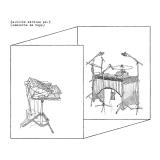
Masayoshi Fujita & Jan Jelinek, live in Kyoto, 29th June 2025 at Shimei-Kaikan, Kyoto
The concert took place as part of a Japan tour by the duo in June/July 2025. The show in Kyoto was organised by Tatsuya Shimada (night cruising). After a solo concert by Masayoshi Fujita and Jan Jelinek, the two performed as a duo.
faitiche edition is a series of concerts on tape cassette. The recordings are not available digitally. Buyers/owners of the tape can send a photo of their cassette by email to info@faitiche.de (Subject: »das digitale Konzert«) to receive a Bandcamp download code free of charge.
Sound recording: Kunihito Kizuka
Mastering: Jan Jelinek
Drawings: Vincent Klingelhöfer
Photo: Yoshikazu Inoue
Design: Tim Tetzner
out of Stock
Last delivered 5 months ago available to reorder, subject to availability
In February 2021, Jan Jelinek's seminal album "Loop-Finding-Jazz-Records" turned 20. The anniversary repress, a double LP with two bonus tracks (B-sides from the Tendency EP, 2000), is a little late to the party.
What the press said about Loop-Finding-Jazz-Records:
“Don’t be misled by the title, though for there isn’t a finger-snapping rhythm c bebop lead anywhere on the album. Instead, Jelinek chooses to explore the visual effect moiré - two shifting patterns creating an implied third dimension - in the audio realm.” (Alternative Press)
“The title acts as explanation for the studio technique that provided the basis for this album, snippets of other people’s arrangements deconstructed through a sampler into loops and then splashed onto an audio canvas.” (ATM)
“Jelinek’s sound evolved out of his dislike for (and inability to play) keyboards.” (RPM)
“Jelinek has abstracted his sources beyond recognition, looping his millisecond samples into flickering patterns of sonic moiré laid atop a dub Techno framework. (...) Jelinek might as well have sampled a horn player’s hissing intake of breath – it would have been ‘jazz’ enough for his purposes.“ (The Wire)
“It’s a perfect inversion of conventional music, a sonic negative. Everything that would typically be foreground is moved back or pushed off the screen altogether, and the flecks of sonic debris that would normally be covered by other sounds are left to carry the melody and rhythm.” (Pitchfork)
“All you need to know is that these onomatopoeic non-specific songs (...) are warm, paradisical creations”. (NME)
“Listen carefully and you’ll hear textures slowly unfolding and mutating. Presuming you’ve not fallen asleep of course.” (iDJ)
“At times, it’s all a bit dripping tap Japanese water torture; so sedentary it drowns in its own motionlessness” (DJ)
“Loop Finding Jazz Records' is a genuine modern classic whose re-release is anything but a cynical mortgage repayment exercise. Consider this a second chance, then pretend you had it all along.” (Boomkat)
PS:
“I’ve been fortunate enough to see Jan Jelinek live once, at Tonic NYC (...). Wearing a black and white striped shirt, he looked like a nihilistic Charlie Brown.” (beachsloth)
out of Stock
Last delivered 69 days ago available to reorder, subject to availability
The Danish label arbitrary presents Framework / Zwischen Remixes – a remix by German artistJan Jelinek and one by musician & label founder Mads Emil Nielsen originally made for a digital compilation, now published on 7" vinyl (arbitrary22).
For the CRXSSINGS release, Jan Jelinek remixed Nielsen’s Framework 10, a track from the Framework Book/CD (arbitrary01) based on sequences/recordings of sine waves and noise.
Side B: a rework by Mads Emil Nielsen of Jelinek’s voice collage and electronic sounds, from Zwischen – Marcel Duchamp, would you like or expect people to spin the wheel on your kinetic object Roue de Bicyclette?
Framework 10 (Remix) written & produced by Jan Jelinek, Berlin, 2019.
Zwischen/Marcel Duchamp (Remix) written & produced by Mads Emil Nielsen, Copenhagen, 2019.
Graphic design + score (cover, back: Framework 10) by Mads Emil Nielsen.
Mastered and cut by Kassian Troyer at D&M, Berlin.
out of Stock
Last delivered 8 months ago available to reorder, subject to availability
The innovative French composer & visual artist Aude Van Wyller aka Oï les Ox (The Death of Rave, Primordial Void, Kraak) receives the remix treatment from the influential German musician Jan Jelinek (aka Farben, Faitiche) on a brace of singular reworks, comprising a sprawling, longform excursion and an uncanny mood piece.
out of Stock
Last delivered 16 months ago available to reorder, subject to availability
Jan Jelinek plays The Carpenters, concert by Jan Jelinek for four loudspeakers, 20th July 2022 at Uferstudio 1, Berlin.
For this live performance, Jelinek used a sample from the song “’ * ***” by The Carpenters. Towards the end of the 1st half, the original source sample emerges from the dense arrangement of processed loops and reveals its identity, a moment that recalls awakening from deep hypnosis. The 2nd half of the performance zooms in further on the source material, leading to a complete dissolution of any referentiality.
faitiche edition is a series of concerts on tape cassette. The recordings are NOT available digitally. Buyers/owners of the tape can send a photo of their cassette by email to info@faitiche.de (Subject: “das digitale Konzert”) to receive a Bandcamp download code free of charge.
The concert was part of “TetraTon - A concert evening in quadraphonic”. The same evening, there was also a concert by Liz Allbee & Sabine Ercklentz entitled “Close-Up”. The event received support from the Initiative Neue Musik Berlin.
sound recording: Jan Jelinek
drawings: Vincent Klingelhöfer
photo: Udo Siegfriedt
layout: Tim Tetzner
out of Stock
Last delivered 17 months ago available to reorder, subject to availability
A long-lost vinyl album is back in stock: for the last 20 years, Kosmischer Pitch by Jan Jelinek, originally released in 2005 on ~scape, existed only as a digital download. Right on time for the 20th anniversary the remastered album is available again on vinyl. The digital version includes two previously unreleased pieces from that period.
What the press said about Kosmischer Pitch back in 2005:
“For Kosmischer Pitch, Jelinek draws from the obsessed-over rock produced by his German countrymen in the 1970s. (…) Trance-inducing repetition is constantly modulated by variations that hover on the threshold of audibility. (…) one of the more remarkable bodies of work in electronic music.” - Pitchfork
„Like the cosmic compositions it delicately references, Kosmischer Pitch is proof that the higher and lower pleasures can triumphantly combine.” - The Wire Magazine
“ The old Jelinek approach can also be heard on the new album - not least the “Pitch” in the title, which, as Martin Büsser explains in the info sheet, refers specifically to Wild Pitch House, generally to manipulation/exploitation of the sense of time - but there are striking differences: clear vintage synth, guitar and drum sounds, very subtle club references.” - Groove
“t's impossible to know how many layers of sound Jelinek has stacked up on any of these eight tracks, but each one seems to take on a shadowy, ghost-like life of its own as it morphs across time and space. Minimalist, yes, in a way, but thick as a wool rug.” - AllAboutJazz
out of Stock
Last delivered 6 months ago available to reorder, subject to availability
Social Engineering brings together thirteen text fragments from so-called phishing emails.
Using speech synthesis, they are spoken, sung, and/or transformed into abstract textures.
The result is a 36-minute language and sound collage devoted to the dark forces of phishing
out of Stock
Last delivered 2 years ago available to reorder, subject to availability
This record contains four tracks taken from a live performance which took place on December 3rd 2021 at the vinyl harvest record store in Esch-sur-Alzette Luxembourg. The concert was curated by non-profit organisation I am esch twenty too and the label mint.conception.recordings. I am esch twenty too was founded in 2020 as an alternative suggestion to the city of Esch-sur-Alzette being European Capital of Culture 2022 and its role and program. The budget for this concert was generated by the entrance fee to the concert only.
Jan Jelinek has for more than 20 years been one of the most essential voices in contemporary electronic music. Arthur Clees is a young percussionist from Luxembourg and a bright talent intent on finding his own way into jazz, improv and electronic music. Both performers had never met each other before.
out of Stock
Last delivered 23 months ago available to reorder, subject to availability
Faitiche releases the album Improvisations And Edits, Tokyo 26.09.2001 on vinyl for the first time. For the original 2002 CD on Soup-Disk and Sub Rosa (Audiosphere), Jan Jelinek and the Japanese trio Computer Soup (Satoru Hori – trumpet, Osamu Okubo - toys & electronics, Kei Ikeda - toys & electronics) presented eight tracks all recorded one afternoon in the trio’s living room in Tokyo. They are excerpts from a joint group improvisation that subsequently underwent rudimentary editing, on which Jelinek and Computer Soup worked separately.
Jelinek met the three musicians at his first concert in Japan in 2001, at Tokyo’s Yellow club, where Computer Soup performed as the support act. Delighted by their free improvisation on pocket-sized electronic toys, trumpet and oscillators, he arranged to meet Hori, Okubo and Ikeda a few days later for a session at their apartment. The resulting three-hour recording, made on their living room floor, formed the basis for Improvisations and Edits. A few days later, Jelinek returned to Berlin. Over the following months, they separately chose passages from the recording that were then edited and assembled into an album.
Formed in Tokyo in 1996 as a quintet (including Shusaku Hariya and Daisuke Oishi), Computer Soup began by performing with acoustic instruments on the streets of Shibuya. Ikeda und Okubo soon switched instruments, and from then on the group’s minimalistic but densely woven sound was defined by electronic toys, oscillators and Satoru Hori’s trumpet. Their first album was released in 1997 on the Japanese label Soup Disk. Eight further releases followed.
From the reviews of Improvisations and Edits, Tokyo 26.09.2001 in 2003:
"The mind-blowing first track Straight Life is perhaps the best example of what the album has to offer. Jelinek's trademark smears and washes occupy the midrange, like ghosted images of Joe Zawinul's electric piano floating quietly in the wind. DSP jazz modes are set against a walking bassline (possibly computer generated) and a gently tooted trumpet complete with Harmon mute, a dead ringer for Miles Davis' Prestige-era ballads. The effect is something like a three-dimensional film, with different realities on each layer; images of what jazz was manage to interact with a real-time demonstration of all it could be."
pitchfork, 2003
"Improvisations and Edits is a warm and mellow Ambient release with beautiful glitch fragments, static noise bursts and real trumpet intersections. However, there are times where it is the exact opposite, mainly effect-laden, overdriven and bouncy with a lack of melodies and focus, so be aware of these specific tracks."
ambientexotica, 2003
"Often deliciously dreamy and hazy, Improvisations and Edits is like listening to an exceptional instrumental jazz performance while half-conscious or under some sort of chemical influence. Computerised blips and bleeps, loops and treatments and murky sonic skips curl up around desolate horn notes and scattered instrumental noises that culminate in elegant music."
exclaim.ca, 2003
out of Stock
Last delivered 2 years ago available to reorder, subject to availability
One of the most notorious hatemongers in movie history is Captain Ahab from John Huston’s 1956 classic Moby Dick. His manic monologues cast a spell on generations of viewers. Berlin based musician and sound artist Jan Jelinek has now turned the voice of Ahab into a musical instrument.
Faitiche presents Jan Jelinek's soundtrack for SEASCAPE – polyptych, an audio-visual software developed in collaboration with Canadian new media artist Clive Holden in 2022.
SEASCAPE – polyptych is based on image and acoustic source material from Moby Dick. While Holden works on manipulating film sequences, the voice of Ahab plays a central role in Jan Jelinek’s soundtrack. The dynamic volume and tone of the captain's speech control a synthesizer system that turns Ahabs voice into ten abstract soundscapes.
In this production the voice gives the impulse and controls things but is not the sound of spoken word itself that we hear. Only occasionally can snippets of speech be heard so that syllables or sounds are recognisable. Instead we hear compositions made of hissing, soundscapes and eruptive sounds. The atmosphere is dark and sinister. Still every piece has a clear sonic structure and follows an understandable dramatic composition. This music is abstract but not overwhelming. Quite the opposite, SEASCAPE – polyptych is an invitation to listeners to let themselves be carried by the stream of sonic events. Although part of a media art work, the soundtrack can be enjoyed without any of this connecting superstructure. It works with no previous knowledge. But what happens when one does know that it’s the sonic waves of a human voice that is controlling a network of synthesizers?
If you want to hear Ahab, you will hear a choir of Ahabs in every piece of sound. The subliminal threatening as well as the conjuring Ahab. Finally the Ahab who whips up his crew and tears them with him into their downfall. The majestic „on the quay now, waiting and watching“, the oppressive “drawn towards the whirlpools center” - they are all music as well as sonic discourse.
out of Stock
Last delivered 3 years ago available to reorder, subject to availability
Faitiche releases an album version of the radio piece Vom Rohen und Gekochten (The Raw and The Cooked) originally composed and produced by Jan Jelinek for the state broadcaster SWR2. The album The Raw and The Cooked brings together five sound collages that deal with the consistency of material and its mutability.
Solid, raw, boiling, powdery, liquid, broken and folded - categories which describe the nature of material. They can also be read in a chronological sequence: solid becomes broken becomes liquid becomes powdery... Material tells of its essence as it drifts through its states, always in correspondence with external energies. The Raw and The Cooked observes the artists Thomas & Renée Rapedius as they design their paper and metal objects and the artist Peter Granser as he ritually prepares Japanese tea, it shatters glass, bends metal and burns wood. The resulting audio documents capture processes of material transformation as sound.
The Raw and The Cooked was created with the help of ITO Raum Stuttgart and Thomas & Renée Rapedius. Originally produced for radio broadcast on Südwestrundfunk in 2020 it contains a variation of the collage Zwischen/Raum that was made with funding from Musikfonds. Many thanks to Eckhart Holzboog and Beatrice Theil, as well as Frank Halbig/SWR.
out of Stock
Last delivered 5 years ago available to reorder, subject to availability
Queried on his favourite word in the German language, Masayoshi Fujita will pick ‘getragen’ – without a sliver of hesitation. Further questioning will reveal that he loves the term’s semantic signifiers, its inherent sense of “expansive, deep, quiet and sombre.” And yet, ‘getragen’ leaves plenty of room for interpretation: depending on context, it might also indicate wearing apparel or the state of being carried – two more mundane interpretations that I would rather keep from him. Does Masayoshi’s own definition, however, apply to ‘Bird, Lake, Objects’? Only to a limited extent. Compared to previous Faitiche releases, ‘Bird, Lake, Objects’ is certainly the most ‘getragen’ of them all. Nevertheless, this is by far not the first association that comes to mind. From a distance, these tracks seem rather introspective, cautious even – and reflect the recording situation: deliberately pared down, reduced to a single microphone in space and a separate track for all other instruments, each movement and action is chronicled by the treacherous mike. This confronted me with some unexpected and unfamiliar problems. For example, we had to swap out the seating in the studio as my favoured chair had a characteristic creak. Other, external influences were proved our control: fire engine klaxons, street noise and footfall became part of the recordings and their improvisatory nature. Each movement required careful orchestration, fully aware of its irrevocable nature. Space itself was always present and an audible entity, except on ‘Stripped to RM’ (recorded without a microphone or vibraphone track). After extensive deliberations, we decided to forgo the vibes on this piece – a very similar version had already been released in 2008 (on the compilation ‘Enjoy The Silence’, Mule Electronic, 2008). Jan Jelinek, February 2010
out of Stock
Last delivered 6 years ago available to reorder, subject to availability
Queried on his favourite word in the German language, Masayoshi Fujita will pick 'getragen' - without a sliver of hesitation. Further questioning will reveal that he loves the term's semantic signifiers, its inherent sense of "expansive, deep, quiet and sombre." And yet, 'getragen' leaves plenty of room for interpretation: depending on context, it might also indicate wearing apparel or the state of being carried - two more mundane interpretations that I would rather keep from him. Does Masayoshi's own definition, however, apply to 'Bird, Lake, Objects'? Only to a limited extent. Compared to previous Faitiche releases, 'Bird, Lake, Objects' is certainly the most 'getragen' of them all. Nevertheless, this is by far not the first association that comes to mind. From a distance, these tracks seem rather introspective, cautious even - and reflect the recording situation: deliberately pared down, reduced to a single microphone in space and a separate track for all other instruments, each movement and action is chronicled by the treacherous mike. This confronted me with some unexpected and unfamiliar problems. For example, we had to swap out the seating in the studio as my favoured chair had a characteristic creak. Other, external influences were proved our control: fire engine klaxons, street noise and footfall became part of the recordings and their improvisatory nature. Each movement required careful orchestration, fully aware of its irrevocable nature. Space itself was always present and an audible entity, except on 'Stripped to RM' (recorded without a microphone or vibraphone track). After extensive deliberations, we decided to forgo the vibes on this piece - a very similar version had already been released in 2008 (on the compilation 'Enjoy The Silence', Mule Electronic, 2008). Jan Jelinek, February 2010
out of Stock
Last delivered 6 years ago available to reorder, subject to availability
Faitiche releases a new collaboration between the Japanese sound artist ASUNA and Jan Jelinek: the album Signals Bulletin brings together joint improvisations and compositions made over a period of three years in Berlin, Kyoto and Kanazawa. ASUNA’s meandering organ drones merge with Jelinek’s pulsating synthesizer and field recording loops to create dense superclusters that span broad harmonic arcs.
"Watching the Japanese sound artist ASUNA playing the organ, some people might be surprised. ASUNA is no virtuoso flying over the keyboard in a rage. Instead, with the calm gestures of an office worker, he cuts strips of adhesive tape to the correct length before sticking them onto the keys of his instrument. In this way, large clusters of keys are held down, creating a dense and sustained range of frequencies, while the sound artist continually prepares further sets of keys or removes tape again. I have rarely seen a more convincing performance concept, with such a power to fascinate.
I first met ASUNA when we both gave a concert at the 21st Century Museum of Contemporary Art in Kanazawa, his home city. He performed the organ drones as described above and I immediately knew I wanted to collaborate with him. Six years and five meetings later, we completed Signals Bulletin. The album includes both joint improvisations and compositions, recorded in Berlin, Kanazawa and Kyoto.
Whether using prepared organ, Casio keyboards or mechanical plastic toys, ASUNA creates rich textures of sound that barely change over long stretches of time. It is a music without breaks. For a while, I was unsure how my loops made using modular synthesizers and live sampling fitted here – until I realized the role I had to take in this duet: I would provide the rhythmically pulsating foundation over which his dense continuums could unfold.
The result is harmonically drifting superclusters that put us into a meditation-like state. It can perhaps be compared to Automatic Writing – a mode of creative expression floating somewhere between concentration and distraction. Both the structure of our pieces and our approach to our instruments allow a similar “absence”: we let the machines play and repeat themselves – while we, in a mild form of trance, adopt the role of observers, intervening only occasionally.
It is no coincidence that ASUNA owns a collection of Doodle Art – drawings jotted down during conversations or while talking on the phone. It is said that works made like this point to the unconscious and reveal pet motifs – because a doodler always inadvertently returns to his or her favourite themes. The artwork for Signals Bulletin features pictures from the collection, in this case sheets of paper from the pads provided in stationery shops to test out pens. The special quality of such doodles is that the jumble of drawings is the work of a collective whose individual members do not know each other. Layer by layer is added, by someone different each time – until it becomes a dense cluster of lines and symbols ..."
Jan Jelinek, Berlin 2018
out of Stock
Last delivered 7 years ago available to reorder, subject to availability
Whether the drummer mimics the machine or the machine mimics the drummer is no longer a question for cultural critique or estrangement theory: rhythmitised assembly on the factory line concerns only a minor part of today's working world. More important is the animistic core question: Is the subject (drummer) contained in the beat or does he lose himself to the beat Or does he follow an experimental setup that functions like a composition or a conceptualist experiment, that allows for both, considers both - Diedrich Diederichsen
Jan Jelinek, electronics Sven-Åke Johansson, percussion
recorded live at SYN/CUSSION Festival, Radialsystem Berlin, 07.05.2017
Faitiche releases the album Improvisations And Edits, Tokyo 26.09.2001 on vinyl for the first time. For the original 2002 CD on Soup-Disk and Sub Rosa (Audiosphere), Jan Jelinek and the Japanese trio Computer Soup (Satoru Hori - trumpet, Osamu Okubo - toys & electronics, Kei Ikeda - toys & electronics) presented eight tracks all recorded one afternoon in the trio's living room in Tokyo. They are excerpts from a joint group improvisation that subsequently underwent rudimentary editing, on which Jelinek and Computer Soup worked separately.
Jelinek met the three musicians at his first concert in Japan in 2001, at Tokyo's Yellow club, where Computer Soup performed as the support act. Delighted by their free improvisation on pocket-sized electronic toys, trumpet and oscillators, he arranged to meet Hori, Okubo and Ikeda a few days later for a session at their apartment. The resulting three-hour recording, made on their living room floor, formed the basis for Improvisations and Edits. A few days later, Jelinek returned to Berlin. Over the following months, they separately chose passages from the recording that were then edited and assembled into an album.
Formed in Tokyo in 1996 as a quintet (including Shusaku Hariya and Daisuke Oishi), Computer Soup began by performing with acoustic instruments on the streets of Shibuya. Ikeda und Okubo soon switched instruments, and from then on the group's minimalistic but densely woven sound was defined by electronic toys, oscillators and Satoru Hori's trumpet. Their first album was released in 1997 on the Japanese label Soup Disk. Eight further releases followed.
From the reviews of Improvisations and Edits, Tokyo 26.09.2001 in 2003:
"The mind-blowing first track Straight Life is perhaps the best example of what the album has to offer. Jelinek's trademark smears and washes occupy the midrange, like ghosted images of Joe Zawinul's electric piano floating quietly in the wind. DSP jazz modes are set against a walking bassline (possibly computer generated) and a gently tooted trumpet complete with Harmon mute, a dead ringer for Miles Davis' Prestige-era ballads. The effect is something like a three-dimensional film, with different realities on each layer, images of what jazz was manage to interact with a real-time demonstration of all it could be."
pitchfork, 2003
"Improvisations and Edits is a warm and mellow Ambient release with beautiful glitch fragments, static noise bursts and real trumpet intersections. However, there are times where it is the exact opposite, mainly effect-laden, overdriven and bouncy with a lack of melodies and focus, so be aware of these specific tracks."
ambientexotica, 2003
"Often deliciously dreamy and hazy, Improvisations and Edits is like listening to an exceptional instrumental jazz performance while half-conscious or under some sort of chemical influence. Computerised blips and bleeps, loops and treatments and murky sonic skips curl up around desolate horn notes and scattered instrumental noises that culminate in elegant music."
exclaim.ca, 2003
A much needed repress of French ambient composer and lifeguard Roméo Poirier's cult debut record, Plage Arrière. Released with updated artwork, by London imprint Kit Records.
Plage Arrière is a deep sea meditation on a constellation of Greek beaches across three islands. Trumpets, echo-clicks and Harold Budd-esque shimmer piano whirl together on these sand-caked missives, tumbled and re-engineered by their surroundings like seaglass. Poirier evokes the sub-aqeaous ambitions of Jürgen Müller, or Jan Jelinek inspecting a coral reef.
Faitiche presents the debut solo album by cellist, sound artist, and composer Topu Lyo: “quiet scenes from tokyo” brings together sixteen miniatures for solo cello and tape echo that oscillate between abstracts drones and rhythmic pizzicato sketches – all recorded at Topu’s Tokyo apartment. The constant traffic noise from a nearby highway has become an accompanying soundtrack for his compositions and can be heard on the recordings. Topu’s playing is marked by a distinctive idiom oriented more towards abstract electronic studio effects than classical technique.
The artist spoke to Jan Jelinek about his work:
JJ: A solo cello album may seem like an odd fit for a label that has to date released only music that is electronic in the broadest sense. But I think “quiet scenes from tokyo” complements the Faitiche repertoire exceptionally well. Its sixteen miniatures showcase the cello in all its complexity: the bowed passages sometimes recall a tape feedback drone; the pizzicato playing conjures up the percussion recordings of Moondog; and the abstract textures might be mistaken for the product of a granular sampler rather than rapid finger work on the cello. I’m constantly surprised by just how rich and varied this album is – without ever losing the charm of its sketch-like quality. Could you say a few words about the making of your album – first of all, from a rather technical perspective: what production tools did you use, and why?
TL: My production tools were very sparse. Just a solo cello and my Roland 301 Space Echo, which I only used at the end, running everything through it during mixing, tape only. After years of working with electronics, pedals, and synthesizers, moving to Tokyo pushed me toward minimizing my setup. But my aesthetics shifted too, toward simplicity. I wanted to strip everything back to just the acoustic cello and see how far I could push it — replicating some of my favorite electronic effects through extended technique: slow portamento, LFOs, filters, detune, noise. I’d also been listening to a cassette of ocean sounds for years. When I moved to Tokyo I was horrified to find myself living directly across from a freeway. Eventually the freeway started sounding almost identical to the ocean — and that ended up playing a prominent part in the recording.
JJ: That’s super interesting: mimicking electronic production as a compositional idea for the cello! You say the sound of the freeway is crucial to the album: I, too, tend to interpret steady traffic noise as a positive soundscape – do we hear the freeway on the album? I can also hear other field recordings, for example on “a street car with announcements”. Can you say a bit about how these field recordings influence your playing?
TL: Yes, you can hear the freeway on the album! The freeway is most prominent in “old trees in lonely spring”, “yuyake koyake”, and “the moon” (you can clearly hear individual cars). When I first began recording I had my balcony door shut tightly, but after a while I began leaning into the highway sound and slowly opening the door little by little to control the amount of noise. “streetcar with announcements” was a moment I was recording and a car passed by making announcements in the background. I loved how it sounded! Same thing with “yuyake koyake”, and later I realized that every day at 5pm the same song plays to mark sunset, telling children it’s time to go home. Having this bedrock of sound puts less pressure on me to put music on top or to play more notes.
JJ: It’s astonishing how much this differs from what I’d imagined: I’d been picturing peaceful landscape recordings, but had never thought of a freeway. Which goes to show how open to interpretation traffic noises are. So the room by the freeway had a major influence on the album – how are you going to perform it live?
TL: The contrast between the freeway and the beautiful landscape in my head couldn’t have been starker. I too was imagining a beautiful landscape in which to create the album, but somehow it still worked out. I've been going back and forth a lot on live shows and I think the most honest way is to have it the most stripped down. I was thinking of using traffic samples etc., but I think the duet really comes from the background sounds from every unique venue/environment. So as it stands, I’ll just be doing acoustic solo cello.
An acclaimed international cast of forward-looking artists – Jan Jelinek, KMRU, Lia Kohl, J. Albert, Laurie Torres, Jefre Cantu-Ledesma, Giuseppe Lelasi, Jung DJ and Smoke Point – remixes/remodels tracks from Arp’s transfixing late 2025 album Drifts for Barcelona-imprint Modern Obscure Music (Actress/ Sakamoto, Merzbow). Reflecting Arp’s stylistically-omnivorous approach, each remixer on Echo–Variations represents a unique corner of the music landscape, from the jazzy ambient glitch of storied German producer Jan Jelinek to the overdrivendrone landscapes of Kenyan ambient auteur KMRU to Smoke Point’s no frills club-tool to the haunted ambience of cellist Lia Kohl’s gorgeous electro-acoustic work. One can hear elements of hauntology, post-rock, minimal techno, glitch, spiritual jazz at play. Arp adds a few alternate mixes and two new tracks for good measure, ambient techno floater “Chlorophyll (1998 Mix)” and perhaps the most surprising of all, the dub techno heater “MMXXVI (Dub Mix).” Heart all together, its classic sounding heart RIYL Touch, Millie Plateaux: Creative,meditative, brain cleansing, thought provoking hauntological futurism.
following two releases dedicated to sydney's atone, tonal oceans now turns its attention closer to home. after several years in the making, this release reintroduces the berlin trio die elektronische wohlfahrt in a revised form. nearly three decades after its original release on lab records in 1997, alongside the original 12" material, it includes two short pieces from the treffpunkt freizeit cd. die elektronische wohlfahrt was a short-lived project formed by kai kroker (rawell), peter lay, and anne westphalen. their recordings grew organically from late-night after-hours sessions in their studio in berlin's pankow district, capturing a unique blend of warm, quirky and playful textures. although their recorded output was rather limited, die elektronische wohlfahrt occupied the same creative circles as artists and friends such as move d and jan jelinek, at a time when berlin was establishing itself as one of germany's most innovative electronic music hubs. the group also performed at the legendary interference festival, one of germany's key underground electronic events of the 1990s. founded by dr. motte and uwe reinicke, the festival later evolved into interference records, where die elektronische wohlfahrt released the caro ep in 1996, further cementing the project's place within berlin's underground electronic scene. over the past few years, the music has quietly found its way into the hands of a new generation of listeners and discerning tastemakers, making its return feel long overdue.