There are records that come from the soul. No matter how primitive may be the recording techniques the musician has access to, the soul gets its way to the heart and mind of the listener. Samtvogel' is one of those records. Günter Schickert recorded that amazing piece of human greatness in 1974, using the media he had at the time, putting his brain at work to find the best way of taping everything he had to say. When I was recording Samtvogel' in 1974 I had only 2 Taperecorders. I played one track and while listening I added the second one. And so on. Four times. When I mixed all together I borrowed a 3rd taperecorder. And still added the last track to the master. I had a small mixer with 2 stereo and 1 mono but it was possible to pan tracks. No equalization. It all came out of my still living G2000 Dynacord guitar amplifier, of course valve, with no master, even the voice recorded through it. If I made a mistake in 1 track I had to repeat it from the beginning. And if while mixing I was not fast enough in changing the tape I had to start again. So it took me more than 3 months to get ready.'
Thanks to these three months of work, between June and September of 1974, 'Samtvogel' was privately issued that same year. It would later be issued on the Brain label, with a small change in the artwork -titles added to the front cover, which weren't on the original private pressing. Brain also reissued it on the label's Rock On Brain' LP series, this time with a completely different sleeve. The album contained two tracks on side one and just one on side two, and its sound has often been compared to the most explorative works of Syd Barret - however it must be pointed that Schickert did not need any mind spreading substances to allow his sounds float out of his mind & soul, they just came out in the most natural way. It will also appeal to fans of the echoed athmosferic guitar work of other kraut innovators such as Ash Ra Tempel, Manuel Götsching or A.R. & The Machines, and some may find on the vocal passages certain resemblances to Damo Suzuki on Can's 'Tago-Mago' era.
The Wah Wah reissue is housed in a quality sleeve that reproduces that of the original 1974 private pressing and features a 4 page insert with liners and photos - sound remastered at Eastside mastering Berlin. Get this bird now, before it flies away again!
Suche:k line
Two records came out in 1988 that forever changed the perception of "experimental" or "serious" music produced in Portugal. These were "Plux Quba" by Nuno Canavarro and "Música de Baixa Fidelidade" by Tózé (António) Ferreira. Both were released by the same label - Ama Romanta -, an influential independent imprint closely linked to avantgarde pop band Pop Dell'Arte. Because those records appeared in what could be perceived as an "alternative pop" framework, they rescued this difficult music from Academia. It helps that Canavarro played in a successful new wave pop band (Street Kids) during the period 1980-83. By association, being a friend since 1976, António was in close contact with many of the musicians and bands that were part of the equally celebrated and detested Portuguese Rock Boom (roughly 79-82).
He was not a musician then but through his friendship with Canavarro, who had the means to acquire electronic equipment, António became involved with that equipment and shared Canavarro's passion for experimentation and curiosity for knowledge. They tried to get hold of as many technical magazines as possible and learn while testing ideas. In 1983, Street Kids were about to break up, young lives drafted into the Army and maybe, in Canavarro's case, a whole new passion for challenging music similar to his bandmate Nuno Rebelo, by then in the process of discovering a wide range of "other" music mainly through Jorge Lima Barreto. Barreto, who had started Telectu with Vítor Rua, possessed a huge book and record collection and, like Rua before them, Canavarro, Rebelo and Ferreira became fascinated by the pool of knowledge they now had access to by frequenting Barreto's house in Lisbon. He was roughly a decade older, had published several books and other writings throughout the 1970s, cultivated an anarchic stance and a penchant for cultural indoctrination. Rebelo was the first to be introduced via his contact with Rua (who had invited him to play in his other band GNR).
Overwhelmed, he felt the need to share his enthusiasm with friends and eventually took a few to the house in true pilgrimage fashion. To see the Light. Among the few he led there was even João Peste, founder of Ama Romanta. Canavarro and Ferreira preceded him.
Ferreira recalls an exciting learning process added to his experiments with Canavarro's array of synths such as the Korg Ms 20, Korg polysix, ARP Axxe, Roland SH-01, the Ensoniq Mirage sampler... He read in a magazine article about someone who had studied at the Institute of Sonology (then in Utrecht, Netherlands) and went there during a vacation trip in the Summer of 1983. He became excited by the prospect of studying at the Institute but money was a problem. Canavarro, on the other hand, was admitted there in the following year. Back in Portugal, Ferreira eventually abandoned his Chemical Engineering studies in Lisbon's Technical Institute in favour of a more focused music practice. He collaborated with Telectu during 1984 and 85 as a sort of technical engineer, implementing some recording solutions and background tapes and went to work at a thermoelectric power plant in Sines, hoping to make enough money to fund his musical studies. He did and proceeded with the paperwork for admission at the Institute of Sonology, now based in The Hague. António studied there in 1986-87 and the present album includes two compositions developed at the Institute: "More Adult Music" and "This Is Music, As It Was Expected", both featuring the voice of Rodney Waschka II. Among other activities and talents, Rodney is an expert in computer music and to António his voice sounded similar to Robert Ashley's, whose work he admired.
What happened at the Institute was a systematization of António's self-taught practice. Computer software, Musique Concrète, noise and silence, organisation of abstract ideas and sounds. The original notes on the back sleeve of the LP give some indication of process and thinking, but a more detailed account was given by António in the liner notes of the CD reissue in 2002, which are also included in this 2025 LP reissue.
The music sounds deep and detailed, despite the fact of António calling it low-fi ("Baixa Fidelidade"). It flows like an improvised performance where several musicians might be responding to each other, respectful of their mutual space. Drama occurs, as a natural emotional connection is sought by the listener. Piano, bells, drone, processed voices, even the clear narrative of Rodney Waschka II, contribute to create a sort of alternative perceptual reality. The sounds are almost tangible, more a part of the physical world than ethereal manifestations and thus it would not be correct to invoke "ambient music" as a selling point. But although "physical" and distinct, this music is still alien, more so in Portugal's 1988 environment. In March, helped by Canavarro, António set up a home studio and there he recorded the remaining material for this album: "Algumas Pessoas Olharam O Sul E Viram Deserto", "Um Som, Seguido De Uma Cena Negra E Malva" and "O Verão Nasceu Da Paixão De 1921".
"Música de Baixa Fidelidade" stands not only as a proof of great resilience but as one of those magnificent works of art coming from someone who balanced technical inclination and emotional sensibility. Because of that, Tózé Ferreira is able to decode the phantom world of sound for anyone who cares to experience the sensation of inhabiting a version of the Future. First ever vinyl reissue, reproduction of the original artwork with an additional insert. Made in collaboration with the artist and the support of Paulo Menezes (Plancton Music), who provided valuable assistance. Remastered by Taylor Deupree.
The heyday of American baroque pop – or chamber pop - ran from 1966 to the turn of the seventies. It used string quartets, harpsichords and woodwinds to create a summer-into-autumn melancholy that was quite new, and quite far removed from rock’n’roll as Eddie Cochran would have known it. Baroque pop’s musicians often came from a folk background, with an affinity for acoustic instrumentation. Linda Ronstadt's first band the Stone Poneys had introduced the autoharp to their line-ups in 1965, while the likes of Bonnie Dobson and Nico experimented with a string quartet’s, searching for different, post-electric Dylan directions.
The Young Mothers return with their third album, Better If You Let It, blending a genre-defying mix of jazz, hip-hop, punk, experimental rock, and electronic music. Formed by Norwegian bassist Ingebrigt Håker Flaten in Austin, Texas, the band’s sound is shaped by the diverse musical backgrounds of its members, hailing from both the U.S. and Norway. With influences spanning from Texas’ vibrant hip-hop and punk scenes to Norway’s experimental jazz traditions, the band creates a powerful fusion that feels cinematic and unpredictable.
The lineup includes Jawwaad Taylor (trumpet, rhymes, electronics) and Jason Jackson (tenor and baritone sax) from Houston, Stefan Gonzalez (vibraphone, drums, percussion, voice) from Dallas, Frank Rosaly (drums, electronics) from Chicago and Amsterdam, and Håker Flaten (bass) from Norway.
This global roster brings together a dynamic, cross-cultural sound, with Better If You Let It showcasing their most cohesive and wide-ranging material yet. Recorded in Oslo and set for release on Sonic Transmission Records, the album is a bold statement, proving The Young Mothers’ ability to push musical boundaries across genres and geographies.
Berlin based producer CONCEPTUAL is back home after his Not an easy one Ep, again providing his own vision on techno, full of sonic landscapes, detail and intelligence.
Release starts with Approach slowly a brief atmospheric intro that sets the pace for what comes next in Il silenzio degli innocenti introducing the rhythmic pulse from the first bar with almost all elements into he equation, this is a minimalistic tool where percussive elements evolve in a subtle manner all over the arrangement.
No more excuses continues in the mood, adding more spice to the formula with reverberated details, growing mental sequences and the usual complex groove. Intense and mental all in one.
Sand fury follows, with atmospheres colliding with rugged components, evolving all together in a progressive arrangement, a superb tool to enhance your mixes properly.
Miles per hour introduces you into another sonic realm, using elastic synth lines, a wise reverb work and a sensation of infinite space combined with floor intensity. Again a proper intelligent missile for the adequate dancefloors out there.
Simone Scardino is one of those few creators that always pushes his sound one step further and we are super proud to have him onboard again.
- Whatever Makes You Happy
- Last Forever
Color Vinyl[10,04 €]
Patchwork Inc. is a multi genre music collective based in Chicago. Inspired by the intricate and repetitive patterns on a quilt, deep grooves are stitched together with vibrant threads of analog synths, fat bass, Fender Rhodes, and a plethora of percussion to form a uniquely personal piece of art. "Whatever Makes You Happy," comes on like one of those unseasonably warm days in late fall. Flute, synth, and congas flutter like a cool breeze before giving way to a sunny and sultry hook. North Carolina native Taylor Williams brings a D'angeloesque vocal to a Roy Ayers style instrumental resulting in a mosaic of neo-soul and jazz-funk. The record's flipside evokes more of an idyllic fall day. The kind of day where you can throw on your favorite jacket and endlessly stroll down a tree-lined path as amber leaves fall to the ground. Chicago journeyman and musical prodigy Wyatt Waddell effortlessly layers his voice over the backbeat of "Last Forever," resulting in a medium-fidelity banger that could be confused for a I Want You-era Marvin demo.
W/CYA are proud to introduce the first release of Amygdala. A three tracks EP entirely produced by themselves, including a special collab with the brillant Brooklyn's voice of IDA fLO aka Florence Ida Dabokemp.
The A side with the solo track "Forever Joy" is a deep dive into the classic 90's house sounds crafted with a futuristic vision on the modern techno style. The B1 and B2 tracks follow the same line of the A side, offering a more complexed and articulated image of the idea behind the
label identity. A true dancefloor burner that must be in your bag.
- A1: Funeralaughters
- A2: Brother & Sister
- A3: Charlie
- A4: Party, Crash
- B1: Mourning
- B2: Aftermath
- B3: Séance / Sleepwalking
- B4: Second Séance Pt. 1
- B5: Second Séance Pt. 2
- B6: Second Séance Pt. 3
- C1: Classroom
- C2: Dreaming
- C3: Book Burning
- C4: Joanie
- C5: Get Out
- C6: Leigh’s Things
- D1: Steve
- D2: Peter
- D3: Chasing Peter
- D4: The Attic
- D5: Reborn
- D6: Hail, Paemon!
Green[42,82 €]
Hereditary is a 2018 American psychological horror film written and directed by Ari Aster in his feature directorial debut.
He later went on to direct Midsommar (2019) and Beau Is Afraid (2023). The movie stars Toni Collette, Alex Wolff, Milly Shapiro, Ann Dowd, and Gabriel Byrne.
When Ellen, the matriarch of the Graham family, passes away, her daughter’s family begins to unravel cryptic and increasingly terrifying secrets about their ancestry.
The more they discover, the more they find themselves trying to outrun the sinister fate they seem to have inherited.
The soundtrack for the movie was written, arranged, and produced by Colin Stetson. Aster tried to keep it simple for Stetson regarding the music, but he wanted one thing to be apparent: the music had to “feel evil”.
This 2LP is housed in a gatefold sleeve that includes liner notes by the director, Ari Aster.
"In celebration of its 20th Anniversary, Waxwork Records is proud to present THE RING Original Motion Picture Music by Hans Zimmer! This long anticipated release marks the first time that The Ring will be available on vinyl. The Ring is a 2002 supernatural horror film directed by Gore Verbinski and starring Naomi Watts and Brian Cox. It is a remake of Hideo Nakata’s 1998 Japanese horror film Ringu, based on Koji Suzuki’s 1991 eponymous novel. The plot follows a journalist who investigates an urban legend of a cursed videotape that seemingly kills the viewer seven days after watching it. The Ring was released on October 18, 2002 to positive reviews praising its atmosphere, visuals, and Watt’s performance. It is one of the highest grossing horror remakes and paved the way for English-language remakes of other Asian horror films such as The Grudge and Dark Water. The score by composed by Hans Zimmer is a dark symphonic orchestration that shifts from ghostly and melancholic to frightening and terror stricken. Constructed from a base of a piano, violins, synthesizer, and two cellos, Zimmer’s score is thoroughly effective in bringing the listener into the haunting space that is The Ring with dreadfully anxious strings, mournful keys, and rolling percussion. Zimmer creates a shadowy ambience that pulls you into the gripping ghost story. Waxwork Records is thrilled to present the full score to The Ring composed by Hans Zimmer for the very first time on vinyl as a deluxe double LP for the film’s 20th Anniversary. Featuring 180 gram “Samara & The Well” Green & Black Marbled Vinyl and “Cursed VHS Tape” Black with White Splatter Colored Vinyl, heavyweight gatefold jackets with matte satin coating, new art and design by Matt Needle, exclusive liner notes by director Gore Verbinski, a 12”x12” printed insert, and enthusiastic album packaging approvals from director Verbinski and composer Hans Zimmer.
- Hello !
- Back 2 Ya
- This Is Me Now
- Care
- Animal
- Chew U Up
- Say Less !
- Losing Me
- This Love S Gonna Go Nowhere
- To Be A Man
- Good God You Ve Gotta Try !
"‘man oh man !’ is the sophomore 11 track album from indie singer-songwriter Martin Luke Brown.
Marking a significant new era in both his personal and musical life, Martin tackles a myriad of themes; self-awareness and personal growth, treasured friendships, swept-off-your-feet romance and gut wrenching heartbreak - all with a laidback, indie singer-songwriter sound that naturally shapes the album into three linear phases: the end of a relationship, new beginnings and the consequential feeling of accepting change.
Described by Martin as a ‘time capsule’, each track on the album was written and recorded in one day, making for a raw and honest snapshot of Martin’s life experiences at the time. Instrumentation is simple and recorded with producer and friend Matt Zara using almost exclusively analog technology – tape machines and vintage mics, a messiness that the duo embraced from the get go.
Martin has released over 100 songs as either a co-writer or a producer, with BTS, Dylan, Jacob Banks, Gavin James, Sam Tompkins,James Smith, Sody andJack Kane. He has also seen a wealth of success as part of pop supergroup FIZZ alongside Orla Gartland, dodie, and Greta Isaac, earning widespread praise from the likes of Rolling Stone UK, Dork, DIY, Clash & more."
VETO aus Süddeutschland starteten Anfang der Achtziger als Hardrockband mit deutschen Texten. Nach einigen Besetzungswechseln und einer Neuausrichtung in Richtung englischsprachigem Heavy Metal, bekam man einen Plattenvertrag bei der Firma GAMA (Label: Scratch). Mangels Schlagzeuger übernahm diesen Posten einer der beiden Labelbosse persönlich: Peter Garattoni.
Das Debüt “Veto“ erschien 1986 und wurde von den Fans und der Presse wohlwollend aufgenommen. In Folge spielte man unter anderem mit Bands wie Saxon, Vengeance, Lee Aaron, Warlock, Sinner und Grave Digger. Das zweite Album „Carthago“ wurde im Stuttgarter Zuckerfabrik-Studio aufgenommen und gehört heute zu den absoluten Geheimtipps der German Metal Szene. Nicht nur, dass die Band an sich mit überdurchschnittlichen Fähigkeiten ausgestattet war, sie konnten auch mit packenden Songs zwischen Hardrock und Speed Metal überzeugen. Dazu eine knackige und druckvolle Produktion, die so manch Majorlabel damals nicht geboten hat.
Mit dem Titelstück “Carthago“ gelang VETO zudem ein episches Meisterwerk. Die Ankündigung einer wertigen Wiederveröffentlichung von “Carthago“ auf Golden Core hat in der Metalszene bereits Staub aufgewirbelt und in den sozialen Medien für positive Reaktionen gesorgt. Die remasterte CD enthält als Bonus das gesamte Debütalbum “Veto“, sowie das rare und spannende Drumsolo “Thunderstorm“ von Peter Garattoni, welches als Veto-Song auf einer heute raren Metal-Compilation aus den Neunzigern zu finden ist. Die LP, separat für Vinyl gemastert, enthält als Bonus zwei Songs vom Debüt und ebenso “Thunderstorm“. Beide Formate beinhalten Liner Notes und viele rare Abbildungen.
- 01: Never Said
- 02: Bambi’s Theme
- 03: Some Girls
- 04: Counting Sheep
- 05: Audrey Go Again
- 06: Head & Spine
- 07: Tell Me Why
- 08: Sunder
- 09: Next Big Star
- 10: Jacy
- 11: I’ll Be Around
Anxious’ second album Bambi arrives this winter on Run For Cover Records. It’s been a whirlwind few years for the Fairfield, Connecticut five-piece – since the release of their debut album Little Green House, there’s been little time for anything other than consistent touring with bands like Hot Mulligan, One Step Closer and The Wonder Years. Somewhere during that endless grind, vocalist Grady Allen was sitting in a hotel room and stumbled upon a name typed into a long-forgotten memo on his phone: Bambi. “We should have named the band Bambi,” he recalls admitting to his bandmates. Bambi stuck with the band after that night and eventually it evolved from a “what-if” into the name of Anxious’ second full-length album.
Bambi is a record of remarkable growth, depth, ambition, and energy. It takes all the unsolvable and unavoidable problems of exiting adolescence and makes them resonate in urgent and authentic new ways. The album has deep roots in the storied lineage of Northeast tri-state hardcore and emo, but it also fully embraces the widescreen alternative rock songwriting at which Anxious have previously only hinted. It’s a statement of purpose, the kind of album that comes from a band reconciling where they’ve been with where they want to go. Bambi is the sound of Anxious putting everything on the line–and coming out on the other side better than ever.
Inspired by “big swing” records like Blink-182’s self-titled or Jimmy Eat World’s Clarity, Anxious set out to redefine the band without losing sight of what made them work in the first place. Tracks like “Head & Spine,” “Sunder,” and “Tell Me Why” showcase the scope of Anxious’ evolution, tapping crunchy ‘90s rock guitarwork, layered ‘60s-esque harmonies, and crisp, modern production that captures the unrivaled energy of seeing the band play live.
The title of the brand new album from Brussels hybrid pop quartet FABIOLA refers to the fruit of the gigantic network known as mycelium. A fitting image to describe an album rich in luxuriant sound worlds. This unique collage of 90’s hip hop basses, vivid drums, ominous synthesizers, fields recordings and almost no-wave guitar pizzicati perfectly blends with Fab Detry’s lush vocal lines. If lyrics can express political concerns, crucifying conservatism, icons and orchestrated social division, they also hearten contemplation and a return to simplicity and nature. Fabiola’s pop is utterly smiling, even if it lacks a few teeth.
All the shades of green. Plants. Water. The absolute necessities of life. Music, too, is an absolute necessity. To capture both color and sound in a bottle to put atop a piano like a houseplant. A clock. A fern. Synesthesia. This music is meant for that. To close your eyes and see green. To drown in the color of piano. A melancholic covey that pulls hard on the heart strings musically and lyrically, brushed over with a plethora of improvisation in smooth watercolors.
With Tim Hill’s new trajectory, we are offered a fresh neuron sprawl, branching beyond lyrics in interrupted pieces of sound. He takes our reptilian brains and welds them to our unborn futures, placing us inside of his droplet. Here, we're forced to reflect out, something singular multiplies, nature brings her face in, something shifts, our speed changes, the Self refracts and what's left jumps on sustained lines that eventually arch into meditation milk. It becomes a karmic cleanse of the amygdala, a launch from normal feeling life. Tim takes the risk, committing to diving deeper into his own bottomless pool of art, gifting us with sensory treats that dilate our old perimeters. It's sky as theatre, handing out everything but answers to questions. And where do we go? Where starlight mingles. Where minds never land.
A seasoned musician in all forms, Tim Hill has toured the world as a keyboardist, guitarist, saxophonist, and drummer, with a long time stint with LA group the Allah Las, and well known acts such as Nick Waterhouse, Curtis Harding, PAINT, and others.
SPECKLED DRAGON EGG COLOR VINYL[23,49 €]
Cassette[14,08 €]
PURPLE TREE FOG VINYL[23,95 €]
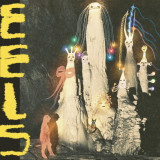
Being Dead knows how to make an entrance - within the first several seconds of EELS, the duo's new record, the bright, hard-strummed guitar line on "Godzilla Rises" conjures cinematic immediacy, a creature emerging from the depths of the ocean in campy, freaky stop motion, fittingly so. Being Dead's records are mosaics, technicolor incantations, each song its own self-contained little universe. And while the dreamlike EELS probes further into the depths of the duo Being Dead's psyche, it is, most importantly, in the year of our lord 2024, a 16-track record that is genuinely unpredictable from one track to the next: a joyous and unexpected trip helmed by two true-blue freak bitch besties holed up in a lil' house in the heart of Austin, Texas. They decamped to Los Angeles for two weeks to record with GRAMMY-winning producer John Congleton, writing songs for the record until days before they left. The radical shift in process was welcome - a good balance and a challenge, Congleton helping them find new ways to work and helping peel back the layers on the core of their songwriting. Being Dead has grown from a duo to a trio live, including bassist Ricky Motto (who is immortalized finally on record here, particularly in the giggles on "Rock n' Roll Hurts") The resulting EELS is a darker record, tapped more into the devilishness within, but it's also a more raucous, rougher ride sonically. There's heartbreak, excitement, enchantment, dancing - we move through it all at a high-octane pace. Falcon Bitch and Smoofy never want to do the same thing twice on any song, and they don't. From the pummeling garage rock distortion of "Firefighters" to "Dragons II," which appears in its demo form taped on a hand recorder, it's unexpected but intuitive, and, most importantly, singularly Being Dead. Like its animal namesake suggests, the songs on EELS are malleable, the record like slithering through murky waters or strange half dreams, mysterious and beautiful in how it moves, reflective in a wavering sheen. Dipping into each song feels like uncovering a new cavern, plunging into depths unknown but fully open to what will be revealed. On the album artwork, an illustration by the artist Julia Soboleva, there are some weird disparate spectral creatures, a stark glimmer against a cloudy darkness. It's a fitting encapsulation of Being Dead, exuding a welcoming, playful energy even if something foreboding lurks just beyond the pale - more out of frame that's left to uncover, no path unexplored, strange and beautiful in the light.
Purple Tree Fog Vinyl. Being Dead knows how to make an entrance - within the first several seconds of EELS, the duo's new record, the bright, hard-strummed guitar line on "Godzilla Rises" conjures cinematic immediacy, a creature emerging from the depths of the ocean in campy, freaky stop motion, fittingly so. Being Dead's records are mosaics, technicolor incantations, each song its own self-contained little universe. And while the dreamlike EELS probes further into the depths of the duo Being Dead's psyche, it is, most importantly, in the year of our lord 2024, a 16-track record that is genuinely unpredictable from one track to the next: a joyous and unexpected trip helmed by two true-blue freak bitch besties holed up in a lil' house in the heart of Austin, Texas. They decamped to Los Angeles for two weeks to record with GRAMMY-winning producer John Congleton, writing songs for the record until days before they left. The radical shift in process was welcome - a good balance and a challenge, Congleton helping them find new ways to work and helping peel back the layers on the core of their songwriting. Being Dead has grown from a duo to a trio live, including bassist Ricky Motto (who is immortalized finally on record here, particularly in the giggles on "Rock n' Roll Hurts") The resulting EELS is a darker record, tapped more into the devilishness within, but it's also a more raucous, rougher ride sonically. There's heartbreak, excitement, enchantment, dancing - we move through it all at a high-octane pace. Falcon Bitch and Smoofy never want to do the same thing twice on any song, and they don't. From the pummeling garage rock distortion of "Firefighters" to "Dragons II," which appears in its demo form taped on a hand recorder, it's unexpected but intuitive, and, most importantly, singularly Being Dead. Like its animal namesake suggests, the songs on EELS are malleable, the record like slithering through murky waters or strange half dreams, mysterious and beautiful in how it moves, reflective in a wavering sheen. Dipping into each song feels like uncovering a new cavern, plunging into depths unknown but fully open to what will be revealed. On the album artwork, an illustration by the artist Julia Soboleva, there are some weird disparate spectral creatures, a stark glimmer against a cloudy darkness. It's a fitting encapsulation of Being Dead, exuding a welcoming, playful energy even if something foreboding lurks just beyond the pale - more out of frame that's left to uncover, no path unexplored, strange and beautiful in the light.
- 01: 9Th Wonder
- 02: Crown Ones
Amsterdam-based keyboardist, producer, arranger and DJ Soul Supreme reached out to NYC drummer Jay Mumford in 2021 to lay the down groove on his re-imagining of Q-Tip and J-Dilla's "Let's Ride". That paved the way for future collaborations: a cover of A Tribe Called Quest's "Award Tour (We Gettin' Down)" and two tunes on Soul Supreme's Poetic Justice LP. But when the pair began doing brief covers of their favorite funk, jazz and hip-hop tunes on Instagram just for fun, followers of both musicians - and often, the covered artists themselves - began to take note. Two of those 20+ covers were particularly well-received, and the duo decided to answer the peoples' call for a 7" release with the songs pushed to their full potential. Similar to "Award Tour" and "Let's Ride", a hip-hop classic and a fan favorite are pushed to their full potential here. This installment goes coast to coast and explores Digable Planets' "9th Wonder" (the "East" side) and People Under the Stairs' (PUTS) "Crown Ones" (the "West" side).
The iconic synth intro of "9th Wonder" makes way for Jay's thunderous ode to a slowed down Clyde Stubblefield groove. Sure to be a favorite with DJs, Jay eventually detours into a syncopated New Orleans funk break, before getting back to the groove for Soul Supreme's funky wah wah clavinet work. Throughout, the arrangement expands beyond both that of the original and all of its DNA. The addition of cascading horns (featuring a trumpet solo by Lourens van der Zwaag) and a second, more aggressive break from Jay bring it back full circle, completing a modern update of a classic that manages to pay homage to '70s jazz-funk, breakbeats and '90s hip-hop - all while staying both modern and raw.
Diehard PUTS fans will recognize Soul Supreme's catchy Rhodes line as soon as the needle drops, but Jay's heavy funk groove quickly separates it from the original and takes it from hip-hop cover to heavy funk tune. Soul Supreme's Rhodes solo pushes it far beyond the confines of instrumental funk as the groove intensifies, while his chops as an arranger are on full display: his horn parts - featuring van der Zwaag, trombonist Olav Schloorlemmer and Job Chajes' Contra-Alto Clarinet that channels The Headhunters - counter his synth melodies in a discussion that completes the record as a heavy slice of uncut jazz-funk.
Hardly Cricket sees the band truly lean into their rock tendencies. Those who have enjoyed their past forays into 70s style dual guitar leads will find much to latch onto here. Explosive, high energy tunes like “New Music” and “Sacred Heart” are instantly infectious and truly set the tone with high flying guitar action from all the players. However, as always, Shirese keeps it varied. With songwriting duties being more evenly spread throughout the group this time around, listeners will find 60s garage, country, and even doo-wop inflected songs as well. Matt Paolilo’s ever present vocals and tongue-and-cheek lyrics keep listeners on their toes. While the occasional descent into tape spliced experimental madness still finds its place in the grooves. Shirese continues to evolve as their lineup continues to cement. Gone are the days of a revolving cast of characters, and in its place we find a group of friends who mesh tightly, pushing beyond their perceived limits to true rock’n’roll glory! A Grapefruit Records and C/Site Recordings co-release. Limited to 300 copies.
"Heritage is the tenth studio album by Swedish progressive metal band Opeth. The album was recorded in early 2011 at Atlantis Studios in Stockholm and produced by Mikael Åkerfeldt, engineered by Janne Hansson, and mixed by Steven Wilson (the first album since 2003's Damnation on which he worked with the band, although not as producer). It takes on more of a progressive rock sound, something the band had wanted to do for some time, resulting in a stark contrast to the progressive death metal sounds of their past albums.
A critical and commercial success and charted at number 19 on the Billboard 200. The first 5000 copies of this edition will contain a beautiful 16 page booklet.
Heritage is available as a 2LP limited edition of 5000 individually numbered copies on black & red marbled vinyl and comes with a limited 16 page booklet, a poster and an insert."
Tradition shapes your work. For saxophonist and bandleader Shabaka Hutchings, that's something he's long understood. After years spent in the orbit of London's jazz circuit, he examines and reimagines his influences with a dexterity that's unique. Drawing out the vision underlying his new album, he says, I see energy as being a form of wisdom to be passed down through the ages.'
Unpicking the album's title, he continues, "When we study the music, the lives, the words of our master musicians we obtain a glimpse of that artist's essential energy source. This is the core vitality of the individual which leads them to utilise the musical specifics of their chosen genre in a way that mirrors their inner source of power. This is an intuited wisdom that's handed to us from the legacies of our elders.
The album is a document of sessions combining Hutchings with a group of South African jazz musicians he's long admired. His connection to the group was Mandla Mlangeni (bandleader of the Amandla Freedom Ensemble), whom he'd flown there to play with over the past few years. Recorded across just one day, the group drew on their South African lineage - heroes like Zim Ngquwana and Bheki Mseleku - to bring their own slant to the American jazz lineage which is reconfigured in Hutchings' compositions themselves.
Going beyond the jazz greats Hutchings cites, influences are drawn from plenty of other sources: Caribbean calypso, central African song structures and Southern African Nguni music all play a part. Bringing together those ideas with the contributions of his bandmates is, he explains, crucial to what he sees in the role of an album artist. Even though I wrote all the music, for me, the leader of the project isn't the person who writes all the music but the one who has a vision for how certain musical elements will be combined."
A regular sight on stages around London and beyond, playing - and often leading - groups like The Comet Is Coming, Sons of Kemet and Melt Yourself Down, he's part of a generation whose idea of jazz is pointedly unrefined. That's to say, Wisdom of the Elders comes from an artist interested in the indefinable gaps more than fitting into boxes.