Change is good. It’s inevitable. It’s the general nature of how the universe works all around us. Change comes in many forms, and this particular one is the debut EP from 2Phargon. While it might be the debut, the veteran producer behind the new alias isn’t a stranger to Dirtybird, Lee Mortimer aka Friend Within.
The EP features three brand new tracks under the new guise covering a wide landscape. “Feel A little Strange” is a monster attention grabber - the perfect piece to kick off the new venture. “Micro” is fast-paced filled with moments of drifting away before snapping back into stride. Rounding it out is “Dwelling”—a bubbling kaleidoscope of sound.
We welcome the change with open arms.
Cerca:ka§par
- A1: Third World - 1865 (96° In The Shade)
- A2: Peter Tosh - Johnny B. Goode
- A3: Althea & Donna - Uptown Ranking
- A4: Toots & The Maytals - 54-46 Was My Number
- A5: Inner Circle - Mary Mary
- A6: Wailing Souls - Feel The Spirit
- B1: Ini Kamoze - World-A-Music
- B2: John Holt - Police In Helicopter
- B3: Jimmy Cliff - The Harder They Come
- B4: Steel Pulse - Babylon Makes The Rules
- B5: Culture - The International Herb
- B6: Dennis Brown - Love Has Found Its Way
- C1: Eek-A-Mouse - Wa Do Dem
- C2: Black Uhuru - Sinsemilla
- C3: Aswad - Can’t Stand The Pressure
- C4: The Mighty Diamonds - Right Time
- C5: Pato Banton - Go Pato
- C6: Linton Kwesi Johnson - Inglan Is A Bitch
- D1: Gregory Isaacs - Night Nurse
- D2: The Abyssinians - Meditation
- D3: Max Romeo & The Upsetters - Chase The Devil
- D4: Buju Banton - Hills And Valleys
- D5: The Paragons - The Tide Is High
- D6: Yellowman - Zungguzungguguzungguzeng
Reggae Collected is compiled from the broad world of Jamaican artists, groups and its diaspora. This brand new compilation contains early reggae by Jimmy Cliff, classics from Third World, Peter Tosh, Toots & The Maytals, Steel Pulse, Black Uhuru, lovers-rock from Dennis Brown, Linton Kwesi Johnson, Gregory Isaacs, Yellowman and the #1 hit from Althea & Donna “Uptown Top Ranking” which was championed by BBC Radio 1 DJ John Peel.
The album Reggae Collected is part of the Collected compilation series, which is a collaboration between Universal Music and Music On Vinyl. The compilations bring together the biggest and best names of its genre, combined with forgotten hits and less discovered gems, giving the listener an experience of both nostalgia, and uncovering new musical grounds at the same time.
The 2LP Reggae Collected is available as a limited edition of 2000 individually numbered copies on yellow (LP1) and light green (LP2) coloured vinyl and includes an insert.
Ontario four piece Tokyo Police Club burst on to the scene as teenage sensations with 2007"s A Lesson in Crime EP, an opening salvo that delighted discriminating young music fans around the world and saw them win plaudits from NME, Pitchfork and more. The EP was followed up in 2008 with Peter Katis on the desk for their debut album Elephant Shell which spawned the hits Your English is Good and Tesselate. Elephant Shell is the sound of these four young friends coming of age and into their own. The album catapulted the band into the popular consciousness, landing the band on the stages of the world"s biggest festivals, a spot in MTV"s video rotation, appearances on the Late Show with David Letterman, and even a cameo on Desperate Housewives. Beyond that, Elephant Shell has stood up as one of the defining albums of this particular era in indie rock. Hard to believe it"s 15 years hence. Elephant Shell is ripe for a reissue and this 2023 edition comes on tricolour-incolour-vinyl.
Ghost Producer aka Badawi (aka Raz Mesinai aka Bilal ibn Yakub al-Badawi) is a prolific producer and artist who has been on the forefront of underground experimental jazz and electronic music scenes around the world for over thirty years, with a catalog of albums on labels as ROIR, Asphodel and Tzadik under various monikers dating back to the late 1980s.
Ghost Producer released his first albums starting in the late 80’s under the monikers Psy Co. and Ruff Riddim Productions, selling his cassette tapes in NYC. He produced, on average, at least one album per week since 1988 until today. One of the twenty or so monikers was Badawi, later being signed to ROIR Records and releasing the seminal experimental dub, punk albums »Bedouin Sound Clash« and later »The Heretic of Ether« on Asphodel. Spending time as a child between Occupied Jerusalem, the West Bank (Balata) and New York City (Rock Steady Park) during the height of the B-Boy era in the 70s and 80s informed Ghost Producer’s singular sound of heavy driving Sufi rhythms, sonic experiments, percussion, piano playing and sound design which has connected him to a wide variety of artists ranging from Maryanne Amacher to John Zorn, to added elements of darkness to music by such artists as Hanz Zimmer (Black Hawk Down) and rappers Danny Brown (Pneumonia) and Skepta and Double D (Don) among many others.
At age 14, Ghost Producer was discovered by visionary jazz and rock musician, Juma Sultan (Jimi Hendrix) whom later trusted Ghost Producer with producing the archive of over 2000 hours from recordings from »Studio We« and the Free Jazz Loft Movement in NYC in the 60s and 70s. As a composer, he has worked with Kronos Quartet and has had premiers at Carnegie Hall (Cross Fader, The Echo of Decay) and Lincoln Center (String Quartet For Four Turntables). In addition, Ghost Producer has released several albums on John Zorn’s Tzadik label, where he explored producing to the books of Franz Kafka (Before The Law, Resurrections for Goat Skin, Cyborg Acoustics)
As a composer for film, he coined the term »score design» to describe his work in conceiving and producing scores for films with particularly demanding needs, working on such films as A Late Quartet (director Yaron Zilberman composer: Angelo Badalamenti), The Fountain, Black Swan and The Wrestler (Darren Aronofsky/Clint Mansel), Black Hawk Down (Ridley Scott/Hans Zimmer) and many more. In 2014, he was awarded as a fellow in the Sundance Composers Lab.
In 2015, Ghost Producer formed the Underground Producers Alliance, a unique program for developing producers, performers and composers, with co-founders Scotty Hard (Wu Tang Clan, Medeski Martin and Wood, De La Soul), HPrizm aka High Priest (Anti Pop Consortium), Honeychild Coleman (the 1865, The Slits) and Prince Paul (Jungle Brothers, De La Soul), where Ghost Producer produces entire albums with student participation in his master course.
This album, »The Book of Jinn«, is one of many productions done within the course, featuring players/mentors Juma Sultan (percussion), Chandenie (voice) and Shahzad Ismaily (electric bass), with additional student participation from Adam Culbert and Jonah Sollins (aka Goodnight 1500) on synths and percussion as well, then all remixed and rearranged by Badawi into what you hear here, The Book of Jinn.
Der in Paris geborene Singer-Songwriter, Performer und Produzent norwegischer Abstammung, der gerade bei Because Music unter Vertrag genommen wurde, hat den größten Teil seines erwachsenen Lebens im Ausland verbracht. Diese ständige Bewegung war ausschlaggebend dafür, dass Aime die englische Sprache als diejenige wählte, in der er sich als Künstler am ehrlichsten ausdrücken kann.
Der schillernde Post-Pop des Singer-Songwriters, Performers und Produzenten hat nach der Veröffentlichung seines Debütalbums ”Say Yes, Say No” internationale Anerkennung gefunden. Nun präsentiert Aime Simone sein neues Album ”Oh Glory” inklusive der bereits veröffentlichten Songs ”Baby Don’t Quit”, ”Not What You Wanted” und ”Answer The Night”.
Er beschloss, seinen Musikstil ”Post-Pop” zu nennen, da er sich aus einer so reichen Palette von Stilen bedient, dass das Konzept eines einzigen Musikgenres verschwindet. Die Harmonien und die Refrain-Struktur seiner Songs stammen aus dem klassischen Pop, mit Untertönen von Soul und Gospel sowie Einflüssen von Clubmusik.
Auf den 11 Tracks von ”Oh Glory” verschließt Aime nie die Augen vor den dunklen Phasen seines Lebens. Wie Caravaggio und seine Gemälde, deren Schönheit dieses Album inspiriert hat, nutzt
Aime Simone diese Kontraste, um eine vom Licht durchdrungene Dunkelheit zu beschreiben.
Edmony Krater grew up on the side of Morne Rouge in Sainte-Rose, north of Guadeloupe. His mother sang in church, but Edmony was drawn to the sound of Gwo Ka, which was frowned upon but very present in ceremonies or funeral vigils.
As both a fashion designer for the theater and a musician (percussion, trumpet, vocals) in the group Gwakasonné, formed by Robert Oumaou and Georges Troupé, Edmony left Guadeloupe in 1983 to settle in mainland France just after recording their first album.
Upon his arrival in Paris, with the desire to give his own version of Gwo Ka, he founded the group Zepiss with Eddy Lebouin, Freddy Tisseur, Philippe Augusty, and Rico Toto and immediately recorded a first album, Natibel.
In a singular way, Natibel perpetuates Gwo Ka Modèn, a movement initiated by the iconic jazz guitarist Gérard Lockel, who was the first to theorize and politicize this music previously transmitted only orally. In just six tracks, Natibel combines the sophistication and roughness of its root music, as Gwo Ka combines an intense rhythmic section with intoxicating melodies.
In the tradition of other Gwo Ka musicians who took the music further such as Guy Conquet, Fabriano Fuzion, Gwakasonné, Erick Cosaque, and above all legendary drummer Marcel Lollia aka Vélo, Edmony Krater and his group Zepiss have contributed to preserving its heritage and bringing an obvious touch of modernity.
"Akuphone is proud to present the Jerusalem-based improvisational trio Leviot and its hypnotizing debut album. Leviot (Hebrew for “Lionesses”) is a brainchild of multi-faceted musician and composer Yael Lavie, who’s joined by classically trained percussionist and music teacher Cnaan Canetti, and synth enthusiast Yishay Seroussi. The project is a result of Lavie’s ongoing explorations beyond the restraints of classical kanun playing and fascination with electronic sound and modern composition. Initially started following her experience performing and recording with Spiritczualic Enhancement Center, in Leviot, Yael gives up rehearsed pieces in favour of improvised sets, based on virtuous interpretation by Cnaan and Yishay. The three have been active since 2019, playing their immersive shows in a wide variety of settings, venues and festivals. The trio’s debut release is a live session, recorded in late 2020 at Mazkeka Studios (Jerusalem) for the lockdown edition of the annual Zikuk Festival. It’s a meditative improv piece in five parts that combines and melts boundaries between the traditional and the experimental, the primal and the futuristic. With setup as the foundation of the piece and Lavie’s graphic score as the road map, Leviot takes off on a cosmic journey between deep drones, whispering chimes, mesmerizing Arab melodies, pulsating rhythms and iridescent ambient patterns."
Tom Zé and Faust collide in Domenico Lancellotti's "machine samba"
Domenico Lancellotti's SRAMBA reaches back to the roots of samba whilst completely revamping its blueprint, indoctrinating guitar and percussion-led rhythms with analogue synthesisers, courtesy of album producer Ricardo Dias Gomes.
The majority of SRAMBA was recorded over two months in The Cave - Domenico's home studio in Lisbon, the city both Brazilian ex-pats reside in, where the arrival of a couple of Russian-designed synths purchased by Ricardo influenced the direction of their initial experimentation: "Ricardo had these instruments, modular machines" remembers Domenico, "and I had my guitar, some percussion instruments. On the first day we started making sounds and recording them, and songs started to appear, sambas started to appear."
The son of a renowned samba songwriter, at home Domenico would watch his father play and compose. At parties, the adults would hand his father a tamborim (a small tambourine) and ask him to play along. "I grew up inside samba, it's my roots", he says. "For me, everything is samba, I bring it into whatever style of music I am making".
Domenico and Ricardo instantly saw how the synthesisers were not at odds with the sambas they were playing, instead they had a similar sound to its typical percussion instruments (ganza, repinique, surdo, tarol). What's more, they saw a connection with roots samba, the samba that existed before bossa nova and samba jazz came along. This was rhythmic samba, with grooves that could go on ad infinitum. "It's samba de clave, geometrically structured" says Domenico. "It's ostinato samba", adds Ricardo.
"Diga" is a great example of what their proposal is capable of, as what begins as a glitchy machine whirring into action soon turns into a glorious samba in which the gurgles and scratchy beats coming from the analogue equipment only add to the arrangement. Likewise, on "Tá Brabo" it's an aching melody from one of the synths that gives the guitar rhythm its needed counterpoint, and shows how the duo's greatest accomplishment is not in invention alone, but in creating a great samba album. It's an album that can go from the opening track "Ere" with its reverberant bass thud, mantra-like vocals and staccato rhythms to the string-accompanied "Nada Sera de Outra Maneira", a swooning samba that pays tribute to the Brazilian ensemble Tamba Trio, who along with Tom Zé's Estudando O Samba, Domenico names as the biggest influence on their treatment of samba.
Other important reference points are made clear on "Um Abraço No Faust". One of three instrumentals on the album its title riffs off a JoãoGilberto song, "Um Abraço no Bonfá", but whereas JoãoGilberto was giving a hug (um abraço) to bossa nova guitarist Luiz Bonfá, Domenico and Ricardo are giving theirs to the German avant-gardists Faust. "Quem Samba", with its horn section and dramatic melody give a whiff of Domenico's Italian ancestry, while "Descomunal" is devoid of rhythm whatsoever, guest vocalist Tori singing over a bed of electronic drums, cello and swirling synths, that highlights the duo's unwillingness to stick to a particular formula.
Both Domenico Lancellotti and Ricardo Dias Gomes are revered names within Brazilian music over the past 20 years. As a member of the +2's, with Moreno Veloso and Kassin, Domenico released a trio of albums on Luaka Bop in the early 00s that pioneered a new Rio samba sound with elements of funk and psychedelia. With Veloso and Kassin he would later form Orquestra Imperial, a big band intent on reviving ballroom (gafieira) samba, and that has worked with guest vocalists such as Seu Jorge, Elza Soares and Ed Motta. SRAMBA is his fourth solo album. Multi-instrumentalist Ricardo Dias Gomes first came to notice as a member of Caetano Veloso's band Cê which helped reinvigorate Caetano's career with a sound influenced by British new wave. As well as collaborations with Lucas Santtana, Negro Leo and Thiago Nassif, and work with his own group Do Amor, he has released a series of acclaimed solo albums that reveal a restless music-maker.
SRAMBA is a glorious showcase of the duo's style, uniting Domenico's playful lyrics and rhythmic, samba-rooted songs with with Ricardo's assured accompaniment of unorthodox textures and instrumentations. It may be a new language for samba, machine samba (samba de máquina), but as Domenico says, "samba da máquina is samba".
- A1: Büþra Kayýkçý - Genius Loci
- A2: Pavel Milyakov - Gtr Chords Movement 1
- B1: Felicia Atkinson - Le Poème De L’angle Droit
- B2: Carmen Villain - Luften Imellom
- C1: Kuniyuki Takahashi - Moere
- C2: Kmru - Stretch Mabati
- D1: Ana Quiroga - London Fields
- D2: Abul Mogard - Teatro Romano Di Tuscolo
- D3: Pedro Vian - Neue Nationalgalerie
it’s a pleasure to bring together, on this album, musicians with whom we feel a very special connection, namely Felicia Atkinson, Büþra Kayýkçý, Carmen Villain, Kuniyuki Takahashi, Pavel Milyakov,
KMRU, Ana Quiroga, Abul Mogard and Pedro Vian. All of them have been very generous in their willingness to participate in an artistic experiment: to build bridges between architecture and music.
Each of these artists chose a space and translated it into a piece of music, and the result is a sonic kaleidoscope through which specific territories can be gazed upon from unexplored points of view. The
compositions that make up this compilation are synaesthetic windows through which we can observe with our ears. To look through them, all we have to do is listen and we’ll be able to contemplate, in a unique
way, spaces located in such different places as Vilches (Chile), Istanbul (Turkey), Oslo (Norway), Sapporo (Japan), Nairobi (Kenya), London (England), Rome (Italy), Berlin (Germany), or even in imaginary universes.
- A1: Erstes Kapitel (Verschliffen)
- A2: Zweites Kapitel (Ruckartig)
- A3: Drittes Kapitel (Ungesagt, Dann Vergessen)
- A4: Viertes Kapitel (Bewusstseinsfrei)
- B1: Fünftes Kapitel (Kreuzweis)
- B2: Sechstes Kapitel (Herausgewunden)
- B3: Siebentes Kapitel (Verflochten)
- B4: Letztes Kapitel (Halb Vermutet, Halb Gesehen)
11th album by the one-of-a-kind collective: psychedelia and free form jazz (not jazz) trigger a sophisticated excursion into weird textures with drastic turns. Dislocated dense music full of secret connections!
Kammerflimmer Kollektief – "Schemen"
Before reason prevails, invoked by those who want everything to remain as it is, Kammerflimmer Kollektief disrupts the established supply chains of sound. It seeks more interesting ways to assemble them. Trusting in this, because of the fact that every sound that still comes out of a guitar, a bass, a harmonium, drums and electronic devices has already been taken into the common mangle of meaning anyway. Enough of all that. Here, nothing is explained. Here we speak in schemes. Polished and jerky.
The images that Kammerflimmer Kollektief conjures up therefore happen not in the focus of consciousness, but rather in its outer realms. In those to which one does not give one's full attention at the moment, but which are nevertheless perceived. For example, when a leaf falls from the ground back up to the tree in the corner of your eye, and for an instant you think this is possible, before you realize it was a small bird flying into the tree; it is in just such irritating moments between perception and realization that the art of the Kollektief also unfolds. On "Schemen", familiar fragments float gently around their core – a Fender Rhodes tone, a bass figure, a guitar motif, a masterful drum shuffle, a moment of icy stasis borrowed from the harmonium playing of Christa 'Nico' Päffgen. Triggering brief associations, they slowly rush off in other directions through free jazz-informed editing work, whereupon such zones can also arise in which perception has a few tricks ready and earlier experience suddenly breaks into the now in a completely different way. Half suspected, half seen.
Half-music like Can from Cologne – also masters of improvised editing – sometimes produced a few decades ago in their in-between moments. The first minutes of "Future Days" for example, which fade in gently, sketch a barely graspable figure emerging from all directions of the room. Kammerflimmer Kollektief also engages in similarly open moments of development. Loosely, it eludes the first formative impressions, keeping itself ready for moments that do not follow any logic of appointment. This looseness in handling makes Kammerflimmer Kollektief so fluidly audible, even when dissonant peaks and free playing arise. What Karlheinz Stockhausen is to Can's understanding of composition, the recordings of The Cocoon are to Kammerflimmer Kollektief. The Cocoon, a meeting of garage psychedelics from the Hannover area with free jazzers from the Galaxie Dream Band, whose album "While The Recording Engineer Sleeps", recorded in 1985 in unguarded moments, operates in a very similar way with decentralized perceptual ambivalences and only appeared more or less secretly four years later on Wilhelm Reich Schallspeicher. Other traces of "Schemen" lead to the debut album of Quicksilver Messenger Service. The guitars of Gary Duncan and John Cipollina, which refer to themselves in an unforced manner, are instructions to let go. They don't want to be traced in every note as a solo, but they give their music a sense that the essential takes place off center, in the mutual and intuitive gift of loving attentions. Consciousness-free.
Loving turns like the little guitar phrase that, like a kind of leitmotif, is repeatedly ghosting more or less unchanged through all of the Kammerflimmer Kollektief albums. A Coricidin induced, very catchy slide idea filtered out of ancient Æther, which – who knows – maybe even centuries ago found its way from somewhere to America – the old, the eerie – and from there wafted on through the ages to southern Germany, to a smoky studio in the Upper Rhine lowlands. A memory of which even the memory no longer knows what it once reminded. Unsaid, then forgotten.
In Kammerflimmer Kollektief you will also find a friend of slowly building, unhurried music, which probably would have been appreciated by the old Franz Mesmer, who 200 years ago, after tranquilizing treatments, sometimes used to play for his patients ambient melodies on the enormous glass harmonica. However, in order not to surrender completely to the flow of one's own life energy, as Mesmer had in mind with his therapies, Kammerflimmer Kollektief occasionally adds hectic tensions, gently embraced by the droning of a sine wave generator, as if a trance could briefly refesh. This old analog sine wave generator is new in the Kammerflimmer assortment of sounds. So, the art of the Kollektief likes to dock occasionally in modern times, yet with the past in mind. Mental states begin to flicker between imagination and certainty, between culture-bound art expression and coincidences: A cawing and scraping can always just be a cawing and scraping with Kammerflimmer Kollektief, the way Andy Warhol's mushroom eater just eats a mushroom.
Heike Aumüller's cover works, which illustrate all the Kammerflimmer Kollektief albums, additionally act as amplifiers of unexplained refractions. Her style consists of eye-corner art that remains so, even when looked at directly. Her shots remain disquieting because they do not jolt themselves into a reassuring order, even in retrospect. Rather than evading the fear that arises when looking at them by trying to impose some irrational rhyme or reason, that fear must simply be endured. This strategy of endurance is equally applicable to the music. The trick is to let parts be parts without compulsively seeking delusional patterns that lull us into a false sense of security and in doing so, possibly delude ourselves. In this context, freedom means not having to anxiously attach a fantasized superior meaning to everything. "Schemen" has an conspiracy disintegrating effect.
b A2 Zweites Kapitel (ruckartig) [feat. Heike Aumüller]
Les Disques Bongo Joe return to the scorching Kabyle rock of Abranis, the pioneering Algerian band that blended traditional Berber music with western rock, folk, disco, and funk, all the while proudly celebrating their Kabyle heritage. Amazigh Freedom Rock is a comprehensive look into their discography, from the garage-rock experimentations of their early days to their lushly orchestrated North African fusion masterpieces of the 1980s.
The Abranis story begins in the mid-sixties, when Shamy El Baz and Karim Abdenou crossed paths in one of Paris' bohemian neighborhoods. Both were Kabyle, the Berber
people from Algeria’s northern regions, both loved rock music, and both were passionate about fostering a modern Algerian sound, as inspired by Kabyle rhythms and melodies as it was by western rock. The two musicians founded Les Abranis in 1967.
Together they experimented by mixing Kabyle vocals and melodies with garage and psych-rock but as the '70s progressed they increasingly moved away from the garage and psychedelia of their early days and began to interpret their Kabyle repertoire in more open and creative ways melting prog rock, jazz and some early electronic influences.
Over 11 electrifying tracks, Amazigh Freedom Rock 1973-1983 highlights their legacy as the underground kings of Kabyle rock.
- A1: Main Theme
- A2: Band Of Brothers (Suite One)
- A3: Band Of Brothers (Suite Two)
- Part One - Curahee’
- B1: The Mission Begins
- Part Two - Day Of Days
- B2: Swamp
- Part Three - Carentan
- B3: Spiers’ Speech
- B4: Fire On Lake Part Four - Replacements
- B5: Parapluie
- B6: Boy Eats Chocolate
- B7: Bull’s Theme
- Part Five - Crossroads
- C1: Winters On Subway Part Six - Bastogne
- C2: Headscarf Part Seven - The Breaking Point
- C3: Buck In Hospital
- C4: Plaisier D’amour Part Eight - The Patrol
- C5: Preparing For Patrol
- Part Nine - Why We Fight
- D1: String Quartett In C-Sharp Minor (Opus 131)
- D2: Discovery Of The Camp
- D3: Nixon’s Walk Part Ten - Points
- D4: Austria
- D5: Band Of Brothers Requiem
After more than 20 years, Band Of Brothers is still considered one of HBO’s most important series. Produced by Steven Spielberg and Tom Hanks, the series has won major awards such as the Golden Globe for Best Miniseries and the Emmy Award for Outstanding Miniseries. The series is a war drama miniseries based on historian Stephen E. Ambrose’s 1992 non-fiction same titled book. It follows the story of Easy Company of the U.S. Army 101st Airborne Division and their mission in World War II Europe, from Operation Overlord to V-J Day
The score, composed by the late Michael Kamen, is credited as one of the essential elements in creating the realistic atmosphere of the series. Kamen was best known for scoring movies such as Die Hard, Lethal Weapon and X-Men and received an Academy Award nomination for both Don Juan DeMarco and Robin Hood: Prince Of Thieves.
Revisit the Band Of Brothers score with this deluxe reissue on smoke- coloured vinyl, available as a limited edition of 1500 individually numbered copies. The 2LP is housed in a gatefold with a cast picture on the inside, and includes a large poster and insert.
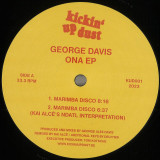
Brand new Berlin based Label and Party Series "kickin' up dust" teams up with German Producer George Davis and brings out their first EP incl. a Kai Alcé NDATL Interpretation.
"Lovedancin" is the name of an event series by kickin’ up dust. Founder Tom Kutsche and his staff have dedicated their energy to bring together a diverse crowd celebrating in a field of Disco, Acid Jazz and Proto House. The bookings have the task of bringing together "from the old to the new" with dinosaur acts like Maurice Fulton, DJ Deep, Alex from Tokyo and Roy Davis Jr paired with new & local talents. Be sure to attend one of the next Lovedancin events and check out the debut release by George Davis on their freshly founded kickin’ up dust label.
Early DJ Support by: DJ Sneak, Honey Dijon, Charles Webster, Terry Farley, DJ Seinfeld, Jimpster, Horse Meat Disco, Robert Owens, Luke Solomon.
After 3 individual pieces on the Hamburg label PUDEL PRODUKTE, the longplaying work of the man from the Pension Stammheim is finally released. It quickly becomes clear that this is a real capacity record: 6 (on vinyl) or 8 pieces (on electricity) from the cosmos of a man who means business. You can already tell by the fact that the record is only called ROTTE and not something else. Rotte makes ROTTE and nothing named, nothing labelled, nothing carefree commodes and prisoners certainly not.
It is relatively easy to approach ROTTE. Just listen and do nothing else. No, nothing. Nothing at all. Don't give away flowers, smoke cows, talk yourself or listen to the net. Don't try to get out of the Bermuda Triangle in the process! Concentrate as if you were reading a book by Suhrkamp. Be action-less in the here and jazz. Beat the six kinds of wood out of the coffin and leave only the steel screws!
Take Rotte and ROTTE seriously. Man and work. With him, though, black is absolutely a colour. My ketamine is my petrol. First Takes only. Drilling without Club of Gore. Undisputed truth. No Lounge. The lyrics on Rotte are not a party.
It might seem a bit TOO colourless, a bit TOO intense, a bit TOO hard and dark. Too much psycho-babble. But the songs bring it and you. They are designed in such a way that nothing else works during them. Nobody would think of peeling an egg at Russian roulette. That's how you have to see it.
The songs were musically supervised by Jörn Elling Wuttke and Oliver Bradford (Thee Church Ov Acid House), by DIE NERVEN producer Ralv Milberg, by Douglas Creed (BPitch Control + Freude am Tanzen), Boris Nielsen (Käptn Peng) and Peter Armster.
There is a congenial mutual autocorrection between lyrics and music. Individually, this cannot be heard and it is not offered. By the way, you don't hear anything else at the Federal Criminal Police Office at the moment. So please.
A1 Fliege gegen Scheibe
Written & produced by Oliver Bradford, Jörn Elling Wuttke, Christian Rottler
Lyrics: Christian Rottler
A2 Butterbrot und Peitsche
Written & produced by Peter Armster, Christian Rottler
Lyrics: Christian Rottler
A3 Gaffa, Farbe und Zustimmung
Written & produced Jörn Elling Wuttke, Christian Rottler
Lyrics: Christian Rottler
B1 Autosuggestion
Written by Boris Nielsen, Christian Rottler, produced by Boris Nielsen, Marc Eggert
Lyrics: Christian Rottler
B2 Deichtorhallen
Written & produced by Oliver Bradford, Jörn Elling Wuttke und Christian Rottler
Lyrics: Christian Rottler
B3 Dunkelwach
Written by Mario Willms, Christian Rottler, produced by Mario Willms
Lyrics: Christian Rottler
Crown the Empire haben sich in den letzten zehn Jahren kontinuierlich als eine Naturgewalt in der Rockwelt etabliert. Sie haben die Bühne mit Slipknot, A Day To Remember, Dance Gavin Dance, Black Veil Brides, Falling in Reverse, Underoath und vielen anderen geteilt.
Bis heute hat die Band vier Studioalben veröffentlicht und wurde von Alternative Press, Billboard, Kerrang!, Nylon, Rock Sound und anderen gelobt. Der beeindruckende Katalog hat ihnen 825M Streams weltweit eingebracht.
DOGMA, produziert und gemischt von Zach Jones (Fever 333, Poorstacy, Scene Queen, Nova Twins), ist ihr bisher vielfältigstes Album, das von Angst, existenzieller Identität, Isolation und Entschlossenheit geprägt ist und Features von Courtney LaPlante (Spiritbox) und Remington Leith (Palaye Royale) enthält. Um die Veröffentlichung zu feiern, wird Crown The Empire in diesem Frühjahr mit der texanischen Hard-Rock-Band Nothing More auf Tour gehen.
Îlot, an isolated element within a different whole. For his new album, Sheldon, emblematic rapper of the 75e Session collective, continues his work of introspection on organic compositions, filled with the multiple references that build the musical universe of the artist.
Produced by Epektase and mixed by Sheldon himself at Winslow Studio, the project leaves a lot of room for the guitar and the rapper's 60/70s rock influences such as Bowie and the Beatles. There are also influences from Soul, R&B, Lo-Fi and Jazz, pushing the meeting of rap with other musical genres even further.
A nod to Böcklin's painting Isle of the Dead, a work of multiple interpretations that obsessed the painter himself, the island echoes feelings of isolation and solitude, but also the need to escape and introspect. We thus find the themes that haunt Sheldon: his childhood and his relationship with others, his questions about his place as a human being, which he poses head-on or through lighter notes of humour, and his dismay at a world for which he "knows the problems, not the solutions". His texts, unique and personal, reveal his most intimate thoughts. Like a conversation, they resonate within each of us and create a strong bond, a deep sense of understanding, against the backdrop of all the sweetness and melancholy of the images he conjures up: "One more day on my islet, watching the sailboats go by."
The metaphor of the islet continues in the visual universe built around the album, where the central element is a monolith used to represent isolation and emptiness. Made up of four mirrored sides, this imposing artefact represents both the island and the subject of the album: the central element is not the main subject, Sheldon, but rather what he tells us about the world around him.
Koudlam returns to civilization with “Precipice Fantasy”, an abnormal album once again. The Album is made up of 2 very different parts which will be released separately, with a first part which shells 12 songs like so many flamboyant mutations and a second contemplative instrumental part halfway between uneasy yoga music and trance from the lowlands of Kathmandu. Inspired by the hallucinated stories of mountain pioneers and conquistadores, the artist delivers here the soundtrack of peaks and precipices. Or rather that of the path between the two, winding, vertiginous, always on the edge of the blade.
Critically acclaimed composer, producer and electronic musician Mark Barrott is set to release his new album ‘Jōhatsu (蒸発)’ in April via Reflections, the new imprint from the Anjuna family, which focuses on downtempo, ambient, and alternative releases. An artist that creatively speaking, never stops moving, Barrott’s musical career has taken many forms. From Future Loop Foundation, the alias he used to create and perform ambient drum and bass from the mid-90s, to his Sketches from an Island albums released under his own name, and as founder of the highly influential International Feel label, Barrott has spent close to four decades exploring new sonic territory and pushing the boundaries of various genres, and is considered a pivotal figure in the revival of the Balearic music scene of the last decade. Barrott’s new album, ’Jōhatsu (蒸発)’, is predictably unpredictable. Released on Reflections, the new downtempo label from the Anjuna family, it’s a full departure from anything Barrott’s written before, partly because he was writing to moving picture. Towards the end of 2019, he had been working so relentlessly as a record producer for artists such as South African DJ Themba and the late Virgil Abloh, that he developed Repetitive Strain Injury, and was forced to take time off, and it was during this down-time he received an email from a director asking him to write the score for his new documentary, ‘Jōhatsu... the art of Evaporation’. ‘Jōhatsu (蒸発)’ is an 8-track journey through the sounds, sights, smells and sensations of traditional and contemporary Japanese culture. “What came home to me during the scoring process, was how much shame is a huge part of Japanese culture. There’s a lot of shame surrounding losing your job and around things like divorce & bankruptcy, and it’s been there for centuries, since the Samurai and Bushido.” Some take their own lives, while others decide to simply… evaporate. Jōhatsu refers to these people who decide to purposely disappear, leaving their lives they knew behind without a trace.
"One of the world’s finest purveyors of music to chill out to - he is the master of sunset music" (Pitchfork).