Perhaps best known as the frontman of South London indie pop / power pop outfit Bromide or being the worst salesman in Cargo Records…, Simon Bromide (aka Simon Berridge) has announced he will be releasing a solo album 'Following The Moon' in late autumn via Scratchy Records with distribution by Cargo Records. Ahead of this, he presents the lead track 'The Waiting Room'. ‘Following The Moon’ is essentially a solo album - with a lot of help. It was recorded at Bark Studios in Walthamstow by Brian O’Shaughnessy (Primal Scream, My Bloody Valentine, Beth Orton), who had worked with Berridge on the last two Bromide albums. The album features drummer Fells Guilherme (Children of The Pope), bassist Ed ‘Cosmo’ Wright, multi-instrumentalists Dave Hale, Dimitri Ntontis and Stephen Elwell as well as folk-pop chanteuse Katy Carr on piano and Terry Edwards (Nick Cave, Tom Waits, P.J.Harvey) on trumpet. Scottish singer Julie Anne McCambridge joins Simon on the closing track, the William Blake penned ‘Earth’s Answer’. This is Berridge's first output since Bromide's 'Ancient Rome' and 'I'll Never Learn' singles, both released in 2020. Their most recent album 'I Woke Up', with singles 'Magic Coins' and 'Two Song Slot', was met with popular acclaim, receiving positive reviews and airplay in dozens of countries. Influenced equally by The Beatles, Neil Young, Mark Eitzel and Bob Mould, Simon Berridge creates ultra-catchy, jangly acoustic pop / electric rock. Album track ‘The Skehans Song’ pays homage to the club and features the ‘Easycome choir’ with Andy Hankdog, Scarlett Woolfe and Vincent Davies. “A febrile soul who can do pop in many voices” ~ Melody Maker "Simon Berridge's voice is as strong as ever, with the songwriter only gaining in sound and fury” ~ Clash Magazine “Romping, indie-pop blast“ ~ The Times "This is catchy, upbeat, well-structured and impeccably delivered – with a winner of a debut release, Simon Bromide has our attention" ~ The Spill Magazine “Memorable slices of acoustic whimsy” ~ Q magazine “Berridge has an ear for a canny tune and a keen lyrical eye for detail... Ray-Davies-meets-Lloyd-Cole crooning” ~ The Big Issue
From its founding in the late 14th century, the kingdom of Buganda has been celebrated through sound and nurtured a rich musical tradition in its royal court. Coming from across the kingdom, musicians would take turns in the palace to sound drums, xylophones, flutes, lyres, and more to praise and honour the existence of the kingship. In recent years however, the tradition has been more difficult to maintain, especially since 1966 where there was a violent attack on the palace that abruptly abolished the kingdom and during which royal musicians fled or were killed. And while the kingdom was re-established in 1993 as a cultural institution, many of the remaining musicians had since chosen to sideline their skills to deal with the issues of their day to day lives, the practice of the royal tradition waning in popularity, especially with younger listeners and players. But all is not lost. Scattered across the kingdom, a motivated team of older veterans and attentive young players are still keeping the tradition alive. Offering a transversal glimpse into the past and the present, "Buganda Royal Music Revival" collects recordings made in between the late 1940s and 1966 illustrating the older generation's skills, and presents them alongside recent recordings featuring old and young musicians who still carry on this musical tradition, some even performing for the current king, Muwenda Mutebi II. The later were made during the shooting of the 2019 documentary "Buganda Royal Music Revival" that presents through a film what this album conveys through sounds: a packed dive into a century-old tradition. The music displayed here is diverse and vibrant, presenting a variety of styles and highlighting instruments that illustrate the depth and sophistication that stemmed from the royal court experience of Buganda. As a starter, the album opens with 'Mujaguzo'. Often translated as 'The Drums of the Kingship', the mujaguzo is a crucial ensemble for the cultural tradition, made from drums collected by the kingdom throughout its long history and numbering around 100 drums (historical records suggest there were at some point over 300). They are the vitality of the kingship packaged into sound. From here, we're introduced deeper to an array of instruments and textures, like the buzzing Bugandan lyre (endongo) by contemporary royal player Albert Bisaso Ssempeke, the resonant akadinda xylophone with its 21 large wooden keys, Temutewo Mukasa's restless praise sung with his harp (ennanga), the hand-made gourd trumpet (amakondere), the entenga "drum-chime" and its core set of 12 drums tuned like the amadinda xylophone, or the tightly intertwined melodies of the flutes ensemble (abalere). With the music, the hissing and swishing sounds of old tapes reminds at times the listener of the long process, from the original recording to its archival digitization, that allows the talent of past musicians to still vibrate nowadays. This rousing selection of music and moods is a unique and all too rare exploration of sounds that celebrates the common history of generations of musicians, and the question remains open as to how this rich cultural tradition will shape and be shaped by the upcoming Bugandan future, and what engagement it will trigger among audiences within, but also beyond, the kingdom of Buganda.
Spoken word recordings from Gregory Corso, Tina May Hall, Sam Lipsyte, Christine Schutt, Gary Lutz, Allen Ginsberg, Dawn Raffel, Jason Schwartz, Kathryn Scanlan, Scott McClanahan, & Terry Southern. About 40 years ago, in a record shop on Long Island during a weekend visit there to see my parents, i found a double-LP that looked like something i should definitely buy. It was called "BIG EGO", by the The DIAL-a-POEM POETS. On the cover was a picture of John Giorno (a great poet Ed Sanders had turned me on to) on a NYC rooftop with Philip Glass, Meredith Monk, and two kids. It cost $2. I bought it and rushed back to my parents house, where i still had my old turntable in the basement, not far from my Jimi Hendrix and Zappa Crappa posters, and my framed portrait of John Cage. My copy of Eno's "Discreet Music" was still on the turntable, having been left there years before, when i'd fled Long Island for good. I lifted it from the platter, gently slid it back into its sleeve, like a priceless religious artifact, and put Side A of the Dial-a-Poem LP on. I almost lost my mind while listening to it. The next day i went back to the same record shop looking for more DIAL-A-POEM LP's. i found two. One had a long list of names on the back, some famous, and some i'd never heard of before. I bought both LP's, and an hour later, for the first time in my life, i was exposed to the art of Laurie Anderson, whom i'd never heard of before. This was 1978. Her contribution was a piece called "Time To Go". It changed my life. Or at least, that’s how I remember it. I was just a kid, so there were a lot of moments like that, around then. Nowadays, these moments can be had in seconds, with a click of the cursor. That evening, as i sat alone by my imaginary campfire (ie; that record player in my parents basement), i promised myself that someday, somehow, i would embark upon a WORDS & MUSIC project that might move people the same way i was moved when i first heard Laurie, and Robert Wilson & Christopher Knowles, and Burroughs, and Ginsberg, and Corso, and Anne Waldman, and John Ashbery, and the great Charles Olson, and so many others. Words, for the very first time, had wielded the same power as music. And it was visceral. Just like music. It ran deep. It was a FEELING. John Giorno died in 2019, but he kept poetry alive like nobody's business. I was lucky enough to have spent some time with him in the early 1980's, when i was briefly a member of The Fugs, and often found myself surrounded by those Ginsberg called, "...the greatest minds of my generation". Ed Sanders (who'd ushered me into that scene) once told me that when he came to NYC, it was easy to go to a cafe, or to St Marks Church, and hear Burroughs, Corso, Ginsberg, and all the greats, reading their poetry. He said that even if you were just a bum on the street, you could just walk right up to them, and start a conversation. They were totally accessible, if they were in the right mood at that particular moment. So i was shocked when Sanders told me he didn't approach any of them, not even once, til he'd been going to their readings for nearly ten years. "For almost a decade, I went to every reading, every lecture, every panel discussion. But I never went near them. Never approached them. Not even once", Sanders told me. "For ten years, all I did, was listen." It took me four decades, but ... better late than never. I finally made WORDS & MUSIC, Book One.
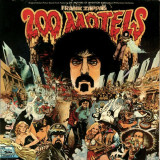
Frank Zappa’s “200 Motels” was a miraculous feat, a cinematic collision of the venerated musician and composer’s kaleidoscopic musical and visual worlds that brought together Zappa and his band, The Mothers, Ringo Starr as Zappa – as “a large dwarf” – Keith Moon as a perverted nun, Pamela Des Barres in her acting debut, noted thespian Theodore Bikel, the Royal Philharmonic Orchestra, and an incredible assortment of characters (both on screen and off) for a “surrealistic documentary” about the bizarre life of a touring musician. In celebration of “200 Motels” golden anniversary, Zappa Records, UMC and MGM have assembled a definitive Super Deluxe six-disc box set of the beloved, yet hard to find, soundtrack for release on November 19. Fully authorized by the Zappa Trust and produced by Ahmet Zappa and Zappa Vaultmeister Joe Travers, the monstrous 200 Motels 50th Anniversary Edition brings together the original soundtrack, newly remastered by Bernie Grundman at Bernie Grundman Mastering, along with a staggering amount of unreleased and rare material unearthed from FZ’s Vault, including original demos, studio outtakes, work mixes, interviews and movie ads, along with newly discovered dialog reels, revealing an early audio edit of the film. Also included is a wealth of never-before-heard audio documentary material surrounding the project. The six-disc set will be housed in a 64-page hardcover book in a handsome 12” x 12” slipcase. The packaging replicates the original booklet updated with revealing new liner notes from Pamela Des Barres, Ruth Underwood and Joe Travers, as well as Patrick Pending’s essay from the 1997 reissue, and is chock full of motion picture artwork, stills and images, from the film and its making, many which have never been seen before. This must-have collector’s release will also include a custom “200 Motels” keychain and Do-No-Disturb motel door hanger and a full-size replica of the original movie poster. Years in the making, all the audio was meticulously identified and transferred over several years as Travers dug through the Vault to create a new high resolution 96K/24B digital patchwork stereo master from the original analog tapes. The Vault material was mastered by John Polito in 2021. The remastered 200 Motels soundtrack will also be reissued on vinyl as a 2LP pressed on 180-gram black vinyl and on a 2CD format - both will include a smaller version of the movie poster.
With the release of Sweet Inspirations At Muon, the first appearance on vinyl of Tori Kudo’s mythical early ‘80s primitive rock gang Sweet Inspirations, another piece of the seemingly endless puzzle of the Japanese underground has fallen into place. Recorded some time in 1982 at Yokohama venue Muon – precise details are sketchy – we’re now given another chance to discover what was going on in Kudo’s mind just before he formed the group he is now best known for, the ragtag gang of pro and amateur musicians that was Maher Shalal Hash Baz.
Sweet Inspirations were one of several groups formed by Kudo around this time. He’d already released the visionary naïve-art album, Tenno, in collaboration with Reiko Omura, in 1980, and a trip to New York the following year led to the recording of Atlantic City, under the name La Consumption 4. Returning to Japan, Kudo first formed Guys’N’Dolls with Jun Yoshiwara (bass) and Kiyoaki Iwamoto (drums); Yoshiwara carried over into Sweet Inspirations, who existed for a few years, their membership, at various times, featuring Asahito Nanjo (High Rise etc.), Jutok Kaneko (Kousokuya), Yoshio Kuge (Les Rallizes Denudes etc.), 3C123 and many more.
The material here was originally released, without permission, by the Cragale label on CD-R in 2000. It was one of a sudden wave of archival CD-Rs that Cragale pumped out that year of material recorded at Muon, which was owned by Kohei Iehara, who co-founded Cragale with Tamotsu Hongo. In the context of the recent unleashing of material from the Kudo archives – the 9CD At Goodman set, the reissue of the first two Maher Shalal Hash Baz cassettes and the Noise LP, and the tantalising glimpses of other historical gems via Tori’s own Bandcamp page – hearing Sweet Inspirations with such clarity fills in a significant piece of the puzzle; here is Kudo, just before Maher, channelling the rough conceptualism of Red Krayola and the glinting, staggered rhythms of Syd Barrett into extended blooms of ragged glory, sketching out future classics like “Manson Girls”; A bonus CD includes a cover of a song by legendary South Korean rock group San Ul Lim.
SectorSept’s ‘954’ is a boldly original record, one which announces the arrival of a singular musical mind. Its creator states that he crafted this EP by trying to make tracks that were ‘a representation of how I believe music would sound in some distant land in the future’. On ‘954’ this vision takes flight in the form of eight multifaceted, genre-defying electronic productions.
To unpack this record one must first understand the myriad influences which feed into SectorSept’s style. The producer grew up between the UK and Florida - indeed, the record’s title references the area code he had while in the USA. His formative years were spent soaking in the dancehall sounds he heard around him in his Jamaican household as well as techno, jazz, Miami bass and the city’s ‘Love 94 Smooth Jazz’ radio station.
All of this and more can be heard in the fabric of ‘954’. The drum programming alone reveals SectorSept to be someone with extremely wide-ranging musical tastes. Cuts such as ‘Get Ready For The Programme’ and ‘Be There’ are powered by deft beats that have Miami bass, Jersey Club, juke and more in their make-up. Drexciya-adjacent machine-funk creeps into the mix in ‘954’s mid-section, ‘Golden Third Eye’ touches on trap, and closing duo ‘Tropic Universe’ and ‘Prize’ bring dancehall dembows to the fore.
The productions of ‘954’ are simultaneously driving and chilled, coasting nicely yet still plumbed with enough bite to do damage on the dancefloor. It’s a feeling which is heightened by SectorSept’s gorgeous textural work. Several of the tracks here soften up collages of vocal clips with wistful, dreamy synths - see the way that club-caller snippets orbit Boards Of Canada-esque keys on ‘Get Ready For The Programme’ or how closing cut ‘Prize’ works both the classic Warp/Planet Mu sound and the pitched-down stylings of DJ Screw. It’s a rich and fully-formed artistic aesthetic, something which is all the more impressive when you consider that ‘954’ is SectorSept’s first official release.
That said, while the overall flavour of ‘954’ is SectorSept’s and SectorSept’s alone, one also finds links to Gobstopper’s previous output here. Those dancehall influences on ‘Tropic Universe’ and ‘Prize’ line the record up with Gobstopper drops like Otik’s ‘Thousand Year Stare’ while the emotive, soulful synth work that has long been a Gobstopper calling card is also in evidence here. Perhaps the thing about ‘954’ which makes it feel most at home on Mr. Mitch’s label is SectorSept’s imaginative futurism. SectorSept is a keen scholar of anime composers Kenji Kawai and Joe Hisaishi, and as such it is no surprise that there is a slightly fantastical quality to ‘954’. This is most boldly expressed on ‘Intuition Segment’, a magic-realist vignette which looks to Oneohtrix Point Never.
Blending ethereal textures with hybrid electronic grooves, SectorSept’s ‘954’ EP uses the sounds, influences and cultural experiences that have shaped its creator in order to build a vibrant vision of the future.
Maurice Louca is one of the most gifted musicians and composers on Egypt's thriving underground music scene. This forthcoming full-length album draws voraciously on Arabic music, psychedelic folk. The title Saet el Hazz is a coded saying in Egypt to refer to a good time and usually implies a great deal of debauchery. “When you mention to someone that you’ve had a saet hazz, there are no questions asked. It is what it is.”
The initial spark for Saet El-Hazz (The Luck Hour) was Louca’s desire to collaborate with 'A' Trio, the Lebanese improvisational group featuring Mazen Kerbaj on prepared trumpet, Sharif Sehnaoui on prepared guitar, and Raed Yassin on prepared double bass. 'When the three of them come together they create a sonic cosmos entirely their own. I started by composing music that I wanted to have exist within this sonic world— at times in harmony, or clashing with it, and all the emotional ranges in between.' Just as 'A' Trio served as the spark, a commission from Mophradat, an arts organization based out of Brussels, was the tinder. The commission was for a new composition to be performed using instruments that Louca would modify to play microtonally. This led him to Turkey and Indonesia. In Istanbul, he worked with a Lutheran to custom-make a guitar. In Surakarta, he ended up with an instrument maker tuning a Serang—referred to as the Indonesian xylophone, part of the family of Gamelan tuned percussion instruments. These new modified instruments opened up the composition to new tonal possibilities which drove Louca to expand his line up to include Khaled Yassine, a longtime collaborator and versatile percussionist and drummer, Christine Kazaryan, a dynamic harpist whom he met via Praed Orchestra, and Anthea Caddy, a cellist who came highly recommended from the Berlin free improv scene.
'There is something about linking luck to decadence that resonates with me, and even if I can't fully articulate it in words, the drive behind the music of this album and how it came to be, and the energy between us at the studio rehearsing and recording it, was in a lot of ways for me a saet hazz.'
Saet El Hazz (The Luck Hour) is a long form composition of six movements, recorded over the course of a week in August 2019 at A/B studios in Brussels.
To write these few lines, we spoke to saxophonist François Jeanneau, an old friend of Jacques Thollot who also played on several of his albums, including the “Watch Devil Go” which interests us here. He told us a story which, according to him, sums up the personality of Thollot. A noted studio had reserved three days for a Thollot recording session. The first morning was devoted to sound checks and putting some order in the score sheets which Jacques would hand out in a somewhat anarchic manner. Then everyone went for lunch. When the musicians returned to the studio, Thollot had disappeared. He wasn’t seen again for the three days. When he reappeared, he had already forgotten why he had left, The music of Jacques Thollot is in the image of its’ author: it takes you somewhere, suddenly escapes and disappears, returning in an unexpected place as if nothing had happened.
Four years after a first album on the Futura label in 1971, Jacques Thollot returned, this time on the Palm label of Jef Gilson, still with just as much surrealist poetry in his jazz. In thirty-five minutes and a few seconds, the French composer and drummer, who had been on the scene since he was thirteen, established himself as a link between Arnold Schoenberg and Don Cherry. Resistant to any imposed framework and always excessive, Thollot allows himself to do anything and everything: suspended time of an extraordinary delicacy, a stealthy explosion of the brass section, hallucinatory improvisation of the synthesisers, tight writing, teetering on the classical, and in the middle of all that, a hit; the title-track - that Madlib would one day end up hearing and sampling.
“Watch Devil Go” was in the right place in the Palm catalogue, which welcomed the cream of the French avant-garde in the 70s. But it is also the story of a long friendship between two men. Jacques Thollot and Jef Gilson had known and respected one another for a long time. Though barely sixteen years old, Thollot was already on drums on the first albums by Gilson starting in 1963 and would play in his big band (alongside François Jeanneau once again), ‘Europamerica’, until the end of the 70s.
In a career lasting half a century and centred on freedom Jacques Thollot played with the most important experimental musicians (Don Cherry, Sonny Sharrock, Michel Roques, Barney Wilen, Steve Lacy, François Tusques, Michel Portal, Jac Berrocal, Noël Akchoté...) and they all heard in him a pulsation coming from another world. (Jérôme "Kalcha" Simonneau)
In November 1976, Jef Gilson’s phone rang. What a surprise! It was Serge Rahoerson, one of the musicians he had met in Madagascar at the end of the 60s and who had played on his first album “Malagasy”. Rahoerson announced that he was in Paris for a few days.
Immediately, Jef wanted to organise a recording session, starting the next day. He thought of a trio including Serge, Eddy Louiss on organ and cellist Jean-Charles Capon, who had also been on one of the trips to Tananarive and so had also known Rahoerson there. Unfortunately, Eddy Louiss –who had already played with Gilson and Capon on the album “Bill Coleman Sings And Plays 12 Negro Spirituals” in 1968- had to drop out at the last minute: he was delayed by a session with Claude Nougaro. Jean-Charles Capon had also become a sought-after studio musician since his trip to Madagascar in 1969. He appeared on several key albums on the Saravah label including the now famous “Comme À La Radio” by Brigitte Fontaine, “Un Beau Matin” by Areski and “Chorus” by Michel Roques, without mentioning the album by his own Baroque Jazz Trio. He was also to be found with Jef Gilson for his album on Vogue with the ex-drummer from Miles Davis’ first great quintet, Philly Joe Jones, or also in the orchestra led by Jean-Claude Vannier for the album “Nino Ferrer & Leggs”. He also played regularly on albums by Georges Moustaki.
Jean-Charles Capon and Serge Rahoerson found themselves thus in the studio, with Jef at the controls. He had decided to record the rhythmic structure right away. He would find the soloists later, that didn’t worry him. Serge Rahoerson was on drums. Though a saxophonist by training, Jef remembered that Serge was also capable of great things behind a drum kit: he was the improvised drummer on their cover of “The Creator Has A Master Plan” on the album “Malagasy”... The great memories came flooding back (the nod on the title “Orly - Ivato”), and the old magic worked again.
Brought in momentarily from Europamerica, Gilson’s new big band, in which JC Capon also played, the saxophonists Philippe Maté, from France (another Saravah stablemate) and the American Butch Morris (soon to be a key member of David Murray’s band) were invited to record their parts later and Gilson mixed it all as if it had been one single session (as he had already done on other albums, with the tracks by Christian Vander recorded before the creation and success of Magma).
The album would not appear until 1977, on Palm, Jef’s own label, and was dedicated to the memory of Georges Rahoerson, Serge’s father, who had also played on the album “Malagasy” and who had died prematurely at the age of 51 in 1974.
“I only received my own copy of the album in 1981 when I came to live in France definitively”, a still-moved Serge Rahoerson told us in 2013. “I was playing in a club one night and Jef turned up by surprise with a copy of the album for me, I was so pleased to see him again. When I arrived in France, I told everyone that I had played with Jef Gilson a few years previously, and I was surprised to learn that so few people knew of him. For us, he was of one of the great jazz visionaries.” (Jérôme "Kalcha" Simonneau)
On Delta, a dozen artists across four continents freely interpret Fountain across a double LP, again featuring Donna Huanca’s surreal artwork, and the unearthly graphic manipulations of Nufolklore Studios. Remaining faithful to Fountain’s presentation, Lyra’s curation reflects her commitment to stylistic diversity, with the old guard and the next wave alongside each other. Where some artists chose to rework existing works, others composed new material from fragments found across the record. The results showcase the very themes of wordless identity conflict and technological concerns that Lyra and her foremothers have projected.
the limitless highs of Sigur Ros and the steady pulse of The Knife. KMRU cloaks Lyra in a hazy film, soundtracking the depths of space embedded within the ghosts of jungle past. Gabber Modus Operandi expose the realities of artificial nature in a multicoloured rave dystopia. Eris Drew’s double opus takes the tenets of her philosophies into both ambient and peaktime expressions of the trip, the things that lead to the decision before, and the portals that can open up after.
Ben Frost dissolves Cradle’s deep and tremulous hymn in analogue warble, distressed tape spooling out of control and breaking up over the heavens, while remaining oddly serene. Heaven In Stereo conjures up post-rock with trap drums out of Gossip, buried in bass weight and dub space. Nailah Hunter and Tygapaw transform New Moon into an earthbound ode to nature and a pounding trance state induction, while Caterina Barbieri and Hudson Mohawke extract and amplify Tendril’s mind and soul. Vessel takes what feels like the entire album and builds it up to a frantic climax before subsuming into Enoesque pastoralia.
Alongside Delta, Lyra has collaborated with Spitfire Audio to develop Siren Songs, a free plug-in for their LABS series made from playable samples from Fountain, able to work across DAWs in multiple formats. By removing barriers to access, the listener can craft their own responses to the album’s themes, or use its language to express their innermost feelings in their own works.
Life and society emerge where water tessellates over land and provides fertile soil. The chances of evolution that made them interact as they did could have had meaningful environmental consequences had things developed differently. For Lyra Pramuk, that fertile geology provides the ground for her albums. Fountain was that burst of water and swell of energy that propelled her to critical acclaim. Delta is a new take on a traditional remix album, centred on transgenerational dialogue and global storytelling, and will be released again via Iceland’s Bedroom Community label. Projecting Fountain through prisms, wordless songs fractalize into lush creations that blossom with new life.
The ability to have such sheer diversity of material in one place is thanks to the global increase in accessible technologies, fueling an explosion of creativity and genre exploration that was thought of as unthinkable in our lifetimes. Like its namesake, Delta is a point where creative flows meet and triangulate, where global and personal folk histories are presented in novel ways, where transcultural collaboration is celebrated, where many worlds emerge from the depths below.
RIYL: The Knife, Spacetime Continuum, Lorenzo Senni, the soundtrack to Planete Sauvage, 3:45 AM by the front left speaker, 7:45 AM as light pours in and everything winds down.
out of Stock
Last delivered 4 years ago available to reorder, subject to availability
Remix album for Oké's Deserto featuring nine interpretations of tracks from the original with a focus on the dancefloor alongside some abstract beats and rap.
Oasi (Deserto Remixed) features two groups of transatlantic contributors: Shigeto, DJ Dez, and Sterling Toles from Detroit; Populous, Godblesscomputers, DJ Rocca, and Silvano Del Gado from Italy, all close friends of the band. The remixes are rounded off by two versions from the man behind Oké, Andrea Visani, under his Katzuma and King Dumitru aliases.
The library music, cosmic jazz, and afro-house vibes of the original are retooled into a variety of dancefloor friendly productions: Shigeto and Silvano Del Gado invoke the tribal spirits of 'Ochosi Ayilodà'; Dez turns 'Il Venditore di Elastici' into a warm and comfortable chugging groove; Populous zeroes in on peak time ecstasy with his take on 'Queens of the Supercolony'; Rocca injects electro funk into 'Tarantula'; and Katzuma keeps it slow and funky with his refixes of 'Tamahaq' and 'Sons of Cabila.'
Balancing all these are two mellower contributions, with Godblesscomputers flipping 'The Secret Baile of the Maharajas' into a laidback roller and Sterling Toles transforming 'Serir' into a haunting song of remembrance.
Released on single 12" vinyl with seven of the nine remixes (two edited for length) and artwork from Andrea Casciu.
out of Stock
Last delivered 4 years ago available to reorder, subject to availability
No other pairing in the history of Darkwave ever matched the unfettered creativity, resolve, and DIY attitude from the collaboration between the two creative minds that compromise Lebanon Hanover.
The meeting of the Swiss musician Larissa Georgiou, aka Larissa Iceglass and British artist William Maybelline a decade ago in the latter’s hometown of Sunderland in the UK, was a monumental occasion, reverberating throughout the European music scene and even across the Atlantic.
Lebanon Hanover would emerge from the peak of the world-wide minimal wave revival, with their 2011 split 7-inch record with La Fete Triste issued as the catalog debut of Europe’s most ubiquitous Techno-Industrial EBM labels, Aufnahme + Wiedergabe
With Berlin as their new physical home, William and Larissa would soon, however, join the Fabrika Records family. From here, they would go on to release two full-length albums through the Athens based label, starting in early 2012 with their winter debut LP The World Is Getting Colder, and it’s All Hallows Eve follow up Why Not Just Be Solo.
It was Lebanon Hanover’s 2013 third studio outing Tomb for Two that would go on to cement the duo’s legacy, with the album’s single “Gallow Dance” becoming a post-punk anthem for the times, with artwork became the band’s defacto logo. Not only that, the song “Sadness is Rebellion”, also featured on the album, became the band’s official Mantra.
Two years would pass before the release of 2015’s critically acclaimed fourth record, “Besides the Abyss”. In the intervening years, William and Larissa, initially a couple, would find other partners, and relocate to Athens.
Meanwhile, Lebanon Hanover as a live act would expand rapidly in popularity, exceeding capacity during their performances at Wave Gotik Treffen in Leipzig, and performing sold-out shows across Europe and the UK.
With the playful Babes of the 80s maxi-single released in the interim, three years would pass before the next record from Lebanon Hanover, with 2018’s Let Them Be Alien, the band’s fifth studio album.
At the dawn of the global pandemic, where dystopian nightmares that were only ever seen before within the pages of books and flashes of silver screen celluloid, has become a daily reality, a new kind of darkness envelops the world. It was at this Lebanon Hanover returned, sharing a glimmer of hope with the single “The Last Thing,” the duo’s first song from their forthcoming sixth studio album Sci-Fi Sky.
Spanning an epic journey across ten tracks that wander through industrial landscapes, and ascend beyond the atmospheric aether, Sci Fi Sky is Lebanon Hanover’s most cohesive artistic statement to date. With their icy hearts on their sleeves, this is the culmination of a decade’s worth of musical creativity radiating from the minds of both Iceglass and Maybelline, and altogether an otherworldly beacon of hope in a time of sheer darkness.
out of Stock
Last delivered 4 years ago available to reorder, subject to availability
MASSIMO NAPOLI is a DJ from Catania with a passion for jazz and black music. He began his musical career in the early 90s playing funk, hip hop, and acid jazz in clubs, contributing to the spreading of the most eclectic and refined sounds in Sicily.
Departing from club culture with particular emphasis on electronic dub, Galathea unfolds into many influences and styles, making it a unique listening experience. Mediterranean culture, afro and cinematic melodies, jazz, spiritual echoes, and soothing beats lead the listener into a subliminal escape, where the fluidity and the convergence of genres freely progress intoa dream-like journey.
b A2: Afrique (Vocal Video Version) feat. Kadi Koulibaly
out of Stock
Last delivered 4 years ago available to reorder, subject to availability
With endless Afro-latin percussion & drums patterns woven throughout ten tracks of tropical dance floor heaters, Italian multi-instrumentalist and master percussionist, Worldwide FM presenter and director of the Yoruba Soul Orchestra, Gabriele Poso is to release his seventh LP, Tamburo Infinito, via New York record label Wonderwheel Recordings. Recorded in Lecce in the south of Italy and almost entirely on his own (unlike previous productions), the undisputed star of the show is once again the drum and the percussion, the Tamburo Infinito.
Although born in Italy, Gabriele has always looked across the Atlantic for inspirations and rhythms, and this album is no different. This time his sonic adventures took him to the French West Indies and the French Caribbean island like Guadeloupe Martinique, "I'm in love with everything about the sound of their drums, it's very unique warm and deep sound."
The album kicks off with the hot & sticky Ritmo, setting the tone for the record with a kaleidoscope of tropical rhythms and influences. First single La Bola is jammed full of exultant horns and syncopated drum beats carried on the back of a driving, funky bassline. By the time the horns drop in on the aptly named Party People the carnival is in full swing over jubilant percussion and spaced out synths.
Gabriele Poso's musical passion has taken him around the world, initially to Rome, then to Puerto Rico, Cuba, and most recently, Berlin. Between 1998 and 2001, Gabriele delved deep into the study of Afro-Cuban percussion, first at the "Timba" School Of Music in Rome, under the guidance of the most important representative of Afro-Cuban culture in Italy, Roberto "Mamey" Evangelista. Later in 2001, he moved to San Juan, Puerto Rico to attend the "Universidad Interamericana De Puerto Rico" to continue his studies, finally culminating in a masterclass at "Escuela Nacional De Arte" in Havana, Cuba.
2008 saw the release of Poso's debut solo album, From The Genuine World, released on Yoruba Records, Osunlade's label, which sparked a career performing around Europe and the rest of the world. His second solo album, Roots of Soul arrived in 2012 on the German label INFRACom!, his third solo album entitled Invocation in 2014, on the German label Agogo Records with other full length efforts released on renowned British labels, Barely Breaking Even (Awakening - 2018) and Soundway Records (Batik - 2019), culminating in an impressively deep and diverse catalogue of solo work.
out of Stock
Last delivered 4 years ago available to reorder, subject to availability
The rarefied music of Ramuntcho Matta returns to Emotional Rescue with the first ever reissue of his album, 24 hrs. Recorded in 1986 - the same year as his influential Ecoute... - the album finds Matta working in a less playful, more experimental framework but with the same ground breaking results.
Again collaborating with a selection of accomplished players, 24 hrs sees Matta (electronics, guitars, marimba, melodica, sanza, vocals) work again with Cacau de Queiroz (flute and saxaphones) and Elie Meideros (vocals), plus Guillermo Fellove (trumpet), Ahmeed Kawa (tablas) and Polo Lombardo (konks) to deserne 6 pieces as part of a performance of Labyrinth by Joan Baixis' (backing vocals) Teatre de la Castra, Barcelona's acclaimed puppetry and visual troupe.
Centred as before, on Matta's guitar, the approach is playful, inventive, a foundation for a texture of musical aphorisms. Against a background of tabla, the elegance of versatility builds, intertwining the players via moods and textures of various traditions in a unique way that is his signature.
An album to be appreciated as one, this archival offered up additional surprises when the Master tapes were examined and so presented here is a longer form, unreleased version of Before Sunrise, as well as the previously unreleased Ramon (Digital only).
out of Stock
Last delivered 4 years ago available to reorder, subject to availability
Does returning to a place have a sound? Can the ear have a memory? And what if places which we return to are just empty shells? Choreographed rooms which we need to play, fill from scratch each time with fragments from the past and present, layer upon layer, familiar and still somehow always new and differently assembled. Paula Schopf’s Espacios en Soledad are acoustic walks around present day Santiago de Chile, the city where she was born - which she always left, had to leave and to which she always returns - but more than anything also through her own memories which resonate throughout the public places, squares, streets though still in their own way remain strange.
„Every immigrant in the world has a piece like this - a kind of missing link, something which is incomplete. And every time one returns to the home country you are looking for it. For me it was a matter of sound.“ (Paula 2019).
In the mid 70s leaving Santiago was a flight of exile as a child with her family. Leaving in 1990 was an autonomous decision to head for Europe, Berlin, where the wall fell, where the heavens opened up all at once and electronic music became a kind of new home to so many. Paula Schopf belonged there. For her the Ocean Club at Tresor club was a central place where friends and mentors like Gudrun Gut and Thomas Fehlmann made it possible for her to get really into it. Dancing, being and feeling your body, forgetting oneself in the bass and beats, who one is and where one’s from, to becoming the DJ Chica Paula. Chile was very far away during this time, Latin America was more just a code, a musical and habitual cliche to be cautious of. This was especially true for the culture of the Chilean exile, the pathos of the “Canto Nuevo”, the sound and ideologically charged instruments of the „música andina“, for example the Zampoña, Quena or Charango. Techno was the greatest thinkable alternative to this even if or perhaps because so many kids exiled from Chile became key figures in the German and European scene: Ricardo Villalobos, Dandy Jack, Cristian Vogel, Matias Aguayo and many more.
How does returning to a place sound? Does the ear have its own memory? The field recordings which were recorded in Santiago de Chile in 2016 and form the central sonic material for Espacios en Soledad represent the paradox for Schopf’s return to her home country after emigrating: the inevitable drifting apart of her own lived time from that of her former home. Already the Venezuelan and Colombian hawkers are unmistakable signs of the deep change in Chilean society which has happened in recent years due to immigration. Which is in contrast to the old lady who sits on the floor in a pedestrian zone and without break sings the same three songs by Violeta Parra and then keeps falling asleep while doing so. The fragile presence of her voice is joined with a repertoire which is almost mythologically timeless in Chile in a particularly moving way.
By layering, ordering and conjoining such found sounds from modern day Santiago this piece become about the urban sound of Chile’s present. But more than anything by doing this Paula Schopf becomes an arranger of her own sonic memory or sound-triggered memories of returning to this city. Just as techno and Berlin helped her for such a long time to get away from too strong of an identification as a Chilean in exil, now with Espacios en Soledad she has found a way to bring these two seemingly disparate lives and remembered worlds together.
Matthias Pasdzierny
out of Stock
Last delivered 16 months ago available to reorder, subject to availability
Shovel Knight began as a modest, yet highly promising Kickstarter project in March 2013. Billed as “a groundbreaking love letter to 8 bits!” by Indie developer Yacht Club Games, this 2D side-scrolling platform game released in June 2014 to universal praise and accolades.
Fans and industry professionals praised Shovel Knight for its charming retro-2D visuals, humorous story, fun characters and strong gameplay design, which all came together to offer a game that is nostalgic yet very modern. The efforts of Yacht Club Games paid off when Shovel Knight was won the prestigious “Best Independent Game” award at The Game Awards 2014. The game’s chiptune soundtrack, composed by Jake Kaufman and Manami Matsumae, is integral to the game’s modern-retro identity and has been similarly praised for its outstanding arrangements, memorable melodies and strong technical composition. This definitive soundtrack contains all music from the original Shovel Knight game released in June 2014, with a vinyl tracklist crafted by Jake Kaufman himself. The package cover and inner-gatefold have been designed exclusively for the soundtrack by Hitoshi Ariga; an interview with co-composer Manami Matsumae; and character artwork from the game.
Germany-based metal band OBSCURA launch trilogy concept on stunning new album “A Valediction”. The group’s first (sixth overall) album for Nuclear Blast pivots on many fronts. Advanced, elegant, and yet refreshing, “A Valediction” sums up past endeavors effortlessly as it gazes with purpose and conviction into the future. OBSCURA are fan-renowned and critically acclaimed for challenging and then expanding upon norms. From “Cosmogenesis” (2009) through “Diluvium” (2018), the band flourished and made significant progress in a musical genre unprepared for a creative shot of German invention. “A Valediction” spearheads OBSCURA into a new era of extreme metal.
Guitarist/vocalist Steffen Kummerer founded OBSCURA in 2002. Early on, he set out to improve, redefine, and push forward. Under his self-label creation, the Bavarian released debut album “Retribution” (2006), followed by heavy touring throughout Europe. Word quickly spread that a brand-new band from the south of Germany was on the rise. Buzz lead to a deal with U.S.-based Relapse Records. The first record out was “Cosmogenesis”. In Europe, Metal Hammer Germany awarded the album 6/7 while in the U.S., “Cosmogenesis” hit the Billboard charts at #71. The cross-continental praise and fevered momentum landed OBSCURA on high-profile tours in Europe, North America, and Japan.
When follow-up “Omnivium” arrived in 2011, they upped their chart success (Billboard #11; Media Control #14), received more accolades from publications like Terrorizer, Rock Hard, and Decibel, had another massive round-world tour cycle, while enhancing and making progress on their clever brutality. OBSCURA further developed their sound on “Akróasis” (2016). Moored by jaw-dropping tracks like ‘Sermon of the Seven Suns,’ ‘Ode to the Sun,’ and the title track, “Akróasis” elevated OBSCURA to the highest levels of international renown, having climbed up the Billboard charts (#5) as well as earning top marks in Rock Hard (8.5/10), Metal Hammer Germany (6/7), and Revolver (4/5). The Germans toured the world yet again, playing over 100 shows in support of “Akróasis”.
OBSCURA’s most significant accomplishment was, however, just around the corner. The final part of a tetralogy, “Diluvium” (2018), fiercely pursued OBSCURA’s multi-album transformation into musical innovators and metal powerhouses. Music videos for the title track, ‘Emergent Evolution’ and ‘Mortification of the Vulgar Sun,’ in concert with a substantial interest in virtuosic, forward-thinking metal, posited OBSCURA in the good graces (yet again) of the worldwide press in addition to rocketing up, for the very first time, the official album charts in Germany (#58) and Switzerland (#93). The Germans also topped out at #3 on the Billboard Heatseekers chart with “Diluvium”.
OBSCURA‘s stats have been impressive: Twenty years active; six highly prized albums; over 600 shows on four continents. Worldwide fan and press engagement—the videos for ‘The Anticosmic Overload,’ ‘Akróasis,’ and ‘Diluvium’ have over 4.5 million views—is only getting stronger the longer OBSCURA continue to offer up and interact with (via play-throughs and member/gear spotlights) their very captive audience. This is only the tip of Kummerer’s custom ESP guitar, however. A Valediction finds OBSCURA turning the page to a new chapter in the band’s evolution. A year in the works, the songwriting sessions followed a new approach, where the framework was relaxed, allowing new inspirations, imagining, and opportunities to arise. Songs like the opening epic ‘Forsaken,’ the '80s-tinted ‘When Stars Collide’ (featuring Soilwork/The Night Flight Orchestra frontman Björn Strid), the brutal groove of ‘Devoured Usurper,’ the ethereal artistry of ‘Heritage,’ and the fleet-fingered title track benefitted compositionally (refined structures) and aesthetically (more dynamism) from OBSCURA’s restyled songwriting stratagem.
OBSCURA wrote, recorded, and finalized “A Valediction” during the pandemic. The stipulations of working during this time allowed OBSCURA to work cross-country, tracking each respective part—drums, guitar, and bass—in national studios across The Netherlands, Austria, and Germany. Once the pieces were completed, the recordings were shipped off to award-winning producer Fredrik Nordström and Studio Fredman (In Flames, Architects) in Gothenburg, Sweden, where Kummerer and Münzner completed vocals and acoustic guitars using custom-built ENGL amps. Nordström was also tapped to mix and master. The final result is a deeper, heavier, yet more rounded production.
Lyrically, “A Valediction” is layered in structure and meaning. The word ‘valediction,’ by definition, deals with goodbyes and farewells. In a way, this is auf wiedersehen to the four-part album series while also addressing complex topics of Kummerer’s personal life. Instead of obscuring issues of loss, death, and abandonment in metaphor and allusion, the German laid bare his torment across songs like ‘Forsaken,’ ‘Solaris,’ ‘In Unity,’ ‘The Neuromancer,’ and ‘In Adversity.’ But for every line of desperation, he also offers positivity. Indeed, new beginnings—physical, emotional, or environmental—can provide light in the darkness. Lauded artist Eliran Kantor (Testament, Helloween) was brought on board to visualize the leitmotif. The bronze-themed colourway Kantor used exemplifies OBSCURA’s resistance to individual and sonic corrosion.
In 2021, OBSCURA will lighthouse their musical prowess, thematic complexity, and lyrical ambition on “A Valediction”. The group continue to be a beacon for change. No doubt OBSCURA’s new stats will amaze, but what they’re focused on is the release of “A Valediction” and then taking it on the road. Several high-caliber tours of Europe, North America, and Asia are planned through to 2023, with routes are in the works for the band to visit Australia, South America, and beyond. Truly, there is no band quite like OBSCURA. “A Valediction” proves that persistence, perseverance, and enterprising minds can achieve anything. Welcome to the next level!
Harlem River marks the solo debut of songwriter Kevin Morby. Known for his work as the singer/guitarist for the Brooklyn band The Babies and bassist for Woods, the Kansas City native and new Los Angeles resident, calls the record “an homage to New York City”, his adopted home for the past five years. Harlem River features eight interweaving tales of tragedy and misfortune; a series of desperate characters playing out their dramas with the city as backdrop. A departure from some of the signature sounds of his better known projects, Morby’s songs glisten with a haunting intimacy and while he maintains that the songs are stories about other people, it’s hard not to feel a piece of him in each one; a half-imagined, half-painfully personal world of lost love, addiction, violence and prayers for the departed. The album was recorded in Los Angeles in February and March of ‘13 with producer Rob Barbato who recorded the Babies second album “Our House on the Hill” and whose guitar and bass work figure prominently on Harlem River. The album also features drummer Justin Sullivan (the Babies) as well as contributions from Will Canzoneri, Tim Presley (White Fence), Dan Iead and Cate Le Bon.
Lennert Jacobs' music is an echo of his imagination, inevitably reflecting and reinforcing a natural philosophy of enlightenment. L. Jacobs employs modern and classical instruments to enhance and distill a spirit of humanity through his aesthetic currency of sound.
Surveying his debut album ‘Enthusiasm’ and its instinctive impulses delivers a sublime sonic experience. Specifics of musical styles fade obliquely in service of resonance on a deeper level—sound speaking on a universal language with innately humorous wonkiness whirling you into a state of pure delight.
Kaleidoscopic keyboards shape a celebration of freedom and spontaneity. With warped beats, the songs clatter in crafted structures to create obscure alternative atmospheres. ‘Enthusiasm’ is a sonic lens that lands right from the first moment you hear it, a showcase of musical talent and intuitive expression.
Lennert Jacobs does an excellent job of investing and producing mainly instrumental compositions which manage to touch on a wide variety of emotions over the course of their unfolding. The works on ‘Enthusiasm’ are synthetic creatures, living and growing autonomously. The duality of the composer is on full holistic display: the lighter side—relaxing, ethereal, and dreamy, and the darker—disturbing and uncanny. This is a sonic transportation and cerebral massage. Stick a needle in it to activate.
Ajo Sunshine (pronounced “Ahh-Ho”) is heralded by
an alarming horn ensemble, stabbing with the dramatic
urgency of a killer’s theme in a midnight movie. It’s a
jarring but appropriate entry point for this brilliantly blasted
listen, an array of exquisitely sharp edges punctuated by
kaleidoscopic respites of throbbing warmth and surprising
tenderness. J.R.C.G. (Justin R. Cruz Gallego)’s previous
work with Seattle’s excellent Dreamdecay may foreground
the broad strokes here, but he’s pushed things way outward
in terms of his sonic palette. Abutting field recordings
captured from rodeos off Ajo Way, a stretch of highway
that leads one westward out of Tucson Arizona directly into
the sun, both acoustic instruments and gleaming walls
of synthetic noise are framed in dour and dissonant chord
shapes, crackling with overdriven drum mics and seasick
waves of distortion. It’s homage that plays out like a
collage, a dream switching from station to station, a series
of dedications broadcast on late night radio. All pin-hole
size images from scenes never seen whole, strung together
in but one version of complete, all making for a dazzling
listen.
Line-up
Chra / Christina Nemec: electronics, field recordings, effects
Christian Schachinger: guitar, effects
Editions Mego recording artist Chra/Christina Nemec and Christian Schachinger spark off abstract electronic/guitar noise-layers in reminiscence of Italian avantgarde composer Giacinto Scelsi.
As a trio together with Peter Rehberg - SHAMPOO BOY - they have previously released two albums on Blackest Ever Black.
Paradiso Infernal was recorded and processed by Christina Nemec and Christian Schachinger at TROST Waldviertel Studios 2020–2021. Mastering by Martin Siewert. Artwork by Susi Klocker.
Far View’ is a compilation of tracks from Joel Vandroogenbroeck’s series of library
music releases for the Coloursound label, a uniquely trippy catalogue of music
vignettes long overdue for their day in the library music sun, remastered from the
original analogue reels.
The late Joel Vandroogenbroeck was among the rare breed of musicians who defy
all categorization, using music conventions to explore the far reaches of human and
cosmic consciousness. After passing through the jazz and rock worlds from the
1950s through the ‘70s, Joel found new outlets for his expansive vision in the ‘80s
with the Swiss library music label Coloursound. ‘Far View’ draws tracks from these
releases, which form a unique entry in the genre of library music. For the uninitiated,
this is just one way to begin a brilliant musical trip through Vandroogenbroeck’s
undersung career.
A musical prodigy from youth, Joel arrived at Brussels’ classical Music Conservatory
in the early ‘50s, but his studies were curtailed by the revelation of jazz. Soon, Joel
was touring in groups around Europe and beyond with luminaries like Eje Thelin,
Stan Getz, Bob Brookmeyer and Zoot Sims. As time passed, his musical
consciousness continued to expand: time spent in Africa sparked a deep exploration
of the music of the Middle East. The new rock sounds from England, like The Beatles
and Jimi Hendrix, were mind-blowing. And from Germany came the krautrockers,
with something completely else again.
Vibing on the eclectic energies of the day, Vandroogenbroeck formed Brainticket,
whose approach to composition fused jazz, rock and a mélange of global musical
traditions, combining a Western rhythm section and analogue synthesizers with an
astonishing array of acoustic instruments; ethnic flutes, sitar, harp, kalimba and all
manner of percussion. Steeped in diverse approaches of playing and listening,
Brainticket drew from prog rock and psych, traditional sounds and minimalist music,
all of which passed through their hands like the tributaries that formed the basis of
what would soon be known as New Age music.
In the late 1970s, Vandroogenbroeck began composing for sound libraries, with
recordings to be used as underlay music in films, radio and television. Gunter
Greffenius’ Coloursound Library was formed in 1979 with an inclusive vision of
music, including experimental, progressive rock, and some of the earliest examples
of ambient music - styles not well represented in other libraries. Coloursound gave
Joel the freedom to create music in any style or genre, and over the next decadeplus, he embarked on a musical journey that is unmatched anywhere in the world of
library music. Working under the pseudonyms VDB, his output on Coloursound is
some of his most sublime and otherworldly - ranging from dark electronics to
imagined music of the ancient past to ethereal ambient sounds of the future, which
makes sense, as Joel’s records were always ahead and in and out of their time.
Joel VandroogenbroeckJ passed away in in December 2019, while work was being
done assembling this collection. Curated by David Hollander, whose ‘Unusual
Sounds’ album and book of the same name delightfully explore the library music
world, ‘Far View’ draws from ten of Joel’s Coloursound albums with lovely cohesion.
Featuring brilliantly remastered sound, liner notes from David Hollander, album art
designed by Robert Beatty and reproductions of the Coloursound album jackets, ‘Far
View’ is an entry point to Joel Vandroogenbroek’s mind-bending body of work - sonic
soma to expand your consciousness and vibrate with the cosmos.
Electronic musician Xopher Davidson will release ‘Lux Perpetua’ this year via Daydream Library Series. A noted protége of Maryanne Amacher, Xopher recorded these two tracks in 2020 utilizing vintage synths within the beloved music studios of Mills College in Oakland, California. Xopher builds his experiments in electronic sound from a basis in painting, photography, and film, and through an interest in electronic circuits going back to building radios and homemade circuits as a kid. He has built and explored the sound world of a homebrew modular synthesizer comprised of surplus laboratory equipment: various oscillators, pulse generators, filters and an 'analog computer. He has released 4 albums as ANTIMATTER : ‘Transfixion’, ‘Antimatter Vs. Antimatter’, ‘Our Lady of the Skies’, and ‘Reset’. As an audio engineer, Davidson has worked on projects composed / performed by: the League of Automatic Composers, John Cage, Marcel Duchamp, Subtropic, Diamanda Galas, Kid 606, DJ Rupture, Darwin's Bitch, Once 11, Mix MasterMike, Hans Grusel, Phoenecia, Jonah Sharp, We, Zbigniew Karkowski, and Iannis Xenakis
Ten years after its release, the reissue of this fabulous Matt Elliott record seemed essential to us since it was eagerly expected! It is undoubtedly the most dramatic sequel to the songs trilogy being outstanding for its darkness, from which he has progressively turned away. The Songs Trilogy is over, A new chapter entitled 'The Broken Man' is about to open and is the most delicate of Elliott's albums to date. The angry noise has all but abated, making way for more fragile melodies and a more subtle approach to intensity to immerse the listener. Ideally listened to in total darkness to discover the hope hidden deep within the guitars, voice, choirs, bells, ethereal trumpets, the howl of the dog beneath the skin, in the sincerity of the music. Inspired by the ghosts of European folk music, the voice often resigned but always expressive. Always finding new ways of working, Elliott collaborated with Katia Labeque who interpreted an improvisation of his that became the backbone of one of the central epic pieces on this album 'If Anyone Ever Tells Me That it is Better to Have Loved and Lost Than to Have Never Loved At All I Will Stab Them in the Face'. 'Dust Flesh and Bones', another of the epic pieces on this album, is perhaps Elliott's most beautiful and moving work to date, simple in it's form but emotionally profound. 'The Pain that's Yet to Come' hints at a new almost psychedelic era to come. 'The Broken Man' is an album to be discovered gradually over many listens, and with each one a new depth is surrendered until one can appreciate the panorama in it's entirety. Each track is an invitation to explore one mans analysis of his own descent reflecting the frustrations and sadness that touch us all at some point. Mixed by Yann Tiersen this album is a bridge between the more acoustic work of 'Songs' and the more electronic, ethereal work of Third Eye Foundation. It is finely balanced in the centre of Matt's musical universe.
There are records with empathy, records which are your friends and then there's the others... There might be little difference between them, a certain "je ne sais quoi", an "almost nothing but still something" which makes the difference between almost pointless and vital records. Despite, or rather thanks to his cynical despair, Matt Elliott's music never holds up a moralizing mirror to us - on the contrary, it creates a compassionate dialogue with listeners like the rhythm of two steps that synchronize to become as one. In 2016, Matt Elliot brought out his seventh solo album The Calm Before whose obscure title is neither exactly threatening nor comforting... the calm before what? Before the storm for sure but maybe also before the great record, the immediate classic we felt might be coming for a long time in the dual discography of the Bristol-born artist working under his own name and his electronic alias Third Eye Foundation. The elegant details and perspectives of Little Lost Soul (2000) already hinted at the upcoming masterpiece from the English singer-songwriter. The Mess We Made (2003) was Matt Elliott's first solo album and portrayed a universe in a kind of flight towards Balkan horizons made up of visceral despair. With the Songs trilogy, he put aside the electronic side of his work to continue working with a minimalist, stark and lucid style of writing. The Broken Man (2012) was full of tears and long laments sometimes carried by Katia Labèque's piano on a record which painted new shades of grey. On this record Matt began working with the producer, arranger and multi-instrumentalist David Chalmin (La Terre Invisible) who has kept on collaborating with the Bristol-born singer since then. Their partnership continued on Only Myocardial Infection Can Break Your Heart (2013) and The Calm Before (2016). Stéphane Grégoire is the head of the Ici D'Ailleurs label which has accompanied Matt Elliott since 2005 and perhaps he describes this album the best: "This new record by Matt is without a doubt his best album to date, a record that takes him into another dimension where he fully asserts himself as a songwriter and singer of the calibre of artists like Bill Callahan, Leonard Cohen or Johnny Cash." Matt Elliott's other records all seemed like empathic links between each other. Farewell To All We Know is an instant classic based on the sensitive piano and superb arrangements of David Chalmin, the sensitive cello of Gaspar Claus, the subtle bass of Jeff Hallam (who has also played with Dominique A and John Parish). There is a clear form of alchemy in all of this and still we find Matt Elliott's usual atmospheres and scenery, the same Eastern European folk music, long songs that take time to settle over time. Everything is the same but also is transfigured. By making his music stark and purifying and redefining the subject matter, Matt Elliott's work became so much more delicate. However this work is never frail nor really turned in on himself and thus becomes like a vital tune that vibrates and unfolds. The opening song Farewell To All We Know seems torn between the fear of what tomorrow may bring, inevitability and hope for the future in a permanent and progressive dramatic tension expressed by his Spanish guitar, the impressionist style piano and Matt's voice teetering on the edge of whispers. A funereal tribute to endless twilights and the dawns we all dream of seeing. There are touches of Leonard Cohen from Songs from a Room or Thanks For The Dance in The Day After That with Gaspar Claus's counterpoint cello. There is no spirit of resignation in Matt Elliott's work - life's path has to be followed against all odds. We have to follow the river's flow to reach the immense ocean and its infinite freedom. The haunted instrumental Guidance Is Internal harks back to the atmospheres of Howling Songs (2008) with its guitar parts full of scansions and muted threats. The music is transcendental but never seems afraid of the risk of falling. This is also what Bye Now tells us with its quasi-obsolete simplicity and sunburst melancholy reminiscent of the work of Luiz Bonfá, Bill Evans on Peace Piece or laidback crooners of the 50s. In Farewell To All We Know, Matt Elliott incessantly alternates between the dual desires to face up to the world or to protect himself from it. Hating The Player, Hating The Game is a lucid statement about the dullness of our daily lives sometimes, our right to get out of the game and no longer want to be part of it. Matt Elliott is tender but spares no one, particularly himself. Aboulia speaks of the tiredness of living and of looming death while Crisis Apparition says that there is always a time for reconstruction after chaos. This is like initially wearying wandering in the ruins of Aleppo with the slow dilution of the melody into a hallucinated drone. However the smell of great fires always fades and the earth always regenerates. Matt Elliott seems to suggest that the survival instinct is stronger than any cold winds could ever be. Matt Elliott never sings of certainties and prefers possibilities. Possibly the worst is over? Maybe... Maybe the storm has passed and devastated everything, now we just have to rebuild and live again. Farewell To All We Know shows us the distance that still needs to be walked and he walks next to you - right next to you, he is the friend who doesn't spare you the truth like all true friends really do.
I want action ... irgendwas WILDES!
Wildes are 2 young musicians from Munich and Zurich, who like to experiment around indie rock and disco, punk and electro pop.
7 piece instrumental soul group from Melbourne, Australia featuring members from Karate Boogaloo, Surprise Chef and Saskwatch.
Produced by Henry Jenkins (Karate Boogaloo, Mo'Ju), the recording mind behind Surprise Chef and Karate Boogaloo, Waiting Room moves deftly through moments of fuzzed-out psychedelia, dusty deep soul backbeat and incendiary minor key funk.
out of Stock
Last delivered 4 years ago available to reorder, subject to availability
Zwei Monate nach der Veröffentlichung von NEWMEN's drittem Album "Futur II" gibt es nun eine Night-Edition mit vier Remixen von Freunden und Weggefährten der "Krautpop"- Gang aus Frankfurt.
Die ursprüngliche Kollaboration "Futur I" mit Kraftwerks Ex-Roboter Wolfgang Flür wurde dabei von Italohouse-Ragazzo Fabrizio Mammarella gelasert. Cool? Always!
Running Back-Boss Gerd Janson hat "Cell" eine Frischzellenkur verpasst. Mit Synthspuren von International Feel’s Mark Barrott. Peak-Time-Nahrung für die Ausgehungerten!
Salon des Amateurs Bohème Detlef "Tolouse Low Trax" Weinrich hat eine Botschaft aus Paris geschickt und das gemacht, was er am besten kann: Genreverbiegender Postmodernismus, destilliert in einem einzigartigen Stück Musik, bei dem man sich fragt, wie lange es her ist, dass man derlei Neues gehört hat.
Und wer sich schon immer gefragt hat, wie der Prozess des Songwritings von "Futur II" funktionieren kann, findet in Martin Heimanns originaler Skizze von “Rational Landscapes” ein hervorragendes Beispiel. Jetzt mit poliertem Mix, denn die Urversion war für die Floors gemacht.
out of Stock
Last delivered 3 years ago available to reorder, subject to availability
Kalita are excited to announce the first ever re-release of 'Asew Watchman' and 'Mabre Agu', two phenomenal pieces of Ghanaian boogie/burger highlife from Wilson Boateng's sought-after 1988 record 'Highlife Rock'!
out of Stock
Last delivered 4 years ago available to reorder, subject to availability
Sissi Rada is a wonderfully ambiguous personality and one of the best harpists for contemporary classical music in Europe and at the same time producer of beautiful abstract electronica songs. Her album "Nanodiamond" comes out on new Berlin label Kryptox with guest vocals by Lena Platonos, co-production by Brian Eno on 81948 (2000 OM69) and Andi Toma of Mouse on Mars on Maps and Blueblack Tomb. A futuristic body of work that combines the sweet melancholy of the classical harp with subtle electronic soundscapes and Sissi Rada's magical voice.
out of Stock
Last delivered 4 years ago available to reorder, subject to availability
Eine neue Sammlung von Liedern, persönlich ausgewählt vom weltgrößten ”klassischen Künstler” - Ludovico Einaudi - aus mehr als 25 Jahren Musikschaffen.
Dieses neu gemasterte Doppelalbum erkundet Musik aus dem gesamten Katalog von Einaudi und bringt verborgene Edelsteine aus über 9 Alben ans Tageslicht. Es enthält Tracks aus seinen zahlreichen Kooperationsprojekten wie Taranta, Diaro Mali & Cloudland, die Soloalben Eden Roc, I Giorni & Una Mattina, Live-Auftritte aus Berlin & La Scala, Mailand, eine Gesangsversion seines beliebtesten Titels Nuvole Bianche, mehrere Titel, die nie vollständig veröffentlicht wurden, und einen bisher unveröffentlichten Titel.
out of Stock
Last delivered 4 years ago available to reorder, subject to availability
Marco Gomes is coming with a much personal and intimate album named ” week “, as much as a real research on sounds and textures. It’s a day to day travel in which each element of the week, each day, with its particular soundscape, is part of an ensemble that expresses the complexity of emotions and the difficulties to catch the real life in its crudeness. This album is kind of melancholic, it’s hard to deny it, but it’s not expressed in a naive or depressed language. Some dark sounds, industrial, are always balanced with melodic or harmonic elements. Rhythms change along the pieces, the idea remains, in this kind of sharp and sweet poetry, in a kind of spiritual romanticism. This quest of sound of structures is an existential investigation on the modern life through the prism of ruled time oppression versus sublimation of the machines.
out of Stock
Last delivered 4 years ago available to reorder, subject to availability
gem-K is the femme fatale alter-ego of Maria Korkeila, a Finnish multidisciplinary artist working at the intersection of fashion, graphics, textiles, photography and music. Super Utu and Korkeila first crossed paths in 2017 at The Community, a small independent art gallery then located in Paris’s 10th arrondissement run by a group of Finnish expats. It was from then we learnt that Korkeila’s artistry is influenced not by any one discipline but by praxis itself. This can be observed through her myriad creative explorations: In My Room - a site specific installation at Kämp Garden, Helsinki; Her Aalto University grad collection - a junction of photography and textile design through a feminist lens; and Fiskars by Maria Korkeila - a gender-neutral gardening and urban exploration clothing collection.
out of Stock
Last delivered 4 years ago available to reorder, subject to availability
“I’ve lost track of how many times I’ve listened to Age of Exile in the past few weeks. I got a preview before it came out and on the first listen I was hooked. My first impression was that it sounded like Kaleidoscope (with whom Straw Man Army shares members), but it’s reaching toward something more like the song-oriented anarcho punk of Zounds and Crisis. I’ve been playing this record into the ground in the subsequent weeks, though, and there’s so much more to hear than a simple “this kinda sounds like this” comparison. One thing Straw Man Army shares with Kaleidoscope is a sense of rhythmic sophistication and inventiveness. We expect that a neo-anarcho band will have some interesting marching band snare patterns, but there’s so much more to the tracks on Age of Exile. Every song has a unique groove (or rather several of them, frequently overlapping), giving the album a sense of scope and breadth far beyond most contemporary punk records. And then there’s the sense of melody, which is equally sophisticated. While the interwoven rhythms make each song seem like a dense tapestry, the guitar melodies have a sense of sweetness and directness that makes Straw Man Army seem approachable and human. And then there are the lyrics, which I haven’t been able to dig into thoroughly, but are as dense, poetic, and vibrant as the music, focusing on how to live in the rubble of empire. Age of Exile is a striking album no matter which aspect of it you focus on, and it’s so distinctive and consuming that I can already tell it’s going to be a big part of the soundtrack to this part of my life.”
Translucent Orange Vinyl. "Deep States" ist ein Protestalbum, das neues kulturelles Terrain erforscht und im subjektiven Zustand zeitgenössischer Panik gräbt. Aber TROPICAL FUCK STORM predigen heimlich, immer im Bewusstsein der Tatsache, dass sie schließlich Popmusik machen, egal wie avantgardistisch oder "out there" es wird. Entsprechend kommt "Deep States" komplett mit Q-Drops, Anspielungen auf den Capitol Riot vom 6. Januar 2021, einem Riff auf Pizzagate, Waterboarding-Marsianern, gefährlichen Kulten von Heaven's Gate bis The Shining Path und, nicht zu übertreffen, Romeo-Agenten, die uns nachts ins Bett legen, um uns am Morgen zu verraten. Wir leben in einer Welt, in der das Bizarre zum Normalen geworden ist, und TROPICAL FUCK STORM lotet dieses Paradoxon aus. Was TROPICAL FUCK STORM so großartig macht, ist die Schnittmenge zwischen ihrem düsteren, aber satirischen Storytelling und den musikalischen Arrangements, die darauf abzielen, erhaltene Kanons und Weisheiten zu pervertieren. Diese Songs sind ein Experiment, das sich in seinem eigenen idiosynkratischen, zutiefst beunruhigenden Tempo vor- und zurückbewegt. Sie hängen am schrägen Beat und gleiten in jazzige, verzerrte Jams, die so turbulent sind, dass sie Charlie Mingus stolz machen würden. Musikalisch macht "Deep States", was es will: Pop, R&B, New Wave im Stil der Talking Heads, Delta Blues, Tom Waits und einige der HipHop-Lieblinge der Band wie Wu-Tang Clan und Missy Elliott. Barrieren werden nicht nur durchbrochen, sie scheinen komplett weggefallen zu sein.
Portico Quartet announce Monument, the electronic driven follow-up to their acclaimed ambient-minimalist suite Terrain, presenting the band at their most direct
It's rare that a band releases two albums within six months of each other, rarer too that while both are so different, they are both as epochal in terms of the band's output as Terrain and Monument are to Portico Quartet. The irony is that Monument, a stripped-back, intentionally direct album, was the album that the band set out to write in May 2020, before the dream like long-form Terrain came into focus. Briefly they were two halves of the same record, but the band ended up developing these two distinct bodies of work concurrently. And although they were written side-by-side and recorded at the same sessions, they are records best understood as distinct from each other, each with opposing ideas and forms.
Monument is one of Portico Quartet's most accessible, direct records to date. If Terrain addressed the darker side of how Duncan Bellamy and Jack Wyllie made sense of the pandemic, then Monument resonates as an ode to better times. If not quite a dance record, it nonetheless pulses with an energy, radiance and a scalpel sharp focus. Jack Wyllie explains: "It's possibly our most direct album to date. It's melodic, structured and there's an economy to it that is very efficient. There's not much searching or wastage within the music itself, it is all finalised ideas, precisely sculpted and presented as a polished artefact."
Bellamy expands "Monument sits somewhere between our albums Portico Quartet and Art in the Age of Automation. It has perhaps a more overtly electronic edge to its sound – there are more synthesisers and electronic elements than we have used before and the music is often streamlined and rhythmic".
After the ethereal, stage-setting of Opening, the album kicks into overdrive with Impressions, a short energetic track that pairs a club influenced groove with hang drum and close, delicate saxophone. It's the balance between these elements that push and pull the track through a selection of melodic and rhythmic re-configurations, contrasting human touch with a machine-like focus. Ultraviolet is a kaleidoscopic, krautrock inspired track with a haunting introduction and an insistent pulse. The wistful Ever Present builds from a simple piano refrain; a nostalgic melody line floats over the top as drums and bass groove insistently underneath, before reaching a euphoric peak. The title track Monument builds around a looping vocal sample, drums and an enigmatic melody, the ending giving way to a gauzy, weaving synth line. The power here is in its economy and luminosity. AOE flips back and forth, like a dial that's been switched. Mining the tension between a pastoral inflected cello and saxophone melody, with an abrupt shift to jilted live drums, wailing delayed saxophone and a flickering synth line. Warm Data comes straight from the same Portico Quartet tradition as older tracks like Current History and Laker-Boo. It's a marriage of instrumental minimalism with drum machines and synths. Finally, the album closes with On The Light, a track that transmits a sense of suspense and freedom, driven by the twitching drums of Bellamy and evocative sax of Wyllie. It offers the perfect bitter-sweet and evocative ending to Portico Quartet's latest Monument.
out of Stock
Last delivered 4 years ago available to reorder, subject to availability