Steeped in nocturnal, death rock adventurism, riven with a post-punk anxiety that feels increasingly like the twitching heart of our modern age, and driven by hardcore punk intensity, the second studio album from Boston’s FINAL GASP, titled New Day Symptoms, does what all great rock records do - not only does it place itself within a lineage, summoning up and amplifying a spectrum of powers from Rock n' Roll lore, it makes them resonate in the here and now. It gives voice to those fears and frustrations lurking just under the surface of waking consciousness and turns them into a rallying cry. Throughout New Day Symptoms, FINAL GASP create a potent reaction from the furious and the forlorn, frontman Jake Murphy’s vocalizes both a supercharged howl into the void and a remorseful echo back. But where the band’s 2023 debut, Mourning Moon, was a concentrated shot of acrid, underground death rock, its propulsion tanks largely filled with references to Samhain and Killing Joke, New Day Symptoms keeps all the core urgent energy while vastly broadening its scope. Through the anthemic, acid-corroded vistas of "Look Away" and gothic tub-thumping beat of "Gifted Shame" to "No Hand To Lead" channelling "Don’t Fear The Reaper" and its loping groove, New Day Symptoms takes the familiar into uncharted territory and makes the unfamiliar instantly, internally recognisable. With new space to explore, this is an album that feels a mapping of personal trials and dark recesses. Short: Boston's FINAL GASP return with New Day Symptoms - the new album steeped in nocturnal, death rock adventurism, riven with a post-punk anxiety that feels increasingly like the twitching heart of our modern age, and driven by hardcore punk intensity! FFO: Danzig, Killing Joke, TSOL, Lathe of Heaven, Poison Ruin, Gouge Away, Tribulation
BlackRain is a French hard rock and glam metal band formed in France in the early 2000s. With explosive energy, virtuosic riffs, and anthemic choruses inspired by bands like Guns N’ Roses and Mötley Crüe, BlackRain has become one of the most prominent names in the French rock scene. Their acclaimed albums and electrifying live performances across Europe and Japan showcase their dedication to keeping the spirit of classic rock alive.
After being fired by Miles Davis and traveling to Philadelphia to combat his drug addiction in 1957, John Coltrane accepted an invitation from Thelonious Monk to join his quartet. They famously played at New York's Five Spot Cafe and despite the exquisite quality of the band's music, it yielded few recordings and Coltrane's tenure with Monk only lasted six months. Produced by Orrin Keepnews for his label Milestones, the album is compiled from sessions recorded during April, June, and July of 1957. It wasn't released until 1961 though, four years after the sessions took place, and after Coltrane had become a leader and jazz star in his own right.
[c] OFF MINOR [tk 4]
[f] EPISTROPHY [alt tk]
[g] FUNCTIONAL [alt tk]
[h] OFF MINOR [master]
"Best - 25th Anniversary" ist die ultimative Sammlung einer der berühmtesten, einflussreichsten und beständigsten Soul/Funk-Bands Australiens, The Bamboos. Eine Reise durch 25 Jahre Musikgeschichte einer Band, die den Grundstein für die heute international anerkannte australische Soul-Szene legte. Mit 20 Tracks aus ihrem umfangreichen Katalog, darunter viele, die seit ihrem Erstrelease nicht mehr auf Vinyl erhältlich waren, und ein Track, der erstmals auf Vinyl erscheint. Von ihren Raw Deep Funk-Ursprüngen bis zu ihrem heutigen, genreübergreifenden Style haben The Bamboos einen klassischen Sound neu belebt und gleichzeitig nahtlos zeitgenössische Einflüsse integriert, um etwas völlig Neues zu schaffen. Die Band hat es geschafft, sowohl Soul/Funk-Puristen als auch Gelegenheitsmusikfans anzusprechen und sich dabei stets auf das Wesentliche konzentriert: Songwriting, Groove und kraftvolle Vocals.
Rick James Blends Brazen Attitude, Fearless Sexuality, and Shrewd Charisma on Street Songs:
Punk-Funk Album Aims for the Hips and Head, Includes the Timeless Hit “Super Freak”
Sourced from the Original Master Tapes and Strictly Limited to 4,000 Numbered Copies:
Mobile Fidelity’s 180g 45RPM 2LP Set Presents 1981 Smash in Audiophile Sound for the First Time
1/4” / 30 IPS analogue master to DSD 256 to analogue console to lathe
“Punk funk” was a relatively unknown concept before 1981. But once Street Songs took the charts by storm that year, the world soon knew about what became Rick James’ signature style. And how. True to its name, Street Songs blends outspoken sexuality, brazen attitude, and edgy commentary amid contagious R&B-fueled arrangements that simultaneously aim for the hips, head, and various nether regions. And it’s never sounded better.
Sourced from the original master tapes, strictly limited to 4,000 numbered copies, pressed at Fidelity Record Pressing, and housed in a Stoughton gatefold jacket, Mobile Fidelity’s 180g 45RPM 2LP set presents James’ platinum-certified effort in audiophile quality for the first time. Playing with crisp dynamics, lively textures, airy headroom, and revealing clarity, this collectible edition of the record that stayed at the No. 1 spot on the R&B Album Charts for 20 weeks invites you to get closer to music that beckons you to turn your space into a private dance floor.
Then again, you’ll likely be so taken by how the taut bass lines, snappy rhythms, and four-on-the-floor beats — all rendered in stunning detail and with full-bodied architecture — come across with such accuracy and presence, you might stay pinned to your seat. On this pressing, the soundstaging, imaging, and lit-fuse energy of Street Songs reach new heights. Everything from the rubbery feel of the guitar lines to the depth of James’ temperature-raising vocals to the scale of the horn charts emerges as if James and his ace session crew set up in your room.
The Buffalo native and his ensemble waste no time getting their message across. On the album-opening “Give It to Me Baby,” James and company lay down a mix of sleek funk and pulsing disco that practically activates the bright lights of a discotheque and stimulates the libido of anyone within earshot. Having reached No. 1 on the Billboard Hot Soul charts, the song is pure sex — and just one of the carnal delights on a record that embraces the subject as fearlessly as James does his identity.
Of course, the most famous of James’ erotic excursions — the timeless “Super Freak” — hit No. 1 on Hot Dance Club Play charts, No. 16 on the Hot 100, and, later, No. 153 on Rolling Stone’s list of the Top 500 Songs of All Time. Bolstered by a quavering keyboard theme and electro riffs, the much-sampled track worms itself inside your muscles with smile-inducing subject matter, gliding vocals, nimble movements, a hot tenor-saxophone solo, and backing vocals by the Temptations.
The iconic Motown group isn’t the only celebrated guest artist on the Grammy-nominated Street Songs. James’ then-labelmate, Stevie Wonder, lends harmonica to the frank sociopolitical narrative on “Mr. Policeman,” a protest tune that also manages to stroll ’n’ strut via simmering organ, staggering brass accents, and James’ gritty vocal performance. In addition to contributing backing vocals on several cuts, Teena Marie turns in one of the album’s signature moments on “Fire and Desire,” a romantic old-school duet with James that impresses with smoothness, sensitivity, and smokiness.
High-profile colleagues aside, James remains the undisputed star, a figure whose leather-and-latex attire, braided hair, and natural swagger made him misunderstood by some in the mainstream and embraced by everyone in the know as a true original. As a testament to his magnetism and skills, his charisma and rawness seemingly seep through every note, whether on the balladic sweep of the risqué “Make Love to Me” or strident, poke-and-prod persuasion of the moonwalking “Call Me Up.”
On the closing “Below the Funk (Pass the J),” an uptempo autobiographical tale that addresses the visionary musician’s second-favorite love, the singer acknowledges his upbringing and inseparable connection with his roots — an homage to where he began and a toast to where he’s gone.
Rick James, keepin’ it real on Street Songs, still as real as it gets.
out of Stock
Last delivered 7 months ago available to reorder, subject to availability
Debut by a new string trio of Pelt and Elkhorn veterans with the wild card contributions of Kaily Schenker, creating a new variant of supremely pleasing acoustic-psychedelic-drone-Americana etc. “Lullaby>Summer Field” is an aptly named gentle rise, with Sheppard’s fingerpicked 12 string snaking through waves of elongated fiddle and cello. “Triode>Freedom” follows a darker minor-key ostinato with Gangloff’s keening melody over the top. “Freedom>Universal Blues” starts as a dirge and builds to a transition into the traditional “The Squirrel is a Pretty Thing,” with Kaily Schenker’s droning harmonium and vocal delivering a riveting, epic version of what’s usually cast as a short “kids”/folk-tale song (e.g. Peggy Seeger’s version). Originally this album was released by the band in an instantly sold-out edition of 100 for sale at their shows. This updated version includes a new insert by Kaily, a new cut by John Golden and a thick pressing from Smashed in Chicago.
From out of nowhere comes a unique collaborative album from Edvard Graham Lewis (WIRE) & Mark Spybey (ZOVIET FRANCE). Mixing lush electronic rhythms, sonic collage, ambient soundscapes and manipulated field recordings, these six compositions form an album with a strong identity. That this is such a vital and fertile partnership should come as no surprise. After all, both men have made careers out of creating confidently questing musics. Lewis with Wire, He Said, Hox, Dome etc. and Spybey with Dead Voices on Air, Beehatch, Altered Statesmen, Zoviet France and so on. This new album however, is something different again: experimental, yet tightly focused, and not averse to the groove or the sly hook. The pair met via an appearance on a podcast in November 2022, hosted by cEvin Key of Skinny Puppy. They hit it off immediately. “We did a live chat with Graham - which I think, went on for about three days” jokes Spybey. It was Spybey who first broached the idea of collaboration. “It was a bit like shy bairns get nowt: I just said ‘maybe we should make something together.’” And so, with no plan other than to see what might develop, the duo began to assemble the compositions at long distance. Indeed, Lewis and Spybey only met in the real world after the album had been completed. “Mark sent half a dozen tracks in a stereo mix,” says Lewis. “And I looked at the ’topography’, to see where the spaces might be. So then I’d add to those areas. But then, when do you take it away? Sometimes you let it drop off a cliff, land in the shingle, and it gets washed out to sea again.” The process moved at a pace. “Almost everything each of us brought, ending up being incorporated in some way.” Says Spybey. “We didn’t really go down any cul-de-sacs.” As Lewis observes “We have such a sympathetic tone.” Full of inventive sonics that draw on both men’s previous work, ‘Lewis/Spybey’ offers up a richly detailed soundworld
out of Stock
Last delivered 7 months ago available to reorder, subject to availability
Saxophonist and producer Ben Vince announces the release of his sixth album, Street Druid, the first in almost six years via AD 93.
Street Druid merges acoustic, manipulated and electronic sound and it has saxophone, synth, voice, guitars and drum machine, and features drum kit from Moses Boyd. It features artwork by Byzantia Harlow. It is at once tender, psychedelic and fierce. It is not interested in genre or category. It lasts just under 45 minutes.
A prelude for the future, hands join to cast a peace spell. Consciousness is vast water seeking divine essence and meaning where colours merge and refract. The street druid walks through the night, a benevolence in the darkness, guiding you home. Immersed in noise, life can feel empty, like hollow vessels, a sentient interlude. At times we are found in Gaia’s rhythm, kinetic and rebuilt, transcending through the impact of sound on the body. Every moment is a new change, a new challenge, a new life, we must ride the wave if we are not to be caught adrift or drown. Trying to keep hope intact, we must not retreat into fear, recognise we all live here in Longville and stop the fire before it engulfs us all.
out of Stock
Last delivered 3 months ago available to reorder, subject to availability
The second release from Irish label IL Corpo Records comes from Dublin native Dave Hughes. The Fastplay E.P. sees the accomplished audio engineer and Dj return to production duties with 4 carefully crafted excursions into mid tempo deep house with elements of dub and techno. Having had multiple releases on John Tejada’s legendary Palette label and iRecords amongst others, the production values are top notch and well executed making this an interesting listen indeed.
Fastplay chugs along building gradually before sultry vocals from Svelte weave their way into the mix and beckon the listener to the dance floor for the night ahead.
Feel Better is a downtempo dubby experiment inflected with a dose of rave nostalgia.
Walk Alone sees more atmospheric chord work and well chosen percussion that cements the sentimental feel of the E.P.
Tabouli rounds out the release with broken beats wrapped up in mid eastern rhythms. Moody chords and a G Funk lead line keep the groove evolving to the end.
out of Stock
Last delivered 7 months ago available to reorder, subject to availability
"On its Various 2 compilation, Altered Circuits returns with a gripping four-track selection by an equal number of distinct-voiced artists. Perrax En La Calle sees tINI merge sturdy drums, arpeggiated basslines, and ominous synth work. She knows what makes the floor tick blindfolded, and keeps the energy high here, channelling electronic body music and Italo into a contemporary club knockout. Up next is Ionic, a fusion of quirky, pointillist hooks that play call and response, driven by 909 kicks and a sub pattern underneath. Mogwaa spellbinds, and often pulls the rug only to reveal more intricate melodic needlework -- it's done so nimbly and enticingly, there's no way not to get drawn in. On the flip side, rising talent Desiree Falessi joins with the peak time Scandal. Statically-charged basslines mesh with reverb-drenched percussion salvos, and as slinky pads and subtle theme variations emerge, the intensity builds toward a tipping point. Closer Flex features a sharp arpeggiated bassline that funnels through misty, LFO-steered synths, scattered alarm-like melodies, muffled vocals, and gated-reverb snares. When classic high-pass modulation intermezzos are introduced, Monile demonstrates how sparse means, when deployed precisely, can sustain considerable tension."
out of Stock
Last delivered 73 days ago available to reorder, subject to availability
West Mineral returns with lushly amorphous actions by Shiner, Pontiac Streator & Ben Bondy aka Shinetiac; together fused for an immersive flux of vapoured dub, chopped and droned Billie Eilish, and fidgety algorithmic jams.
There's not a single, specific sound you can peg to the West Mineral axis at this stage in the label’s evolution - it's rather a set of shared aesthetics that freely bend into various interconnected shapes. Shinetiac's contemptuous, critic-baiting gear is the ideal example; on their last album, 2023's 'Not All Who Wander Are Lost', skittery, ketamized IDM sparkled over Spice Girls samples and the Foo Fighters' 'Everlong' was transmuted into Sneaker Pimps-style trip-hop. 'Infiltrating Roku City' might be a little less blatant with its out-and-out poptimism, but it takes a similarly dim view of conservative "big ambient" snobbishness. Just a few minutes of 'Bluemosa' should be enough to let you know what's up; the overall character of the sound is hazed, with frozen pads and garbled, dubbed-out voices smudged into a mess of effects and samples. But it sups up different nuances as it wriggles, absorbing scampering breaks, dizzy acoustic guitar strums and half-heard wordless vocals, flipping in the third act to emerge from its shell as minimalist balearic folk-pop - something like Bon Iver doing 'Electric Counterpoint'.
Brooklyn's Shiner, Philly's Pontiac Streator and Berlin-based Ben Bondy navigate the labyrinthine streaming landscape, guided by their own private experiences of mindless doom-scrolling and cruising the darkest corners of YouTube. They formulated 'Infiltrating Roku City' while they were rehearsing last year and spent the winter stitching together various recordings and jams into a layered, dry-witted commentary on our algorithmic reality. Laden with inside jokes and refried memes, it's surprisingly elegant gear; handling the most unseemly elements like sonic recyclers, earnestly repurposing pop and nostalgia to create an atmospheric echo of contemporary reality.
Screwing Chief Keef's enduring 'Citgo', 'Clublyfe (hulu)' emphasises the original's AFX-pilled euphoria with Robert Miles-style piano hits, replacing Young Ravisu's brittle 128kbps trap rhythm with a glitchy rattle that picks up dembow spikes as it rolls. 'I Hate Being Sober' vaporises the Chicago drill pioneer's 'Hate Bein' Sober', blocking out his voice with glitchy, downsampled interference and elasticated Rhodes. The trio team up with Orange Milk's goo age on the sublime 'Crisis Angel', catching a ray of Malibu's sunshine in the process, and reduce Billie Eilish's voice to a Romance-does-Celine cinder on 'Billie', stretching it to fit next to gassed Future ad-libs and swooping 808 Mafia sub womps. And although the album takes a murky diversion on 'Roku Axes Ultra’, and a cloud-stepping centrepiece ‘Purelink’ in homage to the eponymous dubbed ambient dynamos, it's back on course with 'Jiafei (NETFLIX)', taking aim at TikTok bot videos and welding screams from Florida metal band Underoath to AI-strength vocal curlicues.
out of Stock
Last delivered 7 months ago available to reorder, subject to availability
Little Richard (1932–2020) was one of rock ’n’ roll’s founding fathers, known for his explosive energy, flamboyant style, and electrifying performances. With hits like “Tutti Frutti,” “Long Tall Sally,” “Lucille,” “Keep A Knockin’,” and “Good Golly, Miss Molly,” he brought gospel fire and wild showmanship to popular music. His groundbreaking sound and charisma paved the way for generations of rock, soul, and pop artists.
Wewantsounds is delighted to continue its Yoshiko Sai reissue program with the release of "Mikkou", the Japanese singer-songwriter"s 2nd album released in 1976 on Black Records. The album, produced by ace arranger Isamu Haruna, keeps the same formula as "Mangekyou" with Yoshiko Sai"s beautiful songs and dreamy vocals over cool funky arrangements, this time featuring legendary guitarist Masayoshi Takanaka. This is the first time "Mikkou" is widely available outside of Japan, with remastered audio, original artwork and a 4 page insert including new liner notes by Hashim Kotaro Bharoocha who interviewed Yoshiko Sai for this special occasion.
In February 2025, more than 1,000 musicians came together to release a silent album protesting the UK government’s planned changes to copyright law, which would make it easier to train AI models on copyrighted work without a licence. The album, titled Is This What We Want?, featured recordings of empty studios and performance spaces, representing the impact on artists’ and music professionals’ livelihoods that is expected if the government does not change course.
The digital release in February 2025 reached no. 38 in the UK album charts. Now, it is being released on vinyl, with a bonus track - a recording of an empty studio - from Paul McCartney. The vinyl is being released by state51.
Under the heavily criticised proposals, UK copyright law would be upended to benefit global tech giants. AI companies would be free to use an artist’s work to train their AI models without permission or remuneration. The government’s proposed changes would require artists to proactively ‘opt-out’ from the theft of their work – reversing the very principle of copyright law. ‘Opt-out’ models are near impossible to enforce, have yet to be proven effective anywhere else in the world, and place enormous burdens on artists, particularly emerging talent.
Facing major backlash from the creative sector and beyond, the government has said its previous proposal is no longer its preferred option. However, it has not proposed an alternative, simply recommitting to its plan to “modernise the copyright legislation”. In the meantime, it has sent creatives a worrying signal, five times rejecting House of Lords amendments to the data bill that would have given rights holders visibility over when their work was being used against their wishes by AI companies.
The album’s track listing spells out a simple message: “The British government must not legalise music theft to benefit AI companies.”
Ed Newton-Rex, the organiser of the album, said:
“The government must commit to not handing the life’s work of the country’s musicians to AI companies for free. Doing so would be hugely damaging to our world-leading creative industries, and is totally unnecessary, only benefiting overseas."
Paul Sanders, founder of The state51 Conspiracy, said:
"When tech companies lobby governments to give them songs for free, it’s not so they can cure diseases, feed the hungry, or provide clean water where it is needed. It’s simply so they can make millions of fake songs and keep all the profits for themselves. As a company with a lifelong commitment to musicians The state51 Conspiracy was honoured to be asked to help get this message out on vinyl. All profits go to Help Musicians, which is what our politicians should be doing instead of sucking up to tech bros."
Danish bassist and composer Jesper Thorn has become one of Scandinavia s most distinctive musical voices, known for blending introspective storytelling with the understated lyricism of Nordic jazz. His award award-winning albums Boy and Dragor earned international praise for their emotional honesty and cinematic depth, establishing a sound world where fragility, melancholy, and quiet beauty intertwine. A deeply personal meditation on the search for calm, connection, and meaning in a world that often feels overwhelming, the album continues his exploration of sound as refuge, a place to pause, reflect, and breathe. Joined by long long-term collaborators Marc Méan (piano), Andreas Bernitt (violin), Cecilie Strange (saxophone), and Maj Berit Guassora (trumpet), Thorn reunites with producer Mette Damm and engineer August Wanngren to craft an atmosphere both intimate and expansive. Where 2023" s Dragor confronted the ghosts of Thorn s past, STILLE (meaning quiet " or silent " in Danish) looks outward - and inward - toward reflection. For me, music has always been a refuge, Thorn writes. It s a place where I can reflect and immerse myself - both as a listener and, maybe even more, as a composer. Each composition functions as a kind of musical still image : fragments of emotion captured in time, responding to both the chaos and fragile beauty of the modern world. From the flickering calm of Fragmentarium , to the urgent, primal fear of Run (written as wildfires swept through California) to the tender domestic peace of Stilleben , these pieces balance melancholy and hope in equal measure. Thorn s writing continues to thrive on collaboration and trust. Such is Fate emerged from a discarded melodic fragment, reimagined through the expressive playing of Bernitt on violin. Recover and Rebuild form a quiet hymn to resilience, with Guassora and Strange lending understated, breath breath-like power to the ensemble. The closing track, Shimmering (for MM) MM), is dedicated to pianist Marc Méan, a constant presence in Thorn s projects since 2014 and, as Thorn puts it, the touch and sound I hear in my head when I compose ". I wanted to create a space that feels like silence, peace and quiet in a noisy world that often moves faster than it feels possible to keep up with. says Thorn.
Reissue, at last!, of Vol. 2, second album by legendary Argentinian Rock outfit Billy Bond y La Pesada del Rock and Roll, a Hard Rock classic originally released in 1972. Leaning on the heavier side of their Hard Rock, Blues, Rock'n`Roll and Psychedelic influences, and keeping their playful spirit intact, the band created another masterpiece. Includes bonafide classics of their repertoire such as "La pálida ciudad", "La máquina" or "Para qué nos sirven". Their tongue in cheek adaptation of the patriotic song "Marcha de San Lorenzo" got them heavily censored by the government. An essential release for the hugely important Argentinian label Music Hall, licensed by the label and re-released in close cooperation with the iNAMU, Argentina's National Music Institute. Gatefold cover, includes insert with extensive notes and rare photos.
As the world sinks deeper into screens and algorithms blur the line between creation and imitation, Nubiyan Twist return with Chasing Shadows, a record that reclaims the pulse, warmth and spontaneity of human connection.
The band’s fifth studio album is a rich and restless blend of jazz, afrobeat, hip hop and electronic textures, exploring the space between the organic and the digital. It’s music that moves, sweats, and breathes, made by real people in real rooms with heavyweight features bringing together varied voices from the music community which they inhabit.
Bandleader and producer Tom Excel explains: “We wanted to make something that felt joyous and defiantly human — something that couldn’t exist without that connection between people. You can get an AI to write a fugue in seconds, but it can’t capture the chemistry and chaos that happens when musicians lock in together. Chasing Shadows is our way of holding onto that.”
Folowing 2024’s acclaimed Find Your Flame, praised by Roling Stone, Jazzwise, NPR and more, Chasing Shadows pushes the band’s sound further into new soulful territory under Exce l’s expert guidance, featuring bright new vocalist Eniola and a glowing cast of icons and innovators. Malian star Fatoumata Diawara lights up the title track on a powerful slice of Afrobeat, Joe Armon Jones leads the dub workout ‘Rhythm Of You’ and the band take it back to their hip hop roots on great colabs with The Pharcyde’s Booty Brown, Ghanaian MC M.anifest and London dancehal favourite, Mr Wi liamz.
On Chasing Shadows, Nubiyan Twist continue to look outwards with their music but keep the focus firmly on humanity and positivity. It is an album which crosses continents and which shamelessly celebrates our co lective strength.
Fifth album from UK-based co lective Nubiyan Twist led by bandleader & producer Tom Excel (Africa Express, Onipa)
Featuring Booty Brown, Fatoumata Diawara, M.Anifest, Mr Wi liamz and Joe Armon Jones.
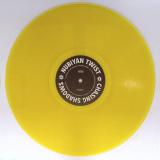
Pressed on Yelow Vinyl LP, or Green & Yelow splatter Vinyl LP (exclusively for UK indies).
out of Stock
Last delivered 3 months ago available to reorder, subject to availability
What or who is Arawak? It's the library music pseudonym of Italian pianist and composer Benito / Luciano Simoncini. Here, he was asked to produce a series of background cues for the Lupus label in 1974. So he began with a track called London 1965. Then proceeded to do what the hell he wanted, writing musical love letters, playing with strange noises, treated trumpets or keeping it simple with his piano and some heavy but controlled reverb.
The result is a consistently interesting album full of passion, joy and beautiful fun, and not a million musical miles away from a classic Morricone release. The original album was repressed five years later on the small Titian library label, and now, at last, there's this final commercial pressing.
It's great to know these near legendary and rare background recordings are moving slightly more into the important foreground.
As the meteoric rise of reggae began to captivate listeners around the globe in the 1970s, innovative artist Augustus Pablo emerged as vital creative force pushing the genre forward. An important figure in the Jamaican music scene during this remarkable era, Pablo was not only a skilled musician but an influential producer who shaped the sound of countless classic recordings. While his instrumental work and legendary dubs remain essential, Pablo was also responsible for iconic vocal tracks from a wide range of local talent, many of which were released on his own label Rockers. Now, Nature Sounds is proud to present Rockers United!, a collection of classic and rare vocal selections from the Rockers archives, all produced by Augustus Pablo. Deeply rooted in hypnotic, bass-heavy instrumentation, the album features remastered audio transferred from the original master tapes, with vocals by Jacob Miller, Delroy Williams, Hugh Mundell, Tetrak, Junior Delgado, Earl Sixteen, Spliffy Dan and more.
While Toronto producer Demuir regularly features on a wide variety of house labels, it's always worth keeping an eye on his Purveyor Underground label and its' limited-edition offshoot. He's back on the latter label for this outing, where he shares vinyl space with long-serving Parisian producer (and Robsoul founder) Phil Weeks. Demuir handles side A, delivering two passes on 'The Spark': the lightly funk-fuelled original mix, where woozy jazz samples dance atop a rubbery bassline and vintage Masters at Work style beats, and the more bumpin', cut-up and sub-heavy swing of the 'Some Too Suspect remix'. On side B, Weeks delivers 'Party Time', a typically low-slung and analogue-rich deep house number where classic boogie-era vocal samples and occasional chords wrap around loose-limbed machine drums and a killer TB-303 acid bassline.
out of Stock
Last delivered 4 months ago available to reorder, subject to availability
At the start of this summer, following a three-year hiatus for Daphni (punctuated only by his first ever collaborative Daphni track ‘Unidos’ alongside Sofia Kourtesis), he dropped ‘Sad Piano House’. The track represented something of a continuation in the Daphni catalogue, its roots growing from Cherry’s ‘Cloudy’ and its subsequent Kelbin remix, something in that song’s makeup having a profound effect when played on dancefloors by Snaith and countless others. ‘Sad Piano House’ deployed more intangibly irresistible bendy piano to equally satisfying effect and continues to achieve similarly rhapsodic dancefloor saturation.
Though a sizeable gap for Daphni releases, between Cherry and Butterfly however of course sits Honey, the latest Caribou album and one that saw the more instantaneous and dancefloor leaning traits of Daphni peaking through the cracks more than ever before. This blurring of the lines leads to an intriguing collaboration in Butterfly’s lead single ‘Waiting So Long (feat. Caribou)’. An unlikely duo - in that both artists are the same man, Dan Snaith - ‘Waiting So Long’ is not so much an identity crisis, ego trip, or the result of a chemical spill in the Snaith laboratory. It’s simply a track that Snaith felt for the first time belongs to both aliases, and might appeal to fans of both. He has never sung on a Daphni track before, and did not set out with the intention to do so this time, and yet this strange billing was born.
Daphni music has always been Snaith’s way of hitting directly to the core of the dancefloors he spends so much of his time playing to, and those dancefloors have been steadily expanding as his name grows, with the music following suit. This album however also draws from further back with a definite kinship to the very first Daphni album, the invigorating bag of ideas that was Jiaolong.
Butterfly is a showcase of the wonderful variety and surprising twists and turns that made that album such an exciting new prospect and that still to this day make Snaith such an intriguing DJ. There are more heavy hitters here, tracks that fill those dancefloors better than anyone, like ‘Clap Your Hands’ which picks up the energy of ‘Sad Piano House’ and flips it, exposing the gritty and intoxicating underbelly of Snaith’s hitmaking side, while retaining the playful urgency that runs through all of his work of late. Meanwhile ‘Hang’’s comic-strip horns are unpinned by gleeful force, unrelenting and thrillingly unshakeable. Elsewhere though comes a clutch of other tunes that might creep out somewhere more off the beaten path, a path Snaith has never stopped seeking in amongst his larger billings. ‘Lucky’ is squirmy and elusively intoxicating, ‘Invention’ skitters down meandering, inviting corridors, ‘Talk To Me’ grumbles and broods in the murk, and ‘Miles Smiles’ could roll on endlessly, so confident in its groove. There are no obvious peaks in these tracks or unifying moments, in fact many of them really have no business being on the dancefloor at all, and yet in the right setting, they could be the most fun to be had all night.
One such club is a good microcosm for the ethos of Butterfly as a whole. “Around the time I was finishing up this album I played a long set in a club called Open Ground in Wuppertal, Germany.” Snaith recalls, “It’s kind of, in one sense, the platonic ideal of the kind of club I’d want to play in. Every single decision has been taken, at great expense, with the aim of making the perfect sounding medium sized club room. But on top of it being the perfect acoustic environment it also is run by an amazing collection of people in a way that gives it a sense of community that dance music at its best provides. It is an absolute pleasure to play in that room to a crowd of people who come from all over. Playing in there you feel like you can play anything, and I played works in progress of pretty much every track on this album in my set there. Don’t get me wrong, I love playing a short set at a festival or in a more raw warehouse kind of club where you bang it out and only really functional music works but on record I guess the point of these Daphni records is to keep in mind a more expansive idea of dance music where the parameters are broad and the church is broad. I think that actually, putting really functional stuff next to weirder tracks (both on an album and in a dj set) might be the thing that’s still most interesting to me.”
This is the feeling that’s most palpable on Butterfly, and in every single time you see Snaith DJ. Right from the inception of the Daphni alias - and even before that – the thrill of trying stuff out, pushing at the boundaries has always been there and on Butterfly is present in all its twists and turns. It leaps all over the place and yet it hangs together, never feeling like a grab bag of dancefloor utilities but rather a distillation of all the strings to Snaith’s bow, exhilaratingly human and unified by one singular concept – simple and joyful exploration.
out of Stock
Last delivered 89 days ago available to reorder, subject to availability
A chance meeting in Mexico City set Points of Inaccessibility into motion. When Ibero-American composer Rafael Anton Irisarri crossed paths with Dutch media artist Jaco Schilp at MUTEK in 2024, a conversation about how technology shapes perception revealed an unexpected common ground. Schilp invited Irisarri to a spring 2025 residency at Uncloud, the Utrecht-based collective he co-founded, where Irisarri's sound began to take form amid an environment shaped by Schilp’s visual research.
The Uncloud studio was located inside the former Pieter Baan Centre, a forensic psychiatric prison where suspects of violent crimes were once confined. Its long history of silence and containment shaped the atmosphere in which the project developed. Within this setting, Irisarri coaxed long bowed-guitar tones through a network of pedals and looping systems. The raw gestures thickened into a vaporous and architectural field of sound. Schilp processed the material through a custom point-cloud software patch that produced images in continuous flux. The visuals flickered, dissolved and reformed like memories that resist coherence, functioning as a digital Rorschach that reflected the observer’s own perception.
Amid these spectral echoes, the project evolved into an examination of how the past persists within present signals. Memory endures as residue and interference, continually shaping perception even when its source has faded.
Schilp’s visual process required a continuous stream of sound in real time. Irisarri improvised throughout the residency, generating material that allowed the visuals to develop in parallel. Once back in his New York studio, he began shaping the recordings by carving pathways through the improvisations and mapping selected passages into MIDI. This process allowed him to build outward from the bowed-guitar material with minimal overdubs, adding Prophet 5 textures, Moog bass and strings that expanded the harmonic field while keeping the original performances at the center. To refine the structure, Abul Mogard provided editorial input, working with Irisarri’s stems to guide transitions and strengthen the overall pacing. The material, originally created under conditions of immediacy and constraint, evolved into a fully realized work through careful revision, patience and sustained reworking.
The title engages the geographic concept of the Poles of Inaccessibility, locations defined solely by their distance from all surrounding points. Irisarri adapts this idea to the conditions of digital life, where new forms of inaccessibility arise through the informational enclosures that structure perception. What appears to be a fully connected network often produces a deeper kind of separation, one shaped by the filtering logic of the systems that mediate experience. In this sense, the digital sphere mirrors its geographic counterpart. We inhabit spaces saturated with signals, yet the possibility of genuine contact becomes increasingly remote.
At its core, Points of Inaccessibility considers what can be understood as the new rituals of capitalist realism. Irisarri uses the term digital shamanism to describe the forms of simulated connection that organize contemporary life. These systems promise comfort through algorithms, influencers and AI interlocutors, yet they often reproduce the same conditions that generate loneliness in the first place. What appears as connection becomes the echo of connection, a sequence of gestures that imitate solidarity while withholding it. Like the geographic poles, these rituals are defined by distance. They pull us into environments where everything is illuminated, yet meaningful proximity becomes increasingly rare. In this sense, the work approaches a hauntology of the present, a reflection on futures that have stalled and intimacies that have been thinned by the algorithmic infrastructures that surround us.
This thematic tension unfolds across the album’s four movements. Faded Ghosts of Clouds introduces the work with textures that rise and dissipate in slow cycles, creating an atmosphere that resists clear definition. Breaking the Unison occupies a pivotal position in the sequence and focuses on the moment when the individual and the system fall out of alignment. Its shifting patterns trace the scattering of signals that once suggested connection, revealing the instability at the heart of contemporary perception. Signals from a Distant Afterglow forms the center of the album and features vocals by Karen Vogt, whose presence enters the sound field like a fragile transmission shaped by distance and delay. The closing piece, Memory Strands, follows motifs that appear, recede and briefly intersect before returning to quiet. Across these movements, the album outlines a landscape in which emergence and disappearance continually inform one another.
Listening to Points of Inaccessibility is an encounter with a sound field that is constantly in flux. Elements surface briefly, shift position and recede, creating a sense of motion that resists stable interpretation. The music moves between closeness and vastness, carrying traces of memory while withholding a clear point of resolution.
The album’s visual identity completes the project’s conceptual arc. In Mexico City, where Irisarri and Schilp first met, Daniel Castrejón transformed stills from Schilp’s point-cloud visuals into the cover image. The final artwork captures a single suspended frame of the digital material, a moment extracted from a field that is normally in constant motion. Its surface recalls the texture and abstraction found in the work of Catalan artist Antoni Tàpies, where material presence and erasure coexist within the same plane.
What emerges is a work that examines the tension between technological systems and human presence. Points of Inaccessibility asks whether connection is still possible within environments shaped by mediation and delay, or whether we have become isolated points within the very networks that promise proximity. What possibilities for relation persist within environments organized by algorithms and interruption? And how are we meant to understand presence when so much of it is constructed at a distance?
Points of Inaccessibility will be released on BioVinyl on February 6, 2026, with audiovisual performances planned throughout 2026.
Mastered by Stephan Mathieu
Artwork by Jaco Schilp
Design and layout by Daniel Castrejón
Artist photo by Iulia Alexandra Magheru.
out of Stock
Last delivered 7 months ago available to reorder, subject to availability
In 1999, on December 23 to be precise, the electronic music landscape changed forever. On that day, the now legendary Icelandic band múm released their debut album “Yesterday Was Dramatic – Today Is OK”. The thing is though, back in the day, hardly anybody realized. It was Christmas after all, people were busy with potentially more important things and didn’t pay attention to some kids selling records on Reykjavík’s high street. Little did those shoppers know.
Thankfully, those 10 tracks weren’t overlooked for long. On the contrary: the album went on to become one of the most influential building blocks of what back then was called electronica and today is considered an art form playing a crucial and important role in shaping and defining the rich electronic music culture of the 21st century. Now, 20 years after the record dropped onto planet Earth, Morr Music is re-issuing the remastered album with its original artwork, adding newly commissioned re-works: A note-for-note representation of “Smell Memory“ by Kronos Quartet (with additional drums by múm’s Samuli Kosminen), a gentle reinterpretation of “Random Summer” by acclaimed pianist and composer Hauschka and an otherworldly new version of “Ballad Of The Broken String” recorded by label mate Sóley. Additionally, four remixes produced in the early 2000s are made available for the first time ever on vinyl here.
In 1999, electronic music was in full bloom. The dance floors were thriving worldwide.Yet the concept of using electronic sounds in acoustic-based productions (or vice versa) was still in its infancy. Many producers were trying, most of them failed. The results felt often forced, fabricated, unimaginative, random and forgettable. New ideas require new mindsets after all. With “Yesterday Was Dramatic – Today Is OK”, múm established a new approach in music production. Instead of setting a fixed agenda and working with a distinct hierarchy for their sonic palette, Gyða Valtýsdóttir, Kristín Anna Valtýsdóttir, Gunnar Örn Tynes and Örvar Smárason let each instrument and sound source be true to itself, creating an ever-evolving universe of sonic bliss. Listening to the album in 2019 still makes every music lover’s heart jump. Combining Drill-and-Bass-inspired beat-chopping, future-informed DSP-programming, ethereal vocal work, indie rock’s boominess, folk music’s soulful brittleness and a lofty feeling for melody and arrangement, the album is a rare example of musical transcendence and remains impossible to categorize.
Many of the ideas formulated and recorded for the album quickly became an integral part of the canonical self-conception musicians around the world were and still are aspiring to. How these ideas really came about, though, is not known – the dynamics, the struggles, the qualms, the sudden realization of having achieved something which might actually stick. Maybe that is a good thing. Örvar Smárason remembers that most of the album “was recorded in a tiny, sweaty room in the summer of 1999 with carpenters banging nails around us, but sometimes we put on headphones so we couldn’t hear them.” It is a good thing they did. As is often the case with classics, all one can do is listen closely and let the magic sink in – again and again.
out of Stock
Last delivered 8 months ago available to reorder, subject to availability
A house is something that is so deeply temporary, yet it can hold so much energy. How do we carry or leave behind those energies while transitioning into new spaces? How does each space we occupy for some time shape us and how do we tear ourselves away from it and its influence once it’s time to go? These are some of the core questions behind CC Sorensen’s new album for mappa, ‘Phantom Rooms’ – it’s a record about movement, change, transformation, family, juxtapositions… but most of all, home.
CC Sorensen was reflecting a lot on their childhood home in rural Kansas, USA while working on this music. The album could be characterised by a familial, chamber feel and both of CC Sorensen’s brothers, Ryan and Nyal Ruehlen, make an appearance on ‘Phantom Rooms’, among other instrumentalists. Using a wide palette of sounds – CC Sorensen alone in charge of keyboards, software instruments, voice, electronics, percussion, trumpet, guitar and field recordings, in addition to guests on pedal steel, voice, chimes, saxophone and drumset – the American musician crafts music as mysterious as it is inviting. The idea behind it would be almost surrealist – ghostly rooms in houses where we live – if we all didn’t know exactly what CC Sorensen means. Home isn’t something concrete, but it’s also not just an abstract concept. It’s a space beyond space; home in itself is a phantom room we enter. And what enables us to enter is the object of exploration here.
CC Sorensen’s approach is playful – tracks like “Beat Bot” and “Plastic Portals” are almost fun – but also contemplative. They make thoughtful, meandering chamber music intertwined with field recordings and electronics. Reeds, strings and percussion often set the atmosphere – sometimes airy, gentle, at other points more insistent – as the music grapples with departure, instability, deep reflection and imagined future spaces. Especially in the closing “Bexar” there’s a tangible yearning for a stable home, a longing to rekindle and keep ablaze this beautiful familial connection to a physical place. It’s both music that invites to reflect and music that in itself reflects; desires, hopes and dreams.
out of Stock
Last delivered 8 months ago available to reorder, subject to availability
Smoove returns with two unstoppable dancefloor heaters on this explosive new 45!
On the A-side, Push It Good delivers a brilliant rework of the iconic Push It, powered by heavy breakbeat drums and infused with vintage ’60s soul flavor — a guaranteed crowd-mover.
Flip it over and Smoove keeps the momentum going with Scandalized Lifetime — a masterful fusion that rebuilds sampled layers from Sugar Bear’s 1989 classic, interwoven with multitrack elements from Talking Heads. The result? Pure dancefloor gold — a certified champion!
out of Stock
Last delivered 21 days ago available to reorder, subject to availability
RAWAX presents Dope Dog (Orlando Voorn) - Keep House Unda'Ground formerly released on legenday Touché in 1996!
We have the honor to re-release this great release 30 years later on vinyl early 2026 with re-mastered tracks!
out of Stock
Last delivered 8 months ago available to reorder, subject to availability
B' ROOTS SOUND SYSTEM presents the first release of its record label -NORTH&SOUTH Reggae Label-. A 12inch worked with Sergio López aka Japu, from Lana Studio in Linares (Jaén-Andalusia-Spain).
A version of the original riddim by N. Bailey with the voice and lyrics of Natty Nature. 'Keep up the vibe', a song full of powerful melodies, where the lyrics refer to creating a harmony between the music and the listener through the vibration of the instruments, the voice and each sound element. That is, keeping the energy and creativity awake in perfect balance.
On the other side, Jorge Dopico contributes his art in 'Trombone vibe', to keep the energy at its highest until the end of the album. A trombone line that delights anyone who loves the most melodic and instrumental reggae.
All this, supported by the respective Dub Versions, by Sergio López aka Japu, from Lana Studio. Providing the riddim, production, mixing and mastering of this sensational first work.
A rising and genre-defying figure in the French electronic scene, Goldie B continues her ascent with Who Says Night’s For Sleeping?, a five-track EP that asserts her distinctive signature: an instinctive blend of club energy, cinematic storytelling and UK rave influences. Conceived as the soundtrack to a night lived in full intensity, the record moves through the fire of the dancefloor, the collective trance, and those suspended moments where one floats between dream and wakefulness.
“I imagined this EP as the soundtrack to a night experienced in its entirety. From the first rush of adrenaline on the dancefloor to that floating walk home, still carried by the music. My influences range from Moby and Air to Floating Points and Joy Orbison, artists who know how to combine power and emotion. I love connecting the raw energy of the club with more dreamlike textures, because you can absolutely dream while dancing. Each track is an instinctive snapshot of my inner world.” Goldie B The EP’s opening act, “The Space Between” blends ethereal pads, organic strings and a steady crescendo, recalling the elegance of Air or Moby. It opens a suspended space, equally suited to inner drift or physical release. “I wanted it to feel like a threshold, a gentle hand pulling you into a trance state.”
On “U Make Me Feel So Good”, a sensual and narrative breakbeat track, a flowing bassline gradually tightens into trancier energy. Seductive female vocals weave through broken rhythms, creating a piece that is as tactile as it is hypnotic. “It’s about contrast, the softness and caress at the start, then a tension that rises and electrifies.”
Instagram | Youtube | TikTok | SoundCloudAt the heart of the project, “Rêve de Rave” channels 90’s breakbeat spirit with old-school samples, an euphoric central break and voices urging to move your feet. Urgent and liberating, it embodies the dreamlike essence of the rave. “It’s how I imagine the rave: a lucid dream where joy and collective energy feel almost unreal.”
Next comes the most incisive cut of the EP, “Purple FX”, driven by a grating central bassline that evolves relentlessly until its explosive drop. Minimalist yet implacable, it captures the sheer force of a peak-time track. “I wanted a track purely designed for the club, where the tension just keeps rising until it explodes.”
Closing in chiaroscuro, “Snake Waves” shifts from breakbeat into a half-house, half-techno 4/4 groove, carried by a sinuous, hypnotic bassline. The track plays on tension and release, with a rich harmonic break before fading like a suspended farewell, where the party recedes but the energy lingers. “It’s a farewell piece that keeps the intoxication alive, like a final vertigo before slipping back into the night.”
Goldie B is a multifaceted force on the French electronic scene. A producer, multi-instrumentalist, singer, MC, DJ, and co-founder of the label Omakase Recordings, her sets blend bass, jungle, UKG, and breakbeat, captivating audiences with their contagious energy. Based in Marseille, she has released music on renowned labels such as D.KO, Banoffee Pies, and YUKU, and has performed on some of the biggest French stages and festivals: Peacock Society, Astropolis, NDK, Marsatac, Delta, Le Bon Air, and even the Festival d’Avignon. In 2024, she was selected by Apple Music for its Women In Electronic series. Her new Who Says Night’s For Sleeping? EP confirms her status as an instinctive and distinctive artist to watch on the French electronic scene.
out of Stock
Last delivered 8 months ago available to reorder, subject to availability
Stoop Kid is the jangly indie rock project of Diest-born Jens Rubens. After Camp Careful (2021) and Mount Cope (2023), Stoop Kid returns with his third full-length album Office Overdue, a ten-song collection that captures the quiet fatigue, flickering humor, and
fragile hope of keeping it together in a world that won't slow down.
'Office Overdue' is a collection of songs Jens made at home in his modest home studio. For this album, he wanted to let go of pressure and expectations more than ever, and only work on music when he genuinely felt like it.No fancy studio, no producer, just walking upstairs and messing around. The result doesn't always sound perfectly polished: the drums are sometimes clumsily programmed and more than a few wrong notes made it onto the record. The guitars were allowed to hit a bit harder this time, with the '90s slacker vibes coming through more prominently. The result is a record that feels raw and honest, and above all, was made purely out of enthusiasm.
Office Overdue explores the attempt to keep functioning in everyday life while the world around us feels on the verge of collapse. The songs move between mental exhaustion and self-reflection, carried by a dry, sometimes bitter humour that helps lighten the weight. The album focuses on repetition and routine, and on the tension between wanting to care for others and being trapped inside one's own head. Themes of anxiety, guilt and dissociation recur throughout, but are always accompanied by small moments of connection, gentle resistance and acceptance. Office Overdue embraces the mess, the doubt and the false notes, without drawing grand conclusions. Not everything is resolved, but the persistence remains.
'Flowers', the new EP from Elizabeth Davis, finds itself at the cross-section of many factors. In part, it’s the result of Davis’ obsession with a seminal folk song. But it also coincides with her rediscovery of the voice and language as an instrument. It was recorded during an autumn residency at Sternhagen Gut, the cultural refuge run by Gudrun Gut and Thomas Fehlmann, located deep in the Uckermark countryside halfway between Berlin and the Baltic coast.
The six tracks on 'Flowers' all take Pete Seeger’s ‘60s protest-folk song 'Where Have All The Flowers Gone' as their starting point. However, they veer off in different directions, from vocal loops and deconstructed lyrics, to instrumental drones and glitchy, manipulated rhythm tracks. Like many musicians, Davis has learnt composition by a process of disassembly, analyzing musical works piece by piece, and 'Flowers' began as one such forensic exercise. “But sometimes,” says Davis, “a source is so loaded up on meaning that the studies and experiments can become worthwhile and meaningful works in their own right.” 'Flowers' began to take on a life of its own, raising renewed questions about age-old themes such as war, authorship, translation and historical structures.
Davis is no stranger to cover versions. From studying violin to playing in free jazz and punk bands, interpreting other artists’ works has long been a key part of her musical approach. And since her radio show 'Deep Puddle' recently drew to a close after seven years, her experiments with narration and sound collage have found their way into her musical work once again. For 'Flowers', she cut up the source material (with a nod to Gysin and Burroughs), and reassembled the lyrics, the musical notes, and recordings by different performers, to create uncanny new forms.
But perhaps the biggest influence on 'Flowers' was conversations about music, art and pop subcultures with Gut. These dialogues helped Davis find a balance between far-out sound design experiments and catchy melodies, combining a certain avant-garde element and modern day songcraft. And it’s this sense of conversation, this revisiting of topics and renewal of ideas, that will keep us coming back to 'Flowers' long into the future.
Jackie Mittoo, organ and piano maestro, was also one of the founding members of Jamaica's top session band The Skatalites. Musical arranger for Studio One he provided the backbone to so many of Jamaica's finest tunes. The invention of Ska music and the sounds that rode through the Rocksteady and Reggae period all carry his stamp. Whether it be in his various incarnations, the aforementioned Skatalites, The Soul Brothers, Soul Vendors and the Sound Dimension or under his own name, his distinctive organ and piano sound and musical arrangements have all played a major part in Jamaica's musical history.
Jackie Mittoo (born 1948, Kingston, Jamaica) began playing musical instruments at a very early age. Taught piano by his grandmother he was performing live by the age of 10 and recording by the age of 15. Two Kingston bands that he played with the Rivals and the Sheiks brought him to the attention of Studio One's founder Coxsone Dodd. Who at the time was putting a group of musicians together to be his studio band. Impressed by his skills on both the organ and the piano, Jackie was asked to join in what would become Jamaica's foremost band The Skatalites. The fellow band members were Lloyd Brevett (bass), Lloyd Knibbs (drums), Don Drummond (trombone), Tommy McCook, Roland Alphonso and Lester Sterling (Sax), Johnny Moore (trumpet), Jah Jerry (guitar) and Mr Mittoo (piano). This line up ruled the Jamaican scene between 1964 - 1965 as well as inventing the Ska sound, they also performed the backing duties for the other top labels of the time including Duke Reid's Treasure Isle and Justin Yap's Top Deck label.
1965 saw The Skatalites disband and Jackie Mittoo move on to his next musical project The Soul Brothers. Formed with fellow Skatalite Roland Alphonso, this band would back all the hits coming out of Studio One for the next three years with Jackie Mittoo working as band leader and musical arranger. Around this time Jackie also had his own single released, a Ska underground classic called 'Got My Bugaloo'. Rare, as it also features Jackie in the unusual role for him, as lead singer!!!!.
1966 saw the Ska sound evolve into Rocksteady, again with Jackie's band at the helm, and his first hit single the Rocksteady cut 'Ram Jam'. The success of which would lead to a solo career and album releases under his own name such as 'Now', 'Macka Fat', 'Evening Time', 'In London' and 'Keep on Dancing', to name but a few. In1967 the hits at Studio One were still flowing when The Soul Brothers morphed into The Soul Venders and began backing such luminaries as Ken Boothe, Alton Ellis, Delroy Wilson, The Heptones, The Cables, The Wailers and many other of the labels solo artists.
By 1968 Jamaican music was ready for another change and Rocksteady rolled into a slower groove soon to be called Reggae. Jackie Mittoo would be at the forefront with his latest band The Sound Dimension. A line up that included Leroy Sibbles (bass), Roland Alphonso and Cedric Brooks (saxophone), Eric Frater and Ernest Ranglin (guitar) and Bunny Williams (drums). Being the house band at Studio One they backed all the leading names of the time, John Holt, Horace Andy and Alton Ellis, all of Studio One's output carried his sound.
Jackie Mittoo emigrated in the late 60's to Canada, but travelled to Jamaica and London to record with many of the big new names, who were trying to redress Studio One's supremacy and needed his magic touch. Such Producers as Bunny Lee used Jackie Mittoo on many of his sessions, Sugar Minott among others were always glad of his services.
We have captured some fine 1970's cuts that feature Jackies numerous talents, showing his ability to embellish tracks with a feel that few could better, Musical arranger, band leader all round studio ace. We hope you enjoy the set and I'm sure you'll agree with us Jackie Mittoo does indeed Ride On.........
Kanyon (John) is a NYC based producer/dj who has cut his teeth in the underground US techno scene through raw live sets, and dynamic djing. Keeping the quality high with his signature no-bs style of production and performing, he has played live supporting legends like Steve Poindexter, DJ Hyperactive, and Francois K. His productions have garnered support from Ben Sims, Akua, Ron Like Hell, Kush Jones and many others.
The Duplex EP is a split record featuring John's house alias DJ John Brooklyn on the A side (A1, A2, locked groove) & techno alias Kanyon on the B side (B1, B2). Exploring NY house and trippy, dubby minimal techno respectively, Duplex EP is a heady start to 2026.
out of Stock
Last delivered 6 months ago available to reorder, subject to availability
Dear friends, What’s left of a genre when you drop the posturing and keep nothing but feeling, space and rhythm? Freudenthaler answers that question straight up with a stripped-back, no-nonsense take on UK garage. With a sharp ear for space, swing and restraint, he boils the sound down to its core — nodding to the golden age of sound system culture while lacing it with the jazz-tinged touches that run through his productions. The result is a record that feels both timeless and personal. Freudenthaler plays with expectations, flips them neatly, and leaves just enough room between the beats for the atmosphere to breathe and the dancefloor to lock in. One for lovers of vinyl, heavy sub and subtle moves. Sincerly yours, Brombért P.S.: The physical release comes with handcrafted, screen-printed artwork by the fabulous graphic artist Zatina Kessl
out of Stock
Last delivered 8 months ago available to reorder, subject to availability
Finnish dub-techno craftsman TM Shuffle, head of Vuo Records, resurfaces with a deep and distilled EP that goes straight for the late-night heart of the dancefloor. Rooted in Tampere’s raw, analog dub sound, his productions have long balanced weight and warmth, smoked-out chords, rolling low-end and subtle shuffle that keeps the groove in constant motion.
The lead track “Kellari” dives into basement mode: pressure-cooker drums, slow-burning stabs and a humid, lived-in atmosphere that feels equally at home on a huge system or in headphones at 4 a.m. On the second original cut, TM Shuffle links up once again with long-time collaborator Monoder, the alias of Jussi-Pekka Parikka, known for his dubbed-out explorations on labels like Statik Entertainment and Pakkas-Levyt since the early 2000s. Their joint track stretches time, letting echo, tape hiss and distant melodic fragments float around a rock-solid groove, channelling years of shared studio language into one focused, hypnotic flow.
On the flip, Anton Kubikov (SCSI-9) steps in with a lush reinterpretation of Kellari. A true Russian techno veteran with a catalog that spans Kompakt, Force Tracks, Mayak and beyond, Kubikov melts the original into a widescreen, dream-state trip, soft-focus pads, gentle yet insistent percussion and that unmistakable rolling pulse that made his work so enduring. The remix doesn’t just extend the track; it opens a new dimension, turning the basement pressure into a slow-rising, celestial drift.
Pressed on limited coloured vinyl, this EP is built for selectors who like their dub techno deep, human and timeless, a record that will quietly live in bags for years and keep resurfacing whenever the room calls for true late-night elevation.
out of Stock
Last delivered 42 days ago available to reorder, subject to availability
Following her compelling debut EP Mending, Frida Touray returns with Homebody, a work of raw emotional clarity, crafted duringa time when her voice was literally fighting back. Diagnosed mid-process with a rare condition that forced her into silence andstillness, Touray chose not retreat, but rebuild. From the quiet corners of domestic life, she’s shaped a collection of songs thatradiate warmth, vulnerability and quiet endurance.Musically, Homebody expands on Touray’s jazz-soul foundations with sparse, atmospheric production that amplifies her voiceand message. There’s a newfound looseness in her phrasing, a deeper sense of presence in every word she sings. You can hearthe letting go, of perfection, of control, and the deepening of purpose in its place. Each track lands with unfiltered intimacy andemotional architecture, a subtle act of defiance wrapped in softness.This is music built on stillness and shaped by resilience. A reflection on self-worth, illness, femininity, community and healing.Songs that speak to the unseen parts of recovery and the small rooms we build ourselves back up in. Homebody is a record foranyone rebuilding from the inside.
out of Stock
Last delivered 8 months ago available to reorder, subject to availability
Djo, the musical project of Joe Keery, returns with his fourth studio album, The Crux Deluxe—an expansive, 12-track companion album to The Crux, written, recorded and produced by Keery and his collaborator Adam Thein. Following the massive success of his single “End of Beginning,” which topped both the US and Global Spotify charts and amassed over 2 billion streams worldwide, the deluxe record is full of songs that were written at the same time as The Crux album sessions and recorded at Electric Lady Studios in NYC.