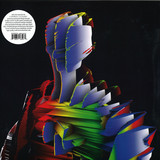
Syncopated percussion and murky atmospherics form the basis of 'Mutual Romance' before Dicicco introduces an ominous melody to generate the duskiest track on the package. 'Virgo Love Affair' then meanders forward with tight kicks and a hypnotising chord sequence before making way for the deep and scintillating 'Filling Pieces'. Concluding the release, 'How We Live' combines organic drums with sweeping effects whilst distorted keys operate throughout.
The second album by Istanbul's clarinet virtuoso Cüneyt Sepetçi is an intense trip into modern Turkish wedding and party music. The foundations go deep into Turkey and the surrounding regions' history, which each generation innovates and develops. These days, no wedding or circumcision party is complete without the sound of the micro-tonal keyboard. A new addition, these Turkish keyboardists can play between notes, and supply banging club rhythms in wide variety of time signatures.Sepetçi uses the bedrock of Volkan Sever's synth insanity as a jumping off point for some truly crazy solos. His fluttering sheets of notes tie knots around the pulsating, fried synthesizer. For this recording session, Sepetçi brought in two drummers, Fatih Özden (tapan) and Samet Sertol (darabouka), to play along with the Turkish drum machine. A dense nest of rhythmic complexity is the result. And to further connect to this music's rich past, the ancient double reed zurna of Ahmet Özden and Yasar Uçar's European violin weave ancient melodies and incredible solos throughout.
These musicians are some of the best in Istanbul, and all of these songs are first takes, recorded live with very little planning. Sepetçi essentially leads the band through these complex arrangements as they play them.In Istanbul, one may see Sepetçi playing for change on Istiklal Caddesi, the famous Turkish walking street at the center of the city. Or one may see him on one of the TV stations, playing Anatolian songs in his inimitable style. He's even begun touring outside of Turkey—at Denmark's Roskilde Festival, and at concerts in Italy, Beirut, and Israel. I want to go to America. He says. Do they have mosques there
Air Lows is the debut solo album by Silvia Kastel. The Italian artist has been a fixture of the underground since her precocious teens, clocking up many miles in Control Unit with Ninni Morgia ('It's like Catherine Deneuve dumped two cases of post-Repulsion psychiatric notes over Pere Ubu's Dub Housing, lit the fuse and, ahem, stood well back" - Julian Cope), including collaborations with the likes of Smegma, Factrix, Gary Smith, Aki Onda and Gate (Michael Morley of The Dead C). Both solo and in her work with others, Kastel has explored the outer limits and inner workings of no wave, industrial, dub, extreme electronics, free rock and improvisation. Air Lows is both her fullest and most refined offering to date, a work of vivid, isolationist electronics which draws deeply on her past experience but assuredly breaks new ground. Prompted by a late-flowering interest in techno and club music, Kastel sought to create something which combines a steady rhythmic pulse with the otherworldly sonorities of musique concrete, and avant-garde synth sounds inspired by Japanese minimalism and techno-pop (Haruomi Hosono's Philharmony being a particular favourite). The formal artifice of muzak / elevator music, the intros and outros of generic popular songs, the extreme light-heavy contrasts of jungle, the creative sampling of hardcore, and the very 'human' synths in the jazz of Herbie Hancock's Sextant and Sun Ra: all were touchstones for Air Lows' conception and composition, and all strains of music addressing - or complicating - the relationship between the human and the technological. By extension, visual inspirations also proved important: anime, and the avant-garde fashion of Rei Kawakubo. What does that shirt or dress sound like Though used sparingly, Kastel's voice remains her key instrument, whether subject to dissociative digital manipulations as on 'Bruell', delivering matter-of-fact spoken monologues, or providing splashes of pure tonal colour. Recorded between her expansive Italy studio and a more compact, ersatz set-up in Berlin, Air Lows gradually takes on some of the character of the German capital: you can hear the wide streets and uninhabited spaces, the seepage of never-ending nightlife, the loneliness. Air Lows is The Wizard of Oz in reverse: the glorious technicolour J-pop deconstructions of its first half leading inexorably to the icy noir of 'Spiderwebs' and 'Concrete Void'. These later tracks are reminiscent of 2015's magnificent 39 12', Kastel in the role of numbed, nihilistic chanteuse stalking dank, murky tunnels of reverb and sub-bass. But in fact there is contradiction and emotional ambiguity to Air Lows from the outset, and throughout - a sense of both infinite space and acute claustrophobia; energy and inertia; fluency and restraint.
Visible Cloaks' Lex proposes a utopian dream language and its accompanying sound, a limitless, delicate space developed by fluid musical techniques and subconscious voices. The six pieces comprising Lex simulate a more peaceful future, their mysteries telling a new tale in an unknown but imaginable melodic language. Visible Cloaks are the Portland-based musicians Spencer Doran and Ryan Carlile. Utilizing software-based composition rooted in randomization, MIDI-translation and chance operations, the duo has established an improbable humanist mode of music from esoteric processes. Following their self-titled debut album, Visible Cloaks offered Reassemblage, an album simultaneously honoring the post-Yellow Magic Orchestra school of avant musical adventure and diverging from it. Veering from the paths cleared by Japanese and Italian electronic pop and ambient artists of the mid-80s / early-90s, Reassemblage established Visible Cloaks' own camp in a forest of deep sound canopied by trees grown from synthetic seeds.The sound represented on Lex is webbed with sculptural arrangements and interpolated by the sounds of alien speech. These strange and serene utterances were created by Doran feeding a chain of multiple dialects and accents through a language translation software to create an auditory poetry of an evolved place and time.
Lex features both the final version of this process and earlier, simplified experiments with it ( Keys'). The idea - building on 'fourth world' or 'global village' type concepts - was to create a projected language that was a fusion of many,' Doran explains. The result was a very disorienting form of non-language that amplifies the lapses in meaning that occur with the inaccuracy of auto-translation software.'
Permutate Lex, a companion short film to Lex made by Visible Cloaks in collaboration with artist Brenna Murphy (who also created the artwork for Reassemblage and several virtualist videos for the album), is an integral counterpart, both visualizing an aesthetic alive with human form and guiding the sonic experience of the first five pieces: Wheel,' Frame,' Transient,' Keys,' and title track Lex.' World,' the longest piece presented on Lex, is redrawn from a generative composition originally produced for an installation Doran made with Murphy.
The original work incorporates LFOs and randomized MIDI-information, and was intended to variate indefinitely. In this 'fixed' version, World' provides a more conclusive view into the impossible musical environments Visible Cloaks make real. Longer than any track on
Reassemblage, World' expresses the deepening, patient intimations suggested by Lex.
Doran says the Lex attempts to communicate the essence of a world distant enough that it can't be captured or comprehended from the present, appearing only surreal and inscrutable.' The statement reveals a broader musical philosophy fueling this new moment, an awakened voice woven through complex melodic shapes and phrases establishes communication between listeners and the unknown, here presented by Visible Cloaks as sounds coloring the very edge of the envisionable.
Marco Bailey's 5th full-length album, one that he personally claims to be the best overall representation of his sound. With seventeen tracks comprising almost an hour and a half of music, he has ample room to stretch out and to give listeners an excellent portable version of his potent live show.
By maintaining a consistently high-quality output that does not merely ride the wave of current trends, multi-faceted producer Marco Bailey has managed to survive through decades of mercilessly shifting adjustments to popular taste in dance music. From his beginnings in the late '80s spinning eclectic sets comprised of everything from punk to old school hip-hop, to his present interest in pure unadulterated techno, the Belgium-based DJ and producer has won over audiences with his keen knowledge of how to squeeze the greatest physical and emotional impact out of a few well-placed elements, along with his instinct for seeking out the most innovative and resilient kindred spirits (his impressive number of professional friendships includes artists as diverse as Markus Suckut, Jonas Kopp, Alex Bau, Edit Select, Speedy J, Steve Rachmad and many more). These combined talents have led to his formation of several different labels: MB Electronics in 2001, the 'limited edition' label MBR in 2013, and lastly the new Materia Music label begun last year. His similiarly named event series, Materia, has also been a truly worldwide 'state of the art' summit for advanced techno artists.
The full-length personal releases by Marco Bailey, which stretch back to his mid-'90s period as a trance producer, have been gracefully arcing and anthemic affairs composed of individual tracks that follow that same blueprint. He is now about to drop his 5th full-length album overall, one that he personally claims to be the best overall representation of his sound. With seventeen tracks comprising almost an hour and a half of music, he has ample room to stretch out and to give listeners an excellent portable version of his potent live show. Of course, an epic running time alone is not the marker of a great audio experience, but an epic running time in which one loses track of time completely is - Bailey accomplishes this feat by never rushing the payoff; by organically building up each track until listeners are fully immersed in his alternate universe.
This skill can be heard on banging, sweat-saturated tracks like 'Ash', 'Genetix' and 'Hasai,' but also on comparitively gentle pieces like 'Klauth' (which straddles the line between disciplined electro and something more dreamlike and weightless), or the blissed out 'Suoh,' which feels like a fresh snowfall in audio form. Low-key cuts like 'Rex,' driven by echo FX and other windswept sounds, form natural counterparts to busier tracks like 'Ruth,' with its spring-loaded sequencer attacks, or 'Reboot That Device,' which is ingeniously driven by a psychedelic organ whose sound evolves with various filter settings. Minimalist vocals are occasionally injected into the mix - i.e. on the 'The Darkness' - to impart a subtle message of constant, ongoing expansion into unexplored galaxies without and within. It's as good a definition of the artist's musical mission as any.
Tropical Odds is the second album by White Sea, the solo alias adopted by gifted American singer, songwriter and producer Morgan Kibby of M83
Born in Alaska, and now a resident of Los Angeles, Morgan fronted The Romanovs before joining acclaimed electronic music group M83 in 2007, co-writing, arranging and playing keyboards on the albums Saturdays = Youth and Hurry Up, We're Dreaming, as well as completing several world tours.
As White Sea, her first solo album In Cold Blood arrived in 2014, a dramatic debut praised by Billboard for its 'canyon-sized hooks, knowingly grandiose melodies and succulent vocals' and judged 'pop's newest break-up classic' by Flavourwire.
Outside of M83 Morgan has also collaborated with artists such as Greg Kurstin, Panic! at the Disco, Mark Ronson and School of Seven Bells, remixed Ellie Goulding and Britney Spears, and composed the award winning soundtrack to Eva Husson's provocative 2016 movie Bang Gang (une histoire d'amour moderne).
New album Tropical Odds stems from an interactive project launched via White Sea's website featuring digital singles and videos released at regular intervals throughout 2015 and 2016. Explains Morgan: 'Generally being able to create and mix and master my solo material within days has given me the direct freedom to share songs I want people to hear. In short, if I write something that I like, I put it out!'
Now gathered together in album form, the musical moods on Tropical Odds range from the sombre reflections of Gangster No. 1 and Yesterday to the hedonistic rush of Stay Young, Get Stoned and Never a Woman, high drama on Bloodline and Arcadia, and heartbreaking balladry on Secret, One Bad Eye and Lessons.
RAWAX proudly welcomes Mr. Lamont Norwood aka Dj Di'jital to the family! A true pioneer from Detroit!
Truly an old school Techno Bass jewel, DJ Di'jital has been a key player in the development of what some call the "Second Generation" of Detroit Techno. Having released on classic Detroit labels like Metroplex, Direct Beat, and Twilight 76, there is plenty of good reason why his name and his work have become so legendary over the years.
Influenced by early groups like Kraftwerk and Parliament, it was no surprise that the 80's fusion of Electronic Music, Funk and Hip Hop that brought about the Electro Funk sounds, would have such an impact on him. As a kid, Lamont Norwood aka DJ Di'jital became acquainted with the idea of mixing two songs together using tape decks, which while being limited, still gave him the drive and passion to pursue a career as a professional DJ. Over the years he played many different house parties and underground clubs, even spending some time as a Cabaret DJ.
Throughout this time, Di'jital became an incredibly skilled turntablist, quickly gaining the reputation of being a formidable force behind the wheels of steel. The year 1996 would prove to be quite a momentous one for Norwood, not only signing to the already well established label Direct Beat, but also becoming the official DJ for one of the label's finest and most important artists, Aux 88. Having already released his first EP, "Prototype", on Direct Beat, this would become a great opportunity that would help seal him as an icon of what was now known as the Detroit Techno Bass scene. Over the next few years,
Di'jital continued recording for Direct Beat, releasing some of the greatest and most unique Techno Bass classics to date, even doing a few remixes for some of Aux 88's most well known releases like "Electro/Techno", "I Need To Freak", and "Break It Down". Hit EPs like "From The Mind Of The Master", and "360 Degrees" became instant classics, still very sought after to this day. He also had some of his songs appear on some of the various Direct Beat compilations that were released between the years 1996 and 1999 like "Xperience De Bass II", which released "Radar2Bass", one of his most notable works, as well as the all time collector's album, "Techno Bass: The Mission".
Perhaps what may have been one of the biggest signs that his career was becoming exactly what he had hoped for, was the opportunity presented to him to remix Aaron Carl's classic "Down", which was released on the iconic Metroplex Records in 1998; Something that to any Detroit native would have been an honor and a milestone, given the reputation and level of success and influence that Juan Atkin's imprint had on the Detroit Electronic Music scene, as well as the global Electro/Techno movement.
Between the years 2000 and 2002, there was a small hiatus in complete EPs or albums being released by DJ Di'jital, although there were 2 different tracks released on the labels Bipolar and Studio iK7. In 2002, he went on to sign to another of Detroit's legendary imprints, Twilight 76, where he released 2 EPs, "Bass Programmers", and Di'jital's Revenge". In 2005, already a veteran and having amassed the necessary skill and knowledge needed to be a true beat warrior, Di'jital was now ready to join the resistance...Underground Resistance that is! Featured on the Interstellar Fugitives Vol. 2 compilation ( also later released as a 2xCD/DVD set ), Di'jital also released on the Electrocuter EP, which featured the previously released "Bang", as well as "Track 19".
In 2006, already well into the digital age ( no pun intended ), Norwood would release his first set of downloadable works, starting with an album called "The Prototype", on Twilight 76, which was completely unrelated to his first EP which was also called "Prototype". Recently, Twilight 76 has also released what is so far a 2 volume set of battle cuts dubbed "Electro Battle Tools".
The only known material that is known to be in the future for DJ Di'jital at the moment is a remix of Morphogenetic's "Techno Bass Is Back!", which was originally released as a free download to members of Technobass, but will soon be released on a 12"/Digital release that will launch the site's own label "Techno Bass Music". There will also be a follow EP by Di'jital, so stay tuned! Over the years, DJ Di'jital has proven to be an unstoppable force in the Techno Bass scene, tirelessly working to push the boundaries of Electro forward with his futuristic and visionary beats that have unleashed mayhem across the globe, not just in his published works, but also in his incredible DJ acts, where one can truly witness one of the few actual turntablists in this style of music. Expect more in the future as Di'jital's revenge continues to spread across the globe with his out of the ordinary approach towards Techno Bass music.
In 1997, a quiet, unassuming man of 59 years old named Victor Tavares - better know as Bitori - walks into a studio for the very first time to record a masterpiece which many Cabo Verdean consider to be the best Funaná album ever made. Bitori´s musical adventure had begun long before this point. It was 1954 when he embarked on a journey across the seas to the island of Sao Tomé & Principe. The young man´s hope was to return to Cabo Verde with an accordion.
Following two years of hard labour Bitori had succeeded in saving enough money to acquire what was to become his most valued possession, his cherished instrument. The two month journey back to Santiago, his island of birth, proved time enough to master it. Self taught, Bitori developed his own style, an infectious blaze, that quickly caught the attention of the older generation. Before long Bitori was being asked to share his musical talents, igniting the local festivities around Praia with his music.
But not everybody welcomed the rural accordion-based sound. Perceived as a symbol of the struggle for Cape Verdean independence and frowned upon as music of uneducated peasants, Funaná was prohibited by the Portuguese colonial rulers. Performing it in public or in urban centres had serious consequences - often jail time and torture awaited musicians that were caught in the act'. In light of such persecution the genre of Funaná began to slowly disappear.
In 1975 Cabo Verde achieved independence from Portuguese colonial rule. Along with Cabo Verde's independence came a lifting of the ban placed on Funaná. The musical repercussions in Cabo Verde were plenty - many upcoming artists embraced Funaná, translating and adapting its musical form in new ways. It was not to be until the mid-1990's, however, that Funaná in its traditional form was actually recorded. It was a young singer from Tarafal, Chando Graciosa, who was to play a key role in this event. Upon hearing Bitori, Graciosa immediately felt drawn to Bitori's unique playing style - a raw and passionate sound accompanied by honest lyrics that reflected the harsh reality of the Cabo Verdean working class. He eagerly approached Bitori suggesting they join forces and travel overseas with the objective of taking Funaná beyond its rural roots. The two of them, with others in tow, achieved their goal and travelled to Europe, introducing a receptive European audience to the vibrant energy of Funaná.
Eventually Bitori returned to his beloved Cabo Verde. Graciosa opted to settle in Rotterdam in order to pursue his career - he vowed, however, to bring Bitori across to Holland at a later date to record an album.
In 1997 the time was ripe to immortalise the sound Bitori had shaped over a time span of four decades. Built around a formidable rhythm section, formed of drummer Grace Evora and bass player Danilo Tavares, "Bitori Nha Bibinha" was recorded. The recording catapulted Chando Graciosa to stardom, making him Cabo Verde´s No.1 interpreter of Funaná.
The success in Cabo Verde was phenomenal and Funaná rapidly gained the recognition it deserved, especially in urban dance clubs. Bitori´s songs quickly became standards - classics known and loved throughout the country. The musical success, however, was solely limited to the Cabo Verdean islands - until now!
Analog Africa is proud to contribute to the worldwide promotion of Funaná - the once forbidden sound of the Cabo Verde archipelago - by releasing a worldwide re-issue of Bitori and Chando Graciosa´s legendary recording.
The release will herald Bitori´s first European tour taking place during the summer of 2016. Watch this space! And listen!
Our latest Looking for Mushrooms' EP comes to us from a collaboration between long time Dirt Crew resident Tigerskin and gifted jazz pianist and composer Grambow. We first heard from Grambow when his fluid key stylings featured on Tigerskin's Faint' in 2015. The title track is a suspenseful and moody journey, lead by live double bass from feature artist Das Eb". Building in intensity with Tigerskin's warm production and steady percussive instrumentation until Grambow's live lead on a gritty synth growls in over the top. A true modern electronic classic as far as we are concernred. Tsukiji' is a playful deep house groover. Balmy tuned percussion and shaken highs roll along under the light hearted piano which cruises along throughout the whole tropically touched endeavour. This track has Party' written all over it! Octocat' is a tougher italo disco tainted work out, tightly programmed live and analogue percussive elements push along, while wailing keys lick over a tenacious grunting bass. You can really taste and feel the long studio sessions the guys had to compose this great track. It is so much more than generic dance music. Red Fox' is a divine culmination of the pair's compositional prowess and dance music knowhow. A cinematic and spirited house track that glides and glistens via delicate piano, plucky percussive riffs, bright strings and woodwinds. We are very honoured to release this outstanding musical release by Tigerskin and Grambow.
Two generations of Italian music history come together on this split 7. Milan meets Rome, Fred Ventura meets Alessandro Adriani. For this occasion Adriani and Ventura covered the 82' evergreen 'Changing' by Bill Bruce. The perfect combination to pay homage to this monumental piece of music. On the flip side Fred's early 80's new wave band State Of Art got the remix treatment by Alessandro's moniker Newclear Waves. Another unique match of these two key figures preserving the 80's underground sound of Italy.
Over the past few decades, there has been a seismic shift in Brazil's musical landscape. A plethora of varying musical undergrounds has developed across the nation. While Rio and São Paulo have been overwhelmed with networks of talented musicians for a long time, creative life is now bursting all over the country. Amplificador exists to document and propagate the wonderfully diverse music currently blossoming from Brazil's vivacious and geographically varied musical undergrounds. Presenting an up-to date insight into Brazilian music, this compilation draws together some of the components of 'Novíssima Música Brasileira' (brand new Brazilian music), ranging from afro-grooves to rock, to modern samba and MPB. The music reaches back across Brazil's incredibly rich musical and cultural traditions, while also taking in influence from other movements around the globe.
Having begun life in 2012 as a Brazilian music blog run by Marcelo Monteiro, Eduardo Rodrigues, Mateus Campos, and Ricardo Calazans, the aim of Amplificador is to document and propel to wider audiences, Brazilian music of the '00s and '10s generation. This is a task made more significant by obvious changes in the way music is consumed. 'People are no longer obliged to listen to what the radio and TV are presenting. There is a whole new generation that wants to listen to new bands and new sounds and we try to connect those bands with other bands, producers, fans and even the mainstream.' These changes in technology and the way music is discovered and shared have developed parallel to the proliferation of these emerging scenes. The ostensible decentralization of the music industry means the promoting and filtering work of journalists and blogs, like Amplificador, have become increasingly important, as people try to keep up with the tsunami of new music and media flooding the country on a daily basis.
Marcelo uses the example of the Mangue Beat movement to explain a trend in contemporary Brazilian music that looks both inwards, to Brazil's own musical traditions and outwards, to movements around the world to create a novel, localised identity: 'The 90's Pernambuco art-social movement was inspired by Coco, Maracatu and Forró all mixed with modern riffs and grooves. The mythical
revolutionary Chico Science, his Nação Zumbi, Mundo Livre, Siba, and many others do this blend perfectly. There are also the references to the older generations and masters - Gil, Caetano, Luiz Gonzaga, João Gilberto, Tim Maia, Jorge Benjor - as a constant inspiration for all bands.' This is very much the case for the Brazilian artists of today.
Music is unquestionably informed by place. Brazil has always been famed for its regional differences in this sense. Indeed there are still pronounced variations between the scenes of Rio, Sao Paulo, Natal, Goiânia, Belo Horizonte and Belém for example, there are also great divergences within cities and while technology has brought changes to the way musical influences are shared, there are cultural differences, rooted in folkloric traditions, that aren't going away. Expressing his appreciation for this fact, while highlighting the potential of Brazil's spread of musical flavours, Marcelo explains that 'what we have now is new ingredients to make an even better mixture.'
This compilation heavily features music from a scene in Brazil's current musical make-up, which draws inspiration from African music, particularly Afro-beat music. Abayomy Afrobeat Orchestra from Rio formed because of their shared love of the music of Fela Kuti, uniting initially in 2009 for a jam session in his honour. But what sets Abayomy apart from other groups of a similar nature, is the fact that their sound also brings with it the songs and rhythms of candomblé. In this sense, Abayomy was the first band of its kind. The thirteen members of the orchestra have a palpable current of Rio's musical heritage - its rhythms and culture - running through them. So while their sound is distinctly African, it is also inherently Brazilian. Similarly, Zebrabeat Afro-Amazônia Orquestra draw upon traditional guitarradas and carimbos from the state of Pará and fuse these with the poly-rhythms of Afrobeat to create another regional hybrid, which stays true to both its Amazonian and African roots, yet which results in a very fresh, Brazilian sound. From Belo Horizonte (capital of Minas Gerais), Iconilli are another key band on Brazil's Afro-groove scene. With influences as varied as funk, jazz and psychedelic rock, congado, mining harmonies, maracatu, coco, ijexá, carimbó, Iconilli somehow manage to balance all of these sounds in such a way that makes it impossible to pin them down. From the Northeastern city of Joao Pessao, Parayba, Burro Morto's pshychadelic afro sound leans more towards rock and funk influences, with hint of regional Brazilian rhythms such as frevo and forro. They add another flavour to the Brazilian afro-groove scene: just one of the many exciting facets of Novíssima Música Brasileira.
While African-inspired music features heavily on the compilation, it is just one of the many styles within. Ive Seixas has a fresh approach to MPB, based on traditional rhythms and instrumentation, punctuated by a pop sensibility, coupled with a powerful female vocal. As an artist she is a product of a 'Do It Yourself' outlook to creativity, taken from her love of rock growing up. In 2013 she embarked on a project of street performance: wandering, like a lonely troubadour with just her guitar. Ive and her project began to gain notoriety and shortly after, her first EP was recorded, featuring some important names of South Rio's underground scene. 'Cervejas Populares' taken from the EP, is a beautiful, sombre piece of modern Brazilian pop, with a traditional samba rhythm. Another artist of the new MPB scene is Fabricio, from the city of Vitoria, who's 'Feito Tamborim' melds rock and funk and is also clearly reminiscent of the old Brazilian masters. It's an appreciation for the national musical heritage, alongside a keen ear for melody and an acceptance of foreign influences that results in these promising new sounds of Brazilian MPB.
Sao Paulo's super group of the underground 'Passo Torto' have been at the helm of an emerging scene in the city: an innovative approach to samba which draws in and experiments with afro grooves, jazz melodies and rock structures. Their sound is naturally very Brazilian, but the nylon twang of Faira Lima Pra Ca, interspersed with ominous strings and light rolling percussion, seems reminiscent of Captain Beefheart or Tom Waits, as the band lament their frustrations with their native city through their music.
The Future of Novíssima Música Brasileira looks very bright. The main challenge (and purpose of this album) is to get the music beyond Brazil's underground and into view of international audiences. In the last 10 years this goal has become somewhat more attainable, as the Brazilian government has begun to see the internationalisation of the nation's culture as a strategic objective, with public projects gaining increased investment and backing. The continuing project of Amplificador is to reinforce this international bridge by writing, filtering and promoting the scene as a whole. There is a wealth of great music currently blooming in Brazil and using new media tools, Marcelo and the team, alongside many others, will passionately continue to get the voices of Brazil's underground heard.
Traversing with an understated technical assuredness, the ambitious shapes of Steely Dan, the popping lounge funk of McDonald era Doobie Brothers, the sweet mourning of the Stylistics and Delfonics, and the exquisite song-craft and flawless harmonising of CSNY, Daniel Collas (The Phenomenal Handclap Band), Bart Davenport and Quinn Luke aka Bing Ji Ling have recorded an absolute darling of an album under the name Incarnations. They are three friends with enough musical guises, side-projects, collaborations and production jobs to fill the annual itinerary of your average musician twice over. When three CVs like these get together on a regular basis, it's only logical they speculate and hypothecate on the possibility of an album together. But, how to make those congested diaries synchronise? Bart lives in Oakland and Quinn and Daniel are in New York, all three of them are on tour for the better part of the year. One sunny day in Madrid, Spain, a plan was hatched and a proposal was made. Lovemonk, a small, eclectic and affable Spanish label, dangled the carrot that clinched the deal; 'find two weeks between gigs/productions/recordings and head down to this little place we know in Tarifa, Southern Spain'. A family-run studio, in a house 5 minutes from a wild beach and a short ferry ride from the coast of Africa; the perfect ambience for the fleeting melody and sultry grooves of the Incarnations debut album, "With All Due Respect". Arriving with bits and bobs of half-songs, grooves and melodies, Daniel, Quinn and Bart, sketched and improvised their way to the most intensely evocative songs you'll hear this year. Punctuated by a day trip across the water to Tangiers, all 9 songs were written and recorded inside a fortnight in October 2009 and laid to rest while our protagonists jetted off to their respective diary appointments. Whether it was the beach, the soft weather, the fact that you can smell Africa from the studio, the home cooked Spanish food or the relaxed environment of the recording room, when the band returned to the songs at a New York studio earlier this year, they found an album as fresh and resonant as the moment it came into being. Quickly mixed down with no over-dubs or re-records, "With All Due Respect" captures the combined gifts of Tarifa and the three very talented friends that paid a visit. Incarnations are: Daniel Collas: DJ, drummer, organist, and one half of production team Embassy Sound Productions, the minds behind The Phenomenal Handclap Band. Plays - drums, percussion, organ and synthesizers. Bart Davenport: Collaborator with Greyboy, General Elektriks and The Phenomenal Handclap Band; Singer-songwriter with The Loved Ones, The Kinetics and Honeycut, and most recently a touring member of the Kings Of Convenience. Plays - guitar, bass and vocals. Quinn Luke a.ka. Bing Ji Ling: Part of The Phenomenal Handclap Band, one half of DFA recording artists Q&A and long time member of Tommy Guerrero's band; Solo artist on labels Ubiquity and Lovemonk among others. Plays - guitars, keyboards, vocals The band are named after Encarnacion "Nini" Sagrista, owner of the recording studio in Tarifa, who housed and fed them during their stay.
It's only early July, but 2013 has already proven to be a landmark year for production/DJ duo Deep'a & Biri. With a couple of their tracks being released on Transmat Records and appearing on Derrick May's mix compilations on the one hand, while on the other, getting signed to DJ Hell's International DJ Gigolo Records, where they released a single in April and have a full album forthcoming mid-September - it seems that all corners of the techno diaspora are ready to catch up on their sound. But it doesn't stop there, as they now launch their own Tel-Aviv based label, Black Crow. With a successful series of parties operating under the same name, bringing to Tel-Aviv a tasteful selection of the world's top class techno DJ's and live acts, Black Crow, the label, is set to counter-match this high standard with its musical output. Inaugurating the label is the imminent release of 'Redshift", produced in collaboration with their long-time partner and excellent producer on his own right, Gene. 'Redshift' has the signature Deep'a & Biri sound, a pumping Detroit-indebted roller, with shout snippets riding in & out the keys-led workout. Keeping it in the Mediterranean, Greek producer Argy provides the remix, accenting the baseline and adding a spoken vocal that takes 'Redshift' all the way to Chicago. Rounding off the package is 'Blueshift", which demonstrates the team's melodic tendencies, with its more spatial arrangement perfect for those deep space moments.
If geography has an impact on music, then Vienna has coloured Tosca's music at every turn. Over the course of a career spanning two decades, the Austrian capital has inspired Richard Dorfmeister (of Kruder & Dorfmeister fame) and Rupert Huber to make electronic mood pieces coloured with Mitteleuropean melancholy.It's a bittersweet juxtaposition that is much in evidence on the pair's new album, 'Odeon'. It opens with the hazy strings of 'Zur Guten', which ebbs into the oozing keys and pizzicato steel string guitars of 'What If', which features a smokey vocal from Sarah Carlier. Lead single 'Jayjay' is a haunted combination of sombre piano chords, rolling drums and weird, otherworldly vocals from JJ Jones. It's the pivotal track on a record that sees Tosca tapping into gothic atmospheres. It's darker than their previous five albums, more downbeat, at times ambient. It's unlike anything else out there at the moment.Is there a reason for this sombre tone Nothing specific. "Obviously our music is influenced by our experiences of life - it couldn't be any other way - so in some senses it's a kind of diary, but there weren't any single incidents that caused the record to be that little bit darker," says Dorfmeister. If anything, the exact opposite is true: life has been good. "Over the last year I think we've both learnt to be more generous and to understand our own limitations and other people's" says Huber. A case of musical yin and personal yang, then.The album's name, meanwhile, comes from the venue in Vienna where Tosca debuted the new material in October. The performance went so well they decided it would make a fortuitous name - the music/place interface in action once again. The performance features as a bonus disc on the deluxe version of the album, which will be available exclusively via !K7's webstore. More than anything, 'Odeon' is the sound of a band at the top of their game. A good time for them to release a career retrospective then. Dorfmeister reflects on the band's history. "It sounds like a cliche, but we've never really thought about other people's music when we're writing our own," he says. "We try and create our own sound. We really have always been like that. And I think we've developed a trademark sound because of that." They certainly have. It's been called the "Vienna sound". And, in updated form, it still sounds like nothing else.
Double Gatefold LP with bonus CD of the entire album
out of Stock
Last delivered 9 years ago available to reorder, subject to availability
Soda Gong presents a razor sharp collection of rigorous and imaginative new music from Moscow-by-way-of-St.Petersburg-based musician and producer Flaty. "Generic TARGZ" places Flaty's precipitously complex drum programming and keen ear for atmosphere and space at the forefront, offering up a dynamic array of techno, ambient, generative footwork, and other tougher to pigeonhole rhythmic experiments. It is a dizzying and cohesive document in which ethereal productions, such as "Praaai" wherein a bewitching vocal pad hovers over delicate, pin-prick percussion, sit comfortably alongside tightly controlled chaos, as with the synapse-knotting "Thread" and heavy-hitting "Horn of Plenty".
Over the past few years, Flaty has released a wealth of diverse and uniformly excellent music under monikers such as AEM Rhythm Cascade, Dada Ques, and Wrong Water. He is most closely associated with the influential GOST ZVUK label, but his work has also appeared on imprints such as 12th Isle, Muscut, and his own ANWO Records. Although Flaty serves as his primary alias, "Generic TARGZ" is only the artist's second full-length under the moniker, following 2016's "New Suggestions", a high-water mark in the impeccable GOST ZVUK catalog. Mastered by Rashad Becker at D&M. Artwork and design by Alex McCullough and Niall Wynne Lewis.
out of Stock
Last delivered 6 years ago available to reorder, subject to availability