Marc Richter aka Black To Comm released his debut record 20 years ago. In 2023 he is still busy releasing music under various disguises and is currently signed to the Thrill Jockey label. To celebrate this anniversary his own Cellule 75 label is re-releasing some classic out-of-print vinyl albums that originally came out on the defunct Type and De Stijl labels. The LP will feature a full-colour lyric sheet / poster exclusive to this edition.
After releasing the critically acclaimed Alphabet 1968 on the seminal Type label (Grouper, Jóhann Jóhannsson, Yellow Swans), Richter chose De Stijl for this 2012 album, an American label that had just put out future classics by the likes of Circuit Des Yeux, Hype Williams and Wolf Eyes.
EARTH is a 2009 silent film by Ho Tzu Nyen, one of Singapore's foremost visual artists. After hearing Black To Comm's Alphabet 1968 Ho Tzu Nyen invited Richter to accompany the film at Berlin's Asian Film Festival, Unsound in Krakow and several other art biennals and music festivals around the world.
In his own words: "Most of the music was composed under the influence of heavy pain killers while recovering from a broken leg (the recordings literally took place in bed). The music (like the film) is about slowness and decay, states of unconsciousness, sleeping and waking up, dying and being reborn. The film is a post-apocalyptic collage based on paintings by classical European painters (Caravaggio, Delacroix, Rembrandt, Gericault) -- the music translates this concept employing corresponding collage-based sampling techniques using loops made from vintage vinyl and shellac records combined with acoustic and electronic instrumentation and voice."
From the original De Stijl one-sheet:
"Richter’s already formidable expressive power stretches over all of EARTH. Reflecting the countless cyclical forces that make up, oh, more or less everything we know and are, the music on EARTH is bracing, lovely, bustling and still, and at times bittersweet, a commingling of sensations and emotions that can’t be neatly separated from one another. (EARTH is complex, as you know.) Guests on EARTH include David Aird, a.k.a Vindicatrix (on the Mordant Music label), contributing startling vocal work; Renate Nikolaus on an array of instruments and noise devices; Rutger Zuydervelt (singing bowls); and Christopher Kline (singing saw). EARTH is Black to Comm’s seventh album and his debut for De Stijl, following the acclaimed Alphabet 1968 (on Type) and last year’s vinyl-only collaboration with Mike Kelley of Destroy All Monsters (on the En/Of label)."
Alex Neilson in The Wire:
"The most marked aspect of Earth is the voice of David Aird, aka Vindicatrix. Imperious and dolorous, he has the gravity of post-Climate Of Hunter Scott Walker, David Sylvain or Klaus Nomi stripped of the pathetic ritz. This is something that's easy to do badly, but Aird pulls it off with aplomb. On "The Children" he breaks into a morose yodel, rolling the words around his palate and colouring each syllable black before gifting them to the air. The meaning isn't understood verbally as much as viscerally. Beneath Aird's ululations, Richter casts handfuls of angelic debris from keyboards and digital devices, generating a celestial electronic tapestry reminiscent of Japanese musician Nobukazu Takemura. Sounds vie and twist at frequencies you can't so much hear as feel in the bridge of your nose, and the variety and full-bloodedness of the accompaniment is what prevents Aird's vocal from occassionally lapsing into shtick."
Buscar:less is more
“Session Victim debut on Rhythm Section Intl with an EP of understated but highly effective jazzy house rollers“
Having cemented themselves as firm favourites on the Rhythm Section dance-floor over the years, the German duo step forward to present their debut EP on the South London label: “ Basic Instinct”.
Known for their unparalleled energy when performing live or DJing, Hauke and Matthias fly the flag for sample based, soulful house music and a commitment to the art of vinyl DJing. With the never- ending search for the perfect beat at the core of what they do, it was no surprise they found a deep affinity with Rhythm Section INTL over years of playing for each other, jamming in the studio and crossing paths at festivals and airports around the world. In short, this record was an inevitable culmination of two passionate, like minded groups, a match made in Heaven and a long time coming!
Despite hailing from the techno meccas of Berlin and Hamburg, Session Victim are direct descendants of the German Jazzy House masters, tracing inspiration from the likes of Jazzanova, Soulphiction & Compost Records - the likes of which have gone on to inspire a renaissance of this more soulful sound in German clubs, spearheaded by labels like Tartelet and Toy Tonics - the latter of which the duo recently released an EP with.
This latest effort on Rhythm Section INTL is a masterclass in restraint, demonstrating a deep understanding of dancefloor dynamics, putting the maxim ‘less is more’ to great effect. The
opening track, ‘Trying To Make it Home’ is the most immediately engaging cut: a double bass riff drives along a Kerri Chandler-esque filtered piano pattern which gives way to a soaring Gospel
Vocal , allowing the groove to take control as flutes, strings and occasional guitar licks meander in and out of the mix to create a real ‘heads down, arms up’ moment for the dancefloor.
Third in a trilogy of LPs of Library Music miniatures from composer and multi-instrumentalist Daniel O’Sullivan (Æthenor, Ulver, This is Not This Heat, etc) following 2020’s Electric Māyā and 2021’s Fourth Density. For heads, the term “Library Music” in 2021 might evoke dodgy Italian gray market LPs and crate diggers hunting for “funky breaks” - but London’s venerable KPM Music is working with groundbreakers like Daniel to open up new avenues for composers to experiment. The 15 tracks on “The Physic Garden” are fully-formed and orchestrated compositions, which would be highlights on anyone’s LP, never mind as incidental music. Of the music, Dan says: “The Physic Garden is an album of diverse instrumentals inspired by a swathe of verdant vistas from manicured gardens and follies to urban common land, overgrown and forgotten. Convalescent memories in the shape of psychedelic auditory botanics.”
Key tracks include the droning acoustic folk of the title song; the Canterbury-esque rolling horn and woodwind melody of “Return the Heart” (with expert drum kit from Frank Byng); The prog-ish odd meter interlude “Buttercup Tea”; The quiet ambience and delicate melody of “Dusty Feather:”; and the Eno-like drift of “Vapourer Larvae.”
“Library music. Akasha. Here you accept that music behaves like a thing to accentuate another thing, seemingly unrelated. A beautiful, shining blankness. Not passive. An opportunity to wade. A brief encounter with an open-ended destiny. As in, you never know who or what it will be partnered with. With library music the emphasis tends to be on functionality and less on sonic self-portraiture. So it compels you to be concise, like what is the function of this work? The distance is liberating. It’s less “What Am I? and more “What Is This?”. It compels you to be brief, each little cell is a world of its own in an assemblage of miniatures all vibrating in their collective identity. Then there is the occult nature of library music which is fetishized by many for its ability to induce time travel, often to send us back to some televisual memory. However, despite its broad-brush strokes, the library can be so profoundly alien, especially when experienced independently of the televisual realm; an unruly chimera of genre mutations, compositional curiosities and the deepest wallpaper you ever laid ears on. Perhaps the observances of library music can help unshackle us from our artistic insecurities and delusions, where one is drawn to the shape of music as a whole instrument unto itself; as a vehicle carrying our intention and consisting of everything we have to give at that moment; so things that are seemingly unrelated are ultimately connected.” – Daniel O’Sullivan
Lewis II was the follow up to Lewis Taylor's epochal, self-titled debut album. It was initially released in 2000 and this double LP release, its first ever vinyl edition, has been heavily anticipated for nearly a quarter of a century. It's often years before most listeners catch up with an album's breathtaking vision and devastating execution, and so it has proved with Lewis II; it stands up exceptionally well today.
After Island rejected Lewis Taylor's second release (later released as The Lost Album), he returned to the studio to record Lewis II. Less esoteric than Lewis Taylor, Lewis II is a more polished, sophisticated funk and mature uptempo soul than the dark psych-soul of his debut. The production, whilst slicker, is a bit tougher, with more crisp, R&B-flavoured grooves and head-nod beats and more bass pumping up his voice. The vocal intensity present on album number one doesn't abate. Indeed, as Lewis himself noted, "my voice is better on Lewis II and the vocals are high in the mix."
The moody funk of "Party" sounds like a mad blend of Riot-era Sly Stone and Brian Wilson. It rides a stuttering drum machine groove with acapella harmony vocals arriving halfway through to stay for the duration. "My Aching Heart", with its clean, slick, late 90s R&B drums, could surely have been a single. Perhaps Lewis's idiosyncratic melodies would've been too challenging for the charts. Lewis *had hoped* "You Make Me Wanna" would be a single but the dank, organ-drenched groove, coupled with the growling eroticism of Lewis's vocals would've, again, made this beyond the pale for most mainstream music fans. Somewhat incongruous acidic synths and bleeps give way to a laconic summertime groove on breezy highlight "The Way You Done Me", all funky acoustic guitars and stunning, good-time vocals. Sumptuous ballad "Satisfied", a real fan favourite, marries unusual instrumentation with classic soul-ballad structure and closes with a monster guitar solo which almost out-Princes Prince in its gritty melodicism, set against sweeping strings of real majesty. Prog-Funk-Rock!
The dubbed-out, spaced-out "Never Gonna Be My Woman" is the closest the album comes to classic D’Angeloesque neo-soul, with echoes of the esoteric funk featured across Maxwell's contemporaneous Embrya. But what follows is on some next level business. As Lewis's biggest fan, Geoffrey Scull, noted, "the "I'm On The Floor" / "Lewis II" / "Into You" song cycle stacks up against any other consecutive 15 minutes of recorded music, ever!" And who are we to argue with that? These could've been hits for Justin Timberlake during his fascinating Timbaland-collaborating days, such is the sonic and textural pop experimentation at play here. The extraordinary title track sounds like an outtake from Marvin Gaye’s Trouble Man and spends its last third as a searingly dark piano-led psychedelic-guitar-crunching soul instrumental. Just astounding. And then. AND THEN! The way it segues into, er, "Into You" is just straight up genius. Goosebumps galore on this one, no words can describe its celestial brilliance. Just kick back and be beguiled by the "Let me come on over again" refrain that ornately adorns its sensational coda. Phew.
The swoonsome, lovelorn ballad "Blue Eyes", apparently written in the spirit of Marvin’s "Vulnerable", is a lush, slow swinger with some gorgeous noir touches. To close, Lewis completely retools Jeff Buckley’s beloved, beautiful "Everybody Here Wants You" and, while talking some liberties, even manages to surpass the original. Yes, really! With soaring, fiery vocals set against icy piano and psychedelic guitars, Lewis recasts Buckley's effort as dramatic, ethereal soul.
When it came to translating the original CD booklet into a 12 inch LP sleeve, thanks to some suggestions from Cally Callomon (head of Island’s art department, who designed all the sleeves for Lewis’s two Island albums and their singles) and his trusting us with his “Lewis Taylor” folder full of various negatives, test prints and whatever else he was able to salvage from the old Island art department, we’ve gotten pretty close to what the original LP sleeve would’ve looked like if it existed. Simon Francis’s vinyl mastering, presents the eleven tracks over a double LP so, as ever, the record sounds outstandingly good. The records have been cut by Cicely Balston at Air Studios and pressed at Record Industry.
Svitlana Nianio has been active in the Ukrainian and Polish underground music scenes since the early '90's both as a solo artist and a prominent member of the now disbanded avant-rock outfit Cukor Bila Smert (Sugar White Death). Her music draws on aspects of modern composition and traditional Slavic music, with songs and experiments from that early period culiminating in the 1999 album Kytytsi (Koka Records, Poland). Prior to that in 1995, Nianio recorded Lisova Kolekciya (Forest Collection) live in a simple home studio setting with Olexander Yurchenko and Konstantin Nazarenko.
Less indebted to folk tradition than Kytytsi, Lisova Kolekciya was performed using Casio keyboards, electronics, and voice, positioning itself more inline with Terry Riley's Shri Camel in its otherworldly reinterpretation of the ancient through modern means. Retaining aspects of traditionl music in its use of spare instrumentation and haunting vocal melodies, this largely unknown album pushes at the edges of what folk music might be, resulting in music previously described as being "deeply rooted in primeval myths, creating a world of magic realism, in which the temporal dimension and the other world constantly move and permeate."
Issued here officially for the first time after an extremely limited private cassette edition handed out to friends in 1996 - where the recording was twinned with the album Znayesh Yak Rozkazhi (Know How Tell Me) - Lisova Kolekciya comes packaged in a full colour offset printed sleeve featuring artwork by Svitlana Nianio and is limited to 300 copies. 100 copies are housed in a special edition sleeve handmade by Faraway Press and are only available to order direct from the label.
Opening with euphoric keys and soothing birdsong, Jman & The Argonautz’ debut LP ‘Therapy In Session’ feels like a seminal moment. Not just for the band (it’s not everyday you reveal your debut album to the world) but also in the HF canon.
As a label founded on emcees and breaks, the notion of releasing a fully fledged LIVE studio album, crafted by a 6-piece of likeminded and deeply connected musicians makes for a hugely refreshing kink in the arc, at a time when championing true art has never been more important.
The thing we love most about ’Therapy In Session’ is the sense of togetherness that runs through the album. From the aforementioned opening notes to the very last cymbal, every member bringing out the very best in one another as the track list unfolds. Everything poised and perfectly measured, Jman’s lyrical dexterity and Maddy’s accompanying melodies offering up a rich assortment of emotion and mood for the band to blanket in warm arrangements.
Above all else, ‘Therapy In Session’ represents catharsis for both Jman and The Argonautz; each track a deep dive into the highs and the lows, fears, lessons and regrets that life too often throws at us; 16-tracks, each eloquent and razor sharp at every turn.
De La Soul is never far away from the conversation about great music but as of late, they have been back in the headlines more than ever as their music finally got added to digital streaming sites. Buhloone Mindstate is a lesser-known but just as good album as the most famous Three Feet High and Rising and was a critical success at the time. The lead single has samples of Michael Jackson's 'I Can't Help It' and Smokey Robinson's 'Quiet Storm', there is a collab with Biz Markie on 'Stone Age' and MC Shortie No Mas appears on many tracks including the particularly standout 'In The Woods'.
- A1: 20
- A2: Little Love (Ft Roland Faunte)
- A3: I Looked Into Her Eyes (Ft Ural Thomas & The Pain)
- A4: Bonxair
- B1: Nomadics
- B2: See You Dancing In The Dark
- B3: Emotional
- B4: Don’t Smoke
- C1: Thinking Of
- C2: Memories (Ft Lord Apex)
- C3: Dreams
- C4: Mo1994By
- D1: Cuzratatat
- D2: Aye
- D3: When My Heart In Your Heart
- D4: Outro (End Of The Part 1)
Three years after his last album ‘I Need Space’, Mounika. is back on his favorite playground: electronic music, which arouses his curiosity since his beginnings. He is now ready to unveil ‘Don't Look At Me’, a new opus that takes us, by other paths, to his unique universe. Recorded during the confinement in the intimacy of his home studio, the French artist reveals little by little another facet of his artistic personality, more raw and affirmed, without totally abandoning the cottony sounds already proposed on titles like ‘Cut My Hair’ (diamond single) or ‘Tender Love’ (gold single). We discover sensitive compositions, still inspired by his love for trip-hop, piano and artists who made his musical culture during his youth: Moby, Ratatat, Air or Bonobo. After all, a Mounika. album without a tribute to these figures is not really an album...
But something new was needed to distinguish this opus from the previous ones. From the very first tracks, we can clearly feel this need for exploration that has always guided the French producer. ‘BonXair’ or ‘Nomadics’ take us, for example, in a more straight electronic, more heady than usual. In the same spirit, the rhythms close to the deep house of a track like ‘See You Dancing In The Dark’ offer to the album a new direction, and yet is quite representative of the work undertaken by Mounika. these last years.
In this new record that will also satisfy the fans of the first hour (a sample loop well felt, as on ‘Little Love’ or ‘I Looked Into Her Eyes’, always makes its effect), the French artist has also opened to collaborations of choice. Mounika. works on the heart, and thus wished to welcome those who have particularly marked him during his more or less recent discoveries. The American artist Roland Faunte lends his voice to the effective ‘Little Love’, while Ural Thomas & The Pain (discovered notably on the series ‘It's Bruno’) takes care of the chorus of ‘I Looked Into Her Eyes’. The British rapper Lord Apex delivers a spellbinding performance on ‘Memories’.
Finally, if you listen carefully, you can even hear Mounika. singing on some tracks... like ‘20’ or ‘Don't Smoke’. Put together, these appearances perfectly complement the energy transcribed by Mounika. throughout ‘Don't Look At Me’.
And what could be better than an amazing graphic universe to open the doors of this album like no other? Meet Carl & TJ, two cartoonish characters created in collaboration with Berlin-based artist Joe Taylor, who take care of guiding the listener through this new adventure. One is dreamy and contemplative, the other asks himself a lot of questions... and between them, they form a colorful duet illustrating with tenderness the universal emotions that punctuate this third opus, and that Mounika. will notably defend in the first part of Wax Tailor's French tour starting next April.
The successive pianos composing the productions of ‘When In My Heart In Your Heart’ then ‘Outro’ come, at the end of the record, to conclude the setting in orbit proposed by this ‘Don't Look At Me’. One more step in the sensory journey that Mounika. is committed, from the intimacy of her room to the international success, to build relentlessly.
The continuing growth of Maik Krahl as a melodic improviser, bandleader, and composer is distinctly evident in this new release. In-Between Flow, Krahl’s third outing as leader, is a portrait of a young artist who has gone through many years of dedicated hard work, study, experimentation, and refinement in order to achieve this level of instrumental and artistic progress. Krahl belongs to a new generation of improvisers who have acquired a breadth of technical and theoretical facility, while not losing the spontaneity and rawness of this music we call jazz. As a bandleader, he chooses his colleagues wisely and for this date is joined on a few tracks by the visionary guitarist Kurt Rosenwinkel, whose brilliant playing adds a cherry on top of this already delicious line up.
The title In-Between Flow refers to ever evolving progression of our human condition. As in nature, the human spirit can expand and unfold, maturing to a new state where it may settle for a while until some new impulses inspires another transition. These transitions, sometimes subtle, sometimes abrupt; as well as the times of contentedness and serenity are the inspirations for this music.
The record opens up with an ode to the town Krahl calls home. Cologne 4 AM, begins with a haunting melody by Krahl’s soft yet powerful horn before settling into a perfect vehicle to display his command of melodic and motivic story telling. There is something about the time of 4 AM that seems to permeate literature and music, and this track will add to the canon of artistic references to this magical time where the night meets the morning.
Mr. Rosenwinkel joins the band for Slosetta, which is a great example of Krahl’s ability to craft a tune. As is to be expected, Rosenwinkel weaves through the changes with grace and mastery, obviously enjoying the communication with the rhythm section, who are undeniably inspired by his harmonic, rhythmic and melodic ingenuity.
Jakob Kühnemann, a Bandleader and composer is his own right, has been an in demand bassist on the German and European scene for several years, and his contribution to this record is proof of why that is. Although Krahl takes the lead on Drizzle Counter, in a great display of technical virtuosity, it is Kühneman who stands out on this track. It is not only in his improvisation, but more so in his poly rhythmic pulses dancing up from the deep and the harmonic insinuations in his accompaniment of Krahl’s solo that demonstrate his musical mastery.
Rosenwinkel joins again for No Claim Claim, a composition so balanced that I would not be surprised to hear other artists recording or performing it in the future. After Krahl’s melodically inventive statement, Rosenwinkel shifts the band to the next gear building the intensity towards the out head.
Constantin Krahmer has been Krahl´s piano player since his debut record, Decidophobia. His patience, ingenuity, and big ears make him a perfect accomplice to Krahl, and his sensitive yet powerful approach and accompaniment on Reconstruction of a Dream as well as his harmonic and melodic inventiveness on Vinaceous Clouds (where he plays Fender Rhodes) make it clear why he is an integral part of this unit.
Ms Ludgate is a funky composition with angular melody that is another feather in the cap of the band leader. Kurt Rosenwinkel is back, and seems more than willing to engage in some rhythmic dialogue with the spectacular young drummer on the date, Fabian Rösch. Throughout this entire record Rösch is subtly but strongly guiding the band, playing his role as a supportive and interactive proponent to the music. We will surely be hearing much more from this young man with such a refined sound and clear rhythmic conception.
Flawless Sunday, a perfect closing statement for this record. The melody is another great example of Krahl’s growth as a composer. The whole rhythm section really shines on Krahmer’s choruses, where the three colleagues push and dare each other rhythmically as well as harmonically before Krahl enters and brings the record to a close with his beautiful rich tone and melodic playing.
It is a great pleasure to hear the growth of a young artist with such dedication and vision. Hearing how Krahl and his band mates navigate through the vicissitudes of this music is an inspiration that can be mirrored in everyday life. A lesson in accepting the ever changing flow from one state to another. Growing, learning, and evolving into a new state, until the process begins anew. In-Between Flow.
The Search for God is a wake-up call for a troubled world that’s still worth saving, animated by a belief in the power of small connections to add up to big changes. At 10 songs delivered in a brief 15 minutes, Jimmy Whispers’ long-awaited sophomore album feels present in a way that feels brand new for the cult auteur. Like many of us, Jimmy has been affected by the pressure of the past few years. After embracing sobriety in 2019, and now as a filmmaker sharing the stories of lesser known Los Angeles community members, he’s brought his dreaming down to earth, while turning its direction even further out.
Recorded with his longtime friend Ziyad Asrar of the band Whitney (and re-recorded after a hard drive incident destroyed the original files), The Search for God was created in the wake of Jimmy’s COVID isolation, and returns to some teen influences that are out of step with the chill/lo-fi LA indie rock scene he’s found himself lumped in with. Created mostly with two vintage synths, a single Roland CR5000 drum machine, and a busted karaoke machine, it channels Midwestern emo, the Beach Boys’ Smile, subtle nods at hyper-pop production, and forgotten jewel-box era college radio of the early aughts into a pure pop sound that transcends easy categorization.
The album’s standout single—and its statement of purpose—is “Hellscape,” which packs more into a minute and 40 seconds than you’d think possible: multiple immediately-unforgettable hooks, kaleidoscopic keyboards, and a bracing reminder that even the most transcendent moments are rooted in a world full of suffering. “This is a fucking hellscape,” Jimmy sings. “This is real life / this is happening.”
That may sound like punk nihilism, but The Search for God is anything but. Every lyrical acknowledgment of how fucked things are right now comes with a promise that we can still make positive changes. Jimmy calls it “God”; you might call it Love or Peace or A Place In the Universe That Makes Some Kind of Sense.
Will The Search for God deliver whatever that is to you? Of course not. At its heart, it’s still just a really good pop album. But maybe that’s enough. For a minute or two at a time, Jimmy’s music cracks open a space where the divine can enter our lives. The utopia we’ve all been dreaming of is already here if we’re just willing to build it. Jimmy Whispers is there, ready to add his voice, whenever we want to reach out.
repressed !
Number 060 in our catalogue, and we are keeping it tight and sharp. Oscar Mulero is the mind behind this creature, offering three cuts of merciless techno exercises both physically and digitally.
Opening track is "Tormenta", Storm in spanish, a fast paced groove with almost all elements up from the very beginning. Wisely distorted drums, continuous filtered sequences, a sharp elastic line running and mutating across the structure. Direct and mental at the time.
"Espectro Rojo", Red spectrum translated begins with obsessive distorted evolving lines, shuffled hi hats and precise kicks. The stereo field is constantly worked out augmenting the experience exponentially.
"Gradiente de Voltaje" closes the EP, the overall feel is less distorted and more opaque and lo-fi. The liquid filtered bassline is soon joined by distorted hats, alternating patterns and twisting the sounds wisely. No sudden interruptions, no abrupt changes, just the right dose of hypnosis to use as a powerful tool.
Cory Hanson"s third solo LP follows upon 2020"s luminescent Pale Horse Rider, upping the heat to molten levels, six strings at a time. In search of further adventures, Cory draws with vampiric glee from the madness coursing through the world outside; a spiraling shitshow that"s reawakened a compulsion in him - an old ambition, even! - to crush brutality and elegance together into a fresh set of rocks to hail down upon us. Western Cum is a high-stepping, hard-dancing, first love/heartbreak, tonight"s-the-night, future nostalgia kind of good time - the sound of guitars through the speakers of luxury cars. Like the dream you had once, alone, asleep in an amplifier, blasting Guns N" Roses through every last orifice in your body. And it"s coming through! Western Cum"s map to the treasure is less about pastiche, though; more toward executing the songs by executioner"s axe, rolling their decapitated rhythm heads and soaring melodies, the panoply of Cory"s melodic impulses with guitars, guitars, guitars. Harmony leads are just the tip of the iceberg, but be quick - the guitars like to melt everything in their path! The eight songs of Western Cum are driven by the stalwart bass of brother Casey Hanson and the drums of Evan Backer with a few passing acoustics from Cory and the intermittent spirit-moans of Tyler Nuffer"s steel guitar. The quartet sound - two guitars, bass and drums - acts as beat-making principle/phrasing device, as well as template for Cory"s layers of six-string and vocal textures. From the rooftop of their musical safe house - the band in their makeshift hut and Cory ensconced in an outhouse - they let loose with a blast both face-melting and mind-blowing: a social service that gives constipation a good name.
Superb Gatefold printed sleeve...
Conceptual inside brain travel...
To express the mental acid sounds to check...
First track announces the style with a long Break intro... mental tune... Superb ambiances... very Cinetic and good to mix.
Second track goes 128 BPM acid progressive techno... Excellent Dj tool at a rare speed... flirting with the Trance.
Last track of the A side grow the speed up to 150 BPM with a long break intro tunring after a while more/less 4/4... The sound is very acid and industrial. A big tune !
B side goes up to 160 BPM : Minimal acid sound.
...And finishes in a dark 170 BPM progressive acid track. Mentalcore aera starts here....
Second record opens with a 146 BPM techno mental acid stabilizer. Deep.
Second track is mentalcore big acid overdrive dancefloor pearl from Mr Gasmask !
Last Track of C side from Emetic is a Hardcore splendid exciting tune... maybe the best of this record. Quiet minimal and banging at 170 BPM it reminds the A*Symetric Spivey style:)
... Last side, opens with Minus Polaris and a pure mental acid grower
Last tune of this jewel is from Scandal Orchestra, a Hardcore frontier Hardtek acid track in the classic french good vibe style... Enjoy !
How about you forget for a moment all the things you thought you knew about Saroos, okay? First of all, let’s forget about all the other projects these guys are part of. Why? Because thinking of The Notwist, Driftmachine, Lali Puna, Tvii Son, to name “only” half a dozen things, might be misleading in this case. What’s more, please make sure to forget the fact that they’re mostly filed under “instrumental,” “post-rock dub,” or “kraut-flavored indie-tronica,” you know, all that. And most importantly, let’s forget that they’re a closed, three-minded system: a fixed and fully committed entity of three. No more!
Known to reinvent themselves in less drastic ways, Christoph Brandner, Max Punktezahl and Florian Zimmer, have opened the floodgates to COLLABORATION – making things open, porous, different, new, in many ways, on their quietly explosive latest album “Turtle Roll”.
Announced by 2021 singles “Tin & Glass” feat. Ronald Lippok and aptly titled “Frequency Change” feat. Leila Gharib aka Sequoyah Tiger, the sixth full-length sees the Berlin threesome add another handful of vocal guests along the way – thus turning into shape-shifting full bands and/or temp quartets, perfectly at home in about as many genres as there are tracks on the LP.
Kicked off by the motoric B-funk (Berlin represent) of the Lippok-assisted “Tin & Glass,” complete with retro-futuristic effects, spoken declarations, and non-terrestrial vibes, it might not be Daft Punk playing at their house, but a byobv (vibe) house party of musical minds isn’t too far off, actually! Once again as much a mixtape as an album, the mood, vibe, and color changes with every new collaborative tune: From ethereally soothing and dreamy (“The Mind Knows” feat. Solent from Canada) to clap-driven and wildly hypnotic (that pounding “Mutazione,” featuring vocals and rhymes courtesy of Eva Geist from Italy) and almost radio-ready (“current, bass-heavy alternative indie hits only!”), when that stadium-sized oomph of “Frequency Change” feat. Sequoyah Tiger arrives around halfway in.
Elsewhere, Japanese guest Kiki Hitomi (WaqWaq Kingdom) adds exotic ecstasy to the hypothermic beatscapes of “The Sign,” while Ukrainian vocalist Lucy Zoria pushes poetic layers over “Southern Blue”’s wonky foundation that hardens and finds more direction with each round the beat clock takes – until it’s impossible to escape that undertow. “My baby makes it better,” sings Caleb Dailey on the faithful and still-loving “Being with You,” a sepia, softly churning look back by the US songsmith, a sweetly shimmering ode to a relationship.
Speaking of foursomes, there’s four instrumental tracks scattered throughout the new LP – ranging from a painting in crystal clear colors of night (“Organ of Recall”) to the highly dramatic sonic tapestry of “Thicket” (actually feat. vocals as well). Before the perfect goodbye of slow-moving album closer “Here Before,” “Passed Out” sounds like Odd Nosdam finding his feet after blacking out on a German carnival.
Titled after a surf maneuver that allows you to break through the crests on the way out, Saroos have skipped the obvious waves with “Turtle Roll” – creating their own kind of sonic “Hang Ten” by adding 7 new voices to the mix.
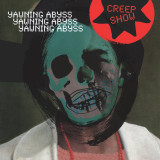
In the five years since Creep Show’s acclaimed Mr Dynamite album was released it’s fair to say that we’ve all been through a fair bit. Sitting here, in 2023, things don’t seem to be getting any better. There’s the cost of living crisis and political meltdowns; we're in deep water with global warming and to top it all there’s a war on our doorstep.
Back in 2018 everything seemed less complicated. Sure, there was stuff to get riled about, but we knew nothing about what was to come. Mr Dynamite was a fairground ride into the dark corners of a world that was on the brink of being blitzed in a blender. It was a record teetering on the edge. Five years down the line you’d expect the follow-up, Yawning Abyss, would double-down and bring the white-knuckled, teeth-gritted fury of the last five years to the boil. And yet….
A quick recap? No problem. Wrangler + John Grant = Creep Show. And Creep Show? “A band of musical misfits who have found a voice or two”, says Wrangler’s Ben “Benge” Edwards, whose Bond villain studio on the edge of a moorland is Creep Show Grand Central as well as home to an analogue synth arsenal that could sink ships.
Wrangler have known each other for a while. Tunng’s electronics wizard Phil Winter and Cabaret Voltaire’s trailblazing, pioneering frontman Stephen Mallinder go way back, while Phil and Benge crossed paths in the 21st century when they seemed to be increasingly in the same venues at the same times. Meanwhile, Mal had been living in Australia since the mid-90s and when, in 2007, he returned to the UK his old pal Phil suggested he meet Benge and the three of them immediately began working together.
Wrangler collectively bumped into Grant at their soundcheck for Sheffield’s Sensoria Festival in 2014 where they were playing with Carter Tutti. A friendship blossomed and when they were invited to perform together for Rough Trade’s 40th anniversary show at London’s Barbican in 2016, well, they jumped at the chance... and Creep Show was born.
Let’s talk about the new album... What is the ‘Yawning Abyss’? You might well ask. According to Mal, it’s “a cosmic event horizon that I can see from my attic window when stand on a chair”. Yeah. Thanks.
“On this album”, offers Benge, feet firmly on the floor, “Wrangler wrangled some vintage synths, mostly Roland, Moog, and the ‘Crystal Machine’ - then John Grant joined in the fun at Memetune Studios where lots of musical experiments were carried out. Then Mal and John ran off to Iceland with the master tapes and recorded a load of madcap vocals. Back at Memetune, me and Phil were left to try and make sense of it all. Which wasn’t hard because what they did in Iceland was totally magnificent.”
Which kind of brings us back to where we began. You’d imagine ‘Yawning Abyss’ would be blowing steam out of its furious ears. Mr Dynamite but kicking a wasps nest. Repeatedly. And yet…
Opener ‘The Bellows’ comes on like a modular ‘Radio Ga Ga’, the singalong ‘Moneyback’ (“You want your money back? / I didn’t think so”) sounds like Godley & Creme’s ‘Snack Attack’ meets Prince Charles And The City Beat Band (“Pennies, pounds, dollar bills, signed agreements, death wills”). ‘Yahtzee!’ is an unhinged electro breakdance party in four minutes and nine seconds.
Where Mr Dynamite was menace, a mélange of mangled voices, with Grant and Mallinder being heavily treated, pitched up or down, rendering their contributions largely indistinguishable, Yawning Abyss takes a more direct approach. You hesitate to say feelgood, but there’s a skip in the step here for sure.
The title track plays John Grant’s vocal straight. Completely. It’s good, so very good. Like ‘Axel F’ covered by Vangelis. The delicious shimmering synths of ‘Bungalow’ also plays those Grant pipes with a straight bat. ‘Matinee’ delves into darker, very funky territory. With Mal upfront it comes on like ‘The Crackdown’. Choice lyric: “You are starting to breakdown / And it’s so fun for me to see / You should have thought of that / You should have come prepared / You can see what’s happening and you look a little scared”.
So, you know, not all feelgood. But it does feel good. It’s probably best to draw your own conclusions... This is Creep Show after all.
The Marshall Suite is the 1999 album by the Fall. The album builds on the techno-influenced beats of its predecessor Levitate, while also returning to a more rockabilly-influenced sound reminiscent of earlier Fall line-ups with songs such as the catchy “Touch Sensitive” and the strange, complex, thumping jungle beats of “The Crying Marshal”.
The Marshall Suite was made immediately after an American tour during which Mark E. Smith had an onstage fight with members of the band and was arrested following ongoing altercations at the hotel at which the group were staying. While the remaining band members quit and returned to England, leaving Smith in a cell in Manhattan, Julia Nagle chose to stay in the band, helping to assemble the group’s new line-up.
During the recording of the album, this new line-up was still taking shape and the album features two different bassists. None the less it was very well-received album at the time and highly collectible by now.
Kusōzu : Nine Death Stages is the second album by the Tokyo trio Archeus, which consists of Keiko Higuchi (voice, percussion, trombone, shamisen), Shizuo Uchida (bass strings), and TOMO (hurdy gurdy, voice). It follows their debut, self-titled and self-released CD and cassette from 2021 and is further proof – if any were needed – that these musicians, who’ve known each other for some time, but only started playing together relatively recently, share a telepathic communication, improvising together, fully in the moment, and as one. Where their debut album featured four extended improvisations, Kusōzu is an object lesson in economy and clarity – nine tracks, thirty-three minutes, everything that needs be said and nothing more.
All three musicians are incredibly active in the Japanese underground. Higuchi currently plays with Sachiko in Albedo Fantastica, adding Uchida for Albedo Gravitas; Uchida and Higuchi team up with Masami Kawaguchi (guitar) in vDBG. She’s also recorded with improvisers such as Naoto Yamagishi, Yasumune Morishige, and Shin-Ichiro Kanda. Uchida is also a member of MAI MAO, Kito-Mizukumi Rouber, Hasegawa-Shizuo, UH, and TERROR SHIT, and he’s recently recorded with improvising guitarist Takashi Masubuchi; TOMO has previously been a member of Tetragrammaton and Pouring High Water, and has recently performed live with Mick of Kousokuya, Mitsuru Tabata, Keiji Haino, and Daisuke Takaoka.
While Higuchi and Uchida have been making music together for some time now, they appear careful not to impose their previously articulated lexicon to bear on Archeus. There are trace elements of their playerly voices still present – the stretchy, plastic scrabbling on bass strings from Uchida; Higuchi’s murmurations of tone, and sudden plunges back down to earth, vertiginous and woozy – but there are other things going on here, particularly with TOMO joining in the action. His hurdy gurdy is a wild card in a group of wild cards, here cranking out burred, purring drones, there fidgeting through floods of notes, cranked up really high, ducking and weaving between Higuchi and Uchida as the three pursue the eternal now that is core to the best improvised music.
Archeus seem to work alchemically, transmuting their base matter into gold. Named after the Buddhist art practice of kusōzu, the graphic painting of nine stages of a decaying corpse in the open air, “to demonstrate the effects of impermanence,” as scholar Gail Chin once wrote.
Kusōzu : Nine Death Stages is Archeus at their most rigorously attentive to each other’s playing, and by the end, the music is itself thinking and feeling.
`Oh Me Oh My' is both elegant and ferocious. It is stirring in one moment and a balm the next. It details histories both global and personal. Lonnie Holley's harrowing youth and young manhood in the Jim Crow South are well-told at this point _ his sale into a different home as a child for just a bottle of whiskey; his abuse at the infamous Mount Meigs correctional facility for boys; the destruction of his art environment by the Birmingham airport expansion. But Holley's music is less a performance of pain endured and more a display of perseverance, of relentless hope. Intricately and lovingly produced by LA's Jacknife Lee (The Cure, REM, Modest Mouse), there is both kinetic, shortwave funk that call to mind Brian Eno's `My Life in the Bush of Ghosts' and the deep space satellite sounds of Eno's ambient works. But it's a tremendous achievement in sonics all its own. It's also an achievement in the refinement of Holley's impressionistic, stream-of-consciousness lyrics. On the title track which deals with mutual human understanding", Holley is able to make a profound point as ever in far fewer phrases: "The deeper we go, the more chances there are, for us to understand the oh-me's and understand the oh-my's." Illustrious collaborators like Michael Stipe, Sharon Van Etten, Moor Mother and Justin Vernon of Bon Iver serve as not only as choirs of angels and co-pilots to give Lonnie's message flight but as proof of Lonnie Holley as a galvanizing, iconoclastic force across the music community.
Eric Emm and Jesse Cohen of Tanlines are indie-rock lifers turned reasonable, happy middle-aged fathers of two, figuring out their place in a chaotic culture and industry that can no longer command their full attention. They are emblematic of a particular time and place that doesn't really exist anymore, yet here they are existing, and thriving, in 2023. The Big Mess came together when Emm and his family moved from Brooklyn to rural Connecticut, while Cohen launched a marketing career and a successful podcast and stayed in the city. Emm continued writing songs_hundreds of them _ through all the weirdness of the past few years, but he wasn't exactly sure who he was writing them for. "I spent years figuring out in my mind, `What is my musical life going to look like?'" he says. "I just kept writing." Cohen gave Emm his blessing to continue Tanlines, even if his own contributions would be limited due to his own non-musical obligations. "I'm like, `Whatever you can do to keep this thing going, do it,'" Cohen says. And with that, Tanlines was reborn. By January 2022 Emm felt he had a body of work that made sense as a Tanlines album. Cohen spent ten days with Emm at his Connecticut studio, along with unofficial third Tanline Patrick Ford (!!!). This was tied together with a sleek final mix from Peter Katis (The National, Interpol) at his famed Tarquin Studios, resulting in a clear vision of what Emm's musical life was going to look like: The Big Mess. The first sounds on The Big Mess are the title track's coiled guitars and thumping drums, building into the kind of outsize, choral rock anthem artists like Tanlines were almost a reaction to. It is warm and nostalgic, and Cohen likens a lot of the prevailing mood to "a sepia filter on a digital photo." He continues, "we were pretty intentional about making this the first song on the album, underlining the way that this is a new phase of the band." Cohen says. The moody, scintillating "Burns Effect" serves as one of the biggest pushes forward for the Tanlines sound, and for Emm as a lyricist. He says that the song is "deep and dark and dangerous, but in a fun way. It's one of the more personal tracks on the album where this ungrounded part of my personality surfaces, but with an over-the-top machismo, almost an ironic character." Other tracks like "New Reality" and closer "The Age of Innocence" are also demonstrably guitar-forward in ways that wouldn't seem obvious for Tanlines (despite Emm's pedigree in austere avant-garde math-rock outfits Storm & Stress and Don Caballero), but Emm is less sure The Big Mess is a total departure. "I'm trying to make these absolutely simple things," he says. "I think of these songs as Rothko paintings: They're big and they're bold and they're seemingly straightforward, but they have a lot of depth and they engage with you and make you feel something."
- A1: Centuras - Tokyo
- A2: Bandulu & Amaranth - Love Lies Beneath
- B1: Strontium 90 - Rave On The Congo
- B2: Orr-Some - We Can Make It
- C1: Biff'um Baff'um Boys - Bombing
- C2: Epoch 90 - Vlsi Heaven (Zone Mix)
- C3: Mind Over Rhythm - Kubital Footstorm (Global Beatmix)
- D1: Dream Frequency - Dream The Dream
- D2: As One - Isatai
- D3: Uvx - Elevator (Trancefloor Transporter) (Trancefloor Transporter)
From 1989 onwards, Richard was an obsessive collector of house and techno music, frequenting legendary London record shops such as Fat Cat, Silverfish, Trax and Red Records. He took record buying trips to NewYork to find second-hand disco, house and techno 12”s, which were lying around in bargain bins. The selection for this compilation are his own personal favourites from that era.
Back then, electronic dance music was young, innocent and fun; it hadn’t been analysed, theorised and fragmented into the multi-genre industry it is today.
What you hear on this compilation reflects what he was playing at that time; joining the dots between ambient, techno, tribal house, breakbeat and early trance productions from the UK.
Much house and techno from the US, Belgium, Germany and Holland has been well documented, but some of the more obscure British productions are lesser known and need to be showcased.
Hopefully, these tracks will inspire and educate a new generation of electronic music fans who weren’t born then and also trigger some acid flashbacks for the older,ravers as they take a trip down memory lane.