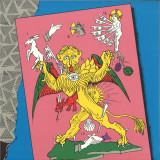
Emapea made his way into the world of beat-making after several releases and a first album in 2016. After releasing his LP Dreaming Zone, Polish producer Emapea is back on the French label Hip Dozer with a brand new album this fall, 'Still Got It'. With over 400k monthly listeners, Emapea didn’t lose his spark and brings a long player that reminds his connection to an old-school Hip-Hop style, yet always pushing towards freshness brought by the typical use of groovy piano leads and the addition of smooth vocals. Energetic, dynamic but at the same time chill vibe, this album in the colors of the Indian summer is a cocktail of strong and groovy beats balanced with light and jazzy melodies. ‘Still Got It’ achieves a certain airiness yet thoughtfulness that will carry your spirits up in another auditive dimension.
out of Stock
Last delivered 2 years ago available to reorder, subject to availability
"Music gives us the illusion that time is not time, but space. It is then that the music transforms from process to object, which I find a very interesting thought; a materialisation of the sound process. Sound is matter." - Noémi Büchi
Noémi Büchi's debut album 'Matter' captures the tension between growth and decay, consonance and dissonance, mirroring Büchi's own catharsis through music. Her most personal material to date, 'Matter' is an opus of refined, sculpted beauty, one that aims to blur the distinction between ephemerality and physicality. Inspired by late romantic classical music and early 20th century contemporary music, 'Matter' is driven by the compositional methodologies of Igor Stravinsky, Alexander Skrjabin, Gustav Mahler and György Ligeti to modern sound forms, adapting and expanding upon their ideas in an awe-inspiring exploration of cutting-edge potency and tactility.
Büchi structures the electronic works that constitute 'Matter' in movements, stratifying myriad instrumental parts like the constituent sections of an orchestra. During her work on the album, Büchi engaged in extensive research, obsessively studying specific chords and progressions, and searching for transcendent intonations with resonant properties; complexions of sound with the ability to connect with the listener's body. Transforming our inner worlds into zones of suspension and levitation, Büchi exposes the listener to intoxicating slipstreams of sound. Prominent voices ascend, tectonic disturbances threaten the foundations, perception and sensation becomes subject to elemental countercurrents and inversions. 'Matter' illustrates the fraught pursuit of momentary equilibrium, and makes the fragility of euphoria tangible.
Composer & sound artist Noémi Büchi creates electronic, symphonic maximalism. Her music is defined by delicate electronic-orchestral forms and textural rhythms. She strives for a combination of harmonic and dissonant sonorities, to evoke both intellectual and emotional euphoria. Büchi has appeared on the Light of Other Days and Visible Dinner labels, and is now an affiliate of -OUS, releasing 'Hyle' her debut EP on the label in spring 2022. As well as her solo output, Noémi Büchi is currently working with Feldermelder on their collaborative project Musique Infinie. Their debut album will also be released via -OUS in the near future.
out of Stock
Last delivered 3 years ago available to reorder, subject to availability
"Most of this record was created in the shadow of COVID and deep in the maw of Melbourne’s 2020 long winter lockdown. It is a meditation on the nature of connection.
Restricted to a 5km zone, one of the only people I saw outside my family during this time was my old friend and teacher, Ania Walwicz. We met in the overlap between our zones on the waterfront near Docklands to walk and talk on bright, cool winter afternoons. Those conversations became large in my thoughts when Ania suddenly passed away in September. Her voice was in my head as I worked on this music, trawling through threads of ideas, recordings made on my phone, and thoughts jotted down in notebooks.
Ania’s practice as a writer relied on ‘automatic’ processes. Her work was informed by everything she had read (a lot) but it was created in the manner of dreams. In a state where the subconscious might bubble up and the words arrange themselves into meaning bearing forms that resonate more than represent. I thought a lot about that as I made this music. I recorded everyday using the trumpet, my old Revox reel-to-reel, a couple of synths, a harmonium I lent from a friend, and whatever else was around. I worked mostly on just diving a little deeper each time I sat down to it.
Through the simple process of exhalation, I explored my relationship with the trumpet, which has been through so many twists and turns. I let the tones produced by my breath unfurl on long tape loops and degrade beyond recognition through pedal and plugin chains, until the only imprint of the initial gesture remained.
My process also involved long bike rides during which I’d listen to the work of previous days on ear buds, gliding through familiar streets made slightly strange by the absence of people and movement. Often my rides took me along Footscray Rd next to the port, and as I washed down towards Docklands past the old boat moorings I stopped pedalling to coast. The sounds from my darkened studio mingled with the low rush of air past my helmet, the click and whirr of my bike gears, a squalling bird, a whooshing car. And I remembered my last conversation with Ania. Sitting in the late afternoon sun, squinting against the light that raked across the water, she was telling me about all the different words for they have for blue in Polish and Russian, and how words don’t just change our perception of things, but also actually change the thing being perceived.
As I rode home that afternoon, I felt like anything was possible. "
Mondays at The Enfield Tennis Academy, x2 LPs of long-form, lyrical, groove-based free improv by acclaimed guitarist & composer Jeff Parker's ETA IVtet. Recorded live at ETA (referencing David Foster Wallace), a bar in LA’s Highland Park neighborhood with just enough space in the back for Parker, drummer Jay Bellerose, bassist Anna Butterss, & alto saxophonist Josh Johnson to convene in extraordinarily depth-full & exploratory music making. Gleaned for the stoniest side-length cuts from 10+ hours of vivid two-track recordings made between 2019 & 2021 by Bryce Gonzales, Mondays at The Enfield Tennis Academy is a darkly glowing séance of an album, brimming over with the hypnotic, the melodic, & patience & grace in its own beautiful strangeness. Room-tone, electric fields, environment, ceiling echo, live recording, Mondays, Los Angeles. Jeff Parker's first double album & first live album, Mondays at The Enfield Tennis Academy belongs in the lineage of such canonical live double albums recorded on the West Coast as Lee Morgan’s Live at the Lighthouse, Miles Davis' In Person Friday & Saturday Night at the Blackhawk, San Francisco & Black Beauty, & John Coltrane's Live in Seattle.
While the IVtet sometimes plays standards &, including on this recording, original compositions, it is as previously stated largely a free improv group —just not in the genre meaning of the term. The music is more free composition than free improvisation, more blending than discordant. It’s tensile, yet spacious & relaxed. Clearly all four musicians have spent significant time in the planetary system known as jazz, but relationships to other musics, across many scenes & eras —dub & Dilla, primary source psychedelia, ambient & drone— suffuse the proceedings. Listening to playbacks Parker remarked, humorously & not, “we sound like the Byrds” (to certain ears, the Clarence White-era Byrds, who really stretched it).
A fundamental of all great ensembles, whether basketball teams or bands, is the ability of each member to move fluidly & fluently in & out of lead & supportive roles. Building on the communicative pathways they’ve established in Parker’s -The New Breed- project, Parker & Johnson maintain a constant dialogue of lead & support. Their sampled & looped phrases move continuously thru the music, layered & alive, adding depth & texture & pattern, evoking birds in formation, sea creatures drifting below the photic zone. Or, the two musicians simulate those processes by entwining their terse, clear-lined playing in real-time. The stop/start flow of Bellerose, too, simulates the sampler, recalling drum parts in Parker’s beat-driven projects. Mostly Bellerose's animated phraseologies deliver the inimitable instantaneous feel of live creative drumming. The range of tonal colors he conjures from his extremely vintage battery of drums & shakers —as distinctive a sonic signature as we have in contemporary acoustic drumming— bring almost folkloric qualities to the aesthetic currency of the IVtet's language. A wonderful revelation in this band is the playing of Anna Butterss. The strength, judiciousness & humility with which she navigates the bass position both ground & lift upward the egalitarian group sound. As the IVtet's grooves flow & clip, loop & repeat, the ensemble elements reconfigure, a terrarium of musical cultivation growing under controlled variables, a tight experiment of harmony & intuition, deep focus & freedom.
For all its varied sonic personality, Mondays at The Enfield Tennis Academy scans immediately & unmistakably as music coming from Jeff Parker‘s unique sound world. Generous in spirit, trenchant & disciplined in execution, Parker’s music has an earned respect for itself & for its place in history that transmutes through the musical event into the listener. Many moods & shapes of heart & mind will find utility & hope in a music that combines the autonomy & the community we collectively long to see take hold in our world, in substance & in staying power.
On the personal tip, this was always my favorite gig to hit, a lifeline of the eremite records Santa Barbara years. Mondays southbound on the 101, driving away from tasks & screens & illness, an hour later ordering a double tequila neat at the bar with the band three feet away, knowing i was in good hands, knowing it would be back around on another Monday. To encounter life at scales beyond the human body is the collective dance of music & the beholding of its beauty, together. – Michael Ehlers & Zac Brenner
out of Stock
Last delivered 6 months ago available to reorder, subject to availability
* A welcome reissue for this herbal-influenced Zion Train album, originally released on Universal Egg in 1995.
* A spaced-out world-wide dub excursion into the `Wonderful World of Weed’.
* For 30 years, Zion Train have been at the forefront of the UK dub and festival scene and still take their sound and message worldwide
Downwards’ deep bonds with NYC catalyse the debut LP by Jim Siegel’s Vivid Oblivion, a reveberating post-industrial salvo produced by adopted Brooklynite Karl O’Connor (Regis), and co-mixed by Anthony Child (Surgeon) and Simon Shreeve, who also mastered it. It’s a super deep, highly atmospheric beast somewhere between Valentina Magaletti’s most expressive percussion work, Bark Psychosis, and classic, moody 4AD, which is coincidentally referenced via the artwork, made by Chris Bigg - legendary graphic designer and longtime assistant to Vaughan Oliver.
Invoking the density, vertiginous scale, and dark grimy nooks of NYC, ‘The Graphic Cabinet’ was realised by Jim Siegel - hardcore legend and occasional/regular drummer with everyone from Raspberry Bulbs to Damo Suzuki and Boredoms, made in close collaboration with Karl O’Connor aka Regis during 2021.
Stemming from intently deep listening sessions immersed in LPs by Viennese aktionist Hermann Nitsch and the myriad eras of Killing Joke, while also absorbing the atmospheres of classic Tarkovsky flicks, the album began life as gonzo field recordings of Siegel smashing the f*ck out of his drum kit, zither, scrap metal and gongs in an array of abandoned warehouse spaces. The recordings formed the basis of Karl’s compound productions, which add depth charge bass and sonorous metallic atmospheres to the mix, along with birdsong and gibbon hoots, plus guitar textures by Nick Forté (Raspberry Bulbs, Rorschach) for a dread-lusting jag deep in the belly of the Big Apple.
With a palpable tang of rust and blood in the air and grime under the fingernails, the seven tracks evoke a resoundingly brutalist portrait of space and place. Siegel’s nervy percussive discipline is framed in alternating barometric and light settings from cut to cut, variously snaking from the poltergeist clang and haunted resonance of ‘Converging and Dissolving’ to slamming motorik thrum in ‘Oblivion’ via imaginative descent into cyberpunk simulacra of the city as jungle-at-night in ‘Remnant Corridor’, replete with animalistic atmospheres that recall Organum.
While the raw attack and devilish swerve of the rhythms are utterly fundamental to the record, Karl’s atmospheric content and the animist mixing magick of Anthony Child and Simon Shreeve most potently give flesh to its bones. Patently evident on the stepping pulse and searching zither that keens into detuned orchestration on ‘Immediate Possession’, the zoned-out klang of ‘Stand Aside’ or in the flooded warehouse chaos of ‘Test For Traps’. The attention to spatial, textural and proprioceptive detail is tightened throughout, peaking with ‘Bargemaster’, a dense slab of tension that sounds like Jon Mueller’s Silo recordings fed through The Caretaker’s fogged machinery.
It’s one of the most impressive records on Downwards for a long while, bound to gnaw and spark the nerves of experimental rock and post-industrial’s greats, anything from The New Blockaders to Faust, Flying Saucer Attack and into iconic Blackest Ever Black releases in the modern era.
out of Stock
Last delivered 3 years ago available to reorder, subject to availability
RAW SPACE" is rooted in chaos and chance, sensuality and intensity - it's an album that's able to sound alarmingly freeform and tightly controlled simultaneously. Already established as a genre-disrupting DJ, and even dubbed "demon of the Nile" by Ugandan politicians after an exuberant performance at Nyege Nyege festival in September 2019, Kampala-based sonic hypnotist Authentically Plastic brings a digger's literacy, an activist's intent, and an artist's playfulness to their jagged debut album. As both a DJ and a producer, Authentically Plastic is drawn to the idea of chance as a creative tool - to push against the idea of the all-knowing genius, and approach artistry instead as a facilitator, unraveling parallel mismatched rhythmic events. Their musical process is to start with chaos, then attempt to mold those fleshy structures into polyrhythmic mutations, pulling influence from East Africa's innovative musical landscape and augmenting it with an exploratory sense of surrealism. On opening track 'Aesthetic Terrorism', rough-hewn industrial rhythms chug mechanically against course, dissonant synth blasts and acidic arpeggios. There's a faint sparkle of Detroit's chrome-plated Afro-futurism, but bathed in neon light, reflecting Africa's contemporary electronic revolution. Authentically Plastic's productions have a sense of thematic coherence, but their myriad influences are torched into cinders, leaving inverse impressions and ghost rhythms: the tuned overdriven clatter of 'Anti-Fun' echoes Ugandan kadodi modes, yet simultaneously mirrors the rugged out-zone grit of Container or Speaker Music; standout centerpiece 'Buul Okyelo' meanwhile is as rhythmically cross-eyed as Slikback or Nazar, but juxtaposes kinetic dancefloor thumps with chaotic microtonal ritual cycles. Writing "RAW SPACE", Authentically Plastic found themselves fascinated by sonic flatness. They realized that in Western art, there's an obsession with depth of field that carries into music, robbing it of intensity. The album is an example of the power that can be reclaimed when you let go of depth, letting sounds rub together carnally and spawn something fresh and unexpected.
out of Stock
Last delivered 3 years ago available to reorder, subject to availability
Acht neue Songs von Okkervil River Frontmann Will Sheff. Produziert von John Congleton (St. Vincent, The War On Drugs), Matt Linesch und Marshall Vore (Phoebe Bridgers). Ein bemerkenswertes Album und Sheff’s Solodebüt.
Inspiriert von den Texten von King Crimson, Joni Mitchell oder Bill Fay sowie den Bergen, Wüsten und Seen Südkaliforniens, seiner neuen Wahlheimat, jedoch überschattet vom Tod seines Freundes, Okkervil River-Drummer Travis Nelsen, besticht 'Nothing Special' mit teils verspulten Arrangements, die subtile Überraschungen enthalten und Verweise nahelegen auf barocken Pop, verschwommene Synthie-Balladen und Sci-Fi-Psychedelia der 70er und 80er Jahre. Eine emotionale Reise, die von Trauer und Verlust handelt und dem Versuch, sich einer transzendenteren Realität zu öffnen.
Unterstützt wird er dabei von alten und neuen Freunden, Gitarrist Will Graefe und Bassist Benjamin Lazar Davis, Singer/Songwriter Christian Lee Hutson, Dawes-Schlagzeuger Griffin Goldsmith und Death Cab For Cutie-Pianist Zac Rae sowie Cassandra Jenkins und Eric D. Johnson (Fruit Bats, Bonny Light Horseman).
Nothing is explained in the mysteries around us, but some art touches their soul: last year, Justin Tripp, one half of the US-American impro electronic duo Georgia and London-based electronic artist Zaheer Gulamhusein man behind projects like Waswaas and XVARR -joined forces as STRING. Together they went on a virtual vacation and never came back. As the virtual is fully real due to its virtuality, they created a truly authentic aural hardware journey, hauntingly adventurous, calm, and surprising.
Without defining the scope, STRING tumbled through a dark musical zone that stretched to the horizon, letting the sound shape itself while falling discreet into an appealing abstract space. Hovering clockwise shortly above the ground, they formed impossible geometric musical figures - weightless, fluid clouds, made up of relations between asymmetrical elements. Like in nature, their collaborative work avoids identical characteristics. In an expression of respectful admiration, they softly celebrate the irregularities between their specific genetic musical fingerprints, creating eight light binding clouds of dawn. A meditative musical voyage that transports cosmic particles of idealistic Berlin school ambient right into the heart of their electronic machines. All tunes swing calm but constitutive, dancing around synthesized surfaces that form obsessed flaming orbs of fear and hope, of matter and antimatter.
A shared love for hardware and the ethos of improvisation guided STRING into an experimentation, in which each party aligns closely to the core ideas of co-operative, in-the-moment electronic music, tied across the eight tracks in a sequence.
Finding a home with the highly esteemed Hamburg based label V I S, STRING’s debut “Last Index Of…“ will enter the earth in double vinyl and cassette format, plus tripping on at the digital platforms.
(Text written by Michael Leuffen) the sound shape itself while falling discreet into an appealing abstract space. Hovering clockwise shortly above the ground, they formed impossible geometric musical figures - weightless, fluid clouds, made up of relations between asymmetrical elements. Like in nature, their collaborative work avoids identical characteristics. In an expression of respectful admiration, they softly celebrate the irregularities between their specific genetic musical
fingerprints, creating eight light binding clouds of dawn. A meditative musical voyage that transports cosmic particles of idealistic Berlin school ambient right into the heart of their electronic machines. All tunes swing calm but constitutive, dancing around synthesized surfaces that form obsessed flaming orbs of fear and hope, of
matter and antimatter.
A shared love for hardware and the ethos of improvisation guided STRING into an experimentation, in which each party aligns closely to the core ideas of co-operative, in-the-moment electronic music, tied across the eight tracks in a sequence.
Finding a home with the highly esteemed Hamburg based label V I S, STRING’s debut “Last Index Of…“ will enter the earth in double vinyl and cassette format, plus tripping on at the digital platforms.
(Text written by Michael Leuffen)
out of Stock
Last delivered 19 months ago available to reorder, subject to availability
Black Truffle is thrilled to announce Drumming Up Trouble, the first release of previously unissued music by Alvin Curran on the label. Collecting works recorded between 2018-2021 and a side-long epic dating back to the early 80s, as the title suggests, Drumming Up Trouble focuses on a hitherto almost unknown aspect of Curran’s encyclopaedic and omnivorous musical world: his experiments with sampled and synthesised percussion. As Curran’s wonderful, wildly sweeping liner notes make clear, his fascination with drumming belongs to the radical investigation of music’s fundamental elements that has marked his output since the beginnings of MEV, who aimed (as he says in a recent interview) to return ‘in some collective way to a non-existent start time in the history of human music’. Whatever kind of music our proto-human ancestors played, he writes, ‘drums were front and centre in the mix. Drums rule!’
In a paradox typical of Curran’s approach, Drumming Up Trouble interrogates this most ancient dimension of music with contemporary technology. On the first side, we hear recent pieces performed using the sampling software and full-size MIDI keyboard setup Curran has refined since the 1980s. Two of them are wild real-time improvisations, primarily utilising an enormous bank of hip-hop samples. Building from polyrhythmic layers of drum machine fragments to wild cacophonies of clashing vocal samples, scratching, and frantic pitch shifting, these energetic and at times hilarious pieces occupy a space somewhere between John Oswald’s Plunderphonics, Pat Thomas and Matt Wand in the Tony Oxley Quartet, and the propulsive Kudoro/Grime fusion of Lisbon’s Príncipe label. They are improvisations are accompanied by two austere, minimal compositions realised in collaboration with Angelo Maria Fallo: ‘End Zone’ for orchestral bass drum and high oscillator, and ‘Rollings’, where a snare roll is gradually stretched and filtered by digital means into ‘floating electronic gossamer’.
The incredible breadth of Curran’s output makes it pretty unlikely that a listener familiar with his work would be surprised to find it branching out in a new direction. But no degree of familiarity with his work can really prepare for side B’s epic and bizarre ‘Field it More’. It’s perhaps best to let the maestro describe this unhinged and infectious offering in his own words: ‘It features an 8 bar funky minimal riff à la James Brown, played on synth and an-out-of-tune piano, synced to a pre-paid patch on the Roland drum machine. Over this is laid a heavily processed track of the voices of dancer Yoshiko Chuma and movie-maker Jacob Burckhardt discussing an upcoming performance of theirs at the Venice film festival, capped by a track of my playing an increasingly out of control blues over the top of all of the above’. Only Pekka Airaksinen’s Buddhas of the Golden Light comes to mind as a reference point that might even vaguely compare to this wild home-brew of drum-machine funk, mad improvisation and squelching electronics, which eventually dissolved into a massive, layered cluster. Ancient and modern, synthetic and human, hysterical and rigorous, Drumming up Trouble is 100% Curran.
out of Stock
Last delivered 3 years ago available to reorder, subject to availability
Mice Parade returns from a decade of silence to release lapapọ, an album that spans the many styles of their storied career,and features guest singer appearances by Angel Deradoorian (Dirty Projectors) and Arone Dyer (Buke & Gase). The rock is louder; the West-African-inspired highlife breaks are chubbier; the dueling drumkits are more complex, the instrumental passages more serene. What started as a home recording project in the late 90s soon morphed into a formidable and completely unique live band of incredible musicians from around the globe, all live-mixed and effected by legendary UK engineer Brandon Knights (aka Dub Warrior), the longtime sound engineer for Lee Scratch Perry, Soul II Soul, Gladiators and others. After 9 albums and nearly 15 years years of worldwide touring, including festivals across the UK, Iceland, mainland Europe, Turkey and Japan, and supporting Stereolab across the US, Mice Parade fans can finally hear some new music, and the live band hopes to safely reunite later this year. Throughout it all, Adam has mostly recorded with same ethos: allowing only one take for each track, forcing him to either leave in mistakes or address them with mutes or distractions, and embracing the Bob Ross concept of 'happy accidents.' This was a strict rule for the first several albums, and while he eventually became less strict about it, it's still a goal that is achieved more often than not. Perfection is not the goal - indeed, there should be no such thing in music. Most songs are not even written before pressing the record button, but instead are built piece by piece in improvised fashion. lapapọ is a Yoruba word meaning something akin to "totally" or "altogether."
out of Stock
Last delivered 4 years ago available to reorder, subject to availability
2LP Gatefold (featuring liner notes). Limited Edition. Artwork by Meeuw.
A collection of personal recordings made on various synthesisers between 1989 and 2017, by Telesoniek Atelier. Huge Tip on this one!
Early feedback:
"Fascinating improvs. I loved 'Gruesse'. " Suzanne Ciani (Atmospheric)
"Beautiful music with real subtlety and depth” Anthony Child (Surgeon, Transcendence Orchestra)
"Lovely, pure synth music." Mark Pritchard (Warp Records)
"Chateuroux is mighty... A proper zoner. Flung on earth." John T. Gast
"This is a great release by Telesoniek Atelier - a musician unknown to me before now. I've been thoroughly enjoying playing this double vinyl release since i got it. Both discs are filled with amazing music that moves between abstract electronic experiments to melodic, DMT bent sounding, classical contemporary music and futuristic soundtracks from non-existing Sci Fi movies you'll wish you could see. It time-warps you from here to there then freezes the moment. It all sounds like its been taken straight from the ancient room .. you know, that one where the spirits of the great teachers live. This is very focused, unpretentious and highly emotive music . A wonderful and dreamy sound garden coming from what I imagine to be a beautiful mind . These discs will be camping out on my turntables for a while."
Tako Reyenga (Music From Memory)
"A deep sense of the symphonic permeates this record. While synthesizers form the basis of its sound, Hans Kulk shapes their timbre into uncanny acoustics and weaves them together like an orchestra. Just when you think you have understood what is happening, another layer reveals itself. Yet it keeps a floating sense of lightness throughout. A truly rewarding listening experience."
Hainbach
out of Stock
Last delivered 4 years ago available to reorder, subject to availability
An unapologetic ode to the audacity and playful cynicism of growing up, After The Head Rush emerges like the shadow of a sundial cast between two time zones - one in the past, and one in the present. Infused with belated coming-of-age wisdom it sparks the dawn of a new era - inspired by a move to his hometown and the thrill of rediscovering the music of his youth.
The Idealist is one of the many projects of Joachim Nordwall who has a long history in Swedish experimental music running the quintessential iDEAL Recordings record label since 1998, as a member of the psych-drone duo Alvars Orkester, avant punk rock trio Kid Commando and ritual drone rock group The Skull Defekts and through his many solo recordings and collaborations with people such as John Duncan, Aaron Dilloway, Mika Vainio, Mats Gustafsson, Leif Elggren, Gabi Losoncy, Mark Wastell and Christine Abdelour.
As The Idealist, he has been delving into an amalgam of experimental techno, dub and industrial music since 2006. His new A Lion Is A Lion And Not A Lamb continues this perspective unabatedly, conjuring up six tracks that shimmer with an almost psychotropic intensity, sometimes including acidic touches, dwelling in a confrontational minimalist musical stance where repetition, bursts of gorgeous noise and dubbed out skeletal rhythms make for wayward yet driving grooves at home on the dance floor and a set of headphones alike. The Idealist looks for engagement within rhythm, in its almost purest
form.
out of Stock
Last delivered 4 years ago available to reorder, subject to availability
Charlemagne Palestine (born Charles Martin ni 1947 in Brooklyn, New York) wrote intense, ritualistic music in the 1970s, intended by the composer to rub against audiences' expectations of what is beautiful and meaningful in music. A composer-performer, he always performed his own works as soloist. His earliest works were compositions for carillon and electronic drones, and he is best known for his intensely performed piano works. He also performs as a vocalist. Palestine's performance style is ritualistic; he generally surrounds himself (and his piano) with stuffed animals, smokes large numbers of kretek (Indonesian clove cigarettes) and drinks cognac.
Oren Ambarchi (born 1969 in Australia) is a composer and multi-instrumentalist with longstanding interests in transcending conventional instrumental approaches. His work focuses mainly on the exploration of the guitar, "re-routing the instrument into a zone of alien abstraction where it's no longer easily identifiable as itself. Instead, it's a laboratory for extended sonic investigation". (The Wire, UK).
Oren Ambarchi's works are hesitant and tense extended songforms located in the cracks between several schools: modern electronics and processing; laminal improvisation and minimalism; hushed, pensive songwriting; the deceptive simplicity and temporal suspensions of composers such as Morton Feldman and Alvin Lucier; and the physicality of rock music, slowed down and stripped back to its bare bones, abstracted and replaced with pure signal.
From the late 90's his experiments in guitar abstraction and extended technique have led to a more personal and unique sound-world incorporating a broader palette of instruments and sensibilities. On releases such as Grapes From The Estate and In The Pendulum's Embrace Ambarchi has employed glass harmonica, strings, bells, piano, drums and percussion, creating fragile textures as light as air which tenuously coexist with the deep, wall-shaking bass tones derived from his guitar.
Ambarchi works with simple constructs and parameters; exploring one idea over an extended duration and patiently teasing every nuance and implication from each texture; the phenomena of sum and difference tones; carefully tended arrangements that unravel gently; unprepossessing melodies that slowly work their way through various permutations; resulting in an otherworldly, cumulative impact of patiently unfolding compositions.
Ambarchi has performed and recorded with a diverse array of artists such as Fennesz, Otomo Yoshihide, Pimmon, Keiji Haino, John Zorn, Rizili, Voice Crack, Jim O'Rourke, Keith Rowe, Phill Niblock, Dave Grohl, Gunter Muller, Evan Parker, z'ev, Toshimaru Nakamura, Peter Rehberg, Merzbow, Kassel Jaeger, Anthony Pateras, Crys Cole, Giuseppe Ielasi, Judith Hamann, Sunn 0))), James Rushford, Stephen O'Malley and many more.
For 10 years together with Robbie Avenaim, Ambarchi was the co-organiser of the What Is Music? festival, Australia's premier annual showcase of local and international experimental music. Ambarchi now curates the Maximum Arousal series at The Toff In Town in Melbourne and has recently co-produced an Australian television series on experimental music called Subsonics. Ambarchi co-curated the sound program for the 2008 Yokohama Triennale. Ambarchi has released numerous recordings for international labels such as Touch, Southern Lord, Table Of The Elements and Tzadik.
Belgian drummer Eric Thielemans is one of the most idiosyncratic figures in Belgian music, someone who not only demonstrates that special musicians always seek out (and find) their own place, but above all that they always remain students of the art of questioning and listening. No musician better illustrates the difference between playing music and playing with music than percussionist Eric Thielemans. He gets to the heart of the matter with an at times extremely minimalist approach, but on the other hand he frequently relies on a range of objects beyond the regular drum kit: a drum placed on its side, a bicycle wheel with a bow, hands and the body.
Air, Nico, St Etienne, Kid Loco, Young Marble Giants, Sandy Denny, Vashti Bunyan, Andrew Weatherall, Robert Wyatt and Serge Gainsbourg. Limited edition first pressing of 500 copies on "Mock Turtle" Blue. International collaboration between artists in Glasgow, London, Paris & New York. Mastered by Shimmy-Disc founder Kramer. Accompanying visual art work by Film and art director Tim Saccenti. Inspired by the intensity of lockdown, the self-titled debut album by electro-pop project Gates of Light, is the result of a collaboration between five artists across four cities, three time zones and two continents. Hailing from Glasgow, singer-songwriter Louise Quinn and producer Bal Cooke teamed up with London-based DJ and producer Scott Fraser; Parisian musician, DJ and producer Kid Loco; and film director and photographer, New York’s Tim Saccenti - who has previously worked with Run The Jewels and Pharell- to create a sublime, electro-pop reflection on the grief, insularity and peculiar highs of lockdown. Immediately after hearing the album, revered post-punk musician and producer Kramer offered to release the vinyl edition on his iconic cult label Shimmy-Disc, which boasts an impressive back catalogue of artists including Daniel Johnson, Low and Galaxie 500. A project grounded on collaboration - born from a period of disconnect - Gates Of Light perfectly amplifies the longing, confusion, lucid dreams and appreciation of the outdoors that the pandemic ignited in so many over the last couple of years. Originally written and recorded by Louise and Bal from their bedroom studio in Glasgow whilst their one-year-old twins slept, the tracks were then sent to Scott and Kid Loco who remixed the tracks from home studios in London and Paris before Tim created the artwork and a video for the track ‘When The Leaf Falls’. Gates Of Light is the latest project from Louise and Bal who have released music in the past as A Band Called Quinn and DAWNINGS. Louise and Scott Fraser have also previously collaborated following a chance encounter at a nightclub in Glasgow. Their single ‘Together More’ was released on Andrew Weatherall’s renowned Birdscarer vinyl imprint in 2019 and featured a remix by the Guv’nor himself who described the track as “sublime magik”.
out of Stock
Last delivered 4 years ago available to reorder, subject to availability
The latest offering from French shape-shifter Maxime Primault (High Wolf, Black Zone Myth Chant, etc.) is both a distillation and deepening of psychedelic soundsystem strategies honed across a decade plus of production and performance, in crisscrossing trenches of vibrational exploration. The four cuts comprising IN D EV IL were born of bass and syrup, designed as anthems for baser desires: “I just wanted to make bangers really.” Alien squelches and insectoid chatter pulse above thick swells of low end, intercut with sirens, screwed voices, and seasick wobble, alternately pummeling and prismatic. Masterfully disorienting, flickering with FX, drops, and narcotic murmuring, at the threshold of dissociative and dubstep.
Recent years spent performing in clubs influenced Primault’s listening habits, both in taste and production methods, skewing towards a starker contrast of highs and lows. IN D EV IL encapsulates this evolution, hallucinatory but urgent, like DJ tools for an underworld afterhours: tight, tripped, and lightless. The EP’s tracks vary in energy and density but share Primault’s premise of “tunes that sound fat and heavy.” Club music as dimensional gateway, booming and liminal, rippling with tremors, texture, and undertow. Whether deployed in public or private, these designs manifest vividly altered states, testament to their creator’s omnivorous vision of rhythm and sound.
out of Stock
Last delivered 4 years ago available to reorder, subject to availability
AOW is a new collaborative project from Dan Ghenacia and Tolga Fidan emerging from a new period of creativity and inspiration for the Lisbon-based artists.
Long time friends and fellow lynchpins of the European house and techno scene, Ghenacia and Fidan started working closely together through 2020 and 2021 while sharing studio space at Boa Lab. They found themselves at the heart of an artistic community of musicians, designers and engineers, which took shape around Ghenacia’s experiments with alpha wave generation, inspired by Bryon Gysin’s Dream Machine.
Ghenacia and engineer Anine Kirsten developed a modern update on Gysin’s 1950s design, which has been installed at exhibitions in London, Lisbon and Paris. At its heart, the project explores the natural hallucinatory effects of alpha wave projections on the eyelids, and the therapeutic benefits of the experience. Out of this spirit of psychedelically-charged experimentation, Ghenacia and Fidan have been working beyond the confines of their typical club-oriented material, creating ambient soundtracks to artist exhibitions in Boa and auditory backdrops to Alpha Wave Experience installations.
AOW bridges the gap between this new period of creativity and Ghenacia and Fidan’s life-long passion for electronic dance music. Compared to the strictures of house and techno they’re best known for, the three tracks on Hear the Light explore a more open, inquisitive sound with roots in UK electronica and West Coast psychedelic breaks (a seminal scene when Ghenacia was in the Bay Area in the 90s). Crucially though, it’s not a pointedly retro sound, but rather a result of rich streams of inspiration meeting and passing through crisp, modernist production techniques to offer something
genuinely fresh on the ears.
Working outside of their comfort zones and guided by creative philosophies springing from research, shared experience and community, Hear the Light marks a new step forward for Ghenacia and Fidan, with many more developments promised for the future.
out of Stock
Last delivered 3 years ago available to reorder, subject to availability
Nothing is explained in the mysteries around us, but some art touches their soul: last year, Justin Tripp, one half of the US-American impro electronic duo Georgia and London-based electronic artist Zaheer Gulamhusein man behind projects like Waswaas and XVARR -joined forces as STRING. Together they went on a virtual vacation and never came back. As the virtual is fully real due to its virtuality, they created a truly authentic aural hardware journey, hauntingly adventurous, calm, and surprising.
Without defining the scope, STRING tumbled through a dark musical zone that stretched to the horizon, letting the sound shape itself while falling discreet into an appealing abstract space. Hovering clockwise shortly above the ground, they formed impossible geometric musical figures - weightless, fluid clouds, made up of relations between asymmetrical elements. Like in nature, their collaborative work avoids identical characteristics. In an expression of respectful admiration, they softly celebrate the irregularities between their specific genetic musical fingerprints, creating eight light binding clouds of dawn. A meditative musical voyage that transports cosmic particles of idealistic Berlin school ambient right into the heart of their electronic machines. All tunes swing calm but constitutive, dancing around synthesized surfaces that form obsessed flaming orbs of fear and hope, of matter and antimatter.
A shared love for hardware and the ethos of improvisation guided STRING into an experimentation, in which each party aligns closely to the core ideas of co-operative, in-the-moment electronic music, tied across the eight tracks in a sequence.
Finding a home with the highly esteemed Hamburg based label V I S, STRING’s debut “Last Index Of...“ will enter the earth in double vinyl and cassette format, plus tripping on at the digital platforms.
Growing up in the Californian sprawl and the vast suburbs of Phoenix, Arizona, Caleb Dailey largely dismissed the country and western music that surrounded him. Instead, he was drawn to independent rock, experimental zones, and other genre-defying forms, which led him to create skewed rock music with Bear State and establish the “minimal art label” Moone Records with his brother Micah Dailey in 2013. But in the early half of the 2010s, Dailey began to hear things differently. Drawn into the left-of-center works of artists like Gram Parsons and Blaze Foley, a more idiosyncratic take on country, folk, and roots music began to swirl in his imagination.
Wandering into the form’s cowboy chords and lonesome scenes, Dailey found himself wondering what his own country album might sound like. The result is his debut solo album, a collection of covers called Warm Evenings, Pale Mornings; Beside You Then. Produced by John Dieterich of Deerhoof, Keiko Beers, and Dailey himself, it’s a melancholy charmer, rooted in traditional ideas but free roaming in its scope. Laced with synths, pedal steel, acoustic guitars, and commanded by Dailey’s full and woozy voice, it owes as much to the busted waltzes of Lambchop and the homespun lo-fi folk of Little Wings (whose Kyle Field appears on the album via a spoken intermission) as it does to the songwriters and performers who provide its source material, which include Parsons, Foley, Elvis Presley associate Chips Moman, steel guitarist Buddy Emmons, and others.
“The subversive nature of country music isn’t as much at the surface as some other genres,” Dailey says. “But the deeper down the ‘country hole’ I went, the more I wanted to be part of it. It is truly a strange world.”
The hands of Dailey and his collaborators, which includes a wide roster of DIY experimentalists like James Fella of art punks Soft Shoulder, Jay Hufman (Gene Tripp), Lonna Kelley of Giant Sand, Japanese DIY hero’s Koji Shibuya and Tori Kudo, Nicholas Krgovich, Markus Acher of The Notwist, and more, that strangeness is accentuated. Dailey doesn't aspire to retro Nashville fetishism or sanctioned notions of “realness” so much as a genuine outsider authenticity. Take his version of Gordon Lightfoot’s “If You Could Read My Mind” for example: a highlight of the record, it pairs familiar genre signifiers like pedal steel and guitar strums with warbled synths. Then there’s his read of “Dreaming My Dreams,” originally made famous by Waylon Jennings (who also did time in the Arizona desert), which morphs from a mournful ballad into a wash of far-off sonic noise.
The attention here is on the songcraft itself, with Dailey inhabiting these songs and turning them inside out to reveal unexpected tenderness and playfulness.
Recorded at home with an acoustic guitar and 4-track, Dailey began open correspondences with his collaborators, who fleshed out ideas and added touches, often working with skeletal frames before Dieterich and Dailey shaped it into a cohesive whole. “John is the reason this album exists,” Dailey says. “He sculpted all these parts together in such an otherworldly way. He is truly a magician.” Deeply allergic to insincerity, Dailey avoids any trace of irony. He’s created a cohesive gem out of disparate parts, uniting Americana songcraft with experimental disassemblage. From this bric-à-brac, he’s made something touching and beautifully strange.
Aesthetical in collaboration with Sync presents "Detect" by Marco Monfardini.
Originally developed as an audio/video live performance, Marco Monfardini based his research for Detect on the decoding of inaudible sounds, sound generated by electromagnetic emissions left from electronic devices and inaudible to the human ear. By using various electro-smog detectors Marco Monfardini creates a sort of detection mapping where electromagnetic emissions are the starting point for the sonorous development of each single composition.
A path that creates a parallel with our lives by questioning how much these emissions affect unconsciously our choices, tastes and perceptions, seeking a relationship between the massive use of technology in everyday life and our emotional state.
The album Detect is developed in 15 tracks in continuous play, an imperfect, faulty mosaic inhabited by invisible beings manifesting themselves in the form of sound streams, mutable entities that find a definitive form in the pattern of the compositional structure.
The album opens with “aR1 detection", sounds of pure detection place themselves in the sound space giving the initial coordinates for the exploration of unconscious parallel areas. The boundaries transform and gradually expand until they flow into the structure of "kernel variations", a growing rhythmic pattern decodes the impulses projecting a perspective that dissolves in the unstable and fluctuating electromagnetic emissions of the subsequent "[a]3020t detection", "binary defect "and "core[2] ". “[A.box]emission” confronts the use of sound downloaded random from internet sample banks and the emissions generated during the download itself, micro sound fragments arrange themselves in an organized and regular pattern, shaping a rhythmic structure. The first part ends with the short “[sa]6030” and “[det]x1a”, absence and presence provide an alternation of movements, inaudible and elusive signals all trying to establish a contact with our perception. “det : scan” opens the second part of Detect, a sort of scanning, leaving EMF (electromagnetic field) textures, a static multilayer that progressively expands until it dissolves into the rhythmic emissions of a common smartphone “[4s]detection”.The track “[rs]zone” " is pushing itself deeper, two minutes of sound speleology that reveal the existence of sound artifacts that seem to vanish getting in contact with the light accented by the bass drum of "[det] 0100+" a constant, rhythmic pumping, a luminous pulsation that reveals an apparent void, which seems to subside entering in the winding and waving atmosphere of "conductive [area]" and "[s3] microfunktion". Detect comes to the end with “[emf]terminal” a mirror of the unarrestable technological acceleration intercepting the flow of data that feeds the system of communication , digital micro waste suffocates the living space by centering up the invisible in an unconscious map.
As humans, we are aware of our inner beast and should therefore be able to control it. We understand our hard-wired primal urges and why they exist in an evolutional sense. We understand the relationship between mind and body. Highly evolved and intelligent, we should be able to recognize these genetic hangovers and control them as a means to act positively and move forward as a compassion-ate species. Unfortunately, this is not the case. Recent global events have proven this. The human race is consuming itself.
World Eater, the new album by Benjamin John Power's Blanck Mass project, is a reaction to this. There is an underlying violence and anger throughout the record, even though some of these tracks are the closest Power has ever come to writing, in his words, actual love songs.'
Maybe subconsciously this was some kind of countermeasure to restore some personal balance,' Power explains.
On World Eater, Power further perfects the propulsive, engrossing electronic music he has created throughout his impressive decade-plus career, both under the Blanck Mass moniker and as one-half of Fuck Buttons, as he elaborates upon the sound of 2015's brilliant double album Dumb Flesh. As massive as the sonic world of the new record often feels, its greatest achievement is in its maximization of a limited set of tools, a restriction intentionally set by Power himself.
As an exercise in better understanding myself musically, I found myself using an increasingly restricted palette during the World Eater creative process. Evoking these intense emotions using minimal components really put me outside of my comfort zone and was unlike the process I am used to. Feeling exposed shone a new light on this particular snapshot. I feel enriched for doing so.'
(A) 1. John Doe's Carnival of Error
(B) 2. Rhesus Negative
(C) 3. Please
(D) 4. The Rat
(E) 5. Silent Treatment
(F) 6. Minnesota / Eas Fors / Naked
(G) 7. Hive Mind
What is techno if not a powerful conduit for energy? The movement of a sequence, the surge of an effects rush, the respondent reaction in every individual dancer and the moving mass of the crowd as a whole. Whether the frequencies transmit directly into the brain through the intimacy of a headphone reverie, reverberate through the architecture of a space or fill the formless void of the open air, techno’s potency to initiate and stimulate energetic events is profound. This is something Pfirter understands intimately, having spent more than 15 years exploring ways of manipulating the energy on a dancefloor.
Of course, energy is not just about volume and aggression. Tonality, spatial processing and composition can have just as profound an effect as the thump of the kick drum. On his new album Altered States, Pfirter proves that point by zeroing in on the cerebral, psychedelic elements of his craft across 10 incisive tracks. The Argentine producer consciously approached his second album (following 2019’s The Empty Space) with a minimal mindset, using a very focused set of drum machines and synths to achieve a consistency across the record. Captured over a short burst of creativity, it’s the sound of an artist pushing a limited array of tools as far as possible. Despite this concise palette, it’s not an album that repeats itself, but rather an extended trip that flows from one detailed, textured immersion to the next.
The dense, febrile waves of hard-oscillating ripples in ‘A Future In Chaos’ and the sparkling, off-key chimes adorning ‘Yearn’ all speak to Pfirter’s gift for extravagant, surrealist expression within his tracks. ‘Altered States’, by way of contrast, succeeds in its absolute immediacy – a piledriving statement of bleep-driven intent. ‘Boiler’ and ‘Convergence’ land somewhere in between, coiling around kinked rhythmic incantations which still push forwards with precision while offering a different angle from which to approach the dancefloor. Cementing the idea of the whole album as a listening experience, Altered States is bookended by ‘Venus’ and ‘Dissolution’, two minimal exercises in drone-oriented mood setting.
Pfirter understands the role of his music, and his own instincts as a performing artist. It’s crafted to be captivating for DJs as much as the attentive listener. Spanning linear rhythms and broken beats, moments of calm and writhing intensity, Altered States offers a multitude of energetic possibilities in the mix or as a standalone piece of music. Ultimately, it’s a masterful return from a leading light of the contemporary techno scene.
This is MindTrip!
out of Stock
Last delivered 3 years ago available to reorder, subject to availability
50th Anniversary Re-Edition - Includes Original Releasesheet Inlay - Original Release: 1972 - 2021 Re-Cut carefully overseen by Manuel Göttsching
We proudly announce the authorised 50th Anniversary Edition 2021 of the 1972 Original release , one of the most important German Krautrock albums in a 2021 Re-Cut carefully overseen by Manuel Göttsching himself. As for the info we refer to Julian Cope´s review in his “Krautrocksampler” Book, Publisher : Head Heritage (1 Oct. 1995) : “Beware of Schwingungen!” That should be the large sticker on the front of all copies of this record. For it is dangerous to be casually introduced to something that is life-changing, as I found out to my cost when first listening to this record. It all starts fairly simply and without any cause for alarm - “Look at Your Sun” begins with a Doorsy lone groover guitar begins a pedestrian blues, beautiful. Then the most crushed voice, a cross between Johnny Rotten and Tiny Tim, preaches its way into the proceeds. God, it is beautiful - John L. repeats over and over, “We are all one, we are all one”, until a howling fuzztone solo guitar blows the whole onechord “Signed D.C.” ringing-cymbals torture to an end. And then the most far out track of all begins. This is called “Flower Must Die” and it is a free-rock giant that transcends everything else in its field (there are no contenders.) As I’ve written before, PIL sounds like this. John L. was John Lydon in a previous incarnation. After a slow weird build, a frantic streamlined one-chord mantra kicks in and it’s like the Stooges’ Funhouse period but in a Righteous Vision Zone that fucks them right off.
out of Stock
Last delivered 4 years ago available to reorder, subject to availability
One of the Netherlands most exciting rising names, Utrecht’s Locklead is emerging into the spotlight in style. Known for serving up heavy-hitting stabs of dancefloor driven material across SlapFunk, Pleasure Zone and Dungeon Meat, he now takes things deeper and brings his surging momentum to countryman Chris Stussy’s Up The Stuss imprint for the label’s first album release.
Stepping out into fresh territories, his eight-track debut LP ‘Square One’ showcases a previously unseen side to the Dutchman, revealing a collection of lush, deep journeys coupled with crisp house and vibrant, spacey cuts along the way.
out of Stock
Last delivered 8 days ago available to reorder, subject to availability
By now you’re probably familiar with our wildly popular Brown Acid series of rare, lost and unreleased proto-metal and stoner rock singles from the 60s-70s. In the endless pursuit of those glorious gems, we often uncover equally brilliant rarities from the late-70s to late-80s Golden Age of Heavy Metal that also just must be heard, but they don’t fit the series’ aesthetic. Scrap Metal, Volume 1 collects some of the greatest unknown and lost Heavy Metal tracks, long buried beneath the avalanche of the era’s classic output.
We all know the old adage that history is told by the winners. But sometimes the losers tell the best stories. And while none of these bands found fame and fortune, this artifact and the volumes to come are testament to the enduring power of heavy music. You can hear the blood, sweat and beers that went into each of these singles. The recordings may be low budget, but the inspiration and talent is immutable. Not only are the amps turned up to 11, the boyish sexual innuendo is cranked to 69. You can hear the convergence of influences — NWOBHM, thrash, glam metal, doom, etc — colliding at once as the era birthed a wellspring of subgenres.
Many of these singles are self-released and were thus limited to a small run of copies. Those that remain are hoarded by collectors and sold for exorbitant amounts. We’ve collected the best of the best for you here. As with Brown Acid, all of these tracks are licensed legitimately and the artists all get paid. Because it’s the right thing to do.
LINER NOTES:
Rapid Tears launch this series with the perfect christening. The Toronto, ON quintet’s 1981 single “Headbang” is such the pinnacle of heavy metal madness that it almost sounds like a spoof. There’s also enough of the rapid-fire sputum that inspired Metallica to bang the head that doesn’t, as such, engage in said practice, to be found on the band’s sole full length Honestly. But “Headbang” is a straightforward glammy anthem for the ages.
Air Raid’s “69 In A 55” may be lyrically so sophomoric that it’s actually pretty clever, but this 1983 Bay Area power metal single is loaded with sleek Judas Priest riffs and interwoven melodies that are downright sublime. The band’s sole release, the 2-song Rock Force 7” features a curious band photo in which 3 band members — dolled up in Crüe makeup and leather — are sexually menacing the lead singer/guitarist tied to a bed. Another low budget highlight is when singer/guitarist Tommy “Thrasher” Merry imitates a delay effect on his vocals as he sings, “tonight!...tonight...night.”
Hades’ “Girls Will Be Girls” has a real demo cassette feel to its vastly uneven mix, but the energy to the performance makes this an undeniable keeper. The long running Paramus, NJ quintet’s 1982 2- song debut 7” titled Deliver Us From Evil features this blistering thrasher dominated by shimmering leads and confident vocals that show why the band went on to near-fame on Metal Blade Records.
Resless don’t need no T to prove that they’ve got “The Power” with this 1984 driving mid-tempo rocker in the vein of Mötley Crüe and Ratt. The River Vale, NJ quartet’s tight crunch wails all over Bon Jovi posers but it’s the band’s unique and subtle deployment of background vocals that gives this rager its staying power.
Pittsburgh, the Steel City, is home to Don Cappa, a band that pays tribute to the burgh, the metal, and the awesomeness of both with “Steel City Metal.” Their lone single, issued in 1987 with only 300 copies released, sounds like the work of some serious steel driving men, with a drummer who might’ve forgotten to wear a hard hat one too many times on the construction site.
The Beast has more of a punk feel to their aggressive “Enemy Ace” track from the 4-song Power Metal EP from 1983 — something like Dr. Know meets D.O.A. But their look, artwork and lyrics all prove that Heavy Metal is where their hearts lie. And this hook filled monster delivers repeated lines like, “I command them all in my lofty realm,” with commendable conviction.
Dead Silence from Denver, Colorado, debuting in 1984 is not to be confused with Dead Silence from Denver, Colorado, who also debuted in 1984. The former a workman’s hard rock bar band, the latter a political peace punk band and neither knowing of the other’s existence throughout their tenure. The pre-internet days were a marvel, indeed.This Dead Silence spits out a slick, Nugent tinged rocker called “Can’t Stop” about life on the road.
The Danger Zone is, by all accounts, not the place to be. And, Hazardous Waste of Boston, MA saw fit to add their two cents on the matter with this 1986 single that combines Van Halen’s flashy musicianship with NWOBHM aggression that sounds so awesome it teeters on itself entering the “Danger Zone.”
Czar’s heavy, doomy “Iron Curtain” single from 1982 hearkens to the sleazy sounds of Saint Vitus and Pentagram with its cranked up DOD Distortion pedal in a Peavey combo amp guitar tone and meaty, barking vocals. The upstate NY quintet only issued this 2-song single, but its driving rhythm, nosedive whammy-bar guitar solos and comparatively mature Cold War subject matter show they had real potential.
Not much is known about Real Steel’s majestic “Viking Queen” from 1987, other than it rocks hard and the 7” 45 sells for upwards of a grand on the collectors market. The Flint, Michigan band recorded at the home studio of local radio personality Bill Lamb, who primarily released Christian Gospel recordings. So, perhaps the band was struck down by a bolt of lightning shortly after this rare single’s release. Whatever the case may be, it’s a must have for fans of classic metal mayhem.
Recorded in Havana’s famed Egrem Studios, the group displays a cohesion forged by an intense performing and touring cycle. The musical conversation that began in the Areito studios three years earlier blossomed into an easy, intimate dialogue between good friends - allowing full, fearless musical expression and risk-taking outside of their comfort zones.
Building upon Perez Prado’s dissonant, near avant-garde vision of the mambo, and highlighting the Lucumí subtext of Cuban rhythms and styles, the band continues to explore, develop and expand the island’s rich rhythmic palette and repertoire - pushing the conventions of what is considered “mambo” - and drawing deeply from folkloric and religious traditions seldom heard in popular music. 16 Rayos is here to shine its musical rays on us, warm our hearts, and irresistibly move our bodies.
When Orquesta Akokán burst onto the global music scene a mere three years ago, their no-holds-barred 21st century take on the venerable Cuban mambo lit up stages around the world with a fierce and unremitting joy. Singer José "Pepito" Gómez, Chulo Records producer and multi instrumentalist Jacob Plasse, and arranger Michael Eckroth joined forces with a carefully curated selection of Havana’s most extraordinary musicians as Orquesta Akokán, polishing Cuban mambo’s golden sound to a luminous, contemporary sheen. Along the way Orquesta Akokán imbued these legendary Cuban grooves with a renewed vitality and powerful sense of akokán ---the Yoruba word used by Cubans to mean “from the heart” or “soul.”
On the Cuban side of the equation the Orquesta boasts some of the island’s greatest instrumentalists culled from members of near-mythical groups such as Los Van Van, NG La Banda, and Irakere (notably César Lopez, Orquesta Akokan’s point man in Havana). The ensemble for 16 Rayos shines a light on Cuba’s musical families and multigenerational legacy with the participation of two fabled Vizcainos on percussion - Roberto "Tato" Vizcaino Jr. and his father Roberto Vizcaino Guillot, a member of Chucho Valdes’ seminal 90’s quartet. Another family duo added their masterful legacy to the recording, with trumpeter Reinaldo “Molote” Melián bringing in his son, Reinaldo Melián Zamora, to play trumpet on several tunes alongside lead trumpet Harold Madrigal Frías. The winds and brass are rounded out with a rich saxophone section made up of young lion Jamil Shery and Germán Velazco (musical director for Pablo Milanés)on tenor, with Evaristo Denis on baritone and César López on alto, along with Yoandy Argudin and Heikel Fabián Trimiño on trombone. Coros were sung by Eddie Venegas and Luis Soto. Significantly, Orquesta Akokán added strings to the ensemble for the first time, with the participation of violinists Amelia Febles Díaz, Jenny Peña and Anabel Estévez Acosta, whose virtuosity stems from the classical training for which Cuban musicians are so renowned. The power and grace of Pedro "Tata" Francisco Almeida Barriel’s vocals lead the way on “4 de Octubre” and “Llegue con mi Rumba,” evincing why he is considered one of the Cuban rumba’s premier exponents. Another highly recognized singer, legendary guarachera Xiomara Valdés - who’s shared the stage with legends such as Beny Moré and Omara Portuondo and received the Ministry of Culture’s Distinción por la Cultura Nacional de Cuba as a significant contributor to Cuba’s musical legacy - is the featured guest on the title track.
The second volume of music from the hit Fox TV show ‘Bob’s Burgers’. The Emmywinning, top-rated show was named one of the 60 Greatest TV Cartoons of All Time
by TV Guide.
In addition to the show’s cast, the album features high-profile guests including Adam
Driver, Tiffany Haddish, Jenny Slate, Daveed Diggs, Max Greenfield, Toddrick Hall,
Aparna Nancherla and Matt Berninger (of the National).
The ‘Bob’s Burgers’ audience is wide-ranging: strong performance with 15-25 year
olds, median viewing age of 37, 35 share among males 35-54 and a 16 share of
females in the same group.
Campaign will include promotion from the cast and show production team.
‘The Bob’s Burgers Music Album Vol. 2’ includes nearly every single musical morsel
from Seasons 7 through 9.
This 90-song smorgasbord will feature the Belcher family - Bob (H. Jon Benjamin),
Linda (John Roberts), Tina (Dan Mintz), Gene (Eugene Mirman) and Louise (Kristen
Schaal) - as well as the show’s numerous recurring and special guests.
For fans of the show, enjoying the music of Bob’s Burgers on its own is both an
irresistible to-go bag and ultimately a world unto itself. Lose yourself in the strangely
epic disco celebration ‘Hot Pants Rain Dance’, sing along with the musical theatre
gem ‘The Wedding Is My Warzone’, or do whatever you’re gonna do to ‘Sexy Little
Tiger’ but don’t miss ‘The Bob’s Burgers Music Album Vol. 2’.
out of Stock
Last delivered 5 years ago available to reorder, subject to availability
Impressions cast from lyric and rhythm – desire in movement, now articulated and set forth. Meaning arises between attention and action. In darkness what is it?
Air is breath, like light through crystal; it’s truth and sacred geometry. A version like ancient stone - the sample shows in layers, solid time. Compressed life. Pages packed together and seen from the edge, razor sharp and two dimensional. We are the salt we become, our children and ancestors. All at once, being forever; a verse, then volume and tome.
But we slow, dragging like ploughs tilling clay. The physical is a language like memory – translated into real. Turn from backwards to parallel, watch it reduce; remember downstream. The rock, earth and salt, our real reconfigured.
Type peels away, turning to sand in the wash. Disordering disorder - now still. Translation becomes everything, set sequence and entropy. Whole, to node, to nothing, and all. Not new, just another.
Vector Trancer’s journey continues; re-emerging into the central stream, deep dub glows and woven polyrhythm conjure vital knowledge for protection and expression. Viridis Mantra and outer canopy steam, we’re brought tense rhythm experiments and biospheric reverb – see further excursions in atmos and shades from Touch, Fax, Geometrik, or Ed Handley on a dark one.
out of Stock
Last delivered 2 years ago available to reorder, subject to availability
Golden Earring were active for 50 years from 1961 until 2021. Their final line-up still included two founding members George Kooymans (vocals and guitar) and Rinus Gerritsen (bass, keyboard) along with Barry Hay (vocals, guitar, flute and saxophone), a member since 1968, and Cesar Zuiderwijk (drums), a member since 1970. They have had over 40 hits and 30 albums, many achieving either gold or platinum status in their home country, The Netherlands. They are best known for their 1973 hit single “Radar Love” and their 1982 single “Twilight Zone”.
To The Hilt was released in 1976 and is considered to be one of their most complex albums. More than half of the songs are over 7 minutes long and musically the songs are very diverse. It is the last record that features Robert Jan Stips on keyboards. This reissue will come with a gatefold sleeve.
The album is available as a limited edition of 1500 individually numbered copies on silver coloured vinyl, and includes an insert.
"Certain loud guitar rock records serve as brain erasers, a form of shock therapy zapping through aural inputs and (to mix metaphors) cleaning the proverbial clock. Lightning Bolt is one such thing." - LA Times Since their first moment it seems like they've been as electric as their name suggests. Lightning Bolt, their first album, captures that energy in a raw form. Famously lo-fi, this is the album that's been described as most feeling like being at one of their shows. It's difficult to listen and not want to jump with the crowd it feels like must be huddled around the amp producing an incredible wave of noise, astonishingly coming from just two musicians. You can hear the threads of their later work; use of repetition, a sense of grinding and building, noise melting to guitar solos. This album is loud, and the riffs repeated become mesmerizing as they warp slowly thru the songs. Long saught after, this record has not been available new on vinyl since it's first pressing. This edition includes songs which have never before been released on vinyl. A must have for any Lightning Bolt fan, or really anyone who loves noise.
Yves Jarvis and Romy Lightman are a pair of idiosyncratic and restlessly creative artists. In the past decade, Jarvis's ever-expanding swatch have earned international acclaim, while Lightman's twin-sister-led band Tasseomancy has transfixed listeners since the late 2000s. The Lightman Jarvis Ecstatic Band marks the duo's first collaboration, slingshotting both musicians out of their comfort zones into spellbinding territories of lysergic folk and impressionistic rock. Banned was recorded in the tranquil environment of the Tree Museum, an outdoor art gallery in rural Ontario, Canada, hosting residencies for contemporary sculptors over the past 20 years. The pair credit its 200 acres of natural spaces intermingling with human-made creations as the fuel for their unfettered process. Recorded over two weeks in a free-flowing stream of improvisation, the album finds Lightman on synthesizer with Jarvis on drums and guitar, as their voices weave together into an electrified pastoral tapestry. For both musicians, the creation offered a chance to challenge themselves: Jarvis defying his solitary practice to record with another person, while open jams provided Lightman an alternative to her preference for thoroughly composed songwriting. "This album is a loose manifesto in our shared vision for a way of being," says Lightman. "It's about our relationship and the dynamics in that. There's an epicness to it and tension at times. It's like the ways particles collide. There's an alchemical aspect to it with these base components slamming together."
Nonesuch Records releases an album of songs written and performed by Caroline Shaw and Sō Percussion, Let the Soil Play Its Simple Part. The musicians, who have known each other since their student days, were presented with three days of gratis studio time and decided to experiment with ideas they had begun putting to tape during the sessions for their January 2021 Nonesuch release Narrow Sea. With Shaw on vocals and Sō – Eric Cha-Beach, Josh Quillen, Adam Sliwinski, and Jason Treuting – filling out this new band, they developed songs in the studio, with lyrics inspired by their own wide-ranging interests: James Joyce, the Sacred Harp hymn book, a poem by Anne Carson, the Bible’s Book of Ruth, the American roots tune ‘I’ll Fly Away’, and the pop perfection of ABBA, among others. The album is co-produced by Shaw, Sō Percussion, and the Grammy Award–winning engineer Jonathan Low (The National, Taylor Swift).
Shaw, who won a Pulitzer Prize for her vocal composition Partita for 8 Voices, written for and performed with Roomful of Teeth, makes her solo vocal debut with Let the Soil Play Its Simple Part. The album’s first track, ‘To the Sky’, from the Sacred Harp, takes its lyrics from Anne Steele. “I love the songs about death, and going home, and looking toward a time that is better or brighter, which, if there’s one thing to think about in the world, maybe that’s the thing,” Shaw says. “This one I love in particular. There’s a line, ‘Frail solace of an hour / So soon our transient comforts fly / And pleasure blooms to die.’ It’s meditation on the ephemeral, and I love it.”
“I hadn’t written very many songs, but I have certainly loved many in my life. I’ve been thinking of making a solo album for seven or eight years, but it takes having the right friends and community in the room,” Shaw says. “The prompt for all of us was: What would we make in the room together with no one person in charge, like a band writes in the studio?”
Cha-Beach recalls of the early test run during the Narrow Sea session: “It had that capturing-lightning-in-a bottle feeling.” When the opportunity to have three days in their friends’ studio, Guilford Sound, came up, the five musicians decamped for Vermont with engineer/co-producer Jonathan Low. “Jon is an amazing editor,” Cha-Beach says. “He is so helpful in thinking about: ‘We have these ideas: how do we shrink those and make them come across on an album?’”
One such idea was for Shaw to do a duet with each member of Sō. She sings with Josh Quillen on steel drums on the title track, which she wrote in under an hour in a “free-writing zone, very inspired by James Joyce, taking on that brain space,” she says. Lyrically, the song is “related to some math bits that I love, but also memory, and love songs of somebody who’s gone or passed away, or that you’re no longer with: what is the sound of that kind of devastation or confusion or love?” They recorded the song only twice, and the first take is on the album. “It’s very spare. The playing is very Josh; it’s so sensitive,” Shaw says.
Adam Sliwinski’s marimba duet with Shaw is an interpretation of the ABBA song ‘Lay All Your Love On Me’. She explains, “It’s really a Bach chorale. Also, the idea of someone singing ‘Don’t go wasting your emotion / Lay all your love on me / Don’t go sharing your devotion / Lay all your love on me,’ over and over again very slowly, there’s a certain tragedy in it. And then Adam did some absolutely exquisite layering that built this stunning world from the marimba.”
Jason Treuting on the drum kit joined Shaw for ‘Long Ago We Counted’. She suggested, “Why don’t we start with the voice and the kit having a weird conversation, sort of like two babies talking to each other? And then we built this loop, and we go from this place that’s totally uncomfortable and nonsensical to something that’s rich and rolling and satisfying.” For ‘Some Bright Morning’, the duet with Cha-Beach – who here plays electronics, piano, and Hammond organ – Shaw drew upon a twelfth century liturgical hymn she had sung regularly in church during her college years: ‘Salve Regina’.
“Some songs on Let the Soil… were very specifically composed by Caroline,” Cha-Beach says. “But others were this assemblage of ideas: finding words, an idea for how a melody could work, a harmony, and then tossing it in a blender and trusting each other.” Shaw adds, “What I love about Sō is the curiosity about how objects make sounds and how they speak to each other. There was an underlying thread of thinking about what goes into soil, how we take care of it, how we allow it to be itself, how we contain it, and what can come out of it if you cultivate the right environment, which for me is always this wonderful metaphor for creativity and collaboration: let people be themselves and see what happens,” she concludes.
Caroline Shaw is a New York–based musician – vocalist, violinist, composer, and producer – who performs in solo and collaborative projects. She was the youngest recipient of the Pulitzer Prize for Music in 2013 for Partita for 8 Voices, written for the Grammy–winning Roomful of Teeth, of which she is a member. Shaw’s film scores include Erica Fae’s To Keep the Light and Josephine Decker’s Madeline’s Madeline as well as the upcoming short 8th Year of the Emergency by Maureen Towey. Hailed for ‘astonishing both the pop and classical music worlds’ (Guardian), she has produced for Kanye West (The Life of Pablo; Ye) and Nas (NASIR), and has contributed to records by The National and by Arcade Fire’s Richard Reed Parry. Shaw currently teaches at NYU and is a Creative Associate at The Juilliard School. Her 2019 Nonesuch/New Amsterdam album Orange won a Grammy Award.
Through its interpretations of modern classics, innovative multi-genre original productions, and ‘exhilarating blend of precision and anarchy, rigor and bedlam’ (New Yorker), Sō Percussion has redefined the scope and role of the modern percussion ensemble. Sō’s repertoire ranges from twentieth century works by John Cage, Steve Reich, and Iannis Xenakis, to commissioning and advocating works by contemporary composers such as David Lang, Julia Wolfe, and Steven Mackey, to collaborations with artists who work outside the classical concert hall, including Shara Nova, choreographer Susan Marshall, The National, Bryce Dessner, and many others. Sō has recorded more than twenty albums, including a performance of Reich’s Mallet Quartet on the Nonesuch record WTC 9/11; appeared at Carnegie Hall, Lincoln Center, Walt Disney Hall, the Barbican, the Eaux Claires Festival, MassMoCA, and TED 2016; and performed with Jad Abumrad, JACK Quartet, the Mostly Mozart Festival Orchestra, and the LA Phil and Gustavo Dudamel, among others.
It's 1992. You're seven to twelve years old. What are you doing? You're probably biking home from Blockbuster with a Sonic the Hedgehog 2 cartridge. You've waited weeks to get your paws on it, but since it's still a "new release," it's only a three day rental. No matter - you've already stocked a whole weekend's worth of Surge and Fun Dip. You fire up your Genesis. Your television screen erupts with a blinding flash of white light, as The Blue One tears across the screen leaving the letters S - E - G - A emblazoned in his path. You're in a tizzy. Your thumbs begin to twitch in anticipation. Level two, CHEMICAL PLANT ZONE, is uncharted territory. Your palms start to get sweat as you see toxic sludge fill the screen. The Surge and the Fun Dip hit you at the same time. Rings, spin dashes, Chaos Emeralds...everything blurs into a kaleidoscope of colors and shapes and sounds and... You snap out of it. It's not the nineties. It's 2021 and you're in your 30s. Drats. The good news is the new "Chemical Plant Zone" 45 by Minneapolis rascals Black Market Brass. A 12-piece psych-afrobeat band covering music from the Sonic 2 soundtrack? Pshaw!
KNTXT kicks off 2021 by welcoming exciting new talent ONYVAA to its ranks. The much vaunted DJ and producer debuts with her Lost Angeles EP, a superbly powerful four tracker that is perfectly at home on this agenda setting label.
ONYVAA is an LA based artist who has been on a swift rise up through the global techno ranks in the last couple of years. She brings classy Detroit, melodic and dub influences to her music, and her raw analog aesthetic always helps ensure her stylish tracks bring plenty of atmosphere to go alongside her strong modular live-sets. Now, she steps up with a much anticipated debut on Charlotte de Witte's KNTXT label having struck up a personal friendship with the influential artist.
Says ONYVAA, "Lost Angeles was inspired by my time back home in LA and things feeling a bit foreign to my everyday life pre-covid. I’m super grateful for all of Charlotte’s support and really proud to be a part of the KNTXT family. Hoping to play these tracks out on the dance floor soon!"
Opener 'The Way It Is' wastes no time in laying down a heavyweight techno groove that is run through with edgy, laser-like synth riffs. It's an all consuming wall rattler that will blow clubs away. 'Lucid' is a darkened techno roller again lit up with expertly designed synths that are bright yet menacing as distant vocal sounds add another layer of tension. It's an all out acid attack on 'LXD' which places you at the heart of a rave, strobe lights flashing, smoke in the air, darkness enveloping you. The title track closes out at hyper speed, with turbocharged drum programming, interwoven bass and clanking industrial motifs all getting you thoroughly in the zone.
Says Charlotte, "I met Shelby for the first time after a show in Athens. We visited the city the day after and instantly became friends. Whenever the opportunity would arise, we’d spend time together. I love being around the ball of energy that is Shelby and I’m beyond excited to have her and her music on my label. Expecting big things from her!”
This is a fantastic new signing for KNTXT and surely the start of even bigger things for ONYVAA.
out of Stock
Last delivered 9 months ago available to reorder, subject to availability
How would Roc Marciano and MF Doom sound if they were born in Athens to immigrant parents?
MC Yinka & DJ Booker provide an answer by teaming up to bring us their first LP “Night Lights”.
MC Yinka finds inspiration in blighted areas, urban struggles and multicultural subcultures. With a unique and characteristic voice, he touches on various social and spiritual matters and concerns.
Night Lights is fully produced by DJ Booker who surprises with his sample selection and the overall approach on the production. He balances between trippy and minimal sounds with dark and abstract samples. The beats vary from broken to “J Dilla – inspired” rhythms to discreet patterns that trigger the imagination and the expectations of the audience.
Not to mention the scratching skills of DJ Booker which spice up the music production and established him as one of the best scratch DJs in Europe according to British magazine “Undercover Hip-Hop”.
The album features one of the most “conscious” MCs, Mr. Lif, well known for his collaboration with the Thievery Corporation, and the hip-hop street performers Twinsanity who call our attention to the raw reality from Athens to Boston.
Night Lights will be released on vinyl by the label Mind The Wax in February 26th, 2021 and includes 10 tracks.
Long out of print and highly anticipated repress of the Andrew Weatherall ‘anti-produced’ long player. The Twilight Sad’s third full-length, No One Can Ever Know, marked a sonic shift for the band
'No One Can Ever Know' was released across all formats on 6th February 2012 and was the follow-up to 2009's acclaimed break-through 'Forget The Night Ahead'. Already flagged by the widely leaked 'Kill It In The Morning' and forthcoming first single proper, 'Sick', 'No One Can Ever Know' marked a sonic shift for The Twilight Sad. Freshly inspired by a listening diet of Caberet Voltaire, Liars, Magazine, Autechre, Banshees, Fad Gadget, PiL and Can, a synth-heavy sound characterizes 'No One Can Ever Know', a record thematically akin to 'Holy Bible' era Manics, 'Violator'-era Depeche Mode and 'The Downward Spiral' -era Nine Inch Nails.
"We wanted to be a lot more spontaneous, get outside our comfort zone - not to fall back into repeating what we've done previously", explains guitarist Andy MacFarlane. "So we moved to London for a month to record at The Pool and got Andrew Weatherall involved to bounce ideas off and to generally reassure us of the direction we were already progressing in - toward a sparser sound, with a colder, slightly militant feel."
Under the guidance of Weatherall the band experimented with vintage analogue synths - borrowed from Ben Hillier - to work on the core sounds they wanted, finding inspiration too in the distinctive production style of innovators like Martin Hannett and Conny Plank. For the first time the drums were also recorded separately utilising a lot of synthetic effects which allowed for the easy manipulation of the sounds and samples later in the process. Stylistically, the guitars tend to refract John McGeogh (Magazine/ Banshees) or Keith Levene (PiL) rather than the 'wall of sound' approach that defined The Twilight Sad's previous recordings.
Lyrically 'No One Can Ever Know' finds singer James Graham on typically ominous form, delivering lightning bolts of malevolent threat. "I'll find you - don't worry" he promises on forthcoming single, 'Another Bed' - The Twilight Sad's most radical and anthemic moment yet, it's driving disco motorik and glacial keys pushing a dizzy emotional uplift.
out of Stock
Last delivered 5 years ago available to reorder, subject to availability