Before fronting classic post-punk group The Sound, Adrian Borland was a Wimbledon teenager enamored of Iggy Pop and the Velvet Underground. With friends, he formed The Outsiders. In 1976, they home-recorded Calling On Youth, a searching full-length that straddles nihilo-punk argot (“Terminal Case” and “I’m Screwed Up”) as well as smudged glam balladry (“Start Over” and “Weird”). Its release in 1977, on the group’s own Raw Edge label, with Borland’s cityscape abstraction on the cover, marked the first independent punk full-length in the United Kingdom.
The Outsiders, featuring bassist Bob Lawrence and drummer Adrian “Jan” James, were punk in the moment before punk cut ties with solos and five minute songs. (Close Up, released in 1978, is more streamlined.) Like the Saints or Crime, they still trafficked in rock ’n’ roll. Calling On Youth, though, announces Borland as more than a precious teenage bandleader. The nervous introspection, wiry leads and negative space that he would refine solo and in The Sound, Second Layer and Witch Trials glistens throughout Calling On Youth, beckoning rediscovery.
THERION have always been a band that have challenged themselves to explore new paths, while remaining true to their musical core values. For their 17th studio album, mastermind Christofer Johnsson and his collaborator Thomas Vikström have created something that has been previously unthinkable to the guitarist and the singer. "We have done the only thing that was left of all the different angles to explore", explains Christofer. "We have decided to give the people what they kept asking for. 'Leviathan' is the first album that we have deliberately packed with THERION hit songs."
True to the Swede's words, the album opens with the catchy and swift tune 'The Leaf Of The Oak Of Far' featuring female and male antiphonal singing as well as a choir that seems to have evolved straight out of THERION's breakthrough full-length "Theli" (1996). This is immediately followed by the obvious highlight 'Tuonela', in which Christofer cleverly underscores this hit-track's Finnish vibe by employing NIGHTWISH’s "metal voice" Marko Hietala. Next up in this parade of future fan-favourites is the title track 'Leviathan' that offers classic THERION material with operatic female vocals and a massive choir.
Christofer Johnsson's passion for classic voices, choirs, and orchestral elements as well as his penchant for epic melodies in combination with rock and metal shines clearly through the following sing-along ballad 'Die Wellen Der Zeit', which indicates another nod to German romantic composer Richard Wagner. "Ever since 'Theli', Wagner has been and will always be at the core of THERION", emphasises Christofer. "When we started to combine metal and opera, it was something new and original. Today, symphonic metal has long been a firmly established genre."
When THERION came into being in 1988 by changing name from the already existing band BLITZKRIEG, which was founded a year earlier, Christofer had rather taken inspiration from SLAYER's "Reign In Blood" among other classic metal albums. At the beginning, the Swedes were firmly rooted in death metal, a genre which they helped to define, as witnessed by their debut album "Of Darkness...." (1991). Yet even back then, there were hints of "something else" lurking beneath the rough surface.
The use of female vocals is another core ingredient of THERION today, which developed gradually. CELTIC FROST had basically introduced the female element to extreme metal on "To Mega Therion" in 1985. THERION began with both a female and male vocalist emulating a church like choir already in their sophomore full-length 'Beyond Sanctorum' (1992). With Symphony "Masses: Ho Drakon Ho Megas" (1993) and "Lepaca Kliffoth" (1995), Christofer continued to developed his trademark sound by gradually drifting towards cleaner vocals and more keyboards. With "Theli", the Swedes had firmly established a reputation of pushing the boundaries of metal in the 90s – among such acts as their compatriots TIAMAT, THE GATHERING, and MOONSPELL that were often referred to as "gothic metal" at the time.
THERION continued to break new ground leaving inspiration for others to follow in their wake: On "A'arab Zaraq - Lucid Dreaming" (1997), Christofer further explored the use of Near Eastern music in metal which he had already begun in 1992, while "Secret Of The Runes" (2001) dared to have Swedish lyrics in some songs. While critics were left confused and fans challenged, THERION were often ahead of their times and vindicated in hindsight. Even the band's 25th anniversary excursion "Les Fleurs Du Mal" has by now overcome the initial shock the album caused and is only beaten in terms of streaming by the classic "Vovin" (1998).
When Christofer faced the question of where to go next after the dramatic "Beloved Antichrist" (2018) had finally fulfilled his musical mission, his answer is "Leviathan" named after a giant sea monster from Judeo-Christian myth that has roots in Babylonic lore: THERION have created a giant hit album – and for the first time in the history of the Swedes, their fans are not asked to explore something new, but simply to lean back and enjoy the best from their band!
James Yorkston and The Second Hand Orchestra release ‘The Wide, Wide River’. The album came to be after the blossoming of a long-term friendship between James Yorkston and Karl-Jonas Winqvist, the Swedish music producer, leader and conductor of The Second Hand Orchestra.
That communal feeling is apparent across the entire album. Recorded and mixed in Sweden over the course of three days, with a selection of musicians Winqvist had brought together, including Peter Morén (Peter, Bjorn & John), Cecilia Österholm (one of Sweden’s best-known nyckelharpa players), Emma Nordenstam (piano & cello) and Ulrika Gyllenberg (violin).
The studio approach with The Second Hand Orchestra was entirely improvised around Yorkston’s songs and the only song they heard in advance was ‘Ella Mary Leather’; Yorkston didn’t want to direct anyone too much but instead allowed for a welcoming, instinctive, free-spirited and joyful atmosphere.
‘The Wide, Wide River’ is a soothing, warm and sublime listen whilst also highlighting Yorkston’s skills for songwriting, collaboration and as a musical conductor. The record takes in past loves, advancing age and friends now gone, whilst also containing some of the most sanguine songs Yorkston has ever made.
Kiwi Jr. are a phenomenal rock and / or punk and / or indie rock (whichever you like more) band from Canada, made up of Jeremy Gaudet (mic, guitar), Brohan Moore (drums), Mike Walker (bass) and Brian Murphy (guitar). ‘Cooler Returns’ is their second album and their first for Sub Pop.
Despite being a snapshot of the pandemic-infused beginnings of this decade, ‘Cooler Returns’ is truly a whole lot of fun. For fans of indie pop from down under and things that are smart / exuberant / catchy all at once.
‘Cooler Returns’ was produced by Kiwi Jr., mixed and engineered by Graham Walsh (METZ, Bully) in Toronto and mastered by Phillip Shaw Bova at Bova Labs in Ottawa, Ontario.
'the commentary of the worst reality show you can imagine...Britain'
Following the recent self-titled mini album, Dead Sheeran returns with his full debut album 'A National Disgace'. Once again Dead looks at the way the country continues to spiral downwards into oblivion in his usual satirical and tourette-like way. Pianos and strings play over harsh basslines and hip hop beats, and punk rock fuses with video game soundtracks, while the lyrics paint a dark picture of the situation we find ourselves in. The album was started in the last throes of Lockdown 1, with songs such 'Can Things Get Any Worse?' 'The Problem With This Country' and the government's failed attempts at getting UK furloughed workers to get out and harvest fruit in 'Pick For Britain' narrating the crazy days of Summer 2020. As lockdown eased, and society started to erupt, tunes such as 'Kicking Off In The Streets, and 'Keep Your Distance' started to come into play. Self awareness, social media abuse, litter louts and right wing mates all come under fire over the duration of this 11 track album, with the moods changing as regular as the F-bomb gets dropped. Essential listening for these strange times.
Dead Sheeran aka Paul Catten writes, produces, mixes and plays all instruments on this. From programming beats, fiddling with synths to recording himself playing Pac-man, Dead pushes further musically than the previous release. The influences of the Sleafords, The Fall, The Streets and the many punk outfits that influence him still rumble in the distance, but make no mistake, this is a Dead Sheeran record. He has carved out his own sound and vibe on 'A National Disgrace', and as Dead will tell you, this is only the beginning…
Ecstatic Meditations’, the follow up to 2016’s acclaimed debut solo outing ‘Interludes’, features six beautifully crafted new tracks leading with an edit of the 20 minute album opener and lead track ‘Journey In Ecstasy’. An adventurous deep listening experience, the new collection was recorded, mixed and mastered by Furse at his electronic studio on the Margate coast.
A sonic tapestry of sound that takes inspiration from the likes of Alice Coltrane, Laraaji, Eno and Steve Reich together with a new found appreciation for Japanese environmental music composers such as Akira Ito and Yasauki Shizimu. The result is an intense yet playfully refreshing take on ambient and electronic music.
Generative music seems to imply a systems approach to music, or a system that once created can utilise randomness in a creative way. The benevolence of nature’s creativity belies this musical term, and can flip the word ‘generative’ to mean to involve constantly flowing creativity with purpose. In Europe there was a time in the Pagan Renaissance when architecture would mirror nature’s generative quality. Sculptures and columns were to imply animation or movement.
That’s where Milan W.’s album comes through in 2020. His music involves the night shadows of Europe’s architecture and its growth. In Bloom personifies itself by showing Antwerp’s influential ‘Night Play’: a term that can relate to many European cities such as Bologna, Vienna, and so on and so on. The leftovers of Renaissance and gothic architecture are everywhere in Europe still; layers of ruins that can generate the impression of simultaneous time periods. Tracks like Spa and Helium Queen reveal and revel in the power of shadow movement that is generated by the night. In Milan W.’s past works, the poignant and simple creative play of dark wave and synth beat music was his vehicle for expression, but now on In Bloom he departs to a touching sidereal impressionism allied with Coil’s instrumental pieces on Horse Rotorvator — an album whose cover portrays the potential powers of the pavilion just as Milan W. is portraying the generative soul and alienation of Europe’s ‘Night Play’. Because of In Bloom we can come to believe that there is a secretive energy in alienation, a playfulness that is alight at Night.
out of Stock
Last delivered 5 years ago available to reorder, subject to availability
Rachel Baiman’s ‘Thanksgiving’ EP is a collection of music to inspire an introspective holiday spirit. The songs center around themes of Indigenous Rights, home and homelessness, and love in hard times.
Baiman called upon her superb live touring band (Cy Winstanley, Shelby Means) in addition to special collaborators including flatpicking guitar master Molly Tuttle, who features prominently on a spirited John Hartford cover, “Madison Tennessee” to bring these
thoughtful songs to life. ‘Thanksgiving’ allows Baiman space to stretch out stylistically and marks an intriguing followup to her celebrated full-length debut ‘Shame’.
Baiman moves with ease from bluegrass, to folk, to old-time and country sensibilities over the course of these four tracks. Her adept lyricism is again on full display, as she sheds new light on the complex, bittersweet feelings of both hardship and hope that often intertwine around the holiday season.
‘Chet Sings’ by the trumpeter and vocalist Chet Baker is a classic of West Coast cool jazz. Recorded between 1953 and 1956 this CD reissue includes 10 bonus tracks and vinyl inludes 2 bonus tracks.
The collective personnel accompanying Baker includes Russ Freeman on piano & celeste; Jimmy Bond, Carson Smith, Joe Mondragon, bass; Peter Littman, Lawrence Marable, Bob Neel, Shelly Manne, drums; among others. The 20-page booklet features complete information and specially prepared liner notes by Penguin
Guide to Jazz’s writer Brian Morton and by France’s prestigious Jazz Magazine.
SINGS
This reissue of pianist Dave Brubeck’s classic 1959 album ‘Time Out’
features the classic quartet of Brubeck with Paul Desmond on alto sax, Eugene Wright on bass and drummer Joe Morello.
The bonus album is ‘Countdown - Time In Outer Space’ recorded in 1961 by the same line-up. The 20-page booklet contains complete information with specially prepared liner notes by Penguin Guide to Jazz’s writer Brian Morton and by France’s prestigious Jazz Magazine. “Time Out by the Dave Brubeck Quartet has never lost its power of fascination. On these unforgettable tunes, Dave Brubeck and his alter ego Paul Desmond seem to be painting a canvas. Every note is like a touch of colour, expertly distilled, subtly hypnotic, ideally thought. “ Jazz Magazine
Magnum II is the eponymous second studio album by English hard rock band Magnum. Originally released in 1979, the album highlights the band’s trademark harmonies and punchy instrumentals very well. Magnum II is a diverse record, as it features ballads and adult contemporary rock, but also hints of prog and heavy metal. A track like “Great Adventure” contains catchy vocals, dynamic guitar riffs and inspired keyboards, while the acoustic “Reborn” showcases a more mellow side of the band. Magnum II is released with a special mirror sleeve, and it includes 2 bonus tracks: “Lonesome Star” and “Everybody Needs”. The limited edition of 1000 individually numbered copies is pressed on silver coloured vinyl.
Marie Knight's legendary 45 from 1964 that made her a name in the Northern Soul scene. Massive spin in Wigan Casino allnighters, officially reissued here for the first time with 'Say It Again' on the flip, as originally released.
DESCRIPTION
Singer and pianist, Marie Knight made her name as a gospel superstar recording for Decca in duet with the legendary Sister Rosetta Tharpe. Her first solo record for Decca arrived in the mid '50s, just a couple of years before her signing to Mercury. She later toured with rhythm and blues acts like the Drifters, Clyde McPhatter and Brook Benton. Three singles followed on Diamond in 1963/64 before she was signed to Musicor Records later in 64.
Her definitive non-religious song 'That's No Way To Treat A Girl', crafted in this period, failed to become a hit at the time but was the recording that would make her name with the Northern Soul fans in the UK many years later, standing as one of the most celebrated spins at the Wigan Casino allnighters.
The slow-paced ballad on the flip-side, 'Say It Again', is a beautiful deep soul song that echoes the gospel singing Knight had mastered over the years. After her deal with Musicor ended, she was unable to land another secular recording contract. "That's No Way To Treat a Girl' is officially reissued here with 'Say It Again' on the flip for the first time, as originally released.
Among the heroes and innovators of 70s spiritual/progressive/funk/jazz, Doug Carn has always flown a little under the radar. He has long plied his trade with patience and dedication, releasing absolutely stunning albums that are cherished by cognoscenti but lesser known even to the jazz mainstream, even as his influence can be detected among his colleagues. Carn"s newest project, his entry in the Jazz Is Dead album series helmed by Adrian Younge and Ali Shaheed Muhammad, takes his unique and timeless art and places it within the context of a musical culture that has always taken cues from his "70s classics. There"s no mistaking the musical mind that created legendary albums like Infant Eyes and Adam"s Apple, but the encounter of that with the distinctive jazz-hip hop-funk-noir that is the Younge/Muhammad/JID trademark creates something worthy of comparison to Carn"s past work but which could only have been made right now.
out of Stock
Last delivered 17 months ago available to reorder, subject to availability
NEW REPRESS IN HARD CARDBOARD SLEEVE + OBI + INSERT WITH LINER NOTES
+ RESEALABLE OUTER SLEEVE.
Christopher were an underground acid rock trio featuring future Josefus drummer Doug Tull. They evolved from United Gas, a psychedelic band from Houston who rubbed shoulders with legends like The 13th Floor Elevators and Moving Sidewalks . After relocating to Los Angeles - where they changed his name to Christopher - they played at numerous biker parties and recorded their sole album in 1970 for the Metromedia label. It’s an amazing example of West Coast psychedelia / acid-rock featuring strong fuzz-wah guitar, great compositions and superb musicianship. It was housed in a terrific cover depicting the band at the same hippie crash-pad where some scenes from the “The Trip” movie were filmed.
One of the holy grails of American psychedelic-rock and the rarest album originally released by the collectable Metromedia label.
Remastered sound, original artwork, insert with liner notes.
Note: This is the only legitimate, fully-authorized vinyl reissue of Christopher in the current market. Beware of inferior, low-quality bootlegs.
Tibor Szemző returns with a new album, based on the music for his film about historic figure Alexander Csoma.
Tibor Szemző is a Hungarian composer, performer, media artist. Recently his album Snapshots From The Island (1987) gained renewed interest. Over the years Tibor Szemzo continued composing classical / electronic works. His pieces often include spoken texts, film and other media. He creates installations and composes music for his own and others’ films.
Csoma, his new album, is based on the music for this film about Alexander Csoma. Alexander set up to research the origin of the Hungarians 200 years ago. During his student years, before he enrolled in college, he and two fellow students vowed to go to Central Asia to discover the origins of their nation. In the first thirty-five years of his life, he spent his humble pilgrimage in Asia traveling and studying with Buddhist priests in Tibet in isolation, and devoted the remaining eleven years of his life to publishing some of the material he had collected in India.
Now on the 200th anniversary, Szemző’s Cinematic Opera wishes to pay tribute to Alexandar Csoma. Over the course of two vinyl sides classical and acoustic instruments are mixed with angelic voices, spoken word in German, Hungarian & English. Sounding like vintage Tibor Szemzo compositions, vividly performed by the Gordian Knot Company and the Voces Aequales Ensemble.
out of Stock
Last delivered 5 years ago available to reorder, subject to availability
William Basinski's reputation as the foremost producer of profound meditations on death and decay has long been established, but on his new album, Lamentations, he transforms operatic tragedy into abyssal beauty. More than any other work since The Disintegration Loops, there is an ominous grief throughout the album, and that sense of loss lingers like an emotional vapor. Captured and constructed from tape loops and studies from Basinski's archives - dating back to 1979 - Lamentations is over forty years of mournful sighs meticulously crafted into songs. They are shaped by the inevitable passage of time and the indisputable collapsing of space - and their collective resonance is infinite and eternal.
out of Stock
Last delivered 5 years ago available to reorder, subject to availability
Sabaturin is Charles-Émile Beullac (Galerie Stratique, Canada) and Simon Crab (Bourbonese Qualk, United Kingdom). In the spirit of old school tape exchanges that resulted in musical collaborations developed over long periods of time but informed by the infinitely easier processes of the digital age, "Kenemglev" was assembled without the musicians ever meeting.
The title "Kenemglev" means "consensus" in Breton, something which quite naturally had to be achieved between both musicians. The other consensus was a sort of virtual middle ground symbolized by the Breton language, particular to a geographical area (Brittany) that both agreed would stand for a neutral meeting point between their respective native languages and, consequently, cultures. All titles are Breton words and the name Sabaturin ("standing on one feet", "to be off-balance") expresses mainly Charles' excitement: "Simon's bold approach has been some kind of a shock therapy for my music".
The sleeve was designed by Simon Crab, using a Chladni pattern simulation based on specific pitches. Looking like stained glass, it sort of reflects the way the music is presented: although including 9 titles, the album's tracklist flows uninterrupted on each side of the vinyl, semi-mixed, blended.
Detailed electronic ambience, glitches, loops and tiny details are augmented by a sort of signature rhythmic grid we recognize from "My Government Is My Soul"-era Bourbonese Qualk. It never settles into a formula and so the music remains loose, as much Mille Plateaux as classic 80s industrial shortwave-sampling or dub, rolled into one same entity, touching base with the gorgeous glitch dub "Morgouskus". This concludes a gentle and discreet album that doesn't require the validation of being associated with any of the current keywords in the electronic music scene.
out of Stock
Last delivered 5 years ago available to reorder, subject to availability
fter a small digital break, here is new record from the Comic Sans' vaults. First world appearance for Low Khey with 10 tracks exploring the 90-100 bpm side of experimental bass music. Call it mutant dancehall, deconstructed dub or industrial riddims, it's difficult to describe precisely in which genre the release falls.
Let's just imagine that Vybz Cartels' beats met Adrian Sherwood's punk dub sound design and that the whole thing was supervised by the evil twin of DJ Python. The big space left to the drums and the precise use of robotic sound-effects give a hyper-mechanical aspect to the riddim tracks which are aired by several interludes made of weird FX making it sound like futuristic commercials for spaceships or intergalactic bitcoin exchange.
The whole project has hidden references to artificial intelligence and problems that human are facing regarding the technology. The world in wich Low Khey lives is dominated by machines, and mankind is having a rough time to say the least! But there is hope for our Homo Sapien friend... If only he kept in mind this simple advice : Never. Trust. A. Cyborg.
out of Stock
Last delivered 5 years ago available to reorder, subject to availability
After two full-length albums, freshly released and shortly out on S+M, Evitceles & Spite Cathedral meet their equally twisted but often polar approaches to electronic music for a 12” split release. Five tracks are inhabiting the Evitceles side of the record and while two of them we already heard on his latest cassette they seem to be living a completely new life when put in the context of this shared release. ‘Endless Reachʼ deceivingly sets a more dreamy tone which is instantly shattered by the tracks to follow. Itʼs not until the second half of ‘Restless Headʼ that the skies are clear again and weʼre once again ready to fall in the warm embrace of “Нелюбов”, the most heart-breaking track in the ever-growing discography of Bulgarian producer Etien Slavchev as Evitceles. While a bigger chunk of Spite Cathedralʼs tracklist can be found on forthcoming new full-length ‘The Human Touch” (Sores022) his side on this record is not less tense and emotionally charged. Usually indulging his musical searches in lengthier releases, here Dan Mortazavi teams up with his long term partner Karsten Svendsen on several tracks to offer us a more dense and saturated version of his recent work as Spite Cathedral. The first half of the material is more rhythm and beat oriented, then the producers carefully refocuses on melody until it all disintegrates into amorphic ambiances and microsound debris.
out of Stock
Last delivered 3 years ago available to reorder, subject to availability
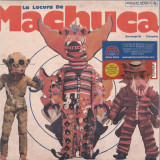
La Locura de Machuca is the story of one man’s bizarre odyssey into Colombia’s coastal music underground, and the wild, hypnotic sounds he helped bring up to the surface.
One night in 1975, a successful tax lawyer named Rafael Machuca had his mind blown in Barranquilla’s ‘Plaza de los Musicos’. Overnight he went from a high ranking position in the Columbian revenue authority to visionary production guru of the newly formed record label that bore his name, Discos Machuca, and for the next six years he devoted his life to releasing some of the strangest, most experimental Afro Psychedelia Cumbias ever produced. La Locura de Machuca is the story of one man’s bizarre odyssey into Colombia’s coastal music underground, and the wild, hypnotic sounds he helped bring up to the surface.
The Colombian music industry was thriving in the mid-seventies, but while homegrown bolero and vallenato tunes were doing well on the charts, it was imported African records that were setting crowds on fire at the picos – the sound-systems that fuelled neighbourhood parties – and wherever those records were played there were always a handful of groups who were inspired to plug traditional Cumbia directly into the electric currents coming from across the Atlantic.
It was these obscure bands, who fused Colombian and African rhythms with the swirling organs and psychedelic guitars of underground rock, that fired Machuca’s imagination. While the label made its money releasing popular hits by legends such as Alejandro Durán and Aníbal Velásquez, that money was poured back into a unique run of experimental releases by fringe artists such as La Banda Africana, King Somalie, Conjunto Barbacoa, and Abelardo Carbono, one of the godfathers of Champeta Criolla.
When Machuca couldn’t find groups to realise his particular vision, he simply created them himself. Drawing on a fearsome roster of musicians associated with the label, he assembled bands that lasted only as long as it took to record an album ,and unleashed the results – complete with arrestingly unusual album covers – under a series of different names such as Samba Negra or El Grupo Folclórico. This unorthodox approach led his longtime recording engineer, Eduardo Dávila, to describes Machuca’s productions as the “B-Movies of Colombian music.”
The story of Doctor Machuca and his eccentric exploits tells of one of Colombia’s most atypical and peculiar record companies; a defining pillar of Afro-Caribbean psychedelia. His productions have come to represent the roots of Champeta and set the pedigree standards for Afro and Costeño avant-garde. The seventeen tracks on La Locura de Machuca, harvested from the darkest, strangest corners of the Discos Machuca catalogue, sound like little else recorded before or since.
out of Stock
Last delivered 5 years ago available to reorder, subject to availability
Following the stellar trip through Woo’s Arcturian Corridor , Quindi Records continues to explore intimate, inviting sounds with an experimental bent by facilitating the return of overlooked Italian duo Cabaret du Ciel.
Initially formed in 1986, Cabaret du Ciel’s debut album Skies In The Mirror was a low-key and extremely rare cassette release of spellbinding electro-acoustic ambient music created by Gian Luigi Morosin and Andrea Desiderà. A reissue on Hybride Sentimento in 2018 brought renewed attention to the startling music contained within this unique project.
The Breath Of Infinity is an album comprised of new works recorded over the past year, either as new pieces or reworked from old ideas with the assistance of Giorgio Ricci. Morosin and Desiderà’s natural instincts as multi-instrumentalists shine through across the record as they did on Skies in the Mirror , although these tracks were in fact composed as raw live takes using electronic workstations (with a little additional fretless bass provided by a close friend Giampaolo Diacci on “Different Suns” and “Climatic Variations”).
There is a crisp, digital timbre to the worlds Cabaret du Ciel shape out on The Breath Of Infinity – utopian pastureswith an air of optimism similarly expressed in the first waves of ambient electronica. Folk traditions exert a guiding influence on the sparkling, ethereal melodies and full-frequency harmonisation, but this is music enamoured with timeless plateaus rather than hackneyed interpretations of the past, present or future.
It’s also an album of variety. “Different Suns” tumbles with a pastoral, elemental earthiness thanks to the interwoven rhythmic murmuring of percussion and live bass, while “Lakota” pivots in sharply rendered bio-mechanical formations.
There’s a widescreen bombast to “Theatre Azure” which calls to mind mid-90s US electronica, while “Meredith” reclines in a blissful bath of plush 80s FM synthesis. “Sunset Parade March” has a distinct sense of propulsion thanks to its overdriven, broken techno rhythm and “Highlands” skips with an infectious energy despite not using any formal
kind of percussion, but even in these more kinetic moments a preference for mellow musicality maintains the dreamlike mood.
Consider The Breath of Infinity like an archipelago, where each track functions as its own distinct island of ideas while being intrinsically interconnected to the others. In a similar fashion to acts such as Ultramarine (who appeared as remixers on Quindi 001), Cabaret du Ciel emphasise the musicality in their electronic music, shaping out an
evocative, imaginative environment to idly glide through or attentively explore.
out of Stock
Last delivered 5 years ago available to reorder, subject to availability
Nuno Canavarro's Plux Quba hails from three decades in the past, yet the simple profi le of it's abstract/ambient/cutup collage makes it a record that sits quite comfortably in our IDM-informed future. In 1988, Plux Quba was a primal dark horse in the world of pants-forward electronic music - an obscurity issued with little explanation from the laid-back west coast of Europe: Portugal, of all places! - though the casual listener could hardly know that from an examination of the LP jacket. The vanguard of electronics in late-80s Europe was being pushed by organizations like Nurse With Wound, The Hafler Trio, HNAS - and yet, when Christoph Heemann came across this recording, it struck his ears and the ears of fellow listeners like nothing before. Plux Quba was handed around between the principles of the early 90s A-Musik scene: Jan St. Werner, C-Schulz, Frank Dommert, Georg Odijk, plus interested fellow travelers like Jim O'Rourke, to the intense curiosity of all. To ears that were already saturated with all things kraut, the dark corners of prog and the frontline of experimental and improvised music, it proved elusive. Not simply in how it sounded and how that sound was achieved, but in where it was coming from - like later Robert Ashley at times; certain stretches of melody recalled some of Eno's ambient pieces - but mostly, it was a completely alien soundscape!
Blue vinyl includes mp3 download, 12 x 24 inch poster: Some say life only makes sense in reverse, from the vantage point of your rear view - Magic Mirror is a looking glass of sorts. Like a modern day Alice in Wonderland, Pearl Charles beckons you to slip and fall into her world. You'll find yourself drifting with the tide - the ups, downs, and all-arounds of a life well-lived and well- loved. From start to finish you float along a reflective river, dancing in your own/the personal/private Studio 54 of your living room, decked out in sequins or nothing at all. It's a feel good album that asks us to actually take the time to feel good. Magic Mirror follows the cartography of a girl, growing into a woman, as she moves through life from singledom, to the expansive space of self-reflection, and the newly appreciated perspective of coming back together again and finding yourself, this time with someone new. A love letter to the self, a dance party for life, and at times as introspective as your best trip, Pearl takes us on a journey that, like life & love, has the tendency to surprise, delight, and leave you breathless. All you have to do is let yourself enjoy it.
“If you have a vacancy for Favourite New Band, Pom Poko would like to apply for the role,” tweeted Tim Burgess in April, as Norway’s finest punkpop anti-conformists revisited their joyous debut album, ‘Birthday’, for one of Tim’s mood-lifting Twitter listening parties. Pom Poko pimp their CV on all fronts with their glorious second album, ‘Cheater’. Between the quartet’s sweet melodies, galvanic punky ructions and wild-at-art-rock eruptions, ‘Cheater’ is the sound of a band celebrating the binding extremes that make them so uniquely qualified to thrill: and, like Tim’s listening party, to fulfil any need you might have for a pick-you-up.
As singer Ragnhild Fangel explains of the leap from ‘Birthday’ to ‘Cheater’, “I think it’s very accurate to say that we wanted to embrace our extremes a bit more. In the production process I think we aimed more for some sort of contrast between the meticulously written and arranged songs and a more chaotic execution and recording, but also let ourselves explore the less frantic parts of the Pom Poko universe. I think both in the more extreme and painful way, and in the sweet and lovely way, this album is kind of amplified.”
The sound of four distinct personalities driving in divergent directions towards one destination, the result is an evolved snapshot of the bracingly contrary chemistry forged when Fangel, Tonne, Jonas Krøvel (bass) and Ola Djupvik (drums) united to play punk during a jazz gig at a literature festival in Trondheim (the band-members studied jazz there).
Along the way, the band drew praise from NME, Interview Magazine, DIY, PopMatters, The Line Of Best Fit, The Independent and BBC Radio 6, where Miranda Sawyer was moved to note that “‘Birthday’s ‘Crazy Energy Night’ seems to contain about 20 songs in one.” Meanwhile, a huge touring schedule included countless sold-out headline shows and a rapturously received UK jaunt with Ezra Furman.
‘Cheater’ does its predecessor proud on every front. Bursting with colour and wonky life from its cover art (by close collaborator Erlend Peder Kvam) outwards, it differs from ‘Birthday’ primarily in that its songs did not have a chance to be road-tested before going into the studio. But you wouldn’t know it. As Ragnhild explains, “That meant we had to practice the songs in a more serious way, but it also meant the songs had more potential to change when we recorded them since we didn’t have such a clear image of what each song should/could be as the last time.”
140g clear vinyl LP with PVC printed outer sleeve and digital download code.
First time ever on vinyl! On beautiful white vinyl with a dark blue splatter // "Webster explores themes of different relationships through her broody tunes, tackling the notion of writing only sad songs by writing her "saddest song" yet. In a way, the record feels like a comingof-age for the singer-songwriter into her own perfectly curated moment, which surely will lead to bigger and better things." - NYLON // "Faye Webster is filled with lush bluegrass sounds, featuring plenty of slide guitar and the occasional trill of a fiddle, which Webster's fragile voice flits through like that of a younger Natalie Prass." - W Magazine // "_a soulful offering heavily inspired by the country and western music she grew up listening to." - Pitchfork "Her self-titled record will win fans across the musical spectrum for its left-of-center approach to folk. Webster is a lifelong student of country-western songwriting and Americana sound (...) But she punctuates her own tunes with subtle flourishes of funk. Her voice hits a sweet spot somewhere between bluegrass powerhouse Alison Krauss, Natalie Prass, and Tennis's Alaina Moore, whose light vocals glide across any melody." - VICE // #8 album of 2017 - Gorilla vs. Bear
As Midnight Sister, multi-disciplinary LA artists Juliana Giraffe and Ari Balouzian make motion pictures. Yes, sometimes with moving images _ but most often only with the music they create together. Balouzian's serpentine, string compositions are movie scenes that allow Giraffe, a brilliant character actor, to cloak herself in a new roles and voices. A bit of Jon Brion's score work; some old Hollywood strings; a solid dose of glam and outsider disco from 70s independent cinema. Any perceived artifice is always matched by an indelible human fingerprint, something perfectly off. Giraffe and Balouzian's respective work in fashion, visual art, video and film scoring _ along with the gang of virtuosos with which they surround themselves _ all wonderfully coalesce as Midnight Sister. And if 2017's `Saturn Over Sunset' was their collection of short films about outcast life in The San Fernando Valley, then their new album `Paining the Roses' is the inventive, meta motion picture that cements them as auteurs. `Painting the Roses' is in many ways a fairy tale -- not so much the sweet-and-happyending kind as something richer, packed with imagination and rooted in the complex human messiness beneath a story's artifice. Frontwoman Giraffe describes it as "this tightrope of being real yet synthetic, organic yet staged, light yet dark, logical yet irrational, beautiful yet dilapidated. Joyful nonsense." Here, disguises like masks and paint are not meant to hide but to liberate, to "set a part of us free", and Midnight Sister often embody this themselves, appearing highly stylized, curious, warm and inviting but a little askew. `Painting the Roses' is a story told through the looking glass, one where we examine ourselves in a funhouse mirror but find clarity in its twists. Giraffe traveled to visit family in Argentina during the making of the album and reconnected greatly with that part of her family history, art and culture. Balouzian created the core album opener "Doctor Says" during a session in the desert outside of LA. The guitar, which reminded Giraffe of South America, has a slow, sweltering surf-tango to it, like Dick Dale doing Carlos Gardel. And even though the song was inspired by Giraffe's reconnection with Argentina, the song is about the fading of some close friendships during the making of the album. "Man, you have changed," Giraffe sings, unclear if tis directed to a friend or to herself. Later on the album, "Wednesday Baby" _ named after Giraffe's rescue dog _ is patient, subtly baroque pop. It follows Giraffe through one of those gloomy days spent in tunnelvision doldrums from which only a sunbathing turtle or your canine companion can pull you out. By the time collaborator Max Whipple's saw comes beaming down from heaven in the song's 3rd part, we're hypnotized by the song's charming ennui. The song lands someplace both familiar and aloof, a little slice of timelessness taken straight from The Cake of Perfect Songcraft.
Shame follow up their wildly acclaimed debut with a James Ford-produced peek into the riddled mind of the band's frontman, Charlie Steen. There are moments on Drunk Tank Pink where you almost have to reach for the sleeve to check this is the same band who made 2018's Songs Of Praise. Such is the jump Shame have made from the riotous post-punk of their debut to the sprawling adventurism and twitching anxieties laid out here. The South Londoner's blood and guts spirit, that wink and grin of devious charm, is still present, it's just that it's grown into something bigger, something deeper, more ambitious and unflinchingly honest. The genius of Drunk Tank Pink is how these lyrical themes dovetail with the music. Opener Alphabet dissects the premise of performance over a siren call of nervous, jerking guitars, its chorus thrown out like a beer bottle across a mosh pit. Songs spin off and lurch into unexpected directions throughout here, be it March Day's escalating aural panic attack or the shapeshifting darkness of Snow Day. There's a Berlin era Bowie beauty to the lovelorn Human For A Minute while closer Station Wagon weaves from a downbeat mooch into a souring, soullifting climax in which Steen elevates himself beyond the clouds and into the heavens. Or at least that's what it sounds like. From the womb to the clouds (sort of), Shame are currently very much in the pink.
Shame follow up their wildly acclaimed debut with a James Ford-produced peek into the riddled mind of the band's frontman, Charlie Steen. There are moments on Drunk Tank Pink where you almost have to reach for the sleeve to check this is the same band who made 2018's Songs Of Praise. Such is the jump Shame have made from the riotous post-punk of their debut to the sprawling adventurism and twitching anxieties laid out here. The South Londoner's blood and guts spirit, that wink and grin of devious charm, is still present, it's just that it's grown into something bigger, something deeper, more ambitious and unflinchingly honest. The genius of Drunk Tank Pink is how these lyrical themes dovetail with the music. Opener Alphabet dissects the premise of performance over a siren call of nervous, jerking guitars, its chorus thrown out like a beer bottle across a mosh pit. Songs spin off and lurch into unexpected directions throughout here, be it March Day's escalating aural panic attack or the shapeshifting darkness of Snow Day. There's a Berlin era Bowie beauty to the lovelorn Human For A Minute while closer Station Wagon weaves from a downbeat mooch into a souring, soullifting climax in which Steen elevates himself beyond the clouds and into the heavens. Or at least that's what it sounds like. From the womb to the clouds (sort of), Shame are currently very much in the pink.
Germany Exclusive on Smoke Marble Vinyl, only 1000 copies available. Shame follow up their wildly acclaimed debut with a James Ford-produced peek into the riddled mind of the band's frontman, Charlie Steen. There are moments on Drunk Tank Pink where you almost have to reach for the sleeve to check this is the same band who made 2018's Songs Of Praise. Such is the jump Shame have made from the riotous post-punk of their debut to the sprawling adventurism and twitching anxieties laid out here. The South Londoner's blood and guts spirit, that wink and grin of devious charm, is still present, it's just that it's grown into something bigger, something deeper, more ambitious and unflinchingly honest. The genius of Drunk Tank Pink is how these lyrical themes dovetail with the music. Opener Alphabet dissects the premise of performance over a siren call of nervous, jerking guitars, its chorus thrown out like a beer bottle across a mosh pit. Songs spin off and lurch into unexpected directions throughout here, be it March Day's escalating aural panic attack or the shapeshifting darkness of Snow Day. There's a Berlin era Bowie beauty to the lovelorn Human For A Minute while closer Station Wagon weaves from a downbeat mooch into a souring, soullifting climax in which Steen elevates himself beyond the clouds and into the heavens. Or at least that's what it sounds like. From the womb to the clouds (sort of), Shame are currently very much in the pink.
This 1975 album was the first solo outing for David Byron, former lead singer for Uriah Heep. It isn’t a big surprise that a good portion of the album sounds a lot like the group that gave him his day job at the time: sturdy organ-driven hard-rockers like “Silver White Man” and “Hit Me With a White One” (featuring the recently deceased Ken Hensley). Take No Prisoners is a solid and consistent solo venture. It’s all there, Heep- styled rockers with a variety of roots rock and soul experiments that blend in well with the other, more traditional material. And “Love Song” proves that Byron could do a straight ballad with surprising sensitivity. Overall, Take No Prisoners is a well-crafted album that will definitely find favor with Uriah Heep fans.
Take No Prisoners is available as a limited edition of 1000 individually numbered copies on purple coloured vinyl. The package includes an insert.
• 180 GRAM AUDIOPHILE VINYL
• INCLUDES INSERT
• FORMER LEAD SINGER OF URIAH HEEP
• LIMITED EDITION OF 1000 INDIVIDUALLY NUMBERED COPIES ON PURPLE COLOURED VINYL
Shame follow up their wildly acclaimed debut with a James Ford-produced peek into the riddled mind of the band's frontman, Charlie Steen. There are moments on Drunk Tank Pink where you almost have to reach for the sleeve to check this is the same band who made 2018's Songs Of Praise. Such is the jump Shame have made from the riotous post-punk of their debut to the sprawling adventurism and twitching anxieties laid out here. The South Londoner's blood and guts spirit, that wink and grin of devious charm, is still present, it's just that it's grown into something bigger, something deeper, more ambitious and unflinchingly honest. The genius of Drunk Tank Pink is how these lyrical themes dovetail with the music. Opener Alphabet dissects the premise of performance over a siren call of nervous, jerking guitars, its chorus thrown out like a beer bottle across a mosh pit. Songs spin off and lurch into unexpected directions throughout here, be it March Day's escalating aural panic attack or the shapeshifting darkness of Snow Day. There's a Berlin era Bowie beauty to the lovelorn Human For A Minute while closer Station Wagon weaves from a downbeat mooch into a souring, soullifting climax in which Steen elevates himself beyond the clouds and into the heavens. Or at least that's what it sounds like. From the womb to the clouds (sort of), Shame are currently very much in the pink.
Kurt Vile’s ‘Speed, Sound, Lonely KV (ep)’ was recorded and mixed in sporadic sessions that spanned four years at The Butcher Shoppe studio in Nashville, TN. It includes five songs - covers of John Prine and “Cowboy” Jack Clement as well as two originals - and was recorded alongside a cast of local heavies like Bobby Wood, Dave Roe and Kenny Malone, with Dan Auerbach (The Black Keys) and Matt Sweeney (Chavez, Superwolf) tossed into the mix as well.
Most importantly, it features what KV has called “Probably the single most special musical moment in my life” - a duet with the late John Prine on the songwriter’s well-loved tune, ‘How Lucky’. “The truth is John was my hero for a long time when he came into The Butcher Shoppe to recut one of his deepest classics with me. And, man, I was floating and flying and I couldn’t hear anything he told me while he was there till after he was gone for the night,” notes Vile in a personal statement that accompanies the record. “A couple nights later we were playing ‘How Lucky’ together again; this time onstage at the Grand Ole Opry on New Year's Eve at the turn of 2020. Nothing like seeing John and his band of musical brothers and family and friends playing into the new decade in front of an adoring audience on that stage in Nashville, TN... and, yup, that’s just how lucky we all got that night."
CHAI’s triumphant single ‘NO MORE CAKE’ is released on 7” with B-side ‘Ready Cheeky Pretty’.
Artwork by Chai member Yuki.
“The planet’s most fun band unleash their best single yet: all manic intensity and haunting chants underpinned by elephantine bass and taut funk.” - The Guardian
A message from Chai: “You know how I feel about make-up? I feel like make-up has the ability to allow you to be who you want to be. It’s that
super awesome, sparkling kind of magic! Yes you can paint over with it, even recreate with it but… doesn’t that make it just like decorations? The same as a cake no? Because, I’m the original! There’s no reason to become someone else right? My color is only for me to decide! “what’s attractive to us?”, is something CHAI will MAKE ♡ and of course eat as much CAKE as possible! It’s this type
of song!”
ACCEPT ARE BACK! The German kingpins of heavy metal will release their new, eagerly-awaited studio album via Nu- clear Blast on January 15th 2021. The ingenious title of the masterpiece is “Too Mean To Die”.
Speaking of heavy metal kingpins, when ACCEPT first launched at the end of the 70s, the metal genre didn’t even exist - at first the band could only be labelled with the (quality) seal “crazy loud and crazy wild”. Today we know that this was (and is) metal par excellence. And we also know that ACCEPT opened the door to thrash metal, inspiring giants such as Metallica. Guitarist Kirk Hammett recently stated in the German magazine “Gitarre & Bass”: “Wolf Hoffmann has a huge influence on me.“
ACCEPT, who once had their origins in the city of Solingen, a city of sound, have been a worldwide music phenomenon for more than 40 years. They still impress with razor-sharp guitar licks and a steel-hard sound. The band created all-time metal classics like “Balls To The Wall”, “Metal Heart” and many more.
Countless world tours and headline slots at the biggest, cutting-edge festivals cemented the band’s reputation as one of the best, hottest and loudest live acts ever. In addition, the band has sold millions of records, has achieved gold status in the USA, top 10 chart positions worldwide and a number 1 album (Germany, Finland) for “Blind Rage” (2014).
Now with “Too Mean To Die” their 16th studio album is in the starting blocks - it is the fifth album that US vocalist and front man Mark Tornillo has put his incomparable vocal stamp on.Recorded in the world music capital of Nashville (USA), ACCEPT’s music was once again produced by British master producer Andy Sneap, who is responsible for the mix. Sneap, who works for Judas Priest and Megadeth among others, has also been responsible for all ACCEPT productions since 2010.
Special circumstances often lead to very special albums. This is certainly true for “Too Mean To Die”, which of course alludes to the Corona period, although in a different way than one might assume. Hoffmann says: “Its to be expected that many musicians will address the Corona situation in their songs. There will certainly be slogans for cohesion, through which positive vibes should be spread, which is also good. But we have decided to not let ourselves be influenced by it. The fans will get a hard, direct and uncompromising metal album, but of course accompanied with a wink: We are too mean to die! Weeds do not go away! ACCEPT do not let themselves get down!”
Wolf isn’t wrong - the title track is a classic Accept cracker: dynamic and unwavering, turned up to eleven!
Zombie Apocalypse’, also relentless and hard, strikes the same note in the band’s signature style.
The first single - which will be released on October 2nd 2020 together with a remarkable video - is different. Titled ‘The Undertaker’, its a terrific midtempo number with great vocals and a built-in character that chugs along – certain to deliver some mermorable live moments! According to Wolf Hoffmann its one of the most catchy, pleasing pieces of the album.
New to the band, and thus to be heard for the first time on an ACCEPT album, is Philip Shouse (Gene Simmons Band, among others). The US guitarist fights hot duels with Hoffmann, while Uwe Lulis makes the guitar trio perfect and pro- vides the right rhythm. “Phil was part of our orchestra project and was also completely convincing live. We recognised his great talent immediately and simply didn’t let him go,” explains Hoffmann.
Just how varied the ACCEPT guitar trio performs on the new album is proven by one of the secret highlights: ‘The Best Is Yet To Come’ – a beguiling ballad in which Mark Tornillo is at his best. The metal world knows that Mark can scream like no other, but here it shows once again that the frontman can also sing magnificently. “Mark sang this, for us rather unusual song stunningly well. The fantastic thing about Mark is that he not only masters the typical metal screams, but can also sing melodically and beautifully. He proves this impressively in this song”, chief guitarist Hoffmann raves.
In addition, ACCEPT have strengthened their team even further with newcomers Martin Motnik (bass) and Philip Shouse (guitar), thus forming an unbeatable team together with “Drum God” Christopher Williams and “Rhythm Mas- ter” Uwe Lulis.
There’s no doubt that with “Too Mean To Die” Accept are once again playing at the top of the Champions League of the genre. Wolf Hoffmann & Co. present the (music) world eleven masterpieces at the beginning of 2021 - eleven songs for eternity!
'An expanded edition of KT’s second studio album ‘Drastic Fantastic’, to be released on 2LP + 10″ coloured LP set, 3CD and digitally. Bonus content includes acoustic versions, live tracks, remixes and b-sides such as Journey which has never been delivered to streaming or released physically in the UK. The bonus 10″ will consist of 4 brand new, unreleased remixes of the album’s singles Hold On, Saving My Face, If Only and Little Favours.
[xb] Hold On (The Freelance Hellraiser [Holed Up] Remix)
BLIXA SOUNDS is releasing a Special Edition of Miami, the classic 1982 album by punk rock legends The Gun Club.
This Special Edition not only features a remastered version of the original classic album, but also includes a 2nd disc featuring the Miami demos. The 2LP set features a 2nd LP of demos of the 12 songs on the album and the 2CD set features a 2nd CD of the complete 18 song demos.
This classic 1982 album has been digitally re-mastered and comes in beautiful gatefold packaging with extensive liner notes and archival photos and other collectable images.
The Gun Club recorded a few albums after Miami, but this one with the original band is the one that is considered their masterpiece!
Classic 2nd Gun Club album with a complete 2nd CD & LP of the Miami demos, never before released.
Digitally re-mastered from the original tapes.
2CD & 2LP collections come in high quality gatefold packaging that includes extensive liner notes and archival photos and images.
"When Candy Opera first appeared on the kaleidoscopic early 1980s Liverpool music scene, by rights they should have changed the world" ~ Louder Than War
"Very welcome news as a highly underrated band who is now back with a force. While their previous output is stellar, this new single is even more commanding of attention. This is absolutely stunning, the band reaching higher than ever before" ~ Big Takeover Magazine
Sometimes it takes a while to realise what you’ve got. So it goes with pop craftsmen Candy Opera, who emerged during Liverpool’s 1980s golden age and whose new LP 'The Patron Saint of Heartache' is their first collection of new material in nearly three decades.
Ahead of that, they present 'These Days Are Ours', a rally cry of hope for the current times and the first single from this long-play, which is due for release in mid-November via European / UK label A Turntable Friend Records. The video was created / produced by James Davies and Paul Malone.
Mixed by Grammy award-winning producer Guy Massey and featuring back vocals by Paul Simpson of The Wild Swans, the track was recorded at Elevator Studios in Liverpool.
With all the hallmarks of an enduring pop anthem, this impeccably produced, adrenalin-fuelled song captures the essence of Candy Opera’s infectious energy and celebrates life with a genuine wonder-lust, whilst delivering the excitement of their live performances.
Following the overdue release of two archival sets - '45 Revolutions Per Minute' and 'Rarities' (released in 2018 by Firestation Records., quickly selling out of their first runs) - their new album 'The Patron Saint of Heartache' picks up where the band left off, with 14 fresh songs ready for discovery of a sound as timeless as any Candy Opera output.
Candy Opera were formed in Liverpool in 1982 and went through various incarnations before calling it a day in 1992. By 1985, the band had played alongside the likes of The Pogues, The Go-Betweens and The Redskins, as well as appearing on Granada TV.
The band's current line-up is drawn from all eras of the band’s existence and features Brian Chin Smithers (guitar, vocals), Alan Currie (drums), Frank Mahon (bass), Paul Malone (vocals, guitar), Ken Moss (guitar) and Gary O'Donnell (keyboards, vocals, percussion).
This new LP also features a swathe of friends and contemporaries, including Paul Simpson (The Wild Swans) and Phil Jones (Afraid of Mice). The result is an exquisite piece of pop craftsmanship that brings their songs into the light. This is a labour of love born of experience, but retaining the sense of wonder that brought the band together in the first place.
It seems that every major jazz artist has a one-off sort of record in their discography, be it with strings, voices, spoken word or - as in this case - a foray into the funkier side of jazz. Charlie Rouse (going here as Charles Rouse) gets his chance on Two Is One, a funky soul jazz excursion on Strata-East, the artist-run label where creativity and pushing boundaries was at the forefront. Playing mostly with a group of session musicians, Rouse put together an album that may stray a bit from his hard bop roots, but is nonetheless an enjoyable and at times inventive record. The style of music played here - sophisticated soul jazz with some post bop and spiritual jazz thrown in for good measure - is very much a product of it's time. 1974 saw a whole slew of artists stretching the boundaries of what jazz music could be, combining elements from the past two decades into electric jazz adventures. The piano-less group that Rouse put together is a funky one, with lots of rhythmic playing behind either the searching solos of Rouse on the tenor or some inventive electric guitar work from either George Davis or Paul Metzke who appear together on all but a couple of tracks. Cal Scott gets plenty of time to shine throughout on what sounds like an electrified cello, an unusual instrument for modern jazz to be sure, but one that manages to fit in just fine here.
The first side of the album is all slow burning soul jazz, highlighted by the opening track "Bitchin'" where Rouse shows off that he is more than capable of setting down soulful lines over a funky backbeat. The second side is where the group gets a whole lot more inventive, particularly on the title track where they mix some post bop madness with the soul jazz sound. "Two Is One" features different tempos throughout: in the "first section" the bass plays in 9/8 time, the drums in 6/8 time and the cello and tenor are in 3/4 time. For the "second section" the rhythm section switches to 7/8 time while cello and tenor move to 4/4 time. Stanley Clarke is on bass here and his deep and twisty electric bass line is placed prominently up front.
"Two Is One" is certainly the highlight of the album from a pure jazz standpoint, and it lives up to it's title, which according to Gene Lewis' liner notes is taken from a Thelonious Monk phrase meaning two people so in tune with one another that they become one. The album finishes off with "In His Presence Searching," a spiritually informed jazz number that is reminiscent of the work being done during this period by the likes of Pharoah Sanders and Gary Bartz, (while not being quite as out there as their best work). The tune is all rhythmic glory, with Rouse and Scott playing introspective and penetrating solos throughout. It's a nice album closer, and a good reminder that while Two Is One may be best known for it's funkier excursions, Rouse had a few tricks up his sleeve and the album, when taken as a whole, is a complete statement from a legendary jazz musician.
In 1978 Pharoah Sanders went into the studio with pianist, Ed Kelly, who was an important figure in the local San Francisco and Oakland jazz scene. The two of them recorded six tracks which ranged from covers of standards, through soul jazz through to two real gems. The album was originally released as Ed Kelly and Friend due to Pharoah being contracted to Arista Records at the time. Indeed, as you can see, the cover shows Kelly playing next to Pharoah’s hat, shoes and Selmer tenor saxophone.
Rainbow Song, a Kelly composition, opens matters in a manner far removed from Pharoah’s work on his Impulse albums (although there had been a dramatic change of course when he signed with Arista and recorded). This is firmly in Grover Washington Junior territory with a liberal sprinkling of oh so tasteful strings. The Master’s sound is full and mighty as ever.
With the radio track out of the way it is business as hoped for and Newborn is a Sanders composition that burns with intensity. The power of his solo is as good as anything he has produced and he runs over the full span of the tenor’s range and onwards into territory lesser known or explored by 99% of sax players.
Sam Cooke’s You Send Me is treated with reverence and respect, with Pharoah delivering a sensitive and heartfelt rendition and ending with some extraordinary phonics, which we will meet again on later albums. Kelly’s accompaniment complements Sander’s playing before he receives his own space for a shimmering yet restrained solo which discloses what this non-pianist assumes to be an agile right hand.
Answer Me My Love is an early 50’s ballad with a fascinating back story. On its initial release in post-war Britain, covers of this fine melody stirred sufficient controversy for the song to be banned by the BBC. What led to it being barred from broadcast on the Light Programme and treated like Anarchy For The UK, Wet Dream and Give Ireland Back To The Irish? I can reveal that the reason for this draconian action was that the original version was entitled ‘Answer Me, My Lord’. In the olden days, it seems that a direct appeal to God was considered to be blasphemous- especially if set in a secular or selfish. Further research indicates that Nat King Cole made the most celebrated recording and that Bob Dylan used to sing it live in the 1990’s, presumably during his overtly Christian phase. Anyway, it is a grand tune.
Pharoah went on to record at least three studio versions of his great anthem You’ve Got To Have Freedom but the one here is the earliest incarnation that I am aware of. It is also the most restrained treatment of the theme, although Pharoah’s solo shows his ability to play with fire and power over the entire range of the horn. There’s plenty of space for Kelly’s piano too and he provides an elegant setting for Sanders’ exploratory work.
On to my short review. I have to admit that I'm biased in favour of Charles Tolliver. He plays with a combination of strength and sweetness that goes beyond mere language. The fact that he is self -taught is more miraculous. This particular recording has the best sound quality I've ever heard. The clarity is stunning and all the music is magnificent. The recording is so good, one can hear the sound of a musician's fingertips accidentally brushing across the bass strings, for example. Alvin Queen is always brilliant on the drums. This group has a synergy that just goes so deep, it feels like they're reading each others' minds. But I can't recommend this enough. It's some of the best recorded jazz I've ever experienced.