Free-roaming French techno talent Angioma lands on Lady Tazz's Mind Medizin with a new single that comes remixed by the legendary Kaiser, Fixon and Toru Ikemoto.
Angioma does it all from peak time and hypnotic techno to jacking house, all with his own signature exotic twist. He is currently Berlin-based and has released on Made of Concrete, but also co-runs with BLANKA the Room Trax label and Room Lab, contemporary local art and networking space. With increasingly high-profile sets in clubs like Egg London and Anomalie Berlin, Angioma is an ever more crucial part of the modern techno landscape.
The brilliant 'Unusual Suspect' is darkly seductive with its high-pressure techno rhythms and silky synth lines. Pulsing keys bring late-night hypnosis, and the icy hi-hats draw you in further to this shadowy and tunnelling groove. It's a warm, Mills-inspired sound that is stylish and dynamic.
The A Side also features a heart stopping Detroit infused remix courtesy of Mexican based Fixon (part of the Illegal Alien crew). On the flip and Gianluca Caiati aka Kaiser has been tearing up the techno scene for 15 years. His superb remix pairs things back but the pummeling, rubbery drums remain the focal point as whip-snapping snares lash about up top, incendiary hi-hat pressure grows, and the sleek synths intensify the trip. Finally, Japanese Techno hero Toru Ikemeto delivers an off-kilter slice of driving take on the original.
Lobster Theremin ambient sub-label Lobster Sleep Sequence announce their double LP + 7” album from Dutch producer nthng - featuring a limited run of copies on deep green vinyl. Themed around events in the artist's life, Unfinished is a deeply personal journey, yet there’s something very relatable to the world he has conjured. Lockdown has forced us to look inward, explore realities within ourselves and the fragility of our forgotten world. The album is a series of peaks and troughs - hopeful words, ominous tones and other-worldly soundscapes, giving way to a journey in no way linear - but a true reflection of our times. The title track sets the scene perfectly, while Son features deep bass notes, dreamy keys and spoken word - creating a visceral and unsettling scene. Subnautica resides in the fringes of ambient and techno - as tribalistic drums are suspended in our new rendered reality.
The marching bass and howling synths of Wrath of the Demon lull conspicuously in a vacuum, while the hauntingly beautiful vocals featured on Disappeared But Not Forgotten evoke a poignant, powerful reaction across the record’s B-side - “Everything stopped, you just disappeared...”
At its most tranquil Our Time offers a sense of rest - a space to appreciate, as we leave the window open, peer outside and feel the gentle breeze brush across our face. Saafe continues this theme, and feels like a warm embrace - “She saved my life in a matter of speaking, when she gave me back the power to believe.”
Ending Theme is beautifully organic as you hear the sound of the piano pedal touch the floor, tones are introspective and vulnerable - while the looming presence of uncertainty subtly takes form in thinly layered pads.
The album also sees the release of a digi only bonus track Only a Flash of Light and invites you outside while the stars are at their brightest.
Before MF DOOM donned his mask and became one of the most prolific MC-producers of modern Hip-Hop, he was a member of KMD, an early ‘90s rap group whose work still goes criminally under-appreciated to this day.
Following their 1991 debut album, Mr. Hood, the former trio shed one member leaving only two remaining – Subroc and his brother, Zev Love X (better known today as MF DOOM). Originally scheduled for release in 1994, their sophomore album Black Bastards showed clear progression from their debut. It was a truly amazing record, both sonically and lyrically, full of youthful creativity and tinged with the stresses of growing up as Black men in urban America. Songs like the lead single “What A N*gga Know”, the slippery, bass-driven “Get U Now”, and the album’s title track explore Black consciousness viewed through young-but-experienced eyes. Musically alternating between bouncy and raw – many times both, concurrently – the tracks gave the MC’s the springboard they needed to express themselves clearly.
Sadly, Subroc would face a sudden and untimely death in 1993, just as the duo were finishing the album. Grief-stricken, his brother Zev Love X – now the sole remaining member of the group – was determined to carry the legacy of KMD onward, but Elektra Records unceremoniously shelved the project in the eleventh hour, due to controversy surrounding the album’s provocative cover art. Following the fallout with Elektra, Zev tried for years to release the album on other labels, but he was continually met with dead ends. Struggling through the pain of losing his brother, coupled with the inability to release their final project together, a discouraged Zev Love X quietly withdrew from the scene and began quietly plotting his revenge on an industry that had broken him spiritually. Thus, in order to understand the true origin story of the super-villain, MF DOOM, one must recognize and appreciate the evolution of his former group, KMD, and the backstory of their pivotal album, Black Bastards.
This is another piece to my musical puzzle. After "The Forced..." album, I still felt there was further I could go in... So again, with David's support, we ended up here...what a place! Never stops amazing, what happens while making music from the soul. This album is dedicated to my amazing Mum Sylvia (all I am)! Pearls Don't Lay On The Shore will be released physically as 2 x 12" vinyl LP - each single copy coming in a unique coloured pressing - on March 27th 2023, followed by the digital release on March 31st 2023.
Inner Zone’s latest project marks the launch of their brand new eponymous label - the first EP in what’s set to be a run of self-released work. Kicking things off in style, Neurolink arrives with supercharged energy thanks to sizzling breaks, wonky rave chords and blissed-out vocal samples. Next up, My Mind is a winding journey through signal-firing, synapse-stimulating percussion - this time the breaks are faster, more vortex-like. Fragmented vocals and a nostalgia-tinged melody combine to create the gloomy euphoria of the third track, Dark Night. The Final track, Crystal Cut, is spell-casting - a heady potion of ethereal chimes, paired with a delicate melody, guides us into a state of hypnosis. Inner Zone’s latest release offers a contemporary re-imagining of the much-loved sound of breaksy, rave-hued, 90s dance floors.
Arp Frique returns to the scene with a new album after a string of releases, leaving the cratediggers and dancefloor tastemakers with underground classics like Nos Magia, Voyage and Nyame Ye. On ''Analog People Digital World' he embraces the digital coldness of Yamaha’s classic DX7 synthesizer to create a refreshing listening experience using only the FM synthesis-based sounds from this machine to find new heat for an analog world, reflecting on the digital revolution we are living through. The album features Ghanaian songstress Mariseya (Omampam, Jah Kingdom, Digital World, Roi Salomon), Cape Verdean OG Americo Brito (Go Now Wetiko) and Surinam funkstar Sumy, who joins the record on the opening track “Spiritual Masseuse”. Arp Frique closes the album with “Duncan Truffle”, a very intense and wobbling instrumental echoing Bootsy and Bernie Worrell on a solo exercise. Expect an analog-digital exploration of lofi funk, highlife, zouk and reggae. Does that DX7 sound hot or cold to you?
»Love As Projection« is the new album by Frankie Rose, her fifth studio LP and second for Night School following the reissue of her interpretation of The Cure’s »Seventeen Seconds«. Frankie Rose has forged an enviable musical legacy, from playing with bands like Crystal Stilts and The Vivian Girls but on »Love As Projection« she takes a bold step into electronic pop production. A sumptuous recorded statement, it dances in ecstasy and broods on the tumult of the western world’s decay in equal proportion. At the heart of the album is glowing, confident songwriting, resplendent in hooks and choruses but still touched with an optimism undimmed.
After spending nearly two decades establishing herself across New York and Los Angeles independent music circles, Rose re-emerges after six years with a fresh form, aesthetic, and ethos. Celebrated over the years for her expansive approach to songwriting, lush atmospherics, and transcendent vocal melodies and harmonies, »Love As Projection« is a reintroduction of her established style through the lens of contemporary electronic pop. Recorded with producer Brandt Gassman and mixed with long-term collaborator Jorge Elbrecht this is the album Frankie Rose has been building up to her entire career.
More than a rebirth, a refinement, a resurgence, »Love As Projection« boasts a widescreen scope: a long- form project heavily considered for half of a decade, culminating in the most personal and accessible collection of art-pop that Frankie has ever written. When Rose aims for the pop jugular as in first lead track »Anything«, the result is unstoppable. A majestic pop song built for radio, it erupts into an irresistible chorus that marries classic epic 80s American pop with the cult effervescence of Strawberry Switchblade »It’s like a prom scene in a John Hughes movie. It’s a hopeful song about abandoning fear even if the world is quite literally on fire.. In the end, at least we have each other,« says Rose. »Sixteen Ways« further boasts a propulsive, massive chorus, though tempered by a cynicism built in global post-truth, global malaise. »It’s about getting your hopes up, but simultaneously making lists in your head about how it will never work out in your favour.«
The big anthems don’t let up there. On »DOA« some massive, rolling drums lathered in big mid-80s gated reverb dovetail with a syncopated baseline for the ages as Rose’s vocal sails effortlessly above. The effect isn’t unlike ethereal vocalists Clannad circa Howard’s Way or Enya jamming with Simple Minds in their stadium-conquering heyday. Rose tempers the adrenalin with heart-tugging bittersweet tones and there are plenty of them. »Sleeping Night And Day« takes its time with an off-the-cuff chorus, swirling around in harmony and chorus-bass. »Saltwater Girl« picks up the balladeering baton with another nod to album track-mode Switchblade, deep space opening up in the mid-tempo drum track and soupy, digital atmospherics. Album closer »Song For A Horse«, reimagines modern Pop production a-la-PC Music but shorn of the meta-atmosphere. Pianos, swelling synths, minor keys cut through with major. These moments, also seen in Feel Light offer ballast to the soaring pop choruses. Moments like these are big oceans of emotion to fall into before being led out by Rose into a bright new day.
»Love As Projection« is released in the USA by Slumberland.
A1 Fred Hush - Close Your Eyes
This track is cracking and is the unofficial follow up to open your eyes. Some sounds have been taken from OYE and mixed with new sounds and a new discreet vocal. For the people who like hypnotic long and deep climaxes.
A2 Fred Hush - I Say (Remix Noseda)
I SAY is a niche record released on Emmanuel Top's Fokalm label. This version is a remix by techno man Noseda known from Ragnarok Berlin and releases on Deborah De luca's Solamente label.
B1 Emmanuel Top Acid Phase (Fred Hush & Dimitri Andreas Rework)
Acid Phase, an unbelievable record that is hard to match, was repackaged by Fred Hush & Dimitri Andreas. A slightly dreamier and more melodic tone was indicated in a compelling beat. This version was released before but quickly sold out. Played by Sven Vath.
B2 Fred Hush - I Say (Remix Klaudia Gawlas)
International DJ Star Klaudia Gawlas also let her go for a while to make her own version. Very strong sound and an unmissable second break that certainly works on the dance floor.
The Cult brings on board a legend. From DMC scratch champion in the late eighties to the missing link between Detroit and Amsterdam in the nineties. Dutch producer Orlando Voorn needs little introduction and with seminal hits like his dancefloor destroying KMS smash ‘Fix’ under his belt, it is no surprise that the ever-innovative producer is as in demand today as he ever was. Having worked alongside techno originators such as Juan Atkins and honed his production skills under an incredible number of monikers over the years, we bring the multi-talented producer into the Cult. Here he produces an EP of techno brimming with the musicality and inventiveness that is regularly stamped all over his productions.
Opener ‘Between the Surface’ rolls along effortlessly with its Detroit house leanings, loose jazz drums and buoyant walking bass line driving the groove onwards. Hitting hard, ‘Dazed’ is up next with its jackin’ DX style bass and deep evolving arpeggios, that hark back to the glory days of early house music. Finally, ‘Immortal’ ventures into deeper territory for a twisted journey of discordant synths, electro bleeps and haunting synth melodies. His debut on Rhythm Cult is rich with ideas and showcases the creativity that has made Voorn a force to be reckoned for nearly three decades in the game. Joining the dots between Amsterdam and Detroit this new EP brings fresh inspiration with every listen.
In the mid-70s, Bob Shad’s cult New York Jazz label Mainstream Records turned to the burgeoning underground Disco scene and released a handful of great singles produced by the likes of Tommy Stewart, Jimmy Roach or Bert DeCoteaux. Featuring artists from the early Disco hotbed including South Side Coalition, Chocolate Syrup and Three Ounces of Love, these singles, proving Shad's great flair, accompanied the rise of the New York club and block party culture that was going to revolutionise the musical landscape a few years later. Most of the singles are officially reissued here on vinyl for the first time, with Three Ounces of Love's "Disco Man" full mix previously unissued on vinyl. Remastered by Colorsound Studio in Paris, with liner notes by Charles Waring and artwork by Thomas C. Bradley
Funk and Soul in the early 70s were mutating to a new sound spearheaded by such labels as Philadelphia International Records (PIR), Scepter and Salsoul: Early Disco was taking off and Its sound was earthier and more urban, mixing the nascent Disco beat with strong funk and soul elements. New York was at the epicentre of the phenomenon, thanks to its thriving club scene and also to a new wave of DJs from the Bronx who started playing the music at block parties along with James Brown and Mandrill. bubbling under was a cohort of small independent labels that released some great music on 7" singles to meet the growing demand. Industry veteran Bob Shad and his label Mainstream Records started investigating this new scene and asked his circle of independent producers to bring him their latest production for release. For the occasion, he set up two sub labels, IX Chains and Brown Dog.
Among the producers who'd heard Shad's call were Tommy Stewart who came up with The South Side Coalition's funky '(Don't You Wanna) Get Down Get Down' in 1975 and Prophecy's 'What Ever's Your Sign' a year later. Seasoned arranger/producer Bert DeCoteaux (Patti Austin, Maxine Brown, The Main Ingredient) brought Lenny Welch's soulful 'A Hundred Pounds of Pain' and the superb mid-tempo instrumental 'Nothing Between Us' by The Electric Ladies. Arranger Jimmy Roach came with his latest single with The Dramatics ('No Rebate on Love') whom he'd worked with at Volt and with Three Ounces of Love on their aptly titled single 'Disco Man,' whose unissued long version merging Side 1 and 2 is released here on vinyl for the first time. The sister group would go on to sign with Motown in 1978 and release their sole album self-titled 'Three Ounces of Love.'
Other highlights on 'Mainstream Disco Funk' include The Grand Jury's 'Music is Fun To Me' with its languid funky rhythm arranged by Ted Bodnar, a producer and studio engineer who'd work with Sir Joe Quarterman, Blair and Al Johnson. Also featured on the set is Crystal Image's superb 'Gonna Have a Good Time (part 1 & 2) which typifies the blend of urban funk, glitzy strings and metronomic beat that were signature elements of early Disco.
The style would keep getting more commercial over the years and reach overkill in the late 70s but the block party scene which more than embraced this breakbeat-filled genre would soon morph into hip hop in the second half of the 70s with the help of a few key industry figures such as Sylvia Robinson (Sugar Hill Records). By that time, Bob Shad had ceased releasing records and relocated in Los Angeles but he left behind a small treasure trove of superb obscure singles which are now making their LP debut on 'Mainstream Disco Funk' for the delight of all funk and disco lovers.
In 1975, under the oppressive air of military dictatorship in Brazil, brothers Lelo and Zé Eduardo Nazario invited bassist Zeca Assumpção to join their musical experiments in a basement under Sao Paulo’s Teodoro Sampaio Street. As teenagers, the trio had already been playing together in Hermeto Pascoal’s Grupo, alongside guitarist Toninho Horta and saxophonist Nivaldo Ornelas, and it was while working together under Hermeto’s direction that the Paulista rhythm section (as they were then known) began to realise their own potential.
With many nightclubs and venues closed in the mid-70s and government censors dictating the output of radio, TV and art galleries, many Brazilian artists fled during the years of dictatorship. But underground, Grupo Um were fusing avant garde ideals with contemporary jazz and Afro Brazilian rhythm; making phenomenally free and expressive music - in stark contrast to the sterile, conservative conditions being imposed above ground.
Just like Hermeto Pascoal’s Viajando Com O Som from the following year, Starting Point was recorded over two days at Vice-Versa Studios, by revered engineer Renato Viola. The studio was one of the best in Sao Paulo and musicians communicated with engineers through cameras and a monitor, allowing the group complete immersion in the process. They also made use of the studio’s hemispherical tiled room, which served as an acoustic reverberation chamber.
The album begins with Zé Eduardo Nazario’s thunderous drum solo on “Porão da Teodoro”, before clearing the clouds with the lone Berimbau which opens “Onze Por Oito”. Built around a hypnotic electric bass line, heady Fender Rhodes improvisations, and more rip-roaring drums, it’s a rapturous, electrifying freak-jam in 11/8.
Like some invertebrate deep-sea curiosity, the free-form “Organica” is made up of Lelo Nazario’s playfully eerie prepared piano, with Zé Eduardo’s percussion flurries darting around Assumpçao’s double bass. The equally non-conformist, percussion-only piece “Jardim Candida” features many of Zé Eduardo’s home-made instruments, including a long saw blade played with vibraphone sticks and violin bow. While working with Hermeto, Zé Eduardo famously built his own all-in-one percussion set-up known as the “Barraca de Percussão” (Percussion Tent) - the first of its kind in Brazil, which he would also use on Hermeto Pascoal’s Viajando Com O Som and throughout his career.
“Suite Orquidea Negra'' (Black Orchid Suite) was written by Lelo Nazario as the score for an imaginary movie - the story of a rare, black orchid which produced a substance meant to cure all diseases, but which had mysteriously disappeared from the laboratory… “As a screenplay it’s not very good” reflects Lelo in jest, “but the music ended up being very interesting, the way its parts are chained to one another carries a little of the mystery I imagined for the movie.”
The album closes with the triumphant “Cortejo dos Reis Negros” (Procession of Black Kings) - a groovy variation on the Maracatu rhythm, with a two-note bassline underpinning piano improvisations, exultant wordless vocals, cuicas, slide-whistles and a very special guest appearance from Zé’s dog Bolinha.
Starting Point was to mark the inception of one of Brazil’s most daring instrumental groups. Their debut now sits in the lofty echelon of otherworldly 70s Brazilian music, alongside the likes of Marcos Resende & Index’s self-titled debut, Cesar Mariano & Cia’s Sao Paulo Brasil, Azymuth’s debut and indeed Hermeto Pascoal’s Viajando Com O Som. But just like all of those titles, which were either shelved or largely ignored at the time, Grupo Um - so radically ahead of their time - struggled to find a label to release their debut album. So Lelo kept the tapes safe in his archives, which is where they sat for almost half a century. Finally, almost fifty years later, this mesmerising piece of history is here, and it was only the beginning...
Grupo Um’s Starting Point will be released by Far Out Recordings, on vinyl LP, with an insert featuring unseen photos and liner notes by the Nazario brothers, as well as a CD on 17th February 2023.
DJ Girl is a DJ and producer who was raised in Detroit, but since the pandemic has been based in Austin, Texas. She's the co-founder of the up and coming Eat Dis Records and her recent releases have been generating excitement in all the right places.
In some ways, 'Hellworld' feels like a direct relation to a lot of early 2000s Planet Mu releases. It could sit neatly alongside Hellfish or Neil Landstrumm, with a similar anything-goes, gleeful attitude, but instead DJ Girl mashes together a driving sound that is founded upon Detroit techno and electro, Chicago juke and Miami bass, with an old school/new school production style that's finessed with distortion and sparse IDM production.
It's a midwest USA style that takes a leaf from DJs and producers such as the wild-style hard techno of Lenny Dee, the tough midwest acid of Woody McBride and the system wrecking electro of Dynamix II, with a joyful, take-no-prisoners bounce.
'Hellworld' kicks off with the industrial juke of 'Get Down', followed by the powerful electro of 'Opp Pack Hittin' (the first of two tracks to feature MC Malik McFly).
'Technician' is a chirpy old school electro track that gets crazier as it progresses, while 'Lucky' mashes together samples and rough beats like an electro version of breakcore.
'Gallery' again features Malick McFly and switches between footwork beats, pumping techno and electro.
'So Hot' is hard 8-bar electro while 'When U Touch Me featuring Irish producer Lighght feels like a very manic take on hyperpop.
The album ends with the tough, spiralling acid of 'Groover' which wouldn't be out of place on a late nineties Jeff Mills mix. The fun is infectious on this one.
You Can Can is an echoed affirmation, an album which traces song forms around silence, field recordings, and degraded analog memories. This is folk music transmogrified and mutated, as if recorded and reconstructed in Pierre Schaffer’s GRM studio.
Not your typical Mariposa folk duo, the group is comprised of Toronto avant-music scene stalwarts, vocalist Felicity Williams (Bernice, Bahamas) and bricolage artist and synthesist Andrew Zukerman (Fleshtone Aura, Badge Epoch). The album feels like a somnambulant conversation, fragmented and half-remembered with Williams’ vocals traveling through a landscape of field recordings and Zukerman’s saturated concrète topographies. It is an electro-acoustic assemblage, both analog and digital, comprised of air, electricity, minerals, wood, and water. Although the album nods towards traditional forms of folk and musique concrète (if at this point it can be called a traditional form), it is outwardly and inwardly contemporary; non-linear, citational, opaque, and sui generis. In a way it feels like a sonic index of the narrative experiments found on the infamous Language school-related publisher The Figures, in the work of Lyn Hejinian, Clark Coolidge, and Lydia Davis. In the musical continuum, the album picks up where Linda Perhacs left off in the early 70’s—explored by Gastr Del Sol in the ‘90s—a convergence of rural acoustic idioms and urban avant-electronics. This is country music for the discerning cosmopolitan citizen of the 21st Century.
RIYL: Luc Ferrari, Brannten Schnüre, William Basinski, Oval, Eric Chenaux, Emmanuelle Parrenin About Everything In Time and Failure Figures, Felicity Williams says:
Everything In Time is indebted to the language of Brazilian author Clarice Lispector (as translated by Alison Entrekin). Drawing on insights from psychoanalysis, we trace the roots of melancholy to render them available to consciousness; words from the ghostly realm of the transpersonal filter through dreams and shine a beam of light onto a lone trillium in a forest at night. Other influences include the experience of not knowing, of being subject to a gestation outside of one’s control. This is an ode to the power of naming to obliterate, to set free.
Failure Figures is a meditation on the radical contingency of reality and the vicissitudes of the will. With Slavoj Zizek as my guide (think: “Hegel for dummies” - I’m the dummy in this scenario), I wander through the valley of the shadow of death, and take heart. The last verse refers to an experience I had recording at a studio in Brussels. I was singing in French, with which I have some fluency, and the producer was complaining to the artist whose song it was that my delivery was not convincing. Thinking I was out of ear shot, he said in French, “c’est comme elle n'est pas là”; I was pronouncing the words correctly, but I failed to express anything. So what or whom is responsible for conveying meaning, if not the form of the word itself? And if the connection between meaning and form is broken, how do we fix it?
Gratitude to Thom Gill (guitar) and Daniel Fortin (bass) who joined us on the recording of Failure Figures. Thanks as well to my old roommate Christopher Willes, who unwittingly left behind his hand bells deep in the hall closet. We unearthed them by accident, and the bells became an important sound element. Thanks to other past roomies Robin Dann and Claire Harvie, whose childhood piano and guitar respectively still reside with us, and were used in the recording. Field recordings were made in Toronto, Canada and Celestún, Mexico in 2020.
Evocative and spooky contemporary prog. Meine U Teksi has absolutely nailed it to fetishist levels. It sounds like the synths were the only thing keeping the castle warm the night this was recorded.
The whole record it's made even more unnerving by the fact that the 4th track doesn't exist.
Daje Funk Records is back with Vol. 4 of the legendary ‘Slam Dunk’ series of EPs, this time featuring Souldynamic - Musta - Les Inferno - Groovemasta !!!
On the A-side, the supremely talented Souldynamic kicks things off with ‘Tales From Q.J.’ - a delicious chunk of late summer grooves bathing in sun-drenched keys and strings. The rolling bassline acts as the hook, and what follows is a gloriously constructed melodic masterpiece sprinkled with heavenly vocals. Fall in love with this, you will.
A2 sees Italian maestro Musta crack open the deep reggae vibes with ’Soup’. You’ll find it hard to resist this bubbling broth of twisted, rhythmic precision bass, ‘one drop’ beats and tight, short skanking guitar riffs. With ‘Soup’, Musta demonstrates his complete understanding of this genre. Darkened room or bar sun terrace - you decide.
On the B-side, label co-owner Les Inferno spices things up several notches with the aptly titled ‘Hot Burn’. And boy, does this track sizzle. A hustling rhythm that takes over your dance nodes from the get go, Les Inferno lovingly sprinkles Latino and Afro vibes all over this searingly hot dish. It’s furious, intense and relentless - and the brass breakdown acts as the tabasco sauce. Drink water. Plenty of water.
Closing Vol. 4 out on B2 is Groovemasta with ‘That Funk’. A track that treats its funky beats and chunky bass like royalty, this 118bpm monster wastes no time in demanding ‘Gimme that funk’. And you’re gonna hand it over. The swirling, gyrating sexiness of ‘That Funk’ can’t be understated - impossible not to lose yourself in this guaranteed dance floor time bomb.
Slam Dunk Vol. 4 seriously raises the bar for this already excellent series, and has to be in any self-respecting vinyl junky’s record box. Grab it while you can!
From New Jersey via The Netherlands: longstanding US craftsman Joey Anderson makes his debut on Deeptrax with his inspiring new album… ‘Exotic Sequence’
His fourth LP to date, ‘Exotic Sequence’ is a fully instrumental deep dive into both Joey’s machines and mindset, as he explains himself… “The title ‘Exotic Sequence’ stood out to me because throughout the LP I tended to use a sequencer for the main melody of most of the tracks. Almost every time I approach a track with techno intentions it eventually ends up being deep / housey,” states the artist who broke through 15 years ago on Qu’s Strength Music and has worked closely with the likes of Dekmantel and, more recently, Avenue 66.
Now at home on the relatively new and positively thriving label arm of Dutch record store institution Deeptrax, Joey tells us where he’s at with a body of work that poignantly reminds us that it’s not the destination that counts; it’s the journey we endure to get there.
In this sense, ‘Exotic Sequence’ is the sound of Joey letting his instruments guide, inform and inspire him. Cuts like the constantly rising and hopeful ‘Sky Children’, the deep 808 bubbles and dreamy reflections of ‘Behind The Valley’ and the emotionally rich ‘Stop’ are just a handful of examples of Joey being lost in deep flow, channeling the creative energy in his studio.
It lands exactly three years after his last album ‘Rainbow Doll’, neatly bookending the strangest and most surreal start to any decade we’ve lived through since house and techno culture took root in the 80s. A timeless document that looks forward and back and remains unhurried, thoughtful and crafted with longevity, ‘Exotic Sequence’ is arguably the most honest and frank side to Joey Anderson we’ve heard in his extensive career so far.
King of Town (KoT), originally from Johannesburg but now in the UK, is back after a nearly a decade hiatus from his mutant disco-inflected remixes.
Prior to his long break, King of Town remixed the likes of Franz Ferdinand, Slow Club, Alice Russell, the Detachments and the Phenomenal Handclap Band.
His remix of Desmond and the Tutus' 'Kiss You on the Cheek', released on Tigersushi in 2009, has become a regular feature of Spotify playlists and has racked up a few million listens across various streaming platforms.
For this release KoT serves up four exclusive re-edits.
Lord Have Mercy is a retouch of Willie West's slow-burn R&B lament of his own elegiac defiance, where KoT underpins West's groove with a 303 acid bassline and synth flourishes.
Swimming in Your Eyes is a beefing up of Pasteur Lappe's 1979 Rhodes-heavy space disco groove.
Troubles of this World takes OV Wrights ridiculously soulful take on a gospel classic and transforms it into a retro-futurist track aimed firmly at the dancefloor.
And with Khomo Tsaka Deile Kae KoT nods towards his roots and inserts drive and snap into fellow South African Marumo's 1982 kwela-touched stomper.
As always the artwork has been completed by the very talented Pedro Carvalho de Almeida.
ENARCHY is the debut album by Leipzig-based producer and singer Maria die Ruhe. It is the result of a deep and thorough look the
artist took into both her own inner workings and the world around her. In 14 tracks, she explores different types of energy,
oscillating between head and heart. Final destination of this sometimes painful process of self- exploration is the embodiment of
her own power and creativity; the realization, that she manifests her role as catalyst, healer, and fighter for freedom and equality
by reporting on her experiences. These songs are about nothing less than that. And you can also dance to them.
In a musical sense, Maria surpasses herself compared to previous releases. She is bolder, more explorative and dissolves genre
boundaries. Acoustic instruments like the cello and the piano unite playfully with electronic beats. Her expressive voice speaks and
sings from the lowest lows to the loftiest heights. Her self-disclosing lyrics communicate the deepest messages of the soul. One can
tell right away: something is at stake here, this is about a real human living through something real, and now reporting from the
front lines of the human experience.
With lines like „Things are changing all the fucking time“ (ENARCHY) she posts a reminder for the current zeitgeist and the resulting
global uncertainty. „Some things need to be destroyed before they can heal“ is a demand for openness towards change, even if it is
challenging, requires energy, and leaves behind some scars.
In ART IS THE ONLY REAL TRANSLATION OF LIVING FOR ME, Maria uses sentences like „I’ve been trying to please you, I got headaches
and I still don’t fit“ to express her desperation with existing structures of injustice and the lack of livability of the artist lifestyle.
„Ah, you’re an artist - and what do you do professionally?“ Everyone loves music and art! When, o when, will the understanding
follow that there need to be people who make this art as a central part of their lives?
Frustration takes turns with hope and a growing acceptance of the self. In EQUALISTA, Maria discusses antiquated conditions like the
inequality between the sexes in a kind of manifesto, with a simple proposal for solution: „Let’s both be selfish and raise our
energies, to create a whole world with all the things we need.“
In WE BELONG TO NEVER, Maria sings about the everyday horror of toxic relationships. Lines like „Disengagement and rage, I’ve become such a slave.“ express the despair of the emptiness that results from a lack of affection. She also describes treacherous
narcissistic manipulation: „You cut me small just to feel tall.“
In SKIN, she confesses: „I’m not as enough as everyone else.“ and describes the long and painful way from rejecting her own body
to loving herself unconditionally. „I hate what I feel, while I pretend to be free“ means she doesn’t want to be reduced down to
her body, doesn’t want to be seen as an instagrammable, thoroughly designed product; she wants to be acknowledged as an
individual.
In LOST, she poses a question that many are currently forced to ask themselves: „What do we do with all this solitude?“ Maybe
making use of the reclusion by exploring the shadow self. „Can you cope with the truth?“
The conclusion: energy is being freed up through the means of self-experience and living through the personal darkness -
ENARCHY. The realization: every human being is self-determined and should simply do what they feel. It is everyone’s right to
choose their own life’s path. Here, intuition serves as a signpost. This is both feminine and strong.
ENARCHY celebrates an embodied anarchy by working through the personal shadow and the genuine, healthy integration of the
struggle survived - not as a destructive rebellion, but as a testament of shameless, joyful self-empowerment.
„In the end, I want to be alive, because in reality, I’m free.“
Featuring music from a lost tape of devotional keyboard jams, field recordings of migrating birds, mysterious bells, meditative noise and crooked new beat/EBM, made god-knows-when and subsequently discovered in a Thessaloniki charity shop years later. It now somehow finds its way to vinyl, newly mastered by Rashad Becker, and sounding like a lost Hype Williams x Muslimgauze madness.
Originally discovered in a musty charity shop by Live Adult Entertainment, and issued in minuscule numbers on CD in ’21, Christian Love Forum’s raverential debut ‘Naked Light’ documents the fraternal post-church jams of siblings, Scott, Kiro and N•X, plus their mate Steve, who would regularly channel the light and pain of Sunday mass sermons into their ecclesiastic crud.
As previously heard on their blink ’n miss ‘Unconditional Love’ tape, the trio express their higher purpose thru ribboning microtonal keyboard jams that sound like Gurdjieff with a Casio and a knackered drum machine after too much sacramental wine. They hit the strangest, most affective seam of religious cinematic epic soundtracks, gnarled noise and clandestine Belgian new beat that seriously pushes our buttons, sounding quite unlike anything in the contemporary sphere, but eerily also echoing sentiments explored on record by James Leyland Kirby or Bryn Jones.
Now reshuffled and clad in custom artwork, ‘Naked Light’ is unveiled to believers and skeptics as a definitive article of faith. The lord works in mysterious ways within, manifest in stages of sun-bleached post-church field recordings, whirligig melodies, blown-out bouzouki and choral tape howls and a Béla Tarr soundtrack-like campanology on the A-side, before letting their passions flow in ‘Wicked City (Parts I-IV)’; a spellbinding side-long collage of slurred synths, neo-noir hardbeat rhythms and speaking-in-tongues vox recalling V/Vm’s new beat apocrypha as much as bits from Hype Williams’ hypnagogic ‘One Nation’, thee dustiest gooches of Dirk Desaever’s archive, or even aspects of Rat Heart at his cruddiest.
‘Naked Light’ rarely fails to induce uncontrolled eye movement in susceptible skulls, destined to become an occult hit with lapsed churchgoers, new beat fiends and anyone missing the enigma and ineffable flavour of ‘00s underground noise tapes in this auspicious year of AD2023.
When Belgium’s Bonzai Records released Cherrymoon Trax I “The House Of House” in 1994 it was like nothing I had ever heard before. It is a masterpiece that captures the energy and euphoria of rave culture from the mid 90s in such an iconic way. I picked this track out of my record collection a few months ago and felt compelled to create a tribute to this groundbreaking work.
My respect to the original producers Yves Deruyter; Alex Stephenson; Frederico Santini and Franky Kloeck. (Thomas Schumacher)
Hot on the heels of this year’s ‘Dyslexia Sound System’ album, Touch Sensitive is thrilled to share a three-track companion piece from Autumns - 'DSS Dubplate'. Autumns is the solo project of Derry’s Christian Donaghey. With a relentless release rate that mirrors the energy and intensity of his live shows, Donaghey has submitted a selection of skewed star turns for the likes of iDEAL, Death & Leisure, and Opal Tapes since his debut on Regis' Downwards label in 2014. Much like it's companion LP, 'DSS Dubplate' is heavily inspired by the On-U Sound label, the productions of Adrian Sherwood, and that cultural and musical sweet spot when the rockers met the post-punk crowd. Donaghey’s whip-crack beats, heavily effected vocals, shredded no-wave guitar, and clarinet squalls are shaped and shifted further into the endless expanse by his dubwise techniques on the board. As always with Donaghey's productions - these rhythms grip tight and don't let loose until the needle is on the run-out groove. Full-throttle! Autumns non-stop!
Dynamite cuts release a first-time masterpiece The George Semper Music Archives & Dynamite Cuts Records
“Knowbody’s Gonna Love You” is a masterpiece vocal demo written by George Semper almost 50 years ago. Lost and almost forgotten, lying dormant on a master tape recorded late 60s. Such a wonderful and fresh song, perfect swing and groove.
Finding this demo completed the puzzle with an unknown one-off press acetate record. That was within Georges collection, now we know he had wrote it. The acetate was titled “Knowbody’s Gonna Love You” Joanne. With a little more investigation Joanne became the lesser known soul singer Joanne Vent. She recorded one LP on the label A&M back in the late 60s, which just happened to be the same time George worked for the label… One off press limited edition x400 copies with heavy card sleeve
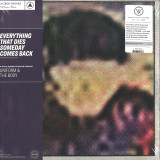
On the heels of their monolithic collaborative LP Mental Wounds Not Healing, the collaboration between industrial-noise post-everything bands Uniform & The Body returns with a second entry, Everything That Dies Someday Comes Back. Comprised of an amalgam of abrasive influence that spans Swans-y dirge and purge, Whitehouse’s clenched-jaw noise, middle-period Ministry’s penchant for metallic post-industrial everything, New Order’s nose for melodic emotionality, and Juicy J-inspired beats, Uniform & The Body’s approach delves deeper down the rabbit hole than before, igniting a sonic world of terror and bliss poised to grip the throats of fans yet again. Prepare for a record that the band self-describes as “the middle ground between Robyn and Corrupted, but weirder.”
Much like the collective’s bombastic debut, Everything was built over a series of collaborative sessions with Seth Manchester at Machines with Magnets in Rhode Island, mixing industrial-influenced synths, squalls of harsh noise, manipulated guitar, oodles of samples along with hard rock-inspired riffs, saccharine pop, and the alternately antagonistic and harrowing vocals of Michael Berdan
In order to celebrate the disco legend, Editions Miliani presents a
magnificent double album of remastered tracks by performer and
songwriter David Christie.
David Christie, a.k.a Jacques Pepino, passed away 25 years ago and for the anniversary of his death, Editions Miliani has compiled these tracks to bring to life timeless music that continues to make people dance! Carefully selected, the tracks include the "Saddle Up" version by Bon Entendeur.
David Christie has composed for artists such as Sylvie Vartan, Joe Dassin, Demis Roussos, Morris Albert, Gloria Gaynor, Jimmy James, Grace Jones and Tina Charles, for whom Christie wrote the 1976 hit "I Love to Love" that topped the UK charts. The album pays tribute to the career of this musical genius.
After previous releases by Todd Modes, the mysterious K-6000 and long-time Urban Tribe member Kemetrix, 100 Limousines from Detroit presents this new album by DUNN.
A wonderful and deep sound exploration, ranging from peaceful meditative states to echoing sounds from outer space and even some warm Detroit house vibes in between.
In other words, a perfect release to expand 100 Limousines’ off-the-beaten-track catalogue. Bending genres and not sticking to any rules... Just as we like it.
Available to pre-order now! Also some very limited quantities left of 100LIM001 and 100LIM002…
Summer is here, and we at OFF are proud to be once again a steady provider of sunny vibes with this lovely 2-track EP.
Purple Disco Machine from Dresden, Germany step up to the plate with a soul/disco-infused house tune with a driving flow and a killer beat, one made both for the club and the beach.
Second track comes from praised producer James Silk, from Liverpool, already familiar to the likes of Defected or Exploited, who delivers a west coast influenced deep house tune with an inspiring breakdown and a groove that will make everyone smile.
Another hit from OFF aimed straight to the soul!
---- Malente & Teenage Mutants - Blow My Mind
After the immense success of chart topper 'Hanging On' (Co-produced with Andre Crom), Teenage Mutants (Stil Vor Talent, Nurvous) makes yet another promising collaborating alliance with german superstar Malente (No Brainer, Defected, Fool's Gold, Southern Fried) to provide another hit single of huge proportions.
'Blow My Mind' is a nu-disco influenced funk bomb with a rocking synth bassline and hypnotic vocoder vocals that create a deep and spacey atmosphere. Another quality OFF installment destined to take dancefloors all over the world on a deep funky trip!
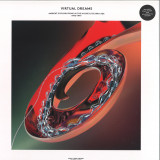
Music From Memory is delighted to be turning 50 with a special release: MFM050 - V/A - Virtual Dreams: Ambient Explorations In The House & Techno Age, 1993-1997 (3xLP/2xCD). The first in a series of compilations, alongside more in depth artist-focused releases, Virtual Dreams will delve into music produced during the 1990’s that redefined the boundaries of ‘Ambient’. This was music that explored the possibilities of Ambient music within a new setting, created often by House & Techno music producers for a world beyond dance floors but made very much with the pre and post-clubbing listener in mind.
When House and Techno exploded out of America in the mid 1980s a whole generation was redefined not only musically but also culturally and chemically speaking. Peaking, quite literally, with a second ‘Summer of Love’ in 1988, millions of young people across the world would experience the life-changing ups of a brave new world but with it of course came the downs; enter the concept of a ‘Chill-out’ room. Whilst early Chill-out rooms lacked a specific sound and were often soundtracked by music such as reggae and soul, slowly young Techno and House producers themselves would become increasingly interested in developing a futuristic ‘Ambient’ soundtrack to a world beyond the thud of the main room.
‘Ambient’ in this new age now though had sharper teeth than in Brian Eno's key text for ‘Music for Airports’, instead here the sounds were the mode of transport rather than the backdrop. While the melodies were pretty, the soundscape steered away from the pastoral, dreaming of outer-space and technology as opening up exciting new dimensions. Much like in the first Summer Of Love; the musicians were again exploring psychedelic, mind-altering and transcendental possibilities of music. And also much as in the first Summer Of Love, a psychedelic visual language would accompany the music. Though now the tracks could be accompanied by music videos, utilising early CGI techniques, they would look almost entirely to the future: envisioning technology, nature and humanity intertwined in a new Utopian future. Virtual Dreams of a better world.
From Ambient and early Chill-out classics, to lesser known one-off projects, as well as Ambient deviations by some of House and Techno’s leading producers, Volume One of Virtual Dreams features tracks by Bedouin Ascent, LA Synthesis, LFO, Marc Hollander, Mark Pritchard & Kirsty Hawkshaw, Richard H. Kirk and more.
To celebrate our 50th release the first 1000 copies include a holographic 'Virtual Dreams' sticker plus a special insert poster with artwork by Victoria Pacheco and design by Steele Bonus.
London's Lilas Records has been going from strength to strength following the recent sell out of Swoy’s Essence EP. This time they welcome German based Daniel Broeseck to Lilas who showcases two sides to his personality with a pair of straight up dance floor killers sitting comfortably alongside two hypnotic breakbeat groovers. The release has seen early support from the likes of Nu Zau, Cristi Cons, Miroloja and Techu to name just a few.
British musician, multi-instrumentalist, producer and DJ cktrl returns with the release of his new EP ‘Yield’. Born from a desire to change the narrative around contemporary Black British music, the boundary-pushing musician aims with this project to prioritise the art of bonafide musicianship. A stark departure from cktrl’s previous work, ‘Yield’ is a celestial and palpably more inward body of work that harkens back to the pre-electric age of modal jazz while simultaneously pulling in elements from the disciplines of classical and baroque music. Speaking on the project’s sonic identity, cktrl says: “I want to be able to show that you can make things from scratch again that have that feeling and beauty without having to sample an old record. Even though that’s an art-form within itself, I want to show raw orchestration and instrumentation can be the sole source” The origins of the title came from a period where cktrl was looking to find solace in himself after an introspective period of grief and heartbreak. As an intentionally instrumental project with minimal vocals, cktrl wants prospective listeners to see these new songs as guided meditations where they can wholly insert themselves in it. Eliciting and reaping whatever feelings come to the fore. Speaking on what ‘Yield’ means to him as a concept, cktrl explains: “Some people who I've asked to define the word ‘yield’ have looked at it from a harvest point of view, whereas others have seen it as something to submit to, to render, like you're giving up yourself. I see it as a barometer for how you feel - no matter if you're at your lowest or your highest vibration, you still need to show up for yourself. You still have to be present. It’s about getting the best from yourself no matter where you are in life” The new project is the follow up to last year’s ‘Zero’ which featured collaborations with esteemed contemporaries like the GRAMMY-nominated Mereba and anaiis. Upon the project’s release, it was met with a plethora of critical acclaim from highly regarded publications and platform such as British Vogue, Dazed, CRACK Magazine, Resident Advisor, NOTION, Harper's Bazaar and ES Magazine for its sprawling and experimental scope, spanning avant-garde jazz, classical music, alternative R&B and electronica. cktrl has a tune for every occasion: as content making beats by himself at home in Lewisham as he is amongst this generation’s fashion and cultural vanguards. Music has been a part of his life for as long as he can remember: from clarinet lessons throughout his school life to fond memories from his NTS days. Moulded by a unique blend of his West Indian heritage, years of classical training in both the clarinet and saxophone, cktrl strives to do what hasn’t been done before. His approach to creation is decidedly wide-ranging and broad. In fact, where sonic descriptions might fail to encompass the breadth of cktrl’s scope, three words surface when he unpacks his musical aims: freedom, range and feeling. Elsewhere, throughout his career, cktrl has been recognised and heralded by fashion and film VIPs as he firmly embeds himself within the black cultural renaissance emerging here in Britain. Acquiring a global network of creatives that include the late Virgil Abloh, Bianca Saunders, Tremaine Emory, Saul Nash, Maximilian Davis, Ahluwalia, Stephen Isaac Wilson, Sean Frank, Campbell Addy, Ib Kamara and Jenn Nkiru who secured him a cameo in Beyoncé’s ground-breaking film ‘Black Is King’.
For this uniquely personal retrospective spread over twelve vinyl discs, Sven Väth takes us back to the early days of his DJ career. On What I Used To Play we meet great pioneers of electronic music, gifted percussionists, obscure wave bands, and innovative producers of a bygone 'new electronic' era. Rough beats and irresistible grooves from the identification stage of house, techno, and acid remind us not just how far electronic music has evolved over the past four decades, but how great it was to dance to EBM, techno, and house for the very first time.
If there is one protagonist of the electronic music scene who has remained curious, innovative and at the very cutting edge of music for over four decades, it's Sven Väth. His multi-layered artist albums and Sound of the Season mix compilations have been defining the genre for over two decades, and even today, he is constantly on the lookout for the next top tune to add to the highlights of his next set. At least, that's the case when he's not producing them himself as an artist or remixer. "Actually, it's always been part of my DNA to think ahead," and nothing had been further from his mind than looking back at his past, but when in spring of 2020 the international DJ circuit had to be scaled down to virtually zero, the 'restless traveler' suddenly had time. Time to stop and reflect on "how it actually was back then, at the very beginning of my career..."
"It was a great trip and with every track, beautiful memories came flooding back".
In the London apartment, he had just moved into, Sven has set up a "little music room", where he cocooned himself for several days, "to look way back for the first time and review my musical journey through the eighties, so to speak."
The interim result was six thematically oriented playlists with a grand total of 120 tracks from 'early 80s' to 'Balearic late 80s', together with excursions into afrobeat, European new wave, and EBM sounds and a few epochal techno/house tracks from the USA in between. From these 'Best of Sven Väth's favorites', the project What I Used To Play crystallized. Sven remembers how the Cocoon team reacted to his proposal: "They found the idea of making a compilation out of it MEGA from the beginning and everyone said 'Sven, go for it', but then, of course, the work really started, namely, to clear the rights and to get clean sounding masters of the up to 40-year-old tracks. There was also disappointment, of course. We couldn't clear certain titles because the rights holders in the USA had fallen out with each other or simply disappeared from the scene. In short, it wasn't easy, but now I can safely say we got the most important tracks."
Finally, after two years of research, curation, design, and administrative fine-tuning, the "little retrospective" from 1981 to 1990 is available. The exquisitely packaged, and three-kilo heavy box set is not only physically impressive, WIUTP is also the definitive record of Sven Väth's musical development. On each of the twenty-four sides of vinyl, you can trace track by track, what influenced him during which phase, and how he took off as a DJ from his parents' Queen's Pub straight into the spotlight at Dorian Gray. There and at Vogue (later OMEN), Sven became the style-defining player in the DJ booth that he still is today.
1981 - 1990: Future Sounds of Now
In the early eighties, the crowd in clubs like Vogue and Dorian Gray danced to what nowadays we call 'dance classics' - mainly disco, funk, soul, and chart pop. It was up to a new generation of DJs, including Sven Väth, the youngest protagonist in the Rhine-Main area at the time, to create their own club-ready music mix. Good new tracks and potential floor-fillers were rarities that had to be sought out and found, in order to prove oneself worthy.
Without MP3s, internet streaming, or other digital download possibilities, music didn't just gravitate to the DJ, instead, it had to be tracked down. In well-stocked record stores in Frankfurt and Wiesbaden or even in Amsterdam, London, or New York, Sven and friends sourced the material for countless magical nights. On WIUTP we can follow Sven's very personal journey through this wild, innovative era in which synth-pop, funk, hip-hop, and disco were successively replaced as 'club music' by house, techno, acid, and breakbeat. By the end of the decade, it was clear to see that these once exotic 'fringe' phenomena would soon become 'mass' phenomena.
Early 80s
Dirty Talk by the Italian-American duo Klein & M.B.O. represents the most innovative phase of the Italo-disco genre in the early eighties like no other track. Mario Boncaldo (I) and Tony Carrasco relied entirely on the original synthetic drum and percussion sounds of the Roland TR-808, coupled with the raunchy vocals of Rossana Casale and guitar accents of Davide Piatto. Of course, other tracks from this period were also influential in style, most notably Unit by Logic System, which worked as the perfect soundtrack to the laser lighting system at the legendary Dorian Gray club. With stomping beats and robotic rap interludes, Bostich by Yello also belongs on Sven's eternal playlist - after all, it caught the attention of Afrikaa Bambaataa, who invited the Swiss duo to perform at the Roxy in New York in 1983.
EBM Wave - Mid 80s
From today's point of view, the almost ten-minute-long, downtempo track Giant by Matt Johnson's band project The The, would probably not be considered an obvious club classic. However, a closer (re)listen reveals the rhythmic intricacies of the percussion overdubs by JG Thirlwell (aka Foetus) on Johnson's composition, and it becomes clear why this exceptional piece of music is one of Sven's absolute favorites. Other classics from this phase include Kaw-Liga by the mysterious The Residents, the hypnotic-synthetic Our Darkness by Anne Clark (and David Harrow), and last but not least, the somber, monotonous anthem Where Are You? by 16Bit, one of Sven Väth's projects together with Michael Münzing, Luca Anzilotti from 1986.
US House - Late 80s
You certainly can't talk about Chicago house without mentioning Frankie Knuckles. The resident DJ at the Warehouse not only gave the name to an entire genre, but also produced epochal floor fillers on the Trax label like the timeless Your Love, sung (and moaned) by Jamie Principle. Acid house protagonists Phuture also hail from Chicago, and on We Are Phuture (also released on Trax) we hear the chirping acid sounds of the legendary Roland TB-303 in full effect. Another featured classic is No UFO's by Detroit's Model 500 aka Juan Atkins, who is rightly considered the 'Godfather of Techno' even if the genre-defining track from 1985 still breathes with the spirit of hip-hop and electro from the first breakdance era.
Afrobeat
Le Serpent, by Algerian-born Abdelmadjid Guemguem, is a track that sounds completely different from everything else on WIUTP. Made in 1978, it's a monumental, rousing groove created without bass or synths, just with five congas! Even though Guem sadly passed away in 2021, his immortal, acoustic beats are understood all over the world and will continue to enrich many thousands of DJ sets for years to come. Another classic that not only Sven appreciates beyond measure is Hugh Masekela's Don't Go Lose it, Baby. In addition to being one of the most important jazz pioneers, the trumpeter and freedom fighter from Johannesburg was very experimental, integrating electronic sounds into his music in later years, in a similar vein to Miles Davis and Herbie Hancock. Dutch jazz pianist Jasper van't Hof's afrobeat project Pili Pili has also aged well. The trance-like, almost sixteen-minute-long track of the same name, manages to fill a whole side on the seventh of twelve vinyl discs in the WIUTP box.
UK-US-Euro - Late 80s
Time for a change of scene, in the truest sense of the word, and from a musical perspective, this section is like landing on another planet. First up is Andrew Weatherall's classic remix of Primal Scream's Loaded, featuring the iconic Peter Fonda sample (lifted from the 1966 biker film Wild Angels) that came to personify the mood triggered by the British Second Summer of Love in the late eighties: "We wanna be free to do what we wanna do, and we wanna get loaded...". This period also saw the emergence of M/A/R/R/S whose only single, 1987's Pump Up The Volume, became a club classic with support from DJ legend CJ Mackintosh. In this most eclectic of sections, we also encounter New York house and reggae producer Bobby Konders and his seminal Nervous Acid.
Balearic - Late 80s
Those who know him, know that Sven had already lost his heart to the 'magic island' of Ibiza as a teenager, so with that in mind, the WIUTP project couldn't end without a Balearic chapter. Inspired by Manuel Göttsching's E2-E4, the immortal, eponymously titled Sueño Latino belongs in there without question. Equally popular on the island was, and still is Break 4 Love by Raze, which thinking about it, would also fit perfectly into the house chapter. Last, but not least, there's an overdue reunion with Sven Väth himself, in his role as frontman of the successful Frankfurt trio OFF. Together with Michael Münzing and Luca Anzilotti (later of Snap!) this 'Organization For Fun' created the off-the-wall club hit Electric Salsa in 1986 which incidentally turned into an international chart smash, putting Sven in the enviable position of having to decide between pop stardom and a DJ career. Well, we all know how that decision turned out and the rest, as they say, is history. A not insignificant part of his story is What I Used To Play. Enjoy!
Tod Dockstader's Aerial series, an electronic/drone masterpiece, is cherished among fans of the artist's work and this second volume is available in an audiophile quality double LP edition.
Tod Dockstader's Aerial series is sourced from his life long passion for shortwave radio. Dockstader collected over 90 hours of recordings, made at night, and comprised of cross signals and fragments plucked from the atmosphere.
Opening with airwave drones, Dockstader gradually allows elements to slowly come and go, summoning an ominous atmosphere of ethereal cloud clouds. Malignant placidity continues, giving the feeling of eavesdropping upon late-night audio activity not unlike discovering number stations while sweeping the dials. These sounds pull you in as their density and rhythms come and go.
Backward voices, deep echoing choruses of conversations flowing under the surface, ocean sounds, pulsing electro-rhythms, all seem to be created via the collaging of many hours of source recordings. A masterwork of collage and juxtaposition by an overlooked pioneer of American electronic music.
Artwork by John Brien (Imprec) is inspired by the propagation of shortwave radio signals throughout the earth's atmosphere.
"This return of Dockstader is something to cherish, not just because his output has been so limited and scarce but because what we do have is so intriguing, persuasive and cliche-free; the music of an inspired explorer who trails in nobody's slipstream." The Wire
"One of the great figures of musique concrete composition." Dusted
The Aerial project
I've written before of my interest in shortwave radio, in the notes to the Quatermass CD. Also, in the notes to the Omniphony CD (which has my first "Aerial" mix, "Past Prelude," in it), I mentioned "The Aerial Etudes," which was my working title for what became the three CDs you have. And, at the end of an interview with Chris Cutler (which can be found in the "Unofficial TD Website"), the piece I mentioned I was starting to work on at the time became Aerial.) When I was very young, people got most of their entertainment from radio. They called it "playing the radio," as if it were a musical instrument. That's what I've tried to do in this piece. About this time, a few people encouraged me to look into using a computer for this work.
I'd never used one, but I saw it would allow me to keep my mixes digital - no more transfer losses. So, at the end of 2001, I got a computer and an editing program for it, and spent what seemed a long time learning it. I began selecting mixes and loading them into the computer in late March, 2002. Out of the 580, I selected 90 "best" mixes - eventually reduced to 59, the ones on the CDs. Finally, in assembling the CDs, I followed David Myers' suggestion to allow each piece to flow into the next - making a continuous journey to the end. Tod Dockstader, 14 september 2003
About Tod Dockstader: Dockstader moved to New York in 1958 and became a self-taught sound engineer and sound effects specialist and apprenticed as a recording engineer at Gotham Recording Studios. It was around this time that he started to use his off-work hours to experiment with mixing and manipulating sounds on magnetic tape (musique concrète). By 1960 he had amassed enough material to assemble his first record Eight Electronic Pieces which was released on the Folkways label in 1961 (this would later be used in the soundtrack of Fellini’s Satyricon). The last of the eight pieces was later re-worked into his first stereo piece. In 1961 he applied to use the facilities at the Columbia-Princeton Electronic Music Center and was denied access by Vladimir Ussachevsky. Ussachevsky’s official reason was the “overstrained” scheduling of the studios, although many suspect that Dockstader’s lack of academic training was a factor in the decision. He continued to create music throughout the first half of the 60s, working principally with tape manipulation effects. His last piece at Gotham was Four Telemetry Tapes in 1965, after which he left to work as an audio-visual designer on the Air Canada Pavillion at Montreal’s Expo ‘67. It was around this time in 1966 that some of Dockstader’s pieces were released on three Owl L.P.s, and his work became known to a larger audience. He achieved modest recognition and radio play alongside the likes of Karlheinz Stockhausen, Edgard Varèse, and John Cage.
From a research work started in full lockdown three years ago, finally sees the light (or darkness) Echi Senza Fine, a remastered collection of sound material by Tasaday. Inspired by the controversial media story in 1971 of the discovery of a tribe in the Philippines that apparently had technology that had stood still in the Stone Age, the project officially borrows the name Tasaday in 1984 from the evolution of Nulla Perreale, in turn union of Die Form (musical part) & Orgasm Denied (performative part).
To put it in the words of Marcello Ambrosini, the Tasadays find in Die Form the controlled destruction of the form after its careful design and construction, while in Nulla Iperreale the spontaneity free from any possible superstructure. They declare themselves new primitives, not in the perspective of a nostalgic return to a pre-industrial or prehistoric external world, but in the exception of an inner experience in stark contrast to the leviathan of the single utilitarian thought that has dominated the West for centuries.
Their production-action does not allow itself to be tempted by the repetitiveness used by many industrial groups of those years, thus resulting seminal in the evolution of the scene. Their impulse to go further and not remain caged in the format of the new wave is witnessed by their particular sound vocabulary that sees, along with the use of conventional instruments, the use of DIY tools such as Chopper Vox and highly sui generis tools, like the Camolofono, cariole loaded with sheets, stones, tubes, chains and “garbage” of various shapes and sizes.
A discography dotted with primordial electronic experiments that reaches the new millennium through several vinyl records and an endless number of cassettes. From this undefined and mysterious number of tapes that is born Echi Senza Fine: 14 tracks (+ 2 digital bonuses) remastered, collected by Asymmetrical, who also edited the release insert, a collage of visual and textual material from their fanzines. A series of 300 transparent vinyl + Insert.
It is a huge honour to present the Disco Gospel 12”, curated and edited by Chicago's Marc Davis and Sadar Bahar. Featuring two under-the-radar disco / gospel fusion tracks that have been given a new lease of life courtesy of these masters of their craft.
We first came to know Marc through his always on-point Black Pegasus record label, which he’s been running since 2006. As a renowned international DJ, record collector, and an integral part of Chicago's underground music scene, we knew anything he sent our way was going to be serious and he didn’t disappoint. Joining forces with Sadar Bahar (Soul in the Hole), who is himself a gospel and disco legend and a DJ's DJ favourite across the globe, they dug deep and put us onto two absolute gems from their beloved collections. As DJs who play a wide range of genres, their ability to spot the real heat within any sound has placed them at the top of their game. As Sadar puts it, "We are always digging for records and these fit the criteria of disco and happen to be gospel”.
First up is the feel-good joint 'I'm So Happy' by Fountain of Life Joy Choir Under The Direction of Kevin Yancy. Originally released in 1978 on a subsidiary label of T.K. Productions entitled Gospel Roots, the clue is in the title with this one. It's an unadulterated, uplifting, joyous dancer. Marc and Sadar’s fizzing edit brings out the best elements of the song and extends them. Working the addictive vocal hooks and building the funky instrumental grooves produces a spirit-lifting mood that is bursting with enough energy to light a fire under any dancefloor.
'Optical Illusion' on the flip, takes the tempo down, but doesn’t let up on the vigour. It’s a driving, stomping anthem that features another lung-busting vocal performance. Working with a live recording of Rev. Charles H. Nicks and The Baptist Assembly Of Free Spirit Churches Mass Choir, this one proves to be the perfect accompaniment to the ecstatic vibe of the A-side. The duo has condensed and heightened the drama of the song and added some light-touch production elements to clean up and enhance the sound. We guarantee this will be filtering its way into the sets of discerning DJs worldwide.
Marc described the selections best when he succinctly put it like this, “We both knew these were two heaters on our first listen”.
We completely agree, and with recording and engineering contributions from Tone B. Nimble (Soul Is My Salvation) and Rahaan, here we have Chicago royalty creating an unmissable release that celebrates the crossover of dance music with the musical traditions of the church.
On behalf of re:discovery records, it is with great excitement that we announce the release of Stryke – The Introspection Trilogy (1994-2022). rd011 features a track that is very close to my heart. My senior year in high school. I was heavily into chill-out music at the time. Labels like FAX, Instinct Ambient, Reflective, Astralwerks, em:t, Silent, Moonshine, Rising High, Warp, Exist Dance, Visible, Eye Q and others were giving me such a wide array of beautiful sounds of more subdued techno and rhythmic ambient music. I was buying every compilation I could at the time that looked remotely different based on the artwork, the unusual artist names or the tracks. I was soaking in everything I could under the chill-out style. That year 1994 I picked up the 2nd edition of Moonshine's 'United State of Ambience 2'.
It has so many good tracks on it. One track that always held a special place in my heart was Stryke's 'Introspection pt.1'. The simple but catchy melody layering. The easy atmosphere made me feel like I was floating in the ocean. The deep 808 bass notes (I hope one day you and I will hear this on an amazing sound system). The amazing strings reach a crescendo nearing the end. This track has so many simple but beautiful sounds on it. It's a great example of what I call sequencer-styled electronic music. At a time when producers layered tracks in more of a sequence then building or placing sounds. In 2021 I was able to get a hold of Greg Chin to see if he was interested in putting the track on my label and letting it breathe freely on its own side alone as the highlight of an EP. Greg was enthusiastic about the opportunity and told me that he always wanted to complete the trilogy he had in mind of a part 2 and 3. The ominous and eerie part 2 adds a terrific tension to the finale of part 3. The last being almost an updated part 1 really concluded the trilogy for me. Both parts melded together on side B pushing near 17 minutes. I want to thank Greg for letting us be a home to complete his journey.
August Greene culminates years of mutual respect and friendship, channeling the musicians’ various talents into a cohesive project. The perfect marriage of jazz, hip-hop and soul, it’s music that just is. This is black expression the way God intended: earnest, unfiltered, and harmonious. Throughout August Greene, you feel the abundance of Glasper’s rolling keys, the sheer honesty of Com’s lyrics, and the nuanced subtlety of Riggins’ drum work. It’s a fluid sound that’s sorely needed in today’s landscape, and a teachable moment for the next wave of creators. “I feel like we need to set the bar for this generation of musicians and producers,” Riggins says. “There’s a lot of computer-driven music. This is the opposite of that. We’re showing you can still use your creative muscle on an instrument to generate your own sound.” August Greene is a meditative offering that stands tall against the era of “fake news.” “They body snatching black girls in D.C. / Politics and propaganda on the TV,” Common observes on the opening track. On “Nirvana,” the lyricist uses a stuttering percussive loop and faint piano chords to search his inner being: “Thought I was gonna fly when Obama became the king … when it’s all done, will I have heaven’s dress code, and been able to let God and let go.” As Com puts it, Glasper and Riggins’ soundtrack allowed him to open up in ways he hadn’t done previously. Like on “Fly Away,” for instance, where he riffs on the public relationships he’s had. Other songs, like “Black Kennedy,” feel spacious and scenic. “I got to go new places with the music, and it didn’t have to fit within a genre for me to participate on it,” he says. “This gave me an experience I haven’t had in a long time, so I want people to feel that. I want this to be a cleansing of whatever doesn’t feel good or inspiring.” In the end, August Greene speaks to those pushing through the dark for brighter days. It's a masterpiece from which virtue can shine. “I want people to go on the ride and be open,” Glasper says. “We just created and it became a sound. I want people to approach this with an open mind and without expectations.” —Marcus J. Moore
Nous'klaer audio presents Oceanic's debut album Choral Feeling. A rhythmically diverse electronic album full of sonic explorations and beautiful moments, all bound together by a sense of colour. The album touches on the core of what music can be for: a sense of togetherness, finding meaning in moments, a way to cope with loss and soundtracking dreams about a different future. The music on this album reflects that in the most personal way. Each track consists almost entirely of his friends' voices, recorded and transformed into the sounds you'll hear. No, you can But how Just think of anything How can it just be anything Why does it need to be more Because they're afraid of it. They're not afraid of the words Then what are they afraid of The power behind the words How can words have power If you say something, only you, maybe I can hear it. Perhaps someone sitting over near that tree can hear it too. If we say it together, maybe we can reach past that tree and reach that rock. But if us and a million others say them same thing, all at the same time. Then every tree and every rock everywhere will hear us. Trees and rocks don't have ears. No they don't but they do. Why don't they just cover their ears Because then they need to do that every time we use our voice. And use them we did and use them again we shall. They got tired of covering their ears, so they decided to cover our mouths. Won't they hear us now? We're safe here. For how long will we be safe? For now. Perhaps until later. Just try. Read the words like I've written, but do so like the birds in the trees. You are my sunshine A little louder You are my sunshine, my only sunshine, you make me happy When skies are grey You'll never know dear How much I love you Please don't take my sunshine away Beautiful. Shall we go teach the others When will we have enough to free ourselves We'll always have more than they do. We only need to not forget I'll never forget Sing it again. Artwork by Bob Verhoeven. Text by Gregory Markus.
Bernard Szajner is a French composer, musical theorist, visual artist. He is credited with the invention of the laser harp, which he patented.
Between 1979 and 1983, Szajner released five albums of innovative and Avant-garde electronic music. He became renowned as a light and visual effects technician with artists such as Magma, Gong, Stomu Yamashta and The Who.
During the 1970s, he became a pioneer in the field of using laser technology as an artistic tool. As a measure of his success, he became renowned by his work with companies such as Cartier and Renault. In 1980, inspired by the novel, Nova, by Samuel R. Delany, he first created the laser harp. The laser harp became so successful that Jean-Michel Jarre ordered a version from Bernard Szajner for his tour of China. Despite all this, Szajner would only occasionally use this instrument in his own performances. He has stated that he would rather the public not know him solely for his work on the laser harp, and that it not be allowed to take precedence over his work in musical composition that it enables. This is also why he continues to develop other instruments which use other innovative methods of interaction, such as tactile or holographic.
Towards the end of the 1980s and disgusted with the music industry, he chose to abandon music entirely, and shifted his focus towards digital and visual arts, and theatre.
From Bernard Szajner : “These tracks are my preferred ones .... Ever ! ... For a long time I've been waiting for a record label to release what corresponds to what I like playing these days... Until Sleepers records decided to release this compilation which contains most of the tracks I enjoy playing live on stage ! At last my wish is fulfilled !”
'Intensely textured, interlocking guitar riffs weave together on New Bright Object, the debut album from Berlin and Edinburgh-based duo I’m Not You.
Working under the name I’m Not You, artist Alex Gibbs (bass & vocals) and sound designer Niall McCallum (guitar & drums) have honed a sound that draws in equal measure from jazz funk of Weather Report and the math rock of Don Caballero. Their debut album, New Bright Object is their most developed statement to date, an intricate, robust and unique collection of songs born from serpentine jam sessions in rural idylls.
The duo make no secret of their admiration for bands like Battles and Tortoise. They reference Jim O’Rourke’s lounge numbers and the droll lyricism of Modern Lovers’ Jonathan Richman. There’s a touch of Vini Reilly in their sparse and serpentine guitar lines. A hint perhaps of Mogwai. All these names place New Bright Object within a constellation of albums made with bigger budgets for wider audiences.
New Bright Object opens In a flash of light, comet-like, with the sound of ‘Mr. Wind- Up Bird’. The threads they weave are full with intent, as moments of density rise like hills from the track’s quieter valleys. It’s easy to imagine the pair looking out over the rolling fields of the garden studio in East Lothian where they recorded the album, as they assiduously try and draw their own landscapes in sound.
Similarly, there is a crispness to ‘A Certain Arrangement Of Atoms’ - every clipped hat, rim-shot snare and tightly wound tom a fine-tipped mark on the score. It is intricate and precise, a result perhaps of Niall’s attention to detail. Then there is the piano, Alex’s grandmother’s, slightly out of tune, which adds a few expressionist strokes to this pointillist composition. The piece loosens, until all we’re left with is the bass.
Although the album orbits around the pendulum sway of ‘The Older I Get’, it is ‘What Cats Think About’ that stands out most. That it does is by design – a nod to the Sun City Girls and albums that like to throw their listeners a curveball every now and then. Pleasantly ramshackle, confusingly domestic, agreeably strange.
All this speaks to the spirit of the album and the creative relationship between two best friends whose differences seem to have been the only things they could agree on.'
An aura of mystery is hidden on this magnificent album released on EMI Nigeria in 1974 and today a collector’s cult object was the only one named Moonrakers Band.
Steve Black tells: “We were the original members of The Moonrakers and were based in Zaria, then in 1972 we left band management and started The Elcados. The original management of The Moonrakers sold the name to his elder brother who had a club in Kano and they brought Prince Bola Agbana to get other musicians to continue The Moonrakers while we moved in as The Elcados.”
Moonrakers Band and Elcados were the two bands that inflamed northern Nigeria in the early 70s with a more rocking and virtuoso sound, and especially with tons of rare grooves, then everything else around it.
Coming to the album content tracks like Wait For Me, Cut Your Coat According To You Size, Yara Manyan Gobe, but also Enia Sa Pele and Move on, will make floating camels appear on the dancefloor, or in your house.
With ´Future Romance´ a new chapter of storytelling house & techno music is opened. After running the mighty Parquet Recordings label for 15 years, german DJ and producer ´Solee´ is starting an additional vinyl & digital imprint with focus on quality deep & expressive sounds.
Future Romance starts off with „Reboot“ a new single by the labelboss himself showcasing once again his ability to build up a track like no other and combine extensive melodies with big basslines & clever invented synth-work. As remixers for this promising debut release we could win no less than one of the greatest icons of melodic techno worldwide ´Recondite´ (wellknown for his releases on labels like Afterlife or Innervisions) and italian master of organic deep and emotional house sound ´Lehar´, member of the Diynamic family and owner of the ´Multinotes´record label together with Musumeci and Olderic.
Early DJ support by DJ Hell, Innellea, Kevin De Vries, Fur Coat, Pig & Dan, Timo Maas, Quivver, Musumeci, Oliver Huntemann, Dave Seaman, Mira, Rinzen, Markus Kavka, Nick Warren, Eelke Kleijn, Nhar, Martin Roth and more.