
6
Disponible
En el almacen y preparando para el envío
14,24 €
En el almacen y preparando para el envío

Miles Away Records are proud to introduce a brand-new, never before released piece of music.
In September 2024, Rob J Madin reached out to us with a collection of instrumental covers he had created. Immediately drawn in, we loved both the musical approach to these covers and the fact he tastefully selected these tracks to cover. Following up, we asked Rob, an accomplished musician, if he had any original compositions in a similar style.
The result is "MONSTRO", six instrumental slabs of jazz-funk heat! Produced primarily in Rob's attic studio in Sheffield. Rob showcases his talents on guitar, bass, keys, and percussion, with each track built around iconic drum samples. Listeners can expect spacey synths, silky electric pianos, and irresistible hooks. Think BADBADNOTGOOD meets Mildlife with a side plate of Herbie Hancock.
From the kick-your-door-down energy of "Callisto Disco" to the slow-burning allure of "Heartbreaker" and optimistic sunny day feel of "Cherryade" to the fully grown earworm synth lines of "Bouquet Garni". In addition to four original songs, the collection features two cover versions from that initial SoundCloud link: Michael Miglio's "Never Gonna Let You Go" and Rupa's "Ayee Morshume Be-Reham Duniya." Both are rare early-80s gems, wonderfully reimagined by Rob.
"MONSTRO" will be officially released on May 16th, 2025 on digital and physical formats. The 12" EP comes with printed inner sleeves and is pressed at 45rpm for maximum audio depth.
En el almacen y preparando para el envío

Every ATA project is marked by collaboration - some over a few weeks and some over decades. When drummer Sam Hobbs and bassist Neil Innes decided to make The Return of, by The Flying Hats they were building on twenty years of playing together; Innes"s years of nightclub residencies and love of Afro-American dance music, and Hobbs"s intensive exploration of the links between American soul and R&B, Jamaican rocksteady and roots, and the music of the wider Caribbean from Cuba to Trinidad and Brazil.
En el almacen y preparando para el envío

Isle of Jura teams up with French digger Switch Groove on the next compilation titled ‘Archipelago – Cosmic Fusion Gems from France (1978-1988)’.
Switch Groove explains the concept “When I seriously began to search for and collect records, I was mostly interested in sounds from african-american, afro-latin and UK contemporary scenes. Sounds from distant territories, faraway from my native Massif Central, a highland region in the middle of France. The grass is always greener, I guess however, as I was digging in fleamarkets in the early sunday morning light, as well as spending regular sessions in second hands record shops, I began to discover hidden treasures, underground gems and side-projects of an unknown French musical repertoire.
French music is often reduced to its most famous musical forms, characters and signatures : French songwriting and voices, 60s yéyé, prog rock concept albums and soundtrack explorations, 80’s indie rock scene or more recently electronic French touch. All these sounds have a common feature : a geographical link, forged on mainland French territory, following the contour of the so-called Hexagone, the border that shapes the grounds for an homogeneous cultural expression. But beyond this showcase lie more complex, hybrid and global French productions. From French Caribbean Antilles to Parisian suburbs - especially during the ‘Sono Mondiale’ era -, in French areas outside urban cultural centers, musicians have created fusion and cosmic musical expressions. As the mid-seventies meant a greater freedom to make and record music, a wider use of electronic instruments like synthesizers and drum machines helped to deliver some magical projects you could only find lost in the middle of cheap records during a sunny record digging session. I selected these tracks, in an attempt to shape an ARCHIPELAGO that highlights significative contributions of African diasporas and ultramarine territories into French musical borders. It is the map of a land I have gradually drawn, thanks to deep listening of amazing cosmic and fusion tunes. I hope you enjoy the journey.”
En el almacen y preparando para el envío

The year 2024 rolled out in a restless haze, leaving everything a bit cloudy. In search of vision, we sought the guidance of our shaman—through the steady beat of a drum, a deep transformation began. And bam, just like that, the balance was restored and everything fell into alignment. Tokyo, Paris, Zürich, and Helsinki—each location now linked in a cosmic force field.
Fast forward to May 2025, and we are presented with a lush underground journey. The eleventh Common Labour 12” features the works of Omar Santis, Flabaire, Thomas Wood and pothOles. So buckle up and enjoy the ride into the depths. Odd Jobs Vol.4 is a labour of love – hand-stamped and numbered, limited to 199 copies worldwide.
En el almacen y preparando para el envío

Fozbee & Cooz were the first artists we approached as Vinyl Fanatiks when it came to re-issuing fantastic music from the early 90’s. They were a big inspiration on us here at the label, with all their original releases sat in the racks here since the 90’s.
Two brothers our of Hertfordshire, they were the link between Jack Smooth and his first release – loaning him their Akai sampler so he could write his first track. They were also round the corner from Bukem, who wanted to work with the guys on music back then. But as the brothers lived at home with their parents and Bukem had a strict weed smoking policy when writing music, the project didn’t take off the ground as their mum would of gone mad!
Fast forward 32 years and we are honoured to be able to share with you the brothers first release under their monicker of Fozbee & Cooz. Two big rave classics that got a lot of pirate radio play back in the day too. And as usual, the original of this release commands a high price on Discogs, so grab a fully authorised copy from us at a fraction of the price!
En el almacen y preparando para el envío

Longevity in dance music is not option.
It is the requirement.
'Don't Stop' is the essential ethos in DJ culture, especially concerning the medium of vinyl records.
Eddie C and Keita Sano link again inside and outside Europe for 3 tracks of hard-edge, progressive Kraut and global House sound.
Don't sleep! Don't stop!
EC x KS 2025
En el almacen y preparando para el envío

180 G. BLACK VINYL WITH LINER NOTES IN CREOLE, FRENCH, ENGLISH
Originally released in 1979, "Spiritual Sound" lives up to its name, a soaring, triumphant album, six tracks of spirit magic from Guadeloupe.
Telluric, intense, terribly alive, the gwoka drums of Guadeloupe carry the identity of a painful and fervent island. Marked forever by the crime of slavery, Guadeloupe's créolité cherishes the ka drums and their natural environment: the low-pitched boula drum with male goatskin, the high-pitched soloist makè drum with female goatskin, the chacha, ti bwa, triangle, calabash and other percussion instruments that surround them, and the voices - the fiery, proud, timbred, urgent voices of the gwoka.
This album is also a legend for its voices: in his then dazzling youth, singer Lukuber Séjor was one of the first gwoka artists to largely feminize the chorus of répondè, who converse with his text delivered in a straight and powerful voice.
And everything here sets new standards. In 1979, Mizik Filamonik - Spiritual Sound proclaimed a spiritual patriotism of ferocious intensity. The album by Lukuber Séjor - whose spelling alone is a battle - sets out to give Guadeloupe the intangible weapons of self-respect and self-knowledge, through a singular practice of traditional music.
The genesis of gwoka music is less straightforward than one might imagine... The drums performed the servile task of accompanying the work of slaves in the fields and during the “corvées” imposed by the administration, before being freely practiced by the common people after the abolition of 1848. At the heart of the conviviality of the Guadeloupeans furthest from the cities - geographically and socially - the gwoka drums come out for carnival, funeral wakes and neighborhood celebrations, but also during strikes, fits of anger and armed vigils of the riots and revolts that have punctuated the island's history. For generations, governors of the colony and then the prefects of the overseas department of Guadeloupe have been viewing the gwoka as a potential for turbulence and a threat to public order.
But as the Beatlesmania, “chanson engagée” and rock revolutions unfolded in Europe, young people turned to the drums of mizik a vié nèg (“bad negro music”, in Creole), which Guadeloupeans had learned to despise by following the “assimilation” process advocated by the school system and most of the political class. At the end of the sixties, in a Guadeloupe mourning the deadly repression of the May 1967 social movement, they played traditional music, refusing to wrap it up in tourist prettiness and madras folk costumes. Instinctively, they played a rough and contemporary gwoka, led by the incendiary Guy Konkèt. This was the era of decisive 45 rpm records such as Robert Loyson's Kann a la richès, which brought to light the fieriest words of union rallies.
At his home in Sainte-Anne, Lukuber Séjor played with flautist Olivier Vamur and his brother Claude Vamur, who cobbled together a drum kit from tin crockery and became, a few years later, the most influential drummer in Kassav'.
These were the years of the Bumidom program, when young Guadeloupeans were encouraged to emigrate to mainland France. At the age of twenty, Lukuber Séjor embarked on the liner Irpinia, disembarking at Le Havre and taking the train to the Gare Saint-Lazare - the route taken by thousands of young West Indians who went on to study or looked for work, all the while trying to maintain a link with their homeland. In this case, it's at the Antony university residence, where Lukuber played the drum and participated in a thousand gwoka updates and aggiornamentos, while exile reinforced the need for a spiritual link with the native land.
In 1978, Guy Konkèt played at the Salle Wagram, a historic event for West Indian music. After serving as répondè - i.e. backing vocalist - on one of his home-recorded albums, Lukuber joined his live band. Little by little, he became one of the key artists on a circuit parallel to French show business. At a student party in Caen, he met a young woman from Martinique who, at the time, was more motivated by her ambitions as a visual artist than by her vocation as a musician. Her name was Jocelyne Béroard and, a few years before she plunged into the Kassav' adventure and became the greatest West Indian singer of her generation, she designed the cover of Lukuber Séjor's LP.
This ambition was obvious and imposed its will. A more or less regular band was formed, with Roger Raspail, Rudy Mompière and Éric Danquin on ka drums, Claude Vamur on ti bwa, Olivier Vamur and Françoise Lancréot on flutes and Annick Noël on keyboards. Lukuber Séjor is set on wanting to extend the gwoka palette to other instruments, as the jazz-rock revolution opens a thousand new doors. Annick Noël will play a wide range of timbres and textures on electric piano and synthesizer. Another novelty: the répondè are two men and two women, Roger Raspail, Olivier Vamur, Françoise Lancréot and Maryann Mathéus ...
Mizik Filamonik - Spiritual Sound is a self-production in which the singer and leader sank all his savings, allowing him no more than a single day in the studio. The first side is more of a musical manifesto, with the first two tracks, Éritage and Penn é plézi, being instrumentals. The third, Son, forcefully celebrates the need for Guadeloupeans to connect with the gwoka. In fact, Jocelyne Béroard's cover shows a tambouyé in the shadow of a cloudy sky, against which a radiant sun is rising and whose light will soon flood the entire landscape. The silhouette and face of this man strongly evoke the immense Vélo, master of the ka, rejected at the time on the fringes of society.
The second side of the LP is surprising. Formally, three tracks are explicitly linked like the three parts of a triptych. Primyé voyaj evokes the appalling tribulation of Africans deported as slaves to Guadeloupe; dézyèm voyaj speaks of the Bumidom program and the economic, political and social forces driving young Guadeloupeans towards the mirage of prosperity in France; twazyèm voyaj closes the cycle with the emigrants' return from Europe after years away from their island...
This gwoka, obsessed with the need to save Guadeloupe spiritually, appeals far beyond the politicized audience. Mizik Filamonik - Spiritual Sound instantly became a classic, although Lukuber Séjor never really made a career for himself as a musician.
After all, the album was released in 1980, with no promotional resources in France or Guadeloupe - and therefore no concerts. The thirty-two-year-old author, composer and performer made his own third trip back to Guadeloupe. He set up a small woodworking business, which he lost in Hurricane Hugo in 1989. His other activity, teaching in a medical-educational institute, became the core of his professional life. He continued to be an active campaigner - a campaigner for the Creole language, a campaigner for the reawakening of identity, a campaigner for special education, a campaigner for a thousand causes that he ignited with his generous and perceptive enthusiasm, such as the defense of breadfruit fries...
The echoes of his 1979 album have not died down. Of course, the use of Penn é plézi as the theme tune for Radio Guadeloupe's funeral notices from 1980 to 1992 kept him in the collective memory, but he continues to sing and compose sporadically, as with his all-female
vocal group Vwapoulouéka... Still convinced that music is a means of liberating the spirit, he continues the journey of a young man eager to deploy the power of Creole music and language.
Bertrand Dicale
En el almacen y preparando para el envío
Tuskegee returns with serious intent and a fresh club weapon from a recognised statesman of house music, Junior Sanchez. Having written and collaborated with artists including Daft Punk, Armand Van Helden, Todd Terry, and Roger Sanchez, ‘Bitch U Could Neva’ pairs Sanchez with vocalist and songwriter Dave Giles II, riding high himself following link-ups with Honey Dijon, Mike Dunn, and a producer on Beyonce’s anthemic ‘Cozy’.
‘Bitch U Could Neva’ is a powerful, instantaneous trip back into the underground style and attitude shared between both artists, reflecting the vibe of Sanchez’s rise to success in the halcyon days of New York nineties clubbing, alongside Giles II’s own youth in the Chicago creative scene. Living up to the attitude of its title, ‘Bitch U Could Neva’ bumps with peak-time energy, jackhammer drums and chopped-up vocals never undermining its fundamental sensuality, an increasingly rare link between true, authentic dancefloors past and present.
The pair then look to London for a confident, stripped-back take from prestigious record collector and curator GIDEON. The founder of dance music institutions Adonis and Glastonbury’s infamous Block 9 goes deep to find the track’s potential as a minimal, vogue-adjacent house workout, scattered with telephone dial tones and an upfront disclosure; “Bitch, I’m serving.”
Back across the Atlantic, Physical Therapy and Michael Mangan team up under their Fatherhood project to give ‘Bitch U Could Neva’ a seriously bouncy redress, winding tight drums atop a rubbery bassline and paying their own Twilo and Tunnel-era tributes with cut-up vocals and an ecstatic onslaught of rave stabs.
En el almacen y preparando para el envío

The first official reissue of Dorothy Carter"s folk-music exegesis comes 46 years after its original release, 20 years after Dorothy passed, and 11 years before the centennial of her birth. Yet it seems right on time for a new celebration of her music. Appalachian folk tunes, old and ancient psalms and hymns, Scottish, Irish, French and Israeli melodies, and original tunes flow together effortlessly in hypnotic gardens of eternal world musics. A highly energized, alternately meditative and proselytic recital whose vitality has only burgeoned in the decades since it appeared. As it should be: the music of Dorothy Carter is akin to a portal, linking her and us with the eternal. This edition of Troubadour reproduces the original album package, adding an insert adorned with additional photos of Dorothy and her collection of instruments, as well as notes from Eric Demby exploring the era - his childhood - from a vantage point of some 50 years. This reissue is a long-held family dream come true, and it is dedicated in loving memory to Bob Rutman, Constance Demby, David Demby and Dorothy Carter.
En el almacen y preparando para el envío

En el almacen y preparando para el envío

UV & Nenor link up once more and return to Fossils with three new edits that take the form of spaced-out deep cosmic chuggers. These are all classy tunes with an analogue edge, great deference to the classic synth sounds of days gone by but all with nice modern touches. 'Space Love' is a widescreen odyssey with sultry female vocals and a sweet theremin sound. On the flip, 'Shwag' has hazy pads and slowed down, rugged, sleazy drums and bass and then last of all comes 'GoGo Stomp' with another bubbly bottom end, squelchy bassline and weird but wonderful vocal sounds. A brilliantly high-grade addition to your record back.
En el almacen y preparando para el envío

For the second edition of Ninja records , Miroloja introduce Linkblow Ep with three electro groovy tracks crafted for the dancefloor with driving basslines, punchy rhythms and captivating melodies perfect for setting the vibe
En el almacen y preparando para el envío

Swedish artist Martinou crafts deeply immersive electronic music, seamlessly balancing weight and delicacy. His productions oscillate between hypnotic intensity and introspective warmth, always evoking a visceral response on the dancefloor.
After releasing on acclaimed labels like Nous’klaer, Turbo Recordings, and Mule Musiq, the Malmö-based producer now makes his long-awaited debut on Stockholm’s Studio Barnhus. His Linked EP showcases six meticulously layered compositions, where intricate rhythms intertwine with luminous melodies – ethereal synths drifting in and out of the grooves, shaping an atmosphere that’s both expansive and deeply personal.
With Linked, Martinou further refines his signature approach, crafting music that feels at once free-flowing and deliberate. It’s a record that invites deep listening yet remains primed for the floor – a testament to the Malmö maestro's knack for blurring the lines between club functionality and sonic storytelling.
En el almacen y preparando para el envío

New sounds from the gaullic underground on Violent Cases’ latest release, the first one since many moons. Two long tracks born out of myths and mist to take you on a mental journey.
Side A’s „Chaos Theory“ sets off at 145 bpm. Synth layers and strings over deep bass create the atmosphere. Drama. Then a brilliant incorporation of a classic guitar solo in mid track. Unique.
Side B „Pagan Blade“ is a joint venture with Ciklo and ups the tempo to 160 bpm. Rolling and riding it’s pushing the dance floor while the pagan assassin whispers the rhythm.
You can tell the artists have honed their skills playing live, these tracks will unfold their full potential and deepness on a proper system.
Stunning full sleeve artwork by Darkam. Graphically edited and arranged by TDSIGNZ. Mastered by Stefan ZMK in the low countries.
Each copy includes an artwork poster, artwork sticker and digital download link.
En el almacen y preparando para el envío

Slow-moving finger-picked ambient folk straddling the synthetic and organic divide – that is “The Ending Was A Typical Part”, the first album by the Zurich-based duo Gūsū. It combines the tradition of playing the guzheng with electronic instruments, allowing different yet harmonious worlds to collide.
The collaboration between Xueyan Chen and Nicolas Balmer alias Gūsū was born out of their shared musical explorations in 2022 and has evolved into a dialogue of sound. Chen’s guzheng, an instrument deeply linked to Chinese history, resonates with improvised and self-composed melodies, freeing its pentatonic scale from its traditional bounds. Her playing is underscored with the cryptic hum of Balmer’s modular synthesizers, the deep bass and layered textures that combine the organic with the electronic. Together they create a sonorous exploration of identity, displacement and unity.
Xueyan Chen has been playing the Guzheng since her early childhood. With her moving to Zurich, Switzerland she started reimagining its historical identity through improvisation and self-composed melodies. With this approach, Chen emancipates the instrument from its classical heritage, weaving a contemporary and deeply personal narrative. Nicolas Balmer meanwhile brings a contrasting yet complementary dimension with modular synthesizers, bass guitar, and electronic textures. His layered soundscapes amplify and distort the Guzheng’s pentatonic timbres, enveloping them in mysterious tones and expansive harmonics.
En el almacen y preparando para el envío

At the start of the 1980’s X-Plode’s dad had a second-hand colour TV business in Bolton, Lancashire where he would buy, sell, repair and trade TVs. He would come back home with all kinds of things he had traded for a TV but the most memorable, to a 10 year old kid at that time, were the keyboards. He use to watch his dad play songs from the 1960’s on these keyboards and when his dad had gone out, Lee X-Plode would sneak on them and start messing about, experimenting with the drum programs and fiddling with the buttons, trying out ideas. He had to move fast though because these keyboards didn’t stay in the house for long as his dad would trade them again for something else; one time that was an old analogue echo chamber, which Lee also messed about with when his dad was out. That echo chamber was a revelation to Lee and opened up the possibilities of what was possible with sound. So by the time Lee was 16, he decided he wanted his own keyboard and started saving. When his 17th birthday came around he had saved up £200 and visited his local Argos where he bought himself a Yamaha PSS 680, an FM synthesizer with memory banks and a basic drum machine incorporated. ‘It was shit quality like, but I didn’t mind. I just wanted it for the programmable drum machine, the synth and the memory banks that came with it” Lee recalls. The year was 1987 and by this time in Lee’s life he was into reggae and hip hop, the latter he first embraced in 1983 by the way of breakdancing and listening to electro, so all he wanted to do when he got his gear was make reggae and electro sounding beats. Recalling his youth and the fun he had with the echo chamber, the next edition to his home set up was to acquire one of those, which he did via a mate of his. But by the time he got his minimal set up sorted in 1988, his musical tastes had changed. House music had landed here in UK and this was Lee’s new passion, so from that point on wards he started experimenting, trying to nail a decent house groove. ‘I wanted 808 sounds, but I didn’t know what one was!’ Lee explains.
Around late 1990 or early 1991, Lee started to improve upon his set up, purchasing an Atari STE, a Cheetah MS6 , a 6 voice polyphonic/multi-timbre analogue rack mounted synth that linked up to his Yamaha – “It wasn’t a great bit of kit, I kept getting electric shocks from it. Eventually it just blew up!” Lee had acquired a cracked copy of Cubase on floppy disk from his local computer game shop but struggled with it. “It was so complicated to understand and took me ages to get used to it. I was stoned a lot back then and I just couldn’t concentrate on anything for long” Lee laughs, continuing “I also picked up a 4 channel sampler/sequencer which plugged into the side of the Atari and that’s when I first started sampling, I think this would have been late 1991. I had the Simon Harris ‘Breaks, Beats and Scratches’ vinyl that he put out on Music for Life which were a godsend back then. I was also sampling a lot from cassette tapes, especially reggae. I would also record the Stu Allan show on Key 103FM, one of the main stations broadcasting out of Manchester. He would do a 3 hour show with hip hop and house, and then hardcore house came along. Eventually he dropped the hip hop altogether and it was just house and hardcore. I recorded the shows onto cassette most weeks and started to learn more about how house and hardcore was put together by listening to those shows.”
En el almacen y preparando para el envío
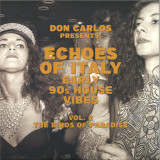
Vol 1[28,99 €]
Googling “paradise house”, the first results to pop up are an endless list of European b&b’s with whitewashed lime façades, all of them promising “…an unmatched travel experience a few steps from the sea”. Next, a little further down, are the institutional websites of a few select semi-luxury retirement homes (no photos shown, but lots of stock images of smiling nurses with reassuring looks). To find the “paradise house” we’re after, we have to scroll even further down. Much further down.
It feels like yesterday, and at the same time it seems like a million years ago. The Eighties had just ended, and it was still unclear what to expect from the Nineties. Mobile phones that were not the size of a briefcase and did not cost as much as a car? A frightening economic crisis? The guitar-rock revival?! Certainly, the best place to observe that moment of transition was the dancefloor. Truly epochal transformations were happening there. From America, within a short distance one from the other, two revolutionary new musical styles had arrived: the first one sounded a bit like an “on a budget” version of the best Seventies disco-music – Philly sound made with a set of piano-bar keyboards! – the other was even more sparse, futuristic and extraterrestrial. It was a music with a quite distinct “physical” component, which at the same time, to be fully grasped, seemed to call for the knotty theories of certain French post-modern philosophers: Gilles Deleuze, Félix Guattari, Paul Virilio... Both those genres – we would learn shortly after – were born in the black communities of Chicago and Detroit, although listening to those vinyl 12” (often wrapped in generic white covers, and with little indication in the label) you could not easily guess whether behind them there was a black boy from somewhere in the Usa, or a girl from Berlin, or a pale kid from a Cornish coastal town.
Quickly, similar sounds began to show up from all corners of Europe. A thousand variations of the same intuition: leaner, less lean, happier, slightly less intoxicated, more broken, slower, faster, much faster... Boom! From the dancefloors – the London ones at least, whose chronicles we eagerly read every month in the pages of The Face and i-D – came tales of a new generation of clubbers who had completely stopped “dressing up” to go dancing; of hot tempered hooligans bursting into tears and hugging everyone under the strobe lights as the notes of Strings of Life rose up through the fumes of dry ice (certain “smiling” pills were also involved, sure). At this point, however, we must move on to Switzerland.
In Switzerland, in the quiet and diligent town of Lugano, between the 1980s and 1990s there was a club called “Morandi”. Its hot night was on Wednesdays, when the audience also came from Milan, Como, Varese and Zurich. Legend goes that, one night, none less than Prince and Sheila E were spotted hiding among the sofas, on a day-off of the Italian dates of the Nude Tour… The Wednesday resident and superstar was an Italian dj with an exotic name: Don Carlos. The soundtrack he devised was a mixture of Chicago, Detroit, the most progressive R&B and certain forgotten classics of old disco music: practically, what the Paradise Garage in New York might have sounded like had it not closed in 1987. In between, Don Carlos also managed to squeeze in some tracks he had worked on in his studio on Lago Maggiore. One in particular: a track that was rather slow compared to the BPM in fashion at the time, but which was a perfect bridge between house and R&B. The title was Alone: Don Carlos would explain years later that it had to be intended both in the English meaning of “by itself” and like the Italian word meaning “halo”. That wasn’t the only double entendre about the song, anyway. Its own very deep nature was, indeed, double. On the one hand, Alone was built around an angelic keyboard pattern and a romantic piano riff that took you straight to heaven; on the other, it showcased enough electronic squelches (plus a sax part that sounded like it had been dissolved by acid rain) to pigeonhole the tune into the “junk modernity” section, aka the hallmark of all the most innovative sounds of the time: music that sounded like it was hand-crafted from the scraps of glittering overground pop.
No one knows who was the first to call it “paradise house”, nor when it happened. Alternative definitions on the same topic one happened to hear included “ambient house”, “dream house”, “Mediterranean progressive”… but of course none were as good (and alluring) as “paradise house”. What is certain is that such inclination for sounds that were in equal measure angelic and neurotic, romantic and unaffective, quickly became the trademark of the second generation of Italian house. Music that seemed shyly equidistant from all the rhythmic and electronic revolutions that had happened up to that moment (“Music perfectly adept at going nowhere slowly” as noted by English journalist Craig McLean in a legendary field report for Blah Blah Blah magazine). Music that to a inattentive ear might have sounded as anonymous as a snapshot of a random group of passers-by at 10AM in the centre of any major city, but perfectly described the (slow) awakening in the real world after the universal love binge of the so-called Second Summer of Love.
For a brief but unforgettable season, in Italy “paradise house” was the official soundtrack of interminable weekends spent inside the car, darting from one club to another, cutting the peninsula from North to centre, from East to West coast in pursuit of the latest after-hours disco, trading kilometres per hour with beats per minute: practically, a new New Year’s Eve every Friday and Saturday night. This too was no small transformation, as well as a shock for an adult Italy that was encountering for the first time – thanks to its sons and daughters – the wild side of industrial modernity. The clubbers of the so-called “fuoriorario” scene were the balls gone mad in the pinball machine most feared by newspapers, magazines and TV pundits. What they did each and every weekend, apart from going crazy to the sound of the current white labels, was linking distant geographical points and non-places (thank you Marc Augé!) – old dance halls, farmhouses and business centres – transformed for one night into house music heaven. As Marco D’Eramo wrote in his 1995 essay on Chicago, Il maiale e il grattacielo: “Four-wheeled capitalism distorts our age-old image of the city, it allows the suburbs to be connected to each other, whereas before they were connected only by the centre (…) It makes possible a metropolitan area without a metropolis, without a city centre, without downtown. The periphery is no longer a periphery of any centre, but is self-centred”.
“Paradise house” perfectly understood all of this and turned it into a sort of cyber-blues that didn’t even need words, and unexpectedly brought back a drop of melancholic (post?)-humanity within a world that by then – as we would wholly realise in the decades to come – was fully inhuman and heartless. A world where we were all alone, and surrounded by a sinister yellowish halo, like a neon at the end of its life cycle. But, for one night at least, happy."
En el almacen y preparando para el envío

The Mighty Zaf & Linkwood reunite for 'Yokai,' an epic dancefloor gem quickly gaining momentum among tastemakers, dance music aficionados & those in the know.
Endorsed by Luke Una on his BBC Radio 1 Essential Mix and already tipped by him as a contender for track of the decade. On the flip, the Control Remote mix pitches things down for a more Balearic vibe.
There's a high chance you'll be hearing this a lot in clubs over the next few months and it's primed to be an anthem at festivals this summer. These won't hang around for long!
En el almacen y preparando para el envío

DJ support: Lenzman, Redeyes, Trail, Satl, Flight, Doc Scott
Rosebay Music presents its 5th release: a collaborative effort from Submorphics & Zar. These 2 producers linked up in Manchester for an inspired afternoon in the studio before playing at iconic club night @hitandrunuk 'Another Level Of Love' is a timeless piece of D&B magic. Classic 90s strings, melancholic piano and a live bassline set the tone for aya dia’s grainy vocals to cut through the mix and straight into your soul. 'Western Times' is a deeper and subtler moment. A chopped-up Rhodes sample glides over woeful guitars and beautiful pads creating a hypnotic, cinematic atmosphere. Visionary music written for your deep winter nights.
En el almacen y preparando para el envío
