Super Rhythm Trax is excited to welcome 303 enthusiast and incredible conceptual artist (check out his website) Yuri Suzuki to the label. Yuri serves up 4 acidic tracks that are perfect fit for the label, all of them giving you that little bit extra, burrowing deep into the groove whilst giving plenty of extra elements to push the listener that bit further ‘out there’.
Yuri has collaborated many times with DMX Krew and appeared on labels as diverse as Matthew Herbert’s Accidental Jnr, Jared Wilson’s 7777 and Chicago’s mighty Trax records.
out of Stock
Last delivered 3 years ago available to reorder, subject to availability
The Isley Brothers “Knowledge is power. I’m a witness to that. Our parents wanted us to have a complete musical education. They exposed us to everything, classical to country, standards, show tunes.” Ronald Isley, Mojo Magazine, 2000 The Isley Brothers have delighted audiences since the 1950’s and are celebrating their eighth decade in show business. Morphing from their roots in gospel and doo-wop through funk, rock and then, finally, into slow-jam R&B, the Isley Brothers remain one of the most fascinating groups of all time.
This album contains some of the most life-affirming music ever recorded: Ronald Isley’s keening yelp offering strength and sensitivity as it is supported by brothers Rudolph and O’Kelly. Our collection picks up their story in 1969. By this time, they had been recording for 12 years for many legendary labels, from RCA, to Atlantic, to Motown.
The brothers decided to go it alone on their own label, T-Neck. The repurposed Isleys broke onto the scene with the US R&B No.1/Hot 100 No. 2, ‘It’s Your Thing’. The album of the same name was a Top 30 smash and the group’s decision was vindicated. ‘It’s Your Thing’ marked a meeting point of influences: Sly Stone, James Brown, gospel and one-time group member Jimi Hendrix, laying the template for the Isleys’ next decade, from the gritty rock covers of Givin’ It Back to the era-defining ‘3 + 3’ (with the formal addition of the two younger Isleys, Ernie and Marvin, plus brother-in-law Chris Jasper).
After the 1972 release of ‘Brother, Brother, Brother’ (featuring the classic ‘Work To Do’) T-Neck moved to CBS leading to their first Platinum-selling album (1973’s ‘3+3’). Produced with Malcolm Cecil and Robert Margouleff, ‘3+3’ was practically prescribed to every soul boy in the UK (witness Wham’s cover of ‘If You Were There’). For the Isleys to take their old R&B hit, ‘Who’s That Lady’ and turn it into hard-rocking psychedelic soul was a blazing statement of their
intent. Their version of Seals and Croft’s pretty ‘Summer Breeze’ became one of their biggest hits, with Ronald and Ernie stamping their authority on the ballad. A period of phenomenal success followed. For every standout ballad (‘For The Love Of You’, or ‘The Highways Of My Life’), there was strident, take-no-prisoners political funk - as typified by ‘Fight The Power’, a US R&B No. 1 in 1975.
It was written by Ernie on the same day as another of their greatest moments, ‘Harvest For The World’.
This collection is a beautiful overview to the group, a most fabulous re-introduction to old friends. This era is affectionately known by the Isleys as the ‘gold and platinum years’ - one listen and you will understand why.
out of Stock
Last delivered 3 years ago available to reorder, subject to availability
Multi-dimensional future-jazz outfit JK GROUP release a new EP, Rising on La Sape Records. The brainchild of award-winning saxophonist, Joshua Kelly (30/70 collective, PBS Young Elder of Jazz 2019), the band returns to the label with a follow up EP to the mind-bending 2021 release, What's Real?
Where What's Real? served as a platform for wild experimentation, Rising returns to a more considered and familiar format for the band, offering up 4 cohesive tracks that are deep in conception and expression, at once original and fresh. Conceived after recording an as yet unreleased body of work written whilst undergoing chemotherapy, Rising celebrates bandleader Josh's survival and eventual recovery from the intense treatment he received for lymphoma in 2020.
The band stays true to their honed format of jazz traditions melding with influences from electronica and beyond. Like the first release, The Young Ones, Rising sits comfortably in the crossover of raw, live jazz and electronic dance music, whilst also throwing an unexpected curveball to the listener expanding the palate of the bands sound to a pigment never before heard in their music. The EP takes you on an emotional journey throughout the four tracks, best listened to start-to-finish.
out of Stock
Last delivered 3 years ago available to reorder, subject to availability
Levitation Orchestra are the next progression of London's vibrant jazz scene. A vibrant collective with a balanced, workshop-orientated approach to composition, members include Axel Kaner-Lindstrom (Cykada), Xvngo (Nihilism, SEED Ensemble), and Maria Zofia Osuchowska (Alabaster dePlume). Their alternative instrumental line-up, spiritual jazz-informed groove, hard-hitting spoken word verses and highly original compositions are taken to the next level with their forthcoming album, Illusions & Realities.
out of Stock
Last delivered 3 years ago available to reorder, subject to availability
Inspired by revolutionary efforts against oppressive hegemonies in Detroit, and in Black locales around the world, Memoirs of Hi-Tech Jazz is a sound score evocative of that resistance. It is also a reminder that although violence and injustice looms, it is not the only story: we are much more than what oppresses us. The album celebrates Black leisure and play; the mundane joys that persist in spite of the depleting realities of the world.
Movement, and the very mobility of the car specifically is integral to Memoirs of Hi Tech Jazz. Timed perfectly to match the duration of a round trip drive from Underground Music Academy in the North End, to Detroit’s island park, Belle Isle - the album is undoubtedly best experienced while driving.
That journey signifies the transition from labor to pleasure: from the neighborhood of the Techno Museum in North End to an outdoor park that has long been a destination for Black Detroiters to cookout, park their boats, play spades, and listen to local music.
Memoirs of Hi-Tech Jazz embodies the feeling this place engenders—a reprieve from the midwestern work ethic, and a reminder to ground in the pleasures of your body and the land.
out of Stock
Last delivered 5 days ago available to reorder, subject to availability
Hot on the heels of their debut 45 released on Colemine Records, German funk powerhouse The Winston Brothers re-up with their first-ever full length LP. "DRIFT" is the name of the game, presenting eleven versatile cuts to invite listeners on an all-instrumental trip back to the future of funk. But make no mistake: Though audibly steeped in the deep funk tradition, this retrophile outfit is anything but dusty. The Winston Brothers are a modular studio project by Hamburg-based multi-instrumentalist and producer Sebastian Nagel (The Mighty Mocambos, Bacao Rhythm & Steel Band) and drummer / percussionist extraordinaire Lucas Kochbeck (The KBCS, Bacao Rhythm & Steel Band, Hamburg Spinners). Industry veterans with a penchant for analog music production, the two combine a boom bap state of mind with well-rounded funk acumen and able frequent collaborators to create dynamic arrangements that are both an audible nod to the genre's past as well as a contemporary blend of like-minded organic styles. Lacing heavy drums with juicy breaks, headnodic grooves, scorching riffs and melodic instrumentation, "DRIFT" draws on the raw energy inherent to `60s / `70s funk and takes it from there. Catchy, repetitive motifs gain musical momentum as they evolve into vibrant and autonomous soundscapes with a distinct drive of their own, ranging from incendiary to more laid-back and almost dreamlike. Strutting an irresistible bounce to their step, The Winston Brothers are poised to light up dance floors, river cruises and backyard BBQs alike. Catch our drift?
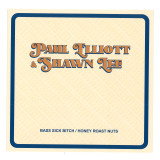
Quirky as fuck!' is the term to describe the latest killer 45 from Paul Elliott & Shawn Lee.
Since they crossed paths over a decade ago, Paul (Eleven76/Hot Border Special/The Mighty Mocambos) & Shawn (Ping Pong
Orchestra/Young Gun Silver Fox) have collaborated on many impressive projects including the critically acclaimed documentary The Library Music Film. The pair share a love of weird, exotic, otherworldly sounds that can usually only be found in classic library music.
However, with their latest release on Farfalla Records, they take the listener on a deep dive into the strange, percussive and unusual
world they inhabit!
'Bass Sick Bitch' begins with a glitchy toy rhythm and leads into a voice memo of a wooden 'Jank tone' instrument that Shawn had
played and recorded for Paul to hear. Paul's low slung drums and percussion take off and the pair exchange phrases on some of their
unusual instruments. This one has a head nod groove and a breakbeat that poppers, lockers and bboys can get down to...
'Honey Roast Nuts' is introduced with a rhythm Paul literally played on an old tin of Honey Roast Nuts, hence the name....Shawn creates
the vibe with Polynesian Ukulele, guitar and retro futuristic synthesized sounds, all the while a 70s inspired bass guitar keeps the mood up. The middle of the tune is stopped in its tracks when a voicemail recording from Paul's phone pops up and Shawn's fried brain takes us out with a modulated guitar!
Take a trip with Paul Elliott & Shawn Lee, It's all good in the motherfucking hood yo!
out of Stock
Last delivered 3 years ago available to reorder, subject to availability
On the album Opening, Tord Gustavsen reveals a fresh angle to his
particularly unique trio investigations into Scandinavian folk hymns,
gospel, chorale and jazz, as he introduces a different voice on bass
With a new fellow- traveller on board and its recording premiere in Lugano's
Auditorio Stelio Molo, the trio discovers inspired new ways to interact with each
other, using innovative approaches to sound and technique in the process. Made
up in equal parts of intricately textured improvisations and understated melodic
hooks, the group's conversations bring an enticing unfamiliarity to the language
the Norwegian pianist has developed over almost two decades of collaboration
with ECM.
Tord Gustavsen: piano, electronics
Steinar Raknes: double bass, electronics
Jarle Vespestad: drums
Press:
"Vibrates between the introspective and the dramatic in rich and singular ways.
Scene-setting opener 'The Circle' sees Gustavsen exploring a modal melodic line
of beguiling simplicity, with the trio's sotto voce approach creating an atmosphere
of hushed intimacy." - **** Jazzwise (Editor's Choice)
"The focus of Opening remains the playing from Gustavsen and the rich
accompaniment from his fellow musicians, creating an atmosphere perfect for a
walk by a cabin at dawn, with the sun peeking in through the trees." - Pitchfork
"Norwegian piano star Tord Gustavsen's long-honed recipe of low-key folk songs,
gospel, classical music and jazz gets a graceful makeover on Opening - with new
bassist Steinar Raknes, a player of uncannily responsive precision alongside
regular percussionist Jarle Vespestad, while subtle electronics sometimes create
ghostly horn-player effects." - The Guardian
"For Gustavsen, pieces such as Floytelat and Vaer Sterk, Min Sjel are routes into
the sort of cerebral mysteries that the former church pianist has made his own.
The first is a funereal theme where the notes he sprinkles like raindrops build into
a fatalistic flood. The second, from the Norwegian Hymnal, is played with an
innocent simplicity. Both are equally powerful...Remarkable music, Norwegian
blues." - The Times
"Quietly beguiling release...With lesser artists the uniformity of mood and
reluctance to turn up the volume would pall. But there's an artistry to Gustavsen's
compositions, a skill in their execution, and a warmth to their spirit that keeps the
listener engaged." - LondonJazz News
Hailing from the North West of England, XENTRIX was formed in 1985 by guitar player Chris Astley. After numerous changes to the line up XENTRIX signed to Roadrunner records and entered the studio to record their first album 'Shattered Existence' with producer John Cuniberti (Vio-lence, Forbidden, Joe Satriani). XENTRIX were one of the leading lights of the British thrash metal movement. They had music videos which all had regular air time on MTV’s Headbangers Ball. Gaining global notoriety, XENTRIX had many high energy performances with audiences of thousands. XENTRIX released their comeback album 'Bury the Pain’ in 2019 with production from Andy Sneap and Mastering by Russ Russell, this new recording showed the band sounding heavier than ever, while still retaining their signature sound. “Seven Words” is the 7th studio release from UK Thrash outfit Xentrix and is a crushing compendium of all that has made this band what it is today. New tracks such as “Reckless with a smile”, “Anything But The Truth”, “The Alter Of Nothing”, “Everybody Loves You When You're Dead”, and the title track “Seven Words” will take their rightful place next to the Xentrix classics. Xentrix’s guitarist Kristian Havard Comments: “This LP is the culmination of the last 2 years of us experimenting and trying new ideas. It feels like a big step forward for the band, but without stepping away from our Thrash Metal past and I can’t wait for people to hear it.” Recorded in the UK at Backstage studios in Derbyshire and Viscon studios in Lancashire, the album was mixed & mastered by Andy Sneap (Judas Priest, Exodus, Megadeth) and returning to create the cover artwork was Dan Goldsworthy (Accept, Corpsegrinder, Alestorm).
Anchor and Adjust is the debut album from, Australian synth-pop duo
Syzygy; Rebecca Maher and Gus Kenny both formerly of beloved
Melbourne synth-punk band Spotting
This new project explores a more unadulterated electronic aesthetic combined
with an unabashed pop sensibility.Gus was listening to a lot of 80s synth music
and minimal wave, while Bec was deep into mainstream 80s pop divas and new
wave. The resultant album sits at a crossroads of genre. The melodies of new
wave pop meet the synth tones of 80's coldwave, the vocal dynamics of postpunk and the DIY ethos and raw edges of punk. Layered synths twist and weave.
Featuring celestial, emotive vocals, the album is often bright and upbeat,
danceable, but also moody, thoughtful and clever. It is sparkling and edgy
electronic pop.
The album's lyrics explore the power dynamics in relationships, including the
relationship with yourself. It is about control and being controlled. Attempts to
unravel years of ingrained behaviour and decision making to try and see the world
another way. It yearns for clarity, asking questions and searching for definitions to
try to understand what is perception, what is manipulation and what is truth.
I was speaking to myself, through myself. Both aware of having these feelings
and disconnected from how they were making me feel. Making this record
allowed me to create order and meaning. It was both my wake up call and my pep
talk for changes I desperately needed in my life. Rebecca Maher. Pressed on
Transparent Purple Color vinyl.
GENRE : Synth-pop, Electronic, Darkwave
'While We Wait for a Brand New Day' is the third part of the Oddgeir Berg
Trio's trilogy around the dark hours of the day
The album was recorded under immense pressure. With only three days left
before Norway went into a lockdown, the trio headed to the studio and finished
the album in an intense session. Remarkably, the tone of these nine new originals
is hopeful and upbeat. If previous Oddgeir Berg Trio albums made you think of
ECM, the new one carves out a more personal sound.
Berg remembers the process as one of careful touches: "To me, it feels like an
evolving landscape. I have quite a few synths and effect pedals in my locker, but I
try not to overdo things." In conceptual terms, this is where the circle closes - now,
you can put on 'Before Dawn' and simply continue listening.
John Scofield's first guitar-solo-recording ever gives a résumé of all the
influences and idioms he has cultivated over his career in performances
on guitar, accompanied by his own rhythmic pulse and chordal backing
using a loop machine
Besides jazz, John is known to have always also had a soft spot for the rock and
roll and country music he grew up with, revealed here in unencumbered renditions
of Buddy Holly's "Not Fade Away" and Hank Williams' "You Win Again". Between
elegant and personal readings of standards, like "It Could Happen To You", the
traditional "Danny Boy" and Keith Jarret's "Coral", Scofield presents his own
timeless compositions - some new, others known.
For the guitarist, it's all about "the way you get the sound out of the string and
what you do with it after you attack it."
John Scofield: electric guitar and looper
Press:
"Scofield is as fiery as ever, plugged in and using loops to give himself a
background groove on some of his gritty originals or putting a punkish spin on
romantic ballads." - **** The Times
"This isn't an album to listen to in a hurry; but if you were pressed for time, the last
two tracks alone would give you a sense of Scofield's extraordinary range. The
bebop- heavy Trance De Jour is antic, angular, questing. But then we close with
You Win Again, a Hank Williams cover, serene as a sunset over the prairie." - ****
The Daily Telegraph
"Here he has distilled his decades in this crazy business into a baker's dozen of
songs that may appear modest in ambition - only one track runs to more than five
minutes, several run to barely three - yet is mighty in impact...This album needed
no other title. This is John Scofield." - **** Jazzwise
"(8/10) The result offers an intimate insight to Sco's skills as both guitarist and
arranger. It's a late-night album - quiet, introspective and really quite beautiful, too,
with Sco's musical soul laid bare before us." - Guitarist
Africa Corps Live at The Whisky A Go Go 30th
December 1981
Ever wondered about what seeing a blossoming Savage Republic,
formally known as Africa Corps, up close must have felt like? 'Africa
Corps Live at The Whisky A Go Go 30th December 1981', is here to take
us right there, fiercely catapulting listeners in front of one of Los Angeles'
most iconic stages, back when a young band of UCLA students (Bruce
Licher, Mark Erskine, Philip Drucker and Jeff Long), was starting to make
its way in the punk underground
Their extraordinary first time at the Whisky was recorded on cassette, direct from
the sound board, on December 30th, 1981. We're lucky enough to witness most of
the future 'Tragic Figures' tracks in a process of highly creative gesta- tion, in the
middle of being developed. The original tape has now been remastered by Warren
DeFever (His Name Is Alive) and unearths a most cathartic performance. It's hard
to fathom, but the four musicians had only been playing together for about eight
months at that point, mostly rehearsing in the concrete parking garages at UCLA.
Those formative experiences are brilliantly re- flected in the sound of 'Africa
Corps Live at The Whisky A Go Go 30th December 1981', with its hypnotic blend
of industrial and piercing post punk.
Africa Corps Live at The Whisky A Go Go 30th
December 1981
Ever wondered about what seeing a blossoming Savage Republic,
formally known as Africa Corps, up close must have felt like? 'Africa
Corps Live at The Whisky A Go Go 30th December 1981', is here to take
us right there, fiercely catapulting listeners in front of one of Los Angeles'
most iconic stages, back when a young band of UCLA students (Bruce
Licher, Mark Erskine, Philip Drucker and Jeff Long), was starting to make
its way in the punk underground
Their extraordinary first time at the Whisky was recorded on cassette, direct from
the sound board, on December 30th, 1981. We're lucky enough to witness most of
the future 'Tragic Figures' tracks in a process of highly creative gesta- tion, in the
middle of being developed. The original tape has now been remastered by Warren
DeFever (His Name Is Alive) and unearths a most cathartic performance. It's hard
to fathom, but the four musicians had only been playing together for about eight
months at that point, mostly rehearsing in the concrete parking garages at UCLA.
Those formative experiences are brilliantly re- flected in the sound of 'Africa
Corps Live at The Whisky A Go Go 30th December 1981', with its hypnotic blend
of industrial and piercing post punk.
Italian The Villains Inc. moves up a gear with its fourth release to date and already the second in less than a year!
Conscious “Time To Go Back EP” introduces the exclusive collaboration between label owner Gab.Gato (Dominance Electricity, Drivecom, SolarOne) and his partner in crime Jack Bags (La Sabbia) from Milan.
Together, they drop an untouchable dancefloor oriented five tracker based upon a terrific concept.
Coming from the year 2106 with a preventive message to save Earth from manhandled destruction, scientist Dr Boomer understands how much it’s too late to prevent the planet from Armageddon.
A side opens with insane “Man Of The Future”: a pure analogical time machine merging whispers a la Egyptian Lover to heading vocoder sequences over a sharp 808 programming.
Luminous and hypnotizing at the same, this oldschool anthem is instantly followed by enthusiastic “No Permission”.
A groovy bassline melt with acidic loops turns the song into a masterpiece enhanced by funny vocal scanding “You Have No Permission To Get Into My Head”.
Top notch! With its fierce rhythm and relentless beats, title track “Time To Go Back” coming next signs an ode to the glorious days of West Coast electro sound.
Vintage sonorities fuse into cutting-edge drums while a funky atmosphere will propel you through time and space. Ace!
The flipside goes deeper into the realm serving up what appears as the climax of the EP. Combining gloomy strings to progressive swirls and ethereal chords, well named “Darkness” delivers a scary yet prophetic message from the future that will spread guilty feelings to any listener: “There Will Be No Light, No Hope…”. You have been warned! Last cut “The Bad Place” concludes the 12” on a soulful note regarding the state of our world controlled by government and technology.
Completed by a fantastic comic style artwork, awaken and despair “Time To Go Back EP” offers an outstanding retrofuturist release from which no one will come out unscathed.
One of the best outings in The Villains Inc. so far, rush on it!
out of Stock
Last delivered 2 years ago available to reorder, subject to availability
Ingredient is the elegant collaboration of Toronto poets, composers, producers and dear friends Ian Daniel Kehoe and Luka Kuplowsky. Their self-titled release is an enigmatic electronic avant-pop record attuned to the micro and macro perspectives of the natural world. Ingredient is an album whose lyrics are more poem than lyric, and whose songs exist in a merger of house music, philosophically-minded lyricism and contemporary R&B. One might recall electronic and art-pop luminaries such as Yukihiro Takahashi, The Blue Nile, and Arthur Russell, or connect it to contemporaries like Nite Jewel, Westerman and Blood Orange. A distinct world of dance, of questions, of secrecy and ultimate softness.
Eight years of friendship forges strange telepathy.
In the summer of 2020, Ian Daniel Kehoe was entrenched in a new feeling of heaviness; psychosomatic symptoms had started to proliferate; stress made new pores across the body, bending sensitivity into pain. His days were met with confusion, detachment, sleeplessness and pain without causation. Disfigured, he felt that what had been central and centering was blown out to the periphery of things. In a moment of self-preservation he reached out to his dear friend Luka Kuplowsky to make an album together. For Kehoe, it was an instinctual grasp for the anchoring truthfulness of deep friendship and the potential for a dedicated creative collaboration. Kuplowsky’s presence was light, supportful and curious, eager to explore musically the sounds they were mutually drawn to: house music, ambient pop, dub. The duality between Kuplowsky and Kehoe – between the Aflight and the Unmoored – is a portrait of a friendship whose exchanges came easy and produced an outpouring of song. Creation and therapy crisscross. In email correspondence that catalogs their process of collaboration, affection abounds: “feels bare without the Luka Licks”, or “Love you so much”, or “Kinda just overwhelmed with deadliness coming in at all angles.” When their voices first come in together on “Wolf,” that harmony arrives in a dramatic avant-pop sound that is bold and wondrous.
Kuplowsky and Kehoe both arrive at Ingredient as established artists whose works are committed to language’s propensity to provoke and mystify. Kuplowsky’s 2020 album Stardust is an idiosyncratic and otherworldly blend of pop and jazz romanticism grounded by Cohen-esque vocals and a stirring philosophical curiosity. Kehoe’s entrance into the new decade has hatched four records of pop experimentation, most recently 2022’s Yes Very So, a euphoric and bold album of poetic synth-pop and meditative ambient instrumentals. Kuplowsky and Kehoe’s union as Ingredient is a beautiful and unusual chemistry that integrates their distinct approaches while bringing forth a newness: a sound that alternates between cinematic technicolor and dubbed out fogginess; a lyricism that exchanges their lucid and clear poetics for a playful and obtuse verse. The album intuitively taps into the opposing emotional states of Kuplowsky and Kehoe during the conception of the record, contrasting the buoyancy of trumpeting keyboards (“Resurface”), angelic synthesized voices (“Come”), and rolling bass (“Photo”) with the record’s underlying darkness of whirring buzzsaw textures (“Transmission”), whooping sirens (“Wolf”) and murky ambience (“Illumination”). Lyrically, this duality arises in the record’s flux between openness (“Variation”, “Raindrop”) and existential dread (“Wolf”). “Illumination” most clearly crystalizes this opposition, reconciling the verses’ neurotic yearning for enlightenment with the chorus’ liberating doctrine of negation: “no more devotion… no more delusion”. Amidst the gradations of light and dark, Kuplowsky and Kehoe trade indelible, lush melodies as though their voices are made of a substance that melts easily one into the other. The harmony of poetry, sound, and texture cuts through your brain fog like a wet diamond.
Ingredient’s self-titled record was assembled by Kuplowsky and Kehoe over the course of six months in a home studio they frequented daily. Amidst synthesizers and drum machines they composed, re-composed, and workshopped a wide array of music, ultimately focusing on a set of eight songs that lived in a shared musical and philosophical world. Recording days often ended in basketball games at a local court or a rooftop commune over a pot of tulsi tea and a crossword puzzle. Kuplowsky brought in the Blue Cliff Record – the classic anthology of Chan Buddhism – whose inscrutable and sublime insights remained constant throughout the recording process as an activator of reorientation and reflection. While Kehoe was frequently rendered physically immobile by bouts of anxiety, a patience and mutual caring governed the pace of their creation; rest, stretching and meditation became equally important as the act of arrangement. Invited into their intimate circle of composition was Thom Gill, whose heavenly voice uplifts “Variation” and “Raindrop,” and Karen Ng, whose alto sax simmers and dances around the funky strut of “Raindrop.”
The lyrics on Ingredient reflect the persistence of change, the infinite variability of nature where randomness and divergence are no accidents. In Daoism, duality, in the form of Yin and Yang, is not contradictory as it is in Western idealist philosophy, but rather composes the eternal and lived paradox of our changeless-changing universe: changeless because all is change, and changing because the dynamism of the Dao makes each moment transformational. Kuplowsky and Kehoe refract this way of seeing the world, as in Variation: “Variation in the natural world / there it is.” Ingredient is an experience of the manifold ways of saying there it is of the transformational world, and there it is, unfolding. Elsewhere, change and ephemerality is addressed through the record’s preoccupation with non-human perspectives, reorienting the listener to the wolf, the mouse, the emerald frog, the centipede, the bird, the fly in the lamp. The album cover visualizes this fascination with the striking image of a reddish-orange frog atop a defamiliarized landscape of dark green leaves. Mirroring the exploratory process of the record’s collaboration, the frog also signals the amphibian’s natural inclination to leap into boundless potential. Kuplowsky and Kehoe’s lyrics manifest philosopher and ecologist Timothy Morton’s concept of “the mesh,” drawing attention to the “vast, entangled web” of interconnectedness that connects all life forms and interweaving the songwriters’ shared wonder into the Animal’s unknowability. As Luka narrates in the breakdown of the dance-floor ready “Photo,” “the closer we observe things, the further they retreat into abstraction.” In Ingredient’s ecosystem, perception is a reversible fractal where the world’s minutest details mirror the shape of the cosmos.
According to the Dao, the path to healing starts by reorienting perception away from the self and toward the self’s subsumption in Totality. For Kehoe, collaborating with Kuplowsky became the reorientation necessary for the self-preservation he was seeking, opening up a shared creative practice to navigate and soften the complexity of his psychological shattering. The album begins with Kuplowsky intoning “colossal faith” which bounces around the stereo field in a cloud of echo, and it is the enormity of “faith” that centers both Kuplowsky and Kehoe’s collaboration and their inquisitiveness in the vast mysteries of our very being. Truth in Ingredient is not an essential nugget, but a bending of the light – it is the equivocal entanglement of how we are in nature as nature, but with a plea or prayer under our breath that marks our felt distance from what we are a part of: “carry me towards the mountains of my birth / returning to the nest / the silence of the earth.”
Unholy Black Metal from the Holy Land, drenched in Middle-Eastern tones and mystique! An invocation of thousands of years of Darkness! Hailing from the urban Israeli settlement called Ma’ale Adummim in Israel, Arallu is a five-piece Black/Death Metal act that has been around the metal underground for twenty-five years. The band got the name Arallu from the Mesopotamian mythology, as it is the name of the underworld kingdom ruled by the goddess Ereshkigal and the god Nergal, where the dead are judged. Arallu’s music revolves around the traditional ancient Middle Eastern melodies of fellow countrymen Melechesh, the high speed savagery of bands like Angelcorpse and Absu, and the atmospheric feel of legendary acts like before mentioned Melechesh and Absu. In 2019 the band had released the record called “En Olam”, and that opus has solidified Arralu’s already known talent to the underground extreme metal community. “Death Covenant” is the band’s seventh full-length studio offering and the album offers the listeners a very stunning infusion of occult Black Metal music with the ancient Sumerian and Middle Eastern sound. The riffs found in here will satisfy the listeners with its frenzy of melodic tremolo picked riffs that is intertwined with some eerie folk instrumentation. The elements in the guitar department, thrown in with a few folk instruments such as a saz and a darbuka, reveals how the band had successfully stripped metal down to its core and added a personal touch of their own special flair. them and it provides that extra punch and low-end heaviness to the overall outcome of Arallu’s music. It basically lies steadily beneath the guitars as it backs them up with some thick lines that give a more deep feel to the strings and dispenses an ominous atmosphere to the tracks. The drum section also catches the audience’s attention with a variety of destructive pummeling double bass blasting to some Middle Eastern tribal drumming that helps a lot in terms of keeping the atmosphere intact. The record is filled with high-pitched piercing shrieks and screams which create a dark and raw soundscape. These vicious shrieks are sometimes jacked up with some uncanny backing vocals that tie together the brutality of extreme death and Black Metal music to the ancient Middle Eastern scales of the material. “Death Covenant” also parades the band’s strongest production to date in their twenty-five years of existence. Arallu had created a menacing and atmospheric beast in this style of metal with their release of “Death Covenant”. These Israelis had put out a savage album that is hardly comparable to its predecessors.
16)- return with their heaviest and most devastating record to date, Into Dust. The new album, a collection of cautionary tales of survival and redemption, is set to an amalgamation of sludge, punk, metal, hardcore, and stoner riffs, that could only be built through 30 years of commitment to their dark sonic craft, which -(16)- continues to improve upon. From the frantic opening of "Misfortune Teller" to the undeniable pounding and swagger of "Scrape the Rocks", Into Dust lives up to its name, as -(16)- beat the listener into submission through the lowest of ends and the sour, palpable malaise prevalent throughout the album's dozen tracks. "There's a story arc in the lyrics that start with an eviction notice served amid the ruins of Hurricane Irma in the Florida Keys, to running aground metaphorically and drowning in midlife, bearing witness to the modern suffering of hunger and poverty on the Mexico California border," guitarist and vocalist Bobby Ferry says. The negativity persists on tracks aptly titled "Null and Eternal Void", and the dizzying, pill-induced "The Floor Wins". Elsewhere, "Born on a Bar Stool" sends the listener off with a sobering album closer; ending on a foggy and rainy jazz-tinged San Francisco night, with an anti-drinking drinking song, proclaiming "Raise your glass all things pass".
We, the label, asked Ben Wallers (ex-Country Teasers) to write a press release for his new album. "Press Release And Give Me The Disc as Peter said to Murphy said to Daniel said to Ash said to J said to the drummer subs please check name was it Martyn Atkins? No... scratch that please Roger, there's nothing funny about not knowing all the members of Bauhaus. Announcing the new album by The Rebel, yay! Wow! Fucking hell, great! How long is it this time? Oh it's getting on for the optimal 45 mins. Fit on side of a D90 but go bit wobbly near end of SA90. I am listening to my copy on vinyl record, it's much better than tape. That's the intro. Once upon a time there was a man/boy a sort of immature Peter's Pan type pan-pipe type who COULDNT WOULDNT grow up a bit like Keith Richards and who er where was i? The Vagina Museum is very near Maureen Paley's art gallery where if you hurry you can see some INCREDIBLY GOOD paintings/art. Anyway once upon a time it was february 2021 if that's last year or 2020 if it was the one before that, i've lost count, honestly this Covid thing is SO confusing isn't it? Anyway. Ducking fomestic crisis as usual reached boiling point again and i fucked off didn't i, did a runner, off to Turkey wiv a lih-ooh bih-uh ragarahn me ed, first of all 2 weeks on George's spare mattress, then 2 weeks in Merlin's magical tower, then a week in a fucking EasyJet Hotel with no windows, then at last my new exile retreat, Congreve Ho. Meanwhile Dad got me a new recording device the size of a VHS tape, the Tascam D-POO 8 S-E-X multitrack. Quality, oscar mike golf!! Urine for a surprise Listener/s! Ural b sayin "Y could ont he ov get 1 of these B4?" Well! Paid off the fuckin mortgage, didden Eye listenerz. Paid the fucking mortgage of. Dad said "Lets get you a reward Son! Anything name it!" Well i said ... can you fix it for me to touch Britney's hat? The one she wore for the Milkshake video. Great album. Recorded it in exile, from where i write this press release and give me the tape Kevin Haskins." And he did. Tracklist: 1. Nemo To Self 2. I’m Wok Inner Gdn.C 3. A Cretian Build-Up 4. Lays A Seamless Transition 5. A Bottle Of Timotei Hair-Shampoo 6. Long Way Off 7. Teulleodd Hapys (Dave 1) 8. I Aint Gonna Lie To Ya 1 9. Bisgeden Am Swper Eto (Dave 4) 10. Put Your Fucking Glasses On So You Can Fucking See 11. Happy Families (Dave 3) 12. Pyfgosycfs 2/Aquafauna 13. Dave Two Ukraine Nil 14. Nemo Self 2
What does it mean to be a traveler in a fixed place? An adventurer in
domestic space? A troubadour in a confined microcosm, or a
constellation of microcosms—that is, a microcosmos? These are the
questions Nashville musician, songwriter, and published poet Lou Turner
(aka Lauren Turner, Styrofoam Winos) was reflecting on as she wrote her
luminous third solo album, Microcosmos
She says of the cosmic country record, "Musically, these songs are mostly in the
country/folk vein of the 70s songwriter but lyrically they're challenging some of
those tropes or totally subverting them altogether, talking about commitment and
love—the small microcosmic things that make up the fabric of everything."
With her warm and welcoming voice and nylon- stringed acoustic guitar
foregrounded over sparse yet playful arrangements, Microcosmos is a meditation
on what it means to privilege cultivation over consumption and to ponder larger
realities from within the shell of the fixed reality of a home. The reward is the
adventure to be found in stillness and observation, the discovery of the
otherworldly in earthly matter, the revelations of groundedness. Turner generously
offers up these wonders to the listener, sharing hers, and inviting us to find our
own.
After releasing his self-titled debut album in 2017 (On Agitated AGIT044R), Dion Lunadon (The D4, ex-A Place To Bury Strangers) and In The Red Records is proud to release his sophomore album, Beyond Everything. Beyond Everything will be Lunadon’s first release on In The Red (an ideal match for his music), as well as his first full-length since departing A Place To Bury Strangers. Written, performed and recorded by himself, the songs tap into a raw, palpable energy that blur the line between the music and the person. Drums on the record were played by Blaze Bateh (Bambara) and Nick Ferrante (The Black Hollies). Lunadon says; “The record was written and recorded sporadically between 2017 and 2019. I probably wrote about one hundred songs during this period. The first album was pretty relentless which I liked, but I wanted to make something more dynamic for the second record. Something that could be more conducive to repeated listens. I’d get in my studio, come up with a song title, and start working on any ideas that I had. For example, with ‘Elastic Diagnostic,’ the idea was to create a hum that evokes the sound of life coursing through your body. Everything else kind of formed around that idea.” “An arresting, noise-infected dose of psych-garage.” on “It’s The Truth”—Brooklyn Vegan “An amped up garage psych ripper.” on “Living And Dying With You”—Brooklyn Vegan “A ferocious rocker.” on “Living And Dying With You”—Destroy Exist “A gritty and raw glam-like anthem centered around chugging power chords, Lunadon’s howled and desperate delivery, forceful and propulsive drumming paired with an explosive feedbackdriven coda, ‘It’s The Truth’ further cements the Kiwi-born, Brooklyn-based artist’s reputation for crafting anthems meant to be played as loud as humanly possible.” —Joy Of Violent Movement
Written and recorded between 1972 and 1982 in Western Oregon, Back to the Woodlands is a previously unreleased, and nearly lost, album made by Ernest Hood during the same era as his near mythical album Neighborhoods . A visionary combination of field recordings, zithers, and synthesizers, Back to the Woodlands offers an unprecedented depth of access to this singular artistic mind. Born into a musical family, Ernest Hood began a promising career as a jazz guitarist during the 1940s, touring internationally with his brother Bill Hood and the saxophonist Charlie Barnet , before contracting polio in his late twenties. The disease left Ernest unable to play the guitar and confined him to a wheelchair for the rest of his life. It also forced him to adapt and innovate around his musical practices in the face of adversity; Hood's value of sound matured with a remarkably democratic and nonhierarchical approach and application. Taking up the zither, a less physically-demanding stringed instrument to the guitar, embarking upon the unprecedented process of incorporating field recordings into his work as early as 1956, and eventually discovering the synthesizer, Hood's music became imbued with optimism and subtle cultural critique. This ethos and technique - refined over the coming decades - would lay the groundwork for a sprawling body of radio work, mail order recordings for homebound listeners, and Neighborhoods , self- issued as a small vinyl edition in 1975. Where Neighborhoods , a nostalgic opus, drawing from a well of collective memory of the 1950s, is defined by traces of human activity, Back to the Woodlands leaves the modern world behind, delving into Hood's love for nature. Only recently discovered in his archives, the album dramatically expands his concept of "musical cinematography," imagistically triggering states of sensory memory from within its zither and synthesizer melodies, intertwined with field recordings made during Hood's extensive travels throughout Oregon. If Neighborhoods is a retreat into the gauzy joys of a romanticized past, Back to the Woodlands is an immersion in the timeless sanctuary of the natural world. A fascinating counterpoint to its predecessor, Back to the Woodlands brings us even closer to Hood's belief in the transportive qualities of sound; that field recordings could serve as a vehicle for the imagination and liberation, particularly for those with similar mobile disabilities as his own. Across the album's twelve compositions, the rippling instrumental harmonics - shifting between abstraction and playful melody - fold so seamlessly into the birdsong, bubbling brooks, and other environmental ambiences, that they often give the impression of having been recording within the landscapes toward which they whisper. Falling somewhere between the immersive calm of healing music and New Age, the creative field recording practices of sound ecologists world building for Folkways, and the jazz infected ambiences during Obscure / Editions EG's highest heights, Back to the Woodlands sculpts an singular proximity of music for its moment; a form of ambient sonic realism that draws the consciousness toward its surroundings as much as within. Working closely with his estate to maintain his original vision, Freedom to Spend has restored and remastered this never before released, lost masterpiece by Ernest Hood from the original tapes. Ernest Hood's Back to the Woodlands will be issued on vinyl, as well as on CD in combination with its contemporary Where the Woods Begin , with new liner notes by Michael Klausman . On behalf of Ernest Hood and Freedom To Spend, a portion of the proceeds from this release will benefit Oregon Wild, an organization dedicated to protecting and restoring Oregon's wildlands, wildlife, and waters as an enduring legacy for future generations.
Charbel Haber is Lebanese musician, performer, visual artist and composer from Beirut. His work has seen him collaborate with artists from a wide range of disciplines - film, video art, visual art, theatre, dance - both in Lebanon and abroad.
As a solo artist and as a member of post-punk band Scrambled Eggs, he has composed music for directors Khalil Joreige and Joana Hadjithomas, Ghassan Salhab, Mohamad Malas, video artists Lamia Joreige and Akram Zaatari, Maqamat dance company and playwrights Rabih Mroueh and Lina Saneh, to name but a few. His prolific and collaborative career includes free improv group Johnny Kafta Anti-Vegetarian Orchestra, psychedelic Arabic music ensembles Malayeen and Orchestra Omar, cold wave band The Bunny Tylers and minimal ambient duo Good Luck In Death. He is the founder of Those Kids Must Choke and co-founder of Johnny Kafta's Kids Menu - two experimental record labels - and he has recorded and collaborated with notable artists from the fields of free rock and improv such as Oiseaux-Tempête, Radwan Moumneh, Tarek Atoui, Jean Francois Pauvros, The Ex, Michael Zerang, Mats Gustafson, Eddie Prevost, Xavier Charles and Tony Buck.
And once again, here I am telling you to go look for the truth and its beauty in the words of dead poets, in the little tales of ravaged cities, in aborted dreams, in the melancholy of the ruins of tomorrow, in meaningless plastic totems, in the enigmatic end of restless fools.
I'll be here long after you all disappear.
These are the first and last sentences from Charbel Haber's latest offering, A Common Misunderstanding of the Speed of Light: a multi-media musing on the chronic and the chronological, the subversive nature of time. This combination of a record and book observes the slow passing of life and the illusion of retrogradation in his every day. Simply by documenting - via image, text and tune - Haber assigns value to everything that is cast in amber by this project. There's an acceptance and appreciation of the destitution he witnesses, it is an homage given in overlapping forms.
ACMOTSOL has two parts. The book, hardcover in an embossed orange, features photographs and texts taken from Haber's personal digital diary spanning from 2020 to the start of 2022. Broken into six chapters - named for the six tracks on the record - the entries are an artist's log of sorts during a peculiar period of global hyper stagnation and navigating the aftermath of the Beirut explosions. The 96 pages highlight Haber's interest in decay, negative space and the temporality of the human condition. Instead of presenting the images and texts as they were originally paired online, they're reordered and recontextualized in the book. New connections are formed, as tenuous and fleeting as the content they surround. The images interrupt the texts in many instances, forcing pauses and inviting distraction.
At the center of the book is a sudden burst of orange pages, with stylized pluckings of the text framing a QR-code that grants access to the record. With the brilliant orange covers and matching innards, pregnant with the music at the core, it's almost as if these central pages act as a way to turn the book inside out. There, the book's purpose is altered, fixated on a mirror image of itself. It forms a self-completing arc for the project, a loop.
ACMOTSO's second half is that mirrored album. Six tracks totalling just under 52 minutes. The music could be a continuation of his solo albums Of Palm Trees and Decompositions (2016) and It Ended Up Being a Good Day Mr. Allende (2012), an exploration into the expansiveness of seemingly simple loops of a lilting guitar. Careful electronic effects add dimensions or reground the listener. There's a swelling of sound, the illusion of the push of space before it retracts back into itself or fades into the distance. Much like the images and texts the music complements, the songs challenge the purity of cycles. Endings are beginnings, beginnings are endings or is everything just the middle? Haber is quietly and elegantly grappling with the troublesome act of place-making. In music, in words and in visual storytelling.
ACMOTSOL is a work that can be calming or disorienting, depending on what is requested of it. Similar to the way loops and cycles can signify both meditation and mania. The tendrils of Haber's past - his home of Beirut, fictional and real characters encountered, authors read, films watched, composers listened, walks taken - knit themselves together for a presentation of our immediate present. An evidence of a happening. A considered project of time.
All photographs, texts and music by Charbel Haber. Album mixed by Radwan Ghazi Moumneh. Design by Maziyar Pahlevan. Printed by Albe De Coker in Belgium.
This dual-part project will be released on XX XXX 2022 on 'Other People.'
In recent years ambient music has changed and encountering Jon Hassell's fourth world design has become easy. Most of the time there’s no feeling, no narrative, a nothingness of ideas through layers and layers of pastiche and boring bedroom music. This is not bashing. Just a reminder that sometimes the information trap delays an understanding of how good music really is.
“Cavalcante” is the new release by funcionário (born Pedro Tavares). You’ll find Jon Hassell in these eleven pieces. And yes, sometimes you’ll think about ambient music. Most of the time you’ll wonder about what is really happening. And why it's only now you’re hearing about this twenty-something musician from Setúbal, Portugal.
A little bit more than one minute into “En Garde!”, the opening track, one feels challenged by the idea that everything that was listened up to that moment was a false start. The piece abruptly stops, flips some digital sound, and restarts in a whole new direction. As this happens it becomes obvious we are in for a treat. Those two, three seconds create a sensation that everything happens in a moment that introduces you to funcionário's craft: delicate complex sounds infatuated with the idea of movement and the never-ending notion that there’s no dividers in the fourth world. Music can go beyond that.
As it moves forward – “Verde”, “Sierra” or “Publicidade Arco e Flecha” -, the album (his fourth) morphs around variations or perceptions of ambient / electronic / experimental music. And as the language evolves, it hints on how funcionário keeps stretching the boundaries of digital music as he wishes to advance to a more analog setup. In a way, he confronts foundational ideas while having breakthroughs and realizing he is at a top level. Justifiably ambitious, bright and discreetly edgy.
Written and recorded between 1972 and 1982 in Western Oregon, Back to the Woodlands is a previously unreleased, and nearly lost, album made by Ernest Hood during the same era as his near mythical album Neighborhoods. A visionary combination of field recordings, zithers, and synthesizers, Back to the Woodlands offers an unprecedented depth of access to this singular artistic mind.
Born into a musical family, Ernest Hood began a promising career as a jazz guitarist during the 1940s, touring internationally with his brother Bill Hood and the saxophonist Charlie Barnet, before contracting polio in his late twenties. The disease left Ernest unable to play the guitar and confined him to a wheelchair for the rest of his life. It also forced him to adapt and innovate around his musical practices in the face of adversity; Hood’s value of sound matured with a remarkably democratic and nonhierarchical approach and application.
Taking up the zither, a less physically-demanding stringed instrument to the guitar, embarking upon the unprecedented process of incorporating field recordings into his work as early as 1956, and eventually discovering the synthesizer, Hood’s music became imbued with optimism and subtle cultural critique. This ethos and technique - refined over the coming decades - would lay the groundwork for a sprawling body of radio work, mail order recordings for homebound listeners, and Neighborhoods, self-issued as a small vinyl edition in 1975.
Where Neighborhoods, a nostalgic opus, drawing from a well of collective memory of the 1950s, is defined by traces of human activity, Back to the Woodlands leaves the modern world behind, delving into Hood’s love for nature. Only recently discovered in his archives, the album dramatically expands his concept of “musical cinematography,” imagistically triggering states of sensory memory from within its zither and synthesizer melodies, intertwined with field recordings made during Hood’s extensive travels throughout Oregon. If Neighborhoods is a retreat into the gauzy joys of a romanticized past, Back to the Woodlands is an immersion in the timeless sanctuary of the natural world.
Johannes Auvinen (Tin Man) and Max Ravitz (Patricia), two devotees in the cult of the TB-303, return to Acid Test with the Celestial Body Music series, a follow up to their 2020 LP Powers Of Ten.
Recorded in Ravitz’s studio in Asheville, NC, Celestial Body Music once again showcases the pair’s penchant for raw yet emotive dance music. With Auvinen’s signature TB-303 programming and Ravitz’s typical melancholic flair, the duo’s styles merge seamlessly over the course of 8 tracks that harken back to the heyday of American techno and house. Following on from Powers of Ten, the pair continue to fix their eyes firmly on the stars, as Celestial Body Music’s song titles conjure visions of listening to Dance Mania 12”s on the ISS. With a tonal palette that features the well-trodden sounds of classic analog hardware like the TR-808, TR-909, TB-303, and SH-101, Ociya demonstrate their ability to breathe new life into these old instruments through thoughtful programming, arrangement, and mixing. This is made all the more significant when considering every song was recorded live to 2-track with no editing over the course of a few days. Sweet and savory both, the new material strikes a perfect balance between emotive sensibility and dance floor appeal.
out of Stock
Last delivered 2 years ago available to reorder, subject to availability
Johannes Auvinen (Tin Man) and Max Ravitz (Patricia), two devotees in the cult of the TB-303, return to Acid Test with the Celestial Body Music series, a follow up to their 2020 LP Powers Of Ten.
Recorded in Ravitz’s studio in Asheville, NC, Celestial Body Music once again showcases the pair’s penchant for raw yet emotive dance music. With Auvinen’s signature TB-303 programming and Ravitz’s typical melancholic flair, the duo’s styles merge seamlessly over the course of 8 tracks that harken back to the heyday of American techno and house. Following on from Powers of Ten, the pair continue to fix their eyes firmly on the stars, as Celestial Body Music’s song titles conjure visions of listening to Dance Mania 12”s on the ISS. With a tonal palette that features the well-trodden sounds of classic analog hardware like the TR-808, TR-909, TB-303, and SH-101, Ociya demonstrate their ability to breathe new life into these old instruments through thoughtful programming, arrangement, and mixing. This is made all the more significant when considering every song was recorded live to 2-track with no editing over the course of a few days. Sweet and savory both, the new material strikes a perfect balance between emotive sensibility and dance floor appeal.
out of Stock
Last delivered 2 years ago available to reorder, subject to availability
Chile-born and now Germany-based scourging black metal plague Vel'Har joins Sentient Ruin for a much awaited and long anticipated vinyl release of its 2020 light-consuming debut MLP "Letanía I". On the wretched offering cryptic mastermind H.S.V.H. unfolds two monstrous black metal blades adorned by three interludes to invoke an unholy sonic siege upon the ridicule of life and the purity of christendom. Baptized under the pentagram and spewn from the unholy jaws of oblivion, these five tracks sprawl and hiss like a horrifying morass of snakes, consuming reality and devouring everything in the wake of a monstrous tide of venom. The rawness and violence of these riffs is evident, but so is the ritualistic and esoteric majesty emanating from its death-scarred aura; an infernal force summoned as a liturgy or rite of passage toward a higher meaning and other form of existence. And that form is Satan's triumph, the zenith toward which every moving part of this wretched crucible converges. His glory as beacon and conduit of pestilent krafts conceived with the malefic design of insulting life and transporting the listener deep inside twisted and inverted dimensions of infinite dissolution and complete insanity.
"Most of this record was created in the shadow of COVID and deep in the maw of Melbourne’s 2020 long winter lockdown. It is a meditation on the nature of connection.
Restricted to a 5km zone, one of the only people I saw outside my family during this time was my old friend and teacher, Ania Walwicz. We met in the overlap between our zones on the waterfront near Docklands to walk and talk on bright, cool winter afternoons. Those conversations became large in my thoughts when Ania suddenly passed away in September. Her voice was in my head as I worked on this music, trawling through threads of ideas, recordings made on my phone, and thoughts jotted down in notebooks.
Ania’s practice as a writer relied on ‘automatic’ processes. Her work was informed by everything she had read (a lot) but it was created in the manner of dreams. In a state where the subconscious might bubble up and the words arrange themselves into meaning bearing forms that resonate more than represent. I thought a lot about that as I made this music. I recorded everyday using the trumpet, my old Revox reel-to-reel, a couple of synths, a harmonium I lent from a friend, and whatever else was around. I worked mostly on just diving a little deeper each time I sat down to it.
Through the simple process of exhalation, I explored my relationship with the trumpet, which has been through so many twists and turns. I let the tones produced by my breath unfurl on long tape loops and degrade beyond recognition through pedal and plugin chains, until the only imprint of the initial gesture remained.
My process also involved long bike rides during which I’d listen to the work of previous days on ear buds, gliding through familiar streets made slightly strange by the absence of people and movement. Often my rides took me along Footscray Rd next to the port, and as I washed down towards Docklands past the old boat moorings I stopped pedalling to coast. The sounds from my darkened studio mingled with the low rush of air past my helmet, the click and whirr of my bike gears, a squalling bird, a whooshing car. And I remembered my last conversation with Ania. Sitting in the late afternoon sun, squinting against the light that raked across the water, she was telling me about all the different words for they have for blue in Polish and Russian, and how words don’t just change our perception of things, but also actually change the thing being perceived.
As I rode home that afternoon, I felt like anything was possible. "
It was conceived bit by bit, when inspiration would sneak into a rehearsals for
shows or in between recording sessions at my studio in East Vancouver. These
little song starts or jams sprout up; incomplete, but with the potential to be full
songs. As these recordings amassed on hard drives, I would occasionally listen
back, hunting for a glimmer or an angle of potential; some of which were buried
inside long jams. These sessions happened over a five year period as I was also
recording, mixing, writing and mastering for other artists in my studio called
recRoom. In 2020, my partner and bandmate in Limblifter, Megan Bradfield and I
migrated to our cottage on a Southern Gulf Island in British Columbia. At the start
of the pandemic, recording, mixing and at my Vancouver studio wasn't a wise
idea, so I migrated my from East Van to the Southern Gulf Islands and opened
Mayne Island Sound. My partner and bandmate, Meagan Bradfield and I have
been coming to this island for years to take a break from our busy downtown
Vancouver life and during COVID we found ourselves staying here, waiting for the
madness to pass. Moving away from my busy Vancouver studio life and from
touring gave me perspective. Living in the middle of this spectacular forest on an
island has put Megan and I back in touch with nature. The combination of all
these things gave me laser focus to write new material and finish the songs we'd
started. - Ryan Dahle.
Laila Sakini's new album 'Paloma' arrives via Modern Love and is her most striking and ambiguous to date - a pointed and timely meditation on hope and hierarchies that riffs on Zbigniew Preisner's magical "The Double Life of Veronique" score and enduring outsider music tome "The Langley Schools Music Project". Subtly transcendent, fathoms-deep music.
When Laila Sakini's debut album ‘Vivienne’ arrived in 2020, it felt like the record we were waiting for to map out our tangled reactions to an uninvited reality. Never self-consciously strange, it revealed itself slowly and cautiously, like a shadow in the corner of the eye, or an alchemical symbol in a bowl of alphabet spaghetti. This time around Sakini has worked her unique world-building to an even finer point, forming six tracks around a theme that's so close to our heart it's almost beating in time. Initially inspired by Krzysztof Kieślowski's 1991 arthouse classic "The Double Life of Veronique", the cult Polish director's enduring modern fairytale that serves as a cosmic rumination on identity and choice. Detailing two identical women - both singers, both in love - the film lets one live as the other dies, forcing us to consider the implications of art and endurance in the face of life's myriad challenges.
Sakini takes Polish composer Zbigniew Preisner's influential score for the film and uses it as a jumping-off point for ‘Paloma’, bending the more grandiose moments into baroque awkwardness on opening track 'Fluer D'Oranger' and evoking the mood of scene-setting cues 'Weronika' and 'Véronique' on the recorder-led 'The Light That Flickers In The Mirror'. And while Preisner's score zeroed in on the musical virtuosity of the film's lead characters, Sakini reinterprets that as a metaphor for self-discovery. Playing piano, violin, glockenspiel, timbale, recorder, and occasionally singing, Sakini captures a mood of innocence that immediately transports the listener back to simpler times. Her music isn't self-consciously simplistic, but forcing herself to interface with instruments impulsively rather than studiously, her sounds are all heart, no filigree.
In spirit, it reminds us of cult Canadian album "The Langley Schools Music Project", a collection of 1970s recordings of school kids singing rudimentary renditions of pop songs in a school gymnasium. That album's genius was in the bottling of hope and innocence: the feeling of joy from hearing and wholesomely interacting with music that's known and loved without a sense of hierarchy or desire for cultural clout. Sakini subtly subverts this by evoking the amateur spirit in the most bewitching way; instead of sourcing her ideas from Bowie, Fleetwood Mac and the Beach Boys, her stock is the established art canon, and by reforming those sounds she makes an insightful comment on intellectualism and access. European classical music is all too often trapped behind the frosted glass of respectability and assumed skill - craft replaces spirit, and technique replaces soul. By approaching these gestures from a different angle, Sakini softens the edges sonically and intellectually, finding music that bubbles with emotion, and most strikingly - hope.
Her choice of instruments and the way she interacts with them allows us to feel as if we're not only listening but contributing. It's a bottom-up way of absorbing art that's traditionally been top-down, and a reminder that we're all part of the experience, whether we're humming along to the remnants of a theme as it dribbles out of an ear in the shower, or dreaming of spotlights in a parallel life that may or may not be real. Sakini's music is nostalgic in a sense, but nowhere near the buttered popcorn and high-fructose candy migraine of the Netflix/Spotify algorithm generation of regurgitated churn. She makes sounds that remind us of what time and experience may have stolen from us, and how we might recover it.
In 2016 lutenist Sofie Vanden Eynde put her instrument aside for nine
months in order to recover from a severe burnout
Five years later, she felt the need to look back. Would it be possible, she
wondered, to use the intense, shared concentration between musician and
listener to convey sensations of over- stimulation, contrast, excess, stagnation,
emptiness, beauty and movement? Would it be possible to articulate the inner
reality of a burnout musically: to make a burnout audible, tangible,
understandable and, who knows, avoidable? The result is Vanishing Point /
Verdwijntijd, an autobiographical recital, a musical narrative, a journey:
somewhere between fragile comfort and cautious happiness. Writer Annemarie
Peeters drew on her interviews with Sofie to write a text that reflects the three
phases of a burnout. The run- up, the phase of total stagnation during, and the
cautious way out. Three colours, three seasons, three ways of being. Lurking
beneath Sofie's personal story are experiences that many will recognize: the
craving for efficiency, the sudden faltering, the unfamiliar and at the same time
disconcerting sense of emptiness, and the tentative search for a new balance.
But also the questions Sofie asked herself – about the connection between her
own little story and the big world that surrounds her – evoke wide recognition. Is
burnout a personal failure or a social symptom?
Sofie went in search of pieces from the solo lute repertoire that she intuitively
associated with the various phases of the text. This resulted in a recital with a
surprising palette of colours, styles and atmospheres. At times she chose the
rich, powerful sound of the theorbo. At others she chose the fragile, hushed
sound of the Renaissance lute. The Prelude by the French baroque composer
Robert de Visee combines phrases full of grandeur with breathing pauses filled
with intimate doubt. The music of John Dowland draws on the typically English
penchant for melancholy. In the fantasias and ricercars of Francesco da Milano, it
is not only the bright colours of the Italian Renaissance that resound, but also the
constant search for a new beginning. Luis de Narvaez's Cancion del emperador is
an arrangement for lute of the famous chanson Mille Regretz by Josquin Desprez,
a song that emanates serene regret for everything that is not. And in Robert de
Visee's Chaconne the same chord sequence revolves around its own axis. Hope,
tenderness, revolt and acceptance each step to the fore in turn.
At Sofie's request, Vladimir Gorlinsky created a new composition, one which
reflects the state of mind in the middle of a burnout. Vanishing Point balances on
the edge of total emptiness, a stagnation that at times is hard to bear. Vanishing
Point starts out from this stagnation to explore the different facets of burnout:
resistance and acceptance, fear and hope, stagnation and movement, absolute
solitude and the desire to interact again with the surrounding world. Vanishing
Point / Verdwijntijd can be listened to in different ways: not only as a lute recital,
but also as a radio play with voice, lute and soundscapes. Annemarie Peeters'
text was recorded by actress Katelijne Damen (NL) and voice artist Caroline
Daish (EN). Vladimir Gorlinsky created soundscapes based on the sounds of the
lute, which were magnified as if under a microscope. The soundscapes weave
themselves between the text and the lute music. Jo Thielemans created the
sound design and provided the live electronics.
Muireann Nic Amhlaoibh & Irish Chamber Orchestra have breathed new life into the noble, classical songs of our ancestors with this new album, R is n Reimagined.The sean n s tradition is undergoing a revival During lockdown, award- winning singer Muireann Nic Amhlaoibh's renditions of classic sean n s songs such as An Ch ilfhionn or R is n Dubh introduced a new generation of listeners to these melodically complex and richly ornamented songs. Now Nic Amhlaoibh joins the Irish Chamber Orchestra for R is n
ReImagined, an exciting new project that pairs her peerless vocals with fresh
orchestral arrangements of sean n s songs. Kilkenny Arts Festival and the Irish
Chamber Orchestra have co- commissioned special arrangements from six
leading Irish composers: Cormac McCarthy, Paul Campbell, Linda Buckley, Sam
Perkin, Niamh Varian- Barry and Michael Keeney. Produced by D nal O'Connor,
Roisin ReImagined explores the connections between classical and traditional
music, and reimagines these timeless songs for a new era. These works typically
date from the 16th-19th century, and bear the hallmarks of high art and learning.
In many instances, they bear witness to the artistic culture of Gaelic Ireland,
which was under siege and endangered; the high art of their era. Amongst them
are classics such as R is n Dubh, An Ch ilfhionn, Sl n le M igh & An tSeanbhean
Bhocht. Nic Amhlaoibh's distinct voice and outward- looking approach has
elevated these songs to yet another level through this project, and along with the
Irish Chamber Orchestra and producer D nal O'Connor, she has given a platform
to a tradition that gives a deep insight into the Irish psyche. These sean-n s songs
emerged from a practice that was part of a wider European and international
culture, and this project will resonate with people from every corner of the world.
The new incarnation of these old songs is a beautiful, uplifting sonic journey,
especially for those fortunate enough to experience it live, and is sure to leave an
imprint on the consciousness of the Irish song tradition.
Etceteral are a Slovenian experimental trio (saxophone & electronics, drums, visuals) who create a propulsive, polyrhythmic futurist jazz. It is a sound marked by abstract modular explorations, hypnotic drumming, ricocheted horn textures and crystalline production. Interzones between Dub, Krautrock, Afro-rhythms, free improvisation and quantized electronic music are brightly lit on this thrilling second album. The idea of musical elasticity is central to Rhizome, the sophomore album of the Slovenian audio-visual electronic jazz trio Etceteral, the newest member of the Glitterbeat family, who debuted in 2020 with the album Ama Gi for Kapa Records. Following a series of domestic and international gigs, the band consisting of Bostjan Simon (saxophone, synth, electronics), Marek Fakuc (drums) and Lina Rica (visuals) returned to the studio, taking their ambition to meld audio and visuals to a whole new level on their debut for the tak:til imprint. On Rhizome, the band explores the interzone between groove-driven contemporary jazz, quantized electronic music, abstract modular explorations and free improvisation. Like rubber that is able to stretch and be returned to its original shape, Etceteral expands its arrangements to the point of no return, pushing its sonic architecture to the maximum without ever letting it collapse onto itself. "I like to think in terms of sonic rubber bands. We can stretch our music both rhythmically and harmonically, change tonality and return to the main theme through a different key. This process opens up new space for discovery. We recently listened a lot to Joshua Abrams and Evan Parker, musicians who know how to make their music airy and spacious," says saxophonist Simon
Beatservice Records are thrilled to present the hotly-anticipated third album from Oslo-based production maestro, Third Attempt. 'The Novel Sound' follows on from the widely acclaimed 'Beats From The Quarantine' album released in April 2021, and further compliments the young artist's deserved reputation as one of the dance underground's most exciting talents to emerge in recent years.
Third Attempt (aka Torje Fagertun Spilde) has been dazzling us with his far-reaching music since arriving in the Beatservice fold with 'Shoreline' back in 2018, and since then his ever-evolving repertoire has continued to serve up immaculate sonic surprises. The fast-rising 23-year old artist has wasted no time making his indelible mark, displaying a frenetic work rate alongside an impeccable ear for constructing compelling leftfield grooves.
'The Novel Sound' opens with the rolling deviance of 'Freak Out', where a dusty string sample makes way for vocal samples, scratches, and searing sirens permeating a bass-heavy groove, setting the tone magnificently for the music that's primed to unfold. Next, we arrive in the mid-tempo chug of 'Age Of Steam'. Evolving over a crisp, club-ready rhythm, heavy funk guitars, dancing keys and distant vocal stabs cascade over driving bass before soaring strings herald the arrival of a slick breakdown section. The icing on the cake arrives as bubbling acid joins sensational horn motifs, breaking down once again for a starry-eyed beatless passage that leaves us yearning for a reprise.
'My Girl' features amorous vocal samples hovering over an irresistible disco beat, with alluring rhythm guitars and dreamy e-piano chords setting the scene for rousing horns to blast off into blissful summer skies. Before we've found time to catch our breath, 'Nu Funk' arrives with snappy hip hop samples scratched over tight beats and a delectable bass guitar hook. The groove pauses for dubbed-out space delays to echo into the night before a singing lead guitar joins the rhythm elements to burst back into life, with flute motifs, elegant strings, and otherworldly sweeps elegantly meandering across the panorama.
Set over a groove that arrives like a cool summer breeze, 'Sunbeam Symphony' drifts over soul-soothing chords, weighted bass and slick, rolling beats. Hypnotic keys guide us into position as the drums build energy and the bass notes power us forward. Third Attempt's dextrous keyboard solo dazzles momentarily before subsiding for a dub-infused break, with spaced-out vocal chops and rising sweeps building tension before the groove resumes and the virtuoso solo once again majestically soars. Maintaining the sun-kissed meditations, 'Definite' effortlessly floats through waves of thick bass, funk guitar chops and elegantly fused samples, with seductive chords, hypnotic horns and laser-tight drums combining to create a near overpowering dream state.
The heavy trip-hop rhythms of 'Nightfall' enrapture the listener as rich chords discreetly beckon, with cascading congas, mysterious melodies and exotic refrains building before the glorious lead vocal appears like a hyper-luminous flash of light. The chords disappear into the nothingness, before the carefully selected sample of 'Working Man' drifts in to fill the empty space. Smokey drums soon arrive, joined by weighted bass, foggy chords and an enigmatic whistle lead, fusing to conjure a half-lit world lifted from the pages of an evocative film noir novel.
The enlivening tablas, glitchy effects and saucer-eyed sweeps of 'Greed' hide subliminal messages casting a knowing eye over the consumer-driven society and self-help culture that pervade our society, before we arrive at the album's charmed finale. 'Last Winter Of My Childhood' yet again manages to transport the listener into a gently hallucinatory realm, with drowsy bass notes, tripped out pads and emotive strings building to a profound and rush-inducing crescendo.
'The Novel Sound' once again sees Third Attempt dextrously merging expansive musical aesthetics that fuse trip-hop, funk, soul and disco to deliver a sound that – although endowed with vintage sensibilities – feels proudly up to date. Continuing his breathtaking development in dazzling style, the album feels destined to echo over blissed-out sunsets, back-room excursions and twilight skies for many years to come.
out of Stock
Last delivered 12 months ago available to reorder, subject to availability
"Contaminated Culture" is the next various artists on limited edition by Scena_731 Recordings. Are two collections with 7 artists and divided in one vinyl release. The contamination comes from the different culture of these artists, who found two similar genres into the techno music and who marry in a festival line up. On the Part I of the V/A on side a, we have three artists on the classic techno and deep sounds. As you will know the well-known sound of Ritzi Lee with a classic mix, Paul Birken with his unmistakable technique through modular systems, Booz equally a lover of the sound sought through spatial connections of the universe. On the Part II on the side b, we have the B2B of Yari Greco & Karah from Rotterdam with a totally raw and edgy version for the dancefloor with a mix of raw and pounding groove. Then you will listen to Aeit, with an industrial London sound with a raw electronic synth perfect for the rave crowd and the last track signed by Jassass, an earthquake that damages you with very fast grooves and changes of industrial scenarios.
Support the good techno music for his different culture. Enjoy!
out of Stock
Last delivered 10 months ago available to reorder, subject to availability
2022 limited edition of this Japanese no wave gem from 1982. With extended liner notes and interviews with band members about the recordings of the album, as well as unpublished photographs from 1981 by Jibiki Yuichi.
The Japanese punk rock movement known as Tokyo Rockers began in the summer of 1978. It incubated an independent music culture as well as a host of fascinating, individualistic musicians. One of the more striking units was the male-female duo Maria 023. NON played bass for them, and it was here that she first attracted attention. However, Maria 023 was short-lived, and NON would not reappear until the following year, August 1979, on stage at the legendary concert event "Drive to 80s". Her unbilled performance at the event consisted of several songs for solo bass and vocals, and her combination of intensity and a distinctly female emotionality made a striking impression. In the months that followed, NON continued to play solo and she became a pivotal presence among the female rockers on the scene at the time.
Finally she shifted from solo to group performance, and formed NON BAND. After several member changes, the line-up stabilized into a unique trio with Kinosuke Yamagishi on violin and clarinet, and Mitsuru Tamagaki on drums. It was with this line-up that the group reached a musical peak. At the same time, the Japanese punk and new wave rock scene was moving in a new direction, as a second generation of artists appeared and mushrooming independent labels began to play an increasingly important role. I myself started a label called Telegraph Records in 1981 and worked hard on record releases and building a distribution network.
Since starting the label, I had wanted to release a record by NON BAND. There were many vicissitudes before it could happen, but in February 1982 NON BAND's first album was released as a 10-inch LP on Telegraph Records, the label's fifth release. In the early Japanese indies scene, if a release sold 1000 copies it was counted as a significant success. The NON BAND album went through several repressing and sold 2000 copies. The album was a hit and the band's critical reception and popularity suddenly took off.
The shows that followed the release of the album were given a boost by the addition of two female rockers, the guitarist Kummy and keyboard player Mitsuwa. The group was reaching a real musical peak and everyone expected more great developments, but just six months after the release of the album the group would grind to a halt. Members quit the band one after another, and with no possible replacements to be found, NON herself faded away from the scene.
NON BAND's career in the early Japanese indies scene was thus short-lived. But their sole album was reissued twice on CD, and remained popular with listeners. However, the group's history was to have a second chapter.
NON ended up returning to her hometown, snowy Hirosaki in the far northern prefecture Aomori. There she raised two children and took over the running of the family business, an arts supplies store. Her thoughts turned once again towards music, and in 1999 she took up her bass again and began to sing. She invited two fabulous musicians, Keiji Haino and Tatsuya Yoshida, to Hirosaki, and performed together with them as well as solo. This marked the beginning of a new phase for her, and she played live in Tokyo and released a solo album, "ie". She got back in touch with Yamagishi and Tamagaki and reformed NON BAND. They added Emi Sasaki on accordion and began to play a handful of gigs each year, bringing a mature depth to their undiminished power and dazzling a new generation of fans. In 2012 the group released an album of recent live performances entitled " NON BAND Liven' 2009-2012". I released the album on the newly reanimated Telegraph Records.
NON still lives in the north, in Hirosaki. The city is famous for its summer Neputa festival. The first track on this album, "Duncan Dancin'" is almost a theme song for NON BAND, but its rhythm is taken from the ohayashi music that is performed in this festival, as large floats and troupes of dancers wind their way through the streets. The title refers to the legendary dancer, Isadora Duncan. The image perfectly represents NON herself: Isadora Duncan dancing to the earthy rhythms bubbling up out of the north land.
Nov 9, 2016 Jibiky Yuichi (Telegraph Factory)
In order to achieve a meticulous sound quality the reissue version is cut on 12" vinyl instead of the original 10" format. The original cover artwork has been reproduced and there are liner notes by Jibiky Yuichi with unpublished photos of NON BAND.
out of Stock
Last delivered 3 years ago available to reorder, subject to availability
6 face-melting gurners for the 21st Century’s, wilted and jilted generation.
Glasgow’s Lady Neptune follows her New Gorbals Gabber cassette E.P. with her debut vinyl release NOZ. Over the course of 23 bloody fisted minutes, Lady Neptune’s – aka Moema Meade - hyper destructed take on Gabber and Happy Hardcore breaks down the genre tropes before rebuilding them as a new pop music. If 2020’s New Gorbals Gabber showed an artist building their own language from fragments of different genres, 2022’s NOZ goes harder into the cyberpunk-ass future and takes no prisoners. Recorded and mixed at Glasgow’s legendary Green Door Studios and mastered by Rashad Becker, here Lady Neptune evolves into a monster.
With the classic weapons of Dutch Gabber – distorted 909 kick drums, bursts of noise and world-eating Rave-O- Matic hoovering synth riffs, Lady Neptune’s 6 tracks constantly threaten to careen off the speaker into the sweatiest, most gibbering, messy corners of the club. The two years since her debut has seen Meade destroying festival dancefloors, training for the full assault that is NOZ. Live performances have seen foam guns, tequila-pistols, neon stage dancers and a full, maxed-out orgy of fast-as-hell BPM, rave music burning up the cones. The experience reaps rewards from the outset on recorded form here. APOCOLYPS begins with monstrous vocals and the all-consuming kick, pulled back and taut for launch. The arsenal builds; warbling synths and high-pitched synth-strings before dropping into Bald Terror-sized hoovers and stuttering 4/4s. It quickly bleeds into MASTERER, with a looped, pitched up vocal intersecting with the synth riff. The aesthetics might be Happy Hardcore but the dynamic feels like a synthetic, evil Nu Metal-influenced Industrial music. Constantly evolving and twisting with its own natural drama, the drop at 2:15 is pure ecstatic release. fusing Meade’s inclination for pop hooks with the first out-and-out 180BPM (ish, who’s counting?) anthemic melter of the E.P., TELL ME has THE big catchy chorus, used sparingly and sung by Meade with angelic devilishness, coming at you in waves of XTC. It’s a repeater.
It’s then massive fists in the air for the ruthless Side B opener WIT. In the Welsh-Brazilian artist’s adopted home of Glasgow it translates directly as WHAT!? Itt makes sense. g. Sharp, weaponised, rhythmic punishment abounds before OH responds. Pitched up vocals and another mid-frequency synth hook wipes the slate clean. Like the best Gabber, the tension and release dynamic is used to full effect by Meade, with the thunderous low end kick -expertly tweaked in the mastering by Rashad Becker – slipping into the ghostly cavern. Industrialized 4/4 and noise-snares propel onwards to be utterly squashed by that bloody synth, stinging and horribly brilliant. Proving her genius for a ridiculous A-N-T-H-E-M, TIME 2 MAKE U FEEL GOOD closes the 23 minutes of ragged, drugged glory with a festival-slamming chorus built from the wreckage. It’s a song that does that thing we all know and love but can’t put our finger on. Sad, happy, tragedy, ecstasy, joy, horror...There’s big, minor chord changes (yes there’s some CHORDS on this slammer), the kick is submerged in layers of pads and Meade’s actual secret weapon: her vocal and knack for writing a chorus line. In the listener’s mind it’s over before it’s begun, a track destined for the big rewind.
NOZ is a breathless, E-number riddled eternal ecstasy.
out of Stock
Last delivered 3 years ago available to reorder, subject to availability
For most of us, life is a series of human interactions; some good, some bad, some happy, some sad. But what would life be without those peripheral characters who plant themselves into our worlds through the sheer force of their presence? Whether we speak to them or not, those vibrant contrasts to the everyday tide of ordinary people are a magical part of the human experience. Oddballs and misfits, flamboyant instigators or low-key game changers, we all clock them on our own hectic journeys, and they make the day a little brighter. Everyone has their favourite people.
Following the runaway success of their first one-shot single in 2020, Favourite People reconvene for a full-length of blues-tinged cuts stemming from sessions at Selva Studios in Brooklyn. The project’s roots predate the studio, from scattered jams and sweaty nights in New York nightspots to impromptu recordings on cruise ships, but the flashpoint of inspiration that truly set the album in motion was the arrival of a blonde 1960s Fender Telecaster. From there, the motley crew of sharp-shooting string slingers and sticks men set about crafting paeans to those striking souls who make the world a more colourful place.
The emphasis here is on the kind of forward-facing, electrically charged mix you felt (whether you realised it or not) hearing early Sabbath or Priest for the first time. With their undeniable bias towards vintage soul, Favourite People are far from heavy metal, but the same lineage of blues and by extension jazz informs the music, while the tonal crunch of that 70s era guides the sound. Feasting on tasteful overdrive and leaning on the unmistakable flavour of tape for much of the recording, the deal was sealed on this purposeful exercise in vibe thanks to the near-mythical texture of Guy Davie’s EMI Nigeria console at Electric Mastering.
Across the album there are mellow shades and bursts of good-time get-down exuberance, but the lead singles capture the essence of the band in no uncertain terms.
‘Promise Of Nibbles’ brings the Favourite People MO into sharp relief with a low-slung, hard swinging blues confection full of overheating organ and duelling guitars in pursuit of Southern-stewed boogie (im)perfection.
‘We’ll Be Late To The Party’ turns up the tempo and dials in the fuzz, striking an anthemic note which lands somewhere between urgent highway escapism and euphoric communal revelation.
‘Mass and Mustiness’ leans in on the funk dimension of the group’s sound with the sweetest licks and chops on that fabled telecaster backed up by an acutely angled beat and the slinkiest of b-lines.
These are but three of the vibrant vignettes laid down by this quietly unassuming collective of heads down jammers, loose groovers and vintage sound freaks –heavy grooving instrumentals pulled from their own moments of pure musical magic and captured on disc for your listening, dancing, living, loving pleasure.
out of Stock
Last delivered 3 years ago available to reorder, subject to availability
By 1980 when this was originally released Pharoah Sanders was solidly entrenched with his own voice on tenor. The passing of John Coltrane and Sanders's fruitful years of playing with the prolific saxophone genius resulted with an unmistakable influence on his sound and explorations of the instrument. Beginning with "Greetings to Idris" the structure of the music is one that follows tradition yet opens up for the musicians to improvise within the arrangements. "Greetings to Idris" is in reference to the featured drummer Idris Muhammad who also played with Coltrane during his late period. Naturally Sanders is featured as the main instrument and his horn can be bold and demanding of your full attention. Always interested in other instruments from other cultures, much like Trane, he incorporates the Japanese instrument the koto, a beautifully harmonic stringed instrument to counter his soft rich blowing on tenor with only wind chimes and a harmonium for a delicious peaceful bit of music on "Kazuko"(Peace Child) that has the qualities of a meditative offering. Most of the music, eight tracks, is composed and arranged by Sanders and demonstrates his leadership. There is one John Coltrane composition entitled "After The Rain" that gets the Tranesque treatment by Sanders that makes it hard for even the most discerning listener to distinguish between the original version and Sanders impression. It is a bluesy duet featuring only sax and piano and leaves you wanting to hear it over and over again because of it's simple and haunting melodies. Another song that Coltrane recorded entitled "Easy To Remember" has a gentle swing to it built around a classic quartet (drums, bass, piano, sax) like that employed by Coltrane that results in a superb standard. Sanders incorporates the use of another "foreign" instrument to jazz by working in a tabla and sitar on "Soledad " that takes center stage before Sanders joins in on the music. The result is a thing of genius as the East and West merge and interface for composition that is peaceful. Sanders music on this LP fluctuates between the tranquil sounds of his mellow horn to the outer limits where he left off with the explorations of Trane's late period. What separates this LP from others is that it is a group playing under his leadership where he gives all others close to equal billing. The uptempo, "You've Got To Have freedom" is one such song where Sanders gets out there on some of his solos but works within the group structure as the other musicians, most notably Eddie Henderson on flugelhorn, bring the music back home. There is a chorus sung much of the time throughout where the the proclamation "Ya gotta have peace and love, ya gotta have freedom" is presented in Manhattan Transfer style but with much more soul. The use of vocalists is done again on the track entitled "Think About The One." The chorus features vocalese specialist Bobby McFerrin. This LP shows the different sides of Pharoah Sanders, a man always willing to explore the music, explore his soul and share it with you. The closing track "Bedria" is a mellow exploration of the various ranges of the tenor. It is a ten minute song that displays all the grace of his being, a gentle giant who can manipulate the horn to do extraordinary things, reverberating out and back in undulating waves of harmonic bliss. Sanders on this LP is next to perfect. One of his best recording from his post Impulse career. It belongs in your jazz collection right next to John Coltrane.
out of Stock
Last delivered 3 years ago available to reorder, subject to availability