Suche:loca


- 1: Canto De Enramada
- 2: A Temple By The River
- 3: Exuviae
- 4: Burial Of The Patriarchs
- 5: Siphonophores
- 6: Despe?Aperros
- 7: O Rubor
- 8: Fiat Lux
- 9: Kwisatz Haderach
Coloured Vinyl[29,20 €]
Maud the moth, the solo project of Spanish-born and Scotland-based pianist, singer and songwriter Amaya Lopez-Carromero announces her new album, The Distaff, to be released via The Larvarium (digital +CD) and La Rubia Producciones (vinyl) Amaya has long used the mantle of Maud the moth as an alter-ego, a séance-like conduit to explore themes of rootlessness, identity and trauma. The Distaff in particular refers to the stick or spindle onto which wool or flax is wound for spinning, and an object which has historically been used across multiple cultures as a symbol wielded by the “virtuous woman”, an authoritarian ideal around which much of the trauma surrounding the feminine coalesces. The album takes the form of a sort of self reflective and surreal autobiography. It was in part inspired by the poem of the same name written by the Greek poet Erinna, as she mourns her friend's loss of individuality and agency in exchange for marriage - and therefore safety and acceptance in the eyes of society. The album exists in an ethereal but violent world of aesthetic overlaps where time stands still and fictional and reimagined folk sits at the table with Maud the moth’s usual sonic menagerie. It is the result of a lifetime of obsession with sound and music, where glimpses of musical genre offer insight into Amaya’s artistic interests and her participation in the underground European scene for many years, in bands such as healthyliving. Heavier, darker, and more exposed than any of her previous works it features some highly accomplished artists, such as Seb Rochford (Patti Smith, Polar Bear, Sons of Kemet, Pulled by magnets, etc.) on drums, Alison Chesley (Helen Money) on cello, Fay Guiffo on violin and Scott McLean (Ashenspire, healthyliving, Falloch) on guitar, saxophone and synthesiser. Maud the moth shares the video for "Siphonophores". About the track, Maud the moth says; I wrote "Siphonophores" on guitar, during the first lockdown, a period where I was kind of trapped between an almost empty flat in Edinburgh and Dresden. It was an incredibly harrowing time, but also one of hope and where important new things were being birthed. I felt incredibly sensitive to everything, almost like life was happening in slow motion. I´m not a confident guitarist since I am completely self-taught, but, probably because of this, I feel that this instrument allows me to focus on aspects of the songwriting that I normally overlook when writing on piano, and I think it was a necessary step for this song to exist. Something else which I've been really exploiting lately and features strongly in the album is the percussive capabilities of the piano, and in particular, of the sustain pedal when mic'd up. This can be heard very clearly at the beginning of "Siphonophores". Written and arranged by Amaya, with some contributions in the later role from the aforementioned collaborators, the album presents nine tracks originally written entirely on acoustic piano as accompanied voice pieces, in pure singer-songwriter fashion. The album was co-produced and recorded by Scott and Amaya in different studios across the UK between January and July of 2024, in a process that started shortly after the 2020 pandemic and finished alongside the album recordings in a detailed, organic and at times obsessive process aimed primarily at capturing the natural dynamics and expression of free performance. The Distaff was mixed in its entirety by Scott and mastered at Abbey Road by Alex Wharton (Radiohead, My Bloody Valentine, Aurora, Kathryn Joseph etc.) Despite being born of a very personal point of view, the album lacks a specific narrator and was conceived almost as a sonic trousseau, where the needle point, silks and other family heirlooms have been swapped for out-of-the-corner-of-the-eye memories of rural Spain by the vineyards, family disputes, old tales of wartime pains, generational breaches and finally the conflict of migration and estrangement. The songs paint dystopian pastoral scenes which evolve throughout the span of one fictional day outside of time and coherent locations and where imagination (often the only account surviving from traumatic events and gaslighting) has become indistinguishable from fact. The Distaff attempts to acknowledge past trauma, comprehend and process some of the more difficult aspects which have contributed to our darker self and offer closure and solace through creative catharsis.

Maud the moth, the solo project of Spanish-born and Scotland-based pianist, singer and songwriter Amaya Lopez-Carromero announces her new album, The Distaff, to be released via The Larvarium (digital +CD) and La Rubia Producciones (vinyl) Amaya has long used the mantle of Maud the moth as an alter-ego, a séance-like conduit to explore themes of rootlessness, identity and trauma. The Distaff in particular refers to the stick or spindle onto which wool or flax is wound for spinning, and an object which has historically been used across multiple cultures as a symbol wielded by the “virtuous woman”, an authoritarian ideal around which much of the trauma surrounding the feminine coalesces. The album takes the form of a sort of self reflective and surreal autobiography. It was in part inspired by the poem of the same name written by the Greek poet Erinna, as she mourns her friend's loss of individuality and agency in exchange for marriage - and therefore safety and acceptance in the eyes of society. The album exists in an ethereal but violent world of aesthetic overlaps where time stands still and fictional and reimagined folk sits at the table with Maud the moth’s usual sonic menagerie. It is the result of a lifetime of obsession with sound and music, where glimpses of musical genre offer insight into Amaya’s artistic interests and her participation in the underground European scene for many years, in bands such as healthyliving. Heavier, darker, and more exposed than any of her previous works it features some highly accomplished artists, such as Seb Rochford (Patti Smith, Polar Bear, Sons of Kemet, Pulled by magnets, etc.) on drums, Alison Chesley (Helen Money) on cello, Fay Guiffo on violin and Scott McLean (Ashenspire, healthyliving, Falloch) on guitar, saxophone and synthesiser. Maud the moth shares the video for "Siphonophores". About the track, Maud the moth says; I wrote "Siphonophores" on guitar, during the first lockdown, a period where I was kind of trapped between an almost empty flat in Edinburgh and Dresden. It was an incredibly harrowing time, but also one of hope and where important new things were being birthed. I felt incredibly sensitive to everything, almost like life was happening in slow motion. I´m not a confident guitarist since I am completely self-taught, but, probably because of this, I feel that this instrument allows me to focus on aspects of the songwriting that I normally overlook when writing on piano, and I think it was a necessary step for this song to exist. Something else which I've been really exploiting lately and features strongly in the album is the percussive capabilities of the piano, and in particular, of the sustain pedal when mic'd up. This can be heard very clearly at the beginning of "Siphonophores". Written and arranged by Amaya, with some contributions in the later role from the aforementioned collaborators, the album presents nine tracks originally written entirely on acoustic piano as accompanied voice pieces, in pure singer-songwriter fashion. The album was co-produced and recorded by Scott and Amaya in different studios across the UK between January and July of 2024, in a process that started shortly after the 2020 pandemic and finished alongside the album recordings in a detailed, organic and at times obsessive process aimed primarily at capturing the natural dynamics and expression of free performance. The Distaff was mixed in its entirety by Scott and mastered at Abbey Road by Alex Wharton (Radiohead, My Bloody Valentine, Aurora, Kathryn Joseph etc.) Despite being born of a very personal point of view, the album lacks a specific narrator and was conceived almost as a sonic trousseau, where the needle point, silks and other family heirlooms have been swapped for out-of-the-corner-of-the-eye memories of rural Spain by the vineyards, family disputes, old tales of wartime pains, generational breaches and finally the conflict of migration and estrangement. The songs paint dystopian pastoral scenes which evolve throughout the span of one fictional day outside of time and coherent locations and where imagination (often the only account surviving from traumatic events and gaslighting) has become indistinguishable from fact. The Distaff attempts to acknowledge past trauma, comprehend and process some of the more difficult aspects which have contributed to our darker self and offer closure and solace through creative catharsis.
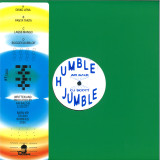
It's been a long (and fun) time but finally Ari Bald & CJ Scott are getting the international recognition they deserve, after years of meticulously crafting their own brand of pure, guilt-free, locally sourced house music, through regular releases on a
string of illustrious underground labels and, more recently, two striking EPs on their hometown label Studio Barnhus outta Stockholm, Sweden.
On the dynamic duo's new Studio Barnhus release Humble Jumble, cheekiness levels and BPM counts are pushed to their limits, with ingenious sample choices and floor-friendly arrangements spread across two slabs of DJ-optimised vinyl, arriving on February 7 2025. Comes in yellow, red and green sleeves. Stamped and numbered by the artists themselves. Limited edition of 300 copies.
![bod [包家巷] & Æthereal Arthropod - parabrutality](https://www.deejay.de/images/l/4/7/1129647.jpg)
parabrutality was composed over the course of three days, featuring vocals from Æthereal Arthropod and production from bod 包家巷.
parabrutality is defined exactly as the word's construction delineates.
the work should be considered a mantic instrument for knowledgeable and careful usage.
the artwork is derived from a photo of a tattoo given by Æthereal Arthropod to bod [包家巷] and a stone carving made in prehistory.
all track titles are encoded to a key that will only be disclosed (in addition to the source of the stone carving) in exchange for a private transfer of one thousand euros or more to paypal.me/baojiaxiang

Tesfa Williams celebrates his personal ancestry and the diversity of black electronic music with a name change on his Heist Recordings debut.
First things first. T. Williams is now Tesfa Williams. And although the dot is gone after the T, by taking that away, the artist openend up a whole world of meaning, personal storytelling and recognition of his roots.
“Originally when I started "T.Williams" it felt like my African first name Tesfa wouldn't be welcomed in the scene. Something I've experienced in general from school, college, work etc….. I grew up in a Rastafarian family with Carribean heritage and my parents decided to give me and my siblings African names to connect us to our African ancestry. I now feel like I’m ready to embrace this part of me as an artist and share it with the world.”
Tesfa Williams is an artist with a long history in UK club music. Long before his critically acclaimed debut album in 2024 ‘Raves of future past’, he was knee-deep in the UK grime scene and throughout the years, he has built a strong reputation in UK funky, soulful house and Garage with remixes of Latch for Disclosure and Sam Smith (yes, that track), bumping originals on Strictly Rhythm, Local Action with Julio Bashmore, and much more. On his debut for Heist, we see the artist dig deep into his black roots and deliver an EP that celebrates his eclectic sound with 4 originals full of high notes.
The ’Beyond today’ EP kicks off with ‘Moments Ahead’, a classic filter-house jam with lovely soulful chops and the perfect amount of grit. It’s the type of funky, peak-time house track that will ignite any dancefloor with its irresistible groove. ‘Get it together’ sees the artists layer some classic R&B vocals over an infectious warehouse groove. It’s the kind of track that’ll grab anyone’s attention on a first listen. The breakbeat loop in the background gives the percussion its dry immediacy and the sparse melodic hits and irresistible vocal chops turn this track into an absolute dancefloor monster.
On the flip, the London producer merges his love for soulful house with contemporary electronics on ‘Brighter life’. There’s something deliciously breezy about this song, where the vocals, chord hits, sweeps, and hits deliver a groove that’s laidback and powerful at the same time. The electronic parts of this track are cleverly laid out to contrast the syrupy sweet vocal and underline the class of the artist’s ability to effortlessly blend genres.
The EP closes with ‘Futures’, a bottom-heavy late-night burner much in the style of Dam Swindle’s 2023 Heist outing ‘Soul’s lament’ or the percussive goodness of Alma Negra tracks such as ‘Conversation’. There’s a nice blend of trippy electronics and driving Rhodes hits, which makes this a track perfect for those moments you simply want to go deep, heads-down, and feel the music.
With ‘Beyond Today’, Tesfa Williams has written a piece of music that pays homage to so many of the genres that have influenced him as well as to his black roots. ‘Beyond Today’ is a contemporary club record that oozes positive energy just the way we like it and we can’t wait to play this one out to all of you.
Enjoy the music and get ready to dance!
Lars & Maarten

Blue Valentine Vinyl. Sometime in 2005, a lone box of master tapes escaped an estate sale and made its way through a network of collectors, record dealers, and "junkers" into the hands of leading Ohio soul expert Dante Carfagna, who linked them to Columbus, Ohio's mysterious Prix label (See: Eccentric Soul: The Prix Label). A bit of research turned up Prix proprietor George Beter, who identified most of the unlabeled material. All it took was an endless series of phone calls and letters and two fields trips in Columbus. But one complete mystery wended its way onto our final Prix compilation. "You and Me," a simple but irrepressible demo credited only to Penny & the Quarters, was found tacked onto a mixed studio reel. Our survey of every willing lifer left on the Columbus soul scene, including retired DJs, producers, and important local artists, produced not so much as a glimmer of recognition at the name Penny & the Quarters. Though we loved the song from the first play, it may've ended up a bit buried on our original compilation, as #18 of 19 tracks.Four years later, Eccentric Soul: The Prix Label hadn't exactly become a huge seller, although listeners had repeatedly told us that the unfiltered studio demos that fill out the record's back half were true diamonds in the rough. But neither Penny nor her Quarters had appeared to claim credit for their efforts. Then, completely out of left field, we heard from respected screen actor and avowed Numero fan Ryan Gosling that Penny's piercing bit of stripped down doo-wop was being considered for inclusion in Derek Cianfrance's indie-weeper film Blue Valentine. What we didn't know was that "You and Me" had won a major role in what became an indie circuit hit, and that Penny & the Quarters would instantly assume the role of world's most famous unknown doo-wop group.Every week is a slow news week in Columbus, Ohio, and early January 2011 found the city recovering from the thrill of elevating Ted Williams_the formerly homeless guy with the awesome voice for radio_into a national news sensation. But both major daily newspapers in town, as well as the city's alternative weekly, also ran stories about how a lost and unknown Columbus soul group had become the musical centerpiece of a film already garnering Oscar buzz. That mainstream spotlight aimed at Blue Valentine and Penny & the Quarters did the trick: we finally made contact with the widow of Jay Robinson, lead Quarters' singer and songwriter. Robinson, it turned out, had also been the leader of Columbus doo-wop pioneers The Supremes (later known as "The Columbus Supremes," for reasons which should be obvious). Jay Robinson never did give up on the dream of writing a hit record; even so, the posthumous realization of his dream is cold comfort for his widow and daughter. With their blessings, we returned to those estate sale masters and pulled down another neglected track ("You Are Giving Me Some Other Love") from the still-unknown Penny and her now-partly-known Quarters. "You and Me" is a song that could not be suppressed: not when Prix failed to release it; not when Penny & the Quarters were forgotten; not when Numero stuck it at the bitter end of a much overlooked compilation. Its evolution from estate sale trash to silver-screen gold has finally returned it to big-hole 45, where it probably should have lived all along.

Released via RCA Records - Louis Dunford is a story teller, with stories that need to be told. Born under Bow bells and raised in Islington, Louis' songs are chapters straight out of his lived experiences. Sometime raw, sometimes funny and always honest, the stories are all underpinned by infectious melodic hooks. To date, he’s best known for singles including ‘Lucy,’ ‘The Local’ and ‘The Angel (North London Forever)’—an ode to his hometown, which has been adopted by Arsenal FC fans as their official club anthem. Now comes Louis’ debut album, titled Be Lucky, featuring the above mentioned singles and 11 more tracks - weaving a story of his life and observations so far.

- Jellyroll
- High-Test Fish Line
- Local Days
- Check Me Out
- Highway Blues
- I M A Lonely Man
- Sweet Lynda
- Springfield Station Theme
- Racetrack Daddy
Released in 1971, Get Off in Chicago captures the essence of an energetic concert featuring Harvey Mandel and key figures from the Chicago blues scene. Alongside Mandel, known for his innovative guitar playing, are renowned musicians such as John Bishop and Gregory E. Stinson, who contribute their talents on guitar. The rhythm section, with Peter Milo on drums and Nick Tountas on bass, anchors the tracks in a powerful groove. The album shows blazing solos, bold improvisations, and a collaborative spirit that transcends genres. This unique blend of blues, rock, and jazz highlights the collective genius of these talented artists.

The 2003 debut album and a collection of early rarities from the genuine treasure of the UK underground. Remastered and available on vinyl for the first time in over two decades. “Legendary angular rock…Edgar Allen Poe meets The Fall” (The Guardian 2003) “Jarvis Cocker fronting Fugazi” (Melody Maker 1994) Joeyfat, from Tunbridge Wells in Kent, are the daddy of all the Sprechgesang bands out there. We searched on Wikipedia; they're not even mentioned. Maybe not such a bad thing. There are young scamps climbing up festival line-ups all over the world with more than a passing sonic and aesthetic resemblance. Influence can be picked up in diluted ways, maybe the true source of the river has been forgotten. Foals heard the source, they were there. So were Everything Everything. Ask them. Black Midi heard it third hand. Life Without Buildings heard it. So did Yard Act. You can see the pattern. From the early '90s Joeyfat, led by Matt Cole and Jason Dormon, have been perfecting and re-perfecting the sound. They toured with Green Day in 1994. They released music on the Fierce Panda label. They recorded BBC Sessions for John Peel and Marc Riley and released four albums and countless singles. They flirted with being known and they didn't like what they saw so they kept it local, building a community by setting up the Tunbridge Wells Forum, one of the great UK small venues. Debut album The House Of The Fat is a masterpiece, the musical precision recalls The Sound or B52s. The spot-on attack of the vocal and lyrics makes us think of Fugazi or Zounds. The Unwilling Astronaut compiles early singles and compilation tracks. Going all the way back to 1993 it shows how close to a DC-inspired hardcore band they were, it's a thrilling listen. Joeyfat shouldn’t need a re-introduction but they’re going to get one. The source of the river. The top of the family tree. This is where the resemblance comes from

- A. You And Me
- B. You Are Giving Me Some Other Love
Blue Valentine Vinyl[15,08 €]
Sometime in 2005, a lone box of master tapes escaped an estate sale and made its way through a network of collectors, record dealers, and “junkers” into the hands of leading Ohio soul expert Dante Carfagna, who linked them to Columbus, Ohio’s mysterious Prix label (See: Eccentric Soul: The Prix Label). A bit of research turned up Prix proprietor George Beter, who identified most of the unlabelled material. All it took was an endless series of phone calls and letters and two fields trips in Columbus. But one complete mystery wended its way onto our final Prix compilation. “You and Me,” a simple but irrepressible demo credited only to Penny & the Quarters, was found tacked onto a mixed studio reel. Our survey of every willing lifer left on the Columbus soul scene, including retired DJs, producers, and important local artists, produced not so much as a glimmer of recognition at the name Penny & the Quarters. Though we loved the song from the first play, it may’ve ended up a bit buried on our original compilation, as #18 of 19 tracks.

Sometime in 2005, a lone box of master tapes escaped an estate sale and made its way through a network of collectors, record dealers, and “junkers” into the hands of leading Ohio soul expert Dante Carfagna, who linked them to Columbus, Ohio’s mysterious Prix label (See: Eccentric Soul: The Prix Label). A bit of research turned up Prix proprietor George Beter, who identified most of the unlabelled material. All it took was an endless series of phone calls and letters and two fields trips in Columbus. But one complete mystery wended its way onto our final Prix compilation. “You and Me,” a simple but irrepressible demo credited only to Penny & the Quarters, was found tacked onto a mixed studio reel. Our survey of every willing lifer left on the Columbus soul scene, including retired DJs, producers, and important local artists, produced not so much as a glimmer of recognition at the name Penny & the Quarters. Though we loved the song from the first play, it may’ve ended up a bit buried on our original compilation, as #18 of 19 tracks.

Double B is Barry from 2-X-Treme and these tracks were written at the same time as that infamous 2-X-Treme EP. Pressed by Barry on a white label and mostly hand-distributed to local south coast record shops. This is a very rare record from a Pompey rave don!
Jesse Hackett returns with another unclassifiable co-mingling of genres, this time made in collaboration with Durban-based gqom trio Phelimuncasi. The group met up in Nyege Nyege's Kampala studio last year, spending three days engineering a sequence of tracks that turned the acts' respective sounds inside out, stretching urgent vocals over mutating backdrops of time stretched electronic drums, saturated noise and unstable synths.We last heard from Hackett on last year's chilling 'Shadow Swamps', a chilly, surrealist blast of disembodied folk and vintage electronics that added a cinematic twist to industrial music. Phelimuncasi meanwhile followed their acclaimed debut with the enormous 'Ama Gogela', asserting their dominance with tight, dancefloor-fwd, hook-led jams produced by some of the scene's most important beatmakers. In collaboration, both Metal Preyers and Phelimuncasi materialized a few worlds outside their comfort zones, with the Durban trio's words frothing from Hackett's marshy productions like echoes from another universe.Opening track 'Gidigidi ka Makhelwane' erupts in a fizz of beatbox percussion that loops noisily alongside Makan Nana, Khera and Malathon's stirring vocals, delivered in their local isiZulu tongue. Hackett's process is relatively restrained, offering Phelimuncasi the space to work their rousing magic unimpeded and adding punctuation where necessary. But when he takes more of a destructive role, it's just as impressive: on 'Gqom slowgen Chant', he corrupts his rhythm into a ritualistic pulse, letting the trio's words melt into metallic clicks and nauseous atmospheres.Elsewhere on 'Mgiligi wableka', Phelimuncasi's words create a rousing rhythm against a low-n-slow gqom thud from Hackett, and on 'Coffin Roller' he brings to mind '80s video nasty soundtracks, toying with analog synth sequences against Makan Nana, Khera and Malathon's distant chants. 'Like A Corpse' might be the album's most hollowed-out banger, turning the beat into a chopped 'n screwed drag that scrapes clamorously against Phelimuncasi's gurgling raps. Needless to say, there's nothing else like this.Jesse Hackett returns with another unclassifiable co-mingling of genres, this time made in collaboration with Durban-based gqom trio Phelimuncasi. The group met up in Nyege Nyege's Kampala studio last year, spending three days engineering a sequence of tracks that turned the acts' respective sounds inside out, stretching urgent vocals over mutating backdrops of time stretched electronic drums, saturated noise and unstable synths.We last heard from Hackett on last year's chilling 'Shadow Swamps', a chilly, surrealist blast of disembodied folk and vintage electronics that added a cinematic twist to industrial music. Phelimuncasi meanwhile followed their acclaimed debut with the enormous 'Ama Gogela', asserting their dominance with tight, dancefloor-fwd, hook-led jams produced by some of the scene's most important beatmakers. In collaboration, both Metal Preyers and Phelimuncasi materialized a few worlds outside their comfort zones, with the Durban trio's words frothing from Hackett's marshy productions like echoes from another universe.Opening track 'Gidigidi ka Makhelwane' erupts in a fizz of beatbox percussion that loops noisily alongside Makan Nana, Khera and Malathon's stirring vocals, delivered in their local isiZulu tongue. Hackett's process is relatively restrained, offering Phelimuncasi the space to work their rousing magic unimpeded and adding punctuation where necessary. But when he takes more of a destructive role, it's just as impressive: on 'Gqom slowgen Chant', he corrupts his rhythm into a ritualistic pulse, letting the trio's words melt into metallic clicks and nauseous atmospheres.Elsewhere on 'Mgiligi wableka', Phelimuncasi's words create a rousing rhythm against a low-n-slow gqom thud from Hackett, and on 'Coffin Roller' he brings to mind '80s video nasty soundtracks, toying with analog synth sequences against Makan Nana, Khera and Malathon's distant chants. 'Like A Corpse' might be the album's most hollowed-out banger, turning the beat into a chopped 'n screwed drag that scrapes clamorously against Phelimuncasi's gurgling raps. Needless to say, there's nothing else like this.
Miki Yui is a musician, artist, and composer, originally from Tokyo, who has been based in Düsseldorf since 1994. Her whose work has long explored multiple forms of media, while documenting liminal zones of perception. On her latest album, As If, Yui creates a subtly connected suite of electronic music, drawn from improvisations and randomised processes that she has engaged with modular synthesis. Deeply poetic in its expression, even at its most minimal, the six pieces on As If have a curious tenor – they are, each of them, intensely sensuous, almost haptic listening experiences, as though the laser focus that Yui displays towards her compositions allows her to engage them as almost physical presences in the world.
One of the keys that unlocks the intimate complexity-in-simplicity of As If was Yui’s encounters with the Amazonian rainforest in Manaus, Brazil in 2018. Finding that the sounds in the rainforest both shadowed and echoed the music she had been making for two decades, she embraced the possibilities of modular synthesis, the sounds of which she discovered “have astonishing similarities to the sounds I experienced in the rainforest.” There is, indeed, something natural about the way these sounds bloom in real time; in their dedicated focus to the subtle development and mutation of several discrete parameters of sound, they grow slowly, gradually, their rhizomic structures suggesting that we are always situated within the middle of sound.
Sometimes, the material here has a kind of febrile energy, as on the ticking, clacking electronics of “Generativ”, a track that seems to rotate in the air in front of the listener, the light reflecting off its multiple surfaces as we catch the intricacies of its micro-patterns. Elsewhere, we slide into a cooled but welcoming environment, like the late-night fire-fly horizon of “Song 4”; there’s also the humid, dripping tropical sunset that’s documented on “Summernight”. It’s a music that’s hard to locate external coordinates for, though there are, perhaps, some parallels with the work of Laurie Spiegel, Eliane Radigue’s Vice Versa, and Pauline Oliveros’s “Roots of the Moment”. But As If is an extraordinary collection of naturally developing, rich studies for slowly mutating, enveloping, elemental electronics.

Efficient Space honours the memory of producer and MC Ali Omar with Hashish Hits, a posthumous selection from the dub rebel’s self-released discography.
One of ten children in working-class Liverpool, Omar drew deep influence from his father's Arabic heritage—a thread central to his identity and sample origins. After art school and a spell clubbing during Manchester's halcyon days, he relocated to Sydney, where he cofounded the blunted downbeat duo Atone with fellow British expatriate Andy Fitzgerald. As an MC, he infiltrated the city’s house, dub, jungle, and bass circuits, becoming a regular fixture at the Bentley Bar, where he commanded the mic with his versatile, rumbling baritone and charisma.
Freakishly talented in the studio, Omar was a pioneer of the Akai sampler and Atari, deftly recording live sessions straight to DAT. Drawing on industry insights from his sister, Merseybeat firebrand Beryl Marsden—who supported The Beatles on their final UK tour and was signed to Decca and Columbia—the non-conformist sought to build a self-sufficient business model. Between 1998 and 2004, he independently issued four albums on CD through his Hashish Studios imprint, hustling copies directly to local record stores and live shows for instant returns, even hand-sewing screen-printed hessian sleeves for his final release.
Uncompromising in his principles and refusing to suffer fools or charlatans, Omar relished the opportunity to collaborate with those who embodied the same spirit. Hashish Hits offers a snapshot of his inner sanctum—Fitzgerald on the opening track's billowing smoke stacks, the serpentine vocals of Gina Mitchell and the magic hands of mixer Louis Mitchell on 'On Release,' and Wicked Beat Sound System’s Kye on 'Poor Man Beggar Man Thief'. Meanwhile, 'Suicide Bomber' smoulders with the tension of a lost Muslimgauze relic, as the instructional 'Roll Up' and 'The Last Straw' spiral deeper into Omar’s signature production vortex— where space stretches in slow motion and walls reverberate with ricocheting delay.
A true icon of Sydney’s underground scene, the larger-than-life Omar passed away on 23 June 2009 after a valiant battle with cancer. He is remembered for his assertive spirit, larrikin humour, wild anarchic personality, and enduring mantra: “Love and live your life”.1

- Cue Cards
- Cue Cards
Like so many bands that cut their teeth playing basements, rental halls, and teen centers around the Puget Sound in the early '90s, the Olympia trio Lync may have had similar roots to the local rock heroes of the era but were conscientiously averse to the trappings of mainstream success. Lync kept the grit, the shouted vocals, and the rough-hewn choruses, but eschewed the machismo and metal swagger. Their song 'Cue Cards' is a perfect encapsulation of their overall approach-heartfelt melodies, bashed drums, hoarse throats, gritty bass lines, and fractured guitars. Lync's legacy was interwoven with fellow PNW artists like Modest Mouse, 764-Hero, and Red Stars Theory-bands that were crucial to the foundation of Suicide Squeeze Records. It only made sense for Suicide Squeeze to reissue Lync's lone LP, These Are Not Fall Colors back in 2023. And in conjunction with the reissue, Suicide Squeeze is proud to announce the second single featuring a choice cut from Fall Colors paired with a current artist's reinterpretation of the song. On their latest 7", Lync's original version of 'Cue Cards' is paired with a cover by Julia & The Squeezettes-a Suicide Squeeze-centric all-star line-up featuring Julia Kugel of The Coathangers and Julia, Julia, Staz Lindes of The Paranoyds, Bonnie Bloomgarden and Rikki Styxx of Death Valley Girls. On their rendition, Julia & The Squeezettes excise the half-time distorted bombast of the original in favor of up-tempo minimalist pop. Guitars are reduced to a few choice phrases, putting the song's luring vocals and lyrical charms at the forefront. Paired with the tasteful yet propulsive rhythm section, this new approach to 'Cue Cards' demonstrates the timeless songwriting of Lync while simultaneously showcasing the creative vision, timbral aptitude, and resourceful production savvy of four contemporary artists in the ongoing lineage of American indie rock. Suicide Squeeze is proud to release these two versions of 'Cue Cards' to the world on a pressing of 500 Ocean Blue-colored vinyl 7" singles.

Causa Sui returns with a new live album, recorded at their home turf – the legendary Copenhagen venue Loppen, located at the famous, and notorious, freetown Christiania – a venue the band has played more often than any other throughout their 20 year career.
This set is the perfect companion to last year's career highlight ‘From The Source”, which saw the band condense the multiple stylistic aspects of their sound into an awe-inspiring 47 minutes. Represented here are key cuts from that album – including the sidelong 7-part epic ‘Visions of a New Horizon” - as well as a few fan favorites such as ‘Red Sun in June” from the band's Summer Sessions series, which has never previously been released in a live version. In this rendition the band let themselves get carried away, riding on the energy of the room, soaring into jammy Grateful Dead territory. Elsewhere the band explores jazzy, improvisatory group interplay (The Spot) and get as heavy as they can (Soledad, Boozehound). Getting carried away is what Causa Sui are all about when playing live, and that mentality is captured in entirety on this set. Mixed and mastered by Jonas Munk from a multitrack soundboard recording

- Clem's Crime 05:08
- Synth Love 04:32
- Silver Skin
- Good Boy
- Will Not Dance
. The idea for the band was originally conceived by singer-guitarist Joe Woodward whilst writing and recording songs in his kitchen on a 4-track recorder, and over time eventually found help from like-minded friends, Elliot Roberts and Cam Wheeler. The three of them would spend their nights experimenting with cassette recording with the admirable if not challenging aim to recreate the symphonic sounds of Phil Spector on a DIY budget. With growing confidence and having amassed a small catalogue of songs, a few aborted attempts were made to get a live band together before they found help from a second guitarist, Eli Allison, who had recently relocated from Cornwall. As necessity would dictate, the first shows as a quartet made use of a drum machine, but the ideal formation for the band wasn’t truly complete until meeting Nia Abraham, whose live drumming would add a more physical quality to the band’s sound. At the beginning of 2024, they began working more purposefully towards an end goal with the writing and recording of the five-song Nowhere Near Today EP. Though retaining some of their home recording practices, they also made use of a studio facility based in a disused shopping centre basement that was made available through SHIFT, a local artist collective connected to the band. The acquisition of an 8-track Tascam 488MKII, along with the natural reverb of SHIFT’s empty concrete space allowed for further opportunity to experiment with both cassette recording techniques and their still developing live sound, the two environments permitting an all-too-rare creative freedom. The process was transformative for the group, their Spector-inspired ambitions now taking on a more defined shape that skirted around the edges of psych, noise-rock and industrial-pop in a way that increasingly became their own. For a debut EP, the results are impressively realised, a confluence of expansive tremolo guitars, a deliberately primordial rhythm section and a contrasting vulnerable vocal performance that’s both melodic and bracing. It’s a record born both of private experimentation and public performance, who they are on stage and what they express on record informing the other but still distinctly each their own thing, shifting then dovetailing like the waves of feedback that wash through Nowhere Near Today. Still a young band, it’s tomorrow they feel a lot closer to.

At the age of 14, Ayako Hosokawa was already performing in the American military clubs in Japan, picking up the English language by singing international pop songs of that time. Now, she represents feeling and soul within her songs, no matter whether she sings in English or Japanese. After her marriage, she moved to the United States and was discovered and sponsored by Earl "Fatha" Hines. She found enthusiastic fans touring San Francisco, Las Vegas, Montreal and lots of places in California, performing in the clubs, local radio stations or on TV. In the '80s, she started a roving life between the United States and Japan. Due to her recordings for TBM and performances for radio stations and on TV, she became one of the best-known pop and jazz singers throughout her country.
Backed by a terrific band, Ayako tackles some of the most memorable jazz standards of all time on the 1977 release To Mr. Wonderful. Couple this with spectacular sonics for a memorable and beautiful album.
