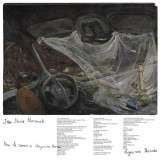
- Jean And Dinah
- From A Logical Point Of View
- Not Me
- What Is This Generation Coming To?
- Tic, Tic, Tic
- Beauty Is Only Skin Deep
- I Learn A Merengue, Mama
- Take Me Down To Lover's Row
- Mama, Looka Boo Boo
- Coconut Water
- Matilda, Matilda
- They Dance All Night
quête:logic
Roberto Cacciapaglia is an Italian composer and pianist who started out in the fertile Milan avant-garde scene of the 1970s, which included Franco Battiato, Giusto Pio, Lino Capra Vaccina, Francesco Messina, among others. After studying at the conservatory, he worked at RAI's Studio of Musical Phonology – an electronic music laboratory similar to NDR/WDR in Germany, GRM/IRCAM in France or BBC Radiophonic Workshop.
Originally released in 1979, Sei Note In Logica (Six Notes In Logic) is Cacciapaglia's second album. While his debut, Sonanze, offers a series of ambient mini-soundtracks, Sei Note presents a singular, sinuous piece. The composition is based on a finite set of musical notes, yet this limitation is the point of departure for a grand tour of possible combinations and enthralling timbres (marimbas, strings, reeds and human voice).
Like Steve Reich's Music For 18 Musicians, the joyous experiment of Sei Note is grounded in constant variation. Often doubled by multiple instruments, non-repeating patterns are exquisitely layered, while electro-acoustic signals transform and further refract through visceral effects. Within this conceptual framework, Cacciapaglia does not so much juxtapose rigid dichotomies – acoustic vs. electronic, melodic vs. dissonant, simple vs. complex – as fuse them into an expansive whole.
What started as an inspired study in Minimalism becomes a bold feat of 20th century music. Sei Note In Logica is deeply sincere and, at the same time, quite playful. With one foot firmly planted in the past and the other steeped in technology, Cacciapaglia's influence can be heard in the work of Jim O'Rourke, Fennesz and Ben Vida.
Schwefelgelb return with a brand new EP titled "Trigger". 2 original tracks pounding energy-loaded drums over catchy basslines at 138 bpm. Cleverly designed details in arrangement and sound design make this production appear like a fresh approach on the raw side of Techno. The next step in Schwefelgelb's musical evolution is a highly effective sound which combines hard stomping Techno with a tonal playfulness. Hence it seems only logical to complete this release with 2 remixes which extend the versatility further. A remix by UFO95 adds a dubby flavor whilst still being 4-on-the-floor Techno, whereas a remix by French artist Flore completely pulls it to UK Bass territory. "Trigger" will be released 29th of November on n-PLEX, 140 g colored vinyl including download code.
Formed in 2019, Lawne is the result of a meeting of minds between old friends and self confessed music nerds Joe Nicklin and Joe Martin. Their sound draws upon myriad influences with dub, electronics, hip hop, psych, jazz, post-punk and Afrobeat all somehow ingrained within the mix.
It's something that evolved during at a time of change for both of them, as Joe Nicklin explains:
"The start of this project coincided with me moving onto a canal boat, which was a hugely rewarding time of my life but not without its challenges. You can hear some of my boating vents coming through in the lyrics of Beta Pan and Ame Tova.
Another challenge during this time was trying to figure out a way of still playing and recording drums that wasn't going to break the bank. I decided to start renting a tiny storage space near Caledonian Road in North London, that I would convert into a makeshift studio and soon learned that corrugated iron sheets aren't the best walls for a drum booth. My friend cut me some curtains and a few egg boxes later we were able to insulate the thing, sort of.
These limitations meant that we had to keep recordings pretty simple and I feel like this set the tone for the whole record. Whether it was digging out my childhood bass guitar for Joe to play, squeezing every last drop out of Logic presets or mumbling into a SM57 for the first time, we made do with what we had and I'm proud of the charming thing we were able to create. I felt like I was learning on the job at times for this album and I'm grateful for what it has taught me, whilst being excited for what we can do next. As I was moving off the water and out of my lockup, the album masters were also starting to trickle through. A fitting close to that chapter of my life and the making of our first album."
Joe Martin reflects more on how their unique sound came about:
"It's interesting thinking back to the sound we were exploring when we first started writing together, and how different much of the record is to that original sound. We didn't set out a clear musical direction and that meant we were rarely constrained stylistically, we could shift between genres and feels and grooves, take inspiration from the new and the old and it still sat comfortably with what we were trying to do. I think the eight tracks we landed on illustrates that nicely.
The record's named after the self storage unit we used as a studio for many years, there's something quite poetic about parting ways with the space within weeks of the album coming out; a final homage to the place it all started."
None of Scattersun’s principal collaborators could easily meet in person. When Fax Gang and Parannoul began work on the album in 2023, they encouraged themselves to throw all caution to the wind with regard to genre and sound palette, ultimately weaving together intense strains of blown-out electronica that pull on a whole manner of stylistic threads, from two-step beats, to flashes of breakcore, cloud rap passages, and pop serenity. Jarring turns that lead to booming, emotional climaxes form the animating logic behind Scattersun. Album opener “Quiet” lulls listeners into a false sense of security before the breakdown tells them do not pay any heed to your expectations as it dismantles itself before exploding into a climax the artists describe as a spirit bomb. Such crescendos and dime-turns are all over Scattersun, defining characteristics which, in their scattered unpredictability, always culminate in enrapturing, playful mimicry of human nature.
On his latest full-length, Low End Activist swerves towards weightless grime and suspended hardcore miniatures to tell a very personal story. The UK-rooted producer continues his habit of zeroing in on a distinct approach for each release, leaving a logical breadcrumb trail of soundsystem science in his wake as he channels decades of bass absorption into 14 atmospheric cuts that prize patience and precision over obvious club functionality.
Municipal Dreams plays out as a semi-autobiographical tour through the Blackbird Leys estate that the Activist grew up on. It’s a lived reflection on inequality and the ripple effect it has in working class communities, using the sonic palette to set the mood and scattering pointed samples throughout to spell out the story.
In sampling the exhaust of a stolen Subaru Impreza, ‘TWOC’ looks back to the recreational car theft which was standard entertainment for the kids in his community. There’s an underlying idea that this ‘council estate sport’ wouldn’t have been so prevalent if there were public services and opportunities presented to the scores of disaffected youth looking for somewhere to direct their energy and frustration.
In ‘Just A Number (Institutionalised)’ LEA alludes to the shattered juvenile detention system, growing up seeing friends and family members locked up at ease with little to no support on being released back into society, just meant that the same cycles of behaviour would play out over and over.
‘Violence’ samples from a short film shot by the drama division of the Blackbird Leys Youth Club to evoke the physical threat which formed a background hum to life on the estate. The industrial mechanics of the local car factory, which served an integral role as a workplace for many in the community, gets sampled in ‘They Only Come Out At Night’ while the ‘Everyone I look up to are either junkies or criminals’ sample in ‘Broke’ looks to a lack of positive role models.
Municipal Dreams isn’t a one-note indictment of life on the estate, ‘Innocence’ captures the simplicity of a child at birth before their environment has time to shape them. The Hope interludes cut through the grim honesty of the longer tracks while a subtle thread of wry humour finds its way into some of the talking heads cutting through the signature LEA murk.
But honesty is the operative word here, and the message feels all the more meaningful at a time when the UK’s social divisions are laid bare in the wake of a devastating stretch of austerity. Returning to Blackbird Leys to shoot images for the photo-zine and album cover, the Activist found the local community centre being demolished. The local pub stands derelict, its faded Welcome sign a grimly ironic portent of the options facing children of the estate in the wider world.
Funnelling his memories, hopes and fears into a singular twist on the bass weight tradition, LEA captures evocative scenes that land somewhere between kitchen sink realism and rave futurism.
On this new LP Harry Bertoia shows why he may have been the first industrial musician. Bertoia often referred to his sound sculptures as a "collaboration with industry" and on this LP Bertoia is intentionally creating heavy, rhythmic music he described as "mechanized," "mechanical" and "factory like."
Recorded in 1971, percussion and repetition emulate the pounding rhythms of machinery on this unique pair of conceptual Bertoia compositions. Bertoia utilizes innovative performance techniques to create new sounds unheard in his ouevre. Even in the busy factory of Bertoia's mind, distant stillness rises up as Bertoia exhibits the massive amount of control he possesses over his many looming sculptures.
"Mechanization" is just one of the many sonic directions Bertoia took while composing and recording between the late 1950's and his death in 1978. He documented all of his ideas and directions in notes accompanying the hundreds of tapes discovered in his barn.
Bertoia's recordings are as much a celebration of sustained tones, intervallic relationships, healing vibrations, deep listening and shimmering harmonics as Indian Classical music, singing bowls, The Well Tuned Piano or Benjamin Franklin's glass armonica. Through these rich harmonics and pulsing pure tone, Bertoia was able to more clearly articulate his inner spirit than he could with sculpture alone – a point he made himself many times in interviews.
Harry Bertoia first came into artistic prominence in the late 1930s and his sculptural, ergonomic chairs, produced by Knoll Furniture beginning in 1952, were soon modernist furniture classics. Inspired by the resonant sounds emanating from metals as he worked them and encouraged by his brother Oreste, whose passion was music, Harry restored a fieldstone "Pennsylvania Dutch" barn as the home for this experiment in sounding sculptures which he had begun in the 1950s. Bertoia was an obsessive composer and relentless experimenter, often working late into the night and accumulating hundreds of tapes of his best performances; Oreste, too, would explore and record the sculptures' sounds during his annual visits to his brother's home in rural Pennsylvania.
Learning by experimentation was common for Bertoia and he mastered the art of tape recording, turning the Sonambient barn into a sound studio with four overhead microphones hanging from the rafters in a square formation. He would experiment with overdubbing by performing along to previous recordings, sometimes backwards, constantly improving his methods while also honing his performance skills. Bertoia was a careful editor of his own work and only chosen recordings remained, each with a date and carefully considered observations written on a note included with each tape. Through these pieces of paper a greater logic can be uncovered, a careful approach to composition, ideas, feelings and forms. The story of Sonambient barn collection will slowly be told through the release of recordings from the archive as well as installations and performances built from Bertoia's own recordings, lectures and a book.
Krauty electrocis from FACTORY FLOOR re-promoted now! The music is taken from a project originally commissioned by London's Science Museum to live score Fritz Lang's 1927 cinematic landmark, Metropolis on its 90th anniversary. The band performed the score live at the Science Museum's IMAX in April 2017 in an event that was part of the acclaimed Robots exhibition. This new release is a studio recording of the 150 minute score, recorded in its entirety and mixed by Nik Void with the exception of the tracks `Heart of Data' and `Babel' which was mixed by award-winning producer Marta Salogni. It's something of a rite of passage for electronic artists to compose music for the classic sci-fi movie Metropolis, and with the simply named Soundtrack for a Film, Factory Floor join the ranks of Giorgio Moroder and Jeff Mills. ... While Soundtrack for a Film is subtler than Factory Floor's albums, it still bears the duos signature approach. ... Soundtrack for a Film also takes Factory Floor's skill at making expansive, evolving tracks to its logical conclusion, and the album could be heard as one two-and-a-half-hour cut. Despite its length, Gurnsey and Void never lose focus thanks to their carefully chosen motifs. ... As Factory Floor balance the organic and mechanical aspects of Metropolis and their music on Soundtrack for a Film, they achieve the best of both worlds -- a commissioned work that's just as original as their own albums. - Available as a box set comprising four 12" vinyl on the band's own imprint H/O/D Records. The artwork is by British artist Haroon Mirza adapted and arranged by Nik Void in collaboration with illustrator Sam Moore.
Mysterious, multifaceted collective i Häxa have unveiled their epic self-titled, full length debut; a ground-breaking conceptual double album shaped by a collision of ancient gods and bleeding-edge technology_ Released as four distinct Parts over the course of the year, `i Häxa' now comes together as a singular vision that weaves together genre-defiant soundscapes, abstract cinema and ancient meteorological mythologies from singer-songwriter and visual artist Rebecca Need-Menear (also of electronic alt-rock duo Anavae) and forward-thinking producer Peter Miles (Architects, Dodie, Fizz). i Häxa is a ritualistic dissection of the world as we know it, a forceful separation of the monotony of modernity from the rites and rituals that for centuries formed the foundations for who we are, how we came to be and where we claim to belong. Disjointed fragments of time collide. Two sides, one of logic and one of chaos, seeking unity and balance through an expression of freedom. This is i Häxa. Whilst the album is composed of four distinct movements, each consisting of four distinct tracks themselves; pulling them apart into easily digestible, standalone singles isn't an easy feat and, as is now clear from the project's sprawling cyclic nature, was never the intention. In an age of fast fun and instant gratification, the ties that bind these works together are intended to transcend tracklisting. With aural, visual and lyrical themes freely intertwining, i Häxa is something to be consumed whole; just as it will, in time, consume you. Charting an existential journey to the very depths of what makes us who we are, with every dark corner illuminated in glitched out, discordant glory; i Häxa is a project years in the making that draws simultaneously from rituals for old gods and the modern day deification of data. i Häxa is both heartwarming and horrifying; i Häxa is ancient history and hyper-real; i Häxa is everybody and no one at all. Check out if you like Radiohead, Julie Christmas, Agnes Obel, Bjork, Fever Ray, Massive Attack, Dead Can Dance, Emma Ruth Rundle, Jenny Hval, Cult of Luna, Eivor, Zola Jesus, Marissa Nadler, Soft Moon
Uncomon tribe sound, quiet melodious, with Kputsh... you might have heard some violin/tekno is some parties ? here it is on Vinyl !!! that's something...
The whole EP brings loads of percussives ideas and fresh spirit... the whole thing is quiet sweet, and not crazy-hardcore style....
With a last track electro Punk ! A Fuck Keta anthem ^^ that all Ketakore guys will love... if they understand French language ^^
The Wild Classical Music Ensemble is a Belgian experimental rock band formed in 2007 by artists with mental disability within the social-artistic non-profit organisation Wit.h in Kortrijk. Their unique sound is a blend of punk/rock riffs, fanatical rhythms and soaring flutes and fiery synths, over which gravitate multiple, multilingual voices that scratch harshly as much as they comfort. There's something very Belgian about this harshness and noisiness. We often think of compadre Arno, from the TC Matic era. During the Covid crisis, the disabled members of the Wild Classical Music Ensemble were undoubtedly subjected more than others to the harsh conditions of confinement, alone in their rooms. Damien Magnette was still able to visit them with sound equipment. This was one of their all-too-few windows onto the world. Forbidden to meet, let alone play together, the members of Wild were nevertheless able to compose songs in tandem with Damien. The tracks were then sent to musician friends - Fabrice Gilbert, Ava Carrère, Wim Opbrouck, Shht, Arthur Satàn, Nathan Roche and Julien ZLDR - who added their artistic touch. Jean Lamoot and Carl Roosens joined the adventure, one as mixer, the other as video director. It's a result of the conditions under which it was created, this is the band's most highly-produced album, and perhaps its most accessible: frankly rock, with a great deal of freedom in production, and sometimes with a certain pop allure. Jean Lamoot's contribution to the mix had a lot to do with it. In addition, the forced slowdown allowed us to devote much more time and attention to writing the lyrics. Leader Damien Magnette says: "For over a year, we were all confined. But what about when you're a mentally handicapped person? Well, it's very different from you and me... We have the right to choose, the luxury of deciding for ourselves what rules we want to follow or not. We have free will. They don't. This series of confined songs is dedicated to all the people who have gone through this crisis, deprived of their free will. We send them our thoughts, hugs and kisses full of true love! The songs respond to a deep desire to look out for each other in adversity (the so obvious "Comment ça va?" by Johan Geenens and Wim Opbrouck, or "Waarom ben je boos" by Sébastien Faidherbe with Wim Decoene, the latter full of empathy). A sense of loneliness is logically present on the album ("Dat is mijn verdriet" by Linh Pham, a very real, very concrete and particularly touching poem, or "Loneliness", whose text was improvised by Wim), if not an understandable rage ("Je ne veux pas" and "My Frustrations"). It worth noting that on "On reste heureux", Sébastien Faidherbe composed all the parts in one go, with an optimism that stands out from the anger expressed in his other songs. Let's make no mistake: none of this is really over. All these emotions, suffering, pain and hope, speak to us far beyond this grim story of covid.
Hank Dogs – Andy Allan, his partner Piano and Lily, Andy’s daughter from a previous relationship - started out at folk clubs in London in the early 1990s before going worldwide in 1998 when legendary producer and late 60s Folk Rock guru, Joe Boyd declared them the first British act he'd loved in 30 years. Their debut album ‘Bareback’ saw them touring the US with Joan Baez and winning fans with their quiet, haunting sound featuring ethereal vocal harmonies, strong traces of blues and Celtic music and Allan’s fluid acoustic finger-picking recalling UK folk guitarists such as John Renbourn. Another part of their appeal, particularly in the States, was their ‘Carter Family’ image but then, when Andy and Piano split-up in real life, so did the band. A follow up album ‘Half Smile’ appeared in 2002 but this turned out to be their swansong. However, the story was not quite over yet.. a third unreleased album ‘Fiveways’ had been recorded before they went their separate ways and now it’s finally seeing the light of day on South London label Scratchy Records, plus the band are re-uniting for some long overdue gigs to celebrate the release. ‘Fiveways’ contains much of the Hank Dogs’ trademark English folk/US country-straddling sound. Piano’s voice bounces between early Suzanne Vega, Tracey Thorn and Mary Margaret O’Hara with occasional hints of Dolores Cranberry and Bridget St. John, while underneath the acoustic guitars run freeform tangled and Lily’s backing vocals add sky. Stand out track ‘Logic’ with its pensive lyrics and haunting guitar line recalls the way Suzanne Vega (her again) could sometimes make songs stand still in their tracks but it’s the dreamy ‘Nut’ that really captures the mood “You had me when I was sweet as a nut.. Not sweet enough” sings Piano. This is the sound of two ex-lovers still able to work together but unable to hide the odd dig here and there.. like a follow up album a couple of years later on from ‘Blood On The Tracks’. Andy sings a few songs too including the raggedy, swashbuckling ‘Gazetteer’ revolving around a ‘Pre-CBS Maple neck Sunburst bought off The Pretty Things’ and hinting at a whole lifetime of music biz escapades from watching his dad Elkan Allan produce 60s TV show ‘Ready Steady Go’ to a stint on bass in The Professionals along with Steve Jones and Paul Cook. Next year the story carries on with his long-running South East London ‘Easycome’ club night featuring in US TV queen Lena Dunham’s new Netflix series ‘Too Much’. Towards the end of the album an angelic setting of Dylan Thomas’s ‘Do Not Go Gentle Into That Good Night’ in the song ‘Nod’ recalls Christmas TOTP number ones from days gone by and captures Hank Dogs ability to transport the listener. This album is definitely one for the dreamers. FFO Pentangle, The Innocence Mission and William Blake
Orange Vinyl[29,37 €]
HOO - master builders of woozy dynamics, songs unfurl with a mysterious, hooky logic all their own to create deeply emotive, chaotic, cinematic and - surprisingly, with this album ‘III’ - indie pop tunes! Songs clocking in just over 2 or 3 minutes, driven by heavy grunge guitars & potty Moog magic, opening out at times during the breathtaking prog Ov Violence/ Evil Weeks and the epic gothy final track Method Papers. ‘III’ has been 10 years in the making and features friends Simon Rowe (Chapterhouse, Mojave 3), Ian McCutcheon (Mojave 3, Slowdive), Paul Blewett (Moon Attendant), Lee Lavender & long-time collaborator & award-winning folk artist Jackie Oates. The themes and feel of the songs meant they had to lay in wait in HOO’s church-like studio, patiently growing & spawning like a 70's Dr WHO monster. Newer songs like the almost indie disco Snake & Myself When I Am Real finally gave the album foundation. HOO songwriter Nick Holton explains “All my music, including stuff in the past with Coley Park & Neil Halstead (Slowdive), is made at home in my own studio ‘Oaki Room’, so they blend into one another and my broader life. This is why musicians like Paul Blewett, Ian McCutcheon and Simon Rowe are always in the band or on my records - because they are part of my life. I have always made music this way and intended to. Jackie’s beautiful lead on England Theme, a high for me, was a simple idea. A mirror, as is so much of what I write about, here pride and disappointment in your world. Politics, religion, conflict, human frailty & alien tentacles, the collapsing environment all feature heavily and inspire. Despite this, we aim to make these dark songs engaging & endearing, skipping about you at volume in a psychedelic fug.” “I cannot and will not explain what is going on, but ‘III’ definitely closes a door and feels the most complete work of my life” Holton concludes. ’III’ is playful, eccentric, explosive and shamelessly takes itself seriously. Finished and mastered by Heba Kadry (Beach House, Bjork, Slowdive). We hope you now enjoy HOO’s third album. “Highly recommended to those who dig cinematic dream pop & Krautrock.” Echoes & Dust “50s sci-fi meets peak Reading shoegaze. It’s an ideal soundtrack for the new normal” Mojo “Shoegaze guitars, space-folk synths, otherworldly drones & krautrock drums into soundscapes immersive, possibly hallucinogenic.” Uncut “Textural & cinematic guitar driven epic” Shindig “A place where you see shadows of ghosts and echoes of your imagination” HiFi World Highlights “50s sci-fi meets peak Reading shoegaze. It’s an ideal soundtrack for the new normal” Mojo feat ex-Slowdive & Coley Park
Black[29,37 €]
HOO - master builders of woozy dynamics, songs unfurl with a mysterious, hooky logic all their own to create deeply emotive, chaotic, cinematic and - surprisingly, with this album ‘III’ - indie pop tunes! Songs clocking in just over 2 or 3 minutes, driven by heavy grunge guitars & potty Moog magic, opening out at times during the breathtaking prog Ov Violence/ Evil Weeks and the epic gothy final track Method Papers. ‘III’ has been 10 years in the making and features friends Simon Rowe (Chapterhouse, Mojave 3), Ian McCutcheon (Mojave 3, Slowdive), Paul Blewett (Moon Attendant), Lee Lavender & long-time collaborator & award-winning folk artist Jackie Oates. The themes and feel of the songs meant they had to lay in wait in HOO’s church-like studio, patiently growing & spawning like a 70's Dr WHO monster. Newer songs like the almost indie disco Snake & Myself When I Am Real finally gave the album foundation. HOO songwriter Nick Holton explains “All my music, including stuff in the past with Coley Park & Neil Halstead (Slowdive), is made at home in my own studio ‘Oaki Room’, so they blend into one another and my broader life. This is why musicians like Paul Blewett, Ian McCutcheon and Simon Rowe are always in the band or on my records - because they are part of my life. I have always made music this way and intended to. Jackie’s beautiful lead on England Theme, a high for me, was a simple idea. A mirror, as is so much of what I write about, here pride and disappointment in your world. Politics, religion, conflict, human frailty & alien tentacles, the collapsing environment all feature heavily and inspire. Despite this, we aim to make these dark songs engaging & endearing, skipping about you at volume in a psychedelic fug.” “I cannot and will not explain what is going on, but ‘III’ definitely closes a door and feels the most complete work of my life” Holton concludes. ’III’ is playful, eccentric, explosive and shamelessly takes itself seriously. Finished and mastered by Heba Kadry (Beach House, Bjork, Slowdive). We hope you now enjoy HOO’s third album. “Highly recommended to those who dig cinematic dream pop & Krautrock.” Echoes & Dust “50s sci-fi meets peak Reading shoegaze. It’s an ideal soundtrack for the new normal” Mojo “Shoegaze guitars, space-folk synths, otherworldly drones & krautrock drums into soundscapes immersive, possibly hallucinogenic.” Uncut “Textural & cinematic guitar driven epic” Shindig “A place where you see shadows of ghosts and echoes of your imagination” HiFi World Highlights “50s sci-fi meets peak Reading shoegaze. It’s an ideal soundtrack for the new normal” Mojo feat ex-Slowdive & Coley Park
Black Truffle is pleased to announce a tenth anniversary reissue of Oren Ambarchi’s Quixotism, originally released on Editions Mego in 2014. Recorded with a multitude of collaborators in Europe, Japan, Australia and the USA, Quixotism presents the fruit of two years of work in the form of a single, LP-length piece in five parts. Quixotism takes the driving rhythmic aspect of works such as Sagittarian Domain to new levels, with the entirety of this long-form work built on a foundation of pulsing double-time electronic percussion provided by Thomas Brinkmann. Beginning as almost subliminal propulsion behind cavernous orchestral textures and John Tilbury’s delicate piano interjections, the percussive elements (elaborated on by Ambarchi and Matt Chamberlain) slowly inch into the foreground of the piece before suddenly breaking out into a polyrhythmic shuffle around the halfway mark, and joined by master Japanese tabla player U-zhaan for the piece’s final, beautiful passages.
The pulse acts as thread leading the listener through a heterogeneous variety of acoustic spaces, from the concert hall in which the Icelandic Symphony Orchestra were recorded to the intimacy of crys cole’s contact-mic textures. Ambarchi’s guitar itself ranges over this wide variety of acoustic spaces, from airless, clipped tones to swirling, reverberated fog. Within the complex web Ambarchi spins over the piece’s steadily pulsing foundation, elements approach and recede in a non-linear fashion, even as the piece plots an overall course from the grey, almost Nono-esque reverberated space of its opening section to the crisp foreground presence of Jim O’Rourke’s synth and Evyind Kang’s strings in its final moments. Formally indebted to the side-long workouts of classic Cologne techno, the long-form works of composers such as Éliane Radigue and the organic push and pull of improvised performance,
Quixotism is constantly in motion, yet its transitions happen slowly and steadily, often nearly imperceptible, the diverse elements which make up the piece succeeding one another with the logic of a dream.
At the time of its first release, Quixotism was clearly a summation of Ambarchi’s work in the years leading up to it. Now, listening back a decade later, it also seems like an arrow pointing to the future, suggesting paths that would be explored further in works to come: the pulsating guitar layers of Hubris, the album-length collaboration with Jim O’Rourke and U-zhaan on Hence, Shebang’s joyous layering and percussive drive. Now sounding better than ever in a new remaster by Joe Talia, the time is ripe to rediscover its quixotic charms.
- A1: The Scent Of Magnolia
- A2: Heartbeat (Tainai Kaiki Ii) Returning To The Womb (Remix) - Sakamoto, Ryuichi
- A3: Blackwater - Rain Tree Crow
- A4: Albuquerque (Dobro #6)
- A5: Ride
- B1: The Golden Way (Remix) - Nicola Alesini
- B2: Ghosts (Remix) - Japan
- B3: Pop Song
- B4: Every Colour You Are - Rain Tree Crow
- B5: God Man
- C1: God's Monkey
- C2: Let The Happiness In
- C3: I Surrender
- C4: Thoroughly Lost To Logic
- D1: Jean The Birdman
- D2: Cover Me With Flowers
- D3: The Boy With The Gun
- D4: River Man
- D5: Aparna And Nimisha (Dobro #5)
- E1: Midnight Sun
- E2: Orpheus
- E3: Some Kind Of Fool - Japan
- E4: Cries And Whispers - Rain Tree Crow
- E5: Wanderlust
- F3: Weathered Wall (Remix)
- F4: Bamboo Houses (Remix) - Sakamoto, Ryuichi
- F5: Come Morning (Remix) - Nicola Alesini
- F1: Laughter And Forgetting
- F2: Buoy (Remix) - Karn, Mick
First time on vinyl for David Sylvian’s 29-track career-spanning compilation from 2000.
Features key songs from Japan and Rain Tree Crow, as well as David’s Virgin Records solo years.
Also includes key collaborations with Ryuichi Sakamoto, Robert Fripp and Alesini & Andreoni.
Alongside the remixes of “Ghosts” and “Bamboo Houses”, the album features tracks such as the beautiful ‘Ride’ from the ‘Secrets of the Beehive’ sessions, two dobro pieces written with Bill Frizell and “Cover Me with Flowers” from the ‘Dead Bees On A Cake’ sessions, plus the classic “Some Kind of Fool’ taken from Japan’s sessions for ‘Gentleman Take Polaroids’.
Blu’s music has been championed by outlets like XXL, Pitchfork, Okayplayer, HipHopDX, and more. In recent years, he has been interviewed by Billboard, Complex, LA Weekly, Noisey, Red Bull Music Academy, and more. Blu has collaborated with prominent artists like The Roots, Logic, Miguel, MF DOOM, Madlib, Anderson .Paak, Lupe Fiasco, Freddie Gibbs, Aloe Blacc, Roc Marciano, Slum Village, 9th Wonder, and more. Classic 2014 album on gatefold 2LP vinyl, now available after years out of print. Good To Be Home features guest appearances by Evidence, Fashawn, Alchemist, Casey Veggies, MED, Planet Asia, Oh No, Pac Div, Strong Arm Steady, Thurz, Visionaries, Chace Infinite, Cashus King, and more. L.A. rapper Blu burst onto the scene in the late 00s with the widely acclaimed Exile collaboration Below The Heavens, igniting a West Coast hip-hop renaissance in the process. With his cool Cali demeanor and undeniable lyrical talent, Blu drew praise from fans and tastemakers alike, launching a remarkable career that continues thriving to this day. His first ever double album, the 2014 masterpiece Good To Be Home is an essential part of this story. An unapologetic celebration of Los Angeles music and culture, the album takes listeners on a vivid journey through Blu’s storied stomping grounds. With sweeping strings and hypnotic bass lines supplied by producer Bombay, Good To Be Home features a host of West Coast hip-hop luminaries, including Evidence, Fashawn, Alchemist, Casey Veggies, MED, Planet Asia, Oh No, Pac Div, Strong Arm Steady, Thurz, Visionaries, and more. A cohesive collection with 20 tracks and no filler, this classic release is now available again on vinyl after years out of print.
Finnish duo Lampen presents their second album "Halogen" on We Jazz Records, September 20. Lampen is Kalle Kalima and Tatu Rönkkö. Kalle plays guitar, Tatu plays percussions and sampler. The band makes its home between Helsinki and Berlin, where Kalima is based. Lampen's sound is reminiscent of the wide-screen meditations of the likes of Earth and The Necks, but on a territory of their own. Think meditative deep contemporary jazz drawing from way outside of the genre's borders and landing somewhere with heightened levels of low key sonic intensity. Ideas form in time and nothing is rushed, and when you land in the full eruption of the duo's force, you get there surprisingly yet logically.
As many artists before them (Gainsbourg, Snoop Dogg, Lavilliers, Sinead O'Connor…), DA BREAK embarques us to revisit their best tracks “Inna Reggae Vibe”, and invites us listeners to rediscover their repertoire with a more than ever “Roots” sound. An enchanted break that will seduce the early fans as well as reggae connoisseurs; A suspended moment with a band on their new musical quest, assuming a different side of their DNA.
The idea of an “old school reggae auto remix” had bloomed for quite a long time, with the will to dive into the 60s & 70s sound esthetics and to pay tribute to this reggae culture - this unique cultural temple they love and respect so much.
DA BREAK concerts are always rich and intense musical moments, thanks to a crew of solid musicians, so the choice to record LIVE, all in the same room, was quite obvious; with “vintage” instruments and microphones, to enjoy this warm and authentic sonic texture. The result is a “Roots & Rock Steady” album without electronics, leaning towards sweaty and rough Jazz, tropical Soul or even Gospel with sand between the toes… definitely Reggae!
DA BREAK remains DA BREAK, with its inner light, this time looking towards the Caribbean musical culture.
Given the historical influence of Jamaican Sound Systems on the American Block Parties, it seemed logical for DA BREAK to pay tribute to the artists that influenced them since day one, and still do today: Bob Marley & the Wailers, Jimmy Cliff. Culture, Toots & the Maytals, Burning Spears, The Gladiators, YellowMan, Israel Vibrations, LKJ & Mad Professor, UB40, Shaka Demus, Peter Tosh... Just to name a few.
As the 21st century was born, so Kreator underwent what was nothing less than a seismic creative rebirth. By this time, the iconic German band had released nine studio albums in the 1980s and '90s, which had established them as one of the most important metal names of these decades.In the first period, they had helped to shape and pioneer the thrash scene through such releases as 'Pleasure To Kill' (1986), 'Terrible Certainty' ('87) and 'Extreme Aggression' ('89). During the following decade, the band had opened up exciting horizons of experimentation on albums like 'Coma Of Souls' (1990), 'Renewal' ('92) and 'Endorama' ('99).
Now, though, it was time to move into a fresh era, as vocalist/guitarist Mille Petrozza explains.
“During the 1990s, we were definitely experimenting with what the band were doing. But (drummer) Ventor and I decided that for this album – our first of the new millennium – we wanted to go back to the sort of sound that we had at the start of Kreator. In other words, to get back to the reason why we began the band in the first place.”
There was also new guitarist introduced, as Sami Yli-Sirniö (who had made his reputation with Finnish band Waltari) took over from Tommy Vetterli. The latter (also known as Tommy T. Baron) had joined in 1996 and played on the 'Oucast' (1997) and 'Endorama' albums.
The producer for this album was Andy Sneap, who was now making a name for himself as one of the pre-eminent masters of this art in the modern metal world.“I had known and liked Andy since the days he had been the guitarist in Sabbat, as they were signed to Noise Records as Kreator were on that label. He was our first choice to work on this new project. I liked what he'd done for Testament on their album 'The Gathering' (released in 1999). He had given them a sound they'd never had before, and that really was what we were after. It was natural and organic, and also very modern. I remember phoning him at his Backstage Studios in England (Ripley in Derbyshire). And Warrel Dane, the vocalist in Nevermore, answered. Andy was producing their new album at the time ('Dead Heart In A Dead World', 2000). And when I heard this, again I was very impressed. So, I was delighted when he agreed to produce the new Kreator album.”
The album title came from something Petrozza had read. “In a book I came across a comment that John F. Kennedy said (in 1962). This was: "Those who make peaceful revolution impossible will make violent revolution inevitable”. I thought 'Violent Revolution' would make a good title for an album. So, I kept it in my mind for this record. I think 'Violent Revolution' is a title that makes a real impact.”
One interesting aspect of the track listing was that the 52 second instrumental 'The Patriarch' actually came after the opening song 'Reconquering The Throne'. Fans might have been expected that it would have opened the album. But for Petrozza, there was a logical reason for this not to happen. “We really wanted to lead off with a thrashing track, to show everyone what we were now doing musically. After 'Endorama', it was important that everyone should recognise this was a new era for Kreator.”
'Violent Revolution' is without question an excellent album. While in some ways it does hark back to the glories of the band's earlier days, nonetheless it does not sound at all nostalgic. The performances and production values are very much part of the contemporary era, and the strength of the compositions themselves are of the highest values. Rising to the challenge offered by a new generation of ambitious metal bands, Kreator proved they were far from being a spent force. Unlike so many of their peers, here was a band who still had so much creativity to offer, and were also clearly excited themselves by what they were doing. And when you hear the band themselves enjoying the entire process, then you know this is a bona fide revitalisation.
- A1: Weltschmerz (Intro)
- A2: Sink Fast, Let Go
- A3: Fatalist
- A4: Puritanical Punishment Beating
- A5: When All Is Said And Done
- A6: Freedom Is The Wage Of Sin
- A7: In Deference
- A8: Short-Lived
- A9: Identity Crisis
- B1: Shattered Existence
- B2: Eyes Right Out
- B3: Call That An Option?
- B4: Warped Beyond Logic
- B5: Rabid Wolves (For Christ)
- B6: Deaf And Dumbstruck (Intelligent Design)
- B7: Persona Non Grata
- B8: Smear Campaign
- B9: Atheist Runt
Napalm Death's "Smear Campaign," released in 2006, stands as a powerful statement against religious dogma and societal oppression. This album delivers free-thinking, free-form grindcore from the grind majors that dismantles religious burden myth-by-myth.
With its relentless energy and incisive lyrics, "Smear Campaign" continues the band's tradition of merging ferocious soundscapes with thought-provoking themes.
- A1: Weltschmerz (Intro)
- A2: Sink Fast, Let Go
- A3: Fatalist
- A4: Puritanical Punishment Beating
- A5: When All Is Said And Done
- A6: Freedom Is The Wage Of Sin
- A7: In Deference
- A8: Short-Lived
- A9: Identity Crisis
- B1: Shattered Existence
- B2: Eyes Right Out
- B3: Call That An Option?
- B4: Warped Beyond Logic
- B5: Rabid Wolves (For Christ)
- B6: Deaf And Dumbstruck (Intelligent Design)
- B7: Persona Non Grata
- B8: Smear Campaign
- B9: Atheist Runt
Napalm Death's "Smear Campaign," released in 2006, stands as a powerful statement against religious dogma and societal oppression. This album delivers free-thinking, free-form grindcore from the grind majors that dismantles religious burden myth-by-myth.
With its relentless energy and incisive lyrics, "Smear Campaign" continues the band's tradition of merging ferocious soundscapes with thought-provoking themes.
- A1: Weltschmerz (Intro)
- A2: Sink Fast, Let Go
- A3: Fatalist
- A4: Puritanical Punishment Beating
- A5: When All Is Said And Done
- A6: Freedom Is The Wage Of Sin
- A7: In Deference
- A8: Short-Lived
- A9: Identity Crisis
- B1: Shattered Existence
- B2: Eyes Right Out
- B3: Call That An Option?
- B4: Warped Beyond Logic
- B5: Rabid Wolves (For Christ)
- B6: Deaf And Dumbstruck (Intelligent Design)
- B7: Persona Non Grata
- B8: Smear Campaign
- B9: Atheist Runt
Napalm Death's "Smear Campaign," released in 2006, stands as a powerful statement against religious dogma and societal oppression. This album delivers free-thinking, free-form grindcore from the grind majors that dismantles religious burden myth-by-myth.
With its relentless energy and incisive lyrics, "Smear Campaign" continues the band's tradition of merging ferocious soundscapes with thought-provoking themes.
- A1: Weltschmerz (Intro)
- A2: Sink Fast, Let Go
- A3: Fatalist
- A4: Puritanical Punishment Beating
- A5: When All Is Said And Done
- A6: Freedom Is The Wage Of Sin
- A7: In Deference
- A8: Short-Lived
- A9: Identity Crisis
- B1: Shattered Existence
- B2: Eyes Right Out
- B3: Call That An Option?
- B4: Warped Beyond Logic
- B5: Rabid Wolves (For Christ)
- B6: Deaf And Dumbstruck (Intelligent Design)
- B7: Persona Non Grata
- B8: Smear Campaign
- B9: Atheist Runt
Napalm Death's "Smear Campaign," released in 2006, stands as a powerful statement against religious dogma and societal oppression. This album delivers free-thinking, free-form grindcore from the grind majors that dismantles religious burden myth-by-myth.
With its relentless energy and incisive lyrics, "Smear Campaign" continues the band's tradition of merging ferocious soundscapes with thought-provoking themes.
Defined by a riveting array of Caribbean rhythms, Etienne Charles's first album featuring his big band arrangements is a personal triumph, but Creole Orchestra is also part of a much larger Story. Drawing on material from several different commissions and projects, the album encompasses the key players from Charles's band Creole Soul and features special guest vocalists Rene Marie and Brandon Rose, plus DJ Logic (turntables).
Rhetoric & Terror is Berlin-based Hemphill’s second album since leaving Liars back in 2016.
No stranger to reinventing his approach towards composition, Rhetoric & Terror feels like we are – perhaps for the first time – opening a doorway into Hemphill’s personal life, to his disparate sonic influences, his wide-ranging journeys through philosophy, and his own reflections on his role as an artist.
Like different thoughts and feelings emerging in a state of meditation, Hemphill invites you to pause on one ‘scene’ for a moment before moving onto the next. There’s space to get lost here – both emotionally and in the colour of the album’s wide-ranging textures.
With his wife Angelika Kaswalder on vocals throughout the album and multi-instrumentalist Morgan Henderson – a longtime friend of Hemphill’s since Henderson’s time in the post- hardcore band The Blood Brothers - adding woodwind, Nonpareils is no longer simply a solo project – and it’s apparent in this openness.
The name of the album – Rhetoric & Terror – describes this split that Hemphill is making from the conceptual nature of his first solo album (2018’s Scented Pictures), and the new direction that he – perhaps – hopes to continue taking. The title comes from a chapter in Giorgio Agamben’s book, “The Man Without Content”, where he describes the concepts of rhetoric and terror to describe two different types of writers: the rhetorician and the terrorist. The terrorist is a misologist who is only into the feeling; the rhetorician is committed to logic and form.
“With Rhetoric & Terror, I wanted to start with emotions and feeling. I was playing with my kids, listening to Cocteau Twins, I have a wonderful partner, and it seemed very contrary to any sort of growth to sequester myself from this life in order to get into character as a musician. Instead, I tried to remove the boundaries between my creative life and my. responsibilities and have it all be one fluid thing. All things at all times, and trust that this will guide my music rather than more intellectual concepts or limitations.”
Despite its catalysts being in philosophy and conceptual art, Hemphill has created an album that’s deeply “emotionally available”. It’s also helped him take a new stance on life that combines his life as a partner and parent in a kind of unity with his role as the artist. It’s plain to hear as a listener – Rhetoric & Terror, despite its intimidating name, is welcoming
and playful, even during its most intense moments.
Black[19,75 €]
ORANGE/BLACK SPLATTER VINYL[21,81 €]
YELLOW/BLACK SPLATTER VINYL[21,81 €]
Black[21,81 €]
8/10 REVIEW IN METAL HAMMER : ‘’YOU GET THE FULL ON THRASH AND SLAYER-ESQUE SQUALLS OF FIRING SQUAD ALONGSIDE THE AWESOME CRUNCH OF AND GROOVE OF EXECUTIONER’S TAX (SWING OF THE AXE). IT SOUNDS IMMENSE’’
A razor sharp recording that effectively proves how lethal this band was in the flesh. As the title states this album was recorded live in Seattle at Neumos 5/28/18.
The set list is a brutal selection of cuts from the Nightmare Logic & Manifest Decimation albums + a deep cut/fan favourite: “Suffer No Fool" . 11 killer thrashing tracks full of all the fire and venom that only this band can deliver.
Black[19,75 €]
BLUE/BLACK SPLATTER VINYL[21,81 €]
YELLOW/BLACK SPLATTER VINYL[21,81 €]
Black[21,81 €]
8/10 REVIEW IN METAL HAMMER : ‘’YOU GET THE FULL ON THRASH AND SLAYER-ESQUE SQUALLS OF FIRING SQUAD ALONGSIDE THE AWESOME CRUNCH OF AND GROOVE OF EXECUTIONER’S TAX (SWING OF THE AXE). IT SOUNDS IMMENSE’’
A razor sharp recording that effectively proves how lethal this band was in the flesh. As the title states this album was recorded live in Seattle at Neumos 5/28/18.
The set list is a brutal selection of cuts from the Nightmare Logic & Manifest Decimation albums + a deep cut/fan favourite: “Suffer No Fool" . 11 killer thrashing tracks full of all the fire and venom that only this band can deliver.
Black[19,75 €]
BLUE/BLACK SPLATTER VINYL[21,81 €]
ORANGE/BLACK SPLATTER VINYL[21,81 €]
Black[21,81 €]
8/10 REVIEW IN METAL HAMMER : ‘’YOU GET THE FULL ON THRASH AND SLAYER-ESQUE SQUALLS OF FIRING SQUAD ALONGSIDE THE AWESOME CRUNCH OF AND GROOVE OF EXECUTIONER’S TAX (SWING OF THE AXE). IT SOUNDS IMMENSE’’
A razor sharp recording that effectively proves how lethal this band was in the flesh. As the title states this album was recorded live in Seattle at Neumos 5/28/18.
The set list is a brutal selection of cuts from the Nightmare Logic & Manifest Decimation albums + a deep cut/fan favourite: “Suffer No Fool" . 11 killer thrashing tracks full of all the fire and venom that only this band can deliver.
If there's one musician in the last decade that you may hear in wildly diverse musical contexts it is Belgian electric bassist and sound sculptor Farida Amadou. Not only can you enjoy the unerringly skillful command she has over her instrument but also the transformative power to reinterpret and expand her material in spontaneous and unconventional ways.
Amadou is self-taught and radically aware of her idiosyncratic relationship with the bass guitar. She neither emulates the virtuosos of the electric bass, nor does she use the instrument as a pure sound generator that merely emits humming and feedback. She takes a completely independent and unique approach. This freedom enables her to create an overwhelming wall of sound, as well as simple, clear structures that are rhythmically concise yielding a wide associative space that lands somewhere between free jazz and noise.
Her work is often concentrated and circular where motifs are established and developed outward. It is an organic sound in the literal sense of the word, constantly in motion, yet resting in itself. The three solo pieces she has recorded for Week-End Records emphasize her impressive ability to ignite ecstasy from tranquility, to fan out a whole range of moods from a few potent ideas.
These attributes make her a musician who enriches every group she plays in, because she is present with her assured and crystallized sound but refrains from being domineering. However, her strengths are even more apparent when she plays solo: the contrasts between the dark, heavy clouds of sound and the rhythmic passages, and the transitions between movements which always sound "logical" yet surprising.
Her new solo album, "When It Rains It Pours" presents Amadou as an inspired improviser who follows her musical intuition and acumen to create a truly unique soundworld. Rarely has improvised music sounded so succinct and compelling.
Wenn es in den letzten zehn Jahren eine Musikerin gegeben hat, die man in den unterschiedlichsten musikalischen Kontexten immer wieder hören will: nicht weil sie eine passable Mitspielerin wäre, sondern weil sie diese Kontexte jedes Mal bereichert und auf spontane, unkonventionelle Weise erweitert, umdeutet, in neue transformiert, dann ist es die belgische E-Bassistin und Klangskulpteurin Farida Amadou.
Sie ist Autodidaktin - und sie versteht diese Selbstaneignung des Instruments radikal. Weder eifert sie den Virtuosen des E-Basses nach, noch verwendet sie das Instrument als reinen Klangerzeuger, der bloß Brummen und Feedbacks von sich gibt. Sie geht von einem völlig eigenständigen Ansatz aus. Der ermöglicht es ihr, eine überwältigende Wall of Sound zu kreieren genauso wie einfache, klare Strukturen, die rhythmisch prägnant sind und einen weiten Assoziationsraum zwischen Free Jazz und Noise eröffnen.
Ihre Musik ist konzentriert, hat einen langen Atem, kreist um Motive, entwickelt daraus neue Linien, die Amadou im Spiel weiterverfolgt. Es ist ein im Wortsinne organischer Sound, ständig in Bewegung, dabei in sich ruhend. Die Stücke, die sie für Week-End Records aufgenommen hat, unterstreichen ihre beeindruckende Fähigkeit, aus der Ruhe die Ekstase zu entfachen, aus wenigen Ideen eine ganze Palette an Stimmungen aufzufächern.
Das macht sie zu einer Musikerin, die jede Gruppe, in der sie spielt, bereichert, weil sie präsent ist, ohne zu dominieren, weil ihr Sound so prägnant ist, ohne die anderen zu übertönen. Im Solo treten die Stärken ihres Spiels aber noch stärker hervor: die Kontraste zwischen zwischen dunklen, schweren Klangwolken und den rhythmischen Passagen, vor allem die Übergänge, die immer „logisch“ klingen, aber zunächst unerwartet kommen und ihren eigenen Weg einschlagen. Ihr neues Solo-Album, “When It Rains It Pours” zeigt sie als inspirierte Improvisatorin, die sich nie bloß ihren Einfällen hingibt, sondern die Ideen zu Ende denkt, oder besser: spielt. Selten klang improvisierte Musik so kompakt und zwingend.
Kompakt is proud to announce, finally, a reissue of the first, self-titled GAS album. Originally released on electronica imprint Mille Plateaux back in 1996, it’s been unavailable in its original form ever since – the version of GAS included in 2008’s Nah Und Fern box featured several different tracks. Here, however, GAS is restored in all its glory, the debut full-length from Wolfgang Voigt’s most enigmatic, quixotic project.
There had, of course, been signs of what was to come. Back in 1995, Voigt essayed the first GAS release, a slender, yet remarkable four-track EP, Modern. Its centre label featured a reduced symbol – an overhead or lamp light, switched on, its glow radiating outwards in four bold black lines – a perfect representation of the tight, stylised ambient electronic pop contained on that 12”. A few curious compilation tracks were floating around, too, for Mille Plateaux’s Modulation & Transformation and Electric Ladyland series. If you were attentive enough, you could tell something was up.
But nothing quite prepared us for the languorous, effervescing loops and regular-like-clockwork beats that Voigt folded together on GAS. Its six long tracks, all untitled, neither begin nor end but hazily fade into earshot, vibrate majestically in your cochlea for fifteen-or-so minutes – some a bit shorter, some longer – and then meander away, reading the mise-en-scène for the next example of Voigt’s drift and dream logic to unfold. The material is referential in the most distant way, and you can sense only the most evanescent of ghostly presences, haunting these six compositions.
GAS feels, also, like a more pliable hint at what’s to come, as the GAS concept really solidified on its successor, 1997’s Zauberberg, and reach its apotheosis on Königsforst and Pop. Those three albums share a very similar palette – blurred, hazy samples, often of classical music, stacked and cross-thatched across a muted 4/4 thud. GAS, then, is an outlier of sorts: it’s more expansive in its remit, lighter in its mood, perhaps more fleet of foot. This, of course, is part of its charm.
In clearing space for Voigt, by preparing the terrain, GAS sits both at the edge of the forest, and at the verge of an expansive, wide-eyed future; one where GAS would become truly eternal.
Text by Jonathan Dale
Kompakt ist stolz, endlich eine Neuauflage des ersten, selbstbetitelten GAS-Albums ankündigen zu können. Ursprünglich im Jahr 1996 auf dem Electronica-Label Mille Plateaux veröffentlicht, ist es seitdem nicht mehr in seiner ursprünglichen Form erhältlich – die gleichnamige Version von GAS, die 2008 in der Nah Und Fern Box enthalten war, enthielt verschiedene andere Titel. Nun liegt das 3er Album in seinem naturbelassenen Originalzustand wieder vor.
Bereits 1995 zeichnete sich mit der Maxi GAS - Modern auf Profan, sowie einigen Kompilation-Beiträgen auf Modulation & Transformation und Electric Ladyland auf Mille Plateaux dieser frühe, weltentrückte, rätselhafte GAS Sound ab, der sich erst in den sechs scheinbar endlosen, majestätisch-sprudelnden Tracks des Albums voll entfaltete. Die Musik ist von ätherischer Leichtigkeit, in der wie aus einer anderen Sphäre abstrakte Referenzen aus weiter Ferne nur andeutungsweise herüberzuwehen scheinen.
Dieser frühe, eher sphärisch-leichte, gleich einer sonnendurchfluteten (Wald-)Lichtung anmutende GAS Sound, stellt gewissermaßen den Ausgangspunkt der audiovisuellen „Welt“-Reise in den düster-romantischen Acid-Wald dar, in den sich GAS ab 1997 mit den Alben Zauberberg, Königsforst, Oktember und ab 2000 mit Pop an anderer Stelle wieder hinaus und in seine ganz eigene Ewigkeit begeben hat.
MRAK unveils a six-track collection of new material. “This is a snapshot of my reality. It is a composition, a challenge, that I took not knowing the outcome and its price - the amount of logical mazes I had to overcome and I still am. The biggest honour and most humble experience is the possibility to feel any sparkle of emotion, providing fragments of the music and the reality that I’ve developed as an artist over the years. My imprint soul and commitment to melody are adamant, as is the pledge to deliver and be loyal to this abstract entity called music; that gently accompanies our lives.” MRAK As one of the founders of Afterlife, MRAK is now reshaping the afterlife paradigma. Introducing a sharp and elegant but distinctive musical equation. On The Pledge, he presents six compositions, all bound to the Afterlife ethos. ‘The World‘ featuring vocalist braev. Sombre piano keys and urgent strings accompany energetic synth layers. ‘The Process works from a hypnotic low end, supporting a solid melody that increases in intensity as the track develops. For ‘Their Law ’MRAK teams up with David Lindmer, crafting an undulating track with captivating melodies and harmonies. With ‘Portal ’the realm of consciousness beckons us in, with a female vocal reverberating intermittently, complementing the dark bassline and bright synth lines. Penultimate track ‘The Flame features braev and Canadian vocalist Wasiu for a three-way collaboration steeped in emotion. It utilises a heartfelt vocal alongside a spoken-word segment, striking the balance between emotion and high energy. Lastly, MRAK collaborates with Omnya on the remix of ‘Never Ends’. The main melody provides an uplifting vibration, juxtaposed with the darker elements of this journey to the close of the EP…
- Various Organs
- Crow, Crow
- Night By Night (V3)
- Angelic Aye Are
- Last Summer (Ilkeston Version)
- Shark Attacks
- Two Minute Warning
- Suburban Monochrome
- Suburban Monochrome (Instrumental)
- My Mouth Is Bored
- No One Road (Early Version)
- In A Room 13 Blue Loop (Demo)
- The Long Run (Demo)
- Immaculate Mistake
- Unused Ymg Organ Riff
Young Marble Giants' "Colossal Youth" has mystified and beguiled audiences since its 1980 release. Seen by primary songwriter Stuart Moxham as "a last gasp" at making a record, Stuart insisted the one-off 7" deal offered by Rough Trade be altered to allow an entire album . . . that paid off when with a big seller which produces cover versions even from bands whose members were a decade or two away from being born on the album's release. When YMG disbanded, Stuart was at a loss; he'd never envisioned a follow-up. A series of experimental recordings made with pal Phil Legg (Essential Logic) and supported by other YMG members, musicians from This Heat and Swell Maps, old Cardiffian pals, and new friends like Vivien Goldman resulted in an album, "Embrace The Herd", as The Gist. Released just before Rough Trade made bold moves toward pop charts with Scritti Politti, The Smiths and others, the album was odd for its time, but has since taken on the lustre of genius. Years of silence followed, thereafter intermittently broken by the odd release from small labels. Stuart delved into family life, though he never stopped writing and recording. In more recent years, two retrospective compilation of lost recordings by The Gist have been released, as well as a superb collaboration with French arranger Louis Philippe, "The Devil Laughs". "Fabstract" is the final gathering of Stuart's lost recordings. Compiling long-lost YMG-era tracks with the recent brilliance of "Crow, Crow" and "Suburban Monochrome", through bits of whimsy and vastly alternate versions of fan faves, this diverse album shouldn't work . . . but it does, telling a satisfying story of an underrated talent whose mistake was following his muse, not the charts. This album precedes a new recording, years in the making, produced by Dave Trumfio, which promises to be Stuart's most complete - and original - work since "Colossal Youth". Tracks:
Biomes are little worlds of organic relationships, full of struggles, symbiosis, and sheer obsolete noise. In "De Silenti Natura," Henrique Vaz is meticulously crafting synthetic auditory biomes, sprouting from their own fuzzy logic. Unfolding across two distinct acts, the Brazilian artist interprets and replicates the complex, often ambiguous sounds of (un)natural environments, creating imaginary systems to inhabit over two sides of tape. The soundscape of the first side and title track is entirely algorithmically synthesized, with no samples used, leveraging Supercollider for real-time sound generation. The environment thus built is a flourishing one, seemingly unable to escape its own grandeur as insect-like buzzing and crackles expands into mountain ranges and forests of erupting sonorous drama. The second side introduces 'hydrophone' water synthesizers, submerged in a goldfish bowl to interface with the unfurling waves of electronic chords, creating a unique blend of damp and unwieldy sloshing movements, prismatically scattered into a luscious soundscape, and resembling everything from the bridge of a starship to the echoed drip-drip of stalactites.
Both sides of the album slowly unwrap and uncrinkle, revealing layers of hisses, distant digital choirs, warm enveloping chords, and juddering bleeps. Despite their unwieldy and strange nature, myriad elements convey a familiar sense of environment, flitting between the blossoming of new (manmade) life and the doom and destruction of the (real) world.
As the ringing of bells (fully synthetic; no samples were used) hove into view during the closing movement of side one, a simulacrum cacophony of voices is ushered in. It’s a reminder of the holy nature of sound itself, beamed into our heads intangibly. The flipside’s water ritual, frantically dunking ‘water synthesizers’ to birth swooping melodies and yawning tones, is jabbing at sleeping giants. It’s pushing and pulling the stars in the night sky into place. It’s both a simple act of beautiful creation, and a storm in a teacup.
OTOROKU is proud to reissue Evan Parker's first solo LP "Saxophone Solos". Recorded by Martin Davidson in 1975 at the Unity Theatre in London, at that time the preferred concert venue of the Musicians' Co-operative, Parker's densely woven and often cyclical style has yet to form; instead throaty murmurs appear under rough hewn whistles and calls - the wildly energetic beginnings of an extraordinary career. Reissued with liner notes from Seymour Wright in an edition of 500. "The four pieces across the two sides of Saxophone Solos - Aerobatics 1 to 4 - are testing, pressured, bronchial spectaculars of innovation and invention and determination. Evan tells four stories of exploration and imagination without much obvious precedent. Abstract Beckettian cliff-hanging detection/logic/magic/mystery. The conic vessel of the soprano saxophone here recorded contains the ur-protagonists: seeds, characters, settings, forces, conflicts, motions, for new ideas, to delve, to tap and to draw from it story after story as he has on solo record after record for 45 years. 'Aerobatics 1-3' were recorded on 17 June 1975, by Martin Davidson at Parker's first solo performance. This took place at London's Unity Theatre in Camden. 'Aerobatics 4' was recorded on 9 September the same year, by Jost Gebers in the then FMP studio in Charlottenburg, Berlin. Music of balance and gravity, fulcra, effort, poise and enquiry. Sounds thrown and shaken into and out of air, metal and wood. It is - as the titles suggest - spectacular." - Seymour Wright, 2020.
*REMASTERED ROUGH TRADE DEBUT LP LIMITED TO JUST 500 COPIES WITH EMBOSSED OUTER SLEEVE AND ORIGINAL INNER SLEEVE ON BLACK VINYL*
Dream POP, they called it. Given AR Kane’s Alex Ayuli once worked for advertising agency Saatchi & Saatchi, it’s no surprise that he and collaborator Rudy Tambala invented their own genre before critics could stick their oar in. It was a canny move, but more importantly, it was accurate: the music of AR Kane was made for dreamers, by dreamers, and its languor and longing made it particularly bewitching listening; their music is often smeared and blurry, happily lost in its own indefinable pleasures. “We wanted dream pop,” Tambala says, “that feeling of a dream where the rules are different. Dream logic.”
-UNCUT REISSUE OF THE MONTH
"A.R. Kane carved out a unique musical path, welding elements of pop, psych, dub, electronica, funk, noise, jazz, ambient and more in a way that had never been done before. Or since. Their debut in particular is a work of unbridled brilliance."
*Electronic Sound*
‘Sixty Nine’ the group’s debut LP that emerged in 1988 had critics and listeners struggling to fit language around A.R. Kane’s sound. As a title it was telling - the year of ‘Bitches Brew’, the year of ‘In A Silent Way’, the erotic möbius between two lovers - and as originally coined by the band themselves, ‘dream pop’ (before it became a free-floating signifier of vague import) was entirely apposite for the music A.R. Kane were making. Crafted in a dark small basement studio in which Tambala recalls the duo had “complete freedom - We wanted to go as far out as we could, and in doing so we discovered the point where it stops being music”. There was an irresistibly dreamy, somnambulant, sensual and almost surreal flow to ‘sixty nine’s sound, but also real darkness/dankness, the ruptures of the primordial and the reverberations of the subconscious, within the grooves of remarkable songs like ‘Dizzy’ and ‘Crazy Blue’. Alex’s plangent vocals floated and surged amidst exquisite peals of refracted feedback but crucially there was BASS here, lugubrious and funky and full of dread, sonic pleasure and sonic disturbance crushed together to make music with a center so deep it felt subcutaneous, music constructed from both the accidental and the deliberate, generous enough to dance with both serendipity and chaos. ‘sixty nine’ remains - especially in this remastered iteration - ravishing, revolutionary – Neil Kulkarni
"A.R. Kane made some of the most exciting, forward-thinking, and science fictional music of their era".s*
LUMBEROB has always strived for maximalist sonic vaudeville, always hoped for real electro gabber hardcore noise art, always grabbed for frenzied illegibility, always lurched loosely improvised from a psych-swamp of love. On the new album, HUNTER GATHER, LUMBEROB swings swanky as proper pop deviance. Built from the same loopy logic which drives the stomping slaphappy force of his live show, these tunes are crafted out of lovely and weirdly thunk out loud and large soundscapes. Mixed and mastered by Shimmy-Disc founder Kramer (Daniel Johnston, JD Pinkus, Pan American), the album surprises, estranged from obvious categorization. These slippery little bouncy bangers are bold exercises in genre discovery. It sounds like nothing and it goes with everything. LUMBEROB is a tough act to follow, a surreally inventive performer who spins giddy with excitement, dancing dumb and banging hard. That's just what he does, and HUNTER GATHER is a refined encapsulation of that energy. There's truly a beautiful stupidity to be found here. HUNTER GATHER is noise-pop, art-rock, psych-primitive, dumb-dance. The album teams with bright sounds, spinning visions, and brut poetics. It curves furiously like a naughty noodle and, yes, it spins you dizzy at times. Nothing is old in that feeling ever. Listen loudly.
- A1: Hello 00 27
- A2: A Love From Outer Space 05 08
- A3: Crack Up 04 12
- A4: Timewind 00 15
- A5: What's All This Then? 04 03
- A6: Snow Joke 04 46
- A7: Off Into Space 00 04
- B1: And I Say 02 42
- B2: Yeti 00 11
- B3: Conundrum 02 32
- B4: Honeysuckleswallow 03 20
- B5: Long Body 01 21
- B6: In A Circle 04 37
- C1: Fast Ka 00 27
- C2: Miles Apart 03 01
- C3: Pop 03 40
- C4: Mars 00 20
- C5: Spook 03 10
- C6: Sugarwings 03 37
- D1: Back Home 00 07
- D2: Down 05 14
- D3: Supervixens 05 40
- D4: Insect Love 02 52
- D5: Sorry 00 05
- D6: Catch My Drift 05 40
- D7: Challenge 00 06
*REMASTERED ROUGH TRADE DEBUT LP LIMITED TO JUST 500 COPIES WITH EMBOSSED OUTER SLEEVE AND ORIGINAL INNER SLEEVE ON BLACK VINYL*
Dream POP, they called it. Given AR Kane’s Alex Ayuli once worked for advertising agency Saatchi & Saatchi, it’s no surprise that he and collaborator Rudy Tambala invented their own genre before critics could stick their oar in. It was a canny move, but more importantly, it was accurate: the music of AR Kane was made for dreamers, by dreamers, and its languor and longing made it particularly bewitching listening; their music is often smeared and blurry, happily lost in its own indefinable pleasures. “We wanted dream pop,” Tambala says, “that feeling of a dream where the rules are different. Dream logic.”
-UNCUT REISSUE OF THE MONTH
"A.R. Kane carved out a unique musical path, welding elements of pop, psych, dub, electronica, funk, noise, jazz, ambient and more in a way that had never been done before. Or since. Their debut in particular is a work of unbridled brilliance."
*Electronic Sound*
‘Sixty Nine’ the group’s debut LP that emerged in 1988 had critics and listeners struggling to fit language around A.R. Kane’s sound. As a title it was telling - the year of ‘Bitches Brew’, the year of ‘In A Silent Way’, the erotic möbius between two lovers - and as originally coined by the band themselves,
‘dream pop’ (before it became a free-floating signifier of vague import) was entirely apposite for the music A.R. Kane were making. Crafted in a dark small basement studio in which Tambala recalls the duo had “complete freedom - We wanted to go as far out as we could, and in doing so we discovered the point where it stops being music”. There was an irresistibly dreamy, somnambulant, sensual and almost surreal flow to ‘sixty nine’s sound, but also real darkness/dankness, the ruptures of the primordial and the reverberations of the subconscious, within the grooves of remarkable songs like ‘Dizzy’ and ‘Crazy Blue’. Alex’s plangent vocals floated and surged amidst exquisite peals of refracted feedback but crucially there was BASS here, lugubrious and funky and full of dread, sonic pleasure and sonic disturbance crushed together to make music with a center so deep it felt subcutaneous, music constructed from both the accidental and the deliberate, generous enough to dance with both serendipity and chaos. ‘sixty nine’ remains - especially in this remastered iteration - ravishing, revolutionary – Neil Kulkarni
"A.R. Kane made some of the most exciting, forward-thinking, and science fictional music of their era".
*Reissue Of The Week In The Quietus*