Running Back is delighted to introduce RB Studio Sessions, a new sub-imprint of music envisioned, recorded and fully realised at Running Back’s in-house studio.
Built on the promise of unfettered creative freedom and aided by agreeable local autobahn connections in the Hesse region, the RB Studio Sessions project is christened with the work of Running Back’s founder, chief dreamer, and Geschäftsführer, Gerd Janson.
For this debut edition, he is joined for a momentous jam by the new-school hero of the house, good friend and kindred spirit, Narciss.
Just as Running Back’s earliest releases dropped a stylus to preserve timeless ideals of club culture, the four tracks on ‘No Maze Like Heaven’ further this continuum by turning back the sonic clock just a decade or so. Picture, if you will, a nascent Narciss, youthfully club
hopping and deeply inspired by the selections of Gerd himself, alongside a selection of DJs coaxing the Panorama Bar blinds open with exquisite, mid-tempo precision.
As such, new light immediately floods in for ‘Chicco’s Chips’, which captures many of those irresistible elements—Italo-tinted synths, hooky vocals, and perfect percussion— regenerated with the wide-eyed, high energy of Narciss’s own solo productions. ‘Elka,
meanwhile, is a richer, deeper dish, masterfully interlocking multiple heavenly melodies under layers of optimistic analogue fuzz.
Narciss and Gerd then look to the Netherlands for further collaboration with one of electronic music’s best-loved vocalists and another fine producer, Coloray, who fills ‘Look For You’ with a yearning performance in the vulnerable, synth-pop tradition. Finally, ‘No
Maze Like Heaven’ builds on this mood and melody for a finale that hits the sweet spot between machine power and oh-so-human emotion.
Featuring labyrinthian artwork from the mighty Gasius., via a sleeve that appears to blend M.C. Escher with MC Hammer, ‘No Maze Like Heaven’ proves to be a divine foundation of RB Studio Sessions. For Narciss, “a memory they will cherish forever.”
For Gerd, a taxdeductible working lunch. For DJs and dancers? Four ebullient hits-in-waiting, sounding great and meaning more.
Buscar:love machine
Hard Times proudly welcomes a new release from an artist deeply connected to the label’s storied past. Alex Arnout presents BLACK LOGIC with their debut EP, ‘Pull Up’, a project born from passion, collaboration, and a return to House music's soulful roots
Hailing from West Yorkshire, Arnout spent his formative years on the Hard Times dancefloors, absorbing the beats and vibes that would later shape his own productions. His journey with the label reignited when he was invited to remix Michael Watford’s classic 'Love Change Over' and Steve Silk Hurley’s fresh hit 'All I Need'. Now, he returns with something truly special
“Black Logic was born out of the pandemic,” says Arnout. “I wanted to move away from drum machines and synths, getting back to sampling jazz and the deep house sounds of the ‘90s - taking inspiration from artists like Bugs in the Attic, Jazzanova, and Ernest Saint Laurent.
What began as a solo project soon evolved into a collective effort. Bassist and guitarist Alan Riggs, a former member of Delta 5, joined the sessions, bringing warmth and groove to the productions. Vocalists Tempo O’Neil, Anthony Beckford, Mariana Orsho, and Sophie Barker added their distinct voices, completing the vision.
The ‘Pull Up’ EP is the first of a debut double-header from Black Logic, delivering five stunning tracks that blend jazzy keys, deep grooves, and rich, soulful vocals. From the warm basslines to the celestial closing moments, this EP is a statement of intent - a wonderfully fresh, yet nostalgic take on deep house from a collective of masterful musicians.
- A1: Montego Bay - Everything (Paradise Mix) 04 59
- A2: Atelier - Got To Live Together (Club Mix) 06 06
- A3: Golem - Music Sensations 04 56
- B1: The True Underground Sound Of Rome Feat. Stefano Di Carlo - Gladiators 05 26
- B2: Eagle Parade - I Believe 04 26
- C1: Dj Le Roi - Bocachica (Detroit Version) 05 28
- C2: Green Baize - Synthetic Rhythm 01 41
- C3: M.c.j. Feat. Sima - Sexitivity (Deep Mix) 05 30
- D1: Kwanzaa Posse Feat. Funk Master Sweat - Wicked Funk (Afro Ambient Mix) 06 31
- D2: Progetto Tribale - The Bird Of Paradise 06 29
- D3: Mbg - The Quite 06 59
Vol 1[28,99 €]
Googling “paradise house”, the first results to pop up are an endless list of European b&b’s with whitewashed lime façades, all of them promising “…an unmatched travel experience a few steps from the sea”. Next, a little further down, are the institutional websites of a few select semi-luxury retirement homes (no photos shown, but lots of stock images of smiling nurses with reassuring looks). To find the “paradise house” we’re after, we have to scroll even further down. Much further down.
It feels like yesterday, and at the same time it seems like a million years ago. The Eighties had just ended, and it was still unclear what to expect from the Nineties. Mobile phones that were not the size of a briefcase and did not cost as much as a car? A frightening economic crisis? The guitar-rock revival?! Certainly, the best place to observe that moment of transition was the dancefloor. Truly epochal transformations were happening there. From America, within a short distance one from the other, two revolutionary new musical styles had arrived: the first one sounded a bit like an “on a budget” version of the best Seventies disco-music – Philly sound made with a set of piano-bar keyboards! – the other was even more sparse, futuristic and extraterrestrial. It was a music with a quite distinct “physical” component, which at the same time, to be fully grasped, seemed to call for the knotty theories of certain French post-modern philosophers: Gilles Deleuze, Félix Guattari, Paul Virilio... Both those genres – we would learn shortly after – were born in the black communities of Chicago and Detroit, although listening to those vinyl 12” (often wrapped in generic white covers, and with little indication in the label) you could not easily guess whether behind them there was a black boy from somewhere in the Usa, or a girl from Berlin, or a pale kid from a Cornish coastal town.
Quickly, similar sounds began to show up from all corners of Europe. A thousand variations of the same intuition: leaner, less lean, happier, slightly less intoxicated, more broken, slower, faster, much faster... Boom! From the dancefloors – the London ones at least, whose chronicles we eagerly read every month in the pages of The Face and i-D – came tales of a new generation of clubbers who had completely stopped “dressing up” to go dancing; of hot tempered hooligans bursting into tears and hugging everyone under the strobe lights as the notes of Strings of Life rose up through the fumes of dry ice (certain “smiling” pills were also involved, sure). At this point, however, we must move on to Switzerland.
In Switzerland, in the quiet and diligent town of Lugano, between the 1980s and 1990s there was a club called “Morandi”. Its hot night was on Wednesdays, when the audience also came from Milan, Como, Varese and Zurich. Legend goes that, one night, none less than Prince and Sheila E were spotted hiding among the sofas, on a day-off of the Italian dates of the Nude Tour… The Wednesday resident and superstar was an Italian dj with an exotic name: Don Carlos. The soundtrack he devised was a mixture of Chicago, Detroit, the most progressive R&B and certain forgotten classics of old disco music: practically, what the Paradise Garage in New York might have sounded like had it not closed in 1987. In between, Don Carlos also managed to squeeze in some tracks he had worked on in his studio on Lago Maggiore. One in particular: a track that was rather slow compared to the BPM in fashion at the time, but which was a perfect bridge between house and R&B. The title was Alone: Don Carlos would explain years later that it had to be intended both in the English meaning of “by itself” and like the Italian word meaning “halo”. That wasn’t the only double entendre about the song, anyway. Its own very deep nature was, indeed, double. On the one hand, Alone was built around an angelic keyboard pattern and a romantic piano riff that took you straight to heaven; on the other, it showcased enough electronic squelches (plus a sax part that sounded like it had been dissolved by acid rain) to pigeonhole the tune into the “junk modernity” section, aka the hallmark of all the most innovative sounds of the time: music that sounded like it was hand-crafted from the scraps of glittering overground pop.
No one knows who was the first to call it “paradise house”, nor when it happened. Alternative definitions on the same topic one happened to hear included “ambient house”, “dream house”, “Mediterranean progressive”… but of course none were as good (and alluring) as “paradise house”. What is certain is that such inclination for sounds that were in equal measure angelic and neurotic, romantic and unaffective, quickly became the trademark of the second generation of Italian house. Music that seemed shyly equidistant from all the rhythmic and electronic revolutions that had happened up to that moment (“Music perfectly adept at going nowhere slowly” as noted by English journalist Craig McLean in a legendary field report for Blah Blah Blah magazine). Music that to a inattentive ear might have sounded as anonymous as a snapshot of a random group of passers-by at 10AM in the centre of any major city, but perfectly described the (slow) awakening in the real world after the universal love binge of the so-called Second Summer of Love.
For a brief but unforgettable season, in Italy “paradise house” was the official soundtrack of interminable weekends spent inside the car, darting from one club to another, cutting the peninsula from North to centre, from East to West coast in pursuit of the latest after-hours disco, trading kilometres per hour with beats per minute: practically, a new New Year’s Eve every Friday and Saturday night. This too was no small transformation, as well as a shock for an adult Italy that was encountering for the first time – thanks to its sons and daughters – the wild side of industrial modernity. The clubbers of the so-called “fuoriorario” scene were the balls gone mad in the pinball machine most feared by newspapers, magazines and TV pundits. What they did each and every weekend, apart from going crazy to the sound of the current white labels, was linking distant geographical points and non-places (thank you Marc Augé!) – old dance halls, farmhouses and business centres – transformed for one night into house music heaven. As Marco D’Eramo wrote in his 1995 essay on Chicago, Il maiale e il grattacielo: “Four-wheeled capitalism distorts our age-old image of the city, it allows the suburbs to be connected to each other, whereas before they were connected only by the centre (…) It makes possible a metropolitan area without a metropolis, without a city centre, without downtown. The periphery is no longer a periphery of any centre, but is self-centred”.
“Paradise house” perfectly understood all of this and turned it into a sort of cyber-blues that didn’t even need words, and unexpectedly brought back a drop of melancholic (post?)-humanity within a world that by then – as we would wholly realise in the decades to come – was fully inhuman and heartless. A world where we were all alone, and surrounded by a sinister yellowish halo, like a neon at the end of its life cycle. But, for one night at least, happy."
Man-of-the-minute Jorg Kuning returns to Facta & K-LONE’s Wisdom Teeth imprint with ‘Elvers Pass’: a new 6-track exposition of his singular sound, and his most accomplished and comprehensive work to date. By now, the Jorg Kuning trademark is well established. Cherrypicking influences from the wiggiest ends of tech house, electro and bass music, his music is instantly set apart by his totally unique sound palette.
In fact, it’s hard to think of another club artist who has emerged with such a distinct and recognisable voice in recent years. Bubbling and funky with that unmistakable dose of wonk, you can tell a Jorg Kuning tune the minute it enters the mix. Since last appearing on Wisdom Teeth with 2022’s ‘Chosta-del-sol’ EP, the Welshpool-based artist has become a cult name on the global club and festival circuit - his must-see live set turning heads wherever he pitches up. Anybody who frequents the summer circuits around Freerotation, Love International, Gottwood and Dimensions will know exactly what we’re talking about. Along the way he has picked up a number of ardent and outspoken fans, including Lukas Wigflex and Koreless - the latter of whom tapped Jorg for a stellar remix on last year’s ‘Deceltica’ EP on Young. On ‘Elvers Pass’, Jorg manages to ring an exceptionally rich diversity of life from the circuitry of his modular machines.
The record’s melodies flutter and swirl like deep-sea creatures, and his synths ooze as if dredged from some primordial swamp. More so than ever, a host of otherworldly voices have begun to creep into his music: ‘Mercedes’ centres around a fluttering chorus of disembodied vocal chops, while ‘Synthetic Squashies’ rocks back and forth on a looping dialog between two AI chatbots. Across the record, synths mimic animal vocal tones, from the belching bass licks on ‘Skudde’ to the amphibious synth groans on ‘Teen Frogue’. Playful, oddball and in a class of its own, ‘Elvers Pass’ is a welcome New Year offering for ravers and club adventurers worldwide.
QUEENDOM is an album that marks a new era for the project while staying true to the essence of Minuit Machine. Produced under the SYNTH RELIGION label, this opus immerses us in Amandine's introspective realm, oscillating between darkness and light, between doubt and self-conquest. While retaining the emotional DNA of previous productions, QUEENDOM stands out with a more pop-oriented touch, featuring tracks where Amandine sings in French for the first time.
The first single, "HOLD ME," is a powerful pop anthem addressed to the queer community, celebrating the freedom to be oneself and breaking free from societal and patriarchal norms. This track is a true empowerment statement, with striking electro beats supporting a strong message of emancipation and pride.
"Créatures," a collaboration between RAUMM and Minuit Machine, is a modern fairy tale—a timeless love story that could take place in any era. This salvific love, rarely seen today, embodies a poignant depth and beauty.
Continuing the journey, "Cent Fois"—a French-written track—takes us into a techno-pop universe with nostalgic yet hopeful undertones. This song perfectly reflects Minuit Machine's evolution toward a more radiant approach while staying faithful to its dark heritage.
"Party People," on the other hand, is a return to roots with dark wave/italo sounds. This hypnotic and haunting track questions identity in an increasingly robotic society, where individuals are forced to conform to imposed norms. This exploration of the individual versus the collective lies at the core of Minuit Machine's DNA.
"Mes Souvenirs," created in collaboration with Rebeka Warrior, dives intimately into the memories of Amandine and Rebeka. Together, they reveal fragments of their past—precious and vibrant memories that resonate through powerful and melancholic electro sounds.
Finally, the eponymous track "Queendom" invites us to plunge into the depths of Amandine's world—a universe that is both tormented and icy, yet resilient. Supported by a slow and captivating rhythm, this track is designed to grip and haunt the listener, like an incantation.
QUEENDOM is a bold and hybrid work where each track reflects a pursuit of sincerity and artistic reinvention while maintaining the ability to express emotions through rhythms that are both danceable and introspective. The album showcases Minuit Machine's artistic maturity, establishing itself as a must-listen in the darkwave and electronic pop scene.
Amandine entrusted the artistic direction of this album to Manon Dupeyrat, a brilliant young artist who crafted a bespoke universe perfectly aligned with the produced tracks. The album cover, both intimate and anachronistic, invites listeners into Amandine's private world through her bedroom, revealing what she wishes to share.
Recut, the elusive DJ and producer whose roots trace back to Southern Italy but whose sound resonates globally, is back with a scorching new release titled "Narcotic Tango". This four-track EP, out on vinyl only, is a deep dive into the raw energy of Acid House and Chicago's underground, delivering an unforgettable experience for both DJs and dancefloors alike.
Opening with "Narcotic Tango", Recut lays down a track with intense rhythmic drive. The throbbing bassline and shimmering hi-hats combine with a tantalizing arpeggio that elevates the track to a hypnotic level. It’s a club banger with an irresistible groove, and once you’ve heard it, you won’t forget it. Next up, "Acid Street" transports listeners into a world of deep, dark synthetic atmospheres. The pounding drum machine and the rumbling analog bassline carry the track forward like an unstoppable force, while the overall vibe conjures a sense of gritty dancefloor energy that never lets up. "Jack On Acid" brings the heat with an unapologetically raw Chicago-inspired sound.
With a deep, looping acid groove and a steady, driving rhythm, it channels the essence of the Windy City’s storied dance music tradition, offering pure, unfiltered Acid House energy. Finally, "Feel The Heat" kicks things into overdrive with its infectious blend of New York house and Latin-infused vibes. This track is all about dancing until the break of dawn, breaking boundaries with its smooth yet aggressive energy and contagious rhythm. Recut’s unmistakable style shines through, blending the wild, experimental spirit of Acid House with the raw, soulful energy of Chicago House. Whether you're a vinyl collector, a club DJ, or simply a lover of pure dancefloor joy, this EP is an essential addition to your collection. A seasoned DJ and producer with a passion for underground sounds, Recut has been carving his name in the electronic music scene for years. With his eclectic mix of influences and cutting-edge production skills, he continues to push boundaries and captivate audiences worldwide.
ascha Funke is creating a long overdue monument to an almost forgotten cultural artefact of the GDR: the ‘Germina Speeder’ was the only skateboard made in East Germany before reunification and was launched in 1986. It was produced by VEB Schokoladen-Verarbeitungsmaschinen (a state-owned chocolate processing machine factory) in Wernigerode and was therefore affectionately known as the ‘chocolate board’. However, it was hardly suitable for actual skateboarding due to technical inadequacies. It is not known whether Sascha himself owned such a board, but the tracks on the ‘Germina Speeder’ EP definitely roll better than the original. The opener ‘Blaupunkt’ breathes the euphoric spirit of the legendary Berlin club ‘E-Werk’, while the title track would have been more at home at the ‘Dubmission’ parties in the Turbine. Sascha leaves the 90s behind with radiant positivism; ‘Bo Knows’ sounds more like a 2000s open air at Café Schönbrunn. The EP closes with ‘Mastermind’, a high-octane psy-proghouse banger that, like all four tracks, quotes the past but still has both feet on today’s dance floors. Or rather, is dancing. 4:1 for love!
Sascha Funke setzt einem nahezu vergessenen Kulturgut der DDR ein längst überfälliges Denkmal: Der “Germina Speeder” war vor der Wende das einzige in Ostdeutschland hergestellte Skateboard und kam im Jahre 1986 auf den Markt. Es war ein Erzeugnis des VEB Schokoladen-Verarbeitungsmaschinen aus Wernigerode und wurde daher liebevoll auch als “Schoko-Board” bezeichnet. Zum eigentlichen Skateboardfahren war es allerdings aufgrund von technischen Unzulänglichkeiten kaum zu gebrauchen. Ob Sascha selbst ein solches Board besaß ist nicht überliefert, aber die Tracks auf der “Germina Speeder” EP rollen allemal besser als das Original. Der Opener “Blaupunkt” atmet den euphorischen Geist des legendären Berliner Clubs “E-Werk”, während der Titeltrack eher bei den “Dubmission” Parties in der Turbine gelaufen wäre. Mit strahlendem Positivismus verlässt Sascha die 90er; “Bo Knows” klingt eher nach einem 2000er Open Air am Café Schönbrunn im Volkspark Friedrichshain. Die EP schließt mit “Mastermind”, einem hochoktanigen Psy-Proghouse Knaller, der wie alle vier Tracks zwar das Vergangene zitiert, aber dennoch mit beiden Füßen auf den Tanzflächen von heute steht. Beziehungsweise tanzt. 4:1 für die Liebe!
Welcome to 'Instrumental Dubs #3', the ongoing series that delves into the world of the Dub Version and beyond. Side one explores the axis of UK Street Soul and Reggae with the opening two tracks produced by Howard Hill and originally released on his Passion Enterprises label in the late eighties. Both 'Versions' have a machine lead rhythm section paired with a reggae skank and snippets of soulful vox. The Proto House of Protek's 'I Love to Dance With You' featured on a Jura Soundsystem DJ Mix for Planet Trip, a one off single from the now sadly deceased Errol Parkes that's been re-edited with love by The Nightlark from Edinburgh.
The B side features The Cool Notes 'Natural Energy', which isn't strictly speaking a Dub Version, but it has that vibe with a primarily instrumental backing track featuring sparse vocals and spacey FX. The album closes with a secret weapon of Ilija Rudman 'Dub 4 Love' that pays homage to a famous track from Acid House's heyday.
Pressed on 180g Heavyweight Vinyl with full sleeve jacket design by Bradley Pinkerton.
Neuauflage zum 30-jährigen Jubiläum!
Zum ersten Mal seit seiner ursprünglichen Veröffentlichung im Jahr 1994 auf Vinyl erhältlich und jetzt auf über 2 LPs verteilt, um ein besseres Klangerlebnis zu bieten.
Das Doppelvinyl wurde von Frank Arkwright in den Abbey Road Studios geschnitten und von Robin Proper-Sheppard aus der Band betreut.
The God Machine waren eine alternative Rockband, die 1990 in San Diego gegründet wurde und in ihrer kurzen Lebensspanne zwei sehr einflussreiche Alben auf Fiction Records veröffentlichte, 'Scenes From The Second Storey' (1992) und 'One Last Laugh In A Place of Dying' (1994).
Jim Chancellor, Chef von Fiction, schreibt: "The God Machine sind einer der unbekanntesten Influencer dessen, was heute als Post Rock / Metal bekannt ist." Er zitiert Lobeshymnen von so unterschiedlichen Künstlern wie Tool, Rage Against the Machine, Mogwai, Converge und vielen mehr.
Arun Starkey von Far Out – The Independent Voice of Culture trifft den Nagel auf den Kopf, wenn er sagt: "The God Machine klingen wie nichts, was vor ihnen kam. Sie klingen wie The God Machine, was auch immer das ist, und der Name hätte nicht passender sein können."
Obwohl sie begeisterte Kritiken für ihre zwei bahnbrechenden Alben und Live-Auftritte als Support von Nick Cave & The Bad Seeds, The Cramps, The Fall, My Bloody Valentine und The Jesus and Mary Chain erhielten, litt die Band darunter, zwischen zwei Stühle zu fallen, weil sie "zu Indie für das amerikanische Publikum und zu rockig für das britische Publikum" war.
In memory of a long lost friend, Patas comes forth with a relic of a vinyl release in the name of that loved one, featuring one dreamy side in memoriam of the flesh, and one bouncy side for the spirit.
Title track starts it out in a lush and vibrant synthworld pairing up with a dubby techno groove, whole track foaming over with saudade, an emotional concoction of joy interlaced with melancholic sadness, one part looking back in tears, the other going forward with a subtle smile.
ILU 2 MUCH takes a bit too much sweet emotions stuff and turns it into a restless standstill.
Flip the record over and you get two certified dancefloor scorchers in different trajectories. Bontelabo is a deep and trippy broken beat keepsake using only sampled guitar for its harmonic and melodic content.
Og Sa ? is a fresh take on the techno tool, constantly flipping and changing up the material around some good ol machine funk, a tune for all the serious clowns looking to get down.
Follow-up album to cult-classic debut, Mantra Moderne.
‘Melodi’ is the second album from captivating duo Kit Sebastian (aka Kit Martin and Merve Erdem). Those familiar with the band's cult classic 2019 debut record 'Mantra Moderne' will instantly recognise their unique sound that blurs boundaries of world music, jazz and psychedelia. Not to be content replicating the same album, sonically the feel of ‘Melodi’ is a maturation. It is more diverse and provides glimpses into many different worlds from the Italian Riviera to the mountains of the Caucasus, the beaches of Bahia to the city streets of Istanbul and Paris. This joyous merging of soundscapes evokes a borderless planet with music as an international language, belonging everywhere and nowhere.
‘Melodi’ is imbued with Kit Sebastian's love of vintage records and world cinema, but it is not a retro homage. It celebrates its influences but is very much a modern record, being simultaneously brand new and retro. This is a credit to the duo's craft as musicians and songwriters, presenting their influences as a circular interaction between the present and the past rather than a linear one.
The music was written during the first UK lockdown and recorded that summer, a time of opening up that only briefly existed. In a world with a slower pace than before the Covid crisis, the band were able to spend more time experimenting in the studio. The album’s range of instrumentation has expanded from the previous record to include zithers, harpsichords, congas, bongos, bulbul tarang, and a mock-up choir on top of the synthesizers, balalaikas, organs, and saxophones. Session musicians and friends were also booked to introduce trumpet and string sections giving the album an added depth and orchestral texture. Despite the added complexity, the album was recorded using the same techniques employed for the previous album with various tape machines, bouncing back between cassette and ¼” tape for practicality and sonic abstraction. To pierce through this abstraction, the vocals are intentionally more expressive. Merve took cues from the Turkish singers of her youth, adding a slightly more melancholic, darker and more reflective style than 'Mantra Moderne’. Rooted in observations from everyday life, they speak often about the worlds and thoughts that arise from the end of the night.
Like with many of the best albums, the record seems over all too soon and has you instantly wanting to play it again. On each listen you decide on a track that you think is your favourite from the album only for it to be replaced with a different one on the next listen. The songs and production have hidden depths that seem to evolve and morph the more you devour them. Moments of pure pop, moments to fall in love, moments to contemplate. This journey is rich in musical vitamins and nourishment, but like all the best things still leaves you wanting more.
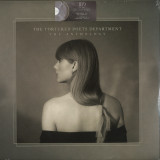
- A1: Fortnight Feat Post Malone
- A2: The Tortured Poets Department
- A3: My Boy Only Breaks His Favorite Toys
- A4: Down Bad
- B1: So Long, London
- B2: But Daddy I Love Him
- B3: Fresh Out The Slammer
- B4: Florida!!! Feat Florence + The Machine
- C1: Guilty As Sin?
- C2: Who’s Afraid Of Little Old Me?
- C3: I Can Fix Him (No Really I Can)
- C4: Loml
- D1: I Can Do It With A Broken Heart
- D2: The Smallest Man Who Ever Lived
- D3: The Alchemy
- D4: Clara Bow
- D5: The Black Dog
- E1: Imgonnagetyouback
- E2: The Albatross
- E3: Chloe Or Sam Or Sophia Or Marcus
- E4: How Did It End?
- E5: So High School
- F1: I Hate It Here
- F2: Thank You Almee
- G4: The Manuscript
- H1: Fortnight (Acoustic Version) Feat Post Malone
- H2: Down Bad (Acoustic Version)
- H3: But Daddy I Love Him (Acoustic Version)
- H4: Guilty As Sin? (Acoustic Version)
- F3: I Look In People’s Windows
- F4: The Prophecy
- F5: Cassandra
- G1: Peter
- G2: The Bolter
- G3: Robin
clear LP[36,09 €]
black LP[39,92 €]
Beige Vinyl 2x12"[45,34 €]
Smoke Grey 2x12"[45,34 €]
The Tortured Poets Department: The Anthology Vinyl
35 Tracks including 4 acoustic bonus songs
Never-Before-Seen 12” x 12” Poster
4 Marbled Translucent vinyl discs
Depiction of this product is a digital rendering and for illustrative purposes only. Actual product detailing may vary. Please note due to the custom manufacture process, each vinyl unit may be slightly different in coloration.
You’re NEXUS 21, central to the dizzy zeitgeist of the 1991 adrenaline rammed UK House Music juggernaut, and you have just recorded a masterpiece of an album MIND MACHINES.
DON’T DO IT LIKE THAT - somehow even though your record label love the album it does not get released.
DO IT LIKE THIS - it finally gets issued now.
When Mark Archer and Chris Peat flew back from a seminal recording session at Kevin Saunderson’s KMS Studio in Detroit there was a palpable feel of excitement. Instead of merely paying homage to their Techno forerunners, they were now creating their own just as innovative waveforms.
In the can was a gem - DON’T DO IT LIKE THIS, DO IT LIKE THAT. Motor City songstress Donna Black had unconsciously seemed to add Ma to the start of her name and her recorded in the dark vocals helped conjure up an almost Madonna and a drum machine meets Techno hybrid. This it was agreed could be a huge breakthrough single which - preceded by strategically released set up tracks - would build up Nexus 21’s surely inevitable rise to glory. And the release of the MIND MACHINES album. But it never happened. Instead one day Mark and Chris burst into Network’s Birmingham office excitedly brandishing no less than 8 new recordings infused with a propulsive Rave energy flash compared to their more cerebral Nexus 21 work. The label agreed that the new tracks should be released under a new artist name and an initial suggestion. Alien 8 replaced by Altern 8. What was planned as temporary dalliance became a long term relationship. You all know the score - Altern 8 became surf riders supreme on the rave tsunami, not just music makers but myth creators. The plan has been to run Nexus 21 and Altern 8 parallel, a kind of schizophrenic experiment by two men, a drum machine and a mad for it record company. History shows that Altern 8 became too DOMIN 8 and the lovingly recorded Nexus 21 album was left on the proverbial shelf (actually a box in Birmingham)
So now MIND MACHINES finally meets the World. First thing that screams out that it hasn’t half aged well. Obviously it is a wet dream for the anoraks of electronica, that goes without saying. But above and beyond the history lesson of how 2 young UK techno mad kids got the dots from Detroit and deconstructed them to create something very British the music they created, sometimes naive but frequently knowledgeable, sounds .. well just great.
The four Detroit recordings - NEXODUS, TOGETHER, DON’T DO IT LIKE THAT, DO IT LIKE THIS and EVERYTHING (NO STATUES) - variously feature contributions from Motor City luminaries Marc Kinchen and Anthony Shakir.
Only two of the twelve recordings were properly released in 1990/1991 with two more making it on a withdrawn white label 12 inch at the time. Three of the tracks, including a live recording at London’s Brain Club that has been retrieved from a DAT that was thought to have disappeared, are previously unreleased. And as well as two previously unreleased much altered versions of Nexus 21 gems there is the legendary much tougher mix of the duo’s signature techno treasure Self Hypnosis.
NEXUS 21
LOST AND NOW FOUND
- A1: Rotterdam Terror Corps - We're Gonna Blow Your Mind
- A2: Buzz Fuzz - Jealousy (Is A M F)
- A3: The Bazeman - Can You Feel The Baze
- A4: Predator - Mind Of A Lunatic
- B1: Bertocucci Feranzano - Xtc Love
- B2: The Stunned Guys - Bim Bum Bam
- B3: Dj Sim - Simbiosis
- B4: Micropoint - Ping Machine
- C1: Neophyte Vs Stunned Guys - Army Of Hardcore
- C2: Dj Delirium & Dj Buzz Fuzz - Immortality
- C3: Diss Reaction - Jiiieehaaaa
- C4: Neophyte Vs Stunned Guys - Get This Motherfucker
- D1: J D.a. & Delta 9 - Real Harcore En Anders Niks
- D2: Charly Lownoise & Mental Theo - Ultimate Sextrack
- D3: Jappo & Lancinhouse - Exlxaxl
- D4: Dj Buby - A E.i.o.u Feat The Stunned Guys
Number One - ‘Il Locale dell’Impossibile’ presents
‘LA SALA 2’ - Limited Edition
Relive the music that made history in
‘Sala 2’ with this exclusive double vinyl!
Available starting Friday, December 13th, 2024, in
record stores and online, or grab your copy in
person at the Number One on Saturday, December
21st, 2024, during the epic celebration in Sala 2.
'Cupar Grain Silo' is Sam Annand's first release on the Blackford Hill label. Its nine tracks blur the lines between ambient electronica and sonic history, as synthesised melodies and rhythms reverberate through the extreme acoustics of the disused Cupar Grain Silo in Scotland. Built in 1964 as a sugar store, the silo towers 60 metres above the surrounding Fife countryside. Its industrial life was short: in 1971 it was closed, and barring a short period as a grain store, remained empty for decades.
In 2014, Sam Annand was given access to the silo as part of the Resono project, set up to study a series of highly reverberant locations across Scotland. The ambitious industrial architecture of the Cupar Grain Silo has given the space a reverberation time of 36.5 seconds. This measurement describes the time a sound takes to decay or 'fade away' in a closed space. To put this in perspective, the Cupar Grain Silo reverb time is around three times longer than that in cathedrals like York Minster and St Paul's.
"The acoustics are immediately noticeable when climbing the ladder into the main chamber", Sam says. "The sound of your voice begins to circle around and above you, inviting you to shout, clap and bang objects to excite the space into revealing its intimidating architectural voice."
Sam began to experiment with musical compositions which responded to the unique acoustics of the silo space. He used impulse responses – a short, sharp sound like a gunshot – to record these acoustics, allowing him to experiment with the silo's reverb in his production. Sam's compositions were performed using a modular synth system, a Roland Juno-6 polyphonic synthesizer and a bowed ride cymbal.
"Chords can be constructed in time by hanging successive single notes in the air," Sam describes, "The flutter echoes from the immediate cylindrical walls can be used to create bursts of scattering spatial imagery and harmonic blooms, following short percussive moments."
Originally recorded on 21st May 2016, 'Cupar Grain Silo' is now released on 12" vinyl with an accompanying booklet of imagery and essays. The compositions are at once true to the unique architectural acoustics of the silo whilst also being playful and experimental with the creative possibilities it offered. Arpeggiated melodies ebb and fall across extended call-and-response shapes formed by the silo's reverb; modular drum patterns crackle like dying machinery; whilst bowed drones waver and wash over.
"We all love reverberation," reflects Prof. Peter Stollery, Professor of Composition and Electroacoustic Music at the University of Aberdeen, on the project. "As kids, we play in it – yelling in forests and caves, surreptitiously dropping objects in huge churches – mouths wide open at the lingering smears of sound which come back to us."
In 'Cupar Grain Silo', Sam Annand has harnessed the extraordinary acoustics of the disused silo to tap into this sense of joy and amazement that reverberation can bring.
Forest Jams continues the journey into the great beyond with Mori Ra’s Mantra–an EP composed of four edits created for any inquisitive earthling and forest wanderer.
Mori Ra is a DJ based in Osaka, Japan his sets are a witches brew composed of balearic, cosmic, and electronic disco ingredients. He has released on other labels such as Rotating Souls, Macadam Mambo, Berceuse Heroique, MM Discos and more. In Mantra, Mori Ra acts as a mysterious wanderer who has stumbled upon the doors of our minds in the middle of the night. When we answer the door he is bearing gifts of creative glory and all we need to do is provide shelter in return. We invite him in so that he can rest, recharge, and continue his journey.
During his visit in our minds Mori Ra shares “Mantra” the secrets of the universe disguised as parables packaged neatly into four tracks. Catharsis begins the journey and immediately throws us into a sound that feels like we are driving a spaceship in Gran Turismo 37, the spaceship simulator. Now that we have successfully crossed the plane and have entered the digital unknown, Seinn O! becomes the story of communication. Seinn O! gave the smoke leaving my mouth color and the shamanistic chants placed me in an atmospheric state with the ability to cross over and communicate in the digital space. Then comes 孫行者 the Grandson Traveler, which embodies the story of the simulation. Imagine the sound of a bustling dystopian city in the matrix–neon signs, dancing billboards, talking vending machines, radioactive wildlife, and overgrown foliage leaking in from the jungle the city is carved into. Mori Ra seems to have melded all of those sounds together to create the soundtrack of the big city where everyone is lost. Finally, before leaving our minds Mori Ra offers the final parable, あの星 That Star. Which becomes the story of realization, the journey back home from the exploration of the mind. That Star brought me into a cave and I could see the opening at the end of it, all I had to do was walk towards it. However, I couldn’t walk. I could only galumph forward, while bouncing up and down to the beat. My arms slivered and guided my body forward as the vocals came in. As I moved forward the opening, the clearing, the destination remained the same distance away. The endless tunnel of the mind gave me a feeling of comfort because I did not want this journey to end.
The EP ends and we will never know who visited our minds that night, but we know we loved the journey. Mori Ra is the steward of our journey through consciousness, and the vessel is “Mantra”.
As the tenth candle flickers atop the torta alla panna, Archeo Recordings play the Uno reverse card, breaking with tradition to give us a gift in celebration of its birthday: the first in a series of exquisite EPs on which the label's favourite contemporaries pay homage to past masters. Each re-polished gem is plucked either directly from the beatific back catalogue of the fine Florentine label or is at least Archeo-adjacent, perhaps a sign of future wonders to come. Like a musical version of Janus, who can be found at the heart of Bertoldo di Giovanni's frieze in the Medici villa, Archeo Recordings will continue to look forwards and backwards to provide sublime sounds for us all.
Pepe Maina officially joined the Archeo family in 2019 with the much-needed reissue of his 1979 masterpiece Scerizza (AR015), but his astounding music has been a constant companion to label head Manu for much longer. An inter-dimensional, multi-instrumental maverick, Maina weaves the frayed edges of prog rock, new age, organic jazz and global minimalism into a shimmering tapestry all of his own. The results are spread across fifty years and almost as many albums, largely self-released and always absolutely untarnished by commercial concerns.
Based in a small village in the hills of Brianza, just north of Milan, Maina translates the beauty of his surroundings into transformative tone poems, and the folkloric fusion of "The Infinite", originally released on his 2014 CD Tales From The Hill, is the perfect example of his practice. It opens with a recitation of Giacomo Leopardi's 1825s poem "L'Infinito" by famed Italian actor Vittorio Gassman. A leading figure in the romantic movement, Leopardi explores the idea of time and space within the natural world, and the peace that comes with an appreciation of the immensity of eternity. Manu, longtime digger and now a burgeoning producer, expands upon the original with tribal percussion, chirping electronics and a spheric bassline, folding Maina's elegant strings and gossamer pads into a new arrangement suited for a slow dance under the stars.
Unless you had a well-trained ear tuned to Italy's avant-jazz scene, chances are your first encounter with innovative flautist Roberto Aglieri came via the 2017 Archeo reissue of hisalmost untraceable LP Ragapadani (AR011). It's a true testament to Manu's digging credentials that he snatched this masterpiece out of the esoteric atmosphere and brought it attention it so richly deserved. A delicate union of digital synthesis and versatile flute - be it soft and silvery or
brilliant and clear - the 1987 album was a shapeshifting masterpiece, replaying scenes from Virgil, Verdi, Visconti and Pasolini with a neon glow. Quintessentially Italian, but uncanny and previously unimagined - Penthouse and Portico perhaps. Powered by a percolating prototechno sequence, cascading keys, hallucinogenic vocal snippets and a variety of tonal timbres from Roberto's reed, "Danza N. 1" long deserved the praise reserved for Jean-Luc Ponty's pinnacle, so many thanks to Manu for our collective introduction. The tall task of reinterpreting this particular paragon falls to Perugian polymath Daniele Tomassini AKA Feel Fly, whose peerless skills as both producer and musician have delighted DJs and dancers alike. Hot on the heels of his diverse and definitive remixes of Tony Esposito for AR027, Daniele delivers a radical rework of "Danza N. 1" perfect for both day rave sunshine and full moon party alike. Enhanced by snapping breaks and a rattling kick, the bassline gurgle emerges as a progressive powerhouse, laying the foundation for the trilling flute and circular keys to cast a psychedelic spell. As the slow-Goa revival picks up pace, this one is way ahead of the pack.
Archeo take us all the way back to the start of its story here - well almost. Though it bore the stamp AR001 (2015), this Radio Band reissue actually hit shelves months after Tony Esposito's "Je-Na' / Pagaia"; a false start perhaps but a true classic all the same. Radio Band were a group of DJs from Florence who all sailed the airways of Radio Fantasy in 1984 and whose one and only release was this super groovy slice of Italo-boogie. Following the example of Milanese DJs Band of Jocks but far surpassing their formulaic funk fizzle, Radio Band employed an intergalactic bassline, cosmic keys and that undeniably Italian style of rapping to deliver a sophisticated party-starter which even found its way to disco deity Ron Hardy. Back to the here and now, and if you've found yourself pumping an ecstatic fist to a supercharged Italian epic of late, chances are its from the mind of the mysterious Radiomarc. Operating on the ascendent Popcorn Groove imprint, this shadowy figure steers his country's lost classics into peaktime territories, finding a sweet spot between late Italo-disco, early Italo-house and contemporary cool. Pushing the tempo with a club-ready 4/4, setting the sequencer to stun and supplementing the original melodies with a series of synth riffs, the mystery producer send this one into orbit. Radio Band - Radio Rap - Radiomarc, the circle is complete.
Few have done more to develop cross-cultural musical exchange than Futuro Antico. A collaborative venture from musician, archeologist and ethnomusicologist Walter Maioli, keyboardist and tonal theoretician Riccardo Sinigaglia and multi-disciplinary artist and composer Gabin Dabiré, Futuro Antico formed in Milan in 1979, combining ancient international folkloric traditions with otherworldly electronics. The result is an arresting melange of Mediterranean, African and Asian instrumentation, mimicked by esoteric synth tones and hypnotic minimalism, which the group perfected on their acclaimed 1990 LP Dai Primitivi All'Elettronica. The meditative and transportive "Pan Tuning" belongs to their largely overlooked 2005 CD only release Intonazioni Archetipe, and has been amongst Manu's most loved tracks from the first moment he heard it. Who else is better placed to reshape this evocative opus into an immersive, transcendental dance floor journey than label favourites Mushrooms Project? The duo sows the original elements into a sprawling fifteen minute fusion of séance and science, at times propulsive with a ritualist rhythm of tuned percussion and crunching drum machine at others drifting off into ethereal ambience. Mushrooms Project continue to push the boundaries of the Afro-cosmic style, and this remix marks a new zenith.
2024 Repress
Fratelli Malibu is an original idea of Andrea De Fazio with the cooperation of Paolo Petrella, drummer and bassist for the “Nu Guinea” live band. Their love for synthesizers and drum machines brought them together to create the shiny world of Ciro Miami.
We could think of Ciro as a neapolitan expat in the american dream, where he discovers a world of excess, flashy cars, cocktail bars, beautiful women, cocaine, gambling, spaceships and videogames that erodes all of his money forcing him to go back to Napoli
completely broke, but with a fistful of wonderful memories.
- A1: Konkparty (7 Inch)
- A2: Baby Dee
- A3: Sokalokamoki
- A4: Honeymoon Side
- B1: Your Life (7 Inch)
- B2: Elephant
- B3: Cool Out Gar (Third Stone From The Sun)
- B4: Suave Y Caliente
- C1: Love Attack
- C2: Machine
- C3: Alien Jam
- C4: Soka-Loka-Moki (7 Inch Part I)
- C5: Soka-Loka-Moki (7 Inch Part Ii)
- D1: Tonton Macoute (Live At Cbgb 81)
- D2: Alamo (Live At Cbgb 81)
- D3: High On The Hill (Live At Cbgb 81)
- D4: Fela (Live At Cbgb 81)
- D5: Frog Talk (Live Broadcast To Paris)
- E1: Konk Party (Uptown Breakdown)
- E2: Konk Party (Master Cylinder Jam)
- E3: Konk Party (Bonus Beats)
- F1: Your Life (12 Inch)
- F2: Your Life (Skull Whip)
- F3: Your Life (What U Want Dub)
Repress!
This year, get ready for KONK! with the ultimate collection The Magic Force Of Konk 1981-1988. This white hot Limited Edition 3xLP set is a lovingly composed Deluxe retrospective, showcasing the Definitive Sounds Of A New York Jazz Punk Afro Funk Disco Machine.
The Magic Force Of Konk 1981-1988 is a testament to the bands artistic staying power, the music sounding as fresh now as it did then, from the crossover funk grooves of the ‘Planet Rock’ inspired ‘Konk Party’, to the innovative punk funk synth bass of club hit ‘Your Life’, the bands influence indisputably lives on in this specially created deluxe collection. This beautifully designed package is a feast for the senses, looking as good as it sounds and sure to please fans of Liquid Liquid, ESG, Pigbag, James Chance, Soul Sonic Force, LCD Soundsystem, to name but a few, or simply those intrigued by those tales of wild nightlife that have become synonymous with the vitality of 1980’s downtown New York City.
- A1: World Is Dog
- A2: Cctv (Feat Creature)
- A3: Yottabyte
- A4: Bad Pollen (Feat Billy Woods)
- A5: Slum Of A Disregard
- A6: Rfid
- A7: Instant Transfer (Feat Billy Woods)
- A8: Ikebana
- B1: In The Shadow Of If
- B2: Skp
- B3: Hushpuppies
- B4: 14 4 (Feat. Skech185)
- B5: Voice 2 Skull
- B6: Xolo
- B7: Zigzagzig
Black Vinyl[35,08 €]
We’re teaming up with ELUCID and Fat Possum for a limited edition of 300 copies of a Rush Hour black ice coloured edition.
E L U C I D, one half of the illustrious duo Armand Hammer, is here with the full-length follow-up to 'I Told Bessie'. Further experiments in the sonic, expanding on the 'live' side of music paired with the embracing of chaos. Something you haven't heard, or not so for a very long time. E L U C I D is here to reveal the bleakness of reality.
---------------------------------------------------------------------------------
''There is never time in the future in which we will work out our salvation. The challenge is in the moment; the time is always now.''
James Baldwin
A raw, crackling urgency runs through rapper-producer ELUCID’s new album REVELATOR like an underground power line. There is no space here for sepia-toned reminiscences or indulgent self-mythologizing. Intellectual rabbit holes have been filled in with concrete and rebar ; there is nowhere to hide and no off ramp from the audio Autobahn that ELUCID has fashioned—a renegade Robert Moses with gold fronts, bulldozing the homes of the powerful and the complicit. REVELATOR brims with the energy of now, with a refusal to look away. Carpe diem in a murder one mask.
Born in Jamaica, Queens, ELUCID has been on the cutting edge of New York’s underground scene since the mid-2000s. From the beginning, he has defied both convention and expectation. He ran with Okayplayer darlings Tanya Morgan, but his own music eschewed their throwback charm for glitchy noise experiments and bass-swamped culture jamming. His 2016 debut studio project Save Yourself (re-released in a deluxe edition last year) announced him in earnest. But in recent years, his Armand Hammer releases with partner-in-crime billy woods have received significant attention and acclaim. Serving as a followup to his last solo album—2022’s comparatively balmy I Told Bessie—ELUCID hoped to “re-distinguish” himself with REVELATOR, setting himself apart amidst the increasing attention around the music he and his friends are making together.
For ELUCID, this meant setting bold new challenges for himself. One of these was diving further into live instrumentation than ever before—”getting my Quincy Jones on,” as he puts it. The testing ground for this approach was Armand Hammer’s most recent project, 2023’s We Buy Diabetic Test Strips’ Möbius strip soundscapes, warmed with instrumental flourishes and skin-shedding beat progressions. With REVELATOR, though, ELUCID strove to create an atmosphere of chaos, embracing experimental electronics and atonal sample bursts. He worked on much of the album with co-producer Jon Nellen, who comes from a background in avant-garde and Indian classical music. “I wanted to get as freaky as I could at this moment. I wanted people to hear things, maybe for the first time, or in a way they haven’t for a long while,” the rapper explains.
ELUCID arrived at the studio with a collection of noise sources: non-referential samples, glitches and noises. Together he, Nellen, and others created forms out of them and, as ELUCID recalls, “just started playing drums with it.” Their fried, distorted sound was directly inspired by Miles Davis at his most uncompromising—specifically, the tone-clustering funk track “Rated X” from his 1974 double LP Get Up With It. At times, the pairing of rap with avant-fusion sounds also brings Emergency! from The Tony Williams Lifetime to mind, perhaps in an alternate timeline where the late drummer was listening to Ice Cube’s AmeriKKKa’s Most Wanted.
“The World is Dog,” REVELATOR’s lead single, functions as the album’s aesthetic thesis statement. Like the Davis track, the textures are punishing, the tonality is in free-fall, and the driving breakbeat of a groove cuts in and out unceremoniously. Avant-jazz bassist Luke Stewart, who appears throughout the record, holds the whole thing together just long enough for ELUCID to tightwalk over the beat. This tension is exactly where REVELATOR sets itself apart; in a time of drumless loops, and safe soul samples, this is a high-wire act with no safety net. Similarly, the song announces the themes of the album within just a few phrases, evoking the way societies accept and adjust to new levels of debasement and brutality while suffocating under the weight of history: “Can’t clock the kill, all a mystery/Forced past will eating everyone eventually/The world is dog.”
Many of the songs on REVELATOR grapple obliquely with dissolution and disenfranchisement in America and across the world—the grim realities of our domestic sociopolitical climate and our involvement in foreign conflicts. “Much of my artistic and political sensibility comes from the Black arts movement here in New York,” ELUCID explains. “Recognizing the interconnected global struggles against oppression, artists and thinkers created works and actions in solidarity with freedom movements in South Africa and Palestine.” ELUCID cites intellectuals like Amiri Baraka, Kwame Nkrumah, Audre Lorde, Sonia Sanchez, and Nikki Giovanni among his heroes. (One track on the album is specifically inspired by Lorde’s work, “SKP,” citing the scholar’s paper “Uses of the Erotic: The Erotic As Power.”) Songs like REVELATOR’s insistent closer “ZIGZAGZIG,” find ELUCID applying up-to-the-minute messaging, making explicit reference to the conflict in Gaza: “Feed a war machine…from river to sea, in lieu of peace.”
Despite ELUCID’s preference for cacophonous system overload here, the rapper also provides moments of respite. Recorded at The Alchemist’s Los Angeles studio, the laid-back, wheezing “INSTANT TRANSFER” is a collaboration with billy woods, which crystallizes their shared sense of creative determination. “With much momentum behind us and even more on the horizon, I knew a purpose, and that every step was ordered to that purpose,” ELUCID said of the experience. Meanwhile, the jittery “HUSHPUPPIES” is a playful anomaly on the track list, providing a snapshot of ELUCID watching his grandparents in the kitchen while preparing for Friday night fish fry dinners.
“Love still rules over on this side,” ELUCID says. ”I’m raising a family. We are making meaning and finding joy in the midst of all the fucked up-ness of everything around us because the alternative is cowardice and slow death. We remain rooted. We celebrate our people and our wins. Struggle is necessary.”
“IKEBANA” is one of ELUCID’s strongest statements of purpose on the record, blending the record’s heaviest themes with its most hopeful sentiments. supported by a shoutalong refrain and an urgent prog-funk groove. Breaking away from images of dissolution and crumbling societal systems that populate REVELATOR, ELUCID notes that the only way to navigate life’s bleakest landscapes is to cling to love and believe in those around you—to look forward toward something better that may or may not be possible. For the rapper, one of the album’s most trenchant lines comes during a centerpiece of a beat drop: “Being alive/I must look up.”
“The lyric ‘being alive I must look up’ is important especially in the context of this album. Much of the album imagery is harsh and reflects the actual doom some of us experience. But still I/we exist,” ELUCID explains.
Every artist is, in one way or another, the product of their time, bound by life’s leaden gravity to operate within the space of that which is already known. But there are some who are able to shake free of these ties, to shape the culture as it unfolds, to make the present their own.
Revelation, as a concept, points to the scales falling from people’s eyes—something that has been hiding in plain sight becoming clear. “The revelator relates to things that have been talked about, things that have been forecasted,” ELUCID adds. “And now they’re really here, and everyone sees it. And there’s no escaping.” REVELATOR plays out with the unmitigated power of those storms, laying waste to any genre conventions in pursuit of a certain physicality. Here, ELUCID develops a wholly distinctive musical language to explore our fractured modernity.
REVELATOR's packaging was designed by longtime Armand Hammer / Backwoodz art director, Alexander Richter.
Originally released on one of Bruton's extensive library albums but later used as the theme song to a UK drama series dealing with the intrigues of a family motor business and the world of rally driving from the 80s, "The Winning Streak" is another production by the now late library music maestro Alan Hawkshaw. A downtempo track with remarkably trippy use of percussion elements via electronics and drum machines with entertaining accents and "exotic" vocals. Another wonderful example of library music tickling the fancy of diggers and collectors with a dancefloor inclinations thanks to its highly distinct sound -- everybody loves a winner. 1 to 1 official re-issue, remastered.
DJ Support: Grant Nelson, Dr Packer, Purple Disco Machine, Cj Mackintosh, Mark Knight, Sam Divine, Jamie Jones, Funkerman, Vanilla Ace, Roog/Hardsoul
Birdee has managed to carve out quite a path for himself, remixing luminaries such as Aeroplane and Michael Gray, collaborating with legendary singers Barbara Tucker and Angela Johnson, as well as releasing on Glitterbox, Big Love, Nervous and of course Tinted. On his latest single Birdee remakes the Jomanda classic 'Don't You Want My Love' (As sampled later by Felix) in true Birdee style, as a complete disco reinventio, crafting an all original backing of dynamic drums, funky bass and some classy synth and string arrangements that glide across this timeless ear-worm.
2021. Italoconnection, the partnership of Fred Ventura and Paolo Gozetti, released Midnight Confessions Vol 1. Three years on, the awaited second volume has arrived. All of the analogue emotion that characterised the first collection is present from the outset, warm throbs of bass coupled with clean melodies in “The Wait”. Smoky lyrics permeate the nine track album, the unmistakable timbre of Ventura’s voice recanting tales of optimistic encounters and lost love. As with the 2021 release, collaborations with fellow italo romantics are peppered throughout. Francesca Gastaldi returns to work with Italoconnection once again. Having featured on their Humanize EP, Gastaldi’s vibrant voice shines through the smouldering synthlines and robust beats of “Live Forever”. Jaia Sowden takes centre stage for “Just Like Water”. A story of discontent and disconnect is sang over bittersweet keys as eastern undercurrents flow. Contemporary commentary is intertwined with undulating melodies and distant lyrics in “Cold War Lovers”, a cold wave edge cutting through the sounds and words of “Systematic” .The dancefloor surfaces throughout the record. Bodies are pulled tight by the bold and bright bars of “Why” before drifting apart in the lovelorn lamentations of “Lover 2 Lover”. “Europa” pays homage to the machine music of the continent as a litany of influences are drawn upon . The title piece closes. A fragile drum pattern is bolstered by cascading chords, piano notes sailing alongside words by Gastaldi and Ventura. Welcome confessions from musicians who live and breath the synthesizer traditions of Italy.
Not so long ago in 2017, the first release on Michiel Claus' and Ailsa Cavers' Basic Moves saw the light of day and especially the shine of night. Produced by founding father Walrus, BM01 set the tone for a record label that focuses on releasing hidden archives from the 90s, whilst combining them with modern club music from the here and now. By highlighting the musical heritage of the Belgian electronic music scene, the label illustrates the continuity between past and present, history and shaping identities of 21st-century artists, undeniably building on the strong foundations of their forerunners. Seven years and nineteen releases later, Basic Moves is rounding off the series with BM20, a final double 12'' by one of the major figures from the Belgian underground: Circadian Rhythms also known as Dj Deg. After many years of collecting, deejaying and producing music, his musical spectrum ranges from synth, library and wave, to jazz, funk and disco, from house to techno. His journey started in clubs like Bocaccio (1988 - 1993), and La Gait? (1979 -1989), where young Deg came across deejay's like Olivier Pieters or Eric Beysens who made him choose the path of becoming a devoted disc jockey himself. BM20 is a sonic witness of Deg's first musical encounters with his machines, revealing a withdrawn selection of six bedroom patchwork tracks produced between the years of '93 & '99, a time without the internet or user manuals to help you solve the riddles of technology. Though only at the very beginning of his creative process, Deg's unique personality is nevertheless already clearly identifiable: blending techno with jazz, where the sharp edges of 16-step drum-sequences are smudged and bent in different directions. In the lower countries, the second half of the 90s was a period of fast & funky, happy Detroit, 140 BPM techno. Whenever Deg was not oscillating between record shops or gigs and had a moment on his own, mostly during morning hours after the club, he would spend his leftover energy in the studio. Either by himself or with his loyal ally Mike DMA, he would benefit from these moments to slow down and give space to a different, introverted sound - processing moods, feelings and thoughts. This record therefore gathers only a few of many (unrecorded) one-shot live sessions which were never intended to be shared - and only existed for the love of music and its power to take you beyond all things known. Thank you Deg for sharing your music and giving us a glimpse of your universe. Without your productions, your memorable warm-ups and closing sets - many of us would not be where we are now, and Basic Moves might never have been founded. As a last note to a closing song, BM20 is about being fully committed to the music and the club, a medium and place of fruitful settings for encounters, creativity and growth. Where dreams and ideas have a chance to exist, being almost ready and thought out to shape future times to come - and many party nights. Gurl, December 2023
Repress!
Every once in a while, a record comes along which resonates in a special way, stands the test of time, and brings the same reaction to the dancefloor now as it did all those years ago. 'Groovejet (If This Ain’t Love)' is one of those records, a classic in every sense of the word. Originally released in 2000, Defected are, re-releasing this club essential for new and original fans alike in a special, limited edition deluxe remix reissue.
This unique two vinyl pack comes in full colour gatefold sleeve with augmented reality cover that will come to life once you scan the mask image on your phone accompanied by a four page 12” insert written by Spiller detailing the full story of ‘Groovejet’; from original production, early reactions, chart success and new 2021/22 remixes.
The releases features the original versions plus new mixes Purple Disco Machine & Lorenz Rhode, Riva Star, Breakbot & Irfane and Harvey Sutherland. Exclusive to the vinyl are Riva Starr’s Skylight Mix and the Harvey Sutherland Instrumental version.
'SOL' features 10 solid electro-funk tracks, each with the unmistakable Bas Bron sound. From club-ready four to the floor to dreamy melodies, the whole album is another innovative blend of vocoder-electro and machine funk exploration. Following the success of his previous album "Spontaneous Order", the EP "Built Back Bangers" and more recently the OST for the Dutch documentary 'Onzichtbaar'. Fatima Yamaha is back with a new chapter. 'SOL' showcases Fatima Yamaha's evolution, while staying true to his fundamentals. In conjunction with the album release, Fatima Yamaha will embark on an extensive tour this spring, bringing his live performances to audiences in London, Glasgow, Paris, Amsterdam, and more.
Two titans of modern disco and funk unite to produce a present-day love ballad (or rather love ache), drenched in 80s nostalgia, complete with melodic arpeggio, thumping drums, electric guitar solos and plenty of vocoder action. Heartbreaker is the title of the project, brought to you by none other than Purple Disco Machine & Chromeo. The 12-inch is released with an extended cut alongside the original mix and an instrumental version for good measure. An upbeat electronic track with early Daft Punk influence
Benny Howell (aka DJ Subaru) is a UK based producer, DJ and overall promoter of good times who's undoubtedly propelling a new generation of music appreciation with an honourable respect for the earlier beginnings of club culture. Benny Howell might also be the pioneer of a new post-Brexit Eurodance genre, with "Surrender", a catchy Pop oriented production with strong influences from Italodisco and HiNRG, written and produced entirely from scratch with best friend Bella Quirin who co-wrote the lyrics after a break up with her ex. Innocent and charming lyrics over 120's BPM drum machine and a simple melody that you'll be humming in the back of your mind for days to come. Equipped with a Yamaha TX81Z, a few guitar pedals and a makeshift bedroom studio, "Surrender" is the product of a dear friendship between the two music lovers, as per Benny's recount: "Bella came and sung on the track in my bedroom during one of the gaps between Covid lockdowns after I asked her at the pub if she knew any singers and said me of course, and we went from just friends to best friends."
The remix on the B-side by Castro takes a darker turn into what almost sounds like a Techno version with heavy dubbed out effects taking the "Surrender" theme through an unhinged Ketamine flanger vortex. Full cover artwork and mastered at Manmade mastering in Berlin.
A vibrant kaleidoscope of sound, colour and emotion, British multi-hyphenate James Alexander Bright's new album 'Cool Cool' is set for release on 26th July via Athens Of The North. A dynamic set of urgent funkers, gentle soul ballads, head-nodders, fuzzy folkers and straight-up disco bangers span 10 songs that soundtrack fertile daydreams, esoteric dancefloors, languorous reflection, and wild excursions in nature and beyond. James' voice, pitched somewhere between Eddie Chacon, Beck and Michael McDonald, takes a confident lead on this new record. Whether tenderly caressing on the title track's beautiful soul minimalism or deployed passionately on boogie machine 'Straight Line'; it's an immediately recognisable signature. Impressive multi-instrumentalism sees him perform on guitar, bass, keys, programming, percussion, production and myriad quirky effects; across song subjects that cover searching for truth, imagining the distant future, teen nostalgia, relaxation exploration
Operating under the moniker Eat Them, Johannes Hofmann ravenously ingests and rearranges pretty much everything of interest that electric guitar music has produced over the last 50 years. King Crimson, Dinosaur Jr, Talking Heads or Germany's Tocotronic all resonate in Hofmann's expansive oeuvre. Having begun to record music as a 13-year-old for the main purpose of burning compilation CDs of his work for his grandma, the Eat Them catalogue now spans around 20 Bandcamp albums.
Chosen from these, a selection of 12 tracks will be released via Fun In The Church on March 1st. Entitled "All" in keeping with the holistic aspect of the project - and, of course, complementing the band's name - the album covers everything from Sonic-Youth-with-drum-machine-style mashups to nervous post-funk and anthemic lo-fi indie rock, recorded and sung entirely by Hofmann himself.
The first single, out today, is "Do You Love Me When I'm Dead?", a DIY pop diamond whose sonics are lovingly and firmly rooted in a garage-cum-teenage practice space. The track reflects the project's live line-up, which has been expanded to include bass and drums. However, Hofmann transcends the suburbs with urgent echoing vocals expressing an emotional need to stay on the move, to resist being pinned down.
This is framed by guitar arpeggios that actually point in a more introspective direction. This penchant for contrast and movement can be found in many Eat Them pieces - they are snapshots of an ongoing development, a work that you listen to as it grows and lives. To rephrase the question posed in this single's title: Would we love it if it was already dead?
There may already be 20 albums on Bandcamp - and that CD at Grandma's - but the journey has only just begun. Bon appétit!
Recorded almost entirely in a single day at the legendary Total Refreshment Centre in London, JOY MACHINE brings together some of the most exciting musicians in London’s new jazz explosion. With features from Alabaster DePlume and trumpeter Jonathon Enser (Nubiyan Twist), vocals from Dizraeli (Worldwide Music Awards Best Album nominee), drums from Ben Brown (Alfa Mist, Mulatu Astatke), bass from uk jazz scene favourite Daisy George, synths from Joseph Costi (Yusef Cat Stevens, Bahla) and saxophone from free jazzer Ronan Perrett.
In the tradition of Miles Davis’s Bitches Brew, the band came to the studio in October 23 with only one pre-written track (the uplifting summer anthem Greek Summer) and once that was recorded, spent the rest of the day improvising wild, explosive music laced with Dizraeli’s rap and spoken word lyricism. The result is JOY MACHINE, a record bursting with urgency, intensity and life, and one that cements Dizraeli’s position as an innovative wordsmith, bringing both personal depth (as in Abigail, a homage to the sister who died before he was born) and fierce political commentary (as in Dear Cousin, a goosebumps-inducing narrative that transports the listener aboard the boat Adriana carrying refugees across the Mediterranean, which sank in June 2023 drowning 500 people, and then confronts a very English bigot in the second verse).
Michael The Lion and Natasha Kitty Katt began collaborating as Natasha found a second home in Philadelphia. The two have a mutual love of classic disco and found a kindred spirit in Suki Soul, who has been tearing up the scene the last few years in Northern England. I Found Peace features Michael on guitar and Natahsha on drum machines and synths alongside Michael’s long-time studio band mates. Classical composer and legendary Pittsburgh hip hop producer Jules Krishnamurti adds bass guitar and University of Pennsylvnia jazz ensemble leader Dan Paul plays keyboards on this incredible modern disco classic. Pontchartrain brings all the right touches to the club mix, along side some heavy house mixes by Tonarunur (aka B.G. Baarregaard) to round out the first Whiskey Disco release in several years.
- A1: Unity Feat Red Eye
- A2: And You Feel
- A3: Redemption
- B1: Horsepower Feat Modeselektor
- B2: Mechanic Love
- C1: Hustle
- C2: Sandstorm
- D1: Black Ice Feat Skee Mask
- D2: Scratchy
- D3: Vertical
- E1: Breathe Underwater
- E2: Wind Mill Hill Feat J Manuel
- F1: Stargazer
- F2: Timesqueezed
- F3: Glove Box
- G1: Nyx
- G2: Ringworld
- G3: Scoop
- G4: Dreamweaver
- H1: Flashback
- H2: The Deal
- H3: Micro Expressions
- H4: Pentatonic Light
Fuelled by the Berlin-based duo's love of club music in all its forms ''FJAAK THE SYSTEM'' is FJAAK's most definitive album to date, a winding sonic odyssey that surveys the rave landscape, dipping between frantic euphoria and deep contemplation. Featuring sizzling collaborations with Modeselektor, Skee Mask, Red Eye and J.Manuel, the album draws a bold line under FJAAK's 15 years of mischief and mayhem, pulling together 23 tracks (culled from over 300, no less) that truly reflect the duo's boundless enthusiasm for the dancefloor. Grazing UK breakbeat, techno, 2-step, d'n'b, jungle, trip-hop and ambient, these elasticated, hybrid bangers paint a vivid picture of FJAAK's utopian club ideal, a place where genre boundaries evaporate and only the groove remains. Since graduating in audio engineering in the early 2010s, FJAAK have been challenging the logic of a maddeningly conservative club scene with their hardware only live shows, DJ sets a myriad of record releases. In 2019 they launched the label and platform Spandau20 with a steady flow of records and a mixtape series featuring new talent and established artists. With their rebellious attitude and notoriously energetic live sets, the duo have brought back a crucial lost ingredient to the rave: playfulness. And if their well-loved albums 'FJAAK', released on Modeselektor's Monkeytown imprint, and 'Havel' set the scene, 'FJAAK THE SYSTEM' rises above and beyond expectations, creating a new benchmark. It's not just blood, sweat and tears either, FJAAK's advanced technical knowhow and love of synthesizers and drum machines helps them formulate a sound that's conscious of dance music history, but focused on a brighter, more equitable future. Their second single 'And You Feel' is an emotional rollercoaster combining UK breakbeat with a dubstep-influenced bassline wobler and alluring vocals, emulating the moment the mind becomes a tranquil void through the crescendo of adrenaline like a strain of physical exertion. This is reflected on their new music video which shows an unexpected ''rage room'' scene.
Introducing Foreign Tech Division a mysterious and confident new label curated with the purpose of taking your listening experiences to new places in mind.
First up is MSRG; After solo appearances and eps on Solar One Records and Analog Concept Records, MSRG debuts his first full length vinyl album Part Time Hover Lp. Lovers of Detroit classic electro with warm analogue frequencies will feel right at home in the midst of these 9 compositions designed with intricate machine formulas that glide through aquatic and celestial aesthetics, dipped in both dark and colorful tones.
Whether you seek bold and funky sci fi grooves, or temples into the lush and mental with mysterious vocals (featuring Roger Versey);
MSRG's Part Time Hover has you covered with the electro essentials, and features the fine mastering of Johanz Westerman for the smooth listen you can enjoy again and again.
We have a subtly edit of “Soul Town” by The Motherhood, the psychedelic 1969 LP “I Feel So Free. Motherhood was the unlikely name of Klaus Doldinger's psychedelic fusion band, who eventually transmuted into the bands Passport (Klaus Doldinger, Lothar Meid & Udo Lindenberg) & Hallelujah (Paul Vincent & Keith Forsey). “Soul Town” appears as the B-side to the first single “Back In The Grass”, which fetches ~$275. It was produced by Siegfried E. Loch, & written/arranged by Paul Nero. Many will recognize it as the closing track on the Ocean’s 13 soundtrack. It’s a psychedelic, jazz-funk bomb that punches hard.
Pinball Number Count (Edit) by The Pointer Sisters b/w Soul Town (Edit) by The Motherhood | Galaxy Sound Company — GSC45-043, test pressing | You know the drill. It’s Galaxy Sound Co. It is cop-on-site. It is yet another GSC45 edit you need in your crates. & number 43 doesn’t disappoint. I have been wanting both of these jazz-funk nuggets on 7-inch for a minute now, so much love to the GSC crew!
Any of us who grew up on Sesame Street in the 1970s will know this A-side righ away. “The Pinball Number Count” (or Pinball Countdown) is a collective title referring to the 11 one-minute animated segments on the TV series Sesame Street that teach children to count to 12 by following the journey of a pinball through a fanciful pinball machine. These segments are notable for the colorful, imaginative animation as well as the funkysoundtrack with vocals by The Pointer Sisters. It was produced in 1976 by Imagination, Inc. in San Francisco, California for the Children's Television Workshop & debuted on Sesame Street during Season 8 .
DJ Support: Danny Howard, Annie Mac, Mistajam, Pete Tong, Charlie Hedges, Kraak & Smaak, Maxinne, Todd Terry, Alex Preston, Full Intention, GW Harrison, DJ Rae, Rudimental, Alaia & Gallo, Illyus & Barrientos, Johan S, David Penn, Sam Divine, Riva Starr, Claptone, Nice7, Dario D’Attis, Mousse T, S-Man, Huxley, KC Lights, Friend Within, Dombresky, Gorgon City, Chris Lake, Format:B, Pirupa, TCTS, Alan Fitzpatrick, Low Steppa, Mat.Joe, Raumakustik, Eskuche
Leading the charge with the next Toolroom Trax vinyl series is Mark Knight’s remix on a euphoric dance anthem from Dave Spoon (aka Shadowchild) & Nick Reach Up who update Elaine Mai & MuRli's track 'Ready'. An underground House work-out that's been tried & tested on the dancefloor throughout 2023 and inspired by the euphoric House sound of the 90's, Mark’s mix makes use of the original's hypnotic vocal, combined with driving bass and big euphoric synths. House heavy-weight CASSIMM lands back on our Trax vinyl series with another essential club cut 'Wanna Feel Something'. The Italian, London based hit machine rose to new heights in 2023 with a Beatport House #1 'LOVE DESIRE' on Claptone's Golden Recordings, and chart-topping releases on Toolroom, Spinnin', Myth Of NYX and more. Full of fun, funk and house goodness, CASSIMM yet again delivers another irresistible party starter! Label favourite, Crusy steps up on remix duties for this next offering and a milestone 300th release for the label with an updated mix of Superchumbo & Victoria Wilson James’ ‘The Revolution’. An influential anthem from 2001 'The Revolution' spent over two decades in clubland since icon Danny Tenaglia originally broke the record at the infamous WMC Miami, later going on to recieve support from global superstars such as Pete Tong, X-Press 2, Roger Sanchez and more. Crusy’s signature drums, percussion and grooves drive through
that Latin influenced energy throughout. Last but definitely not least, James Hurr and Electro pioneer Arthur Baker team up with their unique blend of underground house and 80's hip-hop in new club controller, 'Powder In The Nose'. This collaboration marks a triumphant return for James Hurr on Trax who has previously released successful club cuts on the label, and an exciting debut for Arthur Baker, an artist who needs no introduction. The Boston-born producer is widely recognized as one of the pioneers of the Electro genre, with a career spanning over four decades. Baker's unique sound, which fuses elements of hip-hop, funk, and electronic music, has made him a household name and a highly sought-after collaborator. Together, Hurr and Baker are a powerhouse duo, with their combined expertise and passion for dance music 'Powder In The Nose' is nothing short of spectacular.
ountless radio plays on Radio 1 from Danny Howard, Sarah Storie, Pete Tong Other notable radio plays – Kiss FM, Toolroom Radio, Sirius XM, Data Transmission Radio, Radio 1 Dance Anthems, Radio 1 Party Anthems, Rinse FM, Select Radio, Tomorrowland Radio
"Deep Dancefloor Jams of African Disco, Funk, Boogie, Reggae & Proto Electro Music 1977-1986reggWhen a passionate DJ and crate digger intuitively selects music for a DJ compilation, without artistic compromise and without the burden of trends, AfroMagic vol.1 emerges from the depths of his soul. Herewith we present the new favorite phonomancer’s tool for all the DJs who experience the dance floor as a sanctuary and a source of freedom and love.
The most fundamental thing that defines African music is that it was created for dancing. In African dance, there is often no clear distinction between ritual celebration and social recreational entertainment – one can seemlessly merge with the other. Because dance and rhythm have more power than gesture and more richness than words, and because they express the deepest experiences of human beings, dance is in itself a complete and self-sufficient language. It is truly an expression of life with all of its emotions – joy, love, sadness and hope – without which there is no African music and dance. For the African people, dance and music are integral parts of the body and soul, thus depicting the expression of life, current emotional states, visions or dreams. Through hypnotic repetitive music and dance, people communicate with each other and with the souls of the dead, the animals, the plants, the stars, the Gods… They free the body and the spirit through ecstatic states, reaching a healing sense of freedom, happiness, and satisfaction.
Throughout history, this transcendental perception of rhythm and dance originating from Africa, influenced popular music worldwide, thus creating new living and breathing forms of musical genres – freeing them from their industrial mold. Funk, disco, soul, boogie, reggae, dancefloor jazz etc., developed in parallel all over the world. It is foolish to perpetually discuss where they originated from and who were the creators of all these fiery dance floor genres – being obvious that they directly or indirectly originate from the African continent and its people who were as well, over the centuries, influenced by disturbing socio-cultural factors of colonialism. However, no one can enslave the soul. The seeds of free and uninhibited dance and rhythm, true to their original form, initially first sprouted onto the USA’s fertile fields of clubbing and popular music while later evolving in other parts of the world.
The disco funk club culture manifested itself as a phenomenal explosion of artists and grooves in the second half of the 70s in the USA. Shortly it spread around the world continually reigning over charts in its various forms – to this day. Clubs emerged where the DJ is an almighty shaman and the dancers are a tribe united under one roof. This urban ritual had and still has a single goal: togetherness, freedom, and love. Clubs have evolved into temples where we free ourselves from the burden of a consumerist lifestyle and suppressed emotions – a place where we receive love and give love – to be who we really are.
Disco funk clubbing was such an influential global phenomenon that its influence can be observed in various other genres from the disco funk era i.e. progressive rock, which mutated by layering complex rock arrangements with a disco funk groove resulting in hybrids, highly sought by today’s diggers, producers and collectors. The profit-hungry music industry of the 80s very quickly commercialized the original disco funk sound by amputating of its original Afro groove to be able to easily ‘sell’ it globally. So, the original disco funk groove became underground again, and it has remained so until this day. Today, for a DJ to unearth that ravishing groove that will lead the dancers to the stars, he must dig passionately like a true musical archaeologist in search of that groove that picks you up after just a few initial beats. That groove which forces the atoms in your body to vibrate, that groove which unites the body and releases the burden.
The AfroMagic compilation series is created as a tool for real DJs who stick to the aesthetics and essence of clubbing.
This continuation of the Afromagic compilation by DJ Borovich was created in a private jam session which served as an escape route from intense and complex love problems.
Unconsciously driven by intuition and emotion and following a live mix tape framework where many tunes are arranged instantaneously, Borovich narrates his story with a strong rhythm that cuts loose even the most blocked off energy nodes and restores happiness to the spirit and the body.
The musical experience of the groove is completed by the lyrics of the songs, which symbolically give DJ Borovich universal answers to his questions arising from questioning the boundaries, nuances and other forms of love.
When considering that Borovich’s selection was created to facilitate an escape from the burdens of reality through rhythm and dance, we can be sure that Afromagic Vol. 2 will have a 100% uplifting, energized and spaced-out effect on the listeners.
The intro to A1, “Feeling Happy” by the Apostles, introduces us to an experienced and slow, cool and irregularly tight groove containing a confidently sung chorus that instantly gives a sense of freedom and hints at the remainder of Afromagic Vol. 2: “I’m gonna feel happy, ´cause I know I’m gonna be myself.” After the anthemic song mantra of the Apostles, Aigbe Lebarty uncompromisingly continues with a dirty disco rhythm. Acidified by accented synths that elevate it to shamanic levels and held together by a female tribal choir, we embark on an uncompromising ritual disco journey. Without a moment to take a breather the prog funk band Mighty Flames and their Road Man launch a highly vicious and raw, thick funk groove spiced with acid synths and dirty RnR breaks, raising the bar for the A side. Jimi Hendrix himself would surely praise it given the ultimate freedom and virtuosity in the solo sections. With the last tune on A side DJ Borovich decides to burn the floor with Geraldo Pino’s psychedelic, acid furious groove and lyrics which describe this HEAVY part of love problems: “The way she walk, the way she talk, the way she does a funky dances, she is really really heavy – that woman”.
While the A side represents a compact intoxicating afro groove machine that separates us from reality and lifts us up to the stars in over 23 minutes, the B side is a treasure trove of proto sub-genres gems. This selection represents the mission of the Afromagic: to find singular events in African recorded discography of popular music from the 70s and 80s that give evidence to the birth of new modern genres on the Dark Continent even before they emerged in the U.S.A. or Europe. The beginnings of electronic music influenced genres are represented back to back with 80s synth jazzy pop, all painted in African colours.
The B side opens big with Jake Sollo and a huge reggae blues number singing about the humiliation of a man – goosebumps guaranteed! “You think I’m nobody that’s why, you don’t know the way for me, I’m somebody I know, I found myself at last”. Adolf Ahanotu then enters the scene with a hard sliding tackle at B2 and an exotic rare disco funk dancefloor napalm. A ‘Sensation’ that would ignite even the coldest of introverts. While we approach the end of the compilation the narrative revolves again and takes a different turn. No less and no more than to the proto-electro that Baad John Cross serves us in “Give Me Some Lovin´”. The fat and repetitive broken electro synth groove, championing many early 90s electro tracks, is presented here without hesitation and with constant tension accompanied by a mantric chorus “Gimme some, gimme some, gimme some looooovin’, EVERBODY!!!”. Finally, we’re guided to the end of Afromagic Vol. 2 by Eji Oyevole’s 80s synth pop style presented in an authentic afro manner, giving us a glimpse at yet another released Afromagic edition, as well as giving an answer to DJ Borovich’s love problems. A smoothly broken electronic rhythm resembling electrified highlife sounds, carried on the wings of a virtuoso dreamy saxophone on top of which Eji presents the most intimate parts of himself. Finalizing the track with a symbolic chorus, on the surface referring to the dancefloor and simply having fun, but in actuality referring to the skill and happiness of living: “I´m a dancer, I can dance”. So, get up and dance among the stars with DJ Borovich and Afromagic.
Warehouse Find - Test Pressing!
Time to welcome Kresy to the label with three original tracks of immaculate left of centre house. With only a clutch of releases his name may be new to many but if you dig deeper you'll find he's definitely moving the right circles. His debut release on John Talabot's Hivern Discs gave some broad exposure, picking up spins from the likes of Four Tet's Keiren Hebden, Jenifer Cardini and Nick Hoppner. Remix requests followed too with releases on Exquisite Pain, Southern Fried and Lovemonk all getting the Kresy treatment.

2014 looks equally busy with material forthcoming on Jay Shepheards Retrofit as well as DJ dates taking in Corsica Studios and Panarama Bar.
On his Freerange debut Kresy kicks off with Sweet Dangerous MC's, a shuffling, raw, 90's inspired cut which treads firmly forward rather than backward. The beats are crunched and jacked to perfection while the pads hiss and fizz all the while punctuated by the sweet dangerous MC in person.
Next up is Last Cocktail Of Stallone where echoes of Studio54 combine with the stomp of jacking Chicago house to produce a fresh fusion for 2014.
Flipping over we have a brilliant reinterpretation of Last Cocktail Of Stallone by west coast house heroes Vin Sol and MATRiXXman. Here the duo clearly had a fun session firing up the hardware drum machines and delays, reworking the rhythm track into a steady yet subtly massive warehouse jam primed for the dancefloor.
Finally, we're treated to the elegant beauty of Midnight In Manhattan where melancholic piano chords lay the foundation for an echoing sax riff to take centre stage. An original, interesting and above all deep slice of house that demonstrates Kresy's diversity and talent perfectly.
‘Kevin’, a new collaboration between Ben Bondy and Mister Water Wet, presents what feels like a time-machine hidden in the back of your closet. ‘Laundry’ pleasantly haunts listeners with phantom purrs, harmonies, hums and horns. This project is a hand reaching through the void and out of your speakers responding to moments of isolation and pining with resounding gratitude. It makes space for warmth in slow-healing wounds; the gift of reset that is born from the call and response between friends.
Their newest release “For Barney, Who Was A Bad Dog, But A Good Boy, And Very Much Loved” comes from Brooklyn-based Dekalb Works (debut ‘Duologue’ on Where To Now? Records), the collaborative project of Austin Peru (Vision Fortune) & Daniel Creahan (Sweat Equity / Alien D).
The release summarizes a series of experimentations between live performance contexts and sample-heavy collage work. Since starting their residency on Radio alHara, Dekalb Works found themselves drawn to the act of performing, whether as a live act or DJing, and the space between these two often overly rigid modes.
“For Barney…” draws heavily on the sonic palette of American country and western music, treated through the lens of heavy studio processing and the production techniques of dub, ambient, and trip-hop. Recording hours-long live improvisations with guitar, piano, or drum machines and samplers, they pillaged these sessions as source material. Whereas previous work focused on the voice and the interaction of text, voice and music, these recordings pulled from the sounds of musicians playing together in a room. The arrangement process remains the same, chopping and manipulating small samples and momentary gestures into dense, rhythmic collages.