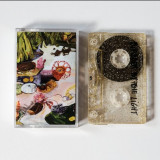
Wisdom Teeth co-founder K-LONE returns with his second full length project, ‘Swells’: a kaleidoscopic and expansive record that looks to deep house, synthpop, leftfield R&B and beyond for a spellbinding masterwork of melodic electronica.
His debut LP ‘Cape Cira’ became the accidental soundtrack of the long strange summer of 2020 - its lush marimbas, hazy atmos and synthesised bird calls providing the ideal soundtrack for some much needed collective escapism. The record was widely deemed one of 2020’s standout electronic LPs, gaining glowing reviews in Pitchfork, DJ Mag, Mixmag and Resident Advisor, and ranking highly in end of year lists by Crack Magazine.
Approaching its follow up, the Brighton-based producer felt a fresh perspective was needed. Originally landing on the name ‘Swells’ as a secret pen-name to write the record under, the intention was to keep the project as separate as possible from ‘Cape Cira’ to avoid settling into familiar territories - but as the record took shape it became clear that it made perfect sense amongst his already diverse discography.
Like ‘Cape Cira’, there is a distinct and intentionally limited sound palette at play on ‘Swells’. Looping vocal cuts, rich cluster chords and undulating arpeggios sit front and centre here - as does the lo-fi plonk of of the CR78 drum machine. But while the record clearly takes influence from a range of vintage sound sources, its overall aesthetic is unmistakably contemporary. Sounds are not artificially degraded nor obscured under washes of sampled tape hiss. Rather, everything is processed with a gloss, hi-fidelity sheen. The record’s rhythms are bright, dry and snappy, and its melodies are processed with a neon poppy glow.
The producer’s unabashed love of contemporary pop music is most obviously exemplified by the appearance of British singer-songwriter Eliza Rose. The pair met for a session at a North London studio back in 2021, and the now Brit Award-nominated singer’s warm, emotive vocal takes became an immediate source of inspiration early in the record’s conception. As such, Rose’s voice is heard in various states of manipulation throughout its duration - initially as reduced and looped phrases, and then finally in full form on ‘With U’: a low-lit, dubbed-out slice of leftfield R&B that beckons comparisons with Tirzah, Little Dragon and even Erykah Badu.
Elsewhere, there are references to G-Funk (‘Oddball’), Autonomic drum and bass (‘Shimmer’), hip-house (‘Love Is’) and even Metronomy-era electro pop (‘Love Me A Little’).
As always, the true magic of K-LONE’s artistry is to present complex, subtle and original ideas in ways that feel familiar and immediate. Melodies are introduced as effortless earworms, only to be twisted out of shape into strange and unusual formulations. Looping rhythms unspool into washes of hazy, dubbed-out ambience before rebuilding themselves. Refined and endlessly creative, ‘Swells’ marks a captivating next step for a producer and record label that have both reliably positioned themselves at the very forefront of contemporary electronic music.
Buscar:low concept
Somewhere in the Lower-Franconian vineyards lies a hidden and mostly unknown canyon, a place that often returns to the thoughts and dreams of Läuten der Seele’s Christian Schoppik. Though a much rarer occurrence now as a consequence of environmental change, chance encounters upon the area in the past would sometimes reveal small ponds amongst the reeds, teeming with life and populated by colonies of newts and the now endangered yellow bellied toad. The transience of the water and the wildlife it hosts, dependent on season or climate, lends the area an almost fantastical, dream-like quality. Was it ever even there at all? A secret place that may or may not be present holds vast appeal to some enquiring minds… Ertrunken Im Seichtesten Gewässer, the third Läuten der Seele album in two years, is inspired directly by these experiences. Translating as ‘drowned in the shallowest stretch of water’, a title as pregnant with dread as it is wonder, the themes present speak both to personal memories and a wider understanding of place and time, and how we might interpret our own position within an ever-changing, sometimes disappearing world.
The record is presented as two long-form pieces divided into four separate movements, each titled so as to reflect this natural environment and its intersection with imagination, relying on processes of collage that draw from myriad indeterminable samples, field recordings and various recorded instruments. Those familiar with Schoppik’s work, both as Läuten der Seele and with Brannten Schnüre, will find present many of his signature tropes - the way deeply layered collages render abstracted visions of the past alive in the present - though what is always significant about his approach is not so much aesthetic as the wider concepts it attempts to express and emote. Indeed, emotional response is key to the Läuten der Seele sound, how overlapping notions of nostalgia, memory and identity calibrate experience and understanding of who we are and the world around us, whether it’s a world that’s gone or another imagined into being. If you observe the artwork closely enough, you may find a clue as to the canyon’s location, though such specifics are besides the point. The music itself infers a wider sense of the impermanence that characterises hidden worlds, wherever they might be or whoever they might belong to.
A kind of hush pervades throughout Standards Vol VI, the latest release by The National Jazz Trio of Scotland, the ironically named project helmed by Falkirk’s musical polymath, Bill Wells, that is neither a trio, nor a jazz band. If this collection of ten covers probably comes closest to the latter in its late night renditions of actual standards, the presence of long-term NJToS member and collaborator Aby Vulliamy as the record’s lone vocalist adds to its solitary air. This follows Standards Vol IV (2018), which featured fellow NJToS co-founder Kate Sugden as primary vocalist, while Gerard Black, a member of the group since 2016, took centre stage in similar fashion on Standards Vol V (2019). Wells has long been a fan of Vulliamy, both of her work as a viola player with numerous collaborators, and as a singer.
Vulliamy played viola on Everything’s Getting Older, Wells’ 2011 collaboration with Arab Strap vocalist Aidan Moffat. Wells went on to play melodica on Vulliamy’s solo record, Spin Cycle, released on Karaoke Kalk in 2018. With the intent of producing the saddest heartbreak record ever made, Wells sourced a back catalogue of miniature epics, reinterpreting each tale of everyday yearning to make a canon of melancholy loungecore designed for nights in alone, if not always lonely. Beyond the concept of isolation behind Standards Vol VI, practical concerns added to the affair, with Wells recording backing tracks at home in Glasgow, while Vulliamy added her voice from her home in Yorkshire. The result on Standards Vol VI is a thing of quiet beauty that sees Wells and Vulliamy reimagine a panoply of pop classics in their own aloof sounding image.
Shades of Margo Guryan and Claudine Longet abound in Vulliamy’s delivery over Wells’ woozy, low-slung guitar and piano, with samples culled from a session with Teenage Fanclub’s Norman Blake. Little electronic percussive clicks and hisses lend things an even more otherworldly air on a record bookended by opener, Donovan’s proto hippy classic, Catch the Wind, and Dixieland miniature, Careless Love. The eight points in between take in a first half led by The Beatles’ normally jaunty We Can Work it Out, flipping the loveable mop-tops’ perky optimism for something more soul searching. This is followed by I Wish You Love, Albert Beach’s English language version of French songwriter Charles Trenet’s evergreen, Que reste-t-il de nos amours. The Bee Gees lost classic, To Love Somebody, is up next, with more impossible to answer questions coming in Why Can’t I?
The latter is a Rodgers and Hart composition that first appeared in the duo’s 1930 Broadway musical, Spring is Here, in which the show’s two heroines commiserate each other over their shared loneliness. Wells stumbled on the song in a tatty Rodgers and Hart songbook, which, like its subjects, had been left on the shelf before he and Vulliamy brought it in from the cold. The second half of Standards Vol VI leads with Matchmaker, Matchmaker, Jerry Bock and Sheldon Harnick’s much covered evocation of a pre dating app era from their 1964 hit musical, Fiddler on the Roof. This is followed by Billy Rose and Dave Dreyer’s showbiz staple (with Al Jolson also taking a credit), Me and My Shadow. While made famous by showbiz double acts ranging from Frank and Sammy to Robbie and Jonathan, here it flies decidedly solo. Johnny Mercer and Hoagy Carmichael’s Skylark comes next, a song inspired by Mercer’s yearning for Judy Garland. We hear ya, bub. The most downbeat take on Bacharach and David’s The Look of Love you’re ever likely to hear comes next, ushering in the short farewell of Careless Love, before the lights are turned out forever. Yeah, well. Whatever gets you through the night…
100-150 TRANSPARENT ORANGE / BLACK VINYL EDITIONS Sunfruits are pleased to announce their forthcoming debut album, One Degree. In high anticipation ever since the Melbourne/Naarm band released their Certified Organic EP in 2020, the album sees their most mature and conceptual songwriting to date. As heard in recent singles ‘End Of The World’, ‘Believe It All’ and ‘Made To Love’, the album showcases Sunfruits’ knack for writing memorable pop songs and their desire to use their music for good. The album is filled with anthemic choruses, melodic psychedelia, harmonious ballads and danceable indie pop, interplaying with potent lyrical messages of hope and despair. Through the album’s 11 tracks the band explore environmental collapse, resilience, self-reflection, love and relationships, all textured with a coming-of-age feel. On their debut album One Degree, the band presents new-age, anthemic psychedelia and indie-pop, similar to MGMT and Pond. The album’s memorable guitar hooks and garage-rock grit nods to artists such as Ty Segall and 70s glam-rocker, T. Rex, while the album’s softer moments echo the cinematic folk of Weyes Blood. Sunfruits take this eclectic mix of influences and create something uniquely their own, branded by euphonious four part vocals that have become a big part of their new sound. One Degree lets the listener sit with their feelings and encourages them to experience the rawness of human existence — highs, lows and the in-betweens. Touring UK/EU in September, including a date at the Manchester Psych Fest.
Emile Mosseri is an Oscar and GRAMMY nominated artist, earning acclaim for his scores for the films Minari (2021) and The Last Black Man In San Francisco (2019) Recently worked with Kaitlyn Aurelia Smith on the critically acclaimed album, "I Could Be Your Dog / I Could Be Your Moon" (2022). On Heaven Hunters, Mosseri looks inwards, using his distinctive sound and gift for musical storytelling for his most personal work. Produced by The Haxan Cloak, Heaven Hunters explores the weight of choosing one path in life, putting to death every other possible future, and finding comfort in redefining happiness.
For Mosseri, the search for Heaven _ a concept of perpetual happiness void of suffering _ is a fruitless effort that blocks us from finding peace and balance in life as it really is. Driven by Mosseri's poignant lyrics and intimate singing, Heaven Hunters is a celebration of the highs and lows that create that equilibrium, built around songs of longing, love, heartbreak, familial struggle, and domestic bliss. It is a vulnerable, heartfelt album that is both expansive and cinematic in its dynamic scope and deeply stripped down and exposed in its emotional core, ready to be experienced as intimately as possible.
Like a winding system of trails and paths cutting through a digital forest-scape, M. Sage's Paradise Crick is shaped by time. Full of wonder and charm, designed patiently and from a rich, curious mulch of synthesized and acoustic sound, the versatile American artist and magic realist's new suite of music is an imaginary destination and a pastoral fantasy that envisions the natural and fabricated worlds as one. Matthew Sage is a musician, intermedia artist, recording engineer and producer, publisher, teacher, partner, and parent. Assembling a sprawling and idiosyncratic catalog of experimental studio music between Colorado and Chicago since the early 2010s, recent highlights include The Wind of Things (Geographic North, 2021), an ensemble-recorded expression of bow-splashed nostalgia, and the four seasonal albums of Fuubutsushi, the improvisatory ambient jazz quartet he formed with friends from afar in 2020. Sage renders projects with nuanced velocity and a completist sensibility _ when it's finished, it's done _ which is what makes Paradise Crick, his debut for RVNG Intl., a compelling outlier. Sage first staked his tent in Crick's conceptual campground five years ago from his home studio in Chicago (he's since returned to Colorado, home to the mountains and prairies often personified in his work). He had just read Richard Brautigan's Trout Fishing in America, a kaleidoscopic reflection of pastoral America's shifting identity by way of magical fishing sojourns. Inspired by that feeling, of getting lost but finding oneself in through the outdoors, he amassed over seventy demos documenting a fictional soundtrack for camping. Pull up to this park, and the sign might read, "Welcome to Paradise Crick. Fire Danger Is Low." The sequence, pruned down to thirteen tracks, courses the dewy mornings, afternoon hikes, and firelit nights of a weekend expedition. While Sage is not a filmmaker, he views the method of making this album as a similar form of world-building via structure, narrative, formal elements, and editorial refinement. Contrasted with his collaborative craft, here he is a sole auteur reclined in total autonomy, able to improvise scenes and implement special effects at will. A parallel precedent for such unchecked imagination in the M. Sage canon is A Singular Continent, his 2014 album that tilted its compass to a faraway land. Where Continent built its world layering samples as composition, Paradise Crick deploys a balance of accessible song structures with experimental instrumentation and sound design. Speckled with harmonica, autoharp, chimes, penny whistle, voice, hand percussion, and other mysteries, Crick's texture is treated as a sensorial adventure; the swamps gurgle, the lakes glisten, and the valleys breathe in robust HD. The rhythms are loose and buoyant, bursting with a few `kick and snare' moments shaped by Sage's lifelong love for drumming and headphone prone electronic music. Crick bumps more than most anything he's done before; crackling static pulses and lush vibrations reveal an intrinsic groove, a hidden beat map. In the landscapes of Paradise Crick, science and magic co-exist, 5k boulders and midi frogs share the frame with real-life memories of Midwest camping trips and the desire to feel extra human in a digitized space. Sage strived for "nature in the holodeck" but couldn't help leaving fingerprints in the simulation, and it's these traces of spirit and character that give Paradise Crick its strange allure. The album's bubbling sense of play, melody, and timbre takes cues from left-field electronic lineage; synth pioneers like Tomita and Raymond Scott up through the more expressive pop tendencies of Woo, Stereolab and the Cocteau Twins, and into contemporary composers like Sam Prekop. The album's vocabulary is uncomplicated; the gestures are sweet and inviting, intended to lull the listener. As much as Sage continues to be an experimentalist by nature in his work, with Paradise Crick, he spins a narrative. Not necessarily a concept album, but rather an invitation to take off for a weekend. That's the modus operandi down here in the Crick, we stretch out. M. Sage's Paradise Crick will be released May 26, 2023 in LP, CD, and digital editions. A portion of the proceeds from this release will benefit Earthjustice, the premier nonprofit public interest environmental law organization.
A precedent of sorts to, erm, Armand van Helden vs Fatboy Slim’s 1999 bout, ‘The Heavyweight Sound Fight’ takes pride of place among iDEAL’s hall of oddities with one of the zaniest recordings by three international leaders of the avant-garde. Double LP with an LP-sized 12-page booklet designed by Sean McCann of Recital.
Adapting all the pomp and ceremony of a boxing match to ludicrous ends - including a flier depicting each artist with their dukes up - they produced what sounds like a great night out for NYC’s experimental cognoscenti with Charlie Morrow (USA) vs Carles santos (Spain) each backed by a band - Soho Baroque Opera Company with the assistance of the New Wilderness Foundation - while Sweden’s Sten Hanson acts as referee, and Armand Schwerner takes the role of announcer in thick, nasal New York brogue. It’s brilliantly daft and subversive but accomplished in a witty way that maybe escapes too many solemnly po-faced avant-garde conceptualists nowadays, and remains a strange outlier in the history of NYC avant garde and beyond.
“Operating as an aural window into an happening that occurred more than 40 years ago, “The Heavyweight Sound Fight” unveils a different context of experimental music than is not often encountered today. Running across the album’s four sides, within all the seriousness of art and technique, is the unmistakable presence of humor, play, and the absurd. The audience can’t help but laugh and cheer as the announcer - effecting a deep New York accent and nodding toward notable attendees like Allison Knowles, Dick Higgins, and Jackson Mac Low - takes an active role in the fight, each artist delivering an array of vocalizations - from extended technique utterances to rants - against the next, with the bands weighing in and engaging in their own battles, ranging from big band dirges and marches, to outright experimental electronic madness. It’s a trully raucous affair that brings that radicalism carried by its sounds into entirely new zones.
According to Marrow, he was deemed “winner” in an “off-script” move by the judges, and Santos never spoke to him again, continuing the wild and wonderful mystery and humor of the performance into the present day. Who knows what Santos, who sadly passed away in 2017, would say.”
With Cruisin', their second album for Telephone Explosion, Toronto's Bernice distils their playful sense of composition resulting in the most affecting collection of their young career. Across fifteen tracks, a special kind of contemporary, jazz-inflected pop unfolds, miraculous for being both fun and musically adventurous, all in the name of emotional resonance. Each groove in the bassbin is matched by a little scratch at the listener's heartstrings. The album was recorded at home with Phil Melanson (Sam Gendel, Andy Shauf) and Thom Gill (Beverly Glenn-Copeland, Joseph Shabason), led by songwriter and vocalist Robin Dann (Martha Wainwright) and producer Matthew Pencer, with additional contributions from longtime members Dan Fortin and Felicity Williams (Bahamas) being captured remotely.
Throughout their eleven years as a group, working at the intersections of several scenes and spotlights (many of which begin and end at Toronto's beloved Tranzac Club), Bernice have developed an idiosyncratic musical language that feels immediately inviting and wonderfully refreshing. The group's two previous releases, Eau De Bonjourno (2021) and Puff: In The Air Without A Shape (2018) received generous nods from both Stereogum and Pitchfork, who described the music as "unusually mesmerizing". With the songcraft a little more crystalline and the vulnerability notched up, Cruisin' feels like the right record to open Bernice up to a much wider audience.
Development of the album began in Spring, 2021 during a writing retreat at the family farm in Bond Head, Ontario. Members of the band luxuriated in slow time, tinkering with lyrics and melodies, sharing meals, knitting. From this communal gathering, the concept of 'dedication' emerged as a guiding theme. Specifically, developing songs in an almost epistolary form; as love letters or check-ins for friends, community members, pets and other more elusive acquaintances (a longtime working title for the project was 'Songs For People').
Lead single 'Underneath My Toe', one of the first pieces developed under this theme, finds the group at their most graceful and direct. Beginning with songwriter/vocalist Robin Dann singing simply 'Hi / I miss you all the time', the composition proceeds to shift subtly between soft jazz balladry and low-bit funk, revelling in the intimate beauty of a long-time-no-see letter to a dear old friend.
Though being a band that so deeply values the art of fartin' around, Bernice couldn't settle on such a straightforward approach. During the creative process, a clarifying question arose: 'Can you cruise to it?'. This somewhat ambiguous aesthetic criteria became a guiding light for the album. 'Sure, it's a beautiful song about building trust with a new nonagenarian friend... but can you cruise to it?'.
Case in point, both follow up singles, 'No Effort To Exist' and 'Second Judy', fall into a more nebulous, bewildering category of song. Undoubtedly affecting, emotionally charged, existentially searching, yet also undeniably juicy. Drum patterns skitter into place while synth tones shift on a dime to meet thematic twists. There's errant whistling and curious overdubs. Then in come elegant backing vocals, elevating the narrative while an unlikely, left-field groove is established. Miraculously, the listener is not just moved, but Cruisin'.
Therein lies the marvel of Bernice: they remind us that the rec room funk of Mario Kart 64 need not exist in mutual exclusivity to a rich tapestry of human emotions. Even as we live through this most cursed timeline, we can look into the heart of things, dwell on the challenges we're called to witness, and find a little levity to carry us through; grab a lil' mushroom and cruise the existential soup.
Strawberries ripen in the spring. Or so they used to, in a more reliable world, one that seems to be rapidly receding in our collective rearview mirror. Presently, “spring” is a troubled concept — fraught with anxiety. Our seasons, if they are seasons at all, are paradoxical. Crops fail, or they ripen prematurely, all at once, and into a burst of rot. Impossibly, somehow, the supermarket shelves stay stocked (mostly, for now at least), and there are buckets of strawberries on every corner. But, of course, their nature is suspect. And they don’t taste like they used to. Or maybe that’s just ruinous nostalgia. But somewhere along the way we certainly lost something. Everybody knows.
Strawberry Season (Leaving Records, November 9 2022) responds tenderly to this sorry state of affairs, not with false comfort — nor escapism. Rather, the album conveys, often wordlessly, that there remains an abundance of sweetness amidst our increasing unease. While much of twentieth century American popular and folk music may have dwelt on the beauty and plenitude of the prairie, More Eaze applies a similar Romantic focus to the small bursts of fecundity that now hide in plain sight. Blending found sound, generative music, a knack for elegant, classically-informed melodic arrangement, and a sort of Liz-Fraser-by-way-of-hyperpop approach to vocals, Strawberry Season offers unique solace — providing an occasion for the kind of deep listening that our overstimulated and undernourished spirits require if there is to be any hope at all (and of course there must be hope).
More Eaze (serving as composer, songwriter, multi-instrumentalist, producer, and sound artist) guides us incrementally to this locus of attentiveness. Strawberry Season begins with the softly sweeping gentle pets. Early intimations of Velvet Underground give way, indeed, to a string arrangement that John Cale might have saved for Paris 1919. The second track, Suped, features a kaleidoscopic swirl of grocery checkout scanners that eventually coalesce and release with the subtle strumming of a harp. On known, in the midst of a nearly elegiac outflow of feeling, a shower starts to run. Someone steps inside, pulling the curtain back, sending the plastic rings clattering. Moments later, the unmistakable sound of the showerer blowing their nose — an inclusion that is at once light-hearted and jarringly, movingly intimate.
Strawberry Season’s second to last song, low resolution at santikos, serves as a sustained meditation on all that has come before it. Building slowly throughout its nine minutes, teetering, at times, on the edge of danceability, it dissipates suddenly, and Strawberry Season concludes with the rustling of clothes, snippets of distant conversation, creaking floorboards, an exhale and a sniff. There is a feeling of having arrived, of temporary reprieve in the face of uncertainty. A hint of a season yet to come, or one that is perhaps only now accessible in dreams.
When Italian composer Bruno Bavota and Dutch songwriter Chantal Acda first met several years ago, they knew almost instantly that they wanted to make music together. Bavota was already a fan of Acda's dreamy, orchestral folk, and in Bavota's intimate, picturesque piano compositions, Acda saw a potential for collaboration that was begging to be explored. As it would happen, the inherent loneliness and isolation of the COVID-19 pandemic would provide a most unusual opportunity to craft an album together - without ever being ion the same room. Originally conceived as a brief two- or three-song EP, A Closer Distance is the result of a month of seemingly endless and effortless creative connections between Bavota and Acda. Spawned from the opening piano phrase that became the album's title track, the nine songs that make up A Closer Distance were written and recorded by Bavota and Acda in their respective homes. No stranger to long-distance collaboration - having worked with an array of artists from Alan Sparhawk and Mimi Parker of Low to guitar legend Bill Frisell - even Acda was surprised by the ease and pace with which A Closer Distance came together: "This all came so weirdly natural. It woke up a part of me that had been asleep for a while." Mostly built around Bavota's solitary piano arrangements and Acda's layered, ethereal vocals, the songs on A Closer Distance reflect the intimacy and tranquility of their conception. It is a magical collection that connects to the listener with the same air of comfort and familiarity that inspired its creation.
Electric Light Orchestra leader Jeff Lynne did more than figuratively reach for the sky on Eldorado. Daring to be bold, and creating imaginative worlds that invite the listener to escape the mundane, the visionary composer-musician achieved a multidisciplinary fantasia and, in the process, a prog-rock landmark. Nearly 50 years later, the concept album's brilliance can be experienced like never before in cinematic, IMAX-worthy fashion.
Sourced from the original analogue master tapes, pressed on MoFi SuperVinyl vinyl at RTI, housed in a keepsake box, and limited to 10,000 numbered copies, Mobile Fidelity's UltraDisc One-Step 180g 45RPM 2LP set of Eldorado allows the long-time audiophile staple to resonate with reference-setting dynamics, tones, and colours. Conjuring the feeling of journeying to different horizons, the record's songs teem with layer upon layer of details, which can now be heard as the producers intended. This very special release both pays tribute to the record's merit and enhances the spectacular program for generations to come.
Presenting the album with breathtaking clarity yet retaining the warmth, texture, and emotion that differentiate live music from reproduced sounds, the collectible reissue features beguiling levels of in-the-moment presence, grand-scale sound-staging, and instrumental balance. Bursting with a veritable cornucopia of stimuli, MoFi's Eldorado package also benefits from superb separation and immersive atmospherics that stem from the meticulous remastering process – as well as an ultra-low noise floor, industry-leading groove definition, and dead-quiet surfaces courtesy of the MoFi SuperVinyl properties.
The premium packaging and gorgeous presentation of the UD1S Eldorado pressing befit its extremely select status. Housed in a deluxe box, it features special foil-stamped jackets and faithful-to-the-original graphics that illuminate the splendour of the recording. No expense has been spared. Aurally and visually, the reissue exists as a curatorial artefact meant to be preserved, touched, and examined. It is made for discerning listeners that prize sound quality and production, and who desire to fully immerse themselves in everything involved with the album.
An artistic breakthrough that established Electric Light Orchestra as a pioneering band (and confirmed Lynne as the leading practising Beatles disciple), the 1974 effort remains notable for its involvement of a full orchestra and choral section, the range of which are captured with exquisite results on this LP. Eldorado distinguished itself from the band's first two works not only via Lynne's sharpened songwriting but due to the hiring of an orchestra that augmented the group's three string players. Co-arranged by Lynne and conductor Louis Clark, the symphonic movements bolster the contagious fare without ever drowning it. The accents also act as transports into the varied narrative universes.
Finished as a story before Lynne put notes down on paper, Eldorado ironically owes its inspiration to Lynne's father. In response to his dad's criticisms about the band, Lynne conceived a melodic tour de force that, like The Wizard of Oz, which informs the cover art, emphasizes the power of everyday dreams and everyman heroism. It's no coincidence that the sonic journey begins with an overture punctuated by the words of a cynic who condemns "the dreamer, the un-woken fool."
Beautiful yet fun, ambitious yet consistent, Eldorado proceeds to celebrate such romantics and escapists. A Technicolour escapade marked by lush melodies, fluid crescendos, and an intoxicating blend of energetic rock and sweeping orchestral elements, the album weds rich imagery and sweeping sounds in manners that make the two inseparable. In Lynne and company's hands, reality and fantasy collide, and dissolve any dividing lines. The proof is not just in the epic production, but in the timeless (and catchy) nature of songs such as the balladic "Boy Blue," power-pop packed "Illusions in G Major," and, of course, the aptly titled hit, "Can't Get It Out of My Head."
Decades later, Eldorado doubles as an invitation to break away from monotony whether you're listening to your Mobile Fidelity reissue on a large system or an excellent pair of headphones.
MoFi SuperVinyl
Developed by NEOTECH and RTI, MoFi SuperVinyl is the most exacting-to-specification vinyl compound ever devised. Analogue lovers have never seen (or heard) anything like it. Extraordinarily expensive and extremely painstaking to produce, the special proprietary compound addresses two specific areas of improvement: noise floor reduction and enhanced groove definition. The vinyl composition features a new carbonless dye (hold the disc up to the light and see) and produces the world's quietest surfaces. This high-definition formula also allows for the creation of cleaner grooves that are indistinguishable from the original lacquer. MoFi SuperVinyl provides the closest approximation of what the label's engineers hear in the mastering lab.
More About Mobile Fidelity UltraDisc One-Step and Why It Is Superior
Mobile Fidelity Sound Lab's UltraDisc One-Step (UD1S) technique bypasses generational losses inherent to the traditional three-step plating process by removing two steps: the production of father and mother plates, which are created to yield numerous stampers from each lacquer that is cut. For UD1S plating, stampers (also called "converts") are made directly from the lacquers. Since each lacquer yields only one stamper, multiple lacquers need to be cut. Mobile Fidelity's UD1S process produces a final LP with the lowest-possible noise floor. The removal of two steps of the plating process also reveals musical details and dynamics that would otherwise be lost due to the standard multi-step process. With UD1S, every aspect of vinyl production is optimized to produce the best-sounding vinyl album available today.
Pink Vinyl
Canadian producer Dylan Khotin-Foote has kept his Khotin alias going for the better part of a decade; the impressionistic electronic project shifts with the movements in his life. Sometimes it leads, like when the club-friendly grooves of 2014's Hello World immersed him in the heart of Vancouver's underground dance scene, and sometimes it follows, like 2018's Beautiful You, a downtempo salve for DJ fatigue His melodic sensibility and playful ear for atmosphere remain the rippling core of the project's fingerprint; whether beat-driven or ambient, a foggy smear or a dusted and pristine print, a Khotin track has a distinct and instantly recognizable swirl. During and after the 2020 release of Finds You Well, his second LP on Ghostly International, Khotin-Foote settled back into a slower vibe in his hometown of Ed- monton. Even before the pandemic, his pivots to softer production, and away from DJing, left him with fewer opportunities in Vancouver and club bookings overall, and as a self-identifying introvert, he was fine with that. But the change of pace did open space for Khotin-Foote to grapple with concepts of adulthood and career. At his lowest, he almost walked off this musical path altogether; instead, he doubled down on the craft _ the tone, pacing, and dynamism of new material _ arriving at a definitive full-length. With Release Spirit, Khotin releases himself from the pressure of expectation, fusing and refining everything we know about his music. The warmth and familiarity of Khotin's dreamy, dulcet style meet new ideas and frameworks, a natural progression, a modest revelation; Khotin confirms it is okay to move slowly and he's never sounded better doing it. The album title borrows from the "release spirit" mechanic in the video game World of Warcraft. When players die, they are prompted to release their spirit and return as ghosts to find their corpses and come back to life. Khotin sees it as a worthy metaphor for the impending change his return home presented and the resulting process of purging artistic expectations to find his creative self again. On this go- around, he is freer, more playful, and more intentional within his palette of warped synth, breakbeats, and piano sounds _ including the classic Casio SK-1 presets he's used since the start _ mingling with wistful samples, field recordings, and other abstract snippets. For the first time, he enlisted Nik Kozub to do the mix and assist with sequencing. Khotin-Foote has long worked with the Edmonton-based musician and engineer in the mastering phase, as well as their days co-running the label Normals Welcome, and this time was able to involve his ears earlier given their newfound proximity. "I think it's my best sounding record to date." We begin on "HV Road" or Happy Valley Road, where Khotin-Foote spent time during a family vacation in British Columbia's Okanagan Lake. His plans to record crickets at night are quickly foiled by his younger siblings; the cute exchange orients the listener to a core memory of sorts, setting the tone of universally understood warmth and wonder that has defined some of Khotin's most transportive tracks. Hazy percussion takes hold, and we are swept further into the wisp of "Lovely," a grooving, melodic standout built on the interplay between the beat and human voice-like hums. Khotin knows this zone well; equally suited for a reverie or a club warm-up. The bubbling atmosphere and absurdity of "3 pz" offer a cosmic/comic interlude and also speak to reflections on his family's move to Canada two generations ago, and the audio tutorials they used to learn English. "I can only imagine my grandpar- ents repeating some of the bizarre phrases." "Fountain, Growth" finds Khotin in collaboration with Montreal's Tess Roby (Dawn to Dawn) for the project's first-ever vocal track. Roby's soft cadence echoes atop spiraling air pockets of rhythmic production, lending a breezy, almost shoegaze pop feel. Throughout the single and the album, wind gusts between the compositional layers, akin to the roaming spirits of its namesake, curving around the birdsong of "Life Mask" and seamlessly reaching "Unlimited <3." The latter bumps in slow motion; disembodied whirrs from his Casio collide with 808 drums and sub-bass for a vibe that teeters on trap and instrumental hip-hop. Release Spirit rests in a dream sequence. Oscillating synth lines dance around the heartbeat of "Techno Creep," a hyperactive REM state before the digitized ambient sprawl of "My Same Size." In the final pass, Khotin imagines transcontinental travel from the glow of his screen. He recorded "Sound Gathering Trip" to soundtrack a genre of YouTube videos he's taken to that follows train routes through Europe and Japan. The scene is serene and moving; piano keys warble as static-filled sound design shimmers off the rails, from cityscapes to the countryside, an introspective ride through a world beyond his bedroom. It doubles as an apt parting image for Khotin's project as a whole: dreaming big but happiest when riffing on the details, shaping environments from the inside out. Over the last decade, he has stretched from his core in Edmonton, leaving a trace in Vancouver and beyond; but when all signs point home, he loops back to see it all from a different vantage, revitalized, refined, and free.
Canadian producer Dylan Khotin-Foote has kept his Khotin alias going for the better part of a decade; the impressionistic electronic project shifts with the movements in his life. Sometimes it leads, like when the club-friendly grooves of 2014's Hello World immersed him in the heart of Vancouver's underground dance scene, and sometimes it follows, like 2018's Beautiful You, a downtempo salve for DJ fatigue. His melodic sensibility and playful ear for atmosphere remain the rippling core of the project's fingerprint; whether beat-driven or ambient, a foggy smear or a dusted and pristine print, a Khotin track has a distinct and instantly recognizable swirl. During and after the 2020 release of Finds You Well, his second LP on Ghostly International, Khotin-Foote settled back into a slower vibe in his hometown of Ed- monton. Even before the pandemic, his pivots to softer production, and away from DJing, left him with fewer opportunities in Vancouver and club bookings overall, and as a self-identifying introvert, he was fine with that. But the change of pace did open space for Khotin-Foote to grapple with concepts of adulthood and career. At his lowest, he almost walked off this musical path altogether; instead, he doubled down on the craft _ the tone, pacing, and dynamism of new material _ arriving at a definitive full-length. With Release Spirit, Khotin releases himself from the pressure of expectation, fusing and refining everything we know about his music. The warmth and familiarity of Khotin's dreamy, dulcet style meet new ideas and frameworks, a natural progression, a modest revelation; Khotin confirms it is okay to move slowly and he's never sounded better doing it. The album title borrows from the "release spirit" mechanic in the video game World of Warcraft. When players die, they are prompted to release their spirit and return as ghosts to find their corpses and come back to life. Khotin sees it as a worthy metaphor for the impending change his return home presented and the resulting process of purging artistic expectations to find his creative self again. On this go- around, he is freer, more playful, and more intentional within his palette of warped synth, breakbeats, and piano sounds _ including the classic Casio SK-1 presets he's used since the start _ mingling with wistful samples, field recordings, and other abstract snippets. For the first time, he enlisted Nik Kozub to do the mix and assist with sequencing. Khotin-Foote has long worked with the Edmonton-based musician and engineer in the mastering phase, as well as their days co-running the label Normals Welcome, and this time was able to involve his ears earlier given their newfound proximity. "I think it's my best sounding record to date." We begin on "HV Road" or Happy Valley Road, where Khotin-Foote spent time during a family vacation in British Columbia's Okanagan Lake. His plans to record crickets at night are quickly foiled by his younger siblings; the cute exchange orients the listener to a core memory of sorts, setting the tone of universally understood warmth and wonder that has defined some of Khotin's most transportive tracks. Hazy percussion takes hold, and we are swept further into the wisp of "Lovely," a grooving, melodic standout built on the interplay between the beat and human voice-like hums. Khotin knows this zone well; equally suited for a reverie or a club warm-up. The bubbling atmosphere and absurdity of "3 pz" offer a cosmic/comic interlude and also speak to reflections on his family's move to Canada two generations ago, and the audio tutorials they used to learn English. "I can only imagine my grandpar- ents repeating some of the bizarre phrases." "Fountain, Growth" finds Khotin in collaboration with Montreal's Tess Roby (Dawn to Dawn) for the project's first-ever vocal track. Roby's soft cadence echoes atop spiraling air pockets of rhythmic production, lending a breezy, almost shoegaze pop feel. Throughout the single and the album, wind gusts between the compositional layers, akin to the roaming spirits of its namesake, curving around the birdsong of "Life Mask" and seamlessly reaching "Unlimited <3." The latter bumps in slow motion; disembodied whirrs from his Casio collide with 808 drums and sub-bass for a vibe that teeters on trap and instrumental hip-hop. Release Spirit rests in a dream sequence. Oscillating synth lines dance around the heartbeat of "Techno Creep," a hyperactive REM state before the digitized ambient sprawl of "My Same Size." In the final pass, Khotin imagines transcontinental travel from the glow of his screen. He recorded "Sound Gathering Trip" to soundtrack a genre of YouTube videos he's taken to that follows train routes through Europe and Japan. The scene is serene and moving; piano keys warble as static-filled sound design shimmers off the rails, from cityscapes to the countryside, an introspective ride through a world beyond his bedroom. It doubles as an apt parting image for Khotin's project as a whole: dreaming big but happiest when riffing on the details, shaping environments from the inside out. Over the last decade, he has stretched from his core in Edmonton, leaving a trace in Vancouver and beyond; but when all signs point home, he loops back to see it all from a different vantage, revitalized, refined, and free.
Most audiophiles know Alan Parsons Project's I Robot by heart. Engineered by Parsons after he performed the same duties on Pink Floyd's Dark Side of the Moon, the 1977 record reigns as a disc whose taut bass, crisp highs, clean production, and seemingly limitless dynamic range are matched only by the sensational prog-rock fare helmed by the keyboardist and his creative partner, Eric Woolfson. Not surprisingly, it's been issued myriad times. Can it be improved? Relish Mobile Fidelity's stupendous UltraDisc One-Step 180g 33RPM box set and the question becomes moot.
Mastered from the original master tapes and pressed at RTI on MoFi SuperVinyl, I Robot comes to life with reference-setting realism on this numbered, limited-edition reissue. Boasting immaculate highs and lows, generous spaciousness, and see-through transparency that takes you into the studio with Parsons and Woolfson at Abbey Road, this definitive edition is designed to demonstrate the full-range capabilities of the world's best stereo systems while offering listeners the convenience of having all the music on one LP.
Featuring a nearly inaudible noise floor, this transcendent UD1S edition functions as a repeat invitation to savor reference-grade soundstages, immersive smoothness, sought-after instrumental separation, three-dimensional imaging, and consummate tonal balances. Able to be played back at high volumes without compromise or fatigue, it is a demonstration record for the ages – the likes of which are no longer being made. This is the very reason you own and invest in high-end audio gear.
The special characteristics of this UD1S version extend to the premium packaging. Housed in an elegant slipcase, the reissue features special foil-stamped jackets and faithful-to-the-original graphics. Aurally and visually, it is made for discerning listeners who prize sound quality and production, and who desire to fully immerse themselves in everything about this conceptual landmark. The Alan Parsons Project's most famous record deserves nothing less.
Inspired by and loosely based around the Isaac Asimov stories of the same name, I Robot delves into themes of artificial intelligence and technological dominance that make the record extremely relevant in the 21st century. Indeed, Parsons and Woolfson's pinnacle creation dovetailed with the ascendency of Star Wars, which itself is experiencing a rebirth in an age of self-driving cars, smart devices, and mindless automation. Lyrically, songs such as "The Voice" call into question human behavior – and their relationship to increasing robotic supremacy – in everyday life. Parsons and Woolfson reflect the associated paranoia, dichotomy, and transformation via shifting sci-fi arrangements steeped in drama and moodiness.
The absorbing tunes on I Robot also continue to fascinate due to their perfectionism and innovation. Borrowing from Pink Floyd's strategies, Parsons and Woolfson utilize a looped sequence on the title track to create new downbeats. "Some Other Time" employs two different lead vocalists and yet gives the illusion that only one is involved. Captivating strings, a piccolo trumpet, and bona fide pipe organ grace "Don't Let It Show." The origins of "Nucleus" stem from a unique analog keyboard concoction dubbed "the Projectron," devised by Parsons and electronic engineer Keith Johnson. Andrew Powell's orchestral and choral arrangements top it all off, with "Total Eclipse" arriving as a frightening track that presages the climactic "Genesis Ch. 1 V. 32."
Does man or machine win in the end? Decide as you get lost in Mobile Fidelity's UltraDisc 180g 33RPM LP pressing. Secure your numbered copy today!
More About Mobile Fidelity UltraDisc One-Step and Why It Is Superior
Mobile Fidelity Sound Lab's UltraDisc One-Step (UD1S) technique bypasses generational losses inherent to the traditional three-step plating process by removing two steps: the production of father and mother plates, which are created to yield numerous stampers from each lacquer that is cut. For UD1S plating, stampers (also called "converts") are made directly from the lacquers. Since each lacquer yields only one stamper, multiple lacquers need to be cut. Mobile Fidelity's UD1S process produces a final LP with the lowest-possible noise floor. The removal of two steps of the plating process also reveals musical details and dynamics that would otherwise be lost due to the standard multi-step process. With UD1S, every aspect of vinyl production is optimized to produce the best-sounding vinyl album available today.
MoFi SuperVinyl
Developed by NEOTECH and RTI, MoFi SuperVinyl is the most exacting-to-specification vinyl compound ever devised. Analogue lovers have never seen (or heard) anything like it. Extraordinarily expensive and extremely painstaking to produce, the special proprietary compound addresses two specific areas of improvement: noise floor reduction and enhanced groove definition. The vinyl composition features a new carbonless dye (hold the disc up to the light and see) and produces the world's quietest surfaces. This high-definition formula also allows for the creation of cleaner grooves that are indistinguishable from the original lacquer. MoFi SuperVinyl provides the closest approximation of what the label's engineers hear in the mastering lab.
- A1: Bergsonist – Southern Sea Palm (Eisenia Arborea)
- A2: 400Ppm – Spiny Lobster (Panulirus Interruptus)
- A3: Virgo Four – Giant Black Sea Bass (Stereolepis Gigas)
- A4: Ouse – Neptune’s Necklace (Hormosira Banksii)
- A5: Lst – Crystal Jellyfish (Aequorea Coerulescens)
- A6: Nick Klein – Bladder Wrack (Nereocystis)
- A7: Suburban Cracked Collective – Garibaldi (Hypsypops Rubicundus)
- A8: Spor Tranquil – Giant Bladder Kelp (Macrocystis Pyrifera)
- A9: Ivory Whips – Blacksmith Chromis (Chromis Punctipinnis)
- A10: Léo Hoffsaes – Juvenile Painted Greenling (Oxylebius Pictus)
- B1: Dopplereffekt – Bat Ray (Myliobatis Californicus)
- B2: Tolouse Low Trax – Elk Kelp (Pelagophycus Porra)
- B3: The Hobbits – Treefish (Sebastes Serriceps)
- B4: Dissemblance – Clouded Moray (Echidna Nebulosa)
- B5: Liquid Soap – Jewel Anemone (Corynactis Viridis)
- B6: Axel Larsen – Brown Macroalgae (Sargassum Horneri)
- B7: Scythe – Sunflower Star (Pycnopodia Helianthoides)
- B8: The New Wagers – Old Souls
- B9: Newworldaquarium – Nudibranch (Hermissenda Opalescens)
Bladder by the Light is a conceptional compilation between Obsolete Future and the Parisian painter Marion Guillet. It was compiled by Marion Guillet & Conor Walker.
Jude Woodhead AKA Saint Jude is a born and bred South London based producer who first approached songwriting after being diagnosed with Tinnitus which prevented him from pursuing his DJ career. While his previous works found space between genres, with elements of indie, ambient pop, hip-hop, Uk garage and noise, his debut self-produced album 'Signal' - out in November 2022 - rejects the limitations of genres altogether while anchoring his music firmly in the sounds of his native South London.
Conceptualized during the lockdown in 2020, ‘Signal’ is a self-portrait about coming of age during a time of political crisis and social change. Enlisting the help of past collaborators and friends (Aga Ujma, Low Loudly - Sarah from Drug Store Romeos - Louis Culture, Trim, HALINA and Zeke Ultra), Jude uses a wide range of voices to communicate different perspectives on his subject matter.
repress
Levon Vincent returns with his fourth full-length studio album Silent Cities a striking departure from his previous records. This, his first release experimenting with the cassette format, Silent Cities is a kind of mixtape through more private moods and personal pitches (literally given Levon’s non-standard tunings).
While Levon has always pro
duced dance floor jams with the intention of raising people’s heart rates, Silent Cities began with 72 bpm: his average resting heart rate, and the concept of tuning the music he was making to his own body rather than increasing anything. This brought the tempos down to 72 bpm or even half of that, at 36bpm. Programming the record during the empty cityscape of Berlin lockdowns, this is the first time Levon’s created an album for the home stereo or for headphone listening whilst navigating through a city. A mixtape specialist in his youth; he was always wanted to play with the cassette format. The results are sure to delight any listener, with the ever-present ambient, krautrock, shoegaze, hip-hop and electro influences coming to the foreground on this work.
“I was expanding further along the lines of a surprise favourite from my previous LP, a song called She Likes To Wave To Passing Boats which was not a 4 on-the-floor piece to play in clubs but a more impressionistic piece of music that I wrote to expound some emotions one day” says Levon. “It was a song written using just intonation. I really love how warm the pure 4ths sound, so when working on the new LP Silent Cities I decided to use my own tunings”.
Historically, the use of just intonation has meant that such instruments could sound "in tune" in one key but at the expense of more dissonance in the other keys. None of the songs on Silent Cities use standard Western equal temperament, Levon created his own scale designs coupled with the ancient ratios found in just intonation.
Born in Houston in 1975, Levon’s life changed dramatically when his parents moved their family to New York in 1981, uprooted from what he knew, the shock, the change from Houston to New York at 6 years old, is referred to constantly in Levon’s Musical output over the years. Levon's family moved houses in and around NYC from 1981 -2010, never more than a mile or two from the WTC. He lived on the Lower East Side during his teenage years and early 20s. This time period and this locale are also a big theme recurrent in his music as he tries to convey how the "downtown" lifestyle and culture-melding affected him so much at a tender age. He cut his teeth working in record shops around lower Manhattan, and while working at the Halcyon Record shop in Brooklyn he (alongside DJ Jus-Ed) was instrumental in creating the wave that came to be known as the "NYC House Renaissance" circa 2010. During the Y2K years he studied 20th C post-minimalism at Purchase college of New York under James McElwaine (who tangentially produced Man Parrish’s Self-Titled proto-hip-hop debt LP). Levon was fortunate to study theory with avant-garde composer Dary John Mizelle and orchestration under conductor Joel Thome. He undertook masterclasses with Philip Glass and also served as intern for John Kilgore, engineer for Steve Reich, where he was present for notable mix sessions such as “Violin Phase.”
Post-minimalism clearly remains an influence not to mention the early sampler stars of 80s freestyle and synth pop. Mixing such far-reaching influences is something Levon executes tremendously well. The first track Everlasting Joy moves at a head nodding 96 BPM tempo, reflecting formative influences like Paul Hardcastle’s Rainforest or Art Of Noise’s Moments in Love. “Those types of songs were a big eye opener for me as a youth, because it was where I realised songs in popular culture didn’t have to be kept to just 3 minutes, and they didn’t require vocals either. So, Everlasting Joy is a song with that intention, one that might be radio-friendly, despite the long arrangement and without vocals. You could say it was inspired by 107.5 in NY because that was a station I listened to a lot in the 1980’s.”
The majority of demos on Silent Cities were recorded before Covid-19 hit the world - when Levon had found a studio space outside of home in his adopted city of Berlin. It was a career first - working on music outside the bedroom. This riding the train or bicycling ‘going to work’ in Berlin opened up a new mood in his music, using the time back and forth to be inspired - commuting as an NYC transplant who still feels as a tourist in Berlin, with a pair of headphones, looking out the window on the train, or stopping on bridges and parking his bike to enjoy Berlin's skyline and horizon. Then, the pandemic struck and “work” came to a halt. Levon had recorded so much material during that year in the studio out of house it seemed like an inflection point for him to lighten the burden of the possessions he was carrying.
“People close to me have watched me give away synths and hardware regularly and I have given away my record collection every few years for my whole life. As a struggling artist in my 20s who had worked in record stores that whole time, I learned that moving constantly with 12k records just wasn't the way to live. So, in light of the pandemic, I set up a shop online, and sold all my music equipment. I also created a separate shop for all my sneakers and clothes. Easy come, Easy go. This provided me with a slow drip type of income that carried me quite well through the pandemic and it allowed me to focus on my own art and music. Getting rid of all my possessions felt like a weight being lifted from my shoulders and I was able to stay the course and remain committed to the music. I needed a further 2 years to mix and arrange the LP. If it weren’t for the pandemic, I would not been able to make this type of LP, so in light of everything, I was able to turn a depressing time in to something lasting and musically very positive.”
You can hear how his approach to a cassette release retains the "Medium is the Message." ethos. Silent Cities is a spooling, warm piece about life memories and embodiment.
Black Vinyl[27,10 €]
Jordan Reyes is one of the busiest musicians in experimental music
today, and here he takes a bold turn with the metal-inflected Everything Is
Always, touching on death, Zen and science fiction
Reyes' previous collaborators include ONO, Eli Winter and Robert Stokowy, and
here he brings in a large and expert cast: Steve Hauschildt (Emeralds) at the
mixing board, and Heba Kadry (Slowdive, Big Thief, Alex G, Lower Dens)
mastering, plus instrumentalists including Lia Kohl (Whitney, Steve Gunn), Jon
Mueller (Volcano Choir, Death Blues), Patrick Shiroishi and Sam Wagster (Fruit
Bats, Eli Winter). The result is conceptual yet refined, and distinctively American
Dreams. Pressed on Randomly Colored color vinyl.
Random Colour Vinyl[36,77 €]
Jordan Reyes is one of the busiest musicians in experimental music
today, and here he takes a bold turn with the metal-inflected Everything Is
Always, touching on death, Zen and science fiction
Reyes' previous collaborators include ONO, Eli Winter and Robert Stokowy, and
here he brings in a large and expert cast: Steve Hauschildt (Emeralds) at the
mixing board, and Heba Kadry (Slowdive, Big Thief, Alex G, Lower Dens)
mastering, plus instrumentalists including Lia Kohl (Whitney, Steve Gunn), Jon
Mueller (Volcano Choir, Death Blues), Patrick Shiroishi and Sam Wagster (Fruit
Bats, Eli Winter). The result is conceptual yet refined, and distinctively American
Dreams. Pressed on Randomly Colored color vinyl.
West Mineral return with a followup to Mister Water Wet’s 2019's subtropical ambient slow-burn debut ‘Bought the Farm’, expanding Iggy Romeu's horizons to contrast feverish Afro-Caribbean ambient jazz with jaunty illbient and atmospheric freakouts. Low-lit heat that’s highly recommended if yr into Nick León, Carlos Niño, Kelman Duran, Gonçalo F. Cardoso.
Mister Water Wet continues to excavate the tropical soundscapes that simmer the producer's Kansas City home with his Puerto Rican roots, on a new album of extended vignettes and mood pieces that cross a late 90’s Mo Wax instrumentals vibe with present day feelings of displacement and ennui.
LP opener ‘Bory’ tunes us into Water Wet’s weirdly fuzzed frequencies, where tremeloed strings and found sounds resemble what might have been a lost dean blunt x dean hurley sound design concept for Inland Empire, while ‘I Saw the Green Flash' opens a swirl of strings and traditional rhythms caught in a reflecting pool of canned classical orchestrals and 1950s theremin wails. 'Good Apple’, meanwhile, cranks up the mood with aged x looped piano paired with an undulating, bass-heavy shuffle that wouldn't sound out of place on a Kelman Duran x Martin Denny mixtape.
'When Kennybrook Burned to the Ground' leans into heady jazz vapours, spreading crackle over pitch-fucked horn samples, but it’s the producer's weird use of percussion that keeps us gripped: scattering his arrangements across the grid, mimicking an ensemble of players deployed in irregular formations. Romeu embraces trip-hop on 'Any Other Time', blending Afro-Caribbean percussion with a swung downtempo beat, while ‘Isthmus’ reminds us of the clatterbox plunder of Moonshake’s PJ Harvey hookup ‘Just a Working Girl’ - with all its asymmetric hooks.
The extended closing track 'Losing Blood' takes a leaf out of Fennesz's glitched rulebook, stretching and folding disintegrating loops through an 11 minute descent into the elegiac aether.