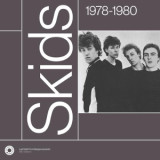
In early 2025 the Skids complete BBC Sessions are compiled onto CD by Scottish label Last Night From Glasgow - The double album features the five sessions the Skids recorded for John Peel with the BBC between 1978 and 1980 - The release includes the BBC session recordings of fan favourites The Saints Are Coming, Masquerade and Circus Games - The legendary Scottish punk band remain as influential as ever, even 45 years on. Legendary punk and new wave band Skids formed in Dunfermline in 1977. They rose to fame with 1979 single Into The Valley and 1980 album The Absolute Game. With almost 50 years under their belt the group, led by Richard Jobson, remain as thrilling as ever, as evident with their latest album Destination Dusseldorf in 2023. The Skids continue to boast over 80,000 monthly Spotify listeners and have been featured extensively across media and press throughout their career. In recent years they have partnered with label Last Night From Glasgow to reissue on vinyl albums Scared To Dance and Days In Europa, and release new album Destination Dusseldorf.
Emergent polymath Brother Aten makes his first outing on Bruk with an icy slice of system-ready
minimalism, guided by the cooly detached voice of Ze R.
Taking cues from cult sci-fi and early 80s no wave, Fragmented Dystopia is a crystal clear
statement trimmed of all unnecessary baggage. The title spells out the mood — Aten's
soundscapes are stark and synthetic machine mantras punched out on outboard instruments
navigating gritty, futuristic zones.
On 'Unavailable' steadily humming drones shape the space in which Ze R. hovers, initially
delivering a deadpan denial before their humanity sneaks in as the track snakes through an
intricate lattice of crisp digital percussion. Short and razor-sharp two-parter 'Fragmented Dystopia'
finds an even sparser corner to occupy within Aten's subtly cyberpunk vision, where Ze R.'s
scattered words cut a measured figure delivered at acute angles before breaking into wilder forms
at the end of Part 2.
Originally from Brooklyn and now based in Berlin, Brother Aten has been weaving a fascinating
tapestry of audio and visual work as MAF. His artwork examines the fraught relationship between
technology and society. Ze R. explores dimensions of sexuality, subjectivity and individualism
through writing, performance and community organisation.
"The, multi-platinum, 3x GRAMMY® Award-nominated, and Emmy® Award-winning rapper Cordae has releases his highly acclaimed third studio album, The Crossroads on 12"" LP.
The new album features production from Executive Producer Smoko Ono, as well as production from multi-platinum and award-winning hitmakers Bongo ByTheWay, Dem Jointz, Camper, BoogzDaBeast, FNZ, and more. Listen HERE.
The Crossroads arrives on the heels of “Syrup Sandwiches” (feat. Joey Bada$$), the fourth lead single released by Cordae ahead of today’s official album release. Previously, “Saturday Mornings” (feat. Lil Wayne), “Summer Drop” (feat. Anderson . Paak), and “Mad As Fuck” were released along with accompanying music videos. An official album trailer was also previously shared on Cordae’s YouTube channel last month. The Crossroads integrates the four lead singles into a cohesive 16-track album containing even more stellar collaborations from Juicy J, Ty Dolla $ign, Jordan Ward, Ravyn Lenae, and Kanye West.
Cordae’s inspiration for The Crossroads comes from his feelings of quite literally finding himself at a crossroads in his own life. Through the album, he conveys his conviction that one single decision doesn’t have the power to change everything, and that while there may be hard decisions to make, there is never truly a “wrong” choice.
The album has already had a viral moment online in the UK with the features being tagged on to the iconic Abbey Road crossing during release week. "
Rob Mazurek’s Alternate Moon Cycles was our first release. The incredibly spare single-note-centered cornet, bass, and organ chant was recorded to tape at pint-sized Chicago bar Curio as part of a performance series that predates any notion of our label’s existence. Documenting this performance—highly unique even within the depths of Mazurek’s vast catalog—stirred those notions, and soon talks began of releasing the recording on a fresh imprint.
The music unfolds glacially amongst the gentle creaks, clinks, whispers, and scuffles of the active room. It’s difficult to imagine a more honest rendering of the two sidelong pieces of organic minimal music, and nearly impossible to separate the sounds from their performance context. It’s also difficult to imagine a more subtly striking way to introduce a new label to the world.
Now this long-gone gem of supernatural frequency excavation is back in print with fresh liner notes by Mikel Patrick Avery and obi design by Aaron Lowell Denton.
Featuring Rob Mazurek, Matt Lux, and Mikel Patrick Avery.
"This is ambient music, suitable for meditation, but its shifts in texture reward real listening." - New York Times
out of Stock
Last delivered 19 months ago available to reorder, subject to availability
Marilyn Manson"s ninth studio album, "The Pale Emperor", is available as a White 2LP housed in a Gatefold Sleeve and a 12" photo art print. This iconic record marked Manson"s return to the forefront of the music scene with its highest opening week sales since "Eat Me, Drink Me" (2007). Topping Billboard"s Hard Rock Albums chart and achieving chart-topping success throughout Europe, "The Pale Emperor" solidified Manson"s status as a rock icon. Featuring hit singles like "Third Day Of A Seven Day Binge" and "Deep Six," the vinyl edition of "The Pale Emperor" offers a tangible glimpse into Manson"s monumental achievement. This is a must-have for collectors and music enthusiasts alike. Experience the electrifying resurgence of Marilyn Manson"s commercial dominance and relive the unparalleled success of "The Pale Emperor".
out of Stock
Last delivered 12 months ago available to reorder, subject to availability
MOLA's music is the unadorned antithesis to a rosy world. She celebrates herself to death, pulls you into her inner chaos and does without the usual romanticising transfiguration of the merciless disorientation that catches up with you on the way home after the last cigarette.
MOLA knows better than anyone that she is a border commuter - and she has never made a secret of it. Perhaps it was fate that the course of events abandoned her shortly after her birth in Erba, Italy, in Germany's most austere metropolis. In Munich, where flying free and falling free are a little more complicated than in the cesspit of Berlin, where one would naturally place Isabella Streifeneder and her music if one didn't know better.
Temporarily reduced to intimacy, then escalating into iconic 80s "Purpel Rain" pathos, MOLA illustrates the emotional chaos that the inner dialogue of left and right brain triggers in her. Unconventional pop music that bundles the nonchalance of great soul anthems, the grace of the Italo-disco of the eighties and the ingenuousness of lascivious hip-hop bangers instead of trying to sound modern by force.
MOLA celebrates defeat, exposes life lies, criticises adulthood, documents radical mood swings. She balances along the abyss in her ball gown, jokes about things you don't joke about, praises and curses intoxication and love - "Vino Bianco no longer tastes like dolce vita, it only tastes like losing".
You can now see MOLA supporting Fatoni, Roy Bianco & the Abbrunzati Boys, Mayberg and Kaffkiez in a flurry of strobe lights after sold-out "nothing breaks me" shows in Munich, Cologne, Berlin & Hamburg. In addition to a festival season that couldn't have been more beautiful, they finally have a big tour of their own coming up for their next album, which will see the light of day in September.
After more than 40 festivals "Snow in Summer" on well-known stages like Lollapalooza Berlin, Rocken am Brocken, Puls Open Air, but also as support for Udo Lindenberg at the Hermann-Hesse-Festival, "Life is Beautiful", the darned second record, sounds almost cynical, ironic or simply naive? In the end, it doesn't matter, because when you are overcome by this spontaneous feeling that is far removed from any rationality, you don't ask any questions. It tastes like the melancholy of a summer in its last breaths, like the last drink of an uncompromisingly insane night.
There is sweating, pogoing and feeling together. Even where it hurts.
You are not just an onlooker or a silent spectator, but part of this empowering feeling of "we".
The strange, carbonated eventide of Evigt Mörker's cosmos takes new dizzy routes in his latest EP, 'Ett Vilt Ljus'.
With the spectre of their more recent and stoic ambient works casting a shadow through the operational tics of this latest collection of tracks, the choppy psychedelia teases frenzied abandon with each bristling manoeuvre yet pitches us into the night again whenever light threatens to break.
'Hemliga eldar', 'Huggormen som vilar', and 'Det blåser en vind genom världen, och det har det alltid gjort' model three rudiments in polyrhythm, each curiously stabilised with choral-like backdrops, while the most flustered pieces can be found cut between.
out of Stock
Last delivered 4 months ago available to reorder, subject to availability
X or Size deftly frays and soothes the ‘floor with a 3rd LP of craftily textured ambient house scuzz for Good Morning Tapes in a vein shared by Huerco S, NWAQ, Actress, Michael J.Blood and Madteo, but pushed farther into groggy and loosey-goose limbed abstraction.
Formerly known as part of ambient drone duo The Geese with Recital’s Sean McCann, and member of psychedelic mutators Regal Degal; Josiah Wolfson has, in recent years, come into his own as X Or Size, whilst retaining the trippy sense of play and experiment that coloured and defined earlier works. His 3rd outing as X Or Size continues a tradition of punning titles and subtly psyched-out, edge-of-the-‘floor dance music with six bits of submersed trippiness idealised for bobbing bodies with eyelids at halfmast, on a slow arc to other dimensions.
Blessed with the finest grasp of heady equilibrium, X Or Size pull strings like a gently psychoactive puppeteer on the 10-minute opener of dreamlike physics, and aching psych-soul downstroke of ‘Anonymous AD'. ’B O M H’ follows with thee gauziest breeze of filtered vox and harmonised textures rolled out in sun-dazed motion that makes us hanker for warmer times, and ‘Ceremonism’ sustains that flow with sloshing beatdown drums paced like an offcut of NWAQ’s ‘The Dead Bears’ marinaded with special ingredients by Madteo.
With minds/bodies well massaged and acclimated to his vibe, ‘oSSo’ screws off into even trippier zones with a nervy offbeat swing and parry spangled by wettest spring reverb, before bringing up for air in the 11 minute title piece of astral planing bliss, ready to roll another one or go head first into the pillow.
out of Stock
Last delivered 19 months ago available to reorder, subject to availability
Over the last few years, New York based producer umru has applied his vivid sonics to an expansive pool of sounds through his own work, or with those operating on the cusp of the underground and mainstream space such as Charli XCX, 100 gecs and ericdoa. After opening a new era late last year with the carnal rap chaos of ‘check1’ ft. Tommy Cash and 645AR before following it out with the hyperactive love story of ‘heart2’ with Rebecca Black and Petal Supply, umru today announces his second official EP on the PC Music label; comfort noise. Alongside the announcement, he’s sharing another taste from the project - a collaboration with Fraxiom titled ‘all i need’, also featuring Hannah Diamond and Tony Velour. Opening more gently than his most recent previous efforts, ‘all i need’ is centered around a pervading tenderness that glitters even through the song’s more hectic moments. Fraxiom’s vocal glides in a breathless fashion as if they’re expressing their crush in as descriptive fashion as possible, becoming the main melodic centrepiece as the track transforms into a relentlessly percussive workout. Tony Velour’s verse brings a more laid back rhythmic approach to the track before Hannah Diamond lays down a twinkling contribution to the track’s closing moments, making ‘all i need’ one of the most sonically diverse electronic pop tracks of recent times. With comfort noise, umru has compounded his reputation as one of this generation’s most inventive crossover producers. Taking his truly versatile sonic palette and applying it to classic pop songwriting, umru is pushing the boundaries of what is possible within his scene, and as unpredictable as his sound is, you can be sure it’ll be one hell of a ride. North American tour with Hyd through November 2022 followed by Boiler Room stage (OOM ROOM) curated by umru featuring ericdoa, Petal Supply, William Crooks.
out of Stock
Last delivered 19 months ago available to reorder, subject to availability
Mirae Arts proudly presents The Way I Am and The Way You Yawn, the debut album from Katsunori Sawa under his KWARP alias. This six-track release explores the fleeting nature of youth and the weariness of aging, blending Sawa’s experimental roots with fresh, modular synthesizer-driven soundscapes.
From the forward-driving hi-hats and alien voices of "Frog FM" to the mechanical aggression of "Ultra," the album offers an imaginative auditory journey. Highlights include the playful chaos of "PlayStation" and the metallic rhythms of "Metal Gear."
About Katsunori Sawa: First emerging on the scene in 2008 as EOC with his debut on the UK-based Ai Records, Sawa has steadily built a reputation for innovation and collaboration within the underground music community. He co-founded the influential 10 Label and has paired his talents with an array of respected artists, including Yuji Kondo (as Steven Porter), Martsman (under the moniker Bokeh), and DJ Nobu (Nobusawa). These alliances have birthed releases on prestigious labels like Kynant Records, SNTS, and Token.
Creating his sound in a hidden studio set within a striking Tadao Ando-designed building, Sawa crafts a sonic landscape that fuses rhythmic noise with pulsating bottom-end rave abstractions. His work reached new heights with an album on Opal Tapes, making him the label’s first Japanese artist and firmly establishing his place in the global music conversation. His tracks have even been woven into the sets of electronic stalwarts such as Aphex Twin.
* Artwork by Jesse Osborne-Lanthier
out of Stock
Last delivered 19 months ago available to reorder, subject to availability
Few sounds transcend time and space quite like the driving pulse of Afrobeat, and few artists, for that matter, have defined their own domains quite as profoundly as Tony Allen—the very beat of Afrobeat itself. In 2011, Allen recorded one of his inimitable rhythmic dialogues as part of the Afrobeat Makers Series for the Parisian imprint Comet Records. Charged with the same fervour for uninhibited expression that defined his trailblazing career, Tony Allen’s drumming, free from convention and charting its own course, emanates a cadenced stream of consciousness that speaks its own truth.
If Allen’s language was his beat, then on this record, La BOA—La Bogotá Orquesta Afrobeat—becomes his latest and most fitting interlocutor. What began as a tribute—a song named after Allen—now feels like the prelude to a deeper dialogue in a meeting that seems more like fate than mere happenstance.
Led by producer Daniel Michel, the ever-evolving band has spent over ten years embodying the fluid, transformative spirit of Afrobeat, imprinting it with their distinctly Colombian sensibilities. From Casa Mambo in Bogotá, Michel’s Mambo Negro Records has become a cornerstone of Colombia’s underground scene championing Afro-Colombian and independent music throughout that time.
Across this LP, Allen’s recordings lay down the canvas upon which La BOA paints its own vision of Afrobeat—raw and expansive, locking step with his drum tracks while building around the unmistakable blueprint of their Colombian rhythms: exuding Caribbean beat, rolling with Pacific groove, and, above all, shaped by the rarefied air of the Andean melting pot that is Bogotá. What ensues is an enduring conversation that crosses eras, borders, even life and death—a celebration of the passing of the baton and the boundless nature of Afrobeat as a genre that refuses to settle. Where the beat of Lagos meets the brass of Bogotá, so too La BOA meets Tony Allen.
out of Stock
Last delivered 18 months ago available to reorder, subject to availability
It took a village to create Le Motel’s Odd Numbers / Số Lẻ. Beneath its pulsing, shimmering tones, the record is alive with the sounds of everyday life—purring mopeds, idle whistling, the din of kitchens and whisper of rain, voices joyful and contemplative, scenes of bustling cities and domestic intimacy.
Le Motel—who runs the Brussels-based record label Maloca—gathered sounds, photographs, and videos while traveling in Vietnam in 2023. From Hanoi he ventured to Hmong communities in the mountains near the border with China, building out a network of contacts gathered from friends and friends of friends. But Odd Numbers / Số
Lẻ—which takes its title from traditional Vietnamese numerological beliefs and customs—is wholly unlike the extractive product typical of exploitative modes of Western tourism; the album’s final shape was deeply dependent upon the participation of the people the artist met in Vietnam.
Back in Brussels after his travels, as Le Motel began working with his materials, he sent early drafts to his contacts, inviting their input. This back-and-forth eventually yielded a dynamic collective effort in which nine of the album’s 15 tracks feature multiple composer credits. Among the album’s diverse collaborators are Yvonne Quỳnh-Lan Dươn, an educator and ethnomusicologist; Chi Chi, the daughter of a Hmong shaman; and Phapxa Chan, who contributes three poems inspired by landscape and Le Motel’s own music (and, in one case, psychedelics).
The result is an album that is not about making sound, broadcasting it as a one-way communication, but instead about the empathic practice of listening—about listening as an integral and even ethical part of musical creation, even (especially!) when that music is created on a computer, rather than conjured by a group of players sharing space in real time. It’s an album that adopts many of the traditional trappings of ambient music while reminding us of the importance of intentional modes of creation. Brian Eno famously said that ambient music must be as ignorable as it is interesting, but Le Motel’s Odd Numbers / Số Lẻ suggests, to the contrary, the richness of experience available to us should we make the effort to open our ears.
Complementing the album, Le Motel’s Odd Numbers / Số Lẻ also takes the form of a multimedia exhibition including photographs, video, and text-based works created in collaboration with Belgian designer and programmer Antoine Jaunard and Vietnamese poet Phapxa Chan. The exhibition is on view from January 23 until March 2, at Brussels’ 254Forest gallery, as part of Photo Brussels Festival 2025.
out of Stock
Last delivered 13 months ago available to reorder, subject to availability
Bandler Ching makes a bold return from within the vibrant, Brussels music scene with their sophomore album, Mercurial. In this latest offering, the band edges even closer to the ever-evolving world of electronics and dance music while retaining the improvisational spirit that has always defined their sound at its core.
On Mercurial, the band navigates the fringes of industrial trap, while expertly bending and pushing the possibilities of their instruments. Ambroos De Schepper's saxophone transcends its traditional role even more, becoming a dynamic, shapeshifting entity capable of evoking haunting melodies one moment and otherworldly harmonies the next. Federico Pecoraro's bass transforms into ethereal ambient pads that drift through the mix like vapor, adding depth. Meanwhile, Olivier Penu's drums form the rhythmic backbone, laying down eclectic grooves that defy the constraints of any single genre, merging seamlessly from trap to electronica, hip-hop, and beyond.
Known for their ability to blend disparate genres and experiment with textures, Bandler Ching forges a new instrumental language, one that feels untethered to convention and free from classification. It's not a genre-crossing experiment-but a daring move towards a new instrumental genre in the digital age.
Fans of experimental electronic icons like Aphex Twin, Squarepusher, and Ceephax Acid Crew will find much to admire in the upcoming Mercurial album- it's a next step in pushing to a new musical territory and boldly casting off the jazz genre in the process.
It's been two years since Bandler Ching first released their debut album Coaxial on Sdban Ultra. Kicking off the album campaign with an album release show in Volta, the Brussels hotbed for a new generation of Belgian artists. What followed was a series of concerts in key venues and festivals across Belgium and the Netherlands to honorable reviews in national and specialized press.
out of Stock
Last delivered 19 months ago available to reorder, subject to availability
Two records came out in 1988 that forever changed the perception of "experimental" or "serious" music produced in Portugal. These were "Plux Quba" by Nuno Canavarro and "Música de Baixa Fidelidade" by Tózé (António) Ferreira. Both were released by the same label - Ama Romanta -, an influential independent imprint closely linked to avantgarde pop band Pop Dell'Arte. Because those records appeared in what could be perceived as an "alternative pop" framework, they rescued this difficult music from Academia. It helps that Canavarro played in a successful new wave pop band (Street Kids) during the period 1980-83. By association, being a friend since 1976, António was in close contact with many of the musicians and bands that were part of the equally celebrated and detested Portuguese Rock Boom (roughly 79-82).
He was not a musician then but through his friendship with Canavarro, who had the means to acquire electronic equipment, António became involved with that equipment and shared Canavarro's passion for experimentation and curiosity for knowledge. They tried to get hold of as many technical magazines as possible and learn while testing ideas. In 1983, Street Kids were about to break up, young lives drafted into the Army and maybe, in Canavarro's case, a whole new passion for challenging music similar to his bandmate Nuno Rebelo, by then in the process of discovering a wide range of "other" music mainly through Jorge Lima Barreto. Barreto, who had started Telectu with Vítor Rua, possessed a huge book and record collection and, like Rua before them, Canavarro, Rebelo and Ferreira became fascinated by the pool of knowledge they now had access to by frequenting Barreto's house in Lisbon. He was roughly a decade older, had published several books and other writings throughout the 1970s, cultivated an anarchic stance and a penchant for cultural indoctrination. Rebelo was the first to be introduced via his contact with Rua (who had invited him to play in his other band GNR).
Overwhelmed, he felt the need to share his enthusiasm with friends and eventually took a few to the house in true pilgrimage fashion. To see the Light. Among the few he led there was even João Peste, founder of Ama Romanta. Canavarro and Ferreira preceded him.
Ferreira recalls an exciting learning process added to his experiments with Canavarro's array of synths such as the Korg Ms 20, Korg polysix, ARP Axxe, Roland SH-01, the Ensoniq Mirage sampler... He read in a magazine article about someone who had studied at the Institute of Sonology (then in Utrecht, Netherlands) and went there during a vacation trip in the Summer of 1983. He became excited by the prospect of studying at the Institute but money was a problem. Canavarro, on the other hand, was admitted there in the following year. Back in Portugal, Ferreira eventually abandoned his Chemical Engineering studies in Lisbon's Technical Institute in favour of a more focused music practice. He collaborated with Telectu during 1984 and 85 as a sort of technical engineer, implementing some recording solutions and background tapes and went to work at a thermoelectric power plant in Sines, hoping to make enough money to fund his musical studies. He did and proceeded with the paperwork for admission at the Institute of Sonology, now based in The Hague. António studied there in 1986-87 and the present album includes two compositions developed at the Institute: "More Adult Music" and "This Is Music, As It Was Expected", both featuring the voice of Rodney Waschka II. Among other activities and talents, Rodney is an expert in computer music and to António his voice sounded similar to Robert Ashley's, whose work he admired.
What happened at the Institute was a systematization of António's self-taught practice. Computer software, Musique Concrète, noise and silence, organisation of abstract ideas and sounds. The original notes on the back sleeve of the LP give some indication of process and thinking, but a more detailed account was given by António in the liner notes of the CD reissue in 2002, which are also included in this 2025 LP reissue.
The music sounds deep and detailed, despite the fact of António calling it low-fi ("Baixa Fidelidade"). It flows like an improvised performance where several musicians might be responding to each other, respectful of their mutual space. Drama occurs, as a natural emotional connection is sought by the listener. Piano, bells, drone, processed voices, even the clear narrative of Rodney Waschka II, contribute to create a sort of alternative perceptual reality. The sounds are almost tangible, more a part of the physical world than ethereal manifestations and thus it would not be correct to invoke "ambient music" as a selling point. But although "physical" and distinct, this music is still alien, more so in Portugal's 1988 environment. In March, helped by Canavarro, António set up a home studio and there he recorded the remaining material for this album: "Algumas Pessoas Olharam O Sul E Viram Deserto", "Um Som, Seguido De Uma Cena Negra E Malva" and "O Verão Nasceu Da Paixão De 1921".
"Música de Baixa Fidelidade" stands not only as a proof of great resilience but as one of those magnificent works of art coming from someone who balanced technical inclination and emotional sensibility. Because of that, Tózé Ferreira is able to decode the phantom world of sound for anyone who cares to experience the sensation of inhabiting a version of the Future. First ever vinyl reissue, reproduction of the original artwork with an additional insert. Made in collaboration with the artist and the support of Paulo Menezes (Plancton Music), who provided valuable assistance. Remastered by Taylor Deupree.
When Apollo Brown and Crimeapple connect, it’s like old film grain under a projector— gritty, timeless. This album isn’t just boom-bap nostalgia; it’s a rebirth of smoke-stained bars, where Crimeapple plays both poet and philosopher, flipping bilingual manteca rhymes with a chef’s precision, stirring up the street grime and serving it with a side of sharp wit. Apollo Brown, as always, builds his beats like ancient architecture—dusty, soulful, and heavy with forgotten stories. These tracks sound like the cracks in the sidewalk talking back, the perfect companion for long nights and even longer thoughts. It’s a sonic novel, a street sermon, and Crimeapple’s wordplay dances through it like grease sizzling in a pan, a reminder that even in decay, there’s beauty. This, Is Not That.
There are records that come from the soul. No matter how primitive may be the recording techniques the musician has access to, the soul gets its way to the heart and mind of the listener. Samtvogel' is one of those records. Günter Schickert recorded that amazing piece of human greatness in 1974, using the media he had at the time, putting his brain at work to find the best way of taping everything he had to say. When I was recording Samtvogel' in 1974 I had only 2 Taperecorders. I played one track and while listening I added the second one. And so on. Four times. When I mixed all together I borrowed a 3rd taperecorder. And still added the last track to the master. I had a small mixer with 2 stereo and 1 mono but it was possible to pan tracks. No equalization. It all came out of my still living G2000 Dynacord guitar amplifier, of course valve, with no master, even the voice recorded through it. If I made a mistake in 1 track I had to repeat it from the beginning. And if while mixing I was not fast enough in changing the tape I had to start again. So it took me more than 3 months to get ready.'
Thanks to these three months of work, between June and September of 1974, 'Samtvogel' was privately issued that same year. It would later be issued on the Brain label, with a small change in the artwork -titles added to the front cover, which weren't on the original private pressing. Brain also reissued it on the label's Rock On Brain' LP series, this time with a completely different sleeve. The album contained two tracks on side one and just one on side two, and its sound has often been compared to the most explorative works of Syd Barret - however it must be pointed that Schickert did not need any mind spreading substances to allow his sounds float out of his mind & soul, they just came out in the most natural way. It will also appeal to fans of the echoed athmosferic guitar work of other kraut innovators such as Ash Ra Tempel, Manuel Götsching or A.R. & The Machines, and some may find on the vocal passages certain resemblances to Damo Suzuki on Can's 'Tago-Mago' era.
The Wah Wah reissue is housed in a quality sleeve that reproduces that of the original 1974 private pressing and features a 4 page insert with liners and photos - sound remastered at Eastside mastering Berlin. Get this bird now, before it flies away again!
There are records that come from the soul. No matter how primitive may be the recording techniques the musician has access to, the soul gets its way to the heart and mind of the listener. Samtvogel' is one of those records. Günter Schickert recorded that amazing piece of human greatness in 1974, using the media he had at the time, putting his brain at work to find the best way of taping everything he had to say. When I was recording Samtvogel' in 1974 I had only 2 Taperecorders. I played one track and while listening I added the second one. And so on. Four times. When I mixed all together I borrowed a 3rd taperecorder. And still added the last track to the master. I had a small mixer with 2 stereo and 1 mono but it was possible to pan tracks. No equalization. It all came out of my still living G2000 Dynacord guitar amplifier, of course valve, with no master, even the voice recorded through it. If I made a mistake in 1 track I had to repeat it from the beginning. And if while mixing I was not fast enough in changing the tape I had to start again. So it took me more than 3 months to get ready.'
Thanks to these three months of work, between June and September of 1974, 'Samtvogel' was privately issued that same year. It would later be issued on the Brain label, with a small change in the artwork -titles added to the front cover, which weren't on the original private pressing. Brain also reissued it on the label's Rock On Brain' LP series, this time with a completely different sleeve. The album contained two tracks on side one and just one on side two, and its sound has often been compared to the most explorative works of Syd Barret - however it must be pointed that Schickert did not need any mind spreading substances to allow his sounds float out of his mind & soul, they just came out in the most natural way. It will also appeal to fans of the echoed athmosferic guitar work of other kraut innovators such as Ash Ra Tempel, Manuel Götsching or A.R. & The Machines, and some may find on the vocal passages certain resemblances to Damo Suzuki on Can's 'Tago-Mago' era.
The Wah Wah reissue is housed in a quality sleeve that reproduces that of the original 1974 private pressing and features a 4 page insert with liners and photos - sound remastered at Eastside mastering Berlin. Get this bird now, before it flies away again!
There are records that come from the soul. No matter how primitive may be the recording techniques the musician has access to, the soul gets its way to the heart and mind of the listener. Samtvogel' is one of those records. Günter Schickert recorded that amazing piece of human greatness in 1974, using the media he had at the time, putting his brain at work to find the best way of taping everything he had to say. When I was recording Samtvogel' in 1974 I had only 2 Taperecorders. I played one track and while listening I added the second one. And so on. Four times. When I mixed all together I borrowed a 3rd taperecorder. And still added the last track to the master. I had a small mixer with 2 stereo and 1 mono but it was possible to pan tracks. No equalization. It all came out of my still living G2000 Dynacord guitar amplifier, of course valve, with no master, even the voice recorded through it. If I made a mistake in 1 track I had to repeat it from the beginning. And if while mixing I was not fast enough in changing the tape I had to start again. So it took me more than 3 months to get ready.'
Thanks to these three months of work, between June and September of 1974, 'Samtvogel' was privately issued that same year. It would later be issued on the Brain label, with a small change in the artwork -titles added to the front cover, which weren't on the original private pressing. Brain also reissued it on the label's Rock On Brain' LP series, this time with a completely different sleeve. The album contained two tracks on side one and just one on side two, and its sound has often been compared to the most explorative works of Syd Barret - however it must be pointed that Schickert did not need any mind spreading substances to allow his sounds float out of his mind & soul, they just came out in the most natural way. It will also appeal to fans of the echoed athmosferic guitar work of other kraut innovators such as Ash Ra Tempel, Manuel Götsching or A.R. & The Machines, and some may find on the vocal passages certain resemblances to Damo Suzuki on Can's 'Tago-Mago' era.
The Wah Wah reissue is housed in a quality sleeve that reproduces that of the original 1974 private pressing and features a 4 page insert with liners and photos - sound remastered at Eastside mastering Berlin. Get this bird now, before it flies away again!
The new recording of The Book of Sounds is an intimate exploration of the piano by pianist Carlos Cipa - a way of looking into the sound, of listening into the moment when Cipa's fingers press down on the piano keys. The Book of Sounds, composed between 1979 and 1982 by composer and pianist Hans Otte, is a musical pendulum movement of one hour in twelve 'pieces', as the composer himself describes them. Chords and melodies repeat themselves, sometimes quickly, sometimes slowly; they follow each other in harmonic cadences and yet never dissolve - a timeless back and forth.
The Book of Sounds is the European-German answer to the concert music of American minimalism. But it is also the essence of many questions about society and the human condition at that time. Inspired by Zen Buddhism, Otte was convinced that a return to simplicity, to the unagitated - a piano, harmonic cadences, a middle register - frees the listener to focus on what is really important in art: the human being. Introspection begins with listening. Seldom have simple chords and melodies been so selectively staged. It is a process of endless reduction - no wild sound dramaturgies, no climaxes, hardly any beginning or end. The interpreting pianist simply prepares a tableaux of perception for the listener. Cipa naturally sets accents; he recorded the 12 pieces on three different pianos - a Steinway grand piano, a Yamaha piano, and a Yamaha CP-70, an early electric piano - to help shape the tonal characteristics.
Carlos Cipa hits the nerve of the times with this new recording. What music can be as art is still up for debate today. The Book of Sounds is not 'art-proof' and in this it is still a provocation today; absolutely unspectacular and practising relaxation. It is a wonderful invitation to feel, experience, and perhaps even find oneself in the confrontation with the work - and for a moment not to fuel the discourse. Cipa, who otherwise appears as a composer himself, here carries out Otte's intended gesture of withdrawal in a double sense and steps into the background as creator but also interpreter, in order to bequeath The Book of Sounds to the loudspeakers and headphones at home in one step forward.
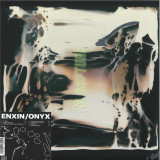
Enxin/Onyx, the duo of Nicky Mao/Hiro Kone and Tot Onyx (formerly group A), joins Other People with their debut album "In Rupture," capturing the same mesmerizing energy for which their live sets have become known.
“In Rupture” is not painless but in rupture lies possibility. The elasticity of this time pitching us across unknown terrain, revealing new potentialities, eclipsing static being. Whether in breach, collision,shimmer or severance, Enxin/Onyx explores these as occasions for transformation. Peeling back the layers through discord and harmony, exciting the inversion of expectation, towing the listener to depths and back up again to illuminate the senses. At times metallic and feral, at others murky and sharp, each song serves as an offering for all that is in rupture; body, spirit, land, ecosystem.
The opening track “A Void” calls to mind some mutation in its mechanical ecstasy, but for what purpose remains unknown. Even in the near moments of stillness, “Needle Pierces the Threshold” breathes a forceful disquietude. Tommi’s vocals pulling the listener down into some subterranean
madness, to unravel upwards from all sides, flooding the once parched landscape. In “Embers Kissthe Eye”, all of time emerges in one moment, compelling the subject’s gaze towards a new horizon.
The album follows its subjects through exile, exhumation and discovery. Through this process plates shift, fissures are revealed and what once appeared to be indomitable absolutes crack, pointing towards their inevitable collapse. To be in rupture is regeneration, to be in rupture is to return.
out of Stock
Last delivered 19 months ago available to reorder, subject to availability
Canada’s answer to Metallica? The Eddie Van Halen of thrash metal? Both these terms could have easily applied to Annihilator and its mastermind, lead guitarist and songwriter Jeff Waters. A fan of both speed metal and classic rock, the Canadian emphasized a flair for both. The fresh invention of Waters’ guitar work was a major reason why Annihilator got off to a promising start and have survived to the present, with a dozen or more albums under their belts.
THE BEST OF ANNIHILATOR compiles cuts from the band’s first three studio albums, a rarities collection, and a live disc, all of which emerged on Roadrunner between 1989 and 1996.
There have been many records in the years since, as Annihilator has continued to be one of the few bands to fly the flag for the classic thrash metal sound, earning themselves a devoted following and a regular spot on the European concert and festival circuit. THE BEST OF ANNIHILATOR takes the listener back to the early days of that sound, which stands up to anything else of it’s time - and even most metal today.
Two albums filled with the best that this band has to offer and for the first time available on vinyl.
Best Of Annihilator is available as limited numbered edition of 1500 copies on silver coloured vinyl
Standard weight white vinyl remastered from the original tapes, restoring the original album on vinyl for the first time since 1995, including its original artwork. Includes download code.
In 1991, four kids from the suburbs of Chicago, IL formed Cap’n Jazz, arguably one of the most influential rock bands of the last 30 years. Those kids, brothers Tim & Mike Kinsella, Victor Villarreal, and Sam Zurick, were joined by Davey von Bohlen in 1994 and recorded their only full-length album before calling it quits - Burritos, Inspiration Point, Fork Balloon Sports, Cards in the Spokes, Automatic Biographies, Kites, Kung Fu, Trophies, Banana Peels We’ve Slipped on, and Egg Shells We’ve Tippy Toed Over - often referred to as Shmap’n Shmazz. Originally released on the Man With Gun label, the album quickly fell out of print after the band’s breakup, with the songs eventually making their way to the Analphabetapolothology compilation, released in 1998 via Jade Tree Records.
As a testament to this legendary debut, Polyvinyl is thrilled to announce the vinyl reissue of Shmap’n Shmazz, which has been remastered from the original tapes - restoring the original album on vinyl for the first time since 1995, including its original artwork. With the unmatched intensity heard in the opening track, “Little League,” coupled with eccentrically poetic lyrics, this iconic album has influenced countless artists since its release and unintentionally sparked a new genre. Pitchfork calls the album “a touchstone of Midwestern emo,” while Vulture placed “Little League” at #3 on their 100 Greatest Emo Songs of All Time list. Musician Devendra Banhart has also expressed his love for the band in a 2017 Joan of Arc documentary, describing Tim’s powerfully striking vocals like "going to the zoo on quaaludes, but all the other animals are on speed."
In addition to the band’s influential legacy, Cap’n Jazz was the catalyst to the formation of other notable bands featuring the original members, including American Football, Joan of Arc, The Promise Ring, Owls, Owen, Make Believe, Ghosts and Vodka and many more.
Koldbrann's 4th album black vinyl repress. After an almost decade-long period of dwelling in the shadows, Koldbrann returned with a series of select festival appearances in 2022/23, premiering new material and proving that they're still full of cold grimness and misanthropy, and completely void of compromise. After last year's 2-track 7" single "Den 6. Massedod (Manna fra en annen himmel)", their long-awaited 4th album "Ingen Skånsel" is ready to be unleashed - and Koldbrann is sounding rawer, harsher and better than ever. Even though deeply rooted in the True Norwegian Black Metal tradition, Koldbrann has carved out their own sound within the genre confines and it sounds fresh, raw and different. There's a fierce nerve running through the album, and the songs stand out from today's typical black metal sounds. You can feel the aggression throughout the whole album. "Ingen Skånsel" is one of the most interesting, aggressive and fierce Norwegian black metal albums in modern times!
Maud the moth, the solo project of Spanish-born and Scotland-based pianist, singer and songwriter Amaya Lopez-Carromero announces her new album, The Distaff, to be released via The Larvarium (digital +CD) and La Rubia Producciones (vinyl) Amaya has long used the mantle of Maud the moth as an alter-ego, a séance-like conduit to explore themes of rootlessness, identity and trauma. The Distaff in particular refers to the stick or spindle onto which wool or flax is wound for spinning, and an object which has historically been used across multiple cultures as a symbol wielded by the “virtuous woman”, an authoritarian ideal around which much of the trauma surrounding the feminine coalesces. The album takes the form of a sort of self reflective and surreal autobiography. It was in part inspired by the poem of the same name written by the Greek poet Erinna, as she mourns her friend's loss of individuality and agency in exchange for marriage - and therefore safety and acceptance in the eyes of society. The album exists in an ethereal but violent world of aesthetic overlaps where time stands still and fictional and reimagined folk sits at the table with Maud the moth’s usual sonic menagerie. It is the result of a lifetime of obsession with sound and music, where glimpses of musical genre offer insight into Amaya’s artistic interests and her participation in the underground European scene for many years, in bands such as healthyliving. Heavier, darker, and more exposed than any of her previous works it features some highly accomplished artists, such as Seb Rochford (Patti Smith, Polar Bear, Sons of Kemet, Pulled by magnets, etc.) on drums, Alison Chesley (Helen Money) on cello, Fay Guiffo on violin and Scott McLean (Ashenspire, healthyliving, Falloch) on guitar, saxophone and synthesiser. Maud the moth shares the video for "Siphonophores". About the track, Maud the moth says; I wrote "Siphonophores" on guitar, during the first lockdown, a period where I was kind of trapped between an almost empty flat in Edinburgh and Dresden. It was an incredibly harrowing time, but also one of hope and where important new things were being birthed. I felt incredibly sensitive to everything, almost like life was happening in slow motion. I´m not a confident guitarist since I am completely self-taught, but, probably because of this, I feel that this instrument allows me to focus on aspects of the songwriting that I normally overlook when writing on piano, and I think it was a necessary step for this song to exist. Something else which I've been really exploiting lately and features strongly in the album is the percussive capabilities of the piano, and in particular, of the sustain pedal when mic'd up. This can be heard very clearly at the beginning of "Siphonophores". Written and arranged by Amaya, with some contributions in the later role from the aforementioned collaborators, the album presents nine tracks originally written entirely on acoustic piano as accompanied voice pieces, in pure singer-songwriter fashion. The album was co-produced and recorded by Scott and Amaya in different studios across the UK between January and July of 2024, in a process that started shortly after the 2020 pandemic and finished alongside the album recordings in a detailed, organic and at times obsessive process aimed primarily at capturing the natural dynamics and expression of free performance. The Distaff was mixed in its entirety by Scott and mastered at Abbey Road by Alex Wharton (Radiohead, My Bloody Valentine, Aurora, Kathryn Joseph etc.) Despite being born of a very personal point of view, the album lacks a specific narrator and was conceived almost as a sonic trousseau, where the needle point, silks and other family heirlooms have been swapped for out-of-the-corner-of-the-eye memories of rural Spain by the vineyards, family disputes, old tales of wartime pains, generational breaches and finally the conflict of migration and estrangement. The songs paint dystopian pastoral scenes which evolve throughout the span of one fictional day outside of time and coherent locations and where imagination (often the only account surviving from traumatic events and gaslighting) has become indistinguishable from fact. The Distaff attempts to acknowledge past trauma, comprehend and process some of the more difficult aspects which have contributed to our darker self and offer closure and solace through creative catharsis.
Maud the moth, the solo project of Spanish-born and Scotland-based pianist, singer and songwriter Amaya Lopez-Carromero announces her new album, The Distaff, to be released via The Larvarium (digital +CD) and La Rubia Producciones (vinyl) Amaya has long used the mantle of Maud the moth as an alter-ego, a séance-like conduit to explore themes of rootlessness, identity and trauma. The Distaff in particular refers to the stick or spindle onto which wool or flax is wound for spinning, and an object which has historically been used across multiple cultures as a symbol wielded by the “virtuous woman”, an authoritarian ideal around which much of the trauma surrounding the feminine coalesces. The album takes the form of a sort of self reflective and surreal autobiography. It was in part inspired by the poem of the same name written by the Greek poet Erinna, as she mourns her friend's loss of individuality and agency in exchange for marriage - and therefore safety and acceptance in the eyes of society. The album exists in an ethereal but violent world of aesthetic overlaps where time stands still and fictional and reimagined folk sits at the table with Maud the moth’s usual sonic menagerie. It is the result of a lifetime of obsession with sound and music, where glimpses of musical genre offer insight into Amaya’s artistic interests and her participation in the underground European scene for many years, in bands such as healthyliving. Heavier, darker, and more exposed than any of her previous works it features some highly accomplished artists, such as Seb Rochford (Patti Smith, Polar Bear, Sons of Kemet, Pulled by magnets, etc.) on drums, Alison Chesley (Helen Money) on cello, Fay Guiffo on violin and Scott McLean (Ashenspire, healthyliving, Falloch) on guitar, saxophone and synthesiser. Maud the moth shares the video for "Siphonophores". About the track, Maud the moth says; I wrote "Siphonophores" on guitar, during the first lockdown, a period where I was kind of trapped between an almost empty flat in Edinburgh and Dresden. It was an incredibly harrowing time, but also one of hope and where important new things were being birthed. I felt incredibly sensitive to everything, almost like life was happening in slow motion. I´m not a confident guitarist since I am completely self-taught, but, probably because of this, I feel that this instrument allows me to focus on aspects of the songwriting that I normally overlook when writing on piano, and I think it was a necessary step for this song to exist. Something else which I've been really exploiting lately and features strongly in the album is the percussive capabilities of the piano, and in particular, of the sustain pedal when mic'd up. This can be heard very clearly at the beginning of "Siphonophores". Written and arranged by Amaya, with some contributions in the later role from the aforementioned collaborators, the album presents nine tracks originally written entirely on acoustic piano as accompanied voice pieces, in pure singer-songwriter fashion. The album was co-produced and recorded by Scott and Amaya in different studios across the UK between January and July of 2024, in a process that started shortly after the 2020 pandemic and finished alongside the album recordings in a detailed, organic and at times obsessive process aimed primarily at capturing the natural dynamics and expression of free performance. The Distaff was mixed in its entirety by Scott and mastered at Abbey Road by Alex Wharton (Radiohead, My Bloody Valentine, Aurora, Kathryn Joseph etc.) Despite being born of a very personal point of view, the album lacks a specific narrator and was conceived almost as a sonic trousseau, where the needle point, silks and other family heirlooms have been swapped for out-of-the-corner-of-the-eye memories of rural Spain by the vineyards, family disputes, old tales of wartime pains, generational breaches and finally the conflict of migration and estrangement. The songs paint dystopian pastoral scenes which evolve throughout the span of one fictional day outside of time and coherent locations and where imagination (often the only account surviving from traumatic events and gaslighting) has become indistinguishable from fact. The Distaff attempts to acknowledge past trauma, comprehend and process some of the more difficult aspects which have contributed to our darker self and offer closure and solace through creative catharsis.
Exploring late-night, after-hours meditations on sound; ‘Everything Above The Sky (Astral Travelling with Luke Una)’ is a new compilation by the titular DJ, promoter and enigmatic cultural curator. Off the back of the E Soul Cultura phenomena, this compilation comes at a timely point in Luke’s rich career as he soars the heights of playing all over the world. Avoiding any chance of his sound being pigeonholed, Luke has put together a tracklist of songs and music that have a transcendental feel, after coming off the grid, going back to source, outside the city walls .
Music has long been believed to aid out of body experiences and many of us have searched long and hard for a combination of those elusive ingredients that might alleviate some of the monotony of everyday life, our daily routines and obligations, and those things that seem to block us from the spirit of the universe. In this collection, Luke selects music with all the right ingredients in just the right quantities, allowing the listener to engage in an esoteric journey of enlightenment through sound. Being a prolific collector of music, Luke initially delivered enough tracks to compile several compilations, making the licensing process the biggest effort to date for the label. The music moves softly and slowly, never becoming too intrusive, exemplifying the wonderful elevating properties of simple songs played from the heart.
Luke’s Everything Above The Sky manifesto reads, “Astral Travelling in the meadowlands with acid folk, spiritual jazz, around midnight hocus pocus, cosmic psychedelic soul, magical spellbound whirling swirling love songs, Brazilian ballads of light into machine soul gospel utopia dreaming, Balearic bossa, Outer Space ancient African drum, the breath of trees, escaping the big bad modern world, gathering round winter fires, walking amongst the bracken in Padley Gorge in late summer twilight, overlooking the Hope Valley, escaping ego, detaching and finally letting go amongst the stars with the slowly floating people. It’s beautiful beyond. Everything above the Sky”.
Beginning his career as an original Sheffield house young blood in the mid 1980s, Luke’s move to Manchester and partnership with Justin Crawford saw the birth of Electric Chair, a cornerstone cult night in the UK underground club scene. Then came Electric Elephant, a Croatian festival paying homage to their wild eclecticism from Balearic to Brazilian to É Soul, house, disco and techno. Luke’s much loved, long-running Homoelectric night and more recently Homobloc sell out festival for 10,000 souls has been at the forefront of Manchester’s LGBTQ+ cultural landscape. Luke’s Friday evening show on Worldwide FM captured imaginations and became a cult four-hour must-listen monthly journey for fans all over the world. Today, Luke remains, as ever, at the forefront of a changing milieu, pairing the momentous legacy of Manchester’s 80s and 90s scene with the delivery of what today’s club communities need to get down.
Anxious’ second album Bambi arrives this winter on Run For Cover Records. It’s been a whirlwind few years for the Fairfield, Connecticut five-piece – since the release of their debut album Little Green House, there’s been little time for anything other than consistent touring with bands like Hot Mulligan, One Step Closer and The Wonder Years. Somewhere during that endless grind, vocalist Grady Allen was sitting in a hotel room and stumbled upon a name typed into a long-forgotten memo on his phone: Bambi. “We should have named the band Bambi,” he recalls admitting to his bandmates. Bambi stuck with the band after that night and eventually it evolved from a “what-if” into the name of Anxious’ second full-length album.
Bambi is a record of remarkable growth, depth, ambition, and energy. It takes all the unsolvable and unavoidable problems of exiting adolescence and makes them resonate in urgent and authentic new ways. The album has deep roots in the storied lineage of Northeast tri-state hardcore and emo, but it also fully embraces the widescreen alternative rock songwriting at which Anxious have previously only hinted. It’s a statement of purpose, the kind of album that comes from a band reconciling where they’ve been with where they want to go. Bambi is the sound of Anxious putting everything on the line–and coming out on the other side better than ever.
Inspired by “big swing” records like Blink-182’s self-titled or Jimmy Eat World’s Clarity, Anxious set out to redefine the band without losing sight of what made them work in the first place. Tracks like “Head & Spine,” “Sunder,” and “Tell Me Why” showcase the scope of Anxious’ evolution, tapping crunchy ‘90s rock guitarwork, layered ‘60s-esque harmonies, and crisp, modern production that captures the unrivaled energy of seeing the band play live.
The title of the brand new album from Brussels hybrid pop quartet FABIOLA refers to the fruit of the gigantic network known as mycelium. A fitting image to describe an album rich in luxuriant sound worlds. This unique collage of 90’s hip hop basses, vivid drums, ominous synthesizers, fields recordings and almost no-wave guitar pizzicati perfectly blends with Fab Detry’s lush vocal lines. If lyrics can express political concerns, crucifying conservatism, icons and orchestrated social division, they also hearten contemplation and a return to simplicity and nature. Fabiola’s pop is utterly smiling, even if it lacks a few teeth.
All the shades of green. Plants. Water. The absolute necessities of life. Music, too, is an absolute necessity. To capture both color and sound in a bottle to put atop a piano like a houseplant. A clock. A fern. Synesthesia. This music is meant for that. To close your eyes and see green. To drown in the color of piano. A melancholic covey that pulls hard on the heart strings musically and lyrically, brushed over with a plethora of improvisation in smooth watercolors.
With Tim Hill’s new trajectory, we are offered a fresh neuron sprawl, branching beyond lyrics in interrupted pieces of sound. He takes our reptilian brains and welds them to our unborn futures, placing us inside of his droplet. Here, we're forced to reflect out, something singular multiplies, nature brings her face in, something shifts, our speed changes, the Self refracts and what's left jumps on sustained lines that eventually arch into meditation milk. It becomes a karmic cleanse of the amygdala, a launch from normal feeling life. Tim takes the risk, committing to diving deeper into his own bottomless pool of art, gifting us with sensory treats that dilate our old perimeters. It's sky as theatre, handing out everything but answers to questions. And where do we go? Where starlight mingles. Where minds never land.
A seasoned musician in all forms, Tim Hill has toured the world as a keyboardist, guitarist, saxophonist, and drummer, with a long time stint with LA group the Allah Las, and well known acts such as Nick Waterhouse, Curtis Harding, PAINT, and others.
Agonis debut album Neutropia gets a high profile and well deserved remix treatment. Originally released in 2021 on his own co-founded amenthia recordings, the album was a strong statement in terms of sound. Formerly known for his excellent deep and incantatory techno, Neutropia opened the door to show more of his far reaching musical interests. It became a vital document of genre bending electronics, fusing half paced drum & bass, rolling amen breaks, forceful frequencies, dreamlike trip-hop and futuristic techno all together. For Neutropia Remixed the sound palette even got wider. Four artists that are highly appreciated by the amenthia camp were asked to rework their track of choice and make it their own. Carrier drops the pace of 'Thermo' and adds a brilliant touch of his stripped down half-time rhythm excellence. Christina Vantzou continues to build on the powerful frequencies that were present at the full original album with a mesmerizing drone trip. Amsterdam resident upsammy adds her glistering dynamics to the dark 'Algoflash' and Felix K does what he does best.. The Hidden Hawaii/Nullpunkt originator turns the rolling 'Pyrchid' into a heady drum work out.
out of Stock
Last delivered 18 months ago available to reorder, subject to availability
Being Dead knows how to make an entrance - within the first several seconds of EELS, the duo's new record, the bright, hard-strummed guitar line on "Godzilla Rises" conjures cinematic immediacy, a creature emerging from the depths of the ocean in campy, freaky stop motion, fittingly so. Being Dead's records are mosaics, technicolor incantations, each song its own self-contained little universe. And while the dreamlike EELS probes further into the depths of the duo Being Dead's psyche, it is, most importantly, in the year of our lord 2024, a 16-track record that is genuinely unpredictable from one track to the next: a joyous and unexpected trip helmed by two true-blue freak bitch besties holed up in a lil' house in the heart of Austin, Texas. They decamped to Los Angeles for two weeks to record with GRAMMY-winning producer John Congleton, writing songs for the record until days before they left. The radical shift in process was welcome - a good balance and a challenge, Congleton helping them find new ways to work and helping peel back the layers on the core of their songwriting. Being Dead has grown from a duo to a trio live, including bassist Ricky Motto (who is immortalized finally on record here, particularly in the giggles on "Rock n' Roll Hurts") The resulting EELS is a darker record, tapped more into the devilishness within, but it's also a more raucous, rougher ride sonically. There's heartbreak, excitement, enchantment, dancing - we move through it all at a high-octane pace. Falcon Bitch and Smoofy never want to do the same thing twice on any song, and they don't. From the pummeling garage rock distortion of "Firefighters" to "Dragons II," which appears in its demo form taped on a hand recorder, it's unexpected but intuitive, and, most importantly, singularly Being Dead. Like its animal namesake suggests, the songs on EELS are malleable, the record like slithering through murky waters or strange half dreams, mysterious and beautiful in how it moves, reflective in a wavering sheen. Dipping into each song feels like uncovering a new cavern, plunging into depths unknown but fully open to what will be revealed. On the album artwork, an illustration by the artist Julia Soboleva, there are some weird disparate spectral creatures, a stark glimmer against a cloudy darkness. It's a fitting encapsulation of Being Dead, exuding a welcoming, playful energy even if something foreboding lurks just beyond the pale - more out of frame that's left to uncover, no path unexplored, strange and beautiful in the light.
Purple Tree Fog Vinyl. Being Dead knows how to make an entrance - within the first several seconds of EELS, the duo's new record, the bright, hard-strummed guitar line on "Godzilla Rises" conjures cinematic immediacy, a creature emerging from the depths of the ocean in campy, freaky stop motion, fittingly so. Being Dead's records are mosaics, technicolor incantations, each song its own self-contained little universe. And while the dreamlike EELS probes further into the depths of the duo Being Dead's psyche, it is, most importantly, in the year of our lord 2024, a 16-track record that is genuinely unpredictable from one track to the next: a joyous and unexpected trip helmed by two true-blue freak bitch besties holed up in a lil' house in the heart of Austin, Texas. They decamped to Los Angeles for two weeks to record with GRAMMY-winning producer John Congleton, writing songs for the record until days before they left. The radical shift in process was welcome - a good balance and a challenge, Congleton helping them find new ways to work and helping peel back the layers on the core of their songwriting. Being Dead has grown from a duo to a trio live, including bassist Ricky Motto (who is immortalized finally on record here, particularly in the giggles on "Rock n' Roll Hurts") The resulting EELS is a darker record, tapped more into the devilishness within, but it's also a more raucous, rougher ride sonically. There's heartbreak, excitement, enchantment, dancing - we move through it all at a high-octane pace. Falcon Bitch and Smoofy never want to do the same thing twice on any song, and they don't. From the pummeling garage rock distortion of "Firefighters" to "Dragons II," which appears in its demo form taped on a hand recorder, it's unexpected but intuitive, and, most importantly, singularly Being Dead. Like its animal namesake suggests, the songs on EELS are malleable, the record like slithering through murky waters or strange half dreams, mysterious and beautiful in how it moves, reflective in a wavering sheen. Dipping into each song feels like uncovering a new cavern, plunging into depths unknown but fully open to what will be revealed. On the album artwork, an illustration by the artist Julia Soboleva, there are some weird disparate spectral creatures, a stark glimmer against a cloudy darkness. It's a fitting encapsulation of Being Dead, exuding a welcoming, playful energy even if something foreboding lurks just beyond the pale - more out of frame that's left to uncover, no path unexplored, strange and beautiful in the light.
Amsterdam-based keyboardist, producer, arranger and DJ Soul Supreme reached out to NYC drummer Jay Mumford in 2021 to lay the down groove on his re-imagining of Q-Tip and J-Dilla's "Let's Ride". That paved the way for future collaborations: a cover of A Tribe Called Quest's "Award Tour (We Gettin' Down)" and two tunes on Soul Supreme's Poetic Justice LP. But when the pair began doing brief covers of their favorite funk, jazz and hip-hop tunes on Instagram just for fun, followers of both musicians - and often, the covered artists themselves - began to take note. Two of those 20+ covers were particularly well-received, and the duo decided to answer the peoples' call for a 7" release with the songs pushed to their full potential. Similar to "Award Tour" and "Let's Ride", a hip-hop classic and a fan favorite are pushed to their full potential here. This installment goes coast to coast and explores Digable Planets' "9th Wonder" (the "East" side) and People Under the Stairs' (PUTS) "Crown Ones" (the "West" side).
The iconic synth intro of "9th Wonder" makes way for Jay's thunderous ode to a slowed down Clyde Stubblefield groove. Sure to be a favorite with DJs, Jay eventually detours into a syncopated New Orleans funk break, before getting back to the groove for Soul Supreme's funky wah wah clavinet work. Throughout, the arrangement expands beyond both that of the original and all of its DNA. The addition of cascading horns (featuring a trumpet solo by Lourens van der Zwaag) and a second, more aggressive break from Jay bring it back full circle, completing a modern update of a classic that manages to pay homage to '70s jazz-funk, breakbeats and '90s hip-hop - all while staying both modern and raw.
Diehard PUTS fans will recognize Soul Supreme's catchy Rhodes line as soon as the needle drops, but Jay's heavy funk groove quickly separates it from the original and takes it from hip-hop cover to heavy funk tune. Soul Supreme's Rhodes solo pushes it far beyond the confines of instrumental funk as the groove intensifies, while his chops as an arranger are on full display: his horn parts - featuring van der Zwaag, trombonist Olav Schloorlemmer and Job Chajes' Contra-Alto Clarinet that channels The Headhunters - counter his synth melodies in a discussion that completes the record as a heavy slice of uncut jazz-funk.
Second VHF solo LP from the Pelt/Black Twigs mainstay, following 2022’s acclaimed “Evening Measures.” “April is Passing” builds on the striking solo Hardanger-style fiddle performances on the previous LP to take the music even further out, with deep drones and extended techniques defining a vocabulary that is Americana-adjacent, but a unique and special sound that Mike is pursuing almost alone. Joined on selected tracks by Cara Gangloff’s Sruti and Kaily Shenker’s sonorous Cello, the all-original, all-live performances are resonant with both overt melody and a cloud of thick string overtones, whether on the more upbeat tunes like “Ironto Dancer” or the epic 11+ minute LP closer “Helen’s Song.” “September Air” is a mournful slow build, the fiddle embroidering a minor-key melody over the drone of the Surti box and a low cello counter point. “A Fallen Palace of Snowville” is a solo performance where the additional sympathetic strings of the hardanger fiddle are strongly heard as a ghostly accompaniment, as Mike’s elegant melody switches back and forth from minor to major. “Helen’s Song” closes side 2 with a complex, ever-changing swirl of melodic and harmonic invention, with Mike’s keening, languorous bowing leading the way through multiple moods and sounds.
Hardly Cricket sees the band truly lean into their rock tendencies. Those who have enjoyed their past forays into 70s style dual guitar leads will find much to latch onto here. Explosive, high energy tunes like “New Music” and “Sacred Heart” are instantly infectious and truly set the tone with high flying guitar action from all the players. However, as always, Shirese keeps it varied. With songwriting duties being more evenly spread throughout the group this time around, listeners will find 60s garage, country, and even doo-wop inflected songs as well. Matt Paolilo’s ever present vocals and tongue-and-cheek lyrics keep listeners on their toes. While the occasional descent into tape spliced experimental madness still finds its place in the grooves. Shirese continues to evolve as their lineup continues to cement. Gone are the days of a revolving cast of characters, and in its place we find a group of friends who mesh tightly, pushing beyond their perceived limits to true rock’n’roll glory! A Grapefruit Records and C/Site Recordings co-release. Limited to 300 copies.
Prolific Norwegian trumpeter and ECM veteran Arve Henriksen returns with Estonian guitarist/composer Robert Jürjendal in tow, matching his idiosyncratic shakuhachi-style melodic condensations with Jürjendal's glassy electro-acoustic soundscapes and sonorous percussion.
Henriksen releases a lot but is remarkably reliable; his playing is so versatile that hearing it dematerialise into different ensembles and individual methodologies is always a treat. Jürjendal is a veteran guitarist, but doesn't approach his instrument from a purely classical standpoint, taking a Fripp-inspired path towards texture, processing and looping his sounds until they're barely recognisable. The duo share a similar love for Hassell's Fourth World ambience, and here inject new life into that mood.
Jürjendal's percussion is impressive: he offsets cascades of oddly-tuned electronics on 'Tuonela' with booming, ritualistic tom hits that punctuate Henriksen's melancholy phrases; and on the brilliant 'Ancient Bells', plays a set of gongs and gamelan-style instruments, creating swirling hammered tonal clusters that quiver beneath Henriksen's echoed-out, spirited improvisations. It's not always that corporeal, either; on 'A Remarkable Flow', he loops guitar phrases, creating gentle vibrations that rumble in the background while he mirrors Henriksen's pitchy zig-zags with high-pitched oscillator vamps.
Even on the peaceable 'Miraculous Lake', discreet kalimba loops set a celestial tempo that anchors the duo's gaseous soundscapes. And although they veer towards end-credits loveliness on the Göttsching-influenced 'Reunion Hymn', it’s balanced by the album's darker passages, like 'Rebirth' and 'Another Me'. On the latter, Henriksen's trumpet is transformed into a voice-like warble, while Jürjendal replies with glacial E-bowed drones that resonate creepily alongside his lysergic FM pads.
To Celebrate its 60th release, Syncrophone proudly presents 'The Syncrophone Remixes Vol. 1' by Rolando. Featuring electrifying reworks of Derrick Thompson, Zadig, and Malvito, this collection brings a powerful, Detroit-inspired sound that echoes the future of techno. Available soon—don’t miss these exclusive remixes. Vol. 2 is just around the corner, promising even more groundbreaking surprises.
out of Stock
Last delivered 9 months ago available to reorder, subject to availability
Tradition shapes your work. For saxophonist and bandleader Shabaka Hutchings, that's something he's long understood. After years spent in the orbit of London's jazz circuit, he examines and reimagines his influences with a dexterity that's unique. Drawing out the vision underlying his new album, he says, I see energy as being a form of wisdom to be passed down through the ages.'
Unpicking the album's title, he continues, "When we study the music, the lives, the words of our master musicians we obtain a glimpse of that artist's essential energy source. This is the core vitality of the individual which leads them to utilise the musical specifics of their chosen genre in a way that mirrors their inner source of power. This is an intuited wisdom that's handed to us from the legacies of our elders.
The album is a document of sessions combining Hutchings with a group of South African jazz musicians he's long admired. His connection to the group was Mandla Mlangeni (bandleader of the Amandla Freedom Ensemble), whom he'd flown there to play with over the past few years. Recorded across just one day, the group drew on their South African lineage - heroes like Zim Ngquwana and Bheki Mseleku - to bring their own slant to the American jazz lineage which is reconfigured in Hutchings' compositions themselves.
Going beyond the jazz greats Hutchings cites, influences are drawn from plenty of other sources: Caribbean calypso, central African song structures and Southern African Nguni music all play a part. Bringing together those ideas with the contributions of his bandmates is, he explains, crucial to what he sees in the role of an album artist. Even though I wrote all the music, for me, the leader of the project isn't the person who writes all the music but the one who has a vision for how certain musical elements will be combined."
A regular sight on stages around London and beyond, playing - and often leading - groups like The Comet Is Coming, Sons of Kemet and Melt Yourself Down, he's part of a generation whose idea of jazz is pointedly unrefined. That's to say, Wisdom of the Elders comes from an artist interested in the indefinable gaps more than fitting into boxes.
Cali Lanauze makes label debut on Crosstown Rebels with his ‘Borderline’ EP.
The three-tracker, landing on 14th February 2025, features a first-time collaboration with Cari Golden alongside two solo cuts.
Hailing from the vibrant shores of San Juan, Puerto Rico, Cali Lanauze has spent over a decade carving out his space in the global electronic scene. A trailblazer since his teens, Cali’s rich, eclectic grooves reflect both his Caribbean roots and his deep connection to underground music. Now, with his debut on Damian Lazarus’ Crosstown Rebels, he follows an impressive outing via sister label Rebellion with his ‘Borderline’ EP, cementing his position as one of his nation’s finest electronic exports.
The title track sees Cali team up with LA-based singer/songwriter Cari Golden, whose credits include collaborations with Groove Armada, Camelphat, Anja Schneider, Audiofly, and more. Having debuted on Crosstown Rebels with Fur Coat on ‘You and I’, Cari’s second appearance sees her soulful, evocative vocals intertwine effortlessly with Cali’s melancholic yet uplifting production. On the flip, Cali showcases his solo prowess. ‘Temple of Confessions’ takes listeners on a hypnotic journey with trippy grooves inspired by the otherworldly energy of Hï Ibiza’s Club Room, while ‘Talk To My People’ delivers a heady mix capturing the essence of his dynamic artistry.
Cali’s journey from a young producer in Puerto Rico has welcomed releases on labels like Flying Circus, Visionquest, and My Favorite Robot, garnering support from legends such as Carl Cox, Radio Slave, and DJ Sneak. Curating groundbreaking events in Puerto Rico, gracing iconic venues like Hï Ibiza and Brooklyn Mirage, and heading up his own label, Opulenc, Launauze has created a platform for his innovations and genre-spanning productions.
out of Stock
Last delivered 5 months ago available to reorder, subject to availability
Loyle Carner will release his highly anticipated sophomore record, 'Not Waving, But Drowning' on 19 April via AMF Records.
'Not Waving, But Drowning' follows Loyle's BRIT (Best Male, Best Newcomer) and Mercury Prize nominated, top 20 debut 'Yesterday's Gone'. The bedrock of honest and raw sentimentality that you heard on 'Yesterday's Gone' left an inextinguishable mark on music in general and UK Hip Hop in particular, standing out as an ageless, bulletproof debut.
'Not Waving, But Drowning', Loyle's new album, gives yet more evidence - as if it were needed - of his razor-sharp flow and his unique storytelling ability. Yes, he can rap, but he allies that with the sensitivity of a poet, the observational skills of a novelist, and warmth of your best friend. The album opens with 'Dear Jean', a letter to his mother in which he's telling her that he has found the love of his life, 'a woman from the skies', and he's moving out.
It goes without saying that Loyle's music is hard to categorise, but what is even more impressive is that for someone who grew up listening to Mos Def, Biggie Smalls, Roots Manuva, and Wu Tang Clan, he doesn't sound like any of them. Although he might from time to time give lyrical nods to them, he's no imitator.
Loyle loves cooking. There are two tracks on this album named after chefs. The British-Israeli chef Yotam Ottolenghi, and the now deceased Italian chef Antonio Carluccio. 'Ottolenghi' the first single from the album was featured on the BBC Radio 1 B-list, BBC 6 Music A-list and has already been streamed over 5 million times.
Loyle refers to real life for everything, the title of 'Yesterday's Gone' came from a song of his step father, the title of his new album 'Not Waving, But Drowning' comes from a poem by his grandfather, which in turn came from a Stevie Smith poem. What you hear on the track 'Krispy' is real. He is pouring his heart out to his best friend Rebel Kleff after their relationship went downhill, he invites him on the track to say his piece but he doesn't turn up, so we get a flugel solo instead.
Loyle also has his own personal black consciousness movement. When he refers to his 'fathers' in the track 'Looking Back' he really is referring to two fathers. His biological father, a black man who he knows, but knows very little of, and his step father, a poet and musician who happens to be a white man but died a sudden unexpected death from epilepsy (SUDEP). With no real emotional ties to his biological father, but a deep connection with a deceased step-father, where does a young child turn He succinctly captures many of the great, unspoken, cultural and historical paradoxes of multicultural Britain on 'Looking Back'.
An album like this is hard to find. It is for those who like their Hip Hop to have soul, and their soul to have spirit. This is because it works on so many levels, but it is reflecting the personality of its creator. There are a host of collaborators here, Jorja Smith, Rebel Kleff, Kiko Bun, Kwes, Jordan Rakei, Sampha, Tom Misch and more, but none are overpowering. They blend righteously into place.
Loyle is not bitter with people who have let him down, or a society that lets so many down, but the combination of anger and love he has gives his voice the perfect blend of strength and vulnerability. This might be a coming of age album, but it's also a coming of ageless album. Loyle's 2019 Spring tour - which includes London's Roundhouse - sold out within 20 minutes of being on sale.
Not Waving, But Drowning
A rapper that raps about family is hard to find. The boys in the 'hood' tend not to be that interested in how much a 'brother' loves his mother, or how much he misses his dad, or even how much he misses his best friend. The boys in the 'hood' tend to be obsessed with the size of their cars, girls, bank accounts, and other personal 'possessions'. Loyle Carner's Mercury and BRIT Prize nominated debut 'Yesterday's Gone' (Released 2017), made it clear that he wasn't that kind of rapper. In fact, every time I talk to him about his work we talk about the world, and we tended to confuse ourselves by calling his work rap, poems, or songs, sometimes in the same sentence. They are in truth all of these things.
Here's some poetry.
Honestly I need them.
I hate them but I grieve them
I think I've finally found the reason
Trust
Like the fire needs the air.
I won't burn unless you're there.
'Not Waving, But Drowning', Loyle's forthcoming new album, gives us yet more evidence, (if it were needed), that he still has what rappers call, flow, but he hasn't lost any of his story telling qualities. Yes, the boy can rap, but a rapper with the sensitivity of a true poet, the observational skills of a novelist, and warmth of your best friend. The album opens with 'Dear Jean', a letter to his mother in which he's telling her that he has found the love of his life, (a woman from the skies), and he's moving out. He really loves the woman from the skies, but he still loves his mum, and so he reassures her that there is no competition, and tells her that 'She's not behind me or behind you, but beside we and beside two', his words. Or to put it another way, moving out without moving out. My words.
It goes without saying that Loyle's music is hard to categorise, but what is even more impressive is that for someone who grew up listening to Mos Def, Biggie Smalls, Roots Manuva, and Wu Tang Clan, he doesn't sound like any of them. Although he might from time to time give lyrical nods to them, he's no imitator. He says finding his own voice was something he always found easy. Although young, (in terms of a musical career), he has confidence in his own words and his own voice, and has never been tempted to sound like he's been hanging out in the USA, or rolling in 'Grime' on the mean streets of East London. And so when it comes to the creative process he doesn't simply find a beat to jump on and ride. Beats are important, but they are tenderly layered with samples, keyboards, or live drums, all imaginatively assembled for the laying on of words. Some tracks start with the idea, some with poetry, and some with a verse from a singer or some other melodic inspiration, but there is no formula.
Here's some poetry.
Don't hold any memories of us
Rather hold you everyday until the memories are dust
Yo we only caught the train
Cos you know I hate the bus
A prolific reader, who has dyslexia is hard to find. Add ADHD (Attention deficit hyperactivity disorder) to that and life should become even more difficult. To deal with your difficulties you devise coping strategies, which can differ from person to person. Loyle loves cooking. There are two tracks on this album named after chefs. The British-Israeli chef Ottolenghi, and the now deceased Italian chef Antonio Carluccio. Loyle describes himself as 'weird' because he is happy to read a cookbook as if he was reading a novel or a book of poetry. He has opened a cookery school for young adults not just because he loves food and wants to make more of it, but because it is one of the few things that can focus the ADHD mind. And when it comes to his other love, football, his approach is the same. Focus. He wanted to be a striker he says, up front scoring goals, but found his best position was in midfield because he was able to focus, check options, and see passes ahead of time, providing passes for other players just when they needed them. He says, 'You don't grow out of ADHD, you grow into it.' Loyle is also working with Levi's® on their music project where he is mentoring young musicians over a six month period, culminating at Liverpool Sound City festival.
More poetry.
When the going is tough
I wait till it falls on deaf ears
Hearsay
Without the boundaries of love
He also said, 'Ask most people and they will say that they love their mothers, but most are not going to rap about her'. On his first album Loyle's mum Jean wrote about the 'scribble of a boy' that growing up would take things apart to see how they worked. On this album she speaks with pride about a man who has found his place in the world.
Yes, poetry.
I'm still looking for the answers
Trying to find the right questions
Still waiting for my fathers
But can't break them in to sections
This poetry is serious. Loyle has his own personal black consciousness movement. He told me that he always felt safe at home, and being the darkest one in the family never meant a thing, but then when he had to face the outside world he felt hostility. It shook him up. Now he had to start asking questions, but what were the questions. This is serious. When he refers to his 'fathers' in the verse above taken from the track 'Looking Back' he really is referring to two fathers. His biological father, a black man who he knows, but knows very little of, and his step father, a poet and musician who happens to be a white man but died a sudden unexpected death from epilepsy (SUDEP). So to whom would a young black (or mixed race) kid turn He succinctly captures many of the great, unspoken, cultural and historical paradoxes of multicultural Britain when he says, 'My great grandfather could of owned my other one.' We are a people descended from enslaved people on one hand, and enslavers on the other, something we are still struggling to come to terms with, and this can be apparent in one family. A big book could have told you that, but here we get it in one line on the track, Looking Back.
Loyle refers to real life for everything. The album is peppered with captured moments that he records on his phone. These moments can range from conversations with taxi drivers, to capturing the moment when England scores a goal in the world cup. The title of 'Yesterday's Gone' came from a song of his step father, the title of his new album 'Not Waving but Drowning' comes from a poem by his grandfather, which in turn came from a Stevie Smith poem. What you hear on the track 'Krispy' is real. He is pouring his heart out to his best friend after their relationship went downhill, he invites him on the track to say his piece but he doesn't turn up, so we get a flugel solo instead. Yes people, this is real.
An album like this is hard to find. It is for those who like their Hip Hop to have soul, and their soul to have spirit, this is an album for those who have, (I'm sorry, I'm going to say it), emotional intelligence. This is because it works on so many levels, but it is reflecting the personality of its creator. There are a host of collaborators here, Jorja Smith, Rebel Kleff, Kiko Bun, Jordan Rakei, Sampha, Tom Misch and more, but none are overpowering. They blend righteously into place. Loyle is not bitter with people who have let him down, or the society that has let him down, but the combination of anger and love he has gives his voice the perfect blend of strength and vulnerability. This might be a coming of age album, but it's also a coming of ageless album. His first album worked, and this second album is a continuation of that work. Not creating a form, but being formless, as someone like Bruce Lee once said.
And here's some poetry from mum.
We talked long in to the darkest hours
Until we saw the burnished sky
And our eyes stung
As our words blurred and became thoughts
As we were silenced by the dawn
We clung to each other like sailors in a storm
out of Stock
Last delivered 19 months ago available to reorder, subject to availability