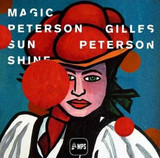
Gilles Peterson has a special love affair with MPS. To be exact, it goes back more than three decades to the London of the 1980's when Gilles stood at the beginning of an exceptional career as DJ, Radio personality, and producer. At that time he was already interested in unusual and unique jazz recordings, and so he inevitably came across the record label from Germany's Black Forest (Schwarzwald), whose catalogue encompassed a large, totally distinct repertoire that had never been released anywhere else. Naturally, there was a long list of amazing interpretations of jazz classics from acknowledged jazz masters, but early on Gilles had developed the talent to dig deeper into the depths of the archives in order to ferret out the special features of the catalogue - occasionally discovering a obscurity - and bring them to the light of day.
He seemed to be able to effortlessly show a completely new connection between classic jazz recordings through the way they were chosen, assorted, and sequenced. Thus, every single title was imbued with a new energy, freshness, and, above all, timelessness, always with an eye on whether the chosen recordings would possibly be compatible with the needs of clubs. This present MPS compilation is an especially good example of Gilles Peterson's amazing talent. It delivers only a small, yet carefully chosen section out of the depths of the MPS archives.
Let's take several steps back to where it all began - back to the town of Villingen in Germany's Black Forest. There are many myths and stories about the label and its founder Hans Georg Brunner-Schwer, simply known as HBGS. Towards the end of the 1950s he began to produce the first recordings under the SABA (Schwarzwälder Apparate Bau Anstalt = Black Forest Appliance Manufacture) label. Later HBGS organized his legendary house concerts in an annex to his own villa. Among the many who played there, Oscar Peterson certainly counted among the most famous, and so he rightfully serves as the godfather of this compilation.
HGBS built his studio directly over his living room where he could, with the help of the earliest video techniques, directly record and mix the concerts. There are many legendary stories about sessions that lasted long after midnight with very happy musicians, especially those who enjoyed catering directly from Brunner-Schwer's wife Marlies. And let's not forget that the good pay was yet another reason the musicians looked forward to returning to the villa in the Black Forest. None of this changed when in 1968 HGBS sold SABA and renamed the label to what it is known by today: MPS - Musik Produktion Schwarzwald (Black Forest Music Production). Over the years, HGBS built up a jazz catalogue of over 500 recordings. Additionally he recorded classical, martial, so-called New German Easy Listening, as well as Schlager music - HGBS was an all-around wiz. In the 1960s and 70s MPS was one of the leading, if not the leading, jazz labels in Europe. It was not until the 1980s that another German label overtook them in terms of the size of their catalogue (ECM records out of Munich).
By contrast, HGBS loved the classic recordings of the great pianists, especially in solo, or as duo or trio, with Oscar Peterson leading the way. Peterson's MPS recordings are acknowledged as some of the best of his long career. Stylistically, the label contains an incredibly broad artistic roster of outstanding artists, from Milt Buckner to Cecil Taylor, from Friedrich Gulda to Sun Ra!
Another observation concerning MPS' pool of artists: the productions were often drawn from players who were already famous, but this was not always the case. Many musicians who are internationally renowned today are heard here in some of their earliest recordings. Musicians such as Joachim Kühn and Wolfgang Dauner especially benefited from their work with MPS. Others, such as George Duke (also represented here as producer of the group The Third Wave), and Monty Alexander, released their first albums on MPS, and remained loyal to the label for a long time. Even Jan Hammer, who became world famous through his Miami Vice soundtrack, recorded for MPS as a still unknown pianist in 1968. Others, such as the recently deceased vibraphonist Dave Pike, celebrated the highpoints of their careers with their MPS recordings. The label has written a lot of history.
A specialty of SABA/MPS was the extremely high quality of the vinyl pressings long before 180gr pressings were used as selling points. The label produced the best possible audiophile sound, fantastic glossy foldout covers in thick album sleeves - these insured a high rate of collector inquiries concerning the label's recordings, and this had also excited Gilles Peterson.
Now it's time to be carried away by Gilles' selections from the label's multifaceted recordings.