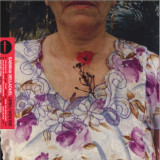
Fortunately for us, Dmytro Nikolaienko agreed to open up the jewellery boxes of his tape-loop archive for his debut album on Faitiche. What came to light was a collection of dreamy glittering gems, masterfully presented using the compositional possibilities of analogue tape machines. Some may consider a tape machine to be limited as a musical instrument, but Rings makes a convincing case with its sure-handed use of the available parameters – moving tape over the tape head mechanically and manually, cutting loops, manipulating timbre and creating noise by means of saturation. The results are eleven blurred, repetitive, rhythmic patterns that can be understood as an intervention against digital precision, as mechanical irregularities and background noise become musical events.
For those familiar with Nikolaienko’s work, his nostalgic approach here will come as no surprise: born in Ukraine and now based in Estonia, he has chosen a historical medium (that has been enjoying a renaissance for some years now) to record historical-sounding sequences. The way he manages his own back catalogue is similarly archival, documenting the chronology of his tape loops in such a way as to leave no doubt as to their advanced age. And then there are his two wonderful labels Muscut and Shukai, the latter being an archival project releasing electroacoustic obscurities from the Soviet past. Which brings us back full circle …
Suche:man make music
Zwerm is a Belgian-Dutch electric guitar quartet (with a backyard rehearsal shed located in Antwerp) that operates along the borders between styles and traverses traditions that are typically not convergent. Zwerm rhymes Larry Polansky with Nadah El Shazly and are galvanized by the likes of guitars pioneers like The Velvet Underground and Sonic Youth, the microtonal DYI-er Harry Partch, Middle Eastern sonorities and the prog-madness of Kind Gizzard & the Lizard Wizard. ‘Musical adventure’ is not just a hollow cliché for this quartet, but a genuine commitment. Zwerm calls itself a ‘guitar quartet’, but that can be interpreted broadly as well as with a pinch of salt: “If we want to do something on instruments we don’t really master, we’ll just figure out a way to make it work.”
Toon Callier, Johannes Westendorp, Kobe van Cauwenberghe and Bruno Nelissen all met in 2007 while working on a project with Glenn Branca. A new guitar quartet was born and it became clear rather quickly that staying in the strictly contemporary compositions lane was not for this quartet-with-five-to-six-members (an organizational chart is available upon request).
An appetite for new and lasting collaborations has been a constant theme throughout their artistic parcours. The group has shared stages with theatrical producers like Walpurgis and Post uit Hessdalen, dancers such as Ecce and with the musicians Fred Frith, Stephen O’Malley, Shiva Feshareki, Rudy Trouvé, Mauro Pawlowski, Larry Polansky, Eric Thielemans, Yannis Kyriakides, François Sarhan, Serge Verstockt and Stefan Prins. These projects have not always translated into records, but they have been decisive in creating a unique musical approach. In 2015, when Zwerm was asked by De Handelsbeurs to collaborate with Fred Frith, they proceeded to pen a few new musical sketches over which Firth sublimely improvised. In 2018 ‘Badminton in Tehran’ was released, their first record that was made up completely of only the group’s compositions.
“a basket full of buttons here
and if you push the wrong one: fear
and if you push the right one: love
or maybe none of the above”
The route that Zwerm has taken is often defined by the question “What if... ?” - like a dart thrown at a musical map, not quite blindly, but naive enough to lead to unexpected endings.
“What if we play Renaissance pieces written by John Dowland, but instead of playing lutes we play these tunes with a Telecaster – and then jam it through effect pedals and an amplifier?”
“What if we connect one hundred guitar pedals and just leave our guitars at home?”
“What if we record a record with ten different one-page-pieces that we found on the Internet?”
In 2020 our metaphorical dart landed on “What if we tried microtonality?”.
‘Microtonality’ sounds a bit creepy, but actually there is nothing to be afraid of: there are no out-of- tune notes, just alternate notes. On the continents where Western musical theory is less stringently applied, microtonality is the rule, and has become the subject of many deep and thoughtfully written theories. However for Zwerm, this phenomenon occurs in many, often surprisingly lighthearted forms. A dilapidated piano that has settled into a beautiful microtonal tuning of its own accord, enthusiastic choral singing, a guitar whose three strings are tuned a quarter-tone higher, a saz (Turkishquarter-tone lute), a maddening guitar pedal, ...
"the dreams they were convicted for telling only lies reality came after for claiming to be wise what you don’t see is what you get just never light a spark I’m a crow in the dark”
“And… what if we work with a drummer?” Enter Karen Willems - dummer, extraordinaire, and ardent player in groups, projects and collaborations galore. One chance meeting and the deal was done. It was obvious before the start that Willems was the versatile and creative percussionist-in-a-toy-store necessary for this project. And in the studio, to our delight, she demonstrated an easy dexterity when switching quickly from one idea to the next.
At the reins behind the scenes was producer Rudy Trouvé, who – during previous sessions for ‘Badminton in Terhran’, when the classically trained guitarists went completely off the rails, staring deeply and forlornly into their scores, looking for answers – was able to pinpoint the problem and get the wagons rolling in the right direction again. Completing the team were Mark Dedecker (recording)and Joris Calluwaerts (mixing).
The results are in and it’s called ‘ Great Expectations’ – a title that, in several ways, fits perfectly with these strange times.‘Great Expectations’ goes wide! Zwerm is at its best when it can run along the borders between style and across traditions that otherwise would not necessarily intersect. The most straightforward rockers have a proggy tinge while the dreamy psychedelic songs lean more toward Richard Youngs. And if a nice melody dared come to close to becoming a ‘Kit-Katjingle’, then barbs-a-la-Pere-Ubu were trailed, tracked, found and promptly embedded. ‘Heavy Machinery’ sits neatly somewhere between Captain Beefheart and Richard Wagner, and ‘On My Way To Aguno’, set to an Iranian folk song chord progression, grew into a hyper-personal lullaby. Zwerm used the saz (Turkish lute) and the sinter (Moroccan gnawa bass instrument) without falling into pastiche psychedelia, but you can still sense the orient.
Real Real World is the first collaborative effort from Nantes-based Australian drummer/percussionist Will Guthrie and Australian keyboardist/composer James Rushford. Primarily recorded in a fluid, spontaneous studio session in Nantes, with overdubs added later in Melbourne and Nantes, Real Real World presents five spacious, unhurried pieces that inhabit a unique sound world characterised by wheezing, half-voiced organ chords, chiming metal percussion, and eruptions of small sounds. Beginning with the eerily beautiful, shakuhachi-esque sound of Rushford performing on detuned portative organ, the opening title track is abruptly transformed by the entry of Guthrie’s sizzling cymbals, deep gong strikes, and rustling hand percussion. On the epic ‘Lumbering’, which occupies the majority of the record’s first side, organ chords define a space in which a kaleidoscopic succession of amplified thuds, chiming bells, rustled and dragged objects, and abruptly silenced clusters advance and recede in an oneiric blur, eventually making way for a passage of Guthrie’s virtuosic polyrhythms, itself unexpectedly overtaken by waves of melting fairground organ. The record reaches an energetic climax mid-way through the second side with the stunning ‘Slakes’, where lugubrious chords in the organ’s lowest register are joined by Guthrie’s skittering rhythms, which somehow manage to call to mind both the most chaotic moments of Balinese Gamelan and the stochastic breakbeats of late-90s Autechre. On this piece, Guthrie and Rushford are joined by Melbourne saxophone maverick Scott McConnachie, who contributes an alto sax solo of burning precision, working with a single-minded palette of piercing long tones and wild intervallic leaps. Though it makes extensive use of overdubbing, Real Real World retains a strong sense of having been performed, rather than constructed: while at times the fleeting succession of events can recall electroacoustic music, its primarily acoustic nature and unhurried pace is also reminiscent of the music of AACM affiliates or Marion Brown’s classic Afternoon of a Georgia Faun. Immediately engaging while also hiding countless details in the folds of its polychrome fabric, Real Real World is a relaxed and joyous document of collaborative musical invention.
Artwork by Patrizia Bach. Layout by Lasse Marhaug. Mixed and mastered by Joe Talia at Good Mixture, Berlin.
- A1: Lily Was Here (Feat. Dave Stewart)
- A2: Dance ‘Till You Bop
- A3: Sax-A-Go-Go
- A4: Pick Up The Pieces
- B1: Funkyness
- B2: Girls Should Stick Together (Feat. Trijntje Oosterhuis)
- B3: So What
- B4: Bob’s Jazz
- C1: 2 Funky
- C2: Wake Me When It’s Over (Feat. David Sanborn)
- C3: Girls Night Out
- C4: What Does It Take (To Win Your Love For Me) (Feat. Jonathan Butler)
- D1: I Can’t Make You Love Me (Live)
- D2: For The Love Of You (Feat. Angie Stone) (Live)
- D3: Saxuality (Bonus Track)
It’s hard to believe that it’s been over 30 years since Candy Dulfer rose to fame with her high-profile collaborations with Dave Stewart (the worldwide number 1 smash “Lily was here”) and of course the legendary Prince, whose tongue-in-cheek recommendation (“When I want sax, I call Candy”) in the “Partyman” video made the world sit up and notice the young, glamorous and talented sax player at his side. Candy has been fortunate to work - both in the studio and on stage - with some of the biggest names in music, including Van Morrison, Maceo Parker, Sheila E., Mavis Staples, Lionel Richie, Beyoncé, Pink Floyd, Chaka Khan, Aretha Franklin, and many others. Despite these high-profile collaborations, Candy mainly focused on her solo career, starting her own band at age 13 and touring the world ever since.
We're back with our 5th release! This time it's the certified dancefloor weapon by Alonzo Turner ‘Whoever Said It?’ Released on a 7 inch with a part 1 & 2, this record has been played on dancefloors worldwide by such players as Rahaan, Sadar Bahar and more, with those selectors favouring the part 2 in the most euphoric moments with that incredible vocal half way through. The record has remained hard to come by for most so we are thrilled to have this one out there as an affordable and great sounding reissue.
Remastered as always by Frank at The Carvery and this time released with a vibrant company sleeve and a baby yellow label on the 7 to match the original.
"Alonzo Turner was born in Northern California in 1955 and was introduced to music by his church, of which his father was pastor. As a young adult, Turner moves to West Hollywood and at 23, he starts to manage a local rock band while working day and night to write what will turn out to be his first and only release, ‘Whoever Said It’.
The song catches the attention of Dave Crawford, A former producer at Atlantic. Like most stuff on Crawford’s label, LA Records, the single never makes it to the charts but helps Turner make a name for himself in L.A. and Orange County where he performs often. There is only speculation about what happened to ‘You’ve Got Something’, the LP on which the song was meant to appear, but five years later Alonzo ends up writing an eponymous piece for Norma Lewis (Shakatak, Charade) on her debut album ‘It’s Gonna Happen’.
In 1984, struggling to make ends meet from his music career, Turner takes a part time job at a record store, while also pushing garments to an elite clientele in Beverly Hills, even selling clothes to one of Michael Jackson’s designers. In 1991, aged 38, Alonzo Turner will pass away from illness.
Written by a loner who lived in a modest flat filled with antiques and expensive art pieces, ‘Whoever Said It’ is a testament to the idea that love does exist beyond our imagination. While asking who is to blame for spreading the opposite theory, Turner makes this simple yet compelling argument to debunk it: emotions are a motor of action, they literally set us in motion and therefore reality derives its very momentum from them."
The shadow that Gary Bartz casts over the last six decades of progressive Black music, and his continued dedication to same, makes him a logical and very welcome contributor to the Jazz Is Dead label. An alto saxophonist steeped in the history and tradition of his instrument who is also restlessly experimental and not prone to purism of any kind, he enjoys both the respect and admiration of his peers and the hero worship of several generations after him - including Adrian Younge and Ali Shaheed Muhammad, which inevitably led to Gary Bartz JID 006. A look at his body of work reveals dalliances with bebop, hard bop, free jazz, spiritual jazz, soul jazz, jazz-funk, fusion and acid jazz, all while resolutely remaining unmistakably Gary Bartz. There's early work with Eric Dolphy and McCoy Tyner in Charles Mingus' Jazz Workshop, work with Max Roach and Abbey Lincoln, a stint in Art Blakey's Jazz Messengers, and also one with Miles. There's his groundbreaking and highly influential Ntu Troop albums of the early '70s and his jazz-funk work including two classic albums with the Mizell Brothers, one of which supplied A Tribe Called Quest with a sample that was smooth like butter. And while on the subject of samples, the Bartz catalog has provided hip-hop and other genres with a rich source of them, and artists who have gone to his well when producing beats also include Black Sheep, Jurassic 5, Casual, RPM, Warren G, Photek, Statik Selektah, Chi-Ali, 3rd Bass, Showbiz, ZTrip, Young Disciples, and many others.
Who is Harvey Couture? Some say he’s a survivor of French pop music’s sun-soaked synth-pop era of the early 1980s, others that he’s a more suave and stylish Serge Gainsbourg for the nu-Balearic era. There were even rumours circulating that he’s a musical mobster from the Cote D’Azure: a shadowy member of the mafia who deals in synths, drum machines and fretless bass guitars rather than guns, money and drugs. In truth, not even Leng Records knows much about the man behind the moniker, though his vividly kaleidoscopic, retro-futurist debut album, Scellé En Cristal, does offer a number of crafty clues. Whether listeners will make the necessary deductions to solve the mystery remains to be seen; regardless, it’s the music that matters, and on that score Scellé En Cristal simply cannot be faulted.
Rich in humid, afternoon-bright musical delights, the set sees our publicity-shy hero mix and mangle a multitude of musical influences – think proto-Balearic European synth-pop, Prince style purple funk, immersive ambient, early INXS style synth-rock, the electronic end of zouk and much more besides – with constantly colourful and imaginative results. Couture is most at home adding his variously seductive, sexy and sleazy vocals to bubbly, upbeat and mid-tempo numbers that combine delay-laden drum machine beats with surging synths, fluid bass, stylish guitars, lashings of leftfield pop nouse and plenty of tongue-in-cheek Gallic flair.
For proof, check the throbbing, off-kilter alien-funk throb of ‘Les Portes De La Perception’, the bustling, percussion-laden cheeriness of ‘Crème Solaire’ and the loose-limbed, toe-tapping brilliance of ‘Je Nes Peux Pas’, where chiming, steel pan style melodies and pots-and-pans percussion hits jostle for position with sliding fretless bass notes and flash-fried guitars. Check to ‘Passion’, a swaggering slab of bustling electrofunk/synth-rock fusion rich in ‘Rockit’-style scratches and restless synth-bass. The influence of languid, sunset-ready European pop records of the 1980s – those cuts that would later become sought-after amongst dusty-fingered collectors of Mediterranean music – is another recurring feature of Couture’s cultured but joyous debut album. It can be heard amongst the drowsy guitars, yawning bass and tumbling lead lines of ‘Look Within’, the pleasingly laidback ‘Invincible Line’, the elastic bass, fluorescent synth sounds and stuttering machine drums of ‘Marche’.
Yet Couture is no one-trick pony. Horizontal and loved-up moments of a more downtempo hue can be found scattered across the album, with the enveloping ambient awe of ‘Les Portes’ – all swelling chords, gentle melodies and atmospheric field recordings – and slowly unfurling ‘Whale Song’ both lingering long in the memory. Harvey Couture may not be ready to step out of the shadows just yet, but his music most certainly is. We have a feeling that Scellé En Cristal is just the start of the mystery monsieur’s musical journey.
Over the course of four albums, Manchester based trumpeter, composer, arranger and band-leader Matthew Halsall has carved out a niche for himself on the UK music scene as one of it's brightest talents. His languid, soulful music has won friends from Jamie Cullum and Gilles Peterson to Jazz FM and Mojo as well as an ever-growing international following. His label Gondwana Records is home to GoGo Penguin and his own albums have found Halsall exploring the modal jazz of John and Alice Coltrane, paying tribute to the hard bop of the late '50s and early '60s or most recently on Fletcher Moss Park drawing on Eastern influences in his most personal statement yet. His latest album When The World Was One is something of a companion piece to Fletcher Moss Park (much of the music was written at the same time) but draws more explicitly on Halsall's love of spiritual jazz and Eastern music as well as his own studies in meditation and travels in Japan. Beautifully recorded at Hasall's favourite studio, 80 Hertz in Manchester, and engineered by Brendan Williams and George Atkins it features the recording debut of Halsall's large ensemble, The Gondwana Orchestra, which utilises the exotic flavours of harp, koto and bansuri flute and Eastern scales to create a global palate for Halsall's life-affirming sounds.
The Gondwana Orchestra features long time collaborators Nat Birchall, saxophone, Gavin Barras, bass and Rachael Gladwin, harp as well as Taz Modi on piano. Modi who also plays with Halsall in their more electronic trio shares his passion for spiritual jazz and plays the music with real feeling while the role of the harp here is to bring a touch of 'magical reality' a floating dreaminess that is a vital part of Halsall's elegiac and beautiful music. The drummer Luke Flowers is perhaps best known as part of Cinematic Orchestra, and Halsall describes him as 'one of the best drummers in the world' and hails him for 'playing the music exactly as I heard it in my head', Keiko Kitamura is a Japanese Koto player who is becoming an increasingly important part of the Gondwana Orchestra, her role is similar to Gladwin's in that the koto helps free up the music while also bringing a real sound of the East. Finally, flautist Lisa Mallett brings a love of Indian music to the orchestra, much travelled on the continent she brings all of her knowledge and experience to play offering a unique texture to Halsall's dreamy melodies.
The album opens with the title track, When The World Was One, an expansive ascending tune that nods to Art Blakey and McCoy Tyner and draws the listener in before giving way to the dreamy, meditative A Far Away Place which features great work from Gladwin on harp and draws on Eastern influences alongside the music of Alice Coltrane and Yusef Lateef. Falling Water which features the beautiful soprano of Nat Birchall nods to classic spiritual jazz as well, but mixes in the more contemporary influences of Nostalgia 77 and Cinematic Orchestra, while the hard-driving Patterns conjures an up-lifting celebratory vibe with fine work from pianist Modi to set the mood. The beautiful Kiyomizu-Dera is inspired by Halsall's travels in Japan and in particular his visit to the Buddhist temple of the same name. Likewise Sagano Bamboo Forest is named for another place that left a deep imprint on Halsall and aims to capture his feelings as he worked through the vast maze of bamboo trees. Finally the album closes with the self-explanatory Tribute To Alice Coltrane a grooving tribute to one of Halsall's key influences. Driven by a powerful bass line and featuring wonderful work from Mallet on bansuri flute and harpist Gladwin, the band all really find their way into Halsall's groove before the leader plays a beautiful wistful solo of his own and it is the oneness of the Gondwana Orchestra that makes it such a powerful vehicle for Halsall's music as the leader takes you on his very own journey through his musical and spiritual world.
- 01: Mosaïque Bleu (Leonhard Kuhn / Patricia Römer) Feat. Nesrine, Vocals / Nils Landgren, Trombone
- 02: Ai 101 (Leonhard Kuhn) Feat. Jelena Kuljić, Vocals / David Helbock’s Random/Control (David Helbock, Piano, Keys, Synthesizer & Fx / Andreas Broger, Tenor & Soprano Saxophone, Flute / Johannes Bär, Tuba, Trumpet, Beatbox & Didgeridoo) / Wolfgang Haffner, Drums
- 03: Make Craft Perform (Leonhard Kuhn) Feat. Viktoria Tolstoy, Vocals / Nils Landgren, Trombone
- 04: Green Sun (Theresa Zaremba) Feat. David Helbock, Piano, Keys, Synthesizer, Fx & Toys / Jakob Manz, Alto Saxophone
- 05: Der Literat (Leonhard Kuhn) Feat. Jelena Kuljić, Vocals / Jakob Manz, Recorder
- 06: Hurricane Ride (Andreas Unterreiner / Antonia Dering) Feat. Viktoria Tolstoy, Vocals / Kalle Kalima, Guitar / Wolfgang Haffner, Drums
- 07: What It Is (Leonhard Kuhn)
- 08: Decadence (Andreas Unterreiner / Antonia Dering)
- 09: Shuffling Steps (Leonhard Kuhn)
- 10: Green Sun Return (Theresa Zaremba) Feat. David Helbock, Piano, Keys, Synthesizer, Fx & Toys / Jakob Manz, Alto Saxophone
“Jazzrausch Bigband is making jazz sexy again” -
Bayerischer Rundfunk
The ensemble’s ingenious mix of techno and big
band jazz has proved to be just as accessible to
people listening to the band from the comfort of
their seats in a concert hall as it has to those
sweating it out on the dancefloor.
Since 2015 Jazzrausch Bigband have been in
residence at Harry Klein in Munich, a club
renowned for its house and techno acts as well as
for its stunning live visuals; this cooperation
between a techno club and a big band is a truly
unique one.
DownBeat magazine singled out not just the
band’s “high-voltage performances” and “party
atmosphere” but also the amount of
experimentation going on.
LP pressed on 180g vinyl.
Hailing from Los Angeles, Jimmy Tamborello has been a key figure in refining what today is considered electronica for over 20 years. "The Seas Trees See" is the first of two Dntel albums to be released in 2021 by Morr Music in collaboration with Les Albums Claus: a free-floating and rather loose stroke of musical genius, giving ambience a whole new meaningful context. It combines crackles and hiss with deep, yet modest, synths and poignant, yet elegant, vocals and lyrics. "Away", its counterpart album, will follow later in 2021. It will showcase Dntel’s unapologetic love for pop music from a long-gone era, presenting yet another aspect of his multi-faceted personality. Dntel has always covered many musical grounds – from the pop-infused hits on "Life Is Full Of Possibilities" (Plug Research, 2001) to his much more abstract works on "Aimlessness" (Pampa Records, 2012), "Human Voice” (Leaving Records, 2014), and his electronics for The Postal Service (Sub Pop). Whatever his style – Tamborello has retained his very own musical voice.
When it comes to producing music, it can be a good idea to get away from the studio and find a more relaxed environment. Inspiration does not necessarily require huge bass bins. Fewer pieces of gear make it easier to really focus on ideas first and let them be. After recording "Hate In My Heart" – his most recent album, released in 2018 – this way, Tamborello continued working in that fashion, mainly jamming and getting ideas together for upcoming live shows. One of the first results of this creative process was the opening track of "The Seas Trees See" – a cover version of "The Lilac and the Apple", originally recorded by Californian folk singer Kate Wolf in 1977. Tamborello turns the acapella song into a vocoder-like extravaganza. Working with the original recording, the track perfectly sets the tone for what "The Seas Trees See" turns out to be – a quiet yet mesmerizing journey through sound and emotion, bringing together his very own sound design, disguised samples and an incredible feel for moods and atmospheres.
"I thought a lot about making an album that you would find in a thrift store", Tamborello remembers. Something "like a mysterious collection of sketches that leaves a lot unanswered. It doesn’t beg for attention or have any big moments." Despite its perfect and gentle flow, it is worth digging deeper, to surrender oneself to all the painstakingly placed details. Whether the beautiful and haunting piano work on "Movie Tears" or the almost sidechained-sounding "Yoga App" – every aspect of this album has been beautifully crafted, often bringing one of life’s biggest questions to the table: What if? What would have happened if Tamborello would have done this on that track or that on this track? It is good that he did not. Small things add up to something great, diverse and riveting.
The subtlety of his latest endeavor is fascinating. It opens up a new world, in which small musical sketches mean at least as much as perfectly produced pop anthems – if not more.
There are no two voices like these. The late Amália Rodrigues, the Queen of Fado, a unique singer up there with the great voices of 20th century popular song like Piaf, Sinatra, Ella, Oum Kalthoum. Mariza, the young singer that has helped bring Fado into the 21st century. Two of the greatest and most influential stylists of Fado, the ex-libris of Portuguese popular music, a world cultural heritage.
Two artists who have a lot in common, beyond their origin. Mariza swept global audiences off their feet like only Amália had done in the 1950s and 1960s, with her residences at legendary venues such as the Paris Olympia or Carnegie Hall. Through her critically acclaimed recordings and unexpected collaborations, Mariza expanded what Fado could be – just like Amália had done in the 1960s and 1970s. Mariza became the ambassador of Portugal’s music in the 21st century like only Amália had been able to be in the 20th century.
2020, the 20th anniversary of Mariza’s career, the centenary of Amália’s birth. “This the best way I can find to pay my tribute to Amália, and to thank her for the legacy and inspiration she gave us,” says Mariza. It’s been a long time coming, but now it’s here: Mariza Sings Amália. Ten Amália standards reinvented for the 21st century, their soul intact, their identity unmistakable, their stylings unexpected.
For this new album, Mariza invited an old friend – Brazilian musician and producer Jaques Morelenbaum, regular accomplice of Ryuichi Sakamoto or Caetano Veloso. Morelenbaum produced Mariza’s triple-platinum 2005 album Transparente; here, he creates a seductive, inspired series of orchestral arrangements, simultaneously classic and innovative, that allow Mariza to delve into songs we all thought we knew and make them new, fresh, ravishing.
Mariza may have performed all over the world, may have multi-platinum albums that topped charts throughout the glove, may have received endless prestigious awards – but in the studio, face to face with the standards that defined Fado for global audiences, Mariza is starting from scratch. She has recorded Amália before, but never like this, never with this wisdom, this experience, this power of interpretation. Now was the time to try on for size the great Amália classics: “Gaivota”, “Estranha Forma de Vida”, “Com que Voz”, “Fado Português”, “Povo que Lavas no Rio”, “Foi Deus”... Ten in all for an album where Mariza more than lives up to her awards, her success, her performances and assumes the mantle only Amália wore before: that of an ambassador of music, culture, talent.
Recorded between Lisbon and Rio de Janeiro, Mariza sings Amália. Like only Amália could have done, like only Mariza can. Is it Fado? Yes, and no. Above all, it’s a match made in heaven.
South has been added to the BBC 6 Music playlist. South London's Wu-Lu shares his latest track 'South' featuring Lex Amor, accompanied by the video directed by Danisha Anderson. The single is available to download and stream on all available platforms via Ra-Ra Rok Records. A track largely based on growing up in inner-city London, it's a first-hand account of witnessing everything you know about your city being broken down, about gentrification and relationships deteriorating as you get older. "It's a feeling that your area is losing all the things that make it what it is: the smell, the look, the taste, and most importantly, the people," Wu-Lu remarks. "Once someone gets a whiff of money then things start to change. But big changes bring unrealistic outcomes for those who can't afford the new way of living." Using his voice to speak up for the silenced and the marginalised through his music means he's able to communicate his message in a powerful and expressive way, as displayed in his latest track. Written long before the Black Lives Matter movement took momentum, 'South' was an outlet for him to convey the thoughts and feelings that he always had, with the message only becoming clearer and more prominent with the movement gathering pace very recently. Cultivating a new sound that lies between the interplay of underground punk and alternative hip-hop, Wu-Lu is stepping out on his own terms with his voice louder than ever. "I use my platform to try and express as many sides of the voice as I can." Growing up in a musical family, the multi-hyphenate artist has a unique ability to straddle seemingly disparate worlds of music unlike anyone else. Having spent years experimenting with lo-fi, psychedelic guitar and off-kilter hip-hop he is now pushing forward into the world of underground punk with an unparalleled confidence. His undisputed roots in the city's scene are highlighted through affiliations with musical movement Touching Bass, and co-signs from fellow stalwarts Black Midi, Sorry and Show Me The Body to name a few. With an innate ability to deliver his unique point of view through an ever-evolving and always refreshing sound, Wu-Lu continues to show just why he should be at the forefront of the UK music scene whilst remaining refreshingly underground and relatable.
"Flowers Bloom, Butterflies Come" is the result of a dialog between the stunning Japanese photographer and artist Miho Kajioka and the wonderful UK musicians and composers Ian Hawgood and Craig Tattersall (The Humble Bee), initiated by IIKKI, between August 2019 and January 2021.
Born in the United Kingdom, Ian Hawgood spent most of his adult life living in Japan, Italy and Poland. Currently he calls Peacehaven (on the south coast, near Brighton) his home. Since 2009, he’s well-known with his work as the curator of the Home Normal label. He makes music using an array of reel-to-reel and tape machines in his studio by the sea, where he also master works for many labels and artists alike. You could often catch him on the coast with his faithful Nagra recorder, hydrophone and field microphones. These days his focus of music is on decayed ambient works using old synths and reels mostly, alongside his childhood piano. (site)
Craig Tattersall is a former member of The Remote Viewer and Famous Boyfriend bandmate Andrew Johnson. Tattersall's music can be found these days more often under his alias The Humble Bee; as a founder member of The Boats; and in his collaborative works with the likes of Bill Seaman in The Seaman And The Tattered Sail. He has run the wonderful label Cotton Goods from 2008 to 2015 and since 2009 he has recorded 12 albums on his moniker The Humble Bee.
Miho Kajioka (b. 1973, Japan, lives in Kyoto) is an artist and a photographer since 2011. Kajioka’s work has been exhibited in Spain, Italy, France, the Netherlands, the USA, Germany, Belgium, Portugal and the United Kingdom. Kajioka’s latest book ‘so it goes’ won Prix Nadar in October 2019. "Kajioka's artistic practice is in principal snapshot based; she carries her camera everywhere and intuitively takes photos of whatever she finds interesting. These collected images serve as the basic material for her work in the darkroom where she creates her poetic and suggestive image-objects through elaborate, alternative printing methods. Kajioka regards herself more as a painter/drawer than as a photographer. She feels that photographic techniques help her to create works that fully express her artistic vision. Her images evoke a sense of mystery in her constant search for beauty. The focused, creative and respectful way in which she uses the medium of photography to creating her works seems to fit in the tradition of Japanese art that is characterized by the specifically Japanese sense of beauty, wabi sabi. (…) According to her, photography captures moments and freezes them; printing impressions is like playing with the sense of time and getting lost in its timeline." (Ibasho Gallery)
Armellodie Records is proud to present 'whence, the', the new album from Thirty Pounds of Bone aka, Johny Lamb. 'whence, the' is the sixth full-length album by Thirty Pounds of Bone and the third in a series of records that play deliberately with the affordances and problems of studio recording. 2015's 'The Taxidermist' was awash with huge, constructed ensemble pieces, 2019's critically-acclaimed, 'Still Every Year They Went' was recorded live, at sea, on a commercial fishing boat, and this last takes Johny Lamb's fascination with analogue synths further than before using Eurorack modular synths as the bedrock for each song. The result of working in this way is of course, that many of the parts on the record are all but impossible to recreate; the nature of the patches being built in the moment, captured, and undocumented. This time around Johny has focused on the tiny details of sadness, largely inspired by the events of 'A Story of Long' where the central moment of the song is observing a close friend pouring his husband a glass of water in a hospice, just some few hours before his death. This was an intimacy and time that Johny did not expect to be a part of (the album is dedicated to the couple in question). But this stirred a way of thinking about how huge events are often typified or defined by very small gestures or happenings, and each of the tracks here comes from that place. Be it the existential crisis brought on by stripping wallpaper in 'Woodchip', how a single day might signify the end of a long relationship ('A Note to Myself'), or the miniature resignations to compromise we make in professional life which eventually overwhelm our very identity ('The Cynical Start to a Jaded Career #1'). Johny's lyricism and composition remain oblique but touching, and these songs of little moments of sadness, regret and grief are built to remain small. They are paradoxically content in their sorrow and should perhaps be kept as companions to similar feelings. "Organic and immediate. Music you can touch with your fingertips" The Irish Times // "Talent to appeal far more than only folk fans alone" Record Collector // "Exquisite index of gin-soaked desolation.... Lamb sings like a man unable to see beyond keeping a stiff upper lip to the end of the song. Even if he manages it, you might not." Mojo
"Terrific!"- Steve Lamacq, BBC 6 Music. Double header 7" from NY production duo The Still Brothers. 'Wake Up' Mixed by Skinshape. The Still Brothers are Andrew LeCoche (Ula Ruth) and Evan Heinze (The Shacks). 'Wake Up' was created in a New York winter on a cloudy day. The song's bones were sculpted in the classic Still Brothers' fashion making use of a collection of favourite sounds. It came to life when Brazilian friend and collaborator Marina B heard the track in her sleep and thought of the song's lyrics as she woke up. It might take you to that place in-between dreams and the waking life, where you are pulled in and out of a state of slumber. It incidentally speaks to the abrupt change that was about to fall upon the world in early 2020. Between the singing in Portuguese and the sounds of subway doors, the song is just alienating enough to make anyone these days to feel right at home. 'Wake Up' was mixed by Will Dorey aka Skinshape and mastered by Alex DeTurk. The cover art was designed by Sofia Ohanna. Inspired by subway preachers, jazz funerals and Hip-Hop 'The Deep' serves as an introduction to the dazzling skills of New York production duo The Still Brothers. Their debut track breaks open with a reverend crying out about the transgressions we have committed against each other. He then observes that so many of us are throwing up our hands in an act of surrendering. A poignant sentiment in these troubling times and one that will resonate throughout the world.
After a 7-year hiatus, funk legend Steve Arrington returns with his uplifting and soulful new album ‘Down To The Lowest Terms: The Soul Sessions’, with artists including Mndsgn, Knxwledge and Jerry Paper on production. The album portrays his diversity of influences, which sees Arrington drawing on funk, soul, jazz, electronic and R&B.
Steve Arrington is known for his innovative vocals on classics including ‘Watching You’ and ‘Just A Touch of Love’, with Slave, as well as his solo work with tracks including ‘Dancin’ in the Key of Life’, ‘Weak at the Knees’ and ‘Nobody Can Be You’. His music has greatly influenced the hip hop generation, having been sampled by Jay-Z, A
Tribe Called Quest, Pharrell, 50 Cent, 2Pac, De La Soul, Snoop Dogg and many more. ‘Down To The Lowest Terms: The Soul Sessions’ is Steve Arrington’s first solo album since 2009’s ‘Pure Thang’.
The first two EPs of rising French-Algerian singer-producer-songwriter Sabrina Bellaouel on InFiné are now available on a single 12" vinyl edition for the first time. At the crossroads of modern electronic production, alternative RnB & North African beats, Sabrina Bellaouel offers her listeners an unprecedented mix of grand emotion of the Pop stage and the cutting-edge underground flair of buzzing nightclubs
Textextext - (add your write up)
2020 saw Sabrina Bellaouel step out of her cocoon a fully formed artist. First, there was "We Don't Need To Be Enemies", a powerful and brave record - directing the limelight away from her talent as a singer and focusing on her honed, meticulous production skill and ingenuity in making demanding, forward thinking music. Bellaouel managed to tell stories of her identity and place in the world almost without a single vocal.
Then, there was "Libra" - fusing her own production with that gorgeous voice - showcasing a fully formed, trailblazing, independent artist. Sabrina jumps effortlessly between empowering trap on "Arab Liquor" to luscious RnB on "Float" and ends the record with "She Don't Care", a peak time house curveball that you can picture heating up the festival dance floors around Europe. The diverse and powerful EP united different sides of the press in its critical acclaim, receiving accolades from Resident Advisor, Mixmag, The Quietus, Metal Magazine and Pan African Music - just to name a few.
Both of these records then, represent a side of the coin - and are now available as a 12" Vinyl combining them to a singular listening experience. And when the clubs slowly open up again, you will surely see this secret weapon make it's way some well assorted DJ bags.
- 1: The Ballad Of Crowfoot
- 1: 2 Peruvian Dream (Part )
- 1: 3 Charlie
- 1: 4 Broker
- 1: 5I Pity The Country
- 1: 6C Razy Horse
- 1: 7L Ouis Riel
- 1: 8 S Hool Days
- 1: 9 Te Carver
- 1: 0O Canada!
- 1: Down By The Stream (Starlight Maiden)
- 1: 2 Rattling Along The Freight Train (To The Spirit Land)
- 1: 3 Pontiac
- 1: 4 The Pacific
- 1: 5 Nova Scotia
- 1: 6 The Dreamer
- 1: 7 Sonnet 33 And 55 / Friendship Dance
- 1: 8 Wounded Lake
- 1: 9 Métis Red River Song
- 1: 20 Son Of The Sun
- 1: 2 The Lovenant Chain
- 1: 22 Bear And Fish
- The definitive overview of one of Canada's unsung musical heroes - Rare/previously unreleased recordings, photos, and interviews - Lyrics, discography, and filmography - Audio re-mastered by John Baldwin Mastering - Artwork by Christi Belcourt and Alanna Edwards - Liner notes by Kevin Howes (Voluntary In Nature) - Contributions from the Dunn family, Bob Robb, and Alanis Obomsawin (OC) // How did you first experience the poetry, music, and film of Willie Dunn? In a Montreal coffeehouse during the mid-1960s? On a CBC Indian Magazine broadcast with host Johnny Yesno? At a Toronto record store or Native Friendship Centre at the turn of the 1970s? Waiting outside of the Mohawk Nation Longhouse? Maybe in your parent's record collection on the Rez? A White Roots of Peace gathering? Pow wow? The Mariposa Folk Festival? Or was it that Save James Bay Benefit back in '73? On a good friend's stereo? Sitting around a crackling campfire? How about an old NFB film reel or VHS tape in high school? Or while attending Manitou College? A German concert hall in the 1980s? Maybe a direct action protest on the colonial streets of Canada? Busking in Ottawa during the 1990s? College radio? At Willie's celebration of life service in 2013 alongside Alanis Obomsawin and Willy Mitchell? LITA's Grammy-nominated Native North America (Vol. 1) compilation or the very anthology you hold in your hands? There should be no judgment for coming to things when you do. All that's important is remaining open to life-changing messages such as these_ Willie Dunn shared truth through song and celluloid. His original composition, "I Pity the Country," is an unparalleled statement on the greed and hate created by humankind, recorded in 1971 and still unfortunately needed today. "It's like the reason you're supposed to make music," said Kurt Vile about the song to MOJO Magazine in 2015. With "Charlie," Willie was the first to deliver the devastating story of Chanie Wenjack and the Canadian residential school system to the music community, nearly 50 years before the much-celebrated Secret Path, yet ignored outside of Indian Country and the folk festival circuit. Dunn's film technique, featured in 1968's The Ballad of Crowfoot (NFB), predates the "Ken Burns effect" to great effect. Are you catching the drift? Willie Dunn was not only a trailblazing leader in his time, but well ahead of the curve, simply without the PR push and big money backing of major label players. "He was our Leonard Cohen," said singer-songwriter Eric Landry about his musical hero. The only difference is that Willie refused to play the Hollywood showbiz game. In talent, he is Cohen, Dylan, and Cash rolled into one and along with Buffy Sainte-Marie, Floyd Red Crow Westerman, and A. Paul Ortega, brought a new set of perspectives and realities to the folk music tradition. Willie spoke directly to his people and Mother Earth through his creations, not only from experience but by examining his roots and connecting with the world in which he lived. We are humbled to help honor Willie Dunn. May he never be forgotten_ PEACE
Black Screen Records und Toge Productions haben sich zusammengetan um im März 2021 Andrew Jeremys ruhigen, relaxten und jazzigen Lo-Fi Soundtrack des Talking Simulators Coffee Talk auf Vinyl zu veröffentlichen. Der Soundtrack erinnert an die beliebte "lofi hip hop radio - beats to relax/study to" Videos auf YouTube und erscheint nun auf Matcha grünem und Kaffee braunem Doppel-Vinyl und kommt in einem wunderschönen Gatefold Sleeve mit brandneuem Artwork der indonesischen Designerin Natto (@vulpetrope) und Liner Notes des Coffee Talk-Entwicklerteams. "Jazzige Akkorde, Hip-Hop Beats, knisterndes Vinyl, ein kühler Kopf, ein entspanntes Herz und ein Gebet. Das ist alles was man braucht, um Musik für Coffee Talk zu schreiben. Die Musik ist beruhigend, entspannt einen und - am allerwichtigste - erwärmt einem das Herz." - Andrew Jeremy, Game Producer / Music Composer Coffee Talk ist emotionaler Talking Simulator, in dem du Kaffee zubereitest, den Geschichten einer fantasievollen, modernen Gesellschaft zugehörst und Probleme mit ein oder zwei heißen Getränken lösen kannst. Das Spiel stellt das Leben so menschlich wie möglich dar. Gleichzeitig triffst du Charaktere, die mehr sind als nur Menschen. Tauche ein in die Geschichten der Bewohnerinnen und Bewohner eines alternativen Seattles! Über eine dramatische Liebesgeschichte zwischen einem Elfen und einer Sukkubus oder einem Außerirdischen, der versucht, das Leben der Erdlinge zu verstehen. Diese Spiel spiegelt die Geschichten der modernen Welt wider. ENG Black Screen Records and Toge Productions teamed up to release Andrew Jeremy's soothing, relaxing and jazzy lo-fi soundtrack to their coffee brewing and heart-to-heart talking simulator Coffee Talk on limited edition vinyl this Winter. The soundtrack will be available on matcha green / coffee brown double vinyl and comes in a beautiful gatefold sleeve with stunning new original artwork by Natto (@vulpetrope) and liner notes by the Coffee Talk dev team and comes with a free Coffee Talk logo sticker. "Jazzy chords, hip-hop beats, vinyl crackles, a chilled mind and heart, and a prayer, that's all you need to make music for Coffee Talk. It's soothing, relaxing, and most importantly, keeping the warmth of your heart." - Andrew Jeremy, Game Producer / Music Composer Coffee Talk is a game about listening to people's problems and helping them by serving up a warm drink out of the ingredients you have in stock. It is a game that depicts lives as humanly as possible, while having a cast that is more than just humans. Immerse yourself in the stories of alternative-Seattle inhabitants, ranging from a dramatic love story between an elf and a succubus, an alien trying to understand humans' lives, and many others modern readers will find strongly echo the world around them.
Back in 2015, to celebrate the 50th anniversary of the BBC broadcast of Delia Derbyshire & Barry Bermange’s “Inventions For Radio: The Dreams”, The Eccentronic Research Council released their own super-limited edition cassette soundtracking the recalled dreams (and nightmares) of friends, artists, actors, musicians, scientists, poets and filmmakers. The release was called “The Dreamcatcher Tapes Volume 1”. Five years on, and with a large part of the planet under lockdown and with nowhere to go but within their imagination, the ERC put a call out once again to music collaborators, nurses, teachers, truck drivers, writers, journalists and shop workers to upon waking, record their dreams straight into their phones and to then send them to the ERC to soundtrack. And thus, Volume 2 of The Dreamcatcher Tapes was born!
How did you make the album during lockdown?
“We got around 26 dreams sent to us via email over the space of a couple of weeks then Dean Honer my partner in The ERC and I revved up the old analogue equipment and would record music and collage sounds to the dreams (remotely) from our home recording studios and bounce them back and forth to each other till they were done. It was a really good way to work actually, sometimes I didn’t even have to put on any trousers!” says ERC/ Moonlandingz founder Adrian Flanagan. Why a second volume of The Dreamcatcher Tapes? “I was really interested to see how the enforced lockdown and the removal of people’s basic needs such as human contact and hanging out in close proximity to friends was affecting the dreams of my friends, peers and those at the very front line of this horrible pandemic”, Adrian continues. “The Important shared experiences for people’s mental health such as going out to gigs, the pub, the cinema etc. ”It was an interesting experiment. Nurses dreaming of inadequate PPE and having to use blow up Elvis costumes to protect themselves. Teachers dreaming of zombies and lots of people dreaming about sex - where the hair of Greek sorceress’s Circe meets bouncy castle breasts and where other dreamers dream of serial killers or seeing dead family members, or taking baby elephants for a walk, or having discos for one in the middle of the ocean and so much more. I’m really proud of this record. It’s psychedelic in its truest most cerebral form”
Who’s on “The Dreamcatcher Tapes Volumes 1 & 2”? Who are the dreamers?
“Although our long time collaborator Maxine Peake wasn’t on the very first tape (her dream ended up on LTD edition split 7” ERC single we did with Pye Corner Audio) - she was the first dream that we soundtracked when I came up with the idea of doing the concept record. However, on the new vinyl and tape box set - she opens volume 1. Across the 2 volumes there’s film maker Carol Morley, Andy Votel from Finders Keepers records, John Doran from The Quietus (who also wrote the albums brilliant sleeve notes), acclaimed writers Benjamin Myers & Adelle Stripe, musicians such as Evangeline Ling from the group Audiobooks, Lias Saoudi from my ‘semi fictional band’, The Moonlandingz and fat white family, Sidonie from The Orielles, journalists /writers Wyndham Wallace (he wrote lee Hazelwood’s brilliant biography) and Daniel Dylan Wray amongst a whole array of musician friends, eccentrics and people with actual proper jobs!”
Why did you chose Castles in Space for this release?
“Jim Jupp at Ghost Box records suggested them to me so I looked into them and saw they were doing loads of really great strange little bespoke electronic record releases. I think that because this is a very niche limited run release, it required a label that was willing to treat it like a piece of art and not a throwaway mass produced commodity. So making sure the packaging was special, the artwork was bang on point and the sleeve notes were written by a writer we like all were very important to us. “It was also important that we could turn it around from the finished recording to being in people’s hands really quickly as Dean and I have another ten projects between us on the boil - and so far, Castles in Space have been true to their word. It’s an artists label done with love and there’s not many of them about anymore - believe it or not.“
“The Dreamcatcher Tapes Volumes 1 & 2” is an immense collaborative achievement which makes for a thoroughly compelling, and gloriously disorientating listening experience.
It is released as a double coloured vinyl LP in deluxe gatefold sleeve w/insert and a highly limited deluxe double cassette box set. The album is released on March 19th, 2021.