Wendell Harrison, who reiterates his passion as a jazz musician with the "Rebirth" label name on this album, is joined by his friend Harold Mckinney, another leader of the Detroit jazz scene, on the brilliant "Winter" (M1), a piano-driven opening number. The opening number "Winter" (M1), with the brilliant piano of his friend Harold Mckinney, who is also a leader of the Detroit jazz scene, is followed by "Love Dream" (M2), a light Brazilian jazz song that blends Leon Thomas' warm vocals with a bossa flavor, and the spiritual and freaky "He's He's He's He's He's" (M3), which is a powerful bluesy tune. He's The One We All Knew" (M3), a spiritual and freaky tune that Wendell blows with great gusto. The second half of the album continues the momentum, with the fusion-like title track "Reawakening" (M4) with Wendell's flute playing a light, mellow melody, and the percussive beat and horn section intertwining in all directions to create the jet-black funkiness of "Tons & Tons Of Ofamp" (M5), which is a great example of the jazz sound of the band. Tons & Tons Of B.S." (M5), which is a performance of maturity! He also performed "Where Am I," a Wendell Harrison song that was featured on the Tribe-era classic "An Evening With The Devil," in an innovative arrangement featuring Leon Thomas' vocals, as if tracing his own career. It is a masterpiece suitable for the launch of the new label "Rebirth"!
quête:master t
We Could Be Flying" is a rare and classic album by KARIN KROG, a world-class jazz singer from Norway, which has been loved since its original release in 1975. The presence of New York pianist Steve Kuhn, who also composes four of the nine tracks, creates a masterpiece that combines a mellow, gentle comfort with a jazz-like groove. The album starts off with the title track "We Could be Flying" with its solidly sounding rhythm and soulful Karin's vocals, followed by "Meaning Of Love," and the album starts off with a sound that is sure to please fans of jazz-rock. The fourth track is a cover of Joni Mitchell's "All I Want," which not only has a pleasant jazz feel, but also a groove that reaches its peak with the interplay of drums and piano and other instruments, making it a must for fans of jazz, rock, and American music. The sixth track, "Raindrops, Raindrops," and "Hold Out Your Hand" also challenge the listener with a danceable samba style, making this an excellent album in its own right!
This is the memorable debut album by Wendell Harrison, the founder of TRIBE, under his solo name, and is also known as the first version of "Message From The Tribe", which was released the previous year as the iconic masterpiece "TRIBE". The first version of "Message From The Tribe" (a.k.a. "Cliff Jacket"), which was released the previous year, is an updated version of the A-side that Wendell Harrison steered! The opening "Mary Had An Abortion" (M1) and "Consciousness" (M5), which quickly builds tension with its poetry reading and freaky sound that conveys a strong message in a deep voice, and the ferocious "Soulful Soul" by a young Wendell Harrison. The soulful "Vol II Angry Young Man Part I - Part II" (M3-4) is overwhelmed by the blows of the young Wendell Harrison, "Rebirth" (M6) is shaken by the heart-string-tugging horns against a tranquil soundscape, and "Mellow & Spiritual" (M7) is a mellow and spiritual masterpiece. Where Am I" (M2), a mellow and spiritual song loved by many DJs and diggers! All tracks have been newly mastered and reissued in the original 1st pressing jacket with full-size printed visuals!
Cardinal Fuzz / Feeding Tube Records in collaboration with Deep Water Acres and in tribute to Sunrise Ocean Bender Records bring to you: Elkhorn – ‘Other Worlds.’ Drew Gardner and Jesse Sheppard, the two-guitar duo of Elkhorn, share a musical brotherhood that spans several decades. From their nascent high school socialist-realist post-punk band Mayfirst, to teenage scavenger trips to the Princeton Record Exchange and City Gardens, the two came of age goofing along to the Dead Kennedys, the Butthole Surfers, and Sonic Youth in the dank Jersey/Philly-scene music holes. Elkhorn has long traversed the valleys between fried cosmic psychedelia and American Primitive, particularly the latter style’s reverence for a wide range of folk and blues idioms ranging from County Records compilations to the Mississippi Sheiks. While the pair is best known for their acoustic guitar explorations, ‘Other Worlds’ continues their recent experiments with other instrumental possibilities. For instance, on the previous Elkhorn release ‘On the Whole Universe in All Directions,’ Drew switched to vibraphone and drums, with Jesse playing 12-string guitar. ‘Other Worlds,’ on the other hand, finds them in a recognizable ‘rock trio’ format (in improvisational mode)—Drew is on electric guitar, with Jesse playing bass, and they are again joined by Ian McColm on drums, with the free-flowing groove he brings. On the opening track ‘Watching the Skies’ you can feel the forward propulsion this—dare I say—power trio sets up, a cosmic widescreen which Elkhorn proceed to rock and groove across the whole of ‘Other Worlds.’ Three flawless musicians in their own right, together they form a telepathic psychic link that taps into the otherworldly flow that is ‘Other Worlds,’ as the synergy created by Jesse and Ian leaves Drew plenty of space to take off on exhilarating and soaring flights of fuzzy haze fire that results in a musical journey toward transcendence. Elkhorn demonstrate again and again that there is no height they won't scale, no direction they won't travel. Have Elkhorn ever sounded as heavy or as on fire as the recordings laid down here? You be the judge. The trio is multitudes. The trio is one. Mastering - Chris Hardman Artwork - Brett Savage
Buddy Rich (1917 - 1987) was described and announced around the world as 'The World's Greatest Drummer.' Rich is still considered one of the most legendary drummers of all time. A master of his instrument, his technique, energy, and speed were praised globally. The jazz drummer and bandleader began his drumming career as a child. When Rich was 18 months old, he started playing the instrument and later performed as a child, becoming known as 'Traps the Drum Wonder.'
Buddy Rich always sought to surpass himself; the next show was always better than the previous one. Nothing could hinder this goal—not even a broken arm or a heart attack could stop Rich from giving a better performance than the last.
In 1978, Buddy Rich and his 14-piece big band played a spectacular show, and thanks to NSJ Records, NTR, AVROTROS, and MOJO, this legendary concert is now available on LP!
Buddy Rich is one of the LPs that is part of the North Sea Jazz Concert Series. Other concerts in this series feature artists like Dizzy Gillespie, Ray Charles, Dexter Gordon, and Jan Akkerman.
The North Sea Jazz Concert Series will include officially licensed releases that will be released as standard on 180-gram white vinyl in a sleeve of heavy paper and printed on reversed board. The records will be captured in mainly black-and-white artwork by Hans Pol in his signature style of the festival with inspiration from the covers of classic older jazz releases from the Blue Note label, for example. The liner notes are written by journalist and jazz expert Jeroen de Valk.
2024 Repress
'The Magical World of The Strands' is one of the most accomplished albums of British songwriting of all time. Why every household doesn't have a copy, I don't know. Seriously, I think it's a masterpiece' - Richard Hawley
'Mick Head is a genius' - Noel Gallagher
Michael Head has announced details of the release of his first album of new material in over 11 years.
Recorded under the name of Michael Head & The Red Elastic Band, 'Adiós Señor Pussycat' is released on Violette Records on Friday 20th October 2017.
Beautiful and evocative and recorded in his home-town of Liverpool between March 2016 and June 2017, the album is the culmination of four years of hard work. Equal to his finest moments, Adiós Señor Pussycat will undoubtedly only further cement his reputation as one of this generations greatest songwriters.
This isn't just a seminal album. It is an estuary. All the black rivers that would form Brazilian funk/hip-hop flow through it. Led by Paulista pianist Salvador Silva Filho - Dom Salvador - 'Som, Sangue, e Raça' from 1971, one year after the explosion of Tim Maia on the scene, catalyzed the bossa nova and jazz background of its leader with the rhythm and blues of its members like saxophonist Oberdã Magalhães, nephew of samba-enredo master Silas de Oliveira and future leader of Banda Black Rio, who since the group Impacto 8 (which had, among others, Robertinho Silva on drums and Raul de Souza on trombone) had already been trying to reconcile MPB with Stevie Wonder and James Brown. Add to all this a mixture of samba, Nordestino accent, and even the black side of the Jovem Guarda represented by the authorial presence of Getúlio Cortes (older brother of Gerson King Combo, our James Brown 'cover') in 'Hei! Você'. Alongside these elements and the presence of Rubão Sabino (bass), who still called himself 'Rubens', drummer Luis Carlos (another member of Black Rio), the record enlists the trumpet and flugelhorn of symphonic musician Darcy in place of the original Barrosinho (yet one more founder of Black Rio), who was traveling during the recording but would end up being a leading force of the band.
The album 'Som, Sangue e raça' paves the way for future generations of musicians and producers of the Carioca scene at the beginning of the 1970s. The lyrics that dealt with the question of race and the explosive fusion of samba, soul, jazz, and funk, elaborated by Dom Salvador and his troupe, Abolição, established the bases for the development of new sounds and tendencies in Brazilian music.
Rippikoulu's Musta seremonia is both an international cult item and an integral part of the history of Svart Records as well - a reissue of the original 1993 tape was one of the earliest Svart releases back in 2010. Back then, this album was considered as one of the best kept secrets in the Finnish underground metal scene. Four years and one quickly sold out reissue later Rippikoulu's greatness is no longer a secret, and we are happy to bring Musta seremonia back on the market.
Rippikoulu began their musical endeavours back in the late eighties, and like so many of their contemporaries, evolved from primitive punk noise to death metal. However, while many bands played death metal with groovy riffing and overall headbanging attitude, Rippikoulu's choice of style was darker. Their downtuned metal is bleak and nearly unbearably heavy in its execution, dark and soul-searching in its themes, intertwining faster bursts of chaos with slow, doomy passages.
Rippikoulu released the Musta Seremonia demo album on tape in 1993 and then disappeared. They never gained much popularity in their time, but their legacy has steadily grown in time. The album has been carefully remastered from the original DAT master tape, cleaned up and amplified.
Feedasoul Records’ mainstay Soul Groove, returns to the label with a four-track vinyl masterpiece that doubles down on his Jazz and Soulful roots while delivering infectious Deep House cuts. This release is a testament to Soul Groove’s evolution as a serious up-and-comer in the electronic scene, showcasing his unique, smooth sound that has become synonymous with Feedasoul Records.
Esteemed musical chameleon Brendon Moeller, renowned for his highly respected work in Deep Ambient, Dub Techno and a myriad of variations on these themes - turns his hand to 170 for Samurai Music.
Vacuum is the first fruits of this collaboration and encompasses a cross section of his approach to the tempo. Dub-wise 170 that hints at a deeper version of autonomic, but ultimately invents a new sound that only Brendon and his analogue dungeon could conjure. 30 years of mastering the art of the deep filtered through an all new tempo lens.
Vacuum is a gentle 6 track record that will become a close companion to those tuned to, or open to embracing the rewards of Brendons impeccable sound design and mastery of immersive, minimalist warmth.
Breathe it in
Following a ten-year hiatus, multi-instrumentalists Rafael Anton Irisarri and Benoît Pioulard return with »How to Color a Thousand Mistakes«, their third LP together as Orcas. Building on the electronic minimalism of »Orcas« (2012) and the Twin Peaks-inspired haze of »Yearling« (2014), the duo have expanded their sound and vision into a full-spectrum ensemble.
In the time since their last major collaboration, Irisarri and Pioulard have done plenty on their own, while also traversing significant life changes: relocation from Seattle to New York, separation and divorce, illness, hospitalizations, and the loss of siblings, parents, and friends. Yet from these tribulations, they gleaned inspiration to reconstruct their lives, creating music with new collaborators and partners. Recorded in a variety of studios and cities including Brooklyn, Cambridge, Oxford, Seattle, and upstate New York, the resulting album, under the tutelage of UK producer James Brown (Arctic Monkeys, Kevin Shields, Nine Inch Nails), is a patiently-crafted beast, equally inspired by impressionism, British new wave, and dream pop.
With Irisarri’s guidance and Brown’s encouragement, Pioulard brings his velvety voice to its harmonized peak on songs like »Wrong Way to Fall« and the Durutti Column-indebted »Fare«. Where his most recent solo albums for Morr Music (»Sylva« and »Eidetic«) navigated foggy forests of ambient pop and stacked tape loops, here his characteristic blur shifts into focus with a unique degree of clarity and confidence. »How fare against balance do I / Navigate my errors?«, Pioulard sings in a heartbreaking tenor, echoing the album’s broader themes of introspection, grief, loss, trial and trauma.
Lead single, »Riptide«, is a summary of Pioulard’s life changes and personal upheavals in the past decade, »flitting eastward toward a yen deep in the past« and learning to glide through the tumult of ocean waves, as a metaphor for the punches one takes in pursuit of grace. Its towering, key-changing midsection arrives with the monumental drumming of Slowdive’s Simon Scott, a long-time friend and cohort who appears on most songs in the set. Scott’s quintessentially English, jazzier approach offers a balance of force and restraint as the backdrop for Irisarri’s majestic guitars, analog synth lines, and Martin Heyne’s Fender Rhodes counterpoints.
Second single, »Next Life«, began as a sketch by Scott, and reached its final form in the hands of Pioulard and Irisarri, at a point that each had endured major concurrent losses, finding a commonality in the need to gaze over the horizon while acknowledging the unavoidable bittersweetness of letting go – not only of people, but of routines, places, and expectations. It’s one of Orcas’ most nuanced pieces, with a mid-tempo, sunset glow that unfolds into a sparkling, slide-guitar finale as it disappears in the rear view.
On third-act highlight, »Bruise«, Scott is doubled on the drum kit by MONO’s Dahm Majuri Cipolla, whose Liebezeit-influenced metronomy anchors a nimble bass groove from Andrew Tasselmyer (of Hotel Neon), and some of the album's most syncopated, spaced-out interplay, courtesy of Puerto Rican guitar player Orlando Méndez (a childhood friend of Irisarri’s). Originally a droney, fingerpicked guitar demo, »Bruise« is the most storied composition here, having gone through almost a dozen versions and lyrical edits, with Brown distilling hours of improvised performances into the final arrangement.
Throughout »How to Color a Thousand Mistakes«, Irisarri uses his deep well of production experience to paint the stereo field with meticulously designed textures, exemplified on the slow burn of »Heaven’s Despite« and the heady rush of »Swells«. As a mixing and mastering engineer with Black Knoll, he has built a client list that reads as a who’s-who of modern, forward-thinking composition, including Temporary Residence, All Saints Records, and Ghostly International, among many others.
As with previous collaborations, Irisarri and Pioulard bring disparate styles and specialties to the table, but with an interpersonal dynamic that transcends friendship into brotherhood, their open-minded workflow and mutual respect are evident at every turn. »How to Color a Thousand Mistakes« brims with tight, complex art rock songwriting, masterful production, and sonic versatility, informed by a plethora of genres and tonal hues. The title might promise answers, but the gravitational center of the album is the dawning realization that, as you reckon with the infinite whims of the cosmos, there could be none.
Following various single releases and remix projects, Benx is back with a strong new EP on their homebase Bouman Records. Slowly building their name, the duo are already receiving help from some of the biggest names on the underground circuit, with vocals by Colonel Redz and some high profile remixes. Techno legend Orlando Voorn provides a banging rework of 'Lets get wild', while DJ Crisps delivers a masterclass in dark & dubby 2step garage with his remix of the title track 'What you want'
The 2019 released "Caligula" took the vision of Kristin Hayter's vessel to the next level of grandeur, her purging and vengeful audial vision went beyond anything preceding it and reached an unparalleled sonic plane within her oeuvre. Succeeding her self-released 2017 "All Bitches Die" opus, "CALIGULA" saw Hayter design an ambitious work, displaying the full force of her talent as a vocalist, composer, and storyteller. Vast in scope and multivalent in its influences, with delivery nothing short of demonic, "CALIGULA" is an outsider's opera; magnificent, hideous, and raw. Eschewing and disavowing genre altogether, Hayter built her own world. Here she fully embodied the moniker Lingua Ignota, from the German mystic Hildegard of Bingen, meaning "unknown language" _ this music has no home, any precedent or comparison could only be uneasily given, and there is nothing else like it in our contemporary realm. Whilst "CALIGULA" is unapologetically personal and critically self-aware, there are broader themes explored; the decadence, corruption, depravity and senseless violence of emperor Caligula is well documented and yet still permeates today. Brimming with references and sly jabs, Hayter's sardonic commentary on abuse of power and invalidation is deftly woven. Working closely with Seth Manchester at Machines With Magnets studio in Pawtucket, Rhode Island, Hayter stripped away much of the industrial and electronic elements of her previous work, approaching instead the corporeal intensity and intimate menace of her notorious live performances, achieved with unconventional recording techniques and sound sources, as well as a full arsenal of live instrumentation and collaborators including harsh noise master Sam McKinlay (THE RITA), visceral drummer Lee Buford (The Body) and frenetic percussionist Ted Byrnes (Cackle Car, Wood & Metal), with guest vocals from Dylan Walker (Full of Hell), Mike Berdan (Uniform), and Noraa Kaplan (Visibilities). "CALIGULA" is a massive work, a multi-layered epic that gives voice and space to that which has been silenced and cut out.
A1 - Wireframe
Label stalwart Aural Imbalance returns to Spatial with the dreamy Wireframe, opening with a sea of beautiful ambient padwork which ushers in a sumptuous, brisk Circles break pattern to the forefront. A myriad of light touch samples & effects twist and twirl over the composition with a fantastic 808 bassline that complements the show-stealing breaks, completing another exquisite collage of atmospheric bliss.
A2 - Hollow Sun
Another fine exploration in atmospheric serenity, Hollow Sun opens with light hats and high-pass filtered breaks which develop into a thick, weighty slice of breakbeat bliss. Like a gentle breeze on a warm summer night, the tapestry of airy melodies beckon the listener into a realm of sonic wonder, the breaks, bass and effects crafting the kind of inimitable soft yet danceable atmosphere Aural Imbalance has truly mastered in his Spatial guise.
AA1 - Distant Stars
Mixing up the vibe with flowing keys and metallic undertones in the intro, heavy old-school breaks with a dense analogue kick drum seize the limelight as Aural Imbalance showcases an impressively subtle break editing skillset with Distant stars. While a knowing aura of elegance and grace build an ethereal soundscape with the padwork, the breaks playfully jostle in the mix towards a clean DJ-friendly outro. Sublime.
AA2 - Eclipse
Low-pass break filtering and an introspective, slightly tense atmosphere introduce Eclipse, before a real treat to the senses unfolds as heavy breakwork thunders hard into the mix with crisp snares and rolling drums. It's a symphony of light and shadow, of tension and release as Aural Imbalance continues to expand his incredible repertoire of sound on Spatial, rounding off another superb explorative EP
Words by Chris Hayes (Spatial / Red Mist)
Decoy is a 1984 album by the famous jazz musician Miles Davis, recorded in 1983. Robert Irving III on keyboards took over the role that Miles had assumed with a true sense of harmony and only a rudimentary mastery of synthetic sounds and movements. Irving shared the responsibilities of directing with the trumpet player’s nephew Vince Wilburn, Jr., but Al Foster continued to lead the tempo. John Scofield drew the funk of bassist Darryl Jones in the direction of chromatic abstraction. The two tracks that he co-wrote with Miles are fragments of solos: “That’s What Happened” reprising the beginning of his solo on “Speak” (Star People). Decoy offered a good balance between the dominant funk that subsequently took over and the jazz tradition, reflected by Scofield’s angularities, Marsalis’ freedom of tone and the breath of Miles’ playing that had recovered its full power. Decoy is available as a 40th anniversary edition of 2000 individually numbered copies on smokey coloured vinyl, housed in a gatefold sleeve.
For The Elektric Band’s sophomore outing, Chick Corea - the venerated 27-time Grammy winner and National Endowment for the Arts Jazz Master - entered the studio with Dave Weckl on drums, John Patitucci on bass, and two new players who would solidify the band’s classic line up, guitarist Frank Gambale and saxophonist Eric Marienthal.
More heavily produced than its predecessor, Light Years contains several sequence-driven tracks, Corea’s attempt at reaching out to a wider audience with a brand of music that was tighter, funkier and eminently more communicative than he had recorded on 1986’s The Chick Corea Elektric Band.
The crisp, irrepressibly catchy title track is a prime example of Corea’s more commercial aspirations for the album, with Patitucci laying down a fat, funky groove with some hearty slap bass lines (a distinct flavor of the time), and Marienthal’s pungent alto sax strutting over the top. Not only did this groove-oriented track catch on with listeners, it also won a Grammy for Best R&B Instrumental Performance at the 31st Annual Grammy Awards.
Originally released on GRP Records in 1987, the album also contains the dreamy contemporary jazz offerings of “Second Sight” and “The Dragon,” the sequence-driven “Time Track”, “Flamingo,” featuring Carlos Rios on guitar and, the electrifying, techno tour de force, highly complex closer, “Kaleidoscope.
Sonor Music Editions presents this restored issue of Maestro Sandro Brugnolini's Overground. This elusive masterpiece in library music captures the most impressive work, alongside Underground (1970), of the Italian composer and alto sax player.
Sandro Brugnolini was a prominent member of the Modern Jazz Gang, a famous Italian jazz group, during the 1950s and 60s, which also included Amedeo Tommasi, Cicci Santucci, and Enzo Scoppa. The group was active from 1956 to 1965 and produced some remarkable albums such as Miles Before And After (1960) and the original soundtrack from Gli Arcangeli (1962), which featured the renowned American jazz singer, Helen Merrill. Subsequently, he recorded many of the genre's most iconic releases, including Feelings (1974), albeit uncredited, and ventured into Psychedelic Lounge Funk and Progressive Jazz Beat tunes.
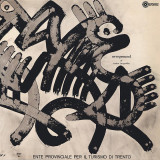
Overground was released on Sincro Edizioni Musicali in 1970 as the soundtrack to Enrico Moscatelli and Mario Rigoni's documentary Persuasione, commissioned by Ente Provinciale Per Il Turismo Di Trento, a local tourism board in Italy, with music composed by Sandro Brugnolini and Luigi Malatesta featuring some of the best musicians in Italy at the time like Angelo Baroncini and Silvano Chimento on guitars, Giorgio Carnini on piano and organ, Enzo Restuccia on drums, and Giovanni Tommaso on bass and effects. The music spans from underground Psychedelic Prog. Rock with swirling organs, trippy effects, and distorted fuzz guitars to sophisticated Lounge grooves with Avant-garde orchestrations.
The music has been transferred and remastered from the original master tapes. It has been lacquer cut in stereo by Jukka Sarapää at Timmion Cutting and packed in a thick cardboard sleeve featuring a fully restored painting by Umberto Mastroianni licensed by Centro Studi dell’Opera di Umberto Mastroianni
The Magnificent Thad Jones is widely regarded as the greatest small group recording of the trumpeter’s career. The 1956 date featured Billy Mitchell on tenor saxophone, Barry Harris on piano, Percy Heath on bass, and Max Roach on drums and is highlighted by Jones’ iconic performance of ‘April In Paris’ plus his swinging originals ‘Billie-Doo’ and ‘Thedia’. This Blue Note Classic Vinyl Edition is mono, all-analog, mastered by Kevin Gray from the original master tapes, and pressed on 180g vinyl at Optimal..
Sweet soul and sentimental music has never really gone out of style, and in the particular cases of the innovative wave of 1950's filin era Cuban boleros, or 1960's Nuyorican street soul, they both remain a thriving beacon of timelessness and universality, capturing a particular style of breezy Caribbean romantic music that has stubbornly thrived in the tough concrete landscape of New York City.
Perhaps there is some love in the heart of the city, as the new ensemble La Triunfadora has managed to tap into something of significant substance on their debut recording, Clasicos Sentimentales Para Una Nueva Generación. Co-produced by band leader Benjamin R. Juliá and renowned talent William Holland aka Quantic (recorded and mixed at the latter's Selva Recording studio in Brooklyn), the group has managed to capture the essence of this reemerging style of classic music, while further injecting their own inspired vision of experimental and psychedelic arrangements.
On A-side display for this debut 7-inch release on Names You Can Trust are two canonized Cuban boleros from maestro composer and guitarist Cesar Portillo De La Luz, stacked together in an old school continuous medley, and transformed with lush orchestration that has the talented musicians sparkling behind the duet of lead vocalists Candace Camacho and bandleader Juliá.
The B-side jumps from 1950's filin into Ralfi Pagan's iconic 1969 latin soul masterpiece "Hijo De Mama." Once again La Triunfadora peppers in just enough exquisite arrangements and musicianship to transform the original into something fresh, yet still guided from an analog sensibility, and ultimately performed with a familiar romanticism that these classic lovers' songs have managed to express over the decades to different generations.
Originally released in 1969, “Poe Through The Glass Prism” was one of the first ever concept-based rock albums. This Scranton, PA band (the first rock group from the Northeast to perform on national television shows and obtain a major record label deal) adapted Edgar Allan Poe poems to psychedelic rock with stunning results: swirling organ, fuzz bursts, passionate vocals… the sound quality was exceptional as the album was engineered and produced by Les Paul (the legendary inventor of the electric guitar and many studio recording devices) at his recording studio in New York. The album and its single “The Raven” hit the Billboard, Cashbox and Record World charts in 1969 and remained on for several weeks.
We’re proud to offer the first ever band sanctioned LP reissue of this cult psychedelic classic.
*Sourced from the original master tapes
*Insert with liner notes by Plastic Crimewave and rare photos
“The Glass Prism were forerunners of the Goth movement. “The Raven” was the first true expression of Goth Rock.