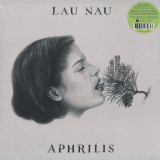
The title of the Lau Nau's 10th album, Aphrilis, derives from the Latin word aperire, meaning "to open." A fitting verb for the month of the year it is closely associated with — April. And while the images of plants and blossoms coming back to colorful life after a long, cold winter feels appropriate when listening to the rich and lustrous bloom of music on Aphrilis, another definition of open feels even more apt. For under the abundance lies the memory of times of austerity, the friction of hard choices, the acceptance that nothing is fixed and the future is unknown. This literal and metaphorical exploration of complexity and contradiction makes Aphrilis a multi-dimensional antidote for our troubled times, one that emphasizes the quiet and communal over noise and spectacle. Laura Naukkarinen, the Finnish artist behind this project, has long kept her mind and spirit open to whatever sounds and creative ideas felt appropriate for the moment. For the past six years that has meant primarily working with modular synthesis — learning how to build modules and releasing acclaimed work centered on its sounds like 5x4 (2023) or Puutarhassa (2022). Running parallel to this work, however, has been a continued exploration of acoustic instruments and group performances with her trio Lau Nau ja Seitsemäs Taivas. Aphrilis arrives then like fresh growth in a creative season cycle. A companion to her brilliant 2017 release Poseidon, the album, says Naukkarinen, "felt like a needed moment to embrace songs with lyrics again." And through the creation of this work, she remained open not only to her own creative muse, but also the input of her chosen collaborators. Each player on Aphrilis — Matti Bye on celesta and synths, Pekko Käppi on jouhikko, Hermanni Yli-Tepsa on violin and contrabass, Topias Tiheäsalo on electric guitar, Samuli Kosminen (Múm) on various instruments — was given free reign to arrange their own parts to accompany Naukkarinen's compositions. Kosminen’s lush fingerprint can also be heard in the mixing and production of the album, as with Poseidon six years ago. The moniker of this project may be taken from Naukkarinen’s own name, but Lau Nau feels more like a band than ever before. The delicacy and softness of the music is reflected in Naukkarinen’s lyrics. Each song is rife with imagery and creatures from the natural world. The spiders in the forest. The animals that keep a young woman company in her refuge in the woods. Wet grass. The feeling of the music is almost tactile, as if listening to the album will leave a bit of dew or sap on your fingers. The theme of this material, says Naukkarinen, runs even deeper. “The songs tell about cracks and changes of direction in different histories: personal, societal, planetary,” she says. “About moments when a yes can become a no and vice versa. The album wants to propose that at the moment of a crisis there is a possibility to influence the histories by our choices.” That may feel like a lot for such a fragile sounding collection of songs to bear. But Aphrilis is an album of surprising strength and resilience
Suche:mea
Two individuals from faraway journeyed the world together, and were given many tiny gifts from the surroundings. Then the music came out as a matter of course, as if a thing was being put in its right place.
Gordan machen Musik zwischen Expressivität und Abstraktion. Ihre Stücke sind nicht durch starre formale Strukturen begrenzt. Vielmehr handelt es sich um offene Prozesse, die einen Verlust des Zeitgefühls bewirken. Reduzierte Arrangements und ausdrucksstarker Gesang verbinden sich zu einem kraftvollen musikalischen Ganzen. Diese Band schafft etwas Neues aus Minimalismus, Intensität und der reichen Gesangstradition des Balkans. Als Down in the Meadow, das erste Album von Gordan, im Oktober 2021 bei Morphine Records veröffentlicht wurde, wurde es von Kritikern und Publikum gleichermaßen gefeiert. Nun legt das Trio sein zweites, noch radikaleres Album vor. Auf dieser neuen Veröffentlichung spiegeln Gordan die Mystik von Legenden und Geschichten aus den Balkanländern mit kontrolliertem Feedback, hypnotischem Bass, ausdrucksstarkem Schlagzeugspiel und dem einzigartigen Gesang von Svetlana Spajic. Schlagzeuger Andi Stecher verzichtet auf jegliche Ausschmückung und spielt gleichzeitig abwechslungsreich und konzentriert. Souverän und mit hervorragender Technik ist er der Motor des Bandsounds. Seine stilistische Flexibilität zeugt von einer profunden Kenntnis der globalen Musikgeschichte. Guido Möbius spielt Bassgitarre und verschiedene elektronische Klangerzeuger. Außerdem provoziert er mit Gitarrenverstärker, Mikrofon und Effekten Rückkopplungen. Diese mal sphärischen, mal sehr konkreten Klänge interagieren mit der Stimme von Svetlana Spajic. Gesang und Rückkopplung umkreisen einander in flüchtiger, sich ständig verändernder Harmonie.
The female-led discodelic soul band Say She She, named as a silent nod to NileRodgers (C'est chi-chi!: It's Chic!"), release their sophomore album `Silver' on theheels of an epic break-out year that grows brighter by the day. The three strong voices of Piya Malik (El Michels Affair staple feature, and formerbacking singer for Chicano Batman), Sabrina Mileo Cunningham and Nya GazelleBrown front the band. This harmonizing trio was formed in a classic New York taleof friends that met by following the music: the downtown dancefloors, through theLower East Side floorboards and up to the rooftops of Harlem. `Silver' was entirely written and recorded live to tape at Killion Sound studio inNorth Hollywood earlier this year and produced by Sergio Rios (of Orgone). Whilethese analog recording techniques help root Say She She's sound in a bedrock oftonal warmth that only tape can achieve, it is also their process of cutting the trackin the moment and capturing the magic of communal creativity that has seen theirsound described as "a glorious overload of joyful elation and spiritualelevation" (MOJO) and "infused with the wonky post-disco spirit of early'80s NYC" (The Guardian). Silver, the element, is known as the metal of self-confidence and the mirror of thesoul. With that, the 16-song double-LP projects not only their growth in writingwith confidence, but also reflects a deeper exploration into their punk-chic, femme-forward sensibility. Ultimately, `Silver' oozes with quirk and adventure and embraces themultifaceted nature of what it means to be a modern femme. The She She'sfully embrace their role as beauticians, actively reminding people of the inherentbeauty in the world. They skillfully employ double entendres and humor toencourage open dialogue and fearlessly address important matters that demandattention.
Combining elements of post-rock, trip-hop, and industrial music, HAAL have quickly become cult favourites in the UK live scene. Their psychotropic blend of samples, DIY pedals, and monolithic instrumentation, has seen the band play and tour alongside the likes of Kyoto Kyoto, WEB, Deliluh, Treeboy & Arc, Katy J Pearson, and Gurriers, as well as appearing at festivals such as ArcTanGent, Dot To Dot and more. Coming off the heels of their recent singles “Janus” and “Judy” (and subsequent remixes by Water From My Eyes and Crimewave), the new EP “Back To Shilmarine” arrives as a blistering snapshot of the band’s protean dynamism.
The band celebrate their late-90s / early-00s influences in a caustic yet melodic blend of tracks that nod as much to the output of labels such as Dischord, Touch & Go, and Nothing Records, as they do their contemporaries in the UK scene such as SCALER, Famous, deathcrash, and LICE. The EP sees them bring all these touchstones together to create a unique and uninhibited maelstrom of sound that spans everything from intricate math-inflected guitar lines and pensive vocals to propulsive drumming, totemic riffing, and warped synths.
Arguably some of HAAL’s heaviest material to date, “Platform 1, 18:19” offers the first look into this new material melding motorik rhythms and hypnotic riffs with sudden explosions of noise and power. However, as ever with HAAL, there is more than meets the eye – the track also features samples completely abstracted from their sources, for instance, the drone that begins the song is taken from a video of frontman Alfie Hay and his friends beating Bop It.
Elsewhere on the EP, the lyrics explore themes of cosmic existentialism, absurdism, meaning, transhumanism, inner reflection, science, history, and general philosophy. “All the lyrics are musings or verses that I wrote at very different times in my life” says Hay. “I then had to fit them around the music, despite being written at wildly different periods.” The record was once again recorded with long-time collaborator Alfie Tyson Brown (Katy J Pearson, LICE, Lazarus Kane) at The Louisiana in Bristol. The band have a tight knit collaborative circle around them, this is particularly notable around the band’s imagery
For the first time in vinyl format the work of the Bolivian avant-garde composer, Cergio Prudencio, together with the Orquesta Experimental de Instrumentos Nativos (OEIN). The OEIN is the result of the incorporation of Aymara musical traditions into the realm of contemporary music to produce a new sonic world. The work of Bolivian composer Cergio Prudencio (La Paz, 1955) is indissolubly linked to the project of the Orquesta Experimental de Instrumentos Nativos Experimental Orchestra of Native Instruments (OEIN), which he co-founded in 1980 and of which he is the emeritus director. It constitutes one of the most challenging adventures in the music that has emerged in Bolivia and Latin America. The OEIN is the result of the incorporation of Aymara musical traditions into the realm of contemporary music to produce a new sonic world. In the composer's words, it is about "...finding in the indigenous conception of music, elements of change and transformation, to establish a historical continuity." This incorporation is not only based on using native instruments but also involves integrating their socio-historical context and philosophies from the Andean indigenous world. In addition to forming ensembles with highland native instruments (sikus, tarkas, mohoceños, pinkillos, wankaras, seeds, drums, etc.), the foundation is laid on the three structural principles that govern Aymara music: "arca-ira," which means alternation of sounds between two musicians; "tropa," which involves the formation of large ensembles of instrumentalists and sound amplification; and "wakiña," meaning community strength. According to Prudencio, the acoustic and expressive identity of Andean-highland sounds originates from these principles, as does that of the OEIN. The release of Cergio Prudencio - Antología 1: Obras para la Orquesta Experimental de Instrumentos Nativos Cergio Prudencio - Anthology 1: Works for the Experimental Orchestra of Native Instruments allows us to delve into this wealth of thought and sounds, into the work of a fundamental and radical artist, for whom decolonization is also an opening to experimentation and the new. These compositions project a historical memory into the present, constructing new horizons.
Arriving as the third album on Supreems ‘Sweet Sun’ label – an imprint gathering a reputation for future-facing, storytelling electronic music – Sloucho's 'NPC' explores the duality of his main character and non-playable lives. With a strong Irish artistic presence featuring Rory Sweeney, EMBY, Curtisy and more, Sloucho navigates through Cloudcore-inspired broken beats, bass-driven percussion, alternative dreamscapes and wubby fuck-steps on his most complete release to date, laying the foundation for an origin-story in the process.
Garnering support from Surusinghe, Roza Terenzi, Two Shell and more; some of the tracks on NPC have already been heard in clubs around the world - from Antwerp to London and Mumbai to Paris. ‘Mind Traveller’ offers an ambient introduction to ‘Athrú’, Sloucho’s home world, as the artist's pitched vocals act as the listeners guide into the island's core. ‘Mutant’ features experimental electronic artist Rhoshi on a track that follows the kaleidoscopic sonic-themes of Sloucho’s previous Cloudcore releases ‘Slow Feet’ and ‘Silver Veil’, before the Rory Sweeney-featuring ‘Come Around’ ignites the dance with its dutty screw-face two-step, balanced by moments of melodic contemplation before evolving into a techno-dancehall hybrid.
‘Brand New’ stays on the steppy aesthetic, and brings MCs EMBY and Zack Oke into the frame with a 3D Meta-human video created in collaboration with respected, exhibiting digital artist Aisling Phelan. Using a motion capture suit, they captured EMBY and Zack’s performance and imported it into Unreal Engine, using different environments scanned from around the Greek Islands as the backdrop. The result is mind-blowing; a complete digital realm, shot like a real-life rap video as EMBY and Zack spit bars across an elasticated garage riddim. Full video is on YouTube.
‘Super Maramu 2000’ is a cut of alien-club beamed directly from ‘Eile’, the afterlife of Sloucho’s Neolithic ancestors. A waltzer-ride through Latin-bass and techno with an oxymoronic blend of maximalist and minimalist futurism, it’s as silly as it is serious, before the stuttering, juke-influence of ‘Make It Work’ brings the album’s rapid first half (and a bit) to a close.
Sloucho seamlessly weaves from front left of the club to dark, fume-filled rooms on ‘Two Thousands’ (featuring EMBY and Curtisy), ‘Rocks’ (featuring Zack Oke, who sounds remarkably like experimental spoken-word artist Coby Sey here, and Chilean artist Vatican Jail) and ‘Lights On’ (featuring Yamagōchi), Sloucho explores a previously unseen side to his sound, meandering through alternative trap and hip-hop laden beats that are both dreamy and nightmarish, bringing NPC to its starry-skied climax.
- Lp Tracks: Queen Feat. Kim Jennett
- Ain't Got No Troubles On The Road Feat. Pete Brown, Chris Farlowe & Tommy Schneller
- Try Me Again Feat. Hamburg Blues Band
- Sunshine Of Your Love Feat. Dennis Chambers, Malcolm Bruce & Maya Sage Tomorrow's Blues Feat. Clem Clempson, Marlia Rae, Harry Waters, Alfred Mehnert, Anne Hauter &Detlef Blanke
- Why Are You Ashamed Of Me? Feat. Heidi Solheim
- I'm A Ram Feat. Jed Potts, Paul Jones, Phil Bee, Alex Lex & Paul Jobson
- I Don't Know Where My Heart Is Feat. Beth Morris
- Road Angel Feat. Vanja Sky & Danny Bryant
- Rock'n Roll Hoochie Koo Feat. Curt Cress, Frank Itt & Stoppok
- Do What I Say Feat. Clawfinger & Millie & Luca Crew
- Bust A Button
It is a monster album which unites the who's who of the modern blues and rock scene and took Krissy one year to produce! Friends on the album include rap metal giants Clawfinger, the god of hellfire Arthur Brown, the voice Chris Farlowe, Germany's soul queen Inga Rumpf, legendary singer songwriter Stoppok, the iconic Hamburg Blues Band, elite drummers Dennis Chambers & Curt Cress, Blues singing dynamite Big Daddy Wilson and many more. The album includes 24 songs and is almost 3 hours long with a mix of Krissy's original material and his favourite cover songs. "It was a long time in the making and I managed to get it done. I started the pre-production in November 2022 and went in the studio to begin the meat and potatoes process in January 2023. I wanted to get all my favourite musicians together that I have met on the road in my career. They are not all here by any means, but a good handful are! I did not want this album to have a box, so there are many different genres from metal to blues and jazz to rock'n'roll. But in the end, it is a Krissy Matthews record."
"Elac Measure and adjusting gauge MKII
For tonearm and cartridge alignment"
"Elac Meß- und Justierschablone MKII"
- A1: Gwaing Reverie
- A2: Lucelle Sista Of The Soil
- A3: Mantis Praise
- A4: Amaseh Amen
- A5: For Peter & Ruth
- A6: Terug Blik
- A7: Threnody For The Khoisan
- A8: Ambient Khoi
- B1: Mcinci Song I
- B2: Morenga
- B3: Evidence Of Things Unseen
- B4: Lockdown Duet Milano-Cape Town
- B5: Roesdorp Requiem
- B6: The Ascension Of Milford Graves
Garth Erasmus is an artist and musician based in Cape Town, South Africa. 'Threnody for the KhoiSan' is his first album under his own name. Since 1985 his artistic interests have broadened to include music-making, designing and making his own instruments based on indigenous KhoiSan knowledge. From 1999 to 2012 he was a member of the South African First Nation activist group Khoi Khonnexion. In the past couple of years Garth Erasmus has also been a pivotal part of various international performance pieces and exhibition projects which brought him regularly to Europe. Most of these activities were developed and performed in collaboration with the Hamburg based band Kante and his band Khoi Khonnexion. In April 2024 Garth Erasmus will be part of the group exhibtion 'Oscillations' at Akademie der Künste, Berlin.
His works in music are predominantly characterized by a restless quest for alternative forms of expression and materials including self build instruments, field recordings or various electronic music devices.
In this context the music on 'Threnody for the KhoiSan' takes on a primal and metaphorical meaning. Rather than a formal, physical initiation, this process is more spiritually inclined, yet it is a spirituality which is consistently put into action.. “Ever since I was an art student I have experimented with alternative materials to release me from the Western education values I received. When I started to make these instruments in the 1980s, my intention was to create art objects but when I discovered the sound they made, it unlocked a door that transported me deeper in my quest in the realization that I was on the right path.
In fact all instruments which appear on 'Threnody for the KhoiSan' are products of a process of discovery starting from square one. All this is based and founded on the beauty of simplicity and minimalism as symbolized by the single string Khoisan musical bow and arrow as trance musical instrument. In this sense it soon became manisfest for Garth Erasmus to combine the bow instruments with various electronic instruments. Besides developing his own unique language in music he also shared an expressed interested in experimental sound aesthecis, Avantgarde composition and Free Jazz. However, his non - academic approach towards sound and music was always fueled by the desire for a reconnection to the land and to the idegenious knowledge of the KhoiSan, whose struggle for First Nation status continues.
Song for Morenga
This song is dedicated to a guerilla leader, named Jacob Morenga, who was the leader of the nama/herero anti-german uprisings that occured between 1904 and 1907.
Amaseh Amen
This is a classic mouthbow piece that conjures the spiritual nature of Khoisan cultural praxis.
Gwaing Reverie
It was composed as a personal gift to the other members of newly formed electro-acoustic trio „Gwaing". „Gwaing" is an ancient Khoisan place name, meaning the mouth of the river.
Mcinci Song
A typical meditation on the traditional Mcinci flute. This flute was originally played by shepherds and was made of reed.
The Ascension of Milford Graves
This piece attends to capture the risen spirit of the legendary African American drummer Milford Graves. It was composed soon after his death in 2021.
Song for The Sisters of the Soil
A live improvisation dedicated to Lucelle and Melissa (The Sisters of the Soil) on the occasion of visiting them at their residence, known as „Oppieyaart" on the Cape Flats. On 10 September 2022 there is an online event with them at Kunsthaus Hamburg.
Parallelle & Nicolas Masseyeff return to Crosstown Rebels to deliver the excellent ‘Surrender’, backed by a remix from Axel Boman. Returning to the iconic imprint following the trio’s stand-out ‘Renegade’ EP in 2023, the new collaborative release, set for release on 10th May 2024, welcomes two hypnotic cuts alongside a slick rework from the Studio Barnhus co-founder.
Three talents with a long-standing and innate musical connection stretching back years, Dutch brother duo Parallelle and French DJ/producer Nicolas Masseyef have been connecting and collaborating to shape a series of lauded projects released via renowned imprints such as DGTL, Systematic, and Masseyef’s own Diversions Music. Reuniting for a second outing on Damian Lazarus’ Crosstown
Rebels imprint, following the success of their 2023 debut with the heavily championed ‘Renegade’, the trio return in style with two fresh, original productions backed by an ever-stylish remix from Studio Barnhus co-founder Axel Boman, who returns to deliver his second remix on the label following his debut remixing Dinky in 2016.
The EP’s title track ‘Surrender’ is a rumbling and impactful percussive journey through the darker territories of the night, with skittering synths and echoed vocal interjections adding glimpses of brightness to the otherwise murky sound. Meanwhile, ‘She Says’ keeps the playful vocal elements front and centre, introducing warping melodies and dub-tinged textures. Providing his flip on the latter, Boman’s take on ‘She Says’ is classy and engaging from the off, stripping the track back to expose a raw yet polished interpretation while drawing on hazy pads, eerie tones and sweeping atmospherics for a wonky and trippy excursion.
- A1: Tone Bone Kone
- A2: Soon-To-Be Innocent Fun / Let's See
- A3: Answers Me
- A4: Being It
- A5: Place I Know / Kid Like You
- A6: She's The Star / I Take This Time
- B1: Tree House
- B2: See-Through
- B3: Hiding Your Present From You
- B4: Wax The Van
- B5: All-Boy All-Girl
- B6: Lucky Cloud
- B7: Tower Of Meaning / Rabbit's Ear / Home Away From Home
- B8: Let's Go Swimming
2024 Repress
Imagine a held-up-in-traffic Wayne Shorter arriving late to a Weather Report studio session and Joe Zawinul, Victor Bailey, and Omar Hakim filling in the time by jamming on a grooving house cut. Had that happened, it might have sounded a little bit like “It Never Stops,” one of two ultra-fresh tracks on Kaidi Tatham's Yore debut. Jazz and house are obviously distinct genres, yet as this irresistible cut makes clear swing is common to both. The other track, the cerebrally titled “One for the Brain,” locates itself closer to house music proper but is no less appealing for doing so.
Given the jazzy vibe of “It Never Stops,” it's fitting that Benji B once deemed Tatham the "Herbie Hancock of the United Kingdom.” Regarded as one of the originators of the Broken Beat sound, the UK-based multi-instrumentalist has worked with many an artist, from Bugz In The Attic and The Herbaliser to DJ Jazzy Jeff, and his session work credits list Slum Village, Amy Winehouse, Soul II Soul, and others. His own discography includes EPs and releases for labels such as 2000 Black, First World Records, Theo Parrish's Sound Signature, Eglo Records, and now, of course, Yore.
“It Never Stops” rolls in on a wave of silky synthesizer textures and percolating precision with a tight, funky groove that instantly pulls you into its velvety world. Triangles, electric bass, and clavinet add collective radiance to the material as the tune struts its way into your psyche. As if to make the jazz connection even more explicit, Tatham works an acoustic piano solo into the cut's second half before shifting focus back to the groove for the coda. “One for the Brain,” by comparison, digs into its chugging house pulse with fervour whilst also sweetening the arrangement with painterly synth flourishes. This one charges with breathless determination and like “It Never Stops” nods in jazz's direction with the inclusion of a freewheeling piano solo. Every minute and second on this strictly limited 12“ release seem's meaningful. No Represses / Limited 200 Copies.
- A1: Forro Violento (Instrumental)
- A2: Grao De Areia
- A3: Nao Vou Reclamar De Deus
- A4: Toda Beleza
- A5: Put@Ria!
- B1: Rubelia
- B2: Posso Dizer
- B3: Vinheta As Palavras
- B4: As Palavras
- B5: Forro Violento
- C1: Torto Arado
- C2: Lua De Garrafa
- C3: Na Mao Do Palhaco
- C4: Doutor Albieri
- C5: Samba De Amanda E Te
- D1: Amor De Mae
- D2: Vinheta As Palavras Ii
- D3: Assum Preto
- D4: Forro No Escuro
- D5: Toda Beleza (Pelos Loirinhos)
Pink Vinyl[29,96 €]
Some albums are game-changers in a genre. Take OutKast's Speakerboxxx / The Love Below or Primal Scream's Screamadelica, they observe, study, and then flip what an album can mean to a genre or moment in time.
From the very first listen of Rubel’s Latin Grammy-nominated third album As Palavras, Vol. 1 & 2, you can feel its transformative force for the MPB genre. Here we see one of Rio’s brightest stars, fusing the contemporary with the classic, soaking up the richness of Brazil’s musical heritage. The result is a marauding 20-track epic, incorporating traditional styles such as forró, MPB, pagode and samba with modern baile funk, rasteirinha and hip-hop.
The album exudes a sense of freedom and creativity, playfully and provocatively juggling the familiar with the forward-thinking. The tracks are divided across two records, navigating feelings of love, heartbreak and discovery, whilst balancing themes of violence, passion, irony and affection. Collaborating with some of the country’s most esteemed artists such as Gabriel do Borel, Liniker, Luedji Luna, Tim Bernardes and Ana Caetano, Rubel takes this fusion of styles, subjects and flavours to the global stage.
The grand, forró-blending, choral opener, ‘Forró Violento (Instrumental)’ sets the tone for the album, with references and links between tradition and modernity everywhere to be seen. From the Ana Frango Elétrico produced, funk flexing, samba-soul brilliance of ‘Não Vou Reclamar de Deus’, to the album’s title cut ‘As Palavras’, in collaboration with Tim Bernardes, that melds MPB influences with electronic elements and hip-hop touches.
Across both sides of the album, Rubel’s story-telling gift is given space to shine. ‘Torto Arado’ featuring Liniker and Luedji Luna, beautifully references the racial injustice, tragedy, hope and ambition found in one the most celebrated Brazilian novels of recent times by Itamar Vieira Júnior. Elsewhere, ‘Na Mão do Palhaço’ manifests a satirical march about a suicidal conservative middle-aged man, who is rescued by the miracle of the carnival.
At times the album is gentle and intimate with tracks like ‘Toda Beleza’ featuring Bala Desejo, or the ode to friendship ‘Lua de Garrafa’, composed with the legendary Milton Nascimento. At others, the grooves hit harder, with sounds from the favelas laced within. ‘Put@ria!’, explores the universe of baile funk, with BK’ and MC Carol trading off on the mic, as ‘Rubelía’ moves between reggaeton, funk, and hip hop. The latter is a tribute to a key influence of the album, Spanish star Rosalía and her parallel mix of current with classic.
Ultimately though the beauty of this album lies in its concept. In the midst of a country divided, ‘As Palavras Vol. 1 & 2’ sets out to bring together genres and generations, grounded in rhythms and words that have helped define Brazil through the ages.
"Ovdan" means loss, the album was written and recorded during a dark period in the Israeli band's life and the creative process was indeed a healing to come back to life after several traumatic events they experienced. Musically, they pushed boundaries while still maintaining the vision that started successfully with their debut album "Hollow" (2020).
The Flenser is pleased to announce the release of Living Is Easy, the latest EP from ecstatic black metal band Agriculture. Ecstatic black metal from Los Angeles. Follows up 2023’s critically acclaimed debut. A new EP plus first vinyl release of their first EP. Appearing prominently at the 2024 edition of Roadburn. US and European tour dates in the works through 2024. Video for title track featuring Flenser goons, Chat Pile. This new EP will be paired with the band’s debut EP, The Circle Chant. For the first time, both EPs will be pressed together on a single 12-inch vinyl record as well as a cassette format Living Is Easy represents a significant new statement from the band. With their debut self-titled, Agriculture embarked on a journey to explore how heavy music can provide insights into the joys of life, both everyday and divine. Their extensive touring with this material led to a profound experience of ecstasy, surpassing expectations as they shared the intensity and joy of these songs with audiences worldwide. This experience was a catalyst for the band, inspiring them to delve even deeper into the realm of “ecstatic black metal” music. They believes that with this release they have pushed this concept to its limit, resulting in a transformative explosion of sound and meaning. The record delves into themes of community connection, holiness, violence, and the cycles of life. The title track is especially notable, featuring a retelling of a story from one of the Buddha’s past lives. In this narrative, the Buddha encounters a starving family of tigers and sacrifices himself to save them, a tale of serenity and selflessness. This story resonates deeply with the band, reflecting the humility and inspiration they find in their collaboration and echoing the generosity and interconnection they strive to explore through their music. Touring holds a special place in the heart of Agriculture. It brings them immense joy to share their music, visit new places, and meet new people in cities around the world. This constant interaction with diverse audiences serves as a continuous source of inspiration for this work. Agriculture is eager and excited to share Living Is Easy as well as give new life to the first vinyl pressing of The Circle Chant
- 01: Absolutely Cuckoo
- 02: I Don't Believe In The Sun
- 03: All My Little Words
- 04: A Chicken With Its Head Cut Off
- 05: Reno Dakota
- 06: I Don't Want To Get Over You
- 07: Come Back From San Francisco
- 08: The Luckiest Guy On The Lower East Side
- 09: Let's Pretend We're Bunny Rabbits
- 10: The Cactus Where Your Heart Should Be
- 11: I Think I Need A New Heart
- 12: The Book Of Love
- 01: Fido, Your Leash Is Too Long
- 02: How Fucking Romantic
- 03: The One You Really Love
- 04: Punk Love
- 05: Parades Go By
- 06: Boa Constrictor
- 07: A Pretty Girl Is Like
- 08: My Sentimental Melody
- 09: Nothing Matters When We're Dancing
- 10: Sweet-Lovin' Man
- 11: The Things We Did And Didn't Do
- 01: Roses
- 02: Love Is Like Jazz
- 03: When My Boy Walks Down The Street
- 04: Time Enough For Rocking When We're Old
- 05: Very Funny
- 06: Grand Canyon
- 07: No One Will Ever Love You
- 08: If You Don't Cry
- 09: You're My Only Home
- 10: (Crazy For You But) Not That Crazy
- 11: My Only Friend
- 12: Promises Of Eternity
- 01: World Love
- 02: Washington, D.c
- 03: Long-Forgotten Fairytale
- 04: Kiss Me Like You Mean It
- 05: Papa Was A Rodeo
- 06: Epitaph For My Heart
- 07: Asleep And Dreaming
- 08: The Sun Goes Down And The World Goes Dancing
- 09: The Way You Say Good-Night
- 10: Abigal, Belle Of Kilronan
- 11: I Shatter
- 01: Underwear
- 02: It's A Crime
- 03: Busby Berkeley Dreams
- 04: I'm Sorry I Love You
- 05: Acoustic Guitar
- 06: The Death Of Ferdinand De Saussure
- 07: Love In The Shadows
- 08: Bitter Tears
- 09: Wi' Nae Wee Bairn Ye'll Me Beget
- 10: Yeah! Oh, Yeah!
- 11: Experimental Music Love
- 01: Meaningless
- 02: Love Is Like A Bottle Of Gin
- 03: Queen Of The Savages
- 04: Blue You
- 05: I Can't Touch You Anymore
- 06: Two Kinds Of People
- 07: How To Say Goodbye
- 08: The Night You Can't Remember
- 09: For We Are The King Of The Boudoir
- 10: Strange Eyes
- 11: Xylophone Track
- 12: Zebra
Limited edition silver vinyl anniversary reissue of the Magnetic Fields' classic 1999 rumination on, of course, love. Funny, smart, dark, memorable, and a lifetime's worth of listening. Stephin Merritt solidifies his songwriting genius on his "most ambitious and fully realized work". (AMG) This vinyl reissue is remastered for vinyl and beautifully packaged in a 10" slipcase box with three double gatefold sleeves and a 24 page booklet!
Red Vinyl[26,26 €]
Deluxe edition Tan and Black Marble Vinyl[28,36 €]
Cassette[14,50 €]
It's been a decade since John Carpenter recorded the material that would become Lost Themes, his debut album of non-film music and the opening salvo in one of Hollywood's great second acts. Those vibrant, synth-driven songs, made in collaboration with his son Cody Carpenter and godson Daniel Davies, kickstarted a musical renaissance for the pioneering composer and director. In the years since, Carpenter, Carpenter, and Davies have released close to a dozen musical projects, including a growing library of studio albums and the scores for David Gordon Green's trilogy of Halloween reboots. With Lost Themes IV: Noir, they've struck gold again, this time mining the rich history of the film noir genre for inspiration. Since the first Lost Themes, John has referred to these compositions as "soundtracks for the movies in your mind." On the fourth installment in the series, those movies are noirs. Like the film genre they were influenced by, what makes these songs "noirish" is sometimes slippery and hard to define, and not merely reducible to a collection of tropes. The scores for the great American noir pictures were largely orchestral, while the Carpenters and Davies work off a sturdy synth-and-guitar backbone. The noir quality, then, is something you understand instinctively when you hear it, as in connected in an emotional way. The trio's free-flowing chemistry means Lost Themes IV: Noir runs like a well-oiled machine_the 1951 Jaguar XK120 Roadster from Kiss Me Deadly, perhaps, or the 1958 Plymouth Fury from John's own Christine. It's a chemistry that's helped power one of the most productive stretches of John's creative life, and Noir proves that it's nowhere near done yielding brilliant results.
Black Vinyl[24,79 €]
Deluxe edition Tan and Black Marble Vinyl[28,36 €]
Cassette[14,50 €]
It's been a decade since John Carpenter recorded the material that would become Lost Themes, his debut album of non-film music and the opening salvo in one of Hollywood's great second acts. Those vibrant, synth-driven songs, made in collaboration with his son Cody Carpenter and godson Daniel Davies, kickstarted a musical renaissance for the pioneering composer and director. In the years since, Carpenter, Carpenter, and Davies have released close to a dozen musical projects, including a growing library of studio albums and the scores for David Gordon Green's trilogy of Halloween reboots. With Lost Themes IV: Noir, they've struck gold again, this time mining the rich history of the film noir genre for inspiration. Since the first Lost Themes, John has referred to these compositions as "soundtracks for the movies in your mind." On the fourth installment in the series, those movies are noirs. Like the film genre they were influenced by, what makes these songs "noirish" is sometimes slippery and hard to define, and not merely reducible to a collection of tropes. The scores for the great American noir pictures were largely orchestral, while the Carpenters and Davies work off a sturdy synth-and-guitar backbone. The noir quality, then, is something you understand instinctively when you hear it, as in connected in an emotional way. The trio's free-flowing chemistry means Lost Themes IV: Noir runs like a well-oiled machine_the 1951 Jaguar XK120 Roadster from Kiss Me Deadly, perhaps, or the 1958 Plymouth Fury from John's own Christine. It's a chemistry that's helped power one of the most productive stretches of John's creative life, and Noir proves that it's nowhere near done yielding brilliant results.