Riding the razor’s edge between rigorous experimentation, innovation, and tradition, London based, Italian composer, cellist, and electronic performer, Sandro Mussida, joins the Die Schachtel family with Rueben, his 3rd solo LP.
Active since the early 2000s, Sandro Mussida worked extensively with Mark Fell, Curl Collective, Lorenzo Senni, Oren Ambarchi, and Alessandra Novaga, among others, as well as a founding member of the interdisciplinary artists' group TQS Collective, before releasing his solo debut, Ventuno Costellazioni Invisibili, on Metrica in 2017, followed by Eeeooosss, released by Soave in 2019. Rueben, like its predecessor, deploys a microtonal vocabulary within a three-instrument sound palette and builds upon Mussida’s long-standing investigations of active listening, augmented by a developing practice that challenges aural perceptions of historical, non-equal-tempered tuning systems.
The 3rd instalment of Die Schachtel’s Decay Music series - launched to highlight inspired contemporary experimental efforts in the ambient, ethereal, and emotively abstract music - Rueben was recorded during 2018 in the church of St.Giusto in Volterra, Italy. Deeply inspired by Italian Renaissance paintings encountered by Mussida during the work’s composition, and conceived at the intersection of acoustic and electronic aural fields, in careful response to the space itself, the sounds of electric guitar, bass clarinet and cello - treated as minuscule sound atoms, rapidly projected to form structures of evolving densities - harmoniously enter into dialogue, forming a multi-layered, contemplative sonic landscape, within the interwoven complexity of their own reflections.
Central to Mussida’s work is the role of the performer, the experience of sound in a given space, and the relation of those sounds to memory and observation. Across the length of Rueben, bound to the work’s inspiration in the visual realm, the interplay between the senses blurs, presenting the act of listening as a mirror for the experience and legacies of seeing. In Mussida’s hands, sound emerges as a trace or memory suspended in a non-linear conception of time, where imprint, movement, and event, as they relate to place and happening, are perceived by the ear, recalling the Russian theologian Pavel Florenskij’s idea of ‘reverse time’, that likens temporal condition activated by experiences with art as similar to that of dreams.
Vast in scope and intricate detail, the 9 discrete compositions that form Rueben unfold in a series of interconnected, shimmering landscapes of tone and texture, each, through the interplay of their elements, configuring a radically dense rendering of minimalist, ambient music that challenge the perceived boundaries of those historical definitions. The identity of individual sound sources fades against their collective whole, sculpting an inward-looking aural image of the church of St.Giusto, that echoes the radiance of the paintings that lay at the heart of the album’s inspiration.
An inspired and radically forward-thinking realization of electro-acoustic music, Mussida pushes toward innumerable possible futures of experimental practice, imbued with ghosts and histories of the past. Rueben is issued Die Schachtel on vinyl in a one-time edition of 250 copies, pressed to 180g marble vinyl and housed in a pro-printed inner sleeve and jacket, featuring an original Sumi-e painting by Japanese artist and avant rock drummer Akihide Monna (Bo Ningen), contained in a silk-screen PVC sleeve.
quête:metr
This album was originally composed in October 2017, performed and recorded live in Kasteliotissa Medieval Hall, Nicosia, on the 19th of November 2017 as an accompanying soundtrack to Fritz Lang's two hour-long edit of the film Metropolis (1927). Commissioned by the the curators of the 'German expressionism in Cinema exhibition' to compose and perform a live soundtrack, Panagiotis and Yiannis employed a hardware heavy arsenal to produce one of their longest pieces. modular synthesizers, guitars, drum samplers and drum machines are all protagonists. The performance lasted for two hours and was recorded in its entirety. It was later edited down to preserve all sound design qualities and a somewhat live feel. The title is an homage to the main actress of the film.
Panagiotis Mina and Yiannis Eliades, longstanding members of 'do it together' collective Honest Electronics and producers of their own material as Panayotis and Isel respectively, often collaborate on projects such as Brigitte. Panagiotis Mina is a producer, musician and visual artist. He lives and works in Cyprus from Pyrgatory studios, his out in the country home diy studio project. Yiannis Eliades produces and performs music using a blend of analog and digital synthesizers, drum machines and twisted recordings, on his own or as part of duos (MYHN, Carnal Throes).
- A1: Africa Is My Root - Osayomore Joseph And The Creative Seven
- A2: Ta Gha Hunsimwen - Akaba Man The Nigie Rokets
- A3: Popular Side - Akaba Man And The African Pride
- B1: Iranm Iran - Victor Uwaifo And His Titibitis
- B2: Sakpaide No 2 - Victor Uwaifo And His Titibitis
- B3: Ta Ghi Rare - Akaba Man The Nigie Rokets
- C1: My Name Is Money - Osayomore Joseph
- C2: Ogbov Omwan - Akaba Man The Nigie Rokets
- C3: Aibalegbe - Victor Uwaifo And His Titibitis
- D1: Who Know Man - Osayomore Joseph And The Ulele Power Sound
- D2: Obviemama - Victor Uwaifo And His Titibitis
- D3: Ororo No De Fade - Osayomore Joseph And The Ulele Power Sound
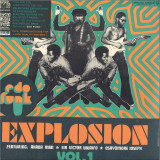
Analog Africa Presents Edo Funk Explosion Vol. 1, available on
2xLP/Gatefold LP with 20-page booklet / CD with 36-page booklet. It was
in Benin City, in the heart of Nigeria, that a new hybrid of intoxicating
highlife music known as Edo Funk was born.
It first emerged in the late 1970s when a group of musicians began to experiment with different ways of integrating elements from their native Edo culture
and fusing them with new sound effects coming from West Africa s night-clubs.
Unlike the rather polished 1980 s Nigerian disco productions coming out of the
international metropolis of Lagos Edo Funk was raw and reduced to its bare
minimum.
Someone was needed to channel this energy into a distinctive sound and Sir
Victor Uwaifo appeared like a mad professor with his Joromi studio. Uwaifo
took the skeletal structure of Edo music and relentless began fusing them with
synthesizers, electric guitars and 80 s effect racks which resulted in some of the
most outstanding Edo recordings ever made. An explosive spiced up brew with
an odd psychedelic note known as Edo Funk.
That’s the sound you’ll be discovering in the first volume of the Edo Funk Explosion series which focusses on the genre’s greatest originators; Osayomore
Joseph, Akaba Man, and Sir Victor Uwaifo: Osayomore Joseph was one of the
first musicians to bring the sound of the flute into the horn-dominated world
of highlife, and his skills as a performer made him a fixture on the Lagos scene.
When he returned to settle in Benin City in the mid 1970s - at the invitation of
the royal family - he devoted himself to the modernisation and electrification
of Edo music, using funk and Afro-beat as the building blocks for songs that
weren’t afraid to call out government corruption or confront the dark legacy of
Nigeria’s colonial past.
Akaba Man was the philosopher king of Edo funk. Less overtly political than Osayomore Joseph and less psychedelic than Victor Uwaifo, he found the perfect
medium for his message in the trance-like grooves of Edo funk. With pulsating
rhythms awash in cosmic synth-fields and lyrics that express a deep personal
vision, he found great success at the dawn of the 1980s as one of Benin City’s
most persuasive ambassadors of funky highlife.
Victor Uwaifo was already a star in Nigeria when he built the legendary Joromi
studios in his hometown of Benin City in 1978. Using his unique guitar style as
the mediating force between West-African highlife and the traditional rhythms
and melodies of Edo music, he had scored several hits in the early seventies,
but once he had his own sixteen-track facility he was able to pursue his obsession with the synesthetic possibilities of pure sound, adding squelchy synths,
swirling organs and studio effects to hypnotic basslines and raw grooves. Between his own records and his production for other musicians, he quickly established himself as the godfather of Edo funk.
What unites these diverse musicians is their ability to strip funk down to its
primal essence and use it as the foundation for their own excursions inward to
the heart of Edo culture and outward to the furthest limits of sonic alchemy.
The twelve tracks on Edo Funk Explosion Volume 1 pulse with raw inspiration,
mixing highlife horns, driving rhythms, day-glo keyboards and tripped-out guitars into a funk experience unlike any other.
We welcome another newcomer to the label, UK-badman Cartridge, who steps up with a smashing debut EP showing the world he’s not messing about. Big Things!
Stone Cold:
The aptly titled EP opener hits hard like a boulder, painting a post-apocalyptic super-metroidesque landscape, building upon the glorious ‘Flummox’ from SUBALT010. Gritty synth lines stating a simple yet catchy and evolving melody, all rounded by a fat bass exactly how we like it. A glittery rain paves the way to the breakdown and the second drop, which tells the final part of this majestic romance.
Choker:
Time to get stealthy with this one… a sinister intro erupts into a refined yet powerful barrage of bass. Solid groove, heavily panned percussion, clever wobs and synth hits, masterful reverb and delay interplays, Cartridge’s sound design really sets to impress with this superb number.
Sweet Doughs:
If the concept of ‘sinister’ was established on the previous track, ‘Sweet Doughs’ definitely takes it to the next level. Menacing car-tyre-screeching-like synths and an amusing yet slightly uncanny vocal sample set up the pace for this weighty dance-floor rattler. A saturated 808-like bass propels the track, which reveals itself as a master-class on how to blend power, bass, crafty sound design and an incredible attention to details.
The latest collection by Cascadian resident loscil aka Scott Morgan is a stunning meditation on light, shade, and decay, sourced from a single three-minute composition performed by a 22-piece string orchestra in Budapest.
The subsequent recording was lathe-cut on to a 7-inch, then “scratched and abused to add texture and color,” from which the entirety of Clara was sampled, shape-shifted, and sculpted. Despite their limited palette, the compositions summon a sense of the infinite, swelling and swimming through luminous depths. Certain tracks percolate over narcoleptic metronomes while others slowdive in shimmering shadowplay, sounding at times like some noir music of the spheres.
Although Morgan's compositional premise for Clara was quite defined, the resultant work is wonderfully opaque and spatial, equal parts lush and lurking, traced in fine-grained gradients and radiant silences. The album's title comes from the Latin for ‘bright': a fitting muse for this masterpiece of celestial electric currents and interstitial ether, where “shadows are amplified and bright spots dimmed.”
Leng Records has long had close ties with the underground music scene in San Francisco, with low-slung dub disco and psychedelic disco outfit 40 Thieves releasing their acclaimed album The Sky Is Yours on the imprint way back in 2014. Now Leng has turned to another stalwart of the Bay Area scene, Cole Odin, on a single that’s every bit as trippy and engrossing as you’d expect from one of San Francisco’s most frequently overlooked talents. Cole made his Leng debut earlier in the year, contributing the electro-influenced track ‘Numbers Game’ to the label’s 10th anniversary compilation. On ‘Little Boxes’, he’s joined by good friend Eddie C, a much-loved disco and house producer from Canada best known for his releases on Endless Flight and Red Motorbike. The pair recorded the track while Eddie was staying with Cole in San Francisco last year.
In keeping with the low-slung, hallucinatory sound that has always been a big feature of the San Franciscan scene, ‘Little Boxes’ is a trippy, mind-altering affair in which waves of sitar sounds, cosmic synths, effects-laden guitars and kaleidoscopic electronics rise above a weighty punk-funk bassline and crunchy, snare-heavy beats. It has serious dancefloor chops but is also atmospheric and immersive: perfect 5am music for Bay Area beach parties and mushrooms-fuelled forest raves.
Fittingly, it’s 40 Thieves who provide the accompanying remix, a 10-minute epic created with the assistance of Adonis and Rodney from the psych rock band ‘Guavatron’ for additional synths and the guitars. Beginning with tabla-style percussion, swirling chords, psychedelic guitar licks and mystical sitar sounds, the remix builds in waves, with looser drums and even weightier bass propelling the track forwards at a metronomic and hypnotic pace. By the time the eyes-closed guitar solos drop two thirds of the way through, you’ll be tripping hard and reaching for the lasers. It’s a genuinely stunning remix of a genuinely intoxicating, mind-mangling track.
Milanese imprint Ansia returns with a new V/A of warped, unconventional techno. Following his critically acclaimed debut LP 'Perdu', label-head Piezo continues to carve out his club-ready and explorative sonic niche, this time calling on a team of kindred left-field sound manipulators to get the job done. Manchester's BFFT (Whities, Gobstopper, Cong Burn) leads the charge with a dexterous cut that marries mind-bending sound design with club-ready functionality. Next up is Timedance-affiliate Metrist, who is as playful as ever on 'LB Steaua': a deceptively simple 4/4 beat peppered with distorted glitches and psychedelic details reminiscent of Perlon's more left field releases. Moving to the B-side, Piezo delivers his trademark brand of ruffneck techno - buzzing with off-grid tribal drums, cartoon synths and nonsense vocal samples. To close, Mexican leading-light Siete Catorce ratchets up the tempo for a singular track in a world entirely of its own: rude, fast, no-frills, sitting somewhere between digital cumbia and hardcore tekno. Unsurprisingly this one ended up in Batu's relentlessly forward thinking BBC Essential Mix.
- A1: Wolfgang Dauner - Output
- A2: My Solid Ground - The Executioner
- A3: Association Pc - Scorpion
- B1: Fritz Muller - Fritz Muller Traum
- B2: Exmagma - It's So Nice
- B3: Anima-Sound - It Loves Want To Have Done It
- C1: Tomorrow's Gift - Jazzi Jazzi
- C2: Out Of Focus - See How A White Negro Flies
- C3: Brainstorm - Snakeskin Tango
- C4: Thirsty Moon - Big City
- D1: Gomorrha - Trauma
- D2: Brainticket - Black Sand
With his ongoing commitment to like-minded archivist label Finders Keepers Records, industrial music pioneer Steven Stapleton further entrusts us to lift the veil and expose “the right tracks” from his uber-legendary and oft misinterpreted psych/prog/punk peculiarity shopping list known as The Nurse With Wound List.
Following the critically lauded first instalment and it’s exclusively French tracklisting both parties now combine their vinyl-vulturous penchants to bring you the next ‘Strain Crack & Break’ edition which consists of twelve lesser-known German records that played a hugely important part in the initial foundations of the list which began to unfold when Stapleton was just thirteen years old.
From the perspective of a schoolboy Amon Düül (ONE) victim, at the start of a journey that commenced before phrases like kosmische and the xeno-ignant Krautrock tag had become mag hack currency, this compendium is devoid of the tropes that united what many would accurately argue to be the greatest progressive pop bands in Europe
(namely CAN, Neu! and Kraftwerk) and rather shatters the ingredients across a ground zero landscape for both inquisitive fans and socially rehabbing musos to begin to assemble a unique self-styled identity. If Krautrock was the music that journalist told us lurked behind schlager (German pop) in the 1970s, then this record includes the music that skulked behind Krautrock and perhaps refused to polish its backhanded name belt.
Including lesser-known artists like the late Wolfgang Dauner, whose career proceeded and outlived the kosmische movement while consistently informing and outsmarting them whenever they got stuck in their metronomic ruts, or how about Fritz Müller, the man who
was to Kraftwerk what Stuart Sutcliffe was to The Beatles but had more in common with Yoko and quite rightly couldn’t give a stuff about the Fab Four’s Hamburg roots.
Elsewhere we have a plethora of German bands made for German audiences as they try and shed secondhand flower power Americanisms and feel the benefits of much harder drugs and the realisations of difficult second album budgets while Kommune 1
newsflashes wipe smiles from everybody’s faces and replace them with opioid chic or acid-sarcastic grins. Bonzo Cockettes show us their Big Muffs and drummers ask for extra mics while Conny Plank goes for parliamentary office and gives babies good firm handshakes for the camera.
‘Strain Crack & Break: Volume Two’ is the sound of Steve Stapleton’s sponge-like mind and the dividends of anyone who was brave enough to even peek inside those brick-thick gatefold covers never mind drop the needle.
Over forty years since Nurse With Wound’s first album was released, Finders Keepers Records and Steve Stapleton take connoisseurs of our kind of music back to the disused elevator shaft towards ground zero. Arriving at the same checkout from different departments, Finders Keepers and Nurse With Wound continue to sing from the same hymnal with this ongoing collaborative attempt to officially, authentically and legally compile the best tracks from Steve’s list, where many overzealous erds have faltered (or simply, got the wrong end of the stick).
After ‘Strain Crack & Break: Volume One’ merely scratched the surface of this DIY dossier of elongated punk-prog peculiarities, this second lavish metallic gatefold double vinyl compendium drives a much deeper groove which, in accordance with Steve’s wishes, focusses exclusively on individual tracks of German origin - the country whose music forged the prototype of the NWW inventory in the form of his secondary school vinyl wantlist in the early 1970s, comprised of disassembled free jazz, unshowered stoner psych, hypnotic prog, deranged monk funk and fuzzed out Deutschmark bin bonzo beats.
- Ace Of Spades
- Stay Clean
- Metropolis
- The Hammer
- Iron Horse
- No Class
- Overkill
- (We Are) The Road Crew
- Capricorn
- Bomber
- Motorhead
- Ace Of Spades
- Stay Clean
- Over The Top
- Metropolis
- Shoot You In The Back
- The Hammer
- Jailbait
- Leaving Here
- Iron Horse
- Fire, Fire
- Capricorn
- Too Late, Too Late
- No Class
- (We Are) The Road Crew
- Bite The Bullet
- The Chase Is Better Than The Catch
- Overkill
- Bomber
- Motörhead
Motörhead in 1981 was a band of extremes; a flammable mix of non-stop celebration over their rising success and punishing graft, underscored by an inter-band powder-keg dynamic. After recording Ace Of Spades, it had shot to number four in the UK; the killer breakthrough after Overkill and Bomber had done essential groundwork, late 1980’s Ace Up Your Sleeve UK tour was a triumphant lap of honour that spilled into the recording of No Sleep ‘Til Hammersmith. The album took its title from an inscription painted on one of the trucks, referencing the 32 gigs they were playing with only two days off. The track listing ended up featuring three tracks from Ace Of Spades, five from Overkill, Bomber’s title track and two from their self-titled debut. Originally released on 27th June 1981, Lemmy is quoted as saying of it “I knew it’d be the live one that went best, because we’re really a live band. You can’t listen to a record and find out what we’re about. You’ve got to see us.” Upon release No Sleep ‘Til Hammersmith went straight to number one, their first and only in the UK and is still the most necessary live album of all time.
The No Sleep ‘Til Hammersmith album; brand new remaster created from the original tapes. Pressed on vinyl as a triple album in a 20 page bookpack and deluxe 24 page, 2CD mediabook. Includes a full live show from Newcastle released in its entirety for the first time. Recorded on the Short Sharp Pain In The Neck tour where the album was originally taken from.
Those who pay close attention to DJ Harvey’s sets should already be familiar with NuNorthern Soul’s next single, a fully licensed reissue of a sought-after 1980 promotional seven-inch from legendary Spanish Flamenco singer Manuel Mancheño Peña, better known as El Turronero (‘The Nougat’).
Both ‘Las Penas’ and ‘Si Yo Volviera A Nacer’ have long been secret weapons in the sets of dusty-fingered Balearic DJs, with Harvey regularly dropping the tracks during his sessions at Pikes Hotel on the White Isle.
Both tracks first appeared on Pena’s 1980 album New Hondo, a set that updated the then veteran Flamenco artist’s sound for the disco era. Whereas most of his previous albums were more traditional Flamenco affairs, New Hondo combined his throaty, effervescent Flamenco singing style with the driving grooves, swooping orchestration and spacey synthesizer sounds of European disco.
To promote the album, Spanish label DB Belter pressed up a promotional “45” featuring two of the most club-friendly cuts on the album. It’s this release that is being reissued for the very first time by NuNorthern Soul.
A-side ‘Las Penas’ is undoubtedly an off-kilter, late-night disco classic. Built around a flanged, action-packed disco-funk bassline, metronomic beats. soaring and layered female backing vocals, intergalactic synth sounds and stirring strings, the track steps up a level when ‘El Turronero’ takes to the microphone to belt out an infectious, energetic vocal in his trademark Flamenco style. It’s the kind of cut that’s as haunting and intoxicating as it is funky and floor friendly.
Flipside ‘Si You Volviera A Nacer’, another of New Hendo’s most sought-after tracks, is another unique and righteous concoction. Looser, groovier and warmer in tone, it sees another sublime, Flamenco style lead vocal from Pena accompanied by even funkier bass, spiralling ’70s synthesizer sounds, sweaty drums and some seriously exotic instrumental flourishes (think sitar and kalimba). It’s every bit as alluring as the more driving A-side, and equally as playable.
Both tracks may be unusual in comparison to the artist’s other releases, but they expertly capture a moment in time, when disco dominated dancefloors all over the world and inspired even the most traditional and historic of European musical styles. Quite a number of flamenco-disco records were made in Spain during the late ’70s and early ’80s, but very few are quite as magical as these.
Manni Dee returns to Perc Trax for the release of 'A Low Level Love', his second full album following on from 'The Residue' released in 2018 by Berlin techno institution Tresor. Manni opened his Perc Trax account back in 2017 with his 'Throbs Of Discontent' 12" which featured his breakout hit 'London Isn't England' and since then he's become Perc Trax regular releasing his recent 'Everyone's Replaceable Now' 12" plus his 'Gulabi Gang' contribution to first of the 'Forever' various artists series. During this time Manni has gone from a cult UK favourite to being internationally recognised, performing all around the world.
On 'A Low Level Love' Manni expands on both his previous album and his recent run of Perc Trax releases, mixing his trademark club techno rhythms with broken beat and non-dance floor outings. 'No More Heroes' and 'You Don't Always Get What You Want' see Manni at his most melodic and introspective, whilst the storm of kick drums on 'Closer' shows a new intensity and aggression to Manni's music even when compared to the heaviest of his previous releases.
Guest slots and collaborations can often detract from the artistic vision of an album, but Manni chooses his co-conspirators well, with vocalist Sylph adding a human element to album opener 'Persist & Change' and London acid techno legend Chris Liberator providing both vocals and some of the inspiration for club hit in waiting 'London In My System'.
'A Low Level Love' will be released by Perc Trax on 17th June on 2 x 12" vinyl, CD and digital. The album was mastered by Matt Colton at Metropolis, London. The front cover photography was taken by Bruna Kazinoti and design was handled by Adult Art Club.
- A1: I May Never See You Again - Saba Alizadeh
- A2: Sorna Lorestan - Ehsan Abdipour
- A3: Char - Hooshyar Khayam & Bamdad Afshar
- A4: Rotenburg 2020 - Otagh Band
- A5: Et Cetera - Pedram Babaiee
- B1: Pipe Dreams - Metempsychosis Sote
- B2: Balal Balalom - Parastoo Ahmadi
- B3: Naked City - Rojin Sharafi
- B4: Kolber - Siavash Molaeian & Kasra Faridi
- B5: Divar - Mina Momeni
Tehran - Iran's cultural melting pot with a population of 15 million. There is a broad and lively music scene here, about which little is known in the West. Here, traditional music from Baluchistan in the south or Kurdistan in the west meets the hip trends of the metropolis.
"This Is Tehran?" invites you to discover this music scene and marvel at its diversity. From Contemporary Classical Sounds with Saba Alizadeh on the Iranian spiked fiddle Kamanche or Siavash Molaeian together with Kasra Faridi on the piano to the well-known experimental electronic musician Ata "Sote" Ebtekar.
The electronic beats of a cooperation of Ehsan Abdipour and Andreas Spechtl stand naturally next to almost jazzy sounds of a Parastoo Ahmadi or Mina Momeni. The Otagh Band invites you to the dark, trip-hop laden Rotenburg, which they wrote about the cannibal of Rotenburg.
"This Is Tehran?": a showcase of Iranian music that makes one curious and invites you on a musical journey, as we have certainly not imagined!
The Journey is the autobiographical account of Folamour's last two years, spent between airports and stages, London, France and the rest of the world, between crowds and solitudes, between highs and lows. The album, due out in June, is composed of metropolises and no-man's-land, inspired by moments that surprised and touched the artist. To express all these emotions, Folamour puts aside samples and computers to concentrate on writing lyrics, recording strings and brass, drums and vocals in order to be as close as possible to the moment. No limits of format, nor of genre, the total freedom to choose the tool adapted to the picture. This album is the sum of chance and encounters, an initiatory rite, as much in form as in content, the tale of a life with all that it can contain of joys and trials, as much in its writing and production as in its message, "The Journey" mixes contemporary sadness, isolation of artists, but also wonder at the simple pleasures of life and the discoveries it brings with it, it is neither a joyful nor a sad and disillusioned tale, it is the sum of all that and the rest too. Cover album adapted from a painting by Tomás Sánchez "Meditador en la laguna" from 1995. Edited by Koria
Peshekhod, the debut album from Dima Pantyushin and Sasha Lipsky, oscillates through an immaculate synth-pop ecosystem in which every shift feels both accurate in its absurdity and divinely danceable.
The album (“peshekhod” translates to “pedestrian”) investigates the inner narrative of a Muscovite as he wanders through the city, recalls his work, and contemplates his existence. It’s roughly autobiographical in scope— Pantyushin was born and raised in Moscow, co-runs Cafe Enthusiast in the city center, and is a visual artist by trade—yet explores feelings universal. His lyrics conjure the nostalgia and joy of parenthood in “Ray of Sunshine,” the paranoia of metropolitan life on “Pigeon,” and the slippage of time on “Chess.”
Fellow Moscow native and longtime friend, Sasha Lipsky, who writes and performs with his brother in Simple Symmetry, joins Pantyushin on production. Lipsky weaves entire sonic ecosystems for Dima’s instinctual observations and adroit lyrics. The result is a musical landscape that bounces between the terrestrial and the divine as Pantyushin’s croon and Lipsky’s synth-heavy compositions swell with aliveness.
Pantyushin and Lipsky graft genres to their electronic framework throughout Peshekhod. “Nature” summons 1950’s pastiche complete with upbeat mellotron, while “Time” and “House (With an Attic)” go from ethereal ambient to subterranean techno and back again. But every oscillation and shift feels part of the same system. Pantyushin never strays too far from his pedestrian protagonist. He knows the best stories are the ones in which we can see ourselves, while Lipsky dresses each observation with earworms you’ll struggle to shake, even if you don’t speak the language. Peshekhod is a picaresque in miniature. A record that considers the stations of the day in deft detail, for all to tap into.
Athlete Whippet join the Toy Tonics family! The London/Berlin-based duo make a sound that is based on futuristic breakbeats combined with deep, jazz chord progressions and a kind of funk that sounds more like it was made in 2100 then in a year behind us. Definitely not a retro record the Vesta EP is further proof that the connection between London and Berlin that has been build by several Toy Tonics artists (Cody Currie the latest in the gang) is becoming a strong one. The combination of the Berlin dancefloor sound and the UK jazz fusion soul is changing the scene and creating new moods. Neo soul and house, broken beats and disco.. there are lot of things happening in that new world and Athlete Whippet could be a strong player in that new sound.
The 2 guys already achieved great support by UK radio DJs such as Annie Mac and Jamz Supernova for their their first collaborative EP Touch (with Metronomy’s Olugbenga), followed by their 2020 solo EP 'Your Love Is Lifting Me', an ode to compassion and solidarity, and remixes for labels including Rhythm Section.
‘Vesta’ is not just the title track of the EP but also the name of the South London Road where they shared an apartment, built a studio in their living room, and put together the first ideas for this EP.
Both Robin and Avi come from a live performance background, played in bands since their early teenage years before they met studying music at Goldsmiths in London. You can hear a playful live quality throughout the EP. It’s not your average house productions with the usual formalistic patterns, but a very original, very fresh style - hard to copy (but easy to dance to).
Now based between Berlin and London, they collaborate with their friend, Athens-born, Berlin-based artist Aphty Khéa on Yesterday and Can’t Make My Mind Up.
Avi and Robin their label squareglass and a London-residency inviting guests such as Seb Wildblood, Will Saul, Asquith, Anu and also have a monthly show on Rinse FM.
Newly awarded Dub Artist of the Year 2020 by the specialized website Reggae.fr, Manudigital presents the second volume of his famous "Digital Kingston Session" on vinyl, three years after the release of volume 1 in 2018! These videos filmed in the streets of Kingston, in which the producer invites Jamaican singers from the golden age of digital Reggae to perform their classics in one take on riddims that he plays with the legendary Casio MT40 or "Sleng Teng Keyboard ”, have become a real institution! With more than 100,000 subscribers on his YouTube channel, Manudigital continues to bring together an ever larger and more international audience.
In this volume 2 of the “Digital Kingston Session”, Manudigital gather a five-star cast with the legendary Capleton, the essential Junior Cat and more underground but no less talented artists such as Devon Morgan, Peter Metro, Jigsy King or Bunny General. As on the first volume, two bonus sessions recorded outside Jamaica complete the tracklisting: one in Brooklyn with Red Fox, the most New Yorker of Jamaican deejays, and the other in Paris with the spectacular English MC Deemas J, who has been accompanying Manudigital on stage since 2018.
A second volume of the "Digital Kingston Session" on vinyl which should delight the public, while waiting to get back to live music and sound systems!
Matter & Time is Romanski's second EP on the Wonder Music label. It is a diverse journey of Iranian melody quotes, analog synthesizer arpeggios, tropical disco adventures and vocoder-based vocal interventions. Romanski does not adhere to a uniform scheme of tempo and rhythm. And so melodic slow techno (Mara Beboos), unusually edgy metre (Matter & Time), sprightly disco house (Hombre Sincero) and a laid-back afterhour vocal number (Ammaring) come together on this record. All of these facets are combined in a lively and spacey atmosphere with elaborate rhythm and sound textures that make Romanski's recognizable sound.
Leo Ceccanti should be a familiar name to all followers of the Claremont 56 label. Alongside sometime studio partner Gianluca Salvadori, he was responsible for two delightfully distinctive Almunia albums released on the label, 2011’s New Moon and 2013’s Pulsar. Both sets were filled with golden, sun-kissed sounds, psychedelic grooves and immersive, life-affirming soundscapes.
Now he’s decided to go it alone as Leo Almunia, delivering a debut album for Claremont 56 that’s every bit as alluring, wide-eyed and evocative as those he made with Salvadori. In keeping with his previous work, the album blends layered acoustic and electric guitars with toasty bass, dreamy synthesizers and grooves that variously touch on hypnotic house, chugging mid-tempo disco, sunset-ready Balearic beats and, on the glistening, life-affirming album highlight ‘Wishing Star’, loose-limbed jazz breaks.
What’s most significant about Ceccanti’s personal musical style is not the blend of stylistic influences he draws on – think psychedelic rock, progressive rock, jazz-rock, new age ambient and slow-motion disco – but rather the way he uses it to paint vivid aural images that genuinely linger long in the memory.
After opening with the duelling guitars and chunky dub disco grooves of ‘Sinking Fields’, Ceccanti sashays between magical moments of rush-inducing positivity, heart-tugging poignance and heady nostalgia.
Along the way, you’ll find numerous sonic highlights. On the intoxicating 21st century psychedelia of ‘Panerea’, jangling chords and eyes-closed psych-rock guitar solos ride a chugging, thickset electronic bassline, while ‘Il Cormorano’ is a metronomic, flash-fried workout rich in fuzz-tone guitar motifs, bluesy riffs and echoing instrumental touches.
He cannily joins the dots between Mid-West Americana and throbbing, psychedelic disco-chug on ‘Loveblind’, while ‘Minor Circle’ sits somewhere between Santana, the Pat Metheny Band and sunrise-ready Balearic blues. Arguably even better is the saucer-eyed brilliance of ‘Brillo De Luna’, where a dubbed-out electronic beat becomes enveloped in life-affirming acoustic guitar chords, exotic slide guitar motifs and string-bending solos. If John Lennon had ingested MDMA rather than LSD before writing ‘Across The Universe’, it would probably sound like this.
Then there’s the album’s crowning moment, closer ‘Can’t Hold a Lover’. A heart-aching, largely ambient instrumental that channels the loneliness and anguish felt by many of those separated from their nearest and dearest during the pandemic, it sees Ceccanti brilliantly wrap a variety of sun-bright guitar textures and solos around some of the loveliest synthesizer chords you’re every likely to hear. On an album packed with effervescent, mood-enhancing musical highs, it’s a rare moment of bittersweet bliss.
The rich sounds of Maloya and Séga music, originating from the Réunion island (as well as Mauritius and Seychelles for Séga), have recently been brought to the ears of the Northern hemisphere's music lovers. Hailing from the French Alps, where Réunion-natives and young "metropolitan" French youngsters have been sharing parties, food and music for years, Les Pythons De La Fournaise are a flavoursome electric "Séga" band and they have already put out a couple of albums over the last decade.
This time, they are interpreting Séga and Maloya songs under the form of a - nearly – all-acoustic orchestra : "L'Orchestre Du Piton" !
This Long-Player has got a particular sound and character, starting with a powerful four-woman choir (often sung in unison, in accordance with the Maloya tradition). The "lead" is a different singer on almost every song, which brings a variety of tone and vocal texture to the album.
Instead of keys, organ or synth, Les Pythons went for accordion ; they also brought into the studio an array of percussion, ranging from classic bongos and bells to typical instruments of the Indian Ocean : theKayamb, the Pikeur, the Sati and most notably the Roulèr– the king of them all, majestic barrel-shelled bass drum.
On songs like "Anon Manz Demiel" (Let's go and eat honey), two crazy electric guitars with intertwined riffs add a fresh element to the sound – somewhat echoeing with Esquivel's exotica and Congolese rumba at the same time !
And the most unusual fact on this record : there is no bass guitar. Perhaps the band had a statement to make; in our modern music culture where bass plays a central role, they prove that one can move to other sounds – and appreciate the more organic deepness of percussion.
Whether or not you look into the meaning of the songs (mostly from the Réunion repertoire with a couple of Mauritian exceptions and one original "Pythons" composition), you will feel the mood of the Creole lyrics – a deep love story in "Maloya Tantine", an hymn to slowness and indolence in "Tou Dou", a clumsy chat-up scene in "Malbaraise"...
And overall, a joyful, fresh and sparkly energy emanates from this "Orchestre" sound, from this exceptionally talented crew. Oté !