Standout favorites of RidingEasy Records’ Brown Acid compilation series, White Lightning’s stellar discography of rare and under-appreciated heavy psych, proto-metal rock gets a vital revival for new generations to learn how swinging, swaggering and often blazingly fast rock’n’roll is done.White Lightning was formed in Minneapolis, MN in 1968 by guitarist Tom “Zippy” Caplan and bassist Woody Woodrich after leaving garage psych band The Litter (themselves popular standouts from the Nuggets and Pebbles series of garage rock rarities.) Originally a power trio, the band later expanded to a 5-piece in 1969 while shortening its name to Lightning. The quintet’s brilliant and rare 1970 self-titled album on Pickwick International’s P.I.P. imprint provides 6 of the 10 tracks on Thunderbolts of Fuzz.The original White Lightning trio only released one 45-rpm single “Of Paupers and Poets” during their existence (on local Hexagon label in 1968, later reissued by major label ATCO Records in 1969.) A long out-of-print posthumous album released in 1995 gathered unreleased recordings, 3 of which are found here. This rounds out this collection of recorded highlights from the band’s rocky history.
Taking their name from a particularly potent type of LSD, White Lightning laid out from the start that it was not cute and cuddly 70s rock. In fact, the band’s aggressive tempos are like punk rock way before punk. However, their dirty blues groove and musical prowess shows the band was more than unrefined ne’er-do-wells, they had true versatility.
Drummer/lead vocalist Mick Stanhope later relinquished his drum throne to take center stage as lead singer of the expanded lineup. Throughout its initial 1968-1974 run, the band had 10 different lineups, with Caplan, Woodrich and Stanhope the most consistent members — though the band points out that no one member has played in all 11 incarnations of the group. For more facts and information visit thelitter-lightning.
Album opener “Prelude to Opus IV” is a wailing rocker with blazing double-kick drum, sizzling melodic riffs and Jim Dandy howls jam packed into an epic 4 minutes that serves enough testament to the band’s greatness, nothing more need be heard or said. However, the would-be hits keep coming as the Led Zeppelin meets Black Oak Arkansas thwack of “Hideaway” and “Born Too Rich” come screaming out of the speakers. “When A Man Could Be Free” shows the band could also reign in the fury, at least a little bit, for a warm Southern rock style ballad. “Borrowed and Blue” echoes the stately poetry of Electric Ladyland-era Hendrix with a dash of The Who’s rollicking psychedelia. “1930” is, quite simply, insane. Searing twin guitars with incredible fuzz-drenched tone, a warm and buzzing bass line bounce atop drummer Bernie Pershey’s unrelenting bass drum triplets while Stanhope ravages his lungs with soulful abandon. The album closes with the aptly titled “Before My Time” a barnstorming boogie rock instrumental the proves the band vanished long before receiving their due.
Suche:mic line
The name COLD EMBRACE has stood for heavy, epic Doom Metal for over 24 years now. Lyrically, a lot revolves around nature-loving paganism. But there are also everyday experiences about people on the lyrical menu. The band was founded by Andreas Libera (bass, vocals). The first permanent line-up came about in 1998 during the recording of the third demo through a collaboration with Michael Hahn
(INCUBATOR, ex-RHYTHM JUNKIES (guitar, vocals)), who was in charge of the recording as a producer, moreover, who recorded some lead and melodic guitars. The was the result of the collaboration was the debut „Ode to Sorrow“ from 1999, which triggered positive reactions from the press (Orkus, Metal Hammer etc.). After the release, COLD EMBRACE got the opportunity to accompany New Orleans sludge doom legends CROWBAR on their German tour dates. In 2001, the second album, Age of Doom, a thoroughbred epic Viking Doom record, was produced. They were not idle at all and already in August
2003 they recorded the compositions for the EP „Buran“. Some of these were songs that were not included on the two albums. Since no label could be found, the hitherto successful band and project slowly but surely fizzled out. At some point the involved partners sat together and listened to the „BuranEP“ after a long break. It was concluded that a few new songs and a qualitatively adjusted remaster would be a good start.
So „Buran“ was remixed, mastered and new songs were added. The result will be released in 2022 by the authentic label ALLEGRO TALENT MEDIA under the album title „Versus Recentem Mundum“. At the same time, it should serve as a prelude to the fourth full-length album, which is scheduled for release in 2023.
incl. mp3
A deepening sense of life, love, health, loss, and luck shaped the outlines of Tuttle’s fifth, and most collaborative album to date. Following a surprising exhilaration and exhaustion from the hitherto most innocuous of moments in mid-2020 - a half-hour drive to collect an online order, the furthest distance he’d traveled in months; Tuttle commenced working on new musical ideas loosely based around navigating the aftermaths and interregnums of a restless era. “I was thinking about what’s going on in the world and how localised it has become for so many of my friends in different places,” Tuttle explains. “Not in a negative way but more so focusing on how lovely it is when things are good.”
Thinking of musician friends and peers around the world – each confined to their own immediate surroundings – Tuttle’s generative and collaborative musical practice became a silvery through-line, connecting American innovators Steve Gunn, Chuck Johnson, Luke Schneider and Michael A. Muller (Balmorhea), to French/Swedish violinist Aurelie Ferriere and Spanish guitarist Conrado Isasa, back to Australian friends such as Voltfruit (aka Flora Wong and Luke Cuerel) and Darren Cross (Gerling) – among many others – each fitting seamlessly into Tuttle’s vibrant musical world.
Whilst previously a feature of Tuttle’s music, the exploration of space and texture found within Fleeting Adventure feels particularly vast and generous. The involvement of Chuck Johnson and Lawrence English mixing and mastering the album respectively, as with their work on Tuttle’s previous and breakthrough album Alexandra (Room40, 2020), inspired Andrew to develop songs that are as serene and patient as he’s ever sounded. Stripping elements back, the idea of pulling the songs apart somewhat, was just as important as adding the work of Andrew’s collaborators. “It is spacious through intent, process and assistance,” he confirms. "I thought carefully about what instruments - both what I played and what I asked others to provide based on my unadorned banjo track - would best work with what I was wanting to create.”
The road to Fleeting Adventure has been both long and short, but it sits as a tender and perhaps even vital reflection of an era in progress, in retrospect and in anticipation. A poignant contemplation on the many bonds that make up our lives from friends and family to the myriad places we inhabit and pass through along the way. The idea that an adventure doesn’t necessarily have to be a grand statement Andrew Tuttle has gathered up a number of his contemporaries and crafted something quietly spectacular, a new beginning to familiar habits.
“Tuttle’s plaintive banjo is encircled by an array of majestic sounds: serpentine electric guitar from Steve Gunn, enveloping electronics courtesy of Balmorhea’s Michael A Muller, violin swirls from Aurelie Ferriere , and the gentle saxophone of Joe Saxby. The result is a lush and unabashedly beautiful sonic landscape.’’ 8/10 UNCUT LEAD REVIEW
Andrew Tuttle's new single New Breakfast Habit is the perfect sonic condiment for the most important meal of the day. A banjo flecked ambient/cosmic journey with a psychedelic video courtesy of Matmos
His new album 'Fleeting Adventure' is the soundtrack of the world re-emerging and getting a release on Basin Rock (Julie Byrne, Aoife Nessa Frances, Johanna Samuels) this summer.
Mondo, in conjunction with Back Lot Music, are proud to present the final chapter of the Jurassic saga: Michael Giacchino’s score to JURASSIC WORLD DOMINION.
Giacchino started his early career at Disney Interactive Division where he had the opportunity to write music for video games. After moving to DreamWorks Interactive, he was asked to score the temp track for the video game adaptation of The Lost World: Jurassic Park. Subsequently, franchise creator Steven Spielberg hired him as the game’s composer and it became the first PlayStation game to have a live orchestral score, recorded with members of the Seattle Symphony. Now, 25 years later, Giacchino comes full circle with this soundtrack to the epic conclusion of the Jurassic era, recorded with 87 orchestra members and 30 choir members at Abbey Road Studios in London. Fans can expect Giacchino’s usual tongue-in-cheek track titles that highlight the action of the score cues.
Mondo has released all Jurassic World franchise series albums on vinyl to date, so complete the trilogy with the Jurassic World Dominion release. Custom artwork was designed by artist Justin Erickson of Phantom City Creative. The package will include liner notes from Jurassic World architect and director of Dominion, Colin Trevorrow, and pressed onto 180-gram webstore exclusive color vinyl.
Composed by Michael Giacchino
Artwork by Phantom City Creative
Manufactured in Czech Republic
- A1: Resemblage (Parasamblaz) (Parasamblaz)
- A2: Cobra Wages Shuffle (Off! Schable W Gure!) (Off! Schable W Gure!)
- A3: Few, Far Chaos Bugles (Uff Bosch Gra Walese) (Uff Bosch Gra Walese)
- A4: Flashcube Fog Wares (Glucha Affera Slow) (Glucha Affera Slow)
- A5: Flight To Sodom (Lot Do Salo) (Lot Do Salo)
- B1: Tonight There Is Something Special About The Moon (Jaki Ksiezyc Dzis Wieczor) (Jaki Ksiezyc Dzis Wieczor)
- B2: If All Things Were Turned To Smoke (Gdyby Wszystko Stalo Sie Dymem) (Gdyby Wszystko Stalo Sie Dymem)
- B3: Anti-Antiphon (Absolute Decomposition) - Anty-Antyfona (Dekonstrukcja Na Calego) (Absolute Decomposition)
Black Vinyl[29,37 €]
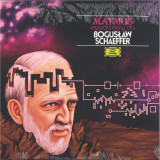
Matmos are one of the most prominent experimental electronic artists working today, crafting work by creating new conceptual frameworks & immediately testing those frameworks absolute limits. For Regards / Uklony dla Boguslaw Schaeffer they've focused on another artist known, in large part, for doing the same. Boguslaw Schaeffer was one of the first Polish artists creating electronic music. In step with American contemporaries like John Cage and Morton Feldman, he worked across the boundaries of classical composition, electronic experimentation, and radical theater in playfully form-breaking ways. Matmos are not the first ones to recognize the power of his catalog, from Solo (a 2008 documentary that garnered numerous international awards), to the annual Shaeffer's Era Festival (most recently celebrated simultaneously in Warsaw and Los Angeles) his work continues to inspire. Regards.. however, was not just inspired by his work, Matmos were given access to the entirity of Schaeffer's recorded works to use as they saw fit, commissioned by the prestigious Instytutu Adama Mickiewicza. They re-assembled & re-combined these recorded works with modern instrumentations in a way that only Matmos could, and what emerges is a composite portrait of the utopian 1960s Polish avant-garde and the contemporary dystopian cultural moment regarding each other across a distance. To facilitate the transcultural exchange that is the album's essential premise, all song titles and liner-notes are provided in both English and Polish. The album was mastered by Rashad Becker and features illustration and design by acclaimed artist Robert Beatty (Tame Impala, Osees, Mdou Moctar). Like the anagrams of the letters of Boguslaw Schaeffer's name that were re-assembled to create some of the song titles, the album itself is a musical re-assemblage of component parts into possible but unforeseen new shapes. Adding harp from Irish harpist Una Monaghan, erhu, viola and violin from Turkish multi-instrumentalist Ulas Kurugullu, and electronic processes from Baltimore instrument builder Will Schorre, and Horse Lords wunderkind Max Eilbacher, the resulting arrangements constantly toy with scale as they move from the close-mic-ing of ASMR and the intimacy of chamber music to the immensity of processed drones and oceanic field-recordings that close the album. Offering a "life review" of production styles, Regards / Uklony dla Boguslaw Schaeffer builds temporary shelters out of the panoramic wreckage of modernist composition, sixties tape music, seventies dub, eighties industrial music, nineties postrock and dark ambient, 2000s era glitch fetishism, and contemporary post-everything collage sensibilities.
- A1: Right Now
- A2: I Love You (And I'm Glad That I Said It)
- A3: You And I
- A4: Teenager In Love
- A5: Sail On Sailor
- A6: It Always Hurts The Most In The Morning
- B1: Moonfire
- B2: You Didn't Feel That Way Last Night (Don't You Remember)
- B3: Along Came Jones
- B4: Savin' My Love For You
- B5: I Remember The Feeling
- B6: Sweet Heart Attack
- C1: Last Train To Clarksville
- C2: Medley: Valleri/Daydream Believer/A Little Bit Me, A Little Bit You
- C3: I Wonder What She's Doing Tonight
- C4: (I'm Not Your) Steppin' Stone
- C5: I Wanna Be Free
- C6: Savin' My Love For You
- C7: Pleasant Valley Sunday
- D1: I Remember The Feeling
- D2: A Teenager In Love
- D3: Cuddly Toy
- D4: Medley: Come A Little Bit Closer/Pretty Little Angel Eyes/Hurt So Bad/Peaches 'N' Cream/Something's Wrong With Me/Keep On Singing
- D5: I Love You (And I'm Glad That I Said It)
- D6: Action
7A Records announces the release of Dolenz, Jones, Boyce & Hart’s original studio and live albums. In the mid-1970s promoters were trying to reunite the Monkees, but with Michael Nesmith and Peter Tork unavailable, it was suggested that Micky Dolenz and Davy Jones team up with Tommy Boyce and Bobby Hart to tour as ‘The Golden Great Hits Of The Monkees Show - ‘The Guys Who Wrote ‘Em & The Guys Who Sang ‘Em’’. The group signed a deal with Capitol Records to record a self-titled studio album of new material. They later released a live album from their tour of Japan. Both albums have been unavailable and out of print for many years. 7A Records have tracked down the original master tapes, that were presumed missing for at least 27 years, and remastered both albums for this release. Available as deluxe 2CD and 2LP sets, the CD version will include a big 40 page colour booklet featuring extensive liner notes and previously unseen photos. The 2LP version comes in a gatefold sleeve and is pressed on special 180g Green, Black and Yellow Quad Vinyl.
Taking inspiration from the likes of Isaac Hayes and Lonnie Liston Smith, ‘Piggyback’ is up-tempo and simmering from the off, with synth strings building tension in the intro alongside a menacing guitar riff and haunting brass stabs.
‘Piggyback’ is a social commentary on the idea that we all become more successful only by associating with people higher up the ladder than ourselves.
‘Deeper In Love’ sees Corbin return to his soulful roots, drawing influences from the likes of Al Green, Syl Johnson and Leroy Hutson to create a smooth groove helped along by some stunning horns and backing vocals.
Speaking about the song Nick says, “Lyrically it was partly inspired by John Legend’s ‘Ordinary People’ - I wanted to write a love song about how challenging times can bring people closer together. The last year or so has really tested a lot of relationships and I felt it was important to have light and shade.”
Recorded at Ernie McKone’s Boogie Back studio in North London, Nick is supported by a stellar line-up of musicians including Mick Talbot on Hammond and Wurlitzer and the dream team horn section of Tom White (Labrinth) and Paul Jordanous (Rag 'n' Bone Man).
The exemplary and well-travelled cornetist Kirk Knuffke presents a bold
new trio, with bassist Michael Bisio and pianist Matthew Shipp, on an
intimate and expansive double album
'Gravity Without Airs features' the three world- class musicians on Knuffke
compositions and in open form, creating a tour-de-force of poetry and verve. It's
available as a 2CD in deluxe 8-panel digipak and a 2LP in deluxe gatefold sleeve
with download card, the liner notes are by Francis Davis.
This is Knuffke's debut as a leader for TAO Forms. Accolades for the cornetist's
recent work as leader include NPR's Jazz Album of the Year laurel for 2017's
Cherryco, his homage to Don Cherry, a prime influence. DownBeat praised the
way that album showcased Knuffke's "nonchalant versatility and ebullient
melodic gifts," while esteemed critic Francis Davis called it "nothing short of
spectacular." Davis also wrote the liner notes for Gravity...noting the allure of
Knuffke's instrumental aplomb: "Kirk plays as if his cornet is a part of him - he
plays with it, not just on it."
On his guiding artistic impulse, Kirk Knuffke says: "I'm concerned with making
beautiful music. Beauty is always first, though not in a precious way. It can be in a
rough way, too." A prolific, lauded record- maker, 'Gravity Without Airs' fulfils his
poetic aims as well as any recording he has made. This work finds Knuffke in the
rare, even unique, trio format of cornet, piano and double-bass. His partners are
two ever- estimable pillars of creative music, and the work they've created
together here brims with melody and mystery, intimacy and dynamism.
"Rhythmically precise, New Orleans funky and full of grace, Kirk Knuffke's music is
a reflection of his multifaceted personality: part musical sage, part jazz
philosopher, a self-taught musician with wide interests, endless curiosity and an
abundance of good humour." - DownBeat
* Comes with the original 1985 artworks & obi strip. * All-star line-up featuring Herbie Hancock, Mory Kante & Bernie Worrell. * 180g blue Vinyl repress. Manu Dibango needs little introduction, born in Cameroon in 1933, Manu developed a musical style fusing jazz, funk, and traditional Cameroonian music. He's definitely among the best known African artists outside of Africa. Collaborations were numerous and include top acts like Fela Kuti, Herbie Hancock, Bill Laswell, Sly & Robbie, Don Cherry and Bernie Worrell. In addition to selling hundreds of thousands of copies of the albums he recorded, he played such huge venues as Yankee Stadium and Madison Square Garden. In 1972, at 40 years of age, Manu Dibango did something almost unheard of for an African artist - he had a pop hit. His song "Soul Makossa" became an enormous hit which influenced popular music for decades to follow. First picked up by David Mancuso (The Loft), "Soul Makossa" took New York dance floors by storm & in July 1973 it became the first disco record to enter the Billboard Top 40_an early instance of Western pop experiencing a paradigm shift thanks to Africa. The song's chant of "ma-mako ma-ma-sa mako-mako sa" echoes through the greatest-selling pop album of all-time, Michael Jackson's Thriller, and it's in the DNA of the music of Kanye West, Rihanna, A Tribe Called Quest, Akon and The Fugees. By 1985, Dibango was back in Paris, one of the most successful African artists in the world, to start on the recordings for the Electric Africa album. This album hooked Manu and the Soul Makossa Gang up with New York avant garde producer Bill Laswell, jazz pianist Herbie Hancock, Parliament-Funkadelic keyboard player Bernie Worrell, Pan African synthesist Wally Badarou, New York guitarist Nicky Scopelitis, African drummer Aiyb Dieng and Malian kora virtuoso Mory Kante. This means of working gave Manu and Laswell license to fuse synthesizers and kora, talking drums and samples, ngoni and electric guitar. What it all boils down to is world beat in its truest sense. Electric Africa remains one of Manu's strongest albums. His deep growl of a honey and sandpaper voice and the energetic honk of his saxophone merge with the seamless samples and the myriad hand percussion and overt funkiness of his band. Herbie Hancock plays on three tracks, contributing an amazing electric piano solo on the title track and interacting with Manu's sax while weaving to the warp of Mory Kante's kora during "L'arbre a Palabres." Similarly but more subtly, Laswell, Badarou and Worrell play dueling synthesizers in and around the band throughout "Pata Piya." All of this makes the album an hypnotic & upbeat Afro-Funk classic that will rock every part your body (and mind). Now finally back available as a limited vinyl edition (Blue vinyl, limited to 500 copies) for the first time since 1985.
‘Raiz’, the first release on the OITO//OITO Discos label, draws the musical focus towards the sound archives of Michel Giacometti, a French ethnomusicologist who dedicated his life to studying the oral traditions of Portugal which had become either lost or forgotten, with his collections still exhibited today in the Museum of Portuguese Music in Estoril. As with their previous releases, the duo carefully manage the source material and interweave it with their Acid House undertones, with both the original cuts ‘Ceifeiras’ and ‘A Poda’ doing a beautiful job at merging the powerful vocals with driving bass lines and rhythms. The opener in particular has a deep mysticism to it, the vocals leading the line as razor sharp pads craft a pulse alongside a steady but powerful drum structure. ‘A Poda’ takes things in a trippy-er direction, with the vocals stretched out in that prog house style that keeps the mind ticking over and the body left to its own devices. The breakdowns in this track are very effective, and really portray the soul of the original vocal performance and allow for the listener to connect with the wider feeling being conveyed. On the flip, the duo asked producers Switchdance and Terra Chã to put their spin on ‘Ceifeiras’, and the results only add to the atmosphere. Switchdance takes things down into murky depths, with a low slung beat expertly interspersed with driving bass notes, as sweeping chordal lines meander up above, giving a whole new angle to the original and winning over our hearts. Terra Chã’s version injects some swing into proceedings, with looping chordal stabs pulsating through the middle along with some beautiful melodic additions that exalt and inspire in equal measure.
Balanced, referential, blissful, dynamic. All this, and more, feature heavily on the first edition of OITO//OITO Discos, so why not come along and meander through time and space – it’s worth the trip…
Kari Faux is a multi-faceted artist - rapper, singer, producer, DJ and
clothing designer - from Little Rock, AR - She is known for her bold
fashion and genre-bending music, fusing elements of southern hip-hop,
funk, and alternative soundscapes
Her unique style of rhyming, dashes of sultry vocal harmonizing and confidence
have helped garner a cult following and make her a force amongst the new
generation of hip-hop's most fearless and outspoken female voices. At the start
of her career, Kari's hit 'No Small Talk' was remixed by Childish Gambino and
featured on HBO's Insecure. Since then, she has made an imprint on the music
industry as an independent artist who has released four projects, headlined tours,
opened for acts such as Steve Lacy and Mick Jenkins, and has written or
produced on tracks for artists such as The Internet. Kari Faux's forthcoming
album, Lowkey Superstar Deluxe, drops September 24 and features fellow heavyhitters Smino, J.I.D, Yung Baby Tate, Jazz Cartier and Deante' Hitchcock. Lowkey
Superstar represents a new chapter along Kari Faux's creative journey. What
started as a phrase has turned into two independent albums, a record label,
clothing line and identity representative of Kari's innate superstar qualities mixed
with her lowkey demeanor. The Lowkey Superstar Deluxe album is a sonic
conglomeration of Kari's longtime influences, including funk, alternative, and
southern rap soundscapes and covers a range of topics from self-preservation to
dating to braggadocious raps.
- A1: Resemblage (Parasamblaz) (Parasamblaz)
- A2: Cobra Wages Shuffle (Off! Schable W Gure!) (Off! Schable W Gure!)
- A3: Few, Far Chaos Bugles (Uff Bosch Gra Walese) (Uff Bosch Gra Walese)
- A4: Flashcube Fog Wares (Glucha Affera Slow) (Glucha Affera Slow)
- A5: Flight To Sodom (Lot Do Salo) (Lot Do Salo)
- B1: Tonight There Is Something Special About The Moon (Jaki Ksiezyc Dzis Wieczor) (Jaki Ksiezyc Dzis Wieczor)
- B2: If All Things Were Turned To Smoke (Gdyby Wszystko Stalo Sie Dymem) (Gdyby Wszystko Stalo Sie Dymem)
- B3: Anti-Antiphon (Absolute Decomposition) - Anty-Antyfona (Dekonstrukcja Na Calego) (Absolute Decomposition)
Coloured VInyl[31,05 €]
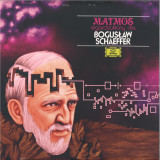
Matmos are one of the most prominent experimental electronic artists working today, crafting work by creating new conceptual frameworks & immediately testing those frameworks absolute limits. For Regards / Uklony dla Boguslaw Schaeffer they've focused on another artist known, in large part, for doing the same. Boguslaw Schaeffer was one of the first Polish artists creating electronic music. In step with American contemporaries like John Cage and Morton Feldman, he worked across the boundaries of classical composition, electronic experimentation, and radical theater in playfully form-breaking ways. Matmos are not the first ones to recognize the power of his catalog, from Solo (a 2008 documentary that garnered numerous international awards), to the annual Shaeffer's Era Festival (most recently celebrated simultaneously in Warsaw and Los Angeles) his work continues to inspire. Regards.. however, was not just inspired by his work, Matmos were given access to the entirity of Schaeffer's recorded works to use as they saw fit, commissioned by the prestigious Instytutu Adama Mickiewicza. They re-assembled & re-combined these recorded works with modern instrumentations in a way that only Matmos could, and what emerges is a composite portrait of the utopian 1960s Polish avant-garde and the contemporary dystopian cultural moment regarding each other across a distance. To facilitate the transcultural exchange that is the album's essential premise, all song titles and liner-notes are provided in both English and Polish. The album was mastered by Rashad Becker and features illustration and design by acclaimed artist Robert Beatty (Tame Impala, Osees, Mdou Moctar). Like the anagrams of the letters of Boguslaw Schaeffer's name that were re-assembled to create some of the song titles, the album itself is a musical re-assemblage of component parts into possible but unforeseen new shapes. Adding harp from Irish harpist Una Monaghan, erhu, viola and violin from Turkish multi-instrumentalist Ulas Kurugullu, and electronic processes from Baltimore instrument builder Will Schorre, and Horse Lords wunderkind Max Eilbacher, the resulting arrangements constantly toy with scale as they move from the close-mic-ing of ASMR and the intimacy of chamber music to the immensity of processed drones and oceanic field-recordings that close the album. Offering a "life review" of production styles, Regards / Uklony dla Boguslaw Schaeffer builds temporary shelters out of the panoramic wreckage of modernist composition, sixties tape music, seventies dub, eighties industrial music, nineties postrock and dark ambient, 2000s era glitch fetishism, and contemporary post-everything collage sensibilities.
A revelatory collection of recordings from Japanese free-sound quintet Gu-N. Formed in 1994 by Fumio Kosakai (Incapacitants, Hijokaidan, C.C.C.C.) and Hidenobu Kaneda (Yuragi), alongside Ikuro Takahashi (Fushitsusha, Kousokuya, LSD March), Ryuichi Nagakubo (C.C.C.C., Yuragi), and Morihide Sawada (Yura Yura Teikoku, Marble Sheep), Gu-N played regularly at Plan-B in Tokyo, but released little during their relatively short time together. Hazy and hypnotic, their laminar improvisations, four of which appear on this untitled album, are compelling, oneiric visions for the ear.
In his liner notes for the album, Michel Henritzi writes that these Gu-N recordings situate the group within a broader trajectory of free improvisation and collective sound within Japan – Taj Mahal Travellers, East Bionic Symphonia, Marginal Consort, each of whom sprung, in many ways, from the radical vision and creativity of Takehisa Kosugi. But there’s a unique spirit here that aligns Gu-N with these predecessors, while also marking out singular territory.
Kosakai’s background in noise, via his participation in Hijokaidan and Incapacitants, can be heard in the unrelenting oscillations and heavyweight drones that purr throughout each of these four tracks. Both Kosakai and Nagakubo were members of C.C.C.C., perhaps the clearest precursors to Gu-N in their psychedelic density, though Gu-N trade in C.C.C.C.’s volcanic energy for a more tempered, sensuous exploration of tone and time.
There’s also a brutish element to Gu-N’s improvisations – see the saturated spectrum, rumbling and phasing throughout the album, and the crushing, almost Amon Düül-esque drum tattoos that Takahashi pounds out on the second track (recorded in 1998), punctuating the music from deep inside its hallucinatory murk. Elsewhere, as on the third track (one of three recorded in 1994), Kosakai’s cello scrapes out armfuls of buzz-tone as Sawada’s bouzouki trills out, elastic and vibrant, across spindrift electronics and lung-spun winds.
What’s most impressive here, though, is the way each player, formidable musicians in their own right, defers to the might of the communal and the collective. The quintet broke up in 1998, leaving behind scant recorded evidence – just one, self-titled CD, on Pataphysique, released in 1995. This LP is a most welcome addition to the small but blissful body of recorded work made public by this mysterious quintet of spirit channelers.
Winston 'Niney' Holmes AKA The Observer, must be one of Reggaes finest Roots Rebel producers. Capable of making some of the heaviest, innovative music, not only in sound but also in the Cultural/Political sense.
Born George Boswell, Montego Bay, Jamaica 1951, and name checked 'Niney' due to losing a thumb in a workshop accident. He began his career in music by organising bands to play at school dances. But his first steps learning the musical ropes came working under the tutelage of producer Bunny Lee around 1967, organising sessions for Bunny's stable of artists. He moved on to work alongside Lee Perry at Joe Gibb's 'Amalgamated' label setup, where on Lee Perry's leaving in 1969 to start his own 'Upsetter' label, Niney became chief engineer.
Inspired by Perry's success it wasn't long before his own 'Destroyer' label was under way. It was 1970, and his first production entitled 'Mr Brown' by DJ's Dennis Alcapone and Lizzy, proved to be a minor hit, but his own 'Blood and Fire' track released in December of that year would become a major hit. After initial problems with it's likeness to Bob Marley's track ' Duppy Conqueror' being ironed out, it's reissue on his now named 'Observer' label, saw it go on to become, Jamaican Record of the Year 1971. Far out selling Bob Marley's track to the tune of 30,000 copies in Jamaica alone. A roots classic...
Niney's reputation for building great roots tracks, was furthered with more success working with singer Max Romeo. Issuing cuts such as 'Beard Man Feast', the great 'Reggae Matic' and 'Aily Ailaloo' and renewing his friendship with Lee Perry on the track 'Rasta Band Wagon', who's production credit read Perry, Niney, Maxie. In 1973, Niney began working with Dennis Brown, who was already an established star from an early age, they found a chemistry that went on to produce some of Dennis' finest work. The 1973 hit 'Westbound Train' was followed in 1974 by 'Cassandra', 'I am the Conqueror' and the timeless 'No More Shall I rOam'. Another important connection around this time was the great King Tubby who Niney would take his tapes along to and even record some of his tracks at Tubby's house, 18 Drummlie Avenue, Kingston, which doubles as his Studio of Dub.
It's these tracks that we are concentrating on here. Tubby would strip the tracks back to the bone and rebuild then sometimes leaving off the hook line. Whether that be the horn line or keyboard line and adding effects over the top that could disguise the cut even more. Even Niney stating that when Tubby had finished with a cut, he found it hard to recognise the track himself. Its these tracks as dub plate specials that Tubby would play on his Hometown HI-FI Sound System and it's these such tracks that we have compiled for this release. Dub Plated that have not seen the light of day since tragically the great Osborne Ruddock AKA King Tubby was gunned won and murdered on the 06th December 1989. For a few dollars and a gold chain, reggae music has lost one of it's most creative, inventive forces.
Niney also cut tracks with many other Reggae giants such as Gregory Issacs, Michael Rose, Junior Delgado, Horace Andy and Delroy Wilson to name but a few. As in house producer at the legendry Channel Studios and supervising sessions at Dynamic and Randy's Studio 17, his magic touched many. DJ, Arranger, Producer, his Roots Rebel music still stands the test of time.
Hope you enjoy the set.....
In a genre belonging to crooners like Marvin Gaye, Sam Cooke, James Brown and Otis Redding, authenticity is a requirement.
Enter Anduze, a unique vocalis whose riffs evoke the retro sounds of the aforementioned artists, but reverently done his way
– a fresh brand, re-imagines and crefted into a modern depiction of the era.
Anduze was raised on his father’s native land of St. Croix in the US Virgin Islands. His distinctive upbringing still lines the
threading of his creative fabric, which continues to expand into all corners of taday’s musical landscape.
It’s been over a decade since Anduze last released a full album. A lot has changed and progressed since then. He left behind the LA/Hollywood nights in exchange for a better quality of life in Athens, Greece. Also, during this span, he’s been a multi-featured artist on collaborations with producers such as Satin Jackets, Art of Tones, LTJ Xperience, Gramatik, and more…
However, his most noteworthy ascent is as lead singer (and songwriter) of Austrian act, Parov Stelar, with whom he tours
worldwide. Still, with all his accomplishments within the electronic world, it was time for Anduze to get back to his own sound – SOUL.
Using the pandemic as an opportunity, instead of a crutch, Anduze recorded “Aura,” a nine-song album that blurs the lines of
soul, funk, pop, folk, and R&B, with 20 contributing musicians.
If you like Prince, Michael Jackson, Marvin Gaye, Lenny Kravitz, Terence Trent D’arby etc…this album takes influences from
all their best moments and combines them into one mighty explosion that is simply, ANDUZE.
These days he is also living the new life of his song in collaboration with LTJ Xperience entitled Bad Side which has been
included in the new game update for Play Station GTA 'Los Santos' starring the DJ producer Moodyman and in the soundtrack of the new series And Just Like That, a popular follow-up to Sex And The City, which aired worldwide.
- A1: Die Partei - Strahlsund
- A2: Rolf Trostel - Two Faces (Bureau B Edit)
- A3: Michael Bundt - Full Steam Ahead (Bureau B Edit)
- A4: Moebius - Etwas (Bureau B Edit)
- A5: Populäre Mechanik - Scharfer Schnitt No 1
- B1: Roedelius - Regenmacher (Bureau B Edit)
- B2: Tyndall - Großstadtgefühl
- B3: Conrad Schnitzler - Bis Die Blaue Blume Blüht (Bureau B
- B4: Phantom Band - Pulsar
- B5: Bernd Kistenmacher - Quitting Time (Bureau B Edit)
- C1: Heiko Maile - Nachtspaziergang (Tape 40)
- C2: Moebius & Plank - News
- C3: Faust - Vorsatz
- C4: Riechmann - Weltweit (Bureau B Edit)
- C5: Asmus Tietchens - Trümmerköpfe
- D1: Cluster - Avanti (Bureau B Edit)
- D2: Günter Schickert - Wanderer (Bureau B Edit)
- D3: You - Live Line (Bureau B Edit)
- D4: Harald Grosskopf - Emphasis
- D5: Eno Moebius Roedelius - Base & Apex
After her stunning collaboration with Jim O’Rourke (Le Piano Englouti, BT055), Brunhild Ferrari returns to Black Truffle with Stürmische Ruhe, her first duo with Christoph Heemann. A legendary figure in underground music, Heemann has quietly produced a unique body of work since his beginnings with the absurdist cutups of H.N.A.S. in the mid-1980, including collaborations with Merzbow, Organum and Nurse With Wound, the eerie psychedelia of Mirror (with Andrew Chalk), In Camera (with Timo van Lujik) and Plastic Palace People (with Jim O’Rourke), and the precise cinema pour l’oreille constructions of his solo works. Created together in Ferrari’s Parisian studio (once shared with Luc) between 2011 and 2014, Stürmische Ruhe is a single half-hour piece that folds rain and storm recordings into a intricately woven fabric of haunted electronics, unexpected edits and disorienting processing. Banging with the jarring thump of a slamming door (an element that will reappear periodically throughout the piece as a kind of punctuation mark), it is immediately obvious that concrete sound is used here in a free, poetic way outside of the strict confines of documentary field recording. The wind captured by Ferrari’s microphone roars and whistles, accompanied by thick clusters of wavering tones whose unpredictable rises and falls in volumes are synchronised with the bumping and thudding of windows and doors. At some points the microphone sound melts into a wavering low-bit digital smear before fanning out into broad, atmospheric depths. The cinema for the ear constructed here suggests not linear narrative or documentary, but an organic flow of cross-fades, double-exposures and abrupt cuts, a free-associative dream in which wind and water take on mythical characteristics. Throughout the piece's second half, layers of synthetic floating tones and pinging upward glissandi negotiate a constantly shifting balance with wind-borne whispers and rustles, at times dropping to silence, at others rising up with elemental force. As Ferrari explains in her liner notes, Stürmische Ruhe is a meeting of ‘completely opposite sound worlds’ in which ‘almost-violence’ is joined with a ‘reconciling harmony’. Reaffirming the infinite possibilities of the musique concrète tradition while avoiding its academic tropes, Stürmische Ruhe is accompanied by tri-lingual liner notes from Brunhild Ferrari and arrives in a sleeve graced with the beautiful art informel paintings of her father, Wolfgang Meyer Tomin. Cut at 45rpm for maximum fidelity.
‘4-Vesta’ is the brightest asteroid visible from Earth. Measuring around 500km in diameter, it’s one of the four largest objects in the asteroid belt between Jupiter and Mars. Fragments of Vesta have been found on Earth, as meteorites that were ejected into space after two collisions that left huge craters on its surface. These fragments show that Vesta was probably once a planet itself, made of the same material as the four terrestrial planets (Mercury, Venus, Earth and Mars).
It was an encounter with one of these fragments that inspired the name for Azu Tiwaline’s latest EP for I.O.T Records, ‘Vesta’, which features tracks that were written and recorded around the same time as ‘Magnetic Service’, her break-through EP for Livity Sound. Holding a piece of Vesta that had been found in the Saharan Desert - already a place of deep significance for her - she felt a sense of wonder, on a cosmic scale. In her hands, was an object so apparently familiar, of the same age and made of the same fundamental materials as the Earth on which she stood, yet from somewhere else entirely. A perfect name for the four tracks that make up ‘Vesta’. And also the perfect source material for the EP’s cover, an electron microscope image of a razor-thin slice of that same cosmic fragment that Azu held in her hand.
‘Vesta’ is familiar, yet distinct. It’s recognisably Azu Tiwaline from the very start, yet the unexpected always finds a way in. A booming, echoing kick opens ‘Low’, followed by the rattling, shivering sound of a tanbur hand-drum, courtesy of his regular collaborator, Franco-Iranian percussionist and producer Cinna Peyghamy. But then, tentatively at first, a jazzy synth line emerges, and disappears again, only to reappear later. An another colour to add to Azu Tiwaline’s already rich palette?
Azu Tiwaline’s music has always explored the dynamics between space and depth, and the contrasts between light and density. ‘Vesta’ often feels like a high-wire act, an exercise in finding space even as the air fills with drum patterns and synth lines. ‘Medium Time’ builds from a chorus of buzzing insects into a thick percussive track across eight minutes, without ever losing that initial wide-open sound of the dusk. ‘Into The Void’ pays homage to her well-worn collection of Rhythm & Sound and Basic Channel 12-inch singles, all swaying dub echoes and languid kick drums. Then mid-track, it pivots in intensity, each element suddenly expanded and magnified: a psychedelic shift. Those who’ve had the chance to see Azu Tiwaline perform in the past few years might get a few flashbacks - it’s been a key part of her live set.
But it’s the final track ‘Deep Theko’ that best fits the EP’s cosmic title. A shape-shifting ‘ambient’ track that never seems to settle, it drifts restlessly, sporadic percussion and synth washes injecting random bursts of activity. A sonic representation of planetary debris floating through space? Here, as with the airless void of space, emptiness enables a certain perspective. If the distances between the stars weren’t so enormous, we wouldn’t be able to gaze upon them in their entirety, after all.
For more than twelve years, Morphology have been re-writing the rules of electronics. Michael Diekmann and Matti Turunen have melted electro, IDM and techno into their own unique sound. To celebrate their achievements, FireScope has sifted through the impressive discography of this Finnish pairing to bring long out of print tracks back to life.
Twelve 2 brings together a decade’s worth of music released between 2009 and 2019, a dozen works that traverse genres and labels like Abstract Forms, AC Records, Analogical Force, Central Processing Unit, Cultivated Electronics, diametric., Inner Space Records and Vortex Traks. Spliced beats and bulging bass lines introduce the album with "Karma Flies.” Rhythmic patterns are condensed and stretched in “Inversion Layer” and “Amphidiscosa”, the latter’s aquatic undercurrents melting an organic touch with the coldness of the machine. Darker tones lurk, the long shadows cast by “Convince the Computer” spread to other tracks like “Nucleosynthesis.” Yet, despite these more sombre shades, pieces with a human element punctuate the album. The frenetic pace of “Fluid Dynamics,” with its playful melody, throbs with the pulse of a city while the ebbs and flows of the watery “Active Optics” explore an ever morphing and shifting sound. An imagined future is never far away in Morphology’s machinations. These other places are given sound in the frigid grooves of “Sentinel,” the primal beauty of “New Horizons” and the stark structures of “Landforms.”
Not only does this double LP gather rare tracks never heard together before, but also each piece has been lovingly remastered to breath new life into these wonderful works. Twelve 1 celebrates the music of Morphology in all its glory, two masters of modern electronic music who continue to re-define and re-design genres.
The Howling is a collaborative project started by writer Ken Hollings and sound artist Howlround devoted exclusively to their shared love of text, audiotape and trash aesthetics. An intense collision of spoken word and analogue tape effects, the Howling's first performance took place at the Iklectik in September 2019 as part of a special programme to celebrate The Tapeworm's 10th anniversary.
Despite the pandemic, they have managed to continue working and conferring together since then, sharing sound files, texts and mixes online, which has resulted in All Hail Mega Force, their first full-length release for The Tapeworm. The two extended tracks contained on this audiocassette reflect their shared interest in Fluxus and how informal rules and permutations can be set up to work themselves out through loops and repetitions. A straight line connects Terry Riley's tape experiments in Paris from the early 60s with their experimental recordings in the Wimpy Bar on Streatham High Road, one of their favourite meeting places. 'The idea of instant, disposable one-off creations appealed to us a lot at the time,' The Howling explain, 'particularly as both pieces were conceived and developed during different phases of Covid lockdown in the UK.'
The title and source material are derived from the kid's adventure movie MegaForce, starring Barry Bostwik and Michael Beck. Designed to sell a range of Mattel hi-tech action toys, MegaForce tanked at the box office but lives on in the collective consciousness of those who share with The Howling a special love for Trash and Trash Aesthetics.
The two tracks also share similarities in approach and realization.
'All Hail Mega Force' was created by reading combinations of the words 'All Hail Mega Force' into a voice memo recorder, transferring it to tape, cutting the whole thing as a single long loop and then stretching it across three reel-to-reel machines simultaneously, using two pencils and a pint glass full of loose change to try and maintain sufficient playback tension. Over time the loop started to degrade, which accounts for the increasingly slurry and unpredictable playback, plus frequent ruptures caused by the tape becoming jammed and having to be tugged through the machine workings by hand. Twenty-four minutes later and the result was a completed new work and a slight backache.
The text for 'Are You Man Enough For Mega Force?' was recorded live in the Wimpy Bar on Streatham High Road, 28 November 2021. It was cut to tape and looped on 3 December 2021 at Warrior Studios, Loughborough Junction. Dragged by motor and then by hand across two tape machines with copious amounts of closed input feedback provided by a third rushing in to fill the gaps. One take with no effects or overdubs, but one tiny edit in the middle when something fell over.