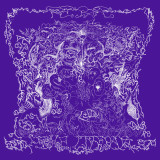
"As Bill Orcutt’s most mature and exhilarating LP to date, Music for Four Guitars was a slab of undeniable Apollonian beauty. Its approachability and obvious novelty landed it not only on the year- end lists of every key-pushing codger in the underground in 2022, but also on NPR in the form of the Bill Orcutt Guitar Quartet, an ensemble assembled to perform this music and featuring Wendy Eisenberg, Ava Mendoza, and Shane Parish in addition to Orcutt. But while their Tiny Desk Concert gave a whiff of the quartet’s easy intimacy, the sterile confines of the virtual recital medium still left a puzzle unsolved: how might these brutally mannered bricks of minimalist counterpoint sound on a stage in front of actual breathing bodies?" "This was the question foremost in my mind when I first saw the quartet in San Francisco a few months before this double live LP was recorded. I was already familiar with the prowess of Eisenberg and Mendoza, two of the most technically intimidating shredders to blast out of the noise/improv underground, and knew Parish as the mastermind behind the epic translation of Orcutt's quartet recordings into a fully notated score. I was ready to be 'blown away'—and I most assuredly was. The quartet navigated Orcutt's jaggedly spiraling right angles into the shining core of the compositions with joyous ease, faithful to the originals in nearly every way (though their tempos were slightly ramped up, Blakey style, to communicate their breathless rush). The renditions were flawless, stellar and inspiring. I had expected nothing less." "Which leads us to this album, Four Guitars Live, recorded in November of 2023 at Le Guess Who? festival during the quartet’s first European tour. The true essence of this set is not simply in its faithfulness to the source compositions, but in the group's easy familiarity (no doubt the result of weeks on the road) and the generosity of their improvisations, both collective and solo. Orcutt, clearly cognizant of both the caliber of his collaborators and the singularity of their voices, has given everyone room to stretch out, and all have delivered some of their most moving passages to date." "One of this record's great thrills for me is imagining a listener, perhaps unfamiliar with the outer limits of contemporary guitar improvisation (or the Tzadik catalog), slammed into catatonia by Mendoza's liquefying lines on Out of the corner of the eye, then revived and healed by the languid, breathy lines of Parish's unaccompanied, spaced-out breakdown of the track's main theme, finally only to be crushed by Eisenberg’s staggering extended solo on Only at dusk (somehow channeling both Eugene Chadbourne and Buck Dharma)." "There's another peak, which begins at the end of side B, in Orcutt's own languid solo, encapsulating the flowing focus of his recent solo LPs, and serving as an introduction to the next side's ensemble tour de force, the psychic heart of the album, On the horizon: its melodic core passing first to Orcutt, launching into a sublime solo turn by Eisenberg, a duo of Parish and Mendoza, before parachuting back into the ensemble for a smashup rendition of Barely visible and Glimpsed while driving (renamed Barely driving) knitted together with an softly bubbling ensemble improvisation. The transfer is orchestrated yet seamless, its tonal form undeniable even in the presence of obvious dissonance." "The breadth of Four Guitars Live gives lie to the false notion that agile, polytonal improv is necessarily without soul, is necessarily inaccessible. Rather, Four Guitars posits a human avant-garde music that the most conservative will recognize as virtuosic and revel in its classic intervals, boiling counterpoint, and precisely- layered facets. Even the rockers in your life might dig it, so why not pass it on?"—Tom Carter
Cerca:minimal set
Of the countless accolades and analyses that surround Blue, no point is more significant than the fact that the 1971 Joni Mitchell album continues to become more popular, revered, referenced, and relevant with each passing day. Such vitality is not only extremely singular; it is the ultimate measure of great art and, in the context of Blue, indisputable proof of the record's accessibility, integrity, and timelessness. If the most brilliant and everlasting music seeks to find truths shared by all of humanity, Blue can be said to be universal doctrine.
Sourced from the original analogue master tapes, pressed on MoFi SuperVinyl, and strictly limited to 12,000 numbered copies, Mobile Fidelity's UltraDisc One-Step 180g 45RPM 2LP box set presents the landmark album with reference-grade detail, tonality, and directness. Marking the first time the beloved LP has received audiophile-quality treatment, it's one of six iconic 1970s Mitchell records Mobile Fidelity is reissuing on definitive-sounding vinyl and SACD sets.
Everything about Blue sounds more intimate, involving, and inescapable on this transparent pressing, which benefits from a virtually non-existent noise floor and superior groove definition. Mitchell's voice, positioned front and center, and primarily accompanied by minimalist acoustic guitar, piano, and dulcimer playing, comes across clearly and prominently. Suspended notes and radiant chords double as question marks, commas, and phrases. The in-the-room presence and spatial dimensionality make absolute the full-range spectrum of introspective emotions — hurt and distress, self-awareness and joy, difficulty and uncertainty, warmth and desire — Mitchell navigates, queries, and contemplates throughout the record. The defencelessness the singer once spoke about is laid bare here like never before.
The packaging of the Blue UD1S set complements its distinguished status. Housed in a deluxe box, both LPs come in special foil-stamped jackets with faithful-to-the-original graphics that illuminate the splendor of the recording. This UD1S reissue exists as a curatorial artifact for listeners who prize sound quality and production, and who desire to engage themselves in everything involved with the album, including the unforgettable cover photograph of a ruminative Mitchell shot by Tim Considine.
Deemed the third Greatest Album of All Time by Rolling Stone; universally celebrated by critics, fans, artists, and educators; and defined by a spell of disarmingly vulnerable songs that are at once confessional, intense, spare, honest, painful, hopeful, and exquisite, Blue charts love, spiritualism, independence, and loss like no record before or since. Widely considered the album that established the singer-songwriter template, the largely autobiographical LP changed everything shortly after its original release in June 1971. Amazingly, it continues to do so more than five decades later.
An incalculable influence on generations of artists, it stands as the through-line from Carole King, Elton John, James Taylor, Joan Armatrading, and Leonard Cohen to Patti Smith, Carly Simon, Emmylou Harris, and Rosanne Cash to 21st century contemporaries like Brandi Carlile, Taylor Swift, Sharon Van Etten, and Courtney Barnett. Teetering between agony and optimism, it is — to borrow a phrase from Mitchell's eternal "A Case of You" — a bottomless "box of paints."
The beauty of the stripped-down arrangements, intoxicating melodies, and Mitchell's wisdom on Blue didn't go unnoticed. Critical acclaim, coupled with the depth of the material and Mitchell's reputation, propelled the album into the Top 20 in the U.S. and Top 10 in the U.K. Yet while so much pop music diminishes with age, Blue has defied norms and headed in the opposite direction. Its 50th anniversary year witnessed an outpouring of tributes, reflections, and testimonials that helped frame the record's escalating importance and symbolism — apt in an age in which women have become the prominent trailblazers in rock, R&B, and hip-hop.
Perhaps most succinctly, in a 2021 article celebrating the LP, the Los Angeles Times declared: "In 1971, nothing sounded like Joni Mitchell's Blue. 50 years later, it's still a miracle." Nothing, indeed. Yet "miracle" suggests Blue partially owes to a divine agent or inexplicable circumstance. And though Mitchell's bracing conviction and forthright sincerity can appear otherworldly, her musical approach and lyrical storytelling is nothing if not personal and human. What we hear is pure truth — no matter how aching, complicated, or stark.
Much has been written about the circumstances that inspired the songs on Blue: Mitchell's romances; her time overseas; her disdain for celebrity; her lingering sense of loss at having given up her daughter for adoption; her treatment by the very same industry that her music made uncomfortable; her prolonged search for resolution. These situations and experiences pushed Mitchell to question everything — especially big-picture concepts that have always obsessed mankind: fulfilment, autonomy, love, honesty, being.
"I wanna make you feel free," Mitchell sings on the record-opening "All I Want." Mission accomplished. Blue is liberation — and the start of a freedom that continues to impact music, culture, and identity today.
More About Mobile Fidelity UltraDisc One-Step and Why It Is Superior
Mobile Fidelity Sound Lab's UltraDisc One-Step (UD1S) technique bypasses generational losses inherent to the traditional three-step plating process by removing two steps: the production of father and mother plates, which are created to yield numerous stampers from each lacquer that is cut. For UD1S plating, stampers (also called "converts") are made directly from the lacquers. Since each lacquer yields only one stamper, multiple lacquers need to be cut. Mobile Fidelity's UD1S process produces a final LP with the lowest-possible noise floor. The removal of two steps of the plating process also reveals musical details and dynamics that would otherwise be lost due to the standard multi-step process. With UD1S, every aspect of vinyl production is optimized to produce the best-sounding vinyl album available today.
During the late 1970s, after No Wave pioneer Lydia Lunch met saxophonist James Chance, she began setting her angry and disjointed poetry to anti-music, founding her ground-breaking band Teenage Jesus and The Jerks with Lunch’s shouted lyrics matched by her non-conventional use of electric guitar. The group’s self-titled debut EP is a fast and furious affair, produced by Robert Quine of the Voidoids/Lou Reed, with future Nick Cave drummer Jim Sclavunos on bass and Bradley Field on minimalist percussion; steeped in aggression and audacity, it’s an awesome disc that rebuffs punk’s easy cliches and refuses to be categorized. This reissue also includes the ‘Pre’ EP and the tracks from the legendary No New York compilation.
»Sound of Matter« is the debut album by Romanian sound artist and composer Simina Oprescu. The two pieces draw on research conducted with 15 historical church bells at the Märkisches Museum and the Stadtmuseum Berlin. After the artist had presented the results of her studies of the connection between matter and harmony in the form of a multi-channel installation, she has translated the underlying approach of this site-specific work into an album that unfolds slowly, consistently setting in motion subtle tonal changes that continuously change the mood of the two pieces. »Sound of Matter« is both minimalist and maximalist, creating an infinitely rich and multi-layered dronescape that modestly invites its audience to get lost in the sonic experience.
Oprescu has been fascinated by church bells since her childhood spent in Transilvania since the instruments were shrouded in mystery, as she explains in an in-depth essay that accompanies the album. Having received a Bachelor’s degree at UNArte in Bucharest and after studying at the Royal Conservatory of Mons in Belgium, Oprescu enrolled at Berlin’s Universität der Künste for an M.A. in Sound Studies and Sonic Arts. She started working with the archive of the Märkisches Museum, which included 15 historical church bells that were built between the 15th and the early 19th century.
Since every bell sounds different according to its shape, material, and density, Oprescu abstracted these qualities in the formula f = K1t/d^2√E/s(1-m^2). This enabled her to recreate the harmonic tone of the individual bells with Max/MSP. She then composed a piece with semi-overlayed tones, i.e. overlapping frequencies. Naturally, this resulted in a beating effect that provided the music with a sense of urgency, though the five second-long natural reverb of the Märkisches Museum’s Große Halle turned it into a »warm blanket of sound,« as the artist herself puts it. This is perfectly recreated on »Sound of Matter« due to the music being presented in mono, bringing out the intrinsic movement of the beatings with more nuance than a stereo version would.
»Sound of Matter« feels warm and welcoming even when different frequencies seem to create friction between each other or when the subtle beating effects turn into throbbing rhythms, like at the end of the record. It manages to explore both Oprescu’s personal fascination with church bells and psychological and psychoacoustic questions relating to them as well as philosophical issues connected with them. This music is profoundly physical, but also intellectually stimulating—perfectly at home in the catalog of the Swiss Hallow Ground label between records by Kali Malone, Lawrence English, or Siavash Amini.
The booklet features an in-depth essay on church bells by Simina Oprescu.
Following a first iteration which set the tone for our newly-minted Heimat series in explosive fashion, here comes the much anticipated second batch of our zeitgeistian take on today's scene's, its current potential and destination. Showcasing productions from artists keen to roll up their sleeves and sail into the impassible status quo, this new number packs the kind of red-hot hammering and cutting-edge punch we've been so adamant to push and defend over the past decade. Berlin-based French producer Arkan steps in first with a proper magnetic depth charge. Dwelling the darker layers of our ocean floor as its name suggests, 'Submarine' is pure hypnotic material geared up for heavy-duty boogie in the warehouse. Filling its ballast tanks with a hefty deluge of muscular bass onslaughts, sonar-like bleeps and untamed cascades of loopy arps, this one rolls and pitches like a haunted ship on predator mode. Adding his dynamic pulse and mind-bending spin to the A-side, Frameworks & Untertwegs bossman Decka cuts a path of straight mental obliteration as he smashes the doors of the club wide open and parades all guns blazing with the unapologetic crusher that is 'Circumvent'. A no-holds-barred workout for the strong stomachs, churning out fiery bars of kick-drum/squelchy bass contrast with in-your-face swagger. Switching on to the flip side, there's Manchester's Yant cruising with the ebulliently dynamic (no shit, Sherlock) tune, 'Moving'. A multidirectional concerto of pong-like modularity and racing synth arpeggios flying off like coloured bricks in a Tetris game gone absolute batshit. The kind of hi-intensity burner that'll awaken any lukewarm mid-set flow with its bouncy unpredictability and ruthless forward-pushing thrust. Rounding it off on a further minimal note, Amsterdam up-and-comer Hitam treats us to an inch-perfectly engineered finale with a stripped-back - yet, absolutely not hollow - bomb, 'Venusian Winds'. Gutsy that one sure is, with its metronomic step ticking at near-cyclonic speed and cleverly arranged, subtly FX-coated funk keeping things both suspenseful and focussed thru and thru. A sleek combo of pared-down brutalism and masterly executed analogue tailoring altogether. All dressed in clear purple marbled wax for the occasion, "Heimat II" shall please both the techno purist and visual aesthete in you with its velvet touch and effortless chic.
Following his 2021 debut on the reverse label with Retreat Ites EP and a spot on the Molten Mirrors compilation, Jurango is back on Livity Sound with another four tracks of low-slung soundsystem pressure.
On An Amorphous Mass EP Jurango presents a particularly focused sound which draws on halftime D&B, dancehall and broken techno all filtered through the meditative pulse of low tempo club music. The measured pace of the tracks doesn’t detract from their weight, whether it manifests in the heavy roll of murky opener ‘Big Saver’, ‘Inner Seam’s mutant dembow rhythm or the heady breakbeat chops of the title track. The stripped-back subs and fractured percussion of ‘Muni Ce Boa’ close the record in potent yet understated style, proving minimal music doesn’t have to compromise on impact for the dance.
Livity Sound is a label set up by Peverelist in 2011 as a vehicle for a raw and exploratory strain of UK techno, rooted in the heritage of UK dance music and sound system culture. It has since become one of the UK's foremost protagonists for cutting edge underground electronic music.
A Colourful Storm begins 2024 with a luxurious suite of daydreaming introspection courtesy of Unchained, the longstanding solo project of Nathaniel Davis who was last seen on vinyl in the final Blackest Ever Black release. Recorded at home between 2020 and 2023, Gabbeh is the latest expression of Davis's guitar-based instrumental musings and represents a stylistic evolution of his self-released noise tapes and CD-Rs into romantic, bossa nova-influenced melody-making. He wrote the tracks sporadically, with minimal instrumentation and intervention. Electric guitar, bass improvisations and rhythms from an old drum machine are layered and given new life, the space between them softly breathing with minutiae of the everyday: the buzz of cicadas, the passing of cars, the whistling of passersby. The psychogeography of Grenoble, Davis' home since 2018, played a conscious role in the weaving of Gabbeh's fabric: "I think certain songs reflect, in ways, Grenoble's natural surroundings. 'Drac' is named after the river that flows from the mountains down to the city… 'Dru' is the name of a well-known peak near Chamonix". Opener 'Largo' sets the mood, its primitive samba rhythm concealed by a cloud of saudade. The bebop sensibility follows suit, the tension between its angular picks and percussive shuffle a wondrous balancing act, while the intoxicating sway of 'Rambler' is perhaps the most poignant expression of longing and loss we've heard in recent years. Highly recommended for fans of Durutti Column, Maurice Feebank, Toninho Horta.
- Strange Stairway
- Spiritual Mansions
- Planet Earth Daytime
- Goodnight Stan
- Tomorrow Tomorrow And Tomorrow
- Just A Moon
- To Be A Part
- Sam
- Lamp Shining
- Turning The Pages
- Love Is The Tune
- After The Revolution
- Jericho Road
- Strange Stairway (Demo)
- Birdman (Bonus Track)
- Life
- Hypocrite
- Man
- Cosmic Boxer
- We Are Raised
- Isle Of Sleep
- Coming Down
- Hypocrite (Demo)
- Spiritual Mansions (Demo)
- Man (Take 1)
- When We Set Sail (Bonus Track)
- Cosmic Boxer (Alternate Version)
- The Coast No Man Can Tell (Bonus Track)
Die Versuchung, Bill Fay zu mythologisieren, kann überwältigend sein. Sein Status als unbesungener Held hat sich langsam, aber stetig, über fünfundzwanzig Jahre hinweg entwickelt und mit jedem neuen Album kommen Fans hinzu, darunter prominente Musiker wie Jeff Tweedy, Kevin Morby, Adam Granduciel und Julia Jacklin, um nur einige zu nennen. Fay war jahrzehntelang ebenso produktiv wie unterschätzt, innerhalb seines Katalogs ist die Bill Fay Group seine bedeutendste Zusammenarbeit. Nach seinem selbstbetitelten Debüt Bill Fay (1970) und dem Klassiker "Time of the Last Persecution" (1971) hatte Decca Records kein Interesse ein drittes Album zu veröffentlichen. Bill Stratton, Gary Smith, Rauf Galip formierten sich mit Fay zur Bill Fay Group und nahmen zwischen 1978 und 1981 in mehreren Sessions, trotz minimaler finanzieller Mittel, ein brillantes Album auf. Die Bandmitglieder beschwören ein elegantes Gegengewicht zu seinem Gespür für das Unauffällige. "Tomorrow Tomorrow and Tomorrow" bringt die galaktischen Qualitäten des frühen Rock, die Komplexität der Jazz-Improvisation und Fays erdigen Folk-Zauber zusammen. Zur Zeit der Fertigstellung fand sich aber leider kein Label für das Projekt. Erst 2005 brachte David Tibet auf seinem Label Durtro Records eine unvollständige, nur auf CD erhältliche Version heraus. Eine Neuauflage von 2006 machte das Album auf Vinyl erhältlich, allerdings mit stark gekürztem Tracklisting, es fehlten neun Songs. Jetzt endlich erscheint Tomorrow Tomorrow and Tomorrow weltweit in voller Länge. Es enthält die 22 Original-Songs des Albums, dazu 6 Bonustracks, sowie seltene und bisher unveröffentlichte Fotos von den ursprünglichen Aufnahmesessions von "Tomorrow Tomorrow and Tomorrow".
Original Sufferhead beginnt mit einer minimalen Improvisation mit Felas neuer Band Egypt 80 und steigert sich dann zu einer kühnen, komplex strukturierten Afrobeat-Hymne, die die Situation der Massen in Nigeria anprangert. "Lasst uns zusammen ein schönes Lied singen", schlägt Fela vor, während der Refrain parallel zu der lebhaften Melodie seines Saxophons erklingt. Mit Hilfe des Refrains zählt er dann die Probleme auf, die das Volk plagen: keine Wasserversorgung, exorbitante Lebenshaltungskosten, keine Gesundheitsversorgung, zweistellige Inflationsraten. Die "großen, großen Leute" haben das Volk zum Sarg des Staatschefs gemacht: Nach der Plünderung und Verbrennung von Felas Kalakuta Republic 1977 schrieb Fela mehrere musikalische Antworten, in denen er die schuldige nigerianische Regierung direkt angriff, darunter diese traurige Hommage an seine Mutter, Coffin for Head of State. Nachdem seine Mutter an den Komplikationen der Verletzungen gestorben war, die sie erlitten hatte, nachdem sie während des Überfalls auf Kalakuta aus einem Fenster geworfen worden war, trugen Fela, seine Frauen und seine Anhänger den Sarg seiner Mutter zum Eingangstor der Armeekaserne: ein mutiger Akt des Trotzes.
"Coffin For Head of State" ist Felas düstere Anklage gegen diejenigen, die "durch Jesus Christus, unseren Herrn" das afrikanische Volk korrumpieren, bestehlen und berauben. Der wummernde, gleichmäßige Beat und die sich wiederholende Struktur des Liedes ahmen den Marsch zur Kaserne nach, während der Text Felas überwältigende Trauer über den Verlust seiner Mutter und den Zustand seines geliebten Nigerias direkt anspricht: eine Nation von ewig Leidenden. Seid nicht passiv, fordert er: Steht auf für eure Rechte.
Die B-Seite, Power Show, baut auf dem gleichen Thema auf und hebt die Unterdrückung der Massen durch die herrschende Klasse hervor. Der Text handelt von einem reichen Mann in einem schicken Auto, der an den Straßenrand ranfährt, um einen armen, allein reisenden Mann zu beschimpfen. Fela nennt dies die "Power Show" und prangert das Verhalten an. So verhält man sich nicht gegenüber seinen Mitmenschen.
Original Sufferhead war im Box Set #5 enthalten, das von Chris Martin und Femi Kuti kuratiert wurde. Das Album wurde auf opakem, hellgrünem Vinyl neu gepresst und ist untergebracht in einer bedruckten Innen- und single sleeve Außenhülle.
The Body & Dis Fig are a natural pair. Each has pioneered instantly recognizable worlds of sound all their own that defy any traditional categorizations or boundaries. The Body, Lee Buford and Chip King, continually challenge any conventional conception of metal, collaborating with myriad artists and from the folk-leanings of their work with BIG|BRAVE to their groundbreaking work with the Assembly of Light Choir to the intensity of their collaborations with OAA or Thou. Dis Fig, aka Felicia Chen, pushes electronic music into dark extremes, from warped DJ sets to avant production, from being a member of Tianzhuo Chen’s performance-art series TRANCE to being the vocalist with The Bug. The Body and Dis Fig find kinship in reimagining what it means to make “heavy music”. Their debut Orchards of a Futile Heaven is the perfect synthesis of two forces, twisting melodicism and intoxicating rhythms, layering a dense miasma of distortion with intense beats and a soaring voice clawing its way towards absolution.
Orchards of a Futile Heaven’s walls of sputtering texture and tectonic booms are soaked in the reverence and melancholy of sacred spaces brought to life by palpable intensity by Chen’s voice. Crafted during a time of personal fragility, the album’s devastating force lies beyond any of the expected noise and abrasive textures typically associated with both The Body & Dis Fig. Suffused with a raw vulnerability and a longing for catharsis, Chen’s voice searches for escape in the midst of oppressive atmospheres as if determined to find relief from guilt. “Eternal Hours” patiently unfurls waves of surprising sounds, whispered undulations that are punctuated by sudden crashes, all beneath Chen’s haunting harmonies. “Dissent, Shame” evokes grief and shame with a minimalist drone dirge that gradually builds to an enchanting choral passage. King’s guitar on “Holy Lance” matches the uncanny drone of Chen’s accordion in an all-consuming blast, Chen’s voice transforming the moment from anguish to defiance and empowerment. The album’s arc finishes with “Coils of Kaa” acting as a kind of propulsive exorcism, breaking through a suffocating air before the funeral procession of “Back to the Water” lays the album to rest.
While sampling has long been essential to each, The Body & Dis Fig deftly meld their differing approaches to sampling and creating extreme sounds until the boundaries are entirely blurred. The two found kinship in their desire to find new avenues to make heavy music that looked beyond tropes of metal and electronic music by merging the two. “I always wanted the heavier stuff but I also didn’t really like heavier guitar music,” says Buford. “None of it really felt quite heavy enough to me. A human can’t be as heavy as a machine.” Chen counters, “I love the balance. You could never connect to just a machine as well as you could a human. Which is why the combination is so potent for me. I don’t want to hide. I think nothing connects you more empathetically than another human's voice.”
Orchards of a Futile Heaven affirms The Body & Dis Fig as skilled sound sculptors who have an exceptional ability to make deeply affecting music, bracing as it is touching, harrowing as it is awe-inspiring. Together, the two have harnessed their expansive artistry to make music that is profoundly emotional, and staggering in its beauty.
The brand new EP "Wellental" by Extrawelt on Traum is herewith reveled to the fans. Their new 3 track vinyl 12" gives a nod to the mayhem and urgency of techno all finely tuned. Straightforward in its brilliance and simplicity, yet carefully measured with a maturity that speaks the language of Extrawelt´s minimalism.
We attest: a unique techno track for the dance-floor on the a side, a trippy track on b1 and a very musical one as B2.
What happens within these 3 tracks is nothing short of alchemy, traversing all sorts of grounds without ever losing the plot. It’s due to the duo’s keen grasp of sound design—they always exchange ideas, on an expansive set of hardware, so no matter what tunnel they’re traveling down head-first, the sounds are always pristine, filled with unexpected details.
The EP opens with the title track "Wellental" which translates as "wave trough". Wave trough valley refers in particular to the points of maximum negative deflection in a traveling wave. In contrast, the points of maximum positive deflection are called wave crests. Musically this converts in a way that, although the title track "Wellental" has a lot of forceful steady forward motion and zig zag sequences cutting into it, it also has that "hanging time" feeling that adds unpredictability and tension to the track. You can defiantly sense that Detroit theme in a post Detroit interpretation here.
The flip-side starts with "Unter Wasser" which is illustrated by urgent uptempo beats that can push it on the dance floor and dreamy, surreal soundscapes on the other hand that account for that great under water feel. The track sounds a bit like the "Deep End" film soundtrack from CAN in that respect.
The B2 track is called "Samtstrand" and there is a reason for this since the track is very gentle and brushes over a surface with velvet hands but in contrast to that, the Extrawelt beats are kicking out the jams here! So this song has a twin drive going!
In Frank Herbert’s 1973 novel Hellstrom’s Hive, the Dune writer tells of a sinister narrative surrounding the maverick scientist Nils Hellstrom, who has created subterranean Hive of 50,000 insect-human hybrid life-forms. Ultimately his plan being for the inhabitants of the Hive to usurp humanity and take over the world. The decade thus far may not have seen anything quite so daunting, but it’s provided more than its fair share of challenges. Yet in such dystopian environments, Teeth Of The Sea flourish. This band has created a kaleidoscopic inner world all its own in Hive, their sixth and most outlandish album. Fundamental to Teeth Of The Sea’s mission thus far is that this band can go anywhere and make short work of any obstacles in their path. Inspiration flowed into Hive from all dimensions, with the band’s sphere of influence expanding to take in everything from Italo-disco to minimal techno, from dubbed-out studio madness to their most brazen forays thus far into pop songwriting. Here is a headspace where the psychic charges from records by Labradford, Nurse With Wound, Vangelis, The Knife, Nine Inch Nails and John Barry can happily co-exist. Hive is more than just a transformative force from subterranean origins. It’s an alchemical headspace where monochrome animates into vivid colour. It may not be a carefully ordered insectoid militia set to overthrow society, but it’s a transmission which transcends anything Teeth Of The Sea have thus far offered in their time on Earth. Step inside Hive, if you dare
Egil Kalman has levelled up on this one; we were stunned by his last solo opus, and on ‘Forest of Tines’, the bassist/synthesist has traded the EMS Synthi 100 for the Buchla Series 200, recording at Stockholm’s illustrious Elektronmusikstudion (EMS). Here, he builds on themes he explored on his debut with a generous 20 track double album that marks firmer lines between Scandinavian folk music and contemporary electro- acoustic minimalism.
Using woody, synthesised tones that gradually open into sawing wails, Kalman suggests harmonies that lie between the 17th century polska and earlier, pre-Renaissance sounds, mimicking the tonal and textural fluctuations of strings with advanced tuning and sequencing techniques. There are plenty of artists delving into the past to unravel their identity, but Kalman’s approach is refreshingly unadulterated. He recorded the entire set on the fly, using just spring reverb to add extra texture, without overdubs or modern DAW-style layering, the Buchla 200 played almost like an acoustic instrument.
There’s a glimmer of vintage acid on the lithe ‘Dub One’, a complex, rhythmic experiment that lashes its pulses together with willowy portamento slides. And on ‘Klystron’, he absorbs warehouse techno’s architectural oomph, splaying psychedelic, reverberating ascending sequences over jagged kicks; listen carefully, and there’s something else going on in the background too, as Kalman meets his stabs with flute-like echoes. It’s a peculiar cocktail of ideas and provocations: ‘Mbira’ finds the composer shaping his synth into dusty, fluttering hits that resemble the titular Zimbabwean finger harp, and on ‘Drums’, he pipes pre-recorded percussion through the system, triggering its oscillators and helping shape its rhythmic patterns. He’s most comfortable when he’s mines a hazier past, ‘Autumn Leaves’ is a mystickal, just intoned droner that harmonises with Mattias Petersson’s awesome ‘Triangular Progressions’, and ‘Subtines’ sounds as if Kalman has deployed his instrument in a subterranean crevice, resonating his rumbles around synthetic water droplets.
If it’s uncanny court music you’re particularly interested in, there’s plenty of that too. ‘Polska’ is another sublimely hauntological Swedish folk interpolation, while closing track ‘Ocquet’ appears to blur Kalman’s ideas more thoroughly, melting folk phrasing and peaceful, uneasy drones to draw us to a neat conclusion. Soft-hearted but animated, it’s modern electronic music that isn’t afraid of employing vintage techniques to suggest new directions.
repressed !
Diferit Records will focus mainly on young talented producers who will get the chance to perfect their skills, reaching step by step to a higher quality profile set by the CWR standard. Also, they will learn first hand how to sail smoothly through the ruff terrain of the musical industry, aided at all times by dedicated people. Having the necessary tools and the right amount of passion, Diferit Records prepares artists to embrace their careers in a professional manner and take them to the next level. Join the team and tomorrow you just might have the whole world cheering for you !, we support House, Tech-House, Deep-House, Minimal-Tech-House, Techno.
The organic minimalism of composer and producer Kirk Barley is collected on his new studio album Marionette, released via Odda Recordings.
Whether drawing from field recordings, found sound, instrumental improvisations or synthetic processes, Barley’s compositions evoke unfolding sound worlds, as simple ideas or motifs are layered and developed into complex set-pieces that reveal themselves over time.
Marionette showcases the breadth and variety of the Yorkshire-born artist’s sound, weaving together familiar and uncanny moods of rural England and its Victorian architecture, as suggested by the gated garden print of the album’s cover. Unfurling between physical textures – the patina of vinyl crackle or gentle rain – and the hyper-real spaces that his music inhabits, Barley describes the compositions as “landscape or static scene paintings,” with many of the album’s tracks taking nature’s rhythms as their compositional cue.
On ‘Seafarer’, this manifests in the repeated synth swells of a boat on rough waters, while title track ‘Marionette’ imagines an eerie scene, were shadows flicker by an open fire. Similarly,‘Lake of Gold’ layers plucked strings at different scales and velocities to create what Barley calls the “rain-like quality” of the rhythm.
Drawing from jazz, minimalism and techno, Barley focuses on the detailed qualities of sound, experimenting with time signatures, temporals and tuning systems. His esoteric alter-ego Bambooman (2013-2018) found a home on Matthew Herbert’s Accidental imprint, releasing the album Whispers in 2017.
In contrast, under the pseudonym Church Andrews (most notably in collaboration with drummer Matt Davies), he produces synthetic, often beat-focused music, using digital synthesis and algorithmic composition techniques, with the live drum performances triggering and modulating Barley’s synths. The duo has recently performed at festivals such as Rewire and Waking Life, filmed sessions for Fact Magazine and Slate & Ash, and recently had their music played out by Aphex Twin.
Under his own name, Barley released his debut album Landscapes in 2019 on 33-33 Records and received support from the likes of NTS Radio and BBC 6 Music. Barley has performed at events across the UK and Europe alongside the likes of Andy Stott, Beatrice Dillon, Jan Jelinek, MF DOOM and Madlib. He has also completed commissioned work for the British Art Show, Camden Arts Centre, MSCTY and the Open Music Archive.
Sun Yellow LP[21,22 €]
Clear Vinyl
Blue Lake is the musical moniker of American born, Copenhagen based multidisciplinary artist and musician Jason Dungan, who signs to the Tonal Union imprint for the release of his new longform album ‘Sun Arcs’. It follows 2022’s release ‘Stikling’, earning a nomination for ‘Album of the Year’ at the Danish Music Awards plus warm praise from The Hum blog and musicians and DJs alike including Jack Rollo (Time is Away/NTS) and Carla dal Forno. A self taught player, Dungan began freely experimenting with self-built multi-string instruments, preferring to build his own hybrid 48-string zither and working in the realms of left-field ambient music, off kilter folk and improvised acoustic minimalism.
The starting point of ‘Sun Arcs’ saw Jason travel for a week alone to Andersabo, a cabin set in the idyllic Swedish woods just outside of Unnaryd, known also as the music project, festival and residency space which has been run by Dungan since 2016, hosting artists like Sofie Birch, Johan Carøe and Ellen Arkbro. Whilst writing 1-2 pieces per day, a conscious decision was made to leave behind everyday distractions and shut out the outside world to instead focus on the natural passage of time as Dungan recalls: “My only sense of time came from these daily walks out in the woods with my dog, and an awareness of the sun’s path as it moved across the sky each day.”
The album’s immersive world unfolds with the opener ‘Dallas’, an ode to his home state and a musical synthesis of these two disparate spaces (Texas and Denmark), the touchstones of Dungan’s life. A folk-esque single acoustic builds to a flowing arrangement of clarinets, organ and cello drones coupled with percussion. ‘Green-Yellow Field’ chimes in as the first of two solo oriented zither recordings twinned with the dreamlike title track ‘Sun Arcs’, both densely rich as cascading and overlapping harmonic tones resound. ‘Bloom’ emerges with a krautrock psyche before an eruption of cello drones, slide guitar and free-ranging zither playing, ushering in the anticipation of spring. With half of the recordings conceived in Andersabo, Jason returned to Copenhagen to form the album's centre piece ‘Rain Cycle’ which features a tempered Roland drum machine alongside shifting zither improvisations. ‘Writing’ explores the shimmering harp-like qualities of sweeping playing figurations with Dungan mapping out adjusted tuning “zones” on the zither for unconventional but creatively liberating effects. ‘Fur’ captures the feeling of openness and the momentum of time, seeing Dungan perform waves of solo clarinet, often in one takes and embellished with textural drones, a zither solo, and layers of guitar. ‘Wavelength’ the album's closer is fondly inspired by the film works of Michael Snow and Don Cherry’s seminal live album ‘Blue Lake’ (1974), as it builds out from a drone-generated zither chord and features an alto recorder solo. Dungan found a deep connection to Cherry’s stripped back performance ethos, focusing on the core beauty of minimal instrumentation creating a genre-less meeting between folk and jazz. A dialogue is formed between the solo and the bandlike performances, interlinked in a geographical duality with all finding a sense of commonplace as musical sketches of visited landscapes. The bountiful instrumentation ebbs and flows as further layers emerge with Dungan constructing his material much like an artist would, recording and reviewing, adding and subtracting.
Musically it portrays a form of double life led by an American-identifying person living in Scandinavia, and a new found presence in Denmark, seeking out underdeveloped marshlands and barren stretches of beach adrift from other rhythms and distractions. Highlighting their individual and potent importance Dungan concludes: “Both places feel like “me”, I think on some level the music is always some kind of self-portrait.” ‘Sun Arcs’ depicts the intricate balance of nature’s cycles and the paths outlined by the seasons, from a winter dormancy to a warm sun drenched scene. The album scales new glorying heights and further defines Dungan’s musical narrative, inhabiting a unique space in left-field, improvised and experimental music, borning his most accomplished compositions to date. A singular and visionary expression, drawing on an array of instruments and sound worlds with a renewed sense of joy and discovery.
The album's rich tapestry was mixed by Jeff Zeigler (Laraaji, Mary Lattimore, Kurt Vile /Steve Gunn) and mastered by Stephan Mathieu (Kali Malone, KMRU, Félicia Atkinson).
Canadian artist Jay Tripwire delivers his new three-track EP ‘Gone Insane’ via Jamie Clarke’s Either imprint this February.
Vancouver, Canada’s Jay Tripwire has long been a beloved producer in the world of stripped back house and techno with releases dating back to the turn of the millennium on the likes of Steve Bug’s Pokerflat, D’Julz’ Bass Culture, Roger Gerressen’s Irenic and of course his own Witching Hour among many others. Here though, we see him joining the roster of Irish artist Jamie Clarke’s Either imprint which has played host to numerous releases from the label boss himself and featured remixes from Silverlining, Ryan Crosson, Barac and more.
Title track ‘Gone Insane’ opens the release and perfectly sets the tone with Tripwire’s signature murky atmospheric style, crisp driving rhythm, gritty bass and intricately programmed effects. ‘Workhorse’ follows next and diverges into haunting minimal realms with swirling synth textures, glitched out bass flutters and crunchy low-slung drums.
‘Still A Raver’ then rounds out the EP, shifting things back up a gear with bouncy, twitchy synth melodies, twisted vocal murmurs and pulsating subs all underpinned by heavily shuffled, raw percussion.
Alara Music is releasing the new album of OXY, the new stunning electronic project by Ivan Pavlov (COH) and Sasha Galianov (Shortparis).
OXY is a transient project combining talents of Ivan Pavlov, major electronic artist better known as CoH who has collaborated with Coil, and Sasha Galianov, the main force behind the electronic sound of the avant-garde performance collective Shortparis. The two once met at a festival where they performed a semi-improvised live set. The first performance sparked mutual interest in continuing joint experimentation, which, after a series of concerts, eventually led to this studio recording.
The name of the album is constructed of the two titles presented each on one side of the LP. The first side, AETHER, delivers a powerfully charged contemplative exploration, in which the two seem to carefully study the sound of each other's instruments. The search for balance between the analogue and the digital reveals a murky terrain of focused sonic pressure interwoven with potent silence filled with echoes. Towards the end, AETHER, amorphous in the beginning, gains structure and rhythm, as if preparing the listener to its more agitated sequel, GUST.
Side two, starting with trademark minimalistic patterns of CoH quickly picks up in intensity and wanders into the domains of digital heavy-metal, in which Sasha's menacing guitar riffs are meticulously disjointed in favour of power focus. Then GUST takes the listener through a minor apocalypse, past a few relieving joyful moments of temporal enlightenment, and towards a strange peace found in a disorienting, synth-framed collage of acoustic guitar sounds.
AETHER GUST is a record that requires listener's full attention, offering in return a captivating journey though peculiar landscapes at the intersection of the worlds of two adventurous music explorers, exchanging their sonic beliefs and passions. An intense journey through a landscape of contrasts, between the warmth of analogue sounds and the aridity of demanding electro, both minimalist and abundant. This journey, these intersections, but also this permanent encounter between analogue and digital, are magnified by the physical version of AETHER GUST: it comes as a bundle of both Vinyl + CD versions of the album, all in a 12" vinyl sleeve then nestled in a thick crafted carboard black embossed sheath.
A snapshot in time...Where all the madness began... Sandwell District. In the summer of 2004 David Sumner (Function), then living in his native New York City, was over in Europe playing some shows. When passing through Berlin to play the old Tresor location at Potsdamer Platz, he stayed with long term friend and collaborator, Karl O'Connor (Regis). One afternoon the two head over to Hardwax and T++ puts on a copy of Sleeparchive Elephant Island. After months of discussions regarding the flavor of the moment ''Minimal'', everything changed in that instant...They looked at each other and said ''now this changes everything!'' Finally, a way forward! Later that night at Tresor - as Function is playing, Regis is behind him organizing a mic...As Dave mixes Regis Guiltless with Elephant Island, Karl starts singing a punk cover version of Buddy Holly Peggy Sue over his set. It's all there in that one moment! Sandwell District. Dave goes back to New York inspired. He sees there's no information on the record apart from an email address. So, he gets in touch...He gets a reply from Roger, the two hit it off and organize the first ever Sleeparchive remix - Regis Asbestos (Sleeparchive Remix). On the B-side comes a cut-up version of Karl and Dave's Portion Reform classic Closing In, where they collaborate with Detroit Underground's Kero to form Re:Group. Adding deep 808 rhythms combined with Kero's signature Max MSP IDM madness, Left provides the perfect counterpart that made this EP the instant classic it became 18 years ago. Now, remastered in all its glory, sounding fresh, massive and better than ever - available on BandCamp for the first time - Infrastructure presents; Regis Asbestos (Sleeparchive Remix) b/w Re:Group Left.
In a union of drum and bass talent at its most authentic, MAKO and SEBA have joined forces to deliver a long-awaited and highly anticipated collaborative single titled "Brotherhood" and "Stockholm Syndrome." These tracks were initially started when SEBA visited MAKO in 2019 and showcase the synergy and creative prowess of both artists.
"Brotherhood" sets the tone for this momentous release as MAKO and SEBA combine their unique styles and sonic signatures to create a track that embodies the essence of Drum & Bass in its purest form. Crushing amen breaks over dystopian themes and chilling Rhodes hooks, this track is constantly moving with its fusion of commanding rhythms, complex arrangement quirks, and grudge-bearing bass work, resulting in a captivating sonic journey that is sure to shatter any jungle sound-system. Topped off with the inspiring mantra of “What is love? One name for it is knowledge."
On the flip side, "Stockholm Syndrome" pays homage to SEBA's cherished hometown. The track captures a minimal yet visceral spirit, a catchy hook that's rare for a track with such a haunting theme is backed with stepping beats and macabre break edits, topped with intricate percussion. This track clearly identifies both MAKO and SEBA's signatures and instantly lets the listener know they're hearing both in fusion, and the heart and soul of both producers' heritage.
MAKO and SEBA's collaborative single is a testament to their individual artistry and the magic that unfolds when they unite. Their ability to seamlessly blend their distinct styles and push the boundaries of the drum and bass genre, while remaining true to its core values, is evident in every note and beat.
This is a brotherhood we're delighted to witness taking shape.
Svaneborg Kardyb are Nikolaj Svaneborg – Wurlitzer, Juno, piano and Jonas Kardyb – drums, percussion a multi award winning duo from Denmark, with a fast-rising international reputation and with an NPR Tiny Desk concert – number one on many artist’s wish lists - in the bag before even the release of their Gondwana Records debut album Over Tage last November.
Their beautiful, exquisite compositions draw on Danish folk music and Scandinavian jazz influences, resulting in a joyful melding of beautiful melodies, delicate minimalism, catchy grooves, subtle electronica vibes, Nordic atmospheres and organic interplay. All of this and more shines through on their NPR session, first broadcast in May 2022 on YouTube. But of course, not everyone watches YouTube and so here, remastered for vinyl and download, is a strictly limited to 1500 vinyl, four tracker - At Home (An NPR Tiny Desk Concert) featuring bespoke artwork from Gondwana Records’ Daniel Halsall.
Here is what Kara Frame had to say for NPR, “Svaneborg Kardyb's Tiny Desk (home) concert was recorded in the countryside of Djursland, Denmark. "You have to drive for a while on a gravel road, and then you come to a lovely old house surrounded by hills and a stream on one side and a very flat landscape on the other, where you can see 10 miles away," the band wrote to us, describing the location of the shoot. It's this place that inspired Svaneborg Kardyb's second album, Haven (or "garden" in English). "Haven celebrates places we like to be," the duo said.
The Danish jazz duo is composed of Nikolaj Svaneborg on the Wurlitzer, synthesizer and piano, and Jonas Kardyb on drums and percussion. Their instrumentation set-up is untraditional, with the drums and keys facing each other, a position that they play in on stage just as they do in Kardyb's kitchen and living room here. They open up their set with the title track from Haven, which begins with a quiet melody over an effervescent loop. The sound mimics the shimmy of leaves in the breeze.”
finally available again on vinyl, note the new price. The most critically revered and commercially successful Eluvium album finally released on stand-alone vinyl for the first time ever. Originally released on CD and Digital formats only, Copia was eventually available on vinyl exclusively as part of the Life Through Bombardment Vol. 1 box set. With thatset long out of print – and Copia celebrating its 10-year anniversary – we are finally giving this landmark album the vinyl reissue that it unquestionably deserves. Remastered for vinyl by Francesco Donadello at Calyx Mastering in Berlin, this deluxe 2xLP set is packaged in a full-color wide-spine jacket with dual heavyweight full-color inner sleeves. // “The grandest, most sweeping Eluvium record to date.” Pitchfork // “A magnificent set, awash in textures, atmospheres, moods, and emotion.” AllMusic // “Copia is the sound of Cooper surpassing himself, combining his patented minimalist drones with beautifully rendered piano.” – Drowned In Sound // Following a string of increasingly remarkable albums, Eluvium's Matthew Cooper set out to broaden his instrumental palette, while maintaining the uncanny emotional resonance that has become his trademark. The result is Copia, an hour-long epic that applies Eluvium's heartache-inducing ether to a symphony of strings, brass, keyboards and piano. Noticeably absent but hardly missed are the washes of guitars that color most of Eluvium's previous material. The deliberate exclusion of traditional rock instrumentation serves as sufficient proof that the instrument is not Eluvium's driving force. At best it is a catalyst, a vehicle to that netherworld in the back of your head, where your life starts to uncontrollably reevaluate itself. Also Available From Eluvium: False Readings On CD, 2LP, Life Through Bombardment Vol. 2 7LP, Nightmare Ending 2CD, The Motion Makes Me Last CDEP, Leaves Eclipse The Light CDEP, Similes CD, Talk Amongst the Trees CD / 2LP, An Accidental Memory In the Case of Death CD, Lambent Material CD
Mona Mur - ein Name, der für eine rauchig-coole Stimme, manisch-intensive Auftritte und eine illustre Liste von wechselnden Mitmusikern steht. Sie ist nicht nur Sängerin, sondern auch Songschreiberin und Produzentin. Als "80s survivor" hat sie sich in den letzten drei Jahrzehnten kontinuierlich in der Musikszene behauptet, auf Tour oder in ihrem eigenen Berliner Studio KATANA. Jetzt können Musikliebhaber ihr 2019er Album "Delinquent" als limitierte Vinyl-Edition auf dem Hamburger Label Cheezy Crust Records erleben. "Delinquent" ist eine Sammlung von 12 Songs auf Deutsch in hartem Schwarz-Weiß, - kurze Geschichten im Urban Desperado Style - körperlich schmerzhaft, schön und brutal wie die gegenwärtige Realität. Trotz ihrer Intensität sind sie tanzbar und verströmen eine unerwartete Leichtigkeit, sogar Humor. An der Seite von Mona Mur: Ralf Goldkind (bekannt durch Lucilectric und Die Fantastischen 4), Co-Produzent und Co-Autor von "Delinquent". Goldkinds hypnotische Twang-Gitarren und Minimal-Elektronik-Loops fungieren als kraftvolle Auslöser für den Elektro-Rock'n'Roll, der auf diesem Album zu hören ist. Die Zusammenarbeit zwischen Mona Mur und Ralf Goldkind hat einen knalligen und eingängigen Sound hervorgebracht. Goldkind, Hitproduzent und Punk der ersten Stunde, zeigte sich begeistert, endlich das Mona Mur-Album zu realisieren, von dem er schon immer geträumt hatte. Die Musik von Mona Mur ist eine einzigartige Mischung aus düsteren und intensiven Emotionen, die in einem elektrisierenden Soundgewand verpackt sind. Mit "Delinquent" setzt sie ein eindrucksvolles Zeichen in der Welt der alternativen Musik. "Delinquent" wird die Fans begeistern und neue Hörer in ihren Bann ziehen. Als Gastvokalistinnen sind Anja Huwe (X Mal Deutschland), Bettina Köster (Malaria) und Annika Line Trost (Cobra Killer) zu hören.
In keeping with tradition, the new year brings another offering from Portuguese pianist and composer Tiago Sousa. »Organic Music Tapes Vol. 3,« the third instalment in Tiago’s ongoing series, continues to develop a freeform dual approach to organic and fluid compositions for Piano and Organ - this time adding a real church tube organ to the proceedings.
Evolving from the foundation laid in the first two volumes, Sousa introduces the pipe organ into his signature piano compositions, expanding his sonic palette into an even more otherworldly organic realm.
Much like its predecessors, »Organic Music Tapes Vol.3« immerses listeners in a nebulous sonic landscape, where the compositions exist in a nebulae-like state— eternally floating over stars and planets. The contours of these musical pieces are indefinite and indeterminate, refusing to settle or conform, a testament to Sousa's commitment to pushing the boundaries of traditional minimalism while still paying respect to the American pioneers of the genre, such as Terry Riley and Steve Reich.
Enter then the third volume and be locked in a new theatre of eternal music by an artists that keeps pushing his own style to ebullient highs.
After a two year wait, we proudly present Deepseries 1.3, the latest installment in our Deep compilation series featuring friends and family of the label. This atmospheric EP showcases the distinct sounds of Deeptrax, bringing together a curated selection of tracks that define the label's sonic universe.
Caim kicks off the journey with an unreleased gem, a calm and atmospheric track with a punchy kick. It sets the stage for an immersive experience, inviting listeners into its ethereal embrace.
Returning to Deeptrax, Mathijs Smit delivers a bass-heavy, emotionally charged track. A sonic return to familiar grounds, his contribution reflects the label's commitment to captivating, bass-driven soundscapes.
Joey Anderson makes a poignant return with a deep, emotionally layered track where instruments guide, inform, and inspire. His unique ability to infuse depth and emotion shines through in this standout contribution.
Rich P & Lee join forces for another V.A. installment, presenting a melodic house journey filled with dub chords. A perfect blend of melody and rhythm, their track is a testament to their signature sound.
Closing the EP is Pim Holthof's debut on Deeptrax with an atmospheric minimal house track. His contribution adds a distinctive touch to Deepseries 1.3, showcasing the label's dedication to sonic exploration.
Deepseries 1.3 is a culmination of artistry, emotion, and sonic innovation. Join us in this exploration of electronic music, where each track is a unique thread in the rich tapestry of Deeptrax Records. Welcome to Deepseries 1.3 - where the journey never ends.
repress !
Eighteen years ago, Oppenheimer Analysis made its indelible mark with the iconic track ‘The Devil’s Dancers,’ heralding the birth of the Minimal Wave label. Founded with a singular mission, the label set out to share this musical gem with the world. The inaugural release was the self-titled Oppenheimer Analysis EP, meticulously pressed onto high-quality 180-gram black vinyl, accompanied by a striking 18” x 24” poster adorned with captivating photos and lyrics. This historic release graced the world on December 6th, 2005. Remarkably, this EP has been elusive for a decade now.
In an exciting development, the fifth edition of the Oppenheimer Analysis self-titled EP is set to debut in December 2023, featuring the original remastered version of ‘The Devil’s Dancers.’ This EP is presented as a loving tribute to Martin Lloyd (1950-2013 R.I.P.), one half of Oppenheimer Analysis. The EP showcases select tracks from the 1982 Oppenheimer Analysis cassette titled “New Mexico,” along with two previously unreleased gems. The story behind Oppenheimer Analysis began when Andy Oppenheimer, a nuclear weapons consultant, and Martin Lloyd, also known for his work with the Survival Label and the project “Analysis,” crossed paths at a Science Fiction Convention in London in 1979. They shared the stage with notable bands like Hawkwind and Spizz Energi and garnered attention in the pages of Melody Maker.
This fifth edition release consists of 999 meticulously hand-numbered 180-gram black vinyl copies, each accompanied by the first edition poster insert. Notably, the spot color on the sleeve distinguishes each edition: green for the first, deep blue-green for the second, light powder blue for the third, mint green for the fourth, and a brighter aqua mint for this current fifth edition.
Van Halen did more than announce to the world the earthshaking arrival of a revolutionary guitarist. Performed by an enterprising California quartet that took its name from two of its principal members, the 1978 debut ripped headlines away from punk, injected fresh energy into a then-moribund rock 'n' roll scene, reimagined how heavy music and throwback pop could coexist, and invited everyone to experience the top-down pleasures of a beach-front Saturday night every day of the week no matter where they lived. Painstakingly restored by Mobile Fidelity Sound Lab, and the first of a multi-album series in an exciting partnership between the famous reissue label and Van Halen, Van Halen delivers feel-good thrills and hormonally charged desires like never before.
Limited to 12,000 numbered copies, pressed on dead-quiet MoFi SuperVinyl at RTI, and mastered from the original analogue master tapes, Mobile Fidelity's ultra-hi-fi UltraDisc One-Step 180g 45RPM 2LP collector's edition pays tribute to the record's merit and allows fans to experience Van Halen's original blend of raw power, Hollywood flair, and vaudeville fun for generations to come. Playing with reference-setting sonics that elevate a 10-times-platinum landmark whose importance cannot be quantitatively measured, this definitive version provides a clear, clean, transparent, balanced, and turn-the-volume-up-to-11 view of an album that birthed entirely new styles. Since MoFi's unique SuperVinyl compound allows you to crank the decibels to your wildest desires without risking noise-floor interference, prepare to not only hear but feel Van Halen in your chest, no fifth-row concert seat necessary.
The premium packaging and gorgeous presentation of the UD1S Van Halen pressing befit its extremely select status. Housed in a deluxe box, it features special foil-stamped jackets and faithful-to-the-original graphics that illuminate the splendor of the recording. No expense has been spared. Aurally and visually, this UD1S reissue exists as a curatorial artefact meant to be preserved, touched, and examined. It is made for discerning listeners that prize sound quality and production, and who desire to fully immerse themselves in the art – and everything involved with the album, from the iconic cover art to the meticulous finishes and, yes, of course, Eddie Van Halen's pioneering fretwork and his brother Alex's double-bass percussion.
Indeed, could a piece of music that transformed how countless guitarists approached their instrument be more fittingly named than "Eruption"? Likely not, and in just 102 seconds, Eddie Van Halen rewrote, reimagined, and reconfigured a vocabulary last significantly updated a decade earlier by fellow six-string wizard Jimi Hendrix. Akin to the Washington State legend, Eddie Van Halen developed his own techniques and tones all the while making his seismic accomplishments seem effortless. Devoid of the pretence, ego, and showiness that infected many of his imitators, the Dutch native sticks to a straightforward approach that underlines the authority, prowess, and visionary scope of his playing and then-unheard-of finger-tapping skills. Throughout Van Halen, he establishes himself as an instant idol – a savant whose otherworldly combination of breadth, poise, feel, speed, force, and melody seems beamed in from another galaxy.
As does nearly every song on the record, whose cohesiveness and dynamic put into perspective the advanced chemistry and one-for-all spirit the youthful band had out of the gates. Having paid its dues for years in bars and clubs – going as far as recording a 24-track demo for Kiss bassist Gene Simmons at Village Recorders only to be spurned by management companies that felt its music wouldn't go anywhere – Van Halen finally got a deserved break when Warner Bros. executives signed the group in 1977. The subsequent recording sessions further testify on behalf of the band's synergy and alignment. Completed in just a few weeks with producer Ted Templeman, Van Halen was primarily cut live in the studio with minimal overdubs and edits. The explosiveness, energy, and electricity remain definitive, and as heard on this UD1S set, put the group on a private stage – humming amplifiers, Frankenstrat guitar, bright spotlights, sweaty headbands, and then some.
Van Halen yielded just one hit in the form of a Top 40 single (a breathless cover of the Kinks' "You Really Got Me") but practically every song on the revered LP has become a staple. Named the 202nd Greatest Album of All Time by Rolling Stone and considered by countless experts as one of the best debuts in history, the record displays what can happen with four distinct talents gel and strive for the same purposes. In Van Halen's case, the latter almost always involved partying, freedom, sex, and, in the immortal words of singer David Lee Roth, living "life like there's no tomorrow." The celebration manifests from the opening notes of the strutting "Runnin' with the Devil" – announced with the blare of droning car horns, Michael Anthony's robust bass line, and Alex Van Halen's thumping drumming – and continues through the conclusion of the white-hot "On Fire," goosed by Eddie Van Halen's race-track-ready lines, Roth's flamboyant deliveries, and the rhythm section's cat-like pounce.
Picking out individual highlights on Van Halen is akin to trying to count all the stars in a clear nighttime desert sky: There are far too many to identify, once you see one you notice another dozen you didn't spot before, and the cluster is best enjoyed as a whole. What's evident over repeat listens is the sheer diversity, a fact that's often overlooked: The high harmonies and background funk of "Jamie's Cryin'"; the insistent cane-and-a-tophat shuffle and doo-wop shoo-bop vocal break on "I'm the One"; the throwback acoustic blues that spreads into fast-paced, single-entendre wildfire on the Roth-led standout interpretation of John Brim's "Ice Cream Man." Like the man says, on Van Halen, all the flavours are guaranteed to satisfy.
More About Mobile Fidelity UltraDisc One-Step and Why It Is Superior
Instead of utilizing the industry-standard three-step lacquer process, Mobile Fidelity Sound Lab's new UltraDisc One-Step (UD1S) uses only one step, bypassing two processes of generational loss. While three-step processing is designed for optimum yield and efficiency, UD1S is created for the ultimate in sound quality. Just as Mobile Fidelity pioneered the UHQR (Ultra High-Quality Record) with JVC in the 1980s, UD1S again represents another state-of-the-art advance in the record-manufacturing process. MFSL engineers begin with the original master recordings, painstakingly transfer them to DSD 256, and meticulously cut a set of lacquers. These lacquers are used to create a very fragile, pristine UD1S stamper called a "convert." Delicate "converts" are then formed into the actual record stampers, producing a final product that literally and figuratively brings you closer to the music. By skipping the additional steps of pulling another positive and an additional negative, as done in the three-step process used in standard pressings, UD1S produces a final LP with the lowest noise floor possible today. The removal of the additional two steps of generational loss in the plating process reveals tremendous amounts of extra musical detail and dynamics, which are otherwise lost due to the standard copying process. Every conceivable aspect of vinyl production is optimized to produce the most perfect record album available today.
MoFi SuperVinyl
Developed by NEOTECH and RTI, MoFi SuperVinyl is the most exacting-to-specification vinyl compound ever devised. Analogue lovers have never seen (or heard) anything like it. Extraordinarily expensive and extremely painstaking to produce, the special proprietary compound addresses two specific areas of improvement: noise floor reduction and enhanced groove definition. The vinyl composition features a new carbonless dye (hold the disc up to the light and see) and produces the world's quietest surfaces. This high-definition formula also allows for the creation of cleaner grooves that are indistinguishable from the original lacquer. MoFi SuperVinyl provides the closest approximation of what the label's engineers hear in the mastering lab.
A1 - Synergy
A long-awaited release for seasoned fans of the label familiar with ASC's DJ sets since creating Spatial, Synergy has been requested for release many times and is finally here - and it hasn't aged a bit. A track which lifts you gradually through a true journey of escalating, dynamic atmospheric soundscapes with crisp detailed break patterns that ebb and flow to an intricate collage of synths, keys and vocal hits to an inquisitive melody. A
stunning piece which somehow has something new to offer each time you hear it.
A2 - Suspended Animation
Conjuring an ethereal feeling with grand atmospheric backdrops reminiscent of early Intense, Suspended Animation is a calming yet suspenseful track which slowly builds with expressive break patterns and minimal kickdrums as subtle basslines rumble below. Long echoing effects and melodies gently nudge the proceedings forward, ASC once again showcasing the diversity of his production toolset.
AA1 - Repetition
It's been a while since a pure two-step drum loop has had this much impact - make no mistake - the breaks of Repetition will bore their way into your brain like Pulp Fiction did in the mid 90's with a thumping kickdrum and stabbing snare tweaked to perfection. While the beats drive the track along, a collage of audio texture surrounds them with a signature female vocal sample closing out phrases filled with finely tuned synthwork.
AA2 - Pharaoh
Landing with immediate impact and building the mood with a subdued urgency, the Hot Pants breaks of Pharaoh surf the dunes of sound to an abundance of sheer atmosphere as ASC crafts a stunningly evocative track which is aptly titled, transporting the listener to mystical Egyptian sands, the synths and horns whispering like the echoes of of a bygone era demanding their timely reprise through the medium of Spatial.
Epic.
Words by Chris Hayes
Gaucho — Steely Dan's Grammy-winning seventh studio album now on UHQR!
Definitive reissue Ultra High Quality Record, the pinnacle of high-quality vinyl!
45 RPM LP release limited to 20,000 numbered copies
Mastered by Bernie Grundman from a 1980 analogue tape copy originally EQ'd by Bob Ludwig
Pressed at Quality Record Pressings using 200-gram Clarity Vinyl®
Purest possible pressing and most visually stunning presentation and packaging!
Tip-on old style gatefold double pocket jackets with film lamination by Stoughton Printing
Gaucho — the iconic seventh studio album by Steely Dan, released in November 1980 — and Grammy-winner for Best Engineered Non-Classical Recording, was also Grammy-nominated for Album of the Year and Best Pop Performance by a Duo or Group with Vocals. The album represents the band's musical evolution towards a more polished and sleek sound, featuring a collection of meticulously crafted songs that blend jazz, rock, and pop music, while exploring themes of decadence, longing, and disillusionment.
Gaucho opens with the title track, a jazzy instrumental piece that sets the tone for the rest of the album. The standout tracks on the album include "Hey Nineteen," a catchy and upbeat tune that features a memorable saxophone riff and lyrics about an older man's attraction to a young woman, and "Babylon Sisters," a funky and groovy track that showcases the band's impeccable sense of rhythm and melody.
The sessions for Gaucho represented the band's typical penchant for studio perfectionism and obsessive recording technique. To record the album, the band used at least 42 different musicians, spent more than a year in the studio, and far exceeded the original monetary advance given by the record label. Still, the album features multiple layers of instrumentation, carefully crafted arrangements, and the use of top-notch session musicians to create a lush and sophisticated sound that is uniquely Steely Dan.
Despite its critical and commercial success, Gaucho was a challenging album to make. During the two-year span in which the album was recorded, the band was plagued by a number of creative, personal and professional problems. MCA, Warner Bros. and Steely Dan had a three-way legal battle over the rights to release the album. After it was released, jazz musician Keith Jarrett was given a co-writing credit on the title track after threatening legal action over plagiarism of Jarrett's song "'Long As You Know You're Living Yours."
Gaucho marked a significant stylistic change for the band, introducing a more minimal, groove- and atmosphere-based format. The harmonically complex chord changes that were a distinctive mark of earlier Steely Dan songs are less prominent on Gaucho, with the record's songs tending to revolve around a single rhythm or mood, although complex chord progressions were still present particularly in "Babylon Sisters" and "Glamour Profession." Gaucho proved to be Steely Dan's final studio album that Donald Fagen and Walter Becker would make together until the year 2000.
Gaucho reached No. 9 on the U.S. album chart and was certified platinum-selling. "Hey Nineteen" reached No. 10 on the U.S. Singles Chart and went to No. 1 in Canada. Pitchfork, in its review, describes the almost "pathologically overdetermined production" as elegant, arid and a little forbidding. "Every last tinkling chime sounds like it took 12 days to mix, because chances are, it did." The New York Times deemed Gaucho the best album of 1980, beating out Talking Heads' Remain in Light and Joy Division's Closer.
Founded by core members Walter Becker (bass) and Donald Fagen (vocals, keyboards), Steely Dan's popularity rose throughout the late 1970s on, and their seven albums throughout that period of time blended elements of jazz, rock, funk, R&B, and pop. Steely Dan created a sophisticated, distinctive sound with accessible melodic hooks, complex harmonies and time signatures, and a devotion to the recording studio. Becker and Fagen, with producer Gary Katz, gradually changed Steely Dan from a performing band to a studio project, hiring session musicians to record their compositions. The duo didn't perform live between 1974 and 1993. But their popularity nevertheless grew throughout the '70s as their albums became critical favorites and their singles became staples of Adult Oriented Radio and pop radio stations.
After a brief battle with esophageal cancer, Walter Becker died on September 3, 2017 at the age of 67. Steely Dan has sold more than 40 million albums worldwide and were inducted into the Rock and Roll Hall of Fame in March 2001. VH1 ranked Steely Dan at No. 82 on their list of the 100 Greatest Musical Artists of All Time. Rolling Stone ranked them No. 15 on its list of the 20 Greatest Duos of All Time.
This stereo UHQR reissue will be limited to 20,000 copies, with gold foil individually numbered jackets, housed in a premium slipcase with a wooden dowel spine.
Gaucho remains a testament to Steely Dan's enduring musical legacy and their ability to create timeless music that transcends genre and style.
As we continue the five part journey to say goodbye to the Telomere Plastic series we have Telomere 020.3 now available for preorder!
This five tracker VA, features producers, Hiroyuki Kato, Six Dreams, Ty Senrna Sherman C & Konerytmi!
We begin off the record with ‘Black from Hiroyuki Kato. This long play is over 9 minutes and is a beautifully structured deep & house tune. Perfect for your summer day time sets!
Next on the A2 we have ‘Static Es’ by Six Dreams, This moody minimal breakbeat tune is filled with heavy bass & lush chords, the perfect track to slow things down for a few minutes during your sets!
On the B1 we have Ty Senrna who delivers a whacky groover! This acidic tech tune will work wonders and bring the spooky & trippy energy to the dance floor!
B2 is a tripped out phat acidic break beat tune from the mighty Sherman C. With some tripped out vocals & classic Sherman breaks & bass, this one will get the dance floor rockin’ full speed!
Lastly, we close out the release with a classic tune from Konerytmi. As expected we are gifted with his signature electro & bass beats!
Very limited black copies with a few colored copies available via the Wex bandcamp, be quick!
180g audiophile vinyl reissue of American blues guitarist Melvin Taylor's 1995 album 'Melvin Taylor & The Slack Band', which is appearing on vinyl for the first time with remastering by Cicely Baston at Alchemy/Air Mastering, London "The U.S. release of Melvin Taylor's two early-'80s LPs by Evidence a decade later was a shock introduction to a blues guitarist who seemingly blazed out of nowhere - outside of Rosa's Lounge in Chicago, that is. "Blazed" is the right word, too, because Taylor is a total maximalist who unleashes torrents of notes to fill up every space. But he's so convincing a player that the concept of "blues guitar hero" might get a good name again, even with fans dead- tired of excess who never thought they'd think things like, "Man, can Melvin Taylor play the ever-loving (add the expletive superlative of your choice) out of the guitar" again. Taylor's first real-time release, Melvin Taylor & the Slack Band, is a pretty straightforward affair - basic trio with minimal overdubs, serviceable vocals in an Albert King mode, and a mix of originals and very classic covers. The opening "Texas Flood" lets him rip on a slow blues, constantly changing up his playing with wah-wah blitzes as the real ace in his sonic hole. The originals "Depression Blues" and "Groovin' in New Orleans" add some funk flair, while "Talking to Anna Mae" is a straight- up Chicago boogie instrumental that Taylor shines on. But he's even more in his element on the unadorned slow blues "Tin Pan Alley" and King's "Don't Throw Your Love on Me So Strong." It's partly the speed but even more the phrasing - the unexpected stops and starts, the spiky and blazing runs and flurries, the unusual note selections he tosses in - that sets his playing apart. The other covers have their sporadic moments - "TBone Shuffle" is inconsequential, but Otis Rush's "All Your Love" and "Voodoo Chile" are worth listening to, even if the latter doesn't add anything to the famous Hendrix wah-wah workout. Taylor actually doesn't sound that radical here, like he was playing to establish blues circuit credentials by putting his stamp on familiar songs more than indulging offbeat personal touches like the mellow lounge jazz take on the Champs' "Tequila." But his playing can be truly electrifying and Melvin Taylor & the Slack Band is recommended for anyone, especially Stevie Ray Vaughan fans, looking for a distinctive new blues guitar voice." - Don Snowden, AllMusic Personnel: Melvin Taylor, guitar, vocals / Willie Smith, bass guitar / Steve Potts, drums Recorded and mixed on March 27-30, 1995 at Dockside Studios, Maurice, LA
- A1: Nicolas Bredin - Dive
- A2: Nicolas Bredin - Moon
- A3: Nicolas Bredin - Maintenance
- A4: Nicolas Bredin - Stan
- A5: Hanging Fields - Float
- B1: Hanging Fields - Remembrance 1
- B2: Nicolas Bredin - Sea
- B3: Nicolas Bredin - Nature
- B4: Nicolas Bredin - Emma
- B5: Nicolas Bredin - Wreck
- B6: Hanging Fields - Dust
- C1: Hanging Fields - Chloe
- C2: Nicolas Bredin - Pearl
- C3: Nicolas Bredin - Memories
- C4: Nicolas Bredin - Abyss
- C5: Nicolas Bredin - Whale Song
- D1: Nicolas Bredin - Unitrench
- D2: Nicolas Bredin - Life Module
- D3: Nicolas Bredin - Fragile
- D4: Nicolas Bredin - Alpha Site
- D5: Hanging Fields - 0042
Plastic-free disc production: Under the Waves OST vinyl is the first of its kind Biovinyl, with all petroleum in S-PVC replaced by recycling used cooking oil or industrial waste gasses. Plus this vinyl comes in a nice transparent green color called "petrol"
Eco-friendly packaging: this 2xLP gatefold packaging is made of 100% recycled paper and cardboard, and printed with sustainable inks made from plant oils.
Eco-friendly design: we set up a minimalist approach throughout the whole design to save the use of paper and ink: no printed booklet, no large plain-colored full-surfaces, only 1 color used.
Under the Waves OST is a 21-track piece of art composed by Nicolas Bredin, influenced by Icelandic composers such as Valgeir Sigurdsson and Ólafur Arnalds, as well as post-rock bands like Mogwai, Sigur Ros and Radiohead. Released by Kid Katana Records, it had to be consistent with the game’s ecological commitment, especially when talking about a physical edition. That’s why Kid Katana has found the most eco-friendly solution: this OST vinyl will be manufactured in Germany using the brand new Biovinyl process developed by one of the leading manufacturers in Europe, Optimal Media.
"North London’s midnight man tumbles out his treehouse to deliver twelve potions of minor healing in “Iron Day”, his questing, soul-salvaging songbook. Brimming with majesty and maraud in equal parts, Genghis Cohn synthesises trad. English folk and woe with surrealist dream sequences on this debut long-player. A romance of two hedgehogs, devotional bone temples, broken shadows and sausage kings, GC conjures Brent Hayward strolling through the silver birch and presents to us, in a warmly recognisable form, a grand slab of folk music that challenges its ancient rewards.
Previous acquaintance with GC's lean, amorphous strain of experimental home recordings may encounter a menacing apprehension whilst trying to settle in the splendour of "Iron Day", unnerved by it's posture and the anticipation of songs dissolving or amalgamating in rust and gob at any moment. Still minimalist and direct, but delivered by an altogether different jester, songwriting that has featured in many previous works is smithed into fine, well-wrought suites that build and blend through paced, tempered sequencing and playful, intricate storytelling.
Amidst cavernous inner-dialogue and brilliant, contorted pastoral sequences, GC’s guitar (reported to be over 100 years old!?) laps and thrashes alongside accompaniments of Lauren Collier’s aching violin, a lethargic harmonica and emphatic hand-percussion that drifts in and then out. A dynamic, earthy collection that places future barn-stormers like “Underneath The Oak” and the gentle blaze of “Onion” in cadence with the doom-stricken, ghostly slides as on “Misunderstood” and “Secrets”, all recorded in dazzling clarity that captures the cascading instrumentation as clearly as the settled, tormented humour of GC’s blues. Indispensable candlemeat and essential, joyous listening for fans of; Davy Graham, The Godz, Leonara Carrington, Smelly Feet, Martin Carthy..."
Meteora - a chain of Greek-Byzantine monasteries was built around the 14th century on top of sandstone rock formations in the fading range of the Pindus Mountains, in the Thessalian lowlands of Greece At an over 600 meters high, some of them were only accessible by rope ladders or winches for hundreds of years. Makiko Hirabayashi learned of this place during a concert tour to Athens and was immediately captivated by its symbolic power: the isolated units which nevertheless exist in a larger context; fragile and floating, but at the same time firmly grounded. The opening title of the new, fifth album of her trio seems to have been perfectly chosen; "Warp", relating to the space above the early monasteries on the rock formations, as well as connecting the album to her previous release Weavers, in which much was woven with warp threads. A high-pitched bass, the subtle use of electronics, like everything else that follows, seem to emerge somehow from outer space. These are seemingly simple structures that only reveal themselves as complex architecture upon repeated listening - meditative and fleeting, but at the same time permanently carved into the rock. Minimalistic piano figures from which melodic fragments emerge, in their very clarity offer ample material for improvisation. With onomatopoeic percussion, an impressionistic and scenic painting is sketched in "Birds Ascending", whereas enthralling rhythms lead the way in "Chestnut Alley" or the sky-racing "Meteor". In between those, you find the improvised miniatures like "The Door" or "Slip", aspherical connections between worlds: imaginary doors, rope ladders or hinges. After the lockdown album Weavers, Makiko Hirabayashi is back in the piano trio setting with Klavs Hovman on bass and the legendary percussionist/ drummer Marilyn Mazur, reclaiming her space and time. Some of the material produced here has been part of their live repertoire for some years and gone through a maturing process, becoming an integral part of the whole album put together in the spirit of Meteora.
- 01: Gavin Bryars - The Sinking Of The Titanic
- 02: Gavin Bryars - Jesus Blood Never Failed Me Yet
- 03: Christopher Hobbs - Aran
- 04: John Adams - American Standard - (I) & John Philip Sousa
- 05: John Adams - American Standard - (Ii) & Christian Zeal And Activity
- 06: John Adams - American Standard - (Iii) & Sentimentals
- 07: Christopher Hobbs - Mccrimmon Will Never Return
- 08: Gavin Bryars - 1-2, 1-2-3-4
- 09: Brian Eno - Discreet Music
- 10: Brian Eno - Fullness Of The Wind
- 11: Brian Eno - French Catalogues
- 12: Brian Eno - Brutal Ardour
- 13: Max Eastley - Hydrophone
- 14: Max Eastley - Metallophone
- 15: Max Eastley - The Centriphone
- 16: Max Eastley - Elastic Aerophone - Centriphone
- 17: David Toop - Do The Bathosphere
- 18: David Toop - The Divination Of The Bowhead Whale
- 19: David Toop - The Chairs Story
- 20: Jan Steele - All Day
- 21: Jan Steele - Distant Saxophones
- 22: Jan Steele - Rhapsody Spaniel
- 23: John Cage - Experiences No.1
- 24: John Cage - Experiences No.2
- 29: Michael Nyman - Bell Set No.1
- 30: Penguin Cafe Orchestra - Penguin Cafe Single
- 31: Penguin Cafe Orchestra - From The Colonies
- 32: Penguin Cafe Orchestra - In A Sydney Motel
- 33: Penguin Cafe Orchestra - Surface Tension
- 34: Penguin Cafe Orchestra - Milk
- 35: Penguin Cafe Orchestra - Coronation
- 36: Penguin Cafe Orchestra - Giles Farnaby&Apos;S Dream
- 37: Penguin Cafe Orchestra - Pigtail
- 38: Penguin Cafe Orchestra - The Sound Of Someone You Love Who`s Going Away And It Doesn`t Matter
- 39: Peguin Cafe Orchestra - Hugebaby
- 40: Peguin Cafe Orchestra - Chartered Flight
- 41: John White - Autumn Countdown Machine
- 42: John White - Son Of Gothic Chord
- 43: John White - Jew`s Harp Machine
- 44: John White - Drinking And Hooting Machine
- 45: Gavin Bryars - The Squirrel And The Ricketty Racketty Bridge
- 46: Tom Phillips, Gavin Bryars & Fred Orton - Introduction
- 47: Tom Phillips, Gavin Bryars & Fred Orton - Overture
- 48: Tom Phillips, Gavin Bryars & Fred Orton - Aria - I Tell You That&Apos;S Irma Herself
- 49: Tom Phillips, Gavin Bryars & Fred Orton - First Interlude
- 50: Tom Phillips, Gavin Bryars & Fred Orton - Aria - Irma You Will Be Mine
- 51: Tom Phillips, Gavin Bryars & Fred Orton - Second Interlude
- 52: Tom Phillips, Gavin Bryars & Fred Orton - Chorus - Love Is Help Mate
- 25: John Cage - The Wonderful Widow Of Eighteen Springs
- 53: Tom Phillips, Gavin Bryars & Fred Orton - Postlude
- 27: John Cage - In A Landscape
- 54: Harold Budd - Bismillahi & Rrahmani & Rrahim
- 55: Harold Budd - Two Songs
- 56: Harold Budd - Madrigals Of The Rose Angel
- 57: Harold Budd - Juno
- 26: John Cage - Forever And Sunsmell
- 28: Michael Nyman - 1-100
ONLY AVAILABLE ON PREORDER!!
The first-ever LP box set gathering the entire 10 albums collection of Obscure Records produced by Brian Eno’s.
Curated by Gavin Bryars
Originally issued between 1975 and 1978, nearly 50 years on the output of Obscure remains radically forward-thinking - offering glimpses of a future yet to be fully seen - and amounts to one of the most important, influential, and creatively accomplished album series ever conceived.
Co-curated by Eno and the composers Gavin Bryars and Michael Nyman - issuing the recording debuts of Bryars, Nyman, John Adams, Christopher Hobbs, David Toop, Max Eastley, Jan Steele, Simon Jeffes / The Penguin Café Orchestra, and Harold Budd, in addition to important works by John Cage, Tom Phillips, and John White - Obscure’s collective output is a groundbreaking landmark in the histories of Minimalism, modern composition, and Experimental music, and laid much of the groundwork for the soon to emerge movement of Ambient music.
Illuminating the remarkable, and largely otherwise undocumented, creative ferment within and between the British and American scenes of experimental music during the mid to late 1970s, this collection - made in full collaboration with all of the composers or their estates - contains the entire 10 album output of Obscure, the majority of which have been out of print for years, with a number having never received a CD reissue.
Offering each of Obscure’s albums, completely remastered and housed in faithful replicas of their original covers and liner notes, as well as a 80-page book (LP dimension) for LP-BOX SET, filled with rare photos, archival material and texts by - among others - Gavin Bryars, Bradford Bailey, David Toop, Max Eastley, Richard Bernas, and Tom Recchion, this historic collection marks the first time this seminal series has received a complete LP repress.
Grand River and Sofie Birch are set to unveil their collaborative EP, titled “Our Circadian,” on November 24, through Melantónia.
The two-track release follows Grand River’s final release under the now-discontinued Editions Mego label earlier this year, and Sofie Birch’s two solo albums from 2022. Our Circadian represents the second collaborative release on Melantónia, a platform founded by Hanna Maria & Mattia Onori in 2021, dedicated to music for non-dance environments, featuring early contributions from artists like Polygonia, Plants Army Revolver, and Melantónia co-founders Hanna Maria & Mattia Onori themselves, amongst others.
“Our Circadian” was conceived remotely in 2021 during the lockdown, with the aim of encapsulating two distinct moments of those days – early morning and late afternoon – along with their subtle emotional nuances. The first track of the release – 7PM – conveys dreamy atmospheres that flow into colorful rhythms, recalling the electroacoustic nature of the label’s melancholic sounds. The gloomier 3AM, on the other side of a 7“ record, offers a timeless introspection of a gently intensifying synth sound’s fling.
Grand River, a composer and sound designer, brings her background in linguistics to her work. She draws inspiration from minimalism and ambient music, resulting in atmospheric and rhythmically intricate compositions. Her artistic pursuits traverse the realms of art and electronic music, exploring forms of communication that transcend language, often influenced by nature, scale, and movement. Grand River’s impressive portfolio includes sound installations at 4DSOUND/Monom and Terraforma’s Il Pianeta, as well as performances at prestigious venues like Barbican, Rewire, MUTEK, Le Guess Who?, CTM, Draaimolen, and Atonal’s Kraftwerk. She has also worked on remixes for notable acts like Tangerine Dream. Since 2016, she has curated the label One Instrument, offering a unique creative challenge to artists: creating music using only a single instrument.
Sofie Birch, a celebrated sound artist and producer, is known for her lush ambient releases, art installations, live performances, DJ sets, and her NTS show “Ambient Abracadabra.” Her sonic creations can manipulate space, infuse it with a profound sense of calm, and invite listeners to engage in meditation and introspection through the healing qualities of sound and vibrations. Her music acts as a conduit for understanding the complexities of the mind and body through artistic expression, characterized by a distinct emphasis on stillness, suspension, and sustain. Sofie’s soundscapes open gateways to dream-like states of perception and heightened presence, providing a transcendental journey into an alchemical biosphere. Her extensive repertoire includes performances at renowned events such as Barbican, Roskilde Festival, MUTEK, Unsound, CTM, Rewire, Monom, and Terraforma, as well as award-winning compositions for VR experiences and animated films, in collaboration with artists like Baum & Leahy and animation director Pernille Kjaer.
As Our Circadian takes its final form, it promises a narrative of resilience, creativity, and the indomitable human spirit guided by the artistic mastery of Grand River and Sofie Birch.
Cycles is a concept which is deeply intertwined with everyday life, both on a micro and macro level. They manifest in various natural, biological and societal processes, influencing our daily routines, behaviours and the world around us. Unconventional rhythms and time signatures, complex patterns, evolving modulations and shifting textures were created and used to present it (Cycles) as an integral part of our existence, shaping how we navigate to the world, make decisions and experience the passage of time..." Kostas Giazlas (Onepointwo). Kostas hails from Thessaloniki, Greece, and describes himself as a keen record collector, who is "always trying to emulate a musical journey into space, time, memories and frequencies". With Influences ranging from late 50s electronic experimental sounds, motorik krautrock bands, lush shoegaze melodies and modern electronica, Onepointwo seeks to crystallise this musical backdrop via judicious use of minimal arrangements, abstract and distorted shortwave radio signals, dystopian soundscapes made up of both digital and analogue sources, all punctuated with heavily affected percussive sounds. The listener is drawn in by the psychedelic impact achieved through repetition. Onepointwo's previous discography ably demonstrates his consummate skill in this field. Keene (Poeta Negra) / SANS (Lotus RecordShop Editions), plus various appearances / remixes in domestic label compilations. He has also clocked up an number of releases on UK labels, including Miracle Pond, Woodford Halse, Werra Foxma and Subexotic Records across various formats; plus several live performances/dj sets and a host of rave reviews including Electronic Sound Magazine.
Faitiche releases the album Improvisations And Edits, Tokyo 26.09.2001 on vinyl for the first time. For the original 2002 CD on Soup-Disk and Sub Rosa (Audiosphere), Jan Jelinek and the Japanese trio Computer Soup (Satoru Hori – trumpet, Osamu Okubo - toys & electronics, Kei Ikeda - toys & electronics) presented eight tracks all recorded one afternoon in the trio’s living room in Tokyo. They are excerpts from a joint group improvisation that subsequently underwent rudimentary editing, on which Jelinek and Computer Soup worked separately.
Jelinek met the three musicians at his first concert in Japan in 2001, at Tokyo’s Yellow club, where Computer Soup performed as the support act. Delighted by their free improvisation on pocket-sized electronic toys, trumpet and oscillators, he arranged to meet Hori, Okubo and Ikeda a few days later for a session at their apartment. The resulting three-hour recording, made on their living room floor, formed the basis for Improvisations and Edits. A few days later, Jelinek returned to Berlin. Over the following months, they separately chose passages from the recording that were then edited and assembled into an album.
Formed in Tokyo in 1996 as a quintet (including Shusaku Hariya and Daisuke Oishi), Computer Soup began by performing with acoustic instruments on the streets of Shibuya. Ikeda und Okubo soon switched instruments, and from then on the group’s minimalistic but densely woven sound was defined by electronic toys, oscillators and Satoru Hori’s trumpet. Their first album was released in 1997 on the Japanese label Soup Disk. Eight further releases followed.
From the reviews of Improvisations and Edits, Tokyo 26.09.2001 in 2003:
"The mind-blowing first track Straight Life is perhaps the best example of what the album has to offer. Jelinek's trademark smears and washes occupy the midrange, like ghosted images of Joe Zawinul's electric piano floating quietly in the wind. DSP jazz modes are set against a walking bassline (possibly computer generated) and a gently tooted trumpet complete with Harmon mute, a dead ringer for Miles Davis' Prestige-era ballads. The effect is something like a three-dimensional film, with different realities on each layer; images of what jazz was manage to interact with a real-time demonstration of all it could be."
pitchfork, 2003
"Improvisations and Edits is a warm and mellow Ambient release with beautiful glitch fragments, static noise bursts and real trumpet intersections. However, there are times where it is the exact opposite, mainly effect-laden, overdriven and bouncy with a lack of melodies and focus, so be aware of these specific tracks."
ambientexotica, 2003
"Often deliciously dreamy and hazy, Improvisations and Edits is like listening to an exceptional instrumental jazz performance while half-conscious or under some sort of chemical influence. Computerised blips and bleeps, loops and treatments and murky sonic skips curl up around desolate horn notes and scattered instrumental noises that culminate in elegant music."
exclaim.ca, 2003
Australia post-punk duo The Native Cats - bassist Julian Teakle and singer and electronics operator Chloe Alison Escott (who released solo album Stars Under Contract via Chapter in 2020). Spiritual forebears to the current wave of speak-singing post-punk a la Dry Cleaning and Sleaford Mods, The Native Cats have grown a sizable cult following from their home in Tasmania (Australia's remote and chilly island state) since the late 2000s. Their minimal bass and drums rumble is offset by Chloe's lyrics which twist, confound and linger. The band have toured the US and played Memphis' legendary Goner Fest, been written up by the likes of Stereogum, NPR and Brooklyn Vegan, and performed at the Sydney Opera House. In 2020, they were riding a growing wave of recognition and admiration following their best run of records to date, culminating in killer double A-side single Two Creation Myths. But the pandemic and Australia's extended lockdowns brought with them a period of intense loneliness, isolation and despair. Chloe's confidence as a lyricist, singer and performer was at an all-time low. Even in those low times, the apparition of Native Cats LP #5 just kept on calling out. Julian never stopped recording instrumental demos and emailing them to Chloe. Chloe never stopped writing, and even began revisiting lyrics that had previously felt too raw or revealing to include.. Small moments of inspiration grew into more substantial ones. The band committed to weekly songwriting sessions, started to accept invitations to perform again, and had crowds fall instantly in love with their new songs. Recorded with producer Ben von Fürstenberg, The Way On is the Way Off takes a meticulous, painterly approach to the band's heavy, scorching songs. Every element is chosen for its thematic resonance and emotional impact. Chloe's lyrics arise from deep-rooted trauma and identity issues she is finally facing head-on, as well as reflections on post-punk history and lineage - the title of the album is drawn from the rules and principles David Thomas wrote for his band Pere Ubu. With the setbacks and self-doubt now a distant memory, The Way On is the Way Off is everything The Native Cats believed it could be when its completion seemed impossible, and everything they have been working towards since the day they began.
"Musik für animierten Tonspurfilm", the twelfth album by Die Anarchistische Abendunterhaltung (or DAAU, as they are commonly known), is the soundtrack to a series of short, abstract animation films by Rudy Trouvé, who also acted as a creative director during the recording process.
The music originates from acoustic improvisation sessions by accordionist Roel Van Camp, clarinetist Han Stubbe, double bass player Hannes D'Hoine and percussionist Jeroen Stevens. These took place according to conceptual guidelines set by Trouvé. Sometimes the starting point was a play on words or a random chord sequence, sometimes a specific atmosphere, but the playing field was always kept deliberately limited. Hence, the musicians were forced to build a musical structure with minimal means. The result was cut on cassette, after which the Antwerp enfant terrible - Rudy Trouvé-, known from his work with dEUS, Kiss My Jazz, Gore Slut and I H8 Camera among others, happily hit the tracks with a virtual sledge hammer. DAAU's pieces were cut up, sampled, drastically restructured and pasted together again, a method that had been applies earlier on the retrospective album 'Hineininterpretierung' (2017). On top of that audio collage, the musicians added new electronic layers, using a digital accordion, synths, digital bass and marimba. DAAU says: 'On the soundtrack, like on the older record, we were looking for a symbiosis between an acoustic and electronic sound. And there too we messed around with dub and Krautrock references'.