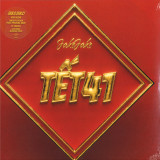
Continuing his fruitful relationship with Discrepant after the third volume of his ongoing Organic Music Tape Series on Sucata Tapes, Tiago Sousa returns with two longform pieces for organ with 'A Thousand Strings'. A self-explanatory title in itself, 'A Thousand Strings' drifts fluidly into a celestial realm of cascading melodies and cycling patterns that never feel forced or strict throughout its two hypnotic tracks. Pulsating with life and ecstatic abandon.
Taking cues from the tradition of American minimalists like Steve Reich and, particularly, Terry Riley, the Portuguese composer's work flows with a life of his own, that, while acknowledging those influences, transcends them into his own signature. On the A side, 'A Thousand Strings' goes seamlessly from intertwining crepuscular harmonies to ascending keyboard runs in the manner of 'Persian Surgery Dervishes' finishing with a coda of rhythmic marimba-like pulses. On the flipside, 'The Things Passed' creates this maze-like tapestry of melodies that seem to drift apart only to converge back again into its internal process before setting on sustained tones infused with a sense of longing. For all things passed. For what is yet to come.
Поиск:minimal set
Все
Long time in the vaults, soon out in pop heaven: Andrea & Alexander, a handsomely nostalgic pop project by Andrea Noce aka Eva Geist and Alexander Arpeggio. Originally launched in 2014, revitalized in 2023, the project originated as a live set-up consisting of synthesizers, ePects pedals, and analogue drum machines. From there it slowly metamorphosed into a crew of songs with raw minimal-wave grooves and romantically haunting English and German pop lyrics, loosely evoking the aura of Siouxsie Sioux, Gudrun Gut or Nadine Bal. After becoming a live mainstay in the Berlin based underground club Sameheads, they went on a tour through Lithuania and soon after several unfortunate troubles led to the break-up of the band, prompting both Andrea and Alexander to focus on their solo careers. Andrea became Eva Geist and released for various international labels, played live and formed the female duo As Longitude. Alexander founded his own label Eine Welt, took over the management of the renowned underground festival Camp Cosmic and created two musical projects with Cid Hohne, Otto and Aufgang B. Now, years later, almost becoming a Soundcloud corpse some Andrea & Alexander recordings caught the attention of the R.i.O. folks and just seconds later they offer six freshly recorded cuts of Andrea & Alexander tunes that stood the test of time as authentic, soulful pop music. “What are we going to wear for tonight’s party?” Andrea Noce asks in their song “Tiney Party”. The answer is “Loved Up” a musical celebration outfit of six sincere recorded, emotionally accorded songs, who make the dance, give verve a chance, to be there, in that moment of all moments. An album for the listener that likes to dance. In his head, on the local carpet. “Loved Up” humming Andrea & Alexander tunes.
Perhaps best described as a pioneer of the underground experimental scene, the signature of Jørgen Teller on the musical landscape of Denmark traces back to the late 1970’s. Sprung out of a whirlpool of post-punk and art school ideas, Teller has relentlessly been chiseling away on the constrictions of music in various bands, collaborations and solo projects ever since. Searching out its farthest outposts - be it free jazz, noise or acousmatic music - Teller has strived towards an approach to music without rules, often by way of improvisation and usually with the aid of electric guitar.
This album is based on a live performance held at the Inter Arts Center in Malmö in early 2022, where Teller performed a semi-improvised piece in homage to the poet Poul Borum, whom he had worked with in the mid-90’s closely before Borum’s death in 1996.
As a composer, Teller relies on a set of “basic choices” that becomes a “precise point of departure” - where he can then go against his “good knowing” of the science, trends and different schools of music and go straight into his own instincts as a performer. For this performance, he used pre- recorded material of three rhythm boxes (all out of sync), timbales and sessions on Erica synths.
In dialogue with the label, Teller has focused on extracting the recording of the rhythm boxes and timbales alone, emphasizing the tension between the rhythms. With minimalist drum sequences that could easily be placed in a proto-techno context, and the whooshing of what might be an ancient rhombus instrument, there is a feeling of a primitive presence to Teller’s rhythmic excursions. A throwback to the spiritual realms of a wordless society fighting the demons of chance.
Occasionally pierced by stark industrial drum crashes and rattling post-punk percussion, it also conjures echoes from the darker side of the 1980s. In citing Borum as its inspiration, Teller shares that he channels the poet’s energy and their shared love of “noisy stuff and darkness”.
But the pace can also go somewhere close to breakbeat on track B2, where a whirlwind of rhythmic elements clash into a deranged deconstructed club tune.
The album also features a remix by a fellow colleague of the acousmatic community; the composer Jacob Riis. On the closing track B3, Riis quietly manipulates and balances the elements of Teller’s recordings and gently releases them into a contemplative pool of static.
Nina Ryser's music has always inhabited its own world; a singular and cohesive collection of Keyboard-centric home recordings that marry her undeniable pop sensibilities with a truly bizarre dreamlike aesthetic. With a solo career spanning 7 releases as well as her work in the highly influential art-punk trio Palberta, Nina's artistic voice has been a staple in the American underground for over a decade, her distinctive and consistent sound earning a cult following. Her latest effort Water Giants signifies a departure in both sound and artistic practice - her first solo release recorded outside of her home studio, with a myriad of first time collaborators, it's Nina's most lavish and expansive offering to date, honing in on the heartfelt songwriting at the core of her work. After completing her usual process of demoing the songs for Water Giants, Nina felt that she wanted to try something new, escaping the confines of her minimal studio setup and the limitations of working alone. At the recommendation of several friends, she began working with Lucas Knapp, a Philly based producer who has contributed work to many Dear Life releases (including Florry's The Holey Bible, Hour's Ease the Work, and Joey Nebulous's Joey Spumoni Creamy Dreamy Party All the Time ). Lucas and Nina's recording sensibilities aligned quite seamlessly, breathing new energy into the songs in what she describes as an "effortless collaboration". The result is some of her most pristine experimental pop offerings to date, centering Nina as a dynamic performer and lyricist without foregoing the surreal qualities of her previous work. The album features contributions from many of her peers in the Philly music community, including Jill Ryan (Great Time), Victoria Rose and Nino Soberon (@, Brittle Brian), Eli Kleinsmith (The Knee Jerk Reaction), and her husband Gabe Adels, whom she frequently collaborates with in the synth-pop duo Data. Even the cover art is a departure for Nina, who has previously crafted it herself or with longtime friend/visual artist Izzy Kross, this time assembling a collage of photographs taken by Eve Alpert (Palm) fit for the album's newfound dimensionality. Lyrically, Water Giants stands as Nina's most personal work to date. Taking a cue from her previous release, I Miss My Dog, which was written as Nina was processing the imminent loss of her and Gabe's dog Billy, Nina approached the writing process with unbridled honesty and chose not to edit or overthink her words as she had in the past. The result is a number of candid, heartfelt reflections on love, illness, addiction, anxiety, and the beautiful absurdity of a trash pile on the street. Interspersed throughout the album are Nina's signature woozy instrumentals, which add some escapism to the grounded nature of the material. By putting faith in a newfound collaboration without straying from her natural instincts, Nina has crafted the most dynamic album in her discography, an exciting testament to her songwriting prowess and what can be accomplished by stepping out of your comfort zone as an artist.
ARIA Award-nominated composer and electronic artist Lance Gurisik announces his forthcoming album, ‘Proffer’. Set to be released on his Sydney-based label, 33 Sides, with global distribution through Inertia / PIAS, ‘Proffer’ promises to be a groundbreaking exploration of experimental electronic, jazz and modern classical forms.
‘Proffer’ is a psychedelic fusion record that blends eclectic musical influences. It draws inspiration from German Krautrock hero Manuel Göttsching, French synth legends Air, minimalist composer Terry Riley, and classical composers Ralph Vaughan Williams and Alexander Scriabin. The album is a maximalist exploration of experimental electronic, jazz, and modern classical forms.
The album features collaborations with Lamorna Nightingale from Australia’s premier Ensemble Offspring on alto and bass flute, Nick Meredith on drums and percussion, a 16-piece string section performed by Ian Cooper on violins and violas, Paul Ghica on Viola da Gamba and cellos, and Lance himself on modular synth and keyboards.
‘Proffer’ challenges the prevailing norms in the music industry, advocating for music as a vehicle of escapism and self-exploration through active listening. The album’s maximalist approach to composition and production pushes the boundaries of where experimental electronic, jazz, and modern classical forms meet, creating an adventurous and cinematic listening journey.
Contemporary Album Of The Month in The Guardian.
returning, dream’ is the second album from Paradise Cinema – the‘Fourth World’ inspired project led by multi-instrumentalist Jack Wyllie (Portico Quartet/Szun Waves). While Wyllie’s other projects move between tightknit electronica, widescreen minimalism and improvised ambient sounds, ‘returning, dream’ contains nods to Jon Hassell, Terry Riley, Don Cherry and Midori Takada as well as more contemporary electronic, ambient and non-western music and even draws inspiration from physics and science fiction.
The first, eponymous, Paradise Cinema record, released in 2020, was recorded in Dakar (Wyllie lived in Senegal for a while in the late 2010s) and featured the dense rhythms of Mbalax music combining with Wyllie’s textural saxophone and synth playing, but here he takes a step into the unknown:
The music is no longer built primarily around the rumbling
propulsiveness of Mbalax, but takes its inspiration from the Many-Worlds Interpretation of quantum mechanics, which suggests that there are many different worlds that branch off from our own. Wyllie explains: “It is an imagining of what music could be like in a different time and space, ancient and futuristic from everywhere and nowhere at once. I was listening to a lot of physics podcasts when I created this record. I loved the many-worlds interpretation of quantum mechanics; about the multiple paths we are taking each time a quantum decision is taken. The different worlds then splitting off like branches on a tree. I could imagine different histories and worlds and multiple versions of myself, others and even other societies existing. In this album I’ve dug into these ideas andattempted to make music that would come from those different spaces, trying to poke my finger through to the other selves and stories. Effectively a form of composed science fiction, the music is an idea of what might be occurring or have occurred on a branch of the tree in a different world. But I like to think the tracks might actually have been composed somewhere or sometime.”
Created in London by Jack Wyllie with additional recordings from Dakar and Sydney, ‘returning, dream’ blends sounds that do not typically live together. It features Khadim Mbaye (sabar drums) and Tons Sambe (tama drums) who provide the dense Sengalese rhythms, plus Szun Waves colleague Laurence Pike, also on drums.
Solomun & CASSIM remix two of the track rake from Radio Slave’s Venti album released earlier this year
Diynamic boss and Ibiza titan Solomun remixes Radio Slave ‘The Lunatics’ on Rekids, following the original’s inclusion in Matt Edwards’ acclaimed ‘Venti’ album in May. The original, a rework itself, reimagined the 1981 Fun Boy Three track ‘The Lunatics Have Taken Over The Asylum’, with Edwards’ ode to the band’s late lead vocalist and The Specials frontman Terry Hall winning support from Saoirse, Erol Alkan, Jennifer Cardini, Laurent Garnier, Paul Woolford, and Honey Dijon.
Solomun’s remix of ‘The Lunatics’ is sparkling aural nostalgia executed with total joy. Crisp 80s drums, Stranger Things-esque Jupiter 8 synth swells, the vocoded titular vocal, and a gloriously rich sliding bassline combine to drag the listener back to 1983 in the best possible way. As the track builds, rousing guitars join the ensemble, completing what is a hypnotic, melodic trip to the 80s via what’s set to be a 2024 anthem.
CASSIMM’s remix of Radio Slave vs Audion’s ‘Mouth To Mouth’ continues the story of Matthew Dear’s classic, which Radio Slave revived and reinvented as part of his 2024 LP, ‘Venti’.
Radio Slave’s hi-NRG disco cover of Audion’s minimal/maximal 2006 and era-defining anthem has dominated dancefloors since it emerged as a single in late 2023, with the likes of Erol Alkan, Job Jobse, Sean Johnston, Jennifer Cardini and Eats Everything continuing to play it today and the latter awarding it an Essential New Tune whilst sitting in for Pete Tong on BBC Radio 1.
Now, recent Rekids alum CASSIMM continues his huge run of form with a chunky, main-room house interpretation that shows just why his recent release, ‘House of Moves,’ won DJ support from the likes of Tong, Arielle Free, Paul Woolford, Honey Dijon, and Jennifer Loveless.
CASSIMS’s remix of Radio Slave vs Audion quickly follows Lindstrom and Solomun’s remixes of the ‘Venti’ LP’s tracks, which have seen support from the likes of Ivan Smagghe, Chloé Caillet, Nightmares On Wax, and more.
returning, dream’ is the second album from Paradise Cinema – the‘Fourth World’ inspired project led by multi-instrumentalist Jack Wyllie (Portico Quartet/Szun Waves). While Wyllie’s other projects move between tightknit electronica, widescreen minimalism and improvised ambient sounds, ‘returning, dream’ contains nods to Jon Hassell, Terry Riley, Don Cherry and Midori Takada as well as more contemporary electronic, ambient and non-western music and even draws inspiration from physics and science fiction.
The first, eponymous, Paradise Cinema record, released in 2020, was recorded in Dakar (Wyllie lived in Senegal for a while in the late 2010s) and featured the dense rhythms of Mbalax music combining with Wyllie’s textural saxophone and synth playing, but here he takes a step into the unknown:
The music is no longer built primarily around the rumbling
propulsiveness of Mbalax, but takes its inspiration from the Many-Worlds Interpretation of quantum mechanics, which suggests that there are many different worlds that branch off from our own. Wyllie explains: “It is an imagining of what music could be like in a different time and space, ancient and futuristic from everywhere and nowhere at once. I was listening to a lot of physics podcasts when I created this record. I loved the many-worlds interpretation of quantum mechanics; about the multiple paths we are taking each time a quantum decision is taken. The different worlds then splitting off like branches on a tree. I could imagine different histories and worlds and multiple versions of myself, others and even other societies existing. In this album I’ve dug into these ideas andattempted to make music that would come from those different spaces, trying to poke my finger through to the other selves and stories. Effectively a form of composed science fiction, the music is an idea of what might be occurring or have occurred on a branch of the tree in a different world. But I like to think the tracks might actually have been composed somewhere or sometime.”
Created in London by Jack Wyllie with additional recordings from Dakar and Sydney, ‘returning, dream’ blends sounds that do not typically live together. It features Khadim Mbaye (sabar drums) and Tons Sambe (tama drums) who provide the dense Sengalese rhythms, plus Szun Waves colleague Laurence Pike, also on drums.
Belarusian post-punk / synth pop group Molchat Doma have always exuded the kind of brutalist aesthetic of the architecture that adorns their album art. It's cold, gray, imposing, industrial and yet there are human hearts beating within those foundations. In the wake of their breakthrough success in 2020, the trio endured a polarity of experiences, from the nadir of an uprooted life and forced relocation away from their native Minsk to the apex of headlining massive shows across the world. It was in this headspace that the band settled into their new home of Los Angeles to finish writing their fourth album Belaya Polosa, a testament to change in difficult times, a love letter to the digital pulse of the `90s, and a technicolor reinvention of the band's somber dancefloor anthems. From the opening synth swell and drum machine throb of "Ty Zhe Ne Znaesh' Kto Ya," to the goth / post-punk austerity of "Son", to the swirling electronic textures mixed with reverb-drenched guitar flourishes, expansive space, and yearning vocals of title track "Belaya Polosa" - that suggests Depeche Mode at their most reflective or The Cure at their most downtrodden - to the sultry and seductive "Chernye Cvety"_ a track reminiscent of Duran Duran's early `90s output in its fusion of dreamy guitars and authoritative mechanized beats _ and the interwoven layers of instrumentation, soaring chorus, and melodic sophistication of "Ya Tak Ustal", it's clear that Molchat Doma are operating on another level. Molchat Doma gained following with earlier albums that sound like third-generation bootlegs of banned recordings from the Eastern Bloc made after a few key entries in the Factory Records catalog were smuggled in from the West. Belaya Polosa propels them into a new direction while retaining their cold minimalist delivery they're known for. The basement grime and dirty tape-head sound of their previous work are now making space for digital luster and shimmering production values. And while Molchat Doma's broadened aural spectrum adds a synesthetic power to Belaya Polosa, the mood remains rooted in stark and unflinching self-reflection. Molchat Doma retain the duality of being both cold and feverish in their delivery while pushing their music into expanded territories through an armory of new textures. The trio continue to harness the sound of harrowing beauty thriving under harsh realities.
Lukas de Clerck brings us the ancient greek instrument, the aulos, of which his new interpretation of long form expression is coaxed forth on this tremendous recording. Lukas de Clerck explores a niche of archaeological research in music; the aulos is a historical Greek instrument that Lukas analyzed and reinterpreted by a luthier in modern times_navigating this impression as an artwork or living sculptural object, as there is an absence of historical partitions or written information about how to recreate technique on the instrument. Lukas de Clerck has interpreted information from the rare archaeological resources and visual art of the classical Greek period to recreate both playing technique and possible sound timbres with the instrument. With his contemporary approach to drone, post-minimalist music, and contemporary folk, we find a deeply satisfying and compelling, even playful set of songs, timbral exercises and compositions. An important document of new music meets contemporary archaemusicological research via Stephen O'Malley of SUNN O)))'s label Ideologic Organ. _ The telescopic aulos is speculative: might it have existed? It takes on features from the historical aulos, a double-reed instrument of which we know how it looked but little about what music was played on it or how it would have really sounded. It's an instrument without the limitations of canon or manual, providing creative freedom and awakening curiosity. The new instrument featured on this album is ancient and futuristic at once. The aulos has no tone holes; instead, each of the two tubes consists of three parts that can slide into each other. In this sense, the metal pipes bear a certain resemblance to the principle of a trombone. However, since both hands are already in use to hold both tubes, the sliding has to be done by way of gravity and the help of a «phorbeia», a leather mask which helps keep the reeds in place. The aulos's material is metal (instead of wood), which gives it a certain electronic allure and intensity, as well as a variety of sonic possibilities and textures. It produces overtones efficiently and allows them to play with their microtonality. The aulos Lukas plays on this recording was developed at Brasserie Atlas, a temporary occupation of a former brewery in the heart of Brussels where Lukas lives. It is quite a poetic coincidence that the birthplace of the instrument is named after the Greek titan condemned to carry the sky, while this instrument needs to be turned skywards to lower its pitch with the help of gravity. At Brasserie Atlas, Lukas has found collaborators who have shared in the process of building this new instrument: the collective Noir Métal has constructed the tubes, in this way becoming instrument builders; the phorbeia has been manufactured by Jot Fau; a former water reservoir in the vast cellar of the building carried the instruments' resonance for its first sounds. The place has left an imprint on this new instrument. With all of the telescopic aulos' layers, its sonic, musical and extra-musical components are still unfolding their potential as a medium for discovery and research, next to being an instrument of great musical potential. The music on The Telescopic Aulos of Atlas reflects this spirit. In several miniature pieces, it presents an encyclopaedia of musical possibilities that the instrument offers while keeping an intense and corporeal sonic specificity. The short pieces are studies that reflect on the sonic possibilities of this instrument that are yet to be explored. It meanders, searches and interacts with itself and the space. It needs to answer common expectations of old instruments being harmonious or pleasing. It transports a kind of experimental archaeology that, by formulating hypotheses in the present, allows us to reflect on what might have been in the past and simultaneously questions concepts of beauty, harmony or virtuosity. However, in the end, this instrument might have never existed before. -Julia Eckhardt
Black Vinyl[23,49 €]
Repress on Limited Crystal Clear Vinyl and Black Vinyl to coincide with new album ‘Daylight’ release
The album was recorded at the top of an East London tower block, mixed in a beach hut on Camber Sands and gilded by Bollywood strings is already setting its sights hide and wide, but when the sound and vision encompasses panoramic electronic soul laced with a viscerally personal reaction to the mad times we’re living through, we’re in the presence of something special
Our two British protagonists are Sean Dickson, a former indie star who reinvented himself as an electronic adventurist - musician, DJ, producer – whose last album Ft. featured a stellar line-up of guest vocalists, including Yoko Ono, Fred Schneider (B- 52’s), Alan Vega, Crystal Waters (fronting ‘Testify’, which topped the US Billboard dance chart) and David McAlmont - the last, a thrilling singing sensation with an illustrious history, from indie-soul pioneers Thieves and the legendary McAlmont & Butler to purer soul and jazz recordings and a striking collaboration with minimalist composer Michael Nyman.
The impact, influence, and importance of Run-D.M.C.'s self-titled debut – the album that invented hardcore hip-hop and bridged rap, rock, and funk in then-unparalleled ways – cannot be measured. The first full-length record released by Profile Records, the 1984 set permanently changed the sound of music, broadcast streetwise wisdom to every corner of the country, and made the notion of a one-man band a distinct reality. Bolstered by an incendiary blend of staccato deliveries, stark beats, aggressive exchanges, evocative hooks, and socially conscious messages, Run-D.M.C. still hits listeners in the jaw with the same intensity it did nearly 40 years ago when it could be heard booming from ghetto blasters carried around city blocks nationwide.
Sourced from the original master tapes, pressed on MoFi SuperVinyl, and strictly limited to 3,000 numbered copies, Mobile Fidelity's 180g SuperVinyl 33RPM LP is the definitive-sounding version of the groundbreaking work cited by Rolling Stone as the 378th Greatest Album of All Time. This reissue also represents the first time this gold-certified effort has been presented in audiophile quality. Benefitting from the ultra-low noise floor, superb groove definition, and dead-quiet surfaces of SuperVinyl, Run-D.M.C. now plays with a clarity, immediacy, punchiness, and directness worthy of the artistry, urgency, and intellect of the trio's material.
The brilliance of Russell Simmons and Larry Smith's production comes into view as if the music is being broadcast on a giant system in a small club — only more focused, lively, and unlimited. Free of dynamic constraints and fatiguing harshness, this LP invites you to turn up the volume and experience the raw, rough, invigorating songs that changed the look, sound, and feel of hip-hop overnight. Think the trio’s sparse framework of drum machines, tag-team rhymes, keyboard accents, and turntable scratches is stuck in the mid-80s? Spin MoFi’s SuperVinyl LP and gain new appreciation for the music, messages, and production on display on Run-D.M.C.
Recorded in the wake of two successful and pioneering singles, both included on the album, Run-D.M.C. effectively took a sheet of coarse-grit sandpaper to the polish, sheen, and linear presentation of all the hip-hop that preceded it. Stripped to bare-bones foundations, the songs grab your attention and shake you by the collar with a combination of industrial-leaning rhythms, staggered deliveries, dance drama, and hard, minimalist percussion. Then there are the lyrics.
The LP broadcasts a smart mix of boots-on-the-ground reports, uplifting advice, and then-nascent b-boy culture. In one fell swoop, its narratives and music rendered the scene’s proclivity toward glamor and softness passé. Run-D.M.C.’s tough, cool-minded fashion sense showed the trio walked its talk and gave fans — particularly those living in long-ignored urban areas — heroes which with they could identify. Kangol hats, black jeans, leather jackets, Adidas sneaks, and gold chains were the new currency.
In every regard, Run-D.M.C. signifies the birth of modern hip-hop. Never more obviously than on the groundbreaking “Rock Box,” where rap and rock were first fused. As the first hip-hop video to receive regular rotation on MTV, the track eviscerated racial and social boundaries, awakened musicians and listeners to new possibilities, and redefined both popular music and, ultimately, popular culture. As the Roots’ Questlove has stated, it “ knocked down many obstacles, enabling hip-hop to become the new gospel."
Such teaching includes the real-world scripture of “Hard Times,” utopian hopefulness of “Wake Up,” and observational truths of “It’s Like That.” Released as the group’s debut single well before its eponymous album, the latter tune established themes and outlooks Run-D.M.C. would embrace during its career. Namely, the keen awareness of various prejudices, economic ills, and disruptive violence as well as the knowledge that education, self-motivation, and hard work were the ways to escape disadvantages and disillusionment.
Inspired and inspirational, the song reflects the spirit and shrewdness that courses throughout Run-D.M.C. That includes a detailed account of the trio’s not-so secret weapon (“Jam-Master Jay”), purpose statement (“Hollis Crew (Krush-Groove 2)”), and a revolutionary hybrid autobiographical narrative-dis track (“Sucker M.C.’s (Krush-Groove 1)”) widely regarded as one of the best hip-hop songs ever created. The same can be said for every moment on Run-D.M.C.
MoFi SuperVinyl
Developed by NEOTECH and RTI, MoFi SuperVinyl is the most exacting-to-specification vinyl compound ever devised. Analog lovers have never seen (or heard) anything like it. Extraordinarily expensive and extremely painstaking to produce, the special proprietary compound addresses two specific areas of improvement: noise floor reduction and enhanced groove definition. The vinyl composition features a new carbonless dye (hold the disc up to the light and see) and produces the world's quietest surfaces. This high-definition formula also allows for the creation of cleaner grooves that are virtually indistinguishable from the original lacquer. MoFi SuperVinyl provides the closest approximation of what the label's engineers hear in the mastering lab.
For those of you who"ve mislaid your history goggles, this archival release recalls an ancient time in the world of recorded music. Yes, back in the dinosaur days of the 1990s, a creature known as Aerial M walked the earth, before evolving into Papa M and PAJO and beyond and back. Even then, the music of M had a next-wave vibe, walking upright among the knuckle-draggers (and having drinks in the evening with others of its genetic detatchment). It was too much to last very long, of course - but some things end up lasting forever, don"t they? Fuck! So it is today that Drag City, an organization largely set up to bring you the best of all available M recordings, is proud to be there for the release of the only Aerial M session ever recorded for John Peel"s BBC Radio One show, as it was originally recorded on 3rd March 1998 and broadcast on 2nd April of the same year. The studio versions of these songs, which appear on Aerial M"s S/t album (DC114) and Papa M"s Hole of Burning Alms comp (DC231), were played by "M" himself (now revealed to be David Pajo!), which makes this album a rare alternative view of the canonical M, played by an actual Aerial M band who, all too briefly, embodied the sound for a year or so before Papa brought a brand new bag. This Session found them fortuitously roadburned from several weeks in the European Theatre. So much the better for our archival ears, as OG-M"s signature minimalist long-fuse sizzle is thrillingly intact here; in fact, even more so, as the tunes are jammed out past the studio versions" originally delineated borders, reaching rudely across the table in moments of liveness that the studio-bound project might have decided against when conferring only with the walls. For fans of their epic version of "Turn Turn Turn", this is more sweetmeats from that raucous old skull - but if you"ve not been down this road before, be prepared: the taste will set you slowly aflame. And then, before you know it, the band is dined and dashed - just like the band that Aerial M was, all too briefly amok on the earth that was too.
Truxx, the duo at the head of Sine Space 7, is back with their latest 4-track EP, "Euphoria and Illusions", set to release on August 30th. This highly anticipated release captures Truxx's signature blend of powerful, bleepy sounds and immersive atmospheres, offering a refreshing experience through raw energy and minimalism. Known for their ability to create hypnotic patterns with distinctive melodies, Truxx crafts melodic patterns in a dark and texture-rich soundscape. "Euphoria and Illusions" promises to break open every mix with a unique sound. This will be the first vinyl release of the label.
Gregory T.S. Walker’s Minstrels & Minimoogs was self-published by a young, nomadic composer and virtuoso in 1988 to accompany an immersive multimedia performance at the University of Colorado Boulder’s Fiske Planetarium. Created with this outer, and other, world setting in mind, the four tracks find Walker stretching toward an ancient-to-future vision where Egyptian myths and Hieronymus Bosch-ian tableaus are rendered in a screaming three dimensional circuitry of electronic drums, synth guitars, and, of course, Minimoog. Given the musical terrains and outmoded topics traversed, and that this entirely DIY effort was originally released as a micro one-sided 12” edition, Minstrels & Minimoogs is as perplexing and euphoric a document lost-to-time as it is now found.
Born in 1961 into an intensely musical family spanning four generations, Gregory’s mother Helen Walker-Hill was a noted musicologist specializing in the rediscovery and work of historical Black female composers, while his father, George Walker, was the first African American composer to win the Pulitzer Prize for music. Both parents studied with the famed (and famously strict) Nadia Boulanger in Paris in the 1950s, and held to lofty aesthetic standards in their home life. Walker began studying the violin as a child, but when a burgeoning interest in the electric guitar and rock music as a teen manifested, it was largely verboten in the household. The rule was that the music played in the home was to be acoustic and classical. Although the elder Walkers eventually relented and allowed Gregory’s guitar to be plugged in for a brief interval on the weekends, the remaining days he settled for strumming it sans amplification.
Gregory, conditioned and eager for a life in music but looking to get out from under the influence and yoke of his famous composer father, ultimately chose to study computer music at the University of California at San Diego, where he earned a Master of Arts. This was followed by another MA in electronic music composition at that hotbed of West Coast experimental music, Mills College. Intermedia and multimedia in the arts was the rage in the 1980s, and Mills was one of the centers for it; audacious spectacle meeting visionary performance, such as one of the realizations for Anthony Braxton’s music for multiple orchestras a young Gregory performed in with his violin.
After a series of solo synthesizer concerts around California, Gregory followed a girlfriend on a mid-country move to Boulder, Colorado. After picking up yet another composition degree at University of Colorado Boulder, his life as a composer really started, writing a piece for extended technique for guitar, a passacaglia for vocoder and orchestra, as well as Minstrels & Minimoogs.
Envisioned as a multimedia performance such as the kind he’d experienced at Mills (which was all but unknown in Boulder at the time), Gregory roped in a number of college going or aged friends of varying skill levels and musical sympathies to accompany him with distorted sax or oblique spoken interludes. Confronted with a lack of finances, but driven to get his ideas captured in a complete musical package, the album was recorded in his brother’s apartment. If not every player assembled was on Gregory’s virtuosic level, so be it; it was more about capturing the spirit of his intentions and embracing the serendipity of mistakes.
An inspired attempt at world building, Minstrels & Minimoogs draws on the deep well of musical knowledge Gregory gathered from his parents and teachers, but all the while subverting that historical basis by incorporating mutant strains of prog and pop music. The work accumulated is not unlike the playful 1980s work of Gregorio Paniagua, where medieval estampies and rondeaus are wrenched into an anachronistic present where Hildegard Von Bingen and Kate Bush are contemporaries. Ars nova, new art, a 20th century minimalist jester and troubadour.
A one sided LP was the cheapest option Gregory found to have Minstrels & Minimoogs memorialized on vinyl, so somewhere between 50 to 100 copies were pressed. There was no distribution, outside of copies that were handed out to friends or sold at the performances at the planetarium. Gregory T.S. Walker’s cosmic-futuristic forays into oblique pop and baroque subversion could forever reside perfectly in both the domed simulacrum of our universe for which it was composed, in the formats it is being reintoduced now, and our own biblical firmament. For in the words of Gregory, straight from the original liner notes: “God Is A Minimoog”
Gregory T.S. Walker’s Minstrels & Minimoogs arrives again August 23, 2024 on vinyl and digitally as part of uncommon¢ (“uncommon sense”), an open-ended, serialized endeavor from Freedom to Spend that provides new meaning for rarefied recordings from music's outermost fringe.
- A1: Bloom (Feat. Esther Durin & Elsie)
- A2: Warning (Feat. Cimone)
- A3: Changes (Feat. Askel & Elere And Javeon)
- B1: Take Me Under
- B2: Crunchy Nutter
- B3: Music To Smash Your Head Against The Wall To
- C1: Dusty 45
- C2: Dubbin Out (Feat. Sweetie Irie)
- C3: Stacatto
- D1: Minimalizm
- D2: Summer Breezin' (Feat. Paige Eliza)
- D3: Little Giggler (Feat. Elsie)
Prepare for take-off as your favourite multidimensional sound supplier, Unglued, unveils his long-awaited second album, "What on Earth". Set to launch you into the stratosphere with 14 fresh meteoric cuts, the Brighton-based producer continues to prove himself as one of the most innovative in the game. Expect a killer line-up of collaborations alongside Pola & Bryson, Lens, SOLAH, Urbandawn, Sweetie Irie, Waeys, Duskee, Paige Eliza and heaps more.Get ready to embark on an auditory adventure like no other - "What on Earth" by Unglued is set to be his biggest release to date, and it's guaranteed to be out of this world.
Since his unforgettable entrance onto the drum & bass circuit with his infamous remix of High Contrast's "If We Ever", Unglued has quickly become known for having one of the most distinct and versatile production styles in modern dance music. His debut album "Interplanetary Radio" was home to anthems such as "South By West", "Total XTC" and "Way Back When (feat. Esther Durin)", and since then Unglued has unleashed a slew of radioactive rumblers such as "If You Like That" with Whiney, Lens & Doktor, "Show Me The Light (feat. Kathy Brown)", and "Warning" alongside Pola & Bryson. Championed by leading industry tastemakers such as Gilles Peterson, Charlie Tee, Sherelle, Annie Mac, and more, Unglued's flawless musical output has led to him lighting up stages at some of the biggest shows and festivals across the globe, including Glastonbury, Boomtown, Hospitality On The Beach, Rampage, and Let It Roll to name a few. Not to mention sell-out tours across USA, Australia and New Zealand! "What On Earth" will be available in digital and vinyl formats from your nearest planet on 26th July
Katya Shirskova - David Maranha - Le Héron / A Reuniåo
Stellagedelivers a compelling split LP fromKatya ShirshkovaandDavid Maranha, "Le Héron / A Reuniåo," set for release in July 2024. Created and produced in residence at La Box contemporary art gallery at ENSA - École national supérieure d'arts de Bourges in 2023, this album is a profound exploration of the two artists' respective voices, showcasing their distinctive approaches.
Katya Shirshkovaopens the LP with side-long "Le Héron." This piece is an unadulterated exploration of voice, devoid of any field recordings or added effects. Embracing minimalism, the work revolves solely around vocal loops and re-recordings, creating choral structures that evoke folk traditions while delving into experimental realms. The ASMR-like techniques employed serve not merely as an auditory gimmick but as an intricate tool to illustrate the delicate flight of birds, mirroring the ethereal quality of the entire composition.
"Le Heron" aptly draws inspiration from its avian namesake, weaving birds into its fabric through the concept of vertical polyphony. The piece is underpinned by a profound understanding of this polyphonic approach, demanding meticulous precision in its looping technique. Each fragile construction is crafted in a single, unbroken take, showcasing an impeccable blend of simplicity and complexity.
David Maranhatakes over on the flip side with "A Reuniåo," delivering seven suites of powerful, minimalist drone compositions. Maranha's mastery of sustained tones and evolving harmonics creates a mesmerizing, meditative experience that is both intense and transformative.A dynamic interplay of harmonics creates a dense, immersive auditory environment, a study in sustained tones and subtle variation, leaving a lasting impression.
Mixed and mastered by Giuseppe Ielasi
Black Truffle is thrilled to announce a reissue of Chico Mello and Helinho Brandão’s self-titled release from 1984, the first return to vinyl of this classic of Brazilian experimental music with its original cover art and complete track listing. An under-recognised figure whose work inhabits a singular terrain where radical new music techniques and music theatre meet musica popular brasileira, Mello has lived and worked in Berlin since the late 1980s. A student of Dieter Schnebel, Mello played in the 90s iteration of Arnold Dreyblatt’s Orchestra of Excited Strings alongside compatriot Silvia Ocougne, with whom he produced a radical and hilarious deconstruction of MPB classics on Musica Brasileira De(s)composta (an early and rather atypical release on Edition Wandelweiser).
On this release, his only recording predating his move to Europe, Mello works with the alto saxophonist Helinho Brandão, who appears to be otherwise unknown outside Brazil. The record’s six tracks range from solo saxophone improvisation to densely layered ensemble works bridging minimalism, acoustic sound art and a plaintive melodic sensibility that calls up Edu Lobo or Milton Nascimento. Beginning with a dramatic, dissonant wind and string surge from which emerge ominously pounding piano chords, opener ‘Água’ slowly builds in intensity, a halo of clustered vocal harmonies gradually closing in on Brandão’s squealing sax until the piece opens up to reveal a gorgeous passage of melodic singing. The piano accompaniment reduces to tolling bass notes as the voice begins a repeated incantation, suggesting a ritualistic atmosphere reminiscent of parts of Xenakis’ setting of Oresteia. Dissonant, sawing tremolos on the strings climb to a crescendo before disappearing into the sounds of water being poured and splashed into metal vessels, presented not as a field recording but as a percussive element performed by the ensemble. A child’s voice then appears, singing to piano accompaniment the same melody heard earlier in the piece. After a brief solo alto improvisation from Brandão, working with the guttural pops and fleeting melodic gestures of Braxton or Roscoe Mitchell, the remainder of the first side is dedicated to the leisurely unfolding of ‘Baiando’ over the course of twelve minutes. A trio for Brandão on soprano saxophone, Mello on a very period-appropriate phased nylon string guitar and Edu Dequech on bongos, the performance eases its way hypnotically through subtle variations on a set of rhythmic and melodic patterns, almost derailed at points by Brandão’s wild forays into extended technique but held together by Mello’s droning guitar notes.
The second side opens with another multi-part epic for a larger ensemble, ‘Matraca’, which makes use of strings, electric guitars and a wide range of South American percussion instruments. Rasping violin harmonics hover as drum hits, repeated guitar notes and triangle accompany a slowly descending bass glissando. A sudden change in direction introduces a thrumming, incessantly repeated bowed bass tone, beginning a series of episodes of minimalist phasing and pattern variation, the combinations of electric guitars and orchestral instruments giving the ensemble an ad hoc charm like the early Penguin Café Orchestra but with more percussive drive. Eventually the piece is overrun by a cacophony of the titular matracas (a kind of ratchet/cog rattle). Following a lyrical trio improvisation by Mello, Brandão and Gerson Kornin on bass, the final ‘Danca’ focuses entirely on Mello’s layered acoustic guitars and vocals, using this restricted palette to build up a haunting piece of almost orchestral density, reminiscent of the 70s work of Egberto Gismonti in how it thickens a folkish ambience with harmonic sophistication.
Arriving in a starkly beautiful gatefold sleeve and sounding better than ever in its new remaster, one might call the stunning music contained on Chico Mello/Helinho Brandão ahead of its time. But what (other than some of Mello’s own work) produced in the years since its initial release has really touched the organic fusion of minimalism, free improvisation, radical instrumental technique and popular song achieved here? Forty years after its first release, Chico Mello/Helinho Brandão remains music of the future.
Fera’s trajectory sticks out like a sore thumb, you need to invest time, carefully divided between body & mind, to truly take a deep dive into his audacious output. After the acclaimed ‘Stupidamutaforma’ and ‘Corpo Senza Carne’, Fera is back with ‘Psiche Liberata’, an oblique, imperfect and broken record, in other words, exactly the type of magical voyage you want to be on. The mind, finally liberated.
Fera is Andrea De Franco, electronic composer from Southern Italy now residing in Bologna, also known for his work as visual artist/designer and member of the Undicesimacasa collective. His musical cosmos is profound and imaginative, intergalactic atmospheres that condense fragmented IDM, scintillating textures, distorted synthscapes, crunchy technoid rhythms and swirling abstractions that weave gently, sometimes moody and stark, more often celestial and awe-inspiring.
Mixed in Berlin by Steve Scanu ‘Psiche Liberata’ encapsulates Fera’s dense and intricate thought process in contrast with his simple and direct approach to writing and recording that finds its more natural output in his rapturous live sets where a mono signal runs through a few analog pedals transforming instantly into menacing alien grooves and fluid ecstasis.
Like ‘Psiche Liberata’s artwork, hand-drawn by Fera, every detailed miniature leads to a single cell of sound, tracks collide against each other in a psychotic kaleidoscope where every safe space is confronted with subsequent noise, alterations or interruptions. The black terror of ‘Celestial Anacusma’ is followed by the space-jazz banquet of ‘Milk Tears In The Hug Chamber’ doped up cyber Sun Ra extravaganza featuring Laura Agnusdei and Luigi Monteanni (Artetetra) on saxophones and flutes; ‘Silenzio Solare’ sprinkles Mille Plateaux era minimalism all over hallucinations, while ‘Diluvia’ crosses industrial acid with perpetual motion; title track ‘Psiche Liberata’ murmurs mechanically, a downtempo drifter for the wide-eyed 7AM comedown: ‘Simulacrima’ melts Boards Of Canada’s mellow pastoralism with dystopian meta-level dreamland and ‘Riposa’ showcases an overwhelming melancholy executed with elegance in a slo-mo world where the ineffable transcends notions of ambient and becomes a warm embrace.
Created on a Monotribe, MS20 & Volca Sample/fm, ‘Psiche Liberata’s velvet heaviness was achieved by re-amping many of the instruments through a Leslie Rotary Speaker and a reel-to-reel Telefunken. Fera’s sonic tapestry is in constant flux, underlying themes of love longing and affection run through the record but in a turbulent, volcanic, unleashed fashion, almost on the brink of utter noise or complete silence, reminding us that this is an artist like no other amidst the ever changing electronic scene. These are transmissions from the gutter, where the inevitable meets the unattainable and collapses.
"Fera’s tarnished materials are destined for ruin; “Stupida,” full of longing and regret, sounds like an elegy for a fallen world." Pitchfork
"A cut of dark magic that fits like a glove to overcast days, wild winds and lashing rains. Insistent, the treacle-thick bassline oozes out, soaking the space between the melancholic synth lines." Inverted Audio
"The songs on Stupidamutaforma feel hypnotizing...it establishes De Franco as a composer who uses space and time to create a set of rich, immersive works." Bandcamp 'Album Of The Day'
Filipovich is one of a kind. The Belarus-born, Paris-based artist works in a multitude of media - found footage films, painting, silkscreening and performance to name a few. It's her musical output that has caught the attention of late, though, with Filipovich dropping a run of releases in recent years which began with 2021's Magnificat on Time Released Sound. Filipovich takes as much of a novel approach to her music-making as she does with her other artistic endeavours - Magnificat was centred around treated samples of Sergei Rachmaninov's All-Night Vigil, and she's also combined classical composition with contemporary electronic techniques on her subsequent drops.
For Idealized, Filipovich's debut on Sheffield's Central Processing Unit, she maintains the gothic air which characterised her previous releases and applies it to a record of widescreen contemporary techno joints. These tracks represent something of a gear shift for CPU, a label which has long made its name by delivering top-quality electro and machine-funk jams, but such is the quality of Idealized that these superbly-executed techno productions are sure to win over label fans both old and new.
Idealized is very much schooled in the German tradition of minimal/dub techno. Tracks like 'Physical', 'Wave' and 'Dance Minor' all anchor themselves on single, steady drum pulses and delay-drenched single-chord loops. Filipovich generally lets the central idea of these tracks play out across several minutes while introducing increasingly disorientating elements into the rest of the mix - wiccan atmospherics, clashing chords, spiralling delays and so forth. It's an approach at once respectful of Filipovich's predecessors - Basic Channel, Deepchord, Ellen Allien and so on - but also full of idiosyncrasies and individuality.
Many of the club cuts here hardwire us into the moody, murky environs of the darkest Berlin Basements. 'Ultra Red' rides forward on a crisp drum machine snap, a menacing burble of bassline and an eerie single-note synth whistle in the upper end of the mix; 'Dance Minor' shows off a bit of KiNK in the brain-bending modular loop that waxes and wanes at its centre; the second-half run from 'Wave' to closer 'Small Cave' travels ever-further out into deep space - the kick drums remain insistent, yet the textural elements are delivered with an edge and flair that evidences Filipovich's ability to think outside the box.
Filipovich's unusual methods, and the influence of sound art and electroacoustic composition on her music, are drawn out further when Idealized steps away from the dancefloor. 'Hydra' comes off like a more gothic version of Pole - its central pulse draws from dub techno but never quite settles into a danceable groove, and this beat is combined with the kind of unnerving keyboard work that would make John Carpenter proud. Although closer 'Small Cave' eventually locks into another dark-room techno roller, the opening section of the track delivers a weightless soundscape of bright, tinny chords and a scene-setting field recording.
Idealized, the first drop on Central Processing Unit from Paris-based Belarusian Lina Filpovich, broadens the label's horizons with a selection of finely crafted minimal/dub techno joints.
RIYL: Andy Stott, Deepchord, Ellen Allien, Moritz von Oswald
For the thirteenth instalment of the Swinging Flavors catalog, Beat Machine Records presents a gem of pure energy by the talented Kyoto-based producer Naco. Set to ignite dance floors worldwide, this release delivers an electrifying fusion of acid, techno, and breaks, with a rave-inspired twist.
Naco, known for his innovative approach to electronic music, defies convention with his genre-defying sound. Drawing inspiration from Bass, Breaks, and Electro, Naco creates a distinctive sonic landscape that captivates audiences worldwide. Since 2017, he has been at the forefront of the music scene, spearheading 85acid, a label dedicated to showcasing emerging talent from Japan and beyond.
"Wavefunk," the lead track on Swinging Flavors #13, is a testament to Naco's unparalleled creativity and sonic mastery. With its infectious rhythm and hypnotic melodies, the fast-paced percussion and minimal character of the release "Wavefunk" transport listeners to a dimension where the boundaries between genres blur and the energy is palpable.
But the journey doesn't end there. Swinging Flavors #13 also features a remix of "Wavefunk" by We Rob Rave. The Polish duo injects his fresh signature style into the track, taking it to new heights and delivering an unforgettable dance floor experience. Transforming it into a full club experience, increasing the beats, and immersing the listener in a rave-like atmosphere fueled by danceable rhythms and an acid edge that cuts through the dance floor.
Another surprise that comes with the latest Swinging Flavors is 'Pure Water,' exclusively on Bandcamp. Let yourself be carried away by the bouncing sounds that make up this Break-style track, closing an energetic and vibrant release.
Naco's music is really pushing the boundaries of electronic music, inspiring both listeners and fellow artists. With a solid track record and a strong commitment to musical innovation, Naco is definitely going to leave a mark on the global music scene.
West London’s Slip ‘N Slide presents a special four-track package on wax for the first time, as Seth Troxler and Franck Roger deliver remixes of the 1997 Blaze favourite ‘Lovelee Dae’. An iconic artist who needs little introduction, Seth Troxler’s name is synonymous with American house and techno of the last two decades, with his formative years in Detroit shaping his sound before moving to the techno capital of the world Berlin. His ventures as a label boss, and with Night Tales, further cemented the talent as an underground hero - he now joins the likes of Carl Craig, Roman Flügel, and Isolée in giving ‘Lovelee Dae’ an expertly crafted remix, building from minimal grooves to a grand and immersive wash of sound. Also stepping up on remix duties is Parisian producer, crate digger and label boss of Real Tone Records, Franck Roger, who adds his signature beat focussed approach to the iconic track. This vinyl package also includes Blaze’s striking original, as well as one of the very first remixes from the late 90s, the 20:20 Vision remix of which used copies go for big money. This is an essential 12 inch EP for any true house fan.
Boxed set of five 7-inch vinyl records, 300 copies limited edition. Artwork poster included.
All tracks remastered from the original master tapes.
Alessandro Alessandroni is no longer remembered simply as 'the whistler' in Morricone's spaghetti western soundtracks – and rightly so, since he was the key figure behind much of Italian 'secret music' from the 60s and 70s, always there in the studio during recording sessions, whether as a multi-instrumentalist or as the leader of session vocal group I Cantori Moderni di Alessandroni. Today his pervasive presence and important role has been finally recognized by music professionals and enthusiasts alike, so much so that he is now considered the true father of Italian library music – a genre whose sound he shaped since 1968.
As a film composer, Alessandroni often worked for small productions that had very limited (and often regional-only) distribution, and whose budgets were worlds apart from those in the 'top league' where friends and colleagues like Morricone, Bacalov, Trovajoli or Piccioni thrived. Rarely released as a soundtrack, this music ended up, at best, forgotten inside dusty ¼-inch reels or, at worst, disappearing into thin air.
After a string of releases that have brought back to life forgotten or lost works by Alessandroni (Sangue di Sbirro, Afro Discoteca, Lost and Found, etc.), it was pretty natural for us at Four Flies to start delving into a little investigated area of his filmography: his scores for erotic films, the last genre to gain popularity in the flourishing Italian film industry of the 60s and 70s, and perhaps the most extreme too, the one that, by pushing things too far, eventually put an end to that industry and its genres.
So, we're now very proud to present Alessandroni Proibito, an exclusive boxed set of five 7-inch records. It contains a total of 14 previously unreleased tracks from the soundtracks of 4 soft-core erotic films that included hard-core sequences and, therefore, fell somewhere in-between normal commercial distribution and the underground scene of adult movie theatres.
Taking an artisanal approach to his musical craft, Alessandroni was not afraid of having to deal with spicy subject matter, wobbly productions, implausible plots, improvised actors, or cinematographers who were clearly no disciples of Storaro. And he was so good at making a virtue out of necessity, at turning budget constraints into creative advantages, that he created soundtracks that far surpass the films' quality, with music that at once captures and elevates the spirit of the erotic genre as if into a condensed symbol.
More specifically, the maestro recorded many of the pieces in a DIY fashion at home, using a 4-track Teac tape machine to arrange his compositions. The Teac allowed him to play different instruments on each track, which meant he could basically put an entire soundtrack together all by himself, or almost all by himself.
These recordings often feature drum machines – which provide that retro, early electronic music vibe – as well as funk guitars and exotic-sounding percussion in the rhythm tracks. In addition, there is an extensive, almost bewildering use of synthesizers to replace solo instruments that would have required a paid session player. On top this minimalist arrangement, Alessandroni layered what he could: some piano chords, a little flute and, most importantly, his signature 12-string guitar phrasing.
The result is just stunning: a unique mixture of electronic music and acoustic instruments, in a style that stops short of kitsch and ranges from cinematic ambient pieces like "Tensione erotica" to disco-funk tracks like "Snake Disco" and "One Sunday Morning", both of which feature vocals by Alessandroni himself.
Alessandroni Proibito comes with artwork by Eric Adrien Lee and a matching 30x70cm folded poster inspired to the insert-size posters which used to be hung outside movie theatres to attract cinema-goers.
The boxed set is being released in a limited edition of just 300 copies and will never be reissued. First come, first served.
Following a ten-year hiatus, multi-instrumentalists Rafael Anton Irisarri and Benoît Pioulard return with »How to Color a Thousand Mistakes«, their third LP together as Orcas. Building on the electronic minimalism of »Orcas« (2012) and the Twin Peaks-inspired haze of »Yearling« (2014), the duo have expanded their sound and vision into a full-spectrum ensemble.
In the time since their last major collaboration, Irisarri and Pioulard have done plenty on their own, while also traversing significant life changes: relocation from Seattle to New York, separation and divorce, illness, hospitalizations, and the loss of siblings, parents, and friends. Yet from these tribulations, they gleaned inspiration to reconstruct their lives, creating music with new collaborators and partners. Recorded in a variety of studios and cities including Brooklyn, Cambridge, Oxford, Seattle, and upstate New York, the resulting album, under the tutelage of UK producer James Brown (Arctic Monkeys, Kevin Shields, Nine Inch Nails), is a patiently-crafted beast, equally inspired by impressionism, British new wave, and dream pop.
With Irisarri’s guidance and Brown’s encouragement, Pioulard brings his velvety voice to its harmonized peak on songs like »Wrong Way to Fall« and the Durutti Column-indebted »Fare«. Where his most recent solo albums for Morr Music (»Sylva« and »Eidetic«) navigated foggy forests of ambient pop and stacked tape loops, here his characteristic blur shifts into focus with a unique degree of clarity and confidence. »How fare against balance do I / Navigate my errors?«, Pioulard sings in a heartbreaking tenor, echoing the album’s broader themes of introspection, grief, loss, trial and trauma.
Lead single, »Riptide«, is a summary of Pioulard’s life changes and personal upheavals in the past decade, »flitting eastward toward a yen deep in the past« and learning to glide through the tumult of ocean waves, as a metaphor for the punches one takes in pursuit of grace. Its towering, key-changing midsection arrives with the monumental drumming of Slowdive’s Simon Scott, a long-time friend and cohort who appears on most songs in the set. Scott’s quintessentially English, jazzier approach offers a balance of force and restraint as the backdrop for Irisarri’s majestic guitars, analog synth lines, and Martin Heyne’s Fender Rhodes counterpoints.
Second single, »Next Life«, began as a sketch by Scott, and reached its final form in the hands of Pioulard and Irisarri, at a point that each had endured major concurrent losses, finding a commonality in the need to gaze over the horizon while acknowledging the unavoidable bittersweetness of letting go – not only of people, but of routines, places, and expectations. It’s one of Orcas’ most nuanced pieces, with a mid-tempo, sunset glow that unfolds into a sparkling, slide-guitar finale as it disappears in the rear view.
On third-act highlight, »Bruise«, Scott is doubled on the drum kit by MONO’s Dahm Majuri Cipolla, whose Liebezeit-influenced metronomy anchors a nimble bass groove from Andrew Tasselmyer (of Hotel Neon), and some of the album's most syncopated, spaced-out interplay, courtesy of Puerto Rican guitar player Orlando Méndez (a childhood friend of Irisarri’s). Originally a droney, fingerpicked guitar demo, »Bruise« is the most storied composition here, having gone through almost a dozen versions and lyrical edits, with Brown distilling hours of improvised performances into the final arrangement.
Throughout »How to Color a Thousand Mistakes«, Irisarri uses his deep well of production experience to paint the stereo field with meticulously designed textures, exemplified on the slow burn of »Heaven’s Despite« and the heady rush of »Swells«. As a mixing and mastering engineer with Black Knoll, he has built a client list that reads as a who’s-who of modern, forward-thinking composition, including Temporary Residence, All Saints Records, and Ghostly International, among many others.
As with previous collaborations, Irisarri and Pioulard bring disparate styles and specialties to the table, but with an interpersonal dynamic that transcends friendship into brotherhood, their open-minded workflow and mutual respect are evident at every turn. »How to Color a Thousand Mistakes« brims with tight, complex art rock songwriting, masterful production, and sonic versatility, informed by a plethora of genres and tonal hues. The title might promise answers, but the gravitational center of the album is the dawning realization that, as you reckon with the infinite whims of the cosmos, there could be none.
A1 - Tensor
Opening with an earworm minimal old school melody which lives long in the mind, Tensor sees JLM Productions kick off his latest Spatial EP in style, flexing his versatility in the genre with an exquisite Hot Pants break pattern in delightfully laid back fashion. Showcasing sublime filtering techniques, a lush 808 bassline and a nominal usage of kicks, Tensor lives long in the memory - and rightfully so.
A2 - Pseudovector
A real treat in store for fans of clean, edited breaks as JLM Productions immediately drops the crispest assortment of drum samples which will delight the ear and the feet in equal measure. Pseudovector is a real treat for the senses with an immense high note melody punctuating the track as the breaks build and build, adding layers of punchy detail which combine beautifully with cymbals, bongos and gentle atmospherics.
AA1 - Helios Drift
A more laid back piece that harks back to a special bygone age of slower atmospherics - as is Spatial's speciality - Helios Drift offers a feast of breakbeats with distinctive tribal maracas jubilantly shaping a unique vibe. Soothing padwork provides an elegant backdrop to the beats with rolled chords and sci fi melodies draped throughout, deconstructing towards a polished outro to this memorable mid-set breather.
AA2 - Wavefunction
Instant rolling 2-step vibes unfold as Wavefunction sees JLM Productions close the EP in style with a track which won't fail to move the discerning dancefloor. Immense 80's synthwave vibes tell a tale of cyber dystopia, highly evocative notes washing harmoniously with the breakbeats while a superb bassline solo in the breakdown invites contemplation from the audience before the beat rolls on to a reflective conclusion.
Words by Chris Hayes (Spatial / Red Mist)
Repress!
** Now available on vinyl* Steve Reich remains one of the most important figures in
20th century music. Though he studied at the prestigious
arts institutions Julliard and Mills College, by the mid-
1960s Reich set about dismantling the very orthodoxy that
he had been trained in. Forming a new musical language
based on repetitive processes, Reich became established
as part of the so-called 'Big Four' of New York minimalists
(along with La Monte Young, Terry Riley and Philip
Glass). Reich's influence can easily be seen today in both
the classical world and contemporary pop music.
'Four Organs' is the ultimate minimalist composition.
Performed by Reich, Glass, Art Murphy and Steve Chambers,
four identical Farfisa organs strike a single chord and
gradually lengthen each note to produce polyrhythms between
the players. Anchored by Jon Gibson's stoicallysteady
pulse on maracas, the piece deconstructs its opening
burst to a sustained mass of sound - stretching the tones to
create (in Reich's words) 'slow-motion music.'
Inspired by Reich's early training on drums, 'Phase Patterns'
treats the keyboards like tuned percussion instruments:
a basic rhythm pattern is played in unison and almost imperceptibly increases tempo to move out-of-sync.
Each progressive cycle emphasizes unique figures that are
not generated by an individual alone, but rather emerge
from the communal expression of the group.
Originally released on Shandar in 1971, Four Organs /
Phase Patterns is one of most highly regarded avant-garde
recordings in the past 45 years. This CD release features
cover photography by artist Michael Snow and is recommended
for fans of Neu!, Glenn Branca and Tim Hecker.
Braulio Lam's Close-Up is a captivating soundscape that blurs the lines between music and photography.
Hailing from the border region between San Diego and Tijuana, Lam's inspiration stems from the vibrant cultural exchange and diverse musical traditions of the area. His creativity as a music producer and photographer converges seamlessly into this album, where he manipulates images and sounds, using light as a catalyst for his sonic experiments.
The album's eight tracks showcase Lam's eclectic sonic palette, ranging from electronica and dub techno to ambient and trip hop. The opening track, "Prologue," sets the stage with a haunting guitar echo and a spacious, downtempo beat. Angelic vocals float ethereal over the sonic backdrop, creating a sense of scenic grandeur. "Cinestill" immerses listeners in a sub-aquatic realm with its slow-pulsing beat and cavernous ambiance. "Buena Vista Social Dub" captivates with its sensual vocals, echoing drums, and hypnotic melody.
"Monika" evokes a sense of beachy tranquility with its electric guitar and ambient soundscapes, while "Mirror" transports listeners into an atmospheric swirl of broken beats and ambient textures. "Eastman" delves into the depths of dub techno, its hypnotic chords and airy soundscapes creating an otherworldly atmosphere. "Winter Light," showcases Lam's mastery of minimalism. Field recordings of natural sounds, sparse guitar plucks, and evocative imagery paint a stark but beautiful soundscape that lingers long after the music has faded. "Tiffen" closes the album on a serene note, its gentle island rhythms and floaty textures inviting listeners to relax and unwind.
Overall, Close-Up is a testament to Braulio Lam's boundless creativity and artistry. Its unique fusion of musical styles, experimental sonic textures, and evocative imagery makes it an immersive and captivating listening experience that transports listeners to a realm where the senses intertwine.
Limited edition "Coke Bottle Cloud" color vinyl with etched b-side. Australian duo Armlock make music for having your head in the clouds. On new album Seashell Angel Lucky Charm, Simon Lam and Hamish Mitchell bring you on a steady ascension through compressed and heavenly sonic realms. The band's second proper release, and first for Run For Cover Records, showcases the songwriters' experimental electronic roots through an indie rock lens. Free from distortion or overindulgence, Seashell Angel Lucky Charm is a collection of consistent rhythms decorated with clean guitar tones and eccentricities. Through playful layers of vocal harmony and minimal arrangements, Armlock capture the inventive and uncomplicated essence of Pinback or Alex G. Self-described as "indie rock with a touch of spirituality and emo", Armlock's journey into a higher realm is seeped with the looming confusion that comes with exploring the unknown. With an introverted demeanor, Armlock explores the human desire to find guidance in a world much bigger than its people. Every sound on Seashell Angel Lucky Charm feels precise and intentional, making the anthemic choruses on tracks like "Fear" and "El Oh Ve Ee'' feel expertly placed and pop-oriented. These two songs show Armlock's savvy with harmony as they use octaves of angelic sounds to stretch a simple one-word chorus until it soars with meaning. Unlike most indie rockers, Armlock use guitar as a tool in their belt rather than a vessel for songwriting. Where their 2021 EP Trust set foundations in downtempo acoustic guitar, Lam and Mitchell's evolved songwriting is a testament to where an electric guitar can amplify a song's groove, or usher in sonic space.
Veiga lands straight on the dancefloor, no ambiguity about it. Spurred by the guys from RS Produções, he's been honing his DJ skills since he was 17 (currently 23), initially with partner Nunocoox, who gave him even more motivation. Production came naturally sometime in 2020. We venture: maybe one of the good things coming out of the lockdown? Summer of '22, his debut at Musicbox (at the Príncipe monthly residency) is recorded as a festive, lively set, punctuated by the kind of crowd shouts only heard when things go really happy and sweaty. Since then, Veiga's name has been spotted regularly in the afro club scene, growing in reputation
This side of kuduro, "Leandro" is as expressive as it gets, with percussive forces pulling in deceitfully different directions, much in the same style as the slower form of tarraxo. But we can call this house, yeah? No niceties, however: little over 3 minutes and the track abruptly cuts into silence, exuding the raw power of something made for the mix, not in the least "for the people". In a similar pragmatic mode, the stabs in "Sem Nome" get the party started unannounced. Full mode, for the duration. Minimal groove, broken beats and emotive highlights. "Boiler Room" may be wishful thinking, an interpretation of what is required to rock the place or, ultimately, just a title to wrap up the project. In any case, here's a feisty vocal-and-whistle driven stormer, building up to perfection over three and a half minutes. All elements exactly where they belong. Relentless pace in "X de Destroi", a dark side operation, unreal ambiance, breakneck beats, a purgation?
The title "Tudo É No Guetto" contains all the necessary theory. Everything happens in the ghetto. This uplifting house slab celebrates life as it is, freezing hardships for a moment, the ghetto seen as welcoming, a natural place to be. Vocals stashed away in his cell phone come from the animação crew Os Twinni (he joined them for a while). Clipped, repeated and manipulated to convey the very simple feeling of good times. Veiga himself talks about growing up with minimum resources but still happy. That is the memory he retains from being a kid in the ghettos of Amadora, just outside of Lisbon, born to a Cape Verdean father and Portuguese mother. Though the music sounds carefree and the message is chilled, let us not be tempted to rebrand Reality.
- A1: Hey Mami
- A2: Dreamy Bruises
- A3: Could I Be
- A4: Wolf
- A5: Dress
- B1: H S.k.t
- B2: Coffee
- B3: Uncatena
- B4: Play It Right
- B5: Come Down
- C1: Hey Mami (Rick Wade Remix)
- C2: H S.k.t. (Dntel Remix)
- C3: Coffee (Helado Negro Remix)
- D1: Hey Mami (Charles Spearin Remix)
- D2: H S.k.t. (Hercules And Love Affair Remix)
- D3: Coffee (J Rocc Remix)
Black/White Split Colour Vinyl. Recorded in a little bedroom studio out in Durham, North Carolina, Amelia Meath and Nick Sanborn's debut LP as Sylvan Esso arrived in 2014 at the juncture of pop and experimental. Even now, years later, the LP remains an urgent and fitting introduction to a push-and-pull that would go on to inform the duo's sound - a thoughtful headiness that also wants you to get out on the dance floor. A blend of analog and digital, Meath and Sanborn were two unexpected puzzle pieces fitting together with singular ease, producing a ten-track LP that was both minimalist and shimmering, with dark undulations rippling beneath the synthy-surface and crystalline quality of Meath's voice. Before all of the international touring and festival headlining and critical acclaim and Grammy nominations, Sylvan Esso was just a shot-in-the dark of musical chemistry gone right. The original album bio for the self-titled presciently sets the stage for the thesis that has gone on to guide Meath and Sanborn's writing since then: "a collection of vivid addictions concerning suffering and love, darkness and deliverance" arriving as "a necessary pop balm, an album stuffed with songs that don't suffer the longstanding complications of that term." And so, even as the band continues to evolve and becomes amorphous, there's still that argument about what pop can be at its core. This is just the beginning of that conversation captured on tape. In honor of the record's ten year anniversary, North Carolina-based indie label Psychic Hotline will release a deluxe reissue, complete with previously unreleased material. Featuring essential singles "Coffee", "Hey Mami," and "H.S.K.T.", the expanded edition also includes remixes from J Rocc, Rick Wade, Helado Negro, Dntel, and more. The deluxe 2LP package sports an all-over foil inversion of the original album's iconic foil "SE" logo.
Steve Reich remains one of the most important figures in 20th century music. As part of the so-called "Big Four" of New York minimalists (along with La Monte Young, Terry Riley and Philip Glass), Reich influenced both the classical world and contemporary pop music.
Back in print ! Steve Reich remains one of the most important figures in 20th century music. Though he studied at the prestigious arts institutions Julliard and Mills College, by the mid-1960s Reich set about dismantling the very orthodoxy that he had been trained in. Forming a new musical language based on repetitive processes, Reich became established as part of the so-called "Big Four" of New York minimalists (along with La Monte Young, Terry Riley and Philip Glass). Reich's influence can easily be seen today in both the classical world and contemporary pop music."Four Organs" is the ultimate minimalist composition. Performed by Reich, Glass, Art Murphy and Steve Chambers, four identical Farfisa organs strike a single chord and gradually lengthen each note to produce polyrhythms between the players. Anchored by Jon Gibson's stoically-steady pulse on maracas, the piece deconstructs its opening burst to a sustained mass of sound – stretching the tones to create (in Reich's words) "slow-motion music."
Inspired by Reich's early training on drums, "Phase Patterns" treats the keyboards like tuned percussion instruments: a basic rhythm pattern is played in unison and almost imperceptibly increases tempo to move out-of-sync. Each progressive cycle emphasizes unique figures that are not generated by an individual alone, but rather emerge from the communal expression of the group. Originally released on Shandar in 1971, Four Organs / Phase Patterns is one of the most highly regarded avant-garde recordings of the past 50 years. This first-time vinyl reissue features cover photography by artist Michael Snow and is recommended for fans of Neu!, Glenn Branca and Tim Hecker.
Repress!
RYUICHI SAKAMOTO'S 1985 ELECTRONIC AND AMBIENT CLASSIC RELEASED OUTSIDE OF JAPAN FOR THE FIRST TIME SINCE ITS ORIGINAL RELEASE WITH NEW LINER NOTES BY ANDY BETA AND AUDIO REMASTERED BY SEIGEN ONO
Wewantsounds continues their Ryuichi Sakamoto reissue series with the release of the 1985 album "Esperanto", composed for a performance by New York avant garde choreographer Molissa Fenley. Produced and performed by Sakamoto with contribution by Arto Lindsay and Japanese percussionist Yas-Kaz, "Esperanto" is a fascinating instrumental work mixing electronica, ambient and synth pop. Released in Japan in 1985 on Midi Inc.s' School label, the album has never been released outside of Japan until now. This special reissue comes with original artwork including a 2 pages insert with a new introduction by Journalist Andy Beta. The audio has been remastered in Tokyo by Seigen Ono.
"Esperanto" originally came out in 1985 and was Ryuichi Sakamoto's sixth solo album. Coming after his stint with the influential Yellow Magic Orchestra, and also the worldwide success of Sakamoto's 1984 soundtrack for the film "Merry Christmas Mr. Lawrence" (in which he starred alongside David Bowie), "Esperanto" was a return to Sakamoto's leftfield roots.
?Composed as the soundtrack to a performance by New York choreographer Molissa Fenley (a show commissioned by Japanese producer Shozo Tsurumoto), the album was masterminded by Sakamoto with the help of the cutting-edge electronic technology of the time (the only external contributions are by Arto Lindsay on guitar and Japanese composer Yas-Kaz on percussion).
?Indeed, the album is a fascinating soundscape experimenting with the new sampler technology - which, according to Ryuichi Sakamoto from a conversation with journalist Andy Beta mentioned in the liner notes, needed a computer that was huge at the time.
?Esperanto is composed of eight tracks displaying a varied mix of influences. "A Wongga Dance Song" is pulsating with rhythms while "A Rain Song" adopts a minimalist mode with its distinctive
repetitive pattern. "Dolphins" and "A Carved Stone" are captivating ambient pieces showcasing Sakamoto's talent for setting beautiful abstract melodic ornaments over atmospheric tones.
?One of the highlights of the album is "Adelic Penguins", a fascinating proto techno piece with a funky twist stretching over six minutes which echoes the electro funk of 1981's album "Hidari Ude No Yume." "Ulu Watu", a collage-like piece featuring bird motives and a tropical soundscape closes the album with an experimental note. It's interesting to note that, a year later, the tracks from "Esperanto" would be turned into an experimental video project by New York visual artists Kit Fitzgerald and Nam June Paik collaborator Paul Garrin.
?A unique album in Ryuichi Sakamoto's rich discography, "Esperanto" is a groundbreaking work worth rediscovering in its full glory.
alphacut sets off into brushy tribal jungle
the early 2010s have been a prosperous era for a lotta fast dance and bass music. dubstep's magic was fading due to brosounds taking over but the idea of some fresh air inbetween drums and basslines was thankfully carried on into the jungles too. not only halftime but also tribal beats grew strong, whether it being in warm dubby or cold darker reincarnations.
speaking of living on, this plate is not only a sequel to that era but also a tribute to the one like morphy, who brought dubby tribal brushy jungle onto alphacut around that time. it light up a spark to head for new territories, its soul is vibing on in 45seven and especially in this new alphacut - post morphem!
rude operator are opening with a minimal dancehall feel, wriggling from 8bar to 8bar, switching tensions with patterns with a slice of footwork dna inside - zero chances to freeze!
rainforest is stepping on with enlightening skanks and mystic basses under a riddim one simply can't escape as well.
paradox effects is not only flipping sides but vibes pretty much too. keeping it tribal and one-seventy but much darker with an amen from the vaults in a bunker-conrete jungle - the raw and free sound of leipzig.
dreadmaul is closing with a masterpiece which could have been executed by the homaged dubbing don himself. moody pads meet distant dub sirens and robotic amen leftovers step up into a hypnotising groove, taking you back down in the woods.
we are happy to be back with a solid round-up package which should never leave your tribal crates again, zooom!
January 2023, Dorset. Snow is piled at the door, icy roads are closed, and Emily Cross is in a coffin. Not a setting typical for a rebirth. But for Loma, this is where they bring their band back from the brink. "It's like a demon enters the room, whenever we get together", writer, singer and instrumentalist Cross says of the struggle to bring new Loma music into the world. Following the release of their 2020 second album Don't Shy Away, Loma's three members were cast around the globe and the band-not for the first time-entered a deep sleep. Multi-instrumentalist and recording engineer Dan Duszynski remained in his studio in Don't Shy Away's central Texas heart, but Cross, a UK citizen, moved to Dorset, and writer and instrumentalist Jonathan Meiburg left the US for Germany to research a book. In the pandemic years, even being in the same room was impossible, and attempts to start a new record faltered. The following winter, in an attempt to salvage the record and the band, Cross suggested they regroup in the UK, in the tiny stone house-once a coffin-maker's workshop-where she works as an end-of-life doula. With minimal recording gear and few instruments, Loma turned two whitewashed rooms into a makeshift studio, using a padded coffin as a vocal booth. It was a turning point. They scrapped much of what they'd made, letting a new place set a new course. The one-lane roads, hedgerows and dark skies of Dorset gave the new songs an ineffable but unmistakable Englishness. The band used the ruin of a 12th-century chapel as a reverb chamber-surprising hillwalkers who peeked in to find them singing to no one-and the sounds of Cross's chilly workshop wormed their way into the recording: a leaky pipe, a drummer's brushes on a metal lampshade, the voices left on an ancient answering machine. What emerged was How Will I Live Without A Body?: a gorgeous, unique, and oddly comforting album about partnership, loss, regeneration, and fighting the feeling that we're all in this alone. Many of its songs have a feeling of restless motion; faceless characters drift through meetings and partings, tangling together and slipping away. "I Swallowed A Stone" is like a nightmare with a happy ending; "How It Starts" and "Broken Doorbell" reflect on the challenge (and necessity) of wrestling with agoraphobia. Though the record nods to the trio's separate lives- a German percussion ensemble, a pair of Texan owls, and the surf at Chesil Beach make guest appearances-the core of Loma's sound remains intact: earthy, organic and deeply human, anchored by Cross's cool, clear voice. Loma's previous album, Don't Shy Away, was galvanized by the unexpected encouragement and contributions of Brian Eno. This time, they found inspiration in another hero, Laurie Anderson, who offered a chance to work with an AI trained on her entire body of work. Meiburg sent her a photo from his book-in-progress about the once and future life of Antarctica; Anderson's AI responded with two haunting poems. "We used parts of them in a few songs," he says. "And then Dan noticed that one of its lines, 'How will I live without a body?' would be a perfect name for the album, since we nearly lost sight of each other in the recording process." In the end, Loma's efforts to reconnect with one another are the album's central focus: what do you owe a shared past, when everyone and everything has changed? "Making this record tested us all," says Duszynski. "I think that feeling was alchemized through the music." Alchemized, because How Will I Live Without A Body? is by no means a stressed-out record: an undercurrent of deep calm runs through it. But maybe 'relaxed' isn't the right word. It's more like a feeling of relief, of making it through a tough journey together.
Chami and DHAEUR step up for the first release on DIG Curated, the sub label of Dust in Grooves (DIG), a pioneering force in the world of vinyl techno, born in Berlin. This passion project, launched by Olivia Mendez and Chami, spotlights emerging artists who embody the essence of the imprint's signature style--sophisticated, timeless, and groovy. With each release, a new talent is endorsed by a seasoned digger from the scene, aiming to push forward undiscovered sounds and empower the community.
After years of refining his palette as a dedicated DJ and acoustics master, the Italian-born, Berlin-based DHAEUR
has developed his distinct creative vision rooted in sound quality and stylistic research. At the time of crossing
paths with Chami, DHAEUR had already produced a handful of immersive tracks, exploring unknown territories
while keeping things minimalistic, giving DJs the freedom to construct their preferred sonic environments. Four of these tracks are pressed on DIG Curated 001, marking the beginning of a chapter for the sub-label that brings forth the future sound of techno.
The opening track of the release SUBJECT ZERO is a cinematic, mental, elegant journey, playing with the
perception of built up anticipation. This boundless, loopy soundscape is designed to induce inner quests on the
dancefloor and is a grand point of departure to unknown adventures ahead. This interlude of primordial grooves sets the scene for a voyage through a not-so-distant world where dystopian visions and technology merge with hypnotic synths. Evoking human emotions and desires is the hot and groovy track MIN(E)D, with vocals that could be from a female replicant building her own sonic web3 through the soundsystem of a steamy dancefloor.
On the B side, things quickly gain power and intensity, with STEPS racing through pounding beats, enigmatic
pads, and unpredictable claps, only tamed by DHAEUR's impeccable acoustic design. The EP closes with the cryptic, mechanical sounds of HEX 1904d1, deconstructing old patterns and programming a new form of evolved consciousness--inspired by precision and a reverence for organic movements.
All tracks mastered by Nihad Tule.
Words: Lora Mateva, Orb Mag
DJ Support: Don Letts (6 Music), Piet Blank Blank & Jones / Dj Ease Nightmares On Wax / Macca Nts Radio / Coyote / Mike Salta Music For Dreams / Pete Gooding / Layne Fox 40 Thieves / Chris Coco / Richard Dorfmeister Kruder & Dorfmeister / Bill Brewster / Simon Mills [Bent. Plus Loads More.
DJ Feedback:
Lovely laid-back vibes. Excellent! - Francois K [NYC, USA]
Ay what a beauty! Takes you away from the madness for a moment. - Macca (NTS)
Following on from Los Rayos Del Sol (2021) & the follow up Los Rayos In Dub (2022) NuNorthern Soul presents ‘Moonbeams’ by Ibiza based producer, per-cussionist and sunset selector, George Solar.
Inspired by nocturnal moods and illuminated by the moon in all its phases, this collection follows the vibrations of 'Los Rayos Del Sol.' It's a journey into night-time peace and harmony, embracing the moonlit atmosphere.
MEDIA LUNA (feat. Ken Fan)
Opening with angelic dubby downtempo, this track translated is 'Half Moon,' sets the tone for the night.
MOONBEAMS (feat. Ken Fan)
Featuring love poet JEN, 'Moonbeams' captures the rise of the moon and the message of love.
COUNTERMOON (feat. Ken Fan)
Originally a slower cumbia demo, this track evolved into a retro dance piece with a minimalistic touch. Reflecting the off-center vibe of lunar forces.
LUNATICOTINA (feat. Ken Fan)
A tribute to the global beats scene, this ritual tune incorporates grooves from all continents, dedicated to Ibiza's 'global beats' oasis LAYLAH venue.
O LUAR
Influenced by Samba vibes and the Brazilian approach to moonlight, this track combines Solar dub and cosmic stardust.
MOONBEAMS reprise (for KS)
A tribute to Klaus Schulze, a secret Solar Moon band member, this reprise is a spontaneous improvisation recorded in memory of the spiritual godfather.
Three years in the making, Livity Sound alumni Azu Tiwaline and Forest Drive West combine their distinct but compatible styles into an EP of advanced, reduced soundsystem immersion.
The idea for the collaboration took shape not long after Tiwaline’s first Livity release, the Magnetic Service EP, and the pair took time to settle on a sound set which now shapes out Fluids In Motion. Drawing on a cohesive palette, the tracks they pieced together in a remote exchange between Tunisia and the UK explored a variety of tempos and rhythms ranging from pure ambience through to spring-loaded 4/4, with a focus on minimalism and dub-spirited spatial sound design.
The end result naturally evolves from each artist’s existing work, matching subtlety and space with intricate detail to present a complete, considered release that runs as deep as an album over the course of four tracks.
Livity Sound is a label set up by Peverelist in 2011 as a vehicle for a raw and exploratory strain of UK techno, rooted in the heritage of UK dance music and sound system culture. It has since become one of the UK's foremost protagonists for cutting edge underground electronic music.
Thisisnegentropy's fourth outing looks all the way to Bangkok's own DOTT who runs the More Rice Record store in Bangkok and has studio skills to spare. He heads down a minimal path here with 'Dem Swing' a kinetic mix of dry hits and well swung kicks and tripped-out FX. 'Mind Designer' then gets deeper, with more lovely hits this time landing on tight drum patterns that are detailed with whirring synths and chopped-up vocals. The flip side is taken up by 'Trouser In The Heat', a more manic cut with dense percussive layers and edgy synths that never settle and always keep you guessing. Another fine statement from this top Thai talent.