
5

Rule of Thirds is the debut album from Nine Windows, a collaborative project between Kid Drama & DJ Trace.
The album pulls inspiration from the golden era of atmospheric jungle with the focus on labels like Good Looking, Deejay Recordings and Lucky Spin.
Expect deep nostalgia and euphoria as the pads wash over you and breaks skitter over subsonic 808 basslines as these two veterans take you on a journey into 90s bliss.
To top it off there are features with the Pioneer of the new Jungle movement - Tim Reaper and the legendary Skream making an appearance on the album.
So sit back, reminisce and listen to the sounds of Nine Windows.

Black Truffle is pleased to announce Symphony No. 107 –The Bard, a previously unheard archival recording of the legendary improvising ensemble MEV (Musica Elettronica Viva), captured in concert at Bard College, New York in 2012. Formed by a group of American expat composers in Rome in 1966, the MEV ensemble played an important role in the development of free improvisation, bridging the live electronics tradition begun by Cage and Tudor and the high-energy squall of free jazz. Early recordings like Spacecraft or The Sound Pool unleash volleys of metal and glass amplified with contact microphones, howling winds, primitive synthesizer bleep and raucous audience participation, the intensity of which puts much later ‘noise’ to shame. In later decades, the ensemble would go through many iterations, often including legendary free players like Steve Lacy and George Lewis. In its final years, MEV settled into the core trio of founding members heard here: Alvin Curran, Frederic Rzewski, and Richard Teitelbaum, using piano, electronics, and small instruments.
Curran, Rzewski, and Teitelbaum were life-long friends blessed, as Curran says, with ‘incompatible personalities’: major figures in the post-Cagean experimental tradition, they explored countless divergent and even contradictory paths as composers and performers, from agitprop songs to brainwave-controlled synthesis. MEV is the sound of these three personalities coming together, their contributions radically individual yet attaining a state of ‘fundamental unity’ that Rzewski, in a text written in the collective’s earliest years, defined as the ‘final goal of improvisation’. Of course, listeners familiar with aspect of the trio’s individual works might hazard some guesses about who is doing what: the crisp piano figures are probably Rzewski’s, the cut-up hip-hop samples most likely Curran’s, the sliding, squelching synth possibly Teitelbaum’s. But often these identities are dissolved in a constantly shifting hall of mirrors, the listener unable to tell which of these pianos is live and which is a sample of a past virtuoso, or whether a horn blast derives from ethnographic documentation or Curran cutting loose on Shofar. The two side-long sets here occupy a similar terrain of constantly shifting texture and instrumentation, unexpected interruptions, and moments of sudden beauty. The first set is sparser, at times almost ominous, as a bell repeatedly sounds across wheezing harmonica, seasick orchestral textures, and creaking wood, making room for episodes of yodelling and delicate prepared piano before exploding into a storm of buzzing synth and piano fragments. The second set is more frenetic, moving rapidly across centuries and continents: cars crash into post-serial piano pointillism, wailing voices collide with chopped and screwed hip-hop samples, Hollywood strings are buried under layers of electronic gurgles. The performance slows in its final moments, making way for a sampled voice repeating the phrase ‘protest and the good of the world’, reminding us that MEV’s idea of freedom was always more than musical. Symphony No. 107 –The Bard is a beautifully recorded example of the endlessly multi-layered later MEV sound, accompanied by new liner notes by Alvin Curran (now the only surviving member of the group) and a selection of previously unseen photographs from across the many decades of the group’s activity. Arriving in an elegant sleeve bearing a beautiful photograph by Francis Zhou of the Olin Hall at Bard College where the concert was recorded, this is an essential document from a major group in the history of experimental music. As Rzewski wrote, this music is ‘like life, unpredictable, sometimes making sense, mostly not’.

The continuing growth of Maik Krahl as a melodic improviser, bandleader, and composer is distinctly evident in this new release. In-Between Flow, Krahl’s third outing as leader, is a portrait of a young artist who has gone through many years of dedicated hard work, study, experimentation, and refinement in order to achieve this level of instrumental and artistic progress. Krahl belongs to a new generation of improvisers who have acquired a breadth of technical and theoretical facility, while not losing the spontaneity and rawness of this music we call jazz. As a bandleader, he chooses his colleagues wisely and for this date is joined on a few tracks by the visionary guitarist Kurt Rosenwinkel, whose brilliant playing adds a cherry on top of this already delicious line up.
The title In-Between Flow refers to ever evolving progression of our human condition. As in nature, the human spirit can expand and unfold, maturing to a new state where it may settle for a while until some new impulses inspires another transition. These transitions, sometimes subtle, sometimes abrupt; as well as the times of contentedness and serenity are the inspirations for this music.
The record opens up with an ode to the town Krahl calls home. Cologne 4 AM, begins with a haunting melody by Krahl’s soft yet powerful horn before settling into a perfect vehicle to display his command of melodic and motivic story telling. There is something about the time of 4 AM that seems to permeate literature and music, and this track will add to the canon of artistic references to this magical time where the night meets the morning.
Mr. Rosenwinkel joins the band for Slosetta, which is a great example of Krahl’s ability to craft a tune. As is to be expected, Rosenwinkel weaves through the changes with grace and mastery, obviously enjoying the communication with the rhythm section, who are undeniably inspired by his harmonic, rhythmic and melodic ingenuity.
Jakob Kühnemann, a Bandleader and composer is his own right, has been an in demand bassist on the German and European scene for several years, and his contribution to this record is proof of why that is. Although Krahl takes the lead on Drizzle Counter, in a great display of technical virtuosity, it is Kühneman who stands out on this track. It is not only in his improvisation, but more so in his poly rhythmic pulses dancing up from the deep and the harmonic insinuations in his accompaniment of Krahl’s solo that demonstrate his musical mastery.
Rosenwinkel joins again for No Claim Claim, a composition so balanced that I would not be surprised to hear other artists recording or performing it in the future. After Krahl’s melodically inventive statement, Rosenwinkel shifts the band to the next gear building the intensity towards the out head.
Constantin Krahmer has been Krahl´s piano player since his debut record, Decidophobia. His patience, ingenuity, and big ears make him a perfect accomplice to Krahl, and his sensitive yet powerful approach and accompaniment on Reconstruction of a Dream as well as his harmonic and melodic inventiveness on Vinaceous Clouds (where he plays Fender Rhodes) make it clear why he is an integral part of this unit.
Ms Ludgate is a funky composition with angular melody that is another feather in the cap of the band leader. Kurt Rosenwinkel is back, and seems more than willing to engage in some rhythmic dialogue with the spectacular young drummer on the date, Fabian Rösch. Throughout this entire record Rösch is subtly but strongly guiding the band, playing his role as a supportive and interactive proponent to the music. We will surely be hearing much more from this young man with such a refined sound and clear rhythmic conception.
Flawless Sunday, a perfect closing statement for this record. The melody is another great example of Krahl’s growth as a composer. The whole rhythm section really shines on Krahmer’s choruses, where the three colleagues push and dare each other rhythmically as well as harmonically before Krahl enters and brings the record to a close with his beautiful rich tone and melodic playing.
It is a great pleasure to hear the growth of a young artist with such dedication and vision. Hearing how Krahl and his band mates navigate through the vicissitudes of this music is an inspiration that can be mirrored in everyday life. A lesson in accepting the ever changing flow from one state to another. Growing, learning, and evolving into a new state, until the process begins anew. In-Between Flow.


After a convincing self-released EP in 2019 and a first introduction on BMM Records with a track feature on the "Groove
Dingueries Vol. 1" compilation, Swiss quartet mohs. present their debut album "Mirage", an ode to creativity.
Guitarist Erwan Valazza, trumpeter Zacharie Ksyk, bassist Gaspard Colin and drummer Nathan Vandenbulcke distill jazz,
hip hop and afrobeat elements in an ocean of blissful synths while keeping a wary eye on the sound texture. From the funky
instrumentation surrounding Fang The Great's vocals on "Heartbreaker" to the the nostalgic guitar loops of "Mirage", all the
way to the relaxing, almost ambient soundscapes of "Lonely Cowboy", this album will comfort your ears like a warm blanket.
Part 1 of a retrospective of sorts, compiled from dozens of unreleased tracks from literally two decades of producing, these gems were collecting dust in the vaults of Ekman. Evocative and eerie electro from the Dutch master. We think we can let the music speak for itself in this case, as it's unique and instantly recognizable.
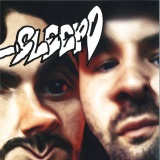
Naarm alchemists Sleep D's revelatory new synthetic 'Electronic Arts' is ready for circulation.
Having released 4 EPs of mind-altering club tackle since 2019's 'Rebel Force', the duo overcome second album syndrome, boiling down their chaos with a more developed sense of songwriting. Never banging one drum, 'Electronic Arts' mirrors the anything goes mania of their DJ sets, tactfully shifting through different sounds and styles. Tempos intensify and decelerate, at times pushing the threshold to 150 bpm from docile canine dreamscapes to full tilt Space Invaders in AR mind games.
Largely built on road tested material from their live performances, the album is a tangible Butter Sessions gathering, busting out the gate with Martian rave initiation Planet Waves, Outdoor System's polyrhythmic beatdown and the Orb-like hero dose affirmations of Sunrise In The Crater (I Exist). While 'Electronic Arts' is otherwise a self-dependent effort, Punch Drunk is brewed ever more potent by the hypnagogic vocals and lucid trumpet cycles of former futsal team member YL Hooi. Their unified energy incidentally manifests a profound matrix of ambient techno, motorik, Don Cherry and Everything But the Girl.
Also touching on apocalyptic doof and minimal, the album is not exclusively peak time with Maryos Syawish and Corey Kikos' specialty curveballs also playing their part. From Village To Empire finds the duo rooting down in Syawish's heritage with a tapestry of purposefully deployed Iraqi and Syrian ethnographic samples and field recordings, dubbed within range of Muslimgauze and On-U Sound. As minimal techno finale Textile trails off into footsteps wandering back to base camp with a satisfied exhale, one wonders where Sleep D's existential pathfinding could possibly take us next?


An extraordinary exploration of pure vocal power and sensual expression, The Zen Kiss is a highly personal vision of a woman working on the boundaries of convention.
credits
released May 3, 1994
Produced by Steve Coe. Mixed at Real World Studios, Wiltshire, England, November 1993. Mixing engineer Stuart Bruce. Assistant mixing engineer James Cadsky. Recorded at the Coachhouse, Clifton, Bristol. Recorded by Andy Allen and Rik Dowding in the two weeks around the Neptune/ Uranus conjuction of October 1993.
Mastered by Ian Cooper at Metropolis, London.
All drones played or sung by Steve Coe and Sheila Chandra.
All songs written and arranged by Steve Coe and Sheila Chandra except ‘En Mireal del Penal’ by Arroyo/Benito.
Art Direction by Michael Coulson, Real World. Designed by Tony Stiles, Real World. Design Consultation Assorted Images. Series identity Garry Mouat. Photography by Sheila Rock.
Interview by Martha Ladly and Tatiana Spencer.

We brake, always,
The rules of our ego,
Of the esteem for ourselves.
We leave the room,
to any kind of influence,
that pull us into eddies without exit.
We allow our minds,
Not to believe anymore who we are,
Not to recognise anymore themselves,
Until the point to not distinguish,
The live, from the die.
We are conscious of what we see,
What we listen, continuously;
Undaunted, we proceed,
In a promised decline.
In the outline of a dry future,
We recognise ourselves, enthused;
In a dark path,
We leave our existences end,
Sure, of tomorrow's absence.


AVKRVST wurde von Martin Utby und Simon Bergseth gegründet - zwei Musikern und Freunden, die zusammen aufwuchsen und einen Pakt schlossen, dass sie eine Band gründen würden, wenn sie älter sind. Jetzt, 22 Jahre später, ist ein Album fertig: 49 Minuten Musik, inspiriert von allem, was sie in ihrer Kindheit gehört haben - von Mew, Anekdoten und Porcupine Tree bis hin zu Opeth, Neal Morse und King Crimson. "The Approbation" ist ein Konzeptalbum über eine düstere Seele, die nur mit ihren Gedanken allein gelassen wird, isoliert in einer Hütte tief in den dunklen Wäldern, weit weg von der Zivilisation. Das Album führt den Hörer durch die Gedanken eines Mannes, der mit der Akzeptanz des Todes kämpft und in den Abgrund gezogen wird. Klanglich ist "The Approbation" ein wuchtig klingendes Stück Musik: Es bietet alles von üppigen, melancholischen Stimmungen bis hin zu schweren, aggressiven Atmosphären. Es versucht, das Gefühl eines kalten, düsteren Herbstes einzufangen - ein dunkler Himmel, gefüllt mit Sternen, die über dem Nebel schweben. Das gesamte Album wurde in einer Hütte in Alvdal (Norwegen) während eines regnerischen, kalten Herbstes und Winters geschrieben und aufgenommen. Während des gesamten Albums kann man Regengeräusche und das Hupen eines Zuges aus der Ferne hören, die tatsächlich nachts unter dem Sternenhimmel in der Hütte aufgenommen wurden. Das Artwork von "The Approbation" ist ein Werk von Mastermind Eliran Kantor, der Folgendes über das Cover zu sagen hat: "Ich wollte das Element der vergehenden Zeit während einer Zeit der Abgeschiedenheit und Selbstreflexion in einer Waldhütte finden und dachte an die Sterne über mir. Alles auf dem Boden schläft und schlummert, während direkt über uns das Universum auf niemanden wartet. Das passte gut zu vielen Texten, da in ihnen die Elemente des Himmels immer die Rolle spielen, die unaufhaltsam ist und ständig auf den Menschen da unten einwirkt, der nach oben starrt und sich von der Schwerkraft seiner Umgebung mitreißen lässt und wie sie ihn zum Nachdenken anregt."
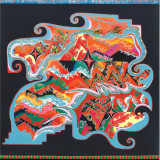
The next chapter of the Natural Information Society is here. Since Time Is Gravity, credited to Natural Information Society Community Ensemble with Ari Brown, presents a newly expanded manifestation of acclaimed composer & multi-instrumentalist Joshua Abrams nearly 15 year, 7 albums &-counting flagship ensemble. Joining the core NIS of Abrams (guimbri & bass), Lisa Alvarado (harmonium) Mikel Patrick Avery (drums) & Jason Stein (bass clarinet) are Hamid Drake (percussion), Josh Berman & Ben Lamar Gay (cornets), Nick Mazzarella & Mai Sugimoto (alto saxophones & flute), Kara Bershad (harp) & Chicago living legend of the tenor saxophone Ari Brown. Recorded live to tape at Electrical Audio & The Graham Foundation, cover painting Vibratory Cartography: Nepantla, by Lisa Alvarado. 2xLP on Eremite USA, 2xLP & CD on Aguirre/Eremite Europe. Out 14-04.
Since first developing Natural Information Society in 2010, Joshua Abrams has been gradually expanding the group’s conceptual underpinnings, its musical references & the sheer number of the group’s members. Its music is, in a sense, an expansive form of minimalism, based in repeated & overlaid rhythmic patterns, ostinatos & modality. Its roots, its scale & its meaning become clearer in time. If time is gravity, it also allows us to carry more. Having begun as fundamentally a rhythm section with Abrams’ guimbri at its core, the version here can stretch to a tentet, including six horns.
Abrams has been expanding his minimalism gradually, but he has long understood a key to minimalism’s potential: the breadth of its roots in the late 1950s & early 1960s, ranging from the dissatisfaction of young European-stream composers with the limitations of serialism to the simultaneous dissatisfaction of jazz musicians with the dense harmonic vocabulary of bop & hard bop. The former began exploring rhythmic complexity & narrow tonal palates in place of harmonic abstraction (Steve Reich’s Drumming, Philip Glass’ Music with Changing Parts; perhaps above all Terry Riley’s In C & his late ‘60s all-night organ & loop concerts); the later reduced dense chord changes to scales (signally with Miles Davis' Kind of Blue, but rapidly expanding with John Coltrane’s vast project). In the 1950s the LP record opened the world with documentation of Asian & African musics, key influences on both minimalists & jazz musicians. If John Coltrane’s soprano saxophone suggested the keening shehnai of Bismillah Khan, the instrument was rapidly taken up by two key minimalists, LaMonte Young & Riley, similarly appreciative of its flexible intonation, the same thing that kept it out of big bands.
If the guimbri, the North African hide-covered lute that Abrams plays with NIS, involves a rich tradition of hypnotic healing music associated with the Gnawa people, Abrams’ music also touches on other musics as well — other depths, memories & healings, different drones, rhythms & modes. As the group expands on Since Time Is Gravity, he has made certain jazz traditions in the same stream more explicit as well. If there is a mystical & elastic quality involved in the experience of time, both in direction & duration, you will catch it here. The parts for the choir of winds expand on the roles of Abrams’ guimbri, Mikel Patrick Avery & Hamid Drake’s percussion & Lisa Alvarado’s harmonium: at times, the winds are almost looping in the tentet version, each hitting a repeating note in turn, at once drone & distinct inflection on temporal sequence. The brilliance of the work resides in Abrams’ compositions, the NIS’ intuitive execution & in Ari Brown’s singular embodiment of the great tenor saxophone tradition, including the oracular genius of Eddie “Lockjaw” Davis, & Yusef Lateef. The three pieces by the expanded NIS featuring Brown —the opening “Moontide Chorus” & “Is” & the ultimate “Gravity”— have an immediate impact, & togther might be considered a kind of concerto for tenor saxophone. Here Brown presses almost indistinguishably from composed melody to improvised speech, getting so close to language that he might have a text. Everything here is a sign. Note the tap of the Rhythm Ace that links “Moontide Chorus” to “Is”, the attentive heart always present, even when signed by a machine. There’s a link here to the methodologies & meanings of dub music & the linear & vertical collage of beats, textures & tongues: treated with reverence, a sample of a beat-box can be as soulful, as hypnotic, as a mbira or a tamboura. If those pieces with Brown are heard as a suspended concerto, the three embrace & enfold the other works, like the sepals of a flower. That placement will also touch on the mysteries of our perception of time.
Particularly in “Is”, but elsewhere as well, a phenomenon of transcendence arises in which time appears to be tripartite, at once moving backwards & forwards & standing still. This is an act of technical brilliance certainly, but also an illumination of music’s ability to represent temporal consciousness through polymetrics. This particular listener has only heard it before in a few places, including the horn shouts & bowed basses of Coltrane’s Africa, in moments of Charles Mingus’ The Black Saint & the Sinner Lady, in certain pieces where tapes were literally running backwards, & earlier still in Dizzy Gillespie’s Cubana Be, Cubana Bop, in which the composer George Russell & conguero Chano Pozo found a music that spoke at once in the voices of Stravinsky’s Rite of Spring & the vestigial rites, rhythms & songs of the Yoruba language & Santeria religion of inland Cuba.
In Joshua Abrams’ compositions & the realization of them by the NIS, in the time of one’s close listening & memory thereof, distinctions between the “natural” & the “social”, the “quotidian” & the “transcendent” are erased, suspended or perhaps irrelevant. Consider two of the ensemble pieces, one named for nature, the other social science. In “Murmuration” the repeated wind figures of flute & alto saxophone combine with the interlocking patterns of harp, guimbri & frame drum (tar) to create a perfect moving stillness, not an imitation but a witness to the miracle of the starlings’ astonishing collective art, a surfeit of beauty that might be the ultimate defense tactic.
“Stigmergy” takes its name & concept from the Occupy movement’s Heather Marsh, who proposes a social system based on a cooperative rather than competitive models, one in which ideas are freely contributed & developed as ideas rather than an individual’s property. In its form, Abrams’ “Stigmergy” is the closes thing to traditional jazz, a series of accompanied solos by each of the wind players. However, the composed accompaniment is a radically collectivist notion: a repeated rhythmic figure, call it ostinato or riff, in which the different winds each play only a note or two of the figure, a concept both more collectivist & individualistic in its conception than any typical unison figure. It suggests another of the underlying recognitions that propel the Natural Information Society, the group as social organism, the teleology of hypnotic anarchy, all parts in place, functioning systematically, evolving & expressing itself, its nature & society, as a transformative organism.
George Lewis has described music as “a space for reflection on the human condition”. This suggests that, rather than a “distraction”, at least some music might serve as a distraction from distraction. It’s a focus, a clarity, a awareness, an external invitation to interiority, as if music itself is a model for form & contemplation, an organism contemplating for us or as us. If that is a possibility, & I am sure I have heard such musics, than this music is among them. How many of our rhythms, melodies & harmonies (cultural, historical, biological, psychic) might such music carry, translate & transform in the particulate ecstasy of our own murmuration? (Stuart Broomer, April 2022)


Pacific Northwestern doom metal monolith BELL WITCH will see the
release of their new album "Future's Shadow Part 1: The Clandestine
Gate" on 2LP/2CD, June 9th.For their new album, bassist/vocalist Dylan
Desmond and drummer/vocalist Jesse Shreibman exploded Bell Witch's
bounds
Like 2017's lauded "Mirror Reaper", "The Clandestine Gate" is a single 83-minute
track -- a composition that pulses and breathes on a filmic timeframe. It
constitutes the first chapter in a planned triptych of longform albums, collectively
called "Future's Shadow." While traces of organ and synthesizer hovered over
"Mirror Reaper" and Bell Witch's 2020 collaboration with Aerial Ruin, "Stygian
Bough Volume 1", "The Clandestine Gate" drew those instruments closer to the
center of its compositions.The band reunited with their longtime producer Billy
Anderson as they began negotiating these new compositional weights. On "The
Clandestine Gate", Bell Witch's twinned voices build off of the chantlike textures
of previous records while steering toward more developed melodic lines,
structured harmonies, and rhythmic death metal growls.
The immense gravity of a work like "The Clandestine Gate", which features
exclusive stunning cover art by Jordi Diaz Alama, allows ideas to simmer in a way
that feels profoundly and somatically intuitive -- not just a philosophical exercise,
but an embodied truth. By slowing down both their creative process and the
tempo of the music itself, Bell Witch digs even deeper into their long standing
focus: the way life spills on inside its minuscule container, both eternal and
fleeting, a chord that echoes without resolution.

Nicholas Allbrook is a Western Australian native and a highly-accomplished Australian songwriter, and multi-instrumentalist. Since the beginning of his artistic career in 2005, Allbrook has brought community and collaboration to the forefront of his artistic method. Whether it was in the poignant lyricism of his solo musical endeavors (Ganough, Wallis and Fatuna/Wabi-Sabi) or in the production style of his band POND's latest album '9', Allbrook shows a deep understanding of the human experience and the importance of art in modern society. He has collaborated with Australian and international musicians alike, from King Krule to Cat Le Bon, Holy Fuck and Cuco. Emotional, geological, psycho-geographical: this is the terrain of Manganese, Allbrook's fourth album away from Pond life. A psyche-pop wonderland, Allbrook's new solo album is the sound of a musician with a symphony in his back pocket, the Eighties history of Oz-rock in his rearview mirror and modern Australia in his sights.

In Hollis Debütalbum Der erste gute Tag kann sich jeder wiederfinden, der auch schon mal einen schlechten Tag hatte Der erste gute Tag ist ein Album übers Älterwerden und übers Dazulernen, über Fehler und was man aus diesen mitnehmen kann.
So ist es dann auch eher auf der melancholischen Seite der Gemütsskala angesiedelt, wenn auch beizeiten tanzbar-lebhafter Indie Rock und melodisch-folkige Arrangements darüber hinwegtäuschen mögen. Der erste gute Tag ist ein Album in tagebuchartigen Momentaufnahmen, aber ohne aufdringliche Weisheiten.
