Hailing from one of the world’s most famous harbours, Rotterdam, a true multicultural melting-pot, the music by 6-piece band called the Greyheads mirrors the daily life of this busy city. They approach jazz from a hip-hop point of view, or hip-hop from a jazz point of view, always carefully adding a perfect dose of other influences (all the members are heavily influenced by artists like Miles Davis, J Dilla, Herbie Hancock and Robert Glasper) with an exciting, groovy and vibrant tone.
After having self-released their debut EP "GREYHEADS × KYTOPIA" in 2017, they recently finished recording "HOMES", their first full length album.
Led by drummer Nello Biasini, this truly international band of like minded musicians was formed in 2016 and have since been busy creating their own, fresh and unique sound. Whether an intimate jazz club or the main stage of a big festival, they are all about creating a feel-good groovy vibe using live rlectronics, drum 'n bass, jazz, hip hop and pop fused together.
GreyHeads performed at NN North Sea Jazz 2019 and several other festivals such as So What's Next Festival, Jazz Delft Festival, Cutting Edge, ProJazz, Big Rivers Festival, as well as opening for the bands Moonchild and Knower.
'Homes' is a journey through space and time, travelling in opposite but jointed paths that lead to the places we call home. The concept of the record is to carry the listener to experience what every place and time can in any way, represent home, characterized by different atmospheres, sounds, images and sensations.
нет на складе
Последняя поставка 6 лет назад доступно для дозаказа без гарантии
Thousand Knives Of Ryuichi Sakamoto's Landmark First Solo Album From 1978 Issued On The Better Days Label And Featuring The Synth Classics "plastic Bamboo," "end Of Asia" & "thousand Knives" Is Reissued Outside Of Japan For The First Time In Decades.
Wewantsounds is proud to announce the release of Ryuichi Sakamoto's first solo album originally released in 1978 on the soughtafter Better Days label. Sakamoto was a member of Yellow Magic Orchestra at the time but the group hadn't released their first album yet. Featuring Sakamoto on a wide range of synthesizers and keyboards programmed by Hideki Matsutake, and accompanied by a few musicians including Haruomi Hosono and Pecker, "Thousand Knives" was a blueprint for the YMO sound and includes cult classics that were to become live favourites. Save for a small-scale release in 1982, this is the first time the album is being released on vinyl outside of Japan. Remastered from the original tapes by renowned producer and engineer Seigen Ono, the LP edition comes with original artwork including OBI and 4p insert with new introduction by Paul Bowler. 1978 was a key year for Japanese music. Haruomi Hosono, one of the country's most innovative musicians had just formed Yellow Magic Orchestra pursuing the sonic experimentation he had started with his solo album "Paraiso." The album, credited to "Harry Hosono and The Yellow Magic Band," had been recorded between December 77 and January 78 and featured both Ryuichi Sakamoto and Yukihiro Takahashi. Hosono quickly invited both musicians to form YMO but before the group could release their first album, Sakamoto entered the Nippon Columbia studios in April 1978 with a plan. Sakamoto had become an in-demand session musician after studying composition at the Tokyo University of Art and had played in many key albums of the time: Taeko Ohnuki's "Sunshower" and Tatsuro Yamashita "Spacy" to name just two famous albums. This led to an invitation by Hosono to feature on "Paraiso". A penchant for avant-garde and improvisation had gotten Sakamoto interested in Electronic Music early on and with “Thousand Knives”, he decided to get Hideki Matsutake on board as he had mastered the art of synth programming following a stint with Electronic Music pioneer Isao Tomita. “Thousand Knives” took several months to record as Sakamoto would be busy during the day with his session work and would only record at night. Named after Belgian-born poet Henri Michaux’s description of a mescaline experience, the album is a reflection on how synthesizer technology might come to change the face of music. The first side conceived as a long suite opens with the title track and a recitation of the Mao Zedong poem "Jinggang Mountain" filtered through a vocoder, before morphing into a mid-tempo synthpop instrumental. It is followed by "Island Of Woods", a ten minute track buzzing with insect-like synth sounds reminiscent of the tropical exotica of "Femme Fatale" on “Paraiso” (also featuring Sakamoto). Side one ends with "Grasshoppers," a beautiful acoustic piano melody underlined by a subtle synthesizer soundscape. Side two opens with "Das Neue Japanische Elektronische Volkslied," acknowledging the influence of the German sound spearheaded by Kraftwerk. The track features a mid-tempo metronomic beat skilfully intertwined with a Japanese folk sounding melody. The album ends with two catchy uptempo synthpop tunes in the form of "Plastic Bamboo" and "The End Of Asia," which both became staples of YMO’s and Sakamoto's live shows. Although "Thousand Knives" sold modestly upon release, it was hugely influential in setting the agenda for what was to follow. YMO's sound included various influences from its three members but there is no denying “Thousand Knives” paved the way for the group's Computer Music sound. Thousand Knives remains a fascinating insight into the making of a music revolution.
нет на складе
Последняя поставка 4 года назад доступно для дозаказа без гарантии
Funky soul-jazz organist Caesar Frazier crafted superior Hammond funk. 75, his second LP, is a rare gem. It’s comfortably his greatest artistic statement.
The follow-up to Hail Ceasar!, it’s a taut, grooving set that expands his sound and, put simply, it’s got better songs. The key elements of his debut album are all there – production from maestro Bob Porter, accompaniment from hip players (Bernard “Pretty” Purdie, Cornell Dupree, John Tropea) and arrangement from Horace Ott - but the overall sound is elevated. The tightly jamming, expressive jazz-funk makes for a richer, fuller, more satisfying experience.
75 is a mixture of hard-driving originals, deeply beautiful slower numbers to vary the tempo and a couple of classy covers. The crazy bombastic “Mighty Mouse” - a riot of horns, organ and in the pocket drums - became an acid jazz classic at Dingwalls and it’s easy to see (hear?) how. A blissed out, lushly instrumental take on Seals and Crofts’s “Summer Breeze” follows, perfect for those sunshine sets.
Side A closes with the heavenly “Sweet Children”. A loping, funky jazz masterpiece famously sampled by Kanye West for Common’s “Real People” from Be. It opens beautifully, with soaring sax and a funky horn section combining with weightless keyboard tones atop snapping drums. Unsurprisingly, the excellence endures right through to the end.
The B side opens with perhaps the album’s most famous track. "Funk It Down” contains the familiar “I can feel the funk” vocal refrain throughout. But it’s the gorgeous, insouciant bridge that you should all know and love, having been used as the hook for Gang Starr’s “Ex-Girl To Next Girl”. A great cover of Stevie Wonder's “Living for the City” comes next, with an unforgettable bass-line which anchors the entire heavy rhythm section workout. Dizzying organ, triumphant horns and sun-dappled guitar grooves combine to create “Walking On The Side”, rounding out a pretty smoking set.
This is one of those rare 70s funk-soul-jazz LPs on which a bad track cannot be found. It’s all essential. So of course finding original copies on vinyl at affordable prices has been tough for years.
Mastered brilliantly by Simon Francis, cut by Pete Norman and with painstakingly reproduced artwork by the Be With team, this fresh Be With reissue ensures this legendary LP now sounds, looks and feels as sensational as it should.
нет на складе
Последняя поставка 6 лет назад доступно для дозаказа без гарантии
One of the greatest enigmas of the music scene in mid to late 1970s Harare was The New Tutenkhamen, a band which played an eclectic brand of Zimbabwean township music combining
traditional rhythms and western influences. The band included some luminaries of Zimbabwean township music. Elisha Josamu was an alumnus of the fabulously-named Hallelujah Chicken Run Band (alongside Thomas Mapfumo), and Green Jangano’s long-running Harare Mambos, and would later form Two Plus Two with bassist Christopher “Chex” Tavengwa. Jethro Shasha played the drums, and would arguably become the New Tutenkhamen’s most famous export, making continental waves working with likes of Salif Keita. Paul Sekerani played the rhythm guitar, with Amos Chatyoka on the organ, while the enigmatic Maggie Mbuli provided vocals and F. Manda played the sax. The New Tutenkhamen recorded I Wish You Were Mine at Teal Records, produced by Crispen Matema, a talented jazz drummer in his own right who had played drums on the all-time classic Skokiaan, and had backed Louis Armstrong on his 1960 Rhodesia visit. Combining the
heavyweight producing talents of Matema and the writing chops of Josamu, The New Tutenkhamen band created an album howcasing various musical styles popular at the time. From the afro-jazz jam session aesthetics of “Tutenkhamen Theme”, “Big Brother alcom” and “Forever Together”, to the almost Van Morrison-sounding “Sunday Morning”; from the upbeat rock ballad “True Love”, to the funk-infused dance song “Togetherness”; from the bouncy jazz
exhortations to work hard in “Ane Nungo”, to the brassy, raunchy foot-stomper “Me & Dolly”. The title track “I Wish You Were Mine” is a ska-infused ballad that wouldn’t be out of place in post-war
Birmingham, while the star of the show is “Joburg Bound”, itself a fast-paced rock piece with Motown undertones and funky guitar lines. As a collective effort, I Wish You Were Mine provides a fascinating insight into a fraught time in Zimbabwe’s history, and the bands plying their trade through the turmoil, making music for young people, by young people.
нет на складе
Последняя поставка 6 лет назад доступно для дозаказа без гарантии
Influential Spanish artist Coyu is stepping out on his own Suara label with a long overdue debut album entitled ‘You Don’t Know’ that is going to shatter all conceptions about him. Due for release this September 23rd, the 16 track affair showcases his broad range and takes in collaborators like Moby, Lazarusman, The Horrorist, Thomas Gandey and many more.
Coyu quickly rose through the ranks to become one of the most prominent names in underground dance music. The Spanish man famous for his love of cats has established his Suara label as a go-to outlet for the most essential house and tech tracks, as well as releasing his own expressive grooves on Cocoon Recordings, Diynamic, Bedrock Records, Turbo Recordings and MORE. Now he really stretches his legs across a fantastic full length album that goes way beyond the dance floor and shows many new sides to his sound. The artist has been working on it since 2012 and aims to show people that whatever they think about him is wrong.
Says the artist himself, “the album is named ‘You Don't Know’ because many people have a preconceived idea of who I am. Until now, maybe I wasn't smart enough to show them my roots, what I love and what I can offer to the music. I'm not just a DJ or a producer who can play or make grooves – I love many different genres and many different kinds of music. With this album I want to change that preconception.”
The album kicks off with a dramatic spoken word from legendary vocalist Lazarusman before exploring low slung and sleazy grooves on ‘The Three Chimney’, floaty light melodic and dreamy house on ‘Out of The Pain’ and more club focussed but just as dreamy fair on ‘We All Try’ with Mike Leary.
Proving he can do everything from poolside gems to peak time techno, ‘Fear Is Gunna Be A Player In Your Life’ is one to get you in a trance with its sonar like synths and rolling deep space drums. Thomas Gandey aka Cagedbaby then steps up to guest on ‘1+1’ which is a hands in the air piano anthem to pump the party, and ‘Wanna Do Right, Wanna Do Wrong’ is a techno cut with brilliantly energetic drum programming and a big, perfectly placed vocal sample.
Switching up the vibe is ‘I May Be Dead, But One Day The World Will Be Beautiful Again’ with none other than dance legend Moby. It is a heavenly track with break beats, angelic melodies and a celestial feel that leaves you refreshed. The second half touches on raved-up drum & bass, gurgling minimal techno and harder techno with mind melting acid synths. The Horrorist contributes to the banging ‘My First Pill’, while the techno journey continues with ‘Unite’ featuring Gabriella Vergilov before the album finishes on the fluttering ambient track ‘Insania’, with mad church bells and manic percussion all bringing things to a close in style.
This is a broad, adventurous album that covers plenty of music ground and takes you on a true electronic trip from one of dance music’s most accomplished names.
нет на складе
Последняя поставка 6 лет назад доступно для дозаказа без гарантии
Mais Alors !!?... c’est à l’envers is the first release of new French Label ICI BIENTÔT (Here Soon ...), launched by Paris Fleamarket’s Record Shop, Geminicricket. On the Menu... Suspended Time,
Unsung Heroes, Hidden Records and Next Door Marvels.
In 1983, NEF released their first and only album, Mais Alors !!?... c’est à l’envers. At that point, the band already had a long history, interwoven with that of various musical trends and alternative
movements from the late sixties to the early eighties. That’s certainly what makes this record so special and able to conciliate such different worlds as Electronic Prog, Film Score, New Wave …
The band’s destiny was most certainly tied to their native region, the South of France, an idyllic environment that attracted a number of musicians during the 1970s, allowing the group to attend many
concerts or share the bill with several groups that have gone on to become well known: Can, Ash Ra Tempel, Magma, Catherine Ribeiro, Zao, Chêne Noir, Art Zoyd …
Founded in 1975 by Richard Lorenzi, NEF started as a kind of Free Rock band with multiple influences, going from Prog to Musique Concrete, in which any method of making sound, any way of
bringing out sounds was good … 2 musicians and a photographer, full member of the band who was projecting slides over the music and influenced their dreamlike universe. In 1978, Vincent Tronc came on board with his keyboards and synths. While the group had been influenced by electroacoustic techniques until then, Vincent broadened NEF’s horizons, bringing in a host of new influences: Ash Ra Tempel, Kraftwerk, Klaus Schulze … the beginnings of electronic music. When the album is recorded in 1983, new directions were taken and changed NEF’s usual sound.
First, the idea of playing the accordion, clearly not a common thing and a new Drum Machine, the Roland CJ-5000. Pressed the day a figure of French Chanson died, NEF’s pressing is botched up, a
good part of the records were unusable since the records came out totally warped. Then, at the end of the eighties the small stock of remaining records is lost in the sadly famous flood of Nîmes. 2000
records had been pressed, but very few survived! All the more reason to reissue Mais Alors !!?... c’est à l’envers, an unsung record, free and multifaceted, a quirky and daring musical ovni, transcending eras and genres, between synthetic
Krautrock and Film Score, reminiscent of NEU! (with a red nose), François de Roubaix and Pascal Comelade.
нет на складе
Последняя поставка 6 лет назад доступно для дозаказа без гарантии
Matasuna Records is thrilled to reissue another musical jewel from Peru on vinyl for the first time. The songs were recorded by the band Bossa 70 and released on a 7inch EP and the self-titled album in 1970. Both are much sought-after collector's items and impossible to find. The songs were transferred from the original master tapes and got a new mastering.
Nilo Espinoza Vascones or better known under his artist name Nilo Espinosa is without doubt a Peruvian saxophone and flute legend. After a classical musical education he entered the music scene in the early 1960s. In 1966 he founded the band Los Hilton's with some of the best Peruvian musicians including the gifted piano player Otto de Rojas. In 1967 they recorded the first and only LP of the group, which was released in a small edition in Peru.
Their concerts were more and more influenced by Jazz and Bossa Nova, so in 1968 they changed the band's name to Bossa 70. In the record label's office Nilo met the Afro-Peruvian Carmen Rosa Basurco, who also loved Bossa Nova and could sing in Portuguese and English. From then on she was the main singer of the band.
Bossa 70 recorded four songs for a 7-inch EP in an edition of only 100 copies, which was given away for promotional purposes at concerts and to friends & family. In 1970 they recorded their self-titled LP which reflected a mixture of Bossa Nova, Latin Jazz and Funk. The label pressed only 300 copies, which were sold out very quickly. This LP was the band's only album and is a rare piece of Peruvian music history.
Si Voce Pensa on the A-side is a great cover version of the same named song by famous Brazilian musician Roberto Carlos from 1968. Bossa 70 adapted the song for the dancefloor, which is driven by an uplifting rhythm and the expressive voice of the singer. Of course, the great interplay of the other musicians must not go unmentioned. A fantastic track that will heat up everywhere!
Birimbao on the flipside is another fantastic Brazilian cover version. The song was written in the 1960s by Baden Powell, one of the most important Brazilian guitarists and one of the pioneers of Bossa Nova. Bossa 70 set their own stamp with a new instrumentation with brass, wah wah guitars, piano, flute parts and trumpet solos. The percussion section is also a brilliant backup for this one. Another winner!
нет на складе
Последняя поставка 6 лет назад доступно для дозаказа без гарантии
It seems KPM have long been fans of Smith and Mudd and, after being introduced to each other by mutual friend Andy Allday, the peerless Balearic maestros were invited to contribute to the library label’s digital-only “Album Shorts” project. The results are predictably wonderful.
With past projects under our belt working with everyone involved so far it made perfect sense for Be With to take on the vinyl release of this instant library classic. But why is it called “Tea With Holger”?
“Holger” is of course Holger Czukay and the whole LP is dedicated to Smith and Mudd’s time spent with him and Ursa Major at Can’s famous Inner Space Studio in Weilerswist, near Cologne.
When not recording it seems they spent a great deal of time sat around being entertained by Holger’s stories and drinking many cups of different sorts of tea from all over the world. These moments provide some their fondest memories of their visits:
“Looking back, it was pretty incredible that we spent part of our lives with Holger in one of the most magical places we’ve ever known, Inner Space Studio. We have our memories and, of course, the Bison album we made with him. But to honour the time we spent with him, we wanted to dedicate an album to him called ‘Tea With Holger’. The names of the tracks are about that time.”
The album was recorded over several years in London, Margate and Gorthleck, a small hamlet in the Scottish Highlands. Mike Piggott, who played with Bert Jansch, handled the strings and played violin whilst Sam Creer lent his virtuoso cello work to the proceedings. The sessions employed a key recording technique from their time with Holger: hit record and play. They wanted to capture magical improvisational moments live and not do the work later on in editing.
In their own words (and in classic library record sleeve style) these tracks are collectively described as “Balearic themes including breezy soul, sun-dappled melodies, warm pianos and sweeping strings”. You want to hear this, right?
The album is vintage Smith and Mudd. The gentle piano ushering in opening track “The Gardener” is soon joined by low, bubbling drums. When the time is just right, lush guitars glisten above a Welsh language vocal that floats like silk. Easy as a sea breeze. “Innerspace” is of course a nod to Can’s aforementioned studio. Dark, heavy piano meets rolling drums before warm chords and luscious strings take over, gliding over moody grooves to drive you home. Closing out side A, “Weilerswist” delivers more beautifully rolling piano and guitars over thumping cellos and building drums.
Side B opens with the full, string-enhanced version of “Away From Me”. This is Smith and Mudd’s prefered version and it’s only available here on this vinyl issue. For us it’s the standout on this all-highlight album. Tribal tones, piano and cello set a melodic staccato for violin to soar over while rolling piano lines and gospel organ chords descend into a drum drop that leads to a glorious vocal lead finale.
Distant synths introduce sun-drenched guitars and uplifting strings in “Kölner Street”, before a spacey Moog solo leads to a spellbinding, sci-fi drop. The sunshine returns before the track ends. The album closes with “Tea With Holger”. Airy vocal swells are punctuated by plucked cellos and picked guitars, all wonderfully warmed by a soulful piano.
Cut by Pete Norman and pressed in the Netherlands by Record Industry, “Tea With Holger” comes in a classic KPM green sleeve complete with track descriptions from Smith and Mudd themselves. The finishing visual touches come courtesy of Richard Robinson. We’ve given this record the same care and attention as we give to each our KPM re-issues, and it’s just as essential.
нет на складе
Последняя поставка 6 лет назад доступно для дозаказа без гарантии
Philippe Cam is the Thomas Pynchon of the electronic music world. Little is known about him and only a couple of pictures have been put online since he emerged on this planet to write his first and only album18 years ago. We know he worked as a sailor and that’s it. If you dig deeper you might find out that he worked as a DJ in the beginning of the 90ies in Brussels and began to study electronic music there and also began to write music for theaters and ballets.
The American distributor Forced Exposure once wrote that about him: „Philipe Cam is a star in his own field. He is among the few people who have succeeded to write hypnotic dance music without a conventional beat still conveying a thrilling, dramatic feel. Cam has developed an accurate, intense and complex formula of modulation-techno. Starting with music similar to Pan Sonic in 1996, his music turned towards a more elegant form of minimal music. Abstract soundtracks lead to an organic form of music, which was equally influenced by modern techno as Wolfgang Voigt's Studio 1/Gas or Basic Channel/Maurizio. Cam's music corresponds heavily to the Cologne scene, where his music is appreciated and played throughout the clubs by the likes of Michael Mayer, Tobias Thomas and various other DJs as well as experimental djs from the A-musik corner.“
So what’s new with his music? Basically the art of filtering is still his passion. Maybe he can be less associated with techno and the themes of his new tracks emerge in a more distinctive pattern? Well that’s hard to say, we would comment the energy of his early techno days in Brussels have returned here in a fierce way with some oft he tracks. The rhythmic movements are classy and stick with you. Whereas other tracks look for a distinctive relaxation of some kind.
We are releasing the album as a double clear vinyl with cover art by Yvette Klein who also designed the cover for his Philippe Cam’s album 18 years ago. Graphics for "Rotterdam" come from Cologne designer Daniela Thiel. We also would like to thank the cultural department of Cologne for supporting us to finance the album and to see the artistic value in this piece of minimalism.
The album kicks off with the mellow and soothing "Cocoa Beach". A Gentle beat that moves like bodies swaying in the hot summer sun. The clock moves a step forward and then a step backward as evolution takes a rest.
"Manga" feels like an acceleration to the moon, the contemplative moments come in spurts and hide in the intervals of the chords which are on the loose. Philippe Cam is the most energetic person in the world when it comes to core activity, this is head banging stuff for the ambient lounge.
"Short Summer" is a heavy and violent recognition. As intensive as it is it knows when to stop and disappear. In the ear and brain of the listeners it leaves an indisputable echo which lingers on for minutes. We suggest not to make a pause but jump directly into "Vermillions Sands".
What can be said about into "Vermillions Sands"? Be prepared some Terry Riley might lure around the corner to offer you some oranges on a silver plate, but don’t eat them. This is luring and beautiful at the same time. Maybe the best ambient track ever written and yet who can ever venture to say that without making a fool of himself. "Vermillions Sands" comes in waves and they could be longer we think.
"Rotterdam" the home of Philippe Cam for a long time but not anymore. He moved away. So that changes the perspective. But when was the track written? "Rotterdam" seems mechanical and rusty and spooky and divided. This arrangement is very different to all the other tracks so far and is almost dub in style but way more fractured. A steady stop and go emerges. But the longer it runs the better it gets. At minute 6 the brain resets itself and tries to grasp what has happened so far, reconstruction as a result of its own phantasmic imagination and hardly true at all, wonderful. Applause included!
Here comes "Bis", a short episode of a track and before we can comment on it, it is already over.
"The Game" is a mule of a track. It has a quiet stubborn sequence that bites and kicks you in the back without any change in near sight. We can hear a voice whispering, which sounds like a miniature vocoder featuring the voice of a child calling out - never stopping. This is treadmill to some extend but starts to breathe towards the middle of the track and slowly changes perspective. In fact there are some changes taking place here which go beyond a sound design that works heavily on the stereo image. Stick with it and the experience will be a great one.
"Ultimate Fly For Halloway" somehow orchestrates how you might feel after you climbed a 8000 meter high mountain and reached the top. A rejoicing off a special kind. Lava for the ears. No cheerleader murder plot sorry.
"Last Track" is a perfect example of a true minimalistic pice of music that manages to make contact with other genres and does this with elegance, determination and a lot of soul.
key selling points: The key selling point is the fact that Philippe Cam once was referred to as one of the main protagonists of the minimal music scene along with Wolfgang Voigt's Studio 1/Gas and Basic Channel/Maurizio. A true artist with a vision which is very rare.
Philippe Cam has picked up the sound he was famous for but has developed it further without selling out to any genre and expectation that rules our daily business.
Exactly this is the strength of the album to create a vivid world of impressions by using instruments in a whole different way than all software developers would suggest.
"Rotterdam" is a piece of art that can set off a firework when you listen to it and it owes nothing to anyone.
нет на складе
Последняя поставка 7 лет назад доступно для дозаказа без гарантии
“Following on from Homenagem, Lugar Alto’s first critically acclaimed project, the São Paulo label's new endeavour is the reissue of another neglected masterpiece. This time, it’s “Poema da Gota Serena” turn by Zé Eduardo Nazário from 1982. This unique work gathers elements of free jazz, Brazilian Northeastern rhythms, Asian percussive instruments and electronics.
Zé Eduardo is a virtuoso drummer and percussionist with a prolific career as a musician and teacher. He was introduced to music in his youth and started playing professionally at the age of thirteen. In the late 60’s he was a regular at the famous Totem night club in São Paulo, where he performed alongside the pianist Tenório Jr. and other exceptional instrumentalists. It was there that he met Guilherme Franco, and together they formed the Grupo Experimental de Percussão. This period defined Nazário’s interest in different sonorities involving percussion, and he broke away from the more traditional genres, such as bossa nova and jazz. Over time, this distinctiveness in sound and playing allowed him to create his own path which culminated in an extensive number of remarkable works, including the colorful and psychedelic “M andala”, which examines Indian and hippie themes. He also played with Hermeto Pascoal’s group and joined him and Jaques Morelenbaum for the recording of the cult classic “Imyra, Tayra, Ypy” by Taiguara. For Egberto Gismonti’s “Nó Caipira”, Nazário performed with the khene, a mouth organ from Laos, a present from Gismonti himself.
But it is Nazário’s work with the 1976 collective Grupo Um which is his most well-known, who, during their 6-year legacy recorded, amongst movie and ballet soundtracks, 3 albums: “Marcha Sobre a Cidade”, “Reflexões Sobre a Crise do Desejo” and “Flor de Plástico Incinerada”. The combo is considered one of the most innovative formations of its time, unusually combining electro-acoustic elements, jazz and Brazilian traditional music.
Poema da Gota Serena was Zé Eduardo's first solo project and it was financed by the legendary Lira Instrumental, a collaboration between the ground-breaking venue, label and publisher for the São Paulo avant-garde, Lira Paulistana, along with the always interesting Continental Records, home to such luminaries as Tom Zé. The album was offered as a package deal simultaneously with the production of “Flor de Plástico Incinerada”, ensuring 2 studio sessions at JV studios in October 1982.
Each side of the album explores different duets which, with its suite formated tracks, give the album the feel of a cohesive whole. The first half of the A side, “Energia dos Três Mundos”, is shared with the improvised saxophone of Cacau. Nazário delves into free jazz rhythms and plays his drums with a rolling and tumbling swing, using the kit in full, demonstrating the power of Brazilian jazz fusion. The second half of the suite takes us into a more tranquil mode. “Só Prá Ouvir”, demonstrates Zé’s mastery on the glockenspiel, and Indian percussion instruments, such as the tabla and mridangam. Cacau, on his side, switches his saxophone for more delicate dancing flute driven passages, equal parts northeastern rhythms and deep Amazonian indigenous influences. The B side, with “Prá Pensar / Prá Sentir e Prá Contar”, contrasts heavily with the A side’s more organic and natural feel. In Prá Pensar Lelo Nazários’s synth clusters and electronic blasts strangely interact with the exploring, wandering percussion. This track leads into the sublime “Prá Sentir e Prá Contar” where South Indian inspired vocals, performed by Zé Eduardo, accompany the graceful synth chords and fluttering percussion. The result is a hypnotic, otherworldly feel to the music that is infectious and takes the listener on an extraordinary journey.
With Poema da Gota Serena, it is possible to hear music that extrapolates the lines of the avant-garde and popular music. It is an album the demonstrates that Brazilian jazz fusion can be both spiritual and challenging at the same time.
All the tracks were expertly remastered by Lelo Nazário, directly from the original tapes, maintaining the high quality of production that Lugar Alto are becoming renowned for. All the artwork was reinterpreted by the São Paulo design studio Sometimes Always, including an exclusive insert and unpublished images.
It seems that Lugar Alto have managed to excavate yet another gem from the seemingly bottomless Brazilian mines. Long may they continue to do what they do so well.”
нет на складе
Последняя поставка 7 лет назад доступно для дозаказа без гарантии
Available on vinyl for the first time in 40 years, Outernational Sounds proudly presents a cornerstone document from the Los Angeles jazz underground, Flight 17 – the first appearance on record of the legendary Pan-Afrikan Peoples Arkestra, led by their founder and mastermind, Horace Tapscott.
"The Arkestra would allow the creativity in the community to come together, would allow people to recognize each other as one people and ask, “Now what can we do to make this community better? What can we do for this community together?”...That’s how the Pan-Afrikan Peoples Arkestra – the Ark – began, with the knowledge that we wanted to preserve the black arts in the community."
Horace Tapscott
Horace Tapscott’s Pan-Afrikan Peoples Arkestra (P.A.P.A.) was one of the most transformative, forward-thinking and straight-up heavy big bands to have played jazz in the 1960s and 1970s. Countless musicians passed through its ranks, and in Tapscott it was led by a musical visionary who should be ranked with the very greatest names in the music. If P.A.P.A. doesn’t have the interstellar rep of that other famous Arkestra, and if the name Tapscott doesn’t ring bells like Monk or Tyner, there’s a reason why: in an industry dominated by record labels, a band that doesn’t record doesn’t count. And the Pan-Afrikan Peoples Arkestra didn’t record for nearly twenty years. But recording success was never their concern – they weren’t about that.
First formed as the Underground Musicians Association in the early 1960s, Tapscott always wanted his group to be a community project. From their base in Watts, UGMA got down at the grassroots. They played for the people, organising fundraisers in parks and coffee houses, hosting teach-ins and workshops for young and old, and mixing it with radical theatre groups, firebrand poets, political radicals, Black separatists, community groups and churches. They lived communally, supporting each other and their people, and built an ark for the Black arts in the heart of the city. The group was renamed the Pan-Afrikan Peoples Arkestra in 1971, and soon after they established a monthly residency at the Immanuel United Church of Christ which ran for over a decade, while still playing all over LA and beyond. But through all this, they never released a note of music.
It was the intervention of Tom Albach, a fan of Tapscott and the group, that finally got them on wax. Determined that their work should be documented, Albach founded Nimbus Records specifically to release the music of Tapscott, the Arkestra, and the individuals that comprised it. The first recording sessions in early 1978 yielded enough material for two albums, and the first release was Flight 17. From the surging avant-gardism of Herbie Baker’s title track to the laid- back summertime groove of Kamonta Lawrence Polk’s ‘Maui’, or Roberto Miranda’s uptempo Latin jam ‘Horacio’, Flight 17 showcased the radical voices of the Arkestra’s members. Led out by Tapscott’s hard-swinging piano, this is the first flight on wax of the West Coasts’ foundational community big band – energised, hip and together. Open up the gates and prepare for departure!
This edition of Flight 17 contains two tracks previously only available on the 1997 CD edition: ‘Coltrane Medley’ and ‘Village Dance’, recorded live at the Immanuel United Church of Christ. It is released as a limited vinyl-only edition on a 180g pressing by Pallas. Fully licensed from Nimbus West founder Tom Albach.
нет на складе
Последняя поставка 7 лет назад доступно для дозаказа без гарантии
When the Tramp Records crew read the internet-sweeping spam/story of Nigerian Astronaut and Air Force pilot Abacha Tunde, they knew that they had to spring into action to help this unfortunate fella out. Dr. Bakare Tunde, the cousin of Abacha Tunde explained the situation as follows: "My cousin was the first African in space when he made a secret flight to the Skylab Space Station in 1979, shortly before it crashed to Earth. 19 years later he was on his second spaceflight, this time to a secret Moon Base located on the far side of the Moon. In 1999 his crew members returned to earth, but his place was taken up by return cargo. There have been occasional supply flights to keep him going since that time. Although he is in good humor, he wants to come home, now, after 20 years in space."
After this hilarious story the idea of a compilation album was born - and "Trip To The Moon" is the result. The goal to raise three million dollars to cover the cost of Abacha Tunde's return flight may never be achieved. Nevertheless, a 41 year experience in the music business is the basis for a fantabulous track listing of 11 amazing and highly underrated Rare Grooves about the Moon!
The Swinging Astronauts open the set, followed by La La Wilson's equally great rhythm & blues rocker "The Moon Man Is Back". With The Moon-Dawgs, this album makes a slight turn into the 1960s garage rock era while Hase Cäsar (backed by none other than the famous Ingfried Hoffmann and his orchestra!) contributes one of two songs of german origin. Now it's time for some funk: Rev. Jamel & Bob Johnson's "Walking On The Moon (Men Are Starving)" criticizes the US government for spending millions of dollars for their space program instead of supporting their own people. "Mars in 75" is deepfunk at its best although some may lament the lack of production. Sidney Ownen's breakbeat-laden "Sputnik" is sought after in collector's circles and needs no justification as to why it is included on this album. Ernest & D.L. Rocco's "Moon Child" is our personal favourite, closely followed by the hypnotic groove of "Mondgesicht" by legendary german saxophonist Ambros Seelos. Scott Cunningham's name should ring a bell as he was featured on several Tramp compilations over the past few years. Finally, the album closes with a psychedelic folk track titled "Voyage To The Moon".
Tramp Records is absolutely convinced that this album will surely be the best way to shorten the wait for Abacha until a rescue space mission finally brings our African soul brother back home.
Key selling points:
- deluxe gatefold LP with detailed liner notes and unseen photographs
- the vinyl LP comes with a full album download code
- most of the songs appear on a 12" album for the very first-time
нет на складе
Последняя поставка 7 лет назад доступно для дозаказа без гарантии
Yeketelale is the third album from Franco-Ethiopian group uKanDanz, combining a heady brew of rock energy, saxophone zigzags and Ethiopian melodies, all fronted by veteran singer Asnake Gebreyes grooving harder than ever.
In Ethiopia, sons follow fathers and, together, their names tell a story. Some discographies are the same way. After Yechelal (''It's Possible''), Awo (''Yes!''),here's Yeketelale (''It Continues''), the third album from Ukandanz.
The adventure that links Damien Cluzel (guitars) and Lionel Martin (tenor sax), the two founders of the group, with the Ethiopian singer Asnake Guebreyes continues and, with this album, takes on new colors and a new dimension. It is a polished synthesis that keeps the rock energy of their first recordings and gives even more space to the subtle vocal ornamentations that mark great Ethiopian singers. Add to that a groove that is more danceable than ever, carried by Adrien Spirti's synth bass and Yann Lemeunier's drums, and you have the magic formula of Yeketelale.
This came about slowly over the course of a dialogue that began in the early 2000s when Damien Cluzel, arriving with a circus in Ethiopia, met up with the occupant of the next room in their hotel. A stroke of luck: this was Francis Falceto, high priest of the Ethiopiques collection (Buda, 30 volumes to date) which had introduced to the West the treasures of swinging Addis, the capital that vibrates to the sound of big brass orchestras. With him, he dives into the capital's nightlife and meets a galaxy of musicians. The singer Asnake Guebreyes is among them.
Recruited by the famous Police Orchestra at the tender age of 16, he already had all the power, energy and class of his role model, Tlahoun Guessessé ''the Ethiopian James Brown''. He began his solo career at the beginning of the 1990s with several major successes, most famously an explosive duo with the singer Fekker Addis.
This experience made a big impact on the French guitarist. Having learned how to blend in with a uniquely Ethiopian groove, he was now ready to take it to other places and in other directions. In his old friend Lionel Martin, he found an ideal partner to engage in such experiences. But they needed a singer. The idea of Asnake Guebreyes was mentioned. Then Francis Falceto called and suggested going to see him at the Addis Music Festival. Ukandanz, a rock version of Ethiopian groove, was born.
Some pieces, like the disturbing Yene Hassab, call to mind Herbie Hancock's experiments in the seventies, as well as the Juju guitars of the Gulf of Guinea. Others, like the dark Fetsum Deng Ledj Nesh, allow Asnake's voice to soar above the synthetic waves, like a siren song for a freighter in distress. Dance and trance are not left out, with inspiration from the inexhaustible Ethiopian traditional repertoire. In a nod towards Asnaké's first album (Ahadu, also reissued by Buda) Ukandanz returns to its track Ajiré, transfigured by the guitar, claps and synthetic bass and takes us back to the glory days of breakdancing. Listening to the two versions gives the key to understanding the unique touch of Ukandanz and of the rich musical colours of Yeketelale (''It Goes On''), a fusion musical journey that brings the electric spark of the Frendj (Westerners) to Ethiopian lyricism.
нет на складе
Последняя поставка 7 лет назад доступно для дозаказа без гарантии
“The year is 1982. Rita Mitsouko has not yet recorded its eponymous debut album. The pile of ashes that once was Disco is still smoking on the field of Comiskey Park. New Wave is a phrase, Post-Punk Rock a thing. In France, young musicians dream of New York City – some with more devotion than others. Lapassenkoff are to early 1980’s downtown New-York what seminal New Wave act Marie Et Les Garçons (who met John Cale on their way to CBGB) are to the city’s musical scene in the late 1970’s: an unexpected cousin from Lyon.
Indeed, going through Shing ‘n’ Tsé! sometimes feel like an impromptu meeting between John Lurie and Tom Tom Club in the basement of some French record store. If we press pause for a minute, a question comes to mind: how on earth such a unique blend of funk, post-punk, jazz fusion & hip hop (!) – more easily associated with, say, The Mudd Club, than with Les pentes de la Croix-Rousse – made its way to the brains of three French musicians?
The answer probably lies in a Swiss chalet, some 40 kilometers away from Zurich. Sent there by the wise people from Mosquito (the label which also gave Ramuntcho Matta and Carte de Séjour the opportunity to record their first album), the band experiences Alpine ennui and mysterious neighbours (a certain Carlos Peron, for instance). That is probably during this stay in Swiss meadows that they opened a Pandora’s box called experimental music, leading them into recording the mind-blowing sample-based – and accidentally proto-everything – M Le Maudit,, that would later grace Belgian airwaves via the famous Liaisons Dangereuses radio show.
But if we’re looking for a bigger picture, M Le Maudit is just an example of how inventive their approach to music was. This compilation is a testimony of a decade-long feverish flirt between the Lyon trio and dance music. From the infectious electric boogie cuts Shing A Ling and Roadie to the somehow euro-house-fuelled Ma Poubelle Angelina, via many unclassifiable yet iconic songs like Bossi Le Bosseman or Fièvres, Frissons, the compilation demonstrates one thing: Lapassenkoff took the road less traveled by and contributed to a different history of French Pop music.”
Pierre-Arthur Michau.
нет на складе
Последняя поставка 7 лет назад доступно для дозаказа без гарантии
With more than 220 million cumulated streams in 2013, Poldoore is far to be unknown from international future-beat and hip-hop scenes. His new record, Mosaïc, comes back confirming to be the spearhead of a booming music genre, where beatmakers emerge from the shadows to the light, to assert themselves as artists in their own rights. Coming from Belgium, more precisely Louvain near Bruxelles, Thomas Schillebeeckx began to explore his parents record collection at age 5, when the family moved to the US. Since, the will to combine this musical heritage to his more modern surrounding sounds never left. Because Poldoore music has a credo: assembly the era with sampling, mixing the genres to create a new musical touch.
Since his beginning in 2013, with the album The Days Off, the young musician talents gave him the opportunity to perform for an international tour with famous venues such as Gilles Peterson's Worldwide Festival, Dour Festival, or the giant Tomorrowland. Everything you need to create a huge fanbase, one that never let you down through your musical evolutions. At this stage, Poldoore is already ahead of his time, playing a music focused on the future, making his place among lasting artists by getting to the top sales on Beatport. Six years after, he's still here, more than ever.
The following of his career brings him to Bulgaria, Spain, Turkey, Germany, Greece, and developing remixes for international artists such as Selah Sue, Wax Tailor, Declaime or Talib Kweli.
He is also nominated at the Red Bull Elektropedia Awards in Belgium, for both Album of the Year and Best Newcomer of the year, mostly thanks to the hit: the remix of the classic Fugees song, Fu-Gee-La. Everything to set the stage for his second album, The Days Off in 2016. The natural identity of Poldoore music rings out more than ever, and allows him to sign several projects and EPs on prestigious labels: Chinese Man Records, Nowadays, Cold Busted or Darker Than Wax.
His forthcoming album Mosaïc is a pure exploration of genres. The offbeat hip-hop, beautifully embodied by the track Lessons About Life, the electro-funk with Darts Is Not A Sport, his beloved jamaïcan sounds on A Brand New Day (featuring ASM and Balkan Bump), or the break-electronic on Solace. But it's mainly his unusual ability to give a second groove to 70s soul samples and epic strings, that makes this record truly essential. The whole tracklist is haunted, whether on the excellent Walking Through A Sunlit Forest or on Melatonin, last of the 13 tracks. Always seeking to marry different musical periods, always linking the past and the future. With Mosaïc, Poldoore is not only showing us his talent, but takes the listener through out Time. And isn't it what the music is supposed to do
нет на складе
Последняя поставка 7 лет назад доступно для дозаказа без гарантии
Greg Foat's 9th album 'The Mage' joins the dots between the past and future of British jazz. Enlisting the talenst of jazz/library/soundtrack legends Duncan Lamont, Art Themen, Ray Russell and Clark Tracey to collaborate with their modern contemporaries Greg Foat, Moses Boyd and Heliocentric's drummer Malcolm Catto to create something undeniably British but outward looking and global.
A long time personal ambition for Greg was to work with Trinidadian songstress Kathy Garcia, on 'The Mage', this wish is granted as she joins him to re-imagine the deep Xian masterpiece 'Of my Hands', 45 years after recording it as a young girl.
Greg's compositions and arrangements showcase the old and new, downtempo folkscapes, free jazz with notes of hip-hop and soul from the young team flavouring the mix. Featuring Simon Ljungman and Friends as a male choir, Greg's EMS Synthi AKS experiments (made famous by Dr Who) the album is a testament to the versatility and pure musicality of all those involved and Greg Foat's ability to bring artists together to record beautiful, timeless music.
#Greg Foat's 9th album joins the dots between the past and future of British jazz. Bringing Jazz/Library/soundtrack legends Duncan Lamont, Art Themen, Ray Russell and Clark Tracey to the table with modern contemporaries Moses Boyd and Heliocentric's drummer Malcolm Catto. A long time personal mission for greg was to work with Trinidadian singer Kathy Garcia, she joins him on The Mage to re-record the deep Xian masterpiece 'Of my Hands' 45 years after recording it as a young girl.
Greg's compositions and arrangements showcase the young and old, downtempo folkscapes, free jazz with Notes of Hip-Hop and Soul from the young team flavouring the mix. Featuring the Simon Ljungman male choir, Gregs EMS Synthi AKS experiments (made famous by Dr Who) the album is a testament to the versatility and pure musicality of all those involved and Greg Foat's ability to bring artists together and make beautiful timeless music that moves deeply
нет на складе
Последняя поставка 6 лет назад доступно для дозаказа без гарантии
Dubplate’s Don Persian has repressed this Hardcore Breaks Techno Riddim, seeing there were only 100 in existence before going for crazy prices, now including a mix from S.Bell capturing a shimmering soundscape vibe, adding perfection to his unsung abilities. This E.P. has some speaker destroyer’s on there, introducing the MixMaster Max into the pot alongside the Persian doing what can only be called world dub music. Sterling breaks shuffling at a downtempo 8 bit vibe with a really heavy bass! MixMaster Max’s history is interesting to say the least...
Born October 1966. Break Dancer in 1984, under the moniker Mad Max, started a crew named The Back Street Warriors, busking all over the UK at places such as Covent Garden/Leicester Square Performing on stage & in clubs. They once jammed with The Rock Steady Crew in Camden Palace in front of an audience.
Then in 1987 he became a DJ, playing all genre’s of music, he first played on RJR Radio, playing Electro, Hip Hop, Soul, R&B & Reggae. Moving forward he started playing Acid House & Four to the Floor Music styles, by the early 90’s he played on Weekend Rush & then went onto Defection, Touchdown, Don & Passion FM, playing Acid & Hardcore Jungle.
In the early day’s, MixMaster Max was one of the Innovator’s of Jungle music by mixing Hardcore, Reggae & Hip Hop together, helping other’s to produce, fuse & gain idea’s in the music industry. He was by Far the most Original, Innovative, DJ anybody had ever heard.
In 1991 he played alongside John Saunderson at the Camden Palace on a Friday night, he also played at the Famous Hacienda Club in Manchester.
He was the first DJ to create the Topsy Turvey, which is one turntable on top of the other, he came runner up in the DMC World Championships in the early 90’s.
He played at some of the Biggest Rave’s back in the day, Pirate club 93, Fantazia 92, Dungeon’s 91/92, Turnmills 92, to mention a few. He also played on Avenues FM & People’s Choice, which were legal Radio Station’s, not forgetting Kool FM & Centreforce.
He performed on stage with the We Papa Girl Rapper’s in 1990 at the Notting Hill Carnival. This Legendary Cult figure is a Master of the Nunchucker’s & TurnTable’s!
His innovative Mixes were ‘legendary’ he was a pioneer precursor to the Art form known as Jungle Music, not to mention his Scratching abilities, which was ‘extraordinary’!
For those that listened to pirate radio back in the day, he was the legendary cult figure that inspired us all, giving us the freshest musical styles that had never been heard before!
He can still be heard on Radio today...What an inspiration this Unsung Hero has been to us All!
нет на складе
Последняя поставка 6 лет назад доступно для дозаказа без гарантии
Second Lp From French Electronic Talent Thylacine
Regardless Of Whether Or Not The Thylacine, A Species Of Marsupial With A Tiger-striped Back, Still Lives
In Tasmania Or Not, It Is In Argentina That This Young Star Of The French Electro Scene Decided To
Record His Second Album. To Create A Follow Up To Transsiberian, His Brilliant First Album That He
Recorded In 2015 Aboard The Train That Links Moscow To Vladivostok, William Rezé, Aka Thylacine,
Bought A 1972 Trailer, One Of The Famous All-aluminum Airstreams.
After Painstakingly Transforming The Trailer Into A Recording Studio, He Put His Beautiful American On
A Freighter Across The Atlantic And Got It Back A Month Later In Buenos Aires.
He Was Drawn To South America By The Pull Of The Unknown, The Absolute Absence Of Reference. He
Wanted To Immerse Himself In Desert And Lunar Landscapes, Explore Multicolored Canyons, Sand
Dunes, Giant Cacti Forests, Snow-capped Peaks... And Write, Alone, In The Intimacy Of His Nomadic
Studio.
After Making Stops In The Middle Of Nowhere, He Returned With Ten Tracks That Marvelously Combine
Moderat's Aerial Melodies, The Solar Touch Of Nicola Cruz, And The Techno Power Of Paul Kalkbrenner.
His Electronica Is Often Laden With Saxophonehis Instrument Of Choice, Which He Started Playing At
The Age Of 6 At A Conservatoryand Features Vocals From Julia Minkin (of Kid Francescoli), Clara
Trucco (a Member Of The Trio Femina), And Juana Molina, "considered The Argentinian Björk," Says
Thylacine.
Mission Accomplished: The Young Angevin's Vaporous Layers Are Tinged With Charango, A Local
Instrument, And Melodies Inspired By Traditional Argentinian Songs. "i Wanted To Go Back To A Music
With A More Acoustic Sound."
And The Tracks Follow One Another, Telling The Story Of His Extraordinary Odyssey: The Hypnotizing the
Road Expresses The Miles Of Road Traveled; The Captivating Tale Of santa Barbara Evokes The Close
Ties Between Inhabitants Of A Tiny Village In The Andes; And The Rhythm Of 4500 M, Cut By The Flow Of
The American Rapper J. Medeiros, Recalls The High Desert Where Thylacine Once Had To Sleep, Forced To
Stop For The Night By Storms Of A Rare Intensity.
Three Months And Ten Thousand Kilometers Later, This "concept Album" Is Ready; It's Called Roads Vol.
1, And Its The First Installment Of A Collection That The 26-year-old Thylacine Expects To Add To As He
Continues His Travels. His Itinerant Studio, Ingeniously Equipped With Solar Panels, Will Take Him,
Hopefully, Very Far.
нет на складе
Последняя поставка 6 лет назад доступно для дозаказа без гарантии
Wehbba collaborates with ghetto tech legend DJ Deeon, to deliver another superlative EP on Drumcode.
Since his debut on Drumcode in 2017, Brazil's Wehbba has become one of the most dependable and impressive artists on the roster. Last year saw two standout EP's 'Eclipse' and 'Catarse' drop on the imprint, alongside 'Just', his strong contribution to A-Sides Vol.7. He also made his mark playing Drumcode events at OFF Week, Resistance Ibiza and the much talked about double header in Manchester and Bristol when DC took over Warehouse Project and Motion respectively.
A true master craftsman in the studio, his first contribution for 2019 is typically impressive. A huge inspiration to Wehbba since his nascent raver days, ghetto tech icon DJ Deeon contributes a fierce vocal to 'We Have Bass', after a serendipitous hook up in São Paulo. A peak career moment collaborating with one of his original heroes and the artist responsible for the classic 'Freak Like Me', the resulting percussive-heavy cut kicks like a rodeo bull. 'Third Wave' is coffee geek Wehbba's homage to his favourite brew, constructing the production to mirror the experience of a caffeine fix, as a loopy trance-inducing groove leads to powerful synth stabs that are heavy on impact. 'Steamroller' is a stripped back slice of techno driven by the Brazilian's Korg MS-20 and found form after it initially begun as a studio jam inspired by Richie Hawtin's 'Minus Orange'.
A Jean-Michel Jarre fan stretching back to his childhood, 'Another Mistake' was conceived after Wehbba saw the French legend in concert last year and was subsequently able to meet him backstage through a mutual friend. While creating the track, the producer imagined Jarre playing the main layers of the hook on his famous Laser-harp, eliciting an almost celestial quality with the melody. This is a stirring slice of techno fit for stadiums. The EP ends with 'Purge', the artist's stream-of-consciousness expression recorded in one-take and a beautiful beat-less way to conclude the work.
нет на складе
Последняя поставка 13 месяцев назад доступно для дозаказа без гарантии
Véronique Sanson is one of the most famous French pop oriented female
singer, songwriter, and composer of the 80s. She began her career in the 70s,
and was the girlfriend of genius composer Michel Berger. Her world turnt
upside down when she met Stephen Stills of Crossby Stills & Nash. One Day,
during a recording session in Paris, she left the studio pretending to go buy
cigarettes, but never came back... She flew overnight to the USA, where she
married Stephen Stills. In LA, she records new music with superstar
composers such as Ray Parker JR and Harvey Mason. "On m'attend là-bas",
produced in 1974, was one of the single of the album Le Maudit.
Funky French League is an intergenerational collective (based in Paris)
formed by Young Pulse (Gamm) , Dabeull (Roche Musique), Arthur Chaps,
Woody Braun (Malka Family), Mr Willy, DJ Asko et Uncle T (Groove
Deluxe). All coming from different universe from hip-hop, to electronic music,
but united by their love for the groove and the funk.
нет на складе
Последняя поставка 7 лет назад доступно для дозаказа без гарантии
After a long wait, Melbourne's Public Opinion Afro Orchestra (The POAO) is set to release their second album, 'Naming & Blaming', a pulsing, percussive journey into classic afrobeat. Recorded by a 17 piece ensemble, led by fierce vocals and a howling horn section, it's a fitting 21st-century response to the world-shaking music of 1970s Nigeria. The result is true to the afrobeat blueprint of hypnotic, extended songs, improvisation and political comment but adds to the formula a host of pan-African influences and hip-hop elements that reflect the deep ranging roots of the band. As the title suggests, and in true afrobeat tradition, Naming & Blaming pulls no punches. It is an outspokenly political record, a cauldron of strong opinions where indignation and optimism coexist. Led by the vocals of MC One Sixth and singer Lamine Sonko, the critique of colonialism is applied to both the African and Australian experience, the battles of many cultures informing the group's ethos as does the importance of community and staying true to one's convictions. Uplifting visions of a brighter possible future as laid out in 'No Passport,' the album's rambunctious opening song, are balanced with honest reflections on injustice like guest Robbie Thorpe's take on Australia's chequered history in the title track.For the Naming & Blaming cover, the band was honoured to have the opportunity to work with one of the originators of the Afrobeat movement Lemi Ghariokwu, the legendary collage artist and illustrator responsible for all of Fela's most famous album covers of the 1970s. This relationship is what the POAO is all about, paying respects to the culture and keeping it alive and relevant in the 21st century. Over the last decade, The POAO have established themselves as a firm festival favourites with their contemporary approach to Afrobeat.
As part of their 20th Anniversary celebrations, Strut present the first new volume in their pioneering 'Nigeria 70' series for over 8 years, bringing together rare highlife, Afro-funk and juju from the '70s and early '80s. Compiled by collector and DJ Duncan Brooker, this new selection of tracks is receiving its first international release outside of Nigeria.
The compilation returns to a fertile heyday in Nigerian music when established styles like highlife and juju became infused with elements of Western jazz, soul and funk and musicians brought a proud new message post-independence. Brooker places the spotlight particularly on some of the incredible Ukwuani musicians from the Delta State region as guitarist Rogana Ottah and Steady Arobby's International Brothers Band forged their own fluid brand of highlife and soulman Don Bruce drew on the US R&B greats for a series of great albums and explosive stage shows at his residency at Hilton Hotel in Abuja.
Elsewhere, the album explores the close connection between Nigeria and Benin's music, most famously through Sir Victor Uwaifo, appearing here with a killer mid'80s ekassa jam, as well as highlife hitmaker Osayamore Joseph on 'Obonogbozu' (Joseph made headlines in Nigeria for very different reasons in 2017, surviving a one month kidnapping ordeal).
Other tracks include 'Sickness' a 1979 lament on how all countries share troubles by Prince Nico Mbarga, the Nigerian / Camerounian star behind the smash hit 'Sweet Mother'; reggae singer Felixson Ngasia switches to funk and disco for a heavy workout with potent lyrics around black identity; another major highlife great Etubom Rex Williams unleashes a punchy psych funk gem with 'Psychedelic Shoes' and Africa 70 member Pax Nicholas vocals a simmering Afrobeat groove from Jacob Lee's Saxon Lee & The Shadows International Band.
'Nigeria 70: No Wahala' iis released on 29th March 2019 on CD, 2LP and digital. All tracks have been restored by See Why Audio and mastered by The Carvery. The package features comprehensive sleeve notes including exclusive interviews with some of the original artists.
With "Being Water" Lali Puna refine their distinctive take on pop and electronics, pushing the boundaries towards classical songwriting. The four songs - equally affecting and catchy as self-reflected and aloof - are complemented by the airy tripiness of a remix by Dave DK (Kompakt, Pampa Records).
Although singer Valerie Trebeljahr wrote "Being Water" mostly by herself, being backed by bandmates Christian Heiß and Christoph Brandner, she rejects the idea of authorship: "Nothing comes out of myself. I'm a sampler: I write music because I listen to music. And I write lyrics because I read". Accordingly, topics and references of "Being Water" vary quite widely: "Who's That Genius" pays tribute to Virginia Woolf and Madonna - and questions why the term 'genius' is still connoted primarily with maleness. The title track refers to the famous Bruce Lee quote "Be formless, shapeless, like water" - but here it is turned upside down: It was Hito Steyerl's video work "Liquidity Inc." that got Valerie's attention, re-reading the quote as a neoliberal paradigm. In contrast, a title like "For Only Love" might sound a little naive as Valerie claims - but: "It surely won't be hate that will save us all". The lyrics were written after watching Obaidah Zytoons and Andreas Dalsgaards documentary "The War Show".
"Diversity is queen" - this goes for the music as well. While the dreamy pop of "Who's That Genius" or the catchy guitar loops of "Being Water" are in the same vein of Lali Puna's earlier albums, the free-floating piano chords and tricky rhythm patterns of "Beatx" in some ways mark new territory as Valerie explains: "I am very proud of this song because it is so fiddly. I thought that was something reserved for men".
Véronique Sanson is one of the most famous French pop oriented female singer, songwriter, and composer of the 80s. She began her career in the 70s, and was the girlfriend of genius composer Michel Berger. Her world turnt upside down when she met Stephen Stills of Crossby Stills & Nash. One Day, during a recording session in Paris, she left the studio pretending to go buy
cigarettes, but never came back... She flew overnight to the USA, where she married Stephen Stills. In LA, she records new music with superstar composers such as Ray Parker JR and Harvey Mason. "Bernard's Song", produced in 1976, was the first single of the double gold album Hollywood.Funky French League is an intergenerational collective (based in Paris) formed by Young Pulse (Gamm) , Dabeull (Roche Musique), Arthur Chaps,
Woody Braun (Malka Family), Mr Willy, DJ Asko et Uncle T (Groove Deluxe). All coming from different universe from hip-hop, to electronic music, but united by their love for the groove and the funk
" I used to live in rue de Clignancourt, and remember as a kid going to the 14th of July West Indian ball organized by my father rue André Del Sartre in Montmartre every year. There I would meet, among others, saxophonist Robert Mavounzy. Sticking to the area, my older brother had a band and often played at the famous venue La Cigale, where even Henri Salvador joined him for a jam from time to time."Since childhood Serge Fabriano bathed in music, to-ing and fro-ing between his native Guadeloupe and Paris where he grew up. He attended the music conservatory, learnt how to play bass, met and played with many musicians and was ultimately angling for a career as a music teacher. But Serge had wanderlust; he lived to meet new people and was passionate about travel.Thus, it was in a squat located rue de Flandres in the 19th district of Paris that Serge Fabriano met by chance zarb player Djamchid Chemirami, one of Iran's greatest percussionists, who invited him to the Arts Festival of Shiraz-Persepolis. After a month-long motorcycle journey, he and his guitar teacher, Roger Bénichou, arrived in Tehran. Sadly their guitars didn't survive the journey. It was there that he met, among others, Woody Shaw, Max Roach and his wife Abbey Lincoln. Serge also formed a friendship with saxophonist Gary Bartz and stayed on a month playing with the cream of the musicians who'd attended to the Festival.During the mid-70's, he alternated between teaching classes and live gigs, and performed in Germany with a funk band comprised of ex-GIs from the US Army. He also met the members of Chick Corea's group, Return to Forever, and especially Stanley Clarke who became a great source of inspiration to him.From 1978 onwards, Serge Fabriano put aside teaching and devoted more time to music. He became a musician's musician, doing studio recordings with rock bands. He also played with members of the Caribbean diaspora, which included the great drummer Marcel Lollia (known as Velo), Patrick Jean-Marie, Guy Conquette, Winston Berkley, Mino CineluDuring the "Ayatollah Comédie" musical comedy tour organized by the Journal Liberation, Serge met actor Pierre Clémenti (Il Gattopardo, Belle De Jour, The Conformist). This was a game-changer : "I was trying to record my first record. Clémenti suggested the Studio Beaubourg in Paris. "The group Fabriano Fuzion - Fabriano Unit Zion - was born.The band brought together some of the Caribbean's most inspired musicians: Martinican-born Mario Canonge on the piano (his first appearance on an album), Alain-Jean Marie on the synthesizer, Edouard and Pierre Labor on saxophones, Claude Vamur (Kassav ') on the drums, singer/percussionists Marie-Reine Lamoureux and Marie-Céline Lafontaine, percussionists Roger Raspail, Sully Cally and Hector Ficadière (Tumblack, Vent Levé) on Ka percussions.It is precisely the Gwo Ka - this ancestral 'root' music deeply embedded in the heart of the Guadeloupe musician - which constitutes the rhythmic backbone of this first opus. The Gwo Ka, the jazz, the poetry and the spiritual vibe are gathered here to form a splendid album; one of the true masterpieces to emerge from the French West Indies.Rarely will a band have borne its name so well than Fabriano Fuzion - its music is a multiple and collective work in which each element brings its identity and its richness, conferring to this major work a truly fusional dimension.
This was Charles Tolliver's first album as a leader. The setting is unique only because his second Freedom-Black Lion album 'The Ringer' and all of his subsequent albums on Strata-East featured his quartet Music Inc. with pianist Stanley Cowell. Here he is surrounded in quartet and quintet formats with a truly stellar cast of the leading players on the New York jazz scene.
Charles plays the role of leader, composer and trumpeter. But it is surely that last role that deserves the most attention. The trumpet is a brass instrument that leans toward a hard sound and staccato phrasing. Yet Tolliver is the quintessence of fluidity. While it may be undeniable that he has learned from his musical heritage and past trumpet masters, a trumpeter of such flow, tone, control, lyricism and creativity is, by definition, a major musician.
Charles Tolliver first came to the professional jazz scene in the mid-sixties, when he first met Jackie McLean. Under McLean's leadership, he played on a number of Blue Note record sessions, some of which have yet to be released. He contributed original tunes to many of those sessions.
Within a couple of years, Tolliver was a well known figure in New York circles, playing and/or recording with Booker Ervin, Archie Shepp, Andrew Hill, Roy Ayers, Art Blakey, Sonny Rollins, Willie Bobo, Gerald Wilson, McCoy Tyner, Hank Mobley, and many others. His compositions were getting recorded by many artists. He gained his greatest recognition during a two year stint with the Max Roach quintet that also included Gary Bartz and Stanley Cowell.
There is also a previously unreleased bonus track of the song, "Repetition", recorded by Charles for this LP which will be included on this new release of the album. This song was originally made famous by Charlie Parker's LP With Strings.
This album is certainly an important and lasting document in light of the musicians involved and in light of its unique context for Charles Tolliver. But basically, it is just a great album to listen to. Michael Cuscuna
Nyami Nyami Records present a lost piece of Zimbabwean musical history: the only album from local legends the New Tutenkhamen, combining Jazz, Soul, Folk and Township rhythms. There are only 2 known copies of the original LP - this reissues make the music available again for the first time in over 40 years.
The New Tutenkhamen included many stars of Zimbabwean township music: Elisha Josamu was an alumnus of the fabulously-named Hallelujah Chicken Run Band (alongside Thomas Mapfumo), and Green Jangano's long-running Harare Mambos, and would later form Two Plus Two with bassist Christopher 'Chex' Tavengwa. Jethro Shasha played the drums, and would arguably become the New Tutenkhamen's most famous export, making continental waves working with likes of Salif Keita. Paul Sekerani played the rhythm guitar, with Amos Chatyoka on the organ, while the enigmatic Maggie Mbuli provided vocals and F. Manda played the sax.I WISH YOU WERE MINE was recorded at Teal Records and was produced by Crispen Matema, a talented jazz drummer in his own right who had played drums on the all-time classic 'Skokiaan', and had backed Louis Armstrong on his 1960 Rhodesia visit. Combining the heavyweight producing talents of Matema and the writing chops of Josamu, the New Tutenkhamen band created an album showcasing various musical styles popular at the time.
From the afro-jazz jam session aesthetics of 'Tutenkhamen Theme', 'Big Brother Malcom' and 'Forever Together', to the almost Van Morrison-sounding 'Sunday Morning'; from the upbeat rock ballad 'True Love', to the funk-infused dance song 'Togetherness'; from the bouncy jazz exhortations to work hard in 'Ane Nungo', to the brassy, raunchy foot-stomper 'Me & Dolly'. The title track 'I Wish You Were Mine' is a ska-infused ballad that wouldn't be out of place in post-war Birmingham, while the star of the show is 'Joburg Bound', itself a fast-paced rock piece with Motown undertones and funky guitar lines.
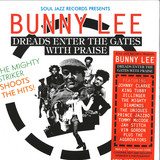
Johnny Clarke & King Tubby & Dillinger & Prince Jazzbo feat. Tommy McCook & The legendary Aggrovators & The Mighty Diamonds - Soul Jazz Records presents Bunny Lee: Dreads Enter the Gates with Praise - The Mighty Striker Shoots the Hits!
Soul Jazz Records presents this new collection featuring the heavy 70s roots reggae of Bunny
Lee - a living legend, one of the last of the great Jamaican record producers who helped shape
and define reggae music in the 1970s from a small island sound into an internationally
successful musical genre.
From teenage fan to young record plugger for Duke Reid, Sir Coxsone and other early
pioneering Jamaican musical entrepreneurs, Lee has spent his whole professional life inside the
Kingston music industry. In the 1970s he rose up to become one of the major record producers
in Jamaica alongside Lee 'Scratch' Perry and the other 'small axe' producers who broke the
dominance of the 'big tree' producers that had ruled Jamaican music in the 1960s.
Featuring some of the heaviest Jamaican artists, including Johnny Clarke, King Tubby, Dillinger,
Prince Jazzbo, Tommy McCook, The legendary Aggrovators (featuring Sly and Robbie), The
Mighty Diamonds and more, the album is a rollercoaster ride of rare, deep and classic 1970s
roots, dub and DJ sounds.
During this era, 'flying cymbals', crashing reverbs, dark echoing thunderclap gunshots and
other 'implements of sound' filled his record productions as Bunny Lee explored the outer limits
of dub with his friend King Tubby in the mix on wild versions that accompanied any 45. A
Bunny Lee record provides a creative and mysterious hidden guide to reggae music itself, a
double-sided three-minute intangible history lesson etched in wax.
Bunny Lee was one of the first Jamaican producers to travel to England in the late 1960s, at
the beginning of the nascent British reggae music industry as record companies such as
Trojan, Pama and others began licensing Jamaican music in the UK to supply the expanding
West Indian communities living up and down England. Lee encouraged other Jamaican
producers to do the same, including Lee Perry, Harry J and Niney The Observer and also
became a conduit between the British music industry and numerous younger Island-based
producers - a frequent flyer reggae ambassador, a musical courier exchanging tapes for
royalties.
Bunny Lee's first recordings in the late 1960s were mainly rock steady but as the 70s
approached the music soon began to mutate and slow down into 'reggae' as the sound became
heavier, more rootsy and the sound itself began to change with the explosion of dub.
Lee was at the forefront to this dramatic musical shift into roots reggae and by this time had
become a major producer, capable of working with whoever he chose as world-famous singers,
DJs and musicians lined up to work with the charismatic man. Lee also employed a fluid but
stable set of crack session musicians who he named The Aggrovators.
Most of the recordings featured here come from the mid 70s, a time when Bunny Lee was
definitely in the zone, releasing heavyweight singles at an almost unstoppable rate. Bunny
Lee's career stretches over five decades and he has upwards of 2,000 production credits on
vinyl.
This album comes with extensive sleevenotes, an interview with Bunny Lee and exclusive
photography. The album is available as a CD pack with 24-page booklet, massive triple LP vinyl
with digital download code, house inner and full notes, as well as digital album.
Armagnac started in 2010 a label in metz all naked records & throwing up parties with his Fensch Groove Consortium (FGC) crew. After few years, he decided to move to paris france where between his writing for some famous french magazines & sites, he produced some marvellous tracks that keep the bobby konders spirit alive. This is spiritual deep house full of mystery and fuzzy textures that puts most 'deep' house to shame. ESSENTIAL ! SKYLAX RECORDS 4 EVER
White Shadows In The South Seas is the title of a book written in 1919 by Frederick O'Brien as part of a trilogy he wrote based on his experiences living in the Pacific islands in the early part of the 20th century. His book was taken as the starting point for a film to be directed, initially, by Robert Flaherty (famous at the time for his groundbreaking documentary / fiction film Nanook Of The North) with W.S.Van Dyke as his support. The film, ultimately, apart from the title, had little to do with O'Brien's book and Flaherty left the film after a few months leaving Van Dyke to finish it.
I purchased O'Brien's book, along with many others, from Basement Books, a secondhand bookstore in Melbourne/Australia. Part of my 'Islomania' and on going fascination with all things Pacific. When I discovered there was a 1929 silent film based on the book I sought it out and started to present it as part of my 'Live Music/Silent films' repertoire. Tabu by Frederick Murnau, which coincidently also had Flaherty as co-director originally, was the first film I ever wrote / improvised a score for and presented as a live film/music performance. My repertoire extends to over 23 films now.
My eclectic and diverse musical and artistic interests extend into 'Hawaiian', 'Exotica', 'Ambient' and 'Electronic' Music. I have produced several volumes of so called 'Electronic, Ambient, Exotica' on CD and Vinyl, including Kiribati, Globe Notes, Rayon Hula ( on Vinyl, CD and digital format ) and most recently, New Globe Note on Vinyl and White Shadows In The South Seas on CD.
White Shadows In The South Seas features some of the music presented in my live screenings of the 1929 silent film.
The film is the story of Dr. Matthew Lloyd, an alcoholic doctor who is disgusted by the exploitation by white people of the natives on a Polynesian island. The natives dive for pearls, however, numerous accidents occur and one diver dies. In anger, Dr. Lloyd punches Sebastian, the employer. As revenge and to prevent further interruption of his activities, he tricks Dr. Lloyd onto a ship with a diseased crew (thinking they are ill) and his men rough him up and send the ship off into a storm. Dr. Lloyd survives and is washed ashore on an island where none of the natives have ever seen a white man before. Lloyd is rescued and ultimately falls in love with the chief's daughter, who is Taboo, hence Lloyd is prevented from pursuing his love for her. An incident occurs and a young boy is thought to have drowned but Lloyd is able to revive him, earning him points and permission with the chief's daughter. Lloyd begins to realise that the local islanders have no sense of the value of the black pearls which grow in abundance around their island and he starts to dive for them and collect them. One morning the white man Sebastian unexpectedly turns up on a scooner and starts to offer the islanders trade for their pearls. Llloyd tries to interrupt the encounter and is shot and dies. His wife and the islanders morn for his dead body and, symbolically, the passing of a way of life.
Mike Cooper plays - Electric and acoustic lap steel guitars / electronics / Zoom Sampletrack / Kaos Pad / Casio SK1 / Korg Drum Machine / Self Made Instruments.
It also features field recordings made on Pulau Ubin by Mike Cooper during a month as Artist In Residence for The Artist Village / Singapore.
I would like to acknowledge and thank Lawrence English (Room40 Records) for his assistance and encouragement with the original recordings and the CD version of White Shadows In The South Seas.
All music written and played by Mike Cooper PRS/MCPS - except Po Mahina (trad. Arr. Cooper) and Hilo Hanakahi (trad. Arr. Cooper)
Recorded and Mixed at the Steelworks in Rome 2012/2013.
A White Shadow In The South Seas
In February 2014 'A White Shadow In The South Seas' was the title of an audio-visual installation I made at the Teatro In Scatola in Rome, Italy, presented as part of a series of sound installations titled 'Visitazioni' produced by Proposte Sonore.
The essay below, as well as our collection of Hawaiian shirts, Exotica and Hawaiian vinyl records, was an inspiration for this installation.
'..the transformation and reconstitution of the souvenir commodity as an indigenous ethnic art form and a scarce relic of Hawai'i's romanticized past...' from - Clothing and Textile Reasearch Journal - From Kitsch to Chic by Marcia A. Morgado.
And....
Michael Thompson's Rubbish Theory (1979)
' ...a critical aspect of Western culture is the pre-disposition to see objects in terms of two overt categories: the transient and the durable. Objects identified as transient have finite life spans and lose value over time, whereas those identified as durable have infinite lives and over time increae in value....category assignments are arbitrary, but once assigned a category membership determines relative value. Fashion apparel-by defenition-is assigned to the transient category; paintings commonly are designated durables....how is it that transient objects.. ( e.g. Hawaiian shirts and vinyl records ) ..sometimes become durables.
Objects assigned to the rubbish category are largely invisible, have no value and, ideally, no life span. Fashion for example, no longer worn and relegated to the back of the wardrobe has fallen into the covert rubbish category. But rubbish can be rescued and transformed. Thompson says ' What I believe happens is a transient object gradually declining in value and in expected life span may slide across into rubbish. Here it exists in a timeless and valueless limbo where it has a chance to be re-discovered and be successfully transformed to a durable. Such transferes are radical: objects gradually slide from transcience to rubbish, but the transformation from rubbish to durable involves an all-or-nothing leap across two boundaries, that separating the worthless from the valuable and that between the covert and the overt. Things drift into obscurity but they leap into prominence.
The delightful consequence of this hypothesis is that in order to study the social control of value we must study rubbish.
The rubbish-to-durable transformation is accompanied by the development of highly specialized knowledge derived from the discovery of subtle variations and complex details that went unnoticed in the objects transient stage. The discoveries initiate renewed interest in the object and its market value begins to climb. As prices soar beyond the reach of ordinary people, the object becomes available only in high priced collectors' markets. Furthermore, as market values rise, the aesthetic value of the object undergoes a reassessment as well, and it becomes increasingly apparent that the objects intrinsic beauty has been overlooked. Ultimately the object is re -assigned as a durable and becomes recognized as a timeless classic.
Exotica, Ambience and Pacificism - A dialogue with Mike Cooper & Professor Philip Hayward Deputy Pro Vice Chancellor of Research Southern Cross University, Lismore, Australia.
The man behind Workshop and Out To Lunch famously takes his time to make electronic productions that are, in turn, out of time. Over the course of his career he's released tracks that could have been made yesterday, years ago, or a decade into the future. with Avenue 66 he's found a leftfield home that celebrates pure creativity, that embraces the liminal, the weird and the sublime. Light Surfing fits all of these descriptors.
The double-LP rewards deep, repeated listening. There's plenty to unpack, but those who cherish the murky bangers that have been Lowtec's stock and trade will find plenty to love. "Boy With The Broken Glasses" weaves a subtle, dancehall-inflected riddim into hazy ambient house, while the closer, "Burnt Toast," is the latest example of Kuhn's uncanny ability to perfectly fit a soulful vocal sample into an alien dance floor soundscape.
Unexpected moments of sideways beauty also unfurl across the four sides. The two-part "Light Surfing" is one of Lowtec's most evocative suites to a date-its mournful string soundtrack is the album's recurring, longing motif. Elsewhere, as on "Mynthenquai," Kuhn applies avant-garde strategies to his synth leads, taking us on head-spinning melodic journeys.
Light Surfing is a masterful balancing act between dream states and machine-like efficiency, the experimental and functional, precision and spontanaeity. Lowtec could have only gotten here by taking his time.
Italian directors GUALTIERO JACOPETTI and FRANCO PROSPERI gave birth to a whole new subgenre of 'non-fiction' exploitation movies with their 1962 hit MONDO CANE. After repeated accusations of forgery, unethical behaviors and war crimes, they decided to make a movie about the atrocities of American slavery as an apology of sorts. It was 1971 and the movie was FAREWELL UNCLE TOM (ADDIO ZIO TOM) The famous critic Roger Ebert called the result 'the most disgusting, contemptuous insult to decency ever to masquerade as a documentary' Naked flesh, voyeurism and violence is constantly used but gorgeous photography and a memorable score from Academy Award nominee RIZ ORTOLANI add a sickening slickness to it all: rock- beat tunes mixed with classic big band themes, waltz and funny marches and the beautiful OH MY LOVE, with the vocals from Katyna Ranieri, used, among many others by Winding Refn in his cult movie DRIVE (2011).
FIRST VINYL REISSUE EVER
LIMITED EDITION OF 500 COPIES
COMPLETE EDITION WITH EXTRA TRACKS
1963 album from the Cuban conguero Mongo Santamaria. Featuring his brilliant cover version of Herbie Hancock's classic title track, along with numerous compositions of his own, this is one of Mongo Santamaria's most famous and coveted albums. From the iconic cover to the brilliant grooves contained within, this album has the whole package. Excellent latin jazz and latin-soul groovers from a Cuban hero, and one of the most famous performers, full stop, of the middle 20th Century.
The Moments' On Top is a perfect example of symphonic soul. Amongst true heads, this is considered the most valuable of all their albums; an original copy of this LP, if you can find one, starts at around $75. Alongside contemporaneous acts from the early 70s - The Chi-lites, The Stylistics, The Delfonics, The Futures, Blue Magic and The Main Ingredient - The Moments exuded all that was compelling about deep, harmony-drenched, string-laden soul. The standout here is undoubtedly 'To You with Love", a floating, tender ballad sung by Harry Ray that features the group's patented handclap-tambourine combo, sweetly repetitive strings, serene guitar and gentle piano. It was famously sampled by J Dilla for 'Last Donut Of The Night' - the gut-wrenching finale to his seminal Donuts. Concentrating solely on its sampled history would do The Moments a huge disservice, but its crucial appearance at the climax of Donuts directed fresh generations of pre-disposed soul fans to the absolute canon. Judged entirely on its merit, it's one of the most heart-breaking songs of any decade and worth the price of admission alone. It's the sweetest, most goose-bump inducing 3 minutes of aural bliss you're ever likely to be exposed to. If that wasn't enough, On Top spawned two minor R&B hits: 'All I Have' and 'Lucky Me", each featuring Billy Brown's ice-melting falsetto. Opener 'All I Have' is a sumptuous introduction to the album. With melancholic, understated guitar licks, twinkling keys and heartbeat drums, it's a gem.
'Sounds from the Great House! Outernational Sounds proudly presents a Nimbus West spirit jazz essential: the Creative Arts Ensemble's classic debut One Step Out. Mastered at 45rpm on double vinyl for enhanced sound, this release features all tracks at full length for the first time on wax.
One of the most sought after and highly regarded titles to have appeared on Tom Albach's celebrated Nimbus West imprint, the Creative Art Ensemble's One Step Out is a timeless work of spiritualised jazz. A true gem from the Los Angeles jazz underground, the album was pianist and composer Kaeef Ruzadun Ali's first recording as leader of the Creative Arts Ensemble, the only large ensemble group that emerged directly from Horace Tapscott's legendary Pan Afrikan Peoples Arkestra community jazz group.
A Los Angeles native, Kaeef was introduced to the Tapscott circle in the late 1970s. His first experience of the Arkestra's ethos was through PAPA tenorist Michael Session, who took him to the famous 'Great House' at 2412 South Western Ave., LA - a large mansion house which members of the Arkestra had taken over as a space for communal living. Life in the Great House was a continuous stream of music, dance and community events. 'When I walked in there,' recalled Kaeef, 'it was like this whole rush came over me, just from going in the front door...It was like a very, very warm feeling of love. I went and I came out with 'Flashback of Time', and that was my first arrangement.'
Kaeef quickly became a significant contributor of compositions to the Arkestra's songbook - his piece 'New Horizon' would be recorded by Horace Tapscott for the latter's Tapscott Sessions series. But 'Flashback of Time' would eventually appear on One Step Out, played by the new group he had put together from stalwart Arkestra members. Inspired by both Tapscott's example and by the Art Ensemble of Chicago, Kaeef had wanted to follow their lead by assembling a larger unit. 'I would like to form a group that would be an extension of the Pan Afrikan Peoples Arkestra,' he told Tapscott. The group was to be known as the Creative Arts Ensemble, and One Step Out, released in 1981 by Nimbus West, was their debut.
Featuring seasoned Arkestra regulars including reedsman Dadisi Komolafe, drummer Woody 'Sonship' Theus and altoist Gary Bias, with veterans Henry 'The Skipper' Franklin on bass and George Bohannon on trombone, One Step Out is a key document of the Los Angeles radical jazz underground. Featuring the sanctified vocals of Kaeef's sister, B. J. Crowley, the album is a tour de force of spiritually energised independent jazz music. Community uplift and sacred vision straight from the Great House, back on vinyl for the first time since 1981!
Footshooter is the moniker of London based producer, DJ and musician Barney Whittaker. His style blends skippy, broken beat production with live instrumentation to create an organic, rich sound and he frequently collaborates with emcees, poets and vocalists exploring different tones and moods.
His last record, Strange Days EP (released on Famous Friends), gained regular plays on NTS, Balamii, WorldWide FM and, most recently, by Bonobo in a DJ set at his NYC Boiler Room.
'Technicolour Nights', due out on YAM Records later this year, is a meditation on long evenings & nights out and how they vary in atmosphere, mood and colour. Opening with the aptly named and ethereal 'Intro', the EP quickly jumps into sunshine territory with 'Juan's Stairwell' before 'On Telegraph Hill' brings the heads down for a meditative two-step groover to close up the A-side.
On the flip, Footshooter flexes his 160bpm muscles on 'Mars' with the help of London based vocalist and MC And Is Phi, before dropping the tempo just a touch on 'Rotations', a steppy, Rhodes-laden journey through London nightlife. 'Our Love' lowers the tempo even further to bring the EP to a close on a bittersweet note.
Scored for Maurice Béjart's choreography to the 'Orphée Ballet', based on the Greek god Orpheus, this is one of Pierre Henry's finest works of musique concrète, the genre in which Henry was an early innovator and to which he devoted his career. After years working for the French national radio (RTF) and honing his studio chops on radio spots and editing/composition, Henry formed his own studio in 1958 and began working on modern dance and ballet and soundtrack work. Incorporating percussion, industrial soundscapes, nature sounds, spoken French narrative, and synthesized tones, 'Orphée Ballet' is a beautiful piece that, while less known than what is perhaps his most famous work, also for Béjart's ballet production, 1967's 'Les Jerks Électroniques De La Messe Pour Le Temps Présent Et Musiques Concrètes Pour Maurice Béjart', is equally compelling and groundbreaking. Following his passing in 2017 at age 89, Henry's work has found renewed interest, and this is a welcome reissue of one of his rarest and finest works. Truly brilliant.
RLydmor is Copenhagen based Jenny Rossander, an electronic producer, composer, singer, songwriter and general troublemaker. Now she's about to release her third solo album "I Told You I'd Tell Them Our Story", a multi-layered piece of modern electronic pop music.
In her sounds and with her words, Rossander captures a reflective description of her surroundings and invites the listener to follow her on a very personal journey.
After her first steps with her two solo albums, that have been released in Denmark only, to much applause, the first international coming out was the 'Seven Dreams Of Fire" album as Lydmor & Bon Homme (with Tomas Høffding from WhoMadeWho). In 2016 Lydmor suddenly disappeared to Shanghai for several months. Her life in the Chinese metropolis inspired her to write a piece of modern electronic pop music which will be released as her new solo album "I Told You I'd Tell Them Our Story" in September. "There is a fearless madness in her that might have waited for too long to finally break out." (Nothing But Hope And Passion). With lots of initiative, Lydmor has made her dream come true to tour most of the world with her music. No matter if she plays an acclaimed festival, a famous club or the tiny living room of her greatest fans, every single one of Lydmor's shows means a highly intense experience. With her irresistible voice and unabashed honesty Lydmor places the little hooks of her melodies and lyrics into the electronic soundscape and she will flirt, dance, cry, scream and hug her way into your heart.
After her first two albums - A Pile of Empty Tapes (2012) and Y (2015) - which were only released in Denmark, Lydmor's new record will be released internationally for the first time by hfn music. "I Told You I'd Tell Them Our Story" is a rite of passage captured in intense moments experienced on the edge of the world and on the edge of one self. Lydmor lived in Shanghai for several months in 2016 and the Chinese metropolis inspired her to completely redefine her artistic expression and to write this new album.
If you check the credits of The Rolling Stones' Goats Head Soup LP from 1973 you'll find a certain "Pascal" listed on the percussion section. That is none other than Los Angeles based artist Nicolas Pascal Raicevik (1933-1994), aka 107-34-8933, aka Head, aka Nik Pascal, aka Nik Raicevic. Besides his hitting the bongoes on the Stones album, Nik was a great artist on his own, both as a painter and as a musician. As a musician, he was a pioneer in the use of synthesizers, preceeding the Berlin school by some years when his Head LP was released on on Buddah in 1970. Buddah probably saw in Head the opportunity to cash in some money from the remains of the psychedelic scene - the three tracks on the LP are named after drugs used in the late sixties. The sounds, however, are accomplished works that show Raicevic as one of the most interesting pioneers in the use of synths. The album probably didn't do too well, since Buddah didn't renew the contract with Raicevic, who instead took his own way releasing his works on his very own Narco Records and Tapes label. Between 1968 and 1975 Narco would issue 4 LPs credited either to Nik Raicevic (Beyond The End... Eternity) or Nik Pascal (The Sixth Ear, Magnetic Web and Zero Gravity) plus one credited to 107-34-8933 (Numbers, which is in fact the same LP as Buddah's Head, albeit with different cover art). Copies of these LPs came with an ironic sticker over the shrinkwrap that read "Do not listen to this LP if you are stoned".
1972 saw the release of The Sixth Ear (Narco NR666), this time credited to Nik Pascal. A more complex work than Beyond The End..., it adds consistent rhythmic patterns to the mix with the addition of bongoes and also explores some interesting chord progressions.
Besides his musical explorations, Nik was also an interesting painter. His paintings are auctioned from time to time, and are consciousness expanding works influenced by abstract cubism and surrealism, some kind of Salvador Dalí on drugs exploring the outter and inner space. All the artwork on the sleeves of his LPs is done by himself. Spacey landscapes and psychedelic colours that fit perfectly to the music they contain.
"Nik Raicevic's music is at the intersection of radical psycho-electronic weirdness and kraut kosmische music (in particular the scifi-hypno-minimal modules of Conrad Schnitzler in Grun, Rot and Blau). It presents mega epic & tripped out electronic improvisations.
"This is an absolute must for collectors and fans of visceral, neurotic soundscapes." (progarchives)
"As far as late-60s / early-70s American Bedroom' Electronic Music goes, these LPS have to be among the first transmissions from this sector, made all the more attractive when coupled with Raicevic's alien topographIes - the covers are high-color portrayals of Venusian lanes, knotted growths, & future-past architecture in a style you might equate with Vintage' sci-fi pulp-novel covers - & copious Downer' sentiment. This music is imbued with a sort of lonely, anti-social sensibility that's about as far as you can get from the Academic' Early Electronic vector. I will say that if the Steve Birchall, Cellutron & the Invisible, and/or Pythagoron™ seed your garden, this will likely do the same." (twoheadeddog)
Never reissued before on vinyl format, the Wah Wah reissue features original sleeve artwork made of paintings and drawings by Nik himself and reproduction of the famous ironic "Do not listen if you are stoned" sticker. Limited edition, 500 copies only.