This rare Brit Funk 12” was originally released in 1984 and is now officially reissued for the first time. Licensed from producer Lindel Lewis, the 12” was heavily influenced by US Boogie and Disco and there’s a Dub influence at play as Lindel was also producing a lot of reggae around this time, most famously ‘Night Over Egypt’ by Mystic Harmony.
The 12” includes a previously unreleased Dub Version of ‘I Need You’ and was produced on two Analogue classics, Lindel says “I used a Linn Drum for the drums and played all synth parts using a Roland 106. I’m a classically trained musician and also a sound engineer, I worked at Mark Angelo Recording Studios for 18 years and have produced a great many artists. Steve Jones real name is Steve Myers, but I didn’t like the surname so changed it to Jones which felt more soulful. The name The Fat Boys came about because of the big bellies of myself the flute player Mike Appoh, my trainee engineer at the time. Ray Carlass played the sax solo, they have both now sadly passed”.
This long overdue reissue revives a standout moment in Brit Funk history, making it an essential addition for fans of classic Boogie and Disco. A 140 gram pressing in 3mm spine disco sleeve with labels and sticker designed by Bradley Pinkerton.
Suche:most
2024 Repress
"You've got to listen to this band, you'll really like them, I know." A Colourful Storm presents the first-time vinyl issue of one of the true treasures of modern pop music: Blueboy's The Bank Of England. The group of Paul Stewart, Keith Girdler, Cath Close, Ian Gardner and James Neville are Sarah Records royalty alongside The Field Mice, Heavenly, The Wake and The Orchids, and this is the final recording from arguably the most beautiful, afflicted band of 90's indie-pop and DIY. Mastered from the original recording tapes with assistance
- A1: Segla – Orchestre Poly-Rythmo De Cotonou-Rep. Pop Du Benin
- A2: Get The Music Now (Edit) – Ipa Boogie
- A3: E Sa F’aiye – Orchestre Black Dragons De Porto-Novo Dahomey
- B1: Aiha Ni Kpe We (Edit) – T.p. Orchestre Poly-Rythmo De Cotonou
- B2: Ego-Ibo – Les Sympathics De Porto-Novo Benin
- B3: Gbeti Ma Djro - Orchestre Poly-Rythmo De Cotonou Dahomey
- C1: Oya Ka Jojo (Edit) – Orchestre Les Volcans Du Benin
- C2: It’s A Vanity - T.p. Orchestre Poly-Rythmo
- C3: Bakassine Gabou - Orchestre Anassoua-Jazz De Parakou
- D1: Nan Man Nan - Orchestre Poly-Rythmo De Cotonou-Rep. Pop Du Benin
- D2: Gbe We Gnin Wa Bio (Edit) – Ogassa
- D3: Kpede Do Gbe Houenou - T.p. Orchestre Poly-Rythmo De Cotonou
Founded in the late 1960s by record store owner Seidou
Adissa, Albarika Store is one of the most important
independent record labels on the African continent. That
it was founded in the relatively small ex-French colony
of Benin (then still called Dahomey), is a testament to its
founder’s musical taste and vision for what the local
musical scene had to offer.
This September, Acid Jazz releases the first ever vinyl
and CD overview of the label and its music, compiled by
David Hill of The Soul Revivers and West African
musical expert Florent Mazzoleni, who also wrote the indepth notes.
The compilation provides a look into what was a
developing and then thriving post-colonial music scene.
It focuses on the label’s biggest and most prolific act
Orchestre Poly-Rhythmo and its founder Melome
Clement – who released under a variety of names often
spotlighting on the musicians’ key to their sound. It also
looks at the other established artists on the label such
as the incendiary Les Sympathics De Porto Novo and
Les Volcans. All of these artists create a unique mix of
Westernised Funk, Soul and Latin sounds crosspollinated with the traditional music of the region.
Camelot, the legendary seat of King Arthur's court in Early Middle Ages Britain, was probably not a real place. A corruption of the name of a real Romano-Briton city, the word "Camelot" accumulated symbolic, mythic resonances over centuries, until achieving its present usage as a near-synonym of "utopia." In the mid-20th century alone, Camelot inspired an explosion of representations and appropriations, among them the violent, affectless Arthurian court of Robert Bresson's 1974 film Lancelot du Lac and the absurdist iteration of Monty Python's 1975 Holy Grail, both of which feature armored knights erupting into fountains of blood; the mystical Welsh world of novelist John Cowper Powys's profoundly weird 1951 novel Porius, with its Roman cults, wizards and witches, and wanton giants; and the nationalist nostalgia of President John F. Kennedy's White House. Unsurprisingly there are fewer Camelots in more recent memory. Camelot, Canadian songwriter Jennifer Castle's extraordinary, moving 2024 chronicle of the artist in early middle age, charts a realer, more rooted, and more metaphorical place than the fabled Camelot of the Early Middle Ages (or its myriad depictions), but it too is a space more psychic than physical. In Castle's Camelot, the fantastic interpenetrates the mundane, and the Grail, if there is one, distills everyday experience into art and art into faith, subliming terrestrial concerns into sublime celestial prayers to Mother Nature, and to the unfolding process of perfecting imperfection in one's own nature. Co-produced by Jennifer and longtime collaborator Jeff McMurrich, her seventh record is at once her most monumental and unguarded to date, demonstrating a mastery of rendering her verse and melodies alike with crisply poignant economy. For all their pointedly plainspoken lyrical detail and exhilarating full-band musical flourishes, these songs sound inevitable, eternal as morning devotions. "Back in Camelot," she sings on the lilting, vulnerable title track, "I really learned a lot / circles in the crops and / sky-high geometry." The album opens with a candid admission of sleeping "in the unfinished basement," an embarrassing joke that comes true. But the dreamer is redeemed by dreaming, setting sail in her airborne bed above "sirens and desert deities." If she questions her own agency_whether she is "wishing stones were standing" or just "pissing in the wind"_it does not diminish the ineffable existential jolt of such signs and wonders. This abiding tension between belief and doubt, magic and pragmatism, self and other, sacred and profane, and even, arguably, paganism and monotheism, suffuses these ten songs, which limn an interior landscape shot through with sunstriped shadows of "multi-felt dimensions" both mystical and quotidian. The epic scale and transport of "Camelot," with its swooning strings, gives way dramatically to "Some Friends," an acoustic-guitar-and-vocals meditation in miniature on Janus-faced friends and the lunar and solar temperatures of their promises_"bright and beaming verses" versus hot curses_which recalls her minimalist last album, 2020's achingly intimate Monarch Season. (In a symmetrical sequencing gesture, the penultimate track, the incantatory "Earthsong," bookends the central six with a similarly spare solo performance and coiled chord progression, this time an ambiguous appeal to _ a wounded lover? a wounded saint? our wounded planet?) Those whom "Trust" accuses of treacherous oaths spit through "gilded and golden tooth"_cynics, critics, hypocrites, gurus, scientists, doctors, lovers, government, the so-called entertainment industry_sow uncertainty that can infect the artist, as in "Louis": "What's that dance / and can it be done? What's that song / and can it be sung?" Answering affirmatively are "Lucky #8," an irrepressible ode to dancing as a bulwark against the "tidal pools of pain" and the "theory of collapse," and "Full Moon in Leo," which finds the narrator dancing around the house with a broom, wearing nothing but her underwear and "big hair." But the central question remains: who can we trust, and at what cost faith, in art or angels or otherwise? Castle's confidence in her collaborators is the cornerstone of Camelot. Carl Didur (piano and keys), Evan Cartwright (drums and percussion), and steadfast sideman Mike Smith (bass) comprise a rhythm section of exquisite delicacy and depth. This fundamental trio anchors the airiness of regular backing vocalists Victoria Cheong and Isla Craig and frames the guitars of Castle, McMurrich, and Paul Mortimer (and on "Lucky #8," special guest Cass McCombs). Reprising his decennial role on Castle's beloved 2014 Pink City, Owen Pallett arranged the strings for Estonia's FAMES Skopje Studio Orchestra. On the ravishing country-soul ballad "Blowing Kisses"_Pallett's crowning achievement here, which can be heard in its entirety in the penultimate episode of the third season of FX's The Bear_Jennifer contemplates time and presence, love and prayer_and how songwriting and poetry both manifest and limit all four dimensions: "No words to fumble with / I'm not a beggar to language any longer." Such rare moments of speechlessness_"I'm so fucking honoured," she bluntly proclaims_suggest a state "only a god could come up with." (If Camelot affirms Castle as one of the great song-poets of her generation, she is not immune to the despairing linguistic beggary that plagues all writers.) Camelot evinces a thoroughgoing faith not only in the natural world_including human bodies, which can, miraculously, dance and swim and bleed and embrace and birth_but also in our interpretations of and interventions in it: the "charts and diagrams" of "Lucky #8," a daydreamt billboard on Fairfax Ave. in LA in "Full Moon in Leo," the bloody invocations of the organ-stained "Mary Miracle," and all manner of water worship, rivers in particular. (Notably, Jennifer has worked as a farmer and a doula.) The album ends with "Fractal Canyon"'s repeated, exalted insistence that she's "not alone here." But where is here? The word "utopia" itself constitutes a pun, indicating in its ambiguous first syllable both the Greek "eutopia," or "good-place"_the facet most remembered today_and "outopia," or "no-place," a negative, impossible geography of the mind. Utopia, like its metonym Camelot, is imaginary. Or as fellow Canadian songwriter Neil Young once sang, "Everyone knows this is nowhere." "Can you see how I'd be tempted," Castle asks out of nowhere, held in the mystery, "to pretend I'm not alone and let the memory bend?"
Black Vinyl[31,89 €]
"Good Lovelies are proud to reissue their holiday classic EVERGREEN just in time for the upcoming holiday season. Originally released in 2019, this fifth anniversary limited edition of 500 has been pressed on beautiful peppermint green vinyl.
Caroline Brooks, Kerri Ough and Susan Passmore are a trio of songwriters, multi-instrumentalists, and gorgeous harmonizers known for their nostalgic sound during the holidays that crosses between folk-roots, old-time swing, soul and bluegrass. ""Evergreen"" includes three original songs that the band have added to the Christmas canon alongside their versions of songs like ""Little Saint Nick"", ""Christmas (Baby Please Come Home)"" and ""(Everybody’s Waiting For) The Man with the Bag"" to really get you in the mood for the season ahead.
The band’s annual Christmas tour hits the road again this December, bringing classic holiday songs, timeless winter selections, and original Good Lovelies material to the stage. A Good Lovelies holiday show is a guaranteed good time for the whole family.
“...while most festive albums are best experienced during the correct season, when it comes to the amazing talents of the Good Lovelies, the rule book can be tossed out.” - GREAT DARK WONDER -
“Some of the most gorgeous Christmas harmonies you’ll ever hear on an album jammed full of warmth and good cheer. Featuring a mix of fun favorites, lesser-heard gems and three truly fine originals, the trio strikes the perfect blend of smiles and sentiment...” - BOB MERSEREAU
Good Lovelies first came together in 2006 and have since recorded thirteen albums, including two Christmas collections. They have toured extensively across North America, Europe, the UK, and Australia, and have earned such accolades as a JUNO Award, a SOCAN #1 Single award, and four Canadian Folk Music Awards. Their latest album “We Will Never Be the Same” is in stores now."
. For Fans Of: The Weather Station, Weyes Blood, Adrianne Lenker, Phoebe Bridgers, Joan Shelley, Lana Del Rey, Cass McCombs, Angel Olsen & Neil Young. Camelot, the legendary seat of King Arthur’s court in Early Middle Ages Britain, was probably not a real place. A corruption of the name of a real Romano-Briton city, the word “Camelot” accumulated symbolic, mythic resonances over centuries, until achieving its present usage as a near-synonym of “utopia.” In the mid-20th century alone, Camelot inspired an explosion of representations and appropriations, among them the violent, affectless Arthurian court of Robert Bresson’s 1974 film Lancelot du Lac and the absurdist iteration of Monty Python’s 1975 Holy Grail, both of which feature armoured knights erupting into fountains of blood; the mystical Welsh world of novelist John Cowper Powys’s profoundly weird 1951 novel Porius, with its Roman cults, wizards and witches, and wanton giants; and the nationalist nostalgia of President John F. Kennedy’s White House. Unsurprisingly there are fewer Camelots in more recent memory. Camelot, Canadian songwriter Jennifer Castle’s extraordinary, moving 2024 chronicle of the artist in early middle age, charts a realer, more rooted, and more metaphorical place than the fabled Camelot of the Early Middle Ages (or its myriad depictions), but it too is a space more psychic than physical. In Castle’s Camelot, the fantastic interpenetrates the mundane, and the Grail, if there is one, distills everyday experience into art and art into faith, subliming terrestrial concerns into sublime celestial prayers to Mother Nature, and to the unfolding process of perfecting imperfection in one’s own nature. Co-produced by Jennifer and longtime collaborator Jeff McMurrich, her seventh record is at once her most monumental and unguarded to date, demonstrating a mastery of rendering her verse and melodies alike with crisply poignant economy. For all their pointedly plainspoken lyrical detail and exhilarating full-band musical flourishes, these songs sound inevitable, eternal as morning devotions. “Back in Camelot,” she sings on the lilting, vulnerable title track, “I really learned a lot / circles in the crops and / sky-high geometry.” The album opens with a candid admission of sleeping “in the unfinished basement,” an embarrassing joke that comes true. But the dreamer is redeemed by dreaming, setting sail in her airborne bed above “sirens and desert deities.” If she questions her own agency whether she is “wishing stones were standing” or just “pissing in the wind” it does not diminish the ineffable existential jolt of such signs and wonders. This abiding tension between belief and doubt, magic and pragmatism, self and other, sacred and profane, and even, arguably, paganism and monotheism, suffuses these ten songs, which limn an interior landscape shot through with sunstriped shadows of “multi-felt dimensions” both mystical and quotidian. The epic scale and transport of “Camelot,” with its swooning strings, gives way dramatically to “Some Friends,” an acoustic-guitar-and-vocals meditation in miniature on Janus-faced friends and the lunar and solar temperatures of their promises—“bright and beaming verses” versus hot curses which recalls her minimalist last album, 2020’s achingly intimate Monarch Season. (In a symmetrical sequencing gesture, the penultimate track, the incantatory “Earthsong,” bookends the central six with a similarly spare solo performance and coiled chord progression, this time an ambiguous appeal to … a wounded lover? a wounded saint? our wounded planet?). Those whom “Trust” accuses of treacherous oaths spit through “gilded and golden tooth” cynics, critics, hypocrites, gurus, scientists, doctors, lovers, government, the so-called entertainment industry sow uncertainty that can infect the artist, as in “Louis”: “What’s that dance / and can it be done? What’s that song / and can it be sung?” Answering affirmatively are “Lucky #8,” an irrepressible ode to dancing as a bulwark against the “tidal pools of pain” and the “theory of collapse,” and “Full Moon in Leo,” which finds the narrator dancing around the house with a broom, wearing nothing but her underwear and “big hair.” But the central question remains: who can we trust, and at what cost faith, in art or angels or otherwise? Castle’s confidence in her collaborators is the cornerstone of Camelot. Carl Didur (piano and keys), Evan Cartwright (drums and percussion), and steadfast sideman Mike Smith (bass) comprise a rhythm section of exquisite delicacy and depth. This fundamental trio anchors the airiness of regular backing vocalists Victoria Cheong and Isla Craig and frames the guitars of Castle, McMurrich, and Paul Mortimer (and on “Lucky #8,” special guest Cass McCombs). Reprising his decennial role on Castle’s beloved 2014 Pink City, Owen Pallett arranged the strings for Estonia’s FAMES Skopje Studio Orchestra. On the ravishing country-soul ballad “Blowing Kisses” Pallett’s crowning achievement here, which can be heard in its entirety in the penultimate episode of the third season of FX’s The Bear Jennifer contemplates time and presence, love and prayer and how songwriting and poetry both manifest and limit all four dimensions: “No words to fumble with / I’m not a beggar to language any longer.” Such rare moments of speechlessness “I’m so fucking honoured,” she bluntly proclaims suggest a state “only a god could come up with.” (If Camelot affirms Castle as one of the great song-poets of her generation, she is not immune to the despairing linguistic beggary that plagues all writers.) Camelot evinces a thoroughgoing faith not only in the natural world including human bodies, which can, miraculously, dance and swim and bleed and embrace and birth but also in our interpretations of and interventions in it: the “charts and diagrams” of “Lucky #8,” a daydreamt billboard on Fairfax Ave. in LA in “Full Moon in Leo,” the bloody invocations of the organ-stained “Mary Miracle,” and all manner of water worship, rivers in particular. (Notably, Jennifer has worked as a farmer and a doula.) The album ends with “Fractal Canyon”s repeated, exalted insistence that she’s “not alone here.” But where is here? The word “utopia” itself constitutes a pun, indicating in its ambiguous first syllable both the Greek “eutopia,” or “good-place” the facet most remembered today and “outopia,” or “no-place,” a negative, impossible geography of the mind. Utopia, like its metonym Camelot, is imaginary
2024 Reissue
The syndicate manifests its sonic potential in full glory. Giving rise to this collection of colossal heavyweights, Sentry demonstrates its spotless record of selecting certified heavyweights for the discography once again, twenty-fold. Stepping into the ring are some of the scene's most prolific artists alongside a plethora of promising, choice newcomers.
Boasting more than an hour of supercharged sound system pressure with names like Caspa, Truth, Bukez Finezt, Nomine and Youngsta himself on the controls - the subsequent inferno proves to be an authoritative display of quality bass music, that is sure to reach roaring stacks of speakers all around the globe for years to come."
"Vintage flavours transmute into fiery low-end excursions in 'Sun Ra' as Onhell reigns with fire and brimstone and makes way for what's to come. Rolling on, Taso lays waste with dimly lit half-time flows as we enter the smoke-filled mansion of Argo's meticulously crafted 'Since Then' - a prime cut of hip-hop infused breakbeats and bass.
Abstrakt Sonance & Substance set the heater into overdrive and blunts aflame as we proceed into the shelling of 207's 'Gypsy Dub' - then promptly being crunched to bits by 'Crocodile' - encapsulating Dayzero's cold-blooded dance floor armaments. Brace yourself for battle as we step to the drums of Caspa's tribal warfare, full-frontal assault engineered for the club.
Unrestrained power surges propelling us onwards in Coltcut & Ourman's decidedly high-grade collaboration as listeners march through Khiva's haunting sound system belter 'Teeth' and a zealous dosage of Dubstep as envisioned by Truth. Led through eerie alleys and pressure-ridden environments with LSN on the buttons, the onslaught proceeds with the relentlessly driving 'R U Broke' in Mr. K's signature style.
Opus merciless injects straight fury in an auditory form in the spiked 'Lime Pickle' - Bukez Finezt keeping pace with a murderous Cembalo-ridden thug anthem, lunacy! Minimal instrumentation to its fullest effect, Sukh Knight's 'Modulate' keeps it spicy - as does the claustrophobic sub-bass chiming by Leftlow. Thanom ignites what's left of the residual air in 'Tumble It' - dangerous goods.
The subsequent time bomb armed by A:Grade & Feonix, cast into the abyss that is Nomine's space-bending 'Judas' - big speaker business. The clock strikes its final hour - Youngsta & Cimm finish off the survivors with a no-holds-barred showdown, the 'Last Judgement' executing its massive verdict.
Colombian artist Kabinett brings a soul and harmonic proposal in the many forms of alternative disco and house through embellished productions and DJ sets finding himself every time as medium for all possibilities.
Involved in music from an early age through classical music, while being exposed and inspired by his older brothers in the many forms of what electronic music was developing, Nicolás, his given name, knew that his future and purpose was only going to be around what matters him the most, music. After learning different instruments in the early years and through a mix of self-education and formal education in contemporary music and music production, as well his first steps as a DJ, at age 20 he was ready to get involved in Colombia's capital electronic music scene as curator, DJ, label owner and music producer.
Founder of vinyl house label Nómada Records next to established artist such as Felipe Gordon & Joint4nine, his mentors, Kabinett have been fed enough to developed a full curation career working for Kaputt Club, El Coq & W Hotels, and more recently Casa Cruxada where he has helped to develop an identity for each which as of today has only enriched the local scene.
More recently as head of Kaputt.wav, his new label, which is now house of artist such as Curses, Iñigo Vontier, Theus Mago, Dombrance, Damon Jee, among many more, promises to keep growing and develope music overseas.
As of his personal artist career, have count on releases in labels such as Glitterbox, Midnight Riot Records, Partyfine, Platino Records, Duro, Playground, Sonido Moderna and more recently in Prins Thomas own label, Intersnajonal which will release his third solo EP in summer 2024.
With a deep understanding and experience on the music scene and a strong influence on dance genres, Kabinett and his music transcends the listeners souls and dive deep into a conscious dance.
Money Jungle was the only trio collaboration of Duke Ellington with Charles Mingus and Max Roach, both youngsters greatly admiring Duke. Ellington himself briefly featured Roach (in 1950) and Mingus (in 1953) in his band, and expressed on multiple occasions his appreciation for Mingus' compositions. Most of the repertoire here was especially composed for the date, while the only old tunes they recorded were "Warm Valley," "Caravan," and "Solitude.
The 2015 edition of Winnipeg’s send + receive festival, focussed on rhythm, turned out to be a generative meeting of minds. There, Mark Fell encountered the music of Will Guthrie, a meeting that was eventually to result in the frenetic acoustic drumkit and digital synthesis pairing heard on Infoldings and Diffractions (2020). At the same festival, Limpe Fuchs first heard and appreciated the music of Mark Fell, planting the seed of a collaboration that came to fruition when Fell (along with his son Rian Treanor) visited Fuchs at her home in Peterskirchen, Germany in September 2022. Black Truffle is pleased to announce the release of the results of this extensive session in the audacious form of a triple LP, housing over two hours of music across its six sides. The collaboration might appear unlikely: what common ground could exist between Fuchs, classically trained pianist, legend of improvised music, instrument builder and sound sculptor active since the 1960s, whose group Anima Sound connected the dots between free jazz, krautrock and ritual, and Fell, proponent of radical computer music, known for his bracingly austere productions that twist remnants of club music into algorithmic stutters? For all their seeming disparity in technology, approach and background, the music on Dessogia/Queetch/Fauch makes it immediately evident the pair share a great deal in their essentially percussive approach and ability to, in Fuch’s phrase, ‘establish silence’. Recording at her home studio, Fuchs had the use of her entire array of instruments, found, invented, and traditional, and treats the listener to some that don’t often make their way to concerts, including extensive passages performed (with Gundis Stalleicher) on pieces of wooden parquetry. Alongside metallic, wooden and skin percussion of all kinds, sounded and struck in every conceivable way, we also hear bamboo flute, viola, and Fuchs’ distinctive free-form vocalisations. Fell also stretched himself, with his contributions ranging from characteristically fizzing pitched percussive pops to swarms of sliding tones and abstract digital noise. Showing both remarkable restraint and improvisational freedom, much of the music consists of duets between a single percussion instrument and a distinctive mode of digital sound, often lingering in one timbral-rhythmic space for minutes at a time. Improvisational forward momentum coexists with a free-floating, wandering quality. On opener ‘Dessogia I’, the shimmering almost-gilssandi tones of Fuchs’ enormous set of microtonally tuned metal tubes ripples across Fell’s rubbery pulse, which moves up the frequency spectrum as Fuchs becomes more animated and switches to horn. At some points, as on the metallic chiming tones that open ‘Fauch I’, only the unexpected dynamic behaviour of Fell’s sounds distinguish them from Fuchs’ acoustic instruments. At others, like on ‘Queetch III’, the waves of sliding tones and noise textures are bracingly synthetic, joined by piercing squeaks and scrapes from Fuchs’ metal objects. Epic in scope, immersing the listener in an entirely distinctive world of sounds, and thrillingly bold in its melding of the most ancient musical procedures with cutting edge technologies, Dessogia/Queetch/Fauch is an unexpected major statement from two of the great mavericks of contemporary music.
Techno House Connoisseurs are back with a proper VA full of acid and tech house delights for the heads. This EP has 5 dance floor whoppers for even the most discerning ear. Starting things off on the A side is Los Angeles duo Warehouse Preservation Society with a chunky bass heavy breakbeat-ish slammer called Fugitive Funk. Hypnotic west coast music at its finest. THC is stoked to welcome Londons Flash Mitra to the label. Flash's debut track is a psychedelic acid house gem perfect for those looking for something moody, dreamy and percussive. This jam will be welcomed on dance floors worldwide. Flip to the B side with THC stalwart Praus unleashing another low slung acid chugger. Magnetism creeps along working its way into your psyche with its warped and unusual vocal snippets and percussive rhythms topped with a healthy dose of 303. Big room cosmica muziks! Track 2 on the B finds label head Space Ace and Seattle's Sherman C of Selector records together bringing to light a buried acid monster titled Just a dream. Crisp percussion underlies a burly acid baseline with more 303 with a breakdown that will bring the floor to a peak. Not for the faint of heart. Lastly Warehouse Preservation rounds out the VA with a filthy dub of Fugitive Funk with a bass line that will rumble the floor and percussion that is so satisfying you will be looping it throughout your set. Bells, congas and claps all reverberating and panning for that head candy you won't be able to get out of your head.
"Since 2017, Thirdface has intrigued their audiences and peers alike with their raw, intense technicality. The Nashville quartet consisting of drummer Shibby Poole, guitarist David Reichley, bassist Maddy Madeira, and vocalist Kathryn Edwards bring an atypically musical approach to hardcore with release after invigorating release. Thirdface takes the most harrowing elements of punk, grindcore, and death metal and fuses them into a ferocious sound that is quite considerably their own. From their inception, Thirdface has developed consistently, culminating in their new release Ministerial Cafeteria, due through stalwart unconventional rock label Exploding in Sound Records.
Thirdface is decidedly remarkable in their dedication to Nashville DIY. Edwards runs the beloved all ages venue Drkmttr; Poole is a go-to recording engineer for local bands; and all four members have played in various other projects over the years. Within the constellation of Nashville’s DIY scene, Poole, Reichley, and Madeira were already well acquainted with each other’s playing styles through a previous band. Starting as a side project in 2017, the three shifted gears and began leaning toward a more intense sound requiring a vocal presence unburdened by an instrument. Since then, the release of 2021’s self-recorded Do It With A Smile led Thirdface to regional tours with the likes of Touché Amoré and City of Caterpillar.
On Ministerial Cafeteria, Thirdface loosens the reins only a little more than on Do It With A Smile, but the small change makes a profound difference. Thirdface’s onslaught of blasts and D-beats are no less present than ever, but now ‘grooves’ are allowed a little more life, stretching for an extra measure or for a full repetition before they’re snatched away. Simply, Ministerial Cafeteria gives more space for the dancers, but their faces will still be on the ground as they try to process what they’re hearing."
Je Te Dis Vous is Patricia Kaas' third studio album, which she released in 1993. After the huge success of her first two albums, Kaas turned to producer Robin Millar, who had worked with Sade and Fine Young Cannibals, for production at Pete Townshend's Eel Pie Studio in London. It established her status as an international star, selling three million copies in over 47 countries. The album features three tracks in English, including a cover of the James Brown song ""It's A Man's World"". Kaas was accompanied by Chris Rea on guitar on the tracks ""Out Of The Rain"" and ""Ceux Qui N'Ont Rien"". The album spawned two singles, including ""Il Me Dit Que Je Suis Belle"", which remains one of her most successful and popular tracks. Je Te Dis Vous is available as a limited edition of 1000(?) individually numbered copies on green coloured vinyl and includes an insert.
~~~From Mississippi and Olvido Records~~~~~~ Steel-string guitar and vocals by the great Giorgos Katsaros, a mythic figure of Greek rembetiko. Our obsession with underground Greek music continues with 10 ultra-rare recordings of heartbreak and vice from rembetiko legend Giorgos Katsaros. Katsaros, who by some accounts lived to be over 100 years old, carried the old songs of Greece to the Diaspora in the United States, bridging centuries of music in one storied lifetime. Born in 1901 on the Greek island of Amorgos, Katsaros' was enchanted with the songs he picked up as a kid in the streets of Piraeus and Athens. Encouraged by his grandfather, an amateur singer, Katsaros developed a style that mirrored his upbringing - centuries-old Asia Minor songs, island rhythms of his homeland, well-known Athenian songs of the time, and anonymous `rebetiko' songs. Katsaros' songbook was vast, but he was most drawn to the street life and music of the manges of early 20th-century Greece: outcasts who dealt with the indignities of an unstable economy and an inauspicious future with the old standbys: wine, hash, and dancing. These ten tracks are remastered from Katsaros's 64 surviving early recordings, many rarely heard since their original release. Hypnotic melodies plucked over repeating thumbed basslines back his deep, mournful voice. Katsaros brought this nostalgic late-night music to smoke-filled rooms of Greek exiles in Chicago, Philly, and New York, where he emigrated in 1917. He continued to travel the country and play until his music was supplanted by more modern styles in the 1950s. He retired to the town of Tarpon Springs, FL, famous for its Greek sponge fishers, til a late-in-life revival brought him back to Greece for a few massive concerts and national accolades in the 1990s. Like many great artists, Katsaros carefully curated his own mythic backstory over the decades. He sometimes claimed he was born in 1888, making him 109 on his passing, and conflicting accounts of his birth and travels circulate to this day. Greek researchers Stavros Kourousis and Konstantinos Kopanitsanos, who also compiled these tracks, contribute groundbreaking new historical research on Katsaros' life. Lyrics, poetically translated by Tony Klein, further fill in the picture. Clean and rare 78s were remastered by Stereophonic. Katsaros has never sounded better than on this LP, pressed on red vinyl, with extensive notes and lyrics.
The 24 songs on this double album are in some ways a completion. Together with Young Man Songs here are nearly all the songs Kerry Lee Crabbe and Daryl Runswick wrote (and Daryl sang) which are good enough to be issued. The subject matter here is wider ranging than on Young Man Songs:love songs, but also family, heroes and antiheroes, zen, celebration, nostalgia, philosophy, life and death.
Daryl Runswick writes: "I first set Kerry Lee Crabbe's words to music in 1967; for the last time in 2010. Our most prolific period was 1970-1980 during which time we had considerable success as a songwriting team, though we didn't have big hits. The pinnacle for us was when Cleo Laine recorded a whole album of our songs (One More Day: well worth looking out for on vinyl or CD). There are a number of reasons for our lack of hits: songwriting was for neither of us our main job - not 'the principal source of his revenue' as Paul Simon put it (One Trick Pony) - we did it in our spare time. Also, neither of us had any interest in being an entrepreneur, nor did we employ a manager to push the songs; also, perhaps we were snobs who disdained moneygrubbing; but perhaps the main reason was that these are art songs: art songs in the style of pop music, yes, but not aimed (other than tangentially) at the commercial market.
We'd have loved to have hits but that's not why we did it and we didn't bother overmuch flogging our wares around. Kerry and I were introduced to one another as undergraduates at Cambridge University. Kerry had written the book and lyrics for a musical (Someone is Squeaking) and I was instructed by Clive James, then President of the Footlights Club where I was Musical Director, to compose the songs. It was put on at the Edinburgh Festival Fringe in 1967 with Julie Covington in the lead role. Kerry directed and I was musical director, playing piano in the accompanying trio. After that summer I went down to London to be a jazz bass player while Kerry had a further year at Trinity College, Cambridge. After he came down, we got together again and continued making songs."
- A1: A Day In The Life (Lennon-Mccartney) 5:49
- A2: Watch What Happens (M. Legrand-N. Gimbel) 2:44
- A3: When A Man Loves A Woman (Lewis-Wright) 2:54
- A4: California Nights (Hamlisch-Liebling) 2:32
- A5: Angel (Wes Montgomery) 2:49
- B1: Eleanor Rigby (Lennon-Mccartney) 3:08
- B2: Willow Weep For Me (Ann Ronnell) 4:34
- B3: Windy (Ruthann Friedman) 2:22
- B4: Trust In Me (Weber-Schwartz-Ager) 4:28
- B5: The Joker (Newley-Bricusse) 3:25
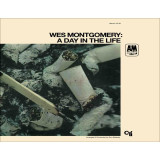
A Day in the Life' was released in 1967 and reached #1 on the Billboard Jazz Albums chart.
From the early 1960s to the late '80s, A&M was one of the most eclectic and powerful independent record labels in the world. The roster of artists who recorded there includes The Carpenters, Captain Beefheart, The Police, Joe Cocker, Suzanne Vega, Procol Harum and Janet Jackson, among others. Founded as an independent company by Herb Alpert and Jerry Moss in 1962, soon the label garnered interest and success, and was acquired by PolyGram in 1989. Throughout its operations, A&M housed well-known acts such as Sting, Sergio Mendes, Supertramp, Bryan Adams, Burt Bacharach, Liza Minnelli, Paul Williams, Quincy Jones, Cat Stevens, Peter Frampton, Carole King, Extreme, Joan Baez, the Human League, Soundgarden, Duffy, and Sheryl Crow, among others. Reissue of the debut album on A&M Records by jazz guitarist Wes Montgomery, released in 1967. It reached #1 on the Billboard Jazz album chart and #2 on the R&B chart. Considered by far the best of his three albums on A&M (in partnership with Creed Taylor’s CTI Records), A Day in the Life features a plethora of star sidemen, such as Herbie Hancock, Ron Carter, Ray Barretto and Grady Tate, among others, as well as superb arrangements by Don Sebesky.
Just under a year after their acclaimed self-titled debut, dreampop duo deary release a brand new six-track EP – Aurelia – via Sonic Cathedral on November 1. It includes the singles ‘The Moth’, ‘Selene’ and ‘The Drift’ and features Slowdive drummer Simon Scott playing on three songs. It will be available on three different vinyl variants, a CD with three bonus tracks and digitally. It’s a stunning record, which displays a new-found maturity in terms of production as well as musically and lyrically. The band – singer Rebecca ‘Dottie’ Cockram and guitarist/producer Ben Easton – have had to grow up in public since the release of their debut single at the start of 2023, supporting legends such as Slowdive and Cranes and TikTok sensations like Wisp along the way. An aurelian is a rare old term for a lepidopterist – someone who studies and collects moths – derived from the Latin aurelia, meaning chrysalis. The perfect title for an EP which is based around the theme of metamorphosis and change. “It leans on the natural world, the human body, the earth and sky as well as human emotion,” says Ben of how the EP represents physical and metaphysical growth. “Change can be daunting but equally exciting, which is something we’ve come to learn.” “While writing the EP, I found a letter I had written to myself when I was 22,” adds Dottie. “I was fresh out of university and had moved back in with my parents as Covid was in full force. I was uninspired and lost and reaching out to my future self for some hope. It was a physical representation of what can happen in a few years; how much can change and how you never know what’s coming next. “I found it interesting that – at the age of 26 – here I was looking back to my younger self for hope or just some comfort in the fact that things will and do move on. It was important to me to bring both of these versions of myself into the new songs.” “Personally, I had noticed a change in myself; a new level of social anxiety, a strange disassociation to things that once brought me joy as well as negative repetitions in my daily life,” reveals Ben. “I began the year sober which allowed me to finish the writing process as a letter of care to my own mental health. There are motifs throughout the EP – for example the riffs in ‘The Moth’ and ‘The Drift’ being reminiscent of each other – which are like musical reflections of these repeated cycles.” It’s musically where the change deary have undergone is most obvious. ‘The Moth’ mixes howling guitars atop a strident breakbeat making it more Curve than Cocteaus; ‘Selene’ is a slow-building wall of noise; ‘The Drift’ combines a perfect pop melody with an incredible sense of urgency. These three singles are balanced by the brief but beautiful ‘Where You Are’ which leads into the Portishead-style trip-hop of ‘Dream Of Me’. The title track has been a staple of their live sets for about a year as ‘Can’t Sleep Tonight’, but its mix of The Cure circa Disintegration and Mezzanine Massive Attack has grown and evolved so much that they renamed it ‘Aurelia’ as the embodiment of the change they have been through. “We’ve allowed deary to naturally grow over the past year, we didn’t want to force it to take a certain shape or sound,” explains Dottie of the duo’s slow and steady approach. “A lot of the last EP was written by sending ideas back and forth over WhatsApp, but this time we were able to sit in the same room and I think that really shows. We know each other a lot better now as we have experienced this journey together and that benefits the writing process as we are more open with each other and can be vulnerable.” “Aurelia definitely feels a lot more collaborative, more personal and more fully realised than the first EP,” concludes Ben. “It feels like a real document of what has been a very important time in both of our lives. Ironically, the band has changed and matured even more since the recording, so we’re both excited to document the next stage
Quantum Baby is the second instalment of Tinashe’s BB/ANG3L trilogy following last fall’s first instalment, BB/ANG3L. The album includes the explosive single “Nasty” which is currently rising up the charts and has become the song of the summer amassing over 200M+ global streams. Billboard Hot 100 - #61, Top 5 Rhythm Radio, Spotify Viral US - #1, TikTok Billboard Top 50 - #2. The genre-blending album contains elements of R&B, Pop, Electronic and Hip-Hop. This album features production from Grammy Award Winning producer Ricky Reed, along with Nosaj Thing and more! Tickets are currently on sale for the North American leg of Tinashe’s Match My Freak World Tour, which kicks off October ‘24. The vinyl is housed in a gatefold jacket with printed sleeve and insert booklet. Available in standard black and a limited Indie Exclusive Edition pressed on Blue & Orange Swirl colored vinyl. Quantum Baby is the second instalment in Tinashe’s BB/ANG3L album trilogy. The first in the series, BB/ANG3L, was released Fall ‘23 and was followed by the BB/ANG3L tour and Tinashe’s first Tiny Desk performance. Tinashe began teasing the hit single “Nasty,” this past Spring, debuting the song at Coachella 2024. The song quickly went viral, to become the song of the summer. This led to everyone asking the most prevalent question of the summer: “Is somebody gonna match my freak?” “Quantum Baby is about getting to know me on a deeper level. It's about exploring who I am as a person and who I am as an artist. I’ve never been one to be put into a box, so the name Quantum Baby encompasses all the different parts that make up who I am as a creative,” says Tinashe, describing the album as “forward, hot and lots of bass
Pink Vinyl
The diminutive Peter Barclay was guy in early '90s Oakland, the eccentric with the most style, the most talent, the local magician. This self-taught musical wizard recorded at home and produced two barely-released albums, 1990's dreamlike Acceptance and 1992's synth pop What Kind Of World, winning over the few who heard them. But fame outside his small circle was not to be, and Barclay was lost in the late-'90s crest of the AIDS epidemic. Rediscovered for a new generation, this is queer music at its finest... Welcome to the world of Peter Barclay.