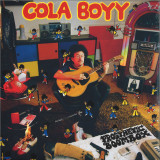
Produced by and featuring Aesop Rock. “I wrote half of these songs when my energy was either headed in the wrong direction or already there. I wrote the other half while my energy was moving in a direction I’m more excited about, that I find to be more enriching. They’re all still my songs though. My mother, and lots of my relatives, used to call me “Angelito.” Little Angel. The taijitu is the symbol for yin and yang. Opposites that make a whole. Given the dualistic/duelistic nature of the songs on the record, put it all together and what do you get, Anjelitu.” - Homeboy Sandman
Buscar:moth
- A1: The Fourth Day (Feat Roger Robinson)
- A2: Pressure (Feat Flowdan)
- A3: Demon (Feat Irah)
- A4: Vexed (Feat Moor Mother)
- B1: Clash (Feat Logan)
- B2: War (Feat Nazamba)
- B3: How Bout Dat (Feat Ffsytho)
- C1: Bang (Feat Manga Saint Hilare)
- C2: Hammer (Feat Flowdan)
- C3: Ganja Baby (Feat Daddy Freddy)
- C4: Fuck Off (Feat Logan)
- D1: Bomb (Feat Flowdan)
- D2: High Rise (Feat Manga Saint Hilare)
- D3: The Missing (Feat Roger Robinson)
Kevin Martins erstes Solo-Album unter dem Namen The Bug seit sieben Jahren könnte zeitlich nicht besser passen: „Fire“ - der dritte, berauschende Teil eines urbanen Triptychons, das mit dem explosiven „London Zoo“ von 2008 begann und mit dem bewusstseinsverändernden „Angels & Devils“ von 2014 fortgesetzt wurde - besteht aus vierzehn Tracks, die die Synapsen zum Schmelzen bringen, die den Körper durcheinanderwirbeln und die Hörerinnen und Hörer auf cineastische Weise von der Beschwörung einer düsteren, abgeriegelten Stadtlandschaft bis hin zu schwindelerregenden, tiefenscharfen Nahaufnahmen der Psyche von Martin, die ihn und seine Kollaborateur*innen an die Belastungsgrenze führen.
Die Aggression, die Attitüde, der beeindruckende Umfang und die destabilisierende, beunruhigende Raserei des Bug-Sounds ist durchweg perfekt umgesetzt, aber „Fire“ ist keine bloße Wiederbelebung der Vergangenheit - für Martin ist das Album sowohl eine Antwort auf die einzigartigen Umstände des vergangenen Jahres als auch eine Chance, seine eigene Reise vom zurückgezogenen Sound-Besessenen zum Familienvater zu reflektieren, und seinen Durst zu stillen - in einer Zeit erzwungener hermetischer Isolation - nach Kontakt, nach dem Chaos, das nur zwischen Menschen, Lärm und Bässen stattfinden kann, die Irritation der Sinne, die stets Bugs Methode und Weg waren, seit er in den späten 90ern aus den tiefsten Ecken Londons herauskroch.
Es ist das bisher beste Album von The Bug, möglicherweise die wildeste und bewegendste Musik, die Martin je gemacht hat, und es berührt immer noch die anfänglichen Sehnsüchte und Impulse, die „London Zoo“ wie eine Rohrbombe durch den Briefkasten in Ihre Welt katapultiert haben. Es ist eine hungrige Platte, in jeder Hinsicht.
Die MCs, die auf dem Album zu hören sind - einerseits langjährige Weggefährt*innen wie Flowdan, Roger Robinson, Moor Mother, Manga Saint Hilare, Irah & Daddy Freddy, andererseits relativ neue Namen im Bug-Stall wie Logan, Nazamba und FFSYTHO - reflektieren unweigerlich den äußeren Wahnsinn einer auf den Kopf gestellten Welt, graben aber auch tief in sich selbst, um nachdenkliche, erbarmungslos ehrliche Darstellungen der Wut, des Widerstands und der Resignation zu schaffen, die das letzte Jahr in uns allen hervorgerufen hat.
Dutch symphonic metal band Delain released their third studio album We Are the Others in 2012 to positive reviews from music critics. The album title was inspired by the murder of 20-year-old Sophie Lancaster, whose murder was likely a hate crime due to her being part of the goth subculture. The album spawned two single releases: “Get The Devil Out of Me” and the title track, for which the band shot a music video that included many well-known people from the metal scene, including George Oosthoek, Sharon den Adel, Robert Westerholt and Rob van der Loo. The album features guest contributions by the likes of Burton C. Bell (Fear Factory) and Marko Hietala (Nightwish) and was produced by Jacob Hellner (aka Tripod), who is best known for producing most of Rammstein’s albums.
Bonander is the shorthand for Ellinor Sterner Bonander. Sporting the role
of musician, arranger and producer, the native Swede is a woman
unchained, injecting darkness into the vein of candied pop with her tropes
of existentialism and feminist revolt.
Following the arc of ‘Backseat’ and ‘Martha’, Bonander’s latest single, ‘Gone
In The Wind’ leads the way for the album with its emotional outpour of lost
sisterhood. Tribal thrashes of drums, pipe organ and soaring vocals combine to
manifest the pain and frustration at the heart of the song.
She says, “The song is about abandonment of a person who’s been like a sister
to you, someone you admire and cherish... The pipe organ and strings are the
most emotional instrumentation I can think of. They represent that suppressed
feeling of anger and frustration, that later in the song is set free.”
The album tells the stories of women both from history and her personal life
whose contributions have previously been overlooked.
“The idea for the album is to create a musical, cinematic and dramatic journey
full of contrast between intimate string sections and huge synth landscapes,
between mechanical rhythms and flowing tempos.
The lyrics will together speak of the identities and emotional life of different
women, both through private and historical perspectives. All of the songs discuss subjects concerning women that ought to be talked about more, but sadly
are not...” // Bonander
Black vinyl w/ standard sleeve. Juju is the brainchild of Sicilian multi-instrumentalist Gioele Valenti (Lay Llamas, Herself) and this Fuzz Club Session LP finds Valenti and band (Vincenzo Schillaci, Simone Sfameli) storming through four tracks at I Candelai in Palermo, Italy. The resulting session is released as a series of videos and pressed on vinyl. Due for release August 13th on London-based label Fuzz Club, the session comprises two tracks from their 2017 second album 'Our Mother Was A Plant' ('In A Ghetto' and 'And Play A Game') and two from 2019's 'Maps and Territory' LP ('Master and Servants' and 'Motherfucker Core'). Juju's worldly, genre-bending experimentalism fuses psychedelia, new wave and krautrock with touches of afrobeat, funk and zamrock and it's in a live setting, such as that captured here, where that captivating blending of sounds is at its most spellbinding and hypnotic. Juju's Fuzz Club Session (the latest in a series which has previously included the likes of A Place to Bury Strangers, Night Beats, Holy Wave, The Entrance Band and more) makes all too clear why the band have been praised as one that "resets the coordinates and makes the past seem startling new again" (The Quietus).
- Lord Invader - Rum And Coca Cola
- Wilmoth Houdini - Poor But Ambitious
- The Charmer - Female Boxer
- Young Tiger – Trinidad
- Attila The Hun - Woman Is Not The Weaker Sex
- The Island Champions - My Advice To Men
- Lord Kitchener - Nosey Mother-In-Law
- Wilmoth Houdini - Gin & Coconut Water
- Lord Invader - Yankee Dollar
- Duke Of Iron - Big Bamboo
- The Roaring Lion - Wash Your Hands
- Mighty Terror - Chinese Children Call Me Daddy
- Lord Melody - Creature From The Black Lagoon
- Lord Kitchener - If You’re Not White, You’re Considered Black
Calypso developed into its modern form in Trinidad around the turn of the twentieth century as a primarily English-language topical song associated with pre-Lenten Carnival. By the 1920s, Calypsonians, as the singers and composers were called, performed in “tents” (yards covered by a tarp, union halls, and such) for the people of Trinidad and for tourists. As early as the 1930s, the genre was gaining a following outside of its homeland ; for example the British writer Aldous Huxley visited a tent in 1933 and wrote with admiration about calypso singing : “ The Calypsonians of Trinidad live in another ‘Zeit’; so the ‘Geist’ they obey is not the same as ours. In that, it may be, they are fortunate.
"Darryl is a crazy mysterious person. From what I know, he grew up alone with his mother without being much in contact with the rest of the world. His father's music record collection was the only connection with the other cultures and the world. Somehow he got a weird idea in his early childhood that this record collection contained all the music that had been ever created. He persuaded himself that the only way to make new music is to combine bits and pieces from that collection together. So he kept listening to those records and after a while, he was able to recollect their parts and combine them in his head — thus creating new music from what was already there. My role in this process is to communicate with Darryl and transfer his ideas into reality". Mr. Ultrafino
Based on the book by the same name, Minamata follows war photographer Eugene Smith as he travels Japan documenting the devastating effect of mercury poisoning among coastal communities. His efforts to publicize the suffering caused by corporate malfeasance soon draw the attention of the world to Minamata, the city where the effects of the toxin are most pronounced.
The score is composed by Ryuichi Sakamoto composer, electro-pop pioneer, buddy to David Bowie, and synthesizer legend. His work since the late 1970s has taken him from the top of the charts. Sakamoto’s music has consistently exuded a profound empathy. Whether leading Yellow Magic Orchestra’s cheeky pop, collaborating with cranial ambient artists, or, more recently, confronting his own mortality, Sakamoto’s music expresses in a few elegant gestures the haunting richness of life.
STANDARD 2LP VINYL EDITION - LIMITIERT Geboren 1970 in Tokio, verbrachte Jonathan Meese seine frühe Kindheit in Japan, und kam mit drei Jahren 1973 gemeinsam mit seiner Mutter zurück nach Deutschland. Als Kind sprach er nur japanisch und englisch. 1995-1998 Studium an der HfbK in Hamburg, 1998 Durchbruch als bildender Künstler auf der Berlin Biennale. In seinen Gemälden, Performances und Aktionen thematisiert Meese immer wieder die Rolle Deutschlands und deutsche Mythen. Eine ursprünglich beauftragte Meese-Inszenierung des ûParsifalë 2016 in Bayreuth wurde 2014 wegen angeblicher Unfinanzierbarkeit gekündigt. Der Münchener Techno- und House-Produzent Hell ist seit zwei Jahrzehnten ein Bewunderer Meeses. Als Hell vor zwei Jahren bei Jonathan Meese anfragte, ob dieser das Cover für Hells neues, kürzlich erschienenes Album ûHouse Music Boxë gestalten wolle, sagte dieser sofort zu. Die Wertschätzung entpuppte sich als gegenseitig. Man verabredete eine experimentelle Studiosession, um auszuloten, ob die polarisierenden Sprachperformances von Jonathan Meese in Verbindung mit Musik von Hell eine eigene Qualität entwickeln würden. 2019 nahmen Hell und Meese zum ersten Mal gemeinsam auf. Meese steuerte Textideen auf Papier bei, Hell hatte Instrumentals vorbereitet, die sowohl Hells stilistische Interessen, als auch Meeses musikalische Vorbilder - von DAF über Sisters of Mercy bis hin zu Kraftwerk - berücksichtigten. Hell: ûMir wurde in vielen gemeinsamen Gesprächen klar, wie musikaffin er eigentlich ist und wie viel unterschiedliche Musik er kennt. Und vor allem: Wie sehr die Musik ihm auch in seiner Kunst als Inspirationsquelle dient.ë Die Sessions - insgesamt drei, davon zwei gemeinsam mit Meeses 91-jähriger Mutter Brigitte - fanden im Trixx-Studio am Berliner Moritzplatz statt. Meese assoziierte Freestyle über Beats und Loops von Hell. Hell: ûIch bewundere Jonathan Meese nicht zuletzt als performativen Künstler - und gerade auch seinen stimmlichen Vortrag. Im Studio sang, sprach oder flüsterte er dann seine improvisierten Texte über die Tracks, die ich vorbereitet hatte.
There’s liberation on the dance floor in the songs of Matthew Urango – glimpses of revolution that glimmer beneath the disco ball. “I want my music to bring people together,” says the Californian pop innovator, best known as Cola Boyy. “Because standing together is our best chance at fighting this shit show.” The shit show in question is a broken, brutal system the acclaimed multi-instrumentalist has witnessed up-close. Urango was born with spina bifida and scoliosis in Oxnard, California: a town in which almost 30,000 are estimated to live in poverty. Prosthetic Boombox, his eagerly awaited debut album, might at first glance seem a joyous confetti-burst of pop eclecticism, engineered to sound like “scanning between stations on a car radio, landing on all these different sounds and styles” as Urango puts it. Dig deeper, though, and you’ll discover a simmering sense of rebellion. “The working class are injured, struggling to pay rent and struggling to put food on the table,” he says. “I want to represent that.” Prosthetic Boombox
achieves that goal in a thrilling flurry of inventive indie, funk and soul: take Urango’s car radio analogy, place it in a time-travelling Delorean with Prince in the passenger seat, and you’re half-way there.
Look no closer than Prosthetic Boombox’s euphoric opener, the Avalanches-assisted ‘Don’t Forget Your Neighbourhood.’ The track – which Urango says mixes “the Beach Boys, French disco, house keys and ragtime piano, kinda like the Cheers soundtrack!” – ends with lyrics urging listeners to “fight for your town with your fist closed, strike it and make it more than just a memory.” It’s a reminder that the working classes need to “turn our fists against our oppressors instead of each other,” he explains. After that emphatic introduction comes a horn-laced funk wig-out titled ‘Mailbox’ – a song that gives Dua Lipa’s Future Nostalgia a run for its Studio 54-themed money, featuring rising Londoner JGrrey. Elsewhere, ‘Song for the Mister’ ventures into smooth R&B territory, before ‘Roses’ – a collaboration with Myd of Ed Banger fame – offers a bouquet of bustling disco guitars and infinite bisous of Connan Mockasin’s band drops in on the immaculate ‘Go the Mile’. Urango saves his most introspective moment for the album’s starry closer. ‘Kid Born in Space’, a cosmic collaboration with MGMT frontman Andrew VanWyngarden, sees the artist reflect on what he once had to overcome as a disabled person of colour. “I see them looking down on my dreams of being,” he sings tenderly. “I hear them making fun of my voice, but I keep on moving forward, I refuse to live in anyone else’s shadow.” Prosthetic Boombox, on this subject, is more than an album title – it’s a statement of intent.
“The message of my music is that our class is exploited, oppressed and murdered on the daily. That’s not right, and the system that enables that deserves to be wiped off the face of the earth,” he says. “The only way that happens is if we’re united. That’s the point of my music – to relate to people and unite them.” And what unites more than raucous, irresistibly danceable pop? Prosthetic Boombox is a riot of joyous grooves and catchy hooks for good reason. “I want to reach and spread my message to as many people as possible. You can’t do that if you’re some obscure motherfucker, you know?” he laughs. Don’t bet on him being an “obscure motherfucker” for long.
Bella Union announce the release of Piroshka’s stunning second album,
‘Love Drips And Gathers’. The album builds on the acclaim of the band’s
2018 debut LP ‘Brickbat’ and the reputations of former members of Lush,
Moose, Elastica and Modern English.
Piroshka emerged in 2018, four individuals with distinct musical identities but
also overlapping histories - a combination that might have unsettled, or even
overwhelmed, some bands. But in their case, the bond only got stronger.
After ‘Brickbat’ explored social and political divisions by way of what MOJO
described as “Forceful, driving garage songs and dream-pop epics,” ‘Love
Drips And Gathers’ follows a more introspective line - the ties that bind us, as
lovers, parents, children, friends - to a suitably subtler, more ethereal sound,
whilst still revelling in energy and drama.
“If ‘Brickbat’ was our Britpop album, then ‘Love Drips And Gathers’ is
shoegaze!” reckons vocalist/guitarist Miki Berenyi, formerly of Lush, a band
that effortlessly bridged the two genres like no other. “It wasn’t intentional; we
just wanted a different focus. I’ve always seen debut albums as capturing a
band’s first moments, when you really have momentum, and then the second
album is the chance for a more thoughtful approach.”
Bassist Mick Conroy (Modern English) agrees. “‘Brickbat’ was a classic first
album; noisy and raucous. On ‘Love Drips And Gathers’, we’ve calmed down
and explored sounds, and space.”
The way ‘Love Drips And Gathers’ changes shape and dynamic is less a
reprise of Nineties Brit indie than a transformation into a more shivery, Euromantic version with glistening electronic filigrees. The opening ‘Hastings’ sets
the tone. Luminous drops of guitar underpin Miki’s becalmed vocal before
drums, bass and a Mellotron add pace while the decorative coda features
their old pal Terry Edwards on flugelhorn.
‘Love Drips And Gathers’ - named after a line in a Dylan Thomas poem - was
inspired by love, family, belonging, memory. Miki and Moose split the eight
lyrics, with some poignant overlaps here too. Miki’s ‘Loveable’ looks to
Moose; Moose’s ‘The Knife-Thrower’s Daughter’ looks to Miki but also their
daughter Stella and his sister Anna; an empathic, touching embrace of the
women in his life.
Staying within the family, Moose eulogises his late mother (the idyllic
childhood seaside trip of ‘Hastings 1973’) and father (the more conflicted
‘Scratching At The Lid’). On ‘V.O.’, Miki pays fond tribute to Vaughan Oliver,
4AD’s legendary in-house art director who died suddenly in December 2019
and who had a particularly close relationship with Lush during their time on
the label (like ‘Brickbat’, ‘Love Drips And Gathers’’ beautiful and enigmatic
artwork is by Vaughan’s former design partner Chris Bigg).
LP pressed on clear vinyl.
- 1: Low On Love
- 2: I Will Avenge You (Feat. Ryan Scott)
- 3: You Didn't Know
- 4: I Wish (Feat. Cory Wong, Justin Stanton & Michael League)
- 5: True Minds
- 6: Between Me & You
- 7: Good Stuff
- 8: Feels Like This
- 9: Slow Burn (Feat. Jacob Collier)
- 10: Charlemagne (Feat. Alan Hampton)
- 1: Never Mine
- 2: Response To Criticism (Feat. Roosevelt Collier)
- 3: Halfway (Feat. Laura Perrudin)
- 4: Heather's Letters To Her Mother (Feat. David Crosby, Michelle Willis, & Mike "Maz" Maher)
Since making her debut with the 2011 album Weightless, singer/songwriter/multi-instrumentalist Becca Stevens has tested the limits of musical identity, mining everything from jazz to Irish folk to indie-rock in her striving for complete and authentic expression. In her latest musical endeavor—the five-track EP WONDERBLOOM and a soon-to-follow full-length of the same name—the North Carolina-bred, Brooklyn-based artist again defies all expectation, this time dreaming up a groove-heavy, dance-ready sound infused with elements of pop and funk and R&B. But despite its brighter textures and uptempo rhythms, WONDERBLOOM finds Stevens achieving a profound complexity in her lyrics, ultimately redefining what’s possible in creating music that elevates and edifies. Centered on the captivating vocal presence she’s showcased as a member of David Crosby’s Lighthouse Band, WONDERBLOOM telegraphs an unabashed joy that Stevens partly attributes to the project’s production. In a bold new turn for her musical career, Stevens co-produced and co-engineered WONDERBLOOM alongside Nic Hard (Snarky Puppy, Ghost-Note, The Church), overseeing every aspect of the recording and claiming a sense of agency that had long eluded her in the studio. “Nic and I were truly working as equals and trusting each other to get the job done, and it was an incredibly empowering experience for me,” she says. In another major departure, Stevens purposely brought a communal sensibility to the making of WONDERBLOOM —an undertaking that resulted in more than 40 musicians contributing to the album, including Vulfpeck guitarist Cory Wong, Jacob Collier, and all of her Lighthouse bandmates (i.e., keyboardist Michelle Willis, Snarky Puppy bandleader Michael League, and David Crosby himself).
Obey Cobra features Kate Wood, Steve O Jones, Rory Coughlan-Allen, Gareth Day, Ian Coote and Rosemary Swan.
Over the past three years the band’s reputation as a formidable live force has grown following gigs with the likes of Pigs Pigs Pigs Pigs Pigs Pigs Pigs, Bob Log III, Hey Colossus and Acid Mothers Temple amongst many more.
Their debut album Oblong is an exceedingly potent blend of ethereal psychedelica, doom and punk with adept flourishes of noise rock, electronics and improv.
Recorded at Foel Studios and Coach House Sessions the album has been specially remastered for vinyl release on Box Records by Sam Grant (Richard Dawson, Du Blonde, Hen Ogledd, Pigs Pigs Pigs Pigs Pigs Pigs Pigs).
The album is completed with songs Sunflowers, Dim Break, Behind The Wall Of Sleep and Wunsch which align the lysergic psychedelics of Velvet Underground with the bewitching magic of Chelsea Wolfe and the mythical atmospherics of SunnO))).
The breadth of genres and sounds Obey Cobra explore across the course of Oblong is breathtaking, every song projecting the enchanting assuredness of a unique and captivating band.
In 1971, following his tenure with Frank Zappa’s Mothers of Invention, George Duke took Joe Zawinul’s seat with the Cannonball Adderley Quintet. During this secondment, Duke was also commissioned by Hans Georg Brunner Schwer’s MPS to produce what would unfold as a landmark album, fusing electric experimentation with latin percussion and African instrumentation. This single draws two of the highlights from this date, with the jazz dance behemoth ‘My Soul’ on the A side, and the funky trip ‘Au Right’ on the flip.
Mondo Music in collaboration with Hollywood Records is proud to present the premiere vinyl pressing of Mark Mothersbaugh's score to Thor: Ragnarok.
Former Devo frontman Mark Mothersbaugh (The Royal Tenenbaums, The Lego Movie) is the perfect choice for Taika Waititi's radical third chapter in the THOR series. Skillfully weaving the sonic landscape of the high fantasy genre with otherworldly synth, Mothersbaugh has produced one of the best scores of the entire MCU.
After long and highly distinguished careers with other collaborators, Richard Rodgers (Composer, 1902-79) and Oscar Hammerstein II (Librettist/Lyricist, 1895-1960) joined forces in 1943 to create the most successful partnership in American Musical Theatre. Prior to joining forces, Rodgers collaborated with lyricist Lorenz Hart on musical comedies that epitomized wit and sophistication (Pal Joey, On Your Toes, Babes in Arms, and more), while Hammerstein brought new life to operetta and created the classic Show Boat with Jerome Kern. Oklahoma!, the first Rodgers & Hammerstein musical, introduced an integrated form that became known as "the musical play." Their shows that followed included Carousel, South Pacific, The King and I, and The Sound of Music. Collectively, the Rodgers & Hammerstein musicals have earned Tony, Oscar, Grammy, Emmy, Pulitzer, and Olivier Awards.
About The Sound of Music
Rodgers & Hammerstein's last musical was a triumph. The Sound of Music opened at Broadway's Lunt-Fontanne Theatre on November 16, 1959. It ran for 1,443 performances and earned five Tony Awards including Best Musical. In addition, the cast album earned a Gold Record and the Grammy Award. Florence Henderson starred in the first national tour, which played for more than two years. Jean Bayless created the role of Maria in the original London production, which ran for more than six years, long holding the record as the longest-running American musical in London.
In 1965 the motion picture version of The Sound of Music was released, and it made Hollywood history. Directed by Robert Wise, with a score revised by Rodgers (Hammerstein had died in 1960, so Rodgers composed both music and lyrics for two songs added to the film: "I Have Confidence" and "Something Good"), and a screenplay by Ernest Lehman, The Sound of Music boasted a dream cast: Julie Andrews as Maria, Christopher Plummer as the Captain, Eleanor Parker as Elsa, Peggy Wood as the Mother Abbess and Charmian Carr as Liesl. Winner of five Academy Awards, including Best Picture, The Sound of Music has become the most popular movie musical ever made.
Finnish producer Sasu Ripatti has been torching the fringes of electronic music since the mid 1990s, a process that's found him melting a wide spectrum of musical innovation into his cult brand of experimental minimalism. From the skeletal jazz deconstructions of his 1997 Vladislav Delay debut "The Kind of Blue EP" to the blurred dub techno variations of 2000's "Multila" and 2012's "Kuopio", Ripatti has betrayed a restless, voracious passion for sound. "Fun is Not A Straight Line" builds on this impressive legacy, retaining his sonic signature and adding a playfulness that harks back to his beloved deep house smash, Luomo's "Vocalcity". After becoming frustrated by the inflexibility of the 4/4 house idiom, Ripatti found solace in rap and bass music's rhythmic complexity and anarchic structures. "I bought Nas's 'Illmatic' when it came out in '94 and have more or less been listening to rap since," he explains. "I'm not really sure why now, but that rap influence wanted to come through." Chopped rap vocals, booming subs and gritty, neck-snapping beats are the primary colors of "Fun is Not A Straight Line", painted into the foreground and blended into an immediately recognizable rhythmic palette. The tracks cross into the same continuum as Chicago footwork, with stuttering samples that build thick walls of bass and flurries of wordless rhymes amid a narcotic haze of beats. On 'monolith', Ripatti's love of New York rap is in full focus as he obscures chipmunked vocals with tight, crackling percussion that disintegrates into rolling kicks; 'speedmemories' is even more upfront, channeling the raw sunshine energy of So So Def electro into rhythms that are powerfully skeletal. Elsewhere, syrupy Southern-fried TR-808 bass womps are tangled with molasses-slow vocals on 'videophonekitty', fuzzed into textured, dissociated ambience. Since the beginning, Ripatti has tried to find a balance between his experimental urges and drive to create more universal music. As his more recent albums have traveled into darker, more extreme realms, he has craved something different for balance. By drawing a crooked line between DJ Premier, DJ Screw and DJ Rashad, Sasu Ripatti has emerged with the most accessible and unashamedly enjoyable album he's produced in years.
Pleasure is a Sydney based music project that utilizes distorted synths, irregular drum beats and fluid song structures to create energetic and hypnotic pieces that straddle the line of bright and abrasive.The trio is comprised of Adam Connelly (synthesizers + vocals) Jonathan Boulet (bass guitar + fx pedals) and Hugh Deacon (drums). When playing live and on record, their music is improvised and unrehearsed with no laptops or backing tracks. “One of us will introduce an idea and the rest will follow.”
Their debut LP Saint Albans, was conceived and recorded in a small farm house in the town of Saint Albans, New South Wales, over 3 days from the 12th to the 14th of October 2019. The building has since burned down in the 2019 Australian Bushfires. “We came away from this session with close to 20 hours of material that we edited down into consumable pieces.” This is the case for all tracks except BRAIN WASTE 191013 which was left intact and unedited.
They launched the Australian release of the album by playing a 6 hour endurance set in a warehouse in Sydney’s Inner West. “Our sonic influences seem very obvious but we haven't been called out yet. Mainly Boards of Canada, Black Moth Super Rainbow, Aphex Twin, Fuck Buttons, Blanck Mass and Lightning Bolt.”
A 14 track single black vinyl LP compilation featuring many of the group’s most cherished hits including "Together", “Cowboy to Girl”, "(We’ll Be) United”, “I'll Always Love My Mama (Part 1 )”, “I Wanna Know Your Name”, “Mother and Child Reunion", "Slow Drag" & "Sad Girl". Marketing activity across all 6 of these titles.
- A1: The Syd Dale Orchestra - The Hell Raisers
- A2: Perez Prado - Mamma A Go-Go
- A3: Rocky Roberts & The Airedales -The Bird Is The Word
- A4: Whit Boyd - Hot Blooded Woman
- A5: Lee Dowell - Don't Make Me Mad
- A6: The Penny Arcade - The Wild Scene
- A7: The E-Types - Put The Clock Back On The Wall
- A8: Bit 'A Sweet - Is It On - Is It Off
- A9: The Jaybirds - The Right Kind
- B1: Joe Bisko / Attila Galamb - Beware Of The 4-D Witch
- B2: Alan Hawkshaw - The Action Scene
- B3: Raul And The Revelations - A Sweet Sickness
- B4: Mandarin Gate With Chris Martell - It's A Revolution Mother
- B5: Jim Hughes - Soorangi
- B6: The Group - Bummer
- B7: Various - Musical Mutiny Trailer
- B8: The Love Generation - Different Now
- C1: John Barry & His Orchestra - Swinging City (Mood Three)
- C2: Robert Farnon - Johnny's Dive
- C3: Bob Freedman And His Orchestra - Strip Blues
- C4: Johnny Hawksworth - Jane Bond Theme
- C5: John Barry & His Orchestra - Mood One
- C6: Various - A Taste Of Flesh Opening Credit Theme
- C7: The Tony Harrison Trio - Hot Blooded Woman Incidental Music
- C10: Various - Hot Thrills Warm Chills Opening Credit Theme
- D1: Betty Dickson - Shanty Tramp
- D2: The Huntington Astronauts - Yipes Stripes
- D3: Billy Lee Riley - Speed Lovers
- D4: Lee Dowell - (Be A) Black Belt
- D5: The Ladybirds - At The Blue Bunny
- D6: Tony & Et Cetra - I Want A Woman
- D7: John Gabriel - Love Cool
- D8: Neil Patrick - Love Goddess
- D9: Meg Myles - The Female Of The Species
- C8: Various - My Brother's Wife Opening Credit Theme
- C9: Armando Sciascia - Easy Macumba
New pressing, with a front punch of color! It’s the yellow belt edition!
(yellow vinyl)Take an auditory trip through a wacky world of oddball and obscure ‘classick’ exploitation cinema soundtracks from the 1960s and early 1970s, presented by one of the most beloved genre film video companies of all time’ Something Weird! Two LPs chock-full of oddities and earworms with great sets of liners and track by track factoids!