Red Vinyl
Time has come for Futurepast to release a long format album: Alarm Phase Red - catalogue number FPLP01 - will be the first full-length work from Futurepast founder Davy Vandegaer, appearing here under a new name: Brainwashed Today.
Rooted in a conceptual approach of electronic music, this double LP ranges from industrial ambient to experimental techno. Like an antidote to a twisted reality of controlled screens and mental isolation, Alarm Phase Red uses the raw language of electricity
to reach the core of the machine and sabotage it, reverse its effects by mirroring them. Fighting fire with fire, deflecting the pressure and strain of a world driven by fear and anger, the music of Brainwashed Today acts like a cathartic escape from technological enslavement.
With the purchase of the vinyl comes a batch of three digital bonus tracks pursuing further the sound research of the album.
Cerca:music is the answer
Limited 300 180g white vinyl LPs with printed inner Discobag and digital download.
500 CDs in gatefold digifile sleeve.
Each drum controls a virtual musical instrument (synthesizers, samplers, arpeggiators, etc.) within Ableton Live music software that, in combination with a custom step sequencer developed with MaxforLive app, allows Davide to perform real melodies/electronic orchestration without the use of any backing track. 100% live. In addition to that, he also uses a microphone set up in the middle of the drumkit to capture the dynamics of the acoustic drums and translate them through an 'envelope follower' into electronic parts in several ways. About ‘Perceive Reality’: Opener Belief bursts the record into life, as skittering arpeggios spin across a vast open plain of pad synths, before the ground splits beneath it with thrashing drums. On Conceived, Davide creates a simultaneously dark and euphoric wall of crystallised sound, a cacophony of pounding drum hits and icy electronic stabs, with an intensity that continues into Collide. With its shuddering, cut-out reverbed synth pads split in two by crashing cymbals and snares, the song spins itself into a transformative cycling trance, before slowly fading and washing away into silence, only to be broken by Conjectures’ sudden cymbal slams and transfixed toms that roll like thunder into a frenzy, before their final lightning strike. On Subjective, arpeggios twist around beating kick drums and toms, quickly scaling to a furious yet tightly wound sequence that envelops the listener, before Relief, where the album finally takes the shape of a huge wave of calm, glimmering hope and reflection. About the concept behind this latest album, Davide says, “Perceive Reality is a vivid exhortation to deepen the relationship with reality, avoiding simple and often illusory visions. In a historical context that fosters the proliferation of dual information and visions, individuals are increasingly exposed to the danger of perceiving less the complexity of events, thus losing the training to express complex and articulated opinions, the result of a reflection, whether individual or collective. Without having the presumption of resolving epochal issues, the project alerts to the fact that univocal answers do not exist and that only by developing a path of knowledge and giving ourselves the opportunity to examine things in depth, can we enter into the relationship with the existing.” Press highlights so far: Video premiere on Rumore.IT (Italy).
Three years have passed since the world first learned of Ursula Bogner's work. Since then, her identity has been surrounded by rumours, her graphic work have been exhibited (CEACC, Strasbourg, France, 2011 and elsewhere) and her compositional instructions have been performed (by Mo Loschelder, Andrew Pekler, Kassian Troyer, Jan Jelinek among others). The release of Sonne = Blackbox brings together all of these aspects in one CD and book: compiled by Andrew Pekler, the CD presents Bogner's early experiments with voice and tape music – a previously unknown emotional side of her music is revealed here through her singing. The 126 page book contains, along with drawings, photos and other curiosities from Bogner’s life, an introduction by Jan Jelinek, texts by Momus, Andrew Pekler, Tim Tetzner, and Bettina Klein as well as interviews with the orgone researcher Jürgen Fischer and the ethnographer Kiwi Menrath. Sonne = Blackbox attempts to locate Ursula Bogner, the sound experimentalist within broader cultural history. A central theme is the phenomenon of fake: how did the erroneous suspicion of fakery come about in the case of Ursula Bogner and what is a post-fake? Answers in this book.
This acoustic body experiment will intoxicate your ears and veins. “Ectomorphin” by Chris Baumann is a straight confession for athletic acid underground – as the artist himself describes his style: “The border between timeless old school quality and new school upfront innovation in today’s techno music – just call it raw, hypnotic techno.” And this new release on Snork Enterprises presents a full load of proof for this bold hypothesis.
Ironically referring to some curious scientific concepts such as “Ectomorphin”, “Brainwave limiter”, “Neurotraxin”, and “Bioport” one may ask himself how the artist may well hypnotize our body and brain. Listening to the four forward moving techno tracks, you will soon know the answer. Just turn up the volume and get your body cells moving.
"Off-kilter melodies, dense instrumentation and lyrical explorations of the darkest side of the human condition" -- The Guardian
With B FLAT A this much acclaimed quartet from Gdansk, Poland have
produced their most epic and visceral statement to date.
A universe where echoes of Can, Syd Barrett and Fugazi lovingly collide. Cryptic and possessing of a great moral force, Trupa Trupa is a band for these times, whether we are ready for them or not.
The frst single "Twitch" is already out and is receiving strong airplay from BBC6 Music. Clash magazine wrote "Polish art-rock group Trupa Trupa return with the storming 'Twitch.' The band's imposing physicality is matched to some truly ground-breaking artistry - imagine a kind of Eastern European answer to Swans and you'd be close. With their intense live shows and crunching studio output,
Trupa Trupa have built an imposing catalogue, one with an international reach."
UK GIGS
19.02.2022 – UK – London – Lexington
21.02.2022 – UK – Brighton – Green Door Store
- A1: Travis - The Beautiful Occupation
- A2: Avril Lavigne - Knockin On Heaven's Door
- A3: Paul Mccartney - Calico Skies
- A4: David Bowie - Everyone Says Hi (Metro Mix)
- A5: George Michael - The Grave
- B1: Ronan Keating - In The Ghetto
- B2: Beverly Knight - Love's In Need Of Love Today
- B3: Moby - Nearer
- B4: New Order - Vietnam
- C1: Basement Jaxx - Love Is The Answer (Feat Yellowman)
- C2: Spiritualized - Hold On (War Child Mix)
- C3: The Charlatans - You Gotta Have Peace
- C4: Beth Orton - Ooh Child
- D1: Tom Mcrae - Border Song
- D2: Billy Bragg - The Wolf Covers It's Tracks
- D3: Yusuf Islam - Peace Train
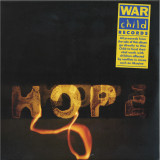
Hope was first released in partnership with The Daily Mirror in April 2003 as a response to the Iraq War, the artist community came together for War Child once more with some of the biggest names in music recording an album of exclusive tracks in just three weeks to raise vital funds to give hope to the children of Iraq. The vinyl release of Hope features alternate artwork using the original concept designed by Nick Robertson that has never been used before. Hope is part of a series of four re-releases by War Child Records making the amazing music artists have donated to the charity available on DSPs and vinyl for the first time. All proceeds from these releases will directly fund War Child’s life saving work with children affected by conflict.
- A1: Renee - Change Your Style
- A2: Joe Simon - Love Vibration
- A3: Dennis Parker - Like An Eagle
- A4: Stereolab - The Black Arts
- B1: Bibio - Don't Summarise My Summer Eyes
- B2: Sbtrkt - Hold On (Feat Sampha)
- B3: Friendly Fires - Why Don't You Answer? (Exclusive Cover Version)
- B4: Sonna - One Most Memorable
- C1: Laurel Halo - Embassy
- C2: Dj Sprinkles - House Music Is A Controllable Desire You Can Own
- C3: Grouper - Invisible
- C4: Melody's Echo Chamber - Endless Shore
- D1: Cocteau Twins - Cherry-Coloured Funk
- D2: Slowdive - Shine
- D3: Nils Frahm - Over There, It's Raining
- D4: Benedict Cumberbatch - Flat Of Angles (Part 1 - Exclusive Spoken Word Piece)
"We’ve reached book IV in Rupert Clervaux’s series of “Zibaldone” audio diaries, at which point we find him telling a different kind of story.
“The first three all had very specific themes, while this one feels a little bit looser and doesn’t have just one thematic thrust,” he tells me, which maybe explains why listening feels a bit like annotating. I’m underlining, emphasizing, drawing arrows from here to there, highlighting symbols and noting motifs, realising, questioning, eureka-ing. An impressionistic meaning’s been encoded in and we’re lucky to be given the space to play that most poetic and boundless of all mental games: narrativization.
There are no wrong answers, but Rupert offers some clues either way. If there’s any cipher here it’s “something like a meditation on the concept of ‘depth’––in all its connotative forms.” Think below the surface, (the) underground, yawning oceans, being ‘down in the dirt’, soil, roots, rootlessness, pulling at the dregs, collapse, profundity, stable and unstable horizons, distance, perspective, intuition, not to mention relative opposites: to be shallow, to be above, to be beyond.
It’s got me thinking of Bresson’s “Bring things together that have as yet never been brought together and did not seem predisposed to be so.” His: “Dig deep where you are. Don't slip off elsewhere.” Rupert has realized these—two favourite goals of mine!—here.
This is music that catches you at your own periphery, gives pause, has you offering a little “huh” to, asking “I wonder why” to. Again, it’s got me musing on another mindworm, this time from New York publisher and multi-sensory reading room Dispersed Holdings: “Feeling-making-knowing feedback loop; cartography of feeling; water as text, read to know the land beneath and around it, and body as reader.”
Is it ok to offer up these other contexts out of context? I think so, because Zibaldone IV articulates a similarly swirly tone. Like, we’ve got Rebecca Solnit talking through Kropotkin’s “Mutual Aid” and later calling out to Michael Ruppert a ways away, and “Easy Rider” is playing in the wings. We’ve got Susan Sontag magically contextualizing Mariah Carey with poet Thylias Moss triangulating in order to sketch out (Rupert again) “something a little more interesting than wilful eclecticism or that laboured and patronising kind of pop-savvy.”
Are we following? Whether yes or no Vanessa Bedoret follows on with a performance of a performance of Moss’s 'Water Road’: to be once or twice removed, via strange transitions, purposeful confusions, and, suddenly, seagulls. We’re on a boat with Ingeborg Bachmann—and how I wish I could actually be! But maybe thanks to this music I can as literature, films, friends, lethargy, coincidences, little mental links, eternal wormholes, lingering notions come together to imagine something better."
Text by Natalia Panzer
Ten years into his role as poster boy for pop soul and peak-hour R&B, Syl Johnson did an unlikely about-face and cut the most inspiring and powerful song he'd ever touch. Issued on 45 in September of 1969, "Is It Because I'm Black" struck an immediate chord within the black community, forcing the song up the charts by sheer volume of call-in requests. It would be Syl's biggest hit for Twinight, climbing as high as #11 on the Billboard R&B chart during its 14-week stay, marking the defining moment of what had become more than just an occupation. Syl had his hands on a career and worked tirelessly rehearsing his next opus, an album of songs reflective of the changing times. With "Is It Because I'm Black" still bolding the pages of Billboard, the coming LP's title appeared to Syl plain as day _ or, in this case, black as night. Issued in April 1970 _ a full 13 months before Marvin Gaye's What's Going On _ Is It Because I'm Black can rightly be called the first black concept album, a distinction few give it credit for. But that factoid, whatever its meaning then or now, failed to inspire music buyers: Johnson's record never got a whiff of the two million copies Gaye's did in its first year of availability. Syl lays the blame squarely on the record's lack of marketability to a white audience. The album's cover didn't exactly move units either. Photographer Jerry Griffith dragged Syl to a burned-out building on 43rd Street to shoot the back cover image, and he finger-painted the iconic title over a stock photo of an eroding brick wall. The title track, coupled with the politically charged "I'm Talking About Freedom" and ghetto conscious "Concrete Reservation" sealed the album's cool reception as the work of an "angry black man." Which is unfortunate, as "Together Forever," "Come Together," and "Black Balloons" are positively uplifting, forming their own pot of gold at the end of a grayscale rainbow. The album's closer burns the brightest. "Right On" devolves into a full-on party track, ending with Syl riffing on the line "I'm gonna keep on doing my thing," as if to answer his critics before their needles reached the run-out groove.
Back in stock !
There is geological time and deep-space time. The natural world's time, and quantum time. Humans started measuring time with the stars and seasons. Then came hourglasses and sundials. The first mechanical clocks weren't in Europe until the late 13th century. Then came industrial time, a wristwatch for all and then everything had a time. A time for everything. All feeding into our recently digitised time and its marching nanoseconds. Let us not forget however another way to measure time: That would be K&D time.
Yes, you can rush, but isn't it so much nicer to amble? This onception of time may well have its roots in those smoke mists, softly blowing through the pre-history of 1995, and if that was time - then we need space. In particular, one Viennese front room that has turned its bass bins out to the cosmos. That sweet smoke, shrouding the desk and sampler. A few old keyboards (as a friend skins up at the back) unnoticed on the couch - just passing through...
Those days of K&D time had been thought to have gone. But one of times tricks is to hide itself in music. Not long ago (after a box of DATs had been found, and a DAT player prised back into service) back through the music wormhole our heroes fell into that smoke laden room of 1995. The remix time hadn't arrived nor the intense touring schedule. It was before the K&D sessions release and all that came with it, before the solo projects of the Peace Orchestra and Tosca. This was a time before all of that. A time for literally living in the studio and experiencing the joy of creating tune after tune. Just the sound and the smoke and no boundaries.
It was before people started asking about when the album was coming out. Which developed its own time specific answers. The 90s answer was soon, 00s answer was not sure and then: never! from 2010 onwards. The truth was, an album had been finished by the spring of '95 and all recorded onto DAT and placed in a box. K&D pressed up 10 copies and gave 4 away to some suitably eccentric individuals. Then the room's doors opened and in a tremendously big cloud of smoke time rushed in, K&D rushed out, and the years went rolling by. The days got filled with remixes, touring and life.
Then in early 2020 that chance moving of a box at the back of a room exposed the DATs and their time transporting properties. As K&D went through them they ended up comfortable and back in the room and that wonderful haze of 1995. The music was transferred from the DATs and K&D painstakingly rebuilt every molecule that made up the original 10 copies. From the very first takes of the mixes printed onto tape, to the solid slab of black virgin vinyl, to the abused by many plays, white cover. Even down to the labels that says "'Unverkäufliche Musterplatte" (Testpressing - Not For Sale) in rather rude German.
It now looks, feels and sounds pretty much exactly the same as those original 10 copies did in 1995. The only thing that couldn't be don is the original clouds of smoke those 10 copies were bathed in. That will be left to the listener to wrap it in the fresh harvest of 2020. In one way it's a musical time warp space travel. In another, if the music becomes classic and timeless, then it's of its time, whatever the time. So as the rooms bass bins are once again turned out towards the cosmos, K&D are happy and proud to release what they thought were lost moments. Drop through the worm hole, take your place on the couch. The friend who is skinning up, always just passing through, listening to an album for the future called 1995. It all makes sense if you measure in K&D time.
Brooklyn-based musician, producer, and DJ Peter Matson returns to Bastard Jazz with a dance-floor ready 12" and digital EP, "The Right Way." The EP builds on Peter's 2019 release for the label - "Short Trips" - as well as his work as the bandleader for Underground System, and a slew of other solo and collaborative projects over the last two years.
Working from the ground up to produce a batch of 3 original tracks, Matson takes his sensibility as a DJ and musician and blends them into an unique whole, crafting sprawling arrangements into club-ready productions. With overall recording quality and ear for detail taking center stage, "The Right Way" boasts an impressive list of musical collaborators including a standout A-side feature from Ibibio Sound Machine's vocalist Eno Williams on the Afro-Disco workout "Call and Answer." Two beautifully conceived instrumentals on the flip-side dip into slow burning Italo ("The Right Way") and Balearic ("PB (Ça Va)") territories, while the UK duo Faze Action helm remix duty, pushing "Call and Answer" toward their signature Afro-meets-ProtoHouse & Disco vibe.
The EP weaves Matson's affinity for club music with the African influences for which he is known, culminating in a release that is both genre-bending and timelessly danceable. "The Right Way" is out digitally on Bastard Jazz Recordings February 25th, 2022, with the 12" to follow shortly after.
Pink Vinyl
"In the beginning there was Jack... And Jack had a groove." We know this old tale pretty well. But what do these words really mean? And does this meaning even exist nowadays?
Our fellow musician and sound researcher Stas Sharifullin, known as HMOT, presents his report Jack Studies in the form of a release on the Instrument, Gost Zvuk sublabel. Formally, it is a reissue of his single Prolegomena to Home Music Ontology, released in 2017 on Cyland. But these old tracks have been expanded, remastered by Rupert Clervaux and complemented by the two new ones. HMOT originally prepared the tracks on Jack Studies for release on Gost Zvuk, so these instrumentations are finally coming home after a long journey. Context is everything - and in the new environment, this music speaks even louder.
Originally, house music was associated with HIV/AIDS activism and the fight against racial oppression, among other things - and this was completely lost in translation in Russia. House was stripped of its political and symbolic potential, and Jack Studies tries to show how the context is slowly fading from our memory. But it's not just an observation. It's a tool of light intrusion that the author has already tested in his DJ sets. Once, he says, he played Instrumentation IV (Encore) for eleven minutes at the Kantine am Berghain.
Now that we are finally talking about Western and Eastern ways of making it in music, Jack Studies is more relevant than ever. You can see it not only as a joke said louder this time, but also as a critique of modern house music. You can also see it as a reflection on our strangeness to house music and how we can interpret it in our own way; as Sharifullin astutely suggests, as home music. He sees no line between tragedy and comedy, citing the plays of Samuel Beckett as the root of Jack Studies' irony. "They are funny and somber at the same time. To me, this release is sad, but the music here is joyful." Home music is the paradox. But it is also the beginning of something new. And in the beginning there was... what? Jack Studies has an answer.
Steve Vai has continually challenged notions of traditional guitar playing
and composition – and on more than one occasion even reimagined the
very instrument itself."I don't sit around and say, 'Okay, what can I do now
that pushes the boundaries?," Vai explains about his approach to the
guitar
"What I do say to myself is, 'Okay, Vai – what are you going to do now that's going
to interest you, that's going to fascinate you, and that's different than anything
you've done before?"The answer to that question comes in the form of Vai's
newest and 10th solo album, 'Inviolate', a nine-song opus that does indeed push
the boundaries of instrumental guitar music – this time out, Vai quite literally
invented not just a new guitar, but also a new guitar-playing technique. The Hydra,
the elaborate three- necked steampunk- inspired guitar that Steve holds on the
album cover, is actually played on the song 'Teeth of the Hydra'. On the other hand
(no pun intended), Steve recorded and played the song 'Knappsack' with just his
left hand, after his right arm was in a sling following shoulder surgery.
At the same time, 'Inviolate' presents his most focused, streamlined and perhaps
invigorating music in years. The album features a host of esteemed musicians,
including Billy Sheehan, Vinnie Colaiuta and Terry Bozzio.
Classic Rock - Album Review Classic Rock - Soundtrack To My Life feature
Fireworks – 2-page interview Fireworks - Album Review The Guitar Mag - 8-10
page Interview Guitar Techniques - Album Review GT332 9th Feb Guitar
Techniques - Q&A 9th Feb GT332. Guitar Interactive - Front cover & substantial
feature Guitarist - Front cover/Guest Editor/8-10 page feature Guitarist - Album
Review HRH - Album Review HRH - interview Powerplay - Interview Prog - My Prog
Hero feature on John Petrucci Rock Candy - 8-Page Interview Feb/Mar iss Total
Guitar - Interview
As a confluence of ideas and methods, WILD ROCKET endeavour to interpret the subtle signals of the universe - the interplanetary vibrations - and present them as brash manifestations of sound. Scientists and Shaman alike have endeavoured to interpret the universal whispers, to elucidate meaning from the measurable and the sensible. It is known that to measure and interpret is to alter and colour those signals and this is what drives the development of WILD ROCKET's sound and interpretation.
FORMLESS ABYSS showcases the band's unflinching pummelling style, drifting from repetitive blows to unhinged swirls of din yet always remaining innately infectious and perhaps surprisingly danceable. The record is presented as a continuous piece in three parts.
The title track A FORMLESS ABYSS appears here for the first time in recorded form – a behemoth of a tune which builds around a drone, joined by dual drums and minimal bass locked into a repetitive groove. A groove that is slowly expanded via multiple guitars and synthesis. Vocals eventually join at just the right moment imploring the listener to “leave your criticisms down” and realise “we're all equal now” in the formless abyss or the place between worlds where our earthly preoccupation with human differences are meaningless. We're all in it together, whether we realise it or not.
The second track INTERPLANETARY VIBRATIONS may seem familiar to some in a simpler form. The expanded line up and extended development of the core theme brings a new interpretation and experience that is more than worthwhile. The track's vocals juxtapose the hybrid Germanic language of English with the ancient native Irish language of Gaeilge. Both used to promote meaning and interpretation of the interplanetary vibrations felt by all. The track features large dynamic shifts and changes of pace as the message that “it's time to leave” propagated by the Earth itself becomes more frantic and more desperate. The track culminates in a wash of smashed gongs and distorted guitars, leaving the listener to interpret the message for themselves. Should we leave, to protect ourselves or the Earth itself?
The final track FUTURE ECHOES is a doom/kraut juggernaut coming in at just under twenty minutes. Only one question is asked and none answered, are we doomed to repeat the mistakes of previous civilisations over and over, or can we find the cracks of light that echo through and show us a new way forward? We're left in a swirling formless abyss to consider who we are and where we're headed. Will we ever reach the cosmic truth? Or will we be continuously mocked by the cosmic trout?
WILD ROCKET have proven themselves on the live circuit, playing with such visionaries as Ufomammut, Slomatics, Earth, Boris, The Cosmic Dead and old school rock legends Girlschool. One of the heaviest bands to emerge from the melting pot of talent in the Irish music scene, WILD ROCKET's reputation precedes them wherever they travel and audiences and venues alike are left to piece themselves together in the discombobulation.
Once in a while a record causes such a wave of excitement, it brings new vitality to dancefloors and generates fresh enthusiasm for the underground scene. ‘Without You’ is one such record, brought to life by the great talents of Art Department, a duo causing deep tremors due to their pioneering use of quivering bass, haunting vocals and fiery kickdrums.
The A side features the vocals of techno’s wonderchild, Seth Troxler, as well as Kenny Glasgow (one half of Art Department), his voice a major element of what makes their records so special. ‘Vampire Night Club’ layers the duo’s trademark synth sounds with an eerie and skin-pinching atmosphere. A truly mesmerizing record that gives the perfect introduction to the Art Dept sound on Crosstown Rebels, pre-empting their debut full length album on the label next year.
The double A and title track ‘Without You’ combines that unforgettable seductive bassline with a lingering vocal call. This record could have been made in the future as much as the past, its simplicity and depth the key to its appeal. Calls for its release have been heard for months and now have been answered with an extended 12” mix.
Art Department is the brainchild of Canadian duo Jonny White and Kenny Glasgow. With musical credentials dating back two decades, together they have constructed their own take on contemporary house music that has caught the attention of some of the leading figures of the current movement. With an album slated on Crosstown Rebels next year, this single is the first in a long line of raw futuristic bullets destined to cause a storm with an international audience.
In the late '70s, three do-right women from Cleveland forged a brief partnership with Ohio's everything man, Lou Ragland. Unlike the prefabricated singing combos of the day, Lily Pearson, Annette Warren, and Avetta Henry swapped lead duties as situation demanded. When a Ragland-centric publicity stunt preempted a concert appearance, Love Apple disintegrated, abandoning this rehearsal tape within the lo-fi confines of Thomas Boddie's cherished Eastside studio. Devoid of bass, the sparse instrumentation (only Lou on guitar and piano and Hot Chocolate's Tony Roberson on drums) accentuates each vocalist's aptitude, showcasing some of Ragland's finest songwriting in the process. During any given take, Ragland can be heard calling audibles, directing his singers to repeat a passage, or lending his own sweet tenor to the vocal mix. Never intended for release, Love Apple's six-song sketch is the perfect companion to I Travel Alone, bringing Ragland's unique musical vision into sharper focus.
The first and truly stunning release on the new Deeptrax sub-label Chasing Sunsets is one that is hard to describe...
As an (electronic) multi-instrumentalist, ES has been making music on a daily base for more than 25 years but has not released anything meaningful to this day. When we asked for some demos, we were literally bombarded with hundreds of well-produced songs in a wide variety of styles.
ES is a very creative artist who, in addition to making (video) art, creates his own world with his music. He is a musician with a completely unique sound that sometimes evokes a strong association with other music or artists. It sounds familiar and is pleasant to listen to because all the sounds seem to fall into place perfectly. But at the same time, it's totally fresh and sounds like nothing else.
“I just want to make music and not worry about the hassle; you just have to do it for me...” was the answer to the question if we could talk about releasing some music on one of our labels. "Just pick the songs you like, releasing my music on vinyl would be great ..."
So that's what we did...
This first EP gives a nice overview of some of the many musical sides of ES. It's jazzy, funky, dubby and trippy electronica with bits of ambient, house, breakbeat, acid and many other weird ES sound mix-ups. The tracks are as they are, all recorded in one take/version. Unique songs with sharply programmed rhythm and bass complemented by brilliantly played guitar, piano and synth parts. It's a surprising debut from an artist who only shows a small part of his personality with this release.
Welcome to the world of ES....
Sammy Burdson/Klaus Weiss/Larry Robbins Backgr Ound Rhythms
Dramatic Tempi / Larry Robbins Background Rhythms
- A1: Pop Waves (1:49)
- A2: Cyclodrom (1:10)
- A3: Devils Drive (1:28)
- A4: Crime Ways (2:06)
- A5: Is It Hip (2:00)
- A6: The Camp (3:29)
- A7: Tomorrow (1:53)
- A8: Rhythm Trip (4:28)
- B1: Vox Pop (1:22)
- B2: Rock Pop (2:47)
- B3: Pop Phase (2:46)
- B4: Pop Twang (0:55)
- B5: Canned Pop (1:40)
- B6: Percussion Take 1 (1:24)
- B7: Percussion Take 2 (1:08)
- B8: Percussion Take 3 (1:16)
- B9: Percussion Take 4 (1:10)
- B10: Percussion Take 5 (0:52)
- B11: Percussion Take 6 (1:54)
- B12: Percussion Take 7 (1:24)
C-L-A-S-S-I-C library breaks and beats set of heavy drums and louche funk.
One of two Be With forays into the archives of revered British library institution Conroy, we present one of our favourites on the label - the super in-demand Dramatic Tempi / Larry Robbins Background Rhythms, originally released in 1975. Rare and sought-after for many years now, this is one of those cult library LPs that rarely turns up on even the deepest dig.
As a single LP, Dramatic Tempi / Larry Robbins Background Rhythms is two distinctly different collections of music. The first side, Dramatic Tempi, is made up of four tracks each from Sammy Burdson and Klaus Weiss.
Sammy Burdson was one of the many, many aliases of the mighty Austrian composer, arranger and conductor, Gerhard Narholz. Founder of adored library label Sonoton in 1965, and a classically trained composer, his work runs from easy listening through pop, jazz and electronic, to avant-garde.
About as cult as it gets when it comes to library music legends (German or otherwise) Klaus Weiss produced essential records on German library labels Coloursound, Selected Sound and Sonoton, as well as making two essential entries in the Conroy catalogue. Having started his career at the age of 16 as a jazz drummer, the Klaus Weiss trademark electronic sound is unsurprisingly built on top of sometimes funky, sometimes frenetic, but always hard-hitting drums.
The second side is both titled and also credited to Larry Robbins Background Rhythms. We have to admit to being stumped as to who Larry was, but we don’t think it’s too much of a stretch to assume it might well be yet another incarnation of Gerhard Narholz’s.
First up from Dramatic Tempi are the phased, gargantuan hip-hop beats of Sammy Burdson’s impeccable “Pop Waves”. This is otherworldly funk on a whole new level. Hearing is believing. The magnificently titled “Cyclodrom” is up next, a beast of booming bass and wah wah guitars over frenetic funk drums. “Devils Drive” is dramatic, blaxploitation street funk with rolling, pounding drums. “Crime Ways” is an acid-squelch, slow-pace neck-snapper.
Klaus Weiss starts by askings us “Is It Hip” and we can only answer “yes it is!” to the clean, skipping drums, booming bass and proto-hip-hop bells, layered beneath laconic and melodic guitar shredding. This is just horizontal soul perfection. “The Camp”, propelled by jazzy guitar à la Joe Pass over fast drum and conga breaks, gives way to the dark guitars and cymbal crashes of “Tomorrow”. It sounds like an early New Order jam session. Closing out a pretty startling side of library greatness, “Rhythm Trip” presents early stuttering funk before easin' on in to a jazzy, soulful groove; all breezy guitar and warm keys. Lush.
Larry Robbins Background Rhythms is a lighter, poppier affair, but it’s not without its drum-heavy bangers. “Vox Pop” and “Pop Phase” each have clean, open-ish drum breaks, ripe for sampling or more daring DJ sets. “Pop Twang” is a short and sweet beat-heavy number that gives way to the fantastically out-there “Canned Pop”. We‘d love to know if this was ever actually licensed for something! The final seven tracks are a set of 1-to-2 minute “Percussion Takes”. All compelling, and all equally useful for any number of production needs. Get sampling.
The British library label with those instantly recognisable “orangey-red” sleeves, Conroy began releasing production music in 1965. A sub-label of Berry Music Co, its catalogue typified the library industry’s strange mixture of tradition and experimentation from the start. Conroy’s early releases included work by big band stalwarts like Eddie Warner as well as early electronic recordings by the likes of Belgian experimental pioneer Arséne Souffriau. With Berry Music Co working as a distribution partner to the German library label Sonoton, it was through the Conroy that a great deal of German library music found its way into the UK market.
Conroy stopped putting out new music in the 1980s, but its history and its catalogue offer an excellent window into the trends and eccentricities of a highly unique industry at the height of its international appeal.
This re-issue of Dramatic Tempi / Larry Robbins Background Rhythms has been mastered for vinyl by Be With regular Simon Francis from audio from the original tapes. Richard Robinson has handled reproducing the iconic, hypnotic original Conroy sleeve. Essential.
Kapingbdi came together in Liberia, West Africa, during the late 1970’s and had their own unique style. This six to seven-piece band played original compositions in a vibrant mix of African Rhythms, Soul, Spiritual Jazz, Funk and Rock. Led by Kojo Samuels on sax, flute and vocals “Born in The Night” presents the essential tracks from their rare studio LPs produced between 1978-1981. The work has been carefully edited and remastered in 2019 for vinyl LP and a 6-Page Digipack CD, which includes two additional recordings. Kapingbdi toured through Europe and the U.S. and were the only Afro funk band to ever come out of Liberia.
Kapingbdi hail from Liberia, West Africa and have their own imitable style. They effortlessly combine traditional African music in a modern mix of Jazz, Funk, Soul and Rock. The band is a fusion of the old and the new.
The word "Kapingbdi" is taken from the Sierra Leone language Mende and means "born in the night". Kojo Samuels was given the name by his Latin teacher whilst attending high school in Freetown, They often meet and debate at night in the city and soon after Kojo is called Kapingbdi. The name serves as a description of his origin. Born In Lagos, Nigeria in 1943. The son of slave children. His mother from Nigeria and father from Sierra Leone who moved the family to Liberia, during the 1950’s.
Kojo has played music for as long as he can remember. He starts with the harmonica and later becomes a drummer and percussionist in his first band at school. During his art studies 1965-1972, he tours Germany and works as an art teacher in the USA. His band Kapingbdi is reorganized five times and consists of up to seven musicians. In a VW-Bulli he drives the group from concert to concert and if the drummer fails, he jumps in himself. Between 1978 and 1981 three Kapingbdi LPs are produced for the independent label Trikont, recorded in Hamburg and Munich. During this creative period, the band plays at festivals in Africa and Europe. In 1984, the band tours the United States and shortly after, they came to an end.
At their best, Kapingbdi would rouse the audience with original compositions like "Human Rights", justice for all, especially for South Africans, and "You Go Go You Go Come". The officials and employees in the government departments have no time for the common man, for any questions such as job search, scholarship or similar, he receives the answer "go, come back tomorrow" and the same thing the following day. Or "Now Is The Time For Cry For Love." Now it is time to scream for love and finally, time for humanity and justice. Despite immense difficulties, the musicians consciously live and work in Africa and are at home in Liberia.
On April 12, 1980, ordinary soldiers and non-commissioned officers organize a coup against the government. This is an attempt to put an end to a policy of exploitation of the Liberian people. Whilst efforts to eradicate poverty, lawlessness and illiteracy are obvious throughout the country, Liberia is still Americanized to a high degree. This is evident, as the radio programs of that time almost exclusively played American disco music. Under these conditions, the people seek a reconnection to their folk music, and Kapingbdi were aware of this. Kojo tried many times to come together with traditional Liberian musicians. This passion takes him north of the country. Meeting and playing with the old hornblowers and playing music on traditional instruments, such as the elephant tusk.
Kapingbdi make high quality tape copies of their own vinyl LPs and patiently try to displace all unauthorized tapes from the domestic "market". Nevertheless, it is hard to make a living through music in Liberia. Kapingbdi, is now celebrated. The radio plays are in abundance, but royalties are not forthcoming. Their musical link is the feeling of Afrobeat and Highlife, which is found in each of the many Kapingbdi pieces. They embody Jazz, which is understood to be the most refined example of black music outside of Africa. In Liberia, Jazz is virtually impossible to hear. Bright shining names such as John Coltrane, Charlie Parker or Miles Davis were widely unknown. Thus, the Black Jazz, including its Back-To-Africa movement of the 60’s and 70‘s, passes by without leaving a trace in Africa itself.
Kojo's claim at the time, was to make African music with the depth, sensitivity and the freedom of the technical level of Jazz. This makes Kapingbdi the torchbeares. The underpaid prophets in small Liberia. It is the passion with which the founder of the band continues to work on their music for years. Tirelessly, stimulating and encouraging his fellow musicians. This is ultimately responsible for the success of Kapingbdi in Liberia itself. The local audience seems to listen to the band in fascinated astonishment. One wonders about the ability to develop as demonstrated by Kapingbdi on the basis of their music. It is African and unusually jazzy, danceable and better than the American disco music heard on the radio.
Rather than chase the money and the job opportunities in Europe, Kapingbdi are firmly rooted in Africa. The musicians live in Monrovia, the capital of Liberia, at the Kabingbdi workshop, located in the Congotown area on the eastern edge of the sprawling city. Kojo works here as a sculptor, painter, batik artist and musician. The sales revenue that his activities generate, gives him the opportunity to support the development of African Jazz music. The highest percentage of funds are from Germany and Kojo’s work ethic is “to work on your own thing“. The stance taken aims to support the welfare of Liberians and Africans. The other musicians of the group live in a second house that is nearby.
For the sake of consistency, Kapingbdi is a full-time band. However, the revenue, from all of the sources, could not keep them afloat. Equally, as important to the group are Kojos's knowledge of traditional African music and his sculpting skills. His knowledge is shared with others at the afternoon workshops. It is here that they discuss new lyrics, engage in political debate and the self-imposed task of improving conditions in Africa. At times the debate became heated, especially during rehearsals. This was regarded as good and integrative, sowing the seeds of innitiative to keep the band together.
From 1980 to 1985 Kojo also opened and ran the club "Panjebota", located on the grounds of the U.S. Consulate in Monrovia. Almost every evening Kapingbdi perform the song "Wrong Curfew Walk", whose lyrics lament the killing of citizens during the curfew imposed by the Liberian government. When the head of state Samuel Doe hears the song, he behaves agressively and forces Kojo to close the "Panjebota". Kojo had already moved on. Soonafter he meets Fela Kuti at the Africa-Festival and plays concerts in Germany with Cecil Taylor's workshop band.
Kapingbdi is for thinking, dreaming, dancing. What they sing about is what they have experienced. Kojo Samuels is 76 years old today and still follows his vocation as a critical musician, artist and activist.
Ekkehart Fleischhammer / Sonorama 2019 (with the help of original press sheets and the memories of Kojo Samuels)
Berlin-based violinist Daniel Hope’s latest album takes a deep dive into the rich repertoire of American music, exploring its roots and distinctive qualities. “We know a piece is from America the moment we hear it,” says Hope. “But what makes music sound American?” Daniel Hope – America provides some answers, presenting works by composers as diverse as Leonard Bernstein, Sam Cooke, Aaron Copland, Duke Ellington, George Gershwin, Florence Price, Samuel A. Ward and Kurt Weill in outstanding new classical and jazz arrangements by Paul Bateman for solo violin in different combinations, with vocals, piano, jazz trio, string/chamber orchestra and percussion.