quête:n non stop

Genres
Tout
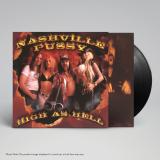
Nashville Pussy - High As Hell

Nashville Pussy

High As Hell

12inchSRE757LP
Svart Records
29.05.2026
  • 1: Struttin' Cock
  • 2: Go To Hell
  • 3: Shoot First And Run Like Hell
  • 4: Rock 'n' Roll Outlaw
  • 5: She's Got The Drugs
  • 6: Let's Ride
  • 7: Wrong Side Of A Gun
  • 8: Blowjob From A Rattlesnake
  • 9: Piece Of Ass
  • 10: Drive
  • 11: High As Hell
  • 12: You Ain't Right
également disponible

Transparent Blue Vinyl[26,01 €]


Nashville Pussy’s second album High As Hell reissued on vinyl for the first time via Svart Records Nashville Pussy is an American rock band from Atlanta, Georgia formed in 1996. Their blend of southern hard rock with tongue-in-cheek lyrics about all the rock’n’roll clichés have delighted audiences around the world for three decades and the band is still active to this day. Their sophomore album High As Hell was originally released on TVT Records back in 2000 and is now getting its first reissue treatment on vinyl via Svart Records. The album is a raw, high-energy fusion of AC/DC-style hard rock, Motörhead, and Lynyrd Skynyrd, delivering a non-stop, guitar-driven sound with praised guitar work by Ruyter Suys. Nashville Pussy stepped up their game with High As Hell by catchier riffs and solid songwriting, offering a loud, unapologetic, and ferocious 40-minute ride.

pré-commande29.05.2026

il devrait être publié sur 29.05.2026

25,17 €
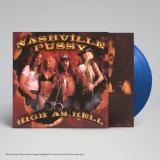
Nashville Pussy - High As Hell

Nashville Pussy

High As Hell

12inchSRE757LPB1
Svart Records
29.05.2026
  • 1: Struttin' Cock
  • 2: Go To Hell
  • 3: Shoot First And Run Like Hell
  • 4: Rock 'n' Roll Outlaw
  • 5: She's Got The Drugs
  • 6: Let's Ride
  • 7: Wrong Side Of A Gun
  • 8: Blowjob From A Rattlesnake
  • 9: Piece Of Ass
  • 10: Drive
  • 11: High As Hell
  • 12: You Ain't Right
également disponible

Black Vinyl[25,17 €]


Nashville Pussy’s second album High As Hell reissued on vinyl for the first time via Svart Records Nashville Pussy is an American rock band from Atlanta, Georgia formed in 1996. Their blend of southern hard rock with tongue-in-cheek lyrics about all the rock’n’roll clichés have delighted audiences around the world for three decades and the band is still active to this day. Their sophomore album High As Hell was originally released on TVT Records back in 2000 and is now getting its first reissue treatment on vinyl via Svart Records. The album is a raw, high-energy fusion of AC/DC-style hard rock, Motörhead, and Lynyrd Skynyrd, delivering a non-stop, guitar-driven sound with praised guitar work by Ruyter Suys. Nashville Pussy stepped up their game with High As Hell by catchier riffs and solid songwriting, offering a loud, unapologetic, and ferocious 40-minute ride.

pré-commande29.05.2026

il devrait être publié sur 29.05.2026

26,01 €
Rashad & Confidence - The Element Of Surprise (2x12")
  • 01: Introduction
  • 02: Brand New
  • 03: The City
  • 04: Understand
  • 05: Rumors Of War
  • 06: Days Of My Youth
  • 07: Interlude
  • 08: Pen On Display
  • 09: Shining
  • 10: Pass Me By
  • 11: Interlude 2
  • 12: They Keep Asking Me
  • 13: Let Me Explain
  • 14: All Year Round
  • 15: The Break Up Song
  • 16: Non Stop
  • 17: Feel It
  • 18: Desires

Rashad and Confidence announce the vinyl reissue of their debut album “The Element Of Surprise”. Though originally released in 2011, the melange of soul samples, classic breaks and favoring of lyrical storytelling / conceptual joints could easily have been released in the 90’s.

The 2xLP vinyl edition includes the 2019’s single “Desires” as well as two never before heard tracks from the 2011 sessions entitled “Non Stop” and “Feel It.” All tracks on the 2026 vinyl version are remastered!

Rashad, a Brooklyn NY emcee who sports a nimble and rapid flow excels at making anthemic choruses interspersed with highly detailed bars. Examples of album topics include a vivid picture of the hood while making a cautionary tale of its pitfalls (“The City”), his personal emcee origin story (“Days Of My Youth”), and the results of low motivation (“Pass Me By”) among others.

Boston based producer Confidence has made a career of sample chopping and analog warm heaters. He also tends to favor the one emcee/one producer line-up of the golden years. This extends to his recent collaborative LP's on Below System Records including “Library Of Sound” with M-Dot and “Kool Moe Dese” with Big Dese.

pré-commande22.05.2026

il devrait être publié sur 22.05.2026

36,93 €
Demon - You Are My High (Standard Edition)

Demon

You Are My High (Standard Edition)

12inchYAMH001STD
LA TEBWA
13.05.2026

"We just wanted a kiss that makes you want to kiss..."

From a sample to the most iconic kiss in music video history… When Demon released "You Are My High" at the end of 1999, it created a frenzy. Nominated at the Victoires de la Musique and the MTV Awards, the track was on everyone’s lips—including the CSA's, which tried to censor it. 25 years later, the "You" shines brighter than ever, captivating each new generation in turn.

A Top 10 hit in France upon release and certified gold within months, "You Are My High" skyrocketed thanks to its video—three minutes of a single-shot French kiss. Briefly banned by the CSA (who quickly realized it’s hard to censor something you see in every film), the clip ended up playing non-stop on music channels, defining an entire era.

Today, the "You"—as its creator fondly calls it—is considered one of the crown jewels of French Touch 1.0 (Daft Punk, Stardust, Cassius, Modjo, The Supermen Lovers...). With nearly 150 million streams across platforms, its legacy holds strong and continues to inspire a new wave of artists. Among the most iconic reinterpretations: a lo-fi cover by Agar Agar, remixes by DJ Snake and Central Cee, the You and Me video by Disclosure and Flume, and even a Jean Paul Gaultier campaign.

pas en stock

Commandez maintenant et nous commanderons l'article pour vous chez notre fournisseur.

Derniere entrée: 17 jours
18,45 €
Hurray for the Riff Raff - Live Forever LP 2x12"

On the two-year anniversary of The Past Is Still Alive – named one of the Best Albums of the 2020s So Far by Pitchfork, and one of the Best Albums of 2024 by the New York Times, The Atlantic, Associated Press, NPR Music, Rolling Stone, Billboard, OUT, Mojo, Uncut and a multitude of others – Hurray for the Riff Raff releases a new live record, Live Forever. The album was captured over the course of two sold-out summer nights at the Old Town School of Folk Music in bandleader Alynda Segarra’s new home of Chicago, Illinois. Spanning 14 songs, Live Forever presents The Past Is Still Alive in its entirety, as well as a selection of Hurray for the Riff Raff’s show-stopping, set-defining staples: decrying ICE on the poetic ‘Precious Cargo’ and The Navigator’s anthemic ‘Pa’lante’; the prescient digital age critique of ‘Pyramid Scheme’; and ripping through a folk-rock rendition of LIFE ON EARTH’s ‘Rhododendron’.

“I moved to Chicago in September 2024, the year I released The Past Is Still Alive and hit the road with a new band – a group of musicians recommended by my front of house/production manager, Johnny Wilson. Everyone had ties to the city, and had been playing together in the DIY scene for over a decade.

Since then we’ve traveled the world together, becoming family, playing the best shows of my life. Chicago has become home for me, and I feel grateful for the welcome I’ve gotten into the best music scene in the country.

I wanted to capture this time and this brilliant band, a moment that won’t last forever. This record is a love letter to the working class musicians out there, we who slug it out on the road against all odds. We deserve so much more from an industry built to exploit us. It’s a thank you to all the fans supporting live music, you who believe songs made by human beings are a vital life force.

pré-commande08.05.2026

il devrait être publié sur 08.05.2026

32,73 €
Guilty Razors - Complete Recordings 1977 - 1978

UILTY RAZORS, BONA FIDE PUNKS.


Writings on the topic that go off in all directions, mind-numbing lectures given by academics, and testimonies, most of them heavily doctored, from those who “lived through that era”: so many people today fantasize about the early days of punk in our country… This blessed moment when no one had yet thought of flaunting a ridiculous green mohawk, taking Sid Vicious as a hero, or – even worse – making the so-called alternative scene both festive and boorish. There was no such thing in 1976 or 1977, when it wasn’t easy to get hold of the first 45s by the Pistols or the Clash. Few people were aware of what was happening on the fringes of the fringes at the time. Malcolm McLaren was virtually unknown, and having short hair made you seem strange. Who knew then that rock music, which had taken a very bad turn since the early 1970s, would once again become an essential element of liberation? That, thanks to short and fast songs, it would once again rediscover that primitive, social side that was so hated by older generations? Who knew that, besides a few loners who read the music press (it was even better if they read it in English) and frequented the right record stores? Many of these formed bands, because it was impossible to do otherwise. We quickly went from listening to the Velvet Underground to trying to play the Stooges’ intros. It’s a somewhat collective story, even though there weren’t many people to start it.
The Guilty Razors were among those who took part in this initial upheaval in Paris. They were far from being the worst. They had something special and even released a single that was well above the national average. They also had enough songs to fill an album, the one you’re holding. In everyone’s opinion, they were definitely not among the punk impostors that followed in their wake. They were, at least, genuine and credible.

Guilty Razors, Parisian punk band (1975-1978). To understand something about their somewhat linear but very energetic sound, we might need to talk about the context in which it was born and, more broadly, recall the boredom (a theme that would become capital in punk songs) coupled with the desire to blow everything off, which were the basis for the formation of bands playing a rejuvenated rock music ; about the passion for a few records by the Kinks or the early Who, by the Stooges, by the Velvet mostly, which set you apart from the crowd.
And of course, we should remember this new wave, which was promoted by a few articles in the specialized press and some cutting-edge record stores, coming from New York or London, whose small but powerful influence could be felt in Paris and in a handful of isolated places in the provinces, lulled to sleep by so many appalling things, from Tangerine Dream to President Giscard d’Estaing...
In 1975-76, French music was, as almost always, in a sorry state ; it was still dominated by Johnny Hallyday and Sylvie Vartan. Local rock music was also rather bleak, apart from Bijou and Little Bob who tried to revive this small scene with poorly sound-engineered gigs played to almost no one.
In the working class suburbs at the time, it was mainly hard rock music played to 11 that helped people forget about their gruelling shifts at the factory. Here and there, on the outskirts of major cities, you still could find a few rockers with sideburns wearing black armbands since the death of Gene Vincent, but it wasn’t a proper mass movement, just a source of real danger to anyone they came across who wasn't like them. In August 1976, a festival unlike any other took place in Mont-de-Marsan – the First European Punk Festival as the poster said – with almost as many people on stage as in the audience. Yet, on that day, a quasi historical event happened, when, under the blazing afternoon sun, a band of unknowns called The Damned made an unprecedented noise in the arena, reminiscent of the chaotic Stooges in their early adolescence. They were the first genuine punk band to perform in our country: from then on, anything was possible, almost anything seemed permissible.

It makes sense that the four+1 members of Guilty Razors, who initially amplified acoustic guitars with crappy tape recorder microphones, would adopt punk music (pronounced paink in French) naturally and instinctively, since it combines liberating noise with speed of execution and – crucially – a very healthy sense of rebellion (the protesters of May 1968 proclaimed, and it was even a slogan, that they weren’t against old people, but against what had made them grow old. In the mid-1970s, it seemed normal and obvious that old people should now ALSO be targeted!!!).
At the time, the desire to fight back, and break down authority and apathy, was either red or black, often taking the form of leafleting, tumultuous general assemblies in the schoolyard, and massive or shabby demonstrations, most of the time overflowing with an exciting vitality that sometimes turned into fights with the riot police. Indeed, soon after the end of the Vietnam War and following Pinochet’s coup in Chile, all over France, Trotskyist and anarcho-libertarian fervour was firmly entrenched among parts of the educated youth population, who were equally rebellious and troublemakers whenever they had the chance. It should also be noted that when the single "Anarchy in the UK" was first heard, even though not many of us had access to it, both the title and its explosive sound immediately resonated with some of those troublemakers crying out for ANARCHY!!! Meanwhile, the left-wing majority still equated punks with reckless young neo-Nazis. Of course, the widely circulated photos in the mainstream press of Siouxsie Sioux with her swastikas didn’t necessarily help to win over the theorists of the Great Revolution. It took Joe Strummer to introduce The Clash as an anti-racist, anti-fascist and anti-ignorance band for the rejection of old-school revolutionaries to fade a little.

The Lycée Jean-Baptiste Say at Porte d’Auteuil, despite being located in the very posh and very exclusive 16th arrondissement of Paris, didn’t escape these "committed" upheavals, which doubled as the perfect outlet for the less timid members of this generation.
“Back then, politics were fun,” says Tristam Nada, who studied there and went on to become Guilty Razors’ frontman. “Jean-Baptiste was the leftist high-school in the neighbourhood. When the far right guys from the GUD came down there, the Communist League guys from elsewhere helped us fight them off.”
Anything that could challenge authority was fair game and of course, strikes for just about any reason would lead to increasingly frequent truancy (with a definitive farewell to education that would soon follow). Tristam Nada spent his 10th and 11th unfinished grades with José Perez, who had come from Spain, where his father, a janitor, had been sentenced to death by Franco. “José steered my tastes towards solid acts such as The Who. Like most teenagers, I had previously absorbed just about everything that came my way, from Yes to Led Zeppelin to Genesis. I was exploring… And then one day, he told me that he and his brother Carlos wanted to start a rock band.” The Perez brothers already played guitar. “Of course, they were Spanish!”, jokes their singer. “Then, somewhat reluctantly, José took up the bass and we were soon joined by Jano – who called himself Jano Homicid – who took up the rhythm guitar.” Several drummers would later join this core of not easily intimidated young guys who didn’t let adversity get the better of them.

The first rehearsals of the newly named Guilty Razors took place in the bedroom of a Perez aunt. There, the three rookies tried to cover a few standards, songs that often were an integral part of their lives. During a first, short gig, in front of a bewildered audience of tough old-school rockers, they launched into a clunky version of the Velvet Underground's “Heroin”. Challenge or recklessness? A bit of both, probably… And then, step by step, their limited repertoire expanded as they decided to write their own songs, sung in a not always very accurate or academic English, but who cared about proper grammar or the right vocabulary, since what truly mattered was to make the words sound as good as possible while playing very, very fast music? And spitting out those words in a language that left no doubt as to what it conveyed mattered as well.
Trying their hand a the kind of rock music disliked by most of the neighbourhood, making noise, being fiercely provocative: they still belonged to a tiny clique who, at this very moment, had chosen to impose this difference. And there were very few places in France or elsewhere, where one could witness the first stirrings of something that wasn’t a trend yet, let alone a movement.

In the provinces, in late 1976 or early 1977, there couldn’t be more than thirty record stores that were a bit more discerning than average, where you could hear this new kind of short-haired rock music called “punk”. The old clientele, who previously had no problem coming in to buy the latest McCartney or Aerosmith LP, now felt a little less comfortable there…
In Paris, these enlightened places were quite rare and often located nex to what would become the Forum des Halles, a big shopping mall. Between three aging sex workers, a couple of second-hand clothes shops, sellers of hippie paraphernalia and small fashion designers, the good word was loudly spread in two pioneering places – propagators of what was still only a new underground movement. Historically, the first one was the Open Market, a kind of poorly, but tastefully stocked cave. Speakers blasted out the sound of sixties garage bands from the Nuggets compilation (a crucial reference for José Perez) or the badly dressed English kids of Eddie and the Hot Rods. This black-painted den was opened a few years earlier by Marc Zermati, a character who wasn’t always in a sunny disposition, but always quite radical in his (good) choices and his opinions. He founded the independent label Skydog and was one of the promoters of the Mont-de-Marsan punk festivals. Not far from there was Harry Cover, another store more in tune with the new New York scene, which was amply covered in the house fanzine, Rock News (even though it was in it that the photos of the Sex Pistols were first published in France).
It was a favorite hang-out of the Perez brothers and Tristam Nada, as the latter explained. “It’s at Harry Cover’s that we first heard the Pistols and Clash’s 45s, and after that, we decided to start writing our first songs. If they could do it, so could we!”
The sonic shocks that were “Anarchy in the UK”, “White Riot” or the Buzzcocks’s EP, “Spiral Scratch” – which Guilty Razors' sound is reminiscent of – were soon to be amplified by an unparalleled visual shock. In April 1977, right after the release of their first LP, The Clash performed at the Palais des Glaces in Paris, during a punk night organised by Marc Zermati. For many who were there, it was the gig of a lifetime…
Of course, Guilty Razors and Tristam were in the audience: “That concert was fabulous… We Parisian punks were almost all dressed in black and white, with white shirts, skinny leather ties, bikers jackets or light jackets, etc. The Clash, on the other hand, wore colourful clothes. Well, the next day, at the Gibus, you’d spot everyone who had been at this concert, but they weren’t wearing anything black, they were all wearing colours.”

It makes sense to mention the Gibus club, as Guilty Razors often played there (sometimes in front of a hostile audience). It was also the only place in Paris that regularly scheduled new Parisian or Anglo-Saxon acts, such as Generation X, Siouxsie and the Banshees, the Slits, and Johnny Thunders who would become a kind of messed-up mascot for the venue. A little later, in 1978, the Rose Bonbon – formerly the Nashville – also attracted nightly owls in search of electric thrills… In 1977, the iconic but not necessarily excellent Asphalt Jungle often played at the Gibus, sometimes sharing the bill with Metal Urbain, the only band whose aura would later transcend the French borders (“I saw them as the French Sex Pistols,” said Geoff Travis, head of their British label Rough Trade). Already established in this small scene, Metal Urbain helped the young and restless Guilty Razors who had just arrived. Guitarist for Metal Urbain Hermann Schwartz remembers it: “They were younger than us, we were a bit like their mentors even if it’s too strong a word… At least they were credible. We thought they were good, and they had good songs which reminded of the Buzzcocks that I liked a lot. But at some point, they started hanging out with the Hells Angels. That’s when we stopped following them.”

The break-up was mutual, since, Guilty Razors, for their part, were shocked when they saw a fringe element of the audience at Metal Urbain concerts who repeatedly shouted “Sieg Heil” and gave Nazi salutes. These provocations, even still minor (the bulk of the skinhead crowd would later make their presence felt during concerts), weren’t really to the liking of the Perez brothers, whose anti-fascist convictions were firmly rooted. Some things are non-negotiable.
A few months earlier (in July 1978), Guilty Razors had nevertheless opened very successfully for Metal Urbain at the Bus Palladium, a more traditonally old-school rock night-club. But, as was sometimes the case back then, the night turned into a mass brawl when suburban rockers came to “beat up punks”.

Back then, Parisian nights weren’t always sweet and serene.

So, after opening as best as they could for The Jam (their sound having been ruined by the PA system), our local heroes were – once again – met outside by a horde of greasers out to get them. “Thankfully,” says Tristam, “we were with our roadies, motorless bikers who acted as a protective barrier. We were chased in the neighbouring streets and the whole thing ended in front of a bar, with the owner coming out with a rifle…”
Although Tristam and the Perez brothers narrowly escaped various, potentially bloody, incidents, they weren’t completely innocent of wrongdoing either. They still find amusing their mugging of two strangers in the street for example (“We were broke and we simply wanted to buy tickets for the Heartbreakers concert that night,” says Tristam). It so happened that their victims were two key figures in the rock business at the time: radio presenter Alain Manneval and music publisher Philippe Constantin. They filed a complaint and sought monetary compensation, but somehow the band’s manager, the skilful but very controversial Alexis, managed to get the complaint withdrawn and Guilty Razors ended up signing with Constantin with a substantial advance.

They also signed with Polydor and the label released in 1978 their only three-track 45, featuring “I Don't Wanna be A Rich”, “Hurts and Noises” and “Provocate” (songs that exuded perpetual rebellion and an unquenchable desire for “class” confrontation). It was a very good record, but due to a lack of promotion (radio stations didn’t play French artists singing in English), it didn’t sell very well. Only 800 copies were allegedly sold and the rest of the stock was pulped… Initially, the three tracks were to be included on a LP that never came to be, since they were dropped by Polydor (“Let’s say we sometimes caused a ruckus in their offices!” laughs Tristam.) In order to perfect the long-awaited LP, the band recorded demos of other tracks. There was a cover of Pink Floyd's “Lucifer Sam” from the Syd Barrett era – proof of an enduring love for the sixties’ greats –, “Wake Up” a hangover tale and “Bad Heart” about the Baader-Meinhof gang, whose actions had a profound impact on the era and on a generation seeking extreme dissent... On the album you’re now discovering, you can also hear five previously unreleased tracks recorded a bit later during an extended and freezing stay in Madrid, in a makeshift studio with the invaluable help of a drummer also acting as sound engineer. He was both an enthusiastic old hippie and a proper whizz at sound engineering. Here too, certain influences from the fifties and sixties (Link Wray, the Troggs) are more than obvious in the band’s music.

Shortly after a final stormy and rather barbaric (on the audience’s side) “Punk night” at the Olympia in June 1978, Tristam left the band ; his bandmates continued without him for a short while.

But like most pioneering punk bands of the era, Guilty Razors eventually split up for good after three years (besides once in Spain, they’d only played in Paris). The reason for ceasing business activities were more or less the same for everyone: there were no venues outside one’s small circuit to play this kind of rock music, which was still frightening, unknown, or of little interest to most people. The chances of recording an LP were virtually null, since major labels were only signing unoriginal but reassuring sub-Téléphone clones, and the smaller ones were only interested in progressive rock or French chanson for youth clubs. And what about self-production? No one in our small safety-pinned world had thought about it yet. There wasn’t enough money to embark on that sort of venture anyway.

So yes, the early days of punk in France were truly No Future!

pas en stock

Commandez maintenant et nous commanderons l'article pour vous chez notre fournisseur.

Last In: 6 months ago
21,43 €
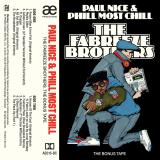
Paul Nice & Phill Most Chill - The Fabreeze Brothers (Tape)

Expanded Edition Double Cassette Box Set including main album and Bonus Cassette with unique download cards


AE Productions in association with Sure Shot Recordings and In Effect Recordings are pleased to announce a 10 Year Anniversary Edition of the critically acclaimed Phill Most Chill and Paul Nice album as the Fabreeze Brothers.

The hugely successful first edition which was pressed on colour vinyl and supplied in double fold out sleeve sold out in only 2 weeks from release date and then the 2nd pressing black vinyl edition sold out a little while later but has for years been out of print but is increasingly requested by shops, via email, social media, AE Productions website back in stock requests, etc…

As it has been 10 years since original release back in 2015 at the time of proceeding with manufacturing, it was the perfect opportunity to do a 3rd pressing to mark the anniversary but we had to pull out all the stops for a 3rd run of this incredible album and also make it subtly different again in packaging design from the 1st and 2nd pressings so that each has it’s own particular feel and quality.

With help from the original designer and all-round vinyl artwork supremo Mr Krum we have found some nice adjustments for the gatefold sleeve where the detail from the insert sheet found in the original issues is incorporated into the inside panels of the sleeve. We have also tweaked the hype sticker to mark the 10th Anniversary Edition and updated the vinyl labels so as to work better with the new Splatter vinyl which follows the original red and yellow vinyl but each splattered with the opposite colour.

For something a little extra we have compiled a Limited Expanded Edition Double Cassette Box Set that includes the original album and also a ‘Bonus Tape’ which features all of the remixes, alternate versions, Original Versions of album cuts and bonus tracks found on B-sides of the array of singles and we included for good measure 2 tracks that only appeared on the promotional only LP sampler that ended up being different on the final release. This is limited to cassette just for the non-vinyl heads as all of these tracks already appear on vinyl. The outer box is A5 card in black with gold foil Fabreeze Brothers logo and comes with discography booklet.

‘The Bonus Tape’ from the box set is also available as a standalone cassette release with alternate j-card art work so that it has it’s own flavour and so that anyone that purchased one of the original run of cassettes that sold out before we could even ship any copies, did not need to purchase the main album again unnecessarily and to make it noticeable from the Expanded Edition Box Set version.

This version also has an alternate shell design in keeping with the clear shell with dark liner that was commonplace back in the 90’s and the cassette geeks may note the red text on the spine as was also a common design back then – giving this a pseudonym of ‘the 90’s tape’ during the design process.

We couldn’t stop there so we also have an extremely low quantity Limited Edition Mini Disc version which is the main album plus 8 of the bonus tracks from The Bonus Tape – only missing the 2 least significant alternate versions but clocking in at just a few seconds under 80 minutes – the absolute maximum for the format! Mini Disc???!!! You’re probably asking – yes!

While looking into the cassette duplication options we realised that the duplicator also offers Mini Disc production so we thought that it may be worth doing a very small run just because not only are professionally manufactured Mini Disc’s rare in Hip Hop, they are rare within the entire music industry as they never really took off as a medium to purchase music but ended up as the choice for home recorded Walkman and car use. Indeed, AE boss Mr Fantastic still has his main machine, portable and old discs. Amazingly also, the sleeve artwork transferred brilliantly to the Mini Disc template. They are manufactured using high quality Sony discs using ATRAC 4.5 codec.

All releases are supplied with unique free download codes on cards that are included inside the packaging but also with the Expanded Edition cassette and Mini Disc having 2 cards – 1 for the main album and a 2nd card for ‘The Bonus Tape’. The free downloads are supplied direct from Phill Most Chill’s Bandcamp page keeping it independent.

pré-commande27.03.2026

il devrait être publié sur 27.03.2026

38,87 €
Mal Devisa - Palimpsesa 2x12

Mal Devisa

Palimpsesa 2x12

2x12inchLPTSR275C
TOPSHELF RECORDS
27.02.2026
  • 1: You Are My Sunshine
  • 2: Next Stop
  • 3: Icarus-breakthrough
  • 4: Vicious Nonbeliever (Feat. God's Wisdom)
  • 5: New Eardrums
  • 6: Dominatrix
  • 7: Old Intro
  • 8: Never See Me Do It
  • 9: Crowd Pleaser
  • 10: The Room Is Spinning/Rough
  • 11: Contracts
  • 12: Skyline Arms/Reach Out
  • 1: Fire
  • 2: You Are All That You Need
  • 3: To Be Unwilling
  • 4: I Could Tell
  • 5: The Skies
  • 6: Dangerous
  • 7: If You Are Waiting
  • 8: Shomberg Isn't the Place
  • 9: Slept On
  • 10: Rum
  • 11: O Ivory
  • 12: Sunrise
  • 15: Forest
  • 16: Raw As the Hands of the Sun
  • 17: Forget That I
  • 13: My Potential
  • 14: You Go to My Head

Mal Devisa is the songwriting, liberation, and poetry project of multifarious artist Deja Carr. Starting in 2014 and breaking through with 2016's Kiid, Mal Devisa's work spans a selfmade spectrum of sound from gravitic, soulful rock to soliloquy to unabashed hip hop. Although known for her unmistakable, smoldering voice and loop-based, bass-forward compositions, Carr's talents also extend to reaches of spoken word and production, paralleled by aspirations to start both a youth foundation and Afrobeat orchestra. Such boundless inspiration is a central facet of Mal Devisa's work, whose sonically and narratively unrestrained passages teem with empathy and liberatory visions for a better world.

pré-commande27.02.2026

il devrait être publié sur 27.02.2026

36,09 €
Various - 600% DYNAMITE! Ska, Soul, Rocksteady, Funk and Dub in Jamaica (2x12")
  • 1: Cynty And The Monkees - Lady Lady
  • 2: Johnny Osbourne - Buddy Bye
  • 3: Dennis Brown - West Bound Train
  • 4: Tenor Saw - Golden Hen
  • 5: The Interns - Nothing Is Impossible
  • 6: Tall T & The Touchers - Touching The President
  • 7: Papa San - Give Her Credit
  • 8: Dennis Brown - Wolf & Leopard
  • 9: Sister Nancy - Transport Connection
  • 10: Tetrack - You're Gonna Lose
  • 11: The Bleechers - Come Into My Parlour
  • 12: Sandra Reid - Ooh Boy
  • 13: Dave And Ansel Collins - Doing Your Own Thing
  • 14: Prince Mohammed - Come Mek We Rub A Dub
  • 15: Junior Byles - Long Way
  • 16: Xterminator - Love Line Version
  • 17: The Uniques - Queen Majesty

600% Dynamite is the critically acclaimed Soul Jazz Records compilation series of Jamaican music, praised for its eclectic selection of upbeat reggae, ska, soul, rocksteady, dancehall, funk and dub satisfying both connoisseurs and newcomers alike.Originally released in 2003 this album has been out of print for nearly 20 years making it one of the most-collectible of Soul Jazz Records" Dynamite! Series. This is the first ever Color Vinyl edition of this classic album.Party classics and non-stop reggae anthems such as Tenor Saw"s "Golden Hen", The Uniques "Queen Majesty", Johnny Osbourne"s "Buddy Bye" and many more, 600% Dynamite is an addictive mix of well-known classics and rarities.Classic artists such as Dennis Brown, Johnny Osbourne, I Roy, Yabby You and Tenor Saw which feature alongside classic and rare tracks by lesser known artists such as Tall T and The Touchers, Prince Mohammed and more.

pré-commande20.02.2026

il devrait être publié sur 20.02.2026

30,67 €
Various - Wizzz! French Psychorama Volume 5 (67-75)

The journey through French-speaking pop archives continues with this fifth volume, packed with fuzz, gimmicks, and dissent. Far from the charts, the selected tracks display a great creative freedom, often backed by corrosive humor. Welcome to the surprising, kaleidoscopic, and colorful world of the late sixties and early seventies, Wizzz!
Born in Montauban, Robert Pico stumbled into music by chance when he met René Vaneste, then artistic director at Pathé-Marconi. René brought him to Paris to record his first 45 RPM EP in 1964. A year later, Pierre Perret introduced him to Vogue, where he recorded his second album with Claude Nougaro’s orchestra. Sylvie Vartan then introduced him to RCA, where he recorded four singles, including the astonishing "Chien Fidèle," a track backed by a hair-rising fuzz guitar. Alongside his solo career, he also composed for other artists like Alain Delon (the song was recorded but remains unreleased), Magali Noël, Bourvil, and Georges Guétary. In the Paris of the sixties, he mingled with Mireille Darc, Elsa Martinelli, Marie Laforêt, France Gall, Françoise Hardy, Petula Clark, Régine, Dani, Serge Gainsbourg, Joe Dassin, Franck Fernandel, Charles Level, and Roland Vincent. Despite his efforts and winning a Grand Prix Sacem for his final record, Robert Pico didn’t achieve the expected success in show business and decided to leave Paris and return to the Southwest, where he devoted himself to writing. He is the author of 23 books (including Delon et Compagnie, Jean-Marc Savary Editions 2025, a memoir about his youth and his many encounters). Today, he is relieved to never have become a celebrity and devotes himself to his work with passion.
In 1969, the Franco-Italian movie Erotissimo was released, directed by Gérard Pirès (who later directed Taxi in 1998, written and produced by Luc Besson). This pop comedy features Annie Girardot, Jean Yanne, Francis Blanche, Serge Gainsbourg, Nicole Croisille, Jacques Martin, and Patrick Topaloff. The soundtrack was written by Michel Polnareff and William Sheller, with lyrics by Jean-Lou Dabadie. "La Femme Faux-cils," performed by Annie Girardot. It recounts the feelings of a rich CEO's wife who seeks to develop her sex appeal under the influence of advertisement and magazines. Groovy, sparkling and light, this track, with ITS lush arrangements humorously critiques consumer society and feminine beauty standards.
“Je suis l’Etat” (1967) is the flagship track of the first EP by singer-songwriter Spauv Georges, aka Georges Larriaga, better known as Jim Larriaga (1941-2022). Born into a family of bakers, the young man was initially planning to become a hairdresser when he discovered English-speaking music through Elvis Presley and the Beatles. After this revelation, he decided he would become a songwriter and gave himself five years to succeed. He recorded his first two EP’s independently for RCA under the pseudonym Spauv Georges; meaning “that poor George”, a nickname given to him by the mother of her friend Jean-Pierre Prévotat (future drummer of the Players, Triangle, or Johnny Hallyday). Portraying a depressed and eccentric young man, Spauv Georges created corrosive and amusing songs that didn’t reach a wide audience, despite a TV appearance with Jean-Christophe Averty.
Supported by his loyal friend and fellow songwriter Jean-Max Rivière, Georges Larriaga met the future singer Carlos in the early '70s, then Sylvie Vartan’s assistant. He wrote songs for Carlos, including the popular "La vie est belle," "Y’a des indiens partout," and "La cantine", which went onto become a huge hit in 1972. He also composed for Claude François (“Anne-Marie”, 1971), Charlotte Julian (“Fleur de province”, 1972), helped launch child singer Roméo (who sold 4 million records), and later wrote the hit "Pas besoin d’éducation sexuelle" (1975) for the young Julie Bataille. In 1971, Jim recorded an album for Disc'Az: “L’univers étrange et fou de Jim Larriaga”, which featured pop gems like “La maison de mon père”.
The story of the song "Zoé" began when Pierre Dorsay, artistic director at Vogue Records, asked Swiss singer and musician Pierre Alain to write a song for a new female singer. The inspiration came when he realized that Zoé (the artist's name) was also the name of France's first atomic battery, created in 1948, which consisted of uranium oxide immersed in heavy water! The lyrics reflect a bubbling energy that must be handled with caution, while the instrumentation echoes this atomic theme, notably with the use of a theremin.
Zoé’s career lasted only as long as a single 45 RPM, but it seems Christine Fontane was the vocalist behind this pseudonym, who is known for several EPs, a good "popcorn" album in 1964, and a handful of children’s singles in the '70s. Regardless, the photograph on the cover is of a different girl entirely.
Later, Pierre Alain continued his career, writing songs for himself, Marie Laforêt, Danièle Licari, Alice Dona, Arlette Zola (3rd place in Eurovision 1982), and achieving multiple gold and platinum records in Canada. Also an inventor with several patents, president of the Romande Academy, and head of the French Alliance in Geneva, he now composes atonal music, books, and poetry. Moreover, he is also the host of "Les Mardis de Pierre Alain" at "Le P'tit Music'Hohl" in Geneva.
Filled with oriental choruses and fuzz guitar, "Fou" is from Jacques Da Sylva's only EP released by Vogue in 1967. Despite the quality of this recording, all traces of this singer disappear after this first effort.
Valentin is a baroque pop singer born in Belgium. He is the songwriter and composer of most of the tracks on his three singles released in the late 60s in Canada. A legend says that he reincarnated himself as Jacky Valentin during the 1970s for a rock'n'roll revival career in Belgium, but his older brother sadly debunked this story. Valentin's first two singles were arranged by Claude Rogen, a Parisian session pianist who had come to Canada to promote the song “Mister A Gogo”, a cover of David Bowie’s “Laughing Gnome”, adapted by singer Delphine, his wife at the time. Far from his usual network, Claude Rogen arranged music for Polydor, including the arrangements for “Je suis un vagabond” in 1969, a jerk tune with string arrangements and a furious optimism.
Jacques Malia wrote, composed, and recorded his only 45 EP for Festival in 1966. “Histoire de gitan” is an incredible beat track with bohemian scat that tells the story of a gypsy musician who came to Paris to make it in the Music-Hall, to no avail. The hero of the song and its author probably shared a similar fate, as Jacques Malia faded into anonymity after this remarkable attempt.
Bernard Jamet recorded two EPs for Barclay in the late sixties and co-wrote several songs with Christine Pilzer, Pascal Danel, and prolific songwriters Michel Delancray and Mya Simile. The track “Raison Légale” (1968), his masterpiece, immerses the listener in a courtroom right when a murderer is being judged, with jerk rhythm and free arrangements. A unique, paranoid, judicial, and psychedelic oddity.
Jean-Pierre Lebrot-Millers started his career in show business in 1967 as a singer and songwriter for the Philips label. After three singles, he wrote several songs of a new kind with his friend Pierre Halioche, in the midst of the sexual liberation movement and the democratization of drugs. With provocative lyrics, “Les filles du hasard” and “Barbara au Chapeau Rose” were released on a Philips singles in 1968. The character of Barbara was inspired by a queen of Parisian nightlife during the psychedelic years: model Charlotte Martin, who dated Eric Clapton from 1965 to 1968, then Jimmy Page from 1970 to 1983. Jean-Claude Petit’s arrangements, with a table-filled intro, soul brass, and Hendrixian guitar, emphasize the flamboyance of a hedonistic and sexy character, whose dog is named Junkie because “Junkie est un nom exquis”! The track was recorded live in three takes with a full orchestra.
Upon its release, the record was censored by Europe 1 and RTL due to its references to drug use. Jean-Pierre Lebrot was then banned from the airwaves and later dismissed by his record label. He changed his artist name to Jean-Pierre Millers, while his companion Pierre Halioche became D. Dolby for a new dreamy composition, “Chilla”, which Jean-Pierre produced himself with arrangements by Jean Musy. Once again, the song was immediately censored everywhere. After this setback, he decided to stop singing and started taking on odd jobs to support his Swedish wife and their son until the day he met Jean-Pierre Martin, then production manager at Decca, who had worked with Manu Dibango. Martin offered Jean-Pierre Lebrot-Millers, then employed at Rank Xerox, the position of artistic director at Decca. He accepted and became, a year later, promotion director (radio, press, TV). He worked on Julio Iglesias’s first album for Decca, which became a massive hit and allowed him to meet Claude Carrère. The latter asked him to write new songs and find their performers, much like a “talent scout.” It’s through him that Jean-Pierre discovered Julie Pietri and Corinne Hermès. He composed “Ma Pompadour” for Ringo, Sheila’s husband, and took the microphone again for the syncope hit “Rendez-Vous” in 1982.
That same year, Jean-Pierre Lebrot-Millers tried to release a track for which he had heavily gone into debt: “Si la vie est un cadeau”. Having recorded it in London, he presented it to numerous professionals, all of whom refused to get involved. The same thing happened with Antenne 2 and the Sacem when he proposed the song as France’s entry for Eurovision. He then met Haïm Saban, who was producing cartoon soundtracks and had just launched the Goldorak theme song. Saban, having listened to the song, declared it had the potential to become a hit. He sent Jean-Pierre and Corinne Hermès to meet the CEO of the Luxembourg radio and television network. The latter received them, asked to hear a verse and chorus a cappella in his office, and immediately hired them to represent Luxembourg at Eurovision 1983. They reworked the arrangements and recorded a new version with Haïm Saban as co-producer. The song ended up winning Eurovision 1983, a great comeback for our hero. He continued producing and hung out with the band Nacash in Belgium when a couple came to introduce their daughter for an impromptu audition in a hotel room. The girl sang “Les démons de minuit” while dancing to a radio cassette. Impressed, he had her take singing lessons for a year and composed a song for her (for which he had the melody and title, but no lyrics). This required him to go on the hunt for a lyricist, who ended up being Guy Carlier. They recorded the song, which was initially a ballad, at Bernard Estardy’s CBE studio, and gave the singer a new name: Melody. They showed the song around their industry network without success. Later, Estardy called Jean-Pierre to suggest changing the rhythm and making it pop-rock. Orlando, Dalida’s brother, liked the result and decided to co-produce the track. “Y’a pas que les grands qui rêvent » became a classic hit. The song has since been covered by Juliette Armanet (as a ballad, like the original) and Valentina.

Born into an aristocratic Breton family, Hervé Mettais-Cartier worked as a DJ at Queen Kiss, a nightclub in Poitiers, where he formed the band Les Concentrés with Michel (an actor) and Christian (a radio technician). Together, they created a repertoire of whimsical songs (“Ma bique est morte”, “J’suis un salaud”, “Fils de dégénéré”...) that they performed on stage dressed in white (in homage to “concentrated milk”). They performed at Bliboquet and Olympia in 1968 for the 10th edition of the “Relais de la chanson Française” organized by L’Humanité-Dimanche and Nous les Garçons et les Filles, sponsored by Pepsi Cola. Winners in the author-composer category, alongside Danish singer Dorte, their visibility allowed them to record a 45, and appear on television in Jean-Christophe Averty’s show. The A-side of the disc features Bruno le ravageur, a casatchok dedicated to Bruno Caquatrix, the director of Olympia, nicknamed in the song “Coq Atroce” or “croque-actrices”. The B-side is dedicated to “Fils de dégénéré”, a quirky tribute to Hervé's aristocratic roots, mixing absurdity with sophisticated vocal harmonies.
After Les Concentrés, Hervé Mettais-Cartier formed the duo La Paire et sa Bêtise with his friend Olivier Robert. They performed in Parisian cabarets and toured with Pierre Vassiliu. In the late 1970s, Hervé began a solo career. He recorded two albums for the Motors label in 1978 and 1979, which did not achieve their anticipated success due to lack of promotion. In 1980, he met Bernadette, with whom he started a family and created a “Chansons à voir” (songs to see) show that he performed until his death at the end of 2024.

Publicité comes from the final EP by the Missiles (Ducretet Thomson, 1966), a disc that also includes “La (nouvelle) guerre de cent ans”, featured on Volume 4 of our Wizzz! series. Please refer to the booklet for the story of the band.

“He’s 1.82 meters tall, 28 years old, weighs 135 kg, is black and Belgian”: this is the description of singer Hegesippe on the back of his sole single (Decca, 1967). He appears on the album cover wearing a Greek toga, like a hippie gag – we are at the end of the year 1967. In “Le crédo d’Hegesippe”, this former bodyguard of Antoine and the Charlots plays the delightful card of the thick brute converted to Flower-Power and non-violence, with arrangements by Jean-Daniel Mercier, aka Paul Mille.
“Ethéro-disco” was released on a promotional record for clients of the Maréchal company (Liège, Belgium) for the New Year 1979. Over a funky rhythm, celebrity impersonations (Brigitte Bardot, Jacques Dutronc, Fernandel…) deliver an enigmatic text about pharmaceutical products like ether, bismuth, and aspartate. The track was composed by Dan Sarravah (responsible for Joanna's “Hold-up inusité” featured on Wizzz! Volume 3) and Tony Talado, who was also a singer (one 45 in 1967), songwriter (with over a dozen credits between 1964 and 1985 in various styles from surf music to disco), author (Devenez Végétarien, Dricot Editions, 1985), ad designer, and psychologist.

Décollez-les is on the A-side of Mamlouk's only single, a pseudonym for Marsel Hurten, who is known for his work on several EPs in the late sixties, as well as composing music for Hervé Vilard’s “Capri, c’est fini”, Claude Channes' “La Haine”, Annie Philippe’s “On m’a toujours dit”, and Nancy Holloway’s “Panne de Cœur”.
This strange song, with Afrobeat horns and absurd dialogues between a chef and his kitchen staff, is the result of a collaboration between Marsel Hurten and one of his neighbors, a photographer from Pavillon-sous-Bois (93), where the musician settled after returning from the Algerian War. A music video was shot to promote the record.
Marsel Hurten was born in Tourcoing (59) into a musical family. At a young age, he joined the brass band founded by his grandfather, playing the piston before studying trumpet at the conservatory, as well as teaching himself how to play the guitar. As an orchestra musician, he toured in France, Belgium, Germany, and England. He released a series of solo 45’s between 1965 and 1968 for the DMF and Az labels before stopping recording to focus on working for other artists (Gilles Olivier, Noëlle Cordier…).
“L’amour nu” (Vogue, 1971) is the work of the short-lived Belgian band Mozaïque. The track, written by singer Jacques Albin, closely resembles another of his compositions, “Carré Blanc”, which he recorded in 1969 for Disc’AZ.
Represented by the Lumi Son micro-label based in Marignane (Côte d'Azur), Jean-Marc Garrigues released two 45 RPMs in the late sixties, defending the French jerk sound. The song “Je dis Non” is a short, joyful ode to youth, pop music, and rebellion.
Songwriter and performer Jacques Penuel released three singles. The first one, “Astronef 328” (Fontana, 1969), features a dizzying series of chords punctuated by sound effects, a sci-fi story, and arrangements by Jean-Claude Vannier.

We would like to sincerely thank Pierre Alain, Moon Blaha, Marsel Hurten, Bastien Larriaga, Jean-Pierre Lebrot-Millers, Bernadette Mettais-Cartier, Robert Pico, Olivier Robert, Claude Rogen, Micky Segura.
pas en stock

Commandez maintenant et nous commanderons l'article pour vous chez notre fournisseur.

Last In: 8 months ago
23,11 €
The Mars Volta - Noctourniquet

The Mars Volta

Noctourniquet

2x12inch4250795604969
CLOUDS HILL
30.01.2026
  • A1: The Whip Hand
  • A2: Aegis
  • A3: Dyslexicon
  • B1: Empty Vessels Make The Loudest Sound
  • B2: The Malkin Jewel
  • B3: Lapochka
  • C1: In Absentia
  • C2: Imago
  • C3: Molochwalker
  • C4: Trinkets Pale Of Moon
  • D1: Vedamalady
  • D2: Noctourniquet
  • D3: Zed And Two Naughts

Noctourniquet And then everything went black, at least for a while, at least for The Mars Volta. In the months and years following their fifth full-length, Octahedron, Omar kept on at his usual fearsome creative pace. In fact, he ramped up his output considerably, starting up his own Rodriguez Lopez Productions label and releasing a slew of solo albums. It was a practice he’d begun shortly after De-Loused’s release, with his solo debut A Manual Dexterity: Soundtrack Volume One, but as the decade reached its close, Omar grew to rely upon his solo recordings as an outlet for his prolific creativity, these albums often exploring musical pastures far beyond even The Mars Volta’s wide-ranging parameters. Before choosing to release music under his own name, Omar would always play it to Cedric first, to see if the frontman thought it had potential to become Mars Volta music. Shortly after Octahedron’s completion, Cedric flagged one batch of tracks Omar had cut with Deantoni Parks, a brilliant drummer and composer who’d briefly occupied the Mars Volta drumstool in-between Jon Theodore and Thomas Pridgen’s tenures, and whose volcanic creativity and unique, unpredictable approach to rhythm and composition had quickly made him one of Omar’s favourite artistic foils.

As with the music that made up Octahedron, the new tracks Cedric had optioned for The Mars Volta often veered far from the riotous, Grand Guignol visions of their earlier releases. It possessed the punchy, song-based focus of Octahedron, though this was a considerably darker, more menacing strain of pop, with synthesisers figuring heavily in the productions. Cedric took the tracks in 2009 and set about writing songs to the music. But no more new Mars Volta music would be heard until 2012. The years that passed in-between were nonetheless momentous, and busy, witnessing an unexpected reunion of the members of At The Drive-In, and Cedric joining his own side-project, Anywhere. But there wasn’t any sign of life within the Mars Volta until Omar, Cedric and their bandmates took to the road for a series of live shows in the spring of 2011, billed as The Omar Rodriguez-Lopez Group, debuting the songs that would become Noctourniquet. The album followed the next year, and it remains one of The Mars Volta’s finest, its electronic textures staking out unfamiliar but fertile new ground.

An unsettling, subtly turbulent listen, Noctourniquet found Cedric sketching out a story about “some sort of device that stops the darkness from bleeding”, drawing influence variously from the nursery rhyme Solomon Grundy, the Greek myth of Hyacinthus and the song Birth, School, Work, Death by British underground rockers The Godfathers. It was an album of dystopian futurism, signalled by the paranoid cyber-rock of opener The Whip Hand and its unnerving chorus, “That’s when I disconnect from you”. But it was also an album of inspired, unexpected moves and uncanny invention, like how Dyslexicon seemed to eerily evoke Blondie’s Rapture, before rushing headlong into its bruising chorus, tempos shifting restlessly throughout like quaking earth beneath the listener’s feet, or how Aegis put a brave new spin on The Mars Volta’s trademark rewiring of salsa’s overdriven passions, or how Cedric had never sounded as scary as he did on The Malkin Jewel’s mutant burlesque shuffle. Tracks like Molochwalker were sleek and concise in a way The Mars Volta had never really attempted before – which was all part of Omar’s plan.

“It had all been guitar, guitar, guitar, overdubs, everything fighting for space in the same frequency,” he explains. “So for Noctourniquet, it was all about subtracting elements, of sticking to how I made demos.” Deantoni’s presence helped revivify the group, playing against cliché and expectation, and taking each song in unexpected directions. “I’d beatbox a rhythm for him to play, to go with my guitar part, and he’d come back with three or four alternate options. It was so great.” Similarly, Cedric had never sung better than on Noctourniquet, staking out a fearsome spectrum from the chilling Tom Waitsian growl of The Malkin Jewel to the keening, beautiful vocalisation on Vedamalady, rising to match some of Omar’s most deft, most immediately effective and melodic songs yet. Indeed, Noctourniquet is the sound of a band discovering new ways to do familiar things, renewing their commitment to their mission, finding fresh inspiration a decade in, and shaking off any complacency that might have come with ten years of acclaim and success.

pré-commande30.01.2026

il devrait être publié sur 30.01.2026

27,69 €
MULUKEN MELLESSE - MULUKEN MELLESSE WITH THE DAHLAK BAND (ETHIOPIQUES)

Swan Song

The vinyl LP at the heart of this éthiopiques 31 tracks 2 to 11 was one of the very last vinyl records ever released in Ethiopia. But above all it represents, we felt, the absolute masterpiece of the Ethiopian Groove – the Swan Song of Swinging Addis. The album leaves a clear idea for posterity of the level of sophistication and mastery that modern Ethiopian music had achieved, before being crushed under the Stalino-military heel of the Derg – as the bloody revolution that was unfolding came to be called.

Ethiopia1976.

The Revolution that broke out in February 1974 rolled on in a ruthless march. The whole of Ethiopian society was utterly stunned. The bouquets of flowers handed joyfully to the first tanks of the coup d'état were to wilt very rapidly. From September 1976 to February 1978, 18 months of Red Terror (the name given by the junta itself) spilled blood throughout the country. This fratricidal conflict took its heaviest toll among students and youth. The shift from feudalism to a cruel and primitive Stalinism left the country's citizens deeply traumatised, and snuffed out any pretence of activism, whatever the sector of society. This ice age was to last for seventeen long years.

ሙሉቀን፡መለሰ Mulukèn Mellèssè Muluqän Mälläsä

It was three tracks by Muluken that served as the opener for éthiopiques-1 more than 25 years ago. Seven more tracks appeared on éthiopiques-3 and 13, all accompanied by The Equators, which was soon to become the Dahlak Band.

The first track, Hédètch alu, also the very first piece that Muluken ever recorded, left audiences both unsettled and amazed. Reflecting the singer's extremely young age (he was just 17 at the time), this angelic voice mystified many, who thought they were in fact listening to a feminine voice. He was not yet 22 when he released his last vinyl record in 1976 with Kaifa Records (KF 39LP), one of the very last to be issued in Ethiopia, before the cassette tape became the dominant medium for music distribution – and before the new revolutionary regime put a stop to all independent musical life, via an unspeakable barrage of prohibitions and other persecutions.

Mulu qèn, literally, “A well filled day”. This tender maternal intention wasn't enough to ward off the cruelty of fate. His mother's premature death drove Muluken to leave his native Godjam, in northeast Ethiopia, to live with an uncle in Addis Ababa. Born Muluken Tamer, he took his uncle's last name – Mèllèssè.

The spelling Muluken appeared in his administrative records. Transcription of Amharic to the Latin alphabet, both in Ethiopia and for scholars, gives rise to controversies and quibbles that can never be neatly settled. French allows for a closer approximation of the original pronunciation, thanks to its battery of accent marks, confusing as they may be to anglophones.

Between rather accommodating administrative record-keepers and the various versions that pop up in interviews given by the artist, Muluken's year of birth oscillates between 1953 and 1955…

1954? One thing is certain: the artist's talent made itself known very early indeed, because he got his start in 1966-67, at the age of 13 or 14. Photos from the period attest to his extreme youth. It's a strange sort of initiation for a very young teenager to become a sensation in the heart of Addis's nightlife at the time, Woubé Bèrèha – the Wilds of Woubé. And what's more, in the club of the Queen of the Night, the Godjamé Assègèdètch Alamrèw herself, the very same that was portrayed by Sebhat Guèbrè-Egziabhér in his novel-memoir Les Nuits d’Addis Abeba2… The legendary female club owner who is remembered to this day by the capital's ageing boomers.

Muluken first tried his hand at the drums, before he grabbed the microphone. He emigrated briefly to the Zula Club, across the street from the old Addis Post Office, one of the ground-breaking bars of the burgeoning musical scene, before joining the Second Police Band in 1968, for around three years. He spent a few months with the short-lived Blue Nile Band founded by saxophonist Besrat Tammènè. As the musical scene grew increasingly successful, and pulled slowly but decisively away from its institutional ties, Muluken released his first 45rpm single in February 1972 (Amha Records AE 440). It was included in two LP Ethiopian Hit Parade compilation albums in September of the same year. All in all, Muluken released eight two-track 45s and the same number of original cassette tapes between February 1972 and 1984, the year that he departed for permanent exile in the USA. After converting to Pentecostalism in 1980, Muluken gradually abandoned all secular musical activity. In 1985, at the end of a concert in Philadelphia, he decided to quit concerts and recording for good. Mèlakè Gèbré, the historic bass player from the Walias band who was playing with him that night, recalls that everything appeared so irredeemably diabolical in Muluken's eyes, that it was to be the end of his contribution to Ethiopian Groove.

The end of the story, the beginning of a legend.

Dahlak Band, forgotten by History

Aside from his personal history and vocal talents, it must be remembered that Muluken Mèllèssè was one of the biggest names in the musical innovations that marked the end of the imperial period. These éthiopiques aim to convince those who are just discovering this hidden gem... As for Ethiopians themselves, they are to this day captivated by this singular and atypical figure in the Abyssinian pop landscape – even though he withdrew from public life some 40 years ago. Incorrigible devotees of poetic twists, of more or less hidden meanings, Ethiopians appreciate above all the care Muluken took in choosing his lyrics and the writers who penned them, such as Feqerte Haylou, Alemtsehay Wodajo and, here, Shewalul Mengistu (1944-1977). Love songs, written by women, a far cry from the conventional drivel that pleases sappy sentimentalists.

Muluken is equally acclaimed for his perfectionism when it came to music, the opposite of the overly casual approach that is all too common. He remained a faithful partner of musicians who came from a lineage that borrowed from several inventive and pioneering bands (Venus, Equators, Dahlak). Amongst them were certain artists who began their musical lives with Nersès Nalbandian at the Haile Sellassie Theatre and who come of age in around 1973 – at just the wrong time, you might say. Among them were the pillars Shimèlis Bèyènè (trumpet), Dawit Yifru (keyboards) and Tilayé Gèbrè (sax & flute). Most notably Tilayé Gèbrè, certainly one of the most important musicians, composers and arrangers of his generation, of the end of the imperial era, and of the early years of the Derg.

It was only in 1981 that a miraculous opportunity arose for Tilayé to escape the Stalinist paradise of the dictator Menguistou Haylè-Maryam. Once again it was Amha Eshèté (1946-2021) who provided a solution. The spirited and courageous producer, who had been in exile in Washington since 1975, succeeded, thanks to his incredible perseverence, in bringing the Walias Band to the USA. It was, in fact an extended Walias Band comprising ten musicians3, six of whom chose to slip away after a few concerts and the recording of an LP (The Best of Walias, WRS 100). Tilayé Gèbrè was one of these. He has been living in the USA ever since. There he joined the then-nascent Ethiopian diaspora, which lived largely unto itself, and was making only very modest headway in the American musical market. It seems unfair that Tilayé Gèbrè and the Dahlak Band were not able to benefit earlier from the public recognition that they do deserve.

A similar draining away of the top-rate talents would lead to the reorganization of the major groups of the “Derg Time”. The remaining artists spread themselves around between Ibex Band (renamed Roha Band), Ethio Star Band and a remodeled Walias Band. That spelled the end of the Dahlak Band.

With this record, produced by the essential Ali Abdella Kaifa a.k.a. Ali Tango, we can appreciate everything that the Derg not only destroyed, but also prevented from flourishing. This gem of Ethiopian-style afrobeat came out in 1976 (and, by way of a parenthesis, before the FESTAC 1977 in Lagos, which was attended by an impressive delegation of Ethiopian musicians — although Fela was already personna non grata in his own country). Despite everything that might distinguish this ethio-groove from Fela’s music – no colonial axe to grind, no question of political confrontation with the authorities, no claims to negritude or Africanism for the Ethiopian musicians, and less extrovertion! –, this LP fits beautifully into the saga of intense and electrified soul of the new “African” groove that Fela and Manu Dibango embodied so well from that point onwards.

In restoring this record to its place in the afrobeat epic, it can be seen that, if nothing else, the timeline bestows a legitimate pedigree and a historical primacy to works that had no international impact when they were originally released.

Warning! Masterpiece!

pas en stock

Commandez maintenant et nous commanderons l'article pour vous chez notre fournisseur.

Last In: 3 months ago
20,59 €
Mahotella Queens - Buya Buya: Come Back LP
  • Jomba Jomba (Jump To The Music)
  • Buya Buya (Come Back)
  • Ngibuz'indlela (Show Me The Way)
  • Mpho Ke Lehlohonolo (Take Care Of Your Gift)
  • Phephezela (Wedding Dance)
  • Šalang (Farewell) ft. Jack Lerole Jnr
  • Thoko, Ujola Nobani? (Thoko, Who Are You Dating?)
  • Mma Ditaba (Gossipmonger)
  • Uyeke Amanga (Stop Your Lies)
  • Ba Ntshepisa Lenyalo (I'm Tired Of Your Promises)
  • Nkhono Le Ntate-Moholo (My Grandparents)
  • Laduma Lamthatha (The Thunder Roars)

'The joyous harmonies and high-octane jive dances of South Africa’s greatest mbaqanga girlgroup, the Mahotella Queens, have enthralled audiences for six decades. "Buya Buya: Come Back" is the first full album of exciting new Queens material in nearly 20 years and marks their long-awaited return to the world stage. "These songs are in the Mahotella Queens’ original style and I can promise fans that it has been worth the wait," says lead singer Hilda Tloubatla, who at the grand age of 83 is the group’s last surviving original member. Hilda has been leading the Queens with her famously resonant voice since the beginning in 1964 and is now actively preparing the ground for the group’s future. She is now accompanied on record and on stage by the youthful voices of Amanda Nkosi and Nonku Maseko – the next generation of Queens – proof if ever it were needed that the mbaqanga beat is as indestructible now as it was 60 years ago. "Buya Buya: Come Back" is the group’s debut album for Umsakazo Records in the UK and is being launched with a two-week tour of Japan, the first performances of the Mahotella Queens outside South Africa since 2019 and their first appearance in Japan since 2005.'

pré-commande

Cet article n'a pas encore été publié. Vous pouvez pré-commander le produit maintenant.

21,22 €
KING GIZZARD & THE LIZARD WIZARD - NONAGON INFINITY LIVE LP
  • 1: Robot Stop (Live in Barcelona '25)
  • 2: People Vultures (Live at The Caverns '3)
  • 3: Mr. Beat (Live in London '19)
  • 4: Invisible Face (Live in Chicago '23)
  • 5: Big Fig Wasp (Live in Chicago '24)
  • 6: Gamma Knife (Live in New Orleans '24)
  • 7: Evil Death Roll (Live at Levitation '16)
  • 8: Wah Wah (Live in Barcelona '24)
  • 9: Road Train (Live in Austin '24)

Sour Grapes Records piece together the live LP of Nonagon Infinity on vinyl, with tracks made up of their sell outs shows across the years. The album features some of the best and most raucous live outings (Chicago, Barcelona, London) from each of the songs available on the infamous King Gizzard bootlegger series, one of the first of its kind. Available on red vinyl, with artwork designed by Jordan Warren.

pré-commande12.12.2025

il devrait être publié sur 12.12.2025

28,53 €
Clark - Steep Stims LP 2x12"

Clark

Steep Stims LP 2x12"

2x12inchTHROT014LP
Throttle Records
21.11.2025

GATEFOLD DOUBLE VINYL WITH SPOT UV FRONT COVER

Following the skewed-unself-help-brilliance of ‘Sus Dog’ (which marked his first full foray into songs, abetted by Thom Yorke), and its companion piece ‘Cave Dog’, Chris Clark returns to the dancefloor’s simple, but no less affecting pleasures, with ‘Steep Stims’.
“I found it hard to pull away from listening to this record, hard to stop making it, I had to remove myself from the Stims and stop enjoying it at some point. The album feels like nature to me. I love it when electronic music feels more naturalistic than acoustic music, more potent, that’s the devil’s trick, the promise of electronic music.” comments Chris.
“I used an old synth - the Virus on all of the tracks. I used it at Mess in Melbourne - run by my friend Robin Fox - I loved it so much I had to buy one when I got back to the UK, it took a while to find. They’re a bit clunky to program but make some of my most favourite sounds.”
‘Steep Stims’ marks a back-to-basics approach, invoking the early years of gung-ho creativity enforced by limitations in technology at the time. “Most of the tracks on this album capture the spirit of making music on old samplers, which don’t have much memory time”, explains Clark. “It reminds me of making ‘Clarence Park’, my first album, where I would have to finish tunes in the session, as they would be saved on floppy disks and I couldn’t easily go between tracks. This new record is just a few synths and a few choice sounds; the writing is the important thing.”
Made quickly, ‘Steep Stims’ reflects the immediate rave energy of his live show, but that’s not to say it’s basic floor fodder, as it’s rife with personality, synth magic, and knack for melody. Although swift and impressionistically captured rather than laboured over, it’s still formidably deft, with plenty of oddball weirdness lurking beneath the dancefloor.
Soft, orange, scorched, brutal, the opening track ‘Gift and Wound’ captures the classic dance music dread / awe / euphoria combo perfectly, before ‘Infinite Roller’ merges sparkly-minimalism with snarling bass and soft sines, which turn more dense and metallic as it progresses.
The melancholic smoke belch of ‘No Pills U’ gives strong classic vibrations, which is belied by its creation, made in just 20 minutes. “I love working quickly sometimes”, comments Clark. “Inspiration hits, rough and ready. It’s off the cuff but also screams ‘don’t gild the lily with nonsense, keep it simple keep it clean’”. Segueing into its elder brother, the piece becomes bigger and beatier on ‘Janus Modal’, where it permutates for over 7 minutes of fluttering, beatific club majesty.
At ‘18EDO Bailiff’ you inexplicably find yourself at a clearing, things have suddenly got much quieter. You enter a decrepit and eerie old house, and as you move through its unsettling interior, you arrive at ‘Globecore Flats’. A real piano tuned to 18 notes per octave gives the pair of tracks a haunted, olde worlde feel, which promptly gets eaten by a huge tech step tearout monster, birthing a strange but exotic beast.
The white hot ‘Blowtorch Thimble’ is all hooktasm-rave-hyper-amen-energy, whilst acidic flute leaps around like Ian Anderson on pingers throughout the catchily simple jump-up lurch of ‘Civilians’.
“‘In Patient’s Day Out’ is like some sort of Morricone-does-kraut-rock-with-drum-machines, but that’s probably just in my head” says Clark. “I made several versions of this then went with the early mix but cranked through some choice outboard because it just had something.”
Drumless, yet still full of exhilarating-big-trance-drama, ‘Who Booed The Goose’ flashes by in stroboscopic fast forward, then ‘5 Millionth Cave Painting’ gives a palate cleanser, letting “the virus with its delicious broken, luxurious reverb have a moment”, before ‘Negation Loop’ swoops down in all its glory, with Clark’s tweaked vocals leading deconstructed trance breakdowns, tape edits and brutal noisebursts.
An antidote to the bombast of its predecessor is ‘Micro Lyf’, which closes the set on a poignant note, of sorts. Muted staccato gives way to field recordings “that gradually put it in this outside space; alien in a meadow somewhere nameless. It feels like a sinkhole. The record kinda swallows itself up and then is gone”, ends Chris.

pas en stock

Commandez maintenant et nous commanderons l'article pour vous chez notre fournisseur.

Derniere entrée: 78 jours
27,31 €
Ruth Mascelli & Mary Hanson Scott - Esoteric Lounge Music Now LP
  • A1: Overture
  • A2: A Lover’s Theory Of Value
  • A3: Hedonist Arc
  • A4: Conversation Pit
  • A5: Vaseline Lens
  • A6: Blue Of Noon
  • B1: Could A Wound Be A Window?
  • B2: Haunted Hearts
  • B3: Self Control
  • B4: The Fool
  • B5: Encore

Ein inspiriertes Treffen musikalischer Köpfe erzeugt eine mehrdimensionale Noir-Welt auf diesem luftig-intimen, wunderschönen Kooperationsalbum. Zugleich der Höhepunkt seiner Disciples-Trilogie, treibt Ruth Mascelli (Special Interest) zusammen mit Mary Hanson Scott die paranoiden Torch-Songs des Vorgängers "Non-Stop Healing Frequency" in noch liminalere und abgehobenere Gefilde. Die Songseite ist stärker denn je, während die FX-beschallten Rohrblatt-Klänge von Mary Hanson Scott nicht nur Ruths verführerisches Gesäusel perfekt untermalen, sondern auch ein wolkig-ambientes Klangbett für die Instrumentals bilden, die die Sequenzen zusammenhalten und zu einer wahrhaft emotional mitreißenden Reise formen. Mit Gastauftritten von Jae Matthews (Boy Harsher) und Maria Elena (Special Interest). Im Coverdesign von Brett LaBauve von der Queer-Dance-Party-Institution Gimme A Reason, New Orleans. Zu den Höhepunkten zählt die episch-sehnsuchtsvolle Power-Ballade "Haunted Hearts", das hinreißende Zeitlupen-Cover des Hi-NRG-Pop(per)-Knallers "Self Control" und die zerhackten Rhythmen von "A Lover's Theory Of Value" zwischen abgestumpftem Trip-Hop und Julee Cruise, während "Vaseline Lens" an die elegischen Klagelieder über den Niedergang auf Seite 2 des Debütalbums "A Night At The Baths" erinnert.

pré-commande07.11.2025

il devrait être publié sur 07.11.2025

27,52 €
PVAS - Slipstream

PVAS

Slipstream

12inchKAPS004
Kapsela
06.11.2025

“sitting in the terminal at Barcelona airport, health safety warnings echo through empty architecture. feeling slow, and fast, out of sync with rituals and routines. structure and rhythm disintegrate into micro gestures appearing in random order, a daily psychedelia... amid all of the chaos and distraction in the last few years, it’s only through letting go that I've found solid ground to stand on.”

These are some of the experiences and reflections that gave shape to Slipstream, a hallucinatory mini-album by the artist PVAS and the fourth release on Objekt's label, Kapsela. Slipstream is an aural document of PVAS's interior life, conceived not as a grab-bag of DJ-friendly tracks (although it’s clearly inspired by the club) but as a single, delicately crafted artistic statement. The entire record is shrouded in a flickering haze, worn through by smudged breakbeats and wiry drum machines. “Wetland”, with its swampy percussion and crystalline arps, echoes T++ and Kraftwerk. The radiant incandescence of “Gathering Drift” recalls GAS or Monolake's “Hong Kong.” Sampled breakbeats dip and swerve asymmetrically through “Boba” and “Terminal”. Across the record, textures and voices are reshaped by PVAS's homemade algo-software, UMT, which, in PVAS’ own words, “reconstructs one audio file by sampling another, resulting in output that merges their aesthetic qualities, creating rhythm with non-rhythmic sound files and abusing the stereo field.” But the most striking union of technology and poetic self-exploration comes at the end of the record, in the title track, from words murmured through a classic vocoder:


“when i stop framing myself as a boundaried stone

immovable, and powerful, and heavy

when i stop figuring my deepest space as my own

something which i am solely responsible

i surrender, i surrender”


PVAS is Jordan Juras, a Berlin-based artist who grew up outside of Windsor, Ontario. He has released solo EPs on Isla and xpq?, and is half the duo NUG (3XL, West Mineral Ltd.). In addition to developing music software professionally, he has used his UMT software on records by Lyra Pramuk and Dylan Kerr. Slipstream was recorded from 2022 to 2025.

Written and produced by PVAS

Mixed by TJ Hertz

Mastered by Anne Taegert at D&M

Artwork and design by Brodie Kaman

pas en stock

Commandez maintenant et nous commanderons l'article pour vous chez notre fournisseur.

Last In: 8 months ago
14,71 €
Soft Cell - First Hand Experience in Second Hand Love
  • A1: First Hand Experience inSecond Hand Love (Extended 12” Mix)
  • A2: First Hand Experience in Second Hand Love (Extended 12” Dub)
  • B1: First Hand Experience in Second Hand Love (Mark Moore S-Express & Dan Donovan Remix)
  • B2: First Hand Experience in Second Hand Love (Mark Moore S-Express & Dan Donovan Dub)

When Soft Cell played a spectacular, sold-out show before 20,000 fans at The O2 in September 2018, the London concert was seen by all and sundry as a grand finale. It had been billed as One Night: One Final Time, leaving devotees in no doubt that a duo who had done so much to define the sound of British electronic pop in the 1980s were saying hello to wave one last, emotional goodbye. At least that had been the idea. Singer Marc Almond and instrumentalist Dave Ball had originally gone their separate ways in 1984 before reuniting for two years in the early 2000s to make a new album, Cruelty Without Beauty. The intention at The O2 had been to draw a line under a rollercoaster ride that had seen Soft Cell secure three Top Ten albums and six Top Ten singles, including 1981’s all-conquering Tainted Love, while setting a template for synth acts from the Pet Shop Boys to Years & Years.


But such was the reaction – and the sense of purpose the pair rediscovered onstage – that the big adieu ultimately turned out to be a brilliant new dawn. The reality is that Marc and Dave bring the best out of one another as performers, both onstage and in the studio, and the sense that there was still plenty of mileage left in their partnership was inescapable. The latest fruits of a bond that was first forged in the art department of Leeds Polytechnic in 1977 were in the shape of a new studio album, *Happiness Not Included, and a series of live dates in the UK and the US that saw the band treat fans to a mixture of new material, classic hits and their 1981 debut album Non-Stop Erotic Cabaret, which was played in its entirety for the first time to mark its 40th anniversary.

pas en stock

Commandez maintenant et nous commanderons l'article pour vous chez notre fournisseur.

Last In: 11 months ago
25,42 €
Current 93 - Earth Covers Earth

Current 93

Earth Covers Earth

Pict-VinylDOARXXX
Cashen`s Gap
24.10.2025

Recorded whilst I was starring as H.R. Pufnstuf in the titular US documentary of the same name, Earth Covers Earth followed up the apocalyptic SingSong Sounds of Swastikas For Noddy with another clutch of classic C93 chimes, none of which bothered the Hit Parade In Any Way Ever. Many of the songs on this beautiful album have been tattooed on the inner thighs of the Illuminati. The drugs had stopped working, and I was staring into several voids, as I couldn’t focus on anything, whilst Moving Waves played in the foreground and background and in the underground tube too. Remastered from the original tapes by The Bricoleur at Bladud Flies!, and with the original artwork refreshed and reborn by Rob Hopeye, this 12” vinyl picture-disc comes in a full-colour die-cut sleeve, which is printed on both the outside and inside.This is one of the second group of 4 reissues of the entire back catalogue of C93 on picture-disc and standard vinyl, in the lead-up to the publication of my autobiography at the end of 2026, whilst I also work on many other recording, publishing, and painting projects, and Watch And Pray! Each release in the picture-disc vinyl reissues series is limited to 1,000 copies, and the titles will not be repressed as picture-discs once they have sold out.

pré-commande24.10.2025

il devrait être publié sur 24.10.2025

26,85 €
Malka Family - Planète Claire LP 2x12"

Since their reunion in 2015, Malka Family has been enchanting stages once again and releasing fabulous albums. Le Retour Du Kif (2018) and SuperLune (2022), featuring almost all of the original musicians, have marked their comeback.
Today, Planète Claire, a 16 tracks album, is undoubtedly one of Malka Family’s best works.
It was urgent for the great Funk families to return and give the new generations a lesson of kif…
Back to the Roots

In 1987, after organizing the Chez Roger Boîte Funk parties with Dee Nasty and Actuel/Radio Nova, Joseph Mannix and Isaac Ben Araz (then guitarist and trombonist of the group Human Spirit) decided to create a French-style Funk band.
The group quickly became one of the most spectacular live sensations of the 1990s.
Their self-produced debut album, Malka On The Beach, was released in 1991. Both the press and the public went crazy for these little funkateers, leading to a series of non-stop tours. Their concerts—wild, costumed performances—drew massive crowds. Warner France took notice and signed them.

Their second album, Tous Des Ouf (WEA), a true Space Opera P-Funk featuring guests like Sidney (Hip-Hop), Dee Nasty, Marco Prince (FFF), Juan Rozoff, and more, was released in 1992.

After touring the world multiple times, the band became independent again in 1995 and recorded an EP for Big Cheese Records: Fricassé De Funk.

By the late ‘90s, the rise of DJs and electronic music signaled the decline of large live bands. Due to its logistical weight—the band had over 14 members on their last tour—Malka Family was forced to part ways in 1997 after touring for their album Fotoukonkass (RCA/BMG).

But that was without counting on the resilience and extraordinary freshness of these Funk performers…

pas en stock

Commandez maintenant et nous commanderons l'article pour vous chez notre fournisseur.

Last In: 10 months ago
23,11 €
EMENT - Metatone

EMENT

Metatone

12inchPZREC001LP
PZ records
29.09.2025

Metatone is a tonic-containing substance used to help restore health and vitality after illnesses or when you are feeling tired. A metaphor, which perfectly describes Ement's debut album - a mixture of peak-time electro/techno tunes spiced up with the modern traces of EBM, which perfectly fits clubs and festivals. It is a personal dancefloor experience materialization of a non-stop party rebel, who started his music production journey in the periphery and got inspired by his brother's hard dance production experiments. After an intensive exploration of the local and foreign club scene through years of intensive djing, remixing and never-ending afterhours, Ement finalized his recent definition of dance, which launches on the new co-curated PZ Records label.
An unexpected break and a long-lasting limbus of the dancefloor consumption turned out as a perfect slot to reveal one of many underestimated Lithuanian producers, who are too shy and too critical to themselves. It's no fiction, as "How Much Is Too Much" was already noticed and compiled by Dave Clark in his "Whitenoise" radio show.

pas en stock

Commandez maintenant et nous commanderons l'article pour vous chez notre fournisseur.

Last In: 12 months ago
15,55 €
Lord Finesse - Return Of The Funky Man (2x12")
  • A1: Lord Finesse Intro
  • A2: Return Of The Funky Man
  • A3: I Like My Girls With A Boom
  • A4: Yes You May (feat. AG aka Andre the Giant and Percee P)
  • B1: Hey Look At Shorty
  • B2: Praise The Lord
  • B3: Save That Shit
  • B4: Show Em How We Do Things
  • C1: Isn't He Something
  • C2: Fat For The 90's
  • C3: Stop Sweating The Next Man
  • C4: Funky On The Fast Tip
  • D1: That's How Smooth I Am
  • D2: Party Over Here
  • D3: Fuck Em
  • D4: Kicking Flavor With My Man (feat. Percee P)

Return Of The Funky Man is the second album by New York legend Lord Finesse. Originally released in 1992, this album was highly anticipated after his debut on the scene just a few years prior. Having already established himself as a punch-line king capable of humorous storytelling, Return of the Funky Man cemented Finesse as a top-notch producer. Tracks such as “Fat for the 90s” and “I Like My Girls With A Boom” showed the Funky Man truly living up to his name, both on the mic and behind the boards. After the gruff-voiced “Lord Finesse Intro”, the album goes on a nonstop journey of witty wordplay over genre-defining boom bap beats. Along for this ride, Finesse brings D.I.T.C. brethren Showbiz and Diamond D on the production side (plus Aladdin & SLJ) while AG and (at the time) newcomer Percee P share mic duties. Topically, Finesse doesn’t stray too far from reminding us why he’s earned the title The Funky Man. Whether it's bragging and boasting, or breaking down females, he has a way of doing it with a tongue-in-cheek type way that is sure to have you letting out a laugh or two every couple of lines. He possesses that rare quality of being a solo MC that is capable of entertaining throughout the entire hour plus listening experience. Standout tracks such as “Yes You May”, “Stop Sweating the Next Man”, and “Party Over Here” all show why this album was instantly praised by fans and critics alike.

pré-commande26.09.2025

il devrait être publié sur 26.09.2025

40,13 €
RABBATH ELECTRIC ORCHESTRA - AMALL

François and Sylvain Rabbath have turned six years of touring into a joint album that patiently and intensely distills a variety of musical flavors gathered from around the world.

Since the early 1960s, François Rabbath's double bass has resonated through enough landmark recordings to fill several shelves in a record collection. As an arranger, composer, and musician, his imprint on music goes far beyond his collaborations with Barbara, Paco Ibáñez, Charles Aznavour, or Édith Piaf. Aspiring double bassists owe him a groundbreaking method for learning the instrument. Born into a lush musical universe that quickly became his own, his son Sylvain first accompanied him on his travels before settling at the piano and sharing stages around the world at his side.

Those years of accumulating visas in their passports were put to good use by father and son. The continents, countries, and cities they passed through became a rich source of inspiration for composing Amall, the album by the Rabbath Electric Orchestra.

Long hours spent in the air or on the road, watching passing landscapes that never stayed the same, were transformed into compositions imbued with the atmospheres of the places they crossed or visited. Inspiration sometimes struck with force, like a green oasis appearing in a desert of stone—unexpectedly, as glowing red rocks suddenly dominated an otherwise open landscape with an endless horizon, while the mind wandered into a state between meditation and introspection.
Born from these travels, the pieces took on their final colors once brought into the studio, refined, and finally arranged to welcome the guitars of Keziah Jones and Matthieu Chedid, the piano of Laurent de Wilde, the bass of Victor Wooten, the saxophone of Raphaël Imbert, and the percussion of Minino Garay. Enhanced by the scale of the jazz-soul orchestrations, by the richness of arrangements bursting from strings, brass, rhythms, or keyboards, the epic breath of vast plains became ingrained. The urban tension of funk, echoing their movements, found its place—alongside more electric expressions or the ambience of a darkened room.
Melancholic and melodious, expressive and edgy, the bowed double bass—played in the high register where few dare to go—emerged as the musical guide. One that draws a path between Seville and Minneapolis, connects François Rabbath's native Syria to France, and bridges South America to Europe. It sets the tone to follow—the emotion that will carry the piece, and if not filled with light, will carry it there nonetheless.
Musical visions packed in luggage, transported in cargo holds, or imprinted in their minds just long enough to cover the distances to the next stop—father and son deepened their bond, beyond family and art. And their hands have never held each other more tightly.

François et Sylvain Rabbath ont fait fructifier six ans de tournées pour un album commun distillant patiemment et intensément la variété de parfums musicaux récoltés autour du monde.
Depuis le début des 60’s, la contrebasse de François Rabbath résonne dans assez de références pour combler plusieurs étagères d’une collection de disques. Arrangeur, compositeur, musicien, l'empreinte laissée dans la musique va bien au-delà de ses collaborations avec Barbara, Paco Ibanez, Charles Aznavour, ou Edith Piaf. C’est à lui que les
apprentis contrebassistes doivent une méthode novatrice pour apprendre l’instrument.

Né dans un univers musical luxuriant qui est vite devenu aussi le sien, c’est d’abord dans ses voyages que son fils Sylvain l’a accompagné, avant de s’installer au piano, et parcourir les scènes du monde à ses côtés. Ces années où les visas se sont entassés sur leurs passeports, père et fils les ont mises à profit. Continents, pays, et villes qui se sont succédés sont devenues un gisement pour composer Amall, l’album du Rabbath Electric Orchestra.

Les longs moments passés dans les airs ou sur la route à contempler un paysage qui défile sans pour autant rester le même, se sont convertis en compositions habitées par les ambiances de ces endroits traversés ou visités. Là où l’inspiration s’est imposée parfois brutalement, sous
la forme d’un oasis de verdure surgissant au milieu d’un désert de pierres. Au hasard d’imposantes roches rougeoyantes s’invitant dans un paysage jusqu’alors dégagé sur un horizon sans fin, quand l’esprit se laisse aller à un mélange de méditation et d'introspection.

Nés de ces pérégrinations, les titres ont pris leurs couleurs définitives une fois ramenés en studio, peaufinés puis, enfin, pensés pour y inviter les guitares de Keziah Jones et de Matthieu Chedid, le piano de Laurent de Wilde, la basse de Victor Wooten, le saxophone de Raphaël Imbert, les percussions de Minino Garay. Sublimé par la dimension des orchestrations jazz-soul, par la richesse des arrangements jaillissant des cordes, des cuivres, des rythmiques ou des claviers, le souffle épique des plaines immenses s’est imprimé.
La nervosité citadine du funk rythmant les déplacements a trouvé sa place, non loin d’une expression plus électrique ou d’une atmosphère de salle obscure.

Mélancolique et mélodieuse, expressive et nerveuse, la contrebasse jouée à l’archet, dans les notes hautes du manche où peu s’aventurent, s’est érigée en guide musical. Celui qui trace le chemin entre Séville et Minneapolis, relie la Syrie natale de François Rabbath à la France,
réduit la distance entre l’Amérique du Sud et l’Europe. Donne la note à suivre, l’émotion qui traversera le morceau qui, s’il n’est pas habité par la lumière, le portera néanmoins jusque là.

Visions musicales mises dans le coffre, transportées en soute ou imprimées dans l’esprit le temps de couvrir les distances qui les mèneront aux prochaines, c’est côte à côte que père et fils ont prolongé leur lien par delà des seules limites familiales et artistiques. Et leurs mains ne se sont jamais serrées aussi fort.
credits

pré-commande19.09.2025

il devrait être publié sur 19.09.2025

20,59 €
Alan James Eastwood - Seeds LP 2x12"

First time vinyl reissue, expanded and deluxe double gatefold 140g double vinyl, remastered audio with restored artwork and fresh liners written by Paul Hillery (Folk Funk & Trippy Troubadours)
Alan James Eastwood's glorious Seeds is a certified folk-funk lost-classic.

But who was Alan James Eastwood? He had never hit the big time and commercial success eluded him. By the mid-1970s, his musical career was pretty much over and he was almost unknown except among deep heads, amongst whom he would gain cult status.

Original copies of the 1971 vinyl release of Seeds exchange hands for high sums, if you can find one. This expanded 2LP contains an extra record, collecting 9 rare non-album singles and is presented in a gatefold sleeve complete with freshly commissioned liner notes courtesy of Paul Hillery (Folk Funk & Trippy Troubadours).

With the long overdue deluxe reissue of this prized artefact, we hope to finally shine a light on the unheralded genius of Alan James Eastwood. RIYL Nick Drake, Rodriguez, Richie Havens.

Alan James ‘Bugsy’ Eastwood was a renowned musician and singer who came to prominence in the late 1960s with The Exception, an unsung but excellent band from Birmingham. The Exception released many singles, the first featuring friend Robert Plant on tambourine, before an album, The Exceptional Exception. However, by this time, Bugsy was feeling constrained and restless; he left the band within weeks of the release.

Having vanished from the scene, he was honing a deeper, introspective edge to his songwriting. His demos found their way to the sound engineer and producer Mike Cooper at Pan Music Studios in Denmark Street. Loving what he heard, Eastwood soon entered a recording session with Cooper. The session was just Alan, his guitar and harmonica and - by all accounts - it was remarkable. With the songs, the voice and such an exceptional talent, it was hard to go wrong. Says Mike: "We had John Hawkins do the big string arrangements and Richard Hewson arranged the string quartet. We overdubbed the orchestrations on Alan's original session recordings, adding Chris Karan on tabla and various percussion. We considered re-recording the vocals but found that the magic on that original session was so exceptional overdubbing would not be as good as the atmospheric 'live' performance."

Mike and Alan viewed each track as a different entity, giving the album a diverse sonic palette. Assessing each song individually, they decided which would be suitable for each arranger. Top-flight session musicians were added to the roster to complete the sound, with Byron Lye Fook (father of musician Omar) on drums, bassist Mike Ward, Brian Pickles on marimba and jazz drummer Chris Karan on tabla and percussion. Recorded in a matter of days in Pan's small 8-track studio, they carefully added overdubs, rhythm sections and four string sessions arranged by Hawkins, with Hewson's arrangements recorded at Trident Studios.

Seeds was Alan James Eastwood's debut solo album – indeed, his only solo album - and was originally issued on President in 1971. It melded Eastwood’s impressive rock sensibilities with a folk thread to superb effect. His arresting voice - its deep, rough-hewn soulfulness - coupled with gorgeous string-drenched backing, make this a phenomenal listen. It really is a great 70s singer-songwriter record - with touches of acid-folk and folk-funk throughout.

It opens with "She's Getting Married In August", a mellow tune with Richard Hewson's strings arranged around Alan's straightforward guitar structure. Up next, the joyous, sun-dappled guitar and strings workout "Evenin' Rain" glides by before the fragile, accordion-enhanced "Les Papillons" breezes out of the speakers. The bluesy "Zeena" follows, featuring vocals and acoustic guitar and showcasing Eastwood's effortless harmonica. Starting out as a ballad, "Virgin Morn" builds with soaring strings and gospel-tinged backing vocals from Marilyn Powell and jazz singer Josephine Stahl. The A-side closes with the title track, "Seeds". With a chugging mid-tempo beat, soulful vocals and a beautiful Bacharach-esque string arrangement, it truly is stop-you-in-your-tracks spectacular.

Side B opens with "Crystal Blue", gilded by Lye Fook's marimba, lush gospel-esque backing vocals and handclaps. Eastwood's acoustic guitar begins "Lady Carole", which starts as a bluesy ballad and builds with more string arrangement, lifting the track to another height. A towering highlight of epic proportions, "Lotus Child" is a true masterpiece of arrangement. It opens with simple yet stunning do-do-dah vocal harmonies blended with John Hawkins's strings, bass lines and rhythmic beats, forming a vibe very much in conversation with the sounds coming from LA's Laurel Canyon. Next up, the heartwarming "Last Prayer", dedicated to Alan's first and last love, contains a melancholic vocal with a wistful string-drenched arrangement that would sit comfortably in a Federico Fellini score. Bringing the album to a close, "Hymn For Today" is a melodic raga with tabla, strings and a soft-psych feel. Eastwood's prophetic whisper - "I am real. At last, I am real" - profoundly hits home.

Kicking off the extra disc is the sparsely funky and country-tinged "Boston", released as the flip to the astonishing "Seeds". Next up are the two tracks that comprised Alan’s debut solo 7" single from 1968. The laconic, Bobby Charles-esque "Blackbird Charlie" evidences a real depth and charm in Eastwood's songwriting whilst the starkly brilliant flip, "My Sun", was a horizontal, atmospheric folk-tinged soundtracky precursor to his later work on Seeds.

In 1972, two further standalone singles followed. The first was the evergreen flute-driven folk-funk bomb, "Closer To The Truth", backed by the funky blues of "Strange News". The second, a deeply moving Havens-inspired "Moonchild" - rightly fawned over to this day - was flipped with "Red Shoe Truckin'", a groove-infused track. Eastwood also paired up with Marilyn Powell for a single produced by Powell's partner, Mike Cooper. Under the name Eastwood & Powell, they released their staggering rendition of "Beautiful", a rock-blues-pop song arranged by Ivor Raymonde and written by Carole King. Over on the flip, a funky Eastwood original "Opal Blue Sunday" lurked. This is not to be overlooked.

Over the years, Alan remained active on the music scene, but problems with alcohol and health complications from diabetes severely impacted his career. He spent his latter years living in London until his untimely death from heart failure on 25 October 2007, just one day before his 62nd birthday and without his music having received the real acclaim it so dearly deserved.

This deluxe reissue, spellbinding from beginning to end, should hopefully go some way to rectifying this tragic fact. Mastering for this special double vinyl edition was overseen by Be With regular Simon Francis and it was cut by the esteemed Cicely Balston at Abbey Road Studios to be pressed in the Netherlands by Record Industry. The original artwork has been lovingly brought back to life at Be With HQ, with the addition of passionately written liner notes specially for this landmark reissue by none other than Paul Hillery.

pas en stock

Commandez maintenant et nous commanderons l'article pour vous chez notre fournisseur.

Last In: 13 months ago
28,87 €
Thee Marloes - I'd Be Lost b/w What's On Your Mind
  • A1: I’D BE LOST
  • B1: WHAT’S ON YOUR MIND

Die indonesische Band Thee Marloes verwöhnt uns mit einer neuen Non-Stop-7", während sie die Aufnahmen zu ihrem zweiten Album fertigstellt, das 2026 erscheinen soll. Nach dem internationalen Erfolg von ,Perak" aus dem Jahr 2024 wird Thee Marloes dieses Jahr durch die USA und Europa touren, und diese neue Single kommt dafür genau zum richtigen Zeitpunkt. Die A-Seite ,I'd Be Lost" ist ein süßer Liebes-Song, in dem Natassya Sianturi einen Mann besingt, der nichts als ihre Liebe braucht. Der wunderschöne Four-on-the-Floor-Backing-Track macht diesen Song zu einem sofortigen Stepper für die Tanzfläche. In der zeitlosen 7"-Tradition von Plug & Ballad-Kombinationen ist die B-Seite ,What's On Your Mind" ein properer, von schweren Drums getriebener Slowie mit aufsteigenden Sitaren und hektischen Piano-Verfolgungsjagden. Tassya singt von der Geheimniskrämerei und Faszination der sofortigen Anziehung, bleibt dabei cool und bekennt ihr Verlangen, ihre Schutzmauer fallen zu lassen.

pré-commande29.08.2025

il devrait être publié sur 29.08.2025

10,71 €
ZONA UTOPICA GARANTITA - LA ABBERANTI SELECTION ZUG COMPILATION LP

ZUG is without a doubt one of the leading and most compelling forces in contemporary European body and minimal electronic music. Once again joining forces with Oráculo Records, they present a retrospective that traces the arc of their already extensive and influential career. The result is a powerful compilation that blends previously unreleased material with some of their most iconic tracks to date—specially remixed and remastered for this edition. Every piece captures ZUG’s signature approach: a fusion of machine precision and raw physicality that transcends genre limitations. Tailored for fans of truly experimental, humanized electronica, primal drum patterns, and proto, body-shaking basslines, this release is a visceral listening experience from beginning to end. This is body music in its purest form. Presented in a ONE-OFF, truly limited edition of 300 copies, lacquer-cut and pressed on 180g high-quality solid BLACK vinyl. All tracks have been specially remastered and mastered for vinyl by Daniel Hallhuber at Young and Cold Studios (Germany).

pas en stock

Commandez maintenant et nous commanderons l'article pour vous chez notre fournisseur.

Last In: 12 months ago
19,12 €
Percussive P - FR037

"Enter The Dragon" is a tune I've been playing for a few years that people have been messaging me about non-stop, asking for track IDs, release information & up until now, there was no real likelihood of it coming out since it had been forthcoming on a release scheduled for Lucky Muffin Records (a Green Bay Wax sublabel), which had been on the cards for a long time, but there was no sign of any imminent plan for release.

That was until Percussive P sent me a new tune he'd done recently called "Vibrating Harmony", which I really liked & wanted to put out on the label. This reminded me of "Enter The Dragon" which was still not out by that point, so I approached Kid Lib to ask if he'd be up for letting me release "Enter The Dragon" with "Vibrating Harmony" on Future Retro London. Reluctantly, he did & here we are...

Big thanks to Percussive P on his excellent work on both tunes, to Kid Lib for allowing me to put out "Enter The Dragon" on Future Retro London and to all the people over the years who were curious what this tune was when they heard it on my Mixmag live set, my Resident Advisor podcast & wherever else me or other DJs that had the tune were playing it at.

pas en stock

Commandez maintenant et nous commanderons l'article pour vous chez notre fournisseur.

Last In: 14 months ago
16,60 €
Madlib - WLIB AM: King of the Wigflip LP 2x12"
  • 1: The New Resident
  • 2: All Virtue
  • 3: Blow The Horns On 'Em
  • 4: Blinfold Test #10 (He Don't Play)
  • 5: The Thang-Thang
  • 6: The Plan Pt. 1
  • 7: Tension
  • 8: Heat
  • 9: Smoke Break
  • 10: Gamble On Ya Boy
  • 11: The Plan (Reprise)
  • 12: The Ox (805)
  • 1: Take That Money
  • 2: Life
  • 3: Parklight
  • 4: Drinks Up!
  • 5: Yo Yo Affair Pt. 1 & 2
  • 6: The Way That I Live
  • 7: Ratrace
  • 8: I Want It Back
  • 9: Go!
  • 10: Disco Dance
  • 11: What It Do
  • 12: Stop

Madlib’s WLIB AM: King of the Wigflip Returns on Double Vinyl via BBE Music BBE Music is thrilled to announce the long-awaited rerelease of WLIB AM: King of the Wigflip, the final installment in the legendary Beat Generation series from none other than Madlib. Originally released in 2008, this masterful collage of dusty loops, raw beats, and left-field soundscapes remains a high-water mark in the Stones Throw producer’s sprawling discography.

Now, for the first time in years, fans can experience the album in all its analog glory with this deluxe double vinyl edition, carefully remastered to preserve Madlib’s signature warmth and grit. A tribute to pirate radio culture and late-night airwaves, WLIB AM weaves together a rich tapestry of hip-hop, jazz, and soul, featuring an all-star cas t of collaborators, including Talib Kweli, Guilty Simpson, MED, and Oh No. Each track showcases Madlib’s uncanny ability to blur the lines between genres, effortlessly flipping obscure samples into hypnotic, off-kilter rhythms. From the hypnotic bounce of “Blow the Horns on ‘Em” to the smoked-out groove of “The Plan Pt. 1,” this is Madlib at his most playful, unpredictable, and inspired.

This special double vinyl edition, released exclusively via BBE Music, brings one of the Beat Generation series’ most celebrated albums back into circulation for crate-diggers and collectors alike. With original artwork and a high-quality pressing, this rerelease is a must-have for Madlib aficionados and vinyl lovers who appreciate raw, unfiltered beat craftsmanship. Don’t miss your chance to own a piece of hip-hop history—WLIB AM: King of the Wigflip is back and sounding better than ever.

pré-commande29.07.2025

il devrait être publié sur 29.07.2025

32,14 €
Kraftwerk - Remixes 3x12"

Kraftwerk

Remixes 3x12"

3x12inch190296504761
Parlophone
15.07.2025

On Friday 25th March Parlophone Records release “Remixes” on double CD and triple vinyl LP. The album is an updated version of the 2020 Digital compilation of the same name, featuring mixes that were originally released between 1991 and 2021.

Alongside Kraftwerk’s own remixes, the album includes some of the world’s biggest DJs and Producers, including François Kervorkian, Orbital, Underground Resistance, DJ Rolando, Alex Gopher + Étienne de Crécy, William Orbit and Hot Chip.

pas en stock

Commandez maintenant et nous commanderons l'article pour vous chez notre fournisseur.

Last In: 11 months ago
42,82 €
RAY CHARLES - Come Live With Me LP
  • 1: Till There Was You
  • 2: If You Go Away
  • 3: It TAkes So Little Time
  • 4: Come Live With Me
  • 5: Somebody
  • 6: Problems, Problems
  • 7: Where Was He
  • 8: Louise
  • 9: Everybody Sing

Come Live With Me represents a creative peak that sounds fresher in 2025 than it may have in 1974. The first album on his Crossover label, it lives up to the label’s name by showcasing the man’s singular ability to cross over to any audience by making songs from any time or genre undeniably his own.

Each side of Come Live With Me sets a seamless mood: Side 1 is a romantic suite of lush, latenight ballads, while a non-stop soul party is cooking on side 2. This two-sides-of-a-Saturday-night concept lets Ray Charles blend modern sounds and timeless traditions in ways no other artist ever could.

Removed from the trappings and tropes of the mid-’70s music scene, and fully restored and remastered in cooperation with the Ray Charles Foundation, Come Live With Me is finally ready to be appreciated as the masterpiece it always was.

pré-commande11.07.2025

il devrait être publié sur 11.07.2025

28,61 €
Hector Rivera - At The Party / Do It To Me

Probably the finest work of Hector Rivera - Latin soul at it’s best. A non-stop
boogaloo party that never lets up with plenty of cha-cha and funky grooves.
• Two tracks taken from Hector Rivera’s debut album “At The Party with Hector Rivera”
originally released in 1966 on Barry Records.
• Remastered by Phil Kinrade and presented in a 7” Discobag sleeve.
• Part of the Demon Records Singles Club.

pas en stock

Commandez maintenant et nous commanderons l'article pour vous chez notre fournisseur.

Last In: 3 years ago
13,03 €
James Din A4 - Never Look Back

here may still be electronic music artists in this age of overflow and convenience who follow their own artistic vision regardless of what attention it might bring, if any. With an output that shows individualism, ideas and a signature sound. An ongoing creative process, uncompromising and adventurous, even eccentric, with results of consistent quality and determination. Dennis Busch aka James Din A4 is an archetypical example for this type of artist. He flooded the scene with releases in the 00s with numerous monikers, mostly on his own Esel imprint, and they were all great. On the outside you had his singular artworks (he is also a very accomplished collage artist) and quirkily humorous titles, and on the inside you had his music, also seemingly informed by a collage approach (only with samples), managing to sound focussed and out of focus, often at the same time. If you listen to a James Din A4 track it probably is simultaneously playful and disciplined. Anything can happen, and a lot if it actually does.

For quite some years, music releases by James Din A 4 were scarce. Jan Jelinek, an ardent fan, re-interpreted some of his favourites from the vast back catalogue as an album in 2014, then ten years later the album „Ins Licht“ appeared, and it quite nonchalantly continued what seemed to have stopped, right on the same level of greatness. And now we know that it still continues, as the label Live At Robert Johnson releases the new album „Never Look Back“. Its title should not be taken too literally, as all the trademarks of his musical legacy are perfectly intact. You will find the light and air that seems to seep through the sounds, the frisky structural details, the jolly melodies, the subtle deepness, the minimalistic yet not too strict grooves.

But do not be mistaken, this album is not looking back too much, of course. After all, this is music that is still evolving. Let’s hope for more glimpses of James Din A4‘s special and spacious world, they are ever
needed.

pas en stock

Commandez maintenant et nous commanderons l'article pour vous chez notre fournisseur.

Last In: 15 months ago
19,12 €
DJ Split - Can I Tell You? EP

With releases on Brooklyn’s Major Records and UK imprints Non Stop Rhythm and Indulgence, DJ Split is a breakthrough producer putting his own stamp on the classic Chicago house sound. For his Shadow Pressings debut he has conjured up five original club cuts that will work their magic on any dance-floor worth it’s salt.

Last Night Baby sets the tone with taught 909 beats, punchy bassline stuttering vocal hits. Piano chords and a smattering of melodic chimes and just the right amount of musicality without taking away any of the raw energy and turbo-charged grunt. Treading a similar path but upping the BPM’s, XNXX goes for the jugular with gnarly FM bassline and frenetic groove.

Flip over for Can I Tell You? which goes a little deeper with a rolling bassline, filtering Detroit pads and strings whilst Step For brings touches of acid, banging 909 toms and vocal chops. Closing out the EP we have One In A Life Time which turns up the jack factor with snappy 808 snares, mechanical bass line and deep stabs. DJ Split is a man on a mission to bang the party and has come prepared with his piñata fully loaded with big, fat beats n basslines.

pas en stock

Commandez maintenant et nous commanderons l'article pour vous chez notre fournisseur.

Last In: 5 months ago
15,34 €
TY SEGALL - POSSESSION

Ty Segall

POSSESSION

12inchDC915
DRAG CITY
30.05.2025
 
8
également disponible

Cassette[14,71 €]


Ty hits the big sky trail of our good ol" frontier empire, discovering non-stop bangers and inspired new sonics around every bend. With lyrics co-written by long-time collaborator, filmmaker Matt Yoka, Ty"s glittering rhythm arrangements move with fresh scansion, inviting in sweeps of strings and horns to further the charge righteously. You"re invited too! Don"t miss the trip - the country inspires awe from up on Ty"s high-octane ride.

pré-commande30.05.2025

il devrait être publié sur 30.05.2025

28,53 €
TY SEGALL - POSSESSION (TAPE)

Ty Segall

POSSESSION (TAPE)

CassetteDCC915
DRAG CITY
30.05.2025

Ty hits the big sky trail of our good ol" frontier empire, discovering non-stop bangers and inspired new sonics around every bend. With lyrics co-written by long-time collaborator, filmmaker Matt Yoka, Ty"s glittering rhythm arrangements move with fresh scansion, inviting in sweeps of strings and horns to further the charge righteously. You"re invited too! Don"t miss the trip - the country inspires awe from up on Ty"s high-octane ride.

pré-commande30.05.2025

il devrait être publié sur 30.05.2025

14,71 €
Daniel O’Sullivan - Eros (LP)

WOW. Daniel O'Sullivan's transcendent new album, Eros, is one of the greatest things we've ever heard. A simply stunning song cycle of hypnotic, experimental contemporary chamber music composed for a 14-piece ensemble. Combining minimalism, complex syncopation, detailed acoustic textures, weird intervals and samurai precision, this record will elegantly blow your mind. When Daniel first sent us this, he pitched it as “Liquid Swords meets Michael Nyman”. Trust us, he wasn't wrong. A "unique hybrid orchestral music", it presents a confluence of Daniel's longstanding fixations; indeed, there's elements of Nyman, Antonio Carlos Jobim, Magma, Aaron Copland and RZA. But this is wholly O'Sullivan's. Originally commissioned for the Sonoton Music Library in Munich, Eros now receives a deluxe vinyl release courtesy of Be With Records, bringing this meticulously crafted work to a wider audience. Limited to just 500 copies for the world, these are gonna fly.

An English composer and multi-instrumentalist, Daniel O'Sullivan’s career has been marked by versatility and innovation. In addition to his work with Sonoton, he has composed extensively for the legendary KPM music library, contributing to its storied legacy of production music. As a deep virtuoso and collaborator, O'Sullivan has also played in a number of influential projects, including Ulver, Sunn O))), This Is Not This Heat, Grumbling Fur and Miracle (with Steve Moore), leaving an indelible mark on the contemporary experimental music landscape.

O’Sullivan’s first foray into classically informed chamber music, Eros is a culmination of his long-standing fixations and expansive musical influences. The album features arrangements that are as detailed as they are emotionally resonant, showcasing his unparalleled ear for intervals and mastery of counterpoint. The music brims with complex rhythmic syncopation and a sensitivity to texture and space, resulting in a soundscape that is both intoxicating and dauntingly precise.

Recorded June 2023 and February 2024, in Brussels, London and Carmarthenshire, Wales, Eros features members of Echo Collective (Neil Leiter and Margaret Hermant), Thighpaulsandra (from seminal post-industrial band Coil), and jazz pioneer Oren Marshall. Daniel's sonic weapons of choice, in his own inimitable words, were "Big Bad Drum, Pee Anne Oh, Low End Brass, Willowy Winds & Samurai Strings." You get the picture. As a cyclical suite, this is a record that really needs to be heard in its entitreity, from start to finish, to truly appreciate the genius at work here.

A jaw-dropping statement of intent, the minimalist "Golden Verses" sets the tone with its complex cue which has your neck snapping right when it feels like it needs to. Listen and you'll understand. A syncopated tangle of sharp strings, crunchy bass, drums percussion and bright piano and mallets vie for position with French horn and woodwind melody in the most compelling and unexpected ways. Quite simply, it's one of the finest album openers I've ever heard. It's followed by the atmospheric rippling minimalism of "Lyre Lyre", a gorgeous gem with shimmering chimes, bright melody, human percussion and syncopated pizzicato strings. It kinda comes on like a less-abstract Boards Of Canada, bursting with typical wonderment. The piano and string-drenched "Dolorous Stroke" effortlessly builds its warm, pastoral orchestration with flowing piano arpeggio, steadfast drums, expressive string quartet, rich low brass, woodwind and lyrical flute. Just sublime.

The insistent frenetic propulsion of "Plain Paper" is utterly beguiling, featuring a determined string motif, urgent drums and percussion, driving low brass and breathless, energetic flute. The haunting, interweaving string arpeggios that propel "Grapes Draped" presents a claustrophobic minimalism for chaos and darkness, with growling low woodwind and brass, spiky harpsichord, skittering flutes and tight drums. Up next, "Xanix Annum" is a stately minimalist waltz with expressive lyrical string quartet and delicate woodwind, anchored by drums and percussion. "Painting Rose" is a bouncy stop-start track with angular syncopated strings and a piano pulse underneath bright harpsichord and flutes. "Rotunda Garden" presents ethereal textural minimalism for landscapes and reflection with flowing string arpeggios, warm, low woodwind drones, floating choir and cymbal swells. Closing out this extraordinary side of music, the glowing, flowing minimalism of "Flowry Orb" features urgent organ, piano and woodwind arpeggios, half-time drums with shimmering cymbals, a soaring, beautiful violin solo and hypnotic vocal chant.

Side 2 opens with "Theia Mania" a determinedly off-kilter, angular track featuring low wind, brass and drum stomp in dialogue with lively string trio, woodwind and solo horn. The light, airy minimalism of "Painting Percy" is built around an interplay of rhythmic motifs for piano, low brass, bassoon, fluttering flutes, urgent strings, drums and percussion whilst "For Archetypes" is a delicate, gently syncopated chamber cue for nostalgia, nature, reflection and moments of calm, with steady piano motif, intimate woodwind and French horn, and warm, graceful strings. The urgent Ars Memoriae is a propulsive march for progress, processes and industry, underpinned by driving tuba, with determined strings, resolute drums, and vivid, expressive flute, clarinet and French horn.

The syncopated energetic minimalism of "Mirrored Seven" presents layers of melodic and cyclical piano, drums, low brass, harp, flute and strings. "Pure Ornament" follows, a slowly evolving chamber cue with flowing clarinet, string and harp arpeggio, plodding tuba and percussion, fluttering flute and graceful, lyrical solos. Stunning! Up next, "Brave Boy" moves from its tender, warm, lullaby-like intro with lyrical flute, clarinet and strings before opening into a playful backend driven by a bouncy tuba riff and syncopated piano, woodwind, string trio, and drums and percussion. Rounding out this astonishing piece, "Waxen Waned" is a warm, pastoral chamber cue with light lyrical woodwind, tender French horn and subtly pulsing string trio.

The album's title is a reference to Plato’s conception of Eros, which is more than romantic or physical desire. It is a dynamic and creative force that drives individuals to seek perfection whether in art, relationships, philosophy or the pursuit of truth. Wholly appropriate, here, we think. When asked what his influences were in making this astounding record, he answered thusly: "Non-musical: Householding, Pythagoras, Goethe, Grail romances, Hermeticism, Doctrine of Signatures (Parcelsus, Bohme, Pliny), Eric Rohmer, John Stezaker, Yasujiro Ozu. Musical: Duke Ellington (late suites), Smile-era Brian, early RZA, Wagner (Parsifal Overture), Magma, Mancini, Axelrod, YMO, Hildegard, Nyman, Penguin Cafe Orchestra, Jobim (Stone Flower), Alessandro Alessandroni, Tavener, Moondog, Orthodox Music, Secular Music." That's some pretty deep shit. Makes you want to dive in, no?

Mastering for this vinyl edition was overseen by Be With regular Simon Francis, and it was cut by the esteemed Cicely Balston at Abbey Road Studios to be pressed in the Netherlands by Record Industry. Truly, Eros is a work of extraordinary depth and sophistication. It invites listeners to immerse themselves in its intricate layers, to lose themselves in its hypnotic rhythms, and to marvel at the precision of its execution. With this release, O’Sullivan reaffirms his position as one of the most inventive and uncompromising voices in contemporary music. Do. Not. Sleep.

pré-commande23.05.2025

il devrait être publié sur 23.05.2025

26,85 €
Articles par page:

Language