Ralph Session is a producer who has been making his mark on the house music scene dropping quality underground house music since 2009. The New Yorker, now based in Barcelona, has racked up well received releases on some of the hottest labels around including Razor n Tape, Local Talk, Nervous, Moulton Music, Large and Exploited and continues to head up his own label Half-Assed as a platform to curate the culturally deep sound of his native New York City. For his Freerange debut he’s joined forces with LA producer and vocalist Juliet Mendoza who can also be found dropping gems for the likes of Planet E, Ocha and Shaboom.
Freak sees Ralph stay true to his roots once again with all the US house hallmarks present and correct. Muscular beats keep things punchy and with plenty of weight and energy whilst the simple stabs and vibraphone hook and just the right touch of musicality without getting in the way of the all important groove. Juliet Mendoza adds the icing on the cake with her spoken word urging you to cut loose on the dance floor.
Detroit’s own Ladymonix steps up for remix duties and turns the Freakometer up to 11. Fresh from output on her own Frizner Electric label as well as Planet E, Toucan Sounds and Studio Barnhus, she twists things into an otherworldly house jam which will lock you into it’s minimal groove. By glitching out the vocal and keeping the groove stripped to the core Ladymonix has created a club track that will stick in your head long after the lights come up.
In addition to these two versions we also have Ralphs own Brooklyn Bounce Mix and an instrumental to get your teeth stuck into.
Cerca:native
A kaleidoscopic sonic riot, Nandakke? is the hotly anticipated debut album from Japanese-Belgian duo Aili. Featuring 10 tracks of surreal electro-pop, joyful electronica, house music and more, Nandakke? is a euphoric album that sees Aili Maruyama and Orson Wouters more than fulfil the promise of their acclaimed debut EP.
Recorded over the course of six months in Orson's studio, packed full of vintage synths, Nandakke? captures the spontaneous spirit and creativity of those sessions. Exchanging riffs and rhythms, bouncing sounds and samples off each other, Aili and Orson would let the music take them where it wanted. The result,an album full of wild ideas and bold, playful experimentation.
More than anything an exhilarating feeling of discovery courses through Nandakke?, leaving you never sure where it will go next. One minute a pulsing electro-pop number featuring Aili's dad discussing his takoyaki (battered octopus) recipe, the next an explosive high energy workout song like Up & Down.
Certainly Aili was surprised to find herself singing in her own unique version of Japanese again.
"I thought that I was done with that after our debut EP, but apparently not as I speak even more Japanese on the album!" said Maruyama. "Every time we were in the studio these words would just tumble out. It's a complicated language but I just love to play with it.
"In many ways I'm an outsider, I left Tokyo aged 7, so there's a lot I notice as someone who is not a native speaker and it doesn't always make sense, there's a lot of mistakes in it.But in a way that sums up the whole philosophy of the album and how Orson and I work together."
That notion of duality, a sense of belonging but feeling apart, of being between two worlds and inventing your own captures the spirit of Nandakke?, itself a Japanese word that roughly translates to "Well, what was it?".
"It's something you say when you're looking for a word, like you know it but have forgotten how to say it. That's literally how I communicate with my dad the whole time," Maruyama explains. "The main feeling I have when I go to Japan is that I know the language, I can speak it, but part of me still feels like it doesn't have all the vocabulary. There's a gap there that nandakke has always filled for me. All the lyrics come from that place, that seven-year old trying to speak Japanese."
Whether Aili's singing about the language she invented with her father over the years to bridge the gap between them (Nandakke?), the idiosyncratic Japanese relationship to fashion (Fashion) or riffing on children's playground songs (Yubikiri) the result is a remarkable album that defies easy categorisation.
Bursting onto the Belgian scene in 2021 with their acclaimed debut EP, Dansu, its lead track spent 8 consecutive weeks at the #1 spot of Radio 1's VOX list and saw the band nominated for Studio Brussel's De Nieuwe Lichting ('New Generation') award. Since then Aili have appeared playing live on the Belgian TV show Roomies, been tipped by the likes of Rolling Stone, become regulars on tastemaker stations like KEXP and KCRW in the US and Nova in France, toured across Europe and, just recently, played their first sell out shows in Japan.
2024 Repress
DANNY DAZE returns to KOMPAKT EXTRA / SPEICHER with one of the most intense and gratifying tracks we have had the pleasure to hear this year. The Miami native's relentless passion for underground '90s electro and techno resounds in "Aire". A collaboration with up and comer SHOKH - a name you may recognise from DANNY DAZE's imprint OMNIDISC. For those that like their techno dark and dirty.
The rise of PATRICE BÄUMEL since last's years now ironically titled "Surge" (KOMEX89) has been steady for good reason - positivity, passion and a lot of hard work. With his days as a resident of TROUW well behind him and now a key member of the KOMPAKT family, he has had what one would call a breakthrough year. There's that remix of CUBICOLOR that was nearly impossible to avoid. Then there's been a steady stream of remixes for SASHA & POLIÇA, MAX COOPER, DAMIAN LAZARUS and DEPECHE MODE. Oh yeah, he's also become a part of the AFTERLIFE crew and put out an EP called "Glutes". Welcome to "Sorcery" - a catch and release techno roller that ripens with a fundamental percussion lead.
So there it is - two luminous artists responsible for two of our most beloved singles of 2016 - now together on one 12".
- A1: Intro
- B1: The Magic Number
- C1: Change In Speak
- C2: Cool Breeze On The Rocks (The Melted Version)
- D1: Can You Keep A Secret
- E1: Jenifa Taught Me (Derwin’s Revenge)
- F1: Ghetto Thang
- G1: Transmitting Live From Mars
- G2: Eye Know Feat Otis Redding
- H1: Take It Off
- H2: A Little Bit Of Soap
- I1: Tread Water
- J1: Potholes In My Lawn
- J2: Say No Go
- K1: Do As De La Does
- L1: Plug Tunin' (Last Chance To Comprehend)
- M1: De La Orgee
- N1: Buddy (With Jungle Brothers And Q-Tip From A Tribe Called Quest)
- O1: Description
- P1: Me Myself And I
- Q1: This Is A Recording 4 Living In A Fulltime Era (L I.f.e.)
- Q2: I Can Do Anything (Delacratic)
- R1: D A.i.s.y. Age
- S1: What’s More (From The Movie Soundtrack Hell On 1St Avenue)
- V1: Buddy (Native Tongue Decision Part 2)
- T1: Jenifa (Taught Me) (12” Mix)
- U1: Buddy (Native Tongue Decision Part 1)
3 Feet High and Rising is the debut studio album by hip-hop trio De La Soul, and was released on March 3, 1989. It marked the first of three full-length collaborations with producer Prince Paul, which would become the critical and commercial peak of both parties. It contains the singles, “Me Myself and I”, “The Magic Number,” “Buddy,” and “Eye Know”. The album title came from the Johnny Cash song “Five Feet High and Rising”. It is listed on both Rolling Stone’s 200 Essential Rock Records and The Source’s 100 Best Rap Albums. When Village Voice held its annual Pazz & Jop Critics Poll for 1989, 3 Feet High and Rising was ranked #1. It was also listed on Rolling Stone’s The 500 Greatest Albums of All Time.
Released amid the 1989 boom in gangsta rap, which gravitated towards hardcore, confrontational, violent lyrics, De La Soul's uniquely positive style made them an oddity beginning with the first single, “Me, Myself and I.” Their positivity meant many observers labeled them a “hippie” group, based on their declaration of the “D.A.I.S.Y. Age” (Da. Inner. Soul. Yall). Sampling artists as diverse as Hall & Oates, Steely Dan and The Turtles, 3 Feet High and Rising is often viewed as the stylistic beginning of 1990s alternative hip hop (and especially jazz rap). 3 Feet High & Rising was chosen by the Library of Congress to be added to the National Recording Registry for its cultural significance and general excellence.
This special boxset release of De La Soul’s 3 Feet High and Rising includes twelve 7” custom singles pressed on splatter vinyl and housed in custom sleeves, housed in a box that includes a 7” pinup and a double-sided 7” slipmat, and is available first at record stores as part of RSD Black Friday. "
THE 1968 ALBUM ON WHICH JOHNNY CASH BECAME A LEGEND: AT FOLSOM PRISON AMONG THE MOST IMPORTANT AND POTENT STATEMENTS OF THE 20TH CENTURY
Johnny Cash already knew his way around Folsom Prison when he and his band stepped inside the institution’s forbidding walls on the morning of January 13, 1968 to record At Folsom Prison. He’d played there two years prior. But this time was different.
Cash took the stage that day for two shows amid a darkening sociopolitical atmosphere and a raging war in Vietnam, as well as the knowledge his career and health hung on by a thread. The Arkansas native shared many of the long odds and abject failures of the inmates for which he performed. The songs he chose, and the conviction with which he delivered them, say as much. The point at which Cash transformed from a country star into a legendary artist, and a bold statement about the American prison state and its commitment to rehabilitation, the triple-platinum At Folsom Prison remains one the most important, potent, and fabled records of the 20th century.
You can hear it echo off the walls of the room; pulse through the itchiness of the Tennessee Three’s acoustic-based boom-chick rhythms; crackle in the announcements conveyed over the intercom; ring in the comedy of the off-cuff remarks and pair of novelty tunes; sense it in palpable energy that wells up within Cash and his audience. And you can experience it like never before via Cash’s knockout singing. The bedrock foundation of all his music, the singer’s baritone resonates with profound degrees of depth, pliability, and passion that underscore how much this appearance meant to him — and the extent he was living the narratives.
Indeed, every song on At Folsom Prison serves a purpose and speaks to the conditions — mental, emotional, physical, geographical, legal, social — the inmates confronted on a daily basis. Beginning with the explicit messages of the opening “Folsom Prison Blues,” Cash makes it clear he understands and shares many of their plights. Not for nothing did the myth of Cash having done hard time persist for decades once this record hit the streets. That’s how real it is, and how dedicated Cash remains to conveying every note with the same truth he invests in the impromptu comments he makes between and amid songs.
Listen to the sorrow, regret, pity, and loneliness of Merle Travis’ “Dark as the Dungeon,” Cash pulling syllables til they threaten to break and inhabiting the mood of bleak phrases such as “pleasures are few” and “the sun never shines.” Witness the isolation, dejection, and sadness punctuating the walking-blues “I Still Miss Someone,” matched in gravity by a solemn reading of “The Long Black Veil” — a traditional dirge that involves murder, cheating, and deception. Cash cuts even deeper on a heartbreaking solo rendition of “Send a Picture of Mother” and plainspoken version of Harlan Howard’s “The Wall,” detailing a suicide disguised as jailbreak through cliched-jaw deliveries that softly curse the impossible situation.
In chronicling temptations, mistakes, mortality, punishment, and life “inside” — for better or worse, the stories of the disenfranchised, forgotten, written-off, and unrepentant — At Folsom Prison also has a blast playing the outlaw role. Cash captures wild-eyed craziness and out-of-control mayhem on a revved-up take of “Cocaine Blues,” taking extra satisfaction in its dastardly tales by way of voice that shifts into character for the sheriff and judge. The gallows humor and racing drama of “25 Minutes to Go”; quicksilver accents and resigned acceptance of “I Got Stripes”; train-whistle blare and twangy locomotion of “Folsom Prison Blues” — all fight the law only to see the law win.
Cash remains deeply committed at every moment, and inseparably connected with the tortured souls removed from the goings-on of the outside world. No wonder all but two songs here stem from the day’s first performance that saw Cash, Luther Perkins, Marshall Grant, and company give everything. As does the Man in Black’s soon-to-be-wife, June Carter. The couple’s fiery duet on “Jackson” scorches; their combination of surrender and fortitude “Give My Love to Rose” puts us in the dying protagonist’s shoes.
And with the closing “Greystone Chapel,” famously penned by convict Glen Sherley, who watched it all happen under the watchful eye of guards, Cash separates the corporeal from the spiritual, relaying lessons about salvation and survival. Heady themes to which he’d return for the remainder of his illustrious career.
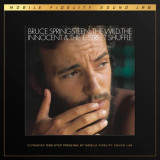
Released only eight months after his exhilarating debut, Bruce Springsteen's The Wild, the Innocent & the E Street Shuffle contains rousing dispatches from the boardwalk, the street, the beach, and the bedroom. It explodes with energy, dares to dream, teases with humour, crackles with tragedy, clings to hope, and overflows with discovery, youthfulness, and personality. It features an unforgettable cast of characters — corner boys, teenage hustlers, doomed lovers, jazz men, junk men, factory girls, fortune tellers, alley cats, pimps, escorts, and more — illuminated by vivid colour, breathtaking detail, and poetic action.
Musically, the heartfelt 1973 record is inhabited by sympathetic vignettes and cinematic arrangements steeped in rock 'n' roll, soul, jazz, and R&B. It finds the New Jersey native looking beyond the parameters of his preceding record and seeking to move on from environments he knows well (and chronicles here) by rushing headlong toward unknown territories, adventures, and people. Underpinned by the singer-guitarist's ambitious poetic enterprise and will to succeed, The Wild, the Innocent & the E Street Shuffle is the album on which Springsteen becomes the Boss.
Mastered on Mobile Fidelity's renowned mastering system, pressed at RTI on MoFi SuperVinyl, and strictly limited to 7,500 numbered copies, Mobile Fidelity's UltraDisc One-Step 180g 33RPM LP set is the definitive-sounding version of Springsteen's sophomore record. Benefitting from SuperVinyl’s nearly non-existent noise floor, superb groove definition, and dead-quiet surfaces, The Wild, the Innocent & the E Street Shuffle plays with a clarity, energy, presence, and openness that complement the expressiveness, dynamics, and scope of the seven restless songs that comprise a work Rolling Stone ranked the 345th Greatest Album of All Time.
Beyond the audiophile sonics that practically place you behind the console at 914 Sound Studios — listen to the separation between the instruments, natural decay of the notes, interplay within the widescreen soundstaging, and nothing-to-lose youthfulness of Springsteen’s voice — this reissue takes seriously this record’s influential merit by presenting it in packaging that underlines its status. Tucked in a beautiful slipcase, the LP is housed in a special foil-stamped jacket with faithful-to-the-original graphics. This reissue is made for listeners who prize sound quality and who want to engage themselves in everything involved with the invigorating set that busted Springsteen loose from the club circuit and landed him on the radio
Determined to liberate anyone within earshot and unafraid to come on strong, The Wild, the Innocent & the E Street Shuffle serves as the debut of the E Street Band — not only heard but seen for the first time by most of the public courtesy of the back-cover photograph. This is where saxophonist Clarence Clemons, organist-accordionist Danny Federici, and pianist David Sancious step out of the shadows — and drummer Vini Lopez and bassist Garry Tallent again stoke a fiery rhythmic engine that helps drive the untamed, reimagined big-band swing of “Kitty’s Back,” breathless R&B thrust of “Rosalita (Come Out Tonight),” and carefree dance steps of the funky “The E Street Shuffle.”
Of course, the main attraction remains a then-24-year-old visionary on the precipice of becoming a sensation and turning a then-bloated rock scene on its head. Recorded over three months while Springsteen and company were busy touring his debut LP, The Wild, the Innocent & the E Street Shuffle reflects the high-octane approach the vocalist embraced onstage and drifts away from the label-dictated acoustic-based frameworks of his debut. The set also witnesses Springsteen deepening his observational skills, with narratives such as the romantically tinged “4th of July, Asbury Park (Sandy)” and redemptive epic “Incident on 57th Street” mirroring changes taking place in the singer’s own life, small towns, and America at large.
A thrilling collision of memories, reflections, and composites — Sandy, Rosalita, and the latter’s parents are all based on actual people Springsteen knew, as is the community depicted in the opening track — the aptly titled The Wild, the Innocent & the E Street Shuffle resonates decades on due to its truths, authenticity, and spirit. Those characteristics — as well as the fact that many of its lengthy songs come on as the equivalent of sweaty, feverish soul revue that won’t stop until you’ve been exhausted — also explain how this now-iconic album triumphed over the reservations of industry “experts” that both demanded Springsteen re-record it and instructed deejays not to play it.
Yet there’d be no stopping a record that saw the past, present, and future, a band whose will would not be denied, and a phenomenon who was born to run. A never-ending invitation to act real cool and stay up all night, The Wild, the Innocent & the E Street Shuffle always feels alright.
Co-founded by Detroit natives Rahill Jamalifard and Lenny Lynch, Habibi got its start in Brooklyn in 2011, earning early raves every- where from Pitchfork and NME to All Things Considered and The New Yorker, who praised the band for infusing “the Colgate-white glisten of sixties-girl-group pop with an uncensored edge.” Dreamachine, Habibi’s mesmerizing new record releasing on Kill Rock Stars, marks a major sonic evolution for the band, rising beyond the critically acclaimed five-piece’s garage rock roots to arrive at a singular swirl of analog and digital elements that underpin their search for spiritual and physical transcendence. Produced by Tyler Love and longtime collaborator Jay Heiselmann and featuring MGMT multi-instrumentalist James Richard-son, the collection draws on a mix of post-punk, experimental pop, and vintage disco, calling to mind Tom Verlaine, Diana Ross, Kate Bush, and Kim Deal, all filtered through the band’s shared love of Middle Eastern psych music. The songs here are their own distinct worlds, each an immersive quest in pursuit of something greater, and the band’s performances are relentless and hypnotic to match, driven by lush synthesizers, sinewy guitars, and a muscular rhythm section. The result is a record as fearless as it is enthralling, an alternatingly fierce and joyous work that ascends to new heights as it reckons with desire and escape, love and surrender, rebellion and reality.
ltd white LP[31,89 €]
Nadsvest is a black metal entity based in Serbia, comprised of Serbian native S and New Zealander A. S (Gorgoroth) and A (Barshesketh) crossed paths in 2015, and after a clear musical symbiosis had become evident, formed Nadsvest.
After an EP and a split with Portugal's Necrobode, Nadsvest crafted their definitive debut album. Musically, Nadsvest is a hellish combination of the first, second-wave and bestial black metal scenes, with unhealthy doses of heavy metal and nods to Serbian folk music, yet unmistakenly capturing that old school sound as only forged in Eastern Europe. Lyrical themes deal with the black arts through the lens of the darker aspects of Serbian folklore.
Conceptually, Slovo meseca i krvi is an epic poem exploring the stages in the process of awakening the primal werewolf force in the warrior, the triumph of the spirit and the ultimate sacrifice of the flesh.
black LP[31,89 €]
Nadsvest is a black metal entity based in Serbia, comprised of Serbian native S and New Zealander A. S (Gorgoroth) and A (Barshesketh) crossed paths in 2015, and after a clear musical symbiosis had become evident, formed Nadsvest.
After an EP and a split with Portugal's Necrobode, Nadsvest crafted their definitive debut album. Musically, Nadsvest is a hellish combination of the first, second-wave and bestial black metal scenes, with unhealthy doses of heavy metal and nods to Serbian folk music, yet unmistakenly capturing that old school sound as only forged in Eastern Europe. Lyrical themes deal with the black arts through the lens of the darker aspects of Serbian folklore.
Conceptually, Slovo meseca i krvi is an epic poem exploring the stages in the process of awakening the primal werewolf force in the warrior, the triumph of the spirit and the ultimate sacrifice of the flesh.
Clear/Black Smoke Vinyl[38,87 €]
Svart Records are proud to release the long-awaited full length album "SÁLA" by Kati Rán in May 2024
If the most profound treasures are often the most deeply buried, the journey to uncover them is vital process of discovery. Five years after the 15-minute single “Blodbylgje” signaled the birth of a new, more primordial, and immersive vision after the dissolution of her band L.E.A.F., Nordic dark folk artist Kati Rán has expanded on its oceanic theme for her long-awaited full-length album, “SÁLA”. Embarking on a far-reaching musical and personal travelogue, it’s a reawakening of both the feminine narratives submerged and fragmented within Norse mythology, and the enduring, healing powers held within.
Named after the Old Norse word for ‘soul’ and ‘sea’, “SÁLA” is an act of ‘soul retrieval’, the shamanic art of trauma recovery, be it illness, death, heartbreak or loss, and the reintegration of a splintered self. Across its 13, wide-ranging, elegantly unfolding tracks, the album is an embodiment of different feminine voices and perspectives – from the Norse nine daughters of the sea, or ‘billow maidens’, through various historical and fictional figures to the late-night voices we hear in our most liminal states – all with tales to tell, riddles to solve, challenges to be accepted and guidance to offer. It’s a multiplicity that, like the ocean itself, belongs to a vast, restless dynamic: a matrix of mysteries, unfathomable depths and ever-shifting currents, accumulating into an elemental, regenerative source of power.
Recorded in a barn in Húsafell, Iceland – home to glacier ice caves and a rare lava stone marimba rediscovered for the track “Stone Pillars” – as well as Finland, Norway and at home in Kati’s native Netherlands, “SÁLA” is as much chronicle of Kati’s own perspective-shifting recording process as it as a pilgrimage through different viewpoints and internal states. That itinerate urge is also reflected in the use of different languages, ranging across Norwegian, Old Norse, Icelandic, and, for the first time, English, her combination of ancient texts, historical reimagining’s and unguarded personal reflection backed up by deep research into the most resonant recesses of Nordic lore.
Spun throughout every thread of “SÁLA” is a sense of communion - with the power of stories to offer moral guidance and the thrill of the unknown; with the element of water, recreated across the album both in field recordings and the agelessly organic nature of the music itself; with the archetypes whose qualities we are called upon to embody at our most critical moments; and with the internal hidden realms forever whispering at us from the far edges of our consciousness.
Appropriately, it’s a collaborative venture too. As well as working closely together with Finnish producer Jaani Peuhu, there are contributions from across the musical spectrum, including extreme metal vocalist extraordinaire Gaahl, the Icelandic female choir Umbra Ensemble, renowned Norwegian jazz musician Karl Seglem, Björk and Brian Eno contrabassist Borgar Magnason, members of pagan folk acts Völuspá, Gealdýr, Heilung and Theodor Bastard and even Napalm Death’s Mitch Harris on vocals.
For all the many sources “SÁLA” draws from, the result is a singular, intimately transformative rite of passage, and a retuning of the heart to the reverent continuity of the sacred. It will take you from the opening title track’s chest-pounding rhythmic pulse emerging from a traditional Norwegian bukkehorn (recorded by Karl Seglem), a galloping horse-rider and Kati’s glacial, velveteen chant, through “Kólga’s” recounting of female persecution through the ages borne on the most gossamer-light yet unbreakable of timbres and “Stone Pillar’s” gently percolating, deep wells of abandonment and incantations to recovery. “SÁLA” closes with the track “Sátta” - Old Norse for ‘peace’ and ‘reconciliation’ – ending the album as it began with the bukkehorn, as it weaves rich drones and experience-stamped poems and prayers, Kati’s vocals the most sensitively tuned of emotional barometers. An album made in dedication, and in thrall to, its own sense of destiny, “SÁLA” is, as all quests must ultimately be, a homecoming.
Album introduction written by Jonathan Selzer.
Black Vinyl[34,87 €]
Svart Records are proud to release the long-awaited full length album "SÁLA" by Kati Rán in May 2024
If the most profound treasures are often the most deeply buried, the journey to uncover them is vital process of discovery. Five years after the 15-minute single “Blodbylgje” signaled the birth of a new, more primordial, and immersive vision after the dissolution of her band L.E.A.F., Nordic dark folk artist Kati Rán has expanded on its oceanic theme for her long-awaited full-length album, “SÁLA”. Embarking on a far-reaching musical and personal travelogue, it’s a reawakening of both the feminine narratives submerged and fragmented within Norse mythology, and the enduring, healing powers held within.
Named after the Old Norse word for ‘soul’ and ‘sea’, “SÁLA” is an act of ‘soul retrieval’, the shamanic art of trauma recovery, be it illness, death, heartbreak or loss, and the reintegration of a splintered self. Across its 13, wide-ranging, elegantly unfolding tracks, the album is an embodiment of different feminine voices and perspectives – from the Norse nine daughters of the sea, or ‘billow maidens’, through various historical and fictional figures to the late-night voices we hear in our most liminal states – all with tales to tell, riddles to solve, challenges to be accepted and guidance to offer. It’s a multiplicity that, like the ocean itself, belongs to a vast, restless dynamic: a matrix of mysteries, unfathomable depths and ever-shifting currents, accumulating into an elemental, regenerative source of power.
Recorded in a barn in Húsafell, Iceland – home to glacier ice caves and a rare lava stone marimba rediscovered for the track “Stone Pillars” – as well as Finland, Norway and at home in Kati’s native Netherlands, “SÁLA” is as much chronicle of Kati’s own perspective-shifting recording process as it as a pilgrimage through different viewpoints and internal states. That itinerate urge is also reflected in the use of different languages, ranging across Norwegian, Old Norse, Icelandic, and, for the first time, English, her combination of ancient texts, historical reimagining’s and unguarded personal reflection backed up by deep research into the most resonant recesses of Nordic lore.
Spun throughout every thread of “SÁLA” is a sense of communion - with the power of stories to offer moral guidance and the thrill of the unknown; with the element of water, recreated across the album both in field recordings and the agelessly organic nature of the music itself; with the archetypes whose qualities we are called upon to embody at our most critical moments; and with the internal hidden realms forever whispering at us from the far edges of our consciousness.
Appropriately, it’s a collaborative venture too. As well as working closely together with Finnish producer Jaani Peuhu, there are contributions from across the musical spectrum, including extreme metal vocalist extraordinaire Gaahl, the Icelandic female choir Umbra Ensemble, renowned Norwegian jazz musician Karl Seglem, Björk and Brian Eno contrabassist Borgar Magnason, members of pagan folk acts Völuspá, Gealdýr, Heilung and Theodor Bastard and even Napalm Death’s Mitch Harris on vocals.
For all the many sources “SÁLA” draws from, the result is a singular, intimately transformative rite of passage, and a retuning of the heart to the reverent continuity of the sacred. It will take you from the opening title track’s chest-pounding rhythmic pulse emerging from a traditional Norwegian bukkehorn (recorded by Karl Seglem), a galloping horse-rider and Kati’s glacial, velveteen chant, through “Kólga’s” recounting of female persecution through the ages borne on the most gossamer-light yet unbreakable of timbres and “Stone Pillar’s” gently percolating, deep wells of abandonment and incantations to recovery. “SÁLA” closes with the track “Sátta” - Old Norse for ‘peace’ and ‘reconciliation’ – ending the album as it began with the bukkehorn, as it weaves rich drones and experience-stamped poems and prayers, Kati’s vocals the most sensitively tuned of emotional barometers. An album made in dedication, and in thrall to, its own sense of destiny, “SÁLA” is, as all quests must ultimately be, a homecoming.
Album introduction written by Jonathan Selzer.
Adrian Younge presents: Angela Muñoz is the debut album of an 18-year-old Angela Muñoz highlighting the Los Angeles native's timeless vocals with innocence and vulnerability. Backed by the soulful production of Adrian Younge, Muñoz's captivating voice reveals the old soul of a legend in the making. Recorded and mixed by Adrian Younge at Linear Labs, the preeminent analog studio of Los Angeles, CA
- A1: Fink - Covering Your Tracks
- A2: Alfa Mist - Mulago
- A3: Charlotte Day Wilson - Mountains
- A4: Moreton - Count A Heart (Feat Jordan Rakei)
- B1: Puma Blue - Untitled 2
- B2: Connan Mockasin - Momo's
- B3: C Duncan - He Came From The Sun
- B4: Oso Leone - Virtual U
- B5: Joe Armon-Jones - Idiom (Feat Oscar Jerome)
- C1: Snowpoet - Eviternity
- C2: Maro - Forever & Always
- C3: Homay Schmitz - Speak Up
- C4: Bill Laurance - Singularity
- D1: Jordan Rakei - Lover, You Should've Come Over (Exclusive Jeff Buckley Cover Version)
- D2: Cubicolor - Counterpart
- D3: Jordan Rakei - Imagination (Exclusive Original Piece)
- D4: Alejandro Gonzalez Inarritu - Imagination (Exclusive Spoken Word Piece)
Original[27,69 €]
“I wanted to try and showcase as many people as I knew on this mix. My idea of Late Night Tales was to distil a series of relaxing moments; the whole conceptual sonic of relax- ation. So, I was trying to think of all the collaborators and friends that I knew, who’d recorded stuff with this horizontal vibe. Plus, I was also trying to help my friends' stuff get into the world. I know the story of Khruangbin blowing up after appearing on the series (in fact, I think that's how I discovered them). So, the main idea was to create a certain atmosphere, but also to help some of my favourite collaborators and bud- dies to give their songs a little push out into the world. Hope you like it” Jordan Rakei
Due for release on 9th April, Late Night Tales celebrate their 20th anniversary with the release of multi-instru- mentalist, vocalist and producer Jordan Rakei’s majestic compilation. The 28-year-old modern soul icon effortlessly stamps his own jazz and hip-hop driven sound all over this gorgeous array of handpicked tracks. A beautifully layered blend that is mirrored in the music he’s made, itcomes as no surprise that such a supremely gifted songwriter should deliver a mix that is all about the song.
Rakei, born in New Zealand, but raised in Australia, moved to the UK in 2015; he released his debut album, Cloak, with Oz label Soul Has No Tempo, but his two subsequentLPs, Wallflower and Origin, came out on Ninja Tune, the former#2 in Album Of The Year for Gilles Peterson’s Worldwide poll, while Origin was nominated for Best Album at the AIM Awards. Jordan had this to say on his upcoming mix:
As Jordan says,there’s so much more to the song selection on Late Night Tales’latest outing than a random collection of artists. Many have some sort of personal connection, so just as Bonobo provided a platform for the breakout of Khruangbin on a previous LNT, this may have the same ef- fect for Rakei’s friends. After a soothing opener from Fink, good friend and big influence Alfa Mist (part of the Are We Live collective) delivers ‘Mulago.’ “I want to champion their sound and show the world how good he is, and I thought it’d be fitting to start the mix with family,” says Jordan.
Next up is Charlotte Day Wilson with ‘Mountains,’ followed by ‘Count A Heart’ from Moreton, an exclusive collab- oration with Jordan, who grew up on the same street in Brisbane, Australia. “She was the first artist I ever collabo- rated with, and one of the first artists to be involved in mycareer,” he explains. Elsewhere we hear Scottish producer and multi-instrumentalist C Duncan’s haunting ‘He Came from the Sun,’ Barcelona collective Oso Leone deliver a dreamy ‘Virtual U’ and Bill Lauren’s ‘Singularity,’ which evokes a striking sense of time and place.
Snowpoet’s ethereal ‘Evitenity’ is a “long mediative nar- rative over a beautiful soundscape,” which at times seems chaotic, nicely juxtaposed with undeniable beauty, and Maro’s kooky songwriting shines on ‘Always And Forever.’ Long-time buddy Armon-Jones contributes ‘Idiom,’ and Jordan’s exclusive cover version is a two-for-one, Radio- head’s ‘Codex’ merging with ‘Lover, You Should’ve Come Home’ by Jeff Buckley and another exclusive,original com- position by Jordan, ‘Imagination.’ The latter works as a piece with the spoken (Spanish) word voiced by movie director Alejandro González Iñárritu (Babel, Birdman, and The Reve- nant,) who is a big fan of Jordan’s. “He messaged me when I went to L.A and asked to come to my show. I was in such shock and we hung out after. I thought it would be nice to get him to do this in his native tongue, because I don’t think that’s been done yet on the series.” It certainly is a familyaffair. Not theblood is thicker than water kind, but certainly musical kindred spirits.
Warehouse Find!
Last month saw the re-release of the this stone-cold classic from 1988. Now we give you the re-edits from The Black Madonna, Adjowa and Jimpster. The Black Madonna should need little by way of introduction seeing as she is almost singlehandedly regenerating Chicago's House music legacy through brilliant
her brilliant productions as well as her position as booker and resident at the legendary Smart Bar. It seemed only right and proper to have the youngest generation of Chicago native revisit such an infuentional classic from the first wave of House. With only the stereo track to work with she stretches things out
and teases with a filter-frenzied arrangement and plenty of twists and turns to bring a fresh new spin to In The Heat Of The Night.
Adjowa grabbed our attention after his amazing Science And Soul 10' last year and seemed the perfect choice to bring some seriously raw warehouse vibes to the release. He certainly goes for the jugular with a more in depth remix adding extra bass and beats with plenty of grit and dirt. Finally, Jimpster gives us his Stretchdit, keeping the vibe of the original intact but offering up an extended DJ friendly version with extra hats, FX and a
sprinkle of pixie dust adding sizzle and drama. We hope you agree that with club music like this sounding every bit as mind-
blowing today as it did in 1988 it seems only right to help introduce such innovative, influential and timeless music to a wider audience.
For the first time in vinyl format the work of the Bolivian avant-garde composer, Cergio Prudencio, together with the Orquesta Experimental de Instrumentos Nativos (OEIN). The OEIN is the result of the incorporation of Aymara musical traditions into the realm of contemporary music to produce a new sonic world. The work of Bolivian composer Cergio Prudencio (La Paz, 1955) is indissolubly linked to the project of the Orquesta Experimental de Instrumentos Nativos Experimental Orchestra of Native Instruments (OEIN), which he co-founded in 1980 and of which he is the emeritus director. It constitutes one of the most challenging adventures in the music that has emerged in Bolivia and Latin America. The OEIN is the result of the incorporation of Aymara musical traditions into the realm of contemporary music to produce a new sonic world. In the composer's words, it is about "...finding in the indigenous conception of music, elements of change and transformation, to establish a historical continuity." This incorporation is not only based on using native instruments but also involves integrating their socio-historical context and philosophies from the Andean indigenous world. In addition to forming ensembles with highland native instruments (sikus, tarkas, mohoceños, pinkillos, wankaras, seeds, drums, etc.), the foundation is laid on the three structural principles that govern Aymara music: "arca-ira," which means alternation of sounds between two musicians; "tropa," which involves the formation of large ensembles of instrumentalists and sound amplification; and "wakiña," meaning community strength. According to Prudencio, the acoustic and expressive identity of Andean-highland sounds originates from these principles, as does that of the OEIN. The release of Cergio Prudencio - Antología 1: Obras para la Orquesta Experimental de Instrumentos Nativos Cergio Prudencio - Anthology 1: Works for the Experimental Orchestra of Native Instruments allows us to delve into this wealth of thought and sounds, into the work of a fundamental and radical artist, for whom decolonization is also an opening to experimentation and the new. These compositions project a historical memory into the present, constructing new horizons.
- A1: Real Negro Life (Feat. Piper Gkfam)
- A2: Looking For Water (Feat. Boldy James)
- A3: Tokyo Blunts (Feat. Armand Hammer, Conquest Tony Phillips)
- A4: Afro Russian (Feat. Amani)
- B1: View Of Paris (Feat. Ahwlee)
- B2: Off The Plane T (Feat. Ez & Kari Faux)
- B3: Pour The Wine (Feat. Peso Gordon & Chuck Strangers)
- B4: Po Drama (Feat. Iojii)
- B5: Real Bad Gospel
Following a banging streak of collaboration albums with the likes of Boldy James and Smoke DZA, as well as his successful On High Alert series, Real Bad Man teams up with one of the most buzzing names in underground hip-hop right now, a true chameleon, Pink Siifu. The Birmingham, Alabama native emcee has been shaking the foundations and pushing boundaries in rap and music in general over the last few years gaining major attention and touring the world. On collaboration album "Real Bad Flights" the two both bring their A-game to the table, creating a unique soundscape together with special guests such as Boldy James, Armand Hammer, Chuck Strangers and Iojii among others, to bring you one of the most exciting albums of 2022/2023!
- A1: Pikiran Dan Kepentingan (Thoughts And Concerns)
- A2: Fenomena Demi Fenomena (From Phenomena To Phe-Nomena)
- A3: Lubuk Yang Terdalam (The Depths Of The Depths)
- A4: Manusia Oh Manusia (Human, Oh Human)
- B1: Selalu Ada Jalan Keluar (There Is Always A Way Out)
- B2: Meyakini Sebuah Jawaban (Believe In An Answer)
- B3: Kepada Cahaya Yang Menerangi Jiwa (To The Light Which Illuminates The Soul)
Born in 1977, in Malang, East Java, Wukir Suryadi began playing music for theatre at the age of 12 with the Idiot The-ater Studio, and later with the Rendra Theater Workshop. In his solo work, and as a member of Senyawa, Error Scream, Bendera Hitam Setengah, Potro Joyo and other groups, Wukir breaks the boundaries of traditional music, death metal and avant-garde performance. On this new release, “Cycle and Prayer,” recorded in 2023, he expands the edges of his unique artistic world further, by digging in to meditative improvisation, art, and community building in his home workshop in the mountains of central Java. These recordings vibrate inwards, toward the microcosmic ecologies of forests and rivers; they distort outwards, resonating with global waves of apocalyptic change that are forcing all living beings to the edges of existence on earth. The result is a meditative poem that moves, as its titles an-nounce, from phenomena to phenomena, praying that humans find a way out from the depths of the depths to the light that illuminates the soul.
An essential mode of creative work for Wukir is the creation of unique instruments, using these sound sources as “bullets of expression.” In addition to the spear-like tube zither Bambu Wukir, he has created the Solet, Enthong, Garu, Luku, Arrows, and Industrial Mutant instruments, which in addition to being used in live performance, have been exhibited in the Instrument Builders Project and the 2017 Jakarta Biennale. In the past few years, Wukir has begun to collaborate with local guitar makers, carpenters, and suppliers of native endemic wood in the mountain region of Salatiga. Using earthen bricks along with local woods (suren, coconut, mindi, and waru lengis) as building materials, he constructed a new studio and workshop space in Tingkir, where this album was made. The trees, water and air of the local environment have exerted a powerful influence in Wukir’s documentations of instrumental sound. On this recording, he uses the simple Cetta guitar, an instrument designed in Bali and made for Indonesian children and local communities of folk and popular musicians, in order to explore the different sonic characteristics of a more “normal” instrument built from local wood.
The themes of the album -- cycle and prayer -- arise from a foreboding series of meta-events that shook Indonesia and the world over the past years, following one after the other: the COVID-19 pandemic, the Ukrainian-Russian war, the Kanjuruhan Stadium tragedy in which football supporters were gassed and killed by police, revelations of govern-ment failures and corruption, the rise of personal vehicles, the increasing disturbance of natural patterns of the rainy season and other ecological cycles. “In these waves of technology and narratives of truth made for certain interests, playing a sound at a certain frequency and repeating can try to bring images and feelings to a certain point of con-sciousness,” Wukir told me. “Sound is a prayer that creates a change, whether gradual or rapid, in the behaviour of living things, to face the demands of the time, as humans struggle to live according to what they believe.” The draw-ings and sketches used for the cover spontaneously emerged alongside the recordings, as an instinctive depiction of “time and sound, nature that is outside of oneself, and nature that is within.”
Warehouse Find! - Test Pressing!
It seems like ages since we last had Roberto Rodriguez on the label with his excellent Be Somebody back in 2008, so we're plenty happy to welcome him back for a long overdue follow up. Roberto clearly hasn't just been sitting on his arse the last 4 years however, having established the Serenades label which released his own LP Dawn last year, as well as putting out the killer Thinking Of You release on Fina plus numerous remixes for rock solid labels such as Let's Play House, On The Prowl, Moodmusic and 2020 Vision. Those familiar with Roberto's productions and credentials will know he has a fine ear for disco and 90's house born out of years collecting records and DJing in the best clubs in his native Helsinki.
Kicking off with Dance Like Nobody's Watching, we see Roberto tread confidently into pure, unadulterated retro house territory with NJ organ stabs, swinging 909 drum groove and choice vocal hits.
Oxymoron keeps things a little deeper with tracky filtering chords and driving drums resulting in a garage-influenced feel with bucket loads of raw attitude.
Finally we have The Black Madonna on board for a remix of the title track. The Chicago producer impressed us recently with her brilliant disco-infused tracks on Stripped & Chewed and Home Taping labels and thought her the perfect choice to contribute to the release. Here she delivers a lesson in stripped back Chicago warehouse vibes keeping everything to a bare minimum for maximum club bump. Kick, claps and piano stabs form the basic groove as she confidently develops the arrangement slowly and surely.
Warehouse Find!
Red D is back for a follow up to his brilliant Chez EP which dropped last year and this time he's going for the jugular! The man responsible for
some of the finest house music of the last decade as FCL (with San Soda) and FCL vs VFB (with Motor City Drum Ensemble) knows a thing or two about
what makes the dancefloor lose its s**t, with tracks such as Let's Go Seven, It's You and Can We Try all testament to this.
When he's not DJing at the likes of Panorama Bar or hosting his own stage at Tomorrowland, Red D can be found running his own mighty fine We Play House label from his Ghent HQ.
Moan The Mania opens this release in suitably back to the raw fashion! A minimal drum machine groove and clipped bassline lay the foundations of this tribute to all things jacking with a sprinkling of porno groans to help you on your way. This is sleazy machine funk at it's very best. Next up we have a remix from Eli Escobar, the native New Yorker who has recently been making major waves following the release of his LP Happiness on Classic.
As someone who has remixed the likes of Lana Del Rey, Kim Ann Foxman, Honey Dijon and Holy Ghost we knew he'd be the man to take Red D's baton and run with it.
Keeping the overall vibe of the original intact
Eli cranks the energy further with additional in your face percussion parts and a couple of perfectly placed build ups. Flipping over we have Chase The Cat which takes a similarly stripped-back and minimal approach as Moan The Mania but goes heavier on the 707 beats. Finally we have Dusk Or Dawn closing the release with a deeper mood.
Simple FM synth stabs and glassy chimes provide a tender and naive-sounding counterpoint to the basic beats.
Red D proving once again that limiting your tools and not over-complicating things can often have so much more impact when it comes to house music.