Previously unreleased recordings
Compiled by Gianmarco Liguori
Bernie McGann - alto sax
Kim Paterson - trumpet
Bobby Gebert - piano (side A)
Andy Brown – bass
George Neidorf – drums
Recorded by Trevor Graham in Sydney, Australia (copyright 1966)
There is no more engaging nor distinctive alto saxophone sound on the planet than McGann’s.
Sydney Morning Herald
McGann takes the language of Bebop then bends and stretches it to fit the contours of his own remarkable im-agination.
The Wire
Bernie McGann’s sound is exciting and physical, as heated as any post-coltrane modernist.
Downbeat
A lost treasure of Antipodean jazz
This compilation documents part of an exciting period in Australasian jazz. Recorded in Sydney, 1966, we can hear Bernie McGann was already one of the great Australian jazz stylists. At the time, the only publicly available recording he made was two tracks on the Jazz Australia compilation (1967) (CBS BP 233450).
Two years earlier, McGann was living in Auckland, New Zealand (1963-64). It was here that he worked regular-ly with Kim Paterson, Andy Brown and pianist Dave MacRae, and the basis of this band came into being.
‘Lazy Days’, ‘Chuggin’, and ‘Sky’ were salvaged from a cassette in Kim Paterson’s collection, one of the few remaining copies. Originally intended for a radio broadcast, the master tapes were reportedly destroyed after the session.
‘Rhythm-a-Ning’ and ‘When Will The Blues Leave?’ were taped by Trevor Graham at the Wayside Chapel in King’s Cross. Graham was a Sydney music journalist and ally of the avant garde, with the foresight to capture some of what was happening at the time.
This album is also notable for a rare appearance by the mysterious American drummer George Neidorf (mis-spelt as ‘Neidori’ in the liner notes on the first Soft Machine album), an early influence on drummer Robert Wyatt.
Field recordings of a major artist in strong company – a lost treasure of Antipodean modern jazz.
Alfredo "El Inca" Linares is one of the best and most beloved musicians in the history of salsa. Fans love his piano playing because of his authentic Cuban feel and 'swing' combined with progressive arrangements and uncompromising phrasing. "Lo Que Tengo" is full of rock solid dance floor killers and no filler, recorded in 1980 with some of the cream of the crop of contemporary Venezuelan salsa musicians (members of Mango, Madera, El Trabuco Venezolano, Los Dementes, Los Melódicos, Dimensión Latina, Guaco, and La Salsa Mayor) and launched there on the indie label A.L.G. Records as ¡Con Todo!, and then a year later on the much larger Velvet Records with a different cover. This a classic Alfredo Linares album, but with the updated studio sound of 1980s Caracas. With five perfectly paced salsas, one funky cha cha chá, a steamy bolero and a dance-friendly Latin jazz number to top it off, there is something for everybody on this record. Thankfully today's generation can now enjoy this rarity at a fraction of the cost of an original copy. Presented in its original artwork and pressed on 180g vinyl. Good to know: Alfredo "El Inca" Linares is one of the best and most beloved musicians in the history of salsa. Fans love his piano playing because of his authentic Cuban feel and 'swing' combined with progressive arrangements and uncompromising phrasing that puts one in mind of Eddie Palmieri. As a composer, arranger and band-leader Linares is highly respected as well. Ever since the 1960s in Lima Peru when his career began, his records have always been on point, being super tight, sharp, and hard as hell, what salseros call salsa brava con afinque. It's no surprise that Lo Que Tengo is exactly that: full of rock solid dance floor killers and no filler, played with verve and flair. Unlike some of his other records that were patched together from various sessions made in different studios (sometimes even in several countries!), this album has the advantage of being produced, recorded and mixed by Alfredo Linares all in one studio and block of time, and backed by hand-picked seasoned professionals who Linares had already played with, both in the studio and on stage, lending it a consistency and sonic integrity that is excitingly manifest in every groove. The album was recorded in 1980 in Caracas with some of the cream of the crop of contemporary Venezuelan salsa musicians (members of Mango, Madera, El Trabuco Venezolano, Los Dementes, Los Melódicos, Dimensión Latina, Guaco, and La Salsa Mayor) and launched there on the indie label A.L.G. Records as ¡Con Todo!, and then a year later on the much larger Velvet Records with a different cover. The LP was also released in Colombia (INS, 1982) and the US (Gallo, 1984), both editions utilizing the Velvet Records cover. During this time Linares had been in Venezuela for some five years and was under contract with a nightclub in Caracas. Through being on the salsa scene there he became friends with the band Mango and even guested on an album with them in 1976. After the contract was up Linares was a free agent again and he was able to draw on his friendship with Mango and assemble a band to back him, first for the Colombian/Venezuelan production Salsa de Verdad (Fonodisco, 1976) and then again with ¡Con Todo! / Lo Que Tengo. One of the distinctive aspects of Alfredo Linares tunes is the 'break' (la cierre)-there are always plenty of dramatic hand-clapping breakdowns followed by an infectious tumbao (sustained vamp) section that sends shivers up the spine and makes the dancers go crazy. In addition, Linares always lets his musicians stretch out, especially in the percussion section. Again, Lo Que Tengo is no exception: there are so many examples of typical arrangements here that one could call this a classic Alfredo Linares album, but with the updated studio sound of 1980s Caracas, which was awash in petro-dollars at the time and so had the latest equipment and a strong consumer base for the salsa market. The album's title tune (originally credited on the Venezuelan edition as 'Lo que tengo que crear'-'What I Have To Create') is by Mango's timbalero José "Cheo" Navarro and sums up Linares' central career philosophy: the musician lives every day to create music, to spread joy and create a party, without complications, wherever he goes. With five perfectly paced salsas, one funky cha cha chá, a steamy bolero and a dance-friendly Latin jazz number to top it off (note the bluesy piano solo from Linares and the sublime vibes of Mango's Freddy Roldán), there is something for everybody on this record. Thankfully today's generation can now enjoy this rarity at a fraction of the cost of an original copy.
out of Stock
Last delivered 5 years ago available to reorder, subject to availability
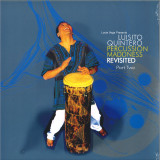
Grammy award winner & multi grammy nominated Luisito Quintero grew up with the Latin American and African tradition of percussion. His father is just as much a percussionist as his uncle Carlos Nene Quintero and his cousin Roberto Quintero . He became a member of the Orquesta Simfonica de Venezuela , but soon appeared with ensembles such as Grupo Guaco and El Trabuco
Venezolano and toured with Oscar D'León .
He then moved to New York, where he initially worked with Latin jazz musicians such as Willie Colón , Eddie Palmieri , Tito Puente and Celia Cruz . He then turned to the fusion of jazz, funk, salsa and African music and performed with George Benson , Herbie Hancock , Ravi Coltrane and Toshiko Akiyoshi , but also with pop musicians such as Gloria Estefan and Marc Anthony .
Vega Records are proud to present his new vinyl release “Percussion Maddness Revisited” Part Two. From the Osibisa remake by Luisito Quintero “Music For Gong Gong” to collaborations with the Great Richard Bona, Latin Jazz legend Hilton Ruiz and Salsa Veterans Jose Mangual and Milton Cardona, you can see the caliber of musicians that make up this timeless piece. For the afrohouse heads you have the new track “Yemaya” Featuring Nina Rodriguez remixed by Afrohouse King Manoo. Prepare for the sonic fun with vinyl pressings by Optimal !!
Percussions Maddness Revisited Part Two Double Vinyl Set out soon at a vinyl store near you !!!
out of Stock
Last delivered 3 months ago available to reorder, subject to availability
Dynamic Sounds Studio has its roots firmly set in Jamaica’s history. It was the first state of the art studio built in Kingston, Jamaica and a firm favourite with all the topflight homespun artists. Bob Marley chose to record the bulk of his seminal 'Catch A Fire' album there and many foreign musicians trying to catch some of that reggae magic and emulate that sound have beaten a path to its doors. As you will see the studio had a history already of its own, that was carved out before it became the aptly named Dynamic Sounds.
Originally named WIRL Studio's (West Indies Records Limited), it was set up initially to record Jamaica's versions of the American Rhythm and Blues tunes that were proving so popular on the island. It was started back in 1958 by Political leader Edward Seaga an astute businessman, who had many interests around the island including clubs and bars. As the R & B music evolved into its own styles from Mento into Ska, one of its main protagonists Byron Lee and his band the Dragonaires would be at the forefront and be seen as ambassadors to the cause. Edward Seaga would choose the band to head the 1964 World’s Fair and take them to New York to showcase the Jamaican Ska Music. His political ambitions leading the American friendly JLP (Jamaican Labour Party) against the Cuban inspired PNP (People's National Party), would see him cutting back his other interests and lead to the selling of WIRL, lock stock and barrel to Byron Lee. On taking over the business he renamed it Dynamic Sounds and extended it to include not only a top of the range recording studio but a pressing plant to distribute the new hot sounds of the day directly to the streets of Jamaica. The address would also change to 15 Bell Road, it's old address No 13, seemingly too unlucky for such a fine establishment.
The studio has become part of the Jamaican culture and each twist and turn in its musical story has been caught and recorded here. We get on board when the music had slowed down to the reggae skank that we now know and love. We have picked some fine cuts that we feel best represent the times. The rhythms are pushed to the fore and the great Sylvan Morris a much-underrated studio master, always came up with some interesting effects to enhance the version cuts. A fine time in reggae's history caught at one of Jamaica's finest studios. Dynamic Sounds from a Dynamic Studio.....
out of Stock
Last delivered 5 years ago available to reorder, subject to availability
Following the extraordinary response to the online streaming event in July, audiences will have another chance to experience Idiot Prayer: Nick Cave Alone at Alexandra Palace as it screens in cinemas globally via Trafalgar Releasing from 5 November. The cinematic release of this remarkable and compelling film will be followed by an album on 20 November, available on vinyl, CD and streaming services worldwide.
Idiot Prayer: Nick Cave Alone at Alexandra Palace was recorded in June 2020 as the UK slowly emerged from lockdown, and was conceived as a reaction to the confinement and isolation of the preceding months. Initially imagined as an online only event, fans will now be able to see the film in cinemas as an extended cut featuring four unseen performances.
Two weeks later on 20 November, the music will be released as a double album of the same name featuring all 22 songs from the original film on vinyl, CD and streaming.
In Idiot Prayer, Cave plays his songs alone at the piano in a rarely seen stripped back form, from early Bad Seeds and Grinderman, right through to the most recent Nick Cave & the Bad Seeds album, Ghosteen.
The performance was filmed by award winning Cinematographer Robbie Ryan (The Favourite, Marriage Story, American Honey) in Alexandra Palace’s stunning West Hall. It was edited by Nick Emerson (Lady Macbeth, Emma, Greta). The music was recorded by Dom Monks.
Idiot Prayer is the fourth film that Nick Cave has released in collaboration with Trafalgar Releasing, following 2018's Distant Sky - Live in Copenhagen directed by David Barnard, 2016's One More Time With Feeling directed by Andrew Dominik and 2014's award winning 20,000 Days on Earth directed by Iain Forsyth & Jane Pollard.
Live at Alexandra Palace, 2020
out of Stock
Last delivered 5 years ago available to reorder, subject to availability
'Music For Us' is Italo-Disco in its pure state! If the two original versions on this 12inch reissue's main side by House of Music are "untouchables" as the "purists" rightly claim, the rebuilt version by Danilo Braca on the flip must also be considered a masterpiece! The original vocal is hot, Helene has a very sexy voice, while the instrumental has a strong groove, thanks to the excellent synthesizers and bass. It seems that Junei's 1987 'Let's Ride' was inspired by this milestone published five years earlier by Stefano Zito.
The sequences of this song, which has become legendary, now sound good, precise and without the distortion of the previous reissues.
By turning the vinyl you'll find a later work by Stefano Galante, the same composer and arranger who, along with Claudio Casalini, at the end of the 80s created a song renamed 'Music For All Of Us'. 13 sumptuous minutes completely rebuilt by Danilo Braca. The Italian DJ based in the Big Apple is a true magician in radically transforming a song without losing its original charm. His version, renewed with a more modern and universal taste, will certainly please everyone. Very captivating, it will attract many new young Italo-Disco fans.
out of Stock
Last delivered 5 years ago available to reorder, subject to availability
Within the elusive confines of this film awaits an unreleased album that defies categorisation by a musician who in a different time and space would be revered amongst some of the most important exponents of progressive rock, dark ambient, Krautrock and pioneering synthesiser composition - not to mention sound design and art-house film scores. As a protégé of François Bayle and Luc Ferrari who had studied classical music before immersing himself in found-sound manipulation and oscillators, Alain Pierre quickly became an enthusiastic go-to man for sound sculpture and technical studio proficiency in Belgium’s small film industry.
To the many generations of dedicated fans of the visual work of Philippe Druillet it might seem virtually impossible to adequately “score” the alien, futurist landscapes of the man who many called the “space architect” (on account of his space age reductions of Gothic cathedrals, Art Nouveau, and Indian temples), but once you have heard the sonic reactions of Alain Pierre on this the first-ever dedicated Druillet documentary, Ô Sidarta, complete with his own equivalent sound palette, it will be difficult to “hear” Druillet’s world via any other composer. Despite Druillet’s truly incredible record sleeve designs for projects like cosmic disco ensemble Black Sun, concept albums such as Attention by Jean-Pierre Mirouze (composer of Le Mariage Collectif), Parisian metal bands like Sortilège, gatefold portraits of Jimi Hendrix, later period albums by William Sheller and most relevantly on albums by Igor Wakhévitch (Docteur Faust, 1971) as well as separate releases by both Richard Pinhas and Georges Grünblatt (both from the cosmic prog outfit Heldon), it is fair to say that this criminally unreleased album by Alain Pierre would conjure up the closest synergy between sound and vision that either artist would come close to.
The almost twelve of continuous music that Alain Pierre supplied for Ô Sidarta in 1974 fortunately appears in its entirety, unedited, as it does here for the first time ever away from its original broadcasts. Broadcast on Belgian and French TV that autumn, the film received a warm reception from Druillet fans, prospective film producers and space rock fans lucky enough to catch the short feature.
Throughout his career Alain’s commitment to conceptual music excelled within both cinematic realms as well as with the live arena. Never shying away from the constraints of transporting heavy synthesiser technolog and unpredictable analogue equipment to public spaces, Alain took his self-initiated “live” work very seriously. It was within his lesser-documented performances that you would find the closest sound to the music on Ô Sidarta, proving that the Druillet collaboration was naturalistic and conceptually close to Alain’s personal stylistic agenda. A rare recording of a one-off concert at the Université libre de Bruxelles in October 1976 reveals a very similar set of movements and soundscapes found on Ô Sidarta. This rare artefact has been included on the second side of this record under its original title Notions de physique intérieure (Notions Of Interior Physics) and stands as a perfect companion piece to Ô Sidarta - complete with a very similar “kit list” including the welcome addition of an Arp Sequencer, a Korg Vocoder and a Theremin (a back line whose total would far surpass any stationary studio of the era never mind a live show!).
By looking back at his original composition for one of his very first solo soundtrack commissions, Ô Sidarta, you can hear that back in 1974 Alain had already successfully managed to combine more unlikely musical influences, experimental techniques, and previously unheard soundscapes and studio tricks in to one twelve-minute score than most musicians fail to cram in to a whole discography. But still there is so much music yet to be discovered and Ô Sidarta is just the tip of the iceberg in the middle of a cosmic sea. Much like a character from one of Philippe Druillet’s books, Alain Pierre is a rogue pilot, steering his own ship in to the unknown, uncharted, unnoticed and quite unbelievable.
Joshua Abrams’ first album Natural Information from 2010, superb avant-jazz, newly remastered at Dubplates & Mastering.
In his book Powershift, published in 1990, writer and businessman Alvin Toffler predicted that the century ahead would be defined by speed and that time itself is destined to become our most valuable commodity. When Joshua Abrams recorded Natural Information, originally released by Eremite in 2010, he was reacting against such commodification of time and the diminishing attention span that accompanies it by offering music with an irresistible groove, rooted in the sinuous rhythms of the human body and the full play of our senses.
At the heart of this music is the sound of the guimbri, a North African three-stringed bass lute, which Abrams started to play following a visit to Morocco during the late 90s. Traditionally the instrument has a key role in mystical healing ceremonies. Abrams, already a well-established figure in Chicago’s vibrant musical communities, had no desire to repackage tradition. He recognized however that the involving, springy and percussive sound of the guimbri was just the right voice to communicate vital data, to relay the natural information we all need in order to get back in touch with the pulsating continuities of a world we all share.
With Natural Information Abrams entered a new phase of his musical life, extending an invitation to the trance, where time intersects with timelessness. He carried with him a wealth of playing and listening experience. As a bass player he had worked with a host of notable musicians including guitarist Jeff Parker and percussionist Hamid Drake, and had been a member of back porch minimalism outfit Town And Country and the improvising trio Sticks And Stones.
The guimbri is a shaping presence on this remarkable recording, but Abrams also plays bass, bells, kora, sampler and synthesizer. Sympathetic friends including guitarist Emmett Kelly, vibraphonist Jason Adasiewicz and drummers Frank Rosaly and Nori Tanaka join him for the project. They set out not to contrive some neat hybrid but to enable coordinated energies and enriching influences to pulse and flow through living, breathing music. Ten years further into a century seemingly dedicated, as Toffler foresaw, to the survival of the fastest, the deep involving groove of Natural Information seems still more relevant, more illuminating, more vital.
Krautrock, das fällt einem bei dem Namen Joachim Witt nicht grade als erstes ein, auch nicht hinterher, eigentlich gar nicht. Und dennoch ist Witt ein Veteran des deutschen Kunstrocks der 70er Jahre. Genre-Fans erinnern sich gern an die Band „Duesenberg“ (benannt nach der US-amerikanischen Automarke) und Witt war ein Drittel des Ender der 70er für Aufsehen sorgenden Trios.
Von US-amerikanischen Westcoast-Rock mutierte Witt In den frühen 80er Jahren zum Top Star der aufblitzenden Neuen Deutschen Welle. Sein Evergreen "Der goldene Reiter" (Nr. 2), der einen schizophrenen Menschen skizziert wird zu einem der wichtigsten Titel der NDW-Bewegung. Als gegen Ende der 80er Jahre der NDW-Sound langsam verschwand, verschwand sein Star – bis er sich 1998 zur Überraschung der breiten Öffentlichkeit wieder erhebt. Mit seinem neuen Partner Peter Heppner, der sich mit der Band Wolfsheim bereits einen Namen gemacht hat, schickt Witt sich an neues Terrain zu erobern. Das mystische, im angesagten „gotischen Sound“ vorgetragene Opus "Die Flut" begeistert zuerst die Goth Szene, dann schließlich ganz Deutschland und landet auf Platz 2 der Verkaufs-Charts. Auch das Album „Bayreuth Eins“ wird zum Bestseller und Platin Erfolg. Das Album ist noch immer ein Klassiker und gilt zusammen mit dem nachfolgenden Album „Bayreuth Zwei“ als Vorläufer der anschließend aufkommenden Strömung “Deutscher Dance Metal“, oder des auch als “Neue Deutsche Härte“ bezeichneten Trends, deren spätere Vertreter Top-Acts wie OOMPH! oder RAMMSTEIN sind.
Die Original LP „Bayreuth Eins“ ist seit langem vergriffen und „Bayreuth Zwei“ ist nie vorher als Schallplatte erschienen. Zwei Klassiker in der Wiederauferstehung, einer davon sogar als Premiere auf Vinyl.
out of Stock
Last delivered 5 years ago available to reorder, subject to availability
Today Rozzma announces the ‘Khatar Sayeb’ EP, the artist’s first release for XL Recordings. He kicks off the EP release with ‘Hout’, a track that displays Rozzma’s knack for combining tribal sounds and contemporary urban/street music with a sharp, idiosyncratic flair.
Rozzma is an Egyptian sound artist inspired by the era where sound preceded music – he finds inspiration in the similarities between the wilderness of prehistoric times and modern-day chaos. Having already performed his particular strain of music across the world and at festivals like Sonar and Unsound, Rozzma releases ‘Hout’ into the digital world with an animated video created by the artist’s close friend Mahmoud Shiha.
“Hout is a celebration of beating the odds,” says Rozzma. “It’s about a specific state of mind where one finds comfort in the most extreme and unfortunate circumstances to beat the odds that one could instead fear.”
The EP’s title ‘Khatar Sayeb’ means 'loose danger’. “The release challenges the idea that danger and fear are uncontrollable circumstances,” explains Rozzma. “We cannot fully diminish fear or danger. We can only condition ourselves to believe that safety exists during the absence of fear. It is however more dangerous to deny the uncertainty of danger itself. Danger is a very broad state with infinite circumstances. But it is also infinitely uncertain and mainly linked to luck. We do not control our luck; good or bad. And it is solely luck that dictates danger and safety. It is for that reason that one’s best chances may be to condition themselves to find comfort in danger. Loose danger to be specific.”
Rozzma’s world is one of status quos being challenged, whether that be the real world, the historical world or specifically in the world of music. Rozzma won’t let you settle with what you believe. Everything deserves to be challenged.
out of Stock
Last delivered 10 months ago available to reorder, subject to availability
With a unique mix of music roots and cosmopolitan sounds Jaime Roos would become one of the most successful and significant artists of Uruguayan music.
Released in 1984, Mediocampo absorbs the new wave trend in a unique way, blending the sounds of synths and electric guitars with Afro drums and Latin rhythms. The songs jump from candombe to rock, from ballad to murga roots, from pop to experimental music. The album paved Roos’ path to stardom in Uruguay and is considered nowadays as one of his most substantial works.
4 LP Boxset mit 52 seitigem Booklet vom 2018er Coachella Auftritt. Die epischen pyramidenförmigen Tribünen hatten rund 100 Tänzer und eine Band mit besonderen Gastdarstellern wie Solange, JAY-Z, Kelly Rowland und Michelle Williams, die Destiny's Child Magie, Harmonie und Nostalgie brachten.
out of Stock
Last delivered 4 years ago available to reorder, subject to availability
The genre, electro (or electro-funk), is sometimes perceived to have a separate identity to hip-hop; however, this electronic cousin was integral to the early development of the hip-hop sound. Drawing on drum machines, such as the Roland TR-808, and influenced by funk, these two genres were intertwined and rode a parallel axis for a while, with rap, breakdance, and graffiti as pillars of the culture and community. The mechanical sound of electro would later go on to inspire a different set of producers and played its part in influencing contemporary electronic dance music. For this 7" release we are taking things back to 1984 and 1985 with a split single from The Egyptian Lover and Jamie Jupitor.
First up is a track from The Egyptian Lover, AKA Greg J. Broussard, the cult Los Angeles-based producer, vocalist and DJ, who is a true hip-hop / electro-fusion pioneer. 'Computer Love (Sweet Dreams)' is a seminal electro-fusion / machine-funk classic that saw a release on the iconic label Freak Beat Records (owned by Greg himself). The original 7" release is now very sought-after by collectors.
On the flip we have another electro jam from The Egyptian Lover disciple, Jamie Jupitor. 'Computer Power’ was additionally produced and arranged by The Egyptian Lover, and was released on Egyptian Empire Records (the label that evolved from Freak Beat Records). For this release we have opted for a special 7" unreleased radio edit, that has Greg kindly provided us with, which differs slightly in composition from the previously released versions. One for fans of Dãm Funk, electro and 80s funk.
out of Stock
Last delivered 4 months ago available to reorder, subject to availability
A contemporary dance score for award winning British choreographer Wayne McGregor inspired by Sergei Pavlovich Diaghilev (1872-1929). 'My composer for Dyad, Icelandic musician ?lafur Arnalds, is coming in next week to finish work on the score. It's an amazing piece of music ? it's melancholic and spatial then cuts to extreme rhythmic violence - it's hauntingly inspiring' ? Wayne McGregor (Random Dance) 2009 has already proved quite a year for Iceland's neo-classical export ?lafur Arnalds. Still high on the success of his 7-song series 'Found Songs' ? recording a song a day for 7 days and instantly making each track available via Twitter; ?lafur was approached by the world renowned and critically acclaimed choreographer Wayne McGregor to create a 30-minute score for his ambitious new work 'Dyad 1909'. The dance piece, inspired and created 'In The Spirit of Diaghilev' premiered at the Sadler's Wells theatre this October and became an unpredictable and much talked about 5-nights of live music, dance and visuals. This 'fascinating collaboration' (Guardian) will go on a EU-wide tour this autumn with Arnalds included in an impressive creative line-up alongside visual artists and filmmakers Jane and Louise Wilson. In December ?lafur's 'evocative and lyrical score' (The Times) will see a 10" vinyl, CD and digital release via Erased Tapes ? the label behind his previous releases as well as Peter Broderick's recent and much noted dance score release 'Music For Falling From Trees'. Born in 1987, ?lafur hails from the suburban Icelandic town, Mosfellsb?r, just a few kilometres outside of Reykjav?k. He has immersed himself completely in a world of delicate symphonic compositions generating near weightless orchestral pieces. Arnalds explores the crossover from classical to pop by mixing chamber strings and piano with discreet electronics which makes him a perfect fit for cinematic pop label Erased Tapes. His motivations are clear: "The classical scene is kind of closed to people who haven't been studying music all their lives. I would like to bring my classical influence to the people who don't usually listen to this kind of music?open people's minds." This young artist is steadily gaining recognition worldwide since his 2007 debut 'Eulogy for Evolution' and the 2008 follow-up EP 'Variations of Static'. In April 2009 online experiment 'Found Songs' received more than 200,000 downloads via foundsongs.erasedtapes and the physical edition released this August has instantly become a best seller, demonstrating that music in its physical format still attains a particular charm. ?lafur conceived 'Found Songs' as a way to collate several lost and found musical sketches and ideas in a 'very challenging, but fun' series. The experiment offers its listeners an intimate insight into ?lafur Arnalds' creative world with artwork contributions from fans via Flickr. With the next full-length release due in 2010, 'Found Songs' hasn't just inspired 2-D work. Esteban Di?cono ? a young motion graphic artist from Buenos Aires, Argentina ? created an astonishing animation video for 'Lj?si?', which found its way into the heart of UK illusionist Darren Brown among over 400,000 others within 4 weeks via Vimeo and YouTube. The music video is now available for download via iTunes. ?lafur is currently in the studio with Bardi Johannsson (Bang Gang) who will be co-producing his upcoming and highly anticipated second full-length album.
out of Stock
Last delivered 5 years ago available to reorder, subject to availability
Favorite Recordings presents an exclusive reissue of the first private press eponymous LP by Sacbé, a Mexican Jazz Fusion masterpiece from 1977. Unique and beautifully recorded, with a breezy feel brought by the synthesizers, Sacbé could be likened to what Azymuth was doing at the same time in Brazil. Available as a vinyl-only limited pressing Deluxe Tip-On LP, coming with its original printed innersleeve, remastered by The Carvery.
Sacbé was composed of Eugenio (keyboards), Enrique (electric bass) & Fernando Toussaint (drums), three brothers hailing from the huge Mexico city, and their friend and sax player Alejandro Campos. Growing up in a family of musicians, they quickly became familiar with jazz music. However they were mostly self-taught, most of them choosing at first to work and study outside the music industry, but somehow, Eugenio had the opportunity to start studies at the Berklee Music University. Before leaving, he deeply wanted to play jazz with his brothers. That’s how Sacbé was created on a hot day of October 1976.
The band then built step by step a challenging repertoire including Chick Corea, Herbie Hancock, Weather Report, Milton Nascimento, Focus, Passport, and many more… Gradually, Eugenio started to compose more tracks, and through a cooperative work of arrangement, Sacbé ended up playing only their own compositions. That was not an easy choice for the band, resulting in a lot fewer opportunities to play in bars and clubs at night, while they were cumulating small jobs during the daytime. But their dedication, tightness, and integrity started to attract a wider audience thanks to their sessions at the Musicafé and helped Sacbé to assert its imprint within Mexico’s creative artistic circles. A group of artists with similar attitudes was created and they began working almost as a team, holding live shows, exhibitions, and dance performances, all with a very unique and creative proposal. It’s at this period that the band met Luis Gil, a young designer and recording engineer, who had access to one of the best studios of the city called LAGAB. Recording at nights and weekends for free, the Toussaint brothers had, therefore, the chance to really put their band quite literally under the microscope.
With tenacity, they explored all the possibilities of interpretations, structures and improvisations, collaborating with great musicians and finding themselves in the position of being their own producers, despite being only around 20 years old! This album is the result of this perfectionism ethics, shared by everyone involved. “Sacbé” means white road in the Mayan culture, it was the name for the roads connecting the main ceremonial centres with the jungle, made of roughly three feet of coral limestone. They were sacred roads used by high priests and warriors, which echoed the musical path of the three brothers. Putting the pieces together, they managed to create their own label and pressed 1000 copies of their reunited recordings in 1977. The artwork was painted by Enrique, inspired by the work of Le Douanier Rousseau and the Mayan jungle. Hopefully, the LP met some success in Mexico and California, opening many radio and TV doors for them. It was the starting point for a whole career of recordings, with a total of seven albums including various guests.
out of Stock
Last delivered 2 years ago available to reorder, subject to availability
WRWTFWW Records is profoundly enchanted to announce the full official reissue of Somei Satoh’s magnificent Avatamsaka Sutra inspired Mandala Trilogy with one additional never-released piece, sourced from original masters and available on double vinyl in heavy 350gsm sleeve with liner notes by passionate Japanese music connoisseur/collector/critic/dj Masaaki Hara.
Deep deep deep into the abyss…
The Mandala Trilogy blends Somei Satoh’s own slowed down Buddhist chant vocalization and early electronics to create a radiant and meditative atmosphere conveying serenity and timelessness. It includes three pieces recorded separately. "Mandala" was recorded at the NHK Studio of Electronic Music in 1982 and was included on the album Mandala/ Sumeru, released on Kojima Recordings’ ALM. "Mantra" was a NHK commissioned work, recorded at the same studio in 1986. "Tantra" was recorded at Victoria University of Wellington’s Lilburn Studios for electronic music and recording in 1990.
Included as a bonus is the 20-minute "Mai", a composition commissioned by harpist Ayako Shinoza-ki and recorded at the Kioi Hall in Tokyo on November 11th 2004. The piece was conducted by Tetsuji Honna and performed by the Kioi Sinfonietta Tokyo. Satoh says: "The harp is one of my favorite instruments. Also, by combining my affectionate percussion instrument, the chromatic gong and steel drum, with the harp’s most beautiful tone, I attempted to bring out a mystical sound." Alt-hough it is not an electronic music piece, the stunning composition elegantly complements the deep mystical world that Satoh expresses in his Mandala Trilogy.
Mandala Trilogy + 1 is reissued in conjunction with Somei Satoh’s Emerald Tablet / Echoes LP, also available on WRWTFWW Records.
out of Stock
Last delivered 5 years ago available to reorder, subject to availability
WRWTFWW Records is feeling total bliss as it announces the full official reissue of two major works from the great Somei Satoh gathered into one LP: the mystic and meditative Emerald Tablet (1978) and Echoes (1981), sourced from original masters and available on vinyl with liner notes by passio-nate Japanese music connoisseur/collector/critic/dj Masaaki Hara.
Fall into the ambient vastness, let yourself go…
Originally released by highly respected label ALM, these pivotal pieces of late 70s / early 80s Ja-panese experimental music majestically showcase Satoh’s intuitive approach to composition and mastery of creating infinite worlds of sound from very, very little.
Emerald Tablet, recorded at the fabled NHK Studio of Electronic Music in 1978, is a spellbinding take on musique concrète meets tape music relying solely on sound harmonics from tubular bell, cymbals, and 'kin' (Buddhist standing bell) overdubbed endlessly, voyaging into vertiginous sonic depths.
Echoes was composed for the Mist, Sound, and Light Festival, a 10-day event organized by the hot spring tourist association of Kawaji, Tochigi Prefecture, held on May 20-29, 1981. It was played in the Kawaji hot spring's Ojika river valley, with 8 gigantic loudspeakers set up on hills surrounding the stream and connected to an octuple channel-tape system - thanks to a combined length of cables exceeding one kilometer - while artificial fog rose from a ravine and laser beams shot up on the mountains. Cinematic and resonating, this breathtaking piece from Somei Satoh is a transcending sonic experience.
Emerald Tablet / Echoes is reissued in conjunction with Somei Satoh’s Mandala Trilogy + 1 double LP, also available on WRWTFWW Records.
out of Stock
Last delivered 5 years ago available to reorder, subject to availability
Relapse Records is proud to announce the first ever fully-authorized reissue of GISM's landmark debut LP, ‘Detestation’. Originally released in 1984, Detestation has since remained one of the most innovative, bewildering, extreme, and wildly influential albums in the punk and metal canon. To say ‘Destestation’ was ahead of its time would be a huge understatement -- it incorporated elements from so many genres: hardcore, punk, heavy metal, glam, thrash, industrial, and experimental. It was almost as if listeners didn’t know what to do with the record’s music but gravitated to it nonetheless as they recognized it was something unique and special. Maximum Rocknroll’s Jay Bentley’s 1984 review of ‘Detestation’ made that sentiment clear, describing the record as "Churning Metal-punk, or perhaps even speed-metal, depending on where you draw the distinction. GISM are undoubtedly a heavy metal band who've been heavily influenced by hardcore, but the music is so intense and the vocals so ominous that even I’m in a state of shock. These guys make VENOM sound like the KNACK, especially on side 1."
out of Stock
Last delivered 5 years ago available to reorder, subject to availability
The band that modernised Zimbabwean music, and by doing so revolutionised the music industry in their country. Available for the first time on vinyl (180 gramms) with gatefold cover, and now all tracks fully remastered !
In 1972, the country of Rhodesia – as Zimbabwe was then known – was in the middle of a long-simmering struggle for independence from British colonial rule.
In the hotels and nightclubs of the capital, bands could make a living playing a mix of Afro-Rock, Cha-Cha-Cha and Congolese Rumba. But as the desire for independence grew stronger, a number of Zimbabwean musicians began to look to their own culture for inspiration. They began to emulate the staccato sound and looping melodies of the mbira (thumb piano) on their electric guitars, and to replicate the insistent shaker rhythms on the hi-hat; they also started to sing in the Shona language and to add overtly political messages to their lyrics (safe in the knowledge that the predominantly white minority government wouldn’t understand them).
From this collision of electric instruments and indigenous traditions, a new style of Zimbabwean popular music – later known as Chimurenga, from the Shona word for ‘struggle’ – was born.
And there were few bands more essential to the development of this music than the Hallelujah Chicken Run Band. The band came into being when a young trumpet player named Daram Karanga offered to assemble a group to entertain the workers at a copper mine in the town of Mhangura.
The original line-up – which included legendary singer Thomas Mapfumo, who would bring the sounds of Chimurenga to the world in the early 1980s with his band the Blacks Unlimited, and Joshua Hlomayi, one of the pioneers of mbira- style guitar – started out playing the Rumba and Afro-Rock styles popular in the capital. Although this was a hit with the white owners of the mine, the workers greeted it with indifference. But when they started adding electric arrangements of traditional Shona music to their repertoire, the audience went wild.
With the addition of “Zim” sounds to their arsenal, the HCR Band became unstoppable. Their reputation spread quickly and, in 1974, they were invited to the capital to compete in a national music contest organised by the South-African Teal label. Not only did they win the competition, but they also attracted the attention of famed producer Crispen Matema, who quickly organised their first recording sessions.
On their first day at Jameson House studios, they recorded half a dozen songs, including “Ngoma Yarira” and “Murembo”, two singles that would alter the course of Zimbabwean popular music.
During the next five years, the band would relocate from their small mining town to the capital city, go through numerous line-up changes and pay a few more visits to the recording studio, without ever losing the raucous urgency that had transformed them from popular entertainers into titans of Zimbabwean culture.
out of Stock
Last delivered 5 years ago available to reorder, subject to availability
Over two years in the making, and it’s finally here. Amsterdam based, brand new old-school label “Betonska” kicks off with this highly diverse release for the selector, collector, radio host and club DJ.
Crisp instrumentation, tight retro drum computer programming and propulsive danceable bass lines are what you will find here. The Amsterdam based label will be focusing on previously unreleased and tough-to-find material from the 80s and 90s – all re-mastered, officially licensed and in collaboration with the original artist. In addition to the original material an occasional modern twist will be given by contemporary artists who cherish that signature sound.
The first release is an alternative issue of Flo Sullivan’s “Higher” release, originally recorded in 1984 in the world famous Amazon Studios in Liverpool and released in 1985. On the A-side both the 12” and the 7” version of the hard-to-get, firm synth-pop track “Higher” will be pressed on a loud 45rpm vinyl. The 12” version is the (bass-)heavier one, while the 7” version sounds more “organic” with an extended intro and an added horns part. The tracks on the A-side have been pressed before and are made available now again for the wider public, giving those tracks the recognition and attention they deserve.
The B-side focuses on previously unreleased original downtempo material by the same artist but released under her real name: Gayna Rose Madder. This, accompanied by a refreshing club-ready remix of one of those tracks by Vienna’s top-notch selector, producer and Neubau label owner: Heap.
Neither of the two original tracks “Over” and “Element” have ever been released on vinyl before, up until now. “Over” was written and recorded in 1983 in Splash Sound Studios in Liverpool. A beautiful melancholic synth-pop track, which was meant to be released, but unfortunately never saw the light of day. At the time it was recorded Gayna left her band “Shiny Two Shiny” and therefore needed a new deal from a different company for her solo releases. But by the time she found the right one, many newer songs needed release. Much later, in 2005, Gayna decided to self-release “Over” on a compilation CD to sell copies online.
“Element” is a spoken-word poem accompanied by a fire-crackling tribal kind of rhythm. It was written for a musical play and recorded in Sparks Studio Liverpool in 2004 and has never officially been released before. (For a short period it was available on a self-released CD on Gayna’s website; a compilation of the songs written for one of her musicals).
And last but not least, the icing on the cake is Heap’s remix of “Element”. He translated this spoken word poem into a refreshing 90s-style and danceable club-track to complete the diversity of Betonska’s first release. A chugging acid bass, breakbeat rhythms, crisp claps and sharp snares and a screeching lead synth to get you screaming on the dance floor.
out of Stock
Last delivered 5 years ago available to reorder, subject to availability
Karaba is the new signing on Kryptox. The Berlin label founded to show what's happening in the German Jazz crossover scene. One of these bands is Karaba from Munich. The band was already featured on the Kryptox Kraut Jazz Futurism Compilation in 2019. Now they deliver their first mini album for Kryptox. Five young guys from Munich. Skilled and tight on their instruments and deeply rooted in the heritage of all kind of wild forms of jazz, krautrock and psychedelic music. The kids began to jam together when starting to study music in 2012. Being from Munich, a town where legendary Krautrock bands like Amon Düül, Guru Guru and Embryo came from, the Karaba guys are obviously influenced by these german kraut and psychedelic sounds. You can hear that in many shades of this album: the complexity of the unusual rhythmical fundaments and percussive patterns. The Prog-Rock parts, with these partly abstract unisono lines and strange melodic figures or unexpected chord changes. Karaba’s album starts with an slightly arabic feel. The repetitive groove of „Der Inder“ gets the listener immediately into a different south-eastern space. Later the music gets more animated, more structured and more uplifting. A whole universe of little influences. Shades of certain Jazz and prog-rock bands: you might think about the canterbury scene of the 1960ies and 70ies. There are textures reminding of Soft Machine, Frank Zappa, Mats and Morgan, Kraan and maybe some Passport influences. (Another band from Munich that left a huge footmark in the worldwide jazz fusion history). The whole Karaba sound has a certain 1970es feel. But not in a pure retro way. The EP sounds more like a modern psychedelic 2020 Lofi Indie Jazz thing - a sound that fits well in these wild times and finds it’s place in the actual scenario of new jazz bands worldwide.
out of Stock
Last delivered 4 years ago available to reorder, subject to availability
Four Flies are proud and honoured to release the first vinyl reissue of Bruno Nicolai's outstanding original score for GEMINUS, a 1969 Italian TV mini-series directed by Luciano Emmer and starring Walter Chiari, Alida Chelli, and Ira von Fürstenberg.
Originally released under Italian label Gemelli, Nicolai's soundtrack has been remastered from the original master tapes and comes in a glossy, tip-on style jacket featuring the restored original cover artwork, as well as extended liner notes by film critics Francesco Cesari and Roberto Curti.
Bruno Nicolai composed and directed an eclectic score that brings together different music genres and influences, from 60s beat, psych, and progrock to baroque and experimental music. He did not hesitate to mix classical forms and structures with new instruments andremarkable, eccentric arrangements.
In 'Giano' (Janus), the interplay between a distorted electric guitar and a hypnotic harpsichord creates a strange, somewhat troubling ambience.
The delicate, celestial voice of Edda Dell'Orso leaves its unique emotional imprint on the most lyricalpiece in the soundtrack, 'Tema Barocco' (Baroque Theme).
The main theme 'Il cielo cade' (The Sky Is Falling) features a luxurious arrangement and stunning orchestration enhanced by enchanting vocal harmonies sung by 'I Cantori Moderni di Alessandroni'.
In other pieces, such as 'Larve' (Larvas), 'Il sognatore' (The Dreamer), 'Eclisse di luna' (Moon Eclipse), 'Visioni' (Visions), 'Catacombe' (Catacombs), and 'Notti romane' (Roman Nights), expressive and experimental solo passages played by instruments such as the vibraphone, sitar, harmonica, or percussions, contribute to the sombre, mysterious atmosphere of the score as a whole.
out of Stock
Last delivered 5 years ago available to reorder, subject to availability
Leroy Smart the self-proclaimed ‘Don’, carries much respect in the Jamaican musical community. His attacking vocal style gives his lyrics and tunes that extra meaningfulness.
Born in Jamaica and orphaned as a young child, Leroy was sent to Maxfield Park children's home and educated at the famed Alpha Boys School. The school was run by nuns who encouraged musical talent and would provide the world with the cream of Jamaica’s artistic talent. Such legends as Don Drummond, Tommy McCook, Johnny’ Dizzy’ Moore, to name but a few, all learnt their musical trade in this strict environment.
Leroy worked with many Jamaican producers, but seemed to find his feet working with Bunny ’Striker’ Lee. With whom he cut many of his greatest tunes. It is from this period that we have compiled this album. Featuring lost to now dubs to many of his classic tunes, like ' Wreck up my Life’, featured here as ’Dub Wrecker’. ’God Helps the Man’ Help yourself to Dub, Pride and Ambition If I should Dub. Fittest of the Fittest Dub for the Fittest and the title track of this selection his self-affirming Mr Smart Mr Smart in Dub.
These work alongside less known cuts that he also puts his musical stamp on .’No Love’ No Love In Dub. which sees him working over the ‘Zion Gate’ rhythm, made famous by Mr Horace Andy. The ‘My Conversation’ rhythm originally cut by Slim Smith but made into Leroy’s own ‘Jah Jah Forgive them’ For They Know What They Dub. All portrayed in his enviable style.
Such was Mr Leroy Smart’s stature in his homeland Jamaica, that when the ‘One Love’ peace concert line-up was put together for the 22nd of April 1978. The best of Jamaica’s Reggae stars was picked to play alongside Bob Marley & the Wailers. Such greats as Dennis Brown, The Mighty Diamonds, Peter Tosh and Inner Circle were chosen alongside the Don himself, Mr Smart. Whose stage shows were always colourful and to say the least eventful..
Mr Smart has continued to release music during the 80’s & 90’s, most notably with ‘She Just a Draw Card’ & ‘I’m the Don’. But as a set we feel this stands up with the best of them. Hope you enjoy the ride...
Respect Jah Floyd.
out of Stock
Last delivered 5 years ago available to reorder, subject to availability
Frans Zwartjes is famous for his art-house films (look him up on YouTube). A Dutch underground auteur, his prolific output dates from 1968. A unique talent, Zwartjes produced, directed and edited his own films (his last work was in 1991), but more importantly he created and improvised the soundtracks too. Zwartjes and his large body of work is only now being recognised by a wider, more international crowd, with screenings at the NFT and other important art-house cinemas across the world. The recordings on Tapes 2 were mixed directly from the Zwartjes soundtrack tape archive. They were assembled directly and in real time by Zwartjes archivist Stanley Schtinter and have never been issued before.
The music and sound have been put together as two long, seamless sequences; they are dreamlike, unsettling, peculiar, plugged-in, prescient and unlike any other soundtrack we have heard.
out of Stock
Last delivered 5 years ago available to reorder, subject to availability
Cormac is pleased to announce the second release on his new record label Polari, the label he curates and through which he shares music from artists that he champions in his muchrevered DJ sets.
The name “Polari” references the slang used by the gay subculture in the 19th century.
The sophomore release is from Philadelphia based duo Zillas on Acid.
2019 was the year Zillas made the transition from DJs to break-out producers. Having honed their DJ skills at Philadelphia’s revered MAKING TIME clubbing institution, Thomas Roland and James Weissinger have released two EPs on Optimo Music and also on Ivan Smagghe’s Les Disques de la Mort in the past 12 months.
Cormac has also opted to showcase different LGBTQI+ visual artists' work for the sleeve art.
Artwork on this release is from SHREK 666; an Artist, Performer, Maker & DJ also known as Sorcha Clelland. Creator of Ministry of Pound, a Glasgow based Fetish Party & Mag and resident performer at Scotland’s most loved Queer party Shoot Your Shot. Combining
monstrosity, trans*ness & hypersexuality through the embodiment of an ogre creating new queer worlds.
out of Stock
Last delivered 4 years ago available to reorder, subject to availability
The Mighty Jah Stitch was a legend in Jamaica, making the move as so many ghetto youth’s have tried from Bad Man to Music Man. Jah Stitch embraced the DJ Culture that he himself was an integral part of.
He put not one but two musical stamps on the format. His initial Big Youth sounding chants grew from working alongside the man on the mic. The second almost spoken vibe came about after a well documented incident that led to him being shot .He lived to tell the tale and cut some of the finest Roots DJ cuts, with his new vocal style that many copied but few have surpassed.
We have selected some of his best known tracks to show the knack of working a killer rhythm and dubbed vocal with an almost call and response story telling style.
The opening and title track to this set ‘Dread Inna Jamdown’ sees him working over John Holt’s ‘In The Springtime’.
The second cut ‘Dem Seek Natty Everywhere’ works another John Holt classic ‘Forgot to Say I Love You’.
After some hits in the 1970’s, the 1980’s would see a short name change to Major Stitch.
But we feel that his best loved monicker Jah Stitch serves the man well.
So sit back and enjoy some fine DJ Cuts
No Dread Can’t Dead…Jah Stitch R.I.P
out of Stock
Last delivered 3 years ago available to reorder, subject to availability
This mini LP is an explicit message from Lustpoderosa's sonic continuum. These 7 tracks show the deep connection of Marlene Starks' work as a writer and an artist to her role as mother and DJ in times when there is an urgent need to dismantle the patriarchy in our society and rave culture.
Marlene Stark is telling us much more than a great musical story with the symbolic title "Hyäne". Marlene wants to direct our attention to a reviled creature while she reflects on its literary and symbolic meanings. Although hyenas live in a matriarchal society, its transmutation can be perceived as the ongoing struggle of the non-male body in an androcentric world view.
Marlene Starks reinterprets the figure of the hyena in a very poetic, self-ironical and honest way, as shown in the tracks 'Hungry As a Hunter', 'Hyäne' and 'Language Of Old Woman'. It's a neo-ceremonial call to rethink established structures without missing out the turbulent landscape of today's politics.
From early trip-hop to post-rave elements, Stark combines her sonic adventures with an impressively nonchalant and colloquial vocabulary. Her voice, as well as the voice of guest singer Stefanie Mader, achieves a remarkable vocal structure that goes beyond the mainstream.
This is the contemporary body music for the next generation.
out of Stock
Last delivered 23 months ago available to reorder, subject to availability
Re-mastering by: Ray Staff at Air Mastering, Lyndhurst Hall, London
Originally released by Theresa in 1981, this frequently exquisite set features the McCoy Tyner-inspired piano of Joe Bonner on four originals, Cal Massey's "Quiet Dawn," and "Lush Life." Bonner and a rhythm section are joined by a string quartet, trumpet, trombone, and flutist Holly Hofmann (the leader provided the arrangements) for music that is both lyrical and often passionate. Bonner is an underrated talent, and this is one of his finest recordings. by Scott Yanow
Bonner is only the second-most famous pianist born in Rocky Mount, N.C., behind Thelonious Monk. It’s indicative of Bonner’s lack of fame and appreciation that Monk is listed as a notable resident on Rocky Mount’s Wikipedia page, but Bonner is not.
But the pianist Bonner was most often compared to was not Monk but McCoy Tyner. Scott Yanow’s allmusic review of Impressions of Copenhagen said Bonner’s piano playing was “McCoy Tyner-inspired.” Bonner’s admittedly biased drummer, Tom Tilton, even felt Bonner surpassed Tyner. “Joe Bonner has all the power of McCoy, he has all the capability of McCoy, but he’s so much more romantic,” Tilton said, according to westword “I mean, I’ve been there time after time where there were tears running down people’s faces when he would play a ballad. He could captivate a room like nobody I’ve ever experienced before.”
Bonner did most of his playing over the last two decades in Denver, where he was beloved and appreciated. Even Gov. John Hickenlooper was a Bonner fan. “He was without question, the most talented piano player I’ve ever heard,” the governor told the website heyreverb in a remembrance of Bonner. “… I want people to know that I loved Joe Bonner.”
John Prine’s self-titled debut album continues to sound as fresh as it did back in 1971, with Rolling Stone ranking it amongst its 500 greatest albums of all time. It includes some of Prine’s finest works such as “Sam Stone,” “Paradise,” and the famous “Angel From Montgomery.” After initially being spotted by famed singer-songwriter Kris Kristofferson, John Prine’s debut album earned him a number of admirers, including the likes of Bob Dylan. Tracks such as “Paradise” resonated with many, quickly becoming a bluegrass standard. Originally written by John for his father, the track has since been covered by a number of artists such as Johnny Cash and The Everly Brothers.
John Prine, who passed away in April, was one of the most celebrated singer/songwriters of his generation and recipient of the 2020 Grammy® Lifetime Achievement Award. Considered a true folk-singer, Prine was known for his raspy voice and equally admired for his unique songwriting ability. His career spanned over five decades, during which he created witty and sincere country-folk music that drew from his Midwestern American roots and incorporated sounds from rockabilly, R&B and rock 'n' roll.
In addition to earning the Lifetime Achievement Award this year, Prine also won Grammy® Awards for The Missing Years (1991) and Fair and Square (2005). His songs have been recorded by a long list of well-respected artists, including Joan Baez, Johnny Cash, Bonnie Raitt, Kris Kristofferson, Carly Simon, George Strait, Norah Jones, John Denver, Miranda Lambert, The Everly Brothers, Bette Midler, Paul Westerberg, Tammy Wynette and Dwight Yoakam.
Raster presents »Il Quadro di Troisi«, a project by Andrea Noce (Eva Geist) and Donato Scaramuzzi (Donato Dozzy). The record is a colorful ode of an Italian scented vision, overflowing of details and profound intensity. The contemporary world condition, the pandemic in Italy and around the world define »Il Quadro di Troisi« as a unique and right-on-time release.
This record is a enigmatic collaboration between the two Italian natives Andrea Noce and Donato Scaramuzzi. Andrea Noce takes lead on the vocals, with Donato Scaramuzzi carving the dreamlike soundscapes of the record. The record was born with a correspondence between the two artists about the late actor and director Massimo Troisi, and this exchange soon became an inspirational source of identification. Andrea Noce’s lyrics are sensitive and multi-faceted, they perfectly cling to the musical phrases and flow like a filmic monologue from the oeuvre of that very Troisi.
In a highly creative and confident manner, entire decades of national music history are comprehended and transformed into the here and now. The record takes its cue from the italo-disco, synth pop tradition corroborated by the contribution of artists such as the legendary Twilight Music co-founder, Paolo Micioni, as well as Stefano Di Trapani who wrote »L’ipotesi«. With »Il Quadro di Troisi«, Noce and Scaramuzzi prove their eclecticism, and passion for their home country.
»Il Quadro di Troisi« is a collaboration between Raster and the Milan-based festival Terraforma. With this release, the first with a purely Italian focus on the label, Raster celebrates its long standing relation with Italy and the Italian audience, encapsulated in the label's project ›Electric Campfire‹ held in Rome for ten years. Terraforma is an international experimental and sustainable music festival taking place since 2014 in the park of Villa Arconati, where Dozzy has been invited at every edition in different forms, DJing, live performing both in solo and with Voices from the Lake (together with Neel).
out of Stock
Last delivered 5 months ago available to reorder, subject to availability
Unbegrenzt is the third in an ongoing series of archival records of the unheard music of Swedish composer Catherine Christer Hennix, co-released by Blank Forms Editions and Empty Editions. It follows Selected Early Keyboard Works and Selections from 100 Models of Hegikan Roku (named the #1 archival release of 2019 by The Wire), in addition to a two-volume collection of Hennix’s writing titled Poësy Matters and Other Matters.
Recorded in February of 1974 and featuring Catherine Christer Hennix (recitation, percussion, and electronics) and Hans Isgren (bowed gong), Hennix’s realization of Karlheinz Stockhausen’s “Unbegrenzt” (German for “unlimited”) from Aus den Sieben Tagen is an elaboration both rigorous and radically different from the canonical 1969 recording issued by Shandar. The collection of 15 text pieces written in Paris during May of 1968, Aus den Sieben Tagen, denies its performers notated direction and instead provides poetic cues that hinge upon Stockhausen’s conception of “intuitive music,” a Eurocentric perspective on improvisation antithetical to the vernacular forms Hennix had engaged with as a young drummer performing in Stockholm jazz clubs with musicians like Bill Barron, Cam Brown, Hans Isgren, Lalle Svenson, Allan Vajda, Bo Wärmell, and many others. While both Hennix and Isgren saw the formal prospect of Aus den Sieben Tagen as a productive development of and beyond La Monte Young’s event scores, she here steadfastly counters his rationalization of intuition with the Principle of Sufficient Reason. (Cf. Brouwer’s Lattice.) Eschewing the busy, conservatory-addled lapses into idiomatic citation of Stockhausen’s 1969 recording, Hennix’s alternative realization of the “Unbegrenzt” score’s instructions to “play a sound with the certainty that you have an infinite amount of time and space” is based on her concept of Infinitary Compositions, the trademark of her ensemble The Deontic Miracle which, at one time, considered adding Stockhausen, La Monte Young and Terry Jennings scores to its repertoire. Taking a mature, minimal iteration of Stockhausen’s compositional method of “moment-forming” to heart, her version’s dark, controlled feedback and amplified bowed gong subtly shift through an immanent sequence of formative moments, step by step. Its bubbling computer noise, percussion, and repeated ominous transient sounds of temple blocks over the bowed gong terminate with the integrated recitation of exotic text fragments from Hevajra Tantra which faithfully take Stockhausen’s score into deeper vistas of the unconscious and a more devastating opening to the unlimited time and space of a dreaming mind.
Audio restoration and mastering by Stephan Mathieu, with an essay by Bill Dietz.
Catherine Christer Hennix (b. 1948) started her creative life playing drums with her older brother Peter, growing up in Sweden where she heard jazz luminaries, such as John Coltrane, Eric Dolphy, Dexter Gordon, Archie Shepp, and Cecil Taylor perform from 1960 to 1967. Directly after high school, Hennix went to work at Stockholm’s pioneering Elektronmusikstudion (EMS), where she developed early tape music, incorporating computer generated speech done at the Royal Technological University (KTH), where she was an undergraduate student. After traveling to New York In 1968, she met artists Dick Higgins and Alison Knowles who invited her to stay at the Something Else Press Town House where she had the opportunity to meet, among others, composers John Cage, James Tenney, and Phil Corner. During the following years she developed fruitful collaborative relationships with many composers in the burgeoning American avant-garde, including, most significantly, Henry Flynt and La Monte Young. Young introduced Hennix to Hindustani raga master Pandit Pran Nath and she would later study intensively under him as his first European disciple. While Hennix continued to make music performing alongside Arthur Russell, Marc Johnson, Henry Flynt, and Arthur Rhames, she also served as a professor of Mathematics and Computer Science at SUNY New Paltz and as a visiting Professor of Logic (at Marvin Minsky’s invitation) at MIT’s Artificial Intelligence Laboratory. In recent years Hennix has led the just-intonation ensemble the Chora(s)san Time-Court Mirage, which has featured musicians Amelia Cuni, Amirtha Kidambi, Chiyoku Szlavnics, Hilary Jeffrey, Amir El-Saffar, Benjamin Duboc and Rozemarie Heggen. She currently resides in Istanbul, Turkey pursuing studies in classical Arabic and Turkish makam.
out of Stock
Last delivered 5 years ago available to reorder, subject to availability
Trouble, the aptly named new album on Goner Records, is a confident and joy-filled statement delivering the good-news gospel message unapologetically through music influenced by Ray Charles, Junior Kimbrough, Bill Withers and of course, his father.
Recorded at legendary Royal Studios in Memphis by Lawrence “Boo” Mitchell (Al Green, Solomon Burke, John Mayer, Buddy Guy, Mark Ronson & Bruno Mars, North Mississippi Allstars), Trouble is the culmination of everything in Rev. Wilkins’s remarkable life, his regional history, his family music history. And in a world once again riven with discord and division, like the Memphis of Wilkins’ youth in the 1960’s, Trouble delivers passionate and confident musical performances with a message of hope that meets our present moment equal to the best music from that earlier era.
To call the Reverend John Wilkins a national treasure would not be an overstatement. He is the son of pre-war blues/folk-revival legend Reverend Robert Wilkins and he leads one of the most exciting and uplifting musical acts on the blues and gospel circuit today. His multiracial, multi-generational band blends soul, southern gospel and hill country rhythm, into a sound that has the infectious drive of hill country blues with the emotional heights of a summer tent revival.
Following in the footsteps of his famous father Rev. Robert Wilkins, a blues-singer turned preacher who went from the juke joint to the pulpit, the life of Rev. John Wilkins took a similar path, echoing the story of the elder Wilkins’ most famous song, “Prodigal Son.”
But in 2020 John Wilkins’ life has been closer to a different iconic bible character, Lazarus, as he has miraculously risen after surviving a month-long stay in intensive care battling Covid19 in a Memphis hospital. As Rev. Wilkins sings on the closing track of his forthcoming album, “I’ve come through the storm and rain, I’ve come through the storm and rain, and I made it!”
out of Stock
Last delivered 5 years ago available to reorder, subject to availability
studio mule is back with another amazement, opening the roster towards sophisticated spiritual sounds on the crossroads of electrified jazz, oriental fourth-world spheres and deeply composed experimental sounds. this time the label welcomes japanese artist ya-sukazu sato aka yas-kaz, a university-trained percussionist, that gained global success as a composer for the internationally known butoh dance troupe sankai juku, that tours around the world since 1975. his infrequent musical amalgamation of ancient eastern genres, airy soundscapes, and ritualistic dance percussions perfectly accompanied the modern dance movements of an avantgarde dance group that is known for slow, mesmerizing dance passages, whose repetitive body movements sometimes focusing only on the feet or fingers. besides his theatre work, yas-kaz composed scores for japanese movies, performed live along stars like us-american jazz saxophonist wayne shorter or legendary japanese new-age musical group himekami and recorded a number of collabo-rative and solo albums.
with “virgo indigo”, studio mule reissues his third solo album, originally published on the japanese label canyon in 1986. the album opens with “djidanda”, a composition whose melodic drive and percussive groove reminds on moondog’s spirit. melancholic strings, loose guitar riffs, spiritual cowbells and wild, yet mild rhythms form a repetitive maelstrom that is made for all sorts of acrobatic body movements. it gets followed by the album’s title track “virgo indigo”, a spiritual jazz leaning arrangement featuring wayne shorter on the soprano saxophone, delivering a crystal-clear performance above tribal rhythms and traces of gamelan. the story-arc of the ten-minute long composition brings also minimalistic percussive moments, oriental ambient zones and some electronic drones, all calm and lively at the same time.
a versatileness, that marks the other four arrangements on the album, too. “kara-kira ~windscape iii~” comes around as an airy spiritual illusionist, that melds joyful flute notes with gentle chime melodies. the b-side’s epic opener “wadji” starts industrial, just to break down into a manic, again moondogish atmosphere full of darkish sounds and nebulous ambient deepness. subsequent yas-kaz enters with “notarinotari” the oriental zones, seducing with a jazz-laden romantic soundtrack mood. the final tune is yet another surprise, as “jasmin” is percussive driven neon cocktail bar pop, that features a hum-ming female voice and mesmerizing synth and guitar melodies. six tracks that introduce six different locations of yas-kaz’s ramified artistic work, which combines sweetish melodies, dynamic percussions, statuesque minimalism and world music traditions in spacious compositions that stay surprising until the very last second.
out of Stock
Last delivered 5 years ago available to reorder, subject to availability
After the very successful EP releases of quickly, quickly’s “Over Skies” in mid 2018 (27m spotify-streams) and Please Wait’s “Black & White” in late 2019 (6,4m spotify-streams to this day) Jakarta Records and Ta-ku take their joint label to the next level presenting 823’s very 1st longplayer - a compilation feat. an international line-up of already established as well as up & coming Lo-Fi producers, handpicked and curated by none other than 823 label-head Ta-ku himself.
1st single to be released on 21st of August is „Serenity“ by prolific 27 year old producer eevee (1,5m monthly listeners) from the Netherlands aka „the queen of Lo-Fi“ delivering a loopy and very hypnotic tune w/ quite jazzy horns feeling like watching the sunset on a desert planet like Dune - from outer space.
2nd single will be a double-single, coming on September 11th w/ finnish indie-producer Idealism (2,5m monthly listeners) and his tune “Somehow” – a steady and softened beat w/ colorfull and chilled piano chords – on the one side and Ta-ku’s “Remember Me” - another powerful Lo-Fi anthem by the Australian allrounder and 823 patron - on the flipside.
The compilation’s 3rd drop will be a double-single as well featuring 19 year old, US-based self made producer Peachy! (2,6m monthly listeners), delivering his Shanghai inspired, very spheric walk-by tune “Stroll” on one side while Laguna contributes his slowly uplifting but very keen “Lone Rider” on the flipside, catching that specific moment when switching from boredom to euphoria right away.
All singles off the compilation will be accompanied by customized visuals from different filmmakers catching the songs’ very own vibes. The compilation’s artwork comes along in its very own and unique 823-style.
Worldwide web promotion for this release will be handled and taken care of by Jonathan Kim.
_____
Ta-ku’s 823 label represents the appreciation for the people, ideas and places that inspire and push their protagonists forward. The artwork is shot by the artists themselves and each release has an accompanying photo zine that acts as a visual story to compliment the music being showcased. 823 is also the numerical representation of the phrase 'Thinking Of You'.
“823 celebrates the simple beauty of everyday life and the people in it that inspire us. In that spirit we are proud to present our very first compilation featuring artists we love. All Things Considered Vol.1” (Regan Matthews aka Ta-ku)
out of Stock
Last delivered 5 years ago available to reorder, subject to availability
´Distant Memories - Live in London´ vereint ausgewählte Songs von DREAM THEATERs aktuellem Album ´Distance Over Time´ (2019) zusammen mit der vollständigen Aufführung von ´Metropolis Pt. 2: Scenes from a Memory´ (1999). An einem lang herbeigesehnten und fast schon als historisch zu bezeichnenden Abend in der Geschichte der Band entstand dieses bemerkenswerte Live-Album. Die Tour ´The Distance Over Time Tour: Celebrating 20 Years of Scenes From a Memory´ war ein Dankeschön an die Fans für ihre jahrzehntelange Wertschätzung und Liebe. Für die Band war ´die Tour in vielerlei Hinsicht wirklich unglaublich. Wir durften unsere neuesten Werke präsentieren, die von DT-Fans auf der ganzen Welt auf eine Weise aufgenommen wurde, für die wir unglaublich dankbar sind. Und die zwei Abende, die wir in London aufgenommen und gefilmt haben, gehörten definitiv zu den besten Shows der Tour.´ Petrucci fährt fort: ´Egal ob man die Gelegenheit hatte, diese Tour persönlich zu sehen und das hoffentlich großartige Konzerterlebnis noch einmal erleben möchte, oder ob man das Konzert zum ersten Mal auf Video genießt: ´Distant Memories´ fängt die Live-Energie sehr genau und sehr schön ein - ebenso wie die positive Aufregung, die wir alle im vergangenen Februar gemeinsam im Apollo verspürt haben.´ Er hebt das ´unglaubliche Touring- und Produktionsteam sowie unser großartiges Filmteam hervor, die allesamt perfekt abgeliefert haben und es uns ermöglichten, in bestem Licht präsentiert zu werden. Wir sind überaus stolz darauf, diese Veröffentlichung dank unseres talentierten Mix Engineers, unseres Regisseurs und Art Directors mit brillantem Sound sowie in visueller und künstlerischer Perfektion anbieten zu können.´ Die bedeutsame Performance ´Distant Memories - Live In London´ ist als Limited Deluxe 3CD / 2Blu-Ray / 2DVD 44-seitiges Artbook, Limited Edition 4LP + 3CD Boxset, Special Edition 3CD + 2Blu-ray Digipak, 3CD + 2DVD Mulitbox & als Digitales Audioalbum erhältlich.
By 1995 Kwaito was already a well established and distinguishable sound compared to the International House Remixes that preceded. The tempo was slowed down, Soulful vocal samples were replaced by catchy and repetitive hooks and versus sang in vernacular. The new hit sound had a template and studios worked around the clock to pump fresh releases into the demanding market.
After the successful 1995 release of Import mixes Vol 4, The Groove City team behind the productions now decided to venture into the territory of Mid Tempo. They would craft an album for a young frontman with the help of Kwaito pioneer Oscar Warona, and without much trouble, the team had their first hit on their hands. Filling the boots of their cars with copies of the cassettes and taking the stock to various townships around Johannesburg the tape quickly circulated and sold out every new batch that was printed. Demand was high for the release but as with much of the music at the time, the fast paced demand for the music moved on. Without a follow up release Scotch failed to ride the momentum built by the debut and remained largely unknown although he is still in the music industry to this day.
Even with their first artist release being a success, the following years proved more difficult in reaching such a large audience for the Kaleidosound studio. With popularity for the genre growing, the simple templates for early classics were changing as Kwaito fused with hip hop. Rapping took over as the preferred vocals for the masses. Mysterious production teams and labels that served as guides for music lovers were eclipsed by frontmen and groups that could draw crowds. The fight for fresh sounds continued as the airwaves became the main battleground for artists and the more club oriented music was pushed back underground, eventually evolving into some of the earliest examples of Deep House seen on the continent. The Kaleidosound production team would finally strike gold again in 1997 when reviving Groove City for vol. 5 which acted as the debut for the newly formed group Chiskop. The group would become superstars of the new commercial era that followed, sparking solo careers for the members and creating some of the biggest hits the genre knew.
To this day Scotch remains one of the best albums to come out of the golden era of Kwaito. Although it was outperformed by other groups from the time it has a special place for those who knew it and can still be found as a treasured piece in many collections. The various people involved created a one off fusion of sound that has remained fresh for 25 years. Playful lyrics over floaty grooves resulted in favourites like “Jam Alley” which uses catch phrases from the beloved TV show and “Bafana Bafana” guaranteed to get the boys on the dance floor. Here you have these two tracks taken from the album pressed on a club ready Maxi Single for the Deejays
out of Stock
Last delivered 4 years ago available to reorder, subject to availability
The eighteenth release on Second Circle is the label's second exploration into an artists archival works; this time presenting a selection of four early tracks by theatre, film and music producer Can Oral under his Khan alias.
Can moved to Williamsburg, New York in the early 90's along with good friend and fellow musician Jimi Tenor. Born in Germany of Turkish-Finnish parents, he would frantically start buying equipment (such as a TR808, TB303 and Korg Polysix) from junk shops across New York, becoming greatly prolific in his recordings which he would work on throughout the night. During the daytime though, Can set up and ran the now defunct Temple Records, a seminal Soho record store, and later label, largely importing Techno and Acid from Europe. Though a small store, Temple Records would count musicians and DJs such as Björk, Tricky, Dee-Lite, Josh Wink and Joey Beltram among its regular customers. Also he would host many such guests to play live or DJ at his weekly Techno party “Killer” which was held at Save The Robots in New York’s East Village.
Can Oral's nightly studio sessions eventually led to an almost inexhaustible discography with over a dozen monikers each representing a different aspect of his productions. SC018 focuses then on his early electronic works as Khan.
Named after the color painted studio where the EP was produced between 1993-1996, 'Blue Box Sessions' is a collection of four analogue machine driven cuts, covering different tempos and ethos within electronic music. Initially live recorded to an old DAT recorder, and without any overdubs, SC018 is a lost and found artefact to Khan's unquestioned raw talent and timeless relevance.
out of Stock
Last delivered 4 years ago available to reorder, subject to availability
Technically, Syrup are a hip-hop group with unmistakable leanings towards soul and jazz. The group consists of an MC (Turt), a pianist/singer (C.Tappin) and a beatmaker (Twit One).
Their music is rooted in the tradition of collectives like Native Tongues and Soulquarians, and they have come up with a pretty appropriate term to describe their sound, which is "cool bap". But if we put formalities aside and look at the bigger picture, Syrup are also a perfect example of how music can connect people beyond national borders, language and tradition. And furthermore, how Afro-American culture has influenced not only the musical taste but the views and opinion-making of generations of young people worldwide. The sheer existence of Syrup is also a big fat "Fuck Brexit!" which makes the group even more likeable. The story of Syrup begins in 2015 when Twit One is booked to play a dj gig in Bristol. Twit One is a producer, DJ, radio host, record friend and former bass-player from Cologne (where he also co-owns the Groove Attack Record Store). He is a member of a small group of pioneering producers, who during the 2010s laid the foundation for the European beat-scene as we know it today. Inspired by the likes of Dilla and Madlib these guys made it look cool to not be the rapper. And they recorded some pretty dope music, too, which we had the honour to release via Melting Pot Music as the "Hi-Hat Club" series (a title that Twit came up with). During that night in Bristol, Twit got acquainted with two young men by the name of Turt and C.Tappin. Two childhood friends who had moved from London to Bristol for their studies and had been avid fans of Twit's music for some time. "Back in Cologne, Twit told me about these MCs from Bristol with whom he might record some tracks" Olski remembers, "Needless to say that I never heard about them again until summer 2017 when the annual Radio Love Love boat party was about to happen and Turt and Tappin were actually coming over for the first time, to party and to rock the mic. A couple of months later we released "Hay Luv" a new Twit album that featured Turt and Tappin on two songs. On their next visit, the two were accompanied by Turt's brother Slim, a very talented beatmaker and one half of Summers Sons. We spent some quality time while mastering the 'Undertones' EP (including remixes by Twit One, FloFilz and Cap Kendricks) and shooting the album cover at the Groove Attack record store basement. Since then we released two more album by Summers Sons ("Uhuru" - a joint project with Tappin and "The Rain"), C.Tappin's debut EP "Ashes To Ashes" (with remixes by Reginald Omas Mamode IV, Hulk Hodn & Slim) and a KOOP beat tape by Slim. During the same time, Twit recorded two albums: "Dispo To Dispo" as Flatpocket (a project with Lazy Jones) and "Two", the long awaited follow up to the very first Hi-Hat Club album as Testiculo Y Uno (with Hulk Hodn)." In 2018, Turt and Tappin moved back to London (the Lightworks headquarter is now located in Streatham). They toured with Children of Zeus and shared stages with artists like Melodiesinfonie and FloFilz. But it wasn't until Brexit before the long talked about super group finally became a reality. At the final recording sessions in September 2019 we already knew that the next Eurostar ride would be a different one. Now with Covid-19 we have no clue when all three members of the group will be in the same room again – let alone rock a stage together. But fortunately, we were sitting on a big pile of great singles that we released over the summer months. The album "Rosy Lee" will follow in late September.
out of Stock
Last delivered 4 years ago available to reorder, subject to availability
This record began as a mystery D.O.S. 12” release in September asking questions was it new, was it old, was it a bootleg? Who are D.O.S?? Soon the limited edition 12” pressing release serviced to a handful of DJs and tastemakers was commanding £100 online. The record is a re-make of a Carmen Amez disco/boogie record from 1983 which itself trades for over £200 on a questionable quality pressing that demanded such a great dance record should be freshly re-recorded with strings, horns, bells, whistles and Vanessa Haynes on vocals. The song was originally a Paul Anka composition/recording, but is now out again here by Diplomats Of Soul in collaboration with Incognito’s Bluey with an outstanding cast of UK musicians. D.O.S. and Bluey previously worked together on renditions of “Sweet Power Your Embrace” and “Brighter Tomorrow”. Puzzle solved and record now available.
out of Stock
Last delivered 5 years ago available to reorder, subject to availability