Buscar:off course

Estilos
Todo
MOUTH - VORTEX (REDUX)

400 copies purple wax! Fold Out Poster, remastered & remixed by Eroc Welcome to the definitive Vortex. The LP you're holding has been on a journey, and no, not just shipping. Mouth's second after 2009's Rhizome, Vortex was mostly recorded in 2011 and 2012 over five sessions in a small space where the band rehearsed. Material was pieced together intermittently over a period of 11 months with Chris Koller handling guitar, keys and bass and Nick Mavridis on drums. That's where it started. Two construction projects: the studio and a recording that would help define the course of the band in classic and melodic progressive rock, happening almost simultaneously in a creative meta-narrative that could easily stand as analog for the depth of pieces like "Into the Light" or the sprawling "Vortex" itself, which opens the record (new and old editions) in an encompassing display of impulse and fluidity Through experiments in atmosphere like "March of the Cyclopes" and toward the finish of "Epilogue," Mouth married sounds that in other contexts would come up disparate, like finding a hidden magnetism between two north poles. Most of the Vortex songs were created on the spot in the studio.There would be no way to know it at the time, but this process would result in a collection of songs with a broad range, within as well as between the component tracks. "Parade" taps Sly Stone on the shoulder and asks if he wants to party (he does), while the penultimate "Soon After_" resonates with its smoky, mellow-jazz vibe. "Vortex" itself happens over six movements and was put together across different sessions, while "Epilogue" happened in a day. Dissatisfaction with the original mix - and when an album has as much put into its arrangements as Vortex, that balance matters - would lead Mouth to offer Out of the Vortex in 2020 as a collection of alternate versions of pieces like "Mountain" and "Parade," as well as the unreleased "Ready" and "Homagotago's Paddle Boat Trip," the latter an apparent successor to a cut from Floating. But sometimes a thing nestles itself into the back of your head and just won't leave, and Mouth's pursuit of a finished Vortex would lead them into the studio again. Koller handled the remix himself in Oct. 2023, and in addition to helming the new master, krautrock legend Eroc (who drummed in Grobschnitt) brought a gong to mark the beginning of "March of the Cyclopes." Like a lot of the finer touches on this Vortex, be it a hashed-out stretch in the title-track built on a drum/bass jam or just pulling the vocals and Hammond down a bit in "Epilogue," the result is a stylistic flourishing that was there all along throughout the journey and now can finally shine as the band intended. - JJ Koczan / Dec. 2023

Reservar22.03.2024

debe ser publicado en 22.03.2024

19,96
J MASCIS - WHAT DO WE DO NOW LP

J Mascis

WHAT DO WE DO NOW LP

12inchSPLP1605
Sub Pop
20.03.2024

What Do We Do Now is the fifth solo studio LP recorded by J Mascis since 1996. This is obviously not a very aggressive release schedule, but when you figure in the live albums, guest spots, and records done with his various other bands (Dinosaur Jr., The Fog, Heavy Blanket, Witch, Sweet Apple, and so on), well, to paraphrase Lou Reed, "J's week beats your year." What Do We Do Now began to come together during the waning days of the Pandemic. Utilizing his own Bisquiteen Studio, J started working on writing a series of tunes on acoustic with a different dynamic than the stuff he creates for Dino. "When I'm writing for the band," he says, "I'm always trying to think of doing things Lou and Murph would fit into. For myself, I'm thinking more about what I can do with just an acoustic guitar, even for the leads. Of course, this time, I added full drums and electric leads, although the rhythm parts are still all acoustic. Usually, I try to do the solo stuff more simply so I can play it by myself, but I really wanted to add the drums. Once that started, everything else just fell into place. So it ended up sounding a lot more like a band record. I dunno why I did that exactly, but it's just what happened." Two guest musicians are playing this time out; Western Mass local Ken Mauri (of the B52s) plays piano on several tracks. Since J himself has some experience with keys, when asked why he needed a hired gun, he says, "Ken is great, and he plays all the keys. I tried playing some keyboards on the first Fog album, but I'm really only comfortable playing the white notes, so it's kind of limiting. laughs Nowadays, I could just turn the pitch on a mini Mellotron to play different sounds, but black keys just seem hard. For whatever reason, I just like banging on the white ones. Seems like it's harder to figure out how to stretch your fingers around the other ones." Mauri has no such qualms and plays all the keys very damn well. He sounds especially great on "I Can't Find You," where he is Jack Nitzsche to J's Neil Young, creating one of the album's loveliest tunes. The other guest musician, Matthew "Doc" Dunn, is also prominent on this track. Dunn's steel guitar manages to both widen and soften the musical edges of the music, giving it a full classicist profile. Dunn is an Ontario-based polymath who J met through Matt Valentine. After J played on Doc's great 2022 Sub Pop single, "Your Feel," he figured it was time for payback. Both Dunn and Mauri add beautifully to the songs here, helping to transform them from acoustic sketches into full-blown post-core power ballads. What Do We Do Now is the finest set of solo tunes J has yet penned, and the way they're presented is just about perfect. Asked if he would be touring to support the album, J says he'll be doing some weekend dates, but he probably won't be putting a band together. And I'm sure these songs will sound great solo and acoustic, but the arrangements on this album are truly great and put a cool, different spin on Mascis' instantly Recognizable approach to making music. So, what do we do now? Not sure. But apparently, what J does is to make one of his most killer records ever. Hats off to him. - Byron Coley

No en stock

Haga su pedido ahora y le encargaremos el artículo en nuestro proveedor.

26,01

Ültimo hace: 2 Años
Timmy Thomas - Why Can't We Live Together

Repress!

Official re issue of this timeless classic featuring a fantastic update from Australia's Late Nite Tuff Guy - Tuff Cut Records. Their version has already had 62,000 plays on Soundcloud.

In LNTG own words of how their "No More War Rework" came around :

About 6 months ago, just before I set off on my 5 month tour of Europe I got a message from a good friend of mine asking me if I would edit a track that he loves.
I said of course, and asked him what track.
Turns out its a big favourite of mine also.
'Why Can't We Live Together' by Timmy Thomas is an amazing song with a strong message that is even more relevant today than it was back in 1972.
The message is clear, it's simple, it's beautiful.
I'm saddened by recent events around the world and I've always tried to spread love through music, because for me, music is love.
I hope you share the message and enjoy.
LNTG <3

No en stock

Haga su pedido ahora y le encargaremos el artículo en nuestro proveedor.

13,87

Ültimo hace: 13 Días
Daniel Chavez - Seasons

Daniel Chavez

Seasons

12inchDC08
Deep Club
18.03.2024

Like the best of them, Daniel Chavez got his start immersing himself in the nightclubs, dingy basements, and record stores of Chicago. Cycling around the South Side with records and a small PA system strapped to his back, he found himself at Smartbar and eventually began slinging records at Gramaphone alongside some of the deepest heads of his generation. Before long, Daniel made the jump to Brooklyn and landed at A-1 Records, while diving further into the global deep house community and soaking up knowledge like a sponge. After sowing seeds in obscurity for many years, Daniel saw the fruits of his labor in 2023 with a debut 12” on Halo’s Muted Noise imprint.

These tracks were designed and refined over the course of a year to meet the strict specifications of the Jewel soundsystem and dancefloor. “Writing on Water” is a submersive, simmering tune that heaves and moans for eight minutes, but could probably go on for an hour. “Terras” strips away the layers to reveal a spacious, floating world supported by a fat, rolling bassline. On the flip, “Spiraling” echoes a feeling of early My Love Is Underground and the New York deep house golden era before it: a time of revolution. Finally, “67th Session” combines space and depth with a simple vibraphone riff that can go off day or night.

No en stock

Haga su pedido ahora y le encargaremos el artículo en nuestro proveedor.

12,40

Ültimo hace: 22 Meses
VARIOUS - KIOSQUE D'ORPHEE - UNE EPOPEE DE L'AUTOPRODUCTION EN FRANCE - 1973/1991 LP 3x12"

"For a long time, I'd come across these discs without really understanding what connected them, apart from a button and that famous logo designed by René Dessirier. Then, with a little more digging, I discovered the "self-production" link. For choirs, schools, folk singers, young pop groups, popular homes and even great composers who engraved unique copies of certain recording sessions...

The French equivalent of the English "Derby Service", the Kiosque d'Orphée, formerly at 7 Rue Grégoire de Tours in the 6th arrondissement, was taken over by Georges Batard in 1967 and moved to 20 Rue des Tournelles in the 4th arrondissement of Paris. The adventure lasted until 1991. Georges Batard was a sound engineer who used a Neumann tube engraver to engrave acetates from the tapes he received, before printing the precious vinyls in the press factories of the day, where he was able to produce very small runs of between 50 and 500 copies.

Of course, there were other structures for releasing his records, such as Voxigrave or, later, FLVM, but none of them had so many records in their catalog. Le Kiosque d'Orphée was neither a label nor a publisher, but a structure that allowed you to press your own vinyl, at a time when it was quite an adventure to get your first 45 rpm or 33 rpm album released!

Georges Batard was described as passionate and conscientious. His son, bassist Didier Batard, wrote of him:
"Georges was passionate about recording and reproducing the stereo sound of his great passion, music. He paid close attention to distortion rates, signal-to-noise ratios, response curves, rise times and other damping factors in audio equipment. He was looking for the exact reproduction of concert hall sound in his living room (with the same sound level, if possible...). In the late '50s/early '60s, he found other sound enthusiasts in AFDERS (Association Française pour le Développement de l'Enregistrement et de la Reproduction Sonores). He became its honorary president. Every Saturday afternoon, its members met to test au- dio equipment. Their opinions were published in the monthly Revue du Son.

All you had to do was send in your tapes and choose the number of record copies you'd like to take home with you, so you could finally share your creations and, in a way, exist. You could opt for a generic sleeve, available in several colors, directly customizable with your name and credits, or you could design your dream sleeve yourself in your living room or at a printer's.

This "Do It Yourself" temple gave birth to some superb pouches. Stencilled, hand-written, illustrated with paintings, drawings, illustrations by friends or girlfriends of the time, photo prints hastily stuck in the middle of a blank, white sleeve, on which the traces of time would leave their imprints, so that collectors and the curious would come and buy them decades later, with the promise of a musical discovery, unfortunately not always fulfilled...

What most of these records have in common is the youth of their songwriters, whether or not they've had a career. Stories of buddies, of getting by and dreams of glory made up this catalog. Most of them were amateur productions, both in terms of the level of the musicians and the quality of the recordings, made on a two-track or, the ultimate luxury, a 4-track in a teenager's bedroom or parents' living room.

It was the beginning of the home studio, thanks to the advent of the Revox portable tape recorder. A bit of a shaky DIY system, but, in return, the luxury of setting no limits: one-sided tracks, no outside censorship, no artistic director, no manager, no Barclay or EMI/Pathé Marconi logos...

When you finally had your own record, you could give it away or sell it to friends, family or after concerts. You could also drop it off at the nearest record shop, with undisguised pride.

It was also a calling card that could be sent to radio stations or music labels, in the hope of launching a career...

Many of the protagonists in this story tried to sign with labels, but in those days, bridges were not so easy to build between one's hometown, or even one's village, and the major or more specialized label that might have released these records. At the time, the advertisements published in the press by the Kiosque d'Orphée opened up the field of possibilities for provincial composers. It was now possible to make their own record, without having to go through the process of signing with a label.

Some of the composers who have gone on to make a career have used this channel to release their first record or parallel projects (Claude Engel, Dominique A, Andy Emler, Michel Deneuve, Claude Mairet, Mick Piellard, Tristan Mu- rail...) and sometimes even single or very limited pressings of work or promotional copies (Bernard Parmegiani, Jef Gilson...).

This album is the conclusion of a long investigation, begun six years ago. It took a long time to find the records, scattered all over the place, in the homes of collectors and sometimes the musicians themselves, and then to listen to them, sometimes painstakingly, to unearth these moments of grace.

From this work, 23 tracks remain, but there are dozens of others that could have been included, so we had to choose, and the choice had to be as universal as possible. This selection is obviously not objective, but I hope you'll like it.

Today's music is raw, touching and powerful. "

Jean-Baptiste Guillot - Born Bad Records

Reservar15.03.2024

debe ser publicado en 15.03.2024

35,50
N'Zeng - The Trip

N'zeng

The Trip

12inchPGOV001LP
Parigo
08.03.2024

The Trip is the first solo album by N'Zeng, better known as Sébastien Blanchon. It has to be said that he hid behind his (hollow) nose to sniff out the right projects (ex Le Peuple de l'Herbe, member of Entourloop). His nose is hollow, but not for the trumpet, and yet it's with this instrument that he started out. And he reinvents it, giving it a subtle place on this musical road trip we call The Trip.
A journey open to all, with no tolls and no filters, apart from the cinematic filter of this lover of original soundtracks and trip hop. Beautiful images flash before our eyes, and in our ears, the smooth voice of Charlotte Savary (Wax Tailor). An album, a very good trip for lovers of Portishead, Gorillaz, and well-felt scratches in the form of controlled skids.
He's making a name for himself as N'Zeng, with his smooth arrangements.

N'Zeng's father played trumpet with his grandfather in the Feurs brass band in the Loire department. When he arrived in Saint Etienne, young Sébastien started out with a cornet à pistons at the Conservatoire. His teacher at the time, Marcel Heyte, had won a prize in Paris at the same time as a certain Maurice André.

His father took lessons in orchestral conducting, accompanying the offspring's budding musical career, which included a course at the Festival de Cuivre in Monastier-sur-Gazeille, where he met the soloists of the Radio France orchestra. A new awareness, a new confidence: off to Lyon, not for a soccer derby, but to "beef up his game". In 1997, he was awarded a gold medal for trumpet by a unanimous jury at the Conservatoire National de Lyon.

Lyon, capital of the Gauls, was the starting point for N'Zeng, who went on to become a member of the group Le Peuple de l'Herbe. 15 years later, with several successful records to his credit, a concert in 2003 at the Transmusicales with Beth Gibbons (Portishead), and a Victoire de la Musique award, it was time for N'Zeng to move on to other things.

Arrival in the City of Light, the place where dreams come true. Nzeng's dreams are not only sonic, but also visual, for Sébastien is not only a friendly presence and a talented musician, but also a cinephile. His knowledge of music theory, acquired during his years at the conservatory, enables him to tackle music for pictures.

He created a soundtrack for the cult film Alien - The 8th Passenger, and worked with musician Rone (collaborating with Baxter Dury) and his bandmates from Le Peuple de l'Herbe, composing 2 tracks for the soundtrack of Virginie Despentes's hard-hitting film "Baise-moi". On the album "Hollywood Hustlers", with the group "Mustang Force", he pays tribute to the soundtracks of Lalo Shiffrin, Ennio Morricone... The album is also well received by the critics. He conducts the arrangements and orchestrations for the Degiheuga Orchestra, and composes the original music for the Hôtel Bellevue dance show, another success!

2019 sees the birth of "The Trip" project. On this record, no masks, but a female voice, that of Charlotte Savary (Wax Taylor), laid on a carpet of strings. With this musical voyage, trip hop takes pride of place, with a balance between the body of the instruments and the mechanics of beatmaking.

There's no getting off track on this well-balanced record, with its silky orchestrations. N'Zeng accompanies us elegantly, with his trusty trumpet as GPS, here used subtly. The album cover is a photograph taken by Sébastien Blanchon's mother, in 1973, a year when Saint Etienne was about to become French champion for the 7th time.

Reservar08.03.2024

debe ser publicado en 08.03.2024

22,27
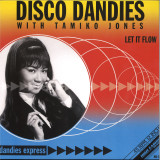
DISCO DANDIES WITH TAMIKO JONES - LET IF FLOW

The renowned Disco Dandies have made a triumphant return, emerging from their creative haven at the Old Course of the St. Andrews Golf Club. Following the success of their previous chart-topping hit, “Inside Your Love” (2 People), which went to number one TWICE at Traxsource, they present their latest offering, a rework of the Miami T.K. Disco classic by Tamiko Jones, “Let It Flow.”

This new release showcases a heightened tempo and a fresh interpretation that irresistibly beckons the dance floor. The Disco Dandies, known for their meticulous attention to detail, have patiently crafted a musical gem that has received the coveted final seal of approval. Now, in the year 2024, they are ready to unveil their creation to the world.

n stark contrast to the hurried pace of some, the Disco Dandies adhere to a philosophy where haste has no place; instead, they embrace patience as the key to their artistic process. The anticipation surrounding their latest work has been met with great reward, and the wait for this musical delight has proven to be truly worthwhile.

Get ready to immerse yourself in the infectious rhythms and the Japanese, Cherokee soulful voice of Tamiko Jones and the Disco Dandies.

No en stock

Haga su pedido ahora y le encargaremos el artículo en nuestro proveedor.

14,24

Ültimo hace: 11 Meses
The Humble Bee & Offthesky - Here In, Absence

Here In, Absence" ("Here, In Absence" for the book) is the result of the dialogue between the Finnish photographer Mikael Siirilä and the music artists The Humble Bee & Offthesky initiated by IIKKI, between March 2023 and January 2024.

After a first release in 2019 on IIKKI ("All Other Voices Gone, Only Yours Remains"), a second one in 2020 on LAAPS ("We Were The Hum Of Dreams"), Craig Tattersall (The Humble Bee) and Jason Corder (Offthesky) come back with a third stunning out-of-time beauty, paired with the Mikael Siirilä photography works.

Craig Tattersall is a former member of The Remote Viewer and Famous Boyfriend bandmate Andrew Johnson. Tattersall's music can be found these days more often under his alias The Humble Bee; as a founder member of The Boats; and in his collaborative works with the likes of Bill Seaman in The Seaman And The Tattered Sail. He has run the wonderful label Cotton Goods from 2008 to 2015 and since 2009 he has recorded 16 solo albums on his moniker The Humble Bee and almost the same under his name on some collaborations.

Jason Corder is experimental-ambient multimedia artist based in Denver, CO. He has been producing music, video art, audio software, and the occasional interactive sound sculpture, for over 20 years. He teaches private courses on generative music and occasionally lectures on various sound design topics at Denver University. He currently is the Audio Director at the Denver based videogame studio Dire Wolf. Over the years, he has worked with labels such as Home Normal, 12k's term, Facture, LAAPS and more. Over the years he has performed at Mutek, Decibel, Communikey and other festivals, sharing the bill with likeminded artists Pole, Matmos, William Basinski, and more.

Mikael Siirilä: "I am a darkroom artist (b. 1978) based in Helsinki, Finland. My small individual photographs examine the themes of absence, presence and outsiderhood. My characters appear immersed in their inner worlds and moments of being: simultaneously absent and intensely present. The pictures also reveal the outsider’s gaze, lost in observation and reflection. My pictures are true observations captured with minimal interaction with the subjects. Their origin is in the act of looking, and they feel causally connected to the world. The craft of printmaking is inseparable from my artistic expression. I work solely with black & white film and the darkroom. The slow, contemplative process lends the pictures a calmness. I make physical pictures I want to stare at, feel and become lost in. Again and again."

Fine Art Book, Ltd. to 500 copies:
Hardcover book printed on Munken Lynx 150g/m2 // 80 pages, 18cm x 24cm, 51 photos // Logo and slot embossed // Selective UV varnish // Visible seam and cutting cover pages // Hand-numbered, hand-stamped.

Reservar01.03.2024

debe ser publicado en 01.03.2024

57,94
REMO DRIVE - MERCY LP

Remo Drive

MERCY LP

12inch279711
Epitaph Europe
23.02.2024

REMO DRIVE, the longstanding project of brothers Erik and Stephen Paulson, want you to feel something. Following a six-year run of pristine emo-influenced rock "n" roll records comes Mercy, the band"s fourth album and third for Epitaph. It"s the band"s most lyric-focused offering to date, a record about reinvention, trusting yourself, and wearing your heart on your sleeve even when it"s painful or vulnerable. Sonically, Mercy is also a major departure for REMO DRIVE. It"s less indebted to the emo and pop punk that foregrounded the duo"s career and instead invested in thorny, baroque indie pop byway of Father John Misty and Fleet Foxes. It was produced by Phil Ek, a legendary Seattle-based indie rock producer who has previously worked with those two bands as well as the Shins and Band of Horses, among others. REMO DRIVE worked with Ek over the course of ten days. "It was refreshing to work with Phil," says Erik, "It made music feel like how it did when we were younger. He was like fuck it, let"s go, let"s have fun." Mercy is a study in intimacy, in being real with yourself, in entering an exciting new creative chapter where you are making the art you really want to make. That"s where REMO DRIVE is today.

Reservar23.02.2024

debe ser publicado en 23.02.2024

26,26
IL BOSCO - MEGA MISSES FROM THE MANCTALO DISKOTEQUE LP 2x12"

As the fable goes: pre-discogs, intrepid disc jocks would often take trips to Italy (many tricking their spouse into believe it was a ‘holiday’!) to source records from the seemingly endless supply of top tier Italo, disco and cosmic record shops across the country. According to legend, the classified sections of local yellow pages and information booklets which would contain the addresses of the record shops and dealers in the area would often be ripped out unscrupulously, thwarting – or at least making it more difficult for – the next vinyl tourist to source out the rare gems amongst the rich seams – a wild west vinyl gold rush if you will.

Such stories are a rarity these days, with youtube making some of the most underground tracks common knowledge, and discogs almost making any record obtainable – at a price of course. Upgrading his digging methodology, Bosco has developed a secret New Technique to side-step the machine and in doing so obtained a clutch of amyl-soaked fluffers that are so rare, that upon writing they aren’t even listed online! Seriously, he must be communicating with some interdimensional, upper echelon Italo overlords; taking us on a primo-thrust tour through the most unexposed recesses of the Italo disco galaxy.

Don’t be hoodwinked by their sheer obscurity however; we wouldn’t give a toss if they couldn’t tear the arse off the dancefloor. But they’re all fuckin rhodium grade tackle peeps! Eight neon-drenched late night roman candles of Italo disco decadence that’ll defo have you jizzing rainbow skittles over the dancefloor as you search desperately through the fog for another huff of poppers off Darren.

Total Discogs market value: as yet undetermined

Pharoah Brunson’s Pyramid Points: 9999999999999

No en stock

Haga su pedido ahora y le encargaremos el artículo en nuestro proveedor.

29,62

Ültimo hace: 13 Meses
Nullptr - Terminus

Nullptr

Terminus

12inchCPU01100011
CENTRAL PROCESSING UNIT
19.02.2024

Back in stock!

NULLPTR never fails. Since emerging in 2016 with the Optical LP, Eddie Symons' project has become a byword for top-draw contemporary electro productions. After triumphantly returning to Sheffield's Central Processing Unit with 2020's Future World full-length, NULLPTR follows that album up with a new quartet of machine-funk slammers. Striking a balance between highwire, twitchy rhythm programming and some deft textural work, the Terminus EP demonstrates exactly why the NULLPTR name is so respected in the world of electro.

The first half here almost showcases the two sides of the NULLPTR sound in microcosm. Opening track 'Connected' zips along like one of the racers from a Wip3out game. The 808s are all booming breakbeats and hissing-piston hats, with a jittery synth bassline nipping in and out of the spaces left vacant by the drums. Atop these swirl eerie keyboard pads, the reverb from them draping across the rest of the instruments like fog above a city. By contrast, following cut 'Mesospheric Cruise' is the yin to 'Connected's yang. Where its predecessor was tense and coiled, this lilting number is expansive and open like a primetime Virginia joint - though the point where the wistful house pads strip back to foreground the twinkle-toed electro beat still has a pleasing crunch to it.

The B-side of Terminus serves dystopian snap from the off. Genre masters Drexciya are invoked by 'Syndicate'. The needle-gun bassline here turns itself inside-out across these five minutes, and all the while the tune is laced with some evocative shadow-realm synth pads. A similar energy courses through the EP's closing title-track, a cut which also brings into play a booming four-to-the-flour that gives it an unstoppable sense of forward-motion. Like 'Connected' and 'Mesospheric Cruise' - indeed, like all of the NULLPTR material that Central Processing Unit has brought us down the years - these jams will sound positively devilish when deployed in a dark basement.

The Terminus EP sees electro don NULLPTR (Eddie Symons) deliver four slices of unadulterated machine-funk heat.

RIYL: Virginia, Cardopusher, Drexciya, Silicon Scally

No en stock

Haga su pedido ahora y le encargaremos el artículo en nuestro proveedor.

9,20

Ültimo hace: 13 Meses
RESIDENTS - SECRET SHOW (LIVE IN SAN FRANCISCO)  LP 2x12"

To celebrate their 50th Anniversary, The Residents undertook a secret, one-off performance in their hometown of San Francisco. Joined on stage by a hand-picked cast of guest artists, the group and their friends performed a dream setlist of classics from the band’s back catalogue, including songs never performed live before. Featuring guest vocalists, a girls’ chorus, spoken word pieces, a solo piano recital, orchestral and choral arrangements, rock freakouts, mariachi interludes and, of course, The Residents themselves. We present a recording of a show that will live long in the memories of all who were there. Showcasing the classics ‘Santa Dog’, ‘Constantinople, ‘Hello Skinny’ and an incredible selection of material spanning the group’s fife decades, this is The Residents as we’ve never head them before, and never will again.

Reservar16.02.2024

debe ser publicado en 16.02.2024

49,79
Danielle Boutet - Pièces LP

Danielle Boutet’s P »Pièces« is a mysterious artifact of Quebecois marginalia, self-released in 1985. Moving from languid ennui to high drama, »Pièces« is a dreamy gestalt, an album that borders Chanson, spoken-word, jazz noir, and minimalism, conjured from the chasm between acoustic and electronic realms. »Pièces« allows us a window into the highly intimate songcraft and compositional skill of an artist who longed to linger not in the public eye, but in relation with others and the world around her.

Born in Quebec City, Boutet studied music at the University of Montreal, where she focused on composition and percussion, before becoming involved in Montreal’s feminist and lesbian art scene. Primarily written, performed, and recorded by Boutet, with voice, guitar work, and technical assistance by Sylvie Gagnon, Pièces was created during a paradigm shift in home recording. Originally composed for the piano, Boutet and Gagnon utilized a consumer-friendly Tascam 4-track Portastudio and versatile Yamaha DX-7, alongside guitar, bass, marimba, and the human voice, to expand and contemporize the original composition’s scope.

Inspired by prog rock and British poet and musician Anne Clark, »Pièces« translates Boutet’s influence by moving between sunny, wistful fairytale and dark, wintry dirge. Filled with longing marimba, vertiginous, startling synth pads, and folk guitar, each track on Pièces offers a wholly unique proposition. Some are modal and rife with the ethereal psychological tension of a sci-fi soundtrack, while others are more like entering a smoke-laced lounge, the entertainer embodying seduction.

With the sprechgesang of artists like Serge Gainsbourg, there is an intense intimacy to Boutet’s delivery, sometimes as if she is performing for an audience of one. As one lyric goes, translated to English from French: “Like holograms/ Images from a world/ That inhales souls/ And exudes drama.” Another song contains an excerpt from The Tao of Physics: “The eastern sages specify clearly that they do not identify an ordinary void, but rather, a void having an infinite creative potential.”

To English-language audiences, the album’s title, »Pièces«, might seem to simply refer to the eleven different pieces. The title can also, of course, refer to parts of a larger whole, but Boutet is keen to point out that there is also another meaning: In French, a pièce is a room. On the cover of the original cassette, Boutet is seen sitting on a chair, alone in an empty apartment, a cable snaking at her feet. Listening to »Pièces« is like entering eleven different rooms: whether a study encased in shadow, a greenhouse left to wither in an eternal frost, or a divine nave.

Boutet sold a few dozen copies around Montreal, a scene mostly occupied by the new wave explosion de rigueur, but the inclusion of Pièces in the 1987 issue of Ladyslipper—the North Carolina-based mail order catalog that championed women musicians of all calibers and careers—led to more exposure throughout North America. “In the catalog,” Boutet says, “they included it in the New Age section, but I was, and still am, aware that this album is relatively unclassifiable.”

Boutet would release one more album, titled Musiques Urbaines, before getting pulled in the direction of interdisciplinary art and theory. “Although I never stopped making music, I lost all interest in public diffusion or performance,” Boutet says. Despite her departure from performance and publicly releasing music, she left behind a strange and enthralling document of Montreal’s 1980s feminist fringe, an aural document of the historic moment when self-recorded music and its practical potential became a prismatic reality.

Danielle Boutet’s Pièces arrives February 16, 2024 as part of uncommon¢ (“uncommon sense”), an open-ended, serialized endeavor from Freedom to Spend that provides new meaning for rarefied recordings from music’s outermost fringe.

Reservar16.02.2024

debe ser publicado en 16.02.2024

22,98
SYNTHS VERSUS ME + NEA - DEFAULT MODE NETWORK LP 2x12"

After almost 6 years of silence since “Akelarre”, Synths Versus Me, the personal musical project of Nico Cabañas, co- founder of Oráculo Records alongside the young Italian promise India Nardone. Recorded analogically in just 2 months, fluctuates in a futuristic way between different kinds of unusual dark sub styles such as industrial noise, proto- tribal, synthpunk or krautwork, and, of course, among other dance-oriented such as EBM, new beat, synthwave, electro/breakbeat or trance. Presented in ONE-OFF truly limited edition of 300 copies lacquered pressed on 180 gr. high quality solid BLACK vinyl. All tracks have been specially mastered for vinyl by Daniel Hallhuber at Young and Cold Studios (Germany).

No en stock

Haga su pedido ahora y le encargaremos el artículo en nuestro proveedor.

41,98

Ültimo hace: 2 Años
KALI MALONE - ALL LIFE LONG LP 2x12"

Kali Malone's anticipated new album "All Life Long" is a collection of music for pipe organ, choir, and brass quintet composed by Kali Malone, 2020 - 2023. Choral music performed by Macadam Ensemble and conducted by Etienne Ferschaud at Chapelle Notre-Dame-de-L'Immaculée-Conception in Nantes. Brass quintet music performed by Anima Brass at The Bunker Studio in New York City. Organ music performed by Kali Malone and Stephen O'Malley on the historical meantone tempered pipe organs at Église Saint-François in Lausanne, Orgelpark in Amsterdam, and Malmö Konstmuseum in Sweden. Kali Malone composes with a rare clarity of vision. Her music is patient and focused, built on a foundation of evolving harmonic cycles that draw out latent emotional resonances. Time is a crucial factor: letting go of expectations of duration and breadth offers a chance to find a space of reflection and contemplation. In her hands, experimental reinterpretations of centuries-old polyphonic compositional methods become portals to new ways of perceiving sound, structure, and introspection. Though awe-inspiring in scope, the most remarkable thing about Malone's music is the intimacy stirred by the close listening it encourages. Malone's new album All Life Long, created between 2020 - 2023, presents her first compositions for organ since 2019's breakthrough album The Sacrificial Code alongside interrelated pieces for voice and brass performed by Macadam Ensemble and Anima Brass. Over the course of twelve pieces, harmonic themes and patterns recur, presented in altered forms and for varied instrumentation. They emerge and reemerge like echoes of their former selves, making the familiar uncanny. Propelled by lungs and breath rather than bellows and oscillators, Malone's compositions for choir and brass take on expressive qualities that complicate the austerity that has defined her work, introducing lyricism and the beauty of human fallibility into music that has been driven by mechanical processes. At the same time, the works for organ, performed by Malone with additional accompaniment by Stephen O'Malley on four different organs dating from the 15th to 17th centuries, underscore the mighty, spectral power that those rigorous operations can achieve. All Life Long simmers in an ever-shifting tension between repetition and variation. The pieces for brass, organ, and voice are alternated asymmetrically, providing nearly continuous timbral fluctuation across its 78-minute runtime even as thematic material reiterates. Each composition's internal framework of fractal pattern permutations has the paradoxical effect of creating anticipated keystone moments of dramatic reverie and lulling the listener into believing in an illusory endlessness. On an even more granular level, the historical meantone tuning systems of each organ used, and the variable intonation of brass and voice, provide further points of emotional excavation within the harmony. The titular composition "All Life Long" appears twice on the album, first as an extended canon for organ and again in the final quarter, compactly arranged for voice In the latter, Malone pairs the music with "The Crying Water" by Arthur Symons, a poem steeped in language of mourning and eternity. For organ, "All Life Long" moves with a patient stateliness, the drama concentrated in moments when shifting tonalities generate and release dissonance and ecstasy. For voice, each word is saturated with feeling, the singers swooping gracefully downward to capture the melancholy of the narrator's relationship to the timeless tears of the sea. "Passage Through The Spheres," the album's opening piece, contains lyrics in Italian pulled from Giorgio Agamban's essay In Praise of Profanation. In it, Agamban defines profanation as, in part, the act of bringing back to communal, secular use that which has been segregated to the realm of the sacred, a process Malone enacts each time she performs on church organs. This is not music of praise, or of spiritual revelation, but it is an artistic enactment of translating the indescribable. It carries the gravity of liturgical chant, and its fixation on the infinite, but draws its weight from the earthly realm of human experience. A music that draws the listener into the present moment where they can discover themselves within the interwoven musical patterns that can come to resemble the passage of days, weeks, years, a lifetime.

No en stock

Haga su pedido ahora y le encargaremos el artículo en nuestro proveedor.

33,19

Ültimo hace: 6 Meses
Various - Toolroom Trax Sampler Vol. 1

Kicking off our new Toolroom Trax vinyl series which celebrates the best releases from Toolroom’s sister label is Italian super-duo Twolate with the incredible new single 'Baila'. A straight-up 4 to the floor club shaker, with powerful hard-hitting drums, deep punchy afro vocals with carnival whistles and percussion hits that will turn the dancefloor into a fiesta. Two dance heavyweights collide on our next offering; best-selling house artist CASSIMM and Chicago house royalty Gene Farris for their latest collaboration 'Party People'. With numerous #1 singles and remixes on Beatport and Traxsource, CASSIMM returns to Trax with his notorious sound of feel-good, high-energy house music, team that with Gene Farris as he effortlessly delivers another irresistible vocal hook. 'This is for my people, my party people'. James Haskell kicks things off on the b-side with 'Check It Out'. With numerous releases on D4 D4NCE, LoveJuice and of course Toolroom, James Haskell is fast gaining support from the scenes top tastemakers including Bob Sinclar, Leftwing : Kody, David Guetta, Tita Lau and Dombresky to name a few. Gracing club hotspots around the world, James Haskell is set to top the charts with his Tech House and Big Room sound. Closing out the Sampler is Toolroom Trax A&R and Music Curator Danny Rhys with his percussive tech house weapon 'Sibali'. Following on from his 2021 Traxsource number #1 single 'Damn Good', in collaboration with house vocalist legend Mr. V. With releases on respectable labels such as Farris Wheel Recordings, Flashmob, HouseU and There Was Jack, Danny Rhys boasts high, feel-good energy, bumpy basslines, rolling percussion and infectious vocals that has since gained respect from AAA talents such as Gorgon City, TCTS, Kryder and of course Mark Knight.

DJ Support from Danny Howard, Annie Mac, Mistajam, Pete Tong, Charlie Hedges, Kraak & Smaak, Maxinne, Todd Terry, Alex Preston, Full Intention, GW Harrison, DJ Rae, Rudimental, Alaia & Gallo, Illyus & Barrientos, Johan S, David Penn, Sam Divine, Riva Starr, Claptone, Nice7, Dario D’Attis, Mousse T, S-Man, Huxley, KC Lights, Friend Within, Dombresky, Gorgon City, Chris Lake, Format:B, Pirupa, TCTS, Alan Fitzpatrick, Low Steppa, Mat.Joe, Raumakustik, Eskuche

No en stock

Haga su pedido ahora y le encargaremos el artículo en nuestro proveedor.

13,87

Ültimo hace: 12 Días
Optimo - Optimo 25 Part 1. (2x12")

Optimo (Espacio) started life as a weekly club night. It was born at The Sub Club in Glasgow on a wet, windy, wintry November Sunday night in 1997. Run by JD Twitch and partner in crime Jonnie Wilkes. Optimo was a reaction against what felt like an increasingly conservative musical soundtrack in clubs here at that time. Clubland felt as if it had become very bland and a bit too serious; it was the era of the dawn of the Superstar DJ. Clubs often felt like bastions of male energy. It seemed dance music and culture was going somewhere far, far away from where it was meant to be. The notion of fun had got lost.

It was no longer the world they had devoted ten years of their lives to already, and lots of their friends felt the same. When the opportunity came up to do a Sunday night at The Sub Club it felt like the perfect opportunity to rip it all up and start again. So they did. There was nothing in the city (or possibly anywhere) like it. As the club believed wholeheartedly in what they were doing, there was no pressure from The Sub Club to fill the club. So, they embraced the freedom. Groups of people who had never been in the same room at the same time before came together. A community of kindred spirits started to emerge.

Word spread, slowly. Lots of people checked it out. Many loved it, some hated it. The core of the Optimo idea was to embrace music they loved that might work on the dancefloor from whatever era or genre they thought felt right. It might not seem very radical now but at that time it was revolutionary.

After about a year and a half, the club went from having 100 people attending most nights to suddenly one week having 500 people turn up. It was very weird. It was as if a collective light bulb went off in people’s heads in Glasgow. From that week on, until the very last weekly Sunday night at the Sub Club, in 2010, over a decade later, it was packed.

There were 550 Sunday Optimo nights. A LOT of music was played. So, what was the music? People often find it hard to pin down exactly what Optimo is. This has been a positive but also a negative as we live in a world where people want easily defined “brand identities”. The simplest definition of the music played is “music for dancing”, which of course is a very broad definition. Even better than trying to define it in words, we have these 2 volumes of music that give a hint of what that might be.

This is not a “Best of Optimo” or a “Greatest Hits of Optimo” compilation. For people who come to, or used to come to the nights there are of course “Greatest Hits”. But, over such a long timespan they are “hits” belonging to a certain moment in time and space. Someone who came to Optimo in 1997 would have a completely different notion of the big tracks at the club to someone coming in 2003, or 2010, or today. This compilation is just a snap shot missing several genres that might make up the DNA of Optimo. There is though a broad sweep through lots of music Optimo loves, that they believe is amazing. Music that they know will rock a dancefloor, that they have played between 1997 and 2023. Of course Optimo nights were not all about rocking the dancefloor. The first hour was always a time for them to play music they loved that often was far removed from the dance. Side 1, Volume 1 of this compilation is the kind of music one might hear at the very start of an Optimo night.

Optimo have always loved a good slogan. The most long lived, and fitting Optimo slogan is "We Love Your Ears", which is in essence what it is all about to them.

No en stock

Haga su pedido ahora y le encargaremos el artículo en nuestro proveedor.

29,83

Ültimo hace: 2 Años
Optimo - Optimo 25 Part . (2x12")

Optimo (Espacio) started life as a weekly club night. It was born at The Sub Club in Glasgow on a wet, windy, wintry November Sunday night in 1997. Run by JD Twitch and partner in crime Jonnie Wilkes. Optimo was a reaction against what felt like an increasingly conservative musical soundtrack in clubs here at that time. Clubland felt as if it had become very bland and a bit too serious; it was the era of the dawn of the Superstar DJ. Clubs often felt like bastions of male energy. It seemed dance music and culture was going somewhere far, far away from where it was meant to be. The notion of fun had got lost.

It was no longer the world they had devoted ten years of their lives to already, and lots of their friends felt the same. When the opportunity came up to do a Sunday night at The Sub Club it felt like the perfect opportunity to rip it all up and start again. So they did. There was nothing in the city (or possibly anywhere) like it. As the club believed wholeheartedly in what they were doing, there was no pressure from The Sub Club to fill the club. So, they embraced the freedom. Groups of people who had never been in the same room at the same time before came together. A community of kindred spirits started to emerge.

Word spread, slowly. Lots of people checked it out. Many loved it, some hated it. The core of the Optimo idea was to embrace music they loved that might work on the dancefloor from whatever era or genre they thought felt right. It might not seem very radical now but at that time it was revolutionary.

After about a year and a half, the club went from having 100 people attending most nights to suddenly one week having 500 people turn up. It was very weird. It was as if a collective light bulb went off in people’s heads in Glasgow. From that week on, until the very last weekly Sunday night at the Sub Club, in 2010, over a decade later, it was packed.

There were 550 Sunday Optimo nights. A LOT of music was played. So, what was the music? People often find it hard to pin down exactly what Optimo is. This has been a positive but also a negative as we live in a world where people want easily defined “brand identities”. The simplest definition of the music played is “music for dancing”, which of course is a very broad definition. Even better than trying to define it in words, we have these 2 volumes of music that give a hint of what that might be.

This is not a “Best of Optimo” or a “Greatest Hits of Optimo” compilation. For people who come to, or used to come to the nights there are of course “Greatest Hits”. But, over such a long timespan they are “hits” belonging to a certain moment in time and space. Someone who came to Optimo in 1997 would have a completely different notion of the big tracks at the club to someone coming in 2003, or 2010, or today. This compilation is just a snap shot missing several genres that might make up the DNA of Optimo. There is though a broad sweep through lots of music Optimo loves, that they believe is amazing. Music that they know will rock a dancefloor, that they have played between 1997 and 2023. Of course Optimo nights were not all about rocking the dancefloor. The first hour was always a time for them to play music they loved that often was far removed from the dance. Side 1, Volume 1 of this compilation is the kind of music one might hear at the very start of an Optimo night.

Optimo have always loved a good slogan. The most long lived, and fitting Optimo slogan is "We Love Your Ears", which is in essence what it is all about to them.

No en stock

Haga su pedido ahora y le encargaremos el artículo en nuestro proveedor.

29,83

Ültimo hace: 6 Meses
J MASCIS - WHAT DO WE DO NOW

J Mascis

WHAT DO WE DO NOW

12inchSPLPX1605
Sub Pop
02.02.2024

What Do We Do Now is the fifth solo studio LP recorded by J Mascis since 1996. This is obviously not a very aggressive release schedule, but when you figure in the live albums, guest spots, and records done with his various other bands (Dinosaur Jr., The Fog, Heavy Blanket, Witch, Sweet Apple, and so on), well, to paraphrase Lou Reed, "J's week beats your year." What Do We Do Now began to come together during the waning days of the Pandemic. Utilizing his own Bisquiteen Studio, J started working on writing a series of tunes on acoustic with a different dynamic than the stuff he creates for Dino. "When I'm writing for the band," he says, "I'm always trying to think of doing things Lou and Murph would fit into. For myself, I'm thinking more about what I can do with just an acoustic guitar, even for the leads. Of course, this time, I added full drums and electric leads, although the rhythm parts are still all acoustic. Usually, I try to do the solo stuff more simply so I can play it by myself, but I really wanted to add the drums. Once that started, everything else just fell into place. So it ended up sounding a lot more like a band record. I dunno why I did that exactly, but it's just what happened." Two guest musicians are playing this time out; Western Mass local Ken Mauri (of the B52s) plays piano on several tracks. Since J himself has some experience with keys, when asked why he needed a hired gun, he says, "Ken is great, and he plays all the keys. I tried playing some keyboards on the first Fog album, but I'm really only comfortable playing the white notes, so it's kind of limiting. laughs Nowadays, I could just turn the pitch on a mini Mellotron to play different sounds, but black keys just seem hard. For whatever reason, I just like banging on the white ones. Seems like it's harder to figure out how to stretch your fingers around the other ones." Mauri has no such qualms and plays all the keys very damn well. He sounds especially great on "I Can't Find You," where he is Jack Nitzsche to J's Neil Young, creating one of the album's loveliest tunes. The other guest musician, Matthew "Doc" Dunn, is also prominent on this track. Dunn's steel guitar manages to both widen and soften the musical edges of the music, giving it a full classicist profile. Dunn is an Ontario-based polymath who J met through Matt Valentine. After J played on Doc's great 2022 Sub Pop single, "Your Feel," he figured it was time for payback. Both Dunn and Mauri add beautifully to the songs here, helping to transform them from acoustic sketches into full-blown post-core power ballads. What Do We Do Now is the finest set of solo tunes J has yet penned, and the way they're presented is just about perfect. Asked if he would be touring to support the album, J says he'll be doing some weekend dates, but he probably won't be putting a band together. And I'm sure these songs will sound great solo and acoustic, but the arrangements on this album are truly great and put a cool, different spin on Mascis' instantly Recognizable approach to making music. So, what do we do now? Not sure. But apparently, what J does is to make one of his most killer records ever. Hats off to him. - Byron Coley

Reservar02.02.2024

debe ser publicado en 02.02.2024

28,99
J MASCIS - WHAT DO WE DO NOW

J Mascis

WHAT DO WE DO NOW

CassetteSPCS1605
Sub Pop
02.02.2024

What Do We Do Now is the fifth solo studio LP recorded by J Mascis since 1996. This is obviously not a very aggressive release schedule, but when you figure in the live albums, guest spots, and records done with his various other bands (Dinosaur Jr., The Fog, Heavy Blanket, Witch, Sweet Apple, and so on), well, to paraphrase Lou Reed, "J's week beats your year." What Do We Do Now began to come together during the waning days of the Pandemic. Utilizing his own Bisquiteen Studio, J started working on writing a series of tunes on acoustic with a different dynamic than the stuff he creates for Dino. "When I'm writing for the band," he says, "I'm always trying to think of doing things Lou and Murph would fit into. For myself, I'm thinking more about what I can do with just an acoustic guitar, even for the leads. Of course, this time, I added full drums and electric leads, although the rhythm parts are still all acoustic. Usually, I try to do the solo stuff more simply so I can play it by myself, but I really wanted to add the drums. Once that started, everything else just fell into place. So it ended up sounding a lot more like a band record. I dunno why I did that exactly, but it's just what happened." Two guest musicians are playing this time out; Western Mass local Ken Mauri (of the B52s) plays piano on several tracks. Since J himself has some experience with keys, when asked why he needed a hired gun, he says, "Ken is great, and he plays all the keys. I tried playing some keyboards on the first Fog album, but I'm really only comfortable playing the white notes, so it's kind of limiting. laughs Nowadays, I could just turn the pitch on a mini Mellotron to play different sounds, but black keys just seem hard. For whatever reason, I just like banging on the white ones. Seems like it's harder to figure out how to stretch your fingers around the other ones." Mauri has no such qualms and plays all the keys very damn well. He sounds especially great on "I Can't Find You," where he is Jack Nitzsche to J's Neil Young, creating one of the album's loveliest tunes. The other guest musician, Matthew "Doc" Dunn, is also prominent on this track. Dunn's steel guitar manages to both widen and soften the musical edges of the music, giving it a full classicist profile. Dunn is an Ontario-based polymath who J met through Matt Valentine. After J played on Doc's great 2022 Sub Pop single, "Your Feel," he figured it was time for payback. Both Dunn and Mauri add beautifully to the songs here, helping to transform them from acoustic sketches into full-blown post-core power ballads. What Do We Do Now is the finest set of solo tunes J has yet penned, and the way they're presented is just about perfect. Asked if he would be touring to support the album, J says he'll be doing some weekend dates, but he probably won't be putting a band together. And I'm sure these songs will sound great solo and acoustic, but the arrangements on this album are truly great and put a cool, different spin on Mascis' instantly Recognizable approach to making music. So, what do we do now? Not sure. But apparently, what J does is to make one of his most killer records ever. Hats off to him. - Byron Coley

Reservar02.02.2024

debe ser publicado en 02.02.2024

12,40
Artículos por página
N/ABPM
Vinyl