“I've collaborated with Polychrome for quite some time. I performed at their one-year anniversary at Sexyland and, along with Eversines, played at their ADE 2022 party. Additionally, I contributed to their recent "Reflection EP." Throughout this collaboration, we became friends. Hervé, one of the core members of the group, asked me numerous times to create an EP together. It wasn't until his wedding that I finally said yes (how fitting!).
The first track of the EP is "Laak," a tune I created the day after playing at the club in Den Haag. I thoroughly enjoyed DJing at this venue with its impressive sound system. It inspired me to work on the low reese-bass that forms the core foundation of the track. Hervé and I decided to dedicate the entire A-side to this tune, as we had discussed how nice it would be to have a 45-side on this EP.
The second side focuses more on the emotional aspects we appreciate. "Underwater (Dream Mix)" opens this side with an uptempo techno-ish foundation and trancy melodies, fitting the label's aesthetic perfectly. The track's name stems from my unintentional creation of very "underwater" sounding pads during the recording session (note to self: next time double-check if the mix is alright). The EP concludes with "Reassociate," a tune heavily inspired by the early 2000s IDM gems we adore.”
Stellar Systems, the latest imprint from the Rings of Neptune crew, readies its first release, "Archived Dreams" — a four-track EP signed by Berlin-based techno luminary Michael Melchner. Drawing influences between electro-charged techno and IDM-tinged minimalism, "Archived Dreams" explores cosmic, genre-blending themes through high-octane machine funk and tons of atmosphere. Crafted with pure analog equipment, the four tracks of the EP capture Melchner’s dedication to pushing sonic boundaries while channelling the raw energy of 90s electronic music.
The EP opens with 'Archived Dreams' (A1), a powerfully hypnotic track of pulsating drums and mesmerizing melodies, layered modular sequences and subtle percussion, setting an entrancing tone. Decollage (A2) dives into breakbeat territory, balancing intricate, syncopated rhythms with deep basslines and shimmering synths. On the B-side, Berlin Phenomena(B1) delivers a groove-laden, robotic vibe—a testament to Melchner’s knack for crafting infectious, funk-inspired rhythms. Closing out the EP, 'OE Underground' (B2) ramps up the intensity, blending raw, mechanical beats with intricate melodic threads to create an entrancing, slightly euphoric finale.
Stellar Systems emerges as an exciting extension of the Rings of Neptune collective dedicated to explore electronic music's rich sonic landscape. From deep, leftfield groovers to dynamic dancefloor stompers, Stellar Systems aims to capture a galactic range of sounds and styles. Michael Melchner, with his body of work — spanning solo projects and collaborations like Omega Men — and his esteemed reputation in the underground techno scene, aligns perfectly with the label's ethos.
Parsley Sounds was the glorious debut album for Mo Wax by Parsley Sound. The album was one of the iconic label’s final releases before it closed in 2003 and locating a clean copy has been extremely tricky of late, unless you're flush enough to drop 150 notes on it. Mercifully, the Be With reissue, put together with invaluable assistance from the group, should remedy this situation. It's a lo-fi, bass-heavy, blunted beat treat, warped with heat haze and dreamy soft-psych and has been criminally under-heard for far too long.
As with most cult-like records, Parsley Sounds has many influential fans, far and wide. From Four Tet and Caribou to NTS's modern day breakfast hero Flo Dill, its reputation has only grown in stature. At the time, the notoriously hard-to-please Pitchfork garlanded it with a scarcely achievable 8.8 whilst, just recently, the Numero Group's Rob Sevier described it as a "visionary bit of proto-Salvia Palth (or Steve Lacy)" via a Ghostly International missive.
Parsley Sound comprised super-talented duo Preston Mead and Dan Sargassa. They released an early single (the perfect "Twilight Mushrooms", featured here) on Warp Records as Slum, before signing to Mo Wax. Hidden behind a wall of sound - fuzzy layers of beats, bleeps and symphonic synths - they were convinced they made mainstream pop music. And, in many respects, Parsley Sounds really is a beautiful pop album. It overflows with memorable, gorgeous melodies and inspired songcraft. As the contemporaneous Pitchfork review correctly had it: "Parsley Sounds is one of those rare records that manage to sound modest while frequently pushing the sonic envelope."
Killer opener "Ease Yourself And Glide" is a thing of aching, soft-psych, wonky beat-beauty. A melodic masterpiece, part Crosby, Stills & Nash, part proto-Koushik, it presents a melancholy falsetto, surging bass and blunted lead guitar. As it climaxes, gorgeous strings are ushered in to see us out. Sublime. "Twilight Mushrooms" is up next and it's an acid-drenched, strung-out acoustic-led campfire wonder. Amid layers of tape-hiss and beautiful, sun-dappled strings, its understated vocal track provides a haze of wistful innocence.
The breezy "Spring's Near" is a krautrock-inspired chiming instrumental of heavenly excellence, its warm, skipping, motorik groove and dreamy synths completely infectious. Another total highlight, the technicolour "Yo Yo" initially presents itself as a more abstract, bleepy offering but as it organically swells into ever more beautiful places, with the addition of a choppy insistent drum loop, flute bursts, horns and sweeping strings, it puts one in mind of early Manitoba and Four Tet releases. Shimmering, blissed-out greatness.
The celestial harmonies and glistening harps of the wonderfully beatless, serenely sullen "Ocean House" are very much in conversation with late-60s meditative psych whilst, closing out Side A, the jaw-dropping, lushly experimental effort "Find The Heat" comes on like Arthur Russell meets Brian Wilson. Yep, *that* good.
Side B opens with the warped, bleepy "Stevie", a brief but beautifully wonky, soulful and intricate instrumental. The more upfront vocals that propel the fuzzy "Platonic Rate" have a refreshing swagger to them, the heavy bass and neck-snapping in-the-red beats too much for any system to deal with whilst the guitars and strings have a sweeping, cinematic feel which just beguiles. The slow, urbane soul of "Candlemice" will stop you in your tracks, no matter what you're doing. It carries a delicate sadness, as does much of the album in that classic "down lifting" style we so love here at Be With.
The fuzzing, buzzing "Templechurchmansions" is a searing, soulful dubwise detonation. Heavily stoned with slow-burning jazzy snatches and a tense, moody atmosphere, it's a Tricky-adjacent gem. The album rounds out brilliantly with the ominous instrumental "Neon Breeze" before giving way to the propulsive, almost incongruous punk-funk / disco-dub of secret "untitled" track "Caution", a scratchy, smacked-out groove-fuelled workout with a female vocal dripping with 'tude. Just sensational.
Under the watchful eye - and attentive ears! - of Parsley Sound themselves, the audio for Parsley Sounds has been carefully mastered by Be With regular Simon Francis, with a few much needed tweaks here and there, according to the artist's wishes. Cicely Balston's expert skills have made sure nothing is lost in the cut whilst the records have been pressed to the highest possible standard at the always stellar Record Industry in Holland.
Preston and Dan always thought the colours on the first vinyl pressing looked a bit "washed out" vis-a-vis the original artwork which was way more vibrant. We feel we've got it popping back to the original intention with the restoration work here at Be With HQ. So with the audio and artwork now approaching completeness after 20 years, this long overdue re-issue could be considered its definitive vinyl release.
Elektorni, based in Oulu, Northern Finland, lands with their second release, this time with three original cuts from the singular Finnish legend Mesak (Klakson, Orson) and a mesmerising remix from Århus-based Picture (Help Recordings, Kalahari Oyster Cult), who you might know from many different aliases as well.
The a-side opens with Mutella, a slapping electro track dripping with gothic emotion and powered by a growling bassline. Next up is Ei Damagea, a smooth slice of electrohypnotism calling to you from an otherworldly dimension inhabited by floaty rhythms and quirky synth stabs. Flip the record, and Mesak flexes his versatility with the 155bpm piece Musantropia, cruising top down and top speed somewhere between IDM, d&b and electro. Fresh! The journey ends with Picture’s remix taking Musantropia deep into an eight-minute techno meditation reminiscent of Basic Channel material, but with an Århusian take on the sound.
A bass heavy record with intricate detail, this is a release as ready for the club as it is for your home hi-fi system.
The enigmatic Ukrainian label Jerelo presents a 4-track vinyl-only EP by the talented Greek producer Cirkel Square. Each track on the release is like an antique sculpture — exquisite, graceful, and made with attention to every small detail. This comparison is not accidental, as Cirkel Square dedicated each of the four “sinister harmonies” to one of the gods of ancient Greek mythology. The opening track, “Kronos Reckoning”, with its new-age melodies bristling with pathos, carries the spirit of the greatness of the age of Titans, frozen between the dense bricks of a micro-house beat. “Hades Symphony” and "Persephone's Whisper" are inspired by existential reflections, while “Ares Beat” surprises with an inventive pseudo-acid drop.
The Malevolent Harmonies EP features tracks perfect for the dance floor, especially when played on a high-quality PA system. Despite each track's unique style, the EP as a whole is surprisingly cohesive. Just as the mentioned gods in the EP are related to each other, the
tracks share common elements, showcasing the high skill level of the rodub / rominimal producer from Stockholm.
To celebrate 10 years of one of London’s most loved underground club nights, Tangent, Mr Bongo are thrilled to launch this new compilation series. Crafted by its two residents, John Gómez and Nick the Record, it aims to transmit a taste of Tangent’s spirit. A party rooted in inclusivity and open-mindedness, whose name captures the spontaneous switches in musical direction that are a defining element of their nights. For the compilation, the pair have cherry-picked a selection of their prized, rare and dancefloor-ready tracks from around the globe, that have soundtracked the past decade of parties.
Friends for close to 20 years, music lovers, record obsessives and internationally renowned DJs in their own right, John and Nick have two lifetimes worth of musical knowledge to draw from. John a long-standing NTS Radio resident and compiler for Music From Memory. Nick one of the UK’s go-to record dealers, resident DJ since the ‘90s at one of Japan’s pioneering parties, Life Force, and co-captain / co-edit-expert of Record Mission with Dan Tyler (Idjut Boys).
In 2014, the pair decided to bring some of Life Force’s grassroots principles to the UK, whilst channelling underground clubbing institution Plastic People’s meticulous attitude to sound. Tangent grew from being a small gathering of friends, to an established fixture in London’s nightlife, whilst always maintaining a strict no guest DJ policy. “As London’s clubs have become increasingly reliant on international guests, we wanted to emphasize the importance of a club night growing through its residents”, John and Nick reflect. With 10 years of the duo at the helm, an intimate connection between DJ and dancefloor has been built, allowing for freedom of expression on both sides of the decks.
Tangent reaches around the globe and across different eras to make connections that stimulate emotional reverberations in the unfamiliar. Where the blissfully Balearic ‘Laberinto’ by Miguel Perikás, goes hand-in-hand with the Cameroonian hip-house of King B.’s ‘Love is Crazy’. The thundering ‘Amek Amek’ by L'Innovateur Djoe Ahmed et le Zoukabyle, rubs shoulders with the soulful Caribbean-influenced touch of Champagn’s ‘Bel Ti Négress’. And Pellegrin El Kady’s afro-cosmic ‘Seiva de Carnaval’, crosses paths with Kajou’s Kompa disco anthem ‘Tet Chajé’.
Tangent’s longevity is in part down to it having always embraced contemporary sounds. The sub-rattling bass of Srirajah Sound System’s stunning Molam dub stepper ‘Si Phan Don Lovers Rock’ and the slow, woozy mantra of leftfield dancehall explorer Androo’s ‘Lyriso’, are two shining examples.
This compilation represents an ongoing dialogue between past and present, transporting listeners to the heart of a pure musical experience, where open minds and open hearts are eager to follow the tangent.
Berlin based Alignment returns to Voxnox for what Italians are best known for: straight and forward-thinking Techno music. Floor orientation with heavy basslines, marching drums and an ever modulating Plug is therefore guaranteed on opening title "Infinity".
Second in order is "Distorted Signal", which specialises on a modulated rhythm with plenty of soundscapes, best up severed for a sweaty Saturday night on a solid sound system, highlighting the many layers and styles on this production work.
The bigger, the better. "Alienist" reminds and also focusses on the classic rave attitudes from the late 90s, with energising synths and an 808-inspired clap programming, ready to heat up the night no matter when and regardless where.
Closing this release is the fourth title "Distance", showing another high-energy production building up epic acid-vibes with various atmospheres just to finally drop them several times par excellence.
Italian born and Berlin based DJ, producer, label and record store owner Deluka kicks things off for Futuristic Architecture, System Error's newest offshoot for all things strictly Techno.
Deluka has long been a secret tip among vinyl and techno heads in Berlin and afar, having been a resident for several years at Berlin's infamously wild Same Bitches Party and the founder of No Signal Records, recently opening a record store of the same name.
With his Heroes EP, he commits 4 timeless techno tracks to wax, paying homage to his musical heroes with tunes that honour the sensibilities of the genre.
Deluka almost single-handedly reminds us of how much we love techno and we couldn't think of a better artist to begin this new story for System Error.
Nuira is the joint project of Italian producers Giovanni Petruzzelli and Michele Lamacchia.
The 6-track strong mini LP called "For Unconventional Ears LP" is a homage to old school drum and bass and breakbeat, while also taking influences from more modern breakcore, culminating in beautiful and blissful breaky bassiness.
Hard-hitting yet romantic tracks invite you on a dreamy ride into the past, present and futu-re! A record to brighten any listener's horizon…
To be released on Ransom Note Records and marking the debut album of Wave Arising project , "(The) Rooted Sky" is an invitation to an initiatory journey where intuitions are channeled into grooves and otherworldly sonic landscapes . A sound where intense rhythms meet circular expansions .
From various improvisations, the experienced & avant-garde musician Sebastian Vaughan decided to take a fresh look and avoid the use of sampling third parties by crafting compositions. An approach to music as a spiritual path driven all the way long by psychedelic dubby vibes , acidic frequencies & hypnotic repetitions coming from his sound-system culture heritage .
While the tracks "It Comes and Goes" , "Ronde Cinétique" , "Electric Shrine" and "Golden Black" draw contemporary almost cinematic ambiences with vibrant and spacious feelings , "Monin Yiri" , "Sound Loves Dance" & "Grow with the Flow" represent a series of energetic deconstructed leftfields , with the omnipresence of a singular tribalism that emphases the african side of Wave Arising .
On its own "Music without chains" is , as the title underlines , a joyful jam free from any boxes or attempts at confinement .
Finally "Subconscience" arrives like a probe , a dreamlike piece full of endless reverbs from Kynsie's voice ; generating mysterious environments and resonating directly with "Soul Whispers" .
Taking on the challenge of fusion , "(The) Rooted Sky" asks the listener to open up through a collection of progressive tracks reflecting the core of Wave Arising’s spirit : Music & Body as a portal . Through this consciously chosen wide range of dynamics , the producer shows his musical ability to create an unique sonic palette yet staying true to his own personality .
Regarding the cover, the outside is a minimalist yet symbolic photograph of the duo’s hands. As for the interior, Wave Arising is very grateful to welcome primitive artworks by the talented artist Rapoon , one of the founder members of the legendary group Zoviet*France . Continuing with this global vision of intertwined arts, the videos accompanying this record are created by Wave Arising .
Ultimately , the recurrent animistic vibes of "(The) Rooted Sky" give to the album a spiritual ethos directly driven by the book of Nature reminding us that, we are all connected to the Source .
Slush Records, the brainchild of London-based DJ Lora Mipsum, unleashes its first release, a much called for reissue of Andy Falconer’s finest EP from 1995 ‘Transmissions’. Remastered from the original DAT, it’s an introspective, absorbing and enticingly expansive roam through the realms of downtempo, electronica, progressive house and experimental sounds.
Best known for his work with The Orb between ‘91-‘94, you’ll also find Falconer’s name nestled in the credits of many other seminal works including albums from The Art Of Noise, Hypnotone and System 7. It’s no surprise then that the Transmissions EP, that landed in 1995, captures the essence of the early ‘90s expertly. An amalgamation of genres within each track, blurring the lines masterfully between them all.
Opening the EP, ‘Afghan Receptor No.9’ plots a driving orbit, rolling seamlessly from a dubbed out intro, into a progressive warper. A track that builds eagerly in intensity, with layer upon layer of mind-bending synths, a whomping bassline, and even Falconer’s old Canon printer sampled to top, tail and weave into the sonics of this track.
On the B side, the title track is an immersive, all-encompassing lunar excursion that engulfs you within Falconer’s soundscape odyssey. Centred around a spacey stuttering synth, hypnotising Roland S-50 harp and dream-inducing keys, it’s a spellbinding swell of emotive brilliance, interspersed with moon landing transmissions that reverberate through your brain.
Finally, like a slip back through memories in a dream, ‘Koda (Dreamscape No.1.1)’ is a psychedelic, ethereal and haunting slice of experiential ambience that provides the perfect closing sequence to this magical EP.
Transmissions takes all of Falconer’s knowledge and production prowess, creating three tracks that nod to those he’s worked with in the past, yet plotting its own course to a far off dimension.
The first bunch of remixes for Kito Jempere's Green Monster. The album itself was a versatile journey thought all music styles and patterns you can imagine, remixes are keeping the same direction.
EP opens with a remix from multi-talented and prolific studio genius Ewan Pearson, the man behind hundreds of remixes, production and studio engineering duties for artists like Tracey Thorn, Pet Shop Boys, Depeche Mode, The Chemical Brothers and many many more. And Mr Pearson is taking Kabwato on a journey! Originally recorded as two and half minutes as some say mid-album filler, this boat (kabwato in chewa language) is going deep down the tropical river and through breezy morning rainforest valleys. A perfect trip for your midday staying home alone errands or for your early morning ray of light at the bar with a beautiful panorama.
Same track is getting treatment from the mighty Cable Toy! Unmistakable peak time euphoria manifest - going back to my roots-esque piano meets 90s cable tv dance show house party!
On the flip is the remix by The Dawless. The Dawless are Ramil' Goddeem from LAUD and Sergey Gol'd, producer and owner of GoldxFish Music studio. They recently released their debut album "Broken Aux" on System 108, got remixed by DMX Crew and became residents of LOUD BOYZ label. The project has simple ethics: computers not allowed, only real gear and vibes. The duo has created a true rage rave anthem for Kito Jempere now. Having already been played in a lot of DJ-sets blasting through packed warehouses, now it became available to everyone.
EP closing opus is by Kito's frequent collaborator - UK born and Japan based producer Max Essa. Every Kito's album was accompanied by Max's remixes and this time he's delivering pure beauty again. Creating some Golden-era "8 1/2 weeks" vibes, Max transforms the track into a post-summer voyage anthem.
Long-time house music producer, DJ and journalist Anthony Teasdale is back with a new four-track EP for London’s Pamela Records.
The lead track is ‘Tango de la Boca’, an uplifting house tune with an unforgettable piano line and a groovy disco beat. Named after the barrio of La Boca in Buenos Aires, the tango feel is supplemented with layers of percussion, electric guitar stabs and moody strings. So far, it’s been played in clubs and on the radio by DJs like Rocky, David Holmes and Richard Sen.
“I think this is the most uplifting record I’ve ever made,” says Anthony. “Hearing those piano lines come in on a club system is a massive buzz.”
Second up is ‘A Pavement in Palma’ – a chilled jazz-house track. Inspired by lazy afternoons in Majorca’s capital, its swinging beat is joined by electric piano chords, live bongos and a bassline you can’t help but move to.
On Side B, we set sail on the good ship disco for ‘Deep in the Forest Something Stared’. Opening with bucolic bird noises – referencing the title – the track adds ’80s-style bass, glockenspiel melodies and soothing strings. It ends with a haunting piano motif that’s well worth the wait.
Finally, we return to 2023 with ‘It’s 5am Somewhere’, which blends old-school Roland 909 drum beats with minor chord synth stabs and rumbling piano melodies – plus an atmospheric breakdown guaranteed to excite any dancefloor.
Anthony says: “The EP reflects the music I’m listening to at the moment – which goes from classic techno to uptempo disco-house (and lots of synth pop!). The fusion of beautiful, often brittle, melodies with percussive house beats sets these records apart. And they sound as good on a dancefloor as they do in headphones when you’re relaxing at home.”
Four tracks of esoteric and spatial electronica are served up on Quartz’s debut release for R&S Records.
Via releases for Metalheadz, Rupture London and System Music, amongst others, the ascending producer from Cardiff has impressed with his unique take on drum & bass, and more recently via grime influenced dubstep.
A thrilling hybrid of sounds and rhythms are pulled together on the ‘Deity Spear’ release as Quartz deploys angular breakbeats, gargantuan bass tones, convoluted rhythms, and panoramic sound design across four mesmerising tracks.
The opening track ‘Lilac Cobwebs’ is a reference and homage to his deceased mother, featuring a snippet of one of her last voice notes to him, and a reference to a colour he fondly remembers of her.
A spellbinding and dense release from one of the UK’s most audacious producers.
SPF 50, real name Stephan Kimbel Olson, has graced New York’s finest sound systems with his deep, rolling club sets. In his numerous roles – DJ, engineer, party promoter, label head, producer and dancer – Stephan has become an essential contributor to New York’s nightlife culture, a fixture in the city’s extended sonic community.
On Social Life, his first release with NY label Bliss Point, Stephan has channeled two booming club workouts, each with modular synthesis evoking the organic: an unruly bassline snakes through the aural fauna of “Body Concept”, while breaks and acid fly by on “Liquid USB”, an intricate sonic constellation propelling through space, culminating in the release of classic house chords midway.
On the B side, Stephan takes us deeper into the unknown. “Grove Map” is world-building club ambiance aptly named after The Grove, a stage deep in the woods at New York’s Sustain-Release festival, where portals have long been known to be opened. “Iris (Bad Water Version)”, rounds out the offering, a drippy dub that time seems to slip off of, perfect for a melted warm up or come down.
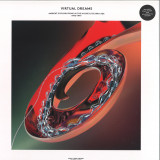
Music From Memory is delighted to be turning 50 with a special release: MFM050 - V/A - Virtual Dreams: Ambient Explorations In The House & Techno Age, 1993-1997 (3xLP/2xCD). The first in a series of compilations, alongside more in depth artist-focused releases, Virtual Dreams will delve into music produced during the 1990’s that redefined the boundaries of ‘Ambient’. This was music that explored the possibilities of Ambient music within a new setting, created often by House & Techno music producers for a world beyond dance floors but made very much with the pre and post-clubbing listener in mind.
When House and Techno exploded out of America in the mid 1980s a whole generation was redefined not only musically but also culturally and chemically speaking. Peaking, quite literally, with a second ‘Summer of Love’ in 1988, millions of young people across the world would experience the life-changing ups of a brave new world but with it of course came the downs; enter the concept of a ‘Chill-out’ room. Whilst early Chill-out rooms lacked a specific sound and were often soundtracked by music such as reggae and soul, slowly young Techno and House producers themselves would become increasingly interested in developing a futuristic ‘Ambient’ soundtrack to a world beyond the thud of the main room.
‘Ambient’ in this new age now though had sharper teeth than in Brian Eno's key text for ‘Music for Airports’, instead here the sounds were the mode of transport rather than the backdrop. While the melodies were pretty, the soundscape steered away from the pastoral, dreaming of outer-space and technology as opening up exciting new dimensions. Much like in the first Summer Of Love; the musicians were again exploring psychedelic, mind-altering and transcendental possibilities of music. And also much as in the first Summer Of Love, a psychedelic visual language would accompany the music. Though now the tracks could be accompanied by music videos, utilising early CGI techniques, they would look almost entirely to the future: envisioning technology, nature and humanity intertwined in a new Utopian future. Virtual Dreams of a better world.
From Ambient and early Chill-out classics, to lesser known one-off projects, as well as Ambient deviations by some of House and Techno’s leading producers, Volume One of Virtual Dreams features tracks by Bedouin Ascent, LA Synthesis, LFO, Marc Hollander, Mark Pritchard & Kirsty Hawkshaw, Richard H. Kirk and more.
To celebrate our 50th release the first 1000 copies include a holographic 'Virtual Dreams' sticker plus a special insert poster with artwork by Victoria Pacheco and design by Steele Bonus.
For this uniquely personal retrospective spread over twelve vinyl discs, Sven Väth takes us back to the early days of his DJ career. On What I Used To Play we meet great pioneers of electronic music, gifted percussionists, obscure wave bands, and innovative producers of a bygone 'new electronic' era. Rough beats and irresistible grooves from the identification stage of house, techno, and acid remind us not just how far electronic music has evolved over the past four decades, but how great it was to dance to EBM, techno, and house for the very first time.
If there is one protagonist of the electronic music scene who has remained curious, innovative and at the very cutting edge of music for over four decades, it's Sven Väth. His multi-layered artist albums and Sound of the Season mix compilations have been defining the genre for over two decades, and even today, he is constantly on the lookout for the next top tune to add to the highlights of his next set. At least, that's the case when he's not producing them himself as an artist or remixer. "Actually, it's always been part of my DNA to think ahead," and nothing had been further from his mind than looking back at his past, but when in spring of 2020 the international DJ circuit had to be scaled down to virtually zero, the 'restless traveler' suddenly had time. Time to stop and reflect on "how it actually was back then, at the very beginning of my career..."
"It was a great trip and with every track, beautiful memories came flooding back".
In the London apartment, he had just moved into, Sven has set up a "little music room", where he cocooned himself for several days, "to look way back for the first time and review my musical journey through the eighties, so to speak."
The interim result was six thematically oriented playlists with a grand total of 120 tracks from 'early 80s' to 'Balearic late 80s', together with excursions into afrobeat, European new wave, and EBM sounds and a few epochal techno/house tracks from the USA in between. From these 'Best of Sven Väth's favorites', the project What I Used To Play crystallized. Sven remembers how the Cocoon team reacted to his proposal: "They found the idea of making a compilation out of it MEGA from the beginning and everyone said 'Sven, go for it', but then, of course, the work really started, namely, to clear the rights and to get clean sounding masters of the up to 40-year-old tracks. There was also disappointment, of course. We couldn't clear certain titles because the rights holders in the USA had fallen out with each other or simply disappeared from the scene. In short, it wasn't easy, but now I can safely say we got the most important tracks."
Finally, after two years of research, curation, design, and administrative fine-tuning, the "little retrospective" from 1981 to 1990 is available. The exquisitely packaged, and three-kilo heavy box set is not only physically impressive, WIUTP is also the definitive record of Sven Väth's musical development. On each of the twenty-four sides of vinyl, you can trace track by track, what influenced him during which phase, and how he took off as a DJ from his parents' Queen's Pub straight into the spotlight at Dorian Gray. There and at Vogue (later OMEN), Sven became the style-defining player in the DJ booth that he still is today.
1981 - 1990: Future Sounds of Now
In the early eighties, the crowd in clubs like Vogue and Dorian Gray danced to what nowadays we call 'dance classics' - mainly disco, funk, soul, and chart pop. It was up to a new generation of DJs, including Sven Väth, the youngest protagonist in the Rhine-Main area at the time, to create their own club-ready music mix. Good new tracks and potential floor-fillers were rarities that had to be sought out and found, in order to prove oneself worthy.
Without MP3s, internet streaming, or other digital download possibilities, music didn't just gravitate to the DJ, instead, it had to be tracked down. In well-stocked record stores in Frankfurt and Wiesbaden or even in Amsterdam, London, or New York, Sven and friends sourced the material for countless magical nights. On WIUTP we can follow Sven's very personal journey through this wild, innovative era in which synth-pop, funk, hip-hop, and disco were successively replaced as 'club music' by house, techno, acid, and breakbeat. By the end of the decade, it was clear to see that these once exotic 'fringe' phenomena would soon become 'mass' phenomena.
Early 80s
Dirty Talk by the Italian-American duo Klein & M.B.O. represents the most innovative phase of the Italo-disco genre in the early eighties like no other track. Mario Boncaldo (I) and Tony Carrasco relied entirely on the original synthetic drum and percussion sounds of the Roland TR-808, coupled with the raunchy vocals of Rossana Casale and guitar accents of Davide Piatto. Of course, other tracks from this period were also influential in style, most notably Unit by Logic System, which worked as the perfect soundtrack to the laser lighting system at the legendary Dorian Gray club. With stomping beats and robotic rap interludes, Bostich by Yello also belongs on Sven's eternal playlist - after all, it caught the attention of Afrikaa Bambaataa, who invited the Swiss duo to perform at the Roxy in New York in 1983.
EBM Wave - Mid 80s
From today's point of view, the almost ten-minute-long, downtempo track Giant by Matt Johnson's band project The The, would probably not be considered an obvious club classic. However, a closer (re)listen reveals the rhythmic intricacies of the percussion overdubs by JG Thirlwell (aka Foetus) on Johnson's composition, and it becomes clear why this exceptional piece of music is one of Sven's absolute favorites. Other classics from this phase include Kaw-Liga by the mysterious The Residents, the hypnotic-synthetic Our Darkness by Anne Clark (and David Harrow), and last but not least, the somber, monotonous anthem Where Are You? by 16Bit, one of Sven Väth's projects together with Michael Münzing, Luca Anzilotti from 1986.
US House - Late 80s
You certainly can't talk about Chicago house without mentioning Frankie Knuckles. The resident DJ at the Warehouse not only gave the name to an entire genre, but also produced epochal floor fillers on the Trax label like the timeless Your Love, sung (and moaned) by Jamie Principle. Acid house protagonists Phuture also hail from Chicago, and on We Are Phuture (also released on Trax) we hear the chirping acid sounds of the legendary Roland TB-303 in full effect. Another featured classic is No UFO's by Detroit's Model 500 aka Juan Atkins, who is rightly considered the 'Godfather of Techno' even if the genre-defining track from 1985 still breathes with the spirit of hip-hop and electro from the first breakdance era.
Afrobeat
Le Serpent, by Algerian-born Abdelmadjid Guemguem, is a track that sounds completely different from everything else on WIUTP. Made in 1978, it's a monumental, rousing groove created without bass or synths, just with five congas! Even though Guem sadly passed away in 2021, his immortal, acoustic beats are understood all over the world and will continue to enrich many thousands of DJ sets for years to come. Another classic that not only Sven appreciates beyond measure is Hugh Masekela's Don't Go Lose it, Baby. In addition to being one of the most important jazz pioneers, the trumpeter and freedom fighter from Johannesburg was very experimental, integrating electronic sounds into his music in later years, in a similar vein to Miles Davis and Herbie Hancock. Dutch jazz pianist Jasper van't Hof's afrobeat project Pili Pili has also aged well. The trance-like, almost sixteen-minute-long track of the same name, manages to fill a whole side on the seventh of twelve vinyl discs in the WIUTP box.
UK-US-Euro - Late 80s
Time for a change of scene, in the truest sense of the word, and from a musical perspective, this section is like landing on another planet. First up is Andrew Weatherall's classic remix of Primal Scream's Loaded, featuring the iconic Peter Fonda sample (lifted from the 1966 biker film Wild Angels) that came to personify the mood triggered by the British Second Summer of Love in the late eighties: "We wanna be free to do what we wanna do, and we wanna get loaded...". This period also saw the emergence of M/A/R/R/S whose only single, 1987's Pump Up The Volume, became a club classic with support from DJ legend CJ Mackintosh. In this most eclectic of sections, we also encounter New York house and reggae producer Bobby Konders and his seminal Nervous Acid.
Balearic - Late 80s
Those who know him, know that Sven had already lost his heart to the 'magic island' of Ibiza as a teenager, so with that in mind, the WIUTP project couldn't end without a Balearic chapter. Inspired by Manuel Göttsching's E2-E4, the immortal, eponymously titled Sueño Latino belongs in there without question. Equally popular on the island was, and still is Break 4 Love by Raze, which thinking about it, would also fit perfectly into the house chapter. Last, but not least, there's an overdue reunion with Sven Väth himself, in his role as frontman of the successful Frankfurt trio OFF. Together with Michael Münzing and Luca Anzilotti (later of Snap!) this 'Organization For Fun' created the off-the-wall club hit Electric Salsa in 1986 which incidentally turned into an international chart smash, putting Sven in the enviable position of having to decide between pop stardom and a DJ career. Well, we all know how that decision turned out and the rest, as they say, is history. A not insignificant part of his story is What I Used To Play. Enjoy!
Samuel L Session and Van Czar drop a four-track techno EP on Unrilis that showcases a deeper and more hypnotic sound with dystopian atmosphere and driving percussion. Rino Cerrone launched the Unrilis record label over 15 years ago, and part of the label's back catalogue is its iconic Rilis series. 2022 sees the relaunch of the Rilis series that has a focus on underground DJ tools with raw analogue sounds. The Rilis series was originally launched in 1999, and was restricted to a concept on only 10 releases, each pressing a limited run of vinyl. It was hugely popular with each one often selling out in only a week and picking up DJ support by people ranging from Jeff Mills to Richie Hawtin. Those first 10 releases were focused on Rino Cerrone's own music, but since his retirement from the industry, the revitalised Rilis series will welcome other artists whose sound matches the label's underground concept.
This latest release in the Rilis series features collaborative tracks by Samuel L Session and Van Czar who have previously teamed up for releases on other imprints ranging from Marco Bailey's MB Elektronics to Ben Sims' Hardgrooves. Both are also successful solo artists, Sweden's Samuel L Session being well-known for his headline DJ sets at clubs around the world, along with the music he has released via iconic imprints such as Slam's Soma, Shlomi Aber's Be As One, Len Faki's Figure and Emmanuel's ARTS plus his own imprints SLS, Cycle, New Soil, and Klap Klap Belgium's Van Czar is also an accomplished DJ who is well-established across Europe and he has also released music on respected record labels ranging from Kevin Saunderson's KMS Records as well as the classic imprint, Yin Yang.
'Air Raid' opens the release with its eerie pads, spine-tingling melody loop and machine-driven percussion. It's got a raw aesthetic with dramatic claps and snare fills that add to the building suspense.
'18-022' is a dark and stripped back track with modulating synth textures layered with fast-flowing high-end percussion. Its pounding kick drum and clap rhythms add rigid structure to its expansive atmosphere and dance floor focused groove.
'Route 200' has thrashing cymbals punishing claps and rippling pads that create a stripped back groove submerged in deep atmosphere. Rich with analogue textures and gritty sound design, its relentless energy is tailor made for club sound systems.
'Objectivism' closes out the release with it's funky bassline and bleeping melody. Whirling textures and fluttering percussion maintain an unrelenting tension that's driven forward by the pounding kick drum.
The moons of Saturn are the inspiration for this brooding, often soaring and searching odyssey of dark electronica.
The second largest planet in the solar system after Jupiter, and the sixth planet from the sun, Saturn is orbited by 53 confirmed moons, with another 29 that are unnamed and still being studied.
Saturnian is a suite of thirteen choral tracks taking their names from some of Saturn's known moons; Dione, Daphnis, Phoebe, Prometheus, Rhea, Janus, Titan, Enceladus, Tethys, Telesto, Mimas, Hyperion and Iapetus, all named after figures from Greek and Roman mythology, each loaded with their own turbulent back stories. It is the debut release by Holmes + atten Ash, written, recorded and produced remotely in Edinburgh and Bristol by the duo Simon Holmes and Paul Nash.
Their project began during the 2020 lockdown. For Simon, time was spent exploring the Pentland Hills south of Edinburgh. For Paul, the Mendip Hills, south of Bristol. Both would experience the darker side of our human impact on the environment. Simon observed the wilderness as a wasteland, finding discarded, rusting metal littering the Pentland Hills while Paul witnessed the decimation of the ancient woodland of the Mendips' King's Wood due to the destructive tree fungus ash dieback.
These field trips fuelled a desire to navigate not just the landscape, but the duo's emotional place within it. Their collaboration led to a concept album that explores the outer reaches of the solar system, while simultaneously grounding them in a specific place. Looking inwards as much as outwards, theycreated soundscapes based on deeply imagined and felt connections to their surroundings.
After Simon had created a choral piece to accompany Luke Jerram's enormous, world touring artwork Museum of the Moon, Saturnian was a natural progression. When Simon was sent an initial score for the ethereal track Enceladus, composed by Paul in Bristol, he added choral arrangements recorded in Edinburgh. Their shimmering, tense opus continued to evolve from there. Just as the discarded bed springs and abandoned car parts that Simon stumbled upon in the Pentland Hills seemed to him at once "horrible but also oddly beautiful", Saturnian melds together melancholy and levity, fusing moments of dark angst with a celestial calm.
Opening with the glistening, hopeful brightness of Dione, increasingly urgent rhythms give way to digital, otherworldly calls from what might be rainforest creatures chirping into life with robotic squawks and delicate keyboard lines on Phoebe, followed by slowed down, monastic song on Rhea. Tethys is a hypnotic blur of synthesiser and soft chanting, while Rhea is a mysterious, echoing chasm, lifted by melodic, gentle male vocals. Janus has a glowing, effervescent energy, swiftly followed by a sense of tension on Titan, which throbs with driving percussive unease.
The album artwork is a pencil drawing created by Edinburgh artist Simon Kirby. It was made by a robot drawing machine, using custom algorithms that bring to life recordings of the sound of magnetic waves near Saturn's icy moon, Enceladus. The lines in the centre of the drawing are distorted by sound captured by the Cassini spacecraft which studied Saturn for over a decade.
Much like Saturn and its frozen, rocky moons, this debut album from Holmes + atten Ash is mysterious and beguiling, with a hint of foreboding in the depths of its powerful beauty and epic scale.
When Irish DJ and producer Pineal Navigation set up Awareness System in 2020, he intended to use the label as an outlet for music, specifically Techno & Electro, that told an evocative story. As the world went into lockdown, Niall, aka Pineal Navigation, decided to hone in on a sound that produced a positive frequency and dismantle the negative energy that started to seep into everyday life. Two years on, the Dublin-based artist launches Awareness System with a split EP called ‘Combination 1’. Swedish producer Daniel Andréasson contributes two tracks to the release, adding another layer of intensity that aligns with the label’s aesthetic. Andréasson is an artist who approaches music with a no-frills attitude, which inspired Niall to invite his long-time friend into the fold of Awareness System. On ‘Sensory Open’, Pineal Navigation creates an eerie atmosphere with swirling synths and gnarly basslines — a response to the chaos unfolding in the modern world. Daniel Andréasson cranks up the pace on ‘Enable’ with wonky drum patterns and distorted FX, veering into the darker textures of techno. The flip-side opens with Daniel Andréasson’s ‘Money Is A Motivator’ where he mutates bleeps and crackling percussion, luring the listener into a dystopian soundscape. Pineal Navigation closes the EP with ‘Off The Earth’, a stomping blend of rumbling bass and stabby percussion. A potent club-orientated track to mark the first chapter in the story of Awareness System.
AVNU (UK) follows up his fantastic recent single on Ellum Audio with a long-awaited and hugely adventurous new album, ‘Tough To Love But Worth The Effort’.
AVNU (UK) is based on the East Coast of Scotland and has been deeply immersed in music for twenty plus years. He has a love of everything from rock, soul and blues to disco, electro, techno, trance and rave. All of that comes out in his innovative sounds, which range from sweat-inducing club tracks to hooky and feel-good grooves. This album finds him working his magic across 15 tracks that bring plenty of fresh perspective to house, electro, synth, techno and pop. They add up to a storytelling record filled with left turns and tracks that work in a range of different contexts.
'Surprise!' opens with a glossy electro beat and shimmering 80s synths that set the tone for the whole record. 'I Love You' brings a French touch influence with plenty of filtered synth loops and crisp drums under a soulful vocal, then 'Supaflake' cuts loose on an old-school funk vibe with nods to early Daft Punk. This most colourful of records plays out through the likes of sombre cosmic techno offering 'Bad Karma,' the longing chords and heavy-hearted electronica of 'Odyssey Jam' feat Mariel Ito and distorted bass of 'Phlegm In The Street' which comes with laser-like synths and menacing vocals.
The future styles continue on 'Yo E, Check This Out' which collides jungle breakbeats with brain-melting sine waves, while 'Wilkie' is a moment to catch your breath amongst bright and shiny synths and deeper drums that suspend you in a celestial sky. 'Proud You’re Mine' is a perfect electro-dance-pop gem that has potential to be a summer festival anthem and the title track closes down with six minutes of enchanting and mystical synth lines and hypnotic drums.
‘Tough To Love But Worth The Effort’ is a spectacularly broad and accomplished album that lives in a world of its own.
Julian Jeweil returns to Drumcode for his first EP in two years with the inspired six-tracker ‘Boreal’ split across two records.
The Frenchman has been a vital member of the extended Drumcode family since 2017 when he debuted with the fantastic ‘Rolling’ EP. Since then, highlights have included playing main stage at Drumcode Festival and dropping the critically acclaimed ‘Transmissions’ album in 2019.
Part II opens with ‘Cosmos’, a peak-time belter that sees Jeweil do what he does best; deliver functional, powerful techno with a trippy extra-terrestrial edge.
One the B side, ‘System’ is a jacking slice of heat, led by shuffling beats and a persistent vox designed primed for sweaty dancefloor moments. Part II rounds out with ‘Minuit’, a polished driving cut with a sleek melodic core that reinforces the Frenchman’s breadth in the studio.
Utter presents 'The Saturn Star', a score to an imaginary film by music producer and visual artist Jorge Velez.
Inspired by The Third Ear Band, late-period Coil, Carlos Peron's lurid soundtracks and European folk music, Velez's score accompanies the evocative tale of a 16th-century physician-alchemist hunted down by The Inquisition in western Europe.
Much like his acclaimed 'Hassan' soundtrack, Velez purposefully limited the amount of equipment he used to create a cohesive sonic environment, this time restricting himself to a Korg MonoPoly and Prophet 6. The music flowed quickly, with the entire project recorded and mixed within two weeks. The resulting work veers from moments of unsettling intensity to blissful beauty, underpinned by a lingering sense of mystery and paranoia.
Velez is also an avid illustrator and a new 8-page riso-printed booklet titled 'Systema' is included within the LP sleeve. It's intended as a 'guide for self-transformation', with each image to be taken in slowly alongside the music. For Velez, sound and vision are closely intertwined:
"Making music is as visual a process for me as making a drawing. A piece of music that's working is able to take on some fantastic shapes or evoke entire scenes or environments. Creating a story, characters and scenes that vary in intensity make the process of building a score for an imagined film tremendous fun. Listening back to 'The Saturn Star' I can still see those 'film scenes' in my mind..."
For the uninitiated, Velez has been producing music since the mid-90s - his early work was compiled by Rush Hour on its dedicated 'MMT Tape Series' releases - and has been prolific since, with releases under his own name on L.I.E.S, Berceuse Heroique, Skudge and Crème Organization coming in quick succession. He has also produced under a number of aliases such as Professor Genius, Bridge & Tunnel Kids and Duermo for Echovolt, Italians Do It Better and Borneo. His collaborators include Willie Burns, Gilb'r and Acid Arab among others. He currently lives in Amsterdam, Netherlands.
*Limited to 250 copies - includes 'Systema' A5 booklet*
Sebastian Heda's new EP is a auditory glimpse into the insides of the haywired central nervous system of a man machine. The opener DISSOLUTION takes no prisoners and sets the direction for this exploration in modular-made attacks from a dystopian future. Followed by no less than two great remixes by ARCHITEKTUR and CAREMAJOR. The next and eponymous track CV GUERILLA is at arms and aims at you with relentless, percussive drum fire and another well executed version by ENDLEC. Finally you get short bursts of radio traffic from a RANDOM SOURCE, leaving nothing but silence and a big grin on your face.
Ben Rau has had a great start to 2018, successfully launching his new label META , and recently returning from his latest tour of Australia.
It is obvious Ben soaked up the sun drenched culture and musical inspirations down under, as his latest INKAL release "Systéme Solaire" showcases Ben's diversity in the studio, and a more melodic side to Ben's sound that perfectly balances musicality while maintaining underground credibility, amounting to what is arguably Ben's strongest work yet.
With multiple represses on each INKAL release so far, the momentum is building for Ben and INKAL004 will only serve to enhance his ever-burgeoning reputation as a purveyor of dancefloor-ready weapons.
The EP kicks off with the title-track A-side "Systémes Solaire", a track which displays all the trademark influences Ben Rau has become synonymous for , as expert drum programming glitchy percussion and a rolling funk bassline combine to provide the groove.
"Systéme Solaire" has hooky elements in abundance, as a combination of chord work and constantly evolving synths team up to create a memorable, peak-time bomb. The B-side, "Expand", continues in the same vein, as a short, bubbling bass stab drives the track forward and modulates to provide an acid vibe, joined again by luscious piano chords and licks and the Expand' vocal, which switches up from a whispering atmospheric to a heavily effected, pitched tone that keeps interest throughout. All the while accentuated by fractured groovy percussion, piano licks and open hats that shine over the whole track.
With big hitter support on the EP already both INKAL and Ben Rau's career continue to go from strength-to-strength. Grab your copy of 'Systémes Solaire' when it drops
There is a hush most of us only knew as children, the warm drift between familiar household sounds and being carried to bed, a place that belongs to you and to some self you have not met yet. June McDoom’s debut full-length, Follow the Light, lives in that dream space and then keeps walking, slipping out of time and waking somewhere new, barely familiar enough to feel like home yet wholly your own. She came up in a Jamaican household on the edge of the Florida Everglades, an existence built of extended family, communal care, bass and harmonics. Her father, a carpenter and a student of sound, built his own speakers and kept three sound systems going across as many rooms. His low end would rise through her bedroom floor like some wayward cat while she lay above it with folk records, finding harmonies that were new and hers alone. Two musics in one room. Lushness as past and premonition. She found folk on her own, somewhere between the cast recording of The Sound of Music and Simon and Garfunkel, while everyone around her called it sleepy music. She did not mind being the only one. The solitude let her fall for harmony first, before words, before anything else, and harmony is still the thing she reaches for. Generationally speaking, the music was already in the air. Her grandfather, Colin Smith, is a distinguished mento man who played banjo and guitar and built his own rumba boxes, worked to keep Jamaica’s oldest acoustic folk form alive. Mento is the root of all of it: ska, rock steady, reggae, dub and everything after. He is the one who put a guitar in her hands. An inheritance, a gift and a map. Even her name is part of it, though she will tell you she landed on it more by feel than reason. She records as June McDoom, born Alyssa, June being a nickname one of her grandmothers, Joan, went by, a name she thought was cool to carry and simply liked the sound of. An etheric channel that reverberates all the same. A dub all its own.
Made slowly and by hand with her longtime partner Evan Wright, Follow the Light lays the harmony of folk over the rhythm of dub, with Dionne Warwick, Minnie Riperton, Pentangle and the washed guitars of Cocteau Twins haunting its outer edges. Voice and guitar seeking each other out first, then everything else stacked across long days in the studio they keep at home, restraint kept on purpose. The lead single “Without You” is the whole method surfacing, split open and sparkling like a geode in a creek bed. Angelic heroics, and nothing less.
At the heart is family. Her grandmother Aggie, the light behind “Memory,” guiding still. And underneath, the quieter truth the record keeps: none of us are only one person, but a continuum of selves, the ones who shaped us and the ones we have yet to meet. Future you is an ancestor your current self gets to greet. Press play and the same invitation is yours: A few minutes out of time, a place that turns familiar the longer you stay until you surface somewhere new and find it was yours all along
There is a hush most of us only knew as children, the warm drift between familiar household sounds and being carried to bed, a place that belongs to you and to some self you have not met yet. June McDoom’s debut full-length, Follow the Light, lives in that dream space and then keeps walking, slipping out of time and waking somewhere new, barely familiar enough to feel like home yet wholly your own. She came up in a Jamaican household on the edge of the Florida Everglades, an existence built of extended family, communal care, bass and harmonics. Her father, a carpenter and a student of sound, built his own speakers and kept three sound systems going across as many rooms. His low end would rise through her bedroom floor like some wayward cat while she lay above it with folk records, finding harmonies that were new and hers alone. Two musics in one room. Lushness as past and premonition. She found folk on her own, somewhere between the cast recording of The Sound of Music and Simon and Garfunkel, while everyone around her called it sleepy music. She did not mind being the only one. The solitude let her fall for harmony first, before words, before anything else, and harmony is still the thing she reaches for. Generationally speaking, the music was already in the air. Her grandfather, Colin Smith, is a distinguished mento man who played banjo and guitar and built his own rumba boxes, worked to keep Jamaica’s oldest acoustic folk form alive. Mento is the root of all of it: ska, rock steady, reggae, dub and everything after. He is the one who put a guitar in her hands. An inheritance, a gift and a map. Even her name is part of it, though she will tell you she landed on it more by feel than reason. She records as June McDoom, born Alyssa, June being a nickname one of her grandmothers, Joan, went by, a name she thought was cool to carry and simply liked the sound of. An etheric channel that reverberates all the same. A dub all its own.
Made slowly and by hand with her longtime partner Evan Wright, Follow the Light lays the harmony of folk over the rhythm of dub, with Dionne Warwick, Minnie Riperton, Pentangle and the washed guitars of Cocteau Twins haunting its outer edges. Voice and guitar seeking each other out first, then everything else stacked across long days in the studio they keep at home, restraint kept on purpose. The lead single “Without You” is the whole method surfacing, split open and sparkling like a geode in a creek bed. Angelic heroics, and nothing less.
At the heart is family. Her grandmother Aggie, the light behind “Memory,” guiding still. And underneath, the quieter truth the record keeps: none of us are only one person, but a continuum of selves, the ones who shaped us and the ones we have yet to meet. Future you is an ancestor your current self gets to greet. Press play and the same invitation is yours: A few minutes out of time, a place that turns familiar the longer you stay until you surface somewhere new and find it was yours all along
The sun sat high above the desert outside Joshua Tree on October 17, 2024, baking the rocks and shrubbery outside the Farrington Observatory as a small group of invited guests ventured up a steep path towards the telescope. Kyle Simon, the artist and printmaker who founded the Observatory, was standing outside the print studio sat below the towering cylindrical building, greeting friends alongside his wife Sarah and lifelong friend Brian Weitz, the musician widely known as Geologist of Animal Collective. Simon and Weitz had spent the previous day testing and retesting a system that would transform the light of the oncoming full moon captured by the gigantic telescope into a signal that would modulate the control voltage of Weitz’s modular synthesizer. As the sun dipped below the horizon line, the audience gathered on a small wooden patio surrounded by speakers while Weitz readied himself behind the array of patches and knobs. Simon addressed the group, presenting the history of The Sirens, the sonic exploration of the night sky’s mystical and scientific significance about to unfold.
The music conjured under the Hunter’s Moon that night is now documented on this first official release of The Sirens, which was conceived by Simon and Weitz as a recurring performance piece and sound installation. Over a decade ago, Simon began immersing himself in literature on humanity’s sonic relationship to the celestial realm, including Homer’s Odyssey, Plato’s “Spindle of Necessity, ” Kepler’s Harmonices Mundi, and the field of astroseismology. He fitted homemade telescopes with photodiodes and optical sensors to make the images audible, finding latent patterns in the noisy sonic signals he began receiving from the stars. With Weitz, the process expanded as the signal was routed through an analog amplifier and set to modulate the pitch, filter, and other elements of his synthesizer. Together they developed a system of improvisation, with Simon adjusting the telescope to change the intensity of the light based on its relationship with the moon’s position (imagine a theremin player moving their hands in subtle, meaningful motion), and Weitz responding to that input in real time: bending it, amplifying it, or letting it stand on its own. The duo debuted the piece at the Integretron in Joshua Tree in 2018, providing a crucial proof of concept for the performance at Farrington featured here.
The first thing the listener hears on The Sirens is the opening of Farrington Observatory, the cranking of motor and metal. As the lens of the telescope is exposed to the evening air, a wavering drone emerges from the synthesizer, flickering at the margins, the tuning of the oscillators adjusting to the rapidly cooling desert air. The piece progresses and the drone becomes a luminous, spherical constant, bathing the listener in pure tone as Weitz draws out harmonically ambiguous melodies that spiral upwards. Electronics crackle and convulse, coalescing into dense dissonance before widening out into an open octave. Just as the moon orbits the Earth and the stars shift as the planet rotates, so each sonic element appears in flux, interrelationships slowly forming and falling away. Divided into two parts, The Sirens flows as a continuous conversation between the artists and the starlight completing its thousand-year journey across the galaxy.
The Sirens belongs primarily to a lineage beyond music: of sea captains navigating by looking skyward, of astrophysicists studying the formation of the Milky Way, of the modern myths of werewolves, of the stories embedded in constellations. As Simon writes in the album’s extensive liner notes, “These stories and explorations reveal a collective yearning to become conscious of our connection to the universe, our deep-seated desire to understand how we fit into it all.” This music underscores the history of the night sky as the place where poetry and science find common ground, where exploration hinges on the imagination. Driven by curiosity and ingenuity, Weitz and Simon look up and wonder.
out of Stock
Last delivered 2 days ago available to reorder, subject to availability
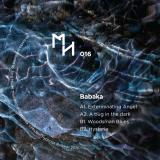
Modern Hypnosis is proud to introduce Babaka, the new alias of esteemed German producer Jörg Müller.
Reigniting his passion for physical, visceral sound system music, Jörg uses classic analog gear and a few self-built instruments to create a unique, potent dub sound. While reminiscent of Jörg’s earlier ambient and dub techno styles on his 2019 album Drawn From Memory and 2022’s Groundworks LP on The Moth Club, his new direction has evolved those techniques and primed them for sound system use. His debut release as Babaka showcases four masterful tracks that differ widely from one another while remaining within his new realm.
The opening track, "Exterminating Angel," is a pulsating, supernatural dub experiment featuring a deeply infectious bassline, ghostly key stabs, tight percussive delays and an oddly dramatic vocal sample creating a profound sonic climax before tapering off, allowing you to escape its vacuum and recalibrate. The most skank'n track of the EP, "A Bug in the dark" with its murky half-time swagger feel, bouncy hats, dub saturation and mega sub-driven riff has become an all-time favourite at Modern Hypnosis HQ.
Featuring precise production with decorative atmospherics and swung drums, "Woodsman Blues" has an almost Boxcutter feel to its intro before plunging off the deep end, hitting the dub floorboards, and revealing its true self as a reincarnated, stoned dubstep track. Closing out the release is "Hysteria," a perfectly executed, dark, chugging techno steppa that remains a popular track for many early-access DJs and selectors around the globe.
In the words of Jörg Müller himself:
After my first Album "Heavy Heart”, I tried to push my music more into abstract territory, especially sound-wise, ignoring mixing and mastering rules... this culminated in the eerie, roomy, off-atmosphere on "ground works" on The Moth Club.
After that, my focus shifted further towards freeform electro-acoustic ambient music. I built a couple of instruments myself and released two albums on Shimmering Mood as Kaleidophon. This was during the pandemic as nightlife came to a stop.
In 2023 and 2024, I started to go to dances again. I saw The Bug on his Pressure System, Al Wootton at Meaksuma Festival, Channel One and Iration Steppas on Young Veteran Hifi Soundsystem. Especially impressive were Mark Ernestus, Mark Ainley and Aba Shanti on the infamous sound system at Open Ground in Wuppertal.
This reignited my passion for dub/sound system music; I wanted to make tracks with the physical, visceral quality of sound systems.
out of Stock
Last delivered 5 days ago available to reorder, subject to availability
After a long-awaited break from the format, Smokin’ Sessions returns to vinyl with a very special limited-edition pressing of Rowl’s Signal EP.
Since launching in 2007, Smokin’ Sessions has built a reputation for deep, bass-driven music and a vinyl catalogue that has become an important part of the label’s history. After quite some time away from pressing records, SMOKE046 marks the label’s return to wax — presented on limited-edition transparent blue vinyl.
At the centre of the release is longtime Smokin’ Sessions and Deep Heads artist Rowl, returning with four cuts rooted in the deep 2-step, garage and bass sound that has defined both his own productions and the label over the years.
Opening the record is Versa & Rowl – “If You (Rowl’s Grey Skies Remix)”, a weighty reworking of an unreleased Versa & Rowl dub. Raw, swung drums, deep sub pressure and a distinctly old-school UK garage atmosphere run throughout — a sound described in early feedback as a “future retro garage classic” with that early deep dubstep / 2-step crossover feeling. The remix has also picked up support from Mat The Alien, BunZer0, Deep Tempo and Richard Dorfmeister, amongst others.
“Signal” follows — a heavy, stripped-back 2-step roller built around swinging drums, commanding low-end and Rowl’s unmistakably deep production style. The track represents the classic Smokin’ Sessions sound while pushing it forward with the precision Rowl has developed over more than a decade of production. The track has received strong DJ support, including J:Kenzo, who called it a “Great track”, Synkro, BunZer0, Mat The Alien and others.
On the B-side comes “Sierra” featuring Bristol lyricist and vocalist P.A.B MC. Written and recorded together in Bristol, Sierra takes things into warmer territory: chilled two-step garage rhythms, dubstep-weight low-end and an almost astral atmosphere underpin P.A.B MC’s melodic, conscious vocal delivery. It sits somewhere between soundsystem music and reflective storytelling — equally suited to a late-night system or headphones.
Early response to “Sierra” has already included Synkro, who described the track simply as “Killer”, alongside further underground DJ support.
Exclusive to the vinyl is the instrumental version of “Sierra”, giving the full production room to breathe and making this pressing an essential version of the EP for DJs, collectors and anyone wanting to hear the depth of Rowl’s production without the vocal.
Rowl first appeared on Smokin’ Sessions in 2011 and has remained closely connected to both Smokin’ Sessions and Deep Heads ever since. His catalogue includes collaborations with Versa such as Lunar, Jupiter and Solstice, alongside his 2013 Cosmic Visions EP. His music has previously received support from Don Letts on BBC Radio 6 Music, Tim Parker on NTS, Synkro and J:Kenzo.
For the physical release, no corners have been cut. The record has been vinyl cut and mastered by Beau Thomas at Ten Eight Seven (Ten Eight Seven Mastering) — one of the most respected engineers in UK bass music and someone whose experience with low frequencies and vinyl makes him the perfect choice for a Smokin’ Sessions pressing.
out of Stock
Last delivered 5 days ago available to reorder, subject to availability
A quick scan of the world’s favourite crowdsourced discography reveals that Sonic Youth co-founder Lee Ranaldo was not a total stranger to crackling electric experimentation in the years following his songwriting turns of the 20-teens. Yet »The System«, ingeniously culled and sequenced from Ranaldo’s soundtrack work for Dutch filmmaker Joris Postema’s ›eco-doc‹ of the same name, nonetheless feels like a reawakening. Quietly released in a vastly different (and much more ›filmic‹) form by Doxy Music/Riva Media Records in 2025, this LP reimagines and reconfigures the initial release, including unreleased material written and recorded for the film, to lend it new stature as both a return to drone-improv form and a reunion with introspective Downtown angst.
Given the state of the world, it’s not surprising that the film Ranaldo scores – a documentary on three climate activists bruising their fists on the black iron prison of techno-fascist deathkultur – is a study in despair and futility. But rather than wallowing in navel-gazing doom and gloom, the film documents the unstoppable spirit that has animated human resistance since the time of the Pharaohs.
As it turns out, the gorgeous scope of Lee Ranaldo’s guitar palette is a perfect manifestation of the hope and despair that animates the film. But like other high-water marks in the guitar-centric soundtrack canon – the high plains raga of Bruce Langhorne’s »Hired Hand«, Neil Young’s sparse and ghostly solo transmissions on »Dead Man«, or the monolithic mantras of Popol Vuh’s »Nosferatu« – its devotion to spectral gestures and meditative song forms launches it firmly outside of the OST orbit into a universe fully its own.
It might seem like a long journey from the Lower Manhattan rhythmic grime of the album’s opener »Tajikistan (Nice to Meet You)« (reminiscent of guitar opuses like Robert Quine and Jody Harris’s »Escape«) to the ringing cowboy chords of the final track, but the narrative logic of the LP pulls the listener along as solidly as a pack horse. As the LP unwinds, and collaborators like Jim Jarmusch, cellist Leila Boudreil, Yeah Yeah Yeahs snare shaman Brian Chase, and guitarist Yonatan Gat take their places, new vistas unfurl: the ritualistic thrum of »Berlin Blockade«, the haunted overtone palaces of »Bergelmir«, and the cavernous acoustic strumming of »Instruments of Violence«. It all winds up with the high lonesome standard »Cool Water«, each unhurried note trailing off into long-tail reverb, layers of shifting vocal harmonies pulling everything skyward – a hopeful note in an album where existential dread never lurks too deeply below the surface.
In the end, »The System« functions both as a film score and a hallucinatory (mostly) instrumental guitar record, revealing a sensibility not too often spotted in the 21st century – a liminal space where the song, the jam, and the meditation merge into a blurred whole. »The System«’s expansive fabric, emerging from a collective sound circling around Ranaldo’s signature tones, envelops and ampl amplifies the contributions of its community of creators – the perfect antidote to narcissistic despair. Much like the subjects of the film light the way towards intra-generational resistance, the music of »The System« reveals a path through gathering darkness. The world could be yours if you follow.
A quick scan of the world’s favourite crowdsourced discography reveals that Sonic Youth co-founder Lee Ranaldo was not a total stranger to crackling electric experimentation in the years following his songwriting turns of the 20-teens. Yet »The System«, ingeniously culled and sequenced from Ranaldo’s soundtrack work for Dutch filmmaker Joris Postema’s ›eco-doc‹ of the same name, nonetheless feels like a reawakening. Quietly released in a vastly different (and much more ›filmic‹) form by Doxy Music/Riva Media Records in 2025, this LP reimagines and reconfigures the initial release, including unreleased material written and recorded for the film, to lend it new stature as both a return to drone-improv form and a reunion with introspective Downtown angst.
Given the state of the world, it’s not surprising that the film Ranaldo scores – a documentary on three climate activists bruising their fists on the black iron prison of techno-fascist deathkultur – is a study in despair and futility. But rather than wallowing in navel-gazing doom and gloom, the film documents the unstoppable spirit that has animated human resistance since the time of the Pharaohs.
As it turns out, the gorgeous scope of Lee Ranaldo’s guitar palette is a perfect manifestation of the hope and despair that animates the film. But like other high-water marks in the guitar-centric soundtrack canon – the high plains raga of Bruce Langhorne’s »Hired Hand«, Neil Young’s sparse and ghostly solo transmissions on »Dead Man«, or the monolithic mantras of Popol Vuh’s »Nosferatu« – its devotion to spectral gestures and meditative song forms launches it firmly outside of the OST orbit into a universe fully its own.
It might seem like a long journey from the Lower Manhattan rhythmic grime of the album’s opener »Tajikistan (Nice to Meet You)« (reminiscent of guitar opuses like Robert Quine and Jody Harris’s »Escape«) to the ringing cowboy chords of the final track, but the narrative logic of the LP pulls the listener along as solidly as a pack horse. As the LP unwinds, and collaborators like Jim Jarmusch, cellist Leila Boudreil, Yeah Yeah Yeahs snare shaman Brian Chase, and guitarist Yonatan Gat take their places, new vistas unfurl: the ritualistic thrum of »Berlin Blockade«, the haunted overtone palaces of »Bergelmir«, and the cavernous acoustic strumming of »Instruments of Violence«. It all winds up with the high lonesome standard »Cool Water«, each unhurried note trailing off into long-tail reverb, layers of shifting vocal harmonies pulling everything skyward – a hopeful note in an album where existential dread never lurks too deeply below the surface.
In the end, »The System« functions both as a film score and a hallucinatory (mostly) instrumental guitar record, revealing a sensibility not too often spotted in the 21st century – a liminal space where the song, the jam, and the meditation merge into a blurred whole. »The System«’s expansive fabric, emerging from a collective sound circling around Ranaldo’s signature tones, envelops and ampl amplifies the contributions of its community of creators – the perfect antidote to narcissistic despair. Much like the subjects of the film light the way towards intra-generational resistance, the music of »The System« reveals a path through gathering darkness. The world could be yours if you follow.
Almost Starlight is the extraordinary new album by Jem Finer (hurdy-gurdy) and John Matthias (violin). Produced by Jay Auborn and recorded in a Medieval Church, deep in the Devon countryside, in the Summer of 2025, the music is suffused with light, heat and the natural acoustics of the space.
The album defies categorisation; forced to pigeon hole it the nearest approximation would be ‘modern-classical’ but this ignores its myriad influences and explorations which encompass inspiration from Arvo Pärt through Terry Riley to Can via Delius, Alice Coltrane and a subtle reimagining of electronic music played purely with acoustic instruments, bending and shaping their possibilities in surprising and unexpected directions.
Jay Auborn plays cello on a number of the compositions and his production opens up and expands the music through a skilled and imaginative use of space, paying homage to the atmosphere of the church; ‘the sound evolved… chasing the imagined acoustics of that church in my mind; a place for worshipping light with sound.’
Almost Starlight will be released on the 4th September by Touch, available as CD, vinyl, cassette and on streaming platforms.
BIOS OF THE ARTISTS
Jem Finer
Since studying computer science in the 1970s, Jem Finer has worked in various fields, including photography, film, experimental and popular music, sound recording, sculpture and installation.
Much of his work relates to systems, extended processes and extremes of scale and includes Longplayer, a musical composition repeating once every 1000 years, and the Gurdy and Hurdy stones, ancient rocks set upright in fields in East Sussex and Gloucestershire with Jimmy Cauty. Their work together includes a band, The Standing Stones, whose most recent release is Twa Sisters, featuring Iona Zajac and Daragh Lynch.
He was a founder member of The Pogues, with whom he has played, written and recorded since 1981.
Recent music revolves around a fascination with the hurdy-gurdy and includes hrdy-grdy, a cassette released by Benedict Drew’s Thanet Tape Centre. His latest collaboration, with John Matthias, Almost Starlight, will be released by Touch in September 2026.
John Matthias
Since studying Theoretical Physics in the late 1980s and 1990s, John has created music and sound in many forms, including for installation, popular music, music for film, for dance and orchestra.
Much of John’s work plays with the physics of complex systems but he is also greatly influenced by stories and song. John has collaborated with Matthew Herbert, Stanley Donwood, Jay Auborn, Radiohead, Thom Yorke, Nick Ryan and many others to create music with a variety of textures and sonorities. He is particularly interested in simplicity and form and how context informs the way music sounds.
His latest collaboration, with Jem Finer, Almost Starlight, will be released by Touch in September 2026.
Composer and multi-instrumentalist Koen Holtkamp has spent more than two decades shaping a body of work at the intersection of ambient, experimental, and electroacoustic music. Known for his role in the influential duo Mountains, as well as a solo catalog defined by texture and spatial awareness, Holtkamp has long explored how sound interacts with environment and perception. With Nightlife, he enters a new phase of that inquiry, one shaped as much by physical relocation as artistic evolution.
After leaving Brooklyn for the relatively rural setting of New York’s Hudson Valley, Holtkamp found himself immersed in nature and embracing a slower way of life, a shift that directly informed the album’s creation. Rather than rushing into a new project, he allowed the space itself to guide him, focusing on experimentation and play instead of a fixed outcome. Over time, a new instrument emerged from his modular system, built around physical modeling techniques that emulate plucked string sounds. Drawing on a deep affinity for acoustic traditions, from guitar soli to the kora and other chordophones, he began translating those influences into an electronic language, creating music that feels tangible, effusive, and even intimate, despite its synthetic nature. As the pieces took shape, Holtkamp expanded the project into a kind of imagined ensemble. Composed with specific collaborators in mind, the album features extensive contributions from drummer Greg Fox and saxophonist and flutist Matt Bauder, whose performances subtly reshape the material and draw it toward more fluid, song-like forms, alongside a guest appearance from Ben Vida on synth bass. Yet even as Nightlife occasionally resembles a band in motion, its construction resists traditional cohesion. Acoustic and electronic sources coexist to create a hyper-dimensional sense of space, with each element deliberately placed in its own distinct environment, yielding a complex yet inviting setting that feels both otherworldly and completely natural.
Much of the album was created during late-night sessions, which became a kind of personal ritual and ultimately inspired its title. Nightlife unfolds as a series of finely detailed environments, where stillness, texture, and subtle interplay take precedence over momentum. Each piece invites close listening while remaining open and unforced, reflecting both a change in pace and a deepening of focus. The result extends Holtkamp’s ongoing interest in how sound can shape, and be shaped by, the spaces we inhabit.
South Asian super-producers Lapgan and Baalti – the former a Madlib-disciple spinning hip-hop grooves out of dusty desi samples, the latter duo purveyors of intricately tapestried dance music – holed up in the California desert in early 2024 for a songwriting session to blend their complimentary styles. They ended up with several albums worth of club material built upon decades of Indian music history – floor fillers that move like early Four Tet meets The Avalanches. They’ve been teasing this material around the world during live sets – from Paris Fashion Week to Glastonbury, London Clubs to BK Warehouse parties, sessions at Lot Radio and Karachi Community Radio, and anywhere else they find an aux. The result has been endless ID requests for unreleased gems like “Ipa Ma” and “Lime Tikka”, calls which should finally be answered with the release of Threads.
Lapgan Bio
Chicago-based archivist and producer Lapgan has become renowned for his signature style: unearthing rare and forgotten Indian & Pakistani sounds and recontextualizing them into hip-hop and dance beats that evoke J Dilla and Madlib. He has cultivated a reputation for quietly revolutionary sample-work across his beloved solo projects History and Duniya Kya Hai, as well as LAFANDAR, his critically acclaimed team up with Heems (of Das Racist / Swet Shop Boys). He has worked with a range of artists from both the West (Your Old Droog, Saul Williams, Cool Calm Pete, Kool Keith, Open Mike Eagle, Blue, Quelle Chris) and the East (EXCISE DEPT, Baalti, Sid Sriram, Sid Vashi, Dynoman), and has been featured in global media including Pitchfork, FADER, Stereogum, Passion of the Weiss, Mixmag, Homegrown, and Vinyl Me, Please. Over the past year he has headlined clubs and performed at festivals across the world from Chicago and New York to London and India, and was personally invited to soundtrack back to back Paris Fashion Week shows for the similarly norm-shifting designer Kartik Research. In 2026 he will soundtrack his third Kartik Research runway show, as well as reissue Duniya Kya Hai for its five-year anniversary alongside a companion EP featuring remixes from peers and supporters Arushi Jain, Loris, Mera Bhai, Malkfunktion, and Maral.
Baalti Bio
Baalti makes electronic music built around rhythm, pressure, and collective release – weaving through leftfield bass, dusty hip hop, tripped out dub and raw house all while maintaining a throughline rooted in South Asian culture seen through the lens of a sweaty dancefloor. In the last year they have experienced a whirlwind rise and growing global recognition: from their EP Mela vividly evoking West Bengal’s sound system culture to their Tamil-cinema-infused filter-house project with Anish Kumar Stunt Doubles, in addition to wide-ranging collabs and remixes alongside DJ ADHD, Naya Beat, and A.R. RahmanThey have also built a reputation for their frenetic live show, with appearances at international festivals like Glastonbury and MELT, headlining shows across Australia and Europe and supporting influences turned peers like Four Tet and Disclosure across North America. Their explosive, percussion-heavy sets have been platformed by Rinse FM, NTS, The Lot Radio, Beats In Space, and Refuge Worldwide, and their music has been renowned by publications including Pitchfork, Bandcamp Daily, RA, and MixMag. Their forward momentum continues into 2026 with slated headline tours in India, Australia, and Asia along with appearances at Coachella, Party in the Paddock, Fvded in the Park, and We Out Here festivals.
Much like a teacher, Meryl Streek imparts his knowledge and lived experiences to all who are willing to listen. His third album, ‘Stories They Don’t Teach You At School’, serves as an alternative form of education, delivered through a visceral blend of factual soundbites and raw emotion, loops and samples, guitars and bass. The lyrics resonate with core values of compassion, resilience, and community—themes rarely explored within a classroom setting or seen in today's fragmented society. By prioritising conviction over commercial success, the Dublin artist's outspokenness may invite controversy. Yet beneath the fervor lies a profound desire for positive social change at home in Ireland, and beyond.
Meryl Streek returned to Darkland Studios in Dublin to fine-tune the recordings previously made in a shed at the back of his ma's garden. Here he continued the genre-blurring nature of his earlier work, enticing listeners toward dissonant landscapes and hypnotic rhythms. Gentle piano tones collide with abrasive synths, creating a striking tension between beauty and noise. Streek tempers his rage when appropriate, integrating atmospheric textures and pop sensibilities into his ever-expanding sonic collage.
As is tradition with any Meryl Streek record, ‘Stories They Don’t Teach You At School’ unearths many uncomfortable truths. ‘Rotten Fruit’ examines media manipulation and the numbing proliferation of misinformation, all soundtracked by synth-punk. With gliding keys and a crunchy bassline, ‘Council Estates’ critiques systemic government failures affecting the working class. ‘Kelly’ is a slice of electronica that details an ongoing criminal investigation, currently classified as a “Contested Cause of Death”. The indie pop of 'The Chancer' brings much-needed attention to landlord politicians. As the album progresses, the mission remains absolute: to provide a voice for the voiceless.
To amplify these narratives, Meryl Streek handpicked a diverse group of collaborators for the project. ‘Rotten Fruit’ features Steve Ignorant of anarcho-punk collective CRASS. ‘Depression’ opens with a touching recording of the late Liam Norton, close friend and former touring companion, while Pete Holidai of The Radiators From Space contributes guitars on the song. Comedian Phill Jupitus provides the spoken outro for ‘The Chancer'. ‘Housing For All’ incorporates audio from Derelict Ireland campaigners Frank O’Connor and Jude Sherry. Venn Records owner and Gallows guitarist Laurent ‘Lags’ Barnard joins forces with Adebisi Shank bassist Vinny McCreith on the aggressive ‘Bullet,’ while Sophie Porter of Other Half provides bass guitar for ‘Life is Not a Rehearsal’. The album concludes with a three-minute spoken word piece by Frankie McNamara, the viral creator behind ‘Meditations for the Anxious Mind’.
In her 1990 protest anthem “Black Boys on Mopeds,” the late Sinead O’Connor warned, “To say what you feel is to dig your own grave”. With this release, Meryl Streek firmly holds the shovel.
On her first Harmony Index album, multi-instrumentalist and producer Nico Leibman spotlights the feelings that are most difficult to express, bringing out the friction between her dreamy hooks and harsher sonics. Written almost like a DJ set, the album shifts intentionally between piano-led trip-hop, lounge, dream pop, 2-step and breakbeat house, not languishing in nostalgia but defining a language that's rooted in desire, surrender and forward motion.
Until now, Leibman has been best known as a touring musician, working alongside artists like Jessica Pratt and Ana Roxanne, while slowly putting together new solo material in-between frequent tours. The album was written in bursts over the course of five long years and provided Leibman with a much-needed outlet - a chance for her to lock into her personal musical preoccupations, like Janet Jackson's 'The Velvet Rope', Everything but the Girl's 'Walking Wounded' and Prefab Sprout's 'Jordan: The Comeback'.
It's this era of pop - when nascent technology collided at force with skillful, soulful songwriting - that provides the album's backbone, fleshed out by Leibman's potent meditations on a spectrum of experiences in Los Angeles. And as the record was evolving, Leibman let long night drives crack her creative world open. Embracing the city's notoriously cinematic romantic side, she used the car as a "little chamber of limerence," in her own words, enabling her fantasies and acting as a test system for each song. "If it wasn't hitting in the car," she says. "It wasn't going to be on the record, period."
This sense of motion is evident almost immediately on 'Recognize', when Leibman's breathy words are carried into the night by choppy, uptempo breaks and resonant pads. So even when she simply coos over chugging guitars and bass on the first half of 'Enough', the drop into a low-slung breakbeat is implied. "Another digression, a break in this tension," she sings. "Was I foolish to believe that this was never your intention?" Leibman's tales of disillusionment are imbued with power, buoyed by her pitch-perfect production, with additional help from co-producer Cesar Maria.
On 'Don't Pretend', she sings softly and soulfully over decelerated Timbaland-inspired beats and a dubwise bassline, aided by additional production from Purelink. And 'If' marks the point where she lets go, infusing her euphoria with melancholy as her voice soars alongside the album's most infectious piano riff. Fittingly, the album concludes with 'Trust', a song about surrendering to the possibilities of love that works as a potent metaphor for the album's evolution. Over the course of five years, Leibman learned to let people in, finally trusting the process. "It's also a fantasy of what it would feel like to finally be in love again," she laughs, accepting that it's still just a fantasy. But it's this hope in unfulfilled longing that gives the album its unique character, defining a bold, unguarded voice in LA's experimental pop landscape.
Anting brings to vinyl the natural evolution of a project born on Bandcamp: a release built around honest audio and the human connection between the artists involved. It also gives a clear view into Alessio Landini’s musical universe, tied together by one thread: intense rhythms, hypnotic spaces, and raw analog textures, with a subtle nod to organic and traditional tones, all built for the sound system.
With contributions from Ketch and Uväll, the release opens up the palette while keeping it tight and coherent: a physical record that hits in the club and holds up for deep listening.
out of Stock
Last delivered 16 days ago available to reorder, subject to availability
Interdance returns in 2026 with its fourth vinyl release, continuing a journey that began in 2023 and further strengthening a distinct sonic identity rooted in hypnotic club experimentation and meticulous sound design. This time, the spotlight falls on Dani Labb, a true architect of sound, delivering four original tracks, including one reimagined by Z@p. The EP is deeply focused on repetition as a language of its own, building groove through carefully layered textures and surgical precision. Music designed to be fully experienced on sound systems capable of embracing the entire frequency spectrum, where every detail reveals its purpose.
The journey begins with Phase Two, a restrained yet immersive acid cut that slowly draws the listener into Dani Labb’s universe. Its progressive structure unfolds gradually, revealing tranceinfused nuances and vocal passages that feel like moving through levels inside a parallel dimension. A2 brings Nordark, following the narrative established by the opening track. Heavy low-end pressure, resonant highs, and a sonic architecture where drums retreat into the background, sketching rhythmic contours while the synth work takes full command. The B-side opens with Enbad, where tension rises and the energy becomes more forceful. The drums gain weight and the sound leans further into techno territory, while acid remains the guiding thread throughout. Closing the record, Z@p reshapes Enbad with his unmistakable signature of mystery, tension, and hypnotic arpeggios that push the experience to the edge. A producer who needs no introduction.
out of Stock
Last delivered 17 days ago available to reorder, subject to availability